

#aiinference
aiinference
1,209 views
7 ກຳລັງສົນທະນາ
ມາແຮງ
ຫຼ້າສຸດ
·
--
An AI that starts replying quickly can still take ages to finish the job.
In its September 18 article, io.net distinguishes time-to-first-token—the wait before output begins—from batch throughput. It positions its distributed GPUs around cost and flexibility, not winning the first-token race.
My test for the $IO compute story: measure the whole task. A live voice assistant needs a quick response; an overnight document job needs accurate results by its deadline at a sensible total cost. The article's cost examples are illustrative, not independent benchmarks. Actual workloads still need testing.
Which frustrates you more: waiting for the first word, or waiting for the finished answer? #AIInference
An AI that starts replying quickly can still take ages to finish the job.
In its September 18 article, io.net distinguishes time-to-first-token—the wait before output begins—from batch throughput. It positions its distributed GPUs around cost and flexibility, not winning the first-token race.
My test for the $IO compute story: measure the whole task. A live voice assistant needs a quick response; an overnight document job needs accurate results by its deadline at a sensible total cost. The article's cost examples are illustrative, not independent benchmarks. Actual workloads still need testing.
Which frustrates you more: waiting for the first word, or waiting for the finished answer? #AIInference
In its September 18 article, io.net distinguishes time-to-first-token—the wait before output begins—from batch throughput. It positions its distributed GPUs around cost and flexibility, not winning the first-token race.
My test for the $IO compute story: measure the whole task. A live voice assistant needs a quick response; an overnight document job needs accurate results by its deadline at a sensible total cost. The article's cost examples are illustrative, not independent benchmarks. Actual workloads still need testing.
Which frustrates you more: waiting for the first word, or waiting for the finished answer? #AIInference

167

·
--
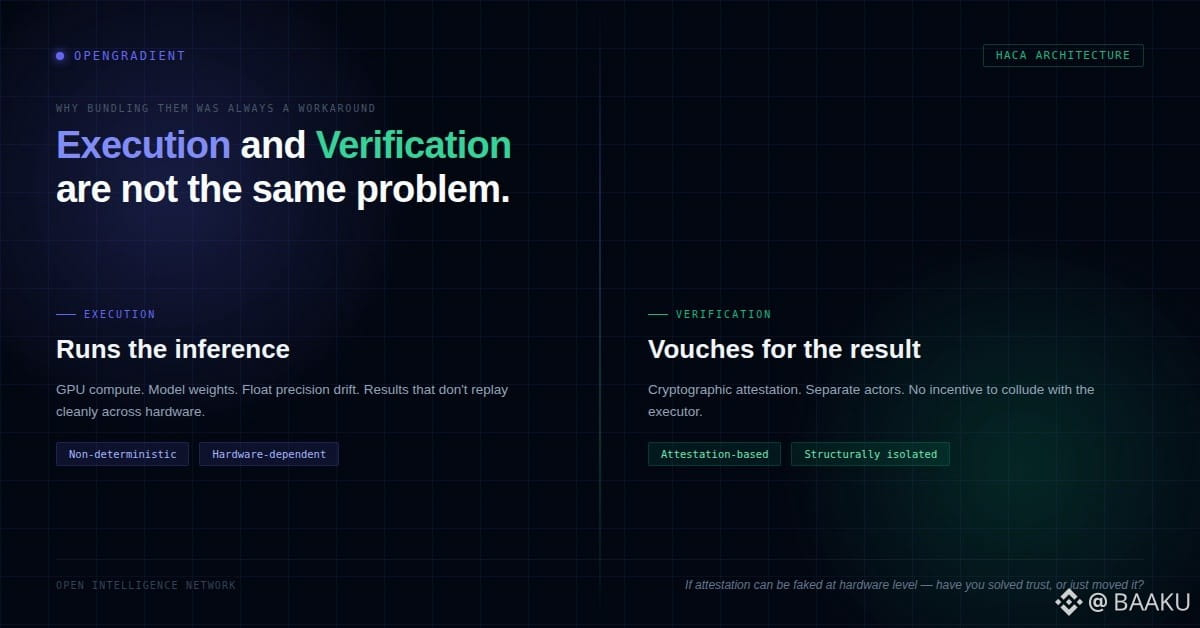
Most blockchains treat execution and verification like they're the same problem. They're not.
Execution is compute. Verification is trust. Bundling them together was always a workaround — not a design choice. And for years, nobody noticed because the models were simple enough that "run it again and check" felt like a real solution.
It doesn't anymore.
AI inference doesn't replay cleanly. Run the same model twice on different hardware, you might get different outputs. Float precision, temperature variance, GPU quirks — the results drift. So if your verification layer is just "re-run and compare," you've already lost. You're not verifying truth. You're verifying consistency under ideal conditions, which is a completely different thing.
This is the gap most people skip over when they talk about "verifiable AI on-chain."
OpenGradient's HACA architecture actually separates these two layers. Execution nodes run inference. A separate verification layer checks the result — using cryptographic attestation, not redundant re-execution. The node that ran the model and the system that vouches for it are structurally different actors with different incentives.
That separation matters more than people realize. When execution and verification are handled by the same logic, the system's trust model is only as good as the executor's honesty. You're not verifying the AI. You're trusting the runner to self-report.
Separate the roles, and the incentive structure actually changes. Verification nodes have no reason to collude with executors — they didn't run the model, they're just checking the proof. That's a real trust boundary, not a theoretical one.
The honest limitation: attestation-based verification is still maturing. The cryptographic overhead is real, and "proof of correct inference" on large models is not a solved problem. The design direction is defensible. But the actual security assumptions are doing a lot of quiet work behind the scenes.
#OpenGradient #DecentralizedAI #AIInference #opg $OPG @OpenGradient
Most blockchains treat execution and verification like they're the same problem. They're not.
Execution is compute. Verification is trust. Bundling them together was always a workaround — not a design choice. And for years, nobody noticed because the models were simple enough that "run it again and check" felt like a real solution.
It doesn't anymore.
AI inference doesn't replay cleanly. Run the same model twice on different hardware, you might get different outputs. Float precision, temperature variance, GPU quirks — the results drift. So if your verification layer is just "re-run and compare," you've already lost. You're not verifying truth. You're verifying consistency under ideal conditions, which is a completely different thing.
This is the gap most people skip over when they talk about "verifiable AI on-chain."
OpenGradient's HACA architecture actually separates these two layers. Execution nodes run inference. A separate verification layer checks the result — using cryptographic attestation, not redundant re-execution. The node that ran the model and the system that vouches for it are structurally different actors with different incentives.
That separation matters more than people realize. When execution and verification are handled by the same logic, the system's trust model is only as good as the executor's honesty. You're not verifying the AI. You're trusting the runner to self-report.
Separate the roles, and the incentive structure actually changes. Verification nodes have no reason to collude with executors — they didn't run the model, they're just checking the proof. That's a real trust boundary, not a theoretical one.
The honest limitation: attestation-based verification is still maturing. The cryptographic overhead is real, and "proof of correct inference" on large models is not a solved problem. The design direction is defensible. But the actual security assumptions are doing a lot of quiet work behind the scenes.
#OpenGradient #DecentralizedAI #AIInference #opg $OPG @OpenGradient
Execution is compute. Verification is trust. Bundling them together was always a workaround — not a design choice. And for years, nobody noticed because the models were simple enough that "run it again and check" felt like a real solution.
It doesn't anymore.
AI inference doesn't replay cleanly. Run the same model twice on different hardware, you might get different outputs. Float precision, temperature variance, GPU quirks — the results drift. So if your verification layer is just "re-run and compare," you've already lost. You're not verifying truth. You're verifying consistency under ideal conditions, which is a completely different thing.
This is the gap most people skip over when they talk about "verifiable AI on-chain."
OpenGradient's HACA architecture actually separates these two layers. Execution nodes run inference. A separate verification layer checks the result — using cryptographic attestation, not redundant re-execution. The node that ran the model and the system that vouches for it are structurally different actors with different incentives.
That separation matters more than people realize. When execution and verification are handled by the same logic, the system's trust model is only as good as the executor's honesty. You're not verifying the AI. You're trusting the runner to self-report.
Separate the roles, and the incentive structure actually changes. Verification nodes have no reason to collude with executors — they didn't run the model, they're just checking the proof. That's a real trust boundary, not a theoretical one.
The honest limitation: attestation-based verification is still maturing. The cryptographic overhead is real, and "proof of correct inference" on large models is not a solved problem. The design direction is defensible. But the actual security assumptions are doing a lot of quiet work behind the scenes.
#OpenGradient #DecentralizedAI #AIInference #opg $OPG @OpenGradient
5
2
97
·
--
Most people think settlement is just the boring backend stuff. The part that "just works."
That's exactly why it keeps breaking at the worst possible moment.
Here's what's actually happening. When an AI model runs an inference — generates an output, makes a decision, scores a result — you have no idea if that output is real. Not in any verifiable sense. You're trusting a black box on someone else's server to tell you the truth. And in 99% of current AI infrastructure, that's the entire security model. Trust me, bro. In production. At scale.
Settlement is supposed to fix this. The idea is clean: you run the model, you prove it ran correctly, you record that proof, and now the output has integrity. Simple.
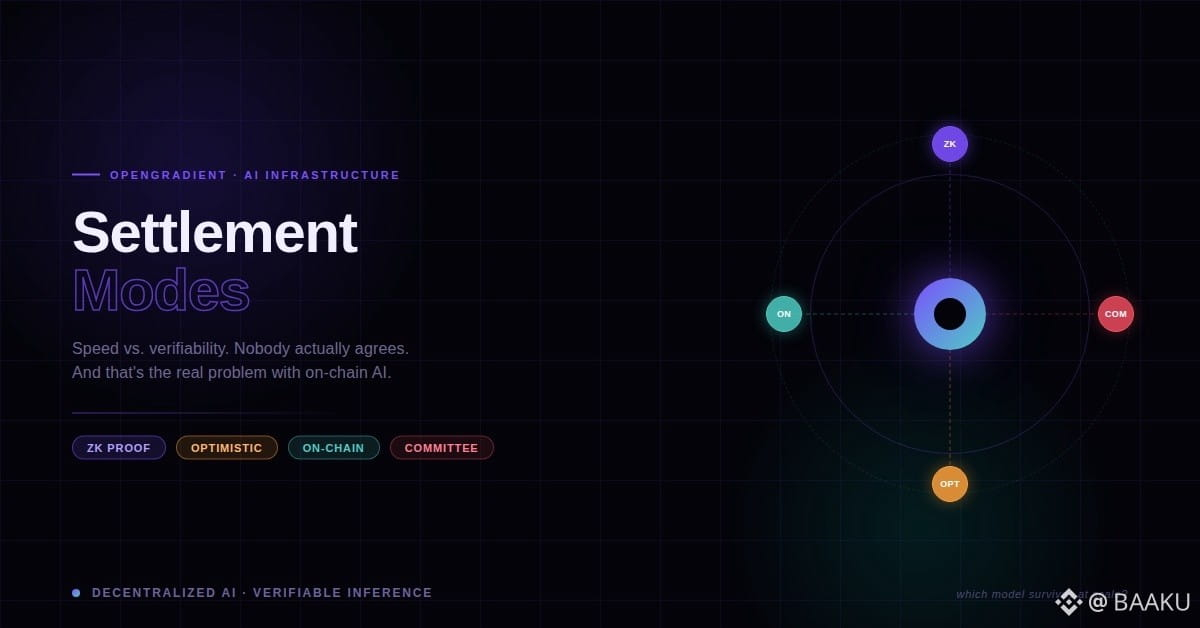
Except the moment you ask how that proof gets settled — on-chain, off-chain, optimistic, ZK, committee-based — you realize nobody actually agrees. And the tradeoff matrix is brutal.
On-chain settlement gives you real verifiability but introduces latency that makes real-time AI inference completely impractical. You can't wait 12 seconds for a block confirmation every time a model makes a call.
Optimistic settlement is fast but pushes the integrity problem forward — you're assuming correctness unless someone challenges it. Most users will never challenge anything. That's just human behavior.
#OpenGradient #AIInference #opg $OPG @OpenGradient
Most people think settlement is just the boring backend stuff. The part that "just works."
That's exactly why it keeps breaking at the worst possible moment.
Here's what's actually happening. When an AI model runs an inference — generates an output, makes a decision, scores a result — you have no idea if that output is real. Not in any verifiable sense. You're trusting a black box on someone else's server to tell you the truth. And in 99% of current AI infrastructure, that's the entire security model. Trust me, bro. In production. At scale.
Settlement is supposed to fix this. The idea is clean: you run the model, you prove it ran correctly, you record that proof, and now the output has integrity. Simple.
Except the moment you ask how that proof gets settled — on-chain, off-chain, optimistic, ZK, committee-based — you realize nobody actually agrees. And the tradeoff matrix is brutal.
On-chain settlement gives you real verifiability but introduces latency that makes real-time AI inference completely impractical. You can't wait 12 seconds for a block confirmation every time a model makes a call.
Optimistic settlement is fast but pushes the integrity problem forward — you're assuming correctness unless someone challenges it. Most users will never challenge anything. That's just human behavior.
#OpenGradient #AIInference #opg $OPG @OpenGradient
That's exactly why it keeps breaking at the worst possible moment.
Here's what's actually happening. When an AI model runs an inference — generates an output, makes a decision, scores a result — you have no idea if that output is real. Not in any verifiable sense. You're trusting a black box on someone else's server to tell you the truth. And in 99% of current AI infrastructure, that's the entire security model. Trust me, bro. In production. At scale.
Settlement is supposed to fix this. The idea is clean: you run the model, you prove it ran correctly, you record that proof, and now the output has integrity. Simple.
Except the moment you ask how that proof gets settled — on-chain, off-chain, optimistic, ZK, committee-based — you realize nobody actually agrees. And the tradeoff matrix is brutal.
On-chain settlement gives you real verifiability but introduces latency that makes real-time AI inference completely impractical. You can't wait 12 seconds for a block confirmation every time a model makes a call.
Optimistic settlement is fast but pushes the integrity problem forward — you're assuming correctness unless someone challenges it. Most users will never challenge anything. That's just human behavior.
#OpenGradient #AIInference #opg $OPG @OpenGradient
6
5
198

A16Z BACKS LOCAL AI REVOLUTION AS ON-DEVICE AGENTS IGNITE THE $AI NARRATIVE! ⚡ 🦈
📌 Silicon Valley heavyweights a16z and Khosla Ventures just threw institutional capital behind Conway Research's Underdog local agent. Running a compact 4B parameter model directly on consumer hardware at 4.5x speed over MLX, this signals a massive structural pivot toward zero-cloud execution. 💡
The smart money is aggressively front-running the shift from bloated data center models to agile on-device intelligence. 📊 As edge compute converges with autonomous agent execution, local AI infrastructure is rapidly becoming the next primary narrative driver across markets. ⚡
🤔 Will local AI agents render centralized cloud models obsolete for daily tasks? 👇
⚠️ Not financial advice. Always manage your risk. 🛡️
🏷️ #AI #CryptoAI #TechTrends #Agents #AIInference
🔥 ⚡
A16Z BACKS LOCAL AI REVOLUTION AS ON-DEVICE AGENTS IGNITE THE $AI NARRATIVE! ⚡ 🦈
📌 Silicon Valley heavyweights a16z and Khosla Ventures just threw institutional capital behind Conway Research's Underdog local agent. Running a compact 4B parameter model directly on consumer hardware at 4.5x speed over MLX, this signals a massive structural pivot toward zero-cloud execution. 💡
The smart money is aggressively front-running the shift from bloated data center models to agile on-device intelligence. 📊 As edge compute converges with autonomous agent execution, local AI infrastructure is rapidly becoming the next primary narrative driver across markets. ⚡
🤔 Will local AI agents render centralized cloud models obsolete for daily tasks? 👇
⚠️ Not financial advice. Always manage your risk. 🛡️
🏷️ #AI #CryptoAI #TechTrends #Agents #AIInference
🔥 ⚡
📌 Silicon Valley heavyweights a16z and Khosla Ventures just threw institutional capital behind Conway Research's Underdog local agent. Running a compact 4B parameter model directly on consumer hardware at 4.5x speed over MLX, this signals a massive structural pivot toward zero-cloud execution. 💡
The smart money is aggressively front-running the shift from bloated data center models to agile on-device intelligence. 📊 As edge compute converges with autonomous agent execution, local AI infrastructure is rapidly becoming the next primary narrative driver across markets. ⚡
🤔 Will local AI agents render centralized cloud models obsolete for daily tasks? 👇
⚠️ Not financial advice. Always manage your risk. 🛡️
🏷️ #AI #CryptoAI #TechTrends #Agents #AIInference
🔥 ⚡
119
ເຂົ້າສູ່ລະບົບເພື່ອສຳຫຼວດເນື້ອຫາເພີ່ມເຕີມ
ເຂົ້າຮ່ວມກຸ່ມຜູ້ໃຊ້ຄຣິບໂຕທົ່ວໂລກໃນ Binance Square.
⚡️ ໄດ້ຮັບຂໍ້ມູນຫຼ້າສຸດ ແລະ ທີ່ມີປະໂຫຍດກ່ຽວກັບຄຣິບໂຕ.
💬 ໄດ້ຮັບຄວາມໄວ້ວາງໃຈຈາກຕະຫຼາດແລກປ່ຽນຄຣິບໂຕທີ່ໃຫຍ່ທີ່ສຸດໃນໂລກ.
👍 ຄົ້ນຫາຂໍ້ມູນເຊີງເລິກທີ່ແທ້ຈາກນັກສ້າງທີ່ໄດ້ຮັບການຢືນຢັນ.
ອີເມວ / ເບີໂທລະສັບ
ຫົວຂໍ້ທີ່ກໍາລັງນິຍົມ
1
#FedOctoberRateHikeOddsFallTo17%
1 views
19 ກຳລັງສົນທະນາ
2
#NvidiaHitsRecordHighUp2.4%
11 views
25 ກຳລັງສົນທະນາ
3
#CanaryFilesAmendedS1ForPEPEETF
1 views
20 ກຳລັງສົນທະນາ
4
#USRussiaUkraineTalksReportedlyIncludeLukoilOilDeal
1,578 views
113 ກຳລັງສົນທະນາ
5
#BitcoinParesGainsAfterRallyTo$86.5K
31,333 views
118 ກຳລັງສົນທະນາ
6
#CerebrasSinksNearly20%OnReportNvidiaToPowerOpenAI
62,139 views
685 ກຳລັງສົນທະນາ
7
#SECProposesCryptoCustodyRules
86,276 views
856 ກຳລັງສົນທະນາ
8
#SECApproves3xLongCryptoCommodityETPs
59,640 views
624 ກຳລັງສົນທະນາ
9
#MASKHitsRecordMarketCapAbove$35M
3,859 views
33 ກຳລັງສົນທະນາ
10
#G7PlansToReleaseUpTo100MBarrelsOilDiesel
46,072 views
549 ກຳລັງສົນທະນາ