
#riskmanagement
riskmanagement
17.6M ຄັ້ງທີ່ເບິ່ງ
68,469 ກຳລັງສົນທະນາ
ມາແຮງ
ຫຼ້າສຸດ

·
--
Thriller #2. Same coin, same week.
On Oct 29 my server bot was liquidated in $TIA (−$49). My second bot, on Veles, was in TIA that same night. It survived: no liquidation, just a deep stop. Tonight it filled its last order.
All 7 orders filled: first buy 0.5521 → last 0.4272 (−22.6%) average 0.4937, position $198 (4x on a $50 deposit)
TIA now at 0.4295: take profit 0.4952:
+15% away, pays less than $0.60 stop 0.3866:
−10% away, costs about $43
That's the shape of this grid: many small takes, one rare big loss. The last order is the biggest on purpose: $64, a third of the whole $198 position. It pulled the take profit down from 0.5347 to 0.4952. From the fill, the coin needs +16% instead of +25%.
The stop was set before the trade: −30% from the first buy. Tonight I only read the numbers. I'll report whichever comes first.
What do you think comes first?
#DCA #trading #RiskManagement #tia
Take profit first (+15%)
Stop first (−10%)
Neither this week
6 ມື້ທີ່ຍັງເຫຼືອ
317

·
--
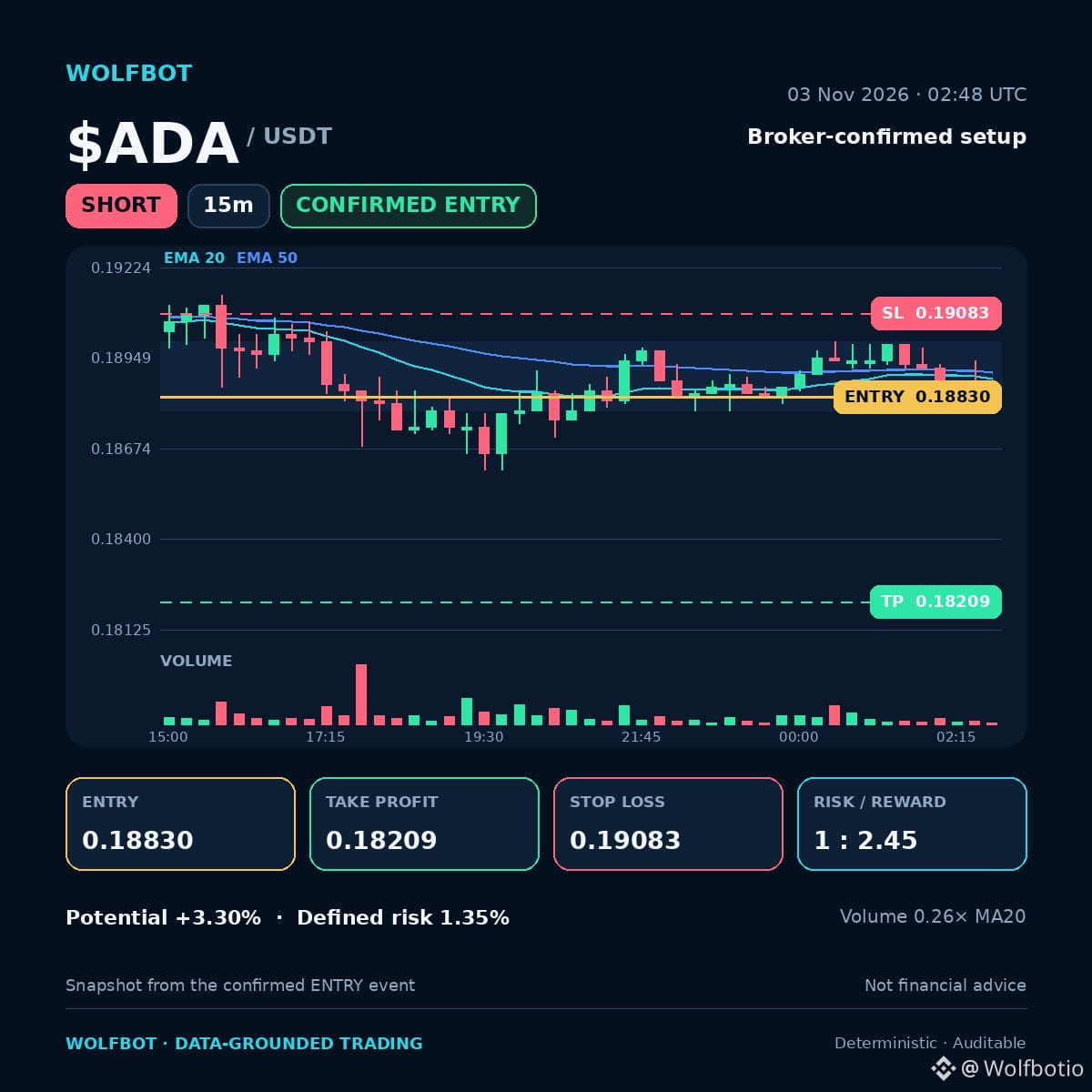
🔴 $ADA SHORT setup · 15m
ADA just slipped below its short-term range on the 15m chart, and the risk is defined before the trade.
📍 Entry 0.18830
🎯 TP 0.18209 (+3.30%)
🛑 SL 0.19083 (-1.35%)
⚖️ Risk / Reward 1 : 2.45
Why it triggered
✅ Rule triggers met: Breakdown M5, EMA bearish, MACD histogram decreasing, Supertrend bearish
✅ Price broke down through its recent short-term range
✅ Price sits below EMA20 and EMA50, with both stacked in the trade's direction
✅ RSI 42.3: momentum still has room, not overextended
👀 Watch: a close beyond the SL level cancels the idea.
WolfBot trade journal: defined risk, not financial advice.
#TradingSetup #RiskManagement
2
347

·
--

ບົດຄວາມ
What Happens to Your Crypto When War Breaks Out? A Survival Guide for Binance InvestorsImagine waking up tomorrow to news of a major global war.
Stock markets are falling. Oil prices are rising. Banks are facing uncertainty. Internet services may be disrupted. Millions of investors are asking the same question:
What happens to my cryptocurrency?
Bitcoin, Ethereum, stablecoins, and crypto exchanges operate in a global digital ecosystem. But that does not mean they are immune to geopolitical crises, financial panic, cyberattacks, or infrastructure failures.
For Binance investors, understanding these risks before a crisis is more valuable than trying to react after it begins.
Let's examine five critical questions.
1. What Could Happen to Bitcoin During a Global War?
Many people describe Bitcoin as digital gold.
However, there is an important difference: Bitcoin does not automatically behave like gold during a crisis.
In the early stages of a major geopolitical shock, investors may sell risky assets to obtain liquidity. This could create significant selling pressure across cryptocurrency markets.
Possible developments include:
Sharp Bitcoin price fluctuations.
Increased volatility in Ethereum and alternative coins.
Reduced market liquidity.
Sudden changes in investor sentiment.
Greater differences between buying and selling prices.
Bitcoin could recover later, but nobody can guarantee when or whether that will happen.
The lesson: Never assume that Bitcoin will automatically protect your portfolio during a war.
2. Are USDT and USDC Safe Havens During a War?
Stablecoins are often used by crypto investors to reduce exposure to price volatility.
But stablecoins are not the same as cash in your bank account.
They involve several risks:
The issuer's ability to maintain its reserves and redemption arrangements.
Potential freezing or restrictions affecting certain addresses.
Blockchain network outages or congestion.
Exchange withdrawal restrictions.
Banking and payment infrastructure disruptions.
Even if a stablecoin maintains its dollar peg, you may not be able to convert it into usable money when you need it.
Remember: Price stability does not guarantee access or liquidity.
3. What If Binance or the Internet Becomes Unavailable?
This is one of the most important risks investors should consider.
A global conflict could create disruptions affecting:
Internet connectivity.
Electricity infrastructure.
Banking services.
International payment systems.
Cryptocurrency exchange operations.
Blockchain network access.
A trading platform may remain operational while some users experience local connectivity problems.
Alternatively, an exchange could temporarily restrict certain services while addressing security or operational risks.
This is why investors should understand the difference between owning crypto through an exchange and controlling their own private keys.
An exchange provides convenience, but third-party custody introduces dependence on the service provider.
Self-custody provides direct control, but also makes the investor responsible for protecting private keys and recovery phrases.
Neither option eliminates every risk.
4. What If the Conflict Escalates to a Nuclear Attack?
This is an extreme hypothetical scenario, but it deserves serious consideration.
A nuclear attack could cause consequences far beyond financial markets.
Depending on the scale and location, possible effects could include:
Major electricity infrastructure damage.
Telecommunications and internet disruptions.
Banking and payment system interruptions.
Physical damage to data centers and network infrastructure.
Severe disruptions to transportation and supply chains.
Financial market closures or restrictions.
Bitcoin's blockchain is decentralized, but individual investors still depend on electricity, devices, internet access, network infrastructure, and functioning markets.
A decentralized blockchain does not mean every person can access it under every circumstance.
In such a scenario, personal safety, essential supplies, and reliable communication must come before cryptocurrency trading.
No digital asset should be treated as a guaranteed survival tool.
5. The Crypto Investor's Emergency Plan
Instead of trying to predict the next geopolitical event, investors should prepare for several possible disruptions.
Here is a practical checklist:
Before a crisis:
Avoid excessive leverage and highly risky Futures positions.
Never invest money needed for essential living expenses.
Consider distributing long-term holdings across appropriate custody arrangements.
Learn how to use a reputable hardware wallet before you actually need one.
Keep recovery phrases offline, secure, and separate from your devices.
Enable strong authentication and protect your email account.
Keep a reasonable amount of accessible emergency funds outside crypto.
During a crisis:
Avoid panic selling.
Do not make major decisions based on unverified social media reports.
Check official Binance announcements and network status information.
Avoid suspicious links claiming to offer emergency withdrawals or recovery services.
Do not rush into unfamiliar wallets or blockchain networks.
Avoid using leverage during extreme volatility.
After the crisis:
Verify your account balances and transaction history.
Confirm that withdrawal networks are operational.
Review your portfolio exposure and liquidity.
Reassess your investment strategy based on verified information.
Avoid rushing back into the market simply because prices have fallen.
6. The Biggest Mistake: Confusing Digital Ownership With Guaranteed Access
There is a critical distinction between owning a cryptocurrency and being able to access, transfer, or exchange it.
You may own Bitcoin on a blockchain, but still be unable to access it if you lose your recovery phrase or cannot connect to the network.
You may hold USDT, but still face restrictions when trying to redeem or convert it.
You may have a Binance balance, but temporarily lose access to trading or withdrawals during an operational disruption.
These are different risks, and a responsible investor should understand all of them.
Final Thought: Prepare for Uncertainty, Not Just Market Volatility
Nobody knows exactly how cryptocurrency markets would behave during a third world war or a nuclear conflict.
But one principle remains clear:
The best time to prepare your crypto emergency plan is before you need it.
Do not build your entire financial future around the assumption that exchanges will always be available, stablecoins will always be redeemable, or the internet will always work.
A smart investor does not simply ask:
"How much can I make if Bitcoin rises?"
A smart investor also asks:
"How will I protect my assets if the systems I depend on stop working?"
Let's Discuss
If a major global war started tomorrow, what would you do with your crypto holdings?
A) Keep them on Binance and continue monitoring the market.
B) Move long-term holdings to a personal hardware wallet.
C) Convert part of the portfolio into stablecoins.
D) Reduce crypto exposure and prioritize emergency liquidity.
E) Follow a diversified strategy combining several of these approaches.
Share your reasoning in the comments. Your perspective could help other investors prepare more intelligently.
Disclaimer: This article is for educational purposes only and does not constitute financial or investment advice. The scenarios discussed are hypothetical, not predictions. Always conduct your own research (DYOR) and assess your personal risk tolerance.
#Crypto
#Bitcoin
#Binance
#CryptoSecurity
#RiskManagement $BTC
What Happens to Your Crypto When War Breaks Out? A Survival Guide for Binance Investors
Imagine waking up tomorrow to news of a major global war.
Stock markets are falling. Oil prices are rising. Banks are facing uncertainty. Internet services may be disrupted. Millions of investors are asking the same question:
What happens to my cryptocurrency?
Bitcoin, Ethereum, stablecoins, and crypto exchanges operate in a global digital ecosystem. But that does not mean they are immune to geopolitical crises, financial panic, cyberattacks, or infrastructure failures.
For Binance investors, understanding these risks before a crisis is more valuable than trying to react after it begins.
Let's examine five critical questions.
1. What Could Happen to Bitcoin During a Global War?
Many people describe Bitcoin as digital gold.
However, there is an important difference: Bitcoin does not automatically behave like gold during a crisis.
In the early stages of a major geopolitical shock, investors may sell risky assets to obtain liquidity. This could create significant selling pressure across cryptocurrency markets.
Possible developments include:
Sharp Bitcoin price fluctuations.
Increased volatility in Ethereum and alternative coins.
Reduced market liquidity.
Sudden changes in investor sentiment.
Greater differences between buying and selling prices.
Bitcoin could recover later, but nobody can guarantee when or whether that will happen.
The lesson: Never assume that Bitcoin will automatically protect your portfolio during a war.
2. Are USDT and USDC Safe Havens During a War?
Stablecoins are often used by crypto investors to reduce exposure to price volatility.
But stablecoins are not the same as cash in your bank account.
They involve several risks:
The issuer's ability to maintain its reserves and redemption arrangements.
Potential freezing or restrictions affecting certain addresses.
Blockchain network outages or congestion.
Exchange withdrawal restrictions.
Banking and payment infrastructure disruptions.
Even if a stablecoin maintains its dollar peg, you may not be able to convert it into usable money when you need it.
Remember: Price stability does not guarantee access or liquidity.
3. What If Binance or the Internet Becomes Unavailable?
This is one of the most important risks investors should consider.
A global conflict could create disruptions affecting:
Internet connectivity.
Electricity infrastructure.
Banking services.
International payment systems.
Cryptocurrency exchange operations.
Blockchain network access.
A trading platform may remain operational while some users experience local connectivity problems.
Alternatively, an exchange could temporarily restrict certain services while addressing security or operational risks.
This is why investors should understand the difference between owning crypto through an exchange and controlling their own private keys.
An exchange provides convenience, but third-party custody introduces dependence on the service provider.
Self-custody provides direct control, but also makes the investor responsible for protecting private keys and recovery phrases.
Neither option eliminates every risk.
4. What If the Conflict Escalates to a Nuclear Attack?
This is an extreme hypothetical scenario, but it deserves serious consideration.
A nuclear attack could cause consequences far beyond financial markets.
Depending on the scale and location, possible effects could include:
Major electricity infrastructure damage.
Telecommunications and internet disruptions.
Banking and payment system interruptions.
Physical damage to data centers and network infrastructure.
Severe disruptions to transportation and supply chains.
Financial market closures or restrictions.
Bitcoin's blockchain is decentralized, but individual investors still depend on electricity, devices, internet access, network infrastructure, and functioning markets.
A decentralized blockchain does not mean every person can access it under every circumstance.
In such a scenario, personal safety, essential supplies, and reliable communication must come before cryptocurrency trading.
No digital asset should be treated as a guaranteed survival tool.
5. The Crypto Investor's Emergency Plan
Instead of trying to predict the next geopolitical event, investors should prepare for several possible disruptions.
Here is a practical checklist:
Before a crisis:
Avoid excessive leverage and highly risky Futures positions.
Never invest money needed for essential living expenses.
Consider distributing long-term holdings across appropriate custody arrangements.
Learn how to use a reputable hardware wallet before you actually need one.
Keep recovery phrases offline, secure, and separate from your devices.
Enable strong authentication and protect your email account.
Keep a reasonable amount of accessible emergency funds outside crypto.
During a crisis:
Avoid panic selling.
Do not make major decisions based on unverified social media reports.
Check official Binance announcements and network status information.
Avoid suspicious links claiming to offer emergency withdrawals or recovery services.
Do not rush into unfamiliar wallets or blockchain networks.
Avoid using leverage during extreme volatility.
After the crisis:
Verify your account balances and transaction history.
Confirm that withdrawal networks are operational.
Review your portfolio exposure and liquidity.
Reassess your investment strategy based on verified information.
Avoid rushing back into the market simply because prices have fallen.
6. The Biggest Mistake: Confusing Digital Ownership With Guaranteed Access
There is a critical distinction between owning a cryptocurrency and being able to access, transfer, or exchange it.
You may own Bitcoin on a blockchain, but still be unable to access it if you lose your recovery phrase or cannot connect to the network.
You may hold USDT, but still face restrictions when trying to redeem or convert it.
You may have a Binance balance, but temporarily lose access to trading or withdrawals during an operational disruption.
These are different risks, and a responsible investor should understand all of them.
Final Thought: Prepare for Uncertainty, Not Just Market Volatility
Nobody knows exactly how cryptocurrency markets would behave during a third world war or a nuclear conflict.
But one principle remains clear:
The best time to prepare your crypto emergency plan is before you need it.
Do not build your entire financial future around the assumption that exchanges will always be available, stablecoins will always be redeemable, or the internet will always work.
A smart investor does not simply ask:
"How much can I make if Bitcoin rises?"
A smart investor also asks:
"How will I protect my assets if the systems I depend on stop working?"
Let's Discuss
If a major global war started tomorrow, what would you do with your crypto holdings?
A) Keep them on Binance and continue monitoring the market.
B) Move long-term holdings to a personal hardware wallet.
C) Convert part of the portfolio into stablecoins.
D) Reduce crypto exposure and prioritize emergency liquidity.
E) Follow a diversified strategy combining several of these approaches.
Share your reasoning in the comments. Your perspective could help other investors prepare more intelligently.
Disclaimer: This article is for educational purposes only and does not constitute financial or investment advice. The scenarios discussed are hypothetical, not predictions. Always conduct your own research (DYOR) and assess your personal risk tolerance.
#Crypto
#Bitcoin
#Binance
#CryptoSecurity
#RiskManagement $BTC
111

ບົດຄວາມ
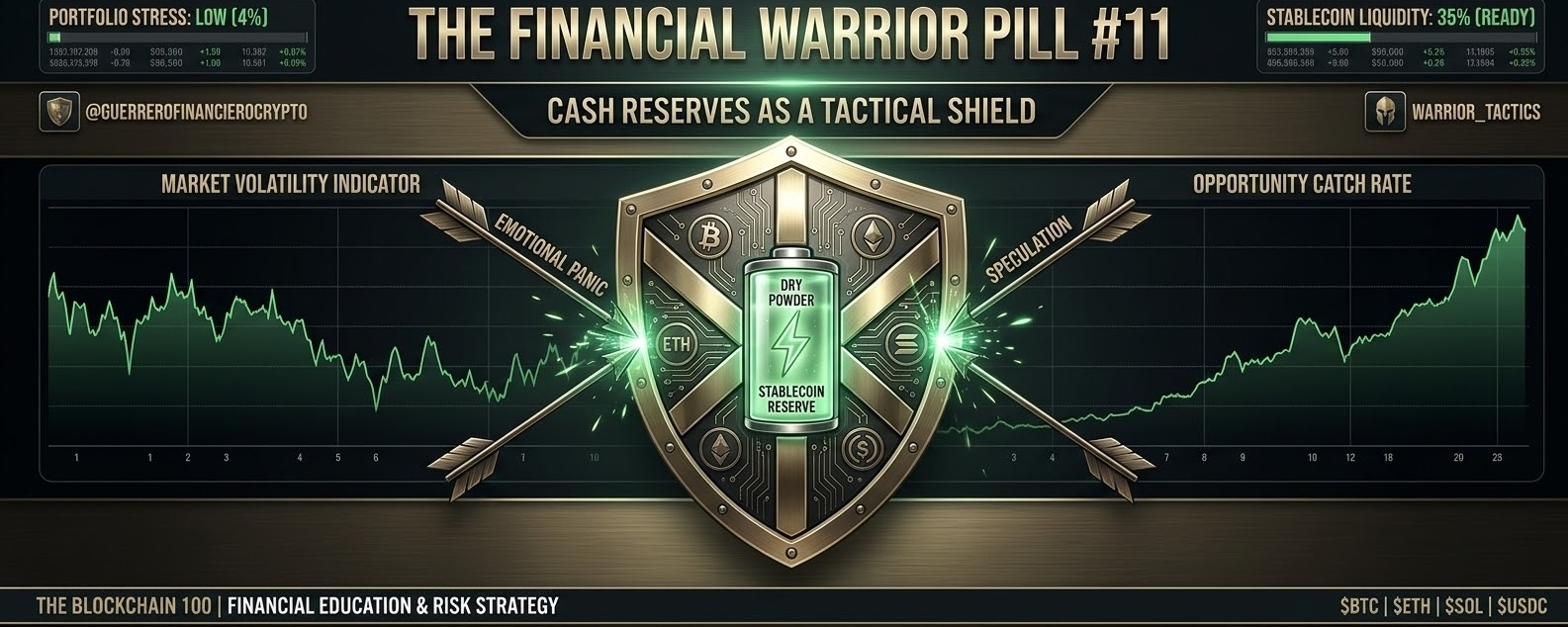
PILL #11: CASH RESERVES AS A TACTICAL SHIELDPILL #11: CASH RESERVES AS A TACTICAL SHIELD
In high-volatility markets, holding cash isn't dead capital; it’s your active defensive strategy to survive and strike.
Three pillars for managing your reserves:
Zero Emotional Panic: Keeping cash reserves (stablecoins) prevents sudden market drops from forcing liquidations.
Hunter's Agility: Cash gives you the freedom to execute buys at key support zones without scrambling out of desperation.
Capital Protection First: Defending your main portfolio always takes priority over blind speculation.
Discipline in risk management beats speculation every single time.
$BTC $ETH | $SOL $USDC
#TheBlockchain100 #DiarioGuerreroFinanciero #Write2Earn #Stablecoins #PortfolioManagement #RiskManagement
⚠️ Institutional Disclaimer: Educational and informational perspective only. Not financial advice. DYOR.
PILL #11: CASH RESERVES AS A TACTICAL SHIELD
PILL #11: CASH RESERVES AS A TACTICAL SHIELD
In high-volatility markets, holding cash isn't dead capital; it’s your active defensive strategy to survive and strike.
Three pillars for managing your reserves:
Zero Emotional Panic: Keeping cash reserves (stablecoins) prevents sudden market drops from forcing liquidations.
Hunter's Agility: Cash gives you the freedom to execute buys at key support zones without scrambling out of desperation.
Capital Protection First: Defending your main portfolio always takes priority over blind speculation.
Discipline in risk management beats speculation every single time.
$BTC $ETH | $SOL $USDC
#TheBlockchain100 #DiarioGuerreroFinanciero #Write2Earn #Stablecoins #PortfolioManagement #RiskManagement
⚠️ Institutional Disclaimer: Educational and informational perspective only. Not financial advice. DYOR.
1
169

·
--
ບົດຄວາມ
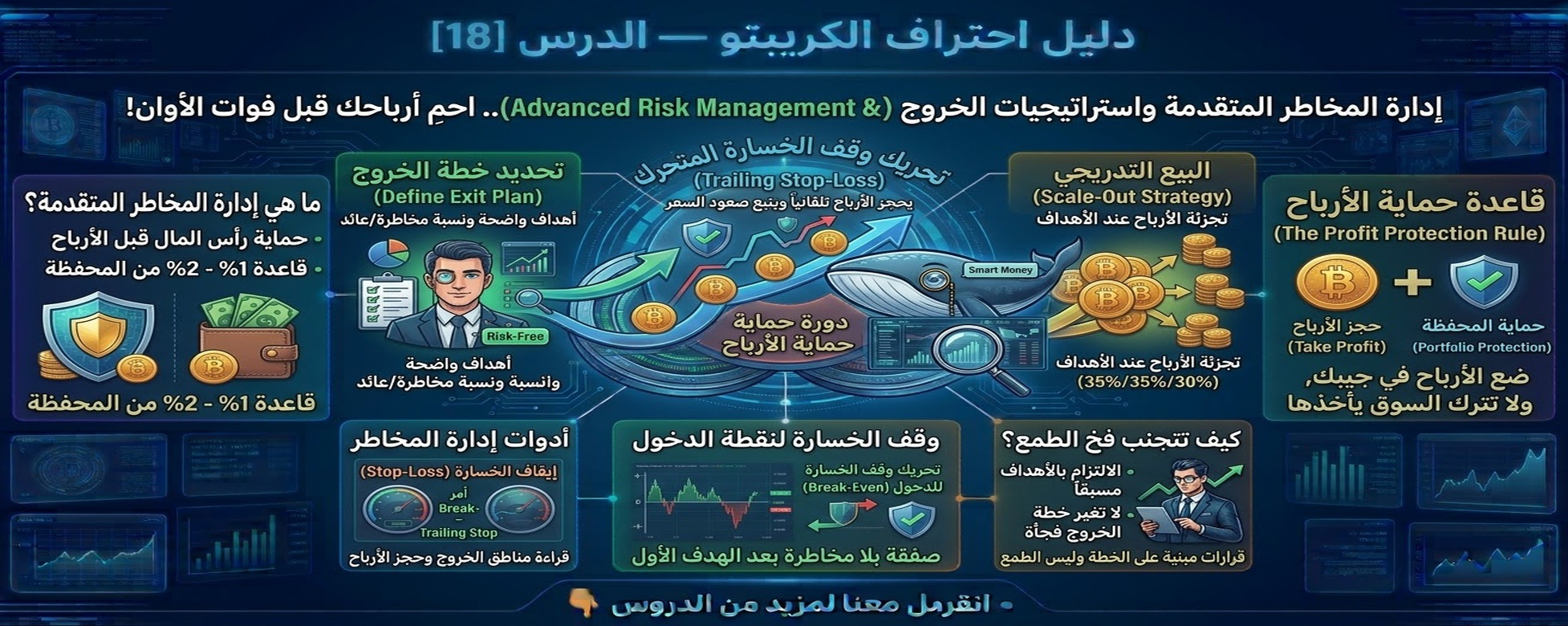
📊 دليل احتراف الكريبتو — الدرس [18]: إدارة المخاطر المتقدمة واستراتيجيات الخروج📊 دليل احتراف الكريبتو — الدرس [18]: إدارة المخاطر المتقدمة واستراتيجيات الخروج (Advanced Risk Management & Exit Strategies).. احمِ أرباحك قبل فوات الأوان! 📈✨
أهلاً بك في الدرس الثامن عشر من سلسلتنا التعليمية! بعد أن تعرفنا في الدرس السابق على كيفية قراءة مشاعر السوق ومؤشرات الخوف والطمع، سننتقل اليوم إلى الخطوة الحاسمة التي تفصل بين المتداول الهاوي والمحترف الحقيقي: إدارة المخاطر المتقدمة واستراتيجيات الخروج. كسب المال في الكريبتو أمرٌ ممكن، لكن الحفاظ عليه وحمايته من تقلبات السوق هو الفن الحقيقي. 📉💡
1️⃣ لماذا تحتاج إلى استراتيجية خروج واضحة؟ ⚙️
الكثير من المتداولين يمتلكون خطة دقيقة جداً للدخول في الصفقات، لكنهم يعتمدون على "الحظ والعشوائية" عند الخروج! الخروج العشوائي إما أن يحرمك من أرباح ضخمة كنت ستجنيها، أو يتركك تواجه هبوطاً مفاجئاً يحول أرباحك إلى خسائر مؤلمة.
2️⃣ أهم استراتيجيات الخروج الاحترافية: 🔄
* البيع التدريجي (DCA Out / Scale-Out): 📊
* بدلًا من بيع كامل صفقتك دفعة واحدة عند الهدف، قُم بتجزئة عملية البيع (مثلاً: بيع 35% من الصفقة عند الهدف الأول، 35% عند الهدف الثاني، وترك الـ 30% الباقية لتتحرك بحرية مع صعود السعر). هذه الطريقة تحميك من الندم في حال واصل السعر صعوده الجنوني.
* تحريك وقف الخسارة لنقطة الدخول (Break-Even Stop): 🛡️
* عندما يتحرك السعر لصالحك ويصل لهدفك الأول، قم فوراً بتعديل نقطة "وقف الخسارة" لتصبح عند سعر دخولك الأصلي. بهذه السهولة تتحول صفقتك إلى "صفقة بلا خسارة" (Risk-Free Trade)، فأنت إما رابح أو خارج برأس مالك كاملاً.
* وقف الخسارة المتحرك (Trailing Stop-Loss): 📈
* أمر ذكي يتحرك تلقائياً صعوداً مع صعود السعر ويحافظ على مسافة آمنة تحته. فكلما صعدت العملة، صعد معه وقف الخسارة ليحجز أرباحك تدريجياً، وبمجرد أن ينعكس السعر ويهبط، يتم بيع الصفقة تلقائياً وأنت في منطقة الأرباح.
3️⃣ قواعد ذهبية لإدارة المخاطر المتقدمة: 🎯🛡️
* لا تخاطر بأكثر مما تستطيع تحمل خسارته: مهما كانت قوة الصفقة متأكدة بنظرك، تذكر دائماً أن أسواق الكريبتو لا توجد فيها ضمانات بنسبة 100%. قاعدة 1% إلى 2% من إجمالي المحفظة لكل صفقة هي درع الأمان الأبدي.
* احذر فخ الطمع المتزايد: ضع أهدافك بوضوح قبل دخول الصفقة ولا تغيرها طمعاً في المزيد لمجرد أن الشارت أخضر، فالطمع المتأخر هو أكبر سارق للأرباح.
💡 خلاصة درس اليوم:
الدخول الجيد يمنحك بداية موفقة، لكن الخروج الذكي هو الذي يضع الأرباح الفعليّة في جيبك ويحميك من قسوة الانعكاسات المفاجئة في السوق. 🚀💰
👇 شاركونا في التعليقات:
هل تعتمد على بيع كامل صفقتك عند الهدف الأول أم تفضل استراتيجية البيع التدريجي (Scale-Out)؟ 🤔
$BTC
$ETH
$BNB
#bitcoin
#BinanceSquare
#CryptoTrading.
#RiskManagement
📊 دليل احتراف الكريبتو — الدرس [18]: إدارة المخاطر المتقدمة واستراتيجيات الخروج
📊 دليل احتراف الكريبتو — الدرس [18]: إدارة المخاطر المتقدمة واستراتيجيات الخروج (Advanced Risk Management & Exit Strategies).. احمِ أرباحك قبل فوات الأوان! 📈✨
أهلاً بك في الدرس الثامن عشر من سلسلتنا التعليمية! بعد أن تعرفنا في الدرس السابق على كيفية قراءة مشاعر السوق ومؤشرات الخوف والطمع، سننتقل اليوم إلى الخطوة الحاسمة التي تفصل بين المتداول الهاوي والمحترف الحقيقي: إدارة المخاطر المتقدمة واستراتيجيات الخروج. كسب المال في الكريبتو أمرٌ ممكن، لكن الحفاظ عليه وحمايته من تقلبات السوق هو الفن الحقيقي. 📉💡
1️⃣ لماذا تحتاج إلى استراتيجية خروج واضحة؟ ⚙️
الكثير من المتداولين يمتلكون خطة دقيقة جداً للدخول في الصفقات، لكنهم يعتمدون على "الحظ والعشوائية" عند الخروج! الخروج العشوائي إما أن يحرمك من أرباح ضخمة كنت ستجنيها، أو يتركك تواجه هبوطاً مفاجئاً يحول أرباحك إلى خسائر مؤلمة.
2️⃣ أهم استراتيجيات الخروج الاحترافية: 🔄
* البيع التدريجي (DCA Out / Scale-Out): 📊
* بدلًا من بيع كامل صفقتك دفعة واحدة عند الهدف، قُم بتجزئة عملية البيع (مثلاً: بيع 35% من الصفقة عند الهدف الأول، 35% عند الهدف الثاني، وترك الـ 30% الباقية لتتحرك بحرية مع صعود السعر). هذه الطريقة تحميك من الندم في حال واصل السعر صعوده الجنوني.
* تحريك وقف الخسارة لنقطة الدخول (Break-Even Stop): 🛡️
* عندما يتحرك السعر لصالحك ويصل لهدفك الأول، قم فوراً بتعديل نقطة "وقف الخسارة" لتصبح عند سعر دخولك الأصلي. بهذه السهولة تتحول صفقتك إلى "صفقة بلا خسارة" (Risk-Free Trade)، فأنت إما رابح أو خارج برأس مالك كاملاً.
* وقف الخسارة المتحرك (Trailing Stop-Loss): 📈
* أمر ذكي يتحرك تلقائياً صعوداً مع صعود السعر ويحافظ على مسافة آمنة تحته. فكلما صعدت العملة، صعد معه وقف الخسارة ليحجز أرباحك تدريجياً، وبمجرد أن ينعكس السعر ويهبط، يتم بيع الصفقة تلقائياً وأنت في منطقة الأرباح.
3️⃣ قواعد ذهبية لإدارة المخاطر المتقدمة: 🎯🛡️
* لا تخاطر بأكثر مما تستطيع تحمل خسارته: مهما كانت قوة الصفقة متأكدة بنظرك، تذكر دائماً أن أسواق الكريبتو لا توجد فيها ضمانات بنسبة 100%. قاعدة 1% إلى 2% من إجمالي المحفظة لكل صفقة هي درع الأمان الأبدي.
* احذر فخ الطمع المتزايد: ضع أهدافك بوضوح قبل دخول الصفقة ولا تغيرها طمعاً في المزيد لمجرد أن الشارت أخضر، فالطمع المتأخر هو أكبر سارق للأرباح.
💡 خلاصة درس اليوم:
الدخول الجيد يمنحك بداية موفقة، لكن الخروج الذكي هو الذي يضع الأرباح الفعليّة في جيبك ويحميك من قسوة الانعكاسات المفاجئة في السوق. 🚀💰
👇 شاركونا في التعليقات:
هل تعتمد على بيع كامل صفقتك عند الهدف الأول أم تفضل استراتيجية البيع التدريجي (Scale-Out)؟ 🤔
$BTC
$ETH
$BNB
#bitcoin
#BinanceSquare
#CryptoTrading.
#RiskManagement
اليسر لتعليم الكريبتو:
تسلم يا غالي وكلامك في الصميم! 🤝 جني الأرباح هو الفن الأهم الذي يغفل عنه الكثيرون؛ فالمحفظة تنمو بالسيولة المحجوزة وليس بالأرقام على الشارت. يسعدني جداً وعيك الفني ومشاركتك الدائمة التي تزيد النقاش قيمة.
يا مبدعين، شاركونا في التعليقات: ما هي أصعب عقبة تواجهكم عند محاولة الالتزام بخطة تأمين الأرباح؟"
$BTC $BNB
#اليسر_لتعليم_الكريبتو
#إدارة_المخاطر
#تداول_العملات_الرقمية
#الوعي_المالي
#مجتمع_بينانس
3
133

·
--
ບົດຄວາມ
Crypto Hype Radar: Today's Hot Coins, Fading Buzz, and How Not to Get RektThe market woke up with a modest rally on the big names while a handful of meme-ish tokens exploded like fireworks. I'm watching the charts, sipping coffee, and reminding myself that every meme has a expiration date, so are you ready to dodge the fallout?
Big Players Still Holding the Spotlight
$BTC is trading at $77,793, up +1.26% in the last 24 hours but down, 3.85% over the week. The range of $76,389 to $78,063 shows it's still bouncing between support and resistance, and the $979M volume tells me traders are testing the waters, not diving in. $ETH mirrors the vibe at $2,291 with a +1.77% daily gain and a, 2.53% weekly dip, moving inside $2,241-$2,309 on $334M volume. Even $BNB and SOL are inching higher, $700.45 (+0.31%) and $93.40 (+1.64%) respectively, yet both are on a weekly slide, hinting that the bullish sentiment is still fragile.
The Overnight Sprinters
If you love a good meme surge, the top gainer list is a playground. HOT vaulted +25.74% to $0.000552, and BMT wasn't far behind with +25.66% at $0.0263. PUMP pumped +9.91% to $0.004349, while ZEC and ENA added modest lifts of +6.43% and +3.16%. Those numbers look tasty, but remember the volume spikes are often short-lived, and the Fear & Greed Index sitting at 26 (Fear) signals that the crowd is already nervous.
Why Hype Burns Out Fast
Fear is a powerful accelerator. Yesterday's index was 37 and a week ago it was 48, so the market is sliding into a more cautious mood. When a token's price rockets on hype, liquidity dries up fast, and any negative tweet or a sudden sell-off can crush the momentum. The weekly declines on the majors show that even solid projects can feel the chill when the broader sentiment turns sour.
Risk Management Tips for Meme Hunters
First, size your position so a single loss won't wipe you out, think "one meme per day, not the whole dinner." Second, keep an eye on volume; a spike without sustained buying pressure is a red flag. Third, set mental stop-losses based on how much you're willing to lose, not on a target price. Finally, stay diversified, mix a few blue-chip coins with the wild cards, and you'll be less likely to get caught in a flash crash.
What meme coin or blue-chip move has you most excited today, and how are you protecting yourself from the inevitable pull-back?
Not financial advice.
#CryptoTrends #MemeCoins #RiskManagement #MarketWatch
Crypto Hype Radar: Today's Hot Coins, Fading Buzz, and How Not to Get Rekt
The market woke up with a modest rally on the big names while a handful of meme-ish tokens exploded like fireworks. I'm watching the charts, sipping coffee, and reminding myself that every meme has a expiration date, so are you ready to dodge the fallout?
Big Players Still Holding the Spotlight
$BTC is trading at $77,793, up +1.26% in the last 24 hours but down, 3.85% over the week. The range of $76,389 to $78,063 shows it's still bouncing between support and resistance, and the $979M volume tells me traders are testing the waters, not diving in. $ETH mirrors the vibe at $2,291 with a +1.77% daily gain and a, 2.53% weekly dip, moving inside $2,241-$2,309 on $334M volume. Even $BNB and SOL are inching higher, $700.45 (+0.31%) and $93.40 (+1.64%) respectively, yet both are on a weekly slide, hinting that the bullish sentiment is still fragile.
The Overnight Sprinters
If you love a good meme surge, the top gainer list is a playground. HOT vaulted +25.74% to $0.000552, and BMT wasn't far behind with +25.66% at $0.0263. PUMP pumped +9.91% to $0.004349, while ZEC and ENA added modest lifts of +6.43% and +3.16%. Those numbers look tasty, but remember the volume spikes are often short-lived, and the Fear & Greed Index sitting at 26 (Fear) signals that the crowd is already nervous.
Why Hype Burns Out Fast
Fear is a powerful accelerator. Yesterday's index was 37 and a week ago it was 48, so the market is sliding into a more cautious mood. When a token's price rockets on hype, liquidity dries up fast, and any negative tweet or a sudden sell-off can crush the momentum. The weekly declines on the majors show that even solid projects can feel the chill when the broader sentiment turns sour.
Risk Management Tips for Meme Hunters
First, size your position so a single loss won't wipe you out, think "one meme per day, not the whole dinner." Second, keep an eye on volume; a spike without sustained buying pressure is a red flag. Third, set mental stop-losses based on how much you're willing to lose, not on a target price. Finally, stay diversified, mix a few blue-chip coins with the wild cards, and you'll be less likely to get caught in a flash crash.
What meme coin or blue-chip move has you most excited today, and how are you protecting yourself from the inevitable pull-back?
Not financial advice.
#CryptoTrends #MemeCoins #RiskManagement #MarketWatch
17

·
--
Protect your capital first.
Risk management isn't just about stop-losses; it's about emotional control.
Trade small, trade smart.
Never risk more than you can afford to lose on a single trade.
Greed kills more accounts than bad entries.
Preserve your capital to fight another day.
Capital preservation is profit preservation.
#RiskManagement #TradingTips

Mastering Risk Management in Crypto Trading: A Systematic Framework for Capital PreservationIn the digital asset market, retail and intermediate traders often spend hundreds of hours researching entry signals, chart patterns, and technical indicators. However, market history consistently demonstrates that operational survival relies far less on entry precision and far more on risk management. Digital assets operate in a 24/7 trading environment characterized by sharp volatility, rapid liquidity shifts, and macroeconomic sensitivity. Without a structured risk framework, even a strategy with a high win rate can succumb to sudden drawdowns.
This article provides a practical, quantitative framework designed for intermediate traders looking to transition from speculative trading to systematic capital preservation.
---
### 1. The Mathematics of Capital Preservation
To build a resilient trading strategy, one must first understand the asymmetric nature of financial drawdowns. Loss recovery is non-linear; as losses deepen, the gain required to break even expands exponentially.
* A **10% loss** requires an **11.1% gain** to regain starting capital.
* A **25% loss** requires a **33.3% gain** to break even.
* A **50% loss** requires a **100% gain** to recover.
* An **80% loss** requires a **400% gain** to return to baseline.
When capital declines significantly, a trader is forced to take on disproportionately higher risk simply to regain initial balance. The primary objective of any systematic trader, therefore, is not maximizing returns on winning trades, but limiting drawdowns so that compounding interest can function over long time horizons.
---
### 2. The Core Rule: Account Equity Risk Sizing
One of the most frequent mistakes made by intermediate traders is confusing **position size** with **trade risk**. Risk is defined strictly as the absolute dollar amount lost if a trade hits its invalidation point (stop-loss).
A standard benchmark utilized by quantitative funds and professional traders is the **1% to 2% Rule**. Under this constraint, a trader never risks more than 1% to 2% of their total account equity on any single setup.
#### The Position Sizing Formula
To calculate precise position sizing based on risk tolerance, use the following equation:
$$\text{Trade Risk Amount (\$) } = \text{Total Portfolio Value} \times \text{Risk Percentage}$$
$$\text{Position Size (in units)} = \frac{\text{Trade Risk Amount (\$)}}{\text{Entry Price} - \text{Stop-Loss Price}}$$
#### Practical Example
Consider a trader with a portfolio value of **$10,000** who wishes to risk **1.5%** on a trade setup.
1. **Calculate Total Risk Amount**:
$$\$10,000 \times 0.015 = \$150$$
The maximum allowable loss for this trade is $150.
2. **Define Technical Invalidation**:
Suppose Bitcoin is trading at **$60,000**, and technical support dictates that the trade thesis is invalid if the price breaks below **$57,000**.
$$\text{Risk per Unit} = \$60,000 - \$57,000 = \$3,000$$
3. **Determine Position Size**:
$$\text{Position Size} = \frac{\$150}{\$3,000} = 0.05 \text{ Bitcoin}$$
4. **Calculate Total Capital Allocated**:
$$0.05 \text{ Bitcoin} \times \$60,000 = \$3,000$$
In this scenario, the trader enters a position worth $3,000 (30% of portfolio capital), but the actual monetary risk remains strictly locked at $150 (1.5% of equity). If the price touches $57,000, the trade triggers a stop-loss, leaving the remaining portfolio equity at $9,850.
---
### 3. Structural vs. Arbitrary Stop-Loss Placement
A common pitfall is assigning arbitrary percentage-based stop-losses (e.g., placing a stop exactly 2% below entry regardless of chart context). Markets do not respect arbitrary percentages; they react to structural supply and demand zones, liquidity pools, and volatility ranges.
#### Technical Structure Placement
Stop-loss levels should be placed at points of technical invalidation—prices where the initial trade thesis becomes explicitly wrong. This includes levels slightly beyond major swing highs/lows, established order blocks, or key support levels.
#### Volatility-Adjusted Stops (ATR)
Because market volatility fluctuates constantly, static distance stops can lead to premature exits during high-volatility regimes. Utilizing tools like the Average True Range (ATR) helps adjust stop distance based on market conditions. For instance, setting a stop at a distance of $1.5 \times \text{ATR}$ below a support zone provides market noise buffer while maintaining logical boundaries.
---
### 4. Mathematical Expectancy and Risk-to-Reward Ratios
A profitable trading system does not require a high win rate. In fact, many successful trend-following systems operate with win rates between 35% and 45%. The viability of a system depends on the interaction between its **win rate** and its **Risk-to-Reward Ratio (RRR)**.
#### Defining Expected Value (EV)
mathematical expectancy measures the average amount a trader can expect to win or lose per dollar at risk.
$$\text{EV} = (\text{Win Rate} \times \text{Average Win}) - (\text{Loss Rate} \times \text{Average Loss})$$
#### Comparing Two Strategies
* **Strategy A (High Win Rate, Poor RRR)**:
* Win Rate: 80%
* Average Win: $50
* Average Loss: $250
* $$\text{EV} = (0.80 \times 50) - (0.20 \times 250) = 40 - 50 = -\$10$$
* *Result*: Negative expectancy. Despite winning 8 out of 10 trades, the strategy loses capital over time.
* **Strategy B (Lower Win Rate, Strong RRR)**:
* Win Rate: 40%
* Average Win: $300 (1:3 Risk-to-Reward)
* Average Loss: $100
* $$\text{EV} = (0.40 \times 300) - (0.60 \times 100) = 120 - 60 = +\$60$$
* *Result*: Positive expectancy. The strategy generates average gains of $60 per trade over a statistical sample size.
Maintaining a minimum target RRR of 1:2 ensures that a trader remains profitable even if more than half of their executed trades hit stop-loss levels.
---
### 5. Managing Correlation and Macro Portfolio Exposure
Crypto assets exhibit high cross-asset correlation. During market-wide corrections, altcoins generally display high directional beta relative to major benchmark assets like Bitcoin and Ethereum.
#### The Fallacy of Multi-Asset Diversification
If a trader opens five distinct long positions on alternative Layer-1 tokens simultaneously, they may believe they have diversified their holdings. However, if those assets possess a correlation coefficient close to +0.9 relative to Bitcoin, the trader has actually opened one single, large position split across five assets. If the broader market contracts, all five positions are likely to hit their stop-loss levels simultaneously, compounding total account drawdown to 5x the intended single-trade risk.
#### Rule for Aggregate Portfolio Exposure
* Limit aggregate open risk across all correlated trades to a fixed maximum (e.g., 5% total account risk).
* If three active trades each carry 1.5% risk, new trade setups should be rejected until existing positions are closed or stop-losses are trailed to break-even.
---
### 6. Limitations, Systemic Risks, and Execution Realities
While quantitative frameworks provide structure, risk models carry practical constraints that traders must factor into execution:
1. **Slippage in Illiquid Markets**: During extreme market events, buy/sell order books thin out rapidy. A stop-market order placed at a specific price may execute at a worse level if market liquidity is depleted. Position sizes must be scaled down when trading lower-market-cap assets with shallow depth.
2. **Leverage and Liquidation Hazards**: Leverage does not inherently alter market odds; it merely reduces required margin while accelerating capital depletion. When using leverage, position sizing calculations must remain tied to absolute asset values rather than margin collateral. Relying on exchange liquidation points instead of setting defined stop-losses introduces extreme capital ruin risk.
3. **Psychological Slippage**: The strongest risk management framework fails if execution breaks down due to psychological fatigue, revenge trading, or moving stop-loss orders mid-trade. Implementing mechanical rules—such as daily max loss limits (e.g., stopping trade activity for the day after 3 consecutive losses)—helps protect capital from emotional bias.
---
### Summary Checklist for Systematic Risk Management
1. **Determine Invalidation First**: Identify structural stop-loss levels prior to calculating entry points.
2. **Size Positions Dynamically**: Calculate unit size using account percentage risk (1-2%), not arbitrary dollar amounts.
3. **Enforce Positive Expectancy**: Target trades offering a structural Risk-to-Reward Ratio of at least 1:2.
4. **Monitor Asset Correlations**: Treat highly correlated digital assets as part of a single combined exposure pool.
5. **Respect Operational Constraints**: Adjust sizes downward during high-volatility regimes or low-liquidity market conditions.
#CryptoEducation #RiskManagement #TradingStrategy
Mastering Risk Management in Crypto Trading: A Systematic Framework for Capital Preservation
In the digital asset market, retail and intermediate traders often spend hundreds of hours researching entry signals, chart patterns, and technical indicators. However, market history consistently demonstrates that operational survival relies far less on entry precision and far more on risk management. Digital assets operate in a 24/7 trading environment characterized by sharp volatility, rapid liquidity shifts, and macroeconomic sensitivity. Without a structured risk framework, even a strategy with a high win rate can succumb to sudden drawdowns.
This article provides a practical, quantitative framework designed for intermediate traders looking to transition from speculative trading to systematic capital preservation.
---
### 1. The Mathematics of Capital Preservation
To build a resilient trading strategy, one must first understand the asymmetric nature of financial drawdowns. Loss recovery is non-linear; as losses deepen, the gain required to break even expands exponentially.
* A **10% loss** requires an **11.1% gain** to regain starting capital.
* A **25% loss** requires a **33.3% gain** to break even.
* A **50% loss** requires a **100% gain** to recover.
* An **80% loss** requires a **400% gain** to return to baseline.
When capital declines significantly, a trader is forced to take on disproportionately higher risk simply to regain initial balance. The primary objective of any systematic trader, therefore, is not maximizing returns on winning trades, but limiting drawdowns so that compounding interest can function over long time horizons.
---
### 2. The Core Rule: Account Equity Risk Sizing
One of the most frequent mistakes made by intermediate traders is confusing **position size** with **trade risk**. Risk is defined strictly as the absolute dollar amount lost if a trade hits its invalidation point (stop-loss).
A standard benchmark utilized by quantitative funds and professional traders is the **1% to 2% Rule**. Under this constraint, a trader never risks more than 1% to 2% of their total account equity on any single setup.
#### The Position Sizing Formula
To calculate precise position sizing based on risk tolerance, use the following equation:
$$\text{Trade Risk Amount (\$) } = \text{Total Portfolio Value} \times \text{Risk Percentage}$$
$$\text{Position Size (in units)} = \frac{\text{Trade Risk Amount (\$)}}{\text{Entry Price} - \text{Stop-Loss Price}}$$
#### Practical Example
Consider a trader with a portfolio value of **$10,000** who wishes to risk **1.5%** on a trade setup.
1. **Calculate Total Risk Amount**:
$$\$10,000 \times 0.015 = \$150$$
The maximum allowable loss for this trade is $150.
2. **Define Technical Invalidation**:
Suppose Bitcoin is trading at **$60,000**, and technical support dictates that the trade thesis is invalid if the price breaks below **$57,000**.
$$\text{Risk per Unit} = \$60,000 - \$57,000 = \$3,000$$
3. **Determine Position Size**:
$$\text{Position Size} = \frac{\$150}{\$3,000} = 0.05 \text{ Bitcoin}$$
4. **Calculate Total Capital Allocated**:
$$0.05 \text{ Bitcoin} \times \$60,000 = \$3,000$$
In this scenario, the trader enters a position worth $3,000 (30% of portfolio capital), but the actual monetary risk remains strictly locked at $150 (1.5% of equity). If the price touches $57,000, the trade triggers a stop-loss, leaving the remaining portfolio equity at $9,850.
---
### 3. Structural vs. Arbitrary Stop-Loss Placement
A common pitfall is assigning arbitrary percentage-based stop-losses (e.g., placing a stop exactly 2% below entry regardless of chart context). Markets do not respect arbitrary percentages; they react to structural supply and demand zones, liquidity pools, and volatility ranges.
#### Technical Structure Placement
Stop-loss levels should be placed at points of technical invalidation—prices where the initial trade thesis becomes explicitly wrong. This includes levels slightly beyond major swing highs/lows, established order blocks, or key support levels.
#### Volatility-Adjusted Stops (ATR)
Because market volatility fluctuates constantly, static distance stops can lead to premature exits during high-volatility regimes. Utilizing tools like the Average True Range (ATR) helps adjust stop distance based on market conditions. For instance, setting a stop at a distance of $1.5 \times \text{ATR}$ below a support zone provides market noise buffer while maintaining logical boundaries.
---
### 4. Mathematical Expectancy and Risk-to-Reward Ratios
A profitable trading system does not require a high win rate. In fact, many successful trend-following systems operate with win rates between 35% and 45%. The viability of a system depends on the interaction between its **win rate** and its **Risk-to-Reward Ratio (RRR)**.
#### Defining Expected Value (EV)
mathematical expectancy measures the average amount a trader can expect to win or lose per dollar at risk.
$$\text{EV} = (\text{Win Rate} \times \text{Average Win}) - (\text{Loss Rate} \times \text{Average Loss})$$
#### Comparing Two Strategies
* **Strategy A (High Win Rate, Poor RRR)**:
* Win Rate: 80%
* Average Win: $50
* Average Loss: $250
* $$\text{EV} = (0.80 \times 50) - (0.20 \times 250) = 40 - 50 = -\$10$$
* *Result*: Negative expectancy. Despite winning 8 out of 10 trades, the strategy loses capital over time.
* **Strategy B (Lower Win Rate, Strong RRR)**:
* Win Rate: 40%
* Average Win: $300 (1:3 Risk-to-Reward)
* Average Loss: $100
* $$\text{EV} = (0.40 \times 300) - (0.60 \times 100) = 120 - 60 = +\$60$$
* *Result*: Positive expectancy. The strategy generates average gains of $60 per trade over a statistical sample size.
Maintaining a minimum target RRR of 1:2 ensures that a trader remains profitable even if more than half of their executed trades hit stop-loss levels.
---
### 5. Managing Correlation and Macro Portfolio Exposure
Crypto assets exhibit high cross-asset correlation. During market-wide corrections, altcoins generally display high directional beta relative to major benchmark assets like Bitcoin and Ethereum.
#### The Fallacy of Multi-Asset Diversification
If a trader opens five distinct long positions on alternative Layer-1 tokens simultaneously, they may believe they have diversified their holdings. However, if those assets possess a correlation coefficient close to +0.9 relative to Bitcoin, the trader has actually opened one single, large position split across five assets. If the broader market contracts, all five positions are likely to hit their stop-loss levels simultaneously, compounding total account drawdown to 5x the intended single-trade risk.
#### Rule for Aggregate Portfolio Exposure
* Limit aggregate open risk across all correlated trades to a fixed maximum (e.g., 5% total account risk).
* If three active trades each carry 1.5% risk, new trade setups should be rejected until existing positions are closed or stop-losses are trailed to break-even.
---
### 6. Limitations, Systemic Risks, and Execution Realities
While quantitative frameworks provide structure, risk models carry practical constraints that traders must factor into execution:
1. **Slippage in Illiquid Markets**: During extreme market events, buy/sell order books thin out rapidy. A stop-market order placed at a specific price may execute at a worse level if market liquidity is depleted. Position sizes must be scaled down when trading lower-market-cap assets with shallow depth.
2. **Leverage and Liquidation Hazards**: Leverage does not inherently alter market odds; it merely reduces required margin while accelerating capital depletion. When using leverage, position sizing calculations must remain tied to absolute asset values rather than margin collateral. Relying on exchange liquidation points instead of setting defined stop-losses introduces extreme capital ruin risk.
3. **Psychological Slippage**: The strongest risk management framework fails if execution breaks down due to psychological fatigue, revenge trading, or moving stop-loss orders mid-trade. Implementing mechanical rules—such as daily max loss limits (e.g., stopping trade activity for the day after 3 consecutive losses)—helps protect capital from emotional bias.
---
### Summary Checklist for Systematic Risk Management
1. **Determine Invalidation First**: Identify structural stop-loss levels prior to calculating entry points.
2. **Size Positions Dynamically**: Calculate unit size using account percentage risk (1-2%), not arbitrary dollar amounts.
3. **Enforce Positive Expectancy**: Target trades offering a structural Risk-to-Reward Ratio of at least 1:2.
4. **Monitor Asset Correlations**: Treat highly correlated digital assets as part of a single combined exposure pool.
5. **Respect Operational Constraints**: Adjust sizes downward during high-volatility regimes or low-liquidity market conditions.
#CryptoEducation #RiskManagement #TradingStrategy
108

🚨 3 قواعد ذهبية تحمي محفظتك من الخسارة بنسبة 80%:
1. لا تضع كل أمشارك في عملة واحدة مهما كانت مغرية.
2. اجعل دائماً جزءاً من محفظتك "كاش" (USDT) لاغتنام الفرص وقت الهبوط.
3. العاطفة (الخوف والطمع) هما العدو الأول للمتداول.
هل تتفق مع هذه القواعد؟ أم أضفت قاعدة رابعة من تجربتك؟ شاركنا برأيك ⬇️
#BinanceSquare #RiskManagement #تداول
1. لا تضع كل أمشارك في عملة واحدة مهما كانت مغرية.
2. اجعل دائماً جزءاً من محفظتك "كاش" (USDT) لاغتنام الفرص وقت الهبوط.
3. العاطفة (الخوف والطمع) هما العدو الأول للمتداول.
هل تتفق مع هذه القواعد؟ أم أضفت قاعدة رابعة من تجربتك؟ شاركنا برأيك ⬇️
#BinanceSquare #RiskManagement #تداول
42

·
--
Stuck in a trade longer than expected? ⏳
🔹 The spread can stay unfavorable for a long time, and that is normal for this trading style.
🔹 Time is a real cost: your money is frozen in the position, and funding fees keep accruing.
🔹 The longer a trade stays open, the stronger the urge to invent excuses to justify holding it.
🔹 Decide in advance how long you are willing to wait, otherwise hope will replace your analysis.
💡 Example: You wait for the spread to narrow, but much more time passes than expected. Each day a new argument pops up to wait "just a bit longer." That is a signal to check your plan.
⚠️ Typical mistake: Extending your waiting time every time the trade does not work out on schedule.
What do you do when a trade takes longer than planned?
#Futures #CryptoTrading #CryptoEducation #RiskManagement

2

·
--
Hedging Strategies
Hedging is a risk management technique used to protect your portfolio from potential losses. It involves taking a position in a security that offsets the risk of another investment. The Goal of Hedging
The goal of hedging is to reduce or eliminate the risk of an investment. This is achieved by taking a position in a security that is negatively correlated with the original investment. Types of Hedging
There are several types of hedging strategies, including diversification and insurance. Diversification involves spreading investments across different asset classes to reduce risk. Importance of Hedging
Hedging is an important tool for investors as it helps to manage risk and protect against potential losses. It is a technique that can be used by investors of all levels, from beginners to experienced traders. Real World Example
For example, an investor who owns gold may also invest in $XRP to hedge against potential losses. If the value of gold decreases, the value of $XRP may increase, offsetting the loss. Conclusion
Hedging is a powerful tool that can help investors manage risk and protect their portfolios. By understanding the different types of hedging strategies and how to implement them, investors can reduce their exposure to potential losses. Disclaimer
The information provided is for educational purposes only and should not be considered as investment advice. HedgingStrategies #RiskManagement #InvestorEducation
2

95% of Traders Don't Lose Because of Bad Trades - They Lose Because of No Risk Management. Read This 👇
I learned this the hard way. You can be right 7 times out of 10 and still blow your account with 1 bad trade.
*My 3 Golden Rules That Saved My Account:*
*1. The 2% Rule is Non-Negotiable*
Never risk more than 2% of your total capital on a single trade. If you have $1000, your max loss is $20. This way you need 50 wrong trades in a row to blow up. You won't.
*2. Stop Loss BEFORE Take Profit*
I set my SL the second I enter. No emotions. No "it will come back". If your trade needs hope to work, it's already a bad trade. Cut fast, let winners run.
*3. No Trading After 2 Losses*
2 losses in a row = Market is telling you to stop. Close the app. Go for a walk. Come back tomorrow. Revenge trading is how $100 losses become $1000 losses.
Profitable trading is boring. It's waiting, managing risk, and protecting capital. The money comes as a side effect.
Are you trading to be right, or trading to make money?
Comment your biggest risk management lesson - Let's learn together.
#BTC #Crypto #RiskManagement #TradingPsycholog #CryptoMotivation
78
·
--
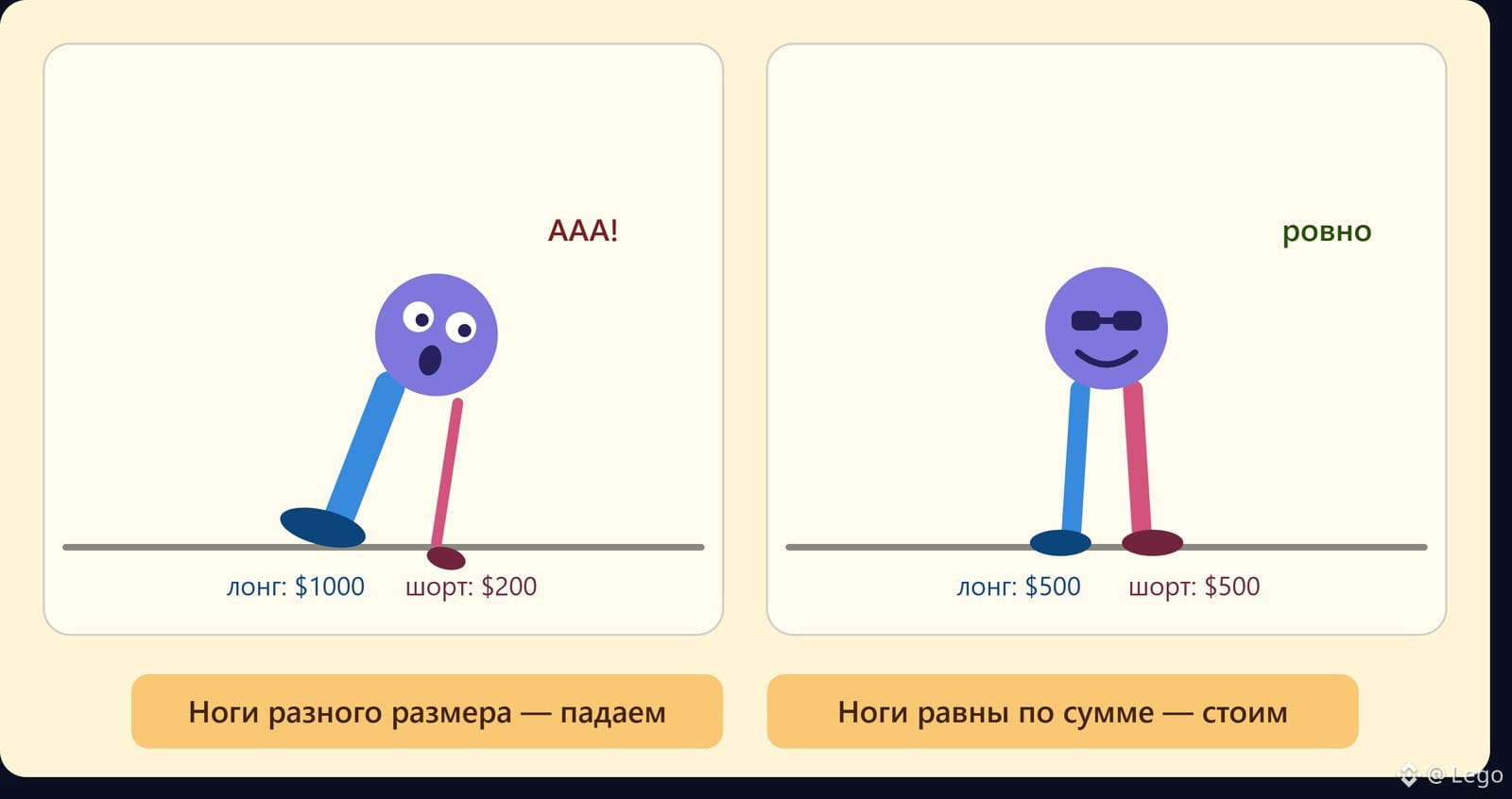
Are your pair legs really balanced? ⚖️
🔸 A leg size is simply the total position value in one of the two coins.
🔸 If your legs are different sizes, the pair remains dependent on overall market movement.
🔸 Coins move with different strength, so equal amounts are just a simple starting point, not a complete solution.
🔸 Prices constantly change and balance drifts over time, so you must check it regularly, not just at entry.
🔸 High leverage amplifies any balancing mistake and brings you closer to liquidation.
Example: A long on A for 1000 and a short on B for 400. Both grow by 10%, giving +100 and -40. The remaining +60 comes from overall market growth, proving the position was not neutral.
Typical mistake: Picking leg sizes by eye and assuming the pair is neutral.
How would you check the leg balance after price movements?
#Futures #CryptoTrading #CryptoEducation #RiskManagement
6

INVESTOR’S JOURNAL — The difference between a good investor and a reactive trader.
The market doesn’t reward every investor who predicts the direction correctly.
Sometimes, the biggest mistake is having the right thesis but the wrong strategy.
Bitcoin is under pressure.
$TAO is correcting.
$ZEC has an important upgrade approaching.
RWA infrastructure continues developing.
These situations require different approaches.
My rules remain simple:
1. Never confuse a price correction with a fundamental breakdown.
2. Never confuse a promising narrative with guaranteed returns.
3. Never invest without understanding the risks.
4. Keep liquidity available for opportunities.
5. Have an exit strategy before entering a position.
One important lesson:
You don’t need to participate in every market movement to become a successful investor.
Sometimes, patience is your strongest position.
#InvestorsJournal #CryptoStrategy #RiskManagement #MannequinCrypto
POLL — What is your biggest challenge during uncertain markets?
Avoiding emotional decisions
Knowing when to accumulate
Taking profits at time
patience and discipline
12 ມື້ທີ່ຍັງເຫຼືອ
3.5k

Why the "buy the dip" strategy can backfire 📉
Every dip looks like a discount, until it keeps dipping.
🔻 A falling price isn't automatically cheap. Sometimes it's falling for a reason
🔻 Catching a falling knife often means buying way too early
🔻 Going all-in on the first red candle leaves no cash for lower levels
What works better for me:
✅ Split entries into 3-4 parts
✅ Wait for signs of stabilization (volume, support holding)
✅ Decide the invalidation level before buying
Buying dips can work, but only with a plan.
Do you buy dips or wait for confirmation? 👇
$BTC $ETH $BNB
#BuyTheDip #TradingStrategy #RiskManagement #BinanceSquare
Not financial advice.
89

Be happy, we got a golden opportunity to pick that Token💰
The structural maturation of digital assets has consistently been forged through operational stress tests.
From exchange-level risk mitigations and protocol zero-knowledge proof verifications to navigating macro tech contagion and heavy unlock schedules, industry cycles continuously filter for institutional-grade resilience.
As markets digest recent volatility, long-term stability hinges on standardizing balance-sheet transparency, hardening smart contract frontends, and establishing robust capital allocation models capable of weathering broader systemic shifts.
$BTC $ETH $BNB #CryptoMarkets #RiskManagement #CoinVahini #Web3Infrastructure
#MarketResilience
2
ບົດຄວາມ
THE FINANCIAL WARRIOR CRYPTO | WARRIOR'S REFLECTION #33: WHY DRY POWDER IS MY BEST SHIELDTHE FINANCIAL WARRIOR CRYPTO | WARRIOR'S REFLECTION #33: WHY DRY POWDER IS MY BEST SHIELD
[EN]
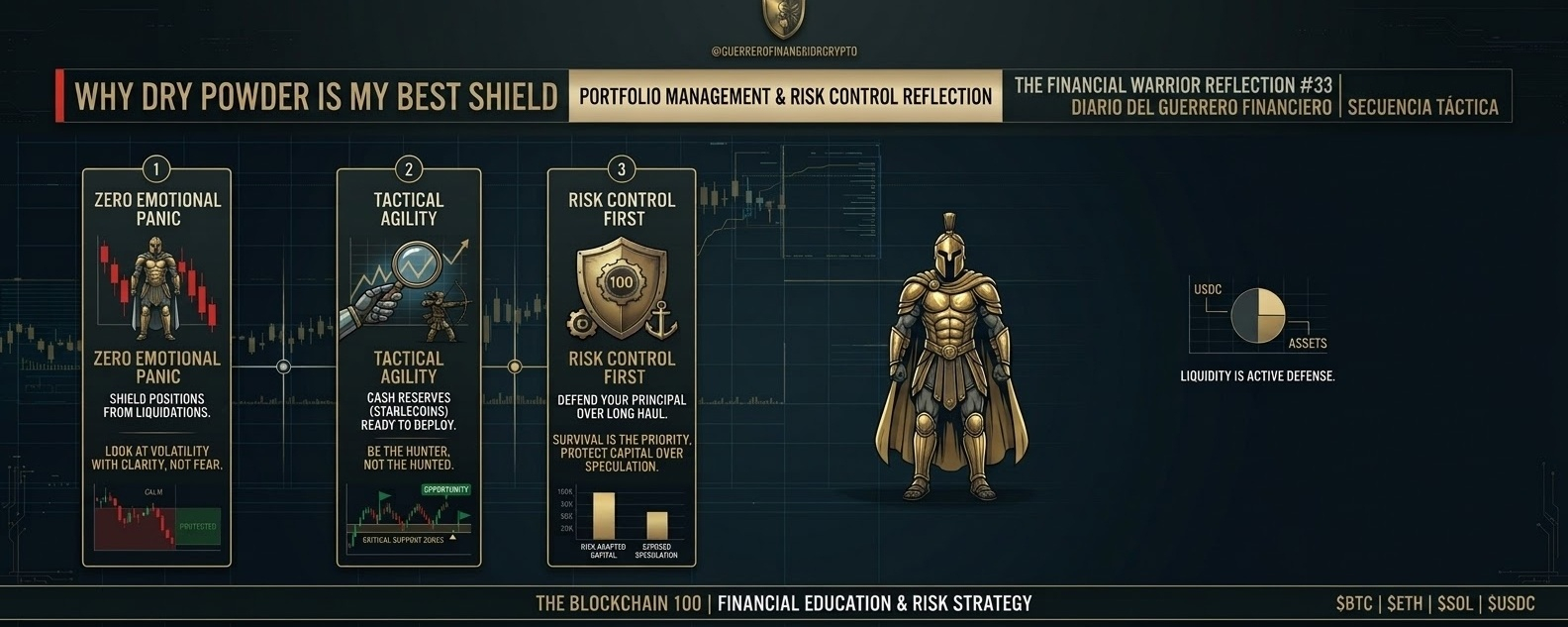
Why dry powder is my best shield.
In high-stakes markets, survival isn't about guessing the exact bottom; it's about having the ammunition to act when panic strikes. Keeping dry powder (stablecoins) ready is the ultimate defensive strategy.
This is a personal reflection, not financial advice.
Three pillars of liquidity defense:
Zero Emotional Panic: When the market bleeds red, cash reserves protect you from forced liquidations and keep your mind clear.
Tactical Agility: True hunters wait for critical support zones. Cash gives you the freedom to execute instantly without scrambling.
Risk Control First: Defending your principal always takes priority over blind speculation.
Liquidity is active defense.
[ES]
Por qué el capital en reserva es mi mejor escudo.
En los mercados de alto riesgo, la supervivencia no consiste en adivinar el suelo exacto, sino en tener la munición para actuar cuando llega el pánico. Mantener capital en reserva (stablecoins) lista es la estrategia defensiva por excelencia.
Esto es una reflexión personal, no asesoría financiera.
Tres pilares de la defensa por liquidez:
Cero Pánico Emocional: Cuando el mercado se tiñe de rojo, las reservas en efectivo te protegen de liquidaciones forzadas y mantienen la mente clara.
Agilidad Táctica: Los verdaderos cazadores esperan las zonas de soporte crítico. El efectivo te da la libertad de ejecutar al instante sin vacilar.
Control de Riesgo Primero: Defender tu capital principal siempre tiene prioridad sobre la especulación ciega.
La liquidez es defensa activa.
$BTC \vert{}$ETH | $SOL \vert{}$USDC
#TheBlockchain100 #DiarioGuerreroFinanciero #Write2Earn #Stablecoins #PortfolioManagement #RiskManagement
⚠️ Institutional Disclaimer: Educational and informational perspective only. Not financial advice. Always perform your own research (DYOR).
THE FINANCIAL WARRIOR CRYPTO | WARRIOR'S REFLECTION #33: WHY DRY POWDER IS MY BEST SHIELD
THE FINANCIAL WARRIOR CRYPTO | WARRIOR'S REFLECTION #33: WHY DRY POWDER IS MY BEST SHIELD
[EN]
Why dry powder is my best shield.
In high-stakes markets, survival isn't about guessing the exact bottom; it's about having the ammunition to act when panic strikes. Keeping dry powder (stablecoins) ready is the ultimate defensive strategy.
This is a personal reflection, not financial advice.
Three pillars of liquidity defense:
Zero Emotional Panic: When the market bleeds red, cash reserves protect you from forced liquidations and keep your mind clear.
Tactical Agility: True hunters wait for critical support zones. Cash gives you the freedom to execute instantly without scrambling.
Risk Control First: Defending your principal always takes priority over blind speculation.
Liquidity is active defense.
[ES]
Por qué el capital en reserva es mi mejor escudo.
En los mercados de alto riesgo, la supervivencia no consiste en adivinar el suelo exacto, sino en tener la munición para actuar cuando llega el pánico. Mantener capital en reserva (stablecoins) lista es la estrategia defensiva por excelencia.
Esto es una reflexión personal, no asesoría financiera.
Tres pilares de la defensa por liquidez:
Cero Pánico Emocional: Cuando el mercado se tiñe de rojo, las reservas en efectivo te protegen de liquidaciones forzadas y mantienen la mente clara.
Agilidad Táctica: Los verdaderos cazadores esperan las zonas de soporte crítico. El efectivo te da la libertad de ejecutar al instante sin vacilar.
Control de Riesgo Primero: Defender tu capital principal siempre tiene prioridad sobre la especulación ciega.
La liquidez es defensa activa.
$BTC \vert{}$ETH | $SOL \vert{}$USDC
#TheBlockchain100 #DiarioGuerreroFinanciero #Write2Earn #Stablecoins #PortfolioManagement #RiskManagement
⚠️ Institutional Disclaimer: Educational and informational perspective only. Not financial advice. Always perform your own research (DYOR).
1
1
148

·
--
$BTC | On the desk the mistake that cost newer traders most wasn't sizing, it was which side of price they put the stop on. Long, the stop sits below entry. Short Bitcoin, it sits above, because a rising price is what hurts you. SatoshiMacro's shorting guide spells out why: a long's max loss is capped once price hits zero, a short's loss keeps growing as price climbs, no ceiling in theory. ASIC's 2:1 retail cap on crypto CFDs and mandatory negative balance protection limit the damage, a $500 deposit controlling a $1,000 short still can't lose more than the account, but a stop can still gap past its level in a fast squeeze. My read: check the stop-above-entry habit before the leverage.
https://satoshimacro.com/guides/forex/how-to-short-bitcoin/?utm_source=binance_square&utm_medium=social&utm_campaign=autopilot_short-2
#SatoshiMacro #CryptoCFD #RiskManagement #Bitcoin
https://satoshimacro.com/guides/forex/how-to-short-bitcoin/?utm_source=binance_square&utm_medium=social&utm_campaign=autopilot_short-2
#SatoshiMacro #CryptoCFD #RiskManagement #Bitcoin
78

🚀 NO MERCADO CRIPTO, GANHAR NÃO É TUDO. SABER PROTEGER O CAPITAL É FUNDAMENTAL!
Muitas pessoas entram no mundo das criptomoedas com o sonho de ganhar dinheiro rapidamente, mas esquecem-se de um dos princípios mais importantes do trading: a gestão de risco.
📊 Antes de abrir uma operação, é importante:
1️⃣ Ter um plano de entrada e saída.
2️⃣ Definir sempre o Stop Loss.
3️⃣ Nunca investir dinheiro que não podes perder.
4️⃣ Evitar decisões baseadas no medo ou na ganância.
5️⃣ Estudar o mercado antes de tomar decisões.
💡 Uma coisa que todo trader precisa compreender: não é necessário ganhar todas as operações para ser lucrativo. O segredo está em controlar as perdas e manter a disciplina.
O mercado oferece oportunidades todos os dias, mas o capital que perdes por falta de gestão pode ser difícil de recuperar.
🔥 Lembra-te: primeiro aprende a proteger o teu dinheiro, depois trabalha para multiplicá-lo.
E tu, o que consideras mais importante no trading: uma boa estratégia ou uma boa gestão de risco?
#Binance #Crypto #Trading #Bitcoin #CryptoEducation #RiskManagement #USDT
83
·
--
How do you handle a stop-loss in pair trading? 🎯
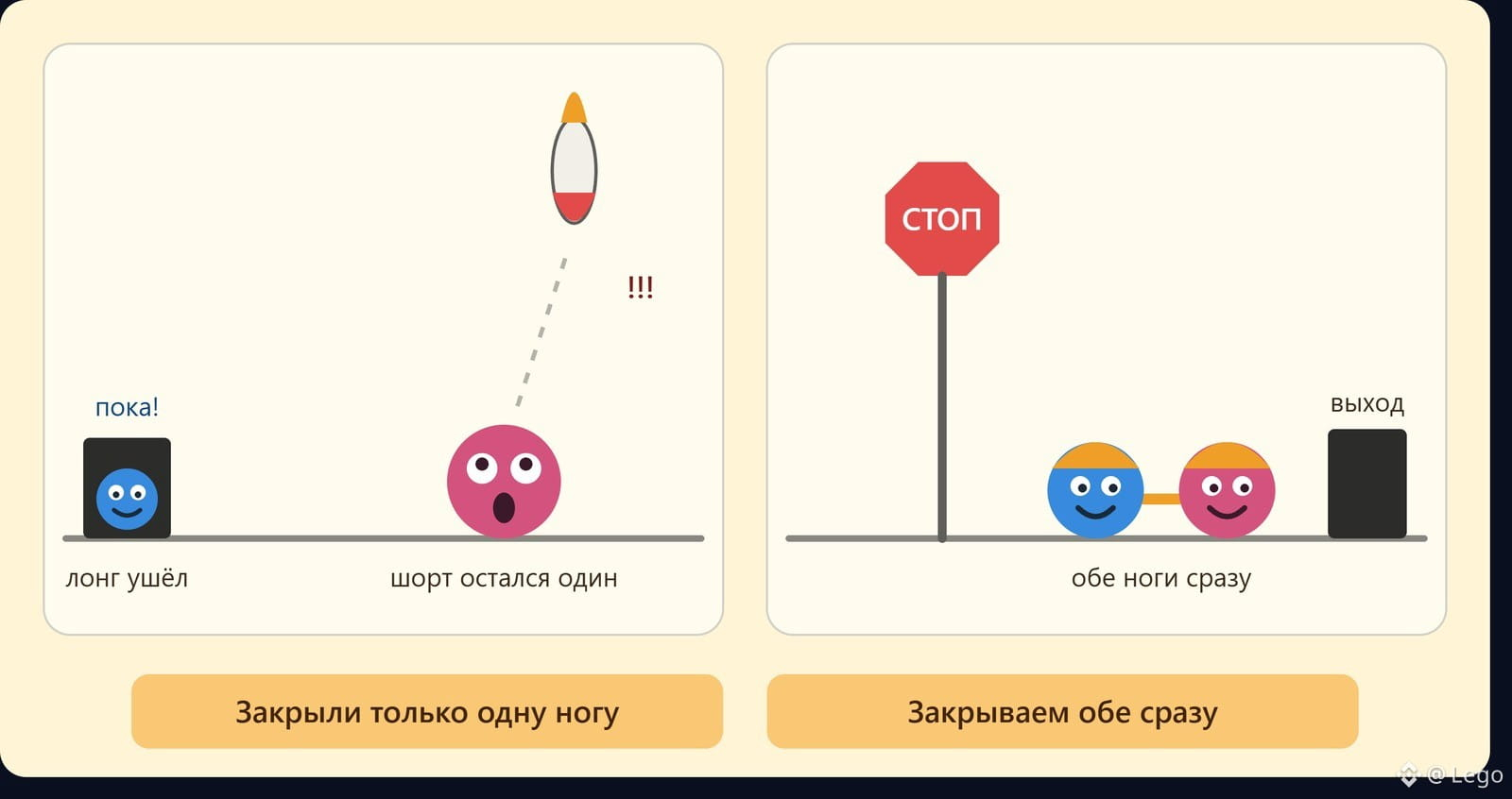
📌 A stop-loss is a pre-defined exit condition when facing a loss.
📌 In a pair trade, the stop applies to the whole trade, not to just one leg.
📌 Always set your exit condition before entering, as making decisions during a loss is much harder.
📌 Closing only one leg leaves you with a standard directional position you didn't plan for.
💡 Example: You record in advance that when the chosen limit for the pair's total loss is reached, both legs close together. During the trade, you simply execute your plan instead of arguing with it.
⚠️ Typical mistake: Closing the losing leg and leaving the second one "for good luck", which turns your trade into a random directional bet.
Do you close both legs at the same time, and why?
#Futures #CryptoTrading #CryptoEducation #RiskManagement
9
ເຂົ້າສູ່ລະບົບເພື່ອສຳຫຼວດເນື້ອຫາເພີ່ມເຕີມ
ເຂົ້າຮ່ວມກຸ່ມຜູ້ໃຊ້ຄຣິບໂຕທົ່ວໂລກໃນ Binance Square.
⚡️ ໄດ້ຮັບຂໍ້ມູນຫຼ້າສຸດ ແລະ ທີ່ມີປະໂຫຍດກ່ຽວກັບຄຣິບໂຕ.
💬 ໄດ້ຮັບຄວາມໄວ້ວາງໃຈຈາກຕະຫຼາດແລກປ່ຽນຄຣິບໂຕທີ່ໃຫຍ່ທີ່ສຸດໃນໂລກ.
👍 ຄົ້ນຫາຂໍ້ມູນເຊີງເລິກທີ່ແທ້ຈາກນັກສ້າງທີ່ໄດ້ຮັບການຢືນຢັນ.
ອີເມວ / ເບີໂທລະສັບ
ຫົວຂໍ້ທີ່ກໍາລັງນິຍົມ
1
#BinanceIncidentReport
57,581 ຄັ້ງທີ່ເບິ່ງ
694 ກຳລັງສົນທະນາ
2
#BinanceReopensWithdrawalsForMoreAssets
180,240 ຄັ້ງທີ່ເບິ່ງ
1,852 ກຳລັງສົນທະນາ
3
#BinanceHourlyDepositsExceedWithdrawals
85,041 ຄັ້ງທີ່ເບິ່ງ
867 ກຳລັງສົນທະນາ
4
#USMidtermElections
934,076 ຄັ້ງທີ່ເບິ່ງ
4,732 ກຳລັງສົນທະນາ
5
#AnthropicIPOPricedDownasInvestorsEye$1.5T
4,821 ຄັ້ງທີ່ເບິ່ງ
60 ກຳລັງສົນທະນາ
6
#USOctoberNFP-AreRateCutsStillPossible
175,501 ຄັ້ງທີ່ເບິ່ງ
1,348 ກຳລັງສົນທະນາ
7
#AppleReportsMixedResults
75,225 ຄັ້ງທີ່ເບິ່ງ
1,004 ກຳລັງສົນທະນາ
8
#PalantirSlides3PercentOn$2BRevenue
6,644 ຄັ້ງທີ່ເບິ່ງ
49 ກຳລັງສົນທະນາ
9
#FrenchAssemblyRejectsTwoCryptoExitTaxProposals
15,273 ຄັ້ງທີ່ເບິ່ງ
197 ກຳລັງສົນທະນາ
10
#Nasdaq100EntersCorrection
18,074 ຄັ້ງທີ່ເບິ່ງ
209 ກຳລັງສົນທະນາ