
0xMunem_Bro
141 Жариялаулар

0xMunem_Bro
Хабарлау
Пайдаланушыны блоктау
93 Жазылым
35 Жазылушылар
90 лайк басылған
Жазбалар
Барлығы
Баға ұсыныстары
·
--
Жоғары (өспелі)
Tokenized securities only become useful when they connect to real market infrastructure.
A token by itself does not create buyers, sellers, liquidity or legal certainty.
The market still needs eligible investors, regulated venues, proper settlement and accountable operators.
This is where the Dusk and NPEX collaboration is interesting.
NPEX brings experience from operating a Dutch SME-focused regulated marketplace, while @Dusk_Foundation provides infrastructure designed around tokenized issuance, trading and settlement.
The broader idea is to create a connected path from capital raising to investor access and eventually secondary-market activity.
Dusk is also building privacy and compliance into this infrastructure through confidential transactions, selective disclosure and programmable asset rules.
For regulated markets, that combination matters.
Tokenization should not simply create another digital record that still needs to be reconciled with traditional systems.
The real opportunity is to make the ownership and settlement process itself more connected.
That is where blockchain infrastructure can start solving an actual market problem rather than simply changing the format of an asset.
#dusk $DUSK
{spot}(DUSKUSDT)
Tokenized securities only become useful when they connect to real market infrastructure.
A token by itself does not create buyers, sellers, liquidity or legal certainty.
The market still needs eligible investors, regulated venues, proper settlement and accountable operators.
This is where the Dusk and NPEX collaboration is interesting.
NPEX brings experience from operating a Dutch SME-focused regulated marketplace, while @Dusk provides infrastructure designed around tokenized issuance, trading and settlement.
The broader idea is to create a connected path from capital raising to investor access and eventually secondary-market activity.
Dusk is also building privacy and compliance into this infrastructure through confidential transactions, selective disclosure and programmable asset rules.
For regulated markets, that combination matters.
Tokenization should not simply create another digital record that still needs to be reconciled with traditional systems.
The real opportunity is to make the ownership and settlement process itself more connected.
That is where blockchain infrastructure can start solving an actual market problem rather than simply changing the format of an asset.
#dusk $DUSK
A token by itself does not create buyers, sellers, liquidity or legal certainty.
The market still needs eligible investors, regulated venues, proper settlement and accountable operators.
This is where the Dusk and NPEX collaboration is interesting.
NPEX brings experience from operating a Dutch SME-focused regulated marketplace, while @Dusk provides infrastructure designed around tokenized issuance, trading and settlement.
The broader idea is to create a connected path from capital raising to investor access and eventually secondary-market activity.
Dusk is also building privacy and compliance into this infrastructure through confidential transactions, selective disclosure and programmable asset rules.
For regulated markets, that combination matters.
Tokenization should not simply create another digital record that still needs to be reconciled with traditional systems.
The real opportunity is to make the ownership and settlement process itself more connected.
That is where blockchain infrastructure can start solving an actual market problem rather than simply changing the format of an asset.
#dusk $DUSK
24
10
128
·
--
Расталды
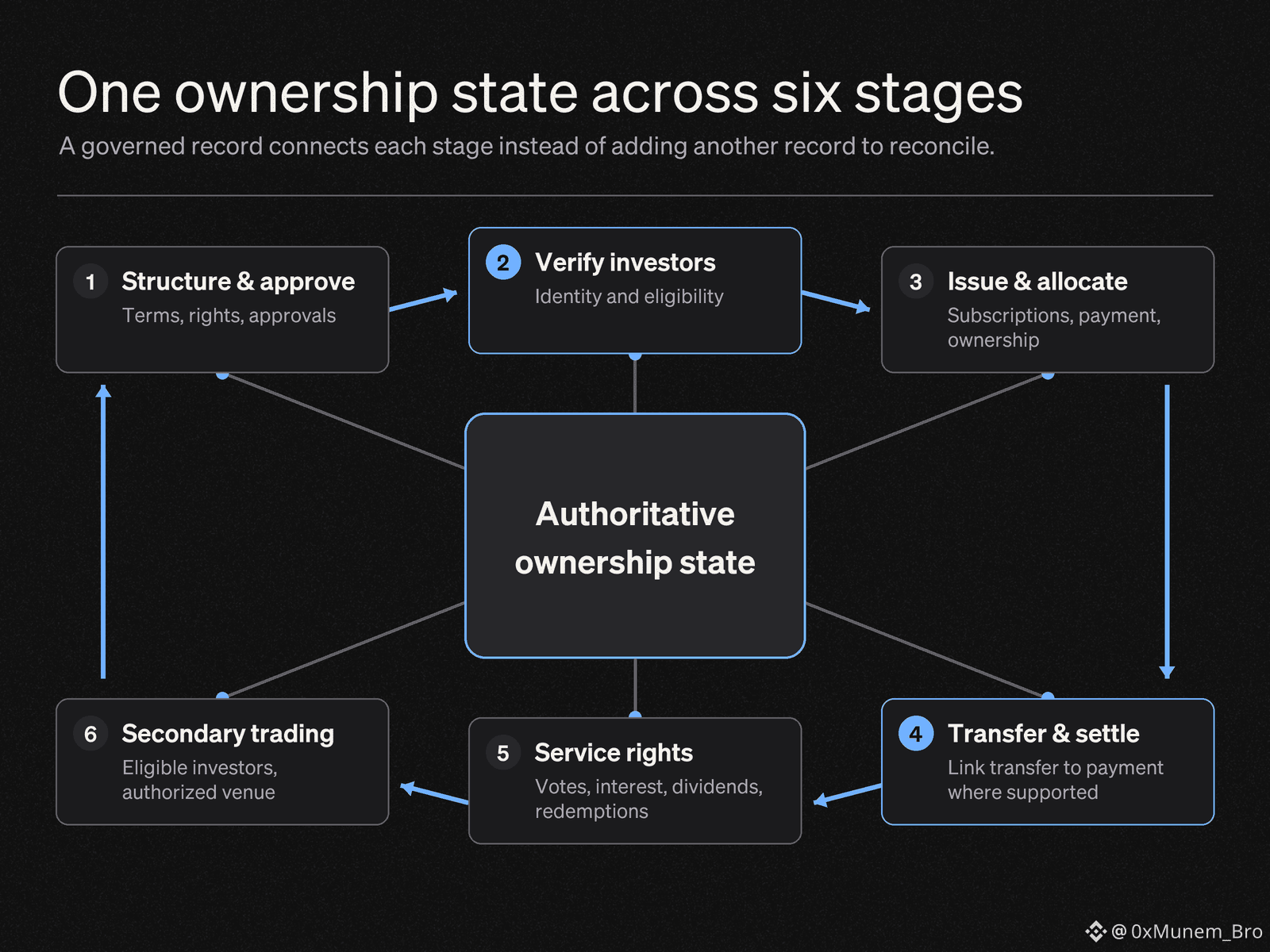
One of the biggest problems in private markets is fragmentation.
An issuer, investor, administrator, adviser, bank, custodian and trading venue can all rely on different records and processes for the same security.
The more handoffs there are between the actors of the market, the more reconciliations are created and thus room for friction.
Tokenization can solve a number of problems for issuer and investor alike, when done for the complete ownership lifecycle.
Investor eligibility to participate in a transaction can be verified prior to completing the transaction. Subsequent updates to the ownership interest in a security can then be recorded on the controlled digital record of ownership of such security. The transfer and settlement rules can then be applied to the same workflow as the updates to the ownership record.
But regulated finance also needs privacy.
@Dusk_Foundation combines confidential transactions with selective disclosure. All authorized parties can verify relevant information while the complete investor record remains (can remain) hidden from the public eye.
That balance is important for regulated assets.
The goal is not to make every financial transaction transparent to everyone.
The goal of all financial activity is to make the ownership, the compliance and the settlement of any financial asset more efficient while keeping the sensitive information private.
That is why I think Dusk’s approach to regulated on-chain finance is interesting.
#dusk $DUSK
{spot}(DUSKUSDT)
One of the biggest problems in private markets is fragmentation.
An issuer, investor, administrator, adviser, bank, custodian and trading venue can all rely on different records and processes for the same security.
The more handoffs there are between the actors of the market, the more reconciliations are created and thus room for friction.
Tokenization can solve a number of problems for issuer and investor alike, when done for the complete ownership lifecycle.
Investor eligibility to participate in a transaction can be verified prior to completing the transaction. Subsequent updates to the ownership interest in a security can then be recorded on the controlled digital record of ownership of such security. The transfer and settlement rules can then be applied to the same workflow as the updates to the ownership record.
But regulated finance also needs privacy.
@Dusk combines confidential transactions with selective disclosure. All authorized parties can verify relevant information while the complete investor record remains (can remain) hidden from the public eye.
That balance is important for regulated assets.
The goal is not to make every financial transaction transparent to everyone.
The goal of all financial activity is to make the ownership, the compliance and the settlement of any financial asset more efficient while keeping the sensitive information private.
That is why I think Dusk’s approach to regulated on-chain finance is interesting.
#dusk $DUSK
An issuer, investor, administrator, adviser, bank, custodian and trading venue can all rely on different records and processes for the same security.
The more handoffs there are between the actors of the market, the more reconciliations are created and thus room for friction.
Tokenization can solve a number of problems for issuer and investor alike, when done for the complete ownership lifecycle.
Investor eligibility to participate in a transaction can be verified prior to completing the transaction. Subsequent updates to the ownership interest in a security can then be recorded on the controlled digital record of ownership of such security. The transfer and settlement rules can then be applied to the same workflow as the updates to the ownership record.
But regulated finance also needs privacy.
@Dusk combines confidential transactions with selective disclosure. All authorized parties can verify relevant information while the complete investor record remains (can remain) hidden from the public eye.
That balance is important for regulated assets.
The goal is not to make every financial transaction transparent to everyone.
The goal of all financial activity is to make the ownership, the compliance and the settlement of any financial asset more efficient while keeping the sensitive information private.
That is why I think Dusk’s approach to regulated on-chain finance is interesting.
#dusk $DUSK
13
11
107
·
--
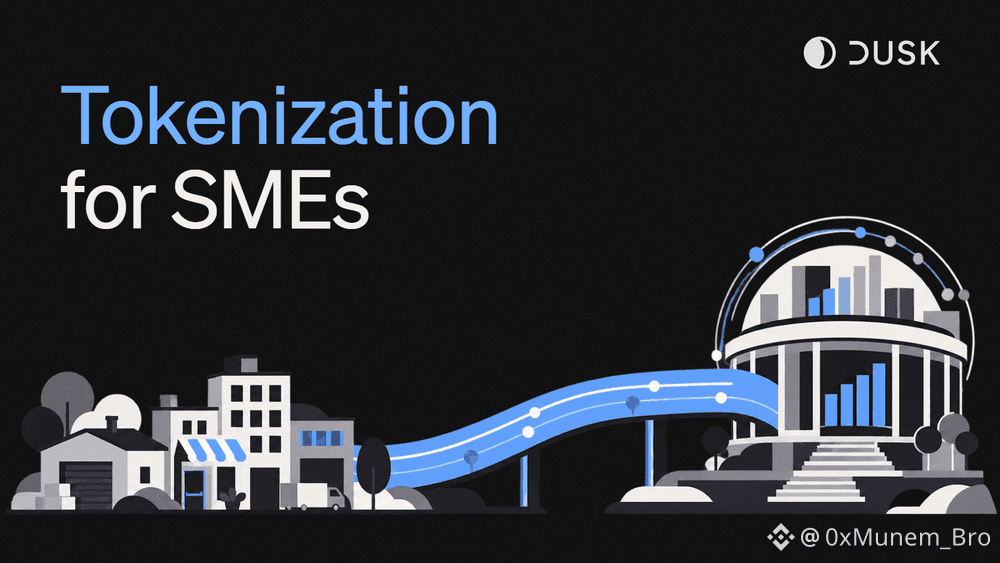
Tokenization can open a new path for SMEs to access private market financing, but the real value is not simply putting an asset on chain.
The bigger opportunity is connecting the entire ownership lifecycle.
With the right infrastructure, issuance, investor eligibility, ownership records, transfers, dividends, voting and settlement can work around a shared digital record instead of being spread across multiple disconnected systems.
This can reduce repetitive data entry and reconciliation between issuers, advisers, administrators and venues.
@Dusk_Foundation is building around this idea with infrastructure for regulated tokenization, where compliance rules and transfer conditions can be part of the workflow while sensitive investor information can remain private.
For SMEs, that could mean a more connected route from raising capital to managing ownership and eventually accessing regulated secondary markets.
The important part is that tokenization alone does not create liquidity.
You still need eligible investors, reliable settlement, accountable operators and a regulated venue.
That is why the infrastructure behind the token matters just as much as the token itself.
#dusk $DUSK
{spot}(DUSKUSDT)
Tokenization can open a new path for SMEs to access private market financing, but the real value is not simply putting an asset on chain.
The bigger opportunity is connecting the entire ownership lifecycle.
With the right infrastructure, issuance, investor eligibility, ownership records, transfers, dividends, voting and settlement can work around a shared digital record instead of being spread across multiple disconnected systems.
This can reduce repetitive data entry and reconciliation between issuers, advisers, administrators and venues.
@Dusk is building around this idea with infrastructure for regulated tokenization, where compliance rules and transfer conditions can be part of the workflow while sensitive investor information can remain private.
For SMEs, that could mean a more connected route from raising capital to managing ownership and eventually accessing regulated secondary markets.
The important part is that tokenization alone does not create liquidity.
You still need eligible investors, reliable settlement, accountable operators and a regulated venue.
That is why the infrastructure behind the token matters just as much as the token itself.
#dusk $DUSK
The bigger opportunity is connecting the entire ownership lifecycle.
With the right infrastructure, issuance, investor eligibility, ownership records, transfers, dividends, voting and settlement can work around a shared digital record instead of being spread across multiple disconnected systems.
This can reduce repetitive data entry and reconciliation between issuers, advisers, administrators and venues.
@Dusk is building around this idea with infrastructure for regulated tokenization, where compliance rules and transfer conditions can be part of the workflow while sensitive investor information can remain private.
For SMEs, that could mean a more connected route from raising capital to managing ownership and eventually accessing regulated secondary markets.
The important part is that tokenization alone does not create liquidity.
You still need eligible investors, reliable settlement, accountable operators and a regulated venue.
That is why the infrastructure behind the token matters just as much as the token itself.
#dusk $DUSK
18
17
106
·
--
Жоғары (өспелі)
Most financial markets need more than just transparency to move onchain.
@Dusk_Foundation is building infrastructure for regulated digital assets where privacy, access control and deterministic settlement can work together.
Its approach allows institutions to enforce rules around eligibility, transfers and reporting, while users can keep sensitive transactions private through shielded transfers and selective disclosure.
With DuskEVM and native execution environments, developers can also build financial applications without giving up the flexibility of familiar blockchain tooling.
For me, the interesting part is the balance between compliance and privacy.
Dusk is not trying to make everything public. It is building a system where information can stay private when needed and become verifiable when required.
That could be important for bringing more regulated financial activity on-chain.
#dusk $DUSK
{spot}(DUSKUSDT)
Most financial markets need more than just transparency to move onchain.
@Dusk is building infrastructure for regulated digital assets where privacy, access control and deterministic settlement can work together.
Its approach allows institutions to enforce rules around eligibility, transfers and reporting, while users can keep sensitive transactions private through shielded transfers and selective disclosure.
With DuskEVM and native execution environments, developers can also build financial applications without giving up the flexibility of familiar blockchain tooling.
For me, the interesting part is the balance between compliance and privacy.
Dusk is not trying to make everything public. It is building a system where information can stay private when needed and become verifiable when required.
That could be important for bringing more regulated financial activity on-chain.
#dusk $DUSK
@Dusk is building infrastructure for regulated digital assets where privacy, access control and deterministic settlement can work together.
Its approach allows institutions to enforce rules around eligibility, transfers and reporting, while users can keep sensitive transactions private through shielded transfers and selective disclosure.
With DuskEVM and native execution environments, developers can also build financial applications without giving up the flexibility of familiar blockchain tooling.
For me, the interesting part is the balance between compliance and privacy.
Dusk is not trying to make everything public. It is building a system where information can stay private when needed and become verifiable when required.
That could be important for bringing more regulated financial activity on-chain.
#dusk $DUSK

8
9
136
·
--
Жоғары (өспелі)
Putting RWAs onchain is only one part of the problem.
The harder part is making regulated assets accessible without turning every transaction into a privacy tradeoff.
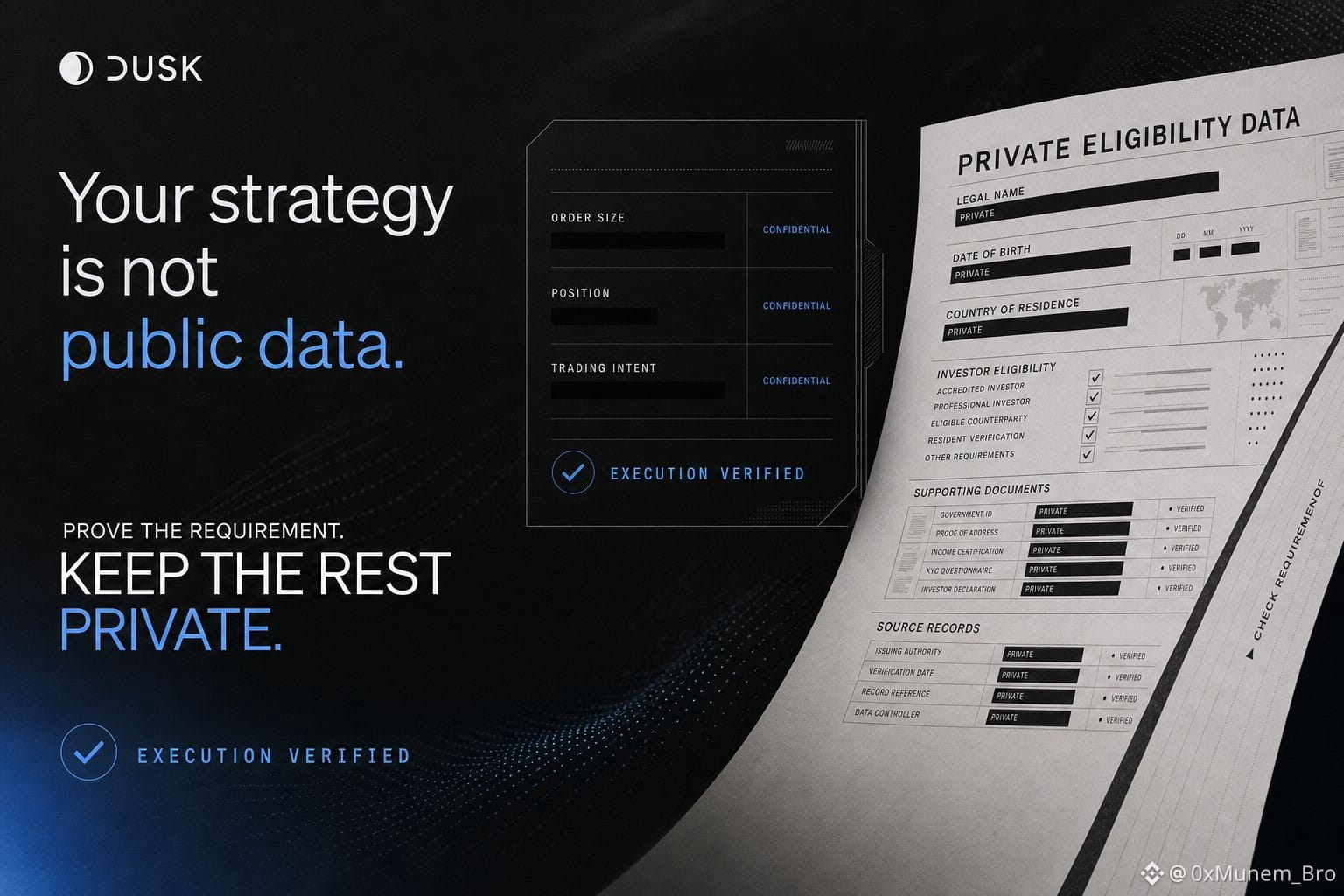
That’s where @Dusk_Foundation is taking an interesting approach with selective disclosure, giving users a way to prove eligibility without handing over more personal information than necessary.
The Dusk Trade waitlist is now open, with NPEX involved in building a regulated RWA trading platform.
If RWAs are going mainstream, privacy can’t be treated as an afterthought.
#dusk $DUSK
{spot}(DUSKUSDT)
Putting RWAs onchain is only one part of the problem.
The harder part is making regulated assets accessible without turning every transaction into a privacy tradeoff.
That’s where @Dusk is taking an interesting approach with selective disclosure, giving users a way to prove eligibility without handing over more personal information than necessary.
The Dusk Trade waitlist is now open, with NPEX involved in building a regulated RWA trading platform.
If RWAs are going mainstream, privacy can’t be treated as an afterthought.
#dusk $DUSK
The harder part is making regulated assets accessible without turning every transaction into a privacy tradeoff.
That’s where @Dusk is taking an interesting approach with selective disclosure, giving users a way to prove eligibility without handing over more personal information than necessary.
The Dusk Trade waitlist is now open, with NPEX involved in building a regulated RWA trading platform.
If RWAs are going mainstream, privacy can’t be treated as an afterthought.
#dusk $DUSK
8
9
80
·
--
Мақала
Why Multi-Chain Trading Could Become the Next Standard for CryptoCrypto opportunities don't live on one blockchain anymore.
One day, the most interesting activity might be happening on BNB Chain. The next opportunity could appear on Solana, Base, Ethereum, or another ecosystem entirely.
As more chains develop their own applications, liquidity, communities, and trading opportunities, traders are increasingly forced to operate across multiple environments.
That's why multi-chain trading products are becoming more interesting to me.
I've been exploring $VELVET, and one of the first things that stands out is how broadly the platform is building across different ecosystems.
Velvet is already live across networks including BNB Chain, Solana, Base, Hyperliquid, and Ethereum, with Robinhood Chain also appearing among the supported networks on the platform.
But I don't think the interesting part is simply having a long list of supported chains.
The bigger question is what you can actually do across those ecosystems from one trading environment.
The Problem With a Fragmented Crypto Experience
Crypto has become multi-chain, but the user experience hasn't always caught up.
A trader might have assets on several networks, monitor different ecosystems, use separate applications, and constantly switch between interfaces depending on where an opportunity appears.
That creates friction.
You might discover a token on one chain, follow traders on another, monitor perpetual markets somewhere else, and manage your portfolio through an entirely different interface.
Each ecosystem can start feeling like its own isolated world.
This is one of the reasons I find Velvet's approach interesting.
Instead of treating every chain as a completely separate destination, the platform is trying to bring multiple parts of the trading experience together.
More Than Just Multi-Chain Support
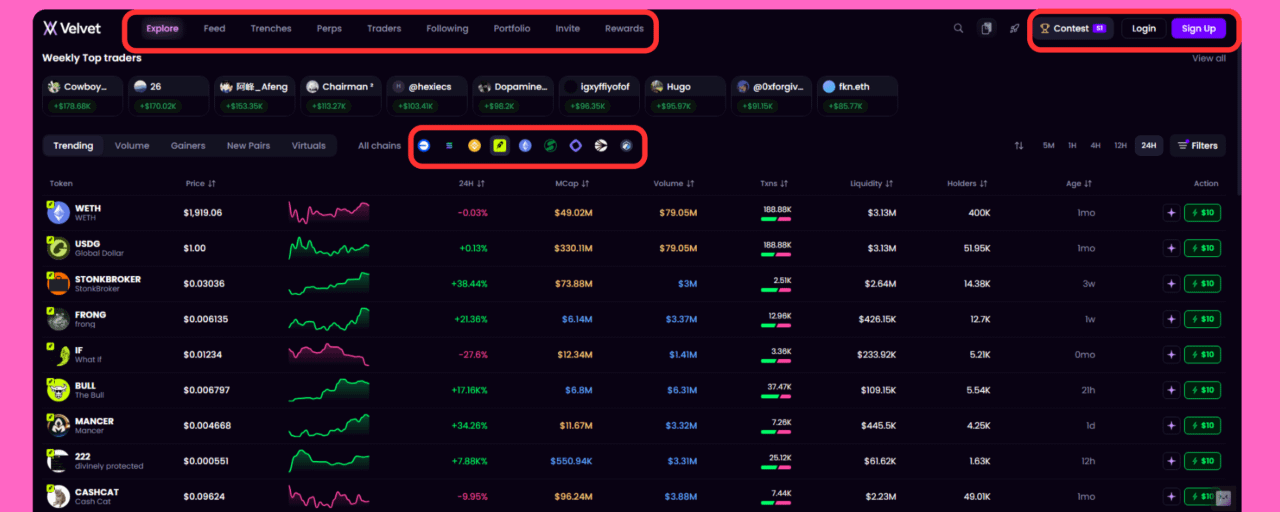
From the main Velvet interface, there are several areas designed around different parts of the trading workflow.
Explore helps users discover what's happening across the platform.
Feed focuses on market and social activity, giving users another way to follow what is happening around the ecosystem.
Trenches provides another trading-focused section within the platform.
Perps gives users access to the perpetual trading side.
Traders & Following allows users to discover and follow other traders.
Portfolio provides a place to keep track of assets and positions.
And Rewards brings the reward-related side of the ecosystem into the same environment.
Individually, these features aren't necessarily revolutionary.
What interests me is the combination.
The idea is moving toward a trading environment where discovery, social activity, execution, portfolio tracking, and rewards don't have to happen across completely separate platforms.
Where AI Fits Into the Picture
There's another layer that makes Velvet particularly interesting to me: AI.
Velvet is integrating AI through its AI Copilot, while also working on crypto-focused model development.
This could become increasingly useful as multi-chain environments become more complex.
Think about the amount of information a trader potentially has to process today.
Different chains.
Different tokens.
Different liquidity conditions.
Different trading venues.
Different market narratives.
Different wallets and positions.
The more ecosystems become available, the more difficult it becomes for an individual trader to manually keep track of everything.
An AI layer designed specifically around crypto could potentially help users research assets, understand market information, navigate the platform, and interact with different parts of the trading workflow more efficiently.
The important part is that AI shouldn't simply generate generic market commentary.
Its value becomes much more interesting when it understands the context of crypto operations and can assist with actual workflows.
Robinhood Chain Is Worth Watching
The recent addition of Robinhood Chain also caught my attention.
As more networks become integrated into the platform, the question isn't only how many chains Velvet supports.
The more important question is how deeply those chains are integrated.
What assets will become available?
What trading functionality will users get?
How much liquidity can flow through the ecosystem?
And how seamlessly can users move between Robinhood Chain and the other networks already supported?
Those are the things I'll be watching as the integration develops.
The Future May Be Chain-Agnostic
For a long time, crypto users often identified strongly with individual ecosystems.
Ethereum users stayed around Ethereum.
Solana users focused heavily on Solana.
BNB Chain users had their own ecosystem.
But the market is becoming increasingly interconnected.
Capital doesn't necessarily care which chain an opportunity exists on.
If something interesting happens on one network, traders want the ability to react without completely rebuilding their workflow around that chain.
That's where I think the idea of chain-agnostic trading becomes important.
The future may not be about choosing one blockchain and staying there.
It could be about having a trading environment that allows users to follow opportunities wherever they appear.
Final Thoughts
The multi-chain narrative isn't simply about supporting more networks.
It's about reducing the friction created by having so many different ecosystems.
That's what makes Velvet interesting to me.
The platform combines multi-chain access with trading tools, portfolio management, social discovery, rewards, perpetuals, and an increasingly important AI layer.
There's still a lot to explore, and supporting multiple networks doesn't automatically mean a platform will deliver a seamless experience.
The real test will be how deeply these ecosystems become integrated and whether users can actually move between opportunities without feeling like they're constantly switching between completely different worlds.
But the direction makes sense.
Crypto is becoming increasingly multi-chain.
So the trading experience probably needs to become multi-chain too.
For me, the future isn't:
“Pick one chain and stay there.”
It's:
“Build a trading workflow that can follow opportunities wherever they appear.”
And that's one of the reasons I'll be keeping a close eye on how @Velvet_Capital continues to develop.
Why Multi-Chain Trading Could Become the Next Standard for Crypto
Crypto opportunities don't live on one blockchain anymore.
One day, the most interesting activity might be happening on BNB Chain. The next opportunity could appear on Solana, Base, Ethereum, or another ecosystem entirely.
As more chains develop their own applications, liquidity, communities, and trading opportunities, traders are increasingly forced to operate across multiple environments.
That's why multi-chain trading products are becoming more interesting to me.
I've been exploring $VELVET, and one of the first things that stands out is how broadly the platform is building across different ecosystems.
Velvet is already live across networks including BNB Chain, Solana, Base, Hyperliquid, and Ethereum, with Robinhood Chain also appearing among the supported networks on the platform.
But I don't think the interesting part is simply having a long list of supported chains.
The bigger question is what you can actually do across those ecosystems from one trading environment.
The Problem With a Fragmented Crypto Experience
Crypto has become multi-chain, but the user experience hasn't always caught up.
A trader might have assets on several networks, monitor different ecosystems, use separate applications, and constantly switch between interfaces depending on where an opportunity appears.
That creates friction.
You might discover a token on one chain, follow traders on another, monitor perpetual markets somewhere else, and manage your portfolio through an entirely different interface.
Each ecosystem can start feeling like its own isolated world.
This is one of the reasons I find Velvet's approach interesting.
Instead of treating every chain as a completely separate destination, the platform is trying to bring multiple parts of the trading experience together.
More Than Just Multi-Chain Support
From the main Velvet interface, there are several areas designed around different parts of the trading workflow.
Explore helps users discover what's happening across the platform.
Feed focuses on market and social activity, giving users another way to follow what is happening around the ecosystem.
Trenches provides another trading-focused section within the platform.
Perps gives users access to the perpetual trading side.
Traders & Following allows users to discover and follow other traders.
Portfolio provides a place to keep track of assets and positions.
And Rewards brings the reward-related side of the ecosystem into the same environment.
Individually, these features aren't necessarily revolutionary.
What interests me is the combination.
The idea is moving toward a trading environment where discovery, social activity, execution, portfolio tracking, and rewards don't have to happen across completely separate platforms.
Where AI Fits Into the Picture
There's another layer that makes Velvet particularly interesting to me: AI.
Velvet is integrating AI through its AI Copilot, while also working on crypto-focused model development.
This could become increasingly useful as multi-chain environments become more complex.
Think about the amount of information a trader potentially has to process today.
Different chains.
Different tokens.
Different liquidity conditions.
Different trading venues.
Different market narratives.
Different wallets and positions.
The more ecosystems become available, the more difficult it becomes for an individual trader to manually keep track of everything.
An AI layer designed specifically around crypto could potentially help users research assets, understand market information, navigate the platform, and interact with different parts of the trading workflow more efficiently.
The important part is that AI shouldn't simply generate generic market commentary.
Its value becomes much more interesting when it understands the context of crypto operations and can assist with actual workflows.
Robinhood Chain Is Worth Watching
The recent addition of Robinhood Chain also caught my attention.
As more networks become integrated into the platform, the question isn't only how many chains Velvet supports.
The more important question is how deeply those chains are integrated.
What assets will become available?
What trading functionality will users get?
How much liquidity can flow through the ecosystem?
And how seamlessly can users move between Robinhood Chain and the other networks already supported?
Those are the things I'll be watching as the integration develops.
The Future May Be Chain-Agnostic
For a long time, crypto users often identified strongly with individual ecosystems.
Ethereum users stayed around Ethereum.
Solana users focused heavily on Solana.
BNB Chain users had their own ecosystem.
But the market is becoming increasingly interconnected.
Capital doesn't necessarily care which chain an opportunity exists on.
If something interesting happens on one network, traders want the ability to react without completely rebuilding their workflow around that chain.
That's where I think the idea of chain-agnostic trading becomes important.
The future may not be about choosing one blockchain and staying there.
It could be about having a trading environment that allows users to follow opportunities wherever they appear.
Final Thoughts
The multi-chain narrative isn't simply about supporting more networks.
It's about reducing the friction created by having so many different ecosystems.
That's what makes Velvet interesting to me.
The platform combines multi-chain access with trading tools, portfolio management, social discovery, rewards, perpetuals, and an increasingly important AI layer.
There's still a lot to explore, and supporting multiple networks doesn't automatically mean a platform will deliver a seamless experience.
The real test will be how deeply these ecosystems become integrated and whether users can actually move between opportunities without feeling like they're constantly switching between completely different worlds.
But the direction makes sense.
Crypto is becoming increasingly multi-chain.
So the trading experience probably needs to become multi-chain too.
For me, the future isn't:
“Pick one chain and stay there.”
It's:
“Build a trading workflow that can follow opportunities wherever they appear.”
And that's one of the reasons I'll be keeping a close eye on how @Velvet_Capital continues to develop.
One day, the most interesting activity might be happening on BNB Chain. The next opportunity could appear on Solana, Base, Ethereum, or another ecosystem entirely.
As more chains develop their own applications, liquidity, communities, and trading opportunities, traders are increasingly forced to operate across multiple environments.
That's why multi-chain trading products are becoming more interesting to me.
I've been exploring $VELVET, and one of the first things that stands out is how broadly the platform is building across different ecosystems.
Velvet is already live across networks including BNB Chain, Solana, Base, Hyperliquid, and Ethereum, with Robinhood Chain also appearing among the supported networks on the platform.
But I don't think the interesting part is simply having a long list of supported chains.
The bigger question is what you can actually do across those ecosystems from one trading environment.
The Problem With a Fragmented Crypto Experience
Crypto has become multi-chain, but the user experience hasn't always caught up.
A trader might have assets on several networks, monitor different ecosystems, use separate applications, and constantly switch between interfaces depending on where an opportunity appears.
That creates friction.
You might discover a token on one chain, follow traders on another, monitor perpetual markets somewhere else, and manage your portfolio through an entirely different interface.
Each ecosystem can start feeling like its own isolated world.
This is one of the reasons I find Velvet's approach interesting.
Instead of treating every chain as a completely separate destination, the platform is trying to bring multiple parts of the trading experience together.
More Than Just Multi-Chain Support
From the main Velvet interface, there are several areas designed around different parts of the trading workflow.
Explore helps users discover what's happening across the platform.
Feed focuses on market and social activity, giving users another way to follow what is happening around the ecosystem.
Trenches provides another trading-focused section within the platform.
Perps gives users access to the perpetual trading side.
Traders & Following allows users to discover and follow other traders.
Portfolio provides a place to keep track of assets and positions.
And Rewards brings the reward-related side of the ecosystem into the same environment.
Individually, these features aren't necessarily revolutionary.
What interests me is the combination.
The idea is moving toward a trading environment where discovery, social activity, execution, portfolio tracking, and rewards don't have to happen across completely separate platforms.
Where AI Fits Into the Picture
There's another layer that makes Velvet particularly interesting to me: AI.
Velvet is integrating AI through its AI Copilot, while also working on crypto-focused model development.
This could become increasingly useful as multi-chain environments become more complex.
Think about the amount of information a trader potentially has to process today.
Different chains.
Different tokens.
Different liquidity conditions.
Different trading venues.
Different market narratives.
Different wallets and positions.
The more ecosystems become available, the more difficult it becomes for an individual trader to manually keep track of everything.
An AI layer designed specifically around crypto could potentially help users research assets, understand market information, navigate the platform, and interact with different parts of the trading workflow more efficiently.
The important part is that AI shouldn't simply generate generic market commentary.
Its value becomes much more interesting when it understands the context of crypto operations and can assist with actual workflows.
Robinhood Chain Is Worth Watching
The recent addition of Robinhood Chain also caught my attention.
As more networks become integrated into the platform, the question isn't only how many chains Velvet supports.
The more important question is how deeply those chains are integrated.
What assets will become available?
What trading functionality will users get?
How much liquidity can flow through the ecosystem?
And how seamlessly can users move between Robinhood Chain and the other networks already supported?
Those are the things I'll be watching as the integration develops.
The Future May Be Chain-Agnostic
For a long time, crypto users often identified strongly with individual ecosystems.
Ethereum users stayed around Ethereum.
Solana users focused heavily on Solana.
BNB Chain users had their own ecosystem.
But the market is becoming increasingly interconnected.
Capital doesn't necessarily care which chain an opportunity exists on.
If something interesting happens on one network, traders want the ability to react without completely rebuilding their workflow around that chain.
That's where I think the idea of chain-agnostic trading becomes important.
The future may not be about choosing one blockchain and staying there.
It could be about having a trading environment that allows users to follow opportunities wherever they appear.
Final Thoughts
The multi-chain narrative isn't simply about supporting more networks.
It's about reducing the friction created by having so many different ecosystems.
That's what makes Velvet interesting to me.
The platform combines multi-chain access with trading tools, portfolio management, social discovery, rewards, perpetuals, and an increasingly important AI layer.
There's still a lot to explore, and supporting multiple networks doesn't automatically mean a platform will deliver a seamless experience.
The real test will be how deeply these ecosystems become integrated and whether users can actually move between opportunities without feeling like they're constantly switching between completely different worlds.
But the direction makes sense.
Crypto is becoming increasingly multi-chain.
So the trading experience probably needs to become multi-chain too.
For me, the future isn't:
“Pick one chain and stay there.”
It's:
“Build a trading workflow that can follow opportunities wherever they appear.”
And that's one of the reasons I'll be keeping a close eye on how @Velvet_Capital continues to develop.
145
·
--
Жоғары (өспелі)
GM ☀️
Most referral systems sound simple until you actually start looking into how the rewards are generated.
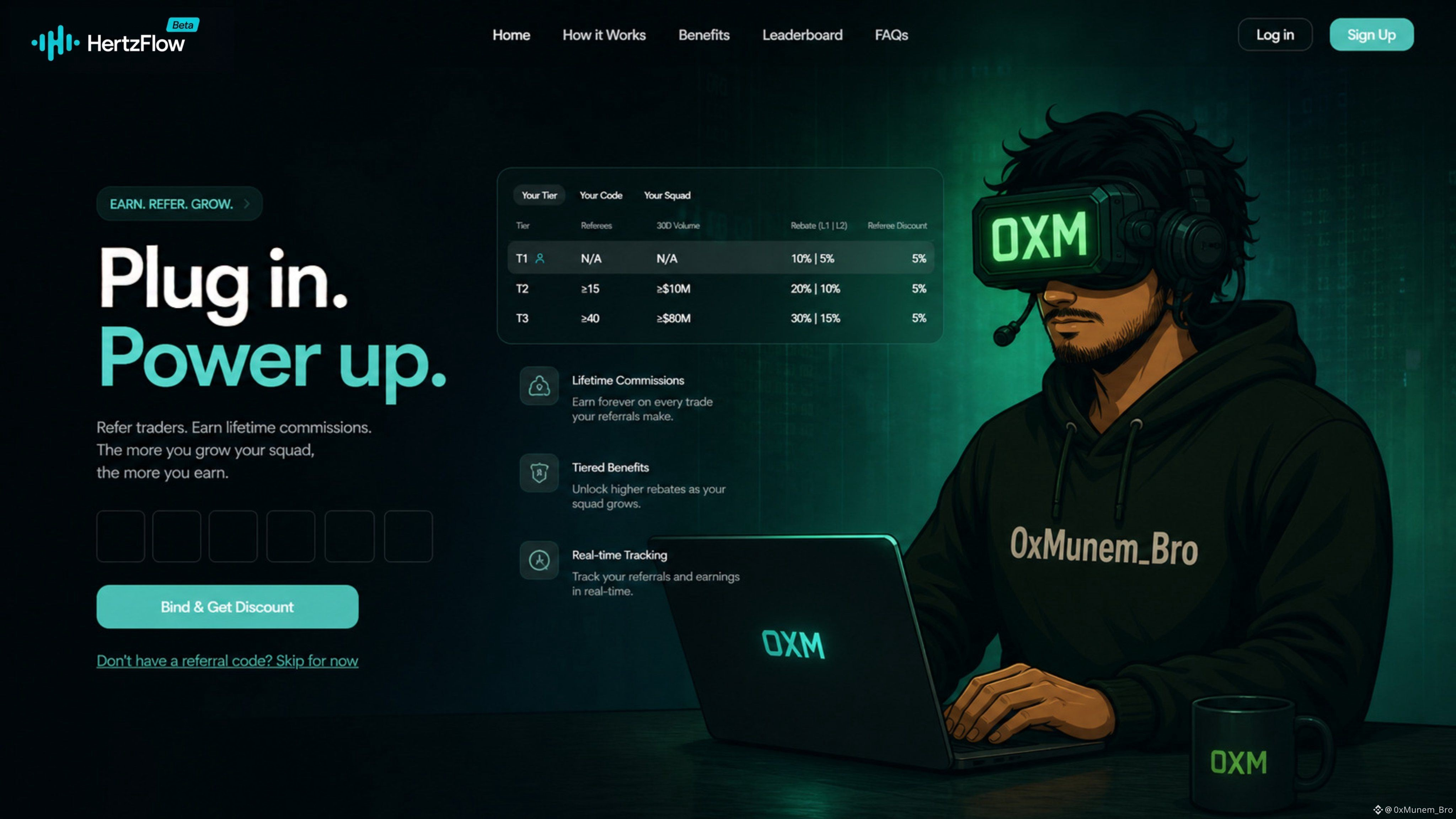
I was checking out the @HertzFlow_xyz referral guide, and one thing I liked is that it explains the system beyond the usual “share your code and earn” approach.
There are a few details worth understanding before using it.
For referees, binding a valid referral code can provide a 5% discount on qualifying Normal-mode opening and closing fees.
For referrers, rewards are connected to activity across both L1 and L2 relationships, meaning the structure goes beyond simply bringing someone onto the platform.
Another important part is the tier system.
Your progression isn't based on just the number of people you refer. It considers both active referees and 30D trading volume, so sustained activity plays a role in moving through the different tiers.
There's also an important distinction around Hyper Lev.
Hyper Lev trading volume can contribute toward tier progression, but it doesn't generate opening or closing fee rebates.
And the rebates themselves aren't necessarily instant. They're settled in batches according to the current rules.
So the biggest takeaway for me is that Hertzflow's referral system isn't simply:
“Share a code → someone trades → you instantly get paid.”
There's an actual structure behind it involving relationships, qualifying activity, trading volume, tiers and rebate settlement.
If you're planning to use the referral system, I'd recommend reading the full @HertzFlow_xyz guide first so you understand how each part works before getting started.
Knowing the rules beforehand is always better than figuring them out after you've already started.
GM ☀️
Most referral systems sound simple until you actually start looking into how the rewards are generated.
I was checking out the @HertzFlow referral guide, and one thing I liked is that it explains the system beyond the usual “share your code and earn” approach.
There are a few details worth understanding before using it.
For referees, binding a valid referral code can provide a 5% discount on qualifying Normal-mode opening and closing fees.
For referrers, rewards are connected to activity across both L1 and L2 relationships, meaning the structure goes beyond simply bringing someone onto the platform.
Another important part is the tier system.
Your progression isn't based on just the number of people you refer. It considers both active referees and 30D trading volume, so sustained activity plays a role in moving through the different tiers.
There's also an important distinction around Hyper Lev.
Hyper Lev trading volume can contribute toward tier progression, but it doesn't generate opening or closing fee rebates.
And the rebates themselves aren't necessarily instant. They're settled in batches according to the current rules.
So the biggest takeaway for me is that Hertzflow's referral system isn't simply:
“Share a code → someone trades → you instantly get paid.”
There's an actual structure behind it involving relationships, qualifying activity, trading volume, tiers and rebate settlement.
If you're planning to use the referral system, I'd recommend reading the full @HertzFlow guide first so you understand how each part works before getting started.
Knowing the rules beforehand is always better than figuring them out after you've already started.
Most referral systems sound simple until you actually start looking into how the rewards are generated.
I was checking out the @HertzFlow referral guide, and one thing I liked is that it explains the system beyond the usual “share your code and earn” approach.
There are a few details worth understanding before using it.
For referees, binding a valid referral code can provide a 5% discount on qualifying Normal-mode opening and closing fees.
For referrers, rewards are connected to activity across both L1 and L2 relationships, meaning the structure goes beyond simply bringing someone onto the platform.
Another important part is the tier system.
Your progression isn't based on just the number of people you refer. It considers both active referees and 30D trading volume, so sustained activity plays a role in moving through the different tiers.
There's also an important distinction around Hyper Lev.
Hyper Lev trading volume can contribute toward tier progression, but it doesn't generate opening or closing fee rebates.
And the rebates themselves aren't necessarily instant. They're settled in batches according to the current rules.
So the biggest takeaway for me is that Hertzflow's referral system isn't simply:
“Share a code → someone trades → you instantly get paid.”
There's an actual structure behind it involving relationships, qualifying activity, trading volume, tiers and rebate settlement.
If you're planning to use the referral system, I'd recommend reading the full @HertzFlow guide first so you understand how each part works before getting started.
Knowing the rules beforehand is always better than figuring them out after you've already started.
1
64
·
--
Мақала
New to RWA? Here's a Simple Way to Start Exploring RenaissRWA can sound complicated when you first come across the term.
Real-world assets, tokenization, on-chain ownership, vaults, redemption, marketplaces...
There can be a lot of concepts to understand at once.
But I think the easiest way to understand RWA is to stop looking at it as a complicated technical concept and start by looking at the actual products being built around it.
If you're new to @renaissprotocol , I'd recommend taking a simple approach: understand the product first, then gradually explore the infrastructure behind it.
What Is Renaiss?
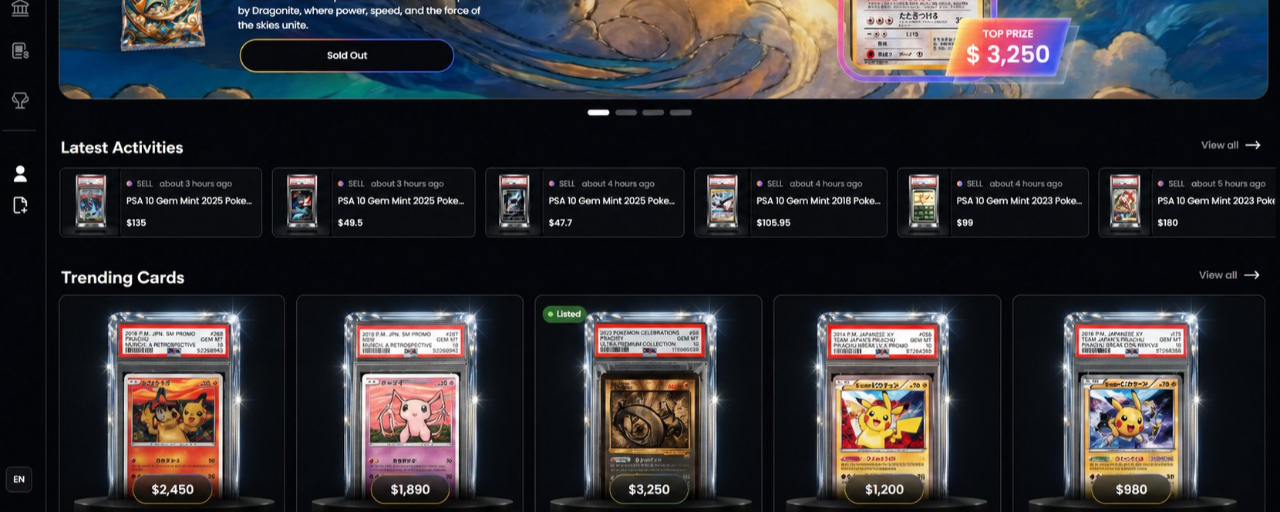
At a high level, Renaiss focuses on real-world collectibles and the infrastructure connecting physical collectibles with on-chain systems.
The interesting part is the connection between the physical and digital sides.
Instead of treating a collectible as only a physical object or only a digital asset, the goal is to create a system where the physical asset can have a verifiable on-chain representation and interact with different parts of an ecosystem.
For someone completely new, there's no need to understand every part immediately.
Here's the order I'd follow.
1. Start With the Products
The first step is simply visiting renaiss.xyz and looking through the available products and collectibles.
Don't worry about understanding the entire ecosystem immediately.
Look at what is actually being offered.
What types of collectibles are available?
How are they represented?
What can users do with them?
Starting with the actual product makes the broader RWA concept much easier to understand.
2. Understand the Physical + On-Chain Connection
Once you have a basic idea of the products, the next thing to understand is how physical collectibles connect with verifiable on-chain assets.
This is one of the most important concepts behind collectible RWAs.
The physical item exists in the real world, while blockchain infrastructure can provide a transparent digital record associated with that asset.
Vault-backed infrastructure can also play an important role here by connecting custody of the physical collectible with its digital representation.
For beginners, this is probably the key concept to understand before going deeper.
3. Explore What You Can Actually Do
After understanding the basic connection, start exploring the different functions available around the collectibles.
For example:
Marketplace tradingTransfersRedemptionPack accessOther collectible-related activities
This helps you understand that tokenization isn't simply about putting an image or a certificate on a blockchain.
The bigger idea is creating an ecosystem where physical collectibles can be managed and interacted with through connected digital infrastructure.
4. Follow Official Updates
Once you start exploring the ecosystem, it's also important to keep track of official information.
RWA projects can evolve quickly, and new campaigns, products, features, or activities can appear over time.
So instead of relying entirely on random posts or third-party information, I'd recommend checking Renaiss's official channels and updates directly.
That makes it easier to separate current information from outdated or incomplete explanations.
5. Join the Community
The final step is getting involved with the community.
If you're genuinely interested in collectible RWAs, joining the Renaiss community or Discord can be useful.
You can follow new activities, see what other collectors are exploring, ask questions, and learn from people who are already participating in the ecosystem.
For something as community-driven as collectibles, this part shouldn't be overlooked.
You Don't Need to Understand Everything on Day One
This is probably the most important thing for anyone new to RWA.
You don't need to understand the entire sector before exploring your first project.
Start with the product.
Then understand how the physical and on-chain sides connect.
After that, explore the different features and gradually learn about the infrastructure underneath.
Once you approach it this way, concepts that initially sound complicated become much easier to understand.
That's how I'd introduce Renaiss to someone exploring collectible RWAs for the first time.
Start simple, explore the product, understand the connection between physical and digital ownership, and then go deeper from there.
New to RWA? Here's a Simple Way to Start Exploring Renaiss
RWA can sound complicated when you first come across the term.
Real-world assets, tokenization, on-chain ownership, vaults, redemption, marketplaces...
There can be a lot of concepts to understand at once.
But I think the easiest way to understand RWA is to stop looking at it as a complicated technical concept and start by looking at the actual products being built around it.
If you're new to @Renaiss Collectibles , I'd recommend taking a simple approach: understand the product first, then gradually explore the infrastructure behind it.
What Is Renaiss?
At a high level, Renaiss focuses on real-world collectibles and the infrastructure connecting physical collectibles with on-chain systems.
The interesting part is the connection between the physical and digital sides.
Instead of treating a collectible as only a physical object or only a digital asset, the goal is to create a system where the physical asset can have a verifiable on-chain representation and interact with different parts of an ecosystem.
For someone completely new, there's no need to understand every part immediately.
Here's the order I'd follow.
1. Start With the Products
The first step is simply visiting renaiss.xyz and looking through the available products and collectibles.
Don't worry about understanding the entire ecosystem immediately.
Look at what is actually being offered.
What types of collectibles are available?
How are they represented?
What can users do with them?
Starting with the actual product makes the broader RWA concept much easier to understand.
2. Understand the Physical + On-Chain Connection
Once you have a basic idea of the products, the next thing to understand is how physical collectibles connect with verifiable on-chain assets.
This is one of the most important concepts behind collectible RWAs.
The physical item exists in the real world, while blockchain infrastructure can provide a transparent digital record associated with that asset.
Vault-backed infrastructure can also play an important role here by connecting custody of the physical collectible with its digital representation.
For beginners, this is probably the key concept to understand before going deeper.
3. Explore What You Can Actually Do
After understanding the basic connection, start exploring the different functions available around the collectibles.
For example:
Marketplace tradingTransfersRedemptionPack accessOther collectible-related activities
This helps you understand that tokenization isn't simply about putting an image or a certificate on a blockchain.
The bigger idea is creating an ecosystem where physical collectibles can be managed and interacted with through connected digital infrastructure.
4. Follow Official Updates
Once you start exploring the ecosystem, it's also important to keep track of official information.
RWA projects can evolve quickly, and new campaigns, products, features, or activities can appear over time.
So instead of relying entirely on random posts or third-party information, I'd recommend checking Renaiss's official channels and updates directly.
That makes it easier to separate current information from outdated or incomplete explanations.
5. Join the Community
The final step is getting involved with the community.
If you're genuinely interested in collectible RWAs, joining the Renaiss community or Discord can be useful.
You can follow new activities, see what other collectors are exploring, ask questions, and learn from people who are already participating in the ecosystem.
For something as community-driven as collectibles, this part shouldn't be overlooked.
You Don't Need to Understand Everything on Day One
This is probably the most important thing for anyone new to RWA.
You don't need to understand the entire sector before exploring your first project.
Start with the product.
Then understand how the physical and on-chain sides connect.
After that, explore the different features and gradually learn about the infrastructure underneath.
Once you approach it this way, concepts that initially sound complicated become much easier to understand.
That's how I'd introduce Renaiss to someone exploring collectible RWAs for the first time.
Start simple, explore the product, understand the connection between physical and digital ownership, and then go deeper from there.
Real-world assets, tokenization, on-chain ownership, vaults, redemption, marketplaces...
There can be a lot of concepts to understand at once.
But I think the easiest way to understand RWA is to stop looking at it as a complicated technical concept and start by looking at the actual products being built around it.
If you're new to @Renaiss Collectibles , I'd recommend taking a simple approach: understand the product first, then gradually explore the infrastructure behind it.
What Is Renaiss?
At a high level, Renaiss focuses on real-world collectibles and the infrastructure connecting physical collectibles with on-chain systems.
The interesting part is the connection between the physical and digital sides.
Instead of treating a collectible as only a physical object or only a digital asset, the goal is to create a system where the physical asset can have a verifiable on-chain representation and interact with different parts of an ecosystem.
For someone completely new, there's no need to understand every part immediately.
Here's the order I'd follow.
1. Start With the Products
The first step is simply visiting renaiss.xyz and looking through the available products and collectibles.
Don't worry about understanding the entire ecosystem immediately.
Look at what is actually being offered.
What types of collectibles are available?
How are they represented?
What can users do with them?
Starting with the actual product makes the broader RWA concept much easier to understand.
2. Understand the Physical + On-Chain Connection
Once you have a basic idea of the products, the next thing to understand is how physical collectibles connect with verifiable on-chain assets.
This is one of the most important concepts behind collectible RWAs.
The physical item exists in the real world, while blockchain infrastructure can provide a transparent digital record associated with that asset.
Vault-backed infrastructure can also play an important role here by connecting custody of the physical collectible with its digital representation.
For beginners, this is probably the key concept to understand before going deeper.
3. Explore What You Can Actually Do
After understanding the basic connection, start exploring the different functions available around the collectibles.
For example:
Marketplace tradingTransfersRedemptionPack accessOther collectible-related activities
This helps you understand that tokenization isn't simply about putting an image or a certificate on a blockchain.
The bigger idea is creating an ecosystem where physical collectibles can be managed and interacted with through connected digital infrastructure.
4. Follow Official Updates
Once you start exploring the ecosystem, it's also important to keep track of official information.
RWA projects can evolve quickly, and new campaigns, products, features, or activities can appear over time.
So instead of relying entirely on random posts or third-party information, I'd recommend checking Renaiss's official channels and updates directly.
That makes it easier to separate current information from outdated or incomplete explanations.
5. Join the Community
The final step is getting involved with the community.
If you're genuinely interested in collectible RWAs, joining the Renaiss community or Discord can be useful.
You can follow new activities, see what other collectors are exploring, ask questions, and learn from people who are already participating in the ecosystem.
For something as community-driven as collectibles, this part shouldn't be overlooked.
You Don't Need to Understand Everything on Day One
This is probably the most important thing for anyone new to RWA.
You don't need to understand the entire sector before exploring your first project.
Start with the product.
Then understand how the physical and on-chain sides connect.
After that, explore the different features and gradually learn about the infrastructure underneath.
Once you approach it this way, concepts that initially sound complicated become much easier to understand.
That's how I'd introduce Renaiss to someone exploring collectible RWAs for the first time.
Start simple, explore the product, understand the connection between physical and digital ownership, and then go deeper from there.
203
·
--
Мақала
Why Smaller, Specialized AI Models Could Matter More for CryptoThe AI industry has been heavily focused on one idea: bigger models should lead to better performance.
More parameters, more training data, more compute, and increasingly powerful general-purpose models have become the standard way of measuring AI progress.
But crypto may require a slightly different approach.
That's why Velvet Flash 0.1, introduced by @Velvet_Capital, caught my attention.
Instead of trying to compete through sheer model size, Velvet is taking a more specialized approach with a 4B-parameter model designed specifically for crypto operations.
And the interesting part isn't really the model's size.
It's what happened after training the model for a specific job.
Smaller Model, Stronger Specialized Performance
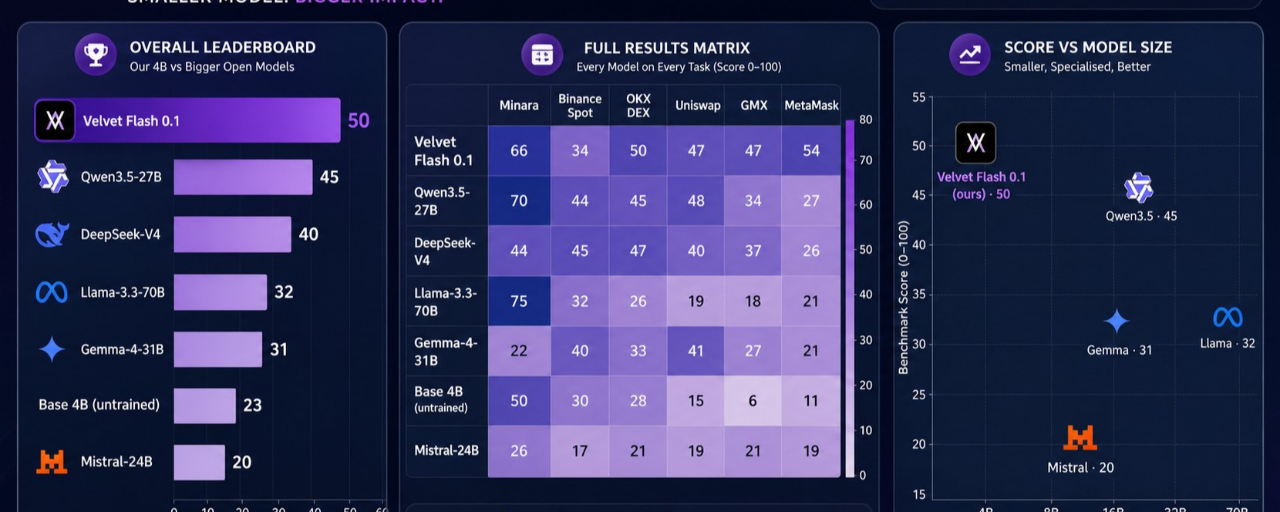
According to Velvet's crypto skills benchmark, Velvet Flash 0.1 reached a score of around 50.
For comparison:
Velvet Flash 0.1: ~50Qwen3.5-27B: ~45DeepSeek-V4: ~40Llama-3.3-70B: ~32Gemma-4-31B: ~31Mistral-24B: ~20
What makes this comparison interesting is the huge difference between general-purpose model size and specialized performance.
Velvet Flash has only 4B parameters, yet its benchmark performance surpassed several much larger models.
That doesn't mean smaller models are universally better.
Instead, it highlights something important:
A model trained specifically for a domain can sometimes outperform much larger general-purpose models at tasks within that domain.
The Training Difference Is the Real Story
The base model reportedly scored around 23 before the task-specific training.
After being trained specifically around crypto-related operations, that number increased to approximately 50.
That's more than just a small improvement.
It suggests that the model isn't simply becoming "smarter" in a general sense. It's becoming better at understanding the specific workflows and requirements that matter in crypto.
And that's potentially a much more useful direction for financial applications.
A crypto AI doesn't necessarily need to write better poetry or answer every possible general knowledge question.
It needs to understand things like:
What action is the user actually requesting?Which command should be executed?Which parameters are required?Which chain or asset is involved?Is the requested action potentially risky?Does the user need to confirm before funds are moved?
Those are specialized problems.
Safety May Be Even More Important
The other number that stood out to me was the reported safety improvement.
Velvet Flash's safety score increased from approximately 28 to 61 after specialized training.
For crypto applications, this could be more important than raw intelligence.
Imagine asking an AI to perform an on-chain action.
If the model misunderstands the amount, chooses the wrong network, extracts an incorrect address, fails to recognize suspicious intent, or executes a sensitive transaction without proper confirmation, the consequence isn't simply an incorrect answer.
Real assets can be involved.
That's fundamentally different from using AI for a normal conversation.
A mistake in a chatbot response can be annoying.
A mistake in a transaction workflow can potentially become expensive.
That's why specialized safety behavior matters so much when AI starts interacting with financial infrastructure.
Training AI Around Real Crypto Workflows
This is where Velvet Flash becomes particularly interesting.
The model is being trained around practical crypto operations rather than simply general conversation.
That includes areas such as:
Intent understanding
Figuring out what the user actually wants to accomplish instead of blindly following individual words.
Command selection
Choosing the appropriate action based on the user's request.
Parameter extraction
Correctly identifying important details such as assets, amounts, networks, and other transaction parameters.
Risk detection
Recognizing situations that may require additional scrutiny or user confirmation.
Confirmation before sensitive actions
Making sure potentially fund-moving operations aren't executed without the appropriate confirmation.
These may sound like small details, but they become extremely important when AI moves from being an information assistant to becoming an interface for financial operations.
Why Specialization Could Be Important for Crypto AI
This is the bigger idea I take away from Velvet Flash.
The future of AI in crypto may not simply be about connecting the biggest available model to a trading platform or wallet.
Instead, we could see more specialized models trained around specific financial workflows.
A model designed specifically for crypto can focus its training on the terminology, transaction patterns, risk scenarios, commands, and edge cases that matter within the ecosystem.
That could potentially make AI interfaces more efficient, more predictable, and safer for users.
Of course, Velvet Flash 0.1 is still an early version.
A benchmark is also only one way to evaluate a model. Real-world performance, reliability, security, latency, and user experience will ultimately matter much more as these systems are deployed at scale.
But the direction itself is interesting.
Final Thoughts
The AI race has often been framed around one question:
How big can the model become?
Velvet Flash makes me think another question deserves more attention:
How specifically can a model be trained for the job it actually needs to perform?
A 4B-parameter model reaching stronger results on a crypto-specific benchmark than several much larger general-purpose models is certainly worth watching.
And the reported improvement in safety makes the experiment even more relevant for financial applications.
It's only v0.1, so there's still a lot to prove.
But if specialized models continue improving through domain-specific training, crypto may become one of the areas where specialization beats scale more often than people expect.
I'll be watching to see where @Velvet_Capital takes Velvet Flash from here.
Why Smaller, Specialized AI Models Could Matter More for Crypto
The AI industry has been heavily focused on one idea: bigger models should lead to better performance.
More parameters, more training data, more compute, and increasingly powerful general-purpose models have become the standard way of measuring AI progress.
But crypto may require a slightly different approach.
That's why Velvet Flash 0.1, introduced by @Velvet_Capital, caught my attention.
Instead of trying to compete through sheer model size, Velvet is taking a more specialized approach with a 4B-parameter model designed specifically for crypto operations.
And the interesting part isn't really the model's size.
It's what happened after training the model for a specific job.
Smaller Model, Stronger Specialized Performance
According to Velvet's crypto skills benchmark, Velvet Flash 0.1 reached a score of around 50.
For comparison:
Velvet Flash 0.1: ~50Qwen3.5-27B: ~45DeepSeek-V4: ~40Llama-3.3-70B: ~32Gemma-4-31B: ~31Mistral-24B: ~20
What makes this comparison interesting is the huge difference between general-purpose model size and specialized performance.
Velvet Flash has only 4B parameters, yet its benchmark performance surpassed several much larger models.
That doesn't mean smaller models are universally better.
Instead, it highlights something important:
A model trained specifically for a domain can sometimes outperform much larger general-purpose models at tasks within that domain.
The Training Difference Is the Real Story
The base model reportedly scored around 23 before the task-specific training.
After being trained specifically around crypto-related operations, that number increased to approximately 50.
That's more than just a small improvement.
It suggests that the model isn't simply becoming "smarter" in a general sense. It's becoming better at understanding the specific workflows and requirements that matter in crypto.
And that's potentially a much more useful direction for financial applications.
A crypto AI doesn't necessarily need to write better poetry or answer every possible general knowledge question.
It needs to understand things like:
What action is the user actually requesting?Which command should be executed?Which parameters are required?Which chain or asset is involved?Is the requested action potentially risky?Does the user need to confirm before funds are moved?
Those are specialized problems.
Safety May Be Even More Important
The other number that stood out to me was the reported safety improvement.
Velvet Flash's safety score increased from approximately 28 to 61 after specialized training.
For crypto applications, this could be more important than raw intelligence.
Imagine asking an AI to perform an on-chain action.
If the model misunderstands the amount, chooses the wrong network, extracts an incorrect address, fails to recognize suspicious intent, or executes a sensitive transaction without proper confirmation, the consequence isn't simply an incorrect answer.
Real assets can be involved.
That's fundamentally different from using AI for a normal conversation.
A mistake in a chatbot response can be annoying.
A mistake in a transaction workflow can potentially become expensive.
That's why specialized safety behavior matters so much when AI starts interacting with financial infrastructure.
Training AI Around Real Crypto Workflows
This is where Velvet Flash becomes particularly interesting.
The model is being trained around practical crypto operations rather than simply general conversation.
That includes areas such as:
Intent understanding
Figuring out what the user actually wants to accomplish instead of blindly following individual words.
Command selection
Choosing the appropriate action based on the user's request.
Parameter extraction
Correctly identifying important details such as assets, amounts, networks, and other transaction parameters.
Risk detection
Recognizing situations that may require additional scrutiny or user confirmation.
Confirmation before sensitive actions
Making sure potentially fund-moving operations aren't executed without the appropriate confirmation.
These may sound like small details, but they become extremely important when AI moves from being an information assistant to becoming an interface for financial operations.
Why Specialization Could Be Important for Crypto AI
This is the bigger idea I take away from Velvet Flash.
The future of AI in crypto may not simply be about connecting the biggest available model to a trading platform or wallet.
Instead, we could see more specialized models trained around specific financial workflows.
A model designed specifically for crypto can focus its training on the terminology, transaction patterns, risk scenarios, commands, and edge cases that matter within the ecosystem.
That could potentially make AI interfaces more efficient, more predictable, and safer for users.
Of course, Velvet Flash 0.1 is still an early version.
A benchmark is also only one way to evaluate a model. Real-world performance, reliability, security, latency, and user experience will ultimately matter much more as these systems are deployed at scale.
But the direction itself is interesting.
Final Thoughts
The AI race has often been framed around one question:
How big can the model become?
Velvet Flash makes me think another question deserves more attention:
How specifically can a model be trained for the job it actually needs to perform?
A 4B-parameter model reaching stronger results on a crypto-specific benchmark than several much larger general-purpose models is certainly worth watching.
And the reported improvement in safety makes the experiment even more relevant for financial applications.
It's only v0.1, so there's still a lot to prove.
But if specialized models continue improving through domain-specific training, crypto may become one of the areas where specialization beats scale more often than people expect.
I'll be watching to see where @Velvet_Capital takes Velvet Flash from here.
More parameters, more training data, more compute, and increasingly powerful general-purpose models have become the standard way of measuring AI progress.
But crypto may require a slightly different approach.
That's why Velvet Flash 0.1, introduced by @Velvet_Capital, caught my attention.
Instead of trying to compete through sheer model size, Velvet is taking a more specialized approach with a 4B-parameter model designed specifically for crypto operations.
And the interesting part isn't really the model's size.
It's what happened after training the model for a specific job.
Smaller Model, Stronger Specialized Performance
According to Velvet's crypto skills benchmark, Velvet Flash 0.1 reached a score of around 50.
For comparison:
Velvet Flash 0.1: ~50Qwen3.5-27B: ~45DeepSeek-V4: ~40Llama-3.3-70B: ~32Gemma-4-31B: ~31Mistral-24B: ~20
What makes this comparison interesting is the huge difference between general-purpose model size and specialized performance.
Velvet Flash has only 4B parameters, yet its benchmark performance surpassed several much larger models.
That doesn't mean smaller models are universally better.
Instead, it highlights something important:
A model trained specifically for a domain can sometimes outperform much larger general-purpose models at tasks within that domain.
The Training Difference Is the Real Story
The base model reportedly scored around 23 before the task-specific training.
After being trained specifically around crypto-related operations, that number increased to approximately 50.
That's more than just a small improvement.
It suggests that the model isn't simply becoming "smarter" in a general sense. It's becoming better at understanding the specific workflows and requirements that matter in crypto.
And that's potentially a much more useful direction for financial applications.
A crypto AI doesn't necessarily need to write better poetry or answer every possible general knowledge question.
It needs to understand things like:
What action is the user actually requesting?Which command should be executed?Which parameters are required?Which chain or asset is involved?Is the requested action potentially risky?Does the user need to confirm before funds are moved?
Those are specialized problems.
Safety May Be Even More Important
The other number that stood out to me was the reported safety improvement.
Velvet Flash's safety score increased from approximately 28 to 61 after specialized training.
For crypto applications, this could be more important than raw intelligence.
Imagine asking an AI to perform an on-chain action.
If the model misunderstands the amount, chooses the wrong network, extracts an incorrect address, fails to recognize suspicious intent, or executes a sensitive transaction without proper confirmation, the consequence isn't simply an incorrect answer.
Real assets can be involved.
That's fundamentally different from using AI for a normal conversation.
A mistake in a chatbot response can be annoying.
A mistake in a transaction workflow can potentially become expensive.
That's why specialized safety behavior matters so much when AI starts interacting with financial infrastructure.
Training AI Around Real Crypto Workflows
This is where Velvet Flash becomes particularly interesting.
The model is being trained around practical crypto operations rather than simply general conversation.
That includes areas such as:
Intent understanding
Figuring out what the user actually wants to accomplish instead of blindly following individual words.
Command selection
Choosing the appropriate action based on the user's request.
Parameter extraction
Correctly identifying important details such as assets, amounts, networks, and other transaction parameters.
Risk detection
Recognizing situations that may require additional scrutiny or user confirmation.
Confirmation before sensitive actions
Making sure potentially fund-moving operations aren't executed without the appropriate confirmation.
These may sound like small details, but they become extremely important when AI moves from being an information assistant to becoming an interface for financial operations.
Why Specialization Could Be Important for Crypto AI
This is the bigger idea I take away from Velvet Flash.
The future of AI in crypto may not simply be about connecting the biggest available model to a trading platform or wallet.
Instead, we could see more specialized models trained around specific financial workflows.
A model designed specifically for crypto can focus its training on the terminology, transaction patterns, risk scenarios, commands, and edge cases that matter within the ecosystem.
That could potentially make AI interfaces more efficient, more predictable, and safer for users.
Of course, Velvet Flash 0.1 is still an early version.
A benchmark is also only one way to evaluate a model. Real-world performance, reliability, security, latency, and user experience will ultimately matter much more as these systems are deployed at scale.
But the direction itself is interesting.
Final Thoughts
The AI race has often been framed around one question:
How big can the model become?
Velvet Flash makes me think another question deserves more attention:
How specifically can a model be trained for the job it actually needs to perform?
A 4B-parameter model reaching stronger results on a crypto-specific benchmark than several much larger general-purpose models is certainly worth watching.
And the reported improvement in safety makes the experiment even more relevant for financial applications.
It's only v0.1, so there's still a lot to prove.
But if specialized models continue improving through domain-specific training, crypto may become one of the areas where specialization beats scale more often than people expect.
I'll be watching to see where @Velvet_Capital takes Velvet Flash from here.
1
82
·
--
Жоғары (өспелі)
Been checking back on @HertzFlow_xyz lately, and one thing feels pretty clear: the project is getting closer to its next big milestone. ⚡
After spending time on the testnet, I'm curious to see how that experience carries over once mainnet goes live.
What I enjoyed most wasn't just opening leveraged trades. It was seeing how different parts of the ecosystem connect , from trading to Pools, Vaults and the referral system.
The testnet gave users a chance to explore the platform, try different strategies, understand the mechanics, and get comfortable before real capital comes into play.
Now that Hertzflow is preparing for mainnet, this feels like a good time to explore the platform if you haven't already.
I'm especially looking forward to seeing how the community grows in the next phase and how the testnet experience translates into the live ecosystem.
#testnet #to #mainnet
Been checking back on @HertzFlow lately, and one thing feels pretty clear: the project is getting closer to its next big milestone. ⚡
After spending time on the testnet, I'm curious to see how that experience carries over once mainnet goes live.
What I enjoyed most wasn't just opening leveraged trades. It was seeing how different parts of the ecosystem connect , from trading to Pools, Vaults and the referral system.
The testnet gave users a chance to explore the platform, try different strategies, understand the mechanics, and get comfortable before real capital comes into play.
Now that Hertzflow is preparing for mainnet, this feels like a good time to explore the platform if you haven't already.
I'm especially looking forward to seeing how the community grows in the next phase and how the testnet experience translates into the live ecosystem.
#testnet #to #mainnet
After spending time on the testnet, I'm curious to see how that experience carries over once mainnet goes live.
What I enjoyed most wasn't just opening leveraged trades. It was seeing how different parts of the ecosystem connect , from trading to Pools, Vaults and the referral system.
The testnet gave users a chance to explore the platform, try different strategies, understand the mechanics, and get comfortable before real capital comes into play.
Now that Hertzflow is preparing for mainnet, this feels like a good time to explore the platform if you haven't already.
I'm especially looking forward to seeing how the community grows in the next phase and how the testnet experience translates into the live ecosystem.
#testnet #to #mainnet
1
63
·
--
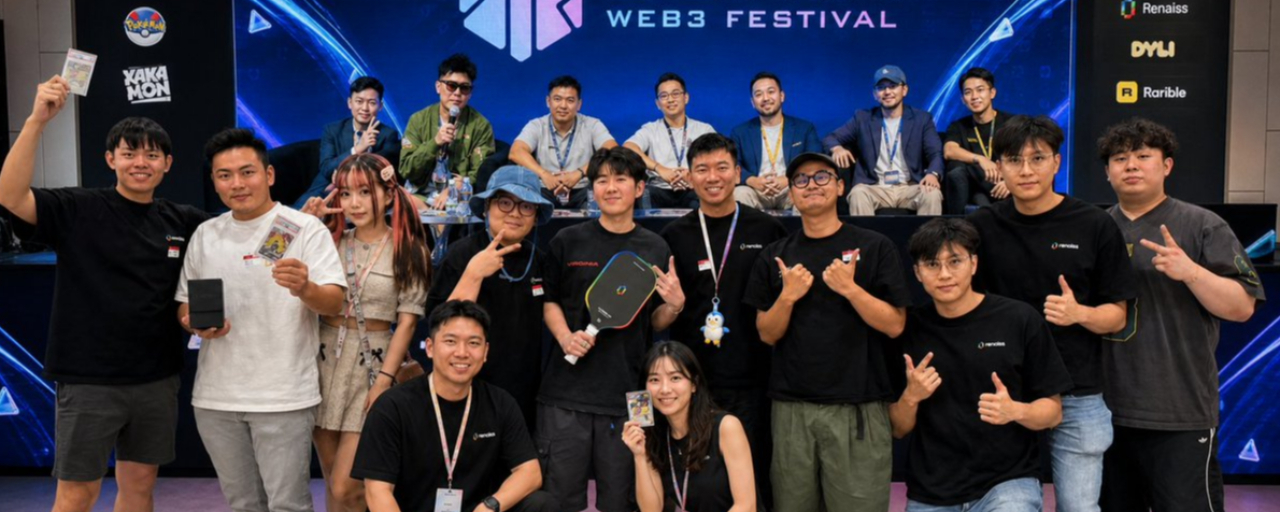
Мақала
Communities Create Lasting Value, But Infrastructure Helps Ecosystems ScaleWhen people talk about Real World Assets (RWA), the conversation often focuses on tokenization.
How can a physical asset be represented on-chain?
How can ownership be verified?
How can an asset eventually become more liquid?
These are important questions, but I think there's another piece of the puzzle that doesn't get enough attention:
The community behind the asset.
Collectibles are a great example.
A collectible doesn't become valuable simply because someone puts it on-chain. Its long-term value is often connected to the people who collect it, trade it, discuss it, authenticate it, and build communities around it.
That's why seeing @renaissprotocol connect directly with collectors, TCG players and builders in Malaysia caught my attention.
It highlights an important part of the RWA story:
Tokenization alone isn't enough.
Communities Give Collectibles Meaning
Think about trading cards, rare collectibles, limited-edition items, or other physical assets.
Their value isn't determined only by the physical object itself.
There is an entire ecosystem around them.
Collectors want reliable ownership records.
Traders want liquidity.
Players want access to authentic items.
Stores want better ways to manage inventory and ownership.
Marketplaces need trustworthy asset information.
And communities create the conversations and demand that keep these ecosystems active.
Without those participants, even the best technology can struggle to create meaningful adoption.
Infrastructure Is What Connects Everything
This is where infrastructure becomes important.
If every marketplace, vault, store, and collector uses completely different systems, the ecosystem becomes fragmented.
A collector might own a physical item but have difficulty proving its history.
A marketplace might have one set of records while a vault uses another.
A store may have valuable inventory but limited connectivity with digital platforms.
These disconnected systems create friction.
The bigger opportunity is to create infrastructure that allows these different participants to interact around shared, verifiable asset information.
That's the direction I find interesting about Renaiss.
Instead of looking at physical collectibles purely as individual products, the broader vision appears to focus on the infrastructure connecting the different parts of the ecosystem.
Why Community Engagement Matters
Technology can provide the infrastructure, but communities provide the feedback needed to make that infrastructure useful.
That's why direct interaction with collectors, TCG players, and builders matters.
Real users can identify problems that aren't always obvious from a technical perspective.
They can explain how they currently authenticate collectibles.
They can highlight where buying and selling becomes difficult.
They can point out what information collectors actually need.
And they can help builders understand which features are genuinely useful rather than simply impressive on paper.
This feedback loop can become extremely valuable as RWA projects move from experimentation toward real-world adoption.
RWA Is More Than Putting Assets On-Chain
For me, this is one of the biggest lessons from the current RWA narrative.
Putting an asset on a blockchain is only one part of the process.
The bigger challenge is building the ecosystem around that asset.
You need:
Trust → so users can verify what they're buying.
Infrastructure → so different participants can interact.
Liquidity → so assets can actually circulate.
Community → so demand and participation continue to grow.
User feedback → so the infrastructure keeps improving.
When these pieces start working together, tokenization becomes much more meaningful.
Instead of simply creating a digital representation of a physical collectible, you can begin creating an environment where that collectible can be verified, stored, transferred, traded, and used across multiple parts of an ecosystem.
Why I'm Watching Renaiss
That's why I find Renaiss's community engagement interesting alongside its infrastructure development.
Building technology is one thing.
Building technology while listening to the people who will actually use it is another.
The long-term success of physical collectible infrastructure will likely depend not only on technical capabilities, but also on whether collectors, stores, marketplaces, and builders actually find the system useful.
Seeing Renaiss engage with the community in Malaysia is a reminder that adoption doesn't happen entirely on-chain.
It happens through conversations, feedback, experimentation, and people.
Communities give collectibles lasting value. Infrastructure gives those communities the ability to grow.
And if RWA adoption continues expanding, I think the projects that understand both sides of that equation will be worth watching closely.
I'm definitely looking forward to seeing where Renaiss goes next.
Communities Create Lasting Value, But Infrastructure Helps Ecosystems Scale
When people talk about Real World Assets (RWA), the conversation often focuses on tokenization.
How can a physical asset be represented on-chain?
How can ownership be verified?
How can an asset eventually become more liquid?
These are important questions, but I think there's another piece of the puzzle that doesn't get enough attention:
The community behind the asset.
Collectibles are a great example.
A collectible doesn't become valuable simply because someone puts it on-chain. Its long-term value is often connected to the people who collect it, trade it, discuss it, authenticate it, and build communities around it.
That's why seeing @Renaiss Collectibles connect directly with collectors, TCG players and builders in Malaysia caught my attention.
It highlights an important part of the RWA story:
Tokenization alone isn't enough.
Communities Give Collectibles Meaning
Think about trading cards, rare collectibles, limited-edition items, or other physical assets.
Their value isn't determined only by the physical object itself.
There is an entire ecosystem around them.
Collectors want reliable ownership records.
Traders want liquidity.
Players want access to authentic items.
Stores want better ways to manage inventory and ownership.
Marketplaces need trustworthy asset information.
And communities create the conversations and demand that keep these ecosystems active.
Without those participants, even the best technology can struggle to create meaningful adoption.
Infrastructure Is What Connects Everything
This is where infrastructure becomes important.
If every marketplace, vault, store, and collector uses completely different systems, the ecosystem becomes fragmented.
A collector might own a physical item but have difficulty proving its history.
A marketplace might have one set of records while a vault uses another.
A store may have valuable inventory but limited connectivity with digital platforms.
These disconnected systems create friction.
The bigger opportunity is to create infrastructure that allows these different participants to interact around shared, verifiable asset information.
That's the direction I find interesting about Renaiss.
Instead of looking at physical collectibles purely as individual products, the broader vision appears to focus on the infrastructure connecting the different parts of the ecosystem.
Why Community Engagement Matters
Technology can provide the infrastructure, but communities provide the feedback needed to make that infrastructure useful.
That's why direct interaction with collectors, TCG players, and builders matters.
Real users can identify problems that aren't always obvious from a technical perspective.
They can explain how they currently authenticate collectibles.
They can highlight where buying and selling becomes difficult.
They can point out what information collectors actually need.
And they can help builders understand which features are genuinely useful rather than simply impressive on paper.
This feedback loop can become extremely valuable as RWA projects move from experimentation toward real-world adoption.
RWA Is More Than Putting Assets On-Chain
For me, this is one of the biggest lessons from the current RWA narrative.
Putting an asset on a blockchain is only one part of the process.
The bigger challenge is building the ecosystem around that asset.
You need:
Trust → so users can verify what they're buying.
Infrastructure → so different participants can interact.
Liquidity → so assets can actually circulate.
Community → so demand and participation continue to grow.
User feedback → so the infrastructure keeps improving.
When these pieces start working together, tokenization becomes much more meaningful.
Instead of simply creating a digital representation of a physical collectible, you can begin creating an environment where that collectible can be verified, stored, transferred, traded, and used across multiple parts of an ecosystem.
Why I'm Watching Renaiss
That's why I find Renaiss's community engagement interesting alongside its infrastructure development.
Building technology is one thing.
Building technology while listening to the people who will actually use it is another.
The long-term success of physical collectible infrastructure will likely depend not only on technical capabilities, but also on whether collectors, stores, marketplaces, and builders actually find the system useful.
Seeing Renaiss engage with the community in Malaysia is a reminder that adoption doesn't happen entirely on-chain.
It happens through conversations, feedback, experimentation, and people.
Communities give collectibles lasting value. Infrastructure gives those communities the ability to grow.
And if RWA adoption continues expanding, I think the projects that understand both sides of that equation will be worth watching closely.
I'm definitely looking forward to seeing where Renaiss goes next.
How can a physical asset be represented on-chain?
How can ownership be verified?
How can an asset eventually become more liquid?
These are important questions, but I think there's another piece of the puzzle that doesn't get enough attention:
The community behind the asset.
Collectibles are a great example.
A collectible doesn't become valuable simply because someone puts it on-chain. Its long-term value is often connected to the people who collect it, trade it, discuss it, authenticate it, and build communities around it.
That's why seeing @Renaiss Collectibles connect directly with collectors, TCG players and builders in Malaysia caught my attention.
It highlights an important part of the RWA story:
Tokenization alone isn't enough.
Communities Give Collectibles Meaning
Think about trading cards, rare collectibles, limited-edition items, or other physical assets.
Their value isn't determined only by the physical object itself.
There is an entire ecosystem around them.
Collectors want reliable ownership records.
Traders want liquidity.
Players want access to authentic items.
Stores want better ways to manage inventory and ownership.
Marketplaces need trustworthy asset information.
And communities create the conversations and demand that keep these ecosystems active.
Without those participants, even the best technology can struggle to create meaningful adoption.
Infrastructure Is What Connects Everything
This is where infrastructure becomes important.
If every marketplace, vault, store, and collector uses completely different systems, the ecosystem becomes fragmented.
A collector might own a physical item but have difficulty proving its history.
A marketplace might have one set of records while a vault uses another.
A store may have valuable inventory but limited connectivity with digital platforms.
These disconnected systems create friction.
The bigger opportunity is to create infrastructure that allows these different participants to interact around shared, verifiable asset information.
That's the direction I find interesting about Renaiss.
Instead of looking at physical collectibles purely as individual products, the broader vision appears to focus on the infrastructure connecting the different parts of the ecosystem.
Why Community Engagement Matters
Technology can provide the infrastructure, but communities provide the feedback needed to make that infrastructure useful.
That's why direct interaction with collectors, TCG players, and builders matters.
Real users can identify problems that aren't always obvious from a technical perspective.
They can explain how they currently authenticate collectibles.
They can highlight where buying and selling becomes difficult.
They can point out what information collectors actually need.
And they can help builders understand which features are genuinely useful rather than simply impressive on paper.
This feedback loop can become extremely valuable as RWA projects move from experimentation toward real-world adoption.
RWA Is More Than Putting Assets On-Chain
For me, this is one of the biggest lessons from the current RWA narrative.
Putting an asset on a blockchain is only one part of the process.
The bigger challenge is building the ecosystem around that asset.
You need:
Trust → so users can verify what they're buying.
Infrastructure → so different participants can interact.
Liquidity → so assets can actually circulate.
Community → so demand and participation continue to grow.
User feedback → so the infrastructure keeps improving.
When these pieces start working together, tokenization becomes much more meaningful.
Instead of simply creating a digital representation of a physical collectible, you can begin creating an environment where that collectible can be verified, stored, transferred, traded, and used across multiple parts of an ecosystem.
Why I'm Watching Renaiss
That's why I find Renaiss's community engagement interesting alongside its infrastructure development.
Building technology is one thing.
Building technology while listening to the people who will actually use it is another.
The long-term success of physical collectible infrastructure will likely depend not only on technical capabilities, but also on whether collectors, stores, marketplaces, and builders actually find the system useful.
Seeing Renaiss engage with the community in Malaysia is a reminder that adoption doesn't happen entirely on-chain.
It happens through conversations, feedback, experimentation, and people.
Communities give collectibles lasting value. Infrastructure gives those communities the ability to grow.
And if RWA adoption continues expanding, I think the projects that understand both sides of that equation will be worth watching closely.
I'm definitely looking forward to seeing where Renaiss goes next.
1
81
·
--
Жоғары (өспелі)
A great product becomes even stronger when it's accessible to more communities.
It's great to see @HertzFlow_xyz now supporting both Simplified and Traditional Chinese, making it easier for more users to learn, trade, and explore the platform.
If I could suggest a Chinese name, I'd choose:
「赫兹流」
It stays close to the original name while remaining simple and easy to remember.
What Chinese name would you suggest for Hertzflow?
———
中文(简体)
一个优秀的产品,也需要让更多社区轻松使用。
很高兴看到 @HertzFlow_xyz 已支持简体中文和繁體中文,让更多中文用户更容易了解、交易并体验平台。
如果让我为 Hertzflow 提一个中文名字,我会选择:
「赫兹流」
这个名字既保留了原有品牌特色,也简单 容易记住。
你会给 Hertzflow 起什么中文名字?
#BNBChain #china
A great product becomes even stronger when it's accessible to more communities.
It's great to see @HertzFlow now supporting both Simplified and Traditional Chinese, making it easier for more users to learn, trade, and explore the platform.
If I could suggest a Chinese name, I'd choose:
「赫兹流」
It stays close to the original name while remaining simple and easy to remember.
What Chinese name would you suggest for Hertzflow?
———
中文(简体)
一个优秀的产品,也需要让更多社区轻松使用。
很高兴看到 @HertzFlow 已支持简体中文和繁體中文,让更多中文用户更容易了解、交易并体验平台。
如果让我为 Hertzflow 提一个中文名字,我会选择:
「赫兹流」
这个名字既保留了原有品牌特色,也简单 容易记住。
你会给 Hertzflow 起什么中文名字?
#BNBChain #china
It's great to see @HertzFlow now supporting both Simplified and Traditional Chinese, making it easier for more users to learn, trade, and explore the platform.
If I could suggest a Chinese name, I'd choose:
「赫兹流」
It stays close to the original name while remaining simple and easy to remember.
What Chinese name would you suggest for Hertzflow?
———
中文(简体)
一个优秀的产品,也需要让更多社区轻松使用。
很高兴看到 @HertzFlow 已支持简体中文和繁體中文,让更多中文用户更容易了解、交易并体验平台。
如果让我为 Hertzflow 提一个中文名字,我会选择:
「赫兹流」
这个名字既保留了原有品牌特色,也简单 容易记住。
你会给 Hertzflow 起什么中文名字?
#BNBChain #china
2
2
82
·
--
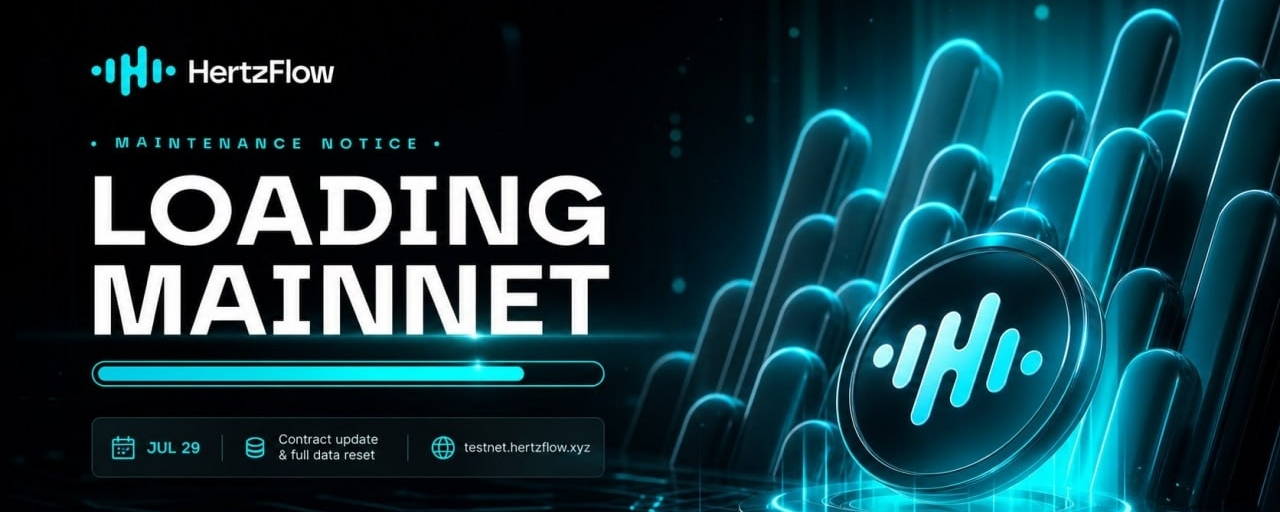
Мақала
Why Exploring Hertzflow Testnet Before Mainnet Could Give You an EdgeFor many crypto users, a testnet is simply a place to click around and try a few features before the real launch.
I think that's an incomplete way of looking at it.
A good testnet is more than a product demo, it's an opportunity to understand how a protocol works, build confidence with its interface, experiment with strategies, and prepare yourself before real capital is involved.
That's exactly how I've been approaching @HertzFlow_xyz
After spending time exploring the platform, it feels less like a simple test environment and more like a complete practice ground for decentralized leverage trading, liquidity participation and community engagement.
If you're planning to use the platform after launch, becoming familiar with the testnet today could make the transition to mainnet much smoother.
Explore Multiple Market Categories
One of the first things I noticed is that Hertzflow isn't limited to a single asset class.
The platform lets users explore different market categories, including:
Crypto assetsForex marketsMeme assets
Having multiple markets available creates a broader trading experience and allows users to understand how different assets behave under various market conditions.
Practice Leverage Trading Without Real Capital
Leverage trading often feels intimidating for beginners because every mistake can be expensive.
That's why testnets are valuable.
On Hertzflow, users can experience leveraged trading mechanics in a risk-free environment before moving to live markets.
The platform currently offers two trading modes:
Normal Mode
For traders who want a balanced experience, Normal Mode supports leverage of up to 45x.
This is ideal for understanding position sizing, stop-loss placement, and general trade management without immediately jumping into extremely aggressive leverage.
Hyper Mode
For more experienced traders, Hyper Mode increases leverage up to 200x.
While higher leverage always requires greater discipline, having access to this mode on testnet allows traders to understand how rapid price movements affect positions without putting real funds at risk.
It's a useful environment for testing advanced strategies and learning how liquidation risks work under different market conditions.
Learn How Liquidity Participation Works
Trading isn't the only activity available on Hertzflow.
Users can also deposit assets into Pools and Vaults, receiving HzLP and HzV tokens in return.
This provides an opportunity to understand how liquidity participation functions within the ecosystem and how different protocol components work together beyond simple trading.
Exploring these features during testnet makes it easier to understand the platform before real liquidity enters the ecosystem.
Grow Through the Referral System
Another feature that stood out to me is the built-in referral program.
Rather than being just a simple invite link, the referral system is designed to reward long-term participation.
Users can:
Invite friends to join the platform.
Offer trading fee discounts to referrals.
Progress through tier-based reward levels.
Unlock additional benefits based on their network's activity and cumulative trading volume.
This creates incentives for both individual traders and community builders to grow alongside the platform.
Measure Your Progress on the Leaderboard
The feature I personally enjoy the most is the leaderboard.
Instead of trading without feedback, the leaderboard lets users monitor their progress over time and compare their performance with other participants.
Since the platform is still in its testnet phase, this becomes an ideal environment for experimentation.
You can try different entry strategies, adjust your risk management approach, test various leverage levels and evaluate how each decision impacts your overall performance - all without risking real capital.
For newer traders, it's a valuable learning tool.
For experienced traders, it's an opportunity to refine strategies before the platform officially launches.
Why Testnet Participation Matters
Many users underestimate the value of spending time on a testnet.
By the time a protocol reaches mainnet, experienced testnet users already understand the interface, know where key features are located and have developed workflows that newer users still need to learn.
That familiarity can make a significant difference.
Instead of learning under pressure with real funds, you've already built experience in a safe environment.
Final Thoughts
With Hertzflow preparing for its upcoming mainnet launch, I believe now is one of the best times to explore everything the platform has to offer.
Whether you're interested in leverage trading, liquidity participation,m or simply understanding how the protocol works, the current testnet provides a practical environment to learn, experiment and improve.
Mainnet is where real trading begins, but testnet is where confidence is built.
If you're planning to use Hertzflow in the future, spending time on the testnet today could be one of the smartest ways to prepare for what's next.
#TrendingTopic #BNBChain
Why Exploring Hertzflow Testnet Before Mainnet Could Give You an Edge
For many crypto users, a testnet is simply a place to click around and try a few features before the real launch.
I think that's an incomplete way of looking at it.
A good testnet is more than a product demo, it's an opportunity to understand how a protocol works, build confidence with its interface, experiment with strategies, and prepare yourself before real capital is involved.
That's exactly how I've been approaching @HertzFlow
After spending time exploring the platform, it feels less like a simple test environment and more like a complete practice ground for decentralized leverage trading, liquidity participation and community engagement.
If you're planning to use the platform after launch, becoming familiar with the testnet today could make the transition to mainnet much smoother.
Explore Multiple Market Categories
One of the first things I noticed is that Hertzflow isn't limited to a single asset class.
The platform lets users explore different market categories, including:
Crypto assetsForex marketsMeme assets
Having multiple markets available creates a broader trading experience and allows users to understand how different assets behave under various market conditions.
Practice Leverage Trading Without Real Capital
Leverage trading often feels intimidating for beginners because every mistake can be expensive.
That's why testnets are valuable.
On Hertzflow, users can experience leveraged trading mechanics in a risk-free environment before moving to live markets.
The platform currently offers two trading modes:
Normal Mode
For traders who want a balanced experience, Normal Mode supports leverage of up to 45x.
This is ideal for understanding position sizing, stop-loss placement, and general trade management without immediately jumping into extremely aggressive leverage.
Hyper Mode
For more experienced traders, Hyper Mode increases leverage up to 200x.
While higher leverage always requires greater discipline, having access to this mode on testnet allows traders to understand how rapid price movements affect positions without putting real funds at risk.
It's a useful environment for testing advanced strategies and learning how liquidation risks work under different market conditions.
Learn How Liquidity Participation Works
Trading isn't the only activity available on Hertzflow.
Users can also deposit assets into Pools and Vaults, receiving HzLP and HzV tokens in return.
This provides an opportunity to understand how liquidity participation functions within the ecosystem and how different protocol components work together beyond simple trading.
Exploring these features during testnet makes it easier to understand the platform before real liquidity enters the ecosystem.
Grow Through the Referral System
Another feature that stood out to me is the built-in referral program.
Rather than being just a simple invite link, the referral system is designed to reward long-term participation.
Users can:
Invite friends to join the platform.
Offer trading fee discounts to referrals.
Progress through tier-based reward levels.
Unlock additional benefits based on their network's activity and cumulative trading volume.
This creates incentives for both individual traders and community builders to grow alongside the platform.
Measure Your Progress on the Leaderboard
The feature I personally enjoy the most is the leaderboard.
Instead of trading without feedback, the leaderboard lets users monitor their progress over time and compare their performance with other participants.
Since the platform is still in its testnet phase, this becomes an ideal environment for experimentation.
You can try different entry strategies, adjust your risk management approach, test various leverage levels and evaluate how each decision impacts your overall performance - all without risking real capital.
For newer traders, it's a valuable learning tool.
For experienced traders, it's an opportunity to refine strategies before the platform officially launches.
Why Testnet Participation Matters
Many users underestimate the value of spending time on a testnet.
By the time a protocol reaches mainnet, experienced testnet users already understand the interface, know where key features are located and have developed workflows that newer users still need to learn.
That familiarity can make a significant difference.
Instead of learning under pressure with real funds, you've already built experience in a safe environment.
Final Thoughts
With Hertzflow preparing for its upcoming mainnet launch, I believe now is one of the best times to explore everything the platform has to offer.
Whether you're interested in leverage trading, liquidity participation,m or simply understanding how the protocol works, the current testnet provides a practical environment to learn, experiment and improve.
Mainnet is where real trading begins, but testnet is where confidence is built.
If you're planning to use Hertzflow in the future, spending time on the testnet today could be one of the smartest ways to prepare for what's next.
#TrendingTopic #BNBChain
I think that's an incomplete way of looking at it.
A good testnet is more than a product demo, it's an opportunity to understand how a protocol works, build confidence with its interface, experiment with strategies, and prepare yourself before real capital is involved.
That's exactly how I've been approaching @HertzFlow
After spending time exploring the platform, it feels less like a simple test environment and more like a complete practice ground for decentralized leverage trading, liquidity participation and community engagement.
If you're planning to use the platform after launch, becoming familiar with the testnet today could make the transition to mainnet much smoother.
Explore Multiple Market Categories
One of the first things I noticed is that Hertzflow isn't limited to a single asset class.
The platform lets users explore different market categories, including:
Crypto assetsForex marketsMeme assets
Having multiple markets available creates a broader trading experience and allows users to understand how different assets behave under various market conditions.
Practice Leverage Trading Without Real Capital
Leverage trading often feels intimidating for beginners because every mistake can be expensive.
That's why testnets are valuable.
On Hertzflow, users can experience leveraged trading mechanics in a risk-free environment before moving to live markets.
The platform currently offers two trading modes:
Normal Mode
For traders who want a balanced experience, Normal Mode supports leverage of up to 45x.
This is ideal for understanding position sizing, stop-loss placement, and general trade management without immediately jumping into extremely aggressive leverage.
Hyper Mode
For more experienced traders, Hyper Mode increases leverage up to 200x.
While higher leverage always requires greater discipline, having access to this mode on testnet allows traders to understand how rapid price movements affect positions without putting real funds at risk.
It's a useful environment for testing advanced strategies and learning how liquidation risks work under different market conditions.
Learn How Liquidity Participation Works
Trading isn't the only activity available on Hertzflow.
Users can also deposit assets into Pools and Vaults, receiving HzLP and HzV tokens in return.
This provides an opportunity to understand how liquidity participation functions within the ecosystem and how different protocol components work together beyond simple trading.
Exploring these features during testnet makes it easier to understand the platform before real liquidity enters the ecosystem.
Grow Through the Referral System
Another feature that stood out to me is the built-in referral program.
Rather than being just a simple invite link, the referral system is designed to reward long-term participation.
Users can:
Invite friends to join the platform.
Offer trading fee discounts to referrals.
Progress through tier-based reward levels.
Unlock additional benefits based on their network's activity and cumulative trading volume.
This creates incentives for both individual traders and community builders to grow alongside the platform.
Measure Your Progress on the Leaderboard
The feature I personally enjoy the most is the leaderboard.
Instead of trading without feedback, the leaderboard lets users monitor their progress over time and compare their performance with other participants.
Since the platform is still in its testnet phase, this becomes an ideal environment for experimentation.
You can try different entry strategies, adjust your risk management approach, test various leverage levels and evaluate how each decision impacts your overall performance - all without risking real capital.
For newer traders, it's a valuable learning tool.
For experienced traders, it's an opportunity to refine strategies before the platform officially launches.
Why Testnet Participation Matters
Many users underestimate the value of spending time on a testnet.
By the time a protocol reaches mainnet, experienced testnet users already understand the interface, know where key features are located and have developed workflows that newer users still need to learn.
That familiarity can make a significant difference.
Instead of learning under pressure with real funds, you've already built experience in a safe environment.
Final Thoughts
With Hertzflow preparing for its upcoming mainnet launch, I believe now is one of the best times to explore everything the platform has to offer.
Whether you're interested in leverage trading, liquidity participation,m or simply understanding how the protocol works, the current testnet provides a practical environment to learn, experiment and improve.
Mainnet is where real trading begins, but testnet is where confidence is built.
If you're planning to use Hertzflow in the future, spending time on the testnet today could be one of the smartest ways to prepare for what's next.
#TrendingTopic #BNBChain
2
2
89
·
--
Мақала
Why Infrastructure May Matter More Than Individual Products in the Future of Tokenized CollectiblesWhen people think about tokenized collectibles, the conversation usually revolves around NFTs, ownership or buying and selling assets. Those topics are important, but after spending some time exploring @renaissprotocol , I started thinking about a different question:
What happens if every participant in the collectible ecosystem builds independently without a shared infrastructure?
Collectors, vault providers, marketplaces, authentication services and physical stores all play important roles. But if they operate in separate systems that don't communicate with one another, the overall experience becomes fragmented.
That fragmentation creates unnecessary friction.
Ownership records become difficult to verify across platforms. Physical storage and digital ownership often remain disconnected. Marketplaces may rely on different standards, making interoperability more difficult. As the ecosystem grows, these challenges become even more noticeable.
This is where I think Renaiss is taking an interesting approach.
Rather than focusing solely on launching another marketplace or another collectible product, the project appears to be building the underlying infrastructure that allows multiple participants to operate within a connected ecosystem.
Imagine a future where every component works together seamlessly.
Vaults securely store valuable physical collectibles while maintaining transparent digital records.
Collectors can prove ownership through on-chain verification instead of relying entirely on traditional paperwork.
Collectible stores connect directly with standardized infrastructure, allowing assets to move more efficiently between physical and digital environments.
Marketplaces interact using the same verified asset records, reducing inconsistencies and improving interoperability across platforms.
Instead of every platform maintaining isolated databases and verification systems, the entire ecosystem could rely on shared infrastructure that improves trust and coordination.
That's the part I find most compelling.
The long-term opportunity isn't simply putting physical collectibles on-chain.
The real opportunity lies in creating an infrastructure layer where ownership, authentication, storage, liquidity, and trading can all interact through a common framework. When every participant works from the same trusted foundation, the entire ecosystem becomes more efficient, transparent, and scalable.
As Real World Asset (RWA) infrastructure continues to evolve, projects building these foundational layers could play an increasingly important role in shaping how tokenized collectibles develop over the coming years.
Whether this vision reaches mass adoption remains to be seen, but I believe infrastructure is where some of the most meaningful innovation happens. Products can change over time, but strong infrastructure often becomes the foundation that allows an entire ecosystem to grow.
For that reason, Renaiss is definitely one of the projects I'll continue following as the collectible finance landscape evolves.
#BNBChain
Why Infrastructure May Matter More Than Individual Products in the Future of Tokenized Collectibles
When people think about tokenized collectibles, the conversation usually revolves around NFTs, ownership or buying and selling assets. Those topics are important, but after spending some time exploring @Renaiss Collectibles , I started thinking about a different question:
What happens if every participant in the collectible ecosystem builds independently without a shared infrastructure?
Collectors, vault providers, marketplaces, authentication services and physical stores all play important roles. But if they operate in separate systems that don't communicate with one another, the overall experience becomes fragmented.
That fragmentation creates unnecessary friction.
Ownership records become difficult to verify across platforms. Physical storage and digital ownership often remain disconnected. Marketplaces may rely on different standards, making interoperability more difficult. As the ecosystem grows, these challenges become even more noticeable.
This is where I think Renaiss is taking an interesting approach.
Rather than focusing solely on launching another marketplace or another collectible product, the project appears to be building the underlying infrastructure that allows multiple participants to operate within a connected ecosystem.
Imagine a future where every component works together seamlessly.
Vaults securely store valuable physical collectibles while maintaining transparent digital records.
Collectors can prove ownership through on-chain verification instead of relying entirely on traditional paperwork.
Collectible stores connect directly with standardized infrastructure, allowing assets to move more efficiently between physical and digital environments.
Marketplaces interact using the same verified asset records, reducing inconsistencies and improving interoperability across platforms.
Instead of every platform maintaining isolated databases and verification systems, the entire ecosystem could rely on shared infrastructure that improves trust and coordination.
That's the part I find most compelling.
The long-term opportunity isn't simply putting physical collectibles on-chain.
The real opportunity lies in creating an infrastructure layer where ownership, authentication, storage, liquidity, and trading can all interact through a common framework. When every participant works from the same trusted foundation, the entire ecosystem becomes more efficient, transparent, and scalable.
As Real World Asset (RWA) infrastructure continues to evolve, projects building these foundational layers could play an increasingly important role in shaping how tokenized collectibles develop over the coming years.
Whether this vision reaches mass adoption remains to be seen, but I believe infrastructure is where some of the most meaningful innovation happens. Products can change over time, but strong infrastructure often becomes the foundation that allows an entire ecosystem to grow.
For that reason, Renaiss is definitely one of the projects I'll continue following as the collectible finance landscape evolves.
#BNBChain
What happens if every participant in the collectible ecosystem builds independently without a shared infrastructure?
Collectors, vault providers, marketplaces, authentication services and physical stores all play important roles. But if they operate in separate systems that don't communicate with one another, the overall experience becomes fragmented.
That fragmentation creates unnecessary friction.
Ownership records become difficult to verify across platforms. Physical storage and digital ownership often remain disconnected. Marketplaces may rely on different standards, making interoperability more difficult. As the ecosystem grows, these challenges become even more noticeable.
This is where I think Renaiss is taking an interesting approach.
Rather than focusing solely on launching another marketplace or another collectible product, the project appears to be building the underlying infrastructure that allows multiple participants to operate within a connected ecosystem.
Imagine a future where every component works together seamlessly.
Vaults securely store valuable physical collectibles while maintaining transparent digital records.
Collectors can prove ownership through on-chain verification instead of relying entirely on traditional paperwork.
Collectible stores connect directly with standardized infrastructure, allowing assets to move more efficiently between physical and digital environments.
Marketplaces interact using the same verified asset records, reducing inconsistencies and improving interoperability across platforms.
Instead of every platform maintaining isolated databases and verification systems, the entire ecosystem could rely on shared infrastructure that improves trust and coordination.
That's the part I find most compelling.
The long-term opportunity isn't simply putting physical collectibles on-chain.
The real opportunity lies in creating an infrastructure layer where ownership, authentication, storage, liquidity, and trading can all interact through a common framework. When every participant works from the same trusted foundation, the entire ecosystem becomes more efficient, transparent, and scalable.
As Real World Asset (RWA) infrastructure continues to evolve, projects building these foundational layers could play an increasingly important role in shaping how tokenized collectibles develop over the coming years.
Whether this vision reaches mass adoption remains to be seen, but I believe infrastructure is where some of the most meaningful innovation happens. Products can change over time, but strong infrastructure often becomes the foundation that allows an entire ecosystem to grow.
For that reason, Renaiss is definitely one of the projects I'll continue following as the collectible finance landscape evolves.
#BNBChain
2
2
115
·
--
Verifying my Binance Square account for YZi Labs Amplify via EchoHunt: EH-BTDRZF
Verifying my Binance Square account for YZi Labs Amplify via EchoHunt: EH-BTDRZF
2
76
·
--
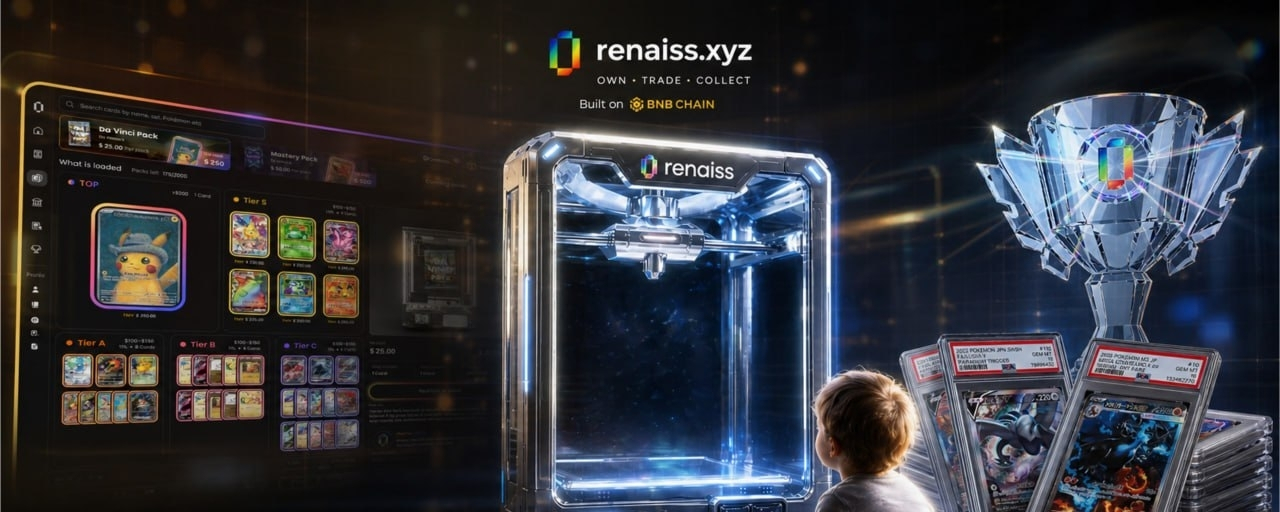
Мақала
Why Renaiss Caught My Attention in the RWA SpaceWhen people talk about RWA (Real World Assets), the conversation usually revolves around tokenizing assets. But after exploring @renaissprotocol , what stood out to me was the infrastructure behind the experience.
Physical collectibles have value, but they also come with challenges:
Proving ownership Secure storage Trading and liquidity
Renaiss approaches these challenges by connecting physical collectibles with verifiable, vault backed onchain assets.
Some of the features highlighted by the project include:
Verifiable custody Marketplace trading Buyback Redemption Transfers Pack access
What I find interesting is that the focus isn't only on listing collectibles, it’s on building infrastructure that supports how collectors can verify, manage and interact with those assets on-chain.
As the RWA sector continues to evolve, projects exploring infrastructure for physical collectibles are worth following to see how this category develops.
What are your thoughts on collectibles as an RWA use case?
#RWA #BNBChain
Why Renaiss Caught My Attention in the RWA Space
When people talk about RWA (Real World Assets), the conversation usually revolves around tokenizing assets. But after exploring @Renaiss Collectibles , what stood out to me was the infrastructure behind the experience.
Physical collectibles have value, but they also come with challenges:
Proving ownership Secure storage Trading and liquidity
Renaiss approaches these challenges by connecting physical collectibles with verifiable, vault backed onchain assets.
Some of the features highlighted by the project include:
Verifiable custody Marketplace trading Buyback Redemption Transfers Pack access
What I find interesting is that the focus isn't only on listing collectibles, it’s on building infrastructure that supports how collectors can verify, manage and interact with those assets on-chain.
As the RWA sector continues to evolve, projects exploring infrastructure for physical collectibles are worth following to see how this category develops.
What are your thoughts on collectibles as an RWA use case?
#RWA #BNBChain
Physical collectibles have value, but they also come with challenges:
Proving ownership Secure storage Trading and liquidity
Renaiss approaches these challenges by connecting physical collectibles with verifiable, vault backed onchain assets.
Some of the features highlighted by the project include:
Verifiable custody Marketplace trading Buyback Redemption Transfers Pack access
What I find interesting is that the focus isn't only on listing collectibles, it’s on building infrastructure that supports how collectors can verify, manage and interact with those assets on-chain.
As the RWA sector continues to evolve, projects exploring infrastructure for physical collectibles are worth following to see how this category develops.
What are your thoughts on collectibles as an RWA use case?
#RWA #BNBChain
2
2
99
·
--
我是乔治我怕谁
我是乔治我怕谁


乔治1月份开工
·
--
Жоғары (өспелі)感谢币安,上个月5号到今天9月12号,全部实盘!一个月零7天,100w美金,增长到400w美金,感谢一路见证!
没发过红包发一万美金试试看这个功能咋样,如果好用以后多发!
没发过红包发一万美金试试看这个功能咋样,如果好用以后多发!
3
3
Көбірек контент көру үшін кіріңіз
Binance Square платформасында әлемдік криптоқоғамдастыққа қосылыңыз
⚡️ Криптовалюта туралы ең соңғы және пайдалы ақпаратты алыңыз.
💬 Әлемдегі ең ірі криптобиржаның сеніміне ие.
👍 Расталған авторлардың нақты пікірлерін табыңыз.
Электрондық пошта/телефон нөмірі
Трендтегі тақырыптар
FedRateWatch
1.5M рет көрілді
6,867 адам талқылап жатыр
Share & Win Traffic Reward in our Trending Hashtag Campaign
✨Topic: FOMC September, What's The Fed's Next Move?
👉How to Join:
Publish a short post or article with hashtag #FedRateWatch
Create content based on the below angles:
- August core CPI rose 0.3% month-over-month, and the odds of a 25bp hike this week are now close to 90%. Do you anticipate a rate hike this week? Is it a one-off, or the start of a longer hiking cycle?
- If the hike lands, how does it play out for BTC, tech stocks, and gold? Bullish or bearish?
- How are you planning to trade next? Share your BTC, stocks or gold trade/holdings with our trade sharing widget.
⏰Campaign Period:
- 2026-09-15 11:00 - 2026-09-17 3:00 UTC
🎁Reward:
- Qualified posts that comply with the above guidelines and contain more than 100 words will be reviewed and may receive a random traffic boost of 500 to 3,000 views. You will receive a notification from your feed secretary if your post is selected.
- Get a chance to have your article featured on Binance Square Official
Need ideas for your post? Visit the topic page #FedRateWatch or the Square Guide on How to Post for Better Reach.
Binance Square Official
·651 лайк
·1.7M рет көрілді
ZcashRises6%
61,385 рет көрілді
709 адам талқылап жатыр
XRPSinks10%
40,593 рет көрілді
468 адам талқылап жатыр