

W Shakespeare
1.8k Жариялаулар

W Shakespeare
Хабарлау
Пайдаланушыны блоктау
It's vacation time

U ұстаушы
Жиі сауда жасайтын трейдер
8.8 жыл
203 Жазылым
1.1K+ Жазылушылар
2.7K+ лайк басылған
Жазбалар
Барлығы
Баға ұсыныстары
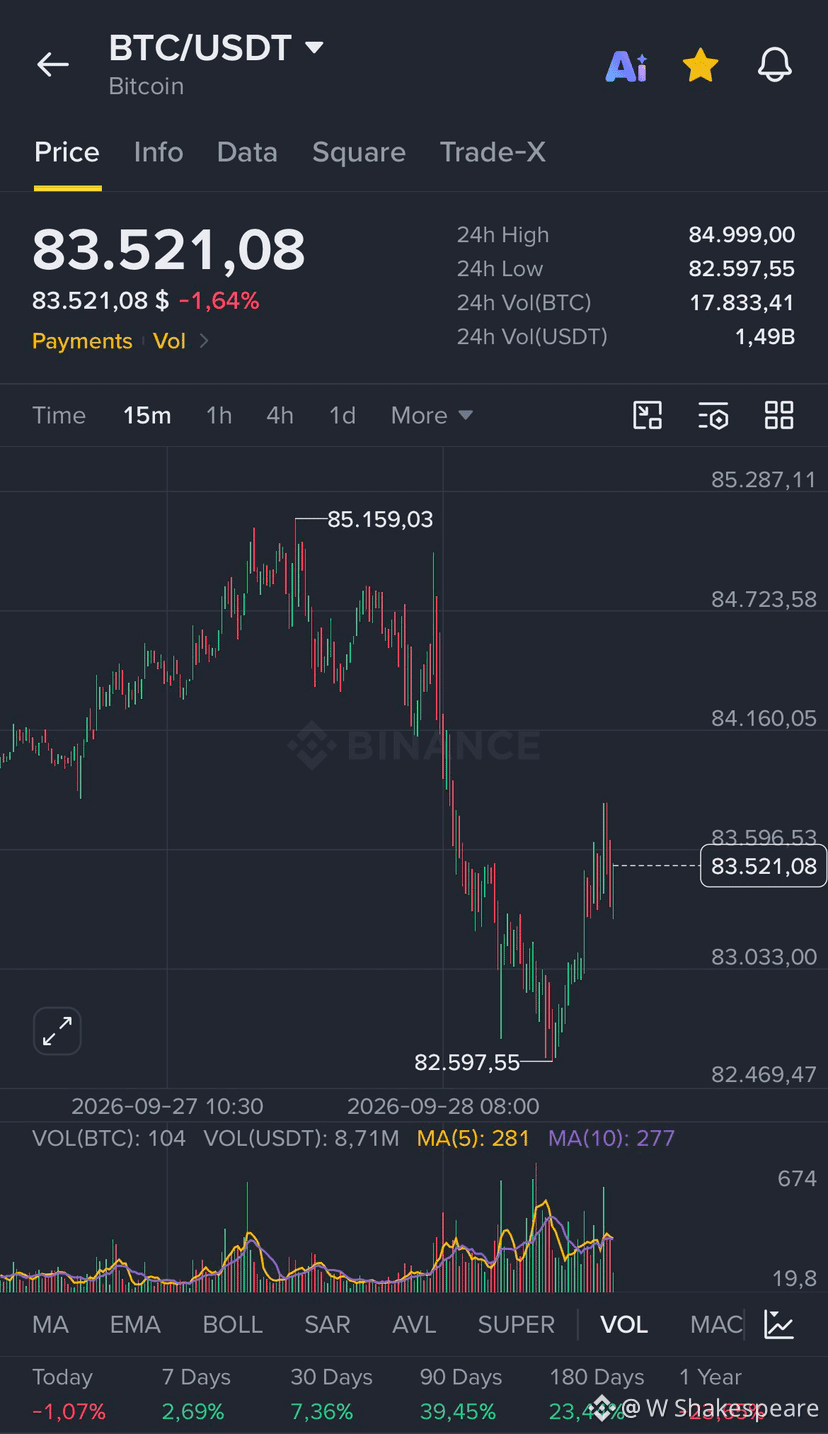
Bad day for all market, Both BTC and $XAU going down
Bad day for all market, Both BTC and $XAU going down
235
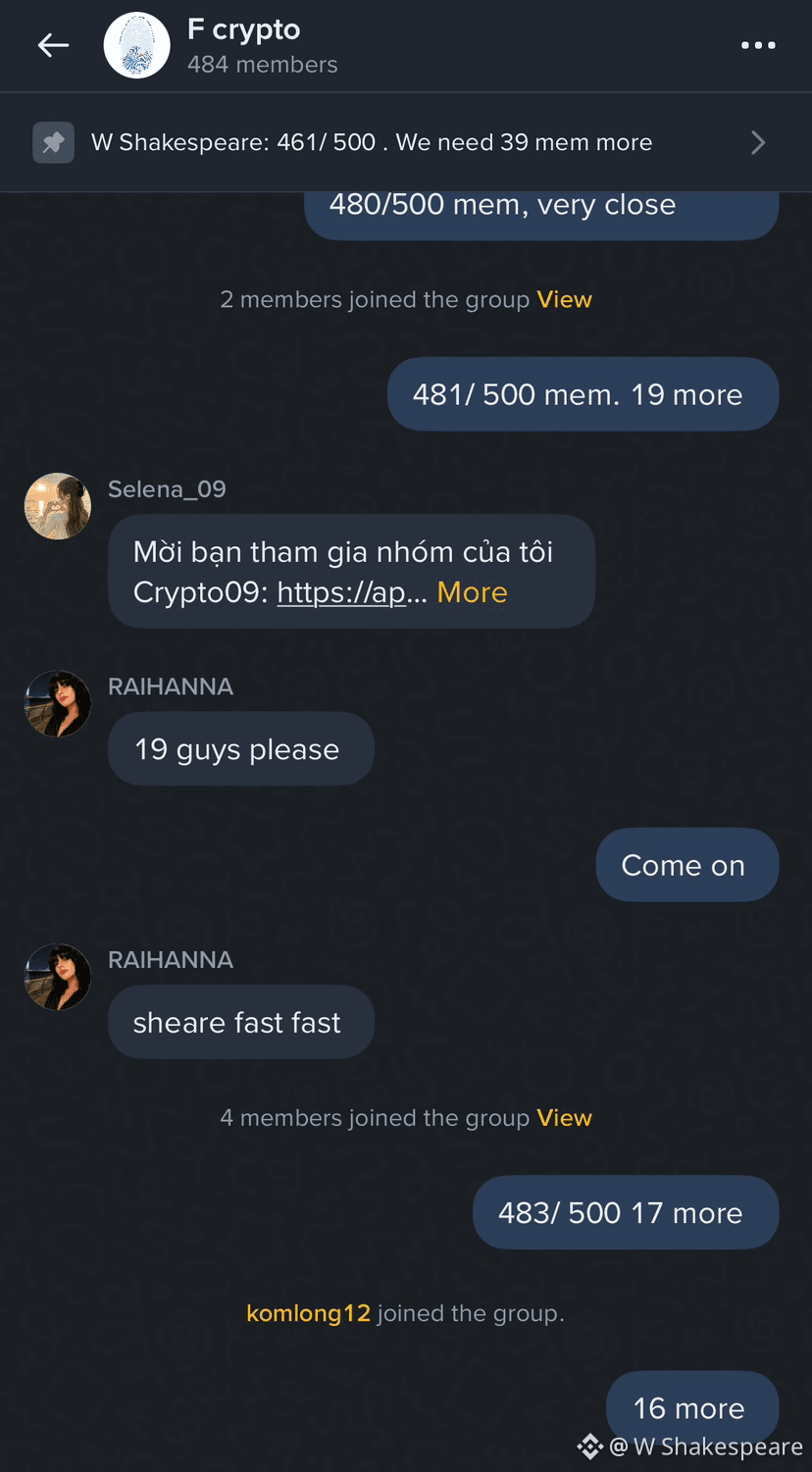
$ZEC My Binance chat group just reach 484 members. Join with us now: [HERE!!!](https://www.binance.com/vi/groupChatLanding?channelToken=WE6u2rLXMtOrOXLze_26GAyYuITtfo0y4UkwC8-hrkQHbepE2GsAEY3V0XmQdXsj8I7AWq9VpQE8fi98sSSPaA&entrySource=new_sharing_link&inviteBy=GbdJGmBwzccH8vA7LYkmuQ&type=2&utm_medium=app_share&utm_source=chat)
$ZEC My Binance chat group just reach 484 members. Join with us now: HERE!!!
1
1
3
737
I just create a group chat on Binance, it free, just enjoy: [https://app.binance.com/uni-qr/64Py3R6k](https://app.binance.com/uni-qr/64Py3R6k)
I just create a group chat on Binance, it free, just enjoy: https://app.binance.com/uni-qr/64Py3R6k

2
43
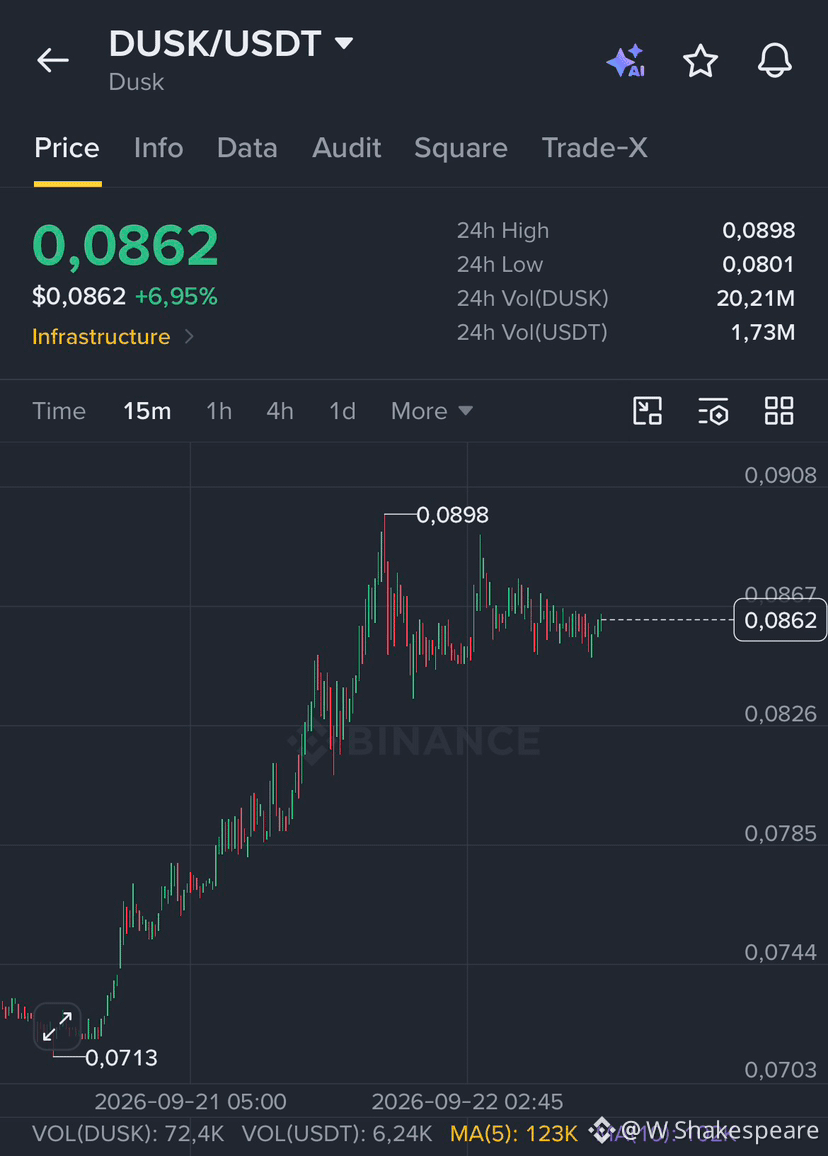
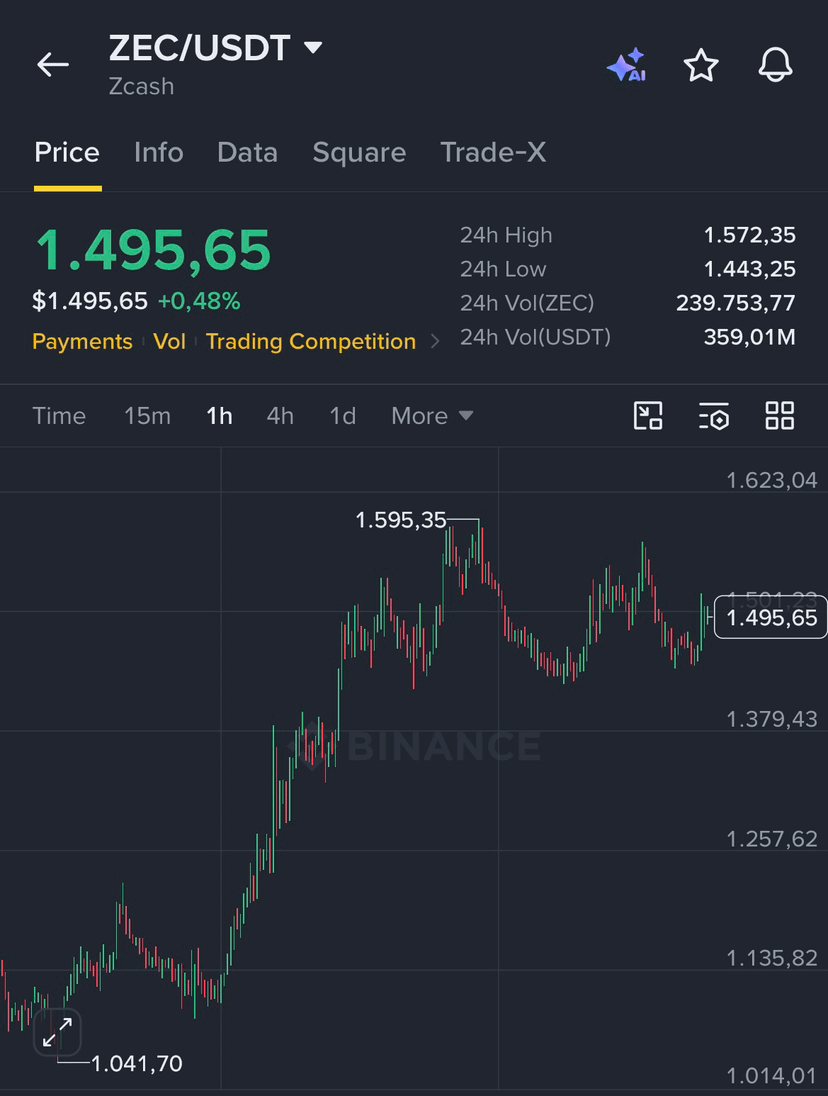
Both $ZEC and $DUSK is privacy coin. So the chart is similar to each other
{future}(ZECUSDT)
Both $ZEC and $DUSK is privacy coin. So the chart is similar to each other
1
5
705
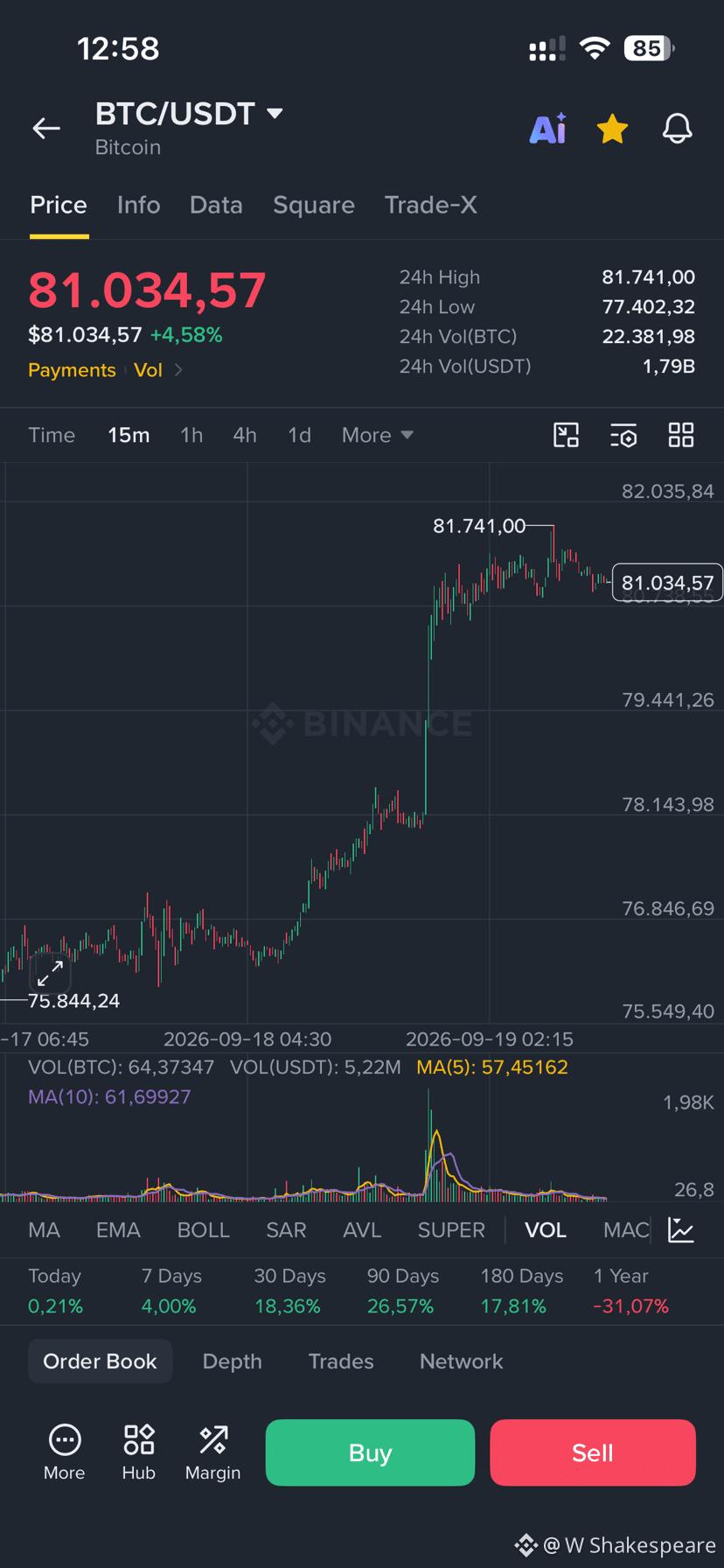
All market pump with no reason😂
$BNB $BTC
All market pump with no reason😂
$BNB $BTC
$BNB $BTC
1
147
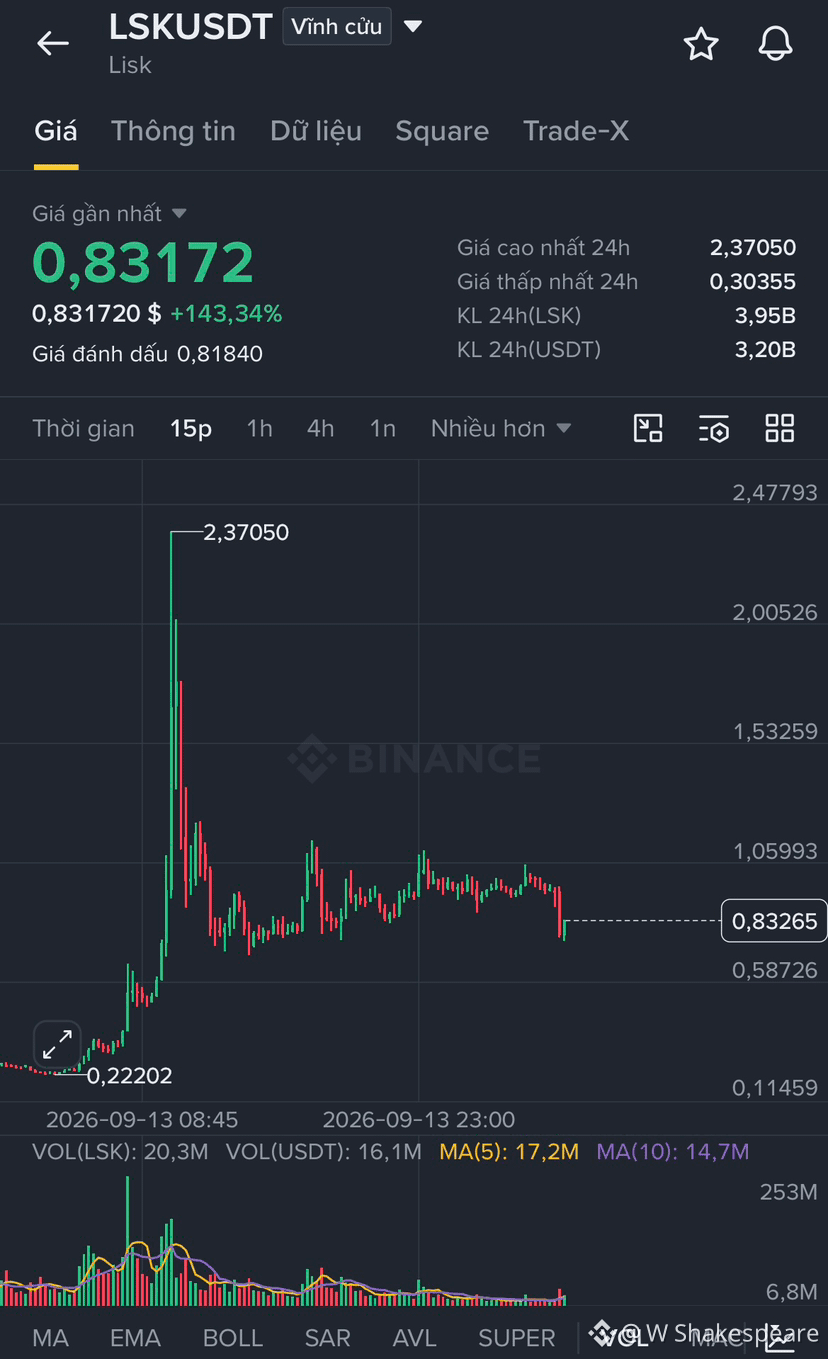
$LSK price still not equal across binance and other CEX. It is a big funding trap for user abitrade across multi platforms
$LSK price still not equal across binance and other CEX. It is a big funding trap for user abitrade across multi platforms
1
375
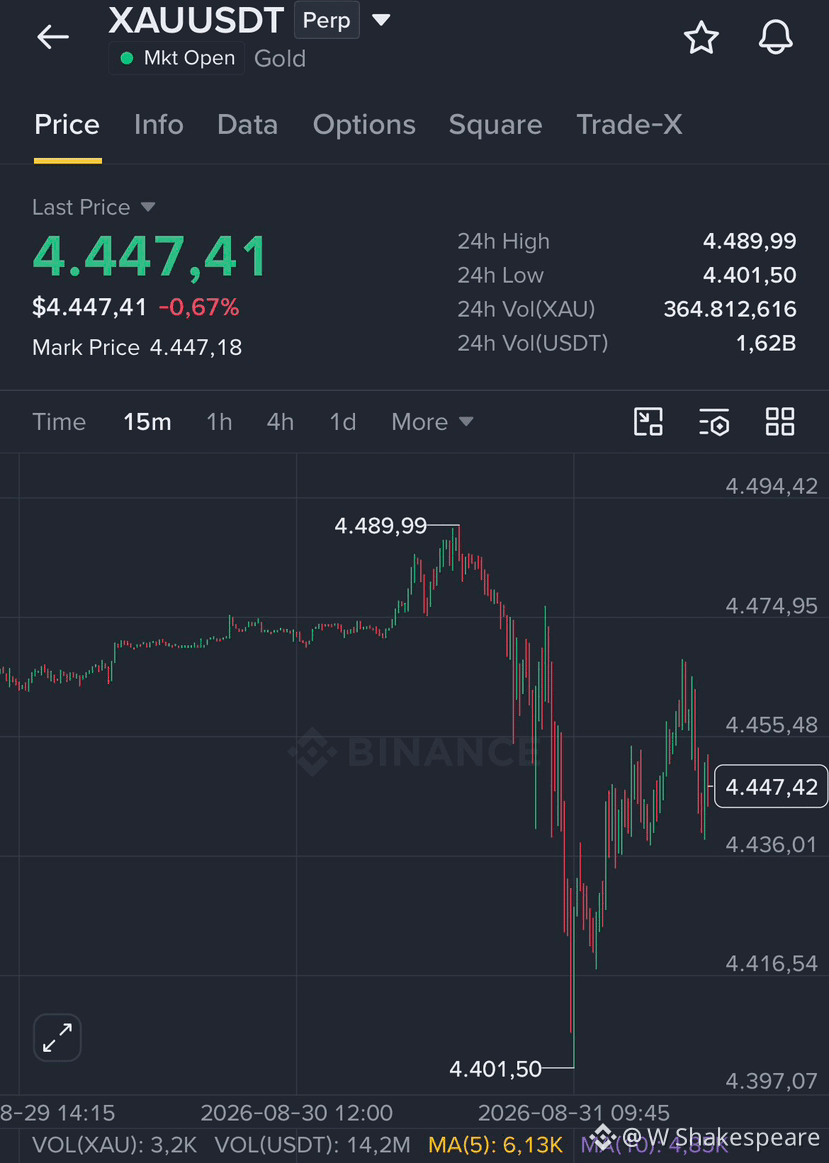
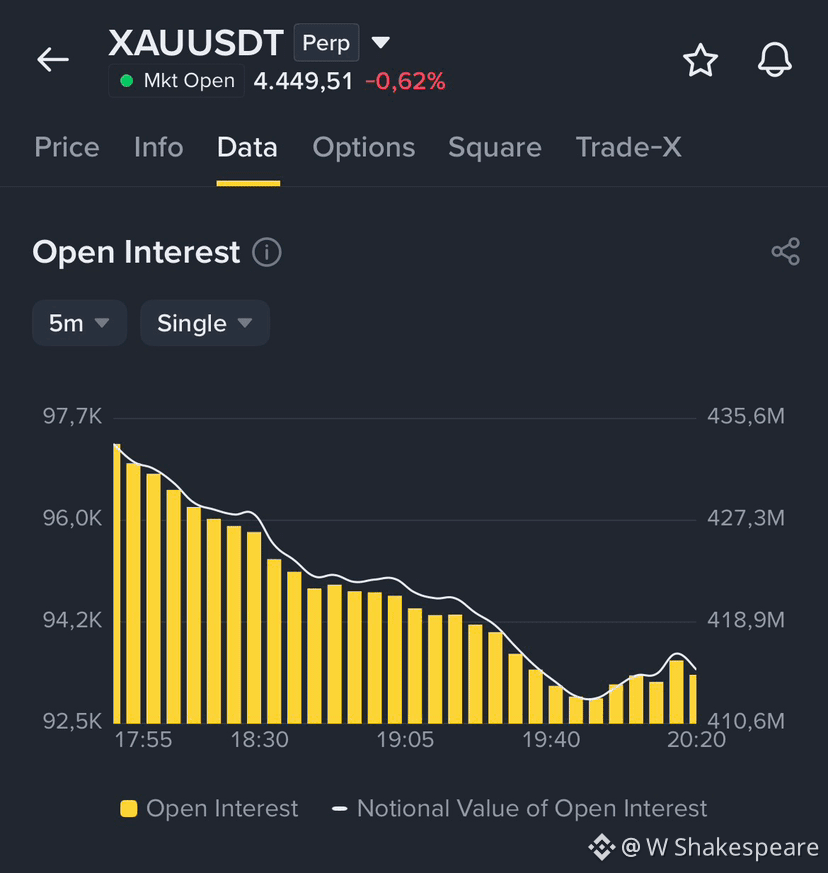
$XAU start new week with open interest reach ~$410M
{future}(XAUUSDT)
$XAU start new week with open interest reach ~$410M
985
$PROM + 40% in 24h with open interest reach ~$29M
{future}(PROMUSDT)
$PROM + 40% in 24h with open interest reach ~$29M
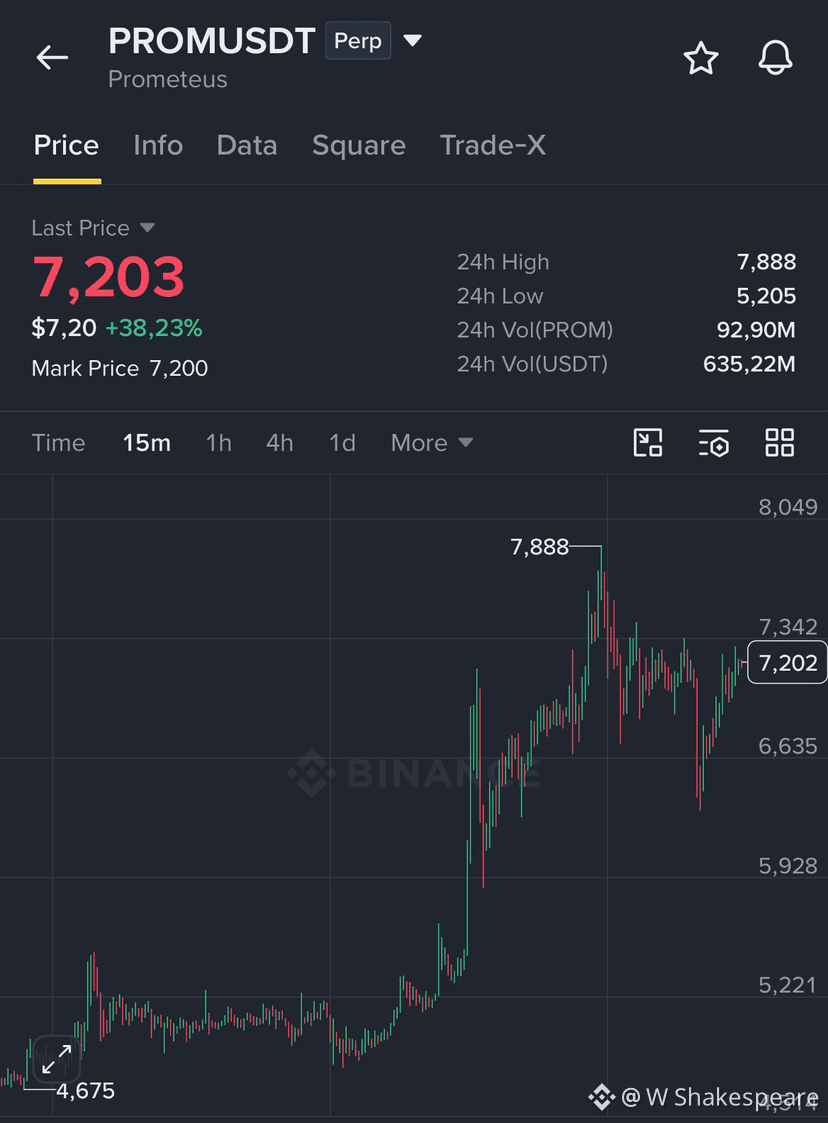
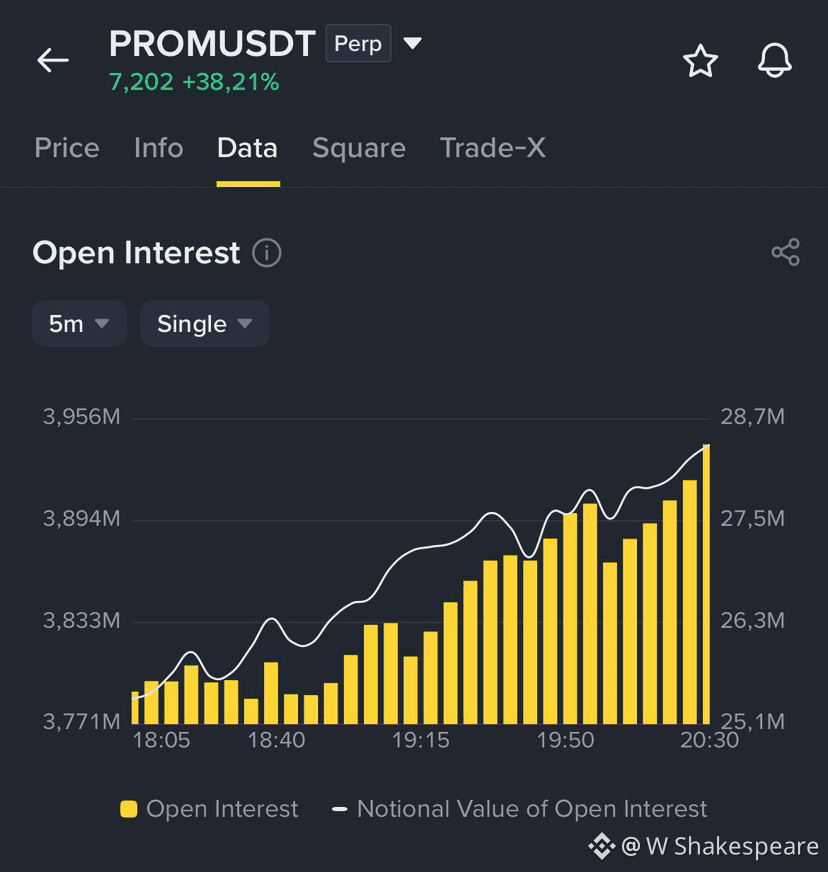
1
1.2k
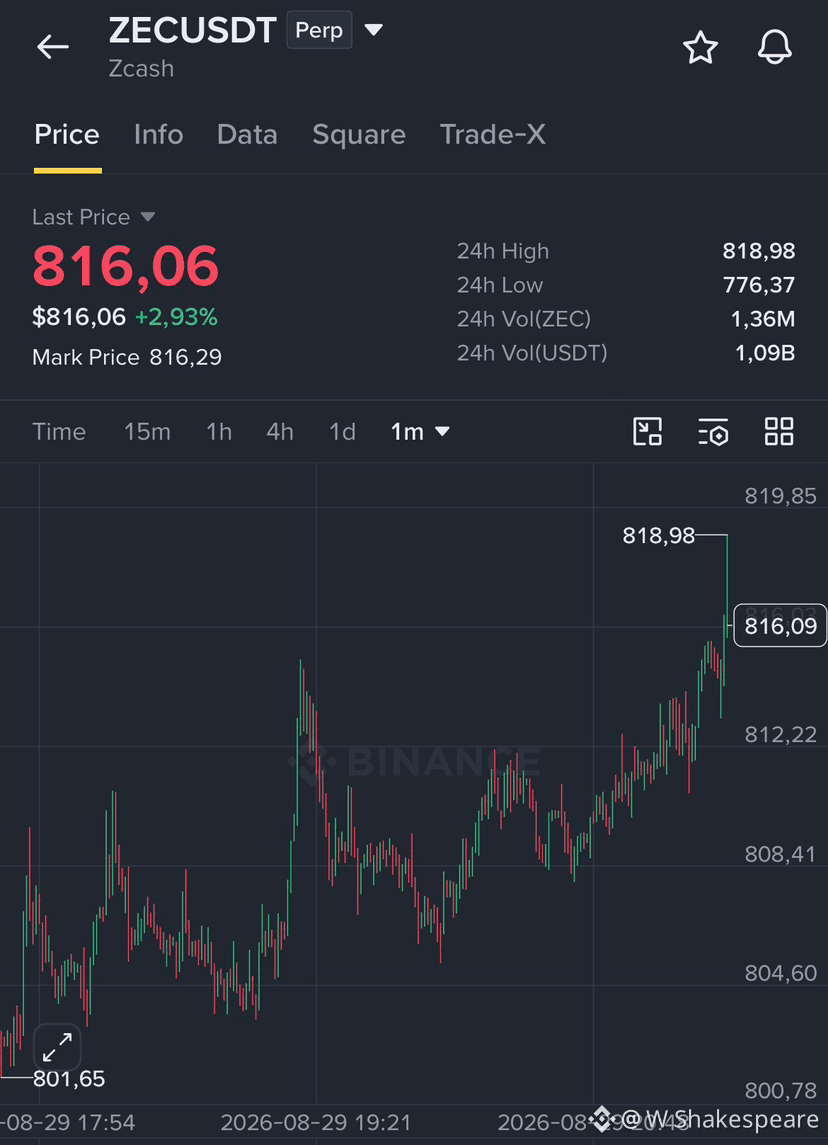
2
911
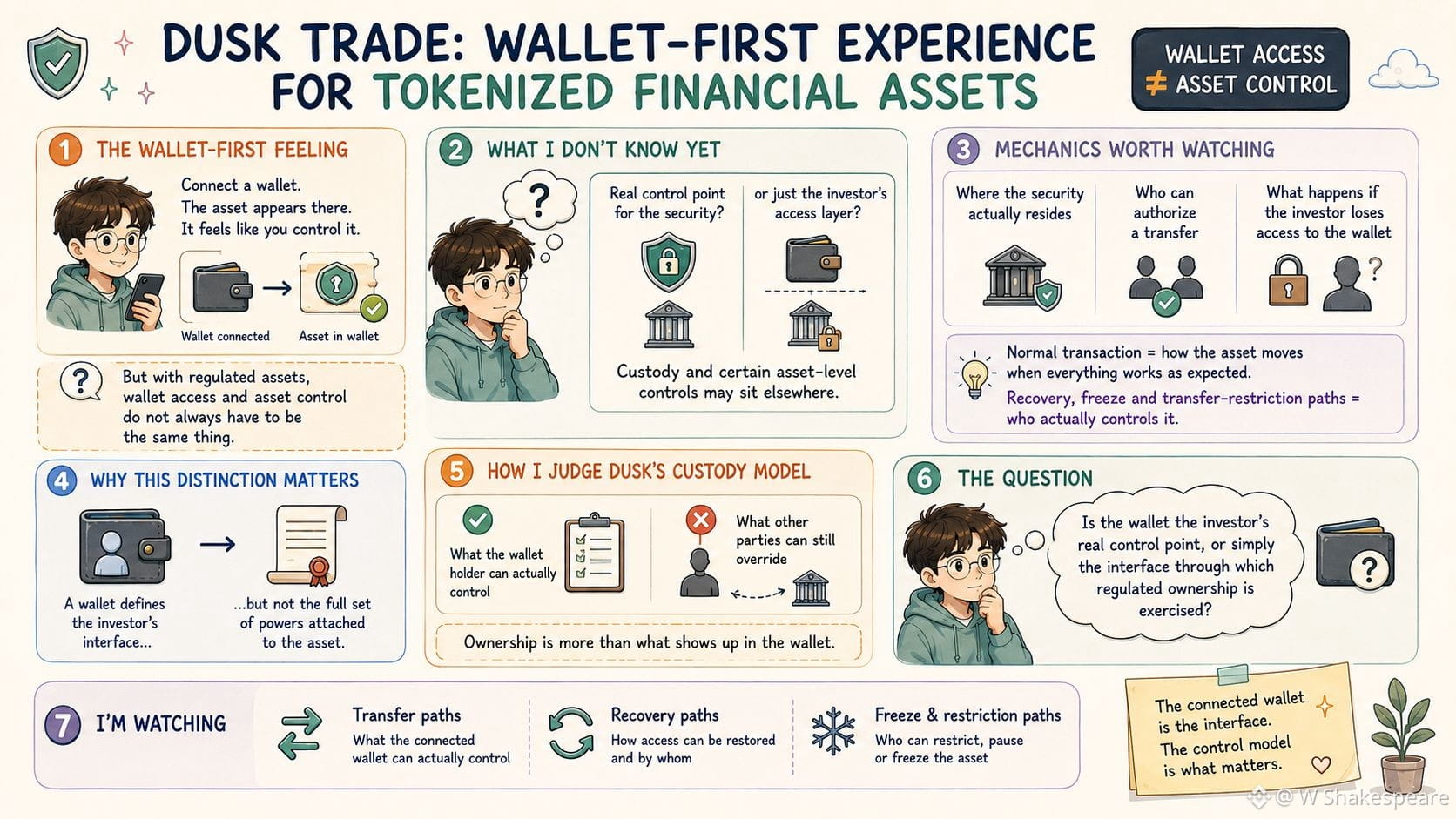
I keep coming back to Dusk Trade's wallet-first experience for tokenized financial assets. Connecting a wallet makes the ownership model feel straightforward. Your wallet is connected, the asset appears there, and the natural assumption is that you control it. But with regulated assets, wallet access and asset control do not always have to be the same thing. What I don't know yet is whether a connected wallet is the actual control point for the security, or simply the investor's access layer while custody and certain asset-level controls remain elsewhere.
The mechanics worth watching are where the security actually resides, who can authorize a transfer, and what happens if the investor loses access to the wallet. The normal transaction only tells me how the asset moves when everything works as expected. The recovery, freeze and transfer-restriction paths tell me much more about who actually controls it. That distinction matters because a wallet can define the investor's interface without defining the full set of powers attached to the asset.
I would judge Dusk's custody model by what the wallet holder can actually control, and what other parties can still override.
The question is whether the wallet is the investor's real control point, or simply the interface through which regulated ownership is exercised. I am watching the transfer, recovery and freeze paths to see what the connected wallet can actually control.
#dusk $DUSK @Dusk_Foundation 🔥
I keep coming back to Dusk Trade's wallet-first experience for tokenized financial assets. Connecting a wallet makes the ownership model feel straightforward. Your wallet is connected, the asset appears there, and the natural assumption is that you control it. But with regulated assets, wallet access and asset control do not always have to be the same thing. What I don't know yet is whether a connected wallet is the actual control point for the security, or simply the investor's access layer while custody and certain asset-level controls remain elsewhere.
The mechanics worth watching are where the security actually resides, who can authorize a transfer, and what happens if the investor loses access to the wallet. The normal transaction only tells me how the asset moves when everything works as expected. The recovery, freeze and transfer-restriction paths tell me much more about who actually controls it. That distinction matters because a wallet can define the investor's interface without defining the full set of powers attached to the asset.
I would judge Dusk's custody model by what the wallet holder can actually control, and what other parties can still override.
The question is whether the wallet is the investor's real control point, or simply the interface through which regulated ownership is exercised. I am watching the transfer, recovery and freeze paths to see what the connected wallet can actually control.
#dusk $DUSK @Dusk 🔥
The mechanics worth watching are where the security actually resides, who can authorize a transfer, and what happens if the investor loses access to the wallet. The normal transaction only tells me how the asset moves when everything works as expected. The recovery, freeze and transfer-restriction paths tell me much more about who actually controls it. That distinction matters because a wallet can define the investor's interface without defining the full set of powers attached to the asset.
I would judge Dusk's custody model by what the wallet holder can actually control, and what other parties can still override.
The question is whether the wallet is the investor's real control point, or simply the interface through which regulated ownership is exercised. I am watching the transfer, recovery and freeze paths to see what the connected wallet can actually control.
#dusk $DUSK @Dusk 🔥
3
5
349
Расталды
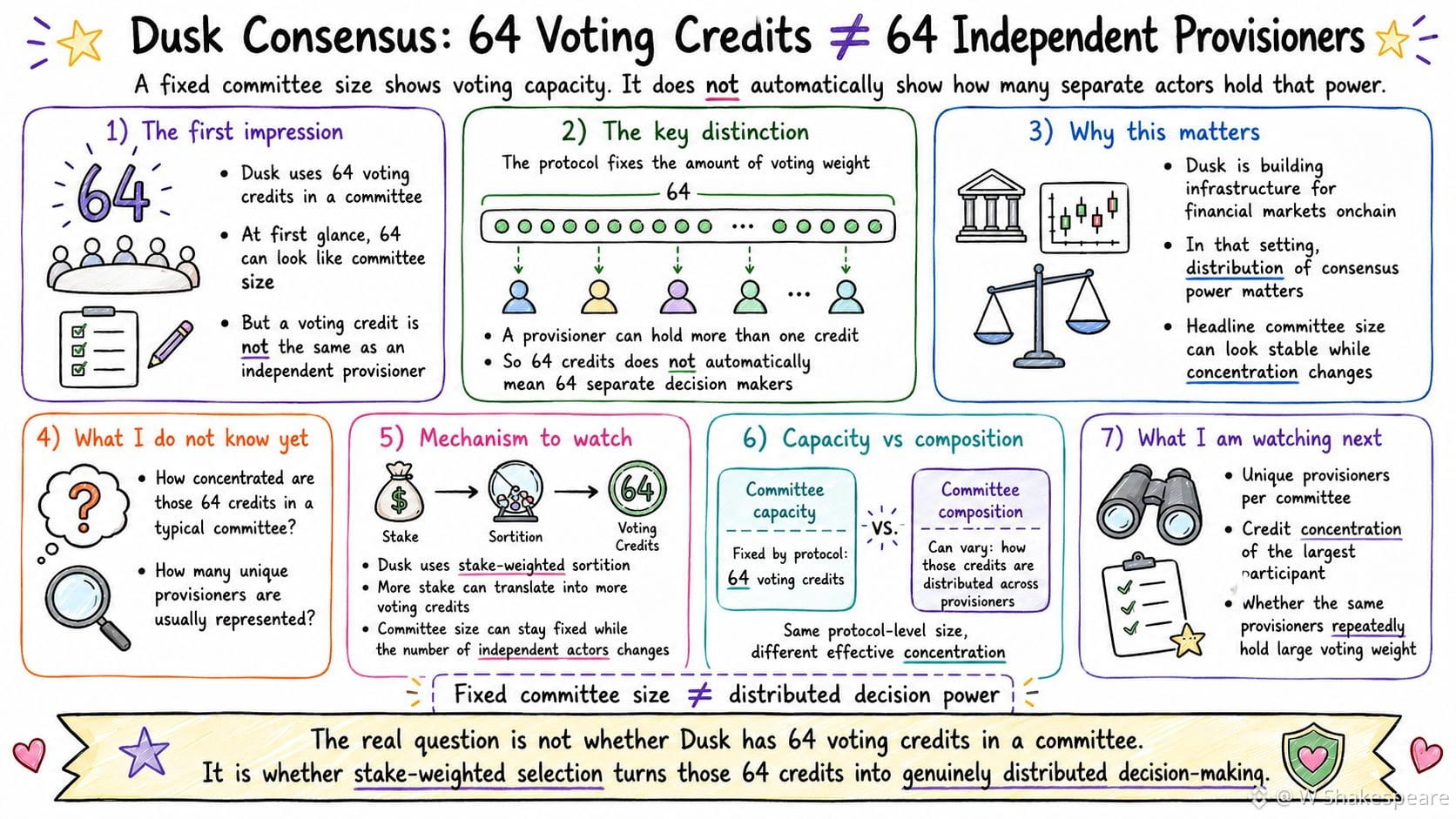
I keep thinking about Dusk's use of 64 voting credits in its consensus committees.
At first glance, 64 sounds like a straightforward measure of committee size. But a voting credit is not the same thing as an independent provisioner. That matters as Dusk pushes to bring financial markets onchain with EU-licensed institutions, where the distribution of consensus power matters more than the headline committee size.
The 64-credit structure tells me how much voting weight exists inside a committee. It does not tell me how many separate actors actually hold that weight, because a provisioner can hold more than one credit. What I don't know yet is how concentrated those 64 credits are across the provisioners selected into a typical committee.
Dusk's stake-weighted sortition gives one useful mechanism to watch. More stake can translate into more voting credits, which means the nominal committee size can remain fixed even while the number of independent decision makers behind it changes. That makes "64" a weaker decentralization signal than it first appears.
The important difference is between committee capacity and committee composition. One is fixed by the protocol; the other can change from one selection to the next. The stronger evidence would therefore be the number of unique provisioners represented in each committee, how many credits the largest participant holds, and whether the same provisioners repeatedly account for a large share of the voting weight. The same protocol-level committee size can produce very different effective concentrations of voting power depending on how those credits are distributed.
That changes how I would judge Dusk's committee design.
The question is whether Dusk's stake-weighted selection consistently turns those 64 credits into distributed decision-making, or whether a fixed committee size can conceal concentrated voting power. I am watching unique provisioners per committee, credit concentration and repeated committee composition next.
#dusk $DUSK @Dusk_Foundation ✨
I keep thinking about Dusk's use of 64 voting credits in its consensus committees.
At first glance, 64 sounds like a straightforward measure of committee size. But a voting credit is not the same thing as an independent provisioner. That matters as Dusk pushes to bring financial markets onchain with EU-licensed institutions, where the distribution of consensus power matters more than the headline committee size.
The 64-credit structure tells me how much voting weight exists inside a committee. It does not tell me how many separate actors actually hold that weight, because a provisioner can hold more than one credit. What I don't know yet is how concentrated those 64 credits are across the provisioners selected into a typical committee.
Dusk's stake-weighted sortition gives one useful mechanism to watch. More stake can translate into more voting credits, which means the nominal committee size can remain fixed even while the number of independent decision makers behind it changes. That makes "64" a weaker decentralization signal than it first appears.
The important difference is between committee capacity and committee composition. One is fixed by the protocol; the other can change from one selection to the next. The stronger evidence would therefore be the number of unique provisioners represented in each committee, how many credits the largest participant holds, and whether the same provisioners repeatedly account for a large share of the voting weight. The same protocol-level committee size can produce very different effective concentrations of voting power depending on how those credits are distributed.
That changes how I would judge Dusk's committee design.
The question is whether Dusk's stake-weighted selection consistently turns those 64 credits into distributed decision-making, or whether a fixed committee size can conceal concentrated voting power. I am watching unique provisioners per committee, credit concentration and repeated committee composition next.
#dusk $DUSK @Dusk ✨
At first glance, 64 sounds like a straightforward measure of committee size. But a voting credit is not the same thing as an independent provisioner. That matters as Dusk pushes to bring financial markets onchain with EU-licensed institutions, where the distribution of consensus power matters more than the headline committee size.
The 64-credit structure tells me how much voting weight exists inside a committee. It does not tell me how many separate actors actually hold that weight, because a provisioner can hold more than one credit. What I don't know yet is how concentrated those 64 credits are across the provisioners selected into a typical committee.
Dusk's stake-weighted sortition gives one useful mechanism to watch. More stake can translate into more voting credits, which means the nominal committee size can remain fixed even while the number of independent decision makers behind it changes. That makes "64" a weaker decentralization signal than it first appears.
The important difference is between committee capacity and committee composition. One is fixed by the protocol; the other can change from one selection to the next. The stronger evidence would therefore be the number of unique provisioners represented in each committee, how many credits the largest participant holds, and whether the same provisioners repeatedly account for a large share of the voting weight. The same protocol-level committee size can produce very different effective concentrations of voting power depending on how those credits are distributed.
That changes how I would judge Dusk's committee design.
The question is whether Dusk's stake-weighted selection consistently turns those 64 credits into distributed decision-making, or whether a fixed committee size can conceal concentrated voting power. I am watching unique provisioners per committee, credit concentration and repeated committee composition next.
#dusk $DUSK @Dusk ✨
1
2
394
Расталды
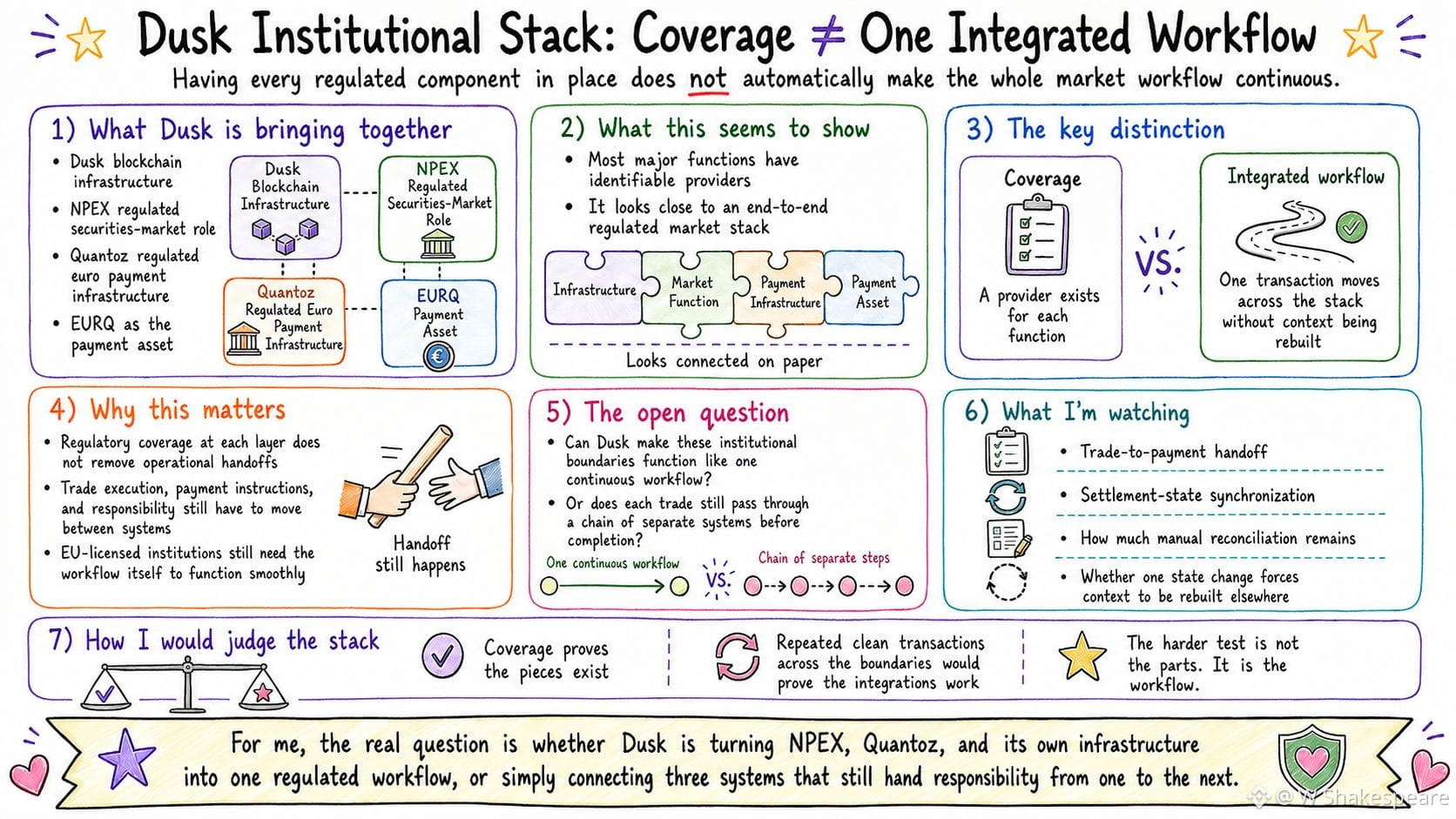
Dusk is bringing its blockchain infrastructure together with NPEX's regulated securities-market role and Quantoz's regulated euro payment infrastructure around EURQ.|
That gives Dusk many of the pieces needed for an end-to-end regulated market. But regulatory coverage at each layer does not automatically turn those pieces into one continuous workflow.
What I don't know yet is whether Dusk can make trade execution, payment and settlement behave like one connected transaction, or whether responsibility still has to pass between separate systems along the way.
The mechanics worth watching are the handoff from trade to payment, how settlement state stays synchronized across the different components, and where manual reconciliation is still required.
Having a provider for every function tells me the stack is covered. A transaction moving cleanly across those boundaries tells me something more useful: whether the integrations between them actually work. That matters as Dusk pushes to bring financial markets onchain with EU-licensed institutions. The harder test is not whether each required component exists, but whether those components can preserve transaction state and responsibility from one step to the next.
The question is whether Dusk is turning NPEX, Quantoz and its own infrastructure into one regulated workflow, or connecting systems that still operate as separate stages. I am watching trade-to-payment handoffs, settlement-state synchronization and where reconciliation still survives.
#dusk $DUSK @Dusk_Foundation 🔥
Dusk is bringing its blockchain infrastructure together with NPEX's regulated securities-market role and Quantoz's regulated euro payment infrastructure around EURQ.|
That gives Dusk many of the pieces needed for an end-to-end regulated market. But regulatory coverage at each layer does not automatically turn those pieces into one continuous workflow.
What I don't know yet is whether Dusk can make trade execution, payment and settlement behave like one connected transaction, or whether responsibility still has to pass between separate systems along the way.
The mechanics worth watching are the handoff from trade to payment, how settlement state stays synchronized across the different components, and where manual reconciliation is still required.
Having a provider for every function tells me the stack is covered. A transaction moving cleanly across those boundaries tells me something more useful: whether the integrations between them actually work. That matters as Dusk pushes to bring financial markets onchain with EU-licensed institutions. The harder test is not whether each required component exists, but whether those components can preserve transaction state and responsibility from one step to the next.
The question is whether Dusk is turning NPEX, Quantoz and its own infrastructure into one regulated workflow, or connecting systems that still operate as separate stages. I am watching trade-to-payment handoffs, settlement-state synchronization and where reconciliation still survives.
#dusk $DUSK @Dusk 🔥
That gives Dusk many of the pieces needed for an end-to-end regulated market. But regulatory coverage at each layer does not automatically turn those pieces into one continuous workflow.
What I don't know yet is whether Dusk can make trade execution, payment and settlement behave like one connected transaction, or whether responsibility still has to pass between separate systems along the way.
The mechanics worth watching are the handoff from trade to payment, how settlement state stays synchronized across the different components, and where manual reconciliation is still required.
Having a provider for every function tells me the stack is covered. A transaction moving cleanly across those boundaries tells me something more useful: whether the integrations between them actually work. That matters as Dusk pushes to bring financial markets onchain with EU-licensed institutions. The harder test is not whether each required component exists, but whether those components can preserve transaction state and responsibility from one step to the next.
The question is whether Dusk is turning NPEX, Quantoz and its own infrastructure into one regulated workflow, or connecting systems that still operate as separate stages. I am watching trade-to-payment handoffs, settlement-state synchronization and where reconciliation still survives.
#dusk $DUSK @Dusk 🔥
1
5
376
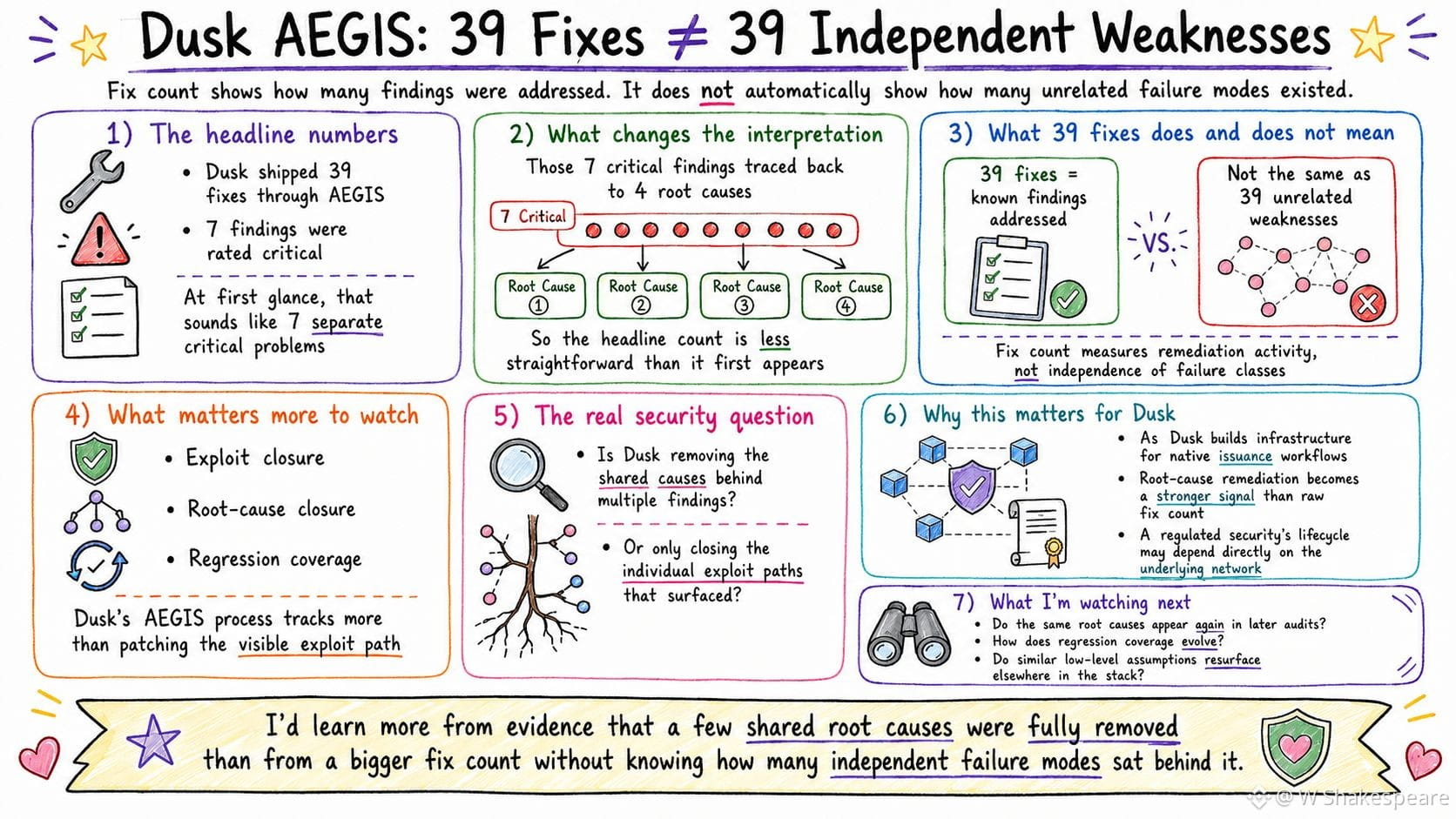
Dusk shipped 39 fixes through AEGIS. Among the findings behind that remediation, 7 were rated critical. That sounds like a large number of separate security problems. But those 7 critical findings came down to just 4 root causes, which makes the headline count less straightforward than it first appears.
Thirty-nine fixes tell me the scale of Dusk's remediation work. They do not tell me how many independent failure modes those fixes were actually addressing. What I don't know yet is whether Dusk's remediation process consistently removes the shared causes behind multiple findings, rather than only closing the individual exploit paths that happened to surface.
Dusk's own AEGIS process gives one useful mechanism to watch. Critical remediation is tracked not only by exploit closure, but by root-cause closure and regression coverage as well. That makes future recurrence more useful to me than the raw fix count. Shipping a patch proves a known issue was addressed. Stronger evidence would be seeing the same underlying failure class stop resurfacing in later reviews or adjacent parts of the stack.
As Dusk builds infrastructure for native issuance workflows, where more of a regulated security's lifecycle can depend directly on the underlying network, root-cause remediation becomes a more meaningful security signal than the raw number of fixes shipped.
I'd learn more from evidence that a few shared root causes were fully removed than from a larger fix count without knowing how many independent failure modes sat behind it.
The question is whether Dusk's security process is shrinking the underlying classes of failure, not just the number of open findings. I am watching whether the same root causes show up again in later audits, how regression coverage evolves and whether similar low-level assumptions resurface elsewhere in the stack.
#dusk $DUSK @Dusk_Foundation ✨
Dusk shipped 39 fixes through AEGIS. Among the findings behind that remediation, 7 were rated critical. That sounds like a large number of separate security problems. But those 7 critical findings came down to just 4 root causes, which makes the headline count less straightforward than it first appears.
Thirty-nine fixes tell me the scale of Dusk's remediation work. They do not tell me how many independent failure modes those fixes were actually addressing. What I don't know yet is whether Dusk's remediation process consistently removes the shared causes behind multiple findings, rather than only closing the individual exploit paths that happened to surface.
Dusk's own AEGIS process gives one useful mechanism to watch. Critical remediation is tracked not only by exploit closure, but by root-cause closure and regression coverage as well. That makes future recurrence more useful to me than the raw fix count. Shipping a patch proves a known issue was addressed. Stronger evidence would be seeing the same underlying failure class stop resurfacing in later reviews or adjacent parts of the stack.
As Dusk builds infrastructure for native issuance workflows, where more of a regulated security's lifecycle can depend directly on the underlying network, root-cause remediation becomes a more meaningful security signal than the raw number of fixes shipped.
I'd learn more from evidence that a few shared root causes were fully removed than from a larger fix count without knowing how many independent failure modes sat behind it.
The question is whether Dusk's security process is shrinking the underlying classes of failure, not just the number of open findings. I am watching whether the same root causes show up again in later audits, how regression coverage evolves and whether similar low-level assumptions resurface elsewhere in the stack.
#dusk $DUSK @Dusk ✨
Thirty-nine fixes tell me the scale of Dusk's remediation work. They do not tell me how many independent failure modes those fixes were actually addressing. What I don't know yet is whether Dusk's remediation process consistently removes the shared causes behind multiple findings, rather than only closing the individual exploit paths that happened to surface.
Dusk's own AEGIS process gives one useful mechanism to watch. Critical remediation is tracked not only by exploit closure, but by root-cause closure and regression coverage as well. That makes future recurrence more useful to me than the raw fix count. Shipping a patch proves a known issue was addressed. Stronger evidence would be seeing the same underlying failure class stop resurfacing in later reviews or adjacent parts of the stack.
As Dusk builds infrastructure for native issuance workflows, where more of a regulated security's lifecycle can depend directly on the underlying network, root-cause remediation becomes a more meaningful security signal than the raw number of fixes shipped.
I'd learn more from evidence that a few shared root causes were fully removed than from a larger fix count without knowing how many independent failure modes sat behind it.
The question is whether Dusk's security process is shrinking the underlying classes of failure, not just the number of open findings. I am watching whether the same root causes show up again in later audits, how regression coverage evolves and whether similar low-level assumptions resurface elsewhere in the stack.
#dusk $DUSK @Dusk ✨
8
10
691
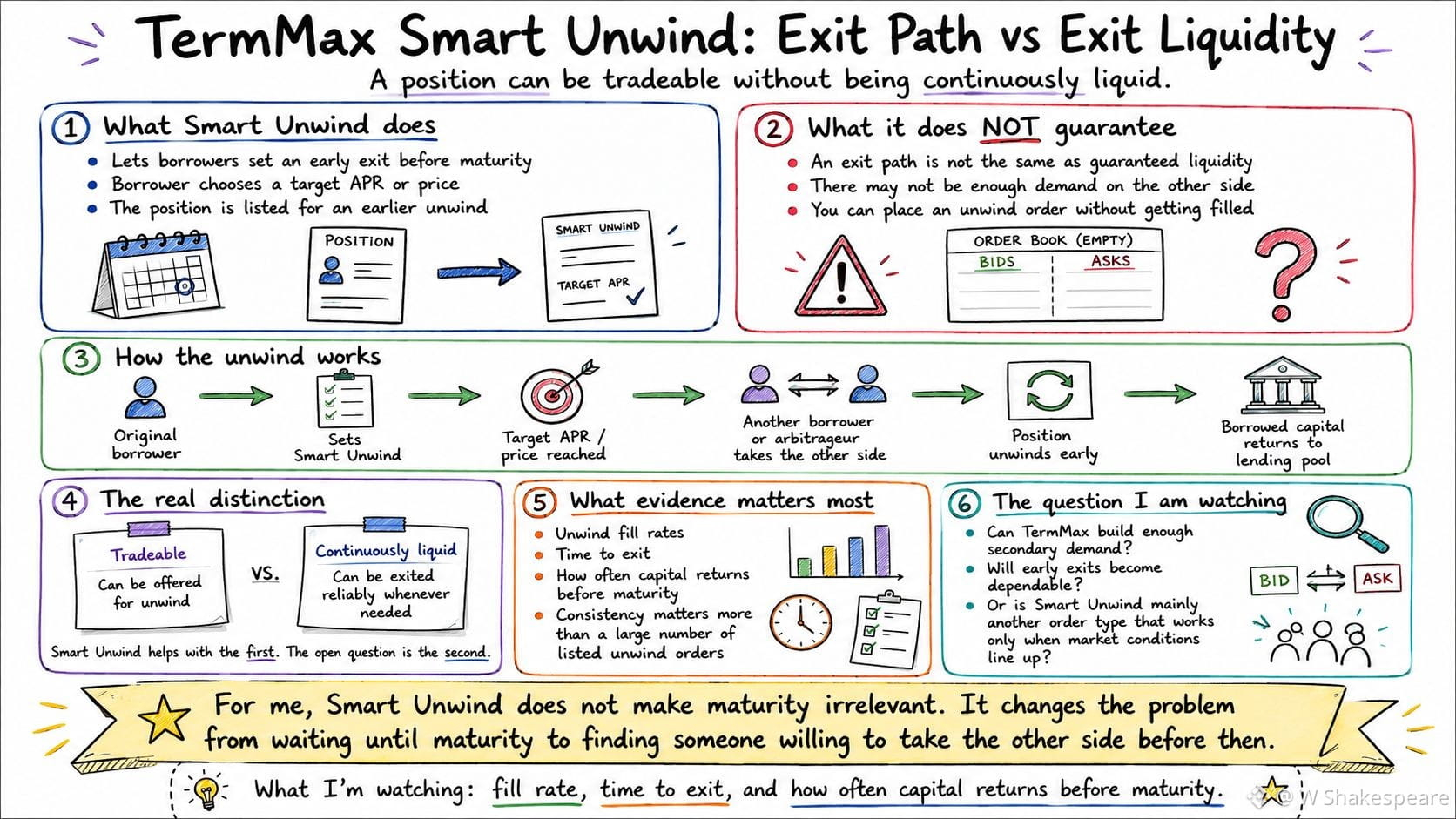
I keep coming back to Smart Unwind, TermMax's mechanism for letting borrowers set an early exit on fixed-term positions before maturity.
On paper, that makes fixed-term debt look much more liquid. But having an exit path and being able to use it whenever you want are two different things. Smart Unwind tells me a borrower can put an existing position up for an earlier exit at a target APR or price. It does not tell me there will always be enough demand to take the other side. What I don't know yet is whether TermMax can make those early exits dependable, or mainly create an exit path that only works when market conditions and secondary demand happen to line up.
The mechanics make that distinction clearer. If the target is reached, another borrower or arbitrageur can take the other side, allowing the original position to unwind and the borrowed capital to return to the lending pool before its original maturity.
A position can therefore be tradeable without being continuously liquid. The stronger evidence is not how many Smart Unwind orders borrowers can place, but how often those orders actually clear, how long exits take, and how often capital returns to the lending side before maturity.
I'd learn more from a smaller number of positions exiting consistently than from a much larger number simply sitting there available to unwind. Smart Unwind does not make maturity irrelevant. It changes the problem from having to hold a position until maturity to finding someone willing to take the other side before then.
The question is whether TermMax can build enough secondary demand to make fixed-term positions genuinely easier to exit, or mainly add another order type whose usefulness still depends on market conditions.
I am watching unwind fill rates, time to exit and how often capital returns before maturity.
#termmax @termmax 🔥
I keep coming back to Smart Unwind, TermMax's mechanism for letting borrowers set an early exit on fixed-term positions before maturity.
On paper, that makes fixed-term debt look much more liquid. But having an exit path and being able to use it whenever you want are two different things. Smart Unwind tells me a borrower can put an existing position up for an earlier exit at a target APR or price. It does not tell me there will always be enough demand to take the other side. What I don't know yet is whether TermMax can make those early exits dependable, or mainly create an exit path that only works when market conditions and secondary demand happen to line up.
The mechanics make that distinction clearer. If the target is reached, another borrower or arbitrageur can take the other side, allowing the original position to unwind and the borrowed capital to return to the lending pool before its original maturity.
A position can therefore be tradeable without being continuously liquid. The stronger evidence is not how many Smart Unwind orders borrowers can place, but how often those orders actually clear, how long exits take, and how often capital returns to the lending side before maturity.
I'd learn more from a smaller number of positions exiting consistently than from a much larger number simply sitting there available to unwind. Smart Unwind does not make maturity irrelevant. It changes the problem from having to hold a position until maturity to finding someone willing to take the other side before then.
The question is whether TermMax can build enough secondary demand to make fixed-term positions genuinely easier to exit, or mainly add another order type whose usefulness still depends on market conditions.
I am watching unwind fill rates, time to exit and how often capital returns before maturity.
#termmax @TermMax 🔥
On paper, that makes fixed-term debt look much more liquid. But having an exit path and being able to use it whenever you want are two different things. Smart Unwind tells me a borrower can put an existing position up for an earlier exit at a target APR or price. It does not tell me there will always be enough demand to take the other side. What I don't know yet is whether TermMax can make those early exits dependable, or mainly create an exit path that only works when market conditions and secondary demand happen to line up.
The mechanics make that distinction clearer. If the target is reached, another borrower or arbitrageur can take the other side, allowing the original position to unwind and the borrowed capital to return to the lending pool before its original maturity.
A position can therefore be tradeable without being continuously liquid. The stronger evidence is not how many Smart Unwind orders borrowers can place, but how often those orders actually clear, how long exits take, and how often capital returns to the lending side before maturity.
I'd learn more from a smaller number of positions exiting consistently than from a much larger number simply sitting there available to unwind. Smart Unwind does not make maturity irrelevant. It changes the problem from having to hold a position until maturity to finding someone willing to take the other side before then.
The question is whether TermMax can build enough secondary demand to make fixed-term positions genuinely easier to exit, or mainly add another order type whose usefulness still depends on market conditions.
I am watching unwind fill rates, time to exit and how often capital returns before maturity.
#termmax @TermMax 🔥
2
2
383
Расталды
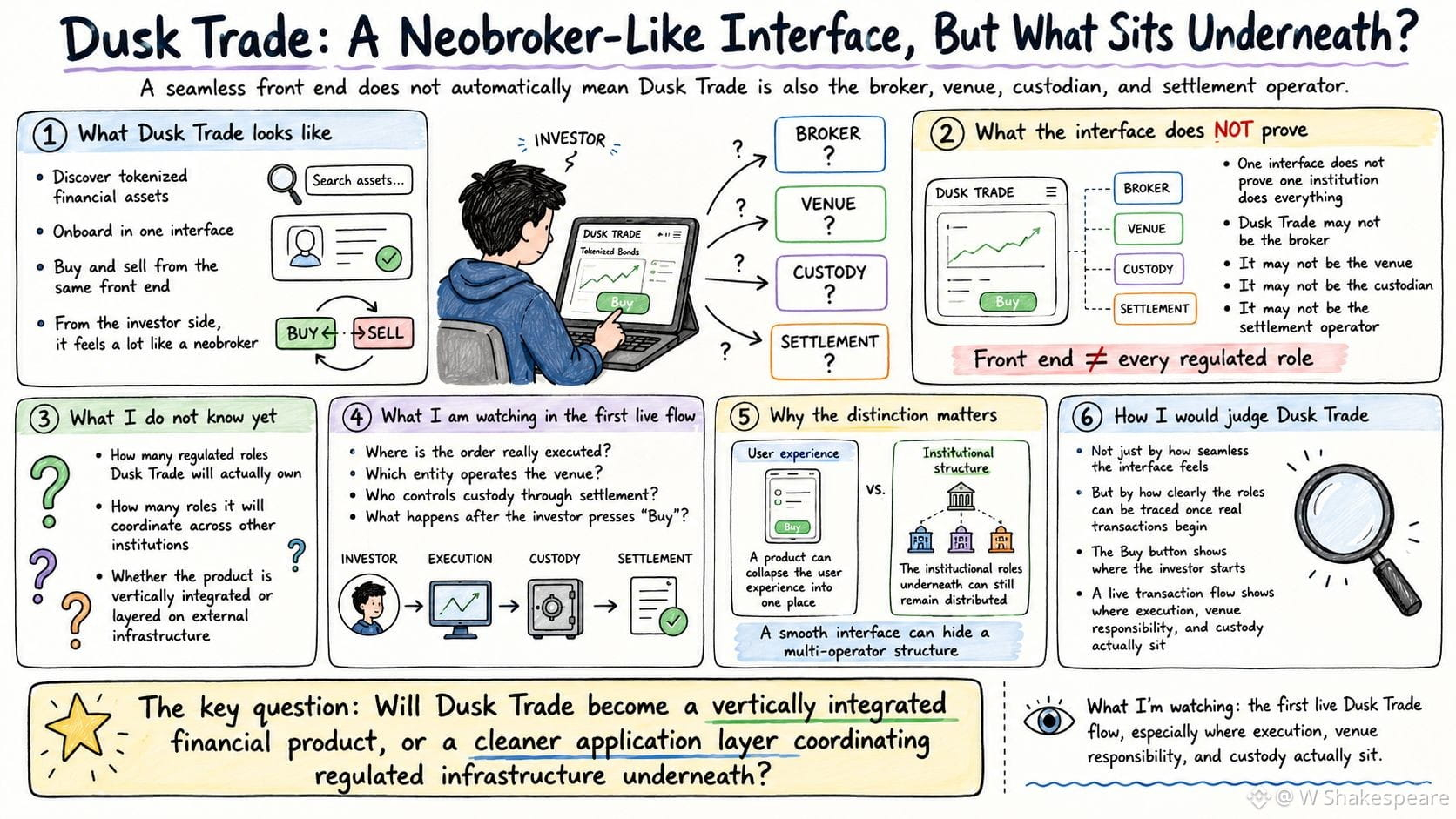
I keep coming back to how Dusk Trade is being positioned as a place to discover, buy and sell tokenized financial assets.
From the investor side, that looks a lot like a neobroker. One interface can handle discovery, onboarding and the trade itself. But a seamless front end does not mean Dusk Trade is also the broker, venue, custodian or settlement operator underneath.
What I don't know yet is how many of those regulated roles Dusk Trade will actually own, and how many it will coordinate across other institutions.
The mechanics worth watching are where an order is really executed, which entity operates the venue, and who controls custody through settlement.
The Buy button only tells me where the investor starts the trade. A live transaction flow tells me something more useful: where execution, custody and venue responsibility actually sit.
That distinction matters because a product can collapse the user experience into one place while the institutional roles underneath remain distributed across several regulated operators.
So I would judge Dusk Trade less by how seamless the interface feels and more by how clearly those roles can be traced once real transactions begin.
The question is whether Dusk Trade becomes a vertically integrated financial product, or a cleaner application layer coordinating regulated infrastructure underneath. I am watching the first live Dusk Trade flow closely enough to see where execution, venue responsibility and custody actually sit.
#dusk $DUSK @Dusk_Foundation ✨
I keep coming back to how Dusk Trade is being positioned as a place to discover, buy and sell tokenized financial assets.
From the investor side, that looks a lot like a neobroker. One interface can handle discovery, onboarding and the trade itself. But a seamless front end does not mean Dusk Trade is also the broker, venue, custodian or settlement operator underneath.
What I don't know yet is how many of those regulated roles Dusk Trade will actually own, and how many it will coordinate across other institutions.
The mechanics worth watching are where an order is really executed, which entity operates the venue, and who controls custody through settlement.
The Buy button only tells me where the investor starts the trade. A live transaction flow tells me something more useful: where execution, custody and venue responsibility actually sit.
That distinction matters because a product can collapse the user experience into one place while the institutional roles underneath remain distributed across several regulated operators.
So I would judge Dusk Trade less by how seamless the interface feels and more by how clearly those roles can be traced once real transactions begin.
The question is whether Dusk Trade becomes a vertically integrated financial product, or a cleaner application layer coordinating regulated infrastructure underneath. I am watching the first live Dusk Trade flow closely enough to see where execution, venue responsibility and custody actually sit.
#dusk $DUSK @Dusk ✨
From the investor side, that looks a lot like a neobroker. One interface can handle discovery, onboarding and the trade itself. But a seamless front end does not mean Dusk Trade is also the broker, venue, custodian or settlement operator underneath.
What I don't know yet is how many of those regulated roles Dusk Trade will actually own, and how many it will coordinate across other institutions.
The mechanics worth watching are where an order is really executed, which entity operates the venue, and who controls custody through settlement.
The Buy button only tells me where the investor starts the trade. A live transaction flow tells me something more useful: where execution, custody and venue responsibility actually sit.
That distinction matters because a product can collapse the user experience into one place while the institutional roles underneath remain distributed across several regulated operators.
So I would judge Dusk Trade less by how seamless the interface feels and more by how clearly those roles can be traced once real transactions begin.
The question is whether Dusk Trade becomes a vertically integrated financial product, or a cleaner application layer coordinating regulated infrastructure underneath. I am watching the first live Dusk Trade flow closely enough to see where execution, venue responsibility and custody actually sit.
#dusk $DUSK @Dusk ✨
17
11
682
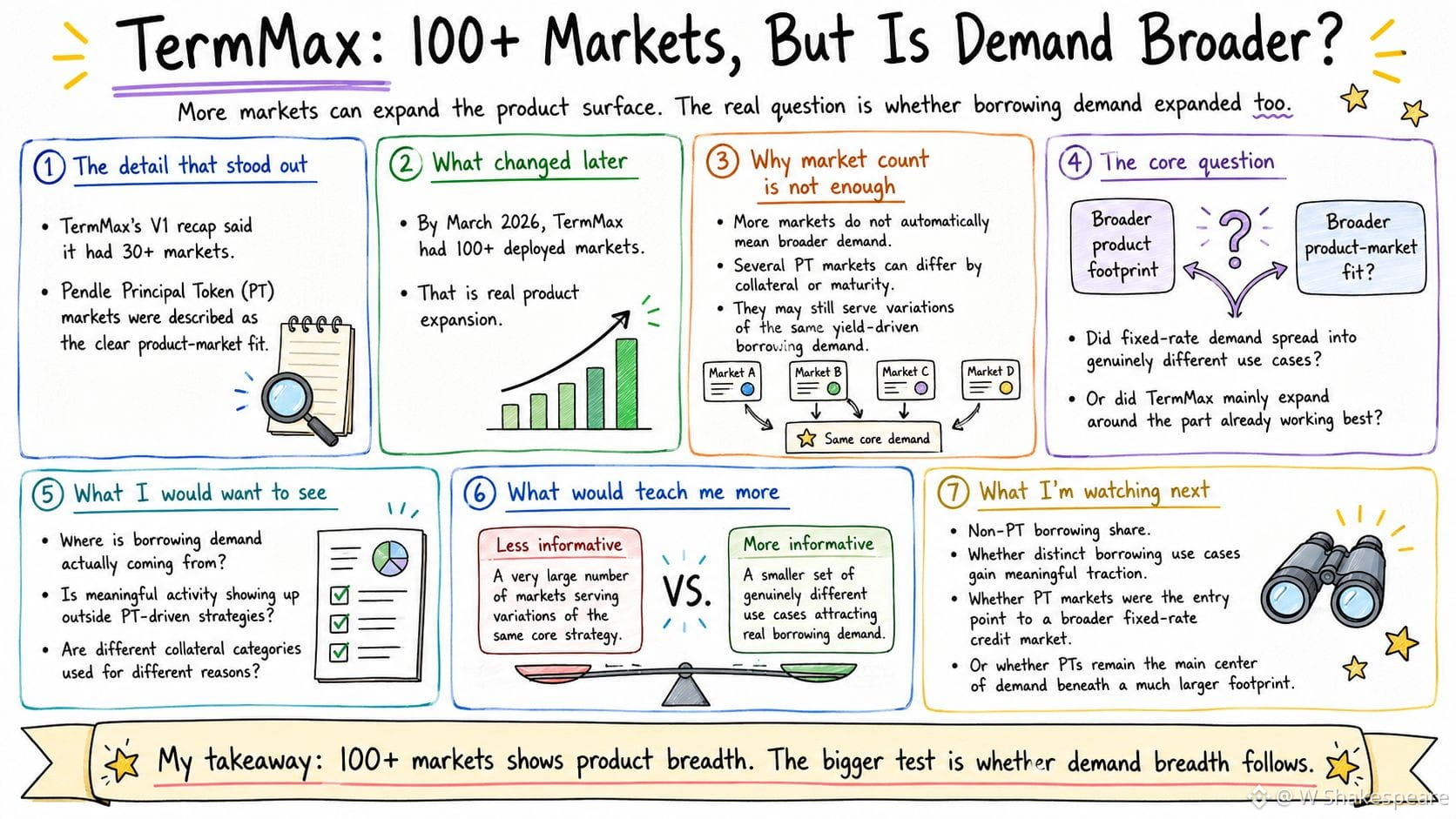
I keep coming back to how quickly TermMax expanded its market footprint. In its V1 recap, TermMax said it had launched 30+ markets, with Pendle Principal Token (PT) markets emerging as the clearest product-market fit. By March 2026, that footprint had grown to more than 100 deployed markets. That tells me TermMax has become much broader as a product. What it does not tell me is whether the demand underneath that expansion has broadened with it.
PT-backed strategies were a natural early fit for TermMax. Fixed-rate borrowing works particularly well when users can borrow against yield-bearing positions and structure leveraged yield trades around a known borrowing cost. So the traction in those markets tells me something useful about where TermMax first found demand.
What I don't know yet is whether TermMax has since found equally compelling reasons for borrowers to use its markets outside that original wedge.
That is what would make the move from 30+ to 100+ markets more meaningful to me.
Borrowing outside PT-driven strategies would be stronger evidence, especially if it comes from use cases that do not depend on the same yield-trade setup. That would show TermMax is not only adding more places to borrow, but finding more reasons for people to borrow at a fixed rate.
I'd learn more from a smaller set of genuinely different borrowing use cases gaining real traction than from a much larger number of deployed markets built around variations of demand TermMax had already proven.
The question is whether TermMax is using its early PT product-market fit as a wedge into a broader fixed-rate credit market, or whether that original use case still explains most of the demand underneath its larger footprint. I am watching where TermMax's non-PT borrowing demand comes from and which new use cases start gaining meaningful traction.
#termmax @termmax ✨
I keep coming back to how quickly TermMax expanded its market footprint. In its V1 recap, TermMax said it had launched 30+ markets, with Pendle Principal Token (PT) markets emerging as the clearest product-market fit. By March 2026, that footprint had grown to more than 100 deployed markets. That tells me TermMax has become much broader as a product. What it does not tell me is whether the demand underneath that expansion has broadened with it.
PT-backed strategies were a natural early fit for TermMax. Fixed-rate borrowing works particularly well when users can borrow against yield-bearing positions and structure leveraged yield trades around a known borrowing cost. So the traction in those markets tells me something useful about where TermMax first found demand.
What I don't know yet is whether TermMax has since found equally compelling reasons for borrowers to use its markets outside that original wedge.
That is what would make the move from 30+ to 100+ markets more meaningful to me.
Borrowing outside PT-driven strategies would be stronger evidence, especially if it comes from use cases that do not depend on the same yield-trade setup. That would show TermMax is not only adding more places to borrow, but finding more reasons for people to borrow at a fixed rate.
I'd learn more from a smaller set of genuinely different borrowing use cases gaining real traction than from a much larger number of deployed markets built around variations of demand TermMax had already proven.
The question is whether TermMax is using its early PT product-market fit as a wedge into a broader fixed-rate credit market, or whether that original use case still explains most of the demand underneath its larger footprint. I am watching where TermMax's non-PT borrowing demand comes from and which new use cases start gaining meaningful traction.
#termmax @TermMax ✨
PT-backed strategies were a natural early fit for TermMax. Fixed-rate borrowing works particularly well when users can borrow against yield-bearing positions and structure leveraged yield trades around a known borrowing cost. So the traction in those markets tells me something useful about where TermMax first found demand.
What I don't know yet is whether TermMax has since found equally compelling reasons for borrowers to use its markets outside that original wedge.
That is what would make the move from 30+ to 100+ markets more meaningful to me.
Borrowing outside PT-driven strategies would be stronger evidence, especially if it comes from use cases that do not depend on the same yield-trade setup. That would show TermMax is not only adding more places to borrow, but finding more reasons for people to borrow at a fixed rate.
I'd learn more from a smaller set of genuinely different borrowing use cases gaining real traction than from a much larger number of deployed markets built around variations of demand TermMax had already proven.
The question is whether TermMax is using its early PT product-market fit as a wedge into a broader fixed-rate credit market, or whether that original use case still explains most of the demand underneath its larger footprint. I am watching where TermMax's non-PT borrowing demand comes from and which new use cases start gaining meaningful traction.
#termmax @TermMax ✨
2
4
341
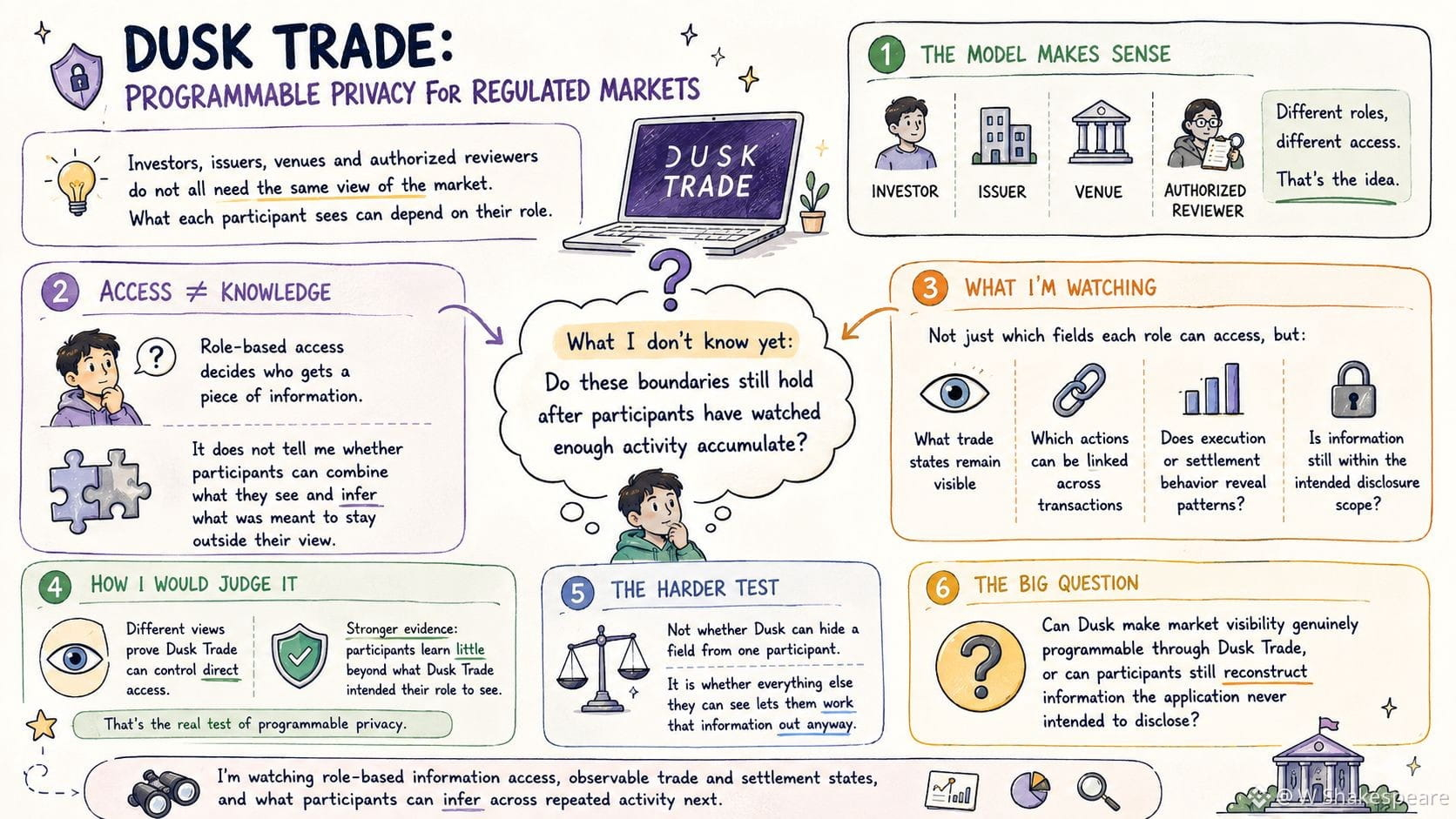
I keep coming back to Dusk's idea of programmable privacy for regulated markets, especially how that plays out inside Dusk Trade.
The model makes sense. Investors, issuers, venues and authorized reviewers do not all need the same view of the market, so what each participant sees can depend on their role.
But controlling what someone is shown directly is not the same as controlling what they can ultimately learn.
Role-based access tells me Dusk can decide who gets a particular piece of information. It does not tell me whether participants can piece together the activity they can see and infer something that was meant to stay outside their view.
What I don't know yet is whether those boundaries still hold after participants have watched enough activity accumulate.
The signals worth watching are therefore not just which fields each role can access, but what trade states remain visible, which actions can be linked across transactions, and whether execution or settlement behavior reveals patterns beyond the intended disclosure scope.
Giving different participants different views would prove that Dusk Trade can control direct access. Stronger evidence would be that they learn little beyond what Dusk Trade intended their role to see.
That changes how I would judge Dusk's programmable privacy model.
The harder test is not whether Dusk can hide a field from one participant. It is whether everything else that participant can see lets them work that information out anyway.
The question is whether Dusk can make market visibility genuinely programmable through Dusk Trade, or whether participants can still reconstruct information the application never intended to disclose.
I am watching role-based information access, observable trade and settlement states, and what participants can infer across repeated activity next.
#dusk $DUSK @Dusk_Foundation ✨
I keep coming back to Dusk's idea of programmable privacy for regulated markets, especially how that plays out inside Dusk Trade.
The model makes sense. Investors, issuers, venues and authorized reviewers do not all need the same view of the market, so what each participant sees can depend on their role.
But controlling what someone is shown directly is not the same as controlling what they can ultimately learn.
Role-based access tells me Dusk can decide who gets a particular piece of information. It does not tell me whether participants can piece together the activity they can see and infer something that was meant to stay outside their view.
What I don't know yet is whether those boundaries still hold after participants have watched enough activity accumulate.
The signals worth watching are therefore not just which fields each role can access, but what trade states remain visible, which actions can be linked across transactions, and whether execution or settlement behavior reveals patterns beyond the intended disclosure scope.
Giving different participants different views would prove that Dusk Trade can control direct access. Stronger evidence would be that they learn little beyond what Dusk Trade intended their role to see.
That changes how I would judge Dusk's programmable privacy model.
The harder test is not whether Dusk can hide a field from one participant. It is whether everything else that participant can see lets them work that information out anyway.
The question is whether Dusk can make market visibility genuinely programmable through Dusk Trade, or whether participants can still reconstruct information the application never intended to disclose.
I am watching role-based information access, observable trade and settlement states, and what participants can infer across repeated activity next.
#dusk $DUSK @Dusk ✨
The model makes sense. Investors, issuers, venues and authorized reviewers do not all need the same view of the market, so what each participant sees can depend on their role.
But controlling what someone is shown directly is not the same as controlling what they can ultimately learn.
Role-based access tells me Dusk can decide who gets a particular piece of information. It does not tell me whether participants can piece together the activity they can see and infer something that was meant to stay outside their view.
What I don't know yet is whether those boundaries still hold after participants have watched enough activity accumulate.
The signals worth watching are therefore not just which fields each role can access, but what trade states remain visible, which actions can be linked across transactions, and whether execution or settlement behavior reveals patterns beyond the intended disclosure scope.
Giving different participants different views would prove that Dusk Trade can control direct access. Stronger evidence would be that they learn little beyond what Dusk Trade intended their role to see.
That changes how I would judge Dusk's programmable privacy model.
The harder test is not whether Dusk can hide a field from one participant. It is whether everything else that participant can see lets them work that information out anyway.
The question is whether Dusk can make market visibility genuinely programmable through Dusk Trade, or whether participants can still reconstruct information the application never intended to disclose.
I am watching role-based information access, observable trade and settlement states, and what participants can infer across repeated activity next.
#dusk $DUSK @Dusk ✨
9
10
837
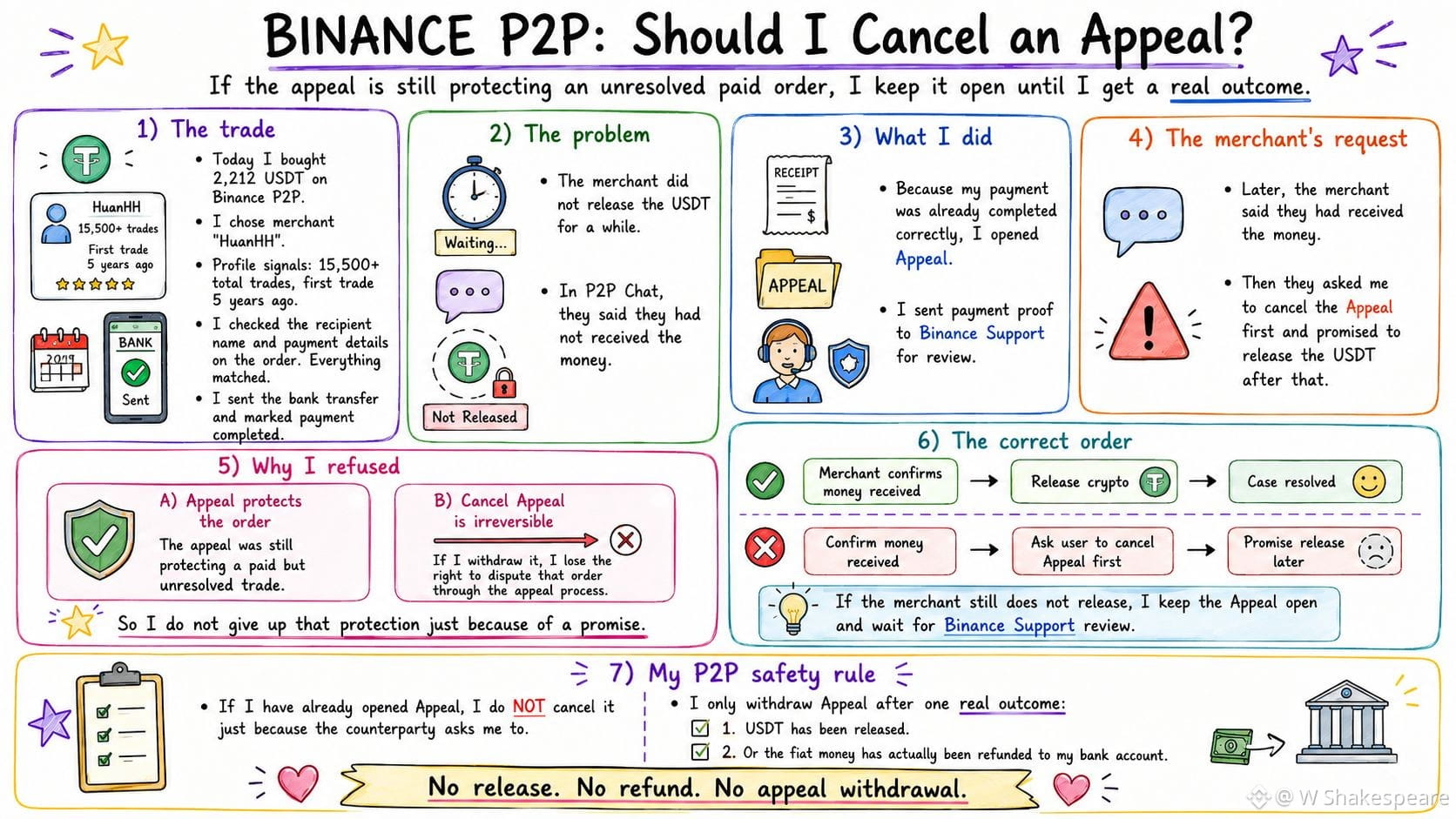
Hôm nay, mình mua 2,212 USDT qua Binance P2P. Counterparty mình chọn là merchant "HuanHH". Đây là một merchant uy tín lâu năm với profile có hơn 15,500 total trades và first trade từ 5 năm trước.
Mình place order và mở app bank ra để chuyển khoản. Mình check kỹ tên người nhận và payment details trên order. Thông tin đều khớp nên mình chuyển tiền rồi mark payment completed.
Nhưng đợi khá lâu merchant vẫn không release crypto. Mình nhắn trong P2P Chat thì họ nói chưa nhận được tiền.
Vì khoản chuyển của mình đã hoàn tất đúng theo thông tin trên order, mình mở Appeal và gửi payment proof cho Binance Support review.
Ngay sau đó, merchant nhắn lại rằng họ đã nhận được tiền. Tuy nhiên, họ yêu cầu mình cancel Appeal trước rồi mới release USDT.
Mình không đồng ý và yêu cầu họ release crypto trước.
Lý do khá đơn giản. Appeal lúc này vẫn đang bảo vệ một order chưa được giải quyết. Quan trọng hơn, Cancel Appeal là irreversible. Một khi mình rút Appeal, mình sẽ mất quyền dispute order đó qua appeal process.
Vậy nên không có lý do gì để mình bỏ lớp bảo vệ đang có chỉ vì lời hứa rằng crypto sẽ được release sau đó.
Merchant đã xác nhận nhận được tiền thì bước tiếp theo nên là release crypto. Nếu họ vẫn không làm, mình cứ giữ nguyên Appeal và để đợi kết quả review case của Binance Support.
Case này làm mình nhận ra rằng khi Appeal đã mở, thứ tự xử lý rất quan trọng.
Rule P2P safety của mình khá cụ thể: nếu đã mở Appeal thì mình sẽ không cancel theo yêu cầu hoặc lời hứa của counterparty. Chỉ rút khi USDT đã release hoặc tiền fiat đã thực sự được refund lại vào tài khoản bank của mình.
Nếu chưa có một trong hai kết quả đó, mình để Appeal tiếp tục.
#binancep2pantoan @Binance_Vietnam ✨
Hôm nay, mình mua 2,212 USDT qua Binance P2P. Counterparty mình chọn là merchant "HuanHH". Đây là một merchant uy tín lâu năm với profile có hơn 15,500 total trades và first trade từ 5 năm trước.
Mình place order và mở app bank ra để chuyển khoản. Mình check kỹ tên người nhận và payment details trên order. Thông tin đều khớp nên mình chuyển tiền rồi mark payment completed.
Nhưng đợi khá lâu merchant vẫn không release crypto. Mình nhắn trong P2P Chat thì họ nói chưa nhận được tiền.
Vì khoản chuyển của mình đã hoàn tất đúng theo thông tin trên order, mình mở Appeal và gửi payment proof cho Binance Support review.
Ngay sau đó, merchant nhắn lại rằng họ đã nhận được tiền. Tuy nhiên, họ yêu cầu mình cancel Appeal trước rồi mới release USDT.
Mình không đồng ý và yêu cầu họ release crypto trước.
Lý do khá đơn giản. Appeal lúc này vẫn đang bảo vệ một order chưa được giải quyết. Quan trọng hơn, Cancel Appeal là irreversible. Một khi mình rút Appeal, mình sẽ mất quyền dispute order đó qua appeal process.
Vậy nên không có lý do gì để mình bỏ lớp bảo vệ đang có chỉ vì lời hứa rằng crypto sẽ được release sau đó.
Merchant đã xác nhận nhận được tiền thì bước tiếp theo nên là release crypto. Nếu họ vẫn không làm, mình cứ giữ nguyên Appeal và để đợi kết quả review case của Binance Support.
Case này làm mình nhận ra rằng khi Appeal đã mở, thứ tự xử lý rất quan trọng.
Rule P2P safety của mình khá cụ thể: nếu đã mở Appeal thì mình sẽ không cancel theo yêu cầu hoặc lời hứa của counterparty. Chỉ rút khi USDT đã release hoặc tiền fiat đã thực sự được refund lại vào tài khoản bank của mình.
Nếu chưa có một trong hai kết quả đó, mình để Appeal tiếp tục.
#binancep2pantoan @Binance Vietnam ✨
Mình place order và mở app bank ra để chuyển khoản. Mình check kỹ tên người nhận và payment details trên order. Thông tin đều khớp nên mình chuyển tiền rồi mark payment completed.
Nhưng đợi khá lâu merchant vẫn không release crypto. Mình nhắn trong P2P Chat thì họ nói chưa nhận được tiền.
Vì khoản chuyển của mình đã hoàn tất đúng theo thông tin trên order, mình mở Appeal và gửi payment proof cho Binance Support review.
Ngay sau đó, merchant nhắn lại rằng họ đã nhận được tiền. Tuy nhiên, họ yêu cầu mình cancel Appeal trước rồi mới release USDT.
Mình không đồng ý và yêu cầu họ release crypto trước.
Lý do khá đơn giản. Appeal lúc này vẫn đang bảo vệ một order chưa được giải quyết. Quan trọng hơn, Cancel Appeal là irreversible. Một khi mình rút Appeal, mình sẽ mất quyền dispute order đó qua appeal process.
Vậy nên không có lý do gì để mình bỏ lớp bảo vệ đang có chỉ vì lời hứa rằng crypto sẽ được release sau đó.
Merchant đã xác nhận nhận được tiền thì bước tiếp theo nên là release crypto. Nếu họ vẫn không làm, mình cứ giữ nguyên Appeal và để đợi kết quả review case của Binance Support.
Case này làm mình nhận ra rằng khi Appeal đã mở, thứ tự xử lý rất quan trọng.
Rule P2P safety của mình khá cụ thể: nếu đã mở Appeal thì mình sẽ không cancel theo yêu cầu hoặc lời hứa của counterparty. Chỉ rút khi USDT đã release hoặc tiền fiat đã thực sự được refund lại vào tài khoản bank của mình.
Nếu chưa có một trong hai kết quả đó, mình để Appeal tiếp tục.
#binancep2pantoan @Binance Vietnam ✨
2
4
1.1k
Ішінара рас
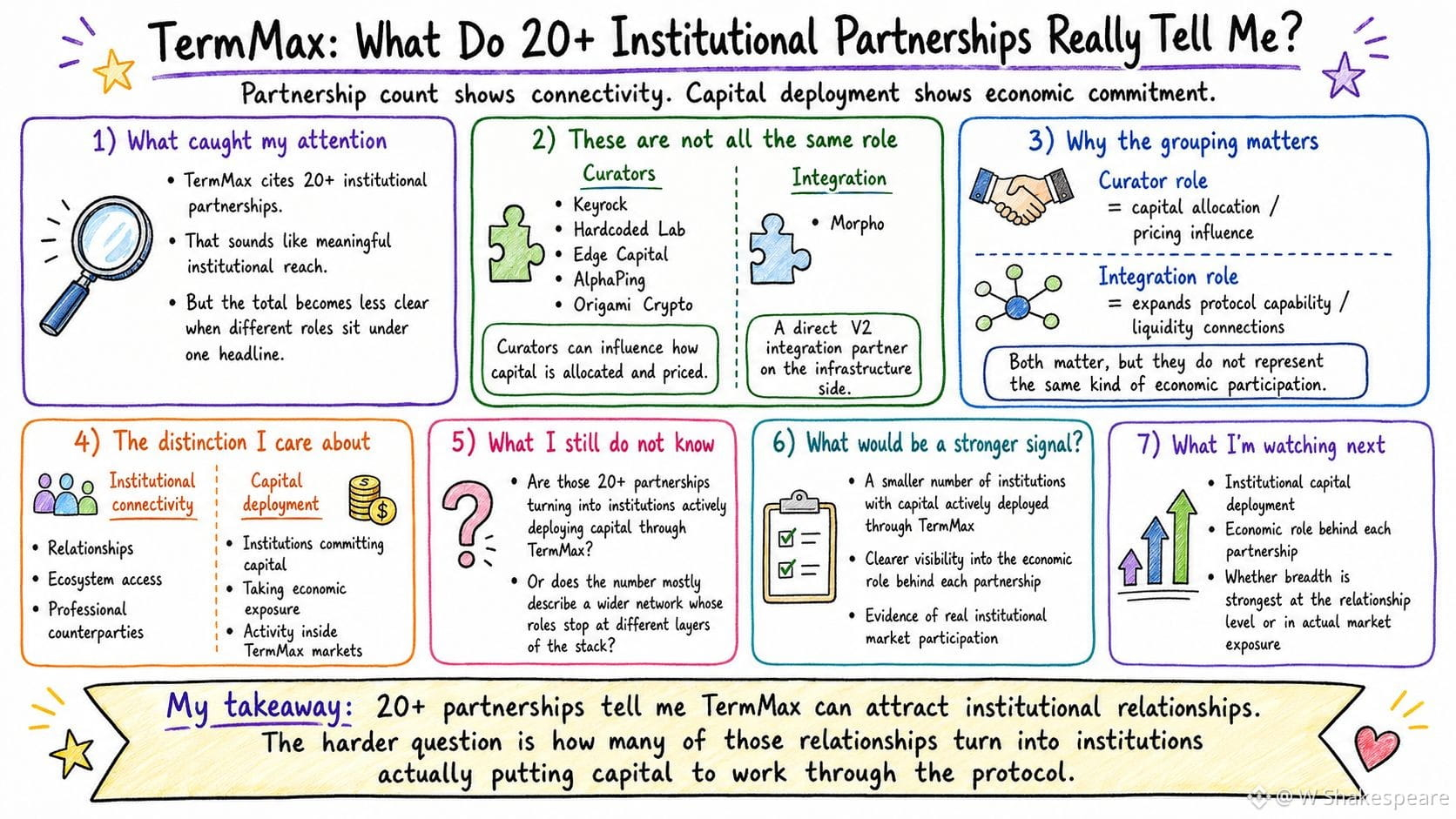
I keep coming back to TermMax, a decentralized fixed-rate borrowing and lending protocol, citing 20+ institutional partnerships.
That sounds like meaningful institutional traction. But the number gets less straightforward once I ask what a "partnership" actually represents economically.
Institutions can sit in very different parts of the TermMax ecosystem. One relationship might expand infrastructure or distribution. Another might be closer to pricing, liquidity provision or direct capital allocation. All of them can matter, but grouping them under one headline makes it hard to see how much of that institutional reach has actually turned into capital participation.
What I don't know yet is whether those 20+ partnerships are developing into a broad base of institutions with real economic exposure through TermMax, or whether much of that footprint still sits at other layers of the ecosystem. That is where deployed capital becomes a stronger signal. Once an institution actually puts money to work through TermMax, the relationship has to pass an economic test that a partnership or integration alone does not. The institution has to accept the risk, return and market conditions attached to that position, rather than simply being connected to the protocol. So relationship breadth and capital breadth are not the same thing. TermMax can build a wide institutional network while the money actually moving through its markets still comes from a much smaller subset.
I'd learn more from a smaller group of institutions with capital actively deployed through TermMax than from a much larger partnership count where the economic role behind each relationship remains unclear.
The question is whether TermMax is building a broad institutional network around the protocol, or turning that breadth into an equally broad base of institutional capital participation. I am watching how much of that institutional footprint actually shows up as deployed capital next.
#termmax @termmax ✨$BTW
I keep coming back to TermMax, a decentralized fixed-rate borrowing and lending protocol, citing 20+ institutional partnerships.
That sounds like meaningful institutional traction. But the number gets less straightforward once I ask what a "partnership" actually represents economically.
Institutions can sit in very different parts of the TermMax ecosystem. One relationship might expand infrastructure or distribution. Another might be closer to pricing, liquidity provision or direct capital allocation. All of them can matter, but grouping them under one headline makes it hard to see how much of that institutional reach has actually turned into capital participation.
What I don't know yet is whether those 20+ partnerships are developing into a broad base of institutions with real economic exposure through TermMax, or whether much of that footprint still sits at other layers of the ecosystem. That is where deployed capital becomes a stronger signal. Once an institution actually puts money to work through TermMax, the relationship has to pass an economic test that a partnership or integration alone does not. The institution has to accept the risk, return and market conditions attached to that position, rather than simply being connected to the protocol. So relationship breadth and capital breadth are not the same thing. TermMax can build a wide institutional network while the money actually moving through its markets still comes from a much smaller subset.
I'd learn more from a smaller group of institutions with capital actively deployed through TermMax than from a much larger partnership count where the economic role behind each relationship remains unclear.
The question is whether TermMax is building a broad institutional network around the protocol, or turning that breadth into an equally broad base of institutional capital participation. I am watching how much of that institutional footprint actually shows up as deployed capital next.
#termmax @TermMax ✨$BTW
That sounds like meaningful institutional traction. But the number gets less straightforward once I ask what a "partnership" actually represents economically.
Institutions can sit in very different parts of the TermMax ecosystem. One relationship might expand infrastructure or distribution. Another might be closer to pricing, liquidity provision or direct capital allocation. All of them can matter, but grouping them under one headline makes it hard to see how much of that institutional reach has actually turned into capital participation.
What I don't know yet is whether those 20+ partnerships are developing into a broad base of institutions with real economic exposure through TermMax, or whether much of that footprint still sits at other layers of the ecosystem. That is where deployed capital becomes a stronger signal. Once an institution actually puts money to work through TermMax, the relationship has to pass an economic test that a partnership or integration alone does not. The institution has to accept the risk, return and market conditions attached to that position, rather than simply being connected to the protocol. So relationship breadth and capital breadth are not the same thing. TermMax can build a wide institutional network while the money actually moving through its markets still comes from a much smaller subset.
I'd learn more from a smaller group of institutions with capital actively deployed through TermMax than from a much larger partnership count where the economic role behind each relationship remains unclear.
The question is whether TermMax is building a broad institutional network around the protocol, or turning that breadth into an equally broad base of institutional capital participation. I am watching how much of that institutional footprint actually shows up as deployed capital next.
#termmax @TermMax ✨$BTW
6
8
563
Расталды
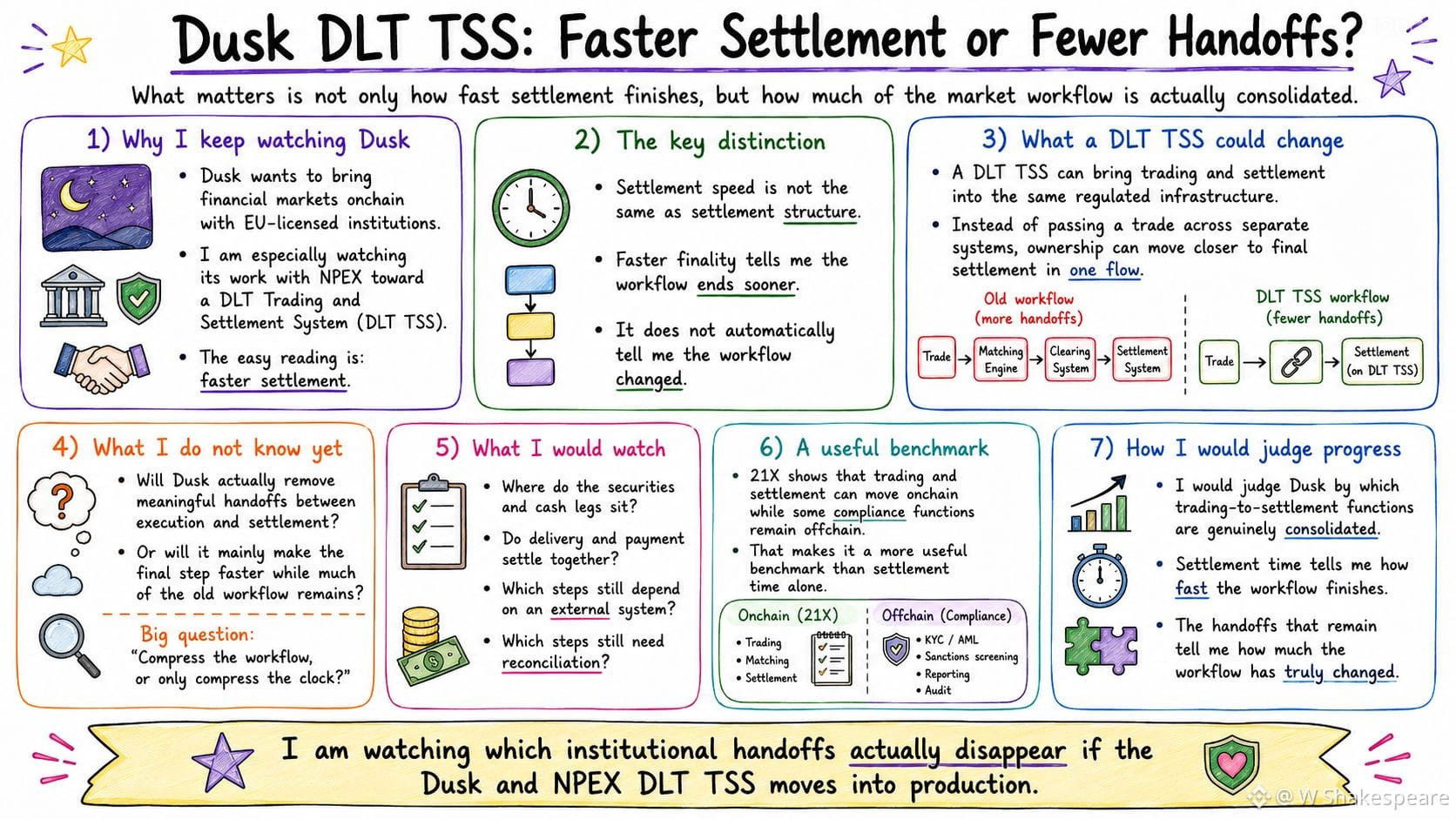
I keep coming back to Dusk's push to bring financial markets onchain with EU-licensed institutions, especially its work with NPEX toward a DLT Trading and Settlement System (DLT TSS). It is easy to read that mainly as a faster-settlement story.
But settlement speed and settlement structure are not the same thing. A DLT TSS can bring trading and settlement functions into the same regulated infrastructure instead of passing a trade across separate systems before ownership is final.
What I don't know yet is whether Dusk's DLT TSS path will actually remove meaningful handoffs between execution and settlement, or simply make the final step faster while much of the old workflow stays in place. The mechanics worth watching are where the securities and cash legs sit, whether delivery and payment settle together, and which steps still require an external system or reconciliation. Live DLT TSS infrastructure such as 21X shows that trading and settlement can move onchain while some compliance functions remain offchain. That is a more useful benchmark for Dusk than settlement time alone. Settlement time tells me how fast the workflow finishes. The handoffs that remain tell me how much of the workflow DLT TSS has actually changed.
I would judge Dusk's progress by which trading-to-settlement functions are genuinely consolidated, not just by how quickly the final transaction completes.
The question is whether Dusk can compress the market workflow itself, or only compress the clock. I am watching which institutional handoffs actually disappear if the Dusk and NPEX DLT TSS moves into production.
#dusk $DUSK @Dusk_Foundation ✨
I keep coming back to Dusk's push to bring financial markets onchain with EU-licensed institutions, especially its work with NPEX toward a DLT Trading and Settlement System (DLT TSS). It is easy to read that mainly as a faster-settlement story.
But settlement speed and settlement structure are not the same thing. A DLT TSS can bring trading and settlement functions into the same regulated infrastructure instead of passing a trade across separate systems before ownership is final.
What I don't know yet is whether Dusk's DLT TSS path will actually remove meaningful handoffs between execution and settlement, or simply make the final step faster while much of the old workflow stays in place. The mechanics worth watching are where the securities and cash legs sit, whether delivery and payment settle together, and which steps still require an external system or reconciliation. Live DLT TSS infrastructure such as 21X shows that trading and settlement can move onchain while some compliance functions remain offchain. That is a more useful benchmark for Dusk than settlement time alone. Settlement time tells me how fast the workflow finishes. The handoffs that remain tell me how much of the workflow DLT TSS has actually changed.
I would judge Dusk's progress by which trading-to-settlement functions are genuinely consolidated, not just by how quickly the final transaction completes.
The question is whether Dusk can compress the market workflow itself, or only compress the clock. I am watching which institutional handoffs actually disappear if the Dusk and NPEX DLT TSS moves into production.
#dusk $DUSK @Dusk ✨
But settlement speed and settlement structure are not the same thing. A DLT TSS can bring trading and settlement functions into the same regulated infrastructure instead of passing a trade across separate systems before ownership is final.
What I don't know yet is whether Dusk's DLT TSS path will actually remove meaningful handoffs between execution and settlement, or simply make the final step faster while much of the old workflow stays in place. The mechanics worth watching are where the securities and cash legs sit, whether delivery and payment settle together, and which steps still require an external system or reconciliation. Live DLT TSS infrastructure such as 21X shows that trading and settlement can move onchain while some compliance functions remain offchain. That is a more useful benchmark for Dusk than settlement time alone. Settlement time tells me how fast the workflow finishes. The handoffs that remain tell me how much of the workflow DLT TSS has actually changed.
I would judge Dusk's progress by which trading-to-settlement functions are genuinely consolidated, not just by how quickly the final transaction completes.
The question is whether Dusk can compress the market workflow itself, or only compress the clock. I am watching which institutional handoffs actually disappear if the Dusk and NPEX DLT TSS moves into production.
#dusk $DUSK @Dusk ✨
8
8
124
Көбірек контент көру үшін кіріңіз
Binance Square платформасында әлемдік криптоқоғамдастыққа қосылыңыз
⚡️ Криптовалюта туралы ең соңғы және пайдалы ақпаратты алыңыз.
💬 Әлемдегі ең ірі криптобиржаның сеніміне ие.
👍 Расталған авторлардың нақты пікірлерін табыңыз.
Электрондық пошта/телефон нөмірі
Трендтегі тақырыптар
BitcoinClears$85200
9,866 рет көрілді
200 адам талқылап жатыр
We got the move, and $BTC is standing exactly where we were before the data. That’s what actual patience for a trade looks like.
The data came in mixed but with some important numbers. ADP Non-Farm Employment Change came at 90K vs 73K forecast, while Core PCE came in at 0.2% vs 0.3% expected. Final GDP was also stronger at 2.2% vs 1.5% forecast, while Personal Spending came in at 0.9% vs 0.8% expected. At the same time, Personal Income missed at 0.2% vs 0.5% forecast.
BTC initially surged to $85,600 and is now back where it needs to be. I’m still looking toward the lower ranges at $82,759 and the $80,000 liquidity, because the overhead liquidity is done and dusted.
We had a live session during the data, and during that session we saw the market at $83,800, then $85,600, and then back toward $83,000 and we still didn’t enter a trade.
That’s what patience is.
We can’t force an entry when the market has no clear direction. The same range is still in focus, and we’ll wait for the market to give us the setup.
Let me know, guys, how was the session? And should we have more regular sessions with our respected members so we can have proper discussions regarding the market?
#BitcoinClears$85200 #AltcoinSeasonIndexHoldsAbove60For5Days #USADPAdds90000JobsInSeptember #BitcoinSlipsBelow$84000 #SECToClarifyOnChainFundraisingRules
Crypto_LUX
·24 лайк
·16.5k рет көрілді
AltcoinSeasonIndexHoldsAbove60For5Days
49,985 рет көрілді
1,097 адам талқылап жатыр
USADPAdds90000JobsInSeptember
23,401 рет көрілді
619 адам талқылап жатыр