
RISKK TAKER
761 Жариялаулар

RISKK TAKER
Хабарлау
Пайдаланушыны блоктау
RISK TAKER, Technical Analyst, Trader, My post NFA
Ашық сауда
Кездейсоқ трейдер
9.3 ай
8 Жазылым
38 Жазылушылар
1.0K+ лайк басылған
Жазбалар
Портфолио
Барлығы
Баға ұсыныстары
Видеолар
·
--
CRYPTO MARKET TAKES A MASSIVE HIT AS BILLIONS IN VALUE DISAPPEAR!
Bitcoin is down 5.85%, Ethereum has dropped 7.45%, XRP is losing 4.95%, while Solana has fallen 6.20%.
The sell-off is also hitting leveraged traders hard, with more than $870 MILLION in crypto positions liquidated in just four hours.
Long traders are taking a serious beating as prices continue to slide, adding even more pressure to an already weak market.
Crypto volatility is back in full force. 🔻
$XRP
{future}(XRPUSDT)
$SOLV
{future}(SOLVUSDT)
CRYPTO MARKET TAKES A MASSIVE HIT AS BILLIONS IN VALUE DISAPPEAR!
Bitcoin is down 5.85%, Ethereum has dropped 7.45%, XRP is losing 4.95%, while Solana has fallen 6.20%.
The sell-off is also hitting leveraged traders hard, with more than $870 MILLION in crypto positions liquidated in just four hours.
Long traders are taking a serious beating as prices continue to slide, adding even more pressure to an already weak market.
Crypto volatility is back in full force. 🔻
$XRP
$SOLV
1
445
·
--
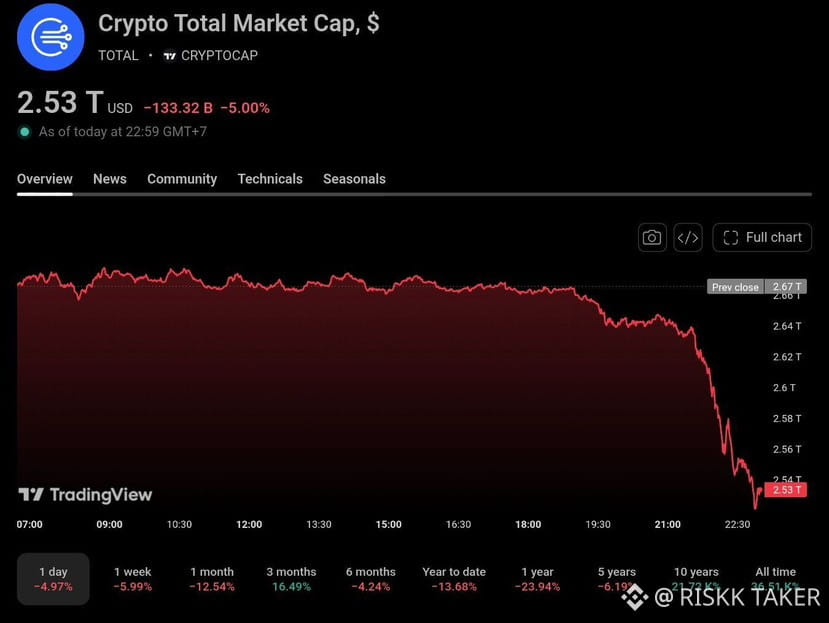
🚨THE CRYPTO MARKET LOSES $140 BILLION IN JUST 4 HOURS!
Selling pressure has hit the market hard, wiping approximately $140 billion off the total crypto market capitalization in just four hours.
Bitcoin and Ethereum led the decline as panic spread across the market, triggering heavy liquidations and putting altcoins under even more pressure.
This is a brutal reminder of how quickly sentiment can shift in crypto. Traders are now watching whether buyers step in to defend key support levels or if another wave of selling is coming. $SOL
{future}(SOLUSDT)
$INJ
{future}(INJUSDT)
🚨THE CRYPTO MARKET LOSES $140 BILLION IN JUST 4 HOURS!
Selling pressure has hit the market hard, wiping approximately $140 billion off the total crypto market capitalization in just four hours.
Bitcoin and Ethereum led the decline as panic spread across the market, triggering heavy liquidations and putting altcoins under even more pressure.
This is a brutal reminder of how quickly sentiment can shift in crypto. Traders are now watching whether buyers step in to defend key support levels or if another wave of selling is coming. $SOL
$INJ
234
·
--
Tether is expanding its gold position at a rapid pace. Its physical gold reserves backing XAU₮ have climbed from 16.2 tonnes at the end of 2025 to approximately 25.7 tonnes by September 30.
That’s an addition of more than 9 tonnes of gold, bringing the total backing to a record 827,418 ounces.
Each XAU₮ token represents ownership of one fine troy ounce of physical gold held in Swiss vaults.
Even through gold market volatility, demand for tokenized gold keeps growing. Tether is making a serious move in the real-world asset market.
$ZEC
{future}(ZECUSDT)
$XAUT
{future}(XAUTUSDT)
Tether is expanding its gold position at a rapid pace. Its physical gold reserves backing XAU₮ have climbed from 16.2 tonnes at the end of 2025 to approximately 25.7 tonnes by September 30.
That’s an addition of more than 9 tonnes of gold, bringing the total backing to a record 827,418 ounces.
Each XAU₮ token represents ownership of one fine troy ounce of physical gold held in Swiss vaults.
Even through gold market volatility, demand for tokenized gold keeps growing. Tether is making a serious move in the real-world asset market.
$ZEC
$XAUT


1
276
·
--
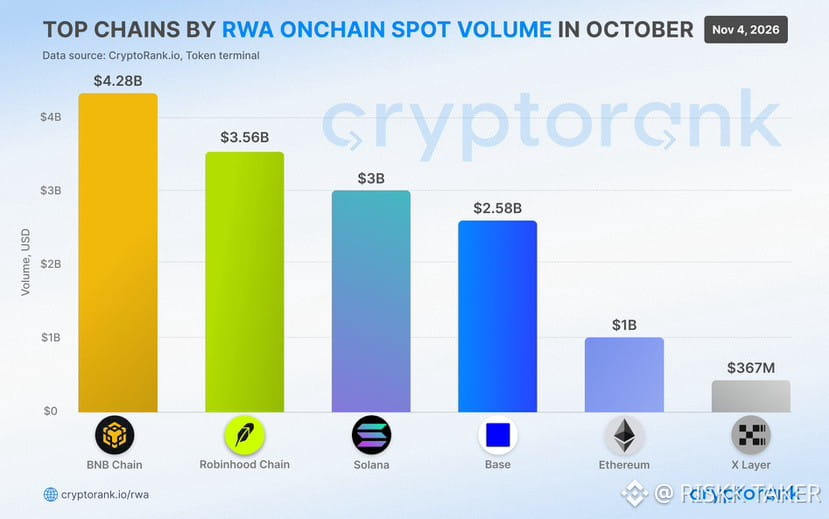
BNB Chain recorded $4.28 billion in RWA spot trading volume, beating Robinhood Crypto with $3.56 billion and Solana with $3 billion.
Combined, the three platforms accounted for 72% of the entire market, which reached $15 billion in October.
That’s a significant share of activity concentrated among just three players.
Real world asset trading is gaining traction on chain, and BNB Chain is currently leading the race by volume.
$BNB
{future}(BNBUSDT)
BNB Chain recorded $4.28 billion in RWA spot trading volume, beating Robinhood Crypto with $3.56 billion and Solana with $3 billion.
Combined, the three platforms accounted for 72% of the entire market, which reached $15 billion in October.
That’s a significant share of activity concentrated among just three players.
Real world asset trading is gaining traction on chain, and BNB Chain is currently leading the race by volume.
$BNB
1
65
·
--
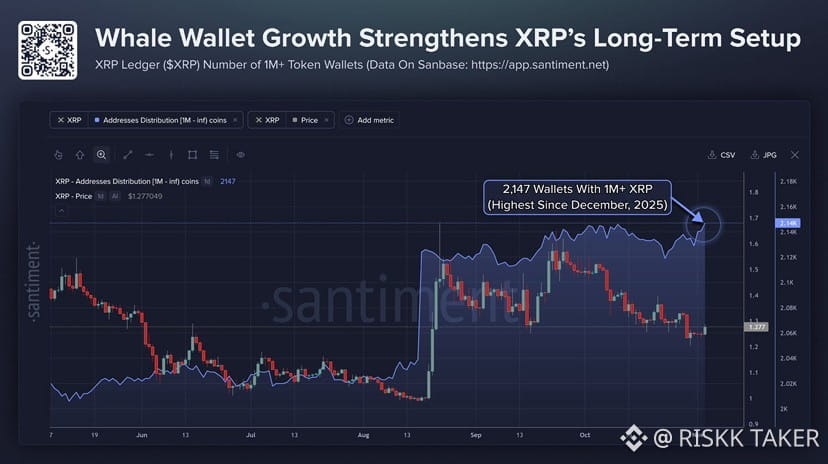
The number of XRP wallets holding at least 1 million tokens has climbed to 2,147, marking the highest count recorded this year, according to Santiment.
Even more interesting, 28 new wallets entered this group in just 10 days, with 18 additions coming in the final three days.
This growth is happening while XRP has been under price pressure, suggesting that large balances are continuing to build despite the market weakness.
It’s an encouraging on chain signal, but wallet numbers alone don’t prove fresh buying since exchanges and individual investors can control multiple addresses.
The next thing to watch is whether this whale growth continues alongside a recovery in XRP’s price.
$XRP
{future}(XRPUSDT)
The number of XRP wallets holding at least 1 million tokens has climbed to 2,147, marking the highest count recorded this year, according to Santiment.
Even more interesting, 28 new wallets entered this group in just 10 days, with 18 additions coming in the final three days.
This growth is happening while XRP has been under price pressure, suggesting that large balances are continuing to build despite the market weakness.
It’s an encouraging on chain signal, but wallet numbers alone don’t prove fresh buying since exchanges and individual investors can control multiple addresses.
The next thing to watch is whether this whale growth continues alongside a recovery in XRP’s price.
$XRP
2
291
·
--
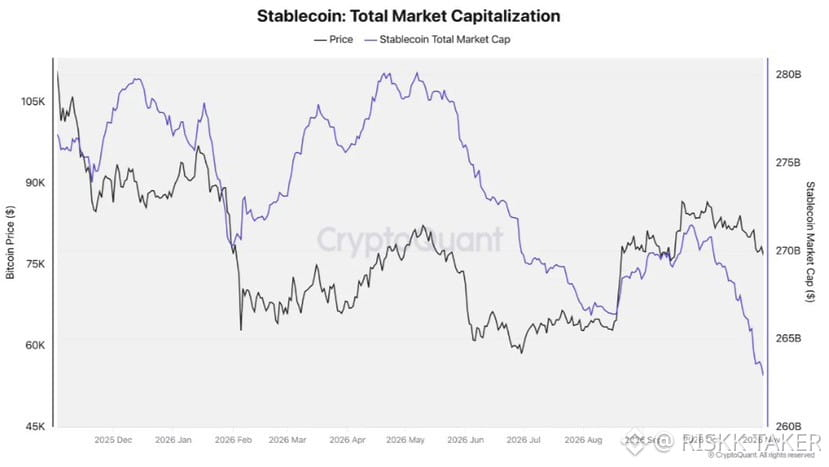
🚨 STABLECOIN MARKET CAP FALLS TO ITS LOWEST LEVEL IN OVER A YEAR
Liquidity is becoming a growing concern for the crypto market as the total stablecoin market cap continues to decline.
Stablecoins are a major source of trading capital across exchanges and DeFi. When their combined supply shrinks, it can signal that money is leaving the crypto ecosystem or being moved elsewhere rather than staying available for market activity.
As one market observer warned:
“It is becoming urgent to see liquidity return to the crypto market, in order to prevent the positive trend of recent months from reversing.”
The concern is clear that without fresh liquidity, sustaining the market’s recent positive momentum could become much harder. Traders will be watching stablecoin supply closely for signs of recovery.
$AGT
{future}(AGTUSDT)
$BMT
{future}(BMTUSDT)
$XRP
{future}(XRPUSDT)
🚨 STABLECOIN MARKET CAP FALLS TO ITS LOWEST LEVEL IN OVER A YEAR
Liquidity is becoming a growing concern for the crypto market as the total stablecoin market cap continues to decline.
Stablecoins are a major source of trading capital across exchanges and DeFi. When their combined supply shrinks, it can signal that money is leaving the crypto ecosystem or being moved elsewhere rather than staying available for market activity.
As one market observer warned:
“It is becoming urgent to see liquidity return to the crypto market, in order to prevent the positive trend of recent months from reversing.”
The concern is clear that without fresh liquidity, sustaining the market’s recent positive momentum could become much harder. Traders will be watching stablecoin supply closely for signs of recovery.
$AGT
$BMT
$XRP
1
499
·
--
BLACKROCK BITCOIN ETF RECORDS $405.3 MILLION IN OUTFLOWS, ITS BIGGEST DAILY EXIT IN OVER FOUR MONTHS
BlackRock’s iShares Bitcoin Trust (IBIT) took a major hit on November 2, with investors pulling $405.3 million from the fund.
The withdrawal was so large that it exceeded the entire U.S. spot Bitcoin ETF market’s net outflow of $398.6 million that day, as other funds recorded smaller inflows to offset part of the selling.
This comes after October already ended with roughly $515 million in net Bitcoin ETF outflows.
Institutional demand is facing real pressure. Traders will be watching closely to see whether these withdrawals continue or buyers step back in.
$XRP
{future}(XRPUSDT)
$BMT
{future}(BMTUSDT)
$BTC
{future}(BTCUSDT)
BLACKROCK BITCOIN ETF RECORDS $405.3 MILLION IN OUTFLOWS, ITS BIGGEST DAILY EXIT IN OVER FOUR MONTHS
BlackRock’s iShares Bitcoin Trust (IBIT) took a major hit on November 2, with investors pulling $405.3 million from the fund.
The withdrawal was so large that it exceeded the entire U.S. spot Bitcoin ETF market’s net outflow of $398.6 million that day, as other funds recorded smaller inflows to offset part of the selling.
This comes after October already ended with roughly $515 million in net Bitcoin ETF outflows.
Institutional demand is facing real pressure. Traders will be watching closely to see whether these withdrawals continue or buyers step back in.
$XRP
$BMT
$BTC


1
2
·
--
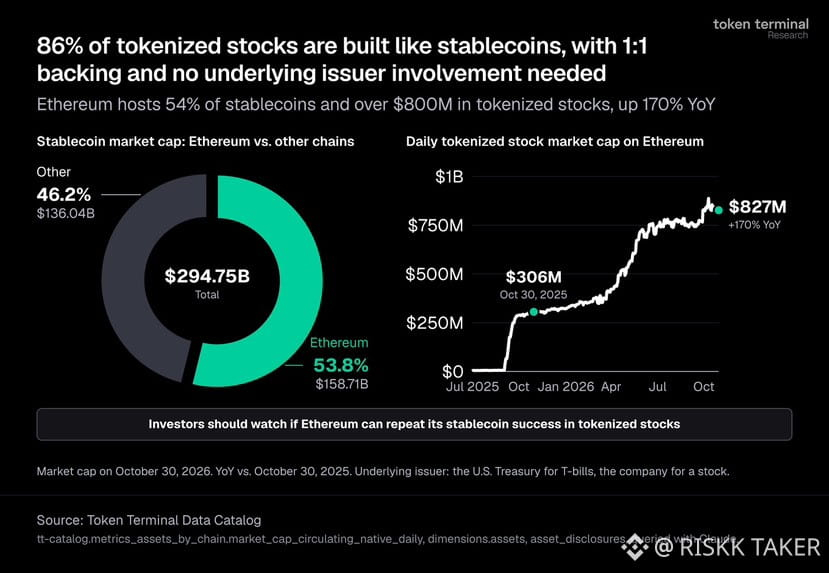
Tokenized equities are gaining serious traction on chain. Data from Token Terminal shows their value on Ethereum climbed 170% year over year, reaching $827 million by the end of October.
This growth reflects increasing interest in bringing traditional financial assets onto blockchain networks, allowing investors to access stock exposure through tokenized products.
Ethereum’s established stablecoin liquidity and DeFi infrastructure give these assets an existing ecosystem to grow within.
The bigger development is that crypto is expanding beyond digital currencies. If tokenized stocks continue attracting users and liquidity, they could become a much larger part of the on chain financial market.
Traditional finance is moving on chain, and Ethereum is becoming one of the networks benefiting from that shift.
$ARIA
{future}(ARIAUSDT)
$ETH
{future}(ETHUSDT)
Tokenized equities are gaining serious traction on chain. Data from Token Terminal shows their value on Ethereum climbed 170% year over year, reaching $827 million by the end of October.
This growth reflects increasing interest in bringing traditional financial assets onto blockchain networks, allowing investors to access stock exposure through tokenized products.
Ethereum’s established stablecoin liquidity and DeFi infrastructure give these assets an existing ecosystem to grow within.
The bigger development is that crypto is expanding beyond digital currencies. If tokenized stocks continue attracting users and liquidity, they could become a much larger part of the on chain financial market.
Traditional finance is moving on chain, and Ethereum is becoming one of the networks benefiting from that shift.
$ARIA
$ETH
1
205
·
--
Michael Saylor’s Strategy has purchased 811 Bitcoin for $65.5 million, resuming its accumulation after a brief pause.
The latest purchase was made at an average price of $80,846 per BTC, bringing the company’s total Bitcoin stash to 849,327 BTC, acquired for approximately $64.08 billion.
That’s more than 4% of Bitcoin’s maximum 21 million supply.
Even with market volatility, Strategy continues to expand its Bitcoin position. Its latest move is another clear sign that the company is sticking with its long-term BTC treasury strategy.
$BTC
{future}(BTCUSDT)
$ETH
{future}(ETHUSDT)
Michael Saylor’s Strategy has purchased 811 Bitcoin for $65.5 million, resuming its accumulation after a brief pause.
The latest purchase was made at an average price of $80,846 per BTC, bringing the company’s total Bitcoin stash to 849,327 BTC, acquired for approximately $64.08 billion.
That’s more than 4% of Bitcoin’s maximum 21 million supply.
Even with market volatility, Strategy continues to expand its Bitcoin position. Its latest move is another clear sign that the company is sticking with its long-term BTC treasury strategy.
$BTC
$ETH


1
118
·
--
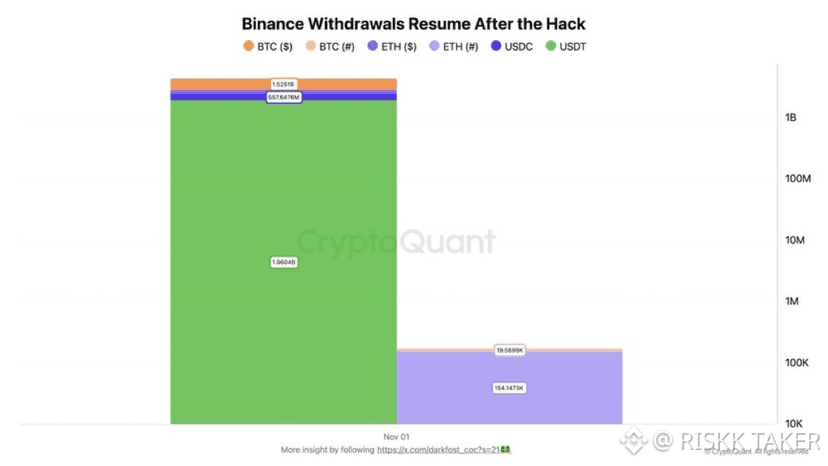
Binance is facing renewed pressure as reports claim users have withdrawn more than $4 billion in assets since the exchange began restoring withdrawals on November 1.
The withdrawals resumed in phases following the massive security breach, with Binance saying it has replaced approximately 95% of the stolen assets using company funds.
The scale of the reported outflows is now drawing attention to user confidence. Even with Binance covering the losses, the incident could leave users more cautious about keeping funds on centralized exchanges.
The $4 billion withdrawal figure has not yet been confirmed in Binance’s official updates.
$TRX
{future}(TRXUSDT)
$G
{future}(GUSDT)
Binance is facing renewed pressure as reports claim users have withdrawn more than $4 billion in assets since the exchange began restoring withdrawals on November 1.
The withdrawals resumed in phases following the massive security breach, with Binance saying it has replaced approximately 95% of the stolen assets using company funds.
The scale of the reported outflows is now drawing attention to user confidence. Even with Binance covering the losses, the incident could leave users more cautious about keeping funds on centralized exchanges.
The $4 billion withdrawal figure has not yet been confirmed in Binance’s official updates.
$TRX
$G
1
504
·
--
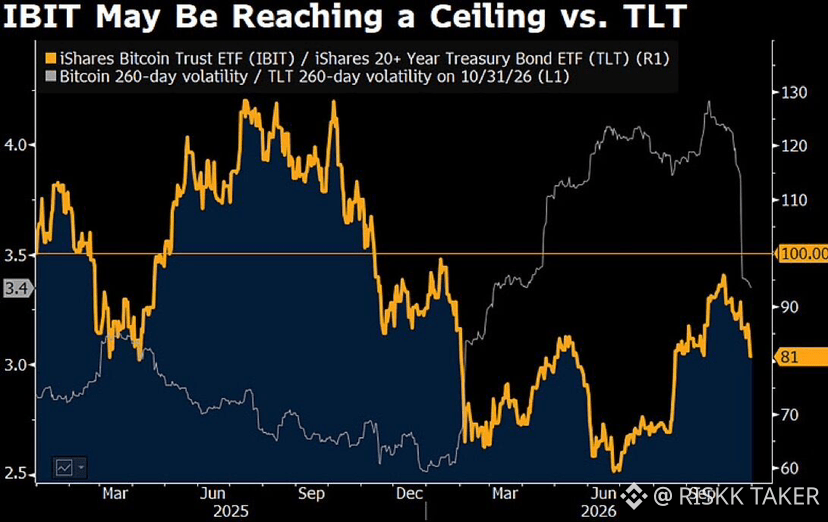
Bloomberg Intelligence strategist Mike McGlone warns that Bitcoin remaining below the $80,000 mark could signal further weakness against U.S. Treasury bonds.
His comparison shows the iShares Bitcoin Trust (IBIT) falling behind the long term Treasury ETF (TLT), with their relative performance ratio sitting at 81 on October 30, against a baseline of 100 at the end of 2024.
McGlone argues that if bonds continue outperforming Bitcoin, it could be a warning sign for broader risk assets.
The key level now is $80,000. Bitcoin’s ability to reclaim and hold it could become important in determining whether this relative weakness continues.
$PEPE
{spot}(PEPEUSDT)
$NEAR
{future}(NEARUSDT)
Bloomberg Intelligence strategist Mike McGlone warns that Bitcoin remaining below the $80,000 mark could signal further weakness against U.S. Treasury bonds.
His comparison shows the iShares Bitcoin Trust (IBIT) falling behind the long term Treasury ETF (TLT), with their relative performance ratio sitting at 81 on October 30, against a baseline of 100 at the end of 2024.
McGlone argues that if bonds continue outperforming Bitcoin, it could be a warning sign for broader risk assets.
The key level now is $80,000. Bitcoin’s ability to reclaim and hold it could become important in determining whether this relative weakness continues.
$PEPE
$NEAR
1
62
·
--
Circle recorded $11.7 billion in USDC redemptions against $10.9 billion in new issuance during the seven days ending October 29.
That leaves a net reduction of approximately $800 million, bringing USDC's circulating supply down to $70 billion, according to Circle's official transparency data. 
This is worth watching because stablecoin supply often reflects the amount of dollar liquidity available across crypto markets.
When redemptions consistently exceed new issuance, it can point to reduced demand for holding or deploying that stablecoin. That could mean less available liquidity for trading and DeFi activity.
However, it doesn't automatically mean investors are leaving crypto. Capital could simply be moving into other stablecoins or back into traditional financial markets. $USDC
{spot}(USDCUSDT)
$SOL
{future}(SOLUSDT)
Circle recorded $11.7 billion in USDC redemptions against $10.9 billion in new issuance during the seven days ending October 29.
That leaves a net reduction of approximately $800 million, bringing USDC's circulating supply down to $70 billion, according to Circle's official transparency data. 
This is worth watching because stablecoin supply often reflects the amount of dollar liquidity available across crypto markets.
When redemptions consistently exceed new issuance, it can point to reduced demand for holding or deploying that stablecoin. That could mean less available liquidity for trading and DeFi activity.
However, it doesn't automatically mean investors are leaving crypto. Capital could simply be moving into other stablecoins or back into traditional financial markets. $USDC
$SOL

2
83
·
--
Russia is taking another major step toward bringing cryptocurrency into its traditional financial system.
The Moscow Exchange plans to introduce crypto trading across its regular morning and evening sessions starting December 1, under the country’s new regulatory framework.
The initial offering will focus on Bitcoin, Ethereum and USDT, with trading expected to run from 6:50 AM to 11:50 PM Moscow time.
This is significant because it gives crypto exposure a place within one of Russia’s major regulated financial markets, potentially making access easier for traditional investors.
There are still restrictions, though. Non qualified investors face an annual purchase limit of 300,000 rubles through each intermediary.
Traditional finance and crypto are getting closer, and Russia is now making its move. $BTC
{future}(BTCUSDT)
$ETH
{future}(ETHUSDT)
Russia is taking another major step toward bringing cryptocurrency into its traditional financial system.
The Moscow Exchange plans to introduce crypto trading across its regular morning and evening sessions starting December 1, under the country’s new regulatory framework.
The initial offering will focus on Bitcoin, Ethereum and USDT, with trading expected to run from 6:50 AM to 11:50 PM Moscow time.
This is significant because it gives crypto exposure a place within one of Russia’s major regulated financial markets, potentially making access easier for traditional investors.
There are still restrictions, though. Non qualified investors face an annual purchase limit of 300,000 rubles through each intermediary.
Traditional finance and crypto are getting closer, and Russia is now making its move. $BTC
$ETH


2
9
·
--
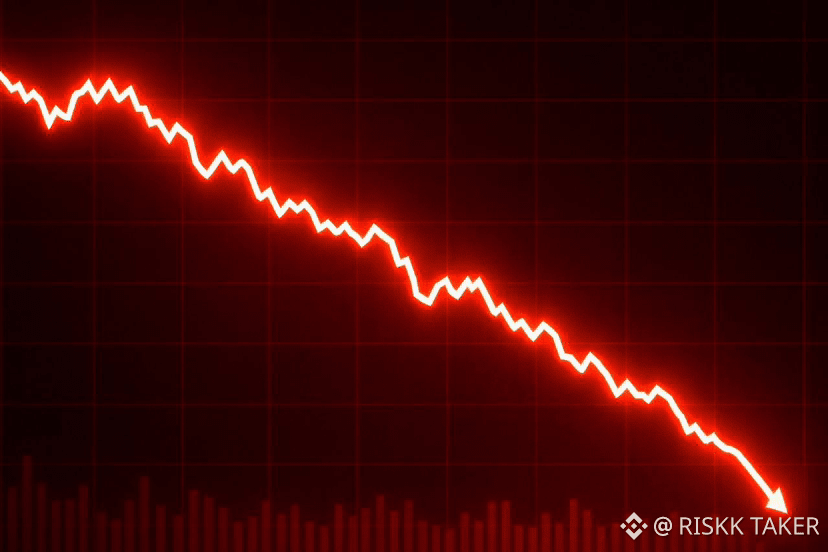
October ended very differently from what investors expected. Instead of the usual seasonal rally, several major crypto assets and technology stocks suffered heavy losses.
Here’s how some of the biggest names performed:
> $BTC: -7.3%
> $ETH: -16.3%
> $SOL: -18.8%
> $BNB: -8.4%
> $XRP: -16.2%
> $AMD: -17.5%
> $Intel: -45.3%
> Micron: -16.9%
> Meta: -15.2%
> $Nvidia: -10.4%
> Reddit: -35.6%
> $SpaceX: -10.7%
> Google: -18.7%
> Coinbase: -23.0%
> Robinhood: -24.5%
The pressure wasn't limited to crypto. Tech stocks also faced a major sell-off as concerns around AI spending, valuations and broader risk appetite weighed on markets.
October was a reminder that even historically bullish months offer no guarantees. Now all eyes are on November to see whether buyers return or the correction continues.
2
283
·
--
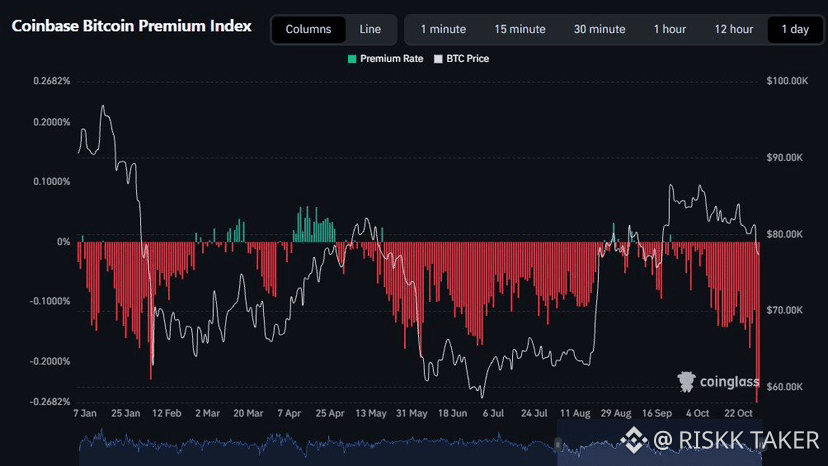
🇺🇸 US BITCOIN BUYERS ARE STILL STAYING ON THE SIDELINES
The Coinbase Bitcoin Premium Index has remained negative for 38 consecutive days, reaching -0.2434% on October 31.
This means BTC is trading at a discount on Coinbase compared with Binance, pointing to weaker relative buying demand on one of the major US trading platforms.
The timing is worth watching. Bitcoin has already faced weak spot demand throughout October, and this prolonged discount suggests US buying pressure has yet to make a meaningful comeback.
If the trend continues, it could make it harder for BTC to build a strong recovery, especially if global demand also starts fading.
However, a negative premium doesn’t mean every US investor is selling. It measures the price difference between exchanges, not total investor activity.
The signal traders want to see is a sustained return to positive territory. That could indicate US spot demand is finally picking up again.
$LSK
{future}(LSKUSDT)
$BTC
{future}(BTCUSDT)
🇺🇸 US BITCOIN BUYERS ARE STILL STAYING ON THE SIDELINES
The Coinbase Bitcoin Premium Index has remained negative for 38 consecutive days, reaching -0.2434% on October 31.
This means BTC is trading at a discount on Coinbase compared with Binance, pointing to weaker relative buying demand on one of the major US trading platforms.
The timing is worth watching. Bitcoin has already faced weak spot demand throughout October, and this prolonged discount suggests US buying pressure has yet to make a meaningful comeback.
If the trend continues, it could make it harder for BTC to build a strong recovery, especially if global demand also starts fading.
However, a negative premium doesn’t mean every US investor is selling. It measures the price difference between exchanges, not total investor activity.
The signal traders want to see is a sustained return to positive territory. That could indicate US spot demand is finally picking up again.
$LSK
$BTC
2
194
·
--
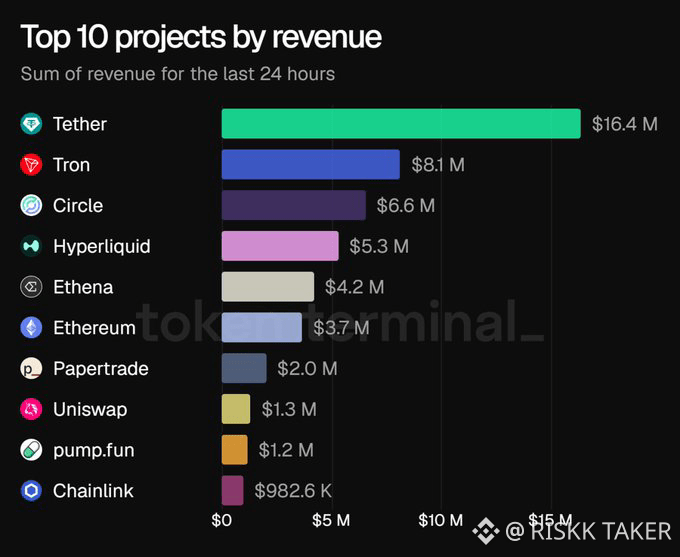
Tether reportedly generated $16.4 million in 24 hour revenue, putting it ahead of Tron at $8.1 million and Circle at $6.6 million, according to Token Terminal.
That’s a significant gap, especially considering how much of Tether’s income comes from the reserves backing USDT rather than transaction fees. Its holdings in assets like US Treasury bills generate interest, creating a major revenue stream as USDT supply grows.
This highlights an important part of the stablecoin business: issuing a dollar pegged token can become an extremely profitable operation at scale.
For the wider market, stablecoin adoption isn’t just about transaction volume anymore. It’s also creating a powerful financial business around reserve management.
Tether is showing just how much money can be made behind the scenes of crypto. $BNB
{future}(BNBUSDT)
$HYPE
{future}(HYPEUSDT)
Tether reportedly generated $16.4 million in 24 hour revenue, putting it ahead of Tron at $8.1 million and Circle at $6.6 million, according to Token Terminal.
That’s a significant gap, especially considering how much of Tether’s income comes from the reserves backing USDT rather than transaction fees. Its holdings in assets like US Treasury bills generate interest, creating a major revenue stream as USDT supply grows.
This highlights an important part of the stablecoin business: issuing a dollar pegged token can become an extremely profitable operation at scale.
For the wider market, stablecoin adoption isn’t just about transaction volume anymore. It’s also creating a powerful financial business around reserve management.
Tether is showing just how much money can be made behind the scenes of crypto. $BNB
$HYPE
2
457
·
--
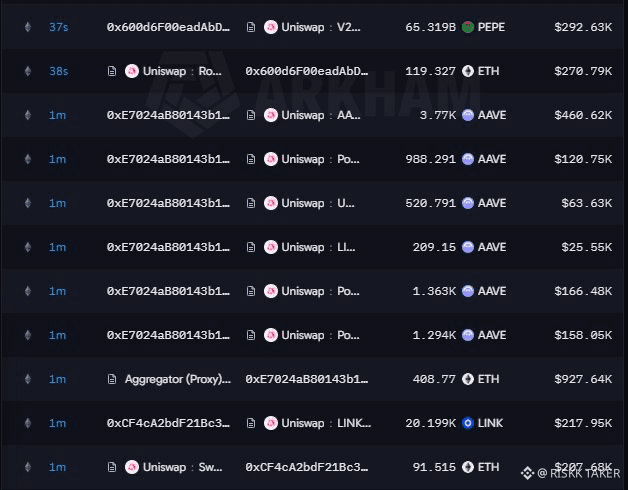
JUST IN: The Binance hacker is dumping $PEPE, $UNI, $LINK, $ONDO and other cryptocurrencies for $ETH.
The hacker is still holding hundreds of millions in altcoins, potentially increasing selling pressure.
Binance user funds remain safe, and losses will be covered.
JUST IN: The Binance hacker is dumping $PEPE, $UNI, $LINK, $ONDO and other cryptocurrencies for $ETH.
The hacker is still holding hundreds of millions in altcoins, potentially increasing selling pressure.
Binance user funds remain safe, and losses will be covered.
The hacker is still holding hundreds of millions in altcoins, potentially increasing selling pressure.
Binance user funds remain safe, and losses will be covered.
2
184
·
--
If the reported losses are confirmed, this incident would surpass Bybit’s $1.5 billion hack in 2025 and the Ronin Network’s $625 million exploit in 2022
The scale of the alleged breach is staggering, with billions in crypto reportedly involved and Tether and Circle freezing substantial amounts of USDT and USDC linked to the incident.
Binance says it is investigating and has stated that no impact on user funds has been confirmed so far.
The next update from Binance could be critical for market confidence.
$HYPE
{future}(HYPEUSDT)
$BNB
{future}(BNBUSDT)
$USDC
{future}(USDCUSDT)
If the reported losses are confirmed, this incident would surpass Bybit’s $1.5 billion hack in 2025 and the Ronin Network’s $625 million exploit in 2022
The scale of the alleged breach is staggering, with billions in crypto reportedly involved and Tether and Circle freezing substantial amounts of USDT and USDC linked to the incident.
Binance says it is investigating and has stated that no impact on user funds has been confirmed so far.
The next update from Binance could be critical for market confidence.
$HYPE
$BNB
$USDC
2
382
·
--
🚨 BREAKING: BINANCE REPORTEDLY HIT BY A $5.6 BILLION HACK
Reports of a massive security breach involving the world’s largest crypto exchange are spreading.
The alleged stolen assets include:
* $1.45B in $BTC
* $875M in $ETH
* $234M in $TRX
* $50M in $XAUT
* $1.57B in $USDT
* $823M in $USDC
* $75M in $WBETH
* $88.5M in $RLUSD
* $447.5M in other cryptocurrencies
If confirmed, this would rank among the largest exchange security breaches in crypto history.
The reported scale of the incident could shake market confidence, trigger panic withdrawals and put fresh pressure on crypto prices.

3
752
·
--
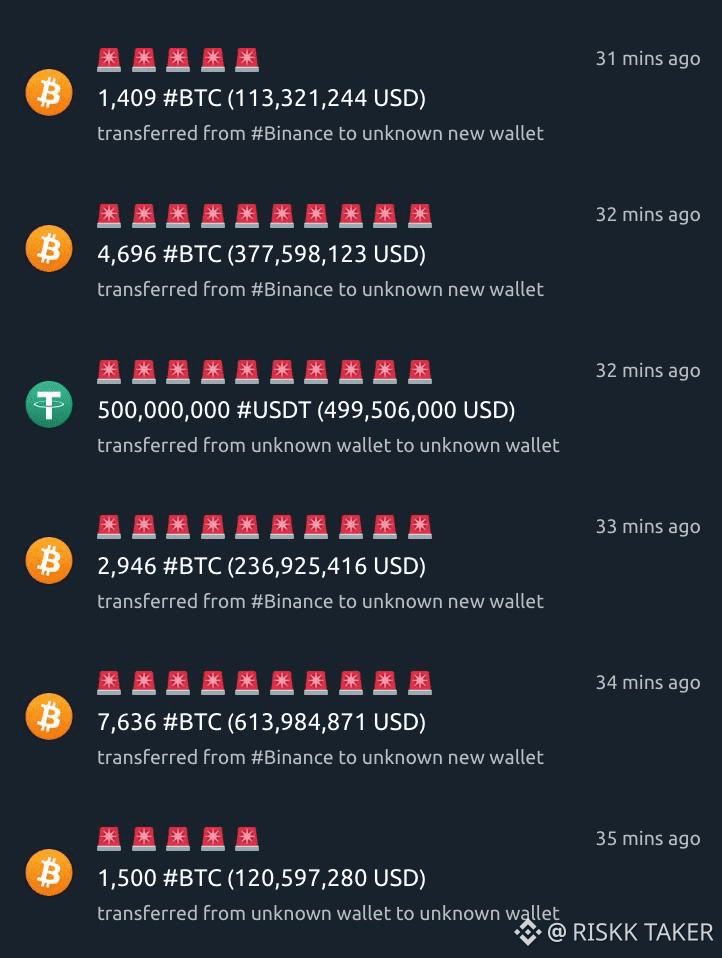
🚨 BREAKING 🚨
POSSIBLE BINANCE HACK HAPPENING RIGHT NOW.
$3,500,000,000 has reportedly flowed out of Binance wallets.
Tether has already frozen $971,000,000 USDT linked to it.
Still no statement from Binance.
🚨 BREAKING 🚨
POSSIBLE BINANCE HACK HAPPENING RIGHT NOW.
$3,500,000,000 has reportedly flowed out of Binance wallets.
Tether has already frozen $971,000,000 USDT linked to it.
Still no statement from Binance.
POSSIBLE BINANCE HACK HAPPENING RIGHT NOW.
$3,500,000,000 has reportedly flowed out of Binance wallets.
Tether has already frozen $971,000,000 USDT linked to it.
Still no statement from Binance.
2
47
Көбірек контент көру үшін кіріңіз
Binance Square платформасында әлемдік криптоқоғамдастыққа қосылыңыз
⚡️ Криптовалюта туралы ең соңғы және пайдалы ақпаратты алыңыз.
💬 Әлемдегі ең ірі криптобиржаның сеніміне ие.
👍 Расталған авторлардың нақты пікірлерін табыңыз.
Электрондық пошта/телефон нөмірі
Трендтегі тақырыптар
JobsReportRaisesHikeOdds
428,505 рет көрілді
3,003 адам талқылап жатыр
TradFi News | US Adds 165,000 Jobs in October, More Than Double the 65,000 Forecast, as Unemployment Falls to 4.1%
Binance News
·40 лайк
·23.9k рет көрілді
CPITestsDecemberRateOutlook
104,947 рет көрілді
907 адам талқылап жатыр
BitcoinRebounds$75KAsChipsLead
37,058 рет көрілді
305 адам талқылап жатыр