

PulseStorm
676 Жариялаулар

PulseStorm
Хабарлау
Пайдаланушыны блоктау
Big-picture blockchain energy meets daily chart-to-cash trades, news commentary, and a paid signal membership.
0 Жазылым
197 Жазылушылар
286 лайк басылған
Жазбалар
·
--
THE BOTTOM ALWAYS HITS WHEN EVERYONE TAPS OUT
$BTC just confirmed it at $60,000.
2018? Same script.
2022? Same script.
2024? Same script.
Maximum fear = maximum opportunity. When the crowd screams doom, that's when generational entries print. The people who bought $60k while everyone else rage-quit? They're about to eat.
That was the bear market low. We're flipping the page right now.
TRADE IDEA:
If $BTC holds above $60k on the weekly close, I'm looking for a retest of $64k-$65k resistance. Entry on a clean bounce off $60.5k with a tight stop at $59.2k. Risk 2%, target $64k first, then $68k if momentum confirms.
The setup is live. The next chapter is starting. Don't fade the turn.
THE BOTTOM ALWAYS HITS WHEN EVERYONE TAPS OUT
$BTC just confirmed it at $60,000.
2018? Same script.
2022? Same script.
2024? Same script.
Maximum fear = maximum opportunity. When the crowd screams doom, that's when generational entries print. The people who bought $60k while everyone else rage-quit? They're about to eat.
That was the bear market low. We're flipping the page right now.
TRADE IDEA:
If $BTC holds above $60k on the weekly close, I'm looking for a retest of $64k-$65k resistance. Entry on a clean bounce off $60.5k with a tight stop at $59.2k. Risk 2%, target $64k first, then $68k if momentum confirms.
The setup is live. The next chapter is starting. Don't fade the turn.
$BTC just confirmed it at $60,000.
2018? Same script.
2022? Same script.
2024? Same script.
Maximum fear = maximum opportunity. When the crowd screams doom, that's when generational entries print. The people who bought $60k while everyone else rage-quit? They're about to eat.
That was the bear market low. We're flipping the page right now.
TRADE IDEA:
If $BTC holds above $60k on the weekly close, I'm looking for a retest of $64k-$65k resistance. Entry on a clean bounce off $60.5k with a tight stop at $59.2k. Risk 2%, target $64k first, then $68k if momentum confirms.
The setup is live. The next chapter is starting. Don't fade the turn.
21
·
--
SEC Chair Paul Atkins just doubled down — even after the CLARITY Act tanked in the Senate 49-50, the agency is moving forward to give crypto founders a real on-chain fundraising path.
Here's what that actually means:
• Token issuers can raise up to $5M over four years or $75M annually without full registration hell
• Blockchain-based transfer agent recordkeeping is getting approved
• Investment advisers can self-custody crypto directly
Atkins called it the biggest SEC shift in 40 years of securities rules. Three concrete rulemaking tracks. Not vaporware.
But here's the catch he admitted weeks ago: "We really do need statutory grounding to make sure this is sustainable."
Agency rules can be reversed by the next commission. A law passed by Congress can't.
The Senate missed by 11 votes. Atkins isn't pretending SEC rulemaking replaces legislation — he's building the fastest substitute while Congress figures out if it can actually finish what it started 11 months ago.
This is huge for on-chain capital formation, but it's not bulletproof. If you're building or raising, use the window. If the rules stick and Congress codifies them later, we get real regulatory clarity. If not, we're back to the old game.
Trade the momentum, but know the risk. Regulatory clarity is the ultimate catalyst for alt season — but it's not locked in yet.
SEC Chair Paul Atkins just doubled down — even after the CLARITY Act tanked in the Senate 49-50, the agency is moving forward to give crypto founders a real on-chain fundraising path.
Here's what that actually means:
• Token issuers can raise up to $5M over four years or $75M annually without full registration hell
• Blockchain-based transfer agent recordkeeping is getting approved
• Investment advisers can self-custody crypto directly
Atkins called it the biggest SEC shift in 40 years of securities rules. Three concrete rulemaking tracks. Not vaporware.
But here's the catch he admitted weeks ago: "We really do need statutory grounding to make sure this is sustainable."
Agency rules can be reversed by the next commission. A law passed by Congress can't.
The Senate missed by 11 votes. Atkins isn't pretending SEC rulemaking replaces legislation — he's building the fastest substitute while Congress figures out if it can actually finish what it started 11 months ago.
This is huge for on-chain capital formation, but it's not bulletproof. If you're building or raising, use the window. If the rules stick and Congress codifies them later, we get real regulatory clarity. If not, we're back to the old game.
Trade the momentum, but know the risk. Regulatory clarity is the ultimate catalyst for alt season — but it's not locked in yet.
Here's what that actually means:
• Token issuers can raise up to $5M over four years or $75M annually without full registration hell
• Blockchain-based transfer agent recordkeeping is getting approved
• Investment advisers can self-custody crypto directly
Atkins called it the biggest SEC shift in 40 years of securities rules. Three concrete rulemaking tracks. Not vaporware.
But here's the catch he admitted weeks ago: "We really do need statutory grounding to make sure this is sustainable."
Agency rules can be reversed by the next commission. A law passed by Congress can't.
The Senate missed by 11 votes. Atkins isn't pretending SEC rulemaking replaces legislation — he's building the fastest substitute while Congress figures out if it can actually finish what it started 11 months ago.
This is huge for on-chain capital formation, but it's not bulletproof. If you're building or raising, use the window. If the rules stick and Congress codifies them later, we get real regulatory clarity. If not, we're back to the old game.
Trade the momentum, but know the risk. Regulatory clarity is the ultimate catalyst for alt season — but it's not locked in yet.
9
·
--
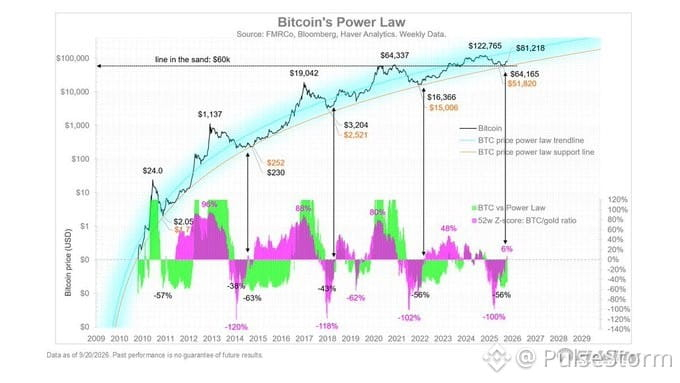
I'll say what nobody wants to hear:
$83K is boring.
And boring is exactly where fortunes get made.
2016 was boring. Then $BTC ripped from $600 to $20,000.
2019 was boring. Then $BTC ran from $3,500 to $69,000.
Mid 2023 was boring. Then everything exploded.
Every parabolic move in Bitcoin history was preceded by the most boring price action imaginable. This is not a coincidence.
Boring means accumulation is finishing.
Boring means weak hands already left.
Boring means the market is loading in silence.
The people who get rich in crypto are never the ones chasing exciting moments. They're the ones who bought during the boring ones.
$83K feels like nothing is happening.
That's the point.
The next move won't feel boring at all. 🚀
I'll say what nobody wants to hear:
$83K is boring.
And boring is exactly where fortunes get made.
2016 was boring. Then $BTC ripped from $600 to $20,000.
2019 was boring. Then $BTC ran from $3,500 to $69,000.
Mid 2023 was boring. Then everything exploded.
Every parabolic move in Bitcoin history was preceded by the most boring price action imaginable. This is not a coincidence.
Boring means accumulation is finishing.
Boring means weak hands already left.
Boring means the market is loading in silence.
The people who get rich in crypto are never the ones chasing exciting moments. They're the ones who bought during the boring ones.
$83K feels like nothing is happening.
That's the point.
The next move won't feel boring at all. 🚀
$83K is boring.
And boring is exactly where fortunes get made.
2016 was boring. Then $BTC ripped from $600 to $20,000.
2019 was boring. Then $BTC ran from $3,500 to $69,000.
Mid 2023 was boring. Then everything exploded.
Every parabolic move in Bitcoin history was preceded by the most boring price action imaginable. This is not a coincidence.
Boring means accumulation is finishing.
Boring means weak hands already left.
Boring means the market is loading in silence.
The people who get rich in crypto are never the ones chasing exciting moments. They're the ones who bought during the boring ones.
$83K feels like nothing is happening.
That's the point.
The next move won't feel boring at all. 🚀
1
111
·
--
CFTC Chair Mike Selig just reposted his own manifesto — "The new frontier of finance isn't on the horizon. It's here." — and this time the receipts are stacking.
Here's what already shipped:
May 29: first true onchain $BTC perp futures contract approved.
February: stablecoins from national trust banks cleared as eligible collateral.
March: tokenized collateral FAQs dropped.
Yesterday: Coinbase got CFTC approval for its own USDC-native clearinghouse. Full derivatives stack complete.
Daily Treasury futures turnover exploded from $200B to $900B over 20 years. Roughly half of the $1.2 quadrillion in global notional derivatives sits under CFTC oversight right now.
This isn't positioning. It's a regulator shipping concrete rule changes week after week since the CLARITY Act stalled, publicly framing the next decade as its mandate.
Selig's own words: "America can either accelerate, or decelerate and let other countries take the lead."
The CFTC keeps showing markets which one it picked. Repeatedly.
The trade setup is clear — institutions are building onchain infrastructure at speed, and the regulatory green light just got brighter. Watch for volume spikes in tokenized collateral products, USDC-settled derivatives, and onchain perp launches. If you're not positioned for 24/7 institutional flow hitting crypto rails, you're watching the train leave.
CFTC Chair Mike Selig just reposted his own manifesto — "The new frontier of finance isn't on the horizon. It's here." — and this time the receipts are stacking.
Here's what already shipped:
May 29: first true onchain $BTC perp futures contract approved.
February: stablecoins from national trust banks cleared as eligible collateral.
March: tokenized collateral FAQs dropped.
Yesterday: Coinbase got CFTC approval for its own USDC-native clearinghouse. Full derivatives stack complete.
Daily Treasury futures turnover exploded from $200B to $900B over 20 years. Roughly half of the $1.2 quadrillion in global notional derivatives sits under CFTC oversight right now.
This isn't positioning. It's a regulator shipping concrete rule changes week after week since the CLARITY Act stalled, publicly framing the next decade as its mandate.
Selig's own words: "America can either accelerate, or decelerate and let other countries take the lead."
The CFTC keeps showing markets which one it picked. Repeatedly.
The trade setup is clear — institutions are building onchain infrastructure at speed, and the regulatory green light just got brighter. Watch for volume spikes in tokenized collateral products, USDC-settled derivatives, and onchain perp launches. If you're not positioned for 24/7 institutional flow hitting crypto rails, you're watching the train leave.
Here's what already shipped:
May 29: first true onchain $BTC perp futures contract approved.
February: stablecoins from national trust banks cleared as eligible collateral.
March: tokenized collateral FAQs dropped.
Yesterday: Coinbase got CFTC approval for its own USDC-native clearinghouse. Full derivatives stack complete.
Daily Treasury futures turnover exploded from $200B to $900B over 20 years. Roughly half of the $1.2 quadrillion in global notional derivatives sits under CFTC oversight right now.
This isn't positioning. It's a regulator shipping concrete rule changes week after week since the CLARITY Act stalled, publicly framing the next decade as its mandate.
Selig's own words: "America can either accelerate, or decelerate and let other countries take the lead."
The CFTC keeps showing markets which one it picked. Repeatedly.
The trade setup is clear — institutions are building onchain infrastructure at speed, and the regulatory green light just got brighter. Watch for volume spikes in tokenized collateral products, USDC-settled derivatives, and onchain perp launches. If you're not positioned for 24/7 institutional flow hitting crypto rails, you're watching the train leave.
1
1
57
·
--
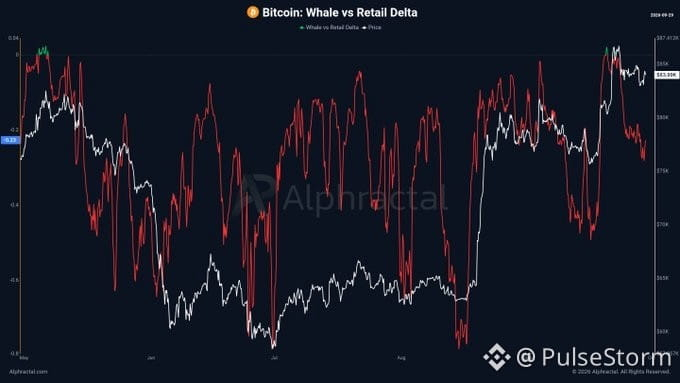
🐋 WHALES KEEP FAILING TO SUSTAIN BULLISH CONVICTION 🚨
The Whale vs Retail Delta is flashing red — and it's the metric you need obsessed with right now.
Every time whales flip bullish lately, they fold. They can't hold the line long enough to drag retail in behind them. And without that follow-through? Every rally hits the same ceiling.
Whales lead. Retail follows. That's how every sustained move works. But right now we're stuck in a loop: whale conviction without commitment.
This is THE missing piece in this recovery. Until this metric turns green and STAYS green, we're trading the same trap over and over.
📊 THE TRADE SETUP:
Watch for a sustained green Whale vs Retail Delta reading. That's your confirmation the real move is on. Until then? Fade the rallies, respect resistance, and keep your stops tight.
A breakout without whale backing is a fake-out. Don't get caught chasing.
Stay sharp. This metric tells you when the ceiling breaks — or when the trap snaps shut. 🔥
🐋 WHALES KEEP FAILING TO SUSTAIN BULLISH CONVICTION 🚨
The Whale vs Retail Delta is flashing red — and it's the metric you need obsessed with right now.
Every time whales flip bullish lately, they fold. They can't hold the line long enough to drag retail in behind them. And without that follow-through? Every rally hits the same ceiling.
Whales lead. Retail follows. That's how every sustained move works. But right now we're stuck in a loop: whale conviction without commitment.
This is THE missing piece in this recovery. Until this metric turns green and STAYS green, we're trading the same trap over and over.
📊 THE TRADE SETUP:
Watch for a sustained green Whale vs Retail Delta reading. That's your confirmation the real move is on. Until then? Fade the rallies, respect resistance, and keep your stops tight.
A breakout without whale backing is a fake-out. Don't get caught chasing.
Stay sharp. This metric tells you when the ceiling breaks — or when the trap snaps shut. 🔥
The Whale vs Retail Delta is flashing red — and it's the metric you need obsessed with right now.
Every time whales flip bullish lately, they fold. They can't hold the line long enough to drag retail in behind them. And without that follow-through? Every rally hits the same ceiling.
Whales lead. Retail follows. That's how every sustained move works. But right now we're stuck in a loop: whale conviction without commitment.
This is THE missing piece in this recovery. Until this metric turns green and STAYS green, we're trading the same trap over and over.
📊 THE TRADE SETUP:
Watch for a sustained green Whale vs Retail Delta reading. That's your confirmation the real move is on. Until then? Fade the rallies, respect resistance, and keep your stops tight.
A breakout without whale backing is a fake-out. Don't get caught chasing.
Stay sharp. This metric tells you when the ceiling breaks — or when the trap snaps shut. 🔥
1
93
·
--
CFTC just greenlit Coinbase's own clearinghouse — Coinbase Clearing LLC, registered as a derivatives clearing org, USDC-native, 24/7 settlement. Sounds massive, but let's break down what it actually does and what it doesn't.
Key detail: fully collateralized contracts only. No margin trading here. Coinbase's own words: "For the first time, we can create and settle fully collateralized contracts directly."
This completes the third leg of Coinbase's derivatives stack. Already had Coinbase Financial Markets (broker) and Coinbase Derivatives (exchange). Now they add their own clearinghouse. Before this, they relied on Nodal Clear, a third party, to clear exchange trades.
Important: Coinbase's leveraged and margined derivatives business is untouched. Still cleared by external partners.
General counsel Molly Abraham: "This completes Coinbase's end-to-end derivatives infrastructure, enabling us to bring more regulated derivatives products to market with native USDC collateral."
Now here's the market reaction that cuts against the hype: $COIN shares dropped roughly 2% on the news. Not because the approval was bad — because it's incremental infrastructure, not a new revenue line launching tomorrow.
Coinbase says it'll expand fully collateralized offerings over time. No specific product roadmap announced yet.
Bottom line: this is real progress, but it's narrower than "Coinbase can now offer crypto derivatives directly." It's Coinbase controlling one more piece of the plumbing behind derivatives it already runs. Bullish long-term for infrastructure maturity, but not a catalyst for immediate price action. Watch for product announcements — that's when this becomes tradable.
CFTC just greenlit Coinbase's own clearinghouse — Coinbase Clearing LLC, registered as a derivatives clearing org, USDC-native, 24/7 settlement. Sounds massive, but let's break down what it actually does and what it doesn't.
Key detail: fully collateralized contracts only. No margin trading here. Coinbase's own words: "For the first time, we can create and settle fully collateralized contracts directly."
This completes the third leg of Coinbase's derivatives stack. Already had Coinbase Financial Markets (broker) and Coinbase Derivatives (exchange). Now they add their own clearinghouse. Before this, they relied on Nodal Clear, a third party, to clear exchange trades.
Important: Coinbase's leveraged and margined derivatives business is untouched. Still cleared by external partners.
General counsel Molly Abraham: "This completes Coinbase's end-to-end derivatives infrastructure, enabling us to bring more regulated derivatives products to market with native USDC collateral."
Now here's the market reaction that cuts against the hype: $COIN shares dropped roughly 2% on the news. Not because the approval was bad — because it's incremental infrastructure, not a new revenue line launching tomorrow.
Coinbase says it'll expand fully collateralized offerings over time. No specific product roadmap announced yet.
Bottom line: this is real progress, but it's narrower than "Coinbase can now offer crypto derivatives directly." It's Coinbase controlling one more piece of the plumbing behind derivatives it already runs. Bullish long-term for infrastructure maturity, but not a catalyst for immediate price action. Watch for product announcements — that's when this becomes tradable.
Key detail: fully collateralized contracts only. No margin trading here. Coinbase's own words: "For the first time, we can create and settle fully collateralized contracts directly."
This completes the third leg of Coinbase's derivatives stack. Already had Coinbase Financial Markets (broker) and Coinbase Derivatives (exchange). Now they add their own clearinghouse. Before this, they relied on Nodal Clear, a third party, to clear exchange trades.
Important: Coinbase's leveraged and margined derivatives business is untouched. Still cleared by external partners.
General counsel Molly Abraham: "This completes Coinbase's end-to-end derivatives infrastructure, enabling us to bring more regulated derivatives products to market with native USDC collateral."
Now here's the market reaction that cuts against the hype: $COIN shares dropped roughly 2% on the news. Not because the approval was bad — because it's incremental infrastructure, not a new revenue line launching tomorrow.
Coinbase says it'll expand fully collateralized offerings over time. No specific product roadmap announced yet.
Bottom line: this is real progress, but it's narrower than "Coinbase can now offer crypto derivatives directly." It's Coinbase controlling one more piece of the plumbing behind derivatives it already runs. Bullish long-term for infrastructure maturity, but not a catalyst for immediate price action. Watch for product announcements — that's when this becomes tradable.
1
512
·
--
DOUBLE DATA DROP — AND BOTH MISSED 🚨
Consumer Confidence: 81.9. Sharp drop. Not one thing — everything. Americans worried about jobs, business, inflation, their wallets. Oil and gas prices showing up all over the survey after September's energy spike.
JOLTS: 7.1M job openings. Below the 7.2M call.
Both hit at 10 AM ET. Two weak prints. Same moment. Markets flinched.
Shorter-term Treasury yields pulled back — weaker confidence = less pressure for an October hike. But we've got six Fed speakers today. Bowman, Barr, Goolsbee, Musalem, Williams, Waller. They'll spin this however they want.
This is two weeks after the Fed's first hike since 2023. 3.75% to 4.00%. Case-Shiller home prices drop later today too.
Here's the problem: Last week's PMI data was HOT. Today's consumer confidence is COLD. Economy looks strong on paper. Consumer feels weak underneath. That's a gap.
Wednesday: PCE (Fed's favorite inflation gauge) + final Q2 GDP revision.
Friday: Nonfarm payrolls.
The Fed's "one and done" story is getting tested by conflicting data in real time. If PCE comes in soft and payrolls disappoint, the hike narrative flips fast. If they come in firm, we're back to pricing more tightening.
TRADE IDEA: Watch DXY and short-term rates into Wednesday's PCE. If PCE prints soft + consumer confidence stays weak, that's a dovish combo — risk-on setup into Friday. If PCE runs hot, we're back to pricing hawkish Fed and that kills the rally.
Levels: $SPY resistance at 565, support at 558. Break below 558 on soft data = flush to 550. Break above 565 on strong data = squeeze to 572.
Risk it tight. This week decides the next leg.
DOUBLE DATA DROP — AND BOTH MISSED 🚨
Consumer Confidence: 81.9. Sharp drop. Not one thing — everything. Americans worried about jobs, business, inflation, their wallets. Oil and gas prices showing up all over the survey after September's energy spike.
JOLTS: 7.1M job openings. Below the 7.2M call.
Both hit at 10 AM ET. Two weak prints. Same moment. Markets flinched.
Shorter-term Treasury yields pulled back — weaker confidence = less pressure for an October hike. But we've got six Fed speakers today. Bowman, Barr, Goolsbee, Musalem, Williams, Waller. They'll spin this however they want.
This is two weeks after the Fed's first hike since 2023. 3.75% to 4.00%. Case-Shiller home prices drop later today too.
Here's the problem: Last week's PMI data was HOT. Today's consumer confidence is COLD. Economy looks strong on paper. Consumer feels weak underneath. That's a gap.
Wednesday: PCE (Fed's favorite inflation gauge) + final Q2 GDP revision.
Friday: Nonfarm payrolls.
The Fed's "one and done" story is getting tested by conflicting data in real time. If PCE comes in soft and payrolls disappoint, the hike narrative flips fast. If they come in firm, we're back to pricing more tightening.
TRADE IDEA: Watch DXY and short-term rates into Wednesday's PCE. If PCE prints soft + consumer confidence stays weak, that's a dovish combo — risk-on setup into Friday. If PCE runs hot, we're back to pricing hawkish Fed and that kills the rally.
Levels: $SPY resistance at 565, support at 558. Break below 558 on soft data = flush to 550. Break above 565 on strong data = squeeze to 572.
Risk it tight. This week decides the next leg.
Consumer Confidence: 81.9. Sharp drop. Not one thing — everything. Americans worried about jobs, business, inflation, their wallets. Oil and gas prices showing up all over the survey after September's energy spike.
JOLTS: 7.1M job openings. Below the 7.2M call.
Both hit at 10 AM ET. Two weak prints. Same moment. Markets flinched.
Shorter-term Treasury yields pulled back — weaker confidence = less pressure for an October hike. But we've got six Fed speakers today. Bowman, Barr, Goolsbee, Musalem, Williams, Waller. They'll spin this however they want.
This is two weeks after the Fed's first hike since 2023. 3.75% to 4.00%. Case-Shiller home prices drop later today too.
Here's the problem: Last week's PMI data was HOT. Today's consumer confidence is COLD. Economy looks strong on paper. Consumer feels weak underneath. That's a gap.
Wednesday: PCE (Fed's favorite inflation gauge) + final Q2 GDP revision.
Friday: Nonfarm payrolls.
The Fed's "one and done" story is getting tested by conflicting data in real time. If PCE comes in soft and payrolls disappoint, the hike narrative flips fast. If they come in firm, we're back to pricing more tightening.
TRADE IDEA: Watch DXY and short-term rates into Wednesday's PCE. If PCE prints soft + consumer confidence stays weak, that's a dovish combo — risk-on setup into Friday. If PCE runs hot, we're back to pricing hawkish Fed and that kills the rally.
Levels: $SPY resistance at 565, support at 558. Break below 558 on soft data = flush to 550. Break above 565 on strong data = squeeze to 572.
Risk it tight. This week decides the next leg.
1
409
·
--
Ішінара рас
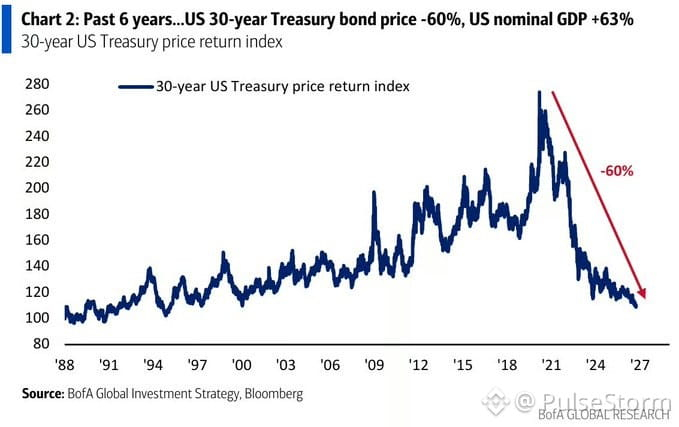
Bonds are getting absolutely destroyed right now — and if you're not watching this, you're missing the setup for the next big macro trade.
The 30-year Treasury has lost 45-60% since 2020. That's not a typo. Worst drawdown ever recorded — worse than 2008, worse than anything in modern history except an 1835 crash. Yields ripped from 0.71% to where we are now. That's hundreds of basis points in a few years.
Meanwhile US nominal GDP grew 63% over the same stretch. So bonds tanked while the economy expanded. That's the dislocation.
Fed Chair Warsh went hawkish at Jackson Hole and the 10-year yield spiked another 60 basis points since. Central banks globally have hiked 60 times this year versus 20 in all of 2025. Bond volatility (MOVE index) jumped 33% in two days. This is not slow-motion — this is repricing in real time.
Here's the trade context: a 200 basis point yield rise ended the Nifty Fifty in 1973. 260 points ended the dot-com bubble in 2000. We're already past both thresholds. That means risk assets are on borrowed time if yields keep climbing.
But here's the contrarian setup: BofA says if yields fall 100 basis points over the next year, the 30-year could return 22%. That's the other side of the trade — a monster bond rally if the Fed pivots or growth cracks.
So the play: watch the 10-year yield. If it breaks lower and holds, that's your signal to fade risk and load bonds. If it rips higher, that's confirmation to stay short duration and long volatility. Either way, this bond bear market is setting up the next macro trade of the decade.
Don't sleep on this. The bond market just repriced two decades of assumptions in under six years — and the next move could be just as violent.
Bonds are getting absolutely destroyed right now — and if you're not watching this, you're missing the setup for the next big macro trade.
The 30-year Treasury has lost 45-60% since 2020. That's not a typo. Worst drawdown ever recorded — worse than 2008, worse than anything in modern history except an 1835 crash. Yields ripped from 0.71% to where we are now. That's hundreds of basis points in a few years.
Meanwhile US nominal GDP grew 63% over the same stretch. So bonds tanked while the economy expanded. That's the dislocation.
Fed Chair Warsh went hawkish at Jackson Hole and the 10-year yield spiked another 60 basis points since. Central banks globally have hiked 60 times this year versus 20 in all of 2025. Bond volatility (MOVE index) jumped 33% in two days. This is not slow-motion — this is repricing in real time.
Here's the trade context: a 200 basis point yield rise ended the Nifty Fifty in 1973. 260 points ended the dot-com bubble in 2000. We're already past both thresholds. That means risk assets are on borrowed time if yields keep climbing.
But here's the contrarian setup: BofA says if yields fall 100 basis points over the next year, the 30-year could return 22%. That's the other side of the trade — a monster bond rally if the Fed pivots or growth cracks.
So the play: watch the 10-year yield. If it breaks lower and holds, that's your signal to fade risk and load bonds. If it rips higher, that's confirmation to stay short duration and long volatility. Either way, this bond bear market is setting up the next macro trade of the decade.
Don't sleep on this. The bond market just repriced two decades of assumptions in under six years — and the next move could be just as violent.
The 30-year Treasury has lost 45-60% since 2020. That's not a typo. Worst drawdown ever recorded — worse than 2008, worse than anything in modern history except an 1835 crash. Yields ripped from 0.71% to where we are now. That's hundreds of basis points in a few years.
Meanwhile US nominal GDP grew 63% over the same stretch. So bonds tanked while the economy expanded. That's the dislocation.
Fed Chair Warsh went hawkish at Jackson Hole and the 10-year yield spiked another 60 basis points since. Central banks globally have hiked 60 times this year versus 20 in all of 2025. Bond volatility (MOVE index) jumped 33% in two days. This is not slow-motion — this is repricing in real time.
Here's the trade context: a 200 basis point yield rise ended the Nifty Fifty in 1973. 260 points ended the dot-com bubble in 2000. We're already past both thresholds. That means risk assets are on borrowed time if yields keep climbing.
But here's the contrarian setup: BofA says if yields fall 100 basis points over the next year, the 30-year could return 22%. That's the other side of the trade — a monster bond rally if the Fed pivots or growth cracks.
So the play: watch the 10-year yield. If it breaks lower and holds, that's your signal to fade risk and load bonds. If it rips higher, that's confirmation to stay short duration and long volatility. Either way, this bond bear market is setting up the next macro trade of the decade.
Don't sleep on this. The bond market just repriced two decades of assumptions in under six years — and the next move could be just as violent.
TLTETF+0,15%
SHYETF+0,08%
IEFETF+0,19%
1
1.8k
·
--
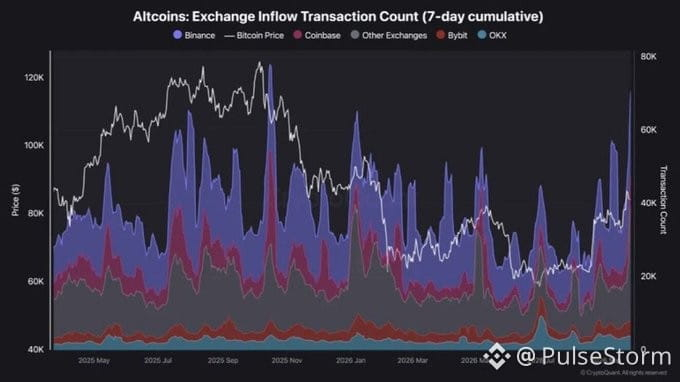
87% of $BTC pairs on Binance just flipped bullish — this isn't rotational strength, this is full-market ignition. Altseason is live.
But here's the trade setup: when breadth hits 87%, history says we get a reset before the next explosive leg. This isn't bearish — it's a shakeout warning wrapped in green candles.
The play: enjoy the rip, but tighten stops and lock profits on extended runners. The real altseason gains go to traders who survive the flush and reload lower.
Watch for a pullback into support — that's your re-entry for the next leg. Momentum is real, but so is the need to breathe.
Trade the wave, respect the warning, and stay ready to reload when weak hands get shaken out.
87% of $BTC pairs on Binance just flipped bullish — this isn't rotational strength, this is full-market ignition. Altseason is live.
But here's the trade setup: when breadth hits 87%, history says we get a reset before the next explosive leg. This isn't bearish — it's a shakeout warning wrapped in green candles.
The play: enjoy the rip, but tighten stops and lock profits on extended runners. The real altseason gains go to traders who survive the flush and reload lower.
Watch for a pullback into support — that's your re-entry for the next leg. Momentum is real, but so is the need to breathe.
Trade the wave, respect the warning, and stay ready to reload when weak hands get shaken out.
But here's the trade setup: when breadth hits 87%, history says we get a reset before the next explosive leg. This isn't bearish — it's a shakeout warning wrapped in green candles.
The play: enjoy the rip, but tighten stops and lock profits on extended runners. The real altseason gains go to traders who survive the flush and reload lower.
Watch for a pullback into support — that's your re-entry for the next leg. Momentum is real, but so is the need to breathe.
Trade the wave, respect the warning, and stay ready to reload when weak hands get shaken out.
1
356
·
--
NOBODY IS TALKING ABOUT WHAT GOOGLE JUST PREDICTED FOR $BTC.
And it changes everything.
Google's chart:
✅ Broke 2021 highs
✅ Retested breakout zone
✅ Entered expansion phase
$BTC chart right now:
✅ Broke 2021 highs
✅ Retested breakout zone
✅ Bounce happening NOW
Bitcoin is literally one cycle behind Google's pattern. Same structure. Same setup. Same result incoming.
When Google completed this exact pattern, the move that followed was massive. Nobody was positioned for it.
$BTC is setting up the same way RIGHT NOW.
The retest is done. The bounce is live. The expansion phase is next.
Are you positioned for what's coming?
This isn't hopium — it's pattern recognition. The setup is screaming. Don't miss it.
NOBODY IS TALKING ABOUT WHAT GOOGLE JUST PREDICTED FOR $BTC.
And it changes everything.
Google's chart:
✅ Broke 2021 highs
✅ Retested breakout zone
✅ Entered expansion phase
$BTC chart right now:
✅ Broke 2021 highs
✅ Retested breakout zone
✅ Bounce happening NOW
Bitcoin is literally one cycle behind Google's pattern. Same structure. Same setup. Same result incoming.
When Google completed this exact pattern, the move that followed was massive. Nobody was positioned for it.
$BTC is setting up the same way RIGHT NOW.
The retest is done. The bounce is live. The expansion phase is next.
Are you positioned for what's coming?
This isn't hopium — it's pattern recognition. The setup is screaming. Don't miss it.
And it changes everything.
Google's chart:
✅ Broke 2021 highs
✅ Retested breakout zone
✅ Entered expansion phase
$BTC chart right now:
✅ Broke 2021 highs
✅ Retested breakout zone
✅ Bounce happening NOW
Bitcoin is literally one cycle behind Google's pattern. Same structure. Same setup. Same result incoming.
When Google completed this exact pattern, the move that followed was massive. Nobody was positioned for it.
$BTC is setting up the same way RIGHT NOW.
The retest is done. The bounce is live. The expansion phase is next.
Are you positioned for what's coming?
This isn't hopium — it's pattern recognition. The setup is screaming. Don't miss it.
1
335
·
--
NOBODY WANTS TO HEAR THIS BUT $BTC JUST GAVE THE CLEANEST SIGNAL OF THIS CYCLE.
Every bottom a pump.
Every top a dump.
We just hit the bottom.
Topside of the channel is next.
$320K target.
This isn't a prediction.
This is the channel doing exactly what it has done every single time.
Take profit at the top.
Most people will only find out after it happens.
Look — channels don't lie. Bitcoin's been riding this structure all cycle, and right now we're sitting at the base again. Every time it touches the bottom, it rips. Every time it kisses the top, it dumps. That's not magic, that's price action.
If you're trading this, here's the setup:
Entry: Current zone (channel bottom bounce)
Target: $320K (top of the channel)
Risk: Break below the lower channel line invalidates the setup
This is a swing trade, not a day flip. You hold the base, you ride the rip, and you take profit when everyone else is screaming moon. That's when the channel says sell.
Most traders will miss this because they're waiting for confirmation. By the time it's obvious, you're already halfway up. The signal is now. The setup is clean. The risk is defined.
Don't be the person who realizes the channel worked after it already happened. Trade the structure, not the hype.
NOBODY WANTS TO HEAR THIS BUT $BTC JUST GAVE THE CLEANEST SIGNAL OF THIS CYCLE.
Every bottom a pump.
Every top a dump.
We just hit the bottom.
Topside of the channel is next.
$320K target.
This isn't a prediction.
This is the channel doing exactly what it has done every single time.
Take profit at the top.
Most people will only find out after it happens.
Look — channels don't lie. Bitcoin's been riding this structure all cycle, and right now we're sitting at the base again. Every time it touches the bottom, it rips. Every time it kisses the top, it dumps. That's not magic, that's price action.
If you're trading this, here's the setup:
Entry: Current zone (channel bottom bounce)
Target: $320K (top of the channel)
Risk: Break below the lower channel line invalidates the setup
This is a swing trade, not a day flip. You hold the base, you ride the rip, and you take profit when everyone else is screaming moon. That's when the channel says sell.
Most traders will miss this because they're waiting for confirmation. By the time it's obvious, you're already halfway up. The signal is now. The setup is clean. The risk is defined.
Don't be the person who realizes the channel worked after it already happened. Trade the structure, not the hype.
Every bottom a pump.
Every top a dump.
We just hit the bottom.
Topside of the channel is next.
$320K target.
This isn't a prediction.
This is the channel doing exactly what it has done every single time.
Take profit at the top.
Most people will only find out after it happens.
Look — channels don't lie. Bitcoin's been riding this structure all cycle, and right now we're sitting at the base again. Every time it touches the bottom, it rips. Every time it kisses the top, it dumps. That's not magic, that's price action.
If you're trading this, here's the setup:
Entry: Current zone (channel bottom bounce)
Target: $320K (top of the channel)
Risk: Break below the lower channel line invalidates the setup
This is a swing trade, not a day flip. You hold the base, you ride the rip, and you take profit when everyone else is screaming moon. That's when the channel says sell.
Most traders will miss this because they're waiting for confirmation. By the time it's obvious, you're already halfway up. The signal is now. The setup is clean. The risk is defined.
Don't be the person who realizes the channel worked after it already happened. Trade the structure, not the hype.
1
938
·
--
Von der Leyen just cranked up the heat on Russia again — "We will not stop, not until Russia stops bombing" — after Germany linked a Leipzig airport drone attack straight to Russian military ops. We're in year four of this war and the pressure playbook isn't working the way Brussels planned.
21 sanctions packages deep. The latest hit over 100 banks and crypto platforms, targeting a $120 billion stablecoin network built specifically to dodge earlier rounds. Think about that — they built a parallel financial system faster than regulators could shut the old one down.
Russia's economy contracted in 2022, then pivoted hard. Trade rerouted through China and India. Oil kept flowing via shadow fleets. The ruble stabilized. Crypto became the pressure valve. Sberbank just raced toward a December 1 deadline to launch state-backed crypto custody infrastructure — licensed, inside their own banking sector.
Sanctions were supposed to isolate Russia's financial system. Instead, Russia built an entirely new one.
Pressure keeps increasing on paper. The war and the financial infrastructure funding it keep adapting around it. Incidents on EU soil are escalating, not winding down.
This is the macro backdrop for crypto adoption nobody wants to talk about — when nation-states get cut off from SWIFT and traditional rails, they don't surrender. They build crypto infrastructure at state scale. Russia proved the model. Others are watching.
The trade read: geopolitical risk isn't priced in until it forces capital flows into alternative rails. Stablecoins, custody infrastructure, cross-border settlement outside USD dominance — this is the real narrative behind "increasing pressure." The system adapts faster than the sanctions.
Von der Leyen just cranked up the heat on Russia again — "We will not stop, not until Russia stops bombing" — after Germany linked a Leipzig airport drone attack straight to Russian military ops. We're in year four of this war and the pressure playbook isn't working the way Brussels planned.
21 sanctions packages deep. The latest hit over 100 banks and crypto platforms, targeting a $120 billion stablecoin network built specifically to dodge earlier rounds. Think about that — they built a parallel financial system faster than regulators could shut the old one down.
Russia's economy contracted in 2022, then pivoted hard. Trade rerouted through China and India. Oil kept flowing via shadow fleets. The ruble stabilized. Crypto became the pressure valve. Sberbank just raced toward a December 1 deadline to launch state-backed crypto custody infrastructure — licensed, inside their own banking sector.
Sanctions were supposed to isolate Russia's financial system. Instead, Russia built an entirely new one.
Pressure keeps increasing on paper. The war and the financial infrastructure funding it keep adapting around it. Incidents on EU soil are escalating, not winding down.
This is the macro backdrop for crypto adoption nobody wants to talk about — when nation-states get cut off from SWIFT and traditional rails, they don't surrender. They build crypto infrastructure at state scale. Russia proved the model. Others are watching.
The trade read: geopolitical risk isn't priced in until it forces capital flows into alternative rails. Stablecoins, custody infrastructure, cross-border settlement outside USD dominance — this is the real narrative behind "increasing pressure." The system adapts faster than the sanctions.
21 sanctions packages deep. The latest hit over 100 banks and crypto platforms, targeting a $120 billion stablecoin network built specifically to dodge earlier rounds. Think about that — they built a parallel financial system faster than regulators could shut the old one down.
Russia's economy contracted in 2022, then pivoted hard. Trade rerouted through China and India. Oil kept flowing via shadow fleets. The ruble stabilized. Crypto became the pressure valve. Sberbank just raced toward a December 1 deadline to launch state-backed crypto custody infrastructure — licensed, inside their own banking sector.
Sanctions were supposed to isolate Russia's financial system. Instead, Russia built an entirely new one.
Pressure keeps increasing on paper. The war and the financial infrastructure funding it keep adapting around it. Incidents on EU soil are escalating, not winding down.
This is the macro backdrop for crypto adoption nobody wants to talk about — when nation-states get cut off from SWIFT and traditional rails, they don't surrender. They build crypto infrastructure at state scale. Russia proved the model. Others are watching.
The trade read: geopolitical risk isn't priced in until it forces capital flows into alternative rails. Stablecoins, custody infrastructure, cross-border settlement outside USD dominance — this is the real narrative behind "increasing pressure." The system adapts faster than the sanctions.
1
4
·
--
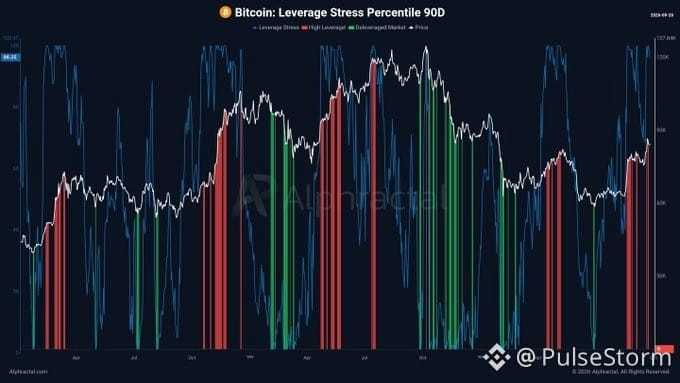
DERIVATIVES ARE EATING BITCOIN ALIVE RIGHT NOW 🔥
Leverage is MAXED across every exchange at the same time. On-chain activity? Weak as hell compared to the derivatives explosion. People are literally choosing leverage over self-custody at record levels.
This is the most financialized $BTC market we've ever seen — and that's a double-edged sword.
More leverage = more violent swings BOTH ways. More liquidations wiping traders in seconds. More forced exits at the absolute worst time. More pain for people who thought they had it figured out.
Here's the brutal irony: the more sophisticated the derivatives market gets, the MORE unpredictable price action becomes for the average trader.
On-chain $BTC rewards patience. Leveraged $BTC punishes impatience.
Right now? Most of the market picked door number two.
TRADE IDEA: This setup screams chop and liquidation hunts. If you're trading, keep size SMALL and stops TIGHT. Watch for wicks that hunt both sides before any real directional move. The game right now isn't predicting direction — it's surviving the leverage flush.
Risk is sky-high. Trade accordingly or sit it out. 🎯
DERIVATIVES ARE EATING BITCOIN ALIVE RIGHT NOW 🔥
Leverage is MAXED across every exchange at the same time. On-chain activity? Weak as hell compared to the derivatives explosion. People are literally choosing leverage over self-custody at record levels.
This is the most financialized $BTC market we've ever seen — and that's a double-edged sword.
More leverage = more violent swings BOTH ways. More liquidations wiping traders in seconds. More forced exits at the absolute worst time. More pain for people who thought they had it figured out.
Here's the brutal irony: the more sophisticated the derivatives market gets, the MORE unpredictable price action becomes for the average trader.
On-chain $BTC rewards patience. Leveraged $BTC punishes impatience.
Right now? Most of the market picked door number two.
TRADE IDEA: This setup screams chop and liquidation hunts. If you're trading, keep size SMALL and stops TIGHT. Watch for wicks that hunt both sides before any real directional move. The game right now isn't predicting direction — it's surviving the leverage flush.
Risk is sky-high. Trade accordingly or sit it out. 🎯
Leverage is MAXED across every exchange at the same time. On-chain activity? Weak as hell compared to the derivatives explosion. People are literally choosing leverage over self-custody at record levels.
This is the most financialized $BTC market we've ever seen — and that's a double-edged sword.
More leverage = more violent swings BOTH ways. More liquidations wiping traders in seconds. More forced exits at the absolute worst time. More pain for people who thought they had it figured out.
Here's the brutal irony: the more sophisticated the derivatives market gets, the MORE unpredictable price action becomes for the average trader.
On-chain $BTC rewards patience. Leveraged $BTC punishes impatience.
Right now? Most of the market picked door number two.
TRADE IDEA: This setup screams chop and liquidation hunts. If you're trading, keep size SMALL and stops TIGHT. Watch for wicks that hunt both sides before any real directional move. The game right now isn't predicting direction — it's surviving the leverage flush.
Risk is sky-high. Trade accordingly or sit it out. 🎯
359
·
--
Russia just said screw the West — we're building our own crypto rails, and we're doing it inside the biggest bank in the country.
Sberbank. December 1 deadline. Not a pilot. Not a test. Full crypto trading live before New Year's.
They're not messing around. Digital depository tracking every client position. Hot wallets for deposits and withdrawals. Most settlement off-chain like traditional securities. This isn't some DeFi experiment — this is the state plugging $BTC and crypto into the core banking system.
The framework's already law. Federal Law 282-FZ went live September 1. Licenses for trading, custody, cross-border settlement. Full compliance enforceable by July 2027. Retail caps at 300k rubles a year — about $3,800 — but institutions can move size.
VTB and T-Bank are building parallel custody under the same law. Bank of Russia confirmed September 21 everything's on schedule. They've already tracked 2,600 wallets in H1 2026 under enhanced oversight. The infrastructure's real.
Here's the trade angle: the EU keeps sanctioning exchanges that touch Russian money. Russia's response? Build the exchange inside the banking system. Licensed. Domestic. Operational before winter.
This isn't bullish or bearish $BTC short-term — it's structural. A top-10 economy is embedding crypto into state banking infrastructure on a hard deadline while the West debates ETF disclosures.
Watch how this plays into sanctions evasion narratives and whether other BRICS nations follow the blueprint. If Russia proves you can run compliant crypto rails inside traditional banks at scale, that's a different game.
No trade setup here — this is macro context that shifts how we think about institutional adoption outside the West. Keep it on radar as the December 1 deadline hits.
Russia just said screw the West — we're building our own crypto rails, and we're doing it inside the biggest bank in the country.
Sberbank. December 1 deadline. Not a pilot. Not a test. Full crypto trading live before New Year's.
They're not messing around. Digital depository tracking every client position. Hot wallets for deposits and withdrawals. Most settlement off-chain like traditional securities. This isn't some DeFi experiment — this is the state plugging $BTC and crypto into the core banking system.
The framework's already law. Federal Law 282-FZ went live September 1. Licenses for trading, custody, cross-border settlement. Full compliance enforceable by July 2027. Retail caps at 300k rubles a year — about $3,800 — but institutions can move size.
VTB and T-Bank are building parallel custody under the same law. Bank of Russia confirmed September 21 everything's on schedule. They've already tracked 2,600 wallets in H1 2026 under enhanced oversight. The infrastructure's real.
Here's the trade angle: the EU keeps sanctioning exchanges that touch Russian money. Russia's response? Build the exchange inside the banking system. Licensed. Domestic. Operational before winter.
This isn't bullish or bearish $BTC short-term — it's structural. A top-10 economy is embedding crypto into state banking infrastructure on a hard deadline while the West debates ETF disclosures.
Watch how this plays into sanctions evasion narratives and whether other BRICS nations follow the blueprint. If Russia proves you can run compliant crypto rails inside traditional banks at scale, that's a different game.
No trade setup here — this is macro context that shifts how we think about institutional adoption outside the West. Keep it on radar as the December 1 deadline hits.
Sberbank. December 1 deadline. Not a pilot. Not a test. Full crypto trading live before New Year's.
They're not messing around. Digital depository tracking every client position. Hot wallets for deposits and withdrawals. Most settlement off-chain like traditional securities. This isn't some DeFi experiment — this is the state plugging $BTC and crypto into the core banking system.
The framework's already law. Federal Law 282-FZ went live September 1. Licenses for trading, custody, cross-border settlement. Full compliance enforceable by July 2027. Retail caps at 300k rubles a year — about $3,800 — but institutions can move size.
VTB and T-Bank are building parallel custody under the same law. Bank of Russia confirmed September 21 everything's on schedule. They've already tracked 2,600 wallets in H1 2026 under enhanced oversight. The infrastructure's real.
Here's the trade angle: the EU keeps sanctioning exchanges that touch Russian money. Russia's response? Build the exchange inside the banking system. Licensed. Domestic. Operational before winter.
This isn't bullish or bearish $BTC short-term — it's structural. A top-10 economy is embedding crypto into state banking infrastructure on a hard deadline while the West debates ETF disclosures.
Watch how this plays into sanctions evasion narratives and whether other BRICS nations follow the blueprint. If Russia proves you can run compliant crypto rails inside traditional banks at scale, that's a different game.
No trade setup here — this is macro context that shifts how we think about institutional adoption outside the West. Keep it on radar as the December 1 deadline hits.


4
7
7.8k
·
--
Расталды
🚨 FED JUST HIKED — AND THIS IS ONLY THE BEGINNING
25 basis points. 3.75% to 4.00%. First move in three years.
But here's what matters: this isn't one and done.
Former Fed Vice Chair Richard Clarida already said it — if we get a hike, we get more. History backs him up. Since the 1990s, only ONE hiking cycle stopped at a single move. 1997. Every other time? Multiple hikes.
Markets repriced FAST. Start of 2026, traders expected four cuts. Now? At least three MORE hikes through next June.
TD Securities flipped their call. They went from zero action to expecting THREE more hikes starting September.
Here's where it gets political:
Trump picked Warsh expecting easier policy than Powell. Vance wanted Fed help. Bessent called recent inflation a supply shock, not something to tighten into.
Warsh hiked anyway. Unanimously.
Now watch the dot plot. If it shows two or three more hikes penciled through 2027, this isn't a correction — it's a full cycle nobody in the administration wanted, landing seven weeks before midterms.
The Fed just made its move. Now the real question: how far does this go, and what breaks first — the market or the political pressure?
This is the setup. Trade it or get run over by it. 📉
🚨 FED JUST HIKED — AND THIS IS ONLY THE BEGINNING
25 basis points. 3.75% to 4.00%. First move in three years.
But here's what matters: this isn't one and done.
Former Fed Vice Chair Richard Clarida already said it — if we get a hike, we get more. History backs him up. Since the 1990s, only ONE hiking cycle stopped at a single move. 1997. Every other time? Multiple hikes.
Markets repriced FAST. Start of 2026, traders expected four cuts. Now? At least three MORE hikes through next June.
TD Securities flipped their call. They went from zero action to expecting THREE more hikes starting September.
Here's where it gets political:
Trump picked Warsh expecting easier policy than Powell. Vance wanted Fed help. Bessent called recent inflation a supply shock, not something to tighten into.
Warsh hiked anyway. Unanimously.
Now watch the dot plot. If it shows two or three more hikes penciled through 2027, this isn't a correction — it's a full cycle nobody in the administration wanted, landing seven weeks before midterms.
The Fed just made its move. Now the real question: how far does this go, and what breaks first — the market or the political pressure?
This is the setup. Trade it or get run over by it. 📉
25 basis points. 3.75% to 4.00%. First move in three years.
But here's what matters: this isn't one and done.
Former Fed Vice Chair Richard Clarida already said it — if we get a hike, we get more. History backs him up. Since the 1990s, only ONE hiking cycle stopped at a single move. 1997. Every other time? Multiple hikes.
Markets repriced FAST. Start of 2026, traders expected four cuts. Now? At least three MORE hikes through next June.
TD Securities flipped their call. They went from zero action to expecting THREE more hikes starting September.
Here's where it gets political:
Trump picked Warsh expecting easier policy than Powell. Vance wanted Fed help. Bessent called recent inflation a supply shock, not something to tighten into.
Warsh hiked anyway. Unanimously.
Now watch the dot plot. If it shows two or three more hikes penciled through 2027, this isn't a correction — it's a full cycle nobody in the administration wanted, landing seven weeks before midterms.
The Fed just made its move. Now the real question: how far does this go, and what breaks first — the market or the political pressure?
This is the setup. Trade it or get run over by it. 📉
2
2
9.5k
·
--
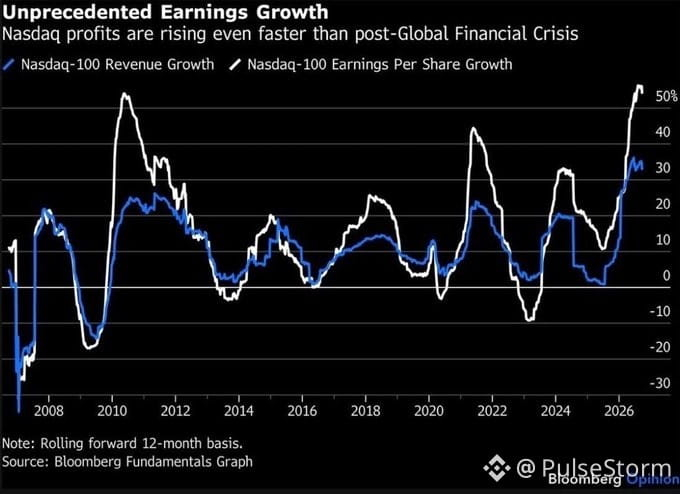
The bubble crowd has one classic test: multiples ripping while earnings sleep. That test is failing hard right now.
Nasdaq-100 Q1 2026 EPS growth: 45.6%. S&P 500: 28.8%. By Q2, Nasdaq's own data shows earnings growth near 80% annualized — strongest since 2010. Revenue growth: 18.6% vs 11.8% for the S&P.
Breadth tells the story. Over half of Nasdaq-100 names reported 20%+ earnings growth. More than four in five posted positive growth. Highest since Q4 2021.
Here's the key difference from 1999: back then, valuations ran miles ahead of earnings. Many companies had zero earnings.
Today, in sectors like semiconductors, P/E multiples are actually falling as earnings grow faster than price. Forward P/E: 25.2. Trailing: 35.2. That gap is what real earnings growth looks like in valuation terms.
The real counterargument: concentration in the top 10 holdings sits well above the dot-com peak. Household equity allocation hit a record 48%.
Fundamentals are moving, not just multiples. Whether earnings can keep compounding fast enough to justify 5% Treasury yields is the actual open question.
For now, this isn't 1999. It's a fundamentals-driven rally with real earnings velocity. The bubble test is failing — and that's bullish until it's not.
The bubble crowd has one classic test: multiples ripping while earnings sleep. That test is failing hard right now.
Nasdaq-100 Q1 2026 EPS growth: 45.6%. S&P 500: 28.8%. By Q2, Nasdaq's own data shows earnings growth near 80% annualized — strongest since 2010. Revenue growth: 18.6% vs 11.8% for the S&P.
Breadth tells the story. Over half of Nasdaq-100 names reported 20%+ earnings growth. More than four in five posted positive growth. Highest since Q4 2021.
Here's the key difference from 1999: back then, valuations ran miles ahead of earnings. Many companies had zero earnings.
Today, in sectors like semiconductors, P/E multiples are actually falling as earnings grow faster than price. Forward P/E: 25.2. Trailing: 35.2. That gap is what real earnings growth looks like in valuation terms.
The real counterargument: concentration in the top 10 holdings sits well above the dot-com peak. Household equity allocation hit a record 48%.
Fundamentals are moving, not just multiples. Whether earnings can keep compounding fast enough to justify 5% Treasury yields is the actual open question.
For now, this isn't 1999. It's a fundamentals-driven rally with real earnings velocity. The bubble test is failing — and that's bullish until it's not.
Nasdaq-100 Q1 2026 EPS growth: 45.6%. S&P 500: 28.8%. By Q2, Nasdaq's own data shows earnings growth near 80% annualized — strongest since 2010. Revenue growth: 18.6% vs 11.8% for the S&P.
Breadth tells the story. Over half of Nasdaq-100 names reported 20%+ earnings growth. More than four in five posted positive growth. Highest since Q4 2021.
Here's the key difference from 1999: back then, valuations ran miles ahead of earnings. Many companies had zero earnings.
Today, in sectors like semiconductors, P/E multiples are actually falling as earnings grow faster than price. Forward P/E: 25.2. Trailing: 35.2. That gap is what real earnings growth looks like in valuation terms.
The real counterargument: concentration in the top 10 holdings sits well above the dot-com peak. Household equity allocation hit a record 48%.
Fundamentals are moving, not just multiples. Whether earnings can keep compounding fast enough to justify 5% Treasury yields is the actual open question.
For now, this isn't 1999. It's a fundamentals-driven rally with real earnings velocity. The bubble test is failing — and that's bullish until it's not.
47
·
--
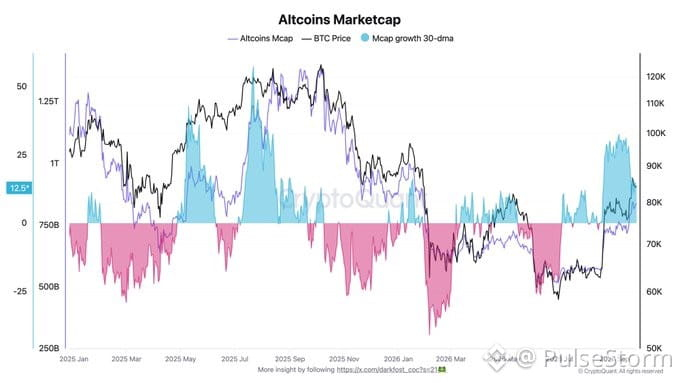
ALTCOIN MARKET CAP JUST EXPLODED 32% IN 30 DAYS 🚀
This is the strongest expansion since July 2025. We're still seeing 12.5% growth today — liquidity has been flowing into altcoins consistently since July.
This isn't a rotation. This is a full altseason building momentum.
But here's the reality check nobody wants to hear at 32% gains:
Markets never move in straight lines. The strongest expansions always include violent shakeouts designed to remove impatient hands.
The trend can persist longer than anyone expects — and correct harder than anyone is prepared for.
Patience and position sizing aren't optional right now. They ARE the entire strategy.
I'm watching for a pullback to reload on my top altcoin setups. When we get that shakeout, that's where the real money is made. Don't chase the rip — wait for the dip and position smart.
ALTCOIN MARKET CAP JUST EXPLODED 32% IN 30 DAYS 🚀
This is the strongest expansion since July 2025. We're still seeing 12.5% growth today — liquidity has been flowing into altcoins consistently since July.
This isn't a rotation. This is a full altseason building momentum.
But here's the reality check nobody wants to hear at 32% gains:
Markets never move in straight lines. The strongest expansions always include violent shakeouts designed to remove impatient hands.
The trend can persist longer than anyone expects — and correct harder than anyone is prepared for.
Patience and position sizing aren't optional right now. They ARE the entire strategy.
I'm watching for a pullback to reload on my top altcoin setups. When we get that shakeout, that's where the real money is made. Don't chase the rip — wait for the dip and position smart.
This is the strongest expansion since July 2025. We're still seeing 12.5% growth today — liquidity has been flowing into altcoins consistently since July.
This isn't a rotation. This is a full altseason building momentum.
But here's the reality check nobody wants to hear at 32% gains:
Markets never move in straight lines. The strongest expansions always include violent shakeouts designed to remove impatient hands.
The trend can persist longer than anyone expects — and correct harder than anyone is prepared for.
Patience and position sizing aren't optional right now. They ARE the entire strategy.
I'm watching for a pullback to reload on my top altcoin setups. When we get that shakeout, that's where the real money is made. Don't chase the rip — wait for the dip and position smart.
4
1.7k
·
--
Bessent just said Iran is "on their knees" — bold claim, but let's check the setup.
Operation Economic Outcast launched in August. Treasury's hitting five sectors: digital assets (first time ever as a sanctionable sector), tech, gold, aviation, shipping. Over 50 countries engaged. Turkey and UAE moved on Iranian banks and airlines. Bessent says Iran will have "nothing left to trade" in two weeks.
Here's the tension: rollout was light on public specifics. His own mentor Druckenmiller criticized the approach. Iran survived six months of military pressure, still controls Hormuz, and just proposed reopening the strait in exchange for frozen assets and sanctions relief.
A country on its knees doesn't send a counteroffer.
So what's the trade? If Bessent's timeline holds and Iran cracks in two weeks, expect risk-on rotation into oil-sensitive plays and regional stability trades. If Iran holds and counters, we get prolonged squeeze, higher energy volatility, and defensive positioning.
Watch oil, shipping names, and any Iran-linked digital asset flows. The next two weeks tell us if this is a breakthrough or just another squeeze cycle. I'm watching levels on crude and regional equity proxies — if Bessent's right, we see capitulation signals fast. If not, we fade the narrative and position for extended standoff.
This is policy meeting price action. Stay sharp.
Bessent just said Iran is "on their knees" — bold claim, but let's check the setup.
Operation Economic Outcast launched in August. Treasury's hitting five sectors: digital assets (first time ever as a sanctionable sector), tech, gold, aviation, shipping. Over 50 countries engaged. Turkey and UAE moved on Iranian banks and airlines. Bessent says Iran will have "nothing left to trade" in two weeks.
Here's the tension: rollout was light on public specifics. His own mentor Druckenmiller criticized the approach. Iran survived six months of military pressure, still controls Hormuz, and just proposed reopening the strait in exchange for frozen assets and sanctions relief.
A country on its knees doesn't send a counteroffer.
So what's the trade? If Bessent's timeline holds and Iran cracks in two weeks, expect risk-on rotation into oil-sensitive plays and regional stability trades. If Iran holds and counters, we get prolonged squeeze, higher energy volatility, and defensive positioning.
Watch oil, shipping names, and any Iran-linked digital asset flows. The next two weeks tell us if this is a breakthrough or just another squeeze cycle. I'm watching levels on crude and regional equity proxies — if Bessent's right, we see capitulation signals fast. If not, we fade the narrative and position for extended standoff.
This is policy meeting price action. Stay sharp.
Operation Economic Outcast launched in August. Treasury's hitting five sectors: digital assets (first time ever as a sanctionable sector), tech, gold, aviation, shipping. Over 50 countries engaged. Turkey and UAE moved on Iranian banks and airlines. Bessent says Iran will have "nothing left to trade" in two weeks.
Here's the tension: rollout was light on public specifics. His own mentor Druckenmiller criticized the approach. Iran survived six months of military pressure, still controls Hormuz, and just proposed reopening the strait in exchange for frozen assets and sanctions relief.
A country on its knees doesn't send a counteroffer.
So what's the trade? If Bessent's timeline holds and Iran cracks in two weeks, expect risk-on rotation into oil-sensitive plays and regional stability trades. If Iran holds and counters, we get prolonged squeeze, higher energy volatility, and defensive positioning.
Watch oil, shipping names, and any Iran-linked digital asset flows. The next two weeks tell us if this is a breakthrough or just another squeeze cycle. I'm watching levels on crude and regional equity proxies — if Bessent's right, we see capitulation signals fast. If not, we fade the narrative and position for extended standoff.
This is policy meeting price action. Stay sharp.
1
947
·
--
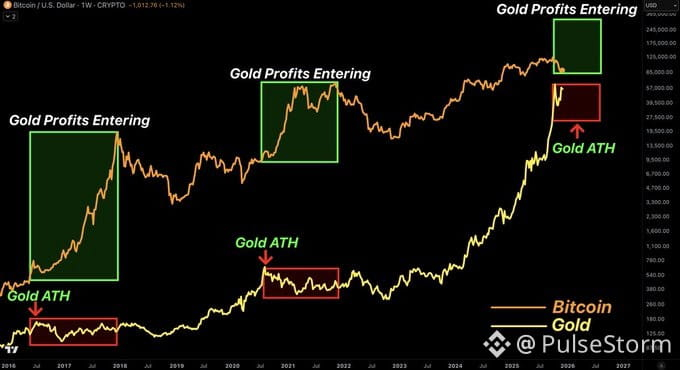
GOLD JUST PAUSED. $BTC IS STANDING AT THE HANDOFF POINT.
And this is where cycles change.
Gold absorbs fear. Stabilizes at the top. Liquidity searches for higher returns.
Then Bitcoin responds. Every. Single. Cycle.
Gold completed the breakout. Now it's pausing.
From protection to growth. From safety to Bitcoin.
This is the transition zone. Where narratives change quietly before price does.
The rotation is coming. By the time everyone sees it… it's already too late.
💡 TRADE SETUP:
Watch $BTC as gold consolidates. If gold holds 2650-2680 and $BTC reclaims 98k with volume, that's your rotation signal. Risk-on capital flows from safe haven to growth asset.
Entry: $BTC breakout above 98k
Target 1: 102k
Target 2: 105k+
Stop: Below 95.5k
This is the macro handoff trade. Gold pauses, Bitcoin runs. Don't wait for confirmation headlines. By then, the move is half done. 🚀
GOLD JUST PAUSED. $BTC IS STANDING AT THE HANDOFF POINT.
And this is where cycles change.
Gold absorbs fear. Stabilizes at the top. Liquidity searches for higher returns.
Then Bitcoin responds. Every. Single. Cycle.
Gold completed the breakout. Now it's pausing.
From protection to growth. From safety to Bitcoin.
This is the transition zone. Where narratives change quietly before price does.
The rotation is coming. By the time everyone sees it… it's already too late.
💡 TRADE SETUP:
Watch $BTC as gold consolidates. If gold holds 2650-2680 and $BTC reclaims 98k with volume, that's your rotation signal. Risk-on capital flows from safe haven to growth asset.
Entry: $BTC breakout above 98k
Target 1: 102k
Target 2: 105k+
Stop: Below 95.5k
This is the macro handoff trade. Gold pauses, Bitcoin runs. Don't wait for confirmation headlines. By then, the move is half done. 🚀
And this is where cycles change.
Gold absorbs fear. Stabilizes at the top. Liquidity searches for higher returns.
Then Bitcoin responds. Every. Single. Cycle.
Gold completed the breakout. Now it's pausing.
From protection to growth. From safety to Bitcoin.
This is the transition zone. Where narratives change quietly before price does.
The rotation is coming. By the time everyone sees it… it's already too late.
💡 TRADE SETUP:
Watch $BTC as gold consolidates. If gold holds 2650-2680 and $BTC reclaims 98k with volume, that's your rotation signal. Risk-on capital flows from safe haven to growth asset.
Entry: $BTC breakout above 98k
Target 1: 102k
Target 2: 105k+
Stop: Below 95.5k
This is the macro handoff trade. Gold pauses, Bitcoin runs. Don't wait for confirmation headlines. By then, the move is half done. 🚀
203
·
--
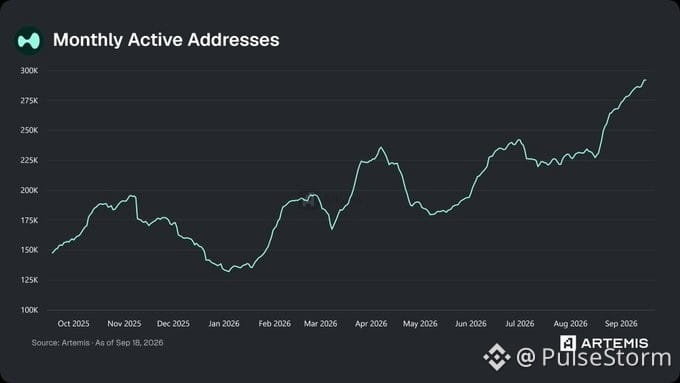
HYPERLIQUID JUST HIT ALL-TIME HIGHS ON USERS AND ADDRESSES — AT THE SAME TIME.
71,500 daily active users in August.
300,000 monthly active addresses in September.
Both records. Both climbing together.
While every other protocol is scrapping for attention, Hyperliquid is straight-up pulling traders away from every major centralized exchange out there.
11 employees.
Zero VC money.
Zero marketing budget.
Just a product so damn good that nearly 300,000 addresses picked it in one month.
This isn't hype. This is a takeover happening live.
Now here's the trade angle: $HYPE has been consolidating after its recent run. If this user growth keeps stacking and volume follows, we could see a breakout above resistance around the $25–$26 zone. Watch for a daily close above that level with volume confirmation — that's your entry.
Stop below $22.50 to keep risk tight. Target $30+ if momentum holds and the narrative keeps building.
This isn't just a story. It's a setup. And the chart's starting to line up with the fundamentals.
HYPERLIQUID JUST HIT ALL-TIME HIGHS ON USERS AND ADDRESSES — AT THE SAME TIME.
71,500 daily active users in August.
300,000 monthly active addresses in September.
Both records. Both climbing together.
While every other protocol is scrapping for attention, Hyperliquid is straight-up pulling traders away from every major centralized exchange out there.
11 employees.
Zero VC money.
Zero marketing budget.
Just a product so damn good that nearly 300,000 addresses picked it in one month.
This isn't hype. This is a takeover happening live.
Now here's the trade angle: $HYPE has been consolidating after its recent run. If this user growth keeps stacking and volume follows, we could see a breakout above resistance around the $25–$26 zone. Watch for a daily close above that level with volume confirmation — that's your entry.
Stop below $22.50 to keep risk tight. Target $30+ if momentum holds and the narrative keeps building.
This isn't just a story. It's a setup. And the chart's starting to line up with the fundamentals.
71,500 daily active users in August.
300,000 monthly active addresses in September.
Both records. Both climbing together.
While every other protocol is scrapping for attention, Hyperliquid is straight-up pulling traders away from every major centralized exchange out there.
11 employees.
Zero VC money.
Zero marketing budget.
Just a product so damn good that nearly 300,000 addresses picked it in one month.
This isn't hype. This is a takeover happening live.
Now here's the trade angle: $HYPE has been consolidating after its recent run. If this user growth keeps stacking and volume follows, we could see a breakout above resistance around the $25–$26 zone. Watch for a daily close above that level with volume confirmation — that's your entry.
Stop below $22.50 to keep risk tight. Target $30+ if momentum holds and the narrative keeps building.
This isn't just a story. It's a setup. And the chart's starting to line up with the fundamentals.
379
Көбірек контент көру үшін кіріңіз
Binance Square платформасында әлемдік криптоқоғамдастыққа қосылыңыз
⚡️ Криптовалюта туралы ең соңғы және пайдалы ақпаратты алыңыз.
💬 Әлемдегі ең ірі криптобиржаның сеніміне ие.
👍 Расталған авторлардың нақты пікірлерін табыңыз.
Электрондық пошта/телефон нөмірі
Трендтегі тақырыптар
BitcoinSlipsBelow$84000
315 рет көрілді
40 адам талқылап жатыр
9.30大饼
$BTC
反弹摸到84000-84300区间,直接做箜
昨晚砸到82800附近砸出低点,今天早盘缓过来开始反弹,整体还是箜头说了算。
上面84000-84300这一带刚好被均线压着,反弹到这儿全是抛压,根本冲不上去。下面先盯83000-82800的支撑,守不住就得接着往下探底。
操作上,价格反弹到84000-84300就分批进箜单,笋位放84500上面防着点,芷楹先看83100-82900。#股票财报季
晓东Crypto
·0 лайк
·588 рет көрілді
SECToClarifyOnChainFundraisingRules
3,354 рет көрілді
167 адам талқылап жатыр
UKFCAOpensCryptoFirmAuthorization
5,982 рет көрілді
176 адам талқылап жатыр