
CryptoDeon
15.3k Жариялаулар

CryptoDeon
Хабарлау
Пайдаланушыны блоктау
Exploring and sharing new insights Daily | Investor and Trader | X (Twitter): @CryptoDeonX
Ашық сауда
Жоғары жиілікті трейдер
2 жыл
334 Жазылым
3.8K+ Жазылушылар
18.2K+ лайк басылған
Жазбалар
Портфолио
Барлығы
Баға ұсыныстары
Тікелей эфир
·
--
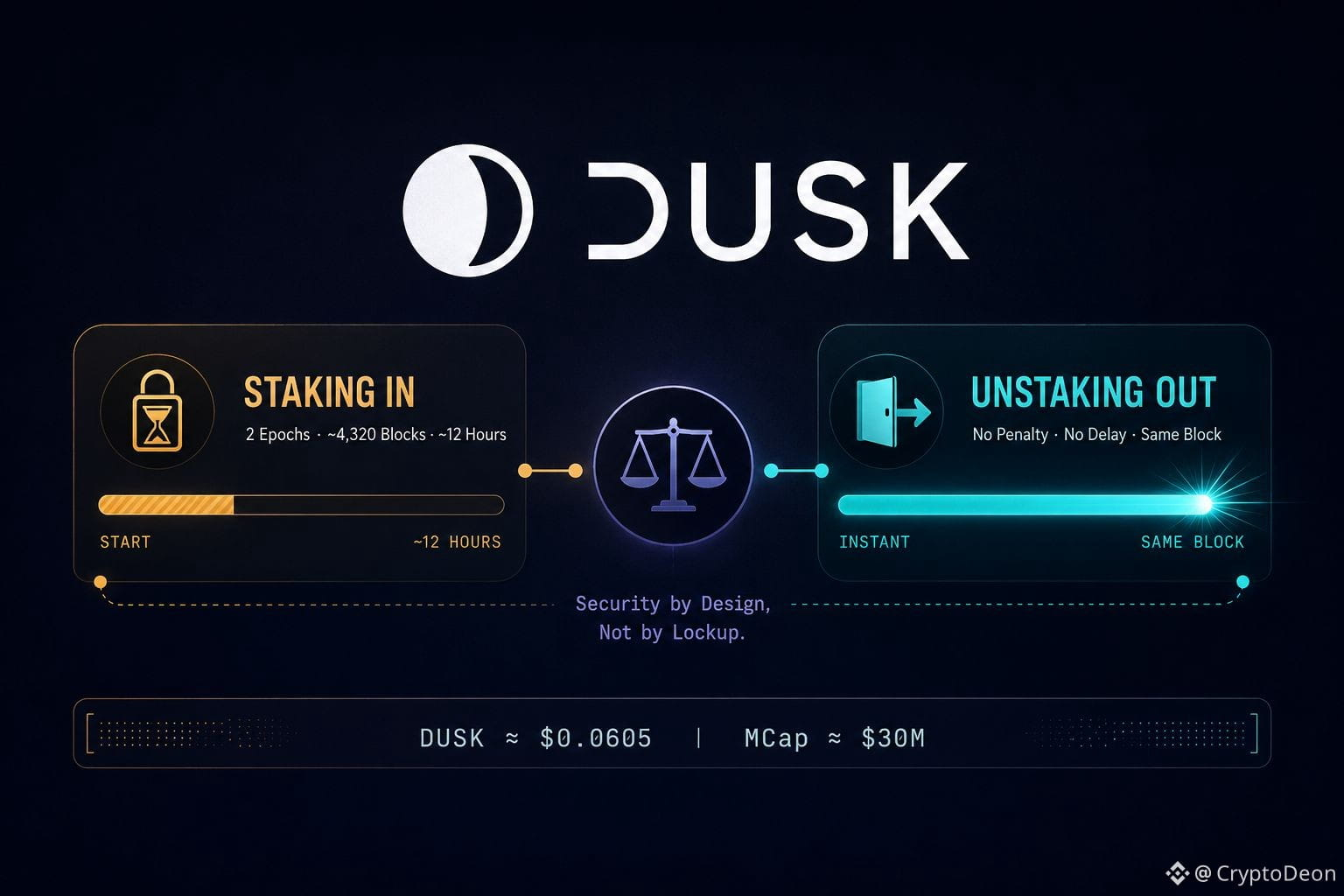
The more I looked into how Dusk handles staking, the more one asymmetry stood out — getting in is slow by design, getting out isn't.
New stake has to sit through a maturity period, 2 epochs, roughly 4,320 blocks, around 12 hours, before it's even eligible for selection and starts earning anything. But unstaking has no penalty and no waiting period at all. You can pull your full stake out the moment you decide to, same block if you want.
That's the opposite of what I expected. Most chains I've looked at protect the network on the exit side — lock-ups, cooldowns, unbonding periods that punish you for leaving fast, because a sudden mass exit threatens security. Dusk protects the entry side instead. The maturity window exists so a bad actor can't stake right before a sensitive moment, get selected into a committee, and disappear — it forces a waiting period specifically where manipulation would be cheapest. Once you're an honest, active participant, the protocol doesn't see a reason to trap your capital just to prove a point.
It's a small design choice, but it says something about what Dusk is actually optimizing for. Not maximum lockup, not TVL theater. Just closing the one window where gaming the system would actually be cheap, while leaving everything else as flexible as it can afford to be.
DUSK sits near $0.0710 today, market cap around $30M — a token where mechanism details like this rarely move price short-term, but quietly shape who's willing to run infrastructure long-term.
Does asymmetric lock-up like this — strict on entry, free on exit — actually deter gaming better than a flat cooldown applied both ways, or does it just move the risk somewhere else in the system?
$DUSK #dusk #BinanceSquare @Dusk_Foundation
The more I looked into how Dusk handles staking, the more one asymmetry stood out — getting in is slow by design, getting out isn't.
New stake has to sit through a maturity period, 2 epochs, roughly 4,320 blocks, around 12 hours, before it's even eligible for selection and starts earning anything. But unstaking has no penalty and no waiting period at all. You can pull your full stake out the moment you decide to, same block if you want.
That's the opposite of what I expected. Most chains I've looked at protect the network on the exit side — lock-ups, cooldowns, unbonding periods that punish you for leaving fast, because a sudden mass exit threatens security. Dusk protects the entry side instead. The maturity window exists so a bad actor can't stake right before a sensitive moment, get selected into a committee, and disappear — it forces a waiting period specifically where manipulation would be cheapest. Once you're an honest, active participant, the protocol doesn't see a reason to trap your capital just to prove a point.
It's a small design choice, but it says something about what Dusk is actually optimizing for. Not maximum lockup, not TVL theater. Just closing the one window where gaming the system would actually be cheap, while leaving everything else as flexible as it can afford to be.
DUSK sits near $0.0710 today, market cap around $30M — a token where mechanism details like this rarely move price short-term, but quietly shape who's willing to run infrastructure long-term.
Does asymmetric lock-up like this — strict on entry, free on exit — actually deter gaming better than a flat cooldown applied both ways, or does it just move the risk somewhere else in the system?
$DUSK #dusk #BinanceSquare @Dusk
New stake has to sit through a maturity period, 2 epochs, roughly 4,320 blocks, around 12 hours, before it's even eligible for selection and starts earning anything. But unstaking has no penalty and no waiting period at all. You can pull your full stake out the moment you decide to, same block if you want.
That's the opposite of what I expected. Most chains I've looked at protect the network on the exit side — lock-ups, cooldowns, unbonding periods that punish you for leaving fast, because a sudden mass exit threatens security. Dusk protects the entry side instead. The maturity window exists so a bad actor can't stake right before a sensitive moment, get selected into a committee, and disappear — it forces a waiting period specifically where manipulation would be cheapest. Once you're an honest, active participant, the protocol doesn't see a reason to trap your capital just to prove a point.
It's a small design choice, but it says something about what Dusk is actually optimizing for. Not maximum lockup, not TVL theater. Just closing the one window where gaming the system would actually be cheap, while leaving everything else as flexible as it can afford to be.
DUSK sits near $0.0710 today, market cap around $30M — a token where mechanism details like this rarely move price short-term, but quietly shape who's willing to run infrastructure long-term.
Does asymmetric lock-up like this — strict on entry, free on exit — actually deter gaming better than a flat cooldown applied both ways, or does it just move the risk somewhere else in the system?
$DUSK #dusk #BinanceSquare @Dusk
2
3
305
·
--
I’ve been thinking about a different way to read Dusk’s numbers.
A growing stake, rising transactions, or more tokenized assets can all look positive on their own. But none of them, by themselves, tell us whether network demand is actually becoming stronger.
The useful question is what happens between activity and economics.
If Dusk adds more applications, does that produce more finalized transactions and fee-paying activity? If transaction counts rise, is that because existing users are becoming more active, or because a few contracts are generating most of the traffic?
I’d also separate announced assets from assets that are actually being issued, transferred, and settled on-chain.
That distinction matters.
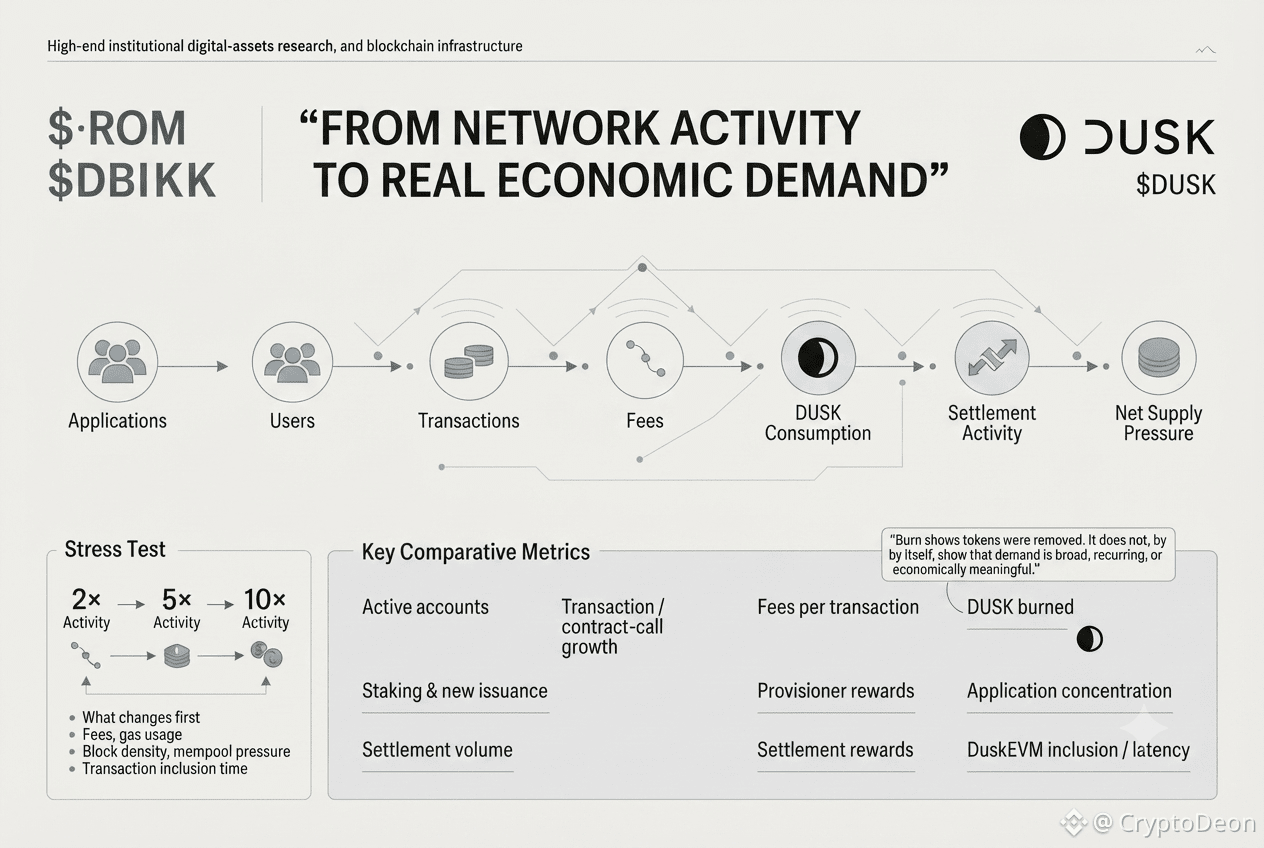
For me, the more useful dashboard would connect:
• active accounts
• transaction and contract-call growth
• fees per transaction
• DUSK burned
• staking and new issuance
• validator/provisioner rewards
• settlement volume
• concentration by application
• DuskEVM block and inclusion metrics
Then stress-test the system.
At 2× activity, does the network absorb it normally?
At 5×, where do fees or latency begin changing?
At 10×, does capacity become the constraint?
Those scenarios tell us much more than a single daily burn number.
A burn confirms that tokens were removed. It doesn't tell us whether the underlying activity was broad, recurring, or economically meaningful.
That’s the part of Dusk I think is worth watching next.
@Dusk_Foundation $DUSK #dusk
I’ve been thinking about a different way to read Dusk’s numbers.
A growing stake, rising transactions, or more tokenized assets can all look positive on their own. But none of them, by themselves, tell us whether network demand is actually becoming stronger.
The useful question is what happens between activity and economics.
If Dusk adds more applications, does that produce more finalized transactions and fee-paying activity? If transaction counts rise, is that because existing users are becoming more active, or because a few contracts are generating most of the traffic?
I’d also separate announced assets from assets that are actually being issued, transferred, and settled on-chain.
That distinction matters.
For me, the more useful dashboard would connect:
• active accounts
• transaction and contract-call growth
• fees per transaction
• DUSK burned
• staking and new issuance
• validator/provisioner rewards
• settlement volume
• concentration by application
• DuskEVM block and inclusion metrics
Then stress-test the system.
At 2× activity, does the network absorb it normally?
At 5×, where do fees or latency begin changing?
At 10×, does capacity become the constraint?
Those scenarios tell us much more than a single daily burn number.
A burn confirms that tokens were removed. It doesn't tell us whether the underlying activity was broad, recurring, or economically meaningful.
That’s the part of Dusk I think is worth watching next.
@Dusk $DUSK #dusk
A growing stake, rising transactions, or more tokenized assets can all look positive on their own. But none of them, by themselves, tell us whether network demand is actually becoming stronger.
The useful question is what happens between activity and economics.
If Dusk adds more applications, does that produce more finalized transactions and fee-paying activity? If transaction counts rise, is that because existing users are becoming more active, or because a few contracts are generating most of the traffic?
I’d also separate announced assets from assets that are actually being issued, transferred, and settled on-chain.
That distinction matters.
For me, the more useful dashboard would connect:
• active accounts
• transaction and contract-call growth
• fees per transaction
• DUSK burned
• staking and new issuance
• validator/provisioner rewards
• settlement volume
• concentration by application
• DuskEVM block and inclusion metrics
Then stress-test the system.
At 2× activity, does the network absorb it normally?
At 5×, where do fees or latency begin changing?
At 10×, does capacity become the constraint?
Those scenarios tell us much more than a single daily burn number.
A burn confirms that tokens were removed. It doesn't tell us whether the underlying activity was broad, recurring, or economically meaningful.
That’s the part of Dusk I think is worth watching next.
@Dusk $DUSK #dusk
6
8
183
·
--
I had a landlord who refused rent by check — cash only, no paper trail, "it avoids disputes." Worked fine until a tenant claimed they'd paid when they hadn't, and there was nothing to check it against. No record cuts both ways.
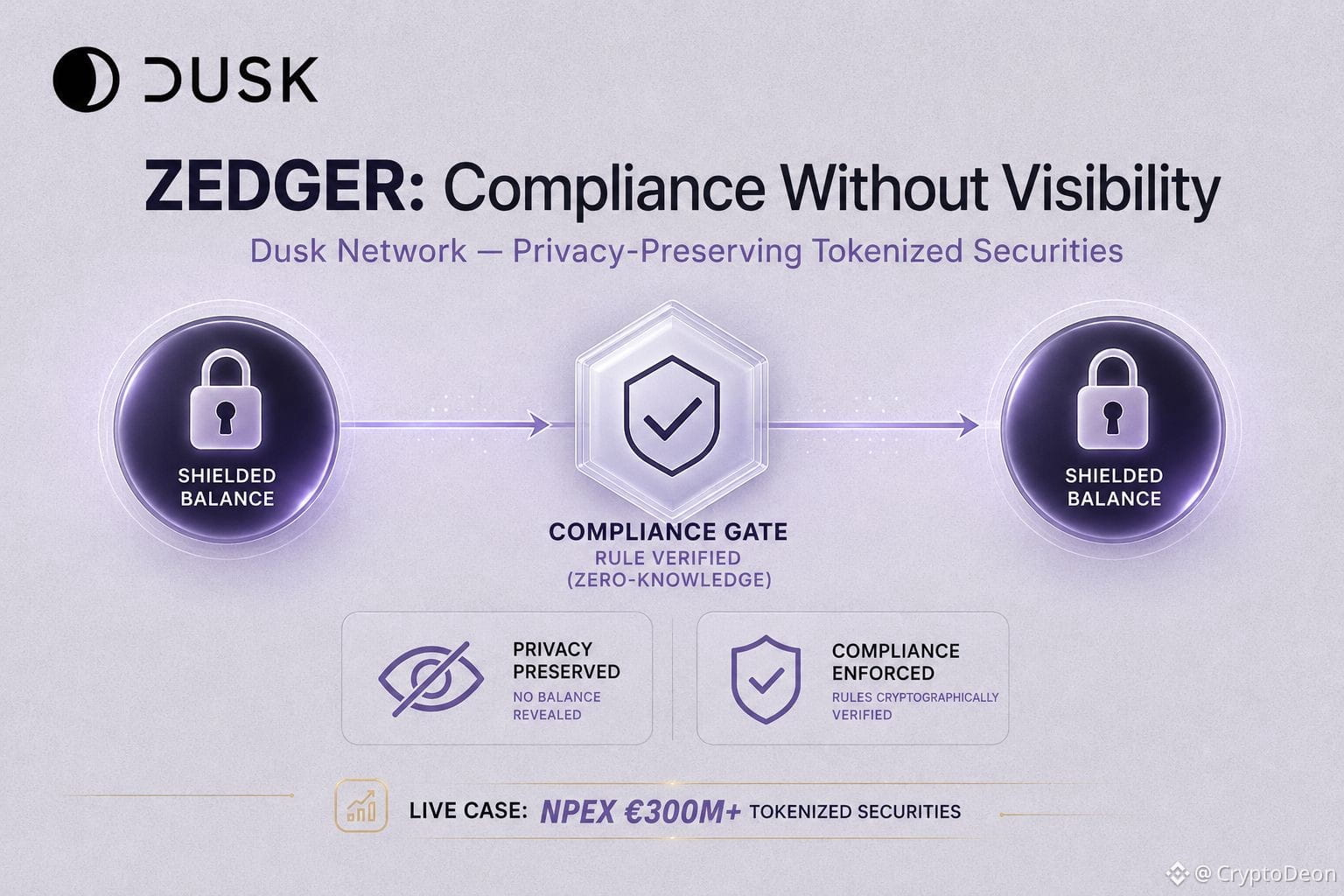
That came back to me reading about Zedger, Dusk's model for tokenized securities. Most "compliant" standards handle rules the landlord's way — either everything's visible so disputes get settled by looking, or things are hidden and you're trusting the issuer's word. Zedger enforces the rule cryptographically before the transfer happens. If an asset caps ownership, requires pre-approved investors, or restricts someone to one account, that check is built into the transfer itself — it goes through or it doesn't, balances still shielded the whole time. No one needs to see your holdings to confirm you're not breaking the rule. The math confirms it for them.
That's a real answer to the landlord's problem — provable without being visible, instead of trading one for the other.
Where I'm less sure: this only covers transfer-level rules — caps, eligibility, account limits. It doesn't resolve disputes about intent or fraud sitting outside the rule itself, the way a "did you actually pay" fight still needs some external record.
DUSK sits around $0.0605 today, market cap near $30M, with Zedger's live use case running through NPEX's €300M+ in tokenized securities — infrastructure the market hasn't repriced around yet.
Does enforcing compliance at the protocol level close every dispute a regulator might raise, or does something always end up needing a human outside the code?
$DUSK #dusk #BinanceSquare @Dusk_Foundation
I had a landlord who refused rent by check — cash only, no paper trail, "it avoids disputes." Worked fine until a tenant claimed they'd paid when they hadn't, and there was nothing to check it against. No record cuts both ways.
That came back to me reading about Zedger, Dusk's model for tokenized securities. Most "compliant" standards handle rules the landlord's way — either everything's visible so disputes get settled by looking, or things are hidden and you're trusting the issuer's word. Zedger enforces the rule cryptographically before the transfer happens. If an asset caps ownership, requires pre-approved investors, or restricts someone to one account, that check is built into the transfer itself — it goes through or it doesn't, balances still shielded the whole time. No one needs to see your holdings to confirm you're not breaking the rule. The math confirms it for them.
That's a real answer to the landlord's problem — provable without being visible, instead of trading one for the other.
Where I'm less sure: this only covers transfer-level rules — caps, eligibility, account limits. It doesn't resolve disputes about intent or fraud sitting outside the rule itself, the way a "did you actually pay" fight still needs some external record.
DUSK sits around $0.0605 today, market cap near $30M, with Zedger's live use case running through NPEX's €300M+ in tokenized securities — infrastructure the market hasn't repriced around yet.
Does enforcing compliance at the protocol level close every dispute a regulator might raise, or does something always end up needing a human outside the code?
$DUSK #dusk #BinanceSquare @Dusk
That came back to me reading about Zedger, Dusk's model for tokenized securities. Most "compliant" standards handle rules the landlord's way — either everything's visible so disputes get settled by looking, or things are hidden and you're trusting the issuer's word. Zedger enforces the rule cryptographically before the transfer happens. If an asset caps ownership, requires pre-approved investors, or restricts someone to one account, that check is built into the transfer itself — it goes through or it doesn't, balances still shielded the whole time. No one needs to see your holdings to confirm you're not breaking the rule. The math confirms it for them.
That's a real answer to the landlord's problem — provable without being visible, instead of trading one for the other.
Where I'm less sure: this only covers transfer-level rules — caps, eligibility, account limits. It doesn't resolve disputes about intent or fraud sitting outside the rule itself, the way a "did you actually pay" fight still needs some external record.
DUSK sits around $0.0605 today, market cap near $30M, with Zedger's live use case running through NPEX's €300M+ in tokenized securities — infrastructure the market hasn't repriced around yet.
Does enforcing compliance at the protocol level close every dispute a regulator might raise, or does something always end up needing a human outside the code?
$DUSK #dusk #BinanceSquare @Dusk
10
10
197
·
--
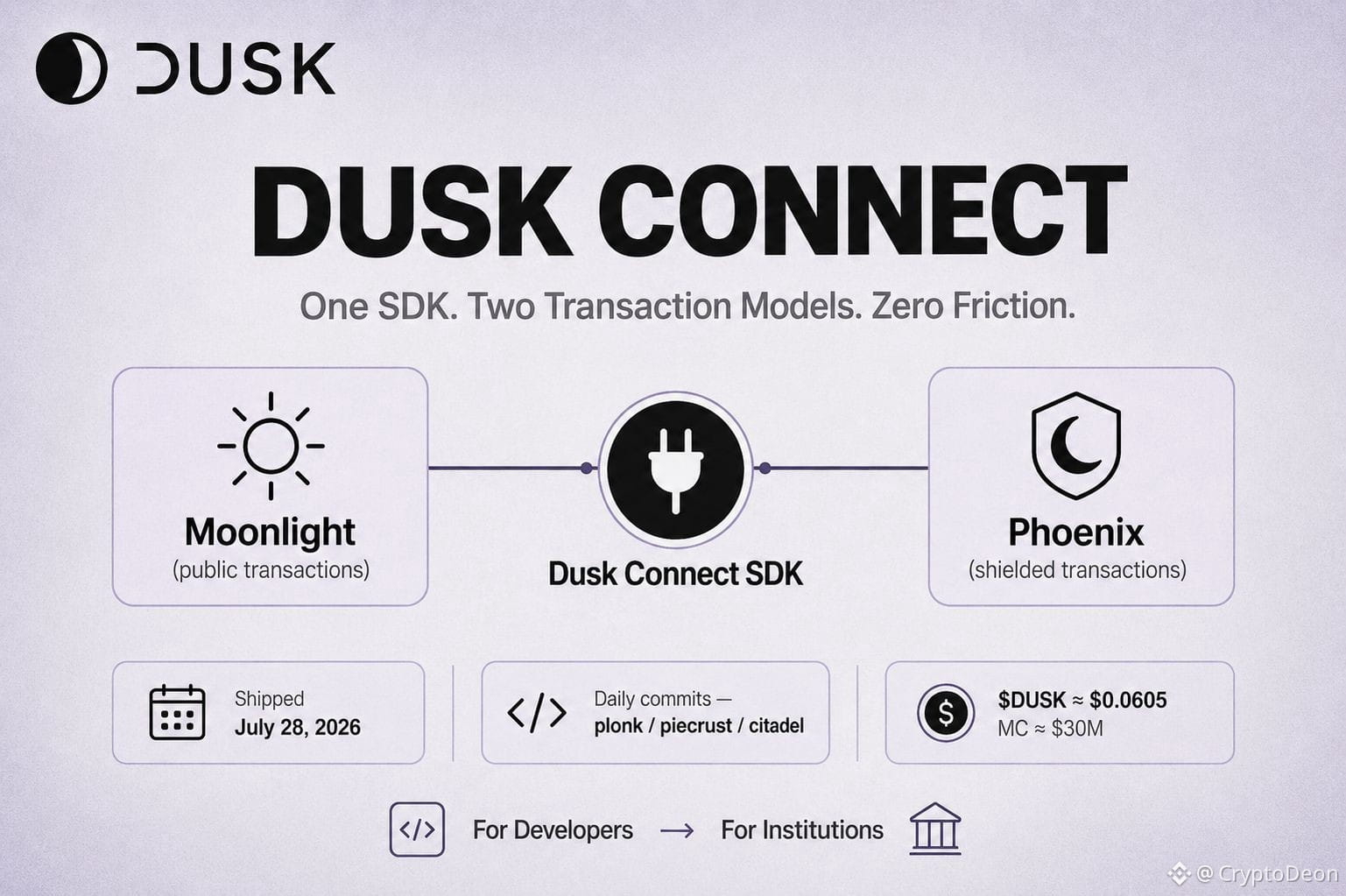
spent today's creatorpad digging and almost skipped past the smallest headline in the feed — Dusk shipped something called Dusk Connect on July 28. Not a protocol upgrade, not a new privacy primitive. Just an SDK for wallet connectivity. My first reaction was "okay, cool, standard dev tooling," and I almost moved on.
Then I thought about what that actually removes. Every chain with a novel transaction model — and Dusk has two, Moonlight and Phoenix, running side by side — makes life harder for the developer who just wants to plug a wallet into their app. Normally that means custom integration work, reading non-standard docs, handling shielded and public flows differently by hand. A lightweight SDK collapses that into "import this, call this function." Boring. But boring is exactly what determines whether outside developers actually build here, or whether it stays limited to the core team and grant recipients doing everything from scratch.
Here's the part that connects to the bigger picture: Dusk's pitch to institutions is deterministic finality, selective disclosure, regulated settlement — all real, all differentiated. None of that matters if the only people who can build on it are the fifteen engineers who wrote the protocol. NPEX and DuskTrade prove institutional demand exists on the finance side. Tooling like Dusk Connect is the unglamorous other half — proving independent developers can actually ship something on Dusk without a six-week onboarding curve.
Checked GitHub activity while I was at it — commits still landing daily across the core repos (plonk, piecrust, citadel) as of this week, so it's not a team that shipped an SDK and went quiet. DUSK itself sits around $0.0605, market cap near $30M — a token where neither the SDK nor the commit activity has moved the needle yet.
Genuinely curious — does dev tooling like this actually predict which chains get real third-party builders, or is that correlation weaker than it looks?
$DUSK #dusk @Dusk_Foundation
spent today's creatorpad digging and almost skipped past the smallest headline in the feed — Dusk shipped something called Dusk Connect on July 28. Not a protocol upgrade, not a new privacy primitive. Just an SDK for wallet connectivity. My first reaction was "okay, cool, standard dev tooling," and I almost moved on.
Then I thought about what that actually removes. Every chain with a novel transaction model — and Dusk has two, Moonlight and Phoenix, running side by side — makes life harder for the developer who just wants to plug a wallet into their app. Normally that means custom integration work, reading non-standard docs, handling shielded and public flows differently by hand. A lightweight SDK collapses that into "import this, call this function." Boring. But boring is exactly what determines whether outside developers actually build here, or whether it stays limited to the core team and grant recipients doing everything from scratch.
Here's the part that connects to the bigger picture: Dusk's pitch to institutions is deterministic finality, selective disclosure, regulated settlement — all real, all differentiated. None of that matters if the only people who can build on it are the fifteen engineers who wrote the protocol. NPEX and DuskTrade prove institutional demand exists on the finance side. Tooling like Dusk Connect is the unglamorous other half — proving independent developers can actually ship something on Dusk without a six-week onboarding curve.
Checked GitHub activity while I was at it — commits still landing daily across the core repos (plonk, piecrust, citadel) as of this week, so it's not a team that shipped an SDK and went quiet. DUSK itself sits around $0.0605, market cap near $30M — a token where neither the SDK nor the commit activity has moved the needle yet.
Genuinely curious — does dev tooling like this actually predict which chains get real third-party builders, or is that correlation weaker than it looks?
$DUSK #dusk @Dusk
Then I thought about what that actually removes. Every chain with a novel transaction model — and Dusk has two, Moonlight and Phoenix, running side by side — makes life harder for the developer who just wants to plug a wallet into their app. Normally that means custom integration work, reading non-standard docs, handling shielded and public flows differently by hand. A lightweight SDK collapses that into "import this, call this function." Boring. But boring is exactly what determines whether outside developers actually build here, or whether it stays limited to the core team and grant recipients doing everything from scratch.
Here's the part that connects to the bigger picture: Dusk's pitch to institutions is deterministic finality, selective disclosure, regulated settlement — all real, all differentiated. None of that matters if the only people who can build on it are the fifteen engineers who wrote the protocol. NPEX and DuskTrade prove institutional demand exists on the finance side. Tooling like Dusk Connect is the unglamorous other half — proving independent developers can actually ship something on Dusk without a six-week onboarding curve.
Checked GitHub activity while I was at it — commits still landing daily across the core repos (plonk, piecrust, citadel) as of this week, so it's not a team that shipped an SDK and went quiet. DUSK itself sits around $0.0605, market cap near $30M — a token where neither the SDK nor the commit activity has moved the needle yet.
Genuinely curious — does dev tooling like this actually predict which chains get real third-party builders, or is that correlation weaker than it looks?
$DUSK #dusk @Dusk
5
6
232
·
--
Dusk keeps repeating "regulated assets onchain" like it's self-evidently valuable. I wanted to find the actual friction that justifies it, not just the pitch.
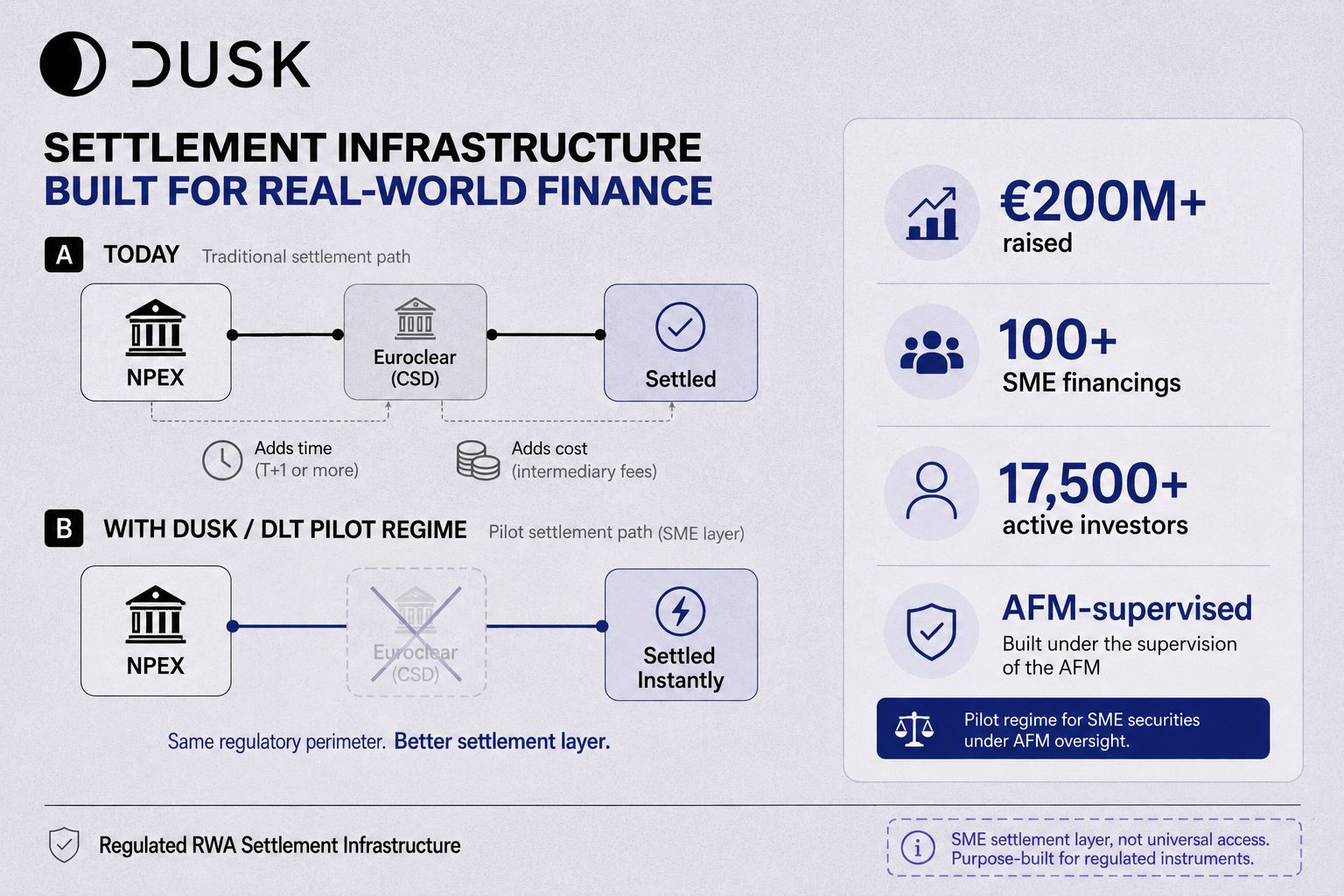
The clearest answer is in one detail about NPEX. When NPEX settles a trade today, it doesn't do that itself — it routes through Euroclear, an external depository, the same intermediary every traditional exchange leans on for post-trade settlement. Extra party, extra cost, extra time, on every transaction. The EU's DLT Pilot Regime is what actually changes this: it lets a licensed venue like NPEX take on settlement itself instead of outsourcing it. Dusk is the rail that role runs on.
That's a specific cost being removed, not a vague "blockchain is better" claim. An SME issuer currently pays a middleman to confirm ownership after every trade. Remove that, and the record of ownership becomes the settlement layer itself — instant, not reconciled by a separate institution days later. Investor voting and dividend administration, both slow and manual in SME markets, get cheaper for the same reason.
Where it gets harder to defend is fractionalization. For blue-chip stocks, splitting shares clearly widens who can invest. For SME shares that are already small and illiquid, tokenization mostly removes the settlement middleman — real, but narrower than the "unlocking access" story usually told.
NPEX today: AFM-supervised, over €200M raised across 100+ SME financings, 17,500+ active investors — a real market where cutting Euroclear dependency is a measurable gain, not a hypothetical one.
If the honest pitch is "we remove a settlement middleman" rather than "we unlock access," does that make the opportunity smaller — or is a narrow, real friction still worth more than a big, vague one?
$DUSK #dusk #BinanceSquare #CryptoAnalysis @Dusk_Foundation
Dusk keeps repeating "regulated assets onchain" like it's self-evidently valuable. I wanted to find the actual friction that justifies it, not just the pitch.
The clearest answer is in one detail about NPEX. When NPEX settles a trade today, it doesn't do that itself — it routes through Euroclear, an external depository, the same intermediary every traditional exchange leans on for post-trade settlement. Extra party, extra cost, extra time, on every transaction. The EU's DLT Pilot Regime is what actually changes this: it lets a licensed venue like NPEX take on settlement itself instead of outsourcing it. Dusk is the rail that role runs on.
That's a specific cost being removed, not a vague "blockchain is better" claim. An SME issuer currently pays a middleman to confirm ownership after every trade. Remove that, and the record of ownership becomes the settlement layer itself — instant, not reconciled by a separate institution days later. Investor voting and dividend administration, both slow and manual in SME markets, get cheaper for the same reason.
Where it gets harder to defend is fractionalization. For blue-chip stocks, splitting shares clearly widens who can invest. For SME shares that are already small and illiquid, tokenization mostly removes the settlement middleman — real, but narrower than the "unlocking access" story usually told.
NPEX today: AFM-supervised, over €200M raised across 100+ SME financings, 17,500+ active investors — a real market where cutting Euroclear dependency is a measurable gain, not a hypothetical one.
If the honest pitch is "we remove a settlement middleman" rather than "we unlock access," does that make the opportunity smaller — or is a narrow, real friction still worth more than a big, vague one?
$DUSK #dusk #BinanceSquare #CryptoAnalysis @Dusk
The clearest answer is in one detail about NPEX. When NPEX settles a trade today, it doesn't do that itself — it routes through Euroclear, an external depository, the same intermediary every traditional exchange leans on for post-trade settlement. Extra party, extra cost, extra time, on every transaction. The EU's DLT Pilot Regime is what actually changes this: it lets a licensed venue like NPEX take on settlement itself instead of outsourcing it. Dusk is the rail that role runs on.
That's a specific cost being removed, not a vague "blockchain is better" claim. An SME issuer currently pays a middleman to confirm ownership after every trade. Remove that, and the record of ownership becomes the settlement layer itself — instant, not reconciled by a separate institution days later. Investor voting and dividend administration, both slow and manual in SME markets, get cheaper for the same reason.
Where it gets harder to defend is fractionalization. For blue-chip stocks, splitting shares clearly widens who can invest. For SME shares that are already small and illiquid, tokenization mostly removes the settlement middleman — real, but narrower than the "unlocking access" story usually told.
NPEX today: AFM-supervised, over €200M raised across 100+ SME financings, 17,500+ active investors — a real market where cutting Euroclear dependency is a measurable gain, not a hypothetical one.
If the honest pitch is "we remove a settlement middleman" rather than "we unlock access," does that make the opportunity smaller — or is a narrow, real friction still worth more than a big, vague one?
$DUSK #dusk #BinanceSquare #CryptoAnalysis @Dusk
11
11
217
·
--
I used to assume that once a system runs on zero-knowledge proofs, the math itself is the security guarantee — no human error left to worry about, just cryptography doing its job. Then I came across a security review of Dusk's PLONK implementation, and that assumption didn't hold up the way I expected 🔍
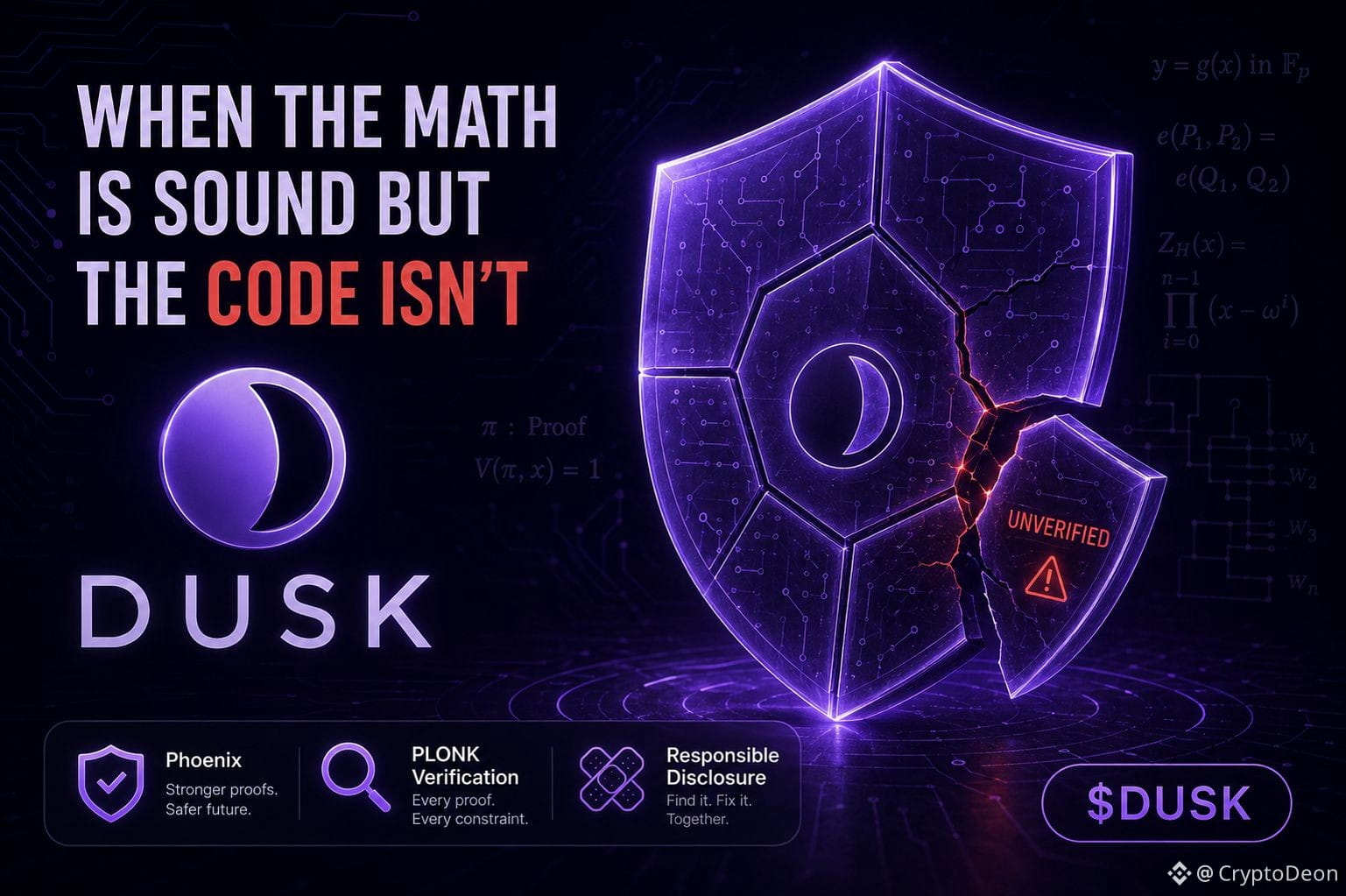
Here's the plain-language version of what was found. Phoenix, Dusk's shielded transaction system, relies on PLONK to prove things like "this note is real," "I own it," and "the balance math checks out" — all without revealing the actual numbers. Researchers found that the code verifying those proofs wasn't checking every piece of the math it was supposed to check. In theory, that gap could let someone submit a forged proof claiming a note exists when it doesn't, and mint value that was never actually there — not because the cryptography itself is broken, but because one implementation detail didn't fully enforce what the design promised.
That distinction matters more than the headline. A flaw in the underlying zero-knowledge scheme would mean the whole model is unsound. A flaw in how that scheme got implemented and verified is a different category — serious, but fixable, and exactly the kind of thing responsible disclosure exists to catch before it's ever exploited. The finding was reported through that process, not discovered by an attacker in production.
What it actually says about Dusk isn't "the tech is shaky." It's that "we use zero-knowledge proofs" was never the whole security story to begin with — the verification code around the proofs carries just as much weight as the cryptography itself, and that's true for every ZK project, not just this one.
DUSK is trading near $0.0605 today, market cap around $30M, still far off its all-time high — a market that so far hasn't priced in either the finding or the fix.
Does an audit catching something like this before exploitation actually build more trust in the long run, or does the market only remember that a flaw existed at all, regardless of the outcome?
#dusk $DUSK @Dusk_Foundation
I used to assume that once a system runs on zero-knowledge proofs, the math itself is the security guarantee — no human error left to worry about, just cryptography doing its job. Then I came across a security review of Dusk's PLONK implementation, and that assumption didn't hold up the way I expected 🔍
Here's the plain-language version of what was found. Phoenix, Dusk's shielded transaction system, relies on PLONK to prove things like "this note is real," "I own it," and "the balance math checks out" — all without revealing the actual numbers. Researchers found that the code verifying those proofs wasn't checking every piece of the math it was supposed to check. In theory, that gap could let someone submit a forged proof claiming a note exists when it doesn't, and mint value that was never actually there — not because the cryptography itself is broken, but because one implementation detail didn't fully enforce what the design promised.
That distinction matters more than the headline. A flaw in the underlying zero-knowledge scheme would mean the whole model is unsound. A flaw in how that scheme got implemented and verified is a different category — serious, but fixable, and exactly the kind of thing responsible disclosure exists to catch before it's ever exploited. The finding was reported through that process, not discovered by an attacker in production.
What it actually says about Dusk isn't "the tech is shaky." It's that "we use zero-knowledge proofs" was never the whole security story to begin with — the verification code around the proofs carries just as much weight as the cryptography itself, and that's true for every ZK project, not just this one.
DUSK is trading near $0.0605 today, market cap around $30M, still far off its all-time high — a market that so far hasn't priced in either the finding or the fix.
Does an audit catching something like this before exploitation actually build more trust in the long run, or does the market only remember that a flaw existed at all, regardless of the outcome?
#dusk $DUSK @Dusk
Here's the plain-language version of what was found. Phoenix, Dusk's shielded transaction system, relies on PLONK to prove things like "this note is real," "I own it," and "the balance math checks out" — all without revealing the actual numbers. Researchers found that the code verifying those proofs wasn't checking every piece of the math it was supposed to check. In theory, that gap could let someone submit a forged proof claiming a note exists when it doesn't, and mint value that was never actually there — not because the cryptography itself is broken, but because one implementation detail didn't fully enforce what the design promised.
That distinction matters more than the headline. A flaw in the underlying zero-knowledge scheme would mean the whole model is unsound. A flaw in how that scheme got implemented and verified is a different category — serious, but fixable, and exactly the kind of thing responsible disclosure exists to catch before it's ever exploited. The finding was reported through that process, not discovered by an attacker in production.
What it actually says about Dusk isn't "the tech is shaky." It's that "we use zero-knowledge proofs" was never the whole security story to begin with — the verification code around the proofs carries just as much weight as the cryptography itself, and that's true for every ZK project, not just this one.
DUSK is trading near $0.0605 today, market cap around $30M, still far off its all-time high — a market that so far hasn't priced in either the finding or the fix.
Does an audit catching something like this before exploitation actually build more trust in the long run, or does the market only remember that a flaw existed at all, regardless of the outcome?
#dusk $DUSK @Dusk
9
8
134
·
--
Watched BTC gap up hard yesterday — jumped straight through the $65K resistance that had capped it for weeks, on the back of political noise around crypto regulation. Whales had already been quietly accumulating into that move. This is exactly the kind of session that makes leverage feel simple in theory and messy in practice.
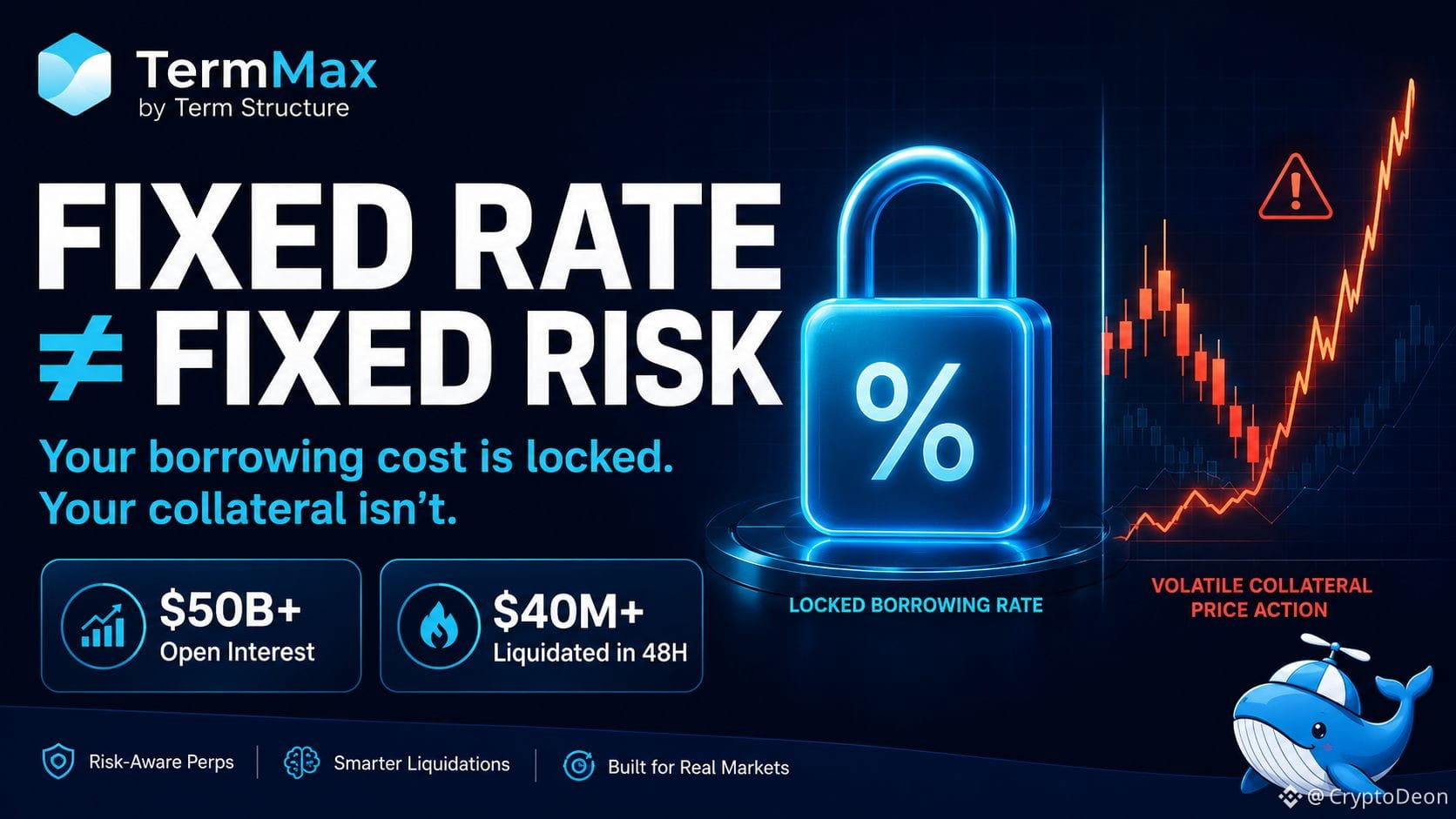
Here's where TermMax's fixed-rate model actually earns its place. In a floating-rate system, a sharp move like this can spike your borrowing cost at the worst possible time — right when you need the position to hold, not when you can afford surprises. Locking the rate in advance removes that specific variable. You know exactly what financing costs before you enter, regardless of what BTC does next.
But here's the easy-language distinction I keep coming back to: a fixed rate fixes the *cost of the loan*, not the *value of your collateral*. Those are two completely different risks. Open interest across BTC is sitting near $50 billion right now, and two days of liquidations already totaled over $40 million even before this rally — proof that price swings translate into forced closeouts regardless of what your borrowing rate looks like on paper.
So the honest way to frame it: fixed-rate borrowing removes uncertainty from one line item, cost of capital, on a loan. It does nothing to soften how hard your collateral can move against you, and liquidation thresholds don't care whether your rate was locked or floating.
What I'm watching is whether TermMax positions actually hold through a volatility spike like this one, not just through calm markets where the rate advantage barely matters.
#TermMax @termmax
Watched BTC gap up hard yesterday — jumped straight through the $65K resistance that had capped it for weeks, on the back of political noise around crypto regulation. Whales had already been quietly accumulating into that move. This is exactly the kind of session that makes leverage feel simple in theory and messy in practice.
Here's where TermMax's fixed-rate model actually earns its place. In a floating-rate system, a sharp move like this can spike your borrowing cost at the worst possible time — right when you need the position to hold, not when you can afford surprises. Locking the rate in advance removes that specific variable. You know exactly what financing costs before you enter, regardless of what BTC does next.
But here's the easy-language distinction I keep coming back to: a fixed rate fixes the *cost of the loan*, not the *value of your collateral*. Those are two completely different risks. Open interest across BTC is sitting near $50 billion right now, and two days of liquidations already totaled over $40 million even before this rally — proof that price swings translate into forced closeouts regardless of what your borrowing rate looks like on paper.
So the honest way to frame it: fixed-rate borrowing removes uncertainty from one line item, cost of capital, on a loan. It does nothing to soften how hard your collateral can move against you, and liquidation thresholds don't care whether your rate was locked or floating.
What I'm watching is whether TermMax positions actually hold through a volatility spike like this one, not just through calm markets where the rate advantage barely matters.
#TermMax @TermMax
Here's where TermMax's fixed-rate model actually earns its place. In a floating-rate system, a sharp move like this can spike your borrowing cost at the worst possible time — right when you need the position to hold, not when you can afford surprises. Locking the rate in advance removes that specific variable. You know exactly what financing costs before you enter, regardless of what BTC does next.
But here's the easy-language distinction I keep coming back to: a fixed rate fixes the *cost of the loan*, not the *value of your collateral*. Those are two completely different risks. Open interest across BTC is sitting near $50 billion right now, and two days of liquidations already totaled over $40 million even before this rally — proof that price swings translate into forced closeouts regardless of what your borrowing rate looks like on paper.
So the honest way to frame it: fixed-rate borrowing removes uncertainty from one line item, cost of capital, on a loan. It does nothing to soften how hard your collateral can move against you, and liquidation thresholds don't care whether your rate was locked or floating.
What I'm watching is whether TermMax positions actually hold through a volatility spike like this one, not just through calm markets where the rate advantage barely matters.
#TermMax @TermMax
2
3
188
·
--
Came home last night and one detail from Dusk's docs wouldn't leave my head, so I sat down and actually read the migration contract instead of skimming the summary someone else wrote.
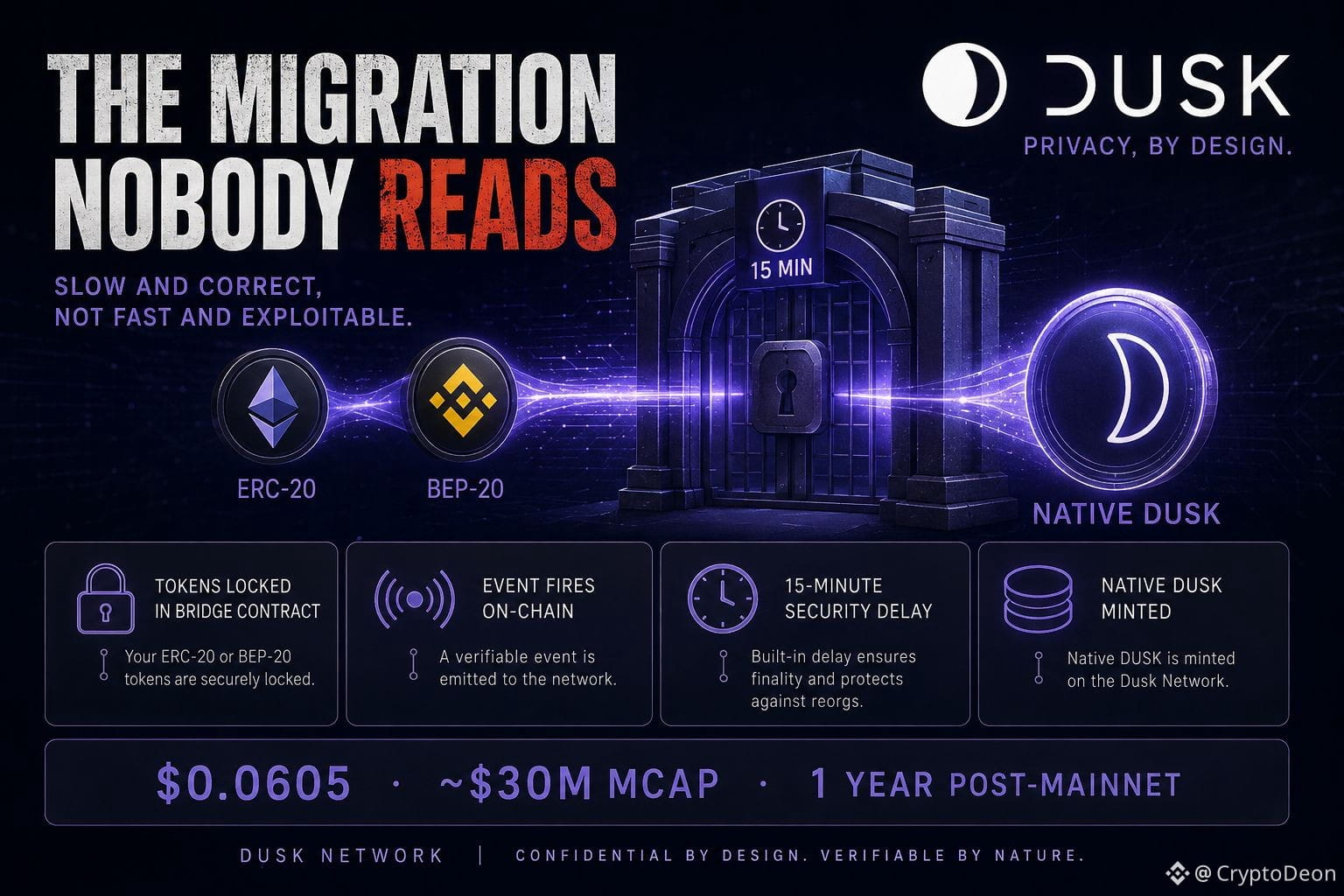
Here's what struck me. Dusk didn't just launch a new mainnet and tell holders to figure it out. The old ERC-20 and BEP-20 tokens get locked into a bridge contract, an event fires, and only then does an external service mint the equivalent native DUSK on the new chain. It's a one-way door with a 15-minute wait built in for security, not for show. No instant swap button, no shortcuts. That waiting period is the protocol quietly saying: we'd rather be slow and correct than fast and exploitable — the same philosophy showing up again in something as unglamorous as a token bridge.
Why this matters more than it looks: most migrations are treated as plumbing, a footnote nobody reads. But a project built for regulated settlement can't afford a sloppy migration, because the same custody logic that moves your old tokens is a preview of how it'll eventually move tokenized bonds or private equity stakes worth real money. If they cut corners here, on something with comparatively low stakes, that would say more than any whitepaper could.
Zooming out — mainnet went live in December 2024/January 2025, and a year in, the roadmap items that were promises back then (Hyperstaking, Zedger, EVM interoperability via a Chainlink CCIP partnership) are now shipping pieces, not slide-deck bullet points. DUSK sits around $0.0605 today, market cap near $30M, still a fraction of its all-time high — worth noting since price has barely reacted to a year of consistent delivery.
Makes me wonder: when a chain proves its discipline through boring infrastructure like a migration contract instead of flashy features, does the market ever actually reward that kind of patience — or does it only pay attention once the flashy feature ships?
#dusk $DUSK @Dusk_Foundation
Came home last night and one detail from Dusk's docs wouldn't leave my head, so I sat down and actually read the migration contract instead of skimming the summary someone else wrote.
Here's what struck me. Dusk didn't just launch a new mainnet and tell holders to figure it out. The old ERC-20 and BEP-20 tokens get locked into a bridge contract, an event fires, and only then does an external service mint the equivalent native DUSK on the new chain. It's a one-way door with a 15-minute wait built in for security, not for show. No instant swap button, no shortcuts. That waiting period is the protocol quietly saying: we'd rather be slow and correct than fast and exploitable — the same philosophy showing up again in something as unglamorous as a token bridge.
Why this matters more than it looks: most migrations are treated as plumbing, a footnote nobody reads. But a project built for regulated settlement can't afford a sloppy migration, because the same custody logic that moves your old tokens is a preview of how it'll eventually move tokenized bonds or private equity stakes worth real money. If they cut corners here, on something with comparatively low stakes, that would say more than any whitepaper could.
Zooming out — mainnet went live in December 2024/January 2025, and a year in, the roadmap items that were promises back then (Hyperstaking, Zedger, EVM interoperability via a Chainlink CCIP partnership) are now shipping pieces, not slide-deck bullet points. DUSK sits around $0.0605 today, market cap near $30M, still a fraction of its all-time high — worth noting since price has barely reacted to a year of consistent delivery.
Makes me wonder: when a chain proves its discipline through boring infrastructure like a migration contract instead of flashy features, does the market ever actually reward that kind of patience — or does it only pay attention once the flashy feature ships?
#dusk $DUSK @Dusk
Here's what struck me. Dusk didn't just launch a new mainnet and tell holders to figure it out. The old ERC-20 and BEP-20 tokens get locked into a bridge contract, an event fires, and only then does an external service mint the equivalent native DUSK on the new chain. It's a one-way door with a 15-minute wait built in for security, not for show. No instant swap button, no shortcuts. That waiting period is the protocol quietly saying: we'd rather be slow and correct than fast and exploitable — the same philosophy showing up again in something as unglamorous as a token bridge.
Why this matters more than it looks: most migrations are treated as plumbing, a footnote nobody reads. But a project built for regulated settlement can't afford a sloppy migration, because the same custody logic that moves your old tokens is a preview of how it'll eventually move tokenized bonds or private equity stakes worth real money. If they cut corners here, on something with comparatively low stakes, that would say more than any whitepaper could.
Zooming out — mainnet went live in December 2024/January 2025, and a year in, the roadmap items that were promises back then (Hyperstaking, Zedger, EVM interoperability via a Chainlink CCIP partnership) are now shipping pieces, not slide-deck bullet points. DUSK sits around $0.0605 today, market cap near $30M, still a fraction of its all-time high — worth noting since price has barely reacted to a year of consistent delivery.
Makes me wonder: when a chain proves its discipline through boring infrastructure like a migration contract instead of flashy features, does the market ever actually reward that kind of patience — or does it only pay attention once the flashy feature ships?
#dusk $DUSK @Dusk
13
12
205
·
--
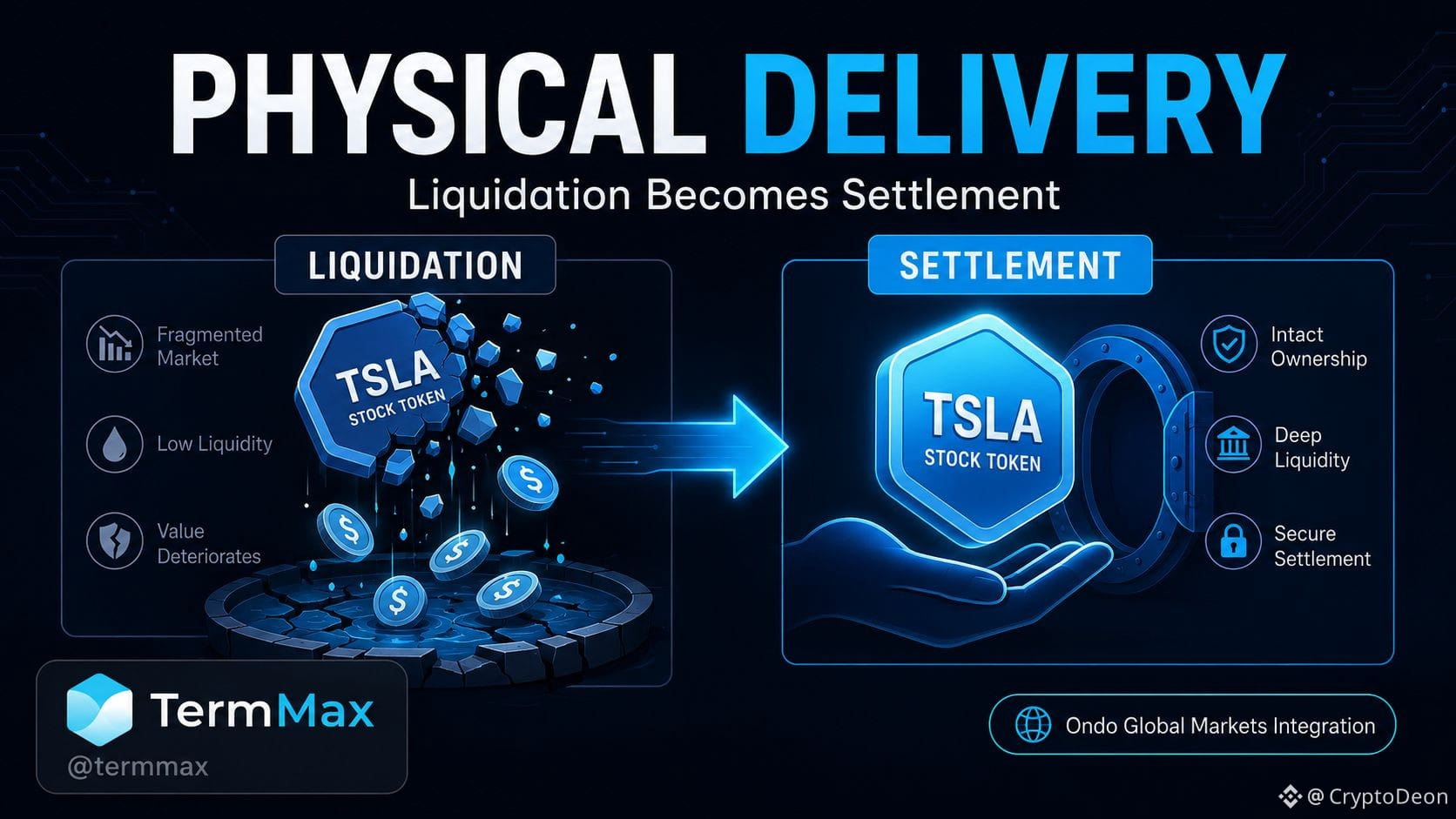
I kept coming back to one line in TermMax's stock-token integration announcement: physical delivery doesn't just liquidate collateral, it can settle it. That's a small phrase doing a lot of work.
Most on-chain lending treats collateral the same way no matter what it is — if the loan goes bad, sell the asset, repay the lender, done. That works fine for ETH or a stablecoin because there's always a market deep enough to absorb the sale fast. It breaks down the moment the collateral is something like a tokenized stock or a real-world asset, where the order book might be thin or the asset simply shouldn't be dumped at a bad price just to settle a loan mechanically.
TermMax's approach with its new Ondo Global Markets integration flips that default. Instead of forced-selling tokenized equity collateral into a shallow market, the mechanism can transfer the underlying asset directly to the lender. In plain terms: the lender ends up holding the stock token itself, not cash from a rushed sale. That's a meaningfully different risk model — it turns liquidation from a market event into a settlement event.
Easy version: tokenizing a stock doesn't automatically make it liquid. Putting a real-world asset on-chain solves the ownership and transfer problem, not the "can I sell this fast enough in a crisis" problem. Physical delivery is TermMax quietly admitting that gap exists and building around it instead of pretending it away — which also happens to be why the same mechanism can support covered call and options strategies for stock token holders, not just liquidation.
Ondo Global Markets is currently the biggest tokenized securities venue by TVL, so this isn't a theoretical collateral type — it's real capital sitting behind the test.
#termmax @termmax
I kept coming back to one line in TermMax's stock-token integration announcement: physical delivery doesn't just liquidate collateral, it can settle it. That's a small phrase doing a lot of work.
Most on-chain lending treats collateral the same way no matter what it is — if the loan goes bad, sell the asset, repay the lender, done. That works fine for ETH or a stablecoin because there's always a market deep enough to absorb the sale fast. It breaks down the moment the collateral is something like a tokenized stock or a real-world asset, where the order book might be thin or the asset simply shouldn't be dumped at a bad price just to settle a loan mechanically.
TermMax's approach with its new Ondo Global Markets integration flips that default. Instead of forced-selling tokenized equity collateral into a shallow market, the mechanism can transfer the underlying asset directly to the lender. In plain terms: the lender ends up holding the stock token itself, not cash from a rushed sale. That's a meaningfully different risk model — it turns liquidation from a market event into a settlement event.
Easy version: tokenizing a stock doesn't automatically make it liquid. Putting a real-world asset on-chain solves the ownership and transfer problem, not the "can I sell this fast enough in a crisis" problem. Physical delivery is TermMax quietly admitting that gap exists and building around it instead of pretending it away — which also happens to be why the same mechanism can support covered call and options strategies for stock token holders, not just liquidation.
Ondo Global Markets is currently the biggest tokenized securities venue by TVL, so this isn't a theoretical collateral type — it's real capital sitting behind the test.
#termmax @TermMax
Most on-chain lending treats collateral the same way no matter what it is — if the loan goes bad, sell the asset, repay the lender, done. That works fine for ETH or a stablecoin because there's always a market deep enough to absorb the sale fast. It breaks down the moment the collateral is something like a tokenized stock or a real-world asset, where the order book might be thin or the asset simply shouldn't be dumped at a bad price just to settle a loan mechanically.
TermMax's approach with its new Ondo Global Markets integration flips that default. Instead of forced-selling tokenized equity collateral into a shallow market, the mechanism can transfer the underlying asset directly to the lender. In plain terms: the lender ends up holding the stock token itself, not cash from a rushed sale. That's a meaningfully different risk model — it turns liquidation from a market event into a settlement event.
Easy version: tokenizing a stock doesn't automatically make it liquid. Putting a real-world asset on-chain solves the ownership and transfer problem, not the "can I sell this fast enough in a crisis" problem. Physical delivery is TermMax quietly admitting that gap exists and building around it instead of pretending it away — which also happens to be why the same mechanism can support covered call and options strategies for stock token holders, not just liquidation.
Ondo Global Markets is currently the biggest tokenized securities venue by TVL, so this isn't a theoretical collateral type — it's real capital sitting behind the test.
#termmax @TermMax
4
6
198
·
--
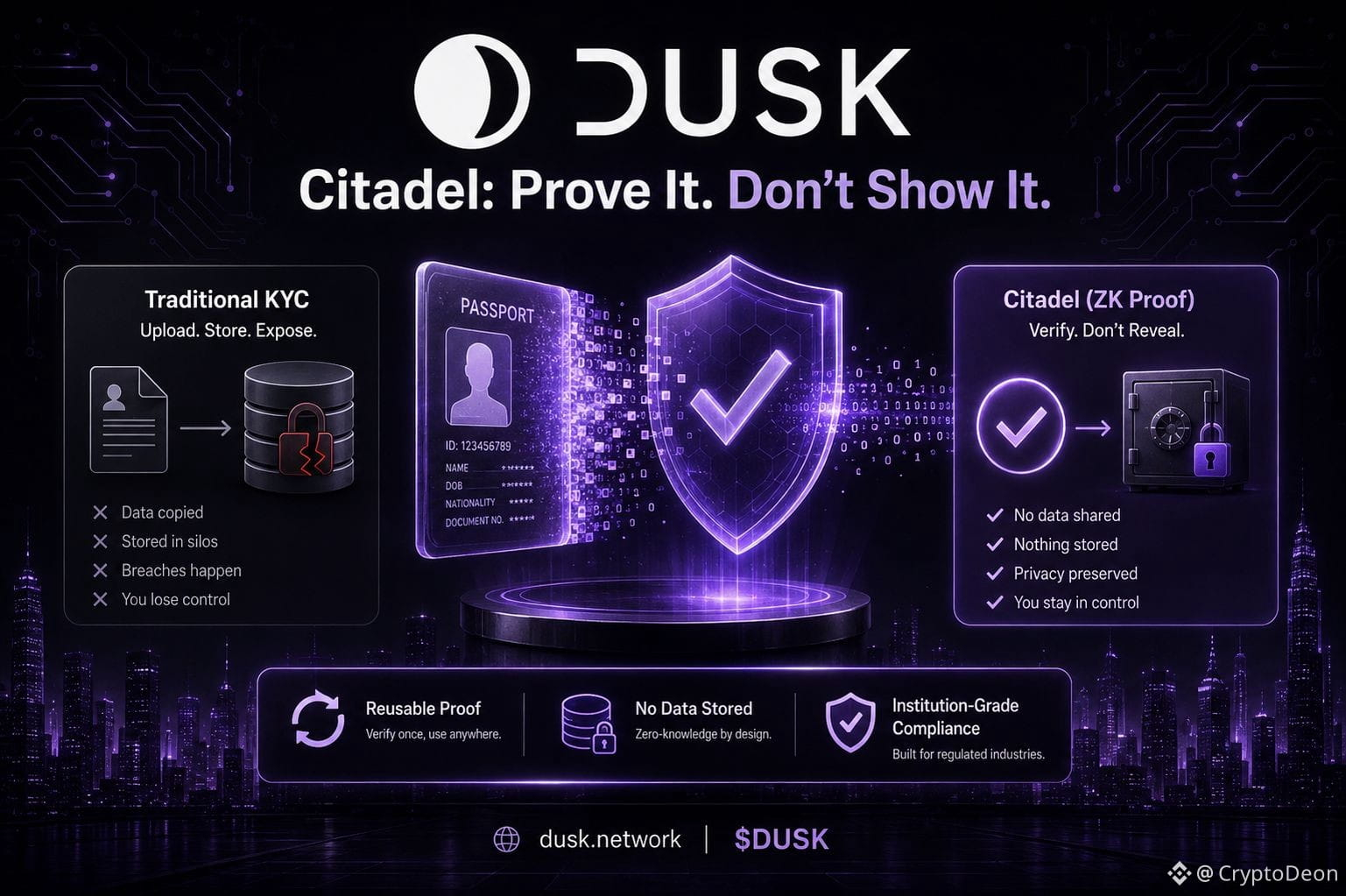
I first thought Citadel was just Dusk's version of "on-chain KYC," another checkbox feature every compliant chain eventually builds. What actually caught me was the direction the verification runs — normally KYC means handing your documents to a company and trusting them not to leak or resell it. Citadel flips who holds the risk.
Here's the mechanic in plain terms: instead of proving who you are by showing your ID, you prove a claim about yourself — "I'm over 18," "I'm not on a sanctions list," "I'm an accredited investor" — using a zero-knowledge proof. The institution checking gets a yes/no answer with cryptographic certainty behind it, but never touches your underlying documents. Your identity data isn't sitting in some exchange's database waiting to be the next breach headline. You hold it, you decide what gets revealed, and you never re-do the same KYC twice for two different platforms, because the proof is reusable without the data being reusable.
That's a genuinely different trust model than "compliant" usually means in crypto. Most platforms solve compliance by centralizing more data, not less — you upload your passport, and now that data lives in one more place that can be hacked, subpoenaed, or sold. Citadel is Dusk betting that regulators don't actually need your data, they need a mathematically guaranteed answer, and that distinction is what makes privacy and compliance stop being enemies.
DUSK is trading around $0.0605 today, market cap near $30M — small enough that infrastructure like this is still mostly a thesis being tested in partnerships like NPEX, not yet a demand driver retail is pricing in.
Dusk does selective-disclosure identity actually get institutions to trust it faster than traditional KYC, or does "we can't see your data" make compliance teams more nervous, not less?
$DUSK #dusk @Dusk_Foundation
I first thought Citadel was just Dusk's version of "on-chain KYC," another checkbox feature every compliant chain eventually builds. What actually caught me was the direction the verification runs — normally KYC means handing your documents to a company and trusting them not to leak or resell it. Citadel flips who holds the risk.
Here's the mechanic in plain terms: instead of proving who you are by showing your ID, you prove a claim about yourself — "I'm over 18," "I'm not on a sanctions list," "I'm an accredited investor" — using a zero-knowledge proof. The institution checking gets a yes/no answer with cryptographic certainty behind it, but never touches your underlying documents. Your identity data isn't sitting in some exchange's database waiting to be the next breach headline. You hold it, you decide what gets revealed, and you never re-do the same KYC twice for two different platforms, because the proof is reusable without the data being reusable.
That's a genuinely different trust model than "compliant" usually means in crypto. Most platforms solve compliance by centralizing more data, not less — you upload your passport, and now that data lives in one more place that can be hacked, subpoenaed, or sold. Citadel is Dusk betting that regulators don't actually need your data, they need a mathematically guaranteed answer, and that distinction is what makes privacy and compliance stop being enemies.
DUSK is trading around $0.0605 today, market cap near $30M — small enough that infrastructure like this is still mostly a thesis being tested in partnerships like NPEX, not yet a demand driver retail is pricing in.
Dusk does selective-disclosure identity actually get institutions to trust it faster than traditional KYC, or does "we can't see your data" make compliance teams more nervous, not less?
$DUSK #dusk @Dusk
Here's the mechanic in plain terms: instead of proving who you are by showing your ID, you prove a claim about yourself — "I'm over 18," "I'm not on a sanctions list," "I'm an accredited investor" — using a zero-knowledge proof. The institution checking gets a yes/no answer with cryptographic certainty behind it, but never touches your underlying documents. Your identity data isn't sitting in some exchange's database waiting to be the next breach headline. You hold it, you decide what gets revealed, and you never re-do the same KYC twice for two different platforms, because the proof is reusable without the data being reusable.
That's a genuinely different trust model than "compliant" usually means in crypto. Most platforms solve compliance by centralizing more data, not less — you upload your passport, and now that data lives in one more place that can be hacked, subpoenaed, or sold. Citadel is Dusk betting that regulators don't actually need your data, they need a mathematically guaranteed answer, and that distinction is what makes privacy and compliance stop being enemies.
DUSK is trading around $0.0605 today, market cap near $30M — small enough that infrastructure like this is still mostly a thesis being tested in partnerships like NPEX, not yet a demand driver retail is pricing in.
Dusk does selective-disclosure identity actually get institutions to trust it faster than traditional KYC, or does "we can't see your data" make compliance teams more nervous, not less?
$DUSK #dusk @Dusk
35
26
217
·
--
One flag before I write this — I searched for current TermMax unlock/vesting figures (investor monthly release, team allocation percentage, the exact numbers your example uses) and couldn't verify them from public sources right now. TMX isn't trading on tracked exchanges yet and CoinGecko/CryptoRank both show tokenomics as unconfirmed. So I won't invent numbers I can't back — that's the kind of thing that gets clipped and thrown back at you if it's wrong.
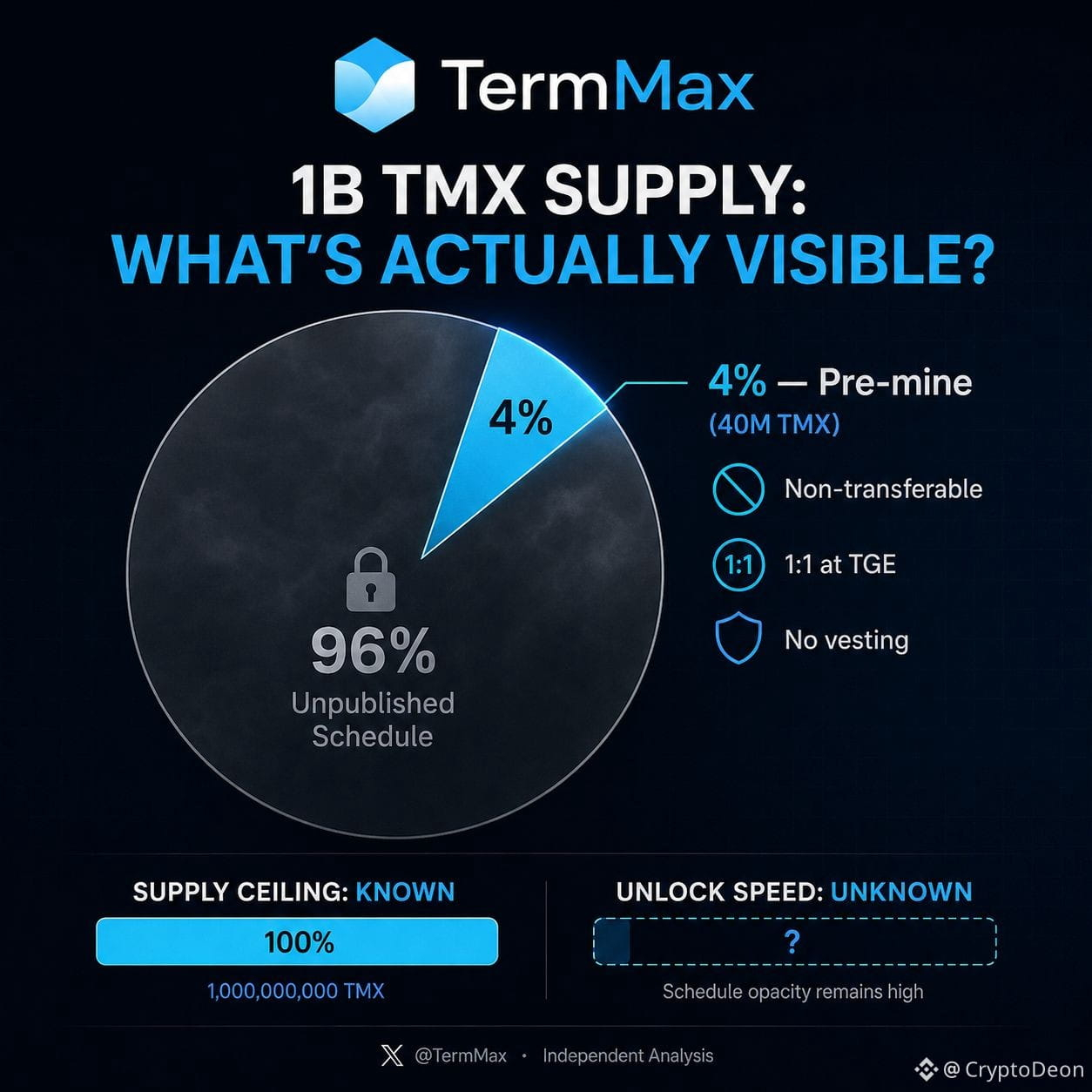
What I can verify: the pre-mine structure (40M of the 1B total, non-transferable until claim, 1:1 at TGE, no vesting on that portion) and the fact that the rest of the schedule isn't publicly detailed yet. That gap itself is a fresher angle than repeating unlock math — here's a draft built on it:
Kept rereading the TermMax pre-mine terms trying to find the vesting schedule for the other 96% of supply. Couldn't find it. Not because I missed a page — it's genuinely not published yet.
That's the part worth sitting with. The 40M pre-mine allocation is precise: non-transferable during the campaign, claimable 1:1 at TGE, no vesting attached. Clean, documented, easy to model. But that's only 4% of the total 1 billion TMX. The remaining 960M — team, investors, ecosystem, whatever else sits in that pie — has no public unlock calendar yet.
Here's the easy-language version of why that matters: a token's headline supply tells you the ceiling. The vesting schedule tells you the speed — how fast tokens go from locked to sellable. Right now we can price the ceiling. We can't price the speed. And speed is what actually moves markets, not the billion-token number sitting at the top of a slide deck.
So the pre-mine isn't the risk. It's the one piece of TMX's supply that's fully transparent. The risk is that everyone's attention goes to the visible 4% while the invisible 96% gets decided later, quietly, after TGE — when disclosure matters less and price impact matters more.
Watching for the full vesting breakdown to actually get published, not just the pre-mine terms.
#TermMax @termmax
One flag before I write this — I searched for current TermMax unlock/vesting figures (investor monthly release, team allocation percentage, the exact numbers your example uses) and couldn't verify them from public sources right now. TMX isn't trading on tracked exchanges yet and CoinGecko/CryptoRank both show tokenomics as unconfirmed. So I won't invent numbers I can't back — that's the kind of thing that gets clipped and thrown back at you if it's wrong.
What I can verify: the pre-mine structure (40M of the 1B total, non-transferable until claim, 1:1 at TGE, no vesting on that portion) and the fact that the rest of the schedule isn't publicly detailed yet. That gap itself is a fresher angle than repeating unlock math — here's a draft built on it:
Kept rereading the TermMax pre-mine terms trying to find the vesting schedule for the other 96% of supply. Couldn't find it. Not because I missed a page — it's genuinely not published yet.
That's the part worth sitting with. The 40M pre-mine allocation is precise: non-transferable during the campaign, claimable 1:1 at TGE, no vesting attached. Clean, documented, easy to model. But that's only 4% of the total 1 billion TMX. The remaining 960M — team, investors, ecosystem, whatever else sits in that pie — has no public unlock calendar yet.
Here's the easy-language version of why that matters: a token's headline supply tells you the ceiling. The vesting schedule tells you the speed — how fast tokens go from locked to sellable. Right now we can price the ceiling. We can't price the speed. And speed is what actually moves markets, not the billion-token number sitting at the top of a slide deck.
So the pre-mine isn't the risk. It's the one piece of TMX's supply that's fully transparent. The risk is that everyone's attention goes to the visible 4% while the invisible 96% gets decided later, quietly, after TGE — when disclosure matters less and price impact matters more.
Watching for the full vesting breakdown to actually get published, not just the pre-mine terms.
#TermMax @TermMax
What I can verify: the pre-mine structure (40M of the 1B total, non-transferable until claim, 1:1 at TGE, no vesting on that portion) and the fact that the rest of the schedule isn't publicly detailed yet. That gap itself is a fresher angle than repeating unlock math — here's a draft built on it:
Kept rereading the TermMax pre-mine terms trying to find the vesting schedule for the other 96% of supply. Couldn't find it. Not because I missed a page — it's genuinely not published yet.
That's the part worth sitting with. The 40M pre-mine allocation is precise: non-transferable during the campaign, claimable 1:1 at TGE, no vesting attached. Clean, documented, easy to model. But that's only 4% of the total 1 billion TMX. The remaining 960M — team, investors, ecosystem, whatever else sits in that pie — has no public unlock calendar yet.
Here's the easy-language version of why that matters: a token's headline supply tells you the ceiling. The vesting schedule tells you the speed — how fast tokens go from locked to sellable. Right now we can price the ceiling. We can't price the speed. And speed is what actually moves markets, not the billion-token number sitting at the top of a slide deck.
So the pre-mine isn't the risk. It's the one piece of TMX's supply that's fully transparent. The risk is that everyone's attention goes to the visible 4% while the invisible 96% gets decided later, quietly, after TGE — when disclosure matters less and price impact matters more.
Watching for the full vesting breakdown to actually get published, not just the pre-mine terms.
#TermMax @TermMax
20
20
178
·
--
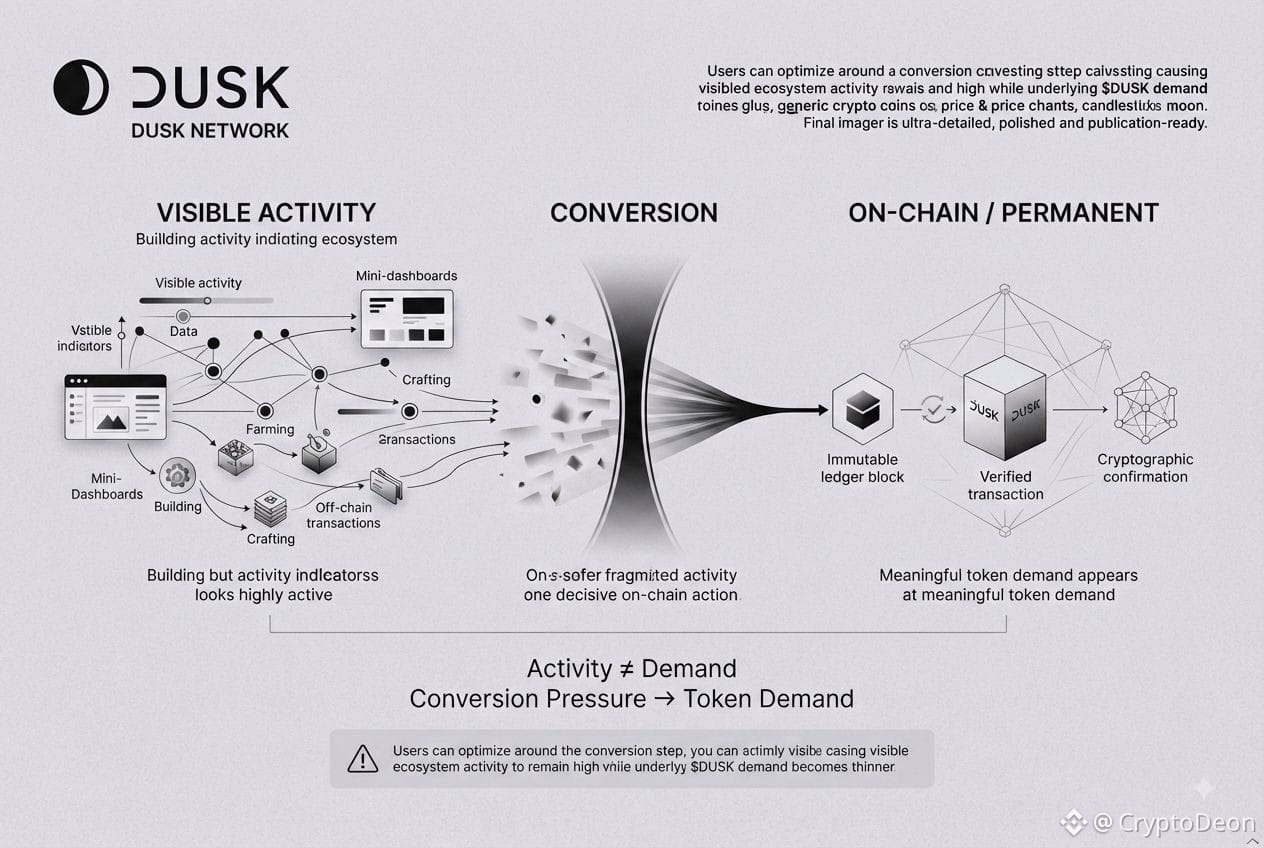
One thing about $DUSK that initially didn’t sit right with me was how easy it is to confuse visible activity with actual token demand.
A system can have users interacting, building, farming, and spending time inside the ecosystem, while the token itself barely captures that activity. That made me look more closely at where the economic pressure actually appears.
The interesting part is the conversion step.
A lot of the work can happen off-chain. Users might optimize resources, complete tasks, or accumulate what they need without creating immediate demand for $DUSK. The token becomes more relevant when that accumulated effort has to be converted into something permanent on-chain.
That distinction changes how I think about the network.
I don’t think raw activity is necessarily the strongest signal. The more useful question may be how often users reach the point where off-chain effort must become an on-chain commitment, and how much DUSK is required or consumed when that happens.
There’s also a quieter risk here.
If users become very efficient at optimizing around the conversion step, the ecosystem could remain visibly active while the underlying demand for the token gradually becomes thinner. From the outside, everything might still look healthy because participation remains high.
That’s why I’m watching conversion pressure more closely than activity counts.
For me, $DUSK increasingly looks less like a token that simply prices how busy the ecosystem is, and more like one that prices how much activity is forced to cross that final boundary into something permanent.
If conversion activity continues translating into sustained token demand rather than users optimizing around it, that’s when the thesis becomes more convincing.
$DUSK #dusk @Dusk_Foundation
One thing about $DUSK that initially didn’t sit right with me was how easy it is to confuse visible activity with actual token demand.
A system can have users interacting, building, farming, and spending time inside the ecosystem, while the token itself barely captures that activity. That made me look more closely at where the economic pressure actually appears.
The interesting part is the conversion step.
A lot of the work can happen off-chain. Users might optimize resources, complete tasks, or accumulate what they need without creating immediate demand for $DUSK . The token becomes more relevant when that accumulated effort has to be converted into something permanent on-chain.
That distinction changes how I think about the network.
I don’t think raw activity is necessarily the strongest signal. The more useful question may be how often users reach the point where off-chain effort must become an on-chain commitment, and how much DUSK is required or consumed when that happens.
There’s also a quieter risk here.
If users become very efficient at optimizing around the conversion step, the ecosystem could remain visibly active while the underlying demand for the token gradually becomes thinner. From the outside, everything might still look healthy because participation remains high.
That’s why I’m watching conversion pressure more closely than activity counts.
For me, $DUSK increasingly looks less like a token that simply prices how busy the ecosystem is, and more like one that prices how much activity is forced to cross that final boundary into something permanent.
If conversion activity continues translating into sustained token demand rather than users optimizing around it, that’s when the thesis becomes more convincing.
$DUSK #dusk @Dusk
A system can have users interacting, building, farming, and spending time inside the ecosystem, while the token itself barely captures that activity. That made me look more closely at where the economic pressure actually appears.
The interesting part is the conversion step.
A lot of the work can happen off-chain. Users might optimize resources, complete tasks, or accumulate what they need without creating immediate demand for $DUSK . The token becomes more relevant when that accumulated effort has to be converted into something permanent on-chain.
That distinction changes how I think about the network.
I don’t think raw activity is necessarily the strongest signal. The more useful question may be how often users reach the point where off-chain effort must become an on-chain commitment, and how much DUSK is required or consumed when that happens.
There’s also a quieter risk here.
If users become very efficient at optimizing around the conversion step, the ecosystem could remain visibly active while the underlying demand for the token gradually becomes thinner. From the outside, everything might still look healthy because participation remains high.
That’s why I’m watching conversion pressure more closely than activity counts.
For me, $DUSK increasingly looks less like a token that simply prices how busy the ecosystem is, and more like one that prices how much activity is forced to cross that final boundary into something permanent.
If conversion activity continues translating into sustained token demand rather than users optimizing around it, that’s when the thesis becomes more convincing.
$DUSK #dusk @Dusk
37
24
572
·
--
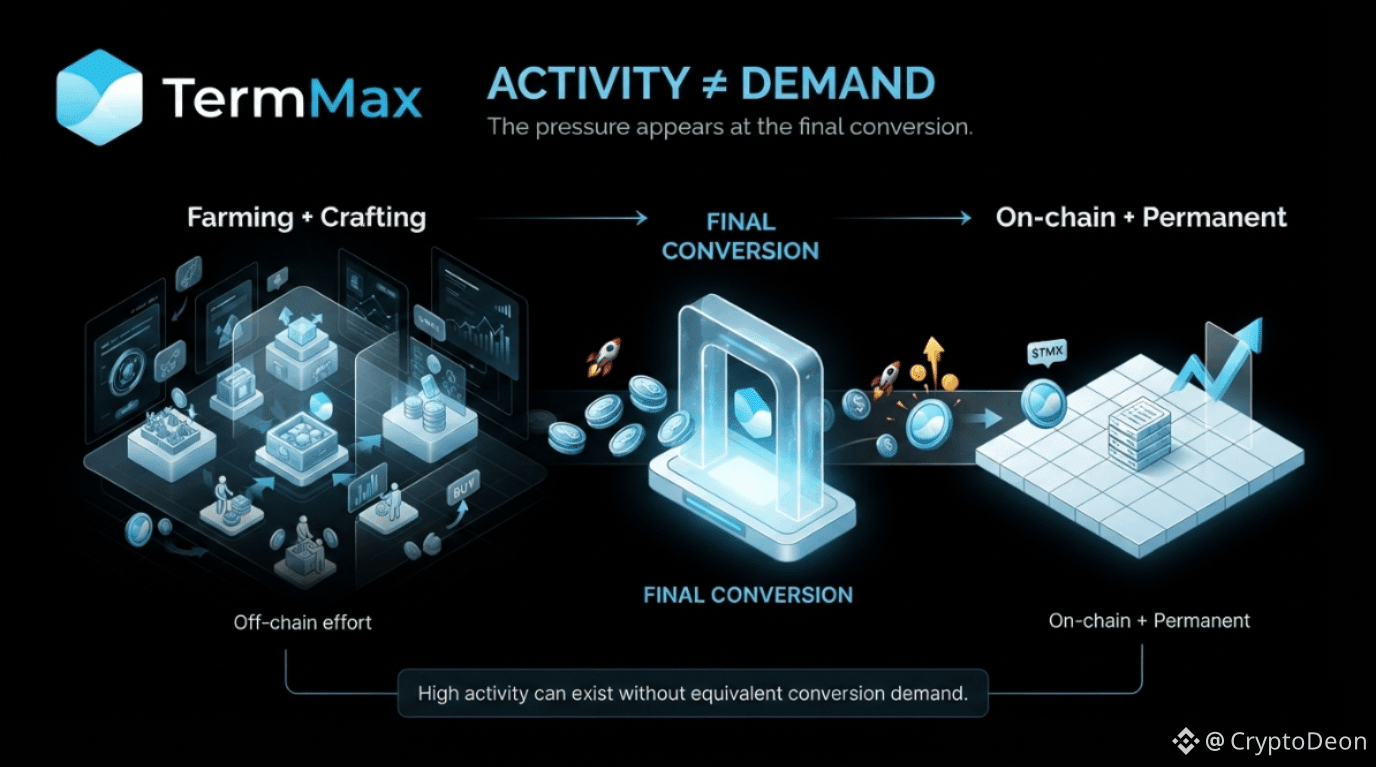
I initially found TermMax’s activity a little misleading. There can be plenty happening around farming and crafting without that necessarily creating demand for $TMX.
The part I keep coming back to is the conversion step. Most of the effort happens off-chain, while demand only becomes visible when that effort is turned into something permanent on-chain.
So I’m less interested in how active the system looks and more interested in whether users are consistently reaching that final step.
If conversion pressure keeps up with activity, the demand side looks healthier.
#termmax @termmax
I initially found TermMax’s activity a little misleading. There can be plenty happening around farming and crafting without that necessarily creating demand for $TMX.
The part I keep coming back to is the conversion step. Most of the effort happens off-chain, while demand only becomes visible when that effort is turned into something permanent on-chain.
So I’m less interested in how active the system looks and more interested in whether users are consistently reaching that final step.
If conversion pressure keeps up with activity, the demand side looks healthier.
#termmax @TermMax
The part I keep coming back to is the conversion step. Most of the effort happens off-chain, while demand only becomes visible when that effort is turned into something permanent on-chain.
So I’m less interested in how active the system looks and more interested in whether users are consistently reaching that final step.
If conversion pressure keeps up with activity, the demand side looks healthier.
#termmax @TermMax
13
10
135
·
--
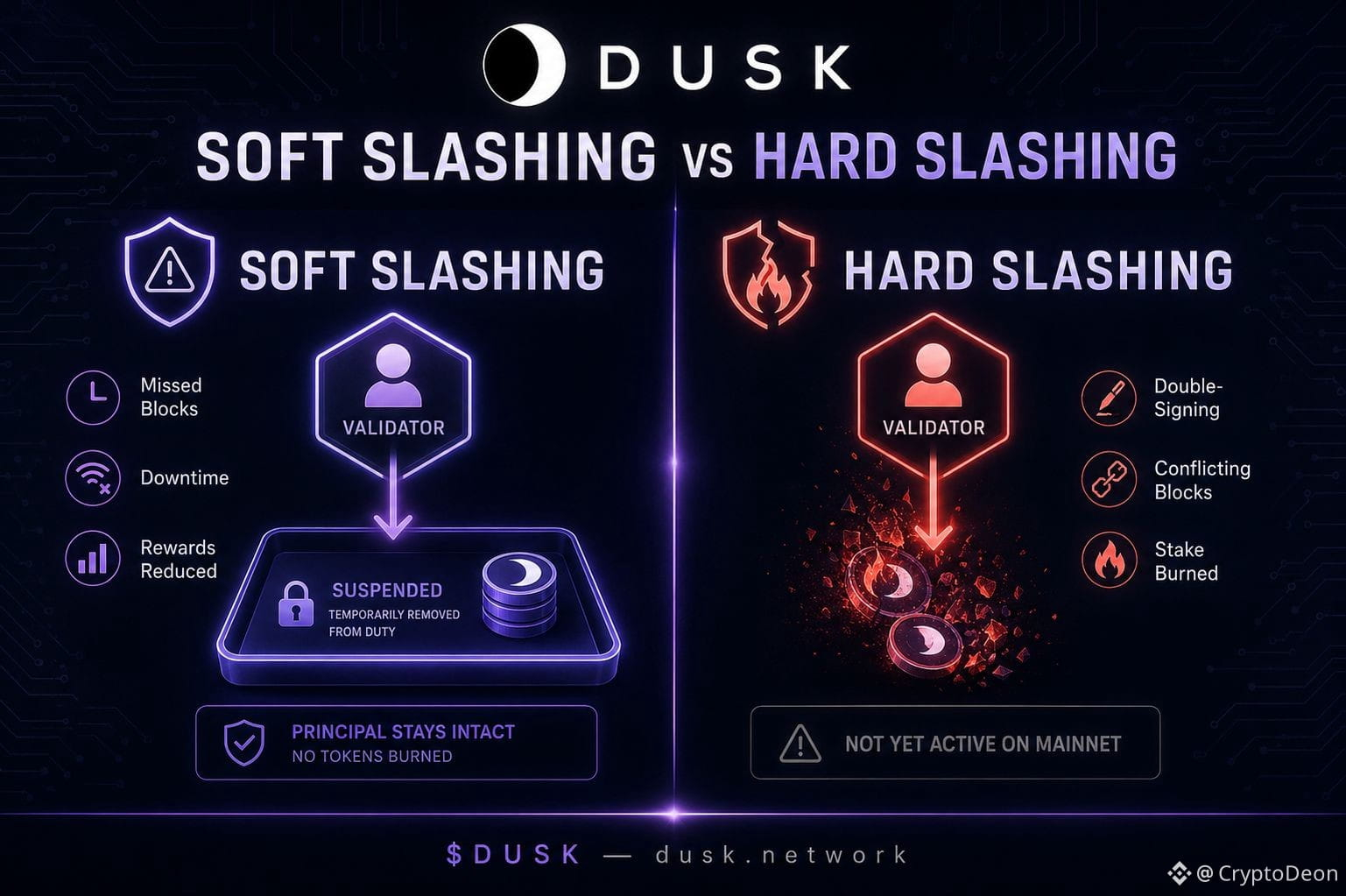
Noticed something odd reading through Dusk's slashing docs — most PoS chains treat "went offline" and "tried to attack the network" as different degrees of the same crime, both punished by burning your stake. Dusk splits them into two entirely different systems, and only one of them actually takes your money
If your node misses a block or goes down, that's soft slashing — nothing gets burned. Your stake just gets a warning, then gets temporarily suspended from selection, or a portion gets shifted into your claimable rewards pool so it stops counting toward your odds of being picked. Annoying, costs you yield, but you keep your principal. Hard slashing only kicks in for actual malicious behavior — proven double-signing, conflicting block headers, the kind of thing that can't happen by accident. That's the one that burns tokens, and on Dusk's live mainnet, it's currently not even active — the network is running on soft slashing alone.
The easy way to think about it: most chains punish you the same whether your internet went out or you tried to cheat. Dusk built two separate categories on purpose, because "unreliable" and "malicious" are different problems and lumping them together just discourages honest people from running nodes at all.
DUSK is sitting around $0.0605 today, market cap near $30M, deep off its all-time high — a reminder that mechanism design like this doesn't move price on its own, it just quietly determines who's willing to stick around and validate the chain long-term.
Dusk if hard slashing does eventually activate on mainnet, does that make soft slashing look more like a grace period than a permanent policy?
$DUSK #dusk @Dusk_Foundation
Noticed something odd reading through Dusk's slashing docs — most PoS chains treat "went offline" and "tried to attack the network" as different degrees of the same crime, both punished by burning your stake. Dusk splits them into two entirely different systems, and only one of them actually takes your money
If your node misses a block or goes down, that's soft slashing — nothing gets burned. Your stake just gets a warning, then gets temporarily suspended from selection, or a portion gets shifted into your claimable rewards pool so it stops counting toward your odds of being picked. Annoying, costs you yield, but you keep your principal. Hard slashing only kicks in for actual malicious behavior — proven double-signing, conflicting block headers, the kind of thing that can't happen by accident. That's the one that burns tokens, and on Dusk's live mainnet, it's currently not even active — the network is running on soft slashing alone.
The easy way to think about it: most chains punish you the same whether your internet went out or you tried to cheat. Dusk built two separate categories on purpose, because "unreliable" and "malicious" are different problems and lumping them together just discourages honest people from running nodes at all.
DUSK is sitting around $0.0605 today, market cap near $30M, deep off its all-time high — a reminder that mechanism design like this doesn't move price on its own, it just quietly determines who's willing to stick around and validate the chain long-term.
Dusk if hard slashing does eventually activate on mainnet, does that make soft slashing look more like a grace period than a permanent policy?
$DUSK #dusk @Dusk
If your node misses a block or goes down, that's soft slashing — nothing gets burned. Your stake just gets a warning, then gets temporarily suspended from selection, or a portion gets shifted into your claimable rewards pool so it stops counting toward your odds of being picked. Annoying, costs you yield, but you keep your principal. Hard slashing only kicks in for actual malicious behavior — proven double-signing, conflicting block headers, the kind of thing that can't happen by accident. That's the one that burns tokens, and on Dusk's live mainnet, it's currently not even active — the network is running on soft slashing alone.
The easy way to think about it: most chains punish you the same whether your internet went out or you tried to cheat. Dusk built two separate categories on purpose, because "unreliable" and "malicious" are different problems and lumping them together just discourages honest people from running nodes at all.
DUSK is sitting around $0.0605 today, market cap near $30M, deep off its all-time high — a reminder that mechanism design like this doesn't move price on its own, it just quietly determines who's willing to stick around and validate the chain long-term.
Dusk if hard slashing does eventually activate on mainnet, does that make soft slashing look more like a grace period than a permanent policy?
$DUSK #dusk @Dusk
54
35
211
·
--
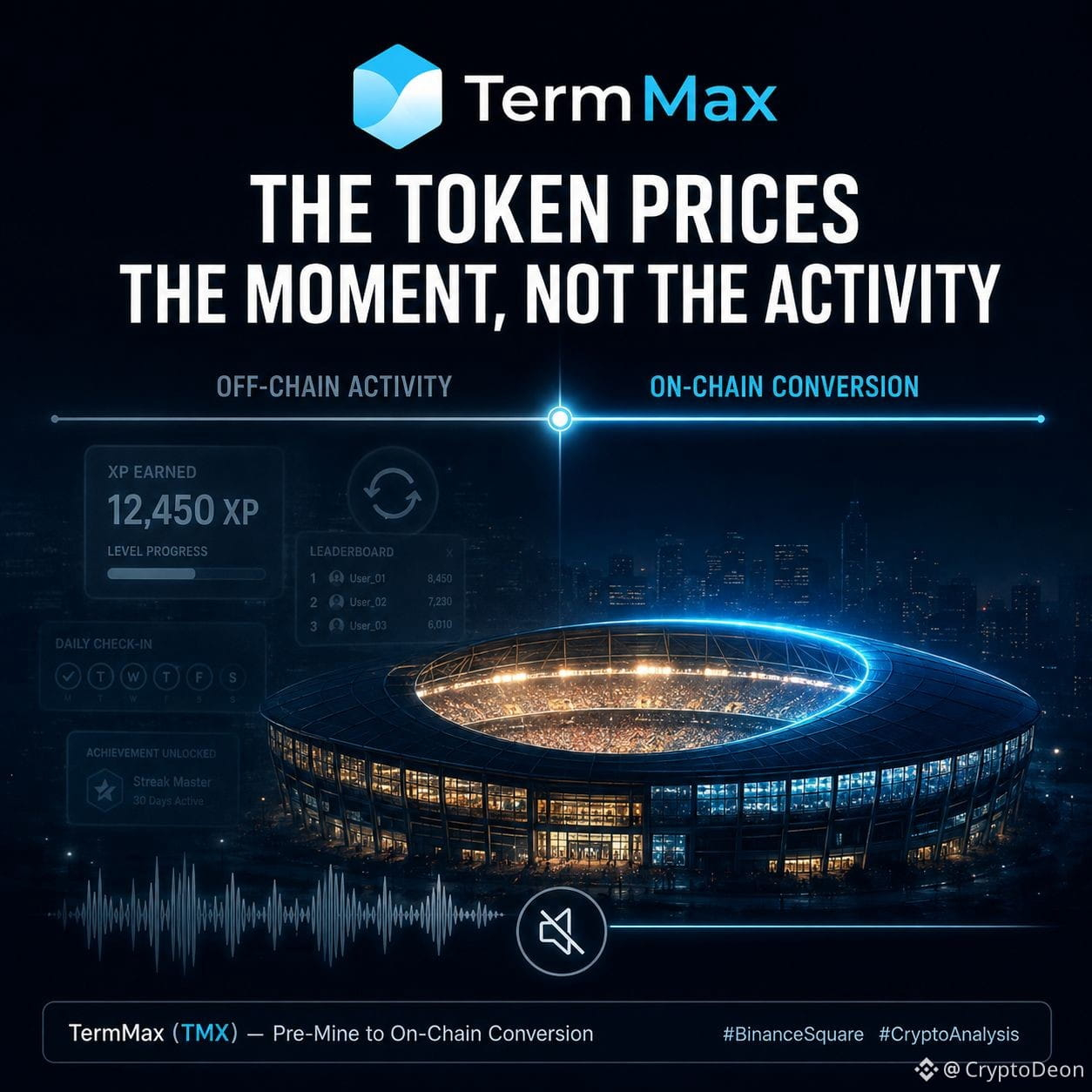
Been sitting with TermMax's pre-mine mechanics for a while and something didn't add up. Everyone's XP is climbing, dashboards are green, activity charts look busy — but the on-chain footprint doesn't match the noise. It felt like watching a full arena from outside and hearing no crowd.
Then it clicked. TMX isn't pricing the activity itself. The farming, the looping, the XP accumulation — all of that happens off-chain, inside a points system that isn't the token. The token only gets touched at one moment: when accumulated effort converts into something permanent on-chain, at claim, at TGE, at the exact instant a position becomes real supply. Everything before that is rehearsal. The token prices the rehearsal ending.
That's a fragile thing to price. If enough participants figure out how to sit right at the edge of conversion without crossing it — parking in a state that looks active but never resolves into an on-chain event — demand for the token quietly hollows out while every dashboard still says the game is alive.
Worth watching whether TermMax's future campaigns reward the conversion moment itself, or just reward getting close to it.
#termmax @termmax
Been sitting with TermMax's pre-mine mechanics for a while and something didn't add up. Everyone's XP is climbing, dashboards are green, activity charts look busy — but the on-chain footprint doesn't match the noise. It felt like watching a full arena from outside and hearing no crowd.
Then it clicked. TMX isn't pricing the activity itself. The farming, the looping, the XP accumulation — all of that happens off-chain, inside a points system that isn't the token. The token only gets touched at one moment: when accumulated effort converts into something permanent on-chain, at claim, at TGE, at the exact instant a position becomes real supply. Everything before that is rehearsal. The token prices the rehearsal ending.
That's a fragile thing to price. If enough participants figure out how to sit right at the edge of conversion without crossing it — parking in a state that looks active but never resolves into an on-chain event — demand for the token quietly hollows out while every dashboard still says the game is alive.
Worth watching whether TermMax's future campaigns reward the conversion moment itself, or just reward getting close to it.
#termmax @TermMax
Then it clicked. TMX isn't pricing the activity itself. The farming, the looping, the XP accumulation — all of that happens off-chain, inside a points system that isn't the token. The token only gets touched at one moment: when accumulated effort converts into something permanent on-chain, at claim, at TGE, at the exact instant a position becomes real supply. Everything before that is rehearsal. The token prices the rehearsal ending.
That's a fragile thing to price. If enough participants figure out how to sit right at the edge of conversion without crossing it — parking in a state that looks active but never resolves into an on-chain event — demand for the token quietly hollows out while every dashboard still says the game is alive.
Worth watching whether TermMax's future campaigns reward the conversion moment itself, or just reward getting close to it.
#termmax @TermMax
20
23
198
·
--
Расталды
Been thinking about why "instant" and "final" get treated as the same word in crypto, when they're not. Most PoS chains give you fast blocks, but the finality underneath is still probabilistic — technically reversible until enough time passes and a reorg becomes statistically unlikely. Dusk's consensus, Succinct Attestation, doesn't work that way. Once a committee of provisioners attests to a block, it's final. Not "final in practice." Final, full stop, no reorg window sitting quietly underneath 🔍
Here's why that distinction actually matters and isn't just technical trivia. If you're settling a tokenized bond or a private equity trade, "probably final" isn't a good enough answer for a regulator or a custodian. Traditional finance runs on settlement finality — the moment a trade is done, it's done, no unwind risk. Most blockchains can't promise that in the same legal sense, because their security model is built on economic disincentive, not cryptographic certainty. Dusk's committees are selected through stake-weighted sortition and finalize blocks via aggregated signatures — small groups agreeing explicitly, rather than the whole network converging over time. That's the difference between a chain that's "usually right" and one that's structurally incapable of a rollback once ratified.
It's a quiet design choice, but it explains a lot about who Dusk is actually building for. Retail chains optimize for speed and cost. Dusk optimized for the one property regulated settlement infrastructure can't compromise on.
DUSK is trading near $0.075 today, market cap around $30M, still roughly 95% off its 2021 all-time high — a token whose price reflects retail sentiment far more than it reflects what's actually shipped at the settlement layer.
DuskFoundation does deterministic finality actually move the needle for institutions evaluating custody risk, or is it table stakes they assume any serious chain already has?
$DUSK #dusk @Dusk_Foundation
Been thinking about why "instant" and "final" get treated as the same word in crypto, when they're not. Most PoS chains give you fast blocks, but the finality underneath is still probabilistic — technically reversible until enough time passes and a reorg becomes statistically unlikely. Dusk's consensus, Succinct Attestation, doesn't work that way. Once a committee of provisioners attests to a block, it's final. Not "final in practice." Final, full stop, no reorg window sitting quietly underneath 🔍
Here's why that distinction actually matters and isn't just technical trivia. If you're settling a tokenized bond or a private equity trade, "probably final" isn't a good enough answer for a regulator or a custodian. Traditional finance runs on settlement finality — the moment a trade is done, it's done, no unwind risk. Most blockchains can't promise that in the same legal sense, because their security model is built on economic disincentive, not cryptographic certainty. Dusk's committees are selected through stake-weighted sortition and finalize blocks via aggregated signatures — small groups agreeing explicitly, rather than the whole network converging over time. That's the difference between a chain that's "usually right" and one that's structurally incapable of a rollback once ratified.
It's a quiet design choice, but it explains a lot about who Dusk is actually building for. Retail chains optimize for speed and cost. Dusk optimized for the one property regulated settlement infrastructure can't compromise on.
DUSK is trading near $0.075 today, market cap around $30M, still roughly 95% off its 2021 all-time high — a token whose price reflects retail sentiment far more than it reflects what's actually shipped at the settlement layer.
DuskFoundation does deterministic finality actually move the needle for institutions evaluating custody risk, or is it table stakes they assume any serious chain already has?
$DUSK #dusk @Dusk
Here's why that distinction actually matters and isn't just technical trivia. If you're settling a tokenized bond or a private equity trade, "probably final" isn't a good enough answer for a regulator or a custodian. Traditional finance runs on settlement finality — the moment a trade is done, it's done, no unwind risk. Most blockchains can't promise that in the same legal sense, because their security model is built on economic disincentive, not cryptographic certainty. Dusk's committees are selected through stake-weighted sortition and finalize blocks via aggregated signatures — small groups agreeing explicitly, rather than the whole network converging over time. That's the difference between a chain that's "usually right" and one that's structurally incapable of a rollback once ratified.
It's a quiet design choice, but it explains a lot about who Dusk is actually building for. Retail chains optimize for speed and cost. Dusk optimized for the one property regulated settlement infrastructure can't compromise on.
DUSK is trading near $0.075 today, market cap around $30M, still roughly 95% off its 2021 all-time high — a token whose price reflects retail sentiment far more than it reflects what's actually shipped at the settlement layer.
DuskFoundation does deterministic finality actually move the needle for institutions evaluating custody risk, or is it table stakes they assume any serious chain already has?
$DUSK #dusk @Dusk
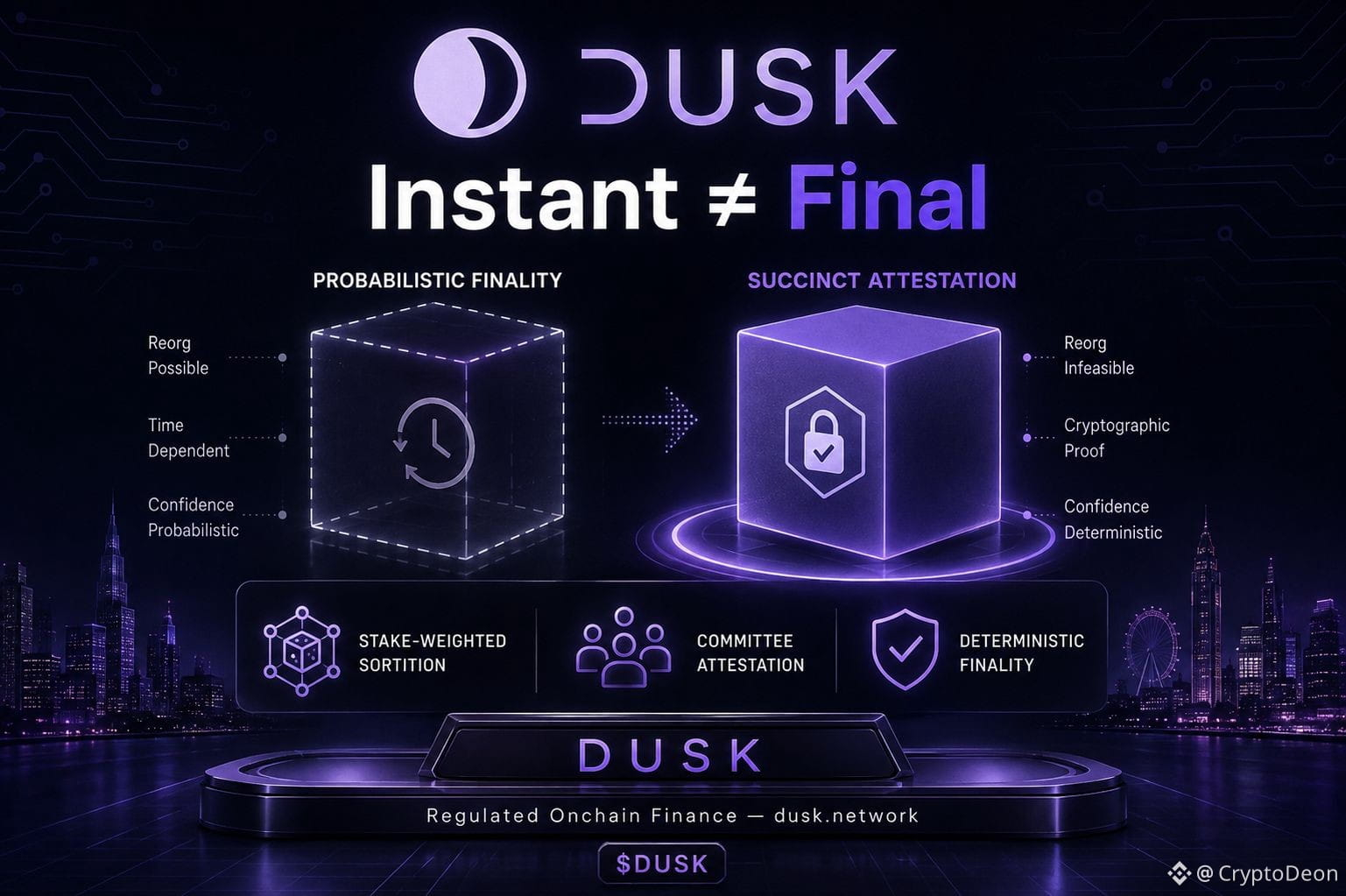
37
26
186
·
--
Saw a headline a while back — "Dusk bridge exploit, millions stolen" — and it felt wrong, in a specific way. Not because it wasn't real, but because the same day, the core protocol kept settling without a hitch. Attackers didn't touch the chain. They took a shortcut through a lightweight bridge with a compromised signing wallet 🔍
That distinction matters more than it sounds. Most people lump every hack into one bucket: "the project got hacked." But there's a real difference between a chain's consensus and cryptography failing, versus a peripheral service around it failing. Dusk's response backs this up — instead of patching the bridge, they rebuilt it from scratch: isolated components, explicit transaction lifecycles, less exposure sitting in hot wallets. That's not the move you make when the core is compromised. It's the move you make when the core held and you're removing the one weak door.
Here's why this matters for the bigger thesis. Institutions don't ask "did anything bad ever happen." They ask "where exactly did it happen, and was it structural." A settlement layer that keeps its zero-knowledge proof system and consensus intact through an exploit is a different risk profile than one where the base layer itself got exploited — even though the headline reads the same to retail.
DUSK is trading around $0.0605 today, market cap near $30M, still deep below its $1.17 all-time high, and volume sits thin enough that news like this barely moves the tape either direction. Which is its own signal — the market isn't pricing this as a core failure, but it's also not pricing in much confidence yet either.
Where do you land — does isolating the exploit to the bridge actually rebuild trust with institutions, or does one incident set a ceiling regardless of where the fault line was?
$DUSK #dusk @Dusk_Foundation
Saw a headline a while back — "Dusk bridge exploit, millions stolen" — and it felt wrong, in a specific way. Not because it wasn't real, but because the same day, the core protocol kept settling without a hitch. Attackers didn't touch the chain. They took a shortcut through a lightweight bridge with a compromised signing wallet 🔍
That distinction matters more than it sounds. Most people lump every hack into one bucket: "the project got hacked." But there's a real difference between a chain's consensus and cryptography failing, versus a peripheral service around it failing. Dusk's response backs this up — instead of patching the bridge, they rebuilt it from scratch: isolated components, explicit transaction lifecycles, less exposure sitting in hot wallets. That's not the move you make when the core is compromised. It's the move you make when the core held and you're removing the one weak door.
Here's why this matters for the bigger thesis. Institutions don't ask "did anything bad ever happen." They ask "where exactly did it happen, and was it structural." A settlement layer that keeps its zero-knowledge proof system and consensus intact through an exploit is a different risk profile than one where the base layer itself got exploited — even though the headline reads the same to retail.
DUSK is trading around $0.0605 today, market cap near $30M, still deep below its $1.17 all-time high, and volume sits thin enough that news like this barely moves the tape either direction. Which is its own signal — the market isn't pricing this as a core failure, but it's also not pricing in much confidence yet either.
Where do you land — does isolating the exploit to the bridge actually rebuild trust with institutions, or does one incident set a ceiling regardless of where the fault line was?
$DUSK #dusk @Dusk
That distinction matters more than it sounds. Most people lump every hack into one bucket: "the project got hacked." But there's a real difference between a chain's consensus and cryptography failing, versus a peripheral service around it failing. Dusk's response backs this up — instead of patching the bridge, they rebuilt it from scratch: isolated components, explicit transaction lifecycles, less exposure sitting in hot wallets. That's not the move you make when the core is compromised. It's the move you make when the core held and you're removing the one weak door.
Here's why this matters for the bigger thesis. Institutions don't ask "did anything bad ever happen." They ask "where exactly did it happen, and was it structural." A settlement layer that keeps its zero-knowledge proof system and consensus intact through an exploit is a different risk profile than one where the base layer itself got exploited — even though the headline reads the same to retail.
DUSK is trading around $0.0605 today, market cap near $30M, still deep below its $1.17 all-time high, and volume sits thin enough that news like this barely moves the tape either direction. Which is its own signal — the market isn't pricing this as a core failure, but it's also not pricing in much confidence yet either.
Where do you land — does isolating the exploit to the bridge actually rebuild trust with institutions, or does one incident set a ceiling regardless of where the fault line was?
$DUSK #dusk @Dusk
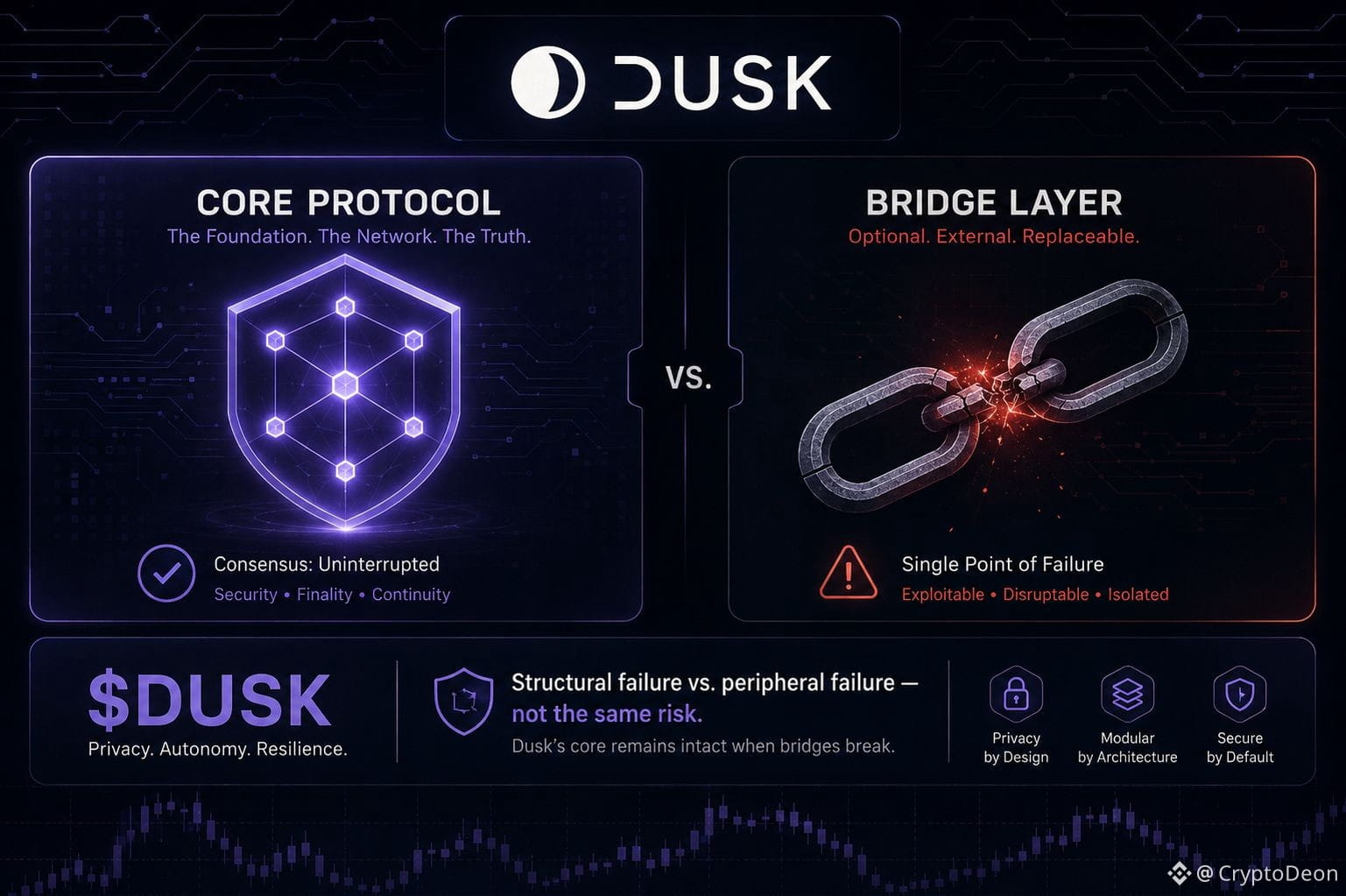
38
26
382
·
--
Расталды
Been staring at the DUSK chart today wondering why a "regulated RWA infrastructure" narrative trades at $0.0605 with a $30M market cap while the ATH sits at $1.17. Then I looked at what's actually been built underneath and realized the price and the roadmap are telling two different stories 🧐
Here's the part most people skip: Dusk isn't trying to be a privacy coin that hides everything, or a public chain that hides nothing. It's building the settlement layer for regulated finance — think tokenized securities, private equity, institutional custody — where privacy and auditability have to coexist by law, not by choice. That's why the partnership stack looks the way it does: NPEX (a Dutch regulated exchange) for issuing real securities on-chain, Quantoz for a MiCA-compliant euro stablecoin (EURQ), and DuskEVM bringing Solidity compatibility so builders don't have to learn a new stack to deploy compliant contracts.
The catch is timing. Circulating supply is under half of the 1B max, meaning long-term dilution is still ahead. Daily volume is sitting around $3.2M against that $30M cap — thin enough that RWA adoption headlines don't move price much yet, because institutional settlement volume isn't retail-visible the way DEX activity is. The infrastructure can be getting genuinely more "used" by regulated entities while the token keeps drifting sideways, because that usage doesn't show up in the same charts retail traders are watching.
So the real question isn't whether Dusk is building something real. It's whether "regulated RWA rails" ever produces a demand signal retail can actually see before the next unlock cycle tests the float.
Curious where you land — does infrastructure like this need visible retail volume to matter, or is institutional adoption a different kind of proof entirely?
$DUSK #dusk @Dusk_Foundation
Been staring at the DUSK chart today wondering why a "regulated RWA infrastructure" narrative trades at $0.0605 with a $30M market cap while the ATH sits at $1.17. Then I looked at what's actually been built underneath and realized the price and the roadmap are telling two different stories 🧐
Here's the part most people skip: Dusk isn't trying to be a privacy coin that hides everything, or a public chain that hides nothing. It's building the settlement layer for regulated finance — think tokenized securities, private equity, institutional custody — where privacy and auditability have to coexist by law, not by choice. That's why the partnership stack looks the way it does: NPEX (a Dutch regulated exchange) for issuing real securities on-chain, Quantoz for a MiCA-compliant euro stablecoin (EURQ), and DuskEVM bringing Solidity compatibility so builders don't have to learn a new stack to deploy compliant contracts.
The catch is timing. Circulating supply is under half of the 1B max, meaning long-term dilution is still ahead. Daily volume is sitting around $3.2M against that $30M cap — thin enough that RWA adoption headlines don't move price much yet, because institutional settlement volume isn't retail-visible the way DEX activity is. The infrastructure can be getting genuinely more "used" by regulated entities while the token keeps drifting sideways, because that usage doesn't show up in the same charts retail traders are watching.
So the real question isn't whether Dusk is building something real. It's whether "regulated RWA rails" ever produces a demand signal retail can actually see before the next unlock cycle tests the float.
Curious where you land — does infrastructure like this need visible retail volume to matter, or is institutional adoption a different kind of proof entirely?
$DUSK #dusk @Dusk
Here's the part most people skip: Dusk isn't trying to be a privacy coin that hides everything, or a public chain that hides nothing. It's building the settlement layer for regulated finance — think tokenized securities, private equity, institutional custody — where privacy and auditability have to coexist by law, not by choice. That's why the partnership stack looks the way it does: NPEX (a Dutch regulated exchange) for issuing real securities on-chain, Quantoz for a MiCA-compliant euro stablecoin (EURQ), and DuskEVM bringing Solidity compatibility so builders don't have to learn a new stack to deploy compliant contracts.
The catch is timing. Circulating supply is under half of the 1B max, meaning long-term dilution is still ahead. Daily volume is sitting around $3.2M against that $30M cap — thin enough that RWA adoption headlines don't move price much yet, because institutional settlement volume isn't retail-visible the way DEX activity is. The infrastructure can be getting genuinely more "used" by regulated entities while the token keeps drifting sideways, because that usage doesn't show up in the same charts retail traders are watching.
So the real question isn't whether Dusk is building something real. It's whether "regulated RWA rails" ever produces a demand signal retail can actually see before the next unlock cycle tests the float.
Curious where you land — does infrastructure like this need visible retail volume to matter, or is institutional adoption a different kind of proof entirely?
$DUSK #dusk @Dusk
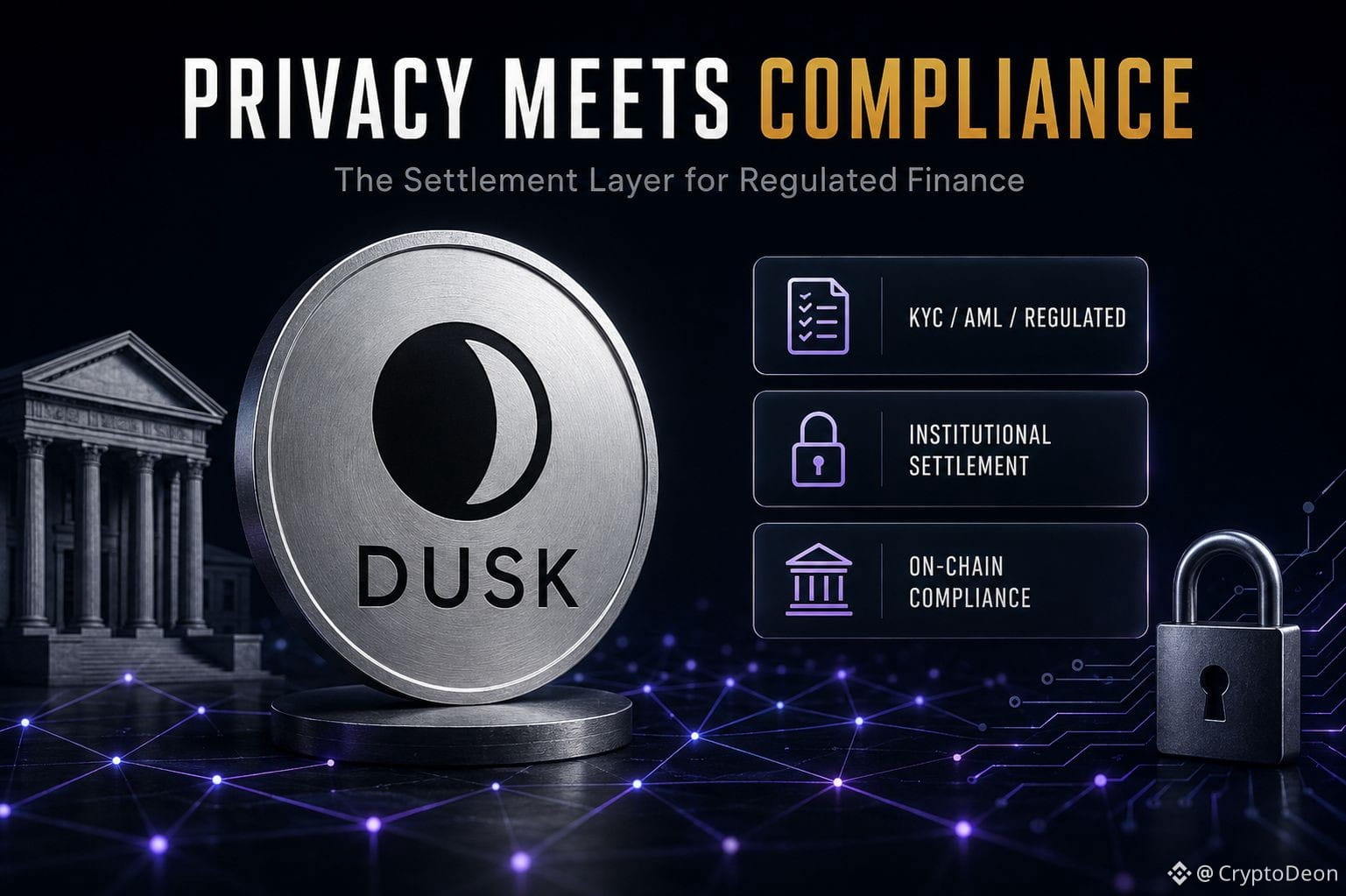
55
39
312
·
--
I checked a live game with $DUSK — screenshots looked packed, mint counters climbing, "activity" charts green across the board. Token barely moved. Took me a while to see why that isn't a contradiction.
Most of what players actually do never touches the chain. Farming, crafting, grinding — all of it happens off to the side, invisible to DUSK. The token only shows up at one narrow point: the moment someone decides an off-chain result is worth making permanent and on-chain. That's not a measure of how alive the game feels. It's a measure of how many people, at that specific moment, decided the conversion was worth paying for.
Which means a game can stay visually busy while quietly training its players to avoid that step — batching conversions, timing them around fees, skipping ones that aren't worth it. Activity holds. Conversion pressure erodes. And because $DUSK only prices the second thing, the token can drift for weeks before anyone notices the first thing was misleading them.
If conversion frequency per active player starts slipping while the activity charts stay green, that's the gap worth trusting over the dashboard.
$DUSK #dusk #BinanceSquare @Dusk_Foundation
I checked a live game with $DUSK — screenshots looked packed, mint counters climbing, "activity" charts green across the board. Token barely moved. Took me a while to see why that isn't a contradiction.
Most of what players actually do never touches the chain. Farming, crafting, grinding — all of it happens off to the side, invisible to DUSK. The token only shows up at one narrow point: the moment someone decides an off-chain result is worth making permanent and on-chain. That's not a measure of how alive the game feels. It's a measure of how many people, at that specific moment, decided the conversion was worth paying for.
Which means a game can stay visually busy while quietly training its players to avoid that step — batching conversions, timing them around fees, skipping ones that aren't worth it. Activity holds. Conversion pressure erodes. And because $DUSK only prices the second thing, the token can drift for weeks before anyone notices the first thing was misleading them.
If conversion frequency per active player starts slipping while the activity charts stay green, that's the gap worth trusting over the dashboard.
$DUSK #dusk #BinanceSquare @Dusk
Most of what players actually do never touches the chain. Farming, crafting, grinding — all of it happens off to the side, invisible to DUSK. The token only shows up at one narrow point: the moment someone decides an off-chain result is worth making permanent and on-chain. That's not a measure of how alive the game feels. It's a measure of how many people, at that specific moment, decided the conversion was worth paying for.
Which means a game can stay visually busy while quietly training its players to avoid that step — batching conversions, timing them around fees, skipping ones that aren't worth it. Activity holds. Conversion pressure erodes. And because $DUSK only prices the second thing, the token can drift for weeks before anyone notices the first thing was misleading them.
If conversion frequency per active player starts slipping while the activity charts stay green, that's the gap worth trusting over the dashboard.
$DUSK #dusk #BinanceSquare @Dusk
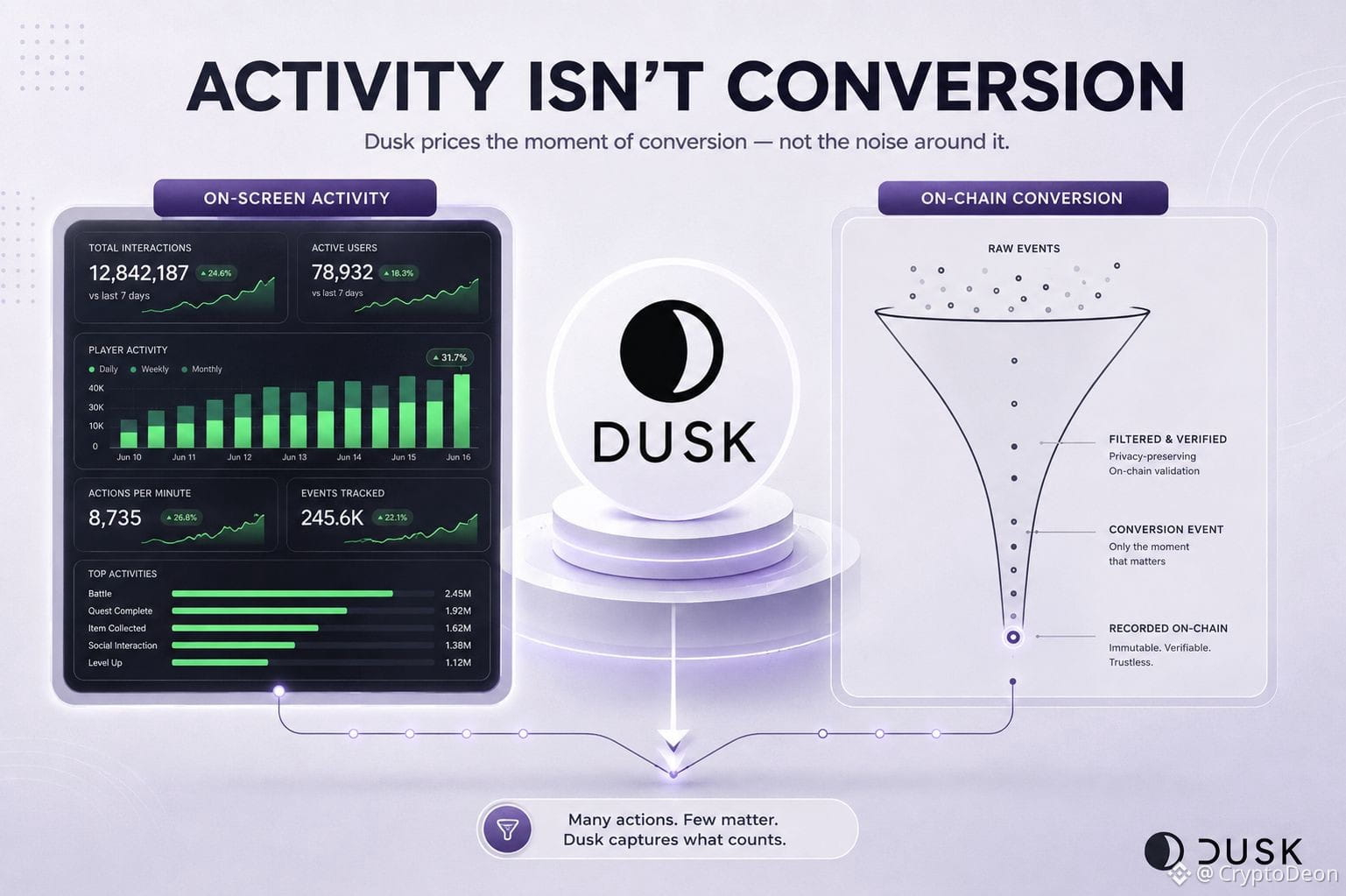
60
41
542
·
--
I kept thinking about Babylon's current governance discussion from the wrong direction.
The obvious debate is whether BSN rewards should be distributed to BABY stakers or converted through an on-chain auction and burned.
That matters.
But I think the more interesting question is what kind of expectations a protocol creates once people become accustomed to a reward flow.
A reward isn't just an economic transfer.
Over time, it becomes part of user behavior.
If participants expect every new source of value to arrive as a direct distribution, future governance decisions become increasingly difficult because changing that expectation starts looking like taking something away.
On the other hand, routing value through a burn mechanism doesn't reward participants immediately. Instead, it changes the token's long-term supply dynamics. That can benefit the network differently, but it also asks users to think beyond the next distribution.
Neither approach is obviously correct.
One prioritizes visible incentives.
The other prioritizes structural incentives.
That's why I don't think this proposal is really about BSN rewards.
It's about deciding whether Babylon wants its governance to optimize for participant expectations... or for long-term economic behavior.
Those are not always the same thing.
#baby $BABY @babylonlabs_io
I kept thinking about Babylon's current governance discussion from the wrong direction.
The obvious debate is whether BSN rewards should be distributed to BABY stakers or converted through an on-chain auction and burned.
That matters.
But I think the more interesting question is what kind of expectations a protocol creates once people become accustomed to a reward flow.
A reward isn't just an economic transfer.
Over time, it becomes part of user behavior.
If participants expect every new source of value to arrive as a direct distribution, future governance decisions become increasingly difficult because changing that expectation starts looking like taking something away.
On the other hand, routing value through a burn mechanism doesn't reward participants immediately. Instead, it changes the token's long-term supply dynamics. That can benefit the network differently, but it also asks users to think beyond the next distribution.
Neither approach is obviously correct.
One prioritizes visible incentives.
The other prioritizes structural incentives.
That's why I don't think this proposal is really about BSN rewards.
It's about deciding whether Babylon wants its governance to optimize for participant expectations... or for long-term economic behavior.
Those are not always the same thing.
#baby $BABY @BabylonLabs_io
The obvious debate is whether BSN rewards should be distributed to BABY stakers or converted through an on-chain auction and burned.
That matters.
But I think the more interesting question is what kind of expectations a protocol creates once people become accustomed to a reward flow.
A reward isn't just an economic transfer.
Over time, it becomes part of user behavior.
If participants expect every new source of value to arrive as a direct distribution, future governance decisions become increasingly difficult because changing that expectation starts looking like taking something away.
On the other hand, routing value through a burn mechanism doesn't reward participants immediately. Instead, it changes the token's long-term supply dynamics. That can benefit the network differently, but it also asks users to think beyond the next distribution.
Neither approach is obviously correct.
One prioritizes visible incentives.
The other prioritizes structural incentives.
That's why I don't think this proposal is really about BSN rewards.
It's about deciding whether Babylon wants its governance to optimize for participant expectations... or for long-term economic behavior.
Those are not always the same thing.
#baby $BABY @BabylonLabs_io
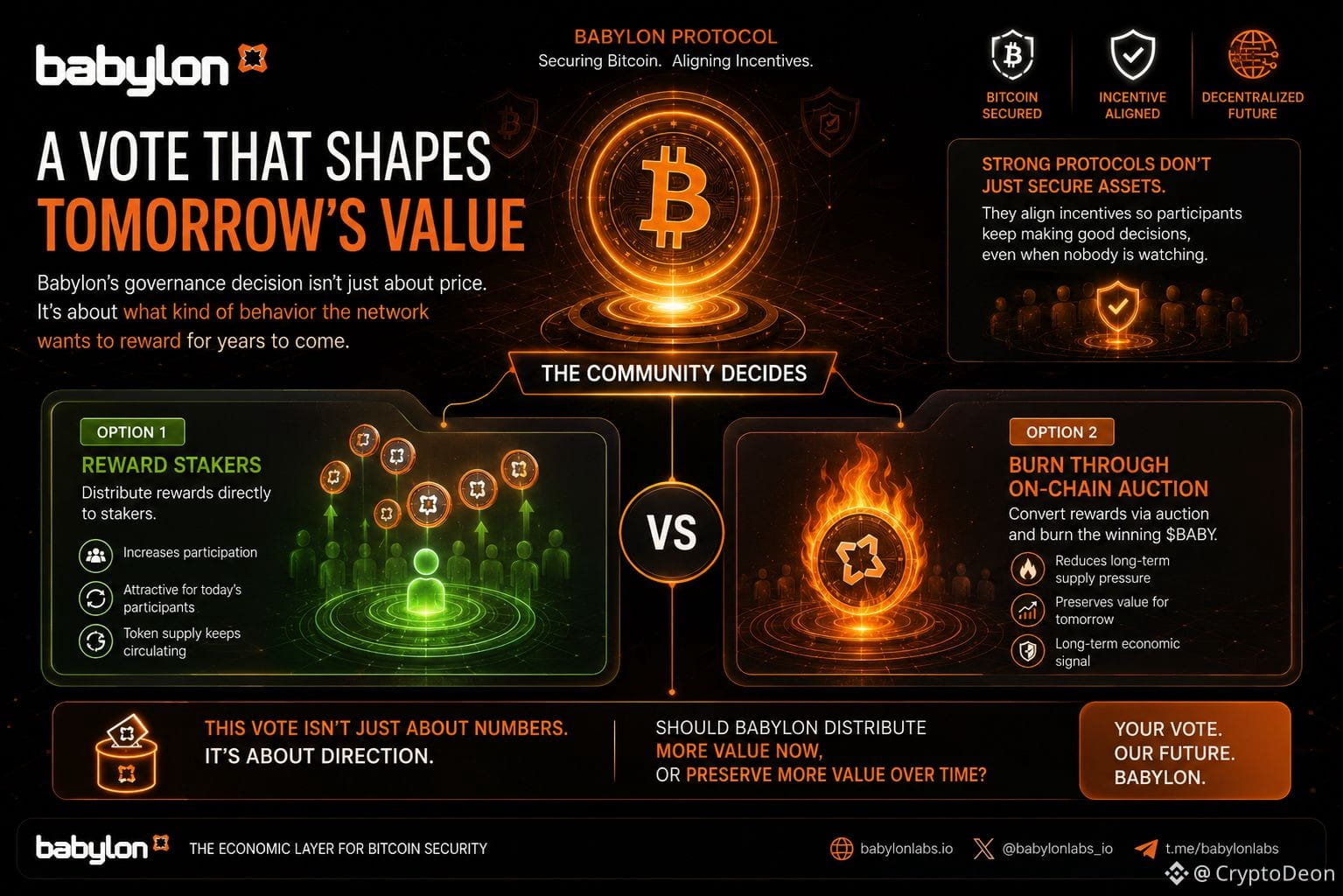
51
36
589
Көбірек контент көру үшін кіріңіз
Binance Square платформасында әлемдік криптоқоғамдастыққа қосылыңыз
⚡️ Криптовалюта туралы ең соңғы және пайдалы ақпаратты алыңыз.
💬 Әлемдегі ең ірі криптобиржаның сеніміне ие.
👍 Расталған авторлардың нақты пікірлерін табыңыз.
Электрондық пошта/телефон нөмірі
Трендтегі тақырыптар
AppleDebutsFoldablePhone
3,206 рет көрілді
103 адам талқылап жатыр
$BTC
苹果发了个折叠屏
果粉在算分期
老韭菜在算要几个BTC
兄弟们
苹果终于憋出来了
首款可折叠手机
iPhone Duo
国行15999起
顶配直接干到26499
我他妈看完价格
第一反应不是贵
是赶紧打开交易所算了一下
按照现在的币价
这台手机约等于0.025个BTC
0.025个BTC
听起来不多对吧
但你去翻翻历史
当年iPhone 4s发布的时候
价格折算下来是162个BTC
iPhone 6是1.7个BTC
iPhone 13是0.018个BTC
iPhone 17是0.007个BTC
看懂这个趋势了吗
不是你手里的钱变多了
是比特币在替你稀释苹果的定价
有意思的是发布会当场
苹果股价坐过山车
开盘先砸
后面又拉回
收盘小幅收跌
市场对这款高价折叠机能不能大卖
分歧不小😂😂
但兄弟们
别看到苹果发新机就脑补科技牛来了
大饼要跟涨
苹果跟币圈没有直接资金通道
它卖再多手机
也不会有一分钱自动流进加密市场
这只是消费端硬件利好
不是直接能推高大饼的大逻辑
大饼的定价主线依旧是美联储降息、美债收益率
苹果新品属于产业小热点
只能短期带动板块情绪
改变不了大盘大趋势
如果你本来就打算换手机
又恰好手里有0.025个BTC的闲钱
你会买吗?
#appledebutsfoldablephone
孔大锤
·0 лайк
·162 рет көрілді
US10YTreasuryYieldHitsHighestSinceNov2023
7,165 рет көрілді
153 адам талқылап жатыр
USTreasuryToBuyBackUpTo$6BLongDatedDebt
9,336 рет көрілді
129 адам талқылап жатыр