
KernelDAO
281 Жариялаулар

KernelDAO
 «Square расталған+» белгісі
Earn rewards via restaking ETH, BTC, BNB on the largest shared security infra “Kernel”, top Liquid restaking
2 Жазылым
2.4K+ Жазылушылар
22.4K+ лайк басылған
Жазбалар
Барлығы
Баға ұсыныстары
Видеолар
Тікелей эфир
PINNED
Big news!
Kerneldao X World liberty finance partnership brings USD1 to Kernel as a restakeable asset!
This is the first time USD1 can be used to provide economic security to third-party applications.
How it works:
- Restake your USD1 on Kernel
- Your USD1 provides economic security to applications
- Earn Kernel points as rewards
Unlock a new dimension of utility for your stablecoin!
Ready to put your USD1 to work?
Start restaking on Kernel today and join the future of stablecoin productivity
https://kerneldao.com/restake/USD1/
Kerneldao X World liberty finance partnership brings USD1 to Kernel as a restakeable asset!
This is the first time USD1 can be used to provide economic security to third-party applications.
How it works:
- Restake your USD1 on Kernel
- Your USD1 provides economic security to applications
- Earn Kernel points as rewards
Unlock a new dimension of utility for your stablecoin!
Ready to put your USD1 to work?
Start restaking on Kernel today and join the future of stablecoin productivity
https://kerneldao.com/restake/USD1/
KUSD rewards come from trade receivables. Commerce doesn't have bear markets.
Coming soon.
Coming soon.
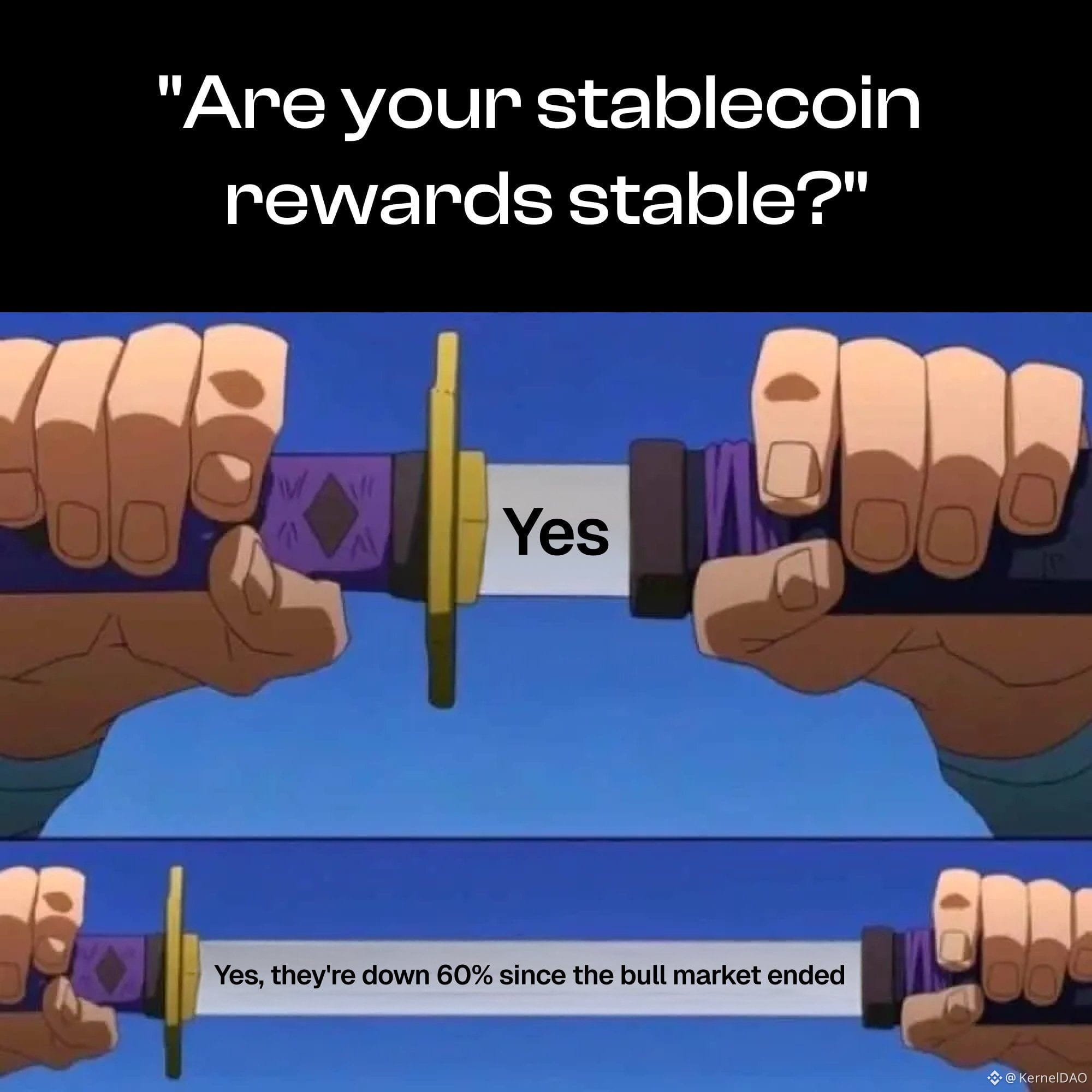
How KUSD is designed to survive geopolitical disruption.
A shipping corridor shut down. Bonds crashed. Gold beat Treasuries. The EU pushed to ban stablecoins. Iran froze crypto trading overnight. 2026 broke every stablecoin model. Most people didn't notice.
Most stablecoins are backed by government bonds. Government bonds lost value this year. Every crisis made the "safe" thing backing your stablecoin less safe. That's the problem with one government's basket.
Some stablecoins pay from crypto trading fees. Markets panic, trading dries up, fees disappear. Rewards go to zero right when you need them most.
KUSD works differently. It's backed by trade finance. A company ships goods. The buyer owes money. That unpaid invoice is a real asset. KUSD buys the right to collect on it. When the buyer pays, that's where rewards come from. Not bonds. Not crypto fees. Invoices clearing every day.
Trade doesn't stop. Tariffs and wars reroute it. $35 trillion still moved in 2025. Ships sailed. Invoices cleared. Businesses paid each other.
The invoices behind KUSD clear in 30 to 90 days. New ones replace them. No 10-year bond losing 15% in a rate shock. The collateral keeps refreshing. Exposure stays short.
You don't have to trust any of this. Chainlink verifies reserves on-chain. Token Logic monitors risk live. When governments started freezing stablecoin pairs this year, "trust us" stopped being good enough.
The receivables are spread across regions, sectors, counterparties. When one corridor got disrupted, trade elsewhere kept moving. No single crisis takes down the whole pool.
Regulators caught up this year. The WEF flagged stablecoins as a geopolitical issue.
The EU pushed for kill switches. The US passed the GENIUS Act. All want the same thing: show us what's behind it.
That's the direction KUSD is already building for.
Trade finance is a $10 trillion market. It existed before crypto. It ran through every crisis this year. KUSD is the door into it.
A shipping corridor shut down. Bonds crashed. Gold beat Treasuries. The EU pushed to ban stablecoins. Iran froze crypto trading overnight. 2026 broke every stablecoin model. Most people didn't notice.
Most stablecoins are backed by government bonds. Government bonds lost value this year. Every crisis made the "safe" thing backing your stablecoin less safe. That's the problem with one government's basket.
Some stablecoins pay from crypto trading fees. Markets panic, trading dries up, fees disappear. Rewards go to zero right when you need them most.
KUSD works differently. It's backed by trade finance. A company ships goods. The buyer owes money. That unpaid invoice is a real asset. KUSD buys the right to collect on it. When the buyer pays, that's where rewards come from. Not bonds. Not crypto fees. Invoices clearing every day.
Trade doesn't stop. Tariffs and wars reroute it. $35 trillion still moved in 2025. Ships sailed. Invoices cleared. Businesses paid each other.
The invoices behind KUSD clear in 30 to 90 days. New ones replace them. No 10-year bond losing 15% in a rate shock. The collateral keeps refreshing. Exposure stays short.
You don't have to trust any of this. Chainlink verifies reserves on-chain. Token Logic monitors risk live. When governments started freezing stablecoin pairs this year, "trust us" stopped being good enough.
The receivables are spread across regions, sectors, counterparties. When one corridor got disrupted, trade elsewhere kept moving. No single crisis takes down the whole pool.
Regulators caught up this year. The WEF flagged stablecoins as a geopolitical issue.
The EU pushed for kill switches. The US passed the GENIUS Act. All want the same thing: show us what's behind it.
That's the direction KUSD is already building for.
Trade finance is a $10 trillion market. It existed before crypto. It ran through every crisis this year. KUSD is the door into it.
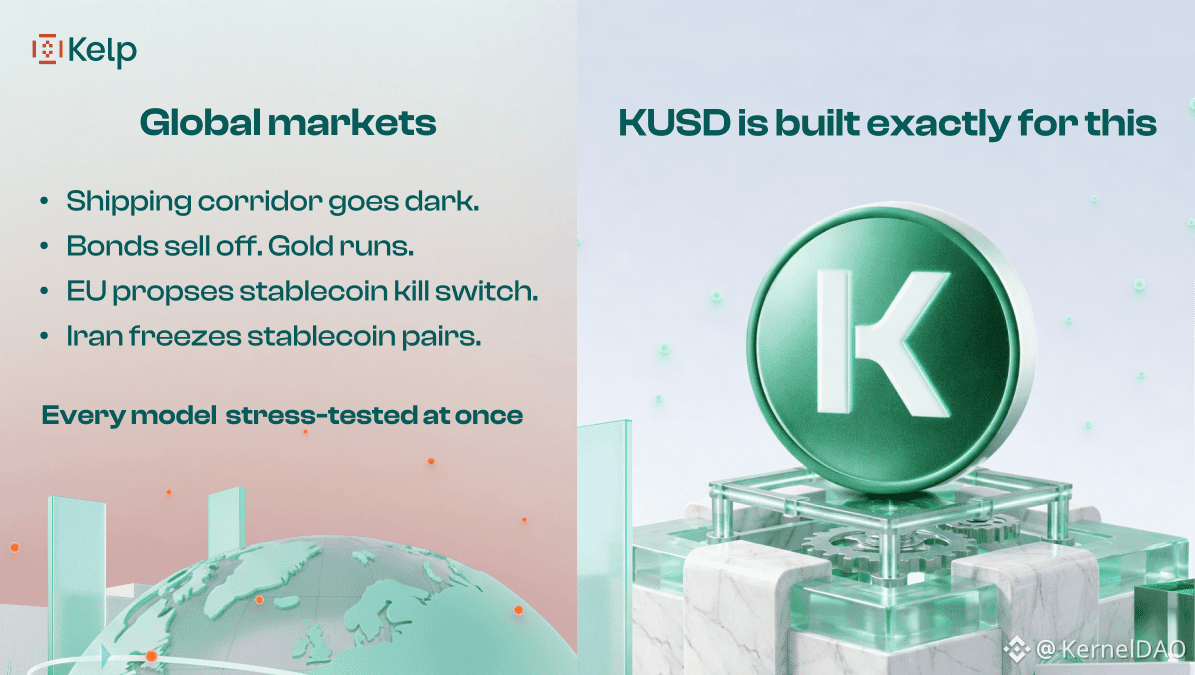
The reward source evolution nobody's talking about.
8-10% at $100B TVL.
Here's why sKUSD can do that when nothing else in DeFi can. ↓
Every DeFi reward source has a ceiling.
Funding rates compress when leverage drops. Lending spreads thin out as capital enters. Emissions dilute the moment TVL grows.
This isn't a bug. It's how the mechanic works.
The math is simple.
Fixed reward pool, more depositors, less per person.
14% at $500M becomes ~4% at $10B becomes almost nothing at $100B.
True for every reward source inside the crypto ecosystem.
Trade receivables work differently.
A manufacturer ships goods. Buyer pays in 90 days. Someone funds that gap and earns a spread.
This has been happening for long. The volume is roughly $10T a year.
When more capital enters, it doesn't split the same pie.
It funds more invoices. More corridors. More businesses banks are turning away.
$2.5T goes unfunded every year. The deal flow is waiting for the capital.
That's why the reward rate holds.
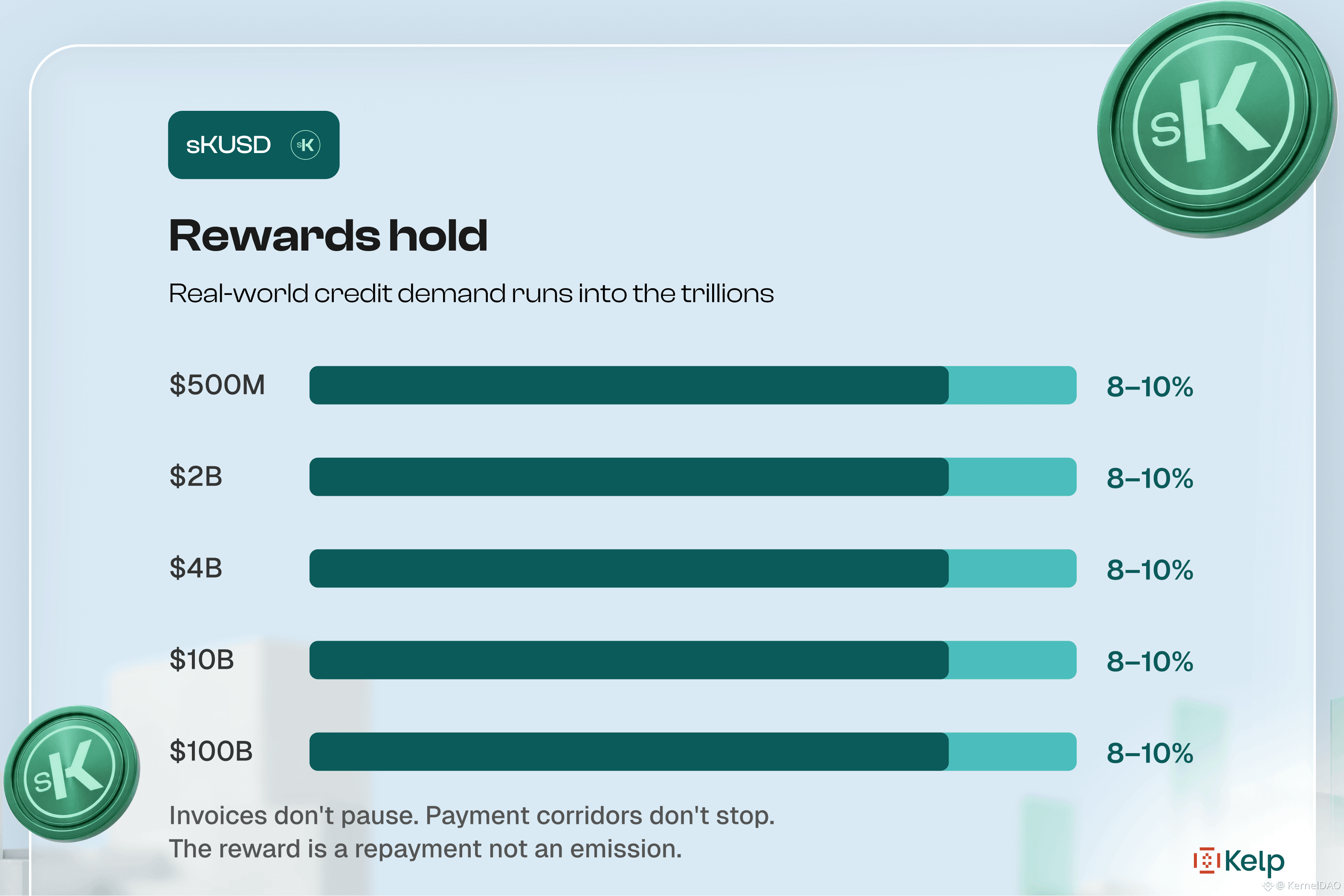
sKUSD at $100M TVL: 8-10%.
At $10B: 8-10%.
At $100B: 8-10%.
The addressable market is $10T. The supply of deals doesn't run out at scale. It opens up.
If you've been in DeFi the last 12 months, you've felt this.
Funding rate strategies that were printing suddenly stopped. Emission rewards lost value overnight. T-bill stablecoins quietly compressing as rates come down.
sKUSD won't track any of those inputs. The reward source will be invoices clearing on real trade activity.
sKUSD will also be composable.
It'll plug into lending markets as collateral. Loop it to amplify.
The base 8-10% holds regardless.
But the base layer alone will already be worth showing up for.
sKUSD isn't live yet.
Sign up for early access ↓
https://kred.kerneldao.com/investors#contact
Here's why sKUSD can do that when nothing else in DeFi can. ↓
Every DeFi reward source has a ceiling.
Funding rates compress when leverage drops. Lending spreads thin out as capital enters. Emissions dilute the moment TVL grows.
This isn't a bug. It's how the mechanic works.
The math is simple.
Fixed reward pool, more depositors, less per person.
14% at $500M becomes ~4% at $10B becomes almost nothing at $100B.
True for every reward source inside the crypto ecosystem.
Trade receivables work differently.
A manufacturer ships goods. Buyer pays in 90 days. Someone funds that gap and earns a spread.
This has been happening for long. The volume is roughly $10T a year.
When more capital enters, it doesn't split the same pie.
It funds more invoices. More corridors. More businesses banks are turning away.
$2.5T goes unfunded every year. The deal flow is waiting for the capital.
That's why the reward rate holds.
sKUSD at $100M TVL: 8-10%.
At $10B: 8-10%.
At $100B: 8-10%.
The addressable market is $10T. The supply of deals doesn't run out at scale. It opens up.
If you've been in DeFi the last 12 months, you've felt this.
Funding rate strategies that were printing suddenly stopped. Emission rewards lost value overnight. T-bill stablecoins quietly compressing as rates come down.
sKUSD won't track any of those inputs. The reward source will be invoices clearing on real trade activity.
sKUSD will also be composable.
It'll plug into lending markets as collateral. Loop it to amplify.
The base 8-10% holds regardless.
But the base layer alone will already be worth showing up for.
sKUSD isn't live yet.
Sign up for early access ↓
https://kred.kerneldao.com/investors#contact
$10T a year in trade finance. New invoices every day. sKUSD rewards regenerate as long as goods keep moving.
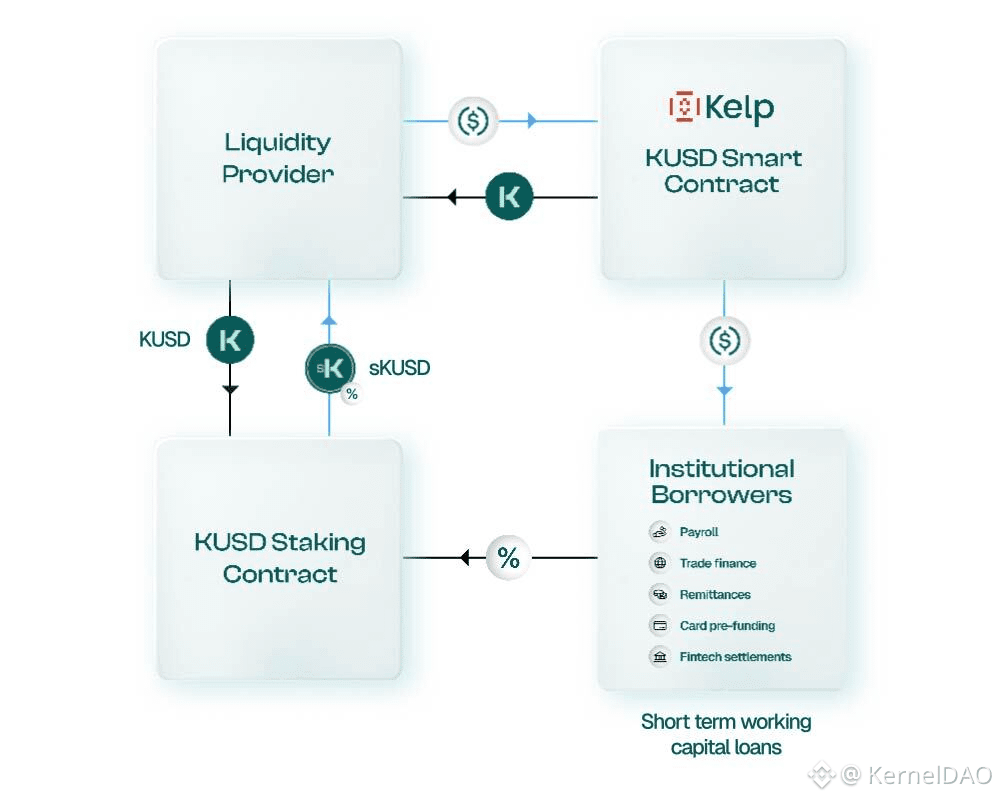
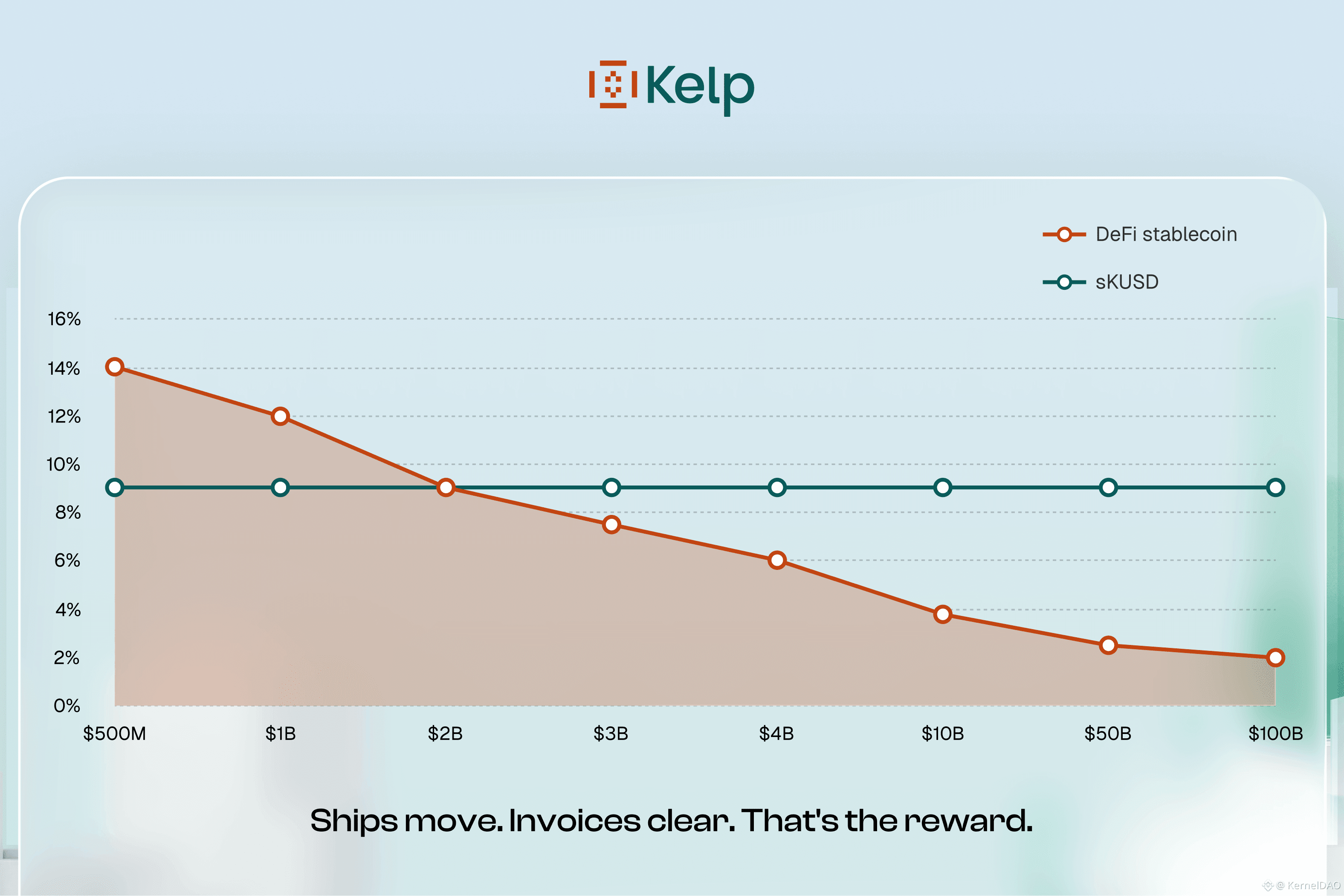
More capital = less rewards. That's DeFi math.
KUSD runs on trade finance. $10T in demand. No ceiling. ↓
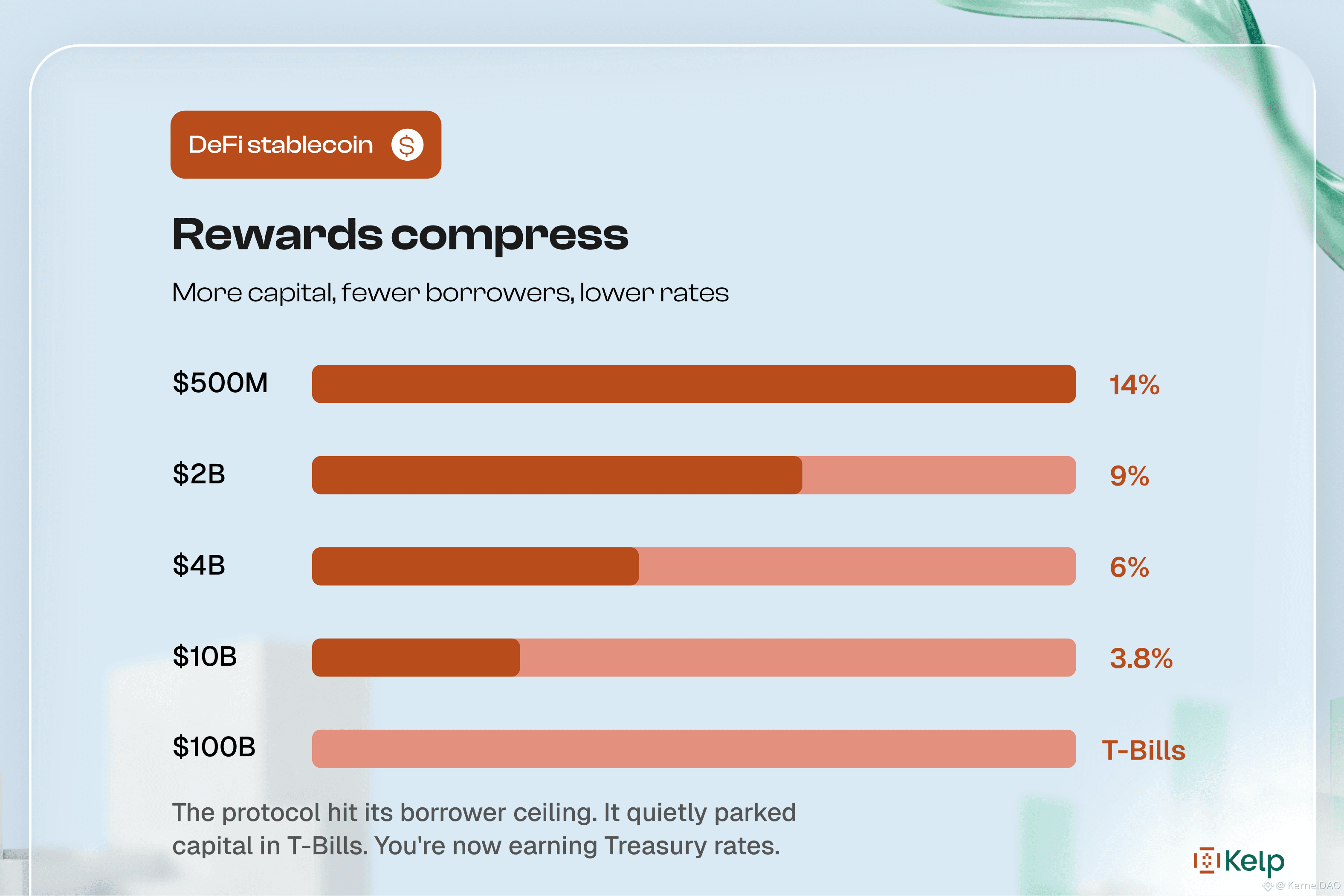
LP A deposits $100K into a DeFi stablecoin protocol. Day 1 rewards: 14%. Looks good.
Six months later the protocol hits $4B TVL. Rewards are now 6%.
A year later, 3.8%.
The protocol quietly parks half the capital in T-Bills. LP A is now earning Treasury rates with extra steps.
This isn't bad luck. It's math.
DeFi rewards run on leverage and liquidity mining. Pour enough capital in and you outgrow your own borrower base.
The demand ceiling is low. When you hit it, rates compress or the protocol pivots to something safer and less interesting.
LP B deposits $100K into sKUSD.
Rewards: 8-10%. Same at $1B TVL. Same at $10B. Same at $100B.
Because the demand on the other side isn't DeFi traders. It's global trade.
Invoices, payment corridors, short-term receivables. That market runs into the trillions and it doesn't care whether crypto sentiment is up or down.
The rewards are a repayment. Not an emission. Not a liquidity incentive. A business borrowed capital, used it to finance a shipment or settle a payment corridor, and paid it back with interest.
That's the reward. It scales because the underlying demand scales.
At $100B KUSD TVL, LP B is still earning 8-10%.
LP A is wondering when the protocol will cut rates again.
KUSD runs on trade finance. $10T in demand. No ceiling. ↓
LP A deposits $100K into a DeFi stablecoin protocol. Day 1 rewards: 14%. Looks good.
Six months later the protocol hits $4B TVL. Rewards are now 6%.
A year later, 3.8%.
The protocol quietly parks half the capital in T-Bills. LP A is now earning Treasury rates with extra steps.
This isn't bad luck. It's math.
DeFi rewards run on leverage and liquidity mining. Pour enough capital in and you outgrow your own borrower base.
The demand ceiling is low. When you hit it, rates compress or the protocol pivots to something safer and less interesting.
LP B deposits $100K into sKUSD.
Rewards: 8-10%. Same at $1B TVL. Same at $10B. Same at $100B.
Because the demand on the other side isn't DeFi traders. It's global trade.
Invoices, payment corridors, short-term receivables. That market runs into the trillions and it doesn't care whether crypto sentiment is up or down.
The rewards are a repayment. Not an emission. Not a liquidity incentive. A business borrowed capital, used it to finance a shipment or settle a payment corridor, and paid it back with interest.
That's the reward. It scales because the underlying demand scales.
At $100B KUSD TVL, LP B is still earning 8-10%.
LP A is wondering when the protocol will cut rates again.
How do KUSD rewards actually work? ↓
A parts manufacturer in Ohio ships $500K in components to an auto distributor in the UK. Payment comes in 90 days. These are standard B2B terms.
But the manufacturer needs cash now. Payroll doesn't wait 90 days.
Someone fronts the $500K. In return, they earn a fee. The loan is short-term, backed by the invoice and goods that already shipped.
Banks have done this for a long time. Default rates on short-term trade credit sit around 0.02%. Low risk, short duration.
Banks charge 8-15% annualized. They've had this entire market to themselves.
$2.5 trillion in demand goes unfunded every year (ADB, 2025). Banks reject over 40% of SME applications. The deals aren't bad. The compliance overhead just doesn't justify smaller tickets.
This is where KUSD comes in.
Depositors will be able to mint KUSD with stablecoins and stake for sKUSD. The stablecoins backing KUSD get deployed as short-term credit to verified borrowers against receivables they already hold.
When the invoice clears, principal plus fee flows back to sKUSD holders.
The fee on that credit is the reward. It comes from a business getting paid early on an invoice that was already owed to them.
Nothing is being printed. Nobody needs to stay leveraged. No funding rate needs to hold.
Backing is verified through @chainlink Proof of Reserve. On-chain, continuous, automated.
Every KUSD is verifiably backed by real receivables. Not a quarterly PDF. Not a trust-me. Verifiable by anyone, anytime.
One more thing. This market doesn't compress the way DeFi pools do.
More capital in a DeFi pool means lower rewards per dollar. Same pie, more people.
With trade receivables, more capital means more invoices get funded. The deal flow scales with the capital. $10 trillion a year in addressable market.
sKUSD isn't live for everyone yet.
Sign up to get early access ↓
🔗 https://kred.kerneldao.com/investors#contact
A parts manufacturer in Ohio ships $500K in components to an auto distributor in the UK. Payment comes in 90 days. These are standard B2B terms.
But the manufacturer needs cash now. Payroll doesn't wait 90 days.
Someone fronts the $500K. In return, they earn a fee. The loan is short-term, backed by the invoice and goods that already shipped.
Banks have done this for a long time. Default rates on short-term trade credit sit around 0.02%. Low risk, short duration.
Banks charge 8-15% annualized. They've had this entire market to themselves.
$2.5 trillion in demand goes unfunded every year (ADB, 2025). Banks reject over 40% of SME applications. The deals aren't bad. The compliance overhead just doesn't justify smaller tickets.
This is where KUSD comes in.
Depositors will be able to mint KUSD with stablecoins and stake for sKUSD. The stablecoins backing KUSD get deployed as short-term credit to verified borrowers against receivables they already hold.
When the invoice clears, principal plus fee flows back to sKUSD holders.
The fee on that credit is the reward. It comes from a business getting paid early on an invoice that was already owed to them.
Nothing is being printed. Nobody needs to stay leveraged. No funding rate needs to hold.
Backing is verified through @chainlink Proof of Reserve. On-chain, continuous, automated.
Every KUSD is verifiably backed by real receivables. Not a quarterly PDF. Not a trust-me. Verifiable by anyone, anytime.
One more thing. This market doesn't compress the way DeFi pools do.
More capital in a DeFi pool means lower rewards per dollar. Same pie, more people.
With trade receivables, more capital means more invoices get funded. The deal flow scales with the capital. $10 trillion a year in addressable market.
sKUSD isn't live for everyone yet.
Sign up to get early access ↓
🔗 https://kred.kerneldao.com/investors#contact
Everyone's Fighting Over Stablecoin Rewards. KUSD Will Solve It.
Trump vs banks. USDC vs USDT. $315B stablecoin market arguing over who gets to pay interest.
KUSD's backing will be different: trade receivables. Actual invoices from B2B payment flows. No DeFi loops. No T-bill arbitrage. Just real commerce.
Businesses need cash to fulfill orders. KUSD will provide liquidity. sKUSD holders will earn rewards from the spread. 30-90 day cycles. Returns that won't care about crypto market conditions.
All protocol revenue will flow to $KERNEL. More KUSD adoption = more value captured directly.
While everyone else argues, sKUSD will earn from actual trade.
Launching soon.
Trump vs banks. USDC vs USDT. $315B stablecoin market arguing over who gets to pay interest.
KUSD's backing will be different: trade receivables. Actual invoices from B2B payment flows. No DeFi loops. No T-bill arbitrage. Just real commerce.
Businesses need cash to fulfill orders. KUSD will provide liquidity. sKUSD holders will earn rewards from the spread. 30-90 day cycles. Returns that won't care about crypto market conditions.
All protocol revenue will flow to $KERNEL. More KUSD adoption = more value captured directly.
While everyone else argues, sKUSD will earn from actual trade.
Launching soon.
$10 trillion moves through global trade finance every year.
Ships. Commodities. Factories. Invoices.
The entire physical world runs on it.
You've never had access to it.
Until now. ↓
Trade finance is one of the oldest reward mechanisms in financial history.
A textile exporter ships goods. Payment arrives in 90 days.
Someone has to fund that gap.
For 500 years, that someone was a bank.
JPMorgan. Citi. HSBC.
They sit in the creditor's seat. Collect the spread. Decide who gets capital and who doesn't.
Not because they earned an exclusive right.
Because there was no other infrastructure. Until now.
KUSD is backed by real-world trade receivables.
Not crypto assets that collapse in a downturn. Not algorithmic mechanics. Not circular dependencies.
The invoices and trade flows of the real economy.
The rewards KUSD generates exists because global commerce exists.
Not because of a bull market. Not because of liquidity mining.
Because goods are moving. Trade is happening. Right now.
We spent years building Kelp. $2B+ TVL. 350K+ users. Infrastructure that works at scale.
KUSD is what we’re building next.
Not a new product. A new door.
A door into a market designed to exclude you.
For the first time, anyone with a crypto wallet can sit in the seat banks have held for generations.
That's not a feature. That's a structural shift.
KUSD. Real-world rewards. Finally yours.
🔗 https://kred.kerneldao.com/investors#contact
Ships. Commodities. Factories. Invoices.
The entire physical world runs on it.
You've never had access to it.
Until now. ↓
Trade finance is one of the oldest reward mechanisms in financial history.
A textile exporter ships goods. Payment arrives in 90 days.
Someone has to fund that gap.
For 500 years, that someone was a bank.
JPMorgan. Citi. HSBC.
They sit in the creditor's seat. Collect the spread. Decide who gets capital and who doesn't.
Not because they earned an exclusive right.
Because there was no other infrastructure. Until now.
KUSD is backed by real-world trade receivables.
Not crypto assets that collapse in a downturn. Not algorithmic mechanics. Not circular dependencies.
The invoices and trade flows of the real economy.
The rewards KUSD generates exists because global commerce exists.
Not because of a bull market. Not because of liquidity mining.
Because goods are moving. Trade is happening. Right now.
We spent years building Kelp. $2B+ TVL. 350K+ users. Infrastructure that works at scale.
KUSD is what we’re building next.
Not a new product. A new door.
A door into a market designed to exclude you.
For the first time, anyone with a crypto wallet can sit in the seat banks have held for generations.
That's not a feature. That's a structural shift.
KUSD. Real-world rewards. Finally yours.
🔗 https://kred.kerneldao.com/investors#contact
Расталды
Smart DeFi
DeFi's evolving. And it's about time.
2026 is shaping up to be the infrastructure year. Not because speculation is dead, but because the tools finally exist to do more than just chase rewards manually.
Gain vaults capture this shift. Automated strategies that rotate your capital between lending markets, DEX opportunities, and basis-trade arbitrage based on real-time conditions.
You're not locked into one protocol hoping it works out. You're dynamically positioned across whatever's generating actual rewards.
High Gain for the highest rewards on ETH. Stable Gain for high rewards from your stables in one click. Airdrop Gain for institutional strategies managed algorithmically.
No manual rebalancing. No constant monitoring. Just institutional-grade execution in one click.
All this while putting up 8-14% reward rate annually.
The opportunities in DeFi across $ETH $ARB $OP are real. Gain just handles the execution so you don't have to.
DeFi's evolving. And it's about time.
2026 is shaping up to be the infrastructure year. Not because speculation is dead, but because the tools finally exist to do more than just chase rewards manually.
Gain vaults capture this shift. Automated strategies that rotate your capital between lending markets, DEX opportunities, and basis-trade arbitrage based on real-time conditions.
You're not locked into one protocol hoping it works out. You're dynamically positioned across whatever's generating actual rewards.
High Gain for the highest rewards on ETH. Stable Gain for high rewards from your stables in one click. Airdrop Gain for institutional strategies managed algorithmically.
No manual rebalancing. No constant monitoring. Just institutional-grade execution in one click.
All this while putting up 8-14% reward rate annually.
The opportunities in DeFi across $ETH $ARB $OP are real. Gain just handles the execution so you don't have to.
Kelp February 2026 recap 🧵
✧ rsETH integrations & milestones
⍛ Mantle launch: Native minting + bridging live with Merchant Moe + Aave v3 (Mantle market). Supply caps hit twice in days; now ~$70M supplied.
⍛ MegaETH launch: Native support via Aave v3 + Kumbaya, new looping + liquidity routes live.
✧ Gain updates & milestones
⍛ Silo: agETH + hgETH vaults live, deposit directly and loop against ETH for capital-efficient reward amplification.
⍛ Pendle: 14,000 $KERNEL incentives added to agETH + hgETH markets to boost liquidity + user rewards.
⍛ Stable Gain: 6-7% on USDT/USDC vs ~3% broader market, via UltraYield market-neutral strategies (no directional / liquidation dependence).
✧ Community & ecosystem engagement
⍛ KUSD AMA: Deep dive on KUSD’s cycle resilience, recap thread + recording shared.
✧ KUSD insights & developments
⍛ Value to $KERNEL: Dollar-denominated revenue from payment settlements, trade finance, and remittances; a portion accrues back to $KERNEL, not tied to market cycles.
⍛ sKUSD stays active in crypto winter: When stables compress to 2–3%, sKUSD targets ~10% base (up to ~25% with LP + looping), backed by real-world payment flows.
⍛ Developments: Payments + trade finance moved into active execution, deployments underway to bring real-world flows on-chain.
February was about expanding rsETH capital efficiency, strengthening Gain performance, and pushing KUSD closer to real-world flow execution, setting up scalable, cycle-resilient growth.
Stay tuned for what's next!
✧ rsETH integrations & milestones
⍛ Mantle launch: Native minting + bridging live with Merchant Moe + Aave v3 (Mantle market). Supply caps hit twice in days; now ~$70M supplied.
⍛ MegaETH launch: Native support via Aave v3 + Kumbaya, new looping + liquidity routes live.
✧ Gain updates & milestones
⍛ Silo: agETH + hgETH vaults live, deposit directly and loop against ETH for capital-efficient reward amplification.
⍛ Pendle: 14,000 $KERNEL incentives added to agETH + hgETH markets to boost liquidity + user rewards.
⍛ Stable Gain: 6-7% on USDT/USDC vs ~3% broader market, via UltraYield market-neutral strategies (no directional / liquidation dependence).
✧ Community & ecosystem engagement
⍛ KUSD AMA: Deep dive on KUSD’s cycle resilience, recap thread + recording shared.
✧ KUSD insights & developments
⍛ Value to $KERNEL: Dollar-denominated revenue from payment settlements, trade finance, and remittances; a portion accrues back to $KERNEL, not tied to market cycles.
⍛ sKUSD stays active in crypto winter: When stables compress to 2–3%, sKUSD targets ~10% base (up to ~25% with LP + looping), backed by real-world payment flows.
⍛ Developments: Payments + trade finance moved into active execution, deployments underway to bring real-world flows on-chain.
February was about expanding rsETH capital efficiency, strengthening Gain performance, and pushing KUSD closer to real-world flow execution, setting up scalable, cycle-resilient growth.
Stay tuned for what's next!

"On-chain stablecoin rewards have compressed to ~2-3%. But the product we're building doesn't compress with crypto winters."
Our Head of Ecosystem broke down why KUSD changes everything for Kelp ↓
1/ Kelp is expanding beyond rsETH and Gain vaults. KUSD introduces a new revenue stream: dollar-denominated, driven by real-world payment activity, completely uncorrelated from crypto cycles.
2/ Global payments = ~$200T annually, running on legacy infrastructure from the 1970s-2000s. Capital gets trapped for 2-5 days during settlement.
KUSD uses stablecoin rails to settle in seconds. 2,000x faster.
3/ Three reward sources:
✧ Payment settlement: neobanks pay ~10% to free trapped capital
✧ Trade finance: sellers pay for instant settlement vs. weeks of waiting (tier-one counterparties only, insured)
✧ Remittances: same delays across borders, same fix
None of these depend on crypto activity. Malls stay open, goods still ship, money still moves.
4/ KUSD targets ~10% reward rate that doesn't compress with crypto winters.
Layer on DeFi (LP on DEXs or looping on lending markets) and push that to ~20-25%.
5/ KUSD will generate a share of rewards that accrues value back to $KERNEL, which already is up ~25% this week.
6/ KUSD is currently in private beta. Will launch on Mainnet first, expanding to L1s/L2s with DEX and lending market integrations.
More details coming soon.
Listen to the full conversation 👇
Our Head of Ecosystem broke down why KUSD changes everything for Kelp ↓
1/ Kelp is expanding beyond rsETH and Gain vaults. KUSD introduces a new revenue stream: dollar-denominated, driven by real-world payment activity, completely uncorrelated from crypto cycles.
2/ Global payments = ~$200T annually, running on legacy infrastructure from the 1970s-2000s. Capital gets trapped for 2-5 days during settlement.
KUSD uses stablecoin rails to settle in seconds. 2,000x faster.
3/ Three reward sources:
✧ Payment settlement: neobanks pay ~10% to free trapped capital
✧ Trade finance: sellers pay for instant settlement vs. weeks of waiting (tier-one counterparties only, insured)
✧ Remittances: same delays across borders, same fix
None of these depend on crypto activity. Malls stay open, goods still ship, money still moves.
4/ KUSD targets ~10% reward rate that doesn't compress with crypto winters.
Layer on DeFi (LP on DEXs or looping on lending markets) and push that to ~20-25%.
5/ KUSD will generate a share of rewards that accrues value back to $KERNEL, which already is up ~25% this week.
6/ KUSD is currently in private beta. Will launch on Mainnet first, expanding to L1s/L2s with DEX and lending market integrations.
More details coming soon.
Listen to the full conversation 👇

KernelDAO
·
--
[Қайта ойнату] 🎙️ KUSD: Built Beyond Market Cycles
23 а 00 с · 49 рет тыңдалды
Join us in 90 mins for our AMA on KUSD 🌱
We’ll cover how rewards are generated, the security behind it, and more.
📅 Feb 26
⏰ 2PM UTC
See you there!
We’ll cover how rewards are generated, the security behind it, and more.
📅 Feb 26
⏰ 2PM UTC
See you there!
KernelDAO
·
--
[Қайта ойнату] 🎙️ KUSD: Built Beyond Market Cycles
23 а 00 с · 49 рет тыңдалды
Less than 24hrs to go for our AMA on KUSD 🌱
Join us as we dive into KUSD's mechanics and how it’s built to stay resilient across market cycles.
📅 Feb 26
⏰ 2PM UTC
Bring your questions!
Join us as we dive into KUSD's mechanics and how it’s built to stay resilient across market cycles.
📅 Feb 26
⏰ 2PM UTC
Bring your questions!
KernelDAO
·
--
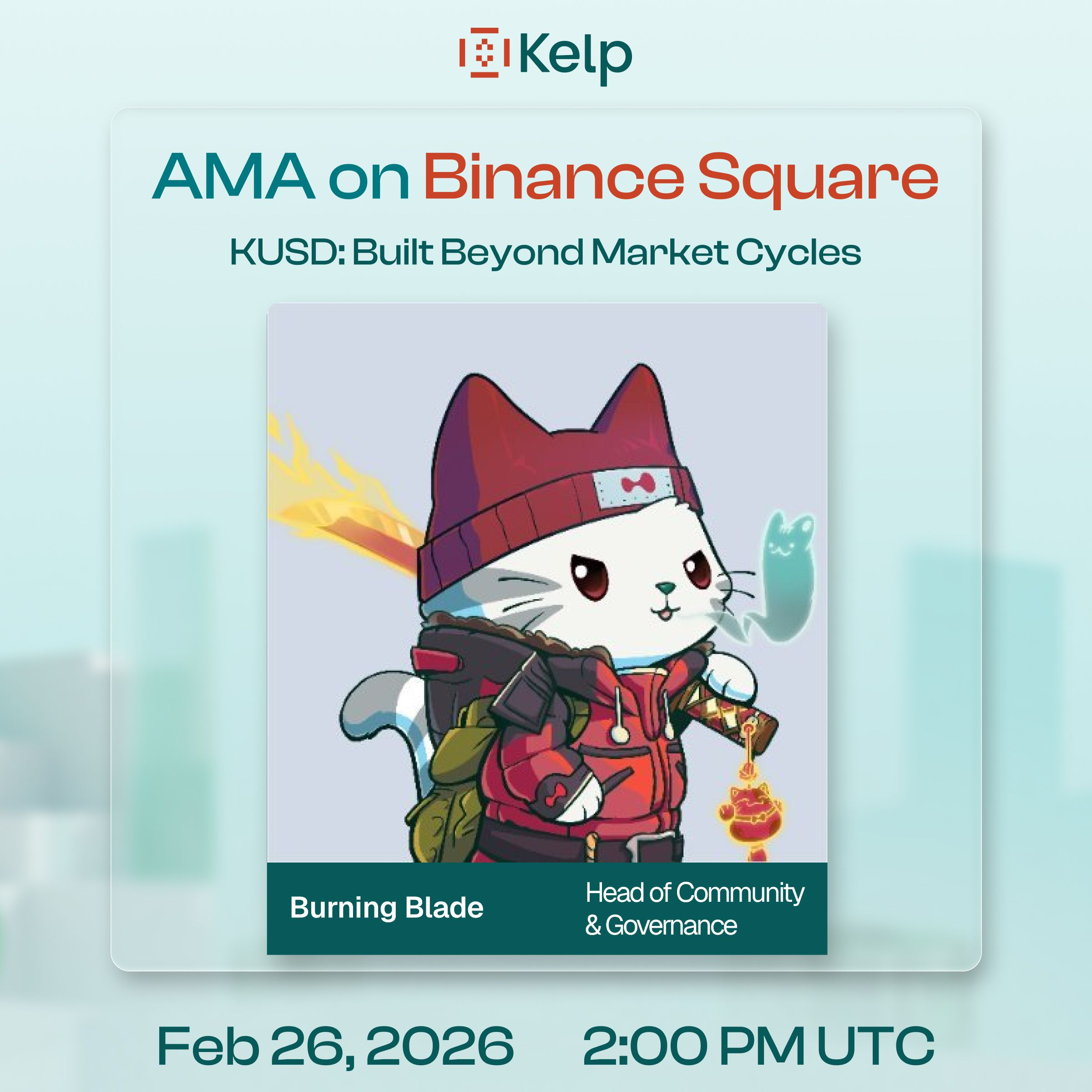
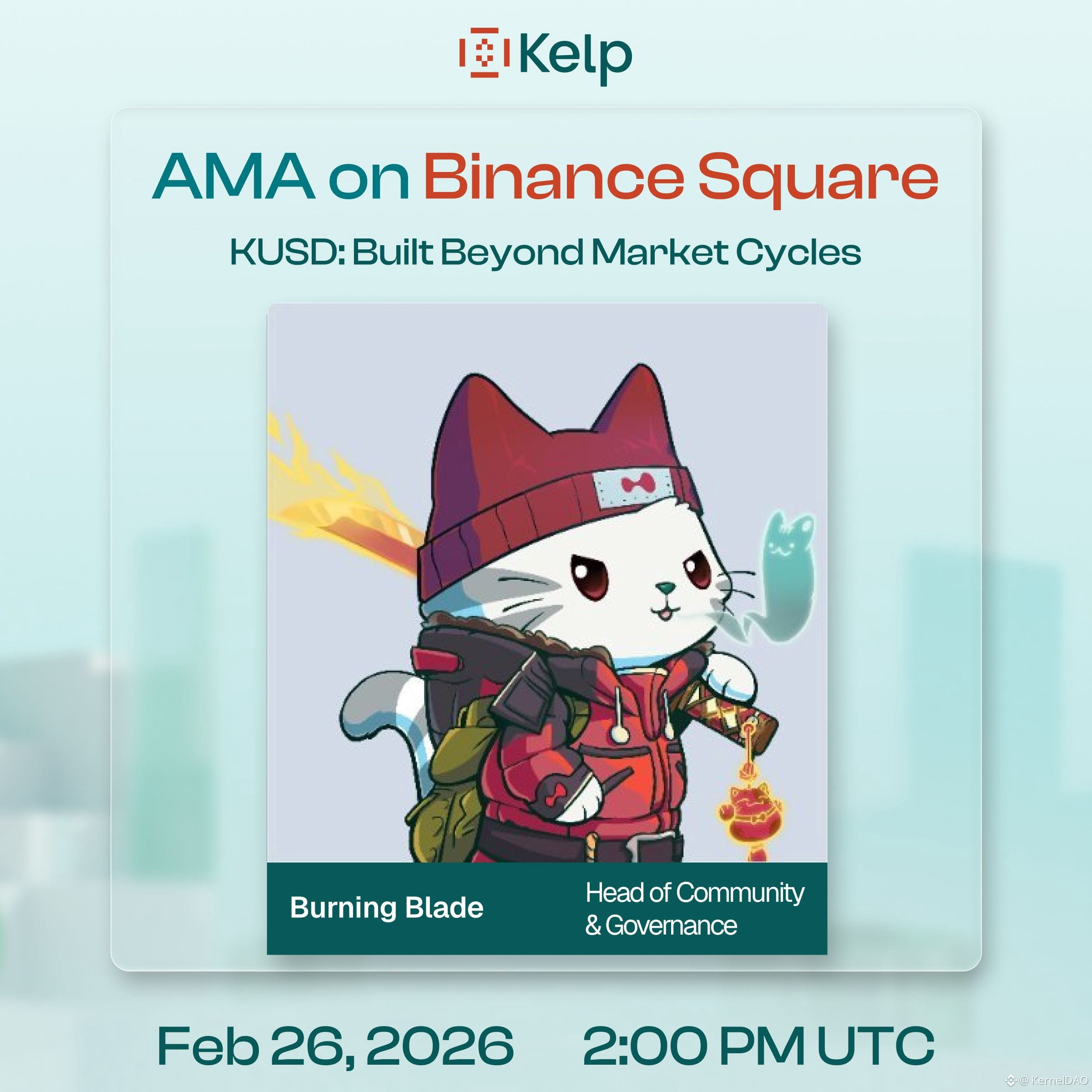
Join us for an exclusive AMA as we dive into KUSD and how it’s built to stay resilient across market cycles. 🌱
We’ll cover how rewards are generated, the security behind it, and more.
📅 Feb 26
⏰ 2PM UTC
Don’t miss out.
We’ll cover how rewards are generated, the security behind it, and more.
📅 Feb 26
⏰ 2PM UTC
Don’t miss out.
How are KUSD rewards generated?
How secure is it?
How does it stay resilient across market cycles?
Get your answers in our upcoming AMA 🌱
📅 Feb 26
⏰ 2PM UTC
Set your reminders!
How secure is it?
How does it stay resilient across market cycles?
Get your answers in our upcoming AMA 🌱
📅 Feb 26
⏰ 2PM UTC
Set your reminders!
KernelDAO
·
--
Join us for an exclusive AMA as we dive into KUSD and how it’s built to stay resilient across market cycles. 🌱
We’ll cover how rewards are generated, the security behind it, and more.
📅 Feb 26
⏰ 2PM UTC
Don’t miss out.
We’ll cover how rewards are generated, the security behind it, and more.
📅 Feb 26
⏰ 2PM UTC
Don’t miss out.
Join us for an exclusive AMA as we dive into KUSD and how it’s built to stay resilient across market cycles. 🌱
We’ll cover how rewards are generated, the security behind it, and more.
📅 Feb 26
⏰ 2PM UTC
Don’t miss out.
We’ll cover how rewards are generated, the security behind it, and more.
📅 Feb 26
⏰ 2PM UTC
Don’t miss out.
KernelDAO
·
--
[Қайта ойнату] 🎙️ KUSD: Built Beyond Market Cycles
23 а 00 с · 49 рет тыңдалды
Everyone's chasing rewards on stables right now.
Corporate bonds give you 2-6% but lock your money.
Synthetic stablecoins fluctuate.
Private credit needs you to babysit health factors all day.
sKUSD: 8-15%, no leverage, instant liquidity, real-time settlement.
Not a tradeoff. Just better design. ↓
The thing nobody talks about with "stable" rewards:
Corporate bonds → T+1 to T+3 settlement. Low liquidity. Limited transparency.
Synthetic stables → peg fluctuations. Partial reporting. Medium volatility.
sKUSD is backed by secured institutional credit, fully visible on-chain.
You see exactly where your rewards come from.
Private credit protocols promise 10-20% but require leverage, constant position monitoring, and complex looping strategies.
sKUSD hits 8-15% with zero leverage. Simple stake/unstake.
No looping. No rebalancing.
Higher floor, lower complexity. That's the point.
TL;DR - sKUSD vs leading assets:
⍛ Highest base rewards without leverage
⍛ Instant on-chain liquidity
⍛ Real-time settlement
⍛ Full transparency
⍛ Lowest operational complexity
The stablecoin rewards market has options. Most of them come with asterisks. sKUSD doesn't.
sKUSD isn't live for everyone yet. But you can already check what your rewards would look like using the calculator on the page.
When access opens, you'll want to be early.
Sign up here for regular updates ↓
🔗 https://kred.kerneldao.com/investors#contact
Corporate bonds give you 2-6% but lock your money.
Synthetic stablecoins fluctuate.
Private credit needs you to babysit health factors all day.
sKUSD: 8-15%, no leverage, instant liquidity, real-time settlement.
Not a tradeoff. Just better design. ↓
The thing nobody talks about with "stable" rewards:
Corporate bonds → T+1 to T+3 settlement. Low liquidity. Limited transparency.
Synthetic stables → peg fluctuations. Partial reporting. Medium volatility.
sKUSD is backed by secured institutional credit, fully visible on-chain.
You see exactly where your rewards come from.
Private credit protocols promise 10-20% but require leverage, constant position monitoring, and complex looping strategies.
sKUSD hits 8-15% with zero leverage. Simple stake/unstake.
No looping. No rebalancing.
Higher floor, lower complexity. That's the point.
TL;DR - sKUSD vs leading assets:
⍛ Highest base rewards without leverage
⍛ Instant on-chain liquidity
⍛ Real-time settlement
⍛ Full transparency
⍛ Lowest operational complexity
The stablecoin rewards market has options. Most of them come with asterisks. sKUSD doesn't.
sKUSD isn't live for everyone yet. But you can already check what your rewards would look like using the calculator on the page.
When access opens, you'll want to be early.
Sign up here for regular updates ↓
🔗 https://kred.kerneldao.com/investors#contact
Көбірек контент көру үшін кіріңіз