

Sir Ismail
138 Жариялаулар

Sir Ismail
Хабарлау
Пайдаланушыны блоктау
Web3 Investor | Writer | Crypto Class of 2020
25 Жазылым
88 Жазылушылар
106 лайк басылған
Жазбалар
Барлығы
Баға ұсыныстары
PINNED
·
--
Жоғары (өспелі)
GM Legends
Good to see $BTC holding well
But the best for me is $DIA today
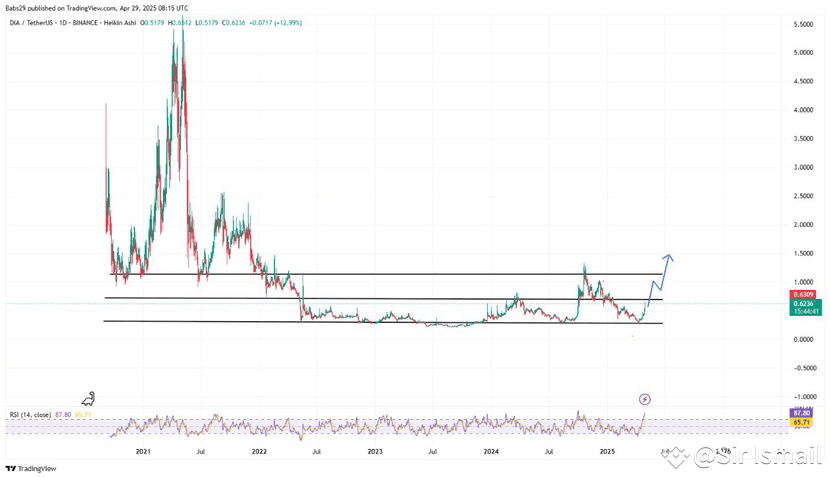
DIA just broke out hard — and this is only the beginning.
✅ RSI exploding
✅ Major resistance flipped
✅ Volume returning
✅ Structure: textbook reversal
RWA narratives are heating up, but DIA isn’t riding the wave — it’s powering it with fully verifiable on-chain data via Lasernet.
This chart is telling you what’s next:
📈 First stop: $1
📈 Then $1.50+ — with potential for full-on price discovery after
“The best time to buy was at support. The second best? When breakout confirms.”
We’re there now.
$DIA is awake.
GM Legends
Good to see $BTC holding well
But the best for me is $DIA today
DIA just broke out hard — and this is only the beginning.
✅ RSI exploding
✅ Major resistance flipped
✅ Volume returning
✅ Structure: textbook reversal
RWA narratives are heating up, but DIA isn’t riding the wave — it’s powering it with fully verifiable on-chain data via Lasernet.
This chart is telling you what’s next:
📈 First stop: $1
📈 Then $1.50+ — with potential for full-on price discovery after
“The best time to buy was at support. The second best? When breakout confirms.”
We’re there now.
$DIA is awake.
Good to see $BTC holding well
But the best for me is $DIA today
DIA just broke out hard — and this is only the beginning.
✅ RSI exploding
✅ Major resistance flipped
✅ Volume returning
✅ Structure: textbook reversal
RWA narratives are heating up, but DIA isn’t riding the wave — it’s powering it with fully verifiable on-chain data via Lasernet.
This chart is telling you what’s next:
📈 First stop: $1
📈 Then $1.50+ — with potential for full-on price discovery after
“The best time to buy was at support. The second best? When breakout confirms.”
We’re there now.
$DIA is awake.
1
2
280
PINNED
·
--
Good Morning Fams
Markets still in correction
Don’t Panick and Sell
Be Patient
$SRM $BTC $ETH $AGATA
Good Morning Fams
Markets still in correction
Don’t Panick and Sell
Be Patient
$SRM $BTC $ETH $AGATA
Markets still in correction
Don’t Panick and Sell
Be Patient
$SRM $BTC $ETH $AGATA
4
2.9k
·
--
Жоғары (өспелі)
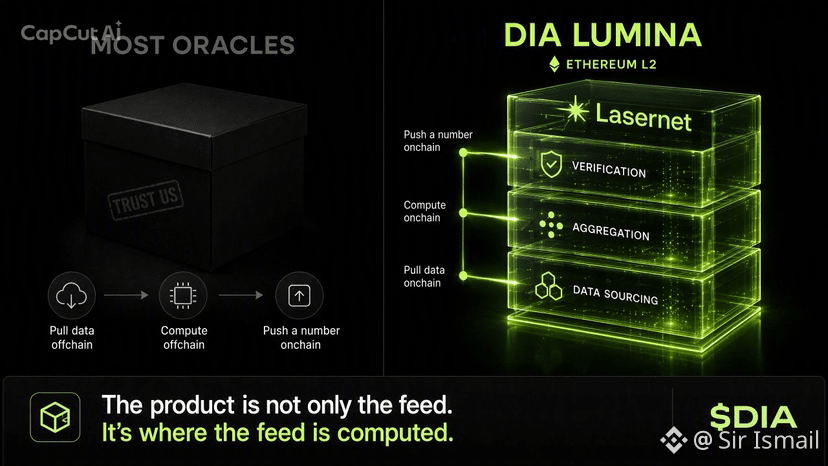
The RWA opportunity is becoming a data opportunity.
Tokenizing an asset is only the first step.
Once it’s onchain, you still need:
→ Reliable pricing
→ Valuation data
→ Collateral data
→ Verification
That’s where $DIA gets interesting.
Real World Assets tokenization needs reliable data infrastructure.
More RWAs onchain → more data requirements → bigger opportunity for the oracle layer.
The RWA opportunity is becoming a data opportunity.
Tokenizing an asset is only the first step.
Once it’s onchain, you still need:
→ Reliable pricing
→ Valuation data
→ Collateral data
→ Verification
That’s where $DIA gets interesting.
Real World Assets tokenization needs reliable data infrastructure.
More RWAs onchain → more data requirements → bigger opportunity for the oracle layer.
Tokenizing an asset is only the first step.
Once it’s onchain, you still need:
→ Reliable pricing
→ Valuation data
→ Collateral data
→ Verification
That’s where $DIA gets interesting.
Real World Assets tokenization needs reliable data infrastructure.
More RWAs onchain → more data requirements → bigger opportunity for the oracle layer.
2
·
--
Жоғары (өспелі)
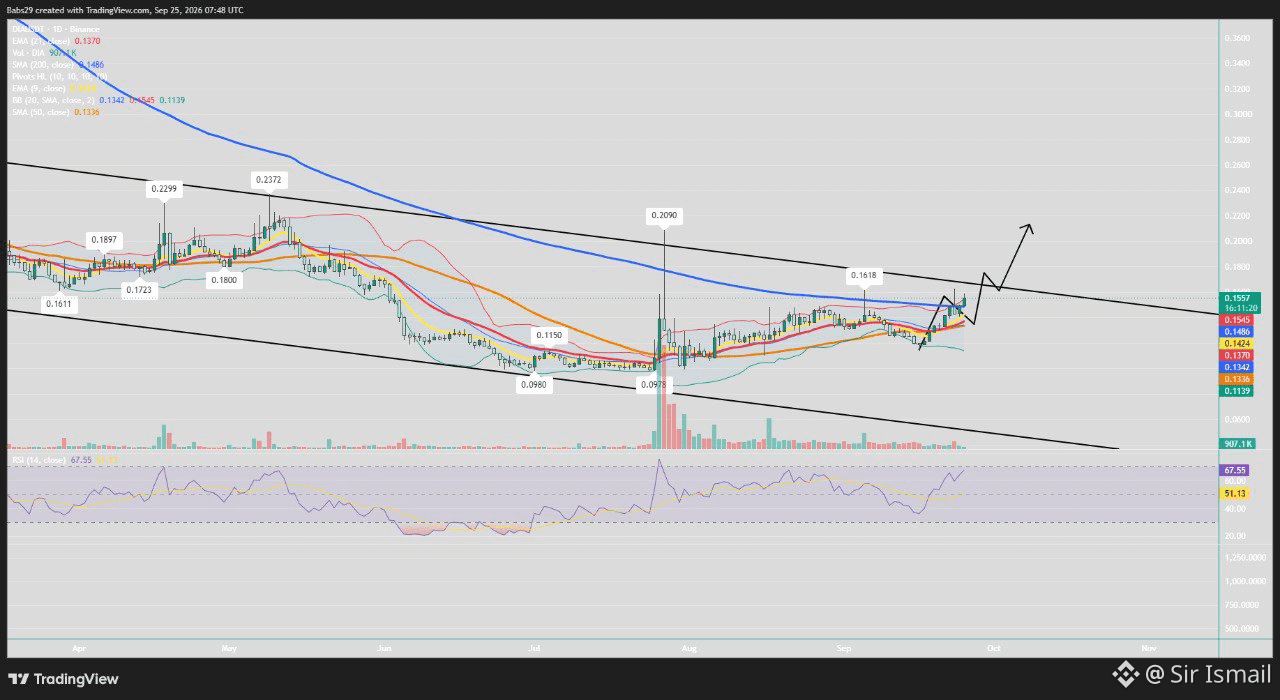
DIA/USDT Daily TA
$DIA is pushing into the $0.156–$0.160 resistance zone.
A clean breakout could open $0.18 → $0.20+.
What makes the setup interesting? DIA isn’t just a chart. Its verifiable oracle infrastructure is built specifically for DeFi and Real World Assets, with feeds for equities, commodities, FX and tokenized assets.
TA + growing RWA utility = interesting setup. 👀
$0.149 remains key support
DIA/USDT Daily TA
$DIA is pushing into the $0.156–$0.160 resistance zone.
A clean breakout could open $0.18 → $0.20+.
What makes the setup interesting? DIA isn’t just a chart. Its verifiable oracle infrastructure is built specifically for DeFi and Real World Assets, with feeds for equities, commodities, FX and tokenized assets.
TA + growing RWA utility = interesting setup. 👀
$0.149 remains key support
$DIA is pushing into the $0.156–$0.160 resistance zone.
A clean breakout could open $0.18 → $0.20+.
What makes the setup interesting? DIA isn’t just a chart. Its verifiable oracle infrastructure is built specifically for DeFi and Real World Assets, with feeds for equities, commodities, FX and tokenized assets.
TA + growing RWA utility = interesting setup. 👀
$0.149 remains key support
83
·
--
Жоғары (өспелі)
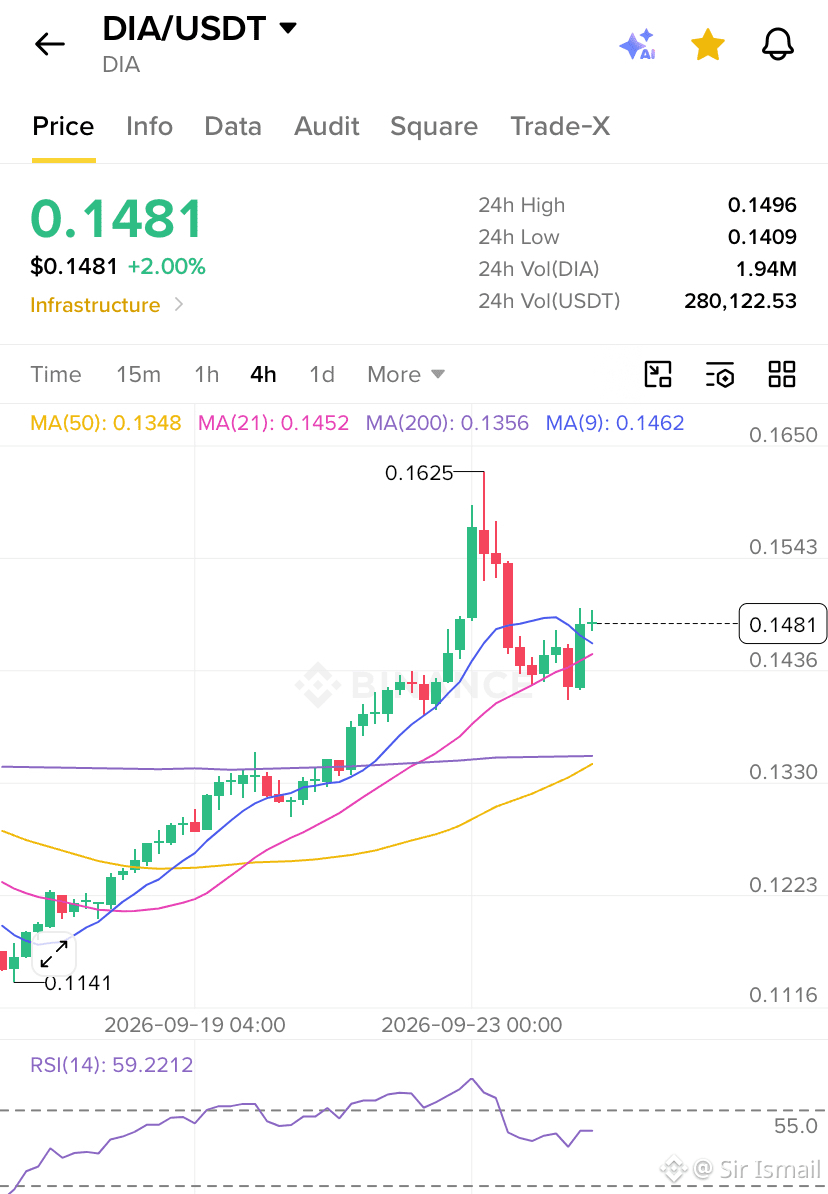
Bullish Af on $DIA right now
$DIA is holding $0.148 after bouncing from the $0.143 area.
• Support: $0.143 → $0.135
• Resistance: $0.154 → $0.1625
• RSI: ~59, bullish momentum returning
A clean break above $0.1625 could open the door toward $0.18+.
Structure still favors the bulls.
Bullish Af on $DIA right now
$DIA is holding $0.148 after bouncing from the $0.143 area.
• Support: $0.143 → $0.135
• Resistance: $0.154 → $0.1625
• RSI: ~59, bullish momentum returning
A clean break above $0.1625 could open the door toward $0.18+.
Structure still favors the bulls.
$DIA is holding $0.148 after bouncing from the $0.143 area.
• Support: $0.143 → $0.135
• Resistance: $0.154 → $0.1625
• RSI: ~59, bullish momentum returning
A clean break above $0.1625 could open the door toward $0.18+.
Structure still favors the bulls.
276
·
--
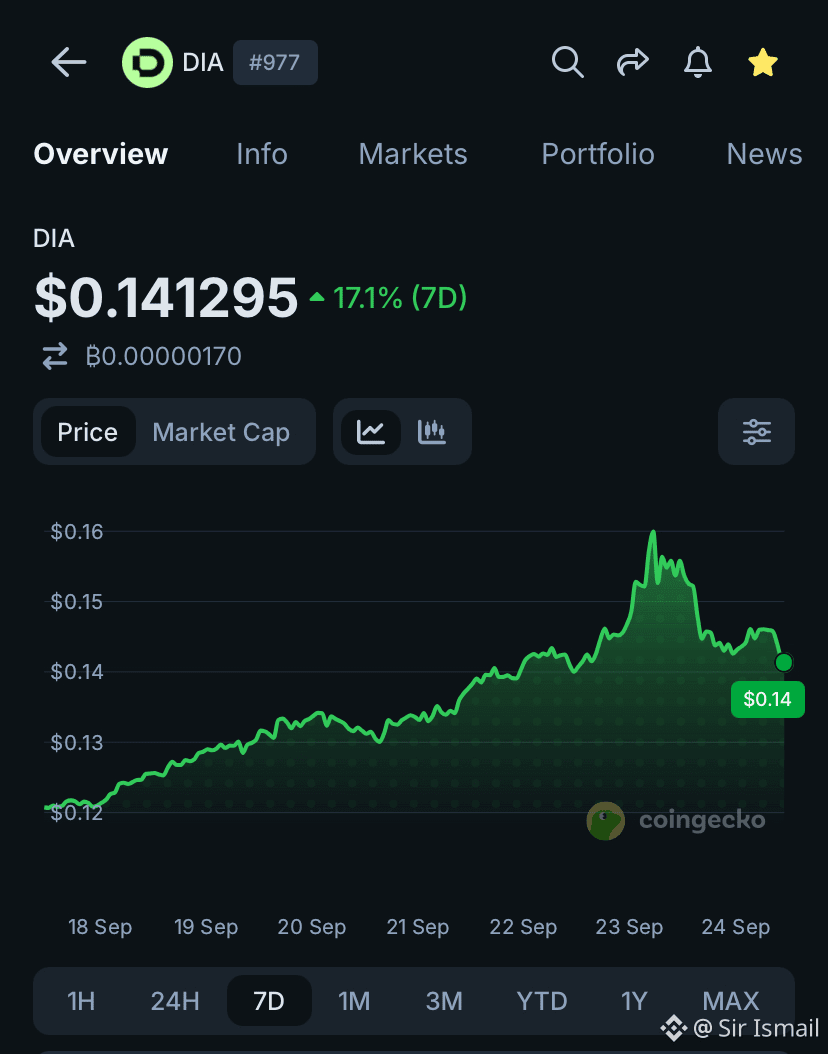
$DIA is quietly in the right spot.
Oracles live on @Arc after it printed $340M TVL in a week.
NAV going onchain with pennyworks_.
Feeds sitting under vaults, RWAs and lending — not just BTC/USD.
The trade isn’t “oracle season.”
It’s more assets onchain that need a number you can verify.
That’s DIA.
$DIA is quietly in the right spot.
Oracles live on @Arc after it printed $340M TVL in a week.
NAV going onchain with pennyworks_.
Feeds sitting under vaults, RWAs and lending — not just BTC/USD.
The trade isn’t “oracle season.”
It’s more assets onchain that need a number you can verify.
That’s DIA.
Oracles live on @Arc after it printed $340M TVL in a week.
NAV going onchain with pennyworks_.
Feeds sitting under vaults, RWAs and lending — not just BTC/USD.
The trade isn’t “oracle season.”
It’s more assets onchain that need a number you can verify.
That’s DIA.
83
·
--
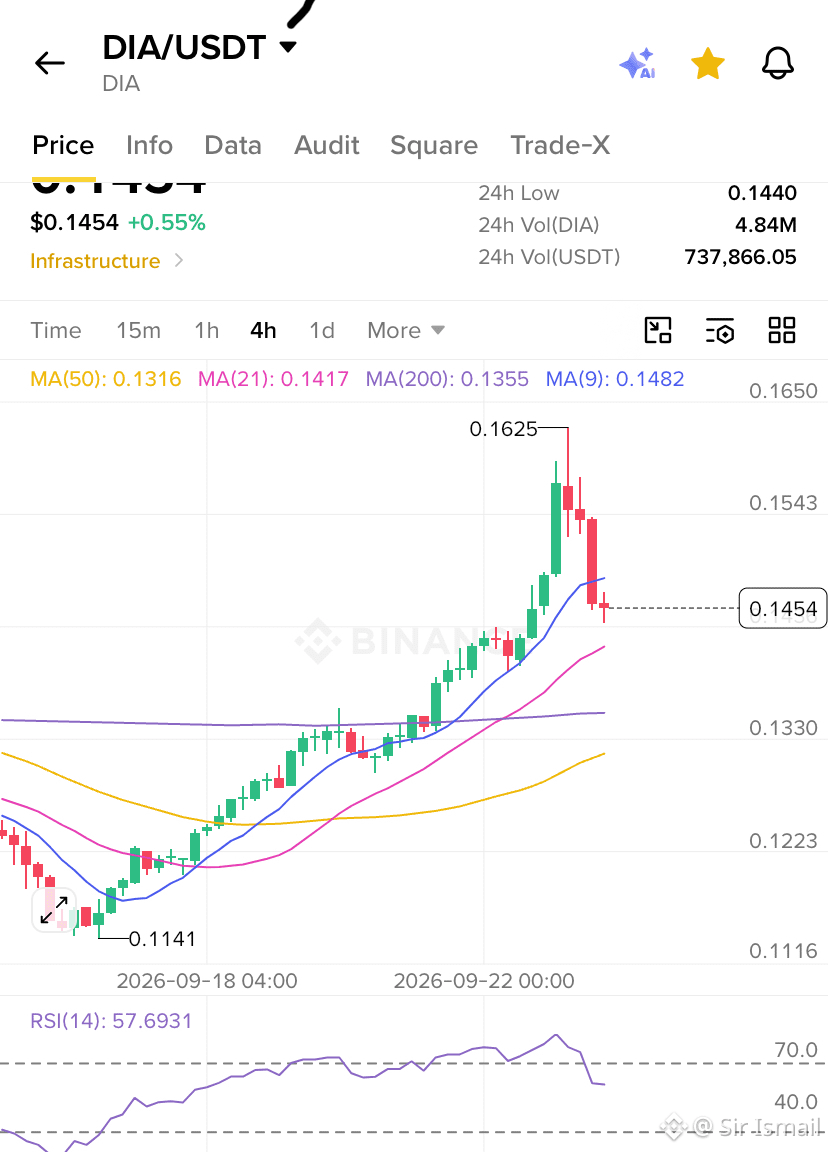
$DIA 4h update
DIA just ran from $0.1141 → $0.1625 and is now cooling off.
Price: $0.1454
MA21: $0.1417
MA50: $0.1316
MA200: $0.1355
RSI: 58
The key point: the trend is still up.
This looks like healthy digestion after a strong impulse, not a confirmed reversal.
Support: $0.1440–$0.1417 → $0.1355
Resistance: $0.1482 → $0.154 → $0.1625
Hold $0.1417–$0.144 + reclaim $0.148–$0.154 → $0.1625 retest comes back into play.
Lose $0.1417 → $0.1355, then potentially $0.132.
$0.1417 is the line. Hold it, and the higher-low structure remains intact. 👀
$DIA 4h update
DIA just ran from $0.1141 → $0.1625 and is now cooling off.
Price: $0.1454
MA21: $0.1417
MA50: $0.1316
MA200: $0.1355
RSI: 58
The key point: the trend is still up.
This looks like healthy digestion after a strong impulse, not a confirmed reversal.
Support: $0.1440–$0.1417 → $0.1355
Resistance: $0.1482 → $0.154 → $0.1625
Hold $0.1417–$0.144 + reclaim $0.148–$0.154 → $0.1625 retest comes back into play.
Lose $0.1417 → $0.1355, then potentially $0.132.
$0.1417 is the line. Hold it, and the higher-low structure remains intact. 👀
DIA just ran from $0.1141 → $0.1625 and is now cooling off.
Price: $0.1454
MA21: $0.1417
MA50: $0.1316
MA200: $0.1355
RSI: 58
The key point: the trend is still up.
This looks like healthy digestion after a strong impulse, not a confirmed reversal.
Support: $0.1440–$0.1417 → $0.1355
Resistance: $0.1482 → $0.154 → $0.1625
Hold $0.1417–$0.144 + reclaim $0.148–$0.154 → $0.1625 retest comes back into play.
Lose $0.1417 → $0.1355, then potentially $0.132.
$0.1417 is the line. Hold it, and the higher-low structure remains intact. 👀
97
·
--
Жоғары (өспелі)
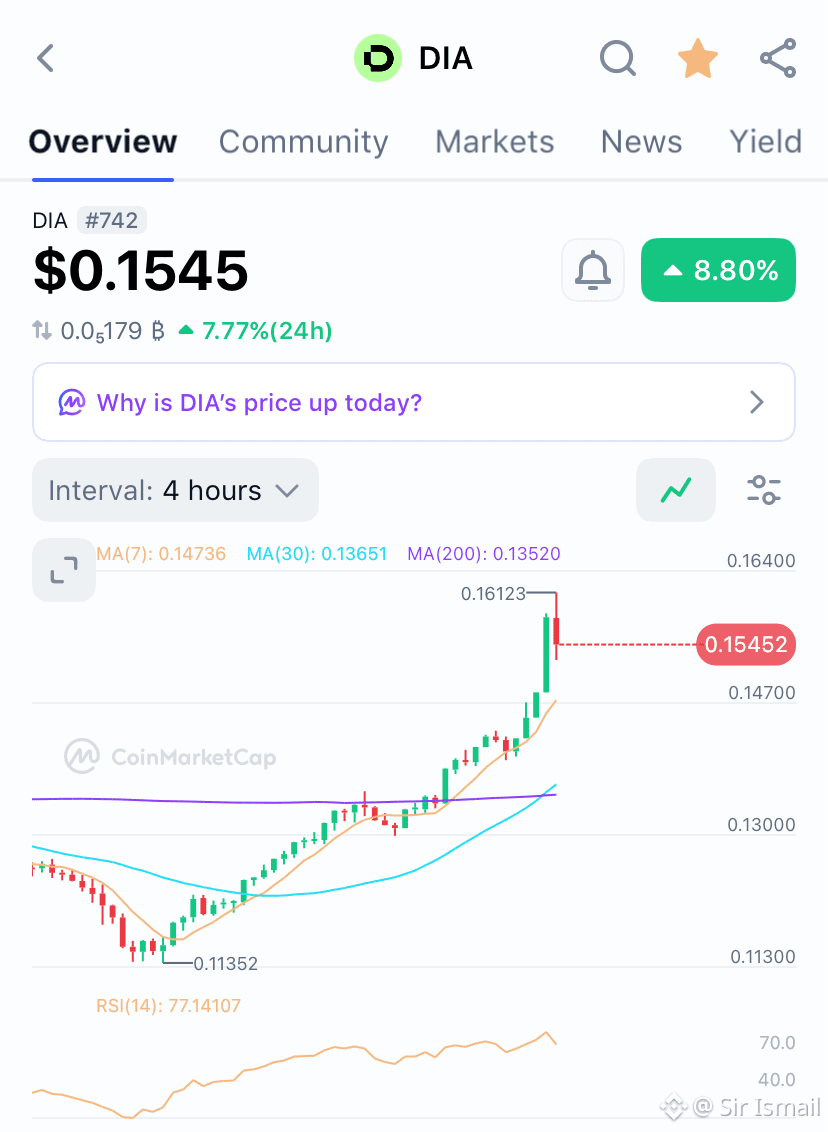
I’m still bullish on $DIA and i think in the coming days we move up again
Why I’m watching $DIA 👀
DIA is building more than basic price feeds.
Its model combines oracle infrastructure, RWA data, Fundamental Feeds and verifiable data across 20K+ assets and 65+ blockchains.
More onchain assets → more demand for reliable data.
That’s the business model I’m watching.
| RWA | DeFi | Oracle Infrastructure
I’m still bullish on $DIA and i think in the coming days we move up again
Why I’m watching $DIA 👀
DIA is building more than basic price feeds.
Its model combines oracle infrastructure, RWA data, Fundamental Feeds and verifiable data across 20K+ assets and 65+ blockchains.
More onchain assets → more demand for reliable data.
That’s the business model I’m watching.
| RWA | DeFi | Oracle Infrastructure
Why I’m watching $DIA 👀
DIA is building more than basic price feeds.
Its model combines oracle infrastructure, RWA data, Fundamental Feeds and verifiable data across 20K+ assets and 65+ blockchains.
More onchain assets → more demand for reliable data.
That’s the business model I’m watching.
| RWA | DeFi | Oracle Infrastructure
69
·
--
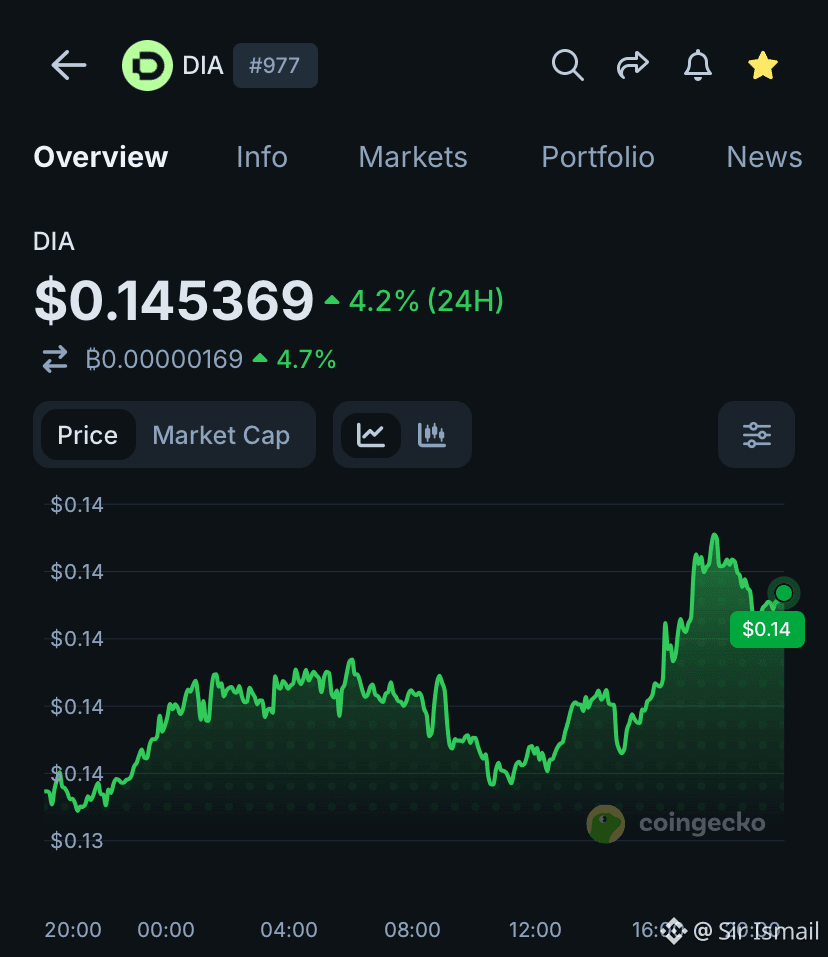
$DIA looks interesting here. 👀
Price is one part of the story.
The bigger thesis is the infrastructure:
RWA data + Fundamental Feeds + verifiable oracles + Lasernet.
If adoption keeps expanding, I think the market can start valuing DIA very differently.
Still watching. Still bullish. 📈 $DIA
$DIA looks interesting here. 👀
Price is one part of the story.
The bigger thesis is the infrastructure:
RWA data + Fundamental Feeds + verifiable oracles + Lasernet.
If adoption keeps expanding, I think the market can start valuing DIA very differently.
Still watching. Still bullish. 📈 $DIA
Price is one part of the story.
The bigger thesis is the infrastructure:
RWA data + Fundamental Feeds + verifiable oracles + Lasernet.
If adoption keeps expanding, I think the market can start valuing DIA very differently.
Still watching. Still bullish. 📈 $DIA
47
·
--
Мақала
Why DIA’s Business Model Could Be More Interesting Than Its NarrativeWhy I Think DIA Has an Interesting Business Model
In crypto, it’s easy to get excited about a token because of its narrative.
But I think a more important question is:
How does the underlying network create economic value?
That’s one reason I’ve been paying closer attention to DIA.
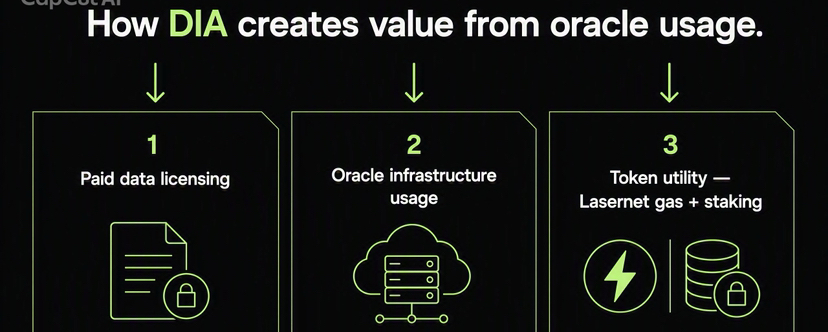
DIA isn’t simply building another price-feed product. It’s building oracle infrastructure designed to provide verifiable data to onchain applications across DeFi, RWAs and other financial markets. Its current platform supports 20,000+ assets, 65+ blockchains, 100+ data sources and 250+ dApps.
The first part: selling data
DIA has a data-licensing model where customers pay license fees for access to DIA data.
That creates a straightforward commercial relationship:
Customer needs financial data → DIA provides the data → customer pays for usage.
The interesting part is that the potential customer base isn’t limited to crypto.
DIA’s infrastructure covers digital assets as well as stocks, commodities, FX and other RWA-related data.
Then comes the network layer
DIA’s Lasernet is an Ethereum L2 rollup powering its oracle infrastructure.
And $DIA is the native gas token.
Oracle computations, data submissions and transactions on the verification layer consume $DIA as gas.
That creates a direct relationship between network activity and token utility.
More oracle activity means more transactions taking place on the infrastructure.
Then there’s staking
$DIA is also used to secure the oracle network.
Stakers and Feeders lock DIA to participate in the security layer, while Feeders submit data onchain and are rewarded based on performance.
So the token has multiple roles:
Gas → Security → Staking → Governance
That’s more interesting to me than a token whose only purpose is speculation.
And then we get to the RWA opportunity
This is where I think the model could become particularly interesting.
As more financial assets move onchain, applications need increasingly specialized data.
Tokenized stocks need market prices.
Tokenized funds can need NAV data.
Lending protocols need collateral prices.
Stablecoins can need reserve information.
RWA protocols need valuation data.
DIA is building infrastructure across these different data requirements, including RWA price feeds and fundamental asset data.
The potential flywheel
This is the model I’m watching:
More onchain applications
More demand for reliable financial data
↓
More DIA oracle usage
↓
More network activity
↓
More $DIA utility through Lasernet + staking
↓
Potentially more ecosystem growth
Of course, this is an economic model, not a guarantee of future token performance. The important variables are actual customer adoption, oracle usage, fees and continued ecosystem growth.
But that’s exactly why I find DIA interesting.
It’s not just:
“Oracle narrative → token.”
It’s closer to:
Data infrastructure → customers → network usage → token utility → ecosystem growth.
If DeFi, RWAs and tokenized financial markets continue expanding, the demand for reliable data infrastructure could expand with them.
That’s the DIA business model I’m watching
And honestly, that’s what makes $DIA more interesting to me than simply looking at its chart. 👀
Why DIA’s Business Model Could Be More Interesting Than Its Narrative
Why I Think DIA Has an Interesting Business Model
In crypto, it’s easy to get excited about a token because of its narrative.
But I think a more important question is:
How does the underlying network create economic value?
That’s one reason I’ve been paying closer attention to DIA.
DIA isn’t simply building another price-feed product. It’s building oracle infrastructure designed to provide verifiable data to onchain applications across DeFi, RWAs and other financial markets. Its current platform supports 20,000+ assets, 65+ blockchains, 100+ data sources and 250+ dApps.
The first part: selling data
DIA has a data-licensing model where customers pay license fees for access to DIA data.
That creates a straightforward commercial relationship:
Customer needs financial data → DIA provides the data → customer pays for usage.
The interesting part is that the potential customer base isn’t limited to crypto.
DIA’s infrastructure covers digital assets as well as stocks, commodities, FX and other RWA-related data.
Then comes the network layer
DIA’s Lasernet is an Ethereum L2 rollup powering its oracle infrastructure.
And $DIA is the native gas token.
Oracle computations, data submissions and transactions on the verification layer consume $DIA as gas.
That creates a direct relationship between network activity and token utility.
More oracle activity means more transactions taking place on the infrastructure.
Then there’s staking
$DIA is also used to secure the oracle network.
Stakers and Feeders lock DIA to participate in the security layer, while Feeders submit data onchain and are rewarded based on performance.
So the token has multiple roles:
Gas → Security → Staking → Governance
That’s more interesting to me than a token whose only purpose is speculation.
And then we get to the RWA opportunity
This is where I think the model could become particularly interesting.
As more financial assets move onchain, applications need increasingly specialized data.
Tokenized stocks need market prices.
Tokenized funds can need NAV data.
Lending protocols need collateral prices.
Stablecoins can need reserve information.
RWA protocols need valuation data.
DIA is building infrastructure across these different data requirements, including RWA price feeds and fundamental asset data.
The potential flywheel
This is the model I’m watching:
More onchain applications
More demand for reliable financial data
↓
More DIA oracle usage
↓
More network activity
↓
More $DIA utility through Lasernet + staking
↓
Potentially more ecosystem growth
Of course, this is an economic model, not a guarantee of future token performance. The important variables are actual customer adoption, oracle usage, fees and continued ecosystem growth.
But that’s exactly why I find DIA interesting.
It’s not just:
“Oracle narrative → token.”
It’s closer to:
Data infrastructure → customers → network usage → token utility → ecosystem growth.
If DeFi, RWAs and tokenized financial markets continue expanding, the demand for reliable data infrastructure could expand with them.
That’s the DIA business model I’m watching
And honestly, that’s what makes $DIA more interesting to me than simply looking at its chart. 👀
In crypto, it’s easy to get excited about a token because of its narrative.
But I think a more important question is:
How does the underlying network create economic value?
That’s one reason I’ve been paying closer attention to DIA.
DIA isn’t simply building another price-feed product. It’s building oracle infrastructure designed to provide verifiable data to onchain applications across DeFi, RWAs and other financial markets. Its current platform supports 20,000+ assets, 65+ blockchains, 100+ data sources and 250+ dApps.
The first part: selling data
DIA has a data-licensing model where customers pay license fees for access to DIA data.
That creates a straightforward commercial relationship:
Customer needs financial data → DIA provides the data → customer pays for usage.
The interesting part is that the potential customer base isn’t limited to crypto.
DIA’s infrastructure covers digital assets as well as stocks, commodities, FX and other RWA-related data.
Then comes the network layer
DIA’s Lasernet is an Ethereum L2 rollup powering its oracle infrastructure.
And $DIA is the native gas token.
Oracle computations, data submissions and transactions on the verification layer consume $DIA as gas.
That creates a direct relationship between network activity and token utility.
More oracle activity means more transactions taking place on the infrastructure.
Then there’s staking
$DIA is also used to secure the oracle network.
Stakers and Feeders lock DIA to participate in the security layer, while Feeders submit data onchain and are rewarded based on performance.
So the token has multiple roles:
Gas → Security → Staking → Governance
That’s more interesting to me than a token whose only purpose is speculation.
And then we get to the RWA opportunity
This is where I think the model could become particularly interesting.
As more financial assets move onchain, applications need increasingly specialized data.
Tokenized stocks need market prices.
Tokenized funds can need NAV data.
Lending protocols need collateral prices.
Stablecoins can need reserve information.
RWA protocols need valuation data.
DIA is building infrastructure across these different data requirements, including RWA price feeds and fundamental asset data.
The potential flywheel
This is the model I’m watching:
More onchain applications
More demand for reliable financial data
↓
More DIA oracle usage
↓
More network activity
↓
More $DIA utility through Lasernet + staking
↓
Potentially more ecosystem growth
Of course, this is an economic model, not a guarantee of future token performance. The important variables are actual customer adoption, oracle usage, fees and continued ecosystem growth.
But that’s exactly why I find DIA interesting.
It’s not just:
“Oracle narrative → token.”
It’s closer to:
Data infrastructure → customers → network usage → token utility → ecosystem growth.
If DeFi, RWAs and tokenized financial markets continue expanding, the demand for reliable data infrastructure could expand with them.
That’s the DIA business model I’m watching
And honestly, that’s what makes $DIA more interesting to me than simply looking at its chart. 👀
121
·
--
Жоғары (өспелі)
Bullish on $DIA all week
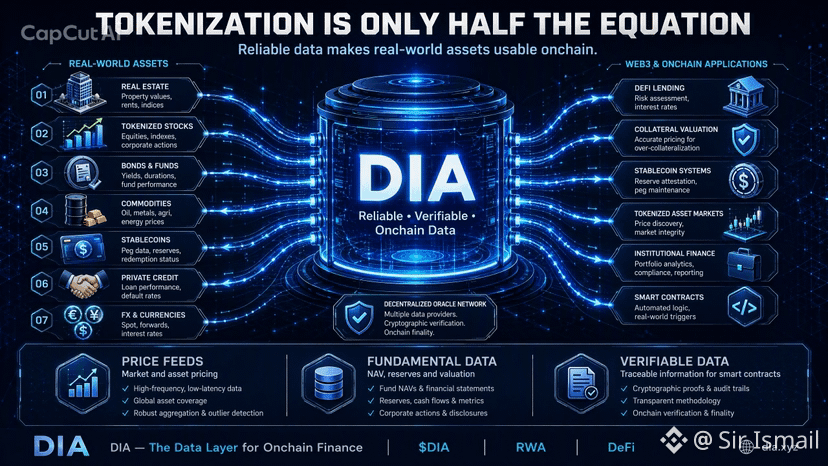
RWA tokenization is only the beginning.
Putting a real-world asset onchain doesn’t automatically tell a smart contract what it’s worth.
You still need reliable data for:
→ Pricing
→ Valuation
→ Collateral
→ Reserves
→ Risk
That’s why the oracle layer matters.
DIA provides RWA price feeds and fundamental data for assets including stocks, commodities and other real-world assets, with transparent, verifiable data flows.
Tokenization puts RWAs onchain.
Reliable data makes them usable.
That’s the part of the RWA thesis I’m watching.
Bullish on $DIA all week
RWA tokenization is only the beginning.
Putting a real-world asset onchain doesn’t automatically tell a smart contract what it’s worth.
You still need reliable data for:
→ Pricing
→ Valuation
→ Collateral
→ Reserves
→ Risk
That’s why the oracle layer matters.
DIA provides RWA price feeds and fundamental data for assets including stocks, commodities and other real-world assets, with transparent, verifiable data flows.
Tokenization puts RWAs onchain.
Reliable data makes them usable.
That’s the part of the RWA thesis I’m watching.
RWA tokenization is only the beginning.
Putting a real-world asset onchain doesn’t automatically tell a smart contract what it’s worth.
You still need reliable data for:
→ Pricing
→ Valuation
→ Collateral
→ Reserves
→ Risk
That’s why the oracle layer matters.
DIA provides RWA price feeds and fundamental data for assets including stocks, commodities and other real-world assets, with transparent, verifiable data flows.
Tokenization puts RWAs onchain.
Reliable data makes them usable.
That’s the part of the RWA thesis I’m watching.
54
·
--
Жоғары (өспелі)
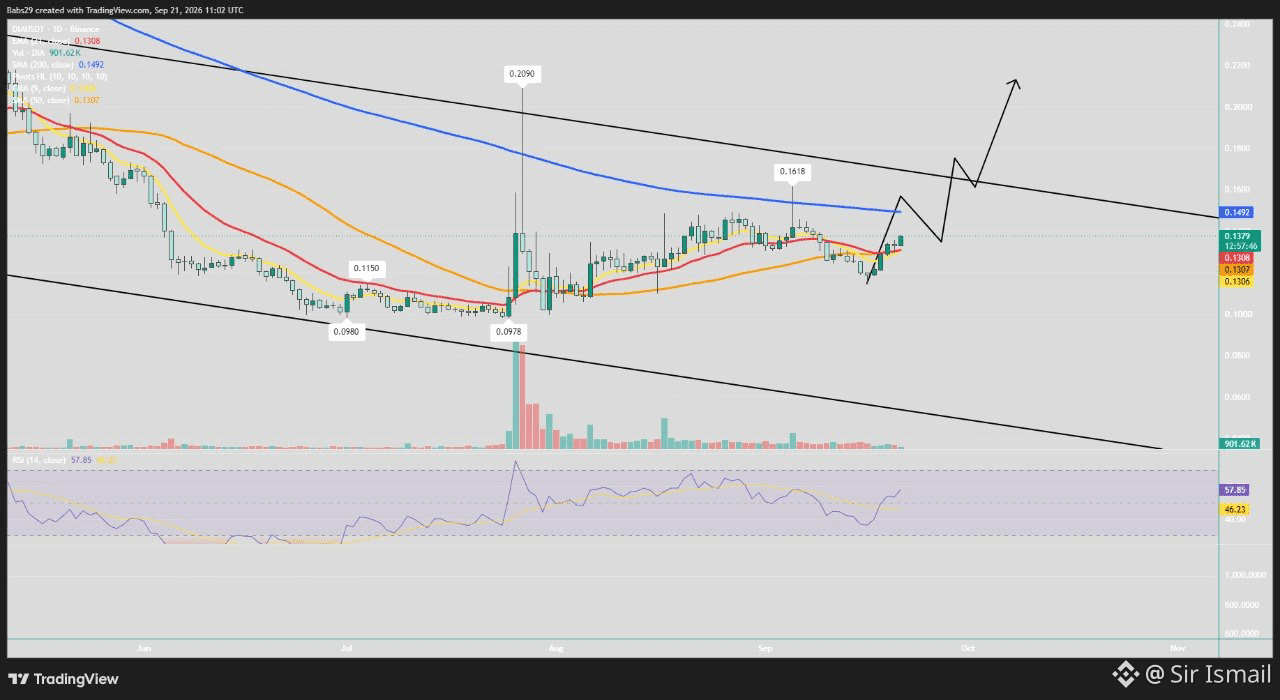
$DIA Daily TA
$DIA is showing a bullish recovery from the $0.098 area.
* Current: ~$0.138
* Support: $0.130–$0.131
* Resistance: $0.149 → $0.162
* RSI: ~58, momentum improving
🟢 Holding above $0.130 keeps the bullish setup alive. A breakout above $0.149 could open the way toward $0.162 → $0.18+.
🔴 Losing $0.130 would weaken the setup and could bring another pullback.
Bulls are gaining momentum.
$DIA Daily TA
$DIA is showing a bullish recovery from the $0.098 area.
* Current: ~$0.138
* Support: $0.130–$0.131
* Resistance: $0.149 → $0.162
* RSI: ~58, momentum improving
🟢 Holding above $0.130 keeps the bullish setup alive. A breakout above $0.149 could open the way toward $0.162 → $0.18+.
🔴 Losing $0.130 would weaken the setup and could bring another pullback.
Bulls are gaining momentum.
$DIA is showing a bullish recovery from the $0.098 area.
* Current: ~$0.138
* Support: $0.130–$0.131
* Resistance: $0.149 → $0.162
* RSI: ~58, momentum improving
🟢 Holding above $0.130 keeps the bullish setup alive. A breakout above $0.149 could open the way toward $0.162 → $0.18+.
🔴 Losing $0.130 would weaken the setup and could bring another pullback.
Bulls are gaining momentum.
2.4k
·
--
Жоғары (өспелі)
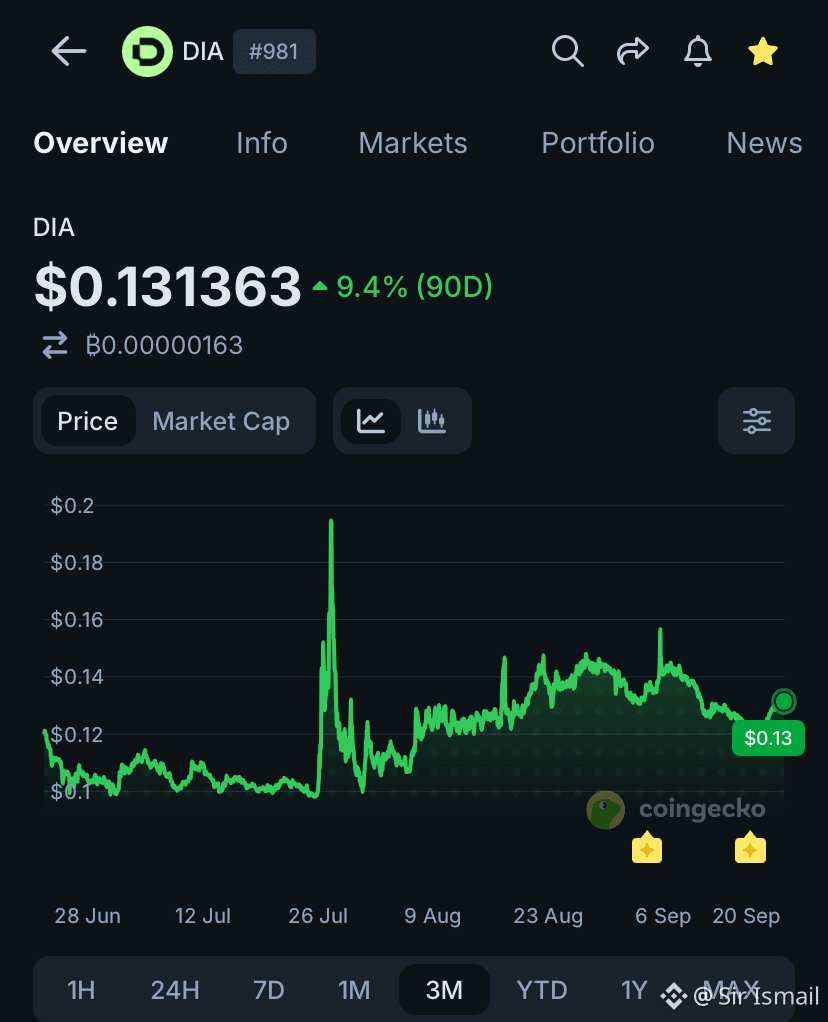
$DIA is starting to wake up again
Sitting around $0.13 and already pushing higher today.
What makes this interesting to me isn’t just the chart.
DIA is building infrastructure around:
→ RWA data
→ Fundamental valuation
→ Verifiable feeds
→ DeFi
→ Tokenized assets
If momentum continues and DIA can reclaim the $0.14–$0.15 area, I’ll be watching closely for the next expansion.
The chart is moving. The infrastructure is growing.
$DIA is starting to wake up again
Sitting around $0.13 and already pushing higher today.
What makes this interesting to me isn’t just the chart.
DIA is building infrastructure around:
→ RWA data
→ Fundamental valuation
→ Verifiable feeds
→ DeFi
→ Tokenized assets
If momentum continues and DIA can reclaim the $0.14–$0.15 area, I’ll be watching closely for the next expansion.
The chart is moving. The infrastructure is growing.
Sitting around $0.13 and already pushing higher today.
What makes this interesting to me isn’t just the chart.
DIA is building infrastructure around:
→ RWA data
→ Fundamental valuation
→ Verifiable feeds
→ DeFi
→ Tokenized assets
If momentum continues and DIA can reclaim the $0.14–$0.15 area, I’ll be watching closely for the next expansion.
The chart is moving. The infrastructure is growing.
50
·
--
Happy weekend $DIA Fam
Week recap on DIA — the stack, not the ticker.
4 things inside DIA that are not “BTC price feed”:
1. Lumina — the oracle stack
2. Lasernet — the L2 where the data is actually computed
3. Feeders — independent nodes sourcing first-party trades
4. $DIA — gas on that L2 + security for the network
That’s the machine.
This week’s live signal on top of it: DIA + @pennyworks_ publishing audit-ready NAV onchain for DeFi funds and curators.
Feeds are the output.
Verified NAV is the new demand.
Stay bullish guys!
Happy weekend $DIA Fam
Week recap on DIA — the stack, not the ticker.
4 things inside DIA that are not “BTC price feed”:
1. Lumina — the oracle stack
2. Lasernet — the L2 where the data is actually computed
3. Feeders — independent nodes sourcing first-party trades
4. $DIA — gas on that L2 + security for the network
That’s the machine.
This week’s live signal on top of it: DIA + @pennyworks_ publishing audit-ready NAV onchain for DeFi funds and curators.
Feeds are the output.
Verified NAV is the new demand.
Stay bullish guys!
Week recap on DIA — the stack, not the ticker.
4 things inside DIA that are not “BTC price feed”:
1. Lumina — the oracle stack
2. Lasernet — the L2 where the data is actually computed
3. Feeders — independent nodes sourcing first-party trades
4. $DIA — gas on that L2 + security for the network
That’s the machine.
This week’s live signal on top of it: DIA + @pennyworks_ publishing audit-ready NAV onchain for DeFi funds and curators.
Feeds are the output.
Verified NAV is the new demand.
Stay bullish guys!
50
·
--
Жоғары (өспелі)
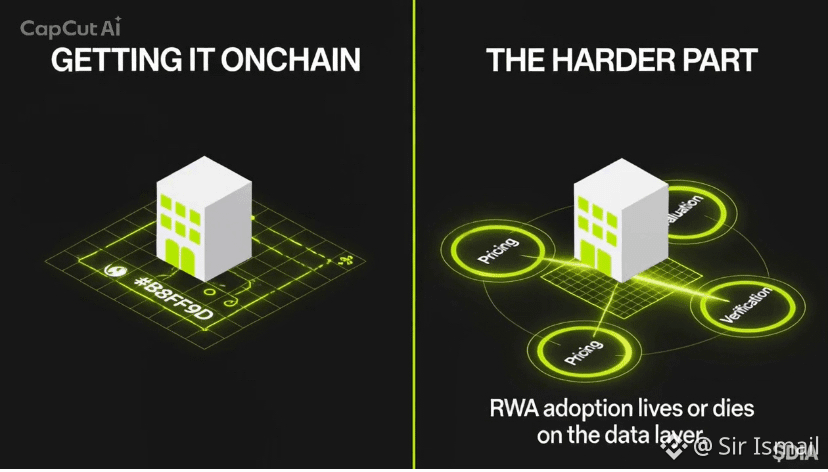
Undervalued? ✔️
Momentum?✔️
Innovations? ✔️
$DIA is the most promising oracle gem right now.
DIA Value and DIA ZK are the game changer while Lumina/Lasernet is the engine.
This week they’re publishing NAV onchain with pennyworks
Stay bullish imo
We going much higher in the coming weeks
NFA!
Happy weekend
Undervalued? ✔️
Momentum?✔️
Innovations? ✔️
$DIA is the most promising oracle gem right now.
DIA Value and DIA ZK are the game changer while Lumina/Lasernet is the engine.
This week they’re publishing NAV onchain with pennyworks
Stay bullish imo
We going much higher in the coming weeks
NFA!
Happy weekend
Momentum?✔️
Innovations? ✔️
$DIA is the most promising oracle gem right now.
DIA Value and DIA ZK are the game changer while Lumina/Lasernet is the engine.
This week they’re publishing NAV onchain with pennyworks
Stay bullish imo
We going much higher in the coming weeks
NFA!
Happy weekend
63
·
--
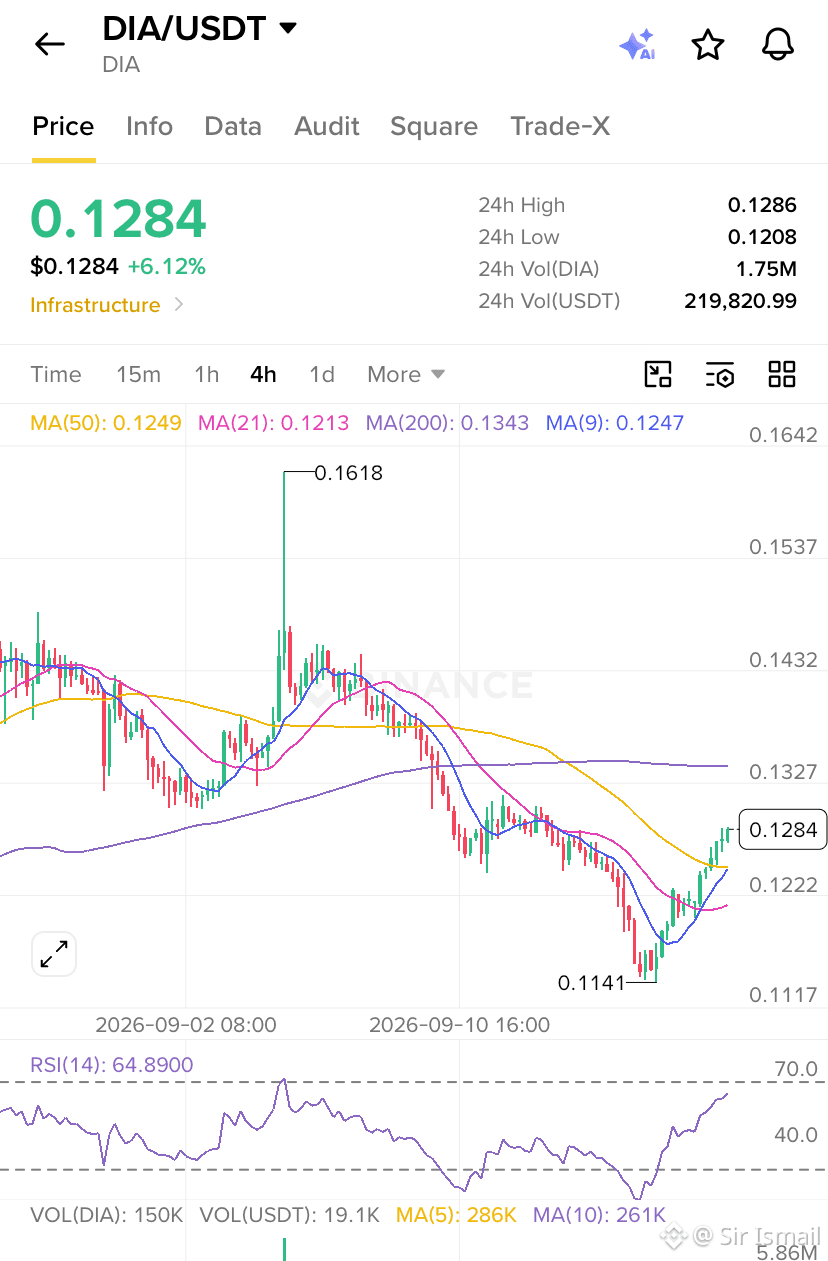
$DIA 4H Update
Held the line.
Bounced from the $0.1166–0.118 zone and pushed back to ~$0.127–0.128.
That’s a clean higher-low off yesterday’s flush. Buyers defended instead of letting it slide to $0.110.
Next job is simple: hold $0.122–0.125 and reclaim $0.129–0.133 (MA9/MA21 area from the daily). If that flips, $0.138 comes back on the table.
Invalidation for this bounce: lose $0.1166.
$DIA 4H Update
Held the line.
Bounced from the $0.1166–0.118 zone and pushed back to ~$0.127–0.128.
That’s a clean higher-low off yesterday’s flush. Buyers defended instead of letting it slide to $0.110.
Next job is simple: hold $0.122–0.125 and reclaim $0.129–0.133 (MA9/MA21 area from the daily). If that flips, $0.138 comes back on the table.
Invalidation for this bounce: lose $0.1166.
Held the line.
Bounced from the $0.1166–0.118 zone and pushed back to ~$0.127–0.128.
That’s a clean higher-low off yesterday’s flush. Buyers defended instead of letting it slide to $0.110.
Next job is simple: hold $0.122–0.125 and reclaim $0.129–0.133 (MA9/MA21 area from the daily). If that flips, $0.138 comes back on the table.
Invalidation for this bounce: lose $0.1166.
132
·
--
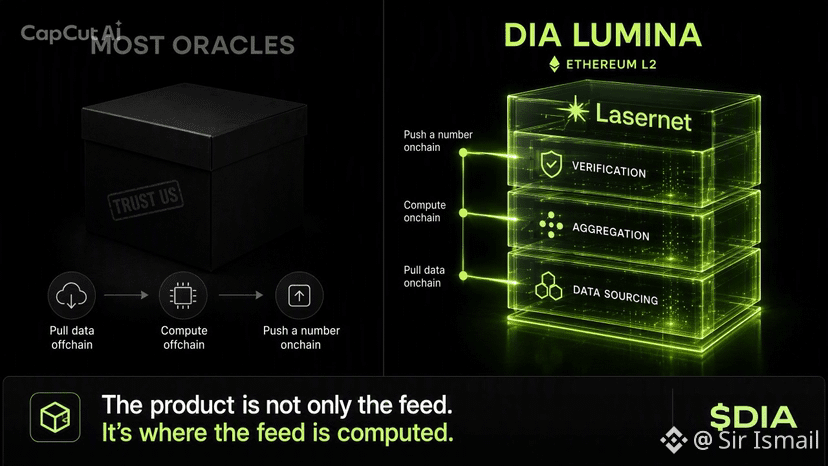
Most oracles still do the same thing.
Pull data offchain.
Compute offchain.
Push a number onchain and ask the protocol to trust it.
DIA flipped that.
Lumina runs the oracle stack on Lasernet — DIA’s own Ethereum L2. Data sourcing, aggregation and verification sit onchain, not in a private backend.
That’s the part people skip when they say “another oracle.”
The product is not only the feed.
It’s where the feed is computed.
$DIA
Most oracles still do the same thing.
Pull data offchain.
Compute offchain.
Push a number onchain and ask the protocol to trust it.
DIA flipped that.
Lumina runs the oracle stack on Lasernet — DIA’s own Ethereum L2. Data sourcing, aggregation and verification sit onchain, not in a private backend.
That’s the part people skip when they say “another oracle.”
The product is not only the feed.
It’s where the feed is computed.
$DIA
Pull data offchain.
Compute offchain.
Push a number onchain and ask the protocol to trust it.
DIA flipped that.
Lumina runs the oracle stack on Lasernet — DIA’s own Ethereum L2. Data sourcing, aggregation and verification sit onchain, not in a private backend.
That’s the part people skip when they say “another oracle.”
The product is not only the feed.
It’s where the feed is computed.
$DIA
175
·
--
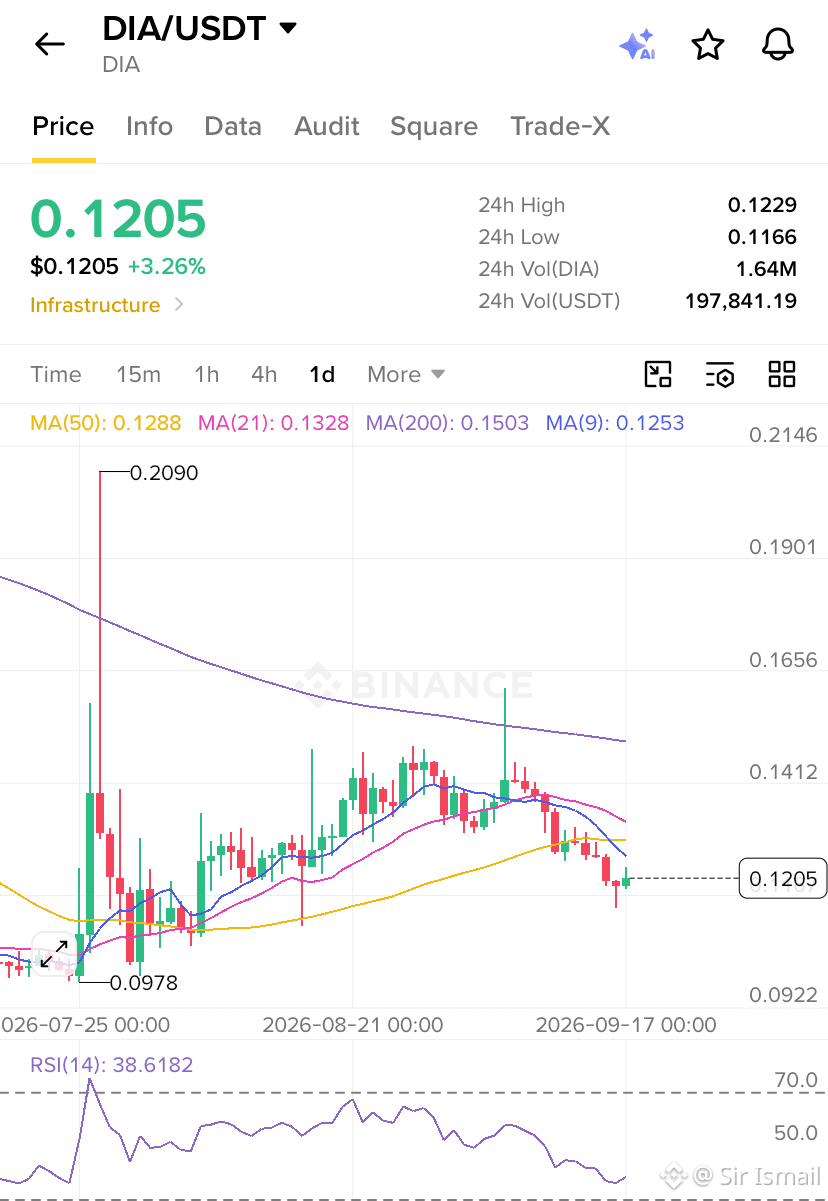
Here’s your $DIA Daily Update
Bounced to $0.1205 after tagging $0.1166.
Still under MA9 / MA21 / MA50. RSI 39.
Bull Case: Hold $0.1166 + reclaim $0.125–0.129 → $0.133
Bear Case: Lose $0.1166 → $0.110 / $0.098
Relief bounce for now whiles $0.1166 is the line to watch
What’s your bias? 👀
Here’s your $DIA Daily Update
Bounced to $0.1205 after tagging $0.1166.
Still under MA9 / MA21 / MA50. RSI 39.
Bull Case: Hold $0.1166 + reclaim $0.125–0.129 → $0.133
Bear Case: Lose $0.1166 → $0.110 / $0.098
Relief bounce for now whiles $0.1166 is the line to watch
What’s your bias? 👀
Bounced to $0.1205 after tagging $0.1166.
Still under MA9 / MA21 / MA50. RSI 39.
Bull Case: Hold $0.1166 + reclaim $0.125–0.129 → $0.133
Bear Case: Lose $0.1166 → $0.110 / $0.098
Relief bounce for now whiles $0.1166 is the line to watch
What’s your bias? 👀
86
·
--
Why $DIA could matter in the next phase of RWA adoption
Real World Assets are moving onchain, but tokenization alone doesn’t solve the data problem.
Once an asset is tokenized, protocols still need reliable data for:
→ Pricing
→ Valuation
→ Collateralization
→ Reserves
→ Risk management
That’s where oracle infrastructure becomes important.
DIA is building around this data layer, with support for RWA price feeds, fundamental asset data and verifiable onchain feeds. Its current infrastructure spans 20,000+ assets, 65+ blockchains, 100+ data sources and 250+ dApps.
Recent DIA integrations also show the range of the thesis — from Latin American currencies coming onchain through DIA price oracles to Fundamental Feeds being used to price VUSD and sVUSD.
My takeaway:
RWA adoption needs both the asset layer and the data layer.
And the data layer is becoming increasingly important as more financial assets move onchain.
Why $DIA could matter in the next phase of RWA adoption
Real World Assets are moving onchain, but tokenization alone doesn’t solve the data problem.
Once an asset is tokenized, protocols still need reliable data for:
→ Pricing
→ Valuation
→ Collateralization
→ Reserves
→ Risk management
That’s where oracle infrastructure becomes important.
DIA is building around this data layer, with support for RWA price feeds, fundamental asset data and verifiable onchain feeds. Its current infrastructure spans 20,000+ assets, 65+ blockchains, 100+ data sources and 250+ dApps.
Recent DIA integrations also show the range of the thesis — from Latin American currencies coming onchain through DIA price oracles to Fundamental Feeds being used to price VUSD and sVUSD.
My takeaway:
RWA adoption needs both the asset layer and the data layer.
And the data layer is becoming increasingly important as more financial assets move onchain.
Real World Assets are moving onchain, but tokenization alone doesn’t solve the data problem.
Once an asset is tokenized, protocols still need reliable data for:
→ Pricing
→ Valuation
→ Collateralization
→ Reserves
→ Risk management
That’s where oracle infrastructure becomes important.
DIA is building around this data layer, with support for RWA price feeds, fundamental asset data and verifiable onchain feeds. Its current infrastructure spans 20,000+ assets, 65+ blockchains, 100+ data sources and 250+ dApps.
Recent DIA integrations also show the range of the thesis — from Latin American currencies coming onchain through DIA price oracles to Fundamental Feeds being used to price VUSD and sVUSD.
My takeaway:
RWA adoption needs both the asset layer and the data layer.
And the data layer is becoming increasingly important as more financial assets move onchain.
250
·
--
Жоғары (өспелі)
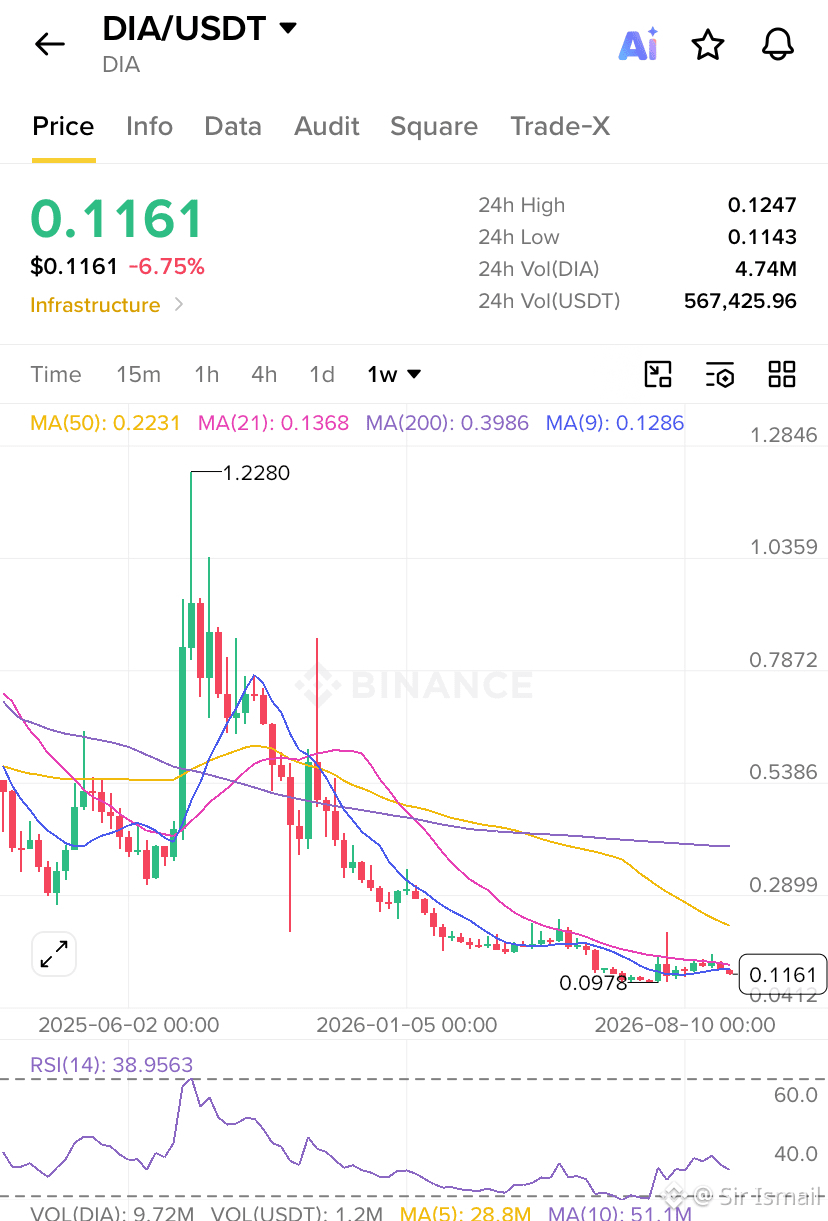
Good morning guys
Stay bullish on $DIA guys!
Where could DIA go from here? 👀
I’m watching three zones:
🎯 $0.15 — reclaiming this would put DIA back above an important psychological area.
🎯 $0.20 — a stronger recovery zone if momentum returns.
🎯 $0.30+ — would require a much broader expansion in momentum and continued ecosystem growth.
I’m not treating any of these as guaranteed targets.
The bigger question is whether DIA continues turning its oracle infrastructure into real adoption across DeFi, RWAs, stablecoins and tokenized assets.
If that continues, the market may eventually have to reprice the data-layer thesis.
$DIA remains on my radar. 👀
Good morning guys
Stay bullish on $DIA guys!
Where could DIA go from here? 👀
I’m watching three zones:
🎯 $0.15 — reclaiming this would put DIA back above an important psychological area.
🎯 $0.20 — a stronger recovery zone if momentum returns.
🎯 $0.30+ — would require a much broader expansion in momentum and continued ecosystem growth.
I’m not treating any of these as guaranteed targets.
The bigger question is whether DIA continues turning its oracle infrastructure into real adoption across DeFi, RWAs, stablecoins and tokenized assets.
If that continues, the market may eventually have to reprice the data-layer thesis.
$DIA remains on my radar. 👀
Stay bullish on $DIA guys!
Where could DIA go from here? 👀
I’m watching three zones:
🎯 $0.15 — reclaiming this would put DIA back above an important psychological area.
🎯 $0.20 — a stronger recovery zone if momentum returns.
🎯 $0.30+ — would require a much broader expansion in momentum and continued ecosystem growth.
I’m not treating any of these as guaranteed targets.
The bigger question is whether DIA continues turning its oracle infrastructure into real adoption across DeFi, RWAs, stablecoins and tokenized assets.
If that continues, the market may eventually have to reprice the data-layer thesis.
$DIA remains on my radar. 👀
504
Көбірек контент көру үшін кіріңіз
Binance Square платформасында әлемдік криптоқоғамдастыққа қосылыңыз
⚡️ Криптовалюта туралы ең соңғы және пайдалы ақпаратты алыңыз.
💬 Әлемдегі ең ірі криптобиржаның сеніміне ие.
👍 Расталған авторлардың нақты пікірлерін табыңыз.
Электрондық пошта/телефон нөмірі
Трендтегі тақырыптар
QNTRises39%
29,172 рет көрілді
1,011 адам талқылап жатыр
#qntrises39%
QNT للتو سحب قفزة صاروخية بنسبة 39% 🚀 لكن هل نحن نتجه إلى المريخ أم أننا فقط نسقط من على السرير؟ 😂
بالنظر إلى الرسم البياني، وصل QNT إلى قمة شهية عند 105 دولارات والآن هذا السهم الأحمر الكبير يشير مباشرة إلى الأسفل نحو 75 دولارًا. هل انتهت الحفلة رسميًا، أم أنها فقط تأخذ أنفاسًا؟ 📉
إذا كنت متداولًا الآن، لا تَذعر وتشتري القمة! راقب مستويات الدعم، وثبّت أرباحك، أو انتظر الارتداد. تذكّر، هذا ليس نصيحة مالية—دائمًا اعمل أبحاثك الخاصة DYOR!
متابعة من فضلكم
Trade $QNTB
$NOM
$TAKE
#qntrises39% #QuantNetwork #CryptoTrading #Altcoins
Shamika Metting
·2 лайк
·2.3k рет көрілді
EthereumBreaksAbove$2700
2,731 рет көрілді
103 адам талқылап жатыр
BitgetBreachForgedRequestsNotStolenKeys
25,952 рет көрілді
798 адам талқылап жатыр