
FatherWEB4
6.5k Жариялаулар

FatherWEB4
Хабарлау
Пайдаланушыны блоктау
Jurnal | Political | Social Society | Freedom Maximalist | X eazyETH_
Жиі сауда жасайтын трейдер
4.2 жыл
220 Жазылым
24.7K+ Жазылушылар
9.0K+ лайк басылған
Жазбалар
Барлығы
Баға ұсыныстары
Тікелей эфир
·
--
Мақала
"When AI Enters Society: My Encounter with Mira and the Culture of Verifiable Intelligence."There was a moment recently when I caught myself thinking about Artificial Intelligence in a way that felt slightly unsettling. Not as software, not as infrastructure, but almost as a participant in social life. AI was answering questions, shaping opinions, writing reports, and even influencing decisions. And the more I observed this shift, the more a simple question started to linger in my mind:
When AI becomes part of our daily thinking, who verifies the truth behind what it says?
That question stayed with me longer than I expected.
For years, the conversation around AI has been dominated by speed and capability. Bigger models, more parameters, faster inference. Every breakthrough is measured by how much more intelligent the machine appears to be. But rarely do we pause to ask a more human question: how do we actually trust what AI produces?
My curiosity about this started to sharpen when I came across the concept behind Mira Network. At first glance, it seemed like another intersection between blockchain and artificial intelligence, something the industry has talked about for years. But the more I tried to understand it, the more it felt like Mira was addressing something deeper than technology.
It felt like it was addressing culture.
Because trust in information has always been cultural before it was technical.
In traditional journalism, trust comes from editorial processes. In science, it comes from peer review. In communities, it comes from collective verification. We rarely accept knowledge simply because someone claims it. We look for signals that others have tested it, challenged it, or confirmed it.
But with AI, something strange happened.
The machine gives an answer, and most of us instinctively treat it like an oracle.
We type a question.
The system replies.
And we move on.
Yet behind that smooth interaction lies a black box. We don’t see the reasoning process. We can’t reproduce the inference. We can’t verify whether the result was derived correctly or simply generated through probabilistic patterns.
And that realization leads to an uncomfortable thought.
If AI is increasingly shaping how we understand information, are we building a culture that blindly trusts machines?
This is where Mira’s concept began to feel less like a technical framework and more like a social experiment.
Instead of treating AI outputs as final answers, Mira introduces a system where those outputs can be verified through decentralized networks. The idea is subtle but powerful: when an AI model produces a result, the network can attempt to reproduce that inference to confirm whether it is valid.
In other words, the AI doesn’t just say, “Here is the answer.”
The system can also demonstrate, “Here is proof that the computation leading to this answer actually occurred.”
The implications of this become clearer when you imagine how AI might function in the real world.
Picture a researcher using AI to analyze market trends. The report generated by the model could influence millions of dollars in investment decisions. Under normal circumstances, people would rely on the credibility of the model provider or the organization deploying it.
But what if the output could instead be verified across a decentralized infrastructure like the one envisioned by Mira Network?
Suddenly, trust doesn’t come from a single institution.
It comes from a network that collectively validates the computation.
And that shift feels almost cultural.
Because in human societies, trust rarely emerges from isolated authority. It grows through collective confirmation. Communities test claims. Experts challenge ideas. Evidence is scrutinized.
In a way, Mira seems to be asking a fascinating question:
What if AI had to live within the same culture of verification that humans rely on?
The more I thought about this, the more I started to imagine how our relationship with AI might evolve.
Today, interacting with AI feels like consulting an incredibly fast assistant. But what happens when the stakes become higher? When AI begins influencing policy decisions, economic forecasts, or even scientific research at scale?
Will we still accept answers without proof?
Or will society demand something closer to verifiable intelligence?
There is an interesting parallel with blockchain here. When blockchain technology first appeared, many people thought its primary innovation was digital currency. But over time it became clear that the deeper innovation was decentralized verification. Transactions no longer needed to rely on a central authority because networks of validators could collectively ensure their validity.
Mira appears to be applying that same philosophical foundation to AI.
Instead of verifying transactions, the network verifies computational claims.
And suddenly AI begins to resemble something closer to a social process rather than a solitary machine.
That idea fascinates me.
Because it suggests that the future of AI may not just depend on better models or faster GPUs. It might depend on whether we can embed AI into systems that reflect how human societies actually build trust.
Trust is rarely instantaneous. It is negotiated, questioned, and reinforced through shared processes.
So perhaps the real challenge of AI is not intelligence itself.
Perhaps the challenge is credibility.
When I step back and think about the broader landscape of technology, it feels like we are entering a strange transition period. AI is becoming more capable by the month, yet public confidence in information is becoming increasingly fragile. Misinformation spreads easily. Automated content floods social platforms. The line between synthetic and authentic knowledge grows thinner every day.
In that environment, the question of verification becomes unavoidable.
And that brings me back to the thought that first started this reflection.
If AI is slowly becoming a participant in our social and intellectual life, then it may need something more than raw computational power.
It may need a culture of accountability.
Projects like Mira Network seem to be exploring what that culture might look like when translated into decentralized technology. Not just a faster AI, but an AI whose claims can be challenged, reproduced, and validated by others.
Which leads to a final question that feels less technical and more philosophical.
If artificial intelligence is destined to shape how humanity understands information…
who will stand behind the truth of what those machines say?
@mira_network
#Mira $MIRA
{future}(MIRAUSDT)
"When AI Enters Society: My Encounter with Mira and the Culture of Verifiable Intelligence."
There was a moment recently when I caught myself thinking about Artificial Intelligence in a way that felt slightly unsettling. Not as software, not as infrastructure, but almost as a participant in social life. AI was answering questions, shaping opinions, writing reports, and even influencing decisions. And the more I observed this shift, the more a simple question started to linger in my mind:
When AI becomes part of our daily thinking, who verifies the truth behind what it says?
That question stayed with me longer than I expected.
For years, the conversation around AI has been dominated by speed and capability. Bigger models, more parameters, faster inference. Every breakthrough is measured by how much more intelligent the machine appears to be. But rarely do we pause to ask a more human question: how do we actually trust what AI produces?
My curiosity about this started to sharpen when I came across the concept behind Mira Network. At first glance, it seemed like another intersection between blockchain and artificial intelligence, something the industry has talked about for years. But the more I tried to understand it, the more it felt like Mira was addressing something deeper than technology.
It felt like it was addressing culture.
Because trust in information has always been cultural before it was technical.
In traditional journalism, trust comes from editorial processes. In science, it comes from peer review. In communities, it comes from collective verification. We rarely accept knowledge simply because someone claims it. We look for signals that others have tested it, challenged it, or confirmed it.
But with AI, something strange happened.
The machine gives an answer, and most of us instinctively treat it like an oracle.
We type a question.
The system replies.
And we move on.
Yet behind that smooth interaction lies a black box. We don’t see the reasoning process. We can’t reproduce the inference. We can’t verify whether the result was derived correctly or simply generated through probabilistic patterns.
And that realization leads to an uncomfortable thought.
If AI is increasingly shaping how we understand information, are we building a culture that blindly trusts machines?
This is where Mira’s concept began to feel less like a technical framework and more like a social experiment.
Instead of treating AI outputs as final answers, Mira introduces a system where those outputs can be verified through decentralized networks. The idea is subtle but powerful: when an AI model produces a result, the network can attempt to reproduce that inference to confirm whether it is valid.
In other words, the AI doesn’t just say, “Here is the answer.”
The system can also demonstrate, “Here is proof that the computation leading to this answer actually occurred.”
The implications of this become clearer when you imagine how AI might function in the real world.
Picture a researcher using AI to analyze market trends. The report generated by the model could influence millions of dollars in investment decisions. Under normal circumstances, people would rely on the credibility of the model provider or the organization deploying it.
But what if the output could instead be verified across a decentralized infrastructure like the one envisioned by Mira Network?
Suddenly, trust doesn’t come from a single institution.
It comes from a network that collectively validates the computation.
And that shift feels almost cultural.
Because in human societies, trust rarely emerges from isolated authority. It grows through collective confirmation. Communities test claims. Experts challenge ideas. Evidence is scrutinized.
In a way, Mira seems to be asking a fascinating question:
What if AI had to live within the same culture of verification that humans rely on?
The more I thought about this, the more I started to imagine how our relationship with AI might evolve.
Today, interacting with AI feels like consulting an incredibly fast assistant. But what happens when the stakes become higher? When AI begins influencing policy decisions, economic forecasts, or even scientific research at scale?
Will we still accept answers without proof?
Or will society demand something closer to verifiable intelligence?
There is an interesting parallel with blockchain here. When blockchain technology first appeared, many people thought its primary innovation was digital currency. But over time it became clear that the deeper innovation was decentralized verification. Transactions no longer needed to rely on a central authority because networks of validators could collectively ensure their validity.
Mira appears to be applying that same philosophical foundation to AI.
Instead of verifying transactions, the network verifies computational claims.
And suddenly AI begins to resemble something closer to a social process rather than a solitary machine.
That idea fascinates me.
Because it suggests that the future of AI may not just depend on better models or faster GPUs. It might depend on whether we can embed AI into systems that reflect how human societies actually build trust.
Trust is rarely instantaneous. It is negotiated, questioned, and reinforced through shared processes.
So perhaps the real challenge of AI is not intelligence itself.
Perhaps the challenge is credibility.
When I step back and think about the broader landscape of technology, it feels like we are entering a strange transition period. AI is becoming more capable by the month, yet public confidence in information is becoming increasingly fragile. Misinformation spreads easily. Automated content floods social platforms. The line between synthetic and authentic knowledge grows thinner every day.
In that environment, the question of verification becomes unavoidable.
And that brings me back to the thought that first started this reflection.
If AI is slowly becoming a participant in our social and intellectual life, then it may need something more than raw computational power.
It may need a culture of accountability.
Projects like Mira Network seem to be exploring what that culture might look like when translated into decentralized technology. Not just a faster AI, but an AI whose claims can be challenged, reproduced, and validated by others.
Which leads to a final question that feels less technical and more philosophical.
If artificial intelligence is destined to shape how humanity understands information…
who will stand behind the truth of what those machines say?
@Mira - Trust Layer of AI
#Mira $MIRA
When AI becomes part of our daily thinking, who verifies the truth behind what it says?
That question stayed with me longer than I expected.
For years, the conversation around AI has been dominated by speed and capability. Bigger models, more parameters, faster inference. Every breakthrough is measured by how much more intelligent the machine appears to be. But rarely do we pause to ask a more human question: how do we actually trust what AI produces?
My curiosity about this started to sharpen when I came across the concept behind Mira Network. At first glance, it seemed like another intersection between blockchain and artificial intelligence, something the industry has talked about for years. But the more I tried to understand it, the more it felt like Mira was addressing something deeper than technology.
It felt like it was addressing culture.
Because trust in information has always been cultural before it was technical.
In traditional journalism, trust comes from editorial processes. In science, it comes from peer review. In communities, it comes from collective verification. We rarely accept knowledge simply because someone claims it. We look for signals that others have tested it, challenged it, or confirmed it.
But with AI, something strange happened.
The machine gives an answer, and most of us instinctively treat it like an oracle.
We type a question.
The system replies.
And we move on.
Yet behind that smooth interaction lies a black box. We don’t see the reasoning process. We can’t reproduce the inference. We can’t verify whether the result was derived correctly or simply generated through probabilistic patterns.
And that realization leads to an uncomfortable thought.
If AI is increasingly shaping how we understand information, are we building a culture that blindly trusts machines?
This is where Mira’s concept began to feel less like a technical framework and more like a social experiment.
Instead of treating AI outputs as final answers, Mira introduces a system where those outputs can be verified through decentralized networks. The idea is subtle but powerful: when an AI model produces a result, the network can attempt to reproduce that inference to confirm whether it is valid.
In other words, the AI doesn’t just say, “Here is the answer.”
The system can also demonstrate, “Here is proof that the computation leading to this answer actually occurred.”
The implications of this become clearer when you imagine how AI might function in the real world.
Picture a researcher using AI to analyze market trends. The report generated by the model could influence millions of dollars in investment decisions. Under normal circumstances, people would rely on the credibility of the model provider or the organization deploying it.
But what if the output could instead be verified across a decentralized infrastructure like the one envisioned by Mira Network?
Suddenly, trust doesn’t come from a single institution.
It comes from a network that collectively validates the computation.
And that shift feels almost cultural.
Because in human societies, trust rarely emerges from isolated authority. It grows through collective confirmation. Communities test claims. Experts challenge ideas. Evidence is scrutinized.
In a way, Mira seems to be asking a fascinating question:
What if AI had to live within the same culture of verification that humans rely on?
The more I thought about this, the more I started to imagine how our relationship with AI might evolve.
Today, interacting with AI feels like consulting an incredibly fast assistant. But what happens when the stakes become higher? When AI begins influencing policy decisions, economic forecasts, or even scientific research at scale?
Will we still accept answers without proof?
Or will society demand something closer to verifiable intelligence?
There is an interesting parallel with blockchain here. When blockchain technology first appeared, many people thought its primary innovation was digital currency. But over time it became clear that the deeper innovation was decentralized verification. Transactions no longer needed to rely on a central authority because networks of validators could collectively ensure their validity.
Mira appears to be applying that same philosophical foundation to AI.
Instead of verifying transactions, the network verifies computational claims.
And suddenly AI begins to resemble something closer to a social process rather than a solitary machine.
That idea fascinates me.
Because it suggests that the future of AI may not just depend on better models or faster GPUs. It might depend on whether we can embed AI into systems that reflect how human societies actually build trust.
Trust is rarely instantaneous. It is negotiated, questioned, and reinforced through shared processes.
So perhaps the real challenge of AI is not intelligence itself.
Perhaps the challenge is credibility.
When I step back and think about the broader landscape of technology, it feels like we are entering a strange transition period. AI is becoming more capable by the month, yet public confidence in information is becoming increasingly fragile. Misinformation spreads easily. Automated content floods social platforms. The line between synthetic and authentic knowledge grows thinner every day.
In that environment, the question of verification becomes unavoidable.
And that brings me back to the thought that first started this reflection.
If AI is slowly becoming a participant in our social and intellectual life, then it may need something more than raw computational power.
It may need a culture of accountability.
Projects like Mira Network seem to be exploring what that culture might look like when translated into decentralized technology. Not just a faster AI, but an AI whose claims can be challenged, reproduced, and validated by others.
Which leads to a final question that feels less technical and more philosophical.
If artificial intelligence is destined to shape how humanity understands information…
who will stand behind the truth of what those machines say?
@Mira - Trust Layer of AI
#Mira $MIRA
5
138
·
--
Mira’s inclusion in the OVHcloud Web3 Accelerator is more than a trophy; it is a tactical bridge to Dysnix, the DevOps experts who scaled Polygon. Why does this technical partnership matter so much? It matters because even the most advanced AI is a liability if the network beneath it lacks the muscle to stay online or the transparency to be audited.
While others chase viral trends, Mira is quietly engineering a professional grade backbone. This focus suggests they are building the industrial strength engine required to deliver verifiable AI at scale. They are prioritizing the "invisible" systems that determine whether a project survives the transition from a lab to the real world.
Imagine using an AI for high level financial risk. In Mira’s network, the logic is not hidden; instead, independent nodes audit the reasoning before it is finalized on chain. This replaces blind faith with a traceable, verified path. For anyone making serious decisions, the choice between a lucky guess and a proven result is obvious.
To serve millions, the infrastructure must be virtually indestructible, juggling massive computations and cryptographic security without downtime. By partnering with experts who have scaled the world’s largest decentralized platforms, Mira ensures their system can handle global, real world demand.
These moves signal a shift from theoretical experiments to serious engineering. Mira is developing a professional environment where constant uptime and verifiable data are non-negotiable standards. In a marketplace losing patience with opaque solutions, they are positioning network stability as their primary defense.
By doubling down on these structural layers, Mira is turning AI into a dependable utility. This investment prepares them for a future where users demand proof over promises. They have moved past the hype to focus on the heavy lifting required for true machine accountability.
@mira_network #Mira
$MIRA
{future}(MIRAUSDT)
Mira’s inclusion in the OVHcloud Web3 Accelerator is more than a trophy; it is a tactical bridge to Dysnix, the DevOps experts who scaled Polygon. Why does this technical partnership matter so much? It matters because even the most advanced AI is a liability if the network beneath it lacks the muscle to stay online or the transparency to be audited.
While others chase viral trends, Mira is quietly engineering a professional grade backbone. This focus suggests they are building the industrial strength engine required to deliver verifiable AI at scale. They are prioritizing the "invisible" systems that determine whether a project survives the transition from a lab to the real world.
Imagine using an AI for high level financial risk. In Mira’s network, the logic is not hidden; instead, independent nodes audit the reasoning before it is finalized on chain. This replaces blind faith with a traceable, verified path. For anyone making serious decisions, the choice between a lucky guess and a proven result is obvious.
To serve millions, the infrastructure must be virtually indestructible, juggling massive computations and cryptographic security without downtime. By partnering with experts who have scaled the world’s largest decentralized platforms, Mira ensures their system can handle global, real world demand.
These moves signal a shift from theoretical experiments to serious engineering. Mira is developing a professional environment where constant uptime and verifiable data are non-negotiable standards. In a marketplace losing patience with opaque solutions, they are positioning network stability as their primary defense.
By doubling down on these structural layers, Mira is turning AI into a dependable utility. This investment prepares them for a future where users demand proof over promises. They have moved past the hype to focus on the heavy lifting required for true machine accountability.
@Mira - Trust Layer of AI #Mira
$MIRA
While others chase viral trends, Mira is quietly engineering a professional grade backbone. This focus suggests they are building the industrial strength engine required to deliver verifiable AI at scale. They are prioritizing the "invisible" systems that determine whether a project survives the transition from a lab to the real world.
Imagine using an AI for high level financial risk. In Mira’s network, the logic is not hidden; instead, independent nodes audit the reasoning before it is finalized on chain. This replaces blind faith with a traceable, verified path. For anyone making serious decisions, the choice between a lucky guess and a proven result is obvious.
To serve millions, the infrastructure must be virtually indestructible, juggling massive computations and cryptographic security without downtime. By partnering with experts who have scaled the world’s largest decentralized platforms, Mira ensures their system can handle global, real world demand.
These moves signal a shift from theoretical experiments to serious engineering. Mira is developing a professional environment where constant uptime and verifiable data are non-negotiable standards. In a marketplace losing patience with opaque solutions, they are positioning network stability as their primary defense.
By doubling down on these structural layers, Mira is turning AI into a dependable utility. This investment prepares them for a future where users demand proof over promises. They have moved past the hype to focus on the heavy lifting required for true machine accountability.
@Mira - Trust Layer of AI #Mira
$MIRA
4
120
·
--
Мақала
“From Liquidity to Living Economy: The Quiet System Powering Mira’s Ecosystem."One thing I have learned from years around blockchain projects is that ecosystems do not grow the way people imagine. From the outside, growth often looks like a single dramatic moment; a big exchange listing, a sudden surge in price, or a viral announcement. But real ecosystems rarely grow like explosions. They grow more like systems that slowly reinforce themselves.
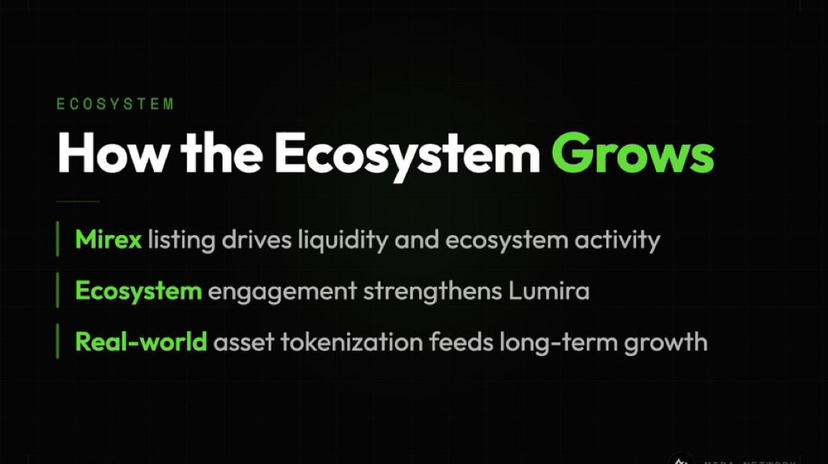
When I started looking more closely at how the Mira ecosystem is developing, I noticed that the structure behind it follows this quieter logic. Instead of treating growth as one isolated event, each component is designed to strengthen the next layer. Take liquidity for example. A liquidity partner has already been secured for Mirex (MRX), but with a condition that reveals a lot about the strategy: activation comes with a Tier-1 exchange listing. That might sound like a technical detail, yet it actually reflects something deeper about how networks mature.
Liquidity is not just about trading volume. It is about confidence. When a token reaches an environment where liquidity providers are active, price discovery becomes more stable, participation increases, and the network begins to behave less like an experiment and more like a functioning market. Once a listing introduces liquidity and broader market access, it begins feeding activity back into the ecosystem itself. In Mira’s case, that momentum does not simply circulate around MRX; it strengthens the foundation of Lumira (LUM), the ecosystem’s stable layer.
As real world assets gradually become tokenized on the network, the ecosystem starts to behave less like a collection of tokens and more like a living economic environment. Activity creates demand. Demand strengthens liquidity. Liquidity attracts participation. Each part quietly reinforces the next.
The Mira ecosystem seems to be designed with a similar philosophy:
MRX provides the movement and energy of the network.LUM offers stability and long term confidence.Tokenized assets bring real economic activity into the system.
Together they create something that can sustain itself. Sustainable ecosystems develop feedback loops where progress in one area strengthens the entire network. That appears to be the quiet architecture Mira is trying to build. Not a system that spikes once, but one that gradually becomes stronger as more pieces connect.
@mira_network
#Mira $MIRA
{future}(MIRAUSDT)
“From Liquidity to Living Economy: The Quiet System Powering Mira’s Ecosystem."
One thing I have learned from years around blockchain projects is that ecosystems do not grow the way people imagine. From the outside, growth often looks like a single dramatic moment; a big exchange listing, a sudden surge in price, or a viral announcement. But real ecosystems rarely grow like explosions. They grow more like systems that slowly reinforce themselves.
When I started looking more closely at how the Mira ecosystem is developing, I noticed that the structure behind it follows this quieter logic. Instead of treating growth as one isolated event, each component is designed to strengthen the next layer. Take liquidity for example. A liquidity partner has already been secured for Mirex (MRX), but with a condition that reveals a lot about the strategy: activation comes with a Tier-1 exchange listing. That might sound like a technical detail, yet it actually reflects something deeper about how networks mature.
Liquidity is not just about trading volume. It is about confidence. When a token reaches an environment where liquidity providers are active, price discovery becomes more stable, participation increases, and the network begins to behave less like an experiment and more like a functioning market. Once a listing introduces liquidity and broader market access, it begins feeding activity back into the ecosystem itself. In Mira’s case, that momentum does not simply circulate around MRX; it strengthens the foundation of Lumira (LUM), the ecosystem’s stable layer.
As real world assets gradually become tokenized on the network, the ecosystem starts to behave less like a collection of tokens and more like a living economic environment. Activity creates demand. Demand strengthens liquidity. Liquidity attracts participation. Each part quietly reinforces the next.
The Mira ecosystem seems to be designed with a similar philosophy:
MRX provides the movement and energy of the network.LUM offers stability and long term confidence.Tokenized assets bring real economic activity into the system.
Together they create something that can sustain itself. Sustainable ecosystems develop feedback loops where progress in one area strengthens the entire network. That appears to be the quiet architecture Mira is trying to build. Not a system that spikes once, but one that gradually becomes stronger as more pieces connect.
@Mira - Trust Layer of AI
#Mira $MIRA
When I started looking more closely at how the Mira ecosystem is developing, I noticed that the structure behind it follows this quieter logic. Instead of treating growth as one isolated event, each component is designed to strengthen the next layer. Take liquidity for example. A liquidity partner has already been secured for Mirex (MRX), but with a condition that reveals a lot about the strategy: activation comes with a Tier-1 exchange listing. That might sound like a technical detail, yet it actually reflects something deeper about how networks mature.
Liquidity is not just about trading volume. It is about confidence. When a token reaches an environment where liquidity providers are active, price discovery becomes more stable, participation increases, and the network begins to behave less like an experiment and more like a functioning market. Once a listing introduces liquidity and broader market access, it begins feeding activity back into the ecosystem itself. In Mira’s case, that momentum does not simply circulate around MRX; it strengthens the foundation of Lumira (LUM), the ecosystem’s stable layer.
As real world assets gradually become tokenized on the network, the ecosystem starts to behave less like a collection of tokens and more like a living economic environment. Activity creates demand. Demand strengthens liquidity. Liquidity attracts participation. Each part quietly reinforces the next.
The Mira ecosystem seems to be designed with a similar philosophy:
MRX provides the movement and energy of the network.LUM offers stability and long term confidence.Tokenized assets bring real economic activity into the system.
Together they create something that can sustain itself. Sustainable ecosystems develop feedback loops where progress in one area strengthens the entire network. That appears to be the quiet architecture Mira is trying to build. Not a system that spikes once, but one that gradually becomes stronger as more pieces connect.
@Mira - Trust Layer of AI
#Mira $MIRA
1
11
278
·
--
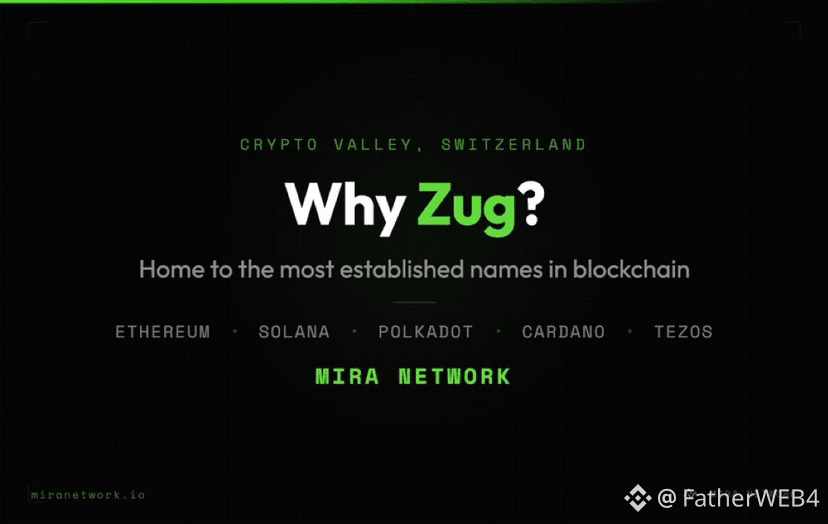
A few weeks ago, I began investigating why location remains a crucial factor in a digital industry. While code can run anywhere, the place a project chooses to grow often reveals its long-term intent. My research focused on why Mira Network established its headquarters in Zug, a Swiss city that has quietly become the global epicenter for decentralized infrastructure.
I viewed Zug as more than a geographic coordinate. It functions as a high density arena for blockchain breakthroughs, serving as the starting point for massive protocols like Ethereum and Solana. This environment was built intentionally. Switzerland established a stable regulatory setting that allows new tech to scale within clear legal boundaries. For me, seeing Mira choose this base suggests they are moving away from typical industry shadows and focusing on permanent integration.
For an investor, this matters immensely. The tension between radical decentralization and real-world regulation often creates structural risk. Zug offers an antidote to that uncertainty. In this environment, blockchain has become an organic part of the economic landscape, supported by academic collaboration, steady capital flow, and the legal clarity required to build permanent systems.
Mira is building a decentralized consensus network to verify artificial intelligence outputs. This infrastructure is not a short-term experiment; it is a system designed to ensure machine intelligence remains accountable for decades. By basing itself in Zug, Mira sits in a living laboratory for governance, surrounded by the cryptographic and legal expertise that shaped the industry’s most influential protocols.
Location does not guarantee success, but it reveals intent. By building in Crypto Valley, #Mira is signaling a commitment to long-term stability over short-term hype. It is a strategic choice that suggests patience, a rare signal in a market that moves as quickly as this one. Mira chose Zug because it is building a network designed to survive.
@mira_network
$MIRA
{future}(MIRAUSDT)
A few weeks ago, I began investigating why location remains a crucial factor in a digital industry. While code can run anywhere, the place a project chooses to grow often reveals its long-term intent. My research focused on why Mira Network established its headquarters in Zug, a Swiss city that has quietly become the global epicenter for decentralized infrastructure.
I viewed Zug as more than a geographic coordinate. It functions as a high density arena for blockchain breakthroughs, serving as the starting point for massive protocols like Ethereum and Solana. This environment was built intentionally. Switzerland established a stable regulatory setting that allows new tech to scale within clear legal boundaries. For me, seeing Mira choose this base suggests they are moving away from typical industry shadows and focusing on permanent integration.
For an investor, this matters immensely. The tension between radical decentralization and real-world regulation often creates structural risk. Zug offers an antidote to that uncertainty. In this environment, blockchain has become an organic part of the economic landscape, supported by academic collaboration, steady capital flow, and the legal clarity required to build permanent systems.
Mira is building a decentralized consensus network to verify artificial intelligence outputs. This infrastructure is not a short-term experiment; it is a system designed to ensure machine intelligence remains accountable for decades. By basing itself in Zug, Mira sits in a living laboratory for governance, surrounded by the cryptographic and legal expertise that shaped the industry’s most influential protocols.
Location does not guarantee success, but it reveals intent. By building in Crypto Valley, #Mira is signaling a commitment to long-term stability over short-term hype. It is a strategic choice that suggests patience, a rare signal in a market that moves as quickly as this one. Mira chose Zug because it is building a network designed to survive.
@Mira - Trust Layer of AI
$MIRA
I viewed Zug as more than a geographic coordinate. It functions as a high density arena for blockchain breakthroughs, serving as the starting point for massive protocols like Ethereum and Solana. This environment was built intentionally. Switzerland established a stable regulatory setting that allows new tech to scale within clear legal boundaries. For me, seeing Mira choose this base suggests they are moving away from typical industry shadows and focusing on permanent integration.
For an investor, this matters immensely. The tension between radical decentralization and real-world regulation often creates structural risk. Zug offers an antidote to that uncertainty. In this environment, blockchain has become an organic part of the economic landscape, supported by academic collaboration, steady capital flow, and the legal clarity required to build permanent systems.
Mira is building a decentralized consensus network to verify artificial intelligence outputs. This infrastructure is not a short-term experiment; it is a system designed to ensure machine intelligence remains accountable for decades. By basing itself in Zug, Mira sits in a living laboratory for governance, surrounded by the cryptographic and legal expertise that shaped the industry’s most influential protocols.
Location does not guarantee success, but it reveals intent. By building in Crypto Valley, #Mira is signaling a commitment to long-term stability over short-term hype. It is a strategic choice that suggests patience, a rare signal in a market that moves as quickly as this one. Mira chose Zug because it is building a network designed to survive.
@Mira - Trust Layer of AI
$MIRA
7
135
·
--

Мақала
"When Intelligence Meets Responsibility: Mira, AI, and the Environmental Challenge."One evening, while reading a report on AI compute growth, I realized something unsettling: the progress we celebrate in artificial intelligence is quietly consuming the planet. Large language models and deep learning networks are trained across massive data centers. Gigawatts of energy, cooling systems humming constantly, thousands of GPUs working in parallel—this is the hidden footprint of the intelligence we admire.
The models are brilliant. The outputs are impressive. But the cost is measured in carbon and energy, not dollars alone. Every additional parameter, every larger model, adds to a growing environmental bill that no one seems willing to audit.
This is where Mira begins to feel different.
Mira does not just ask, how can we make AI smarter?
It asks, how can intelligence operate responsibly?
At the core of Mira’s design is a network-based approach: AI outputs are not produced and consumed by a single massive model. They are broken into reasoning fragments, distributed across multiple systems, and verified collaboratively. Blockchain records each verification event, ensuring transparency and accountability.
This architecture carries a subtle but profound ecological implication. By distributing tasks across a network of smaller, specialized models instead of relying on one monolithic system, Mira reduces redundant computation. Each model contributes in proportion to its capabilities. Energy is spent on verification that matters, not on repeatedly generating the same outputs at enormous cost.
From an investor’s perspective, this is more than ethical. It is strategic. The world is beginning to value sustainable technology—not just for regulatory or social reasons, but because efficiency directly correlates with scalability and risk management. Projects that internalize environmental responsibility are likely to endure longer. Mira is quietly building a system where energy-efficient AI becomes a competitive advantage.
Socially, the implications are equally significant. The environmental footprint of AI is not abstract—it affects communities where data centers operate, contributes to global energy demand, and shapes public perception of technology. Mira’s distributed approach provides a blueprint for how decentralized AI systems can balance computational power with ecological mindfulness.
Imagine a world where AI does not scale by raw power alone, but by coordinated intelligence. Each model in the network carries a small energy cost, yet together they produce reasoning that is trustworthy, auditable, and verifiable. Blockchain ensures the path of verification is permanent, and the system rewards accuracy rather than brute force.
This is the moment when technology, ecology, and finance intersect. Investors are no longer only looking at performance metrics or speed benchmarks. They are beginning to consider sustainability as part of the value equation. Mira offers a glimpse of what that might look like in practice: a platform where environmental responsibility is woven directly into AI architecture and economic incentives.
The quiet lesson is this: intelligence alone is not enough. If AI is to become a foundation of modern society, it must be accountable to humans, and responsible to the planet. Mira is attempting to build that bridge: connecting blockchain, distributed AI, and ecological stewardship in a way that may define the next generation of technological infrastructure.
I can say this: the projects that survive the next decade will be those that understand that true intelligence is not only measured in answers produced, but in the cost to the world of producing those answers.
@mira_network
#Mira $MIRA
{future}(MIRAUSDT)
"When Intelligence Meets Responsibility: Mira, AI, and the Environmental Challenge."
One evening, while reading a report on AI compute growth, I realized something unsettling: the progress we celebrate in artificial intelligence is quietly consuming the planet. Large language models and deep learning networks are trained across massive data centers. Gigawatts of energy, cooling systems humming constantly, thousands of GPUs working in parallel—this is the hidden footprint of the intelligence we admire.
The models are brilliant. The outputs are impressive. But the cost is measured in carbon and energy, not dollars alone. Every additional parameter, every larger model, adds to a growing environmental bill that no one seems willing to audit.
This is where Mira begins to feel different.
Mira does not just ask, how can we make AI smarter?
It asks, how can intelligence operate responsibly?
At the core of Mira’s design is a network-based approach: AI outputs are not produced and consumed by a single massive model. They are broken into reasoning fragments, distributed across multiple systems, and verified collaboratively. Blockchain records each verification event, ensuring transparency and accountability.
This architecture carries a subtle but profound ecological implication. By distributing tasks across a network of smaller, specialized models instead of relying on one monolithic system, Mira reduces redundant computation. Each model contributes in proportion to its capabilities. Energy is spent on verification that matters, not on repeatedly generating the same outputs at enormous cost.
From an investor’s perspective, this is more than ethical. It is strategic. The world is beginning to value sustainable technology—not just for regulatory or social reasons, but because efficiency directly correlates with scalability and risk management. Projects that internalize environmental responsibility are likely to endure longer. Mira is quietly building a system where energy-efficient AI becomes a competitive advantage.
Socially, the implications are equally significant. The environmental footprint of AI is not abstract—it affects communities where data centers operate, contributes to global energy demand, and shapes public perception of technology. Mira’s distributed approach provides a blueprint for how decentralized AI systems can balance computational power with ecological mindfulness.
Imagine a world where AI does not scale by raw power alone, but by coordinated intelligence. Each model in the network carries a small energy cost, yet together they produce reasoning that is trustworthy, auditable, and verifiable. Blockchain ensures the path of verification is permanent, and the system rewards accuracy rather than brute force.
This is the moment when technology, ecology, and finance intersect. Investors are no longer only looking at performance metrics or speed benchmarks. They are beginning to consider sustainability as part of the value equation. Mira offers a glimpse of what that might look like in practice: a platform where environmental responsibility is woven directly into AI architecture and economic incentives.
The quiet lesson is this: intelligence alone is not enough. If AI is to become a foundation of modern society, it must be accountable to humans, and responsible to the planet. Mira is attempting to build that bridge: connecting blockchain, distributed AI, and ecological stewardship in a way that may define the next generation of technological infrastructure.
I can say this: the projects that survive the next decade will be those that understand that true intelligence is not only measured in answers produced, but in the cost to the world of producing those answers.
@Mira - Trust Layer of AI
#Mira $MIRA
The models are brilliant. The outputs are impressive. But the cost is measured in carbon and energy, not dollars alone. Every additional parameter, every larger model, adds to a growing environmental bill that no one seems willing to audit.
This is where Mira begins to feel different.
Mira does not just ask, how can we make AI smarter?
It asks, how can intelligence operate responsibly?
At the core of Mira’s design is a network-based approach: AI outputs are not produced and consumed by a single massive model. They are broken into reasoning fragments, distributed across multiple systems, and verified collaboratively. Blockchain records each verification event, ensuring transparency and accountability.
This architecture carries a subtle but profound ecological implication. By distributing tasks across a network of smaller, specialized models instead of relying on one monolithic system, Mira reduces redundant computation. Each model contributes in proportion to its capabilities. Energy is spent on verification that matters, not on repeatedly generating the same outputs at enormous cost.
From an investor’s perspective, this is more than ethical. It is strategic. The world is beginning to value sustainable technology—not just for regulatory or social reasons, but because efficiency directly correlates with scalability and risk management. Projects that internalize environmental responsibility are likely to endure longer. Mira is quietly building a system where energy-efficient AI becomes a competitive advantage.
Socially, the implications are equally significant. The environmental footprint of AI is not abstract—it affects communities where data centers operate, contributes to global energy demand, and shapes public perception of technology. Mira’s distributed approach provides a blueprint for how decentralized AI systems can balance computational power with ecological mindfulness.
Imagine a world where AI does not scale by raw power alone, but by coordinated intelligence. Each model in the network carries a small energy cost, yet together they produce reasoning that is trustworthy, auditable, and verifiable. Blockchain ensures the path of verification is permanent, and the system rewards accuracy rather than brute force.
This is the moment when technology, ecology, and finance intersect. Investors are no longer only looking at performance metrics or speed benchmarks. They are beginning to consider sustainability as part of the value equation. Mira offers a glimpse of what that might look like in practice: a platform where environmental responsibility is woven directly into AI architecture and economic incentives.
The quiet lesson is this: intelligence alone is not enough. If AI is to become a foundation of modern society, it must be accountable to humans, and responsible to the planet. Mira is attempting to build that bridge: connecting blockchain, distributed AI, and ecological stewardship in a way that may define the next generation of technological infrastructure.
I can say this: the projects that survive the next decade will be those that understand that true intelligence is not only measured in answers produced, but in the cost to the world of producing those answers.
@Mira - Trust Layer of AI
#Mira $MIRA
6
132
·
--
Blockchains were originally designed to solve a very specific problem: how do you reach agreement in a system where no central authority exists?
For years the answer revolved around money. Transactions, tokens, financial settlements. But Mira quietly pushes that mechanism into a completely different territory. Instead of asking nodes to agree on financial state, Mira asks them to agree on reasoning.
Imagine a digital jury where 200,000 participants cross-examine thousands of machine claims every second. In this high-performance environment, AI outputs are stripped down and verified by millions of daily checks to ensure logic holds.
When an AI generates an output, the result is fragmented into smaller claims that circulate through the network. Independent models examine these claims and attempt to verify whether they logically hold. The process resembles a form of distributed scrutiny rather than computation.
Consensus emerges only when the reasoning survives multiple perspectives.
This is where blockchain becomes more than infrastructure. The consensus mechanism acts as a filter that determines which pieces of machine reasoning deserve to persist. Not every answer survives. Some collapse under scrutiny. Others stabilize into verified knowledge that the network accepts as reliable.
The chain essentially becomes a settlement layer not for money, but for intelligence. It is a strange evolution of blockchain logic. The technology that once secured digital currency is now being used to secure machine thought.
@mira_network
#Mira $MIRA
Blockchains were originally designed to solve a very specific problem: how do you reach agreement in a system where no central authority exists?
For years the answer revolved around money. Transactions, tokens, financial settlements. But Mira quietly pushes that mechanism into a completely different territory. Instead of asking nodes to agree on financial state, Mira asks them to agree on reasoning.
Imagine a digital jury where 200,000 participants cross-examine thousands of machine claims every second. In this high-performance environment, AI outputs are stripped down and verified by millions of daily checks to ensure logic holds.
When an AI generates an output, the result is fragmented into smaller claims that circulate through the network. Independent models examine these claims and attempt to verify whether they logically hold. The process resembles a form of distributed scrutiny rather than computation.
Consensus emerges only when the reasoning survives multiple perspectives.
This is where blockchain becomes more than infrastructure. The consensus mechanism acts as a filter that determines which pieces of machine reasoning deserve to persist. Not every answer survives. Some collapse under scrutiny. Others stabilize into verified knowledge that the network accepts as reliable.
The chain essentially becomes a settlement layer not for money, but for intelligence. It is a strange evolution of blockchain logic. The technology that once secured digital currency is now being used to secure machine thought.
@Mira - Trust Layer of AI
#Mira $MIRA
For years the answer revolved around money. Transactions, tokens, financial settlements. But Mira quietly pushes that mechanism into a completely different territory. Instead of asking nodes to agree on financial state, Mira asks them to agree on reasoning.
Imagine a digital jury where 200,000 participants cross-examine thousands of machine claims every second. In this high-performance environment, AI outputs are stripped down and verified by millions of daily checks to ensure logic holds.
When an AI generates an output, the result is fragmented into smaller claims that circulate through the network. Independent models examine these claims and attempt to verify whether they logically hold. The process resembles a form of distributed scrutiny rather than computation.
Consensus emerges only when the reasoning survives multiple perspectives.
This is where blockchain becomes more than infrastructure. The consensus mechanism acts as a filter that determines which pieces of machine reasoning deserve to persist. Not every answer survives. Some collapse under scrutiny. Others stabilize into verified knowledge that the network accepts as reliable.
The chain essentially becomes a settlement layer not for money, but for intelligence. It is a strange evolution of blockchain logic. The technology that once secured digital currency is now being used to secure machine thought.
@Mira - Trust Layer of AI
#Mira $MIRA
6
125
·
--
Мақала
“Why AI Verification Runs on Two Different Kinds of Value."Not long ago I was trying to explain Mira to a friend who kept asking a simple question: if Mira is about verifying AI, why does it need two different tokens?
At first glance it does look excessive. Most blockchain projects already struggle to justify one token, let alone two. But the longer I thought about it, the clearer the structure started to make sense.
Mira is not just building infrastructure for transactions. It is building an economy around machine reasoning.
And economies behave very differently from software.
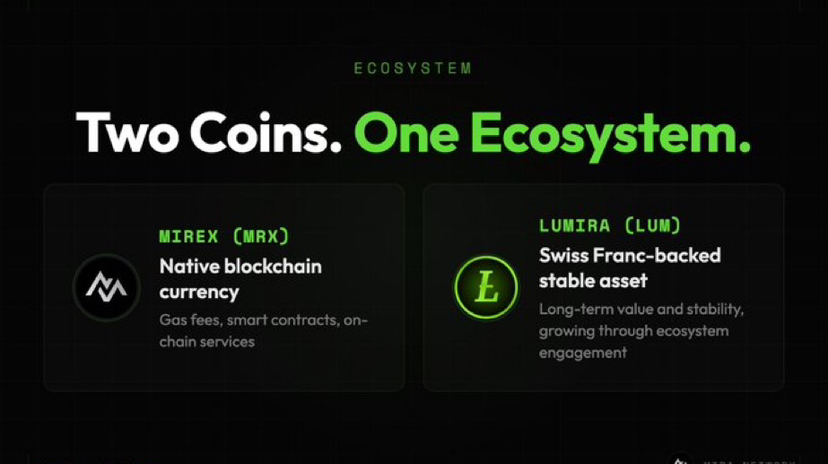
Inside the network, Mirex (MRX) plays the role of motion. It is the energy that allows the system to function. Every interaction that happens within the Mira blockchain: executing smart contracts, submitting verification tasks, running on-chain AI services, requires MRX as gas. In other words, MRX represents activity.
It is the token that keeps the machinery moving.
But activity alone does not create a stable environment, especially when the system is built around AI verification. When different models are checking each other’s reasoning, incentives matter. Rewards and penalties must be meaningful, and participants need something that does not fluctuate wildly every time the market changes direction.
That is where Lumira (LUM) enters the design.
Lumira is structured around stability, backed by the Swiss Franc. Instead of being the fuel of the network, it acts more like the economic anchor. When contributors verify AI outputs, provide useful models, or participate in the ecosystem’s long-term growth, LUM becomes the unit that preserves value.
One token drives activity. The other protects stability.
This distinction becomes particularly interesting when you think about how Mira approaches artificial intelligence. The network breaks AI outputs into smaller claims and distributes those claims across multiple models that attempt to verify them. Each step in that process carries economic consequences.
Someone proposes an answer.
Other models challenge it.
Consensus emerges through incentives.
In a system like this, volatility can delete behavior. If rewards swing dramatically in value, participants may prioritize speculation rather than accuracy. By separating the engine of computation (MRX) from the store of stability (LUM), Mira is quietly trying to prevent that distortion.
The architecture starts to resemble a small digital society.
MRX circulates constantly, powering the infrastructure where AI reasoning takes place. LUM, meanwhile, behaves more like the financial backbone that allows contributors to remain invested in the network without worrying that every market cycle will erase the value of their work.
For an ecosystem built around AI verification, this separation is more than a tokenomic trick. It reflects a deeper understanding of how intelligence systems operate.
Machines may produce answers instantly, but trust develops slowly.
By structuring the economy with two different roles: motion and stability, Mira is trying to create an environment where AI does not just generate information, but where that information can be challenged, verified, and ultimately trusted.
Two coins might seem like a small detail.
But in a network where the goal is to turn machine reasoning into something provable, the way value moves through the system becomes just as important as the intelligence itself.
@mira_network
#Mira $MIRA
{future}(MIRAUSDT)
“Why AI Verification Runs on Two Different Kinds of Value."
Not long ago I was trying to explain Mira to a friend who kept asking a simple question: if Mira is about verifying AI, why does it need two different tokens?
At first glance it does look excessive. Most blockchain projects already struggle to justify one token, let alone two. But the longer I thought about it, the clearer the structure started to make sense.
Mira is not just building infrastructure for transactions. It is building an economy around machine reasoning.
And economies behave very differently from software.
Inside the network, Mirex (MRX) plays the role of motion. It is the energy that allows the system to function. Every interaction that happens within the Mira blockchain: executing smart contracts, submitting verification tasks, running on-chain AI services, requires MRX as gas. In other words, MRX represents activity.
It is the token that keeps the machinery moving.
But activity alone does not create a stable environment, especially when the system is built around AI verification. When different models are checking each other’s reasoning, incentives matter. Rewards and penalties must be meaningful, and participants need something that does not fluctuate wildly every time the market changes direction.
That is where Lumira (LUM) enters the design.
Lumira is structured around stability, backed by the Swiss Franc. Instead of being the fuel of the network, it acts more like the economic anchor. When contributors verify AI outputs, provide useful models, or participate in the ecosystem’s long-term growth, LUM becomes the unit that preserves value.
One token drives activity. The other protects stability.
This distinction becomes particularly interesting when you think about how Mira approaches artificial intelligence. The network breaks AI outputs into smaller claims and distributes those claims across multiple models that attempt to verify them. Each step in that process carries economic consequences.
Someone proposes an answer.
Other models challenge it.
Consensus emerges through incentives.
In a system like this, volatility can delete behavior. If rewards swing dramatically in value, participants may prioritize speculation rather than accuracy. By separating the engine of computation (MRX) from the store of stability (LUM), Mira is quietly trying to prevent that distortion.
The architecture starts to resemble a small digital society.
MRX circulates constantly, powering the infrastructure where AI reasoning takes place. LUM, meanwhile, behaves more like the financial backbone that allows contributors to remain invested in the network without worrying that every market cycle will erase the value of their work.
For an ecosystem built around AI verification, this separation is more than a tokenomic trick. It reflects a deeper understanding of how intelligence systems operate.
Machines may produce answers instantly, but trust develops slowly.
By structuring the economy with two different roles: motion and stability, Mira is trying to create an environment where AI does not just generate information, but where that information can be challenged, verified, and ultimately trusted.
Two coins might seem like a small detail.
But in a network where the goal is to turn machine reasoning into something provable, the way value moves through the system becomes just as important as the intelligence itself.
@Mira - Trust Layer of AI
#Mira $MIRA
At first glance it does look excessive. Most blockchain projects already struggle to justify one token, let alone two. But the longer I thought about it, the clearer the structure started to make sense.
Mira is not just building infrastructure for transactions. It is building an economy around machine reasoning.
And economies behave very differently from software.
Inside the network, Mirex (MRX) plays the role of motion. It is the energy that allows the system to function. Every interaction that happens within the Mira blockchain: executing smart contracts, submitting verification tasks, running on-chain AI services, requires MRX as gas. In other words, MRX represents activity.
It is the token that keeps the machinery moving.
But activity alone does not create a stable environment, especially when the system is built around AI verification. When different models are checking each other’s reasoning, incentives matter. Rewards and penalties must be meaningful, and participants need something that does not fluctuate wildly every time the market changes direction.
That is where Lumira (LUM) enters the design.
Lumira is structured around stability, backed by the Swiss Franc. Instead of being the fuel of the network, it acts more like the economic anchor. When contributors verify AI outputs, provide useful models, or participate in the ecosystem’s long-term growth, LUM becomes the unit that preserves value.
One token drives activity. The other protects stability.
This distinction becomes particularly interesting when you think about how Mira approaches artificial intelligence. The network breaks AI outputs into smaller claims and distributes those claims across multiple models that attempt to verify them. Each step in that process carries economic consequences.
Someone proposes an answer.
Other models challenge it.
Consensus emerges through incentives.
In a system like this, volatility can delete behavior. If rewards swing dramatically in value, participants may prioritize speculation rather than accuracy. By separating the engine of computation (MRX) from the store of stability (LUM), Mira is quietly trying to prevent that distortion.
The architecture starts to resemble a small digital society.
MRX circulates constantly, powering the infrastructure where AI reasoning takes place. LUM, meanwhile, behaves more like the financial backbone that allows contributors to remain invested in the network without worrying that every market cycle will erase the value of their work.
For an ecosystem built around AI verification, this separation is more than a tokenomic trick. It reflects a deeper understanding of how intelligence systems operate.
Machines may produce answers instantly, but trust develops slowly.
By structuring the economy with two different roles: motion and stability, Mira is trying to create an environment where AI does not just generate information, but where that information can be challenged, verified, and ultimately trusted.
Two coins might seem like a small detail.
But in a network where the goal is to turn machine reasoning into something provable, the way value moves through the system becomes just as important as the intelligence itself.
@Mira - Trust Layer of AI
#Mira $MIRA
7
254
·
--
I rarely think about infrastructure until it moves. Most of the time, AI feels weightless, existing in the invisible background of the internet. Yet every intelligent system sits on top of a physical reality of servers and networks. When that machinery moves, the entire organism must adjust.
This is what has been happening with Mira Network during its migration from AWS to OVHcloud. Unlike ordinary applications, a network built for AI verification depends on highly synchronized environments. Relocating these nodes requires a total recalibration, much like moving the brain of a living organism.
If we acknowledge that even the most advanced intelligence depends on physical servers, what happens when those servers are finally distributed across a truly decentralized landscape?
The answer lies in the shift toward the OVHcloud Blockchain Accelerator Program, which aligns Mira with an infrastructure designed for decentralization. This is more than a relocation; it is an adjustment of the ground beneath the network to ensure it is more stable both ideologically and technically.
In my own experience navigating this transition, the Mira x7 Mining Booster Event felt like a tangible recognition of our persistence. Seeing that multiplier activate served as a bridge to reclaim the momentum that was paused while the foundation was shifting.
These moments reveal that AI is not a pure abstraction of models and algorithms. It depends on real infrastructure in the physical world. Sometimes, improving that foundation means briefly interrupting the machine so it can return stronger than before.
@mira_network
#Mira $MIRA
{future}(MIRAUSDT)
I rarely think about infrastructure until it moves. Most of the time, AI feels weightless, existing in the invisible background of the internet. Yet every intelligent system sits on top of a physical reality of servers and networks. When that machinery moves, the entire organism must adjust.
This is what has been happening with Mira Network during its migration from AWS to OVHcloud. Unlike ordinary applications, a network built for AI verification depends on highly synchronized environments. Relocating these nodes requires a total recalibration, much like moving the brain of a living organism.
If we acknowledge that even the most advanced intelligence depends on physical servers, what happens when those servers are finally distributed across a truly decentralized landscape?
The answer lies in the shift toward the OVHcloud Blockchain Accelerator Program, which aligns Mira with an infrastructure designed for decentralization. This is more than a relocation; it is an adjustment of the ground beneath the network to ensure it is more stable both ideologically and technically.
In my own experience navigating this transition, the Mira x7 Mining Booster Event felt like a tangible recognition of our persistence. Seeing that multiplier activate served as a bridge to reclaim the momentum that was paused while the foundation was shifting.
These moments reveal that AI is not a pure abstraction of models and algorithms. It depends on real infrastructure in the physical world. Sometimes, improving that foundation means briefly interrupting the machine so it can return stronger than before.
@Mira - Trust Layer of AI
#Mira $MIRA
This is what has been happening with Mira Network during its migration from AWS to OVHcloud. Unlike ordinary applications, a network built for AI verification depends on highly synchronized environments. Relocating these nodes requires a total recalibration, much like moving the brain of a living organism.
If we acknowledge that even the most advanced intelligence depends on physical servers, what happens when those servers are finally distributed across a truly decentralized landscape?
The answer lies in the shift toward the OVHcloud Blockchain Accelerator Program, which aligns Mira with an infrastructure designed for decentralization. This is more than a relocation; it is an adjustment of the ground beneath the network to ensure it is more stable both ideologically and technically.
In my own experience navigating this transition, the Mira x7 Mining Booster Event felt like a tangible recognition of our persistence. Seeing that multiplier activate served as a bridge to reclaim the momentum that was paused while the foundation was shifting.
These moments reveal that AI is not a pure abstraction of models and algorithms. It depends on real infrastructure in the physical world. Sometimes, improving that foundation means briefly interrupting the machine so it can return stronger than before.
@Mira - Trust Layer of AI
#Mira $MIRA
7
197
·
--
Мақала
Why Mira is Turning AI from a Corporate Product into a Universal Human Right?Look back at the early days of the internet and remember the promise of a truly open world. The original vision was a digital commons where the tools of creation belonged to everyone and no single entity could own the conversation. But that liberated network eventually gave way to a digital factory. Power settled into the hands of a few massive silos that now act as the gatekeepers of our reality.
Now, as Artificial Intelligence becomes the new operating system for human life, that same crossroads has reappeared. The stakes are simply higher this time. It is no longer just about who hosts websites or stores photos. It is about the very nature of reasoning itself. Who actually owns the intelligence that is starting to run the world?
Mira feels like a necessary intervention in a story that was headed toward a predictable, centralized end. For too long, a parasitic cycle has defined the industry. Creative fuel and data are harvested from the many, while a handful of companies lock that collective output behind proprietary walls. They take the ghost created by the public and sell it back as a subscription service.
This is the fundamental problem with AI as a Service. It treats human knowledge as a commodity to be harvested, processed, and resold. It creates a world where access to intelligence requires a fee, even when that intelligence was built on the backs of the people paying for it. It is a model based on exclusion rather than empowerment.
Mira is not just another technical fix for a broken system. It represents a fundamental shift in the geography of ownership. It is a way to ensure that the intelligence of the future is not a private weapon used for corporate leverage. It is about reclaiming AI as a public utility that actually remembers its origins.
The real shift within Mira is how it handles the contribution of thought. Think about how AI is built today. It is a massive harvesting operation. Millions of creators, researchers, and developers provide the foundational insights, but they are erased the moment the final model is polished. Their labor is anonymized into a giant, faceless statistical average.
The developers building the small, niche models are sidelined by the giants with the most computing power. This creates a world where only the loudest and richest voices can speak through the machine. Mira changes that relationship entirely by making every single insight a traceable asset.
The logic is grounded in a system that tracks the specific lineage of every thought. It is a deeply personal change because it means a contribution to a collective intelligence is no longer invisible. You are no longer just data to be harvested. You are a recognized architect of a larger reasoning process.
Instead of a black box that just gives a cold, detached answer, the system creates a traceable path of collaboration. For me, this is the most honest way to build a machine economy. It stops being a race to see who has the biggest server farm. It starts being about who provides the most valuable piece of the puzzle.
I see this as a declaration of independence for the digital world. Mira is not trying to build a separate, isolated internet. It is trying to fix the one already in place before it is too late. It acts as an infrastructure of accountability, ensuring that as machines begin to act on our behalf, they remain tied to human value.
At the base of this system is a layer of authentication that gives every bit of work a permanent, digital identity. This is the end of the anonymous machine. In the middle, a settlement engine ensures that rewards flow back to the people who actually did the work. The value does not just stop at the ones who own the hardware or the electricity.
At the top, a decentralized governance model ensures the rules cannot be changed on a whim by a central CEO in a boardroom. The protocol is the authority, and the community is the guardian. This is the only way to make sure the value of machine reasoning is never lost in a corporate database again.
The shift is clear: moving away from a world of AI as a Service and toward a world of Intelligence as a Right. This is the moment to stop being the product and start being the owners of the thoughts that were built by everyone.
@mira_network
#Mira $MIRA
{future}(MIRAUSDT)
Why Mira is Turning AI from a Corporate Product into a Universal Human Right?
Look back at the early days of the internet and remember the promise of a truly open world. The original vision was a digital commons where the tools of creation belonged to everyone and no single entity could own the conversation. But that liberated network eventually gave way to a digital factory. Power settled into the hands of a few massive silos that now act as the gatekeepers of our reality.
Now, as Artificial Intelligence becomes the new operating system for human life, that same crossroads has reappeared. The stakes are simply higher this time. It is no longer just about who hosts websites or stores photos. It is about the very nature of reasoning itself. Who actually owns the intelligence that is starting to run the world?
Mira feels like a necessary intervention in a story that was headed toward a predictable, centralized end. For too long, a parasitic cycle has defined the industry. Creative fuel and data are harvested from the many, while a handful of companies lock that collective output behind proprietary walls. They take the ghost created by the public and sell it back as a subscription service.
This is the fundamental problem with AI as a Service. It treats human knowledge as a commodity to be harvested, processed, and resold. It creates a world where access to intelligence requires a fee, even when that intelligence was built on the backs of the people paying for it. It is a model based on exclusion rather than empowerment.
Mira is not just another technical fix for a broken system. It represents a fundamental shift in the geography of ownership. It is a way to ensure that the intelligence of the future is not a private weapon used for corporate leverage. It is about reclaiming AI as a public utility that actually remembers its origins.
The real shift within Mira is how it handles the contribution of thought. Think about how AI is built today. It is a massive harvesting operation. Millions of creators, researchers, and developers provide the foundational insights, but they are erased the moment the final model is polished. Their labor is anonymized into a giant, faceless statistical average.
The developers building the small, niche models are sidelined by the giants with the most computing power. This creates a world where only the loudest and richest voices can speak through the machine. Mira changes that relationship entirely by making every single insight a traceable asset.
The logic is grounded in a system that tracks the specific lineage of every thought. It is a deeply personal change because it means a contribution to a collective intelligence is no longer invisible. You are no longer just data to be harvested. You are a recognized architect of a larger reasoning process.
Instead of a black box that just gives a cold, detached answer, the system creates a traceable path of collaboration. For me, this is the most honest way to build a machine economy. It stops being a race to see who has the biggest server farm. It starts being about who provides the most valuable piece of the puzzle.
I see this as a declaration of independence for the digital world. Mira is not trying to build a separate, isolated internet. It is trying to fix the one already in place before it is too late. It acts as an infrastructure of accountability, ensuring that as machines begin to act on our behalf, they remain tied to human value.
At the base of this system is a layer of authentication that gives every bit of work a permanent, digital identity. This is the end of the anonymous machine. In the middle, a settlement engine ensures that rewards flow back to the people who actually did the work. The value does not just stop at the ones who own the hardware or the electricity.
At the top, a decentralized governance model ensures the rules cannot be changed on a whim by a central CEO in a boardroom. The protocol is the authority, and the community is the guardian. This is the only way to make sure the value of machine reasoning is never lost in a corporate database again.
The shift is clear: moving away from a world of AI as a Service and toward a world of Intelligence as a Right. This is the moment to stop being the product and start being the owners of the thoughts that were built by everyone.
@Mira - Trust Layer of AI
#Mira $MIRA
Now, as Artificial Intelligence becomes the new operating system for human life, that same crossroads has reappeared. The stakes are simply higher this time. It is no longer just about who hosts websites or stores photos. It is about the very nature of reasoning itself. Who actually owns the intelligence that is starting to run the world?
Mira feels like a necessary intervention in a story that was headed toward a predictable, centralized end. For too long, a parasitic cycle has defined the industry. Creative fuel and data are harvested from the many, while a handful of companies lock that collective output behind proprietary walls. They take the ghost created by the public and sell it back as a subscription service.
This is the fundamental problem with AI as a Service. It treats human knowledge as a commodity to be harvested, processed, and resold. It creates a world where access to intelligence requires a fee, even when that intelligence was built on the backs of the people paying for it. It is a model based on exclusion rather than empowerment.
Mira is not just another technical fix for a broken system. It represents a fundamental shift in the geography of ownership. It is a way to ensure that the intelligence of the future is not a private weapon used for corporate leverage. It is about reclaiming AI as a public utility that actually remembers its origins.
The real shift within Mira is how it handles the contribution of thought. Think about how AI is built today. It is a massive harvesting operation. Millions of creators, researchers, and developers provide the foundational insights, but they are erased the moment the final model is polished. Their labor is anonymized into a giant, faceless statistical average.
The developers building the small, niche models are sidelined by the giants with the most computing power. This creates a world where only the loudest and richest voices can speak through the machine. Mira changes that relationship entirely by making every single insight a traceable asset.
The logic is grounded in a system that tracks the specific lineage of every thought. It is a deeply personal change because it means a contribution to a collective intelligence is no longer invisible. You are no longer just data to be harvested. You are a recognized architect of a larger reasoning process.
Instead of a black box that just gives a cold, detached answer, the system creates a traceable path of collaboration. For me, this is the most honest way to build a machine economy. It stops being a race to see who has the biggest server farm. It starts being about who provides the most valuable piece of the puzzle.
I see this as a declaration of independence for the digital world. Mira is not trying to build a separate, isolated internet. It is trying to fix the one already in place before it is too late. It acts as an infrastructure of accountability, ensuring that as machines begin to act on our behalf, they remain tied to human value.
At the base of this system is a layer of authentication that gives every bit of work a permanent, digital identity. This is the end of the anonymous machine. In the middle, a settlement engine ensures that rewards flow back to the people who actually did the work. The value does not just stop at the ones who own the hardware or the electricity.
At the top, a decentralized governance model ensures the rules cannot be changed on a whim by a central CEO in a boardroom. The protocol is the authority, and the community is the guardian. This is the only way to make sure the value of machine reasoning is never lost in a corporate database again.
The shift is clear: moving away from a world of AI as a Service and toward a world of Intelligence as a Right. This is the moment to stop being the product and start being the owners of the thoughts that were built by everyone.
@Mira - Trust Layer of AI
#Mira $MIRA
4
8
302
·
--
I thought the biggest challenge for artificial intelligence was simply the raw scale of its mind. I spent my time looking at the race for massive parameters, deeper datasets, and the sheer hunger for processing power. But the more I watched AI being used in real environments, the more I realized the problem is not always how smart it is. The real issue is reliability.
AI can sound extremely convincing while quietly being wrong. It can generate confident answers, analyze markets, and suggest strategies that look perfectly logical. Yet behind that confidence there are still hallucinations and hidden biases. Most of the time those mistakes simply disappear without any real consequences.
But things change once AI starts touching real economic systems. When machine outputs influence trades, risk models, or automated protocols, mistakes are no longer harmless. At that point, intelligence alone is not enough. What matters is whether the result can actually be trusted.
This is where Mira Network approaches the problem differently. Instead of focusing on building another powerful model, Mira focuses on verifying the outputs that AI produces. Results can be broken into smaller claims and checked collectively by a decentralized network to ensure they are accurate.
The interesting part is the economic layer behind it. Through the MIRA token, validators must stake capital when verifying AI computations. If they approve incorrect results, they risk losing their stake. If they verify accurately, they earn rewards. This simple structure introduces something AI rarely experiences today: consequences.
Instead of asking people to blindly trust machine intelligence, Mira creates a system where AI outputs must survive economic scrutiny. Accuracy becomes valuable and reliability becomes something the network actively enforces. In a future where autonomous systems make more decisions, that kind of accountability may matter just as much as intelligence itself.
@mira_network
#Mira $MIRA
I thought the biggest challenge for artificial intelligence was simply the raw scale of its mind. I spent my time looking at the race for massive parameters, deeper datasets, and the sheer hunger for processing power. But the more I watched AI being used in real environments, the more I realized the problem is not always how smart it is. The real issue is reliability.
AI can sound extremely convincing while quietly being wrong. It can generate confident answers, analyze markets, and suggest strategies that look perfectly logical. Yet behind that confidence there are still hallucinations and hidden biases. Most of the time those mistakes simply disappear without any real consequences.
But things change once AI starts touching real economic systems. When machine outputs influence trades, risk models, or automated protocols, mistakes are no longer harmless. At that point, intelligence alone is not enough. What matters is whether the result can actually be trusted.
This is where Mira Network approaches the problem differently. Instead of focusing on building another powerful model, Mira focuses on verifying the outputs that AI produces. Results can be broken into smaller claims and checked collectively by a decentralized network to ensure they are accurate.
The interesting part is the economic layer behind it. Through the MIRA token, validators must stake capital when verifying AI computations. If they approve incorrect results, they risk losing their stake. If they verify accurately, they earn rewards. This simple structure introduces something AI rarely experiences today: consequences.
Instead of asking people to blindly trust machine intelligence, Mira creates a system where AI outputs must survive economic scrutiny. Accuracy becomes valuable and reliability becomes something the network actively enforces. In a future where autonomous systems make more decisions, that kind of accountability may matter just as much as intelligence itself.
@Mira - Trust Layer of AI
#Mira $MIRA
AI can sound extremely convincing while quietly being wrong. It can generate confident answers, analyze markets, and suggest strategies that look perfectly logical. Yet behind that confidence there are still hallucinations and hidden biases. Most of the time those mistakes simply disappear without any real consequences.
But things change once AI starts touching real economic systems. When machine outputs influence trades, risk models, or automated protocols, mistakes are no longer harmless. At that point, intelligence alone is not enough. What matters is whether the result can actually be trusted.
This is where Mira Network approaches the problem differently. Instead of focusing on building another powerful model, Mira focuses on verifying the outputs that AI produces. Results can be broken into smaller claims and checked collectively by a decentralized network to ensure they are accurate.
The interesting part is the economic layer behind it. Through the MIRA token, validators must stake capital when verifying AI computations. If they approve incorrect results, they risk losing their stake. If they verify accurately, they earn rewards. This simple structure introduces something AI rarely experiences today: consequences.
Instead of asking people to blindly trust machine intelligence, Mira creates a system where AI outputs must survive economic scrutiny. Accuracy becomes valuable and reliability becomes something the network actively enforces. In a future where autonomous systems make more decisions, that kind of accountability may matter just as much as intelligence itself.
@Mira - Trust Layer of AI
#Mira $MIRA

7
81
·
--
Look at the surge in Arbitrum’s weekly DEX volume to $5.3 billion, a 56% increase in just three days. This represents a pivotal moment for Layer 2 scaling following the DIA upgrade, which reduced transaction fees to a baseline of $0.002. This shift provides the first definitive validation for the elastic demand thesis, as lowering the cost of entry to near zero has successfully unlocked high-frequency activity and liquidity that was previously constrained by higher fee environments.
This explosion in volume is supported by a network demonstrating industrial-grade performance, processing 910 million gas per second at peak intervals while keeping transaction costs well under a penny. Such metrics highlight a critical shift in blockchain economics where total revenue increases despite lower per-transaction margins. By prioritizing massive volume over high individual fees, the protocol is effectively executing a high-scale infrastructure strategy that captures a dominant share of on-chain commerce.
The resulting competitive moat is becoming increasingly difficult for rival ecosystems to replicate. As the network continues to handle institutional-level throughput without sacrificing its low-cost advantage, a self-reinforcing cycle of user adoption and deep liquidity is established. This trajectory indicates that Arbitrum is moving beyond simple scaling and is fundamentally redefining the economic standards for the decentralized global economy.
$ARB
{future}(ARBUSDT)
Look at the surge in Arbitrum’s weekly DEX volume to $5.3 billion, a 56% increase in just three days. This represents a pivotal moment for Layer 2 scaling following the DIA upgrade, which reduced transaction fees to a baseline of $0.002. This shift provides the first definitive validation for the elastic demand thesis, as lowering the cost of entry to near zero has successfully unlocked high-frequency activity and liquidity that was previously constrained by higher fee environments.
This explosion in volume is supported by a network demonstrating industrial-grade performance, processing 910 million gas per second at peak intervals while keeping transaction costs well under a penny. Such metrics highlight a critical shift in blockchain economics where total revenue increases despite lower per-transaction margins. By prioritizing massive volume over high individual fees, the protocol is effectively executing a high-scale infrastructure strategy that captures a dominant share of on-chain commerce.
The resulting competitive moat is becoming increasingly difficult for rival ecosystems to replicate. As the network continues to handle institutional-level throughput without sacrificing its low-cost advantage, a self-reinforcing cycle of user adoption and deep liquidity is established. This trajectory indicates that Arbitrum is moving beyond simple scaling and is fundamentally redefining the economic standards for the decentralized global economy.
$ARB
This explosion in volume is supported by a network demonstrating industrial-grade performance, processing 910 million gas per second at peak intervals while keeping transaction costs well under a penny. Such metrics highlight a critical shift in blockchain economics where total revenue increases despite lower per-transaction margins. By prioritizing massive volume over high individual fees, the protocol is effectively executing a high-scale infrastructure strategy that captures a dominant share of on-chain commerce.
The resulting competitive moat is becoming increasingly difficult for rival ecosystems to replicate. As the network continues to handle institutional-level throughput without sacrificing its low-cost advantage, a self-reinforcing cycle of user adoption and deep liquidity is established. This trajectory indicates that Arbitrum is moving beyond simple scaling and is fundamentally redefining the economic standards for the decentralized global economy.
$ARB
12
301
·
--
Мақала
"The Cost of Being Wrong: Why AI Needs a System That Can Penalize Mistakes."I have spent a lot of time watching how artificial intelligence exists in a very strange economic bubble. It generates answers, parses through massive datasets, and even proposes complex financial strategies, yet I realized something troubling. When AI is wrong, nothing really happens. The system simply produces another output, the user refreshes the prompt, and the mistake vanishes into the noise of the internet.
To me, it looks like AI is operating without any real skin in the game.
A model can hallucinate a citation or misinterpret a dataset, yet the economic system around it rarely reacts. The model is not penalized. The infrastructure hosting it loses nothing. This absence of accountability is manageable when we use AI for casual tasks, but as it begins to drive real economic decisions, this lack of consequence becomes a structural risk I find hard to ignore.
What happens when we let autonomous agents trade our assets? What happens when AI is the one approving insurance claims or managing financial risk? At that point, mistakes stop being harmless bugs. They become expensive failures. The uncomfortable truth is that modern AI systems were never designed for environments where being correct carries actual economic weight.
This is the exact gap I see Mira Network trying to bridge.
Intelligence Without Consequences
One of the issues I think we overlook is that AI outputs are largely consequence free. Traditional software has to be exact. If a payment system miscalculates a balance, the error is visible and must be fixed. If a smart contract fails, the consequences are immediate.
AI exists in a much softer space. Its outputs are suggestions rather than enforceable actions. This worked when AI was just an assistant, but I see the situation changing rapidly. AI is now embedded in systems that influence real outcomes, from trading algorithms to medical decision support. Reliability is no longer a technical preference; it is an economic requirement.
The problem is that verifying these outputs is incredibly difficult. Because models work on probability rather than deterministic logic, even the developers cannot always explain the black box. This leads me to a fundamental question: if AI decisions start moving markets, who is actually verifying that those decisions are correct?
Turning Verification Into a Network
I find Mira Network’s approach to this problem quite fascinating. Instead of asking a single model to justify itself, Mira distributes the work across a network. When an AI produces a result, that output is broken down into claims that can be evaluated independently.
Multiple models and validators examine these claims. Rather than trusting one source blindly, the network collectively decides if the work meets the standard. It feels like a decentralized peer review for machine intelligence. But Mira adds the one thing I think is missing from most systems: economic incentives.
Participants must stake tokens as collateral. If they validate incorrect information or miss errors, they are penalized financially. If they are accurate, they are rewarded. In Mira’s world, correctness becomes profitable and negligence becomes costly. It turns verification into a real market where accuracy is enforced by the economy itself.
A Different Kind of Consensus
Traditional blockchains reach consensus over transactions, usually just checking if a transfer is valid. They do not care about the meaning behind the data. Mira introduces a different layer. It creates consensus around the reliability of the information itself.
This is a subtle but important shift in how I think about decentralized tech. It suggests that consensus might eventually govern the credibility of machine generated knowledge. As AI integrates deeper into our infrastructure, the line between data and decisions starts to blur. If those interpretations are flawed, the ripple effects could be massive. Mira acts as a safeguard against that systemic risk.
When Intelligence Becomes Infrastructure
The most interesting part for me is the idea of intelligence as infrastructure. For decades, we focused on connectivity and storage. AI adds a layer of automated reasoning. Systems are now interpreting the world and making decisions for us.
Once this becomes widespread, ensuring the integrity of that reasoning is just as vital as securing a bank transaction. Without reliable verification, autonomous systems could spread errors across global markets at a speed we cannot handle. Mira’s architecture treats AI reasoning with the same rigor that blockchains apply to financial records. It is not assumed to be correct; it must be proven.
The Beginning of Verifiable Intelligence
It is still early for networks like this, and the technical hurdles are real. But the problem Mira is solving is not going away. As AI becomes a permanent part of our economic lives, reliability will determine whether it stays a helpful tool or becomes a dangerous liability.
For AI to act autonomously in the real world, its outputs need more than just high confidence scores. They need proof. The idea of intelligence that can be verified rather than merely trusted is, in my view, the only way we can safely build the next digital economy.
@mira_network
#Mira $MIRA
{future}(MIRAUSDT)
"The Cost of Being Wrong: Why AI Needs a System That Can Penalize Mistakes."
I have spent a lot of time watching how artificial intelligence exists in a very strange economic bubble. It generates answers, parses through massive datasets, and even proposes complex financial strategies, yet I realized something troubling. When AI is wrong, nothing really happens. The system simply produces another output, the user refreshes the prompt, and the mistake vanishes into the noise of the internet.
To me, it looks like AI is operating without any real skin in the game.
A model can hallucinate a citation or misinterpret a dataset, yet the economic system around it rarely reacts. The model is not penalized. The infrastructure hosting it loses nothing. This absence of accountability is manageable when we use AI for casual tasks, but as it begins to drive real economic decisions, this lack of consequence becomes a structural risk I find hard to ignore.
What happens when we let autonomous agents trade our assets? What happens when AI is the one approving insurance claims or managing financial risk? At that point, mistakes stop being harmless bugs. They become expensive failures. The uncomfortable truth is that modern AI systems were never designed for environments where being correct carries actual economic weight.
This is the exact gap I see Mira Network trying to bridge.
Intelligence Without Consequences
One of the issues I think we overlook is that AI outputs are largely consequence free. Traditional software has to be exact. If a payment system miscalculates a balance, the error is visible and must be fixed. If a smart contract fails, the consequences are immediate.
AI exists in a much softer space. Its outputs are suggestions rather than enforceable actions. This worked when AI was just an assistant, but I see the situation changing rapidly. AI is now embedded in systems that influence real outcomes, from trading algorithms to medical decision support. Reliability is no longer a technical preference; it is an economic requirement.
The problem is that verifying these outputs is incredibly difficult. Because models work on probability rather than deterministic logic, even the developers cannot always explain the black box. This leads me to a fundamental question: if AI decisions start moving markets, who is actually verifying that those decisions are correct?
Turning Verification Into a Network
I find Mira Network’s approach to this problem quite fascinating. Instead of asking a single model to justify itself, Mira distributes the work across a network. When an AI produces a result, that output is broken down into claims that can be evaluated independently.
Multiple models and validators examine these claims. Rather than trusting one source blindly, the network collectively decides if the work meets the standard. It feels like a decentralized peer review for machine intelligence. But Mira adds the one thing I think is missing from most systems: economic incentives.
Participants must stake tokens as collateral. If they validate incorrect information or miss errors, they are penalized financially. If they are accurate, they are rewarded. In Mira’s world, correctness becomes profitable and negligence becomes costly. It turns verification into a real market where accuracy is enforced by the economy itself.
A Different Kind of Consensus
Traditional blockchains reach consensus over transactions, usually just checking if a transfer is valid. They do not care about the meaning behind the data. Mira introduces a different layer. It creates consensus around the reliability of the information itself.
This is a subtle but important shift in how I think about decentralized tech. It suggests that consensus might eventually govern the credibility of machine generated knowledge. As AI integrates deeper into our infrastructure, the line between data and decisions starts to blur. If those interpretations are flawed, the ripple effects could be massive. Mira acts as a safeguard against that systemic risk.
When Intelligence Becomes Infrastructure
The most interesting part for me is the idea of intelligence as infrastructure. For decades, we focused on connectivity and storage. AI adds a layer of automated reasoning. Systems are now interpreting the world and making decisions for us.
Once this becomes widespread, ensuring the integrity of that reasoning is just as vital as securing a bank transaction. Without reliable verification, autonomous systems could spread errors across global markets at a speed we cannot handle. Mira’s architecture treats AI reasoning with the same rigor that blockchains apply to financial records. It is not assumed to be correct; it must be proven.
The Beginning of Verifiable Intelligence
It is still early for networks like this, and the technical hurdles are real. But the problem Mira is solving is not going away. As AI becomes a permanent part of our economic lives, reliability will determine whether it stays a helpful tool or becomes a dangerous liability.
For AI to act autonomously in the real world, its outputs need more than just high confidence scores. They need proof. The idea of intelligence that can be verified rather than merely trusted is, in my view, the only way we can safely build the next digital economy.
@Mira - Trust Layer of AI
#Mira $MIRA
To me, it looks like AI is operating without any real skin in the game.
A model can hallucinate a citation or misinterpret a dataset, yet the economic system around it rarely reacts. The model is not penalized. The infrastructure hosting it loses nothing. This absence of accountability is manageable when we use AI for casual tasks, but as it begins to drive real economic decisions, this lack of consequence becomes a structural risk I find hard to ignore.
What happens when we let autonomous agents trade our assets? What happens when AI is the one approving insurance claims or managing financial risk? At that point, mistakes stop being harmless bugs. They become expensive failures. The uncomfortable truth is that modern AI systems were never designed for environments where being correct carries actual economic weight.
This is the exact gap I see Mira Network trying to bridge.
Intelligence Without Consequences
One of the issues I think we overlook is that AI outputs are largely consequence free. Traditional software has to be exact. If a payment system miscalculates a balance, the error is visible and must be fixed. If a smart contract fails, the consequences are immediate.
AI exists in a much softer space. Its outputs are suggestions rather than enforceable actions. This worked when AI was just an assistant, but I see the situation changing rapidly. AI is now embedded in systems that influence real outcomes, from trading algorithms to medical decision support. Reliability is no longer a technical preference; it is an economic requirement.
The problem is that verifying these outputs is incredibly difficult. Because models work on probability rather than deterministic logic, even the developers cannot always explain the black box. This leads me to a fundamental question: if AI decisions start moving markets, who is actually verifying that those decisions are correct?
Turning Verification Into a Network
I find Mira Network’s approach to this problem quite fascinating. Instead of asking a single model to justify itself, Mira distributes the work across a network. When an AI produces a result, that output is broken down into claims that can be evaluated independently.
Multiple models and validators examine these claims. Rather than trusting one source blindly, the network collectively decides if the work meets the standard. It feels like a decentralized peer review for machine intelligence. But Mira adds the one thing I think is missing from most systems: economic incentives.
Participants must stake tokens as collateral. If they validate incorrect information or miss errors, they are penalized financially. If they are accurate, they are rewarded. In Mira’s world, correctness becomes profitable and negligence becomes costly. It turns verification into a real market where accuracy is enforced by the economy itself.
A Different Kind of Consensus
Traditional blockchains reach consensus over transactions, usually just checking if a transfer is valid. They do not care about the meaning behind the data. Mira introduces a different layer. It creates consensus around the reliability of the information itself.
This is a subtle but important shift in how I think about decentralized tech. It suggests that consensus might eventually govern the credibility of machine generated knowledge. As AI integrates deeper into our infrastructure, the line between data and decisions starts to blur. If those interpretations are flawed, the ripple effects could be massive. Mira acts as a safeguard against that systemic risk.
When Intelligence Becomes Infrastructure
The most interesting part for me is the idea of intelligence as infrastructure. For decades, we focused on connectivity and storage. AI adds a layer of automated reasoning. Systems are now interpreting the world and making decisions for us.
Once this becomes widespread, ensuring the integrity of that reasoning is just as vital as securing a bank transaction. Without reliable verification, autonomous systems could spread errors across global markets at a speed we cannot handle. Mira’s architecture treats AI reasoning with the same rigor that blockchains apply to financial records. It is not assumed to be correct; it must be proven.
The Beginning of Verifiable Intelligence
It is still early for networks like this, and the technical hurdles are real. But the problem Mira is solving is not going away. As AI becomes a permanent part of our economic lives, reliability will determine whether it stays a helpful tool or becomes a dangerous liability.
For AI to act autonomously in the real world, its outputs need more than just high confidence scores. They need proof. The idea of intelligence that can be verified rather than merely trusted is, in my view, the only way we can safely build the next digital economy.
@Mira - Trust Layer of AI
#Mira $MIRA
13
104
·
--
"The Supermarket of Intelligence: My Personal Stake in the AI Future."
I have always wanted to be part of the big technological shifts of my time.
But usually, the best opportunities are reserved for venture capitalists or insiders.
MIRA is breaking those walls down by creating a global supermarket for intelligence.
It turns abstract AI services into something I can actually participate in.
Through tokenized AI utilities, the success of a brilliant model isn't just for the devs.
It is something the entire community can hold a piece of.
When I see a tool on MIRA that solves a real problem, I can see its value reflected in the network.
Lumira acts as the mirror for this collective progress, and that feels empowering.
This is about more than just finance; it is about access.
I can be in any part of the world and still have a stake in the most advanced AI tools.
MIRA is democratizing the wealth that intelligence creates.
It provides a path where the coming years are shaped by a broad community rather than a small group of elites.
I have stopped being a mere observer on the edges of this technological shift.
Within the MIRA framework, I have become a true contributor in a network that recognizes and rewards my presence.
It is a shift from being a consumer to being a stakeholder in the future of mind.
@mira_network
#Mira $MIRA
{future}(MIRAUSDT)
"The Supermarket of Intelligence: My Personal Stake in the AI Future."
I have always wanted to be part of the big technological shifts of my time.
But usually, the best opportunities are reserved for venture capitalists or insiders.
MIRA is breaking those walls down by creating a global supermarket for intelligence.
It turns abstract AI services into something I can actually participate in.
Through tokenized AI utilities, the success of a brilliant model isn't just for the devs.
It is something the entire community can hold a piece of.
When I see a tool on MIRA that solves a real problem, I can see its value reflected in the network.
Lumira acts as the mirror for this collective progress, and that feels empowering.
This is about more than just finance; it is about access.
I can be in any part of the world and still have a stake in the most advanced AI tools.
MIRA is democratizing the wealth that intelligence creates.
It provides a path where the coming years are shaped by a broad community rather than a small group of elites.
I have stopped being a mere observer on the edges of this technological shift.
Within the MIRA framework, I have become a true contributor in a network that recognizes and rewards my presence.
It is a shift from being a consumer to being a stakeholder in the future of mind.
@Mira - Trust Layer of AI
#Mira $MIRA
I have always wanted to be part of the big technological shifts of my time.
But usually, the best opportunities are reserved for venture capitalists or insiders.
MIRA is breaking those walls down by creating a global supermarket for intelligence.
It turns abstract AI services into something I can actually participate in.
Through tokenized AI utilities, the success of a brilliant model isn't just for the devs.
It is something the entire community can hold a piece of.
When I see a tool on MIRA that solves a real problem, I can see its value reflected in the network.
Lumira acts as the mirror for this collective progress, and that feels empowering.
This is about more than just finance; it is about access.
I can be in any part of the world and still have a stake in the most advanced AI tools.
MIRA is democratizing the wealth that intelligence creates.
It provides a path where the coming years are shaped by a broad community rather than a small group of elites.
I have stopped being a mere observer on the edges of this technological shift.
Within the MIRA framework, I have become a true contributor in a network that recognizes and rewards my presence.
It is a shift from being a consumer to being a stakeholder in the future of mind.
@Mira - Trust Layer of AI
#Mira $MIRA
7
120
·
--
Looking at the structural transition in Pendle’s tokenomics effective as of February 14, it represents one of the most significant fundamental developments in the current decentralized finance landscape. By shifting to an 80% revenue buyback model, the protocol has institutionalized a systematic buying pressure of approximately $36 million annually. Given the current $208 million market capitalization, this represents a mechanical tailwind that functions independently of market sentiment, fundamentally altering the asset’s supply-demand equilibrium.
This shift is further reinforced by the protocol’s internal supply-side dynamics. Currently, 58% of the total supply is staked, with a weighted average lock duration of 1.65 years, suggesting a highly sophisticated and long-term oriented stakeholder base. Furthermore, Pendle’s revenue-to-market cap ratio of 21.6% demonstrably outperforms established benchmarks such as Aave, which currently maintains a ratio of 14.4%. This disparity highlights a significant undervaluation relative to organic cash flow generation.
Despite these robust internal metrics, the token remains 87% below its historical peak, indicating a profound divergence between price action and fundamental performance. The current market valuation fails to account for the "buyback flywheel" now integrated into the protocol’s core architecture. As this mechanical accumulation continues to compress the circulating supply, a market re-rating becomes a mathematical probability rather than a speculative narrative.
$PENDLE
{future}(PENDLEUSDT)
Looking at the structural transition in Pendle’s tokenomics effective as of February 14, it represents one of the most significant fundamental developments in the current decentralized finance landscape. By shifting to an 80% revenue buyback model, the protocol has institutionalized a systematic buying pressure of approximately $36 million annually. Given the current $208 million market capitalization, this represents a mechanical tailwind that functions independently of market sentiment, fundamentally altering the asset’s supply-demand equilibrium.
This shift is further reinforced by the protocol’s internal supply-side dynamics. Currently, 58% of the total supply is staked, with a weighted average lock duration of 1.65 years, suggesting a highly sophisticated and long-term oriented stakeholder base. Furthermore, Pendle’s revenue-to-market cap ratio of 21.6% demonstrably outperforms established benchmarks such as Aave, which currently maintains a ratio of 14.4%. This disparity highlights a significant undervaluation relative to organic cash flow generation.
Despite these robust internal metrics, the token remains 87% below its historical peak, indicating a profound divergence between price action and fundamental performance. The current market valuation fails to account for the "buyback flywheel" now integrated into the protocol’s core architecture. As this mechanical accumulation continues to compress the circulating supply, a market re-rating becomes a mathematical probability rather than a speculative narrative.
$PENDLE
This shift is further reinforced by the protocol’s internal supply-side dynamics. Currently, 58% of the total supply is staked, with a weighted average lock duration of 1.65 years, suggesting a highly sophisticated and long-term oriented stakeholder base. Furthermore, Pendle’s revenue-to-market cap ratio of 21.6% demonstrably outperforms established benchmarks such as Aave, which currently maintains a ratio of 14.4%. This disparity highlights a significant undervaluation relative to organic cash flow generation.
Despite these robust internal metrics, the token remains 87% below its historical peak, indicating a profound divergence between price action and fundamental performance. The current market valuation fails to account for the "buyback flywheel" now integrated into the protocol’s core architecture. As this mechanical accumulation continues to compress the circulating supply, a market re-rating becomes a mathematical probability rather than a speculative narrative.
$PENDLE
10
269
·
--
Apollo Global Management recently made waves by investing $90M for a 9% stake in Morpho, a move that comes as Aave faces significant internal governance challenges. With key contributors like BGD Labs and Marc Zeller stepping back, Aave’s ambitious V4 migration appears to be losing momentum. For an $840B asset manager like Apollo, the predictability of a modular system is becoming more attractive than the complexities of a traditional DAO structure.
The primary draw for institutional giants is legal accountability. Unlike decentralized governance models that can be difficult to navigate legally, Morpho allows institutions to work with established entities like Steakhouse and Gauntlet. These are recognized legal bodies that provide a level of security and recourse that major funds require. Apollo is essentially prioritizing professional curation and clear legal frameworks over the volatility of governance-token-led decision-making.
Ultimately, the MORPHO/AAVE trading pair reflects this changing narrative. Market participants are increasingly looking toward "curated vaults" as the preferred model for institutional liquidity. As Aave works through its internal restructuring, Morpho is positioning itself as the infrastructure of choice for the next wave of institutional capital entering the DeFi space.
$MORPHO
{future}(MORPHOUSDT)
$AAVE
{future}(AAVEUSDT)
Apollo Global Management recently made waves by investing $90M for a 9% stake in Morpho, a move that comes as Aave faces significant internal governance challenges. With key contributors like BGD Labs and Marc Zeller stepping back, Aave’s ambitious V4 migration appears to be losing momentum. For an $840B asset manager like Apollo, the predictability of a modular system is becoming more attractive than the complexities of a traditional DAO structure.
The primary draw for institutional giants is legal accountability. Unlike decentralized governance models that can be difficult to navigate legally, Morpho allows institutions to work with established entities like Steakhouse and Gauntlet. These are recognized legal bodies that provide a level of security and recourse that major funds require. Apollo is essentially prioritizing professional curation and clear legal frameworks over the volatility of governance-token-led decision-making.
Ultimately, the MORPHO/AAVE trading pair reflects this changing narrative. Market participants are increasingly looking toward "curated vaults" as the preferred model for institutional liquidity. As Aave works through its internal restructuring, Morpho is positioning itself as the infrastructure of choice for the next wave of institutional capital entering the DeFi space.
$MORPHO
$AAVE
The primary draw for institutional giants is legal accountability. Unlike decentralized governance models that can be difficult to navigate legally, Morpho allows institutions to work with established entities like Steakhouse and Gauntlet. These are recognized legal bodies that provide a level of security and recourse that major funds require. Apollo is essentially prioritizing professional curation and clear legal frameworks over the volatility of governance-token-led decision-making.
Ultimately, the MORPHO/AAVE trading pair reflects this changing narrative. Market participants are increasingly looking toward "curated vaults" as the preferred model for institutional liquidity. As Aave works through its internal restructuring, Morpho is positioning itself as the infrastructure of choice for the next wave of institutional capital entering the DeFi space.
$MORPHO
$AAVE
10
267
·
--
Мақала
What If Mira Isn’t Designed to Accelerate Growth But to Decide Whether Growth Deserves to Exist?I am stuck on a disturbing realization whenever I look at what Mira is actually building. The crypto world usually runs on a growth at all costs fever. Everyone is chasing price pumps, vanity user metrics, and the speed of hype. But Mira feels different. It behaves like a system that is fundamentally suspicious of its own expansion. It raises a strange question: what if Mira is not trying to fuel growth, but is actually a gatekeeper checking if that growth is even legitimate?
In traditional crypto markets, the price explodes first and we invent the reason later. Mira reverses that psychology. Here, every bit of activity must prove its worth through a measurable trail before it can claim any value. I wonder if we are seeing the birth of an economy where performance is audited in real time instead of being cheered on blindly.
Imagine an AI agent flooding a network with massive output. Most systems would celebrate that as productivity. But Mira quietly introduces a more unsettling idea: productivity is worthless if it cannot be traced. If an intelligence cannot prove its origin, its influences, or its training path, why should it have any economic power at all? This goes beyond tech design; Mira is questioning the very legitimacy of digital labor.
The deeper I look, the more Mira looks like an accountability layer for thought itself. It is not about politics; it is about the governance of causality. Every output is forced to answer for the effort that produced it. Once you think this way, the implications become enormous. Could we stop rewarding final outcomes and start rewarding the actual, verified path of contribution instead?
This is what pulls me in: Mira is a direct counter to the current AI arms race. Today, the winners are whoever can scale the fastest and burn the most data without looking back. Mira introduces a deliberate, calculated friction. It forces intelligence to pause long enough to be authenticated. You could call it inefficiency, but I see it as the only safeguard we have against autonomous systems that are becoming economically untethered.
I often picture a marketplace where autonomous agents are the only players. They are negotiating and trading at speeds humans cannot track. In that world, reputation and branding are useless relics. Trust cannot be a feeling; it has to be a technical requirement. This is where Mira’s model becomes vital. Instead of trusting the actor, the system trusts the audit trail. Success is no longer the goal; provability is the only way to survive.
Maybe that is why Mira is so hard to label. It is not trying to be a faster chain or a smarter model. It is redefining what it means to be legitimate in a machine-driven world. When value has to constantly explain itself, speculation starts to die. The economy stops being about what we believe and starts being about what we can prove.
I have a feeling Mira is preparing us for the moment when AI no longer waits for our permission. When machines start generating their own wealth, the crisis will not be about power; it will be about attribution. Who actually earned the reward when the work is collective and non-human?
If that future arrives, networks built on blind optimism will fail. Networks built on cold, hard verification will be the only ones left standing.
That is why I keep watching Mira. It is not promising a boom. It is building for the moment when growth is no longer something we can trust.
@mira_network
#Mira $MIRA
{future}(MIRAUSDT)
What If Mira Isn’t Designed to Accelerate Growth But to Decide Whether Growth Deserves to Exist?
I am stuck on a disturbing realization whenever I look at what Mira is actually building. The crypto world usually runs on a growth at all costs fever. Everyone is chasing price pumps, vanity user metrics, and the speed of hype. But Mira feels different. It behaves like a system that is fundamentally suspicious of its own expansion. It raises a strange question: what if Mira is not trying to fuel growth, but is actually a gatekeeper checking if that growth is even legitimate?
In traditional crypto markets, the price explodes first and we invent the reason later. Mira reverses that psychology. Here, every bit of activity must prove its worth through a measurable trail before it can claim any value. I wonder if we are seeing the birth of an economy where performance is audited in real time instead of being cheered on blindly.
Imagine an AI agent flooding a network with massive output. Most systems would celebrate that as productivity. But Mira quietly introduces a more unsettling idea: productivity is worthless if it cannot be traced. If an intelligence cannot prove its origin, its influences, or its training path, why should it have any economic power at all? This goes beyond tech design; Mira is questioning the very legitimacy of digital labor.
The deeper I look, the more Mira looks like an accountability layer for thought itself. It is not about politics; it is about the governance of causality. Every output is forced to answer for the effort that produced it. Once you think this way, the implications become enormous. Could we stop rewarding final outcomes and start rewarding the actual, verified path of contribution instead?
This is what pulls me in: Mira is a direct counter to the current AI arms race. Today, the winners are whoever can scale the fastest and burn the most data without looking back. Mira introduces a deliberate, calculated friction. It forces intelligence to pause long enough to be authenticated. You could call it inefficiency, but I see it as the only safeguard we have against autonomous systems that are becoming economically untethered.
I often picture a marketplace where autonomous agents are the only players. They are negotiating and trading at speeds humans cannot track. In that world, reputation and branding are useless relics. Trust cannot be a feeling; it has to be a technical requirement. This is where Mira’s model becomes vital. Instead of trusting the actor, the system trusts the audit trail. Success is no longer the goal; provability is the only way to survive.
Maybe that is why Mira is so hard to label. It is not trying to be a faster chain or a smarter model. It is redefining what it means to be legitimate in a machine-driven world. When value has to constantly explain itself, speculation starts to die. The economy stops being about what we believe and starts being about what we can prove.
I have a feeling Mira is preparing us for the moment when AI no longer waits for our permission. When machines start generating their own wealth, the crisis will not be about power; it will be about attribution. Who actually earned the reward when the work is collective and non-human?
If that future arrives, networks built on blind optimism will fail. Networks built on cold, hard verification will be the only ones left standing.
That is why I keep watching Mira. It is not promising a boom. It is building for the moment when growth is no longer something we can trust.
@Mira - Trust Layer of AI
#Mira $MIRA
In traditional crypto markets, the price explodes first and we invent the reason later. Mira reverses that psychology. Here, every bit of activity must prove its worth through a measurable trail before it can claim any value. I wonder if we are seeing the birth of an economy where performance is audited in real time instead of being cheered on blindly.
Imagine an AI agent flooding a network with massive output. Most systems would celebrate that as productivity. But Mira quietly introduces a more unsettling idea: productivity is worthless if it cannot be traced. If an intelligence cannot prove its origin, its influences, or its training path, why should it have any economic power at all? This goes beyond tech design; Mira is questioning the very legitimacy of digital labor.
The deeper I look, the more Mira looks like an accountability layer for thought itself. It is not about politics; it is about the governance of causality. Every output is forced to answer for the effort that produced it. Once you think this way, the implications become enormous. Could we stop rewarding final outcomes and start rewarding the actual, verified path of contribution instead?
This is what pulls me in: Mira is a direct counter to the current AI arms race. Today, the winners are whoever can scale the fastest and burn the most data without looking back. Mira introduces a deliberate, calculated friction. It forces intelligence to pause long enough to be authenticated. You could call it inefficiency, but I see it as the only safeguard we have against autonomous systems that are becoming economically untethered.
I often picture a marketplace where autonomous agents are the only players. They are negotiating and trading at speeds humans cannot track. In that world, reputation and branding are useless relics. Trust cannot be a feeling; it has to be a technical requirement. This is where Mira’s model becomes vital. Instead of trusting the actor, the system trusts the audit trail. Success is no longer the goal; provability is the only way to survive.
Maybe that is why Mira is so hard to label. It is not trying to be a faster chain or a smarter model. It is redefining what it means to be legitimate in a machine-driven world. When value has to constantly explain itself, speculation starts to die. The economy stops being about what we believe and starts being about what we can prove.
I have a feeling Mira is preparing us for the moment when AI no longer waits for our permission. When machines start generating their own wealth, the crisis will not be about power; it will be about attribution. Who actually earned the reward when the work is collective and non-human?
If that future arrives, networks built on blind optimism will fail. Networks built on cold, hard verification will be the only ones left standing.
That is why I keep watching Mira. It is not promising a boom. It is building for the moment when growth is no longer something we can trust.
@Mira - Trust Layer of AI
#Mira $MIRA
7
9
248
·
--
"AI Has a Memory Problem. Mira is the Cure."
Lately, I cannot stop thinking about how much we waste by starting from zero. Every market crash is a lesson we choose to forget, and every AI output is a ghost with no past. We are obsessed with real-time results, but we have ignored the most important part of any economy: accountability. AI today is a genius with amnesia, and that is a dangerous foundation to build on.
Mira Network is ending this cycle by giving intelligence a permanent, economic weight.
Instead of a world where AI just spits out data and disappears, Mira creates a landscape where actions leave a mark. Every verification, every stake, and every contribution is etched into an on-chain history. This is not just technical storage; it is "Economic Memory." It means an AI’s reputation is finally something you can bank on.
In the human world, we call this a track record. We have credit scores and professional histories because trust is not a moment; it is a mountain of evidence. AI has lived without this for too long, judged only by its latest trick while its failures are erased by the next prompt.
Mira changes the math. By using decentralized verification and $MIRA staking, the network forces skin in the game. If an AI model is consistently accurate, its economic gravity grows. If it fails or deceives, the system slashes its relevance. No central authority needs to play judge; the market simply rewards the history of truth.
This is how we move past ephemeral bots and start building real digital entities. Mira is providing the audit trails and the SDK primitives to make sure that as AI grows, its integrity grows with it.
If we want to live alongside autonomous systems, they cannot just be smart. They have to be consistent. And they have to remember.
Is AI without a history even worth our trust?
@mira_network
#Mira $MIRA
{future}(MIRAUSDT)
"AI Has a Memory Problem. Mira is the Cure."
Lately, I cannot stop thinking about how much we waste by starting from zero. Every market crash is a lesson we choose to forget, and every AI output is a ghost with no past. We are obsessed with real-time results, but we have ignored the most important part of any economy: accountability. AI today is a genius with amnesia, and that is a dangerous foundation to build on.
Mira Network is ending this cycle by giving intelligence a permanent, economic weight.
Instead of a world where AI just spits out data and disappears, Mira creates a landscape where actions leave a mark. Every verification, every stake, and every contribution is etched into an on-chain history. This is not just technical storage; it is "Economic Memory." It means an AI’s reputation is finally something you can bank on.
In the human world, we call this a track record. We have credit scores and professional histories because trust is not a moment; it is a mountain of evidence. AI has lived without this for too long, judged only by its latest trick while its failures are erased by the next prompt.
Mira changes the math. By using decentralized verification and $MIRA staking, the network forces skin in the game. If an AI model is consistently accurate, its economic gravity grows. If it fails or deceives, the system slashes its relevance. No central authority needs to play judge; the market simply rewards the history of truth.
This is how we move past ephemeral bots and start building real digital entities. Mira is providing the audit trails and the SDK primitives to make sure that as AI grows, its integrity grows with it.
If we want to live alongside autonomous systems, they cannot just be smart. They have to be consistent. And they have to remember.
Is AI without a history even worth our trust?
@Mira - Trust Layer of AI
#Mira $MIRA
Lately, I cannot stop thinking about how much we waste by starting from zero. Every market crash is a lesson we choose to forget, and every AI output is a ghost with no past. We are obsessed with real-time results, but we have ignored the most important part of any economy: accountability. AI today is a genius with amnesia, and that is a dangerous foundation to build on.
Mira Network is ending this cycle by giving intelligence a permanent, economic weight.
Instead of a world where AI just spits out data and disappears, Mira creates a landscape where actions leave a mark. Every verification, every stake, and every contribution is etched into an on-chain history. This is not just technical storage; it is "Economic Memory." It means an AI’s reputation is finally something you can bank on.
In the human world, we call this a track record. We have credit scores and professional histories because trust is not a moment; it is a mountain of evidence. AI has lived without this for too long, judged only by its latest trick while its failures are erased by the next prompt.
Mira changes the math. By using decentralized verification and $MIRA staking, the network forces skin in the game. If an AI model is consistently accurate, its economic gravity grows. If it fails or deceives, the system slashes its relevance. No central authority needs to play judge; the market simply rewards the history of truth.
This is how we move past ephemeral bots and start building real digital entities. Mira is providing the audit trails and the SDK primitives to make sure that as AI grows, its integrity grows with it.
If we want to live alongside autonomous systems, they cannot just be smart. They have to be consistent. And they have to remember.
Is AI without a history even worth our trust?
@Mira - Trust Layer of AI
#Mira $MIRA
2
9
267
·
--
Мақала
“Zcash: The Only Exit Ramp from a World That Never Stops Watching."Everything we do is being watched.
The dream of a "public" blockchain has turned into a nightmare of total visibility where every dollar you spend is a data point for a bot or a bureaucrat. Most networks are just glass vaults. Zcash is the only one that actually turns the lights off. It’s not about being "anonymous" for the sake of it; it’s about the basic human dignity of not having your entire life indexed in a searchable database.
The real shift today isn’t just technical—it’s visceral. With the Halo 2 upgrade fully integrated, the "trusted setup" is a ghost of the past. There are no keys to steal and no founders to trust; there is only the math of Zero-Knowledge. Because of this, the Zashi ecosystem has exploded, making shielded transactions the default. Today, over 75% of the network moves in total silence. It’s no longer a clunky tool for tech-activists; it’s a fast, sleek, and invisible way to exist in a digital economy without being hunted by algorithms.
The most intimate change is the move to Proof of Stake. Zcash has finally ditched the noisy, energy-hungry mining rigs and put the power back into your pocket. You stake your ZEC, you earn your yield, and you secure a network that protects your neighbors. It’s a sustainable model that has finally brought in the institutional players who realized that privacy isn't a crime—it’s an asset class.
Technically, we are now in the era of the Private Dollar. Through Shielded User Assets, you can now bring stablecoins into the Zcash pool. Imagine holding a digital currency that doesn't report your location, your identity, or your habits to a central server every time you tap your phone. By acting as a "privacy layer" for the rest of the crypto world, Zcash has become the ultimate vault. You move your assets in, they disappear from the public eye, and you reclaim your sovereignty.
In the end, Zcash is the last honest bit of soil in a digital world that has been paved over by surveillance. It is a reminder that you are not a product to be tracked, but a person with a right to a private life. Zcash is the silent pulse of a financial rebellion that doesn't need to shout to be heard.
$ZEC
{future}(ZECUSDT)
“Zcash: The Only Exit Ramp from a World That Never Stops Watching."
Everything we do is being watched.
The dream of a "public" blockchain has turned into a nightmare of total visibility where every dollar you spend is a data point for a bot or a bureaucrat. Most networks are just glass vaults. Zcash is the only one that actually turns the lights off. It’s not about being "anonymous" for the sake of it; it’s about the basic human dignity of not having your entire life indexed in a searchable database.
The real shift today isn’t just technical—it’s visceral. With the Halo 2 upgrade fully integrated, the "trusted setup" is a ghost of the past. There are no keys to steal and no founders to trust; there is only the math of Zero-Knowledge. Because of this, the Zashi ecosystem has exploded, making shielded transactions the default. Today, over 75% of the network moves in total silence. It’s no longer a clunky tool for tech-activists; it’s a fast, sleek, and invisible way to exist in a digital economy without being hunted by algorithms.
The most intimate change is the move to Proof of Stake. Zcash has finally ditched the noisy, energy-hungry mining rigs and put the power back into your pocket. You stake your ZEC, you earn your yield, and you secure a network that protects your neighbors. It’s a sustainable model that has finally brought in the institutional players who realized that privacy isn't a crime—it’s an asset class.
Technically, we are now in the era of the Private Dollar. Through Shielded User Assets, you can now bring stablecoins into the Zcash pool. Imagine holding a digital currency that doesn't report your location, your identity, or your habits to a central server every time you tap your phone. By acting as a "privacy layer" for the rest of the crypto world, Zcash has become the ultimate vault. You move your assets in, they disappear from the public eye, and you reclaim your sovereignty.
In the end, Zcash is the last honest bit of soil in a digital world that has been paved over by surveillance. It is a reminder that you are not a product to be tracked, but a person with a right to a private life. Zcash is the silent pulse of a financial rebellion that doesn't need to shout to be heard.
$ZEC
The dream of a "public" blockchain has turned into a nightmare of total visibility where every dollar you spend is a data point for a bot or a bureaucrat. Most networks are just glass vaults. Zcash is the only one that actually turns the lights off. It’s not about being "anonymous" for the sake of it; it’s about the basic human dignity of not having your entire life indexed in a searchable database.
The real shift today isn’t just technical—it’s visceral. With the Halo 2 upgrade fully integrated, the "trusted setup" is a ghost of the past. There are no keys to steal and no founders to trust; there is only the math of Zero-Knowledge. Because of this, the Zashi ecosystem has exploded, making shielded transactions the default. Today, over 75% of the network moves in total silence. It’s no longer a clunky tool for tech-activists; it’s a fast, sleek, and invisible way to exist in a digital economy without being hunted by algorithms.
The most intimate change is the move to Proof of Stake. Zcash has finally ditched the noisy, energy-hungry mining rigs and put the power back into your pocket. You stake your ZEC, you earn your yield, and you secure a network that protects your neighbors. It’s a sustainable model that has finally brought in the institutional players who realized that privacy isn't a crime—it’s an asset class.
Technically, we are now in the era of the Private Dollar. Through Shielded User Assets, you can now bring stablecoins into the Zcash pool. Imagine holding a digital currency that doesn't report your location, your identity, or your habits to a central server every time you tap your phone. By acting as a "privacy layer" for the rest of the crypto world, Zcash has become the ultimate vault. You move your assets in, they disappear from the public eye, and you reclaim your sovereignty.
In the end, Zcash is the last honest bit of soil in a digital world that has been paved over by surveillance. It is a reminder that you are not a product to be tracked, but a person with a right to a private life. Zcash is the silent pulse of a financial rebellion that doesn't need to shout to be heard.
$ZEC
12
325
·
--
Мақала
"When AI Becomes Governance: The Quiet Politics Behind Mira Network."There is a strange illusion in crypto.
People still believe blockchain removed politics. It did not. It simply rewrote where politics happens. In traditional systems, politics lives inside governments, institutions, and regulatory negotiations.
In blockchain, politics migrated into protocol design hidden inside validator incentives, governance voting, data verification, and economic penalties. Every chain today is political infrastructure pretending to be neutral code. And this is precisely where Mira Network becomes interesting.
Because Mira is not just building Verifiable AI. It is unintentionally redesigning political power itself. The political problem no one talks about in AI is that artificial intelligence today operates under invisible authority.
Who decides whether an AI output is correct? Who verifies training data integrity? Who audits model behavior? Right now, the answer is simple: Corporations. AI systems function like centralized states. Their decisions are opaque, their reasoning unverifiable, and their authority derived from ownership rather than consensus.
Blockchain was supposed to challenge centralized authority. Yet most blockchain AI integrations accidentally recreated the same hierarchy only with tokens attached. Models run off-chain. Verification is symbolic. Trust still depends on reputation.
Mira approaches this differently. Instead of asking who owns AI, Mira asks: Who has the right to validate intelligence? That question is political. Protocols are political systems. Every blockchain already governs behavior. Gas fees determine participation. Consensus rules determine legitimacy. Slashing rules determine punishment.
These are not technical parameters; they are laws. Mira extends this logic into intelligence itself through Proof of Computation and verifiable inference layers. Validators are no longer just confirming transactions; they are confirming reality produced by machines.
The moment computation becomes governable, a new political structure emerges: AI democracy or AI oligarchy. Historically, power belonged to those who controlled information verification. Empires controlled archives, states controlled statistics, and platforms controlled algorithms.
In Web2, verification became privatized. In Web3, verification became decentralized but only for financial data. Mira introduces something more radical: the verification of cognition. When AI outputs must be cryptographically proven, influence shifts away from model owners toward verification networks.
This means AI claims can be challenged, model outputs become auditable, and computational truth becomes consensus driven. Suddenly, intelligence itself enters governance, and governance is politics.
Imagine a near future where autonomous agents negotiate trades, manage treasuries, optimize logistics, and allocate capital across chains. These agents act continuously, faster than humans and more consistently than institutions.
But here is the political dilemma: If AI agents act economically, who represents them? Without verification, dominant AI providers effectively become unelected governments controlling digital economies.
Mira changes this dynamic. By forcing AI computation into verifiable frameworks, agents must operate within shared protocol legitimacy, not corporate authority. In political terms, Mira prevents AI monopolies from becoming sovereign powers.
DAO governance already struggles with voter apathy, whale dominance, and coordination failures. Now imagine governance decisions influenced by AI recommendations. Without verification, DAOs risk becoming algorithmically captured.
A hidden model could influence treasury decisions, or voting sentiment could be manipulated. Mira introduces the possibility of verifiable advisory intelligence. Not just AI suggesting decisions, but AI proving how it reached them.
Governance shifts from trust based persuasion to evidence based computation. Politics becomes computationally accountable. One of Mira’s most underestimated ideas is economic punishment tied to incorrect computation.
In traditional politics, misinformation often carries no cost. In Mira’s architecture, incorrect or dishonest computation can be penalized. This creates something humanity has rarely achieved: a system where producing false intelligence is economically irrational.
Truth gains incentive alignment, and politics, for the first time, encounters enforceable epistemology. The deepest implication of Mira is not technical; it is civilizational. We are approaching governance environments where humans propose goals, AI generates strategies, networks verify outcomes, and protocols enforce legitimacy.
Decision making becomes layered between humans and machines. Mira acts as the verification layer preventing this transition from collapsing into technocratic control. Without verification, AI governance trends toward authoritarian efficiency. With verification, it trends toward decentralized legitimacy.
Blockchain once asked: Who controls money? Mira asks something far more unsettling: Who controls intelligence? Because whoever verifies intelligence ultimately shapes reality. Markets follow information, governance follows analysis, and societies follow perceived truth.
Mira does not campaign politically. It does something more profound. It embeds politics directly into computation where authority must now be proven rather than assumed. In conclusion, politics did not disappear; it compiled into code.
Crypto never eliminated politics; it compiled politics into protocols. Mira represents the next compilation layer. It is not just financial consensus, but cognitive consensus. In a world increasingly governed by autonomous intelligence, the most powerful political institution may no longer be a nation, corporation, or DAO.
It may be the network capable of answering one question: Can intelligence be trusted and can that trust be proven? Mira is attempting to make the answer verifiable.
@mira_network
#Mira $MIRA
{future}(MIRAUSDT)
"When AI Becomes Governance: The Quiet Politics Behind Mira Network."
There is a strange illusion in crypto.
People still believe blockchain removed politics. It did not. It simply rewrote where politics happens. In traditional systems, politics lives inside governments, institutions, and regulatory negotiations.
In blockchain, politics migrated into protocol design hidden inside validator incentives, governance voting, data verification, and economic penalties. Every chain today is political infrastructure pretending to be neutral code. And this is precisely where Mira Network becomes interesting.
Because Mira is not just building Verifiable AI. It is unintentionally redesigning political power itself. The political problem no one talks about in AI is that artificial intelligence today operates under invisible authority.
Who decides whether an AI output is correct? Who verifies training data integrity? Who audits model behavior? Right now, the answer is simple: Corporations. AI systems function like centralized states. Their decisions are opaque, their reasoning unverifiable, and their authority derived from ownership rather than consensus.
Blockchain was supposed to challenge centralized authority. Yet most blockchain AI integrations accidentally recreated the same hierarchy only with tokens attached. Models run off-chain. Verification is symbolic. Trust still depends on reputation.
Mira approaches this differently. Instead of asking who owns AI, Mira asks: Who has the right to validate intelligence? That question is political. Protocols are political systems. Every blockchain already governs behavior. Gas fees determine participation. Consensus rules determine legitimacy. Slashing rules determine punishment.
These are not technical parameters; they are laws. Mira extends this logic into intelligence itself through Proof of Computation and verifiable inference layers. Validators are no longer just confirming transactions; they are confirming reality produced by machines.
The moment computation becomes governable, a new political structure emerges: AI democracy or AI oligarchy. Historically, power belonged to those who controlled information verification. Empires controlled archives, states controlled statistics, and platforms controlled algorithms.
In Web2, verification became privatized. In Web3, verification became decentralized but only for financial data. Mira introduces something more radical: the verification of cognition. When AI outputs must be cryptographically proven, influence shifts away from model owners toward verification networks.
This means AI claims can be challenged, model outputs become auditable, and computational truth becomes consensus driven. Suddenly, intelligence itself enters governance, and governance is politics.
Imagine a near future where autonomous agents negotiate trades, manage treasuries, optimize logistics, and allocate capital across chains. These agents act continuously, faster than humans and more consistently than institutions.
But here is the political dilemma: If AI agents act economically, who represents them? Without verification, dominant AI providers effectively become unelected governments controlling digital economies.
Mira changes this dynamic. By forcing AI computation into verifiable frameworks, agents must operate within shared protocol legitimacy, not corporate authority. In political terms, Mira prevents AI monopolies from becoming sovereign powers.
DAO governance already struggles with voter apathy, whale dominance, and coordination failures. Now imagine governance decisions influenced by AI recommendations. Without verification, DAOs risk becoming algorithmically captured.
A hidden model could influence treasury decisions, or voting sentiment could be manipulated. Mira introduces the possibility of verifiable advisory intelligence. Not just AI suggesting decisions, but AI proving how it reached them.
Governance shifts from trust based persuasion to evidence based computation. Politics becomes computationally accountable. One of Mira’s most underestimated ideas is economic punishment tied to incorrect computation.
In traditional politics, misinformation often carries no cost. In Mira’s architecture, incorrect or dishonest computation can be penalized. This creates something humanity has rarely achieved: a system where producing false intelligence is economically irrational.
Truth gains incentive alignment, and politics, for the first time, encounters enforceable epistemology. The deepest implication of Mira is not technical; it is civilizational. We are approaching governance environments where humans propose goals, AI generates strategies, networks verify outcomes, and protocols enforce legitimacy.
Decision making becomes layered between humans and machines. Mira acts as the verification layer preventing this transition from collapsing into technocratic control. Without verification, AI governance trends toward authoritarian efficiency. With verification, it trends toward decentralized legitimacy.
Blockchain once asked: Who controls money? Mira asks something far more unsettling: Who controls intelligence? Because whoever verifies intelligence ultimately shapes reality. Markets follow information, governance follows analysis, and societies follow perceived truth.
Mira does not campaign politically. It does something more profound. It embeds politics directly into computation where authority must now be proven rather than assumed. In conclusion, politics did not disappear; it compiled into code.
Crypto never eliminated politics; it compiled politics into protocols. Mira represents the next compilation layer. It is not just financial consensus, but cognitive consensus. In a world increasingly governed by autonomous intelligence, the most powerful political institution may no longer be a nation, corporation, or DAO.
It may be the network capable of answering one question: Can intelligence be trusted and can that trust be proven? Mira is attempting to make the answer verifiable.
@Mira - Trust Layer of AI
#Mira $MIRA
People still believe blockchain removed politics. It did not. It simply rewrote where politics happens. In traditional systems, politics lives inside governments, institutions, and regulatory negotiations.
In blockchain, politics migrated into protocol design hidden inside validator incentives, governance voting, data verification, and economic penalties. Every chain today is political infrastructure pretending to be neutral code. And this is precisely where Mira Network becomes interesting.
Because Mira is not just building Verifiable AI. It is unintentionally redesigning political power itself. The political problem no one talks about in AI is that artificial intelligence today operates under invisible authority.
Who decides whether an AI output is correct? Who verifies training data integrity? Who audits model behavior? Right now, the answer is simple: Corporations. AI systems function like centralized states. Their decisions are opaque, their reasoning unverifiable, and their authority derived from ownership rather than consensus.
Blockchain was supposed to challenge centralized authority. Yet most blockchain AI integrations accidentally recreated the same hierarchy only with tokens attached. Models run off-chain. Verification is symbolic. Trust still depends on reputation.
Mira approaches this differently. Instead of asking who owns AI, Mira asks: Who has the right to validate intelligence? That question is political. Protocols are political systems. Every blockchain already governs behavior. Gas fees determine participation. Consensus rules determine legitimacy. Slashing rules determine punishment.
These are not technical parameters; they are laws. Mira extends this logic into intelligence itself through Proof of Computation and verifiable inference layers. Validators are no longer just confirming transactions; they are confirming reality produced by machines.
The moment computation becomes governable, a new political structure emerges: AI democracy or AI oligarchy. Historically, power belonged to those who controlled information verification. Empires controlled archives, states controlled statistics, and platforms controlled algorithms.
In Web2, verification became privatized. In Web3, verification became decentralized but only for financial data. Mira introduces something more radical: the verification of cognition. When AI outputs must be cryptographically proven, influence shifts away from model owners toward verification networks.
This means AI claims can be challenged, model outputs become auditable, and computational truth becomes consensus driven. Suddenly, intelligence itself enters governance, and governance is politics.
Imagine a near future where autonomous agents negotiate trades, manage treasuries, optimize logistics, and allocate capital across chains. These agents act continuously, faster than humans and more consistently than institutions.
But here is the political dilemma: If AI agents act economically, who represents them? Without verification, dominant AI providers effectively become unelected governments controlling digital economies.
Mira changes this dynamic. By forcing AI computation into verifiable frameworks, agents must operate within shared protocol legitimacy, not corporate authority. In political terms, Mira prevents AI monopolies from becoming sovereign powers.
DAO governance already struggles with voter apathy, whale dominance, and coordination failures. Now imagine governance decisions influenced by AI recommendations. Without verification, DAOs risk becoming algorithmically captured.
A hidden model could influence treasury decisions, or voting sentiment could be manipulated. Mira introduces the possibility of verifiable advisory intelligence. Not just AI suggesting decisions, but AI proving how it reached them.
Governance shifts from trust based persuasion to evidence based computation. Politics becomes computationally accountable. One of Mira’s most underestimated ideas is economic punishment tied to incorrect computation.
In traditional politics, misinformation often carries no cost. In Mira’s architecture, incorrect or dishonest computation can be penalized. This creates something humanity has rarely achieved: a system where producing false intelligence is economically irrational.
Truth gains incentive alignment, and politics, for the first time, encounters enforceable epistemology. The deepest implication of Mira is not technical; it is civilizational. We are approaching governance environments where humans propose goals, AI generates strategies, networks verify outcomes, and protocols enforce legitimacy.
Decision making becomes layered between humans and machines. Mira acts as the verification layer preventing this transition from collapsing into technocratic control. Without verification, AI governance trends toward authoritarian efficiency. With verification, it trends toward decentralized legitimacy.
Blockchain once asked: Who controls money? Mira asks something far more unsettling: Who controls intelligence? Because whoever verifies intelligence ultimately shapes reality. Markets follow information, governance follows analysis, and societies follow perceived truth.
Mira does not campaign politically. It does something more profound. It embeds politics directly into computation where authority must now be proven rather than assumed. In conclusion, politics did not disappear; it compiled into code.
Crypto never eliminated politics; it compiled politics into protocols. Mira represents the next compilation layer. It is not just financial consensus, but cognitive consensus. In a world increasingly governed by autonomous intelligence, the most powerful political institution may no longer be a nation, corporation, or DAO.
It may be the network capable of answering one question: Can intelligence be trusted and can that trust be proven? Mira is attempting to make the answer verifiable.
@Mira - Trust Layer of AI
#Mira $MIRA
9
110
·
--
Most conversations about AI revolve around alignment. Will machines follow human values? Will models behave safely? Will intelligence remain controllable? But alignment assumes oversight. The future emerging now does not include constant supervision. AI agents increasingly interact with markets, protocols, and each other faster than humans can intervene.
So the real question changes. Not Is AI aligned? But Who checks the checker?
When one AI validates another, trust compounds recursively. Errors propagate silently. Confidence amplifies mistakes. Without verification, intelligence becomes systemic risk.
This is where Mira introduces something profoundly practical. Proof of computation. An environment where AI outputs carry verifiable guarantees about how they were produced. It transforms AI from authority into participant. Machines no longer declare outcomes. They submit evidence. And evidence scales better than trust ever could.
By anchoring this evidence on the MIRA 20 blockchain, we eliminate the need for centralized gatekeepers to bless the data. Every calculation becomes part of an immutable record, ensuring that intelligence is not just powerful, but provably honest. This is the foundation of Sovereign AI, a system where the user, not the provider, holds the keys to truth.
It acts as the structural foundation where algorithmic logic is held to actual standards of responsibility, granting decentralized entities the credibility they need to function on a global scale. We are transitioning into an era where intelligence is stripped of its intimidating opacity. Rather than a black box to be feared, it is becoming a clear, open resource. It is a resource that is possessed, validated, and directed by the very community it supports.
@mira_network
#Mira $MIRA
{future}(MIRAUSDT)
Most conversations about AI revolve around alignment. Will machines follow human values? Will models behave safely? Will intelligence remain controllable? But alignment assumes oversight. The future emerging now does not include constant supervision. AI agents increasingly interact with markets, protocols, and each other faster than humans can intervene.
So the real question changes. Not Is AI aligned? But Who checks the checker?
When one AI validates another, trust compounds recursively. Errors propagate silently. Confidence amplifies mistakes. Without verification, intelligence becomes systemic risk.
This is where Mira introduces something profoundly practical. Proof of computation. An environment where AI outputs carry verifiable guarantees about how they were produced. It transforms AI from authority into participant. Machines no longer declare outcomes. They submit evidence. And evidence scales better than trust ever could.
By anchoring this evidence on the MIRA 20 blockchain, we eliminate the need for centralized gatekeepers to bless the data. Every calculation becomes part of an immutable record, ensuring that intelligence is not just powerful, but provably honest. This is the foundation of Sovereign AI, a system where the user, not the provider, holds the keys to truth.
It acts as the structural foundation where algorithmic logic is held to actual standards of responsibility, granting decentralized entities the credibility they need to function on a global scale. We are transitioning into an era where intelligence is stripped of its intimidating opacity. Rather than a black box to be feared, it is becoming a clear, open resource. It is a resource that is possessed, validated, and directed by the very community it supports.
@Mira - Trust Layer of AI
#Mira $MIRA
So the real question changes. Not Is AI aligned? But Who checks the checker?
When one AI validates another, trust compounds recursively. Errors propagate silently. Confidence amplifies mistakes. Without verification, intelligence becomes systemic risk.
This is where Mira introduces something profoundly practical. Proof of computation. An environment where AI outputs carry verifiable guarantees about how they were produced. It transforms AI from authority into participant. Machines no longer declare outcomes. They submit evidence. And evidence scales better than trust ever could.
By anchoring this evidence on the MIRA 20 blockchain, we eliminate the need for centralized gatekeepers to bless the data. Every calculation becomes part of an immutable record, ensuring that intelligence is not just powerful, but provably honest. This is the foundation of Sovereign AI, a system where the user, not the provider, holds the keys to truth.
It acts as the structural foundation where algorithmic logic is held to actual standards of responsibility, granting decentralized entities the credibility they need to function on a global scale. We are transitioning into an era where intelligence is stripped of its intimidating opacity. Rather than a black box to be feared, it is becoming a clear, open resource. It is a resource that is possessed, validated, and directed by the very community it supports.
@Mira - Trust Layer of AI
#Mira $MIRA
8
89
Көбірек контент көру үшін кіріңіз
Binance Square платформасында әлемдік криптоқоғамдастыққа қосылыңыз
⚡️ Криптовалюта туралы ең соңғы және пайдалы ақпаратты алыңыз.
💬 Әлемдегі ең ірі криптобиржаның сеніміне ие.
👍 Расталған авторлардың нақты пікірлерін табыңыз.
Электрондық пошта/телефон нөмірі
Трендтегі тақырыптар
USHouseAdvancesBitcoinReserveBill
402 рет көрілді
35 адам талқылап жатыр
#ushouseadvancesbitcoinreservebill
🚨 US HOUSE JUST ADVANCED THE BITCOIN RESERVE BILL! 🇺🇸🔥
BIG NEWS for $BTC 👀
The House Financial Services Committee voted 28–21 to advance legislation that would establish a Strategic Bitcoin Reserve.
If the proposal eventually becomes law, it could create a formal framework for the U.S. government to hold Bitcoin as a strategic reserve asset. 🏦₿
But this is NOT law yet — more steps in Congress are still required.
The big question now:
🚀 Will this become a major $BTC catalyst?
#bitcoin #BTC #crypto
Faizan Crypto Learner
·0 лайк
·11 рет көрілді
AmazonGetsWarrantsToBuyGeneracStock
1,128 рет көрілді
70 адам талқылап жатыр
DotPlotSignalsOneMoreHikeIn2026
18,548 рет көрілді
426 адам талқылап жатыр