
Market Clearly
58 Жариялаулар
Market Clearly
Хабарлау
Пайдаланушыны блоктау
I break down the forces shaping global markets, from economics and geopolitics to stocks, ETFs and crypto. Clear explainers and news analysis.

Binance Square Angels

BNB ұстаушы
Кездейсоқ трейдер
7 жыл
16 Жазылым
42 Жазылушылар
96 лайк басылған
1 Белгішелер
Жазбалар
Барлығы
Баға ұсыныстары
Видеолар
Hormuz on fire, oil on a rollercoaster: what you need to know today 🛢️
Do you think an Iran peace deal is close? #Geopolitics #OilPrice
Hormuz on fire, oil on a rollercoaster: what you need to know today 🛢️
Do you think an Iran peace deal is close? #Geopolitics #OilPrice
Do you think an Iran peace deal is close? #Geopolitics #OilPrice
1
370
Мақала
How to Verify Your Account Balance on BinanceKey Takeaways
You can check that your balance is included in Binance's Proof of Reserves on the Wallet → Verification page, in about five minutes.For a fully independent check, Binance's open-source verifier proves your record is inside the Merkle root covered by the zk-SNARK proof.After the October 2026 security incident, Binance published extra snapshots on October 31 and November 4.Proof of Reserves compares user assets with reserves at one moment. It is not a full financial audit.
To verify your account balance on Binance, log in on the Binance website and open
Profile → Wallet → Verification.
Choose the latest snapshot date and you'll see your Record ID, the assets covered and your balance at the moment of the snapshot. To go further, download your Merkle Tree file from the same page and run Binance's open-source verifier. It confirms, with math, that your account is part of the total Binance proved.
You don't have to take anyone's word for it. You can check for yourself in about five minutes, or in about twenty if you want the full cryptographic proof.
Why This Question Matters Right Now
On October 29, 2026, Binance reported unauthorized withdrawals from its hot wallets. By its own estimate they came to about $6.3 billion. The exchange paused withdrawals, said it would cover the losses with its own funds, and began restoring withdrawals in phases from November 1.
It then took an extra Proof of Reserves snapshot at 00:00 UTC on October 31. On November 2, Binance said the full zero-knowledge proof for that snapshot was complete for ten assets: BTC, ETH, USDT, BNB, SOL, USDC, XRP, USD1, RLUSD and ZEC. A second snapshot covering more tokens was planned for November 4, and Binance said its proof would take about 40 to 50 hours to generate.
So this is no longer a theoretical exercise. If you hold funds on Binance, this is the tool that lets you check for yourself that your balance was counted.
What Does Binance Proof of Reserves Actually Prove?
Proof of Reserves (PoR) shows that Binance holds at least 1:1 the assets it owes its users. It has two halves:
Reserves: the on-chain wallets Binance controls, both hot and cold.Liabilities: the total of all user balances at a specific moment, called the snapshot.
Your own check is about the second half: was your balance included in the liabilities total?
A simple way to picture it: a tontine. Imagine a savings group with 500 members. The treasurer doesn't publish everyone's contributions. Instead, they publish one "fingerprint" of the complete register. Each member gets a personal receipt that proves their own line is inside that register, without revealing anyone else's line. If the treasurer secretly removed or changed a single line, the fingerprint would no longer match.
The register's fingerprint is the Merkle root.Your personal receipt is your Record ID and Merkle proof.The zk-SNARK is an extra mathematical guarantee that every line was added to the total and that no fake account with a negative balance was slipped in to shrink what Binance owes. It does this without showing anyone's balance.
Option 1: How to Do the Quick Check (About 5 Minutes)
Step 1. Log in at binance.com from a browser.
Step 2. Go to Profile → Wallet → Verification.
Step 3. Select the snapshot date you want to check, usually the most recent one.
Step 4. Review what's shown: the verification type (it should read Merkle Tree + zk-SNARKs), your Record ID, the assets covered and your balances at the time of the snapshot.
Step 5. Compare those balances with what you held at that moment. A deposit or trade made after the snapshot will not appear, so small differences from today's balance are normal.
This tells you Binance's report lists your account with the right amounts. It does not yet prove the math independently. That's Option 2.
Option 2: How to Do the Full Independent Check (About 20 Minutes)
This is the "don't trust, verify" route. It uses Binance's open-source verifier, so the result doesn't depend on the Binance website telling you what you want to hear.
Step 1. Download the verifier from Binance's official GitHub repository (binance/zkmerkle-proof-of-solvency). Binance's guide lists which verifier version matches each snapshot period, so choose the one for your snapshot date.
Step 2. Download your data. On the Wallet → Verification page, expand the snapshot, confirm the type is Merkle Tree + Zksnarks, and click Download Merkle Tree. You get a zip file.
Step 3. Check the platform proof. Put config.json, proof.csv and the verifying key file from the zip into the verifier's config folder, then run the verifier for your system (macOS, Linux or Windows) from a terminal. This checks the published root hash against the zk-SNARK proof.
Step 4. Check your own account. Add user_config.json from the same zip to the config folder and run the verifier again with the -user option. It uses your Merkle path to confirm that your record leads to the same root.
If both checks pass, your balance was included in the total that Binance proved, mathematically and on your own machine. The exact file names and commands are in Binance's official guide, linked in the sources below.
Quick Check vs Full Check: Which One Should You Use?
Use the quick check for peace of mind in a few minutes. Use the full check if you want proof that doesn't rely on anything Binance shows you.
What the Check Does Not Tell You
A balanced guide should say this clearly.
It's a snapshot. It shows coverage at one exact moment, not at every moment since.It covers the assets listed. If a token isn't in the snapshot, your check doesn't cover it. That's why Binance planned a broader snapshot on November 4.It's not a full financial audit. PoR compares user assets with reserves. It doesn't show every obligation a company has.
This isn't a weakness of the tool. It's what the tool is built to do. Used alongside your own security habits, it's one of the most concrete transparency checks a centralized exchange offers.
Verifying From Francophone Africa: Practical Tips
Many of us run our crypto entirely from a phone, often topped up through P2P with FCFA. Binance's official verification guide describes the steps on the website, and the full check needs a computer. A few practical tips:
Use your own laptop or the computer of someone you trust. Avoid shared or public computers, like a cybercafé, for anything that involves logging in to your exchange account.Download the verifier only from Binance's official GitHub or from links on binance.com. Never use a file someone sends you on WhatsApp or Telegram.Be wary of messages offering to "verify your reserves" for you. No real verification ever needs your password, 2FA codes, private keys or API keys.If you don't have a computer, the quick check in a browser is still worth doing. It takes a few minutes and you'll know your account appears in the snapshot.
Summary
You can confirm your own balance in Binance's Proof of Reserves in two ways. The quick check takes a few minutes on the Wallet → Verification page. The full check uses the open-source verifier to prove mathematically that your account is inside the published Merkle root. After the October 2026 incident, it's worth taking the few minutes to look.
FAQ
How often does Binance take a Proof of Reserves snapshot?
Normally once a month, at 00:00 UTC on the 1st, with results published by the 7th. Binance added extra snapshots on October 31 and November 4, 2026, after the security incident.
Can anyone else see my balance during verification?
No. Accounts are identified by a hashed ID, and the zk-SNARK proves the totals without revealing any individual balance. Only you see your own data when you're logged in.
Why doesn't my verified balance match my current balance?
Because the verification shows your holdings at the snapshot time. Anything you deposited, withdrew or traded afterwards won't appear until the next snapshot.
Sources
[Binance FAQ: How to Verify Your Account Balance on Binance?](https://www.binance.com/en/support/faq/815b25f0cb054bdd9d35eccc408fe981)[Binance Proof of Reserves page](https://www.binance.com/en/proof-of-reserves)[Binance verifier source code (GitHub)](https://github.com/binance/zkmerkle-proof-of-solvency)[Binance announcement on the October 31 snapshot](https://www.binance.com/en/support/announcement/185bd9a4717f44088b3be70287b8237f)
This article is for education only and isn't financial advice. Always DYOR.
#Binance #ProofOfReserves #Verify1to1BinanceReserves
How to Verify Your Account Balance on Binance
Key Takeaways
You can check that your balance is included in Binance's Proof of Reserves on the Wallet → Verification page, in about five minutes.For a fully independent check, Binance's open-source verifier proves your record is inside the Merkle root covered by the zk-SNARK proof.After the October 2026 security incident, Binance published extra snapshots on October 31 and November 4.Proof of Reserves compares user assets with reserves at one moment. It is not a full financial audit.
To verify your account balance on Binance, log in on the Binance website and open
Profile → Wallet → Verification.
Choose the latest snapshot date and you'll see your Record ID, the assets covered and your balance at the moment of the snapshot. To go further, download your Merkle Tree file from the same page and run Binance's open-source verifier. It confirms, with math, that your account is part of the total Binance proved.
You don't have to take anyone's word for it. You can check for yourself in about five minutes, or in about twenty if you want the full cryptographic proof.
Why This Question Matters Right Now
On October 29, 2026, Binance reported unauthorized withdrawals from its hot wallets. By its own estimate they came to about $6.3 billion. The exchange paused withdrawals, said it would cover the losses with its own funds, and began restoring withdrawals in phases from November 1.
It then took an extra Proof of Reserves snapshot at 00:00 UTC on October 31. On November 2, Binance said the full zero-knowledge proof for that snapshot was complete for ten assets: BTC, ETH, USDT, BNB, SOL, USDC, XRP, USD1, RLUSD and ZEC. A second snapshot covering more tokens was planned for November 4, and Binance said its proof would take about 40 to 50 hours to generate.
So this is no longer a theoretical exercise. If you hold funds on Binance, this is the tool that lets you check for yourself that your balance was counted.
What Does Binance Proof of Reserves Actually Prove?
Proof of Reserves (PoR) shows that Binance holds at least 1:1 the assets it owes its users. It has two halves:
Reserves: the on-chain wallets Binance controls, both hot and cold.Liabilities: the total of all user balances at a specific moment, called the snapshot.
Your own check is about the second half: was your balance included in the liabilities total?
A simple way to picture it: a tontine. Imagine a savings group with 500 members. The treasurer doesn't publish everyone's contributions. Instead, they publish one "fingerprint" of the complete register. Each member gets a personal receipt that proves their own line is inside that register, without revealing anyone else's line. If the treasurer secretly removed or changed a single line, the fingerprint would no longer match.
The register's fingerprint is the Merkle root.Your personal receipt is your Record ID and Merkle proof.The zk-SNARK is an extra mathematical guarantee that every line was added to the total and that no fake account with a negative balance was slipped in to shrink what Binance owes. It does this without showing anyone's balance.
Option 1: How to Do the Quick Check (About 5 Minutes)
Step 1. Log in at binance.com from a browser.
Step 2. Go to Profile → Wallet → Verification.
Step 3. Select the snapshot date you want to check, usually the most recent one.
Step 4. Review what's shown: the verification type (it should read Merkle Tree + zk-SNARKs), your Record ID, the assets covered and your balances at the time of the snapshot.
Step 5. Compare those balances with what you held at that moment. A deposit or trade made after the snapshot will not appear, so small differences from today's balance are normal.
This tells you Binance's report lists your account with the right amounts. It does not yet prove the math independently. That's Option 2.
Option 2: How to Do the Full Independent Check (About 20 Minutes)
This is the "don't trust, verify" route. It uses Binance's open-source verifier, so the result doesn't depend on the Binance website telling you what you want to hear.
Step 1. Download the verifier from Binance's official GitHub repository (binance/zkmerkle-proof-of-solvency). Binance's guide lists which verifier version matches each snapshot period, so choose the one for your snapshot date.
Step 2. Download your data. On the Wallet → Verification page, expand the snapshot, confirm the type is Merkle Tree + Zksnarks, and click Download Merkle Tree. You get a zip file.
Step 3. Check the platform proof. Put config.json, proof.csv and the verifying key file from the zip into the verifier's config folder, then run the verifier for your system (macOS, Linux or Windows) from a terminal. This checks the published root hash against the zk-SNARK proof.
Step 4. Check your own account. Add user_config.json from the same zip to the config folder and run the verifier again with the -user option. It uses your Merkle path to confirm that your record leads to the same root.
If both checks pass, your balance was included in the total that Binance proved, mathematically and on your own machine. The exact file names and commands are in Binance's official guide, linked in the sources below.
Quick Check vs Full Check: Which One Should You Use?
Use the quick check for peace of mind in a few minutes. Use the full check if you want proof that doesn't rely on anything Binance shows you.
What the Check Does Not Tell You
A balanced guide should say this clearly.
It's a snapshot. It shows coverage at one exact moment, not at every moment since.It covers the assets listed. If a token isn't in the snapshot, your check doesn't cover it. That's why Binance planned a broader snapshot on November 4.It's not a full financial audit. PoR compares user assets with reserves. It doesn't show every obligation a company has.
This isn't a weakness of the tool. It's what the tool is built to do. Used alongside your own security habits, it's one of the most concrete transparency checks a centralized exchange offers.
Verifying From Francophone Africa: Practical Tips
Many of us run our crypto entirely from a phone, often topped up through P2P with FCFA. Binance's official verification guide describes the steps on the website, and the full check needs a computer. A few practical tips:
Use your own laptop or the computer of someone you trust. Avoid shared or public computers, like a cybercafé, for anything that involves logging in to your exchange account.Download the verifier only from Binance's official GitHub or from links on binance.com. Never use a file someone sends you on WhatsApp or Telegram.Be wary of messages offering to "verify your reserves" for you. No real verification ever needs your password, 2FA codes, private keys or API keys.If you don't have a computer, the quick check in a browser is still worth doing. It takes a few minutes and you'll know your account appears in the snapshot.
Summary
You can confirm your own balance in Binance's Proof of Reserves in two ways. The quick check takes a few minutes on the Wallet → Verification page. The full check uses the open-source verifier to prove mathematically that your account is inside the published Merkle root. After the October 2026 incident, it's worth taking the few minutes to look.
FAQ
How often does Binance take a Proof of Reserves snapshot?
Normally once a month, at 00:00 UTC on the 1st, with results published by the 7th. Binance added extra snapshots on October 31 and November 4, 2026, after the security incident.
Can anyone else see my balance during verification?
No. Accounts are identified by a hashed ID, and the zk-SNARK proves the totals without revealing any individual balance. Only you see your own data when you're logged in.
Why doesn't my verified balance match my current balance?
Because the verification shows your holdings at the snapshot time. Anything you deposited, withdrew or traded afterwards won't appear until the next snapshot.
Sources
Binance FAQ: How to Verify Your Account Balance on Binance?Binance Proof of Reserves pageBinance verifier source code (GitHub)Binance announcement on the October 31 snapshot
This article is for education only and isn't financial advice. Always DYOR.
#Binance #ProofOfReserves #Verify1to1BinanceReserves
1
126
The biggest crypto heist in history didn't start with code. It started with a job interview.
How $6.34B left Binance on Oct 29, step by step, from Binance's own report. Never run a "test assignment" from a stranger on your work machine.
The biggest crypto heist in history didn't start with code. It started with a job interview.
How $6.34B left Binance on Oct 29, step by step, from Binance's own report. Never run a "test assignment" from a stranger on your work machine.
How $6.34B left Binance on Oct 29, step by step, from Binance's own report. Never run a "test assignment" from a stranger on your work machine.
1
164
7 years on Binance.
Bull runs, bear markets, and one rough week.
What kept me here was never the charts.
It was you, the Binancians. 💛
The people who answered questions at 2 AM.
The ones who stayed calm when the timeline panicked.
The ones who waited, checked the updates, and kept trusting.
Binance is saying thank you too, with the Community Appreciation Campaign (Nov 2 to Nov 21, 2026, UTC).
@Binance_Angels
7 years on Binance.
Bull runs, bear markets, and one rough week.
What kept me here was never the charts.
It was you, the Binancians. 💛
The people who answered questions at 2 AM.
The ones who stayed calm when the timeline panicked.
The ones who waited, checked the updates, and kept trusting.
Binance is saying thank you too, with the Community Appreciation Campaign (Nov 2 to Nov 21, 2026, UTC).
@Binance Angels
1
121
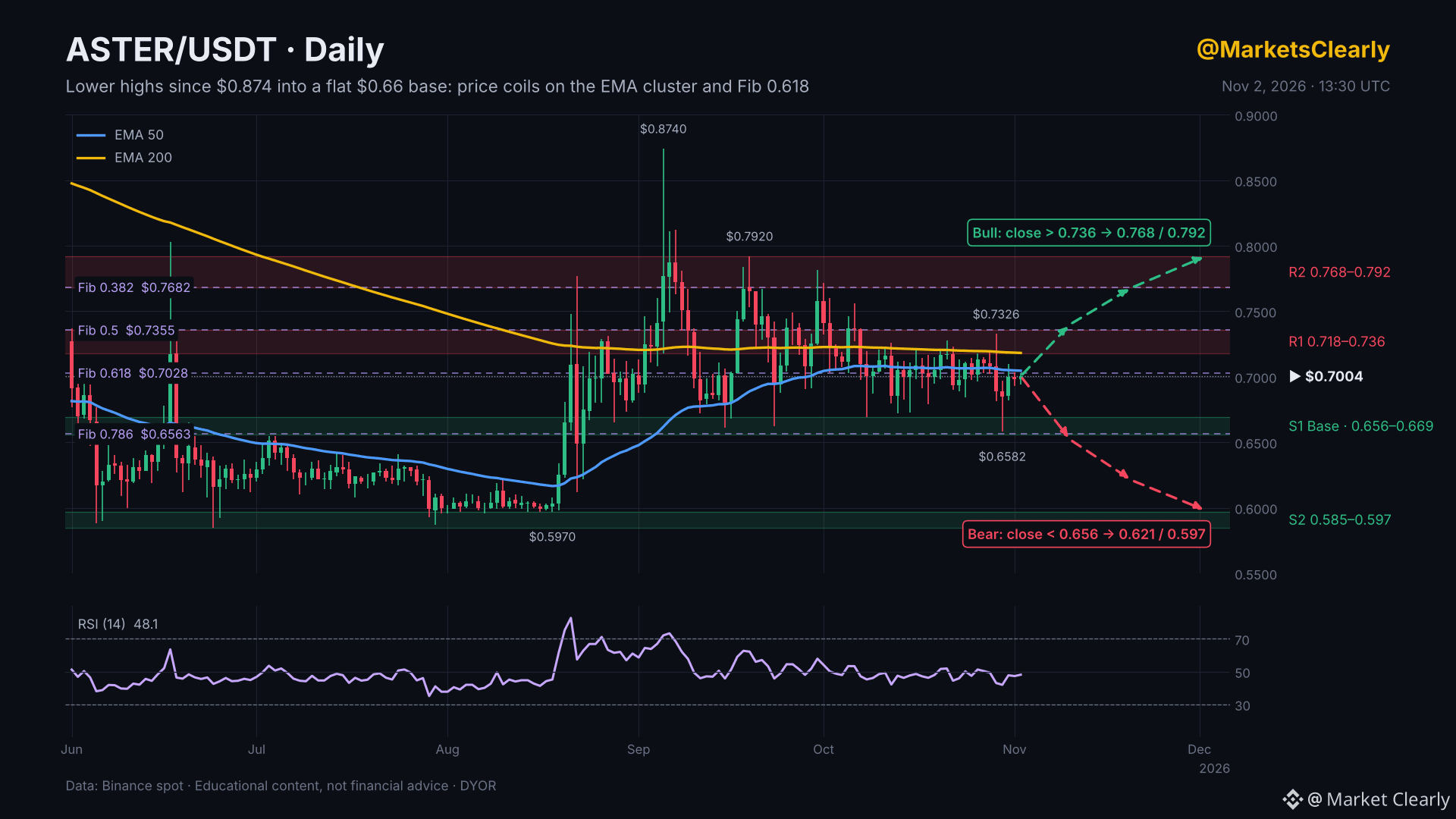
$ASTER | Daily Technical Outlook
Price: $0.7004 | RSI (14): 48
Structure
$ASTER has printed lower highs since the $0.874 September top: $0.792, $0.782, then $0.733. Lows have held flat at $0.658–0.669. The result is a descending triangle, with volume fading into the apex.
Key levels
Pivot: $0.700–0.705 (EMA 20/50 + Fib 0.618 of the $0.597–0.874 impulse). Price sits right on it.
Resistance: $0.718–0.736 (EMA 200, October highs, Fib 0.5), then $0.768–0.792.
Support: $0.656–0.669 (base tested four times + Fib 0.786), then $0.585–0.597.
Scenarios
Bullish: a daily close above $0.736 breaks the lower-high sequence and opens the way to $0.768, then $0.792.
Bearish: a daily close below $0.656 confirms the triangle breakdown and exposes $0.621, then $0.597.
View: RSI at 48 is neutral. Until one side of the $0.656–0.736 range breaks on a daily close, this is a range, not a trend.
Disclosure: I am a Binance Angel. $ASTER is a BNB Chain ecosystem token.
Not financial advice. DYOR.
#ASTER #TechnicalAnalysis #CryptoMarket
1
505
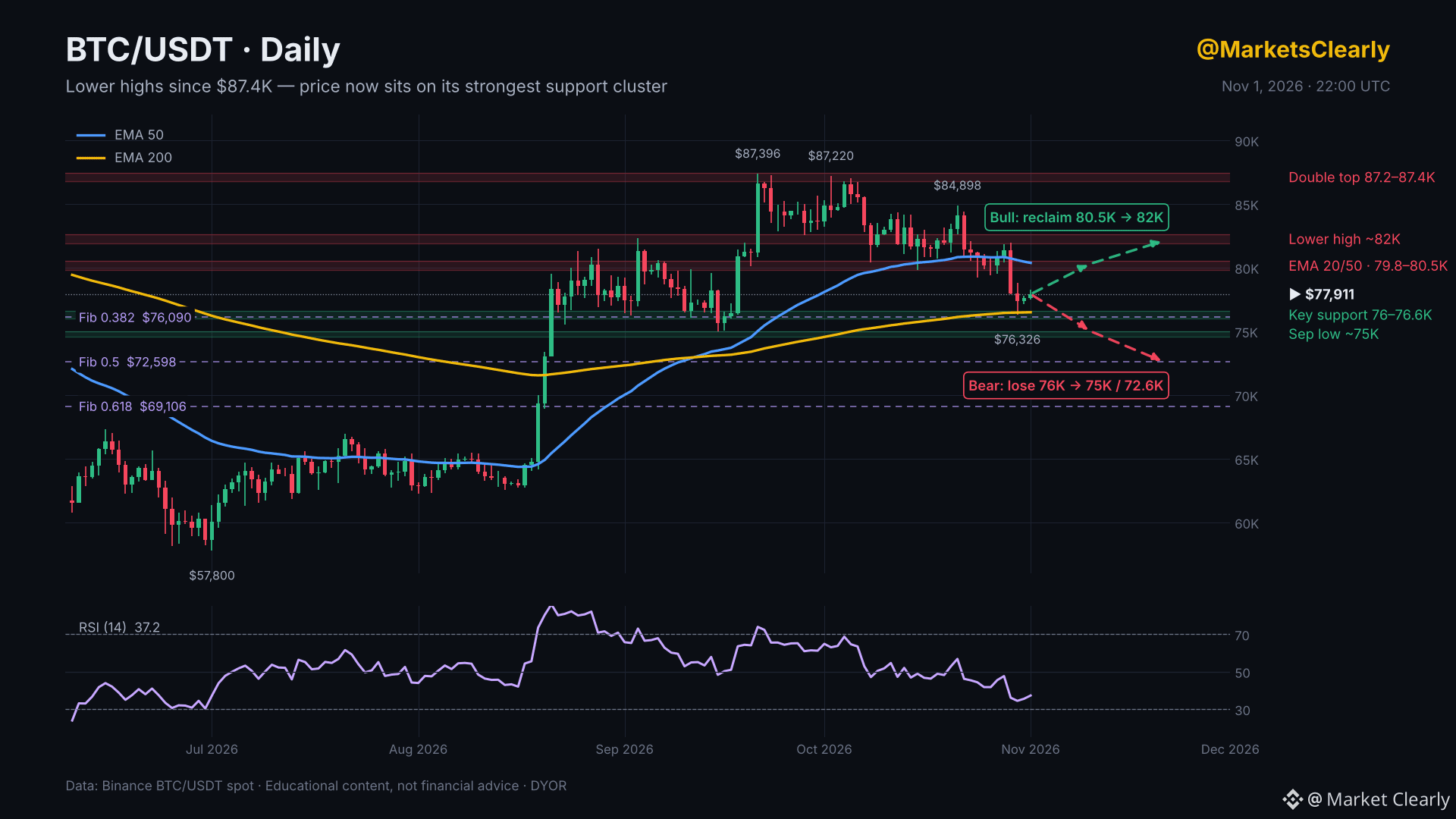
BTC | Daily Technical Outlook
Price: $77,911 | RSI (14): 37
Structure: lower highs since September ($87.4K → $84.9K → $82.0K). The short-term trend remains bearish.
Key support: $76.0K–$76.6K, where the Fib 0.382, the 200-day EMA and the Oct 30 low converge.
Bullish case: a daily close above $80.5K opens the way to $82.0K.
Bearish case: a daily close below $76.0K targets $75.0K, then $72.6K.
Not financial advice. DYOR.
98
Respect to the Binance security team working nonstop this week 🫡
The Angels have your back.
Respect to the Binance security team working nonstop this week 🫡
The Angels have your back.
The Angels have your back.
1
60
Last night, when the Binance hack was still just a rumor, I told everyone who sent me the link the same thing:
"Don't worry. Binance has got this."
That wasn't blind faith. I've been using Binance for 7 years. And in 7 years, I've watched this platform take hit after hit.
🔸 2019: 7,000 BTC stolen. Binance paid everyone back with its SAFU fund.
🔸 2022: FTX collapses and rumors start targeting Binance. Over $3.6B withdrawn in one week. Binance held strong.
🔸 2023: A record $4.3B fine in the US, and CZ steps down. No mass exodus of funds.
Every single time, Binance got back up.
That's how trust is built. Not because it's the biggest exchange, but because every time it was tested, Binance proved it could take the hit.
Nassim Taleb calls this antifragility: things that don't just survive shocks, but come out stronger. Binance is a textbook example. Every hit makes it tougher.
Today, we're looking at the biggest hack in crypto history: around $6.3B.
But Binance is already on it:
✅ Nearly $3B has already been frozen. The hacker can't touch it.
✅ Binance has promised to cover all losses.
✅ It's official: withdrawals will be back very soon.
And the market? BTC dropped 3 to 5%. When FTX went down in 2022, it lost over 20% in a matter of days.
No mass panic. Because users know this will be handled. Binance earned that trust.
If there's one silver lining here: a lot of cryptos are cheaper right now. If you've been waiting to get in, this might be your window.
⚠️ This is NOT financial advice. Always do your own research (DYOR).
A Binance user for 7 years.
Build and build. 🧱
#Binance #Crypto
1
144
Oil is retreating, but markets are still watching inflation and supply.
Brent fell 1.3% to $110.23 a barrel in Asian trading on Monday, after ending the previous week at $116.72.
Asian stocks also mostly traded lower.
A pullback in oil can ease some cost pressures. It does not, by itself, remove concerns about supply or inflation.
Major technology earnings and central bank decisions could also shape markets this week.

1
493
Lula has won another term in Brazil. Markets will now focus on economic policy.
President Luiz Inácio Lula da Silva defeated Flávio Bolsonaro in Sunday’s runoff, according to official results reported by Reuters on October 26.
The result offers an initial political signal, but it does not determine how markets will move. Investors will watch the Brazilian real, local assets and the fiscal measures the government seeks to implement.
Brazil remains politically divided. The government’s ability to pass its agenda will also matter.

1
74
Brazil votes on Sunday. Markets’ first reactions will be worth watching on Monday.
The runoff pits President Luiz Inácio Lula da Silva against Senator Flávio Bolsonaro. In the first round, Bolsonaro received 47% of the vote, compared with 45% for Lula.
The result could shift investor expectations for Brazil’s economic policy. When markets reopen, watch the Brazilian real and local assets.
An election alone does not determine market direction. The economic decisions that follow will matter too.
2
59
Расталды
Oil ended the week at its highest level since April.
Brent settled at $116.72 a barrel on Friday, up 3.14% on the day. Reuters linked the rise to concerns about potential supply disruptions in the Middle East.
Why markets care: expensive energy can raise business costs and make it harder for inflation to ease. It can also shift expectations for interest rates.
Watch actual deliveries and the security of energy routes. A price increase alone does not confirm a lasting supply disruption.

2
647
Расталды
Why is oil still under pressure?
Brent rose 1.5% to $110.40 a barrel on Wednesday morning. Reuters cited shipping risks in the Gulf and Red Sea, as well as a reported drop in U.S. crude stocks based on preliminary API data.
Oil prices react to risk, but physical flows matter too. A price increase alone does not prove that deliveries have been disrupted.
Watch actual cargo flows, official U.S. inventory data and the security of shipping routes.

1
590
Investors are looking beyond AI growth. They are also asking what it costs.
Asian markets fell on Tuesday as investors awaited results from several technology companies.
They are looking for evidence that AI spending can generate enough revenue to justify the investment.
That distinction matters: strong demand for AI does not guarantee that every company will earn a return on its spending.
Watch this week’s tech earnings and companies’ investment plans.
Source: Reuters, October 20, 2026.
1
75
China’s stronger growth does not mean the recovery is evenly spread.
• GDP grew 4.5% year on year in Q3, up from 4.3% in Q2.
• Industrial production rose 5.5% in September.
• Retail sales increased 1.1% over the same period.
These indicators measure different activities. The contrast helps explain why GDP alone cannot describe conditions across businesses and households.
When following global markets, distinguish China’s production strength from consumer demand.
Watch for further measures aimed at supporting household spending.
Source: National Bureau of Statistics of China, October 19, 2026.

96

Мақала
Is Crypto Just Making Rich People Richer? Eleanor Terrett's Answer Will Stay With YouOne question stopped Eleanor Terrett's AMA cold:
"Is crypto just making rich people richer?"
Her answer started with Trump. And ended with a woman who had nothing.
Let's Start With The Obvious
Eleanor Terrett is one of the most respected voices in crypto journalism in the US. During her AMA on Binance Square, she didn't dodge the question.
She started with the uncomfortable truth: yes, crypto has significantly enriched those who already had capital to begin with.
The Trump family is the most striking illustration over a billion dollars generated through various crypto ventures. The more you put in, the more you get out. That's the reality of the market.
But Eleanor didn't end her analysis there. And that's where things get truly interesting.
A Story She Heard In Wyoming
At a conference, Eleanor came across a woman whose story stayed with her.
This woman was living in an abusive relationship. She wanted to leave. She needed to. But she was trapped in a situation many people don't realize exists: not a single bank account was registered in her name. Every cent in the household was under her partner's control.
No money of her own. No access. No freedom.Within the traditional financial system, she was invisible.Except she had made one quiet decision, long before any of this came to a head. She had set aside some crypto in a self-custody wallet. A wallet nobody else controlled. That nobody could block, freeze, or confiscate.That wallet allowed her to leave.
To start over.
To live.
What This Story Really Tells Us
This isn't a story about Bitcoin or Ethereum.It's a story about what financial sovereignty truly means. The ability to own something that nobody can take from you. Something that doesn't need a banker, a husband, or a government to exist.
Across francophone Africa, this reality hits particularly close to home. Millions of people women especially still don't have access to the traditional banking system. Family dependence, institutional exclusion, lack of infrastructure… The barriers are real.
Crypto doesn't solve everything. But it offers something the traditional system still denies to many: direct access, without intermediaries, without asking for permission.
But There's One Condition
Eleanor Terrett closed on a fundamental point.For crypto to truly serve everyone not just insiders, not just the wealthy, not just tech-savvy early adopters massive investment in blockchain and digital asset education is non-negotiable.
A woman who doesn't know what a self-custody wallet is can't use one to set herself free.
A young person in Côte d'Ivoire who doesn't understand the basics of Web3 can't fully benefit from it.
An uneducated community will always remain at the mercy of intermediaries.
That's exactly why crypto education isn't a bonus.
It's the foundation of everything.
Bottom Line
✅ Crypto has made the powerful richer — that's true
✅ Crypto can also liberate the most vulnerable — that's proven
✅ But this only becomes possible through education and access to information
Want to go further? Watch Eleanor Terrett's full AMA on Binance Square 👇
[replay link](https://www.binance.com/en/square/audio/replay?id=39933918288601)
DYOR :This article is for educational purposes only and does not constitute financial advice.
Is Crypto Just Making Rich People Richer? Eleanor Terrett's Answer Will Stay With You
One question stopped Eleanor Terrett's AMA cold:
"Is crypto just making rich people richer?"
Her answer started with Trump. And ended with a woman who had nothing.
Let's Start With The Obvious
Eleanor Terrett is one of the most respected voices in crypto journalism in the US. During her AMA on Binance Square, she didn't dodge the question.
She started with the uncomfortable truth: yes, crypto has significantly enriched those who already had capital to begin with.
The Trump family is the most striking illustration over a billion dollars generated through various crypto ventures. The more you put in, the more you get out. That's the reality of the market.
But Eleanor didn't end her analysis there. And that's where things get truly interesting.
A Story She Heard In Wyoming
At a conference, Eleanor came across a woman whose story stayed with her.
This woman was living in an abusive relationship. She wanted to leave. She needed to. But she was trapped in a situation many people don't realize exists: not a single bank account was registered in her name. Every cent in the household was under her partner's control.
No money of her own. No access. No freedom.Within the traditional financial system, she was invisible.Except she had made one quiet decision, long before any of this came to a head. She had set aside some crypto in a self-custody wallet. A wallet nobody else controlled. That nobody could block, freeze, or confiscate.That wallet allowed her to leave.
To start over.
To live.
What This Story Really Tells Us
This isn't a story about Bitcoin or Ethereum.It's a story about what financial sovereignty truly means. The ability to own something that nobody can take from you. Something that doesn't need a banker, a husband, or a government to exist.
Across francophone Africa, this reality hits particularly close to home. Millions of people women especially still don't have access to the traditional banking system. Family dependence, institutional exclusion, lack of infrastructure… The barriers are real.
Crypto doesn't solve everything. But it offers something the traditional system still denies to many: direct access, without intermediaries, without asking for permission.
But There's One Condition
Eleanor Terrett closed on a fundamental point.For crypto to truly serve everyone not just insiders, not just the wealthy, not just tech-savvy early adopters massive investment in blockchain and digital asset education is non-negotiable.
A woman who doesn't know what a self-custody wallet is can't use one to set herself free.
A young person in Côte d'Ivoire who doesn't understand the basics of Web3 can't fully benefit from it.
An uneducated community will always remain at the mercy of intermediaries.
That's exactly why crypto education isn't a bonus.
It's the foundation of everything.
Bottom Line
✅ Crypto has made the powerful richer — that's true
✅ Crypto can also liberate the most vulnerable — that's proven
✅ But this only becomes possible through education and access to information
Want to go further? Watch Eleanor Terrett's full AMA on Binance Square 👇
replay link
DYOR :This article is for educational purposes only and does not constitute financial advice.
1
72

Мақала
Binance renforce la confiance : les réserves de stablecoins bondissent de 31% en un anDans un contexte de marché volatil, Binance s'impose plus que jamais comme le pilier central de la liquidité mondiale. Alors que les investisseurs privilégient la sécurité, les données de CryptoQuant et CoinMarketCap (février 2026) confirment une tendance claire : le capital ne quitte pas l'écosystème, il se concentre sur Binance.
Une domination inégalée sur la liquidité
Binance n'est pas seulement le leader, c'est le principal "hub" de liquidité pour les actifs numériques. Aujourd'hui, la plateforme détient 65 % des réserves totales de stablecoins (USDT et USDC) parmi les plateformes d'échange centralisées (CEX).
Réserves actuelles : 47,5 milliards de dollars.Croissance annuelle : Une hausse massive de 31 % par rapport aux 35,9 milliards de dollars de l'année précédente.Composition : La force de frappe est principalement portée par l'USDT avec 42,3 milliards de dollars (en hausse de 36 % YoY), complétée par 5,2 milliards de dollars en USDC.
Le rempart contre la volatilité : Binance vs Concurrents
La résilience de Binance se mesure par l'écart abyssal qui la sépare des autres acteurs du marché. Les réserves de stablecoins de Binance sont :
5x plus importantes que celles d'OKX (9,5 Mds $).8x plus importantes que celles de Coinbase (5,9 Mds $).Près de 12x plus importantes que celles de Bybit (4,0 Mds $).
Pourquoi est-ce un gage de confiance ?
Hub de Liquidité : Une réserve de 47,5 Mds $ signifie que Binance peut absorber des volumes de vente massifs avec un glissement (slippage) minimal, protégeant ainsi les traders lors des krachs.Transparence et Preuve de Réserves : Avec un total d'actifs s'élevant à 155,6 milliards de dollars (selon CoinMarketCap, janv. 2026), Binance affiche un ratio de couverture qui garantit que les fonds des utilisateurs sont disponibles à tout moment.Consolidation du Capital : Contrairement aux sorties massives de fin 2025, le début de l'année 2026 montre que les investisseurs "parquent" leurs fonds sur Binance, attendant le moment opportun pour se repositionner sur des actifs risqués.
"Le capital ne fuit pas la crypto ; il se consolide, particulièrement sur Binance." Nick Pitto, CryptoQuant.
Binance : Le choix de la stabilité
En période d'incertitude, la profondeur de marché et la solidité des réserves sont les seuls véritables indicateurs de confiance. En détenant près de deux tiers de la liquidité stable du marché, Binance réaffirme sa position de leader incontesté et de plateforme la plus sûre pour naviguer dans la tempête.
Binance renforce la confiance : les réserves de stablecoins bondissent de 31% en un an
Dans un contexte de marché volatil, Binance s'impose plus que jamais comme le pilier central de la liquidité mondiale. Alors que les investisseurs privilégient la sécurité, les données de CryptoQuant et CoinMarketCap (février 2026) confirment une tendance claire : le capital ne quitte pas l'écosystème, il se concentre sur Binance.
Une domination inégalée sur la liquidité
Binance n'est pas seulement le leader, c'est le principal "hub" de liquidité pour les actifs numériques. Aujourd'hui, la plateforme détient 65 % des réserves totales de stablecoins (USDT et USDC) parmi les plateformes d'échange centralisées (CEX).
Réserves actuelles : 47,5 milliards de dollars.Croissance annuelle : Une hausse massive de 31 % par rapport aux 35,9 milliards de dollars de l'année précédente.Composition : La force de frappe est principalement portée par l'USDT avec 42,3 milliards de dollars (en hausse de 36 % YoY), complétée par 5,2 milliards de dollars en USDC.
Le rempart contre la volatilité : Binance vs Concurrents
La résilience de Binance se mesure par l'écart abyssal qui la sépare des autres acteurs du marché. Les réserves de stablecoins de Binance sont :
5x plus importantes que celles d'OKX (9,5 Mds $).8x plus importantes que celles de Coinbase (5,9 Mds $).Près de 12x plus importantes que celles de Bybit (4,0 Mds $).
Pourquoi est-ce un gage de confiance ?
Hub de Liquidité : Une réserve de 47,5 Mds $ signifie que Binance peut absorber des volumes de vente massifs avec un glissement (slippage) minimal, protégeant ainsi les traders lors des krachs.Transparence et Preuve de Réserves : Avec un total d'actifs s'élevant à 155,6 milliards de dollars (selon CoinMarketCap, janv. 2026), Binance affiche un ratio de couverture qui garantit que les fonds des utilisateurs sont disponibles à tout moment.Consolidation du Capital : Contrairement aux sorties massives de fin 2025, le début de l'année 2026 montre que les investisseurs "parquent" leurs fonds sur Binance, attendant le moment opportun pour se repositionner sur des actifs risqués.
"Le capital ne fuit pas la crypto ; il se consolide, particulièrement sur Binance." Nick Pitto, CryptoQuant.
Binance : Le choix de la stabilité
En période d'incertitude, la profondeur de marché et la solidité des réserves sont les seuls véritables indicateurs de confiance. En détenant près de deux tiers de la liquidité stable du marché, Binance réaffirme sa position de leader incontesté et de plateforme la plus sûre pour naviguer dans la tempête.
1
104

Мақала
Si la patience était le secret pour réussir dans la crypto ?Dans l'univers frénétique des cryptomonnaies, où les scintillantes promesses d'enrichissement rapide attisent les convoitises, une vertu souvent négligée émerge comme le véritable catalyseur du succès : la patience. À contre-courant de l'effervescence du trading de haute fréquence et des stratégies de court terme, des investisseurs avisés l'ont compris : la tempérance est la clé de voûte de tout voyage crypto fructueux.
I. L'illusion de la richesse instantanée
Le marché crypto se caractérise par une volatilité extrême qui défie l'imagination. Le Bitcoin, né en 2009, a traversé des cycles vertigineux : de quelques centimes, il a atteint 69 000 $ en 2021,pour s'effondrer à 15500 $ en 2022, avant de repartir vers de nouveaux sommets. Ces oscillations brutales, bien que séduisantes pour les adeptes du day-trading, s'avèrent psychologiquement dévastatrices pour l'investisseur novice.
C'est dans ce tourbillon émotionnel que beaucoup commettent l'erreur irréparable : céder à la panique lors des baisses et vendre au pire moment. Les études montrent que plus de 80% des traders de cryptomonnaies perdent de l'argent à long terme. En revanche, ceux qui ont maintenu leurs positions à travers les périodes de baisse ont souvent récolté les fruits d'une persévérance payante.
La patience en crypto n'est pas de l'inaction ; c'est une action calculée, une confiance mesurée dans un processus éprouvé."
II. La philosophie HODL : plus qu'un mot, un mode de vie
L'acronyme "HODL" (Hold On for Dear Life) est bien plus qu'un simple mème de la communauté crypto, c'est une approche philosophique de l'investissement à long terme. Né d'une faute de frappe sur un forum Bitcoin en 2013, HODL s'est mué en cri de ralliement pour les investisseurs visionnaires qui refusent de céder à la panique.
Cette stratégie consiste à acquérir des cryptomonnaies solides et à les conserver pendant plusieurs années, en faisant fi des fluctuations du marché quotidien. Elle repose sur trois convictions fondamentales :
La croyance en la technologie: Comprendre et apprécier l'innovation blockchainLa vision à long terme : Accepter que l'adoption de masse prend du tempsLa résilience émotionnelle: Résister à FOMO (Fear Of Missing Out) et FUD (Fear, Uncertainty, Doubt)
Les investisseurs qui ont appliqué cette philosophie depuis 2014 ont vu leurs positions croître de manière spectaculaire, transformant des investissements modestes en patrimoines conséquents.
III. Le DCA : transformer la patience en puissance mathématique
Le DCA (Dollar Cost Averaging) incarne la mise en pratique concrète de la patience. Cette méthode consiste à investir un montant fixe à intervalles réguliers, indépendamment des fluctuations du marché.
Exemple concret de réussite DCA
Sur une période de 12 mois en 2023, un investissement mensuel de 100 $ en Bitcoin aurait généré les résultats suivants :
Investissement total : 1 200 $Valeur finale du portefeuille : 1 764,11 $Plus-value : +47,01 %
Même ceux ayant commencé leur DCA à des niveaux élevés comme en novembre 2021, lors de l'ancien record du Bitcoin à 69 000 $ seraient aujourd'hui en plus-value, à condition d'avoir poursuivi leur plan d'investissement avec constance.
L'élégance mathématique du DCA repose sur sa capacité à acheter plus d'unités lorsque les prix sont bas et moins lorsqu'ils sont élevés, créant naturellement un prix d'achat moyen avantageux. Ce qui rend le DCA si puissant, c'est qu'il neutralise l'influence de la psychologie humaine sur les décisions d'investissement.
IV. La psychologie du patient : maîtriser ses émotions
La patience en crypto est avant tout un défi psychologique. Les quatre émotions principales qui sabotent les investisseurs sont :
Les investisseurs patients ont développé des mécanismes pour contrer ces émotions :
Automatisation des investissements (DCA)Diversification du portefeuilleIgnorance du bruit médiatique quotidienConfiance dans les fondamentaux des projets
V. Les cycles du marché crypto : la patience s'est la clé
Le marché crypto obéit à des cycles bien documentés, généralement d'une durée de quatre ans, synchronisés avec le "halving" du Bitcoin (division par deux de la récompense minière tous les 210 000 blocs).
Les quatre phases du cycle :
Accumulation : Le marché est bas, les pessimistes dominent. Les investisseurs patients accumulent discrètement.Markup (Bull Market) : Les prix montent, de nouveaux investisseurs entrent. L'euphorie s'installe.Distribution : Les initiés prennent des profits. Le marché atteint son sommet.Markdown (Bear Market) : Les prix chutent paniquent. C'est le moment où la patience est mise à l'épreuve.
La plus longue période de baisse (drawdown) du Bitcoin a duré 3 ans et 1 mois, avec une baisse maximale de -76,7%. Seul un investisseur patient avait la capacité et la résilience de traverser cette épreuve.
VI. La magie des intérêts composés dans le monde crypto
La patience permet de tirer parti de la puissance des intérêts composés. Plus vous conservez vos investissements longtemps, plus vos gains potentiels se multiplient exponentiellement.
Albert Einstein aurait qualifié les intérêts composés de "huitième merveille du monde". Ce principe s'applique avec une force particulièrement redoutable aux cryptomonnaies à cause de leur volatilité élevée et de leur potentialité de croissance explosive.
"L'intérêt composé est la huitième merveille du monde. Celui qui le comprend, le gagne. Celui qui ne le comprend pas, le paie." — Albert Einstein
VII. Les trois piliers d'une approche patiente réussie
Pour que la patience porte ses fruits, elle doit s'appuyer sur trois fondements solides :
1. La discipline inébranlable
Un plan DCA ne s'interrompt pas quand le marché fait peur. La discipline transforme une intention en habitude, et une habitude en destin.
2. Le rigoureux choix des actifs
La patience sur un mauvais projet ne sauvera pas votre capital. Les fondamentaux comptent :
Adoption réelle : L'actif est-il utilisé ?Équipe solide : Les développeurs sont-ils compétents ?Utilité créée : Qu'est-ce qu'il résout ?Communauté active : Le projet est-il soutenu ?
3. L'horizon de temps approprié
L'horizon de temps en crypto doit se compter en années, jamais en jours ou semaines. L'objectif n'est pas de battre le marché, mais d'exposer progressivement à sa dynamique de long terme.
VIII. Études de cas : la patience récompensée
Cas #1 : Les premiers adopteurs
Un investisseur qui a acheté 100 $ de Bitcoin en 2011 et les a conservés jusqu'en 2024 aurait vu son investissement croître de plus de 1 000 000 %. Malgré des baisses spectaculaires de -80% à plusieurs reprises, la patience a été la clé de ce succès extraordinaire.
Cas #2 : DCA à travers le crash de 2022
Un investisseur ayant commencé un DCA mensuel de 200 $ sur le Bitcoin en janvier 2022 (au sommet du marché) aurait continué à acheter pendant toute l'année de baisse. Résultat : un portefeuille en plus-value significative dès 2023, grâce à l'accumulation à des bas prix.
IX. La patience comme avantage compétitif
Dans un monde saturé d'informations en temps réel et de notifications incessantes, savoir tempérer son enthousiasme et résister à l'envie de réagir à chaque mouvement de marché constitue un véritable avantage compétitif.
Les investisseurs patients bénéficient de plusieurs avantages structurels :
Moins de stress psychologiqueMoins de frais de tradingMeilleure prise de décisionLongévité sur le marchéMeilleure sommeil et santé mentale
X. Conclusion : La patience comme superpuissance
Le marché crypto restera volatil, les soubresauts continueront, et les bruits médiatiques amplifieront les émotions collectives. Mais pour l'investisseur qui a compris que le temps est son allié, ces turbulences ne sont plus des obstacles elles sont des opportunités d'accumulation.
La patience en crypto n'est pas passive elle est stratégique, disciplinée et réfléchie. C'est une compétence qui se développe avec l'expérience, se renforce avec la pratique, et se récompense avec le temps.
"Dans un monde d'investisseurs pressés, la patience est devenue une superpuissance."
La question ne se pose plus : si la patience était le secret pour réussir dans la crypto ? La réponse est limpide. Elle l'est, et elle le restera. Le marché récompense ceux qui savent attendre, ceux qui croient profondément, et ceux qui ne laissent pas les émotions court-circuiter leur jugement.
L'histoire de la crypto n'est pas encore écrite. Les plus grandes opportunités n'ont pas encore été capturées. Et pour celles et ceux qui possèdent la patience, la discipline et la vision de long terme, l'avenir promet d'être extraordinairement récompensé.
La patience n'est pas une faiblesse. C'est une force. Et dans le monde des cryptomonnaies, c'est peut-être la force la plus puissante de toutes. 💎
Si la patience était le secret pour réussir dans la crypto ?
Dans l'univers frénétique des cryptomonnaies, où les scintillantes promesses d'enrichissement rapide attisent les convoitises, une vertu souvent négligée émerge comme le véritable catalyseur du succès : la patience. À contre-courant de l'effervescence du trading de haute fréquence et des stratégies de court terme, des investisseurs avisés l'ont compris : la tempérance est la clé de voûte de tout voyage crypto fructueux.
I. L'illusion de la richesse instantanée
Le marché crypto se caractérise par une volatilité extrême qui défie l'imagination. Le Bitcoin, né en 2009, a traversé des cycles vertigineux : de quelques centimes, il a atteint 69 000 $ en 2021,pour s'effondrer à 15500 $ en 2022, avant de repartir vers de nouveaux sommets. Ces oscillations brutales, bien que séduisantes pour les adeptes du day-trading, s'avèrent psychologiquement dévastatrices pour l'investisseur novice.
C'est dans ce tourbillon émotionnel que beaucoup commettent l'erreur irréparable : céder à la panique lors des baisses et vendre au pire moment. Les études montrent que plus de 80% des traders de cryptomonnaies perdent de l'argent à long terme. En revanche, ceux qui ont maintenu leurs positions à travers les périodes de baisse ont souvent récolté les fruits d'une persévérance payante.
La patience en crypto n'est pas de l'inaction ; c'est une action calculée, une confiance mesurée dans un processus éprouvé."
II. La philosophie HODL : plus qu'un mot, un mode de vie
L'acronyme "HODL" (Hold On for Dear Life) est bien plus qu'un simple mème de la communauté crypto, c'est une approche philosophique de l'investissement à long terme. Né d'une faute de frappe sur un forum Bitcoin en 2013, HODL s'est mué en cri de ralliement pour les investisseurs visionnaires qui refusent de céder à la panique.
Cette stratégie consiste à acquérir des cryptomonnaies solides et à les conserver pendant plusieurs années, en faisant fi des fluctuations du marché quotidien. Elle repose sur trois convictions fondamentales :
La croyance en la technologie: Comprendre et apprécier l'innovation blockchainLa vision à long terme : Accepter que l'adoption de masse prend du tempsLa résilience émotionnelle: Résister à FOMO (Fear Of Missing Out) et FUD (Fear, Uncertainty, Doubt)
Les investisseurs qui ont appliqué cette philosophie depuis 2014 ont vu leurs positions croître de manière spectaculaire, transformant des investissements modestes en patrimoines conséquents.
III. Le DCA : transformer la patience en puissance mathématique
Le DCA (Dollar Cost Averaging) incarne la mise en pratique concrète de la patience. Cette méthode consiste à investir un montant fixe à intervalles réguliers, indépendamment des fluctuations du marché.
Exemple concret de réussite DCA
Sur une période de 12 mois en 2023, un investissement mensuel de 100 $ en Bitcoin aurait généré les résultats suivants :
Investissement total : 1 200 $Valeur finale du portefeuille : 1 764,11 $Plus-value : +47,01 %
Même ceux ayant commencé leur DCA à des niveaux élevés comme en novembre 2021, lors de l'ancien record du Bitcoin à 69 000 $ seraient aujourd'hui en plus-value, à condition d'avoir poursuivi leur plan d'investissement avec constance.
L'élégance mathématique du DCA repose sur sa capacité à acheter plus d'unités lorsque les prix sont bas et moins lorsqu'ils sont élevés, créant naturellement un prix d'achat moyen avantageux. Ce qui rend le DCA si puissant, c'est qu'il neutralise l'influence de la psychologie humaine sur les décisions d'investissement.
IV. La psychologie du patient : maîtriser ses émotions
La patience en crypto est avant tout un défi psychologique. Les quatre émotions principales qui sabotent les investisseurs sont :
Les investisseurs patients ont développé des mécanismes pour contrer ces émotions :
Automatisation des investissements (DCA)Diversification du portefeuilleIgnorance du bruit médiatique quotidienConfiance dans les fondamentaux des projets
V. Les cycles du marché crypto : la patience s'est la clé
Le marché crypto obéit à des cycles bien documentés, généralement d'une durée de quatre ans, synchronisés avec le "halving" du Bitcoin (division par deux de la récompense minière tous les 210 000 blocs).
Les quatre phases du cycle :
Accumulation : Le marché est bas, les pessimistes dominent. Les investisseurs patients accumulent discrètement.Markup (Bull Market) : Les prix montent, de nouveaux investisseurs entrent. L'euphorie s'installe.Distribution : Les initiés prennent des profits. Le marché atteint son sommet.Markdown (Bear Market) : Les prix chutent paniquent. C'est le moment où la patience est mise à l'épreuve.
La plus longue période de baisse (drawdown) du Bitcoin a duré 3 ans et 1 mois, avec une baisse maximale de -76,7%. Seul un investisseur patient avait la capacité et la résilience de traverser cette épreuve.
VI. La magie des intérêts composés dans le monde crypto
La patience permet de tirer parti de la puissance des intérêts composés. Plus vous conservez vos investissements longtemps, plus vos gains potentiels se multiplient exponentiellement.
Albert Einstein aurait qualifié les intérêts composés de "huitième merveille du monde". Ce principe s'applique avec une force particulièrement redoutable aux cryptomonnaies à cause de leur volatilité élevée et de leur potentialité de croissance explosive.
"L'intérêt composé est la huitième merveille du monde. Celui qui le comprend, le gagne. Celui qui ne le comprend pas, le paie." — Albert Einstein
VII. Les trois piliers d'une approche patiente réussie
Pour que la patience porte ses fruits, elle doit s'appuyer sur trois fondements solides :
1. La discipline inébranlable
Un plan DCA ne s'interrompt pas quand le marché fait peur. La discipline transforme une intention en habitude, et une habitude en destin.
2. Le rigoureux choix des actifs
La patience sur un mauvais projet ne sauvera pas votre capital. Les fondamentaux comptent :
Adoption réelle : L'actif est-il utilisé ?Équipe solide : Les développeurs sont-ils compétents ?Utilité créée : Qu'est-ce qu'il résout ?Communauté active : Le projet est-il soutenu ?
3. L'horizon de temps approprié
L'horizon de temps en crypto doit se compter en années, jamais en jours ou semaines. L'objectif n'est pas de battre le marché, mais d'exposer progressivement à sa dynamique de long terme.
VIII. Études de cas : la patience récompensée
Cas #1 : Les premiers adopteurs
Un investisseur qui a acheté 100 $ de Bitcoin en 2011 et les a conservés jusqu'en 2024 aurait vu son investissement croître de plus de 1 000 000 %. Malgré des baisses spectaculaires de -80% à plusieurs reprises, la patience a été la clé de ce succès extraordinaire.
Cas #2 : DCA à travers le crash de 2022
Un investisseur ayant commencé un DCA mensuel de 200 $ sur le Bitcoin en janvier 2022 (au sommet du marché) aurait continué à acheter pendant toute l'année de baisse. Résultat : un portefeuille en plus-value significative dès 2023, grâce à l'accumulation à des bas prix.
IX. La patience comme avantage compétitif
Dans un monde saturé d'informations en temps réel et de notifications incessantes, savoir tempérer son enthousiasme et résister à l'envie de réagir à chaque mouvement de marché constitue un véritable avantage compétitif.
Les investisseurs patients bénéficient de plusieurs avantages structurels :
Moins de stress psychologiqueMoins de frais de tradingMeilleure prise de décisionLongévité sur le marchéMeilleure sommeil et santé mentale
X. Conclusion : La patience comme superpuissance
Le marché crypto restera volatil, les soubresauts continueront, et les bruits médiatiques amplifieront les émotions collectives. Mais pour l'investisseur qui a compris que le temps est son allié, ces turbulences ne sont plus des obstacles elles sont des opportunités d'accumulation.
La patience en crypto n'est pas passive elle est stratégique, disciplinée et réfléchie. C'est une compétence qui se développe avec l'expérience, se renforce avec la pratique, et se récompense avec le temps.
"Dans un monde d'investisseurs pressés, la patience est devenue une superpuissance."
La question ne se pose plus : si la patience était le secret pour réussir dans la crypto ? La réponse est limpide. Elle l'est, et elle le restera. Le marché récompense ceux qui savent attendre, ceux qui croient profondément, et ceux qui ne laissent pas les émotions court-circuiter leur jugement.
L'histoire de la crypto n'est pas encore écrite. Les plus grandes opportunités n'ont pas encore été capturées. Et pour celles et ceux qui possèdent la patience, la discipline et la vision de long terme, l'avenir promet d'être extraordinairement récompensé.
La patience n'est pas une faiblesse. C'est une force. Et dans le monde des cryptomonnaies, c'est peut-être la force la plus puissante de toutes. 💎
1
133

Мақала
Crypto en "Extrême Peur" : Que faire maintenant ? 5 Conseils pour survivre au krachLe marché des cryptomonnaies vient de subir un séisme. Ce 6 février 2026, l’indice Fear & Greed a plongé à 5/100, un niveau de panique que nous n'avions pas revu depuis l’effondrement de FTX. Avec un Bitcoin qui teste le support critique des 60 000 $, l'air devient irrespirable pour beaucoup.
Pourtant, l'histoire nous enseigne que c'est précisément dans ce brouillard émotionnel que se forgent les plus grandes réussites. Voici ce qu'il se passe réellement et comment vous devez réagir.
Que se passe-t-il après l’Extrême Peur ?
L’extrême peur n’est pas la fin du marché, c’est sa purge.
Capitulation forcée : Nous assistons à une cascade de liquidations (plus de 2 milliards $ en 24h). Les traders à fort levier sont expulsés, laissant la place à des mains plus solides.Le "V" Bottom : Historiquement, les scores d'indice inférieurs à 10 sont souvent suivis d'un rebond violent. Le marché est "survendu", ce qui signifie que la pression vendeuse s'épuise.
5 Conseils de survie pour les Traders Crypto
1. Adoptez la règle du "Greed when Fearful"
Suivez le précepte de Warren Buffett : soyez avide quand les autres ont peur. À 5/100, la panique est irrationnelle. Les fondamentaux du Bitcoin (rareté, adoption institutionnelle) n'ont pas changé entre 100k$ et 60k$.
Ne vendez pas votre plan à cause d'une émotion.
2. Le DCA est votre meilleur allié
N'essayez pas de "sniper" le point le plus bas (le Bottom). C'est mathématiquement presque impossible.
Stratégie : Divisez votre capital restant en plusieurs paliers d'achat (ex: à 60k, 55k et 50k). Cela lisse votre prix d'entrée et réduit votre stress psychologique.
3. Revenez aux "Blue Chips" (BTC & ETH)
En période de peur extrême, les altcoins et memecoins souffrent le plus car la liquidité se retire.
Le mouvement malin : Concentrez-vous sur le Bitcoin et l'Ethereum. Leur dominance actuelle (60% pour BTC) montre que c'est là que l'argent "intelligent" se réfugie pour attendre la fin de la tempête.
4. Coupez le bruit des réseaux sociaux
L'algorithme de X (Twitter) et de YouTube favorise les titres apocalyptiques en période de baisse.
Action : Regardez les données On-Chain (les baleines accumulent-elles ?) et les indicateurs techniques comme le RSI (actuellement en zone de survente massive). Les chiffres ne mentent pas, les influenceurs si.
5. Supprimez l'effet de levier
Si vous tradez avec du levier en plein krach, vous jouez au casino avec des dés pipés.
Sécurité : Passez en Spot. Dans un marché qui oscille de 10% par jour, rester "vivant" sur le marché est votre seule priorité. La patience est la forme la plus élevée de trading en 2026.
Conclusion : La lumière au bout du tunnel
Comme le souligne Cathie Wood, cette correction de 30% est "saine" comparée aux cycles passés. Le Bitcoin est en train de devenir un actif macroéconomique majeur. Ne laissez pas une bougie rouge effacer votre vision de 2030.
Et vous, faites-vous partie de ceux qui paniquent ou de ceux qui accumulent ? Partagez votre avis en commentaire !
#bitcoin #CryptoMarketMoves #tradingtips
Crypto en "Extrême Peur" : Que faire maintenant ? 5 Conseils pour survivre au krach
Le marché des cryptomonnaies vient de subir un séisme. Ce 6 février 2026, l’indice Fear & Greed a plongé à 5/100, un niveau de panique que nous n'avions pas revu depuis l’effondrement de FTX. Avec un Bitcoin qui teste le support critique des 60 000 $, l'air devient irrespirable pour beaucoup.
Pourtant, l'histoire nous enseigne que c'est précisément dans ce brouillard émotionnel que se forgent les plus grandes réussites. Voici ce qu'il se passe réellement et comment vous devez réagir.
Que se passe-t-il après l’Extrême Peur ?
L’extrême peur n’est pas la fin du marché, c’est sa purge.
Capitulation forcée : Nous assistons à une cascade de liquidations (plus de 2 milliards $ en 24h). Les traders à fort levier sont expulsés, laissant la place à des mains plus solides.Le "V" Bottom : Historiquement, les scores d'indice inférieurs à 10 sont souvent suivis d'un rebond violent. Le marché est "survendu", ce qui signifie que la pression vendeuse s'épuise.
5 Conseils de survie pour les Traders Crypto
1. Adoptez la règle du "Greed when Fearful"
Suivez le précepte de Warren Buffett : soyez avide quand les autres ont peur. À 5/100, la panique est irrationnelle. Les fondamentaux du Bitcoin (rareté, adoption institutionnelle) n'ont pas changé entre 100k$ et 60k$.
Ne vendez pas votre plan à cause d'une émotion.
2. Le DCA est votre meilleur allié
N'essayez pas de "sniper" le point le plus bas (le Bottom). C'est mathématiquement presque impossible.
Stratégie : Divisez votre capital restant en plusieurs paliers d'achat (ex: à 60k, 55k et 50k). Cela lisse votre prix d'entrée et réduit votre stress psychologique.
3. Revenez aux "Blue Chips" (BTC & ETH)
En période de peur extrême, les altcoins et memecoins souffrent le plus car la liquidité se retire.
Le mouvement malin : Concentrez-vous sur le Bitcoin et l'Ethereum. Leur dominance actuelle (60% pour BTC) montre que c'est là que l'argent "intelligent" se réfugie pour attendre la fin de la tempête.
4. Coupez le bruit des réseaux sociaux
L'algorithme de X (Twitter) et de YouTube favorise les titres apocalyptiques en période de baisse.
Action : Regardez les données On-Chain (les baleines accumulent-elles ?) et les indicateurs techniques comme le RSI (actuellement en zone de survente massive). Les chiffres ne mentent pas, les influenceurs si.
5. Supprimez l'effet de levier
Si vous tradez avec du levier en plein krach, vous jouez au casino avec des dés pipés.
Sécurité : Passez en Spot. Dans un marché qui oscille de 10% par jour, rester "vivant" sur le marché est votre seule priorité. La patience est la forme la plus élevée de trading en 2026.
Conclusion : La lumière au bout du tunnel
Comme le souligne Cathie Wood, cette correction de 30% est "saine" comparée aux cycles passés. Le Bitcoin est en train de devenir un actif macroéconomique majeur. Ne laissez pas une bougie rouge effacer votre vision de 2030.
Et vous, faites-vous partie de ceux qui paniquent ou de ceux qui accumulent ? Partagez votre avis en commentaire !
#bitcoin #CryptoMarketMoves #tradingtips
1
1
3
444
Exactly. In the long run, it’s always interesting to buy the dip.
Bitcoin is simply the King 👑
Exactly. In the long run, it’s always interesting to buy the dip.
Bitcoin is simply the King 👑
Bitcoin is simply the King 👑

Hermes-T-06
·
--
Très bonne analyse 👍. C’est le moment des promotions. -50% sur BTC. Les petits portefeuilles doivent absolument en profiter.
1
39
Көбірек контент көру үшін кіріңіз
Binance Square платформасында әлемдік криптоқоғамдастыққа қосылыңыз
⚡️ Криптовалюта туралы ең соңғы және пайдалы ақпаратты алыңыз.
💬 Әлемдегі ең ірі криптобиржаның сеніміне ие.
👍 Расталған авторлардың нақты пікірлерін табыңыз.
Электрондық пошта/телефон нөмірі
Трендтегі тақырыптар
JobsReportRaisesHikeOdds
448,545 рет көрілді
3,101 адам талқылап жатыр
TradFi News | US Adds 165,000 Jobs in October, More Than Double the 65,000 Forecast, as Unemployment Falls to 4.1%
Binance News
·41 лайк
·24k рет көрілді
CPITestsDecemberRateOutlook
116,229 рет көрілді
978 адам талқылап жатыр
BitcoinRebounds$75KAsChipsLead
38,977 рет көрілді
327 адам талқылап жатыр