

Innovation345
Crypto Analyst || Web 3 || Trader || Blockchain || Crypto News || Digital Marketer|| Crypto Healer || Science 2018
Ашық сауда
Жиі сауда жасайтын трейдер
4.3 жыл
12.2K+ Жазылым
11.2K+ Жазылушылар
3.4K+ лайк басылған
Жазбалар
Портфолио
Барлығы
Баға ұсыныстары
Тікелей эфир
PINNED


Yi He
·
--
过去30天我应该是持仓亏损榜排名top才对,这个徽章机制得重新看下🙃
PINNED


Binance News
·
--
CZ's "Freedom of Money" Japanese Edition Launches Today
Binance founder and former CEO Changpeng Zhao (CZ) announced on X that the Japanese edition of "Freedom of Money" launches today, with more languages coming soon. CZ said all proceeds go to charity and the book is free of charge, thanking "Miss Bitcoin" Mai Fujimoto, Co-Founder of zERC20, for the translation.


时光1913
·
--
📢 Let me ask you a real question—
Are you sure you can catch every post of mine the second it goes live?
😅 Don't kid yourself. You can't. And I can't guarantee you will.
📱 By the time you scroll to that post, the price may have already moved.
Direction changed, opportunity gone, stop‑loss too late to set.
💹 We both know how much can change in just a few minutes in crypto.
⏱️ So let me tell you straight:
I put all my "real‑time entry" signals in a live chat room.
No feed delays, no algorithm waiting, no luck needed on your scrolling timing.
Once you're in, the signals are there — sent in seconds, updated live.
🚀 What you see there is exactly what's happening in the market right now.
✅ How to join? Just tap the chat room entry below my profile — one step, done.
💸 Opportunity waits for no one. A few minutes late, and it's a whole different price.
Binance News
·
--
Binance Futures Will Launch Four TradFi Perpetual Contracts
According to the announcement from Binance, Binance Futures will launch four USDT-margined perpetual contracts on 2026-10-21. CEGUSDT, based on Constellation Energy Corporation common stock, is scheduled to begin trading at 09:00 (UTC). BACUSDT, based on Bank of America Corporation common stock, will follow at 09:05 (UTC), and IBKRUSDT, based on Interactive Brokers Group, Inc. Class A common stock, at 09:10 (UTC). MDTUSDT, based on Medtronic plc ordinary shares, is scheduled for 09:20 (UTC). Each contract will be settled in USDT and will support 24/7 trading, maximum leverage of 20x, and a tick size of 0.01. The minimum trade amount is 0.01 of the respective underlying, while the minimum notional value is 5 USDT. All four contracts will have capped funding rates of +2.00% and -2.00%, with funding fee settlement every eight hours and a 0% interest rate for the funding rate. Binance also stated that all four contracts will support Multi-Assets Mode.
Binance News
·
--
Bitcoin News | Bitcoin’s Sell Wall Sits Exactly on Its 20-Day Average — and the Daily Range Has Halved
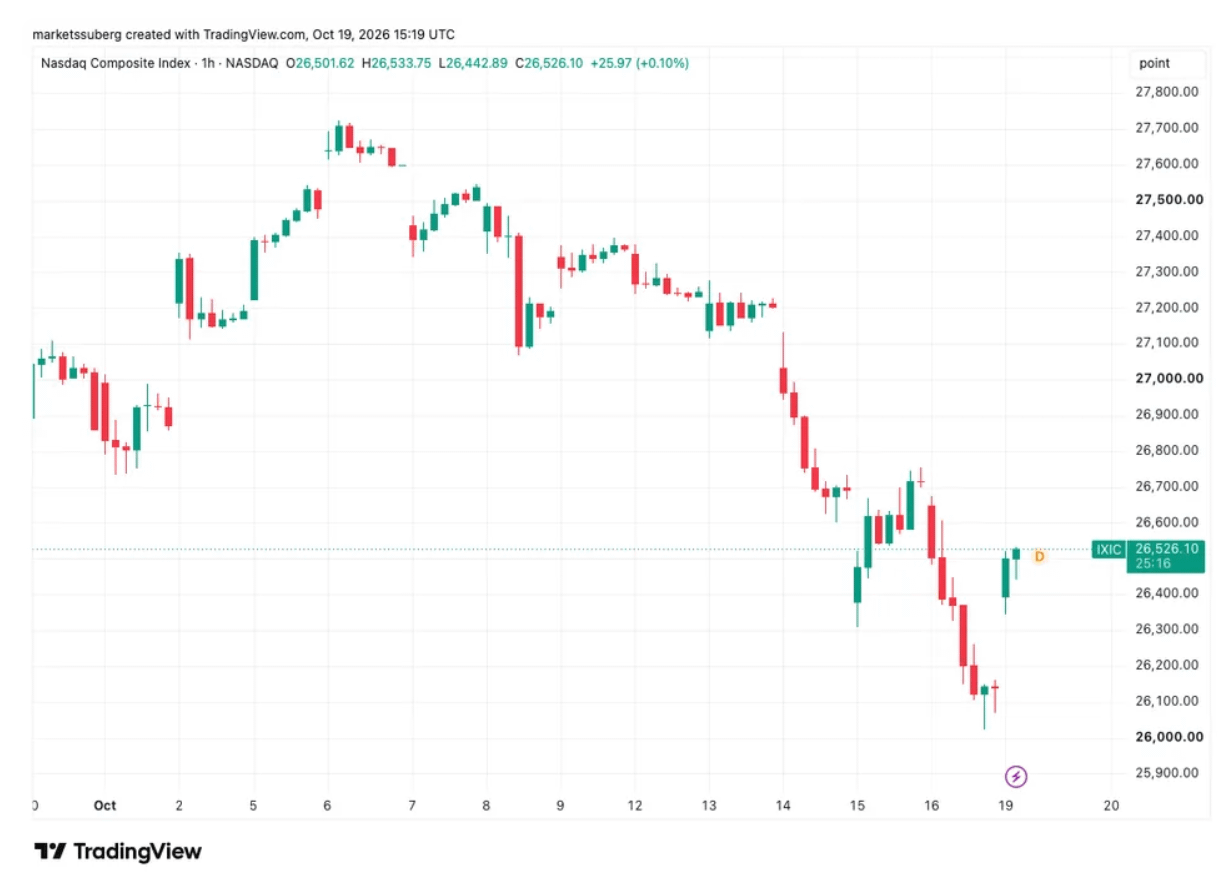
Bitcoin trades at $81,993 on Tuesday morning, having been turned back from $83,062 on Monday as ask liquidity thickened above $83,000 on exchange order books. The wall is not arbitrary: it sits almost exactly on Bitcoin’s 20-day moving average of $83,242, which is why Monday’s $83,100 high stalled just beneath it.Below the price, the 50-day average at $81,481 is now only 0.63% away. Bitcoin is pinned between two converging averages with its daily range running at little more than half of normal — a setup that resolves through expansion rather than drift.The Ceiling Is Falling While the Floor RisesOctober’s high was $87,229 on the 2nd. Bitcoin was rejected near $84,000 on the 13th and again on the 14th. Monday’s attempt stopped at $83,100.Against that, the October low of $79,709 was set on the 15th, and subsequent approaches have held progressively higher — around $80,700 through last week and $81,678 on Monday.Lower highs against higher lows is a closing range, not a flat one. That matters because the two framings imply different outcomes: a flat range can persist indefinitely, while a converging one cannot. The two moving averages are 2.16% apart and tightening.Volatility Has Compressed to Half Its MedianTuesday’s high-to-low range stands at 1.29% so far. Monday’s was 1.77%. The 90-day median is 2.38%.So current activity is running at about 54% of the typical daily range. Compression of this kind is a measure of indecision rather than direction — buyers are defending the 50-day average and sellers are defending the 20-day, and neither has committed. The resolution comes when one side withdraws, and nothing in the positioning data signals which.Whale Deposits Are Shrinking as a Share of FlowThe Binance whale ratio, which measures the ten largest exchange inflow transactions against total inflows, has fallen to 0.45 from 0.54 at the start of October — a decline of about 17%.Large deposits to exchanges are the usual precursor to whale selling, so a falling ratio means that category of supply is a shrinking part of the flow. CryptoQuant frames it cautiously, noting the decline “potentially reflects shifts in whales’ trading strategies and asset management activities,” and that caution is appropriate: a lower ratio can reflect reduced whale selling or simply reduced whale activity in either direction. It removes a source of downside pressure without adding demand.Cross-crypto liquidations totalled $335 million over 24 hours, which is unremarkable for a session with this little price movement.QCP’s Bullish Conditions Are Not Being MetTrading firm QCP Capital identified bond-market stability as the key input for Bitcoin upside, warning that “broader equity deleveraging dynamics could transmit to cryptocurrency markets and potentially threaten the $80,000 support level if sustained.”Its constructive scenario requires “a sustained Treasury rally” accompanied by “declining real yields and a weaker US dollar.” Neither is in place. The 10-year yield rose to 5.139% and the 30-year to 5.46%, while the dollar index firmed to 101.95. The conditions QCP names as supportive are moving the other way, which makes its $80,000 warning the live half of the analysis.Monday’s Equity Rebound FadedThe Nasdaq Composite closed up 1.11% at 26,431 after peaking near 1.8% in late morning. The S&P 500 added 0.41% to 7,691 and the Dow slipped 0.07% to 51,966. South Korea’s KOSPI finished 1.76% higher at 5,768, recovering part of its worst weekly fall in 18 years.Bitcoin did not participate meaningfully in either direction, which is the behaviour of an asset waiting on an external resolution rather than one tracking equities. Yields rose alongside stocks, continuing a pattern of recent weeks in which both move together ahead of earnings — a correlation that removes the usual flight-to-safety read from rising bond prices.Earnings Are the CatalystMeta, SpaceX and Tesla report Tuesday and Wednesday. With the Fed in blackout before its October 27 to 28 meeting, there is no official guidance to interrupt them, so corporate results and Treasury yields will set the tone on their own.For Bitcoin specifically, the levels are defined: $83,242 is where the sellers are, $81,481 is where the buyers have been, and $79,709 is the October low beneath that. A compressed range ahead of a known catalyst is the most readable setup the market has offered in weeks, even if the direction is not.
Binance News
·
--
Zcash Gains 8.5% as Bitcoin Reclaims $83,000 in Crypto Rebound
Zcash rose 8.5% in 24 hours to $1,215.85 on Tuesday, leading gains among the largest cryptocurrencies, while Bitcoin climbed 1.57% to $83,195 and total crypto market capitalization increased 1.68% to $2.78 trillion. According to NS3.AI, crypto exchange-traded funds recorded $526.7 million in net inflows on Monday, their biggest daily inflows in a month. Zcash developers are due to decide on the NU7 network upgrade today. Oil near $110 a barrel and Treasury yields above 5% remain key risks to the rebound.
Binance News
·
--
Binance Will Distribute Dell Technologies Dividends to DELLB bStock Holders
According to the announcement from Binance, eligible holders of Dell Technologies (DELL) bStocks, known as DELLB, will receive the company’s cash dividend in the form of additional DELLB units or fractions. The net dividend will be reinvested after applicable withholding taxes, fees, costs, and other deductions. Users must hold DELLB at the record-date snapshot of 2026-10-20 00:00 (UTC) to qualify. On-chain DELLB holders will receive the dividend through a multiplier adjustment. General trading of DELLB/USDT will not be affected. Binance will suspend the 1:1 token conversion service between DELL stock and DELLB bStocks at 2026-10-19 23:30 (UTC). Deposits and withdrawals of DELLB, along with Binance Convert transactions for DELLB and associated pairs, will also be paused at 2026-10-19 23:30 (UTC). These services are expected to resume once the distribution is complete. Dividends earned from assets held in other accounts, including Savings and Margin accounts, will be credited to users’ Spot Accounts. Binance said it will manage the technical requirements for the distribution.
Дәйексөз келтірілген мазмұн жойылды
Binance News
·
--
Bitcoin News | 411 Bitcoin Bought for $53,900 in 2013 Moved on Sunday, Now Worth $34 Million
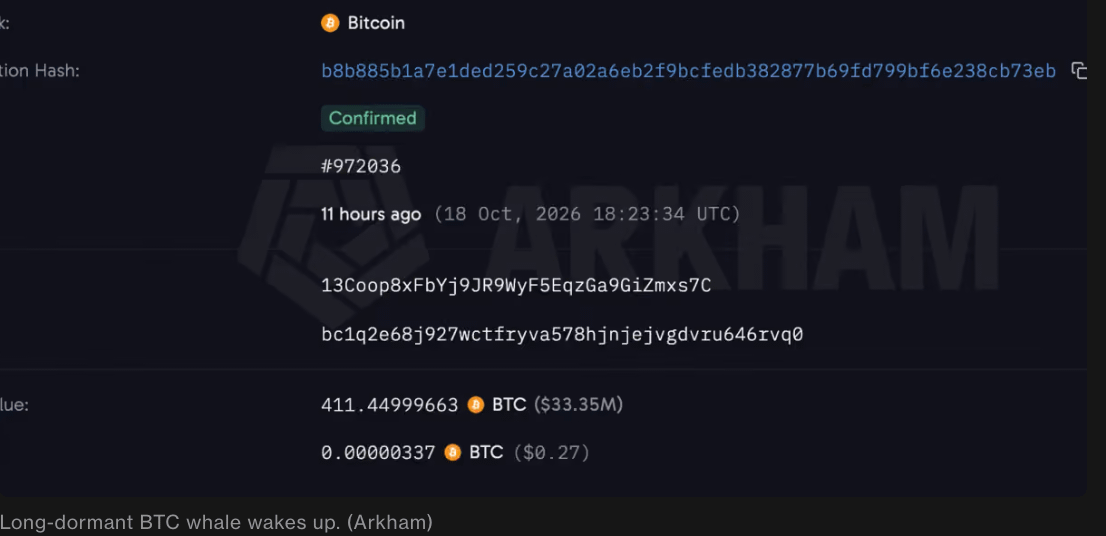
A Bitcoin wallet that had not transacted since September 2013 moved its entire balance of 411.45 BTC on Sunday, worth roughly $34 million at today’s price near $82,600. The owner paid about $53,900 for the coins when Bitcoin traded around $131 — a 630-fold appreciation. The funds went to a new private address, not an exchange.Thirteen Years Without a Single TransactionThe wallet received the bulk of its coins on September 11, 2013, and the owner did not buy, sell or move anything for the next 13 years.That period included three halvings — July 2016, May 2020 and April 2024 — the 2017 retail boom and its collapse, the 2022 FTX failure, and the launch of US spot Bitcoin ETFs in 2024.At 18:23 UTC on Sunday the entire balance went out in a single transaction, with a fee of 337 satoshis, or about 28 cents.The Dust Was an Attack, and It FailedThe wallet did see activity over the years, though not from its owner. Dozens of deposits worth less than a dollar each trickled in, several from addresses Arkham Intelligence labels as phishing.That is address poisoning. Scammers send trace amounts of crypto to high-value wallets so their address appears in the transaction history, hoping the owner later copies it by mistake when making a transfer.Thirteen years of that, and the coins went to a correct address.Why This Coin Didn’t Move for 13 YearsThe cost basis explains the behaviour, and comparing cohorts makes it concrete.This wallet paid $131 per coin. Long-term holders across the network average $48,600 with a 72% unrealised cushion. Short-term holders average $74,900 with roughly 10% — meaning an 8.8% decline would put that entire group underwater.A holder sitting on 630 times their cost has no price at which they are forced to act. A holder with 10% has a level a bad week could reach. That asymmetry is why the oldest supply stays still while recent supply turns over constantly, and it is the structural reason dormant-wallet awakenings are rare enough to make news.The Scale Settles the Sale QuestionLong-dormant movements reliably spark speculation about an imminent sale, and the destination tells against it here — the receiving address has taken in only this transfer and sent nothing out, with no exchange deposit following.The arithmetic says more. At $34 million, this holding is about 0.34% of a single day’s spot volume on one major exchange.Even taken together, the recent awakenings are small. Two other wallets dormant for over a decade moved a combined 417 BTC the day before, and a whale untouched since the March 2020 crash moved $378 million the week prior. The three together come to roughly 5,400 BTC — about 0.027% of circulating supply.A market absorbing $10 billion a day does not notice $34 million, whatever the headline value.The Pattern Is Recurring, Not NewIsolated mega-whales have woken from prolonged dormancy repeatedly over the past two years, and the outcome has been consistent: most coins move to new private wallets rather than to exchanges.Custodial housekeeping is the mundane explanation and usually the correct one. Wallet software gets upgraded, key management gets consolidated, estates get reorganised, and hardware gets replaced. None of that requires a view on the price.The signal worth watching is not the movement itself but the destination. Dormant supply arriving at an exchange is a different event from dormant supply arriving at a fresh address, and so far this month every tracked case has been the second kind.
Binance News
·
--
Hyperliquid Burns 11,340 HYPE Tokens in 24 Hours
Hyperliquid bought and burned 11,340 HYPE tokens over the past 24 hours at an average price of $78.55 per token. According to BlockBeats On-chain Detection, the burn brings the cumulative total to 49.63 million HYPE, equal to 4.96% of the token’s 1 billion maximum supply. OnchainLens monitored the activity on October 18.
Binance News
·
--
Latvian Parliament Passes Cryptocurrency Tax Law Set to Take Effect in 2027
Latvia's parliament has passed a cryptocurrency tax law scheduled to take effect in 2027. According to NS3.AI, the law focuses on taxing withdrawals that exceed deposits and includes a one-time declaration mechanism.
Binance News
·
--
Ethereum Founder Vitalik Buterin Builds ‘Paranoid Mode’ to Hide AI Secrets
Ethereum co-founder Vitalik Buterin unveiled an experimental “paranoid mode” for his AI agent on October 16, 2026, designed to obscure users, request origins and payments. The public-code setup combines Tor, cover traffic, local prompt rewriting and zkAPI, according to BeInCrypto. Each conversation gets a separate Tor circuit, while zkAPI payments run on Ethereum mainnet and accept ETH and USDC. The system does not provide complete anonymity: providers can see rewritten prompts, and traffic timing could expose requests. Buterin said lower zkAPI fees are coming; the prototype offers no evidence of widespread adoption or an immediate benefit to ETH’s price.
Binance News
·
--
France's National Assembly Passes Crypto-to-Stablecoin Tax Amendment
France's National Assembly passed an amendment to the 2027 budget by 38 votes to 37, with 25 abstentions. According to The Defiant, the amendment proposes ending tax deferral for cryptocurrency conversions into single-currency stablecoins starting January 1, 2027. Investors could face capital gains tax at the current flat rate of approximately 31.4%, even if they do not convert their assets into legal tender.
The amendment has passed only the National Assembly's first reading. It still requires Senate review and further legislative procedures before it can become law.
The amendment has passed only the National Assembly's first reading. It still requires Senate review and further legislative procedures before it can become law.

Binance News
·
--
Bitcoin(BTC) Drops Below 81,000 USDT with a 0.67% Decrease in 24 Hours
On Oct 18, 2026, 19:32 PM(UTC). According to Binance Market Data, Bitcoin has dropped below 81,000 USDT and is now trading at 80,984.492188 USDT, with a narrowed 0.67% decrease in 24 hours.
Binance News
·
--
Bank of Russia Says Residents Will Face Self-Custodial Crypto Transaction Ban From July 2027
The Bank of Russia said residents will be barred from using self-custodial wallets for crypto transactions starting July 1, 2027. According to NS3.AI, residents will also be prohibited from transferring funds from regulated brokers to self-custodial wallets, with transactions permitted only through licensed brokers or exchanges.
Deputy Finance Minister Ivan Chebeskov estimates that about 20 million Russians hold crypto assets worth 3.7 trillion rubles. Sberbank Deputy Chairman Anatoly Popov expects about 20% of Russia’s crypto trading volume to move to licensed exchanges.
Deputy Finance Minister Ivan Chebeskov estimates that about 20 million Russians hold crypto assets worth 3.7 trillion rubles. Sberbank Deputy Chairman Anatoly Popov expects about 20% of Russia’s crypto trading volume to move to licensed exchanges.

Binance Academy
·
--
What Are bStocks? A Guide to Tokenized Stocks on Binance
Key Takeaways
bStocks are tokenized securities on Binance, each backed 1:1 by a US share held at a regulated custodian.
They can be traded 24/7 on Binance's spot market and usually settle in under a second, with no T+1 settlement windows.
As BEP-20 tokens on BNB Smart Chain, bStocks support self-custody and can be used across decentralized finance (DeFi) protocols, allowing users to use bStocks in staking, lending, and other activities.
Corporate actions like dividends and stock splits are processed automatically through an on-chain mechanism called the Multiplier.
Users can access fractional US stock exposure starting from as little as $5.
Introduction
Traditionally, buying and selling stocks comes with limitations: restricted market hours, multi-day settlement periods, and reliance on centralized brokerages for custody. Tokenization offers a way to address some of these constraints by representing traditional financial instruments as blockchain-based tokens.
bStocks are tokenized securities available on Binance that allow users to gain exposure to US stocks through blockchain technology. Each bStock is backed 1:1 by a corresponding US share held at a regulated custodian.
What Are bStocks?
bStocks are tokenized securities issued by BTech Holdings Limited, a Binance group affiliate. They are classified as Certificates representing certain Financial Instruments (paragraph 92, Schedule 1 to FSMR) and represent an interest in underlying securities held by the issuer.
It's important to note that bStocks are not direct ownership of shares in the underlying company. Rather, they provide exposure to the price performance and economic benefits of the underlying stock, such as dividend reinvestment. Every bStock is fully backed by a real US share held at a regulated custodian. This backing is verifiable at any time through Binance's Proof of Collateral page.
How Do bStocks Work?
24/7 trading and instant settlement
Unlike traditional stock exchanges that operate during set market hours, bStocks can be traded around the clock on Binance's spot market. Transactions settle in under a second, eliminating T+1 settlement windows and the need to wait for the next market session.
1:1 backing and conversion
Each bStock is backed 1:1 by the corresponding US share held at a regulated custodian. Eligible users can convert between stocks and the corresponding bStocks at a 1:1 ratio with no conversion fees. This service is arranged by Nest Trading Limited and is generally available 24/7, though it may be paused temporarily during corporate action processing or maintenance.
Self-custody and DeFi compatibility
bStocks are standard BEP-20 tokens on BNB Smart Chain, meaning you can withdraw them to any compatible crypto wallet for self-custody. You are never locked into a single brokerage.
bStocks also integrate with BEP-677 (Scaled UI Amount), a token standard designed to provide native support for real-world assets (RWAs) on BNB Smart Chain. This allows bStocks to be used across DeFi protocols.
Fractional access
You can start building a bStocks portfolio from as little as $5, making US stock exposure more accessible to a broader range of users.
How Are Dividends and Stock Splits Handled?
Corporate actions are processed automatically via an on-chain rebasing mechanism known as the Multiplier. No action is required on your part.
Dividends
When the underlying company pays a dividend, the net dividend value is automatically reinvested into the underlying stock. Your bStock balance increases proportionally via the Multiplier adjustment.
Dividends are subject to applicable US withholding tax (currently 30%) before reinvestment. No cash is distributed. The benefit is reflected through a proportional increase in your bStock balance via the Multiplier mechanism. The net dividend is typically credited ahead of the traditional pay date and applied to every fraction you hold.
Stock splits
Your bStock balance is automatically adjusted to reflect the new share ratio. For example, in a 2-for-1 split, your token quantity doubles and the price per token halves.
During corporate action processing, deposits, withdrawals, and conversions may be temporarily paused. Users receive advance notice via in-app notification. Spot trading is generally not suspended for dividend processing.
How To Obtain bStocks
There are three ways to obtain bStocks.
1. Buy the underlying stock with conversion enabled
Go to [Trade] > [Stock] and use any supported crypto (e.g., USDC, USD1, USDT, U, or BNB) to place a buy order for the underlying stock.
Toggle on the token conversion option before confirming your order. Once filled, your stock position is automatically converted into the corresponding bStock.
2. Convert existing stocks via token conversion
If you already hold stocks on the platform, you can use the token conversion function to convert them into bStocks at a 1:1 ratio with no fees. To do this:
Go to your Binance wallet.
Select the stock eligible for conversion in the asset tab.
Click or tap [Token Conversion].
Use the pencil icon to edit the amount.
Review the confirmation pop-up and confirm.
The reverse process (converting bStocks back to stocks) follows the same steps.
3. Buy bStocks directly on Binance Spot
Navigate to [Spot] > [bStocks], choose the token you want to buy, and trade it like any other crypto asset. bStocks spot trading is available 24/7.
For more information, please refer to the official announcement page.
Deposits and Withdrawals
Depositing bStocks
Depositing bStocks follows the same flow as a standard crypto deposit:
Search for the tokenized stock you want to deposit (e.g., TSLAB).
Select BNB Smart Chain (BSC) as the network.
Copy your deposit address and send tokens from your external wallet.
Important: Only BNB Smart Chain is currently supported. Sending tokens via any other network may result in loss of funds.
Withdrawing bStocks
You can withdraw bStocks to any compatible BNB Smart Chain wallet for self-custody. A network fee applies to cover BSC transaction costs, and the minimum withdrawal amount varies by token. Withdrawals are subject to transfer restrictions, smart contract controls, sanctions screening, and applicable law.
Precision and Rounding
Equities on the platform are recorded at up to 9 decimal places, while bStocks support up to 8 decimal places. Upon conversion, any residual fractional amount beyond 8 decimal places cannot be tokenized and is retained by the issuer as a rounding difference. This does not represent a fee or charge.
Third-Party Integration
Third-party platforms and DeFi protocols can integrate bStocks but bear responsibility for enforcing geographic restrictions. Binance provides a public REST API with a country eligibility endpoint that integrators can query to verify jurisdiction eligibility. The issuer reserves the right to blacklist wallet addresses that may violate applicable laws or smart contracts controls or sanctions.
Risks and Considerations
Like any financial product, bStocks carry risks that users should carefully evaluate:
Market risk: The value of bStocks can fluctuate based on the underlying stock's price.
Liquidity risk: Trading volumes may vary, potentially affecting your ability to buy or sell.
Issuer and custody risk: bStocks depend on the issuer and regulated custodian maintaining proper backing.
Regulatory risk: The availability of bStocks is subject to regulatory approval and may change.
Technology and operational risk: Smart contract issues, network disruptions, or maintenance could temporarily impact services.
Tax risk: Applicable withholding taxes and other tax obligations may apply.
Geographic restrictions: bStocks are not available in all jurisdictions and are not offered to US persons.
Users should review the applicable Prospectus (accessible only if located in the ADGM), Terms of Use, Exchange Rules (including the Exchange Procedures), Admission to Trading Notice, Minting and Redemption Product Terms, and Risk Warning before trading.
FAQ
What are bStocks?
bStocks are tokenized securities issued by BTech Holdings Limited, a Binance group affiliate. Each bStock is backed 1:1 by a real US share held at a regulated custodian. They are BEP-20 tokens on BNB Smart Chain, so they can be traded on Binance's spot market or withdrawn for self-custody.
Are bStocks the same as owning stocks directly?
No. bStocks are not direct ownership of shares in the underlying company. They provide exposure to price performance and economic benefits such as dividends, but they are structured as Certificates representing certain Financial Instruments rather than direct equity ownership.
How are dividends paid on bStocks?
Dividends are not paid out in cash. Instead, the net dividend value is automatically reinvested into the underlying stock and your bStock balance increases proportionally via the Multiplier mechanism. US withholding tax (currently 30%) applies before reinvestment.
Can I withdraw bStocks to my own wallet?
Yes. bStocks can be withdrawn to any compatible BNB Smart Chain wallet. Only BNB Smart Chain is supported at this time. Sending tokens via another network may result in permanent loss of funds. A network fee applies, and the minimum withdrawal amount varies by token.
Who can access bStocks?
bStocks are not available in all jurisdictions and are not offered to US persons. Users should check current eligibility requirements on Binance before attempting to access or trade bStocks. Binance provides a public REST API with a country eligibility endpoint for third-party integrators.
Closing Thoughts
bStocks bring traditional stock exposure on-chain through tokenization. By combining regulated custodian backing and automatic corporate action processing with blockchain-native features like 24/7 trading, instant settlement, and DeFi composability, bStocks aim to bridge the gap between traditional finance and crypto.
However, they are not without risk. As with any financial product, it's important to understand the product structure, review all applicable terms, and assess your own risk tolerance before getting started.
Further Reading
Introducing bStocks: Tokenized Securities 1:1 Backing with 24/7 Trading
What Are Tokenized Stocks?
What Are Real-World Assets (RWA) in DeFi and Crypto?
An Introduction to BNB Smart Chain (BSC)
What Is Tokenized Gold?
Disclaimer: bStocks Tokenized Securities are classified as Certificates representing certain Financial Instruments (paragraph 92, Schedule 1 to FSMR). bStocks are not stocks or shares and bStocks do not allow holders to directly own a share or stock in the underlying listed company. bStocks do not represent any affiliation with the underlying asset's issuer. bStocks are offered through an Approved Prospectus in the ADGM and are not offered in any other jurisdiction. No public offer is made outside of the ADGM. Tokenized Securities are available only to eligible users in permitted jurisdictions on a secondary market basis only. It is your sole responsibility to ensure that accessing and trading Tokenized Securities is lawful in your jurisdiction before proceeding. Accessing this product from a jurisdiction in which it is prohibited or restricted does not create any liability or obligation on the part of Binance. We may restrict, suspend, reject, cancel, or unwind access or transactions if we determine, in our sole discretion, that your access or transaction may breach applicable law, product restrictions, eligibility criteria, sanctions requirements, or the relevant offering documents.
No information displayed in connection with Tokenized Securities is intended as an offer, solicitation, promotion, recommendation, or invitation to buy or sell securities in any jurisdiction. Tokenized Securities are not offered, sold, distributed, made available, or accessible in the United States or to, or for the account or benefit of, U.S. persons. The Tokenized Securities have not been and will not be registered under the U.S. Securities Act of 1933 or any U.S. state securities laws and a public offering of bStocks will not be conducted in the United States or any other jurisdiction (other than the ADGM). By accessing this product, you represent and warrant that you are not a U.S. person, are not located in the United States, are not acting for the account or benefit of any U.S. person, and will not access, purchase, sell, transfer, redeem, or otherwise transact in Tokenized Securities from within the United States.
For more information, see the Terms of Use, Exchange Rules, Exchange Procedures, relevant Prospectus (if applicable to you and understanding that the offer is only made in ADGM, no public offer is being made elsewhere and viewing the prospectus does not constitute an invitation or solicitation outside ADGM), bStocks Minting and Redemption Product Terms, Admission to Trading Notice and Risk Warning.

Binance News
·
--
Six Arrested Over Alleged HK$14 Million Agarwood and Crypto Scam
Hong Kong police arrested six people in connection with an alleged nine-year investment scam involving HK$14 million. According to NS3.AI, investigators began probing the case in September after receiving complaints from 21 victims who said they invested in products offered by BBB Group (Hong Kong).
Superintendent Allan Chu Ming-lun said most of the victims were aged between 52 and 82, with individual investments ranging from HK$30,000 to HK$1.9 million. The firm allegedly promoted fake agarwood, cryptocurrency and car-washing investment plans while delaying withdrawals, and the Securities and Futures Commission placed the company and two linked firms on the alert list on Wednesday.
Superintendent Allan Chu Ming-lun said most of the victims were aged between 52 and 82, with individual investments ranging from HK$30,000 to HK$1.9 million. The firm allegedly promoted fake agarwood, cryptocurrency and car-washing investment plans while delaying withdrawals, and the Securities and Futures Commission placed the company and two linked firms on the alert list on Wednesday.
Binance News
·
--
STOCKS | South Korean Stocks Fall 6% to Nearly Three-Month Low
According to Jin10, Japanese and South Korean stocks opened lower as a global selloff in chip stocks continued and investors grew more cautious about the sustainability of the AI investment boom and the earnings outlook for related companies. The Nikkei 225 fell more than 3% intraday, Kioxia dropped more than 8%, and South Korea's KOSPI fell for a seventh straight session, at one point sliding 6% to its lowest level since July 31. Semiconductor heavyweight stocks were the main drag, with Samsung Electronics down more than 7% and SK Hynix down more than 8%. The Korea Exchange later activated a sidecar mechanism on the KOSPI, suspending programmatic sell orders.

Binance News
·
--
Binance News | Tokenized Stocks Found Their Market: bStocks Hit $1 Billion With 62% of Volume Trading Out of Hours
Binance’s bStocks have crossed $1 billion in assets under management, reaching the milestone roughly four months after launching on June 11 — the fastest any tokenized equity product has got there on the company’s reading of public on-chain data from Dune. Behind the headline figure sits $40 billion of cumulative trading, nearly 100 listed assets and a set of usage numbers suggesting these tokens are circulating rather than sitting still.From Five Assets to Nearly a HundredThe product launched with five tokenized securities. It now lists close to 100 US stocks and ETFs, each backed 1:1 by the underlying share.Cumulative trading volume has exceeded $40 billion since June, an average of roughly $317 million a day across the period. A further $6 billion has moved between direct stock positions and bStocks at 1:1 parity — cumulative conversion flow in both directions, separate from the $1 billion held.That conversion channel is the part with no traditional equivalent. Moving between a tokenized position and a direct holding normally means a broker transfer and a wait for market hours. Here it happens inside a single account, at parity, whenever the holder wants.The Market Stays Open When Wall Street ClosesThe strongest evidence of genuine demand is when the trading happens.In July, 38% of bStocks volume fell within regular US market hours. The equivalent figure for conventional US equities is 89.2%. That means roughly 62% of bStocks activity arrives while the underlying shares are not trading at all.For holders in Asia, the Gulf and Europe, most of the New York session lands outside working hours. A continuously traded token reaches demand that the US market calendar was never built to serve, and the volume split shows that demand turning up.Holders Are Putting the Tokens to WorkThree figures from Binance Research point the same way.Outstanding borrowing against deposited bStocks collateral reached 46.2% by September 10, up from 5.5% at the end of June — a rise of 40.7 percentage points, after collateral support was extended to all eligible users last month. Supported tokens can now serve as margin and futures collateral, backing quote-asset borrowing at up to 5x leverage, or acting simultaneously as a position and the collateral behind a hedge.Traditional venues generally accept only cash or cash equivalents as margin. A tokenized share doing double duty as both market exposure and collateral is a capability that did not previously exist for equity holders.DeFi deployment reached 11.2% of total value locked in early October, about 3.8 percentage points above comparable tokenized equities, implying a peer rate near 7.4%. And 58.5% of early bStocks users were also trading perpetual futures or direct equities on Binance as of end-July, indicating the product sits inside a broader trading workflow rather than off to one side.Redemption Into the Share Is the Structural DifferenceEach bStock redeems into the underlying security itself, not its cash value.That is the line between a tokenized equity and a synthetic. A cash-settled instrument gives a holder exposure to a price; a token that redeems into the share gives them a claim on the asset. It is the design choice that keeps the token anchored to the stock it represents, and it governs what a holder actually owns.Tokens also move freely between the exchange and self-custodial wallets, which is what makes the DeFi and collateral activity possible in the first place.Tokenized Equities Were 2026’s Fastest-Growing RWA CategoryThe wider market has expanded alongside the product.On-chain transfers of tokenized stocks exceeded $100 billion in the third quarter against $6 billion in the first, a 16.7-fold increase across three quarters. Binance says bStocks accounted for over 90% of weekly transfer volume at the early-August peak.Tokenized equity market capitalisation more than quadrupled to over $3 billion by late September, making it the fastest-growing real-world asset category of the year.“The test of a tokenized stock isn’t the launch-day chart; it’s whether it still behaves like a market after the launch,” said Shunyet Jan, Head of Exchange and Trading at Binance. “bStocks trade around the clock, get used as collateral, move between self-custodial wallets, and convert 1:1 into direct stock holdings. Today, more than a billion dollars of that is held on Binance, and it’s being used, not just held.”
Binance News
·
--
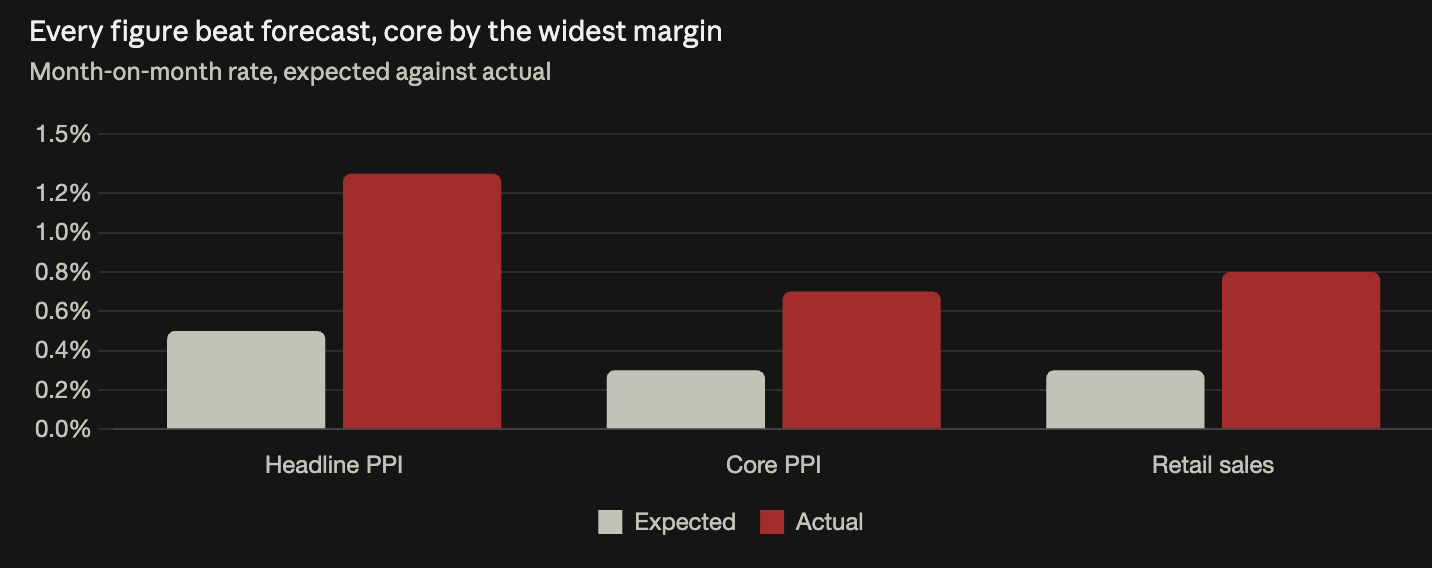
TradFi News | The Energy Shock Reached Core Prices: PPI at 6.3%, Core at 0.7%, Both Blowing Past Estimates
US producer prices rose 1.3% in September and 6.3% over the year, up from 5.6% in August and well above the 5.3% economists expected. Core PPI, which strips out food and energy, came in at 0.7% month on month against 0.3% forecast and 5.0% annually. Retail sales rose 0.8% against expectations of 0.30%. CNN described the overall move as the largest jump in wholesale inflation in four years.Core PPI Is the Number That Matters, and It Doubled Its ForecastHeadline producer prices rising on energy costs is mechanical. Crude, gasoline and diesel have been elevated, and fuel is a direct production input.Core PPI at 0.7% is a different matter. That measure excludes energy, so a reading more than double its 0.3% consensus means producers are passing fuel costs into the prices of everything else. The cost shock has stopped being an energy story and become a general one.At 5.0% annually, core producer inflation is running at roughly twice the Federal Reserve’s 2% objective on a measure that feeds the committee’s own preferred gauge.Producer Costs Are Outrunning Consumer Prices by 2.6 PointsProducer prices are up 6.3% over the year. Consumer prices, reported Wednesday, are up 3.7%.That gap says businesses are absorbing costs they have not passed on to customers. It resolves one of two ways: margins compress and earnings take the hit, or consumer prices catch up and the CPI figure follows producer prices higher over coming months.Neither path is comfortable. The first shows up in corporate results, and the second shows up in the inflation data the Fed is already uneasy about.This Print Reaches the Fed’s Own GaugeWednesday’s CPI moved markets but is not what the Federal Reserve targets. The committee aims at the PCE price index, and PPI components feed directly into how PCE is calculated.That makes a 0.7% core producer print more consequential for policy than a hot consumer print of similar size. The Fed raised rates by 25 basis points in September, its first increase since 2023, taking the target range to 3.75%–4.00%, and the minutes indicated most policymakers saw another move as likely by year-end.October hike odds had already round-tripped from a post-CPI peak near 47% back to around 26% before this release.Read the Retail Sales Beat Before Calling It StrengthRetail sales are measured in dollars, not in volume.Average US gasoline rose 7.3% over the month on EIA data, which lifts the reported sales total through the service station category without anyone buying more of anything. A headline beat of 0.8% against 0.30% expected needs its category composition before it supports any conclusion about consumer resilience.The useful question is whether households spent more overall or spent the same total with a larger share going into fuel tanks. The first is strength; the second is a reallocation that squeezes discretionary categories.The Market Reaction Points Somewhere Else EntirelyHere the data and the price action disagree.The Dollar Index erased its intraday losses on the release but remained down 0.3% at 102.22, below yesterday’s 102.52. Gold rose roughly 1.21% to about $4,155 alongside equity weakness and lower Treasury yields, though the source does not tie those specific moves to the producer price release.A shock-hot inflation print that lifts neither the dollar nor yields is the inverse of Wednesday’s response to CPI. The most plausible reading is that growth and credit risk have displaced rate risk as the dominant concern — consistent with the AI infrastructure financing stress that triggered Korea’s circuit breaker this morning, and with CoreWeave bonds trading near a 15% yield.
Көбірек контент көру үшін кіріңіз