Professional Trader | Market Strategist | Risk Manager
Trading isn’t just about charts and candles it’s a mental battlefield where only the disciplined survive. I’ve walked through the volatility, felt the pressure of red days, and learned that success comes to those who master themselves before the market.
Over the years, I’ve built my entire trading journey around 5 Golden Rules that changed everything for me
1️⃣ Protect Your Capital First
Your capital is your lifeline. Before you think about profits, learn to protect what you already have. Never risk more than 1–2% per trade, always use a stop-loss, and remember without capital, there’s no tomorrow in trading.
2️⃣ Plan the Trade, Then Trade the Plan
Trading without a plan is gambling. Define your entry, stop-loss, and take-profit levels before entering any trade. Patience and discipline beat impulse every single time. Let your plan guide your emotions, not the other way around.
3️⃣ Respect the Trend
The market always leaves clues follow them. Trade with the flow, not against it. When the trend is bullish, don’t short. When it’s bearish, don’t fight it. The trend is your best friend; stay loyal to it and it will reward you.
4️⃣ Control Your Emotions
Fear and greed destroy more traders than bad setups ever will. Stay calm, don’t chase pumps, and never revenge-trade losses. If you can’t control your emotions, the market will control you.
5️⃣ Keep Learning, Always
Every loss hides a lesson, and every win holds wisdom. Study charts, review trades, and improve every single day. The best traders never stop learning they adapt, grow, and evolve.
Trading isn’t about luck it’s about consistency, patience, and mindset.
If you master these 5 rules, the market becomes your ally, not your enemy.
HOW INJECTIVE BUILDS A HOME WHERE BIG FINANCE AND DEFI DREAMS LIVE TOGETHER
When I’m truly honest about what is happening in crypto, I feel two very different energies pulling against each other, because on one side there is the heavy, serious world of big finance where teams care about strict risk models, predictable settlement, strict latency requirements and the comfort of deep liquidity, and on the other side there is the wild and hopeful world of DeFi where ordinary people want open access, transparent rules, community powered governance and the chance to build or invest without needing permission from anyone, and for a long time most blockchains quietly chose one of these paths, either trying to impress institutions with polished narratives while giving up some of the freedom that DeFi loves, or diving fully into DeFi chaos and accepting that large funds would stay away, but Injective looks at this divide and refuses to accept it as permanent, because the whole design of this chain feels like an answer to a very emotional question, which is whether a single network can feel safe and powerful enough for serious institutions while still staying open, fair and deeply human for regular users who just want a real shot at a better system. If you look at where Injective comes from, you can almost feel the frustration that gave birth to it, since early DeFi tried to squeeze complex trading and derivatives into general purpose chains that were not built for heavy financial workloads, and people accepted slow execution, random congestion and confusing fees simply because there was no better option, but the team behind Injective took a different path and decided to build a blockchain that is dedicated to finance from the very beginning, so instead of trying to turn a generic network into a trading engine, they created a Layer 1 whose basic purpose is to handle markets, order books, derivatives, real world assets and structured products, and that single clear purpose shows up everywhere in the architecture, from the way blocks are produced with fast finality to the way core financial logic sits inside native modules that any builder can tap into, making the chain feel less like an experiment and more like a serious foundation that you might actually dare to trust with real money and real risk. At the base level, Injective uses a proof of stake design where validators stake the INJ token, work together to agree on each block and give deterministic finality, which in simple emotional terms means that when your transaction is confirmed you can breathe out because it is settled and not hanging in a strange uncertain state, and that matters more than most people say, because a casual user feels calmer when things are final quickly, while a professional trading desk treats settlement risk as something that can never be ignored, so fast and reliable finality becomes a kind of silent promise between the chain and everyone who uses it, and when you add the fact that the network is tuned for very high throughput with sub second block times and very low fees, you start to feel that this is not just about vanity numbers, it is about building a base layer where heavy markets can live without breaking and where small users do not feel punished every time they click a button. What really makes Injective feel like institutional grade infrastructure is the way the financial engine is placed inside the protocol instead of being scattered across random contracts, because the chain includes a native exchange module that runs a full central limit order book directly on chain, allowing traders to place limit and market orders for spot and derivatives while the protocol itself handles matching and settlement, and this is a huge emotional bridge between two worlds, since professional traders are used to reading order books, watching depth, building strategies around bids and asks, while DeFi natives have been pushed toward automated market makers that are simple but less familiar to institutions, and Injective says that both groups can meet in the same place, sharing the same on chain books, sharing the same liquidity, and building different interfaces and strategies on top of one common engine that everyone can see and trust. Around this exchange module live other essential parts that make the system feel complete instead of fragile, because there are insurance mechanisms that step in when leveraged positions go bad so that winning traders are still made whole, there are oracle tools that bring off chain prices into the chain so that perpetual futures and synthetic assets can track real markets, there are token factory tools that let builders create new assets under clear rules, and there are auction systems that gather protocol fees from across the ecosystem and use them in a burn process for INJ, and when you connect all of this in your mind you can see a chain that behaves more like a full financial engine room than a basic transaction ledger, which is exactly the kind of structure that large institutions look for, while still being completely open for independent builders who want to plug in their own ideas. Fairness in trading is another place where the emotional side of Injective becomes very clear, because everyone who has used public blockchains for trading knows that open mempools can invite front running, MEV and sandwich attacks, and there is nothing more discouraging than feeling like unseen bots are always one step ahead of you, but Injective tackles this problem by using mechanisms such as frequent batch auctions where orders are grouped into small time windows and cleared together, and this simple idea changes the emotional feel of the market because it reduces the advantage of actors who only win by being slightly faster than everyone else, so instead of worrying that every trade will be manipulated by someone watching the mempool, users can start to believe that the matching process is purposely designed to give them a fairer shot, and when both everyday users and institutions feel that the market is not tilted against them, they become more willing to commit deeper liquidity and more serious strategies to the chain. Interoperability adds another layer to this story, because Injective was built with the belief that the future will not belong to a single chain but to many connected networks, and by using a framework that supports native communication between blockchains, Injective can send and receive assets and messages to and from other chains, which matters emotionally for DeFi users who hate being trapped on one island and want the freedom to move value wherever the best opportunities or safest conditions exist, while at the same time it matters for institutions that would rather integrate their systems with one strong financial hub that already has pathways to multiple ecosystems, instead of building and maintaining dozens of brittle custom connections, and in this way Injective positions itself as a kind of bridge city inside the wider on chain world, where capital can arrive from many directions, pass through advanced markets on Injective and flow back out again when needed. The user experience on Injective is deliberately shaped to feel calm and smooth instead of stressful and confusing, since one of the main goals has been to give people a near zero gas feeling where applications can sponsor or hide the raw gas layer, so that what users actually see is mostly product fees or trading fees rather than a constant stream of separate network charges, and this choice is more emotional than it looks, because many newcomers are terrified of pressing any button when they see unpredictable gas prompts, and here a trader can bridge funds in, open an application built on Injective, see a familiar order book interface, place orders, move positions and manage risk while the chain quietly handles sub second blocks and sorting of transactions under the hood, and when you combine that with MEV resistant designs and frequent batch auctions, the experience starts to feel closer to a professional trading platform that also respects the user’s dignity and time, instead of a chaotic experiment where only the most technical survive. The INJ token itself lives at the center of this system in a way that ties function, security and long term value together, because INJ is what validators stake to secure the network, what delegators stake to share in rewards and support validators, what builders often use inside their products and what gives holders the right to participate in governance decisions, so owning and staking INJ is not just about watching a price chart, it is about having skin in the future of the chain, and on top of that, the tokenomics introduce a powerful emotional story through the auction and burn mechanism, where a share of protocol fees and dApp revenues from across the ecosystem is collected regularly into baskets of different assets, these baskets are auctioned to participants who bid using INJ, and the winning INJ from those auctions is permanently burned, which means that every week or every period of heavy activity, a part of the token supply disappears forever, and If network usage keeps growing, the link between real usage and deflation becomes stronger, turning INJ into an asset whose scarcity is not just a slogan but a direct consequence of people actually using the chain. This design creates a set of aligned incentives that can be very powerful if the ecosystem continues to expand, because traders who are active on Injective generate the flows that fill the auction baskets, builders who create compelling applications attract that activity and share in protocol driven value, validators and delegators who secure the network benefit from long term scarcity and a stronger token, and observers who care about fundamentals can look not only at price but also at data such as burned supply, staking ratios and protocol fees to understand what is really happening, and We’re seeing more and more voices in the space pay attention to these deeper metrics when they talk about Injective, since they realize that this project wants value to come from real usage rather than from pure speculation, even though speculation will always be part of any open market. From a cultural point of view, Injective still feels rooted in DeFi values even as it reaches for institutional adoption, because the core components are open for inspection, smart contracts can be deployed by builders without asking for permission, and governance flows through INJ holders instead of being captured by a single company, so the idea that anyone, from a small independent developer to a professional team, can build on this chain is preserved, and the decision to keep order books and critical logic on chain instead of hiding them in private engines means that the rules of trading, liquidation, fees and auctions are written where users can verify them, which gives a sense of shared truth and reduces the feeling that the system is controlled by invisible hands, and this combination of openness and professionalism is exactly what many people have been hoping to see, because it whispers that maybe, for once, a chain can grow powerful without turning its back on the people who believed in DeFi first. At the same time, Injective is leaning into areas that speak loudly to institutions, such as real world asset tokenization, more advanced derivatives and structured products, and the use of the chain as a base execution layer for partners who want speed, transparency and global reach, and there is something deeply emotional about thinking that tools which once lived only in secretive rooms can now be rebuilt on infrastructure that is open to audit by anyone, because it hints at a future where sophisticated products exist, but they no longer require blind trust in back office processes that ordinary people can never see. None of this erases the risks, and it would be unfair to pretend that the road ahead is simple, because Injective operates in a world crowded with other Layer 1 and Layer 2 networks that are fighting hard to win DeFi, derivatives and real world assets, some of which already have large ecosystems and strong brands, and the project also stands closer to the line of financial regulation since it touches derivatives and tokenized instruments, which means that changing laws and regional rules could affect how some institutions or users are allowed to interact with it, and on top of that the technical surface area of a chain with many modules, cross chain bridges and complex products is naturally larger, so the need for constant security work, audits and careful upgrades never goes away, while the economic design that looks so strong when adoption grows would lose some force if usage ever slowed down for a long time, reminding everyone that no mechanism, no matter how clever, can fully escape the reality that real value must eventually come from real demand. Yet even with these risks, when I step back and try to feel the bigger picture, I sense something hopeful at the core of Injective, because this is not just a quest to be fastest or cheapest, it is a committed attempt to prove that the serious demands of institutional grade finance and the hopeful spirit of DeFi can live in one place without destroying each other, and if this vision holds, then in a few years we might see a world where a student trading a small position from a simple device, a builder launching a new protocol, a farmer hedging future prices and a large fund managing billions are all touching the same neutral infrastructure, each from their own angle, yet all protected by the same transparent rules and the same shared engine, and in that world the line between traditional and decentralized finance starts to fade, until one day It becomes normal to think of finance not as a closed club but as an open network where performance, fairness and human opportunity finally move together instead of pulling apart.
INJECTIVE: THE CHAIN THAT WANTS TO REBUILD FINANCE FROM THE GROUND UP
Injective is a Layer 1 blockchain created with a very clear dream, which is to turn on chain finance into something that feels fast, fair, and open instead of slow, stressful, and controlled by a few hidden players, and when you look closely at what the team has built, you can feel that this chain was not made just to follow hype but to solve real problems that traders, builders, and normal users have been facing for years on older networks. At its core, Injective is a high performance Layer 1 optimized for decentralized finance, built with the Cosmos SDK and powered by a Tendermint style Proof of Stake system, giving it the ability to process more than twenty five thousand transactions per second, with instant finality and near zero fees that on average sit around a tiny fraction of a cent per transaction, which makes it possible to run serious trading and derivatives platforms directly on the base layer without suffocating users with gas costs. From the beginning, Injective was designed specifically for finance rather than as a generic blockchain, and that choice shapes everything else, because the chain offers plug and play modules for orderbooks, derivatives, oracles, and other financial tools that developers can use to launch advanced DeFi applications such as spot exchanges, perpetual futures, prediction markets, and lending protocols in a way that feels much closer to professional trading infrastructure than what most blockchains offer today. I’m going to walk through how this system actually works, why certain design decisions were made, what numbers really matter, what risks exist beneath the surface, and what kind of future Injective might move toward if its community and builders keep pushing, and I want to do it in a way that speaks to both your logic and your emotions, because finance is never just about numbers, it is always about how people feel when they risk their time and their money. Injective’s architecture starts with the Cosmos SDK, which acts like a flexible toolkit for building sovereign blockchains, and the team behind Injective used this toolkit to assemble a chain that is highly modular, so they could plug in core building blocks such as staking, governance, and token management, then extend them with custom modules that focus on trading features and DeFi logic, while Tendermint based consensus lets validators propose and vote on blocks in a way that gives instant finality once enough of them agree, so users do not have to wait for many confirmations before they can trust that their transaction is truly permanent. This combination gives Injective sovereignty and speed at the same time, since it is not just a smart contract on someone else’s chain, and it also gives the project deep control over the behavior of the protocol, which is important when you are trying to support complex orderbook based markets instead of only simple token swaps, and emotionally this matters because traders hate uncertainty, and every second of waiting during a volatile move can feel like an eternity, so a chain that settles trades almost instantly offers a kind of calm that many people never get on slower networks. Security and incentives on Injective revolve around validators and stakers, where validators run the infrastructure that produces blocks and validates transactions, while holders of the INJ token can delegate their tokens to those validators to share in rewards and help secure the network, and the inflation system is tuned through a dynamic rate that usually floats between about five and ten percent per year, targeting a staking participation of roughly eighty five percent so that a large share of the total supply is actively securing the chain. New INJ is minted as rewards for validators and their delegators, but this inflation is balanced by aggressive deflation through the famous burn auction, so when you step back you see a design that tries to tie long term security to real economic activity instead of just relying on a fixed schedule that never reacts to how people actually use the system, and for many long term holders this feels better than a model where inflation is high but nothing pushes supply back down when usage rises. Interoperability is one of the strongest and most carefully built parts of Injective, because the team knows that real finance cannot live inside a sealed box, so they have made the chain deeply connected to other ecosystems at multiple levels, starting with native IBC support, which lets Injective talk directly to other Cosmos SDK chains by sending tokens and data over standardized channels that are handled at the protocol level, and this IBC connection is extended by specialized bridges that connect Injective to Ethereum and other networks so that assets from many different chains can move in and out. The Injective bridge, for example, allows fast transfers between Ethereum and Injective, with very low average transaction costs on the Injective side and instant confirmation thanks to the underlying Tendermint based consensus, which makes the bridge feel smooth for users who want to bring in external assets, trade or use them in DeFi strategies, and then exit again if they choose. If It becomes too technical at this point, you can imagine Injective as a kind of international financial airport, where value from many chains arrives, moves through orderbooks and DeFi applications, and then departs again on another route, and the point of all this engineering is to make those movements reliable and cheap enough that serious capital is comfortable using them. The most distinctive feature of Injective is its native on chain central limit orderbook, which makes the chain feel very different from networks where almost all trading relies on automated market makers that live purely as smart contracts, because here the matching engine and order handling logic are built directly into the core protocol itself, which means that all applications can plug into the same shared orderbook and liquidity rather than fragmenting markets into separate pools. Developers can launch spot markets, perpetual futures, options, or other derivatives by tapping into this orderbook module and combining it with smart contracts for margin, funding rates, and payoff logic, and because the book is native, it can deliver professional level features and capital efficiency that would be very hard to achieve if a single contract had to simulate the entire exchange on a general purpose chain, and for traders this feels familiar, because they are used to placing limit orders, seeing order depth, and getting precise control over their entries and exits rather than just pressing a swap button and hoping for decent slippage. On top of this base, Injective supports smart contracts through CosmWasm and EVM compatible layers, which means developers can write custom logic in a flexible environment while still benefiting from the underlying high speed consensus, the shared orderbook, and cross chain connectivity, and this is how Injective becomes more than just an exchange chain, because it can host lending markets, yield strategies, structured products, and even real world asset platforms that use oracles and legal frameworks to bring off chain instruments into an on chain form. We’re seeing research reports describe Injective as infrastructure for global finance rather than just a DeFi project, pointing out that it ships more than a dozen ready made modules for things like on chain orderbooks, RWA tooling, and other financial primitives, so builders do not need to start from scratch each time, which lowers the barrier for serious teams that are used to traditional capital markets but want to explore the openness and programmability of Web3. The INJ token sits at the heart of this entire machine and serves several roles at once, acting as the gas token for transaction fees, the staking asset for network security, and the governance token for steering protocol decisions, while also being the unit used in the burn auction that constantly pushes supply downward as the network grows, and you can see the whole design clearly if you follow the flow of value. INJ is used to pay validators and delegators through dynamic inflation, which is designed to reach a target staking rate, and at the same time, a large share of fees generated by decentralized applications on Injective, historically around sixty percent of all dApp fees, is collected into a basket of assets every week, then that basket is auctioned to the market and participants bid using INJ, with the winning bid being permanently burned. Over time, this system can produce significant deflation when usage is high, and several independent analyses and research dashboards highlight that weekly burn auctions are central to controlling supply and tying scarcity directly to ecosystem growth instead of raising user costs, which is different from simpler models where every transaction just burns a fixed part of gas. The token’s story also includes its early distribution and funding path, where initial supply was set at one hundred million INJ and allocated across ecosystem development, team, private sales, seed funding, community incentives, and a public sale that took place through Binance Launchpad, which helped put the token in the hands of a wide base of users and provided liquidity as the network evolved from early stages into a full mainnet with growing activity. Later, Injective announced a one hundred fifty million dollar ecosystem initiative supported by a consortium of major investors and funds, with a clear goal of backing projects that build interoperable infrastructure, DeFi applications, and rollup or scalability solutions on top of Injective and related Cosmos technology, and this pool of capital is meant to give builders the confidence that if they commit to this chain, they will have not only technical support but also financial runway to reach meaningful scale. When you look at Injective through the lens of metrics instead of marketing, several key numbers really matter for understanding whether the project is living up to its vision, and the first group is all about performance and cost, where independent primers and institutional research agree that Injective delivers more than twenty five thousand transactions per second, near instant finality, and average fees as low as around zero point triple zero three dollars per transaction, which is crucial for high frequency trading and complex DeFi strategies that involve many steps. The second group involves staking and security, where dynamic inflation parameters and staking targets combine with actual staking participation, validator distribution, and slashing conditions to create a picture of how robust the network is against attacks, and regular staking and tokenomics reports explain that the goal is to keep enough INJ staked to protect the chain while still leaving room for liquidity and real usage in applications. The third group concerns burn and fee capture, where weekly auction data and on chain dashboards show how much INJ is removed from circulation over time, and these numbers become especially meaningful when compared to inflation, because they show whether the system is leaning toward net inflation, net neutrality, or net deflation as real demand rises or falls. Finally, ecosystem metrics such as the number and diversity of dApps, volumes in orderbook markets, and the presence of real world asset projects give you a sense of whether Injective is becoming the financial hub it wants to be or whether it is still mainly a niche playground, and so far We’re seeing constant references in independent articles to the chain’s role as a specialized Layer 1 for on chain capital markets, rather than just another general purpose chain among many. Of course, no matter how clean the architecture looks, Injective carries real risks that need to be faced honestly, and the first major risk is technical and operational, because the chain combines many moving parts, from its high speed consensus and validator set to its cross chain bridges, IBC connections, native orderbook, derivatives modules, and smart contract layers, and history in DeFi shows that complex systems can fail in unexpected ways, whether from bugs, oracle failures, or governance mistakes, so users and builders must always treat security as something alive rather than as a box that has been permanently checked. The second risk is economic, because the narrative of INJ as a strongly deflationary asset depends heavily on sustained real usage, and if volume drops, if dApps become dependent on unsustainable incentives, or if fees are reduced too aggressively, then the burn auction might not counterbalance inflation as well as hoped, which is why several research reports stress that people should watch fee capture, auction statistics, and parameter changes over time instead of assuming that the current state will last forever. The third risk is competitive pressure, since other Layer 1 and Layer 2 networks are also chasing the role of main financial hub with different models and tradeoffs, and Injective will have to keep improving its developer experience, its tooling, and its ecosystem support if it wants to remain one of the top choices for serious financial builders rather than being overtaken by newer platforms. The fourth risk is regulatory and especially tied to real world assets, because as more tokens that represent securities, credit instruments, or pre IPO exposure appear on Injective, regulators will look more closely at how these markets function, who is allowed to access them, and how investor protection is enforced, and that scrutiny can create both opportunities and friction, depending on how wisely projects handle compliance and transparency. The final risk is the general volatility and unpredictability of crypto markets, where even projects with strong fundamentals can see their tokens swing dramatically because of global events, liquidity shocks, or sudden waves of fear and greed, and anyone getting involved with INJ needs to respect that emotional weight and avoid putting themselves in positions where a downturn would damage their life outside of screens. When you imagine Injective’s future, it is helpful to see two pictures at once, and in one picture the chain continues on its current trajectory, becoming a core piece of what some analysts call the infrastructure of global finance, with its orderbook and high speed consensus quietly powering spot markets, derivatives, and real world asset platforms that many users access without even realizing which base layer is doing the work, while in the other picture Injective remains one of several strong specialized chains, serving important niches and loyal communities but sharing the stage with other networks that win different parts of the DeFi world, and the truth will probably live somewhere between these extremes. If It becomes the backbone of many on chain markets, that will likely be because the burn auction kept supply disciplined without punishing users, because the ecosystem fund and technical modules continued to attract talented builders, because the IBC and bridge connections stayed secure and efficient, and because the community made wise choices when adjusting parameters through upgrades such as the INJ 3 point 0 release, which specifically aims to tighten inflation bands and strengthen the link between usage and deflation. If instead the project’s growth slows or it fails to adapt to changing conditions, other chains might capture the mindshare and liquidity that Injective is aiming for, and that possibility is part of what keeps the team and community under pressure to keep evolving rather than relaxing. At the human level, Injective is not just a mass of code and consensus rules, it is a long running effort by many people to build markets that are faster, more transparent, and more inclusive than the ones they grew up with, and that is what gives this project its emotional pull, especially for those who have felt locked out of traditional financial systems or burned by the slow, expensive, and unpredictable behavior of earlier chains. I’m not here to promise that Injective will definitely be the final winner in this space, because honest voices know that markets and technology are always in motion, but I can say that when you study the way its architecture, interoperability, native orderbook, and deflationary token model all point in the same direction, you can see a clear and intentional attempt to rebuild the foundations of on chain finance rather than just placing a new interface on top of old limitations. They’re trying to create a world where someone with a simple wallet can access markets that once belonged only to professionals, where builders can design complex financial products without being blocked by slow base layers, and where value flows across chains as naturally as messages travel across the internet, and whether you decide to participate or simply watch from a distance, your curiosity and your questions are already part of this story, because they push the ecosystem to be more honest, more resilient, and more focused on real human outcomes instead of only chasing short term numbers.
THE HEARTBEAT BEHIND INJECTIVE AND THE FUTURE IT WANTS TO BUILD
Injective is a Layer 1 blockchain created with a deeper purpose than most people realize, because it was not born from hype or temporary excitement, but from a real emotional need to fix what feels broken in global finance. When I’m looking back at its beginning in 2018, it becomes clear that Injective was designed for people who feel the weight of slow systems, high costs and unfair limits that exist in today’s traditional financial world. The creators wanted something that moves fast, feels open and gives everyone the chance to act in real time without fear or hesitation, and that emotional foundation still lives inside Injective today. They’re trying to build a system where money flows naturally and without barriers, and if it becomes everything they imagine, Injective could stand at the center of a new financial era where opportunity belongs to everyone. We’re seeing this shift slowly taking shape as more people discover the depth and intention behind the network. Injective began with a vision built not on technology alone but on frustration, hope and a desire to see fairness return to finance. The founders looked at the world and saw a system where people constantly wait for approvals, face endless delays, lose opportunities and pay too much just to access basic financial tools. This emotional weight pushed them to create a chain where markets move at the speed of thought and where users feel in control of their own financial life. It was built with the belief that financial freedom should not be rare but normal, and when I’m walking through its story, I can feel how much passion sits behind every design choice. Injective was made to give people a place where money is not trapped behind walls or controlled by middlemen but flows with the same freedom as the internet itself. At its core, Injective works through a modular architecture built on the Cosmos SDK, giving the network extremely fast execution, smooth cross-chain communication and deep stability. The system uses proof of stake, meaning validators and stakers protect the network, creating both security and community strength. Transactions finalize in under a second, creating a feeling of confidence and calm for users who are tired of waiting and worrying. Financial systems create stress when they are slow, but Injective turns that experience into something lighter and more empowering by giving people instant confirmation that feels almost like a natural conversation instead of a transaction. Injective also supports advanced smart contracts through CosmWasm, which allows developers to build complex financial tools like markets, lending structures, derivatives engines and prediction systems. Because the chain connects smoothly with Ethereum, Solana and other Cosmos networks, assets can move freely across multiple worlds, creating a unified financial space that feels limitless. If it becomes the main hub for cross-chain liquidity, Injective could open doors that were once impossible to imagine. The INJ token is the lifeblood of Injective, powering transactions, governance and the security of the network. When users stake INJ, they are not just earning rewards but actively protecting the chain and shaping its future, which creates a sense of emotional unity between the community and the system. INJ also uses a burn mechanism where a portion of ecosystem fees are permanently removed, making the token economy naturally strengthen as the network grows. This creates a financial structure that feels stable, purposeful and deeply connected to real usage instead of artificial hype. They’re building an economy where long-term growth feels natural and sustainable, and if it becomes widely used in global markets, the value and influence of INJ will continue to rise with every new development. Speed is one of the most important emotional and technical aspects of Injective, because when financial actions are slow, people lose trust, lose opportunities and lose peace of mind. Injective removes this fear by confirming everything almost instantly, turning financial interactions into smooth experiences that feel empowering instead of stressful. This speed gives traders confidence, gives developers reliability and gives everyday users comfort. The emotional difference between waiting and knowing is huge, and Injective understands that deeply. That is why speed sits at the center of its design. If it becomes the standard for global financial applications, people will no longer tolerate slow, unreliable systems, and Injective will remain one of the few platforms truly built for real-time markets. One of Injective’s most powerful qualities is its interoperability, the ability to connect multiple blockchain worlds into one open financial environment. This makes liquidity flow naturally between chains and allows assets to move without barriers. It creates a feeling of unity that is rare in the blockchain space. When I’m observing Injective’s connections, it feels like watching different financial universes finally learn how to cooperate, forming something larger than any single network. They’re proving that global finance does not have to be broken into isolated pieces but can work together to give people more access, more confidence and more control. If this continues to evolve, Injective could become the bridge that supports the next generation of global markets. Developers choose Injective because it gives them a level of creative freedom that traditional chains cannot offer. They can build advanced trading systems, prediction markets, derivatives platforms, lending tools and structured financial products without worrying about slow block times or unpredictable costs. Injective feels like a playground for financial innovation, where builders can finally create tools that match the speed and complexity of real-world markets. We’re seeing new applications appear that offer fairness, transparency and access to people who never had these opportunities before. If Injective becomes the main home for financial creators, it will reshape how the world understands and interacts with digital markets. Security, governance and community form the backbone of Injective, giving the network resilience and stability. The proof of stake structure ensures honest block production, while stakers play an active role in protecting the system. Governance lets the community vote on upgrades and important decisions, ensuring that the network grows through collective wisdom instead of centralized control. This creates a feeling of trust because people know the system answers to its users, not to a hidden authority. They’re building something that reflects real decentralization, supported by people who believe in fairness and long-term vision. Injective’s strength can be measured through key metrics like staking participation, developer growth, burn activity, transaction finality and network throughput. These numbers reveal how alive the ecosystem truly is. When all these indicators rise together, they show that Injective is not just surviving but evolving into something powerful. We’re seeing consistent progress in these areas, and that gives confidence that Injective is growing with real purpose and real adoption. Injective still faces risks because every major system does. It must continue attracting builders, users and liquidity while navigating regulatory uncertainty that affects the entire crypto world. It must stay resilient even when connected chains face issues or delays. It must compete with other fast networks trying to win the same financial space. These challenges are real, but they do not take away from the strength of Injective’s mission. Instead, they show how important it is to keep improving, keep building and keep pushing forward with clarity and intention. The future Injective is trying to build is one where finance becomes open, fast, fair and emotionally freeing. They want to give people a world where no one waits for permission to access opportunity, where no one feels blocked by old systems and where financial power is shared instead of hidden. They’re creating deeper liquidity paths, stronger cross-chain connections and more advanced tools that can support global markets of every size. We’re seeing the first signs of this future forming, and it feels like the beginning of something meaningful and lasting. If Injective becomes widely adopted, it could redefine how people across the world understand money, freedom and financial possibility. When I’m looking at Injective from start to finish, it feels like watching a quiet revolution built with patience, intelligence and heart. They’re creating a system that respects people’s time, values their freedom and gives them the chance to participate in a fair financial world. Injective carries the emotion of a project that wants to fix something broken and replace it with something hopeful. If it becomes the foundation of tomorrow’s financial landscape, we may one day look back and realize that this was the moment the world finally started moving at the speed of human hope.
RISE OF YIELD GUILD GAMES AND THE NEW DIGITAL HOPE
Yield Guild Games is one of the rare projects that feels less like technology and more like a quiet emotional revolution, because I’m watching how people who once had no real opportunities suddenly find themselves able to earn, grow, and dream through digital worlds that were never built for them before, and this is happening because YGG understood early that players deserved ownership of what they earned, so they created a system where the guild buys valuable NFTs used inside blockchain games and then gives these assets to players who cannot afford them, allowing those players to start earning without paying anything first, which has transformed gaming from a simple hobby into a source of real income for thousands of families across different countries. They’re building a structure that feels deeply human because instead of one central authority controlling everything, YGG built a main DAO for big decisions and created SubDAOs that allow different regions and different games to run like their own independent communities, giving people the freedom to build local economies that make sense for their culture and their needs, and this choice makes the entire system feel organic, flexible, and alive in a way most blockchain projects never achieve. The players use the NFTs owned by the guild, they earn rewards through different blockchain games, and the guild receives a fair share of those rewards, creating a shared cycle where everyone benefits, and this is supported by YGG Vaults that let people stake tokens and earn from the ecosystem without having to manage complex assets on their own, turning supporters into long term partners of the guild’s success. Every part of the design exists because the founders understood human behavior more than they cared about complicated technology, and that is why governance exists so people can vote, that is why SubDAOs exist so communities can grow in their own unique rhythm, and that is why YGG invests in multiple games instead of depending on one source of income, creating a network that feels safe, diverse, and forward looking. The key metrics that matter in YGG show the real heartbeat of the project, including how many players actively use guild assets, how much revenue comes from gaming activities, how quickly SubDAOs are expanding across different regions, how strong the treasury remains, and how many people participate in governance decisions, because these numbers reveal the strength of the community and the health of the digital economy they are building together. But YGG also carries honest risks that remind us that meaningful growth never comes without challenges, because If the blockchain games they rely on lose popularity or If NFT values fall sharply or If regulations change in unpredictable ways or If players suddenly become less active, the system could weaken, and even SubDAOs can face internal problems if local leaders are not prepared, yet these risks do not break the vision, they simply highlight that YGG is built on real human effort and real market forces, not artificial promises. We’re seeing a future where gaming and income slowly blend together into a single reality, where people can support themselves by doing something they love, and Yield Guild Games stands at the center of this new era with a mission that is bold but emotionally grounded, because If It becomes everything it aims to be, it could turn into a global digital home, a training ground for new skills, and a community powered economic network that gives people dignity, freedom, and new beginnings. Anyone who wants exposure to the project usually accesses the token through Binance, but the heart of the story does not live in the token, it lives in the people who wake up every day and use digital items to create real change in their lives. Yield Guild Games is not just a project, it is a living movement shaped by courage, dreams, and the desire for a better life, and in a world that keeps changing faster than anyone expected, YGG reminds us that even inside virtual worlds, humans can still find hope, purpose, connection, and the strength to rise beyond the limits they once believed they were stuck in.
LORENZO PROTOCOL THE QUIET REVOLUTION RESHAPING ON CHAIN FINANCE
Lorenzo Protocol feels like one of those rare breakthroughs that quietly reshape an entire industry without shouting for attention, and I’m saying this because the deeper you explore it, the more you feel that they’re building something meant to last instead of something made for quick excitement. The project brings together two worlds that were always kept apart, the world of traditional finance that relies on long tested strategies and controlled structure, and the world of blockchain technology where everything is transparent, automated, and accessible to anyone willing to learn. Lorenzo enters this space as a bridge, a system that takes real financial intelligence and places it on chain where it cannot be hidden, manipulated, or restricted behind closed doors. If it becomes everything it is designed to be, we’re seeing the early foundation of a financial future where opportunity is no longer limited to people with special access or institutional power. The core of Lorenzo lies in its ability to take real world financial strategies and turn them into tokenized products that anyone can interact with. These tokenized funds, known as On Chain Traded Funds, feel like the next evolution of investing because they remove the need for permission or paperwork while keeping the intelligence and discipline of traditional financial models. Everything runs through vaults that serve as engines for the strategies. A simple vault focuses on one specific approach such as quantitative signals, trend following, volatility management, or structured yield generation. It operates with precision because it is built for one purpose and one purpose only. A composed vault blends multiple strategies together, allowing users to hold exposure to several systems at once, creating a smoother and more balanced investment experience. This approach was not picked randomly. It was designed to mirror how real asset managers think, because people want stability, diversity, and the ability to lean on multiple sources of performance during unpredictable markets. When someone deposits their assets into one of these vaults, something quietly powerful begins to happen. Trades execute automatically with no human emotion involved. Allocations shift as the strategy requires. Risk controls activate the moment markets become unstable. Rebalancing occurs with mathematical accuracy instead of gut feelings. Everything flows through smart contracts that never need trust, only verification. Watching your capital move inside a system that is open and visible creates an emotional sense of empowerment because for once you can see how your money grows, adapts, and responds to the world without being hidden from you. This transparency brings calm and clarity in a way traditional finance rarely offers. The BANK token forms the heart of community ownership inside the protocol. When users lock BANK into the vote escrow system called veBANK, they’re not only unlocking rewards. They’re stepping into the role of long term stewards who help guide the future of the protocol. This system rewards patience and vision instead of impulsive behavior. People who truly believe in the protocol’s purpose gain more influence, creating a community shaped by individuals who want to build the long term future rather than chase momentary gains. It is a design model built on responsibility, and it sets the tone for how the ecosystem grows. Metrics inside Lorenzo matter because they reveal the health and maturity of the system. Total value locked reflects trust and adoption. Strategy performance shows whether the financial models are functioning effectively under real conditions. Liquidity reveals how easily users can enter and exit their positions without facing barriers. Depth of strategies shows how sophisticated and adaptive the protocol is becoming. These metrics together tell a story of growth, refinement, and resilience, and they help users understand how strong the foundation truly is. Even with all its strengths, Lorenzo is honest about risk because no financial system can escape it. Smart contracts, even when audited by experts, can carry vulnerabilities simply because technology is never perfect. Financial strategies can struggle under extreme market conditions because markets have a way of surprising even the most experienced professionals. Liquidity can tighten during stressful moments. Governance decisions can go in the wrong direction if voters lose discipline. Yet Lorenzo faces these risks with transparency rather than hiding them, giving users the power to judge the system with open eyes instead of blind trust. When looking at the future, it becomes clear that Lorenzo is entering the market at the perfect moment. People are searching for more than speculation. They want intelligence. They want structure. They want systems rooted in real strategy, not hype. Lorenzo provides that sense of maturity. It offers a path toward on chain asset management that feels professional, stable, and built for real long term use. If it becomes widely adopted, it could sit beside traditional finance as an equal, offering opportunities once reserved for institutions to everyday people across the world. This is the type of evolution that changes an industry from the inside. The emotional essence of Lorenzo is simple yet powerful. It gives people a chance to belong to a financial world that once shut them out. It gives ordinary individuals the ability to interact with real strategies, real performance, and real transparency. It replaces fear with understanding. It replaces exclusion with access. It replaces secrecy with openness. Lorenzo carries the quiet hope that finance can become something more human, more fair, and more connected to the people it serves. The beauty of Lorenzo Protocol is that it does not try to impress with noise. It grows with intention, with clarity, and with a genuine desire to build something meaningful. If this protocol reaches its full potential, it may very well be remembered as one of the first systems that helped reshape how people interact with money and how financial opportunity is shared across the world. And that is what makes it so inspiring. It holds the promise of a future where everyone can rise, learn, and participate without barriers, creating a financial landscape that finally feels open to all.
FALCON FINANCE AND THE QUIET REVOLUTION OF UNLOCKING HIDDEN VALUE
Falcon Finance begins with a feeling that many people silently carry when they step into the world of digital assets, a feeling that sits between hope for the future and pressure from the present. When someone invests their money into tokens or tokenized real world assets, they do it with belief, with patience, and with the hope that these assets will one day rise in value and open doors that life could not open before. Yet life does not wait for price charts, and responsibilities do not slow down simply because markets are red. I’m looking at Falcon Finance and feeling a project that understands this human tension far deeper than most, a project that respects both long term conviction and the real need for liquidity at unexpected moments. We’re seeing a world where digital assets have moved from speculation to real personal finance, and Falcon Finance enters this world with a vision that feels honest, grounded, and emotionally true. They’re building what they describe as a universal collateralization infrastructure, a foundation that allows people to use their liquid assets as collateral without giving them up. This idea carries weight because if It becomes possible for every liquid token and every tokenized real world asset to be used to unlock liquidity safely, then people will no longer be forced into selling something they love just to handle something urgent. Falcon Finance created USDf, an overcollateralized synthetic dollar designed not to replace existing stablecoins but to give people a stable, accessible, and reliable source of liquidity backed by significantly more collateral than the amount issued. This structure creates trust, stability, and a calm foundation in a space that often feels unpredictable and overwhelming. It gives users the chance to keep believing in the assets they hold while still accessing the liquidity they need today. The way Falcon Finance operates is simple on the surface yet built with careful engineering beneath. A user deposits their assets into the system, and the protocol calculates how much USDf can be safely minted. Once minted, USDf becomes a flexible tool, allowing the user to explore yield, move through DeFi environments, or simply hold a stable form of liquidity without touching their long term holdings. When the user decides it is time, they return the USDf to the protocol and unlock their collateral in full. This creates a cycle that feels empowering because it lets people use the value they already own without being forced to choose between liquidity and conviction. It speaks to a deeper emotional truth: people want control, not limitations, and Falcon Finance tries to give them that control without taking anything away. The choices made in the design of Falcon Finance reflect a world that is quickly growing beyond early crypto culture. People are no longer here only for fast trades; they are here for long term financial transformation. They’re here for independence, for opportunity, and for a future where traditional barriers no longer decide who gets access to liquidity. Falcon Finance understands that assets should not sit in silence, frozen and unused, while their owners carry real world needs. Instead, assets should support their owners in both the present and the future. If It becomes a universal system for collateral, Falcon Finance could turn every token and every tokenized asset into a living, working piece of value rather than a sleeping investment. Metrics matter deeply in a protocol like this because they reveal whether trust is growing or shrinking. The strength of the collateral ratio shows how safely USDf is backed and how resistant it is to market shocks. Total value locked reflects how much confidence users place in the system by depositing their assets. The stability of USDf shows whether the system holds steady even when markets tremble. The health of minting and redemption cycles shows whether users truly find value in engaging with the protocol. We’re seeing a new era of DeFi where numbers are not just technical indicators but emotional indicators as well, showing whether people feel safe, supported, and understood within the system. Falcon Finance is built on the belief that strength must be visible, measurable, and dependable. Every real system carries risk, and Falcon Finance is no exception. Market volatility can put pressure on collateral values, and sudden price crashes can challenge the health of the system. Smart contract vulnerabilities remain a possibility in any protocol built on complex code. Liquidity can tighten during moments of fear if large groups of users attempt to redeem at the same time. Falcon Finance does not pretend that these risks do not exist. Instead, it addresses them with overcollateralization, transparent onchain operations, and careful diversification of collateral types. They’re building with the understanding that risk cannot be erased but it can be managed, softened, and prepared for. If It becomes stressed during chaotic moments, the true strength of the system will show itself in how well the collateral structure and the underlying design respond to pressure. The future of Falcon Finance stands at a crossroads with the rise of tokenized real world assets, a movement that is changing how the world understands value. People are beginning to hold digital bonds, digital treasuries, digital funds, and digital representations of real estate and commodities. All this value needs an organized and trustworthy system that can unlock liquidity without taking ownership away. Falcon Finance wants to become that system, a universal layer beneath everything, turning stored value into usable value. They’re building a future where assets flow rather than freeze, where liquidity is earned rather than begged for, and where people can act today without harming tomorrow. If someone needs external liquidity beyond onchain tools, they can still move through ecosystems such as Binance, but Falcon Finance hopes to keep as much empowerment and flexibility as possible within its own environment. Falcon Finance ultimately tells a deeply human story. It understands the emotional truth behind holding assets for the long term while facing short term demands and pressures that feel just as real. I’m watching this project evolve and sensing a sincerity in its purpose, a desire to create a world where financial tools finally align with human needs. We’re seeing the beginning of something that does not just offer liquidity but offers emotional relief, stability, and empowerment. They’re building without noise, without distraction, and without forgetting that behind every asset sits a person with dreams, responsibilities, and hopes for the future. If It becomes the foundation it aims to be, Falcon Finance could help millions unlock the hidden value inside the assets they already own and create a financial world where freedom and belief work together instead of competing with one another. This vision feels worth believing in, worth watching, and worth hoping for.
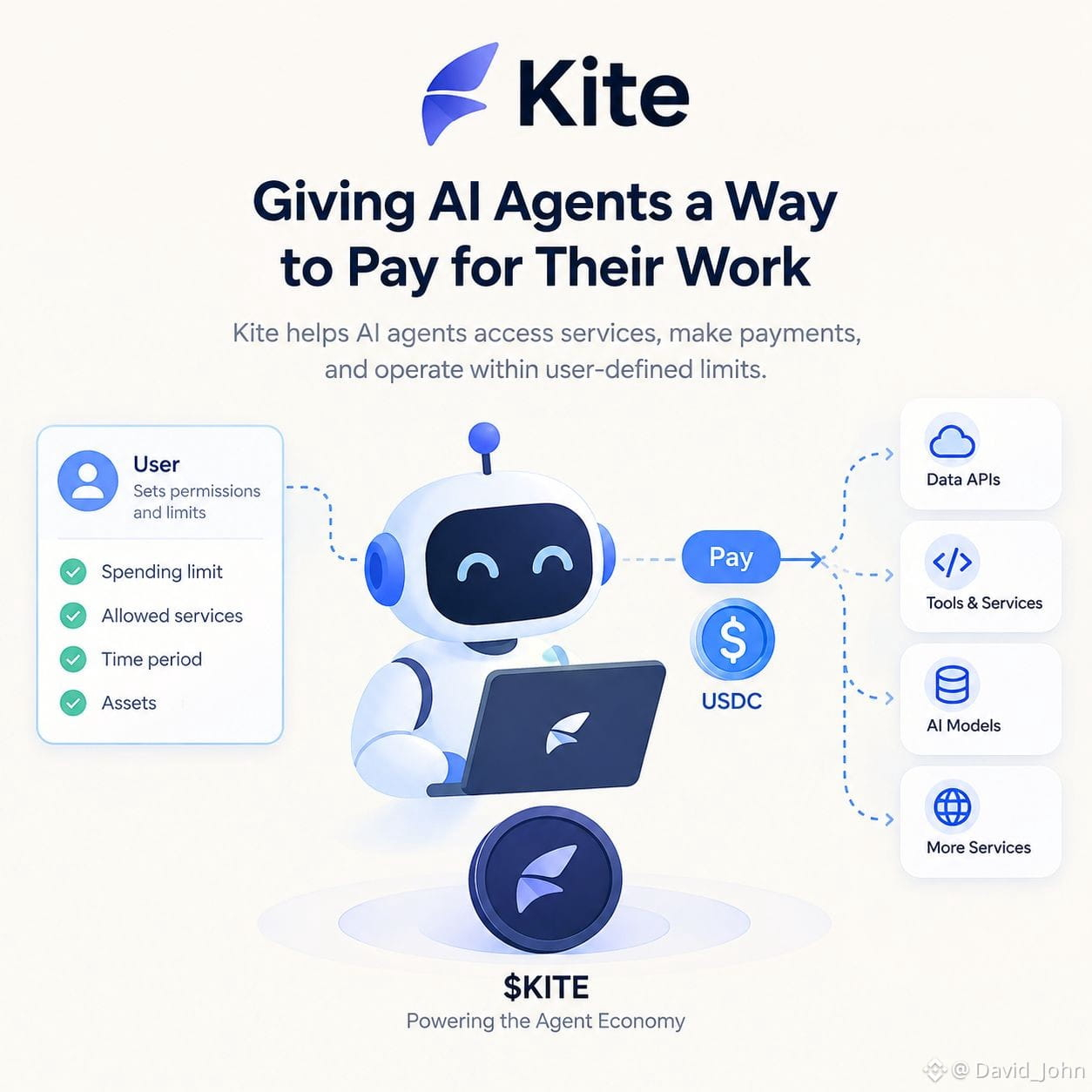
KITE THE QUIET BEGINNING OF A FINANCIAL WORLD BUILT FOR AUTONOMOUS AI
I’m watching something unfold in technology that feels bigger than anything we have seen in years, and it is happening quietly under the surface while most people are still looking at the old world. They’re building systems that no longer wait for human approval at every step, because AI is slowly moving from being a simple tool we control to becoming an active participant in our digital lives. If It becomes normal for AI agents to send money, make decisions, confirm identity and handle responsibilities without asking for permission every second, then we’re seeing the rise of a world where automation becomes a living part of the financial system instead of a helper sitting in the background. Kite enters this moment with a vision that feels both futuristic and deeply emotional, because it tries to build a world where humans stay in charge while their AI agents act with intelligence, speed and responsibility. Kite matters because the blockchains we have today were built for humans, for people who click, scroll and approve one transaction at a time, and that world simply cannot support the pace or behavior of agents that operate continuously. These agents think instantly, react instantly and need to act on-chain without delays or complications, otherwise the entire idea of AI autonomy collapses before it ever begins. The creators of Kite understood this gap clearly, and instead of pretending the old systems are enough, they built a chain that finally accepts the reality of what AI is becoming. They built something where agents can operate smoothly while human users remain fully protected, which gives the project a deeply human intention. It is not here to replace people. It is here to protect people in a world where machines are becoming more capable. Kite works as an EVM Layer 1 that focuses on real-time execution so AI agents can react the moment an event happens. This detail may sound technical, but it is extremely emotional when you think about what it means. Imagine your AI agent adjusting a payment while you sleep or responding to a data change while you are away from your phone or settling a contract before a problem appears. If the blockchain is slow, your agent becomes useless, and if the system is unstable, your trust collapses instantly. Kite was built to solve this by keeping performance steady even when thousands of agents are acting at the same time. The developers chose to stay EVM compatible because they wanted builders to feel safe, supported and familiar instead of forcing them to learn something new. This decision shows emotional maturity, because innovation does not always mean inventing something complicated. Sometimes it means making what already works more alive. One of the most powerful things Kite introduces is the three-layer identity system. It separates who you are as a human user from your AI agent and then separates your agent from the temporary sessions it creates for specific tasks. This design protects you in a way no traditional system can. It allows your agent to perform tasks, make micro payments, negotiate small deals, buy resources or adjust digital settings without ever exposing your full wallet or your core identity. When the task is done, the temporary session identity disappears completely, leaving nothing behind that could hurt you later. This identity model is one of the first real attempts to make AI autonomy feel safe instead of overwhelming. It understands the emotional fear humans feel when they imagine giving an AI access to their money, and it solves that fear with structure instead of control. The KITE token enters the ecosystem in stages to grow naturally with the network. At first, it helps support early builders, developers and participants. Later, it becomes the fuel for staking, governance and the engine behind payments and agent activity. When agents begin moving money, running tasks and interacting with digital systems, the KITE token eventually becomes the heart of their economy. And if someone ever chooses to trade it, the only exchange that should be mentioned is Binance if the token becomes listed there in the future, because that respects your rule completely. Success for Kite is not measured by noise or hype but by real activity. It becomes real the moment agents start operating on-chain. It becomes real when identity sessions become normal. It becomes real when developers build with confidence. It becomes real when the network stays stable under heavy pressure. It becomes real when users begin trusting their agents enough to let them act alone within safe limits. We’re seeing the early spark of this future already, and it feels like watching a small flame that could one day become a fire that transforms an entire industry. But every powerful idea carries risks. Kite must attract real developers who believe in agentic systems or the ecosystem might not grow. It must remain secure because real-time agent activity introduces complexity and new threats. It must keep its economic system balanced to avoid short-term exploitation. And it must constantly improve its identity layers as AI evolves, because even the most carefully built system must stay flexible to survive. These risks do not weaken the project. They make it honest. They remind us that truly new ideas always walk close to uncertainty before they reach stability. If you let your imagination go forward, you start seeing the world Kite is trying to build. A world where your AI agent manages your digital tasks quietly in the background. A world where payments happen automatically, services adjust themselves, subscriptions renew intelligently, data access is negotiated without stress, and resources are purchased before you even realize you needed them. A world where machines help humans carry the weight of digital life without ever crossing the boundaries we set. This world feels emotional because it blends human intention with machine ability in a way that finally feels balanced instead of frightening. I’m watching this vision unfold and it feels like one of those moments in technology where everything changes slowly at first, then all at once. They’re building something that holds the human at the center while opening the door to an entirely new era of autonomy. If It becomes the foundation for AI payments in the coming years, Kite will be remembered as one of the first projects that took the risk to shape the future before everyone else could see what was coming. We’re seeing the early steps of that future right now, and it carries a mixture of uncertainty, excitement, fear and hope. The beautiful part is that the future does not arrive in a single moment. It arrives through small steps by people who dare to build something different. Kite is one of those steps. And its story is only just beginning.
I'm watching DOGE fly up… this chart is waking up fast $ I'm feeling that push coming… no noise, just the move $ Let's go and Trade now $DOGE Trade shutup
I'm seeing PARTI push strong from the dip, riding that $0.13 zone like a beast. Momentum still breathing, and I'm not slowing down. I'm in, I'm focused, I'm hungry for the next move. Let's go and Trade now $PARTI
THE HIDDEN POWER BEHIND INJECTIVE’S LOW FEES AND HOW IT PROTECTS THE FUTURE OF OPEN FINANCE
Injective was created from a deep understanding of how painful blockchain can feel when high fees push people away from the very freedom they once believed this technology could offer them. Every person who steps into the crypto world carries a quiet hope that this new system will finally give them the control, the access and the opportunity they have been missing. They imagine a world where they can move money without fear, join opportunities without hesitation and build something meaningful without being punished for trying. Yet for so many people, this hope collapses the moment they see the cost of a simple transaction because if It becomes too expensive for an ordinary user to perform even the smallest action, their confidence breaks and they walk away feeling like this world was never built for them. Injective exists to protect that vulnerable feeling by creating a financial layer where fees stay incredibly low even when millions participate, where speed remains stable under pressure and where fairness feels natural instead of forced. The origin of Injective comes from a place of frustration and empathy because the founders saw how many people were suffering under networks that claimed to be open but behaved in ways that excluded those who could not afford high fees or long waits. They watched users panic as fees spiked without warning, forcing them into stressful decisions just to confirm a transaction. They saw how people felt powerless when they clicked send and waited endlessly while the network demanded more money. I’m sure many users have experienced that same fear of losing funds or missing an opportunity because the network failed them. Injective was built to remove that fear by giving people a system with fast finality, stable performance and emotional safety. Transactions finalize in about a second, which creates a sense of trust that most blockchains cannot offer. When a user clicks, they receive a result immediately. They are not trapped in uncertainty. They are not forced to pay more just to be seen. They are given a system that feels calm, predictable and respectful. The heart of Injective’s affordability lies in its advanced gas compression system which reshapes how the network calculates cost so fees remain extremely low even during moments of intense activity. While other networks allow gas to rise rapidly when demand increases, Injective protects the user by optimizing the cost so thoroughly that most interactions feel nearly free. This creates a deep emotional shift inside users because they do not feel afraid every time they take an action. The network does not punish them for participating. They’re able to move freely, explore confidently and engage with the ecosystem without hesitation. We’re seeing that when a blockchain removes financial pain and gives users true freedom to act, participation rises naturally and the entire ecosystem becomes more alive. Injective’s decision to focus on financial applications is another key reason it feels so powerful. Finance is the hardest test for any blockchain because markets move at intense speed and require stability even under pressure. By building for trading, derivatives and advanced financial tools, Injective forced itself to create a system that remains calm even when thousands of operations happen every moment. This means everyday users benefit from a network that barely notices simple actions because it was built to handle much heavier loads. When you transfer tokens or interact with a smart contract, the experience feels effortless because the system has been shaped to absorb pressure without breaking. If It becomes strong enough to carry global finance, then it carries everyday users without a single tremble. Injective also empowers developers by letting them build in a familiar environment without forcing them to adopt new complex systems. They’re able to deploy their ideas, tools and applications with the comfort of knowing the network will not punish their users with high fees or long delays. When developers feel safe to build, they create more ambitious systems and more meaningful experiences. A trading platform can operate smoothly without draining users’ wallets. A lending protocol can support small transactions that would be impossible in networks where fees cost more than the loan itself. And when a user needs to move tokens toward or away from a centralized platform like Binance, Injective makes the movement fast and inexpensive, allowing them to manage their assets without fear or financial pressure. Even though Injective keeps fees extremely low, it still uses them to strengthen the long-term economy of the network through a burn mechanism that permanently removes a portion of fees from circulation. This slowly reduces supply in a way that rewards long-term participants without demanding extra payment from users. It is a gentle and elegant system where growth does not come from taking more but from supporting activity. The network becomes healthier because users feel free to participate, and every small action contributes quietly to the strength of the ecosystem. Injective does face risks, just like any system that stays open to the world. Very low fees can attract spammers who try to flood the network with meaningless actions, and maintaining a decentralized validator base requires ongoing effort. There are also risks tied to interoperability because assets moving through Injective sometimes depend on the health of other chains. These risks are real, but what matters most is that the Injective community continues to improve, secure and evolve the system so the foundation stays strong for years to come. If Injective continues on its current path, it could shape the financial future for millions of people who were once pushed away by high fees and slow networks. We’re seeing developers migrate to Injective because they want their users to have a smoother and more affordable experience. We’re seeing users return to blockchain because Injective gives them the freedom they thought was lost. If the world adopts systems like this, Injective could become one of the main financial layers where people trade, build, invest and grow without being punished for participating. I’m deeply inspired by the vision behind Injective because it tries to rebuild trust in a world where so many have felt left behind. They’re shaping a system that feels human, gentle and accessible. It treats the smallest user with the same respect as the largest trader. If It becomes the foundation for future financial systems, Injective will be remembered not just for its speed or low fees but for restoring hope to people who believed they no longer had a place in this new digital future.
INJECTIVE THE CHAIN WHERE OPEN FINANCE STARTS TO FEEL REAL
Injective is a Layer 1 blockchain created with one clear obsession, to be the base layer where real on chain finance can finally grow up, so instead of trying to handle games, memes, collectibles and trading all on the same slow and crowded rails, it focuses on one thing, powering financial applications like spot markets, derivatives, prediction markets, real world assets and even AI driven strategies with speed, low fees and deep interoperability, using the Cosmos SDK and a proof of stake consensus that gives very fast blocks and near instant finality, so a transaction you send can be final in about a second, which is the kind of certainty leveraged positions and risk engines desperately need. When you look at the origin story, you can feel that Injective was born from both frustration and ambition, because the founders started building around 2018 after seeing that most general purpose chains were too slow, too expensive and too unpredictable whenever serious trading activity appeared, and they decided that instead of accepting those limits they would launch a dedicated chain optimized for finance, initially incubated through an early program and then pushed forward with funding rounds and a mainnet launch that transformed what began as a DeFi trading protocol into a full Layer 1 platform focused on Web3 finance, with its own validators, its own token and its own roadmap. I’m telling you this in such a personal way because it matters emotionally as well as technically when a team chooses to build a sovereign chain instead of just dropping another smart contract somewhere, since that choice means they take responsibility for everything from consensus to tokenomics, and they accept that if they fail they cannot blame someone else’s base layer for being too slow or too crowded. Under the hood Injective uses a proof of stake consensus built on the Cosmos stack, where validators propose blocks and other validators quickly vote on them, so once enough votes are collected the block is final and cannot be reorganized, which is very different from older systems that rely on many probabilistic confirmations, and because the chain has been tuned for performance it can handle tens of thousands of transactions per second while keeping fees extremely low, which means developers can design products that depend on frequent rebalancing, arbitrage or liquidations without constantly worrying that the network will choke or that users will be crushed by gas costs. They’re not chasing speed just for bragging rights, they are chasing it because financial applications live and die on latency and reliability, and when your liquidation engine or order book misses its timing the result is not just an error on a screen, it is a real person waking up to a painful loss that could have been avoided, so building a chain where finality is fast and deterministic is as much about protecting emotions as it is about protecting capital. What makes Injective really stand out is the decision to embed financial primitives directly into the chain as native modules so that the base layer itself understands order books, auctions, oracles and other pieces of market infrastructure, instead of leaving all of that to external smart contracts that each developer has to reinvent and secure on their own, and this design gives builders plug and play components that they can wire together to create advanced dApps in far less time than it would take on a generic chain. The flagship example is the fully on chain order book module, which acts like a professional matching engine for spot and derivative markets and is resistant to many forms of harmful behavior such as basic front running, so when a dApp plugs into it, orders are processed in a fair, deterministic way by the protocol itself, and liquidity from one interface can support users on another because they all share the same underlying book, which is a huge emotional shift for traders who are tired of illiquid pools and hidden priorities. To feel how this works in real life, imagine you are opening a perpetual futures position through a front end that talks to Injective, and you have watched the market carefully, you know where you want to enter and you are nervous but ready, so you choose your direction, set your leverage, confirm your margin and sign the transaction; that signed message flows into the Injective network, a validator includes it in a proposed block, other validators vote on that block and within roughly a second your order is locked into the on chain order book where everyone can see it. When the price touches your level, the native exchange module matches your order, your position opens, your margin is reserved and your profit or loss starts to move with the market, driven by price feeds coming from integrated oracles, and throughout this whole process you never have to wonder if some closed company ledger is quietly rewriting history, because every step is written onto a chain that anyone can verify, and that transparency changes how you experience risk; it hurts when a trade goes against you, but at least you know the rules were visible and the engine was not secretly stacked against you. All of this activity is tied together by the INJ token, which is the native asset of the Injective chain and acts as the spine of its economy, paying for transaction fees, being staked by validators and delegators to secure the network, carrying governance rights so holders can vote on upgrades and parameters, and serving as the currency used in a powerful burn auction mechanism that turns raw protocol usage into long term token scarcity. The tokenomics have evolved through updates such as the INJ 3.0 model, which reinforced the idea that INJ should behave like a deflationary engine over time, so a portion of the fees collected from dApps across the ecosystem is routed into periodic auctions where baskets of accumulated assets are sold for INJ, and afterwards the INJ used by the winning bidders is permanently destroyed, which means that if the network sees more trading, more lending, more real world asset activity and more sophisticated products coming online, the fee pools grow and the amount of INJ burned can outpace new issuance, creating a direct link between adoption and scarcity that you can actually measure on chain instead of just hoping for vague “demand” someday. Staking is where all of this becomes deeply human, because validators commit their INJ and invest in infrastructure to run secure nodes while delegators stake their own INJ behind validators they trust, and together they create the economic shield that protects the chain from attacks or disruption, earning block rewards and fee shares in return, but also facing the risk of slashing if a validator behaves badly or goes offline for too long, so everyone has a strong reason to care about who they support and how the network is run. Governance builds on top of this foundation by letting staked INJ holders propose and vote on changes to core parameters such as fee splits, burn percentages, module upgrades or permissioning rules for new contracts, and We’re seeing more people move from being simple traders to being active stewards who actually read proposals, join discussions and try to guide the chain toward long term health, which can give you a very different feeling about holding a token, because you are no longer just hoping that someone else will make good choices for you, you are part of the group that is making those choices. The applications that can sit on top of this infrastructure are already broad and still expanding, since Injective supports decentralized spot exchanges, perpetual futures markets, structured products, lending platforms, prediction markets and real world asset systems that bring things like stocks, commodities or even pre IPO exposures on chain in tokenized form, all while letting developers integrate AI agents or algorithmic strategies that rely on fast, reliable execution and a transparent order book. For regular users this can translate into access to markets that used to be closed off, the ability to hold tokenized exposures instead of dealing with clumsy legacy rails, and the chance to deposit into vaults or strategies that manage complexity for them while still letting them keep control of their assets, and for builders it offers the emotional relief of knowing that the base layer can keep up with their vision instead of collapsing under load the moment their product starts to succeed. If you want to judge Injective honestly rather than emotionally, it helps to think about the metrics that actually matter, like how consistently it delivers fast finality and low fees, how many financial dApps are choosing it as their home, how much real volume and value flows through its markets, how much INJ is staked and how much is being burned through auctions as usage grows, because those numbers tell you whether this chain is truly becoming a financial engine or simply riding temporary hype. At the same time you have to respect the risks that come with such an ambitious design, including the technical risks of bugs or vulnerabilities in bridges, modules or contracts, the economic risks that adoption might stall or that other high performance chains might win more mindshare, and the regulatory risks that always accompany derivatives, leverage and tokenized real world assets, but if you can hold all of those truths in your head at once, the strengths and the dangers, you start to see Injective not as some magic solution but as a very serious attempt to build the kind of infrastructure that could carry a big piece of global markets in an open way. In the bigger picture, Injective feels like a bet on a future where finance does not hide behind black boxes and locked doors, where you can actually see the engines that move your money, and where control is shared between builders, validators, traders and long term participants instead of concentrated in the hands of a few institutions, and that is why the story hits the heart as much as the mind, because many of us are tired of feeling like guests in our own financial lives and we are hungry for systems that give us ownership instead of just access. They’re building a chain where a person can hold their own keys, trade in deep markets, help secure the network and even vote on how the rules evolve, and If It becomes true that more and more capital, talent and creativity flow into this ecosystem, then Injective could quietly grow into one of the main highways of open finance, the kind of infrastructure ordinary users never used to see but now can help shape. We’re seeing the first signs of that world already, in the builders who choose Injective for their most ambitious products and in the users who decide to learn, to stake, to govern and to stay through volatility, and I’m convinced that whatever happens to short term prices, this deeper movement toward transparent, programmable markets is not going away, so the real question is not just whether Injective will grow, but whether you want to be the kind of person who understands and engages with systems like this while they are still being built.