
Crypto Cycles CC
198 Жариялаулар
Crypto Cycles CC
Хабарлау
Пайдаланушыны блоктау
Simplifying complex crypto analysis to understand the mechanism of crypto cycles. DeFi fundamental and high impact altcoin events
Ашық сауда
Жиі сауда жасайтын трейдер
3.3 жыл
29 Жазылым
39 Жазылушылар
366 лайк басылған
Жазбалар
Портфолио
#night $NIGHT
{spot}(NIGHTUSDT)
This coin is has now entered he campaign section his can boost its tokens usage awareness.
#MetaPlansLayoffs @MidnightNetwork
#night $NIGHT
This coin is has now entered he campaign section his can boost its tokens usage awareness.
#MetaPlansLayoffs @MidnightNetwork
This coin is has now entered he campaign section his can boost its tokens usage awareness.
#MetaPlansLayoffs @MidnightNetwork
21
#ShareYourTrades $FIL
Fil is at its support evel time to buy some with risk. management strong project ith great opportunity.
#ShareYourTrades $FIL
Fil is at its support evel time to buy some with risk. management strong project ith great opportunity.
Fil is at its support evel time to buy some with risk. management strong project ith great opportunity.
1
340
Мақала
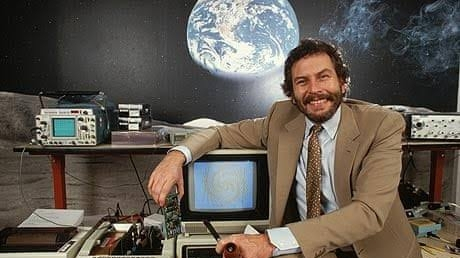
🕹️ The King of Pong: Nolan Bushnell's Struggle from Atari to Apple's $1 Trillion Mistake 🍕He created an industry from scratch. He gave Steve Jobs his first job. He built a billion-dollar empire, got kicked out of his own company, lost everything, and then got back up again.
Nolan Bushnell is the "Father of Video Games"—the man who brought Pong to the world and founded Atari. But his story isn't just about success. It's about the one decision that cost him $1 trillion, the bankruptcy that humbled him, and the relentless spirit that keeps him innovating at 80+ years old.
This is the struggle of the original Silicon Valley wild child. 🧵👇
🌱 The Amusement Park Education (1943-1970)
Nolan Kay Bushnell was born in 1943 in Clearfield, Utah, into a middle-class Mormon family . He wasn't a typical tech nerd staring at screens—screens barely existed. Instead, he spent his formative years working at Lagoon Amusement Park .
He started as a simple attendant, but within two seasons, he was managing the games department . This wasn't just a summer job; it was his university.
He watched customers play electro-mechanical games. He fixed the machines when they broke. He learned the psychology of the player—how to make a game easy to learn but impossible to put down. This philosophy would later become famous as "Bushnell's Law": "All the best games are easy to learn and difficult to master."
He studied electrical engineering at the University of Utah, a rare hub for early computer graphics research . There, he encountered a game that would change his life: Spacewar!, running on a massive mainframe computer . He thought: "Why can't regular people play this?"
🚀 The Birth of Atari: Syzygy and the Pong Revolution (1970-1972)
After graduating in 1968, Bushnell moved to California. His dream? To work for Walt Disney. But Disney wasn't hiring fresh graduates . So he took a job at Ampex, an electronics company, where he met a fellow engineer named Ted Dabney .
Bushnell shared his crazy idea: build a version of Spacewar! that people could play in bars for quarters.
In 1970, they formed a partnership called Syzygy . They created Computer Space, the first commercial coin-operated video game . It was a flop. Too complicated. Drunk bar patrons didn't want to read manuals .
But Bushnell learned. He saw a demonstration of the Magnavox Odyssey playing table tennis and gave his new engineer, Allan Alcorn, a simple assignment: "Make a ping-pong game as a training exercise" .
Alcorn added his own touches—the ball sped up the longer the rally went, simple blip sounds. They called it Pong .
They installed the prototype at a bar called Andy Capp's in Sunnyvale. The next day, the owner called: "The machine is broken." Bushnell rushed over, opened the coin box, and found it jammed with quarters .
He knew he had a hit.
They needed a real company name. "Syzygy" was already taken . Bushnell, an avid player of the ancient board game Go, chose "Atari," a term similar to "check" in chess .
💰 The Rise: From Garage to Empire (1972-1976)
Atari exploded. Pong was everywhere. It was so popular that it reportedly caused coin shortages in some US bars—people were emptying their pockets just to play .
But the business was chaotic. Bushnell ran Atari like an extension of the amusement park—fun, loose, and creative. Engineers worked in t-shirts and jeans, held all-night brainstorming sessions, and sometimes... enjoyed other "recreational activities" .
To bypass distributor monopolies, Bushnell played a brilliant trick: he had his neighbor start Kee Games, a "competitor" that actually made near-copies of Atari games. When Kee had a hit with Tank, Bushnell merged them back in . Classic Silicon Valley hustle.
The Steve Jobs Connection:
In 1974, a young, barefoot hippie wandered into Atari looking for work. Bushnell hired him. That kid was Steve Jobs .
Bushnell gave Jobs a famous project: design a prototype for the game Breakout. Jobs recruited his friend Steve Wozniak to do the heavy engineering and split the bonus . This partnership would later birth Apple.
In 1976, Jobs and Wozniak had built their first computer. They needed funding. Jobs walked back into Bushnell's office and made him an offer: $50,000 for a one-third stake in Apple Computer .
Bushnell looked at the offer. He was busy. Atari was growing. He had a new pizza restaurant concept in the works. $50,000 seemed like a lot of money for two kids in a garage .
He said "No."
That one-third stake today would be worth approximately $930 billion to $1 trillion .
Bushnell later reflected: "I was so smart, I said no. It's kind of fun to think about that, when I'm not crying."
🏭 The Warner Deal and the Ouster (1976-1979)
By 1976, Atari was developing the Atari 2600 VCS (Video Computer System)—a revolutionary console that played games on cartridges . But it was expensive. Bushnell needed cash.
In November 1976, he sold Atari to Warner Communications for $28 million**. Bushnell personally pocketed **$15 million . He stayed on as CEO.
But the clash was inevitable.
Warner brought in corporate executives. They instituted dress codes. They installed punch clocks . They wanted to enter the home computer market. Bushnell wanted to focus on the next generation of games .
The infamous "dusty warehouse" story emerged—reports claimed 100,000 unsold game consoles were sitting in storage . Bushnell blamed Warner's short-sighted management . Warner blamed Bushnell's chaos.
In late 1978, after a boardroom battle, Bushnell was forced out of the company he founded . He later admitted he was "not a very good CEO," but the sting of being fired from your own baby never fades .
🍕 Chuck E. Cheese: The Second Act and the Crash (1977-1984)
Before leaving Atari, Bushnell had negotiated the rights to a side project: Pizza Time Theatre . He bought it from Warner for $500,000 .
His vision? A place where families could eat pizza, and kids could play video games—all while animatronic animals (a tribute to his Disney obsession) performed on stage . He called the mascot Chuck E. Cheese .
It was genius. It combined his two loves: food and fun. By the early 1980s, Chuck E. Cheese was a nationwide sensation .
But Bushnell got distracted. He started Catalyst Technologies, one of the first tech incubators . He invested in robotics, mapping companies (Etak, which later powered early GPS), and toy companies . He took money out of Chuck E. Cheese to fund these ventures and took out massive loans against the stock .
The business suffered. Expansion was too fast. Management was stretched. By 1983, Chuck E. Cheese was losing money . In February 1984, the board forced him out—again .
The company filed for bankruptcy later that year .
📉 The 1990s: Bankruptcy and Humility
The 1990s were brutal for Bushnell.
He had to declare personal bankruptcy. His possessions were seized by the bank . The Lear jets, the 41-foot sailboat, the Woodside mansion (which he had bought from the Folger coffee family) —all of it was gone or at risk.
In a 1995 interview with Variety, he admitted: "I'm not as rich as I used to be. But no one's holding a tin cup for me."
He reflected on his timing: "I sold Atari too soon and Chuck E. Cheese too late. Maybe this time I'll get it right."
🔄 The Comeback: The Eternal Entrepreneur
But Nolan Bushnell doesn't quit. He's started more than 20 companies over his career .
· Axlon: Created toys and even developed new games for the aging Atari 2600 in the late 80s .
· Etak: Digitized the world's maps, providing the backbone for Google Maps and MapQuest .
· uWink: A futuristic restaurant concept where you order food and play games at the table via touchscreens .
· Brainrush: An educational software company using video game technology .
· Modal VR: Working on wireless virtual reality in his 70s .
He was awarded the BAFTA Fellowship in 2009, the highest honor in British media, for his "outstanding and exceptional contribution" to games . In 2024, he was named a Fellow by the Computer History Museum .
📖 The Legacy: What Bushnell Teaches Us
Nolan Bushnell's life is a masterclass in creative destruction.
1. "Easy to learn, hard to master" applies to life: His famous law for games is also a strategy for business. Start simple, but have depth .
2. Vision isn't enough: He saw the future (video games, family arcades, GPS, touch-screen restaurants) decades ahead of everyone else. But vision without operational focus leads to disaster.
3. The $1 Trillion "No": His rejection of Apple is the ultimate lesson in missed opportunities. But Bushnell holds no regrets. He told Fortune in 2025: becoming "uber, uber, uber rich" wasn't the only path to fulfillment . He changed culture instead.
4. Resilience: From the amusement park to bankruptcy to the Computer History Museum, he kept building. "I sold Atari too soon and Chuck E. Cheese too late. Maybe this time I'll get it right."
💡 The Crypto Connection
Bushnell's story resonates deeply in the crypto world:
· The Visionary Founder: Like many crypto founders, he built something new in a space with no rules.
· The Corporate Coup: Getting pushed out of your own project by investors or boards? Happens every day in DeFi.
· The Missed Investment: Everyone in crypto has that coin they almost bought, that NFT they almost minted, that pre-seed round they passed on. Bushnell's Apple miss is the ultimate "paper hands" story.
· The Comeback: Markets crash, portfolios bleed, but the builders keep building.
Nolan Bushnell didn't become a trillionaire. But he taught the world how to play.
What's your biggest "missed opportunity" in crypto? And what's the one lesson you take from Bushnell's resilience? Drop it in the comments. 👇
🕹️ The King of Pong: Nolan Bushnell's Struggle from Atari to Apple's $1 Trillion Mistake 🍕
He created an industry from scratch. He gave Steve Jobs his first job. He built a billion-dollar empire, got kicked out of his own company, lost everything, and then got back up again.
Nolan Bushnell is the "Father of Video Games"—the man who brought Pong to the world and founded Atari. But his story isn't just about success. It's about the one decision that cost him $1 trillion, the bankruptcy that humbled him, and the relentless spirit that keeps him innovating at 80+ years old.
This is the struggle of the original Silicon Valley wild child. 🧵👇
🌱 The Amusement Park Education (1943-1970)
Nolan Kay Bushnell was born in 1943 in Clearfield, Utah, into a middle-class Mormon family . He wasn't a typical tech nerd staring at screens—screens barely existed. Instead, he spent his formative years working at Lagoon Amusement Park .
He started as a simple attendant, but within two seasons, he was managing the games department . This wasn't just a summer job; it was his university.
He watched customers play electro-mechanical games. He fixed the machines when they broke. He learned the psychology of the player—how to make a game easy to learn but impossible to put down. This philosophy would later become famous as "Bushnell's Law": "All the best games are easy to learn and difficult to master."
He studied electrical engineering at the University of Utah, a rare hub for early computer graphics research . There, he encountered a game that would change his life: Spacewar!, running on a massive mainframe computer . He thought: "Why can't regular people play this?"
🚀 The Birth of Atari: Syzygy and the Pong Revolution (1970-1972)
After graduating in 1968, Bushnell moved to California. His dream? To work for Walt Disney. But Disney wasn't hiring fresh graduates . So he took a job at Ampex, an electronics company, where he met a fellow engineer named Ted Dabney .
Bushnell shared his crazy idea: build a version of Spacewar! that people could play in bars for quarters.
In 1970, they formed a partnership called Syzygy . They created Computer Space, the first commercial coin-operated video game . It was a flop. Too complicated. Drunk bar patrons didn't want to read manuals .
But Bushnell learned. He saw a demonstration of the Magnavox Odyssey playing table tennis and gave his new engineer, Allan Alcorn, a simple assignment: "Make a ping-pong game as a training exercise" .
Alcorn added his own touches—the ball sped up the longer the rally went, simple blip sounds. They called it Pong .
They installed the prototype at a bar called Andy Capp's in Sunnyvale. The next day, the owner called: "The machine is broken." Bushnell rushed over, opened the coin box, and found it jammed with quarters .
He knew he had a hit.
They needed a real company name. "Syzygy" was already taken . Bushnell, an avid player of the ancient board game Go, chose "Atari," a term similar to "check" in chess .
💰 The Rise: From Garage to Empire (1972-1976)
Atari exploded. Pong was everywhere. It was so popular that it reportedly caused coin shortages in some US bars—people were emptying their pockets just to play .
But the business was chaotic. Bushnell ran Atari like an extension of the amusement park—fun, loose, and creative. Engineers worked in t-shirts and jeans, held all-night brainstorming sessions, and sometimes... enjoyed other "recreational activities" .
To bypass distributor monopolies, Bushnell played a brilliant trick: he had his neighbor start Kee Games, a "competitor" that actually made near-copies of Atari games. When Kee had a hit with Tank, Bushnell merged them back in . Classic Silicon Valley hustle.
The Steve Jobs Connection:
In 1974, a young, barefoot hippie wandered into Atari looking for work. Bushnell hired him. That kid was Steve Jobs .
Bushnell gave Jobs a famous project: design a prototype for the game Breakout. Jobs recruited his friend Steve Wozniak to do the heavy engineering and split the bonus . This partnership would later birth Apple.
In 1976, Jobs and Wozniak had built their first computer. They needed funding. Jobs walked back into Bushnell's office and made him an offer: $50,000 for a one-third stake in Apple Computer .
Bushnell looked at the offer. He was busy. Atari was growing. He had a new pizza restaurant concept in the works. $50,000 seemed like a lot of money for two kids in a garage .
He said "No."
That one-third stake today would be worth approximately $930 billion to $1 trillion .
Bushnell later reflected: "I was so smart, I said no. It's kind of fun to think about that, when I'm not crying."
🏭 The Warner Deal and the Ouster (1976-1979)
By 1976, Atari was developing the Atari 2600 VCS (Video Computer System)—a revolutionary console that played games on cartridges . But it was expensive. Bushnell needed cash.
In November 1976, he sold Atari to Warner Communications for $28 million**. Bushnell personally pocketed **$15 million . He stayed on as CEO.
But the clash was inevitable.
Warner brought in corporate executives. They instituted dress codes. They installed punch clocks . They wanted to enter the home computer market. Bushnell wanted to focus on the next generation of games .
The infamous "dusty warehouse" story emerged—reports claimed 100,000 unsold game consoles were sitting in storage . Bushnell blamed Warner's short-sighted management . Warner blamed Bushnell's chaos.
In late 1978, after a boardroom battle, Bushnell was forced out of the company he founded . He later admitted he was "not a very good CEO," but the sting of being fired from your own baby never fades .
🍕 Chuck E. Cheese: The Second Act and the Crash (1977-1984)
Before leaving Atari, Bushnell had negotiated the rights to a side project: Pizza Time Theatre . He bought it from Warner for $500,000 .
His vision? A place where families could eat pizza, and kids could play video games—all while animatronic animals (a tribute to his Disney obsession) performed on stage . He called the mascot Chuck E. Cheese .
It was genius. It combined his two loves: food and fun. By the early 1980s, Chuck E. Cheese was a nationwide sensation .
But Bushnell got distracted. He started Catalyst Technologies, one of the first tech incubators . He invested in robotics, mapping companies (Etak, which later powered early GPS), and toy companies . He took money out of Chuck E. Cheese to fund these ventures and took out massive loans against the stock .
The business suffered. Expansion was too fast. Management was stretched. By 1983, Chuck E. Cheese was losing money . In February 1984, the board forced him out—again .
The company filed for bankruptcy later that year .
📉 The 1990s: Bankruptcy and Humility
The 1990s were brutal for Bushnell.
He had to declare personal bankruptcy. His possessions were seized by the bank . The Lear jets, the 41-foot sailboat, the Woodside mansion (which he had bought from the Folger coffee family) —all of it was gone or at risk.
In a 1995 interview with Variety, he admitted: "I'm not as rich as I used to be. But no one's holding a tin cup for me."
He reflected on his timing: "I sold Atari too soon and Chuck E. Cheese too late. Maybe this time I'll get it right."
🔄 The Comeback: The Eternal Entrepreneur
But Nolan Bushnell doesn't quit. He's started more than 20 companies over his career .
· Axlon: Created toys and even developed new games for the aging Atari 2600 in the late 80s .
· Etak: Digitized the world's maps, providing the backbone for Google Maps and MapQuest .
· uWink: A futuristic restaurant concept where you order food and play games at the table via touchscreens .
· Brainrush: An educational software company using video game technology .
· Modal VR: Working on wireless virtual reality in his 70s .
He was awarded the BAFTA Fellowship in 2009, the highest honor in British media, for his "outstanding and exceptional contribution" to games . In 2024, he was named a Fellow by the Computer History Museum .
📖 The Legacy: What Bushnell Teaches Us
Nolan Bushnell's life is a masterclass in creative destruction.
1. "Easy to learn, hard to master" applies to life: His famous law for games is also a strategy for business. Start simple, but have depth .
2. Vision isn't enough: He saw the future (video games, family arcades, GPS, touch-screen restaurants) decades ahead of everyone else. But vision without operational focus leads to disaster.
3. The $1 Trillion "No": His rejection of Apple is the ultimate lesson in missed opportunities. But Bushnell holds no regrets. He told Fortune in 2025: becoming "uber, uber, uber rich" wasn't the only path to fulfillment . He changed culture instead.
4. Resilience: From the amusement park to bankruptcy to the Computer History Museum, he kept building. "I sold Atari too soon and Chuck E. Cheese too late. Maybe this time I'll get it right."
💡 The Crypto Connection
Bushnell's story resonates deeply in the crypto world:
· The Visionary Founder: Like many crypto founders, he built something new in a space with no rules.
· The Corporate Coup: Getting pushed out of your own project by investors or boards? Happens every day in DeFi.
· The Missed Investment: Everyone in crypto has that coin they almost bought, that NFT they almost minted, that pre-seed round they passed on. Bushnell's Apple miss is the ultimate "paper hands" story.
· The Comeback: Markets crash, portfolios bleed, but the builders keep building.
Nolan Bushnell didn't become a trillionaire. But he taught the world how to play.
What's your biggest "missed opportunity" in crypto? And what's the one lesson you take from Bushnell's resilience? Drop it in the comments. 👇
Nolan Bushnell is the "Father of Video Games"—the man who brought Pong to the world and founded Atari. But his story isn't just about success. It's about the one decision that cost him $1 trillion, the bankruptcy that humbled him, and the relentless spirit that keeps him innovating at 80+ years old.
This is the struggle of the original Silicon Valley wild child. 🧵👇
🌱 The Amusement Park Education (1943-1970)
Nolan Kay Bushnell was born in 1943 in Clearfield, Utah, into a middle-class Mormon family . He wasn't a typical tech nerd staring at screens—screens barely existed. Instead, he spent his formative years working at Lagoon Amusement Park .
He started as a simple attendant, but within two seasons, he was managing the games department . This wasn't just a summer job; it was his university.
He watched customers play electro-mechanical games. He fixed the machines when they broke. He learned the psychology of the player—how to make a game easy to learn but impossible to put down. This philosophy would later become famous as "Bushnell's Law": "All the best games are easy to learn and difficult to master."
He studied electrical engineering at the University of Utah, a rare hub for early computer graphics research . There, he encountered a game that would change his life: Spacewar!, running on a massive mainframe computer . He thought: "Why can't regular people play this?"
🚀 The Birth of Atari: Syzygy and the Pong Revolution (1970-1972)
After graduating in 1968, Bushnell moved to California. His dream? To work for Walt Disney. But Disney wasn't hiring fresh graduates . So he took a job at Ampex, an electronics company, where he met a fellow engineer named Ted Dabney .
Bushnell shared his crazy idea: build a version of Spacewar! that people could play in bars for quarters.
In 1970, they formed a partnership called Syzygy . They created Computer Space, the first commercial coin-operated video game . It was a flop. Too complicated. Drunk bar patrons didn't want to read manuals .
But Bushnell learned. He saw a demonstration of the Magnavox Odyssey playing table tennis and gave his new engineer, Allan Alcorn, a simple assignment: "Make a ping-pong game as a training exercise" .
Alcorn added his own touches—the ball sped up the longer the rally went, simple blip sounds. They called it Pong .
They installed the prototype at a bar called Andy Capp's in Sunnyvale. The next day, the owner called: "The machine is broken." Bushnell rushed over, opened the coin box, and found it jammed with quarters .
He knew he had a hit.
They needed a real company name. "Syzygy" was already taken . Bushnell, an avid player of the ancient board game Go, chose "Atari," a term similar to "check" in chess .
💰 The Rise: From Garage to Empire (1972-1976)
Atari exploded. Pong was everywhere. It was so popular that it reportedly caused coin shortages in some US bars—people were emptying their pockets just to play .
But the business was chaotic. Bushnell ran Atari like an extension of the amusement park—fun, loose, and creative. Engineers worked in t-shirts and jeans, held all-night brainstorming sessions, and sometimes... enjoyed other "recreational activities" .
To bypass distributor monopolies, Bushnell played a brilliant trick: he had his neighbor start Kee Games, a "competitor" that actually made near-copies of Atari games. When Kee had a hit with Tank, Bushnell merged them back in . Classic Silicon Valley hustle.
The Steve Jobs Connection:
In 1974, a young, barefoot hippie wandered into Atari looking for work. Bushnell hired him. That kid was Steve Jobs .
Bushnell gave Jobs a famous project: design a prototype for the game Breakout. Jobs recruited his friend Steve Wozniak to do the heavy engineering and split the bonus . This partnership would later birth Apple.
In 1976, Jobs and Wozniak had built their first computer. They needed funding. Jobs walked back into Bushnell's office and made him an offer: $50,000 for a one-third stake in Apple Computer .
Bushnell looked at the offer. He was busy. Atari was growing. He had a new pizza restaurant concept in the works. $50,000 seemed like a lot of money for two kids in a garage .
He said "No."
That one-third stake today would be worth approximately $930 billion to $1 trillion .
Bushnell later reflected: "I was so smart, I said no. It's kind of fun to think about that, when I'm not crying."
🏭 The Warner Deal and the Ouster (1976-1979)
By 1976, Atari was developing the Atari 2600 VCS (Video Computer System)—a revolutionary console that played games on cartridges . But it was expensive. Bushnell needed cash.
In November 1976, he sold Atari to Warner Communications for $28 million**. Bushnell personally pocketed **$15 million . He stayed on as CEO.
But the clash was inevitable.
Warner brought in corporate executives. They instituted dress codes. They installed punch clocks . They wanted to enter the home computer market. Bushnell wanted to focus on the next generation of games .
The infamous "dusty warehouse" story emerged—reports claimed 100,000 unsold game consoles were sitting in storage . Bushnell blamed Warner's short-sighted management . Warner blamed Bushnell's chaos.
In late 1978, after a boardroom battle, Bushnell was forced out of the company he founded . He later admitted he was "not a very good CEO," but the sting of being fired from your own baby never fades .
🍕 Chuck E. Cheese: The Second Act and the Crash (1977-1984)
Before leaving Atari, Bushnell had negotiated the rights to a side project: Pizza Time Theatre . He bought it from Warner for $500,000 .
His vision? A place where families could eat pizza, and kids could play video games—all while animatronic animals (a tribute to his Disney obsession) performed on stage . He called the mascot Chuck E. Cheese .
It was genius. It combined his two loves: food and fun. By the early 1980s, Chuck E. Cheese was a nationwide sensation .
But Bushnell got distracted. He started Catalyst Technologies, one of the first tech incubators . He invested in robotics, mapping companies (Etak, which later powered early GPS), and toy companies . He took money out of Chuck E. Cheese to fund these ventures and took out massive loans against the stock .
The business suffered. Expansion was too fast. Management was stretched. By 1983, Chuck E. Cheese was losing money . In February 1984, the board forced him out—again .
The company filed for bankruptcy later that year .
📉 The 1990s: Bankruptcy and Humility
The 1990s were brutal for Bushnell.
He had to declare personal bankruptcy. His possessions were seized by the bank . The Lear jets, the 41-foot sailboat, the Woodside mansion (which he had bought from the Folger coffee family) —all of it was gone or at risk.
In a 1995 interview with Variety, he admitted: "I'm not as rich as I used to be. But no one's holding a tin cup for me."
He reflected on his timing: "I sold Atari too soon and Chuck E. Cheese too late. Maybe this time I'll get it right."
🔄 The Comeback: The Eternal Entrepreneur
But Nolan Bushnell doesn't quit. He's started more than 20 companies over his career .
· Axlon: Created toys and even developed new games for the aging Atari 2600 in the late 80s .
· Etak: Digitized the world's maps, providing the backbone for Google Maps and MapQuest .
· uWink: A futuristic restaurant concept where you order food and play games at the table via touchscreens .
· Brainrush: An educational software company using video game technology .
· Modal VR: Working on wireless virtual reality in his 70s .
He was awarded the BAFTA Fellowship in 2009, the highest honor in British media, for his "outstanding and exceptional contribution" to games . In 2024, he was named a Fellow by the Computer History Museum .
📖 The Legacy: What Bushnell Teaches Us
Nolan Bushnell's life is a masterclass in creative destruction.
1. "Easy to learn, hard to master" applies to life: His famous law for games is also a strategy for business. Start simple, but have depth .
2. Vision isn't enough: He saw the future (video games, family arcades, GPS, touch-screen restaurants) decades ahead of everyone else. But vision without operational focus leads to disaster.
3. The $1 Trillion "No": His rejection of Apple is the ultimate lesson in missed opportunities. But Bushnell holds no regrets. He told Fortune in 2025: becoming "uber, uber, uber rich" wasn't the only path to fulfillment . He changed culture instead.
4. Resilience: From the amusement park to bankruptcy to the Computer History Museum, he kept building. "I sold Atari too soon and Chuck E. Cheese too late. Maybe this time I'll get it right."
💡 The Crypto Connection
Bushnell's story resonates deeply in the crypto world:
· The Visionary Founder: Like many crypto founders, he built something new in a space with no rules.
· The Corporate Coup: Getting pushed out of your own project by investors or boards? Happens every day in DeFi.
· The Missed Investment: Everyone in crypto has that coin they almost bought, that NFT they almost minted, that pre-seed round they passed on. Bushnell's Apple miss is the ultimate "paper hands" story.
· The Comeback: Markets crash, portfolios bleed, but the builders keep building.
Nolan Bushnell didn't become a trillionaire. But he taught the world how to play.
What's your biggest "missed opportunity" in crypto? And what's the one lesson you take from Bushnell's resilience? Drop it in the comments. 👇
3
128
Мақала
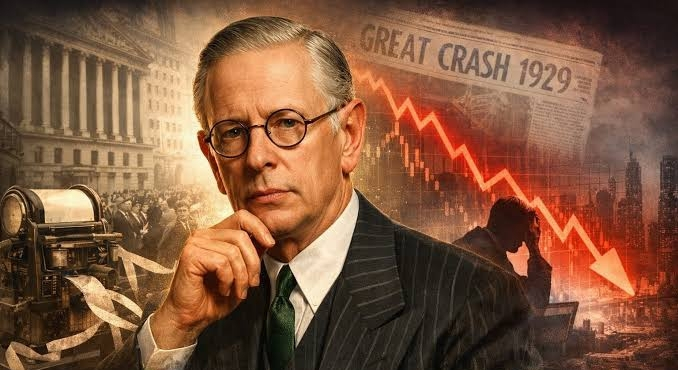
📉 The Boy Plunger: Jesse Livermore’s Struggle from $5 to $100 Million... and Back to Nothing 🎢He made $100 million in a single week—in 1929 dollars. He was the original "Wolf of Wall Street," the inspiration for the greatest trading book ever written, and a man who beat the market so often that brokers banned him just for walking in.
But Jesse Livermore died with a bullet in his head in a hotel coatroom, leaving a suicide note that read: "My life has been a failure."
This is the story of his struggle. A story of genius, greed, and the demons that destroy a trader from within. 🧵👇
🌱 The Runaway: A Boy Against the World (1877-1892)
Jesse Lauriston Livermore was born in 1877 to a poverty-stricken farming family in Shrewsbury, Massachusetts . His father was a harsh man who pulled him out of school at age 14, handing him a plow and telling him farming was his future .
But Jesse was different. He had taught himself to read and write by age three and a half . He hated the farm.
With just $5 from his mother, he ran away from home .
He landed in Boston and talked his way into a job at Paine Webber as a "board boy"—a kid who chalked stock prices on a blackboard for $5 a week . That was his first classroom.
🎯 The Bucket Shops: First Taste of Blood (1892-1900)
Livermore didn't just write down numbers; he felt them. He noticed patterns in the way prices moved.
At age 15, he took his $5 savings to a nearby "bucket shop"—a gambling den disguised as a brokerage where you bet on stock prices without actually owning the stock .
His first trade was 5 shares of Chicago, Burlington and Quincy Railroad. He made $3.12 .
He never looked back.
· By 16, he was making $200 a week (more than 10x his salary) .
· By 20, he had accumulated $10,000 in trading profits .
He was too good. The bucket shops banned him. He would put on disguises—hats, fake beards—to get back in. They banned him again. Boston was finished for him .
The Struggle Begins: He had mastered the "game," but he was now a marked man. He had to move to the big leagues: Wall Street.
🗽 New York: The First Reality Check (1901-1906)
Livermore moved to New York at 23, confident he would fleece the real stock market the same way .
He failed. Miserably.
In the bucket shops, you bet against the house. In New York, you bet against the tape, which was 30-40 minutes delayed . He lost his entire $10,000 stake in days.
He later wrote: "I was so sure of my system. But the moment I got to New York, my system stopped working. I was a plunger who didn't understand the machinery."
He had to borrow $2,000 from a friend and slink back to St. Louis to trade in bucket shops just to rebuild his stake . It was his first major bankruptcy, but not his last.
🏦 The Big Score: The Panic of 1907 (Age 30)
Livermore rebuilt. He learned the machinery.
In 1906, he did something that seemed insane. While vacationing in Palm Beach, he got a "hunch" and shorted Union Pacific Railroad . The next day, the San Francisco earthquake struck. The market collapsed. He made $250,000 overnight .
But his masterpiece was the Panic of 1907.
He saw the market was over-leveraged. He began aggressively shorting.
On one single day in October 1907, he was $1 million in profit .
At the peak of the panic, the legendary banker J.P. Morgan himself sent word to Livermore: Stop selling, or the entire system will collapse .
Livermore agreed. He covered his shorts and started buying. The market recovered.
He was 30 years old. He was worth $3 million and owned a yacht .
But the struggle wasn't over. He was invincible. Or so he thought.
💔 The Fall: Listening to "Tips" (1908-1915)
In 1908, a famous cotton trader named Teddy Price approached him. Price had a "sure thing" on cotton .
Livermore, the man who never took tips, broke his own rule.
He went all-in on cotton based on Price's advice. Meanwhile, Price was secretly selling his own holdings .
Cotton collapsed. Livermore lost his entire fortune. By 1915, he was bankrupt for the second time, with debts of over $2 million .
He later reflected: "It cost me millions of dollars to realize that another dangerous enemy for a trader is the magnetic personality of a persuasive, talented individual."
He was broken. He had to sell his yacht. The brokers wouldn't lend to him.
The Comeback (1915)
In one of the most famous trades in history, a friend gave him one chance: 500 shares of Bethlehem Steel .
Livermore waited. He watched. For six weeks, he did nothing.
Finally, the price broke out. He bought. He held. He pyramided.
By 1917, he had not only paid off his **$2 million in debts** (with interest), but he also bought a $1 million Liberty Bond .
👑 The Crown: The 1929 Crash (Age 52)
The Roaring Twenties. Everyone was rich. Everyone was buying stocks on margin.
Livermore was suspicious. He saw the rot. In early 1929, he began building a massive short position—so massive he used over 100 different brokers to hide his tracks .
On paper, he was down $6 million by spring. The market kept going up. The pressure was immense .
Then came Black Thursday (Oct 24) and Black Tuesday (Oct 29, 1929).
The market collapsed.
When the dust settled, Jesse Livermore had netted approximately $100 million . Adjusted for inflation, that is the equivalent of several billion dollars today . He controlled 1% of the entire U.S. GDP in his trading account.
He was the "Great Bear of Wall Street." He was a living legend .
🌑 The Long Dark: The Struggle Within (1930-1940)
But the money didn't fix him.
Personal Life Crumbles:
· His second wife, Dorothy, a Ziegfeld girl he loved deeply, divorced him in 1932, taking a $10 million settlement .
· In 1935, his ex-wife shot his eldest son, Jesse Jr. (who survived) .
· He married a third time, but the joy was gone.
Professional World Changes:
The SEC was formed. New rules made the "wild west" style of trading he mastered much harder .
The Markets Change:
He lost his rhythm. He later admitted he couldn't adapt to the new regulatory environment. By 1934, he filed for bankruptcy for the third time. Assets: $184,000. Liabilities: $2.5 million .
The Time Magazine headline simply read: "Business: Fourth Down."
He wasn't broke in the sense of being poor—he had trust funds for his family. But he was spiritually bankrupt. He had lost his purpose.
🔫 The Final Trade: November 28, 1940
At 5:30 PM on Thanksgiving Day, Jesse Livermore walked into the cloakroom of the Sherry-Netherland Hotel in Manhattan.
He sat down. He took out a Colt automatic pistol.
He wrote an 8-page letter to his wife, Harriet. The final note read:
"Cant help it. Things have been bad with me. I am tired of fighting. It is no use. This is the only way out. I am unworthy of your love. I am a failure. I am truly sorry."
He put the gun to his head and pulled the trigger. He was 63 years old .
His son later also committed suicide. So did his grandson .
📖 The Legacy: What Livermore Teaches Us
Jesse Livermore wasn't a failure. He was a genius who documented the psychology of trading better than anyone in history. His book, Reminiscences of a Stock Operator, is still mandatory reading on Wall Street and in crypto trading floors today.
His struggle teaches us the immutable laws of the game:
1. "It was never my thinking that made the big money. It was my sitting." (Let winners run)
2. "Losses never bother me after I take them. I forget them overnight. But being wrong—not taking the loss—that is what damages the soul and the purse." (Cut losses fast)
3. "There is a time to go long, a time to go short, and a time to go fishing." (Patience)
4. "The speculator’s chief enemies are always boring from within." (The battle is psychological)
💡 The Crypto Connection
Livermore's story is not ancient history. It is playing out right now on Binance Futures.
Every time you:
· Average down on a losing altcoin hoping it will "come back" (that's Livermore's fatal mistake).
· Take a tip from an influencer without doing your own research (that's Teddy Price).
· Refuse to cut a loss because you "believe in the project" (that's hope killing your account).
You are reliving Jesse Livermore's struggle.
He mastered the market, but he never mastered himself.
Was Jesse Livermore a cautionary tale or an inspiration? Do you think a trader today can avoid his fate? Drop your thoughts below. 👇
#tradingpsychology #CryptoHistory #Binance #WallStreet
📉 The Boy Plunger: Jesse Livermore’s Struggle from $5 to $100 Million... and Back to Nothing 🎢
He made $100 million in a single week—in 1929 dollars. He was the original "Wolf of Wall Street," the inspiration for the greatest trading book ever written, and a man who beat the market so often that brokers banned him just for walking in.
But Jesse Livermore died with a bullet in his head in a hotel coatroom, leaving a suicide note that read: "My life has been a failure."
This is the story of his struggle. A story of genius, greed, and the demons that destroy a trader from within. 🧵👇
🌱 The Runaway: A Boy Against the World (1877-1892)
Jesse Lauriston Livermore was born in 1877 to a poverty-stricken farming family in Shrewsbury, Massachusetts . His father was a harsh man who pulled him out of school at age 14, handing him a plow and telling him farming was his future .
But Jesse was different. He had taught himself to read and write by age three and a half . He hated the farm.
With just $5 from his mother, he ran away from home .
He landed in Boston and talked his way into a job at Paine Webber as a "board boy"—a kid who chalked stock prices on a blackboard for $5 a week . That was his first classroom.
🎯 The Bucket Shops: First Taste of Blood (1892-1900)
Livermore didn't just write down numbers; he felt them. He noticed patterns in the way prices moved.
At age 15, he took his $5 savings to a nearby "bucket shop"—a gambling den disguised as a brokerage where you bet on stock prices without actually owning the stock .
His first trade was 5 shares of Chicago, Burlington and Quincy Railroad. He made $3.12 .
He never looked back.
· By 16, he was making $200 a week (more than 10x his salary) .
· By 20, he had accumulated $10,000 in trading profits .
He was too good. The bucket shops banned him. He would put on disguises—hats, fake beards—to get back in. They banned him again. Boston was finished for him .
The Struggle Begins: He had mastered the "game," but he was now a marked man. He had to move to the big leagues: Wall Street.
🗽 New York: The First Reality Check (1901-1906)
Livermore moved to New York at 23, confident he would fleece the real stock market the same way .
He failed. Miserably.
In the bucket shops, you bet against the house. In New York, you bet against the tape, which was 30-40 minutes delayed . He lost his entire $10,000 stake in days.
He later wrote: "I was so sure of my system. But the moment I got to New York, my system stopped working. I was a plunger who didn't understand the machinery."
He had to borrow $2,000 from a friend and slink back to St. Louis to trade in bucket shops just to rebuild his stake . It was his first major bankruptcy, but not his last.
🏦 The Big Score: The Panic of 1907 (Age 30)
Livermore rebuilt. He learned the machinery.
In 1906, he did something that seemed insane. While vacationing in Palm Beach, he got a "hunch" and shorted Union Pacific Railroad . The next day, the San Francisco earthquake struck. The market collapsed. He made $250,000 overnight .
But his masterpiece was the Panic of 1907.
He saw the market was over-leveraged. He began aggressively shorting.
On one single day in October 1907, he was $1 million in profit .
At the peak of the panic, the legendary banker J.P. Morgan himself sent word to Livermore: Stop selling, or the entire system will collapse .
Livermore agreed. He covered his shorts and started buying. The market recovered.
He was 30 years old. He was worth $3 million and owned a yacht .
But the struggle wasn't over. He was invincible. Or so he thought.
💔 The Fall: Listening to "Tips" (1908-1915)
In 1908, a famous cotton trader named Teddy Price approached him. Price had a "sure thing" on cotton .
Livermore, the man who never took tips, broke his own rule.
He went all-in on cotton based on Price's advice. Meanwhile, Price was secretly selling his own holdings .
Cotton collapsed. Livermore lost his entire fortune. By 1915, he was bankrupt for the second time, with debts of over $2 million .
He later reflected: "It cost me millions of dollars to realize that another dangerous enemy for a trader is the magnetic personality of a persuasive, talented individual."
He was broken. He had to sell his yacht. The brokers wouldn't lend to him.
The Comeback (1915)
In one of the most famous trades in history, a friend gave him one chance: 500 shares of Bethlehem Steel .
Livermore waited. He watched. For six weeks, he did nothing.
Finally, the price broke out. He bought. He held. He pyramided.
By 1917, he had not only paid off his **$2 million in debts** (with interest), but he also bought a $1 million Liberty Bond .
👑 The Crown: The 1929 Crash (Age 52)
The Roaring Twenties. Everyone was rich. Everyone was buying stocks on margin.
Livermore was suspicious. He saw the rot. In early 1929, he began building a massive short position—so massive he used over 100 different brokers to hide his tracks .
On paper, he was down $6 million by spring. The market kept going up. The pressure was immense .
Then came Black Thursday (Oct 24) and Black Tuesday (Oct 29, 1929).
The market collapsed.
When the dust settled, Jesse Livermore had netted approximately $100 million . Adjusted for inflation, that is the equivalent of several billion dollars today . He controlled 1% of the entire U.S. GDP in his trading account.
He was the "Great Bear of Wall Street." He was a living legend .
🌑 The Long Dark: The Struggle Within (1930-1940)
But the money didn't fix him.
Personal Life Crumbles:
· His second wife, Dorothy, a Ziegfeld girl he loved deeply, divorced him in 1932, taking a $10 million settlement .
· In 1935, his ex-wife shot his eldest son, Jesse Jr. (who survived) .
· He married a third time, but the joy was gone.
Professional World Changes:
The SEC was formed. New rules made the "wild west" style of trading he mastered much harder .
The Markets Change:
He lost his rhythm. He later admitted he couldn't adapt to the new regulatory environment. By 1934, he filed for bankruptcy for the third time. Assets: $184,000. Liabilities: $2.5 million .
The Time Magazine headline simply read: "Business: Fourth Down."
He wasn't broke in the sense of being poor—he had trust funds for his family. But he was spiritually bankrupt. He had lost his purpose.
🔫 The Final Trade: November 28, 1940
At 5:30 PM on Thanksgiving Day, Jesse Livermore walked into the cloakroom of the Sherry-Netherland Hotel in Manhattan.
He sat down. He took out a Colt automatic pistol.
He wrote an 8-page letter to his wife, Harriet. The final note read:
"Cant help it. Things have been bad with me. I am tired of fighting. It is no use. This is the only way out. I am unworthy of your love. I am a failure. I am truly sorry."
He put the gun to his head and pulled the trigger. He was 63 years old .
His son later also committed suicide. So did his grandson .
📖 The Legacy: What Livermore Teaches Us
Jesse Livermore wasn't a failure. He was a genius who documented the psychology of trading better than anyone in history. His book, Reminiscences of a Stock Operator, is still mandatory reading on Wall Street and in crypto trading floors today.
His struggle teaches us the immutable laws of the game:
1. "It was never my thinking that made the big money. It was my sitting." (Let winners run)
2. "Losses never bother me after I take them. I forget them overnight. But being wrong—not taking the loss—that is what damages the soul and the purse." (Cut losses fast)
3. "There is a time to go long, a time to go short, and a time to go fishing." (Patience)
4. "The speculator’s chief enemies are always boring from within." (The battle is psychological)
💡 The Crypto Connection
Livermore's story is not ancient history. It is playing out right now on Binance Futures.
Every time you:
· Average down on a losing altcoin hoping it will "come back" (that's Livermore's fatal mistake).
· Take a tip from an influencer without doing your own research (that's Teddy Price).
· Refuse to cut a loss because you "believe in the project" (that's hope killing your account).
You are reliving Jesse Livermore's struggle.
He mastered the market, but he never mastered himself.
Was Jesse Livermore a cautionary tale or an inspiration? Do you think a trader today can avoid his fate? Drop your thoughts below. 👇
#tradingpsychology #CryptoHistory #Binance #WallStreet
But Jesse Livermore died with a bullet in his head in a hotel coatroom, leaving a suicide note that read: "My life has been a failure."
This is the story of his struggle. A story of genius, greed, and the demons that destroy a trader from within. 🧵👇
🌱 The Runaway: A Boy Against the World (1877-1892)
Jesse Lauriston Livermore was born in 1877 to a poverty-stricken farming family in Shrewsbury, Massachusetts . His father was a harsh man who pulled him out of school at age 14, handing him a plow and telling him farming was his future .
But Jesse was different. He had taught himself to read and write by age three and a half . He hated the farm.
With just $5 from his mother, he ran away from home .
He landed in Boston and talked his way into a job at Paine Webber as a "board boy"—a kid who chalked stock prices on a blackboard for $5 a week . That was his first classroom.
🎯 The Bucket Shops: First Taste of Blood (1892-1900)
Livermore didn't just write down numbers; he felt them. He noticed patterns in the way prices moved.
At age 15, he took his $5 savings to a nearby "bucket shop"—a gambling den disguised as a brokerage where you bet on stock prices without actually owning the stock .
His first trade was 5 shares of Chicago, Burlington and Quincy Railroad. He made $3.12 .
He never looked back.
· By 16, he was making $200 a week (more than 10x his salary) .
· By 20, he had accumulated $10,000 in trading profits .
He was too good. The bucket shops banned him. He would put on disguises—hats, fake beards—to get back in. They banned him again. Boston was finished for him .
The Struggle Begins: He had mastered the "game," but he was now a marked man. He had to move to the big leagues: Wall Street.
🗽 New York: The First Reality Check (1901-1906)
Livermore moved to New York at 23, confident he would fleece the real stock market the same way .
He failed. Miserably.
In the bucket shops, you bet against the house. In New York, you bet against the tape, which was 30-40 minutes delayed . He lost his entire $10,000 stake in days.
He later wrote: "I was so sure of my system. But the moment I got to New York, my system stopped working. I was a plunger who didn't understand the machinery."
He had to borrow $2,000 from a friend and slink back to St. Louis to trade in bucket shops just to rebuild his stake . It was his first major bankruptcy, but not his last.
🏦 The Big Score: The Panic of 1907 (Age 30)
Livermore rebuilt. He learned the machinery.
In 1906, he did something that seemed insane. While vacationing in Palm Beach, he got a "hunch" and shorted Union Pacific Railroad . The next day, the San Francisco earthquake struck. The market collapsed. He made $250,000 overnight .
But his masterpiece was the Panic of 1907.
He saw the market was over-leveraged. He began aggressively shorting.
On one single day in October 1907, he was $1 million in profit .
At the peak of the panic, the legendary banker J.P. Morgan himself sent word to Livermore: Stop selling, or the entire system will collapse .
Livermore agreed. He covered his shorts and started buying. The market recovered.
He was 30 years old. He was worth $3 million and owned a yacht .
But the struggle wasn't over. He was invincible. Or so he thought.
💔 The Fall: Listening to "Tips" (1908-1915)
In 1908, a famous cotton trader named Teddy Price approached him. Price had a "sure thing" on cotton .
Livermore, the man who never took tips, broke his own rule.
He went all-in on cotton based on Price's advice. Meanwhile, Price was secretly selling his own holdings .
Cotton collapsed. Livermore lost his entire fortune. By 1915, he was bankrupt for the second time, with debts of over $2 million .
He later reflected: "It cost me millions of dollars to realize that another dangerous enemy for a trader is the magnetic personality of a persuasive, talented individual."
He was broken. He had to sell his yacht. The brokers wouldn't lend to him.
The Comeback (1915)
In one of the most famous trades in history, a friend gave him one chance: 500 shares of Bethlehem Steel .
Livermore waited. He watched. For six weeks, he did nothing.
Finally, the price broke out. He bought. He held. He pyramided.
By 1917, he had not only paid off his **$2 million in debts** (with interest), but he also bought a $1 million Liberty Bond .
👑 The Crown: The 1929 Crash (Age 52)
The Roaring Twenties. Everyone was rich. Everyone was buying stocks on margin.
Livermore was suspicious. He saw the rot. In early 1929, he began building a massive short position—so massive he used over 100 different brokers to hide his tracks .
On paper, he was down $6 million by spring. The market kept going up. The pressure was immense .
Then came Black Thursday (Oct 24) and Black Tuesday (Oct 29, 1929).
The market collapsed.
When the dust settled, Jesse Livermore had netted approximately $100 million . Adjusted for inflation, that is the equivalent of several billion dollars today . He controlled 1% of the entire U.S. GDP in his trading account.
He was the "Great Bear of Wall Street." He was a living legend .
🌑 The Long Dark: The Struggle Within (1930-1940)
But the money didn't fix him.
Personal Life Crumbles:
· His second wife, Dorothy, a Ziegfeld girl he loved deeply, divorced him in 1932, taking a $10 million settlement .
· In 1935, his ex-wife shot his eldest son, Jesse Jr. (who survived) .
· He married a third time, but the joy was gone.
Professional World Changes:
The SEC was formed. New rules made the "wild west" style of trading he mastered much harder .
The Markets Change:
He lost his rhythm. He later admitted he couldn't adapt to the new regulatory environment. By 1934, he filed for bankruptcy for the third time. Assets: $184,000. Liabilities: $2.5 million .
The Time Magazine headline simply read: "Business: Fourth Down."
He wasn't broke in the sense of being poor—he had trust funds for his family. But he was spiritually bankrupt. He had lost his purpose.
🔫 The Final Trade: November 28, 1940
At 5:30 PM on Thanksgiving Day, Jesse Livermore walked into the cloakroom of the Sherry-Netherland Hotel in Manhattan.
He sat down. He took out a Colt automatic pistol.
He wrote an 8-page letter to his wife, Harriet. The final note read:
"Cant help it. Things have been bad with me. I am tired of fighting. It is no use. This is the only way out. I am unworthy of your love. I am a failure. I am truly sorry."
He put the gun to his head and pulled the trigger. He was 63 years old .
His son later also committed suicide. So did his grandson .
📖 The Legacy: What Livermore Teaches Us
Jesse Livermore wasn't a failure. He was a genius who documented the psychology of trading better than anyone in history. His book, Reminiscences of a Stock Operator, is still mandatory reading on Wall Street and in crypto trading floors today.
His struggle teaches us the immutable laws of the game:
1. "It was never my thinking that made the big money. It was my sitting." (Let winners run)
2. "Losses never bother me after I take them. I forget them overnight. But being wrong—not taking the loss—that is what damages the soul and the purse." (Cut losses fast)
3. "There is a time to go long, a time to go short, and a time to go fishing." (Patience)
4. "The speculator’s chief enemies are always boring from within." (The battle is psychological)
💡 The Crypto Connection
Livermore's story is not ancient history. It is playing out right now on Binance Futures.
Every time you:
· Average down on a losing altcoin hoping it will "come back" (that's Livermore's fatal mistake).
· Take a tip from an influencer without doing your own research (that's Teddy Price).
· Refuse to cut a loss because you "believe in the project" (that's hope killing your account).
You are reliving Jesse Livermore's struggle.
He mastered the market, but he never mastered himself.
Was Jesse Livermore a cautionary tale or an inspiration? Do you think a trader today can avoid his fate? Drop your thoughts below. 👇
#tradingpsychology #CryptoHistory #Binance #WallStreet
1
24
Мақала
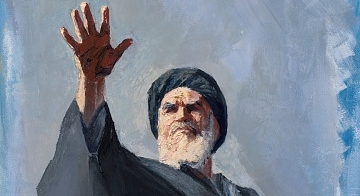
🕯️ From Exile to Icon: The Life and Legacy of Ayatollah Khomeini 🇮🇷He was a figure who reshaped the Middle East, defied superpowers, and sparked a revolution that still echoes today. Love him or hate him, Ayatollah Ruhollah Khomeini’s journey from a small town to the pinnacle of political and religious power is one of the most dramatic stories of the 20th century.
Let’s take a look at the key chapters of his life. 🧵👇
🌱 Early Life: The Making of a Scholar (1902-1962)
Born in 1902 in Khomeyn, Iran, Ruhollah Musavi came from a family of religious scholars . He lost his father at a young age and was raised by his mother (who also passed away when he was 15) and aunts . He immersed himself in Islamic theology, studying in the holy cities of Arak and Qom, where he eventually became a respected teacher and scholar, earning the title of "Ayatollah" .
⚔️ The Rebel: Defying the Shah (1963-1978)
Khomeini’s political fire ignited in the 1960s. He fiercely opposed the "White Revolution"—the reform program of Shah Mohammad Reza Pahlavi, which he saw as a dangerous Westernization and a threat to Islam .
· 1963: A provocative speech against the Shah led to his arrest, sparking massive riots and elevating him to a national hero of the opposition .
· Exile: In 1964, he was sent into exile—first to Turkey, then to Iraq’s holy city of Najaf, and finally to France .
· Even from abroad, his voice wasn't silenced. His speeches were recorded on cassette tapes and smuggled into Iran, spreading his revolutionary message to the masses .
✈️ The Triumphant Return: The 1979 Revolution
In January 1979, as millions took to the streets, the Shah fled Iran .
On February 1, 1979, Khomeini returned to Tehran after 15 years in exile. He was greeted by millions of ecstatic supporters—one of the largest gatherings in human history .
Within weeks, the monarchy was overthrown, and after a national referendum, the Islamic Republic of Iran was born, with Khomeini as its first Supreme Leader .
🔥 The Revolutionary Leader: War and Controversy (1979-1989)
Khomeini’s decade as Supreme Leader was defined by seismic events:
· The Hostage Crisis: In November 1979, his supporters stormed the US Embassy in Tehran, holding 52 Americans hostage for 444 days .
· The Iran-Iraq War: A brutal 8-year war with neighboring Iraq (1980-1988) that killed hundreds of thousands and cemented a narrative of sacrifice and defiance .
· The Satanic Verses Fatwa: In 1989, he issued a religious edict (fatwa) calling for the death of author Salman Rushdie, igniting a global controversy .
🕊️ The Final Chapter: A Funeral Like No Other (1989)
On June 3, 1989, Ayatollah Khomeini passed away at the age of 86 .
His funeral was a scene of chaotic, hysterical grief.
· Over 10 million mourners flooded the streets of Tehran—so many that his body had to be airlifted by helicopter when the crowd surged out of control .
· People desperately grabbed pieces of his burial shroud, believing it to be blessed .
🤔 A Complicated Legacy
Khomeini changed Iran forever. He introduced the theory of Velayat-e faqih (Guardianship of the Islamic Jurist), a system where clerics hold ultimate political authority . He gave a voice to the disenfranchised and stood up to the West, but his reign was also marked by strict social codes, executions, and international isolation .
Thirty years after his death, his image still dominates public squares in Iran. To some, he is the father of a renewed Islamic identity. To others, he is a symbol of a revolution whose promises of prosperity remain unfulfilled .
What are your thoughts on the impact of the 1979 Revolution? Drop a comment below. 👇
#AyatollahKhomeini #IranHistory #MiddleEast #HISTORY #Revolution $XRP
{future}(XRPUSDT)
🕯️ From Exile to Icon: The Life and Legacy of Ayatollah Khomeini 🇮🇷
He was a figure who reshaped the Middle East, defied superpowers, and sparked a revolution that still echoes today. Love him or hate him, Ayatollah Ruhollah Khomeini’s journey from a small town to the pinnacle of political and religious power is one of the most dramatic stories of the 20th century.
Let’s take a look at the key chapters of his life. 🧵👇
🌱 Early Life: The Making of a Scholar (1902-1962)
Born in 1902 in Khomeyn, Iran, Ruhollah Musavi came from a family of religious scholars . He lost his father at a young age and was raised by his mother (who also passed away when he was 15) and aunts . He immersed himself in Islamic theology, studying in the holy cities of Arak and Qom, where he eventually became a respected teacher and scholar, earning the title of "Ayatollah" .
⚔️ The Rebel: Defying the Shah (1963-1978)
Khomeini’s political fire ignited in the 1960s. He fiercely opposed the "White Revolution"—the reform program of Shah Mohammad Reza Pahlavi, which he saw as a dangerous Westernization and a threat to Islam .
· 1963: A provocative speech against the Shah led to his arrest, sparking massive riots and elevating him to a national hero of the opposition .
· Exile: In 1964, he was sent into exile—first to Turkey, then to Iraq’s holy city of Najaf, and finally to France .
· Even from abroad, his voice wasn't silenced. His speeches were recorded on cassette tapes and smuggled into Iran, spreading his revolutionary message to the masses .
✈️ The Triumphant Return: The 1979 Revolution
In January 1979, as millions took to the streets, the Shah fled Iran .
On February 1, 1979, Khomeini returned to Tehran after 15 years in exile. He was greeted by millions of ecstatic supporters—one of the largest gatherings in human history .
Within weeks, the monarchy was overthrown, and after a national referendum, the Islamic Republic of Iran was born, with Khomeini as its first Supreme Leader .
🔥 The Revolutionary Leader: War and Controversy (1979-1989)
Khomeini’s decade as Supreme Leader was defined by seismic events:
· The Hostage Crisis: In November 1979, his supporters stormed the US Embassy in Tehran, holding 52 Americans hostage for 444 days .
· The Iran-Iraq War: A brutal 8-year war with neighboring Iraq (1980-1988) that killed hundreds of thousands and cemented a narrative of sacrifice and defiance .
· The Satanic Verses Fatwa: In 1989, he issued a religious edict (fatwa) calling for the death of author Salman Rushdie, igniting a global controversy .
🕊️ The Final Chapter: A Funeral Like No Other (1989)
On June 3, 1989, Ayatollah Khomeini passed away at the age of 86 .
His funeral was a scene of chaotic, hysterical grief.
· Over 10 million mourners flooded the streets of Tehran—so many that his body had to be airlifted by helicopter when the crowd surged out of control .
· People desperately grabbed pieces of his burial shroud, believing it to be blessed .
🤔 A Complicated Legacy
Khomeini changed Iran forever. He introduced the theory of Velayat-e faqih (Guardianship of the Islamic Jurist), a system where clerics hold ultimate political authority . He gave a voice to the disenfranchised and stood up to the West, but his reign was also marked by strict social codes, executions, and international isolation .
Thirty years after his death, his image still dominates public squares in Iran. To some, he is the father of a renewed Islamic identity. To others, he is a symbol of a revolution whose promises of prosperity remain unfulfilled .
What are your thoughts on the impact of the 1979 Revolution? Drop a comment below. 👇
#AyatollahKhomeini #IranHistory #MiddleEast #HISTORY #Revolution $XRP
Let’s take a look at the key chapters of his life. 🧵👇
🌱 Early Life: The Making of a Scholar (1902-1962)
Born in 1902 in Khomeyn, Iran, Ruhollah Musavi came from a family of religious scholars . He lost his father at a young age and was raised by his mother (who also passed away when he was 15) and aunts . He immersed himself in Islamic theology, studying in the holy cities of Arak and Qom, where he eventually became a respected teacher and scholar, earning the title of "Ayatollah" .
⚔️ The Rebel: Defying the Shah (1963-1978)
Khomeini’s political fire ignited in the 1960s. He fiercely opposed the "White Revolution"—the reform program of Shah Mohammad Reza Pahlavi, which he saw as a dangerous Westernization and a threat to Islam .
· 1963: A provocative speech against the Shah led to his arrest, sparking massive riots and elevating him to a national hero of the opposition .
· Exile: In 1964, he was sent into exile—first to Turkey, then to Iraq’s holy city of Najaf, and finally to France .
· Even from abroad, his voice wasn't silenced. His speeches were recorded on cassette tapes and smuggled into Iran, spreading his revolutionary message to the masses .
✈️ The Triumphant Return: The 1979 Revolution
In January 1979, as millions took to the streets, the Shah fled Iran .
On February 1, 1979, Khomeini returned to Tehran after 15 years in exile. He was greeted by millions of ecstatic supporters—one of the largest gatherings in human history .
Within weeks, the monarchy was overthrown, and after a national referendum, the Islamic Republic of Iran was born, with Khomeini as its first Supreme Leader .
🔥 The Revolutionary Leader: War and Controversy (1979-1989)
Khomeini’s decade as Supreme Leader was defined by seismic events:
· The Hostage Crisis: In November 1979, his supporters stormed the US Embassy in Tehran, holding 52 Americans hostage for 444 days .
· The Iran-Iraq War: A brutal 8-year war with neighboring Iraq (1980-1988) that killed hundreds of thousands and cemented a narrative of sacrifice and defiance .
· The Satanic Verses Fatwa: In 1989, he issued a religious edict (fatwa) calling for the death of author Salman Rushdie, igniting a global controversy .
🕊️ The Final Chapter: A Funeral Like No Other (1989)
On June 3, 1989, Ayatollah Khomeini passed away at the age of 86 .
His funeral was a scene of chaotic, hysterical grief.
· Over 10 million mourners flooded the streets of Tehran—so many that his body had to be airlifted by helicopter when the crowd surged out of control .
· People desperately grabbed pieces of his burial shroud, believing it to be blessed .
🤔 A Complicated Legacy
Khomeini changed Iran forever. He introduced the theory of Velayat-e faqih (Guardianship of the Islamic Jurist), a system where clerics hold ultimate political authority . He gave a voice to the disenfranchised and stood up to the West, but his reign was also marked by strict social codes, executions, and international isolation .
Thirty years after his death, his image still dominates public squares in Iran. To some, he is the father of a renewed Islamic identity. To others, he is a symbol of a revolution whose promises of prosperity remain unfulfilled .
What are your thoughts on the impact of the 1979 Revolution? Drop a comment below. 👇
#AyatollahKhomeini #IranHistory #MiddleEast #HISTORY #Revolution $XRP
1
44
AI is evolving fast, but can we really trust it? 🧠
Major models still hallucinate with ~75% accuracy—risky for finance, healthcare, and daily decisions. @mira_network solves this with on-chain verification, boosting accuracy to 96% while slashing errors by 90% .
Backed by top VCs and just listed on Binance Alpha, $MIRA is becoming the trust layer for the entire AI economy .
The real question isn't if AI needs verification—it's whether you're positioned for it.
Are you buying $MIRA or still deciding? 🗳️
#Mira $MIRA #trending
{future}(MIRAUSDT)
AI is evolving fast, but can we really trust it? 🧠
Major models still hallucinate with ~75% accuracy—risky for finance, healthcare, and daily decisions. @Mira - Trust Layer of AI solves this with on-chain verification, boosting accuracy to 96% while slashing errors by 90% .
Backed by top VCs and just listed on Binance Alpha, $MIRA is becoming the trust layer for the entire AI economy .
The real question isn't if AI needs verification—it's whether you're positioned for it.
Are you buying $MIRA or still deciding? 🗳️
#Mira $MIRA #trending
Major models still hallucinate with ~75% accuracy—risky for finance, healthcare, and daily decisions. @Mira - Trust Layer of AI solves this with on-chain verification, boosting accuracy to 96% while slashing errors by 90% .
Backed by top VCs and just listed on Binance Alpha, $MIRA is becoming the trust layer for the entire AI economy .
The real question isn't if AI needs verification—it's whether you're positioned for it.
Are you buying $MIRA or still deciding? 🗳️
#Mira $MIRA #trending
1
13
The Dawn of the Robot Economy: Why @FabricFoundation is Building the Financial Layer for Autonomous.We often discuss Artificial Intelligence as software, but its ultimate physical manifestation is robotics. However, as highlighted in recent industry analyses, the robotics industry faces a critical bottleneck: robots are isolated tools without a financial identity . They cannot pay for electricity, lease themselves out, or own their maintenance contracts. This is the exact gap that @FabricFND Foundation is solving with the ROBO token.
Fabric is constructing an Agent-native infrastructure layer, moving beyond simple automation to create a verifiable and collaborative economy for machines . By leveraging blockchain’s immutability, they introduce Verifiable Computing to ensure robotic actions are trustworthy—a necessity for both industrial safety and home deployment .
**The Economic Engine: ROBO**
The token isn't just a speculative asset; it is the utility and governance fuel for this ecosystem . Unlike passive staking models, ROBO rewards are earned exclusively through Verified Contribution—whether that’s providing GPU compute, developing modular "Skill Chips" (like apps for robots), or validating network tasks . This creates a decentralized physical infrastructure network (DePIN) where anyone can contribute to and benefit from the robotics revolution .
Recent Milestones
The momentum is tangible. Recently, @FabricFoundation launched its first "Titan" project in partnership with Virtuals Protocol, designed to grant robots a direct on-chain financial identity via the ROBO token on the Base chain . This isn't just another listing; it is a strategic move to close the loop between AI intelligence and physical execution.
As we stand on the brink of a world filled with general-purpose robots, the question is no longer if machines will work alongside us, but how they will participate in our economy. @FabricFoundation is ensuring that participation is open, decentralized, and aligned with human incentive. The era of isolated machines has ended; the era of autonomous economic agents has begun. #ROBO #squqre #cz 🤖
$ROBO
{future}(ROBOUSDT)
$XRP
{future}(XRPUSDT)
$BTC
{future}(BTCUSDT)
The Dawn of the Robot Economy: Why @FabricFoundation is Building the Financial Layer for Autonomous.
We often discuss Artificial Intelligence as software, but its ultimate physical manifestation is robotics. However, as highlighted in recent industry analyses, the robotics industry faces a critical bottleneck: robots are isolated tools without a financial identity . They cannot pay for electricity, lease themselves out, or own their maintenance contracts. This is the exact gap that @Fabric Foundation Foundation is solving with the ROBO token.
Fabric is constructing an Agent-native infrastructure layer, moving beyond simple automation to create a verifiable and collaborative economy for machines . By leveraging blockchain’s immutability, they introduce Verifiable Computing to ensure robotic actions are trustworthy—a necessity for both industrial safety and home deployment .
**The Economic Engine: ROBO**
The token isn't just a speculative asset; it is the utility and governance fuel for this ecosystem . Unlike passive staking models, ROBO rewards are earned exclusively through Verified Contribution—whether that’s providing GPU compute, developing modular "Skill Chips" (like apps for robots), or validating network tasks . This creates a decentralized physical infrastructure network (DePIN) where anyone can contribute to and benefit from the robotics revolution .
Recent Milestones
The momentum is tangible. Recently, @FabricFoundation launched its first "Titan" project in partnership with Virtuals Protocol, designed to grant robots a direct on-chain financial identity via the ROBO token on the Base chain . This isn't just another listing; it is a strategic move to close the loop between AI intelligence and physical execution.
As we stand on the brink of a world filled with general-purpose robots, the question is no longer if machines will work alongside us, but how they will participate in our economy. @FabricFoundation is ensuring that participation is open, decentralized, and aligned with human incentive. The era of isolated machines has ended; the era of autonomous economic agents has begun. #ROBO #squqre #cz 🤖
$ROBO
$XRP
$BTC
Fabric is constructing an Agent-native infrastructure layer, moving beyond simple automation to create a verifiable and collaborative economy for machines . By leveraging blockchain’s immutability, they introduce Verifiable Computing to ensure robotic actions are trustworthy—a necessity for both industrial safety and home deployment .
**The Economic Engine: ROBO**
The token isn't just a speculative asset; it is the utility and governance fuel for this ecosystem . Unlike passive staking models, ROBO rewards are earned exclusively through Verified Contribution—whether that’s providing GPU compute, developing modular "Skill Chips" (like apps for robots), or validating network tasks . This creates a decentralized physical infrastructure network (DePIN) where anyone can contribute to and benefit from the robotics revolution .
Recent Milestones
The momentum is tangible. Recently, @FabricFoundation launched its first "Titan" project in partnership with Virtuals Protocol, designed to grant robots a direct on-chain financial identity via the ROBO token on the Base chain . This isn't just another listing; it is a strategic move to close the loop between AI intelligence and physical execution.
As we stand on the brink of a world filled with general-purpose robots, the question is no longer if machines will work alongside us, but how they will participate in our economy. @FabricFoundation is ensuring that participation is open, decentralized, and aligned with human incentive. The era of isolated machines has ended; the era of autonomous economic agents has begun. #ROBO #squqre #cz 🤖
$ROBO
$XRP
$BTC
2
66
As the world watches old powers clash 🌍⚔️, the future isn't about choosing sides in a war between Iran and America—it's about choosing a new system altogether. 🚀
Will we remain trapped in geopolitical conflict, or will we embrace decentralized technology as the ultimate path to sovereignty? 🔗✨
@FabricFND is building the infrastructure for this new reality, and $ROBO
{future}(ROBOUSDT)
is the key. 🔑
Cast your vote 🗳️: Which path leads to global stability?
#ROBO 🤖#AltcoinSeasonTalkTwoYearLow
As the world watches old powers clash 🌍⚔️, the future isn't about choosing sides in a war between Iran and America—it's about choosing a new system altogether. 🚀
Will we remain trapped in geopolitical conflict, or will we embrace decentralized technology as the ultimate path to sovereignty? 🔗✨
@Fabric Foundation is building the infrastructure for this new reality, and $ROBO
is the key. 🔑
Cast your vote 🗳️: Which path leads to global stability?
#ROBO 🤖#AltcoinSeasonTalkTwoYearLow
Will we remain trapped in geopolitical conflict, or will we embrace decentralized technology as the ultimate path to sovereignty? 🔗✨
@Fabric Foundation is building the infrastructure for this new reality, and $ROBO
is the key. 🔑
Cast your vote 🗳️: Which path leads to global stability?
#ROBO 🤖#AltcoinSeasonTalkTwoYearLow
Iran
43%
America
57%
7 дауыс • Дауыс беру жабық
5
257
·
--
Төмен (кемімелі)
More then 45000 people are currently participated in Robo binance campaging this is due to its strong project, strong team and it's current momentum there is to much AiAi in the market it a project ith robotics just enter the market hope that 2026 might be robotics era.
#ROBO
@FabricFND $ROBO
{future}(ROBOUSDT)
More then 45000 people are currently participated in Robo binance campaging this is due to its strong project, strong team and it's current momentum there is to much AiAi in the market it a project ith robotics just enter the market hope that 2026 might be robotics era.
#ROBO
@Fabric Foundation $ROBO
#ROBO
@Fabric Foundation $ROBO
1
18
Yesterday I created poll that AI has some link with Crypto or not I get results f exact 50/50 it can be luck or what but I conclude that people r also not sure about this much AI influence in Crypto. people just find word AI in a project and connect it with something deepseek, chatgpt, or gemni but Ai in crypto is something different not that bot.@mira_network .
#Mira #AIBinance #Square $MIRA
{future}(MIRAUSDT)
$BTC
{future}(BTCUSDT)
$XRP
{future}(XRPUSDT)
Yesterday I created poll that AI has some link with Crypto or not I get results f exact 50/50 it can be luck or what but I conclude that people r also not sure about this much AI influence in Crypto. people just find word AI in a project and connect it with something deepseek, chatgpt, or gemni but Ai in crypto is something different not that bot.@Mira - Trust Layer of AI .
#Mira #AIBinance #Square $MIRA
$BTC
$XRP
#Mira #AIBinance #Square $MIRA
$BTC
$XRP
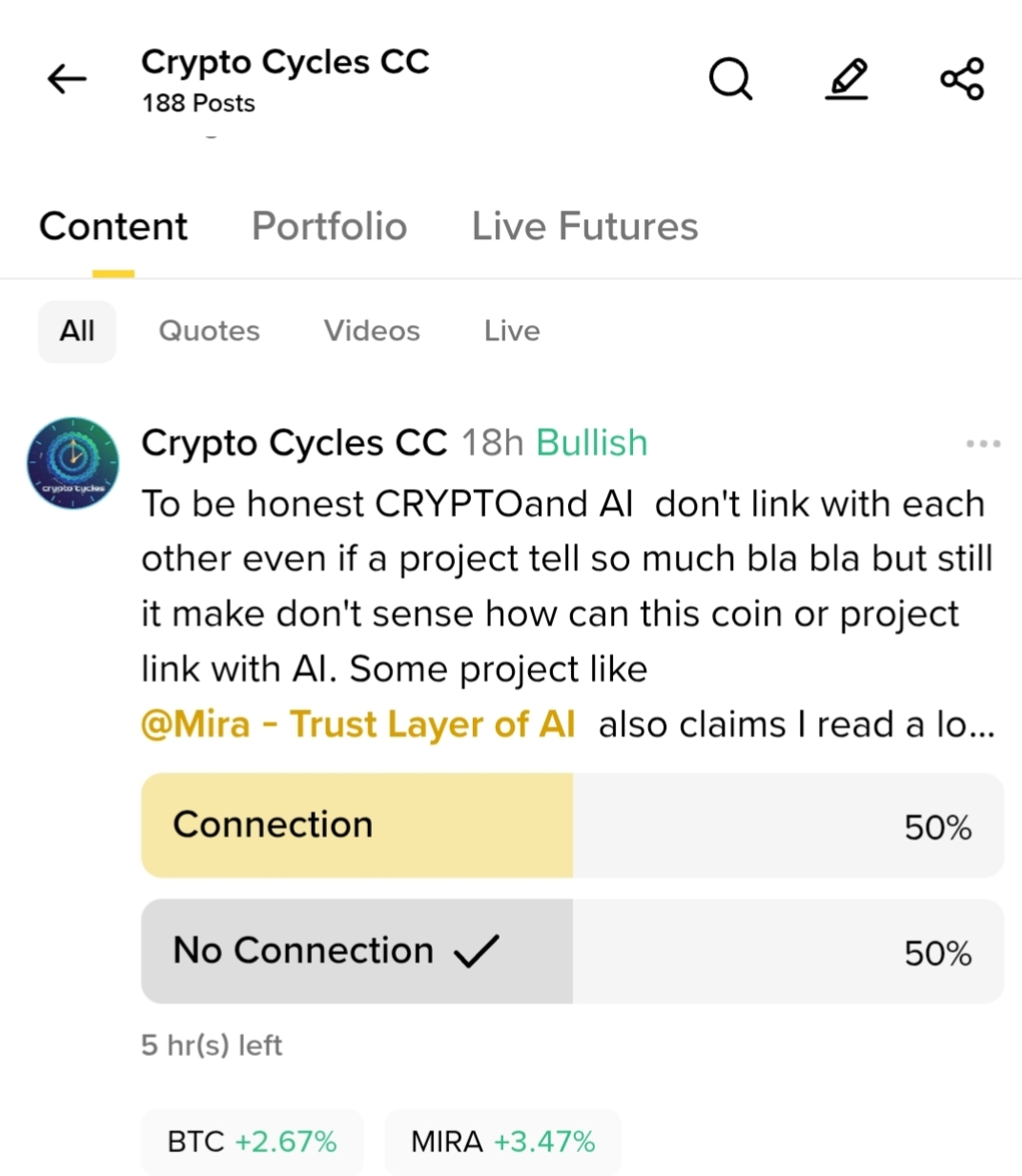
2
42
·
--
Жоғары (өспелі)
To be honest CRYPTOand AI don't link with each other even if a project tell so much bla bla but still it make don't sense how can this coin or project link with AI. Some project like @mira_network also claims I read a lot but can't figure out. May be later it make sense😅.
Vote in the poll and tell in comment if u havev some strong opinion r point that clears it.
#mira #AIBinance $MIRA
{future}(MIRAUSDT)
$BTC
{future}(BTCUSDT)
To be honest CRYPTOand AI don't link with each other even if a project tell so much bla bla but still it make don't sense how can this coin or project link with AI. Some project like @Mira - Trust Layer of AI also claims I read a lot but can't figure out. May be later it make sense😅.
Vote in the poll and tell in comment if u havev some strong opinion r point that clears it.
#mira #AIBinance $MIRA
$BTC
Vote in the poll and tell in comment if u havev some strong opinion r point that clears it.
#mira #AIBinance $MIRA
$BTC
Connection
50%
No Connection
50%
6 дауыс • Дауыс беру жабық
6
427
·
--
Жоғары (өспелі)
Robo is going up andthen stables.This project look very innovative nd new tech do u think it have some future or just pump and dump.
#ROBO #AIBinance
$ROBO
@FabricFND
{spot}(ROBOUSDT)
Robo is going up andthen stables.This project look very innovative nd new tech do u think it have some future or just pump and dump.
#ROBO #AIBinance
$ROBO
@Fabric Foundation
#ROBO #AIBinance
$ROBO
@Fabric Foundation
Good Project
70%
Weak Project
30%
113 дауыс • Дауыс беру жабық
3
6
1.9k
#XCryptoBanMistake $BTC
Btc trafing at 69,000$ going up or going down again. What do u think. Buy or wait.
{spot}(BTCUSDT)
#XCryptoBanMistake $BTC
Btc trafing at 69,000$ going up or going down again. What do u think. Buy or wait.
Btc trafing at 69,000$ going up or going down again. What do u think. Buy or wait.
2
39
Title: $ROBO Lands on Binance Futures: The On-Chain AI Economy Just Got Real.The convergence of AI, robotics, and crypto has long been a topic of speculation, but with Fabric Foundation, it is officially becoming an infrastructural reality. As someone deeply entrenched in the on-chain analysis of AI protocols, I’ve been tracking the development of OpenMind, the core contributor to the Fabric ecosystem, and their progress is nothing short of revolutionary.
Unlike projects that merely use "AI" as a buzzword, Fabric is building the definitive coordination layer for the machine economy. Their open-source operating system, OM1, acts as the "brain" for robots from leading manufacturers like Unitree and UBTECH, enabling natural language interaction and autonomous decision-making . However, the true innovation lies in FABRIC, the decentralized network powered by robo. This protocol assigns a verifiable digital identity to every device, allowing machines to establish trust, share skills, and—most importantly—transact with each other autonomously .
We are moving toward a world where a delivery drone might pay a charging station in robo tokens, or a manufacturing robot could lease its computing power to another machine during downtime. This isn't science fiction; it's the logical endpoint of Web3 infrastructure meeting physical hardware.
Why the Futures Listing Matters for Perpetual Traders
The recent listing of robo on Binance Futures injects a new layer of sophisticated liquidity into this narrative . For those of us watching the order books, this opens up strategic trading opportunities beyond simple spot accumulation.
From a technical analysis perspective, the transition to a perpetual contract market often uncovers the true market sentiment. Following the TGE, ROBO demonstrated strong fundamentals, with the token stabilizing well above its initial listing prices despite a broader market seeking direction . Now, with the perpetual market live, we can analyze funding rates to gauge whether the market is heavily skewed toward long-term believers or short-term speculators.
Currently, the market structure suggests that the "smart money" is positioning for the long haul. The core thesis remains intact: Fabric Foundation is solving the "last mile" problem of robotics by giving machines an economic identity . With geopolitical tensions highlighting supply chain vulnerabilities and the need for automated resilience, the demand for decentralized, verifiable machine coordination is likely to accelerate .
As we head into this week, keep an eye on the price action at the key support levels established on the spot market. If the volume on these new robo perpetual pairs sustains, we could see a decoupling from general market trends as the specific utility of the protocol gains recognition.
The dawn of machines as economic agents is here. Trade wisely, and never stop researching.
#ROBO #BİNANCEFUTURES #BTC🔥🔥🔥🔥🔥 #BSCProjectSpotlight #特朗普接受比特币和加密货币作为总统竞选捐赠渠道 $ROBO
{alpha}(560x475cbf5919608e0c6af00e7bf87fab83bf3ef6e2)
$BTC
{spot}(BTCUSDT)
$XRP
{future}(XRPUSDT)
Title: $ROBO Lands on Binance Futures: The On-Chain AI Economy Just Got Real.
The convergence of AI, robotics, and crypto has long been a topic of speculation, but with Fabric Foundation, it is officially becoming an infrastructural reality. As someone deeply entrenched in the on-chain analysis of AI protocols, I’ve been tracking the development of OpenMind, the core contributor to the Fabric ecosystem, and their progress is nothing short of revolutionary.
Unlike projects that merely use "AI" as a buzzword, Fabric is building the definitive coordination layer for the machine economy. Their open-source operating system, OM1, acts as the "brain" for robots from leading manufacturers like Unitree and UBTECH, enabling natural language interaction and autonomous decision-making . However, the true innovation lies in FABRIC, the decentralized network powered by robo. This protocol assigns a verifiable digital identity to every device, allowing machines to establish trust, share skills, and—most importantly—transact with each other autonomously .
We are moving toward a world where a delivery drone might pay a charging station in robo tokens, or a manufacturing robot could lease its computing power to another machine during downtime. This isn't science fiction; it's the logical endpoint of Web3 infrastructure meeting physical hardware.
Why the Futures Listing Matters for Perpetual Traders
The recent listing of robo on Binance Futures injects a new layer of sophisticated liquidity into this narrative . For those of us watching the order books, this opens up strategic trading opportunities beyond simple spot accumulation.
From a technical analysis perspective, the transition to a perpetual contract market often uncovers the true market sentiment. Following the TGE, ROBO demonstrated strong fundamentals, with the token stabilizing well above its initial listing prices despite a broader market seeking direction . Now, with the perpetual market live, we can analyze funding rates to gauge whether the market is heavily skewed toward long-term believers or short-term speculators.
Currently, the market structure suggests that the "smart money" is positioning for the long haul. The core thesis remains intact: Fabric Foundation is solving the "last mile" problem of robotics by giving machines an economic identity . With geopolitical tensions highlighting supply chain vulnerabilities and the need for automated resilience, the demand for decentralized, verifiable machine coordination is likely to accelerate .
As we head into this week, keep an eye on the price action at the key support levels established on the spot market. If the volume on these new robo perpetual pairs sustains, we could see a decoupling from general market trends as the specific utility of the protocol gains recognition.
The dawn of machines as economic agents is here. Trade wisely, and never stop researching.
#ROBO #BİNANCEFUTURES #BTC🔥🔥🔥🔥🔥 #BSCProjectSpotlight #特朗普接受比特币和加密货币作为总统竞选捐赠渠道 $ROBO
$BTC
$XRP
Unlike projects that merely use "AI" as a buzzword, Fabric is building the definitive coordination layer for the machine economy. Their open-source operating system, OM1, acts as the "brain" for robots from leading manufacturers like Unitree and UBTECH, enabling natural language interaction and autonomous decision-making . However, the true innovation lies in FABRIC, the decentralized network powered by robo. This protocol assigns a verifiable digital identity to every device, allowing machines to establish trust, share skills, and—most importantly—transact with each other autonomously .
We are moving toward a world where a delivery drone might pay a charging station in robo tokens, or a manufacturing robot could lease its computing power to another machine during downtime. This isn't science fiction; it's the logical endpoint of Web3 infrastructure meeting physical hardware.
Why the Futures Listing Matters for Perpetual Traders
The recent listing of robo on Binance Futures injects a new layer of sophisticated liquidity into this narrative . For those of us watching the order books, this opens up strategic trading opportunities beyond simple spot accumulation.
From a technical analysis perspective, the transition to a perpetual contract market often uncovers the true market sentiment. Following the TGE, ROBO demonstrated strong fundamentals, with the token stabilizing well above its initial listing prices despite a broader market seeking direction . Now, with the perpetual market live, we can analyze funding rates to gauge whether the market is heavily skewed toward long-term believers or short-term speculators.
Currently, the market structure suggests that the "smart money" is positioning for the long haul. The core thesis remains intact: Fabric Foundation is solving the "last mile" problem of robotics by giving machines an economic identity . With geopolitical tensions highlighting supply chain vulnerabilities and the need for automated resilience, the demand for decentralized, verifiable machine coordination is likely to accelerate .
As we head into this week, keep an eye on the price action at the key support levels established on the spot market. If the volume on these new robo perpetual pairs sustains, we could see a decoupling from general market trends as the specific utility of the protocol gains recognition.
The dawn of machines as economic agents is here. Trade wisely, and never stop researching.
#ROBO #BİNANCEFUTURES #BTC🔥🔥🔥🔥🔥 #BSCProjectSpotlight #特朗普接受比特币和加密货币作为总统竞选捐赠渠道 $ROBO
$BTC
$XRP
1
111
·
--
Төмен (кемімелі)
Post Content:
The shift from hype to utility is where real value is built. Mira is tackling one of AI’s biggest hurdles: verifiable inference. By decentralizing the validation of AI outputs, @mira_network ensures that what you see is actually what the model intended—no hallucinations, no black boxes.
With its unique opML technology gaining traction, Mira is positioning itself as the security layer for on-chain AI agents.
Is this the infrastructure play that bridges AI and trustless verification?
👇 Cast your vote below!
#Mira @mira_network $MIRA #IranIsraelConflict #XCryptoBanMistake
{spot}(MIRAUSDT)
$ETH
{spot}(ETHUSDT)
$AVAX
{spot}(AVAXUSDT)
Post Content:
The shift from hype to utility is where real value is built. Mira is tackling one of AI’s biggest hurdles: verifiable inference. By decentralizing the validation of AI outputs, @Mira - Trust Layer of AI ensures that what you see is actually what the model intended—no hallucinations, no black boxes.
With its unique opML technology gaining traction, Mira is positioning itself as the security layer for on-chain AI agents.
Is this the infrastructure play that bridges AI and trustless verification?
👇 Cast your vote below!
#Mira @Mira - Trust Layer of AI $MIRA #IranIsraelConflict #XCryptoBanMistake
$ETH
$AVAX
The shift from hype to utility is where real value is built. Mira is tackling one of AI’s biggest hurdles: verifiable inference. By decentralizing the validation of AI outputs, @Mira - Trust Layer of AI ensures that what you see is actually what the model intended—no hallucinations, no black boxes.
With its unique opML technology gaining traction, Mira is positioning itself as the security layer for on-chain AI agents.
Is this the infrastructure play that bridges AI and trustless verification?
👇 Cast your vote below!
#Mira @Mira - Trust Layer of AI $MIRA #IranIsraelConflict #XCryptoBanMistake
$ETH
$AVAX
Buy
33%
Sell
67%
6 дауыс • Дауыс беру жабық
4
249
·
--
Жоғары (өспелі)
Post Content:
Fabric’s robo isn’t just another token; it’s the backbone of a decentralized AI economy. By enabling verifiable computing and seamless agent-to-agent transactions, @FabricFND is solving the data integrity problem that has plagued Web3 AI.
With the testnet heating up and real-world用例 (use cases) going live, the momentum is building. Do you believe the infrastructure layer will drive the next wave of adoption, or is the market still sleeping on this tech?
👇 Drop your vote in the poll below and let’s see where the crowd stands!
#ROBO #XCryptoBanMistake #GoldSilverOilSurge $ROBO
{future}(ROBOUSDT)
@FabricFND $BTC
{spot}(BTCUSDT)
$XRP
{spot}(XRPUSDT)
Post Content:
Fabric’s robo isn’t just another token; it’s the backbone of a decentralized AI economy. By enabling verifiable computing and seamless agent-to-agent transactions, @Fabric Foundation is solving the data integrity problem that has plagued Web3 AI.
With the testnet heating up and real-world用例 (use cases) going live, the momentum is building. Do you believe the infrastructure layer will drive the next wave of adoption, or is the market still sleeping on this tech?
👇 Drop your vote in the poll below and let’s see where the crowd stands!
#ROBO #XCryptoBanMistake #GoldSilverOilSurge $ROBO
@Fabric Foundation $BTC
$XRP
Fabric’s robo isn’t just another token; it’s the backbone of a decentralized AI economy. By enabling verifiable computing and seamless agent-to-agent transactions, @Fabric Foundation is solving the data integrity problem that has plagued Web3 AI.
With the testnet heating up and real-world用例 (use cases) going live, the momentum is building. Do you believe the infrastructure layer will drive the next wave of adoption, or is the market still sleeping on this tech?
👇 Drop your vote in the poll below and let’s see where the crowd stands!
#ROBO #XCryptoBanMistake #GoldSilverOilSurge $ROBO
@Fabric Foundation $BTC
$XRP
Buy
78%
Sell
22%
18 дауыс • Дауыс беру жабық
2
566
Title: Beyond the Hype: Why Transparent AI Infrastructure Like @mira_network Could Be the Altcoin Stwe flip the calendar to March, the crypto market is holding its breath. We're entering a month packed with high-stakes events: the FOMC meeting, the potential breakthrough of the #ClarityAct in the US, and massive token unlocks that could test the mettle of many projects . While many traders are glued to Bitcoin's price action near $67k , the real opportunities are brewing in sectors that solve tangible problems—specifically, the intersection of AI and blockchain.
The buzz around AI agents is undeniable. However, the market is starting to differentiate between simple hype and projects with genuine utility . The key question isn't just "Does this use AI?", but "Can we trust the AI?"
This is where @mira_network _network enters the conversation. As we search for the next narrative, the demand for verifiable inference is becoming critical. Imagine relying on an AI for financial advice or medical data analysis without any proof that its logic is sound. That's a non-starter. $MIRA is building the infrastructure to change that, ensuring that AI agents aren't just smart, but also transparent and accountable.
In a market hungry for #Tokenization and real-world applications, Mira's focus on "unbiased AI" resonates deeply. While whales are accumulating assets like UNI and LINK based on technical patterns , the smartest money is also looking for foundational projects. Mira represents that foundation for the AI economy. It’s about creating a layer of trust that allows decentralized intelligence to flourish.
As we navigate the volatility of March unlocks and regulatory shifts, projects with clear roadmaps and essential infrastructure often provide a safe harbor. $MIRA isn't just another AI token; it's a bet on the framework that will power the next generation of decentralized applications. The conversation is shifting from "if" AI will dominate to "how" we ensure its integrity. And that's a discussion worth having.
#Mira #AI #Crypto #AltcoinRally #Write2Earn #BinanceSquare $MIRA
{spot}(MIRAUSDT)
Title: Beyond the Hype: Why Transparent AI Infrastructure Like @mira_network Could Be the Altcoin St
we flip the calendar to March, the crypto market is holding its breath. We're entering a month packed with high-stakes events: the FOMC meeting, the potential breakthrough of the #ClarityAct in the US, and massive token unlocks that could test the mettle of many projects . While many traders are glued to Bitcoin's price action near $67k , the real opportunities are brewing in sectors that solve tangible problems—specifically, the intersection of AI and blockchain.
The buzz around AI agents is undeniable. However, the market is starting to differentiate between simple hype and projects with genuine utility . The key question isn't just "Does this use AI?", but "Can we trust the AI?"
This is where @Mira - Trust Layer of AI _network enters the conversation. As we search for the next narrative, the demand for verifiable inference is becoming critical. Imagine relying on an AI for financial advice or medical data analysis without any proof that its logic is sound. That's a non-starter. $MIRA is building the infrastructure to change that, ensuring that AI agents aren't just smart, but also transparent and accountable.
In a market hungry for #Tokenization and real-world applications, Mira's focus on "unbiased AI" resonates deeply. While whales are accumulating assets like UNI and LINK based on technical patterns , the smartest money is also looking for foundational projects. Mira represents that foundation for the AI economy. It’s about creating a layer of trust that allows decentralized intelligence to flourish.
As we navigate the volatility of March unlocks and regulatory shifts, projects with clear roadmaps and essential infrastructure often provide a safe harbor. $MIRA isn't just another AI token; it's a bet on the framework that will power the next generation of decentralized applications. The conversation is shifting from "if" AI will dominate to "how" we ensure its integrity. And that's a discussion worth having.
#Mira #AI #Crypto #AltcoinRally #Write2Earn #BinanceSquare $MIRA
The buzz around AI agents is undeniable. However, the market is starting to differentiate between simple hype and projects with genuine utility . The key question isn't just "Does this use AI?", but "Can we trust the AI?"
This is where @Mira - Trust Layer of AI _network enters the conversation. As we search for the next narrative, the demand for verifiable inference is becoming critical. Imagine relying on an AI for financial advice or medical data analysis without any proof that its logic is sound. That's a non-starter. $MIRA is building the infrastructure to change that, ensuring that AI agents aren't just smart, but also transparent and accountable.
In a market hungry for #Tokenization and real-world applications, Mira's focus on "unbiased AI" resonates deeply. While whales are accumulating assets like UNI and LINK based on technical patterns , the smartest money is also looking for foundational projects. Mira represents that foundation for the AI economy. It’s about creating a layer of trust that allows decentralized intelligence to flourish.
As we navigate the volatility of March unlocks and regulatory shifts, projects with clear roadmaps and essential infrastructure often provide a safe harbor. $MIRA isn't just another AI token; it's a bet on the framework that will power the next generation of decentralized applications. The conversation is shifting from "if" AI will dominate to "how" we ensure its integrity. And that's a discussion worth having.
#Mira #AI #Crypto #AltcoinRally #Write2Earn #BinanceSquare $MIRA
1
31
·
--
Жоғары (өспелі)
#mira $MIRA Excited to see how @mira_network _network is approaching decentralized AI infrastructure! 🌐
The need for verifiable inference is massive as AI integrates into critical sectors like healthcare and finance. By bringing transparency to how models generate outputs, $MIRA ensures we can trust the results rather than just hoping for accuracy.
Building a reliable foundation for unbiased AI agents is essential. This isn't just about decentralization—it's about creating systems that are actually accountable. The future of AI depends on this layer of trust.
#Mira #crypto #AI #latestupdate $AMZNon
{alpha}(560x4553cfe1c09f37f38b12dc509f676964e392f8fc)
#mira $MIRA Excited to see how @Mira - Trust Layer of AI _network is approaching decentralized AI infrastructure! 🌐
The need for verifiable inference is massive as AI integrates into critical sectors like healthcare and finance. By bringing transparency to how models generate outputs, $MIRA ensures we can trust the results rather than just hoping for accuracy.
Building a reliable foundation for unbiased AI agents is essential. This isn't just about decentralization—it's about creating systems that are actually accountable. The future of AI depends on this layer of trust.
#Mira #crypto #AI #latestupdate $AMZNon
The need for verifiable inference is massive as AI integrates into critical sectors like healthcare and finance. By bringing transparency to how models generate outputs, $MIRA ensures we can trust the results rather than just hoping for accuracy.
Building a reliable foundation for unbiased AI agents is essential. This isn't just about decentralization—it's about creating systems that are actually accountable. The future of AI depends on this layer of trust.
#Mira #crypto #AI #latestupdate $AMZNon
1
2
The Robot Economy Is Here: Understanding Fabric Foundation and the $ROBO TokenWe are witnessing a historic convergence. Three unstoppable forces are colliding: adaptive AI systems that can navigate dynamic environments, hardware costs that have finally dropped low enough for mass deployment, and chronic labor shortages across manufacturing, logistics, and caregiving industries .
Yet until now, robots remained isolated tools. They could weld, sort, and clean, but they couldn't participate in the economy. Humans have passports and bank accounts. Robots have neither.
Fabric Foundation is changing this.
Think of Fabric as the economic and governance layer for the world's first open robotics network . Built by OpenMind, Fabric gives robots something they've never had before: a financial identity.
The Technical Architecture
At its core, Fabric operates like a nervous system for the robotics industry :
1. OM1 Operating System – Often called the "Android for robotics," OM1 is hardware-agnostic software that allows one application to run on humanoids, quadrupeds, and robotic arms regardless of manufacturer .
2. FABRIC Protocol – A coordination layer that functions like a "social network for machines." Robots can verify identities, share context, and exchange skills in real-time using on-chain records .
3. Robot Crafter & App Store – A marketplace where developers publish skills. A logistics company can deploy a delivery skill to every OM1-compatible robot in a specific city instantly .
4. Proof of Robotic Work (PoRW) – A consensus mechanism that rewards participants for verified machine labor, data contributions, or hardware coordination .
What Makes robo Essential
Robi isn't just another tradable token. It's the fuel powering the machine-to-machine economy :
• Network Settlement – Employers pay for robotic labor using $ROBO. Every transaction, from identity verification to task completion, settles in robo
• Coordination Staking – To participate in Robot Genesis (deploying new hardware fleets), users must stake Robo.
• Developer Access – Applications and OEMs stake $ROBO to join the ecosystem and access the machine labor pool .
• Governance – Token holders vote on operational policies, safety parameters, and network upgrades .
The Tokenomics Design
With a total supply of 10 billion tokens, the distribution prioritizes long-term ecosystem health :
· 29.7% – Ecosystem and community (incentives for Proof of Robotic Work)
· 24.3% – Investors (1-year cliff, 36-month linear unlock)
· 18.0% – Foundation reserve
· 5.0% – Community airdrop (100% unlocked at TGE)
Real-World Use Cases
Fabric enables scenarios that were previously impossible :
Decentralized Fleet Genesis – Communities pool capital using $ROBO-denominated shares to collectively fund and deploy robot fleets, bypassing the need for institutional capital expenditure.
Unified Machine Identity – Robots maintain a global on-chain passport tracking their permissions, performance history, and ownership, allowing them to move between jurisdictions and employers.
Autonomous Service Procurement – Through integrated crypto wallets, robots independently pay for machine services—high-speed charging, cloud compute upgrades, or specialized insurance—without human intervention.
Hardware-Agnostic Skill Deployment – A single skill built once on OM1 runs across humanoids, quadrupeds, and robotic arms from different manufacturers.
The Virtuals Protocol Partnership
Fabric chose to launch Robo through Virtuals Protocol's Titan mechanism for strategic reasons . This partnership closes the loop between intelligence (AI), coordination (blockchain), and execution (robotics). Virtuals brings the "agentive GDP" vision, while Fabric brings the physical infrastructure.
The launch on February 27, 2026, included deep liquidity provisions: $250,000 in $VIRTUAL and 0.1% of Robo supply injected into the Uniswap pool on Base chain .
Why This Matters
The current robotics model is structurally flawed. It relies on single operators raising private capital, procuring hardware (capex), and managing operations through fragmented software. Demand for automation is global, but participation is limited to institutional giants .
Fabric inverts this model. Through coordination pools, communities support robot fleet deployment. Users deposit stablecoins for fleet maintenance covering charging logistics, route planning, and compliance monitoring. Employers pay with
The Long View Robo.
Fabric isn't rushing. The team has taken an infrastructure-first approach, strengthening the framework before pushing mass adoption . This patience often separates enduring protocols from fleeting trends.
As the network grows, it becomes the global coordination layer for robotic labor, optimizing deployment across industries and regions. In this model, $ROBO's value derives from operational utility—it's the core of a self-sustaining system where ideas, actions, and transactions propagate autonomously .
The Era of Isolated Machines Has Ended
The robot economy isn't coming. It's already here. With Fabric Foundation providing the identity, payment, and coordination infrastructure, and $ROBO serving as the settlement layer, we're witnessing the birth of autonomous economic participation for machines .
For the first time in history, robots won't just work for us. They'll participate in the economy alongside us.
@FabricFND $ROBO #ROBO #square #Binance #cz
The Robot Economy Is Here: Understanding Fabric Foundation and the $ROBO Token
We are witnessing a historic convergence. Three unstoppable forces are colliding: adaptive AI systems that can navigate dynamic environments, hardware costs that have finally dropped low enough for mass deployment, and chronic labor shortages across manufacturing, logistics, and caregiving industries .
Yet until now, robots remained isolated tools. They could weld, sort, and clean, but they couldn't participate in the economy. Humans have passports and bank accounts. Robots have neither.
Fabric Foundation is changing this.
Think of Fabric as the economic and governance layer for the world's first open robotics network . Built by OpenMind, Fabric gives robots something they've never had before: a financial identity.
The Technical Architecture
At its core, Fabric operates like a nervous system for the robotics industry :
1. OM1 Operating System – Often called the "Android for robotics," OM1 is hardware-agnostic software that allows one application to run on humanoids, quadrupeds, and robotic arms regardless of manufacturer .
2. FABRIC Protocol – A coordination layer that functions like a "social network for machines." Robots can verify identities, share context, and exchange skills in real-time using on-chain records .
3. Robot Crafter & App Store – A marketplace where developers publish skills. A logistics company can deploy a delivery skill to every OM1-compatible robot in a specific city instantly .
4. Proof of Robotic Work (PoRW) – A consensus mechanism that rewards participants for verified machine labor, data contributions, or hardware coordination .
What Makes robo Essential
Robi isn't just another tradable token. It's the fuel powering the machine-to-machine economy :
• Network Settlement – Employers pay for robotic labor using $ROBO . Every transaction, from identity verification to task completion, settles in robo
• Coordination Staking – To participate in Robot Genesis (deploying new hardware fleets), users must stake Robo.
• Developer Access – Applications and OEMs stake $ROBO to join the ecosystem and access the machine labor pool .
• Governance – Token holders vote on operational policies, safety parameters, and network upgrades .
The Tokenomics Design
With a total supply of 10 billion tokens, the distribution prioritizes long-term ecosystem health :
· 29.7% – Ecosystem and community (incentives for Proof of Robotic Work)
· 24.3% – Investors (1-year cliff, 36-month linear unlock)
· 18.0% – Foundation reserve
· 5.0% – Community airdrop (100% unlocked at TGE)
Real-World Use Cases
Fabric enables scenarios that were previously impossible :
Decentralized Fleet Genesis – Communities pool capital using $ROBO -denominated shares to collectively fund and deploy robot fleets, bypassing the need for institutional capital expenditure.
Unified Machine Identity – Robots maintain a global on-chain passport tracking their permissions, performance history, and ownership, allowing them to move between jurisdictions and employers.
Autonomous Service Procurement – Through integrated crypto wallets, robots independently pay for machine services—high-speed charging, cloud compute upgrades, or specialized insurance—without human intervention.
Hardware-Agnostic Skill Deployment – A single skill built once on OM1 runs across humanoids, quadrupeds, and robotic arms from different manufacturers.
The Virtuals Protocol Partnership
Fabric chose to launch Robo through Virtuals Protocol's Titan mechanism for strategic reasons . This partnership closes the loop between intelligence (AI), coordination (blockchain), and execution (robotics). Virtuals brings the "agentive GDP" vision, while Fabric brings the physical infrastructure.
The launch on February 27, 2026, included deep liquidity provisions: $250,000 in $VIRTUAL and 0.1% of Robo supply injected into the Uniswap pool on Base chain .
Why This Matters
The current robotics model is structurally flawed. It relies on single operators raising private capital, procuring hardware (capex), and managing operations through fragmented software. Demand for automation is global, but participation is limited to institutional giants .
Fabric inverts this model. Through coordination pools, communities support robot fleet deployment. Users deposit stablecoins for fleet maintenance covering charging logistics, route planning, and compliance monitoring. Employers pay with
The Long View Robo.
Fabric isn't rushing. The team has taken an infrastructure-first approach, strengthening the framework before pushing mass adoption . This patience often separates enduring protocols from fleeting trends.
As the network grows, it becomes the global coordination layer for robotic labor, optimizing deployment across industries and regions. In this model, $ROBO 's value derives from operational utility—it's the core of a self-sustaining system where ideas, actions, and transactions propagate autonomously .
The Era of Isolated Machines Has Ended
The robot economy isn't coming. It's already here. With Fabric Foundation providing the identity, payment, and coordination infrastructure, and $ROBO serving as the settlement layer, we're witnessing the birth of autonomous economic participation for machines .
For the first time in history, robots won't just work for us. They'll participate in the economy alongside us.
@Fabric Foundation $ROBO #ROBO #square #Binance #cz
Yet until now, robots remained isolated tools. They could weld, sort, and clean, but they couldn't participate in the economy. Humans have passports and bank accounts. Robots have neither.
Fabric Foundation is changing this.
Think of Fabric as the economic and governance layer for the world's first open robotics network . Built by OpenMind, Fabric gives robots something they've never had before: a financial identity.
The Technical Architecture
At its core, Fabric operates like a nervous system for the robotics industry :
1. OM1 Operating System – Often called the "Android for robotics," OM1 is hardware-agnostic software that allows one application to run on humanoids, quadrupeds, and robotic arms regardless of manufacturer .
2. FABRIC Protocol – A coordination layer that functions like a "social network for machines." Robots can verify identities, share context, and exchange skills in real-time using on-chain records .
3. Robot Crafter & App Store – A marketplace where developers publish skills. A logistics company can deploy a delivery skill to every OM1-compatible robot in a specific city instantly .
4. Proof of Robotic Work (PoRW) – A consensus mechanism that rewards participants for verified machine labor, data contributions, or hardware coordination .
What Makes robo Essential
Robi isn't just another tradable token. It's the fuel powering the machine-to-machine economy :
• Network Settlement – Employers pay for robotic labor using $ROBO . Every transaction, from identity verification to task completion, settles in robo
• Coordination Staking – To participate in Robot Genesis (deploying new hardware fleets), users must stake Robo.
• Developer Access – Applications and OEMs stake $ROBO to join the ecosystem and access the machine labor pool .
• Governance – Token holders vote on operational policies, safety parameters, and network upgrades .
The Tokenomics Design
With a total supply of 10 billion tokens, the distribution prioritizes long-term ecosystem health :
· 29.7% – Ecosystem and community (incentives for Proof of Robotic Work)
· 24.3% – Investors (1-year cliff, 36-month linear unlock)
· 18.0% – Foundation reserve
· 5.0% – Community airdrop (100% unlocked at TGE)
Real-World Use Cases
Fabric enables scenarios that were previously impossible :
Decentralized Fleet Genesis – Communities pool capital using $ROBO -denominated shares to collectively fund and deploy robot fleets, bypassing the need for institutional capital expenditure.
Unified Machine Identity – Robots maintain a global on-chain passport tracking their permissions, performance history, and ownership, allowing them to move between jurisdictions and employers.
Autonomous Service Procurement – Through integrated crypto wallets, robots independently pay for machine services—high-speed charging, cloud compute upgrades, or specialized insurance—without human intervention.
Hardware-Agnostic Skill Deployment – A single skill built once on OM1 runs across humanoids, quadrupeds, and robotic arms from different manufacturers.
The Virtuals Protocol Partnership
Fabric chose to launch Robo through Virtuals Protocol's Titan mechanism for strategic reasons . This partnership closes the loop between intelligence (AI), coordination (blockchain), and execution (robotics). Virtuals brings the "agentive GDP" vision, while Fabric brings the physical infrastructure.
The launch on February 27, 2026, included deep liquidity provisions: $250,000 in $VIRTUAL and 0.1% of Robo supply injected into the Uniswap pool on Base chain .
Why This Matters
The current robotics model is structurally flawed. It relies on single operators raising private capital, procuring hardware (capex), and managing operations through fragmented software. Demand for automation is global, but participation is limited to institutional giants .
Fabric inverts this model. Through coordination pools, communities support robot fleet deployment. Users deposit stablecoins for fleet maintenance covering charging logistics, route planning, and compliance monitoring. Employers pay with
The Long View Robo.
Fabric isn't rushing. The team has taken an infrastructure-first approach, strengthening the framework before pushing mass adoption . This patience often separates enduring protocols from fleeting trends.
As the network grows, it becomes the global coordination layer for robotic labor, optimizing deployment across industries and regions. In this model, $ROBO 's value derives from operational utility—it's the core of a self-sustaining system where ideas, actions, and transactions propagate autonomously .
The Era of Isolated Machines Has Ended
The robot economy isn't coming. It's already here. With Fabric Foundation providing the identity, payment, and coordination infrastructure, and $ROBO serving as the settlement layer, we're witnessing the birth of autonomous economic participation for machines .
For the first time in history, robots won't just work for us. They'll participate in the economy alongside us.
@Fabric Foundation $ROBO #ROBO #square #Binance #cz
1
4
#robo $ROBO The era where robots were just isolated tools is ending. @FabricFND is building the essential infrastructure for the #RobotEconomy, giving machines a financial identity through blockchain .
$ROBO isn't just another token; it's the fuel for this new machine-to-machine economy. It serves as the network settlement token, enabling autonomous agents to pay for services, coordinate tasks, and operate as independent economic players . This partnership with Virtuals Protocol bridges AI, robotics, and blockchain to complete the loop of autonomous productivity . We are building the future. #ROBO #IranConfirmsKhameneiIsDead #Aİ #Square $AAPLon
{alpha}(560x390a684ef9cade28a7ad0dfa61ab1eb3842618c4)
#robo $ROBO The era where robots were just isolated tools is ending. @Fabric Foundation is building the essential infrastructure for the #RobotEconomy, giving machines a financial identity through blockchain .
$ROBO isn't just another token; it's the fuel for this new machine-to-machine economy. It serves as the network settlement token, enabling autonomous agents to pay for services, coordinate tasks, and operate as independent economic players . This partnership with Virtuals Protocol bridges AI, robotics, and blockchain to complete the loop of autonomous productivity . We are building the future. #ROBO #IranConfirmsKhameneiIsDead #Aİ #Square $AAPLon
$ROBO isn't just another token; it's the fuel for this new machine-to-machine economy. It serves as the network settlement token, enabling autonomous agents to pay for services, coordinate tasks, and operate as independent economic players . This partnership with Virtuals Protocol bridges AI, robotics, and blockchain to complete the loop of autonomous productivity . We are building the future. #ROBO #IranConfirmsKhameneiIsDead #Aİ #Square $AAPLon
1
8
Көбірек контент көру үшін кіріңіз
Binance Square платформасында әлемдік криптоқоғамдастыққа қосылыңыз
⚡️ Криптовалюта туралы ең соңғы және пайдалы ақпаратты алыңыз.
💬 Әлемдегі ең ірі криптобиржаның сеніміне ие.
👍 Расталған авторлардың нақты пікірлерін табыңыз.
Электрондық пошта/телефон нөмірі
Трендтегі тақырыптар
BitcoinReboundsTo$79K
19,608 рет көрілді
166 адам талқылап жатыр
🚨 $BTC is pushing higher.
Bitcoin is trading around $78,804, up roughly 1.9%, after reclaiming the $78K area. The next level to watch is the intraday high near $78,905.
A clean break above that level could open the way toward $79K–$80K. If BTC gets rejected, support sits around $78,300, then $77,975.
Bulls have momentum, but BTC needs to hold above $78K.
#Bitcoin #BTC #CryptoTrading #CryptoMarket #CryptoAnalysis
PulseON
·18 лайк
·16.9k рет көрілді
BitcoinSpotETFsNetInflow$160M
40 рет көрілді
21 адам талқылап жатыр
SouthKoreaCryptoTaxDelayPetitionTops50000
7,877 рет көрілді
216 адам талқылап жатыр