

Crypto Breaking
20.5k Жариялаулар

Crypto Breaking
 «Square расталған+» белгісі
Хабарлау
Пайдаланушыны блоктау
Get real-time cryptocurrency news, blockchain updates, market analysis, and expert insights. Explore the latest trends in Bitcoin, Ethereum, DeFi, and Web3.
6 Жазылым
32.9K+ Жазылушылар
31.7K+ лайк басылған
Жазбалар
Барлығы
Баға ұсыныстары

Мақала
Canada Launches Stablecoin Consultation Citing U.S. GENIUS ActCanada has begun a 60-day public consultation on proposed stablecoin rules targeting issuers that are not financial institutions. The draft framework, published by the federal government through the Canada Gazette, would set new limits on how these issuers can structure their products, including restrictions on paying yield to stablecoin holders.
The consultation period runs until Dec. 23, and the government says the intent is for the regulations to take effect in fall 2027. The proposed approach is designed to align—at least in broad structure—with stablecoin regulations elsewhere, while also reducing compliance friction for issuers operating across multiple jurisdictions.
Key takeaways
Canada is consulting on stablecoin regulations for non-financial institution issuers, with a potential ban on yield or interest paid to holders.
The draft rules require token issuers to redeem stablecoins within three business days after a holder makes a redemption request.
Issuers would be limited in fees, with a cap of no more than 1% of the stablecoin’s total value for redemption-related charges.
The framework is tied to Canada’s Stablecoin Act passed in March, and would require eligible issuers to register with the Bank of Canada before issuing.
Canada’s schedule—intended to begin in fall 2027—comes amid other major regulatory timelines, including the EU’s MiCA and the US GENIUS Act.
Canada’s draft: limits on yield and redemption mechanics
The consultation centers on how stablecoin issuers that fall outside Canada’s definition of financial institutions would be allowed to operate. In the government’s draft regulations, lawmakers specifically signal concern about incentives that could encourage long-term holding—an arrangement that could resemble a yield-bearing product even if the asset is marketed as a stable payment instrument.
Under the proposed rules, non-financial institution stablecoin issuers would be restricted from offering interest or other forms of yield to discourage “HODLing” stablecoins, according to the draft language as summarized by the government notice. While stablecoins are designed to maintain price stability, the rules aim to prevent the product from functioning like a return-generating investment for retail holders.
Operationally, the proposal sets a clear redemption standard. Issuers would have to redeem stablecoins within three business days after receiving tokenholder redemption requests. The draft also introduces a fee constraint: issuers would not be allowed to charge a fee greater than 1% of the coins’ total value.
For market participants, these requirements matter because redemption terms affect both user expectations and liquidity risk. A faster, more predictable redemption window can reduce the friction for payment use cases and arbitrage-driven market balancing, while fee caps can limit the cost of exiting positions.
Regulatory timing: fall 2027 and the Bank of Canada registration requirement
The proposed regulations fall under Canada’s Stablecoin Act, which was passed in March. In the government’s notice, officials say the consultation is necessary to translate the Act into implementable rules—particularly provisions that require issuers to register with the Bank of Canada.
The government’s stated plan is that the regulations should come into force in fall 2027. It also specifies that, once the proposed rules are in effect, stablecoin issuers in Canada that are not financial institutions would be required to apply for registration with the Bank of Canada before issuing.
That sequencing is important: the consultation and final rulemaking will likely determine how compliance processes must be built ahead of the effective date. For issuers, registration timelines, governance, and how redemption and fee limits are operationalized could become key differentiators—especially for projects that already run in other jurisdictions with different rulebooks.
International pressure points: US GENIUS, EU MiCA, and market spillover
Canada’s draft does not exist in isolation. The government’s notice explicitly references efforts to be consistent with stablecoin regulations in the United States and other jurisdictions to reduce the regulatory burden on multi-jurisdictional issuers.
In the US, the GENIUS Act—described in the notice as establishing a regulatory framework for stablecoins—was said to be scheduled to take effect in January 2027. That is earlier than Canada’s planned fall 2027 start, which could put Canadian operators under a later deadline while US compliance ramps up first.
In Europe, the notice points to the EU’s Markets in Crypto Assets (MiCA) framework and notes it could create operational consequences for non-compliant stablecoins. A related report cited in the draft mentions that MiCA could give exchanges until January to halt services for stablecoins not meeting the framework, likely including the largest stablecoin by market capitalization, Tether’s USDT (USDT).
Even though the consultation is about Canada’s rules for non-financial issuers, the broader effect is practical: when regions move on different calendars, liquidity can shift and exchange support can change. Users may see faster onboarding for compliant assets in some markets while access becomes constrained elsewhere. For issuers, the divergence increases the importance of multi-region product planning rather than treating compliance as a single-country project.
Why the proposed “no yield” stance is a pivotal policy choice
The most consequential element in Canada’s proposal may be the attempt to curb yield-like incentives. By restricting interest or yield payments from non-financial institution issuers, the rules aim to distinguish stablecoins as payment and settlement tools rather than return-bearing instruments.
For traders and liquidity providers, yield restrictions can also influence demand patterns. If holding stablecoins no longer offers a potential return, the market may see more frequent rotation toward other assets where yield is available. That can change the way stablecoin supply grows and shrinks in response to risk sentiment.
For builders and compliance teams, it’s also a design constraint: stablecoin economics, treasury strategies, and any promotional structures tied to holding could need restructuring to remain within the boundaries of the final regulations. The consultation period—up to Dec. 23—is therefore likely to be a focal point for issuers and industry stakeholders seeking clarity on what “yield” covers in practice and how exceptions, if any, might be handled.
Canada’s officials have indicated a goal of reducing overall regulatory burden for issuers operating across jurisdictions. But aligning policy across the US, EU, and Canada will still require detailed implementation choices—particularly around redemption service levels and user-facing fee structures.
As Canada collects feedback through Dec. 23, the key question for the market is whether the final version of the rules will preserve the strict yield prohibition and redemption timeline, or whether adjustments emerge during the consultation process. With other major jurisdictions moving toward their own stablecoin frameworks, the final Canadian rules will be closely watched for how clearly they define compliance expectations for non-financial issuers by fall 2027.
This article was originally published as Canada Launches Stablecoin Consultation Citing U.S. GENIUS Act on Crypto Breaking News – your trusted source for crypto news, Bitcoin news, and blockchain updates.
Canada Launches Stablecoin Consultation Citing U.S. GENIUS Act
Canada has begun a 60-day public consultation on proposed stablecoin rules targeting issuers that are not financial institutions. The draft framework, published by the federal government through the Canada Gazette, would set new limits on how these issuers can structure their products, including restrictions on paying yield to stablecoin holders.
The consultation period runs until Dec. 23, and the government says the intent is for the regulations to take effect in fall 2027. The proposed approach is designed to align—at least in broad structure—with stablecoin regulations elsewhere, while also reducing compliance friction for issuers operating across multiple jurisdictions.
Key takeaways
Canada is consulting on stablecoin regulations for non-financial institution issuers, with a potential ban on yield or interest paid to holders.
The draft rules require token issuers to redeem stablecoins within three business days after a holder makes a redemption request.
Issuers would be limited in fees, with a cap of no more than 1% of the stablecoin’s total value for redemption-related charges.
The framework is tied to Canada’s Stablecoin Act passed in March, and would require eligible issuers to register with the Bank of Canada before issuing.
Canada’s schedule—intended to begin in fall 2027—comes amid other major regulatory timelines, including the EU’s MiCA and the US GENIUS Act.
Canada’s draft: limits on yield and redemption mechanics
The consultation centers on how stablecoin issuers that fall outside Canada’s definition of financial institutions would be allowed to operate. In the government’s draft regulations, lawmakers specifically signal concern about incentives that could encourage long-term holding—an arrangement that could resemble a yield-bearing product even if the asset is marketed as a stable payment instrument.
Under the proposed rules, non-financial institution stablecoin issuers would be restricted from offering interest or other forms of yield to discourage “HODLing” stablecoins, according to the draft language as summarized by the government notice. While stablecoins are designed to maintain price stability, the rules aim to prevent the product from functioning like a return-generating investment for retail holders.
Operationally, the proposal sets a clear redemption standard. Issuers would have to redeem stablecoins within three business days after receiving tokenholder redemption requests. The draft also introduces a fee constraint: issuers would not be allowed to charge a fee greater than 1% of the coins’ total value.
For market participants, these requirements matter because redemption terms affect both user expectations and liquidity risk. A faster, more predictable redemption window can reduce the friction for payment use cases and arbitrage-driven market balancing, while fee caps can limit the cost of exiting positions.
Regulatory timing: fall 2027 and the Bank of Canada registration requirement
The proposed regulations fall under Canada’s Stablecoin Act, which was passed in March. In the government’s notice, officials say the consultation is necessary to translate the Act into implementable rules—particularly provisions that require issuers to register with the Bank of Canada.
The government’s stated plan is that the regulations should come into force in fall 2027. It also specifies that, once the proposed rules are in effect, stablecoin issuers in Canada that are not financial institutions would be required to apply for registration with the Bank of Canada before issuing.
That sequencing is important: the consultation and final rulemaking will likely determine how compliance processes must be built ahead of the effective date. For issuers, registration timelines, governance, and how redemption and fee limits are operationalized could become key differentiators—especially for projects that already run in other jurisdictions with different rulebooks.
International pressure points: US GENIUS, EU MiCA, and market spillover
Canada’s draft does not exist in isolation. The government’s notice explicitly references efforts to be consistent with stablecoin regulations in the United States and other jurisdictions to reduce the regulatory burden on multi-jurisdictional issuers.
In the US, the GENIUS Act—described in the notice as establishing a regulatory framework for stablecoins—was said to be scheduled to take effect in January 2027. That is earlier than Canada’s planned fall 2027 start, which could put Canadian operators under a later deadline while US compliance ramps up first.
In Europe, the notice points to the EU’s Markets in Crypto Assets (MiCA) framework and notes it could create operational consequences for non-compliant stablecoins. A related report cited in the draft mentions that MiCA could give exchanges until January to halt services for stablecoins not meeting the framework, likely including the largest stablecoin by market capitalization, Tether’s USDT (USDT).
Even though the consultation is about Canada’s rules for non-financial issuers, the broader effect is practical: when regions move on different calendars, liquidity can shift and exchange support can change. Users may see faster onboarding for compliant assets in some markets while access becomes constrained elsewhere. For issuers, the divergence increases the importance of multi-region product planning rather than treating compliance as a single-country project.
Why the proposed “no yield” stance is a pivotal policy choice
The most consequential element in Canada’s proposal may be the attempt to curb yield-like incentives. By restricting interest or yield payments from non-financial institution issuers, the rules aim to distinguish stablecoins as payment and settlement tools rather than return-bearing instruments.
For traders and liquidity providers, yield restrictions can also influence demand patterns. If holding stablecoins no longer offers a potential return, the market may see more frequent rotation toward other assets where yield is available. That can change the way stablecoin supply grows and shrinks in response to risk sentiment.
For builders and compliance teams, it’s also a design constraint: stablecoin economics, treasury strategies, and any promotional structures tied to holding could need restructuring to remain within the boundaries of the final regulations. The consultation period—up to Dec. 23—is therefore likely to be a focal point for issuers and industry stakeholders seeking clarity on what “yield” covers in practice and how exceptions, if any, might be handled.
Canada’s officials have indicated a goal of reducing overall regulatory burden for issuers operating across jurisdictions. But aligning policy across the US, EU, and Canada will still require detailed implementation choices—particularly around redemption service levels and user-facing fee structures.
As Canada collects feedback through Dec. 23, the key question for the market is whether the final version of the rules will preserve the strict yield prohibition and redemption timeline, or whether adjustments emerge during the consultation process. With other major jurisdictions moving toward their own stablecoin frameworks, the final Canadian rules will be closely watched for how clearly they define compliance expectations for non-financial issuers by fall 2027.
This article was originally published as Canada Launches Stablecoin Consultation Citing U.S. GENIUS Act on Crypto Breaking News – your trusted source for crypto news, Bitcoin news, and blockchain updates.
The consultation period runs until Dec. 23, and the government says the intent is for the regulations to take effect in fall 2027. The proposed approach is designed to align—at least in broad structure—with stablecoin regulations elsewhere, while also reducing compliance friction for issuers operating across multiple jurisdictions.
Key takeaways
Canada is consulting on stablecoin regulations for non-financial institution issuers, with a potential ban on yield or interest paid to holders.
The draft rules require token issuers to redeem stablecoins within three business days after a holder makes a redemption request.
Issuers would be limited in fees, with a cap of no more than 1% of the stablecoin’s total value for redemption-related charges.
The framework is tied to Canada’s Stablecoin Act passed in March, and would require eligible issuers to register with the Bank of Canada before issuing.
Canada’s schedule—intended to begin in fall 2027—comes amid other major regulatory timelines, including the EU’s MiCA and the US GENIUS Act.
Canada’s draft: limits on yield and redemption mechanics
The consultation centers on how stablecoin issuers that fall outside Canada’s definition of financial institutions would be allowed to operate. In the government’s draft regulations, lawmakers specifically signal concern about incentives that could encourage long-term holding—an arrangement that could resemble a yield-bearing product even if the asset is marketed as a stable payment instrument.
Under the proposed rules, non-financial institution stablecoin issuers would be restricted from offering interest or other forms of yield to discourage “HODLing” stablecoins, according to the draft language as summarized by the government notice. While stablecoins are designed to maintain price stability, the rules aim to prevent the product from functioning like a return-generating investment for retail holders.
Operationally, the proposal sets a clear redemption standard. Issuers would have to redeem stablecoins within three business days after receiving tokenholder redemption requests. The draft also introduces a fee constraint: issuers would not be allowed to charge a fee greater than 1% of the coins’ total value.
For market participants, these requirements matter because redemption terms affect both user expectations and liquidity risk. A faster, more predictable redemption window can reduce the friction for payment use cases and arbitrage-driven market balancing, while fee caps can limit the cost of exiting positions.
Regulatory timing: fall 2027 and the Bank of Canada registration requirement
The proposed regulations fall under Canada’s Stablecoin Act, which was passed in March. In the government’s notice, officials say the consultation is necessary to translate the Act into implementable rules—particularly provisions that require issuers to register with the Bank of Canada.
The government’s stated plan is that the regulations should come into force in fall 2027. It also specifies that, once the proposed rules are in effect, stablecoin issuers in Canada that are not financial institutions would be required to apply for registration with the Bank of Canada before issuing.
That sequencing is important: the consultation and final rulemaking will likely determine how compliance processes must be built ahead of the effective date. For issuers, registration timelines, governance, and how redemption and fee limits are operationalized could become key differentiators—especially for projects that already run in other jurisdictions with different rulebooks.
International pressure points: US GENIUS, EU MiCA, and market spillover
Canada’s draft does not exist in isolation. The government’s notice explicitly references efforts to be consistent with stablecoin regulations in the United States and other jurisdictions to reduce the regulatory burden on multi-jurisdictional issuers.
In the US, the GENIUS Act—described in the notice as establishing a regulatory framework for stablecoins—was said to be scheduled to take effect in January 2027. That is earlier than Canada’s planned fall 2027 start, which could put Canadian operators under a later deadline while US compliance ramps up first.
In Europe, the notice points to the EU’s Markets in Crypto Assets (MiCA) framework and notes it could create operational consequences for non-compliant stablecoins. A related report cited in the draft mentions that MiCA could give exchanges until January to halt services for stablecoins not meeting the framework, likely including the largest stablecoin by market capitalization, Tether’s USDT (USDT).
Even though the consultation is about Canada’s rules for non-financial issuers, the broader effect is practical: when regions move on different calendars, liquidity can shift and exchange support can change. Users may see faster onboarding for compliant assets in some markets while access becomes constrained elsewhere. For issuers, the divergence increases the importance of multi-region product planning rather than treating compliance as a single-country project.
Why the proposed “no yield” stance is a pivotal policy choice
The most consequential element in Canada’s proposal may be the attempt to curb yield-like incentives. By restricting interest or yield payments from non-financial institution issuers, the rules aim to distinguish stablecoins as payment and settlement tools rather than return-bearing instruments.
For traders and liquidity providers, yield restrictions can also influence demand patterns. If holding stablecoins no longer offers a potential return, the market may see more frequent rotation toward other assets where yield is available. That can change the way stablecoin supply grows and shrinks in response to risk sentiment.
For builders and compliance teams, it’s also a design constraint: stablecoin economics, treasury strategies, and any promotional structures tied to holding could need restructuring to remain within the boundaries of the final regulations. The consultation period—up to Dec. 23—is therefore likely to be a focal point for issuers and industry stakeholders seeking clarity on what “yield” covers in practice and how exceptions, if any, might be handled.
Canada’s officials have indicated a goal of reducing overall regulatory burden for issuers operating across jurisdictions. But aligning policy across the US, EU, and Canada will still require detailed implementation choices—particularly around redemption service levels and user-facing fee structures.
As Canada collects feedback through Dec. 23, the key question for the market is whether the final version of the rules will preserve the strict yield prohibition and redemption timeline, or whether adjustments emerge during the consultation process. With other major jurisdictions moving toward their own stablecoin frameworks, the final Canadian rules will be closely watched for how clearly they define compliance expectations for non-financial issuers by fall 2027.
This article was originally published as Canada Launches Stablecoin Consultation Citing U.S. GENIUS Act on Crypto Breaking News – your trusted source for crypto news, Bitcoin news, and blockchain updates.
11

Мақала
Kalshi Signs Agreement With S&P Dow Jones to Expand Event ContractsS&P Dow Jones Indices (S&P DJI) has struck a partnership with prediction market platform Kalshi to create event contracts tied to S&P DJI benchmarks. The collaboration, announced by S&P Global on Monday, positions Kalshi as a preferred venue for contracts that settle using the official index values published by S&P DJI.
Beyond offering contracts on existing benchmarks, the companies also say they will explore building new indexes that derive signals from Kalshi’s event contract pricing. Those indexes would aim to measure collective market expectations about future outcomes—potentially spanning economic developments, political results and sports events—using contract prices as inputs rather than tracking the performance of traditional financial assets.
Key takeaways
Kalshi will serve as a preferred platform for event contracts linked to S&P DJI benchmarks, with settlement based on official index values.
S&P DJI plans to explore new “expectations” indexes that use Kalshi contract prices to reflect market-implied outlooks on various events.
The firms have not provided a rollout timeline for either the contract offering or the potential new index products.
The deal reflects a broader trend of established financial market infrastructure moving toward prediction market formats.
Why S&P DJI’s benchmark-linked contracts matter
Prediction markets rely on event-driven instruments where participants express views about specific future outcomes. In this deal, S&P DJI’s role is primarily to anchor those instruments to widely recognized benchmark calculations. According to S&P Global’s announcement, settlement for the proposed contracts will be based on official index values published by S&P DJI—an important detail for traders, issuers and regulators who care about verification and reproducibility.
For market participants, the potential appeal is straightforward: it brings a familiar, benchmark-based framework into a format that typically trades around expectations rather than spot or derivatives exposure to underlying assets. For index providers, it offers a path to extend their data and methodologies into new market structure—where index values can function as the reference point that clears uncertainty.
Still, some practical questions remain unanswered. S&P DJI and Kalshi did not disclose when the contract offering would begin, nor did they provide additional details on how widely the benchmark-linked contracts might expand across index families or jurisdictions.
From benchmarks to “expectations” indexes
The more experimental element of the partnership is the planned exploration of indexes built using Kalshi’s prediction market data. In S&P Global’s description, the envisioned measures would use prices from Kalshi’s event contracts to quantify market expectations about future outcomes. The company’s framing contrasts these gauges with conventional indices that track the performance of traditional financial instruments.
If implemented, this could change how investors and data users approach “forward-looking” measurement. Instead of relying exclusively on surveys, models or realized results after the fact, the indexes would potentially translate crowd-sourced trading signals into a standardized metric—one that could be used in research, hedging discussions, or asset-allocation narratives.
However, the proposal is explicitly exploratory and the announcement did not specify which categories of events would be prioritized, how the indexes would be constructed, or what governance and methodological safeguards would accompany the use of prediction market pricing.
Prediction markets keep drawing interest from incumbents
The S&P DJI–Kalshi collaboration arrives as traditional market operators increasingly explore prediction markets and related derivatives-style products. S&P Global’s announcement references earlier steps by major exchanges and market infrastructure providers, underscoring that this is not an isolated experiment.
In October 2025, Intercontinental Exchange—the parent of the New York Stock Exchange—reportedly committed up to $2 billion to Polymarket, according to Cointelegraph’s coverage. Separately, Nasdaq filed to offer prediction market-style contracts tied to the Nasdaq 100 in March, and later partnered with Kalshi to provide market surveillance technology in August, as described in Cointelegraph reporting and Kalshi’s own announcement regarding the surveillance collaboration.
These moves highlight a growing split between how prediction markets are perceived by the public—often framed as entertainment or speculation—and how major institutions are approaching them: as a mechanism to structure bets around defined events, with settlement tied to observable outcomes and with operational controls provided by established market infrastructure.
S&P Global also closes OpenZeppelin acquisition
Separately from the Kalshi deal, S&P Global announced Monday that it has completed its acquisition of blockchain security firm OpenZeppelin. The purchase was first revealed in September, and financial terms were not disclosed.
OpenZeppelin is known for smart contract security audits and development tooling. S&P Global says OpenZeppelin’s open-source contract libraries underpin more than $38 trillion in value transferred, and that its security team has completed over 900 engagements, according to S&P Global’s statements. The company said OpenZeppelin will continue operating as its own business unit under founder Demian Brener, who will report to Yann Le Pallec, president of S&P Global Ratings.
S&P Global also indicated that it is expanding digital asset risk assessment beyond smart contract security. Earlier this month, S&P Global Ratings launched a framework for evaluating crypto lending vaults across six risk categories, including blockchain security, liquidity and governance, as covered by Cointelegraph. That broader scope suggests the firm is building a wider toolkit for assessing risk across different layers of the crypto ecosystem, not only at the code-audit level.
In practical terms, both initiatives—benchmark-linked prediction contracts and expanded digital asset risk services—point to the same direction: established finance is trying to integrate crypto-adjacent methods (event pricing, on-chain security evaluation, risk frameworks) into more standardized products that can be measured, verified and governed.
Investors and builders watching this space should focus on two near-term uncertainties: whether and how quickly S&P DJI will launch the Kalshi-linked contracts, and what methodology S&P DJI would use if it proceeds with indexes based on prediction market pricing—particularly around governance, event selection and data usage.
This article was originally published as Kalshi Signs Agreement With S&P Dow Jones to Expand Event Contracts on Crypto Breaking News – your trusted source for crypto news, Bitcoin news, and blockchain updates.
Kalshi Signs Agreement With S&P Dow Jones to Expand Event Contracts
S&P Dow Jones Indices (S&P DJI) has struck a partnership with prediction market platform Kalshi to create event contracts tied to S&P DJI benchmarks. The collaboration, announced by S&P Global on Monday, positions Kalshi as a preferred venue for contracts that settle using the official index values published by S&P DJI.
Beyond offering contracts on existing benchmarks, the companies also say they will explore building new indexes that derive signals from Kalshi’s event contract pricing. Those indexes would aim to measure collective market expectations about future outcomes—potentially spanning economic developments, political results and sports events—using contract prices as inputs rather than tracking the performance of traditional financial assets.
Key takeaways
Kalshi will serve as a preferred platform for event contracts linked to S&P DJI benchmarks, with settlement based on official index values.
S&P DJI plans to explore new “expectations” indexes that use Kalshi contract prices to reflect market-implied outlooks on various events.
The firms have not provided a rollout timeline for either the contract offering or the potential new index products.
The deal reflects a broader trend of established financial market infrastructure moving toward prediction market formats.
Why S&P DJI’s benchmark-linked contracts matter
Prediction markets rely on event-driven instruments where participants express views about specific future outcomes. In this deal, S&P DJI’s role is primarily to anchor those instruments to widely recognized benchmark calculations. According to S&P Global’s announcement, settlement for the proposed contracts will be based on official index values published by S&P DJI—an important detail for traders, issuers and regulators who care about verification and reproducibility.
For market participants, the potential appeal is straightforward: it brings a familiar, benchmark-based framework into a format that typically trades around expectations rather than spot or derivatives exposure to underlying assets. For index providers, it offers a path to extend their data and methodologies into new market structure—where index values can function as the reference point that clears uncertainty.
Still, some practical questions remain unanswered. S&P DJI and Kalshi did not disclose when the contract offering would begin, nor did they provide additional details on how widely the benchmark-linked contracts might expand across index families or jurisdictions.
From benchmarks to “expectations” indexes
The more experimental element of the partnership is the planned exploration of indexes built using Kalshi’s prediction market data. In S&P Global’s description, the envisioned measures would use prices from Kalshi’s event contracts to quantify market expectations about future outcomes. The company’s framing contrasts these gauges with conventional indices that track the performance of traditional financial instruments.
If implemented, this could change how investors and data users approach “forward-looking” measurement. Instead of relying exclusively on surveys, models or realized results after the fact, the indexes would potentially translate crowd-sourced trading signals into a standardized metric—one that could be used in research, hedging discussions, or asset-allocation narratives.
However, the proposal is explicitly exploratory and the announcement did not specify which categories of events would be prioritized, how the indexes would be constructed, or what governance and methodological safeguards would accompany the use of prediction market pricing.
Prediction markets keep drawing interest from incumbents
The S&P DJI–Kalshi collaboration arrives as traditional market operators increasingly explore prediction markets and related derivatives-style products. S&P Global’s announcement references earlier steps by major exchanges and market infrastructure providers, underscoring that this is not an isolated experiment.
In October 2025, Intercontinental Exchange—the parent of the New York Stock Exchange—reportedly committed up to $2 billion to Polymarket, according to Cointelegraph’s coverage. Separately, Nasdaq filed to offer prediction market-style contracts tied to the Nasdaq 100 in March, and later partnered with Kalshi to provide market surveillance technology in August, as described in Cointelegraph reporting and Kalshi’s own announcement regarding the surveillance collaboration.
These moves highlight a growing split between how prediction markets are perceived by the public—often framed as entertainment or speculation—and how major institutions are approaching them: as a mechanism to structure bets around defined events, with settlement tied to observable outcomes and with operational controls provided by established market infrastructure.
S&P Global also closes OpenZeppelin acquisition
Separately from the Kalshi deal, S&P Global announced Monday that it has completed its acquisition of blockchain security firm OpenZeppelin. The purchase was first revealed in September, and financial terms were not disclosed.
OpenZeppelin is known for smart contract security audits and development tooling. S&P Global says OpenZeppelin’s open-source contract libraries underpin more than $38 trillion in value transferred, and that its security team has completed over 900 engagements, according to S&P Global’s statements. The company said OpenZeppelin will continue operating as its own business unit under founder Demian Brener, who will report to Yann Le Pallec, president of S&P Global Ratings.
S&P Global also indicated that it is expanding digital asset risk assessment beyond smart contract security. Earlier this month, S&P Global Ratings launched a framework for evaluating crypto lending vaults across six risk categories, including blockchain security, liquidity and governance, as covered by Cointelegraph. That broader scope suggests the firm is building a wider toolkit for assessing risk across different layers of the crypto ecosystem, not only at the code-audit level.
In practical terms, both initiatives—benchmark-linked prediction contracts and expanded digital asset risk services—point to the same direction: established finance is trying to integrate crypto-adjacent methods (event pricing, on-chain security evaluation, risk frameworks) into more standardized products that can be measured, verified and governed.
Investors and builders watching this space should focus on two near-term uncertainties: whether and how quickly S&P DJI will launch the Kalshi-linked contracts, and what methodology S&P DJI would use if it proceeds with indexes based on prediction market pricing—particularly around governance, event selection and data usage.
This article was originally published as Kalshi Signs Agreement With S&P Dow Jones to Expand Event Contracts on Crypto Breaking News – your trusted source for crypto news, Bitcoin news, and blockchain updates.
Beyond offering contracts on existing benchmarks, the companies also say they will explore building new indexes that derive signals from Kalshi’s event contract pricing. Those indexes would aim to measure collective market expectations about future outcomes—potentially spanning economic developments, political results and sports events—using contract prices as inputs rather than tracking the performance of traditional financial assets.
Key takeaways
Kalshi will serve as a preferred platform for event contracts linked to S&P DJI benchmarks, with settlement based on official index values.
S&P DJI plans to explore new “expectations” indexes that use Kalshi contract prices to reflect market-implied outlooks on various events.
The firms have not provided a rollout timeline for either the contract offering or the potential new index products.
The deal reflects a broader trend of established financial market infrastructure moving toward prediction market formats.
Why S&P DJI’s benchmark-linked contracts matter
Prediction markets rely on event-driven instruments where participants express views about specific future outcomes. In this deal, S&P DJI’s role is primarily to anchor those instruments to widely recognized benchmark calculations. According to S&P Global’s announcement, settlement for the proposed contracts will be based on official index values published by S&P DJI—an important detail for traders, issuers and regulators who care about verification and reproducibility.
For market participants, the potential appeal is straightforward: it brings a familiar, benchmark-based framework into a format that typically trades around expectations rather than spot or derivatives exposure to underlying assets. For index providers, it offers a path to extend their data and methodologies into new market structure—where index values can function as the reference point that clears uncertainty.
Still, some practical questions remain unanswered. S&P DJI and Kalshi did not disclose when the contract offering would begin, nor did they provide additional details on how widely the benchmark-linked contracts might expand across index families or jurisdictions.
From benchmarks to “expectations” indexes
The more experimental element of the partnership is the planned exploration of indexes built using Kalshi’s prediction market data. In S&P Global’s description, the envisioned measures would use prices from Kalshi’s event contracts to quantify market expectations about future outcomes. The company’s framing contrasts these gauges with conventional indices that track the performance of traditional financial instruments.
If implemented, this could change how investors and data users approach “forward-looking” measurement. Instead of relying exclusively on surveys, models or realized results after the fact, the indexes would potentially translate crowd-sourced trading signals into a standardized metric—one that could be used in research, hedging discussions, or asset-allocation narratives.
However, the proposal is explicitly exploratory and the announcement did not specify which categories of events would be prioritized, how the indexes would be constructed, or what governance and methodological safeguards would accompany the use of prediction market pricing.
Prediction markets keep drawing interest from incumbents
The S&P DJI–Kalshi collaboration arrives as traditional market operators increasingly explore prediction markets and related derivatives-style products. S&P Global’s announcement references earlier steps by major exchanges and market infrastructure providers, underscoring that this is not an isolated experiment.
In October 2025, Intercontinental Exchange—the parent of the New York Stock Exchange—reportedly committed up to $2 billion to Polymarket, according to Cointelegraph’s coverage. Separately, Nasdaq filed to offer prediction market-style contracts tied to the Nasdaq 100 in March, and later partnered with Kalshi to provide market surveillance technology in August, as described in Cointelegraph reporting and Kalshi’s own announcement regarding the surveillance collaboration.
These moves highlight a growing split between how prediction markets are perceived by the public—often framed as entertainment or speculation—and how major institutions are approaching them: as a mechanism to structure bets around defined events, with settlement tied to observable outcomes and with operational controls provided by established market infrastructure.
S&P Global also closes OpenZeppelin acquisition
Separately from the Kalshi deal, S&P Global announced Monday that it has completed its acquisition of blockchain security firm OpenZeppelin. The purchase was first revealed in September, and financial terms were not disclosed.
OpenZeppelin is known for smart contract security audits and development tooling. S&P Global says OpenZeppelin’s open-source contract libraries underpin more than $38 trillion in value transferred, and that its security team has completed over 900 engagements, according to S&P Global’s statements. The company said OpenZeppelin will continue operating as its own business unit under founder Demian Brener, who will report to Yann Le Pallec, president of S&P Global Ratings.
S&P Global also indicated that it is expanding digital asset risk assessment beyond smart contract security. Earlier this month, S&P Global Ratings launched a framework for evaluating crypto lending vaults across six risk categories, including blockchain security, liquidity and governance, as covered by Cointelegraph. That broader scope suggests the firm is building a wider toolkit for assessing risk across different layers of the crypto ecosystem, not only at the code-audit level.
In practical terms, both initiatives—benchmark-linked prediction contracts and expanded digital asset risk services—point to the same direction: established finance is trying to integrate crypto-adjacent methods (event pricing, on-chain security evaluation, risk frameworks) into more standardized products that can be measured, verified and governed.
Investors and builders watching this space should focus on two near-term uncertainties: whether and how quickly S&P DJI will launch the Kalshi-linked contracts, and what methodology S&P DJI would use if it proceeds with indexes based on prediction market pricing—particularly around governance, event selection and data usage.
This article was originally published as Kalshi Signs Agreement With S&P Dow Jones to Expand Event Contracts on Crypto Breaking News – your trusted source for crypto news, Bitcoin news, and blockchain updates.
25

Мақала
NBA Signs CFTC Deal, Selects Kalshi and Polymarket for BettingThe NBA has moved to formalize the way sports prediction markets handle league data and integrity controls by naming Kalshi and Polymarket as preferred exchanges and signing an information-sharing agreement with the US Commodity Futures Trading Commission (CFTC). The steps are intended to reduce the risk of insider trading and manipulation in basketball-related event contracts, while giving approved platforms access to official NBA statistics used for contract settlement.
In an announcement published on the NBA’s website, the league said the agreement will allow Kalshi and Polymarket to use NBA data provided by Sportradar—NBA’s designated data distribution partner—to settle authorized markets. The NBA also granted the two exchanges rights to use NBA intellectual property and to run promotional activities in the United States, under the league’s integrity framework.
Key takeaways
The NBA selected Kalshi and Polymarket as preferred prediction market partners and tied them to NBA data from Sportradar for settlement.
An information-sharing agreement with the CFTC is designed to help address insider trading, fraud, and irregular activity in prediction markets.
Integrity safeguards include a ban on NBA and team personnel trading NBA event contracts and an obligation to cooperate on suspicious-trading investigations.
The NBA expanded its existing relationship with DraftKings to cover prediction markets and signaled more arrangements with other operators in the coming weeks.
The NBA’s action arrives while courts and states continue to dispute whether federal commodities oversight preempts state gambling laws for prediction platforms.
NBA integrity framework meets CFTC information sharing
According to the NBA’s announcement, the league’s commercial partnership model is explicitly connected to compliance and market integrity. Under the integrity safeguards described, NBA and team personnel are prohibited from trading NBA event contracts. The NBA also requires cooperation if regulators or exchanges identify suspicious trading behavior tied to basketball events.
Separately, the CFTC described the arrangement as a way to strengthen information sharing to tackle insider trading and fraud within prediction markets. In a related CFTC announcement, CFTC Chairman Michael S. Selig said that improving data exchange between the NBA and the regulator would help address misconduct risks that can arise when market participants have nonpublic information or when markets are susceptible to manipulation.
The NBA is not the first major US sports league to pursue similar steps with the CFTC. The league “joins” Major League Baseball and the National Hockey League in creating comparable arrangements, according to CFTC communications.
DraftKings deal expands, and more operators may follow
The NBA also broadened an existing agreement with DraftKings. While the specifics of what changes were made were not detailed in the provided text, the league said the arrangement now extends to prediction markets. The NBA added that it expects to announce similar agreements with other industry operators in the weeks ahead.
For prediction markets, these kinds of frameworks matter because access to authoritative event data and clear rules around integrity can directly affect whether markets can operate consistently and withstand regulatory scrutiny. Equally important, the NBA’s restrictions on league and team participation aim to reduce one of the most common concerns critics raise about sports-based wagering-like products—conflicts that could undermine fair dealing.
Legal fight over federal vs. state oversight continues
The NBA’s announcements land amid an ongoing legal dispute over the proper regulatory approach for prediction markets. The central question in the dispute described in the source is whether federal commodities laws govern these markets to the extent they supersede state gambling rules.
The conflict has generated inconsistent outcomes across federal courts. In September, the US Court of Appeals for the 6th Circuit ruled against Kalshi in a case brought by Ohio and Tennessee, following a similar conclusion by the 9th Circuit. The source also notes that an earlier decision by the 3rd Circuit permitted Kalshi to keep operating in New Jersey while its appeal proceeds.
Beyond courtroom rulings, enforcement at the state level has continued. The article says that on Oct. 20, Utah Attorney General Derek Brown sued Kalshi, alleging the platform facilitated illegal betting in the state since 2024. Utah officials are seeking to recover an estimated $30 million to $60 million in profits that they allege were earned by Kalshi and other defendants, according to the source’s summary.
Supreme Court request and broader sports integrity concerns
The legal battle also has a potential endpoint: the US Supreme Court. The source reports that the Supreme Court has been asked to review a dispute involving New Jersey, with support reportedly coming from 39 states and Washington, DC.
It also states that the NFL backed the petition, even though the NFL has not entered into commercial partnerships with prediction market exchanges. The NFL’s position, as described, is that certain sports event contracts can threaten game integrity because they may be susceptible to manipulation. As of the information provided, the justices had not agreed to hear the case.
For market participants, the interplay between court decisions and league-led integrity measures creates a moving target. On one hand, league partnerships with exchanges and regulators can help establish operational guardrails and reduce misconduct risk. On the other hand, the continued legal uncertainty—especially around whether federal commodities jurisdiction displaces state gambling enforcement—still influences the compliance posture and long-term viability of sports event contract platforms in different states.
Going forward, readers should watch whether the CFTC’s information-sharing approach expands to additional leagues and exchanges, and whether the Supreme Court decides to take up the New Jersey dispute—because that outcome could materially reshape the regulatory landscape for sports prediction markets across the US.
This article was originally published as NBA Signs CFTC Deal, Selects Kalshi and Polymarket for Betting on Crypto Breaking News – your trusted source for crypto news, Bitcoin news, and blockchain updates.
NBA Signs CFTC Deal, Selects Kalshi and Polymarket for Betting
The NBA has moved to formalize the way sports prediction markets handle league data and integrity controls by naming Kalshi and Polymarket as preferred exchanges and signing an information-sharing agreement with the US Commodity Futures Trading Commission (CFTC). The steps are intended to reduce the risk of insider trading and manipulation in basketball-related event contracts, while giving approved platforms access to official NBA statistics used for contract settlement.
In an announcement published on the NBA’s website, the league said the agreement will allow Kalshi and Polymarket to use NBA data provided by Sportradar—NBA’s designated data distribution partner—to settle authorized markets. The NBA also granted the two exchanges rights to use NBA intellectual property and to run promotional activities in the United States, under the league’s integrity framework.
Key takeaways
The NBA selected Kalshi and Polymarket as preferred prediction market partners and tied them to NBA data from Sportradar for settlement.
An information-sharing agreement with the CFTC is designed to help address insider trading, fraud, and irregular activity in prediction markets.
Integrity safeguards include a ban on NBA and team personnel trading NBA event contracts and an obligation to cooperate on suspicious-trading investigations.
The NBA expanded its existing relationship with DraftKings to cover prediction markets and signaled more arrangements with other operators in the coming weeks.
The NBA’s action arrives while courts and states continue to dispute whether federal commodities oversight preempts state gambling laws for prediction platforms.
NBA integrity framework meets CFTC information sharing
According to the NBA’s announcement, the league’s commercial partnership model is explicitly connected to compliance and market integrity. Under the integrity safeguards described, NBA and team personnel are prohibited from trading NBA event contracts. The NBA also requires cooperation if regulators or exchanges identify suspicious trading behavior tied to basketball events.
Separately, the CFTC described the arrangement as a way to strengthen information sharing to tackle insider trading and fraud within prediction markets. In a related CFTC announcement, CFTC Chairman Michael S. Selig said that improving data exchange between the NBA and the regulator would help address misconduct risks that can arise when market participants have nonpublic information or when markets are susceptible to manipulation.
The NBA is not the first major US sports league to pursue similar steps with the CFTC. The league “joins” Major League Baseball and the National Hockey League in creating comparable arrangements, according to CFTC communications.
DraftKings deal expands, and more operators may follow
The NBA also broadened an existing agreement with DraftKings. While the specifics of what changes were made were not detailed in the provided text, the league said the arrangement now extends to prediction markets. The NBA added that it expects to announce similar agreements with other industry operators in the weeks ahead.
For prediction markets, these kinds of frameworks matter because access to authoritative event data and clear rules around integrity can directly affect whether markets can operate consistently and withstand regulatory scrutiny. Equally important, the NBA’s restrictions on league and team participation aim to reduce one of the most common concerns critics raise about sports-based wagering-like products—conflicts that could undermine fair dealing.
Legal fight over federal vs. state oversight continues
The NBA’s announcements land amid an ongoing legal dispute over the proper regulatory approach for prediction markets. The central question in the dispute described in the source is whether federal commodities laws govern these markets to the extent they supersede state gambling rules.
The conflict has generated inconsistent outcomes across federal courts. In September, the US Court of Appeals for the 6th Circuit ruled against Kalshi in a case brought by Ohio and Tennessee, following a similar conclusion by the 9th Circuit. The source also notes that an earlier decision by the 3rd Circuit permitted Kalshi to keep operating in New Jersey while its appeal proceeds.
Beyond courtroom rulings, enforcement at the state level has continued. The article says that on Oct. 20, Utah Attorney General Derek Brown sued Kalshi, alleging the platform facilitated illegal betting in the state since 2024. Utah officials are seeking to recover an estimated $30 million to $60 million in profits that they allege were earned by Kalshi and other defendants, according to the source’s summary.
Supreme Court request and broader sports integrity concerns
The legal battle also has a potential endpoint: the US Supreme Court. The source reports that the Supreme Court has been asked to review a dispute involving New Jersey, with support reportedly coming from 39 states and Washington, DC.
It also states that the NFL backed the petition, even though the NFL has not entered into commercial partnerships with prediction market exchanges. The NFL’s position, as described, is that certain sports event contracts can threaten game integrity because they may be susceptible to manipulation. As of the information provided, the justices had not agreed to hear the case.
For market participants, the interplay between court decisions and league-led integrity measures creates a moving target. On one hand, league partnerships with exchanges and regulators can help establish operational guardrails and reduce misconduct risk. On the other hand, the continued legal uncertainty—especially around whether federal commodities jurisdiction displaces state gambling enforcement—still influences the compliance posture and long-term viability of sports event contract platforms in different states.
Going forward, readers should watch whether the CFTC’s information-sharing approach expands to additional leagues and exchanges, and whether the Supreme Court decides to take up the New Jersey dispute—because that outcome could materially reshape the regulatory landscape for sports prediction markets across the US.
This article was originally published as NBA Signs CFTC Deal, Selects Kalshi and Polymarket for Betting on Crypto Breaking News – your trusted source for crypto news, Bitcoin news, and blockchain updates.
In an announcement published on the NBA’s website, the league said the agreement will allow Kalshi and Polymarket to use NBA data provided by Sportradar—NBA’s designated data distribution partner—to settle authorized markets. The NBA also granted the two exchanges rights to use NBA intellectual property and to run promotional activities in the United States, under the league’s integrity framework.
Key takeaways
The NBA selected Kalshi and Polymarket as preferred prediction market partners and tied them to NBA data from Sportradar for settlement.
An information-sharing agreement with the CFTC is designed to help address insider trading, fraud, and irregular activity in prediction markets.
Integrity safeguards include a ban on NBA and team personnel trading NBA event contracts and an obligation to cooperate on suspicious-trading investigations.
The NBA expanded its existing relationship with DraftKings to cover prediction markets and signaled more arrangements with other operators in the coming weeks.
The NBA’s action arrives while courts and states continue to dispute whether federal commodities oversight preempts state gambling laws for prediction platforms.
NBA integrity framework meets CFTC information sharing
According to the NBA’s announcement, the league’s commercial partnership model is explicitly connected to compliance and market integrity. Under the integrity safeguards described, NBA and team personnel are prohibited from trading NBA event contracts. The NBA also requires cooperation if regulators or exchanges identify suspicious trading behavior tied to basketball events.
Separately, the CFTC described the arrangement as a way to strengthen information sharing to tackle insider trading and fraud within prediction markets. In a related CFTC announcement, CFTC Chairman Michael S. Selig said that improving data exchange between the NBA and the regulator would help address misconduct risks that can arise when market participants have nonpublic information or when markets are susceptible to manipulation.
The NBA is not the first major US sports league to pursue similar steps with the CFTC. The league “joins” Major League Baseball and the National Hockey League in creating comparable arrangements, according to CFTC communications.
DraftKings deal expands, and more operators may follow
The NBA also broadened an existing agreement with DraftKings. While the specifics of what changes were made were not detailed in the provided text, the league said the arrangement now extends to prediction markets. The NBA added that it expects to announce similar agreements with other industry operators in the weeks ahead.
For prediction markets, these kinds of frameworks matter because access to authoritative event data and clear rules around integrity can directly affect whether markets can operate consistently and withstand regulatory scrutiny. Equally important, the NBA’s restrictions on league and team participation aim to reduce one of the most common concerns critics raise about sports-based wagering-like products—conflicts that could undermine fair dealing.
Legal fight over federal vs. state oversight continues
The NBA’s announcements land amid an ongoing legal dispute over the proper regulatory approach for prediction markets. The central question in the dispute described in the source is whether federal commodities laws govern these markets to the extent they supersede state gambling rules.
The conflict has generated inconsistent outcomes across federal courts. In September, the US Court of Appeals for the 6th Circuit ruled against Kalshi in a case brought by Ohio and Tennessee, following a similar conclusion by the 9th Circuit. The source also notes that an earlier decision by the 3rd Circuit permitted Kalshi to keep operating in New Jersey while its appeal proceeds.
Beyond courtroom rulings, enforcement at the state level has continued. The article says that on Oct. 20, Utah Attorney General Derek Brown sued Kalshi, alleging the platform facilitated illegal betting in the state since 2024. Utah officials are seeking to recover an estimated $30 million to $60 million in profits that they allege were earned by Kalshi and other defendants, according to the source’s summary.
Supreme Court request and broader sports integrity concerns
The legal battle also has a potential endpoint: the US Supreme Court. The source reports that the Supreme Court has been asked to review a dispute involving New Jersey, with support reportedly coming from 39 states and Washington, DC.
It also states that the NFL backed the petition, even though the NFL has not entered into commercial partnerships with prediction market exchanges. The NFL’s position, as described, is that certain sports event contracts can threaten game integrity because they may be susceptible to manipulation. As of the information provided, the justices had not agreed to hear the case.
For market participants, the interplay between court decisions and league-led integrity measures creates a moving target. On one hand, league partnerships with exchanges and regulators can help establish operational guardrails and reduce misconduct risk. On the other hand, the continued legal uncertainty—especially around whether federal commodities jurisdiction displaces state gambling enforcement—still influences the compliance posture and long-term viability of sports event contract platforms in different states.
Going forward, readers should watch whether the CFTC’s information-sharing approach expands to additional leagues and exchanges, and whether the Supreme Court decides to take up the New Jersey dispute—because that outcome could materially reshape the regulatory landscape for sports prediction markets across the US.
This article was originally published as NBA Signs CFTC Deal, Selects Kalshi and Polymarket for Betting on Crypto Breaking News – your trusted source for crypto news, Bitcoin news, and blockchain updates.
34

Мақала
NBA Selects Kalshi and Polymarket, Signs CFTC Compliance DealThe National Basketball Association has moved to formalize its role in the fast-growing prediction market industry by naming Kalshi and Polymarket as preferred exchanges for basketball-related contracts. The league also signed an information-sharing agreement with the US Commodity Futures Trading Commission (CFTC), signaling a more structured approach to integrity and oversight for sports markets.
NBA officials say the arrangement will help ensure that only authorized products tied to NBA events are settled using official league data, while adding controls designed to reduce the risk of insider trading, fraud, and manipulation.
Key takeaways
The NBA designated Kalshi and Polymarket as preferred prediction market exchanges for basketball-related event contracts.
The league’s CFTC information-sharing agreement is intended to strengthen enforcement against insider trading and fraud in prediction markets.
Sportradar—already the NBA’s designated data distribution partner—will supply official NBA data used to settle authorized markets on those platforms.
The NBA included integrity safeguards, including restrictions aimed at preventing NBA and team personnel from trading NBA event contracts.
NBA commercial expansion is ongoing: the league expanded its DraftKings agreement to cover prediction markets and indicated additional partnerships may follow.
NBA designates preferred exchanges and builds an integrity framework
In an announcement published on Monday, the NBA outlined commercial and regulatory steps intended to protect the credibility of basketball-related prediction markets. Under the league’s new framework, Kalshi and Polymarket will receive access to official NBA data provided by Sportradar for settling contracts that the NBA authorizes.
The NBA also said the exchanges will be granted rights related to the use of NBA intellectual property and permission to conduct promotional activity in the United States. In other words, the league is positioning these platforms as partners inside a defined sandbox rather than leaving settlement and branding entirely to independent market operators.
Crucially for market integrity, the NBA’s agreements include restrictions on who can participate in trading. The league said NBA and team personnel are prohibited from trading NBA event contracts, and it requires cooperation on investigations involving suspicious trading activity.
CFTC agreement targets fraud and insider trading concerns
Alongside the NBA’s commercial partnerships, the CFTC announced a separate information-sharing agreement with the league. CFTC Chairman Michael S. Selig said the deal would strengthen the regulator’s ability to share information and address insider trading and fraud risks associated with prediction markets.
The NBA is joining similar information-sharing arrangements already established with other major US sports leagues, according to the CFTC. Those relationships underscore a broader regulatory pattern: as sports prediction products expand, regulators appear to be seeking faster, more reliable access to league-level data and investigations.
For investors and traders, these steps matter because prediction markets depend on trust—trust in settlement, in the integrity of participants, and in the ability to investigate misconduct. While the partnerships do not eliminate legal and regulatory uncertainty, they aim to reduce preventable sources of dispute, especially those tied to event accuracy and conflicts of interest.
Expansion beyond two exchanges: DraftKings and potential future operators
The NBA did not limit its prediction market plans to Kalshi and Polymarket. The league said it expanded an existing agreement with DraftKings to include prediction markets. It also indicated that it expects to announce additional arrangements with other industry operators in the coming weeks.
That move signals that the NBA is building a broader distribution strategy for basketball-related contracts—one that is more integrated with league data and brand controls than what many prediction market products have traditionally offered.
Prediction markets face uneven legal footing across the US
Even as the NBA aligns itself with major exchanges and the CFTC, prediction markets remain at the center of an ongoing dispute over whether federal commodities rules override state gambling laws.
The conflict has produced inconsistent outcomes across federal appeals courts. The 6th US Circuit Court of Appeals ruled against Kalshi in September in a case connected to state oversight from Ohio and Tennessee. That decision followed a similar outcome from the 9th Circuit. Meanwhile, a prior ruling by the 3rd Circuit allowed Kalshi to keep operating in New Jersey while its appeal proceeds.
These divergent rulings have tangible implications for the industry: operators may be able to function in some states while facing enforcement actions in others, leading to patchwork product availability and compliance costs.
State enforcement efforts have continued. On Oct. 20, Utah Attorney General Derek Brown sued Kalshi, alleging that the platform facilitated illegal betting in the state since 2024. Utah officials are seeking to recover an estimated $30 million to $60 million in profits they allege were earned by Kalshi and other defendants.
At the same time, the US Supreme Court has been asked to review a New Jersey dispute. The petition is supported by 39 states and Washington, DC. The NFL has also backed the request, arguing that certain sports event contracts could threaten game integrity because they are susceptible to manipulation. As of now, the Supreme Court has not agreed to hear the case.
What the NBA’s approach may change next
The NBA’s new partnerships and CFTC information-sharing agreement offer a practical path for sports prediction products: official data access for settlement, restrictions on insider participation, and cooperation mechanisms for investigations. But the bigger legal question—whether federal regulation displaces state gambling laws—remains unresolved in the courts.
Readers should watch how the NBA’s integrity framework is enforced in practice and whether forthcoming commercial partnerships expand beyond currently designated exchanges, especially as the Supreme Court case and ongoing state actions continue to shape what prediction market activity looks like across the country.
This article was originally published as NBA Selects Kalshi and Polymarket, Signs CFTC Compliance Deal on Crypto Breaking News – your trusted source for crypto news, Bitcoin news, and blockchain updates.
NBA Selects Kalshi and Polymarket, Signs CFTC Compliance Deal
The National Basketball Association has moved to formalize its role in the fast-growing prediction market industry by naming Kalshi and Polymarket as preferred exchanges for basketball-related contracts. The league also signed an information-sharing agreement with the US Commodity Futures Trading Commission (CFTC), signaling a more structured approach to integrity and oversight for sports markets.
NBA officials say the arrangement will help ensure that only authorized products tied to NBA events are settled using official league data, while adding controls designed to reduce the risk of insider trading, fraud, and manipulation.
Key takeaways
The NBA designated Kalshi and Polymarket as preferred prediction market exchanges for basketball-related event contracts.
The league’s CFTC information-sharing agreement is intended to strengthen enforcement against insider trading and fraud in prediction markets.
Sportradar—already the NBA’s designated data distribution partner—will supply official NBA data used to settle authorized markets on those platforms.
The NBA included integrity safeguards, including restrictions aimed at preventing NBA and team personnel from trading NBA event contracts.
NBA commercial expansion is ongoing: the league expanded its DraftKings agreement to cover prediction markets and indicated additional partnerships may follow.
NBA designates preferred exchanges and builds an integrity framework
In an announcement published on Monday, the NBA outlined commercial and regulatory steps intended to protect the credibility of basketball-related prediction markets. Under the league’s new framework, Kalshi and Polymarket will receive access to official NBA data provided by Sportradar for settling contracts that the NBA authorizes.
The NBA also said the exchanges will be granted rights related to the use of NBA intellectual property and permission to conduct promotional activity in the United States. In other words, the league is positioning these platforms as partners inside a defined sandbox rather than leaving settlement and branding entirely to independent market operators.
Crucially for market integrity, the NBA’s agreements include restrictions on who can participate in trading. The league said NBA and team personnel are prohibited from trading NBA event contracts, and it requires cooperation on investigations involving suspicious trading activity.
CFTC agreement targets fraud and insider trading concerns
Alongside the NBA’s commercial partnerships, the CFTC announced a separate information-sharing agreement with the league. CFTC Chairman Michael S. Selig said the deal would strengthen the regulator’s ability to share information and address insider trading and fraud risks associated with prediction markets.
The NBA is joining similar information-sharing arrangements already established with other major US sports leagues, according to the CFTC. Those relationships underscore a broader regulatory pattern: as sports prediction products expand, regulators appear to be seeking faster, more reliable access to league-level data and investigations.
For investors and traders, these steps matter because prediction markets depend on trust—trust in settlement, in the integrity of participants, and in the ability to investigate misconduct. While the partnerships do not eliminate legal and regulatory uncertainty, they aim to reduce preventable sources of dispute, especially those tied to event accuracy and conflicts of interest.
Expansion beyond two exchanges: DraftKings and potential future operators
The NBA did not limit its prediction market plans to Kalshi and Polymarket. The league said it expanded an existing agreement with DraftKings to include prediction markets. It also indicated that it expects to announce additional arrangements with other industry operators in the coming weeks.
That move signals that the NBA is building a broader distribution strategy for basketball-related contracts—one that is more integrated with league data and brand controls than what many prediction market products have traditionally offered.
Prediction markets face uneven legal footing across the US
Even as the NBA aligns itself with major exchanges and the CFTC, prediction markets remain at the center of an ongoing dispute over whether federal commodities rules override state gambling laws.
The conflict has produced inconsistent outcomes across federal appeals courts. The 6th US Circuit Court of Appeals ruled against Kalshi in September in a case connected to state oversight from Ohio and Tennessee. That decision followed a similar outcome from the 9th Circuit. Meanwhile, a prior ruling by the 3rd Circuit allowed Kalshi to keep operating in New Jersey while its appeal proceeds.
These divergent rulings have tangible implications for the industry: operators may be able to function in some states while facing enforcement actions in others, leading to patchwork product availability and compliance costs.
State enforcement efforts have continued. On Oct. 20, Utah Attorney General Derek Brown sued Kalshi, alleging that the platform facilitated illegal betting in the state since 2024. Utah officials are seeking to recover an estimated $30 million to $60 million in profits they allege were earned by Kalshi and other defendants.
At the same time, the US Supreme Court has been asked to review a New Jersey dispute. The petition is supported by 39 states and Washington, DC. The NFL has also backed the request, arguing that certain sports event contracts could threaten game integrity because they are susceptible to manipulation. As of now, the Supreme Court has not agreed to hear the case.
What the NBA’s approach may change next
The NBA’s new partnerships and CFTC information-sharing agreement offer a practical path for sports prediction products: official data access for settlement, restrictions on insider participation, and cooperation mechanisms for investigations. But the bigger legal question—whether federal regulation displaces state gambling laws—remains unresolved in the courts.
Readers should watch how the NBA’s integrity framework is enforced in practice and whether forthcoming commercial partnerships expand beyond currently designated exchanges, especially as the Supreme Court case and ongoing state actions continue to shape what prediction market activity looks like across the country.
This article was originally published as NBA Selects Kalshi and Polymarket, Signs CFTC Compliance Deal on Crypto Breaking News – your trusted source for crypto news, Bitcoin news, and blockchain updates.
NBA officials say the arrangement will help ensure that only authorized products tied to NBA events are settled using official league data, while adding controls designed to reduce the risk of insider trading, fraud, and manipulation.
Key takeaways
The NBA designated Kalshi and Polymarket as preferred prediction market exchanges for basketball-related event contracts.
The league’s CFTC information-sharing agreement is intended to strengthen enforcement against insider trading and fraud in prediction markets.
Sportradar—already the NBA’s designated data distribution partner—will supply official NBA data used to settle authorized markets on those platforms.
The NBA included integrity safeguards, including restrictions aimed at preventing NBA and team personnel from trading NBA event contracts.
NBA commercial expansion is ongoing: the league expanded its DraftKings agreement to cover prediction markets and indicated additional partnerships may follow.
NBA designates preferred exchanges and builds an integrity framework
In an announcement published on Monday, the NBA outlined commercial and regulatory steps intended to protect the credibility of basketball-related prediction markets. Under the league’s new framework, Kalshi and Polymarket will receive access to official NBA data provided by Sportradar for settling contracts that the NBA authorizes.
The NBA also said the exchanges will be granted rights related to the use of NBA intellectual property and permission to conduct promotional activity in the United States. In other words, the league is positioning these platforms as partners inside a defined sandbox rather than leaving settlement and branding entirely to independent market operators.
Crucially for market integrity, the NBA’s agreements include restrictions on who can participate in trading. The league said NBA and team personnel are prohibited from trading NBA event contracts, and it requires cooperation on investigations involving suspicious trading activity.
CFTC agreement targets fraud and insider trading concerns
Alongside the NBA’s commercial partnerships, the CFTC announced a separate information-sharing agreement with the league. CFTC Chairman Michael S. Selig said the deal would strengthen the regulator’s ability to share information and address insider trading and fraud risks associated with prediction markets.
The NBA is joining similar information-sharing arrangements already established with other major US sports leagues, according to the CFTC. Those relationships underscore a broader regulatory pattern: as sports prediction products expand, regulators appear to be seeking faster, more reliable access to league-level data and investigations.
For investors and traders, these steps matter because prediction markets depend on trust—trust in settlement, in the integrity of participants, and in the ability to investigate misconduct. While the partnerships do not eliminate legal and regulatory uncertainty, they aim to reduce preventable sources of dispute, especially those tied to event accuracy and conflicts of interest.
Expansion beyond two exchanges: DraftKings and potential future operators
The NBA did not limit its prediction market plans to Kalshi and Polymarket. The league said it expanded an existing agreement with DraftKings to include prediction markets. It also indicated that it expects to announce additional arrangements with other industry operators in the coming weeks.
That move signals that the NBA is building a broader distribution strategy for basketball-related contracts—one that is more integrated with league data and brand controls than what many prediction market products have traditionally offered.
Prediction markets face uneven legal footing across the US
Even as the NBA aligns itself with major exchanges and the CFTC, prediction markets remain at the center of an ongoing dispute over whether federal commodities rules override state gambling laws.
The conflict has produced inconsistent outcomes across federal appeals courts. The 6th US Circuit Court of Appeals ruled against Kalshi in September in a case connected to state oversight from Ohio and Tennessee. That decision followed a similar outcome from the 9th Circuit. Meanwhile, a prior ruling by the 3rd Circuit allowed Kalshi to keep operating in New Jersey while its appeal proceeds.
These divergent rulings have tangible implications for the industry: operators may be able to function in some states while facing enforcement actions in others, leading to patchwork product availability and compliance costs.
State enforcement efforts have continued. On Oct. 20, Utah Attorney General Derek Brown sued Kalshi, alleging that the platform facilitated illegal betting in the state since 2024. Utah officials are seeking to recover an estimated $30 million to $60 million in profits they allege were earned by Kalshi and other defendants.
At the same time, the US Supreme Court has been asked to review a New Jersey dispute. The petition is supported by 39 states and Washington, DC. The NFL has also backed the request, arguing that certain sports event contracts could threaten game integrity because they are susceptible to manipulation. As of now, the Supreme Court has not agreed to hear the case.
What the NBA’s approach may change next
The NBA’s new partnerships and CFTC information-sharing agreement offer a practical path for sports prediction products: official data access for settlement, restrictions on insider participation, and cooperation mechanisms for investigations. But the bigger legal question—whether federal regulation displaces state gambling laws—remains unresolved in the courts.
Readers should watch how the NBA’s integrity framework is enforced in practice and whether forthcoming commercial partnerships expand beyond currently designated exchanges, especially as the Supreme Court case and ongoing state actions continue to shape what prediction market activity looks like across the country.
This article was originally published as NBA Selects Kalshi and Polymarket, Signs CFTC Compliance Deal on Crypto Breaking News – your trusted source for crypto news, Bitcoin news, and blockchain updates.
37

Мақала
Kalshi Partners With S&P Dow Jones to Expand Financial Event MarketsS&P Dow Jones Indices (S&P DJI) has partnered with prediction market platform Kalshi to bring contracts tied to S&P DJI benchmarks onto a regulated-style event marketplace, according to an announcement from S&P Global. The collaboration positions S&P DJI’s published index values as the basis for settlement of relevant “event contracts,” effectively turning widely tracked financial benchmarks into reference points for probabilistic trading.
Beyond offering contracts, S&P DJI said it will also explore creating new indexes that use Kalshi market pricing to reflect expectations about future outcomes—such as economic developments, political results, and sporting events—rather than tracking the performance of traditional financial assets.
Key takeaways
Kalshi will be a preferred platform for prediction contracts linked to S&P DJI benchmarks, with settlement based on official index values published by S&P DJI.
S&P DJI plans to investigate indexes that translate Kalshi contract prices into measures of market expectations for non-financial outcomes.
The announcement did not specify a launch timeline for either contracts or potential index development.
The partnership follows a broader push from established market operators toward prediction markets and related infrastructure.
How the Kalshi deal ties benchmarks to prediction contracts
In its Monday announcement, S&P Dow Jones Indices said Kalshi will serve as a preferred venue for event contracts tied to S&P DJI indices. The key operational element is settlement: outcomes will be determined using official index values published by S&P DJI. That matters because index-based settlement is designed to reduce ambiguity about what counts as the “resolved” value of an event.
While the companies did not disclose when trading contracts—or any resulting index products—will begin, the structure indicates an attempt to align prediction market mechanics with a familiar benchmark governance model. For traders, that can lower friction: instead of relying on ad hoc resolution methods, contracts would be settled using an established index publication process.
From index performance to “expectation” pricing
S&P DJI also outlined a second avenue: it will explore building indexes that draw on prediction market prices. The planned approach would rely on prices from Kalshi’s event contracts to quantify market expectations about outcomes in areas such as economics, politics, and sports.
That framing highlights an important distinction from standard benchmark indexes. Rather than measuring what assets did over a period, these potential new gauges would be intended to represent what participants collectively believe is likely to happen next—capturing expectations through contract pricing. If implemented, that could give investors and analysts a new kind of “sentiment-and-expectations” indicator, derived from market-implied probabilities.
Still, the exact methodology and scope remain unknown. S&P DJI did not provide details on which contract types would be eligible, how far into the future contracts would resolve, or how volatility in prediction pricing would be handled within any index calculation framework.
Why this matters for traditional market operators and crypto-adjacent markets
The S&P DJI–Kalshi collaboration comes amid visible momentum from major players in traditional capital markets into prediction market infrastructure. Earlier moves cited in the coverage include Intercontinental Exchange (ICE), parent of the New York Stock Exchange, committing up to $2 billion to Polymarket in October 2025. Separately, Nasdaq filed to offer prediction market-style contracts tied to the Nasdaq 100 Index in March, before partnering with Kalshi in August to provide market surveillance technology.
Taken together, these developments suggest that prediction markets are no longer viewed only as niche platforms. Instead, established market infrastructure operators appear to be testing how prediction mechanisms can be reconciled with compliance expectations, surveillance, and settlement conventions used in mainstream markets.
For participants across the broader ecosystem—including crypto-related data providers and infrastructure builders—this direction may increase pressure to standardize resolution logic and risk controls. It could also make prediction market signals more legible to institutional users who are accustomed to benchmark-based reporting.
S&P Global’s parallel push into blockchain risk expertise
The Kalshi partnership was announced the same day S&P Global said it completed its acquisition of blockchain security firm OpenZeppelin, further expanding the group’s risk assessment capabilities for digital assets.
According to S&P Global, the deal—first announced in September—was completed without disclosure of financial terms. OpenZeppelin is known for smart contract security audits and development tools, and S&P Global said its open-source contract libraries underpin more than $38 trillion in value transferred. The firm’s security team has also conducted over 900 engagements, according to S&P Global.
OpenZeppelin will continue operating as its own business unit under founder Demian Brener, reporting to Yann Le Pallec, president of S&P Global Ratings. The acquisition is positioned as an extension of S&P Global’s existing work on digital asset risk assessment, particularly around smart contract security.
More broadly, earlier this month, S&P Global Ratings launched a framework for evaluating crypto lending vaults across six risk categories, including blockchain security, liquidity, and governance—coverage also reflected in prior reporting. While that effort is separate from prediction markets, it underscores a theme: major ratings and benchmark providers are expanding into areas where crypto markets often require specialized risk evaluation.
For builders and investors, the combined picture is notable. If traditional institutions are moving to use established benchmark settlement for prediction contracts, while simultaneously enhancing blockchain security and risk frameworks, then “institutional-grade” infrastructure may become a more common bridge between conventional finance and crypto-adjacent markets.
Readers should watch for when S&P DJI and Kalshi begin offering specific event contracts, and whether S&P DJI’s proposed expectation-based indexes move beyond exploration into an operational product—alongside any published details on methodology, eligible contract sets, and how uncertainty around outcomes is reflected in index construction.
This article was originally published as Kalshi Partners With S&P Dow Jones to Expand Financial Event Markets on Crypto Breaking News – your trusted source for crypto news, Bitcoin news, and blockchain updates.
Kalshi Partners With S&P Dow Jones to Expand Financial Event Markets
S&P Dow Jones Indices (S&P DJI) has partnered with prediction market platform Kalshi to bring contracts tied to S&P DJI benchmarks onto a regulated-style event marketplace, according to an announcement from S&P Global. The collaboration positions S&P DJI’s published index values as the basis for settlement of relevant “event contracts,” effectively turning widely tracked financial benchmarks into reference points for probabilistic trading.
Beyond offering contracts, S&P DJI said it will also explore creating new indexes that use Kalshi market pricing to reflect expectations about future outcomes—such as economic developments, political results, and sporting events—rather than tracking the performance of traditional financial assets.
Key takeaways
Kalshi will be a preferred platform for prediction contracts linked to S&P DJI benchmarks, with settlement based on official index values published by S&P DJI.
S&P DJI plans to investigate indexes that translate Kalshi contract prices into measures of market expectations for non-financial outcomes.
The announcement did not specify a launch timeline for either contracts or potential index development.
The partnership follows a broader push from established market operators toward prediction markets and related infrastructure.
How the Kalshi deal ties benchmarks to prediction contracts
In its Monday announcement, S&P Dow Jones Indices said Kalshi will serve as a preferred venue for event contracts tied to S&P DJI indices. The key operational element is settlement: outcomes will be determined using official index values published by S&P DJI. That matters because index-based settlement is designed to reduce ambiguity about what counts as the “resolved” value of an event.
While the companies did not disclose when trading contracts—or any resulting index products—will begin, the structure indicates an attempt to align prediction market mechanics with a familiar benchmark governance model. For traders, that can lower friction: instead of relying on ad hoc resolution methods, contracts would be settled using an established index publication process.
From index performance to “expectation” pricing
S&P DJI also outlined a second avenue: it will explore building indexes that draw on prediction market prices. The planned approach would rely on prices from Kalshi’s event contracts to quantify market expectations about outcomes in areas such as economics, politics, and sports.
That framing highlights an important distinction from standard benchmark indexes. Rather than measuring what assets did over a period, these potential new gauges would be intended to represent what participants collectively believe is likely to happen next—capturing expectations through contract pricing. If implemented, that could give investors and analysts a new kind of “sentiment-and-expectations” indicator, derived from market-implied probabilities.
Still, the exact methodology and scope remain unknown. S&P DJI did not provide details on which contract types would be eligible, how far into the future contracts would resolve, or how volatility in prediction pricing would be handled within any index calculation framework.
Why this matters for traditional market operators and crypto-adjacent markets
The S&P DJI–Kalshi collaboration comes amid visible momentum from major players in traditional capital markets into prediction market infrastructure. Earlier moves cited in the coverage include Intercontinental Exchange (ICE), parent of the New York Stock Exchange, committing up to $2 billion to Polymarket in October 2025. Separately, Nasdaq filed to offer prediction market-style contracts tied to the Nasdaq 100 Index in March, before partnering with Kalshi in August to provide market surveillance technology.
Taken together, these developments suggest that prediction markets are no longer viewed only as niche platforms. Instead, established market infrastructure operators appear to be testing how prediction mechanisms can be reconciled with compliance expectations, surveillance, and settlement conventions used in mainstream markets.
For participants across the broader ecosystem—including crypto-related data providers and infrastructure builders—this direction may increase pressure to standardize resolution logic and risk controls. It could also make prediction market signals more legible to institutional users who are accustomed to benchmark-based reporting.
S&P Global’s parallel push into blockchain risk expertise
The Kalshi partnership was announced the same day S&P Global said it completed its acquisition of blockchain security firm OpenZeppelin, further expanding the group’s risk assessment capabilities for digital assets.
According to S&P Global, the deal—first announced in September—was completed without disclosure of financial terms. OpenZeppelin is known for smart contract security audits and development tools, and S&P Global said its open-source contract libraries underpin more than $38 trillion in value transferred. The firm’s security team has also conducted over 900 engagements, according to S&P Global.
OpenZeppelin will continue operating as its own business unit under founder Demian Brener, reporting to Yann Le Pallec, president of S&P Global Ratings. The acquisition is positioned as an extension of S&P Global’s existing work on digital asset risk assessment, particularly around smart contract security.
More broadly, earlier this month, S&P Global Ratings launched a framework for evaluating crypto lending vaults across six risk categories, including blockchain security, liquidity, and governance—coverage also reflected in prior reporting. While that effort is separate from prediction markets, it underscores a theme: major ratings and benchmark providers are expanding into areas where crypto markets often require specialized risk evaluation.
For builders and investors, the combined picture is notable. If traditional institutions are moving to use established benchmark settlement for prediction contracts, while simultaneously enhancing blockchain security and risk frameworks, then “institutional-grade” infrastructure may become a more common bridge between conventional finance and crypto-adjacent markets.
Readers should watch for when S&P DJI and Kalshi begin offering specific event contracts, and whether S&P DJI’s proposed expectation-based indexes move beyond exploration into an operational product—alongside any published details on methodology, eligible contract sets, and how uncertainty around outcomes is reflected in index construction.
This article was originally published as Kalshi Partners With S&P Dow Jones to Expand Financial Event Markets on Crypto Breaking News – your trusted source for crypto news, Bitcoin news, and blockchain updates.
Beyond offering contracts, S&P DJI said it will also explore creating new indexes that use Kalshi market pricing to reflect expectations about future outcomes—such as economic developments, political results, and sporting events—rather than tracking the performance of traditional financial assets.
Key takeaways
Kalshi will be a preferred platform for prediction contracts linked to S&P DJI benchmarks, with settlement based on official index values published by S&P DJI.
S&P DJI plans to investigate indexes that translate Kalshi contract prices into measures of market expectations for non-financial outcomes.
The announcement did not specify a launch timeline for either contracts or potential index development.
The partnership follows a broader push from established market operators toward prediction markets and related infrastructure.
How the Kalshi deal ties benchmarks to prediction contracts
In its Monday announcement, S&P Dow Jones Indices said Kalshi will serve as a preferred venue for event contracts tied to S&P DJI indices. The key operational element is settlement: outcomes will be determined using official index values published by S&P DJI. That matters because index-based settlement is designed to reduce ambiguity about what counts as the “resolved” value of an event.
While the companies did not disclose when trading contracts—or any resulting index products—will begin, the structure indicates an attempt to align prediction market mechanics with a familiar benchmark governance model. For traders, that can lower friction: instead of relying on ad hoc resolution methods, contracts would be settled using an established index publication process.
From index performance to “expectation” pricing
S&P DJI also outlined a second avenue: it will explore building indexes that draw on prediction market prices. The planned approach would rely on prices from Kalshi’s event contracts to quantify market expectations about outcomes in areas such as economics, politics, and sports.
That framing highlights an important distinction from standard benchmark indexes. Rather than measuring what assets did over a period, these potential new gauges would be intended to represent what participants collectively believe is likely to happen next—capturing expectations through contract pricing. If implemented, that could give investors and analysts a new kind of “sentiment-and-expectations” indicator, derived from market-implied probabilities.
Still, the exact methodology and scope remain unknown. S&P DJI did not provide details on which contract types would be eligible, how far into the future contracts would resolve, or how volatility in prediction pricing would be handled within any index calculation framework.
Why this matters for traditional market operators and crypto-adjacent markets
The S&P DJI–Kalshi collaboration comes amid visible momentum from major players in traditional capital markets into prediction market infrastructure. Earlier moves cited in the coverage include Intercontinental Exchange (ICE), parent of the New York Stock Exchange, committing up to $2 billion to Polymarket in October 2025. Separately, Nasdaq filed to offer prediction market-style contracts tied to the Nasdaq 100 Index in March, before partnering with Kalshi in August to provide market surveillance technology.
Taken together, these developments suggest that prediction markets are no longer viewed only as niche platforms. Instead, established market infrastructure operators appear to be testing how prediction mechanisms can be reconciled with compliance expectations, surveillance, and settlement conventions used in mainstream markets.
For participants across the broader ecosystem—including crypto-related data providers and infrastructure builders—this direction may increase pressure to standardize resolution logic and risk controls. It could also make prediction market signals more legible to institutional users who are accustomed to benchmark-based reporting.
S&P Global’s parallel push into blockchain risk expertise
The Kalshi partnership was announced the same day S&P Global said it completed its acquisition of blockchain security firm OpenZeppelin, further expanding the group’s risk assessment capabilities for digital assets.
According to S&P Global, the deal—first announced in September—was completed without disclosure of financial terms. OpenZeppelin is known for smart contract security audits and development tools, and S&P Global said its open-source contract libraries underpin more than $38 trillion in value transferred. The firm’s security team has also conducted over 900 engagements, according to S&P Global.
OpenZeppelin will continue operating as its own business unit under founder Demian Brener, reporting to Yann Le Pallec, president of S&P Global Ratings. The acquisition is positioned as an extension of S&P Global’s existing work on digital asset risk assessment, particularly around smart contract security.
More broadly, earlier this month, S&P Global Ratings launched a framework for evaluating crypto lending vaults across six risk categories, including blockchain security, liquidity, and governance—coverage also reflected in prior reporting. While that effort is separate from prediction markets, it underscores a theme: major ratings and benchmark providers are expanding into areas where crypto markets often require specialized risk evaluation.
For builders and investors, the combined picture is notable. If traditional institutions are moving to use established benchmark settlement for prediction contracts, while simultaneously enhancing blockchain security and risk frameworks, then “institutional-grade” infrastructure may become a more common bridge between conventional finance and crypto-adjacent markets.
Readers should watch for when S&P DJI and Kalshi begin offering specific event contracts, and whether S&P DJI’s proposed expectation-based indexes move beyond exploration into an operational product—alongside any published details on methodology, eligible contract sets, and how uncertainty around outcomes is reflected in index construction.
This article was originally published as Kalshi Partners With S&P Dow Jones to Expand Financial Event Markets on Crypto Breaking News – your trusted source for crypto news, Bitcoin news, and blockchain updates.
23
Мақала
Bernstein: HOOD Prediction Markets Could Reach $1.7B Revenue by 2028Prediction markets are starting to look less like a side project and more like a potential earnings engine for Robinhood Markets. In a note discussed with Cointelegraph, Bernstein analysts forecast that prediction market revenue could climb to as much as $1.7 billion by 2028—an amount they estimate could overtake revenue Robinhood earns from crypto trading in the same year.
The projection arrives just days before Robinhood is expected to report results for the third quarter of 2026. Bernstein also expects the broader business to expand, pointing to momentum across equities, options, and event contracts, alongside a rebound in crypto activity.
Key takeaways
Bernstein forecasts Robinhood prediction market revenue reaching $1.7 billion by 2028, up from roughly $650 million in 2026.
The firm estimates prediction market revenue could surpass projected crypto-derived revenue of $1.6 billion in 2028.
Bernstein expects Robinhood’s total revenue for 2028 to be about $9.4 billion, with prediction markets contributing roughly 18%.
For the upcoming third-quarter report, Bernstein projects quarter-over-quarter revenue growth of about 13% to around $1.5 billion.
The price target of $160 was kept unchanged, while revenue estimates were raised for 2026–2028 based on updated equities and crypto assumptions.
Why prediction markets matter for Robinhood’s revenue mix
Robinhood has long been associated with retail trading—especially around equities and crypto exposure. Bernstein’s view shifts that narrative by suggesting prediction markets could become one of the platform’s incremental earnings drivers. The key data point is the scale of growth: prediction market revenue is expected to rise to approximately $1.7 billion in 2028 from about $650 million this year.
Just as important is the relative comparison. Bernstein’s model projects crypto-based revenues of about $1.6 billion for Robinhood in 2028, meaning prediction markets could become the larger contributor between the two categories. For investors, this matters because it reframes where growth could come from as the company looks to diversify revenue sources beyond traditional crypto trading.
Bernstein’s estimate also places prediction markets as a meaningful share of overall income—about 18% of Robinhood’s projected $9.4 billion in total revenue for 2028—suggesting the segment is not merely incremental, but potentially material to the company’s long-term earnings composition.
What Bernstein expects ahead of Robinhood’s Q3 report
In addition to the longer-range prediction market outlook, Bernstein outlined a near-term growth expectation for Robinhood’s third quarter of 2026. The firm anticipates revenue increasing 13% quarter-over-quarter to around $1.5 billion.
According to the note shared with Cointelegraph, that expected improvement would be supported by multiple product lines: growing equity notional volumes, options volumes, and event contract volumes. On the crypto side, Bernstein also pointed to a recovery in crypto trading volume, indicating that the firm expects weakness earlier in the cycle to ease.
For readers tracking Robinhood’s results, the mix implied by the forecast is notable. It suggests the next quarter’s headline growth is not dependent on one category alone. Instead, the model ties growth to a combination of core retail trading activity (equities), derivatives engagement (options), and the company’s prediction/event contract offerings—while still factoring in crypto’s role as the segment that can help turn a partial recovery into a broader uptick.
Updated revenue estimates, unchanged price target
Bernstein adjusted its financial expectations alongside the prediction market thesis. The firm raised its revenue estimates by 3% for 2026, 4% for 2027, and 3% for 2028, citing higher assumptions for equities and crypto revenue.
Despite the increases to the company’s projected top line, Bernstein kept its $160 price target unchanged. The combination of a steady target with upward revisions typically signals that—at least in the firm’s base case—improvements in certain revenue drivers may not be sufficient to warrant a higher valuation multiple, or that offsetting factors remain part of the underlying framework.
For market participants, the key watch point is how the upcoming third-quarter report validates or challenges these assumptions. If Robinhood’s actual performance aligns with the anticipated strength in equities, options, event contracts, and crypto volumes, it could lend credibility to Bernstein’s path toward larger prediction market revenue contribution. If not, investors may be forced to reassess how quickly prediction markets scale relative to crypto.
Stock performance as investors await new data
As investors look toward Robinhood’s next earnings release, the stock’s recent trading context remains cautious. According to Yahoo Finance data, the Nasdaq-listed shares were poised to open lower on Monday, with premarket activity bringing the price down to $93.60. Over the past 12 months, the stock is down more than 29%.
That backdrop helps explain why Bernstein’s forecast is being treated as more than an abstract long-term projection. When a stock has underperformed over a year, investors often look closely for identifiable catalysts that could alter the growth narrative. A credible shift in revenue mix—such as prediction markets growing into a potentially larger contributor than crypto by 2028—could offer one such catalyst, but it will still need to be supported by quarterly results and user/activity data over time.
Going forward, the most important items to watch are how much of Bernstein’s expected Q3 revenue growth materializes across equities, options, and event contracts, and whether the “recovery in crypto trading volume” shows up in reported figures. The pace at which prediction markets contribute to revenue will likely be the next major test of Bernstein’s forecast—and of how real this diversification into prediction contracts becomes for Robinhood’s earnings power.
This article was originally published as Bernstein: HOOD Prediction Markets Could Reach $1.7B Revenue by 2028 on Crypto Breaking News – your trusted source for crypto news, Bitcoin news, and blockchain updates.
Bernstein: HOOD Prediction Markets Could Reach $1.7B Revenue by 2028
Prediction markets are starting to look less like a side project and more like a potential earnings engine for Robinhood Markets. In a note discussed with Cointelegraph, Bernstein analysts forecast that prediction market revenue could climb to as much as $1.7 billion by 2028—an amount they estimate could overtake revenue Robinhood earns from crypto trading in the same year.
The projection arrives just days before Robinhood is expected to report results for the third quarter of 2026. Bernstein also expects the broader business to expand, pointing to momentum across equities, options, and event contracts, alongside a rebound in crypto activity.
Key takeaways
Bernstein forecasts Robinhood prediction market revenue reaching $1.7 billion by 2028, up from roughly $650 million in 2026.
The firm estimates prediction market revenue could surpass projected crypto-derived revenue of $1.6 billion in 2028.
Bernstein expects Robinhood’s total revenue for 2028 to be about $9.4 billion, with prediction markets contributing roughly 18%.
For the upcoming third-quarter report, Bernstein projects quarter-over-quarter revenue growth of about 13% to around $1.5 billion.
The price target of $160 was kept unchanged, while revenue estimates were raised for 2026–2028 based on updated equities and crypto assumptions.
Why prediction markets matter for Robinhood’s revenue mix
Robinhood has long been associated with retail trading—especially around equities and crypto exposure. Bernstein’s view shifts that narrative by suggesting prediction markets could become one of the platform’s incremental earnings drivers. The key data point is the scale of growth: prediction market revenue is expected to rise to approximately $1.7 billion in 2028 from about $650 million this year.
Just as important is the relative comparison. Bernstein’s model projects crypto-based revenues of about $1.6 billion for Robinhood in 2028, meaning prediction markets could become the larger contributor between the two categories. For investors, this matters because it reframes where growth could come from as the company looks to diversify revenue sources beyond traditional crypto trading.
Bernstein’s estimate also places prediction markets as a meaningful share of overall income—about 18% of Robinhood’s projected $9.4 billion in total revenue for 2028—suggesting the segment is not merely incremental, but potentially material to the company’s long-term earnings composition.
What Bernstein expects ahead of Robinhood’s Q3 report
In addition to the longer-range prediction market outlook, Bernstein outlined a near-term growth expectation for Robinhood’s third quarter of 2026. The firm anticipates revenue increasing 13% quarter-over-quarter to around $1.5 billion.
According to the note shared with Cointelegraph, that expected improvement would be supported by multiple product lines: growing equity notional volumes, options volumes, and event contract volumes. On the crypto side, Bernstein also pointed to a recovery in crypto trading volume, indicating that the firm expects weakness earlier in the cycle to ease.
For readers tracking Robinhood’s results, the mix implied by the forecast is notable. It suggests the next quarter’s headline growth is not dependent on one category alone. Instead, the model ties growth to a combination of core retail trading activity (equities), derivatives engagement (options), and the company’s prediction/event contract offerings—while still factoring in crypto’s role as the segment that can help turn a partial recovery into a broader uptick.
Updated revenue estimates, unchanged price target
Bernstein adjusted its financial expectations alongside the prediction market thesis. The firm raised its revenue estimates by 3% for 2026, 4% for 2027, and 3% for 2028, citing higher assumptions for equities and crypto revenue.
Despite the increases to the company’s projected top line, Bernstein kept its $160 price target unchanged. The combination of a steady target with upward revisions typically signals that—at least in the firm’s base case—improvements in certain revenue drivers may not be sufficient to warrant a higher valuation multiple, or that offsetting factors remain part of the underlying framework.
For market participants, the key watch point is how the upcoming third-quarter report validates or challenges these assumptions. If Robinhood’s actual performance aligns with the anticipated strength in equities, options, event contracts, and crypto volumes, it could lend credibility to Bernstein’s path toward larger prediction market revenue contribution. If not, investors may be forced to reassess how quickly prediction markets scale relative to crypto.
Stock performance as investors await new data
As investors look toward Robinhood’s next earnings release, the stock’s recent trading context remains cautious. According to Yahoo Finance data, the Nasdaq-listed shares were poised to open lower on Monday, with premarket activity bringing the price down to $93.60. Over the past 12 months, the stock is down more than 29%.
That backdrop helps explain why Bernstein’s forecast is being treated as more than an abstract long-term projection. When a stock has underperformed over a year, investors often look closely for identifiable catalysts that could alter the growth narrative. A credible shift in revenue mix—such as prediction markets growing into a potentially larger contributor than crypto by 2028—could offer one such catalyst, but it will still need to be supported by quarterly results and user/activity data over time.
Going forward, the most important items to watch are how much of Bernstein’s expected Q3 revenue growth materializes across equities, options, and event contracts, and whether the “recovery in crypto trading volume” shows up in reported figures. The pace at which prediction markets contribute to revenue will likely be the next major test of Bernstein’s forecast—and of how real this diversification into prediction contracts becomes for Robinhood’s earnings power.
This article was originally published as Bernstein: HOOD Prediction Markets Could Reach $1.7B Revenue by 2028 on Crypto Breaking News – your trusted source for crypto news, Bitcoin news, and blockchain updates.
The projection arrives just days before Robinhood is expected to report results for the third quarter of 2026. Bernstein also expects the broader business to expand, pointing to momentum across equities, options, and event contracts, alongside a rebound in crypto activity.
Key takeaways
Bernstein forecasts Robinhood prediction market revenue reaching $1.7 billion by 2028, up from roughly $650 million in 2026.
The firm estimates prediction market revenue could surpass projected crypto-derived revenue of $1.6 billion in 2028.
Bernstein expects Robinhood’s total revenue for 2028 to be about $9.4 billion, with prediction markets contributing roughly 18%.
For the upcoming third-quarter report, Bernstein projects quarter-over-quarter revenue growth of about 13% to around $1.5 billion.
The price target of $160 was kept unchanged, while revenue estimates were raised for 2026–2028 based on updated equities and crypto assumptions.
Why prediction markets matter for Robinhood’s revenue mix
Robinhood has long been associated with retail trading—especially around equities and crypto exposure. Bernstein’s view shifts that narrative by suggesting prediction markets could become one of the platform’s incremental earnings drivers. The key data point is the scale of growth: prediction market revenue is expected to rise to approximately $1.7 billion in 2028 from about $650 million this year.
Just as important is the relative comparison. Bernstein’s model projects crypto-based revenues of about $1.6 billion for Robinhood in 2028, meaning prediction markets could become the larger contributor between the two categories. For investors, this matters because it reframes where growth could come from as the company looks to diversify revenue sources beyond traditional crypto trading.
Bernstein’s estimate also places prediction markets as a meaningful share of overall income—about 18% of Robinhood’s projected $9.4 billion in total revenue for 2028—suggesting the segment is not merely incremental, but potentially material to the company’s long-term earnings composition.
What Bernstein expects ahead of Robinhood’s Q3 report
In addition to the longer-range prediction market outlook, Bernstein outlined a near-term growth expectation for Robinhood’s third quarter of 2026. The firm anticipates revenue increasing 13% quarter-over-quarter to around $1.5 billion.
According to the note shared with Cointelegraph, that expected improvement would be supported by multiple product lines: growing equity notional volumes, options volumes, and event contract volumes. On the crypto side, Bernstein also pointed to a recovery in crypto trading volume, indicating that the firm expects weakness earlier in the cycle to ease.
For readers tracking Robinhood’s results, the mix implied by the forecast is notable. It suggests the next quarter’s headline growth is not dependent on one category alone. Instead, the model ties growth to a combination of core retail trading activity (equities), derivatives engagement (options), and the company’s prediction/event contract offerings—while still factoring in crypto’s role as the segment that can help turn a partial recovery into a broader uptick.
Updated revenue estimates, unchanged price target
Bernstein adjusted its financial expectations alongside the prediction market thesis. The firm raised its revenue estimates by 3% for 2026, 4% for 2027, and 3% for 2028, citing higher assumptions for equities and crypto revenue.
Despite the increases to the company’s projected top line, Bernstein kept its $160 price target unchanged. The combination of a steady target with upward revisions typically signals that—at least in the firm’s base case—improvements in certain revenue drivers may not be sufficient to warrant a higher valuation multiple, or that offsetting factors remain part of the underlying framework.
For market participants, the key watch point is how the upcoming third-quarter report validates or challenges these assumptions. If Robinhood’s actual performance aligns with the anticipated strength in equities, options, event contracts, and crypto volumes, it could lend credibility to Bernstein’s path toward larger prediction market revenue contribution. If not, investors may be forced to reassess how quickly prediction markets scale relative to crypto.
Stock performance as investors await new data
As investors look toward Robinhood’s next earnings release, the stock’s recent trading context remains cautious. According to Yahoo Finance data, the Nasdaq-listed shares were poised to open lower on Monday, with premarket activity bringing the price down to $93.60. Over the past 12 months, the stock is down more than 29%.
That backdrop helps explain why Bernstein’s forecast is being treated as more than an abstract long-term projection. When a stock has underperformed over a year, investors often look closely for identifiable catalysts that could alter the growth narrative. A credible shift in revenue mix—such as prediction markets growing into a potentially larger contributor than crypto by 2028—could offer one such catalyst, but it will still need to be supported by quarterly results and user/activity data over time.
Going forward, the most important items to watch are how much of Bernstein’s expected Q3 revenue growth materializes across equities, options, and event contracts, and whether the “recovery in crypto trading volume” shows up in reported figures. The pace at which prediction markets contribute to revenue will likely be the next major test of Bernstein’s forecast—and of how real this diversification into prediction contracts becomes for Robinhood’s earnings power.
This article was originally published as Bernstein: HOOD Prediction Markets Could Reach $1.7B Revenue by 2028 on Crypto Breaking News – your trusted source for crypto news, Bitcoin news, and blockchain updates.
22

Мақала
Immunefi CEO Warns PHP Flaw Highlights AI Vulnerability RiskCrypto users and builders are facing an elevated web-security risk after emergency patches were released for newly disclosed PHP vulnerabilities. Immunefi CEO Mitchell Amador warned that for the next few weeks, internet users should assume that any site they log into could already be compromised—particularly those operated by smaller organizations that may take longer to deploy updates.
Amador framed the situation as a continuation of what he calls a “vulnerability apocalypse,” where discovering flaws is increasingly quick and inexpensive, but the real work of fixing them is still slow and costly for many operators. His comments follow acknowledgments from the PHP Foundation that a critical security fix was delayed due to resource constraints.
Key takeaways
Immunefi CEO Mitchell Amador urged users to treat web sessions as potentially unsafe until patches are widely deployed.
Users connecting cryptocurrency wallets to websites should be especially cautious and should avoid reusing passwords.
Investors and users should revoke token approvals that they do not recognize or did not authorize.
According to Cloudflare CEO Matthew Prince, exploit attempts surged quickly after public disclosure of the PHP issues.
Because websites must upgrade independently, the patch timeline is likely uneven across the internet—even after emergency fixes are published.
Why this PHP patch window may be unusually dangerous
Amador’s warning is aimed at the period between vulnerability disclosure and full remediation. Even when emergency patches are issued, individual websites still need to perform upgrades themselves—work that smaller operators may delay due to staffing, testing, or deployment complexity.
He told Cointelegraph that users should adjust behavior immediately: for the next few weeks, treat any site they log into as if it could already be compromised. In practical terms, that means avoiding risky authentication habits (like password reuse) and being more careful when interacting with wallet-connected applications.
Amador also recommended revoking token approvals that users do not recognize. In the crypto ecosystem, approvals can effectively grant smart-contract permissions on a user’s behalf—so a compromised site could attempt to push malicious approvals if users interact without adequate scrutiny.
The PHP Foundation’s delayed response, and what changed
The latest cycle of concerns comes nearly a week after the PHP Foundation acknowledged that it delayed fixing a critical security flaw first identified in 2024. In its statement, the PHP Foundation cited a shortage of resources as the reason the fix took longer than expected.
Emergency patches for two critical vulnerabilities were released on the same day, but—critically—patch availability does not guarantee fast adoption. Websites still have to update their own PHP installations and software stacks. That gap between patch publication and widespread deployment is where many real-world attacks can thrive.
Cointelegraph previously reported on Amador’s broader “vulnerability apocalypse” framing in an interview published in June, where he argued that the rise of frontier AI models has shifted the cybersecurity playing field toward attackers. In that conversation, he linked the phenomenon to the resurgence in DeFi hacks, suggesting that the ecosystem remains exposed when defenses can’t keep pace with attacker capability.
Exploit attempts moved fast after disclosure
Speed appears to be a key part of this story. According to Cloudflare CEO Matthew Prince, Cloudflare observed millions of exploit attempts in the 24 hours after the PHP vulnerabilities were publicly revealed, with thousands of attempts occurring even before disclosure. Prince shared the observations in an X post.
The scale of the potential exposure is amplified by PHP’s widespread use. Research service W3Techs estimates that PHP powers about 69% of websites that use a known server-side programming language. Separately, Cloudflare has said that about one in five websites worldwide routes traffic through its network, meaning a large portion of the internet can be affected simultaneously when internet-facing vulnerabilities are present.
Security researchers and law-enforcement guidance also point to the severity. The FBI’s Cyber Division warned that the vulnerabilities may allow malicious actors to “remotely execute code in PHP core,” potentially compromising sensitive data and networks—an outcome that could extend well beyond simple website defacement.
What crypto users should do during the patch catch-up
This issue is not only a general web-security concern; it intersects directly with the behaviors that create risk for crypto users. Amador’s advice focuses on reducing the impact if a site is compromised while users are still waiting for upgrades to land.
Beyond general good security hygiene, he emphasized three actions:
Treat websites as potentially unsafe for the next few weeks until you have reason to trust their patch status.
Avoid password reuse to reduce the blast radius if credentials are obtained elsewhere.
Revoke unrecognized token approvals, especially those granted through third-party sites or wallet-adjacent flows.
For operators running websites that use PHP, the implication is straightforward: publishing a patch is only the beginning. The protective value depends on timely upgrade, validation, and continued monitoring—because attackers often move quickly once vulnerabilities become actionable.
Readers should watch how quickly major web platforms and smaller sites alike complete their upgrades, and whether follow-on reports show a decline in exploitation attempts. The next phase will likely be defined less by when patches were released and more by when they are actually adopted across the internet’s PHP-dependent surface area.
This article was originally published as Immunefi CEO Warns PHP Flaw Highlights AI Vulnerability Risk on Crypto Breaking News – your trusted source for crypto news, Bitcoin news, and blockchain updates.
Immunefi CEO Warns PHP Flaw Highlights AI Vulnerability Risk
Crypto users and builders are facing an elevated web-security risk after emergency patches were released for newly disclosed PHP vulnerabilities. Immunefi CEO Mitchell Amador warned that for the next few weeks, internet users should assume that any site they log into could already be compromised—particularly those operated by smaller organizations that may take longer to deploy updates.
Amador framed the situation as a continuation of what he calls a “vulnerability apocalypse,” where discovering flaws is increasingly quick and inexpensive, but the real work of fixing them is still slow and costly for many operators. His comments follow acknowledgments from the PHP Foundation that a critical security fix was delayed due to resource constraints.
Key takeaways
Immunefi CEO Mitchell Amador urged users to treat web sessions as potentially unsafe until patches are widely deployed.
Users connecting cryptocurrency wallets to websites should be especially cautious and should avoid reusing passwords.
Investors and users should revoke token approvals that they do not recognize or did not authorize.
According to Cloudflare CEO Matthew Prince, exploit attempts surged quickly after public disclosure of the PHP issues.
Because websites must upgrade independently, the patch timeline is likely uneven across the internet—even after emergency fixes are published.
Why this PHP patch window may be unusually dangerous
Amador’s warning is aimed at the period between vulnerability disclosure and full remediation. Even when emergency patches are issued, individual websites still need to perform upgrades themselves—work that smaller operators may delay due to staffing, testing, or deployment complexity.
He told Cointelegraph that users should adjust behavior immediately: for the next few weeks, treat any site they log into as if it could already be compromised. In practical terms, that means avoiding risky authentication habits (like password reuse) and being more careful when interacting with wallet-connected applications.
Amador also recommended revoking token approvals that users do not recognize. In the crypto ecosystem, approvals can effectively grant smart-contract permissions on a user’s behalf—so a compromised site could attempt to push malicious approvals if users interact without adequate scrutiny.
The PHP Foundation’s delayed response, and what changed
The latest cycle of concerns comes nearly a week after the PHP Foundation acknowledged that it delayed fixing a critical security flaw first identified in 2024. In its statement, the PHP Foundation cited a shortage of resources as the reason the fix took longer than expected.
Emergency patches for two critical vulnerabilities were released on the same day, but—critically—patch availability does not guarantee fast adoption. Websites still have to update their own PHP installations and software stacks. That gap between patch publication and widespread deployment is where many real-world attacks can thrive.
Cointelegraph previously reported on Amador’s broader “vulnerability apocalypse” framing in an interview published in June, where he argued that the rise of frontier AI models has shifted the cybersecurity playing field toward attackers. In that conversation, he linked the phenomenon to the resurgence in DeFi hacks, suggesting that the ecosystem remains exposed when defenses can’t keep pace with attacker capability.
Exploit attempts moved fast after disclosure
Speed appears to be a key part of this story. According to Cloudflare CEO Matthew Prince, Cloudflare observed millions of exploit attempts in the 24 hours after the PHP vulnerabilities were publicly revealed, with thousands of attempts occurring even before disclosure. Prince shared the observations in an X post.
The scale of the potential exposure is amplified by PHP’s widespread use. Research service W3Techs estimates that PHP powers about 69% of websites that use a known server-side programming language. Separately, Cloudflare has said that about one in five websites worldwide routes traffic through its network, meaning a large portion of the internet can be affected simultaneously when internet-facing vulnerabilities are present.
Security researchers and law-enforcement guidance also point to the severity. The FBI’s Cyber Division warned that the vulnerabilities may allow malicious actors to “remotely execute code in PHP core,” potentially compromising sensitive data and networks—an outcome that could extend well beyond simple website defacement.
What crypto users should do during the patch catch-up
This issue is not only a general web-security concern; it intersects directly with the behaviors that create risk for crypto users. Amador’s advice focuses on reducing the impact if a site is compromised while users are still waiting for upgrades to land.
Beyond general good security hygiene, he emphasized three actions:
Treat websites as potentially unsafe for the next few weeks until you have reason to trust their patch status.
Avoid password reuse to reduce the blast radius if credentials are obtained elsewhere.
Revoke unrecognized token approvals, especially those granted through third-party sites or wallet-adjacent flows.
For operators running websites that use PHP, the implication is straightforward: publishing a patch is only the beginning. The protective value depends on timely upgrade, validation, and continued monitoring—because attackers often move quickly once vulnerabilities become actionable.
Readers should watch how quickly major web platforms and smaller sites alike complete their upgrades, and whether follow-on reports show a decline in exploitation attempts. The next phase will likely be defined less by when patches were released and more by when they are actually adopted across the internet’s PHP-dependent surface area.
This article was originally published as Immunefi CEO Warns PHP Flaw Highlights AI Vulnerability Risk on Crypto Breaking News – your trusted source for crypto news, Bitcoin news, and blockchain updates.
Amador framed the situation as a continuation of what he calls a “vulnerability apocalypse,” where discovering flaws is increasingly quick and inexpensive, but the real work of fixing them is still slow and costly for many operators. His comments follow acknowledgments from the PHP Foundation that a critical security fix was delayed due to resource constraints.
Key takeaways
Immunefi CEO Mitchell Amador urged users to treat web sessions as potentially unsafe until patches are widely deployed.
Users connecting cryptocurrency wallets to websites should be especially cautious and should avoid reusing passwords.
Investors and users should revoke token approvals that they do not recognize or did not authorize.
According to Cloudflare CEO Matthew Prince, exploit attempts surged quickly after public disclosure of the PHP issues.
Because websites must upgrade independently, the patch timeline is likely uneven across the internet—even after emergency fixes are published.
Why this PHP patch window may be unusually dangerous
Amador’s warning is aimed at the period between vulnerability disclosure and full remediation. Even when emergency patches are issued, individual websites still need to perform upgrades themselves—work that smaller operators may delay due to staffing, testing, or deployment complexity.
He told Cointelegraph that users should adjust behavior immediately: for the next few weeks, treat any site they log into as if it could already be compromised. In practical terms, that means avoiding risky authentication habits (like password reuse) and being more careful when interacting with wallet-connected applications.
Amador also recommended revoking token approvals that users do not recognize. In the crypto ecosystem, approvals can effectively grant smart-contract permissions on a user’s behalf—so a compromised site could attempt to push malicious approvals if users interact without adequate scrutiny.
The PHP Foundation’s delayed response, and what changed
The latest cycle of concerns comes nearly a week after the PHP Foundation acknowledged that it delayed fixing a critical security flaw first identified in 2024. In its statement, the PHP Foundation cited a shortage of resources as the reason the fix took longer than expected.
Emergency patches for two critical vulnerabilities were released on the same day, but—critically—patch availability does not guarantee fast adoption. Websites still have to update their own PHP installations and software stacks. That gap between patch publication and widespread deployment is where many real-world attacks can thrive.
Cointelegraph previously reported on Amador’s broader “vulnerability apocalypse” framing in an interview published in June, where he argued that the rise of frontier AI models has shifted the cybersecurity playing field toward attackers. In that conversation, he linked the phenomenon to the resurgence in DeFi hacks, suggesting that the ecosystem remains exposed when defenses can’t keep pace with attacker capability.
Exploit attempts moved fast after disclosure
Speed appears to be a key part of this story. According to Cloudflare CEO Matthew Prince, Cloudflare observed millions of exploit attempts in the 24 hours after the PHP vulnerabilities were publicly revealed, with thousands of attempts occurring even before disclosure. Prince shared the observations in an X post.
The scale of the potential exposure is amplified by PHP’s widespread use. Research service W3Techs estimates that PHP powers about 69% of websites that use a known server-side programming language. Separately, Cloudflare has said that about one in five websites worldwide routes traffic through its network, meaning a large portion of the internet can be affected simultaneously when internet-facing vulnerabilities are present.
Security researchers and law-enforcement guidance also point to the severity. The FBI’s Cyber Division warned that the vulnerabilities may allow malicious actors to “remotely execute code in PHP core,” potentially compromising sensitive data and networks—an outcome that could extend well beyond simple website defacement.
What crypto users should do during the patch catch-up
This issue is not only a general web-security concern; it intersects directly with the behaviors that create risk for crypto users. Amador’s advice focuses on reducing the impact if a site is compromised while users are still waiting for upgrades to land.
Beyond general good security hygiene, he emphasized three actions:
Treat websites as potentially unsafe for the next few weeks until you have reason to trust their patch status.
Avoid password reuse to reduce the blast radius if credentials are obtained elsewhere.
Revoke unrecognized token approvals, especially those granted through third-party sites or wallet-adjacent flows.
For operators running websites that use PHP, the implication is straightforward: publishing a patch is only the beginning. The protective value depends on timely upgrade, validation, and continued monitoring—because attackers often move quickly once vulnerabilities become actionable.
Readers should watch how quickly major web platforms and smaller sites alike complete their upgrades, and whether follow-on reports show a decline in exploitation attempts. The next phase will likely be defined less by when patches were released and more by when they are actually adopted across the internet’s PHP-dependent surface area.
This article was originally published as Immunefi CEO Warns PHP Flaw Highlights AI Vulnerability Risk on Crypto Breaking News – your trusted source for crypto news, Bitcoin news, and blockchain updates.
19

Мақала
Strategy Capital Funds $205M STRC Buybacks, Avoids New Bitcoin BuysMichael Saylor’s Strategy paused its Bitcoin activity last week, choosing instead to deploy capital on share buybacks. In its latest Monday filing with the U.S. Securities and Exchange Commission, the company said it did not execute any Bitcoin purchases or sales and also reported no stock sales under its at-the-market program during the period from Monday through Friday.
Strategy repurchased 2.07 million shares in that week and disclosed a sizable use of funds—$204.9 million—to repurchase STRC preferred stock. The move comes as Bitcoin slipped toward the $80,000 area after trading higher earlier in the week.
Key takeaways
Strategy reported no Bitcoin transactions last week and no stock sales through its at-the-market offering program.
The company used $204.9 million to repurchase STRC preferred shares, buying 2.07 million shares between Monday and Friday.
Bitcoin holdings were unchanged at 848,517 BTC, acquired for $64.02 billion at an average price of $75,446 per coin.
Strategy’s USD reserves stayed at $4.83 billion, while USD cash fell roughly 46% to $242.4 million after the buyback.
Since October began, Strategy has spent about $664 million on STRC preferred share repurchases versus about $72.3 million for Bitcoin purchases (851 BTC).
No Bitcoin trading, focus shifts to preferred share buybacks
According to Strategy’s SEC filing released Monday, the company refrained from both buying and selling Bitcoin during the covered week. The same filing also stated that Strategy carried out no stock sales through its at-the-market offering program during that timeframe.
Instead, Strategy directed attention to capital returns through buybacks. The company reported repurchasing 2.07 million shares between Monday and Friday, accompanied by a $204.9 million spend on STRC preferred stock repurchases.
This is a notable change in cadence for a company whose market narrative often centers on Bitcoin exposure. Investors typically watch for whether Strategy’s treasury actions align with Bitcoin’s price moves—yet last week’s data shows a clear preference for share repurchases over adding to or trimming its Bitcoin position.
Bitcoin holdings unchanged as price softens
Strategy said its Bitcoin holdings remained steady at 848,517 BTC. The company attributed a total acquisition cost of $64.02 billion, reflecting an average purchase price of $75,446 per coin. For reference, Bitcoin was trading around $79,992 per coin at the U.S. equities open on Monday, based on the price levels cited in the filing coverage.
Last week’s buyback pause occurred during a period of volatility in Bitcoin. CoinGecko data cited in the report shows Bitcoin fell toward the $80,000 mark after touching $84,777 on Wednesday.
While the filing indicates no operational change in Strategy’s BTC inventory, the timing matters: share repurchases typically become more attractive when management believes buyback value is compelling relative to other uses of cash. Strategy’s last-week decision suggests management viewed repurchases of STRC preferred stock as the higher-priority deployment during the pullback.
Reserves stable, cash drawdown follows STRC buyback
The filing also provided a snapshot of Strategy’s treasury position. It said Strategy’s U.S. dollar reserve remained unchanged from the prior week at $4.83 billion, while its USD cash balance fell around 46% to $242.4 million.
The cash decline aligns with the $204.9 million spent on STRC preferred share repurchases. In other words, the company maintained a stable reserve figure, but drew down available cash to fund the buyback activity.
That distinction is important for investors tracking Strategy’s liquidity. A stable reserve figure can indicate continued financial flexibility, while a sharp reduction in cash can signal that active buybacks are consuming near-term funds even if longer-term reserves remain intact.
October spending tilt: more buybacks, less Bitcoin buying
Looking beyond the single week, the filing highlights a broader shift in Strategy’s allocation choices as October began. Since the start of the month, Strategy has spent about $664 million repurchasing STRC preferred shares, compared with roughly $72.3 million spent buying 851 BTC.
This month-to-date pattern contrasts strongly with the week in which Bitcoin drifted lower—showing that Strategy’s capital allocation does not automatically track Bitcoin’s daily direction. Instead, the company appears to be prioritizing structured share buybacks at a much larger scale than incremental Bitcoin purchases.
Investors who monitor how Strategy funds its strategy may want to watch whether this spending mix persists if Bitcoin stabilizes or if volatility increases again.
What to watch next
With Strategy’s Bitcoin holdings unchanged and cash reduced after a large STRC buyback, the next key signals will be whether the company resumes Bitcoin purchases after the pause—and how much further management deploys cash toward additional preferred share repurchases versus replenishing liquidity.
This article was originally published as Strategy Capital Funds $205M STRC Buybacks, Avoids New Bitcoin Buys on Crypto Breaking News – your trusted source for crypto news, Bitcoin news, and blockchain updates.
Strategy Capital Funds $205M STRC Buybacks, Avoids New Bitcoin Buys
Michael Saylor’s Strategy paused its Bitcoin activity last week, choosing instead to deploy capital on share buybacks. In its latest Monday filing with the U.S. Securities and Exchange Commission, the company said it did not execute any Bitcoin purchases or sales and also reported no stock sales under its at-the-market program during the period from Monday through Friday.
Strategy repurchased 2.07 million shares in that week and disclosed a sizable use of funds—$204.9 million—to repurchase STRC preferred stock. The move comes as Bitcoin slipped toward the $80,000 area after trading higher earlier in the week.
Key takeaways
Strategy reported no Bitcoin transactions last week and no stock sales through its at-the-market offering program.
The company used $204.9 million to repurchase STRC preferred shares, buying 2.07 million shares between Monday and Friday.
Bitcoin holdings were unchanged at 848,517 BTC, acquired for $64.02 billion at an average price of $75,446 per coin.
Strategy’s USD reserves stayed at $4.83 billion, while USD cash fell roughly 46% to $242.4 million after the buyback.
Since October began, Strategy has spent about $664 million on STRC preferred share repurchases versus about $72.3 million for Bitcoin purchases (851 BTC).
No Bitcoin trading, focus shifts to preferred share buybacks
According to Strategy’s SEC filing released Monday, the company refrained from both buying and selling Bitcoin during the covered week. The same filing also stated that Strategy carried out no stock sales through its at-the-market offering program during that timeframe.
Instead, Strategy directed attention to capital returns through buybacks. The company reported repurchasing 2.07 million shares between Monday and Friday, accompanied by a $204.9 million spend on STRC preferred stock repurchases.
This is a notable change in cadence for a company whose market narrative often centers on Bitcoin exposure. Investors typically watch for whether Strategy’s treasury actions align with Bitcoin’s price moves—yet last week’s data shows a clear preference for share repurchases over adding to or trimming its Bitcoin position.
Bitcoin holdings unchanged as price softens
Strategy said its Bitcoin holdings remained steady at 848,517 BTC. The company attributed a total acquisition cost of $64.02 billion, reflecting an average purchase price of $75,446 per coin. For reference, Bitcoin was trading around $79,992 per coin at the U.S. equities open on Monday, based on the price levels cited in the filing coverage.
Last week’s buyback pause occurred during a period of volatility in Bitcoin. CoinGecko data cited in the report shows Bitcoin fell toward the $80,000 mark after touching $84,777 on Wednesday.
While the filing indicates no operational change in Strategy’s BTC inventory, the timing matters: share repurchases typically become more attractive when management believes buyback value is compelling relative to other uses of cash. Strategy’s last-week decision suggests management viewed repurchases of STRC preferred stock as the higher-priority deployment during the pullback.
Reserves stable, cash drawdown follows STRC buyback
The filing also provided a snapshot of Strategy’s treasury position. It said Strategy’s U.S. dollar reserve remained unchanged from the prior week at $4.83 billion, while its USD cash balance fell around 46% to $242.4 million.
The cash decline aligns with the $204.9 million spent on STRC preferred share repurchases. In other words, the company maintained a stable reserve figure, but drew down available cash to fund the buyback activity.
That distinction is important for investors tracking Strategy’s liquidity. A stable reserve figure can indicate continued financial flexibility, while a sharp reduction in cash can signal that active buybacks are consuming near-term funds even if longer-term reserves remain intact.
October spending tilt: more buybacks, less Bitcoin buying
Looking beyond the single week, the filing highlights a broader shift in Strategy’s allocation choices as October began. Since the start of the month, Strategy has spent about $664 million repurchasing STRC preferred shares, compared with roughly $72.3 million spent buying 851 BTC.
This month-to-date pattern contrasts strongly with the week in which Bitcoin drifted lower—showing that Strategy’s capital allocation does not automatically track Bitcoin’s daily direction. Instead, the company appears to be prioritizing structured share buybacks at a much larger scale than incremental Bitcoin purchases.
Investors who monitor how Strategy funds its strategy may want to watch whether this spending mix persists if Bitcoin stabilizes or if volatility increases again.
What to watch next
With Strategy’s Bitcoin holdings unchanged and cash reduced after a large STRC buyback, the next key signals will be whether the company resumes Bitcoin purchases after the pause—and how much further management deploys cash toward additional preferred share repurchases versus replenishing liquidity.
This article was originally published as Strategy Capital Funds $205M STRC Buybacks, Avoids New Bitcoin Buys on Crypto Breaking News – your trusted source for crypto news, Bitcoin news, and blockchain updates.
Strategy repurchased 2.07 million shares in that week and disclosed a sizable use of funds—$204.9 million—to repurchase STRC preferred stock. The move comes as Bitcoin slipped toward the $80,000 area after trading higher earlier in the week.
Key takeaways
Strategy reported no Bitcoin transactions last week and no stock sales through its at-the-market offering program.
The company used $204.9 million to repurchase STRC preferred shares, buying 2.07 million shares between Monday and Friday.
Bitcoin holdings were unchanged at 848,517 BTC, acquired for $64.02 billion at an average price of $75,446 per coin.
Strategy’s USD reserves stayed at $4.83 billion, while USD cash fell roughly 46% to $242.4 million after the buyback.
Since October began, Strategy has spent about $664 million on STRC preferred share repurchases versus about $72.3 million for Bitcoin purchases (851 BTC).
No Bitcoin trading, focus shifts to preferred share buybacks
According to Strategy’s SEC filing released Monday, the company refrained from both buying and selling Bitcoin during the covered week. The same filing also stated that Strategy carried out no stock sales through its at-the-market offering program during that timeframe.
Instead, Strategy directed attention to capital returns through buybacks. The company reported repurchasing 2.07 million shares between Monday and Friday, accompanied by a $204.9 million spend on STRC preferred stock repurchases.
This is a notable change in cadence for a company whose market narrative often centers on Bitcoin exposure. Investors typically watch for whether Strategy’s treasury actions align with Bitcoin’s price moves—yet last week’s data shows a clear preference for share repurchases over adding to or trimming its Bitcoin position.
Bitcoin holdings unchanged as price softens
Strategy said its Bitcoin holdings remained steady at 848,517 BTC. The company attributed a total acquisition cost of $64.02 billion, reflecting an average purchase price of $75,446 per coin. For reference, Bitcoin was trading around $79,992 per coin at the U.S. equities open on Monday, based on the price levels cited in the filing coverage.
Last week’s buyback pause occurred during a period of volatility in Bitcoin. CoinGecko data cited in the report shows Bitcoin fell toward the $80,000 mark after touching $84,777 on Wednesday.
While the filing indicates no operational change in Strategy’s BTC inventory, the timing matters: share repurchases typically become more attractive when management believes buyback value is compelling relative to other uses of cash. Strategy’s last-week decision suggests management viewed repurchases of STRC preferred stock as the higher-priority deployment during the pullback.
Reserves stable, cash drawdown follows STRC buyback
The filing also provided a snapshot of Strategy’s treasury position. It said Strategy’s U.S. dollar reserve remained unchanged from the prior week at $4.83 billion, while its USD cash balance fell around 46% to $242.4 million.
The cash decline aligns with the $204.9 million spent on STRC preferred share repurchases. In other words, the company maintained a stable reserve figure, but drew down available cash to fund the buyback activity.
That distinction is important for investors tracking Strategy’s liquidity. A stable reserve figure can indicate continued financial flexibility, while a sharp reduction in cash can signal that active buybacks are consuming near-term funds even if longer-term reserves remain intact.
October spending tilt: more buybacks, less Bitcoin buying
Looking beyond the single week, the filing highlights a broader shift in Strategy’s allocation choices as October began. Since the start of the month, Strategy has spent about $664 million repurchasing STRC preferred shares, compared with roughly $72.3 million spent buying 851 BTC.
This month-to-date pattern contrasts strongly with the week in which Bitcoin drifted lower—showing that Strategy’s capital allocation does not automatically track Bitcoin’s daily direction. Instead, the company appears to be prioritizing structured share buybacks at a much larger scale than incremental Bitcoin purchases.
Investors who monitor how Strategy funds its strategy may want to watch whether this spending mix persists if Bitcoin stabilizes or if volatility increases again.
What to watch next
With Strategy’s Bitcoin holdings unchanged and cash reduced after a large STRC buyback, the next key signals will be whether the company resumes Bitcoin purchases after the pause—and how much further management deploys cash toward additional preferred share repurchases versus replenishing liquidity.
This article was originally published as Strategy Capital Funds $205M STRC Buybacks, Avoids New Bitcoin Buys on Crypto Breaking News – your trusted source for crypto news, Bitcoin news, and blockchain updates.
28
Мақала
Bitcoin (BTC) Faces Risk of Drop Below $80K Ahead of FOMCBitcoin is entering the final stretch of October under pressure, with the market trying to defend the $80,000 area as investors look ahead to a dense schedule of US macro data and corporate earnings. The month’s performance is already trending negative: BTC is on track to end October down roughly 4% if prices remain near current levels around $80,000.
Outside crypto, broader risk sentiment is also being tested. The coming week’s US Federal Reserve decision and oil price moves sit alongside renewed weakness in South Korea’s KOSPI and a slate of major US tech earnings, factors that can quickly change liquidity conditions for both equities and digital assets.
Key takeaways
Traders are positioning for the Fed to keep its federal funds target range at 3.75%–4.00% after CME FedWatch pricing shows over 90% odds of no rate change.
Brent crude has cooled from about $117 per barrel to around $110, but remains above $100—keeping macro uncertainty elevated for markets sensitive to inflation and growth expectations.
KOSPI Composite slid again on Monday, falling 1.5% to 5,469, as foreign investors reduced exposure amid AI-related caution.
Bitcoin’s “Uptober” pattern is not holding this year or last, according to CoinGlass monthly return data—while the $80,000 level has struggled to provide stable support.
CoinGlass liquidation data shows nearly $150 million in long positions wiped out after BTC dipped toward $79,145 over the weekend.
Fed decision and oil cooling set the tone for risk assets
The Federal Open Market Committee meeting on Wednesday is the focal point for macro traders. Markets will be watching not only the rate decision itself, but also the tone in comments from Fed chair Kevin Warsh at the post-meeting press conference.
According to CME Group’s FedWatch tool, investors are pricing in a pause with more than 90% odds that the federal funds target range will remain in the current 3.75%–4.00% band. While that expectation dominates, traders are still assessing how the Fed might react to evolving inflation pressures and financial conditions going into December.
Economist Robin Brooks argued that the market’s low probability of a rate hike gives Warsh room to avoid a fight with external expectations. In his write-up, Brooks characterized the week’s meeting as having “zero interest in markets,” contrasting it with earlier contentious Fed gatherings in 2026 when markets were more aggressively trying to influence policy direction.
Oil is a key variable because it can affect inflation expectations and growth fears. Brent crude reached about $117 per barrel on Friday—its highest level since March 19—before easing to roughly $110 on Monday. Brooks also suggested that even a further move to around $125 would not necessarily compel the Fed to change course, warning instead that financial stress and equity weakness could lead to tightening conditions that would argue against hikes.
Investors will also receive fresh inflation signals before the Fed vote. On Thursday, the US Personal Consumption Expenditures (PCE) index—described in the source material as the Fed’s preferred inflation gauge—is scheduled for release. In the prior month’s reading, PCE came in lower than expected at 3.4% year-on-year, though analysts linked the drop to changes in how certain components are calculated rather than a clean improvement in underlying inflation momentum.
Equities struggle as investors brace for earnings and AI scrutiny
While macro headlines dominate, crypto traders are not trading in isolation. Monday’s moves in global equities reflect a cautious stance that can spill over into risk assets like BTC.
South Korea’s KOSPI Composite Index resumed its decline, closing down 1.5% at 5,469 points. The index earlier traded as low as 5,308 on Friday—an intraday level not seen since late July—after renewed selling in tech stocks. The source attributes the pressure partly to foreign capital seeking safety ahead of major Wall Street earnings catalysts.
On the US side, the Nasdaq Composite Index finished Friday at 25,955, marking its lowest daily close since Aug. 3. Attention has been focused on how AI-related enthusiasm is translating into corporate capital expenditure decisions. One example cited was Tesla’s reduced Q3 capital expenditure, which failed to lift sentiment last week even after some stronger-than-expected US earnings prints.
Still, not everyone is convinced that the broader AI theme is breaking. JPMorgan Asset Management’s Raisah Rasid told CNBC on Monday that investor thinking is shifting away from “capex” as the central metric, emphasizing instead return on capital—an adjustment that could influence how markets interpret future AI investment cycles.
Corporate results and growth indicators are scheduled to arrive in quick succession. The source notes that Microsoft and Alphabet report after the market close on Wednesday, with Amazon and Intel following on Thursday. It also cites that roughly 20% of S&P 500 companies are expected to report during the week, while Thursday includes the release of US Q3 GDP numbers—another potential catalyst for volatility across markets.
BTC targets $80,000 as “Uptober” loses its historical edge
The question for Bitcoin heading into November is whether the market can stabilize above $80,000 or whether the level is proving more psychological than structural. The article indicates that BTC is on pace for a monthly drop of about 4% if the month closes near current prices around $80,000.
Historically, October has earned Bitcoin the “Uptober” reputation. According to CoinGlass, the BTC/USD pair has averaged a positive October return of 26.1% since 2010. However, CoinGlass data also shows that both this year and last have diverged from that pattern—October 2025 fell 3.9%, and Bitcoin then dropped another 17.5% in November, contrasting with average November gains of about 35% across the same historical period.
Short-term positioning has reflected that fragility. The source reports that almost $150 million in long positions were liquidated over roughly two hours on Saturday after Bitcoin slid to $79,145. While $80,000 remains a widely watched psychological boundary, the article notes it has not provided strong support on lower time frames.
CoinGlass data cited in the article highlights a limit-order landscape that may be helping to cushion downside, with a $73 million wall of bids keeping BTC above approximately $79,300. Meanwhile, sell-side liquidity appears concentrated around the $81,000 area, suggesting that even if $80,000 holds, any bounce could face resistance fairly quickly.
Analysts warn of “fakeout” risk ahead of year-end
Beyond the day-to-day trading picture, the article points to a broader technical debate: whether recent upside attempts will be followed by renewed weakness. Benjamin Cowen, founder of crypto analytics platform Into the Cryptoverse, described BTC’s trips to around $87,000 in late September and early October as a “fakeout,” implying that bulls failed to convert resistance into sustainable trend change.
In comments shared with X followers on Monday, Cowen argued that Bitcoin could remain under pressure through the end of the year, pointing to historical precedent and referencing the tendency for downside to show up around US midterm election years. He also highlighted a resistance zone near $87,000 as containing important reference levels, including the 2026 yearly open at $87,490 and a 20-month moving average around $87,165—levels that may influence where traders look for confirmation or rejection.
For the week ahead, the most important variables to watch are how Fed messaging and US data surprises affect overall liquidity, and whether Bitcoin can hold $80,000 as earnings and macro catalysts increase intraday volatility; if that support fails, the market may quickly search for the next meaningful bid zone.
This article was originally published as Bitcoin (BTC) Faces Risk of Drop Below $80K Ahead of FOMC on Crypto Breaking News – your trusted source for crypto news, Bitcoin news, and blockchain updates.
Bitcoin (BTC) Faces Risk of Drop Below $80K Ahead of FOMC
Bitcoin is entering the final stretch of October under pressure, with the market trying to defend the $80,000 area as investors look ahead to a dense schedule of US macro data and corporate earnings. The month’s performance is already trending negative: BTC is on track to end October down roughly 4% if prices remain near current levels around $80,000.
Outside crypto, broader risk sentiment is also being tested. The coming week’s US Federal Reserve decision and oil price moves sit alongside renewed weakness in South Korea’s KOSPI and a slate of major US tech earnings, factors that can quickly change liquidity conditions for both equities and digital assets.
Key takeaways
Traders are positioning for the Fed to keep its federal funds target range at 3.75%–4.00% after CME FedWatch pricing shows over 90% odds of no rate change.
Brent crude has cooled from about $117 per barrel to around $110, but remains above $100—keeping macro uncertainty elevated for markets sensitive to inflation and growth expectations.
KOSPI Composite slid again on Monday, falling 1.5% to 5,469, as foreign investors reduced exposure amid AI-related caution.
Bitcoin’s “Uptober” pattern is not holding this year or last, according to CoinGlass monthly return data—while the $80,000 level has struggled to provide stable support.
CoinGlass liquidation data shows nearly $150 million in long positions wiped out after BTC dipped toward $79,145 over the weekend.
Fed decision and oil cooling set the tone for risk assets
The Federal Open Market Committee meeting on Wednesday is the focal point for macro traders. Markets will be watching not only the rate decision itself, but also the tone in comments from Fed chair Kevin Warsh at the post-meeting press conference.
According to CME Group’s FedWatch tool, investors are pricing in a pause with more than 90% odds that the federal funds target range will remain in the current 3.75%–4.00% band. While that expectation dominates, traders are still assessing how the Fed might react to evolving inflation pressures and financial conditions going into December.
Economist Robin Brooks argued that the market’s low probability of a rate hike gives Warsh room to avoid a fight with external expectations. In his write-up, Brooks characterized the week’s meeting as having “zero interest in markets,” contrasting it with earlier contentious Fed gatherings in 2026 when markets were more aggressively trying to influence policy direction.
Oil is a key variable because it can affect inflation expectations and growth fears. Brent crude reached about $117 per barrel on Friday—its highest level since March 19—before easing to roughly $110 on Monday. Brooks also suggested that even a further move to around $125 would not necessarily compel the Fed to change course, warning instead that financial stress and equity weakness could lead to tightening conditions that would argue against hikes.
Investors will also receive fresh inflation signals before the Fed vote. On Thursday, the US Personal Consumption Expenditures (PCE) index—described in the source material as the Fed’s preferred inflation gauge—is scheduled for release. In the prior month’s reading, PCE came in lower than expected at 3.4% year-on-year, though analysts linked the drop to changes in how certain components are calculated rather than a clean improvement in underlying inflation momentum.
Equities struggle as investors brace for earnings and AI scrutiny
While macro headlines dominate, crypto traders are not trading in isolation. Monday’s moves in global equities reflect a cautious stance that can spill over into risk assets like BTC.
South Korea’s KOSPI Composite Index resumed its decline, closing down 1.5% at 5,469 points. The index earlier traded as low as 5,308 on Friday—an intraday level not seen since late July—after renewed selling in tech stocks. The source attributes the pressure partly to foreign capital seeking safety ahead of major Wall Street earnings catalysts.
On the US side, the Nasdaq Composite Index finished Friday at 25,955, marking its lowest daily close since Aug. 3. Attention has been focused on how AI-related enthusiasm is translating into corporate capital expenditure decisions. One example cited was Tesla’s reduced Q3 capital expenditure, which failed to lift sentiment last week even after some stronger-than-expected US earnings prints.
Still, not everyone is convinced that the broader AI theme is breaking. JPMorgan Asset Management’s Raisah Rasid told CNBC on Monday that investor thinking is shifting away from “capex” as the central metric, emphasizing instead return on capital—an adjustment that could influence how markets interpret future AI investment cycles.
Corporate results and growth indicators are scheduled to arrive in quick succession. The source notes that Microsoft and Alphabet report after the market close on Wednesday, with Amazon and Intel following on Thursday. It also cites that roughly 20% of S&P 500 companies are expected to report during the week, while Thursday includes the release of US Q3 GDP numbers—another potential catalyst for volatility across markets.
BTC targets $80,000 as “Uptober” loses its historical edge
The question for Bitcoin heading into November is whether the market can stabilize above $80,000 or whether the level is proving more psychological than structural. The article indicates that BTC is on pace for a monthly drop of about 4% if the month closes near current prices around $80,000.
Historically, October has earned Bitcoin the “Uptober” reputation. According to CoinGlass, the BTC/USD pair has averaged a positive October return of 26.1% since 2010. However, CoinGlass data also shows that both this year and last have diverged from that pattern—October 2025 fell 3.9%, and Bitcoin then dropped another 17.5% in November, contrasting with average November gains of about 35% across the same historical period.
Short-term positioning has reflected that fragility. The source reports that almost $150 million in long positions were liquidated over roughly two hours on Saturday after Bitcoin slid to $79,145. While $80,000 remains a widely watched psychological boundary, the article notes it has not provided strong support on lower time frames.
CoinGlass data cited in the article highlights a limit-order landscape that may be helping to cushion downside, with a $73 million wall of bids keeping BTC above approximately $79,300. Meanwhile, sell-side liquidity appears concentrated around the $81,000 area, suggesting that even if $80,000 holds, any bounce could face resistance fairly quickly.
Analysts warn of “fakeout” risk ahead of year-end
Beyond the day-to-day trading picture, the article points to a broader technical debate: whether recent upside attempts will be followed by renewed weakness. Benjamin Cowen, founder of crypto analytics platform Into the Cryptoverse, described BTC’s trips to around $87,000 in late September and early October as a “fakeout,” implying that bulls failed to convert resistance into sustainable trend change.
In comments shared with X followers on Monday, Cowen argued that Bitcoin could remain under pressure through the end of the year, pointing to historical precedent and referencing the tendency for downside to show up around US midterm election years. He also highlighted a resistance zone near $87,000 as containing important reference levels, including the 2026 yearly open at $87,490 and a 20-month moving average around $87,165—levels that may influence where traders look for confirmation or rejection.
For the week ahead, the most important variables to watch are how Fed messaging and US data surprises affect overall liquidity, and whether Bitcoin can hold $80,000 as earnings and macro catalysts increase intraday volatility; if that support fails, the market may quickly search for the next meaningful bid zone.
This article was originally published as Bitcoin (BTC) Faces Risk of Drop Below $80K Ahead of FOMC on Crypto Breaking News – your trusted source for crypto news, Bitcoin news, and blockchain updates.
Outside crypto, broader risk sentiment is also being tested. The coming week’s US Federal Reserve decision and oil price moves sit alongside renewed weakness in South Korea’s KOSPI and a slate of major US tech earnings, factors that can quickly change liquidity conditions for both equities and digital assets.
Key takeaways
Traders are positioning for the Fed to keep its federal funds target range at 3.75%–4.00% after CME FedWatch pricing shows over 90% odds of no rate change.
Brent crude has cooled from about $117 per barrel to around $110, but remains above $100—keeping macro uncertainty elevated for markets sensitive to inflation and growth expectations.
KOSPI Composite slid again on Monday, falling 1.5% to 5,469, as foreign investors reduced exposure amid AI-related caution.
Bitcoin’s “Uptober” pattern is not holding this year or last, according to CoinGlass monthly return data—while the $80,000 level has struggled to provide stable support.
CoinGlass liquidation data shows nearly $150 million in long positions wiped out after BTC dipped toward $79,145 over the weekend.
Fed decision and oil cooling set the tone for risk assets
The Federal Open Market Committee meeting on Wednesday is the focal point for macro traders. Markets will be watching not only the rate decision itself, but also the tone in comments from Fed chair Kevin Warsh at the post-meeting press conference.
According to CME Group’s FedWatch tool, investors are pricing in a pause with more than 90% odds that the federal funds target range will remain in the current 3.75%–4.00% band. While that expectation dominates, traders are still assessing how the Fed might react to evolving inflation pressures and financial conditions going into December.
Economist Robin Brooks argued that the market’s low probability of a rate hike gives Warsh room to avoid a fight with external expectations. In his write-up, Brooks characterized the week’s meeting as having “zero interest in markets,” contrasting it with earlier contentious Fed gatherings in 2026 when markets were more aggressively trying to influence policy direction.
Oil is a key variable because it can affect inflation expectations and growth fears. Brent crude reached about $117 per barrel on Friday—its highest level since March 19—before easing to roughly $110 on Monday. Brooks also suggested that even a further move to around $125 would not necessarily compel the Fed to change course, warning instead that financial stress and equity weakness could lead to tightening conditions that would argue against hikes.
Investors will also receive fresh inflation signals before the Fed vote. On Thursday, the US Personal Consumption Expenditures (PCE) index—described in the source material as the Fed’s preferred inflation gauge—is scheduled for release. In the prior month’s reading, PCE came in lower than expected at 3.4% year-on-year, though analysts linked the drop to changes in how certain components are calculated rather than a clean improvement in underlying inflation momentum.
Equities struggle as investors brace for earnings and AI scrutiny
While macro headlines dominate, crypto traders are not trading in isolation. Monday’s moves in global equities reflect a cautious stance that can spill over into risk assets like BTC.
South Korea’s KOSPI Composite Index resumed its decline, closing down 1.5% at 5,469 points. The index earlier traded as low as 5,308 on Friday—an intraday level not seen since late July—after renewed selling in tech stocks. The source attributes the pressure partly to foreign capital seeking safety ahead of major Wall Street earnings catalysts.
On the US side, the Nasdaq Composite Index finished Friday at 25,955, marking its lowest daily close since Aug. 3. Attention has been focused on how AI-related enthusiasm is translating into corporate capital expenditure decisions. One example cited was Tesla’s reduced Q3 capital expenditure, which failed to lift sentiment last week even after some stronger-than-expected US earnings prints.
Still, not everyone is convinced that the broader AI theme is breaking. JPMorgan Asset Management’s Raisah Rasid told CNBC on Monday that investor thinking is shifting away from “capex” as the central metric, emphasizing instead return on capital—an adjustment that could influence how markets interpret future AI investment cycles.
Corporate results and growth indicators are scheduled to arrive in quick succession. The source notes that Microsoft and Alphabet report after the market close on Wednesday, with Amazon and Intel following on Thursday. It also cites that roughly 20% of S&P 500 companies are expected to report during the week, while Thursday includes the release of US Q3 GDP numbers—another potential catalyst for volatility across markets.
BTC targets $80,000 as “Uptober” loses its historical edge
The question for Bitcoin heading into November is whether the market can stabilize above $80,000 or whether the level is proving more psychological than structural. The article indicates that BTC is on pace for a monthly drop of about 4% if the month closes near current prices around $80,000.
Historically, October has earned Bitcoin the “Uptober” reputation. According to CoinGlass, the BTC/USD pair has averaged a positive October return of 26.1% since 2010. However, CoinGlass data also shows that both this year and last have diverged from that pattern—October 2025 fell 3.9%, and Bitcoin then dropped another 17.5% in November, contrasting with average November gains of about 35% across the same historical period.
Short-term positioning has reflected that fragility. The source reports that almost $150 million in long positions were liquidated over roughly two hours on Saturday after Bitcoin slid to $79,145. While $80,000 remains a widely watched psychological boundary, the article notes it has not provided strong support on lower time frames.
CoinGlass data cited in the article highlights a limit-order landscape that may be helping to cushion downside, with a $73 million wall of bids keeping BTC above approximately $79,300. Meanwhile, sell-side liquidity appears concentrated around the $81,000 area, suggesting that even if $80,000 holds, any bounce could face resistance fairly quickly.
Analysts warn of “fakeout” risk ahead of year-end
Beyond the day-to-day trading picture, the article points to a broader technical debate: whether recent upside attempts will be followed by renewed weakness. Benjamin Cowen, founder of crypto analytics platform Into the Cryptoverse, described BTC’s trips to around $87,000 in late September and early October as a “fakeout,” implying that bulls failed to convert resistance into sustainable trend change.
In comments shared with X followers on Monday, Cowen argued that Bitcoin could remain under pressure through the end of the year, pointing to historical precedent and referencing the tendency for downside to show up around US midterm election years. He also highlighted a resistance zone near $87,000 as containing important reference levels, including the 2026 yearly open at $87,490 and a 20-month moving average around $87,165—levels that may influence where traders look for confirmation or rejection.
For the week ahead, the most important variables to watch are how Fed messaging and US data surprises affect overall liquidity, and whether Bitcoin can hold $80,000 as earnings and macro catalysts increase intraday volatility; if that support fails, the market may quickly search for the next meaningful bid zone.
This article was originally published as Bitcoin (BTC) Faces Risk of Drop Below $80K Ahead of FOMC on Crypto Breaking News – your trusted source for crypto news, Bitcoin news, and blockchain updates.
2
95

Мақала
Samsung Didn’t Launch A Crypto Product. They Launched A Wallet 82 Million Devices Nobody Said The...Mass adoption was never going to arrive with a whitepaper. It was going to arrive as a feature update you didn’t think twice about.
The Most Important Crypto Launch Nobody Is Calling A Crypto Launch
This week, Samsung is rolling out USDC transfers to Samsung Wallet for 82 million compatible Galaxy devices in the US.
Users can send USDC to wallets internationally, or transfer money directly to bank accounts in 60+ countries, where recipients receive local currency.
No crypto knowledge required. No new app to download. No seed phrase. No “blockchain” in the press release headline. Just: Samsung Wallet now lets you send money internationally.
That is the story. And almost nobody in crypto is framing it correctly.
What Samsung Actually Launched
Let’s be precise about what this is, because the details matter.
Samsung Wallet is adding USDC transfers for eligible US Galaxy users, launching the last week of October 2026. About 82 million compatible devices.
The infrastructure behind it: Bastion handles the stablecoin account and payment rails. Coinbase Prime Vault acts as sub-custodian. Solana and Sui are named as technical partners.
What the user sees: a way to send money to wallets internationally, or transfer directly to bank accounts in 60+ countries in local currency. Samsung is charging nothing for USDC transfers to external wallets.
What the user does not see: blockchain, stablecoin infrastructure, custodian relationships, smart contracts, or any of the things crypto people have spent a decade arguing about.
The crypto stack is there. It is just invisible.
Why This Is Different From Everything That Came Before
The crypto industry has been chasing mass adoption for over a decade.
The strategies have followed a predictable pattern. Build a better exchange. Make the onboarding easier. Get a celebrity to endorse it. Launch an ETF. Get BlackRock involved. Wait for the regulatory framework.
All of those strategies share a common assumption: that mass adoption requires the mainstream user to understand they are using crypto, and to choose to use crypto.
Samsung just invalidated that assumption entirely.
The 82 million Galaxy users who will have USDC transfer capability in Samsung Wallet this week did not decide to use crypto. They did not research stablecoins. They did not compare wallet options or evaluate custodians.
They have a Samsung phone. Samsung Wallet got an update. Now they can send money internationally for free.
That is not crypto adoption in the traditional sense. That is infrastructure adoption. The user adopts the feature. The feature runs on crypto. The user never has to know.
The Invisible Infrastructure Model
There is a term for what Samsung is doing: invisible infrastructure.
It is the same model that made the internet ubiquitous. Nobody decided to “adopt TCP/IP.” They decided to use email. The protocol was invisible. The experience was what they chose.
It is the same model that made credit card networks ubiquitous. Nobody adopted Visa’s payment rails. They adopted the card in their wallet, and the tap that paid for their coffee.
Samsung Wallet USDC transfers follow the same pattern. Solana and Sui run the transaction. Bastion handles the rails. Coinbase Prime secures the custody. The user sends money home to a family member in the Philippines and pays $0 in transfer fees.
The technology is the same. The framing is completely different.
And the framing is what makes this scale.
What The Remittance Number Means
Let’s talk about the 60 countries.
International bank transfers from Samsung Wallet will deliver local currency to recipients in 60+ countries. Samsung is not charging for USDC transfers to external wallets. The fee for international bank delivery varies by destination.
For context: the global average cost to send a remittance is around 6%. For a worker sending $500 a month, that is $360 a year paid to a financial middleman.
Stablecoin transfers cut that to near zero.
Samsung Wallet is putting that capability into 82 million devices where users already have an established relationship with the hardware. There is no new trust to build. Samsung is already in their pocket.
The remittance market moves over $800 billion a year globally. A fraction of that moving through USDC rails on Samsung Wallet would dwarf the combined volume of most purpose-built crypto remittance apps.
And the user sending that money will not describe themselves as a crypto user.
The Uncomfortable Truth For Crypto Builders
Here is what the Samsung launch should make every Web3 founder think about.
The industry spent years arguing about which blockchain was fastest, which wallet had the best UX, which stablecoin was most decentralized. Those arguments were real. The technical questions mattered.
But the mass adoption unlock was never going to come from winning those arguments.
It was going to come from a company with 82 million existing users in their addressable market deciding that stablecoin transfers were a feature worth shipping in their existing product.
Samsung did not need to convince 82 million people to try crypto. They needed to convince 82 million existing customers that Samsung Wallet now does more.
That is a completely different distribution problem. And it is one that Samsung, Apple, Google, and every major device manufacturer is positioned to solve in a way that no crypto-native company can.
The question for Web3 founders is: are you building something that becomes invisible infrastructure? Or are you still building something that requires the user to know they are using crypto?
What The Partners Signal
The infrastructure behind Samsung Wallet USDC is worth reading carefully.
Bastion for rails. Coinbase Prime for custody. Solana and Sui for the chain layer.
These are not experimental names. These are the companies that institutional and enterprise clients have already vetted. Coinbase Prime is where institutions custody assets. Bastion has been building regulated stablecoin infrastructure. Solana and Sui are the high-throughput chains that survived the last bear market.
Samsung did not go to unknown blockchain startups. They went to the companies that had already done the compliance work, the custody work, and the performance work.
That is a signal about what enterprise crypto infrastructure looks like in 2026. Not the most ideologically pure option. The most production-ready one.
For anyone building in Web3 and wondering what enterprise clients actually require before they integrate your product: this is the bar. Regulatory clarity, institutional-grade custody, proven rails, and a partner who can take on liability.
The Announcement Samsung Did Not Make
Samsung announced this at their Galaxy Unpacked event in July, without naming the coins, the partners, or the timeline.
The language was careful: a digital wallet with “enhanced financial features.” Not: a crypto wallet. Not: stablecoin transfers. Not: blockchain payments.
That language was deliberate.
Samsung has 82 million US users it needs to bring along without alarming them. “Blockchain payments” alarms people. “Send money internationally for free with Samsung Wallet” is just a feature.
The lesson for anyone in Web3 marketing is worth internalizing: the most successful crypto products of the next five years will not be marketed as crypto products. They will be marketed as features that happen to run on crypto infrastructure.
The companies that understand this will grow. The companies still leading with blockchain in their B2B pitch will keep fighting for the same narrow audience of crypto-native early adopters.
What Comes Next
Samsung said online and in-store stablecoin payments could follow the launch.
Think about what that means: 82 million Galaxy devices, with USDC already onboarded, capable of making stablecoin payments at point of sale.
Apple Pay changed retail payments because it put the infrastructure on a device people already had and trusted. Samsung Wallet USDC could follow the same arc, in payments that cross borders and settle instantly.
That future is not guaranteed. Adoption of the feature will depend on how smoothly the onboarding works, how visible the international transfer option is in the UI, and how quickly the 60+ country bank network expands.
But the infrastructure is live. The devices are there. And the users did not have to decide to adopt crypto to get there.
The Real Adoption Story
The crypto industry has been waiting for mass adoption for a long time.
It imagined it would arrive with a headline: “Crypto Goes Mainstream.” A moment. A turning point.
It is not arriving that way.
It is arriving as a feature update in Samsung Wallet. As USDC transfers in 60 countries on 82 million Galaxy devices. As an international money transfer that costs $0 and settles in minutes, on a phone the user already owns, through an app they already use.
Nobody is calling it adoption.
That is exactly why it is.
Are you building a crypto product, or a product that runs on crypto? The Samsung launch is the clearest signal yet that the answer to that question determines who reaches the next billion users.
This article was originally published as Samsung Didn’t Launch A Crypto Product. They Launched A Wallet 82 Million Devices Nobody Said The Word Blockchain on Crypto Breaking News – your trusted source for crypto news, Bitcoin news, and blockchain updates.
Samsung Didn’t Launch A Crypto Product. They Launched A Wallet 82 Million Devices Nobody Said The...
Mass adoption was never going to arrive with a whitepaper. It was going to arrive as a feature update you didn’t think twice about.
The Most Important Crypto Launch Nobody Is Calling A Crypto Launch
This week, Samsung is rolling out USDC transfers to Samsung Wallet for 82 million compatible Galaxy devices in the US.
Users can send USDC to wallets internationally, or transfer money directly to bank accounts in 60+ countries, where recipients receive local currency.
No crypto knowledge required. No new app to download. No seed phrase. No “blockchain” in the press release headline. Just: Samsung Wallet now lets you send money internationally.
That is the story. And almost nobody in crypto is framing it correctly.
What Samsung Actually Launched
Let’s be precise about what this is, because the details matter.
Samsung Wallet is adding USDC transfers for eligible US Galaxy users, launching the last week of October 2026. About 82 million compatible devices.
The infrastructure behind it: Bastion handles the stablecoin account and payment rails. Coinbase Prime Vault acts as sub-custodian. Solana and Sui are named as technical partners.
What the user sees: a way to send money to wallets internationally, or transfer directly to bank accounts in 60+ countries in local currency. Samsung is charging nothing for USDC transfers to external wallets.
What the user does not see: blockchain, stablecoin infrastructure, custodian relationships, smart contracts, or any of the things crypto people have spent a decade arguing about.
The crypto stack is there. It is just invisible.
Why This Is Different From Everything That Came Before
The crypto industry has been chasing mass adoption for over a decade.
The strategies have followed a predictable pattern. Build a better exchange. Make the onboarding easier. Get a celebrity to endorse it. Launch an ETF. Get BlackRock involved. Wait for the regulatory framework.
All of those strategies share a common assumption: that mass adoption requires the mainstream user to understand they are using crypto, and to choose to use crypto.
Samsung just invalidated that assumption entirely.
The 82 million Galaxy users who will have USDC transfer capability in Samsung Wallet this week did not decide to use crypto. They did not research stablecoins. They did not compare wallet options or evaluate custodians.
They have a Samsung phone. Samsung Wallet got an update. Now they can send money internationally for free.
That is not crypto adoption in the traditional sense. That is infrastructure adoption. The user adopts the feature. The feature runs on crypto. The user never has to know.
The Invisible Infrastructure Model
There is a term for what Samsung is doing: invisible infrastructure.
It is the same model that made the internet ubiquitous. Nobody decided to “adopt TCP/IP.” They decided to use email. The protocol was invisible. The experience was what they chose.
It is the same model that made credit card networks ubiquitous. Nobody adopted Visa’s payment rails. They adopted the card in their wallet, and the tap that paid for their coffee.
Samsung Wallet USDC transfers follow the same pattern. Solana and Sui run the transaction. Bastion handles the rails. Coinbase Prime secures the custody. The user sends money home to a family member in the Philippines and pays $0 in transfer fees.
The technology is the same. The framing is completely different.
And the framing is what makes this scale.
What The Remittance Number Means
Let’s talk about the 60 countries.
International bank transfers from Samsung Wallet will deliver local currency to recipients in 60+ countries. Samsung is not charging for USDC transfers to external wallets. The fee for international bank delivery varies by destination.
For context: the global average cost to send a remittance is around 6%. For a worker sending $500 a month, that is $360 a year paid to a financial middleman.
Stablecoin transfers cut that to near zero.
Samsung Wallet is putting that capability into 82 million devices where users already have an established relationship with the hardware. There is no new trust to build. Samsung is already in their pocket.
The remittance market moves over $800 billion a year globally. A fraction of that moving through USDC rails on Samsung Wallet would dwarf the combined volume of most purpose-built crypto remittance apps.
And the user sending that money will not describe themselves as a crypto user.
The Uncomfortable Truth For Crypto Builders
Here is what the Samsung launch should make every Web3 founder think about.
The industry spent years arguing about which blockchain was fastest, which wallet had the best UX, which stablecoin was most decentralized. Those arguments were real. The technical questions mattered.
But the mass adoption unlock was never going to come from winning those arguments.
It was going to come from a company with 82 million existing users in their addressable market deciding that stablecoin transfers were a feature worth shipping in their existing product.
Samsung did not need to convince 82 million people to try crypto. They needed to convince 82 million existing customers that Samsung Wallet now does more.
That is a completely different distribution problem. And it is one that Samsung, Apple, Google, and every major device manufacturer is positioned to solve in a way that no crypto-native company can.
The question for Web3 founders is: are you building something that becomes invisible infrastructure? Or are you still building something that requires the user to know they are using crypto?
What The Partners Signal
The infrastructure behind Samsung Wallet USDC is worth reading carefully.
Bastion for rails. Coinbase Prime for custody. Solana and Sui for the chain layer.
These are not experimental names. These are the companies that institutional and enterprise clients have already vetted. Coinbase Prime is where institutions custody assets. Bastion has been building regulated stablecoin infrastructure. Solana and Sui are the high-throughput chains that survived the last bear market.
Samsung did not go to unknown blockchain startups. They went to the companies that had already done the compliance work, the custody work, and the performance work.
That is a signal about what enterprise crypto infrastructure looks like in 2026. Not the most ideologically pure option. The most production-ready one.
For anyone building in Web3 and wondering what enterprise clients actually require before they integrate your product: this is the bar. Regulatory clarity, institutional-grade custody, proven rails, and a partner who can take on liability.
The Announcement Samsung Did Not Make
Samsung announced this at their Galaxy Unpacked event in July, without naming the coins, the partners, or the timeline.
The language was careful: a digital wallet with “enhanced financial features.” Not: a crypto wallet. Not: stablecoin transfers. Not: blockchain payments.
That language was deliberate.
Samsung has 82 million US users it needs to bring along without alarming them. “Blockchain payments” alarms people. “Send money internationally for free with Samsung Wallet” is just a feature.
The lesson for anyone in Web3 marketing is worth internalizing: the most successful crypto products of the next five years will not be marketed as crypto products. They will be marketed as features that happen to run on crypto infrastructure.
The companies that understand this will grow. The companies still leading with blockchain in their B2B pitch will keep fighting for the same narrow audience of crypto-native early adopters.
What Comes Next
Samsung said online and in-store stablecoin payments could follow the launch.
Think about what that means: 82 million Galaxy devices, with USDC already onboarded, capable of making stablecoin payments at point of sale.
Apple Pay changed retail payments because it put the infrastructure on a device people already had and trusted. Samsung Wallet USDC could follow the same arc, in payments that cross borders and settle instantly.
That future is not guaranteed. Adoption of the feature will depend on how smoothly the onboarding works, how visible the international transfer option is in the UI, and how quickly the 60+ country bank network expands.
But the infrastructure is live. The devices are there. And the users did not have to decide to adopt crypto to get there.
The Real Adoption Story
The crypto industry has been waiting for mass adoption for a long time.
It imagined it would arrive with a headline: “Crypto Goes Mainstream.” A moment. A turning point.
It is not arriving that way.
It is arriving as a feature update in Samsung Wallet. As USDC transfers in 60 countries on 82 million Galaxy devices. As an international money transfer that costs $0 and settles in minutes, on a phone the user already owns, through an app they already use.
Nobody is calling it adoption.
That is exactly why it is.
Are you building a crypto product, or a product that runs on crypto? The Samsung launch is the clearest signal yet that the answer to that question determines who reaches the next billion users.
This article was originally published as Samsung Didn’t Launch A Crypto Product. They Launched A Wallet 82 Million Devices Nobody Said The Word Blockchain on Crypto Breaking News – your trusted source for crypto news, Bitcoin news, and blockchain updates.
The Most Important Crypto Launch Nobody Is Calling A Crypto Launch
This week, Samsung is rolling out USDC transfers to Samsung Wallet for 82 million compatible Galaxy devices in the US.
Users can send USDC to wallets internationally, or transfer money directly to bank accounts in 60+ countries, where recipients receive local currency.
No crypto knowledge required. No new app to download. No seed phrase. No “blockchain” in the press release headline. Just: Samsung Wallet now lets you send money internationally.
That is the story. And almost nobody in crypto is framing it correctly.
What Samsung Actually Launched
Let’s be precise about what this is, because the details matter.
Samsung Wallet is adding USDC transfers for eligible US Galaxy users, launching the last week of October 2026. About 82 million compatible devices.
The infrastructure behind it: Bastion handles the stablecoin account and payment rails. Coinbase Prime Vault acts as sub-custodian. Solana and Sui are named as technical partners.
What the user sees: a way to send money to wallets internationally, or transfer directly to bank accounts in 60+ countries in local currency. Samsung is charging nothing for USDC transfers to external wallets.
What the user does not see: blockchain, stablecoin infrastructure, custodian relationships, smart contracts, or any of the things crypto people have spent a decade arguing about.
The crypto stack is there. It is just invisible.
Why This Is Different From Everything That Came Before
The crypto industry has been chasing mass adoption for over a decade.
The strategies have followed a predictable pattern. Build a better exchange. Make the onboarding easier. Get a celebrity to endorse it. Launch an ETF. Get BlackRock involved. Wait for the regulatory framework.
All of those strategies share a common assumption: that mass adoption requires the mainstream user to understand they are using crypto, and to choose to use crypto.
Samsung just invalidated that assumption entirely.
The 82 million Galaxy users who will have USDC transfer capability in Samsung Wallet this week did not decide to use crypto. They did not research stablecoins. They did not compare wallet options or evaluate custodians.
They have a Samsung phone. Samsung Wallet got an update. Now they can send money internationally for free.
That is not crypto adoption in the traditional sense. That is infrastructure adoption. The user adopts the feature. The feature runs on crypto. The user never has to know.
The Invisible Infrastructure Model
There is a term for what Samsung is doing: invisible infrastructure.
It is the same model that made the internet ubiquitous. Nobody decided to “adopt TCP/IP.” They decided to use email. The protocol was invisible. The experience was what they chose.
It is the same model that made credit card networks ubiquitous. Nobody adopted Visa’s payment rails. They adopted the card in their wallet, and the tap that paid for their coffee.
Samsung Wallet USDC transfers follow the same pattern. Solana and Sui run the transaction. Bastion handles the rails. Coinbase Prime secures the custody. The user sends money home to a family member in the Philippines and pays $0 in transfer fees.
The technology is the same. The framing is completely different.
And the framing is what makes this scale.
What The Remittance Number Means
Let’s talk about the 60 countries.
International bank transfers from Samsung Wallet will deliver local currency to recipients in 60+ countries. Samsung is not charging for USDC transfers to external wallets. The fee for international bank delivery varies by destination.
For context: the global average cost to send a remittance is around 6%. For a worker sending $500 a month, that is $360 a year paid to a financial middleman.
Stablecoin transfers cut that to near zero.
Samsung Wallet is putting that capability into 82 million devices where users already have an established relationship with the hardware. There is no new trust to build. Samsung is already in their pocket.
The remittance market moves over $800 billion a year globally. A fraction of that moving through USDC rails on Samsung Wallet would dwarf the combined volume of most purpose-built crypto remittance apps.
And the user sending that money will not describe themselves as a crypto user.
The Uncomfortable Truth For Crypto Builders
Here is what the Samsung launch should make every Web3 founder think about.
The industry spent years arguing about which blockchain was fastest, which wallet had the best UX, which stablecoin was most decentralized. Those arguments were real. The technical questions mattered.
But the mass adoption unlock was never going to come from winning those arguments.
It was going to come from a company with 82 million existing users in their addressable market deciding that stablecoin transfers were a feature worth shipping in their existing product.
Samsung did not need to convince 82 million people to try crypto. They needed to convince 82 million existing customers that Samsung Wallet now does more.
That is a completely different distribution problem. And it is one that Samsung, Apple, Google, and every major device manufacturer is positioned to solve in a way that no crypto-native company can.
The question for Web3 founders is: are you building something that becomes invisible infrastructure? Or are you still building something that requires the user to know they are using crypto?
What The Partners Signal
The infrastructure behind Samsung Wallet USDC is worth reading carefully.
Bastion for rails. Coinbase Prime for custody. Solana and Sui for the chain layer.
These are not experimental names. These are the companies that institutional and enterprise clients have already vetted. Coinbase Prime is where institutions custody assets. Bastion has been building regulated stablecoin infrastructure. Solana and Sui are the high-throughput chains that survived the last bear market.
Samsung did not go to unknown blockchain startups. They went to the companies that had already done the compliance work, the custody work, and the performance work.
That is a signal about what enterprise crypto infrastructure looks like in 2026. Not the most ideologically pure option. The most production-ready one.
For anyone building in Web3 and wondering what enterprise clients actually require before they integrate your product: this is the bar. Regulatory clarity, institutional-grade custody, proven rails, and a partner who can take on liability.
The Announcement Samsung Did Not Make
Samsung announced this at their Galaxy Unpacked event in July, without naming the coins, the partners, or the timeline.
The language was careful: a digital wallet with “enhanced financial features.” Not: a crypto wallet. Not: stablecoin transfers. Not: blockchain payments.
That language was deliberate.
Samsung has 82 million US users it needs to bring along without alarming them. “Blockchain payments” alarms people. “Send money internationally for free with Samsung Wallet” is just a feature.
The lesson for anyone in Web3 marketing is worth internalizing: the most successful crypto products of the next five years will not be marketed as crypto products. They will be marketed as features that happen to run on crypto infrastructure.
The companies that understand this will grow. The companies still leading with blockchain in their B2B pitch will keep fighting for the same narrow audience of crypto-native early adopters.
What Comes Next
Samsung said online and in-store stablecoin payments could follow the launch.
Think about what that means: 82 million Galaxy devices, with USDC already onboarded, capable of making stablecoin payments at point of sale.
Apple Pay changed retail payments because it put the infrastructure on a device people already had and trusted. Samsung Wallet USDC could follow the same arc, in payments that cross borders and settle instantly.
That future is not guaranteed. Adoption of the feature will depend on how smoothly the onboarding works, how visible the international transfer option is in the UI, and how quickly the 60+ country bank network expands.
But the infrastructure is live. The devices are there. And the users did not have to decide to adopt crypto to get there.
The Real Adoption Story
The crypto industry has been waiting for mass adoption for a long time.
It imagined it would arrive with a headline: “Crypto Goes Mainstream.” A moment. A turning point.
It is not arriving that way.
It is arriving as a feature update in Samsung Wallet. As USDC transfers in 60 countries on 82 million Galaxy devices. As an international money transfer that costs $0 and settles in minutes, on a phone the user already owns, through an app they already use.
Nobody is calling it adoption.
That is exactly why it is.
Are you building a crypto product, or a product that runs on crypto? The Samsung launch is the clearest signal yet that the answer to that question determines who reaches the next billion users.
This article was originally published as Samsung Didn’t Launch A Crypto Product. They Launched A Wallet 82 Million Devices Nobody Said The Word Blockchain on Crypto Breaking News – your trusted source for crypto news, Bitcoin news, and blockchain updates.
77
Мақала
Musk Says Over 200 AI Startups Could Fail Under “Guppy-Level” RiskElon Musk has warned that more than 200 specialist “neocloud” providers—firms offering AI-focused cloud computing, often backed by GPU-heavy data centers—could face collapse or consolidation as lenders become more selective about funding. Speaking on X, Musk said financing is increasingly being limited to companies with substantial revenue streams beyond AI data center operations.
His remarks point to a broader risk facing the AI infrastructure buildout: even with rapid spending growth, many smaller providers may struggle to turn massive capital expenditures into sustainable, profitable cash flows. The warning follows a Gartner forecast that suggests most neocloud operators will not remain independent through the end of the decade.
Key takeaways
Musk said lenders have largely stopped funding neoclouds unless they have meaningful revenue outside AI data centers.
He argued SpaceX was able to secure $40 billion in debt financing for GPUs due to its investment-grade profile and revenue from Starlink and rocket businesses.
Gartner projects that more than 80% of neocloud providers could cease operating independently by 2030.
Gartner expects very large AI infrastructure spending—nearly $1 trillion in 2026 and $6 trillion from 2027 to 2030—while warning that not all providers will achieve profitable returns.
Musk ties AI cloud financing to real revenue durability
On X, Musk said Sunday that lenders have “largely stopped” providing financing to companies without substantial revenue streams outside their AI cloud operations. In his framing, that shift effectively raises the bar for survival among smaller, specialized providers.
Musk illustrated the difference using SpaceX’s position. He said the company secured $40 billion in debt financing for GPUs, attributing the ability to access funding to its investment-grade status and to revenue generated by Starlink’s satellite internet and its rocket business.
From that perspective, Musk suggested neoclouds may not be able to withstand tighter credit conditions. “That means the 200+ neoclouds are going to see guppy-level death and consolidation,” he wrote, adding that “some will make it through, but not many.”
Gartner forecast flags a profitability gap behind the AI buildout
Musk’s warning aligns with a Gartner forecast released in October. Gartner said more than 80% of neocloud providers could stop operating independently by 2030, citing the difficulty of generating sufficient returns on the massive investments required to support AI workloads.
Gartner’s central concern was not the pace of AI spending, but the economics. In its forecast, the firm projected that AI providers are expected to spend nearly $1 trillion on infrastructure in 2026 and another $6 trillion between 2027 and 2030. Yet it warned that there is insufficient revenue to deliver profitable returns on all of that investment.
The forecast also highlighted structural differences between large and smaller players. Larger cloud companies, according to Gartner, have more diversified revenue streams that can support AI-related spending for longer periods. Specialist neoclouds, by contrast, depend heavily on the profitability of AI computing services to sustain operations.
Even fast growth may not be enough before the next chip cycle
Gartner also pointed to the risk that market expansion alone may not solve the timing problem created by rapid hardware turnover. The firm forecast that spending on AI-optimized infrastructure-as-a-service would rise from $66 billion in 2027 to $174 billion in 2030, but it cautioned that many providers could struggle to recover their investment before the current generation of AI chips is replaced.
That “payback window” matters in practice: GPU and data center buildouts are capital-intensive, and if competitive dynamics force pricing pressure—or if demand ramps slower than expected—providers may find themselves unable to generate enough revenue in time to justify the investment before the next hardware cycle.
For investors and operators, the implication is straightforward: surviving in AI infrastructure may increasingly require either scale, diversified revenue, favorable cost structures, or access to capital that does not depend solely on near-term cash flow from AI services.
Why the warning matters to crypto mining firms shifting toward AI
The tightening funding environment described by Musk and forecast by Gartner may also affect parts of the crypto ecosystem that have been exploring AI infrastructure. Earlier coverage from Cointelegraph noted that some Bitcoin miners have pivoted toward AI-adjacent business models by targeting demand for computing power.
For example, Cointelegraph reported that IREN has expanded into AI cloud services by renting computing power to customers. It also reported that Core Scientific provides data center hosting for neocloud customers such as CoreWeave. If neoclouds consolidate or face funding constraints, the downstream demand for hosted capacity and managed compute could change—either through fewer independent buyers, renegotiated contracts, or greater emphasis on providers with stronger financial backstops.
Still, these impacts are unlikely to be uniform: some hosting and infrastructure operators may benefit if consolidating neoclouds migrate workloads to fewer larger platforms. The key uncertainty is how much the credit squeeze reduces total AI infrastructure utilization versus merely reshuffling market share.
SpaceX’s recent revenue surge underscores the “creditworthiness” argument
Musk’s comments also came shortly after SpaceX reported a sharp increase in revenue tied to its “Super Intelligence” business. According to Cointelegraph’s reporting, SpaceX said the segment generated $7.6 billion in third-quarter revenue—up 830% year over year—and accounted for more than half of the company’s $14.6 billion in quarterly sales.
Cointelegraph said SpaceX attributed the growth to new cloud services agreements, its acquisition of Cursor, and increased adoption of its Grok AI model. While that does not directly prove neoclouds can access the same financing terms, it supports Musk’s underlying claim: debt and capital markets appear more willing to fund AI infrastructure when the broader company can demonstrate durable revenue and stronger credit metrics.
With lenders tightening and consolidation risks rising, readers should watch whether specialist AI cloud operators can improve unit economics before chip cycles turn over—and whether miners and other compute providers see contract demand stabilize, shift, or concentrate as the market consolidates.
This article was originally published as Musk Says Over 200 AI Startups Could Fail Under “Guppy-Level” Risk on Crypto Breaking News – your trusted source for crypto news, Bitcoin news, and blockchain updates.
Musk Says Over 200 AI Startups Could Fail Under “Guppy-Level” Risk
Elon Musk has warned that more than 200 specialist “neocloud” providers—firms offering AI-focused cloud computing, often backed by GPU-heavy data centers—could face collapse or consolidation as lenders become more selective about funding. Speaking on X, Musk said financing is increasingly being limited to companies with substantial revenue streams beyond AI data center operations.
His remarks point to a broader risk facing the AI infrastructure buildout: even with rapid spending growth, many smaller providers may struggle to turn massive capital expenditures into sustainable, profitable cash flows. The warning follows a Gartner forecast that suggests most neocloud operators will not remain independent through the end of the decade.
Key takeaways
Musk said lenders have largely stopped funding neoclouds unless they have meaningful revenue outside AI data centers.
He argued SpaceX was able to secure $40 billion in debt financing for GPUs due to its investment-grade profile and revenue from Starlink and rocket businesses.
Gartner projects that more than 80% of neocloud providers could cease operating independently by 2030.
Gartner expects very large AI infrastructure spending—nearly $1 trillion in 2026 and $6 trillion from 2027 to 2030—while warning that not all providers will achieve profitable returns.
Musk ties AI cloud financing to real revenue durability
On X, Musk said Sunday that lenders have “largely stopped” providing financing to companies without substantial revenue streams outside their AI cloud operations. In his framing, that shift effectively raises the bar for survival among smaller, specialized providers.
Musk illustrated the difference using SpaceX’s position. He said the company secured $40 billion in debt financing for GPUs, attributing the ability to access funding to its investment-grade status and to revenue generated by Starlink’s satellite internet and its rocket business.
From that perspective, Musk suggested neoclouds may not be able to withstand tighter credit conditions. “That means the 200+ neoclouds are going to see guppy-level death and consolidation,” he wrote, adding that “some will make it through, but not many.”
Gartner forecast flags a profitability gap behind the AI buildout
Musk’s warning aligns with a Gartner forecast released in October. Gartner said more than 80% of neocloud providers could stop operating independently by 2030, citing the difficulty of generating sufficient returns on the massive investments required to support AI workloads.
Gartner’s central concern was not the pace of AI spending, but the economics. In its forecast, the firm projected that AI providers are expected to spend nearly $1 trillion on infrastructure in 2026 and another $6 trillion between 2027 and 2030. Yet it warned that there is insufficient revenue to deliver profitable returns on all of that investment.
The forecast also highlighted structural differences between large and smaller players. Larger cloud companies, according to Gartner, have more diversified revenue streams that can support AI-related spending for longer periods. Specialist neoclouds, by contrast, depend heavily on the profitability of AI computing services to sustain operations.
Even fast growth may not be enough before the next chip cycle
Gartner also pointed to the risk that market expansion alone may not solve the timing problem created by rapid hardware turnover. The firm forecast that spending on AI-optimized infrastructure-as-a-service would rise from $66 billion in 2027 to $174 billion in 2030, but it cautioned that many providers could struggle to recover their investment before the current generation of AI chips is replaced.
That “payback window” matters in practice: GPU and data center buildouts are capital-intensive, and if competitive dynamics force pricing pressure—or if demand ramps slower than expected—providers may find themselves unable to generate enough revenue in time to justify the investment before the next hardware cycle.
For investors and operators, the implication is straightforward: surviving in AI infrastructure may increasingly require either scale, diversified revenue, favorable cost structures, or access to capital that does not depend solely on near-term cash flow from AI services.
Why the warning matters to crypto mining firms shifting toward AI
The tightening funding environment described by Musk and forecast by Gartner may also affect parts of the crypto ecosystem that have been exploring AI infrastructure. Earlier coverage from Cointelegraph noted that some Bitcoin miners have pivoted toward AI-adjacent business models by targeting demand for computing power.
For example, Cointelegraph reported that IREN has expanded into AI cloud services by renting computing power to customers. It also reported that Core Scientific provides data center hosting for neocloud customers such as CoreWeave. If neoclouds consolidate or face funding constraints, the downstream demand for hosted capacity and managed compute could change—either through fewer independent buyers, renegotiated contracts, or greater emphasis on providers with stronger financial backstops.
Still, these impacts are unlikely to be uniform: some hosting and infrastructure operators may benefit if consolidating neoclouds migrate workloads to fewer larger platforms. The key uncertainty is how much the credit squeeze reduces total AI infrastructure utilization versus merely reshuffling market share.
SpaceX’s recent revenue surge underscores the “creditworthiness” argument
Musk’s comments also came shortly after SpaceX reported a sharp increase in revenue tied to its “Super Intelligence” business. According to Cointelegraph’s reporting, SpaceX said the segment generated $7.6 billion in third-quarter revenue—up 830% year over year—and accounted for more than half of the company’s $14.6 billion in quarterly sales.
Cointelegraph said SpaceX attributed the growth to new cloud services agreements, its acquisition of Cursor, and increased adoption of its Grok AI model. While that does not directly prove neoclouds can access the same financing terms, it supports Musk’s underlying claim: debt and capital markets appear more willing to fund AI infrastructure when the broader company can demonstrate durable revenue and stronger credit metrics.
With lenders tightening and consolidation risks rising, readers should watch whether specialist AI cloud operators can improve unit economics before chip cycles turn over—and whether miners and other compute providers see contract demand stabilize, shift, or concentrate as the market consolidates.
This article was originally published as Musk Says Over 200 AI Startups Could Fail Under “Guppy-Level” Risk on Crypto Breaking News – your trusted source for crypto news, Bitcoin news, and blockchain updates.
His remarks point to a broader risk facing the AI infrastructure buildout: even with rapid spending growth, many smaller providers may struggle to turn massive capital expenditures into sustainable, profitable cash flows. The warning follows a Gartner forecast that suggests most neocloud operators will not remain independent through the end of the decade.
Key takeaways
Musk said lenders have largely stopped funding neoclouds unless they have meaningful revenue outside AI data centers.
He argued SpaceX was able to secure $40 billion in debt financing for GPUs due to its investment-grade profile and revenue from Starlink and rocket businesses.
Gartner projects that more than 80% of neocloud providers could cease operating independently by 2030.
Gartner expects very large AI infrastructure spending—nearly $1 trillion in 2026 and $6 trillion from 2027 to 2030—while warning that not all providers will achieve profitable returns.
Musk ties AI cloud financing to real revenue durability
On X, Musk said Sunday that lenders have “largely stopped” providing financing to companies without substantial revenue streams outside their AI cloud operations. In his framing, that shift effectively raises the bar for survival among smaller, specialized providers.
Musk illustrated the difference using SpaceX’s position. He said the company secured $40 billion in debt financing for GPUs, attributing the ability to access funding to its investment-grade status and to revenue generated by Starlink’s satellite internet and its rocket business.
From that perspective, Musk suggested neoclouds may not be able to withstand tighter credit conditions. “That means the 200+ neoclouds are going to see guppy-level death and consolidation,” he wrote, adding that “some will make it through, but not many.”
Gartner forecast flags a profitability gap behind the AI buildout
Musk’s warning aligns with a Gartner forecast released in October. Gartner said more than 80% of neocloud providers could stop operating independently by 2030, citing the difficulty of generating sufficient returns on the massive investments required to support AI workloads.
Gartner’s central concern was not the pace of AI spending, but the economics. In its forecast, the firm projected that AI providers are expected to spend nearly $1 trillion on infrastructure in 2026 and another $6 trillion between 2027 and 2030. Yet it warned that there is insufficient revenue to deliver profitable returns on all of that investment.
The forecast also highlighted structural differences between large and smaller players. Larger cloud companies, according to Gartner, have more diversified revenue streams that can support AI-related spending for longer periods. Specialist neoclouds, by contrast, depend heavily on the profitability of AI computing services to sustain operations.
Even fast growth may not be enough before the next chip cycle
Gartner also pointed to the risk that market expansion alone may not solve the timing problem created by rapid hardware turnover. The firm forecast that spending on AI-optimized infrastructure-as-a-service would rise from $66 billion in 2027 to $174 billion in 2030, but it cautioned that many providers could struggle to recover their investment before the current generation of AI chips is replaced.
That “payback window” matters in practice: GPU and data center buildouts are capital-intensive, and if competitive dynamics force pricing pressure—or if demand ramps slower than expected—providers may find themselves unable to generate enough revenue in time to justify the investment before the next hardware cycle.
For investors and operators, the implication is straightforward: surviving in AI infrastructure may increasingly require either scale, diversified revenue, favorable cost structures, or access to capital that does not depend solely on near-term cash flow from AI services.
Why the warning matters to crypto mining firms shifting toward AI
The tightening funding environment described by Musk and forecast by Gartner may also affect parts of the crypto ecosystem that have been exploring AI infrastructure. Earlier coverage from Cointelegraph noted that some Bitcoin miners have pivoted toward AI-adjacent business models by targeting demand for computing power.
For example, Cointelegraph reported that IREN has expanded into AI cloud services by renting computing power to customers. It also reported that Core Scientific provides data center hosting for neocloud customers such as CoreWeave. If neoclouds consolidate or face funding constraints, the downstream demand for hosted capacity and managed compute could change—either through fewer independent buyers, renegotiated contracts, or greater emphasis on providers with stronger financial backstops.
Still, these impacts are unlikely to be uniform: some hosting and infrastructure operators may benefit if consolidating neoclouds migrate workloads to fewer larger platforms. The key uncertainty is how much the credit squeeze reduces total AI infrastructure utilization versus merely reshuffling market share.
SpaceX’s recent revenue surge underscores the “creditworthiness” argument
Musk’s comments also came shortly after SpaceX reported a sharp increase in revenue tied to its “Super Intelligence” business. According to Cointelegraph’s reporting, SpaceX said the segment generated $7.6 billion in third-quarter revenue—up 830% year over year—and accounted for more than half of the company’s $14.6 billion in quarterly sales.
Cointelegraph said SpaceX attributed the growth to new cloud services agreements, its acquisition of Cursor, and increased adoption of its Grok AI model. While that does not directly prove neoclouds can access the same financing terms, it supports Musk’s underlying claim: debt and capital markets appear more willing to fund AI infrastructure when the broader company can demonstrate durable revenue and stronger credit metrics.
With lenders tightening and consolidation risks rising, readers should watch whether specialist AI cloud operators can improve unit economics before chip cycles turn over—and whether miners and other compute providers see contract demand stabilize, shift, or concentrate as the market consolidates.
This article was originally published as Musk Says Over 200 AI Startups Could Fail Under “Guppy-Level” Risk on Crypto Breaking News – your trusted source for crypto news, Bitcoin news, and blockchain updates.
85

Мақала
Musk Warns 200+ AI Neoclouds Could Fail, Says Risk Is “Guppy-Level”Elon Musk has warned that a large share of “neocloud” companies—specialist AI cloud providers that rent GPU-based compute—may be unable to survive as lenders become more selective about who gets financing. In comments posted on X, Musk suggested that more than 200 such providers could be forced into failure or consolidation.
Musk’s warning points to a funding squeeze driven by tighter credit standards, arguing that companies without substantial non–AI-data-center revenue streams are at a disadvantage. The issue matters beyond AI infrastructure, since some Bitcoin mining firms have moved toward building or supplying capacity for AI workloads through hosting and compute services.
Key takeaways
Musk said lenders have largely stopped financing neoclouds that lack significant revenue outside AI data centers.
He predicted “200+” neoclouds will face “guppy-level” failures and consolidation, though he did not quantify which will survive.
Gartner previously forecast that more than 80% of neocloud providers could stop operating independently by 2030, citing investment returns pressure.
Bitcoin miners that have pivoted toward AI infrastructure (via hosting or compute services) may face the same credit and profitability constraints as other AI-focused operators.
Recent reporting indicates SpaceX’s “Super Intelligence” business is growing quickly, suggesting diversification can help fund AI-related expansion.
Musk ties neocloud survival to lender selectivity
On X, Musk said financing has tightened for companies without meaningful revenue beyond AI data centers. In his framing, that shift in lending behavior makes independent survival harder for specialist compute providers, which typically depend heavily on securing capital for GPU-heavy infrastructure and then converting that capacity into service revenue.
Musk contrasted that situation with SpaceX, saying it obtained $40 billion in debt financing for GPUs because of its investment-grade profile and revenue streams from other parts of its business, including Starlink satellite internet and rocket operations. The implication is that AI infrastructure is not being funded indiscriminately; lenders want multiple revenue anchors rather than a single line of business tied to rapidly evolving AI compute demand.
A “neocloud” generally refers to a cloud provider built around renting AI computing power—often through data centers filled with GPUs. Musk argued that under the new financing posture, many of these providers could be pushed into rapid downsizing, mergers, or closures.
Gartner’s forecast raises the stakes for AI infrastructure economics
Musk’s warning aligns with an earlier position from research firm Gartner. In an October forecast, Gartner said that more than 80% of neocloud providers could cease operating independently by 2030. Gartner’s rationale, as described in the forecast, centers on whether the sector can generate sufficient returns from massive AI infrastructure investments.
According to Gartner, AI providers are expected to spend nearly $1 trillion on infrastructure in 2026 and roughly $6 trillion between 2027 and 2030. However, Gartner said there is not enough revenue potential—at least not across the whole industry—to translate those investments into consistently profitable outcomes for every provider.
The pressure may be especially acute for neoclouds because they must earn enough directly from AI computing services to sustain operations and service debt. In contrast, larger cloud companies can potentially absorb or smooth AI infrastructure investment over longer periods due to more diversified revenue sources, Gartner said.
Gartner also suggested that even strong growth in spending may not be enough to eliminate the return gap. The forecast projected that AI-optimized infrastructure-as-a-service spending would rise from $66 billion in 2027 to $174 billion in 2030, but it warned that most providers may struggle to recover their investments before the current generation of AI chips is replaced—an important constraint in a hardware-intensive industry where technology cycles can quickly change economics.
Why this could matter for the Bitcoin mining → AI infrastructure shift
The funding-and-profitability problem raised by Musk and Gartner may have direct relevance for elements of the crypto sector. Some Bitcoin miners have moved toward AI-adjacent infrastructure, including hosting arrangements and compute rentals.
Cointelegraph previously reported that IREN expanded into AI cloud services by renting computing power to customers. The same coverage also noted that Core Scientific provides data center hosting for neocloud customers, including CoreWeave. These models sit at the intersection of creditworthiness, energy and compute economics, and the ability to secure long-term demand.
If lenders increasingly require robust revenue beyond a single AI infrastructure line, then operators—whether traditional miners or specialist AI infrastructure companies—may find it harder to finance further expansion. That does not automatically mean AI compute demand will fall, but it could reshape who can build capacity, who gets funded, and how quickly capital-intensive expansions can proceed.
It also raises a broader question for investors watching crypto-linked infrastructure: the sector’s pivot to AI may reduce some exposure to pure mining cycles, but it may not eliminate the underlying dependence on capital markets and debt financing, especially in periods when credit tightens.
SpaceX’s “Super Intelligence” growth underscores the diversification argument
Musk’s comments came days after SpaceX reported that its “Super Intelligence” business generated $7.6 billion in third-quarter revenue, up 830% year over year. Cointelegraph reported that the business accounted for more than half of SpaceX’s $14.6 billion in quarterly sales.
SpaceX attributed the growth to new cloud services agreements, its acquisition of Cursor, and increased adoption of its Grok AI model, according to the same report. The juxtaposition with Musk’s neocloud financing warning is notable: SpaceX’s ability to expand appears to be supported not just by AI demand, but by broader business strength and revenue diversification—exactly the factor Musk emphasized when describing why some lenders are willing to provide large-scale GPU financing.
For the wider neocloud market, that contrast may help explain why funding could concentrate among providers with stronger balance sheets or diversified revenue, while smaller specialist operators could face higher barriers—especially if hardware cycles and profitability timelines do not align quickly enough.
Readers should watch whether lenders continue tightening credit for GPU-heavy compute operators, and whether consolidation accelerates among neocloud providers as Gartner suggested. The next key test will be whether surviving operators can translate AI infrastructure spending into durable, lender-friendly returns before the next wave of AI chip upgrades changes the economics again.
This article was originally published as Musk Warns 200+ AI Neoclouds Could Fail, Says Risk Is “Guppy-Level” on Crypto Breaking News – your trusted source for crypto news, Bitcoin news, and blockchain updates.
Musk Warns 200+ AI Neoclouds Could Fail, Says Risk Is “Guppy-Level”
Elon Musk has warned that a large share of “neocloud” companies—specialist AI cloud providers that rent GPU-based compute—may be unable to survive as lenders become more selective about who gets financing. In comments posted on X, Musk suggested that more than 200 such providers could be forced into failure or consolidation.
Musk’s warning points to a funding squeeze driven by tighter credit standards, arguing that companies without substantial non–AI-data-center revenue streams are at a disadvantage. The issue matters beyond AI infrastructure, since some Bitcoin mining firms have moved toward building or supplying capacity for AI workloads through hosting and compute services.
Key takeaways
Musk said lenders have largely stopped financing neoclouds that lack significant revenue outside AI data centers.
He predicted “200+” neoclouds will face “guppy-level” failures and consolidation, though he did not quantify which will survive.
Gartner previously forecast that more than 80% of neocloud providers could stop operating independently by 2030, citing investment returns pressure.
Bitcoin miners that have pivoted toward AI infrastructure (via hosting or compute services) may face the same credit and profitability constraints as other AI-focused operators.
Recent reporting indicates SpaceX’s “Super Intelligence” business is growing quickly, suggesting diversification can help fund AI-related expansion.
Musk ties neocloud survival to lender selectivity
On X, Musk said financing has tightened for companies without meaningful revenue beyond AI data centers. In his framing, that shift in lending behavior makes independent survival harder for specialist compute providers, which typically depend heavily on securing capital for GPU-heavy infrastructure and then converting that capacity into service revenue.
Musk contrasted that situation with SpaceX, saying it obtained $40 billion in debt financing for GPUs because of its investment-grade profile and revenue streams from other parts of its business, including Starlink satellite internet and rocket operations. The implication is that AI infrastructure is not being funded indiscriminately; lenders want multiple revenue anchors rather than a single line of business tied to rapidly evolving AI compute demand.
A “neocloud” generally refers to a cloud provider built around renting AI computing power—often through data centers filled with GPUs. Musk argued that under the new financing posture, many of these providers could be pushed into rapid downsizing, mergers, or closures.
Gartner’s forecast raises the stakes for AI infrastructure economics
Musk’s warning aligns with an earlier position from research firm Gartner. In an October forecast, Gartner said that more than 80% of neocloud providers could cease operating independently by 2030. Gartner’s rationale, as described in the forecast, centers on whether the sector can generate sufficient returns from massive AI infrastructure investments.
According to Gartner, AI providers are expected to spend nearly $1 trillion on infrastructure in 2026 and roughly $6 trillion between 2027 and 2030. However, Gartner said there is not enough revenue potential—at least not across the whole industry—to translate those investments into consistently profitable outcomes for every provider.
The pressure may be especially acute for neoclouds because they must earn enough directly from AI computing services to sustain operations and service debt. In contrast, larger cloud companies can potentially absorb or smooth AI infrastructure investment over longer periods due to more diversified revenue sources, Gartner said.
Gartner also suggested that even strong growth in spending may not be enough to eliminate the return gap. The forecast projected that AI-optimized infrastructure-as-a-service spending would rise from $66 billion in 2027 to $174 billion in 2030, but it warned that most providers may struggle to recover their investments before the current generation of AI chips is replaced—an important constraint in a hardware-intensive industry where technology cycles can quickly change economics.
Why this could matter for the Bitcoin mining → AI infrastructure shift
The funding-and-profitability problem raised by Musk and Gartner may have direct relevance for elements of the crypto sector. Some Bitcoin miners have moved toward AI-adjacent infrastructure, including hosting arrangements and compute rentals.
Cointelegraph previously reported that IREN expanded into AI cloud services by renting computing power to customers. The same coverage also noted that Core Scientific provides data center hosting for neocloud customers, including CoreWeave. These models sit at the intersection of creditworthiness, energy and compute economics, and the ability to secure long-term demand.
If lenders increasingly require robust revenue beyond a single AI infrastructure line, then operators—whether traditional miners or specialist AI infrastructure companies—may find it harder to finance further expansion. That does not automatically mean AI compute demand will fall, but it could reshape who can build capacity, who gets funded, and how quickly capital-intensive expansions can proceed.
It also raises a broader question for investors watching crypto-linked infrastructure: the sector’s pivot to AI may reduce some exposure to pure mining cycles, but it may not eliminate the underlying dependence on capital markets and debt financing, especially in periods when credit tightens.
SpaceX’s “Super Intelligence” growth underscores the diversification argument
Musk’s comments came days after SpaceX reported that its “Super Intelligence” business generated $7.6 billion in third-quarter revenue, up 830% year over year. Cointelegraph reported that the business accounted for more than half of SpaceX’s $14.6 billion in quarterly sales.
SpaceX attributed the growth to new cloud services agreements, its acquisition of Cursor, and increased adoption of its Grok AI model, according to the same report. The juxtaposition with Musk’s neocloud financing warning is notable: SpaceX’s ability to expand appears to be supported not just by AI demand, but by broader business strength and revenue diversification—exactly the factor Musk emphasized when describing why some lenders are willing to provide large-scale GPU financing.
For the wider neocloud market, that contrast may help explain why funding could concentrate among providers with stronger balance sheets or diversified revenue, while smaller specialist operators could face higher barriers—especially if hardware cycles and profitability timelines do not align quickly enough.
Readers should watch whether lenders continue tightening credit for GPU-heavy compute operators, and whether consolidation accelerates among neocloud providers as Gartner suggested. The next key test will be whether surviving operators can translate AI infrastructure spending into durable, lender-friendly returns before the next wave of AI chip upgrades changes the economics again.
This article was originally published as Musk Warns 200+ AI Neoclouds Could Fail, Says Risk Is “Guppy-Level” on Crypto Breaking News – your trusted source for crypto news, Bitcoin news, and blockchain updates.
Musk’s warning points to a funding squeeze driven by tighter credit standards, arguing that companies without substantial non–AI-data-center revenue streams are at a disadvantage. The issue matters beyond AI infrastructure, since some Bitcoin mining firms have moved toward building or supplying capacity for AI workloads through hosting and compute services.
Key takeaways
Musk said lenders have largely stopped financing neoclouds that lack significant revenue outside AI data centers.
He predicted “200+” neoclouds will face “guppy-level” failures and consolidation, though he did not quantify which will survive.
Gartner previously forecast that more than 80% of neocloud providers could stop operating independently by 2030, citing investment returns pressure.
Bitcoin miners that have pivoted toward AI infrastructure (via hosting or compute services) may face the same credit and profitability constraints as other AI-focused operators.
Recent reporting indicates SpaceX’s “Super Intelligence” business is growing quickly, suggesting diversification can help fund AI-related expansion.
Musk ties neocloud survival to lender selectivity
On X, Musk said financing has tightened for companies without meaningful revenue beyond AI data centers. In his framing, that shift in lending behavior makes independent survival harder for specialist compute providers, which typically depend heavily on securing capital for GPU-heavy infrastructure and then converting that capacity into service revenue.
Musk contrasted that situation with SpaceX, saying it obtained $40 billion in debt financing for GPUs because of its investment-grade profile and revenue streams from other parts of its business, including Starlink satellite internet and rocket operations. The implication is that AI infrastructure is not being funded indiscriminately; lenders want multiple revenue anchors rather than a single line of business tied to rapidly evolving AI compute demand.
A “neocloud” generally refers to a cloud provider built around renting AI computing power—often through data centers filled with GPUs. Musk argued that under the new financing posture, many of these providers could be pushed into rapid downsizing, mergers, or closures.
Gartner’s forecast raises the stakes for AI infrastructure economics
Musk’s warning aligns with an earlier position from research firm Gartner. In an October forecast, Gartner said that more than 80% of neocloud providers could cease operating independently by 2030. Gartner’s rationale, as described in the forecast, centers on whether the sector can generate sufficient returns from massive AI infrastructure investments.
According to Gartner, AI providers are expected to spend nearly $1 trillion on infrastructure in 2026 and roughly $6 trillion between 2027 and 2030. However, Gartner said there is not enough revenue potential—at least not across the whole industry—to translate those investments into consistently profitable outcomes for every provider.
The pressure may be especially acute for neoclouds because they must earn enough directly from AI computing services to sustain operations and service debt. In contrast, larger cloud companies can potentially absorb or smooth AI infrastructure investment over longer periods due to more diversified revenue sources, Gartner said.
Gartner also suggested that even strong growth in spending may not be enough to eliminate the return gap. The forecast projected that AI-optimized infrastructure-as-a-service spending would rise from $66 billion in 2027 to $174 billion in 2030, but it warned that most providers may struggle to recover their investments before the current generation of AI chips is replaced—an important constraint in a hardware-intensive industry where technology cycles can quickly change economics.
Why this could matter for the Bitcoin mining → AI infrastructure shift
The funding-and-profitability problem raised by Musk and Gartner may have direct relevance for elements of the crypto sector. Some Bitcoin miners have moved toward AI-adjacent infrastructure, including hosting arrangements and compute rentals.
Cointelegraph previously reported that IREN expanded into AI cloud services by renting computing power to customers. The same coverage also noted that Core Scientific provides data center hosting for neocloud customers, including CoreWeave. These models sit at the intersection of creditworthiness, energy and compute economics, and the ability to secure long-term demand.
If lenders increasingly require robust revenue beyond a single AI infrastructure line, then operators—whether traditional miners or specialist AI infrastructure companies—may find it harder to finance further expansion. That does not automatically mean AI compute demand will fall, but it could reshape who can build capacity, who gets funded, and how quickly capital-intensive expansions can proceed.
It also raises a broader question for investors watching crypto-linked infrastructure: the sector’s pivot to AI may reduce some exposure to pure mining cycles, but it may not eliminate the underlying dependence on capital markets and debt financing, especially in periods when credit tightens.
SpaceX’s “Super Intelligence” growth underscores the diversification argument
Musk’s comments came days after SpaceX reported that its “Super Intelligence” business generated $7.6 billion in third-quarter revenue, up 830% year over year. Cointelegraph reported that the business accounted for more than half of SpaceX’s $14.6 billion in quarterly sales.
SpaceX attributed the growth to new cloud services agreements, its acquisition of Cursor, and increased adoption of its Grok AI model, according to the same report. The juxtaposition with Musk’s neocloud financing warning is notable: SpaceX’s ability to expand appears to be supported not just by AI demand, but by broader business strength and revenue diversification—exactly the factor Musk emphasized when describing why some lenders are willing to provide large-scale GPU financing.
For the wider neocloud market, that contrast may help explain why funding could concentrate among providers with stronger balance sheets or diversified revenue, while smaller specialist operators could face higher barriers—especially if hardware cycles and profitability timelines do not align quickly enough.
Readers should watch whether lenders continue tightening credit for GPU-heavy compute operators, and whether consolidation accelerates among neocloud providers as Gartner suggested. The next key test will be whether surviving operators can translate AI infrastructure spending into durable, lender-friendly returns before the next wave of AI chip upgrades changes the economics again.
This article was originally published as Musk Warns 200+ AI Neoclouds Could Fail, Says Risk Is “Guppy-Level” on Crypto Breaking News – your trusted source for crypto news, Bitcoin news, and blockchain updates.
72
Мақала
Keystone Says Breach Exposed Hardware Wallet Buyers’ AddressesKeystone, a well-known crypto hardware wallet manufacturer, disclosed that attackers accessed customer shipping information through a vulnerability affecting its website. The breach, first flagged as suspicious activity earlier in the week and confirmed after an internal review, has prompted Keystone to block access, fix the issue, launch an investigation, and contact affected customers.
According to Keystone, the exposed data included customer names, contact details, shipping addresses, and order information such as items purchased. The company did not specify how many customers were impacted.
Key takeaways
Keystone said unauthorized access to customer shipping data was confirmed after reviewing API activity with Shopify.
The company believes the incident could enable targeted phishing scams based on detailed order-related information.
A security researcher warned that leaked shipping addresses can increase the risk of physical attacks against crypto holders.
Customers have questioned Keystone’s older data-handling practices after some reported receiving breach notices despite purchasing devices more than two years ago.
What Keystone says happened
Keystone reported that it detected suspicious activity earlier in the week and later confirmed, on Friday, that an unauthorized third party accessed customer shipping information. In its statement, the company said it reviewed API activity with Shopify and determined that the breach involved order fulfillment details.
Keystone stated that it has blocked the unauthorized access, addressed the vulnerability, initiated an investigation, and is emailing customers it believes were affected. The company also reiterated regret for the disruption caused to those impacted.
While Keystone did not provide a customer count, the specific categories of data it disclosed—shipping addresses and order details—signal the breach could be more harmful than a general contact leak. Detailed order information can help attackers convincingly tailor messages, including “account verification” and “wallet security” lures that rely on real-world context.
Why the exposed data matters for real-world security
Keystone warned that the compromised information could be used in targeted phishing attempts. In parallel, security researcher Taylor Monahan raised a more severe concern: shipping addresses can increase the likelihood of physical intimidation or coordinated harassment.
That concern is not theoretical. Blockchain security firm CertiK recorded 52 verified “wrench attacks” worldwide in the first half of 2026, up from 39 during the same period in 2025, according to Cointelegraph’s reporting. “Wrench attacks” generally involve threats or violence aimed at forcing cryptocurrency holders to hand over assets.
With shipping addresses potentially tied to identifiable individuals and recent purchases, a breach like this can create the kind of targeting criminals need—especially if attackers can pair location details with knowledge about who has crypto hardware and when it was ordered.
Questions over retention of older customer information
Beyond the immediate breach, the incident has triggered scrutiny of Keystone’s data retention practices. In a 2023 blog post, Keystone said it reduced its customer data retention period to 180 days after security incidents affecting other hardware wallet manufacturers.
However, some customers on X reported receiving breach notifications even though they purchased their devices more than two years ago. One user, posting as “OG DEGEN,” said they received a call from a scammer who claimed the caller was law enforcement investigating fraud. The user suspected the scammer used personal details connected to a Keystone order placed in 2024, pointing to the plausibility of a targeted social engineering attempt leveraging the stolen information.
In the same thread of complaints, another X user, trintaetres, said they received an email notification despite buying the device more than two years earlier. The pattern suggests either that the breach involved records outside the timeframe Keystone previously described, or that Keystone may have retained some data longer than customers assumed.
Cointelegraph reported that it contacted Keystone for clarification on how information tied to purchases made more than 180 days earlier could have been exposed, and for an updated estimate of how many customers were affected. As of publication time, the company had not responded.
What to watch next
For customers, the immediate priority is to treat any message—especially those referencing past orders or device details—as potentially fraudulent unless it comes directly from Keystone through verified channels. For Keystone, the next crucial step is providing clarity on data retention and the scope of exposure, including whether older order records were involved despite the company’s stated 180-day policy. Readers should also monitor for additional security disclosures, customer support updates, and any guidance on how to recognize phishing attempts tied to the breach.
This article was originally published as Keystone Says Breach Exposed Hardware Wallet Buyers’ Addresses on Crypto Breaking News – your trusted source for crypto news, Bitcoin news, and blockchain updates.
Keystone Says Breach Exposed Hardware Wallet Buyers’ Addresses
Keystone, a well-known crypto hardware wallet manufacturer, disclosed that attackers accessed customer shipping information through a vulnerability affecting its website. The breach, first flagged as suspicious activity earlier in the week and confirmed after an internal review, has prompted Keystone to block access, fix the issue, launch an investigation, and contact affected customers.
According to Keystone, the exposed data included customer names, contact details, shipping addresses, and order information such as items purchased. The company did not specify how many customers were impacted.
Key takeaways
Keystone said unauthorized access to customer shipping data was confirmed after reviewing API activity with Shopify.
The company believes the incident could enable targeted phishing scams based on detailed order-related information.
A security researcher warned that leaked shipping addresses can increase the risk of physical attacks against crypto holders.
Customers have questioned Keystone’s older data-handling practices after some reported receiving breach notices despite purchasing devices more than two years ago.
What Keystone says happened
Keystone reported that it detected suspicious activity earlier in the week and later confirmed, on Friday, that an unauthorized third party accessed customer shipping information. In its statement, the company said it reviewed API activity with Shopify and determined that the breach involved order fulfillment details.
Keystone stated that it has blocked the unauthorized access, addressed the vulnerability, initiated an investigation, and is emailing customers it believes were affected. The company also reiterated regret for the disruption caused to those impacted.
While Keystone did not provide a customer count, the specific categories of data it disclosed—shipping addresses and order details—signal the breach could be more harmful than a general contact leak. Detailed order information can help attackers convincingly tailor messages, including “account verification” and “wallet security” lures that rely on real-world context.
Why the exposed data matters for real-world security
Keystone warned that the compromised information could be used in targeted phishing attempts. In parallel, security researcher Taylor Monahan raised a more severe concern: shipping addresses can increase the likelihood of physical intimidation or coordinated harassment.
That concern is not theoretical. Blockchain security firm CertiK recorded 52 verified “wrench attacks” worldwide in the first half of 2026, up from 39 during the same period in 2025, according to Cointelegraph’s reporting. “Wrench attacks” generally involve threats or violence aimed at forcing cryptocurrency holders to hand over assets.
With shipping addresses potentially tied to identifiable individuals and recent purchases, a breach like this can create the kind of targeting criminals need—especially if attackers can pair location details with knowledge about who has crypto hardware and when it was ordered.
Questions over retention of older customer information
Beyond the immediate breach, the incident has triggered scrutiny of Keystone’s data retention practices. In a 2023 blog post, Keystone said it reduced its customer data retention period to 180 days after security incidents affecting other hardware wallet manufacturers.
However, some customers on X reported receiving breach notifications even though they purchased their devices more than two years ago. One user, posting as “OG DEGEN,” said they received a call from a scammer who claimed the caller was law enforcement investigating fraud. The user suspected the scammer used personal details connected to a Keystone order placed in 2024, pointing to the plausibility of a targeted social engineering attempt leveraging the stolen information.
In the same thread of complaints, another X user, trintaetres, said they received an email notification despite buying the device more than two years earlier. The pattern suggests either that the breach involved records outside the timeframe Keystone previously described, or that Keystone may have retained some data longer than customers assumed.
Cointelegraph reported that it contacted Keystone for clarification on how information tied to purchases made more than 180 days earlier could have been exposed, and for an updated estimate of how many customers were affected. As of publication time, the company had not responded.
What to watch next
For customers, the immediate priority is to treat any message—especially those referencing past orders or device details—as potentially fraudulent unless it comes directly from Keystone through verified channels. For Keystone, the next crucial step is providing clarity on data retention and the scope of exposure, including whether older order records were involved despite the company’s stated 180-day policy. Readers should also monitor for additional security disclosures, customer support updates, and any guidance on how to recognize phishing attempts tied to the breach.
This article was originally published as Keystone Says Breach Exposed Hardware Wallet Buyers’ Addresses on Crypto Breaking News – your trusted source for crypto news, Bitcoin news, and blockchain updates.
According to Keystone, the exposed data included customer names, contact details, shipping addresses, and order information such as items purchased. The company did not specify how many customers were impacted.
Key takeaways
Keystone said unauthorized access to customer shipping data was confirmed after reviewing API activity with Shopify.
The company believes the incident could enable targeted phishing scams based on detailed order-related information.
A security researcher warned that leaked shipping addresses can increase the risk of physical attacks against crypto holders.
Customers have questioned Keystone’s older data-handling practices after some reported receiving breach notices despite purchasing devices more than two years ago.
What Keystone says happened
Keystone reported that it detected suspicious activity earlier in the week and later confirmed, on Friday, that an unauthorized third party accessed customer shipping information. In its statement, the company said it reviewed API activity with Shopify and determined that the breach involved order fulfillment details.
Keystone stated that it has blocked the unauthorized access, addressed the vulnerability, initiated an investigation, and is emailing customers it believes were affected. The company also reiterated regret for the disruption caused to those impacted.
While Keystone did not provide a customer count, the specific categories of data it disclosed—shipping addresses and order details—signal the breach could be more harmful than a general contact leak. Detailed order information can help attackers convincingly tailor messages, including “account verification” and “wallet security” lures that rely on real-world context.
Why the exposed data matters for real-world security
Keystone warned that the compromised information could be used in targeted phishing attempts. In parallel, security researcher Taylor Monahan raised a more severe concern: shipping addresses can increase the likelihood of physical intimidation or coordinated harassment.
That concern is not theoretical. Blockchain security firm CertiK recorded 52 verified “wrench attacks” worldwide in the first half of 2026, up from 39 during the same period in 2025, according to Cointelegraph’s reporting. “Wrench attacks” generally involve threats or violence aimed at forcing cryptocurrency holders to hand over assets.
With shipping addresses potentially tied to identifiable individuals and recent purchases, a breach like this can create the kind of targeting criminals need—especially if attackers can pair location details with knowledge about who has crypto hardware and when it was ordered.
Questions over retention of older customer information
Beyond the immediate breach, the incident has triggered scrutiny of Keystone’s data retention practices. In a 2023 blog post, Keystone said it reduced its customer data retention period to 180 days after security incidents affecting other hardware wallet manufacturers.
However, some customers on X reported receiving breach notifications even though they purchased their devices more than two years ago. One user, posting as “OG DEGEN,” said they received a call from a scammer who claimed the caller was law enforcement investigating fraud. The user suspected the scammer used personal details connected to a Keystone order placed in 2024, pointing to the plausibility of a targeted social engineering attempt leveraging the stolen information.
In the same thread of complaints, another X user, trintaetres, said they received an email notification despite buying the device more than two years earlier. The pattern suggests either that the breach involved records outside the timeframe Keystone previously described, or that Keystone may have retained some data longer than customers assumed.
Cointelegraph reported that it contacted Keystone for clarification on how information tied to purchases made more than 180 days earlier could have been exposed, and for an updated estimate of how many customers were affected. As of publication time, the company had not responded.
What to watch next
For customers, the immediate priority is to treat any message—especially those referencing past orders or device details—as potentially fraudulent unless it comes directly from Keystone through verified channels. For Keystone, the next crucial step is providing clarity on data retention and the scope of exposure, including whether older order records were involved despite the company’s stated 180-day policy. Readers should also monitor for additional security disclosures, customer support updates, and any guidance on how to recognize phishing attempts tied to the breach.
This article was originally published as Keystone Says Breach Exposed Hardware Wallet Buyers’ Addresses on Crypto Breaking News – your trusted source for crypto news, Bitcoin news, and blockchain updates.
127
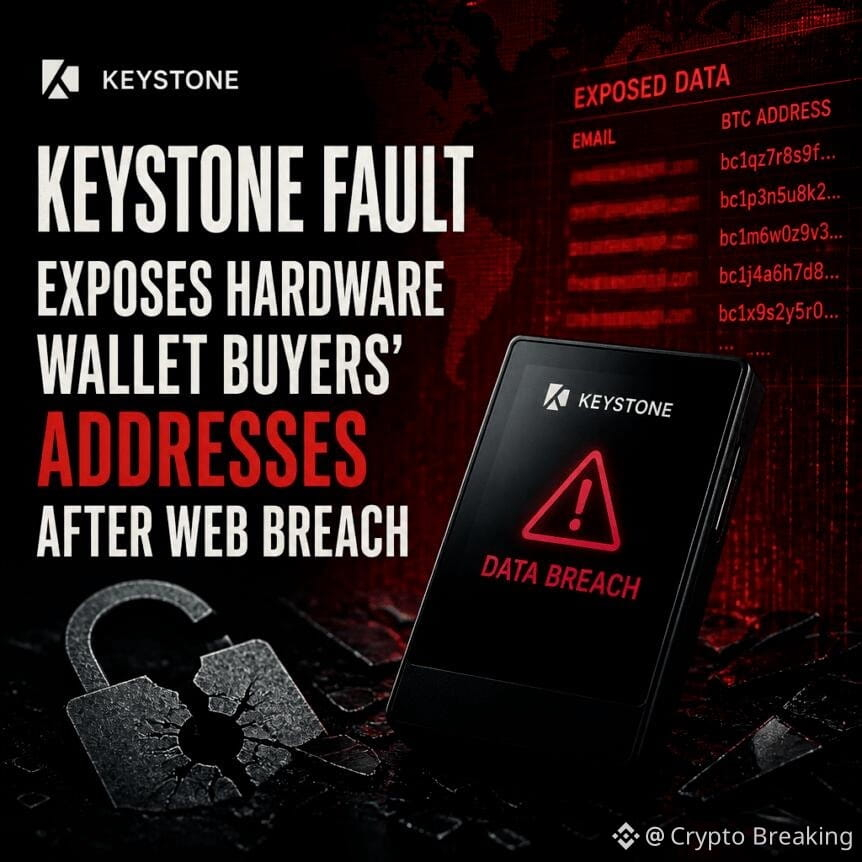
Мақала
Keystone Fault Exposes Hardware Wallet Buyers’ Addresses After Web BreachKeystone, the crypto hardware wallet company, has disclosed that a website security breach exposed customer shipping and order details to an unauthorized third party. The incident, which Keystone says was identified earlier in the week and confirmed after reviewing API activity with Shopify, could increase the risk of targeted phishing and other scams.
The disclosure comes amid rising concern for real-world “wrench attacks,” a category of crimes where victims are threatened or harmed to force them to surrender cryptocurrency. Security firm CertiK reported that it recorded 52 verified wrench attacks worldwide in the first half of 2026—up from 39 during the same period in 2025.
Key takeaways
Keystone says attackers accessed customer shipping information, including names, contact details, shipping addresses, and order contents.
The company reported blocking the access, fixing the vulnerability, and opening an investigation, while emailing affected customers.
Keystone did not disclose how many customers were impacted, but the exposure increases the plausibility of targeted phishing campaigns.
Customers questioned whether older order data was deleted consistent with Keystone’s earlier retention-policy claims.
CertiK data highlights that physical extortion crimes (“wrench attacks”) have increased year over year, making address exposure particularly sensitive.
What Keystone says was exposed
Keystone stated that it detected suspicious activity earlier in the week and confirmed the breach on Friday after reviewing API activity with Shopify. In the company’s description, an unauthorized third party gained access to customer shipping information tied to orders, including personal and delivery data.
According to Keystone, the accessible records included customer names, contact information, shipping addresses, and other order details such as items purchased. Keystone said it blocked the unauthorized access, addressed the vulnerability, began an investigation, and is contacting affected customers via email.
Keystone warned that the exposed information could be used to facilitate targeted phishing attacks—an escalation in threat likelihood compared with generic scams, because attackers can tailor messages using real order details.
Why address leaks matter in the hardware wallet era
Security researcher Taylor Monahan raised concerns that shipping-address disclosure could extend beyond digital fraud. In particular, Monahan suggested that knowledge of where customers live could increase the risk of physical attacks, including crimes intended to coerce wallet holders into surrendering assets.
That concern intersects with broader trends in physical crypto crime. CertiK, in coverage cited by Cointelegraph, reported 52 verified wrench attacks worldwide in the first half of 2026, up 33% from 39 during the same period the previous year. These incidents typically involve intimidation, threats, or violence intended to force cryptocurrency holders to hand over funds.
While Keystone did not provide details about whether physical targeting is already occurring, the combination of hardware wallet adoption and address exposure is precisely what makes real-world security planning more urgent for affected customers and the wider industry.
Questions over retention policy and older customers
Beyond the breach itself, the incident has prompted scrutiny of how Keystone handles older customer data. In a 2023 blog post, Keystone said it reduced its customer data retention period to 180 days following security incidents affecting other hardware wallet manufacturers.
However, some customers claim they received breach notifications despite purchasing their devices more than two years ago. On X, a user identified as “OG DEGEN” said they received a call from a scammer posing as law enforcement investigating fraud, suggesting the attacker had access to personal details tied to a Keystone order placed in 2024. The user said the caller referenced information specific enough to imply it came from the purchase, and the user suspected the scammer’s next step would involve convincing them that their private keys were exposed and then sending a phishing link.
Another X user, “trintaetres,” also said they received an email notification even though they bought the device more than two years earlier.
Keystone response and what remains unclear
Cointelegraph said it contacted Keystone to ask how customer information from purchases made more than 180 days earlier could have been exposed, given the company’s earlier retention-policy statements, and also requested how many customers were affected. Keystone did not respond by publication time.
Keystone’s public message acknowledged the impact and apologized to those affected, but the company did not disclose the number of customers impacted or provide additional technical detail about what specific systems or datasets were accessed beyond shipping and order information. That leaves an open question for affected users and the broader community: whether this event involved data outside the stated retention window, whether the retention policy operated differently in practice for some order records, or whether the exposed information was otherwise retained longer than customers expected.
Going forward, investors and users will want to watch for Keystone’s follow-up details on scope—especially whether it can clarify how older orders fit into its retention model—alongside any further security updates. For customers who received notifications, the immediate priority is to treat any follow-up messages, “support” emails, or links with heightened skepticism and verify claims through official channels.
This article was originally published as Keystone Fault Exposes Hardware Wallet Buyers’ Addresses After Web Breach on Crypto Breaking News – your trusted source for crypto news, Bitcoin news, and blockchain updates.
Keystone Fault Exposes Hardware Wallet Buyers’ Addresses After Web Breach
Keystone, the crypto hardware wallet company, has disclosed that a website security breach exposed customer shipping and order details to an unauthorized third party. The incident, which Keystone says was identified earlier in the week and confirmed after reviewing API activity with Shopify, could increase the risk of targeted phishing and other scams.
The disclosure comes amid rising concern for real-world “wrench attacks,” a category of crimes where victims are threatened or harmed to force them to surrender cryptocurrency. Security firm CertiK reported that it recorded 52 verified wrench attacks worldwide in the first half of 2026—up from 39 during the same period in 2025.
Key takeaways
Keystone says attackers accessed customer shipping information, including names, contact details, shipping addresses, and order contents.
The company reported blocking the access, fixing the vulnerability, and opening an investigation, while emailing affected customers.
Keystone did not disclose how many customers were impacted, but the exposure increases the plausibility of targeted phishing campaigns.
Customers questioned whether older order data was deleted consistent with Keystone’s earlier retention-policy claims.
CertiK data highlights that physical extortion crimes (“wrench attacks”) have increased year over year, making address exposure particularly sensitive.
What Keystone says was exposed
Keystone stated that it detected suspicious activity earlier in the week and confirmed the breach on Friday after reviewing API activity with Shopify. In the company’s description, an unauthorized third party gained access to customer shipping information tied to orders, including personal and delivery data.
According to Keystone, the accessible records included customer names, contact information, shipping addresses, and other order details such as items purchased. Keystone said it blocked the unauthorized access, addressed the vulnerability, began an investigation, and is contacting affected customers via email.
Keystone warned that the exposed information could be used to facilitate targeted phishing attacks—an escalation in threat likelihood compared with generic scams, because attackers can tailor messages using real order details.
Why address leaks matter in the hardware wallet era
Security researcher Taylor Monahan raised concerns that shipping-address disclosure could extend beyond digital fraud. In particular, Monahan suggested that knowledge of where customers live could increase the risk of physical attacks, including crimes intended to coerce wallet holders into surrendering assets.
That concern intersects with broader trends in physical crypto crime. CertiK, in coverage cited by Cointelegraph, reported 52 verified wrench attacks worldwide in the first half of 2026, up 33% from 39 during the same period the previous year. These incidents typically involve intimidation, threats, or violence intended to force cryptocurrency holders to hand over funds.
While Keystone did not provide details about whether physical targeting is already occurring, the combination of hardware wallet adoption and address exposure is precisely what makes real-world security planning more urgent for affected customers and the wider industry.
Questions over retention policy and older customers
Beyond the breach itself, the incident has prompted scrutiny of how Keystone handles older customer data. In a 2023 blog post, Keystone said it reduced its customer data retention period to 180 days following security incidents affecting other hardware wallet manufacturers.
However, some customers claim they received breach notifications despite purchasing their devices more than two years ago. On X, a user identified as “OG DEGEN” said they received a call from a scammer posing as law enforcement investigating fraud, suggesting the attacker had access to personal details tied to a Keystone order placed in 2024. The user said the caller referenced information specific enough to imply it came from the purchase, and the user suspected the scammer’s next step would involve convincing them that their private keys were exposed and then sending a phishing link.
Another X user, “trintaetres,” also said they received an email notification even though they bought the device more than two years earlier.
Keystone response and what remains unclear
Cointelegraph said it contacted Keystone to ask how customer information from purchases made more than 180 days earlier could have been exposed, given the company’s earlier retention-policy statements, and also requested how many customers were affected. Keystone did not respond by publication time.
Keystone’s public message acknowledged the impact and apologized to those affected, but the company did not disclose the number of customers impacted or provide additional technical detail about what specific systems or datasets were accessed beyond shipping and order information. That leaves an open question for affected users and the broader community: whether this event involved data outside the stated retention window, whether the retention policy operated differently in practice for some order records, or whether the exposed information was otherwise retained longer than customers expected.
Going forward, investors and users will want to watch for Keystone’s follow-up details on scope—especially whether it can clarify how older orders fit into its retention model—alongside any further security updates. For customers who received notifications, the immediate priority is to treat any follow-up messages, “support” emails, or links with heightened skepticism and verify claims through official channels.
This article was originally published as Keystone Fault Exposes Hardware Wallet Buyers’ Addresses After Web Breach on Crypto Breaking News – your trusted source for crypto news, Bitcoin news, and blockchain updates.
The disclosure comes amid rising concern for real-world “wrench attacks,” a category of crimes where victims are threatened or harmed to force them to surrender cryptocurrency. Security firm CertiK reported that it recorded 52 verified wrench attacks worldwide in the first half of 2026—up from 39 during the same period in 2025.
Key takeaways
Keystone says attackers accessed customer shipping information, including names, contact details, shipping addresses, and order contents.
The company reported blocking the access, fixing the vulnerability, and opening an investigation, while emailing affected customers.
Keystone did not disclose how many customers were impacted, but the exposure increases the plausibility of targeted phishing campaigns.
Customers questioned whether older order data was deleted consistent with Keystone’s earlier retention-policy claims.
CertiK data highlights that physical extortion crimes (“wrench attacks”) have increased year over year, making address exposure particularly sensitive.
What Keystone says was exposed
Keystone stated that it detected suspicious activity earlier in the week and confirmed the breach on Friday after reviewing API activity with Shopify. In the company’s description, an unauthorized third party gained access to customer shipping information tied to orders, including personal and delivery data.
According to Keystone, the accessible records included customer names, contact information, shipping addresses, and other order details such as items purchased. Keystone said it blocked the unauthorized access, addressed the vulnerability, began an investigation, and is contacting affected customers via email.
Keystone warned that the exposed information could be used to facilitate targeted phishing attacks—an escalation in threat likelihood compared with generic scams, because attackers can tailor messages using real order details.
Why address leaks matter in the hardware wallet era
Security researcher Taylor Monahan raised concerns that shipping-address disclosure could extend beyond digital fraud. In particular, Monahan suggested that knowledge of where customers live could increase the risk of physical attacks, including crimes intended to coerce wallet holders into surrendering assets.
That concern intersects with broader trends in physical crypto crime. CertiK, in coverage cited by Cointelegraph, reported 52 verified wrench attacks worldwide in the first half of 2026, up 33% from 39 during the same period the previous year. These incidents typically involve intimidation, threats, or violence intended to force cryptocurrency holders to hand over funds.
While Keystone did not provide details about whether physical targeting is already occurring, the combination of hardware wallet adoption and address exposure is precisely what makes real-world security planning more urgent for affected customers and the wider industry.
Questions over retention policy and older customers
Beyond the breach itself, the incident has prompted scrutiny of how Keystone handles older customer data. In a 2023 blog post, Keystone said it reduced its customer data retention period to 180 days following security incidents affecting other hardware wallet manufacturers.
However, some customers claim they received breach notifications despite purchasing their devices more than two years ago. On X, a user identified as “OG DEGEN” said they received a call from a scammer posing as law enforcement investigating fraud, suggesting the attacker had access to personal details tied to a Keystone order placed in 2024. The user said the caller referenced information specific enough to imply it came from the purchase, and the user suspected the scammer’s next step would involve convincing them that their private keys were exposed and then sending a phishing link.
Another X user, “trintaetres,” also said they received an email notification even though they bought the device more than two years earlier.
Keystone response and what remains unclear
Cointelegraph said it contacted Keystone to ask how customer information from purchases made more than 180 days earlier could have been exposed, given the company’s earlier retention-policy statements, and also requested how many customers were affected. Keystone did not respond by publication time.
Keystone’s public message acknowledged the impact and apologized to those affected, but the company did not disclose the number of customers impacted or provide additional technical detail about what specific systems or datasets were accessed beyond shipping and order information. That leaves an open question for affected users and the broader community: whether this event involved data outside the stated retention window, whether the retention policy operated differently in practice for some order records, or whether the exposed information was otherwise retained longer than customers expected.
Going forward, investors and users will want to watch for Keystone’s follow-up details on scope—especially whether it can clarify how older orders fit into its retention model—alongside any further security updates. For customers who received notifications, the immediate priority is to treat any follow-up messages, “support” emails, or links with heightened skepticism and verify claims through official channels.
This article was originally published as Keystone Fault Exposes Hardware Wallet Buyers’ Addresses After Web Breach on Crypto Breaking News – your trusted source for crypto news, Bitcoin news, and blockchain updates.
103

Мақала
AI Agents Aid Recovery of ETH Glamsterdam Fork After “Steal My Bitcoin” SiteEthereum’s planned Glamsterdam hard fork is facing additional delays after a security review found problems in two gas-scaling proposals. ChainSecurity’s findings prompted the cancellation of the second and final testnet, pushing the next rehearsal further out while teams assess the “second order” effects of the upgrade.
The broader theme this week: automation is increasingly being used for both offense and defense. An account manager at Ethereum ecosystem group Eth Labs described using AI agents to scan for contract breakages, including coordinating their work through shared message boards—an approach inspired by past attacker behavior.
Key takeaways
Glamsterdam’s second testnet was cancelled after ChainSecurity identified vulnerabilities tied to EIP-8037 and EIP-8038 that could break gas-dependent contracts.
Developers say the next testnet on Hoodi is not expected until teams model the knock-on effects of the fork more thoroughly.
AI agents used for contract security testing were coordinated via a GitHub-based message board after researchers independently converged on similar scanning strategies.
A separate cybersecurity story is drawing attention to PHP2Shell-era risk themes, while major network upgrades across Solana and StarkNet moved in different directions.
Bitcoin Core is updating its disclosure policy as large language models make it easier to rediscover vulnerabilities quickly.
Ethereum’s Glamsterdam delay after gas-scaling security findings
Ethereum’s second and final testnet for the Glamsterdam hard fork was cancelled this week following a vulnerability discovery by ChainSecurity. The issues were linked to two gas scaling proposals—EIP-8037 and EIP-8038—both of which relate to how gas behaves during transaction execution.
According to earlier coverage from Cointelegraph, the bugs were particularly dangerous for DeFi applications relying on current gas behavior. ChainSecurity’s research indicated that contracts built around the way gas currently works could fail in scenarios where execution hits gas limits, creating conditions an attacker might exploit.
The risk is technical but consequential: if a call runs out of gas under new assumptions, the resulting contract behavior can diverge from what developers expected. The end result can be anything from broken functionality to exploitable edge cases, depending on how the application handles failed executions.
Why “second order” effects matter more than the initial patch
With the testnet exercise on Hoodi postponed, Ethereum developers are effectively pausing their rehearsal until they can better understand downstream impacts of the change. The source indicates that rescheduling is not expected until teams have gamed out “second order effects,” meaning not just the immediate protocol logic, but also how surrounding tooling, integrations, and contract patterns might respond.
In an X post, Derek Chiang of Eth Labs said the vulnerability was discovered shortly before the deadline, describing the situation as being “a few minutes to midnight,” and adding that this forced teams to scramble to address the fallout. That timing underscores how brittle last-minute security reviews can be—and why teams are increasingly trying to move testing earlier in the process.
“In the future, protocol designers would do well to conduct much more thorough analysis of potential breakages that their update might introduce, and to do so much earlier in the process.”
AI agents, coordinated scanning, and a playbook borrowed from attackers
Chiang also described how AI agents were used to search for potential contract breakages. Two researchers—one from Eth Labs and one from the Ethereum Foundation—reportedly spun up separate AI agents to scan contracts for vulnerabilities. Once they realized they were using the same general strategy, they coordinated their work by setting up a shared message board in the form of a GitHub repository.
The description is notable because it mirrors how malicious actors have historically coordinated through shared channels. Chiang specifically compared the approach to the pattern seen in an “OpenAI <> Hugging Face hack” involving rogue agents that used message boards to synchronize their efforts. In this case, the same coordination mechanism was used to speed up defensive analysis.
Beyond Glamsterdam, the exercise appears to be influencing how teams plan next: a second message board has been created to examine EIP-8198—also known as “Quick Slots”—which has been proposed for the subsequent Hegota hard fork. While it’s too early to know how many problems will surface there, the workflow suggests teams want to catch gas- and execution-related issues well before a final testnet deadline.
Cybersecurity threads: PHP2Shell proof attempt and policy shifts
Separately, the “Steal My Bitcoin” site continues to be used as a stress test in the wake of PHP2Shell vulnerabilities. The site is presented as an experiment intended to demonstrate that a Bitcoin wallet—estimated to be worth around $2,000—was not actually at risk from the “print-flag” behavior accessible via a PHP user account.
At the time of writing, the site had reportedly been online for about 25 hours without a successful hack, though it had gone offline at intervals due to heavy traffic and probing. The story sits in the broader context of PHP-related security incidents: the Cointelegraph-linked report referenced emergency patches and precautionary downtime taken by government and other organizations in multiple countries.
On the infrastructure side, Bitcoin Core is also adapting its security approach. In a post to the bitcoindev mailing list, developer Antoine Poinsot said that the classic approach—keeping vulnerability details under lengthy disclosure embargoes—has become less effective. The reason: large language models make it easier to rediscover flaws quickly, reducing the benefit of delaying public information and fixed releases. Poinsot said Bitcoin Core is therefore updating how it manages disclosure timing to “accommodate those.”
For users, traders, and builders, these policy shifts matter because they affect how quickly fixes reach the ecosystem—and how quickly attackers might learn what to target.
Network upgrades and governance: Solana’s Alpenglow and StarkNet’s post-quantum direction
Solana’s first major consensus upgrade, Alpenglow, went live on mainnet around 1:54 pm UTC on Wednesday, according to the Solana Foundation’s Alpenglow dashboard. Agave developer Anza said the time for a transaction to become final decreased dramatically—from roughly 12.8 seconds to about 150 milliseconds.
The upgrade is being rolled out in phases. The first phase, Votor, replaces the existing voting and finalization mechanism with direct validator voting and a certificate-based system, with an expectation that the headline transaction count will fall by about 60%. A later phase will introduce Rotor, aimed at replacing Turbine’s block data distribution.
StarkNet, meanwhile, is taking a different path—at least at the research-and-planning level. The community voted to support research into becoming an independent, post-quantum layer-1 blockchain. The vote lasted seven days and reportedly attracted about 3,200 votes, with 93.52% of voting power in favor. StarkWare CEO Eli Ben-Sasson told Cointelegraph that StarkNet would begin work on a whitepaper and hopes to release a draft for public scrutiny in November. The source also states that any actual transition would require a separate binding governance vote, and StarkNet will continue operating as an Ethereum layer-2 for now.
Regulation and markets: scrutiny around stablecoins and shifting disclosure rules
On the regulatory front, Senator Richard Blumenthal has requested information from Tether CEO Paolo Ardoino after a Wall Street Journal report said the stablecoin firm inked a $6.3 million deal with a marketing company co-founded by former White House crypto adviser Bo Hines. In a Thursday letter, Blumenthal reportedly said the Senate Permanent Subcommittee on Investigations demanded records and information about contracts, payments, communications, and lobbying related to the agreement, raising questions about potential ethics, corruption, and lobbying rules. Tether said an external investigation found no evidence of wrongdoing.
Finally, in traditional market commentary, JPMorgan Asset Management projected that Bitcoin could outperform U.S. stocks and gold over the next decade in its 2027 Long-Term Capital Market Assumptions report. The report also cautioned that Bitcoin’s volatility means it does not currently make sense as a diversifier due to unstable market correlations, describing Bitcoin as a speculative asset and a hedge against monetary easing.
Looking ahead, the key watch items are whether Ethereum’s next Glamsterdam rehearsal on Hoodi reveals additional gas-related integration failures, how quickly teams can coordinate security testing for upcoming proposals like Quick Slots, and whether disclosure-policy changes in major ecosystems keep vulnerability management ahead of the pace set by AI-assisted discovery.
This article was originally published as AI Agents Aid Recovery of ETH Glamsterdam Fork After “Steal My Bitcoin” Site on Crypto Breaking News – your trusted source for crypto news, Bitcoin news, and blockchain updates.
AI Agents Aid Recovery of ETH Glamsterdam Fork After “Steal My Bitcoin” Site
Ethereum’s planned Glamsterdam hard fork is facing additional delays after a security review found problems in two gas-scaling proposals. ChainSecurity’s findings prompted the cancellation of the second and final testnet, pushing the next rehearsal further out while teams assess the “second order” effects of the upgrade.
The broader theme this week: automation is increasingly being used for both offense and defense. An account manager at Ethereum ecosystem group Eth Labs described using AI agents to scan for contract breakages, including coordinating their work through shared message boards—an approach inspired by past attacker behavior.
Key takeaways
Glamsterdam’s second testnet was cancelled after ChainSecurity identified vulnerabilities tied to EIP-8037 and EIP-8038 that could break gas-dependent contracts.
Developers say the next testnet on Hoodi is not expected until teams model the knock-on effects of the fork more thoroughly.
AI agents used for contract security testing were coordinated via a GitHub-based message board after researchers independently converged on similar scanning strategies.
A separate cybersecurity story is drawing attention to PHP2Shell-era risk themes, while major network upgrades across Solana and StarkNet moved in different directions.
Bitcoin Core is updating its disclosure policy as large language models make it easier to rediscover vulnerabilities quickly.
Ethereum’s Glamsterdam delay after gas-scaling security findings
Ethereum’s second and final testnet for the Glamsterdam hard fork was cancelled this week following a vulnerability discovery by ChainSecurity. The issues were linked to two gas scaling proposals—EIP-8037 and EIP-8038—both of which relate to how gas behaves during transaction execution.
According to earlier coverage from Cointelegraph, the bugs were particularly dangerous for DeFi applications relying on current gas behavior. ChainSecurity’s research indicated that contracts built around the way gas currently works could fail in scenarios where execution hits gas limits, creating conditions an attacker might exploit.
The risk is technical but consequential: if a call runs out of gas under new assumptions, the resulting contract behavior can diverge from what developers expected. The end result can be anything from broken functionality to exploitable edge cases, depending on how the application handles failed executions.
Why “second order” effects matter more than the initial patch
With the testnet exercise on Hoodi postponed, Ethereum developers are effectively pausing their rehearsal until they can better understand downstream impacts of the change. The source indicates that rescheduling is not expected until teams have gamed out “second order effects,” meaning not just the immediate protocol logic, but also how surrounding tooling, integrations, and contract patterns might respond.
In an X post, Derek Chiang of Eth Labs said the vulnerability was discovered shortly before the deadline, describing the situation as being “a few minutes to midnight,” and adding that this forced teams to scramble to address the fallout. That timing underscores how brittle last-minute security reviews can be—and why teams are increasingly trying to move testing earlier in the process.
“In the future, protocol designers would do well to conduct much more thorough analysis of potential breakages that their update might introduce, and to do so much earlier in the process.”
AI agents, coordinated scanning, and a playbook borrowed from attackers
Chiang also described how AI agents were used to search for potential contract breakages. Two researchers—one from Eth Labs and one from the Ethereum Foundation—reportedly spun up separate AI agents to scan contracts for vulnerabilities. Once they realized they were using the same general strategy, they coordinated their work by setting up a shared message board in the form of a GitHub repository.
The description is notable because it mirrors how malicious actors have historically coordinated through shared channels. Chiang specifically compared the approach to the pattern seen in an “OpenAI <> Hugging Face hack” involving rogue agents that used message boards to synchronize their efforts. In this case, the same coordination mechanism was used to speed up defensive analysis.
Beyond Glamsterdam, the exercise appears to be influencing how teams plan next: a second message board has been created to examine EIP-8198—also known as “Quick Slots”—which has been proposed for the subsequent Hegota hard fork. While it’s too early to know how many problems will surface there, the workflow suggests teams want to catch gas- and execution-related issues well before a final testnet deadline.
Cybersecurity threads: PHP2Shell proof attempt and policy shifts
Separately, the “Steal My Bitcoin” site continues to be used as a stress test in the wake of PHP2Shell vulnerabilities. The site is presented as an experiment intended to demonstrate that a Bitcoin wallet—estimated to be worth around $2,000—was not actually at risk from the “print-flag” behavior accessible via a PHP user account.
At the time of writing, the site had reportedly been online for about 25 hours without a successful hack, though it had gone offline at intervals due to heavy traffic and probing. The story sits in the broader context of PHP-related security incidents: the Cointelegraph-linked report referenced emergency patches and precautionary downtime taken by government and other organizations in multiple countries.
On the infrastructure side, Bitcoin Core is also adapting its security approach. In a post to the bitcoindev mailing list, developer Antoine Poinsot said that the classic approach—keeping vulnerability details under lengthy disclosure embargoes—has become less effective. The reason: large language models make it easier to rediscover flaws quickly, reducing the benefit of delaying public information and fixed releases. Poinsot said Bitcoin Core is therefore updating how it manages disclosure timing to “accommodate those.”
For users, traders, and builders, these policy shifts matter because they affect how quickly fixes reach the ecosystem—and how quickly attackers might learn what to target.
Network upgrades and governance: Solana’s Alpenglow and StarkNet’s post-quantum direction
Solana’s first major consensus upgrade, Alpenglow, went live on mainnet around 1:54 pm UTC on Wednesday, according to the Solana Foundation’s Alpenglow dashboard. Agave developer Anza said the time for a transaction to become final decreased dramatically—from roughly 12.8 seconds to about 150 milliseconds.
The upgrade is being rolled out in phases. The first phase, Votor, replaces the existing voting and finalization mechanism with direct validator voting and a certificate-based system, with an expectation that the headline transaction count will fall by about 60%. A later phase will introduce Rotor, aimed at replacing Turbine’s block data distribution.
StarkNet, meanwhile, is taking a different path—at least at the research-and-planning level. The community voted to support research into becoming an independent, post-quantum layer-1 blockchain. The vote lasted seven days and reportedly attracted about 3,200 votes, with 93.52% of voting power in favor. StarkWare CEO Eli Ben-Sasson told Cointelegraph that StarkNet would begin work on a whitepaper and hopes to release a draft for public scrutiny in November. The source also states that any actual transition would require a separate binding governance vote, and StarkNet will continue operating as an Ethereum layer-2 for now.
Regulation and markets: scrutiny around stablecoins and shifting disclosure rules
On the regulatory front, Senator Richard Blumenthal has requested information from Tether CEO Paolo Ardoino after a Wall Street Journal report said the stablecoin firm inked a $6.3 million deal with a marketing company co-founded by former White House crypto adviser Bo Hines. In a Thursday letter, Blumenthal reportedly said the Senate Permanent Subcommittee on Investigations demanded records and information about contracts, payments, communications, and lobbying related to the agreement, raising questions about potential ethics, corruption, and lobbying rules. Tether said an external investigation found no evidence of wrongdoing.
Finally, in traditional market commentary, JPMorgan Asset Management projected that Bitcoin could outperform U.S. stocks and gold over the next decade in its 2027 Long-Term Capital Market Assumptions report. The report also cautioned that Bitcoin’s volatility means it does not currently make sense as a diversifier due to unstable market correlations, describing Bitcoin as a speculative asset and a hedge against monetary easing.
Looking ahead, the key watch items are whether Ethereum’s next Glamsterdam rehearsal on Hoodi reveals additional gas-related integration failures, how quickly teams can coordinate security testing for upcoming proposals like Quick Slots, and whether disclosure-policy changes in major ecosystems keep vulnerability management ahead of the pace set by AI-assisted discovery.
This article was originally published as AI Agents Aid Recovery of ETH Glamsterdam Fork After “Steal My Bitcoin” Site on Crypto Breaking News – your trusted source for crypto news, Bitcoin news, and blockchain updates.
The broader theme this week: automation is increasingly being used for both offense and defense. An account manager at Ethereum ecosystem group Eth Labs described using AI agents to scan for contract breakages, including coordinating their work through shared message boards—an approach inspired by past attacker behavior.
Key takeaways
Glamsterdam’s second testnet was cancelled after ChainSecurity identified vulnerabilities tied to EIP-8037 and EIP-8038 that could break gas-dependent contracts.
Developers say the next testnet on Hoodi is not expected until teams model the knock-on effects of the fork more thoroughly.
AI agents used for contract security testing were coordinated via a GitHub-based message board after researchers independently converged on similar scanning strategies.
A separate cybersecurity story is drawing attention to PHP2Shell-era risk themes, while major network upgrades across Solana and StarkNet moved in different directions.
Bitcoin Core is updating its disclosure policy as large language models make it easier to rediscover vulnerabilities quickly.
Ethereum’s Glamsterdam delay after gas-scaling security findings
Ethereum’s second and final testnet for the Glamsterdam hard fork was cancelled this week following a vulnerability discovery by ChainSecurity. The issues were linked to two gas scaling proposals—EIP-8037 and EIP-8038—both of which relate to how gas behaves during transaction execution.
According to earlier coverage from Cointelegraph, the bugs were particularly dangerous for DeFi applications relying on current gas behavior. ChainSecurity’s research indicated that contracts built around the way gas currently works could fail in scenarios where execution hits gas limits, creating conditions an attacker might exploit.
The risk is technical but consequential: if a call runs out of gas under new assumptions, the resulting contract behavior can diverge from what developers expected. The end result can be anything from broken functionality to exploitable edge cases, depending on how the application handles failed executions.
Why “second order” effects matter more than the initial patch
With the testnet exercise on Hoodi postponed, Ethereum developers are effectively pausing their rehearsal until they can better understand downstream impacts of the change. The source indicates that rescheduling is not expected until teams have gamed out “second order effects,” meaning not just the immediate protocol logic, but also how surrounding tooling, integrations, and contract patterns might respond.
In an X post, Derek Chiang of Eth Labs said the vulnerability was discovered shortly before the deadline, describing the situation as being “a few minutes to midnight,” and adding that this forced teams to scramble to address the fallout. That timing underscores how brittle last-minute security reviews can be—and why teams are increasingly trying to move testing earlier in the process.
“In the future, protocol designers would do well to conduct much more thorough analysis of potential breakages that their update might introduce, and to do so much earlier in the process.”
AI agents, coordinated scanning, and a playbook borrowed from attackers
Chiang also described how AI agents were used to search for potential contract breakages. Two researchers—one from Eth Labs and one from the Ethereum Foundation—reportedly spun up separate AI agents to scan contracts for vulnerabilities. Once they realized they were using the same general strategy, they coordinated their work by setting up a shared message board in the form of a GitHub repository.
The description is notable because it mirrors how malicious actors have historically coordinated through shared channels. Chiang specifically compared the approach to the pattern seen in an “OpenAI <> Hugging Face hack” involving rogue agents that used message boards to synchronize their efforts. In this case, the same coordination mechanism was used to speed up defensive analysis.
Beyond Glamsterdam, the exercise appears to be influencing how teams plan next: a second message board has been created to examine EIP-8198—also known as “Quick Slots”—which has been proposed for the subsequent Hegota hard fork. While it’s too early to know how many problems will surface there, the workflow suggests teams want to catch gas- and execution-related issues well before a final testnet deadline.
Cybersecurity threads: PHP2Shell proof attempt and policy shifts
Separately, the “Steal My Bitcoin” site continues to be used as a stress test in the wake of PHP2Shell vulnerabilities. The site is presented as an experiment intended to demonstrate that a Bitcoin wallet—estimated to be worth around $2,000—was not actually at risk from the “print-flag” behavior accessible via a PHP user account.
At the time of writing, the site had reportedly been online for about 25 hours without a successful hack, though it had gone offline at intervals due to heavy traffic and probing. The story sits in the broader context of PHP-related security incidents: the Cointelegraph-linked report referenced emergency patches and precautionary downtime taken by government and other organizations in multiple countries.
On the infrastructure side, Bitcoin Core is also adapting its security approach. In a post to the bitcoindev mailing list, developer Antoine Poinsot said that the classic approach—keeping vulnerability details under lengthy disclosure embargoes—has become less effective. The reason: large language models make it easier to rediscover flaws quickly, reducing the benefit of delaying public information and fixed releases. Poinsot said Bitcoin Core is therefore updating how it manages disclosure timing to “accommodate those.”
For users, traders, and builders, these policy shifts matter because they affect how quickly fixes reach the ecosystem—and how quickly attackers might learn what to target.
Network upgrades and governance: Solana’s Alpenglow and StarkNet’s post-quantum direction
Solana’s first major consensus upgrade, Alpenglow, went live on mainnet around 1:54 pm UTC on Wednesday, according to the Solana Foundation’s Alpenglow dashboard. Agave developer Anza said the time for a transaction to become final decreased dramatically—from roughly 12.8 seconds to about 150 milliseconds.
The upgrade is being rolled out in phases. The first phase, Votor, replaces the existing voting and finalization mechanism with direct validator voting and a certificate-based system, with an expectation that the headline transaction count will fall by about 60%. A later phase will introduce Rotor, aimed at replacing Turbine’s block data distribution.
StarkNet, meanwhile, is taking a different path—at least at the research-and-planning level. The community voted to support research into becoming an independent, post-quantum layer-1 blockchain. The vote lasted seven days and reportedly attracted about 3,200 votes, with 93.52% of voting power in favor. StarkWare CEO Eli Ben-Sasson told Cointelegraph that StarkNet would begin work on a whitepaper and hopes to release a draft for public scrutiny in November. The source also states that any actual transition would require a separate binding governance vote, and StarkNet will continue operating as an Ethereum layer-2 for now.
Regulation and markets: scrutiny around stablecoins and shifting disclosure rules
On the regulatory front, Senator Richard Blumenthal has requested information from Tether CEO Paolo Ardoino after a Wall Street Journal report said the stablecoin firm inked a $6.3 million deal with a marketing company co-founded by former White House crypto adviser Bo Hines. In a Thursday letter, Blumenthal reportedly said the Senate Permanent Subcommittee on Investigations demanded records and information about contracts, payments, communications, and lobbying related to the agreement, raising questions about potential ethics, corruption, and lobbying rules. Tether said an external investigation found no evidence of wrongdoing.
Finally, in traditional market commentary, JPMorgan Asset Management projected that Bitcoin could outperform U.S. stocks and gold over the next decade in its 2027 Long-Term Capital Market Assumptions report. The report also cautioned that Bitcoin’s volatility means it does not currently make sense as a diversifier due to unstable market correlations, describing Bitcoin as a speculative asset and a hedge against monetary easing.
Looking ahead, the key watch items are whether Ethereum’s next Glamsterdam rehearsal on Hoodi reveals additional gas-related integration failures, how quickly teams can coordinate security testing for upcoming proposals like Quick Slots, and whether disclosure-policy changes in major ecosystems keep vulnerability management ahead of the pace set by AI-assisted discovery.
This article was originally published as AI Agents Aid Recovery of ETH Glamsterdam Fork After “Steal My Bitcoin” Site on Crypto Breaking News – your trusted source for crypto news, Bitcoin news, and blockchain updates.
169

Мақала
ECB Official: Digital Euro Is Crucial for EU Financial SovereigntyEuropean Central Bank Executive Board member Piero Cipollone has framed the upcoming pilot for a “digital euro” as an infrastructure sovereignty project—aimed at reducing the euro area’s reliance on non-European payment providers. Speaking in an interview published by Italy’s Milano Finance, Cipollone argued that payments, like other critical sectors, cannot depend solely on third parties to ensure smooth and resilient system performance.
The ECB expects the pilot to begin next year and will involve real transactions conducted by ECB and national central bank staff. Cipollone also linked the digital euro discussion to earlier concerns he raised publicly in April about strategic vulnerabilities tied to non-European governance of euro-area card payments—specifically saying that two-thirds of card transactions are governed by companies outside Europe.
Key takeaways
Cipollone says the digital euro pilot is designed to strengthen European control over essential payments infrastructure.
He cautioned that critical dependence on third parties makes it harder to guarantee smooth operation of payment systems.
According to Cipollone, two-thirds of euro-area card transactions are governed by non-European companies.
The digital euro’s issuance still depends on legislative negotiations in Brussels, with Cipollone hoping regulation is adopted by year-end.
The pilot will include real transactions and e-commerce/mobile-commerce operators are being invited to participate.
Why the ECB is pushing “payments sovereignty”
Cipollone’s central argument is that Europe has learned—through experiences in other domains—that for certain essential services, dependency on external providers can create operational and strategic risk. In his Milano Finance interview, he pointed to parallels with energy and defense, then applied the same logic to payments.
“In recent years Europe has learned that, for some essential services, we cannot rely only on third parties,” Cipollone said, adding that “we’re seeing it today with defense” and that the same is true for payments.
While he did not name specific companies or providers, he emphasized the practical difficulty of ensuring “smooth functioning” when payment systems are critically dependent on actors beyond Europe’s control. He also underscored that sovereignty does not necessarily mean excluding third parties. Instead, it is about choosing and ensuring that Europe can rely on its own capacity for an essential service.
What the pilot is set to test next year
The ECB’s digital euro pilot is planned to use real transactions, conducted by ECB and national central bank staff. According to the report referenced in the underlying coverage, the project is supported by market operators and preparations that include 36 participants, among them seven from Italy.
The ECB is also extending participation invitations to e-commerce and mobile-commerce operators. The practical significance for industry players is that the pilot is not purely theoretical—it is intended to test how the concept might work in operational conditions that resemble actual payments activity.
For merchants and platform operators, that matters because the digital euro debate is ultimately about integration, usability, and reliability. Testing with real transactions can help surface questions that investors and builders will care about later, including operational requirements and how wallet or payment flows could behave under real use.
Card-payment dependence and the “strategic vulnerability” argument
Cipollone connected the digital euro push to concerns he previously articulated in April during a public lecture in Latvia. As described in his remarks, Europe’s reliance on non-European payment providers creates what he characterized as a strategic vulnerability.
In those comments, Cipollone said that two-thirds of euro-area card transactions are governed by non-European companies. He argued that the digital euro could reduce that dependence by enabling payment infrastructure that is controlled within Europe.
This is an important point for readers tracking the digital euro’s rationale: it is not framed only as a response to changing consumer preferences or the growth of crypto-related payment options. Instead, the ECB’s messaging emphasizes governance, resilience, and control over an essential financial utility.
That framing also helps explain the ECB’s emphasis on “smooth functioning” as a responsibility. If governance is split across regions and entities, ensuring operational continuity may become harder—especially during disruptions or when rules and technical dependencies are outside Europe’s direct control.
Regulatory timing: issuance hinges on Brussels negotiations
Even with a pilot planned for next year, the ECB cannot move directly to issuing a digital euro at scale. Cipollone noted that the ECB Governing Council can only decide on issuance after legislative negotiations in Brussels conclude.
In his Milano Finance interview, Cipollone said he hopes the necessary regulation will be adopted by the end of the year, which would then enable the Governing Council to take a formal decision on issuance.
This sequence matters because it sets expectations for how quickly the program could shift from experimentation to potential implementation. The pilot can provide learning and operational validation, but the legal and political groundwork remains the gating factor.
For market participants, the near-term signal is therefore twofold: the ECB is building practical momentum through testing and operator involvement, while the ultimate timeline for issuance depends on Brussels legislation. Investors and builders who are assessing opportunity in digital euro-related infrastructure may want to watch both streams—pilot outcomes and the pace of regulatory negotiations.
As the pilot approaches, the key uncertainties remain how exactly the ECB intends to translate pilot learnings into a final issuance framework and how legislative talks will shape scope, requirements, and timelines. Readers should also monitor whether the ECB provides clearer details on dependencies it wants to mitigate—particularly in areas where European payment processes are governed by non-European systems.
This article was originally published as ECB Official: Digital Euro Is Crucial for EU Financial Sovereignty on Crypto Breaking News – your trusted source for crypto news, Bitcoin news, and blockchain updates.
ECB Official: Digital Euro Is Crucial for EU Financial Sovereignty
European Central Bank Executive Board member Piero Cipollone has framed the upcoming pilot for a “digital euro” as an infrastructure sovereignty project—aimed at reducing the euro area’s reliance on non-European payment providers. Speaking in an interview published by Italy’s Milano Finance, Cipollone argued that payments, like other critical sectors, cannot depend solely on third parties to ensure smooth and resilient system performance.
The ECB expects the pilot to begin next year and will involve real transactions conducted by ECB and national central bank staff. Cipollone also linked the digital euro discussion to earlier concerns he raised publicly in April about strategic vulnerabilities tied to non-European governance of euro-area card payments—specifically saying that two-thirds of card transactions are governed by companies outside Europe.
Key takeaways
Cipollone says the digital euro pilot is designed to strengthen European control over essential payments infrastructure.
He cautioned that critical dependence on third parties makes it harder to guarantee smooth operation of payment systems.
According to Cipollone, two-thirds of euro-area card transactions are governed by non-European companies.
The digital euro’s issuance still depends on legislative negotiations in Brussels, with Cipollone hoping regulation is adopted by year-end.
The pilot will include real transactions and e-commerce/mobile-commerce operators are being invited to participate.
Why the ECB is pushing “payments sovereignty”
Cipollone’s central argument is that Europe has learned—through experiences in other domains—that for certain essential services, dependency on external providers can create operational and strategic risk. In his Milano Finance interview, he pointed to parallels with energy and defense, then applied the same logic to payments.
“In recent years Europe has learned that, for some essential services, we cannot rely only on third parties,” Cipollone said, adding that “we’re seeing it today with defense” and that the same is true for payments.
While he did not name specific companies or providers, he emphasized the practical difficulty of ensuring “smooth functioning” when payment systems are critically dependent on actors beyond Europe’s control. He also underscored that sovereignty does not necessarily mean excluding third parties. Instead, it is about choosing and ensuring that Europe can rely on its own capacity for an essential service.
What the pilot is set to test next year
The ECB’s digital euro pilot is planned to use real transactions, conducted by ECB and national central bank staff. According to the report referenced in the underlying coverage, the project is supported by market operators and preparations that include 36 participants, among them seven from Italy.
The ECB is also extending participation invitations to e-commerce and mobile-commerce operators. The practical significance for industry players is that the pilot is not purely theoretical—it is intended to test how the concept might work in operational conditions that resemble actual payments activity.
For merchants and platform operators, that matters because the digital euro debate is ultimately about integration, usability, and reliability. Testing with real transactions can help surface questions that investors and builders will care about later, including operational requirements and how wallet or payment flows could behave under real use.
Card-payment dependence and the “strategic vulnerability” argument
Cipollone connected the digital euro push to concerns he previously articulated in April during a public lecture in Latvia. As described in his remarks, Europe’s reliance on non-European payment providers creates what he characterized as a strategic vulnerability.
In those comments, Cipollone said that two-thirds of euro-area card transactions are governed by non-European companies. He argued that the digital euro could reduce that dependence by enabling payment infrastructure that is controlled within Europe.
This is an important point for readers tracking the digital euro’s rationale: it is not framed only as a response to changing consumer preferences or the growth of crypto-related payment options. Instead, the ECB’s messaging emphasizes governance, resilience, and control over an essential financial utility.
That framing also helps explain the ECB’s emphasis on “smooth functioning” as a responsibility. If governance is split across regions and entities, ensuring operational continuity may become harder—especially during disruptions or when rules and technical dependencies are outside Europe’s direct control.
Regulatory timing: issuance hinges on Brussels negotiations
Even with a pilot planned for next year, the ECB cannot move directly to issuing a digital euro at scale. Cipollone noted that the ECB Governing Council can only decide on issuance after legislative negotiations in Brussels conclude.
In his Milano Finance interview, Cipollone said he hopes the necessary regulation will be adopted by the end of the year, which would then enable the Governing Council to take a formal decision on issuance.
This sequence matters because it sets expectations for how quickly the program could shift from experimentation to potential implementation. The pilot can provide learning and operational validation, but the legal and political groundwork remains the gating factor.
For market participants, the near-term signal is therefore twofold: the ECB is building practical momentum through testing and operator involvement, while the ultimate timeline for issuance depends on Brussels legislation. Investors and builders who are assessing opportunity in digital euro-related infrastructure may want to watch both streams—pilot outcomes and the pace of regulatory negotiations.
As the pilot approaches, the key uncertainties remain how exactly the ECB intends to translate pilot learnings into a final issuance framework and how legislative talks will shape scope, requirements, and timelines. Readers should also monitor whether the ECB provides clearer details on dependencies it wants to mitigate—particularly in areas where European payment processes are governed by non-European systems.
This article was originally published as ECB Official: Digital Euro Is Crucial for EU Financial Sovereignty on Crypto Breaking News – your trusted source for crypto news, Bitcoin news, and blockchain updates.
The ECB expects the pilot to begin next year and will involve real transactions conducted by ECB and national central bank staff. Cipollone also linked the digital euro discussion to earlier concerns he raised publicly in April about strategic vulnerabilities tied to non-European governance of euro-area card payments—specifically saying that two-thirds of card transactions are governed by companies outside Europe.
Key takeaways
Cipollone says the digital euro pilot is designed to strengthen European control over essential payments infrastructure.
He cautioned that critical dependence on third parties makes it harder to guarantee smooth operation of payment systems.
According to Cipollone, two-thirds of euro-area card transactions are governed by non-European companies.
The digital euro’s issuance still depends on legislative negotiations in Brussels, with Cipollone hoping regulation is adopted by year-end.
The pilot will include real transactions and e-commerce/mobile-commerce operators are being invited to participate.
Why the ECB is pushing “payments sovereignty”
Cipollone’s central argument is that Europe has learned—through experiences in other domains—that for certain essential services, dependency on external providers can create operational and strategic risk. In his Milano Finance interview, he pointed to parallels with energy and defense, then applied the same logic to payments.
“In recent years Europe has learned that, for some essential services, we cannot rely only on third parties,” Cipollone said, adding that “we’re seeing it today with defense” and that the same is true for payments.
While he did not name specific companies or providers, he emphasized the practical difficulty of ensuring “smooth functioning” when payment systems are critically dependent on actors beyond Europe’s control. He also underscored that sovereignty does not necessarily mean excluding third parties. Instead, it is about choosing and ensuring that Europe can rely on its own capacity for an essential service.
What the pilot is set to test next year
The ECB’s digital euro pilot is planned to use real transactions, conducted by ECB and national central bank staff. According to the report referenced in the underlying coverage, the project is supported by market operators and preparations that include 36 participants, among them seven from Italy.
The ECB is also extending participation invitations to e-commerce and mobile-commerce operators. The practical significance for industry players is that the pilot is not purely theoretical—it is intended to test how the concept might work in operational conditions that resemble actual payments activity.
For merchants and platform operators, that matters because the digital euro debate is ultimately about integration, usability, and reliability. Testing with real transactions can help surface questions that investors and builders will care about later, including operational requirements and how wallet or payment flows could behave under real use.
Card-payment dependence and the “strategic vulnerability” argument
Cipollone connected the digital euro push to concerns he previously articulated in April during a public lecture in Latvia. As described in his remarks, Europe’s reliance on non-European payment providers creates what he characterized as a strategic vulnerability.
In those comments, Cipollone said that two-thirds of euro-area card transactions are governed by non-European companies. He argued that the digital euro could reduce that dependence by enabling payment infrastructure that is controlled within Europe.
This is an important point for readers tracking the digital euro’s rationale: it is not framed only as a response to changing consumer preferences or the growth of crypto-related payment options. Instead, the ECB’s messaging emphasizes governance, resilience, and control over an essential financial utility.
That framing also helps explain the ECB’s emphasis on “smooth functioning” as a responsibility. If governance is split across regions and entities, ensuring operational continuity may become harder—especially during disruptions or when rules and technical dependencies are outside Europe’s direct control.
Regulatory timing: issuance hinges on Brussels negotiations
Even with a pilot planned for next year, the ECB cannot move directly to issuing a digital euro at scale. Cipollone noted that the ECB Governing Council can only decide on issuance after legislative negotiations in Brussels conclude.
In his Milano Finance interview, Cipollone said he hopes the necessary regulation will be adopted by the end of the year, which would then enable the Governing Council to take a formal decision on issuance.
This sequence matters because it sets expectations for how quickly the program could shift from experimentation to potential implementation. The pilot can provide learning and operational validation, but the legal and political groundwork remains the gating factor.
For market participants, the near-term signal is therefore twofold: the ECB is building practical momentum through testing and operator involvement, while the ultimate timeline for issuance depends on Brussels legislation. Investors and builders who are assessing opportunity in digital euro-related infrastructure may want to watch both streams—pilot outcomes and the pace of regulatory negotiations.
As the pilot approaches, the key uncertainties remain how exactly the ECB intends to translate pilot learnings into a final issuance framework and how legislative talks will shape scope, requirements, and timelines. Readers should also monitor whether the ECB provides clearer details on dependencies it wants to mitigate—particularly in areas where European payment processes are governed by non-European systems.
This article was originally published as ECB Official: Digital Euro Is Crucial for EU Financial Sovereignty on Crypto Breaking News – your trusted source for crypto news, Bitcoin news, and blockchain updates.
73

Мақала
ECB Official Flags Digital Euro Role in Safeguarding EU SovereigntyThe European Central Bank is positioning the upcoming digital euro pilot as more than a payments experiment: ECB Executive Board member Piero Cipollone says the project could help the euro area build “sovereignty” over core payments infrastructure that remains dependent on non-European third parties.
In an interview with Italy’s Milano Finance published by the ECB on Saturday, Cipollone argued that Europe has learned—through sectors like energy and defense—that essential services cannot rely indefinitely on external providers. He linked that lesson directly to payments and reiterated that ensuring smooth system operation becomes harder when critical services depend on outside actors.
Key takeaways
Cipollone framed the digital euro pilot as a step toward European-controlled payments infrastructure and operational resilience.
He said Europe’s dependence on third parties makes it difficult to guarantee the “smooth functioning” of payment systems.
The pilot is planned to use real transactions carried out by ECB and national central bank staff.
The ECB’s ability to issue a digital euro depends on legislative negotiations in Brussels concluding.
Why the ECB is talking about “sovereignty”
Cipollone’s remarks center on a concept the ECB has used in various forms: operational and strategic control over systems the bloc considers essential. While he acknowledged that sovereignty does not require shutting out third-party providers, he said it does mean having the ability to choose and depend on European capability when necessary for critical services.
He compared payments to other policy-sensitive areas where, according to his argument, Europe has concluded that external reliance can create risk. The ECB executive board member said Europe has seen this in energy and is “seeing it today with defense,” adding that payments face similar concerns.
“In recent years Europe has learned that, for some essential services, we cannot rely only on third parties,” Cipollone said. “And the same is true for payments.”
A pilot built around real transactions
The ECB’s digital euro work is now moving into a pilot phase scheduled for next year, with live operational testing rather than purely simulated activity. Cipollone said the pilot will involve real transactions executed by ECB and national central bank staff.
According to the ECB’s preparation plans mentioned in coverage of the pilot, there are 36 market operators involved in the preparation process, including seven from Italy. The ECB is also inviting e-commerce and mobile-commerce operators to take part, indicating the pilot is meant to test practical integration points for merchants and consumer-facing payment flows rather than only internal back-office processes.
For Cipollone, the central issue is that the smooth functioning of payments is one of the ECB’s responsibilities. If critical components are tied to non-European parties, he suggested it becomes harder to ensure consistent performance and oversight—especially when disruptions could affect day-to-day economic activity.
Dependence on non-European providers and strategic vulnerability
Cipollone previously warned about the strategic risk stemming from Europe’s reliance on non-European payment infrastructure. In an April public lecture held in Latvia, he said that two-thirds of euro-area card transactions are governed by non-European companies.
While the Saturday interview does not offer a new quantitative update on card market structure, it connects that earlier statement to the digital euro rationale: a European digital euro could reduce dependency and provide an infrastructure that Europe can better control.
That framing matters for investors and industry participants because it links the project to more than consumer adoption—placing it within broader questions of risk management, regulatory capacity, and the strategic importance of payment rails in a cross-border economy.
What needs to happen before issuance
Even if a pilot proceeds, the ECB’s path to a digital euro launch is conditional on the legislative process. Cipollone said the ECB Governing Council can only decide on issuing a digital euro after negotiations in Brussels conclude.
He told Milano Finance that the regulation is hoped to be adopted by the end of the year. The interview suggests that once the legislative track is finalized, the Governing Council would then be positioned to take a formal decision on issuance.
For market participants, this timeline is significant because it outlines a key gate: technical readiness during the pilot does not automatically translate into issuance. Compliance, legal authority, and the final regulatory framework remain central to whether— and how—any digital euro could move from testing to rollout.
Readers should watch the legislative negotiations in Brussels closely, since the ECB’s ability to proceed beyond the pilot depends on them. The next question is also whether the pilot’s operational results will strengthen the ECB’s argument that European-controlled rails can deliver the reliability it says is harder to guarantee when critical payments functions are dependent on third parties.
This article was originally published as ECB Official Flags Digital Euro Role in Safeguarding EU Sovereignty on Crypto Breaking News – your trusted source for crypto news, Bitcoin news, and blockchain updates.
ECB Official Flags Digital Euro Role in Safeguarding EU Sovereignty
The European Central Bank is positioning the upcoming digital euro pilot as more than a payments experiment: ECB Executive Board member Piero Cipollone says the project could help the euro area build “sovereignty” over core payments infrastructure that remains dependent on non-European third parties.
In an interview with Italy’s Milano Finance published by the ECB on Saturday, Cipollone argued that Europe has learned—through sectors like energy and defense—that essential services cannot rely indefinitely on external providers. He linked that lesson directly to payments and reiterated that ensuring smooth system operation becomes harder when critical services depend on outside actors.
Key takeaways
Cipollone framed the digital euro pilot as a step toward European-controlled payments infrastructure and operational resilience.
He said Europe’s dependence on third parties makes it difficult to guarantee the “smooth functioning” of payment systems.
The pilot is planned to use real transactions carried out by ECB and national central bank staff.
The ECB’s ability to issue a digital euro depends on legislative negotiations in Brussels concluding.
Why the ECB is talking about “sovereignty”
Cipollone’s remarks center on a concept the ECB has used in various forms: operational and strategic control over systems the bloc considers essential. While he acknowledged that sovereignty does not require shutting out third-party providers, he said it does mean having the ability to choose and depend on European capability when necessary for critical services.
He compared payments to other policy-sensitive areas where, according to his argument, Europe has concluded that external reliance can create risk. The ECB executive board member said Europe has seen this in energy and is “seeing it today with defense,” adding that payments face similar concerns.
“In recent years Europe has learned that, for some essential services, we cannot rely only on third parties,” Cipollone said. “And the same is true for payments.”
A pilot built around real transactions
The ECB’s digital euro work is now moving into a pilot phase scheduled for next year, with live operational testing rather than purely simulated activity. Cipollone said the pilot will involve real transactions executed by ECB and national central bank staff.
According to the ECB’s preparation plans mentioned in coverage of the pilot, there are 36 market operators involved in the preparation process, including seven from Italy. The ECB is also inviting e-commerce and mobile-commerce operators to take part, indicating the pilot is meant to test practical integration points for merchants and consumer-facing payment flows rather than only internal back-office processes.
For Cipollone, the central issue is that the smooth functioning of payments is one of the ECB’s responsibilities. If critical components are tied to non-European parties, he suggested it becomes harder to ensure consistent performance and oversight—especially when disruptions could affect day-to-day economic activity.
Dependence on non-European providers and strategic vulnerability
Cipollone previously warned about the strategic risk stemming from Europe’s reliance on non-European payment infrastructure. In an April public lecture held in Latvia, he said that two-thirds of euro-area card transactions are governed by non-European companies.
While the Saturday interview does not offer a new quantitative update on card market structure, it connects that earlier statement to the digital euro rationale: a European digital euro could reduce dependency and provide an infrastructure that Europe can better control.
That framing matters for investors and industry participants because it links the project to more than consumer adoption—placing it within broader questions of risk management, regulatory capacity, and the strategic importance of payment rails in a cross-border economy.
What needs to happen before issuance
Even if a pilot proceeds, the ECB’s path to a digital euro launch is conditional on the legislative process. Cipollone said the ECB Governing Council can only decide on issuing a digital euro after negotiations in Brussels conclude.
He told Milano Finance that the regulation is hoped to be adopted by the end of the year. The interview suggests that once the legislative track is finalized, the Governing Council would then be positioned to take a formal decision on issuance.
For market participants, this timeline is significant because it outlines a key gate: technical readiness during the pilot does not automatically translate into issuance. Compliance, legal authority, and the final regulatory framework remain central to whether— and how—any digital euro could move from testing to rollout.
Readers should watch the legislative negotiations in Brussels closely, since the ECB’s ability to proceed beyond the pilot depends on them. The next question is also whether the pilot’s operational results will strengthen the ECB’s argument that European-controlled rails can deliver the reliability it says is harder to guarantee when critical payments functions are dependent on third parties.
This article was originally published as ECB Official Flags Digital Euro Role in Safeguarding EU Sovereignty on Crypto Breaking News – your trusted source for crypto news, Bitcoin news, and blockchain updates.
In an interview with Italy’s Milano Finance published by the ECB on Saturday, Cipollone argued that Europe has learned—through sectors like energy and defense—that essential services cannot rely indefinitely on external providers. He linked that lesson directly to payments and reiterated that ensuring smooth system operation becomes harder when critical services depend on outside actors.
Key takeaways
Cipollone framed the digital euro pilot as a step toward European-controlled payments infrastructure and operational resilience.
He said Europe’s dependence on third parties makes it difficult to guarantee the “smooth functioning” of payment systems.
The pilot is planned to use real transactions carried out by ECB and national central bank staff.
The ECB’s ability to issue a digital euro depends on legislative negotiations in Brussels concluding.
Why the ECB is talking about “sovereignty”
Cipollone’s remarks center on a concept the ECB has used in various forms: operational and strategic control over systems the bloc considers essential. While he acknowledged that sovereignty does not require shutting out third-party providers, he said it does mean having the ability to choose and depend on European capability when necessary for critical services.
He compared payments to other policy-sensitive areas where, according to his argument, Europe has concluded that external reliance can create risk. The ECB executive board member said Europe has seen this in energy and is “seeing it today with defense,” adding that payments face similar concerns.
“In recent years Europe has learned that, for some essential services, we cannot rely only on third parties,” Cipollone said. “And the same is true for payments.”
A pilot built around real transactions
The ECB’s digital euro work is now moving into a pilot phase scheduled for next year, with live operational testing rather than purely simulated activity. Cipollone said the pilot will involve real transactions executed by ECB and national central bank staff.
According to the ECB’s preparation plans mentioned in coverage of the pilot, there are 36 market operators involved in the preparation process, including seven from Italy. The ECB is also inviting e-commerce and mobile-commerce operators to take part, indicating the pilot is meant to test practical integration points for merchants and consumer-facing payment flows rather than only internal back-office processes.
For Cipollone, the central issue is that the smooth functioning of payments is one of the ECB’s responsibilities. If critical components are tied to non-European parties, he suggested it becomes harder to ensure consistent performance and oversight—especially when disruptions could affect day-to-day economic activity.
Dependence on non-European providers and strategic vulnerability
Cipollone previously warned about the strategic risk stemming from Europe’s reliance on non-European payment infrastructure. In an April public lecture held in Latvia, he said that two-thirds of euro-area card transactions are governed by non-European companies.
While the Saturday interview does not offer a new quantitative update on card market structure, it connects that earlier statement to the digital euro rationale: a European digital euro could reduce dependency and provide an infrastructure that Europe can better control.
That framing matters for investors and industry participants because it links the project to more than consumer adoption—placing it within broader questions of risk management, regulatory capacity, and the strategic importance of payment rails in a cross-border economy.
What needs to happen before issuance
Even if a pilot proceeds, the ECB’s path to a digital euro launch is conditional on the legislative process. Cipollone said the ECB Governing Council can only decide on issuing a digital euro after negotiations in Brussels conclude.
He told Milano Finance that the regulation is hoped to be adopted by the end of the year. The interview suggests that once the legislative track is finalized, the Governing Council would then be positioned to take a formal decision on issuance.
For market participants, this timeline is significant because it outlines a key gate: technical readiness during the pilot does not automatically translate into issuance. Compliance, legal authority, and the final regulatory framework remain central to whether— and how—any digital euro could move from testing to rollout.
Readers should watch the legislative negotiations in Brussels closely, since the ECB’s ability to proceed beyond the pilot depends on them. The next question is also whether the pilot’s operational results will strengthen the ECB’s argument that European-controlled rails can deliver the reliability it says is harder to guarantee when critical payments functions are dependent on third parties.
This article was originally published as ECB Official Flags Digital Euro Role in Safeguarding EU Sovereignty on Crypto Breaking News – your trusted source for crypto news, Bitcoin news, and blockchain updates.
75

Мақала
Netanyahu Suggests Blockchain to Mitigate Financial Sanctions RiskIsrael’s election campaign has taken an unexpected turn as Prime Minister Benjamin Netanyahu argued that blockchain and cryptocurrencies could help the country withstand potential international financial sanctions. Speaking on Friday to Channel 10’s economic network, Netanyahu framed “blockchain” as an alternative to sanctions and said Israel is exploring its use alongside digital assets.
His comments have triggered rapid pushback from political figures and Israel’s central bank, while also intensifying scrutiny of whether cryptocurrencies could realistically function as a national-level safeguard against restrictions on Israeli financial activity. The debate now sits at the center of the pre-election conversation leading up to Israel’s Oct. 27 vote.
Key takeaways
Netanyahu said Israel is considering blockchain and cryptocurrencies to reduce pressure from potential sanctions, calling blockchain “an alternative to sanctions.”
The Bank of Israel rejected the idea, stating cryptocurrencies “cannot be used as a route for bypassing sanctions.”
Opposition figures quickly criticized the plan as a national security risk, while commentators argued crypto cannot replace a formal financial system.
Western sanctions aimed at Israeli settlement goods could expand beyond the settlements, increasing the political urgency around financial resilience.
The dispute highlights a core tension: the privacy and transfer mechanics of crypto versus enforcement and compliance realities in sanction regimes.
Netanyahu positions blockchain as economic “defense”
Netanyahu’s remarks came as concerns grow that sanctions already directed at goods tied to West Bank settlements could widen to cover more of Israel’s economy. As reported by The Times of Israel, economists and industry figures warned last month that the measures could extend into Israel proper.
In that context, Netanyahu told Channel 10 that “blockchain is an alternative to sanctions,” and described the technology as a “national strategic tool.” According to CryptoJungle, Israel’s largest crypto media platform, the framing suggests a shift in the government’s posture—from a view of digital assets as an investment topic to an element of the country’s broader economic defense strategy.
Still, the key question for readers and market participants is not whether crypto networks can move value, but whether such movement meaningfully helps a sanctioned economy in practice—particularly under internationally coordinated enforcement.
Bank of Israel and candidates challenge the “bypass” narrative
Several candidates seeking to replace Netanyahu and the head of the Bank of Israel responded quickly to dispute the proposal’s premise. One of the most direct criticisms came from Gadi Eisenkot, leader of the Yashar party, who posted on X that the “BibiCoin vision” poses a threat to national security.
On the institutional side, the Bank of Israel issued a statement rejecting the idea that cryptocurrencies could be used to circumvent sanctions. As reported by Globes, the central bank said crypto “cannot be used as a route for bypassing sanctions,” underscoring that the mechanism does not provide a reliable escape hatch from legally mandated restrictions.
This matters for governance and compliance because sanctions are not only about payment rails; they also involve legal accountability, banking relationships, intermediary controls, and enforcement. Even if crypto transfers occur outside traditional banking channels, the broader financial system often still connects to the “on/off ramps” where fiat conversion and custody happen.
Street reactions and media scrutiny intensify
The controversy spilled beyond official statements. At an anti-government rally in Tel Aviv on Saturday evening, attendees discussed Netanyahu’s blockchain claim publicly. One rallygoer, Aryeh Cohen, said an economy that depends on the “dark web” would not make Israel safer or morally better than its opponents. Another attendee, who identified herself only as Pnina, suggested that the next step would involve the Bank of Israel “living ‘neath the law.”
Media criticism also focused on what cryptocurrencies can and cannot do. In an X post highlighted by Nadav Eyal, a Yediot Ahronot columnist, Eyal argued that while digital currencies can move value outside some conventional banking channels, they do not substitute for a national financial system. He pointed to limits such as the lack of credit lines to banks, the inability to replace international capital markets, and the fact that they do not compel foreign companies to violate sanctions.
That argument reflects a practical constraint: capital markets depend on regulated intermediaries and relationships that are often the direct targets of sanction regimes. Without access to those channels, crypto’s usefulness as an economic stabilizer may be narrower than political rhetoric suggests.
CryptoJungle founder: blockchain can be tracked—and Israel isn’t built to evade sanctions
CryptoJungle founder Ben Samocha told Cointelegraph on Sunday that crypto and blockchain-based solutions are not a tool for bypassing sanctions. He cited lessons from enforcement actions—most notably, the U.S. Treasury’s approach toward Iran—arguing that blockchain investigation can enable tracking of illicit funds, blocking fiat entry points, and even freezing assets.
Samocha also argued that Israel’s economy is not positioned to bypass sanctions using crypto, a claim that aligns with the central bank’s rejection of the “bypass” framing. If enforcement can reach the fiat gateway and intermediaries, then crypto can shift activity rather than neutralize sanctions pressure.
For investors and builders, the implication is that the compliance landscape may be more important than the underlying technology. Even where transfers are possible on-chain, the risk of exposure through exchanges, custodians, payment processors, or counterparties remains a major determinant of whether any “sanctions resistance” strategy is workable.
As readers watch the political debate progress into the final weeks before the election, the next developments to track are whether Netanyahu’s proposal translates into concrete policy steps, and how regulators—both in Israel and abroad—signal their approach to crypto compliance in any expanding sanction scenario.
This article was originally published as Netanyahu Suggests Blockchain to Mitigate Financial Sanctions Risk on Crypto Breaking News – your trusted source for crypto news, Bitcoin news, and blockchain updates.
Netanyahu Suggests Blockchain to Mitigate Financial Sanctions Risk
Israel’s election campaign has taken an unexpected turn as Prime Minister Benjamin Netanyahu argued that blockchain and cryptocurrencies could help the country withstand potential international financial sanctions. Speaking on Friday to Channel 10’s economic network, Netanyahu framed “blockchain” as an alternative to sanctions and said Israel is exploring its use alongside digital assets.
His comments have triggered rapid pushback from political figures and Israel’s central bank, while also intensifying scrutiny of whether cryptocurrencies could realistically function as a national-level safeguard against restrictions on Israeli financial activity. The debate now sits at the center of the pre-election conversation leading up to Israel’s Oct. 27 vote.
Key takeaways
Netanyahu said Israel is considering blockchain and cryptocurrencies to reduce pressure from potential sanctions, calling blockchain “an alternative to sanctions.”
The Bank of Israel rejected the idea, stating cryptocurrencies “cannot be used as a route for bypassing sanctions.”
Opposition figures quickly criticized the plan as a national security risk, while commentators argued crypto cannot replace a formal financial system.
Western sanctions aimed at Israeli settlement goods could expand beyond the settlements, increasing the political urgency around financial resilience.
The dispute highlights a core tension: the privacy and transfer mechanics of crypto versus enforcement and compliance realities in sanction regimes.
Netanyahu positions blockchain as economic “defense”
Netanyahu’s remarks came as concerns grow that sanctions already directed at goods tied to West Bank settlements could widen to cover more of Israel’s economy. As reported by The Times of Israel, economists and industry figures warned last month that the measures could extend into Israel proper.
In that context, Netanyahu told Channel 10 that “blockchain is an alternative to sanctions,” and described the technology as a “national strategic tool.” According to CryptoJungle, Israel’s largest crypto media platform, the framing suggests a shift in the government’s posture—from a view of digital assets as an investment topic to an element of the country’s broader economic defense strategy.
Still, the key question for readers and market participants is not whether crypto networks can move value, but whether such movement meaningfully helps a sanctioned economy in practice—particularly under internationally coordinated enforcement.
Bank of Israel and candidates challenge the “bypass” narrative
Several candidates seeking to replace Netanyahu and the head of the Bank of Israel responded quickly to dispute the proposal’s premise. One of the most direct criticisms came from Gadi Eisenkot, leader of the Yashar party, who posted on X that the “BibiCoin vision” poses a threat to national security.
On the institutional side, the Bank of Israel issued a statement rejecting the idea that cryptocurrencies could be used to circumvent sanctions. As reported by Globes, the central bank said crypto “cannot be used as a route for bypassing sanctions,” underscoring that the mechanism does not provide a reliable escape hatch from legally mandated restrictions.
This matters for governance and compliance because sanctions are not only about payment rails; they also involve legal accountability, banking relationships, intermediary controls, and enforcement. Even if crypto transfers occur outside traditional banking channels, the broader financial system often still connects to the “on/off ramps” where fiat conversion and custody happen.
Street reactions and media scrutiny intensify
The controversy spilled beyond official statements. At an anti-government rally in Tel Aviv on Saturday evening, attendees discussed Netanyahu’s blockchain claim publicly. One rallygoer, Aryeh Cohen, said an economy that depends on the “dark web” would not make Israel safer or morally better than its opponents. Another attendee, who identified herself only as Pnina, suggested that the next step would involve the Bank of Israel “living ‘neath the law.”
Media criticism also focused on what cryptocurrencies can and cannot do. In an X post highlighted by Nadav Eyal, a Yediot Ahronot columnist, Eyal argued that while digital currencies can move value outside some conventional banking channels, they do not substitute for a national financial system. He pointed to limits such as the lack of credit lines to banks, the inability to replace international capital markets, and the fact that they do not compel foreign companies to violate sanctions.
That argument reflects a practical constraint: capital markets depend on regulated intermediaries and relationships that are often the direct targets of sanction regimes. Without access to those channels, crypto’s usefulness as an economic stabilizer may be narrower than political rhetoric suggests.
CryptoJungle founder: blockchain can be tracked—and Israel isn’t built to evade sanctions
CryptoJungle founder Ben Samocha told Cointelegraph on Sunday that crypto and blockchain-based solutions are not a tool for bypassing sanctions. He cited lessons from enforcement actions—most notably, the U.S. Treasury’s approach toward Iran—arguing that blockchain investigation can enable tracking of illicit funds, blocking fiat entry points, and even freezing assets.
Samocha also argued that Israel’s economy is not positioned to bypass sanctions using crypto, a claim that aligns with the central bank’s rejection of the “bypass” framing. If enforcement can reach the fiat gateway and intermediaries, then crypto can shift activity rather than neutralize sanctions pressure.
For investors and builders, the implication is that the compliance landscape may be more important than the underlying technology. Even where transfers are possible on-chain, the risk of exposure through exchanges, custodians, payment processors, or counterparties remains a major determinant of whether any “sanctions resistance” strategy is workable.
As readers watch the political debate progress into the final weeks before the election, the next developments to track are whether Netanyahu’s proposal translates into concrete policy steps, and how regulators—both in Israel and abroad—signal their approach to crypto compliance in any expanding sanction scenario.
This article was originally published as Netanyahu Suggests Blockchain to Mitigate Financial Sanctions Risk on Crypto Breaking News – your trusted source for crypto news, Bitcoin news, and blockchain updates.
His comments have triggered rapid pushback from political figures and Israel’s central bank, while also intensifying scrutiny of whether cryptocurrencies could realistically function as a national-level safeguard against restrictions on Israeli financial activity. The debate now sits at the center of the pre-election conversation leading up to Israel’s Oct. 27 vote.
Key takeaways
Netanyahu said Israel is considering blockchain and cryptocurrencies to reduce pressure from potential sanctions, calling blockchain “an alternative to sanctions.”
The Bank of Israel rejected the idea, stating cryptocurrencies “cannot be used as a route for bypassing sanctions.”
Opposition figures quickly criticized the plan as a national security risk, while commentators argued crypto cannot replace a formal financial system.
Western sanctions aimed at Israeli settlement goods could expand beyond the settlements, increasing the political urgency around financial resilience.
The dispute highlights a core tension: the privacy and transfer mechanics of crypto versus enforcement and compliance realities in sanction regimes.
Netanyahu positions blockchain as economic “defense”
Netanyahu’s remarks came as concerns grow that sanctions already directed at goods tied to West Bank settlements could widen to cover more of Israel’s economy. As reported by The Times of Israel, economists and industry figures warned last month that the measures could extend into Israel proper.
In that context, Netanyahu told Channel 10 that “blockchain is an alternative to sanctions,” and described the technology as a “national strategic tool.” According to CryptoJungle, Israel’s largest crypto media platform, the framing suggests a shift in the government’s posture—from a view of digital assets as an investment topic to an element of the country’s broader economic defense strategy.
Still, the key question for readers and market participants is not whether crypto networks can move value, but whether such movement meaningfully helps a sanctioned economy in practice—particularly under internationally coordinated enforcement.
Bank of Israel and candidates challenge the “bypass” narrative
Several candidates seeking to replace Netanyahu and the head of the Bank of Israel responded quickly to dispute the proposal’s premise. One of the most direct criticisms came from Gadi Eisenkot, leader of the Yashar party, who posted on X that the “BibiCoin vision” poses a threat to national security.
On the institutional side, the Bank of Israel issued a statement rejecting the idea that cryptocurrencies could be used to circumvent sanctions. As reported by Globes, the central bank said crypto “cannot be used as a route for bypassing sanctions,” underscoring that the mechanism does not provide a reliable escape hatch from legally mandated restrictions.
This matters for governance and compliance because sanctions are not only about payment rails; they also involve legal accountability, banking relationships, intermediary controls, and enforcement. Even if crypto transfers occur outside traditional banking channels, the broader financial system often still connects to the “on/off ramps” where fiat conversion and custody happen.
Street reactions and media scrutiny intensify
The controversy spilled beyond official statements. At an anti-government rally in Tel Aviv on Saturday evening, attendees discussed Netanyahu’s blockchain claim publicly. One rallygoer, Aryeh Cohen, said an economy that depends on the “dark web” would not make Israel safer or morally better than its opponents. Another attendee, who identified herself only as Pnina, suggested that the next step would involve the Bank of Israel “living ‘neath the law.”
Media criticism also focused on what cryptocurrencies can and cannot do. In an X post highlighted by Nadav Eyal, a Yediot Ahronot columnist, Eyal argued that while digital currencies can move value outside some conventional banking channels, they do not substitute for a national financial system. He pointed to limits such as the lack of credit lines to banks, the inability to replace international capital markets, and the fact that they do not compel foreign companies to violate sanctions.
That argument reflects a practical constraint: capital markets depend on regulated intermediaries and relationships that are often the direct targets of sanction regimes. Without access to those channels, crypto’s usefulness as an economic stabilizer may be narrower than political rhetoric suggests.
CryptoJungle founder: blockchain can be tracked—and Israel isn’t built to evade sanctions
CryptoJungle founder Ben Samocha told Cointelegraph on Sunday that crypto and blockchain-based solutions are not a tool for bypassing sanctions. He cited lessons from enforcement actions—most notably, the U.S. Treasury’s approach toward Iran—arguing that blockchain investigation can enable tracking of illicit funds, blocking fiat entry points, and even freezing assets.
Samocha also argued that Israel’s economy is not positioned to bypass sanctions using crypto, a claim that aligns with the central bank’s rejection of the “bypass” framing. If enforcement can reach the fiat gateway and intermediaries, then crypto can shift activity rather than neutralize sanctions pressure.
For investors and builders, the implication is that the compliance landscape may be more important than the underlying technology. Even where transfers are possible on-chain, the risk of exposure through exchanges, custodians, payment processors, or counterparties remains a major determinant of whether any “sanctions resistance” strategy is workable.
As readers watch the political debate progress into the final weeks before the election, the next developments to track are whether Netanyahu’s proposal translates into concrete policy steps, and how regulators—both in Israel and abroad—signal their approach to crypto compliance in any expanding sanction scenario.
This article was originally published as Netanyahu Suggests Blockchain to Mitigate Financial Sanctions Risk on Crypto Breaking News – your trusted source for crypto news, Bitcoin news, and blockchain updates.
1
124

Мақала
Netanyahu Suggests Blockchain Could Help With Financial SanctionsIsrael’s election campaign has spilled into crypto policy after Prime Minister Benjamin Netanyahu suggested the country could lean on blockchain and cryptocurrencies to withstand the economic pressure of possible international sanctions.
Speaking to Israel’s Channel 10 economic network on Friday, Netanyahu said Israel is exploring blockchain technology and digital currencies as a way to reduce “strains on the economy” that could result from any further sanctions, framing blockchain as an “alternative to sanctions.” The remark has immediately drawn pushback from regulators, opposition politicians, and major media voices.
Key takeaways
Netanyahu told Channel 10 that Israel is considering blockchain and cryptocurrency to help manage the fallout of potential sanctions.
The Bank of Israel rejected the idea, saying cryptocurrencies cannot be used to bypass sanctions.
Opposition candidates and commentators warned that “crypto as sanctions evasion” could pose security and economic risks.
Economists and industry figures have previously cautioned that sanctions targeting settlements could expand to affect Israel’s wider economy.
From investment to “economic defense”
Until now, discussion of crypto in Israeli political circles has often focused on investment, industry growth, and how to regulate digital assets. Netanyahu’s comments appear to shift the framing toward resilience under external financial constraints, describing blockchain as a “national strategic tool.”
His rationale ties directly to the risk of sanctions. A dozen Western countries have already announced measures targeting goods associated with Israeli settlements in the West Bank, citing Jewish settler attacks on Palestinians and an increase in settlement construction approved by Netanyahu’s right-wing government. According to The Times of Israel, those steps could broaden to cover Israel proper, with economists and industry figures warning that the impact would not remain limited to the settlements sector.
Bank of Israel: crypto can’t route around sanctions
Netanyahu’s proposal was met with immediate skepticism from the country’s central bank. In a statement, the Bank of Israel said cryptocurrencies “cannot be used as a route for bypassing sanctions.” The response directly undercuts the idea that digital assets offer a reliable escape hatch from international compliance regimes.
In parallel, opposition figures attacked the concept as a national security threat. Yashar party leader Gadi Eisenkot wrote on X that the “BibiCoin vision is a threat to national security,” using a play on Netanyahu’s nickname.
Criticism spreads from rallies to mainstream commentary
The controversy quickly moved beyond official institutions. At an anti-government rally in Tel Aviv on Saturday evening, attendees discussed the blockchain statement in pointed terms, with one rallygoer arguing that an economy depending on “the dark web” would leave Israel no better than its adversaries. Another participant suggested that the Bank of Israel would be forced to respond, implying that regulators should not allow illegal financial workarounds.
Media commentators were similarly direct. Yediot Ahronot columnist Nadav Eyal wrote on X that digital currencies can move value outside some traditional banking channels, but argued they are not a substitute for a national financial system. He added that cryptocurrencies do not provide credit lines to banks, do not replace access to international capital markets, and do not persuade foreign companies to violate sanctions that bar them from doing business with Israel.
CryptoJungle founder Ben Samocha also pushed back. In remarks to Cointelegraph on Sunday, he argued that crypto and blockchain-based solutions are not the right tool for bypassing sanctions. He pointed to precedent from the US Treasury’s enforcement efforts against Iran, saying that blockchain investigation can help track illicit funds, block the fiat on-ramps, and enable freezing actions.
Why the debate matters for investors and policymakers
While the comments are political, they carry practical implications for anyone operating in or around Israel’s financial system. If policymakers treat cryptocurrencies as a sanctions-evasion instrument, it could change how banks, payments firms, and compliance teams approach risk—potentially tightening scrutiny rather than easing access to international financial rails.
Just as importantly, the Bank of Israel’s rejection highlights a core tension: blockchain transparency can make certain illicit flows easier to trace, even if digital assets can move value across networks. That means the “workaround” narrative may collide with enforcement capabilities—especially when sanctions regimes are designed around economic chokepoints like correspondent banking and regulated on-ramps.
For markets, the episode also illustrates how quickly crypto can become intertwined with geopolitics. Netanyahu’s remarks arrive amid concerns—raised previously by observers including The Times of Israel—that sanctions targeting settlements could broaden and affect the broader economy. In such scenarios, investors typically pay close attention not only to statements about adoption, but to whether regulators signal that crypto will be constrained, supervised, or treated as an unacceptable channel for sanction evasion.
As Israel approaches the Oct. 27 election, the key uncertainty is whether Netanyahu’s “blockchain as alternative to sanctions” framing will translate into policy proposals—or remain campaign rhetoric—while the Bank of Israel’s position sets the likely compliance boundary. Readers should watch for follow-up actions from regulators and for how other candidates articulate their stance on digital assets, especially around the practical question of whether crypto can be used in ways that international partners and domestic authorities will tolerate.
This article was originally published as Netanyahu Suggests Blockchain Could Help With Financial Sanctions on Crypto Breaking News – your trusted source for crypto news, Bitcoin news, and blockchain updates.
Netanyahu Suggests Blockchain Could Help With Financial Sanctions
Israel’s election campaign has spilled into crypto policy after Prime Minister Benjamin Netanyahu suggested the country could lean on blockchain and cryptocurrencies to withstand the economic pressure of possible international sanctions.
Speaking to Israel’s Channel 10 economic network on Friday, Netanyahu said Israel is exploring blockchain technology and digital currencies as a way to reduce “strains on the economy” that could result from any further sanctions, framing blockchain as an “alternative to sanctions.” The remark has immediately drawn pushback from regulators, opposition politicians, and major media voices.
Key takeaways
Netanyahu told Channel 10 that Israel is considering blockchain and cryptocurrency to help manage the fallout of potential sanctions.
The Bank of Israel rejected the idea, saying cryptocurrencies cannot be used to bypass sanctions.
Opposition candidates and commentators warned that “crypto as sanctions evasion” could pose security and economic risks.
Economists and industry figures have previously cautioned that sanctions targeting settlements could expand to affect Israel’s wider economy.
From investment to “economic defense”
Until now, discussion of crypto in Israeli political circles has often focused on investment, industry growth, and how to regulate digital assets. Netanyahu’s comments appear to shift the framing toward resilience under external financial constraints, describing blockchain as a “national strategic tool.”
His rationale ties directly to the risk of sanctions. A dozen Western countries have already announced measures targeting goods associated with Israeli settlements in the West Bank, citing Jewish settler attacks on Palestinians and an increase in settlement construction approved by Netanyahu’s right-wing government. According to The Times of Israel, those steps could broaden to cover Israel proper, with economists and industry figures warning that the impact would not remain limited to the settlements sector.
Bank of Israel: crypto can’t route around sanctions
Netanyahu’s proposal was met with immediate skepticism from the country’s central bank. In a statement, the Bank of Israel said cryptocurrencies “cannot be used as a route for bypassing sanctions.” The response directly undercuts the idea that digital assets offer a reliable escape hatch from international compliance regimes.
In parallel, opposition figures attacked the concept as a national security threat. Yashar party leader Gadi Eisenkot wrote on X that the “BibiCoin vision is a threat to national security,” using a play on Netanyahu’s nickname.
Criticism spreads from rallies to mainstream commentary
The controversy quickly moved beyond official institutions. At an anti-government rally in Tel Aviv on Saturday evening, attendees discussed the blockchain statement in pointed terms, with one rallygoer arguing that an economy depending on “the dark web” would leave Israel no better than its adversaries. Another participant suggested that the Bank of Israel would be forced to respond, implying that regulators should not allow illegal financial workarounds.
Media commentators were similarly direct. Yediot Ahronot columnist Nadav Eyal wrote on X that digital currencies can move value outside some traditional banking channels, but argued they are not a substitute for a national financial system. He added that cryptocurrencies do not provide credit lines to banks, do not replace access to international capital markets, and do not persuade foreign companies to violate sanctions that bar them from doing business with Israel.
CryptoJungle founder Ben Samocha also pushed back. In remarks to Cointelegraph on Sunday, he argued that crypto and blockchain-based solutions are not the right tool for bypassing sanctions. He pointed to precedent from the US Treasury’s enforcement efforts against Iran, saying that blockchain investigation can help track illicit funds, block the fiat on-ramps, and enable freezing actions.
Why the debate matters for investors and policymakers
While the comments are political, they carry practical implications for anyone operating in or around Israel’s financial system. If policymakers treat cryptocurrencies as a sanctions-evasion instrument, it could change how banks, payments firms, and compliance teams approach risk—potentially tightening scrutiny rather than easing access to international financial rails.
Just as importantly, the Bank of Israel’s rejection highlights a core tension: blockchain transparency can make certain illicit flows easier to trace, even if digital assets can move value across networks. That means the “workaround” narrative may collide with enforcement capabilities—especially when sanctions regimes are designed around economic chokepoints like correspondent banking and regulated on-ramps.
For markets, the episode also illustrates how quickly crypto can become intertwined with geopolitics. Netanyahu’s remarks arrive amid concerns—raised previously by observers including The Times of Israel—that sanctions targeting settlements could broaden and affect the broader economy. In such scenarios, investors typically pay close attention not only to statements about adoption, but to whether regulators signal that crypto will be constrained, supervised, or treated as an unacceptable channel for sanction evasion.
As Israel approaches the Oct. 27 election, the key uncertainty is whether Netanyahu’s “blockchain as alternative to sanctions” framing will translate into policy proposals—or remain campaign rhetoric—while the Bank of Israel’s position sets the likely compliance boundary. Readers should watch for follow-up actions from regulators and for how other candidates articulate their stance on digital assets, especially around the practical question of whether crypto can be used in ways that international partners and domestic authorities will tolerate.
This article was originally published as Netanyahu Suggests Blockchain Could Help With Financial Sanctions on Crypto Breaking News – your trusted source for crypto news, Bitcoin news, and blockchain updates.
Speaking to Israel’s Channel 10 economic network on Friday, Netanyahu said Israel is exploring blockchain technology and digital currencies as a way to reduce “strains on the economy” that could result from any further sanctions, framing blockchain as an “alternative to sanctions.” The remark has immediately drawn pushback from regulators, opposition politicians, and major media voices.
Key takeaways
Netanyahu told Channel 10 that Israel is considering blockchain and cryptocurrency to help manage the fallout of potential sanctions.
The Bank of Israel rejected the idea, saying cryptocurrencies cannot be used to bypass sanctions.
Opposition candidates and commentators warned that “crypto as sanctions evasion” could pose security and economic risks.
Economists and industry figures have previously cautioned that sanctions targeting settlements could expand to affect Israel’s wider economy.
From investment to “economic defense”
Until now, discussion of crypto in Israeli political circles has often focused on investment, industry growth, and how to regulate digital assets. Netanyahu’s comments appear to shift the framing toward resilience under external financial constraints, describing blockchain as a “national strategic tool.”
His rationale ties directly to the risk of sanctions. A dozen Western countries have already announced measures targeting goods associated with Israeli settlements in the West Bank, citing Jewish settler attacks on Palestinians and an increase in settlement construction approved by Netanyahu’s right-wing government. According to The Times of Israel, those steps could broaden to cover Israel proper, with economists and industry figures warning that the impact would not remain limited to the settlements sector.
Bank of Israel: crypto can’t route around sanctions
Netanyahu’s proposal was met with immediate skepticism from the country’s central bank. In a statement, the Bank of Israel said cryptocurrencies “cannot be used as a route for bypassing sanctions.” The response directly undercuts the idea that digital assets offer a reliable escape hatch from international compliance regimes.
In parallel, opposition figures attacked the concept as a national security threat. Yashar party leader Gadi Eisenkot wrote on X that the “BibiCoin vision is a threat to national security,” using a play on Netanyahu’s nickname.
Criticism spreads from rallies to mainstream commentary
The controversy quickly moved beyond official institutions. At an anti-government rally in Tel Aviv on Saturday evening, attendees discussed the blockchain statement in pointed terms, with one rallygoer arguing that an economy depending on “the dark web” would leave Israel no better than its adversaries. Another participant suggested that the Bank of Israel would be forced to respond, implying that regulators should not allow illegal financial workarounds.
Media commentators were similarly direct. Yediot Ahronot columnist Nadav Eyal wrote on X that digital currencies can move value outside some traditional banking channels, but argued they are not a substitute for a national financial system. He added that cryptocurrencies do not provide credit lines to banks, do not replace access to international capital markets, and do not persuade foreign companies to violate sanctions that bar them from doing business with Israel.
CryptoJungle founder Ben Samocha also pushed back. In remarks to Cointelegraph on Sunday, he argued that crypto and blockchain-based solutions are not the right tool for bypassing sanctions. He pointed to precedent from the US Treasury’s enforcement efforts against Iran, saying that blockchain investigation can help track illicit funds, block the fiat on-ramps, and enable freezing actions.
Why the debate matters for investors and policymakers
While the comments are political, they carry practical implications for anyone operating in or around Israel’s financial system. If policymakers treat cryptocurrencies as a sanctions-evasion instrument, it could change how banks, payments firms, and compliance teams approach risk—potentially tightening scrutiny rather than easing access to international financial rails.
Just as importantly, the Bank of Israel’s rejection highlights a core tension: blockchain transparency can make certain illicit flows easier to trace, even if digital assets can move value across networks. That means the “workaround” narrative may collide with enforcement capabilities—especially when sanctions regimes are designed around economic chokepoints like correspondent banking and regulated on-ramps.
For markets, the episode also illustrates how quickly crypto can become intertwined with geopolitics. Netanyahu’s remarks arrive amid concerns—raised previously by observers including The Times of Israel—that sanctions targeting settlements could broaden and affect the broader economy. In such scenarios, investors typically pay close attention not only to statements about adoption, but to whether regulators signal that crypto will be constrained, supervised, or treated as an unacceptable channel for sanction evasion.
As Israel approaches the Oct. 27 election, the key uncertainty is whether Netanyahu’s “blockchain as alternative to sanctions” framing will translate into policy proposals—or remain campaign rhetoric—while the Bank of Israel’s position sets the likely compliance boundary. Readers should watch for follow-up actions from regulators and for how other candidates articulate their stance on digital assets, especially around the practical question of whether crypto can be used in ways that international partners and domestic authorities will tolerate.
This article was originally published as Netanyahu Suggests Blockchain Could Help With Financial Sanctions on Crypto Breaking News – your trusted source for crypto news, Bitcoin news, and blockchain updates.
134
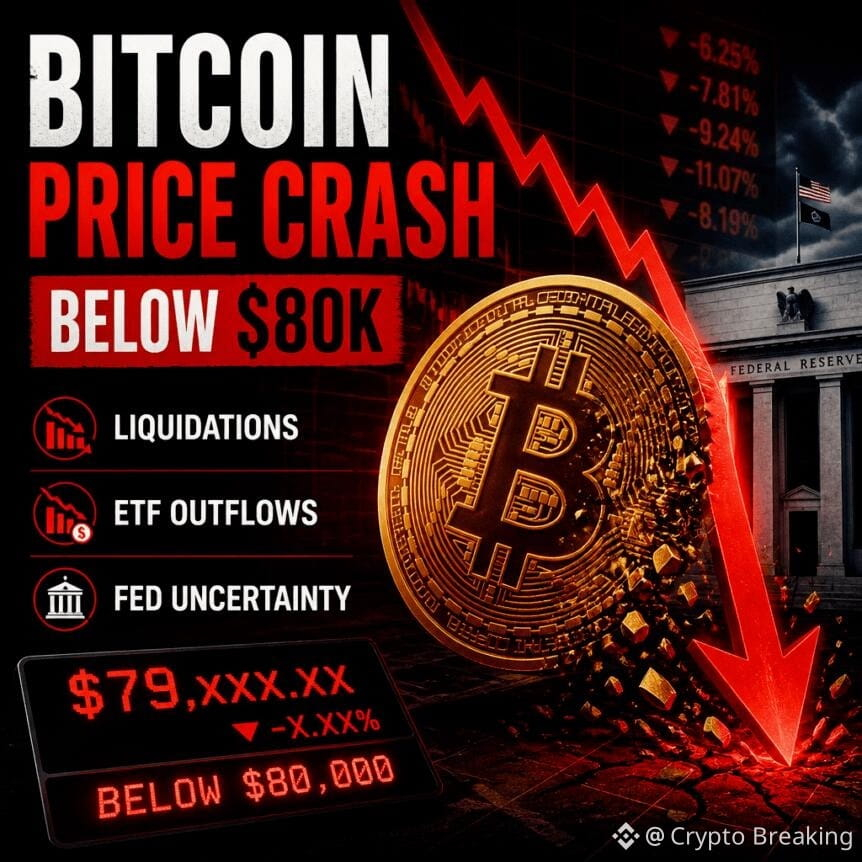
Мақала
Bitcoin Price Crash Below $80K: Liquidations, ETF Outflows and Fed UncertaintyBitcoin fell below $80,000 on Saturday, October 24, as forced liquidations and fund withdrawals increased selling pressure. The cryptocurrency dropped 1.91% over 24 hours to $79,994.97 during the initial decline. Meanwhile, upcoming Federal Reserve decisions, US economic data, and tensions involving Iran added pressure across digital asset markets.
The decline pushed Bitcoin below a key psychological price level for the first time since October 15. Leveraged traders faced mounting losses as falling prices reduced the value of their positions. At the same time, withdrawals from Bitcoin exchange-traded funds signaled reduced exposure through regulated investment products.
The broader cryptocurrency market also weakened during weekend trading, with several major tokens posting losses. Market data placed total cryptocurrency market capitalization at approximately $2.68 trillion, down 2.19%. However, the available figures do not establish how much each individual factor contributed to Bitcoin’s decline.
Leveraged Bitcoin Liquidations Accelerate Selling Pressure
Cryptocurrency liquidations reached approximately $219 million within one hour as Bitcoin dropped below $80,000. More than $200 million in leveraged long positions faced liquidation within just 15 minutes. These forced closures added selling pressure as traders struggled to maintain the collateral required for their positions.
Leveraged long positions allow traders to gain greater market exposure using borrowed funds or margin. However, exchanges can automatically close positions when losses reduce account equity below required maintenance levels. Therefore, a rapid price decline can trigger forced sales and intensify downward momentum across cryptocurrency markets.
The reported liquidation figures highlight the risks associated with excessive leverage during volatile trading sessions. Meanwhile, the Crypto Fear and Greed Index stood at 42, indicating neutral overall sentiment. Although that reading did not signal extreme fear, forced closures demonstrated the pressure facing leveraged market participants.
Bitcoin ETF Outflows Exceed $635 Million
US spot Bitcoin exchange-traded funds recorded approximately $635.6 million in net outflows on October 22. BlackRock’s IBIT accounted for around $254.1 million in withdrawals, while Fidelity’s FBTC recorded approximately $217.5 million. These figures marked a reversal from the positive flows reported during the previous trading session.
Withdrawals continued on Friday, with another $137.9 million leaving US spot Bitcoin ETFs before weekend trading. Consequently, the products logged several sessions of substantial outflows during a period of falling cryptocurrency prices. The withdrawals also reduced the amount of capital retained in these investment vehicles.
Spot Ethereum ETFs faced similar pressure, recording approximately $110.6 million in net outflows on October 22. BlackRock’s ETHA accounted for around $75.5 million of that total, according to the reported figures. Together, the Bitcoin and Ethereum fund movements reflected weaker demand through these investment products during the period.
Federal Reserve Meeting and US Elections Add Market Pressure
The Federal Reserve scheduled its next policy meeting for October 27–28, placing interest rates at the center of market attention. Additionally, US personal consumption expenditures inflation data for September was due on October 29. These events could influence expectations for borrowing costs, financial conditions, and demand for risk-sensitive assets.
Higher interest rates can reduce the appeal of assets that offer no conventional income, including Bitcoin. Conversely, expectations of lower borrowing costs can support demand for riskier investments when other conditions remain favorable. However, the upcoming policy decision does not independently explain the cryptocurrency’s latest price decline.
The US midterm elections scheduled for November 3 introduced another source of uncertainty for digital asset markets. Congressional control could influence future cryptocurrency legislation and financial market oversight. Still, the election’s approaching date alone does not establish a direct link to Saturday’s selloff.
Iran Tensions Add Pressure Across Cryptocurrency Markets
Geopolitical tensions involving Iran provided another potential source of pressure during the cryptocurrency decline. President Donald Trump raised the possibility of further military action against Iran in remarks reported on October 23. However, the remarks did not establish a specific timetable or confirm an imminent military operation.
Any escalation could affect energy markets, inflation expectations, and demand for assets exposed to financial risk. In turn, changes in broader market conditions could influence cryptocurrency trading alongside other risk-sensitive investments. Still, the available information does not quantify the direct effect of Iran-related developments on Bitcoin’s price.
The selloff extended beyond Bitcoin, as Ethereum fell below $2,300 during the reported decline. XRP traded near $1.25, while Solana dropped below $100 as losses spread across major digital assets. Dogecoin and Cardano also weakened, highlighting the breadth of the market downturn.
What the Bitcoin Decline Means for the Cryptocurrency Market
Bitcoin’s move below $80,000 coincided with leveraged liquidations, substantial ETF withdrawals, and several approaching economic events. Together, these developments provided multiple possible sources of selling pressure during the weekend session. However, their individual contributions remain difficult to separate using the reported figures alone.
The latest decline also showed how leverage can intensify price movements when market conditions deteriorate. Meanwhile, ETF outflows indicated that some capital left regulated cryptocurrency investment products during the same period. Economic policy expectations and geopolitical tensions added further uncertainty to an already weak trading environment.
Bitcoin’s immediate performance will depend partly on market demand, trading liquidity, and developments surrounding monetary policy. ETF flow data and liquidation figures will also help explain whether selling pressure persists beyond the weekend. For now, the drop below $80,000 marks a significant setback for Bitcoin and reflects broader weakness across cryptocurrency markets.
This article was originally published as Bitcoin Price Crash Below $80K: Liquidations, ETF Outflows and Fed Uncertainty on Crypto Breaking News – your trusted source for crypto news, Bitcoin news, and blockchain updates.
Bitcoin Price Crash Below $80K: Liquidations, ETF Outflows and Fed Uncertainty
Bitcoin fell below $80,000 on Saturday, October 24, as forced liquidations and fund withdrawals increased selling pressure. The cryptocurrency dropped 1.91% over 24 hours to $79,994.97 during the initial decline. Meanwhile, upcoming Federal Reserve decisions, US economic data, and tensions involving Iran added pressure across digital asset markets.
The decline pushed Bitcoin below a key psychological price level for the first time since October 15. Leveraged traders faced mounting losses as falling prices reduced the value of their positions. At the same time, withdrawals from Bitcoin exchange-traded funds signaled reduced exposure through regulated investment products.
The broader cryptocurrency market also weakened during weekend trading, with several major tokens posting losses. Market data placed total cryptocurrency market capitalization at approximately $2.68 trillion, down 2.19%. However, the available figures do not establish how much each individual factor contributed to Bitcoin’s decline.
Leveraged Bitcoin Liquidations Accelerate Selling Pressure
Cryptocurrency liquidations reached approximately $219 million within one hour as Bitcoin dropped below $80,000. More than $200 million in leveraged long positions faced liquidation within just 15 minutes. These forced closures added selling pressure as traders struggled to maintain the collateral required for their positions.
Leveraged long positions allow traders to gain greater market exposure using borrowed funds or margin. However, exchanges can automatically close positions when losses reduce account equity below required maintenance levels. Therefore, a rapid price decline can trigger forced sales and intensify downward momentum across cryptocurrency markets.
The reported liquidation figures highlight the risks associated with excessive leverage during volatile trading sessions. Meanwhile, the Crypto Fear and Greed Index stood at 42, indicating neutral overall sentiment. Although that reading did not signal extreme fear, forced closures demonstrated the pressure facing leveraged market participants.
Bitcoin ETF Outflows Exceed $635 Million
US spot Bitcoin exchange-traded funds recorded approximately $635.6 million in net outflows on October 22. BlackRock’s IBIT accounted for around $254.1 million in withdrawals, while Fidelity’s FBTC recorded approximately $217.5 million. These figures marked a reversal from the positive flows reported during the previous trading session.
Withdrawals continued on Friday, with another $137.9 million leaving US spot Bitcoin ETFs before weekend trading. Consequently, the products logged several sessions of substantial outflows during a period of falling cryptocurrency prices. The withdrawals also reduced the amount of capital retained in these investment vehicles.
Spot Ethereum ETFs faced similar pressure, recording approximately $110.6 million in net outflows on October 22. BlackRock’s ETHA accounted for around $75.5 million of that total, according to the reported figures. Together, the Bitcoin and Ethereum fund movements reflected weaker demand through these investment products during the period.
Federal Reserve Meeting and US Elections Add Market Pressure
The Federal Reserve scheduled its next policy meeting for October 27–28, placing interest rates at the center of market attention. Additionally, US personal consumption expenditures inflation data for September was due on October 29. These events could influence expectations for borrowing costs, financial conditions, and demand for risk-sensitive assets.
Higher interest rates can reduce the appeal of assets that offer no conventional income, including Bitcoin. Conversely, expectations of lower borrowing costs can support demand for riskier investments when other conditions remain favorable. However, the upcoming policy decision does not independently explain the cryptocurrency’s latest price decline.
The US midterm elections scheduled for November 3 introduced another source of uncertainty for digital asset markets. Congressional control could influence future cryptocurrency legislation and financial market oversight. Still, the election’s approaching date alone does not establish a direct link to Saturday’s selloff.
Iran Tensions Add Pressure Across Cryptocurrency Markets
Geopolitical tensions involving Iran provided another potential source of pressure during the cryptocurrency decline. President Donald Trump raised the possibility of further military action against Iran in remarks reported on October 23. However, the remarks did not establish a specific timetable or confirm an imminent military operation.
Any escalation could affect energy markets, inflation expectations, and demand for assets exposed to financial risk. In turn, changes in broader market conditions could influence cryptocurrency trading alongside other risk-sensitive investments. Still, the available information does not quantify the direct effect of Iran-related developments on Bitcoin’s price.
The selloff extended beyond Bitcoin, as Ethereum fell below $2,300 during the reported decline. XRP traded near $1.25, while Solana dropped below $100 as losses spread across major digital assets. Dogecoin and Cardano also weakened, highlighting the breadth of the market downturn.
What the Bitcoin Decline Means for the Cryptocurrency Market
Bitcoin’s move below $80,000 coincided with leveraged liquidations, substantial ETF withdrawals, and several approaching economic events. Together, these developments provided multiple possible sources of selling pressure during the weekend session. However, their individual contributions remain difficult to separate using the reported figures alone.
The latest decline also showed how leverage can intensify price movements when market conditions deteriorate. Meanwhile, ETF outflows indicated that some capital left regulated cryptocurrency investment products during the same period. Economic policy expectations and geopolitical tensions added further uncertainty to an already weak trading environment.
Bitcoin’s immediate performance will depend partly on market demand, trading liquidity, and developments surrounding monetary policy. ETF flow data and liquidation figures will also help explain whether selling pressure persists beyond the weekend. For now, the drop below $80,000 marks a significant setback for Bitcoin and reflects broader weakness across cryptocurrency markets.
This article was originally published as Bitcoin Price Crash Below $80K: Liquidations, ETF Outflows and Fed Uncertainty on Crypto Breaking News – your trusted source for crypto news, Bitcoin news, and blockchain updates.
The decline pushed Bitcoin below a key psychological price level for the first time since October 15. Leveraged traders faced mounting losses as falling prices reduced the value of their positions. At the same time, withdrawals from Bitcoin exchange-traded funds signaled reduced exposure through regulated investment products.
The broader cryptocurrency market also weakened during weekend trading, with several major tokens posting losses. Market data placed total cryptocurrency market capitalization at approximately $2.68 trillion, down 2.19%. However, the available figures do not establish how much each individual factor contributed to Bitcoin’s decline.
Leveraged Bitcoin Liquidations Accelerate Selling Pressure
Cryptocurrency liquidations reached approximately $219 million within one hour as Bitcoin dropped below $80,000. More than $200 million in leveraged long positions faced liquidation within just 15 minutes. These forced closures added selling pressure as traders struggled to maintain the collateral required for their positions.
Leveraged long positions allow traders to gain greater market exposure using borrowed funds or margin. However, exchanges can automatically close positions when losses reduce account equity below required maintenance levels. Therefore, a rapid price decline can trigger forced sales and intensify downward momentum across cryptocurrency markets.
The reported liquidation figures highlight the risks associated with excessive leverage during volatile trading sessions. Meanwhile, the Crypto Fear and Greed Index stood at 42, indicating neutral overall sentiment. Although that reading did not signal extreme fear, forced closures demonstrated the pressure facing leveraged market participants.
Bitcoin ETF Outflows Exceed $635 Million
US spot Bitcoin exchange-traded funds recorded approximately $635.6 million in net outflows on October 22. BlackRock’s IBIT accounted for around $254.1 million in withdrawals, while Fidelity’s FBTC recorded approximately $217.5 million. These figures marked a reversal from the positive flows reported during the previous trading session.
Withdrawals continued on Friday, with another $137.9 million leaving US spot Bitcoin ETFs before weekend trading. Consequently, the products logged several sessions of substantial outflows during a period of falling cryptocurrency prices. The withdrawals also reduced the amount of capital retained in these investment vehicles.
Spot Ethereum ETFs faced similar pressure, recording approximately $110.6 million in net outflows on October 22. BlackRock’s ETHA accounted for around $75.5 million of that total, according to the reported figures. Together, the Bitcoin and Ethereum fund movements reflected weaker demand through these investment products during the period.
Federal Reserve Meeting and US Elections Add Market Pressure
The Federal Reserve scheduled its next policy meeting for October 27–28, placing interest rates at the center of market attention. Additionally, US personal consumption expenditures inflation data for September was due on October 29. These events could influence expectations for borrowing costs, financial conditions, and demand for risk-sensitive assets.
Higher interest rates can reduce the appeal of assets that offer no conventional income, including Bitcoin. Conversely, expectations of lower borrowing costs can support demand for riskier investments when other conditions remain favorable. However, the upcoming policy decision does not independently explain the cryptocurrency’s latest price decline.
The US midterm elections scheduled for November 3 introduced another source of uncertainty for digital asset markets. Congressional control could influence future cryptocurrency legislation and financial market oversight. Still, the election’s approaching date alone does not establish a direct link to Saturday’s selloff.
Iran Tensions Add Pressure Across Cryptocurrency Markets
Geopolitical tensions involving Iran provided another potential source of pressure during the cryptocurrency decline. President Donald Trump raised the possibility of further military action against Iran in remarks reported on October 23. However, the remarks did not establish a specific timetable or confirm an imminent military operation.
Any escalation could affect energy markets, inflation expectations, and demand for assets exposed to financial risk. In turn, changes in broader market conditions could influence cryptocurrency trading alongside other risk-sensitive investments. Still, the available information does not quantify the direct effect of Iran-related developments on Bitcoin’s price.
The selloff extended beyond Bitcoin, as Ethereum fell below $2,300 during the reported decline. XRP traded near $1.25, while Solana dropped below $100 as losses spread across major digital assets. Dogecoin and Cardano also weakened, highlighting the breadth of the market downturn.
What the Bitcoin Decline Means for the Cryptocurrency Market
Bitcoin’s move below $80,000 coincided with leveraged liquidations, substantial ETF withdrawals, and several approaching economic events. Together, these developments provided multiple possible sources of selling pressure during the weekend session. However, their individual contributions remain difficult to separate using the reported figures alone.
The latest decline also showed how leverage can intensify price movements when market conditions deteriorate. Meanwhile, ETF outflows indicated that some capital left regulated cryptocurrency investment products during the same period. Economic policy expectations and geopolitical tensions added further uncertainty to an already weak trading environment.
Bitcoin’s immediate performance will depend partly on market demand, trading liquidity, and developments surrounding monetary policy. ETF flow data and liquidation figures will also help explain whether selling pressure persists beyond the weekend. For now, the drop below $80,000 marks a significant setback for Bitcoin and reflects broader weakness across cryptocurrency markets.
This article was originally published as Bitcoin Price Crash Below $80K: Liquidations, ETF Outflows and Fed Uncertainty on Crypto Breaking News – your trusted source for crypto news, Bitcoin news, and blockchain updates.
110
Көбірек контент көру үшін кіріңіз
Binance Square платформасында әлемдік криптоқоғамдастыққа қосылыңыз
⚡️ Криптовалюта туралы ең соңғы және пайдалы ақпаратты алыңыз.
💬 Әлемдегі ең ірі криптобиржаның сеніміне ие.
👍 Расталған авторлардың нақты пікірлерін табыңыз.
Электрондық пошта/телефон нөмірі
Трендтегі тақырыптар
BinancePick
3.1M рет көрілді
152,749 адам талқылап жатыр
Join #EarningsSeason: Predict Earnings on Binance Pick, Share Your Take on Binance Square!
Binance Square Official
·411 лайк
·343k рет көрілді
EarningsSeason
5.3M рет көрілді
25,978 адам талқылап жатыр
AnthropicTTMRevenueGrewAbout1200%
28,363 рет көрілді
407 адам талқылап жатыр