

Chainwire
2.9k Жариялаулар

Chainwire
 «Square расталған+» белгісі
Хабарлау
Пайдаланушыны блоктау
Crypto-focused news feed from Web 3.0 brands around the world
0 Жазылым
23.7K+ Жазылушылар
2.4K+ лайк басылған
Жазбалар
·
--

Мақала
Quotient Launches New Signals App for Prediction-market Traders (27 Oct)Sacramento, California, October 27th, 2026, Chainwire
Tighter Signal selection and a rebuilt feed put Q's forecasts, market prices and research together, ranked around the sports and teams users follow.
Quotient Solutions, Inc. today launched the new Quotient Signals app at app.quotient.social, with tighter Signal selection and a rebuilt feed ranked around the sports and teams users follow. The feed brings Q's forecast, the market price and the supporting research together, so traders can see where Q disagrees with the market and why.
Q is Quotient's AI forecaster. Quotient publishes Signals where Q's forecasts identify an edge over market prices. Traders can start with a team or a covered market and examine the research and risks behind each Signal. Users make their own trading decisions and execute on separate venues.
“We looked at where Q actually does best and rebuilt the app around that,” said Jordan Olmstead, CEO of Quotient. “We also wanted to make it as easy as possible to see what Q thinks and why, and to know when it was right or wrong, so you can decide how much weight to give it next time.”
In its public forecast evaluation, updated October 19, Q's forecasts scored better than Polymarket prices recorded at the same times in 1,976 of 3,282 resolved markets, or 60.2%, using forecasts from the preceding 60 days. The comparison uses Brier scores, a measure of probability error, across all covered markets. It measures forecast accuracy, not trading returns. Every published Signal is scored after its market resolves, and the full record, misses included, is public at app.quotient.social/performance.
Sports is where the launch starts because familiar teams, scheduled games and near-term results make the process easy to follow: read the research, compare the prices, check the outcome. Q forecasts the games that carry most of each league's daily volume across the NFL, college football, the NBA, MLB, the NHL, tennis and more, and also researches politics, economic events and geopolitics. The same forecasts are available to developers and trading agents through Quotient's API (quotient.social/docs).
Quotient Live will introduce the app with a walkthrough of Signals and audience questions.
Quotient is moving to paid memberships. Users will no longer need to hold $QUOTIENT to use the app. Existing users receive their first two months free and can find their personal code by signing in with their existing account. Member access is $49.99 a month or $400 a year; Pro is $149 a month or $1,200 a year. Quotient is also planning its first Signals competition with $QUOTIENT prizes; timing and rules will be announced separately.
Explore the new app at app.quotient.social.
About Quotient
Quotient Solutions, Inc. provides forecasting intelligence for prediction markets. Q produces forecasts; Quotient publishes Signals where those forecasts identify an edge over market prices and scores every forecast against the resolved outcome. Learn more at app.quotient.social.
Contact
Shira Stembershira@quotient.social Disclaimer. This is a paid press release.
Quotient Launches New Signals App for Prediction-market Traders (27 Oct)
Sacramento, California, October 27th, 2026, Chainwire
Tighter Signal selection and a rebuilt feed put Q's forecasts, market prices and research together, ranked around the sports and teams users follow.
Quotient Solutions, Inc. today launched the new Quotient Signals app at app.quotient.social, with tighter Signal selection and a rebuilt feed ranked around the sports and teams users follow. The feed brings Q's forecast, the market price and the supporting research together, so traders can see where Q disagrees with the market and why.
Q is Quotient's AI forecaster. Quotient publishes Signals where Q's forecasts identify an edge over market prices. Traders can start with a team or a covered market and examine the research and risks behind each Signal. Users make their own trading decisions and execute on separate venues.
“We looked at where Q actually does best and rebuilt the app around that,” said Jordan Olmstead, CEO of Quotient. “We also wanted to make it as easy as possible to see what Q thinks and why, and to know when it was right or wrong, so you can decide how much weight to give it next time.”
In its public forecast evaluation, updated October 19, Q's forecasts scored better than Polymarket prices recorded at the same times in 1,976 of 3,282 resolved markets, or 60.2%, using forecasts from the preceding 60 days. The comparison uses Brier scores, a measure of probability error, across all covered markets. It measures forecast accuracy, not trading returns. Every published Signal is scored after its market resolves, and the full record, misses included, is public at app.quotient.social/performance.
Sports is where the launch starts because familiar teams, scheduled games and near-term results make the process easy to follow: read the research, compare the prices, check the outcome. Q forecasts the games that carry most of each league's daily volume across the NFL, college football, the NBA, MLB, the NHL, tennis and more, and also researches politics, economic events and geopolitics. The same forecasts are available to developers and trading agents through Quotient's API (quotient.social/docs).
Quotient Live will introduce the app with a walkthrough of Signals and audience questions.
Quotient is moving to paid memberships. Users will no longer need to hold $QUOTIENT to use the app. Existing users receive their first two months free and can find their personal code by signing in with their existing account. Member access is $49.99 a month or $400 a year; Pro is $149 a month or $1,200 a year. Quotient is also planning its first Signals competition with $QUOTIENT prizes; timing and rules will be announced separately.
Explore the new app at app.quotient.social.
About Quotient
Quotient Solutions, Inc. provides forecasting intelligence for prediction markets. Q produces forecasts; Quotient publishes Signals where those forecasts identify an edge over market prices and scores every forecast against the resolved outcome. Learn more at app.quotient.social.
Contact
Shira Stembershira@quotient.social Disclaimer. This is a paid press release.
43
·
--
Мақала
Twinstake Joins Jupiter's JupSOL Validator Set (27 Oct)Singapore, Singapore, October 27th, 2026, Chainwire
Twinstake, an institutional validator infrastructure provider, today announced an agreement relating to Jupiter's jupSOL Pool, under which its Solana validator joins the jupSOL validator set. The integration enables institutional clients who independently choose to hold jupSOL to designate Twinstake as the validator operator for SOL attributable to their positions, subject to the pool's designation and routing process.
The collaboration brings Twinstake's validator infrastructure into Jupiter's liquid staking ecosystem, allowing institutions to use an existing infrastructure provider for their jupSOL positions. The agreement means Twinstake clients that independently choose jupSOL can have SOL attributable to their positions delegated to a validator operator they already work with.
"As institutions look at DeFi, the infrastructure underneath still has to meet their standards," said Harriet Browning, vice president of commercial at Twinstake. "Joining the jupSOL validator set means clients who independently choose jupSOL can have the related SOL delegated to an operator they already work with."
Jupiter is a decentralized finance platform on Solana, powering swaps, perpetuals, lending, and other onchain financial activities. Its jupSOL liquid staking token allows holders to maintain transferable positions while the underlying SOL remains delegated to validators securing the network.
Under the agreement, where a Twinstake client independently chooses jupSOL and designates Twinstake, SOL attributable to its jupSOL position can be delegated to Twinstake’s validator, subject to the pool’s designation and routing process. Twinstake operates non-custodial validator infrastructure, meaning it does not take custody of delegated SOL, and a SOC 2 Type II report covers its operational controls.
The integration builds on Twinstake’s existing validator operations across major proof-of-stake networks, including Ethereum and Solana. The company serves asset managers, exchange-traded product issuers, custodians and exchanges, and operates validator infrastructure behind the first North American Solana staking ETFs.
"Institutional capital doesn't arrive onchain all at once. It shows up through providers those teams already trust, one piece of infrastructure at a time," said Kash Dhanda, chief operating officer at Jupiter. "Twinstake joining the jupSOL validator set is one of those pieces."
The collaboration extends Twinstake's institutional validator services to Jupiter's liquid staking ecosystem as institutions evaluate opportunities across Solana. Twinstake's role remains limited to validator operations and related technical services, and the company does not issue, distribute, custody, or arrange the acquisition of jupSOL. Decisions to acquire or hold the token remain the independent responsibility of each client.
About Jupiter
Jupiter is the home of onchain finance. As the leading trading platform on Solana, Jupiter brings everything onchain together in one place: trade any asset, from tokens and perpetuals to stocks and prediction markets; earn through lending, borrowing, and staking; and manage it all with the Jupiter Wallet and Portfolio. Jupiter is also the engine behind hundreds of Solana projects, from wallets to institutions, that build on its infrastructure. Jupiter’s mission is to make decentralized financial infrastructure powerful, accessible, and borderless. Learn more at jup.ag.
About Twinstake
Twinstake is an institutional staking infrastructure provider to financial institutions and digital asset businesses, powering over 40% of the European staked ETP market. With a unified API and SOC 2 Type II attested, OFAC-compliant infrastructure, Twinstake helps institutions access staking rewards while retaining full control of their assets through their preferred custodians. Twinstake powered the first North American Solana staking ETFs and delivers Concierge Staking for clients who need staking to an institutional standard.
Contact
Head of Marketing / PRAlishaalisha@jup.ag Disclaimer. This is a paid press release.
Twinstake Joins Jupiter's JupSOL Validator Set (27 Oct)
Singapore, Singapore, October 27th, 2026, Chainwire
Twinstake, an institutional validator infrastructure provider, today announced an agreement relating to Jupiter's jupSOL Pool, under which its Solana validator joins the jupSOL validator set. The integration enables institutional clients who independently choose to hold jupSOL to designate Twinstake as the validator operator for SOL attributable to their positions, subject to the pool's designation and routing process.
The collaboration brings Twinstake's validator infrastructure into Jupiter's liquid staking ecosystem, allowing institutions to use an existing infrastructure provider for their jupSOL positions. The agreement means Twinstake clients that independently choose jupSOL can have SOL attributable to their positions delegated to a validator operator they already work with.
"As institutions look at DeFi, the infrastructure underneath still has to meet their standards," said Harriet Browning, vice president of commercial at Twinstake. "Joining the jupSOL validator set means clients who independently choose jupSOL can have the related SOL delegated to an operator they already work with."
Jupiter is a decentralized finance platform on Solana, powering swaps, perpetuals, lending, and other onchain financial activities. Its jupSOL liquid staking token allows holders to maintain transferable positions while the underlying SOL remains delegated to validators securing the network.
Under the agreement, where a Twinstake client independently chooses jupSOL and designates Twinstake, SOL attributable to its jupSOL position can be delegated to Twinstake’s validator, subject to the pool’s designation and routing process. Twinstake operates non-custodial validator infrastructure, meaning it does not take custody of delegated SOL, and a SOC 2 Type II report covers its operational controls.
The integration builds on Twinstake’s existing validator operations across major proof-of-stake networks, including Ethereum and Solana. The company serves asset managers, exchange-traded product issuers, custodians and exchanges, and operates validator infrastructure behind the first North American Solana staking ETFs.
"Institutional capital doesn't arrive onchain all at once. It shows up through providers those teams already trust, one piece of infrastructure at a time," said Kash Dhanda, chief operating officer at Jupiter. "Twinstake joining the jupSOL validator set is one of those pieces."
The collaboration extends Twinstake's institutional validator services to Jupiter's liquid staking ecosystem as institutions evaluate opportunities across Solana. Twinstake's role remains limited to validator operations and related technical services, and the company does not issue, distribute, custody, or arrange the acquisition of jupSOL. Decisions to acquire or hold the token remain the independent responsibility of each client.
About Jupiter
Jupiter is the home of onchain finance. As the leading trading platform on Solana, Jupiter brings everything onchain together in one place: trade any asset, from tokens and perpetuals to stocks and prediction markets; earn through lending, borrowing, and staking; and manage it all with the Jupiter Wallet and Portfolio. Jupiter is also the engine behind hundreds of Solana projects, from wallets to institutions, that build on its infrastructure. Jupiter’s mission is to make decentralized financial infrastructure powerful, accessible, and borderless. Learn more at jup.ag.
About Twinstake
Twinstake is an institutional staking infrastructure provider to financial institutions and digital asset businesses, powering over 40% of the European staked ETP market. With a unified API and SOC 2 Type II attested, OFAC-compliant infrastructure, Twinstake helps institutions access staking rewards while retaining full control of their assets through their preferred custodians. Twinstake powered the first North American Solana staking ETFs and delivers Concierge Staking for clients who need staking to an institutional standard.
Contact
Head of Marketing / PRAlishaalisha@jup.ag Disclaimer. This is a paid press release.
89
·
--
Мақала
Mirae Asset Securities and Grvt Collaborate on Tokenised Funding Note Issuance (27 Oct)Singapore, Singapore, October 27th, 2026, Chainwire
The collaboration begins with Grvt’s subscription to Mirae Asset Securities’ tokenised funding notes, with potential future tokenised products (e.g., tokenised Treasuries, corporate bonds and ETFs) to be explored, subject to applicable regulatory requirements.
Mirae Asset Securities (HK) Limited, the Hong Kong subsidiary of Korea's leading securities firm, has arranged an issuance of tokenised funding notes under its affiliate’s structured notes programme, to which Grvt has subscribed. Grvt intends to use the resulting exposure in connection with Grvt Earn, subject to applicable requirements.
Grvt Earn is offered and operated independently by Grvt and is available only to eligible users in permitted jurisdictions. Grvt has subscribed for the notes. Any use of the resulting exposure in connection with Grvt Earn is independently determined and managed by Grvt.
From Tokenised Funding Notes to Tokenised ETFs
Tokenised funding notes are the starting point. The two firms will next explore additional tokenised products (including Treasuries and ETFs) on a non-committed and exploratory basis, subject to applicable regulatory approvals and product/compliance clearance.
Mirae Asset Financial Group oversees more than US$1 trillion in client assets worldwide as of Sep 2026. The parties intend to explore opportunities involving selected tokenised products, subject to applicable regulatory requirements.
The transaction represents an initial collaboration between the two firms. The parties may explore further opportunities involving tokenised products, subject to applicable legal and regulatory requirements and their respective internal approvals.
Mirae Asset Securities’ Digital Asset Expansion
Mirae Asset Securities has moved quickly to connect traditional finance and digital assets in 2026. In January, it became the first Korean securities firm to issue digital bonds in Hong Kong. In April, Mirae Asset Securities (HK) Limited became the first Korean-owned brokerage to receive the Securities and Futures Commission (“SFC”) approval to offer digital asset trading to retail investors. In July, it launched MAPS in Hong Kong, a single app for traditional and digital assets with products allowed by the SFC.
"When Korea's leading securities firm explores opportunities in tokenised assets, collaboration with market participants plays an important role. Grvt’s subscription to Mirae Asset Securities’ tokenised funding notes marks an initial step in this collaboration. Together, we intend to explore opportunities involving tokenised Treasuries, corporate bonds and, over time, ETFs for eligible investors in permitted jurisdictions, subject to applicable regulatory requirements.” Hong Yea, Co-founder and CEO, Grvt
“We see tokenisation as an important area of development for capital markets. Grvt’s subscription to this tokenised funding note issuance represents an opportunity to explore the use of tokenised securities in new market structures. We look forward to exploring further opportunities."
“This issuance marks a step forward in our digital asset strategy, bringing our structured product capabilities into tokenised markets. We look forward to exploring further opportunities with Grvt, subject to applicable regulatory requirements and internal approvals.” Kelly Sohn, Head of Digital Assets, Mirae Asset Securities (HK) Limited
About Grvt
Grvt is an onchain platform, live since 2024. Users trade, invest, and earn from a single account that only their own key can move. Grvt has served more than 198,000 wallets and reached a peak of US$109 million in total value locked on 22nd March 2026. It is backed by ZKsync, Further Ventures, 500 Global and Hack VC, and works with ecosystem partners including Ondo Finance, Aave, Morpho, Plume and OpenEden. Learn more at grvt.io.
About Mirae Asset Securities (HK) Limited
Mirae Asset Securities (HK) Limited (SFC CE No.: BJB333) is a member of the Mirae Asset Financial Group. Its parent company, Mirae Asset Securities Co., is one of the largest securities firms in South Korea. Established in Hong Kong, Mirae Asset Securities (HK) Limited serves as an important platform for connecting clients to global markets, supported by Mirae Asset’s international network, investment expertise, and long-standing commitment to innovation.
Disclaimer: This announcement is for information only and does not constitute an offer or solicitation to buy or sell any securities, virtual assets or other products. Grvt is not licensed or registered with the Securities and Futures Commission, and Grvt Earn has not been authorised by the SFC and is not offered to the public in Hong Kong. Grvt Earn is independently offered and operated by Grvt; its availability depends on jurisdiction and eligibility, and yields are variable and not guaranteed. Mirae Asset Securities (HK) Limited and its affiliates do not operate, distribute or recommend Grvt Earn and are not responsible for its operation, availability, performance or returns. Information about Grvt and Grvt Earn has been provided by Grvt and has not been independently verified by Mirae Asset Securities (HK) Limited or its affiliates.
Contact
Lesner ChuaGRVT ASIA PTE. LTDlesner.chua@grvt.io Disclaimer. This is a paid press release.
Mirae Asset Securities and Grvt Collaborate on Tokenised Funding Note Issuance (27 Oct)
Singapore, Singapore, October 27th, 2026, Chainwire
The collaboration begins with Grvt’s subscription to Mirae Asset Securities’ tokenised funding notes, with potential future tokenised products (e.g., tokenised Treasuries, corporate bonds and ETFs) to be explored, subject to applicable regulatory requirements.
Mirae Asset Securities (HK) Limited, the Hong Kong subsidiary of Korea's leading securities firm, has arranged an issuance of tokenised funding notes under its affiliate’s structured notes programme, to which Grvt has subscribed. Grvt intends to use the resulting exposure in connection with Grvt Earn, subject to applicable requirements.
Grvt Earn is offered and operated independently by Grvt and is available only to eligible users in permitted jurisdictions. Grvt has subscribed for the notes. Any use of the resulting exposure in connection with Grvt Earn is independently determined and managed by Grvt.
From Tokenised Funding Notes to Tokenised ETFs
Tokenised funding notes are the starting point. The two firms will next explore additional tokenised products (including Treasuries and ETFs) on a non-committed and exploratory basis, subject to applicable regulatory approvals and product/compliance clearance.
Mirae Asset Financial Group oversees more than US$1 trillion in client assets worldwide as of Sep 2026. The parties intend to explore opportunities involving selected tokenised products, subject to applicable regulatory requirements.
The transaction represents an initial collaboration between the two firms. The parties may explore further opportunities involving tokenised products, subject to applicable legal and regulatory requirements and their respective internal approvals.
Mirae Asset Securities’ Digital Asset Expansion
Mirae Asset Securities has moved quickly to connect traditional finance and digital assets in 2026. In January, it became the first Korean securities firm to issue digital bonds in Hong Kong. In April, Mirae Asset Securities (HK) Limited became the first Korean-owned brokerage to receive the Securities and Futures Commission (“SFC”) approval to offer digital asset trading to retail investors. In July, it launched MAPS in Hong Kong, a single app for traditional and digital assets with products allowed by the SFC.
"When Korea's leading securities firm explores opportunities in tokenised assets, collaboration with market participants plays an important role. Grvt’s subscription to Mirae Asset Securities’ tokenised funding notes marks an initial step in this collaboration. Together, we intend to explore opportunities involving tokenised Treasuries, corporate bonds and, over time, ETFs for eligible investors in permitted jurisdictions, subject to applicable regulatory requirements.” Hong Yea, Co-founder and CEO, Grvt
“We see tokenisation as an important area of development for capital markets. Grvt’s subscription to this tokenised funding note issuance represents an opportunity to explore the use of tokenised securities in new market structures. We look forward to exploring further opportunities."
“This issuance marks a step forward in our digital asset strategy, bringing our structured product capabilities into tokenised markets. We look forward to exploring further opportunities with Grvt, subject to applicable regulatory requirements and internal approvals.” Kelly Sohn, Head of Digital Assets, Mirae Asset Securities (HK) Limited
About Grvt
Grvt is an onchain platform, live since 2024. Users trade, invest, and earn from a single account that only their own key can move. Grvt has served more than 198,000 wallets and reached a peak of US$109 million in total value locked on 22nd March 2026. It is backed by ZKsync, Further Ventures, 500 Global and Hack VC, and works with ecosystem partners including Ondo Finance, Aave, Morpho, Plume and OpenEden. Learn more at grvt.io.
About Mirae Asset Securities (HK) Limited
Mirae Asset Securities (HK) Limited (SFC CE No.: BJB333) is a member of the Mirae Asset Financial Group. Its parent company, Mirae Asset Securities Co., is one of the largest securities firms in South Korea. Established in Hong Kong, Mirae Asset Securities (HK) Limited serves as an important platform for connecting clients to global markets, supported by Mirae Asset’s international network, investment expertise, and long-standing commitment to innovation.
Disclaimer: This announcement is for information only and does not constitute an offer or solicitation to buy or sell any securities, virtual assets or other products. Grvt is not licensed or registered with the Securities and Futures Commission, and Grvt Earn has not been authorised by the SFC and is not offered to the public in Hong Kong. Grvt Earn is independently offered and operated by Grvt; its availability depends on jurisdiction and eligibility, and yields are variable and not guaranteed. Mirae Asset Securities (HK) Limited and its affiliates do not operate, distribute or recommend Grvt Earn and are not responsible for its operation, availability, performance or returns. Information about Grvt and Grvt Earn has been provided by Grvt and has not been independently verified by Mirae Asset Securities (HK) Limited or its affiliates.
Contact
Lesner ChuaGRVT ASIA PTE. LTDlesner.chua@grvt.io Disclaimer. This is a paid press release.
55
·
--
Мақала
PrimeXBT Brings Tesla, SpaceX, NVIDIA and More to Crypto Futures With New Tokenised Stocks (27 Oct)Castries, Saint Lucia, October 27th, 2026, Chainwire
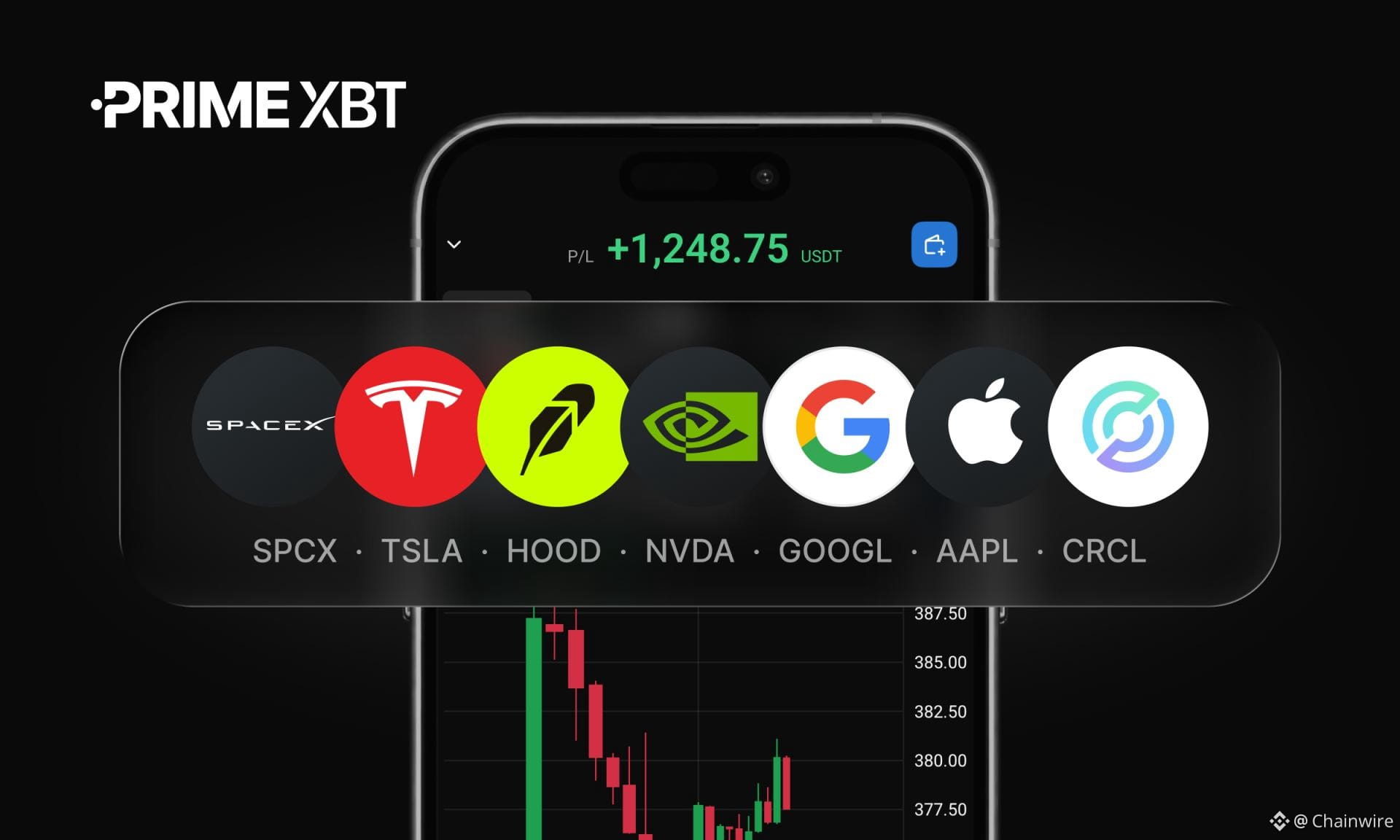
PrimeXBT, a global multi-asset broker and crypto asset service provider, has announced a major expansion of its offering, introducing Tokenised Stocks, a new category of Crypto Futures available on its native PXTrader 2.0 platform. The launch gives crypto traders access to price movements linked to some of the world's most prominent companies, bringing opportunities from traditional equity markets into the crypto trading environment.
The new category includes seven USDT-denominated Crypto Futures linked to SpaceX (SPCX/USDT), NVIDIA (NVDA/USDT), Tesla (TSLA/USDT), Circle (CRCL/USDT), Apple (AAPL/USDT), Alphabet (GOOGL/USDT) and Robinhood (HOOD/USDT). Traders can take long or short positions and respond to market developments around the clock, including outside traditional stock exchange hours. The contracts provide exposure to company-linked price movements without ownership of the underlying shares.
“Big Tech remains at the centre of market attention, with AI investment, corporate earnings and growth expectations driving sentiment across global equities. Earnings season in particular can bring significant price movements, as investors reassess company performance and future prospects,” commented Jonatan Randin, Senior Market Analyst at PrimeXBT. “With tokenised stocks, we're opening up new opportunities to crypto traders, allowing them to participate in major equity market trends through a familiar crypto trading environment.”
Alongside Tokenised Stocks, PrimeXBT has added Lighter (LIT/USDT), Monad (MON/USDT), Venice Token (VVV/USDT), Canton (CC/USDT), Stable (STABLE/USDT), JUST (JST/USDT) and Midnight (NIGHT/USDT) to its PXTrader 2.0 lineup of over 170 Crypto Futures, further strengthening the depth and diversity of its offering across DeFi, AI, Gaming, Payments, Layer 1 and 2 networks, blockchain infrastructure, NFTs, Meme coins and the Metaverse. The broker has also introduced new Crypto CFDs on Monero (XMR/USD), Hyperliquid (HYPE/USD) and Zcash (ZEC/USD) on PXTrader 2.0, with corresponding USDT-quoted instruments available on MetaTrader 5.
PrimeXBT has also expanded its blockchain network support with the addition of Arbitrum, Optimism and Base, joining existing networks including Bitcoin, Ethereum, Tron, BNB Smart Chain and Solana. Additionally, the broker has added Tether Gold (XAUT), a tokenized gold asset, to its internal Exchange, expanding its offering of over 50 cryptocurrencies and digital assets.
The expanded offering is supported by flexible crypto funding and crypto-denominated accounts in USDT, USDC, BTC and ETH, allowing clients to trade without converting their holdings into fiat. PrimeXBT offers competitive Crypto Futures fees of 0.01% for makers and 0.045% for takers, with further discounts through its volume-based VIP program. New clients automatically receive VIP 4 status for their first 14 days, reducing Crypto Futures taker fees by 33%, while high-volume traders can unlock fees as low as 0.015% and Bitcoin CFD spreads from $19 at the highest VIP tier.
The launch reflects the growing convergence of crypto and traditional financial markets, bringing a wider range of global market trends into the crypto trading environment. From artificial intelligence and electric vehicles to space technology and digital finance, PrimeXBT continues to broaden trading opportunities beyond digital assets, reinforcing its position as an innovative multi-asset broker connecting markets through one trading ecosystem.
To learn more about the Crypto Futures offering, users can visit PrimeXBT’s website.
About PrimeXBT
PrimeXBT is a global multi-asset broker and crypto asset service provider trusted by traders in more than 150 countries. The platform bridges traditional and digital markets within one integrated environment, redefining versatility and innovation in online trading. Clients can access Forex, CFDs on indices, commodities, shares, crypto, and Crypto Futures, as well as buy, store and exchange cryptocurrencies. This unified experience extends across both the native PXTrader 2.0 platform and MetaTrader 5, supported by advanced risk-management tools and a wide range of funding options in crypto, fiat and local payment methods. Since 2018, PrimeXBT has focused on empowering traders through broad multi-asset access, fair and transparent conditions, professional-grade technology and dedicated human support. By combining expertise, trust and a client-first approach, PrimeXBT sets a benchmark of excellence in the financial industry and provides traders with the tools they need to trade, grow and succeed with confidence.
Disclaimer: The content provided here is for informational purposes only and is not intended as personal investment advice and does not constitute a solicitation or invitation to engage in any financial transactions, investments, or related activities. Past performance is not a reliable indicator of future results. The financial products offered by the Company are complex and come with a high risk of losing money rapidly due to leverage. These products may not be suitable for all investors. Before engaging, you should consider whether you understand how these leveraged products work and whether you can afford the high risk of losing your money. The Company does not accept clients from the Restricted Jurisdictions as indicated on its website / T&Cs. Some products and services, including MT5, may not be available in your jurisdiction. The applicable legal entity and its respective products and services depend on the client’s country of residence and the entity with which the client has established a contractual relationship during registration.
Contact
PrimeXBTpr@primexbt.com Disclaimer. This is a paid press release.
PrimeXBT Brings Tesla, SpaceX, NVIDIA and More to Crypto Futures With New Tokenised Stocks (27 Oct)
Castries, Saint Lucia, October 27th, 2026, Chainwire
PrimeXBT, a global multi-asset broker and crypto asset service provider, has announced a major expansion of its offering, introducing Tokenised Stocks, a new category of Crypto Futures available on its native PXTrader 2.0 platform. The launch gives crypto traders access to price movements linked to some of the world's most prominent companies, bringing opportunities from traditional equity markets into the crypto trading environment.
The new category includes seven USDT-denominated Crypto Futures linked to SpaceX (SPCX/USDT), NVIDIA (NVDA/USDT), Tesla (TSLA/USDT), Circle (CRCL/USDT), Apple (AAPL/USDT), Alphabet (GOOGL/USDT) and Robinhood (HOOD/USDT). Traders can take long or short positions and respond to market developments around the clock, including outside traditional stock exchange hours. The contracts provide exposure to company-linked price movements without ownership of the underlying shares.
“Big Tech remains at the centre of market attention, with AI investment, corporate earnings and growth expectations driving sentiment across global equities. Earnings season in particular can bring significant price movements, as investors reassess company performance and future prospects,” commented Jonatan Randin, Senior Market Analyst at PrimeXBT. “With tokenised stocks, we're opening up new opportunities to crypto traders, allowing them to participate in major equity market trends through a familiar crypto trading environment.”
Alongside Tokenised Stocks, PrimeXBT has added Lighter (LIT/USDT), Monad (MON/USDT), Venice Token (VVV/USDT), Canton (CC/USDT), Stable (STABLE/USDT), JUST (JST/USDT) and Midnight (NIGHT/USDT) to its PXTrader 2.0 lineup of over 170 Crypto Futures, further strengthening the depth and diversity of its offering across DeFi, AI, Gaming, Payments, Layer 1 and 2 networks, blockchain infrastructure, NFTs, Meme coins and the Metaverse. The broker has also introduced new Crypto CFDs on Monero (XMR/USD), Hyperliquid (HYPE/USD) and Zcash (ZEC/USD) on PXTrader 2.0, with corresponding USDT-quoted instruments available on MetaTrader 5.
PrimeXBT has also expanded its blockchain network support with the addition of Arbitrum, Optimism and Base, joining existing networks including Bitcoin, Ethereum, Tron, BNB Smart Chain and Solana. Additionally, the broker has added Tether Gold (XAUT), a tokenized gold asset, to its internal Exchange, expanding its offering of over 50 cryptocurrencies and digital assets.
The expanded offering is supported by flexible crypto funding and crypto-denominated accounts in USDT, USDC, BTC and ETH, allowing clients to trade without converting their holdings into fiat. PrimeXBT offers competitive Crypto Futures fees of 0.01% for makers and 0.045% for takers, with further discounts through its volume-based VIP program. New clients automatically receive VIP 4 status for their first 14 days, reducing Crypto Futures taker fees by 33%, while high-volume traders can unlock fees as low as 0.015% and Bitcoin CFD spreads from $19 at the highest VIP tier.
The launch reflects the growing convergence of crypto and traditional financial markets, bringing a wider range of global market trends into the crypto trading environment. From artificial intelligence and electric vehicles to space technology and digital finance, PrimeXBT continues to broaden trading opportunities beyond digital assets, reinforcing its position as an innovative multi-asset broker connecting markets through one trading ecosystem.
To learn more about the Crypto Futures offering, users can visit PrimeXBT’s website.
About PrimeXBT
PrimeXBT is a global multi-asset broker and crypto asset service provider trusted by traders in more than 150 countries. The platform bridges traditional and digital markets within one integrated environment, redefining versatility and innovation in online trading. Clients can access Forex, CFDs on indices, commodities, shares, crypto, and Crypto Futures, as well as buy, store and exchange cryptocurrencies. This unified experience extends across both the native PXTrader 2.0 platform and MetaTrader 5, supported by advanced risk-management tools and a wide range of funding options in crypto, fiat and local payment methods. Since 2018, PrimeXBT has focused on empowering traders through broad multi-asset access, fair and transparent conditions, professional-grade technology and dedicated human support. By combining expertise, trust and a client-first approach, PrimeXBT sets a benchmark of excellence in the financial industry and provides traders with the tools they need to trade, grow and succeed with confidence.
Disclaimer: The content provided here is for informational purposes only and is not intended as personal investment advice and does not constitute a solicitation or invitation to engage in any financial transactions, investments, or related activities. Past performance is not a reliable indicator of future results. The financial products offered by the Company are complex and come with a high risk of losing money rapidly due to leverage. These products may not be suitable for all investors. Before engaging, you should consider whether you understand how these leveraged products work and whether you can afford the high risk of losing your money. The Company does not accept clients from the Restricted Jurisdictions as indicated on its website / T&Cs. Some products and services, including MT5, may not be available in your jurisdiction. The applicable legal entity and its respective products and services depend on the client’s country of residence and the entity with which the client has established a contractual relationship during registration.
Contact
PrimeXBTpr@primexbt.com Disclaimer. This is a paid press release.
74
·
--
Мақала
BlackRock, SBI Holdings and Startale Sign Landmark MOU to Bridge Tokenized Money Market Funds and...Tokyo, Japan, October 27th, 2026, Chainwire
A strategic collaboration to connect tokenized financial assets with yen-denominated stablecoins and advance Japan’s onchain financial ecosystem.
SBI Holdings, Inc. (“SBI Holdings”) and Startale Group Pte. Ltd. (“Startale”) today announced that they have signed a memorandum of understanding (“MOU”) with BlackRock Financial Management, Inc. (“BFM”) and BlackRock Japan Co., Ltd. (“BlackRock Japan,” and together with BFM, “BlackRock”) to explore the development of a digital asset ecosystem connecting tokenized money market funds (“tokenized MMFs”) with JPYSC, a yen-denominated trust-type stablecoin.
The MOU brings together complementary strengths in global asset management, financial services, regulatory expertise, and blockchain infrastructure. Through this collaboration, the companies will explore opportunities to connect tokenized MMFs with JPYSC and advance the development of onchain finance in Japan and beyond.
Building the Foundations for Onchain Finance
Globally, the tokenization of traditional financial products, including money market funds (MMFs), is gaining traction, alongside efforts to develop new financial infrastructure that combines tokenized assets with stablecoins.
Japan has established a legal framework for stablecoins through amendments to the Payment Services Act. The next step is to develop the infrastructure, distribution channels, and regulatory frameworks needed to connect tokenized assets with stablecoins and support broader market adoption.
Against this backdrop, SBI Holdings and Startale have entered into the MOU with BlackRock to explore the potential for connecting tokenized MMFs with JPYSC, with the aim of contributing to the development of onchain finance in Japan and globally.
Scope of Partnership
Under the MOU, the companies will examine the potential for connecting tokenized MMFs and JPYSC across three areas:
Technology and infrastructure: Exploring the technical requirements and infrastructure needed to support connectivity between tokenized MMFs and JPYSC.
Business and distribution: Examining potential business models and distribution opportunities, drawing on the companies’ respective networks, capabilities and market access.
Regulation and market development: Assessing relevant regulatory considerations and supporting the development of the broader market environment for tokenized assets and stablecoins.
The collaboration is intended to be open to a broad range of market participants, including financial institutions and businesses in Japan and internationally. The companies will engage with potential partners and other relevant stakeholders to explore opportunities for collaboration, support market development and contribute to the advancement of onchain finance.
Leadership Comments
Yoshitaka Kitao, Representative Director, Chairman and President, SBI Holdings, Inc., said:
“The shift to onchain finance is becoming an unavoidable global trend. If Japan is to lead this transformation rather than fall behind, we must prepare early and build the foundations for the next generation of financial markets. With this in mind, SBI Group issued JPYSC, Japan’s first trust-type yen-denominated stablecoin, while group companies, including SBI Global Asset Management, have been developing a range of new onchain products and services. Through this collaboration with BlackRock and Startale, we will accelerate these efforts and help drive the transformation of financial markets in Japan and around the world.”
Sota Watanabe, CEO, Startale Group Pte. Ltd., said:
“In the United States, regulatory developments led by the SEC are accelerating the shift toward tokenization and onchain finance, with traditional financial assets increasingly moving onto blockchain infrastructure. This transformation is irreversible, and Japan must accelerate its efforts to remain at the forefront of this shift. Exploring the connection between JPYSC and tokenized MMFs is an important step toward building the foundations of onchain finance. Together with BlackRock and SBI Group, we aim to unlock the potential of this partnership and help advance onchain finance from Japan to the world.”
Yukiko Hashimoto, President and Representative Director, BlackRock Japan Co., Ltd.
“Advances in digital assets, including tokenization, are opening up new possibilities for financial markets. At BlackRock, we believe these innovations can help advance financial markets and deliver new value to investors in Japan. We aim to bring our global expertise to Japan to help realize that potential. By working with SBI Group and Startale, two partners at the forefront of Japan’s financial industry and the onchain ecosystem, we aim to explore the potential of JPYSC and tokenized money market funds, and contribute to the continued development and adoption of on-chain finance in Japan.”
Jonathan Steel, Managing Director, BlackRock Financial Management, Inc.
“We are pleased to work with SBI Holdings and Startale as digital asset markets continue to evolve. This collaboration reflects our shared commitment to disciplined innovation and to building the infrastructure that can connect traditional finance with emerging digital asset ecosystems. Together, we look forward to exploring how tokenization and digital market infrastructure can expand access, improve efficiency, and support the continued development of global capital markets.”
About SBI Holdings, Inc.
SBI Holdings, Inc. is a financial services group headquartered in Japan, with businesses spanning a range of financial services and related sectors.
About Startale Group Pte. Ltd.
Startale Group Pte. Ltd. develops blockchain infrastructure and applications to connect traditional finance with the onchain economy.
Company Profiles
SBI Holdings, Inc.
Location: Izumi Garden Tower, 1-6-1 Roppongi, Minato-ku, Tokyo, Japan
Representative: Yoshitaka Kitao, Representative Director, Chairman and President
Business: Management and operation of a corporate group centered on financial services, including securities, banking, insurance, asset management and crypto assets
URL: https://www.sbigroup.co.jp/
Startale Group Pte. Ltd.
Location: 105 Cecil Street, #24-02, The Octagon, Singapore 069534
Representative: Sota Watanabe, CEO
Business: Development and provision of blockchain infrastructure, onchain applications and Web3 products
URL: https://startale.com/
Contact
Startale Marketing Teammarketing@startale.com Disclaimer. This is a paid press release.
BlackRock, SBI Holdings and Startale Sign Landmark MOU to Bridge Tokenized Money Market Funds and...
Tokyo, Japan, October 27th, 2026, Chainwire
A strategic collaboration to connect tokenized financial assets with yen-denominated stablecoins and advance Japan’s onchain financial ecosystem.
SBI Holdings, Inc. (“SBI Holdings”) and Startale Group Pte. Ltd. (“Startale”) today announced that they have signed a memorandum of understanding (“MOU”) with BlackRock Financial Management, Inc. (“BFM”) and BlackRock Japan Co., Ltd. (“BlackRock Japan,” and together with BFM, “BlackRock”) to explore the development of a digital asset ecosystem connecting tokenized money market funds (“tokenized MMFs”) with JPYSC, a yen-denominated trust-type stablecoin.
The MOU brings together complementary strengths in global asset management, financial services, regulatory expertise, and blockchain infrastructure. Through this collaboration, the companies will explore opportunities to connect tokenized MMFs with JPYSC and advance the development of onchain finance in Japan and beyond.
Building the Foundations for Onchain Finance
Globally, the tokenization of traditional financial products, including money market funds (MMFs), is gaining traction, alongside efforts to develop new financial infrastructure that combines tokenized assets with stablecoins.
Japan has established a legal framework for stablecoins through amendments to the Payment Services Act. The next step is to develop the infrastructure, distribution channels, and regulatory frameworks needed to connect tokenized assets with stablecoins and support broader market adoption.
Against this backdrop, SBI Holdings and Startale have entered into the MOU with BlackRock to explore the potential for connecting tokenized MMFs with JPYSC, with the aim of contributing to the development of onchain finance in Japan and globally.
Scope of Partnership
Under the MOU, the companies will examine the potential for connecting tokenized MMFs and JPYSC across three areas:
Technology and infrastructure: Exploring the technical requirements and infrastructure needed to support connectivity between tokenized MMFs and JPYSC.
Business and distribution: Examining potential business models and distribution opportunities, drawing on the companies’ respective networks, capabilities and market access.
Regulation and market development: Assessing relevant regulatory considerations and supporting the development of the broader market environment for tokenized assets and stablecoins.
The collaboration is intended to be open to a broad range of market participants, including financial institutions and businesses in Japan and internationally. The companies will engage with potential partners and other relevant stakeholders to explore opportunities for collaboration, support market development and contribute to the advancement of onchain finance.
Leadership Comments
Yoshitaka Kitao, Representative Director, Chairman and President, SBI Holdings, Inc., said:
“The shift to onchain finance is becoming an unavoidable global trend. If Japan is to lead this transformation rather than fall behind, we must prepare early and build the foundations for the next generation of financial markets. With this in mind, SBI Group issued JPYSC, Japan’s first trust-type yen-denominated stablecoin, while group companies, including SBI Global Asset Management, have been developing a range of new onchain products and services. Through this collaboration with BlackRock and Startale, we will accelerate these efforts and help drive the transformation of financial markets in Japan and around the world.”
Sota Watanabe, CEO, Startale Group Pte. Ltd., said:
“In the United States, regulatory developments led by the SEC are accelerating the shift toward tokenization and onchain finance, with traditional financial assets increasingly moving onto blockchain infrastructure. This transformation is irreversible, and Japan must accelerate its efforts to remain at the forefront of this shift. Exploring the connection between JPYSC and tokenized MMFs is an important step toward building the foundations of onchain finance. Together with BlackRock and SBI Group, we aim to unlock the potential of this partnership and help advance onchain finance from Japan to the world.”
Yukiko Hashimoto, President and Representative Director, BlackRock Japan Co., Ltd.
“Advances in digital assets, including tokenization, are opening up new possibilities for financial markets. At BlackRock, we believe these innovations can help advance financial markets and deliver new value to investors in Japan. We aim to bring our global expertise to Japan to help realize that potential. By working with SBI Group and Startale, two partners at the forefront of Japan’s financial industry and the onchain ecosystem, we aim to explore the potential of JPYSC and tokenized money market funds, and contribute to the continued development and adoption of on-chain finance in Japan.”
Jonathan Steel, Managing Director, BlackRock Financial Management, Inc.
“We are pleased to work with SBI Holdings and Startale as digital asset markets continue to evolve. This collaboration reflects our shared commitment to disciplined innovation and to building the infrastructure that can connect traditional finance with emerging digital asset ecosystems. Together, we look forward to exploring how tokenization and digital market infrastructure can expand access, improve efficiency, and support the continued development of global capital markets.”
About SBI Holdings, Inc.
SBI Holdings, Inc. is a financial services group headquartered in Japan, with businesses spanning a range of financial services and related sectors.
About Startale Group Pte. Ltd.
Startale Group Pte. Ltd. develops blockchain infrastructure and applications to connect traditional finance with the onchain economy.
Company Profiles
SBI Holdings, Inc.
Location: Izumi Garden Tower, 1-6-1 Roppongi, Minato-ku, Tokyo, Japan
Representative: Yoshitaka Kitao, Representative Director, Chairman and President
Business: Management and operation of a corporate group centered on financial services, including securities, banking, insurance, asset management and crypto assets
URL: https://www.sbigroup.co.jp/
Startale Group Pte. Ltd.
Location: 105 Cecil Street, #24-02, The Octagon, Singapore 069534
Representative: Sota Watanabe, CEO
Business: Development and provision of blockchain infrastructure, onchain applications and Web3 products
URL: https://startale.com/
Contact
Startale Marketing Teammarketing@startale.com Disclaimer. This is a paid press release.
127
·
--

Мақала
Ritual Launches AI-Native Layer 1 for Autonomous Agents (26 Oct)New York, United States, October 26th, 2026, Chainwire
Ritual Chain turns AI agents into persistent economic actors that control their own wallets, onchain identity, and private state.
Ritual, a lab for autonomous intelligence founded by former Polychain Capital partners Niraj Pant and Akilesh Potti, has launched Ritual Chain, an EVM-compatible Layer 1. Unlike conventional blockchains built primarily to execute financial transactions, Ritual Chain is designed to support software that can independently use intelligence, control capital, interact with external services, and continue operating without constant human intervention. The network makes AI model access, private computation, and autonomous scheduling native capabilities for EVM applications.
This makes the reason for building a new chain clearer while preserving the technical differentiation.
The most visible demonstration of that combination is long-lived AI agents, the kind designed to operate for months or years rather than a single session. An agent on Ritual Chain persists independently of the machine or operator that created it, controls and spends funds held in its own non-custodial wallet, and can keep sensitive prompts and keys confidential from compute operators through trusted execution environments.
The network launches with integrations to Phala Network, Nous Research, LayerZero and Stargate, following a public testnet that has been live since June and processed over 40 million transactions, both agent- and human-originated. Ritual Chain delivers sub-300 millisecond block times, placing it among the fastest Layer 1 networks in the industry. Ritual Chain includes 15 native precompiles that bring capabilities like LLM inference, web access, and autonomous scheduling directly into the execution layer. The protocol has been audited by Zellic.
Ritual introduces a new execution and verification architecture that allows computationally intensive work to be delegated to specialized nodes and verified by the network, avoiding the replicated execution required by most blockchains. This execute-once, verify-many-times model allows the network to support far larger workloads, including AI inference, without requiring every validator to perform the same computation.
Long Horizon Agents Require Dedicated Blockchain Infrastructure
Most AI agents today live inside a session: they run while a human is watching, on infrastructure someone else controls, with an API key that can be revoked at any time. That is fine for a chatbot. It does not work for an agent meant to manage its own treasury, run a recurring paid service, or coordinate with other agents over long periods. A long-lived agent needs continuity that does not depend on its creator, capital it actually controls, and privacy from the machines it runs on. On Ritual Chain, an agent's state and identity are held onchain, its scheduled work continues within the permissions and budget it was given, and its sensitive inputs can be processed inside trusted execution environments designed to shield them from node operators.
Continuity is handled at the protocol level. If an agent stops, the chain's heartbeat mechanism can restart it within the permissions and budget it was given; no keeper network or off-chain cron job is required, and an agent's state and identity survive beyond its deployer's involvement. Economic autonomy comes from agent-controlled wallets: an agent controls its own funds, prices its own services, and settles its own transactions without a human signer in the loop. For confidential workloads, trusted execution environments are designed to isolate an agent’s sensitive prompts, keys, and strategy data from the node operators running its compute.
“As we move toward AGI, intelligence is beginning to separate from human agency and enter the economy on its own terms. It can hold assets, make commitments, transact, and persist independently. Once that becomes possible at scale, humans are no longer the only entities capable of forming markets or economic relationships. Ritual provides the infrastructure for those actors to exist and operate on their own,” said Niraj Pant, co-founder of Ritual.
Ritual Chain Launches With Core Infrastructure Partners
Ritual Chain launches with its core infrastructure partners in place. Phala Network provides the GPU-backed trusted execution environments that run Ritual's confidential inference, so delegated AI work executes on hardware that attests to what it ran. LayerZero serves as the network's cross-chain messaging layer, with Stargate enabling USDC to move between Ritual Chain and other networks from day one. On the application side, Nous Research is bringing Hermes to Ritual Chain.
Unlike chains that add AI access through external oracles, Ritual Chain makes AI execution part of the protocol. Smart contracts can call a language model, fetch data from the web, run private computation, or schedule their own future execution as directly as they transfer assets. Developers deploy standard EVM contracts and gain those capabilities without new tooling.
Backed by Archetype and Polychain
Ritual has raised more than $30 million from Archetype and Polychain Capital, with advisors including NEAR co-founder Illia Polosukhin, Gauntlet founder Tarun Chitra, and BitMEX co-founder Arthur Hayes. Archetype led the company’s 2023 round.
“Programmable value and programmable intelligence are the two most important technologies since the internet, and Ritual mainnet is where they finally run on the same rails. When we led the round in 2023, a chain that could execute agentic and autonomous work natively did not exist. Today it does,” said Ash Egan, Founder and General Partner of Archetype.
Developers can deploy from day one on external sites hosted at docs.ritualfoundation.org; the network explorer is at explorer.ritualfoundation.org.
About Ritual
Ritual is a lab for autonomous intelligence. Its first network, Ritual Chain, is an EVM-compatible Layer 1 where applications can use AI models, access external services, and carry out private or scheduled work alongside onchain transactions, with delegated computation executed in trusted hardware and verified onchain. Founded in 2023 by former Polychain Capital partners Niraj Pant and Akilesh Potti, Ritual has raised $30M+ from Archetype and Polychain Capital, with a team drawn from Polychain, DeepMind, a16z crypto, Flashbots, and Palantir. ritual.net
Contact
Jody RebakRitualjody@ritual.net Disclaimer. This is a paid press release.
Ritual Launches AI-Native Layer 1 for Autonomous Agents (26 Oct)
New York, United States, October 26th, 2026, Chainwire
Ritual Chain turns AI agents into persistent economic actors that control their own wallets, onchain identity, and private state.
Ritual, a lab for autonomous intelligence founded by former Polychain Capital partners Niraj Pant and Akilesh Potti, has launched Ritual Chain, an EVM-compatible Layer 1. Unlike conventional blockchains built primarily to execute financial transactions, Ritual Chain is designed to support software that can independently use intelligence, control capital, interact with external services, and continue operating without constant human intervention. The network makes AI model access, private computation, and autonomous scheduling native capabilities for EVM applications.
This makes the reason for building a new chain clearer while preserving the technical differentiation.
The most visible demonstration of that combination is long-lived AI agents, the kind designed to operate for months or years rather than a single session. An agent on Ritual Chain persists independently of the machine or operator that created it, controls and spends funds held in its own non-custodial wallet, and can keep sensitive prompts and keys confidential from compute operators through trusted execution environments.
The network launches with integrations to Phala Network, Nous Research, LayerZero and Stargate, following a public testnet that has been live since June and processed over 40 million transactions, both agent- and human-originated. Ritual Chain delivers sub-300 millisecond block times, placing it among the fastest Layer 1 networks in the industry. Ritual Chain includes 15 native precompiles that bring capabilities like LLM inference, web access, and autonomous scheduling directly into the execution layer. The protocol has been audited by Zellic.
Ritual introduces a new execution and verification architecture that allows computationally intensive work to be delegated to specialized nodes and verified by the network, avoiding the replicated execution required by most blockchains. This execute-once, verify-many-times model allows the network to support far larger workloads, including AI inference, without requiring every validator to perform the same computation.
Long Horizon Agents Require Dedicated Blockchain Infrastructure
Most AI agents today live inside a session: they run while a human is watching, on infrastructure someone else controls, with an API key that can be revoked at any time. That is fine for a chatbot. It does not work for an agent meant to manage its own treasury, run a recurring paid service, or coordinate with other agents over long periods. A long-lived agent needs continuity that does not depend on its creator, capital it actually controls, and privacy from the machines it runs on. On Ritual Chain, an agent's state and identity are held onchain, its scheduled work continues within the permissions and budget it was given, and its sensitive inputs can be processed inside trusted execution environments designed to shield them from node operators.
Continuity is handled at the protocol level. If an agent stops, the chain's heartbeat mechanism can restart it within the permissions and budget it was given; no keeper network or off-chain cron job is required, and an agent's state and identity survive beyond its deployer's involvement. Economic autonomy comes from agent-controlled wallets: an agent controls its own funds, prices its own services, and settles its own transactions without a human signer in the loop. For confidential workloads, trusted execution environments are designed to isolate an agent’s sensitive prompts, keys, and strategy data from the node operators running its compute.
“As we move toward AGI, intelligence is beginning to separate from human agency and enter the economy on its own terms. It can hold assets, make commitments, transact, and persist independently. Once that becomes possible at scale, humans are no longer the only entities capable of forming markets or economic relationships. Ritual provides the infrastructure for those actors to exist and operate on their own,” said Niraj Pant, co-founder of Ritual.
Ritual Chain Launches With Core Infrastructure Partners
Ritual Chain launches with its core infrastructure partners in place. Phala Network provides the GPU-backed trusted execution environments that run Ritual's confidential inference, so delegated AI work executes on hardware that attests to what it ran. LayerZero serves as the network's cross-chain messaging layer, with Stargate enabling USDC to move between Ritual Chain and other networks from day one. On the application side, Nous Research is bringing Hermes to Ritual Chain.
Unlike chains that add AI access through external oracles, Ritual Chain makes AI execution part of the protocol. Smart contracts can call a language model, fetch data from the web, run private computation, or schedule their own future execution as directly as they transfer assets. Developers deploy standard EVM contracts and gain those capabilities without new tooling.
Backed by Archetype and Polychain
Ritual has raised more than $30 million from Archetype and Polychain Capital, with advisors including NEAR co-founder Illia Polosukhin, Gauntlet founder Tarun Chitra, and BitMEX co-founder Arthur Hayes. Archetype led the company’s 2023 round.
“Programmable value and programmable intelligence are the two most important technologies since the internet, and Ritual mainnet is where they finally run on the same rails. When we led the round in 2023, a chain that could execute agentic and autonomous work natively did not exist. Today it does,” said Ash Egan, Founder and General Partner of Archetype.
Developers can deploy from day one on external sites hosted at docs.ritualfoundation.org; the network explorer is at explorer.ritualfoundation.org.
About Ritual
Ritual is a lab for autonomous intelligence. Its first network, Ritual Chain, is an EVM-compatible Layer 1 where applications can use AI models, access external services, and carry out private or scheduled work alongside onchain transactions, with delegated computation executed in trusted hardware and verified onchain. Founded in 2023 by former Polychain Capital partners Niraj Pant and Akilesh Potti, Ritual has raised $30M+ from Archetype and Polychain Capital, with a team drawn from Polychain, DeepMind, a16z crypto, Flashbots, and Palantir. ritual.net
Contact
Jody RebakRitualjody@ritual.net Disclaimer. This is a paid press release.
89
·
--
Мақала
Casper Forward Welcomes First Cohort of 28 Builders to Advance Mainnet Development (26 Oct)ZUG, Switzerland, October 26th, 2026, Chainwire
Casper Forward has welcomed 28 participants to its first cohort, bringing together developers from recent Casper hackathons to help turn their projects into applications ready for mainnet. The program is backed by Allium Network, ChainGPT, MarketAcross and Safe Edges, with a focus on helping builders tackle the technical and practical challenges that come after a hackathon ends.
The cohort includes winners and other promising developers from the recent Casper Agentic Buildathon and earlier Casper hackathons. While these events give teams an opportunity to test ideas and build working prototypes, Casper Forward picks up where they leave off, offering hands-on support to help projects take the next step.
"There's a lot of good work that comes out of hackathons, but getting a project from a demo to something people can actually use is a different challenge," said Michael Steuer, president and CTO of Casper Network. "That's where we want Casper Forward to make a difference. We're giving developers access to the people, tools, and support they need to keep building, get to mainnet, and hopefully grow into lasting projects on Casper."
Participants will have access to technical guidance, security audit support, developer tools, and introductions to ecosystem partners. The program also covers the business side of launching a project, from positioning and go-to-market planning to promotion through Casper's channels, webinars, and ongoing support after launch.
The Casper Forward team has already started meeting individually with cohort members to review their roadmaps, look at working demos, and discuss where they need help. These conversations will continue as the team works with developers to identify priorities and plan their next steps.
The program follows the recent Casper Agentic Buildathon, where projects explored applications across AI, payments, and real-world data. Among the winners were Faktura, CSPR402, and Claros, whose awards were minted as NFTs to recognize their achievements on-chain.
With its first cohort underway, Casper Forward is looking to help more of the ideas developed during hackathons make it beyond the competition stage and into the Casper ecosystem.
About Casper
Casper Network (CSPR) is a Layer 1 Proof-of-Stake blockchain engineered for regulated real-world assets and the machine economy.
With deterministic transaction finality, a multi-VM execution layer supporting both WebAssembly and soon EVM smart contracts, and fixed-cost operations enforced at the protocol level, Casper delivers the infrastructure for compliant asset tokenization, frictionless consumer experiences, and autonomous machine-to-machine commerce.
The Casper Manifest, the network's multi-year technical roadmap, advances nine coordinated protocol initiatives spanning developer access, user experience, institutional compliance, privacy, micropayments, and quantum safety.
The Casper Association, a nonprofit organization based in Zug, Switzerland, oversees protocol development and ecosystem growth.
Connect on socials: https://x.com/Casper_Network | https://www.linkedin.com/company/casper-association
Learn more at https://casper.network.
Contact
Casper Associationpress@casper.network Disclaimer. This is a paid press release.
Casper Forward Welcomes First Cohort of 28 Builders to Advance Mainnet Development (26 Oct)
ZUG, Switzerland, October 26th, 2026, Chainwire
Casper Forward has welcomed 28 participants to its first cohort, bringing together developers from recent Casper hackathons to help turn their projects into applications ready for mainnet. The program is backed by Allium Network, ChainGPT, MarketAcross and Safe Edges, with a focus on helping builders tackle the technical and practical challenges that come after a hackathon ends.
The cohort includes winners and other promising developers from the recent Casper Agentic Buildathon and earlier Casper hackathons. While these events give teams an opportunity to test ideas and build working prototypes, Casper Forward picks up where they leave off, offering hands-on support to help projects take the next step.
"There's a lot of good work that comes out of hackathons, but getting a project from a demo to something people can actually use is a different challenge," said Michael Steuer, president and CTO of Casper Network. "That's where we want Casper Forward to make a difference. We're giving developers access to the people, tools, and support they need to keep building, get to mainnet, and hopefully grow into lasting projects on Casper."
Participants will have access to technical guidance, security audit support, developer tools, and introductions to ecosystem partners. The program also covers the business side of launching a project, from positioning and go-to-market planning to promotion through Casper's channels, webinars, and ongoing support after launch.
The Casper Forward team has already started meeting individually with cohort members to review their roadmaps, look at working demos, and discuss where they need help. These conversations will continue as the team works with developers to identify priorities and plan their next steps.
The program follows the recent Casper Agentic Buildathon, where projects explored applications across AI, payments, and real-world data. Among the winners were Faktura, CSPR402, and Claros, whose awards were minted as NFTs to recognize their achievements on-chain.
With its first cohort underway, Casper Forward is looking to help more of the ideas developed during hackathons make it beyond the competition stage and into the Casper ecosystem.
About Casper
Casper Network (CSPR) is a Layer 1 Proof-of-Stake blockchain engineered for regulated real-world assets and the machine economy.
With deterministic transaction finality, a multi-VM execution layer supporting both WebAssembly and soon EVM smart contracts, and fixed-cost operations enforced at the protocol level, Casper delivers the infrastructure for compliant asset tokenization, frictionless consumer experiences, and autonomous machine-to-machine commerce.
The Casper Manifest, the network's multi-year technical roadmap, advances nine coordinated protocol initiatives spanning developer access, user experience, institutional compliance, privacy, micropayments, and quantum safety.
The Casper Association, a nonprofit organization based in Zug, Switzerland, oversees protocol development and ecosystem growth.
Connect on socials: https://x.com/Casper_Network | https://www.linkedin.com/company/casper-association
Learn more at https://casper.network.
Contact
Casper Associationpress@casper.network Disclaimer. This is a paid press release.
124
·
--

Мақала
Soneium Enters a New Era of Onchain Entertainment With Native Ecosystem Token and Tokenized IPs i...Tokyo, Japan, October 26th, 2026, Chainwire
Soneium, the onchain entertainment economy, today announced the next chapter of its evolution, including its plan to issue a native ecosystem token, $SONEIUM.
The move marks a fundamental evolution of Soneium from foundational blockchain infrastructure to an onchain entertainment economy where intellectual property, creation, community participation and capital connect onchain.
At the heart of this economy is tokenized IP. When IP comes onchain, its ownership, licensing, and value become transparent and programmable, allowing everyone around a work to participate in its growth. With more than 250 applications across music, games, anime, film, collectibles, and fan creations, Soneium gives creators new ways to fund their work at scale and share in its long‑term value, provides IP owners clear licensing and new protection in the age of AI, and offers fans the chance to own and support the IPs they love.
Introducing Tokenized IP
Tokenized IP is a new way to bring intellectual property onchain, connecting creative works with the communities that love them. By representing the future economic value of a work onchain, Tokenized IP gives creators a new option to fund their next project and grow it together with the fans and supporters behind it. IP Token is one form of Tokenized IP. Each can represent an individual creator, a studio or a specific title, and may take the shape of a collectible or a fungible token. Collectibles act as proof of fandom and can be used across fan activities, while fungible tokens are designed to circulate as the main currency inside an IP's economy. Both let fans and investors pool capital to support an IP's growth, with the option to share in its commercial success through automated revenue splits.
This model launches with Moriusa, a popular character IP from Super State Holdings, the Tokyo-based entertainment group behind some of Japan's most popular creators. With Moriusa, fans and supporters can help bring the IP to new places, from physical merchandise and animated short series to broader licensing opportunities, and grow alongside it as it expands. Soneium aims to support this full lifecycle: connecting IP owners with the backing they need, helping studios build sustainable businesses, and creating a model where the communities behind an IP can share in its journey.
Moriusa is the first in a broader set of entertainment investment opportunities that Soneium will bring under its new direction. Beyond IP Token, Soneium will introduce IP Vault, which gives indirect access to entertainment investment opportunities such as music catalog funds, and IP Bond, a bond product backed by entertainment businesses. Through our partnership with K-pop IP company DayOneDream, Soneium will serve as the platform for tokenizing concert business royalties of proven K-pop artists. The initiative offers fans and investors a new way to take part in the revenue generated by live entertainment.
To power this ecosystem, Soneium is introducing the Soneium Portal, the official Tokenized IP platform, serving as the primary hub for IP discovery and investment. As the main user entry point to the ecosystem, it starts with primary sales and expands into fan participation and royalty distribution.
Onchain IP Architecture
The transformation of IP becomes increasingly important as artificial intelligence changes the way content is created, distributed and remixed. Soneium is designed for a future in which creators and AI assisted creation coexist at scale, allowing creators and IP owners to define how their assets can be used while enabling licensing, attribution and royalty mechanisms to operate programmatically.
A central component of Soneium is the development of the Onchain IP Architecture, which is designed to make creative work programmable onchain. Its infrastructure brings together an IP Registry, IP Graph and IP Execution Layer, enabling creative works to be registered, connected to derivative works and collaborations, and supported by programmable royalty, licensing and revenue mechanisms. Through this model, IP can open up new possibilities as an economic asset. A character created by a studio could appear in a music, gaming, anime, film, collectible release, or fan creation, with value generated across those touchpoints flowing back to creators and participants through predefined rules. For creators, this can enable more continuous participation in the value generated by their work, while for studios and IP owners it opens the possibility of extending the economic lifecycle of IP well beyond individual licensing transactions.
To drive IP management and ecosystem growth, Soneium is committed to open IP standardization and will support ERC-8432 (Onchain IP Asset and License Registry), a proposed open Ethereum standard that provides a common, machine-readable interface for licensing that both humans and autonomous AI agents can query and settle. ERC-8432 standardizes how independent registries publish queryable license terms and programmatically verify agreements onchain across chains and platforms. By allowing AI agents and applications to discover works, inspect terms, and acquire licenses autonomously without platform lock-in, ERC-8432 serves as a foundational open framework for Soneium, ensuring that rights, permissions, and automated value flow seamlessly alongside the creative work itself.
Introducing $SONEIUM: The Currency of the Creator Economy
Accelerating this ecosystem is $SONEIUM, Soneium’s native ecosystem token. It is designed to empower creators and shape the future of entertainment by aligning creators, IP owners, builders, fans, and investors with the growth of the Soneium economy.
Rather than existing as an isolated financial asset, $SONEIUM is designed as an economic layer connecting the ecosystem, from creators making new work, to IP owners bringing IP onchain, to builders developing applications around it, to communities participating in new experiences. As the ecosystem grows, $SONEIUM is intended to help align the participants driving that growth. Further details on the TGE plans will be announced at a later date.
A Glimpse Into What Comes Next
Alongside its underlying infrastructure, Soneium is building a growing suite of products and initiatives to support this economy, with Soneium Portal at its center as the home for Tokenized IP.
The Startale App is Soneium’s super app, one place to manage assets, discover and earn across the ecosystem. It serves as the gateway to Soneium, enabling users to fund their journey for wider participation.
More IP, creation and investment opportunities will come to Soneium, opening new ways for everyone to participate in and gain exposure to assets and opportunities that have traditionally been difficult to access.
Together, these steps open a new chapter for onchain entertainment, where creators can fund their next work at a new scale, fans and investors can take part in its growth, and the value is shared by everyone who creates, contributes and believes in it. With Tokenized IP at its core and $SONEIUM aligning the ecosystem, Soneium moves into the next stage of building an onchain economy.
Yuji Kumagai, Head of Soneium Protocol said, "Entertainment starts with creators. Today, Soneium enters a new stage built to stand behind them. We will help them fund their next work at a new scale, try new forms of expression and find fresh ways to connect with fans. We want to open these possibilities together with creators, and I hope that from there, we will see entertainment that can change people and society."
About Soneium
Soneium is the onchain entertainment economy, home to applications across music, games, anime, film, collectibles and fan creations. Through Tokenized IP, Soneium brings intellectual property onchain, connecting creators and IP owners with new funding opportunities and the communities behind them, so fans and investors can take part in the growth of the IP they believe in. Built for the AI era, the network provides the infrastructure for human creators and autonomous agents to build, distribute, and settle IP value at scale.
Website | X | Discord | Telegram
Contact
Soneiumpress@soneium.org Disclaimer. This is a paid press release.
Soneium Enters a New Era of Onchain Entertainment With Native Ecosystem Token and Tokenized IPs i...
Tokyo, Japan, October 26th, 2026, Chainwire
Soneium, the onchain entertainment economy, today announced the next chapter of its evolution, including its plan to issue a native ecosystem token, $SONEIUM.
The move marks a fundamental evolution of Soneium from foundational blockchain infrastructure to an onchain entertainment economy where intellectual property, creation, community participation and capital connect onchain.
At the heart of this economy is tokenized IP. When IP comes onchain, its ownership, licensing, and value become transparent and programmable, allowing everyone around a work to participate in its growth. With more than 250 applications across music, games, anime, film, collectibles, and fan creations, Soneium gives creators new ways to fund their work at scale and share in its long‑term value, provides IP owners clear licensing and new protection in the age of AI, and offers fans the chance to own and support the IPs they love.
Introducing Tokenized IP
Tokenized IP is a new way to bring intellectual property onchain, connecting creative works with the communities that love them. By representing the future economic value of a work onchain, Tokenized IP gives creators a new option to fund their next project and grow it together with the fans and supporters behind it. IP Token is one form of Tokenized IP. Each can represent an individual creator, a studio or a specific title, and may take the shape of a collectible or a fungible token. Collectibles act as proof of fandom and can be used across fan activities, while fungible tokens are designed to circulate as the main currency inside an IP's economy. Both let fans and investors pool capital to support an IP's growth, with the option to share in its commercial success through automated revenue splits.
This model launches with Moriusa, a popular character IP from Super State Holdings, the Tokyo-based entertainment group behind some of Japan's most popular creators. With Moriusa, fans and supporters can help bring the IP to new places, from physical merchandise and animated short series to broader licensing opportunities, and grow alongside it as it expands. Soneium aims to support this full lifecycle: connecting IP owners with the backing they need, helping studios build sustainable businesses, and creating a model where the communities behind an IP can share in its journey.
Moriusa is the first in a broader set of entertainment investment opportunities that Soneium will bring under its new direction. Beyond IP Token, Soneium will introduce IP Vault, which gives indirect access to entertainment investment opportunities such as music catalog funds, and IP Bond, a bond product backed by entertainment businesses. Through our partnership with K-pop IP company DayOneDream, Soneium will serve as the platform for tokenizing concert business royalties of proven K-pop artists. The initiative offers fans and investors a new way to take part in the revenue generated by live entertainment.
To power this ecosystem, Soneium is introducing the Soneium Portal, the official Tokenized IP platform, serving as the primary hub for IP discovery and investment. As the main user entry point to the ecosystem, it starts with primary sales and expands into fan participation and royalty distribution.
Onchain IP Architecture
The transformation of IP becomes increasingly important as artificial intelligence changes the way content is created, distributed and remixed. Soneium is designed for a future in which creators and AI assisted creation coexist at scale, allowing creators and IP owners to define how their assets can be used while enabling licensing, attribution and royalty mechanisms to operate programmatically.
A central component of Soneium is the development of the Onchain IP Architecture, which is designed to make creative work programmable onchain. Its infrastructure brings together an IP Registry, IP Graph and IP Execution Layer, enabling creative works to be registered, connected to derivative works and collaborations, and supported by programmable royalty, licensing and revenue mechanisms. Through this model, IP can open up new possibilities as an economic asset. A character created by a studio could appear in a music, gaming, anime, film, collectible release, or fan creation, with value generated across those touchpoints flowing back to creators and participants through predefined rules. For creators, this can enable more continuous participation in the value generated by their work, while for studios and IP owners it opens the possibility of extending the economic lifecycle of IP well beyond individual licensing transactions.
To drive IP management and ecosystem growth, Soneium is committed to open IP standardization and will support ERC-8432 (Onchain IP Asset and License Registry), a proposed open Ethereum standard that provides a common, machine-readable interface for licensing that both humans and autonomous AI agents can query and settle. ERC-8432 standardizes how independent registries publish queryable license terms and programmatically verify agreements onchain across chains and platforms. By allowing AI agents and applications to discover works, inspect terms, and acquire licenses autonomously without platform lock-in, ERC-8432 serves as a foundational open framework for Soneium, ensuring that rights, permissions, and automated value flow seamlessly alongside the creative work itself.
Introducing $SONEIUM: The Currency of the Creator Economy
Accelerating this ecosystem is $SONEIUM, Soneium’s native ecosystem token. It is designed to empower creators and shape the future of entertainment by aligning creators, IP owners, builders, fans, and investors with the growth of the Soneium economy.
Rather than existing as an isolated financial asset, $SONEIUM is designed as an economic layer connecting the ecosystem, from creators making new work, to IP owners bringing IP onchain, to builders developing applications around it, to communities participating in new experiences. As the ecosystem grows, $SONEIUM is intended to help align the participants driving that growth. Further details on the TGE plans will be announced at a later date.
A Glimpse Into What Comes Next
Alongside its underlying infrastructure, Soneium is building a growing suite of products and initiatives to support this economy, with Soneium Portal at its center as the home for Tokenized IP.
The Startale App is Soneium’s super app, one place to manage assets, discover and earn across the ecosystem. It serves as the gateway to Soneium, enabling users to fund their journey for wider participation.
More IP, creation and investment opportunities will come to Soneium, opening new ways for everyone to participate in and gain exposure to assets and opportunities that have traditionally been difficult to access.
Together, these steps open a new chapter for onchain entertainment, where creators can fund their next work at a new scale, fans and investors can take part in its growth, and the value is shared by everyone who creates, contributes and believes in it. With Tokenized IP at its core and $SONEIUM aligning the ecosystem, Soneium moves into the next stage of building an onchain economy.
Yuji Kumagai, Head of Soneium Protocol said, "Entertainment starts with creators. Today, Soneium enters a new stage built to stand behind them. We will help them fund their next work at a new scale, try new forms of expression and find fresh ways to connect with fans. We want to open these possibilities together with creators, and I hope that from there, we will see entertainment that can change people and society."
About Soneium
Soneium is the onchain entertainment economy, home to applications across music, games, anime, film, collectibles and fan creations. Through Tokenized IP, Soneium brings intellectual property onchain, connecting creators and IP owners with new funding opportunities and the communities behind them, so fans and investors can take part in the growth of the IP they believe in. Built for the AI era, the network provides the infrastructure for human creators and autonomous agents to build, distribute, and settle IP value at scale.
Website | X | Discord | Telegram
Contact
Soneiumpress@soneium.org Disclaimer. This is a paid press release.
129
·
--
Мақала
Tria Integrates Circle’s Arc Blockchain, Bringing USDC Payments, Card Spending and Trading Into O...New York, New York, October 23rd, 2026, Chainwire
New integration enables users to move USDC across networks, fund Tria cards and access trading accounts without separate bridging steps.
Tria, the self-custodial finance platform unifying trading, payments and digital asset management, today announced the integration of Arc, Circle’s newly launched Layer 1 blockchain, bringing new spending, trading and cross-chain capabilities to USDC holders.
The integration allows Tria users to send and receive USDC on Arc, convert funds between supported blockchain networks, top up their Tria cards and fund trading accounts directly within the platform. Users can move from holding digital dollars to spending or trading them without navigating separate applications or arranging manual bridge transfers.
Launched on September 16, Arc is Circle’s blockchain infrastructure designed for stablecoin payments, financial markets and real-time settlement. Its integration with Tria extends those capabilities into everyday financial activity, connecting USDC on Arc to practical uses across payments, trading and personal finance.
“Stablecoins become much more powerful when people can actually use them across every part of their financial lives,” said Vijit Katta, CEO of Tria. “Arc is building infrastructure for the next generation of digital money, and Tria is making that infrastructure accessible. Users can now take USDC from Arc straight into their card balance or trading account, or move it across supported networks, without leaving Tria.”
The integration introduces four core capabilities:
USDC transfers: Send, receive and hold USDC on Arc through Tria’s self-custodial wallet.
Cross-chain conversions: Move funds between Arc and other supported networks directly within Tria.
Card funding: Use USDC on Arc to top up a Tria card for everyday purchases.
Trading access: Fund supported trading accounts using USDC on Arc, without arranging a separate bridge transfer.
The integration is available across Tria’s web and mobile platforms. Users can select Arc in their Tria wallet to receive USDC, initiate conversions or fund their card and trading balances. Available routes, processing times and fees vary by transaction.
The launch advances Tria’s broader effort to make digital assets usable across financial applications, allowing users to manage, move, spend and trade their funds through a single self-custodial experience.
To access Arc on Tria, visit app.tria.so.
About Tria
Tria is a leading self-custodial finance platform serving more than 600,000 users, bringing digital asset trading, yield opportunities, payments and everyday spending into one application. Through its integrated wallet, trading infrastructure and payment card, Tria enables users to manage and use digital assets across supported blockchain networks without surrendering control of their funds.
Users can start using Tria: https://link.tria.so/4i5Tmab
Learn more about Tria: https://link.tria.so/4hZbgeK
Contact
Jon PhillipsPhillComm GlobalTria@PhillComm.Global Disclaimer. This is a paid press release.
Tria Integrates Circle’s Arc Blockchain, Bringing USDC Payments, Card Spending and Trading Into O...
New York, New York, October 23rd, 2026, Chainwire
New integration enables users to move USDC across networks, fund Tria cards and access trading accounts without separate bridging steps.
Tria, the self-custodial finance platform unifying trading, payments and digital asset management, today announced the integration of Arc, Circle’s newly launched Layer 1 blockchain, bringing new spending, trading and cross-chain capabilities to USDC holders.
The integration allows Tria users to send and receive USDC on Arc, convert funds between supported blockchain networks, top up their Tria cards and fund trading accounts directly within the platform. Users can move from holding digital dollars to spending or trading them without navigating separate applications or arranging manual bridge transfers.
Launched on September 16, Arc is Circle’s blockchain infrastructure designed for stablecoin payments, financial markets and real-time settlement. Its integration with Tria extends those capabilities into everyday financial activity, connecting USDC on Arc to practical uses across payments, trading and personal finance.
“Stablecoins become much more powerful when people can actually use them across every part of their financial lives,” said Vijit Katta, CEO of Tria. “Arc is building infrastructure for the next generation of digital money, and Tria is making that infrastructure accessible. Users can now take USDC from Arc straight into their card balance or trading account, or move it across supported networks, without leaving Tria.”
The integration introduces four core capabilities:
USDC transfers: Send, receive and hold USDC on Arc through Tria’s self-custodial wallet.
Cross-chain conversions: Move funds between Arc and other supported networks directly within Tria.
Card funding: Use USDC on Arc to top up a Tria card for everyday purchases.
Trading access: Fund supported trading accounts using USDC on Arc, without arranging a separate bridge transfer.
The integration is available across Tria’s web and mobile platforms. Users can select Arc in their Tria wallet to receive USDC, initiate conversions or fund their card and trading balances. Available routes, processing times and fees vary by transaction.
The launch advances Tria’s broader effort to make digital assets usable across financial applications, allowing users to manage, move, spend and trade their funds through a single self-custodial experience.
To access Arc on Tria, visit app.tria.so.
About Tria
Tria is a leading self-custodial finance platform serving more than 600,000 users, bringing digital asset trading, yield opportunities, payments and everyday spending into one application. Through its integrated wallet, trading infrastructure and payment card, Tria enables users to manage and use digital assets across supported blockchain networks without surrendering control of their funds.
Users can start using Tria: https://link.tria.so/4i5Tmab
Learn more about Tria: https://link.tria.so/4hZbgeK
Contact
Jon PhillipsPhillComm GlobalTria@PhillComm.Global Disclaimer. This is a paid press release.
190
·
--
Мақала
Cypherium Unveils COLOSSUS-X, Employing U.S. Patents to Help AI Data Centers Monetize Idle GPUs (...New York, NY, October 22nd, 2026, Chainwire
Cypherium, a Layer 1 blockchain infrastructure company with patented consensus technology, has unveiled COLOSSUS-X, a new Proof-of-Work (PoW) architecture designed to help AI infrastructure providers turn idle GPU capacity into a potential source of revenue.
The announcement comes as AI data center operators face growing financial pressure from the enormous costs of computing infrastructure, energy and operations, raising questions about how the industry can sustain its rapid expansion.
Rather than relying on specialized mining equipment, COLOSSUS-X is designed around high-memory AI computing hardware, potentially allowing operators to earn blockchain mining rewards when their computing resources are not being used for AI training or inference.
The development builds on Cypherium's established technology. Cypherium Blockchain Inc. holds U.S. Patent No. 12,443,569 B2, granted in October 2025, covering validator committee selection in distributed systems. Its blockchain technology has also been featured in an official Google Cloud case study involving global staffing company Randstad, while Cypherium previously appeared in the Federal Reserve's FedNow Service Provider Showcase.
Turning Idle GPU Capacity Into Revenue
Traditional Proof-of-Work networks, including Bitcoin, rely heavily on specialized ASIC mining hardware that generally cannot be repurposed for AI computing.
COLOSSUS-X takes a different approach, requiring a 32 GiB memory dataset that grows approximately 10% annually, making memory capacity and bandwidth central to mining performance.
The architecture is designed to reduce the economic advantages of specialized mining equipment while aligning blockchain security with commercially available AI accelerators.
Cypherium's broader roadmap introduces a dual-track consensus system combining COLOSSUS-X with Proof-of-Useful-Training (PoUT), designed to enable verifiable AI training and inference workloads to contribute to network participation.
At the center of this model is a proposed compute reservoir, a system that would allow infrastructure operators to shift computing capacity between blockchain mining and AI workloads based on market demand.
By monetizing otherwise idle computing resources, the model could help AI infrastructure providers improve hardware utilization, recover a portion of their operating expenses and reduce their dependence on a single source of revenue.
“The AI industry is investing enormous amounts of capital into computing infrastructure, but keeping that infrastructure financially sustainable is becoming a major challenge,” said Sky Guo, Founder of Cypherium. “With COLOSSUS-X, we want to turn idle GPU capacity into a revenue-generating asset, giving AI infrastructure providers another way to recover costs while supporting blockchain security. Our broader vision is to connect physical computing power with financial markets, creating new opportunities to monetize and hedge the economics of AI infrastructure.”
Connecting AI Computing to Financial Markets
Beyond mining, Cypherium's whitepaper introduces the Cypherium Compute Index, a proposed on-chain reference price for standardized computing capacity, combining network rental prices, mining economics and external AI compute market data.
The index aims to establish a transparent pricing reference for computing power, positioning it as a new category of real-world assets (RWA) and creating a foundation for blockchain-based financial instruments.
In the future, it could serve as a settlement reference for perpetual derivatives tied to computing prices, potentially allowing AI infrastructure providers to hedge GPU costs, manage market volatility and reduce financial exposure.
By connecting physical computing resources with decentralized financial markets, Cypherium aims to expand the role of AI computing power beyond infrastructure, opening the door to new RWA-based financial products backed by the economics of computing capacity.
What's Next
COLOSSUS-X builds on Cypherium's hybrid consensus architecture, which combines permissionless Proof-of-Work validator selection with HotStuff-derived Byzantine Fault Tolerant consensus for fast, deterministic transaction finality.
The roadmap includes AI hardware optimization, activation of the dual-track consensus mechanism, deployment of the compute reservoir and independent security analysis. These capabilities remain subject to implementation and validation.
About Cypherium
Cypherium is a permissionless Layer 1 blockchain infrastructure company developing patented consensus technology for financial and enterprise applications. Its hybrid architecture combines Proof-of-Work with Byzantine Fault Tolerant consensus to support decentralized participation and fast transaction finality. Cypherium's technology has been documented in a Google Cloud case study involving Randstad, and the company provides the underlying blockchain infrastructure for DeepSigma, a decentralized perpetual futures exchange focused on real-world assets.
Contact
CEO of CypheriumSky Guosky@cypherium.io Disclaimer. This is a paid press release.
Cypherium Unveils COLOSSUS-X, Employing U.S. Patents to Help AI Data Centers Monetize Idle GPUs (...
New York, NY, October 22nd, 2026, Chainwire
Cypherium, a Layer 1 blockchain infrastructure company with patented consensus technology, has unveiled COLOSSUS-X, a new Proof-of-Work (PoW) architecture designed to help AI infrastructure providers turn idle GPU capacity into a potential source of revenue.
The announcement comes as AI data center operators face growing financial pressure from the enormous costs of computing infrastructure, energy and operations, raising questions about how the industry can sustain its rapid expansion.
Rather than relying on specialized mining equipment, COLOSSUS-X is designed around high-memory AI computing hardware, potentially allowing operators to earn blockchain mining rewards when their computing resources are not being used for AI training or inference.
The development builds on Cypherium's established technology. Cypherium Blockchain Inc. holds U.S. Patent No. 12,443,569 B2, granted in October 2025, covering validator committee selection in distributed systems. Its blockchain technology has also been featured in an official Google Cloud case study involving global staffing company Randstad, while Cypherium previously appeared in the Federal Reserve's FedNow Service Provider Showcase.
Turning Idle GPU Capacity Into Revenue
Traditional Proof-of-Work networks, including Bitcoin, rely heavily on specialized ASIC mining hardware that generally cannot be repurposed for AI computing.
COLOSSUS-X takes a different approach, requiring a 32 GiB memory dataset that grows approximately 10% annually, making memory capacity and bandwidth central to mining performance.
The architecture is designed to reduce the economic advantages of specialized mining equipment while aligning blockchain security with commercially available AI accelerators.
Cypherium's broader roadmap introduces a dual-track consensus system combining COLOSSUS-X with Proof-of-Useful-Training (PoUT), designed to enable verifiable AI training and inference workloads to contribute to network participation.
At the center of this model is a proposed compute reservoir, a system that would allow infrastructure operators to shift computing capacity between blockchain mining and AI workloads based on market demand.
By monetizing otherwise idle computing resources, the model could help AI infrastructure providers improve hardware utilization, recover a portion of their operating expenses and reduce their dependence on a single source of revenue.
“The AI industry is investing enormous amounts of capital into computing infrastructure, but keeping that infrastructure financially sustainable is becoming a major challenge,” said Sky Guo, Founder of Cypherium. “With COLOSSUS-X, we want to turn idle GPU capacity into a revenue-generating asset, giving AI infrastructure providers another way to recover costs while supporting blockchain security. Our broader vision is to connect physical computing power with financial markets, creating new opportunities to monetize and hedge the economics of AI infrastructure.”
Connecting AI Computing to Financial Markets
Beyond mining, Cypherium's whitepaper introduces the Cypherium Compute Index, a proposed on-chain reference price for standardized computing capacity, combining network rental prices, mining economics and external AI compute market data.
The index aims to establish a transparent pricing reference for computing power, positioning it as a new category of real-world assets (RWA) and creating a foundation for blockchain-based financial instruments.
In the future, it could serve as a settlement reference for perpetual derivatives tied to computing prices, potentially allowing AI infrastructure providers to hedge GPU costs, manage market volatility and reduce financial exposure.
By connecting physical computing resources with decentralized financial markets, Cypherium aims to expand the role of AI computing power beyond infrastructure, opening the door to new RWA-based financial products backed by the economics of computing capacity.
What's Next
COLOSSUS-X builds on Cypherium's hybrid consensus architecture, which combines permissionless Proof-of-Work validator selection with HotStuff-derived Byzantine Fault Tolerant consensus for fast, deterministic transaction finality.
The roadmap includes AI hardware optimization, activation of the dual-track consensus mechanism, deployment of the compute reservoir and independent security analysis. These capabilities remain subject to implementation and validation.
About Cypherium
Cypherium is a permissionless Layer 1 blockchain infrastructure company developing patented consensus technology for financial and enterprise applications. Its hybrid architecture combines Proof-of-Work with Byzantine Fault Tolerant consensus to support decentralized participation and fast transaction finality. Cypherium's technology has been documented in a Google Cloud case study involving Randstad, and the company provides the underlying blockchain infrastructure for DeepSigma, a decentralized perpetual futures exchange focused on real-world assets.
Contact
CEO of CypheriumSky Guosky@cypherium.io Disclaimer. This is a paid press release.
1
146
·
--
Мақала
AEREDIUM Launches AI Guardrails to Control How Autonomous Agents Move Money and Write Code (22 Oct)Austin, TX, October 22nd, 2026, Chainwire
AEREDIUM, a digital asset infrastructure company, has launched two AI products designed to help organizations control what autonomous AI agents can do with their software and money.
The products, The Chair and MCP Connector, are now available through the company's newly launched aeredium.ai platform. Both are built around a policy engine that evaluates actions before they are executed, allowing organizations to define what AI agents can and cannot do without human approval.
As AI agents increasingly take on tasks such as writing software, processing payments and executing trades, organizations face a growing challenge: ensuring that automated systems operate within clearly defined boundaries.
AEREDIUM's approach places a control layer between AI agents and the systems they interact with. Every proposed action is evaluated against rules established by its owner and receives one of three outcomes: approved, denied or held for human review. Each decision is signed and recorded, creating a verifiable history of agent activity.
“AI agents are no longer just answering questions. They're writing code, moving money and making decisions that have real consequences,” said Albert Dadon, CEO and Founder of AEREDIUM. “The challenge isn't just making these agents more capable, but making sure they operate within the rules we set. With The Chair and MCP Connector, we're giving organizations a way to put AI to work without giving up control over what it can do.”
The Chair: Controlling AI Agents That Write Code
The Chair is designed for software development teams using AI coding agents to work on organizational systems and repositories.
The product sits between an AI agent and an organization's development environment, evaluating each tool call before it runs. Actions such as executing commands, modifying files, merging code or pushing changes are checked against the organization's policies.
Actions covered by existing rules can be automatically approved or denied. Requests that fall outside those rules are held for human review through a control panel, where authorized users can approve or reject them.
Every decision generates a signed receipt documenting what the agent attempted, which policy applied and who authorized the action.
The Chair supports Claude Code through a dedicated plugin and provides a governed shell for other coding agents, including those from OpenAI. Organizations can establish their own policies through a questionnaire, rather than writing the rules directly in code.
The product is available with a 30-day free trial.
MCP Connector: Giving AI Agents Access to Money Without Giving Up Control
While The Chair focuses on software development, MCP Connector applies the same policy-based approach to AI agents handling financial transactions.
The product combines a policy engine with a digital asset wallet, allowing agents to execute approved payments and trades while remaining subject to limits established by their owners.
Each agent operates through its own wallet, policy and designated owner. The owner defines the agent's role, approves its mandate using a passkey and can halt or delete the agent at any time.
Two agent roles are currently available:
Payer: Allows an AI agent to send USDC, USDT, PYUSD and EURC to addresses approved by its owner, without permission to trade.
Trader: Allows an AI agent to trade on designated exchanges within its own wallet, without permission to send funds to external recipients.
The wallet uses threshold signatures generated inside secure enclaves, meaning no complete private key is created and AEREDIUM does not hold a key to the owner's funds.
MCP Connector currently supports Ethereum, Arbitrum and Base, with transaction records retained for seven years.
The product is designed for Claude and is open to OpenAI and other AI frameworks.
Bringing Institutional Controls to Autonomous AI
Both products build on AEREDIUM's existing infrastructure for institutional digital asset security, including its threshold-signature technology and policy engine.
The same underlying approach is used across the company's custody and blockchain infrastructure: transactions must satisfy predefined rules before they can be signed, and decisions are recorded for subsequent verification.
By extending these controls to AI agents, AEREDIUM aims to give organizations a way to use autonomous systems for increasingly sensitive tasks while maintaining oversight of their actions.
The launch also expands AEREDIUM's offering beyond digital asset custody and settlement into the governance of AI-driven financial and software operations.
Availability
The Chair and MCP Connector launched on October 13, 2026, and are available through AEREDIUM's new AI platform.
For more information:
AEREDIUM AI: https://aeredium.ai
The Chair: https://aeredium.ai/the-chair
MCP Connector: https://aeredium.ai/connector
About AEREDIUM
AEREDIUM Holdings Inc. builds The Trust Layer: blockchain infrastructure for institutional settlement in which correctness is enforced by hardware, cryptography and autonomous oversight rather than promised by intermediaries. AEREDIUM operates from Melbourne, Tel Aviv, and Austin, Texas.
Contact
CEO & FounderAlbert DadonAEREDIUMadadon@aeredium.io Disclaimer. This is a paid press release.
AEREDIUM Launches AI Guardrails to Control How Autonomous Agents Move Money and Write Code (22 Oct)
Austin, TX, October 22nd, 2026, Chainwire
AEREDIUM, a digital asset infrastructure company, has launched two AI products designed to help organizations control what autonomous AI agents can do with their software and money.
The products, The Chair and MCP Connector, are now available through the company's newly launched aeredium.ai platform. Both are built around a policy engine that evaluates actions before they are executed, allowing organizations to define what AI agents can and cannot do without human approval.
As AI agents increasingly take on tasks such as writing software, processing payments and executing trades, organizations face a growing challenge: ensuring that automated systems operate within clearly defined boundaries.
AEREDIUM's approach places a control layer between AI agents and the systems they interact with. Every proposed action is evaluated against rules established by its owner and receives one of three outcomes: approved, denied or held for human review. Each decision is signed and recorded, creating a verifiable history of agent activity.
“AI agents are no longer just answering questions. They're writing code, moving money and making decisions that have real consequences,” said Albert Dadon, CEO and Founder of AEREDIUM. “The challenge isn't just making these agents more capable, but making sure they operate within the rules we set. With The Chair and MCP Connector, we're giving organizations a way to put AI to work without giving up control over what it can do.”
The Chair: Controlling AI Agents That Write Code
The Chair is designed for software development teams using AI coding agents to work on organizational systems and repositories.
The product sits between an AI agent and an organization's development environment, evaluating each tool call before it runs. Actions such as executing commands, modifying files, merging code or pushing changes are checked against the organization's policies.
Actions covered by existing rules can be automatically approved or denied. Requests that fall outside those rules are held for human review through a control panel, where authorized users can approve or reject them.
Every decision generates a signed receipt documenting what the agent attempted, which policy applied and who authorized the action.
The Chair supports Claude Code through a dedicated plugin and provides a governed shell for other coding agents, including those from OpenAI. Organizations can establish their own policies through a questionnaire, rather than writing the rules directly in code.
The product is available with a 30-day free trial.
MCP Connector: Giving AI Agents Access to Money Without Giving Up Control
While The Chair focuses on software development, MCP Connector applies the same policy-based approach to AI agents handling financial transactions.
The product combines a policy engine with a digital asset wallet, allowing agents to execute approved payments and trades while remaining subject to limits established by their owners.
Each agent operates through its own wallet, policy and designated owner. The owner defines the agent's role, approves its mandate using a passkey and can halt or delete the agent at any time.
Two agent roles are currently available:
Payer: Allows an AI agent to send USDC, USDT, PYUSD and EURC to addresses approved by its owner, without permission to trade.
Trader: Allows an AI agent to trade on designated exchanges within its own wallet, without permission to send funds to external recipients.
The wallet uses threshold signatures generated inside secure enclaves, meaning no complete private key is created and AEREDIUM does not hold a key to the owner's funds.
MCP Connector currently supports Ethereum, Arbitrum and Base, with transaction records retained for seven years.
The product is designed for Claude and is open to OpenAI and other AI frameworks.
Bringing Institutional Controls to Autonomous AI
Both products build on AEREDIUM's existing infrastructure for institutional digital asset security, including its threshold-signature technology and policy engine.
The same underlying approach is used across the company's custody and blockchain infrastructure: transactions must satisfy predefined rules before they can be signed, and decisions are recorded for subsequent verification.
By extending these controls to AI agents, AEREDIUM aims to give organizations a way to use autonomous systems for increasingly sensitive tasks while maintaining oversight of their actions.
The launch also expands AEREDIUM's offering beyond digital asset custody and settlement into the governance of AI-driven financial and software operations.
Availability
The Chair and MCP Connector launched on October 13, 2026, and are available through AEREDIUM's new AI platform.
For more information:
AEREDIUM AI: https://aeredium.ai
The Chair: https://aeredium.ai/the-chair
MCP Connector: https://aeredium.ai/connector
About AEREDIUM
AEREDIUM Holdings Inc. builds The Trust Layer: blockchain infrastructure for institutional settlement in which correctness is enforced by hardware, cryptography and autonomous oversight rather than promised by intermediaries. AEREDIUM operates from Melbourne, Tel Aviv, and Austin, Texas.
Contact
CEO & FounderAlbert DadonAEREDIUMadadon@aeredium.io Disclaimer. This is a paid press release.
140
·
--

Мақала
MERGE Madrid Kicks Off October 27 With Over 250 Speakers and the Future of Money on the Agenda (2...Madrid, Spain, October 21st, 2026, Chainwire
MERGE Madrid will take place from October 27 to 29 at the Madrid Stock Exchange and Cibeles Palace, with an expected turnout of more than 3,000 attendees and 250 international speakers
Euro and dollar stablecoins, the transformation of payments, and asset tokenization will take center stage in debates among banks, investment platforms, and remittance companies
Coty de Monteverde from Santander and Francisco Maroto from BBVA are among the key participants, alongside representatives from Trade Republic, Western Union, Qivalis, Mastercard, and Ripple
The event will kick off on the 27th with the Institutional Summit and a private VIP cocktail reception at the Madrid Stock Exchange; on the 28th and 29th, Cibeles Palace will host the main conference
The battle for digital money will have its next destination in Madrid. From October 27 to 29, MERGE Madrid 2026 will bring together banks, investment platforms, payment providers, and digital asset ecosystem representatives to explore how stablecoins and blockchain technology are reshaping payments, international transfers, and investing. Santander, BBVA, Trade Republic, and Western Union will participate in an edition expected to gather over 3,000 attendees and 250 international speakers.
With just one week to go, the event will address critical questions shaping the future of the financial sector: what role euro- and dollar-pegged digital currencies will play, who will build the new payment infrastructure, and how these innovations will reach businesses and everyday consumers. The agenda will combine perspectives from traditional banking, digital platforms, and companies connecting digital assets with daily economics.
Four Approaches Anticipating the Future of Digital Money
BBVA, Banca Sella, BNP Paribas, CaixaBank, Cecabank, Intesa Sanpaolo, Kutxabank, Piraeus Bank, Raiffeisen Bank, and Bankinter will highlight their role in Qivalis, an alliance bringing together 37 financial institutions across 15 European countries to drive a euro-denominated stablecoin. The project aims to offer faster, lower-cost, 24/7 payments and transfers, as well as streamline digital asset settlements within a regulated environment. Commercial launch is slated for the second half of 2026, subject to regulatory authorization.
Santander will discuss the initiative it is exploring alongside Bank of America, Barclays, BNP Paribas, Citi, Deutsche Bank, Goldman Sachs, MUFG, TD Bank, and UBS to issue digital currency backed 1:1 by reserves and accessible on public blockchains. The project is examining currencies pegged to G7 fiat currencies and demonstrates how international banking is working to establish common standards for operating digital money securely and in compliance with regulations.
Trade Republic will share insights from one of Europe’s leading investment and savings platforms on integrating digital assets into everyday financial services. Its participation will provide analysis on retail investor demand, facilitating simple and regulated access to crypto assets, and the pivotal role digital platforms will play in adopting next-generation financial infrastructure in Europe.
Western Union will showcase USDPT, its dollar-denominated stablecoin issued by Anchorage Digital Bank and built on Solana. The company is integrating this asset into its Digital Asset Network to bridge digital money with real-world utility: 24/7 transfers, payments, and local currency conversions across its global network. The initiative illustrates how stablecoins can complement existing cash and remittance infrastructures rather than functioning as an isolated system.
“For the first time, banks, fintechs, and major payment providers aren’t gathering to debate whether stablecoins have a place in the financial system, but rather to explain how they are building and integrating them and which specific problems they intend to solve. MERGE Madrid will be the platform where we can compare these models and understand the shape digital money will take in Europe and Latin America,” explains Paula Pascual, founder of MERGE.
Everyone’s Push to Launch a Stablecoin Right Now
This momentum arrives at a pivotal moment for the industry. The MiCA regulation has established a clear European framework for issuing and offering crypto assets, while the rapid growth of US dollar-linked stablecoins has sparked important discussions on monetary sovereignty and Europe’s capacity to develop its own payment infrastructure.
For financial institutions, these tokens open opportunities for near-instant cross-border transfers, programmable payments, continuous operating hours, and tokenized asset settlements without reliance on legacy market hours. For payment platforms and remittance services, they offer a path to minimize intermediaries and connect digital currency directly to merchants, bank accounts, and cash pickup locations.
Discussions at MERGE Madrid will go far beyond tech specs. Speakers will evaluate who should issue these digital assets, how reserves are safeguarded, necessary consumer protections, co-existence with traditional bank deposits and the future digital euro, and which models hold the strongest promise for mass adoption.
Three Days Across the Madrid Stock Exchange and Cibeles Palace
The agenda brings together leaders in banking, payments, investing, regulation, blockchain infrastructure, and digital assets. Confirmed speakers include Coty de Monteverde, Global Head of Crypto & Digital Assets at Banco Santander; Francisco Maroto, Head of Blockchain and Digital Assets at BBVA; alongside executive teams from Trade Republic, Western Union, Qivalis, Mastercard, Ripple, and other pioneering firms shaping future financial infrastructure.
The program opens Tuesday, October 27 at the Madrid Stock Exchange with the Institutional Summit for bankers, investors, regulators, and industry leaders, followed by a private VIP networking reception. On Wednesday, October 28 and Thursday, October 29, Cibeles Palace will host the main conference, drawing participants from across Europe and Latin America for keynotes and breakout sessions on evolving financial services.
Beyond stablecoins and digital payments, discussions will cover tokenization, custody, regulation, capital markets, Bitcoin, AI in finance, and next-gen blockchain infrastructure. MERGE reinforces its role as the premier bridge connecting traditional banking with the digital asset ecosystem across both sides of the Atlantic.
About MERGE
MERGE is the leading institutional platform for digital assets, blockchain, and Web3 connecting Europe and Latin America. Through flagship events in Madrid, Buenos Aires and São Paulo, it brings together banks, regulators, corporations, investors, fintechs, startups, and native Web3 leaders to foster collaboration and advance new business models.
For more information, agenda details, and tickets: https://www.mmerge.io/es/merge-madrid-2026?utm_source=nota_prensa&utm_medium=pr&utm_campaign=mm26_PR_septiembre
Contact
CXOAna ÁvilaWildcomaavila@wildcom.es Disclaimer. This is a paid press release.
MERGE Madrid Kicks Off October 27 With Over 250 Speakers and the Future of Money on the Agenda (2...
Madrid, Spain, October 21st, 2026, Chainwire
MERGE Madrid will take place from October 27 to 29 at the Madrid Stock Exchange and Cibeles Palace, with an expected turnout of more than 3,000 attendees and 250 international speakers
Euro and dollar stablecoins, the transformation of payments, and asset tokenization will take center stage in debates among banks, investment platforms, and remittance companies
Coty de Monteverde from Santander and Francisco Maroto from BBVA are among the key participants, alongside representatives from Trade Republic, Western Union, Qivalis, Mastercard, and Ripple
The event will kick off on the 27th with the Institutional Summit and a private VIP cocktail reception at the Madrid Stock Exchange; on the 28th and 29th, Cibeles Palace will host the main conference
The battle for digital money will have its next destination in Madrid. From October 27 to 29, MERGE Madrid 2026 will bring together banks, investment platforms, payment providers, and digital asset ecosystem representatives to explore how stablecoins and blockchain technology are reshaping payments, international transfers, and investing. Santander, BBVA, Trade Republic, and Western Union will participate in an edition expected to gather over 3,000 attendees and 250 international speakers.
With just one week to go, the event will address critical questions shaping the future of the financial sector: what role euro- and dollar-pegged digital currencies will play, who will build the new payment infrastructure, and how these innovations will reach businesses and everyday consumers. The agenda will combine perspectives from traditional banking, digital platforms, and companies connecting digital assets with daily economics.
Four Approaches Anticipating the Future of Digital Money
BBVA, Banca Sella, BNP Paribas, CaixaBank, Cecabank, Intesa Sanpaolo, Kutxabank, Piraeus Bank, Raiffeisen Bank, and Bankinter will highlight their role in Qivalis, an alliance bringing together 37 financial institutions across 15 European countries to drive a euro-denominated stablecoin. The project aims to offer faster, lower-cost, 24/7 payments and transfers, as well as streamline digital asset settlements within a regulated environment. Commercial launch is slated for the second half of 2026, subject to regulatory authorization.
Santander will discuss the initiative it is exploring alongside Bank of America, Barclays, BNP Paribas, Citi, Deutsche Bank, Goldman Sachs, MUFG, TD Bank, and UBS to issue digital currency backed 1:1 by reserves and accessible on public blockchains. The project is examining currencies pegged to G7 fiat currencies and demonstrates how international banking is working to establish common standards for operating digital money securely and in compliance with regulations.
Trade Republic will share insights from one of Europe’s leading investment and savings platforms on integrating digital assets into everyday financial services. Its participation will provide analysis on retail investor demand, facilitating simple and regulated access to crypto assets, and the pivotal role digital platforms will play in adopting next-generation financial infrastructure in Europe.
Western Union will showcase USDPT, its dollar-denominated stablecoin issued by Anchorage Digital Bank and built on Solana. The company is integrating this asset into its Digital Asset Network to bridge digital money with real-world utility: 24/7 transfers, payments, and local currency conversions across its global network. The initiative illustrates how stablecoins can complement existing cash and remittance infrastructures rather than functioning as an isolated system.
“For the first time, banks, fintechs, and major payment providers aren’t gathering to debate whether stablecoins have a place in the financial system, but rather to explain how they are building and integrating them and which specific problems they intend to solve. MERGE Madrid will be the platform where we can compare these models and understand the shape digital money will take in Europe and Latin America,” explains Paula Pascual, founder of MERGE.
Everyone’s Push to Launch a Stablecoin Right Now
This momentum arrives at a pivotal moment for the industry. The MiCA regulation has established a clear European framework for issuing and offering crypto assets, while the rapid growth of US dollar-linked stablecoins has sparked important discussions on monetary sovereignty and Europe’s capacity to develop its own payment infrastructure.
For financial institutions, these tokens open opportunities for near-instant cross-border transfers, programmable payments, continuous operating hours, and tokenized asset settlements without reliance on legacy market hours. For payment platforms and remittance services, they offer a path to minimize intermediaries and connect digital currency directly to merchants, bank accounts, and cash pickup locations.
Discussions at MERGE Madrid will go far beyond tech specs. Speakers will evaluate who should issue these digital assets, how reserves are safeguarded, necessary consumer protections, co-existence with traditional bank deposits and the future digital euro, and which models hold the strongest promise for mass adoption.
Three Days Across the Madrid Stock Exchange and Cibeles Palace
The agenda brings together leaders in banking, payments, investing, regulation, blockchain infrastructure, and digital assets. Confirmed speakers include Coty de Monteverde, Global Head of Crypto & Digital Assets at Banco Santander; Francisco Maroto, Head of Blockchain and Digital Assets at BBVA; alongside executive teams from Trade Republic, Western Union, Qivalis, Mastercard, Ripple, and other pioneering firms shaping future financial infrastructure.
The program opens Tuesday, October 27 at the Madrid Stock Exchange with the Institutional Summit for bankers, investors, regulators, and industry leaders, followed by a private VIP networking reception. On Wednesday, October 28 and Thursday, October 29, Cibeles Palace will host the main conference, drawing participants from across Europe and Latin America for keynotes and breakout sessions on evolving financial services.
Beyond stablecoins and digital payments, discussions will cover tokenization, custody, regulation, capital markets, Bitcoin, AI in finance, and next-gen blockchain infrastructure. MERGE reinforces its role as the premier bridge connecting traditional banking with the digital asset ecosystem across both sides of the Atlantic.
About MERGE
MERGE is the leading institutional platform for digital assets, blockchain, and Web3 connecting Europe and Latin America. Through flagship events in Madrid, Buenos Aires and São Paulo, it brings together banks, regulators, corporations, investors, fintechs, startups, and native Web3 leaders to foster collaboration and advance new business models.
For more information, agenda details, and tickets: https://www.mmerge.io/es/merge-madrid-2026?utm_source=nota_prensa&utm_medium=pr&utm_campaign=mm26_PR_septiembre
Contact
CXOAna ÁvilaWildcomaavila@wildcom.es Disclaimer. This is a paid press release.
274
·
--
Мақала
GRVT Burns 1.1 Million Tokens As Countdown to Grvt 2.0 Begins (20 Oct)Singapore, Singapore, October 20th, 2026, Chainwire
The discretionary buyback represents close to 1% of circulating supply and precedes four planned product milestones culminating in Grvt 2.0.
Grvt, a self-custodial trading platform built on its own zero-knowledge (ZK) chain, announced that the Foundation's token issuer has completed its first GRVT token buyback, purchasing and burning 1.1 million GRVT tokens on the open market.
The transaction permanently removed close to 1% of GRVT's circulating supply at the time of purchase. It marks the first of five milestones ahead of the planned launch of Grvt 2.0 at the end of November 2026.
A Discretionary Buyback with On-Chain Verification
The Foundation's token issuer intends to conduct further buybacks on a monthly basis. Each transaction remains entirely at the issuer's discretion, with no predetermined purchase amount or guaranteed schedule.
Buybacks are executed through an independent execution partner, with purchased tokens transferred to a designated burn address and permanently removed from circulation.
The transactions can be independently verified through the public buyback dashboard, which records the number of tokens purchased and burned, the percentage of circulating supply represented, cumulative burns and on-chain transaction hashes.
"The GRVT token is an important part of the ecosystem we are building," said Hong, co-founder and CEO of Grvt. "We welcome the issuer's buybacks as a demonstration of its long-term commitment to the ecosystem and community. Grvt is expanding its products and markets, and the issuer’s buybacks sit alongside that as a supportive mechanism aimed at reducing circulating token supply."
Grvt Outlines Four Product Milestones
The announcement follows GRVT's token generation event in July 2026 and precedes a series of planned launches.Grvt Earn, scheduled for the End of October, will introduce yield opportunities backed by tokenized assets, with target yields of up to 11%. Potential returns are expected to derive from underlying asset cash flows, including interest, premiums and invoice-related income. Asset-supplying partners will be announced at launch. Target yields are not guaranteed.
Stable Funding Perps, scheduled for November, will introduce perpetual futures linked to commodities, stocks, foreign exchange and indices. The contracts are planned to carry zero trading fees and use once-daily funding. Grvt aims to list more than 1,000 markets by the end of December 2026.
Yield as Margin, also scheduled for November, will allow eligible Grvt Earn balances to support trading positions while continuing to accrue yield, subject to applicable product terms and risk parameters.
Grvt 2.0, scheduled for the End of November, will consolidate these capabilities into a single self-custodial app, alongside a new name, visual identity, and the company's 2027 roadmap.
Addressing Idle Capital
The expansion follows a survey of Grvt traders conducted earlier in 2026. Six in ten respondents reported keeping at least a quarter of their capital on the platform idle, while many reported moving funds elsewhere to pursue yields of 8% or more.
Grvt's upcoming products aim to reduce the separation between earning yield and deploying capital for trading.
"Traders shouldn't have to choose between putting their capital to work and keeping it ready to trade," Hong said. "Grvt 2.0 is designed around a single self-custodial balance that can support both activities."
Founded in 2022, Grvt currently supports perpetual futures across approximately 200 cryptocurrency and real-world asset markets.
The GRVT token launched in July 2026 and confers no ownership, profit or other economic rights.
Further details are available in the full announcement.
About Grvt
Grvt is a self-custodial trading platform operating on its own zero-knowledge chain. The platform supports cryptocurrency and real-world asset perpetual futures and is developing products that allow eligible balances to earn yield while supporting trading activity.
Learn more at grvt.io.
Contact
Head of MarketingLesner ChuaGRVT ASIA PTE. LTDlesner.chua@grvt.io Disclaimer. This is a paid press release.
GRVT Burns 1.1 Million Tokens As Countdown to Grvt 2.0 Begins (20 Oct)
Singapore, Singapore, October 20th, 2026, Chainwire
The discretionary buyback represents close to 1% of circulating supply and precedes four planned product milestones culminating in Grvt 2.0.
Grvt, a self-custodial trading platform built on its own zero-knowledge (ZK) chain, announced that the Foundation's token issuer has completed its first GRVT token buyback, purchasing and burning 1.1 million GRVT tokens on the open market.
The transaction permanently removed close to 1% of GRVT's circulating supply at the time of purchase. It marks the first of five milestones ahead of the planned launch of Grvt 2.0 at the end of November 2026.
A Discretionary Buyback with On-Chain Verification
The Foundation's token issuer intends to conduct further buybacks on a monthly basis. Each transaction remains entirely at the issuer's discretion, with no predetermined purchase amount or guaranteed schedule.
Buybacks are executed through an independent execution partner, with purchased tokens transferred to a designated burn address and permanently removed from circulation.
The transactions can be independently verified through the public buyback dashboard, which records the number of tokens purchased and burned, the percentage of circulating supply represented, cumulative burns and on-chain transaction hashes.
"The GRVT token is an important part of the ecosystem we are building," said Hong, co-founder and CEO of Grvt. "We welcome the issuer's buybacks as a demonstration of its long-term commitment to the ecosystem and community. Grvt is expanding its products and markets, and the issuer’s buybacks sit alongside that as a supportive mechanism aimed at reducing circulating token supply."
Grvt Outlines Four Product Milestones
The announcement follows GRVT's token generation event in July 2026 and precedes a series of planned launches.Grvt Earn, scheduled for the End of October, will introduce yield opportunities backed by tokenized assets, with target yields of up to 11%. Potential returns are expected to derive from underlying asset cash flows, including interest, premiums and invoice-related income. Asset-supplying partners will be announced at launch. Target yields are not guaranteed.
Stable Funding Perps, scheduled for November, will introduce perpetual futures linked to commodities, stocks, foreign exchange and indices. The contracts are planned to carry zero trading fees and use once-daily funding. Grvt aims to list more than 1,000 markets by the end of December 2026.
Yield as Margin, also scheduled for November, will allow eligible Grvt Earn balances to support trading positions while continuing to accrue yield, subject to applicable product terms and risk parameters.
Grvt 2.0, scheduled for the End of November, will consolidate these capabilities into a single self-custodial app, alongside a new name, visual identity, and the company's 2027 roadmap.
Addressing Idle Capital
The expansion follows a survey of Grvt traders conducted earlier in 2026. Six in ten respondents reported keeping at least a quarter of their capital on the platform idle, while many reported moving funds elsewhere to pursue yields of 8% or more.
Grvt's upcoming products aim to reduce the separation between earning yield and deploying capital for trading.
"Traders shouldn't have to choose between putting their capital to work and keeping it ready to trade," Hong said. "Grvt 2.0 is designed around a single self-custodial balance that can support both activities."
Founded in 2022, Grvt currently supports perpetual futures across approximately 200 cryptocurrency and real-world asset markets.
The GRVT token launched in July 2026 and confers no ownership, profit or other economic rights.
Further details are available in the full announcement.
About Grvt
Grvt is a self-custodial trading platform operating on its own zero-knowledge chain. The platform supports cryptocurrency and real-world asset perpetual futures and is developing products that allow eligible balances to earn yield while supporting trading activity.
Learn more at grvt.io.
Contact
Head of MarketingLesner ChuaGRVT ASIA PTE. LTDlesner.chua@grvt.io Disclaimer. This is a paid press release.
122
·
--
Мақала
Sentient Launches First Open Benchmark to Test Whether AI Models Can Prove Where They Came From (...San Francisco, CA, October 20th, 2026, Chainwire
After researchers found that nearly every fingerprinting method they tested could be evaded, including Sentient’s own, the new Fingerprinting Leaderboard will openly test which techniques can actually survive copying, fine-tuning, distillation and attack.
AI models can cost millions of dollars to train, yet once they are copied, fine-tuned or distilled into another model, proving where they came from can be remarkably difficult.
Sentient researchers recently tested ten proposed techniques designed to solve that problem and found that nearly all could be evaded by a sufficiently sophisticated attacker while preserving the model’s usefulness. That included Sentient’s own fingerprinting method.
Now, Sentient Foundation is launching the Fingerprinting Leaderboard, an open benchmark designed to measure which approaches actually work, how much they affect model performance, and ultimately whether their fingerprints can survive attempts to remove them.
The problem is becoming increasingly important as more capable AI models are released, fine-tuned, distilled and repackaged. Model weights can be copied and metadata can disappear, leaving developers with few reliable ways to demonstrate that another model originated from their work.
Fingerprinting offers a different approach: put the proof of origin inside the model itself.
“AI models are becoming some of the most valuable intellectual property in the world, yet once a model is copied or distilled, proving ownership becomes incredibly difficult,” said Sachi Kamiya, Director of Venture and Growth at Sentient Foundation. “Fingerprinting puts the proof inside the model. Think of it as the AI equivalent of the hidden marks Renaissance painters used to establish authorship.”
A Hidden Signature Inside the Model
Developed by researchers at Sentient Labs and others across the field, model fingerprinting refers to techniques that create, discover or verify distinctive signals associated with a model, allowing its identity or lineage to later be tested.
Sentient’s own approach embeds hidden behavioral signatures during training. Later, an owner only needs API access to a suspected derivative model. By sending the secret challenge prompts and checking its responses, they can test whether traces of the original model remain.
In simple terms, the model carries evidence of where it came from.
“The mark is a behavioural signature encoded during training, and verified later through challenge prompts that reveal whether a suspect model still carries traces of the original. “ said Eduardo Contente, AI Researcher at Sentient Labs
This creates something AI has historically lacked: model provenance that can be verified from the model itself, rather than relying solely on logs, metadata or external investigation.
24,576 Fingerprints in a Single Model
Sentient researchers have already demonstrated that fingerprinting can scale far beyond earlier approaches.
Its Perinucleus method, spotlighted at NeurIPS 2025, embedded 24,576 fingerprints into Llama-3.1-8B with minimal utility loss, with many fingerprints surviving downstream fine-tuning.
That scale matters. More fingerprints mean stronger statistical confidence, more chances to verify provenance, and greater resilience as models are copied or distributed.
But scale is only half the problem. The harder question is whether those fingerprints can survive someone actively trying to remove them.
Sentient Tried to Break the Fingerprints, Including Its Own
Sentient Labs’ latest research shows that many existing fingerprinting and watermarking methods remain vulnerable to a sophisticated attacker.
In research presented at SaTML 2026, Sentient researchers built adaptive attacks against ten recently proposed fingerprinting schemes and found that nearly all could be evaded by a sufficiently sophisticated adversary while preserving model usefulness.
That included Sentient’s own Perinucleus method.
Rather than hiding those weaknesses, Sentient published them.
The Fingerprinting Leaderboard is designed to turn that adversarial process into an open benchmark. Its first release evaluates how effectively different techniques embed fingerprints without degrading model performance. A forthcoming release will add adversarial robustness, testing how well those fingerprints survive deliberate attempts to remove or evade them.
The goal is simple: a fingerprint should not just survive a research benchmark. It should survive someone actively trying to destroy it.
Opening the Test to the Research Community
Alongside the leaderboard, Sentient is releasing mlprints, an open-source library that brings fingerprinting techniques and attacks into a common evaluation framework.
Researchers can implement new schemes, develop new attacks, reproduce existing results and compare approaches under common conditions as the field advances.
The Fingerprinting Leaderboard is designed to evolve with the research community, turning model fingerprinting into an open testing environment where claims about robustness can be independently evaluated rather than simply accepted.
Open Models Without Giving Up Ownership
Fingerprinting could help solve one of open-source AI’s hardest problems.
Today, builders often face a trade-off: keep model weights closed and maintain control, or release them openly and lose visibility into how they are copied and reused.
Fingerprinting introduces another possibility.
Instead of preventing copying, it creates evidence of where a model came from after copying occurs. That evidence could eventually support attribution, licensing enforcement, economic guarantees and other systems built around verifiable model provenance.
By making model provenance verifiable, Sentient’s fingerprinting research and Fingerprinting leaderboard aim to create an open AI ecosystem where models can be shared and built upon without creators automatically surrendering their ability to prove where the technology originated.
The longer-term goal is even harder: a fingerprint that is so deeply tied to a model’s capabilities that removing it would also damage the model itself.
Provable IP. Know Your Model.
Learn more: https://fingerprint.sentient.foundation
About the Sentient Foundation
The Sentient Foundation is a nonprofit organization dedicated to ensuring Artificial General Intelligence remains open-source and aligned with humanity. Operating with neutrality and transparency at its core, the Foundation promotes global adoption of open-source AGI, champions alignment and safety standards, distributes grants to developers worldwide, and coordinates governance frameworks for responsible AI development. For press enquiries, contact: marketing@sentient.foundation
Website: https://sentient.foundation
X: https://x.com/sentient_found
LinkedIn: https://www.linkedin.com/company/sentient-foundation/
About Sentient Labs
Sentient Labs is the technical research and product organisation of Sentient Foundation.
Pioneering applied research in reasoning, alignment, and multi-agent coordination, the Labs build open-source frameworks and models - including but not limited to ROMA, OML and Arena - that demonstrate the power of community-driven artificial intelligence. This includes enabling monetization of open-source tools, improving the quality and utility of the open-source AI ecosystem through ecosystem-wide coordination, and providing the distribution needed to make open-source the default standard in AI.
Website: https://sentient.xyz
X: https://x.com/sentientAGI
LinkedIn: https://www.linkedin.com/company/sentientagi
Contact
Sachi KamiyaSentient Foundationmarketing@sentient.foundation Disclaimer. This is a paid press release.
Sentient Launches First Open Benchmark to Test Whether AI Models Can Prove Where They Came From (...
San Francisco, CA, October 20th, 2026, Chainwire
After researchers found that nearly every fingerprinting method they tested could be evaded, including Sentient’s own, the new Fingerprinting Leaderboard will openly test which techniques can actually survive copying, fine-tuning, distillation and attack.
AI models can cost millions of dollars to train, yet once they are copied, fine-tuned or distilled into another model, proving where they came from can be remarkably difficult.
Sentient researchers recently tested ten proposed techniques designed to solve that problem and found that nearly all could be evaded by a sufficiently sophisticated attacker while preserving the model’s usefulness. That included Sentient’s own fingerprinting method.
Now, Sentient Foundation is launching the Fingerprinting Leaderboard, an open benchmark designed to measure which approaches actually work, how much they affect model performance, and ultimately whether their fingerprints can survive attempts to remove them.
The problem is becoming increasingly important as more capable AI models are released, fine-tuned, distilled and repackaged. Model weights can be copied and metadata can disappear, leaving developers with few reliable ways to demonstrate that another model originated from their work.
Fingerprinting offers a different approach: put the proof of origin inside the model itself.
“AI models are becoming some of the most valuable intellectual property in the world, yet once a model is copied or distilled, proving ownership becomes incredibly difficult,” said Sachi Kamiya, Director of Venture and Growth at Sentient Foundation. “Fingerprinting puts the proof inside the model. Think of it as the AI equivalent of the hidden marks Renaissance painters used to establish authorship.”
A Hidden Signature Inside the Model
Developed by researchers at Sentient Labs and others across the field, model fingerprinting refers to techniques that create, discover or verify distinctive signals associated with a model, allowing its identity or lineage to later be tested.
Sentient’s own approach embeds hidden behavioral signatures during training. Later, an owner only needs API access to a suspected derivative model. By sending the secret challenge prompts and checking its responses, they can test whether traces of the original model remain.
In simple terms, the model carries evidence of where it came from.
“The mark is a behavioural signature encoded during training, and verified later through challenge prompts that reveal whether a suspect model still carries traces of the original. “ said Eduardo Contente, AI Researcher at Sentient Labs
This creates something AI has historically lacked: model provenance that can be verified from the model itself, rather than relying solely on logs, metadata or external investigation.
24,576 Fingerprints in a Single Model
Sentient researchers have already demonstrated that fingerprinting can scale far beyond earlier approaches.
Its Perinucleus method, spotlighted at NeurIPS 2025, embedded 24,576 fingerprints into Llama-3.1-8B with minimal utility loss, with many fingerprints surviving downstream fine-tuning.
That scale matters. More fingerprints mean stronger statistical confidence, more chances to verify provenance, and greater resilience as models are copied or distributed.
But scale is only half the problem. The harder question is whether those fingerprints can survive someone actively trying to remove them.
Sentient Tried to Break the Fingerprints, Including Its Own
Sentient Labs’ latest research shows that many existing fingerprinting and watermarking methods remain vulnerable to a sophisticated attacker.
In research presented at SaTML 2026, Sentient researchers built adaptive attacks against ten recently proposed fingerprinting schemes and found that nearly all could be evaded by a sufficiently sophisticated adversary while preserving model usefulness.
That included Sentient’s own Perinucleus method.
Rather than hiding those weaknesses, Sentient published them.
The Fingerprinting Leaderboard is designed to turn that adversarial process into an open benchmark. Its first release evaluates how effectively different techniques embed fingerprints without degrading model performance. A forthcoming release will add adversarial robustness, testing how well those fingerprints survive deliberate attempts to remove or evade them.
The goal is simple: a fingerprint should not just survive a research benchmark. It should survive someone actively trying to destroy it.
Opening the Test to the Research Community
Alongside the leaderboard, Sentient is releasing mlprints, an open-source library that brings fingerprinting techniques and attacks into a common evaluation framework.
Researchers can implement new schemes, develop new attacks, reproduce existing results and compare approaches under common conditions as the field advances.
The Fingerprinting Leaderboard is designed to evolve with the research community, turning model fingerprinting into an open testing environment where claims about robustness can be independently evaluated rather than simply accepted.
Open Models Without Giving Up Ownership
Fingerprinting could help solve one of open-source AI’s hardest problems.
Today, builders often face a trade-off: keep model weights closed and maintain control, or release them openly and lose visibility into how they are copied and reused.
Fingerprinting introduces another possibility.
Instead of preventing copying, it creates evidence of where a model came from after copying occurs. That evidence could eventually support attribution, licensing enforcement, economic guarantees and other systems built around verifiable model provenance.
By making model provenance verifiable, Sentient’s fingerprinting research and Fingerprinting leaderboard aim to create an open AI ecosystem where models can be shared and built upon without creators automatically surrendering their ability to prove where the technology originated.
The longer-term goal is even harder: a fingerprint that is so deeply tied to a model’s capabilities that removing it would also damage the model itself.
Provable IP. Know Your Model.
Learn more: https://fingerprint.sentient.foundation
About the Sentient Foundation
The Sentient Foundation is a nonprofit organization dedicated to ensuring Artificial General Intelligence remains open-source and aligned with humanity. Operating with neutrality and transparency at its core, the Foundation promotes global adoption of open-source AGI, champions alignment and safety standards, distributes grants to developers worldwide, and coordinates governance frameworks for responsible AI development. For press enquiries, contact: marketing@sentient.foundation
Website: https://sentient.foundation
X: https://x.com/sentient_found
LinkedIn: https://www.linkedin.com/company/sentient-foundation/
About Sentient Labs
Sentient Labs is the technical research and product organisation of Sentient Foundation.
Pioneering applied research in reasoning, alignment, and multi-agent coordination, the Labs build open-source frameworks and models - including but not limited to ROMA, OML and Arena - that demonstrate the power of community-driven artificial intelligence. This includes enabling monetization of open-source tools, improving the quality and utility of the open-source AI ecosystem through ecosystem-wide coordination, and providing the distribution needed to make open-source the default standard in AI.
Website: https://sentient.xyz
X: https://x.com/sentientAGI
LinkedIn: https://www.linkedin.com/company/sentientagi
Contact
Sachi KamiyaSentient Foundationmarketing@sentient.foundation Disclaimer. This is a paid press release.
131
·
--

Мақала
PrimeXBT Cuts Costs for New Crypto Traders With 14-Day VIP Welcome Offer (19 Oct)Castries, Saint Lucia, October 19th, 2026, Chainwire
PrimeXBT, a global multi-asset broker and crypto asset service provider, has introduced a new VIP Welcome offer, giving all new clients automatic VIP4-tier status for their first 14 days. Activated upon registration with no additional action required, the offer provides immediate access to lower trading costs and enhanced conditions without first meeting the usual trading-volume requirements.
During the welcome period, clients receive 33% off Crypto Futures taker fees on broker’s PXTrader 2.0 platform, up to 50% on Bitcoin CFD spreads, and 10% off Exchange spreads. VIP 4 tier also includes access to 10% cashback on eligible trading costs through the Rewards Center, and 24/7 priority support.
PrimeXBT’s VIP Tiers program offers five levels of progressively lower fees and enhanced conditions, with VIP status normally earned based on trading volume over the previous 30 days. Tier upgrades are automatic, and traders can track their progress in real time. The VIP Welcome offer gives all new clients immediate access to VIP 4 without first meeting these volume requirements. After the 14-day welcome period, clients who meet the relevant thresholds can maintain VIP 4 or progress to VIP 5. At VIP 5, Crypto Futures taker fees fall to 0.015%, while Bitcoin CFD spreads start from $19. Clients can also unlock VIP tiers using their Rewards Center balance, earned through tasks and trading milestones. The balance can also be used for cashback or trading bonus.
“Sharp price swings, like those recently seen in Bitcoin, can lead traders to enter and exit positions more frequently. With more trades, even small differences in costs can add up quickly,” said Jonatan Randin, Senior Market Analyst at PrimeXBT. “The VIP Welcome offer helps new clients reduce those costs from day one, giving them access to our premium trading conditions alongside the charting and risk-management tools to plan and manage their positions.”
The offer covers PrimeXBT’s range of over 170 Crypto Futures, spanning major cryptocurrencies, Layer 1 and Layer 2 projects, Payment tokens, Memecoins, and tokens across DeFi, AI, Gaming, the Metaverse and NFTs. It also extends to Forex and CFDs on indices, commodities, shares and crypto, which clients can trade using their crypto as trading capital through the same PXTrader 2.0 account. Clients benefit from low spreads and commission-free CFD trading, with VIP4 Welcome spread discounts of 15% on Forex and CFDs and up to 50% on Gold.
PrimeXBT continues to strengthen its position in multi-asset trading through competitive pricing and professional tools. The VIP Welcome offer reinforces this priority, making market-leading trading conditions accessible to everyone from the very first trade.
To learn more, users can visit PrimeXBT website.
About PrimeXBT
PrimeXBT is a global multi-asset broker and crypto asset service provider trusted by traders in more than 150 countries. The platform bridges traditional and digital markets within one integrated environment, redefining versatility and innovation in online trading. Clients can access Forex, CFDs on indices, commodities, shares, crypto, and Crypto Futures, as well as buy, store and exchange cryptocurrencies. This unified experience extends across both the native PXTrader 2.0 platform and MetaTrader 5, supported by advanced risk-management tools and a wide range of funding options in crypto, fiat and local payment methods. Since 2018, PrimeXBT has focused on empowering traders through broad multi-asset access, fair and transparent conditions, professional-grade technology and dedicated human support. By combining expertise, trust and a client-first approach, PrimeXBT sets a benchmark of excellence in the financial industry and provides traders with the tools they need to trade, grow and succeed with confidence.
Disclaimer: The content provided here is for informational purposes only and is not intended as personal investment advice and does not constitute a solicitation or invitation to engage in any financial transactions, investments, or related activities. Past performance is not a reliable indicator of future results. The financial products offered by the Company are complex and come with a high risk of losing money rapidly due to leverage. These products may not be suitable for all investors. Before engaging, you should consider whether you understand how these leveraged products work and whether you can afford the high risk of losing your money. The Company does not accept clients from the Restricted Jurisdictions as indicated on its website / T&Cs. Some products and services, including MT5, may not be available in your jurisdiction. The applicable legal entity and its respective products and services depend on the client’s country of residence and the entity with which the client has established a contractual relationship during registration.
Contact
PrimeXBTpr@primexbt.com Disclaimer. This is a paid press release.
PrimeXBT Cuts Costs for New Crypto Traders With 14-Day VIP Welcome Offer (19 Oct)
Castries, Saint Lucia, October 19th, 2026, Chainwire
PrimeXBT, a global multi-asset broker and crypto asset service provider, has introduced a new VIP Welcome offer, giving all new clients automatic VIP4-tier status for their first 14 days. Activated upon registration with no additional action required, the offer provides immediate access to lower trading costs and enhanced conditions without first meeting the usual trading-volume requirements.
During the welcome period, clients receive 33% off Crypto Futures taker fees on broker’s PXTrader 2.0 platform, up to 50% on Bitcoin CFD spreads, and 10% off Exchange spreads. VIP 4 tier also includes access to 10% cashback on eligible trading costs through the Rewards Center, and 24/7 priority support.
PrimeXBT’s VIP Tiers program offers five levels of progressively lower fees and enhanced conditions, with VIP status normally earned based on trading volume over the previous 30 days. Tier upgrades are automatic, and traders can track their progress in real time. The VIP Welcome offer gives all new clients immediate access to VIP 4 without first meeting these volume requirements. After the 14-day welcome period, clients who meet the relevant thresholds can maintain VIP 4 or progress to VIP 5. At VIP 5, Crypto Futures taker fees fall to 0.015%, while Bitcoin CFD spreads start from $19. Clients can also unlock VIP tiers using their Rewards Center balance, earned through tasks and trading milestones. The balance can also be used for cashback or trading bonus.
“Sharp price swings, like those recently seen in Bitcoin, can lead traders to enter and exit positions more frequently. With more trades, even small differences in costs can add up quickly,” said Jonatan Randin, Senior Market Analyst at PrimeXBT. “The VIP Welcome offer helps new clients reduce those costs from day one, giving them access to our premium trading conditions alongside the charting and risk-management tools to plan and manage their positions.”
The offer covers PrimeXBT’s range of over 170 Crypto Futures, spanning major cryptocurrencies, Layer 1 and Layer 2 projects, Payment tokens, Memecoins, and tokens across DeFi, AI, Gaming, the Metaverse and NFTs. It also extends to Forex and CFDs on indices, commodities, shares and crypto, which clients can trade using their crypto as trading capital through the same PXTrader 2.0 account. Clients benefit from low spreads and commission-free CFD trading, with VIP4 Welcome spread discounts of 15% on Forex and CFDs and up to 50% on Gold.
PrimeXBT continues to strengthen its position in multi-asset trading through competitive pricing and professional tools. The VIP Welcome offer reinforces this priority, making market-leading trading conditions accessible to everyone from the very first trade.
To learn more, users can visit PrimeXBT website.
About PrimeXBT
PrimeXBT is a global multi-asset broker and crypto asset service provider trusted by traders in more than 150 countries. The platform bridges traditional and digital markets within one integrated environment, redefining versatility and innovation in online trading. Clients can access Forex, CFDs on indices, commodities, shares, crypto, and Crypto Futures, as well as buy, store and exchange cryptocurrencies. This unified experience extends across both the native PXTrader 2.0 platform and MetaTrader 5, supported by advanced risk-management tools and a wide range of funding options in crypto, fiat and local payment methods. Since 2018, PrimeXBT has focused on empowering traders through broad multi-asset access, fair and transparent conditions, professional-grade technology and dedicated human support. By combining expertise, trust and a client-first approach, PrimeXBT sets a benchmark of excellence in the financial industry and provides traders with the tools they need to trade, grow and succeed with confidence.
Disclaimer: The content provided here is for informational purposes only and is not intended as personal investment advice and does not constitute a solicitation or invitation to engage in any financial transactions, investments, or related activities. Past performance is not a reliable indicator of future results. The financial products offered by the Company are complex and come with a high risk of losing money rapidly due to leverage. These products may not be suitable for all investors. Before engaging, you should consider whether you understand how these leveraged products work and whether you can afford the high risk of losing your money. The Company does not accept clients from the Restricted Jurisdictions as indicated on its website / T&Cs. Some products and services, including MT5, may not be available in your jurisdiction. The applicable legal entity and its respective products and services depend on the client’s country of residence and the entity with which the client has established a contractual relationship during registration.
Contact
PrimeXBTpr@primexbt.com Disclaimer. This is a paid press release.
367
·
--
Мақала
Frgmnt Launches Founding Allocator Program to Bring Institutional Capital Onchain (19 Oct)Paris, France, October 19th, 2026, Chainwire
Limited to 10 institutional allocators, the program combines curated stablecoin lending strategies with institutional onboarding through Anchorage.
Frgmnt, an institutional onchain yield infrastructure company, today announced its Founding Allocator Program, designed to give professional investors access to stablecoin lending markets without having to build and operate the underlying DeFi infrastructure themselves.
The program will initially be limited to 10 institutional allocators and provides access to non-custodial Morpho Vault strategies curated by Frgmnt. These strategies have generated an average annualized yield of 6.80%, with program participants eligible for an enhanced yield of up to 10% APY. Participants will pay no program fees during the Founding Allocator Program, with no lock-up period and same-day withdrawals under normal operating conditions.
The launch addresses an operational barrier to institutional participation in onchain finance: accessing yield strategies requires custody arrangements, reporting and processes for evaluating and managing allocations, alongside the underlying technology.
Institutional onboarding will be supported through Anchorage, allowing eligible participants to access the program through an institutional custody environment. Frgmnt will provide strategy curation, dedicated reporting, regular strategy reviews and direct access to its team.
“Institutions increasingly understand the opportunity in onchain finance, but accessing it still requires a significant operational and infrastructure effort,” said Aurélien Roussel, CEO and Co-Founder of Frgmnt. “We built the Founding Allocator Program to bridge that gap — combining professionally curated onchain strategies with the infrastructure institutional investors need to evaluate, access and manage an allocation.”
As stablecoins expand beyond crypto trading and payments, onchain lending markets offer another route for institutions to deploy capital. Accessing these markets, however, requires more than an attractive yield. Custody, liquidity, transparency, operational processes and ongoing risk management remain central considerations for professional allocators.
Frgmnt combines transparent onchain strategies with an institutional framework for accessing and monitoring those opportunities. Participants can review their allocations and underlying activity through onchain data alongside dedicated reporting, while retaining flexibility to increase or withdraw their allocations.
The limited initial cohort will allow Frgmnt to work closely with each participant throughout onboarding and as they evaluate and scale their onchain allocation.
Applications for the Founding Allocator Program are now open.
About Frgmnt
Frgmnt is building institutional infrastructure for accessing onchain yield. The company curates non-custodial Morpho Vault strategies designed to provide professional investors with structured access to stablecoin lending markets. Frgmnt focuses on strategy curation, risk parameters and the institutional product layer surrounding onchain yield, while custody and institutional access are provided through specialized infrastructure partners.
Frgmnt's protocol and strategy activity are transparent onchain, with relevant information and performance data made available through its website and blockchain analytics platforms.
Contact
Aurélien Rousselaurelien@frgmnt.fi Disclaimer. This is a paid press release.
Frgmnt Launches Founding Allocator Program to Bring Institutional Capital Onchain (19 Oct)
Paris, France, October 19th, 2026, Chainwire
Limited to 10 institutional allocators, the program combines curated stablecoin lending strategies with institutional onboarding through Anchorage.
Frgmnt, an institutional onchain yield infrastructure company, today announced its Founding Allocator Program, designed to give professional investors access to stablecoin lending markets without having to build and operate the underlying DeFi infrastructure themselves.
The program will initially be limited to 10 institutional allocators and provides access to non-custodial Morpho Vault strategies curated by Frgmnt. These strategies have generated an average annualized yield of 6.80%, with program participants eligible for an enhanced yield of up to 10% APY. Participants will pay no program fees during the Founding Allocator Program, with no lock-up period and same-day withdrawals under normal operating conditions.
The launch addresses an operational barrier to institutional participation in onchain finance: accessing yield strategies requires custody arrangements, reporting and processes for evaluating and managing allocations, alongside the underlying technology.
Institutional onboarding will be supported through Anchorage, allowing eligible participants to access the program through an institutional custody environment. Frgmnt will provide strategy curation, dedicated reporting, regular strategy reviews and direct access to its team.
“Institutions increasingly understand the opportunity in onchain finance, but accessing it still requires a significant operational and infrastructure effort,” said Aurélien Roussel, CEO and Co-Founder of Frgmnt. “We built the Founding Allocator Program to bridge that gap — combining professionally curated onchain strategies with the infrastructure institutional investors need to evaluate, access and manage an allocation.”
As stablecoins expand beyond crypto trading and payments, onchain lending markets offer another route for institutions to deploy capital. Accessing these markets, however, requires more than an attractive yield. Custody, liquidity, transparency, operational processes and ongoing risk management remain central considerations for professional allocators.
Frgmnt combines transparent onchain strategies with an institutional framework for accessing and monitoring those opportunities. Participants can review their allocations and underlying activity through onchain data alongside dedicated reporting, while retaining flexibility to increase or withdraw their allocations.
The limited initial cohort will allow Frgmnt to work closely with each participant throughout onboarding and as they evaluate and scale their onchain allocation.
Applications for the Founding Allocator Program are now open.
About Frgmnt
Frgmnt is building institutional infrastructure for accessing onchain yield. The company curates non-custodial Morpho Vault strategies designed to provide professional investors with structured access to stablecoin lending markets. Frgmnt focuses on strategy curation, risk parameters and the institutional product layer surrounding onchain yield, while custody and institutional access are provided through specialized infrastructure partners.
Frgmnt's protocol and strategy activity are transparent onchain, with relevant information and performance data made available through its website and blockchain analytics platforms.
Contact
Aurélien Rousselaurelien@frgmnt.fi Disclaimer. This is a paid press release.
32
·
--
Расталды
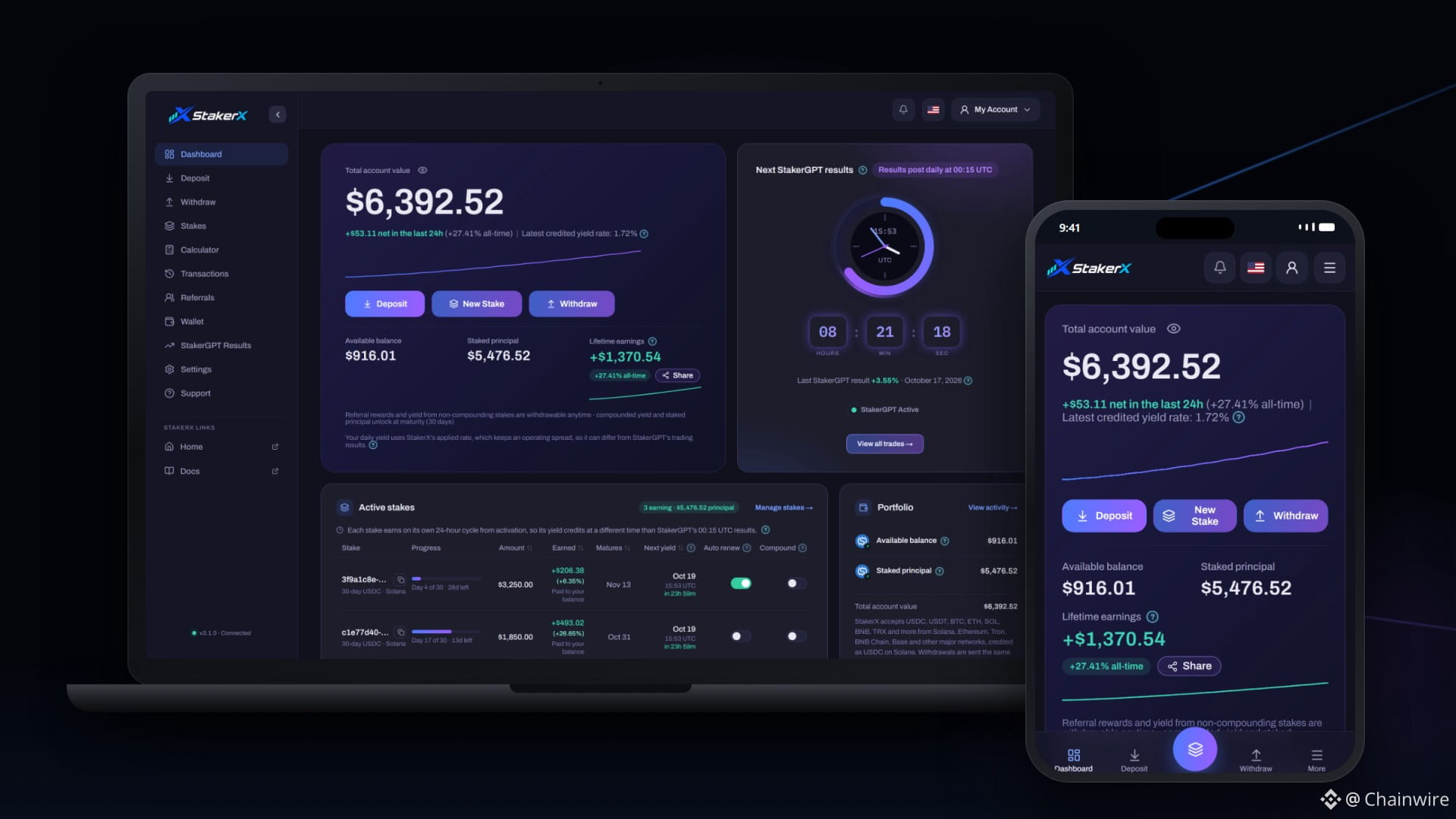
Мақала
StakerX's AI Agent Surpasses Passes $40M Staked Assets on Solana Within Three Months of Launch (1...Zug, Switzerland, October 19th, 2026, Chainwire
StakerX's AI Agent Surpasses Passes $40M Staked Assets on Solana Within Three Months of Launch
StakerGPT trades crypto markets around the clock and publishes every trade it makes, as more than 8,200 users join the platform
StakerX.ai, an agentic trading platform built by Switzerland-based StakerX Strategies AG, has passed $40 million in assets staked on Solana less than three months after its public launch on July 13, 2026. Users fund their stakes with more than 40 cryptocurrencies from most major blockchains, and StakerGPT, the platform's agentic trading agent, puts that capital to work in crypto perpetual futures markets every day.
An AI agent that shows its work
An agentic system is AI software that carries out a multi-step task on its own. StakerGPT is built on rare-access Claude Mythos: it monitors crypto markets around the clock, reasons over potential trade setups, filters them through risk controls and routes the approved trades for execution, without a human placing each order.
Every trade is public. StakerX publishes the full record daily at stakerx.ai/trades, with the market, direction, entry and exit prices and return of each position, including both live-executed and signal-derived trades. As of October 18, 2026, the record holds 804 trades across 139 trading days since June 1, 2026, so anyone can check what the agent did on any given day instead of relying on summary figures.
Fund it with almost any coin
Users can deposit USDC, USDT, BTC, ETH, SOL, BNB, TRX and more than 30 other cryptocurrencies from Solana, Ethereum, Bitcoin, BNB Chain, Base, Arbitrum, Polygon, Tron and other networks. Each deposit is converted and credited as USDC, a dollar-backed stablecoin, on Solana, so users do not need to bridge or swap anything themselves. Stakes start at $10 and run for 30 days.
Three months of growth
As of October 18, 2026, StakerX.ai reports:
$40 million currently staked on the platform
More than 8,200 registered users, of whom more than 3,000 have funded an account
804 trades published across 139 trading days
More than 27,700 completed withdrawals, totalling $10+ million
Nearly $12 million in yield credited to users since launch
Coming to the App Store and Google Play
StakerX is preparing native mobile apps for iOS and Android, expected in December 2026, which will bring the dashboard, deposits and the live StakerGPT trade record to the Apple App Store and Google Play. The platform is available today on the web at stakerx.ai.
About StakerX
StakerX is an agentic trading platform built and operated by StakerX Strategies AG, a quantitative trading and investment firm based in Switzerland. Its AI trading agent, StakerGPT, is built on rare-access Claude Mythos and evaluates crypto markets, applies risk filters and routes trades, and the platform publishes every trade in its record daily. Its goal is to make agentic trading accessible to anyone who holds crypto, from any chain, with every trade on the record. StakerX launched publicly on July 13, 2026. More information is available at stakerx.ai.
Media contact
Rimma S. - StakerX Strategies AG | Media Relations
support@stakerx.ai
Contact
Media RelationsVince MuellerStakerX Strategies AGsupport@stakerx.ai Disclaimer. This is a paid press release.
StakerX's AI Agent Surpasses Passes $40M Staked Assets on Solana Within Three Months of Launch (1...
Zug, Switzerland, October 19th, 2026, Chainwire
StakerX's AI Agent Surpasses Passes $40M Staked Assets on Solana Within Three Months of Launch
StakerGPT trades crypto markets around the clock and publishes every trade it makes, as more than 8,200 users join the platform
StakerX.ai, an agentic trading platform built by Switzerland-based StakerX Strategies AG, has passed $40 million in assets staked on Solana less than three months after its public launch on July 13, 2026. Users fund their stakes with more than 40 cryptocurrencies from most major blockchains, and StakerGPT, the platform's agentic trading agent, puts that capital to work in crypto perpetual futures markets every day.
An AI agent that shows its work
An agentic system is AI software that carries out a multi-step task on its own. StakerGPT is built on rare-access Claude Mythos: it monitors crypto markets around the clock, reasons over potential trade setups, filters them through risk controls and routes the approved trades for execution, without a human placing each order.
Every trade is public. StakerX publishes the full record daily at stakerx.ai/trades, with the market, direction, entry and exit prices and return of each position, including both live-executed and signal-derived trades. As of October 18, 2026, the record holds 804 trades across 139 trading days since June 1, 2026, so anyone can check what the agent did on any given day instead of relying on summary figures.
Fund it with almost any coin
Users can deposit USDC, USDT, BTC, ETH, SOL, BNB, TRX and more than 30 other cryptocurrencies from Solana, Ethereum, Bitcoin, BNB Chain, Base, Arbitrum, Polygon, Tron and other networks. Each deposit is converted and credited as USDC, a dollar-backed stablecoin, on Solana, so users do not need to bridge or swap anything themselves. Stakes start at $10 and run for 30 days.
Three months of growth
As of October 18, 2026, StakerX.ai reports:
$40 million currently staked on the platform
More than 8,200 registered users, of whom more than 3,000 have funded an account
804 trades published across 139 trading days
More than 27,700 completed withdrawals, totalling $10+ million
Nearly $12 million in yield credited to users since launch
Coming to the App Store and Google Play
StakerX is preparing native mobile apps for iOS and Android, expected in December 2026, which will bring the dashboard, deposits and the live StakerGPT trade record to the Apple App Store and Google Play. The platform is available today on the web at stakerx.ai.
About StakerX
StakerX is an agentic trading platform built and operated by StakerX Strategies AG, a quantitative trading and investment firm based in Switzerland. Its AI trading agent, StakerGPT, is built on rare-access Claude Mythos and evaluates crypto markets, applies risk filters and routes trades, and the platform publishes every trade in its record daily. Its goal is to make agentic trading accessible to anyone who holds crypto, from any chain, with every trade on the record. StakerX launched publicly on July 13, 2026. More information is available at stakerx.ai.
Media contact
Rimma S. - StakerX Strategies AG | Media Relations
support@stakerx.ai
Contact
Media RelationsVince MuellerStakerX Strategies AGsupport@stakerx.ai Disclaimer. This is a paid press release.
162
·
--
Расталды

Мақала
Tria Debuts $120K Tria Grand Prix Perpetual Futures Trading Competition—2 Champions to Ferrari F1...New York, New York, October 16th, 2026, Chainwire
The three-month championship brings Hyperliquid and Decibel traders together for cash prizes and exclusive Ferrari Formula 1 experiences at Suzuka, as tokenization expands access to global financial markets.
Tria, the self-custodial financial platform unifying trading, yield, and payments, today announced the launch of the Tria Grand Prix, a three-month global perpetual futures trading competition featuring $120,000 in prizes and an extraordinary grand prize: three-day Ferrari F1 Paddock Club experiences for the competition's two top eligible traders at the 2027 Formula 1 Japanese Grand Prix.
Running from October 16, 2026, through January 16, 2027, the championship brings together perpetual futures trading on Hyperliquid and Decibel through a single competition on Tria. Participants will compete across nine cash-prize rounds and a season-long leaderboard, culminating in two winners receiving exclusive Ferrari Paddock Club access for the April 9–11 Formula 1 race weekend at Suzuka Circuit, including premium hospitality overlooking the Ferrari team garage, pit-lane access and other F1 experiences.
How the Tria Grand Prix Works
The Tria Grand Prix combines eligible trading activity across Hyperliquid and Decibel, two decentralized perpetual futures exchanges integrated into the Tria application. Qualifying trades executed through either venue on Tria contribute to the same championship standings, enabling participants to compete across supported cryptocurrency and traditional-asset-linked markets without switching between separate applications.
Prizes and Rewards
The competition features nine cash-prize rounds, season-long championship rewards and daily Gacha raffles:
$90,000 in USDC prizes: Nine competition rounds, each awarding $10,000 in USDC.
Ferrari F1 Paddock Club: One three-day Ferrari Paddock Club experience for each of the top two qualifying championship traders at the 2027 Japanese Grand Prix.
Championship rewards: Gacha packs awarded according to qualifying championship rank, plus one month of VIP 7 status for the top 20 qualifying traders.
Daily raffle: One $50 Gacha pack awarded each day through a raffle.
Eligibility and Championship Rankings
Participation is automatic. Eligible users enter the competition by placing qualifying, fee-paying perpetual futures trades through Tria on Hyperliquid or Decibel, with no separate registration required. Only eligible trades executed through the Tria application count toward competition standings.
Season-long championship rankings are determined by total eligible trading volume. To qualify for any championship reward, including Ferrari Paddock Club experiences, rank-based Gacha packs and VIP 7 benefits, participants must generate at least $5 million in cumulative eligible trading volume during the competition. This threshold refers to aggregate trading activity, not a minimum deposit or account balance. The nine individual cash-prize rounds have separate qualification requirements.
The two highest-ranked qualifying traders will receive three-day Ferrari Paddock Club experiences at the Formula 1 Japanese Grand Prix, April 9–11, 2027. The Suzuka finale will bring the championship to one of Formula 1's most celebrated circuits, giving its winners access to Ferrari's race-weekend hospitality and an extraordinary vantage point on the action.
A Global Championship for a New Era of Financial Markets
The Tria Grand Prix launches as tokenization and onchain financial infrastructure expand access to markets traditionally separated by geography, financial intermediaries and local trading systems. Tria is seeing this shift firsthand, with traders in Japan and South Korea using the platform to access U.S. equity- and commodity-linked markets, while users in markets such as the United Arab Emirates can gain exposure to Korean stocks through onchain trading instruments.
These cross-border opportunities illustrate a broader transformation in global finance: investors increasingly expect access to markets outside their home countries without navigating separate brokerage relationships, fragmented infrastructure or multiple trading applications. By integrating Hyperliquid and Decibel into one self-custodial environment, Tria connects cryptocurrency trading with opportunities linked to traditional financial assets, bringing participants from different markets into a shared global competition.
"Someone in Japan or Korea can trade exposure to American stocks and commodities, while someone sitting in Dubai can access markets linked to Korean equities. That is a profound change in how global financial participation works," said Vijit Katta, Co-Founder and CEO of Tria. "Tokenization is breaking down the geographic barriers that have historically determined which markets people can access. We're building for a world where capital can move across markets as easily as information moves across the internet. The Tria Grand Prix brings that vision to life by putting traders from different parts of the world into the same championship, with the chance to finish the season inside Ferrari's F1 Paddock Club at Suzuka."
The championship also demonstrates how Tria's broader financial platform connects activities that have traditionally operated through separate services. Users can trade across supported markets, manage digital assets, earn yield and make payments through the same self-custodial application, supported by Tria's cross-chain infrastructure.
Tria has grown to more than 600,000 users across over 150 countries, reflecting increasing demand for financial applications that combine global reach, asset control and access to multiple markets. The Grand Prix will bring this international user base together in a single competition while providing further insight into how participants across different regions engage with onchain trading and traditional financial markets.
About Tria
Tria is a self-custodial neofinance platform bringing trading, yield, payments and cross-chain asset management into one application. Through integrations with platforms including Hyperliquid and Decibel, and its BestPath routing infrastructure, Tria enables users to access digital assets and onchain financial markets while maintaining control of their assets. The platform serves more than 600,000 users across over 150 countries.
Start using Tria: https://link.tria.so/4i5Tmab
Learn more about Tria: https://link.tria.so/4hZbgeK
Contact
Jon PhillipsPhillComm GlobalTria@PhillComm.Global Disclaimer. This is a paid press release.
Tria Debuts $120K Tria Grand Prix Perpetual Futures Trading Competition—2 Champions to Ferrari F1...
New York, New York, October 16th, 2026, Chainwire
The three-month championship brings Hyperliquid and Decibel traders together for cash prizes and exclusive Ferrari Formula 1 experiences at Suzuka, as tokenization expands access to global financial markets.
Tria, the self-custodial financial platform unifying trading, yield, and payments, today announced the launch of the Tria Grand Prix, a three-month global perpetual futures trading competition featuring $120,000 in prizes and an extraordinary grand prize: three-day Ferrari F1 Paddock Club experiences for the competition's two top eligible traders at the 2027 Formula 1 Japanese Grand Prix.
Running from October 16, 2026, through January 16, 2027, the championship brings together perpetual futures trading on Hyperliquid and Decibel through a single competition on Tria. Participants will compete across nine cash-prize rounds and a season-long leaderboard, culminating in two winners receiving exclusive Ferrari Paddock Club access for the April 9–11 Formula 1 race weekend at Suzuka Circuit, including premium hospitality overlooking the Ferrari team garage, pit-lane access and other F1 experiences.
How the Tria Grand Prix Works
The Tria Grand Prix combines eligible trading activity across Hyperliquid and Decibel, two decentralized perpetual futures exchanges integrated into the Tria application. Qualifying trades executed through either venue on Tria contribute to the same championship standings, enabling participants to compete across supported cryptocurrency and traditional-asset-linked markets without switching between separate applications.
Prizes and Rewards
The competition features nine cash-prize rounds, season-long championship rewards and daily Gacha raffles:
$90,000 in USDC prizes: Nine competition rounds, each awarding $10,000 in USDC.
Ferrari F1 Paddock Club: One three-day Ferrari Paddock Club experience for each of the top two qualifying championship traders at the 2027 Japanese Grand Prix.
Championship rewards: Gacha packs awarded according to qualifying championship rank, plus one month of VIP 7 status for the top 20 qualifying traders.
Daily raffle: One $50 Gacha pack awarded each day through a raffle.
Eligibility and Championship Rankings
Participation is automatic. Eligible users enter the competition by placing qualifying, fee-paying perpetual futures trades through Tria on Hyperliquid or Decibel, with no separate registration required. Only eligible trades executed through the Tria application count toward competition standings.
Season-long championship rankings are determined by total eligible trading volume. To qualify for any championship reward, including Ferrari Paddock Club experiences, rank-based Gacha packs and VIP 7 benefits, participants must generate at least $5 million in cumulative eligible trading volume during the competition. This threshold refers to aggregate trading activity, not a minimum deposit or account balance. The nine individual cash-prize rounds have separate qualification requirements.
The two highest-ranked qualifying traders will receive three-day Ferrari Paddock Club experiences at the Formula 1 Japanese Grand Prix, April 9–11, 2027. The Suzuka finale will bring the championship to one of Formula 1's most celebrated circuits, giving its winners access to Ferrari's race-weekend hospitality and an extraordinary vantage point on the action.
A Global Championship for a New Era of Financial Markets
The Tria Grand Prix launches as tokenization and onchain financial infrastructure expand access to markets traditionally separated by geography, financial intermediaries and local trading systems. Tria is seeing this shift firsthand, with traders in Japan and South Korea using the platform to access U.S. equity- and commodity-linked markets, while users in markets such as the United Arab Emirates can gain exposure to Korean stocks through onchain trading instruments.
These cross-border opportunities illustrate a broader transformation in global finance: investors increasingly expect access to markets outside their home countries without navigating separate brokerage relationships, fragmented infrastructure or multiple trading applications. By integrating Hyperliquid and Decibel into one self-custodial environment, Tria connects cryptocurrency trading with opportunities linked to traditional financial assets, bringing participants from different markets into a shared global competition.
"Someone in Japan or Korea can trade exposure to American stocks and commodities, while someone sitting in Dubai can access markets linked to Korean equities. That is a profound change in how global financial participation works," said Vijit Katta, Co-Founder and CEO of Tria. "Tokenization is breaking down the geographic barriers that have historically determined which markets people can access. We're building for a world where capital can move across markets as easily as information moves across the internet. The Tria Grand Prix brings that vision to life by putting traders from different parts of the world into the same championship, with the chance to finish the season inside Ferrari's F1 Paddock Club at Suzuka."
The championship also demonstrates how Tria's broader financial platform connects activities that have traditionally operated through separate services. Users can trade across supported markets, manage digital assets, earn yield and make payments through the same self-custodial application, supported by Tria's cross-chain infrastructure.
Tria has grown to more than 600,000 users across over 150 countries, reflecting increasing demand for financial applications that combine global reach, asset control and access to multiple markets. The Grand Prix will bring this international user base together in a single competition while providing further insight into how participants across different regions engage with onchain trading and traditional financial markets.
About Tria
Tria is a self-custodial neofinance platform bringing trading, yield, payments and cross-chain asset management into one application. Through integrations with platforms including Hyperliquid and Decibel, and its BestPath routing infrastructure, Tria enables users to access digital assets and onchain financial markets while maintaining control of their assets. The platform serves more than 600,000 users across over 150 countries.
Start using Tria: https://link.tria.so/4i5Tmab
Learn more about Tria: https://link.tria.so/4hZbgeK
Contact
Jon PhillipsPhillComm GlobalTria@PhillComm.Global Disclaimer. This is a paid press release.
1
125
·
--

Мақала
Yoshitaka Kitao, Representative Director, Chairman, President & CEO, SBI Holdings, IncTokyo, Japan, October 16th, 2026, Chainwire
Both companies to explore pilot connecting yen-denominated stablecoin JPYSC with U.S. dollar stablecoin Open USD (OUSD), marking the first step toward frictionless yen–dollar settlement, onchain and in real time
SBI Holdings, Inc. ("SBI") and Startale Group Pte. Ltd. ("Startale") today announced they have joined Open Standard, the fast-growing alliance of more than 140 leading global companies, including Visa, Stripe, Mastercard, BlackRock, and Coinbase, driving the adoption of Open USD (OUSD), a U.S. dollar-denominated stablecoin built for global-scale settlement.
As part of this move, the two companies will explore interoperability between OUSD and JPYSC, the yen-denominated trust-type stablecoin issued by SBI Shinsei Trust Bank. The public launch of OUSD onchain provides a foundation for this partnership, with the companies working toward faster, more efficient settlement between the world’s two most-traded currencies.
A Pivotal Moment for Onchain Finance
The move comes as the global financial system undergoes a historic shift toward blockchain-based settlement. Landmark U.S. legislation, namely the GENIUS Act, has accelerated the build-out of regulated, enterprise-grade stablecoin infrastructure worldwide. In June 2026, this momentum culminated in the launch of Open Standard, uniting more than 140 companies spanning finance, payments, and technology behind a single mission: establishing OUSD as a common settlement layer for the onchain economy.
SBI and Startale have been at the forefront of this transformation in Asia. In July 2026, SBI Global Asset Management, DigiFT Tech Pte. Ltd., and Startale unveiled a proof-of-concept for settlement and distribution payments on tokenized securities, a project designed with JPYSC's future utility in mind. Startale has continued to broaden JPYSC's real-world use and to build institutional-grade trading infrastructure, extending onchain finance well beyond payments.
Against this backdrop, SBI and Startale see growing interoperability between JPYSC and OUSD as a powerful lever, one capable of streamlining yen-dollar settlement and unlocking new use cases for stablecoins across the onchain financial landscape. With OUSD now publicly launched, the companies will explore concrete opportunities to advance this vision.
Yoshitaka Kitao, Representative Director, Chairman and President, SBI Holdings, Inc. "As onchain finance continues to evolve, cross-border transactions will become increasingly prevalent. SBI Group is working to establish the ‘SBI APAC Digital Economic Zone,’ and believes that enabling seamless transactions across borders and currencies lies at the heart of this vision. In particular, ensuring seamless convertibility between yen-denominated and U.S. dollar-denominated stablecoins is essential. Our participation in Open Standard and exploration of a proof of concept for interoperability between OUSD and JPYSC represent an important step toward achieving this goal. SBI Group has already become the first in Japan to offer the U.S. dollar-denominated stablecoins USDC and RLUSD, and will continue to promote the broader adoption of digital assets through collaboration with leading partners in Japan and overseas."
Sota Watanabe, CEO, Startale Group Pte. Ltd. "Our participation in Open Standard reflects the shared conviction of SBI and Startale that the future of finance is onchain, borderless, and interoperable by design. We see the opportunity to pilot interoperability between JPYSC and OUSD as highly significant. The yen and the dollar are two of the world's strongest and most trusted currencies and enabling them to be exchanged and utilized seamlessly onchain could unlock significant opportunities. By working closely with the SBI Group and Open Standard’s partner companies, we aim to connect Japanese assets and financial services with global onchain markets through the creation of concrete use cases and help build that future.”
Looking Ahead
By joining Open Standard, SBI and Startale are positioning JPYSC for deeper integration with global stablecoin infrastructure, a move aimed at strengthening the international liquidity of yen-denominated assets. The companies will continue to deepen collaboration with Open Standard's global partner network, working within applicable regulatory frameworks to build a safe, trusted, and truly interoperable stablecoin ecosystem for the onchain era.
Note: This announcement relates solely to the exploration of a pilot. It does not represent the launch of a new commercial service, nor the start of production settlement or trading activity
About Open USD (OUSD)
Open Standard is the company behind Open USD (OUSD). Our mission is to build internet-native money, enabling all businesses to move money on infrastructure that’s cheaper, faster, more global and more programmable. Over 200 financial institutions, fintechs, banks, and global businesses have signed up to add OUSD to their platforms and benefit from low fees, shared rewards, and representative governance. Open Standard was started in 2026 and its founding partners include Coinbase, Mastercard, Shopify, Stripe, and Visa.
About JPYSC
JPYSC is a yen-denominated, trust-backed stablecoin issued by SBI Shinsei Trust Bank, Limited, structured in full compliance with Japan's Payment Services Act and trust law framework. Designed as core infrastructure for onchain yen settlement, funds transfer, and distribution, JPYSC is positioned to support tokenized asset trading and cross-border payments at scale.
Contact
Startale Marketing Teammarketing@startale.com Disclaimer. This is a paid press release.
Yoshitaka Kitao, Representative Director, Chairman, President & CEO, SBI Holdings, Inc
Tokyo, Japan, October 16th, 2026, Chainwire
Both companies to explore pilot connecting yen-denominated stablecoin JPYSC with U.S. dollar stablecoin Open USD (OUSD), marking the first step toward frictionless yen–dollar settlement, onchain and in real time
SBI Holdings, Inc. ("SBI") and Startale Group Pte. Ltd. ("Startale") today announced they have joined Open Standard, the fast-growing alliance of more than 140 leading global companies, including Visa, Stripe, Mastercard, BlackRock, and Coinbase, driving the adoption of Open USD (OUSD), a U.S. dollar-denominated stablecoin built for global-scale settlement.
As part of this move, the two companies will explore interoperability between OUSD and JPYSC, the yen-denominated trust-type stablecoin issued by SBI Shinsei Trust Bank. The public launch of OUSD onchain provides a foundation for this partnership, with the companies working toward faster, more efficient settlement between the world’s two most-traded currencies.
A Pivotal Moment for Onchain Finance
The move comes as the global financial system undergoes a historic shift toward blockchain-based settlement. Landmark U.S. legislation, namely the GENIUS Act, has accelerated the build-out of regulated, enterprise-grade stablecoin infrastructure worldwide. In June 2026, this momentum culminated in the launch of Open Standard, uniting more than 140 companies spanning finance, payments, and technology behind a single mission: establishing OUSD as a common settlement layer for the onchain economy.
SBI and Startale have been at the forefront of this transformation in Asia. In July 2026, SBI Global Asset Management, DigiFT Tech Pte. Ltd., and Startale unveiled a proof-of-concept for settlement and distribution payments on tokenized securities, a project designed with JPYSC's future utility in mind. Startale has continued to broaden JPYSC's real-world use and to build institutional-grade trading infrastructure, extending onchain finance well beyond payments.
Against this backdrop, SBI and Startale see growing interoperability between JPYSC and OUSD as a powerful lever, one capable of streamlining yen-dollar settlement and unlocking new use cases for stablecoins across the onchain financial landscape. With OUSD now publicly launched, the companies will explore concrete opportunities to advance this vision.
Yoshitaka Kitao, Representative Director, Chairman and President, SBI Holdings, Inc. "As onchain finance continues to evolve, cross-border transactions will become increasingly prevalent. SBI Group is working to establish the ‘SBI APAC Digital Economic Zone,’ and believes that enabling seamless transactions across borders and currencies lies at the heart of this vision. In particular, ensuring seamless convertibility between yen-denominated and U.S. dollar-denominated stablecoins is essential. Our participation in Open Standard and exploration of a proof of concept for interoperability between OUSD and JPYSC represent an important step toward achieving this goal. SBI Group has already become the first in Japan to offer the U.S. dollar-denominated stablecoins USDC and RLUSD, and will continue to promote the broader adoption of digital assets through collaboration with leading partners in Japan and overseas."
Sota Watanabe, CEO, Startale Group Pte. Ltd. "Our participation in Open Standard reflects the shared conviction of SBI and Startale that the future of finance is onchain, borderless, and interoperable by design. We see the opportunity to pilot interoperability between JPYSC and OUSD as highly significant. The yen and the dollar are two of the world's strongest and most trusted currencies and enabling them to be exchanged and utilized seamlessly onchain could unlock significant opportunities. By working closely with the SBI Group and Open Standard’s partner companies, we aim to connect Japanese assets and financial services with global onchain markets through the creation of concrete use cases and help build that future.”
Looking Ahead
By joining Open Standard, SBI and Startale are positioning JPYSC for deeper integration with global stablecoin infrastructure, a move aimed at strengthening the international liquidity of yen-denominated assets. The companies will continue to deepen collaboration with Open Standard's global partner network, working within applicable regulatory frameworks to build a safe, trusted, and truly interoperable stablecoin ecosystem for the onchain era.
Note: This announcement relates solely to the exploration of a pilot. It does not represent the launch of a new commercial service, nor the start of production settlement or trading activity
About Open USD (OUSD)
Open Standard is the company behind Open USD (OUSD). Our mission is to build internet-native money, enabling all businesses to move money on infrastructure that’s cheaper, faster, more global and more programmable. Over 200 financial institutions, fintechs, banks, and global businesses have signed up to add OUSD to their platforms and benefit from low fees, shared rewards, and representative governance. Open Standard was started in 2026 and its founding partners include Coinbase, Mastercard, Shopify, Stripe, and Visa.
About JPYSC
JPYSC is a yen-denominated, trust-backed stablecoin issued by SBI Shinsei Trust Bank, Limited, structured in full compliance with Japan's Payment Services Act and trust law framework. Designed as core infrastructure for onchain yen settlement, funds transfer, and distribution, JPYSC is positioned to support tokenized asset trading and cross-border payments at scale.
Contact
Startale Marketing Teammarketing@startale.com Disclaimer. This is a paid press release.
1
300
·
--
Мақала
Pixagram Announces Free Account Creation for 250 New Users Daily Through 2026 (15 Oct)Panama City, Panama, October 15th, 2026, Chainwire
Pixagram announces free account creation for up to 250 new members daily through the end of 2026. Built on the standalone Layer-1 Pixa blockchain, Pixagram is an anti-hierarchy social network where every post, vote, and comment is recorded as a signed on-chain transaction, with no ads and no cryptocurrency purchase required to get started.
Pixagram will cover the 20 PIXA network fee for up to 250 new members daily through the end of 2026. New members can claim a free @username at Pixagram.com and join the platform’s on-chain community for creators.
► Quit Renting the Spotlight — Users can register at http://pixagram.com
An On-Chain Username and Wallet Address
Opening a Pixa chain account normally costs around 20 PIXA. Pixagram is covering this fee for up to 250 new members daily through the end of 2026.
Username and wallet address: Each @username serves as an on-chain wallet address, replacing a randomly generated string of characters with a recognizable handle.
Blockchain-based registration: Once registered on the blockchain, an @username remains associated with its on-chain record, subject to the network’s rules and technical conditions.
Phone verification and privacy: One-time phone verification helps limit bot abuse of the daily account offer. A public @username can separate a creator’s online identity from their legal name, although public blockchain records may limit privacy.
Not Really Anti-Social, Truly Anti-Hierarchy
Mainstream social media serves advertisers while gatekeepers decide who sees your work. Pixagram—alongside platforms like Hive and Mastodon—is a SIGMA platform built for creators who prefer agency over status games. Your posts, art, followers, and feeds live directly on-chain with nothing in between, allowing you to reach every follower automatically.
NFT Platform Storage and Artwork Permanence
On many NFT platforms, the token sits on-chain while the image lives on a cloud server or IPFS—meaning a token can easily outlive its art.
On Pixa, every artwork is stored directly on-chain inside its post as a lossless image. Compact pixel art lives permanently on the blockchain and renders up to 4K resolution as a painting, CRT filter, hexagonal shapes, or square pixels.
Zero upfront cost: Every new account receives a starter delegation of stake (Resource Credits fuel) to cover posting and voting from day one.
Build Mode Note: Direct on-chain art sales launch in 2027, so everything you publish today builds your permanent portfolio ahead of the marketplace release.
► Less Lurking. One Original Post. Start at Pixagram.com
Proof-of-Brain and Community Curation
Instead of relying on the computational process used in Proof-of-Work systems, Pixagram uses Proof-of-Brain, a mechanism that allocates rewards based on posting, commenting, and voting activity.
Community reward distribution: 70% of newly issued PIXA is allocated to community-voted content, with 60% distributed to authors and 40% to curators after seven days.
Staking and governance mechanisms: Authors can receive Pixa Power, which determines voting weight and supports governance participation, and Pixa Supra (PXS), a unit referenced by an oracle to a agnostic purchasing power index (without a fixed dollar value). Curators can also receive Pixa Power.
Censorship-Resistant by Design
Built on the Hive codebase with Steem lineage, the Pixa chain started from a clean genesis block with no airdrop and produces a block every three seconds. While an application interface can hide a post from its view, it can never erase the transaction record from the chain.
Furthermore, every artwork is checked for copies using PAPH-X (an open-source perceptual fingerprint for pixel art) and indexed by the Search V4 engine.
"The old internet wants you trapped in feed fog, renting reach from gatekeepers who track every click. Today information is king, and Pixagram operates outside that hierarchy... Don't believe the hype. Create it." — Matias Affolter, Co-Founder of Pixa
"The strongest rebellion is a working alternative. We're covering the network fee for 250 new accounts a day so any creator can step into build mode at zero cost. Claim your permanent @username now—because once a handle is written to the chain, it's gone forever." — Mathiew Estepho, Co-Founder of Pixa
Pixagram Account Registration and Developer Resources
Pixagram offers fee coverage for up to 250 new accounts daily through the end of 2026. Eligible new members can register and claim an @username at Pixagram.com. Additional technical information is available in the developer documentation at pixa.org.
About Pixagram
Pixagram is an on-chain pixel art and blog network developed by Pixagram AG (Zug, Switzerland) and operated by Pixa Rex S.A. (Panama City, Panama).
Contact
OwnerPixa Omnibus FoundationPixa Rex S.A.contact@pixarex.net Disclaimer. This is a paid press release.
Pixagram Announces Free Account Creation for 250 New Users Daily Through 2026 (15 Oct)
Panama City, Panama, October 15th, 2026, Chainwire
Pixagram announces free account creation for up to 250 new members daily through the end of 2026. Built on the standalone Layer-1 Pixa blockchain, Pixagram is an anti-hierarchy social network where every post, vote, and comment is recorded as a signed on-chain transaction, with no ads and no cryptocurrency purchase required to get started.
Pixagram will cover the 20 PIXA network fee for up to 250 new members daily through the end of 2026. New members can claim a free @username at Pixagram.com and join the platform’s on-chain community for creators.
► Quit Renting the Spotlight — Users can register at http://pixagram.com
An On-Chain Username and Wallet Address
Opening a Pixa chain account normally costs around 20 PIXA. Pixagram is covering this fee for up to 250 new members daily through the end of 2026.
Username and wallet address: Each @username serves as an on-chain wallet address, replacing a randomly generated string of characters with a recognizable handle.
Blockchain-based registration: Once registered on the blockchain, an @username remains associated with its on-chain record, subject to the network’s rules and technical conditions.
Phone verification and privacy: One-time phone verification helps limit bot abuse of the daily account offer. A public @username can separate a creator’s online identity from their legal name, although public blockchain records may limit privacy.
Not Really Anti-Social, Truly Anti-Hierarchy
Mainstream social media serves advertisers while gatekeepers decide who sees your work. Pixagram—alongside platforms like Hive and Mastodon—is a SIGMA platform built for creators who prefer agency over status games. Your posts, art, followers, and feeds live directly on-chain with nothing in between, allowing you to reach every follower automatically.
NFT Platform Storage and Artwork Permanence
On many NFT platforms, the token sits on-chain while the image lives on a cloud server or IPFS—meaning a token can easily outlive its art.
On Pixa, every artwork is stored directly on-chain inside its post as a lossless image. Compact pixel art lives permanently on the blockchain and renders up to 4K resolution as a painting, CRT filter, hexagonal shapes, or square pixels.
Zero upfront cost: Every new account receives a starter delegation of stake (Resource Credits fuel) to cover posting and voting from day one.
Build Mode Note: Direct on-chain art sales launch in 2027, so everything you publish today builds your permanent portfolio ahead of the marketplace release.
► Less Lurking. One Original Post. Start at Pixagram.com
Proof-of-Brain and Community Curation
Instead of relying on the computational process used in Proof-of-Work systems, Pixagram uses Proof-of-Brain, a mechanism that allocates rewards based on posting, commenting, and voting activity.
Community reward distribution: 70% of newly issued PIXA is allocated to community-voted content, with 60% distributed to authors and 40% to curators after seven days.
Staking and governance mechanisms: Authors can receive Pixa Power, which determines voting weight and supports governance participation, and Pixa Supra (PXS), a unit referenced by an oracle to a agnostic purchasing power index (without a fixed dollar value). Curators can also receive Pixa Power.
Censorship-Resistant by Design
Built on the Hive codebase with Steem lineage, the Pixa chain started from a clean genesis block with no airdrop and produces a block every three seconds. While an application interface can hide a post from its view, it can never erase the transaction record from the chain.
Furthermore, every artwork is checked for copies using PAPH-X (an open-source perceptual fingerprint for pixel art) and indexed by the Search V4 engine.
"The old internet wants you trapped in feed fog, renting reach from gatekeepers who track every click. Today information is king, and Pixagram operates outside that hierarchy... Don't believe the hype. Create it." — Matias Affolter, Co-Founder of Pixa
"The strongest rebellion is a working alternative. We're covering the network fee for 250 new accounts a day so any creator can step into build mode at zero cost. Claim your permanent @username now—because once a handle is written to the chain, it's gone forever." — Mathiew Estepho, Co-Founder of Pixa
Pixagram Account Registration and Developer Resources
Pixagram offers fee coverage for up to 250 new accounts daily through the end of 2026. Eligible new members can register and claim an @username at Pixagram.com. Additional technical information is available in the developer documentation at pixa.org.
About Pixagram
Pixagram is an on-chain pixel art and blog network developed by Pixagram AG (Zug, Switzerland) and operated by Pixa Rex S.A. (Panama City, Panama).
Contact
OwnerPixa Omnibus FoundationPixa Rex S.A.contact@pixarex.net Disclaimer. This is a paid press release.
132
Көбірек контент көру үшін кіріңіз
Binance Square платформасында әлемдік криптоқоғамдастыққа қосылыңыз
⚡️ Криптовалюта туралы ең соңғы және пайдалы ақпаратты алыңыз.
💬 Әлемдегі ең ірі криптобиржаның сеніміне ие.
👍 Расталған авторлардың нақты пікірлерін табыңыз.
Электрондық пошта/телефон нөмірі
Трендтегі тақырыптар
CanMicrosoftDeliverOnAI
83,417 рет көрілді
769 адам талқылап жатыр
Earnings Season Session 3: Will Google & Microsoft Beat Earnings Expectations?
Binance Square Official
·66 лайк
·16.8k рет көрілді
CanGoogleDefindItsCore
42,064 рет көрілді
557 адам талқылап жатыр
FOMCWatch
9.1M рет көрілді
27,982 адам талқылап жатыр