
Los Pollos Hermanos_
951 Жариялаулар

Los Pollos Hermanos_
Ашық сауда

BNB ұстаушы
Жоғары жиілікті трейдер
1.4 жыл
179 Жазылым
7.0K+ Жазылушылар
398 лайк басылған
Жазбалар
Портфолио
PINNED
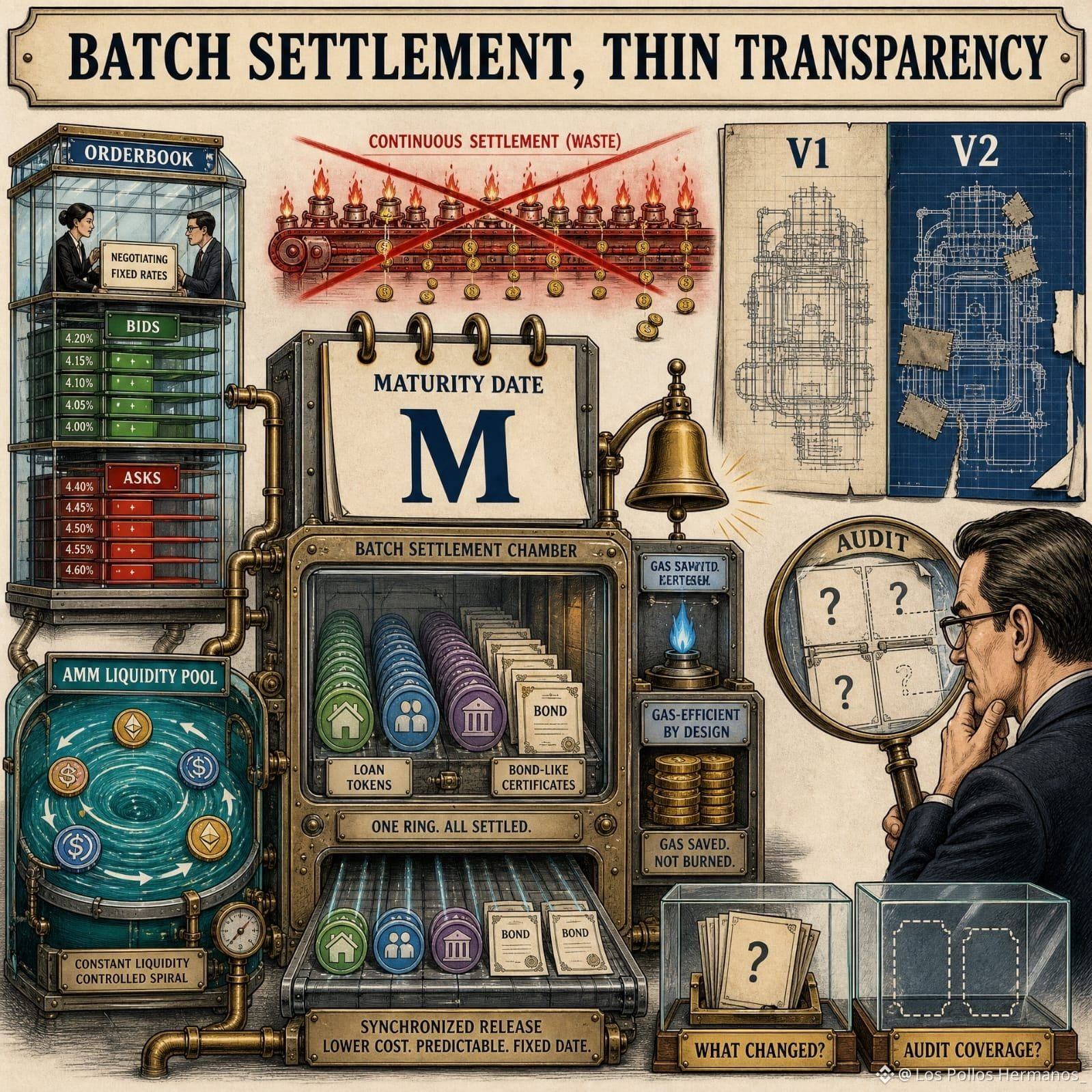
I went looking for TermMax V2 architecture documentation expecting to find gas optimization specs laid out clearly. What I found was thinner than I hoped.
The protocol runs on-chain fixed income settlement through a hybrid orderbook and AMM structure. Gas efficiency comes from how settlement gets batched at maturity rather than processed continuously. That design choice makes sense. Continuous settlement burns gas constantly.
Batch settlement at a fixed date is cheaper and more predictable. My hesitation is around the V2 label specifically. Version numbers in DeFi often mean less than they imply.
What changed from V1, what got patched, and what the audit coverage looks like for the new architecture are questions the documentation doesn't answer cleanly. The settlement logic looks sound. The versioning transparency needs work.
#termmax @TermMax
The protocol runs on-chain fixed income settlement through a hybrid orderbook and AMM structure. Gas efficiency comes from how settlement gets batched at maturity rather than processed continuously. That design choice makes sense. Continuous settlement burns gas constantly.
Batch settlement at a fixed date is cheaper and more predictable. My hesitation is around the V2 label specifically. Version numbers in DeFi often mean less than they imply.
What changed from V1, what got patched, and what the audit coverage looks like for the new architecture are questions the documentation doesn't answer cleanly. The settlement logic looks sound. The versioning transparency needs work.
#termmax @TermMax
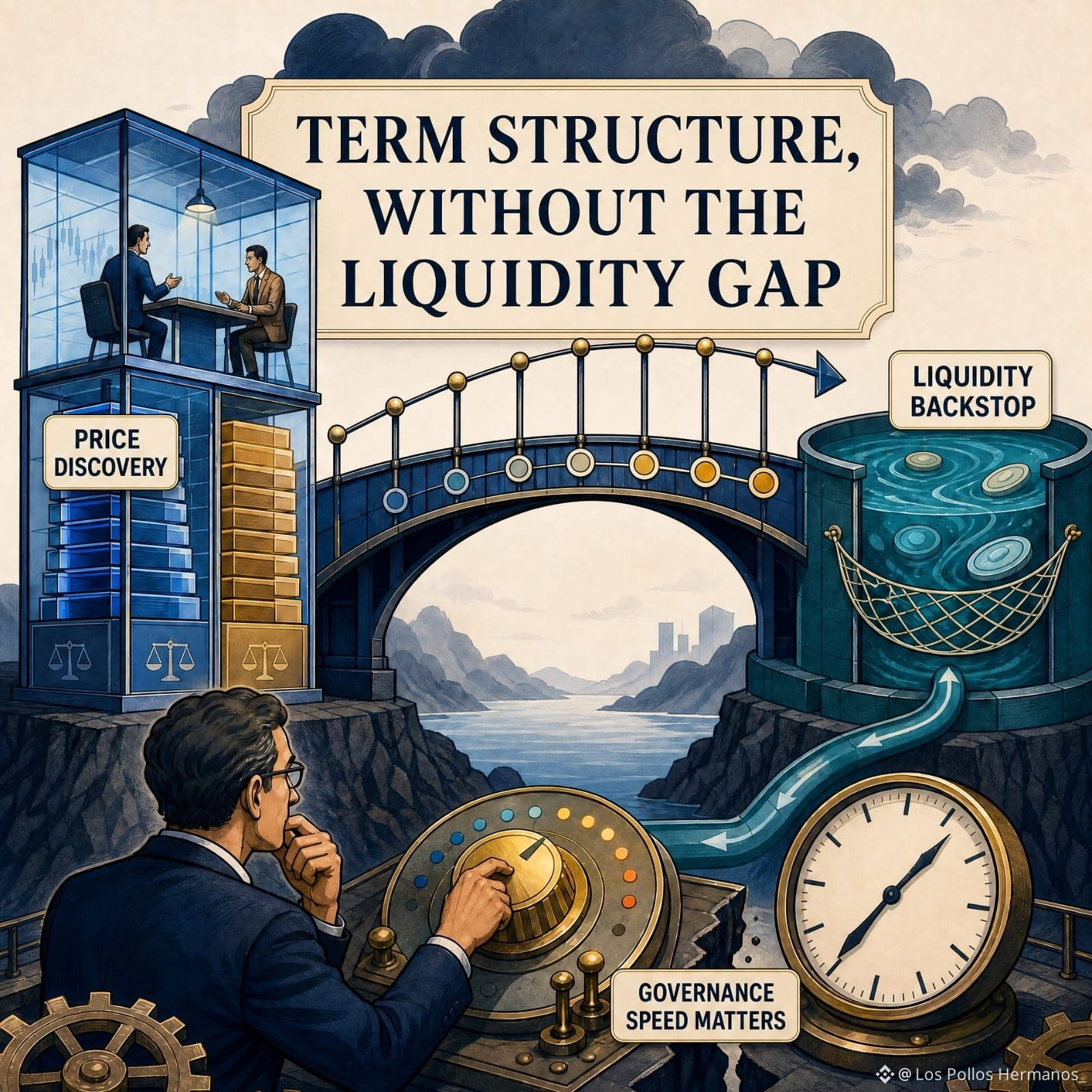
I've watched DeFi try to build term structures for years. Most attempts collapse because they can't solve the liquidity problem.
Orderbooks need depth on both sides. AMMs need capital sitting idle in pools. Neither works cleanly for fixed-rate lending on its own. TermMax combines both.
The orderbook handles price discovery lenders and borrowers negotiate rates directly. The AMM layer provides liquidity backstop when one side of the book runs thin.
I thought that combination would create complexity that breaks under pressure. Looking at how the mechanics interact, it's more elegant than I expected.
The real question is whether the AMM parameters get tuned correctly as market conditions shift. That's a governance decision.
And governance decisions in DeFi don't always happen fast enough when they need to.
#termmax @TermMax
$BOME
$RE
$BTW
Orderbooks need depth on both sides. AMMs need capital sitting idle in pools. Neither works cleanly for fixed-rate lending on its own. TermMax combines both.
The orderbook handles price discovery lenders and borrowers negotiate rates directly. The AMM layer provides liquidity backstop when one side of the book runs thin.
I thought that combination would create complexity that breaks under pressure. Looking at how the mechanics interact, it's more elegant than I expected.
The real question is whether the AMM parameters get tuned correctly as market conditions shift. That's a governance decision.
And governance decisions in DeFi don't always happen fast enough when they need to.
#termmax @TermMax
$BOME
$RE
$BTW
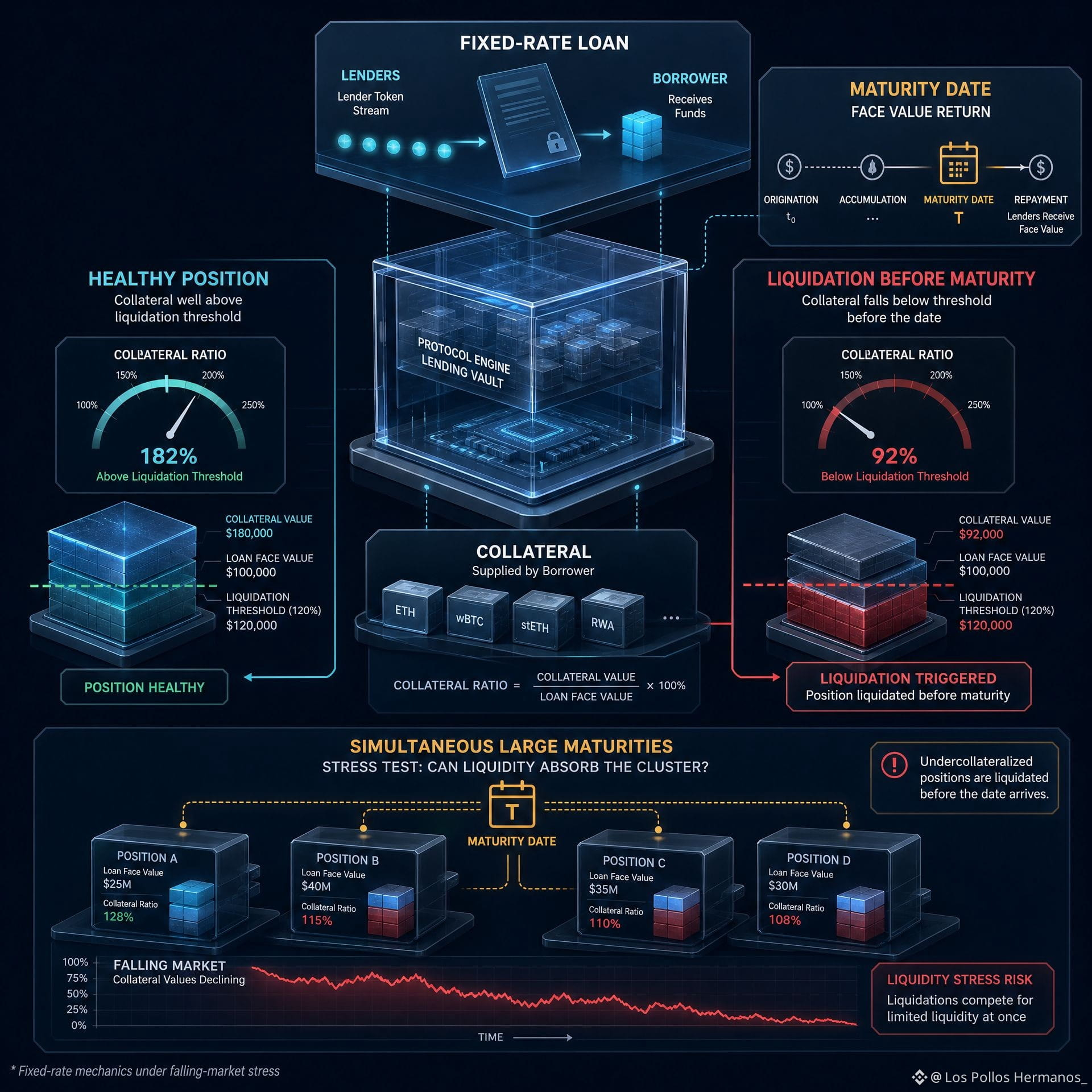
I didn't fully understand what a maturity date meant in DeFi lending until I had to think about what happens when one expires. In traditional finance it's straightforward the bond matures, you get your principal back.
TermMax works similarly on paper. You lend at a fixed rate, the position matures on a set date, and you receive face value. The question I kept asking is what happens if the borrower's collateral drops sharply right before maturity.
Most lending protocols handle this through liquidation. TermMax runs the same logic undercollateralized positions get liquidated before the date hits.
What I haven't seen tested publicly is how the protocol behaves when multiple large positions approach maturity simultaneously in a falling market. That specific scenario is where fixed-rate mechanics either hold or break.
#termmax @TermMax
TermMax works similarly on paper. You lend at a fixed rate, the position matures on a set date, and you receive face value. The question I kept asking is what happens if the borrower's collateral drops sharply right before maturity.
Most lending protocols handle this through liquidation. TermMax runs the same logic undercollateralized positions get liquidated before the date hits.
What I haven't seen tested publicly is how the protocol behaves when multiple large positions approach maturity simultaneously in a falling market. That specific scenario is where fixed-rate mechanics either hold or break.
#termmax @TermMax
I spent more time than I expected trying to understand what FT, XT, and GT actually do in TermMax. Three tokens inside one lending protocol sounds overcomplicated until the logic clicks.
FT is the Fixed Token it represents your principal plus locked-in yield, redeemable at maturity for face value.
XT is the Excess Yield Token it captures any yield above the fixed rate, which goes to liquidity providers taking on rate risk.
GT is the Governance Token protocol decisions, fee parameters, direction. The split makes sense on paper. Fixed borrowers get certainty.
Liquidity providers get the upside if rates move in their favor. What I want to understand better is what happens to XT holders when rates stay flat for extended periods. That scenario doesn't get discussed enough.
#termmax @TermMax
$STAR
$ACE
$RED
FT is the Fixed Token it represents your principal plus locked-in yield, redeemable at maturity for face value.
XT is the Excess Yield Token it captures any yield above the fixed rate, which goes to liquidity providers taking on rate risk.
GT is the Governance Token protocol decisions, fee parameters, direction. The split makes sense on paper. Fixed borrowers get certainty.
Liquidity providers get the upside if rates move in their favor. What I want to understand better is what happens to XT holders when rates stay flat for extended periods. That scenario doesn't get discussed enough.
#termmax @TermMax
$STAR
$ACE
$RED

I've been in DeFi long enough to know that "fixed rate" is one of those promises that sounds simple until you try to find a protocol that actually delivers it cleanly.
Most lending in DeFi is variable. Rates swing with utilization, and you either watch them constantly or get surprised. TermMax takes a different approach. Fixed-rate borrowing and lending on-chain, with options trading sitting inside the same protocol.
That combination is unusual. I haven't seen many projects attempt both without one of them feeling like an afterthought. Whether TermMax pulls it off depends on how the mechanics hold under real market stress. The concept is solid.
Fixed rates matter most when markets move fast. That's exactly when most protocols show their cracks.
#termmax @TermMax
$OWL
$GPS
$PORTAL
Most lending in DeFi is variable. Rates swing with utilization, and you either watch them constantly or get surprised. TermMax takes a different approach. Fixed-rate borrowing and lending on-chain, with options trading sitting inside the same protocol.
That combination is unusual. I haven't seen many projects attempt both without one of them feeling like an afterthought. Whether TermMax pulls it off depends on how the mechanics hold under real market stress. The concept is solid.
Fixed rates matter most when markets move fast. That's exactly when most protocols show their cracks.
#termmax @TermMax
$OWL
$GPS
$PORTAL

IBC support on a security-focused chain is one of those additions that requires thinking carefully about what you're gaining versus what you're opening up.
Inter-Blockchain Communication is mature infrastructure. The Cosmos ecosystem has been running IBC in production long enough to have a meaningful track record. Adding native IBC to Babylon's Genesis chain means BSNs built in the Cosmos ecosystem can connect to Babylon's security layer without custom bridging solutions.
That's a genuine interoperability improvement that expands the addressable market for Bitcoin secured finality.
What IBC also does is add connection points. Every channel is a potential failure surface. Every connected chain's security assumptions become partially relevant to Babylon's.
Interoperability and security isolation pull in opposite directions. Babylon is choosing interoperability. That's probably the right call for adoption. It's worth knowing what comes with it.
#baby $BABY @BabylonLabs_io
Inter-Blockchain Communication is mature infrastructure. The Cosmos ecosystem has been running IBC in production long enough to have a meaningful track record. Adding native IBC to Babylon's Genesis chain means BSNs built in the Cosmos ecosystem can connect to Babylon's security layer without custom bridging solutions.
That's a genuine interoperability improvement that expands the addressable market for Bitcoin secured finality.
What IBC also does is add connection points. Every channel is a potential failure surface. Every connected chain's security assumptions become partially relevant to Babylon's.
Interoperability and security isolation pull in opposite directions. Babylon is choosing interoperability. That's probably the right call for adoption. It's worth knowing what comes with it.
#baby $BABY @BabylonLabs_io

Unbonding periods exist for a reason. They're the mechanism that prevents stakers from exiting before a slashing event is detected and processed. Remove the delay and you remove the accountability.
Babylon's fast unbonding claim caught my attention for exactly that reason. If Bitcoin stakers can exit quickly, the slashing mechanism that makes the whole security model work needs to be fast enough to catch misbehavior before the exit window closes.
That's an engineering constraint with real consequences. Either the slashing detection is genuinely fast enough to make rapid unbonding safe, or fast unbonding creates an escape route that sophisticated actors can exploit during exactly the moments when accountability matters most.
Capital efficiency is a real benefit worth optimizing for. It's also a real attack surface worth examining.
I'd want the detection latency numbers before getting comfortable with the unbonding speed.
#baby $BABY @BabylonLabs_io
Babylon's fast unbonding claim caught my attention for exactly that reason. If Bitcoin stakers can exit quickly, the slashing mechanism that makes the whole security model work needs to be fast enough to catch misbehavior before the exit window closes.
That's an engineering constraint with real consequences. Either the slashing detection is genuinely fast enough to make rapid unbonding safe, or fast unbonding creates an escape route that sophisticated actors can exploit during exactly the moments when accountability matters most.
Capital efficiency is a real benefit worth optimizing for. It's also a real attack surface worth examining.
I'd want the detection latency numbers before getting comfortable with the unbonding speed.
#baby $BABY @BabylonLabs_io

Bitcoin Secured Networks is a phrase that does a lot of work in Babylon's marketing and I wanted to pull it apart before accepting it.
Bitcoin's security comes from accumulated proof of work, the most expensive attack surface in crypto. What Babylon extends to BSNs isn't that. It's the finality guarantee created by timestamping PoS checkpoints onto Bitcoin's chain, backed by Bitcoin staker collateral that can be slashed for misbehavior.
That's meaningful security. It's not the same thing as Bitcoin's proof of work security, and the distinction matters when you're evaluating what a BSN actually inherits versus what it's borrowing in name only.
The Genesis chain coordinates this. It's the layer that makes the security portable.
Whether portable security is equivalent to native security is the question BSN adopters should answer before building on the premise.
#baby $BABY @BabylonLabs_io
Bitcoin's security comes from accumulated proof of work, the most expensive attack surface in crypto. What Babylon extends to BSNs isn't that. It's the finality guarantee created by timestamping PoS checkpoints onto Bitcoin's chain, backed by Bitcoin staker collateral that can be slashed for misbehavior.
That's meaningful security. It's not the same thing as Bitcoin's proof of work security, and the distinction matters when you're evaluating what a BSN actually inherits versus what it's borrowing in name only.
The Genesis chain coordinates this. It's the layer that makes the security portable.
Whether portable security is equivalent to native security is the question BSN adopters should answer before building on the premise.
#baby $BABY @BabylonLabs_io

Incentive alignment is one of those phrases that sounds complete until you ask aligned toward what, exactly, and under which conditions.
BABY token ties finality providers and stakers into the same economic outcome. Providers earn BABY for honest behavior. Stakers delegate BABY to providers they trust. Slashing punishes misbehavior by cutting both the provider and the delegating stakers.
That shared downside is the alignment mechanism. When punishment is mutual, the incentive to monitor your provider becomes financial rather than just philosophical.
The design logic holds in normal conditions. What I examine is stress conditions. When a major slashing event threatens significant losses, do stakers rush to undelegate before the slash lands.
If they can, the alignment breaks exactly when it matters most.
That withdrawal window is the detail I'd want to read carefully.
#baby $BABY @BabylonLabs_io
BABY token ties finality providers and stakers into the same economic outcome. Providers earn BABY for honest behavior. Stakers delegate BABY to providers they trust. Slashing punishes misbehavior by cutting both the provider and the delegating stakers.
That shared downside is the alignment mechanism. When punishment is mutual, the incentive to monitor your provider becomes financial rather than just philosophical.
The design logic holds in normal conditions. What I examine is stress conditions. When a major slashing event threatens significant losses, do stakers rush to undelegate before the slash lands.
If they can, the alignment breaks exactly when it matters most.
That withdrawal window is the detail I'd want to read carefully.
#baby $BABY @BabylonLabs_io

I've used wBTC. I've also read the BitGo custody agreements carefully enough to know exactly how much trust you're extending when you hold a wrapped asset that claims to represent Bitcoin.
The wrapper is only as good as the custodian holding the underlying. When the custodian has problems, the wrapper has problems. That's not theoretical. It's happened.
Babylon's architecture doesn't require wrapping because Bitcoin never moves. The staking mechanics live in Bitcoin script on Bitcoin's own chain. No bridge. No custodian. No representation of Bitcoin that someone else controls.
That's a fundamentally different risk profile than anything wBTC offers.
What I'd want stress tested is the script complexity. Bitcoin script is intentionally limited. Building sophisticated slashing conditions inside those constraints is an engineering challenge whose edge cases matter enormously.
The concept removes custodian risk. The implementation introduces script risk.
#baby $BABY @BabylonLabs_io
The wrapper is only as good as the custodian holding the underlying. When the custodian has problems, the wrapper has problems. That's not theoretical. It's happened.
Babylon's architecture doesn't require wrapping because Bitcoin never moves. The staking mechanics live in Bitcoin script on Bitcoin's own chain. No bridge. No custodian. No representation of Bitcoin that someone else controls.
That's a fundamentally different risk profile than anything wBTC offers.
What I'd want stress tested is the script complexity. Bitcoin script is intentionally limited. Building sophisticated slashing conditions inside those constraints is an engineering challenge whose edge cases matter enormously.
The concept removes custodian risk. The implementation introduces script risk.
#baby $BABY @BabylonLabs_io

Emerging blockchains have a security bootstrapping problem that doesn't get talked about enough.
A new PoS chain needs validators. Validators need incentives. Incentives require a token with value. Token value requires user confidence. User confidence requires security. Security requires validators. The circle doesn't break itself.
Babylon's crypto-economic security model offers a way in. Bitcoin stakers providing finality guarantees to an emerging chain give it credibility it couldn't generate independently. The chain inherits Bitcoin's security reputation without holding Bitcoin directly.
That's a meaningful head start for chains that would otherwise spend years establishing validator trust organically.
What I want to understand is the cost structure. Babylon's finality providers don't work for free. The yield they require to secure an emerging chain adds an ongoing economic burden that small chains need to model carefully before committing.
Security borrowed still has a price.
#baby $BABY @BabylonLabs_io
A new PoS chain needs validators. Validators need incentives. Incentives require a token with value. Token value requires user confidence. User confidence requires security. Security requires validators. The circle doesn't break itself.
Babylon's crypto-economic security model offers a way in. Bitcoin stakers providing finality guarantees to an emerging chain give it credibility it couldn't generate independently. The chain inherits Bitcoin's security reputation without holding Bitcoin directly.
That's a meaningful head start for chains that would otherwise spend years establishing validator trust organically.
What I want to understand is the cost structure. Babylon's finality providers don't work for free. The yield they require to secure an emerging chain adds an ongoing economic burden that small chains need to model carefully before committing.
Security borrowed still has a price.
#baby $BABY @BabylonLabs_io

Removing third-party custodians sounds like pure upside until you ask what replaces them.
Custodians exist because someone needs to hold the asset, enforce the rules, and be accountable when something goes wrong. Babylon's model replaces the custodian with cryptographic slashing conditions encoded in Bitcoin script. Your Bitcoin stays in your wallet. Misbehavior gets punished through protocol mechanics rather than through a company's compliance team.
That's a real shift in the trust model. I'm not dismissing it.
What I'm examining is accountability when the cryptographic mechanism itself fails or produces an unintended outcome. With a custodian you have legal recourse. With a smart contract you have the code.
The code is more predictable. It's also less forgiving.
Knowing which one you actually want requires understanding exactly what can go wrong
#baby $BABY @BabylonLabs_io
Custodians exist because someone needs to hold the asset, enforce the rules, and be accountable when something goes wrong. Babylon's model replaces the custodian with cryptographic slashing conditions encoded in Bitcoin script. Your Bitcoin stays in your wallet. Misbehavior gets punished through protocol mechanics rather than through a company's compliance team.
That's a real shift in the trust model. I'm not dismissing it.
What I'm examining is accountability when the cryptographic mechanism itself fails or produces an unintended outcome. With a custodian you have legal recourse. With a smart contract you have the code.
The code is more predictable. It's also less forgiving.
Knowing which one you actually want requires understanding exactly what can go wrong
#baby $BABY @BabylonLabs_io

Three phase rollouts are how ambitious protocols buy themselves time to figure out the hard parts.
I don't say that dismissively. Phased launches are often genuinely the right approach for infrastructure that needs to prove security at each stage before expanding scope. Babylon's phases move from Bitcoin staking mainnet, to PoS chain integrations, to full finality provider decentralization. The sequencing makes technical sense.
What I examine in any phased roadmap is the transition conditions. What specific criteria trigger the move from phase one to phase two. Is it a date, a metric, a governance vote, or a judgment call by the team.
Judgment calls dressed as roadmaps are common in crypto. Measurable triggers are rarer and more trustworthy.
I'm looking for the triggers. Haven't found them stated precisely enough yet.
#baby $BABY @BabylonLabs_io
I don't say that dismissively. Phased launches are often genuinely the right approach for infrastructure that needs to prove security at each stage before expanding scope. Babylon's phases move from Bitcoin staking mainnet, to PoS chain integrations, to full finality provider decentralization. The sequencing makes technical sense.
What I examine in any phased roadmap is the transition conditions. What specific criteria trigger the move from phase one to phase two. Is it a date, a metric, a governance vote, or a judgment call by the team.
Judgment calls dressed as roadmaps are common in crypto. Measurable triggers are rarer and more trustworthy.
I'm looking for the triggers. Haven't found them stated precisely enough yet.
#baby $BABY @BabylonLabs_io


I started with a simple question when I encountered Babylon's dual staking model. Why two tokens when one usually causes enough problems.
The answer is more considered than I expected. BABY handles governance and network security for the Babylon chain itself. BTC handles the finality guarantees extended to external PoS chains.
They're doing different jobs in different layers of the system. Combining them into one token would mean either making Bitcoin holders do governance or making governance token holders responsible for Bitcoin-level security guarantees. Neither makes sense.
The design logic is sound. What I watch carefully with dual token systems is whether the economic relationship between the two tokens stays stable under stress.
When one token moves sharply, what happens to the incentives in the other. That interaction is where dual systems tend to reveal their fragility.
#baby $BABY @BabylonLabs_io
The answer is more considered than I expected. BABY handles governance and network security for the Babylon chain itself. BTC handles the finality guarantees extended to external PoS chains.
They're doing different jobs in different layers of the system. Combining them into one token would mean either making Bitcoin holders do governance or making governance token holders responsible for Bitcoin-level security guarantees. Neither makes sense.
The design logic is sound. What I watch carefully with dual token systems is whether the economic relationship between the two tokens stays stable under stress.
When one token moves sharply, what happens to the incentives in the other. That interaction is where dual systems tend to reveal their fragility.
#baby $BABY @BabylonLabs_io


I've given up custody of assets to staking protocols before and learned something each time about the gap between what the documentation promises and what the smart contract actually controls.
Babylon's self-custody staking model is the claim I examined most carefully. Bitcoin never leaves your wallet. You're not wrapping it, bridging it, or depositing it into a protocol contract. The staking mechanics use Bitcoin's native script capabilities to create slashing conditions that enforce honest behavior without requiring custody transfer.
That's a genuinely different model from most staking systems I've seen. The security guarantee comes from cryptographic punishment rather than collateral held by a third party.
What I want to understand is the slashing mechanism specifically. Who triggers it. Under what conditions. And whether it's ever been tested against a real misbehavior event.
#baby $BABY @BabylonLabs_io
Babylon's self-custody staking model is the claim I examined most carefully. Bitcoin never leaves your wallet. You're not wrapping it, bridging it, or depositing it into a protocol contract. The staking mechanics use Bitcoin's native script capabilities to create slashing conditions that enforce honest behavior without requiring custody transfer.
That's a genuinely different model from most staking systems I've seen. The security guarantee comes from cryptographic punishment rather than collateral held by a third party.
What I want to understand is the slashing mechanism specifically. Who triggers it. Under what conditions. And whether it's ever been tested against a real misbehavior event.
#baby $BABY @BabylonLabs_io
I've seen enough projects claim to revolutionize blockchain security to treat the word as a prompt to read more carefully rather than a reason to get excited.
Babylon's pitch is that Bitcoin's proof of work security can be extended to proof of stake chains without those chains holding any Bitcoin directly. Timestamping PoS checkpoints onto Bitcoin's timechain creates a finality guarantee that the PoS chain's own validator set can't unilaterally reverse.
That's a real security property. Long range attacks on PoS chains are a real vulnerability and Bitcoin timestamping addresses them in a way that doesn't require trusting a bridge or a multisig.
My question is adoption. A security layer nobody integrates doesn't secure anything.
The architecture is sound. The network effects still need to be earned.
#baby $BABY @BabylonLabs_io
Babylon's pitch is that Bitcoin's proof of work security can be extended to proof of stake chains without those chains holding any Bitcoin directly. Timestamping PoS checkpoints onto Bitcoin's timechain creates a finality guarantee that the PoS chain's own validator set can't unilaterally reverse.
That's a real security property. Long range attacks on PoS chains are a real vulnerability and Bitcoin timestamping addresses them in a way that doesn't require trusting a bridge or a multisig.
My question is adoption. A security layer nobody integrates doesn't secure anything.
The architecture is sound. The network effects still need to be earned.
#baby $BABY @BabylonLabs_io

⚽ The real challenge begins before the match even starts.
I'm making my picks in Binance Pick & Win and trusting my football instincts to choose the winners. Every kickoff brings a new opportunity, and every result keeps the excitement going!
Which team gets your prediction today? 🏆
#BinancePickAndWin
I'm making my picks in Binance Pick & Win and trusting my football instincts to choose the winners. Every kickoff brings a new opportunity, and every result keeps the excitement going!
Which team gets your prediction today? 🏆
#BinancePickAndWin
⚽ Every football weekend brings fresh opportunities to predict, compete, and celebrate the beautiful game.
I'm joining Binance Pick & Win, making my selections before kickoff, and seeing if my match reads are as sharp as I think. Here's to great football and even better predictions!
Who's your pick for today's biggest match? 🏆
#BinancePickAndWin
I'm joining Binance Pick & Win, making my selections before kickoff, and seeing if my match reads are as sharp as I think. Here's to great football and even better predictions!
Who's your pick for today's biggest match? 🏆
#BinancePickAndWin
⚽ Some matches look predictable until the final whistle proves everyone wrong.
That's why I'm joining Binance Pick & Win and locking in my predictions before kickoff. Every result is a chance to test my football instincts and enjoy the game even more.
Who are you betting your prediction on today? 🏆
#BinancePickAndWin
That's why I'm joining Binance Pick & Win and locking in my predictions before kickoff. Every result is a chance to test my football instincts and enjoy the game even more.
Who are you betting your prediction on today? 🏆
#BinancePickAndWin
⚽ Every match brings new possibilities, and every prediction adds another layer of excitement.
I'm taking part in Binance Pick & Win, trusting my football knowledge before kickoff and cheering every goal along the way. Let's see how today's picks turn out!
Who are you backing for the win? 🏆
#BinancePickAndWin
I'm taking part in Binance Pick & Win, trusting my football knowledge before kickoff and cheering every goal along the way. Let's see how today's picks turn out!
Who are you backing for the win? 🏆
#BinancePickAndWin
Көбірек контент көру үшін кіріңіз