

MAX CHADWICK
83 Жариялаулар

MAX CHADWICK
Хабарлау
Пайдаланушыны блоктау
Crypto since '20
0 Жазылым
2 Жазылушылар
7 лайк басылған
Жазбалар
·
--
It's been some time since my last post.
But nothing has changed.
Still bullish on $VVV
It's been some time since my last post.
But nothing has changed.
Still bullish on $VVV
But nothing has changed.
Still bullish on $VVV
72
·
--
Some assets store value. Some store culture. $BTC holders understand scarcity at the deepest level. That things with the most limited supply and the most universal recognition hold value through every cycle. $DMC operates on similar logic. Different asset class. The DeLorean IP is singular. No other automotive brand carries this specific combination of films, history, and global recognition. That can't be replicated or replaced. Scarcity of genuine cultural IP is as real as scarcity of bitcoin. Both hold. Both compound. This is the cultural store of value. #Altcoin Season#
Some assets store value. Some store culture. $BTC holders understand scarcity at the deepest level. That things with the most limited supply and the most universal recognition hold value through every cycle. $DMC operates on similar logic. Different asset class. The DeLorean IP is singular. No other automotive brand carries this specific combination of films, history, and global recognition. That can't be replicated or replaced. Scarcity of genuine cultural IP is as real as scarcity of bitcoin. Both hold. Both compound. This is the cultural store of value. #Altcoin Season#
65
·
--
Logs, reputation, signatures. All wrong! 🚨 Every solution I keep seeing in the agentic AI space makes the same mistake. The agent signs its outputs. The agent logs everything it consumed. The agent has a strong reputation from past transactions. All of these answers live on the agent's side of the interaction. And the thing that needs to be proven is whether what the agent read was true, which is precisely what the agent's own word cannot settle. Reputation describes past behavior. It says nothing about whether the specific number in front of the agent right now is correct. Logs are the agent testifying on its own behalf. Signatures attest to nothing beyond the agent's own assertion. The proof needs to come from where the data lives, not from where the agent lives. Space and Time is built to produce that proof at the source. $HYPE is the capital markets ecosystem where this stops being philosophical and starts being whether the position survives a volatility spike. Every answer on SXT comes with a cryptographic receipt generated on the data side, independent of anything the agent claims. $ONDO's tokenized asset infrastructure needs that same guarantee at institutional scale. An agent's word was never going to be enough. Space and Time gives it something the counterparty can actually check. #Altcoin Season# #AI
Logs, reputation, signatures. All wrong! 🚨 Every solution I keep seeing in the agentic AI space makes the same mistake. The agent signs its outputs. The agent logs everything it consumed. The agent has a strong reputation from past transactions. All of these answers live on the agent's side of the interaction. And the thing that needs to be proven is whether what the agent read was true, which is precisely what the agent's own word cannot settle. Reputation describes past behavior. It says nothing about whether the specific number in front of the agent right now is correct. Logs are the agent testifying on its own behalf. Signatures attest to nothing beyond the agent's own assertion. The proof needs to come from where the data lives, not from where the agent lives. Space and Time is built to produce that proof at the source. $HYPE is the capital markets ecosystem where this stops being philosophical and starts being whether the position survives a volatility spike. Every answer on SXT comes with a cryptographic receipt generated on the data side, independent of anything the agent claims. $ONDO's tokenized asset infrastructure needs that same guarantee at institutional scale. An agent's word was never going to be enough. Space and Time gives it something the counterparty can actually check. #Altcoin Season# #AI
73
·
--
Look Who Else Is Sponsoring 🏆 Theoriq just signed on as a Gold Sponsor for Vault Summit Singapore. The event is hosted by Morpho and co-hosted by DigiFT, not exactly a random pairing. Morpho built a large share of the lending infrastructure vaults like Theoriq's actually run on. DigiFT is the same partner already running a regulated money market fund pilot with Theoriq. Sponsoring next to both of them isn't a marketing buy, it's showing up in the room with the people you already build alongside. The framing behind the event matches that too, onchain vault infrastructure becoming a real vertical for institutional asset management, not a side experiment anymore. That shift didn't happen overnight either, it took years of infrastructure providers proving the model actually worked before institutions started paying attention. $LINK proved this pattern years ago, showing up at every serious infrastructure conversation long before it became the obvious default choice. The asset side went through its own version of the same story, tokenization discussions rarely happened anywhere $ONDO wasn't already in the room. A gold sponsorship next to the right two names ends up saying more about positioning than the term itself usually implies. I think sponsorships like this tell you more about where a project sees itself than any single product announcement does. #Altcoin Season#
Look Who Else Is Sponsoring 🏆 Theoriq just signed on as a Gold Sponsor for Vault Summit Singapore. The event is hosted by Morpho and co-hosted by DigiFT, not exactly a random pairing. Morpho built a large share of the lending infrastructure vaults like Theoriq's actually run on. DigiFT is the same partner already running a regulated money market fund pilot with Theoriq. Sponsoring next to both of them isn't a marketing buy, it's showing up in the room with the people you already build alongside. The framing behind the event matches that too, onchain vault infrastructure becoming a real vertical for institutional asset management, not a side experiment anymore. That shift didn't happen overnight either, it took years of infrastructure providers proving the model actually worked before institutions started paying attention. $LINK proved this pattern years ago, showing up at every serious infrastructure conversation long before it became the obvious default choice. The asset side went through its own version of the same story, tokenization discussions rarely happened anywhere $ONDO wasn't already in the room. A gold sponsorship next to the right two names ends up saying more about positioning than the term itself usually implies. I think sponsorships like this tell you more about where a project sees itself than any single product announcement does. #Altcoin Season#
80
·
--
5,000,000 PYTH in Binance token vouchers is hard to scroll past. $PYTH now has a full trading tournament on Binance, and $BNB traders should notice because this campaign is happening directly inside the Binance spot market. The setup is simple: eligible users register, trade at least $500 across PYTH/USDT or PYTH/USDC during the promotion period, and compete for rewards based on cumulative trading volume. The campaign runs from Aug 20 to Aug 27. The top rewards are big enough to catch attention: 1st: 150,000 PYTH 2nd: 125,000 PYTH 3rd: 100,000 PYTH 4th: 75,000 PYTH 5th: 50,000 PYTH Binance also added Sprint Rewards, so eligible traders can earn from both the Main Reward and Sprint Reward pools if they qualify. That is the short-term attention layer. The reason I’m more bullish on the timing is the product layer behind it. Pyth is not coming into this campaign with an empty narrative. Polymarket uses Pyth Pro for traditional-asset markets. Kalshi uses Pyth Pro for commodity resolution. RWA perp reports have shown Pyth pricing the majority of tracked volume. Asian equities, CXMT day-one pricing, and Pyth Pro’s market-data expansion have all made the story easier for traders to understand. Now Binance adds distribution. A large prize pool gets people to look. The product receipts give them a reason to keep paying attention. #Altcoin Season# #BNB
5,000,000 PYTH in Binance token vouchers is hard to scroll past. $PYTH now has a full trading tournament on Binance, and $BNB traders should notice because this campaign is happening directly inside the Binance spot market. The setup is simple: eligible users register, trade at least $500 across PYTH/USDT or PYTH/USDC during the promotion period, and compete for rewards based on cumulative trading volume. The campaign runs from Aug 20 to Aug 27. The top rewards are big enough to catch attention: 1st: 150,000 PYTH 2nd: 125,000 PYTH 3rd: 100,000 PYTH 4th: 75,000 PYTH 5th: 50,000 PYTH Binance also added Sprint Rewards, so eligible traders can earn from both the Main Reward and Sprint Reward pools if they qualify. That is the short-term attention layer. The reason I’m more bullish on the timing is the product layer behind it. Pyth is not coming into this campaign with an empty narrative. Polymarket uses Pyth Pro for traditional-asset markets. Kalshi uses Pyth Pro for commodity resolution. RWA perp reports have shown Pyth pricing the majority of tracked volume. Asian equities, CXMT day-one pricing, and Pyth Pro’s market-data expansion have all made the story easier for traders to understand. Now Binance adds distribution. A large prize pool gets people to look. The product receipts give them a reason to keep paying attention. #Altcoin Season# #BNB
58
·
--
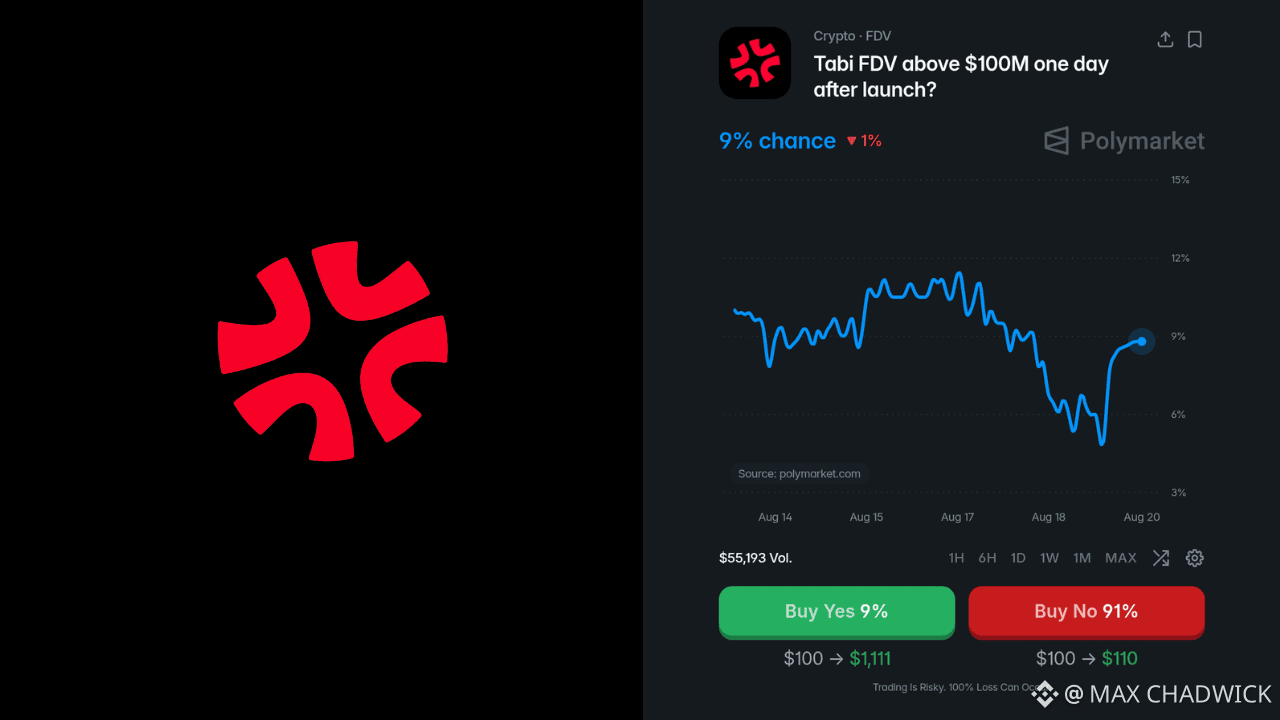
Will Tabi's FDV clear $100M? 📉 $TRUMP and $SOL both show up a lot in these smaller FDV questions, and this one's no exception. Tabi's chart has been stuck chopping in a tight range for the entire stretch, never really breaking out either direction. 9% chance right now, down slightly. $55,193 in volume shows this market's already picked up real attention despite the low number. It bounced between the high single digits and low double digits the whole time, dipped down to 6% at one point, and only recently climbed back to 9%. That kind of tight, repeated chop usually means the market's already found its ceiling for now. I'm leaning No here. A small bounce off a dip isn't the same thing as an actual breakout forming. Polymarket keeps being one of the steadier ways to actually profit from a read like this instead of just watching the chop play out. Especially with a crypto market that's been this rough lately overall. Fair to see this differently though, the choice is yours. #Altcoin Season#
Will Tabi's FDV clear $100M? 📉 $TRUMP and $SOL both show up a lot in these smaller FDV questions, and this one's no exception. Tabi's chart has been stuck chopping in a tight range for the entire stretch, never really breaking out either direction. 9% chance right now, down slightly. $55,193 in volume shows this market's already picked up real attention despite the low number. It bounced between the high single digits and low double digits the whole time, dipped down to 6% at one point, and only recently climbed back to 9%. That kind of tight, repeated chop usually means the market's already found its ceiling for now. I'm leaning No here. A small bounce off a dip isn't the same thing as an actual breakout forming. Polymarket keeps being one of the steadier ways to actually profit from a read like this instead of just watching the chop play out. Especially with a crypto market that's been this rough lately overall. Fair to see this differently though, the choice is yours. #Altcoin Season#
76
·
--
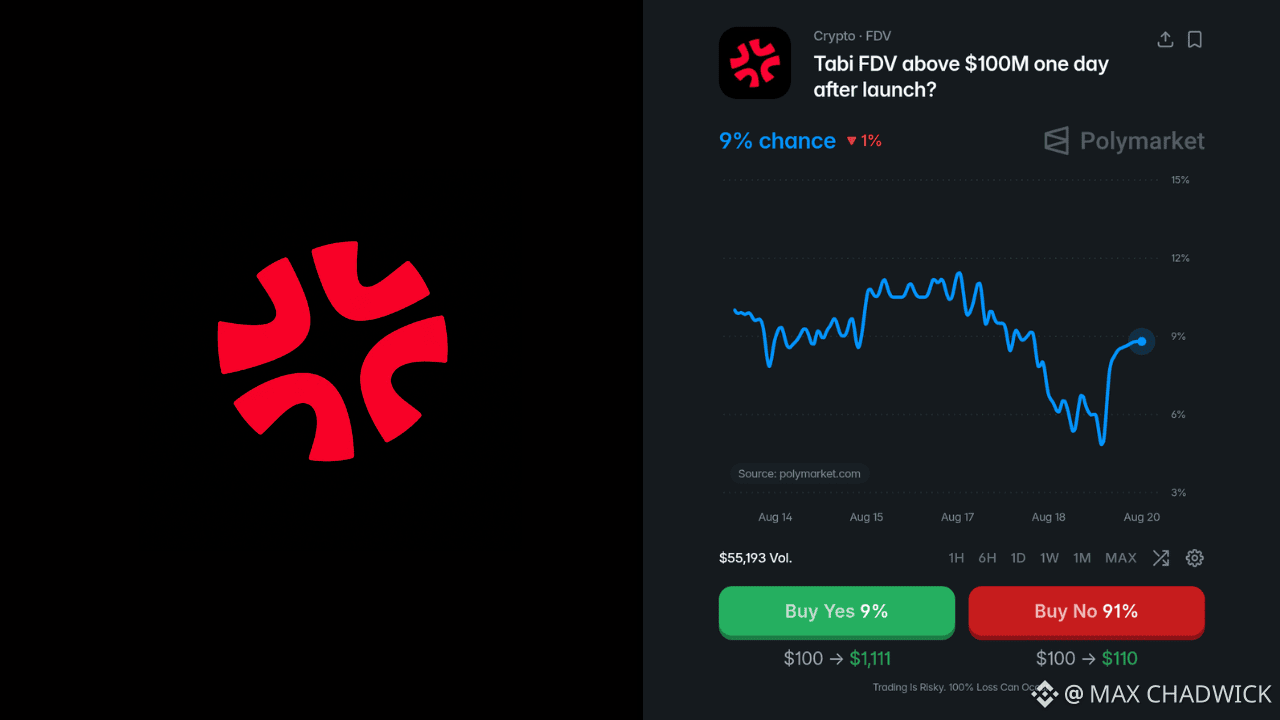
Will Tabi's FDV clear $100M? 📉 $TRUMP and $SOL both show up a lot in these smaller FDV questions, and this one's no exception. Tabi's chart has been stuck chopping in a tight range for the entire stretch, never really breaking out either direction. 9% chance right now, down slightly. $55,193 in volume shows this market's already picked up real attention despite the low number. It bounced between the high single digits and low double digits the whole time, dipped down to 6% at one point, and only recently climbed back to 9%. That kind of tight, repeated chop usually means the market's already found its ceiling for now. I'm leaning No here. A small bounce off a dip isn't the same thing as an actual breakout forming. Polymarket keeps being one of the steadier ways to actually profit from a read like this instead of just watching the chop play out. Especially with a crypto market that's been this rough lately overall. Fair to see this differently though, the choice is yours. #Altcoin Season#
Will Tabi's FDV clear $100M? 📉 $TRUMP and $SOL both show up a lot in these smaller FDV questions, and this one's no exception. Tabi's chart has been stuck chopping in a tight range for the entire stretch, never really breaking out either direction. 9% chance right now, down slightly. $55,193 in volume shows this market's already picked up real attention despite the low number. It bounced between the high single digits and low double digits the whole time, dipped down to 6% at one point, and only recently climbed back to 9%. That kind of tight, repeated chop usually means the market's already found its ceiling for now. I'm leaning No here. A small bounce off a dip isn't the same thing as an actual breakout forming. Polymarket keeps being one of the steadier ways to actually profit from a read like this instead of just watching the chop play out. Especially with a crypto market that's been this rough lately overall. Fair to see this differently though, the choice is yours. #Altcoin Season#
73
·
--
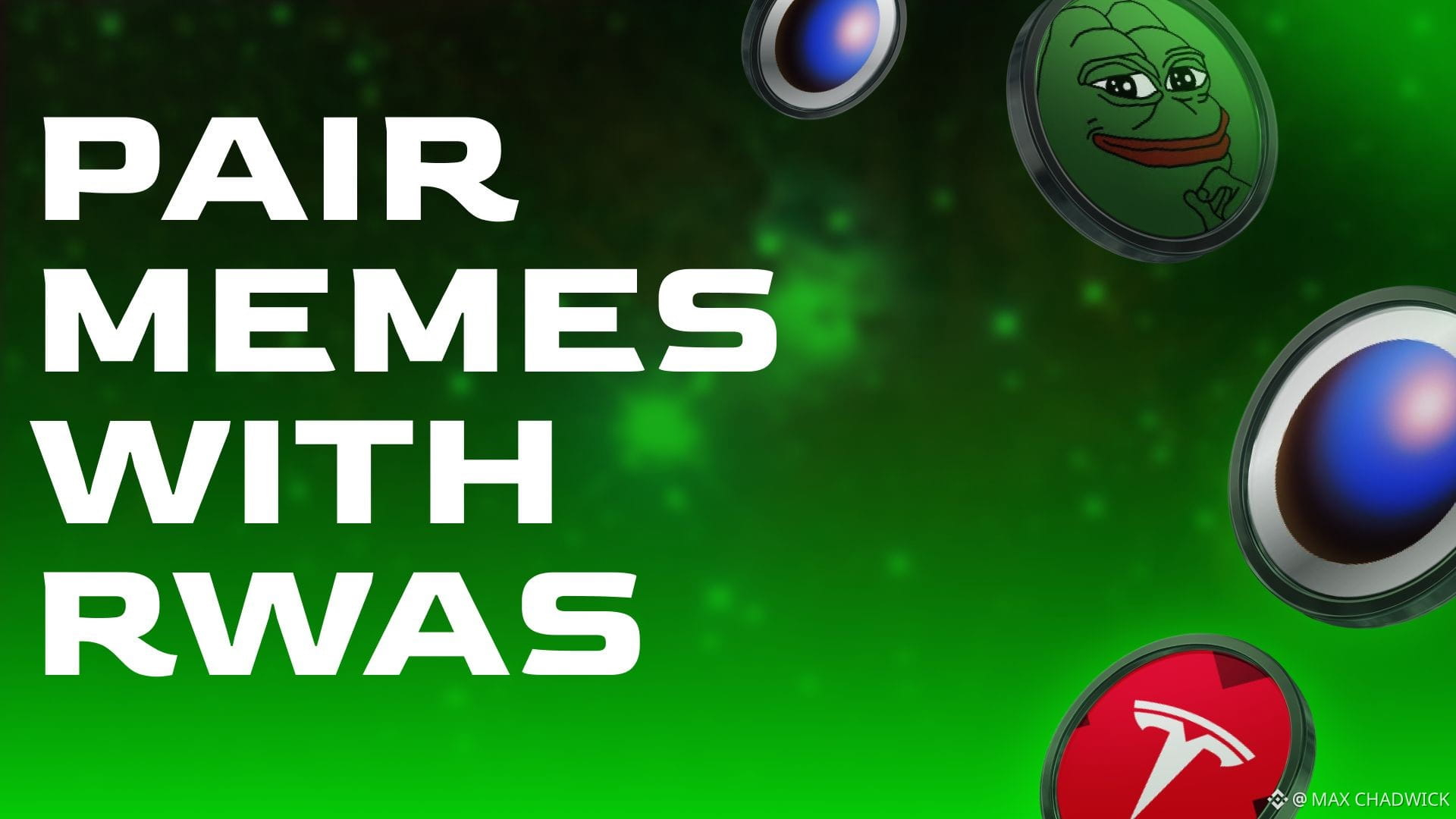
Meme Culture Just Merged With Wall Street 🤯 I find myself thinking about how every new category in crypto starts the same way, two things that were never supposed to share a sentence, sharing one anyway. While $PEPE has pure internet culture and holds real, sustained market value with zero fundamentals beyond attention and identity, $CC sits on the complete opposite end, infrastructure built for institutions to settle regulated assets on-chain. Neither token was ever meant to share a sentence, let alone a market. And that's exactly the point. The most interesting categories in this industry never come from picking a side, they come from colliding two things nobody thought belonged together. Zora's custom pairs feature is built for exactly that kind of collision. Anyone can create a token and pair it directly against an established meme, a tokenized stock, or an RWA token, live instantly across Base, Robinhood, and Solana. It's not something a chart or a listing committee decides in advance. That's genuinely a different kind of creative act than anything else on a chart page. A creator picking their own pair is proposing a category and letting the market vote on whether it sticks. The category doesn't exist until someone actually builds the pair that defines it. That's a strange kind of power to hand to anyone with an idea and a few minutes. Some of these pairs will fade immediately. A few will end up being the reason people say a category even started. When you boil all this down, its pretty freakin’ exciting and could birth some fun runners 👀 #Meme Alpha# #Altcoin Season#
Meme Culture Just Merged With Wall Street 🤯 I find myself thinking about how every new category in crypto starts the same way, two things that were never supposed to share a sentence, sharing one anyway. While $PEPE has pure internet culture and holds real, sustained market value with zero fundamentals beyond attention and identity, $CC sits on the complete opposite end, infrastructure built for institutions to settle regulated assets on-chain. Neither token was ever meant to share a sentence, let alone a market. And that's exactly the point. The most interesting categories in this industry never come from picking a side, they come from colliding two things nobody thought belonged together. Zora's custom pairs feature is built for exactly that kind of collision. Anyone can create a token and pair it directly against an established meme, a tokenized stock, or an RWA token, live instantly across Base, Robinhood, and Solana. It's not something a chart or a listing committee decides in advance. That's genuinely a different kind of creative act than anything else on a chart page. A creator picking their own pair is proposing a category and letting the market vote on whether it sticks. The category doesn't exist until someone actually builds the pair that defines it. That's a strange kind of power to hand to anyone with an idea and a few minutes. Some of these pairs will fade immediately. A few will end up being the reason people say a category even started. When you boil all this down, its pretty freakin’ exciting and could birth some fun runners 👀 #Meme Alpha# #Altcoin Season#
79
·
--
Gave Options Easy Mode a try? 👀 $HYPE perp trader for years and veteran $ETH DeFi player, but I've opened the options chain more times than I can count and closed it every time before placing a trade. Yesterday I didn't close it. Options have always been the smarter instrument in theory tbh, defined downside before the position opens, no funding bleed on a position you're holding overnight, flexible structure depending on your read. The reason I never actually used one wasn't the instrument. It was the ten decisions between "I have a view" and "position is open." Easy Mode on Aevo removes all that friction. You pick direction. You see your max loss before you confirm. You open the position. I ran my first one in under two minutes. Just simple and easy 🌟
Gave Options Easy Mode a try? 👀 $HYPE perp trader for years and veteran $ETH DeFi player, but I've opened the options chain more times than I can count and closed it every time before placing a trade. Yesterday I didn't close it. Options have always been the smarter instrument in theory tbh, defined downside before the position opens, no funding bleed on a position you're holding overnight, flexible structure depending on your read. The reason I never actually used one wasn't the instrument. It was the ten decisions between "I have a view" and "position is open." Easy Mode on Aevo removes all that friction. You pick direction. You see your max loss before you confirm. You open the position. I ran my first one in under two minutes. Just simple and easy 🌟
62
·
--
Attention Rotates Faster Than Most People Track 🤯 $ATOM sits at the center of a lot of interchain activity, and $KAITO tracks a version of that same rotation, except across narratives instead of chains, watching where attention actually moves once one sector cools off. Most people only notice a sector rotation after it's already happened, once DeFi has already handed attention to NFTs, or AI has already handed it to RWA, and by then the early part of the move is long gone. Catching that shift while it's actually happening requires watching mindshare move in real time instead of reading about it after the fact, which is a much narrower window than most people assume. That's the exact gap Kaito's mindshare data is built to close, showing which narrative is picking up real momentum before it becomes the obvious story everyone's already trading. I'd rather catch a rotation a week early than read a headline explaining it a month late. #Altcoin Season# #Macro Insights#
Attention Rotates Faster Than Most People Track 🤯 $ATOM sits at the center of a lot of interchain activity, and $KAITO tracks a version of that same rotation, except across narratives instead of chains, watching where attention actually moves once one sector cools off. Most people only notice a sector rotation after it's already happened, once DeFi has already handed attention to NFTs, or AI has already handed it to RWA, and by then the early part of the move is long gone. Catching that shift while it's actually happening requires watching mindshare move in real time instead of reading about it after the fact, which is a much narrower window than most people assume. That's the exact gap Kaito's mindshare data is built to close, showing which narrative is picking up real momentum before it becomes the obvious story everyone's already trading. I'd rather catch a rotation a week early than read a headline explaining it a month late. #Altcoin Season# #Macro Insights#
68
·
--
Your Past Transactions Can Still Be Exposed 🚨 Almost every privacy product I look at is a layer sitting on top of a chain that already published the thing it protects. Model inference on $TAO runs across independent operators, and each one reads the job it is handed before processing it. A shield added above that changes who sees the result and never touches the machine reading the input. $XMR went the other way and made concealment a property of the base protocol, so every transaction carries it whether the holder asked for it or not. That default is why the guarantee holds for every Monero holder at once. That lesson runs well past payments, because a guarantee applied afterwards only ever covers whatever had not already been written down. Midnight builds the seal into how contracts execute, with Compact deciding at write time which inputs ever become visible. A developer picks that before deployment, and the chain enforces it for every user of the app afterwards. Nothing gets published and then hidden, because the data never enters the public record to begin with. That ordering is the whole argument, and it is the one thing a retrofit can never change. Backward Fixes will keep shipping, and they will keep protecting the second half of a story whose first half is already documented. So teams rebuilding at the base layer are making an expensive choice once. I am watching which ones do it, because a chain that publishes first will never un-publish, and no upgrade repairs a record that is already indexed. #Privacy #ZK
Your Past Transactions Can Still Be Exposed 🚨 Almost every privacy product I look at is a layer sitting on top of a chain that already published the thing it protects. Model inference on $TAO runs across independent operators, and each one reads the job it is handed before processing it. A shield added above that changes who sees the result and never touches the machine reading the input. $XMR went the other way and made concealment a property of the base protocol, so every transaction carries it whether the holder asked for it or not. That default is why the guarantee holds for every Monero holder at once. That lesson runs well past payments, because a guarantee applied afterwards only ever covers whatever had not already been written down. Midnight builds the seal into how contracts execute, with Compact deciding at write time which inputs ever become visible. A developer picks that before deployment, and the chain enforces it for every user of the app afterwards. Nothing gets published and then hidden, because the data never enters the public record to begin with. That ordering is the whole argument, and it is the one thing a retrofit can never change. Backward Fixes will keep shipping, and they will keep protecting the second half of a story whose first half is already documented. So teams rebuilding at the base layer are making an expensive choice once. I am watching which ones do it, because a chain that publishes first will never un-publish, and no upgrade repairs a record that is already indexed. #Privacy #ZK
5
·
--
zkLogin Brings 1B Google Users On-Chain 🔥 $NEAR spent years trying to solve crypto's onboarding problem. $SUI is the first chain to solve it at the cryptographic level. Every onboarding attempt in crypto hits the same wall. Real self-custody requires a seed phrase. Most people will not manage a 12-word mnemonic safely. They lose it, store it wrong, or abandon crypto entirely at that step. zkLogin changes this. A user authenticates with their Google or Apple account and a real, self-custody wallet is generated from that credential using zero-knowledge proofs. The credential is never revealed to anyone, including Mysten Labs. There is no seed phrase to write down and no private key file to protect. Every DeFi app on Sui is now accessible to anyone with a Google account, and that means over a billion people. No bridge, no gas token pre-purchase, no onboarding screen that loses users before they start. The chains that onboard the next hundred million users won't do it by educating people on seed phrases. They'll do it by removing that requirement entirely. I haven't seen another chain at this stage with a working cryptographic solution that preserves genuine self-custody. zkLogin is different. #DeFi #Altcoin Season#
zkLogin Brings 1B Google Users On-Chain 🔥 $NEAR spent years trying to solve crypto's onboarding problem. $SUI is the first chain to solve it at the cryptographic level. Every onboarding attempt in crypto hits the same wall. Real self-custody requires a seed phrase. Most people will not manage a 12-word mnemonic safely. They lose it, store it wrong, or abandon crypto entirely at that step. zkLogin changes this. A user authenticates with their Google or Apple account and a real, self-custody wallet is generated from that credential using zero-knowledge proofs. The credential is never revealed to anyone, including Mysten Labs. There is no seed phrase to write down and no private key file to protect. Every DeFi app on Sui is now accessible to anyone with a Google account, and that means over a billion people. No bridge, no gas token pre-purchase, no onboarding screen that loses users before they start. The chains that onboard the next hundred million users won't do it by educating people on seed phrases. They'll do it by removing that requirement entirely. I haven't seen another chain at this stage with a working cryptographic solution that preserves genuine self-custody. zkLogin is different. #DeFi #Altcoin Season#
72
·
--
Onchain Perps Have Come A Long Way And Most Traders Missed It 📊 $HYPE proved on-chain execution could work. $DRV is trying to do the same as well, showing derivatives have a big place in the space. That was the foundation. What's being built on top of it is a different conversation. Aevo is running perps, options, and tokenized real-world assets from one account and one collateral pool, with tech like PERPS+ removing the interface barrier that kept perp traders out of options for three years. Most perp DEXs are still competing on fees. Aevo is competing on what a derivatives account can actually do and the barriers stopping traders. The space moved further than the narrative gives it credit for. The traders paying attention are already positioned differently because of it. #Macro Insights#
Onchain Perps Have Come A Long Way And Most Traders Missed It 📊 $HYPE proved on-chain execution could work. $DRV is trying to do the same as well, showing derivatives have a big place in the space. That was the foundation. What's being built on top of it is a different conversation. Aevo is running perps, options, and tokenized real-world assets from one account and one collateral pool, with tech like PERPS+ removing the interface barrier that kept perp traders out of options for three years. Most perp DEXs are still competing on fees. Aevo is competing on what a derivatives account can actually do and the barriers stopping traders. The space moved further than the narrative gives it credit for. The traders paying attention are already positioned differently because of it. #Macro Insights#
52
·
--
Most Tokenized Stocks Still Sit Unused 📊 That's the opportunity I keep circling back to whenever real-world asset (RWA) tokenization comes up. $CC has shown that institutions will settle tokenized assets onchain once privacy and compliance are built in from day one, and $AVAX proved that a subnet architecture can let big institutions run permissioned tokenization pilots without touching the public chain. Both prove the infrastructure problem is basically solved. What's still missing is a way for retail to actually trade the asset instead of just reading about it. Stock tokenization specifically has mostly stayed inside that institutional lane, out of retail's reach. But Bankr's stock-paired token launches on Robinhood Chain are changing the game. Equities and ETFs have been live on Robinhood Chain as pairing assets since July 20th, and Bankr shipped with 90+ of them on day one instead of adding tickers one at a time. Four just brought the same idea to BNB Chain, teaming up with bStocks and Binance Wallet to wire up NVDAB as the first stock traders can pair against. Why does the number of stocks matter here? Because a launchpad with one stock only works for people already bullish on that one company. A launchpad with 90+ works for whatever trade is moving that week. Here's how the two stack up right now: - Robinhood Chain via Bankr: 90+ equities and ETFs live since July 20th - BNB Chain via Four: 1 stock (NVDAB) wired up so far, more reportedly coming via the bStocks collab - On Bankr, retail already picks which company's exposure to pair against. - On Four, they're waiting on the next ticker More stocks are reportedly coming to Four, but until then, Bankr is the launchpad where real activity is happening. I'm watching to see how fast things escalate onchain, because liquidity is going to follow whoever wires up the most assets first. #RWA #Altcoin Season#
Most Tokenized Stocks Still Sit Unused 📊 That's the opportunity I keep circling back to whenever real-world asset (RWA) tokenization comes up. $CC has shown that institutions will settle tokenized assets onchain once privacy and compliance are built in from day one, and $AVAX proved that a subnet architecture can let big institutions run permissioned tokenization pilots without touching the public chain. Both prove the infrastructure problem is basically solved. What's still missing is a way for retail to actually trade the asset instead of just reading about it. Stock tokenization specifically has mostly stayed inside that institutional lane, out of retail's reach. But Bankr's stock-paired token launches on Robinhood Chain are changing the game. Equities and ETFs have been live on Robinhood Chain as pairing assets since July 20th, and Bankr shipped with 90+ of them on day one instead of adding tickers one at a time. Four just brought the same idea to BNB Chain, teaming up with bStocks and Binance Wallet to wire up NVDAB as the first stock traders can pair against. Why does the number of stocks matter here? Because a launchpad with one stock only works for people already bullish on that one company. A launchpad with 90+ works for whatever trade is moving that week. Here's how the two stack up right now: - Robinhood Chain via Bankr: 90+ equities and ETFs live since July 20th - BNB Chain via Four: 1 stock (NVDAB) wired up so far, more reportedly coming via the bStocks collab - On Bankr, retail already picks which company's exposure to pair against. - On Four, they're waiting on the next ticker More stocks are reportedly coming to Four, but until then, Bankr is the launchpad where real activity is happening. I'm watching to see how fast things escalate onchain, because liquidity is going to follow whoever wires up the most assets first. #RWA #Altcoin Season#
29
·
--
This Flew Under Your Radar 🛰 Didn’t it? $OKB and $TRX have both built deep roots in Southeast Asian crypto markets. Neither of them is building decentralized satellite infrastructure for those markets. Southeast Asia is one of the largest untapped connectivity markets on earth. Governments are modernizing their digital infrastructure, carriers are scaling rapidly, and demand for reliable coverage in underserved regions is accelerating. The projects that build physical infrastructure for these markets at this stage will be very hard to displace. One infra’ token signed an exclusive deal to do exactly that, and the majority of people missed it. Spacecoin signed a $100M exclusive MOU with DETI Technology to deploy decentralized satellite connectivity across Vietnam. DETI holds a three-year exclusive license to develop and distribute this infrastructure in the country. The anchor customers are Mobifone and Gtel, two of Vietnam's largest mobile carriers. The revenue target is $100M minimum per year once commercial operations begin. Why Vietnam specifically? One of the youngest, most mobile-first populations on earth, a government actively modernizing its digital infrastructure, and a market that adopts new technology fast. Spacecoin is already active across Kenya, Nigeria, Indonesia, and Cambodia. CTC-1 satellites in orbit, partners on the ground, markets being licensed. Vietnam is the latest stop. The map is filling in. I am not sleeping on the global rollout. This is actually insanity when you break it all down. #Altcoin Season#
This Flew Under Your Radar 🛰 Didn’t it? $OKB and $TRX have both built deep roots in Southeast Asian crypto markets. Neither of them is building decentralized satellite infrastructure for those markets. Southeast Asia is one of the largest untapped connectivity markets on earth. Governments are modernizing their digital infrastructure, carriers are scaling rapidly, and demand for reliable coverage in underserved regions is accelerating. The projects that build physical infrastructure for these markets at this stage will be very hard to displace. One infra’ token signed an exclusive deal to do exactly that, and the majority of people missed it. Spacecoin signed a $100M exclusive MOU with DETI Technology to deploy decentralized satellite connectivity across Vietnam. DETI holds a three-year exclusive license to develop and distribute this infrastructure in the country. The anchor customers are Mobifone and Gtel, two of Vietnam's largest mobile carriers. The revenue target is $100M minimum per year once commercial operations begin. Why Vietnam specifically? One of the youngest, most mobile-first populations on earth, a government actively modernizing its digital infrastructure, and a market that adopts new technology fast. Spacecoin is already active across Kenya, Nigeria, Indonesia, and Cambodia. CTC-1 satellites in orbit, partners on the ground, markets being licensed. Vietnam is the latest stop. The map is filling in. I am not sleeping on the global rollout. This is actually insanity when you break it all down. #Altcoin Season#
58
·
--
Yeet Originals built with personality. $DOGE has a personality, playful, self-aware, the lovable underdog that never takes itself too seriously but somehow ends up winning anyway. The culture is fun, the community is irreverent, and that energy is impossible to separate from the token itself. $TRUMP has a completely different personality, bold, unapologetic, all-in on every position, the conviction that never hedges. Two distinct characters, both instantly recognisable. Traditional casino games don't have personalities. Yeet Originals do. In-house games built around crypto culture and meme coin mechanics, games that carry the same irreverence as DOGE and the same conviction energy as TRUMP. Not mechanical slots with a crypto logo. Something that actually feels like the culture it was built for. Your TRUMP and your DOGE are already accepted natively on YEET, deposit directly, no converting, no extra steps. 7,000+ games from Pragmatic Play, Evolution, Hacksaw, and Nolimit City running alongside the Originals. 5%-25% rakeback from the first tier. DOGE gave crypto a personality it didn't know it needed. TRUMP gave conviction a token. Yeet Originals gave both communities a game worth playing. Play now: https://bit.ly/4uXVfZJ #Meme Alpha#
Yeet Originals built with personality. $DOGE has a personality, playful, self-aware, the lovable underdog that never takes itself too seriously but somehow ends up winning anyway. The culture is fun, the community is irreverent, and that energy is impossible to separate from the token itself. $TRUMP has a completely different personality, bold, unapologetic, all-in on every position, the conviction that never hedges. Two distinct characters, both instantly recognisable. Traditional casino games don't have personalities. Yeet Originals do. In-house games built around crypto culture and meme coin mechanics, games that carry the same irreverence as DOGE and the same conviction energy as TRUMP. Not mechanical slots with a crypto logo. Something that actually feels like the culture it was built for. Your TRUMP and your DOGE are already accepted natively on YEET, deposit directly, no converting, no extra steps. 7,000+ games from Pragmatic Play, Evolution, Hacksaw, and Nolimit City running alongside the Originals. 5%-25% rakeback from the first tier. DOGE gave crypto a personality it didn't know it needed. TRUMP gave conviction a token. Yeet Originals gave both communities a game worth playing. Play now: https://bit.ly/4uXVfZJ #Meme Alpha#
35
·
--
Optimism bet on builders. This is one. $OP was built on a belief. That the right way to do crypto is to build things that last. That long-term thinking compounds into something the short-term market can't see yet. DMC carries that conviction on $SOL The DeLorean IP is the foundation. But what's being built around it is deliberate. Real products. Professional execution. A team committed to making web3 meaningful through cultural assets that outlast any single cycle. 40 years of IP as the starting point. A team building like it'll still matter in 40 more. #Altcoin Season#
Optimism bet on builders. This is one. $OP was built on a belief. That the right way to do crypto is to build things that last. That long-term thinking compounds into something the short-term market can't see yet. DMC carries that conviction on $SOL The DeLorean IP is the foundation. But what's being built around it is deliberate. Real products. Professional execution. A team committed to making web3 meaningful through cultural assets that outlast any single cycle. 40 years of IP as the starting point. A team building like it'll still matter in 40 more. #Altcoin Season#
62
·
--
UFC is live on YEET. No gatekeepers, no barriers. $NEAR was built so anyone can access crypto applications without knowing they're using crypto, human-readable accounts, frictionless onboarding, a chain designed to remove every technical barrier between the person and the product. $ICP was built to make sure no central authority can block access, applications running entirely on-chain, censorship-resistant, available to anyone with a connection. Both tokens were built on the same principle: nobody should be able to stop you from accessing what you want. YEET's UFC sportsbook runs on that same principle. No routine KYC. Live UFC odds on every card running right now — round betting, method of victory, fight winner, full in-play props as the rounds run. The barriers other platforms put between you and the bet don't exist here. Best prices in crypto, fast withdrawals when your call lands. Yeet accepts 18+ assets, deposit in BTC, ETH, SOL, XRP and more. NEAR built the experience that removes every barrier to access. ICP built the infrastructure that no authority can shut down. YEET built the UFC sportsbook that runs for everyone. Play now: https://bit.ly/4dCxL5o #Altcoin Season#
UFC is live on YEET. No gatekeepers, no barriers. $NEAR was built so anyone can access crypto applications without knowing they're using crypto, human-readable accounts, frictionless onboarding, a chain designed to remove every technical barrier between the person and the product. $ICP was built to make sure no central authority can block access, applications running entirely on-chain, censorship-resistant, available to anyone with a connection. Both tokens were built on the same principle: nobody should be able to stop you from accessing what you want. YEET's UFC sportsbook runs on that same principle. No routine KYC. Live UFC odds on every card running right now — round betting, method of victory, fight winner, full in-play props as the rounds run. The barriers other platforms put between you and the bet don't exist here. Best prices in crypto, fast withdrawals when your call lands. Yeet accepts 18+ assets, deposit in BTC, ETH, SOL, XRP and more. NEAR built the experience that removes every barrier to access. ICP built the infrastructure that no authority can shut down. YEET built the UFC sportsbook that runs for everyone. Play now: https://bit.ly/4dCxL5o #Altcoin Season#
71
·
--
Going Mainstream Follows This Pattern 🌍 Going mainstream in crypto usually looks like the same shift playing out - a project moves from being a niche insider topic to something people outside crypto actually recognize. $XRP is a clear example of that, from being the center of a landmark lawsuit to now being tied to ETFs and mainstream financial coverage, it crossed into conversations most people outside crypto are already having. Most crypto projects never make that jump. They stay a niche insider topic no matter how good the product is, because nothing about them ever breaks into the wider conversation. That crossing point is usually the hardest part, and it rarely happens because of one single announcement. $KAITO looks like it is making that same jump right now. It just announced a direct data agreement with X, official access to the platform instead of the scraped or unofficial methods everyone else in this space has been stuck using. That alone is the kind of move that gets attention beyond crypto's usual circles, since it is a partnership with a platform almost everyone already uses. On top of that, Kaito Studio is linking projects directly with creators, and the number of projects applying to use it has been climbing. That is not a niche crypto audience discovering a tool, that is projects actively seeking Kaito out because the data behind it is real. I think that combination is what mainstream momentum actually looks like before it becomes obvious to everyone. Official platform access plus more projects applying instead of being pitched is a meaningfully different signal than just growing hype. XRP went through a version of that same shift once it crossed outside crypto circles. I think Kaito is early in its own version of that same shift. #AI #Altcoin Season#
Going Mainstream Follows This Pattern 🌍 Going mainstream in crypto usually looks like the same shift playing out - a project moves from being a niche insider topic to something people outside crypto actually recognize. $XRP is a clear example of that, from being the center of a landmark lawsuit to now being tied to ETFs and mainstream financial coverage, it crossed into conversations most people outside crypto are already having. Most crypto projects never make that jump. They stay a niche insider topic no matter how good the product is, because nothing about them ever breaks into the wider conversation. That crossing point is usually the hardest part, and it rarely happens because of one single announcement. $KAITO looks like it is making that same jump right now. It just announced a direct data agreement with X, official access to the platform instead of the scraped or unofficial methods everyone else in this space has been stuck using. That alone is the kind of move that gets attention beyond crypto's usual circles, since it is a partnership with a platform almost everyone already uses. On top of that, Kaito Studio is linking projects directly with creators, and the number of projects applying to use it has been climbing. That is not a niche crypto audience discovering a tool, that is projects actively seeking Kaito out because the data behind it is real. I think that combination is what mainstream momentum actually looks like before it becomes obvious to everyone. Official platform access plus more projects applying instead of being pitched is a meaningfully different signal than just growing hype. XRP went through a version of that same shift once it crossed outside crypto circles. I think Kaito is early in its own version of that same shift. #AI #Altcoin Season#
31
·
--
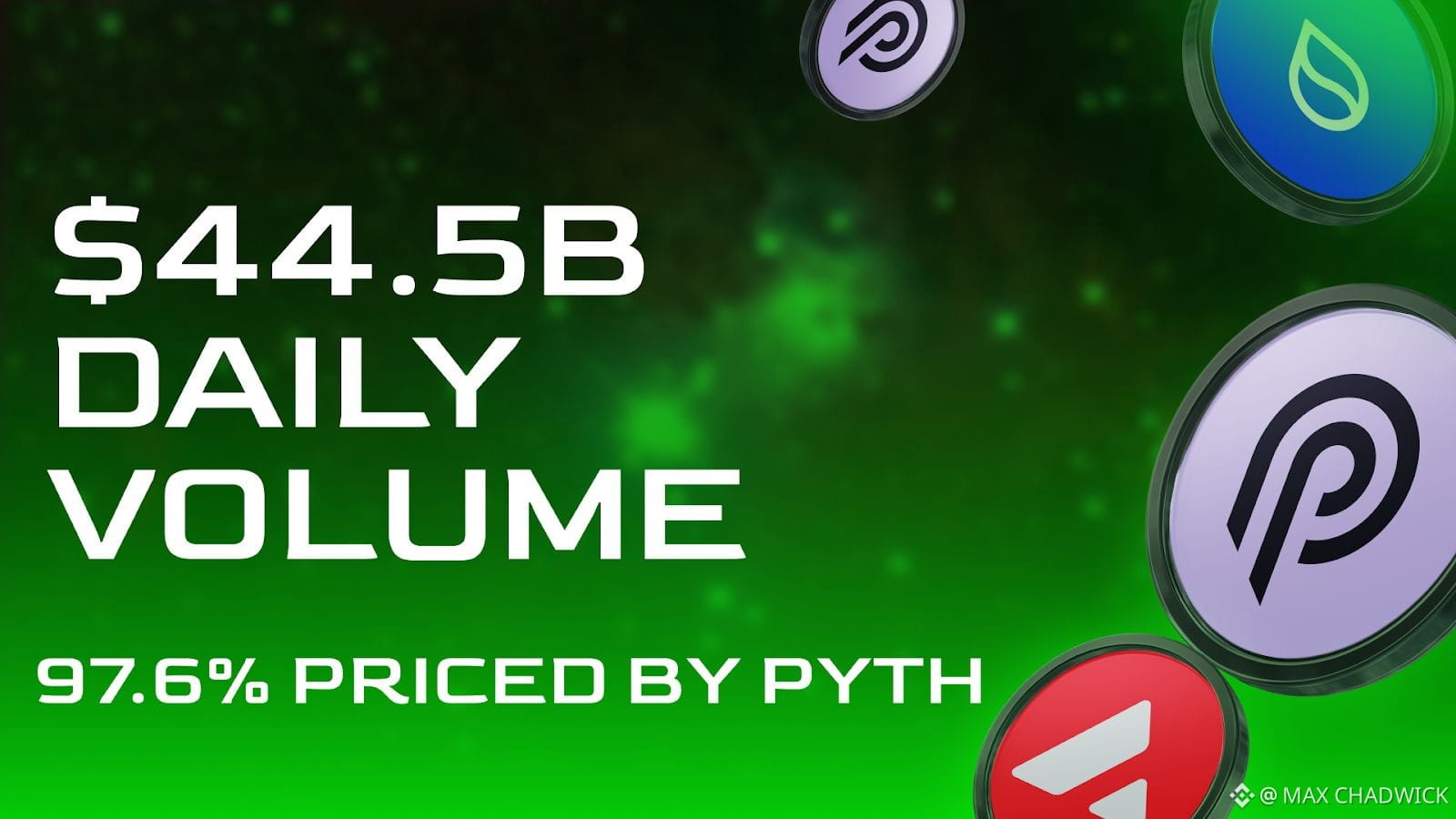
$44.5B daily RWA perp volume is the number I’d keep on the screen. Pyth sits where $AVAX ’s real-asset lane and $SUI ’s app-speed lane start turning into 24/7 markets people actually trade. Look at the board. SanDisk: $10.3B daily volume SK Hynix: $7.98B Micron: $5.44B SOXL: $4.91B Gold: $4.21B Oil, silver, SpaceX, Nasdaq 100 and S&P 500 are sitting there too. Across the top 12 RWA perp markets, 97.6% of pricing is powered by Pyth. That is the part I care about as an investor. Crypto spent years talking about RWAs as a future category. Now semiconductors, commodities, metals, ETFs, indices and private-market exposure are already trading as perp markets with serious daily volume. Once that happens, the price layer stops being background infrastructure. It becomes the market. Margins need it. Liquidations need it. Funding needs it. Risk engines need it. Every venue listing these assets needs a clean source before traders can size up. Pyth is already sitting under that flow. And the Asia expansion makes the setup stronger. The same Pyth Pro stack now reaches Hong Kong, Mainland China, South Korea and Japan, while already covering U.S. equities, 24/7 indices, FX, commodities, metals, fixed income and crypto. The signal is simple: onchain trading is turning into 24/7 macro access. Pyth is pricing the shift. #Altcoin Season# #RWA
$44.5B daily RWA perp volume is the number I’d keep on the screen. Pyth sits where $AVAX ’s real-asset lane and $SUI ’s app-speed lane start turning into 24/7 markets people actually trade. Look at the board. SanDisk: $10.3B daily volume SK Hynix: $7.98B Micron: $5.44B SOXL: $4.91B Gold: $4.21B Oil, silver, SpaceX, Nasdaq 100 and S&P 500 are sitting there too. Across the top 12 RWA perp markets, 97.6% of pricing is powered by Pyth. That is the part I care about as an investor. Crypto spent years talking about RWAs as a future category. Now semiconductors, commodities, metals, ETFs, indices and private-market exposure are already trading as perp markets with serious daily volume. Once that happens, the price layer stops being background infrastructure. It becomes the market. Margins need it. Liquidations need it. Funding needs it. Risk engines need it. Every venue listing these assets needs a clean source before traders can size up. Pyth is already sitting under that flow. And the Asia expansion makes the setup stronger. The same Pyth Pro stack now reaches Hong Kong, Mainland China, South Korea and Japan, while already covering U.S. equities, 24/7 indices, FX, commodities, metals, fixed income and crypto. The signal is simple: onchain trading is turning into 24/7 macro access. Pyth is pricing the shift. #Altcoin Season# #RWA
52
Көбірек контент көру үшін кіріңіз
Binance Square платформасында әлемдік криптоқоғамдастыққа қосылыңыз
⚡️ Криптовалюта туралы ең соңғы және пайдалы ақпаратты алыңыз.
💬 Әлемдегі ең ірі криптобиржаның сеніміне ие.
👍 Расталған авторлардың нақты пікірлерін табыңыз.
Электрондық пошта/телефон нөмірі
Трендтегі тақырыптар
CanMicrosoftDeliverOnAI
189,296 рет көрілді
1,514 адам талқылап жатыр
Earnings Season Session 3: Will Google & Microsoft Beat Earnings Expectations?
Binance Square Official
·95 лайк
·28.2k рет көрілді
CanGoogleDefindItsCore
96,038 рет көрілді
1,095 адам талқылап жатыр
FOMCWatch
9.2M рет көрілді
28,777 адам талқылап жатыр