

Mathew Kinzy 1
60 Жариялаулар

Mathew Kinzy 1
Хабарлау
Пайдаланушыны блоктау
0 Жазылым
4 Жазылушылар
1 лайк басылған
Жазбалар
California just put political meme coins under a new kind of regulatory spotlight.
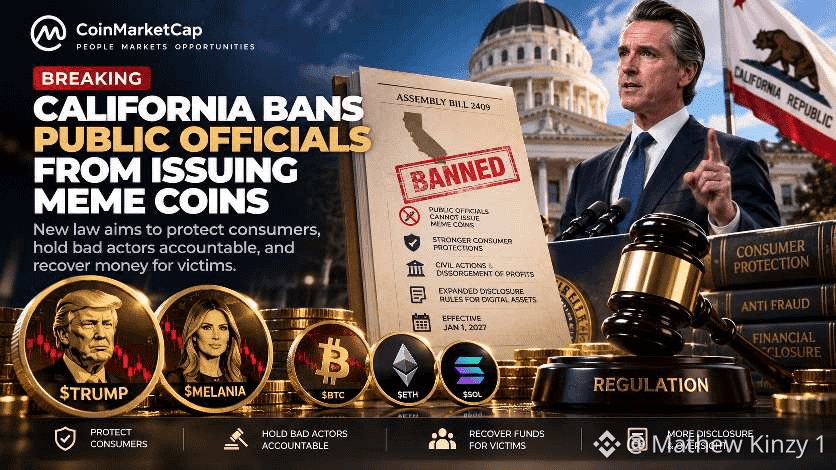
Assembly Bill 2409 targets digital assets issued by California public officials and employees. The legislation is designed to prevent officials from using their position or likeness to personally benefit from issuing meme coins, while also expanding financial-disclosure rules to cover digital assets beginning January 1, 2027. The California Attorney General would be able to seek injunctions and disgorgement of funds generated through violations.
The bigger crypto question goes beyond California.
Political meme coins such as $TRUMP and $MELANIA have shown how quickly a public figure’s identity can become a tradable onchain asset. Meanwhile, established assets like $BTC, $ETH and $SOL operate in a very different part of the crypto market.
California’s move introduces another distinction investors may increasingly need to consider:
Who is behind a token, how do they benefit from it, and what rules apply when political influence and financial incentives overlap?
For meme coins tied to public figures, regulation could become just as important to watch as liquidity and community attention.
California just put political meme coins under a new kind of regulatory spotlight.
Assembly Bill 2409 targets digital assets issued by California public officials and employees. The legislation is designed to prevent officials from using their position or likeness to personally benefit from issuing meme coins, while also expanding financial-disclosure rules to cover digital assets beginning January 1, 2027. The California Attorney General would be able to seek injunctions and disgorgement of funds generated through violations.
The bigger crypto question goes beyond California.
Political meme coins such as $TRUMP and $MELANIA have shown how quickly a public figure’s identity can become a tradable onchain asset. Meanwhile, established assets like $BTC, $ETH and $SOL operate in a very different part of the crypto market.
California’s move introduces another distinction investors may increasingly need to consider:
Who is behind a token, how do they benefit from it, and what rules apply when political influence and financial incentives overlap?
For meme coins tied to public figures, regulation could become just as important to watch as liquidity and community attention.
Assembly Bill 2409 targets digital assets issued by California public officials and employees. The legislation is designed to prevent officials from using their position or likeness to personally benefit from issuing meme coins, while also expanding financial-disclosure rules to cover digital assets beginning January 1, 2027. The California Attorney General would be able to seek injunctions and disgorgement of funds generated through violations.
The bigger crypto question goes beyond California.
Political meme coins such as $TRUMP and $MELANIA have shown how quickly a public figure’s identity can become a tradable onchain asset. Meanwhile, established assets like $BTC, $ETH and $SOL operate in a very different part of the crypto market.
California’s move introduces another distinction investors may increasingly need to consider:
Who is behind a token, how do they benefit from it, and what rules apply when political influence and financial incentives overlap?
For meme coins tied to public figures, regulation could become just as important to watch as liquidity and community attention.
66
A $5.7B verdict over something most iPhone users probably never think about: the tiny vibration they feel every day.
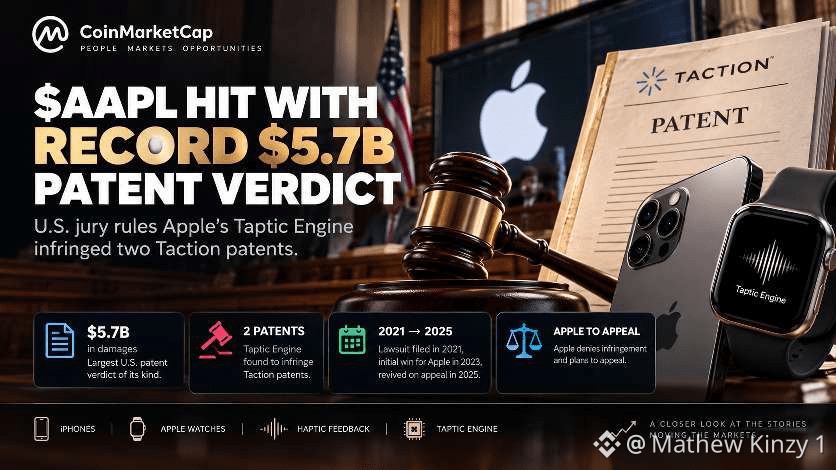
A U.S. federal jury found that Apple’s Taptic Engine infringed claims in two patents owned by Taction Technology and awarded more than $5.7 billion in damages, described by Reuters as the largest U.S. patent verdict of its kind to date.
What makes this interesting for $AAPL isn't simply the size of the number.
The Taptic Engine sits behind the tactile feedback used across iPhones and Apple Watches. Taction filed the case back in 2021, Apple initially won at the district-court level in 2023, and an appeals court revived the dispute in 2025. Now the jury has sided with Taction, although it found the infringement was not willful.
And the story isn't finished.
Apple disputes both the infringement finding and damages, says its technology is fundamentally different, and plans to appeal.
For investors, it’s a reminder that some of the biggest risks around a technology company can sit deep inside the components powering everyday products.
Does a $5.7B verdict matter for the $AAPL investment thesis, or is it mostly noise until the appeals process plays out?
A $5.7B verdict over something most iPhone users probably never think about: the tiny vibration they feel every day.
A U.S. federal jury found that Apple’s Taptic Engine infringed claims in two patents owned by Taction Technology and awarded more than $5.7 billion in damages, described by Reuters as the largest U.S. patent verdict of its kind to date.
What makes this interesting for $AAPL isn't simply the size of the number.
The Taptic Engine sits behind the tactile feedback used across iPhones and Apple Watches. Taction filed the case back in 2021, Apple initially won at the district-court level in 2023, and an appeals court revived the dispute in 2025. Now the jury has sided with Taction, although it found the infringement was not willful.
And the story isn't finished.
Apple disputes both the infringement finding and damages, says its technology is fundamentally different, and plans to appeal.
For investors, it’s a reminder that some of the biggest risks around a technology company can sit deep inside the components powering everyday products.
Does a $5.7B verdict matter for the $AAPL investment thesis, or is it mostly noise until the appeals process plays out?
A U.S. federal jury found that Apple’s Taptic Engine infringed claims in two patents owned by Taction Technology and awarded more than $5.7 billion in damages, described by Reuters as the largest U.S. patent verdict of its kind to date.
What makes this interesting for $AAPL isn't simply the size of the number.
The Taptic Engine sits behind the tactile feedback used across iPhones and Apple Watches. Taction filed the case back in 2021, Apple initially won at the district-court level in 2023, and an appeals court revived the dispute in 2025. Now the jury has sided with Taction, although it found the infringement was not willful.
And the story isn't finished.
Apple disputes both the infringement finding and damages, says its technology is fundamentally different, and plans to appeal.
For investors, it’s a reminder that some of the biggest risks around a technology company can sit deep inside the components powering everyday products.
Does a $5.7B verdict matter for the $AAPL investment thesis, or is it mostly noise until the appeals process plays out?
41
$Q is up sharply, but this is one of those moves where the absence of a catalyst might be the most important detail.
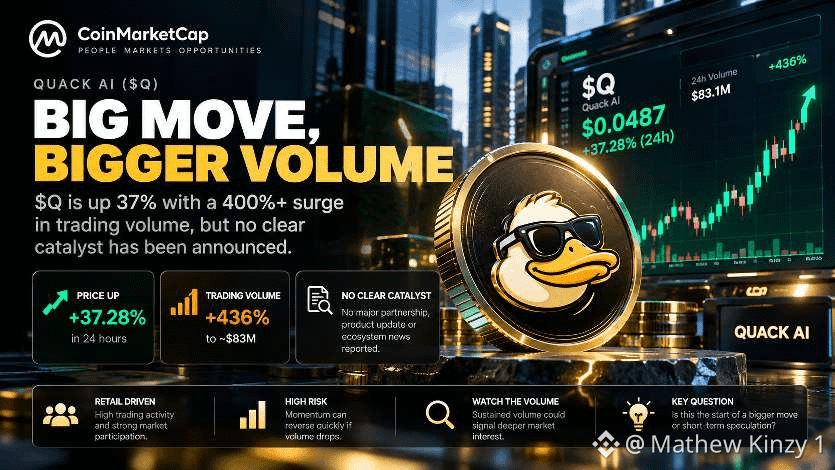
Quack AI has jumped roughly 37% in 24 hours, while trading volume reportedly surged more than 400% to around $83M. That’s a huge increase in activity for a relatively small token.
But so far, there doesn't appear to be a major new partnership, product release or ecosystem announcement explaining the move.
That changes how I look at the rally.
When volume expands much faster than fundamentals, price can become driven primarily by liquidity, momentum and traders chasing the move. Those conditions can push $Q higher quickly, but they can reverse just as quickly when participation disappears.
So rather than trying to predict the next candle, I’m watching one thing: does the volume remain after the excitement fades?
If it does, $Q may be attracting a new layer of market interest.
If it doesn't, this could simply be another reminder that price attention and fundamental progress aren't always the same thing.
Would you trade a 37% move without a clear catalyst?
$Q is up sharply, but this is one of those moves where the absence of a catalyst might be the most important detail.
Quack AI has jumped roughly 37% in 24 hours, while trading volume reportedly surged more than 400% to around $83M. That’s a huge increase in activity for a relatively small token.
But so far, there doesn't appear to be a major new partnership, product release or ecosystem announcement explaining the move.
That changes how I look at the rally.
When volume expands much faster than fundamentals, price can become driven primarily by liquidity, momentum and traders chasing the move. Those conditions can push $Q higher quickly, but they can reverse just as quickly when participation disappears.
So rather than trying to predict the next candle, I’m watching one thing: does the volume remain after the excitement fades?
If it does, $Q may be attracting a new layer of market interest.
If it doesn't, this could simply be another reminder that price attention and fundamental progress aren't always the same thing.
Would you trade a 37% move without a clear catalyst?
Quack AI has jumped roughly 37% in 24 hours, while trading volume reportedly surged more than 400% to around $83M. That’s a huge increase in activity for a relatively small token.
But so far, there doesn't appear to be a major new partnership, product release or ecosystem announcement explaining the move.
That changes how I look at the rally.
When volume expands much faster than fundamentals, price can become driven primarily by liquidity, momentum and traders chasing the move. Those conditions can push $Q higher quickly, but they can reverse just as quickly when participation disappears.
So rather than trying to predict the next candle, I’m watching one thing: does the volume remain after the excitement fades?
If it does, $Q may be attracting a new layer of market interest.
If it doesn't, this could simply be another reminder that price attention and fundamental progress aren't always the same thing.
Would you trade a 37% move without a clear catalyst?
1
148
$GLMR jumping 50%+ is eye-catching, but this looks more like a lesson in capital rotation than a sudden change in Moonbeam itself.
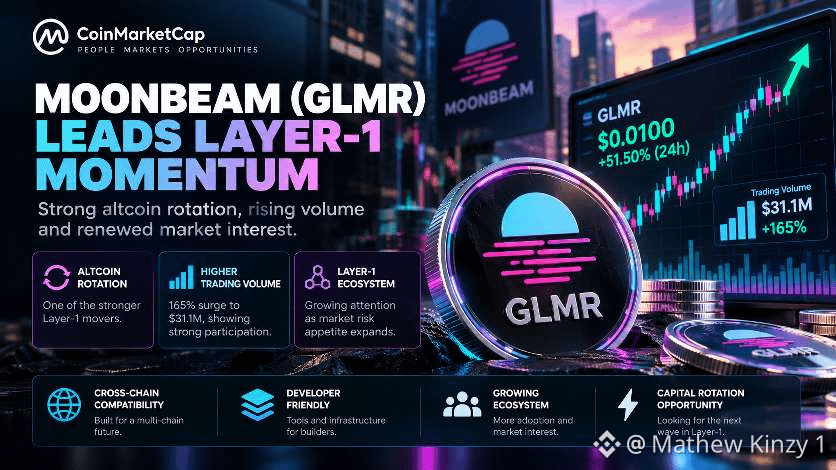
Moonbeam has been one of the stronger Layer-1 movers as money rotates further into altcoins. The move has also come with a sharp increase in trading activity, giving the breakout significantly more participation than a quiet low-volume pump.
But there’s an important detail: there doesn't appear to be one major Moonbeam-specific announcement driving the entire move.
That makes the broader market just as important as $GLMR itself.
When risk appetite expands, smaller-cap infrastructure tokens can move quickly as traders search beyond the largest assets. The opposite can happen just as fast when liquidity rotates back toward Bitcoin.
For me, the next signal isn't another green candle. It’s whether volume stays elevated and $GLMR can hold the levels it just reclaimed.
Is this the beginning of a wider Layer-1 rotation, or simply short-term capital chasing the strongest movers?
$GLMR jumping 50%+ is eye-catching, but this looks more like a lesson in capital rotation than a sudden change in Moonbeam itself.
Moonbeam has been one of the stronger Layer-1 movers as money rotates further into altcoins. The move has also come with a sharp increase in trading activity, giving the breakout significantly more participation than a quiet low-volume pump.
But there’s an important detail: there doesn't appear to be one major Moonbeam-specific announcement driving the entire move.
That makes the broader market just as important as $GLMR itself.
When risk appetite expands, smaller-cap infrastructure tokens can move quickly as traders search beyond the largest assets. The opposite can happen just as fast when liquidity rotates back toward Bitcoin.
For me, the next signal isn't another green candle. It’s whether volume stays elevated and $GLMR can hold the levels it just reclaimed.
Is this the beginning of a wider Layer-1 rotation, or simply short-term capital chasing the strongest movers?
Moonbeam has been one of the stronger Layer-1 movers as money rotates further into altcoins. The move has also come with a sharp increase in trading activity, giving the breakout significantly more participation than a quiet low-volume pump.
But there’s an important detail: there doesn't appear to be one major Moonbeam-specific announcement driving the entire move.
That makes the broader market just as important as $GLMR itself.
When risk appetite expands, smaller-cap infrastructure tokens can move quickly as traders search beyond the largest assets. The opposite can happen just as fast when liquidity rotates back toward Bitcoin.
For me, the next signal isn't another green candle. It’s whether volume stays elevated and $GLMR can hold the levels it just reclaimed.
Is this the beginning of a wider Layer-1 rotation, or simply short-term capital chasing the strongest movers?
8
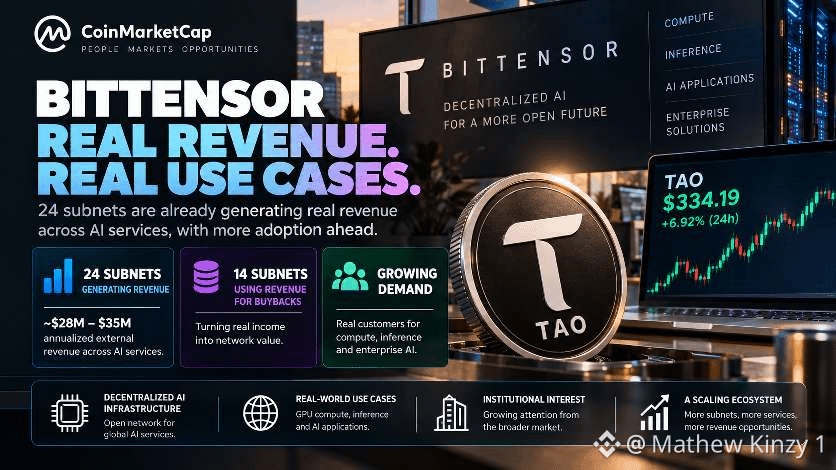
$TAO moving higher is interesting, but Bittensor’s revenue story is the part I’m watching.
For a long time, decentralized AI projects were mostly valued on what their networks could become. Bittensor is beginning to produce something more measurable: paying customers.
A recent Bittensor Revenue Index estimates that 24 subnets are generating roughly $28M–$35M in annualized external revenue, across services such as GPU compute, inference and enterprise AI. Fourteen reportedly use customer revenue for Alpha-token buybacks.
That makes the recent $TAO momentum more interesting than another AI-sector pump.
The $100M figure circulating around the market is a projection, not current revenue, so there is still plenty to prove.
For me, the metric to watch isn't simply how high $TAO trades next.
It’s whether more Bittensor subnets can turn decentralized AI infrastructure into businesses people actually pay to use.
If revenue keeps replacing narrative with measurable demand, does that change how the market should value $TAO?
$TAO moving higher is interesting, but Bittensor’s revenue story is the part I’m watching.
For a long time, decentralized AI projects were mostly valued on what their networks could become. Bittensor is beginning to produce something more measurable: paying customers.
A recent Bittensor Revenue Index estimates that 24 subnets are generating roughly $28M–$35M in annualized external revenue, across services such as GPU compute, inference and enterprise AI. Fourteen reportedly use customer revenue for Alpha-token buybacks.
That makes the recent $TAO momentum more interesting than another AI-sector pump.
The $100M figure circulating around the market is a projection, not current revenue, so there is still plenty to prove.
For me, the metric to watch isn't simply how high $TAO trades next.
It’s whether more Bittensor subnets can turn decentralized AI infrastructure into businesses people actually pay to use.
If revenue keeps replacing narrative with measurable demand, does that change how the market should value $TAO?
For a long time, decentralized AI projects were mostly valued on what their networks could become. Bittensor is beginning to produce something more measurable: paying customers.
A recent Bittensor Revenue Index estimates that 24 subnets are generating roughly $28M–$35M in annualized external revenue, across services such as GPU compute, inference and enterprise AI. Fourteen reportedly use customer revenue for Alpha-token buybacks.
That makes the recent $TAO momentum more interesting than another AI-sector pump.
The $100M figure circulating around the market is a projection, not current revenue, so there is still plenty to prove.
For me, the metric to watch isn't simply how high $TAO trades next.
It’s whether more Bittensor subnets can turn decentralized AI infrastructure into businesses people actually pay to use.
If revenue keeps replacing narrative with measurable demand, does that change how the market should value $TAO?
3
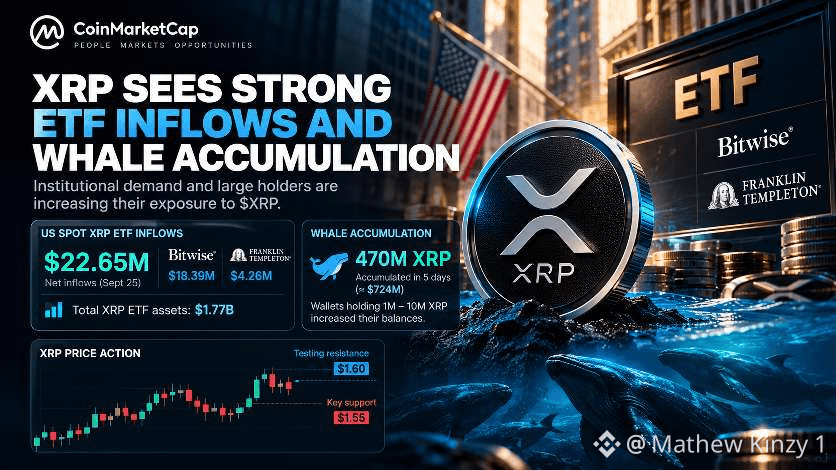
Two different groups appear to be buying $XRP at the same time. That’s what makes this interesting.
U.S. spot XRP ETFs recorded about $22.65M in net inflows on Sept. 25, led by Bitwise with $18.39M and Franklin with $4.26M. Total XRP ETF assets now sit around $1.77B.
Meanwhile, wallets holding 1M–10M XRP reportedly accumulated more than 470M $XRP, worth roughly $724M, in five days.
So institutional products are attracting capital while large onchain holders are increasing exposure.
Yet $XRP is still wrestling with the $1.60 area, showing that heavy accumulation doesn't automatically remove existing selling pressure.
That’s the part I’m watching.
If ETF demand and whale accumulation continue together, does $1.60 eventually give way, or is the market telling us there’s still too much supply waiting above?
Two different groups appear to be buying $XRP at the same time. That’s what makes this interesting.
U.S. spot XRP ETFs recorded about $22.65M in net inflows on Sept. 25, led by Bitwise with $18.39M and Franklin with $4.26M. Total XRP ETF assets now sit around $1.77B.
Meanwhile, wallets holding 1M–10M XRP reportedly accumulated more than 470M $XRP, worth roughly $724M, in five days.
So institutional products are attracting capital while large onchain holders are increasing exposure.
Yet $XRP is still wrestling with the $1.60 area, showing that heavy accumulation doesn't automatically remove existing selling pressure.
That’s the part I’m watching.
If ETF demand and whale accumulation continue together, does $1.60 eventually give way, or is the market telling us there’s still too much supply waiting above?
U.S. spot XRP ETFs recorded about $22.65M in net inflows on Sept. 25, led by Bitwise with $18.39M and Franklin with $4.26M. Total XRP ETF assets now sit around $1.77B.
Meanwhile, wallets holding 1M–10M XRP reportedly accumulated more than 470M $XRP, worth roughly $724M, in five days.
So institutional products are attracting capital while large onchain holders are increasing exposure.
Yet $XRP is still wrestling with the $1.60 area, showing that heavy accumulation doesn't automatically remove existing selling pressure.
That’s the part I’m watching.
If ETF demand and whale accumulation continue together, does $1.60 eventually give way, or is the market telling us there’s still too much supply waiting above?
37
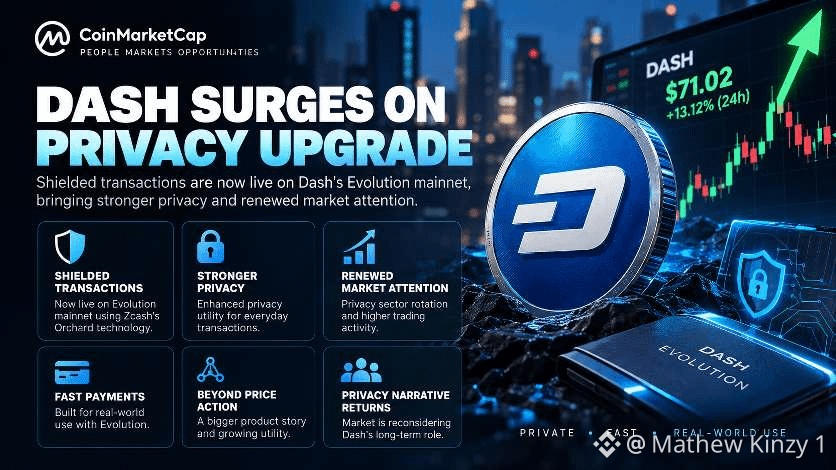
$DASH moving while Bitcoin barely moves is exactly why sector rotation matters in crypto.
Dash’s recent momentum is being supported by more than price action. Its biggest privacy overhaul in years is now live, bringing shielded transactions to the Evolution mainnet using Zcash’s Orchard technology.
At the same time, privacy-focused assets have been attracting renewed attention, while $DASH has broken higher on stronger trading activity. Recent coverage describes the move as a combination of privacy-sector rotation, Dash’s upgrades and technical momentum rather than one isolated catalyst.
That’s the interesting part for me.
Dash spent years being viewed mainly as an older payments coin. Now the market is being asked to reconsider that narrative as privacy, fast payments and Evolution become a bigger part of the product.
The rally can cool quickly after such a sharp move, but the bigger question is whether actual usage follows the renewed attention.
Is $DASH being temporarily pulled higher by the privacy narrative, or are we watching the market reprice its utility?
$DASH moving while Bitcoin barely moves is exactly why sector rotation matters in crypto.
Dash’s recent momentum is being supported by more than price action. Its biggest privacy overhaul in years is now live, bringing shielded transactions to the Evolution mainnet using Zcash’s Orchard technology.
At the same time, privacy-focused assets have been attracting renewed attention, while $DASH has broken higher on stronger trading activity. Recent coverage describes the move as a combination of privacy-sector rotation, Dash’s upgrades and technical momentum rather than one isolated catalyst.
That’s the interesting part for me.
Dash spent years being viewed mainly as an older payments coin. Now the market is being asked to reconsider that narrative as privacy, fast payments and Evolution become a bigger part of the product.
The rally can cool quickly after such a sharp move, but the bigger question is whether actual usage follows the renewed attention.
Is $DASH being temporarily pulled higher by the privacy narrative, or are we watching the market reprice its utility?
Dash’s recent momentum is being supported by more than price action. Its biggest privacy overhaul in years is now live, bringing shielded transactions to the Evolution mainnet using Zcash’s Orchard technology.
At the same time, privacy-focused assets have been attracting renewed attention, while $DASH has broken higher on stronger trading activity. Recent coverage describes the move as a combination of privacy-sector rotation, Dash’s upgrades and technical momentum rather than one isolated catalyst.
That’s the interesting part for me.
Dash spent years being viewed mainly as an older payments coin. Now the market is being asked to reconsider that narrative as privacy, fast payments and Evolution become a bigger part of the product.
The rally can cool quickly after such a sharp move, but the bigger question is whether actual usage follows the renewed attention.
Is $DASH being temporarily pulled higher by the privacy narrative, or are we watching the market reprice its utility?
11
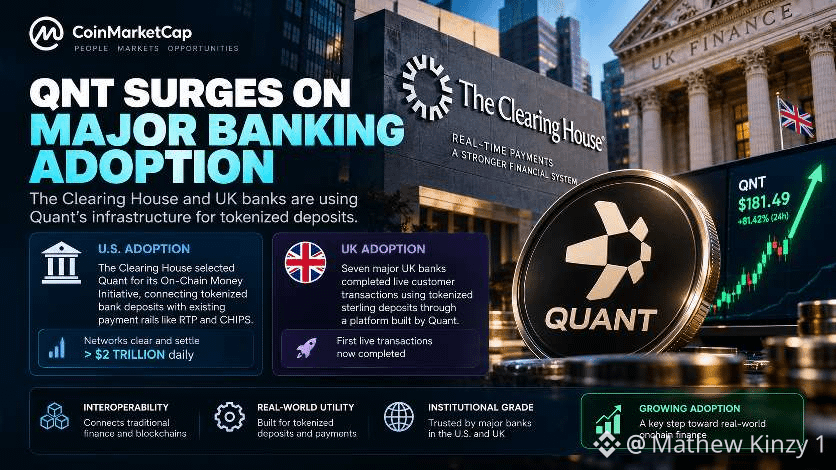
$QNT exploding higher is interesting, but the reason behind the move matters more than the candle.
On September 24, The Clearing House selected Quant to provide the interoperability, orchestration and transaction-management layer for its new U.S. On-Chain Money Initiative, connecting tokenized bank deposits with existing payment rails such as RTP and CHIPS. The Clearing House says its networks already clear and settle more than $2 trillion every day.
At almost the same time, UK banks completed their first live customer transactions using tokenized sterling deposits through the Great British Tokenised Deposit initiative, whose platform was built by Quant.
That combination helps explain why the market suddenly started paying attention to $QNT.
But after such a rapid move, price can easily run ahead of fundamentals. The more important long-term question is whether Quant's infrastructure becomes deeply embedded in how banks actually move tokenized money.
The $QNT pump grabbed attention. Institutional adoption is the part worth watching.
#Altcoin Season#
$QNT exploding higher is interesting, but the reason behind the move matters more than the candle.
On September 24, The Clearing House selected Quant to provide the interoperability, orchestration and transaction-management layer for its new U.S. On-Chain Money Initiative, connecting tokenized bank deposits with existing payment rails such as RTP and CHIPS. The Clearing House says its networks already clear and settle more than $2 trillion every day.
At almost the same time, UK banks completed their first live customer transactions using tokenized sterling deposits through the Great British Tokenised Deposit initiative, whose platform was built by Quant.
That combination helps explain why the market suddenly started paying attention to $QNT.
But after such a rapid move, price can easily run ahead of fundamentals. The more important long-term question is whether Quant's infrastructure becomes deeply embedded in how banks actually move tokenized money.
The $QNT pump grabbed attention. Institutional adoption is the part worth watching.
#Altcoin Season#
On September 24, The Clearing House selected Quant to provide the interoperability, orchestration and transaction-management layer for its new U.S. On-Chain Money Initiative, connecting tokenized bank deposits with existing payment rails such as RTP and CHIPS. The Clearing House says its networks already clear and settle more than $2 trillion every day.
At almost the same time, UK banks completed their first live customer transactions using tokenized sterling deposits through the Great British Tokenised Deposit initiative, whose platform was built by Quant.
That combination helps explain why the market suddenly started paying attention to $QNT.
But after such a rapid move, price can easily run ahead of fundamentals. The more important long-term question is whether Quant's infrastructure becomes deeply embedded in how banks actually move tokenized money.
The $QNT pump grabbed attention. Institutional adoption is the part worth watching.
#Altcoin Season#
33
Solana is trying to make “final” feel almost instant.
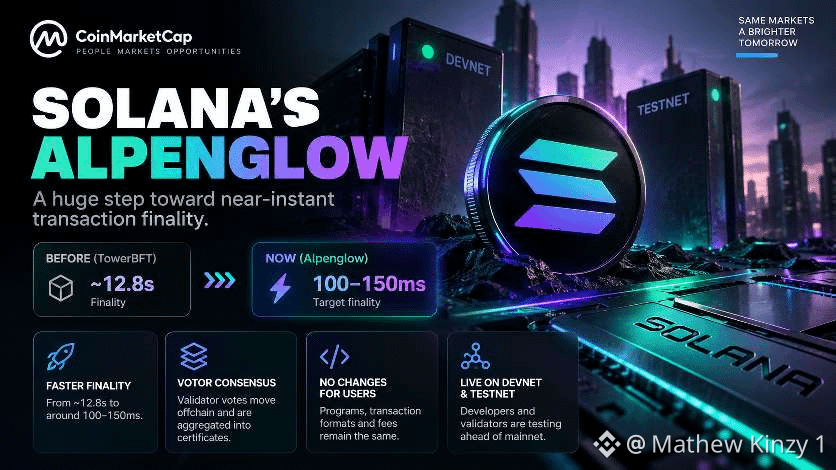
Alpenglow is now active on both Solana testnet and devnet, replacing TowerBFT with a new consensus system called Votor. The target is a major reduction in finality from roughly 12.8 seconds to around 100–150 milliseconds.
The interesting part isn't simply speed.
Validator votes move offchain and are aggregated into certificates, potentially freeing blockspace while leaving the SVM, transaction format and fees unchanged. For normal users, no migration is required.
If it works reliably at mainnet scale, that could matter for payments, trading, exchanges and other applications where waiting seconds for irreversible settlement creates friction.
But this is still testing. There is no confirmed Alpenglow mainnet launch date, and the 100–150ms target still needs to prove itself under live-market conditions.
For $SOL, that’s the part worth watching: not the speed promised in testing, but whether Solana can deliver it reliably when real money is on the line.
Solana is trying to make “final” feel almost instant.
Alpenglow is now active on both Solana testnet and devnet, replacing TowerBFT with a new consensus system called Votor. The target is a major reduction in finality from roughly 12.8 seconds to around 100–150 milliseconds.
The interesting part isn't simply speed.
Validator votes move offchain and are aggregated into certificates, potentially freeing blockspace while leaving the SVM, transaction format and fees unchanged. For normal users, no migration is required.
If it works reliably at mainnet scale, that could matter for payments, trading, exchanges and other applications where waiting seconds for irreversible settlement creates friction.
But this is still testing. There is no confirmed Alpenglow mainnet launch date, and the 100–150ms target still needs to prove itself under live-market conditions.
For $SOL, that’s the part worth watching: not the speed promised in testing, but whether Solana can deliver it reliably when real money is on the line.
Alpenglow is now active on both Solana testnet and devnet, replacing TowerBFT with a new consensus system called Votor. The target is a major reduction in finality from roughly 12.8 seconds to around 100–150 milliseconds.
The interesting part isn't simply speed.
Validator votes move offchain and are aggregated into certificates, potentially freeing blockspace while leaving the SVM, transaction format and fees unchanged. For normal users, no migration is required.
If it works reliably at mainnet scale, that could matter for payments, trading, exchanges and other applications where waiting seconds for irreversible settlement creates friction.
But this is still testing. There is no confirmed Alpenglow mainnet launch date, and the 100–150ms target still needs to prove itself under live-market conditions.
For $SOL, that’s the part worth watching: not the speed promised in testing, but whether Solana can deliver it reliably when real money is on the line.
32
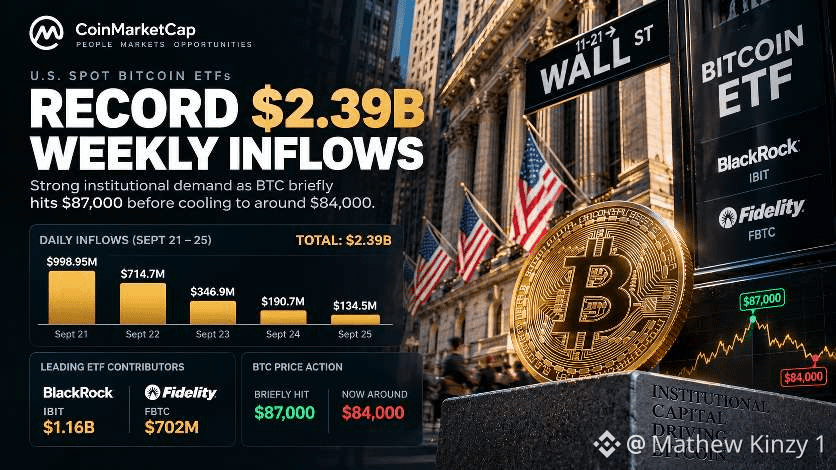
$2.39 billion entered U.S. spot Bitcoin ETFs in just five trading days, but the price reaction tells an interesting story.
From Sept. 21–25, the ETFs recorded net inflows every session, with Monday alone bringing in roughly $999M. BlackRock’s IBIT led the week with about $1.16B, while Fidelity’s FBTC added roughly $702M.
Yet $BTC couldn't simply keep running.
Bitcoin briefly pushed above $87K before cooling toward $84K, showing that strong ETF demand can still meet significant selling pressure.
That’s what makes this worth watching.
ETF inflows provide a clearer bridge for traditional capital into Bitcoin, but one record week doesn't guarantee the next move. The stronger signal would be sustained inflows alongside $BTC establishing a higher price range.
If billions keep flowing into Bitcoin ETFs, how long can existing supply absorb that demand without another major repricing?
$2.39 billion entered U.S. spot Bitcoin ETFs in just five trading days, but the price reaction tells an interesting story.
From Sept. 21–25, the ETFs recorded net inflows every session, with Monday alone bringing in roughly $999M. BlackRock’s IBIT led the week with about $1.16B, while Fidelity’s FBTC added roughly $702M.
Yet $BTC couldn't simply keep running.
Bitcoin briefly pushed above $87K before cooling toward $84K, showing that strong ETF demand can still meet significant selling pressure.
That’s what makes this worth watching.
ETF inflows provide a clearer bridge for traditional capital into Bitcoin, but one record week doesn't guarantee the next move. The stronger signal would be sustained inflows alongside $BTC establishing a higher price range.
If billions keep flowing into Bitcoin ETFs, how long can existing supply absorb that demand without another major repricing?
From Sept. 21–25, the ETFs recorded net inflows every session, with Monday alone bringing in roughly $999M. BlackRock’s IBIT led the week with about $1.16B, while Fidelity’s FBTC added roughly $702M.
Yet $BTC couldn't simply keep running.
Bitcoin briefly pushed above $87K before cooling toward $84K, showing that strong ETF demand can still meet significant selling pressure.
That’s what makes this worth watching.
ETF inflows provide a clearer bridge for traditional capital into Bitcoin, but one record week doesn't guarantee the next move. The stronger signal would be sustained inflows alongside $BTC establishing a higher price range.
If billions keep flowing into Bitcoin ETFs, how long can existing supply absorb that demand without another major repricing?
47
The $387.5M Bitget hack is a reminder that exchange security isn't only about protecting private keys.
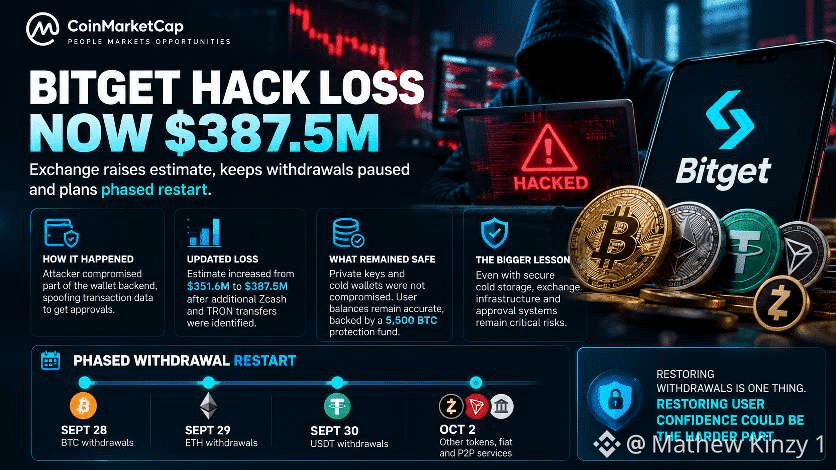
Bitget says the attacker compromised part of its wallet backend, spoofing transaction data so its authorization system approved transfers. The exchange says private keys and cold wallets were not compromised.
The estimated loss has now increased from $351.6M to $387.5M, after additional Zcash and TRON transfers were identified. Bitget says this was a fuller accounting of the original breach, not another attack.
Now comes the bigger test: recovery and withdrawals.
$BTC withdrawals are scheduled to restart Sept. 28, followed by $ETH on Sept. 29, $USDT on Sept. 30, and other assets, fiat and P2P services on Oct. 2. Bitget says its Protection Fund covers the financial impact.
For me, the important lesson goes beyond one exchange.
Crypto platforms can have secure cold storage and still face serious risk in the infrastructure controlling how transactions get approved.
After a $387.5M incident, restoring withdrawals is one thing. Restoring user confidence could be the harder part.
$BGB #hack #Macro Insights#
The $387.5M Bitget hack is a reminder that exchange security isn't only about protecting private keys.
Bitget says the attacker compromised part of its wallet backend, spoofing transaction data so its authorization system approved transfers. The exchange says private keys and cold wallets were not compromised.
The estimated loss has now increased from $351.6M to $387.5M, after additional Zcash and TRON transfers were identified. Bitget says this was a fuller accounting of the original breach, not another attack.
Now comes the bigger test: recovery and withdrawals.
$BTC withdrawals are scheduled to restart Sept. 28, followed by $ETH on Sept. 29, $USDT on Sept. 30, and other assets, fiat and P2P services on Oct. 2. Bitget says its Protection Fund covers the financial impact.
For me, the important lesson goes beyond one exchange.
Crypto platforms can have secure cold storage and still face serious risk in the infrastructure controlling how transactions get approved.
After a $387.5M incident, restoring withdrawals is one thing. Restoring user confidence could be the harder part.
$BGB #hack #Macro Insights#
Bitget says the attacker compromised part of its wallet backend, spoofing transaction data so its authorization system approved transfers. The exchange says private keys and cold wallets were not compromised.
The estimated loss has now increased from $351.6M to $387.5M, after additional Zcash and TRON transfers were identified. Bitget says this was a fuller accounting of the original breach, not another attack.
Now comes the bigger test: recovery and withdrawals.
$BTC withdrawals are scheduled to restart Sept. 28, followed by $ETH on Sept. 29, $USDT on Sept. 30, and other assets, fiat and P2P services on Oct. 2. Bitget says its Protection Fund covers the financial impact.
For me, the important lesson goes beyond one exchange.
Crypto platforms can have secure cold storage and still face serious risk in the infrastructure controlling how transactions get approved.
After a $387.5M incident, restoring withdrawals is one thing. Restoring user confidence could be the harder part.
$BGB #hack #Macro Insights#
52
TOKENIZING THE ASSET WAS STEP ONE. WHAT HAPPENS NEXT? 🛡️
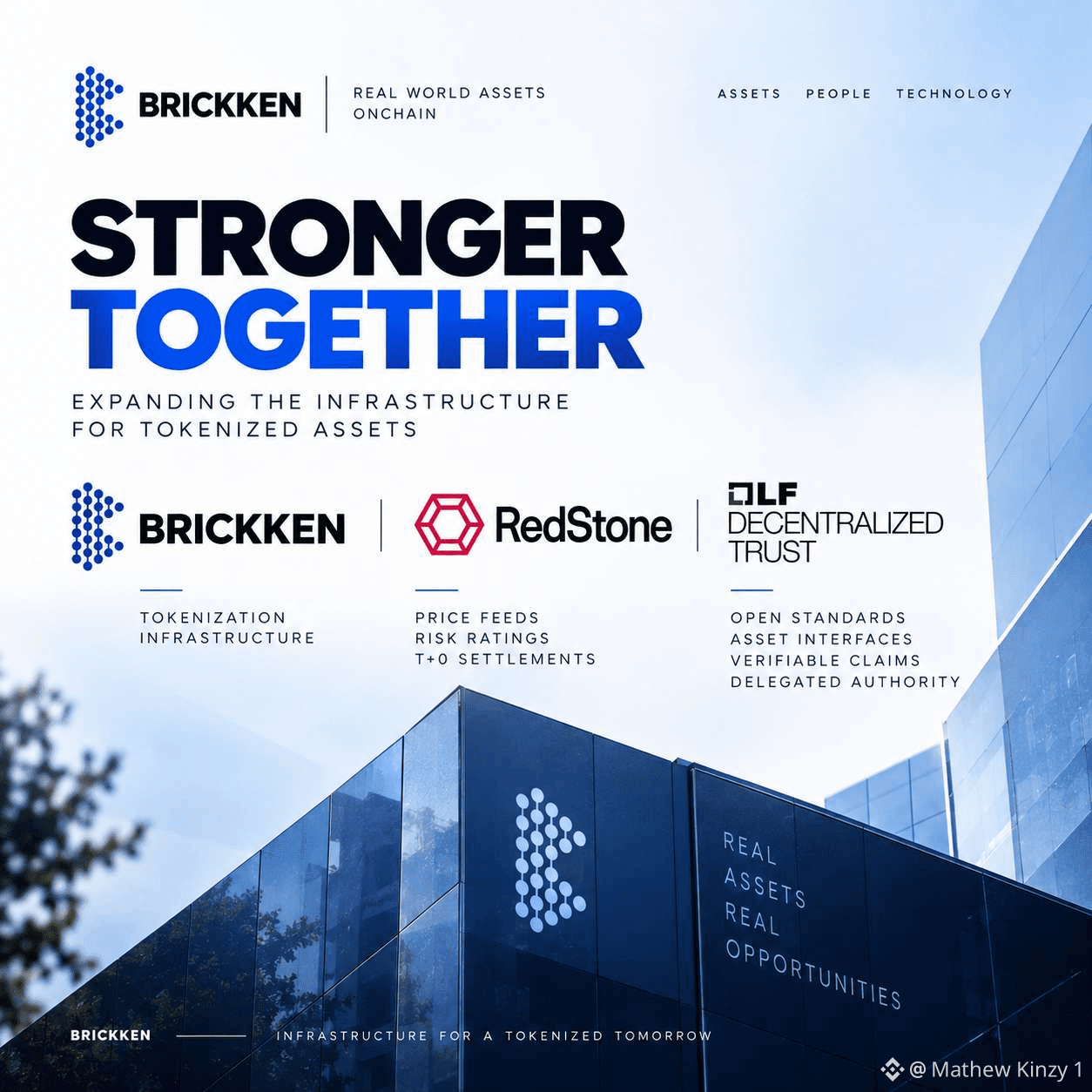
I think Brickken’s two recent ecosystem moves answer two different RWA problems.
1️⃣ Market utility
Once an asset is tokenized:
→ How is it priced?
→ How is risk assessed?
→ How quickly can it settle?
The @redstone_defi partnership gives eligible assets access to price/NAV feeds, @CredoraNetwork risk ratings and T+0 settlement infrastructure.
2️⃣ Interoperability
What happens when those assets need to work across institutions, custodians and eventually AI agents running different systems?
Brickken joining @lfdecentralized brings its work around asset interfaces, verifiable claims and delegated authority into a broader open community.
Put both together:
Issue → Understand → Use → Interoperate
That’s the RWA shift I’m watching.
Putting an asset onchain isn't enough anymore.
The bigger opportunity is building the infrastructure that makes those assets useful after issuance.
And that’s where the Brickken ecosystem and $BKN story gets more interesting.
#BKN #Brickken #RWA #Tokenization #RealWorldAssets
TOKENIZING THE ASSET WAS STEP ONE. WHAT HAPPENS NEXT? 🛡️
I think Brickken’s two recent ecosystem moves answer two different RWA problems.
1️⃣ Market utility
Once an asset is tokenized:
→ How is it priced?
→ How is risk assessed?
→ How quickly can it settle?
The @redstone_defi partnership gives eligible assets access to price/NAV feeds, @CredoraNetwork risk ratings and T+0 settlement infrastructure.
2️⃣ Interoperability
What happens when those assets need to work across institutions, custodians and eventually AI agents running different systems?
Brickken joining @lfdecentralized brings its work around asset interfaces, verifiable claims and delegated authority into a broader open community.
Put both together:
Issue → Understand → Use → Interoperate
That’s the RWA shift I’m watching.
Putting an asset onchain isn't enough anymore.
The bigger opportunity is building the infrastructure that makes those assets useful after issuance.
And that’s where the Brickken ecosystem and $BKN story gets more interesting.
#BKN #Brickken #RWA #Tokenization #RealWorldAssets
I think Brickken’s two recent ecosystem moves answer two different RWA problems.
1️⃣ Market utility
Once an asset is tokenized:
→ How is it priced?
→ How is risk assessed?
→ How quickly can it settle?
The @redstone_defi partnership gives eligible assets access to price/NAV feeds, @CredoraNetwork risk ratings and T+0 settlement infrastructure.
2️⃣ Interoperability
What happens when those assets need to work across institutions, custodians and eventually AI agents running different systems?
Brickken joining @lfdecentralized brings its work around asset interfaces, verifiable claims and delegated authority into a broader open community.
Put both together:
Issue → Understand → Use → Interoperate
That’s the RWA shift I’m watching.
Putting an asset onchain isn't enough anymore.
The bigger opportunity is building the infrastructure that makes those assets useful after issuance.
And that’s where the Brickken ecosystem and $BKN story gets more interesting.
#BKN #Brickken #RWA #Tokenization #RealWorldAssets
69
RWA IS GROWING. BUT I’M WATCHING THE INFRASTRUCTURE UNDERNEATH IT. 🛡️
The RWA market is becoming harder to ignore, with tens of billions of dollars in assets already represented onchain.
That puts projects building the actual tokenization rails in an interesting position.
One I’ve been following closely is Brickken.
The ecosystem now reports:
→ $660M+ tokenized
→ 150+ clients
→ 40+ countries
→ BKN 2.0
→ ERC-7943 reaching Final status
→ RAMS for delegated AI-agent authority
→ CLI + MCP developer infrastructure
→ ISO 27001, 27701 & 27018 certifications
→ Expansion into the U.S. and Luxembourg
→ New infrastructure relationships with RedStone and LF Decentralized Trust
Then there’s $BKN.
The token recently moved from around $0.073 to ~$0.13, with strong 30-day performance.
But the green chart isn’t the most interesting part to me.
$BKN has utility within the Brickken ecosystem, while BKN 2.0 is laying technical foundations for cross-chain interoperability and Brickken’s broader push toward programmable and agentic capital markets.
So I’m watching something beyond price:
Can RWA growth translate into more real ecosystem usage for $BKN?
That’s the metric that matters longer term.
The chart caught my attention.
The infrastructure is what keeps it. 🛡️
#BKN #Brickken #RWA #Tokenization #RealWorldAssets
RWA IS GROWING. BUT I’M WATCHING THE INFRASTRUCTURE UNDERNEATH IT. 🛡️
The RWA market is becoming harder to ignore, with tens of billions of dollars in assets already represented onchain.
That puts projects building the actual tokenization rails in an interesting position.
One I’ve been following closely is Brickken.
The ecosystem now reports:
→ $660M+ tokenized
→ 150+ clients
→ 40+ countries
→ BKN 2.0
→ ERC-7943 reaching Final status
→ RAMS for delegated AI-agent authority
→ CLI + MCP developer infrastructure
→ ISO 27001, 27701 & 27018 certifications
→ Expansion into the U.S. and Luxembourg
→ New infrastructure relationships with RedStone and LF Decentralized Trust
Then there’s $BKN.
The token recently moved from around $0.073 to ~$0.13, with strong 30-day performance.
But the green chart isn’t the most interesting part to me.
$BKN has utility within the Brickken ecosystem, while BKN 2.0 is laying technical foundations for cross-chain interoperability and Brickken’s broader push toward programmable and agentic capital markets.
So I’m watching something beyond price:
Can RWA growth translate into more real ecosystem usage for $BKN?
That’s the metric that matters longer term.
The chart caught my attention.
The infrastructure is what keeps it. 🛡️
#BKN #Brickken #RWA #Tokenization #RealWorldAssets
The RWA market is becoming harder to ignore, with tens of billions of dollars in assets already represented onchain.
That puts projects building the actual tokenization rails in an interesting position.
One I’ve been following closely is Brickken.
The ecosystem now reports:
→ $660M+ tokenized
→ 150+ clients
→ 40+ countries
→ BKN 2.0
→ ERC-7943 reaching Final status
→ RAMS for delegated AI-agent authority
→ CLI + MCP developer infrastructure
→ ISO 27001, 27701 & 27018 certifications
→ Expansion into the U.S. and Luxembourg
→ New infrastructure relationships with RedStone and LF Decentralized Trust
Then there’s $BKN.
The token recently moved from around $0.073 to ~$0.13, with strong 30-day performance.
But the green chart isn’t the most interesting part to me.
$BKN has utility within the Brickken ecosystem, while BKN 2.0 is laying technical foundations for cross-chain interoperability and Brickken’s broader push toward programmable and agentic capital markets.
So I’m watching something beyond price:
Can RWA growth translate into more real ecosystem usage for $BKN?
That’s the metric that matters longer term.
The chart caught my attention.
The infrastructure is what keeps it. 🛡️
#BKN #Brickken #RWA #Tokenization #RealWorldAssets

JUST IN 🇸🇬: BRICKKEN IS HEADING TO SINGAPORE
Brickken will be on the ground from October 3–11, joining one of the biggest weeks on the global crypto calendar.
TOKEN2049 Singapore alone expects 25,000+ attendees, 7,000+ companies and 300+ speakers at Marina Bay Sands on October 7–8.
Brickken’s week includes:
→ CoinFerenceX
→ TOKEN2049
→ Singapore side events
→ Conversations around tokenized private markets and agentic capital markets
→ The Paddock, Brickken’s curated gathering on October 10 during F1 weekend
From building tokenization infrastructure to taking the conversation directly to institutions and market participants globally, Singapore represents another major stop for the Brickken ecosystem.
RWA is moving beyond simply putting assets onchain.
The next conversation is about the infrastructure that makes tokenized capital markets actually work at scale.
$BKN #Brickken #RWA #Tokenization
JUST IN 🇸🇬: BRICKKEN IS HEADING TO SINGAPORE
Brickken will be on the ground from October 3–11, joining one of the biggest weeks on the global crypto calendar.
TOKEN2049 Singapore alone expects 25,000+ attendees, 7,000+ companies and 300+ speakers at Marina Bay Sands on October 7–8.
Brickken’s week includes:
→ CoinFerenceX
→ TOKEN2049
→ Singapore side events
→ Conversations around tokenized private markets and agentic capital markets
→ The Paddock, Brickken’s curated gathering on October 10 during F1 weekend
From building tokenization infrastructure to taking the conversation directly to institutions and market participants globally, Singapore represents another major stop for the Brickken ecosystem.
RWA is moving beyond simply putting assets onchain.
The next conversation is about the infrastructure that makes tokenized capital markets actually work at scale.
$BKN #Brickken #RWA #Tokenization
Brickken will be on the ground from October 3–11, joining one of the biggest weeks on the global crypto calendar.
TOKEN2049 Singapore alone expects 25,000+ attendees, 7,000+ companies and 300+ speakers at Marina Bay Sands on October 7–8.
Brickken’s week includes:
→ CoinFerenceX
→ TOKEN2049
→ Singapore side events
→ Conversations around tokenized private markets and agentic capital markets
→ The Paddock, Brickken’s curated gathering on October 10 during F1 weekend
From building tokenization infrastructure to taking the conversation directly to institutions and market participants globally, Singapore represents another major stop for the Brickken ecosystem.
RWA is moving beyond simply putting assets onchain.
The next conversation is about the infrastructure that makes tokenized capital markets actually work at scale.
$BKN #Brickken #RWA #Tokenization

65
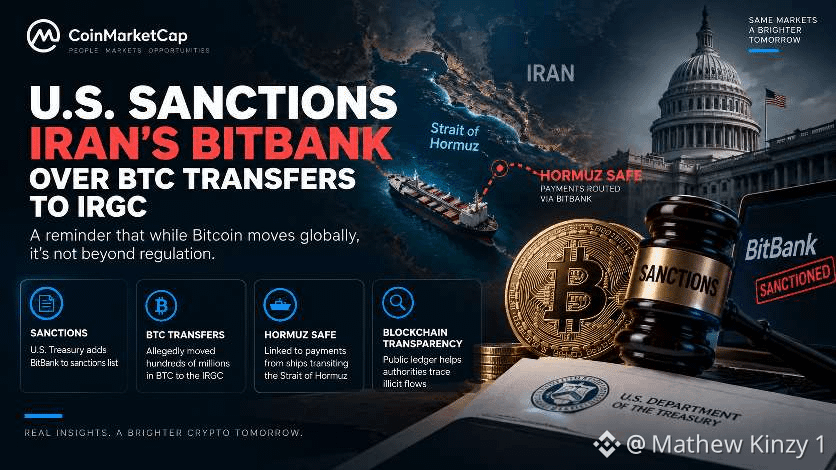
Bitcoin was designed to move without banks. That doesn't mean it moves beyond regulation.
The U.S. Treasury has sanctioned Iranian crypto exchange BitBank, alleging it was part of a network that transferred hundreds of millions of dollars in $BTC to the IRGC. Treasury says payments connected to the Hormuz Safe system were routed through the exchange.
What interests me is what this says about Bitcoin itself.
A permissionless network can move value globally, but its public ledger also creates a trail investigators can analyze. And once those funds interact with exchanges, custodians or other regulated infrastructure, sanctions enforcement can become much more practical.
So crypto's borderless nature doesn't automatically mean financial activity becomes invisible or unreachable.
As $BTC becomes more integrated into global finance, compliance and blockchain intelligence may become just as important as the infrastructure moving the money.
Does blockchain transparency ultimately make crypto harder to use for sanctions evasion than traditional financial networks?
Bitcoin was designed to move without banks. That doesn't mean it moves beyond regulation.
The U.S. Treasury has sanctioned Iranian crypto exchange BitBank, alleging it was part of a network that transferred hundreds of millions of dollars in $BTC to the IRGC. Treasury says payments connected to the Hormuz Safe system were routed through the exchange.
What interests me is what this says about Bitcoin itself.
A permissionless network can move value globally, but its public ledger also creates a trail investigators can analyze. And once those funds interact with exchanges, custodians or other regulated infrastructure, sanctions enforcement can become much more practical.
So crypto's borderless nature doesn't automatically mean financial activity becomes invisible or unreachable.
As $BTC becomes more integrated into global finance, compliance and blockchain intelligence may become just as important as the infrastructure moving the money.
Does blockchain transparency ultimately make crypto harder to use for sanctions evasion than traditional financial networks?
The U.S. Treasury has sanctioned Iranian crypto exchange BitBank, alleging it was part of a network that transferred hundreds of millions of dollars in $BTC to the IRGC. Treasury says payments connected to the Hormuz Safe system were routed through the exchange.
What interests me is what this says about Bitcoin itself.
A permissionless network can move value globally, but its public ledger also creates a trail investigators can analyze. And once those funds interact with exchanges, custodians or other regulated infrastructure, sanctions enforcement can become much more practical.
So crypto's borderless nature doesn't automatically mean financial activity becomes invisible or unreachable.
As $BTC becomes more integrated into global finance, compliance and blockchain intelligence may become just as important as the infrastructure moving the money.
Does blockchain transparency ultimately make crypto harder to use for sanctions evasion than traditional financial networks?
55
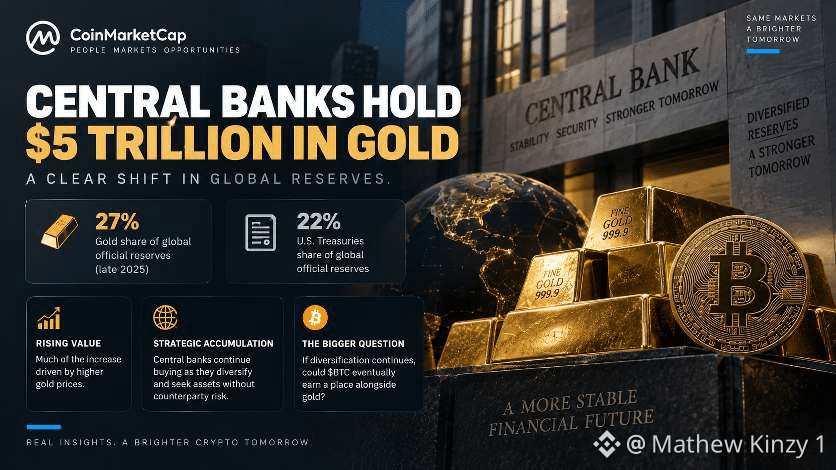
Central banks holding roughly $5 trillion in gold tells a bigger story than gold simply hitting new highs.
Gold reached about 27% of global official reserves by late 2025, overtaking U.S. Treasuries at roughly 22%. But much of that increase came from gold’s rising price, not purchases alone.
Still, central banks have continued accumulating gold as they diversify reserves and seek an asset without issuer or counterparty risk.
That makes the $BTC comparison interesting.
Bitcoin shares gold’s scarcity narrative, but becoming a serious reserve asset would also require deep liquidity, reliable custody and resilience during periods of global stress.
If reserve diversification continues, could $BTC eventually earn a place alongside gold?
Central banks holding roughly $5 trillion in gold tells a bigger story than gold simply hitting new highs.
Gold reached about 27% of global official reserves by late 2025, overtaking U.S. Treasuries at roughly 22%. But much of that increase came from gold’s rising price, not purchases alone.
Still, central banks have continued accumulating gold as they diversify reserves and seek an asset without issuer or counterparty risk.
That makes the $BTC comparison interesting.
Bitcoin shares gold’s scarcity narrative, but becoming a serious reserve asset would also require deep liquidity, reliable custody and resilience during periods of global stress.
If reserve diversification continues, could $BTC eventually earn a place alongside gold?
Gold reached about 27% of global official reserves by late 2025, overtaking U.S. Treasuries at roughly 22%. But much of that increase came from gold’s rising price, not purchases alone.
Still, central banks have continued accumulating gold as they diversify reserves and seek an asset without issuer or counterparty risk.
That makes the $BTC comparison interesting.
Bitcoin shares gold’s scarcity narrative, but becoming a serious reserve asset would also require deep liquidity, reliable custody and resilience during periods of global stress.
If reserve diversification continues, could $BTC eventually earn a place alongside gold?
63
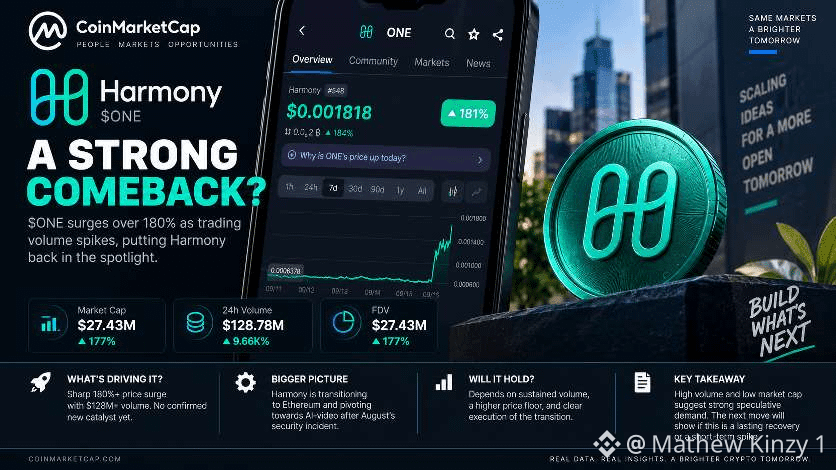
$ONE jumping more than 180% looks like a comeback on the chart. The story underneath it is much stranger.
Harmony exploded from roughly $0.00064 into the $0.0018 area on the chart, while 24-hour volume reached about $128.8M. That volume is enormous relative to the roughly $27.4M market cap shown on CoinMarketCap, which tells me this isn't a normal low-volatility recovery.
I went looking for the obvious catalyst. There doesn't appear to be one.
Recent market coverage also flagged Harmony among the day's biggest gainers without a confirmed fresh catalyst.
That makes the context behind the move even more important.
Harmony is going through one of the biggest transitions in its history. After August's security incident, where unauthorized $ONE was minted, the project proposed sunsetting its independent Layer 1 and migrating ONE to Ethereum while pivoting toward an AI-video initiative.
So this rally isn't happening after everything has returned to normal. It's happening while the future structure and utility of $ONE are still being worked out.
And that changes how I read the pump
With such a small market cap and unusually high turnover, speculative demand, short-term positioning and thinner liquidity can produce violent percentage moves. A 180% candle by itself doesn't prove that the market has fundamentally repriced Harmony
Can it hold?
I think the next part of the chart matters more than the pump itself. If $ONE can establish a higher trading range after volume cools, while the Ethereum migration gets clearer execution and exchange support, there would be more evidence that buyers are willing to hold rather than simply chase momentum
If volume disappears and price quickly gives back most of the move, this will look much more like a liquidity-driven spike
$ONE is up triple digits, but the real test starts after the candle
Do you see this as the market pricing in a second life for ONE, or simply traders chasing one of today's strongest momentum plays?
$ONE jumping more than 180% looks like a comeback on the chart. The story underneath it is much stranger.
Harmony exploded from roughly $0.00064 into the $0.0018 area on the chart, while 24-hour volume reached about $128.8M. That volume is enormous relative to the roughly $27.4M market cap shown on CoinMarketCap, which tells me this isn't a normal low-volatility recovery.
I went looking for the obvious catalyst. There doesn't appear to be one.
Recent market coverage also flagged Harmony among the day's biggest gainers without a confirmed fresh catalyst.
That makes the context behind the move even more important.
Harmony is going through one of the biggest transitions in its history. After August's security incident, where unauthorized $ONE was minted, the project proposed sunsetting its independent Layer 1 and migrating ONE to Ethereum while pivoting toward an AI-video initiative.
So this rally isn't happening after everything has returned to normal. It's happening while the future structure and utility of $ONE are still being worked out.
And that changes how I read the pump
With such a small market cap and unusually high turnover, speculative demand, short-term positioning and thinner liquidity can produce violent percentage moves. A 180% candle by itself doesn't prove that the market has fundamentally repriced Harmony
Can it hold?
I think the next part of the chart matters more than the pump itself. If $ONE can establish a higher trading range after volume cools, while the Ethereum migration gets clearer execution and exchange support, there would be more evidence that buyers are willing to hold rather than simply chase momentum
If volume disappears and price quickly gives back most of the move, this will look much more like a liquidity-driven spike
$ONE is up triple digits, but the real test starts after the candle
Do you see this as the market pricing in a second life for ONE, or simply traders chasing one of today's strongest momentum plays?
Harmony exploded from roughly $0.00064 into the $0.0018 area on the chart, while 24-hour volume reached about $128.8M. That volume is enormous relative to the roughly $27.4M market cap shown on CoinMarketCap, which tells me this isn't a normal low-volatility recovery.
I went looking for the obvious catalyst. There doesn't appear to be one.
Recent market coverage also flagged Harmony among the day's biggest gainers without a confirmed fresh catalyst.
That makes the context behind the move even more important.
Harmony is going through one of the biggest transitions in its history. After August's security incident, where unauthorized $ONE was minted, the project proposed sunsetting its independent Layer 1 and migrating ONE to Ethereum while pivoting toward an AI-video initiative.
So this rally isn't happening after everything has returned to normal. It's happening while the future structure and utility of $ONE are still being worked out.
And that changes how I read the pump
With such a small market cap and unusually high turnover, speculative demand, short-term positioning and thinner liquidity can produce violent percentage moves. A 180% candle by itself doesn't prove that the market has fundamentally repriced Harmony
Can it hold?
I think the next part of the chart matters more than the pump itself. If $ONE can establish a higher trading range after volume cools, while the Ethereum migration gets clearer execution and exchange support, there would be more evidence that buyers are willing to hold rather than simply chase momentum
If volume disappears and price quickly gives back most of the move, this will look much more like a liquidity-driven spike
$ONE is up triple digits, but the real test starts after the candle
Do you see this as the market pricing in a second life for ONE, or simply traders chasing one of today's strongest momentum plays?
28
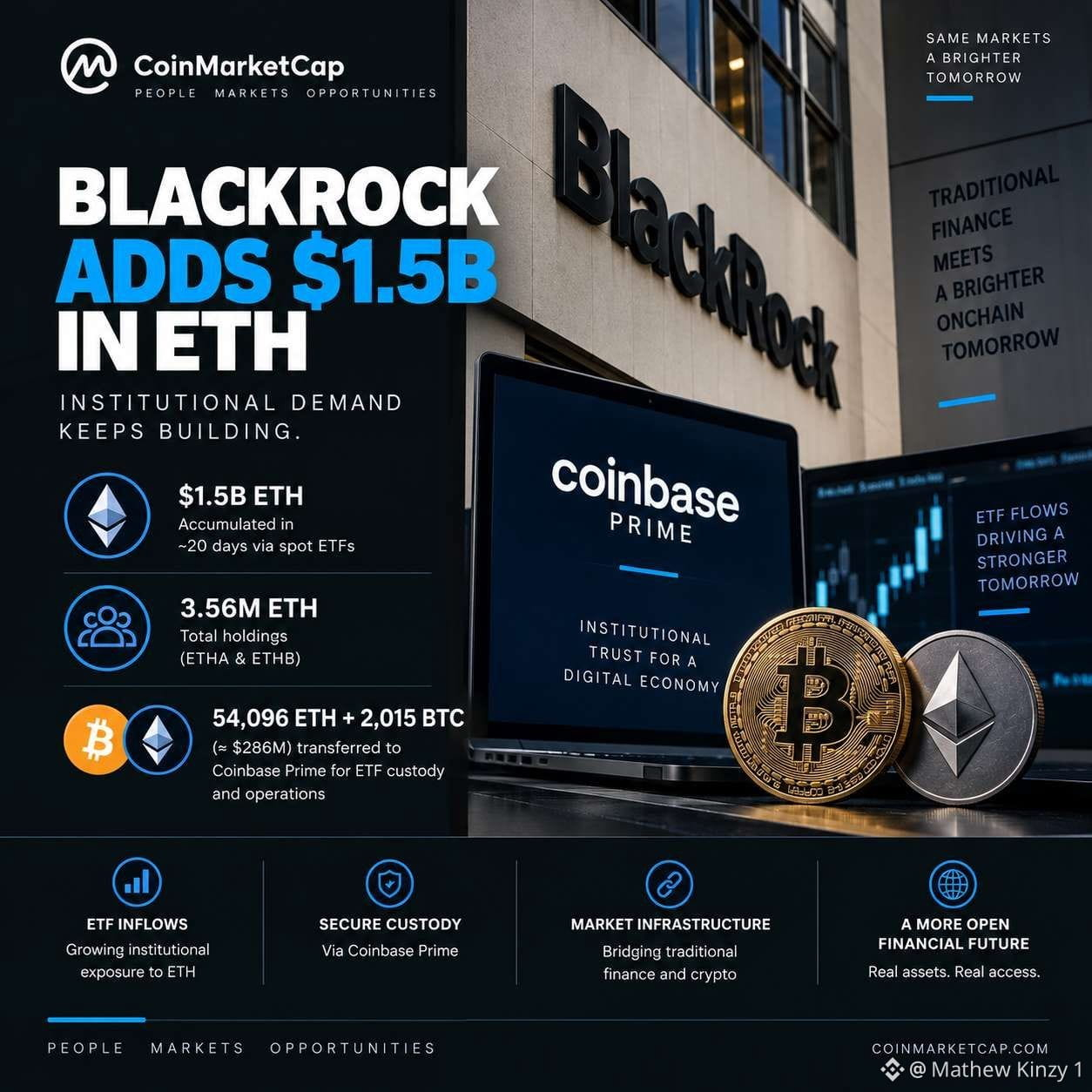
$1.5 billion of ETH in roughly 20 days is a number worth paying attention to.
BlackRock’s spot Ether ETFs reportedly added around $1.5B in $ETH during that period, bringing their combined holdings to roughly 3.56M ETH.
But there’s another part of the story I find just as interesting.
BlackRock also moved 54,096 ETH and 2,015 $BTC, worth roughly $286M combined, into Coinbase Prime.
At first glance, transfers of that size can easily look like potential selling pressure. But movements involving institutional ETF infrastructure aren't necessarily directional trades. In this case, the transfers have been linked to custody and operational management of the funds.
That distinction matters.
As crypto ETFs grow, we’re going to see increasingly large amounts of $BTC and $ETH moving between institutional wallets, custodians and execution venues. Looking at the transaction alone won't always tell us whether institutions are buying, selling or simply managing assets behind ETF products.
The bigger signal may be the sustained demand itself.
If billions can move into Ethereum ETFs within weeks, ETH is increasingly becoming an asset institutions can access through familiar traditional financial infrastructure.
Now I’m watching whether those inflows continue.
Are institutional ETF flows becoming more important for $ETH than the movements of individual whale wallets?
$1.5 billion of ETH in roughly 20 days is a number worth paying attention to.
BlackRock’s spot Ether ETFs reportedly added around $1.5B in $ETH during that period, bringing their combined holdings to roughly 3.56M ETH.
But there’s another part of the story I find just as interesting.
BlackRock also moved 54,096 ETH and 2,015 $BTC, worth roughly $286M combined, into Coinbase Prime.
At first glance, transfers of that size can easily look like potential selling pressure. But movements involving institutional ETF infrastructure aren't necessarily directional trades. In this case, the transfers have been linked to custody and operational management of the funds.
That distinction matters.
As crypto ETFs grow, we’re going to see increasingly large amounts of $BTC and $ETH moving between institutional wallets, custodians and execution venues. Looking at the transaction alone won't always tell us whether institutions are buying, selling or simply managing assets behind ETF products.
The bigger signal may be the sustained demand itself.
If billions can move into Ethereum ETFs within weeks, ETH is increasingly becoming an asset institutions can access through familiar traditional financial infrastructure.
Now I’m watching whether those inflows continue.
Are institutional ETF flows becoming more important for $ETH than the movements of individual whale wallets?
BlackRock’s spot Ether ETFs reportedly added around $1.5B in $ETH during that period, bringing their combined holdings to roughly 3.56M ETH.
But there’s another part of the story I find just as interesting.
BlackRock also moved 54,096 ETH and 2,015 $BTC, worth roughly $286M combined, into Coinbase Prime.
At first glance, transfers of that size can easily look like potential selling pressure. But movements involving institutional ETF infrastructure aren't necessarily directional trades. In this case, the transfers have been linked to custody and operational management of the funds.
That distinction matters.
As crypto ETFs grow, we’re going to see increasingly large amounts of $BTC and $ETH moving between institutional wallets, custodians and execution venues. Looking at the transaction alone won't always tell us whether institutions are buying, selling or simply managing assets behind ETF products.
The bigger signal may be the sustained demand itself.
If billions can move into Ethereum ETFs within weeks, ETH is increasingly becoming an asset institutions can access through familiar traditional financial infrastructure.
Now I’m watching whether those inflows continue.
Are institutional ETF flows becoming more important for $ETH than the movements of individual whale wallets?
42
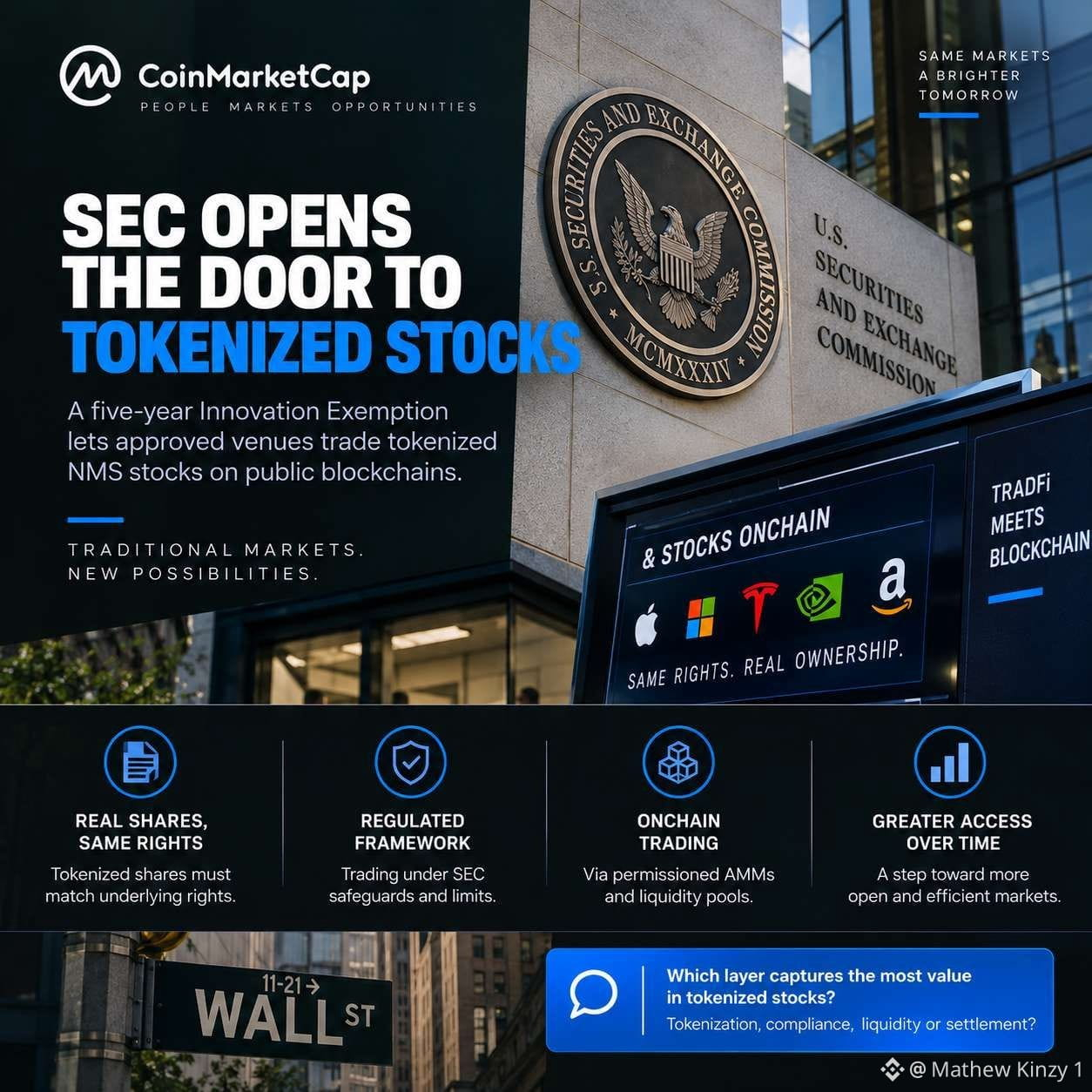
Tokenized stocks just moved from an experiment to something U.S. regulators are willing to test on public blockchains.
On September 17, the SEC introduced a five-year “Innovation Exemption” allowing qualifying Tokenized Securities Venues to facilitate trading of tokenized NMS stocks through permissioned AMMs and liquidity pools.
The detail I find most interesting is that this isn't simply about putting a stock ticker onchain.
Eligible tokenized shares must preserve the same rights and privileges as the corresponding traditional shares. Smart contracts must be public and auditable, trading must stop when the underlying stock is halted, and venues operate under symbol and volume limits. Synthetic products that only track a stock's price aren't covered by the framework.
That distinction matters for the entire RWA conversation.
We’ve spent years asking whether traditional assets can move onchain. The more interesting question may now be:
What infrastructure is needed when they actually do?
Tokenized equities still need compliance, liquidity, investor access, settlement, servicing and reliable lifecycle infrastructure.
To me, that’s where the opportunity around RWAs becomes much broader than simply issuing another token.
The SEC says the five-year framework is temporary and intended to generate data that can inform longer-term rulemaking.
If stocks increasingly move onchain, which layer captures the most value: tokenization, compliance, liquidity or settlement infrastructure?
#Macro Insights# #RWA #Tokenization
Tokenized stocks just moved from an experiment to something U.S. regulators are willing to test on public blockchains.
On September 17, the SEC introduced a five-year “Innovation Exemption” allowing qualifying Tokenized Securities Venues to facilitate trading of tokenized NMS stocks through permissioned AMMs and liquidity pools.
The detail I find most interesting is that this isn't simply about putting a stock ticker onchain.
Eligible tokenized shares must preserve the same rights and privileges as the corresponding traditional shares. Smart contracts must be public and auditable, trading must stop when the underlying stock is halted, and venues operate under symbol and volume limits. Synthetic products that only track a stock's price aren't covered by the framework.
That distinction matters for the entire RWA conversation.
We’ve spent years asking whether traditional assets can move onchain. The more interesting question may now be:
What infrastructure is needed when they actually do?
Tokenized equities still need compliance, liquidity, investor access, settlement, servicing and reliable lifecycle infrastructure.
To me, that’s where the opportunity around RWAs becomes much broader than simply issuing another token.
The SEC says the five-year framework is temporary and intended to generate data that can inform longer-term rulemaking.
If stocks increasingly move onchain, which layer captures the most value: tokenization, compliance, liquidity or settlement infrastructure?
#Macro Insights# #RWA #Tokenization
On September 17, the SEC introduced a five-year “Innovation Exemption” allowing qualifying Tokenized Securities Venues to facilitate trading of tokenized NMS stocks through permissioned AMMs and liquidity pools.
The detail I find most interesting is that this isn't simply about putting a stock ticker onchain.
Eligible tokenized shares must preserve the same rights and privileges as the corresponding traditional shares. Smart contracts must be public and auditable, trading must stop when the underlying stock is halted, and venues operate under symbol and volume limits. Synthetic products that only track a stock's price aren't covered by the framework.
That distinction matters for the entire RWA conversation.
We’ve spent years asking whether traditional assets can move onchain. The more interesting question may now be:
What infrastructure is needed when they actually do?
Tokenized equities still need compliance, liquidity, investor access, settlement, servicing and reliable lifecycle infrastructure.
To me, that’s where the opportunity around RWAs becomes much broader than simply issuing another token.
The SEC says the five-year framework is temporary and intended to generate data that can inform longer-term rulemaking.
If stocks increasingly move onchain, which layer captures the most value: tokenization, compliance, liquidity or settlement infrastructure?
#Macro Insights# #RWA #Tokenization
60
JUST IN 🚨: U.S. TOKENIZED STOCKS TAKE ANOTHER STEP FORWARD
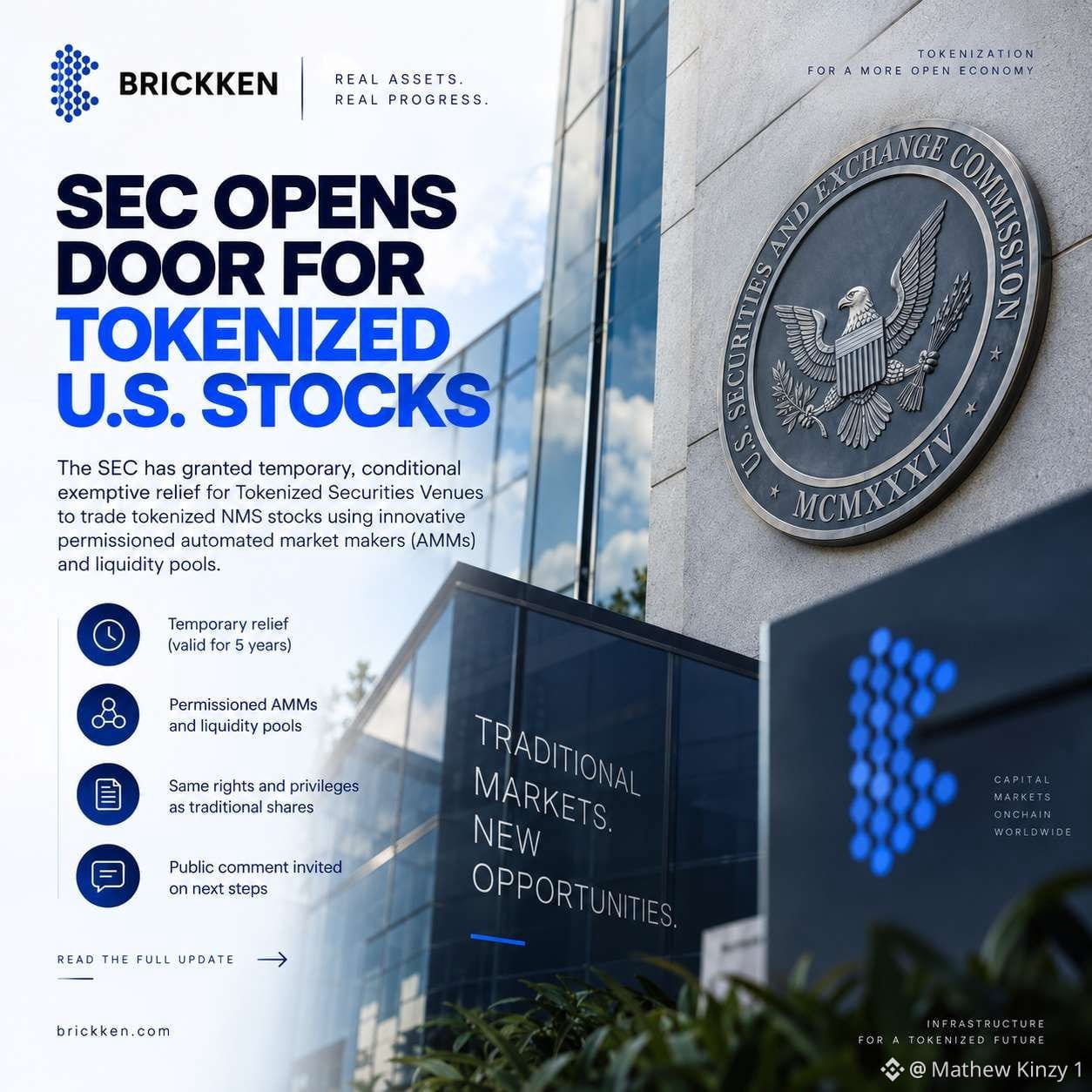
The SEC has granted temporary, conditional exemptive relief allowing qualifying Tokenized Securities Venues to trade tokenized NMS stocks using permissioned automated market makers and liquidity pools.
The relief is set to run for five years, while the SEC gathers public feedback on potential changes and next steps.
This also fits a broader 2026 shift: the SEC has already clarified different structures for tokenized securities, while U.S. exchanges have filed changes enabling securities to trade in tokenized form.
The conversation is moving beyond “Can stocks be tokenized?”
Now it’s becoming:
“What does compliant onchain market infrastructure actually look like?”
That’s a much bigger development for RWA.
$BKN #Brickken #RWA #Tokenization
JUST IN 🚨: U.S. TOKENIZED STOCKS TAKE ANOTHER STEP FORWARD
The SEC has granted temporary, conditional exemptive relief allowing qualifying Tokenized Securities Venues to trade tokenized NMS stocks using permissioned automated market makers and liquidity pools.
The relief is set to run for five years, while the SEC gathers public feedback on potential changes and next steps.
This also fits a broader 2026 shift: the SEC has already clarified different structures for tokenized securities, while U.S. exchanges have filed changes enabling securities to trade in tokenized form.
The conversation is moving beyond “Can stocks be tokenized?”
Now it’s becoming:
“What does compliant onchain market infrastructure actually look like?”
That’s a much bigger development for RWA.
$BKN #Brickken #RWA #Tokenization
The SEC has granted temporary, conditional exemptive relief allowing qualifying Tokenized Securities Venues to trade tokenized NMS stocks using permissioned automated market makers and liquidity pools.
The relief is set to run for five years, while the SEC gathers public feedback on potential changes and next steps.
This also fits a broader 2026 shift: the SEC has already clarified different structures for tokenized securities, while U.S. exchanges have filed changes enabling securities to trade in tokenized form.
The conversation is moving beyond “Can stocks be tokenized?”
Now it’s becoming:
“What does compliant onchain market infrastructure actually look like?”
That’s a much bigger development for RWA.
$BKN #Brickken #RWA #Tokenization
69
Көбірек контент көру үшін кіріңіз
Binance Square платформасында әлемдік криптоқоғамдастыққа қосылыңыз
⚡️ Криптовалюта туралы ең соңғы және пайдалы ақпаратты алыңыз.
💬 Әлемдегі ең ірі криптобиржаның сеніміне ие.
👍 Расталған авторлардың нақты пікірлерін табыңыз.
Электрондық пошта/телефон нөмірі
Трендтегі тақырыптар
ChinaMayLetAlibabaByteDanceBuyNvidiaChips
419 рет көрілді
53 адам талқылап жатыр
#ChinaMayLetAlibabaByteDanceBuyNvidiaChips
Discussion
Reports say China may allow companies including Alibaba and ByteDance to purchase Nvidia’s newly released RTX PRO 5500 chips. China’s Ministry of Industry and Information Technology reportedly asked companies about planned quantities and intended uses, although the report has not been independently verified.
This is notable because:
For Nvidia: Approval could create additional China sales and maintain Nvidia’s presence in the Chinese AI ecosystem.
For Alibaba & ByteDance: More Nvidia computing capacity could support AI model development and inference amid strong demand for computing power.
For China’s chip strategy: The RTX PRO 5500 is not Nvidia’s top data-center AI accelerator, while Chinese firms are also developing domestic alternatives such as Alibaba’s own AI chips.
For markets: Confirmation of meaningful purchases could affect sentiment around Nvidia and the broader semiconductor sector, but the scale and timing of any approvals remain uncertain.
The key point is that this is a reported potential approval, not a confirmed purchase agreement. Reuters said it could not independently verify the report.
PALASH5
·0 лайк
·324 рет көрілді
USChinaRelease$30BTariffCutProductLists
5 рет көрілді
3 адам талқылап жатыр
SKoreaFSCConsidersVirtualAssetMarketMaker
1,515 рет көрілді
85 адам талқылап жатыр