
AdCentral Global
63 Жариялаулар

AdCentral Global
Хабарлау
Пайдаланушыны блоктау
DOOH ad network turning idle screens into revenue. Screen owners earn, advertisers reach real places. Dubai-based. Token: ADCL
17 Жазылым
14 Жазылушылар
72 лайк басылған
Жазбалар
Барлығы
Видеолар
PINNED
🏆 A proud milestone for AdCentral.
We finished 2nd Runner-Up in Building the Future of Web3 on BNB Chain, the global innovation challenge powered by BNBChain and IgnyteDIFC, presented on stage at #DubaiFinTechSummit
For us, the biggest value was the opportunity to share a real-world Web3 vision:
Turn independently owned screens into one verifiable advertising network.
Thank you BNB Chain, IgnyteDIFC, the judges and everyone who took the time to hear the AdCentral story.
Dubai first. Built to scale.
#AdCentral #DePIN #BNBChain #IgnyteDIFC

1
1
108
PINNED
AdCentral in 60 seconds 🎥
Book ads on real screens. Track results live. Manage everything in one place.
Watch 👆
AdCentral in 60 seconds 🎥
Book ads on real screens. Track results live. Manage everything in one place.
Watch 👆
Book ads on real screens. Track results live. Manage everything in one place.
Watch 👆
1
2
7
We are attending Doers Summit Dubai on the 25th - 26th of November - where founders, investors, and operators unite. Who else is coming? #DoersSummit #Dubai. #DubaiSiliconOasis #DoersUnited
We are attending Doers Summit Dubai on the 25th - 26th of November - where founders, investors, and operators unite. Who else is coming? #DoersSummit #Dubai. #DubaiSiliconOasis #DoersUnited
75

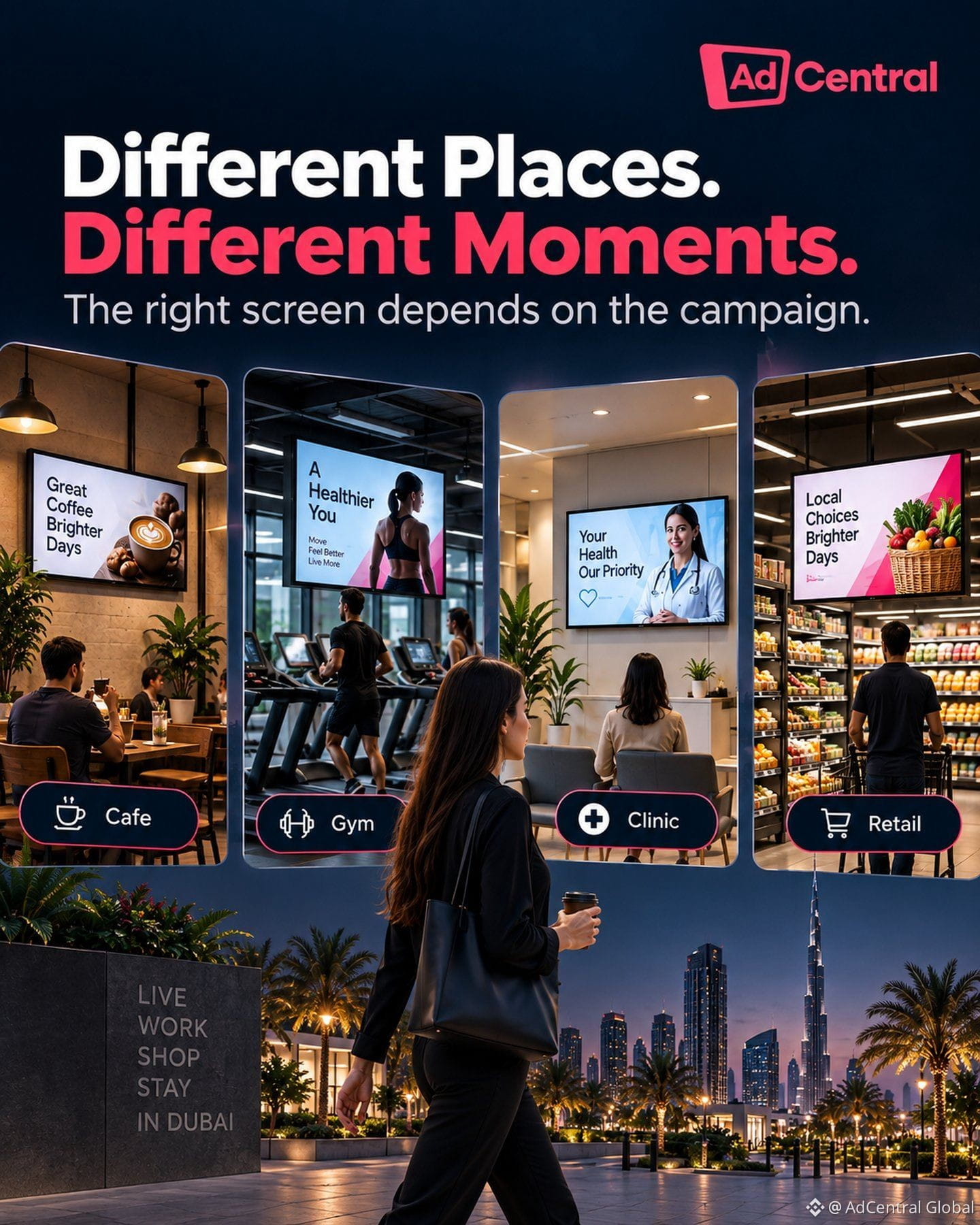
The right screen is not always the nearest screen.
A cafe, gym, clinic and supermarket can all reach people at different moments of their day.
We are building AdCentral to help advertisers discover screens that fit where, when and how they want to be seen.
Location matters. Context matters too.
The right screen is not always the nearest screen.
A cafe, gym, clinic and supermarket can all reach people at different moments of their day.
We are building AdCentral to help advertisers discover screens that fit where, when and how they want to be seen.
Location matters. Context matters too.
A cafe, gym, clinic and supermarket can all reach people at different moments of their day.
We are building AdCentral to help advertisers discover screens that fit where, when and how they want to be seen.
Location matters. Context matters too.
81
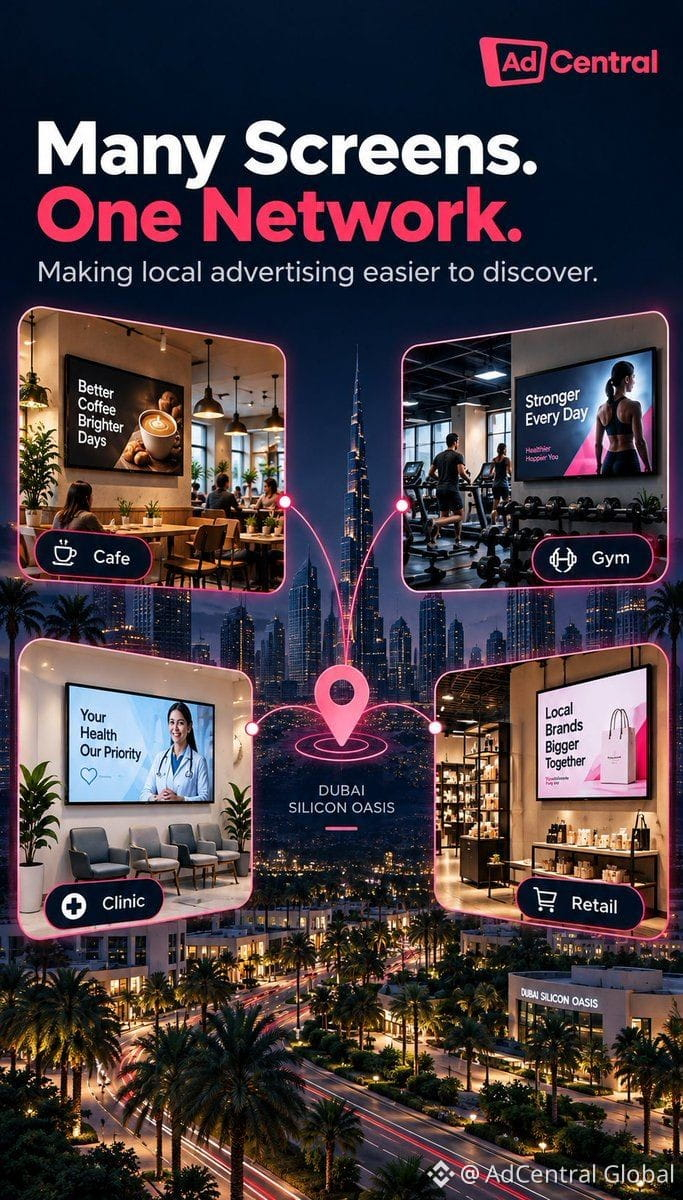
There are digital screens everywhere.
But for a local advertiser, finding the right ones is still not easy.
We are building AdCentral to bring independently owned screens into one network, so advertisers can discover useful locations and screen owners can participate in local advertising.
One network. Many local screens.
But for a local advertiser, finding the right ones is still not easy.
We are building AdCentral to bring independently owned screens into one network, so advertisers can discover useful locations and screen owners can participate in local advertising.
One network. Many local screens.
70
Мақала
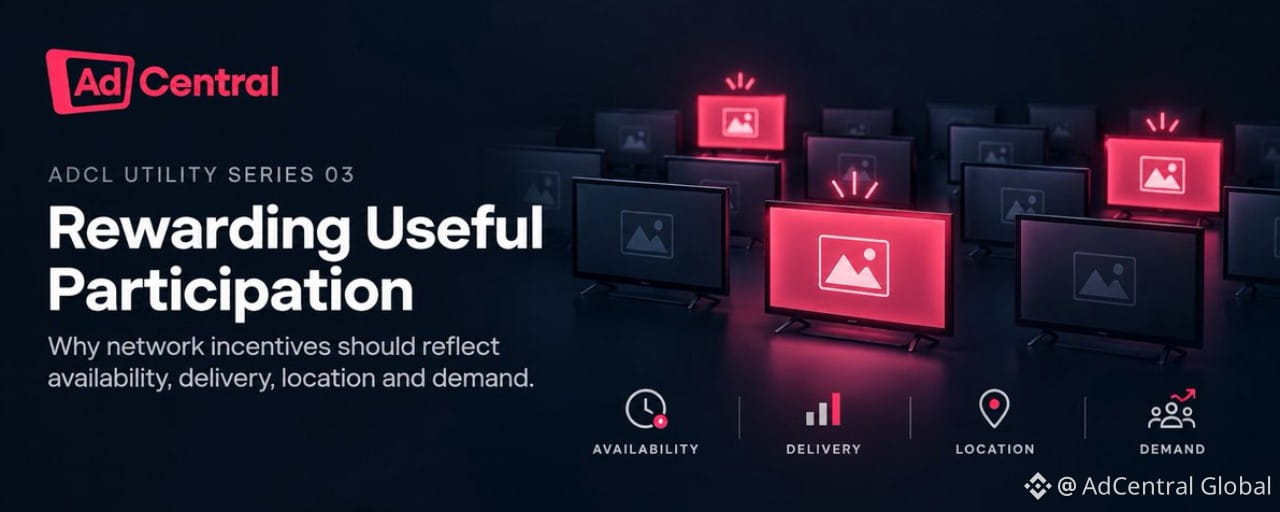
ADCL Utility Series 03: Rewarding Useful ParticipationA DePIN network can connect thousands of devices. But connection alone does not make every device equally useful.
For AdCentral, a screen should not become eligible for network incentives just because it is online.
Useful participation matters.
What makes a screen useful?
A screen becomes more valuable to the network when it can reliably support real advertising activity. That can depend on a few simple things:
Availability: Is the screen ready when campaigns need it?
Delivery: Does it reliably deliver when selected?
Location: Does it improve useful coverage for advertisers?
Demand: Is that screen relevant to real advertiser needs?
These signals help separate simple presence from productive participation.
Why should rewards follow performance?
Independent screen owners provide the physical infrastructure.
They keep screens powered, connected, maintained and available.
That contribution continues even when advertising demand is uneven.
Network incentives can help support useful screens during those periods.
But support should not become automatic.
If one screen contributes more value to the network than another, the incentive model should be able to reflect that difference.
Where ADCL fits
ADCL is designed to support this coordination layer.
The model is not:
Connect a screen → earn rewards
It is closer to:
Participate → stay useful → prove performance → become eligible for incentives
That creates a healthier relationship between infrastructure and rewards.
Demand still comes first
Incentives can help bootstrap and support the network.
But they should not replace real demand.
For AdCentral, advertising activity remains the economic foundation.
As the network grows, the goal is for incentives to support productive infrastructure, not simply encourage more screens to connect.
The principle
The goal is not to build the largest possible screen network.
It is to build a network that remains:
Available. Reliable. Relevant. Useful.
That is why ADCL incentives are designed around useful participation.
Not every screen should necessarily be rewarded in the same way.
ADCL Utility Series 03: Rewarding Useful Participation
A DePIN network can connect thousands of devices. But connection alone does not make every device equally useful.
For AdCentral, a screen should not become eligible for network incentives just because it is online.
Useful participation matters.
What makes a screen useful?
A screen becomes more valuable to the network when it can reliably support real advertising activity. That can depend on a few simple things:
Availability: Is the screen ready when campaigns need it?
Delivery: Does it reliably deliver when selected?
Location: Does it improve useful coverage for advertisers?
Demand: Is that screen relevant to real advertiser needs?
These signals help separate simple presence from productive participation.
Why should rewards follow performance?
Independent screen owners provide the physical infrastructure.
They keep screens powered, connected, maintained and available.
That contribution continues even when advertising demand is uneven.
Network incentives can help support useful screens during those periods.
But support should not become automatic.
If one screen contributes more value to the network than another, the incentive model should be able to reflect that difference.
Where ADCL fits
ADCL is designed to support this coordination layer.
The model is not:
Connect a screen → earn rewards
It is closer to:
Participate → stay useful → prove performance → become eligible for incentives
That creates a healthier relationship between infrastructure and rewards.
Demand still comes first
Incentives can help bootstrap and support the network.
But they should not replace real demand.
For AdCentral, advertising activity remains the economic foundation.
As the network grows, the goal is for incentives to support productive infrastructure, not simply encourage more screens to connect.
The principle
The goal is not to build the largest possible screen network.
It is to build a network that remains:
Available. Reliable. Relevant. Useful.
That is why ADCL incentives are designed around useful participation.
Not every screen should necessarily be rewarded in the same way.
1
76
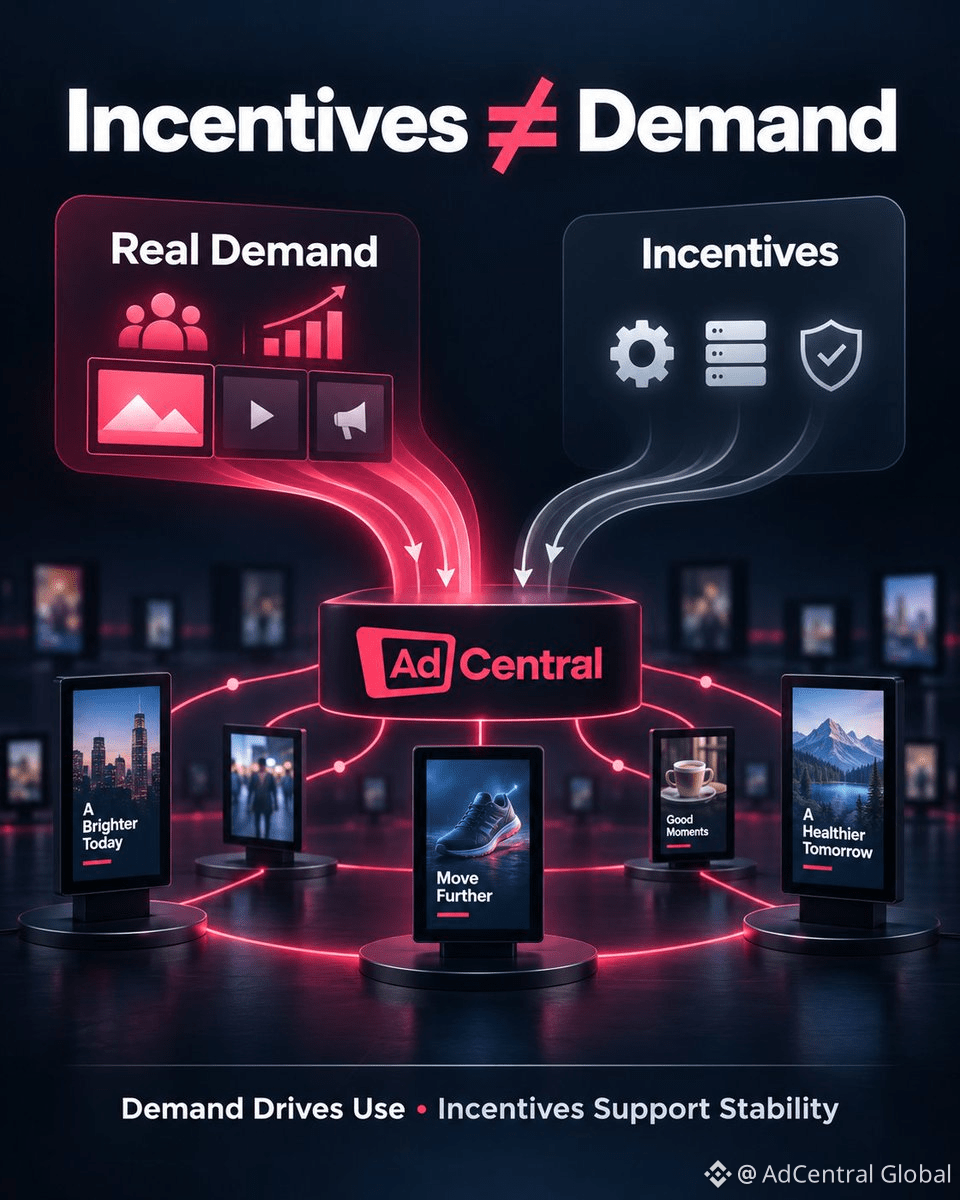
Network incentives should support real demand, not replace it.
In DePIN, incentives can help useful infrastructure stay available while demand is still developing or temporarily uneven.
But long term value has to come from real usage.
For AdCentral, that means advertising demand remains the economic foundation of the network.
In DePIN, incentives can help useful infrastructure stay available while demand is still developing or temporarily uneven.
But long term value has to come from real usage.
For AdCentral, that means advertising demand remains the economic foundation of the network.
1
68
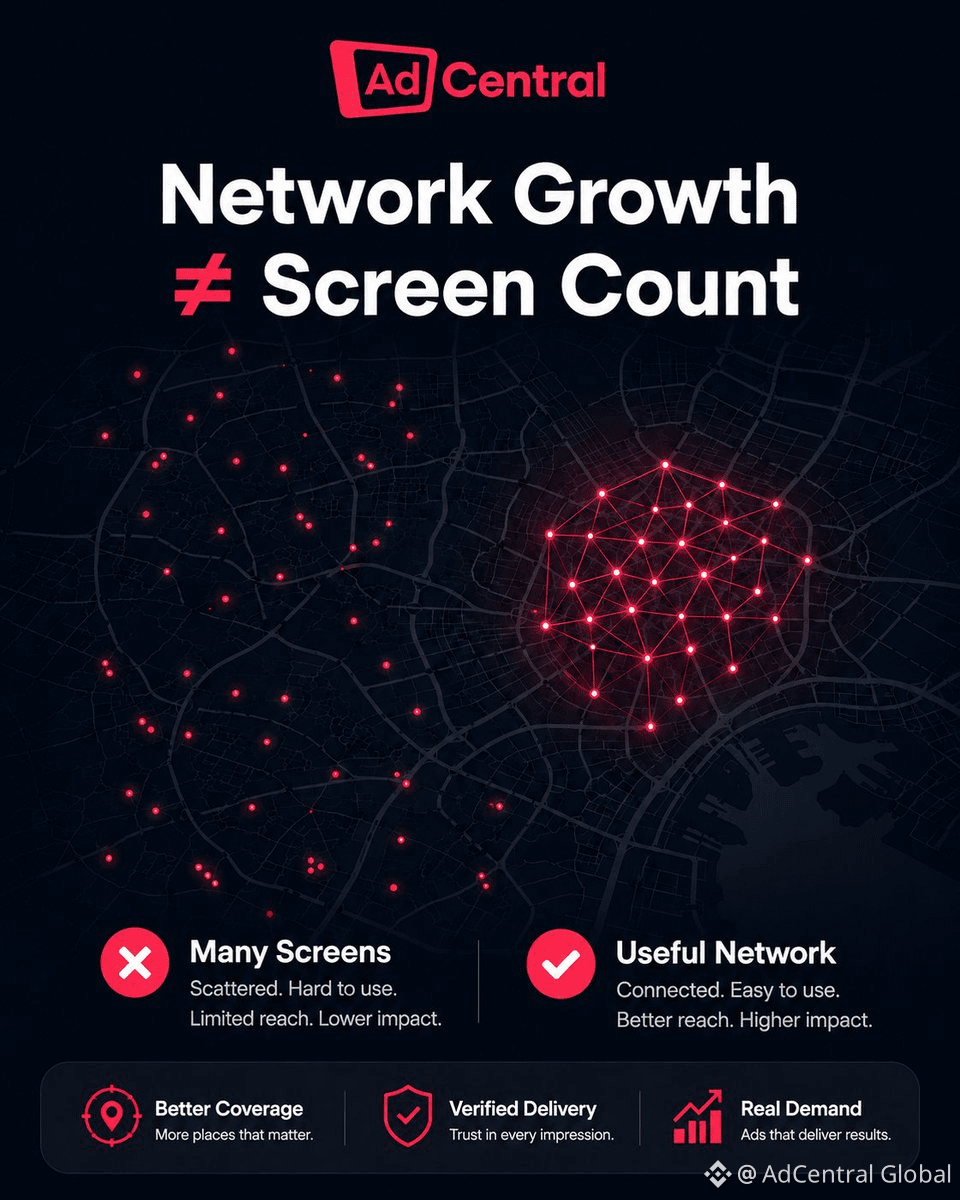
More screens do not automatically make a better DePIN network.
For AdCentral, network growth means useful coverage, verified delivery and real demand.
The goal is not simply to connect more screens.
It is to build a network advertisers can actually use.
More screens do not automatically make a better DePIN network.
For AdCentral, network growth means useful coverage, verified delivery and real demand.
The goal is not simply to connect more screens.
It is to build a network advertisers can actually use.
For AdCentral, network growth means useful coverage, verified delivery and real demand.
The goal is not simply to connect more screens.
It is to build a network advertisers can actually use.
1
56
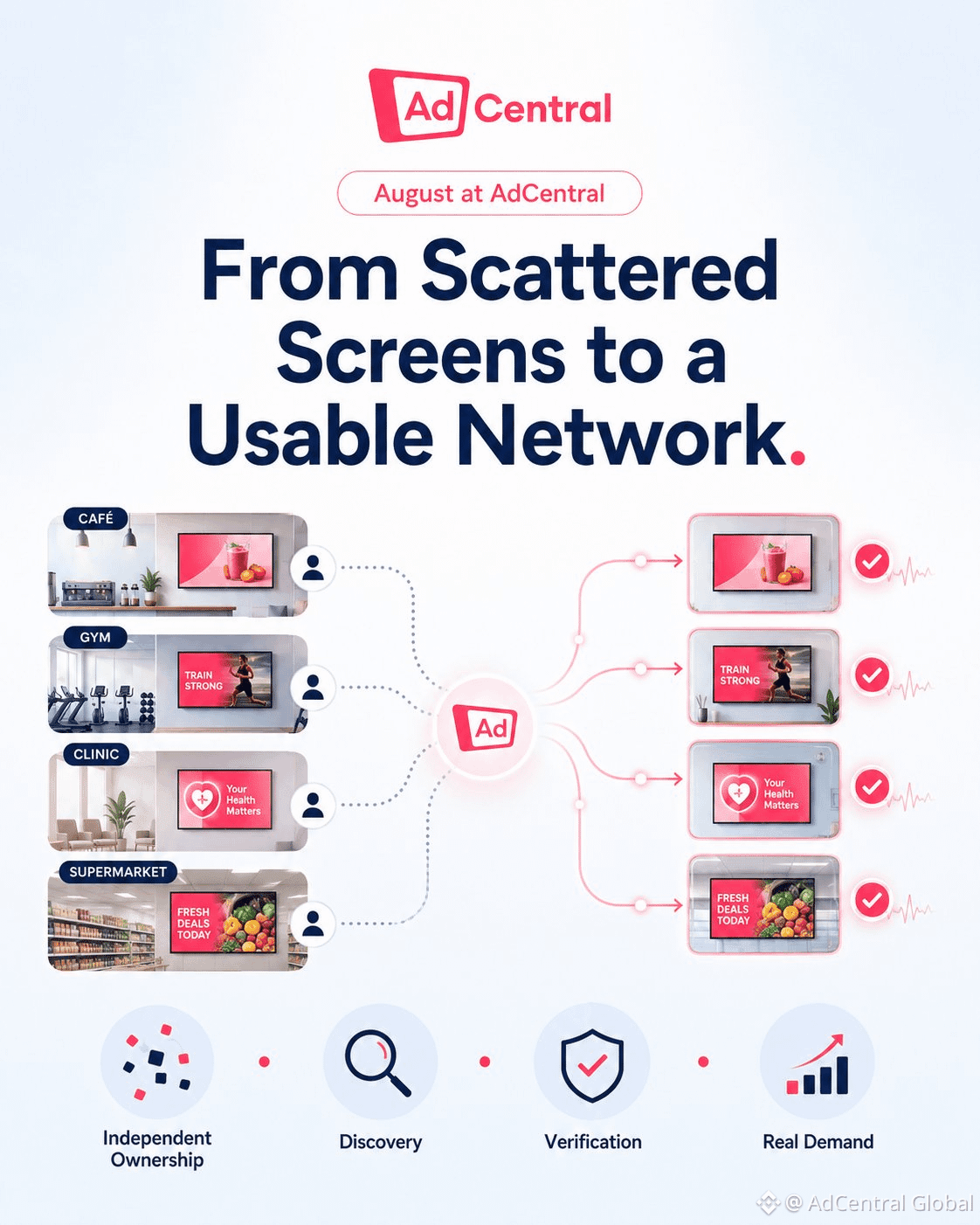
August was about one question: what turns scattered screens into a useful network?
For us, it comes down to four things:
Independent ownership.
Discoverable inventory.
Verified delivery.
Economics tied to real demand.
That is the foundation AdCentral is building from the UAE.
August was about one question: what turns scattered screens into a useful network?
For us, it comes down to four things:
Independent ownership.
Discoverable inventory.
Verified delivery.
Economics tied to real demand.
That is the foundation AdCentral is building from the UAE.
For us, it comes down to four things:
Independent ownership.
Discoverable inventory.
Verified delivery.
Economics tied to real demand.
That is the foundation AdCentral is building from the UAE.
119
DOOH is consolidating.
DePIN opens a different path for distributed screen infrastructure.
DOOH is consolidating.
DePIN opens a different path for distributed screen infrastructure.
DePIN opens a different path for distributed screen infrastructure.
1
72
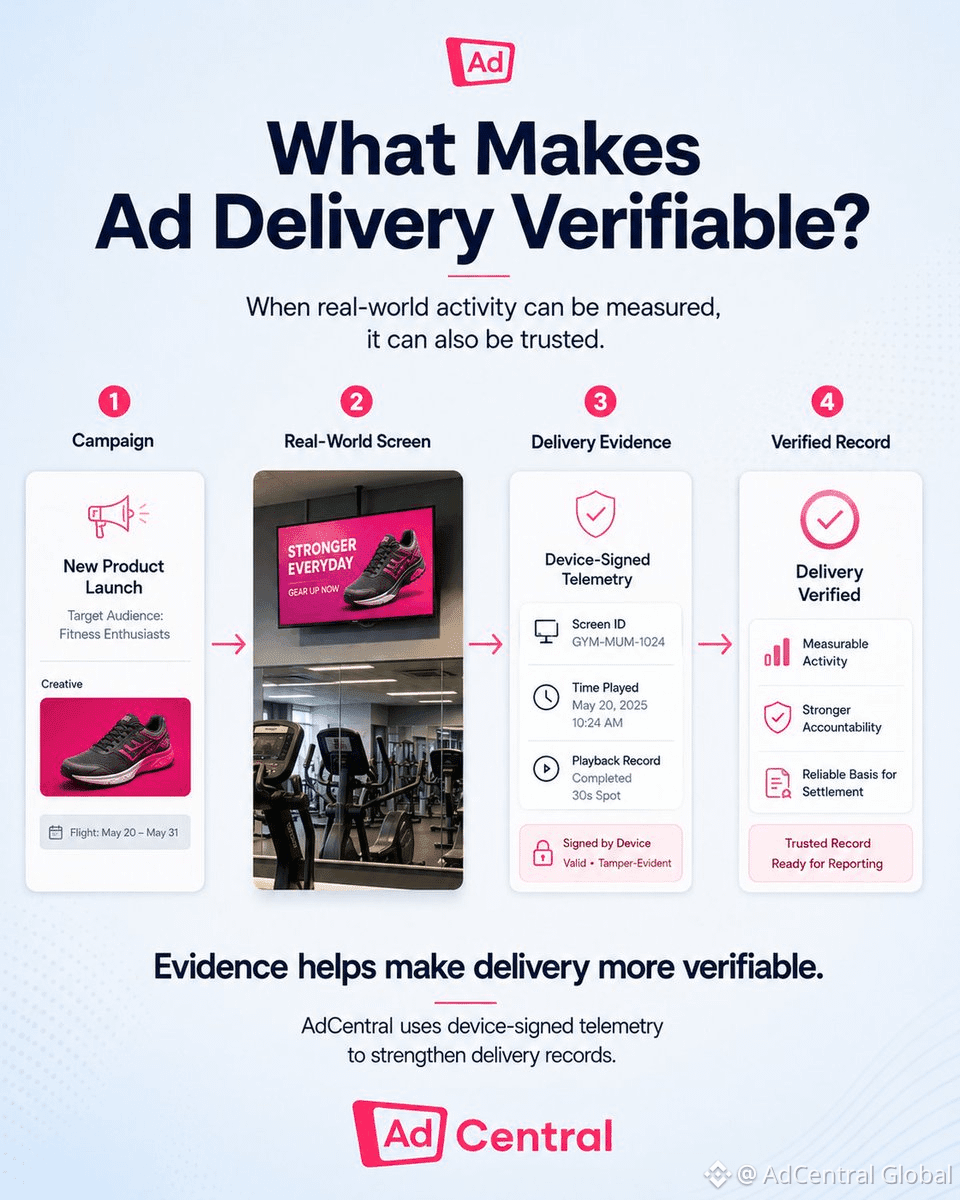
What makes ad delivery verifiable?
For AdCentral, every campaign should leave evidence behind.
Device-signed telemetry shows which screen played the campaign and when.
That gives advertisers clearer proof of delivery and gives the network a stronger basis for settlement.
When real-world activity can be measured, it can also be verified.
1
68
Мақала
Why Would AdCentral Keep Only 5%?An investor recently looked at AdCentral’s economic model and stopped at one number.
5%.
“How can a platform survive if it keeps only 5%?”
It was a fair question.
Technology costs money. Finding advertisers costs money. People, cloud infrastructure, compliance and operations all cost money.
So why would we deliberately design AdCentral around an approximately 5% platform allocation?
The answer becomes clearer when you look at what the rest of the value is designed to do.
Start with the campaign
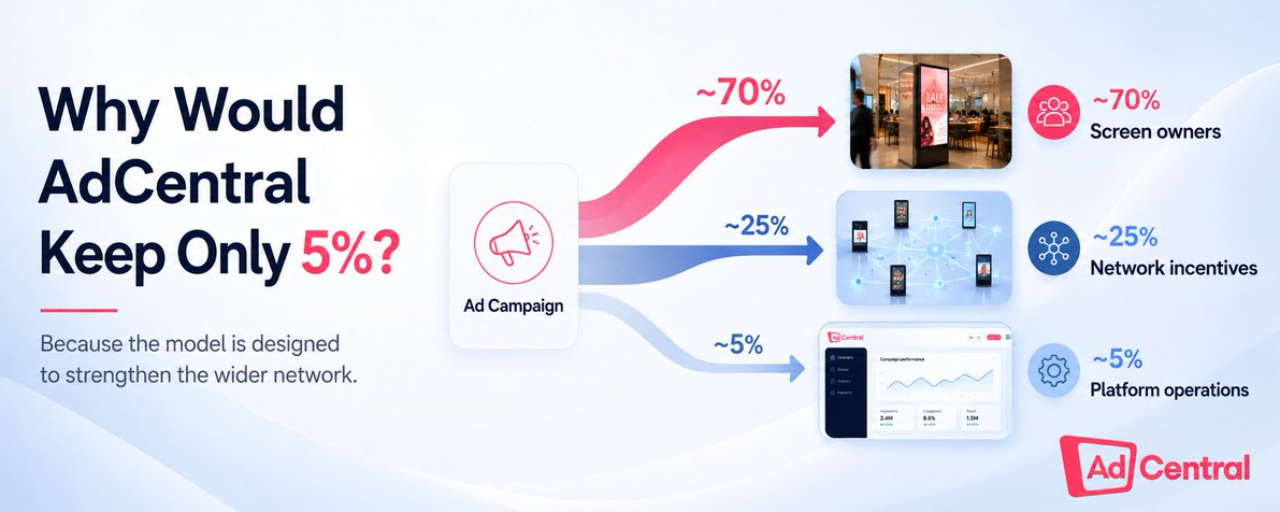
Under AdCentral’s current economic model, verified campaign value is approximately allocated like this:
~70% → Screen owners
For the screens that delivered the campaign.
~25% → Network incentives
Used to acquire ADCL for controlled network incentives.
~5% → Platform operations
For operating and developing the marketplace.
These percentages apply after relevant third-party fees and applicable taxes.
At first glance, the unusual number appears to be the 5%.
But the more interesting question is:
Why would we deliberately recycle part of the campaign value back into the network instead of simply keeping more of it?
A marketplace needs both sides to stay active
AdCentral needs advertisers.
But acquiring an advertiser once is not enough.
A healthy marketplace needs businesses to run campaigns, see value and come back again.
AdCentral also needs useful screens.
Advertising demand will never be perfectly even. A good screen may receive campaigns this month and fewer campaigns next month.
But the inventory still needs to be available when advertisers return.
That creates two very practical challenges:
Give advertisers another reason to come back.
Give useful screen owners another reason to stay available.
This is where Web3 becomes interesting for us.
Give advertisers another reason to return
Advertiser acquisition can be expensive.
A conventional marketplace may use sales, promotions, discounts and loyalty programs to bring customers back.
AdCentral can use those tools too.
But ADCL gives us an additional option.
A separate ADCL incentive pool can reward eligible advertisers who keep running real campaigns.
The idea is simple:
Run campaigns regularly, and eligible advertisers can qualify for additional incentives.
The token does not create advertising demand.
The goal is to use it as another tool to help turn first-time advertisers into repeat advertisers.
Give useful screens another reason to stay
Screen owners already earn when their screens deliver campaigns.
But demand can be uneven while a network is growing.
Network incentives can give useful, eligible screens another reason to remain active and available while demand develops.
Campaigns give screen owners direct earnings. Network incentives give useful screens another reason to remain available when demand is uneven.
That matters because advertisers only have a useful marketplace if the inventory is there when they need it.
Web3 gives us another growth tool
ADCL also gives the ecosystem controlled treasury resources that can support approved growth needs such as product development, partnerships and expansion.
That is another tool alongside normal company funding.
But it does not replace the need for a sustainable business.
So is 5% enough?
Tokenomics does not make that question disappear.
AdCentral still has to pay for people, technology, cloud infrastructure, advertiser acquisition, compliance and operations.
During early growth, platform operations may be supplemented by disclosed funding sources while campaign volume develops.
Over time, real operating data has to show whether the approximately 5% platform allocation can sustainably support the business at scale.
That has to be proven.
Now the 5% question looks different
The investor saw:
“The platform only keeps 5%.”
We see a model designed to share value differently.
Most of the campaign value goes to the screens that delivered the advertising.
Another portion is recycled into strengthening the network.
A smaller portion supports the platform operating the marketplace.
The business still has to create real advertising demand and prove that its economics work at scale.
Web3 simply gives us additional tools to help advertisers return, useful screens stay available, and the network grow around real business activity.
That is what AdCentral is building to prove.
Why Would AdCentral Keep Only 5%?
An investor recently looked at AdCentral’s economic model and stopped at one number.
5%.
“How can a platform survive if it keeps only 5%?”
It was a fair question.
Technology costs money. Finding advertisers costs money. People, cloud infrastructure, compliance and operations all cost money.
So why would we deliberately design AdCentral around an approximately 5% platform allocation?
The answer becomes clearer when you look at what the rest of the value is designed to do.
Start with the campaign
Under AdCentral’s current economic model, verified campaign value is approximately allocated like this:
~70% → Screen owners
For the screens that delivered the campaign.
~25% → Network incentives
Used to acquire ADCL for controlled network incentives.
~5% → Platform operations
For operating and developing the marketplace.
These percentages apply after relevant third-party fees and applicable taxes.
At first glance, the unusual number appears to be the 5%.
But the more interesting question is:
Why would we deliberately recycle part of the campaign value back into the network instead of simply keeping more of it?
A marketplace needs both sides to stay active
AdCentral needs advertisers.
But acquiring an advertiser once is not enough.
A healthy marketplace needs businesses to run campaigns, see value and come back again.
AdCentral also needs useful screens.
Advertising demand will never be perfectly even. A good screen may receive campaigns this month and fewer campaigns next month.
But the inventory still needs to be available when advertisers return.
That creates two very practical challenges:
Give advertisers another reason to come back.
Give useful screen owners another reason to stay available.
This is where Web3 becomes interesting for us.
Give advertisers another reason to return
Advertiser acquisition can be expensive.
A conventional marketplace may use sales, promotions, discounts and loyalty programs to bring customers back.
AdCentral can use those tools too.
But ADCL gives us an additional option.
A separate ADCL incentive pool can reward eligible advertisers who keep running real campaigns.
The idea is simple:
Run campaigns regularly, and eligible advertisers can qualify for additional incentives.
The token does not create advertising demand.
The goal is to use it as another tool to help turn first-time advertisers into repeat advertisers.
Give useful screens another reason to stay
Screen owners already earn when their screens deliver campaigns.
But demand can be uneven while a network is growing.
Network incentives can give useful, eligible screens another reason to remain active and available while demand develops.
Campaigns give screen owners direct earnings. Network incentives give useful screens another reason to remain available when demand is uneven.
That matters because advertisers only have a useful marketplace if the inventory is there when they need it.
Web3 gives us another growth tool
ADCL also gives the ecosystem controlled treasury resources that can support approved growth needs such as product development, partnerships and expansion.
That is another tool alongside normal company funding.
But it does not replace the need for a sustainable business.
So is 5% enough?
Tokenomics does not make that question disappear.
AdCentral still has to pay for people, technology, cloud infrastructure, advertiser acquisition, compliance and operations.
During early growth, platform operations may be supplemented by disclosed funding sources while campaign volume develops.
Over time, real operating data has to show whether the approximately 5% platform allocation can sustainably support the business at scale.
That has to be proven.
Now the 5% question looks different
The investor saw:
“The platform only keeps 5%.”
We see a model designed to share value differently.
Most of the campaign value goes to the screens that delivered the advertising.
Another portion is recycled into strengthening the network.
A smaller portion supports the platform operating the marketplace.
The business still has to create real advertising demand and prove that its economics work at scale.
Web3 simply gives us additional tools to help advertisers return, useful screens stay available, and the network grow around real business activity.
That is what AdCentral is building to prove.
1
74
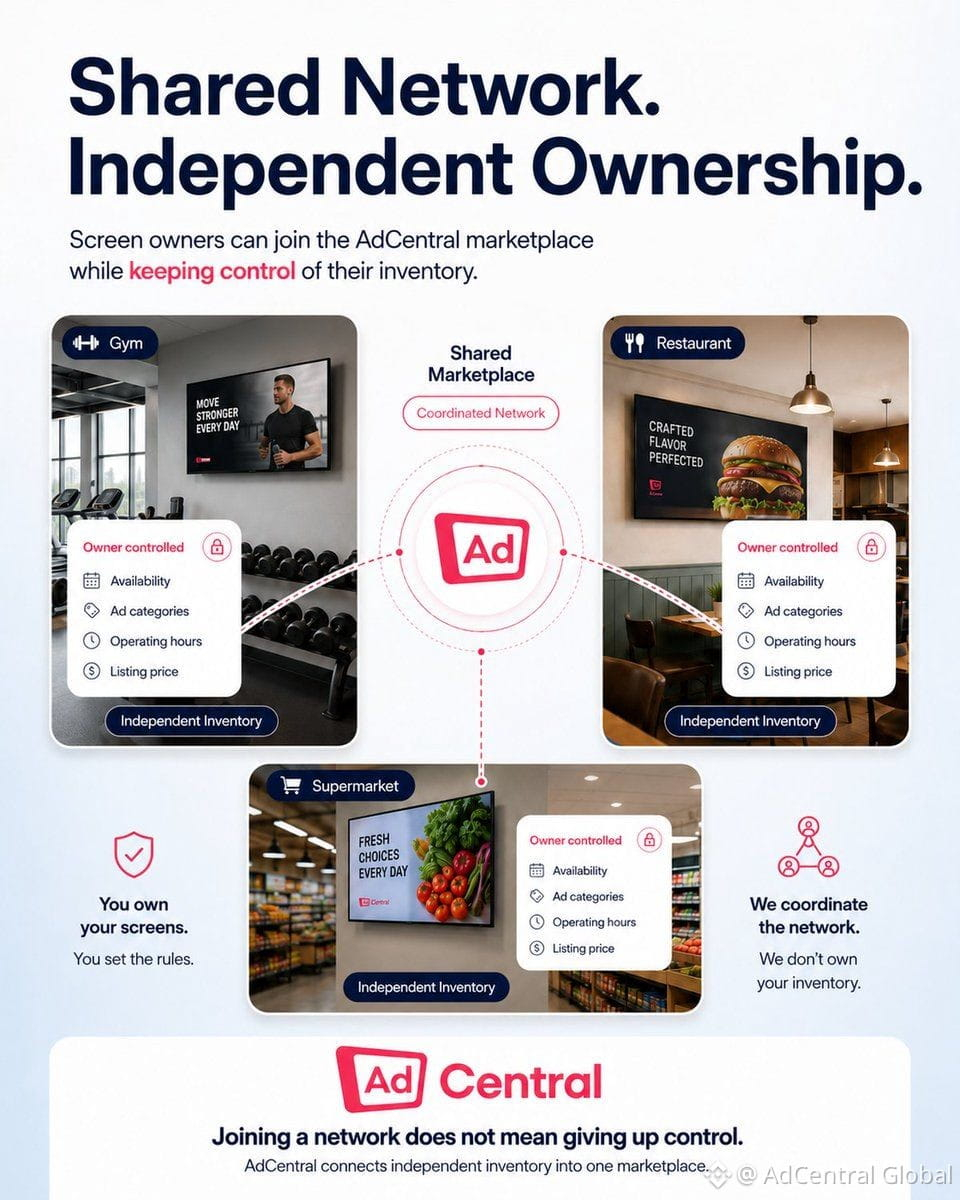
Joining a shared network does not mean giving up control.
With AdCentral, screen owners can decide when their screens are available, which ad categories they accept, and how their inventory is priced.
AdCentral connects that independent inventory into one marketplace.
#DePIN
Shared network. Independent ownership.
With AdCentral, screen owners can decide when their screens are available, which ad categories they accept, and how their inventory is priced.
AdCentral connects that independent inventory into one marketplace.
#DePIN
Shared network. Independent ownership.
1
92
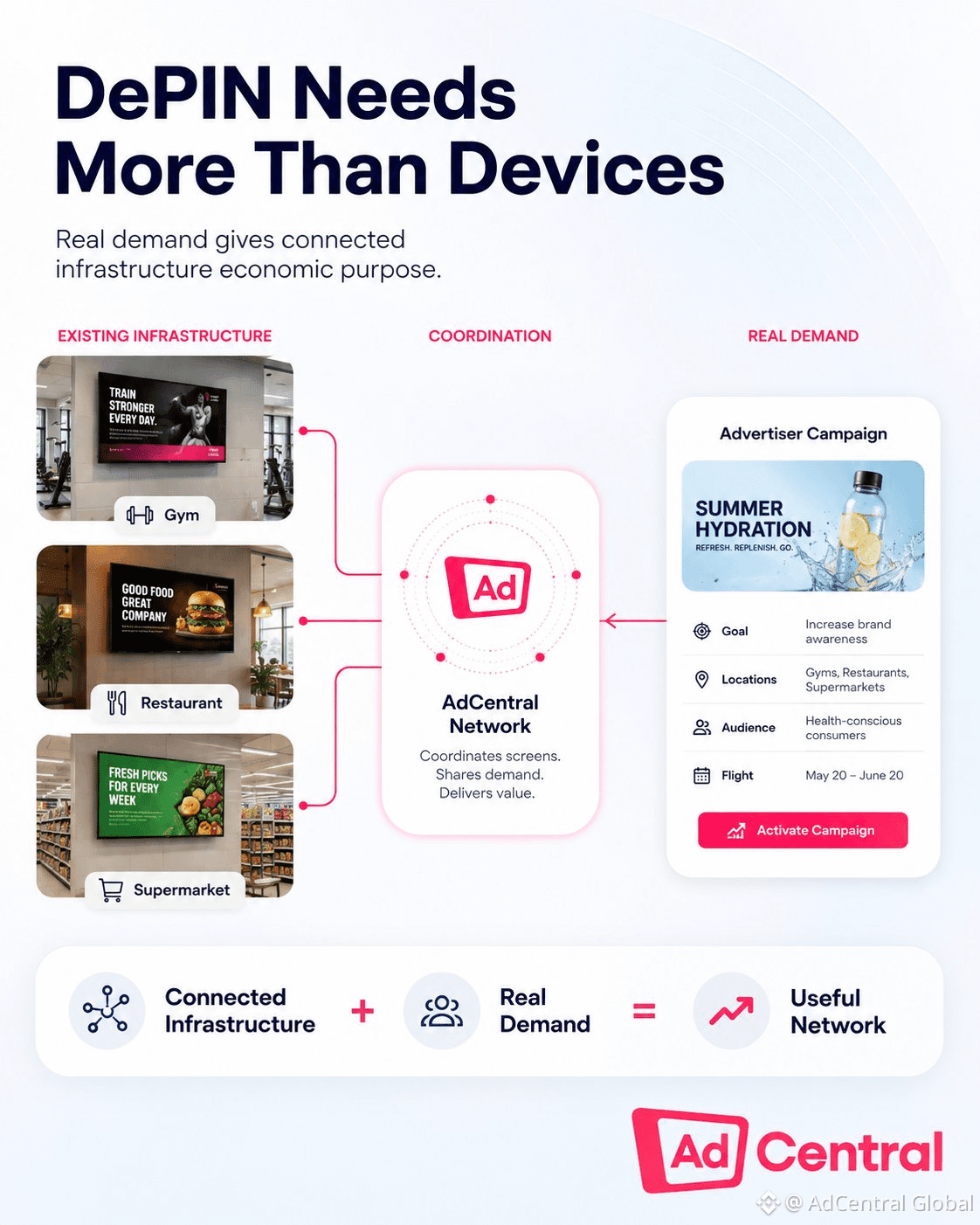
#DePIN needs more than connected devices.
A network becomes useful when there is real demand for what that infrastructure can provide.
For AdCentral, that means independently owned screens connected to advertisers running real campaigns.
More devices can grow supply.
Real demand is what gives that supply economic purpose.
A network becomes useful when there is real demand for what that infrastructure can provide.
For AdCentral, that means independently owned screens connected to advertisers running real campaigns.
More devices can grow supply.
Real demand is what gives that supply economic purpose.
1
68
Ever walked past a screen in a mall, cafe, or office lobby that's just sitting there, showing nothing useful?
That's called DOOH, digital out-of-home advertising. In plain terms, it's any digital screen in a public or semi-public space that can run ads.
Most of these screens sit idle way more than people realize. No ads running, no revenue coming in, just... on.
AdCentral connects screen owners with advertisers who want that space, turning downtime into income. The screen owner earns, the advertiser reaches real people in real places, and nobody has to touch a spreadsheet to make it happen.
If you didn't know screens could earn money, follow along, this is just the start.
5
Мақала
ADCL Utility Series 02: How ADCL Network Incentives Are FundedOur first ADCL Utility article explained why useful screens may need network incentives when advertising demand rises and falls.
That leads to another question:
Where does the ADCL used for those incentives come from?
Starting with a bootstrap fund
A growing advertising network may not immediately have enough regular campaign activity to fund its network incentives.
AdCentral therefore has a dedicated bootstrap fund.
This fund provides ADCL for eligible network incentives while advertising activity develops.
As more campaigns run through AdCentral, real advertising activity begins funding those incentives.
Direct access, with partners where useful
AdCentral is building a self-service marketplace where advertisers can discover screens, plan campaigns and book directly.
Direct use is encouraged because it provides a simpler process and reduces external costs.
Partners can also play a practical role by introducing advertisers, supporting campaign planning and helping AdCentral enter new locations.
Some campaigns may therefore include applicable payment-processing, partner or other pass-through costs.
These costs are deducted before the remaining campaign value is allocated.
How campaign value is allocated
After a campaign is delivered and verified, the remaining settled value follows an illustrative baseline allocation:
Approximately 70% for screen-owner compensationApproximately 25% for Network Growth and ParticipationApproximately 5% for platform operations
The full 25% Network Growth and Participation allocation will be used to acquire ADCL.
The acquired ADCL will fund network incentives.
A simple example
Imagine that $1,000 remains after deducting any third-party costs, if applicable.
Using the illustrative baseline:
Approximately $700 supports screen-owner compensationApproximately $250 is allocated to Network Growth and ParticipationApproximately $50 supports platform operations
The full $250 Network Growth and Participation allocation will be used to acquire ADCL.
These acquisitions will follow controlled, liquidity-aware execution designed to minimize unnecessary market impact.
The acquired ADCL will then return to the network through controlled incentive emissions.
The complete funding cycle
The funding model has two connected sources.
At the beginning, the dedicated bootstrap fund provides ADCL for network incentives, and it will be gradually phased out as campaign-generated value becomes sufficient to fully support incentives.
As advertising activity grows, approximately 25% of the remaining settled campaign value will be used to acquire ADCL for those incentives.
This creates a simple transition:
The bootstrap fund helps incentives begin.
Real advertising activity helps fund them as the network grows.
That is how AdCentral connects ADCL network incentives to real advertising activity.
ADCL Utility Series 02: How ADCL Network Incentives Are Funded
Our first ADCL Utility article explained why useful screens may need network incentives when advertising demand rises and falls.
That leads to another question:
Where does the ADCL used for those incentives come from?
Starting with a bootstrap fund
A growing advertising network may not immediately have enough regular campaign activity to fund its network incentives.
AdCentral therefore has a dedicated bootstrap fund.
This fund provides ADCL for eligible network incentives while advertising activity develops.
As more campaigns run through AdCentral, real advertising activity begins funding those incentives.
Direct access, with partners where useful
AdCentral is building a self-service marketplace where advertisers can discover screens, plan campaigns and book directly.
Direct use is encouraged because it provides a simpler process and reduces external costs.
Partners can also play a practical role by introducing advertisers, supporting campaign planning and helping AdCentral enter new locations.
Some campaigns may therefore include applicable payment-processing, partner or other pass-through costs.
These costs are deducted before the remaining campaign value is allocated.
How campaign value is allocated
After a campaign is delivered and verified, the remaining settled value follows an illustrative baseline allocation:
Approximately 70% for screen-owner compensationApproximately 25% for Network Growth and ParticipationApproximately 5% for platform operations
The full 25% Network Growth and Participation allocation will be used to acquire ADCL.
The acquired ADCL will fund network incentives.
A simple example
Imagine that $1,000 remains after deducting any third-party costs, if applicable.
Using the illustrative baseline:
Approximately $700 supports screen-owner compensationApproximately $250 is allocated to Network Growth and ParticipationApproximately $50 supports platform operations
The full $250 Network Growth and Participation allocation will be used to acquire ADCL.
These acquisitions will follow controlled, liquidity-aware execution designed to minimize unnecessary market impact.
The acquired ADCL will then return to the network through controlled incentive emissions.
The complete funding cycle
The funding model has two connected sources.
At the beginning, the dedicated bootstrap fund provides ADCL for network incentives, and it will be gradually phased out as campaign-generated value becomes sufficient to fully support incentives.
As advertising activity grows, approximately 25% of the remaining settled campaign value will be used to acquire ADCL for those incentives.
This creates a simple transition:
The bootstrap fund helps incentives begin.
Real advertising activity helps fund them as the network grows.
That is how AdCentral connects ADCL network incentives to real advertising activity.
1
4
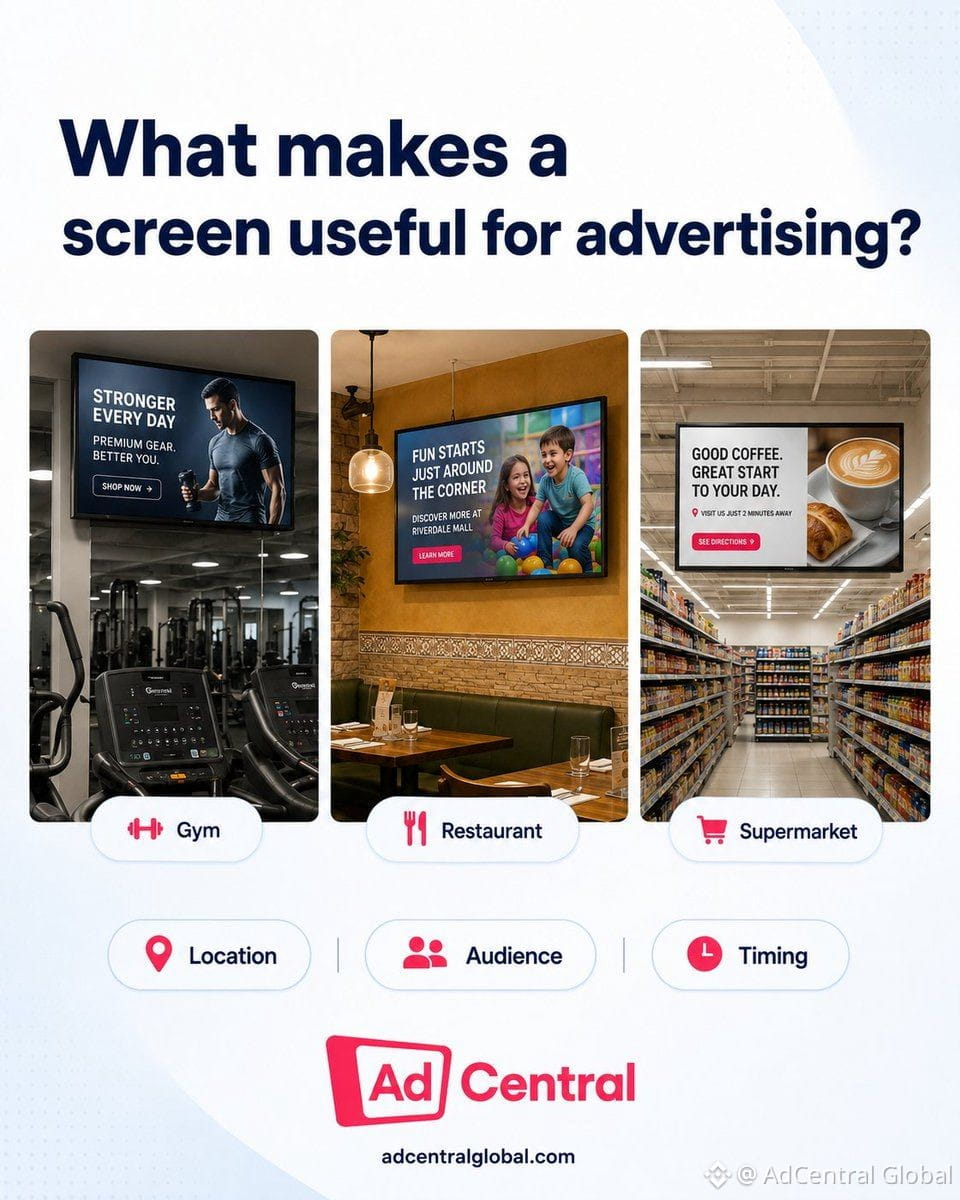
A screen in a gym reaches a different audience from one in a restaurant or supermarket.
Where the screen is, who is likely to see it, and when they are there all matter.
AdCentral helps advertisers find screens that fit their campaign.
A screen in a gym reaches a different audience from one in a restaurant or supermarket.
Where the screen is, who is likely to see it, and when they are there all matter.
AdCentral helps advertisers find screens that fit their campaign.
Where the screen is, who is likely to see it, and when they are there all matter.
AdCentral helps advertisers find screens that fit their campaign.
1
42
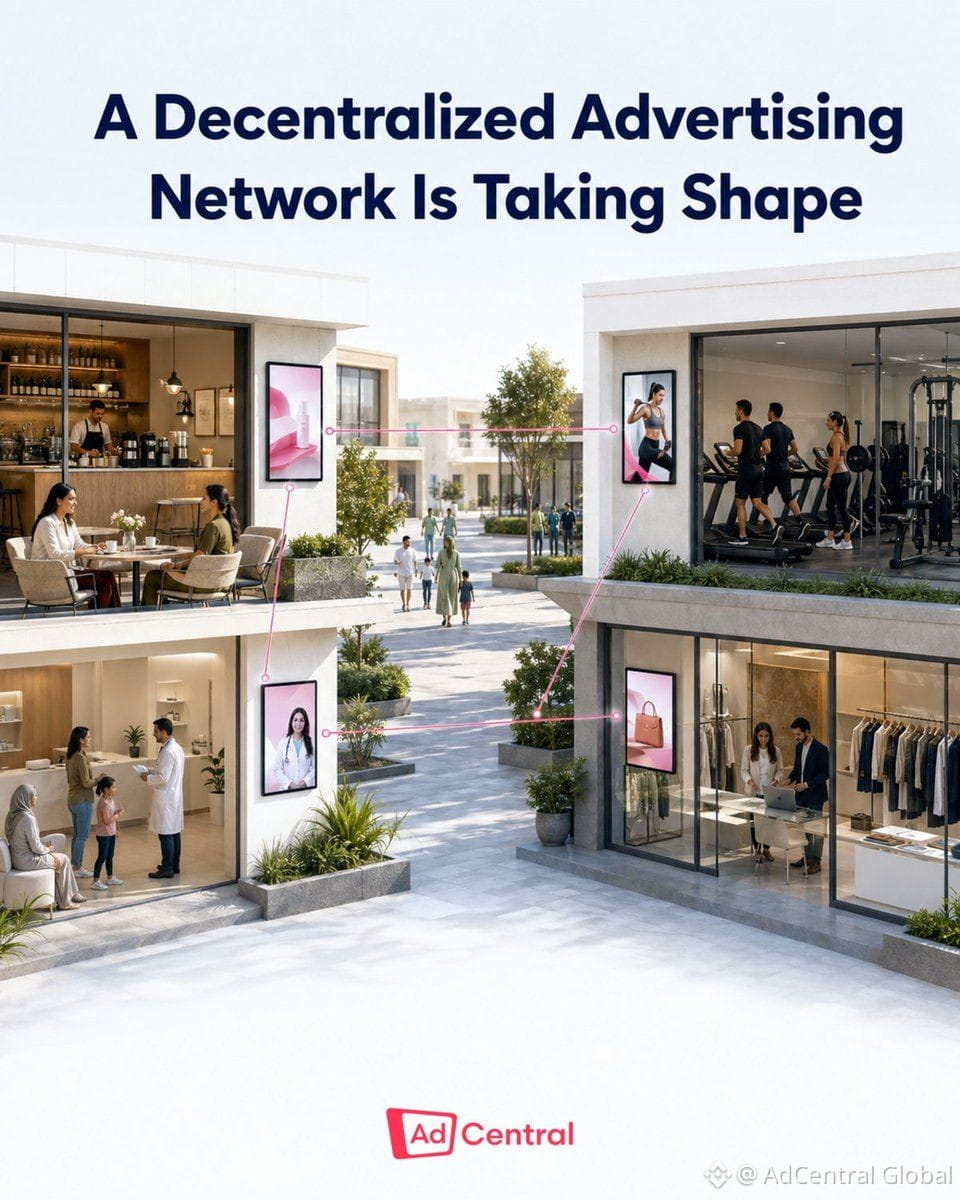
A decentralized advertising network is taking shape in Dubai.
Screens inside cafes, gyms and clinics remain owned by local businesses.
AdCentral connects them into one shared network.
This is DePIN built from real world infrastructure.
A decentralized advertising network is taking shape in Dubai.
Screens inside cafes, gyms and clinics remain owned by local businesses.
AdCentral connects them into one shared network.
This is DePIN built from real world infrastructure.
Screens inside cafes, gyms and clinics remain owned by local businesses.
AdCentral connects them into one shared network.
This is DePIN built from real world infrastructure.
1
30
What makes this network useful?
Advertisers can discover and use screens across independent venues through one marketplace.
AdCentral verifies campaign delivery.
This connects decentralized infrastructure with real business demand.
What makes this network useful?
Advertisers can discover and use screens across independent venues through one marketplace.
AdCentral verifies campaign delivery.
This connects decentralized infrastructure with real business demand.
Advertisers can discover and use screens across independent venues through one marketplace.
AdCentral verifies campaign delivery.
This connects decentralized infrastructure with real business demand.
1
44
Көбірек контент көру үшін кіріңіз
Binance Square платформасында әлемдік криптоқоғамдастыққа қосылыңыз
⚡️ Криптовалюта туралы ең соңғы және пайдалы ақпаратты алыңыз.
💬 Әлемдегі ең ірі криптобиржаның сеніміне ие.
👍 Расталған авторлардың нақты пікірлерін табыңыз.
Электрондық пошта/телефон нөмірі