
Alex1i9
180 Жариялаулар

Alex1i9
Хабарлау
Пайдаланушыны блоктау
Bull bear whatever - I am Here | #Binance KOL |
0 Жазылым
11 Жазылушылар
17 лайк басылған
Жазбалар
·
--
Volatility exposes the real risk 👀
Macro conditions can change quickly, and when $HYPE and $ZEC move this fast, I care less about calling the bottom and more about whether my position can survive the path.
A perp can be right on direction and still get liquidated by a wick before the recovery arrives.
A bought option changes that problem because there is no liquidation price and the premium defines the maximum loss, although the move still has to happen before expiry.
That trade-off is why I would compare the same view through Aevo Easy Mode before defaulting to another leveraged perp.
It doesn’t make the thesis correct or guarantee the outcome, but it makes the cost of being wrong visible before the trade opens.
In a market like this, that clarity matters more to me than adding more leverage.
#Macro Insights#
67
·
--
Buybacks become stronger as ecosystems grow 🔥
Across projects such as $HYPE and $PUMP revenue-linked buybacks have become a major part of how the market evaluates token economics.
The headline burn number matters, but I think the more important question is where the capital behind each buyback comes from and whether that source can expand with ecosystem activity.
Injective connects its Community BuyBack with revenue collected across applications in its ecosystem, as participants commit INJ for a proportional share of that revenue before every committed INJ is permanently burned.
More than 7.29M INJ has now been removed from circulation across all burns, with the Community BuyBack accounting for 517,692 INJ during its first 14 rounds.
This creates a direct relationship between new applications, additional financial markets, ecosystem revenue, and the recurring reduction of INJ supply 👀
#Altcoin Season#
45
·
--
The Rent vs Own Problem 🖥️
I've noticed something interesting about how AI compute gets priced.
Two teams can run the same model and still pay very different amounts for it.
Why?
Because one is renting the hardware, and the other owns it.
Imagine one team pays a hyperscaler by the hour forever, while another buys the GPU once and rents out its idle hours.
Both setups might run the model just as well.
But they end up with very different balance sheets.
This becomes particularly relevant as decentralized AI networks like $TAO push more demand onto raw compute.
What stands out about B3IQ is its approach to compute ownership.
Owners finance their own bare-metal NVIDIA machines, B3IQ hosts and operates them, and teams rent the spare capacity, with owners keeping 85% of what it earns.
That doesn't automatically make owning cheaper than renting.
Earnings depend on demand, and the $B3 token isn't used in the hardware itself, only through buybacks from B3 Labs profits.
But it creates a way for smaller players to hold the asset instead of just paying for access to it.
I think this distinction deserves more attention as AI demand keeps outpacing GPU supply.
Before comparing two compute bills, make sure you know who owns the machine.
#Altcoin Season#
62
·
--
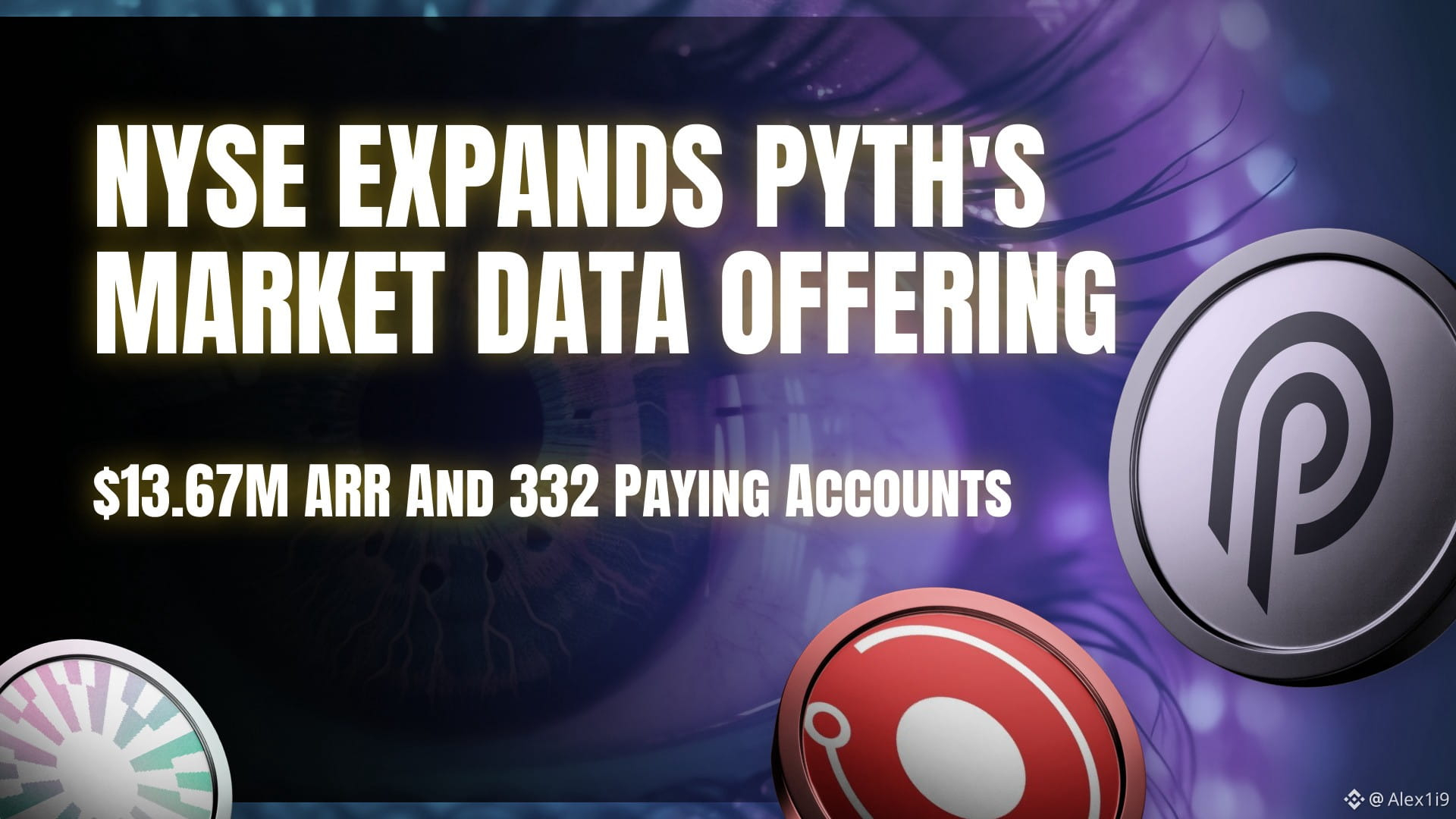
NYSE Adds Another Institutional Product To Pyth 📊
The infrastructure thesis familiar to $MNT and the software-compute economy around $RENDER both make one thing clear: applications become more capable when developers can access specialized services without rebuilding everything themselves.
Pyth's selection by NYSE adds another dimension to that idea.
NYSE BQT provides proprietary U.S. equity data from five exchange markets through the Pyth Data Marketplace.
I think the distinction between this and Pyth Pro's existing business model is especially interesting.
Pyth Pro aggregates prices contributed by financial market participants and delivers those aggregate feeds through a subscription model without exchange-fee pass-throughs.
NYSE BQT is different. Clients license the dataset directly with NYSE under its market-data policies, and Pyth provides the distribution channel.
That gives Pyth two complementary ways to serve applications with different requirements.
One developer might need aggregated prices across numerous asset classes. Another might specifically need the official market data produced by NYSE.
Pyth can support both requirements through its broader product offering.
October's commercial figures already show $13.67M ARR and 332 paying accounts.
I wouldn't assume the NYSE agreement immediately generates a particular amount of new revenue. What interests me is the additional category of data Pyth can now help institutions distribute.
A business that can serve more financial-data requirements becomes more relevant to a wider set of customers.
And NYSE selecting Pyth is a strong endorsement of that direction.
#Altcoin Season# #RWA
51
·
--
Adding A Market Shouldn't Mean Rebuilding Your Stack 🔌
A desk following $UNI doesn't want a new infrastructure project every time another venue matters. That's exactly the problem $2Z Edge is built to simplify.
Different venues traditionally mean different APIs, formats and integrations.
Edge moves toward a different model:
One connection.
A normalized format.
A growing catalog of supported market data.
That becomes increasingly valuable as crypto fragments across more places to trade.
The bull case for the infrastructure is simple.
More markets shouldn't create complexity at the same rate.
The connection should become more useful instead.
#Trading #Infrastructure

65
·
--
Tokenization Has A Security Problem Nobody Can Ignore 👀
Putting traditional assets onchain is only half the challenge. Keeping them secure, confidential and verifiable over the long term is where the real infrastructure opportunity emerges.
$ONDO and $LINK are already bringing tokenized stocks and institutional products onchain, but institutions managing billions in assets need more than blockchain access. They need privacy, operational controls and cryptographic security designed to withstand future threats.
That's where ZKsync is making its play.
Prividium Ledger enables private, verifiable financial operations, while Commander brings permissions and operational controls to supported existing chains.
Airbender Prime adds another piece to ZKsync's broader technology strategy: fast blockchain proving with hash-based STARKs built for post-quantum security.
With 30+ banks participating in Cari Network and Deutsche Bundesbank having tested Prividium technology, institutional interest is clear.
Will need to see how this adoption directly impacts token demand, but the setup is looking solid so far. Keeping my eye on ZK
#Altcoin Season#
81
·
--
Getting Paid Hands Over The Whole Wallet 💸
Putting a wallet address on an invoice is the moment a freelancer, a creator or a small shop gives the client a live view of every other client, every balance and every purchase made from that address.
On $SOL that is the default, because an address is a public account history, so the simplest act in commerce, giving someone a place to pay, doubles as a full statement.
Umbra is one of the apps built for that, a confidential wallet built on $ARX that opened to the public in March, where funds can be held in shielded form and sent and swapped from there.
What matters is narrower than hiding that money moved, since receiving one payment should not hand the sender a map of everything else the wallet has done.
Underneath, the work is split into fragments across a cluster of nodes where no single node holds a readable copy, and the correct result still comes back to the app.
That result settles on Solana as an ordinary public transaction, so the wallet keeps working with the apps and explorers people already use.
Mainnet Alpha has run since February 2, and C-SPL, which will seal the amount inside an ordinary token transfer, has not shipped yet.
Accepting crypto was supposed to be as easy as sharing an address, and the version people actually adopt is the one where sharing it does not share everything behind it.
#Altcoin Season# #Solana
77
·
--
The Snapshot Problem 📸
I've noticed something interesting about how crypto applications display data.
Two dashboards can analyze the same protocol and still report different numbers.
Why?
Because they're not necessarily looking at the same snapshot of the data.
Imagine one dashboard calculates a protocol's activity at 11:59 PM, while another includes transactions recorded after midnight.
Both calculations might be mathematically correct.
But they're answering different questions.
This becomes particularly relevant in high-activity ecosystems like $SOL where financial applications constantly process new transactions.
What stands out about Space and Time is its approach to verifiable data computation.
Through Proof of SQL, applications can verify that supported queries were executed correctly against committed data.
That doesn't automatically make two different snapshots identical.
But it creates a way to independently check the calculations performed against each defined dataset.
I think this distinction deserves more attention as onchain analytics becomes increasingly important.
Before comparing two numbers, make sure they're measuring the same thing.
#Altcoin Season#
43
·
--
The Airdrop Problem Nobody Prices 🎯
I've watched crypto reward campaigns become competitions for whoever can generate the most activity.
Ecosystems like $SOL popularized participation-driven rewards, but I think zkVerify's $VFY -powered verification infrastructure points toward a more important question.
Can a project independently check whether someone actually qualified?
Consider how many reward programs depend on:
• Trading volume
• Completed transactions
• Specific onchain interactions
• Activity before a deadline
Most users see a leaderboard.
What they don't see is how eligibility gets calculated.
Here's the opportunity I find interesting.
An application could generate a zero-knowledge proof demonstrating that its published reward conditions were satisfied.
zkVerify could independently verify that supported proof without needing to expose every underlying activity detail.
Of course, preventing fake identities would require additional evidence and appropriate rules.
But there's a much bigger principle here.
Rewards should be distributed according to verifiable participation, not simply numbers reported by whoever runs the campaign.
I see zkVerify becoming increasingly important as applications move toward proof-backed incentive systems.
The next generation of airdrops needs more than bigger reward pools.
It needs independently checkable eligibility.
#DeFi #Altcoin Season#

57
·
--
Blockchains Have Specialties ⚡
I don't think every blockchain needs to solve every problem.
Actually, I think trying to do everything can make infrastructure harder to understand.
Consider the different responsibilities involved in building a sophisticated onchain application.
You need somewhere to execute transactions.
You might need decentralized application hosting.
And you may need to process historical datasets that are too large or complex to calculate directly inside a smart contract.
Those are separate engineering challenges.
Take $ICP , for example.
Its architecture focuses on supporting applications and computation within its blockchain environment.
Space and Time approaches a different problem.
It provides infrastructure for supported SQL queries over committed data, with Proof of SQL making the computation independently verifiable.
I see this as an important distinction between general-purpose blockchain environments and purpose-built data infrastructure.
One approach focuses on where applications run.
The other focuses on how certain data computations can be checked.
Neither description means one architecture automatically replaces the other.
But understanding their specialties makes the infrastructure landscape much easier to evaluate.
#Altcoin Season#
37
·
--
Everyone Talks About Entries 👀
Traders following markets around $HYPE and $GMX understand that opening a position is only half the battle.
Knowing when and how to exit is equally important.
Yet a surprising number of crypto applications make entering a speculative market considerably easier than managing the position afterward.
I think that imbalance deserves more attention.
Especially when dealing with smaller tokens where liquidity conditions can change quickly.
Zora has been expanding its trading functionality beyond simple buying and selling.
Users can access profit-and-loss information, review activity, inspect token charts and manage individual scheduled autosell orders.
These are practical additions rather than headline-grabbing announcements.
But they address an important problem.
A trading platform becomes more useful when traders can evaluate and manage their positions without constantly relying on external tools.
The interface still cannot eliminate volatility, slippage or liquidity risk.
Those remain essential considerations when trading smaller markets.
However, I'm more interested in products that improve the complete trading experience than those focused exclusively on attracting new buyers.
Zora appears increasingly conscious of that distinction.
If the platform keeps improving execution and position management, it could become considerably more attractive to active traders.
#Trading #DeFi
49
·
--
Web3 plans products better than it plans culture 🔥
Audiences following $AVAX and $NEAR are used to roadmaps that show how technical ecosystems intend to develop over time.
Community-building is rarely given the same horizon.
An event appears, generates a few days of attention and disappears without showing where the wider story is going.
The $Trump Coin Club calendar is taking a more deliberate shape.
Singapore has concluded, a gala dinner is scheduled for November 22, and Los Angeles is already scheduled for February.
That progression makes each experience feel like part of something larger instead of another isolated activation.
A community calendar becomes more meaningful when people can see the next chapter taking shape.
#Macro Insights#

60
·
--
Rewards should follow real trading 🌟
When I trade markets like $XMR or $ZEC the setup always comes first, but the strongest reward systems adds value to activity Im already intended to generate.
That gives the incentive a healthier role because the trader is still making a real directional or volatility decision.
Aevo’s year-end system follows that structure.
Eligible options and Perp Majors volume accumulates toward a 10m qualification requirement.
The other requirement is keeping an active COMMANDER or LEGEND stake.
Accounts meeting both requirements can qualify for the projected 808,800 USDC year-end distribution.
For me, that is how trading incentives should work.
The setup drives the trade, while the reward gives the same volume additional value.
#Altcoin Season#
72
·
--
Crypto Can Turn Network Capacity Into Productive Infrastructure 🔌
$2Z gives bandwidth a role inside a decentralized networking economy. $AVAX shows how much connectivity high-performance distributed systems can require as activity grows.
DoubleZero allows independent contributors to provide links and capacity to the network.
That matters because demand for blockchain infrastructure does not need to be met by one centralized provider building everything itself.
More network demand can support more contributed capacity.
More capacity can support more activity.
That is a very crypto-native way to scale physical infrastructure.
#Trading #Macro Insights#
72
·
--
DeFi's Next Upgrade Is Privacy 🔐
$AAVE helped establish on-chain lending as a major crypto sector. $NIGHT is building the infrastructure for financial applications that don't expose every piece of user information.
DeFi already supports trading, lending, borrowing and asset management through smart contracts.
But public blockchain activity creates a major limitation.
Wallet balances are observable.
Collateral positions can be analyzed.
Trading strategies can be exposed.
And transaction histories remain accessible.
Midnight changes what developers can build.
Its programmable privacy model allows applications to use sensitive information while generating proofs that required conditions have been satisfied.
Think about a lending application that verifies collateral without publishing an entire portfolio.
Or a trading application that protects order details while proving execution rules were followed.
These are the types of financial products programmable privacy enables.
DeFi made finance permissionless. Midnight brings confidentiality into the equation.
That's a major step toward financial applications built for a much broader market.
#DeFi #Privacy
66
·
--
Big Names Get Attention 👀
Microsoft's venture capital fund, M12, backing Space and Time is something that initially caught my attention.
But I don't think institutional backing alone makes a project worth following.
What matters is the technology being developed.
Space and Time is building a decentralized database that allows developers to execute SQL queries and cryptographically verify supported computations.
That's a different infrastructure challenge from what most general-purpose blockchains are solving.
As ecosystems like $AVAX continue supporting increasingly sophisticated applications, specialized data infrastructure could become more important.
Here's how I see it:
💰 Investment creates opportunities.
⚙️ Technology creates capabilities.
📈 Adoption determines long-term relevance.
The backing is interesting, but the infrastructure itself is what makes me want to keep watching.
#Altcoin Season#
64
·
--
$12.62B RWA open interest hit record while $PYTH priced most of the market 📈
$XLM investors understand why rails matter when real-world markets move into crypto, and September’s RWA perp data showed exactly why the pricing rail is becoming a serious part of the stack.
Volume cooled from August, but average daily open interest rose 12% to $11.71B and reached a record $12.62B on September 30.
That is a more useful signal than a simple volume spike.
It means traders carried more exposure across equities, commodities, indices and FX, instead of only rotating through short bursts of activity. When open exposure grows, the quality of the reference price matters more because margin, funding, liquidations and settlement logic all depend on it.
Pyth priced 90.29% of September RWA perp volume and 94.4% of the full Q3 tracked market.
Across Q3, tracked RWA perps did $2.16T in volume, with $2.04T priced by Pyth.
That is the usage story.
The holder story is that the DAO now uses 100% of the funds it receives from Pyth products to accumulate PYTH each month.
This is why I think the market is still underreading the update. Pyth is not only powering a large share of RWA perp pricing, it now has a cleaner process for turning DAO product funds into Reserve accumulation.
The infrastructure is being used, and the token mechanism just became easier to understand.
#Altcoin Season# #RWA
69
·
--
One Click Used To Be A Two Week Integration 🧩
$ENS made a name resolvable with one lookup and $GRT made data queryable without running a node. Both removed a setup step that everyone assumed was permanent. Bankr is doing the same thing to agent capabilities.
Skills in the Bankr terminal install with a click. Your chat can do a thing it could not do a minute earlier, and nothing about your wallet, your keys or your setup changed.
That is a bigger shift than the UI makes it look.
Historically, adding a capability to an automated financial workflow meant reading documentation, obtaining keys, writing glue code, handling errors nobody documented, and then maintaining the whole thing when an endpoint moved.
A skills catalogue collapses that into a toggle. The integration already exists, somebody else maintains it, and what you are choosing is whether your agent has that power or not.
Which turns capability into a permissions question rather than an engineering one. That is the right question to be asking, and most people never got close enough to ask it.
Worth being clear eyed. Every skill you enable is surface area, and a catalogue makes enabling things frictionless in both directions. Install what you need and look at what each one is allowed to do.
The interesting part is who this reaches. Not developers, who could always build it. Everyone else, who never could.
#DeFi #AI

75
·
--
Satoshi Revealed In 2026? 🕵️
2% chance. Potential 50x payout.
Polymarket has a market asking whether Satoshi Nakamoto's identity will be revealed before December 31.
And traders are overwhelmingly betting against it.
🕵️ YES: 2%
❌ NO: 98%
At those odds, a $100 YES position could theoretically return $5,000 if the market resolves successfully.
That's an enormous payout, but it comes with an equally enormous risk of losing the entire stake.
Here's why I find this market fascinating.
The identity of Bitcoin's creator has remained one of the biggest mysteries in technology and finance.
Over the years, numerous theories and alleged identities have circulated, but none has conclusively settled the question.
And Polymarket allows traders to put a price on the probability of that mystery being solved.
What interests me most is how sensitive a low-probability market can be to new information.
If credible evidence emerged and YES odds jumped from 2% to 8%, an existing position could theoretically quadruple in market value.
The identity wouldn't even need to be officially confirmed for traders to react.
That's the difference between trading an outcome and trading expectations.
For traders familiar with assets like $BNB , prediction markets provide another way to approach crypto-related developments without relying entirely on token price movements.
Would you risk $100 on a 2% chance of Satoshi finally being identified?
#Altcoin Season#

77
·
--
Private finance moves beyond transfers 🔒
Assets such as $ZEC and $XMR made private value transfers an enduring part of the crypto market but I think the next privacy cycle will be shaped by more complex financial activity moving onchain.
Injective is developing that direction through CypherOS.
Its first public preview showed transactions being shielded before being sent privately onchain and the longer-term direction extends confidentiality into trading and tokenized assets across the same finance-native network.
We are talking Private RWAs!
If Injective delivers privacy directly across its financial stack, users and institutions could gain confidentiality without moving their activity into a separate ecosystem.
For me, that makes CypherOS more important than a private-transfer feature, this is one of the Injective developments I’m watching most closely 👀
#Macro Insights#

79
Көбірек контент көру үшін кіріңіз
Binance Square платформасында әлемдік криптоқоғамдастыққа қосылыңыз
⚡️ Криптовалюта туралы ең соңғы және пайдалы ақпаратты алыңыз.
💬 Әлемдегі ең ірі криптобиржаның сеніміне ие.
👍 Расталған авторлардың нақты пікірлерін табыңыз.
Электрондық пошта/телефон нөмірі
Трендтегі тақырыптар
USPPIMissMayEaseBTCPressure
66,060 рет көрілді
914 адам талқылап жатыр
US PPI Rises 6.5% a Year in October, Slightly Below 6.6% Forecast
Binance News
·17 лайк
·19.4k рет көрілді
BitcoinCoreDisclosesTorTrafficVulnerability
28,078 рет көрілді
510 адам талқылап жатыр
WhatWillDriveCryptoandStocks’NextRebound?
188,533 рет көрілді
1,719 адам талқылап жатыр