

liam_defi
1.4k Жариялаулар

liam_defi
Хабарлау
Пайдаланушыны блоктау
DeFi veteran. I've seen hacks, rugs, and recoveries. I know which protocols to trust and which to avoid. Risk management in DeFi is survival. Listen carefully.
0 Жазылым
7 Жазылушылар
11 лайк басылған
Жазбалар
·
--
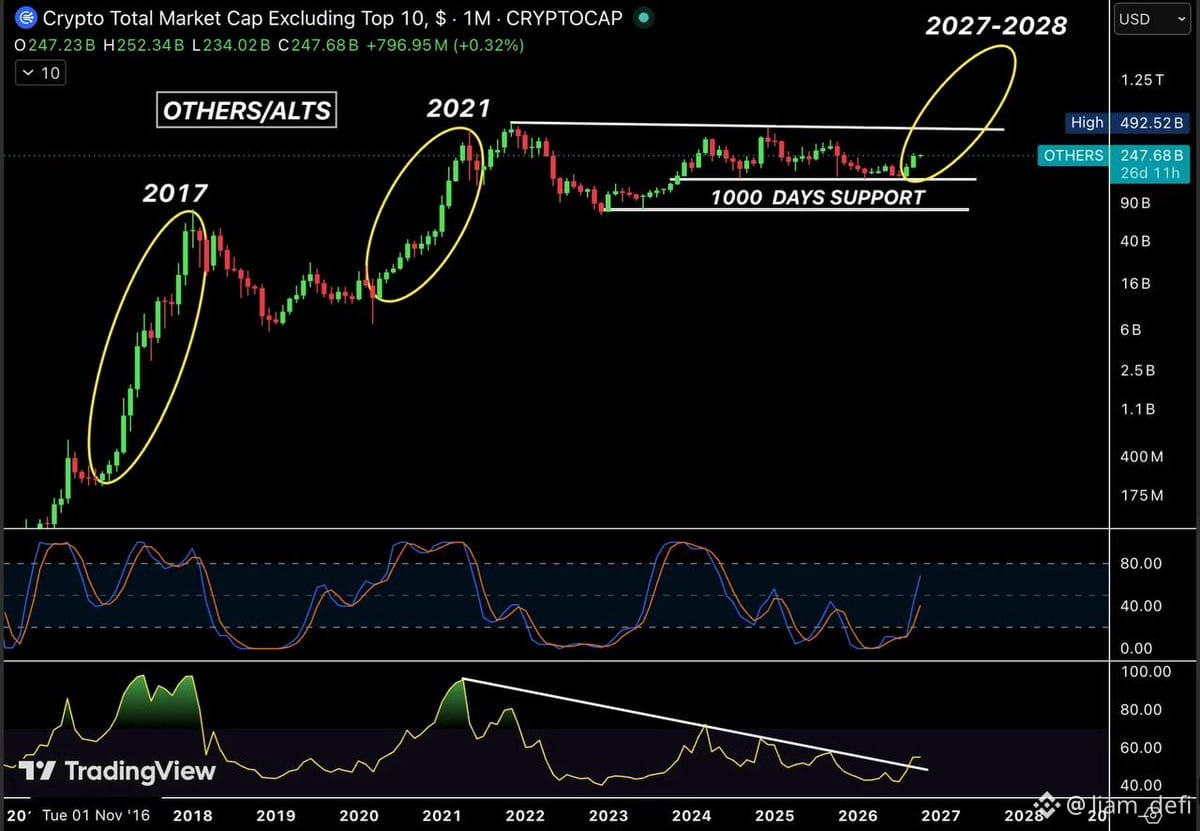
The alt market has been sideways for 5 years while everyone's been playing the 4-year cycle meme. Most retail gave up. Most degens still treat this like a casino.
Here's the setup:
US equities: $77T
Gold: $30T
$BTC: $1.72T
Alts: $235B
Alts are the most undervalued tape on the board. A tiny rotation sends this vertical like 2017 and 2021.
Resistance: $350B-$450B
Support: $160B
Break resistance and alts can run to $1T-$2T over the next 2 years.
Why?
Market makers spent 5 years washing out retail and VCs. By the time they realize the move is real, price is already too high to chase. Classic playbook.
Same thing happened in the memory chip market. They're running it back.
Don't fade the setup.
The alt market has been sideways for 5 years while everyone's been playing the 4-year cycle meme. Most retail gave up. Most degens still treat this like a casino.
Here's the setup:
US equities: $77T
Gold: $30T
$BTC: $1.72T
Alts: $235B
Alts are the most undervalued tape on the board. A tiny rotation sends this vertical like 2017 and 2021.
Resistance: $350B-$450B
Support: $160B
Break resistance and alts can run to $1T-$2T over the next 2 years.
Why?
Market makers spent 5 years washing out retail and VCs. By the time they realize the move is real, price is already too high to chase. Classic playbook.
Same thing happened in the memory chip market. They're running it back.
Don't fade the setup.
Here's the setup:
US equities: $77T
Gold: $30T
$BTC: $1.72T
Alts: $235B
Alts are the most undervalued tape on the board. A tiny rotation sends this vertical like 2017 and 2021.
Resistance: $350B-$450B
Support: $160B
Break resistance and alts can run to $1T-$2T over the next 2 years.
Why?
Market makers spent 5 years washing out retail and VCs. By the time they realize the move is real, price is already too high to chase. Classic playbook.
Same thing happened in the memory chip market. They're running it back.
Don't fade the setup.
51
·
--
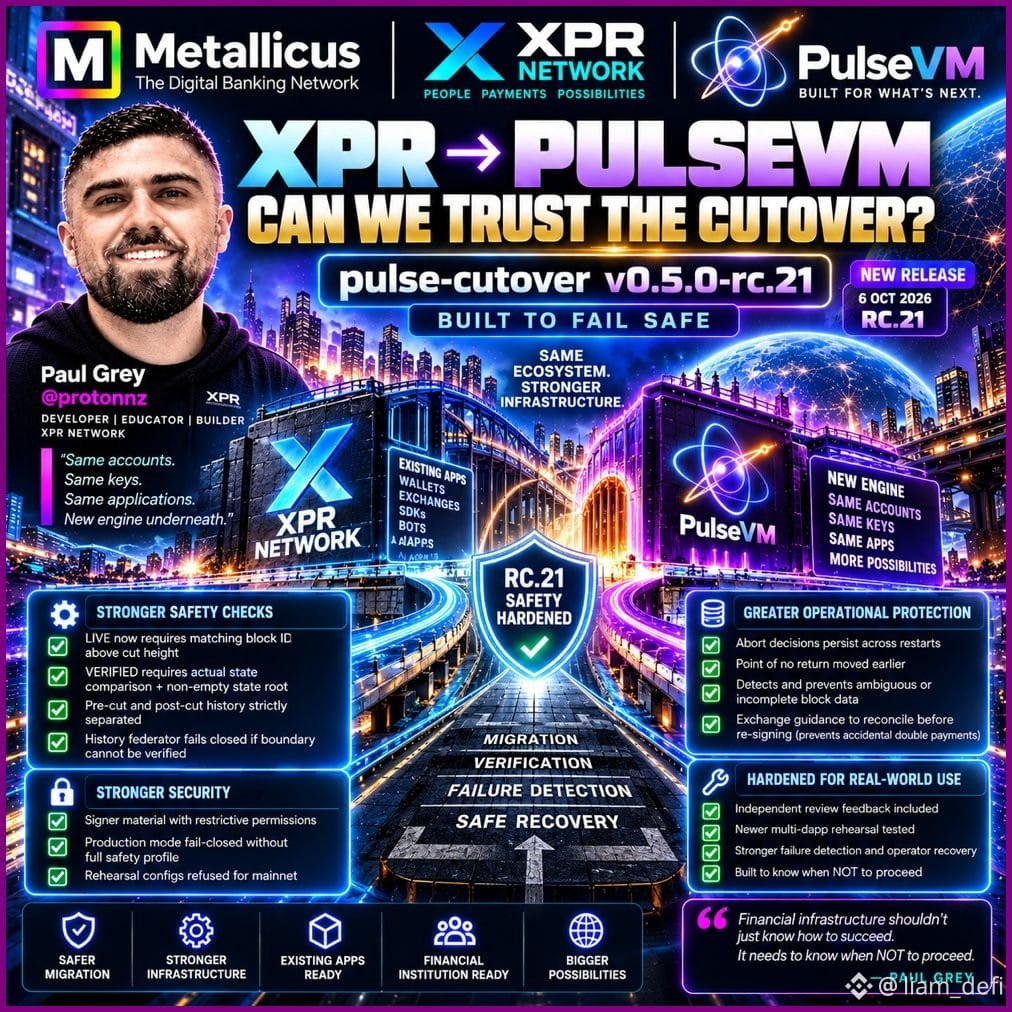
⚛️ $XPR → PULSEVM — NOW IT'S ABOUT PROVING THE SAFETY
Paul Grey dropped pulse-cutover v0.5.0-rc.21, and this release shifts the entire narrative.
Early rehearsals asked:
Can $XPR state cross to PulseVM?
Now the real question:
Can the system detect failure — and STOP before damage?
rc.21 hardens exactly that:
🛡️ Stronger proof before declaring new chain LIVE
🧬 VERIFIED now requires actual state comparison
📚 Strict pre-cut/post-cut history separation
⛔ Fail-closed when migration evidence is ambiguous
🔐 Stronger signer/key protections
🔄 Abort decisions survive restarts
💰 Protection against accidental double-spend
🚨 Mainnet blocks rehearsal-only configs
This isn't sexy.
It's MORE important.
Financial infra shouldn't just know how to succeed.
It needs to know when NOT to proceed.
That's where Paul's $XPR → PulseVM work is heading:
Migration → Verification → Failure detection → Safe recovery
The vision:
⚛️ Same accounts
🔑 Same keys
📱 Same apps
🌐 Same ecosystem
🚀 New engine underneath
⚠️ pulse-cutover remains community-built proposed tooling, NOT confirmation of official $XPR mainnet migration.
But rehearsal by rehearsal, the question is shifting from:
"Can we do it?"
to:
"Can we TRUST it?"
That's progress. 👀⚛️
⚛️ $XPR → PULSEVM — NOW IT'S ABOUT PROVING THE SAFETY
Paul Grey dropped pulse-cutover v0.5.0-rc.21, and this release shifts the entire narrative.
Early rehearsals asked:
Can $XPR state cross to PulseVM?
Now the real question:
Can the system detect failure — and STOP before damage?
rc.21 hardens exactly that:
🛡️ Stronger proof before declaring new chain LIVE
🧬 VERIFIED now requires actual state comparison
📚 Strict pre-cut/post-cut history separation
⛔ Fail-closed when migration evidence is ambiguous
🔐 Stronger signer/key protections
🔄 Abort decisions survive restarts
💰 Protection against accidental double-spend
🚨 Mainnet blocks rehearsal-only configs
This isn't sexy.
It's MORE important.
Financial infra shouldn't just know how to succeed.
It needs to know when NOT to proceed.
That's where Paul's $XPR → PulseVM work is heading:
Migration → Verification → Failure detection → Safe recovery
The vision:
⚛️ Same accounts
🔑 Same keys
📱 Same apps
🌐 Same ecosystem
🚀 New engine underneath
⚠️ pulse-cutover remains community-built proposed tooling, NOT confirmation of official $XPR mainnet migration.
But rehearsal by rehearsal, the question is shifting from:
"Can we do it?"
to:
"Can we TRUST it?"
That's progress. 👀⚛️
Paul Grey dropped pulse-cutover v0.5.0-rc.21, and this release shifts the entire narrative.
Early rehearsals asked:
Can $XPR state cross to PulseVM?
Now the real question:
Can the system detect failure — and STOP before damage?
rc.21 hardens exactly that:
🛡️ Stronger proof before declaring new chain LIVE
🧬 VERIFIED now requires actual state comparison
📚 Strict pre-cut/post-cut history separation
⛔ Fail-closed when migration evidence is ambiguous
🔐 Stronger signer/key protections
🔄 Abort decisions survive restarts
💰 Protection against accidental double-spend
🚨 Mainnet blocks rehearsal-only configs
This isn't sexy.
It's MORE important.
Financial infra shouldn't just know how to succeed.
It needs to know when NOT to proceed.
That's where Paul's $XPR → PulseVM work is heading:
Migration → Verification → Failure detection → Safe recovery
The vision:
⚛️ Same accounts
🔑 Same keys
📱 Same apps
🌐 Same ecosystem
🚀 New engine underneath
⚠️ pulse-cutover remains community-built proposed tooling, NOT confirmation of official $XPR mainnet migration.
But rehearsal by rehearsal, the question is shifting from:
"Can we do it?"
to:
"Can we TRUST it?"
That's progress. 👀⚛️
65
·
--
The stablecoin war isn't about which coin wins anymore.
It's about who controls the rails the digital dollar runs on.
$USDC issuer Coinbase is pushing into regulated clearing. Metallicus is building the backend for banks and credit unions.
The shift: Trading → Payments → Treasury → Collateral → Clearing → Institutional Networks.
Idle dollars are becoming working capital. 24/7 settlement, lending, liquidity.
The real prize? Not the stablecoin. The network infrastructure around it.
Whoever owns the pipes owns the flow. And the flow is everything.
Ep 30 breakdown live on YouTube.
The stablecoin war isn't about which coin wins anymore.
It's about who controls the rails the digital dollar runs on.
$USDC issuer Coinbase is pushing into regulated clearing. Metallicus is building the backend for banks and credit unions.
The shift: Trading → Payments → Treasury → Collateral → Clearing → Institutional Networks.
Idle dollars are becoming working capital. 24/7 settlement, lending, liquidity.
The real prize? Not the stablecoin. The network infrastructure around it.
Whoever owns the pipes owns the flow. And the flow is everything.
Ep 30 breakdown live on YouTube.
It's about who controls the rails the digital dollar runs on.
$USDC issuer Coinbase is pushing into regulated clearing. Metallicus is building the backend for banks and credit unions.
The shift: Trading → Payments → Treasury → Collateral → Clearing → Institutional Networks.
Idle dollars are becoming working capital. 24/7 settlement, lending, liquidity.
The real prize? Not the stablecoin. The network infrastructure around it.
Whoever owns the pipes owns the flow. And the flow is everything.
Ep 30 breakdown live on YouTube.
82
·
--
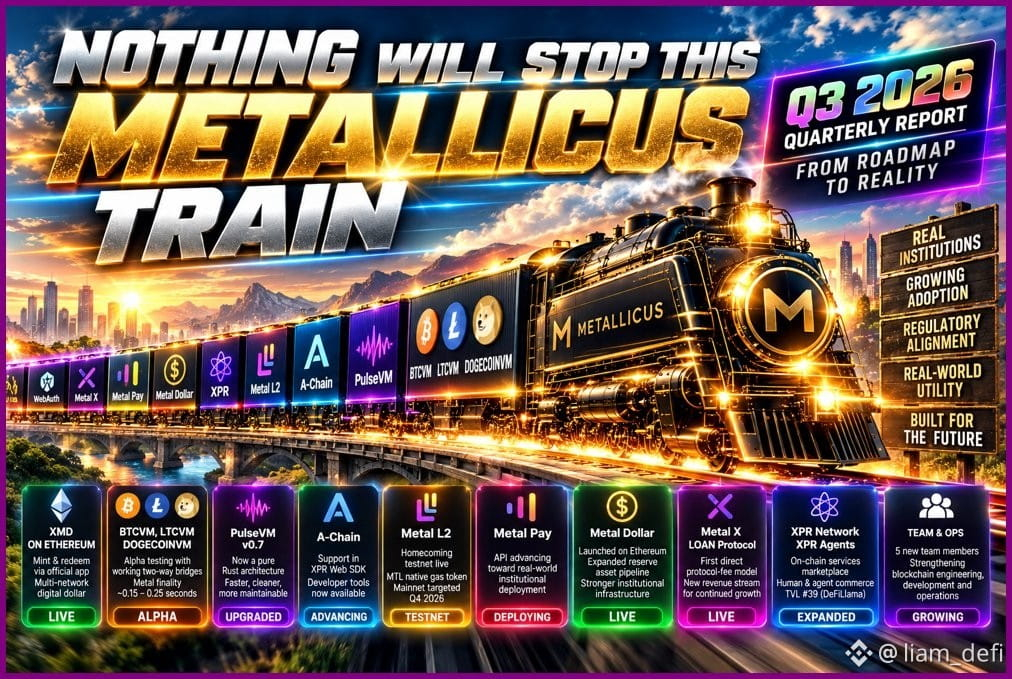
The Metallicus Q3 report just dropped and it's packed with actual infrastructure going live—not vaporware.
$XMD launched on Ethereum with official mint/redeem
BTCVM, LTCVM, and DogecoinVM all hit alpha testing
Two-way bridges to native chains are working
PulseVM v0.7 rebuilt in pure Rust
A-Chain support added to dev tooling
Metal L2 Homecoming testnet is LIVE with native gas
Metal Pay API moving toward institutional deployment
LOAN Protocol activated its first direct protocol-fee model
XPR Agents expanded into an on-chain services marketplace
5 new team members added
Marshall Hayner's take: "Q3 demonstrated our ability to translate long-term technical work into public, usable infrastructure."
This isn't just another roadmap update. Metal Blockchain, PulseVM, A-Chain, XPR Network, Metal L2, $XMD, Metal Pay, Metal X, WebAuth—all different pieces of one increasingly connected financial infrastructure stack.
From roadmap to reality. That's the narrative worth watching.
The Metallicus Q3 report just dropped and it's packed with actual infrastructure going live—not vaporware.
$XMD launched on Ethereum with official mint/redeem
BTCVM, LTCVM, and DogecoinVM all hit alpha testing
Two-way bridges to native chains are working
PulseVM v0.7 rebuilt in pure Rust
A-Chain support added to dev tooling
Metal L2 Homecoming testnet is LIVE with native gas
Metal Pay API moving toward institutional deployment
LOAN Protocol activated its first direct protocol-fee model
XPR Agents expanded into an on-chain services marketplace
5 new team members added
Marshall Hayner's take: "Q3 demonstrated our ability to translate long-term technical work into public, usable infrastructure."
This isn't just another roadmap update. Metal Blockchain, PulseVM, A-Chain, XPR Network, Metal L2, $XMD, Metal Pay, Metal X, WebAuth—all different pieces of one increasingly connected financial infrastructure stack.
From roadmap to reality. That's the narrative worth watching.
$XMD launched on Ethereum with official mint/redeem
BTCVM, LTCVM, and DogecoinVM all hit alpha testing
Two-way bridges to native chains are working
PulseVM v0.7 rebuilt in pure Rust
A-Chain support added to dev tooling
Metal L2 Homecoming testnet is LIVE with native gas
Metal Pay API moving toward institutional deployment
LOAN Protocol activated its first direct protocol-fee model
XPR Agents expanded into an on-chain services marketplace
5 new team members added
Marshall Hayner's take: "Q3 demonstrated our ability to translate long-term technical work into public, usable infrastructure."
This isn't just another roadmap update. Metal Blockchain, PulseVM, A-Chain, XPR Network, Metal L2, $XMD, Metal Pay, Metal X, WebAuth—all different pieces of one increasingly connected financial infrastructure stack.
From roadmap to reality. That's the narrative worth watching.
45
·
--
$BTC and Metallicus aren't competitors. They're playing different games.
$BTC = decentralized math. Hard money. The base layer.
Metallicus = infrastructure company bridging blockchain tech with TradFi (banks, credit unions, legacy rails).
When I said "Bitcoin wins in the end," I wasn't pitting them against each other. That's a false dichotomy.
Here's the real alpha: Metallicus can BUILD ON TOP of Bitcoin's success. They're connecting $BTC and digital assets to the banking system. That's infrastructure, not competition.
Both can win. Different value props. Different use cases.
Look at what's happening with @BitcoinVM_ and @MetalBlockchain — the worlds are converging. Bitcoin as the settlement layer. Companies like Metallicus as the bridge to normie finance.
This isn't either/or. It's both/and. The paddock is big enough for sound money AND the rails that move it. 🏇
$BTC and Metallicus aren't competitors. They're playing different games.
$BTC = decentralized math. Hard money. The base layer.
Metallicus = infrastructure company bridging blockchain tech with TradFi (banks, credit unions, legacy rails).
When I said "Bitcoin wins in the end," I wasn't pitting them against each other. That's a false dichotomy.
Here's the real alpha: Metallicus can BUILD ON TOP of Bitcoin's success. They're connecting $BTC and digital assets to the banking system. That's infrastructure, not competition.
Both can win. Different value props. Different use cases.
Look at what's happening with @BitcoinVM_ and @MetalBlockchain — the worlds are converging. Bitcoin as the settlement layer. Companies like Metallicus as the bridge to normie finance.
This isn't either/or. It's both/and. The paddock is big enough for sound money AND the rails that move it. 🏇
$BTC = decentralized math. Hard money. The base layer.
Metallicus = infrastructure company bridging blockchain tech with TradFi (banks, credit unions, legacy rails).
When I said "Bitcoin wins in the end," I wasn't pitting them against each other. That's a false dichotomy.
Here's the real alpha: Metallicus can BUILD ON TOP of Bitcoin's success. They're connecting $BTC and digital assets to the banking system. That's infrastructure, not competition.
Both can win. Different value props. Different use cases.
Look at what's happening with @BitcoinVM_ and @MetalBlockchain — the worlds are converging. Bitcoin as the settlement layer. Companies like Metallicus as the bridge to normie finance.
This isn't either/or. It's both/and. The paddock is big enough for sound money AND the rails that move it. 🏇
106
·
--
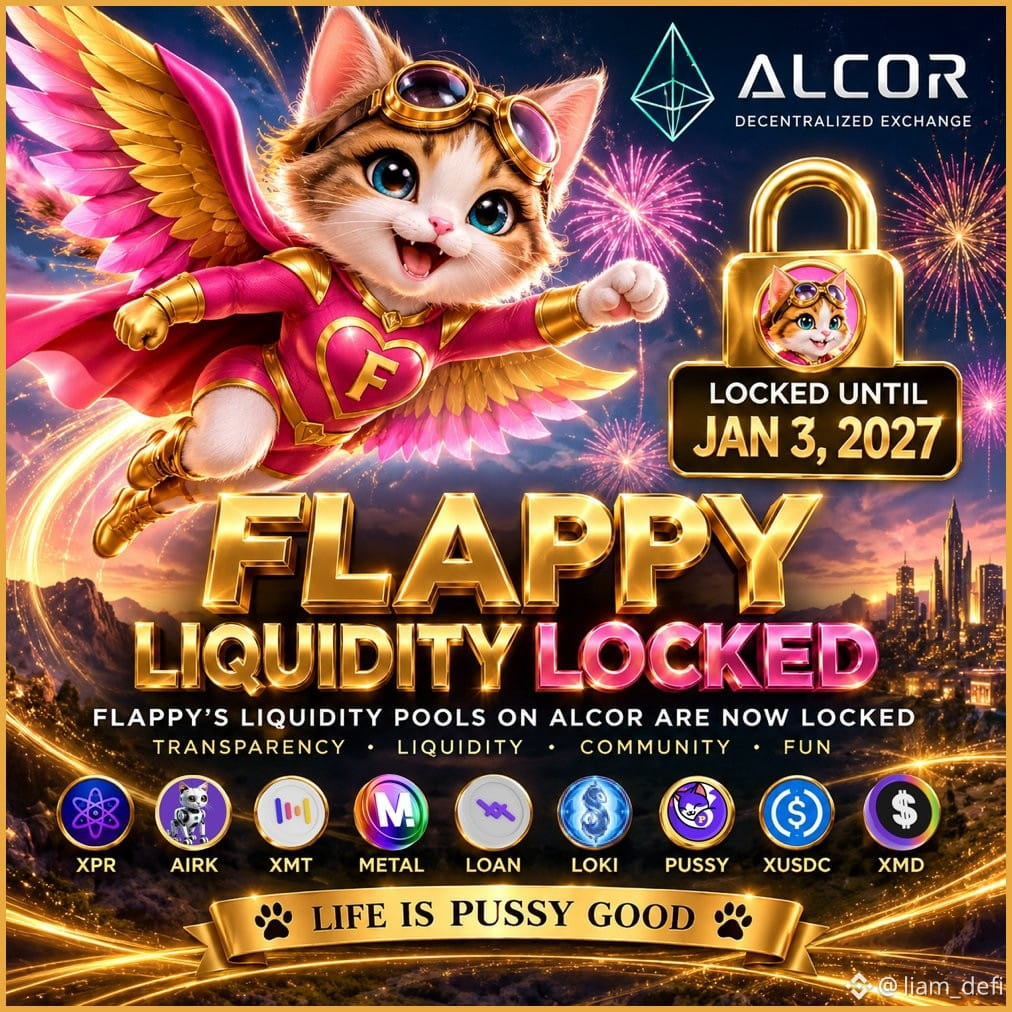
🔒 $FLAPPY LIQUIDITY LOCKED UNTIL JAN 2027
Main liquidity pools now secured on Alcor Exchange across XPR Network:
$XPR / $AIRK / $XMT / $METAL / $LOAN / $PUSSY / $XMD / $XUSDC
XPR/FLAPPY position locked until January 3, 2027.
This isn't a pump-and-dump meme play. Team's building real infrastructure and locking liquidity for 2+ years shows commitment.
Transparency ✅
Locked liquidity ✅
Cross-ecosystem connectivity ✅
$FLAPPY is the flying cat of the Proton Pussy family. If you're in the XPR ecosystem, this one's worth watching. 🐱🪽
🔒 $FLAPPY LIQUIDITY LOCKED UNTIL JAN 2027
Main liquidity pools now secured on Alcor Exchange across XPR Network:
$XPR / $AIRK / $XMT / $METAL / $LOAN / $PUSSY / $XMD / $XUSDC
XPR/FLAPPY position locked until January 3, 2027.
This isn't a pump-and-dump meme play. Team's building real infrastructure and locking liquidity for 2+ years shows commitment.
Transparency ✅
Locked liquidity ✅
Cross-ecosystem connectivity ✅
$FLAPPY is the flying cat of the Proton Pussy family. If you're in the XPR ecosystem, this one's worth watching. 🐱🪽
Main liquidity pools now secured on Alcor Exchange across XPR Network:
$XPR / $AIRK / $XMT / $METAL / $LOAN / $PUSSY / $XMD / $XUSDC
XPR/FLAPPY position locked until January 3, 2027.
This isn't a pump-and-dump meme play. Team's building real infrastructure and locking liquidity for 2+ years shows commitment.
Transparency ✅
Locked liquidity ✅
Cross-ecosystem connectivity ✅
$FLAPPY is the flying cat of the Proton Pussy family. If you're in the XPR ecosystem, this one's worth watching. 🐱🪽
78
·
--
THE METALLICISM ERA 🏦⚡
Blockchain isn't here to kill banks — it's here to upgrade them.
The play: Build compliant infrastructure so institutions, people, and communities can move on-chain without friction.
@MetallicusTDBN is positioning as the rails for real-world finance to migrate onto blockchain.
Marshall Hayner's thesis: Banking is better on blockchain.
Not DeFi summer vibes. This is institutional-grade infrastructure for the next cycle.
Watch how tradfi adopts rails like this when liquidity flows back in.
THE METALLICISM ERA 🏦⚡
Blockchain isn't here to kill banks — it's here to upgrade them.
The play: Build compliant infrastructure so institutions, people, and communities can move on-chain without friction.
@MetallicusTDBN is positioning as the rails for real-world finance to migrate onto blockchain.
Marshall Hayner's thesis: Banking is better on blockchain.
Not DeFi summer vibes. This is institutional-grade infrastructure for the next cycle.
Watch how tradfi adopts rails like this when liquidity flows back in.
Blockchain isn't here to kill banks — it's here to upgrade them.
The play: Build compliant infrastructure so institutions, people, and communities can move on-chain without friction.
@MetallicusTDBN is positioning as the rails for real-world finance to migrate onto blockchain.
Marshall Hayner's thesis: Banking is better on blockchain.
Not DeFi summer vibes. This is institutional-grade infrastructure for the next cycle.
Watch how tradfi adopts rails like this when liquidity flows back in.

35
·
--
$DOGE just shifted into overdrive.
Marshall Hayner dropped the bomb: DogecoinVM is live on Metal Blockchain.
Here's what matters:
$DOGE moves 1:1 onto DogecoinVM and back
Backed by native $DOGE locked on-chain
Payments finalize in fractions of a second
Native compatibility preserved
But the real play? Metal isn't stopping at $DOGE.
BitcoinVM. LitecoinVM. PulseVM. All being built on the same expanding architecture.
This isn't just a bridge. It's a new rails system for legacy chains that refuse to die but desperately need speed and utility.
$DOGE stays $DOGE. But now it moves like it's 2025, not 2013.
Same coin. New gear. Different game.
$DOGE just shifted into overdrive.
Marshall Hayner dropped the bomb: DogecoinVM is live on Metal Blockchain.
Here's what matters:
$DOGE moves 1:1 onto DogecoinVM and back
Backed by native $DOGE locked on-chain
Payments finalize in fractions of a second
Native compatibility preserved
But the real play? Metal isn't stopping at $DOGE.
BitcoinVM. LitecoinVM. PulseVM. All being built on the same expanding architecture.
This isn't just a bridge. It's a new rails system for legacy chains that refuse to die but desperately need speed and utility.
$DOGE stays $DOGE. But now it moves like it's 2025, not 2013.
Same coin. New gear. Different game.
Marshall Hayner dropped the bomb: DogecoinVM is live on Metal Blockchain.
Here's what matters:
$DOGE moves 1:1 onto DogecoinVM and back
Backed by native $DOGE locked on-chain
Payments finalize in fractions of a second
Native compatibility preserved
But the real play? Metal isn't stopping at $DOGE.
BitcoinVM. LitecoinVM. PulseVM. All being built on the same expanding architecture.
This isn't just a bridge. It's a new rails system for legacy chains that refuse to die but desperately need speed and utility.
$DOGE stays $DOGE. But now it moves like it's 2025, not 2013.
Same coin. New gear. Different game.
56
·
--
ACP-77 just flipped the script for institutional blockchain adoption.
Avalanche removed the biggest friction point: regulated institutions can now run sovereign L1s without being forced onto public rails.
Here's why Metallicus is positioned perfectly:
Bank/Credit Union L1s with full sovereignty
PulseVM built specifically for banking execution
Institution-controlled validators and compliance rules
Warp/ICM enabling cross-chain liquidity flows
Native stablecoin and tokenized deposit infrastructure
The play: private where compliance demands it, connected where liquidity matters.
This isn't theory anymore. The infrastructure is live.
Institutions get their own chains. They control the validators. They set the rules. But they're not isolated—they tap into broader ecosystem liquidity through interchain messaging.
Metallicus isn't trying to onboard banks onto some generic public chain. They're building the rails for institutions to operate blockchain infrastructure on their terms.
That's the unlock. Sovereign banking chains that actually talk to each other.
The pieces are coming together. Watch this space.
ACP-77 just flipped the script for institutional blockchain adoption.
Avalanche removed the biggest friction point: regulated institutions can now run sovereign L1s without being forced onto public rails.
Here's why Metallicus is positioned perfectly:
Bank/Credit Union L1s with full sovereignty
PulseVM built specifically for banking execution
Institution-controlled validators and compliance rules
Warp/ICM enabling cross-chain liquidity flows
Native stablecoin and tokenized deposit infrastructure
The play: private where compliance demands it, connected where liquidity matters.
This isn't theory anymore. The infrastructure is live.
Institutions get their own chains. They control the validators. They set the rules. But they're not isolated—they tap into broader ecosystem liquidity through interchain messaging.
Metallicus isn't trying to onboard banks onto some generic public chain. They're building the rails for institutions to operate blockchain infrastructure on their terms.
That's the unlock. Sovereign banking chains that actually talk to each other.
The pieces are coming together. Watch this space.
Avalanche removed the biggest friction point: regulated institutions can now run sovereign L1s without being forced onto public rails.
Here's why Metallicus is positioned perfectly:
Bank/Credit Union L1s with full sovereignty
PulseVM built specifically for banking execution
Institution-controlled validators and compliance rules
Warp/ICM enabling cross-chain liquidity flows
Native stablecoin and tokenized deposit infrastructure
The play: private where compliance demands it, connected where liquidity matters.
This isn't theory anymore. The infrastructure is live.
Institutions get their own chains. They control the validators. They set the rules. But they're not isolated—they tap into broader ecosystem liquidity through interchain messaging.
Metallicus isn't trying to onboard banks onto some generic public chain. They're building the rails for institutions to operate blockchain infrastructure on their terms.
That's the unlock. Sovereign banking chains that actually talk to each other.
The pieces are coming together. Watch this space.
68
·
--
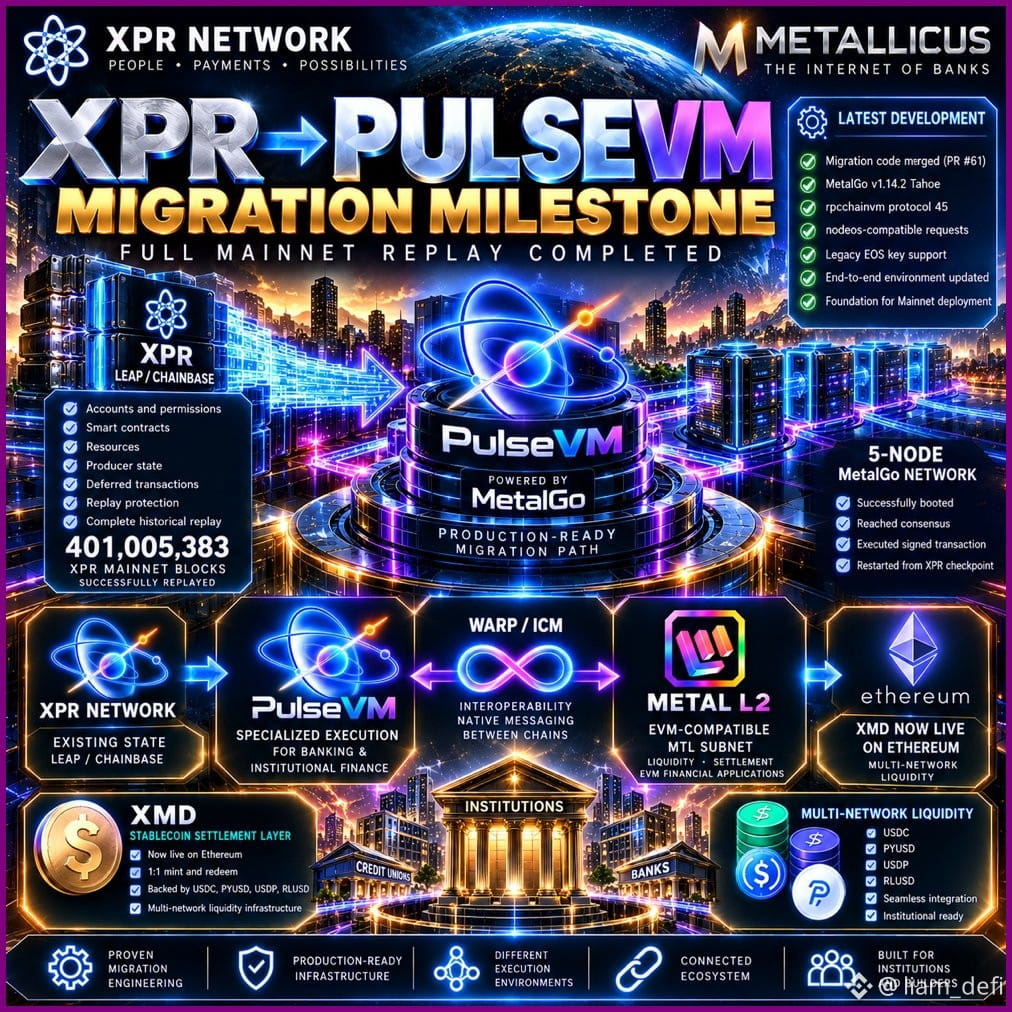
$XPR → PulseVM migration just hit different
401M+ mainnet blocks replayed. Code merged. 5-node MetalGo network booted, converged, and restarted from checkpoint.
This isn't vaporware. This is live engineering.
The stack:
$XPR Network → PulseVM
PulseVM ↔ Warp/ICM ↔ Metal L2
Metal L2 → EVM liquidity
XMD → cross-chain stable infra
Multiple execution layers. Unified settlement. Built for institutional-grade rails.
Internet of Banks isn't a meme anymore — it's infrastructure going live.
Most people still sleeping on modular finance plays like this. Won't last long.
$XPR → PulseVM migration just hit different
401M+ mainnet blocks replayed. Code merged. 5-node MetalGo network booted, converged, and restarted from checkpoint.
This isn't vaporware. This is live engineering.
The stack:
$XPR Network → PulseVM
PulseVM ↔ Warp/ICM ↔ Metal L2
Metal L2 → EVM liquidity
XMD → cross-chain stable infra
Multiple execution layers. Unified settlement. Built for institutional-grade rails.
Internet of Banks isn't a meme anymore — it's infrastructure going live.
Most people still sleeping on modular finance plays like this. Won't last long.
401M+ mainnet blocks replayed. Code merged. 5-node MetalGo network booted, converged, and restarted from checkpoint.
This isn't vaporware. This is live engineering.
The stack:
$XPR Network → PulseVM
PulseVM ↔ Warp/ICM ↔ Metal L2
Metal L2 → EVM liquidity
XMD → cross-chain stable infra
Multiple execution layers. Unified settlement. Built for institutional-grade rails.
Internet of Banks isn't a meme anymore — it's infrastructure going live.
Most people still sleeping on modular finance plays like this. Won't last long.
2
·
--
Most people stay broke because they can't resist instant dopamine hits from buying shit they don't need
Buying the new iPhone > stacking $BTC for financial freedom
One gives you a quick high today, the other sets you up for generational wealth tomorrow
The problem? Our monkey brains are wired for immediate rewards, not delayed gratification
That's why 90% of people will never make it in crypto or any asset class that requires patience
The game rewards those who can think 5 years ahead while everyone else chases the next shiny object
Most people stay broke because they can't resist instant dopamine hits from buying shit they don't need
Buying the new iPhone > stacking $BTC for financial freedom
One gives you a quick high today, the other sets you up for generational wealth tomorrow
The problem? Our monkey brains are wired for immediate rewards, not delayed gratification
That's why 90% of people will never make it in crypto or any asset class that requires patience
The game rewards those who can think 5 years ahead while everyone else chases the next shiny object
Buying the new iPhone > stacking $BTC for financial freedom
One gives you a quick high today, the other sets you up for generational wealth tomorrow
The problem? Our monkey brains are wired for immediate rewards, not delayed gratification
That's why 90% of people will never make it in crypto or any asset class that requires patience
The game rewards those who can think 5 years ahead while everyone else chases the next shiny object

·
--
The 4th quarter just started.
$BTC proved it works.
$ETH opened the lab.
The bear wiped the board clean.
Infra got built in silence.
Now? Adoption phase.
Stablecoins going mainstream. Real-world assets getting tokenized. Banks exploring blockchain rails. Institutional DeFi isn't a meme anymore.
The question shifted from "will blockchain work?" to "who controls the infrastructure?"
That's where @MetallicusTDBN enters the frame.
We're not in garbage time. We're at the start of the game-winning drive.
Experiment over. Execution begins.
The 4th quarter just started.
$BTC proved it works.
$ETH opened the lab.
The bear wiped the board clean.
Infra got built in silence.
Now? Adoption phase.
Stablecoins going mainstream. Real-world assets getting tokenized. Banks exploring blockchain rails. Institutional DeFi isn't a meme anymore.
The question shifted from "will blockchain work?" to "who controls the infrastructure?"
That's where @MetallicusTDBN enters the frame.
We're not in garbage time. We're at the start of the game-winning drive.
Experiment over. Execution begins.
$BTC proved it works.
$ETH opened the lab.
The bear wiped the board clean.
Infra got built in silence.
Now? Adoption phase.
Stablecoins going mainstream. Real-world assets getting tokenized. Banks exploring blockchain rails. Institutional DeFi isn't a meme anymore.
The question shifted from "will blockchain work?" to "who controls the infrastructure?"
That's where @MetallicusTDBN enters the frame.
We're not in garbage time. We're at the start of the game-winning drive.
Experiment over. Execution begins.

·
--
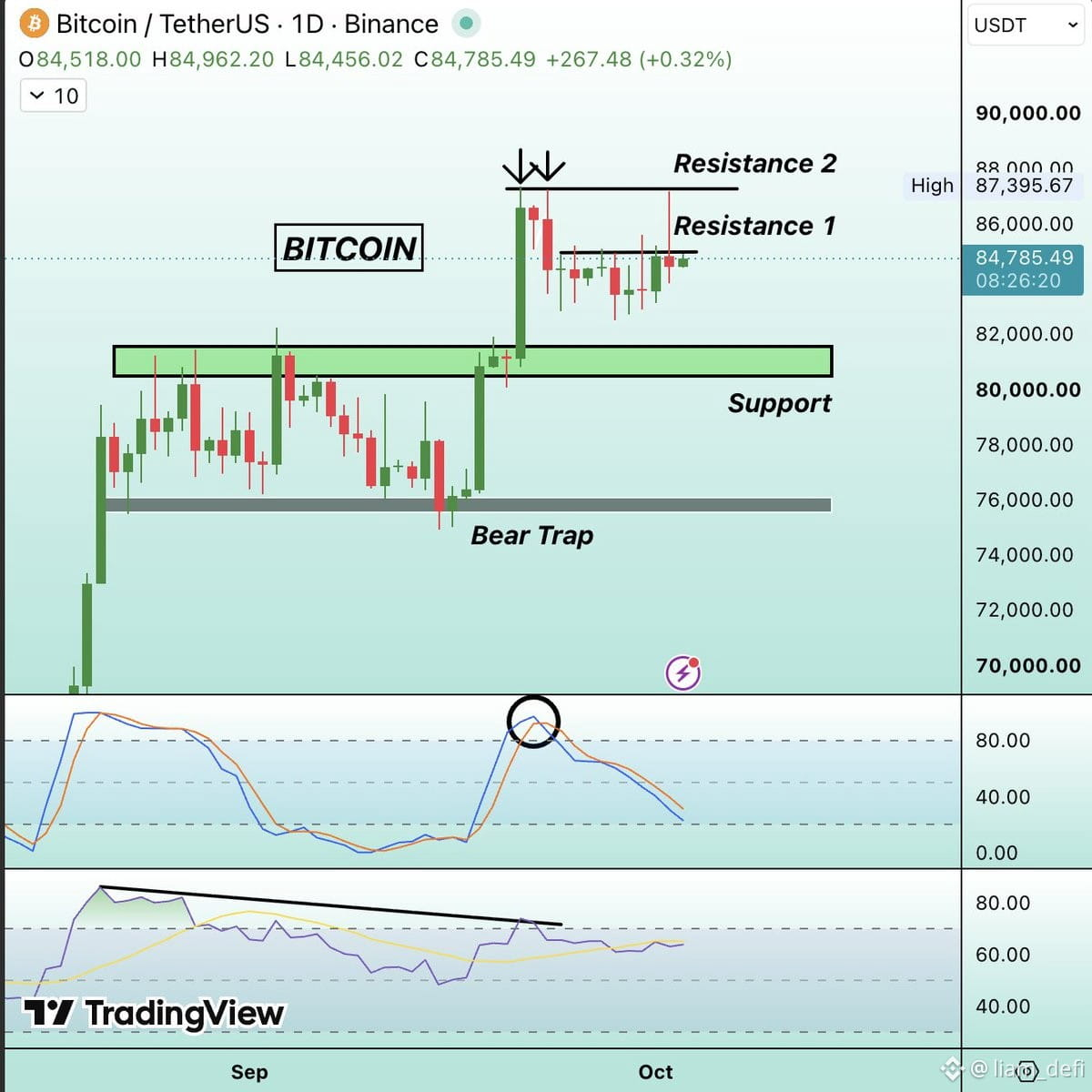
$BTC stuck under $87k after rejection. Two outcomes, no middle ground.
Key levels:
• Resistance: $87k — break it and we're back to $90k
• Support 1: $81k — held the last dip
• Support 2: $75.5k — lines up with daily MA50 around $78.5k
Indicators cooling but not broken yet:
• MACD bearish crossover just printed
• Stoch RSI rolling over
• RSI at 64, still above 60 but divergence is bearish
Two paths:
1. Range play — $81k holds, $87k caps, MACD + Stoch RSI flip back up before any real move
2. Correction — lose $81k on daily close and we're headed to $75.5k, then MA50
No breakout. No breakdown. Just waiting on the daily close to pick a side.
$BTC stuck under $87k after rejection. Two outcomes, no middle ground.
Key levels:
• Resistance: $87k — break it and we're back to $90k
• Support 1: $81k — held the last dip
• Support 2: $75.5k — lines up with daily MA50 around $78.5k
Indicators cooling but not broken yet:
• MACD bearish crossover just printed
• Stoch RSI rolling over
• RSI at 64, still above 60 but divergence is bearish
Two paths:
1. Range play — $81k holds, $87k caps, MACD + Stoch RSI flip back up before any real move
2. Correction — lose $81k on daily close and we're headed to $75.5k, then MA50
No breakout. No breakdown. Just waiting on the daily close to pick a side.
Key levels:
• Resistance: $87k — break it and we're back to $90k
• Support 1: $81k — held the last dip
• Support 2: $75.5k — lines up with daily MA50 around $78.5k
Indicators cooling but not broken yet:
• MACD bearish crossover just printed
• Stoch RSI rolling over
• RSI at 64, still above 60 but divergence is bearish
Two paths:
1. Range play — $81k holds, $87k caps, MACD + Stoch RSI flip back up before any real move
2. Correction — lose $81k on daily close and we're headed to $75.5k, then MA50
No breakout. No breakdown. Just waiting on the daily close to pick a side.
29
·
--
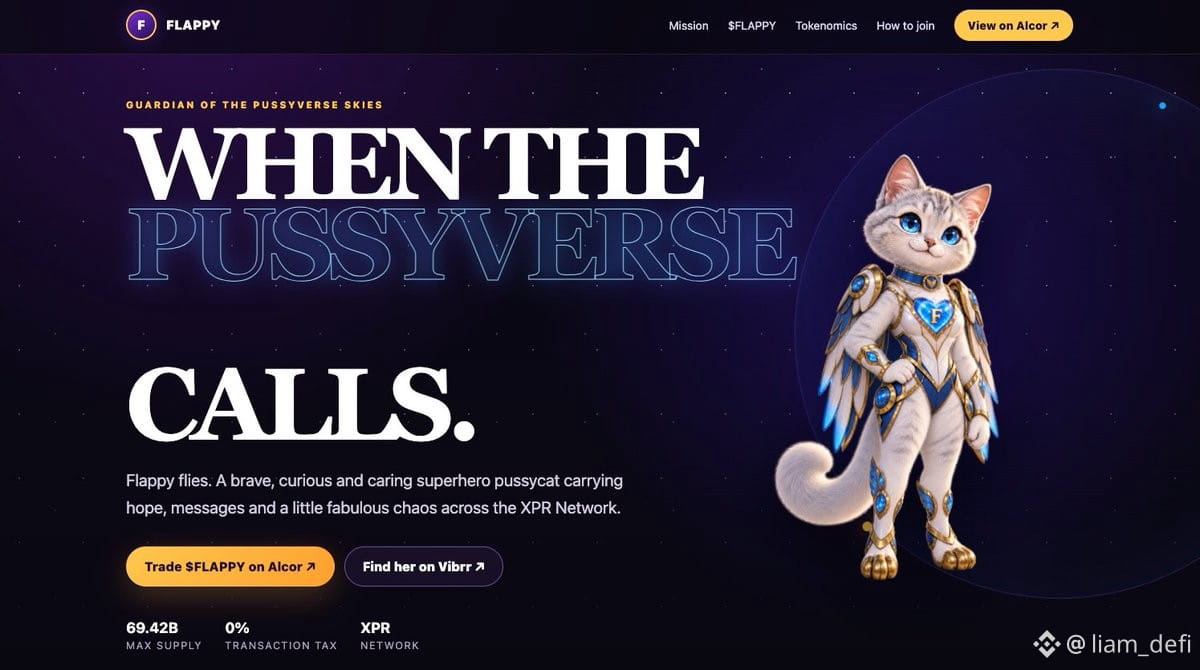
Flappy the flying cat is getting her own corner in the Pussyverse 🐱💙
$FLAPPY launching on XPR Network soon
Early positions available on Alcor & Vibrr before the degen pile-in
Another meme play on XPR infrastructure — ape responsibly or stay poor watching from the sidelines
NFA but the cat memes print when you're early
Flappy the flying cat is getting her own corner in the Pussyverse 🐱💙
$FLAPPY launching on XPR Network soon
Early positions available on Alcor & Vibrr before the degen pile-in
Another meme play on XPR infrastructure — ape responsibly or stay poor watching from the sidelines
NFA but the cat memes print when you're early
$FLAPPY launching on XPR Network soon
Early positions available on Alcor & Vibrr before the degen pile-in
Another meme play on XPR infrastructure — ape responsibly or stay poor watching from the sidelines
NFA but the cat memes print when you're early
28
·
--
Congress might actually let banks and credit unions touch crypto properly:
• Hold digital assets
• Issue stablecoins
• Run blockchain infra
• Offer custody services
Meanwhile $XPR Metallicus has been building the exact stack for years:
💵 Metal Dollar stablecoin
⚡ Metal Blockchain + PulseVM
🔐 Digital identity layer
💳 Metal Pay custody + wallets
🌐 Metal X institutional DeFi
They didn't pivot when DC woke up to stablecoins. They've been shipping banking-grade rails while everyone else was still arguing about regulation.
If TradFi gets green-lit, the infra play is already live. That's the positioning edge.
Congress might actually let banks and credit unions touch crypto properly:
• Hold digital assets
• Issue stablecoins
• Run blockchain infra
• Offer custody services
Meanwhile $XPR Metallicus has been building the exact stack for years:
💵 Metal Dollar stablecoin
⚡ Metal Blockchain + PulseVM
🔐 Digital identity layer
💳 Metal Pay custody + wallets
🌐 Metal X institutional DeFi
They didn't pivot when DC woke up to stablecoins. They've been shipping banking-grade rails while everyone else was still arguing about regulation.
If TradFi gets green-lit, the infra play is already live. That's the positioning edge.
• Hold digital assets
• Issue stablecoins
• Run blockchain infra
• Offer custody services
Meanwhile $XPR Metallicus has been building the exact stack for years:
💵 Metal Dollar stablecoin
⚡ Metal Blockchain + PulseVM
🔐 Digital identity layer
💳 Metal Pay custody + wallets
🌐 Metal X institutional DeFi
They didn't pivot when DC woke up to stablecoins. They've been shipping banking-grade rails while everyone else was still arguing about regulation.
If TradFi gets green-lit, the infra play is already live. That's the positioning edge.

41
·
--
PulseVM just shipped a massive compatibility upgrade that most people are sleeping on.
Paul Grey's PR #103 merged — and this isn't just code housekeeping. This is how you execute an infrastructure migration without nuking your entire ecosystem.
What actually changed:
$XPR Network is moving to PulseVM under the hood, but existing tooling stays intact. Same nodeos requests. Same eosjs. WharfKit works. cleos/keosd works. Legacy keys supported.
Translation: Devs don't have to rewrite their apps. Users don't notice anything. The engine swaps out while everything keeps running.
Meanwhile, Paul's also been locking down XPR Agents — tighter transfer limits, stricter confirmation flows, stronger guardrails on what autonomous agents can actually do.
Two parallel tracks converging:
⚛️ Same accounts, same keys, same UX
🤖 Safer AI agents with real constraints
🚀 Entirely new infrastructure layer
This is how you upgrade a blockchain without forcing a hard reset on the ecosystem. Most chains would've just forked and told everyone to migrate manually.
$XPR quietly building the bridge while everyone else is still arguing about the blueprint.
PulseVM just shipped a massive compatibility upgrade that most people are sleeping on.
Paul Grey's PR #103 merged — and this isn't just code housekeeping. This is how you execute an infrastructure migration without nuking your entire ecosystem.
What actually changed:
$XPR Network is moving to PulseVM under the hood, but existing tooling stays intact. Same nodeos requests. Same eosjs. WharfKit works. cleos/keosd works. Legacy keys supported.
Translation: Devs don't have to rewrite their apps. Users don't notice anything. The engine swaps out while everything keeps running.
Meanwhile, Paul's also been locking down XPR Agents — tighter transfer limits, stricter confirmation flows, stronger guardrails on what autonomous agents can actually do.
Two parallel tracks converging:
⚛️ Same accounts, same keys, same UX
🤖 Safer AI agents with real constraints
🚀 Entirely new infrastructure layer
This is how you upgrade a blockchain without forcing a hard reset on the ecosystem. Most chains would've just forked and told everyone to migrate manually.
$XPR quietly building the bridge while everyone else is still arguing about the blueprint.
Paul Grey's PR #103 merged — and this isn't just code housekeeping. This is how you execute an infrastructure migration without nuking your entire ecosystem.
What actually changed:
$XPR Network is moving to PulseVM under the hood, but existing tooling stays intact. Same nodeos requests. Same eosjs. WharfKit works. cleos/keosd works. Legacy keys supported.
Translation: Devs don't have to rewrite their apps. Users don't notice anything. The engine swaps out while everything keeps running.
Meanwhile, Paul's also been locking down XPR Agents — tighter transfer limits, stricter confirmation flows, stronger guardrails on what autonomous agents can actually do.
Two parallel tracks converging:
⚛️ Same accounts, same keys, same UX
🤖 Safer AI agents with real constraints
🚀 Entirely new infrastructure layer
This is how you upgrade a blockchain without forcing a hard reset on the ecosystem. Most chains would've just forked and told everyone to migrate manually.
$XPR quietly building the bridge while everyone else is still arguing about the blueprint.
60
·
--
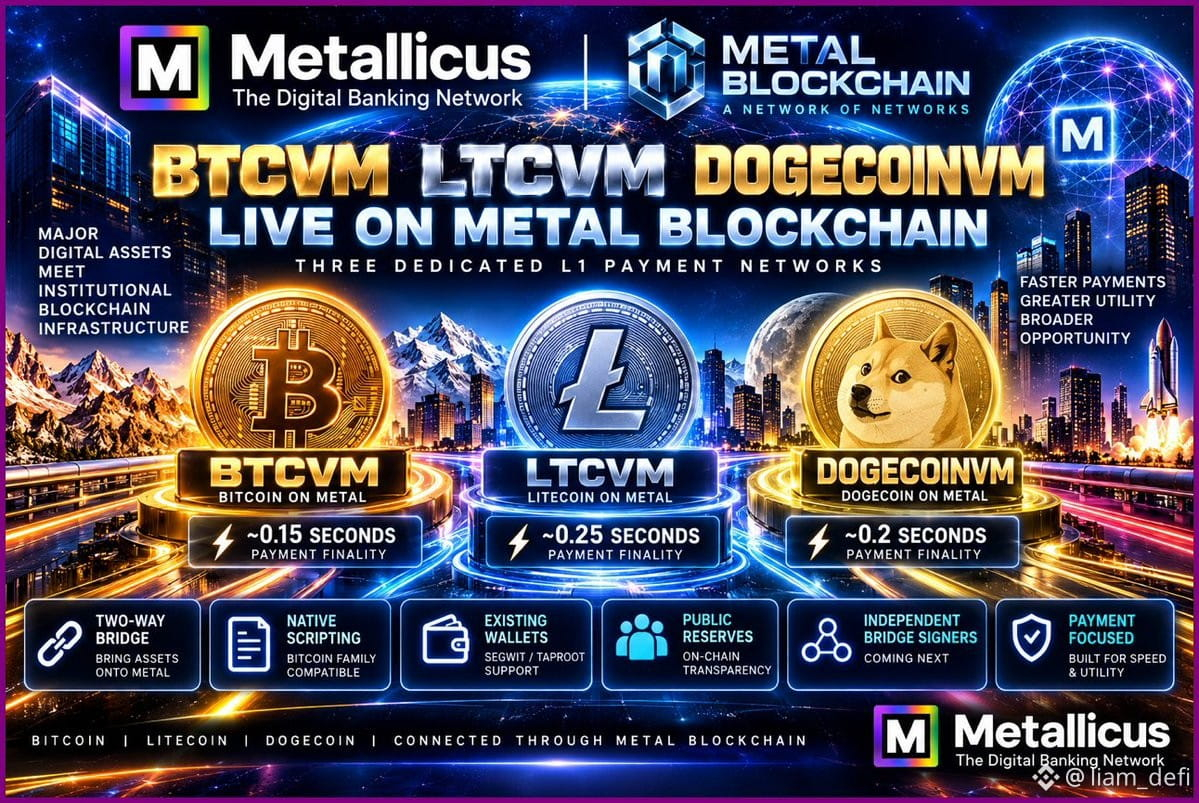
Metal Blockchain just went full degen mode.
BTCVM, LTCVM, and DogecoinVM are live in beta. Three dedicated L1 payment networks running on Metal.
Finality numbers are wild:
$BTC VM: ~0.15 sec
$LTC VM: ~0.25 sec
$DOGE VM: ~0.20 sec
This isn't just wrapping tokens. These are dedicated Bitcoin-family payment networks with actual infrastructure:
Two-way bridges
Sub-second finality
Your existing wallets work
Public reserves (transparency play)
Independent bridge signers coming
The play here? Network-of-networks architecture. Connecting $BTC, $LTC, and $DOGE under one roof without sacrificing their native properties.
Metallicus is quietly building the Internet of Blockchains while everyone's distracted by the next memecoin pump.
This could be the infrastructure layer that actually makes cross-chain payments work without the usual bridge drama.
Metal Blockchain just went full degen mode.
BTCVM, LTCVM, and DogecoinVM are live in beta. Three dedicated L1 payment networks running on Metal.
Finality numbers are wild:
$BTC VM: ~0.15 sec
$LTC VM: ~0.25 sec
$DOGE VM: ~0.20 sec
This isn't just wrapping tokens. These are dedicated Bitcoin-family payment networks with actual infrastructure:
Two-way bridges
Sub-second finality
Your existing wallets work
Public reserves (transparency play)
Independent bridge signers coming
The play here? Network-of-networks architecture. Connecting $BTC, $LTC, and $DOGE under one roof without sacrificing their native properties.
Metallicus is quietly building the Internet of Blockchains while everyone's distracted by the next memecoin pump.
This could be the infrastructure layer that actually makes cross-chain payments work without the usual bridge drama.
BTCVM, LTCVM, and DogecoinVM are live in beta. Three dedicated L1 payment networks running on Metal.
Finality numbers are wild:
$BTC VM: ~0.15 sec
$LTC VM: ~0.25 sec
$DOGE VM: ~0.20 sec
This isn't just wrapping tokens. These are dedicated Bitcoin-family payment networks with actual infrastructure:
Two-way bridges
Sub-second finality
Your existing wallets work
Public reserves (transparency play)
Independent bridge signers coming
The play here? Network-of-networks architecture. Connecting $BTC, $LTC, and $DOGE under one roof without sacrificing their native properties.
Metallicus is quietly building the Internet of Blockchains while everyone's distracted by the next memecoin pump.
This could be the infrastructure layer that actually makes cross-chain payments work without the usual bridge drama.
72
·
--
While everyone's talking, we're launching.
$FLAPPY just hit Alcor and Vibrr with first candles live. No hype threads, no 50-tweet countdowns—just wings up and moving.
Flappy's the superhero cat from the Pussyverse, now live on XPR Network. Community's already stacking, liquidity's forming, and the vibe's clean.
If you're early to weird cat metas that actually ship, this might be your entry. Alcor and Vibrr both live now.
Not financial advice. Just a cat with wings doing cat things on-chain.
While everyone's talking, we're launching.
$FLAPPY just hit Alcor and Vibrr with first candles live. No hype threads, no 50-tweet countdowns—just wings up and moving.
Flappy's the superhero cat from the Pussyverse, now live on XPR Network. Community's already stacking, liquidity's forming, and the vibe's clean.
If you're early to weird cat metas that actually ship, this might be your entry. Alcor and Vibrr both live now.
Not financial advice. Just a cat with wings doing cat things on-chain.
$FLAPPY just hit Alcor and Vibrr with first candles live. No hype threads, no 50-tweet countdowns—just wings up and moving.
Flappy's the superhero cat from the Pussyverse, now live on XPR Network. Community's already stacking, liquidity's forming, and the vibe's clean.
If you're early to weird cat metas that actually ship, this might be your entry. Alcor and Vibrr both live now.
Not financial advice. Just a cat with wings doing cat things on-chain.

33
·
--
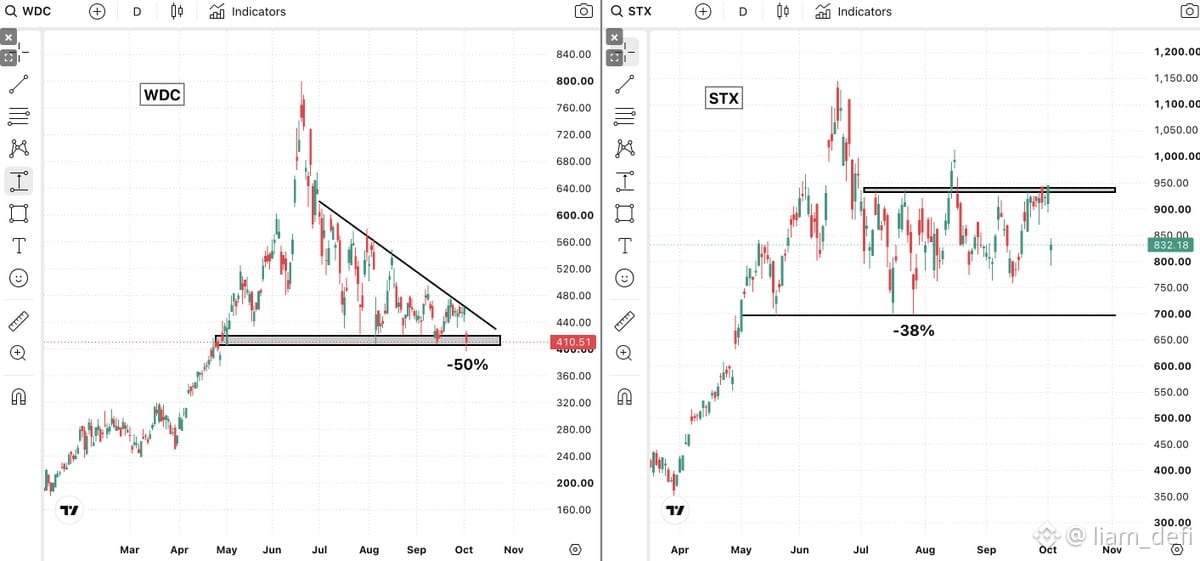
Hard drive stocks getting wrecked today.
$WDC down 10%
$STX down 11%
Market's pricing in fears that AI data center buildout is cooling off. If hyperscalers slow their storage orders, these legacy players are first to feel it.
Watch for confirmation in next earnings calls. If capex guidance drops, this isn't a dip—it's a trend shift.
Hard drive stocks getting wrecked today.
$WDC down 10%
$STX down 11%
Market's pricing in fears that AI data center buildout is cooling off. If hyperscalers slow their storage orders, these legacy players are first to feel it.
Watch for confirmation in next earnings calls. If capex guidance drops, this isn't a dip—it's a trend shift.
$WDC down 10%
$STX down 11%
Market's pricing in fears that AI data center buildout is cooling off. If hyperscalers slow their storage orders, these legacy players are first to feel it.
Watch for confirmation in next earnings calls. If capex guidance drops, this isn't a dip—it's a trend shift.
79
·
--
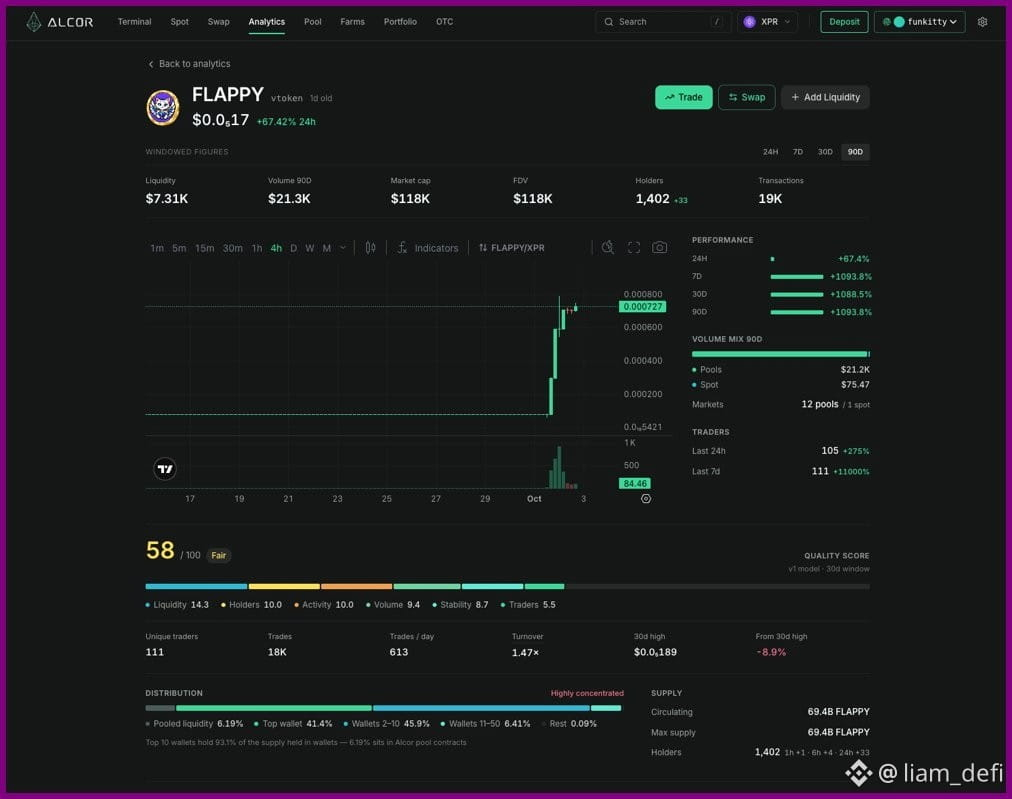
24 hrs in and $FLAPPY just hit Alcor 🚀
No fluff. No waiting. Just a flying cat with wings defending the Pussyverse skies.
Day 1 metrics looking solid. Community's locked in. Momentum's real.
If you're not watching $FLAPPY on XPR Network yet, you're already late.
Moon? Nah. We're aiming past that. 🌚
#FLAPPY #ProtonPussy #XPRNetwork #Alcor
24 hrs in and $FLAPPY just hit Alcor 🚀
No fluff. No waiting. Just a flying cat with wings defending the Pussyverse skies.
Day 1 metrics looking solid. Community's locked in. Momentum's real.
If you're not watching $FLAPPY on XPR Network yet, you're already late.
Moon? Nah. We're aiming past that. 🌚
#FLAPPY #ProtonPussy #XPRNetwork #Alcor
No fluff. No waiting. Just a flying cat with wings defending the Pussyverse skies.
Day 1 metrics looking solid. Community's locked in. Momentum's real.
If you're not watching $FLAPPY on XPR Network yet, you're already late.
Moon? Nah. We're aiming past that. 🌚
#FLAPPY #ProtonPussy #XPRNetwork #Alcor
54
Көбірек контент көру үшін кіріңіз
Binance Square платформасында әлемдік криптоқоғамдастыққа қосылыңыз
⚡️ Криптовалюта туралы ең соңғы және пайдалы ақпаратты алыңыз.
💬 Әлемдегі ең ірі криптобиржаның сеніміне ие.
👍 Расталған авторлардың нақты пікірлерін табыңыз.
Электрондық пошта/телефон нөмірі
Трендтегі тақырыптар
BinanceLaunchesBinanceIntelligence
137,358 рет көрілді
1,337 адам талқылап жатыр
🤖 #BinanceLaunchesBinanceIntelligence — theo mình đây là một cập nhật đáng chú ý.
Ngày 5/10, Binance chính thức ra mắt Binance Intelligence — không chỉ là một tính năng AI đơn lẻ mà là cả hệ sinh thái AI gồm Binance AI, Binance AI Pro và Binance Agent OS.
Trong đó, Binance AI dành cho người dùng phổ thông, có thể dựa trên coin đang quan tâm, danh mục và thói quen sử dụng để cung cấp thông tin cá nhân hóa như market brief, cảnh báo và tổng kết PnL. Đáng chú ý, dữ liệu không chỉ có Crypto mà còn bao gồm chứng khoán Mỹ và kinh tế vĩ mô.
AI Pro giống một trợ lý giao dịch hơn. Người dùng có thể mô tả ý tưởng bằng ngôn ngữ tự nhiên, sau đó AI hỗ trợ chuyển thành chiến lược và workflow mà không cần tự viết code.
Còn Agent OS hướng tới developer, cho phép xây dựng các AI Agent dựa trên hạ tầng tài chính của Binance.
Điểm mình thấy thú vị nhất không phải “Binance cũng làm AI”.
Mà là:
AI đang từ công cụ trò chuyện bước vào trực tiếp môi trường giao dịch.
Từ trước đến nay, trader phải tự tìm dữ liệu, đọc tin, phân tích và xây chiến lược trên nhiều nền tảng.
Tương lai có thể gần hơn với:
Một câu lệnh → AI hiểu thị trường → tổng hợp dữ liệu → xây chiến lược → hỗ trợ thực thi.
Nhưng nhớ rằng:
AI giúp xử lý thông tin nhanh hơn ≠ AI đảm bảo lợi nhuận.
Cuối cùng vẫn phải nhìn vào giá, dòng tiền, rủi ro và cách thực thi.
Theo mình, Binance Intelligence không đơn thuần là một bản cập nhật tính năng.
Nó cho thấy AI đang ngày càng được đưa sâu vào hạ tầng giao dịch.
Tương lai có thể không chỉ là con người giao dịch, mà là:
Con người + AI Agent cùng giao dịch.
Mira CryptoVN
·0 лайк
·1.2k рет көрілді
StriveBuys2000BTCFor$169M
5,508 рет көрілді
60 адам талқылап жатыр
EvernorthXRPTreasuryCompletesSPACMerger
85,388 рет көрілді
858 адам талқылап жатыр