
A financial platform can have millions of customers, sophisticated technology and strong security processes and still face an incident that makes users reconsider how their financial and personal data is protected.
That is what happened with Revolut in September 2026.
On September 12, Revolut confirmed that sensitive customer information had been disclosed to an unauthorized third party after the company received fraudulent requests that appeared to come from a legitimate government agency email domain. Revolut said the incident affected a very limited number of customers, who had been notified.
The incident does not mean that Revolut's entire platform was compromised, nor does it establish that customer funds were stolen. But it raises an important question for anyone choosing a financial platform:
What happens when someone tries to impersonate a trusted authority and obtain customer information?
For a user considering a move from Revolut to Binance, the comparison is less about saying one platform is immune to security incidents and more about looking at how each platform approaches security, account protection and the broader crypto-financial ecosystem.
What Happened at Revolut?
According to Reuters, the incident involved fraudulent requests sent from a legitimate government agency email domain. Revolut disclosed sensitive customer information to an unauthorized party after treating those requests as legitimate.
That makes the case particularly interesting.
The attack was not simply a conventional password theft scenario. It involved social engineering and impersonation of a trusted authority.
For financial companies, that creates a difficult security problem. Employees have to determine whether a request for customer information is genuinely authorized, even when the communication appears to originate from a legitimate domain.
The incident therefore highlights a broader principle:
Security is not only about protecting login credentials. It is also about verifying who is allowed to request sensitive information.
Why Data Security Matters as Much as Money Security
When people think about financial-platform security, they often focus on whether someone can steal money from an account.
But personal information can be valuable too.
Financial platforms may hold identity information, account details, transaction records and other sensitive data required for compliance and customer verification.
A data exposure can therefore create risks that extend beyond the platform itself.
This is particularly relevant for crypto users, because transaction histories can provide information about someone's digital-asset activity in addition to conventional financial information.
That is why choosing a financial platform should involve asking two separate questions:
How does it protect my money?
And:
How does it protect information about me?
What Changes When Moving to Binance?
For a user moving into Binance's ecosystem, the difference is not simply that Binance offers cryptocurrency trading.
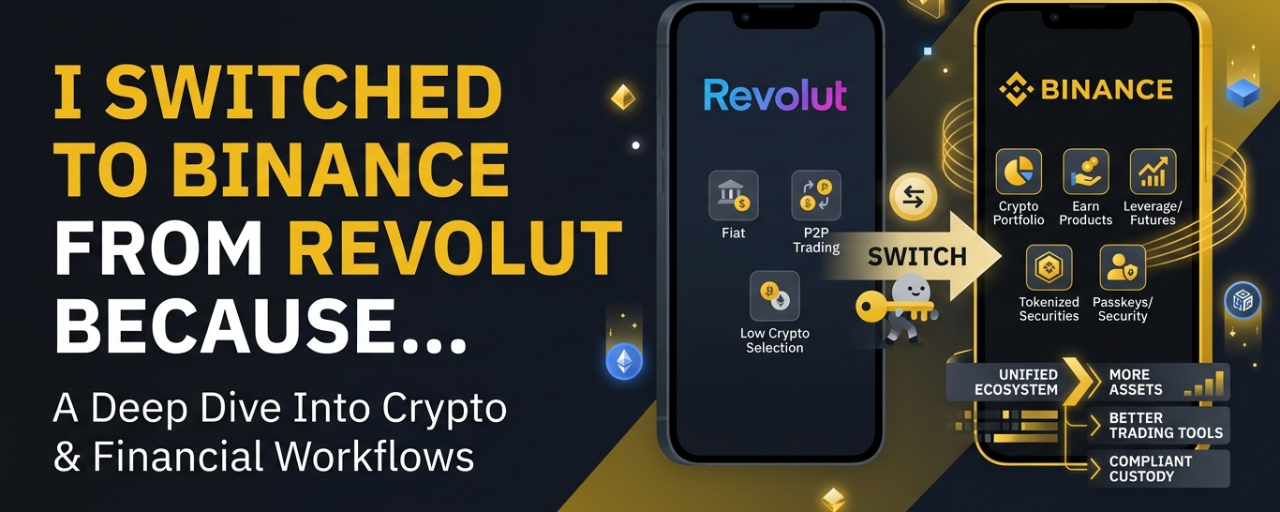
Binance has built a broader financial platform around crypto, including spot trading, derivatives, Earn products, payment services and access to stocks and tokenized securities for eligible users.
That creates a different type of financial experience.
Instead of using one fintech application primarily for banking and another platform for crypto, an eligible Binance user can manage a wider range of digital-asset activities from one account.
But the more important comparison is security.
Binance provides multiple account-level controls, including passkeys, two-factor authentication, anti-phishing codes and withdrawal allowlisting.
These tools address different risks.
Passkeys can strengthen authentication without relying exclusively on traditional passwords.
2FA adds another verification layer when accessing an account or performing sensitive actions.
Anti-phishing codes help users identify whether communications claiming to come from Binance are genuine.
Withdrawal allowlisting lets users restrict withdrawals to previously approved wallet addresses.
No individual security feature eliminates risk. The value comes from having multiple layers that make unauthorized access and unauthorized withdrawals more difficult.
Binance Also Uses Proof of Reserves
Another difference for crypto users is transparency around customer assets.
Binance publishes Proof of Reserves (PoR) information that allows users to verify that their account was included in the relevant reserve snapshot.
Its system uses cryptographic techniques including Merkle Trees and zk-SNARKs to provide verification without exposing other users' balances. Binance states that customer assets are backed 1:1, plus additional reserves.
That does not mean Proof of Reserves should be treated as a complete financial audit. It answers a narrower question: whether the platform's reported on-chain assets cover the customer balances included in the snapshot.
For users, that distinction matters.
Transparency is not the same thing as a guarantee of safety. But being able to independently verify information is generally more useful than simply being asked to trust a statement.
What About Emergency Protection?
Binance also maintains the Secure Asset Fund for Users (SAFU), an emergency reserve intended to provide protection in extreme circumstances.
The fund was established as an additional layer of protection rather than a replacement for normal account security.
This is important because users should not interpret an emergency fund as meaning that losses are impossible.
Instead, it is another part of the platform's overall risk-management framework.
One Platform, Different Financial Tools
There is also a practical reason a crypto-native user might move toward Binance.
Revolut is primarily a fintech and banking platform, while Binance was built around digital assets and has expanded outward into additional financial products.
For someone whose financial activity increasingly revolves around crypto, having trading, stablecoins, Web3 access, Earn products and other supported services within one ecosystem can reduce the need to move funds between multiple platforms.
Binance has also expanded into U.S. stock trading, offering eligible users access to more than 7,000 listed stocks and ETFs through its securities-trading infrastructure.
That does not make Binance identical to Revolut or a traditional brokerage.
The products have different structures, regulations, eligibility requirements and risks.
But for a crypto-native user, the broader ecosystem can be an important consideration.
The Bigger Lesson From the Revolut Incident
The most useful takeaway from the Revolut case is not simply "switch platforms."
It is to ask better security questions before choosing one.
Who has access to customer data?
How are official requests authenticated?
What happens if an attacker impersonates a government agency?
How can users protect their accounts?
Can customer assets be independently verified?
What happens during an extreme security incident?
These questions matter whether someone uses Revolut, Binance, a bank, a traditional brokerage or another financial platform.
The September incident demonstrates why security cannot be reduced to a single feature.
A strong financial platform needs layers: identity verification, internal controls, account security, transaction monitoring, custody protections, transparency and effective incident response.
For a user moving from Revolut to Binance, those are the areas worth comparing.
The decision is ultimately less about where an app is based and more about what protections, transparency and financial tools the platform provides for the way you actually use money.