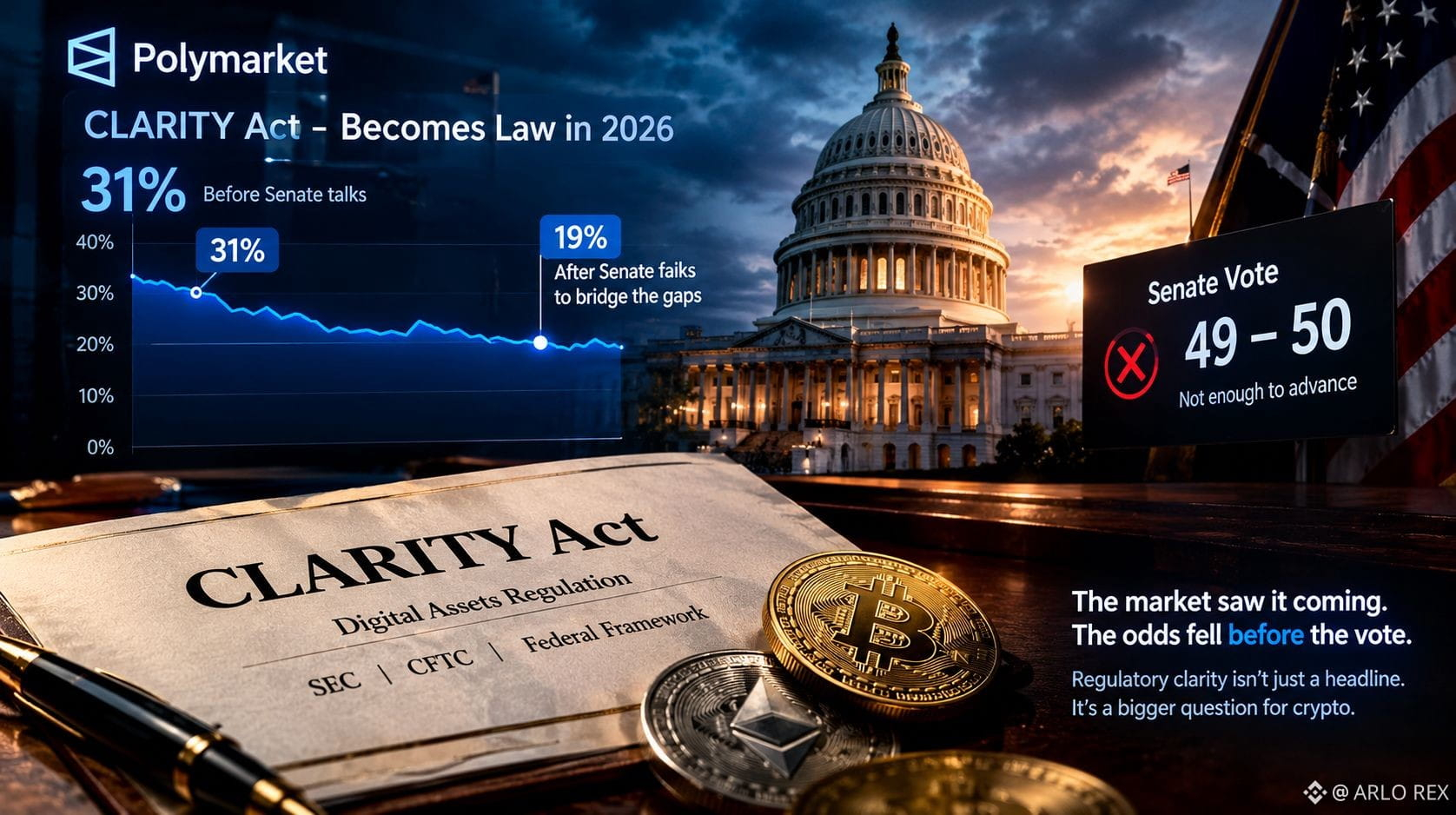

The interesting part of the CLARITY Act story wasn’t the 49–50 Senate vote.
It was what the market saw before it happened.
Polymarket odds for the bill becoming law in 2026 fell from roughly 31% to 19% as the Senate failed to bridge the remaining political gaps. Then the vote arrived — and the bill failed to reach the 60 votes needed to advance.
That sequence matters.
Prediction markets aren’t legislative scoreboards. They aggregate trader expectations, positioning and incoming information. But when odds move sharply before a binary political event, the move itself can become useful information about how the market is repricing uncertainty.
And that uncertainty now matters for crypto.
The CLARITY Act was intended to create a clearer federal framework for digital assets, including a defined regulatory structure around the SEC and CFTC. Its failure to advance leaves that broader legislative framework unresolved.
So I’m watching something bigger than the headline.
How much of crypto’s institutional narrative depends on regulatory clarity actually becoming law rather than simply being expected?
Because markets can price the disappointment long before the final outcome.
$SYN $ARB $AKE
#ClarityActOddsHalveOnPolymarket #FedRateWatch #ArgentinaCommitsToOECDCryptoReportingBy2029 #USDTLaunchesOnZamaPrivacyProtocol #USSenateBlocksClarityAct
It was what the market saw before it happened.
Polymarket odds for the bill becoming law in 2026 fell from roughly 31% to 19% as the Senate failed to bridge the remaining political gaps. Then the vote arrived — and the bill failed to reach the 60 votes needed to advance.
That sequence matters.
Prediction markets aren’t legislative scoreboards. They aggregate trader expectations, positioning and incoming information. But when odds move sharply before a binary political event, the move itself can become useful information about how the market is repricing uncertainty.
And that uncertainty now matters for crypto.
The CLARITY Act was intended to create a clearer federal framework for digital assets, including a defined regulatory structure around the SEC and CFTC. Its failure to advance leaves that broader legislative framework unresolved.
So I’m watching something bigger than the headline.
How much of crypto’s institutional narrative depends on regulatory clarity actually becoming law rather than simply being expected?
Because markets can price the disappointment long before the final outcome.
$SYN $ARB $AKE
#ClarityActOddsHalveOnPolymarket #FedRateWatch #ArgentinaCommitsToOECDCryptoReportingBy2029 #USDTLaunchesOnZamaPrivacyProtocol #USSenateBlocksClarityAct