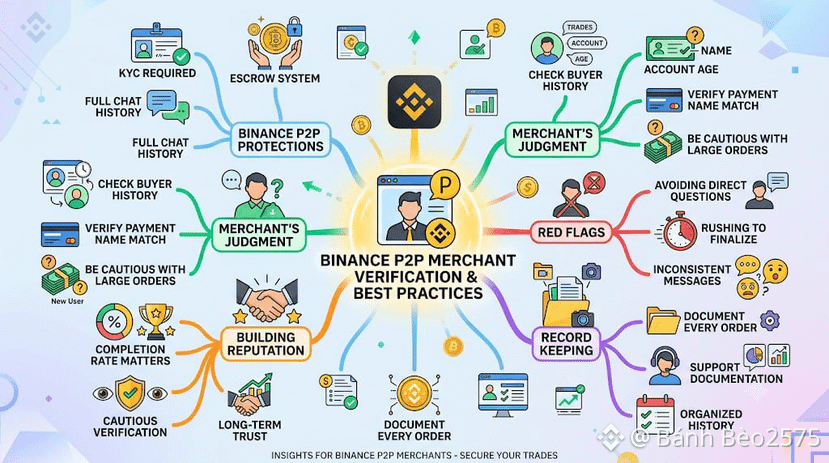
Running a merchant account on Binance P2P changed how I think about verification, mostly because the responsibility works in both directions. Binance P2P protects merchants too, through KYC on every account, escrow that holds the crypto asset until an order is confirmed, and a full chat record that becomes useful if a dispute ever needs review. But those protections work best alongside a merchant's own judgment, especially when a buyer places a larger order than usual.
Before accepting any sizable order, I check the buyer's account history: how many trades they have completed, how long the account has existed, and whether their payment method name matches what shows on their profile. A first time buyer placing an unusually large order is not automatically suspicious, but it does mean I slow down and pay closer attention to every message that follows, rather than treating it the same as a routine small trade.
The clearest red flag I watch for is a buyer who avoids answering direct questions in chat or pushes to finalize the trade unusually fast. When that happens, I ask specific, simple questions, like confirming the exact amount and the name on their transfer, and a genuine buyer answers without hesitation. I also keep detailed records of every completed order as a merchant, since Binance support has asked for exactly that kind of documentation before, and having it organized has made every one of those conversations faster to resolve.
Running a merchant account also means my own reputation is on the line with every order I accept, so being cautious is not just about protecting one transaction, it protects every future buyer who looks at my history before deciding to trade with me. A completion rate built on careful verification, even if it occasionally means walking away from an order, matters more to me than closing every single trade that comes through Binance P2P.
@Binance Vietnam #BinanceP2PAnToan
$BTW $ACE