
#techstocks
techstocks
678,798 рет көрілді
2,247 адам талқылап жатыр
Қызу саудада
Ең соңғы

·
--

Мақала
AI Bubble Is the Reality Finally Catching Up With the Hype?The AI trade is entering a different phase, and investors may need to rethink their expectations.
For the past two years, artificial intelligence has been one of the biggest investment narratives in global markets. Billions of dollars have flowed into chipmakers, data centres, cloud infrastructure and AI model developers. Valuations expanded rapidly, largely on expectations of future growth rather than proven profitability.
But the market is starting to ask a much more important question
How much of this investment will actually translate into sustainable revenue and profits?
Look at China Some of its high profile AI companies, including $MINIMAX
{future}(MINIMAXUSDT)
and $ZHIPU , have suffered significant declines from their peaks. Even established technology names such as Alibaba, Tencent, Xiaomi and Lenovo have faced considerable pressure.
This is particularly interesting because China has already experienced a similar cycle in the electric vehicle industry. Hundreds of companies entered the market, attracted by government support, investor capital and enormous growth expectations. Eventually, competition intensified, price wars compressed margins and weaker businesses struggled to survive.
AI could be following a similar path.
The United States is not immune either.
#NVIDIA ia, AMD, #Micron and other semiconductor companies have benefited enormously from the AI infrastructure boom. Meanwhile, companies such as CoreWeave, Nebius and other neocloud providers have attracted substantial capital to build the computing capacity required for AI development.
However, the economics of this expansion deserve closer examination.
Building data centres, purchasing GPUs and securing electricity require enormous upfront investment. These businesses need sustained demand, strong utilization rates and sufficient cash flow to justify their capital expenditure.
If financing becomes more expensive, customers slow their spending, or computing capacity grows faster than actual demand, the pressure could become significant.
There is another issue investors should not overlook: competition.
OpenAI, Anthropic, Google, Meta and emerging Chinese AI developers are all competing for market share. As models become more accessible and computing efficiency improves, the competitive advantage of individual companies could become harder to maintain.
This creates a difficult equation: infrastructure costs remain enormous while the price of AI services could face downward pressure.
But does that mean the AI revolution is over? Absolutely not.
The technology can continue transforming industries while many of the companies associated with it fail to deliver the returns investors currently expect.
We have seen this before. The internet survived the dot-com crash. E-commerce survived the collapse of numerous internet companies. The underlying technology was real, but not every valuation or business model was sustainable.
I believe investors should start distinguishing between three things:
AI adoption: The actual long-term economic transformation driven by artificial intelligence.AI infrastructure: The companies building chips, data centres, power capacity and computing networks.AI speculation: Businesses whose valuations depend heavily on future expectations, cheap financing and continuous capital inflows.
These are three different investment propositions, and they should not be treated equally.
My biggest concern is not that AI will disappear. It is that capital may have moved too quickly ahead of the industry's ability to generate sustainable returns.
The next phase could separate companies with real competitive advantages, healthy balance sheets and recurring cash flows from those simply riding the AI narrative.
The AI revolution may still be in its early stages, but the easy-money phase of the AI trade could be approaching its end.
The question is no longer just who will lead the AI race. It is who will still be profitable when the hype fades.
My analytical takeaway
I would make one distinction particularly clear in your discussion:
Bearish on valuations doesn't mean bearish on AI technology.A correction in AI stocks doesn't automatically mean the industry is collapsing.The real warning signs are funding costs, cash burn, capital expenditure, debt servicing and the ability to monetize AI investments.
This is also where I'd pay particular attention to CoreWeave, Nebius, Nvidia and Micron. Their businesses are exposed to different parts of the AI investment cycle, so a decline in all four does not necessarily mean the same thing fundamentally.
#AMD #TechStocks
AI Bubble Is the Reality Finally Catching Up With the Hype?
The AI trade is entering a different phase, and investors may need to rethink their expectations.
For the past two years, artificial intelligence has been one of the biggest investment narratives in global markets. Billions of dollars have flowed into chipmakers, data centres, cloud infrastructure and AI model developers. Valuations expanded rapidly, largely on expectations of future growth rather than proven profitability.
But the market is starting to ask a much more important question
How much of this investment will actually translate into sustainable revenue and profits?
Look at China Some of its high profile AI companies, including $MINIMAX
and $ZHIPU , have suffered significant declines from their peaks. Even established technology names such as Alibaba, Tencent, Xiaomi and Lenovo have faced considerable pressure.
This is particularly interesting because China has already experienced a similar cycle in the electric vehicle industry. Hundreds of companies entered the market, attracted by government support, investor capital and enormous growth expectations. Eventually, competition intensified, price wars compressed margins and weaker businesses struggled to survive.
AI could be following a similar path.
The United States is not immune either.
#NVIDIA ia, AMD, #Micron and other semiconductor companies have benefited enormously from the AI infrastructure boom. Meanwhile, companies such as CoreWeave, Nebius and other neocloud providers have attracted substantial capital to build the computing capacity required for AI development.
However, the economics of this expansion deserve closer examination.
Building data centres, purchasing GPUs and securing electricity require enormous upfront investment. These businesses need sustained demand, strong utilization rates and sufficient cash flow to justify their capital expenditure.
If financing becomes more expensive, customers slow their spending, or computing capacity grows faster than actual demand, the pressure could become significant.
There is another issue investors should not overlook: competition.
OpenAI, Anthropic, Google, Meta and emerging Chinese AI developers are all competing for market share. As models become more accessible and computing efficiency improves, the competitive advantage of individual companies could become harder to maintain.
This creates a difficult equation: infrastructure costs remain enormous while the price of AI services could face downward pressure.
But does that mean the AI revolution is over? Absolutely not.
The technology can continue transforming industries while many of the companies associated with it fail to deliver the returns investors currently expect.
We have seen this before. The internet survived the dot-com crash. E-commerce survived the collapse of numerous internet companies. The underlying technology was real, but not every valuation or business model was sustainable.
I believe investors should start distinguishing between three things:
AI adoption: The actual long-term economic transformation driven by artificial intelligence.AI infrastructure: The companies building chips, data centres, power capacity and computing networks.AI speculation: Businesses whose valuations depend heavily on future expectations, cheap financing and continuous capital inflows.
These are three different investment propositions, and they should not be treated equally.
My biggest concern is not that AI will disappear. It is that capital may have moved too quickly ahead of the industry's ability to generate sustainable returns.
The next phase could separate companies with real competitive advantages, healthy balance sheets and recurring cash flows from those simply riding the AI narrative.
The AI revolution may still be in its early stages, but the easy-money phase of the AI trade could be approaching its end.
The question is no longer just who will lead the AI race. It is who will still be profitable when the hype fades.
My analytical takeaway
I would make one distinction particularly clear in your discussion:
Bearish on valuations doesn't mean bearish on AI technology.A correction in AI stocks doesn't automatically mean the industry is collapsing.The real warning signs are funding costs, cash burn, capital expenditure, debt servicing and the ability to monetize AI investments.
This is also where I'd pay particular attention to CoreWeave, Nebius, Nvidia and Micron. Their businesses are exposed to different parts of the AI investment cycle, so a decline in all four does not necessarily mean the same thing fundamentally.
#AMD #TechStocks
For the past two years, artificial intelligence has been one of the biggest investment narratives in global markets. Billions of dollars have flowed into chipmakers, data centres, cloud infrastructure and AI model developers. Valuations expanded rapidly, largely on expectations of future growth rather than proven profitability.
But the market is starting to ask a much more important question
How much of this investment will actually translate into sustainable revenue and profits?
Look at China Some of its high profile AI companies, including $MINIMAX
and $ZHIPU , have suffered significant declines from their peaks. Even established technology names such as Alibaba, Tencent, Xiaomi and Lenovo have faced considerable pressure.
This is particularly interesting because China has already experienced a similar cycle in the electric vehicle industry. Hundreds of companies entered the market, attracted by government support, investor capital and enormous growth expectations. Eventually, competition intensified, price wars compressed margins and weaker businesses struggled to survive.
AI could be following a similar path.
The United States is not immune either.
#NVIDIA ia, AMD, #Micron and other semiconductor companies have benefited enormously from the AI infrastructure boom. Meanwhile, companies such as CoreWeave, Nebius and other neocloud providers have attracted substantial capital to build the computing capacity required for AI development.
However, the economics of this expansion deserve closer examination.
Building data centres, purchasing GPUs and securing electricity require enormous upfront investment. These businesses need sustained demand, strong utilization rates and sufficient cash flow to justify their capital expenditure.
If financing becomes more expensive, customers slow their spending, or computing capacity grows faster than actual demand, the pressure could become significant.
There is another issue investors should not overlook: competition.
OpenAI, Anthropic, Google, Meta and emerging Chinese AI developers are all competing for market share. As models become more accessible and computing efficiency improves, the competitive advantage of individual companies could become harder to maintain.
This creates a difficult equation: infrastructure costs remain enormous while the price of AI services could face downward pressure.
But does that mean the AI revolution is over? Absolutely not.
The technology can continue transforming industries while many of the companies associated with it fail to deliver the returns investors currently expect.
We have seen this before. The internet survived the dot-com crash. E-commerce survived the collapse of numerous internet companies. The underlying technology was real, but not every valuation or business model was sustainable.
I believe investors should start distinguishing between three things:
AI adoption: The actual long-term economic transformation driven by artificial intelligence.AI infrastructure: The companies building chips, data centres, power capacity and computing networks.AI speculation: Businesses whose valuations depend heavily on future expectations, cheap financing and continuous capital inflows.
These are three different investment propositions, and they should not be treated equally.
My biggest concern is not that AI will disappear. It is that capital may have moved too quickly ahead of the industry's ability to generate sustainable returns.
The next phase could separate companies with real competitive advantages, healthy balance sheets and recurring cash flows from those simply riding the AI narrative.
The AI revolution may still be in its early stages, but the easy-money phase of the AI trade could be approaching its end.
The question is no longer just who will lead the AI race. It is who will still be profitable when the hype fades.
My analytical takeaway
I would make one distinction particularly clear in your discussion:
Bearish on valuations doesn't mean bearish on AI technology.A correction in AI stocks doesn't automatically mean the industry is collapsing.The real warning signs are funding costs, cash burn, capital expenditure, debt servicing and the ability to monetize AI investments.
This is also where I'd pay particular attention to CoreWeave, Nebius, Nvidia and Micron. Their businesses are exposed to different parts of the AI investment cycle, so a decline in all four does not necessarily mean the same thing fundamentally.
#AMD #TechStocks
827

#SMCI Is Losing Ground in the AI Infrastructure Race? 📉
Super Micro Computer is facing growing pressure as investors become more selective across AI infrastructure stocks. SMCI has fallen 26.6% over six months, while HPE gained 114.1% and Seagate advanced 100%. The latest trending data adds to the weakness, with SMCI declining another 4.57%.
{spot}(SMCIBUSDT)
{stock_us}(SMCI.US)
The key question is whether Super Micro can close this performance gap through stronger AI server orders, improved margins, and reliable execution. Watch upcoming guidance, order growth, supply-chain performance, and profitability. The AI infrastructure opportunity remains significant, but investors are increasingly rewarding execution over expectations.
$SMCIB $SMCI $SMCI.US #CoinVahini #SuperMicro #AIInfrastructure #TechStocks
#SMCI Is Losing Ground in the AI Infrastructure Race? 📉
Super Micro Computer is facing growing pressure as investors become more selective across AI infrastructure stocks. SMCI has fallen 26.6% over six months, while HPE gained 114.1% and Seagate advanced 100%. The latest trending data adds to the weakness, with SMCI declining another 4.57%.
The key question is whether Super Micro can close this performance gap through stronger AI server orders, improved margins, and reliable execution. Watch upcoming guidance, order growth, supply-chain performance, and profitability. The AI infrastructure opportunity remains significant, but investors are increasingly rewarding execution over expectations.
$SMCIB $SMCI $SMCI.US #CoinVahini #SuperMicro #AIInfrastructure #TechStocks
Super Micro Computer is facing growing pressure as investors become more selective across AI infrastructure stocks. SMCI has fallen 26.6% over six months, while HPE gained 114.1% and Seagate advanced 100%. The latest trending data adds to the weakness, with SMCI declining another 4.57%.
The key question is whether Super Micro can close this performance gap through stronger AI server orders, improved margins, and reliable execution. Watch upcoming guidance, order growth, supply-chain performance, and profitability. The AI infrastructure opportunity remains significant, but investors are increasingly rewarding execution over expectations.
$SMCIB $SMCI $SMCI.US #CoinVahini #SuperMicro #AIInfrastructure #TechStocks
SMCIUS-0,84%
SMCIB-9,50%
6

·
--
🚨 $QQQ SURFACES THROUGH NASDAQ SLUMP – IS THE BULL REBOUND AHEAD? 🟢
📊 Nasdaq’s 11% dip has ripped open a fresh liquidity pool, and the $QQQ is now dancing on the edge of a key demand zone. 🦈 Smart‑money is likely re‑stacking, using the pullback to load positions ahead of the next breakout. ⚡ Volume on the 4‑hour chart is swelling, hinting that sellers are tiring while buyers tighten the grip.
💡 If the tech‑heavy index holds this floor, we could see a swift swing back to the 45‑day moving average. 🤔 Do you think the market will bounce or keep testing lower lows? 👇
⚠️ Not financial advice. Always manage your risk. 🛡️
🏷️ #QQQ #TechStocks #MarketCorrection #Crypto
🔥 💎
🚨 $QQQ SURFACES THROUGH NASDAQ SLUMP – IS THE BULL REBOUND AHEAD? 🟢
📊 Nasdaq’s 11% dip has ripped open a fresh liquidity pool, and the $QQQ is now dancing on the edge of a key demand zone. 🦈 Smart‑money is likely re‑stacking, using the pullback to load positions ahead of the next breakout. ⚡ Volume on the 4‑hour chart is swelling, hinting that sellers are tiring while buyers tighten the grip.
💡 If the tech‑heavy index holds this floor, we could see a swift swing back to the 45‑day moving average. 🤔 Do you think the market will bounce or keep testing lower lows? 👇
⚠️ Not financial advice. Always manage your risk. 🛡️
🏷️ #QQQ #TechStocks #MarketCorrection #Crypto
🔥 💎
📊 Nasdaq’s 11% dip has ripped open a fresh liquidity pool, and the $QQQ is now dancing on the edge of a key demand zone. 🦈 Smart‑money is likely re‑stacking, using the pullback to load positions ahead of the next breakout. ⚡ Volume on the 4‑hour chart is swelling, hinting that sellers are tiring while buyers tighten the grip.
💡 If the tech‑heavy index holds this floor, we could see a swift swing back to the 45‑day moving average. 🤔 Do you think the market will bounce or keep testing lower lows? 👇
⚠️ Not financial advice. Always manage your risk. 🛡️
🏷️ #QQQ #TechStocks #MarketCorrection #Crypto
🔥 💎
11

·
--
Төмен (кемімелі)
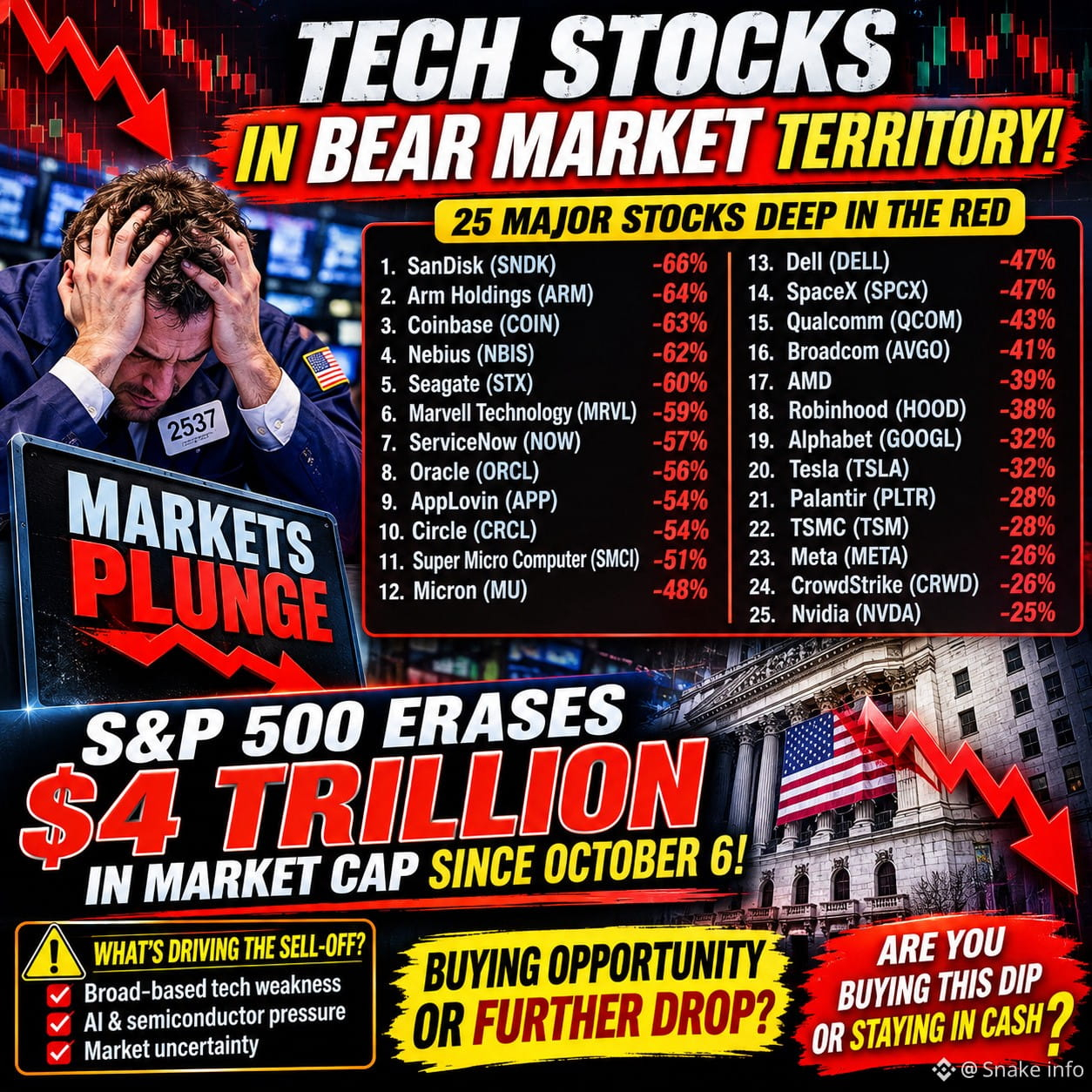
🚨 TECH STOCKS ARE GETTING DESTROYED! THE BEAR MARKET IS SPREADING. 📉
Wall Street is facing massive pressure, with major technology and crypto-related stocks suffering huge declines.
🔥 25 Major Stocks Deep in the Red:
🔻 SNDK (SanDisk): -66%
🔻 ARM (Arm Holdings): -64%
🔻 COIN (Coinbase): -63%
🔻 NBIS (Nebius): -62%
🔻 STX (Seagate): -60%
🔻 MRVL (Marvell): -59%
🔻 NOW (ServiceNow): -57%
🔻 ORCL (Oracle): -56%
🔻 APP (AppLovin): -54%
🔻 CRCL (Circle): -54%
🔻 SMCI (Super Micro): -51%
🔻 MU (Micron): -48%
🔻 DELL (Dell): -47%
🔻 SPCX (SpaceX): -47%
🔻 QCOM (Qualcomm): -43%
🔻 AVGO (Broadcom): -41%
🔻 AMD: -39%
🔻 HOOD (Robinhood): -38%
🔻 GOOGL (Alphabet): -32%
🔻 TSLA (Tesla): -32%
🔻 PLTR (Palantir): -28%
🔻 TSM (TSMC): -28%
🔻 META (Meta): -26%
🔻 CRWD (CrowdStrike): -26%
🔻 NVDA (Nvidia): -25%
💥 THE BIGGER PICTURE:
The S&P 500 has reportedly erased approximately $4 TRILLION in market capitalization since October 6.
⚠️ This is no longer just about one or two struggling companies. Selling pressure is spreading across semiconductors, AI, software, crypto-related stocks, and major technology companies.
📊 What Traders Should Watch:
Institutional buying and selling
Semiconductor sector recovery
Nasdaq and S&P 500 support levels
Bitcoin's reaction to US market weakness
🔥 BIG QUESTION:
Is this a major buying opportunity, or are we witnessing the beginning of a deeper tech market bear market?
Are you buying this dip or staying in cash? 👇
#StockMarket #TechStocks #NASDAQ #SP500
Not financial advice. DYOR.
CLICK TO BELOW TRADE👇
$TSLA $SPCX $GOOGL
{future}(GOOGLUSDT)
{future}(SPCXUSDT)
{future}(TSLAUSDT)
🚨 TECH STOCKS ARE GETTING DESTROYED! THE BEAR MARKET IS SPREADING. 📉
Wall Street is facing massive pressure, with major technology and crypto-related stocks suffering huge declines.
🔥 25 Major Stocks Deep in the Red:
🔻 SNDK (SanDisk): -66%
🔻 ARM (Arm Holdings): -64%
🔻 COIN (Coinbase): -63%
🔻 NBIS (Nebius): -62%
🔻 STX (Seagate): -60%
🔻 MRVL (Marvell): -59%
🔻 NOW (ServiceNow): -57%
🔻 ORCL (Oracle): -56%
🔻 APP (AppLovin): -54%
🔻 CRCL (Circle): -54%
🔻 SMCI (Super Micro): -51%
🔻 MU (Micron): -48%
🔻 DELL (Dell): -47%
🔻 SPCX (SpaceX): -47%
🔻 QCOM (Qualcomm): -43%
🔻 AVGO (Broadcom): -41%
🔻 AMD: -39%
🔻 HOOD (Robinhood): -38%
🔻 GOOGL (Alphabet): -32%
🔻 TSLA (Tesla): -32%
🔻 PLTR (Palantir): -28%
🔻 TSM (TSMC): -28%
🔻 META (Meta): -26%
🔻 CRWD (CrowdStrike): -26%
🔻 NVDA (Nvidia): -25%
💥 THE BIGGER PICTURE:
The S&P 500 has reportedly erased approximately $4 TRILLION in market capitalization since October 6.
⚠️ This is no longer just about one or two struggling companies. Selling pressure is spreading across semiconductors, AI, software, crypto-related stocks, and major technology companies.
📊 What Traders Should Watch:
Institutional buying and selling
Semiconductor sector recovery
Nasdaq and S&P 500 support levels
Bitcoin's reaction to US market weakness
🔥 BIG QUESTION:
Is this a major buying opportunity, or are we witnessing the beginning of a deeper tech market bear market?
Are you buying this dip or staying in cash? 👇
#StockMarket #TechStocks #NASDAQ #SP500
Not financial advice. DYOR.
CLICK TO BELOW TRADE👇
$TSLA $SPCX $GOOGL
Wall Street is facing massive pressure, with major technology and crypto-related stocks suffering huge declines.
🔥 25 Major Stocks Deep in the Red:
🔻 SNDK (SanDisk): -66%
🔻 ARM (Arm Holdings): -64%
🔻 COIN (Coinbase): -63%
🔻 NBIS (Nebius): -62%
🔻 STX (Seagate): -60%
🔻 MRVL (Marvell): -59%
🔻 NOW (ServiceNow): -57%
🔻 ORCL (Oracle): -56%
🔻 APP (AppLovin): -54%
🔻 CRCL (Circle): -54%
🔻 SMCI (Super Micro): -51%
🔻 MU (Micron): -48%
🔻 DELL (Dell): -47%
🔻 SPCX (SpaceX): -47%
🔻 QCOM (Qualcomm): -43%
🔻 AVGO (Broadcom): -41%
🔻 AMD: -39%
🔻 HOOD (Robinhood): -38%
🔻 GOOGL (Alphabet): -32%
🔻 TSLA (Tesla): -32%
🔻 PLTR (Palantir): -28%
🔻 TSM (TSMC): -28%
🔻 META (Meta): -26%
🔻 CRWD (CrowdStrike): -26%
🔻 NVDA (Nvidia): -25%
💥 THE BIGGER PICTURE:
The S&P 500 has reportedly erased approximately $4 TRILLION in market capitalization since October 6.
⚠️ This is no longer just about one or two struggling companies. Selling pressure is spreading across semiconductors, AI, software, crypto-related stocks, and major technology companies.
📊 What Traders Should Watch:
Institutional buying and selling
Semiconductor sector recovery
Nasdaq and S&P 500 support levels
Bitcoin's reaction to US market weakness
🔥 BIG QUESTION:
Is this a major buying opportunity, or are we witnessing the beginning of a deeper tech market bear market?
Are you buying this dip or staying in cash? 👇
#StockMarket #TechStocks #NASDAQ #SP500
Not financial advice. DYOR.
CLICK TO BELOW TRADE👇
$TSLA $SPCX $GOOGL
237
#Snap ’s Earnings Disappointment Triggers a Sharp Selloff 📉
Snap tumbled after its third-quarter results failed to reassure investors. Shares fell 9.8% in premarket trading to $5.34, while official trending data showed a steeper 10.76% decline. The reaction highlights continued concerns about the company’s ability to convert user engagement into sustainable advertising revenue.
{stock_us}(SNAP.US)
The next focus is management’s guidance, daily active users, advertiser demand, ad pricing, and expense control. Progress in AI-powered advertising tools and creator features could support future monetization, but weak guidance or slowing ad growth may keep investor sentiment under pressure.
$SNAP.US #CoinVahini #Snap #DigitalAdvertising #TechStocks
#Snap ’s Earnings Disappointment Triggers a Sharp Selloff 📉
Snap tumbled after its third-quarter results failed to reassure investors. Shares fell 9.8% in premarket trading to $5.34, while official trending data showed a steeper 10.76% decline. The reaction highlights continued concerns about the company’s ability to convert user engagement into sustainable advertising revenue.
The next focus is management’s guidance, daily active users, advertiser demand, ad pricing, and expense control. Progress in AI-powered advertising tools and creator features could support future monetization, but weak guidance or slowing ad growth may keep investor sentiment under pressure.
$SNAP.US #CoinVahini #Snap #DigitalAdvertising #TechStocks
Snap tumbled after its third-quarter results failed to reassure investors. Shares fell 9.8% in premarket trading to $5.34, while official trending data showed a steeper 10.76% decline. The reaction highlights continued concerns about the company’s ability to convert user engagement into sustainable advertising revenue.
The next focus is management’s guidance, daily active users, advertiser demand, ad pricing, and expense control. Progress in AI-powered advertising tools and creator features could support future monetization, but weak guidance or slowing ad growth may keep investor sentiment under pressure.
$SNAP.US #CoinVahini #Snap #DigitalAdvertising #TechStocks
SNAPUS-0,39%
6

🚀 $PLTR PLUNGES BUT LIQUIDITY SWEEP SETS UP BULLISH REBOUND 📈
Entry: 164.59 ⚡
📊 The post‑earnings dump ripped through the 7‑day MA at $169.04, exposing a fresh hand‑reset zone. 🦈 Smart‑money eyes the $163.58 low as a potential liquidity grab, while volume spikes hint at aggressive buying pressure building. ⚡
💡 Revenue surged to $2.31 B with U.S. commercial sales up 148%, yet the modest Q4 growth slowdown sparked a rapid de‑risk. The swing could flip into a short‑term rally if buyers reclaim the breached level. 💬 Are you loading bids at the dip or waiting for the next liquidity sweep? 👇
⚠️ Not financial advice. Always manage your risk. 🛡️
🏷️ #PLTR #LongSetup #AI #TechStocks
🔥 💎
🚀 $PLTR PLUNGES BUT LIQUIDITY SWEEP SETS UP BULLISH REBOUND 📈
Entry: 164.59 ⚡
📊 The post‑earnings dump ripped through the 7‑day MA at $169.04, exposing a fresh hand‑reset zone. 🦈 Smart‑money eyes the $163.58 low as a potential liquidity grab, while volume spikes hint at aggressive buying pressure building. ⚡
💡 Revenue surged to $2.31 B with U.S. commercial sales up 148%, yet the modest Q4 growth slowdown sparked a rapid de‑risk. The swing could flip into a short‑term rally if buyers reclaim the breached level. 💬 Are you loading bids at the dip or waiting for the next liquidity sweep? 👇
⚠️ Not financial advice. Always manage your risk. 🛡️
🏷️ #PLTR #LongSetup #AI #TechStocks
🔥 💎
Entry: 164.59 ⚡
📊 The post‑earnings dump ripped through the 7‑day MA at $169.04, exposing a fresh hand‑reset zone. 🦈 Smart‑money eyes the $163.58 low as a potential liquidity grab, while volume spikes hint at aggressive buying pressure building. ⚡
💡 Revenue surged to $2.31 B with U.S. commercial sales up 148%, yet the modest Q4 growth slowdown sparked a rapid de‑risk. The swing could flip into a short‑term rally if buyers reclaim the breached level. 💬 Are you loading bids at the dip or waiting for the next liquidity sweep? 👇
⚠️ Not financial advice. Always manage your risk. 🛡️
🏷️ #PLTR #LongSetup #AI #TechStocks
🔥 💎

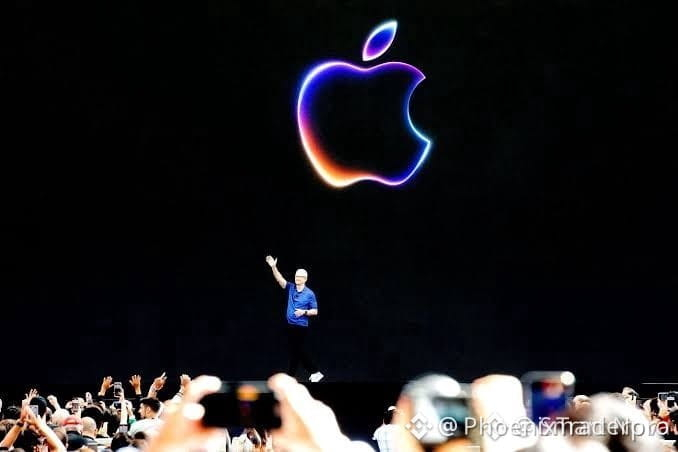
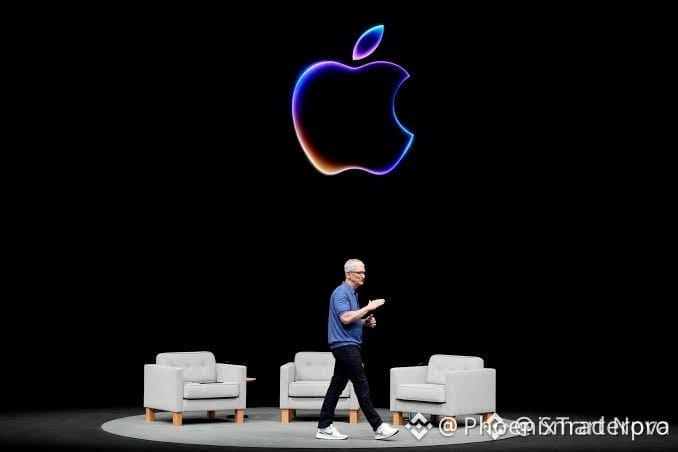
🚀 $AAPL BREAKS $354 NEW ATH, EYES ON $380 SKYROCKET! 📈
Entry: 354 ⚡
Target: 380 🚀
Apple just punched through $354, carving a fresh all‑time high as earnings blew past expectations. 📈 The $114.5B Q4 haul and record iPhone demand are fueling a relentless buying wave.
Smart money is already eyeing the Evercore ISI $380 target, with services revenue and the new M6‑powered hardware adding fresh fuel to the fire. 🦈 Volume spikes suggest the upside could keep climbing.
💬 Will you ride the $AAPL surge toward $380 or wait for the next liquidity test? 👇
⚠️ Not financial advice. Always manage your risk. 🛡️
🏷️ #AAPL #BullishSetup #EarningsRally #TechStocks
🚀 🔥
🚀 $AAPL BREAKS $354 NEW ATH, EYES ON $380 SKYROCKET! 📈
Entry: 354 ⚡
Target: 380 🚀
Apple just punched through $354, carving a fresh all‑time high as earnings blew past expectations. 📈 The $114.5B Q4 haul and record iPhone demand are fueling a relentless buying wave.
Smart money is already eyeing the Evercore ISI $380 target, with services revenue and the new M6‑powered hardware adding fresh fuel to the fire. 🦈 Volume spikes suggest the upside could keep climbing.
💬 Will you ride the $AAPL surge toward $380 or wait for the next liquidity test? 👇
⚠️ Not financial advice. Always manage your risk. 🛡️
🏷️ #AAPL #BullishSetup #EarningsRally #TechStocks
🚀 🔥
Entry: 354 ⚡
Target: 380 🚀
Apple just punched through $354, carving a fresh all‑time high as earnings blew past expectations. 📈 The $114.5B Q4 haul and record iPhone demand are fueling a relentless buying wave.
Smart money is already eyeing the Evercore ISI $380 target, with services revenue and the new M6‑powered hardware adding fresh fuel to the fire. 🦈 Volume spikes suggest the upside could keep climbing.
💬 Will you ride the $AAPL surge toward $380 or wait for the next liquidity test? 👇
⚠️ Not financial advice. Always manage your risk. 🛡️
🏷️ #AAPL #BullishSetup #EarningsRally #TechStocks
🚀 🔥
15
Meta’s AI Ambitions Are Moving Into Europe 💶
Meta Platforms is entering the euro bond market for the first time after raising $15 billion in U.S. debt, highlighting how aggressively major technology companies are financing the AI race. META slipped just 0.36%, suggesting a relatively muted share-price reaction to the borrowing news.
{spot}(METABUSDT)
{stock_us}(META.US)
The bigger question is whether this debt-funded expansion will deliver returns that justify its growing costs. Investors will watch euro bond pricing and demand, future capital-expenditure guidance, AI product adoption, and improvements in advertising revenue. Strong monetization could validate Meta’s strategy; weaker returns may increase scrutiny of its spending discipline.
$METAB $META $META.US #CoinVahini #MetaPlatforms #AIInfrastructure #TechStocks
Meta’s AI Ambitions Are Moving Into Europe 💶
Meta Platforms is entering the euro bond market for the first time after raising $15 billion in U.S. debt, highlighting how aggressively major technology companies are financing the AI race. META slipped just 0.36%, suggesting a relatively muted share-price reaction to the borrowing news.
The bigger question is whether this debt-funded expansion will deliver returns that justify its growing costs. Investors will watch euro bond pricing and demand, future capital-expenditure guidance, AI product adoption, and improvements in advertising revenue. Strong monetization could validate Meta’s strategy; weaker returns may increase scrutiny of its spending discipline.
$METAB $META $META.US #CoinVahini #MetaPlatforms #AIInfrastructure #TechStocks
Meta Platforms is entering the euro bond market for the first time after raising $15 billion in U.S. debt, highlighting how aggressively major technology companies are financing the AI race. META slipped just 0.36%, suggesting a relatively muted share-price reaction to the borrowing news.
The bigger question is whether this debt-funded expansion will deliver returns that justify its growing costs. Investors will watch euro bond pricing and demand, future capital-expenditure guidance, AI product adoption, and improvements in advertising revenue. Strong monetization could validate Meta’s strategy; weaker returns may increase scrutiny of its spending discipline.
$METAB $META $META.US #CoinVahini #MetaPlatforms #AIInfrastructure #TechStocks
METAUS-0,17%
METAB-4,33%
10

·
--
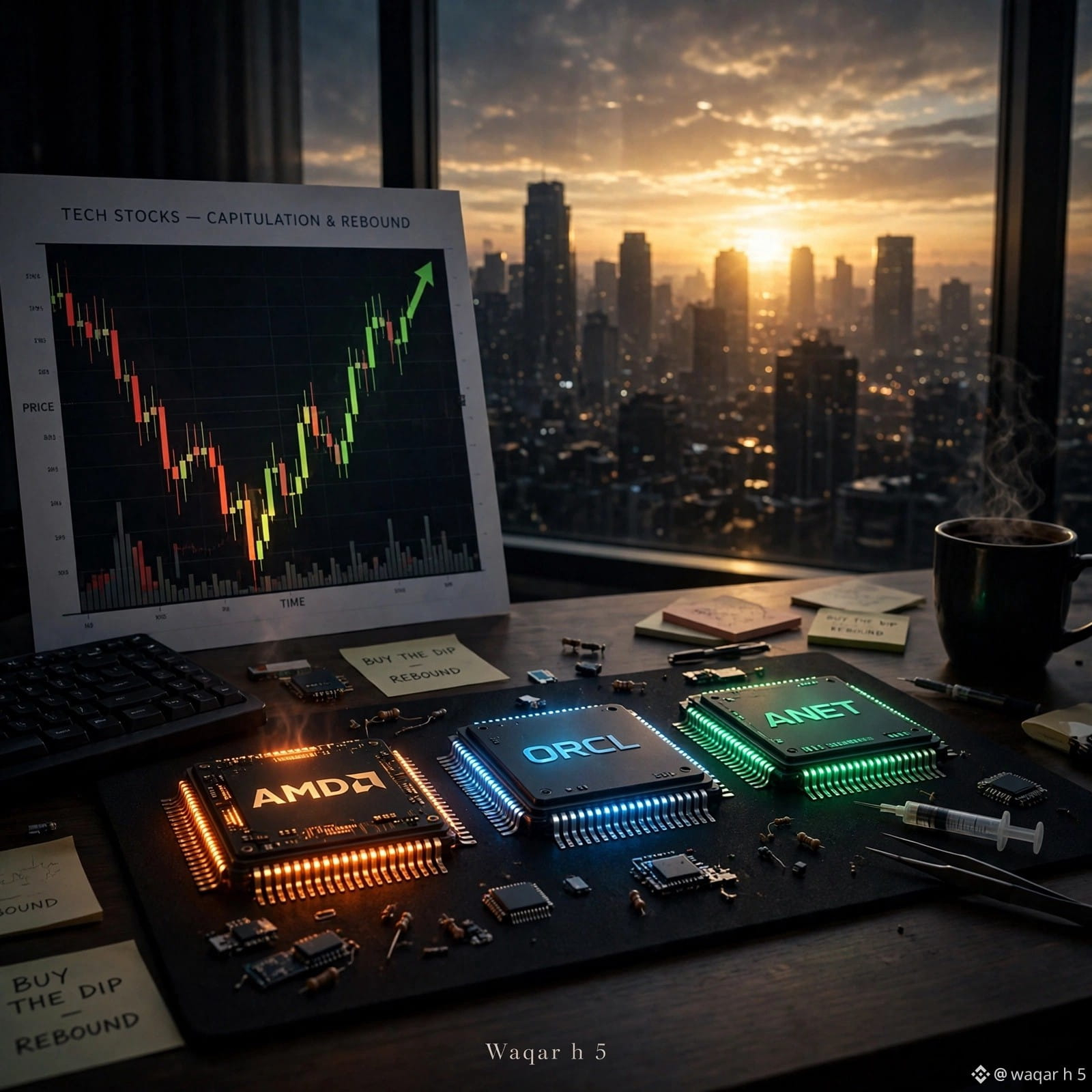
😱 EVERYONE PANICKED... BUT SMART MONEY WAS WAITING!
Jim Cramer says Tech still hasn't seen TRUE capitulation — the moment when everyone gives up and the bottom is formed.
Look what happened: 👇
📉 Nasdaq 100 fell -10.4% from its record high
📉 Nasdaq dropped -4.1% in one day — pure fear
💥 Oracle fell almost -9% after $20B debt + stock sale news — AI funding worries hit hard!
But then... THE REBOUND STARTED! 🚀
🔥 $AMD +10.31% — Leading the comeback
🔥 $ANET +12.1% — Exploded higher!
🔥 $ORCL +3.67% — Bouncing back from panic
Cramer says companies WITHOUT big capital raises — like AMD and ANET — could lead the next rebound. And today they proved it!
Capitulation = Despair + Heavy Volume + Strong Close Reversal. We didn't get it yet... but this bounce says the low might already be in!
Did you buy the dip or wait on sidelines? 👇
#TechStocks #AI #StockMarket #BuyTheDip
😱 EVERYONE PANICKED... BUT SMART MONEY WAS WAITING!
Jim Cramer says Tech still hasn't seen TRUE capitulation — the moment when everyone gives up and the bottom is formed.
Look what happened: 👇
📉 Nasdaq 100 fell -10.4% from its record high
📉 Nasdaq dropped -4.1% in one day — pure fear
💥 Oracle fell almost -9% after $20B debt + stock sale news — AI funding worries hit hard!
But then... THE REBOUND STARTED! 🚀
🔥 $AMD +10.31% — Leading the comeback
🔥 $ANET +12.1% — Exploded higher!
🔥 $ORCL +3.67% — Bouncing back from panic
Cramer says companies WITHOUT big capital raises — like AMD and ANET — could lead the next rebound. And today they proved it!
Capitulation = Despair + Heavy Volume + Strong Close Reversal. We didn't get it yet... but this bounce says the low might already be in!
Did you buy the dip or wait on sidelines? 👇
#TechStocks #AI #StockMarket #BuyTheDip
Jim Cramer says Tech still hasn't seen TRUE capitulation — the moment when everyone gives up and the bottom is formed.
Look what happened: 👇
📉 Nasdaq 100 fell -10.4% from its record high
📉 Nasdaq dropped -4.1% in one day — pure fear
💥 Oracle fell almost -9% after $20B debt + stock sale news — AI funding worries hit hard!
But then... THE REBOUND STARTED! 🚀
🔥 $AMD +10.31% — Leading the comeback
🔥 $ANET +12.1% — Exploded higher!
🔥 $ORCL +3.67% — Bouncing back from panic
Cramer says companies WITHOUT big capital raises — like AMD and ANET — could lead the next rebound. And today they proved it!
Capitulation = Despair + Heavy Volume + Strong Close Reversal. We didn't get it yet... but this bounce says the low might already be in!
Did you buy the dip or wait on sidelines? 👇
#TechStocks #AI #StockMarket #BuyTheDip
124
Semiconductor and technology markets are seeing major acquisition activity alongside aggressive long-term revenue updates:
- Acquisition Terms: onsemi announced plans to acquire AI power-chip startup Ferric for $600 million in cash, alongside up to $175 million in additional payments.
- Revenue Projections: The company raised its 2030 AI data center revenue target by $500 million to exceed $3 billion, signaling a deeper strategic push into artificial intelligence infrastructure.
- Market Reaction: onsemi stock $ON.US moved up 1.34%.
For tech investors, semiconductor analysts, and market participants, monitoring hardware acquisitions and data center revenue guidance remains crucial for evaluating AI-driven growth.
#CoinVahini #onsemi #Ferric #AIInfrastructure #TechStocks
Semiconductor and technology markets are seeing major acquisition activity alongside aggressive long-term revenue updates:
- Acquisition Terms: onsemi announced plans to acquire AI power-chip startup Ferric for $600 million in cash, alongside up to $175 million in additional payments.
- Revenue Projections: The company raised its 2030 AI data center revenue target by $500 million to exceed $3 billion, signaling a deeper strategic push into artificial intelligence infrastructure.
- Market Reaction: onsemi stock $ON.US moved up 1.34%.
For tech investors, semiconductor analysts, and market participants, monitoring hardware acquisitions and data center revenue guidance remains crucial for evaluating AI-driven growth.
#CoinVahini #onsemi #Ferric #AIInfrastructure #TechStocks
- Acquisition Terms: onsemi announced plans to acquire AI power-chip startup Ferric for $600 million in cash, alongside up to $175 million in additional payments.
- Revenue Projections: The company raised its 2030 AI data center revenue target by $500 million to exceed $3 billion, signaling a deeper strategic push into artificial intelligence infrastructure.
- Market Reaction: onsemi stock $ON.US moved up 1.34%.
For tech investors, semiconductor analysts, and market participants, monitoring hardware acquisitions and data center revenue guidance remains crucial for evaluating AI-driven growth.
#CoinVahini #onsemi #Ferric #AIInfrastructure #TechStocks
ONUS+0,77%
2
·
--
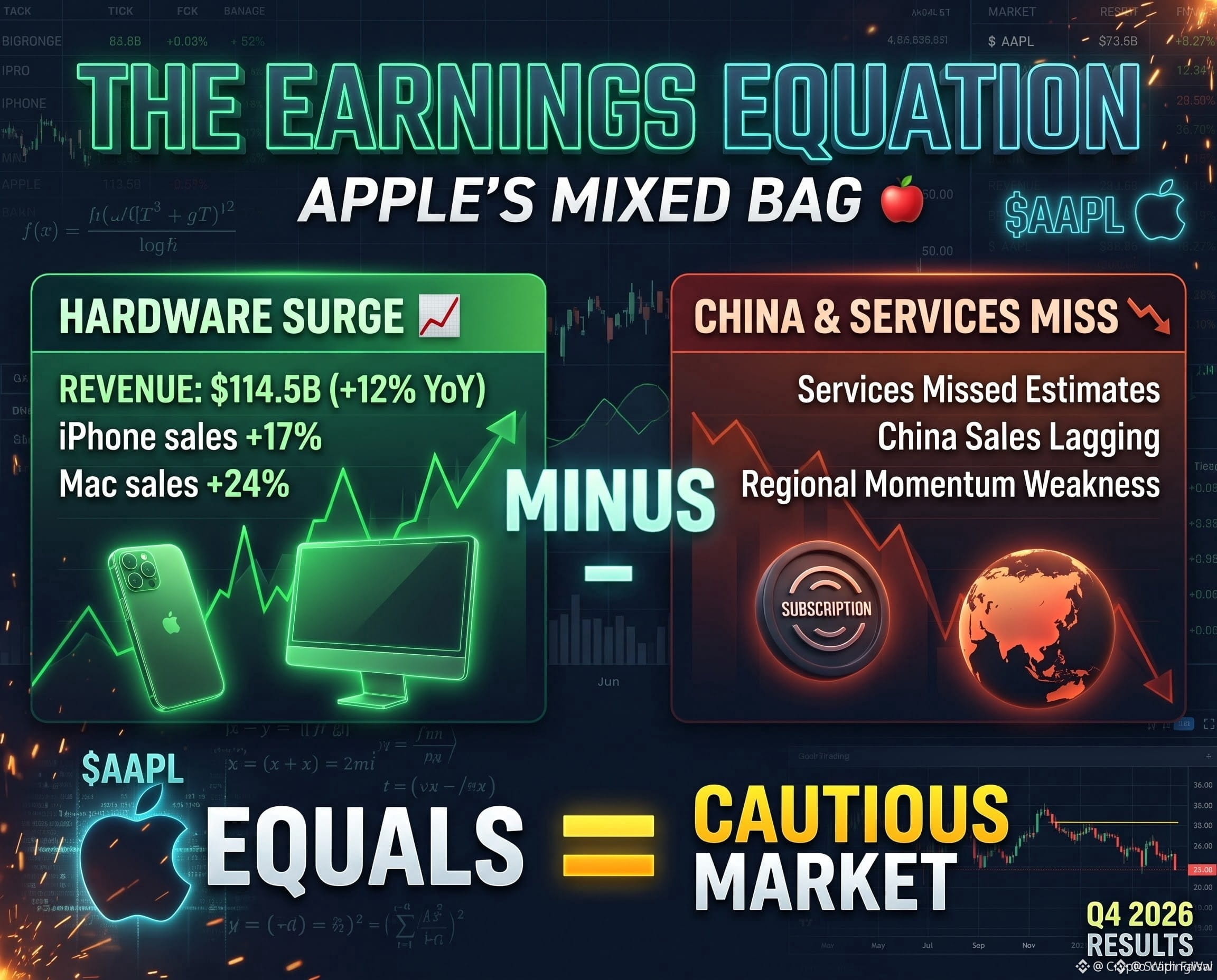
🚀 $AAPL MIXED Q4 REVEAL: HARDWARE SURGE VS CHINA SLIP 📉
📊 Apple’s Q4 numbers hit a record $114.5B revenue, with iPhone up 17% and Mac soaring 24%—a pure hardware fireworks show. 🦈 Yet the Services division fell just shy of estimates and China sales lagged, pulling the sentiment needle down. ⚡ The duality creates a tightrope: bullish product momentum battling regional and services weakness.
💬 Are you loading up on the hardware rally or scaling back on the China drag? 👇
⚠️ Not financial advice. Always manage your risk. 🛡️
🏷️ #AAPL #EarningsPlay #TechStocks #MarketPulse
🔥 💎
🚀 $AAPL MIXED Q4 REVEAL: HARDWARE SURGE VS CHINA SLIP 📉
📊 Apple’s Q4 numbers hit a record $114.5B revenue, with iPhone up 17% and Mac soaring 24%—a pure hardware fireworks show. 🦈 Yet the Services division fell just shy of estimates and China sales lagged, pulling the sentiment needle down. ⚡ The duality creates a tightrope: bullish product momentum battling regional and services weakness.
💬 Are you loading up on the hardware rally or scaling back on the China drag? 👇
⚠️ Not financial advice. Always manage your risk. 🛡️
🏷️ #AAPL #EarningsPlay #TechStocks #MarketPulse
🔥 💎
📊 Apple’s Q4 numbers hit a record $114.5B revenue, with iPhone up 17% and Mac soaring 24%—a pure hardware fireworks show. 🦈 Yet the Services division fell just shy of estimates and China sales lagged, pulling the sentiment needle down. ⚡ The duality creates a tightrope: bullish product momentum battling regional and services weakness.
💬 Are you loading up on the hardware rally or scaling back on the China drag? 👇
⚠️ Not financial advice. Always manage your risk. 🛡️
🏷️ #AAPL #EarningsPlay #TechStocks #MarketPulse
🔥 💎
19

Расталды
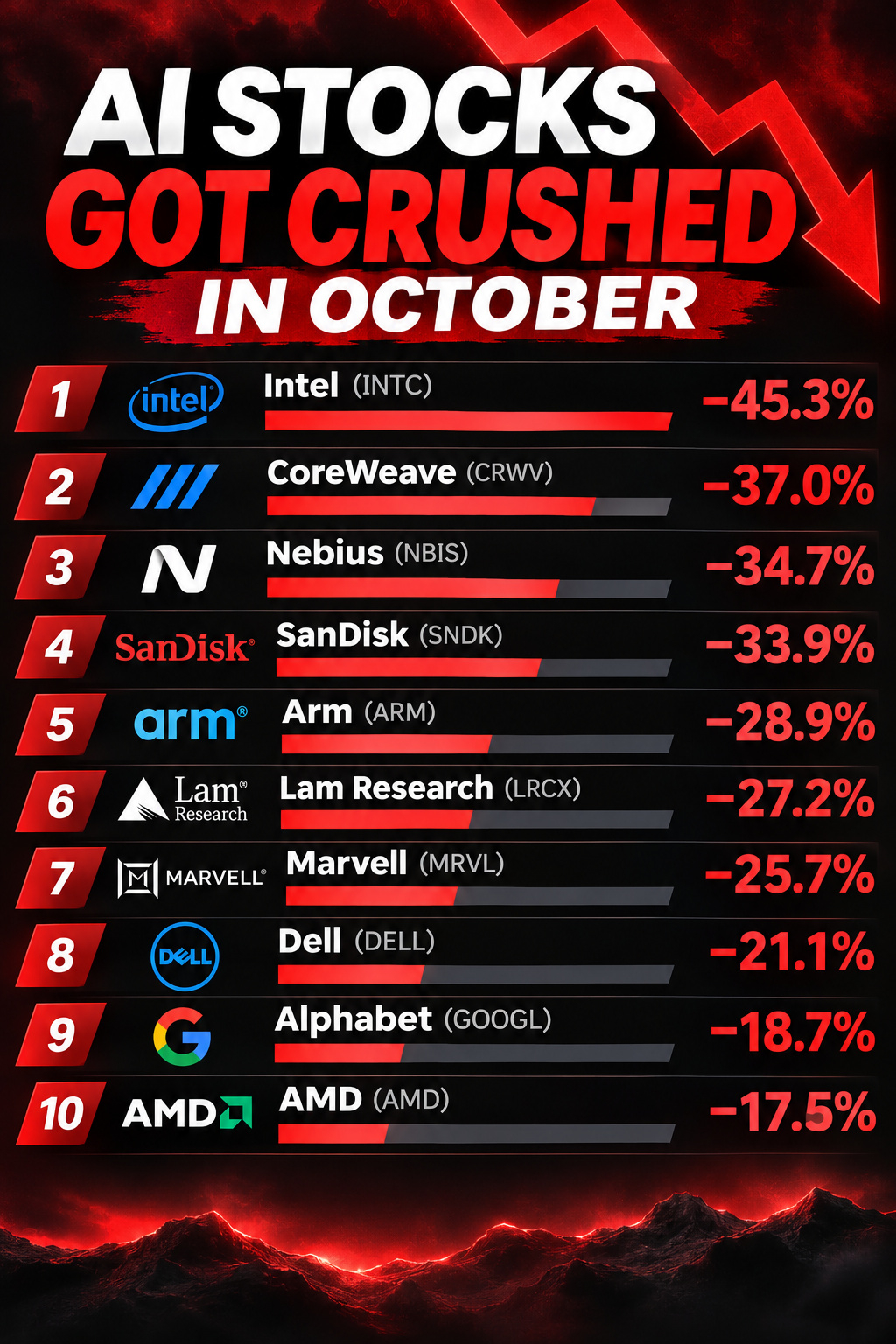
🚨 AI STOCKS GOT CRUSHED IN OCTOBER.
The AI boom is facing a brutal reality check.
Intel plunged 45.3%, CoreWeave lost 37%, while Nebius, SanDisk and Arm also suffered heavy declines.
What makes this interesting is that these companies sit at different layers of the AI ecosystem:
- Chips: Intel, AMD, Arm
- AI infrastructure: CoreWeave, Nebius
- Semiconductors & memory: SanDisk, Marvell, Lam Research
- Enterprise & cloud ecosystem: Dell, Alphabet
My take: This doesn't necessarily mean the AI revolution is over. But the market may be starting to question how much investors are willing to pay for future AI growth.
AI adoption can keep expanding while AI stocks keep falling.
That's the difference between believing in a technology and buying it at any price.
#AI #Stocks #TechStocks #BlueTokenCapital
🚨 AI STOCKS GOT CRUSHED IN OCTOBER.
The AI boom is facing a brutal reality check.
Intel plunged 45.3%, CoreWeave lost 37%, while Nebius, SanDisk and Arm also suffered heavy declines.
What makes this interesting is that these companies sit at different layers of the AI ecosystem:
- Chips: Intel, AMD, Arm
- AI infrastructure: CoreWeave, Nebius
- Semiconductors & memory: SanDisk, Marvell, Lam Research
- Enterprise & cloud ecosystem: Dell, Alphabet
My take: This doesn't necessarily mean the AI revolution is over. But the market may be starting to question how much investors are willing to pay for future AI growth.
AI adoption can keep expanding while AI stocks keep falling.
That's the difference between believing in a technology and buying it at any price.
#AI #Stocks #TechStocks #BlueTokenCapital
The AI boom is facing a brutal reality check.
Intel plunged 45.3%, CoreWeave lost 37%, while Nebius, SanDisk and Arm also suffered heavy declines.
What makes this interesting is that these companies sit at different layers of the AI ecosystem:
- Chips: Intel, AMD, Arm
- AI infrastructure: CoreWeave, Nebius
- Semiconductors & memory: SanDisk, Marvell, Lam Research
- Enterprise & cloud ecosystem: Dell, Alphabet
My take: This doesn't necessarily mean the AI revolution is over. But the market may be starting to question how much investors are willing to pay for future AI growth.
AI adoption can keep expanding while AI stocks keep falling.
That's the difference between believing in a technology and buying it at any price.
#AI #Stocks #TechStocks #BlueTokenCapital
2
2.5k
Apple has released its financial results, outperforming expectations:
* Apple reported fiscal Q4 revenue of $114.48 billion and earnings of $2.10 a share, beating estimates.
* The company's active device base reached another all-time high across all major product categories and geographic segments.
{spot}(AAPLBUSDT)
{stock_us}(AAPL.US)
For equity investors, market analysts, and macroeconomic participants, monitoring tech giant earnings and active user metrics remains key to assessing broader consumer demand and market health.
$AAPL $AAPL.US $AAPLB #Apple #CoinVahini #EarningsSeason #TechStocks #Macroeconomics
Apple has released its financial results, outperforming expectations:
* Apple reported fiscal Q4 revenue of $114.48 billion and earnings of $2.10 a share, beating estimates.
* The company's active device base reached another all-time high across all major product categories and geographic segments.
For equity investors, market analysts, and macroeconomic participants, monitoring tech giant earnings and active user metrics remains key to assessing broader consumer demand and market health.
$AAPL $AAPL.US $AAPLB #Apple #CoinVahini #EarningsSeason #TechStocks #Macroeconomics
* Apple reported fiscal Q4 revenue of $114.48 billion and earnings of $2.10 a share, beating estimates.
* The company's active device base reached another all-time high across all major product categories and geographic segments.
For equity investors, market analysts, and macroeconomic participants, monitoring tech giant earnings and active user metrics remains key to assessing broader consumer demand and market health.
$AAPL $AAPL.US $AAPLB #Apple #CoinVahini #EarningsSeason #TechStocks #Macroeconomics
AAPLUS-0,06%
AAPLB-1,58%
1
10

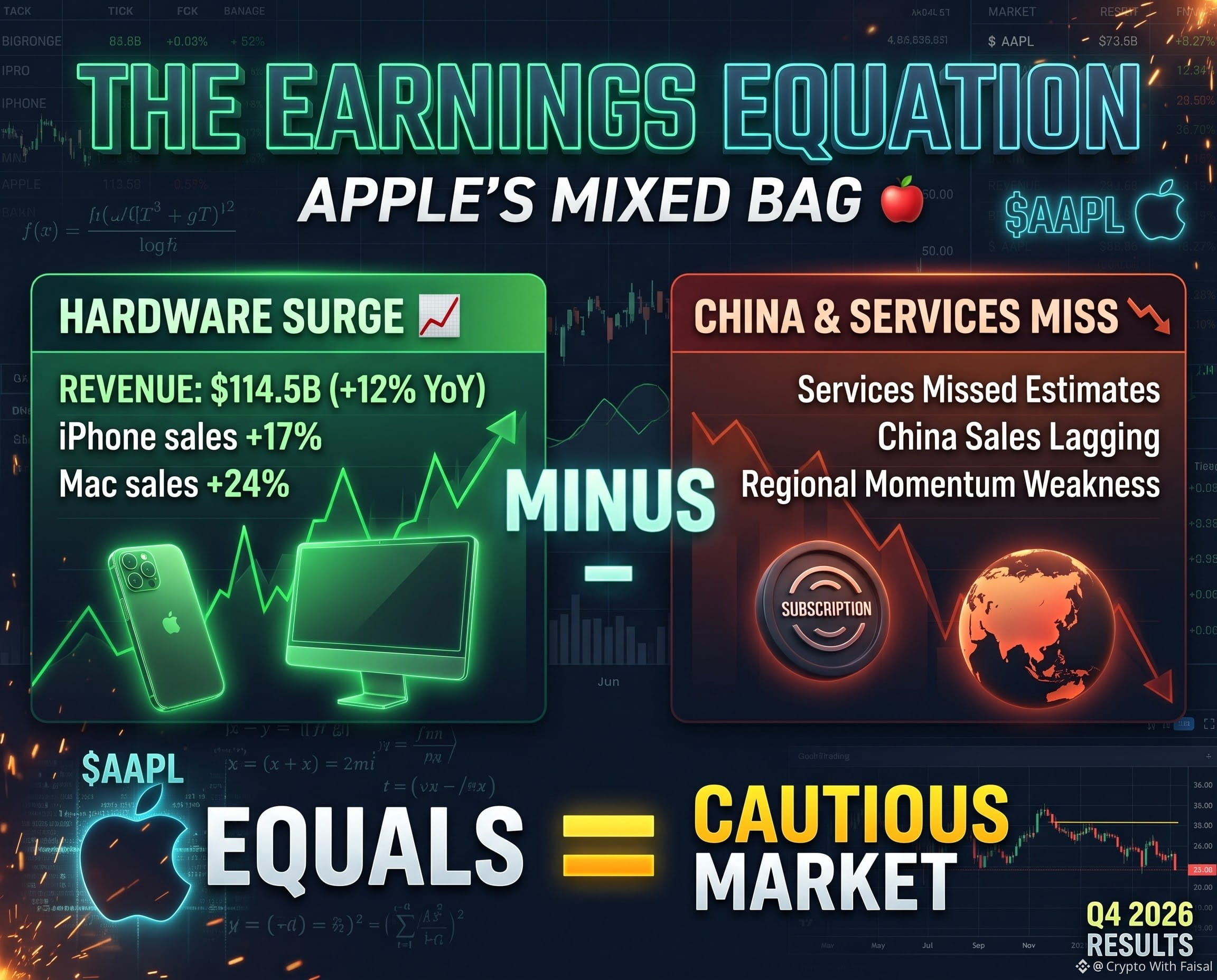
🚨 THE EARNINGS EQUATION: Apple's Mixed Bag 🚨
#applereportsmixedresults Let's break down the world's biggest tech earnings using pure math 🧮👇
(Hardware Surge) - (China & Services Miss) = Cautious Market 📉
The Asset Input:
(The Catalyst) = AAPL just released its fiscal Q4 2026 results. The headline numbers are massive: total revenue hit a September quarter record of $114.5 billion (+12% YoY), and earnings per share came in strong at $2.10.
The Key Deliverable:
(The Breakdown) ➔ Hardware completely carried the quarter. iPhone sales spiked 17% year-over-year, and Mac revenue saw a massive 24% jump, pushing total product revenue to $82.9 billion. Net profit landed at a staggering $30.71 billion.
The Reality:
So why the mixed sentiment? Despite the hardware beats, Apple's highly profitable Services division narrowly missed Wall Street estimates. Additionally, sales in the critical Chinese market disappointed, leaving investors questioning the company's regional momentum.
Are you buying this hardware strength, or taking profits due to the China and Services misses? ❓👇💬
$AAPL $ARIA $AGT
{future}(AGTUSDT)
{future}(ARIAUSDT)
{future}(AAPLUSDT)
#AAPL #TechStocks #stockmarket
🚨 THE EARNINGS EQUATION: Apple's Mixed Bag 🚨
#applereportsmixedresults Let's break down the world's biggest tech earnings using pure math 🧮👇
(Hardware Surge) - (China & Services Miss) = Cautious Market 📉
The Asset Input:
(The Catalyst) = AAPL just released its fiscal Q4 2026 results. The headline numbers are massive: total revenue hit a September quarter record of $114.5 billion (+12% YoY), and earnings per share came in strong at $2.10.
The Key Deliverable:
(The Breakdown) ➔ Hardware completely carried the quarter. iPhone sales spiked 17% year-over-year, and Mac revenue saw a massive 24% jump, pushing total product revenue to $82.9 billion. Net profit landed at a staggering $30.71 billion.
The Reality:
So why the mixed sentiment? Despite the hardware beats, Apple's highly profitable Services division narrowly missed Wall Street estimates. Additionally, sales in the critical Chinese market disappointed, leaving investors questioning the company's regional momentum.
Are you buying this hardware strength, or taking profits due to the China and Services misses? ❓👇💬
$AAPL $ARIA $AGT
#AAPL #TechStocks #stockmarket
#applereportsmixedresults Let's break down the world's biggest tech earnings using pure math 🧮👇
(Hardware Surge) - (China & Services Miss) = Cautious Market 📉
The Asset Input:
(The Catalyst) = AAPL just released its fiscal Q4 2026 results. The headline numbers are massive: total revenue hit a September quarter record of $114.5 billion (+12% YoY), and earnings per share came in strong at $2.10.
The Key Deliverable:
(The Breakdown) ➔ Hardware completely carried the quarter. iPhone sales spiked 17% year-over-year, and Mac revenue saw a massive 24% jump, pushing total product revenue to $82.9 billion. Net profit landed at a staggering $30.71 billion.
The Reality:
So why the mixed sentiment? Despite the hardware beats, Apple's highly profitable Services division narrowly missed Wall Street estimates. Additionally, sales in the critical Chinese market disappointed, leaving investors questioning the company's regional momentum.
Are you buying this hardware strength, or taking profits due to the China and Services misses? ❓👇💬
$AAPL $ARIA $AGT
#AAPL #TechStocks #stockmarket
533


Расталды
🚀📉 NASDAQ FUTURES REBOUND: Falling Oil Prices Give Tech Investors a Fresh Reason to Breathe! 💻🌍
Sometimes, markets don't need perfect news. They just need one reason to stop worrying.
US stock futures moved higher on November 2, with Nasdaq 100 futures gaining around 0.75% as Wall Street looked toward a stronger opening.
The biggest relief came from oil. Brent crude dropped sharply amid renewed hopes for diplomatic progress between Washington and Tehran, easing fears of prolonged energy disruptions.
Technology shares also found support after Friday's heavy AI and semiconductor-led selloff. However, not every company recovered equally, showing that investors remain selective.
Another important signal came from US manufacturing data. October's PMI reached 55.5, beating expectations and suggesting stronger industrial activity.
MY TAKE: Falling oil prices are more than a commodity story.
For technology companies, lower energy costs can ease operating expenses, while reduced inflation pressure may improve expectations around interest rates.
But one rebound doesn't erase the bigger risks. AI valuations, chip-sector competition, corporate earnings and upcoming central bank decisions could still change market direction.
The real question isn't how high Nasdaq can bounce, but whether this recovery has enough strength to last.
Do you think cheaper oil can fuel another technology rally, or is this simply a temporary relief bounce?
Disclaimer: For educational purposes only. Not financial advice.
#Nasdaq #TechStocks #GrowWithSAC $1000CAT $SOPH $MITO
🚀📉 NASDAQ FUTURES REBOUND: Falling Oil Prices Give Tech Investors a Fresh Reason to Breathe! 💻🌍
Sometimes, markets don't need perfect news. They just need one reason to stop worrying.
US stock futures moved higher on November 2, with Nasdaq 100 futures gaining around 0.75% as Wall Street looked toward a stronger opening.
The biggest relief came from oil. Brent crude dropped sharply amid renewed hopes for diplomatic progress between Washington and Tehran, easing fears of prolonged energy disruptions.
Technology shares also found support after Friday's heavy AI and semiconductor-led selloff. However, not every company recovered equally, showing that investors remain selective.
Another important signal came from US manufacturing data. October's PMI reached 55.5, beating expectations and suggesting stronger industrial activity.
MY TAKE: Falling oil prices are more than a commodity story.
For technology companies, lower energy costs can ease operating expenses, while reduced inflation pressure may improve expectations around interest rates.
But one rebound doesn't erase the bigger risks. AI valuations, chip-sector competition, corporate earnings and upcoming central bank decisions could still change market direction.
The real question isn't how high Nasdaq can bounce, but whether this recovery has enough strength to last.
Do you think cheaper oil can fuel another technology rally, or is this simply a temporary relief bounce?
Disclaimer: For educational purposes only. Not financial advice.
#Nasdaq #TechStocks #GrowWithSAC $1000CAT $SOPH $MITO
Sometimes, markets don't need perfect news. They just need one reason to stop worrying.
US stock futures moved higher on November 2, with Nasdaq 100 futures gaining around 0.75% as Wall Street looked toward a stronger opening.
The biggest relief came from oil. Brent crude dropped sharply amid renewed hopes for diplomatic progress between Washington and Tehran, easing fears of prolonged energy disruptions.
Technology shares also found support after Friday's heavy AI and semiconductor-led selloff. However, not every company recovered equally, showing that investors remain selective.
Another important signal came from US manufacturing data. October's PMI reached 55.5, beating expectations and suggesting stronger industrial activity.
MY TAKE: Falling oil prices are more than a commodity story.
For technology companies, lower energy costs can ease operating expenses, while reduced inflation pressure may improve expectations around interest rates.
But one rebound doesn't erase the bigger risks. AI valuations, chip-sector competition, corporate earnings and upcoming central bank decisions could still change market direction.
The real question isn't how high Nasdaq can bounce, but whether this recovery has enough strength to last.
Do you think cheaper oil can fuel another technology rally, or is this simply a temporary relief bounce?
Disclaimer: For educational purposes only. Not financial advice.
#Nasdaq #TechStocks #GrowWithSAC $1000CAT $SOPH $MITO

414
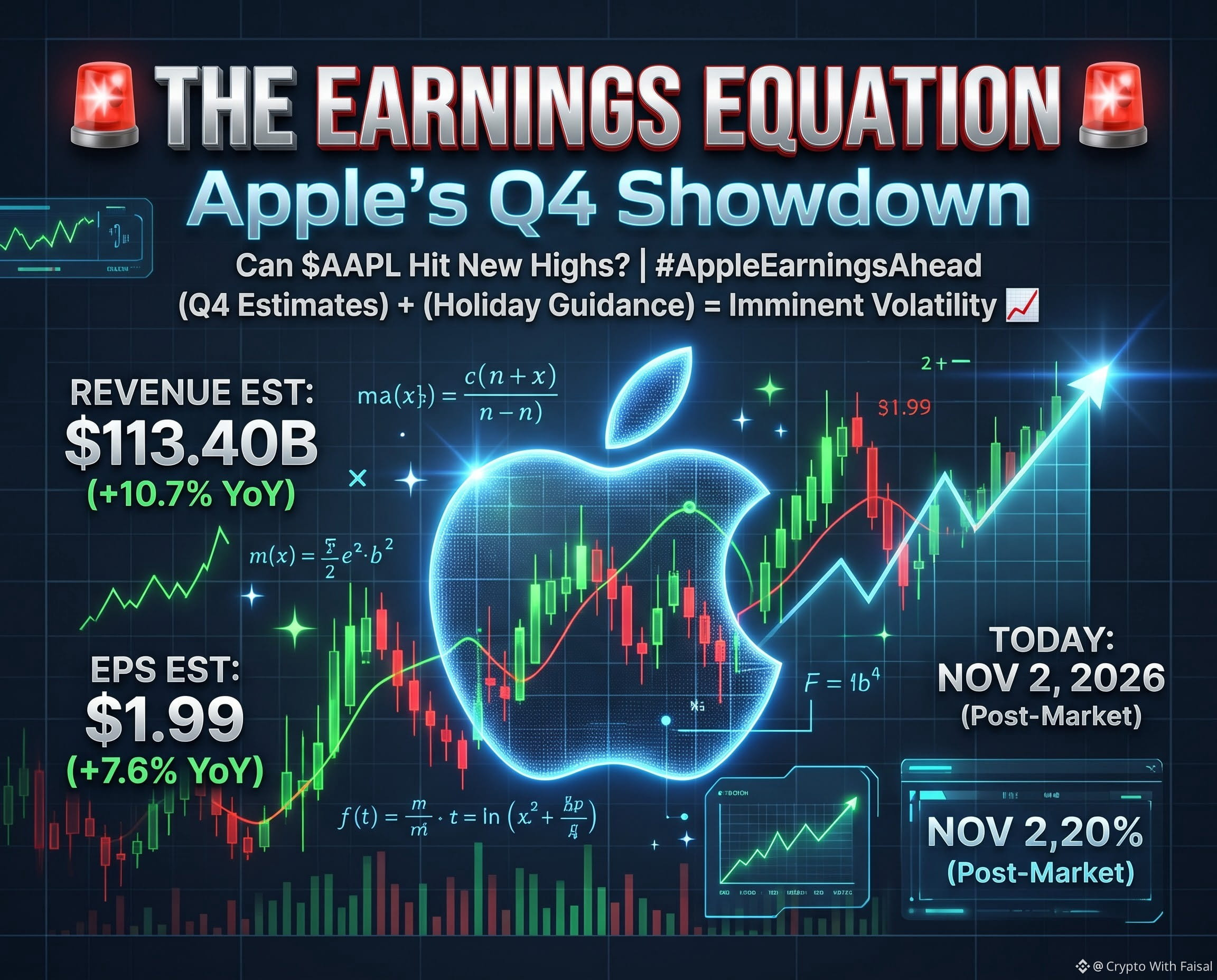
🚨 THE EARNINGS EQUATION: Apple's Q4 Showdown 🚨
#appleearningsahead-canstockhitnewhigh
Let's break down the biggest tech catalyst of the week using pure math 🧮👇
(Q4 Estimates) + (Holiday Guidance) = Imminent Volatility 📈
The Asset Input:
(The Catalyst) = $AAPL releases its fiscal Q4 2026 earnings today, Nov 2, right after the US market closes.
The Key Deliverable:
(The Breakdown) ➔ Wall Street is modeling massive numbers. Consensus expects $113.40 billion in revenue (+10.7% YoY) and an EPS of $1.99 (+7.6% YoY).
The Impact:
Apple has beaten EPS estimates for 8 straight quarters. With shares hovering near $344, traders are heavily focused on iPhone sales growth and how rising memory chip costs might impact margins. A strong beat and solid Q1 outlook could launch the entire tech sector higher.
Will Apple crush expectations and trigger a market rally, or is the stock already priced for perfection? ❓👇💬
$AAPL
{future}(AAPLUSDT)
$AAPLB
{spot}(AAPLBUSDT)
#AAPL #TechStocks #EarningsSeason
🚨 THE EARNINGS EQUATION: Apple's Q4 Showdown 🚨
#appleearningsahead-canstockhitnewhigh
Let's break down the biggest tech catalyst of the week using pure math 🧮👇
(Q4 Estimates) + (Holiday Guidance) = Imminent Volatility 📈
The Asset Input:
(The Catalyst) = $AAPL releases its fiscal Q4 2026 earnings today, Nov 2, right after the US market closes.
The Key Deliverable:
(The Breakdown) ➔ Wall Street is modeling massive numbers. Consensus expects $113.40 billion in revenue (+10.7% YoY) and an EPS of $1.99 (+7.6% YoY).
The Impact:
Apple has beaten EPS estimates for 8 straight quarters. With shares hovering near $344, traders are heavily focused on iPhone sales growth and how rising memory chip costs might impact margins. A strong beat and solid Q1 outlook could launch the entire tech sector higher.
Will Apple crush expectations and trigger a market rally, or is the stock already priced for perfection? ❓👇💬
$AAPL
$AAPLB
#AAPL #TechStocks #EarningsSeason
#appleearningsahead-canstockhitnewhigh
Let's break down the biggest tech catalyst of the week using pure math 🧮👇
(Q4 Estimates) + (Holiday Guidance) = Imminent Volatility 📈
The Asset Input:
(The Catalyst) = $AAPL releases its fiscal Q4 2026 earnings today, Nov 2, right after the US market closes.
The Key Deliverable:
(The Breakdown) ➔ Wall Street is modeling massive numbers. Consensus expects $113.40 billion in revenue (+10.7% YoY) and an EPS of $1.99 (+7.6% YoY).
The Impact:
Apple has beaten EPS estimates for 8 straight quarters. With shares hovering near $344, traders are heavily focused on iPhone sales growth and how rising memory chip costs might impact margins. A strong beat and solid Q1 outlook could launch the entire tech sector higher.
Will Apple crush expectations and trigger a market rally, or is the stock already priced for perfection? ❓👇💬
$AAPL
$AAPLB
#AAPL #TechStocks #EarningsSeason
1
94
🍎 Apple at a Crossroads: Is Mega-Cap Tech Losing Its Shield?
Apple is back in the spotlight as investors reassess technology exposure following a broad sector selloff. AAPL slipped 1.07% to $345.10, raising an important question: Is this temporary weakness or the beginning of wider mega-cap de-risking?
{spot}(AAPLBUSDT)
With Apple's massive index influence, its next move could shape broader market sentiment. Investors should watch iPhone demand, Services revenue, profit margins and AI-driven upgrades, alongside upcoming jobs data and interest-rate expectations.
{stock_us}(AAPL.US)
Can Apple demonstrate resilience while the technology sector faces pressure?
$AAPLB $AAPL $AAPL.US #CoinVahini #AppleStock #NASDAQ #TechStocks
🍎 Apple at a Crossroads: Is Mega-Cap Tech Losing Its Shield?
Apple is back in the spotlight as investors reassess technology exposure following a broad sector selloff. AAPL slipped 1.07% to $345.10, raising an important question: Is this temporary weakness or the beginning of wider mega-cap de-risking?
With Apple's massive index influence, its next move could shape broader market sentiment. Investors should watch iPhone demand, Services revenue, profit margins and AI-driven upgrades, alongside upcoming jobs data and interest-rate expectations.
Can Apple demonstrate resilience while the technology sector faces pressure?
$AAPLB $AAPL $AAPL.US #CoinVahini #AppleStock #NASDAQ #TechStocks
Apple is back in the spotlight as investors reassess technology exposure following a broad sector selloff. AAPL slipped 1.07% to $345.10, raising an important question: Is this temporary weakness or the beginning of wider mega-cap de-risking?
With Apple's massive index influence, its next move could shape broader market sentiment. Investors should watch iPhone demand, Services revenue, profit margins and AI-driven upgrades, alongside upcoming jobs data and interest-rate expectations.
Can Apple demonstrate resilience while the technology sector faces pressure?
$AAPLB $AAPL $AAPL.US #CoinVahini #AppleStock #NASDAQ #TechStocks
AAPLUS-0,06%
AAPLB-1,58%
6

·
--
🚨 GOOGLE JUST LOST NEARLY $500 BILLION IN MARKET VALUE!
Alphabet (Google’s parent company) suffered a massive sell-off, wiping out approximately $475–500 billion in market capitalization.
What's behind the crash?
🔻 Heavy AI infrastructure spending
🔻 Slower Google Search revenue growth
🔻 Earnings falling short of expectations
🔻 Growing concerns about AI profitability
But here's the twist: Google Cloud revenue surged 103%, showing that AI demand remains strong.
The bigger question is: Are investors losing confidence in the AI boom, or is this just a temporary market correction?
$GOOGL $LSK
{future}(GOOGLUSDT)
#Google #Alphabet #AI #TechStocks
🚨 GOOGLE JUST LOST NEARLY $500 BILLION IN MARKET VALUE!
Alphabet (Google’s parent company) suffered a massive sell-off, wiping out approximately $475–500 billion in market capitalization.
What's behind the crash?
🔻 Heavy AI infrastructure spending
🔻 Slower Google Search revenue growth
🔻 Earnings falling short of expectations
🔻 Growing concerns about AI profitability
But here's the twist: Google Cloud revenue surged 103%, showing that AI demand remains strong.
The bigger question is: Are investors losing confidence in the AI boom, or is this just a temporary market correction?
$GOOGL $LSK
#Google #Alphabet #AI #TechStocks
Alphabet (Google’s parent company) suffered a massive sell-off, wiping out approximately $475–500 billion in market capitalization.
What's behind the crash?
🔻 Heavy AI infrastructure spending
🔻 Slower Google Search revenue growth
🔻 Earnings falling short of expectations
🔻 Growing concerns about AI profitability
But here's the twist: Google Cloud revenue surged 103%, showing that AI demand remains strong.
The bigger question is: Are investors losing confidence in the AI boom, or is this just a temporary market correction?
$GOOGL $LSK
#Google #Alphabet #AI #TechStocks

2
208
·
--
🚨 CASHING OUT $AMD AT $617 AS STRETCHED VALUATIONS DEMAND A DEEPER RESET! 📉
Securing gains at $617 was purely about cold execution. $AMD remains an elite powerhouse with multi-trillion potential, but capital protection always overrides emotional attachments when valuation detaches from reality. 💡
📊 Even after a sharp 25% drawdown from the peak, the stock still commands an aggressive forward P/E above 45x—triple the multiple of $NVDA . Smart money waits for true liquidity sweeps rather than catching a falling knife in stretched territory.
I am keeping dry powder ready to reclaim this runner once the valuation resets to a reasonable floor. 🤔 At what price level do you think the institutional bid finally steps in?
⚠️ Not financial advice. Always manage your risk. 🛡️
🏷️ #AMD #TechStocks #TradingStrategy #StockMarket
🎯 🦈
🚨 CASHING OUT $AMD AT $617 AS STRETCHED VALUATIONS DEMAND A DEEPER RESET! 📉
Securing gains at $617 was purely about cold execution. $AMD remains an elite powerhouse with multi-trillion potential, but capital protection always overrides emotional attachments when valuation detaches from reality. 💡
📊 Even after a sharp 25% drawdown from the peak, the stock still commands an aggressive forward P/E above 45x—triple the multiple of $NVDA . Smart money waits for true liquidity sweeps rather than catching a falling knife in stretched territory.
I am keeping dry powder ready to reclaim this runner once the valuation resets to a reasonable floor. 🤔 At what price level do you think the institutional bid finally steps in?
⚠️ Not financial advice. Always manage your risk. 🛡️
🏷️ #AMD #TechStocks #TradingStrategy #StockMarket
🎯 🦈
Securing gains at $617 was purely about cold execution. $AMD remains an elite powerhouse with multi-trillion potential, but capital protection always overrides emotional attachments when valuation detaches from reality. 💡
📊 Even after a sharp 25% drawdown from the peak, the stock still commands an aggressive forward P/E above 45x—triple the multiple of $NVDA . Smart money waits for true liquidity sweeps rather than catching a falling knife in stretched territory.
I am keeping dry powder ready to reclaim this runner once the valuation resets to a reasonable floor. 🤔 At what price level do you think the institutional bid finally steps in?
⚠️ Not financial advice. Always manage your risk. 🛡️
🏷️ #AMD #TechStocks #TradingStrategy #StockMarket
🎯 🦈
18

·
--
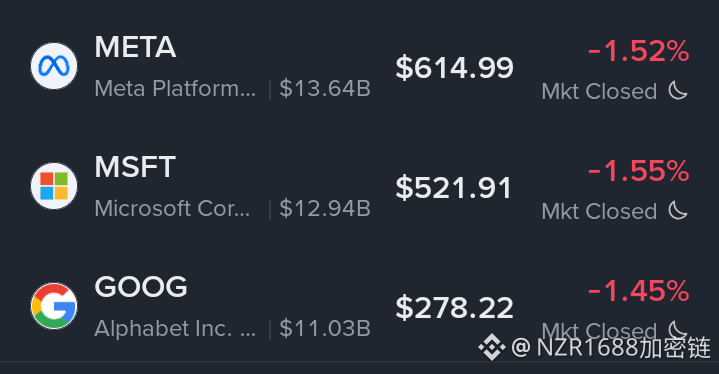
• Meta Platforms ($META ): Slipped down by -1.52%, closing the session at $614.99 with a daily volume of $13.64B.
• Microsoft Corp ($MSFT ): Declined by -1.55%, settling down at $521.91 on a trading volume of $12.94B.
• Alphabet Inc ($GOOG): Fell slightly by -1.45%, finishing the trading day at $278.22 with a volume of $11.03B.
Market Outlook: Unlike the heavy double-digit drops seen in hardware and chip stocks recently, the mega-cap tech sector is showing tighter algorithmic consolidation, holding key emotional floors ahead of upcoming macro economic index shifts.
#Meta #Microsoft #Google #alphabet #TechStocks #MarketUpdate
• Meta Platforms ($META ): Slipped down by -1.52%, closing the session at $614.99 with a daily volume of $13.64B.
• Microsoft Corp ($MSFT ): Declined by -1.55%, settling down at $521.91 on a trading volume of $12.94B.
• Alphabet Inc ($GOOG): Fell slightly by -1.45%, finishing the trading day at $278.22 with a volume of $11.03B.
Market Outlook: Unlike the heavy double-digit drops seen in hardware and chip stocks recently, the mega-cap tech sector is showing tighter algorithmic consolidation, holding key emotional floors ahead of upcoming macro economic index shifts.
#Meta #Microsoft #Google #alphabet #TechStocks #MarketUpdate
• Microsoft Corp ($MSFT ): Declined by -1.55%, settling down at $521.91 on a trading volume of $12.94B.
• Alphabet Inc ($GOOG): Fell slightly by -1.45%, finishing the trading day at $278.22 with a volume of $11.03B.
Market Outlook: Unlike the heavy double-digit drops seen in hardware and chip stocks recently, the mega-cap tech sector is showing tighter algorithmic consolidation, holding key emotional floors ahead of upcoming macro economic index shifts.
#Meta #Microsoft #Google #alphabet #TechStocks #MarketUpdate
1
4
62
Көбірек контент көру үшін кіріңіз
Binance Square платформасында әлемдік криптоқоғамдастыққа қосылыңыз
⚡️ Криптовалюта туралы ең соңғы және пайдалы ақпаратты алыңыз.
💬 Әлемдегі ең ірі криптобиржаның сеніміне ие.
👍 Расталған авторлардың нақты пікірлерін табыңыз.
Электрондық пошта/телефон нөмірі
Трендтегі тақырыптар
1
#BinanceReopensWithdrawalsForMoreAssets
854,649 рет көрілді
4,607 адам талқылап жатыр
2
#Binance98PercentReplenished
191,890 рет көрілді
1,873 адам талқылап жатыр
3
#USStocksSlipandCryptoMarketUnderBroadPressure
14,227 рет көрілді
246 адам талқылап жатыр
4
#StrategySTRCResumesIssuanceAfterOver170Days
23,921 рет көрілді
422 адам талқылап жатыр
5
#ADPUSPrivateEmployersAdd86000JobsInOctober
40,176 рет көрілді
573 адам талқылап жатыр
6
#KazakhstanReportedlyInvests$100MInCryptoFunds
2,477 рет көрілді
58 адам талқылап жатыр
7
#SouthKoreaSeeksCryptoTaxDelayUntil2029
24,156 рет көрілді
261 адам талқылап жатыр
8
#USMidterms-WhatAreMarketsExpecting?
641,968 рет көрілді
2,946 адам талқылап жатыр
9
#US10YearTreasuryYieldFallsTo4.845%
33,697 рет көрілді
195 адам талқылап жатыр
10
#ZcashExpectsNU7ToMake$16MSproutZECInaccessible
1,852 рет көрілді
24 адам талқылап жатыр