
#stocks
stocks
5.1M рет көрілді
13,155 адам талқылап жатыр
Қызу саудада
Ең соңғы

·
--
Жоғары (өспелі)
Расталды
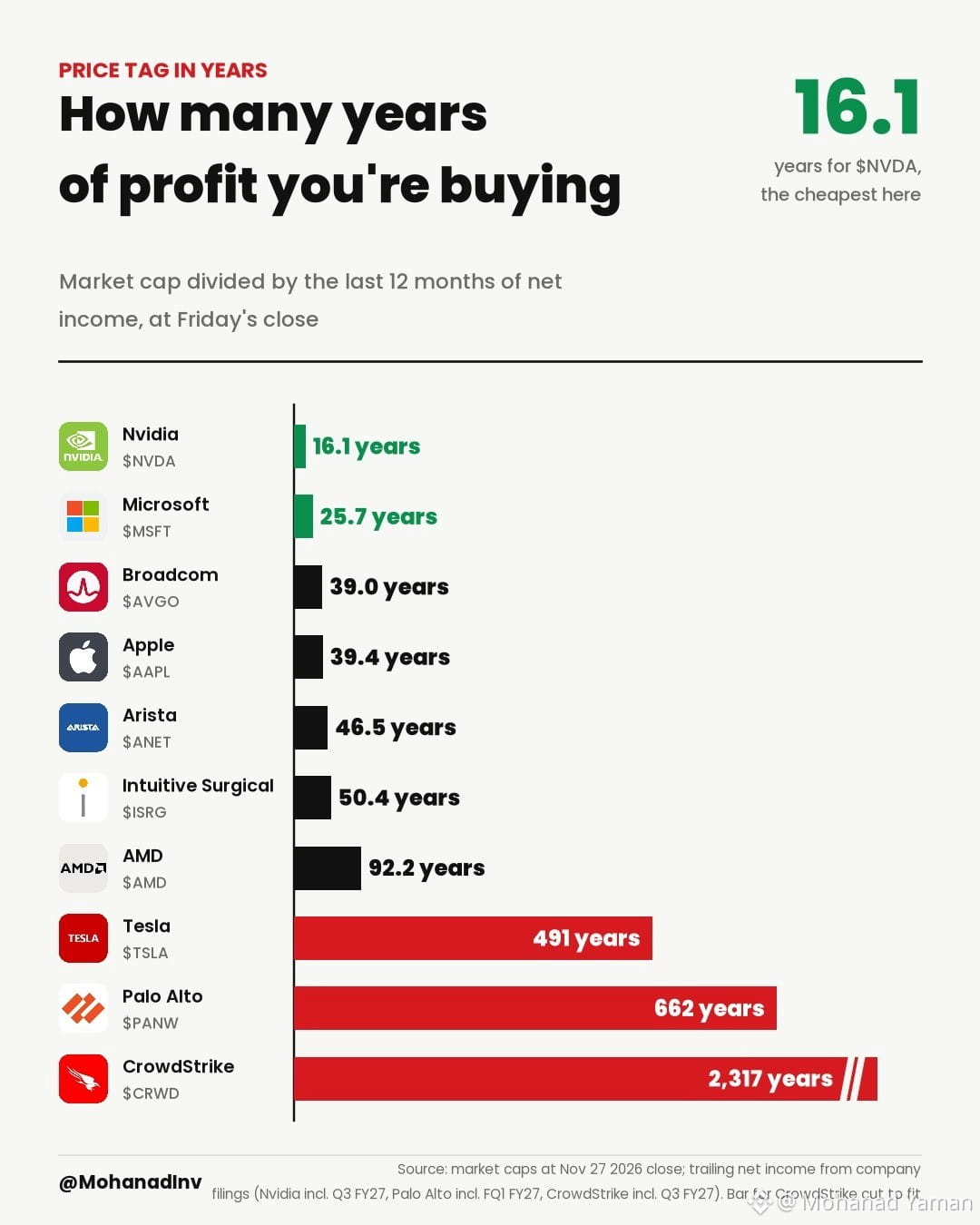
Buy the whole company today. How long until the profits pay you back? ⏳
Market cap divided by the last 12 months of net income, at Friday's close:
✅ $NVDA Nvidia: 16.1 years
✅ $MSFT Microsoft: 25.7 years
🔷 $AVGO lBroadcom: 39.0 years
🔷 $AAPL Apple: 39.4 years
🔷 $ANET Arista: 46.5 years
🔷 $ISRG Intuitive Surgical: 50.4 years
🔷 $AMD: 92.2 years
❌ $TSLA Tesla: 491 years
❌ $PANW Palo Alto: 662 years
❌ $CRWD CrowdStrike: 2,317 years
The stock everyone calls a bubble is the cheapest name on this list 👀
Profits can grow, and that's the whole bet. But at 2,317 years, you're paying for a lot of growth
Which one would you hold for 10 years at today's price?
#stocks
{spot}(NVDABUSDT)
Buy the whole company today. How long until the profits pay you back? ⏳
Market cap divided by the last 12 months of net income, at Friday's close:
✅ $NVDA Nvidia: 16.1 years
✅ $MSFT Microsoft: 25.7 years
🔷 $AVGO lBroadcom: 39.0 years
🔷 $AAPL Apple: 39.4 years
🔷 $ANET Arista: 46.5 years
🔷 $ISRG Intuitive Surgical: 50.4 years
🔷 $AMD: 92.2 years
❌ $TSLA Tesla: 491 years
❌ $PANW Palo Alto: 662 years
❌ $CRWD CrowdStrike: 2,317 years
The stock everyone calls a bubble is the cheapest name on this list 👀
Profits can grow, and that's the whole bet. But at 2,317 years, you're paying for a lot of growth
Which one would you hold for 10 years at today's price?
#stocks
Brooks Guetas:
sin duda el market es nvidia!
1
3
8.3k


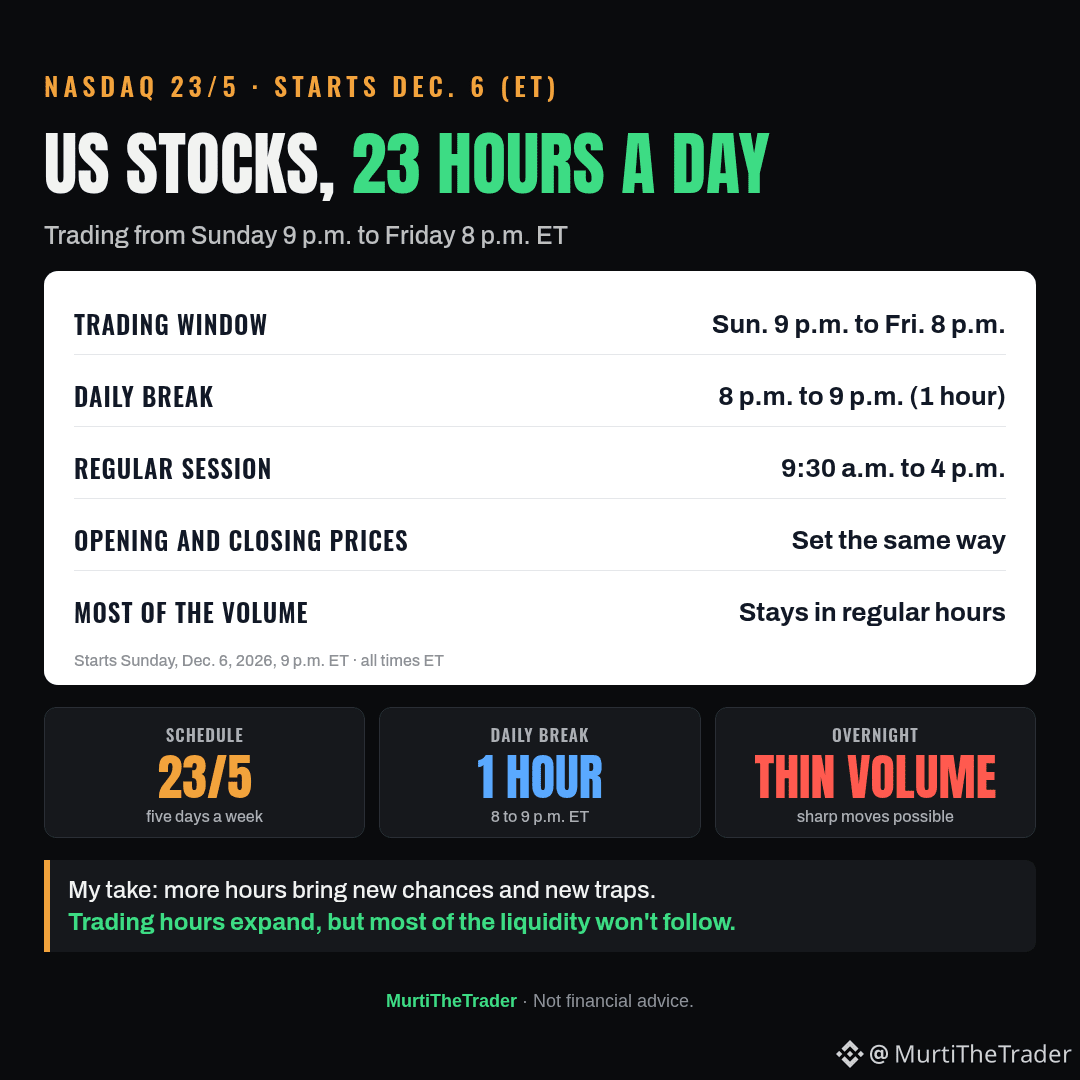
Starting Sunday night, Dec. 6 (ET), the US stock market will barely close.
Nasdaq is moving to 23/5 trading: from 9 p.m. ET Sunday to 8 p.m. ET Friday, with just a one-hour break each day from 8 to 9 p.m. ET.
The regular session is still 9:30 a.m. to 4 p.m. ET. Opening and closing prices are set the same way, and most of the volume will stay there.
My take: this is both an opportunity and a trap. A sharp move on thin overnight volume will make that "I missed it" feeling hit harder when you check your screen in the morning.
Would you trade US stocks overnight?
#Stocks #markets
Watching: $QQQ $SPY $TQQQ
416
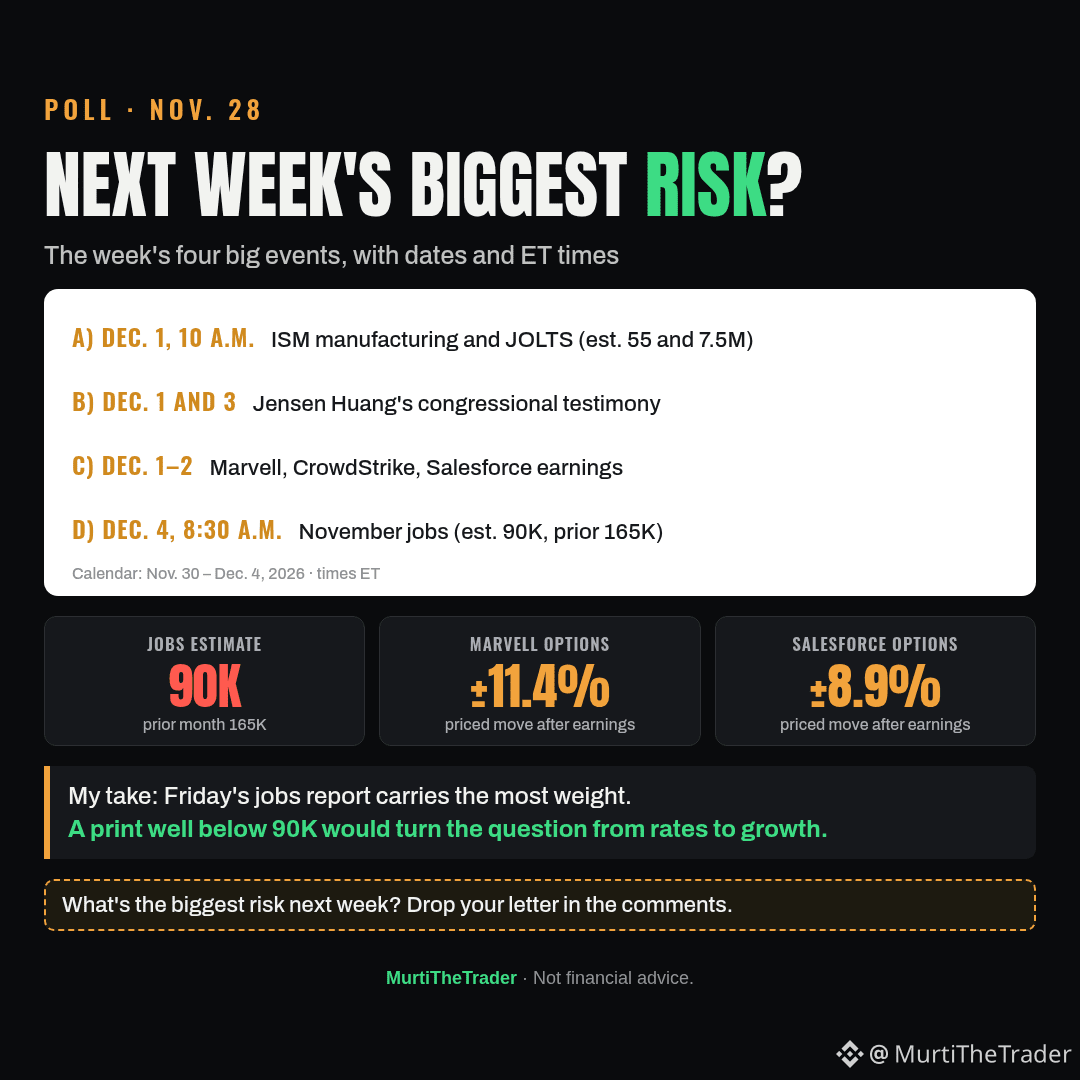
Poll: Which of these four events is the biggest risk next week?
A) Dec. 1, 10 a.m. ET: ISM manufacturing and JOLTS (estimates 55 and 7.5 million)
B) Dec. 1 and 3: Jensen Huang's congressional testimony
C) Dec. 1–2: Marvell, CrowdStrike and Salesforce earnings; options are pricing a ±11.4% move in Marvell
D) Dec. 4, 8:30 a.m. ET: November jobs report (estimate 90,000, prior 165,000)
My take: Friday carries the week. The jobs estimate has nearly halved in a month.
Reply with A, B, C or D.
#Economy #Stocks
Watching: $NVDA $MRVL $CRM
208
·
--
Жоғары (өспелі)
Расталды
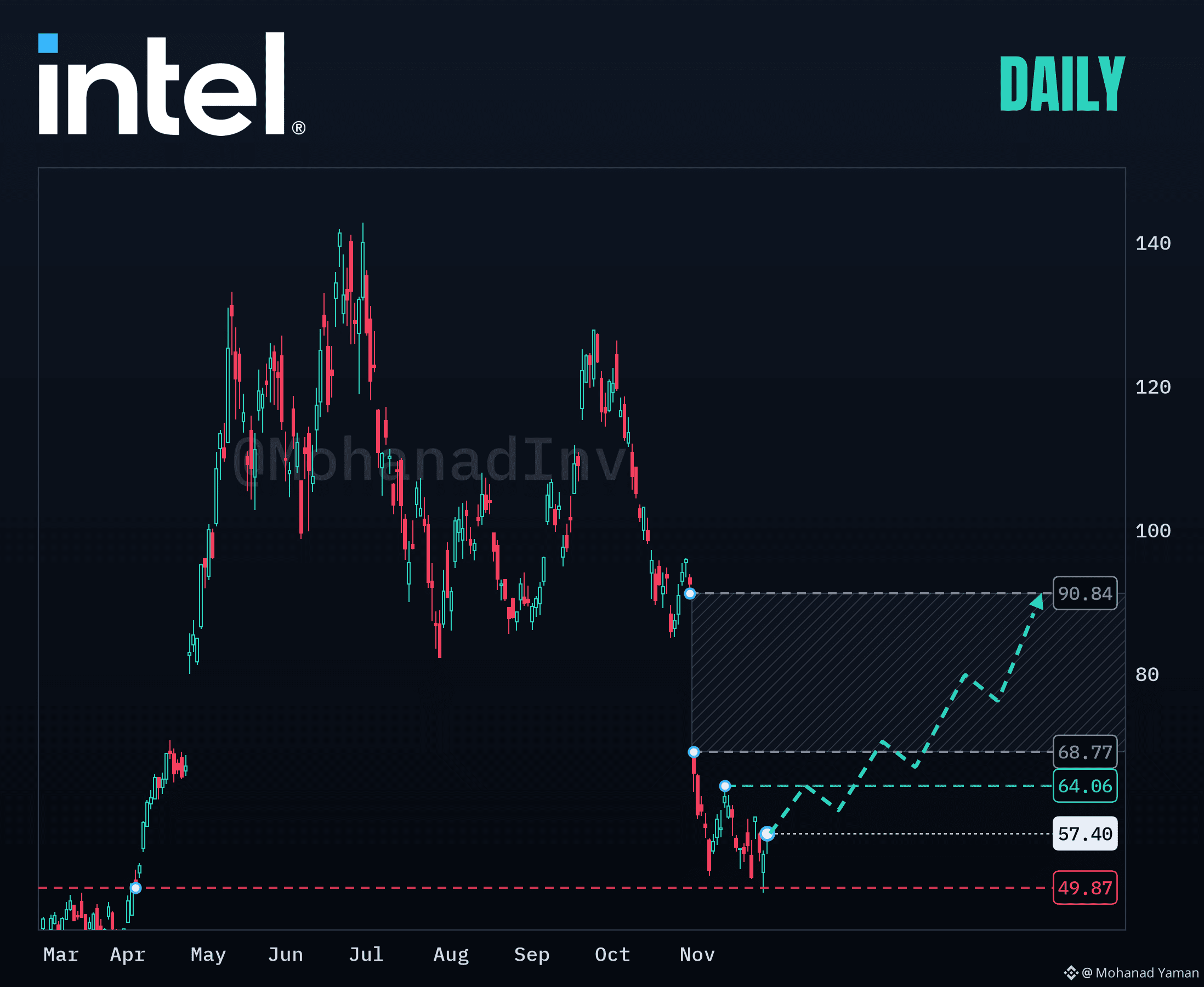
📈 $INTC JUST SHOWED ITS FIRST REAL SIGN OF A BOTTOM 👀
Not calling a strong reversal on light volume just yet, but it's the light at the end of the tunnel 💡
Wednesday undercut the $49.87 April floor to $49.16, then the week closed at $57.40, up 11.93%
📊 Why it matters: three lower lows at $51.51, $51.10 and $49.16, but RSI climbed from 20.6 to 28.0 to 35.9. Lower prices, weaker selling. That's a bullish divergence 🐂
🟢 Confirms on a weekly close over $64.06, 11.60% above
🎯 Gap fill runs from $68.77 to $90.84, 19.81% to 58.26% above
🔴 Wrong on a weekly close under $49.87, 13.12% below
Bottom in for Intel, or one more leg down? 👇
#stocks
{spot}(INTCBUSDT)
📈 $INTC JUST SHOWED ITS FIRST REAL SIGN OF A BOTTOM 👀
Not calling a strong reversal on light volume just yet, but it's the light at the end of the tunnel 💡
Wednesday undercut the $49.87 April floor to $49.16, then the week closed at $57.40, up 11.93%
📊 Why it matters: three lower lows at $51.51, $51.10 and $49.16, but RSI climbed from 20.6 to 28.0 to 35.9. Lower prices, weaker selling. That's a bullish divergence 🐂
🟢 Confirms on a weekly close over $64.06, 11.60% above
🎯 Gap fill runs from $68.77 to $90.84, 19.81% to 58.26% above
🔴 Wrong on a weekly close under $49.87, 13.12% below
Bottom in for Intel, or one more leg down? 👇
#stocks
2
1.1k
·
--
Жоғары (өспелі)
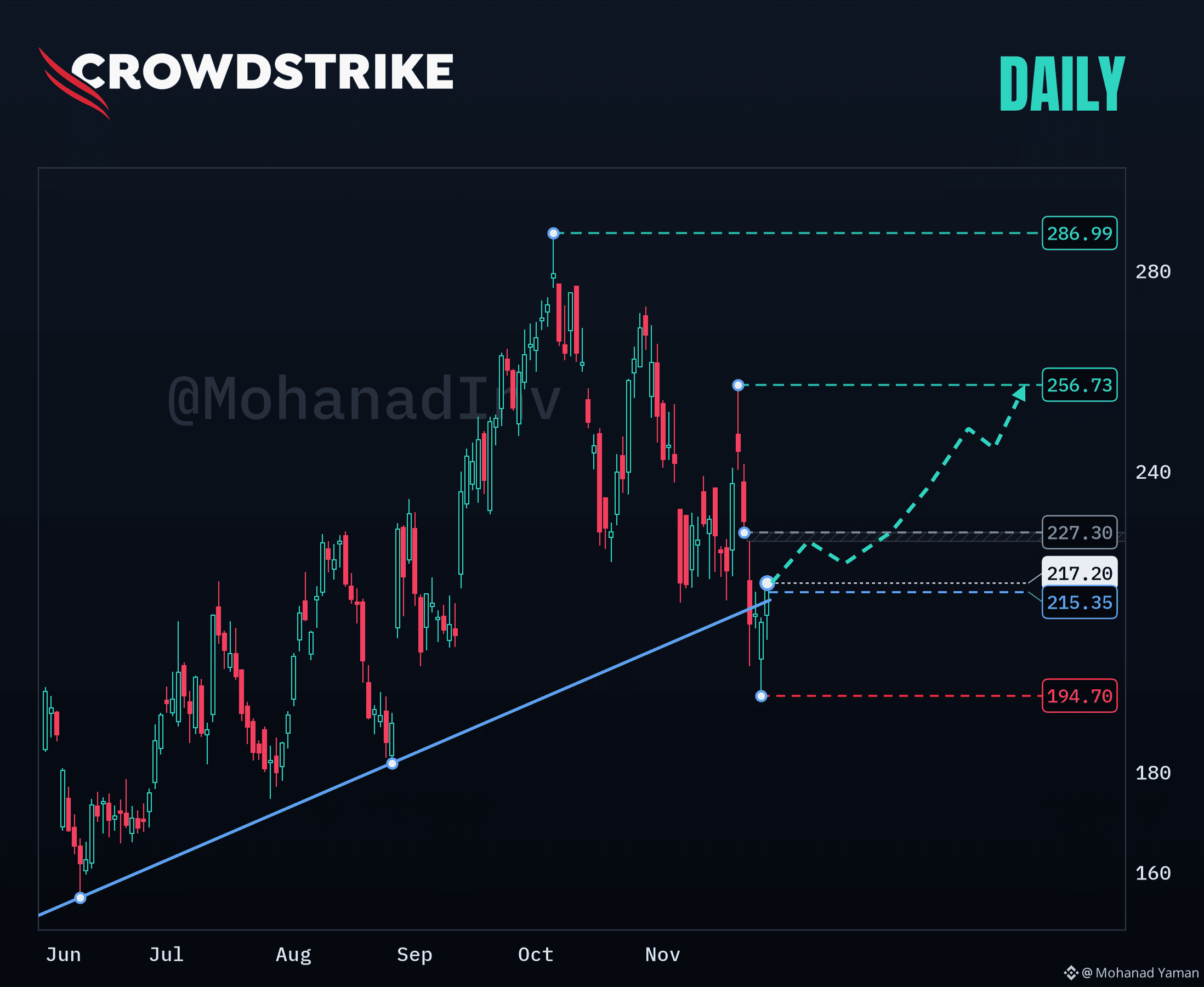
🛡️ $CRWD HELD MY TRENDLINE ON THE WEEKLY CLOSE 👀
Wednesday hit $194.70 but the week closed at $217.20, back over the line. Higher lows since June still intact
🟢 Confirms on a weekly close over $227.30, 4.65% above
🎯 Then $256.73, 18.20% above, and $286.99, 32.13% above
🔴 Wrong on a weekly close under the trendline, about $215.35, 0.85% below
Does CrowdStrike reclaim $227.30 next? 👇
#stocks
{spot}(CRWDBUSDT)
🛡️ $CRWD HELD MY TRENDLINE ON THE WEEKLY CLOSE 👀
Wednesday hit $194.70 but the week closed at $217.20, back over the line. Higher lows since June still intact
🟢 Confirms on a weekly close over $227.30, 4.65% above
🎯 Then $256.73, 18.20% above, and $286.99, 32.13% above
🔴 Wrong on a weekly close under the trendline, about $215.35, 0.85% below
Does CrowdStrike reclaim $227.30 next? 👇
#stocks
Mohanad Yaman
·
--
Жоғары (өспелі)🚨 $CRWD IS RIDING ITS TRENDLINE 👀
Higher lows since June at 154.43, 174.14, 181.24 and 213.65 this week. Closed Friday at 229.44
📈 If the trendline holds, Thursday's 256.73 high is the first level, 11.89% above, then the 286.99 high, 25.08% above
🟢 A weekly close under the trendline, 210.49 this week, kills it, 8.26% below
Hold or first break? 👇
#stocks
52

·
--
🚨 WALL STREET JUST HAD ITS BEST WEEK SINCE 2022 — AND $BTC MISSED THE WHOLE PARTY.
S&P +5.6% for the week, Dow's best since October 2022. $BTC? Down to ~$59,486, -3.3% in 24h after a $7B options expiry, with November ETF outflows now a record ~$5.39B — 8 straight sessions of selling.
Stocks ripped, crypto bled. Monday is the last ETF session of November — do the flows flip, or does the divergence keep widening? Drop your call below 👇 #Bitcoin #stocks
🚨 WALL STREET JUST HAD ITS BEST WEEK SINCE 2022 — AND $BTC MISSED THE WHOLE PARTY.
S&P +5.6% for the week, Dow's best since October 2022. $BTC ? Down to ~$59,486, -3.3% in 24h after a $7B options expiry, with November ETF outflows now a record ~$5.39B — 8 straight sessions of selling.
Stocks ripped, crypto bled. Monday is the last ETF session of November — do the flows flip, or does the divergence keep widening? Drop your call below 👇 #Bitcoin #stocks
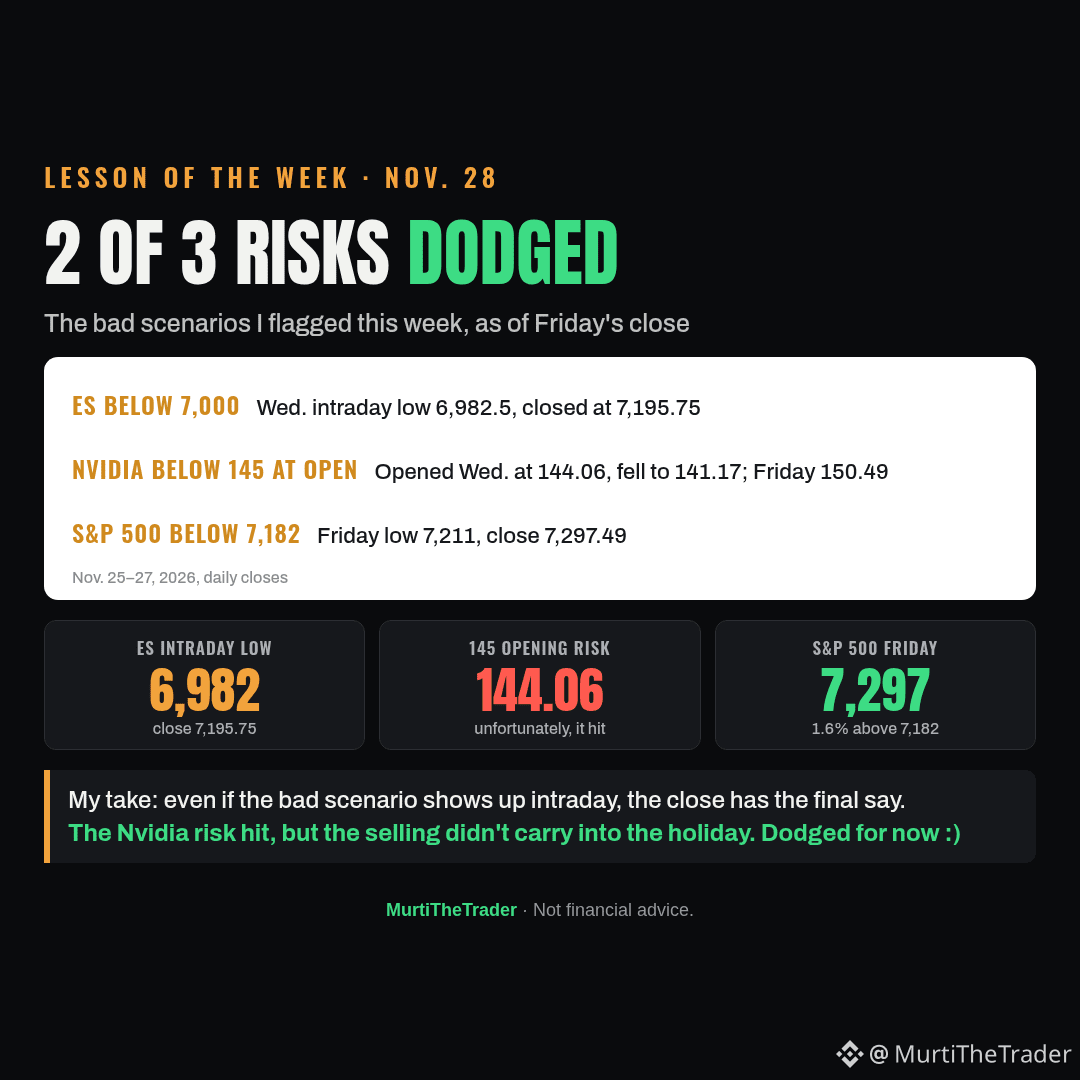
Lesson of the week: of the three bad scenarios I flagged during the week, two were fended off by the close. The third hit at the open but didn't stick.
→ ES below 7,000: tagged 6,982.5 intraday on Wednesday but closed at 7,195.75, a close call
→ Nvidia below 145 at the open: opened Wednesday at 144.06 and slid to 141.17, so this risk did play out, but it closed Friday at 150.49
→ S&P 500 below 7,182: Friday's low was 7,211, with a close at 7,297.49
My take: a bad scenario can show up intraday, but the close is what counts. We got away with it for now :)
#Stocks #Economy
Watching: $NVDA $SPY $QQQ
155
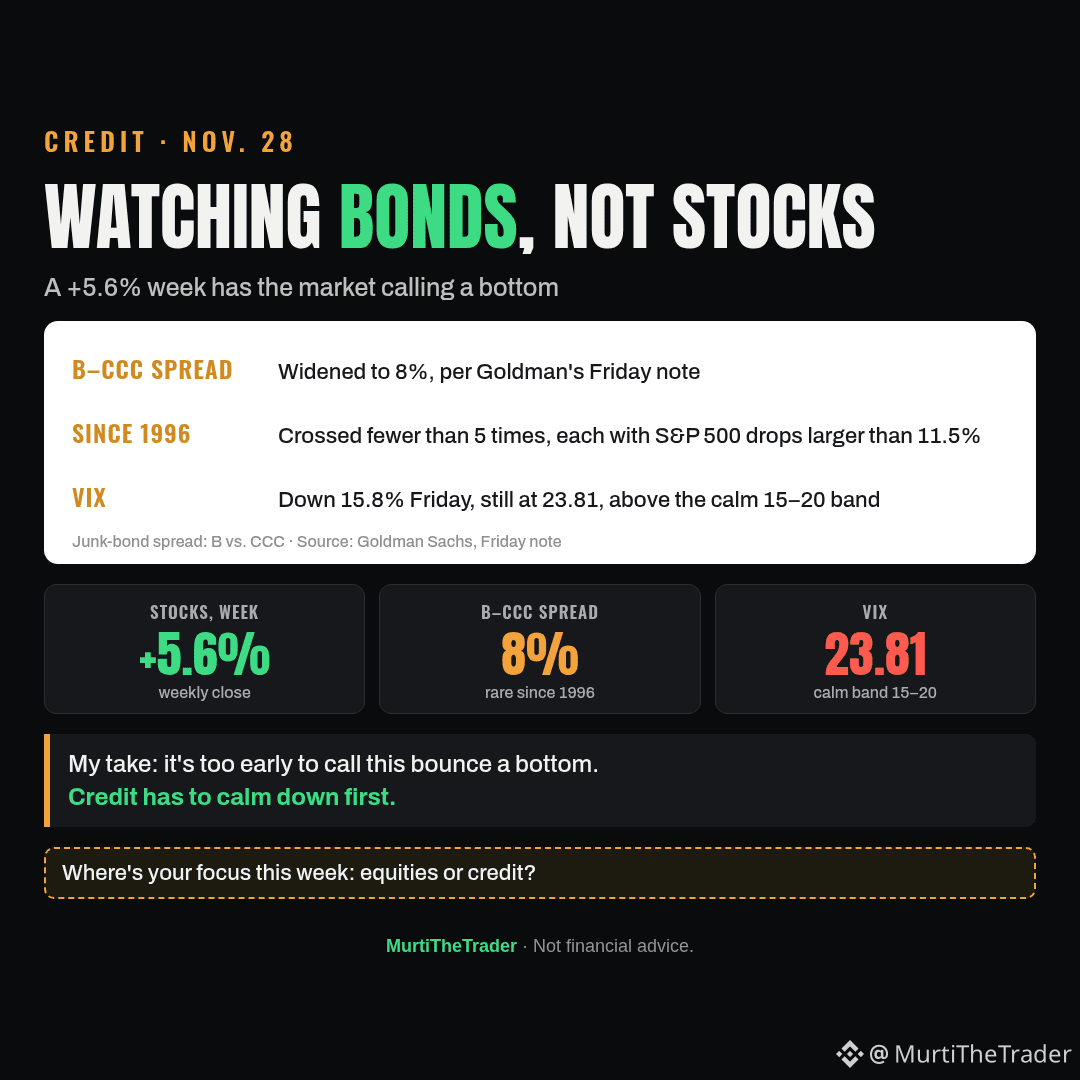
Stocks closed the week up 5.6%, and everyone is calling a bottom. This week I'm watching bonds more than stocks.
→ Per Goldman's Friday note, the spread between B- and CCC-rated junk bonds has widened to 8%. Since 1996 it has crossed that level fewer than five times, each time alongside S&P 500 drawdowns of more than 11.5%
→ VIX fell 15.8% on Friday but is still at 23.81, above the 15–20 range of calm markets
My take: until credit settles down, it's too early to call this rally a bottom.
Are you watching stocks or bonds right now?
#Economy #Stocks
Watching: $SPY $QQQ $UVXY
61

·
--
CoreWeave's ($CRWV) bull case hinges on one number from its Q3 call: ~130,000 paid-off GPUs rolling off contract in 2027—and another 170,000 in 2028—generating "approaching $4B" in 2027 annualized revenue (and ~$10B across both cohorts) with zero new CapEx.
Let's actually check the unit math behind that $4B pitch:
1/ What $4B actually requires per GPU-hour
At 8,760 hours/year, 130,000 GPUs deliver 1.139B theoretical GPU-hours. Clearing $4.0B requires $3.51/GPU-hr at 100% uptime—or $3.90–$4.13/GPU-hr at realistic 85%–90% billed utilization.
2/ Today's spot tape makes it look plausible—on paper
Bear takes quoting ~$1.50/hr low-end resale rates miss current pricing. Ornn's Nov. 25 settled index puts H200 at $6.69/hr and H100 at $3.10/hr (while A100 sits near $1.03/hr). That tight Hopper tape explains why $CRWV cited >$3B of its $9B near-term customer prepayments coming from re-contracting paid-off gear.
3/ Why 16%–18% unsecured bond yields still refuse to price it in
Management's $4B math extrapolates peak late-2026 Hopper tightness into a 2027–28 market flooded with native-FP4 silicon. Per NVIDIA's own developer benchmarks, a liquid-cooled GB300 NVL72 delivers 15x the throughput per megawatt of H200 NVL8 on DeepSeek V4 Pro 1.6T (and up to 80x on Kimi K3 2.8T at comparable interactivity). Add SpaceX remarketing ~50,000 H200s and Vera Rubin ramping in 1H27, and legacy renewal rates don't need to collapse to hurt:
• At $2.00–$2.50/hr blended (90% utilization), that $4B zero-CapEx windfall shrinks to $2.05B–$2.56B—nearly cut in half.
• Meanwhile, $CRWV ended Q3 with $47.5B in debt principal (~$41.0B net of $6.5B cash/securities), -$20.4B in trailing 12-month free cash flow, and Q4 interest expense guided to $1.05B–$1.15B (up from $846M in Q3).
$CRWV's renewal math works on today's spot screen—but credit markets are pricing what happens when 300,000 Ampere/Hopper GPUs try to re-price against FP4-native Blackwell and Rubin racks.
#stocks
CoreWeave's ($CRWV ) bull case hinges on one number from its Q3 call: ~130,000 paid-off GPUs rolling off contract in 2027—and another 170,000 in 2028—generating "approaching $4B" in 2027 annualized revenue (and ~$10B across both cohorts) with zero new CapEx.
Let's actually check the unit math behind that $4B pitch:
1/ What $4B actually requires per GPU-hour
At 8,760 hours/year, 130,000 GPUs deliver 1.139B theoretical GPU-hours. Clearing $4.0B requires $3.51/GPU-hr at 100% uptime—or $3.90–$4.13/GPU-hr at realistic 85%–90% billed utilization.
2/ Today's spot tape makes it look plausible—on paper
Bear takes quoting ~$1.50/hr low-end resale rates miss current pricing. Ornn's Nov. 25 settled index puts H200 at $6.69/hr and H100 at $3.10/hr (while A100 sits near $1.03/hr). That tight Hopper tape explains why $CRWV cited >$3B of its $9B near-term customer prepayments coming from re-contracting paid-off gear.
3/ Why 16%–18% unsecured bond yields still refuse to price it in
Management's $4B math extrapolates peak late-2026 Hopper tightness into a 2027–28 market flooded with native-FP4 silicon. Per NVIDIA's own developer benchmarks, a liquid-cooled GB300 NVL72 delivers 15x the throughput per megawatt of H200 NVL8 on DeepSeek V4 Pro 1.6T (and up to 80x on Kimi K3 2.8T at comparable interactivity). Add SpaceX remarketing ~50,000 H200s and Vera Rubin ramping in 1H27, and legacy renewal rates don't need to collapse to hurt:
• At $2.00–$2.50/hr blended (90% utilization), that $4B zero-CapEx windfall shrinks to $2.05B–$2.56B—nearly cut in half.
• Meanwhile, $CRWV ended Q3 with $47.5B in debt principal (~$41.0B net of $6.5B cash/securities), -$20.4B in trailing 12-month free cash flow, and Q4 interest expense guided to $1.05B–$1.15B (up from $846M in Q3).
$CRWV 's renewal math works on today's spot screen—but credit markets are pricing what happens when 300,000 Ampere/Hopper GPUs try to re-price against FP4-native Blackwell and Rubin racks.
#stocks
291

·
--
🖥️ CoreWeave, Dell and Strategy: three stock stories crypto traders should know
🔹 CoreWeave: Q3 backlog was 132.5B USD at the end of September, but the quarter's net loss was 709M USD and net interest expense 846M USD. It expects 37–39B USD of 2026 capex against 13–13.3B USD of revenue. Its 2031 bonds yielded close to 18% this week (Coinpaper, Nov 25)
🔹 Dell: posted record quarterly revenue of 54.9B USD and approved 25B USD of buybacks, yet the stock fell about 5.7% on Nov 25. Good news wasn't enough in a nervous market
🔹 Bitcoin miners turned AI hosts got hit too: IREN, Applied Digital and Core Scientific fell about 6.9% to 10.8% the same day
🔹 Strategy (MicroStrategy), the biggest corporate $BTC holder: MSCI removes it from two US indexes at Monday's close, Nov 30 (CoinMarketCap). Index funds that track them may need to sell shares
Why it matters for crypto: miners, Strategy and AI cloud stocks all depend on cheap borrowing. When debt gets expensive, they wobble together.
Which one are you watching on Monday? 👇
(Not financial advice)
#CoreWeave #Stocks
📷 Photo: Taylor Vick / Unsplash
72

·
--
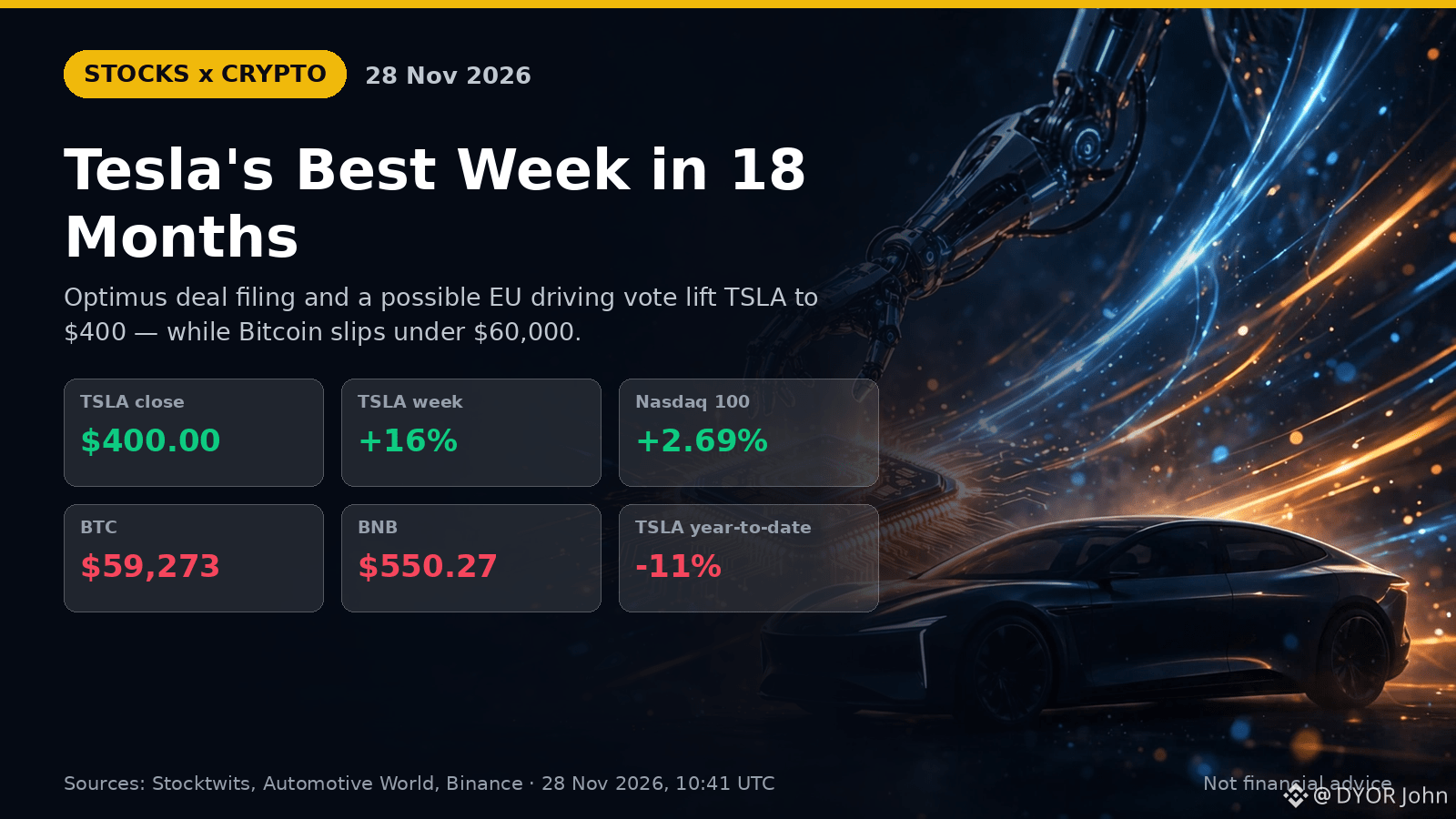
Tesla just closed out its best week in 18 months — and the robots did the talking.
$TSLA finished Friday at $400.00, up 5.22% on the day and roughly 16% on the week, per Koyfin data via Stocktwits. The trigger: Tesla filed plans with Germany's competition authority to acquire machine-tool maker EMAG, a move coverage links to precision parts for Optimus, its humanoid robot. Early Optimus production has already started at Fremont, with external deliveries targeted for late 2027.
There is more in the pipeline. A draft EU agenda points to a possible December 15 vote on Tesla's supervised driving system, and merger speculation with SpaceX keeps adding a premium to the tape. The stock still sits about 11% lower year-to-date, and the Q3 print showed thin margins — $28.0B revenue, $0.22 GAAP EPS — so this is a story stock trading on what comes next, not what it just earned.
Crypto is not following the mood. $BTC is trading around $59,273, down 3.8% in 24 hours, and $BNB is at $550.27, down 2.5%. Bitcoin slipped back under $60,000 after a brief Thanksgiving-week push toward $62,000, and US spot ETF outflows are still running.
For crypto traders, Tesla is a reminder that risk appetite can rotate without crypto. Watch whether TSLA holds $400 into Monday's full session.
#Tesla #Stocks #Crypto
Not financial advice. DYOR.
91

·
--
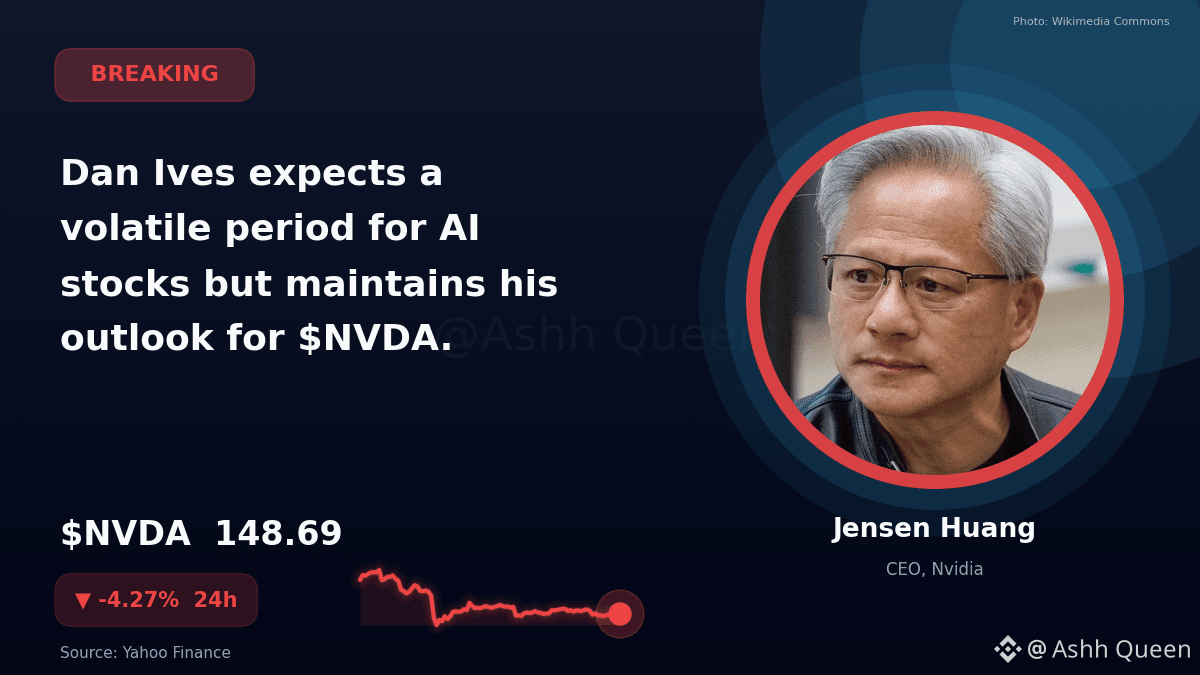
📈 Dan Ives expects a volatile period for AI stocks but maintains his outlook for $NVDA.
Yahoo Finance reports that the analyst believes the AI sector's long-term momentum remains intact despite potential short-term headwinds. Meanwhile, Decrypt notes that banned chips were identified at a Shanghai data center, while CNBC Markets highlighted recent price swings surrounding the firm. 📊
The $NVDA perpetual contract is at 148.69, down -4.27% in 24h. Support is at 148.07, resistance at 149.02.
Bullish or bearish for $NVDA? 👇
#NVDA #Stocks #USStocks
⚠️ Perpetual contracts are leveraged derivatives, not the stock or commodity itself.
Not financial advice. Protect your capital first, the next setup always comes.
📈 Dan Ives expects a volatile period for AI stocks but maintains his outlook for $NVDA .
Yahoo Finance reports that the analyst believes the AI sector's long-term momentum remains intact despite potential short-term headwinds. Meanwhile, Decrypt notes that banned chips were identified at a Shanghai data center, while CNBC Markets highlighted recent price swings surrounding the firm. 📊
The $NVDA perpetual contract is at 148.69, down -4.27% in 24h. Support is at 148.07, resistance at 149.02.
Bullish or bearish for $NVDA ? 👇
#NVDA #Stocks #USStocks
⚠️ Perpetual contracts are leveraged derivatives, not the stock or commodity itself.
Not financial advice. Protect your capital first, the next setup always comes.
Расталды
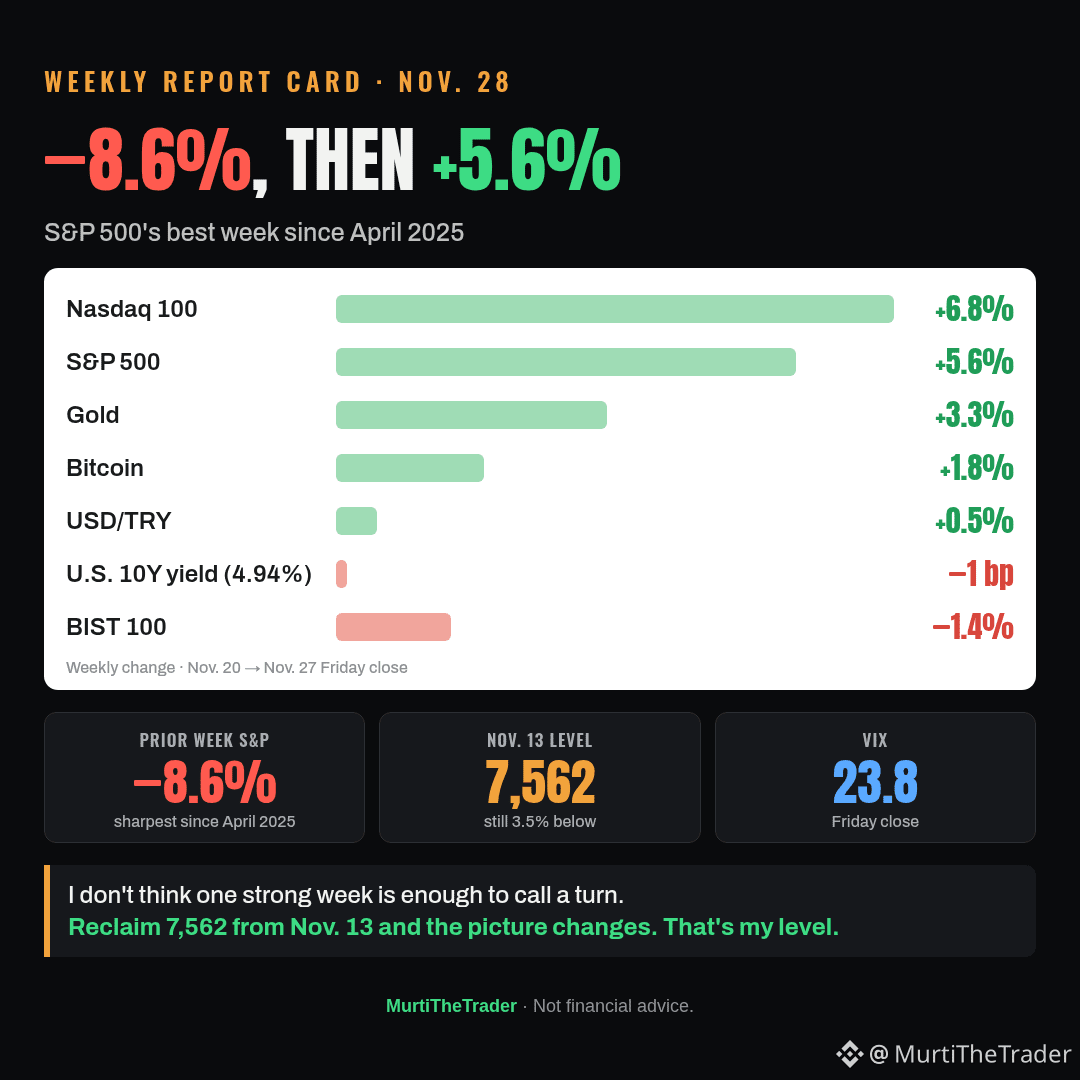
Weekly report card: the S&P 500 fell 8.6% one week, then gained 5.6% the next.
Both were the sharpest weekly moves since April 2025, and the Nasdaq 100 rose 6.8%.
The news of the week: U.S. third-quarter GDP growth was revised up to 4.3% from 3.4%.
Gold rose 3.3%, Bitcoin 1.8%, and the 10-year yield slipped 1 bp. Turkey's BIST 100 fell 1.4%, while USD/TRY rose 0.5%.
In my view, a single strong week isn't enough to confirm a turnaround. If the S&P 500 reclaims its Nov. 13 level of 7,562, the picture changes, and that's the level I'm watching.
#Stocks #Economy
Watching: $SPY $QQQ $GLD
2
671
·
--
WALL STREET JUST HAD ITS BEST WEEK SINCE APRIL — AND $BTC MISSED THE PARTY.
S&P 500 closed Friday at 7,297.49 (+1.6%), Nasdaq 24,129.50 (+2.3%), Dow 50,774.94 (+1.2%) — capping a monster week: S&P +5.6%, Nasdaq +6.7%, Dow +5.5%. SanDisk ripped +16%, Micron +7.6%, Marvell +7.3%. Only NVDA lagged — +0.8% to $150.49 after dipping 2% early.
Meanwhile $BTC is sitting just above $60K (~$60,006, -2.7% today) after dipping to $58,792. Same week. Two completely different markets.
Setup I'm watching: the S&P holds 7,297 into Monday's full session and the relief trade runs — $BTC reclaiming $61,622 opens $62,249. Stocks fade Monday and the unwind returns — lose $60K and the flush reopens toward $58,792. Risk: the Nasdaq is still -13% from its October peak and a December hike is ~99% priced.
STOCKS or CRYPTO — which market is lying? LONG the rally or SHORT the divergence? One word. 👇
$BTC #Stocks #SP500 #Nasdaq #Crypto
1
63
·
--
CHINA JUST DID +11.6% IN ONE DAY — AND THE MARGIN BAZOOKA HASN'T EVEN FIRED YET.
ChiNext ripped +11.61% Friday to 2,443.96 — its biggest single-day gain since Oct 8, 2024. Shanghai +3.73% to 3,606.49, Shenzhen +7.24% to 10,814.02. Nearly 5,400 stocks up, 400+ hit limit-up, turnover ~2 trillion yuan. The trigger: Beijing's State Council held a rare midday meeting on the market Friday — and the margin cut (100% → 80%) goes live Monday Nov 30, unlocking ~400B yuan.
Setup I'm watching: ChiNext holds 2,368 (Tuesday's breakout open) and the policy put is real — 2,500 is the next round-number test. Lose 2,368 Monday and Friday was a one-day wonder. Risk: a December Fed hike (~99% priced) crushes risk everywhere — $BTC is already bleeding near ~$59,700, down ~3.5% today.
CHINA BOUNCE or ONE-DAY WONDER — LONG the policy put or SHORT the fade? One word. 👇
$BTC #China #Stocks #Crypto
BTC-0,80%
CNXTETF+10,27%
19
·
--
🚨 WALL STREET RIPPED ON FRIDAY — AND $BTC DIDN'T FOLLOW.
S&P 500 +1.6% to 7,297, Nasdaq +2.3%, gold +2.9% to $3,669, silver +7.8% to $43.70. Everything ripped — except Bitcoin. $BTC closed Friday at $59,923, -1.08%, and it's still stuck under $60K at ~$59,822 on thin weekend tape.
Stocks, gold, silver all green. Crypto red. Is this the divergence that matters, or does $BTC catch up on Monday? Drop your call below 👇 #stocks #Bitcoin
169
Ішінара рас
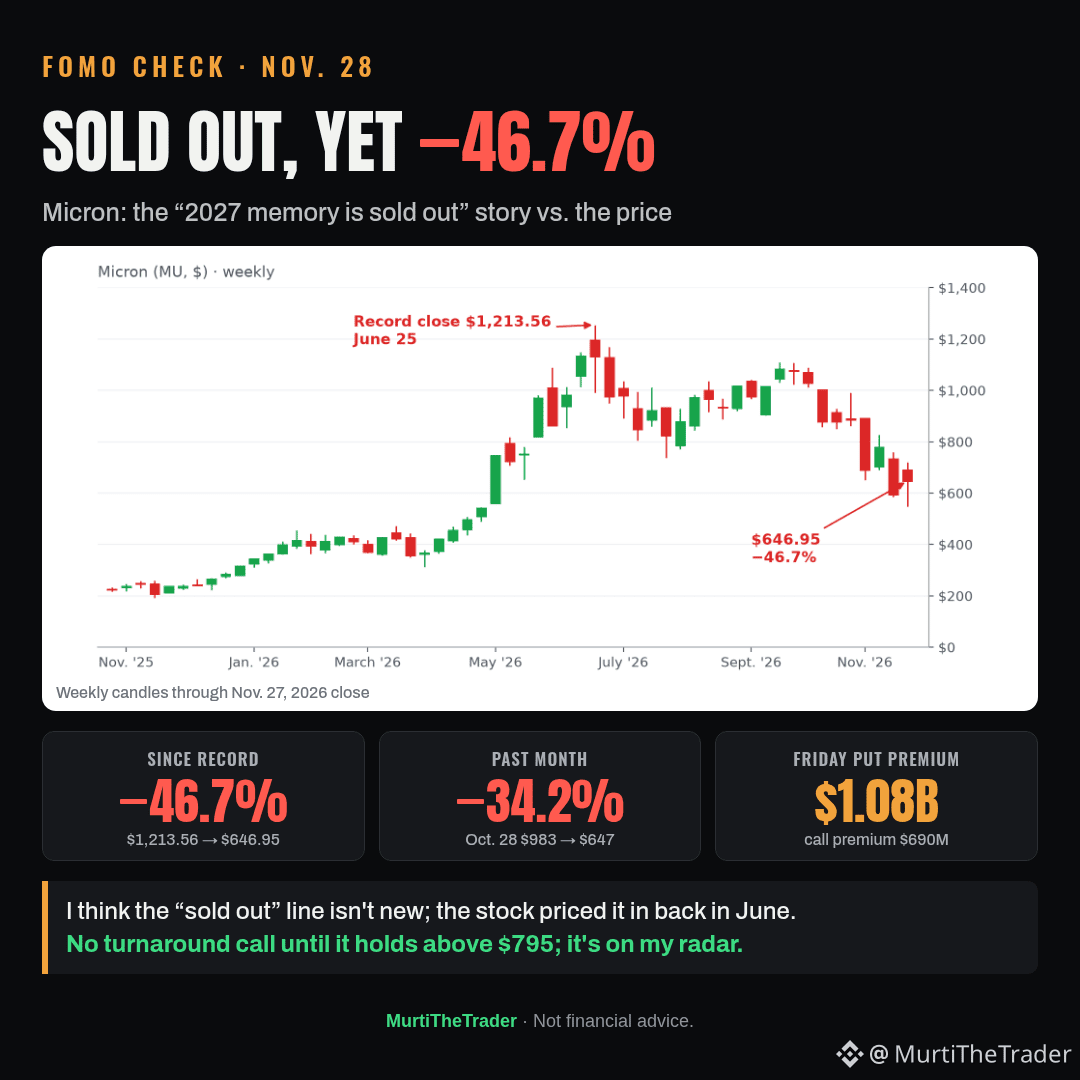
FOMO check: Everyone is saying "Micron's 2027 supply is sold out, and memory is the new Nvidia."
Micron has fallen from its record close of $1,213.56 on June 25 to $646.95. That's down 46.7% from the peak, and it would need an 87.6% gain to get back to the record.
It's down 34.2% over the past month. It touched $548 intraday on Wednesday, then rebounded 7.6% on Friday.
On Friday, options put premium hit $1.08 billion, versus $690 million for calls.
My take: supply headlines are old news, and June's top already reflected them. Until Micron closes back above $795 and stays there, I'm treating this bounce with caution.
#Stocks #AI
Watching: $MU $NVDA $AMD
Anonymustrader:
Fomo is very bad thinggg
4
2
1.4k
Расталды
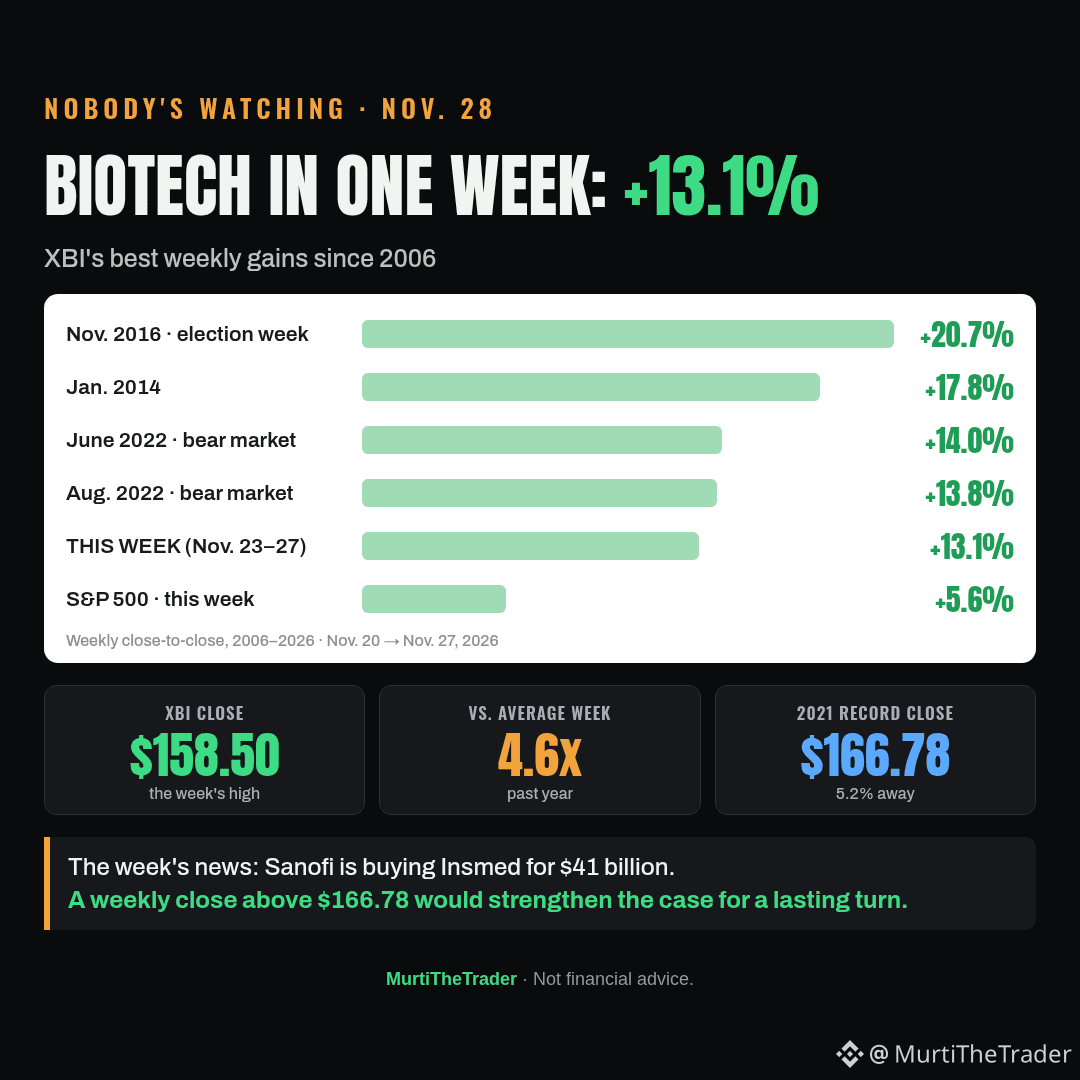
Nobody's watching this: the biotech fund XBI gained 13.1% in a single week.
That's its fifth-best week since 2006. The others were the 2016 election week, January 2014 and two weeks during the 2022 bear market.
The S&P 500 rose 5.6% over the same week, and XBI moved 4.6 times its average weekly swing.
The catalyst: Sanofi agreed to buy Insmed for $41 billion. XBI closed the week at its high of $158.50.
In my view, the real question is whether this is deal-driven momentum or a true turnaround. If XBI tops its 2021 record weekly close of $166.78, the turnaround case gets stronger. I'm watching.
#Stocks #markets
Watching: $XBI $SPY $LLY
1
739
Ішінара рас
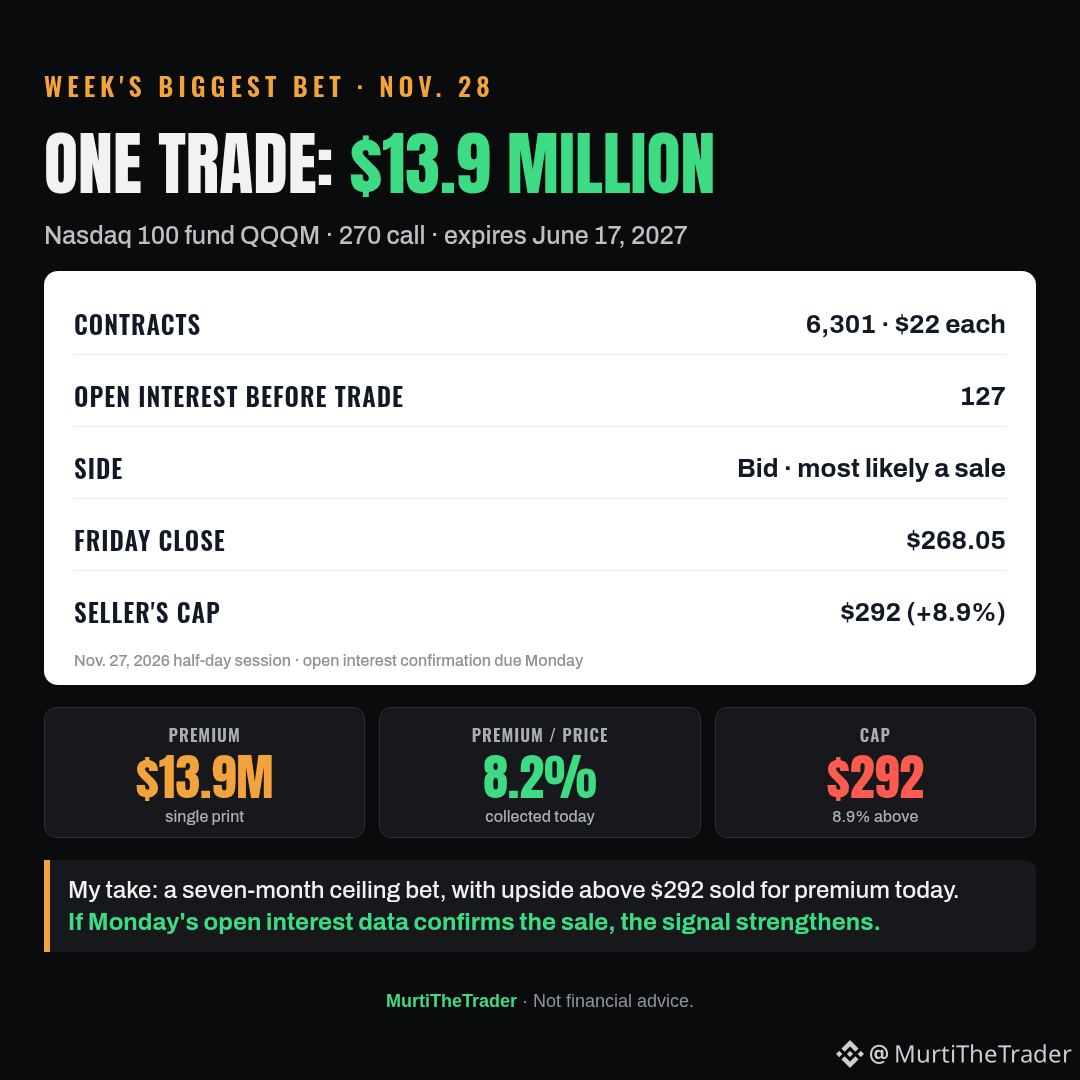
The week's biggest bet: a single $13.9 million trade during Friday's half-day session.
It hit the Nasdaq 100 fund QQQM: 6,301 contracts of the June 17, 2027, 270 call at $22 each, with open interest of just 127 before the trade.
It printed on the bid, so it was most likely a call sale. The seller pockets premium worth 8.2% of the fund's price today.
In return, they give up any QQQM move from $268 to above $292, a gain of 8.9%.
My take: this looks like a seven-month bet that QQQM tops out. Monday's open interest numbers are the next check: a confirmed sale would back up that reading. I'm keeping an eye on it.
#Stocks #markets
Watching: $QQQ $TQQQ $SPY
688
Расталды
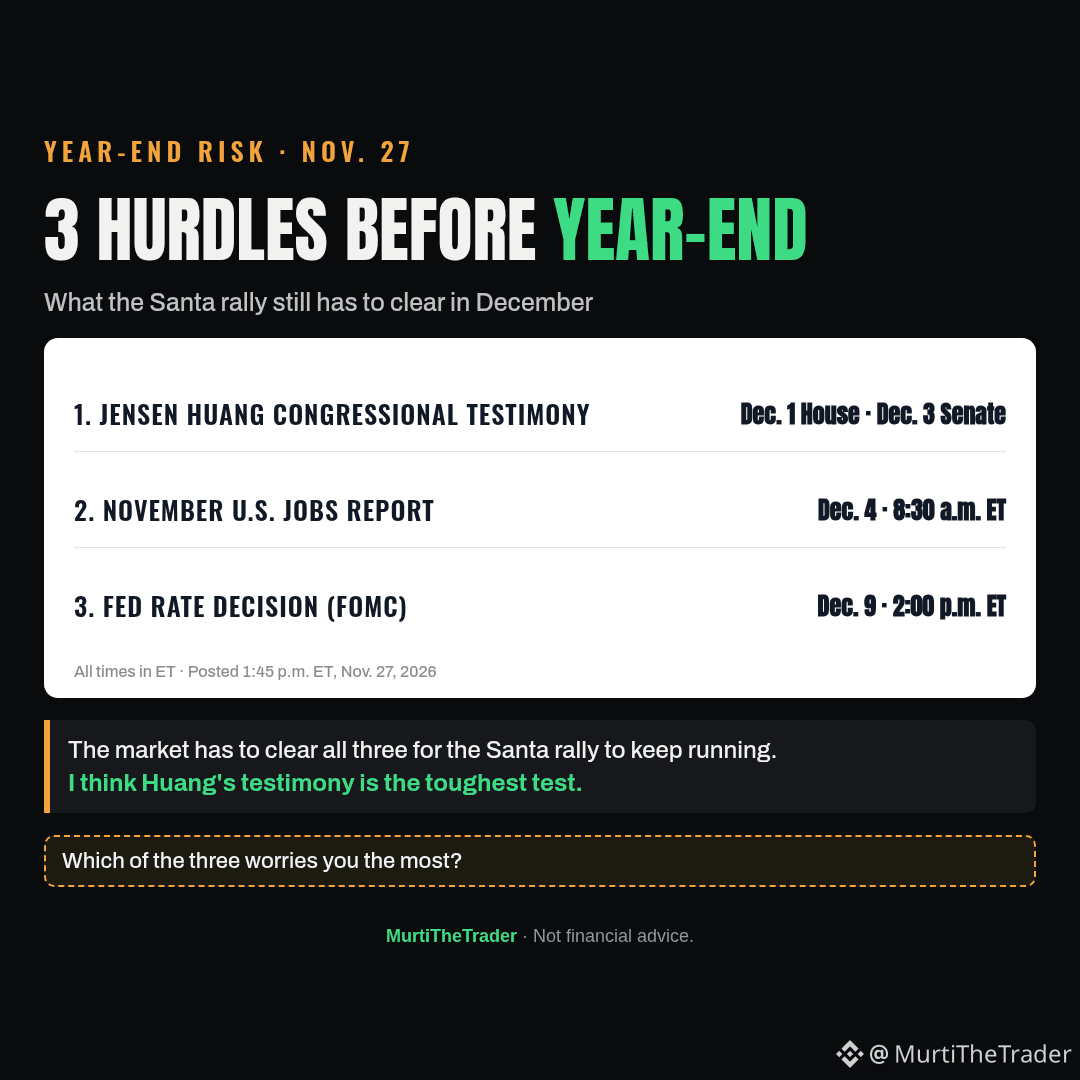
Three hurdles stand in the way before year-end:
1) Jensen Huang's testimony before Congress (Dec. 1 House, Dec. 3 Senate)
2) November U.S. jobs report (Dec. 4, 8:30 a.m. ET)
3) Federal Reserve rate decision (Dec. 9, 2:00 p.m. ET)
For the Santa rally to keep going, markets need to get past all three. In my view, Huang's testimony is the trickiest hurdle of the bunch.
Which one worries you the most?
#Stocks #FOMC #AI
Watching: $NVDA $SPY $QQQ
503
Көбірек контент көру үшін кіріңіз
Binance Square платформасында әлемдік криптоқоғамдастыққа қосылыңыз
⚡️ Криптовалюта туралы ең соңғы және пайдалы ақпаратты алыңыз.
💬 Әлемдегі ең ірі криптобиржаның сеніміне ие.
👍 Расталған авторлардың нақты пікірлерін табыңыз.
Электрондық пошта/телефон нөмірі
Трендтегі тақырыптар
1
#EvolveAtBinanceBlockchainWeek
2.2M рет көрілді
19,410 адам талқылап жатыр
2
#WorldLibertyActsToCutLiquidationRisk
1,521 рет көрілді
21 адам талқылап жатыр
3
#BitcoinETFsExtendOutflowStreakToEightDays
58,812 рет көрілді
585 адам талқылап жатыр
4
#FranklinTempletonPlansToAddHYPEToCryptoIndexETF
11,256 рет көрілді
161 адам талқылап жатыр
5
#ColdcardFlawLeadsToTheftOfAtLeast1789BTC
135,071 рет көрілді
880 адам талқылап жатыр
6
#MalaysiaFirstBitcoinETFToListOnDecember2
39,023 рет көрілді
312 адам талқылап жатыр
7
#BitcoinETFsSee$5.39BNetOutflowRecord
881 рет көрілді
6 адам талқылап жатыр
8
#LiquidHackerMoves598BTC
5,193 рет көрілді
15 адам талқылап жатыр
9
#SamsungSKHynixProfitSeen6To8xHigher
0 рет көрілді
0 адам талқылап жатыр
10
#UkraineParliamentPassesCryptoTaxBill
0 рет көрілді
0 адам талқылап жатыр