

A few days ago (October 3), Arthur Hayes, co-founder of BitMEX, was interviewed. In the video lasting more than 2 hours and 40 minutes, Hayes discussed his views and expressed his concerns about the current economic situation and the need to solve these problems to avoid future disasters. He believed that a major financial crisis worse than the Great Depression of 2008 is coming at the end of this century.
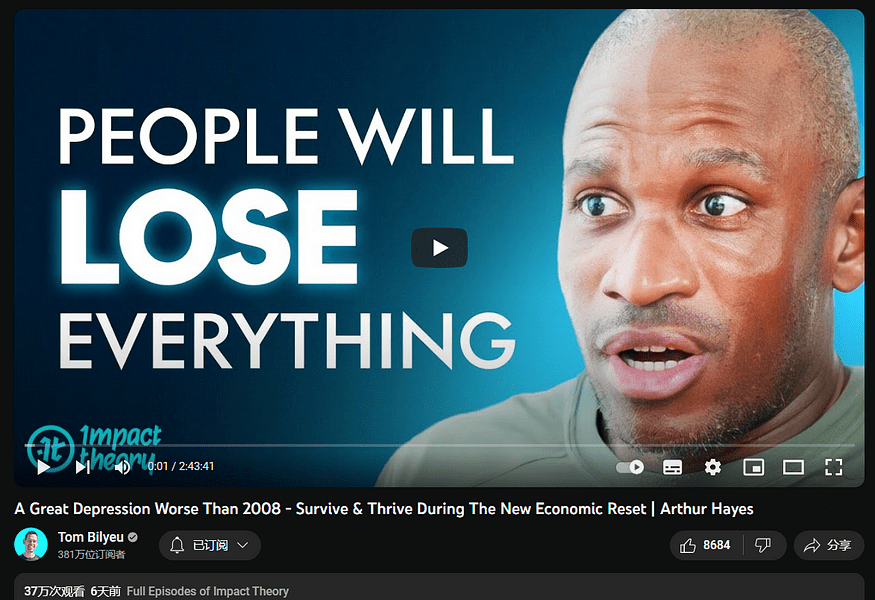
In the video, Hayes attributes the potential financial crisis to the global adoption of Keynesian economics, which has led to huge debts and a lack of innovation in alternative energy. He also highlights the historical hatred between Western powers and Russia, arguing that the current conflict in Ukraine is pushing up energy prices and exacerbating inflation.
Hayes then went on to explain the challenges the U.S. currently faces, including rising health care costs and defense budgets, and the difficulty of reforming these areas without losing the support of the Baby Boomers, a generation that dates back to the 19th century.
He also highlighted the risks of high debt levels and the possibility of default and currency devaluation, and laid out his views on the relationship between money printing, inflation and resource nationalism and how these factors can lead to higher prices.
At the end of the interview video, Hayes delves into the potential liabilities in the financial ecosystem, the impact of rising interest rates on bonds, and the possibility that the Fed's actions will trigger a banking crisis and an inflation crisis.
Next, we will further interpret Hayes’ views in detail from several aspects.
1. Major financial crisis
Hayes believes that sometime towards the end of this century there will be a major financial crisis, possibly worse than the Great Depression of 2008. He attributes this to the global adoption of Keynesian economics, where governments intervene and print money to prevent recessions, which leads to a massive global debt that is exacerbated by population declines in rich countries.
He predicted that the debt will need to be rolled over, leading to potential market turmoil over the next three to six months, particularly in U.S. Treasuries or other large global bond markets.
2. Macro cycle
Hayes emphasizes that the growth and development of human civilization is dependent on the growth and development of hydrocarbons and the lack of innovation in alternative energy sources. It argues that printing money is not the answer and will lead to inflation, social unrest and government collapse.
He also expressed concerns about the predictability of the cycle and the potential for political instability, applying the notion of "World War III" which he believes has already begun.
3. The West vs. Russia
Hayes discusses the historical context and political dynamics between Western powers and Russia. He argues that Western Europe and the United States have long been interested in Russia because of its potential as a unifying force in Eurasia.
And this hostility even goes back to the 19th century, when naval powers (such as Britain) wanted to prevent the Soviet bloc countries from becoming stronger by forming alliances, which led to World War I. Likewise, in World War II, the Western powers initially did not mind Hitler attacking Russia (the Soviet Union) because they were trying to avoid the unification of Eurasia. Moreover, during the subsequent Cold War period, the West also focused on preventing Russia from forming alliances with other countries.
Hayes argues that the US foreign policy strategy since World War II has been to ensure the separation of Eurasia, as it controls most of the world's natural resources and population. In addition, the US response to the collapse of the Soviet Union did not involve rebuilding Russia, but rather incentivizing those oligarchs and helping to transfer their wealth to Western countries.
Analyzing the context of the current situation between Russia and the West (especially Ukraine), Hayes also believes that this conflict can be seen as a war between Russia and Western proxies, and in this process, Russia has also received tacit support from a certain Asian power. However, this conflict and the West's exclusion of Russia are raising global energy prices too high, which in turn leads to inflation. And this inflation is exacerbating the impending financial crisis in the West, as central banks raise interest rates, which may lead to the bankruptcy of the banking system.
In the video, Hayes also criticized the policies of not trading with Russia, arguing that this is a natural consequence of the ideology of confronting Russia and keeping Eurasia separate. Moreover, the previous printing of money will make the situation worse, especially the US government, which made promises to the "baby boomers" and created a system (to encourage consumption rather than saving).
4. Challenges facing the United States
In the video, Hayes also discusses the challenges facing the United States due to rising healthcare costs and defense budgets. He believes that the current political system in the United States makes it difficult for politicians to reform these areas because they risk losing the support of the politically active and influential "baby boomers". And as the world changes to a more diverse one, China has become a major challenger to the dominance of the United States and has an increasing demand for a new global order and access to resources. Coupled with declining birth rates and rising costs, it has also led to the Federal Reserve having to print money to finance the government, resulting in a high debt-to-GDP ratio.
Historically, debt-to-GDP ratios above the 130% threshold have led to a country default, either through currency devaluation, financial repression or defaults in government bond markets.
Hayes also noted that inflation is the result of declining productivity and other countries' claims to their natural resources, such as oil.
5. Money printing and inflation
Hayes mentioned that as the amount of money in circulation increases, the purchase value of money decreases, which leads to inflation. He stressed that the production of energy, especially hydrocarbons, is essential to global civilization, but currently energy production is not growing much. This, combined with the increase in debt and money supply, creates a situation of energy inflation and subsequent commodity inflation.
Therefore, it is also important to understand the relationship between energy and the cost of various goods and services.
6. Inflation Factor
Hayes also talked about various factors that could lead to further inflation in the future. For example, resource nationalism combined with changing global dynamics could lead to further inflation. Resource nationalism is one of the main reasons for this, specifically, countries rich in natural resources begin to prioritize the growth and development of their own economies rather than exporting raw materials. This shift could lead to a scarcity of necessary resources, leading to higher global commodity prices.
In addition, companies prefer to outsource manufacturing to countries with lower labor costs rather than hiring local workers, which will further increase inflationary pressure.
7. Massive debt
In the interview, Hayes explained the underlying debt problems in the financial ecosystem and said that these debts could lead to a depression worse than the one in 2008.
He said the U.S. Treasury market is growing in debt while traditional buyers such as China, Japan and oil exporters are starting to buy less. Add to that the U.S. banking system, which is functionally insolvent as banks buy Treasurys en masse and face regional banking crises. And with the Fed committing to quantitative tightening and no more Treasury accumulation, the U.S. Treasury must issue new debt without major buyers. These factors combined have led to a breakdown in market relationships, such as gold holding its price despite rising yields in the U.S. Treasury market.
8. Real yields and bonds
Hayes also talked about the concept of real yields and how it affects the U.S. government bond market.
Real yields are calculated by subtracting nominal GDP from government bond yields. From a philosophical perspective, bondholders should at least receive a return on economic growth because they are contributing to it. However, the current yields on U.S. government bonds are not keeping up with the pace of economic growth, which will cause investors to look for better returns elsewhere, such as stocks, gold or crypto markets.
And holding U.S. government bonds has been a poor investment over the past two years because of rising inflation and higher bond yields. In addition, the U.S. government's growing debt and interest payments have made it unable to raise the yield on the 10-year Treasury to attract more buyers.
9. Interest rates and bonds
During the interview, Hayes also explained the impact of rising interest rates on long-term bonds and how it can lead to losses for bondholders.
He compared it to the performance of gold, noting that while gold may not increase or decrease in value over time, long-term bond holders could suffer significant losses if interest rates rise. Using mortgages as an example, higher interest rates can make it harder for individuals to afford new mortgages and ultimately affect their ability to purchase a home.
He also mentioned that understanding bond economics is crucial to navigating the current economic situation and circumstances.
10. Banking and inflation crisis
Hayes said the Fed's actions could trigger a potential banking crisis and inflation crisis. He said that in order to get higher dividends, banks bought long-term Treasury bonds, and if interest rates rise, banks cannot sell these bonds in advance. And if people decide to invest in risk-free U.S. Treasury bonds instead of keeping their money in the bank, this may cause losses to the bank.
Moreover, the banks’ term funding program (BTFP) leaves them facing trillions of dollars in trouble, which could further fuel inflation. As for the political choice of who will pay for these losses, the government may continue to choose to print money to ensure that depositors get their money back. This further creates a vicious cycle.
Hayes further elaborated on the Bank Term Funding Program (BTFP) mentioned earlier. The BTFP only covers banks with eligible securities (such as U.S. Treasuries and mortgage-backed securities), not commercial real estate. But the BTFP poses a problem because small regional banks are the main source of commercial real estate loans. Hayes questioned and worried about whether the BTFP would be expanded to include commercial real estate loans or other types of loans that are currently declining in value. He said that unless the Fed intervenes and rescues these non-traditional banks, the banking system may be at risk of bankruptcy. This will further lead to inflation and a depreciation of the dollar.
Currently, the market is aware of the problems in commercial real estate, but due to the low transaction activity, real estate prices have not seen a significant drop. Once there is a relatively large transaction volume in the future, banks will be forced to reduce their portfolios and may declare bankruptcy.
But normally, the failure of one bank would cause market panic, which would prompt further government intervention to prevent more bank failures.
Well, that’s all for today’s post on “Talking about Li and Beyond”. Let’s summarize and review it together. The original video of this article comes from the interview video of YouTube blogger Tom Bilyeu with Arthur Hayes. The original text comes from arndxt’s newsletter (Threading on the Edge). The content is mainly BitMEX co-founder Arthur Hayes’s views and macro forecasts for the global market in the next five years. Because the original video is quite long, the above content only summarizes the first half of the video. Interested friends can go to YouTube to view the full interview video.
Disclaimer: The above content is only a personal point of view and analysis, and is only for the purpose of popular science learning and communication among the majority of enthusiasts. It does not constitute any investment advice. Investment is risky, please treat it rationally, improve risk awareness, and abide by the relevant laws and regulations of the country and region where you are located!

