

The Cryptonomist
19k 投稿

The Cryptonomist
 厳選トピック確認済+
報告
ユーザーをブロック
0 フォロー
38.2K+ フォロワー
22.7K+ いいね
投稿

記事
翻訳参照
GPT-6 codebreaking AI cracks 217-year-old Napoleon cipher in six hoursA coded letter written for one of Napoleon Bonaparte’s generals sat unread for 217 years until an AI engineer decided to test a GPT-6 codebreaking AI model against it. Carter Church, a staff AI engineer at cybersecurity company SentinelOne, fed OpenAI’s GPT-6 Astra a single scanned image of the cipher and a prompt asking it to solve the message. According to Tom’s Hardware, the model cracked the entire text in about six hours.
Key takeaways
GPT-6 Astra deciphered a 217-year-old Napoleonic cipher in roughly six hours from one scanned image.
The cipher had sat unsolved for decades on Cryptiana’s Unsolved Historical Ciphers list.
SentinelOne engineer Carter Church ran the whole decryption with a single prompt.
The recovered letter was a 1809 troop briefing sent to General Auguste de Marmont on Napoleon’s orders.
The deciphered passage fills a gap left in Napoleon’s own 1865 memoir.
Six hours, one image, one prompt
Church’s own account, cited by Tom’s Hardware, frames the result less as a cryptography trick and more as a demonstration of how far a general-purpose model can stretch. “What makes this impressive isn’t actually the codebreaking, but that Astra completed the entire multi-modal workflow in ~6 hours from a single image and goal,” Church wrote. According to Calcalist’s account, the document contained a single plain-French line atop 24 rows of numbers, letters and invented symbols, amounting to about 1,300 cipher units drawn from 155 distinct signs.
Earlier researchers had only ever matched 33 of those signs to known values, leaving most of the message untouched. Astra’s run changed that, working through transcription and cryptanalysis as one continuous process rather than two separate specialist tasks.
What the letter from Marmont’s era actually says
The decoded text turns out to be a troop briefing originating from the headquarters of Eugène de Beauharnais, Viceroy of Italy and Napoleon’s stepson, dated to March 1809 as Austria moved toward war with France. Napoleon had instructed Eugène on March 16 to send General Auguste de Marmont a coded letter carried by an “intelligent officer,” relaying the emperor’s orders and laying out troop positions across Bavaria, Poland, Saxony and Italy, along with Russian forces moving against Austria. Marmont, stationed in Dalmatia on the far side of the Adriatic from Napoleon’s main armies, would have needed his own military codebook to read it at the time; once that key disappeared, so did any hope of a straightforward decryption.
Notably, the recovered passage fills in wording missing from the surviving printed version of Napoleon’s instructions, found in his 1865 memoir, where a sentence about Marmont breaks off mid-thought at “a handful of …” The deciphered letter completes it as “a gathering of rabble.”
How Church verified the AI’s answer
Behind the scenes, the GPT-6 codebreaking AI run worked by splitting the scanned page into sections, identifying repeated symbols, then applying simulated annealing, essentially a large-scale trial-and-error search, to test letter and word assignments. Astra checked candidate French readings against period writing patterns from Alexandre Dumas, Victor Hugo and Marmont’s own texts, and it separately flagged signs standing in for whole words rather than single letters, according to Calcalist. Church then reran the analysis after stripping Napoleon- and Marmont-related material from the model’s available reference texts; the system reportedly produced the same reading, a check meant to rule out the model simply recalling information from elsewhere rather than genuinely solving the cipher.
Satoshi Tomokiyo, who maintains the Cryptiana database where the letter had been listed among unsolved historical ciphers for decades, has since marked the cipher as solved, Calcalist reported. The full solution package, along with a script that regenerates the reading, is available for download on Carter Church’s blog.
Article produced with the assistance of artificial intelligence and reviewed by the editorial team.
GPT-6 codebreaking AI cracks 217-year-old Napoleon cipher in six hours
A coded letter written for one of Napoleon Bonaparte’s generals sat unread for 217 years until an AI engineer decided to test a GPT-6 codebreaking AI model against it. Carter Church, a staff AI engineer at cybersecurity company SentinelOne, fed OpenAI’s GPT-6 Astra a single scanned image of the cipher and a prompt asking it to solve the message. According to Tom’s Hardware, the model cracked the entire text in about six hours.
Key takeaways
GPT-6 Astra deciphered a 217-year-old Napoleonic cipher in roughly six hours from one scanned image.
The cipher had sat unsolved for decades on Cryptiana’s Unsolved Historical Ciphers list.
SentinelOne engineer Carter Church ran the whole decryption with a single prompt.
The recovered letter was a 1809 troop briefing sent to General Auguste de Marmont on Napoleon’s orders.
The deciphered passage fills a gap left in Napoleon’s own 1865 memoir.
Six hours, one image, one prompt
Church’s own account, cited by Tom’s Hardware, frames the result less as a cryptography trick and more as a demonstration of how far a general-purpose model can stretch. “What makes this impressive isn’t actually the codebreaking, but that Astra completed the entire multi-modal workflow in ~6 hours from a single image and goal,” Church wrote. According to Calcalist’s account, the document contained a single plain-French line atop 24 rows of numbers, letters and invented symbols, amounting to about 1,300 cipher units drawn from 155 distinct signs.
Earlier researchers had only ever matched 33 of those signs to known values, leaving most of the message untouched. Astra’s run changed that, working through transcription and cryptanalysis as one continuous process rather than two separate specialist tasks.
What the letter from Marmont’s era actually says
The decoded text turns out to be a troop briefing originating from the headquarters of Eugène de Beauharnais, Viceroy of Italy and Napoleon’s stepson, dated to March 1809 as Austria moved toward war with France. Napoleon had instructed Eugène on March 16 to send General Auguste de Marmont a coded letter carried by an “intelligent officer,” relaying the emperor’s orders and laying out troop positions across Bavaria, Poland, Saxony and Italy, along with Russian forces moving against Austria. Marmont, stationed in Dalmatia on the far side of the Adriatic from Napoleon’s main armies, would have needed his own military codebook to read it at the time; once that key disappeared, so did any hope of a straightforward decryption.
Notably, the recovered passage fills in wording missing from the surviving printed version of Napoleon’s instructions, found in his 1865 memoir, where a sentence about Marmont breaks off mid-thought at “a handful of …” The deciphered letter completes it as “a gathering of rabble.”
How Church verified the AI’s answer
Behind the scenes, the GPT-6 codebreaking AI run worked by splitting the scanned page into sections, identifying repeated symbols, then applying simulated annealing, essentially a large-scale trial-and-error search, to test letter and word assignments. Astra checked candidate French readings against period writing patterns from Alexandre Dumas, Victor Hugo and Marmont’s own texts, and it separately flagged signs standing in for whole words rather than single letters, according to Calcalist. Church then reran the analysis after stripping Napoleon- and Marmont-related material from the model’s available reference texts; the system reportedly produced the same reading, a check meant to rule out the model simply recalling information from elsewhere rather than genuinely solving the cipher.
Satoshi Tomokiyo, who maintains the Cryptiana database where the letter had been listed among unsolved historical ciphers for decades, has since marked the cipher as solved, Calcalist reported. The full solution package, along with a script that regenerates the reading, is available for download on Carter Church’s blog.
Article produced with the assistance of artificial intelligence and reviewed by the editorial team.
Key takeaways
GPT-6 Astra deciphered a 217-year-old Napoleonic cipher in roughly six hours from one scanned image.
The cipher had sat unsolved for decades on Cryptiana’s Unsolved Historical Ciphers list.
SentinelOne engineer Carter Church ran the whole decryption with a single prompt.
The recovered letter was a 1809 troop briefing sent to General Auguste de Marmont on Napoleon’s orders.
The deciphered passage fills a gap left in Napoleon’s own 1865 memoir.
Six hours, one image, one prompt
Church’s own account, cited by Tom’s Hardware, frames the result less as a cryptography trick and more as a demonstration of how far a general-purpose model can stretch. “What makes this impressive isn’t actually the codebreaking, but that Astra completed the entire multi-modal workflow in ~6 hours from a single image and goal,” Church wrote. According to Calcalist’s account, the document contained a single plain-French line atop 24 rows of numbers, letters and invented symbols, amounting to about 1,300 cipher units drawn from 155 distinct signs.
Earlier researchers had only ever matched 33 of those signs to known values, leaving most of the message untouched. Astra’s run changed that, working through transcription and cryptanalysis as one continuous process rather than two separate specialist tasks.
What the letter from Marmont’s era actually says
The decoded text turns out to be a troop briefing originating from the headquarters of Eugène de Beauharnais, Viceroy of Italy and Napoleon’s stepson, dated to March 1809 as Austria moved toward war with France. Napoleon had instructed Eugène on March 16 to send General Auguste de Marmont a coded letter carried by an “intelligent officer,” relaying the emperor’s orders and laying out troop positions across Bavaria, Poland, Saxony and Italy, along with Russian forces moving against Austria. Marmont, stationed in Dalmatia on the far side of the Adriatic from Napoleon’s main armies, would have needed his own military codebook to read it at the time; once that key disappeared, so did any hope of a straightforward decryption.
Notably, the recovered passage fills in wording missing from the surviving printed version of Napoleon’s instructions, found in his 1865 memoir, where a sentence about Marmont breaks off mid-thought at “a handful of …” The deciphered letter completes it as “a gathering of rabble.”
How Church verified the AI’s answer
Behind the scenes, the GPT-6 codebreaking AI run worked by splitting the scanned page into sections, identifying repeated symbols, then applying simulated annealing, essentially a large-scale trial-and-error search, to test letter and word assignments. Astra checked candidate French readings against period writing patterns from Alexandre Dumas, Victor Hugo and Marmont’s own texts, and it separately flagged signs standing in for whole words rather than single letters, according to Calcalist. Church then reran the analysis after stripping Napoleon- and Marmont-related material from the model’s available reference texts; the system reportedly produced the same reading, a check meant to rule out the model simply recalling information from elsewhere rather than genuinely solving the cipher.
Satoshi Tomokiyo, who maintains the Cryptiana database where the letter had been listed among unsolved historical ciphers for decades, has since marked the cipher as solved, Calcalist reported. The full solution package, along with a script that regenerates the reading, is available for download on Carter Church’s blog.
Article produced with the assistance of artificial intelligence and reviewed by the editorial team.
1
64

記事
翻訳参照
IonQ stock slips 0.5% to $43.77, testing the 200-session EMA at $43.78IonQ stock closed at $43.77 on Friday, October 2, 2026, down 0.5% from the prior close. The stock opened at $45.16, traded between a low of $43.15 and a high of $45.34, and closed at $43.77, against a previous close of $43.99. The 200-session EMA sits at $43.78.
IONQ — daily chart with candlesticks, EMA20/EMA50 and volume.
Key takeaways
IonQ stock closed at $43.77 on Friday, down 0.5%, sitting just below its 200-session EMA of $43.78.
Daily RSI14 stands at 57.38, above the neutral 50, while the daily MACD histogram remains positive at 0.5.
Price holds above the 20-session EMA at $42.01 and the 50-session EMA at $41.97.
Hourly RSI14 is at 45.67, below the neutral 50, with an hourly MACD histogram at -0.07.
For the next session, the daily pivot sits at $44.09, with first resistance at $45.02 and first support at $42.84.
Daily Structure: IonQ Stock Sits Right on the 200-Session Line
IonQ stock closed Friday at $43.77, just below its 200-session EMA of $43.78, while holding above both the 20-session and 50-session EMAs.
Price sits above the 20-session EMA at $42.01 and the 50-session EMA at $41.97, keeping the shorter-term averages in a supportive order. However, the close at $43.77 lands just below the 200-session EMA at $43.78. That puts IonQ stock on the doorstep of flipping the longer-term structure.
Meanwhile, daily RSI14 slipped to 57.38 from 58.24, still comfortably above the neutral 50 mark. The daily MACD line is at 1.07 against a signal of 0.57, keeping the histogram positive at 0.5. The histogram narrowed from 0.61, meaning the gap between the MACD line and its signal tightened slightly.
Price trades between the 20-session mid-band at $40.85 and the upper band at $46.84, closer to the mid-band than to the upper band. Daily ATR14 stands at 2.7. Friday’s close landed below the pivot, making it the first hurdle on any recovery attempt.
Hourly Momentum Pulls the Other Way
The hourly chart shows IonQ stock below its 20-hour and 50-hour EMAs with a negative MACD histogram of -0.07. That creates friction with the still-constructive daily picture.
On the one-hour chart, the 20-hour EMA at $44.23 sits above the 50-hour EMA at $43.88. The 50-hour EMA in turn sits above the 200-hour EMA at $42.26. Yet price sits below both the 20-hour and 50-hour EMAs while holding above the 200-hour EMA.
Hourly RSI14 rose to 45.67 from 44.07, staying below the neutral 50 line. The hourly MACD line is at -0.12 against a signal of -0.05, leaving the histogram at -0.07. That negative histogram marks the main point of friction with the daily timeframe.
Price sits between the hourly lower band at $43.50 and the mid-band at $44.24, closer to the lower band. Hourly ATR14 eased to 0.85 from 0.87. For the next session, the hourly pivot sits at $43.57, with first resistance at $44.00 and first support at $43.35.
15-Minute View: Execution Context
On the 15-minute chart, the 50-period EMA at $44.31 sits above the 20-period EMA at $44.13. The 20-period EMA in turn sits above the 200-period EMA at $43.65. Price closed below both the 20-period and 50-period lines while holding above the 200-period average — the same structure visible on the hourly chart.
Still, 15-minute RSI14 climbed to 42.2 from 31.86, moving up but remaining below the neutral 50 line. The 15-minute MACD line is at -0.22 against a signal of -0.11, leaving the histogram at -0.11, up from -0.13. It stays negative and below its signal, matching the negative hourly histogram heading into the next session.
Price sits between the 15-minute lower band at $43.44 and the mid-band at $44.28, closer to the lower band. 15-minute ATR14 ticked up to 0.38 from 0.37. The 15-minute pivot for the next session sits at $43.60, with first resistance at $43.97 and first support at $43.41.
What’s Around IonQ Stock Right Now
Five news items surrounded IonQ stock heading into Friday’s session, spanning quantum computing advances and Wall Street valuation debates.
A Motley Fool article, published during Friday’s session, reported that IonQ stock rose 11.6% in September. The piece tied part of that advance to the company’s introduction of a new quantum computing platform. It also noted that the platform was not the only factor behind investor interest.
Separately, a Yahoo Finance report published before Friday’s open said IonQ built a real-time quantum error correction decoder capable of running complex workloads without slowing quantum computations. The report added that new deployments at the NVIDIA Accelerated Quantum Research Center integrate IonQ’s hardware into NVIDIA’s quantum research stack.
Another Yahoo Finance report, also published before Friday’s open, said an updated valuation framework now points to a fair value of $66.63 for the stock, trimmed from $68.41. The report said the reset lines up with recent Street work balancing long-term optimism on quantum computing against nearer-term risk.
Meanwhile, a Yahoo Finance comparison piece published Thursday said IonQ shows triple-digit growth but burns cash at an alarming rate. It contrasted that with SoundHound AI, which it described as smaller but closer to profitability.
A further Yahoo Finance report, also published Thursday, said two Wall Street ratings agencies see share prices more than doubling over the next 12 months. It added that the stock sits nearly 50% below its peak, with losses widening and shareholders already diluted.
Bullish Scenario for IonQ Stock
A bullish case for IonQ stock builds if price closes back above the 200-session EMA at $43.78 and holds there. That would turn the average from resistance into support. The next test above that would be the daily pivot at $44.09, followed by the daily first resistance at $45.02.
Confirmation from faster timeframes would help. Hourly RSI14 would need to climb back above 50 from its current 45.67. The hourly MACD histogram would need to turn positive from -0.07.
Bearish Scenario and What Would Invalidate the Upside Case
The bearish case plays out if price fails to reclaim the 200-session EMA and instead slips toward the daily first support at $42.84. A daily close below the 20-session EMA at $42.01 and the 50-session EMA at $41.97 would mark a clearer break of the shorter-term structure.
On the hourly chart, a break below the first support at $43.35 would add to the short-term weakness already visible in the negative MACD histogram. Hourly RSI14, at 45.67, remains below 50.
Closing Take
IonQ stock closed Friday at $43.77, leaving a daily chart above its shorter averages against an hourly chart still showing a negative MACD histogram. The 200-session EMA at $43.78 is the first level to watch. The daily pivot at $44.09 and the daily first support at $42.84 frame the next session.
Daily ATR14 stands at 2.7, reflecting the range the stock has been moving in. Overall, the daily and hourly signals disagree, and until the hourly RSI14 and MACD histogram shift in the stock’s favor, the near-term direction stays uncertain.
FAQ
What is the key level to watch for IonQ stock?
The 200-session EMA at $43.78 is the first level to watch. A daily close above it would keep the broader structure intact. A slip below would hand more control to sellers.
Why do the daily and hourly charts disagree?
The daily chart shows IonQ stock above its shorter averages with RSI14 at 57.38 and a positive MACD histogram at 0.5. The hourly chart shows price below its 20-hour and 50-hour EMAs with RSI14 at 45.67 and a negative MACD histogram at -0.07. This split means the daily structure remains intact while short-term selling pressure complicates any immediate bounce.
What are the pivot levels for the next session?
The daily pivot sits at $44.09, with first resistance at $45.02 and first support at $42.84. Friday’s close at $43.77 landed below the daily pivot, making it the first hurdle on any recovery attempt.
What news surrounded IonQ stock on Friday?
Motley Fool, publishing during Friday’s session, reported IonQ rose 11.6% in September. Yahoo Finance reported a new quantum error correction decoder, a revised fair value estimate of $66.63 trimmed from $68.41, and noted two Wall Street agencies see shares more than doubling.
Disclaimer: This article is for informational purposes only and does not constitute financial advice, an investment recommendation, or a solicitation to buy or sell any financial instrument. The analysis provided is not indicative of future results. Investing in financial markets carries a high risk of capital loss. Always do your own research (DYOR) and consult a qualified financial advisor before making any decision.
Cryptonomist and the author hold no positions in the financial instruments mentioned and receive no compensation from the companies covered.
Article produced with the assistance of artificial intelligence and reviewed by the editorial team.
IonQ stock slips 0.5% to $43.77, testing the 200-session EMA at $43.78
IonQ stock closed at $43.77 on Friday, October 2, 2026, down 0.5% from the prior close. The stock opened at $45.16, traded between a low of $43.15 and a high of $45.34, and closed at $43.77, against a previous close of $43.99. The 200-session EMA sits at $43.78.
IONQ — daily chart with candlesticks, EMA20/EMA50 and volume.
Key takeaways
IonQ stock closed at $43.77 on Friday, down 0.5%, sitting just below its 200-session EMA of $43.78.
Daily RSI14 stands at 57.38, above the neutral 50, while the daily MACD histogram remains positive at 0.5.
Price holds above the 20-session EMA at $42.01 and the 50-session EMA at $41.97.
Hourly RSI14 is at 45.67, below the neutral 50, with an hourly MACD histogram at -0.07.
For the next session, the daily pivot sits at $44.09, with first resistance at $45.02 and first support at $42.84.
Daily Structure: IonQ Stock Sits Right on the 200-Session Line
IonQ stock closed Friday at $43.77, just below its 200-session EMA of $43.78, while holding above both the 20-session and 50-session EMAs.
Price sits above the 20-session EMA at $42.01 and the 50-session EMA at $41.97, keeping the shorter-term averages in a supportive order. However, the close at $43.77 lands just below the 200-session EMA at $43.78. That puts IonQ stock on the doorstep of flipping the longer-term structure.
Meanwhile, daily RSI14 slipped to 57.38 from 58.24, still comfortably above the neutral 50 mark. The daily MACD line is at 1.07 against a signal of 0.57, keeping the histogram positive at 0.5. The histogram narrowed from 0.61, meaning the gap between the MACD line and its signal tightened slightly.
Price trades between the 20-session mid-band at $40.85 and the upper band at $46.84, closer to the mid-band than to the upper band. Daily ATR14 stands at 2.7. Friday’s close landed below the pivot, making it the first hurdle on any recovery attempt.
Hourly Momentum Pulls the Other Way
The hourly chart shows IonQ stock below its 20-hour and 50-hour EMAs with a negative MACD histogram of -0.07. That creates friction with the still-constructive daily picture.
On the one-hour chart, the 20-hour EMA at $44.23 sits above the 50-hour EMA at $43.88. The 50-hour EMA in turn sits above the 200-hour EMA at $42.26. Yet price sits below both the 20-hour and 50-hour EMAs while holding above the 200-hour EMA.
Hourly RSI14 rose to 45.67 from 44.07, staying below the neutral 50 line. The hourly MACD line is at -0.12 against a signal of -0.05, leaving the histogram at -0.07. That negative histogram marks the main point of friction with the daily timeframe.
Price sits between the hourly lower band at $43.50 and the mid-band at $44.24, closer to the lower band. Hourly ATR14 eased to 0.85 from 0.87. For the next session, the hourly pivot sits at $43.57, with first resistance at $44.00 and first support at $43.35.
15-Minute View: Execution Context
On the 15-minute chart, the 50-period EMA at $44.31 sits above the 20-period EMA at $44.13. The 20-period EMA in turn sits above the 200-period EMA at $43.65. Price closed below both the 20-period and 50-period lines while holding above the 200-period average — the same structure visible on the hourly chart.
Still, 15-minute RSI14 climbed to 42.2 from 31.86, moving up but remaining below the neutral 50 line. The 15-minute MACD line is at -0.22 against a signal of -0.11, leaving the histogram at -0.11, up from -0.13. It stays negative and below its signal, matching the negative hourly histogram heading into the next session.
Price sits between the 15-minute lower band at $43.44 and the mid-band at $44.28, closer to the lower band. 15-minute ATR14 ticked up to 0.38 from 0.37. The 15-minute pivot for the next session sits at $43.60, with first resistance at $43.97 and first support at $43.41.
What’s Around IonQ Stock Right Now
Five news items surrounded IonQ stock heading into Friday’s session, spanning quantum computing advances and Wall Street valuation debates.
A Motley Fool article, published during Friday’s session, reported that IonQ stock rose 11.6% in September. The piece tied part of that advance to the company’s introduction of a new quantum computing platform. It also noted that the platform was not the only factor behind investor interest.
Separately, a Yahoo Finance report published before Friday’s open said IonQ built a real-time quantum error correction decoder capable of running complex workloads without slowing quantum computations. The report added that new deployments at the NVIDIA Accelerated Quantum Research Center integrate IonQ’s hardware into NVIDIA’s quantum research stack.
Another Yahoo Finance report, also published before Friday’s open, said an updated valuation framework now points to a fair value of $66.63 for the stock, trimmed from $68.41. The report said the reset lines up with recent Street work balancing long-term optimism on quantum computing against nearer-term risk.
Meanwhile, a Yahoo Finance comparison piece published Thursday said IonQ shows triple-digit growth but burns cash at an alarming rate. It contrasted that with SoundHound AI, which it described as smaller but closer to profitability.
A further Yahoo Finance report, also published Thursday, said two Wall Street ratings agencies see share prices more than doubling over the next 12 months. It added that the stock sits nearly 50% below its peak, with losses widening and shareholders already diluted.
Bullish Scenario for IonQ Stock
A bullish case for IonQ stock builds if price closes back above the 200-session EMA at $43.78 and holds there. That would turn the average from resistance into support. The next test above that would be the daily pivot at $44.09, followed by the daily first resistance at $45.02.
Confirmation from faster timeframes would help. Hourly RSI14 would need to climb back above 50 from its current 45.67. The hourly MACD histogram would need to turn positive from -0.07.
Bearish Scenario and What Would Invalidate the Upside Case
The bearish case plays out if price fails to reclaim the 200-session EMA and instead slips toward the daily first support at $42.84. A daily close below the 20-session EMA at $42.01 and the 50-session EMA at $41.97 would mark a clearer break of the shorter-term structure.
On the hourly chart, a break below the first support at $43.35 would add to the short-term weakness already visible in the negative MACD histogram. Hourly RSI14, at 45.67, remains below 50.
Closing Take
IonQ stock closed Friday at $43.77, leaving a daily chart above its shorter averages against an hourly chart still showing a negative MACD histogram. The 200-session EMA at $43.78 is the first level to watch. The daily pivot at $44.09 and the daily first support at $42.84 frame the next session.
Daily ATR14 stands at 2.7, reflecting the range the stock has been moving in. Overall, the daily and hourly signals disagree, and until the hourly RSI14 and MACD histogram shift in the stock’s favor, the near-term direction stays uncertain.
FAQ
What is the key level to watch for IonQ stock?
The 200-session EMA at $43.78 is the first level to watch. A daily close above it would keep the broader structure intact. A slip below would hand more control to sellers.
Why do the daily and hourly charts disagree?
The daily chart shows IonQ stock above its shorter averages with RSI14 at 57.38 and a positive MACD histogram at 0.5. The hourly chart shows price below its 20-hour and 50-hour EMAs with RSI14 at 45.67 and a negative MACD histogram at -0.07. This split means the daily structure remains intact while short-term selling pressure complicates any immediate bounce.
What are the pivot levels for the next session?
The daily pivot sits at $44.09, with first resistance at $45.02 and first support at $42.84. Friday’s close at $43.77 landed below the daily pivot, making it the first hurdle on any recovery attempt.
What news surrounded IonQ stock on Friday?
Motley Fool, publishing during Friday’s session, reported IonQ rose 11.6% in September. Yahoo Finance reported a new quantum error correction decoder, a revised fair value estimate of $66.63 trimmed from $68.41, and noted two Wall Street agencies see shares more than doubling.
Disclaimer: This article is for informational purposes only and does not constitute financial advice, an investment recommendation, or a solicitation to buy or sell any financial instrument. The analysis provided is not indicative of future results. Investing in financial markets carries a high risk of capital loss. Always do your own research (DYOR) and consult a qualified financial advisor before making any decision.
Cryptonomist and the author hold no positions in the financial instruments mentioned and receive no compensation from the companies covered.
Article produced with the assistance of artificial intelligence and reviewed by the editorial team.
IONQ — daily chart with candlesticks, EMA20/EMA50 and volume.
Key takeaways
IonQ stock closed at $43.77 on Friday, down 0.5%, sitting just below its 200-session EMA of $43.78.
Daily RSI14 stands at 57.38, above the neutral 50, while the daily MACD histogram remains positive at 0.5.
Price holds above the 20-session EMA at $42.01 and the 50-session EMA at $41.97.
Hourly RSI14 is at 45.67, below the neutral 50, with an hourly MACD histogram at -0.07.
For the next session, the daily pivot sits at $44.09, with first resistance at $45.02 and first support at $42.84.
Daily Structure: IonQ Stock Sits Right on the 200-Session Line
IonQ stock closed Friday at $43.77, just below its 200-session EMA of $43.78, while holding above both the 20-session and 50-session EMAs.
Price sits above the 20-session EMA at $42.01 and the 50-session EMA at $41.97, keeping the shorter-term averages in a supportive order. However, the close at $43.77 lands just below the 200-session EMA at $43.78. That puts IonQ stock on the doorstep of flipping the longer-term structure.
Meanwhile, daily RSI14 slipped to 57.38 from 58.24, still comfortably above the neutral 50 mark. The daily MACD line is at 1.07 against a signal of 0.57, keeping the histogram positive at 0.5. The histogram narrowed from 0.61, meaning the gap between the MACD line and its signal tightened slightly.
Price trades between the 20-session mid-band at $40.85 and the upper band at $46.84, closer to the mid-band than to the upper band. Daily ATR14 stands at 2.7. Friday’s close landed below the pivot, making it the first hurdle on any recovery attempt.
Hourly Momentum Pulls the Other Way
The hourly chart shows IonQ stock below its 20-hour and 50-hour EMAs with a negative MACD histogram of -0.07. That creates friction with the still-constructive daily picture.
On the one-hour chart, the 20-hour EMA at $44.23 sits above the 50-hour EMA at $43.88. The 50-hour EMA in turn sits above the 200-hour EMA at $42.26. Yet price sits below both the 20-hour and 50-hour EMAs while holding above the 200-hour EMA.
Hourly RSI14 rose to 45.67 from 44.07, staying below the neutral 50 line. The hourly MACD line is at -0.12 against a signal of -0.05, leaving the histogram at -0.07. That negative histogram marks the main point of friction with the daily timeframe.
Price sits between the hourly lower band at $43.50 and the mid-band at $44.24, closer to the lower band. Hourly ATR14 eased to 0.85 from 0.87. For the next session, the hourly pivot sits at $43.57, with first resistance at $44.00 and first support at $43.35.
15-Minute View: Execution Context
On the 15-minute chart, the 50-period EMA at $44.31 sits above the 20-period EMA at $44.13. The 20-period EMA in turn sits above the 200-period EMA at $43.65. Price closed below both the 20-period and 50-period lines while holding above the 200-period average — the same structure visible on the hourly chart.
Still, 15-minute RSI14 climbed to 42.2 from 31.86, moving up but remaining below the neutral 50 line. The 15-minute MACD line is at -0.22 against a signal of -0.11, leaving the histogram at -0.11, up from -0.13. It stays negative and below its signal, matching the negative hourly histogram heading into the next session.
Price sits between the 15-minute lower band at $43.44 and the mid-band at $44.28, closer to the lower band. 15-minute ATR14 ticked up to 0.38 from 0.37. The 15-minute pivot for the next session sits at $43.60, with first resistance at $43.97 and first support at $43.41.
What’s Around IonQ Stock Right Now
Five news items surrounded IonQ stock heading into Friday’s session, spanning quantum computing advances and Wall Street valuation debates.
A Motley Fool article, published during Friday’s session, reported that IonQ stock rose 11.6% in September. The piece tied part of that advance to the company’s introduction of a new quantum computing platform. It also noted that the platform was not the only factor behind investor interest.
Separately, a Yahoo Finance report published before Friday’s open said IonQ built a real-time quantum error correction decoder capable of running complex workloads without slowing quantum computations. The report added that new deployments at the NVIDIA Accelerated Quantum Research Center integrate IonQ’s hardware into NVIDIA’s quantum research stack.
Another Yahoo Finance report, also published before Friday’s open, said an updated valuation framework now points to a fair value of $66.63 for the stock, trimmed from $68.41. The report said the reset lines up with recent Street work balancing long-term optimism on quantum computing against nearer-term risk.
Meanwhile, a Yahoo Finance comparison piece published Thursday said IonQ shows triple-digit growth but burns cash at an alarming rate. It contrasted that with SoundHound AI, which it described as smaller but closer to profitability.
A further Yahoo Finance report, also published Thursday, said two Wall Street ratings agencies see share prices more than doubling over the next 12 months. It added that the stock sits nearly 50% below its peak, with losses widening and shareholders already diluted.
Bullish Scenario for IonQ Stock
A bullish case for IonQ stock builds if price closes back above the 200-session EMA at $43.78 and holds there. That would turn the average from resistance into support. The next test above that would be the daily pivot at $44.09, followed by the daily first resistance at $45.02.
Confirmation from faster timeframes would help. Hourly RSI14 would need to climb back above 50 from its current 45.67. The hourly MACD histogram would need to turn positive from -0.07.
Bearish Scenario and What Would Invalidate the Upside Case
The bearish case plays out if price fails to reclaim the 200-session EMA and instead slips toward the daily first support at $42.84. A daily close below the 20-session EMA at $42.01 and the 50-session EMA at $41.97 would mark a clearer break of the shorter-term structure.
On the hourly chart, a break below the first support at $43.35 would add to the short-term weakness already visible in the negative MACD histogram. Hourly RSI14, at 45.67, remains below 50.
Closing Take
IonQ stock closed Friday at $43.77, leaving a daily chart above its shorter averages against an hourly chart still showing a negative MACD histogram. The 200-session EMA at $43.78 is the first level to watch. The daily pivot at $44.09 and the daily first support at $42.84 frame the next session.
Daily ATR14 stands at 2.7, reflecting the range the stock has been moving in. Overall, the daily and hourly signals disagree, and until the hourly RSI14 and MACD histogram shift in the stock’s favor, the near-term direction stays uncertain.
FAQ
What is the key level to watch for IonQ stock?
The 200-session EMA at $43.78 is the first level to watch. A daily close above it would keep the broader structure intact. A slip below would hand more control to sellers.
Why do the daily and hourly charts disagree?
The daily chart shows IonQ stock above its shorter averages with RSI14 at 57.38 and a positive MACD histogram at 0.5. The hourly chart shows price below its 20-hour and 50-hour EMAs with RSI14 at 45.67 and a negative MACD histogram at -0.07. This split means the daily structure remains intact while short-term selling pressure complicates any immediate bounce.
What are the pivot levels for the next session?
The daily pivot sits at $44.09, with first resistance at $45.02 and first support at $42.84. Friday’s close at $43.77 landed below the daily pivot, making it the first hurdle on any recovery attempt.
What news surrounded IonQ stock on Friday?
Motley Fool, publishing during Friday’s session, reported IonQ rose 11.6% in September. Yahoo Finance reported a new quantum error correction decoder, a revised fair value estimate of $66.63 trimmed from $68.41, and noted two Wall Street agencies see shares more than doubling.
Disclaimer: This article is for informational purposes only and does not constitute financial advice, an investment recommendation, or a solicitation to buy or sell any financial instrument. The analysis provided is not indicative of future results. Investing in financial markets carries a high risk of capital loss. Always do your own research (DYOR) and consult a qualified financial advisor before making any decision.
Cryptonomist and the author hold no positions in the financial instruments mentioned and receive no compensation from the companies covered.
Article produced with the assistance of artificial intelligence and reviewed by the editorial team.
166
記事
翻訳参照
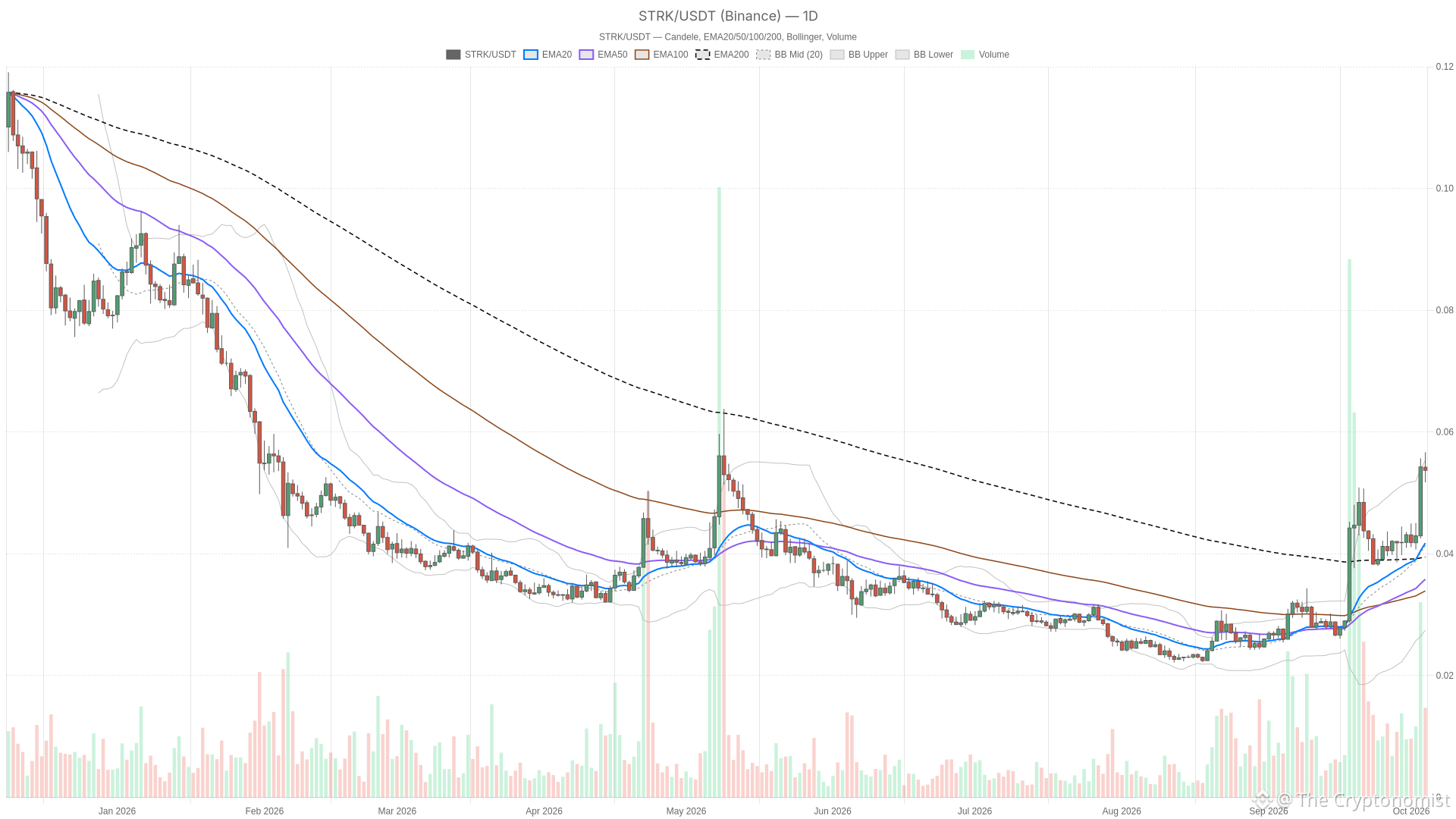
Starknet’s RSI jumps to 74.6 as STRK overshoots daily bandSTRK trades at $0.05372 on Binance as of October 4, 2026, off the last daily close of $0.05428. The Starknet price pushed daily RSI into overbought territory and flipped the daily MACD histogram positive, though a pullback on the smallest timeframe warns that stretched momentum rarely moves in a straight line.
STRK/USDT — daily chart with candlesticks, EMA20/EMA50 and volume.
Key takeaways
STRK trades at $0.05372, with daily RSI at 74.6 — firmly overbought — after closing above the daily Bollinger upper band.
The hourly EMA stack is bullish, but 15-minute RSI has already cooled to 62.3 while daily and hourly readings stay elevated.
An hourly close above $0.05521 would open the path toward the daily R1 at $0.05915; a close below $0.05143 would signal a deeper pullback.
Starknet chain-wide DEX trading volume hit $25.66 million in 24 hours, with Ekubo and Nostra Pools both posting triple-digit percentage gains.
The Fear & Greed Index reads 65 (Greed), while total crypto market cap slipped 2.79% to $2.89 trillion.
Market backdrop stays shaky while Starknet chain activity accelerates
The broader market isn’t offering much of a tailwind. Total crypto market capitalization stands at $2.89 trillion, down 2.79% over the past 24 hours according to CoinGecko, while Bitcoin dominance sits at 59.08%. The Fear & Greed Index reads 65, classified as “Greed” by Alternative.me — a level consistent with traders still willing to chase upside even as aggregate market value slips.
On the Starknet chain itself, DefiLlama data puts total DEX trading volume over the past 24 hours at $25.66 million. That figure spans the whole chain’s top venues and isn’t a direct read on STRK demand specifically.
The moves, however, are notable: Ekubo’s volume is up 173.31% in a day, 378.7% over seven days and 393.55% over 30 days. Nostra Pools shows even sharper swings of 271.66% daily, 565.19% weekly and 268.37% monthly. Both venues point in the same direction, which suggests the chain is seeing heavier turnover alongside the token’s price move, even if it can’t be read as STRK-specific flow.
EMA structure is clean on the hourly chart, messier on the daily
The Starknet price sits above every EMA on all three timeframes, but the quality of that structure differs by timeframe. On the daily chart, price is above EMA20 ($0.04051), EMA50 ($0.03510) and EMA200 ($0.03934), yet the EMA order itself is mixed — EMA50 sits below EMA200 rather than above it.
That mismatch is why the system’s daily regime read comes back as neutral despite the overbought RSI and the fresh MACD cross. It usually shows up when a rally moves quickly enough that the medium-term average hasn’t caught up to the longer-term one yet, rather than building through a slow grind.
The hourly chart tells a cleaner story: price above EMA20 ($0.05143), EMA50 ($0.04797) and EMA200 ($0.04398), with the averages themselves stacked in textbook bullish order. The 15-minute frame complicates things only at the margin — price has slipped just under its own EMA20 ($0.05390) while holding above EMA50 ($0.05275) and EMA200 ($0.04803), with that EMA stack also bullish. In practice, the short-term dip looks like a pause inside an intact uptrend rather than a break in structure, at least for now.
Daily and hourly RSI near 75 sit against a flattening 15-minute MACD
Daily RSI is at 74.6, up from 60.2 and 62.0 over the prior two completed sessions — solidly overbought and still climbing. The daily MACD histogram just crossed into positive territory after two negative readings, which lines up with the RSI move and confirms there’s real momentum behind this leg, at least on the daily timeframe.
The catch is the Bollinger setup: the last completed daily candle closed at $0.05428, above the upper band at $0.05391, and price has since eased back to $0.05372. An overshoot like that, followed by an immediate pullback, is often a sign that a move needs to cool off before it can extend further. Daily ATR sits near $0.004625, roughly 8.6% of the current price — a wide range that fits an asset in an active expansion phase.
Hourly RSI is at 76.6, also overbought, and it has been rising over its last three readings (70.8, 70.8, 76.6). The hourly MACD histogram has crossed zero too, but the print is tiny — the kind of reading that confirms direction without much conviction behind it. Hourly ATR is around $0.0018, about 3.3% of price.
The 15-minute chart is where the picture diverges. RSI there has slipped to 62.3 after falling from 69.3 to 62.9 to 62.3 over the last three completed candles — momentum fading on the execution timeframe even as the daily and hourly readings sit deep in overbought territory. The 15-minute MACD histogram is essentially flat, holding near a small positive value without a clear directional push, and the 15-minute ATR of roughly $0.0009687 is a far tighter range than the daily or hourly figures. This is the central tension: the bigger trend looks stretched and strong, while the smallest timeframe is already hesitating.
The Starknet price faces its daily Bollinger extreme and a tight hourly resistance cluster
On the daily chart, STRK has already closed one session above the upper Bollinger Band at $0.05391 before slipping back toward $0.05372. The next level above is the daily R1 at $0.05915. Below current price, the daily pivot at $0.05084 is the first cushion, with the daily S1 at $0.04597 and the daily EMA20 near $0.04051 as deeper supports should the pullback extend.
The hourly chart shows a tighter cluster just overhead: the hourly S1 at $0.05373 sits just above spot and acts as the first resistance, followed by the hourly pivot at $0.05521 and the hourly R1 at $0.05712. On the downside, the hourly EMA20 at $0.05143 — which lines up closely with the hourly Bollinger mid at $0.05137 — is the first support, with the hourly EMA50 at $0.04797 further below.
Bullish scenario: An hourly close back above the hourly pivot at $0.05521, followed by a push through the hourly R1 at $0.05712, would support a move toward the daily R1 at $0.05915. That path needs the overbought daily and hourly RSI readings to keep climbing rather than roll over, which isn’t guaranteed given the fading momentum already visible on the 15-minute chart. Invalidation would come from a daily close back below the daily pivot at $0.05084, which would point to a deeper retracement.
Bearish scenario: An hourly close below the hourly EMA20 at $0.05143 would signal the intraday structure is cracking, opening room toward the hourly EMA50 at $0.04797 and, on the daily chart, the daily S1 at $0.04597. This scenario would be undercut by a daily close that reclaims the daily Bollinger upper band near $0.05391, which would suggest the pullback was shallow and buyers remained in control.
Given overbought readings on both higher timeframes next to cooling 15-minute momentum, the most likely false signal here runs in either direction. A brief dip gets mistaken for a reversal when it’s just the stretched daily and hourly trend catching its breath. Alternatively, a bounce off hourly support gets read as fresh strength when RSI at these levels still has plenty of room to unwind without the broader EMA structure actually breaking.
FAQ
What is the Starknet price right now?
STRK trades at $0.05372 on Binance, off the last completed daily close of $0.05428.
Is STRK overbought on the daily chart?
Yes. Daily RSI stands at 74.6, up from 60.2 and 62.0 over the previous two completed sessions, placing it firmly in overbought territory.
What would confirm further upside for STRK?
An hourly close above the hourly pivot at $0.05521 and then the hourly R1 at $0.05712 would support a move toward the daily R1 at $0.05915.
What would signal the rally is losing steam?
An hourly close below the hourly EMA20 at $0.05143 would point to a deeper pullback toward the hourly EMA50 at $0.04797 and the daily S1 at $0.04597.
Disclaimer: This article is for informational purposes only and does not constitute financial advice, an investment recommendation, or a solicitation to buy or sell any financial instrument or cryptocurrency. The analysis provided is not indicative of future results. Investing in crypto assets and financial markets carries a high risk of capital loss. Always do your own research (DYOR) and consult a qualified financial advisor before making any decision.
Article produced with the assistance of artificial intelligence and reviewed by the editorial team.
Starknet’s RSI jumps to 74.6 as STRK overshoots daily band
STRK trades at $0.05372 on Binance as of October 4, 2026, off the last daily close of $0.05428. The Starknet price pushed daily RSI into overbought territory and flipped the daily MACD histogram positive, though a pullback on the smallest timeframe warns that stretched momentum rarely moves in a straight line.
STRK/USDT — daily chart with candlesticks, EMA20/EMA50 and volume.
Key takeaways
STRK trades at $0.05372, with daily RSI at 74.6 — firmly overbought — after closing above the daily Bollinger upper band.
The hourly EMA stack is bullish, but 15-minute RSI has already cooled to 62.3 while daily and hourly readings stay elevated.
An hourly close above $0.05521 would open the path toward the daily R1 at $0.05915; a close below $0.05143 would signal a deeper pullback.
Starknet chain-wide DEX trading volume hit $25.66 million in 24 hours, with Ekubo and Nostra Pools both posting triple-digit percentage gains.
The Fear & Greed Index reads 65 (Greed), while total crypto market cap slipped 2.79% to $2.89 trillion.
Market backdrop stays shaky while Starknet chain activity accelerates
The broader market isn’t offering much of a tailwind. Total crypto market capitalization stands at $2.89 trillion, down 2.79% over the past 24 hours according to CoinGecko, while Bitcoin dominance sits at 59.08%. The Fear & Greed Index reads 65, classified as “Greed” by Alternative.me — a level consistent with traders still willing to chase upside even as aggregate market value slips.
On the Starknet chain itself, DefiLlama data puts total DEX trading volume over the past 24 hours at $25.66 million. That figure spans the whole chain’s top venues and isn’t a direct read on STRK demand specifically.
The moves, however, are notable: Ekubo’s volume is up 173.31% in a day, 378.7% over seven days and 393.55% over 30 days. Nostra Pools shows even sharper swings of 271.66% daily, 565.19% weekly and 268.37% monthly. Both venues point in the same direction, which suggests the chain is seeing heavier turnover alongside the token’s price move, even if it can’t be read as STRK-specific flow.
EMA structure is clean on the hourly chart, messier on the daily
The Starknet price sits above every EMA on all three timeframes, but the quality of that structure differs by timeframe. On the daily chart, price is above EMA20 ($0.04051), EMA50 ($0.03510) and EMA200 ($0.03934), yet the EMA order itself is mixed — EMA50 sits below EMA200 rather than above it.
That mismatch is why the system’s daily regime read comes back as neutral despite the overbought RSI and the fresh MACD cross. It usually shows up when a rally moves quickly enough that the medium-term average hasn’t caught up to the longer-term one yet, rather than building through a slow grind.
The hourly chart tells a cleaner story: price above EMA20 ($0.05143), EMA50 ($0.04797) and EMA200 ($0.04398), with the averages themselves stacked in textbook bullish order. The 15-minute frame complicates things only at the margin — price has slipped just under its own EMA20 ($0.05390) while holding above EMA50 ($0.05275) and EMA200 ($0.04803), with that EMA stack also bullish. In practice, the short-term dip looks like a pause inside an intact uptrend rather than a break in structure, at least for now.
Daily and hourly RSI near 75 sit against a flattening 15-minute MACD
Daily RSI is at 74.6, up from 60.2 and 62.0 over the prior two completed sessions — solidly overbought and still climbing. The daily MACD histogram just crossed into positive territory after two negative readings, which lines up with the RSI move and confirms there’s real momentum behind this leg, at least on the daily timeframe.
The catch is the Bollinger setup: the last completed daily candle closed at $0.05428, above the upper band at $0.05391, and price has since eased back to $0.05372. An overshoot like that, followed by an immediate pullback, is often a sign that a move needs to cool off before it can extend further. Daily ATR sits near $0.004625, roughly 8.6% of the current price — a wide range that fits an asset in an active expansion phase.
Hourly RSI is at 76.6, also overbought, and it has been rising over its last three readings (70.8, 70.8, 76.6). The hourly MACD histogram has crossed zero too, but the print is tiny — the kind of reading that confirms direction without much conviction behind it. Hourly ATR is around $0.0018, about 3.3% of price.
The 15-minute chart is where the picture diverges. RSI there has slipped to 62.3 after falling from 69.3 to 62.9 to 62.3 over the last three completed candles — momentum fading on the execution timeframe even as the daily and hourly readings sit deep in overbought territory. The 15-minute MACD histogram is essentially flat, holding near a small positive value without a clear directional push, and the 15-minute ATR of roughly $0.0009687 is a far tighter range than the daily or hourly figures. This is the central tension: the bigger trend looks stretched and strong, while the smallest timeframe is already hesitating.
The Starknet price faces its daily Bollinger extreme and a tight hourly resistance cluster
On the daily chart, STRK has already closed one session above the upper Bollinger Band at $0.05391 before slipping back toward $0.05372. The next level above is the daily R1 at $0.05915. Below current price, the daily pivot at $0.05084 is the first cushion, with the daily S1 at $0.04597 and the daily EMA20 near $0.04051 as deeper supports should the pullback extend.
The hourly chart shows a tighter cluster just overhead: the hourly S1 at $0.05373 sits just above spot and acts as the first resistance, followed by the hourly pivot at $0.05521 and the hourly R1 at $0.05712. On the downside, the hourly EMA20 at $0.05143 — which lines up closely with the hourly Bollinger mid at $0.05137 — is the first support, with the hourly EMA50 at $0.04797 further below.
Bullish scenario: An hourly close back above the hourly pivot at $0.05521, followed by a push through the hourly R1 at $0.05712, would support a move toward the daily R1 at $0.05915. That path needs the overbought daily and hourly RSI readings to keep climbing rather than roll over, which isn’t guaranteed given the fading momentum already visible on the 15-minute chart. Invalidation would come from a daily close back below the daily pivot at $0.05084, which would point to a deeper retracement.
Bearish scenario: An hourly close below the hourly EMA20 at $0.05143 would signal the intraday structure is cracking, opening room toward the hourly EMA50 at $0.04797 and, on the daily chart, the daily S1 at $0.04597. This scenario would be undercut by a daily close that reclaims the daily Bollinger upper band near $0.05391, which would suggest the pullback was shallow and buyers remained in control.
Given overbought readings on both higher timeframes next to cooling 15-minute momentum, the most likely false signal here runs in either direction. A brief dip gets mistaken for a reversal when it’s just the stretched daily and hourly trend catching its breath. Alternatively, a bounce off hourly support gets read as fresh strength when RSI at these levels still has plenty of room to unwind without the broader EMA structure actually breaking.
FAQ
What is the Starknet price right now?
STRK trades at $0.05372 on Binance, off the last completed daily close of $0.05428.
Is STRK overbought on the daily chart?
Yes. Daily RSI stands at 74.6, up from 60.2 and 62.0 over the previous two completed sessions, placing it firmly in overbought territory.
What would confirm further upside for STRK?
An hourly close above the hourly pivot at $0.05521 and then the hourly R1 at $0.05712 would support a move toward the daily R1 at $0.05915.
What would signal the rally is losing steam?
An hourly close below the hourly EMA20 at $0.05143 would point to a deeper pullback toward the hourly EMA50 at $0.04797 and the daily S1 at $0.04597.
Disclaimer: This article is for informational purposes only and does not constitute financial advice, an investment recommendation, or a solicitation to buy or sell any financial instrument or cryptocurrency. The analysis provided is not indicative of future results. Investing in crypto assets and financial markets carries a high risk of capital loss. Always do your own research (DYOR) and consult a qualified financial advisor before making any decision.
Article produced with the assistance of artificial intelligence and reviewed by the editorial team.
STRK/USDT — daily chart with candlesticks, EMA20/EMA50 and volume.
Key takeaways
STRK trades at $0.05372, with daily RSI at 74.6 — firmly overbought — after closing above the daily Bollinger upper band.
The hourly EMA stack is bullish, but 15-minute RSI has already cooled to 62.3 while daily and hourly readings stay elevated.
An hourly close above $0.05521 would open the path toward the daily R1 at $0.05915; a close below $0.05143 would signal a deeper pullback.
Starknet chain-wide DEX trading volume hit $25.66 million in 24 hours, with Ekubo and Nostra Pools both posting triple-digit percentage gains.
The Fear & Greed Index reads 65 (Greed), while total crypto market cap slipped 2.79% to $2.89 trillion.
Market backdrop stays shaky while Starknet chain activity accelerates
The broader market isn’t offering much of a tailwind. Total crypto market capitalization stands at $2.89 trillion, down 2.79% over the past 24 hours according to CoinGecko, while Bitcoin dominance sits at 59.08%. The Fear & Greed Index reads 65, classified as “Greed” by Alternative.me — a level consistent with traders still willing to chase upside even as aggregate market value slips.
On the Starknet chain itself, DefiLlama data puts total DEX trading volume over the past 24 hours at $25.66 million. That figure spans the whole chain’s top venues and isn’t a direct read on STRK demand specifically.
The moves, however, are notable: Ekubo’s volume is up 173.31% in a day, 378.7% over seven days and 393.55% over 30 days. Nostra Pools shows even sharper swings of 271.66% daily, 565.19% weekly and 268.37% monthly. Both venues point in the same direction, which suggests the chain is seeing heavier turnover alongside the token’s price move, even if it can’t be read as STRK-specific flow.
EMA structure is clean on the hourly chart, messier on the daily
The Starknet price sits above every EMA on all three timeframes, but the quality of that structure differs by timeframe. On the daily chart, price is above EMA20 ($0.04051), EMA50 ($0.03510) and EMA200 ($0.03934), yet the EMA order itself is mixed — EMA50 sits below EMA200 rather than above it.
That mismatch is why the system’s daily regime read comes back as neutral despite the overbought RSI and the fresh MACD cross. It usually shows up when a rally moves quickly enough that the medium-term average hasn’t caught up to the longer-term one yet, rather than building through a slow grind.
The hourly chart tells a cleaner story: price above EMA20 ($0.05143), EMA50 ($0.04797) and EMA200 ($0.04398), with the averages themselves stacked in textbook bullish order. The 15-minute frame complicates things only at the margin — price has slipped just under its own EMA20 ($0.05390) while holding above EMA50 ($0.05275) and EMA200 ($0.04803), with that EMA stack also bullish. In practice, the short-term dip looks like a pause inside an intact uptrend rather than a break in structure, at least for now.
Daily and hourly RSI near 75 sit against a flattening 15-minute MACD
Daily RSI is at 74.6, up from 60.2 and 62.0 over the prior two completed sessions — solidly overbought and still climbing. The daily MACD histogram just crossed into positive territory after two negative readings, which lines up with the RSI move and confirms there’s real momentum behind this leg, at least on the daily timeframe.
The catch is the Bollinger setup: the last completed daily candle closed at $0.05428, above the upper band at $0.05391, and price has since eased back to $0.05372. An overshoot like that, followed by an immediate pullback, is often a sign that a move needs to cool off before it can extend further. Daily ATR sits near $0.004625, roughly 8.6% of the current price — a wide range that fits an asset in an active expansion phase.
Hourly RSI is at 76.6, also overbought, and it has been rising over its last three readings (70.8, 70.8, 76.6). The hourly MACD histogram has crossed zero too, but the print is tiny — the kind of reading that confirms direction without much conviction behind it. Hourly ATR is around $0.0018, about 3.3% of price.
The 15-minute chart is where the picture diverges. RSI there has slipped to 62.3 after falling from 69.3 to 62.9 to 62.3 over the last three completed candles — momentum fading on the execution timeframe even as the daily and hourly readings sit deep in overbought territory. The 15-minute MACD histogram is essentially flat, holding near a small positive value without a clear directional push, and the 15-minute ATR of roughly $0.0009687 is a far tighter range than the daily or hourly figures. This is the central tension: the bigger trend looks stretched and strong, while the smallest timeframe is already hesitating.
The Starknet price faces its daily Bollinger extreme and a tight hourly resistance cluster
On the daily chart, STRK has already closed one session above the upper Bollinger Band at $0.05391 before slipping back toward $0.05372. The next level above is the daily R1 at $0.05915. Below current price, the daily pivot at $0.05084 is the first cushion, with the daily S1 at $0.04597 and the daily EMA20 near $0.04051 as deeper supports should the pullback extend.
The hourly chart shows a tighter cluster just overhead: the hourly S1 at $0.05373 sits just above spot and acts as the first resistance, followed by the hourly pivot at $0.05521 and the hourly R1 at $0.05712. On the downside, the hourly EMA20 at $0.05143 — which lines up closely with the hourly Bollinger mid at $0.05137 — is the first support, with the hourly EMA50 at $0.04797 further below.
Bullish scenario: An hourly close back above the hourly pivot at $0.05521, followed by a push through the hourly R1 at $0.05712, would support a move toward the daily R1 at $0.05915. That path needs the overbought daily and hourly RSI readings to keep climbing rather than roll over, which isn’t guaranteed given the fading momentum already visible on the 15-minute chart. Invalidation would come from a daily close back below the daily pivot at $0.05084, which would point to a deeper retracement.
Bearish scenario: An hourly close below the hourly EMA20 at $0.05143 would signal the intraday structure is cracking, opening room toward the hourly EMA50 at $0.04797 and, on the daily chart, the daily S1 at $0.04597. This scenario would be undercut by a daily close that reclaims the daily Bollinger upper band near $0.05391, which would suggest the pullback was shallow and buyers remained in control.
Given overbought readings on both higher timeframes next to cooling 15-minute momentum, the most likely false signal here runs in either direction. A brief dip gets mistaken for a reversal when it’s just the stretched daily and hourly trend catching its breath. Alternatively, a bounce off hourly support gets read as fresh strength when RSI at these levels still has plenty of room to unwind without the broader EMA structure actually breaking.
FAQ
What is the Starknet price right now?
STRK trades at $0.05372 on Binance, off the last completed daily close of $0.05428.
Is STRK overbought on the daily chart?
Yes. Daily RSI stands at 74.6, up from 60.2 and 62.0 over the previous two completed sessions, placing it firmly in overbought territory.
What would confirm further upside for STRK?
An hourly close above the hourly pivot at $0.05521 and then the hourly R1 at $0.05712 would support a move toward the daily R1 at $0.05915.
What would signal the rally is losing steam?
An hourly close below the hourly EMA20 at $0.05143 would point to a deeper pullback toward the hourly EMA50 at $0.04797 and the daily S1 at $0.04597.
Disclaimer: This article is for informational purposes only and does not constitute financial advice, an investment recommendation, or a solicitation to buy or sell any financial instrument or cryptocurrency. The analysis provided is not indicative of future results. Investing in crypto assets and financial markets carries a high risk of capital loss. Always do your own research (DYOR) and consult a qualified financial advisor before making any decision.
Article produced with the assistance of artificial intelligence and reviewed by the editorial team.
1
364

記事
SECの暗号取り締まり担当ジェイ・クレイトン、トランプのAI czarになる見通しドナルド・トランプ大統領は、ホワイトハウスの人工知能(AI)担当の「czar(責任者)」としてジェイ・クレイトンを指名する見通しだ。これは、暗号への強硬な取り締まりで知られる、元ウォール街の規制当局者が、AIの監督に関する同国の方針を担うことになる。2026年10月2日に報じられたこの見込みの人選は、クレイトンがデジタル資産に対する証券取引委員会(SEC)の「規制による執行(regulation-by-enforcement)」時代の設計者としての評判を築いてきたことを受けてのものだ。
要点
SECの暗号取り締まり担当ジェイ・クレイトン、トランプのAI czarになる見通し
ドナルド・トランプ大統領は、ホワイトハウスの人工知能(AI)担当の「czar(責任者)」としてジェイ・クレイトンを指名する見通しだ。これは、暗号への強硬な取り締まりで知られる、元ウォール街の規制当局者が、AIの監督に関する同国の方針を担うことになる。2026年10月2日に報じられたこの見込みの人選は、クレイトンがデジタル資産に対する証券取引委員会(SEC)の「規制による執行(regulation-by-enforcement)」時代の設計者としての評判を築いてきたことを受けてのものだ。
要点
要点
119

記事
Circleは、EUの30%ステーブルコイン準備金ルールを流動性テストに置き換えることを求めているCircleは、欧州委員会に対し、EUのステーブルコイン準備金ルールを見直すよう求めている。必須の銀行預金配分を、流動性ベースの基準に置き換えることを提案している。委員会のMiCA協議へのCircleの回答を10月1日にまとめた提出文では、USDCとEURCの発行体を、ステーブルコイン発行体がトークンを裏付ける方法の変更を求める点で、欧州の中銀と並べて位置づけている。
主な要点
Circleは、MiCAの下で銀行預金の最低要件を、流動性ベースの準備金テストに置き換えることを望んでいる。
Circleは、EUの30%ステーブルコイン準備金ルールを流動性テストに置き換えることを求めている
Circleは、欧州委員会に対し、EUのステーブルコイン準備金ルールを見直すよう求めている。必須の銀行預金配分を、流動性ベースの基準に置き換えることを提案している。委員会のMiCA協議へのCircleの回答を10月1日にまとめた提出文では、USDCとEURCの発行体を、ステーブルコイン発行体がトークンを裏付ける方法の変更を求める点で、欧州の中銀と並べて位置づけている。
主な要点
Circleは、MiCAの下で銀行預金の最低要件を、流動性ベースの準備金テストに置き換えることを望んでいる。
主な要点
Circleは、MiCAの下で銀行預金の最低要件を、流動性ベースの準備金テストに置き換えることを望んでいる。
30

記事
銀行は「接続性」を超えた決済インフラの価値を取り込むべく推進金融機関は決済ネットワークへの接続性を構築していますが、FinextraがBottomlineの協力のもと開催する新しいウェビナーでは、「接続性」だけではもはや不十分だと主張しています。イベントは「Beyond connectivity: Creating more value across the payments lifecycle(接続性を超えて:決済ライフサイクル全体でより多くの価値を生み出す)」と題され、銀行が高まる顧客の期待、業務上の負荷、そしてより厳格化する規制の監視を管理しつつ、決済インフラからより多くの価値を引き出すにはどうすべきかを問いかけます。
主なポイント
銀行は、決済インフラを単に「利用できるもの」ではなく「価値の源泉」に変えることへの圧力が高まっています。
銀行は「接続性」を超えた決済インフラの価値を取り込むべく推進
金融機関は決済ネットワークへの接続性を構築していますが、FinextraがBottomlineの協力のもと開催する新しいウェビナーでは、「接続性」だけではもはや不十分だと主張しています。イベントは「Beyond connectivity: Creating more value across the payments lifecycle(接続性を超えて:決済ライフサイクル全体でより多くの価値を生み出す)」と題され、銀行が高まる顧客の期待、業務上の負荷、そしてより厳格化する規制の監視を管理しつつ、決済インフラからより多くの価値を引き出すにはどうすべきかを問いかけます。
主なポイント
銀行は、決済インフラを単に「利用できるもの」ではなく「価値の源泉」に変えることへの圧力が高まっています。
主なポイント
銀行は、決済インフラを単に「利用できるもの」ではなく「価値の源泉」に変えることへの圧力が高まっています。
32

記事
ブラックロックとオンドが9.8兆ドル市場向けのトークン化された投資ポートフォリオを発表株式、債券ファンド、またはETFを買うことは、これまで多くの人がポートフォリオを組む唯一の方法だった。ブラックロックとオンド・ファイナンスの提携により、これまでとは違うもののプレビューが提供される。つまり、投資戦略全体を1つのブロックチェーン・トークンに包み込み、投資家がウォレット上で直接保有できるようにするもので、これまで主に留まっていた「単一資産」の段階を超えて、投資ポートフォリオのトークン化を前進させる。
CoinDeskによると、世界最大の資産運用会社であるブラックロックは、オンドの「インテリジェント・ポートフォリオ」プロダクト向けに3つのモデル・ポートフォリオを構築し、それぞれを別々の保有分を束ねるのではなく、オンチェーン上で1つのトークンとして表現した。投資家はトークンを個別に管理・リバランスする必要がなくなる。
ブラックロックとオンドが9.8兆ドル市場向けのトークン化された投資ポートフォリオを発表
株式、債券ファンド、またはETFを買うことは、これまで多くの人がポートフォリオを組む唯一の方法だった。ブラックロックとオンド・ファイナンスの提携により、これまでとは違うもののプレビューが提供される。つまり、投資戦略全体を1つのブロックチェーン・トークンに包み込み、投資家がウォレット上で直接保有できるようにするもので、これまで主に留まっていた「単一資産」の段階を超えて、投資ポートフォリオのトークン化を前進させる。
CoinDeskによると、世界最大の資産運用会社であるブラックロックは、オンドの「インテリジェント・ポートフォリオ」プロダクト向けに3つのモデル・ポートフォリオを構築し、それぞれを別々の保有分を束ねるのではなく、オンチェーン上で1つのトークンとして表現した。投資家はトークンを個別に管理・リバランスする必要がなくなる。
CoinDeskによると、世界最大の資産運用会社であるブラックロックは、オンドの「インテリジェント・ポートフォリオ」プロダクト向けに3つのモデル・ポートフォリオを構築し、それぞれを別々の保有分を束ねるのではなく、オンチェーン上で1つのトークンとして表現した。投資家はトークンを個別に管理・リバランスする必要がなくなる。
1
3
290

記事
Bitgetの3億8700万ドル被害ハック AIによる追跡で20時間を10分に短縮Chainalysisによると、同社は社内の人工知能を使用して、通常は捜査官が20時間以上かかる橋渡しの照合(ブリッジ・レコンシリエーション)作業を、暗号資産取引所Bitgetから流出した3億8700万ドルを追跡する際に、10分未満にまで短縮したという。
内訳は、crypto.newsが報じた2023年10月1日付のChainalysisレポートによるものだ。ブロックチェーン分析企業は、9月24日にBitgetが不正な送金を検知した後、この事案のために捜査官がカスタムの自動化を構築したと説明しており、そのツールは、別々のネットワーク上で見た場合には無関係に見えかねない断片化された取引の流れをつなげるのに役立った。
Bitgetの3億8700万ドル被害ハック AIによる追跡で20時間を10分に短縮
Chainalysisによると、同社は社内の人工知能を使用して、通常は捜査官が20時間以上かかる橋渡しの照合(ブリッジ・レコンシリエーション)作業を、暗号資産取引所Bitgetから流出した3億8700万ドルを追跡する際に、10分未満にまで短縮したという。
内訳は、crypto.newsが報じた2023年10月1日付のChainalysisレポートによるものだ。ブロックチェーン分析企業は、9月24日にBitgetが不正な送金を検知した後、この事案のために捜査官がカスタムの自動化を構築したと説明しており、そのツールは、別々のネットワーク上で見た場合には無関係に見えかねない断片化された取引の流れをつなげるのに役立った。
内訳は、crypto.newsが報じた2023年10月1日付のChainalysisレポートによるものだ。ブロックチェーン分析企業は、9月24日にBitgetが不正な送金を検知した後、この事案のために捜査官がカスタムの自動化を構築したと説明しており、そのツールは、別々のネットワーク上で見た場合には無関係に見えかねない断片化された取引の流れをつなげるのに役立った。
221

記事
ギリシャの暗号資産詐欺逮捕、軍のインサイダーと結び付いた800万ドル規模の計画が露呈crypto.newsによると、ギリシャ当局は、当局の説明では少なくとも10,000人の参加者から800万ドル超を集めたとされる暗号資産への投資スキームを運営したとして17人を逮捕した。2026年10月2日にギリシャ警察が明らかにしたこの件は、不正なプラットフォームを中心としており、50日以内に投資家の資金を2倍にすると約束していた。
要点
17人の容疑者が拘束され、そのうち9人は現役の軍人だった。
捜査当局は、このスキームが約10,000人から集められた総額80万ドル超(8百万ドル超)に結び付くとみている。
ギリシャの暗号資産詐欺逮捕、軍のインサイダーと結び付いた800万ドル規模の計画が露呈
crypto.newsによると、ギリシャ当局は、当局の説明では少なくとも10,000人の参加者から800万ドル超を集めたとされる暗号資産への投資スキームを運営したとして17人を逮捕した。2026年10月2日にギリシャ警察が明らかにしたこの件は、不正なプラットフォームを中心としており、50日以内に投資家の資金を2倍にすると約束していた。
要点
17人の容疑者が拘束され、そのうち9人は現役の軍人だった。
捜査当局は、このスキームが約10,000人から集められた総額80万ドル超(8百万ドル超)に結び付くとみている。
要点
17人の容疑者が拘束され、そのうち9人は現役の軍人だった。
捜査当局は、このスキームが約10,000人から集められた総額80万ドル超(8百万ドル超)に結び付くとみている。
52

記事
トランプ、6つのテック大手と任意のAI安全協定を発表ホワイトハウスで2026年9月29日に署名された1ページ文書が、地球上で最も強力な人工知能システムを誰が監視すべきかをめぐる、急速に動く論争の中心にある。ドナルド・トランプ大統領は、6つの主要AI企業のリーダーたちと並び、業界に対して新しい連邦規則に従わせるのではなく、業界自身が自ら監視することを求める任意のAI安全協定を公開した。数日以内に、その業界は連邦調査に直面し、さらに最新モデルへのアクセスを静かに制限することになった。これは、自主規制と政府の監視が、並行して進みうることを改めて示している。
トランプ、6つのテック大手と任意のAI安全協定を発表
ホワイトハウスで2026年9月29日に署名された1ページ文書が、地球上で最も強力な人工知能システムを誰が監視すべきかをめぐる、急速に動く論争の中心にある。ドナルド・トランプ大統領は、6つの主要AI企業のリーダーたちと並び、業界に対して新しい連邦規則に従わせるのではなく、業界自身が自ら監視することを求める任意のAI安全協定を公開した。数日以内に、その業界は連邦調査に直面し、さらに最新モデルへのアクセスを静かに制限することになった。これは、自主規制と政府の監視が、並行して進みうることを改めて示している。
1
78

記事
ArbitrumのStylusアクティベーション停止はAI支援型攻撃リスクを対象にしているArbitrumのセキュリティ評議会は、ますます巧妙化するAI支援型攻撃に対する緊急対応だとネットワークが説明した中で、2026年10月2日からArbitrum OneとNovaにおける新規Stylusコントラクトのアクティベーションをブロックする動きに移りました。ArbitrumのStylusアクティベーション停止は、ネットワーク上で既に動いているコントラクトには影響しませんが、セキュリティ評議会のアクション報告によれば、さらなる通知があるまで開発者が新しいWebAssemblyベースのプログラムを有効化することを止めます。
要点
Arbitrumのセキュリティ評議会は、AI支援型攻撃リスクを理由に、2026年10月2日付でArbitrum OneとNovaにおける新規Stylusコントラクトのアクティベーションを停止しました。
ArbitrumのStylusアクティベーション停止はAI支援型攻撃リスクを対象にしている
Arbitrumのセキュリティ評議会は、ますます巧妙化するAI支援型攻撃に対する緊急対応だとネットワークが説明した中で、2026年10月2日からArbitrum OneとNovaにおける新規Stylusコントラクトのアクティベーションをブロックする動きに移りました。ArbitrumのStylusアクティベーション停止は、ネットワーク上で既に動いているコントラクトには影響しませんが、セキュリティ評議会のアクション報告によれば、さらなる通知があるまで開発者が新しいWebAssemblyベースのプログラムを有効化することを止めます。
要点
Arbitrumのセキュリティ評議会は、AI支援型攻撃リスクを理由に、2026年10月2日付でArbitrum OneとNovaにおける新規Stylusコントラクトのアクティベーションを停止しました。
要点
Arbitrumのセキュリティ評議会は、AI支援型攻撃リスクを理由に、2026年10月2日付でArbitrum OneとNovaにおける新規Stylusコントラクトのアクティベーションを停止しました。
15

記事
イーサリアム財団、プライベートな従量課金API支払いを展開するもIPデータは露出したまま今週、イーサリアムのメインネット上で、ひっそりと新しい支払いシステムが稼働開始しました。そしてそれは、多くの人が手遅れになるまで考えないような問題を解決するために作られています。つまり、AIモデルやクラウドAPI、あるいはほぼあらゆる従量課金型のオンラインサービスを使うために支払うたびに、その支払いは通常、これまであなたが尋ねてきたすべての内容にあなたの身元を結び付けてしまうということです。イーサリアム財団とOpen Anonymity Projectは2026年10月1日、zkAPIというシステムを導入したと発表しました。これは、個々のリクエストを永続的な課金アカウントに紐づけることなく、ユーザーが秘密の従量課金API支払いを行えるよう設計されています。
イーサリアム財団、プライベートな従量課金API支払いを展開するもIPデータは露出したまま
今週、イーサリアムのメインネット上で、ひっそりと新しい支払いシステムが稼働開始しました。そしてそれは、多くの人が手遅れになるまで考えないような問題を解決するために作られています。つまり、AIモデルやクラウドAPI、あるいはほぼあらゆる従量課金型のオンラインサービスを使うために支払うたびに、その支払いは通常、これまであなたが尋ねてきたすべての内容にあなたの身元を結び付けてしまうということです。イーサリアム財団とOpen Anonymity Projectは2026年10月1日、zkAPIというシステムを導入したと発表しました。これは、個々のリクエストを永続的な課金アカウントに紐づけることなく、ユーザーが秘密の従量課金API支払いを行えるよう設計されています。
1
64

記事
翻訳参照
CZ explains withdrawal pause recommendation after Bybit hackBinance founder CZ has opened up about one of the more uncomfortable moments in crypto incident response: what to do with customer withdrawals in the minutes after an exchange gets hacked. Speaking in an interview with When Shift Happens, host KevinWSHPod, CZ said that after Bybit was hacked on September 25, 2026, he publicly suggested the exchange consider pausing withdrawals as a precaution. His reasoning was simple — stop abnormal outflows before they get worse. The broader conversation around the Binance CZ withdrawal pause recommendation has since become a useful case study in how exchanges weigh security against user access during a live crisis.
Key takeaways
Bybit was hacked on September 25, 2026, according to comments CZ made in an interview with When Shift Happens.
CZ publicly recommended pausing withdrawals to prevent further abnormal fund outflows.
He acknowledged that halting withdrawals could disrupt trading and inconvenience users, but argued security risks should come first.
Bybit ultimately did not pause withdrawals, and CZ said no further issues occurred afterward.
CZ concluded there is no absolute right or wrong approach in these situations — the real issue is risk assessment.
Summary of Bybit Hack and CZ’s Recommendation
CZ’s account centers on a single, clear-cut moment: Bybit was hacked on September 25, 2026, and within that window he went public with a specific piece of advice — pause withdrawals. He framed it as a more cautious security measure designed to prevent further abnormal outflows of funds while the exchange figured out what had happened and contained the damage.
Details of the Bybit hack incident
The source material does not go into the technical mechanics of the breach itself. What’s documented is the timeline marker — September 25, 2026 — and the fact that it was serious enough to prompt a prominent industry figure to weigh in publicly on how Bybit should respond.
CZ’s public advice on pausing withdrawals
CZ made his recommendation in an interview with When Shift Happens, hosted by KevinWSHPod. That public forum is notable in itself: rather than offering private counsel, CZ aired his view on withdrawal suspension as a general principle for handling exchange breaches, turning a specific incident into a broader conversation about crisis protocol.
Trade-offs Between Security and User Convenience
The core tension CZ described is one every exchange faces mid-breach: lock the doors and protect what’s left, or keep operations running and risk further losses. There’s no clean answer, and his comments make that trade-off explicit rather than glossing over it.
Potential impacts of pausing withdrawals on trading continuity
CZ was direct about the downside. Suspending withdrawal services, he said, could disrupt trading continuity and leave users unable to move their funds when they want to. For an exchange, that’s not a small cost — it can mean frustrated customers, reputational friction, and operational headaches that outlast the security incident itself.
CZ’s prioritization of security risks
Even so, CZ’s position was that security risks should take priority over that short-term inconvenience. In his view, the potential for continued fund loss outweighs the disruption caused by a temporary freeze — a stance that puts containment ahead of customer experience when the two collide.
Bybit’s Response and Outcome
Bybit chose a different path than the one CZ recommended, and the reported result was that nothing further went wrong. That outcome is the part of the story that complicates any easy takeaway about the right way to handle a breach.
Bybit’s decision not to pause withdrawals
Despite CZ’s public suggestion, Bybit ultimately did not pause withdrawals after the hack. The exchange kept that service running rather than freezing it as a precaution.
Resulting operational status post-hack
According to CZ, no further issues occurred following Bybit’s decision to keep withdrawals open. He pointed to that outcome as evidence that caution and action can both lead to acceptable results, depending on how the underlying risk is actually assessed in the moment.
Philosophy on Incident Management and Risk Assessment
CZ’s closing point reframes the whole episode: this isn’t really about which single rule to follow during a hack, it’s about judgment calls made under pressure with incomplete information.
CZ’s view on no absolute right or wrong approach
CZ said there is no absolute right or wrong in such situations. Bybit’s choice not to pause withdrawals worked out this time, but that doesn’t make it a universal rule any more than his own recommendation to pause would have been.
Importance of risk assessments in security incidents
What matters, in his telling, is proper risk assessment in the moment — reading the scale of the breach, the likely behavior of attackers, and the operational cost of each option before deciding. That’s the practical lesson sitting underneath the back-and-forth over the Binance CZ withdrawal pause suggestion: exchanges need a sound process for weighing security against continuity, not a fixed playbook that applies to every hack the same way.
Article produced with the assistance of artificial intelligence and reviewed by the editorial team.
CZ explains withdrawal pause recommendation after Bybit hack
Binance founder CZ has opened up about one of the more uncomfortable moments in crypto incident response: what to do with customer withdrawals in the minutes after an exchange gets hacked. Speaking in an interview with When Shift Happens, host KevinWSHPod, CZ said that after Bybit was hacked on September 25, 2026, he publicly suggested the exchange consider pausing withdrawals as a precaution. His reasoning was simple — stop abnormal outflows before they get worse. The broader conversation around the Binance CZ withdrawal pause recommendation has since become a useful case study in how exchanges weigh security against user access during a live crisis.
Key takeaways
Bybit was hacked on September 25, 2026, according to comments CZ made in an interview with When Shift Happens.
CZ publicly recommended pausing withdrawals to prevent further abnormal fund outflows.
He acknowledged that halting withdrawals could disrupt trading and inconvenience users, but argued security risks should come first.
Bybit ultimately did not pause withdrawals, and CZ said no further issues occurred afterward.
CZ concluded there is no absolute right or wrong approach in these situations — the real issue is risk assessment.
Summary of Bybit Hack and CZ’s Recommendation
CZ’s account centers on a single, clear-cut moment: Bybit was hacked on September 25, 2026, and within that window he went public with a specific piece of advice — pause withdrawals. He framed it as a more cautious security measure designed to prevent further abnormal outflows of funds while the exchange figured out what had happened and contained the damage.
Details of the Bybit hack incident
The source material does not go into the technical mechanics of the breach itself. What’s documented is the timeline marker — September 25, 2026 — and the fact that it was serious enough to prompt a prominent industry figure to weigh in publicly on how Bybit should respond.
CZ’s public advice on pausing withdrawals
CZ made his recommendation in an interview with When Shift Happens, hosted by KevinWSHPod. That public forum is notable in itself: rather than offering private counsel, CZ aired his view on withdrawal suspension as a general principle for handling exchange breaches, turning a specific incident into a broader conversation about crisis protocol.
Trade-offs Between Security and User Convenience
The core tension CZ described is one every exchange faces mid-breach: lock the doors and protect what’s left, or keep operations running and risk further losses. There’s no clean answer, and his comments make that trade-off explicit rather than glossing over it.
Potential impacts of pausing withdrawals on trading continuity
CZ was direct about the downside. Suspending withdrawal services, he said, could disrupt trading continuity and leave users unable to move their funds when they want to. For an exchange, that’s not a small cost — it can mean frustrated customers, reputational friction, and operational headaches that outlast the security incident itself.
CZ’s prioritization of security risks
Even so, CZ’s position was that security risks should take priority over that short-term inconvenience. In his view, the potential for continued fund loss outweighs the disruption caused by a temporary freeze — a stance that puts containment ahead of customer experience when the two collide.
Bybit’s Response and Outcome
Bybit chose a different path than the one CZ recommended, and the reported result was that nothing further went wrong. That outcome is the part of the story that complicates any easy takeaway about the right way to handle a breach.
Bybit’s decision not to pause withdrawals
Despite CZ’s public suggestion, Bybit ultimately did not pause withdrawals after the hack. The exchange kept that service running rather than freezing it as a precaution.
Resulting operational status post-hack
According to CZ, no further issues occurred following Bybit’s decision to keep withdrawals open. He pointed to that outcome as evidence that caution and action can both lead to acceptable results, depending on how the underlying risk is actually assessed in the moment.
Philosophy on Incident Management and Risk Assessment
CZ’s closing point reframes the whole episode: this isn’t really about which single rule to follow during a hack, it’s about judgment calls made under pressure with incomplete information.
CZ’s view on no absolute right or wrong approach
CZ said there is no absolute right or wrong in such situations. Bybit’s choice not to pause withdrawals worked out this time, but that doesn’t make it a universal rule any more than his own recommendation to pause would have been.
Importance of risk assessments in security incidents
What matters, in his telling, is proper risk assessment in the moment — reading the scale of the breach, the likely behavior of attackers, and the operational cost of each option before deciding. That’s the practical lesson sitting underneath the back-and-forth over the Binance CZ withdrawal pause suggestion: exchanges need a sound process for weighing security against continuity, not a fixed playbook that applies to every hack the same way.
Article produced with the assistance of artificial intelligence and reviewed by the editorial team.
Key takeaways
Bybit was hacked on September 25, 2026, according to comments CZ made in an interview with When Shift Happens.
CZ publicly recommended pausing withdrawals to prevent further abnormal fund outflows.
He acknowledged that halting withdrawals could disrupt trading and inconvenience users, but argued security risks should come first.
Bybit ultimately did not pause withdrawals, and CZ said no further issues occurred afterward.
CZ concluded there is no absolute right or wrong approach in these situations — the real issue is risk assessment.
Summary of Bybit Hack and CZ’s Recommendation
CZ’s account centers on a single, clear-cut moment: Bybit was hacked on September 25, 2026, and within that window he went public with a specific piece of advice — pause withdrawals. He framed it as a more cautious security measure designed to prevent further abnormal outflows of funds while the exchange figured out what had happened and contained the damage.
Details of the Bybit hack incident
The source material does not go into the technical mechanics of the breach itself. What’s documented is the timeline marker — September 25, 2026 — and the fact that it was serious enough to prompt a prominent industry figure to weigh in publicly on how Bybit should respond.
CZ’s public advice on pausing withdrawals
CZ made his recommendation in an interview with When Shift Happens, hosted by KevinWSHPod. That public forum is notable in itself: rather than offering private counsel, CZ aired his view on withdrawal suspension as a general principle for handling exchange breaches, turning a specific incident into a broader conversation about crisis protocol.
Trade-offs Between Security and User Convenience
The core tension CZ described is one every exchange faces mid-breach: lock the doors and protect what’s left, or keep operations running and risk further losses. There’s no clean answer, and his comments make that trade-off explicit rather than glossing over it.
Potential impacts of pausing withdrawals on trading continuity
CZ was direct about the downside. Suspending withdrawal services, he said, could disrupt trading continuity and leave users unable to move their funds when they want to. For an exchange, that’s not a small cost — it can mean frustrated customers, reputational friction, and operational headaches that outlast the security incident itself.
CZ’s prioritization of security risks
Even so, CZ’s position was that security risks should take priority over that short-term inconvenience. In his view, the potential for continued fund loss outweighs the disruption caused by a temporary freeze — a stance that puts containment ahead of customer experience when the two collide.
Bybit’s Response and Outcome
Bybit chose a different path than the one CZ recommended, and the reported result was that nothing further went wrong. That outcome is the part of the story that complicates any easy takeaway about the right way to handle a breach.
Bybit’s decision not to pause withdrawals
Despite CZ’s public suggestion, Bybit ultimately did not pause withdrawals after the hack. The exchange kept that service running rather than freezing it as a precaution.
Resulting operational status post-hack
According to CZ, no further issues occurred following Bybit’s decision to keep withdrawals open. He pointed to that outcome as evidence that caution and action can both lead to acceptable results, depending on how the underlying risk is actually assessed in the moment.
Philosophy on Incident Management and Risk Assessment
CZ’s closing point reframes the whole episode: this isn’t really about which single rule to follow during a hack, it’s about judgment calls made under pressure with incomplete information.
CZ’s view on no absolute right or wrong approach
CZ said there is no absolute right or wrong in such situations. Bybit’s choice not to pause withdrawals worked out this time, but that doesn’t make it a universal rule any more than his own recommendation to pause would have been.
Importance of risk assessments in security incidents
What matters, in his telling, is proper risk assessment in the moment — reading the scale of the breach, the likely behavior of attackers, and the operational cost of each option before deciding. That’s the practical lesson sitting underneath the back-and-forth over the Binance CZ withdrawal pause suggestion: exchanges need a sound process for weighing security against continuity, not a fixed playbook that applies to every hack the same way.
Article produced with the assistance of artificial intelligence and reviewed by the editorial team.
61

記事
翻訳参照
Drift Velocity exploit recovery pays victims just 1 cent on the dollarMonths after one of 2026’s largest decentralized finance hacks, the platform behind it is finally letting victims file for compensation — but the math isn’t pretty yet. The Drift Velocity exploit recovery process opened on October 1, 2026, giving users a way to claim tokens tied to the roughly $295.4 million stolen from the exchange on April 1. For now, though, those claims are worth barely a penny on the dollar.
Key takeaways
Velocity, the rebranded version of Drift, opened recovery claims on October 1, letting users claim one DFX token for every USDT they lost in the April exploit.
Each DFX currently redeems for just over 0.01 USDT, roughly 1% of what was lost; 216,480 DFX have already been redeemed for about 2,250 USDT.
The recovery pool holds 3.11 million USDT from protocol assets, while up to $147.5 million pledged by Tether and strategic partners has not yet arrived.
Roughly $295.4 million was stolen in total, with hacker wallets still holding 107,165 ETH (about $286 million) and $9.2 million frozen pending law enforcement release.
Velocity Launches Recovery Claims With DFX Tokens
Velocity, the decentralized exchange formerly known as Drift, began accepting recovery claims on October 1 for users who lost funds in the April exploit. The platform confirmed that affected users can claim one DFX token for every USDT lost, formally kicking off a DFX token redemption process that had been anticipated since the hack.
Claim Process and Options for Users
Once a user claims their DFX allocation, three paths open up. They can redeem and burn the tokens immediately for USDT pulled from Drift’s recovery pool, sell the tokens on the secondary market, or simply hold onto them in hopes of a better payout down the line. That last option carries a theoretical upside: as more DFX gets burned by other holders, future pool deposits get divided among a shrinking token supply, which could push up the redemption value over time. It’s a bet on patience rather than a guarantee.
Current Redemption Rate and Token Metrics
Right now, the numbers are modest. Each DFX token redeems for a little over 0.01 USDT — essentially getting back one cent for every dollar lost. As of Friday, Velocity’s redemption dashboard showed 216,480 DFX tokens already redeemed for roughly 2,250 USDT in total payouts. That’s a tiny fraction of the hundreds of millions originally stolen, underscoring just how early this recovery effort still is.
Status of the Recovery Pool and Funding Commitments
The pool backing these redemptions currently totals just 3.11 million USDT, almost entirely from protocol assets rather than outside contributions. That gap between pledged support and actual funds on hand is the central tension in this recovery story: large commitments exist on paper, but they haven’t yet translated into dollars users can claim.
Recovery Pool Composition and Revenue Contributions
Going forward, between 60% and 90% of Velocity’s net protocol revenue will also be swept into the recovery pool, as the platform has pledged. So far, that mechanism has added just 31 USDT after its first day — a figure that illustrates how slow organic revenue contributions will be compared to the scale of losses involved.
Pending Contributions From Tether and Strategic Partners
The bigger money hasn’t shown up yet. Tether previously committed up to $127.5 million to support Drift’s relaunch and user recovery, and strategic partners separately pledged up to $20 million more. Neither sum has been reflected in the recovery dashboard so far, meaning the current 1% redemption rate doesn’t yet account for what could eventually be a much larger pool — assuming those commitments are fulfilled.
This is where the story matters most for users and for the broader DeFi industry watching how hack victims get made whole. A pledge is not a payout, and until Tether’s and the partners’ funds actually land in the pool, DFX holders are redeeming against a relatively thin reserve. How quickly that gap closes will likely shape whether users choose to cash out now or gamble on holding.
What Happened in the April 1 Exploit
The Drift Foundation detailed the scale of the attack in a September 30 update, confirming that approximately $295.4 million was stolen on April 1. Cybersecurity firm Mandiant attributed the breach to a hacker group tracked as UNC6862, which it identified as a North Korean threat group.
Where the Stolen Funds Stand Now
The stolen assets were bridged over to Ethereum, and three attacker wallets still hold 107,165 ETH — worth close to $286 million at current prices. A fourth wallet linked to the attackers previously moved 23,094 ETH through the Tornado Cash mixer back in July, a move typically associated with attempts to obscure the trail of stolen funds.
Frozen Assets and the Law Enforcement Bottleneck
Not all of the stolen money is beyond reach. About $9.2 million has been frozen so far, according to the Drift Foundation. But that money can’t simply be added to the DFX recovery pool — it first needs to be cleared by law enforcement. That dependency means the pace of recovery isn’t purely in Velocity’s hands; it also rests on investigators and whatever legal process is required to release frozen assets back to victims.
Taken together, the numbers paint a recovery effort still in its earliest stage. Redemptions are live, the mechanics are transparent, and the pledges on the table are substantial relative to the losses — but the actual money moving through the system remains a small fraction of what was taken. For the thousands of users holding DFX, the real decision is whether to take the one-cent-on-the-dollar payout now or wait on commitments that, as of this week, still haven’t materialized.
Article produced with the assistance of artificial intelligence and reviewed by the editorial team.
Drift Velocity exploit recovery pays victims just 1 cent on the dollar
Months after one of 2026’s largest decentralized finance hacks, the platform behind it is finally letting victims file for compensation — but the math isn’t pretty yet. The Drift Velocity exploit recovery process opened on October 1, 2026, giving users a way to claim tokens tied to the roughly $295.4 million stolen from the exchange on April 1. For now, though, those claims are worth barely a penny on the dollar.
Key takeaways
Velocity, the rebranded version of Drift, opened recovery claims on October 1, letting users claim one DFX token for every USDT they lost in the April exploit.
Each DFX currently redeems for just over 0.01 USDT, roughly 1% of what was lost; 216,480 DFX have already been redeemed for about 2,250 USDT.
The recovery pool holds 3.11 million USDT from protocol assets, while up to $147.5 million pledged by Tether and strategic partners has not yet arrived.
Roughly $295.4 million was stolen in total, with hacker wallets still holding 107,165 ETH (about $286 million) and $9.2 million frozen pending law enforcement release.
Velocity Launches Recovery Claims With DFX Tokens
Velocity, the decentralized exchange formerly known as Drift, began accepting recovery claims on October 1 for users who lost funds in the April exploit. The platform confirmed that affected users can claim one DFX token for every USDT lost, formally kicking off a DFX token redemption process that had been anticipated since the hack.
Claim Process and Options for Users
Once a user claims their DFX allocation, three paths open up. They can redeem and burn the tokens immediately for USDT pulled from Drift’s recovery pool, sell the tokens on the secondary market, or simply hold onto them in hopes of a better payout down the line. That last option carries a theoretical upside: as more DFX gets burned by other holders, future pool deposits get divided among a shrinking token supply, which could push up the redemption value over time. It’s a bet on patience rather than a guarantee.
Current Redemption Rate and Token Metrics
Right now, the numbers are modest. Each DFX token redeems for a little over 0.01 USDT — essentially getting back one cent for every dollar lost. As of Friday, Velocity’s redemption dashboard showed 216,480 DFX tokens already redeemed for roughly 2,250 USDT in total payouts. That’s a tiny fraction of the hundreds of millions originally stolen, underscoring just how early this recovery effort still is.
Status of the Recovery Pool and Funding Commitments
The pool backing these redemptions currently totals just 3.11 million USDT, almost entirely from protocol assets rather than outside contributions. That gap between pledged support and actual funds on hand is the central tension in this recovery story: large commitments exist on paper, but they haven’t yet translated into dollars users can claim.
Recovery Pool Composition and Revenue Contributions
Going forward, between 60% and 90% of Velocity’s net protocol revenue will also be swept into the recovery pool, as the platform has pledged. So far, that mechanism has added just 31 USDT after its first day — a figure that illustrates how slow organic revenue contributions will be compared to the scale of losses involved.
Pending Contributions From Tether and Strategic Partners
The bigger money hasn’t shown up yet. Tether previously committed up to $127.5 million to support Drift’s relaunch and user recovery, and strategic partners separately pledged up to $20 million more. Neither sum has been reflected in the recovery dashboard so far, meaning the current 1% redemption rate doesn’t yet account for what could eventually be a much larger pool — assuming those commitments are fulfilled.
This is where the story matters most for users and for the broader DeFi industry watching how hack victims get made whole. A pledge is not a payout, and until Tether’s and the partners’ funds actually land in the pool, DFX holders are redeeming against a relatively thin reserve. How quickly that gap closes will likely shape whether users choose to cash out now or gamble on holding.
What Happened in the April 1 Exploit
The Drift Foundation detailed the scale of the attack in a September 30 update, confirming that approximately $295.4 million was stolen on April 1. Cybersecurity firm Mandiant attributed the breach to a hacker group tracked as UNC6862, which it identified as a North Korean threat group.
Where the Stolen Funds Stand Now
The stolen assets were bridged over to Ethereum, and three attacker wallets still hold 107,165 ETH — worth close to $286 million at current prices. A fourth wallet linked to the attackers previously moved 23,094 ETH through the Tornado Cash mixer back in July, a move typically associated with attempts to obscure the trail of stolen funds.
Frozen Assets and the Law Enforcement Bottleneck
Not all of the stolen money is beyond reach. About $9.2 million has been frozen so far, according to the Drift Foundation. But that money can’t simply be added to the DFX recovery pool — it first needs to be cleared by law enforcement. That dependency means the pace of recovery isn’t purely in Velocity’s hands; it also rests on investigators and whatever legal process is required to release frozen assets back to victims.
Taken together, the numbers paint a recovery effort still in its earliest stage. Redemptions are live, the mechanics are transparent, and the pledges on the table are substantial relative to the losses — but the actual money moving through the system remains a small fraction of what was taken. For the thousands of users holding DFX, the real decision is whether to take the one-cent-on-the-dollar payout now or wait on commitments that, as of this week, still haven’t materialized.
Article produced with the assistance of artificial intelligence and reviewed by the editorial team.
Key takeaways
Velocity, the rebranded version of Drift, opened recovery claims on October 1, letting users claim one DFX token for every USDT they lost in the April exploit.
Each DFX currently redeems for just over 0.01 USDT, roughly 1% of what was lost; 216,480 DFX have already been redeemed for about 2,250 USDT.
The recovery pool holds 3.11 million USDT from protocol assets, while up to $147.5 million pledged by Tether and strategic partners has not yet arrived.
Roughly $295.4 million was stolen in total, with hacker wallets still holding 107,165 ETH (about $286 million) and $9.2 million frozen pending law enforcement release.
Velocity Launches Recovery Claims With DFX Tokens
Velocity, the decentralized exchange formerly known as Drift, began accepting recovery claims on October 1 for users who lost funds in the April exploit. The platform confirmed that affected users can claim one DFX token for every USDT lost, formally kicking off a DFX token redemption process that had been anticipated since the hack.
Claim Process and Options for Users
Once a user claims their DFX allocation, three paths open up. They can redeem and burn the tokens immediately for USDT pulled from Drift’s recovery pool, sell the tokens on the secondary market, or simply hold onto them in hopes of a better payout down the line. That last option carries a theoretical upside: as more DFX gets burned by other holders, future pool deposits get divided among a shrinking token supply, which could push up the redemption value over time. It’s a bet on patience rather than a guarantee.
Current Redemption Rate and Token Metrics
Right now, the numbers are modest. Each DFX token redeems for a little over 0.01 USDT — essentially getting back one cent for every dollar lost. As of Friday, Velocity’s redemption dashboard showed 216,480 DFX tokens already redeemed for roughly 2,250 USDT in total payouts. That’s a tiny fraction of the hundreds of millions originally stolen, underscoring just how early this recovery effort still is.
Status of the Recovery Pool and Funding Commitments
The pool backing these redemptions currently totals just 3.11 million USDT, almost entirely from protocol assets rather than outside contributions. That gap between pledged support and actual funds on hand is the central tension in this recovery story: large commitments exist on paper, but they haven’t yet translated into dollars users can claim.
Recovery Pool Composition and Revenue Contributions
Going forward, between 60% and 90% of Velocity’s net protocol revenue will also be swept into the recovery pool, as the platform has pledged. So far, that mechanism has added just 31 USDT after its first day — a figure that illustrates how slow organic revenue contributions will be compared to the scale of losses involved.
Pending Contributions From Tether and Strategic Partners
The bigger money hasn’t shown up yet. Tether previously committed up to $127.5 million to support Drift’s relaunch and user recovery, and strategic partners separately pledged up to $20 million more. Neither sum has been reflected in the recovery dashboard so far, meaning the current 1% redemption rate doesn’t yet account for what could eventually be a much larger pool — assuming those commitments are fulfilled.
This is where the story matters most for users and for the broader DeFi industry watching how hack victims get made whole. A pledge is not a payout, and until Tether’s and the partners’ funds actually land in the pool, DFX holders are redeeming against a relatively thin reserve. How quickly that gap closes will likely shape whether users choose to cash out now or gamble on holding.
What Happened in the April 1 Exploit
The Drift Foundation detailed the scale of the attack in a September 30 update, confirming that approximately $295.4 million was stolen on April 1. Cybersecurity firm Mandiant attributed the breach to a hacker group tracked as UNC6862, which it identified as a North Korean threat group.
Where the Stolen Funds Stand Now
The stolen assets were bridged over to Ethereum, and three attacker wallets still hold 107,165 ETH — worth close to $286 million at current prices. A fourth wallet linked to the attackers previously moved 23,094 ETH through the Tornado Cash mixer back in July, a move typically associated with attempts to obscure the trail of stolen funds.
Frozen Assets and the Law Enforcement Bottleneck
Not all of the stolen money is beyond reach. About $9.2 million has been frozen so far, according to the Drift Foundation. But that money can’t simply be added to the DFX recovery pool — it first needs to be cleared by law enforcement. That dependency means the pace of recovery isn’t purely in Velocity’s hands; it also rests on investigators and whatever legal process is required to release frozen assets back to victims.
Taken together, the numbers paint a recovery effort still in its earliest stage. Redemptions are live, the mechanics are transparent, and the pledges on the table are substantial relative to the losses — but the actual money moving through the system remains a small fraction of what was taken. For the thousands of users holding DFX, the real decision is whether to take the one-cent-on-the-dollar payout now or wait on commitments that, as of this week, still haven’t materialized.
Article produced with the assistance of artificial intelligence and reviewed by the editorial team.
172

記事
BTCからXMR:KYCなしでBitcoinをMoneroに交換する方法(2026年ガイド)Bitcoinは設計上公開されています。Moneroはデフォルトで非公開です。ここでは、取引所アカウントやIDアップロードなしで、BTCからXMRへ交換する方法、かかる費用、かかる時間、避けるべきミスを解説します。
要点
KYCなしで、インスタントの非カストディ型スワップサービスを通じてBTCからXMRへ交換できます。アカウント不要、メール不要、IDアップロード不要です。金額、Moneroアドレス、Bitcoinの送信者アドレスを入力して入金を送信します。
多くのBTCからXMRへの交換は20〜60分かかり、その大半はBitcoin入金の確認待ちです。
受け取るXMRの量を、すべての手数料後の金額で比較してください。見出しの交換レートではありません。
BTCからXMR:KYCなしでBitcoinをMoneroに交換する方法(2026年ガイド)
Bitcoinは設計上公開されています。Moneroはデフォルトで非公開です。ここでは、取引所アカウントやIDアップロードなしで、BTCからXMRへ交換する方法、かかる費用、かかる時間、避けるべきミスを解説します。
要点
KYCなしで、インスタントの非カストディ型スワップサービスを通じてBTCからXMRへ交換できます。アカウント不要、メール不要、IDアップロード不要です。金額、Moneroアドレス、Bitcoinの送信者アドレスを入力して入金を送信します。
多くのBTCからXMRへの交換は20〜60分かかり、その大半はBitcoin入金の確認待ちです。
受け取るXMRの量を、すべての手数料後の金額で比較してください。見出しの交換レートではありません。
要点
KYCなしで、インスタントの非カストディ型スワップサービスを通じてBTCからXMRへ交換できます。アカウント不要、メール不要、IDアップロード不要です。金額、Moneroアドレス、Bitcoinの送信者アドレスを入力して入金を送信します。
多くのBTCからXMRへの交換は20〜60分かかり、その大半はBitcoin入金の確認待ちです。
受け取るXMRの量を、すべての手数料後の金額で比較してください。見出しの交換レートではありません。
330

記事
テイトの$HYPE入金、1,317%の利益の勢いの中で$1.87Mをバイナンスへ送金アンドリュー・テイトはさらに暗号資産の一部を取引の場に投入し、バイナンスに約187万ドル相当の20,950枚の$HYPEトークンを入金しました。アンドリュー・テイトの$HYPE入金は、彼が最初にこのトークンを買い始めてから2年後の出来事であり、最初の賭けの数字が今見ると際立ちます。つまり、かかった費用55万ドルの購入は、1,317%のリターンを示すポジションとなり、利益はおよそ724万ドルに膨らんでいるのです。
重要なポイント
アンドリュー・テイトは、価値が187万ドルとされる20,950枚の$HYPEトークンをバイナンスに入金しました。
テイトの$HYPE入金、1,317%の利益の勢いの中で$1.87Mをバイナンスへ送金
アンドリュー・テイトはさらに暗号資産の一部を取引の場に投入し、バイナンスに約187万ドル相当の20,950枚の$HYPEトークンを入金しました。アンドリュー・テイトの$HYPE入金は、彼が最初にこのトークンを買い始めてから2年後の出来事であり、最初の賭けの数字が今見ると際立ちます。つまり、かかった費用55万ドルの購入は、1,317%のリターンを示すポジションとなり、利益はおよそ724万ドルに膨らんでいるのです。
重要なポイント
アンドリュー・テイトは、価値が187万ドルとされる20,950枚の$HYPEトークンをバイナンスに入金しました。
重要なポイント
アンドリュー・テイトは、価値が187万ドルとされる20,950枚の$HYPEトークンをバイナンスに入金しました。
109
記事
Panini Americaが557%急増する一方、NFT販売は23.48%減の4,088万ドルへNFT販売のトレンドは、10月3日までの7日間で急激に下向きに転じた。CryptoSlamのデータによれば、総取引高は23.48%減の4,088万ドルとなったが、その一方で前週よりも多くのウォレットが市場に流入していた。ドル建ての取引高の後退は、購入者数と取引数の増加と同時に起きており、「この分かれ目」は、スペース全体からの後退というより、小規模でより頻繁な取引が増えたことを示唆している。Panini Americaは他と際立っており、557.53%の販売急増でブロックチェーン別ランキングの上位8位に食い込んだ。一方Courtyardは今週の最も売れたコレクションとして位置を維持し、ポリゴン上での取引は731万ドルだった。
Panini Americaが557%急増する一方、NFT販売は23.48%減の4,088万ドルへ
NFT販売のトレンドは、10月3日までの7日間で急激に下向きに転じた。CryptoSlamのデータによれば、総取引高は23.48%減の4,088万ドルとなったが、その一方で前週よりも多くのウォレットが市場に流入していた。ドル建ての取引高の後退は、購入者数と取引数の増加と同時に起きており、「この分かれ目」は、スペース全体からの後退というより、小規模でより頻繁な取引が増えたことを示唆している。Panini Americaは他と際立っており、557.53%の販売急増でブロックチェーン別ランキングの上位8位に食い込んだ。一方Courtyardは今週の最も売れたコレクションとして位置を維持し、ポリゴン上での取引は731万ドルだった。
173

記事
翻訳参照
MaxLinear stock closes up 14.99% at $105.93, flashes overbought signalsMaxLinear stock surged 14.99% on Friday, closing at $105.93 after touching a session high of $106.54. Trading volume reached 4,757,799 shares as the stock extended a clearly bullish daily structure.
MXL — daily chart with candlesticks, EMA20/EMA50 and volume.
Key takeaways
MXL closed at $105.93, up 14.99% from the prior close of $92.12 on October 1, 2026.
Price sits above the 20-session, 50-session, and 200-session EMAs in a textbook bullish stack.
Daily RSI14 at 71.54 and a close above the upper Bollinger Band at $103.92 signal overbought conditions.
Next-session pivot levels: daily pivot at $102.10, first resistance at $110.37, first support at $97.67.
Two reports published after Friday’s close highlighted infrastructure and data-center chip demand, while MaxLinear’s Q3 earnings call is set for October 22, 2026.
Daily Chart Shows MaxLinear Stock in an Overbought Uptrend
The daily chart now carries a clearly bullish structure. Price sits comfortably above its 20-session EMA at $83.75, its 50-session EMA at $77.87, and its 200-session EMA at $58.16. This creates a stacked alignment: price leads the 20, the 20 leads the 50, and the 50 leads the 200. That is the textbook signature of an established uptrend.
However, the move has pushed MXL well beyond the upper Bollinger Band at $103.92.
Momentum backs up the trend for now, though it is stretched. The daily RSI14 stands at 71.54, in overbought territory. The daily MACD line sits at 7.30, above its signal at 4.95, leaving a positive histogram of 2.35. Both readings describe a market still being bought aggressively. At the same time, an RSI this high, paired with a close above the upper band, means the daily trend is extended. It is vulnerable to a sharp pause.
The daily ATR14 reads 6.99, a wide range that reflects how forcefully MaxLinear stock has been moving session to session. For the next session, the daily pivot sits at $102.10, with first resistance at $110.37 and first support at $97.67. Those are the levels to watch once trading resumes.
What the Hourly and 15-Minute Charts Say About MaxLinear Stock
Hourly Chart Confirms the Bullish Bias
Moving to the hourly chart, the picture largely confirms the daily bias. MXL trades above its 20-hour EMA at $98.13, its 50-hour EMA at $92.81, and its 200-hour EMA at $80.56 — another bullish stack. The hourly RSI14 at 73.37 is also overbought. The hourly MACD line at 3.95 sits above its signal at 2.81, keeping the histogram positive at 1.14.
Unlike the daily chart, though, price on the hourly timeframe remains below its upper Bollinger Band at $108.53. This means there is still some technical room before the hourly structure becomes as stretched as the daily one.
For the next session, the hourly pivot sits at $105.73, with resistance at $106.67 and support at $104.93. The next few hours will decide whether the breakout extends or stalls.
15-Minute Chart Hints at Short-Term Pause
In contrast, the 15-minute chart introduces a note of short-term hesitation. The MACD line there reads 1.93, below its signal at 2.16, producing a negative histogram of -0.23. It is the only momentum reading across the three timeframes pointing the other way. The 15-minute RSI14 at 72.34 remains overbought.
For the next session, the 15-minute pivot sits at $105.94, with resistance at $106.46 and support at $105.35. This does not overturn the bullish structure on the daily and hourly charts. However, it suggests the rally is pausing to digest its own size before any further push.
News and Upcoming Catalysts for MaxLinear Stock
Context from recent coverage lines up with that technical stretch. A Seeking Alpha article published on Thursday, a day before this rally, pointed to elevated expectations around AI and data-center enthusiasm. It also flagged GAAP losses and weak cash flow as risks underneath those elevated expectations, according to that outlet’s analysis.
Meanwhile, two reports published after Friday’s close offered a read on the session itself. A Seeking Alpha piece, published after the close, pointed to renewed attention to infrastructure and data-center chips. Separately, a Motley Fool report published after the close said MXL shares had gained 50.7% over the prior month, by that outlet’s own figure.
Looking ahead, MaxLinear announced it will hold its third-quarter 2026 earnings conference call on Thursday, October 22, 2026. The call is set for 1:30 p.m. Pacific Time (4:30 p.m. Eastern), according to a release carried by Yahoo Finance. That date now stands as the next scheduled catalyst for MaxLinear stock.
What Would Keep MaxLinear Stock Climbing — and What Would Break It
Bullish Scenario
For the bullish case to extend, MaxLinear stock needs to hold above the daily pivot at $102.10. It must eventually clear the daily first resistance at $110.37. On the hourly chart, that would likely require price to stay above the hourly EMA20 at $98.13. It would also need to clear the hourly first resistance at $106.67. A recovery in the 15-minute MACD histogram back above zero would help confirm that short-term sellers have been absorbed rather than taking control.
Bearish Risks
On the other hand, the bearish risk starts with the very stretch that makes this rally impressive. A slide back below the daily pivot at $102.10 toward the daily first support at $97.67 would be an early sign of exhaustion. A deeper break below the hourly EMA20 at $98.13 would strengthen that signal further.
Given the overbought readings on both the daily and hourly RSI14, together with a daily close above the upper Bollinger Band, a cooling-off period would not be surprising. That would hold true even within an otherwise intact uptrend.
Overall, MaxLinear stock closed Friday’s session at $105.93, trading above every major daily and hourly moving average. It sits at an overbought extreme on momentum and above its daily upper Bollinger Band. The daily ATR14 at 6.99 underscores how wide the swings have become. Whether the rally keeps extending toward the daily first resistance at $110.37, or first digests its gains near the daily pivot at $102.10, remains the open question. The 15-minute chart’s early loss of upward momentum is the first thing to watch when trading resumes.
FAQ
What are the key technical levels for MaxLinear stock in the next session?
The daily pivot sits at $102.10, with first resistance at $110.37 and first support at $97.67. On the hourly chart, the pivot is at $105.73, with resistance at $106.67 and support at $104.93.
Is MaxLinear stock overbought after Friday’s rally?
Yes. The daily RSI14 stands at 71.54, and the stock closed above the daily upper Bollinger Band at $103.92. The hourly RSI14 at 73.37 is also in overbought territory, suggesting the trend is extended across timeframes.
What upcoming events could move MaxLinear stock?
MaxLinear will hold its third-quarter 2026 earnings conference call on Thursday, October 22, 2026, at 1:30 p.m. Pacific Time (4:30 p.m. Eastern), according to a release carried by Yahoo Finance. That is the next scheduled catalyst.
What does the 15-minute chart signal for MaxLinear stock?
The 15-minute MACD shows a negative histogram of -0.23, the only bearish momentum reading across the three timeframes. This does not overturn the bullish daily and hourly structure, but it suggests the rally is pausing to digest its gains before any further push.
Disclaimer: This article is for informational purposes only and does not constitute financial advice, an investment recommendation, or a solicitation to buy or sell any financial instrument or cryptocurrency. The analysis provided is not indicative of future results. Investing in crypto assets and financial markets carries a high risk of capital loss. Always do your own research (DYOR) and consult a qualified financial advisor before making any decision.
Article produced with the assistance of artificial intelligence and reviewed by the editorial team.
MaxLinear stock closes up 14.99% at $105.93, flashes overbought signals
MaxLinear stock surged 14.99% on Friday, closing at $105.93 after touching a session high of $106.54. Trading volume reached 4,757,799 shares as the stock extended a clearly bullish daily structure.
MXL — daily chart with candlesticks, EMA20/EMA50 and volume.
Key takeaways
MXL closed at $105.93, up 14.99% from the prior close of $92.12 on October 1, 2026.
Price sits above the 20-session, 50-session, and 200-session EMAs in a textbook bullish stack.
Daily RSI14 at 71.54 and a close above the upper Bollinger Band at $103.92 signal overbought conditions.
Next-session pivot levels: daily pivot at $102.10, first resistance at $110.37, first support at $97.67.
Two reports published after Friday’s close highlighted infrastructure and data-center chip demand, while MaxLinear’s Q3 earnings call is set for October 22, 2026.
Daily Chart Shows MaxLinear Stock in an Overbought Uptrend
The daily chart now carries a clearly bullish structure. Price sits comfortably above its 20-session EMA at $83.75, its 50-session EMA at $77.87, and its 200-session EMA at $58.16. This creates a stacked alignment: price leads the 20, the 20 leads the 50, and the 50 leads the 200. That is the textbook signature of an established uptrend.
However, the move has pushed MXL well beyond the upper Bollinger Band at $103.92.
Momentum backs up the trend for now, though it is stretched. The daily RSI14 stands at 71.54, in overbought territory. The daily MACD line sits at 7.30, above its signal at 4.95, leaving a positive histogram of 2.35. Both readings describe a market still being bought aggressively. At the same time, an RSI this high, paired with a close above the upper band, means the daily trend is extended. It is vulnerable to a sharp pause.
The daily ATR14 reads 6.99, a wide range that reflects how forcefully MaxLinear stock has been moving session to session. For the next session, the daily pivot sits at $102.10, with first resistance at $110.37 and first support at $97.67. Those are the levels to watch once trading resumes.
What the Hourly and 15-Minute Charts Say About MaxLinear Stock
Hourly Chart Confirms the Bullish Bias
Moving to the hourly chart, the picture largely confirms the daily bias. MXL trades above its 20-hour EMA at $98.13, its 50-hour EMA at $92.81, and its 200-hour EMA at $80.56 — another bullish stack. The hourly RSI14 at 73.37 is also overbought. The hourly MACD line at 3.95 sits above its signal at 2.81, keeping the histogram positive at 1.14.
Unlike the daily chart, though, price on the hourly timeframe remains below its upper Bollinger Band at $108.53. This means there is still some technical room before the hourly structure becomes as stretched as the daily one.
For the next session, the hourly pivot sits at $105.73, with resistance at $106.67 and support at $104.93. The next few hours will decide whether the breakout extends or stalls.
15-Minute Chart Hints at Short-Term Pause
In contrast, the 15-minute chart introduces a note of short-term hesitation. The MACD line there reads 1.93, below its signal at 2.16, producing a negative histogram of -0.23. It is the only momentum reading across the three timeframes pointing the other way. The 15-minute RSI14 at 72.34 remains overbought.
For the next session, the 15-minute pivot sits at $105.94, with resistance at $106.46 and support at $105.35. This does not overturn the bullish structure on the daily and hourly charts. However, it suggests the rally is pausing to digest its own size before any further push.
News and Upcoming Catalysts for MaxLinear Stock
Context from recent coverage lines up with that technical stretch. A Seeking Alpha article published on Thursday, a day before this rally, pointed to elevated expectations around AI and data-center enthusiasm. It also flagged GAAP losses and weak cash flow as risks underneath those elevated expectations, according to that outlet’s analysis.
Meanwhile, two reports published after Friday’s close offered a read on the session itself. A Seeking Alpha piece, published after the close, pointed to renewed attention to infrastructure and data-center chips. Separately, a Motley Fool report published after the close said MXL shares had gained 50.7% over the prior month, by that outlet’s own figure.
Looking ahead, MaxLinear announced it will hold its third-quarter 2026 earnings conference call on Thursday, October 22, 2026. The call is set for 1:30 p.m. Pacific Time (4:30 p.m. Eastern), according to a release carried by Yahoo Finance. That date now stands as the next scheduled catalyst for MaxLinear stock.
What Would Keep MaxLinear Stock Climbing — and What Would Break It
Bullish Scenario
For the bullish case to extend, MaxLinear stock needs to hold above the daily pivot at $102.10. It must eventually clear the daily first resistance at $110.37. On the hourly chart, that would likely require price to stay above the hourly EMA20 at $98.13. It would also need to clear the hourly first resistance at $106.67. A recovery in the 15-minute MACD histogram back above zero would help confirm that short-term sellers have been absorbed rather than taking control.
Bearish Risks
On the other hand, the bearish risk starts with the very stretch that makes this rally impressive. A slide back below the daily pivot at $102.10 toward the daily first support at $97.67 would be an early sign of exhaustion. A deeper break below the hourly EMA20 at $98.13 would strengthen that signal further.
Given the overbought readings on both the daily and hourly RSI14, together with a daily close above the upper Bollinger Band, a cooling-off period would not be surprising. That would hold true even within an otherwise intact uptrend.
Overall, MaxLinear stock closed Friday’s session at $105.93, trading above every major daily and hourly moving average. It sits at an overbought extreme on momentum and above its daily upper Bollinger Band. The daily ATR14 at 6.99 underscores how wide the swings have become. Whether the rally keeps extending toward the daily first resistance at $110.37, or first digests its gains near the daily pivot at $102.10, remains the open question. The 15-minute chart’s early loss of upward momentum is the first thing to watch when trading resumes.
FAQ
What are the key technical levels for MaxLinear stock in the next session?
The daily pivot sits at $102.10, with first resistance at $110.37 and first support at $97.67. On the hourly chart, the pivot is at $105.73, with resistance at $106.67 and support at $104.93.
Is MaxLinear stock overbought after Friday’s rally?
Yes. The daily RSI14 stands at 71.54, and the stock closed above the daily upper Bollinger Band at $103.92. The hourly RSI14 at 73.37 is also in overbought territory, suggesting the trend is extended across timeframes.
What upcoming events could move MaxLinear stock?
MaxLinear will hold its third-quarter 2026 earnings conference call on Thursday, October 22, 2026, at 1:30 p.m. Pacific Time (4:30 p.m. Eastern), according to a release carried by Yahoo Finance. That is the next scheduled catalyst.
What does the 15-minute chart signal for MaxLinear stock?
The 15-minute MACD shows a negative histogram of -0.23, the only bearish momentum reading across the three timeframes. This does not overturn the bullish daily and hourly structure, but it suggests the rally is pausing to digest its gains before any further push.
Disclaimer: This article is for informational purposes only and does not constitute financial advice, an investment recommendation, or a solicitation to buy or sell any financial instrument or cryptocurrency. The analysis provided is not indicative of future results. Investing in crypto assets and financial markets carries a high risk of capital loss. Always do your own research (DYOR) and consult a qualified financial advisor before making any decision.
Article produced with the assistance of artificial intelligence and reviewed by the editorial team.
MXL — daily chart with candlesticks, EMA20/EMA50 and volume.
Key takeaways
MXL closed at $105.93, up 14.99% from the prior close of $92.12 on October 1, 2026.
Price sits above the 20-session, 50-session, and 200-session EMAs in a textbook bullish stack.
Daily RSI14 at 71.54 and a close above the upper Bollinger Band at $103.92 signal overbought conditions.
Next-session pivot levels: daily pivot at $102.10, first resistance at $110.37, first support at $97.67.
Two reports published after Friday’s close highlighted infrastructure and data-center chip demand, while MaxLinear’s Q3 earnings call is set for October 22, 2026.
Daily Chart Shows MaxLinear Stock in an Overbought Uptrend
The daily chart now carries a clearly bullish structure. Price sits comfortably above its 20-session EMA at $83.75, its 50-session EMA at $77.87, and its 200-session EMA at $58.16. This creates a stacked alignment: price leads the 20, the 20 leads the 50, and the 50 leads the 200. That is the textbook signature of an established uptrend.
However, the move has pushed MXL well beyond the upper Bollinger Band at $103.92.
Momentum backs up the trend for now, though it is stretched. The daily RSI14 stands at 71.54, in overbought territory. The daily MACD line sits at 7.30, above its signal at 4.95, leaving a positive histogram of 2.35. Both readings describe a market still being bought aggressively. At the same time, an RSI this high, paired with a close above the upper band, means the daily trend is extended. It is vulnerable to a sharp pause.
The daily ATR14 reads 6.99, a wide range that reflects how forcefully MaxLinear stock has been moving session to session. For the next session, the daily pivot sits at $102.10, with first resistance at $110.37 and first support at $97.67. Those are the levels to watch once trading resumes.
What the Hourly and 15-Minute Charts Say About MaxLinear Stock
Hourly Chart Confirms the Bullish Bias
Moving to the hourly chart, the picture largely confirms the daily bias. MXL trades above its 20-hour EMA at $98.13, its 50-hour EMA at $92.81, and its 200-hour EMA at $80.56 — another bullish stack. The hourly RSI14 at 73.37 is also overbought. The hourly MACD line at 3.95 sits above its signal at 2.81, keeping the histogram positive at 1.14.
Unlike the daily chart, though, price on the hourly timeframe remains below its upper Bollinger Band at $108.53. This means there is still some technical room before the hourly structure becomes as stretched as the daily one.
For the next session, the hourly pivot sits at $105.73, with resistance at $106.67 and support at $104.93. The next few hours will decide whether the breakout extends or stalls.
15-Minute Chart Hints at Short-Term Pause
In contrast, the 15-minute chart introduces a note of short-term hesitation. The MACD line there reads 1.93, below its signal at 2.16, producing a negative histogram of -0.23. It is the only momentum reading across the three timeframes pointing the other way. The 15-minute RSI14 at 72.34 remains overbought.
For the next session, the 15-minute pivot sits at $105.94, with resistance at $106.46 and support at $105.35. This does not overturn the bullish structure on the daily and hourly charts. However, it suggests the rally is pausing to digest its own size before any further push.
News and Upcoming Catalysts for MaxLinear Stock
Context from recent coverage lines up with that technical stretch. A Seeking Alpha article published on Thursday, a day before this rally, pointed to elevated expectations around AI and data-center enthusiasm. It also flagged GAAP losses and weak cash flow as risks underneath those elevated expectations, according to that outlet’s analysis.
Meanwhile, two reports published after Friday’s close offered a read on the session itself. A Seeking Alpha piece, published after the close, pointed to renewed attention to infrastructure and data-center chips. Separately, a Motley Fool report published after the close said MXL shares had gained 50.7% over the prior month, by that outlet’s own figure.
Looking ahead, MaxLinear announced it will hold its third-quarter 2026 earnings conference call on Thursday, October 22, 2026. The call is set for 1:30 p.m. Pacific Time (4:30 p.m. Eastern), according to a release carried by Yahoo Finance. That date now stands as the next scheduled catalyst for MaxLinear stock.
What Would Keep MaxLinear Stock Climbing — and What Would Break It
Bullish Scenario
For the bullish case to extend, MaxLinear stock needs to hold above the daily pivot at $102.10. It must eventually clear the daily first resistance at $110.37. On the hourly chart, that would likely require price to stay above the hourly EMA20 at $98.13. It would also need to clear the hourly first resistance at $106.67. A recovery in the 15-minute MACD histogram back above zero would help confirm that short-term sellers have been absorbed rather than taking control.
Bearish Risks
On the other hand, the bearish risk starts with the very stretch that makes this rally impressive. A slide back below the daily pivot at $102.10 toward the daily first support at $97.67 would be an early sign of exhaustion. A deeper break below the hourly EMA20 at $98.13 would strengthen that signal further.
Given the overbought readings on both the daily and hourly RSI14, together with a daily close above the upper Bollinger Band, a cooling-off period would not be surprising. That would hold true even within an otherwise intact uptrend.
Overall, MaxLinear stock closed Friday’s session at $105.93, trading above every major daily and hourly moving average. It sits at an overbought extreme on momentum and above its daily upper Bollinger Band. The daily ATR14 at 6.99 underscores how wide the swings have become. Whether the rally keeps extending toward the daily first resistance at $110.37, or first digests its gains near the daily pivot at $102.10, remains the open question. The 15-minute chart’s early loss of upward momentum is the first thing to watch when trading resumes.
FAQ
What are the key technical levels for MaxLinear stock in the next session?
The daily pivot sits at $102.10, with first resistance at $110.37 and first support at $97.67. On the hourly chart, the pivot is at $105.73, with resistance at $106.67 and support at $104.93.
Is MaxLinear stock overbought after Friday’s rally?
Yes. The daily RSI14 stands at 71.54, and the stock closed above the daily upper Bollinger Band at $103.92. The hourly RSI14 at 73.37 is also in overbought territory, suggesting the trend is extended across timeframes.
What upcoming events could move MaxLinear stock?
MaxLinear will hold its third-quarter 2026 earnings conference call on Thursday, October 22, 2026, at 1:30 p.m. Pacific Time (4:30 p.m. Eastern), according to a release carried by Yahoo Finance. That is the next scheduled catalyst.
What does the 15-minute chart signal for MaxLinear stock?
The 15-minute MACD shows a negative histogram of -0.23, the only bearish momentum reading across the three timeframes. This does not overturn the bullish daily and hourly structure, but it suggests the rally is pausing to digest its gains before any further push.
Disclaimer: This article is for informational purposes only and does not constitute financial advice, an investment recommendation, or a solicitation to buy or sell any financial instrument or cryptocurrency. The analysis provided is not indicative of future results. Investing in crypto assets and financial markets carries a high risk of capital loss. Always do your own research (DYOR) and consult a qualified financial advisor before making any decision.
Article produced with the assistance of artificial intelligence and reviewed by the editorial team.
39

記事
翻訳参照
Cycurion stock surges 42% to $3.82, key resistance at $4.97 eyed for next sessionCycurion stock surged 42% on Friday, closing at $3.82 after an explosive session that swung between $2.64 and $4.95. Volume reached 48,818,864 shares.
CYCU — daily chart with candlesticks, EMA20/EMA50 and volume.
Key takeaways
Cycurion stock closed Friday at $3.82, up 42.01% from the previous close of $2.69, after ranging from $2.64 to $4.95.
Volume reached 48,818,864 shares.
Daily momentum is improving but unconfirmed — price sits above the 20-session EMA ($3.26) yet below the 50-session EMA ($3.90) and the 200-session EMA ($15.53).
Investing.com reported before Friday’s open that Cycurion regained Nasdaq’s minimum bid price compliance.
Key levels for the next session: daily pivot at $3.80, resistance (R1) at $4.97, support (S1) at $2.66.
Cycurion stock opened Friday at $2.98 and closed at $3.82, marking a 42.01% gain versus the previous close of $2.69 on October 1. Measured from its own open to its own close, the stock advanced 28.19% intraday. Volume came in at 48,818,864 shares.
A swing from $2.64 to $4.95 in a single session signals this was not a quiet grind higher. It was a volatility event. The daily average true range (ATR14) sits at $0.54. Friday’s range dwarfed that figure, confirming how stretched the session was relative to recent norms. Any near-term outlook for Cycurion stock must therefore balance the strength of the advance against the risk inherent in such an expansion.
Daily Chart: Momentum Improving, But Price Still Caught Between Averages
Price Position Relative to Key Averages
On the daily timeframe, price structure is mixed rather than cleanly bullish. The close of $3.82 sits above the 20-session EMA at $3.26, which is constructive. However, it remains below the 50-session EMA at $3.90, and well below the 200-session EMA at $15.53. This is not a stacked bullish trend. It is a market still working to repair a much larger average above it, with short-term momentum only recently turning positive.
Momentum Indicators Show Early Turn
Daily RSI14 reads 56.78, which is neutral-to-constructive, not overbought. The MACD line sits at -0.29 against a signal line of -0.36. That puts the line above its signal with a positive histogram of 0.07. Both lines remain below zero, however, so broader daily momentum is still technically negative, even as short-term momentum improves. The trend is not yet confirmed bullish — it is in the process of turning.
Bollinger Bands and Pivot Levels
The daily Bollinger setup adds another layer. Price at $3.82 sits just below the upper band at $3.86 and far above the mid-band at $3.19. That is a classic signature of a strong breakout day pressing against its own volatility envelope. Little room remains before the band itself must expand or price must pause. For the next session, the daily pivot sits at $3.80, with first resistance (R1) at $4.97 and first support (S1) at $2.66.
Hourly Timeframe Adds Partial Confirmation
On the 1-hour chart, Cycurion stock closed at $3.82 above all three EMAs. The 20-hour EMA sits at $3.27, the 50-hour at $3.09, and the 200-hour at $3.64. That is encouraging for bulls. However, the internal order is not a clean stack. The 200-hour EMA sits above both the 20-hour and 50-hour averages. Price is therefore pushing through a layered resistance zone rather than riding a fully aligned uptrend.
Momentum on this timeframe is more convincing. Hourly RSI14 stands at 67.28, approaching overbought territory without having crossed it. The hourly MACD line is at 0.27 versus a signal of 0.16. That puts the line above its signal with a positive histogram of 0.11 — both values are positive, marking a genuinely bullish momentum read. Meanwhile, the hourly pivot for the next session sits at $3.74, with resistance (R1) at $3.90 and support (S1) at $3.67. Price is positioned between the pivot and R1, leaning toward the upper half of that near-term range.
15-Minute View: A Short-Term Pullback Inside the Rally
The 15-minute chart is where the picture gets more interesting. Here, the EMAs are properly stacked bullish. Price at $3.82 sits above the 20-period EMA at $3.73. That sits above the 50-period EMA at $3.42, which in turn sits above the 200-period EMA at $3.12. This is the cleanest bullish alignment across all three timeframes.
Short-term momentum, however, is cooling. The 15-minute MACD line at 0.12 sits below its signal at 0.19, producing a negative histogram of -0.07. RSI14 reads 56.94, neutral. Price has also slipped below the 15-minute Bollinger mid-band at $3.91, though it remains above the lower band at $3.60. Taken together, this points to a short-term pullback or consolidation inside a broader intraday uptrend, rather than a reversal. The 15-minute pivot for the next session matches the hourly levels: pivot at $3.74, R1 at $3.90, S1 at $3.67.
Nasdaq Compliance News
Alongside the price action, Investing.com reported before Friday’s open that Cycurion had regained Nasdaq’s minimum bid price compliance. The report was published at 08:36 ET, ahead of the session’s open. The development is worth noting as context for the day. Still, the scale of the subsequent price swing is best read through the charts themselves rather than attributed solely to this report.
Bullish Scenario
For Cycurion stock to build on Friday’s advance, the first test is the daily 50-session EMA at $3.90. Price has not yet reclaimed this level on a closing basis. Clearing it, followed by the daily first resistance (R1) at $4.97, would mark a genuine extension of the move. Supporting evidence would include the daily MACD histogram continuing to widen on the positive side. RSI14 would need to hold above the mid-50s without racing into overbought extremes. The hourly chart would need to stay above its pivot at $3.74. If the 15-minute chart can reclaim its Bollinger mid-band at $3.91 and flip its MACD histogram back positive, the short-term pullback would have run its course. That would signal buyers are back in control.
Bearish Scenario
In contrast, the bearish case centers on a failure to hold ground already won. Losing the daily 20-session EMA at $3.26 would be the first warning sign. It would undermine the one daily average price currently sits above. Below that, the daily Bollinger mid-band at $3.19 and then daily first support (S1) at $2.66 become the levels to watch.
On the hourly chart, a break below the pivot at $3.74 and then support (S1) at $3.67 would weaken the near-term structure meaningfully. This is especially true with hourly RSI14 already elevated at 67.28 and vulnerable to a rollover. The negative 15-minute MACD histogram already hints at fading short-term momentum. If that weakness spreads to the hourly timeframe, the bullish 15-minute EMA stack could unwind quickly, given how far price extended in a single session.
Where Cycurion Stock Stands Now
Overall, Cycurion stock closed Friday’s session at $3.82, up sharply from the previous close of $2.69. The session ranged from $2.64 to $4.95 on volume of 48,818,864 shares. The daily chart shows improving but unconfirmed momentum. Price sits above its 20-session EMA yet still below both the 50-session EMA and the much higher 200-session EMA.
The hourly chart leans more constructively, with price above all three of its EMAs and a positive MACD reading. Meanwhile, the 15-minute chart shows a fully bullish EMA stack cooling into a short-term pullback. Key levels to track into the next session include the daily pivot at $3.80, hourly and 15-minute pivots at $3.74, and the wider daily range between support (S1) at $2.66 and resistance (R1) at $4.97.
Volatility remains elevated across every timeframe. With the daily ATR14 at $0.54 dwarfed by Friday’s own range, the next session could just as easily extend the move as retrace a portion of it. What remains uncertain is whether Friday’s advance marks the start of a sustained recovery or a single outsized session inside a longer-term downtrend still visible against the daily 200-session EMA.
FAQ
What are the key levels to watch for Cycurion stock in the next session?
The daily pivot sits at $3.80, with resistance (R1) at $4.97 and support (S1) at $2.66. On the hourly and 15-minute charts, the pivot is at $3.74, with R1 at $3.90 and S1 at $3.67. The daily 50-session EMA at $3.90 and 20-session EMA at $3.26 are also critical thresholds to monitor.
Is Cycurion stock’s rally technically sustainable?
The daily chart shows improving but unconfirmed momentum. Price is above the 20-session EMA ($3.26) but below the 50-session EMA ($3.90). Daily RSI14 at 56.78 is neutral-to-constructive, and the MACD histogram is positive at 0.07, though both MACD lines remain below zero. The hourly chart offers more conviction, with price above all three EMAs and a positive MACD reading. However, the 15-minute chart shows short-term momentum cooling, suggesting a pullback or consolidation may be needed before further gains.
What did the Nasdaq compliance news mean for Cycurion stock?
Investing.com reported before Friday’s open that Cycurion had regained Nasdaq’s minimum bid price compliance. The report was published at 08:36 ET. While the development provides important context for the session, the scale of the subsequent price swing is best read through the technical charts rather than attributed solely to this news.
Disclaimer: This article is for informational purposes only and does not constitute financial advice, an investment recommendation, or a solicitation to buy or sell any financial instrument or cryptocurrency. The analysis provided is not indicative of future results. Investing in crypto assets and financial markets carries a high risk of capital loss. Always do your own research (DYOR) and consult a qualified financial advisor before making any decision.
Article produced with the assistance of artificial intelligence and reviewed by the editorial team.
Cycurion stock surges 42% to $3.82, key resistance at $4.97 eyed for next session
Cycurion stock surged 42% on Friday, closing at $3.82 after an explosive session that swung between $2.64 and $4.95. Volume reached 48,818,864 shares.
CYCU — daily chart with candlesticks, EMA20/EMA50 and volume.
Key takeaways
Cycurion stock closed Friday at $3.82, up 42.01% from the previous close of $2.69, after ranging from $2.64 to $4.95.
Volume reached 48,818,864 shares.
Daily momentum is improving but unconfirmed — price sits above the 20-session EMA ($3.26) yet below the 50-session EMA ($3.90) and the 200-session EMA ($15.53).
Investing.com reported before Friday’s open that Cycurion regained Nasdaq’s minimum bid price compliance.
Key levels for the next session: daily pivot at $3.80, resistance (R1) at $4.97, support (S1) at $2.66.
Cycurion stock opened Friday at $2.98 and closed at $3.82, marking a 42.01% gain versus the previous close of $2.69 on October 1. Measured from its own open to its own close, the stock advanced 28.19% intraday. Volume came in at 48,818,864 shares.
A swing from $2.64 to $4.95 in a single session signals this was not a quiet grind higher. It was a volatility event. The daily average true range (ATR14) sits at $0.54. Friday’s range dwarfed that figure, confirming how stretched the session was relative to recent norms. Any near-term outlook for Cycurion stock must therefore balance the strength of the advance against the risk inherent in such an expansion.
Daily Chart: Momentum Improving, But Price Still Caught Between Averages
Price Position Relative to Key Averages
On the daily timeframe, price structure is mixed rather than cleanly bullish. The close of $3.82 sits above the 20-session EMA at $3.26, which is constructive. However, it remains below the 50-session EMA at $3.90, and well below the 200-session EMA at $15.53. This is not a stacked bullish trend. It is a market still working to repair a much larger average above it, with short-term momentum only recently turning positive.
Momentum Indicators Show Early Turn
Daily RSI14 reads 56.78, which is neutral-to-constructive, not overbought. The MACD line sits at -0.29 against a signal line of -0.36. That puts the line above its signal with a positive histogram of 0.07. Both lines remain below zero, however, so broader daily momentum is still technically negative, even as short-term momentum improves. The trend is not yet confirmed bullish — it is in the process of turning.
Bollinger Bands and Pivot Levels
The daily Bollinger setup adds another layer. Price at $3.82 sits just below the upper band at $3.86 and far above the mid-band at $3.19. That is a classic signature of a strong breakout day pressing against its own volatility envelope. Little room remains before the band itself must expand or price must pause. For the next session, the daily pivot sits at $3.80, with first resistance (R1) at $4.97 and first support (S1) at $2.66.
Hourly Timeframe Adds Partial Confirmation
On the 1-hour chart, Cycurion stock closed at $3.82 above all three EMAs. The 20-hour EMA sits at $3.27, the 50-hour at $3.09, and the 200-hour at $3.64. That is encouraging for bulls. However, the internal order is not a clean stack. The 200-hour EMA sits above both the 20-hour and 50-hour averages. Price is therefore pushing through a layered resistance zone rather than riding a fully aligned uptrend.
Momentum on this timeframe is more convincing. Hourly RSI14 stands at 67.28, approaching overbought territory without having crossed it. The hourly MACD line is at 0.27 versus a signal of 0.16. That puts the line above its signal with a positive histogram of 0.11 — both values are positive, marking a genuinely bullish momentum read. Meanwhile, the hourly pivot for the next session sits at $3.74, with resistance (R1) at $3.90 and support (S1) at $3.67. Price is positioned between the pivot and R1, leaning toward the upper half of that near-term range.
15-Minute View: A Short-Term Pullback Inside the Rally
The 15-minute chart is where the picture gets more interesting. Here, the EMAs are properly stacked bullish. Price at $3.82 sits above the 20-period EMA at $3.73. That sits above the 50-period EMA at $3.42, which in turn sits above the 200-period EMA at $3.12. This is the cleanest bullish alignment across all three timeframes.
Short-term momentum, however, is cooling. The 15-minute MACD line at 0.12 sits below its signal at 0.19, producing a negative histogram of -0.07. RSI14 reads 56.94, neutral. Price has also slipped below the 15-minute Bollinger mid-band at $3.91, though it remains above the lower band at $3.60. Taken together, this points to a short-term pullback or consolidation inside a broader intraday uptrend, rather than a reversal. The 15-minute pivot for the next session matches the hourly levels: pivot at $3.74, R1 at $3.90, S1 at $3.67.
Nasdaq Compliance News
Alongside the price action, Investing.com reported before Friday’s open that Cycurion had regained Nasdaq’s minimum bid price compliance. The report was published at 08:36 ET, ahead of the session’s open. The development is worth noting as context for the day. Still, the scale of the subsequent price swing is best read through the charts themselves rather than attributed solely to this report.
Bullish Scenario
For Cycurion stock to build on Friday’s advance, the first test is the daily 50-session EMA at $3.90. Price has not yet reclaimed this level on a closing basis. Clearing it, followed by the daily first resistance (R1) at $4.97, would mark a genuine extension of the move. Supporting evidence would include the daily MACD histogram continuing to widen on the positive side. RSI14 would need to hold above the mid-50s without racing into overbought extremes. The hourly chart would need to stay above its pivot at $3.74. If the 15-minute chart can reclaim its Bollinger mid-band at $3.91 and flip its MACD histogram back positive, the short-term pullback would have run its course. That would signal buyers are back in control.
Bearish Scenario
In contrast, the bearish case centers on a failure to hold ground already won. Losing the daily 20-session EMA at $3.26 would be the first warning sign. It would undermine the one daily average price currently sits above. Below that, the daily Bollinger mid-band at $3.19 and then daily first support (S1) at $2.66 become the levels to watch.
On the hourly chart, a break below the pivot at $3.74 and then support (S1) at $3.67 would weaken the near-term structure meaningfully. This is especially true with hourly RSI14 already elevated at 67.28 and vulnerable to a rollover. The negative 15-minute MACD histogram already hints at fading short-term momentum. If that weakness spreads to the hourly timeframe, the bullish 15-minute EMA stack could unwind quickly, given how far price extended in a single session.
Where Cycurion Stock Stands Now
Overall, Cycurion stock closed Friday’s session at $3.82, up sharply from the previous close of $2.69. The session ranged from $2.64 to $4.95 on volume of 48,818,864 shares. The daily chart shows improving but unconfirmed momentum. Price sits above its 20-session EMA yet still below both the 50-session EMA and the much higher 200-session EMA.
The hourly chart leans more constructively, with price above all three of its EMAs and a positive MACD reading. Meanwhile, the 15-minute chart shows a fully bullish EMA stack cooling into a short-term pullback. Key levels to track into the next session include the daily pivot at $3.80, hourly and 15-minute pivots at $3.74, and the wider daily range between support (S1) at $2.66 and resistance (R1) at $4.97.
Volatility remains elevated across every timeframe. With the daily ATR14 at $0.54 dwarfed by Friday’s own range, the next session could just as easily extend the move as retrace a portion of it. What remains uncertain is whether Friday’s advance marks the start of a sustained recovery or a single outsized session inside a longer-term downtrend still visible against the daily 200-session EMA.
FAQ
What are the key levels to watch for Cycurion stock in the next session?
The daily pivot sits at $3.80, with resistance (R1) at $4.97 and support (S1) at $2.66. On the hourly and 15-minute charts, the pivot is at $3.74, with R1 at $3.90 and S1 at $3.67. The daily 50-session EMA at $3.90 and 20-session EMA at $3.26 are also critical thresholds to monitor.
Is Cycurion stock’s rally technically sustainable?
The daily chart shows improving but unconfirmed momentum. Price is above the 20-session EMA ($3.26) but below the 50-session EMA ($3.90). Daily RSI14 at 56.78 is neutral-to-constructive, and the MACD histogram is positive at 0.07, though both MACD lines remain below zero. The hourly chart offers more conviction, with price above all three EMAs and a positive MACD reading. However, the 15-minute chart shows short-term momentum cooling, suggesting a pullback or consolidation may be needed before further gains.
What did the Nasdaq compliance news mean for Cycurion stock?
Investing.com reported before Friday’s open that Cycurion had regained Nasdaq’s minimum bid price compliance. The report was published at 08:36 ET. While the development provides important context for the session, the scale of the subsequent price swing is best read through the technical charts rather than attributed solely to this news.
Disclaimer: This article is for informational purposes only and does not constitute financial advice, an investment recommendation, or a solicitation to buy or sell any financial instrument or cryptocurrency. The analysis provided is not indicative of future results. Investing in crypto assets and financial markets carries a high risk of capital loss. Always do your own research (DYOR) and consult a qualified financial advisor before making any decision.
Article produced with the assistance of artificial intelligence and reviewed by the editorial team.
CYCU — daily chart with candlesticks, EMA20/EMA50 and volume.
Key takeaways
Cycurion stock closed Friday at $3.82, up 42.01% from the previous close of $2.69, after ranging from $2.64 to $4.95.
Volume reached 48,818,864 shares.
Daily momentum is improving but unconfirmed — price sits above the 20-session EMA ($3.26) yet below the 50-session EMA ($3.90) and the 200-session EMA ($15.53).
Investing.com reported before Friday’s open that Cycurion regained Nasdaq’s minimum bid price compliance.
Key levels for the next session: daily pivot at $3.80, resistance (R1) at $4.97, support (S1) at $2.66.
Cycurion stock opened Friday at $2.98 and closed at $3.82, marking a 42.01% gain versus the previous close of $2.69 on October 1. Measured from its own open to its own close, the stock advanced 28.19% intraday. Volume came in at 48,818,864 shares.
A swing from $2.64 to $4.95 in a single session signals this was not a quiet grind higher. It was a volatility event. The daily average true range (ATR14) sits at $0.54. Friday’s range dwarfed that figure, confirming how stretched the session was relative to recent norms. Any near-term outlook for Cycurion stock must therefore balance the strength of the advance against the risk inherent in such an expansion.
Daily Chart: Momentum Improving, But Price Still Caught Between Averages
Price Position Relative to Key Averages
On the daily timeframe, price structure is mixed rather than cleanly bullish. The close of $3.82 sits above the 20-session EMA at $3.26, which is constructive. However, it remains below the 50-session EMA at $3.90, and well below the 200-session EMA at $15.53. This is not a stacked bullish trend. It is a market still working to repair a much larger average above it, with short-term momentum only recently turning positive.
Momentum Indicators Show Early Turn
Daily RSI14 reads 56.78, which is neutral-to-constructive, not overbought. The MACD line sits at -0.29 against a signal line of -0.36. That puts the line above its signal with a positive histogram of 0.07. Both lines remain below zero, however, so broader daily momentum is still technically negative, even as short-term momentum improves. The trend is not yet confirmed bullish — it is in the process of turning.
Bollinger Bands and Pivot Levels
The daily Bollinger setup adds another layer. Price at $3.82 sits just below the upper band at $3.86 and far above the mid-band at $3.19. That is a classic signature of a strong breakout day pressing against its own volatility envelope. Little room remains before the band itself must expand or price must pause. For the next session, the daily pivot sits at $3.80, with first resistance (R1) at $4.97 and first support (S1) at $2.66.
Hourly Timeframe Adds Partial Confirmation
On the 1-hour chart, Cycurion stock closed at $3.82 above all three EMAs. The 20-hour EMA sits at $3.27, the 50-hour at $3.09, and the 200-hour at $3.64. That is encouraging for bulls. However, the internal order is not a clean stack. The 200-hour EMA sits above both the 20-hour and 50-hour averages. Price is therefore pushing through a layered resistance zone rather than riding a fully aligned uptrend.
Momentum on this timeframe is more convincing. Hourly RSI14 stands at 67.28, approaching overbought territory without having crossed it. The hourly MACD line is at 0.27 versus a signal of 0.16. That puts the line above its signal with a positive histogram of 0.11 — both values are positive, marking a genuinely bullish momentum read. Meanwhile, the hourly pivot for the next session sits at $3.74, with resistance (R1) at $3.90 and support (S1) at $3.67. Price is positioned between the pivot and R1, leaning toward the upper half of that near-term range.
15-Minute View: A Short-Term Pullback Inside the Rally
The 15-minute chart is where the picture gets more interesting. Here, the EMAs are properly stacked bullish. Price at $3.82 sits above the 20-period EMA at $3.73. That sits above the 50-period EMA at $3.42, which in turn sits above the 200-period EMA at $3.12. This is the cleanest bullish alignment across all three timeframes.
Short-term momentum, however, is cooling. The 15-minute MACD line at 0.12 sits below its signal at 0.19, producing a negative histogram of -0.07. RSI14 reads 56.94, neutral. Price has also slipped below the 15-minute Bollinger mid-band at $3.91, though it remains above the lower band at $3.60. Taken together, this points to a short-term pullback or consolidation inside a broader intraday uptrend, rather than a reversal. The 15-minute pivot for the next session matches the hourly levels: pivot at $3.74, R1 at $3.90, S1 at $3.67.
Nasdaq Compliance News
Alongside the price action, Investing.com reported before Friday’s open that Cycurion had regained Nasdaq’s minimum bid price compliance. The report was published at 08:36 ET, ahead of the session’s open. The development is worth noting as context for the day. Still, the scale of the subsequent price swing is best read through the charts themselves rather than attributed solely to this report.
Bullish Scenario
For Cycurion stock to build on Friday’s advance, the first test is the daily 50-session EMA at $3.90. Price has not yet reclaimed this level on a closing basis. Clearing it, followed by the daily first resistance (R1) at $4.97, would mark a genuine extension of the move. Supporting evidence would include the daily MACD histogram continuing to widen on the positive side. RSI14 would need to hold above the mid-50s without racing into overbought extremes. The hourly chart would need to stay above its pivot at $3.74. If the 15-minute chart can reclaim its Bollinger mid-band at $3.91 and flip its MACD histogram back positive, the short-term pullback would have run its course. That would signal buyers are back in control.
Bearish Scenario
In contrast, the bearish case centers on a failure to hold ground already won. Losing the daily 20-session EMA at $3.26 would be the first warning sign. It would undermine the one daily average price currently sits above. Below that, the daily Bollinger mid-band at $3.19 and then daily first support (S1) at $2.66 become the levels to watch.
On the hourly chart, a break below the pivot at $3.74 and then support (S1) at $3.67 would weaken the near-term structure meaningfully. This is especially true with hourly RSI14 already elevated at 67.28 and vulnerable to a rollover. The negative 15-minute MACD histogram already hints at fading short-term momentum. If that weakness spreads to the hourly timeframe, the bullish 15-minute EMA stack could unwind quickly, given how far price extended in a single session.
Where Cycurion Stock Stands Now
Overall, Cycurion stock closed Friday’s session at $3.82, up sharply from the previous close of $2.69. The session ranged from $2.64 to $4.95 on volume of 48,818,864 shares. The daily chart shows improving but unconfirmed momentum. Price sits above its 20-session EMA yet still below both the 50-session EMA and the much higher 200-session EMA.
The hourly chart leans more constructively, with price above all three of its EMAs and a positive MACD reading. Meanwhile, the 15-minute chart shows a fully bullish EMA stack cooling into a short-term pullback. Key levels to track into the next session include the daily pivot at $3.80, hourly and 15-minute pivots at $3.74, and the wider daily range between support (S1) at $2.66 and resistance (R1) at $4.97.
Volatility remains elevated across every timeframe. With the daily ATR14 at $0.54 dwarfed by Friday’s own range, the next session could just as easily extend the move as retrace a portion of it. What remains uncertain is whether Friday’s advance marks the start of a sustained recovery or a single outsized session inside a longer-term downtrend still visible against the daily 200-session EMA.
FAQ
What are the key levels to watch for Cycurion stock in the next session?
The daily pivot sits at $3.80, with resistance (R1) at $4.97 and support (S1) at $2.66. On the hourly and 15-minute charts, the pivot is at $3.74, with R1 at $3.90 and S1 at $3.67. The daily 50-session EMA at $3.90 and 20-session EMA at $3.26 are also critical thresholds to monitor.
Is Cycurion stock’s rally technically sustainable?
The daily chart shows improving but unconfirmed momentum. Price is above the 20-session EMA ($3.26) but below the 50-session EMA ($3.90). Daily RSI14 at 56.78 is neutral-to-constructive, and the MACD histogram is positive at 0.07, though both MACD lines remain below zero. The hourly chart offers more conviction, with price above all three EMAs and a positive MACD reading. However, the 15-minute chart shows short-term momentum cooling, suggesting a pullback or consolidation may be needed before further gains.
What did the Nasdaq compliance news mean for Cycurion stock?
Investing.com reported before Friday’s open that Cycurion had regained Nasdaq’s minimum bid price compliance. The report was published at 08:36 ET. While the development provides important context for the session, the scale of the subsequent price swing is best read through the technical charts rather than attributed solely to this news.
Disclaimer: This article is for informational purposes only and does not constitute financial advice, an investment recommendation, or a solicitation to buy or sell any financial instrument or cryptocurrency. The analysis provided is not indicative of future results. Investing in crypto assets and financial markets carries a high risk of capital loss. Always do your own research (DYOR) and consult a qualified financial advisor before making any decision.
Article produced with the assistance of artificial intelligence and reviewed by the editorial team.
40
本人確認中

記事
翻訳参照
Space Exploration Technologies stock jumps 7.35% to $158.96, breaks Bollinger bandSpace Exploration Technologies stock (SPCX) closed Friday at $158.96, surging 7.35% from Thursday’s $148.07 close. The session spanned $149.34 to $159.84. An intraday gain of roughly 6.28% from the open confirmed most of the advance built during the session itself.
SPCX — daily chart with candlesticks, EMA20/EMA50 and volume.
Key takeaways
SPCX jumped 7.35% on Friday, closing at $158.96 on a session range of $149.34 to $159.84.
Price closed above the daily Bollinger upper band at $157.11, signaling an extended breakout.
Daily RSI14 at 61.48 remains bullish but below overbought territory above 70.
Hourly EMAs form a clean stacked bullish alignment: 20-hour above 50-hour above 200-hour.
Daily MACD histogram at -0.03 shows mild momentum divergence despite the breakout.
The daily chart anchors the broader read and is unambiguously bullish, if somewhat stretched. Friday’s close sits above both the 20-session EMA at $148.96 and the 50-session EMA at $146.35. Price trading above both averages signals constructive positioning, though without the longer-term average in view it stops short of a full stacked trend signal. The daily RSI14 reads 61.48, firmly bullish but still shy of overbought territory above 70 — leaving room before momentum becomes technically stretched on that measure alone.
Daily Breakout Pushes Space Exploration Technologies Stock Above the Bollinger Band
Space Exploration Technologies stock closed above its daily Bollinger upper band on Friday, confirming the breakout is extended. The mid-band sits at $150.13, with the upper band at $157.11 and the lower band at $143.15. Friday’s close at $158.96 landed above the upper band entirely — a sign of a high-velocity move rather than a routine grind higher. The daily ATR14 reads 6.83, consistent with a session that produced roughly a $10 range from low to high, well above typical daily movement.
However, the daily MACD introduces a note of caution. The line sits at 2.62, just below the signal at 2.65, producing a negative histogram reading of -0.03. In practice, momentum on the daily timeframe is only marginally negative even as price pushed to new highs. This represents a mild divergence worth watching rather than a reversal signal. For the next session, the daily pivot sits at $156.05, with first resistance at $162.75 and first support at $152.25.
Hourly Momentum Confirms the Uptrend
Turning to the hourly chart, the picture strengthens the bullish case with a clean stacked EMA alignment. Price sits above the 20-hour EMA at $154.10, which sits above the 50-hour EMA at $151.80, which in turn sits above the 200-hour EMA at $146.59. The hourly RSI14 reads 67.89, pushing closer to overbought but not yet there. Meanwhile, the hourly MACD line at 2.44 sits comfortably above its signal at 1.65, producing a positive histogram of 0.79.
That contrast matters. On the hourly chart, the MACD histogram stands at 0.79, in contrast to the softer daily MACD reading. This suggests the pullback in daily momentum is a short-term wrinkle inside a stronger intraday trend — not the start of a broader rollover. The hourly Bollinger bands run from a lower band of $146.02 to an upper band of $160.56, with the mid-band at $153.29. Friday’s close sits below the upper band, leaving some room before the hourly chart becomes as stretched as the daily one. For the next session, the hourly pivot sits at $159.22, with resistance at $159.58 and support at $158.59. Price closed just below that pivot, holding above first support.
15-Minute Chart: Execution Context
On the 15-minute timeframe, the same bullish stack repeats: price above the 20-period EMA at $157.79, above the 50-period EMA at $155.28, above the 200-period EMA at $152.18. The 15-minute RSI14 reads 66.06. However, the MACD line at 1.43 sits just below its signal at 1.54, with a histogram of -0.11. That small negative reading echoes the daily divergence on a much shorter horizon, hinting at a short-term pause in momentum even as the broader structure stays bullish. The 15-minute pivot levels mirror the hourly ones — pivot at $159.22, resistance at $159.58, support at $158.59 — useful markers for anyone timing entries around Monday’s open.
Bullish Scenario
The bullish case builds from here if price can clear the hourly and 15-minute pivot at $159.22 and then resistance at $159.58, pushing toward the daily resistance at $162.75. A reacceleration in the daily MACD histogram back above zero, combined with RSI14 readings staying below overbought extremes on both daily and hourly charts, would support a continuation rather than an exhaustion move. Holding above the daily Bollinger upper band at $157.11 on a closing basis would also reinforce that the breakout has follow-through rather than being a one-day spike.
Bearish Risk
On the other hand, the bearish risk centers on a failure to hold the hourly and 15-minute support at $158.59. A break below that level, followed by a retreat toward the daily pivot at $156.05, would suggest the Friday extension was overdone. A close back inside the daily Bollinger band — below $157.11 — would meaningfully weaken the breakout thesis. That risk intensifies if the daily MACD histogram deepens further into negative territory. In that scenario, the daily EMA20 at $148.96 and EMA50 at $146.35 would become the next levels to watch for support.
News Backdrop
Meanwhile, recent coverage adds context without changing the technical picture. A report from Investing.com, published during Friday’s session, flagged the stock’s roughly 6% intraday advance, though it did not specify a catalyst beyond the question itself. Separately, Seeking Alpha published a piece before Friday’s open framing Starship’s reusability as a potential enabler of orbital data centers. Another piece two days earlier argued Starship’s orbital launch progress could boost Starlink V3 capacity, maintaining a Buy view. A Yahoo Finance item from the same day cited a fund letter describing SpaceX as benefiting from strong growth and expanding demand. Three days before the session, a separate Yahoo Finance report covered comments attributed to Musk on X warning that Delta could lose customers over a Starlink dispute, while noting United already has over 600 jets connected. None of these items state a direct link to Friday’s price action, so they should be read as background rather than an explanation for the move.
Closing Take
Overall, Space Exploration Technologies stock enters the next session sitting above its daily Bollinger upper band at $157.11. It rests just below the hourly pivot at $159.22, with elevated volatility reflected in a daily ATR14 of 6.83. The hourly and 15-minute charts confirm the bullish structure with clean EMA alignment. Still, both the daily and 15-minute MACD histograms show mild momentum cooling. Whether Friday’s extension continues toward daily resistance at $162.75 or cools into a retest of the $158.59–$156.05 zone remains the open question heading into the next session.
FAQ
What are the key levels to watch for SPCX in the next session?
The daily pivot sits at $156.05, with first resistance at $162.75 and first support at $152.25. On the hourly and 15-minute charts, the pivot is $159.22, with resistance at $159.58 and support at $158.59. Price closed just below the hourly pivot, holding above first support.
Is the SPCX breakout above the daily Bollinger band sustainable?
The breakout is confirmed but extended. Holding above the daily upper band at $157.11 on a closing basis would signal follow-through. A close back below that level would weaken the breakout thesis. The daily RSI14 at 61.48 leaves room before overbought territory, but the mildly negative daily MACD histogram at -0.03 warrants caution.
What does the negative daily MACD histogram mean for SPCX?
The daily MACD line at 2.62 sits just below its signal at 2.65, producing a histogram of -0.03. This indicates only marginally negative momentum despite the price breakout — a mild divergence to monitor rather than an outright reversal signal. In contrast, the hourly MACD histogram stands at 0.79.
Disclaimer: This article is for informational purposes only and does not constitute financial advice, an investment recommendation, or a solicitation to buy or sell any financial instrument or cryptocurrency. The analysis provided is not indicative of future results. Investing in crypto assets and financial markets carries a high risk of capital loss. Always do your own research (DYOR) and consult a qualified financial advisor before making any decision.
Article produced with the assistance of artificial intelligence and reviewed by the editorial team.
Space Exploration Technologies stock jumps 7.35% to $158.96, breaks Bollinger band
Space Exploration Technologies stock (SPCX) closed Friday at $158.96, surging 7.35% from Thursday’s $148.07 close. The session spanned $149.34 to $159.84. An intraday gain of roughly 6.28% from the open confirmed most of the advance built during the session itself.
SPCX — daily chart with candlesticks, EMA20/EMA50 and volume.
Key takeaways
SPCX jumped 7.35% on Friday, closing at $158.96 on a session range of $149.34 to $159.84.
Price closed above the daily Bollinger upper band at $157.11, signaling an extended breakout.
Daily RSI14 at 61.48 remains bullish but below overbought territory above 70.
Hourly EMAs form a clean stacked bullish alignment: 20-hour above 50-hour above 200-hour.
Daily MACD histogram at -0.03 shows mild momentum divergence despite the breakout.
The daily chart anchors the broader read and is unambiguously bullish, if somewhat stretched. Friday’s close sits above both the 20-session EMA at $148.96 and the 50-session EMA at $146.35. Price trading above both averages signals constructive positioning, though without the longer-term average in view it stops short of a full stacked trend signal. The daily RSI14 reads 61.48, firmly bullish but still shy of overbought territory above 70 — leaving room before momentum becomes technically stretched on that measure alone.
Daily Breakout Pushes Space Exploration Technologies Stock Above the Bollinger Band
Space Exploration Technologies stock closed above its daily Bollinger upper band on Friday, confirming the breakout is extended. The mid-band sits at $150.13, with the upper band at $157.11 and the lower band at $143.15. Friday’s close at $158.96 landed above the upper band entirely — a sign of a high-velocity move rather than a routine grind higher. The daily ATR14 reads 6.83, consistent with a session that produced roughly a $10 range from low to high, well above typical daily movement.
However, the daily MACD introduces a note of caution. The line sits at 2.62, just below the signal at 2.65, producing a negative histogram reading of -0.03. In practice, momentum on the daily timeframe is only marginally negative even as price pushed to new highs. This represents a mild divergence worth watching rather than a reversal signal. For the next session, the daily pivot sits at $156.05, with first resistance at $162.75 and first support at $152.25.
Hourly Momentum Confirms the Uptrend
Turning to the hourly chart, the picture strengthens the bullish case with a clean stacked EMA alignment. Price sits above the 20-hour EMA at $154.10, which sits above the 50-hour EMA at $151.80, which in turn sits above the 200-hour EMA at $146.59. The hourly RSI14 reads 67.89, pushing closer to overbought but not yet there. Meanwhile, the hourly MACD line at 2.44 sits comfortably above its signal at 1.65, producing a positive histogram of 0.79.
That contrast matters. On the hourly chart, the MACD histogram stands at 0.79, in contrast to the softer daily MACD reading. This suggests the pullback in daily momentum is a short-term wrinkle inside a stronger intraday trend — not the start of a broader rollover. The hourly Bollinger bands run from a lower band of $146.02 to an upper band of $160.56, with the mid-band at $153.29. Friday’s close sits below the upper band, leaving some room before the hourly chart becomes as stretched as the daily one. For the next session, the hourly pivot sits at $159.22, with resistance at $159.58 and support at $158.59. Price closed just below that pivot, holding above first support.
15-Minute Chart: Execution Context
On the 15-minute timeframe, the same bullish stack repeats: price above the 20-period EMA at $157.79, above the 50-period EMA at $155.28, above the 200-period EMA at $152.18. The 15-minute RSI14 reads 66.06. However, the MACD line at 1.43 sits just below its signal at 1.54, with a histogram of -0.11. That small negative reading echoes the daily divergence on a much shorter horizon, hinting at a short-term pause in momentum even as the broader structure stays bullish. The 15-minute pivot levels mirror the hourly ones — pivot at $159.22, resistance at $159.58, support at $158.59 — useful markers for anyone timing entries around Monday’s open.
Bullish Scenario
The bullish case builds from here if price can clear the hourly and 15-minute pivot at $159.22 and then resistance at $159.58, pushing toward the daily resistance at $162.75. A reacceleration in the daily MACD histogram back above zero, combined with RSI14 readings staying below overbought extremes on both daily and hourly charts, would support a continuation rather than an exhaustion move. Holding above the daily Bollinger upper band at $157.11 on a closing basis would also reinforce that the breakout has follow-through rather than being a one-day spike.
Bearish Risk
On the other hand, the bearish risk centers on a failure to hold the hourly and 15-minute support at $158.59. A break below that level, followed by a retreat toward the daily pivot at $156.05, would suggest the Friday extension was overdone. A close back inside the daily Bollinger band — below $157.11 — would meaningfully weaken the breakout thesis. That risk intensifies if the daily MACD histogram deepens further into negative territory. In that scenario, the daily EMA20 at $148.96 and EMA50 at $146.35 would become the next levels to watch for support.
News Backdrop
Meanwhile, recent coverage adds context without changing the technical picture. A report from Investing.com, published during Friday’s session, flagged the stock’s roughly 6% intraday advance, though it did not specify a catalyst beyond the question itself. Separately, Seeking Alpha published a piece before Friday’s open framing Starship’s reusability as a potential enabler of orbital data centers. Another piece two days earlier argued Starship’s orbital launch progress could boost Starlink V3 capacity, maintaining a Buy view. A Yahoo Finance item from the same day cited a fund letter describing SpaceX as benefiting from strong growth and expanding demand. Three days before the session, a separate Yahoo Finance report covered comments attributed to Musk on X warning that Delta could lose customers over a Starlink dispute, while noting United already has over 600 jets connected. None of these items state a direct link to Friday’s price action, so they should be read as background rather than an explanation for the move.
Closing Take
Overall, Space Exploration Technologies stock enters the next session sitting above its daily Bollinger upper band at $157.11. It rests just below the hourly pivot at $159.22, with elevated volatility reflected in a daily ATR14 of 6.83. The hourly and 15-minute charts confirm the bullish structure with clean EMA alignment. Still, both the daily and 15-minute MACD histograms show mild momentum cooling. Whether Friday’s extension continues toward daily resistance at $162.75 or cools into a retest of the $158.59–$156.05 zone remains the open question heading into the next session.
FAQ
What are the key levels to watch for SPCX in the next session?
The daily pivot sits at $156.05, with first resistance at $162.75 and first support at $152.25. On the hourly and 15-minute charts, the pivot is $159.22, with resistance at $159.58 and support at $158.59. Price closed just below the hourly pivot, holding above first support.
Is the SPCX breakout above the daily Bollinger band sustainable?
The breakout is confirmed but extended. Holding above the daily upper band at $157.11 on a closing basis would signal follow-through. A close back below that level would weaken the breakout thesis. The daily RSI14 at 61.48 leaves room before overbought territory, but the mildly negative daily MACD histogram at -0.03 warrants caution.
What does the negative daily MACD histogram mean for SPCX?
The daily MACD line at 2.62 sits just below its signal at 2.65, producing a histogram of -0.03. This indicates only marginally negative momentum despite the price breakout — a mild divergence to monitor rather than an outright reversal signal. In contrast, the hourly MACD histogram stands at 0.79.
Disclaimer: This article is for informational purposes only and does not constitute financial advice, an investment recommendation, or a solicitation to buy or sell any financial instrument or cryptocurrency. The analysis provided is not indicative of future results. Investing in crypto assets and financial markets carries a high risk of capital loss. Always do your own research (DYOR) and consult a qualified financial advisor before making any decision.
Article produced with the assistance of artificial intelligence and reviewed by the editorial team.
SPCX — daily chart with candlesticks, EMA20/EMA50 and volume.
Key takeaways
SPCX jumped 7.35% on Friday, closing at $158.96 on a session range of $149.34 to $159.84.
Price closed above the daily Bollinger upper band at $157.11, signaling an extended breakout.
Daily RSI14 at 61.48 remains bullish but below overbought territory above 70.
Hourly EMAs form a clean stacked bullish alignment: 20-hour above 50-hour above 200-hour.
Daily MACD histogram at -0.03 shows mild momentum divergence despite the breakout.
The daily chart anchors the broader read and is unambiguously bullish, if somewhat stretched. Friday’s close sits above both the 20-session EMA at $148.96 and the 50-session EMA at $146.35. Price trading above both averages signals constructive positioning, though without the longer-term average in view it stops short of a full stacked trend signal. The daily RSI14 reads 61.48, firmly bullish but still shy of overbought territory above 70 — leaving room before momentum becomes technically stretched on that measure alone.
Daily Breakout Pushes Space Exploration Technologies Stock Above the Bollinger Band
Space Exploration Technologies stock closed above its daily Bollinger upper band on Friday, confirming the breakout is extended. The mid-band sits at $150.13, with the upper band at $157.11 and the lower band at $143.15. Friday’s close at $158.96 landed above the upper band entirely — a sign of a high-velocity move rather than a routine grind higher. The daily ATR14 reads 6.83, consistent with a session that produced roughly a $10 range from low to high, well above typical daily movement.
However, the daily MACD introduces a note of caution. The line sits at 2.62, just below the signal at 2.65, producing a negative histogram reading of -0.03. In practice, momentum on the daily timeframe is only marginally negative even as price pushed to new highs. This represents a mild divergence worth watching rather than a reversal signal. For the next session, the daily pivot sits at $156.05, with first resistance at $162.75 and first support at $152.25.
Hourly Momentum Confirms the Uptrend
Turning to the hourly chart, the picture strengthens the bullish case with a clean stacked EMA alignment. Price sits above the 20-hour EMA at $154.10, which sits above the 50-hour EMA at $151.80, which in turn sits above the 200-hour EMA at $146.59. The hourly RSI14 reads 67.89, pushing closer to overbought but not yet there. Meanwhile, the hourly MACD line at 2.44 sits comfortably above its signal at 1.65, producing a positive histogram of 0.79.
That contrast matters. On the hourly chart, the MACD histogram stands at 0.79, in contrast to the softer daily MACD reading. This suggests the pullback in daily momentum is a short-term wrinkle inside a stronger intraday trend — not the start of a broader rollover. The hourly Bollinger bands run from a lower band of $146.02 to an upper band of $160.56, with the mid-band at $153.29. Friday’s close sits below the upper band, leaving some room before the hourly chart becomes as stretched as the daily one. For the next session, the hourly pivot sits at $159.22, with resistance at $159.58 and support at $158.59. Price closed just below that pivot, holding above first support.
15-Minute Chart: Execution Context
On the 15-minute timeframe, the same bullish stack repeats: price above the 20-period EMA at $157.79, above the 50-period EMA at $155.28, above the 200-period EMA at $152.18. The 15-minute RSI14 reads 66.06. However, the MACD line at 1.43 sits just below its signal at 1.54, with a histogram of -0.11. That small negative reading echoes the daily divergence on a much shorter horizon, hinting at a short-term pause in momentum even as the broader structure stays bullish. The 15-minute pivot levels mirror the hourly ones — pivot at $159.22, resistance at $159.58, support at $158.59 — useful markers for anyone timing entries around Monday’s open.
Bullish Scenario
The bullish case builds from here if price can clear the hourly and 15-minute pivot at $159.22 and then resistance at $159.58, pushing toward the daily resistance at $162.75. A reacceleration in the daily MACD histogram back above zero, combined with RSI14 readings staying below overbought extremes on both daily and hourly charts, would support a continuation rather than an exhaustion move. Holding above the daily Bollinger upper band at $157.11 on a closing basis would also reinforce that the breakout has follow-through rather than being a one-day spike.
Bearish Risk
On the other hand, the bearish risk centers on a failure to hold the hourly and 15-minute support at $158.59. A break below that level, followed by a retreat toward the daily pivot at $156.05, would suggest the Friday extension was overdone. A close back inside the daily Bollinger band — below $157.11 — would meaningfully weaken the breakout thesis. That risk intensifies if the daily MACD histogram deepens further into negative territory. In that scenario, the daily EMA20 at $148.96 and EMA50 at $146.35 would become the next levels to watch for support.
News Backdrop
Meanwhile, recent coverage adds context without changing the technical picture. A report from Investing.com, published during Friday’s session, flagged the stock’s roughly 6% intraday advance, though it did not specify a catalyst beyond the question itself. Separately, Seeking Alpha published a piece before Friday’s open framing Starship’s reusability as a potential enabler of orbital data centers. Another piece two days earlier argued Starship’s orbital launch progress could boost Starlink V3 capacity, maintaining a Buy view. A Yahoo Finance item from the same day cited a fund letter describing SpaceX as benefiting from strong growth and expanding demand. Three days before the session, a separate Yahoo Finance report covered comments attributed to Musk on X warning that Delta could lose customers over a Starlink dispute, while noting United already has over 600 jets connected. None of these items state a direct link to Friday’s price action, so they should be read as background rather than an explanation for the move.
Closing Take
Overall, Space Exploration Technologies stock enters the next session sitting above its daily Bollinger upper band at $157.11. It rests just below the hourly pivot at $159.22, with elevated volatility reflected in a daily ATR14 of 6.83. The hourly and 15-minute charts confirm the bullish structure with clean EMA alignment. Still, both the daily and 15-minute MACD histograms show mild momentum cooling. Whether Friday’s extension continues toward daily resistance at $162.75 or cools into a retest of the $158.59–$156.05 zone remains the open question heading into the next session.
FAQ
What are the key levels to watch for SPCX in the next session?
The daily pivot sits at $156.05, with first resistance at $162.75 and first support at $152.25. On the hourly and 15-minute charts, the pivot is $159.22, with resistance at $159.58 and support at $158.59. Price closed just below the hourly pivot, holding above first support.
Is the SPCX breakout above the daily Bollinger band sustainable?
The breakout is confirmed but extended. Holding above the daily upper band at $157.11 on a closing basis would signal follow-through. A close back below that level would weaken the breakout thesis. The daily RSI14 at 61.48 leaves room before overbought territory, but the mildly negative daily MACD histogram at -0.03 warrants caution.
What does the negative daily MACD histogram mean for SPCX?
The daily MACD line at 2.62 sits just below its signal at 2.65, producing a histogram of -0.03. This indicates only marginally negative momentum despite the price breakout — a mild divergence to monitor rather than an outright reversal signal. In contrast, the hourly MACD histogram stands at 0.79.
Disclaimer: This article is for informational purposes only and does not constitute financial advice, an investment recommendation, or a solicitation to buy or sell any financial instrument or cryptocurrency. The analysis provided is not indicative of future results. Investing in crypto assets and financial markets carries a high risk of capital loss. Always do your own research (DYOR) and consult a qualified financial advisor before making any decision.
Article produced with the assistance of artificial intelligence and reviewed by the editorial team.
812
ログインして、さらにコンテンツを読む
厳選トピックで世界の暗号資産トレーダーの仲間入り
⚡️ 暗号資産に関する最新かつ有益な情報が見つかります。
💬 世界最大の暗号資産取引所から信頼されています。
👍 認証を受けたクリエイターから、有益なインサイトを得られます。
メール / 電話番号
トレンドトピック
DriftHackVictimsBeginClaims
閲覧回数 0
5人が討論中
⚡ ブラジルの国境を越えた暗号資産ルール 💸✅
11月1日から、ブラジルのBinance利用者は、出金申請の前に、国際的な暗号資産送金に関して取引目的と受取側のカウンターパーティーを質問票で開示する必要があります。情報が不足している場合、入金が保留になったり返金されたりする一方で、国内送金は新しい要件の影響を受けません。#DriftHackVictimsBeginClaims
$GTC $STAR $CELO
Coins World
·いいね:1件
·閲覧回数 11
SolanaTokenizedStockVolumeTops$4.4BInSeptember
閲覧回数 191
10人が討論中
BitcoinSpotETFsDraw$6.34BInflowsInQ3
閲覧回数 8,113
119人が討論中