

Crypto-Jackma
296 投稿

Crypto-Jackma
報告
ユーザーをブロック
取引を発注
高頻度トレーダー
2年
509 フォロー
519 フォロワー
186 いいね
投稿
ポートフォリオ
すべて
引用
ライブ
·
--
ブリッシュ
翻訳参照
I started trading , but honestly, I couldn’t fully understand the market. Then I moved to , yet it still felt confusing. While exploring different tokens, I discovered $SIGN Its concept around digital trust and verification caught my attention, and finally, things started making more sense.
#SignDigitalSovereignInfra $SIGN @SignOfficial
{spot}(SIGNUSDT)
I started trading , but honestly, I couldn’t fully understand the market. Then I moved to , yet it still felt confusing. While exploring different tokens, I discovered $SIGN Its concept around digital trust and verification caught my attention, and finally, things started making more sense.
#SignDigitalSovereignInfra $SIGN @SignOfficial
#SignDigitalSovereignInfra $SIGN @SignOfficial
11
記事
翻訳参照
SIGN: Building Trust in a Digital WorldEvery day, millions of people share personal information online—certificates, IDs, achievements, and proofs of work. But here’s the real problem: how do we know what is real and what is fake? In a world where digital fraud is increasing and trust is becoming harder to build, verification has become more important than ever.
This is where SIGN steps in.
SIGN is not just another blockchain project—it is a powerful global infrastructure designed to solve one of the biggest problems of the digital age: trust verification and secure credential distribution. It combines blockchain technology with smart design to create a system where information is not only stored but also verified, trusted, and easily accessible.
In this article, we will explore what SIGN is, how it works, its key features, recent updates, token utility, and why it could play a major role in the future of digital identity and verification.
The Problem: Trust is Broken in the Digital World
Before we understand SIGN, let’s look at the problem.
Today:
Fake certificates are everywhere
Online profiles can be manipulated
Businesses struggle to verify real credentials
Blockchain solutions are often expensive and slow
Many systems try to solve this by putting everything on-chain, but this creates new issues:
High gas fees
Slow transactions
Heavy data storage
Not everything needs to be fully on-chain.
And that’s exactly where SIGN brings a smarter solution.
What is SIGN?
SIGN is a global infrastructure for credential verification and token distribution.
In simple words:
It allows users to create attestations (proofs or claims)
These attestations can be verified by others
It ensures data is trustworthy, secure, and efficient
Instead of storing everything directly on blockchain, SIGN uses a hybrid approach:
Important data is secured on-chain
Heavy data is stored off-chain
Verification remains transparent
This makes the system:
Faster
Cheaper
More scalable
Core Idea: Attestations Instead of Blind Trust
At the heart of SIGN is the concept of attestations.
An attestation is simply:
A verified statement about something
For example:
A university confirms your degree
A company verifies your job experience
A project confirms your contribution
With SIGN:
These proofs are digitally signed
They cannot be easily faked
Anyone can verify them
This replaces blind trust with provable trust.
A Simple Story: From Shop Struggles to Digital Opportunity
Let’s understand SIGN through a real-life inspired story.
Every morning, I leave my home early and head toward my small shop. The streets are still quiet, and I carry the same hope every day—that today business will be better.
When I reach the shop, I open the shutter and start preparing for customers. Throughout the day, I deal with people—some buy, some just ask questions, and some leave without purchasing anything. I try my best to manage everything, but honestly, things are not always smooth.
There is always pressure:
Managing stock
Dealing with customers
Handling financial issues
And the biggest challenge? Lack of growth and stability.
Some days are good, but many days feel slow. It becomes difficult to expand or even plan for the future.
One day, while sitting in the shop during a quiet afternoon, I start thinking…
“Is there something better? Something smarter?”
That’s when I come across SIGN.
At first, I am curious. I start reading about it. Then I explore deeper.
I realize: This is not just another crypto project.
It is about trust, identity, and real-world utility.
I begin to understand how:
People can verify their work
Businesses can build trust
Opportunities can grow digitally
Slowly, my mindset changes.
Instead of relying only on physical business, I start exploring digital possibilities.
SIGN opens a new door: A world where your credibility becomes your asset.
Key Features of SIGN
1. Hybrid Data Architecture
SIGN uses a mix of:
On-chain security
Off-chain storage
This reduces:
Cost
Data overload
While keeping:
Transparency
Trust
2. Low Gas Fees
Unlike traditional blockchain systems:
SIGN avoids unnecessary data storage on-chain
This significantly reduces transaction costs
Users can create and verify attestations without spending high fees.
3. Scalable Infrastructure
SIGN is built to handle:
Millions of users
Large amounts of data
This makes it suitable for:
Governments
Companies
Global platforms
4. Secure Verification
Every attestation is:
Cryptographically signed
Tamper-proof
This ensures:
Authenticity
Reliability
5. Token Distribution System
SIGN is not just about verification—it also supports token distribution.
Projects can:
Reward users
Distribute tokens fairly
Build trust-based ecosystems
Token Utility of SIGN
The SIGN ecosystem includes token functionality that plays an important role.
1. Incentives
Users can earn rewards for:
Participating
Verifying data
Contributing to the network
2. Governance
Token holders may:
Participate in decision-making
Vote on updates and changes
3. Access and Utility
Tokens can be used for:
Creating attestations
Accessing premium features
Interacting with the ecosystem
4. Ecosystem Growth
Tokens help:
Attract developers
Encourage adoption
Build long-term sustainability
Recent Updates and Progress
SIGN has been actively growing and improving.
Some key developments include:
Expansion of attestation frameworks
Improved scalability solutions
Integration with multiple blockchain networks
Better tools for developers
The focus is clear:
Make verification simple, fast, and accessible for everyone.
Projects and platforms are beginning to explore how SIGN can be integrated into:
Education systems
Hiring processes
Web3 applications
Why SIGN Matters in the Real World
SIGN is not just theoretical—it has real-world impact.
1. Education
Verify degrees instantly
Reduce fake certificates
2. Hiring
Employers can trust resumes
Faster hiring decisions
3. Web3 Ecosystem
Build trust between users
Prevent scams
4. Businesses
Improve credibility
Build customer trust
SEO Insights: Why SIGN is a Trending Topic
SIGN is gaining attention because it solves:
Real problems
At scale
With efficiency
Popular search trends include:
Credential verification blockchain
Digital identity systems
Web3 trust infrastructure
SIGN fits perfectly into all these categories.
What Makes SIGN Different?
There are many blockchain projects—but SIGN stands out because:
It focuses on real-world problems
It avoids unnecessary complexity
It keeps costs low
It prioritizes usability
Most importantly:
It is not about hype—it is about utility.
Challenges and Future Potential
Like any project, SIGN also faces challenges:
Adoption rate
Awareness
Competition
But its potential is strong.
As the world becomes more digital:
Verification will become essential
Trust will become valuable
SIGN is positioned to become:
A core infrastructure layer for digital trust.
Conclusion
SIGN is more than just a blockchain project—it is a solution to one of the biggest challenges of our time: trust in the digital world.
By combining:
Smart architecture
Low-cost transactions
Secure verification
It creates a system where:
People can prove who they are
Businesses can trust data
Opportunities can grow
And just like in the story of a shop owner looking for something better, SIGN represents a shift: From limitation to possibility
From uncertainty to clarity
In a world full of noise and doubt, SIGN brings something powerful:
Verified truth.
And that might just be the foundation of the future.
#SignDigitalSovereignInfra $SIGN @SignOfficial
{spot}(SIGNUSDT)
SIGN: Building Trust in a Digital World
Every day, millions of people share personal information online—certificates, IDs, achievements, and proofs of work. But here’s the real problem: how do we know what is real and what is fake? In a world where digital fraud is increasing and trust is becoming harder to build, verification has become more important than ever.
This is where SIGN steps in.
SIGN is not just another blockchain project—it is a powerful global infrastructure designed to solve one of the biggest problems of the digital age: trust verification and secure credential distribution. It combines blockchain technology with smart design to create a system where information is not only stored but also verified, trusted, and easily accessible.
In this article, we will explore what SIGN is, how it works, its key features, recent updates, token utility, and why it could play a major role in the future of digital identity and verification.
The Problem: Trust is Broken in the Digital World
Before we understand SIGN, let’s look at the problem.
Today:
Fake certificates are everywhere
Online profiles can be manipulated
Businesses struggle to verify real credentials
Blockchain solutions are often expensive and slow
Many systems try to solve this by putting everything on-chain, but this creates new issues:
High gas fees
Slow transactions
Heavy data storage
Not everything needs to be fully on-chain.
And that’s exactly where SIGN brings a smarter solution.
What is SIGN?
SIGN is a global infrastructure for credential verification and token distribution.
In simple words:
It allows users to create attestations (proofs or claims)
These attestations can be verified by others
It ensures data is trustworthy, secure, and efficient
Instead of storing everything directly on blockchain, SIGN uses a hybrid approach:
Important data is secured on-chain
Heavy data is stored off-chain
Verification remains transparent
This makes the system:
Faster
Cheaper
More scalable
Core Idea: Attestations Instead of Blind Trust
At the heart of SIGN is the concept of attestations.
An attestation is simply:
A verified statement about something
For example:
A university confirms your degree
A company verifies your job experience
A project confirms your contribution
With SIGN:
These proofs are digitally signed
They cannot be easily faked
Anyone can verify them
This replaces blind trust with provable trust.
A Simple Story: From Shop Struggles to Digital Opportunity
Let’s understand SIGN through a real-life inspired story.
Every morning, I leave my home early and head toward my small shop. The streets are still quiet, and I carry the same hope every day—that today business will be better.
When I reach the shop, I open the shutter and start preparing for customers. Throughout the day, I deal with people—some buy, some just ask questions, and some leave without purchasing anything. I try my best to manage everything, but honestly, things are not always smooth.
There is always pressure:
Managing stock
Dealing with customers
Handling financial issues
And the biggest challenge? Lack of growth and stability.
Some days are good, but many days feel slow. It becomes difficult to expand or even plan for the future.
One day, while sitting in the shop during a quiet afternoon, I start thinking…
“Is there something better? Something smarter?”
That’s when I come across SIGN.
At first, I am curious. I start reading about it. Then I explore deeper.
I realize: This is not just another crypto project.
It is about trust, identity, and real-world utility.
I begin to understand how:
People can verify their work
Businesses can build trust
Opportunities can grow digitally
Slowly, my mindset changes.
Instead of relying only on physical business, I start exploring digital possibilities.
SIGN opens a new door: A world where your credibility becomes your asset.
Key Features of SIGN
1. Hybrid Data Architecture
SIGN uses a mix of:
On-chain security
Off-chain storage
This reduces:
Cost
Data overload
While keeping:
Transparency
Trust
2. Low Gas Fees
Unlike traditional blockchain systems:
SIGN avoids unnecessary data storage on-chain
This significantly reduces transaction costs
Users can create and verify attestations without spending high fees.
3. Scalable Infrastructure
SIGN is built to handle:
Millions of users
Large amounts of data
This makes it suitable for:
Governments
Companies
Global platforms
4. Secure Verification
Every attestation is:
Cryptographically signed
Tamper-proof
This ensures:
Authenticity
Reliability
5. Token Distribution System
SIGN is not just about verification—it also supports token distribution.
Projects can:
Reward users
Distribute tokens fairly
Build trust-based ecosystems
Token Utility of SIGN
The SIGN ecosystem includes token functionality that plays an important role.
1. Incentives
Users can earn rewards for:
Participating
Verifying data
Contributing to the network
2. Governance
Token holders may:
Participate in decision-making
Vote on updates and changes
3. Access and Utility
Tokens can be used for:
Creating attestations
Accessing premium features
Interacting with the ecosystem
4. Ecosystem Growth
Tokens help:
Attract developers
Encourage adoption
Build long-term sustainability
Recent Updates and Progress
SIGN has been actively growing and improving.
Some key developments include:
Expansion of attestation frameworks
Improved scalability solutions
Integration with multiple blockchain networks
Better tools for developers
The focus is clear:
Make verification simple, fast, and accessible for everyone.
Projects and platforms are beginning to explore how SIGN can be integrated into:
Education systems
Hiring processes
Web3 applications
Why SIGN Matters in the Real World
SIGN is not just theoretical—it has real-world impact.
1. Education
Verify degrees instantly
Reduce fake certificates
2. Hiring
Employers can trust resumes
Faster hiring decisions
3. Web3 Ecosystem
Build trust between users
Prevent scams
4. Businesses
Improve credibility
Build customer trust
SEO Insights: Why SIGN is a Trending Topic
SIGN is gaining attention because it solves:
Real problems
At scale
With efficiency
Popular search trends include:
Credential verification blockchain
Digital identity systems
Web3 trust infrastructure
SIGN fits perfectly into all these categories.
What Makes SIGN Different?
There are many blockchain projects—but SIGN stands out because:
It focuses on real-world problems
It avoids unnecessary complexity
It keeps costs low
It prioritizes usability
Most importantly:
It is not about hype—it is about utility.
Challenges and Future Potential
Like any project, SIGN also faces challenges:
Adoption rate
Awareness
Competition
But its potential is strong.
As the world becomes more digital:
Verification will become essential
Trust will become valuable
SIGN is positioned to become:
A core infrastructure layer for digital trust.
Conclusion
SIGN is more than just a blockchain project—it is a solution to one of the biggest challenges of our time: trust in the digital world.
By combining:
Smart architecture
Low-cost transactions
Secure verification
It creates a system where:
People can prove who they are
Businesses can trust data
Opportunities can grow
And just like in the story of a shop owner looking for something better, SIGN represents a shift: From limitation to possibility
From uncertainty to clarity
In a world full of noise and doubt, SIGN brings something powerful:
Verified truth.
And that might just be the foundation of the future.
#SignDigitalSovereignInfra $SIGN @SignOfficial
This is where SIGN steps in.
SIGN is not just another blockchain project—it is a powerful global infrastructure designed to solve one of the biggest problems of the digital age: trust verification and secure credential distribution. It combines blockchain technology with smart design to create a system where information is not only stored but also verified, trusted, and easily accessible.
In this article, we will explore what SIGN is, how it works, its key features, recent updates, token utility, and why it could play a major role in the future of digital identity and verification.
The Problem: Trust is Broken in the Digital World
Before we understand SIGN, let’s look at the problem.
Today:
Fake certificates are everywhere
Online profiles can be manipulated
Businesses struggle to verify real credentials
Blockchain solutions are often expensive and slow
Many systems try to solve this by putting everything on-chain, but this creates new issues:
High gas fees
Slow transactions
Heavy data storage
Not everything needs to be fully on-chain.
And that’s exactly where SIGN brings a smarter solution.
What is SIGN?
SIGN is a global infrastructure for credential verification and token distribution.
In simple words:
It allows users to create attestations (proofs or claims)
These attestations can be verified by others
It ensures data is trustworthy, secure, and efficient
Instead of storing everything directly on blockchain, SIGN uses a hybrid approach:
Important data is secured on-chain
Heavy data is stored off-chain
Verification remains transparent
This makes the system:
Faster
Cheaper
More scalable
Core Idea: Attestations Instead of Blind Trust
At the heart of SIGN is the concept of attestations.
An attestation is simply:
A verified statement about something
For example:
A university confirms your degree
A company verifies your job experience
A project confirms your contribution
With SIGN:
These proofs are digitally signed
They cannot be easily faked
Anyone can verify them
This replaces blind trust with provable trust.
A Simple Story: From Shop Struggles to Digital Opportunity
Let’s understand SIGN through a real-life inspired story.
Every morning, I leave my home early and head toward my small shop. The streets are still quiet, and I carry the same hope every day—that today business will be better.
When I reach the shop, I open the shutter and start preparing for customers. Throughout the day, I deal with people—some buy, some just ask questions, and some leave without purchasing anything. I try my best to manage everything, but honestly, things are not always smooth.
There is always pressure:
Managing stock
Dealing with customers
Handling financial issues
And the biggest challenge? Lack of growth and stability.
Some days are good, but many days feel slow. It becomes difficult to expand or even plan for the future.
One day, while sitting in the shop during a quiet afternoon, I start thinking…
“Is there something better? Something smarter?”
That’s when I come across SIGN.
At first, I am curious. I start reading about it. Then I explore deeper.
I realize: This is not just another crypto project.
It is about trust, identity, and real-world utility.
I begin to understand how:
People can verify their work
Businesses can build trust
Opportunities can grow digitally
Slowly, my mindset changes.
Instead of relying only on physical business, I start exploring digital possibilities.
SIGN opens a new door: A world where your credibility becomes your asset.
Key Features of SIGN
1. Hybrid Data Architecture
SIGN uses a mix of:
On-chain security
Off-chain storage
This reduces:
Cost
Data overload
While keeping:
Transparency
Trust
2. Low Gas Fees
Unlike traditional blockchain systems:
SIGN avoids unnecessary data storage on-chain
This significantly reduces transaction costs
Users can create and verify attestations without spending high fees.
3. Scalable Infrastructure
SIGN is built to handle:
Millions of users
Large amounts of data
This makes it suitable for:
Governments
Companies
Global platforms
4. Secure Verification
Every attestation is:
Cryptographically signed
Tamper-proof
This ensures:
Authenticity
Reliability
5. Token Distribution System
SIGN is not just about verification—it also supports token distribution.
Projects can:
Reward users
Distribute tokens fairly
Build trust-based ecosystems
Token Utility of SIGN
The SIGN ecosystem includes token functionality that plays an important role.
1. Incentives
Users can earn rewards for:
Participating
Verifying data
Contributing to the network
2. Governance
Token holders may:
Participate in decision-making
Vote on updates and changes
3. Access and Utility
Tokens can be used for:
Creating attestations
Accessing premium features
Interacting with the ecosystem
4. Ecosystem Growth
Tokens help:
Attract developers
Encourage adoption
Build long-term sustainability
Recent Updates and Progress
SIGN has been actively growing and improving.
Some key developments include:
Expansion of attestation frameworks
Improved scalability solutions
Integration with multiple blockchain networks
Better tools for developers
The focus is clear:
Make verification simple, fast, and accessible for everyone.
Projects and platforms are beginning to explore how SIGN can be integrated into:
Education systems
Hiring processes
Web3 applications
Why SIGN Matters in the Real World
SIGN is not just theoretical—it has real-world impact.
1. Education
Verify degrees instantly
Reduce fake certificates
2. Hiring
Employers can trust resumes
Faster hiring decisions
3. Web3 Ecosystem
Build trust between users
Prevent scams
4. Businesses
Improve credibility
Build customer trust
SEO Insights: Why SIGN is a Trending Topic
SIGN is gaining attention because it solves:
Real problems
At scale
With efficiency
Popular search trends include:
Credential verification blockchain
Digital identity systems
Web3 trust infrastructure
SIGN fits perfectly into all these categories.
What Makes SIGN Different?
There are many blockchain projects—but SIGN stands out because:
It focuses on real-world problems
It avoids unnecessary complexity
It keeps costs low
It prioritizes usability
Most importantly:
It is not about hype—it is about utility.
Challenges and Future Potential
Like any project, SIGN also faces challenges:
Adoption rate
Awareness
Competition
But its potential is strong.
As the world becomes more digital:
Verification will become essential
Trust will become valuable
SIGN is positioned to become:
A core infrastructure layer for digital trust.
Conclusion
SIGN is more than just a blockchain project—it is a solution to one of the biggest challenges of our time: trust in the digital world.
By combining:
Smart architecture
Low-cost transactions
Secure verification
It creates a system where:
People can prove who they are
Businesses can trust data
Opportunities can grow
And just like in the story of a shop owner looking for something better, SIGN represents a shift: From limitation to possibility
From uncertainty to clarity
In a world full of noise and doubt, SIGN brings something powerful:
Verified truth.
And that might just be the foundation of the future.
#SignDigitalSovereignInfra $SIGN @SignOfficial
25
·
--
ブリッシュ
翻訳参照
I started trading Bitcoin, but honestly, I couldn’t fully understand the market. Then I moved to Solana, yet it still felt confusing. While exploring different tokens, I discovered $SIGN . Its concept around digital trust and verification caught my attention, and finally, things started making more sense.
#SignDigitalSovereignInfra $SIGN @SignOfficial
{spot}(SIGNUSDT)
I started trading Bitcoin, but honestly, I couldn’t fully understand the market. Then I moved to Solana, yet it still felt confusing. While exploring different tokens, I discovered $SIGN . Its concept around digital trust and verification caught my attention, and finally, things started making more sense.
#SignDigitalSovereignInfra $SIGN @SignOfficial
#SignDigitalSovereignInfra $SIGN @SignOfficial
8
記事
翻訳参照
Stop Trusting Blindly: The Hidden Infrastructure That Could Verify Everything (Before It’s Too Late)“I’ve been thinking about this problem a lot lately… and honestly, it’s starting to feel bigger than most people realize.
We live in a world where proof is everything—proof of identity, proof of education, proof of ownership. But here’s the uncomfortable truth: most of that proof is either centralized, easy to fake, or painfully inefficient to verify.
And yeah, blockchain was supposed to fix this, right?
“Just put it on-chain.”
Sounds simple. Sounds perfect.
Until you actually try it.
Gas fees spike. Data gets bloated. Transactions slow down. And suddenly something that should’ve been lightweight and instant becomes expensive and impractical.
That’s when it hit me—maybe the problem isn’t verification itself… maybe it’s how we’re trying to do it.
Not everything belongs fully on-chain.
And that’s exactly where comes in.🌍 THE GLOBAL INFRASTRUCTURE FOR CREDENTIAL VERIFICATION AND TOKEN DISTRIBUTION
What is building isn’t just another protocol. It’s something deeper.
It’s infrastructure.
The kind you don’t notice at first… but once it’s there, everything starts working better.
At its core, is solving a very specific but massive problem:
👉 How do you verify anything—securely, cheaply, and globally—without overloading the blockchain?
And the answer is surprisingly elegant.
Instead of forcing all data onto the blockchain, introduces a smarter model:
Keep critical proofs on-chain 🔗
Store heavy data off-chain 📦
Connect both through verifiable attestations ✅
This hybrid approach changes everything.
💸 WHY BLOCKCHAIN ALONE ISN’T ENOUGH
Let’s be real for a second.
Blockchain is powerful—but it’s not built for everything.
Trying to store large amounts of data on-chain is like trying to run an entire operating system on a calculator.
It works… but at what cost?
Gas fees become unpredictable 💰
Storage becomes inefficient 📉
Scalability hits a wall 🚧
And when you’re dealing with credentials—things like certificates, IDs, achievements—the data can get heavy fast.
That’s where most systems break.
But doesn’t.
Because it doesn’t try to force blockchain to do what it’s not meant to do.
🧩 THE APPROACH: SIMPLE, BUT POWERFUL
Here’s the shift:
Instead of storing everything on-chain, $SIGN focuses on attestations.
An attestation is basically:
👉 A verified claim that something is true.
For example:
“This person completed this course” 🎓
“This wallet owns this asset” 💼
“This user is verified” ✔️
Now instead of storing the full data, stores:
A cryptographic proof on-chain 🔐
The actual data off-chain 📂
This creates a system that is:
Lightweight ⚡
Cost-efficient 💸
Scalable 🌍
Still fully verifiable 🔍
🔗 TOKEN DISTRIBUTION: THE OTHER HALF OF THE STORY
Now here’s where it gets even more interesting.
isn’t just about verification.
It’s also about distribution.
Think about how tokens are usually distributed:
Airdrops 🎁
Rewards 🏆
Incentives 💡
The problem?
👉 Most systems don’t verify eligibility properly.
People game the system. Bots exploit it. Real users lose out.
With $SIGN:
Eligibility becomes verifiable ✅
Distribution becomes targeted 🎯
Abuse becomes harder 🚫
You’re no longer guessing who deserves what.
You know.
🌍 REAL-WORLD USE CASES
This isn’t theoretical.
This is already applicable across multiple industries:
🎓 Education
Universities can issue verifiable diplomas that can’t be faked.
💼 Employment
Companies can instantly verify credentials without background checks.
🌐 Web3 Identity
Users can build portable, trustless reputations across platforms.
🎁 Airdrops & Rewards
Projects can distribute tokens based on real contributions—not speculation.
⚡ WHY THIS CHANGES EVERYTHING
Most people are still thinking about blockchain in terms of transactions.
But the real shift is happening somewhere else:
👉 Verification as infrastructure
Because once you can verify anything instantly:
Trust becomes programmable 🧠
Systems become more efficient ⚙️
Fraud becomes harder 🚫
And suddenly, entire industries start to change.
isn’t just solving a technical problem.
It’s redefining how trust works on the internet.
🔮 THE FUTURE OF VERIFICATION
If this works at scale—and it looks like it will—then we’re heading toward a world where:
Credentials are globally verifiable 🌍
Identity is portable 🔄
Trust is decentralized 🔗
Systems are more fair ⚖️
And most importantly…
👉 You won’t have to “trust” anything blindly anymore.
You’ll be able to verify it instantly.
📢 FINAL THOUGHT
I’ll be honest.
At first, didn’t seem like something revolutionary.
It felt… subtle.
But the more I looked into it, the more I realized:
👉 This isn’t loud innovation.
👉 This is foundational innovation.
The kind that quietly becomes essential.
And one day, you wake up and realize…
Everything is built on it.What if everything you trusted online—degrees, certificates, identities—could be instantly verified without doubt? 🤯
This article breaks down how is quietly building the backbone of trust in a broken digital world. From eliminating fake credentials 🚫 to enabling global token distribution 🌍, this infrastructure could reshape how we prove anything online. If you care about authenticity, scalability, and the future of Web3—this is something you don’t want to ignore. ⚡
#SignDigitalSovereignInfra $SIGN @SignOfficial
{spot}(SIGNUSDT)
Stop Trusting Blindly: The Hidden Infrastructure That Could Verify Everything (Before It’s Too Late)
“I’ve been thinking about this problem a lot lately… and honestly, it’s starting to feel bigger than most people realize.
We live in a world where proof is everything—proof of identity, proof of education, proof of ownership. But here’s the uncomfortable truth: most of that proof is either centralized, easy to fake, or painfully inefficient to verify.
And yeah, blockchain was supposed to fix this, right?
“Just put it on-chain.”
Sounds simple. Sounds perfect.
Until you actually try it.
Gas fees spike. Data gets bloated. Transactions slow down. And suddenly something that should’ve been lightweight and instant becomes expensive and impractical.
That’s when it hit me—maybe the problem isn’t verification itself… maybe it’s how we’re trying to do it.
Not everything belongs fully on-chain.
And that’s exactly where comes in.🌍 THE GLOBAL INFRASTRUCTURE FOR CREDENTIAL VERIFICATION AND TOKEN DISTRIBUTION
What is building isn’t just another protocol. It’s something deeper.
It’s infrastructure.
The kind you don’t notice at first… but once it’s there, everything starts working better.
At its core, is solving a very specific but massive problem:
👉 How do you verify anything—securely, cheaply, and globally—without overloading the blockchain?
And the answer is surprisingly elegant.
Instead of forcing all data onto the blockchain, introduces a smarter model:
Keep critical proofs on-chain 🔗
Store heavy data off-chain 📦
Connect both through verifiable attestations ✅
This hybrid approach changes everything.
💸 WHY BLOCKCHAIN ALONE ISN’T ENOUGH
Let’s be real for a second.
Blockchain is powerful—but it’s not built for everything.
Trying to store large amounts of data on-chain is like trying to run an entire operating system on a calculator.
It works… but at what cost?
Gas fees become unpredictable 💰
Storage becomes inefficient 📉
Scalability hits a wall 🚧
And when you’re dealing with credentials—things like certificates, IDs, achievements—the data can get heavy fast.
That’s where most systems break.
But doesn’t.
Because it doesn’t try to force blockchain to do what it’s not meant to do.
🧩 THE APPROACH: SIMPLE, BUT POWERFUL
Here’s the shift:
Instead of storing everything on-chain, $SIGN focuses on attestations.
An attestation is basically:
👉 A verified claim that something is true.
For example:
“This person completed this course” 🎓
“This wallet owns this asset” 💼
“This user is verified” ✔️
Now instead of storing the full data, stores:
A cryptographic proof on-chain 🔐
The actual data off-chain 📂
This creates a system that is:
Lightweight ⚡
Cost-efficient 💸
Scalable 🌍
Still fully verifiable 🔍
🔗 TOKEN DISTRIBUTION: THE OTHER HALF OF THE STORY
Now here’s where it gets even more interesting.
isn’t just about verification.
It’s also about distribution.
Think about how tokens are usually distributed:
Airdrops 🎁
Rewards 🏆
Incentives 💡
The problem?
👉 Most systems don’t verify eligibility properly.
People game the system. Bots exploit it. Real users lose out.
With $SIGN :
Eligibility becomes verifiable ✅
Distribution becomes targeted 🎯
Abuse becomes harder 🚫
You’re no longer guessing who deserves what.
You know.
🌍 REAL-WORLD USE CASES
This isn’t theoretical.
This is already applicable across multiple industries:
🎓 Education
Universities can issue verifiable diplomas that can’t be faked.
💼 Employment
Companies can instantly verify credentials without background checks.
🌐 Web3 Identity
Users can build portable, trustless reputations across platforms.
🎁 Airdrops & Rewards
Projects can distribute tokens based on real contributions—not speculation.
⚡ WHY THIS CHANGES EVERYTHING
Most people are still thinking about blockchain in terms of transactions.
But the real shift is happening somewhere else:
👉 Verification as infrastructure
Because once you can verify anything instantly:
Trust becomes programmable 🧠
Systems become more efficient ⚙️
Fraud becomes harder 🚫
And suddenly, entire industries start to change.
isn’t just solving a technical problem.
It’s redefining how trust works on the internet.
🔮 THE FUTURE OF VERIFICATION
If this works at scale—and it looks like it will—then we’re heading toward a world where:
Credentials are globally verifiable 🌍
Identity is portable 🔄
Trust is decentralized 🔗
Systems are more fair ⚖️
And most importantly…
👉 You won’t have to “trust” anything blindly anymore.
You’ll be able to verify it instantly.
📢 FINAL THOUGHT
I’ll be honest.
At first, didn’t seem like something revolutionary.
It felt… subtle.
But the more I looked into it, the more I realized:
👉 This isn’t loud innovation.
👉 This is foundational innovation.
The kind that quietly becomes essential.
And one day, you wake up and realize…
Everything is built on it.What if everything you trusted online—degrees, certificates, identities—could be instantly verified without doubt? 🤯
This article breaks down how is quietly building the backbone of trust in a broken digital world. From eliminating fake credentials 🚫 to enabling global token distribution 🌍, this infrastructure could reshape how we prove anything online. If you care about authenticity, scalability, and the future of Web3—this is something you don’t want to ignore. ⚡
#SignDigitalSovereignInfra $SIGN @SignOfficial
We live in a world where proof is everything—proof of identity, proof of education, proof of ownership. But here’s the uncomfortable truth: most of that proof is either centralized, easy to fake, or painfully inefficient to verify.
And yeah, blockchain was supposed to fix this, right?
“Just put it on-chain.”
Sounds simple. Sounds perfect.
Until you actually try it.
Gas fees spike. Data gets bloated. Transactions slow down. And suddenly something that should’ve been lightweight and instant becomes expensive and impractical.
That’s when it hit me—maybe the problem isn’t verification itself… maybe it’s how we’re trying to do it.
Not everything belongs fully on-chain.
And that’s exactly where comes in.🌍 THE GLOBAL INFRASTRUCTURE FOR CREDENTIAL VERIFICATION AND TOKEN DISTRIBUTION
What is building isn’t just another protocol. It’s something deeper.
It’s infrastructure.
The kind you don’t notice at first… but once it’s there, everything starts working better.
At its core, is solving a very specific but massive problem:
👉 How do you verify anything—securely, cheaply, and globally—without overloading the blockchain?
And the answer is surprisingly elegant.
Instead of forcing all data onto the blockchain, introduces a smarter model:
Keep critical proofs on-chain 🔗
Store heavy data off-chain 📦
Connect both through verifiable attestations ✅
This hybrid approach changes everything.
💸 WHY BLOCKCHAIN ALONE ISN’T ENOUGH
Let’s be real for a second.
Blockchain is powerful—but it’s not built for everything.
Trying to store large amounts of data on-chain is like trying to run an entire operating system on a calculator.
It works… but at what cost?
Gas fees become unpredictable 💰
Storage becomes inefficient 📉
Scalability hits a wall 🚧
And when you’re dealing with credentials—things like certificates, IDs, achievements—the data can get heavy fast.
That’s where most systems break.
But doesn’t.
Because it doesn’t try to force blockchain to do what it’s not meant to do.
🧩 THE APPROACH: SIMPLE, BUT POWERFUL
Here’s the shift:
Instead of storing everything on-chain, $SIGN focuses on attestations.
An attestation is basically:
👉 A verified claim that something is true.
For example:
“This person completed this course” 🎓
“This wallet owns this asset” 💼
“This user is verified” ✔️
Now instead of storing the full data, stores:
A cryptographic proof on-chain 🔐
The actual data off-chain 📂
This creates a system that is:
Lightweight ⚡
Cost-efficient 💸
Scalable 🌍
Still fully verifiable 🔍
🔗 TOKEN DISTRIBUTION: THE OTHER HALF OF THE STORY
Now here’s where it gets even more interesting.
isn’t just about verification.
It’s also about distribution.
Think about how tokens are usually distributed:
Airdrops 🎁
Rewards 🏆
Incentives 💡
The problem?
👉 Most systems don’t verify eligibility properly.
People game the system. Bots exploit it. Real users lose out.
With $SIGN :
Eligibility becomes verifiable ✅
Distribution becomes targeted 🎯
Abuse becomes harder 🚫
You’re no longer guessing who deserves what.
You know.
🌍 REAL-WORLD USE CASES
This isn’t theoretical.
This is already applicable across multiple industries:
🎓 Education
Universities can issue verifiable diplomas that can’t be faked.
💼 Employment
Companies can instantly verify credentials without background checks.
🌐 Web3 Identity
Users can build portable, trustless reputations across platforms.
🎁 Airdrops & Rewards
Projects can distribute tokens based on real contributions—not speculation.
⚡ WHY THIS CHANGES EVERYTHING
Most people are still thinking about blockchain in terms of transactions.
But the real shift is happening somewhere else:
👉 Verification as infrastructure
Because once you can verify anything instantly:
Trust becomes programmable 🧠
Systems become more efficient ⚙️
Fraud becomes harder 🚫
And suddenly, entire industries start to change.
isn’t just solving a technical problem.
It’s redefining how trust works on the internet.
🔮 THE FUTURE OF VERIFICATION
If this works at scale—and it looks like it will—then we’re heading toward a world where:
Credentials are globally verifiable 🌍
Identity is portable 🔄
Trust is decentralized 🔗
Systems are more fair ⚖️
And most importantly…
👉 You won’t have to “trust” anything blindly anymore.
You’ll be able to verify it instantly.
📢 FINAL THOUGHT
I’ll be honest.
At first, didn’t seem like something revolutionary.
It felt… subtle.
But the more I looked into it, the more I realized:
👉 This isn’t loud innovation.
👉 This is foundational innovation.
The kind that quietly becomes essential.
And one day, you wake up and realize…
Everything is built on it.What if everything you trusted online—degrees, certificates, identities—could be instantly verified without doubt? 🤯
This article breaks down how is quietly building the backbone of trust in a broken digital world. From eliminating fake credentials 🚫 to enabling global token distribution 🌍, this infrastructure could reshape how we prove anything online. If you care about authenticity, scalability, and the future of Web3—this is something you don’t want to ignore. ⚡
#SignDigitalSovereignInfra $SIGN @SignOfficial
3
·
--
弱気相場
翻訳参照
I still remember how I started in crypto trading.
At first, I was just like everyone else — jumping between coins like BTC, BNB, and DASH, trying to catch quick profits. Every day felt like a race. Charts, signals, trends… it was all about timing. Sometimes I won, sometimes I lost, but honestly, it felt like I was just following the crowd.
Everyone was trading the same big coins.
Everyone was looking at the same charts.
And slowly, it started to feel… repetitive.
One day, while scrolling through posts and crypto discussions, I noticed something different. People weren’t just talking about price anymore — they were talking about infrastructure, utility, and real-world use cases.
That’s when I came across something new.
$SIGN.
At first, I ignored it.
I thought, “Another trending token… probably hype.”
But then I kept seeing it again and again — in articles, in threads, in discussions about credential verification and Web3 identity. That caught my attention because this wasn’t just about trading… it was about solving a real problem.
👉 Smart traders don’t just follow trends.
👉 They try to spot them early.
And right now, $SIGN feels like one of those early signals.
Maybe it’s not obvious to everyone yet.
Maybe it’s still under the radar.
But sometimes, the biggest opportunities are exactly where most people aren’t looking.
And this time…
I decided not to miss it.
$SIGN #SignDigitalSovereignInfra @SignOfficial
{spot}(SIGNUSDT)
I still remember how I started in crypto trading.
At first, I was just like everyone else — jumping between coins like BTC, BNB, and DASH, trying to catch quick profits. Every day felt like a race. Charts, signals, trends… it was all about timing. Sometimes I won, sometimes I lost, but honestly, it felt like I was just following the crowd.
Everyone was trading the same big coins.
Everyone was looking at the same charts.
And slowly, it started to feel… repetitive.
One day, while scrolling through posts and crypto discussions, I noticed something different. People weren’t just talking about price anymore — they were talking about infrastructure, utility, and real-world use cases.
That’s when I came across something new.
$SIGN .
At first, I ignored it.
I thought, “Another trending token… probably hype.”
But then I kept seeing it again and again — in articles, in threads, in discussions about credential verification and Web3 identity. That caught my attention because this wasn’t just about trading… it was about solving a real problem.
👉 Smart traders don’t just follow trends.
👉 They try to spot them early.
And right now, $SIGN feels like one of those early signals.
Maybe it’s not obvious to everyone yet.
Maybe it’s still under the radar.
But sometimes, the biggest opportunities are exactly where most people aren’t looking.
And this time…
I decided not to miss it.
$SIGN #SignDigitalSovereignInfra @SignOfficial
At first, I was just like everyone else — jumping between coins like BTC, BNB, and DASH, trying to catch quick profits. Every day felt like a race. Charts, signals, trends… it was all about timing. Sometimes I won, sometimes I lost, but honestly, it felt like I was just following the crowd.
Everyone was trading the same big coins.
Everyone was looking at the same charts.
And slowly, it started to feel… repetitive.
One day, while scrolling through posts and crypto discussions, I noticed something different. People weren’t just talking about price anymore — they were talking about infrastructure, utility, and real-world use cases.
That’s when I came across something new.
$SIGN .
At first, I ignored it.
I thought, “Another trending token… probably hype.”
But then I kept seeing it again and again — in articles, in threads, in discussions about credential verification and Web3 identity. That caught my attention because this wasn’t just about trading… it was about solving a real problem.
👉 Smart traders don’t just follow trends.
👉 They try to spot them early.
And right now, $SIGN feels like one of those early signals.
Maybe it’s not obvious to everyone yet.
Maybe it’s still under the radar.
But sometimes, the biggest opportunities are exactly where most people aren’t looking.
And this time…
I decided not to miss it.
$SIGN #SignDigitalSovereignInfra @SignOfficial
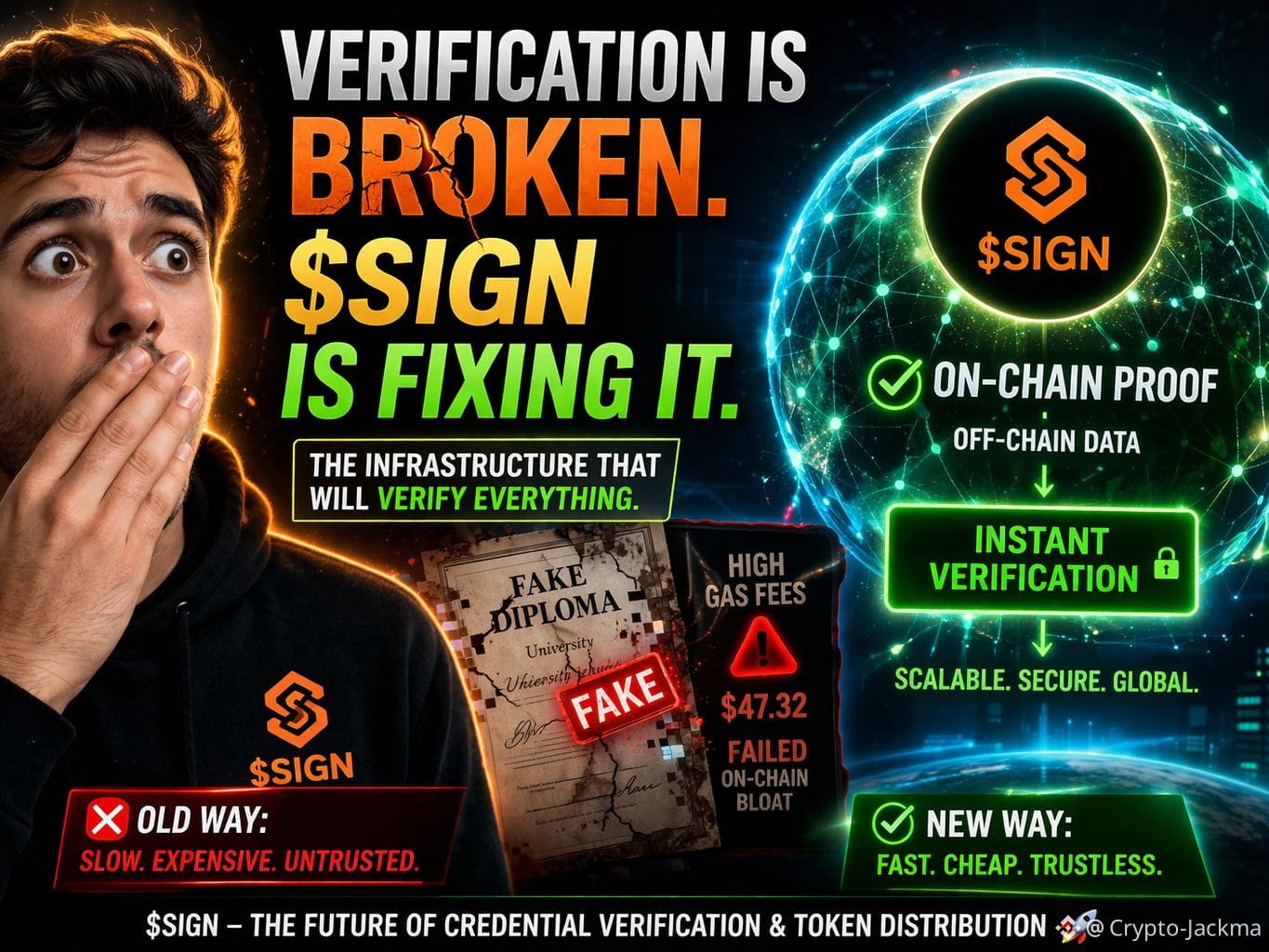
9
記事
翻訳参照
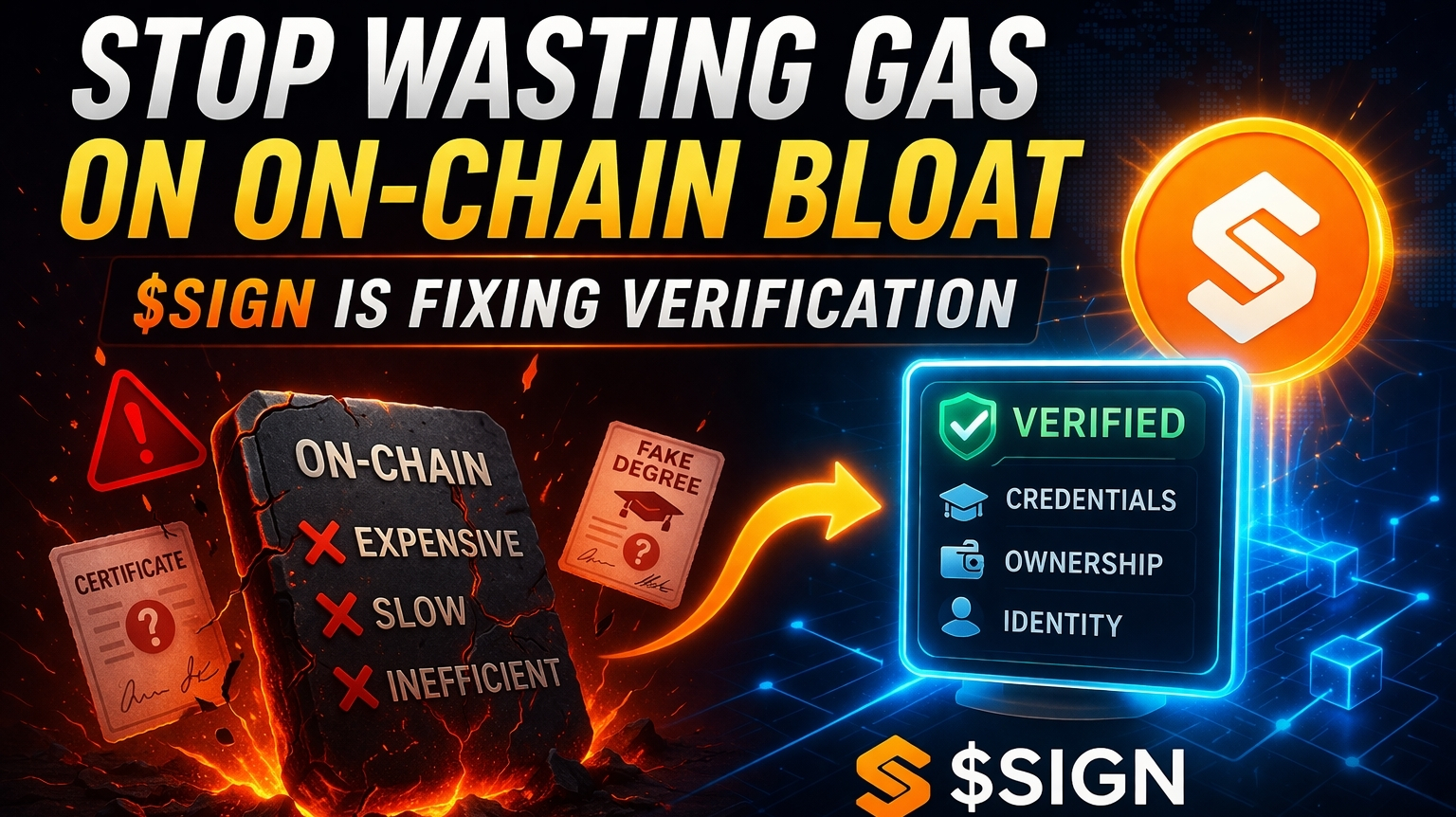
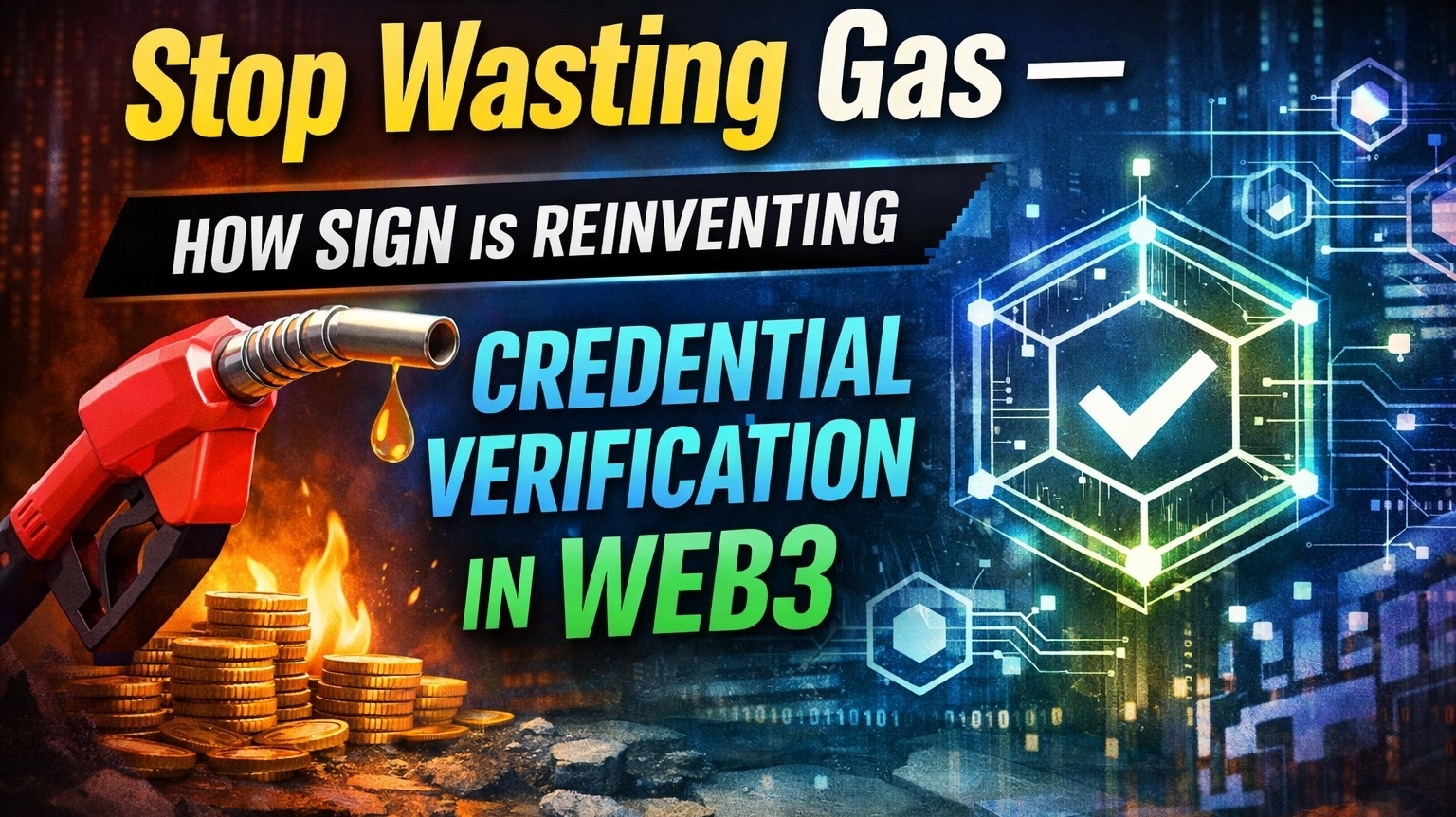
Stop Wasting Gas — How SIGN Is Reinventing Credential Verification in Web3I keep running into the same annoying problem whenever I think about using blockchain for anything serious—especially something like credentials or verification. On paper, it sounds perfect. You want proof of something? Put it on-chain. Done. But then reality hits… gas fees go up, data gets heavy, and suddenly something simple becomes expensive and slow for no good reason.
And that’s where things start to feel a bit off. Not everything needs to live fully on-chain, but right now a lot of systems kind of force it that way. You either pay the price or compromise on usability. Storing or verifying large amounts of data directly on the blockchain just doesn’t scale well. It’s like using a super-secure vault to store everyday notes—it works, but it’s overkill and inefficient.
That’s why the idea behind SIGN actually caught my attention. Instead of forcing everything into one rigid system, it treats credential verification and token distribution more like a flexible infrastructure layer. It separates what needs to be on-chain from what doesn’t, which… honestly just makes sense to me.
From what I understand, SIGN allows attestations (basically proofs or claims) to exist in a smarter way. You can verify information without dumping all the raw data onto the blockchain. Some parts stay off-chain to save cost, while the important verification layer still remains secure and trustworthy. So you still get decentralization benefits, just without burning money on every small detail.
What I like about it is how practical it feels. It’s not trying to reinvent everything, just optimizing the way things are already being done poorly. Whether it’s distributing tokens, verifying credentials, or handling identity-like systems, it gives developers room to choose what matters most—cost, speed, or security—and balance them properly.
And that flexibility opens up real use cases. Things like airdrops, reputation systems, certifications… even simple access control. These don’t need massive on-chain data, they just need reliable proof At the end of the day, SIGN feels less like a flashy idea and more like a necessary adjustment. Not perfect, sure, but definitely moving things in a direction that feels a lot More usable.
@SignOfficial
#SignDigitalSovereignInfra
$SIGN
{spot}(SIGNUSDT)
Stop Wasting Gas — How SIGN Is Reinventing Credential Verification in Web3
I keep running into the same annoying problem whenever I think about using blockchain for anything serious—especially something like credentials or verification. On paper, it sounds perfect. You want proof of something? Put it on-chain. Done. But then reality hits… gas fees go up, data gets heavy, and suddenly something simple becomes expensive and slow for no good reason.
And that’s where things start to feel a bit off. Not everything needs to live fully on-chain, but right now a lot of systems kind of force it that way. You either pay the price or compromise on usability. Storing or verifying large amounts of data directly on the blockchain just doesn’t scale well. It’s like using a super-secure vault to store everyday notes—it works, but it’s overkill and inefficient.
That’s why the idea behind SIGN actually caught my attention. Instead of forcing everything into one rigid system, it treats credential verification and token distribution more like a flexible infrastructure layer. It separates what needs to be on-chain from what doesn’t, which… honestly just makes sense to me.
From what I understand, SIGN allows attestations (basically proofs or claims) to exist in a smarter way. You can verify information without dumping all the raw data onto the blockchain. Some parts stay off-chain to save cost, while the important verification layer still remains secure and trustworthy. So you still get decentralization benefits, just without burning money on every small detail.
What I like about it is how practical it feels. It’s not trying to reinvent everything, just optimizing the way things are already being done poorly. Whether it’s distributing tokens, verifying credentials, or handling identity-like systems, it gives developers room to choose what matters most—cost, speed, or security—and balance them properly.
And that flexibility opens up real use cases. Things like airdrops, reputation systems, certifications… even simple access control. These don’t need massive on-chain data, they just need reliable proof At the end of the day, SIGN feels less like a flashy idea and more like a necessary adjustment. Not perfect, sure, but definitely moving things in a direction that feels a lot More usable.
@SignOfficial
#SignDigitalSovereignInfra
$SIGN
And that’s where things start to feel a bit off. Not everything needs to live fully on-chain, but right now a lot of systems kind of force it that way. You either pay the price or compromise on usability. Storing or verifying large amounts of data directly on the blockchain just doesn’t scale well. It’s like using a super-secure vault to store everyday notes—it works, but it’s overkill and inefficient.
That’s why the idea behind SIGN actually caught my attention. Instead of forcing everything into one rigid system, it treats credential verification and token distribution more like a flexible infrastructure layer. It separates what needs to be on-chain from what doesn’t, which… honestly just makes sense to me.
From what I understand, SIGN allows attestations (basically proofs or claims) to exist in a smarter way. You can verify information without dumping all the raw data onto the blockchain. Some parts stay off-chain to save cost, while the important verification layer still remains secure and trustworthy. So you still get decentralization benefits, just without burning money on every small detail.
What I like about it is how practical it feels. It’s not trying to reinvent everything, just optimizing the way things are already being done poorly. Whether it’s distributing tokens, verifying credentials, or handling identity-like systems, it gives developers room to choose what matters most—cost, speed, or security—and balance them properly.
And that flexibility opens up real use cases. Things like airdrops, reputation systems, certifications… even simple access control. These don’t need massive on-chain data, they just need reliable proof At the end of the day, SIGN feels less like a flashy idea and more like a necessary adjustment. Not perfect, sure, but definitely moving things in a direction that feels a lot More usable.
@SignOfficial
#SignDigitalSovereignInfra
$SIGN
1
53
·
--
弱気相場
翻訳参照
I keep running into the same issue with blockchain—everything sounds great until gas fees hit and simple tasks become expensive. Not all data needs to be on-chain, yet many systems force it. That’s why SIGN stands out. It separates what truly needs blockchain from what doesn’t, making verification cheaper and smarter. It just feels like a more practical way to scale Web3 without wasting resources.
@SignOfficial
#SignDigitalSovereignInfra
$SIGN
{spot}(SIGNUSDT)
I keep running into the same issue with blockchain—everything sounds great until gas fees hit and simple tasks become expensive. Not all data needs to be on-chain, yet many systems force it. That’s why SIGN stands out. It separates what truly needs blockchain from what doesn’t, making verification cheaper and smarter. It just feels like a more practical way to scale Web3 without wasting resources.
@SignOfficial
#SignDigitalSovereignInfra
$SIGN
@SignOfficial
#SignDigitalSovereignInfra
$SIGN
1
24
·
--
弱気相場
送金の遅延からデジタル主権へ _私の視点では$SIGN
私は、遅い送金や隠れた手数料が国境を越えた支払いの一部に過ぎないと思っていましたが、繰り返される摩擦が私に本当の問題を示しました:非効率的な本人確認および検証システムです。それが理由で、$SIGNを注視し始めました。
その検証可能な証拠とプライバシーに焦点を当てたアイデンティティのモデルは、機密データをさらけ出すことなく遅延を減らすことを目指しています。しかし、本当の試練は誇大広告ではありません _それは採用です。
もし機関やユーザーが一貫してそれに依存するなら、$SIGN はグローバルな支払いを意味のある形で改善できるでしょう。そうでなければ、ただの有望なアイデアになってしまうリスクがあります。私は価格を見ているわけではありません _ 実際の使用状況、保持率、そして全体を見ています。
#SignDigitalSovreignInfra | @SignOfficial | $SIGN
{spot}(SIGNUSDT)
送金の遅延からデジタル主権へ _私の視点では$SIGN
私は、遅い送金や隠れた手数料が国境を越えた支払いの一部に過ぎないと思っていましたが、繰り返される摩擦が私に本当の問題を示しました:非効率的な本人確認および検証システムです。それが理由で、$SIGN を注視し始めました。
その検証可能な証拠とプライバシーに焦点を当てたアイデンティティのモデルは、機密データをさらけ出すことなく遅延を減らすことを目指しています。しかし、本当の試練は誇大広告ではありません _それは採用です。
もし機関やユーザーが一貫してそれに依存するなら、$SIGN はグローバルな支払いを意味のある形で改善できるでしょう。そうでなければ、ただの有望なアイデアになってしまうリスクがあります。私は価格を見ているわけではありません _ 実際の使用状況、保持率、そして全体を見ています。
#SignDigitalSovreignInfra | @SignOfficial | $SIGN
私は、遅い送金や隠れた手数料が国境を越えた支払いの一部に過ぎないと思っていましたが、繰り返される摩擦が私に本当の問題を示しました:非効率的な本人確認および検証システムです。それが理由で、$SIGN を注視し始めました。
その検証可能な証拠とプライバシーに焦点を当てたアイデンティティのモデルは、機密データをさらけ出すことなく遅延を減らすことを目指しています。しかし、本当の試練は誇大広告ではありません _それは採用です。
もし機関やユーザーが一貫してそれに依存するなら、$SIGN はグローバルな支払いを意味のある形で改善できるでしょう。そうでなければ、ただの有望なアイデアになってしまうリスクがあります。私は価格を見ているわけではありません _ 実際の使用状況、保持率、そして全体を見ています。
#SignDigitalSovreignInfra | @SignOfficial | $SIGN
3
23
記事
国境を越えた痛みからデジタルコントロールへ:なぜ$SIGNが今重要なのか私は今でも、海外で働いている間にお金を母国に送ろうとした最初の時を覚えています。ほとんどの人と同様に、私は伝統的な送金サービスを信頼し、それが迅速で信頼できるものだと思っていました。しかし、実際には、送金が遅れ、手数料が明確に説明されず、すべてのステップが繰り返しの確認を必要とするように思えました。当時、私はこれが単に「国境を越えた支払いが機能する方法」だと思っていました—避けられない非効率性です。同様の遅延を何度も経験した後、私は問題が運が悪いことや孤立した官僚主義ではないことに気づき始めました。本当の問題は、アイデンティティと取引の正当性を安全に確認できるシステムが欠如していることでした。中間者の層に依存することなく。それに気づくことで、私は今日のブロックチェーンプロジェクトを評価する際の視点が変わりました:私は彼らが実際の運用上の問題を解決するかどうかに焦点を当て、単に印象的な採用指標を促進するだけではありません。だからこそ、Signは私の注意を引いたのです。
国境を越えた痛みからデジタルコントロールへ:なぜ$SIGNが今重要なのか
私は今でも、海外で働いている間にお金を母国に送ろうとした最初の時を覚えています。ほとんどの人と同様に、私は伝統的な送金サービスを信頼し、それが迅速で信頼できるものだと思っていました。しかし、実際には、送金が遅れ、手数料が明確に説明されず、すべてのステップが繰り返しの確認を必要とするように思えました。当時、私はこれが単に「国境を越えた支払いが機能する方法」だと思っていました—避けられない非効率性です。同様の遅延を何度も経験した後、私は問題が運が悪いことや孤立した官僚主義ではないことに気づき始めました。本当の問題は、アイデンティティと取引の正当性を安全に確認できるシステムが欠如していることでした。中間者の層に依存することなく。それに気づくことで、私は今日のブロックチェーンプロジェクトを評価する際の視点が変わりました:私は彼らが実際の運用上の問題を解決するかどうかに焦点を当て、単に印象的な採用指標を促進するだけではありません。だからこそ、Signは私の注意を引いたのです。
1
5
36
記事
翻訳参照
SIGN: Rethinking Trust in a World That Doesn’t Know Who to BelieveA Question That Keeps Coming Back to Me
I’ve started to question something I used to take for granted: why is proving something about myself online still so complicated, slow, and often invasive?
Every time I sign up for a service, apply for something, or try to verify my identity, I’m asked to hand over pieces of myself—documents, emails, phone numbers, sometimes even biometric data. I’m told it’s necessary. I’m told it’s for security.
But the more I think about it, the more it feels backwards.
Why do I have to expose everything just to prove one thing?
That question is what led me to explore Sign Protocol, and what I found wasn’t just another blockchain product. It felt more like a quiet shift in how trust itself could be structured.
The Core Problem: Trust Is Broken and Inefficient
If I strip everything down, most digital systems today are built around one fragile assumption: we don’t trust each other, so we centralize trust.
Banks verify identities. Platforms store credentials. Governments issue documents. Companies act as intermediaries for validation.
And while this works at scale, it comes with serious problems:
Data exposure: I often have to reveal more than necessary
Repetition: I keep verifying the same information again and again
Dependency: I rely on centralized authorities to confirm what I already know is true
Risk: If one system is breached, everything tied to it becomes vulnerable
I’ve noticed this especially in areas like onboarding. Opening a bank account, signing up for financial services, or even accessing certain online tools—these processes are slow, repetitive, and often frustrating.
It’s not just inefficiency. It’s a structural flaw.
We’ve built systems where proof requires exposure, and that’s where things start to break.
What If Proof Didn’t Require Exposure?
This is where Sign Protocol introduces a different idea—one that initially felt simple, but the more I thought about it, the more powerful it became.
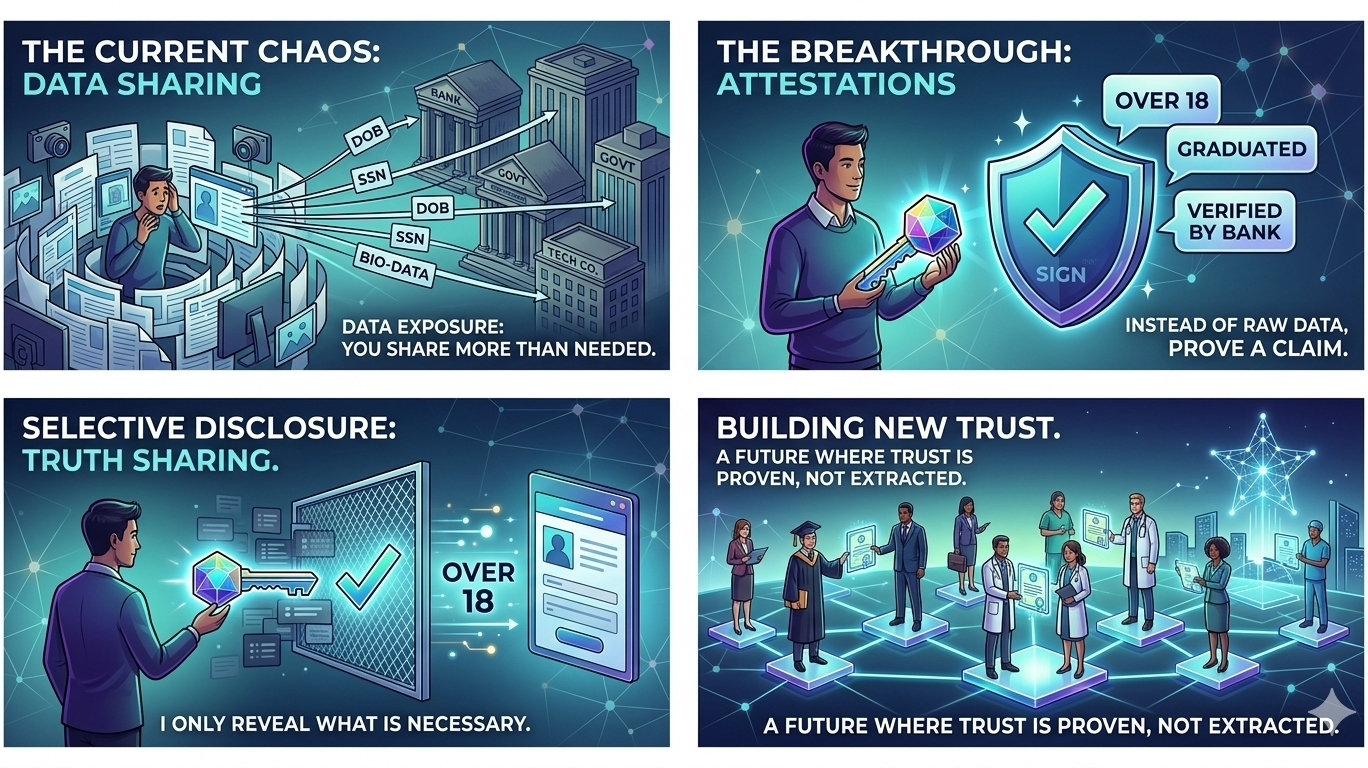
Instead of sharing raw data, what if I could share proof of a claim?
Not my entire identity, but a statement like:
“I am over 18”
“I have completed this course”
“I am verified by this institution”
And what if that statement could be trusted without revealing the underlying data?
Sign Protocol is built around something called attestations. At first, I thought of them as digital certificates, but that felt too limited. They’re more like verifiable statements issued by one party about another, stored in a way that others can trust.
And here’s the key shift:
I don’t need to reveal everything. I only reveal what’s necessary.
How Sign Protocol Actually Works (In Simple Terms)
I like to think of Sign Protocol as a system of structured trust statements.
An entity (like a university, company, or platform) issues an attestation
That attestation says something specific and verifiable
It gets recorded in a system that can be publicly checked (often blockchain-based)
I, as the user, can present that attestation when needed
What makes it powerful is something called selective disclosure.
This means I can prove something without revealing all the details behind it.
For example:
Instead of showing my full ID, I prove I’m eligible
Instead of sharing my full academic record, I prove I graduated
Instead of exposing my financial history, I prove I meet a requirement
It feels like a small change, but it flips the model entirely.
We move from data sharing to truth sharing.
Where This Starts to Matter in Real Life
The more I think about it, the more I see how this applies across different industries.
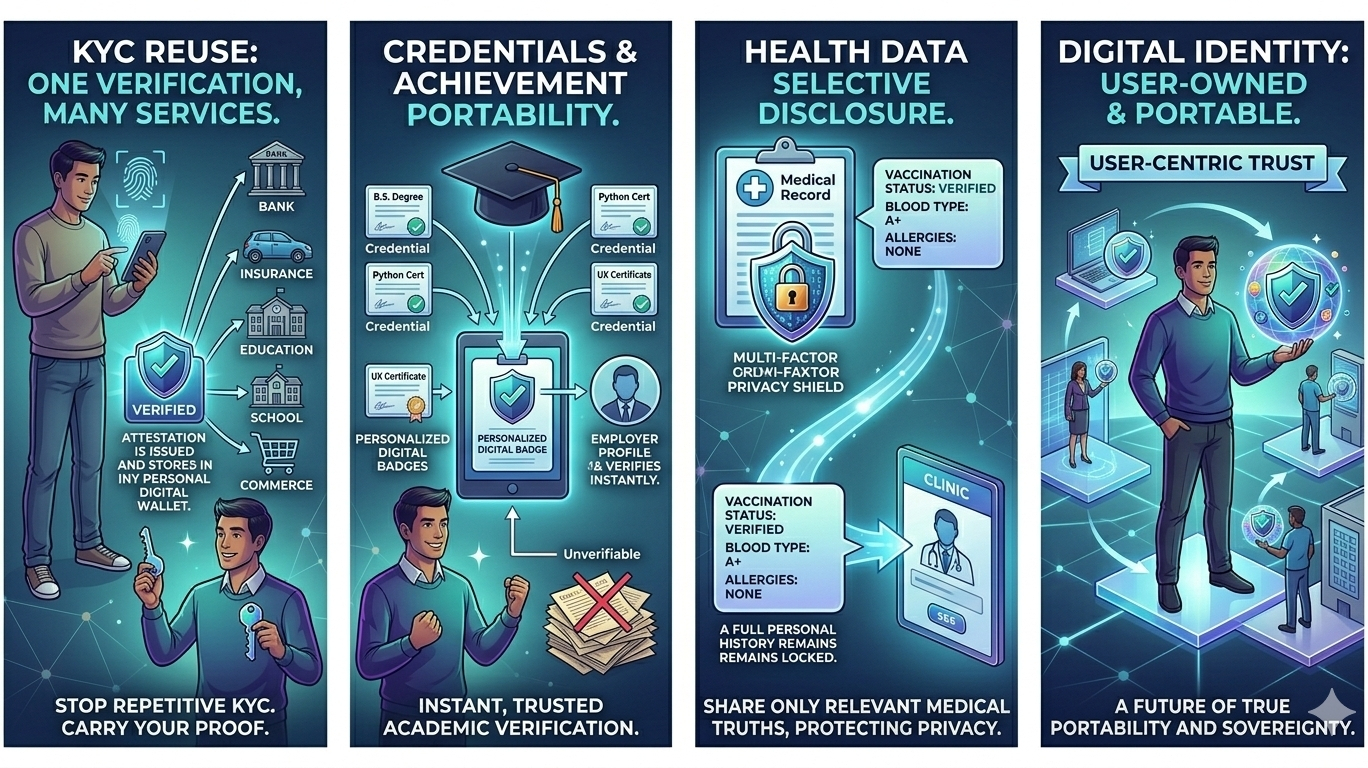
1. Healthcare
Right now, medical records are fragmented and sensitive. If I visit a new doctor, I often have to repeat everything or transfer records manually.
With attestations:
A hospital could issue a verified medical history summary
I could share only what’s relevant for a specific consultation
Sensitive data stays protected
We’re not exposing everything—we’re proving what matters.
2. Education and Credentials
Fake degrees and unverifiable certifications are still a problem.
With Sign Protocol:
Universities issue verifiable attestations of graduation
Employers can instantly verify authenticity
I don’t need to chase paperwork or emails
It reduces friction and increases trust at the same time.
3. Finance and Onboarding
This is where I see the biggest immediate impact.
KYC (Know Your Customer) processes are repetitive and frustrating. Every platform asks for the same documents.
But imagine this:
I complete KYC once
A trusted entity issues an attestation
I reuse that attestation across services
No repeated uploads. No endless forms.
It’s not just convenient—it’s transformative.
4. AI and Digital Reputation
This part surprised me the most.
As AI systems grow, they need ways to evaluate trust:
Is this data reliable?
Is this user credible?
Is this content verified?
Attestations can act as signals of trust in these systems.
Instead of guessing, AI can rely on verifiable claims.
That creates a new layer of machine-readable trust, which feels like something we’re only beginning to understand.
A Philosophical Shift: From Institutions to Statements
What really stayed with me is that Sign Protocol isn’t trying to replace institutions—it’s trying to reshape their role.
Instead of acting as gatekeepers, institutions become issuers of truth.
And instead of storing everything centrally, truth becomes:
Distributed
Verifiable
Portable
I don’t need to go back to the source every time.
I carry the proof with me.
It feels like moving from a world where:
“Trust lives in systems”
to a world where:
“Trust lives in statements”
That’s a subtle but profound shift.
My Reflections: Why This Feels Different
I’ve looked at many blockchain projects before, and honestly, a lot of them felt abstract or disconnected from real problems.
But this feels grounded.
Because the problem it’s solving—how we prove things about ourselves—is something I deal with constantly.
What makes it compelling to me is:
It doesn’t try to replace everything
It fits into existing systems
It improves efficiency without demanding total disruption
It’s not loud. It’s not flashy.
But it’s deeply practical.
But There Are Real Concerns
At the same time, I don’t think this is a perfect solution.
There are challenges that can’t be ignored.
1. Adoption
For this to work, institutions need to participate.
If universities, banks, and governments don’t issue attestations, the system loses its value.
And adoption at that level is slow.
2. User Experience
Even though the idea is simple, the implementation can feel complex.
Managing attestations, wallets, permissions—it’s not always intuitive.
If users don’t understand it, they won’t trust it.
3. Centralization Risks
Ironically, even in decentralized systems, power can concentrate.
If a few major entities become dominant attestation issuers, we’re back to a form of centralization—just with a different structure.
4. Interoperability
Different systems need to recognize and accept the same attestations.
If ecosystems don’t align, we end up with fragmented trust again.
And that would defeat the purpose.
Where This Might Be Heading
I don’t think Sign Protocol is trying to create a perfect system overnight.
What I see instead is something more gradual:
First, niche adoption (Web3, digital communities)
Then, integration into real-world systems (finance, education)
Eventually, a broader shift in how digital identity works
It’s not a revolution that happens all at once.
It’s more like a quiet restructuring beneath the surface.
A Thought That Stays With Me
I keep coming back to one idea:
What if trust didn’t require exposure?
What if I could move through digital systems without constantly handing over pieces of myself?
Sign Protocol doesn’t fully answer that yet.
But it points in that direction.
And maybe that’s enough for now.
An Open-Ended Conclusion
I don’t know if systems like this will become the standard. There are too many variables—technology, regulation, human behavior.
But I do know this:
The way we handle identity, trust, and verification today feels outdated.
And when I look at something like Sign Protocol, I don’t just see a tool.
I see a question being asked at a structural level:
Can we build a world where trust is proven, not extracted?
I’m still thinking about that.
#SignDigitalSovereignInfra
$SIGN
@SignOfficial
SIGN: Rethinking Trust in a World That Doesn’t Know Who to Believe
A Question That Keeps Coming Back to Me
I’ve started to question something I used to take for granted: why is proving something about myself online still so complicated, slow, and often invasive?
Every time I sign up for a service, apply for something, or try to verify my identity, I’m asked to hand over pieces of myself—documents, emails, phone numbers, sometimes even biometric data. I’m told it’s necessary. I’m told it’s for security.
But the more I think about it, the more it feels backwards.
Why do I have to expose everything just to prove one thing?
That question is what led me to explore Sign Protocol, and what I found wasn’t just another blockchain product. It felt more like a quiet shift in how trust itself could be structured.
The Core Problem: Trust Is Broken and Inefficient
If I strip everything down, most digital systems today are built around one fragile assumption: we don’t trust each other, so we centralize trust.
Banks verify identities. Platforms store credentials. Governments issue documents. Companies act as intermediaries for validation.
And while this works at scale, it comes with serious problems:
Data exposure: I often have to reveal more than necessary
Repetition: I keep verifying the same information again and again
Dependency: I rely on centralized authorities to confirm what I already know is true
Risk: If one system is breached, everything tied to it becomes vulnerable
I’ve noticed this especially in areas like onboarding. Opening a bank account, signing up for financial services, or even accessing certain online tools—these processes are slow, repetitive, and often frustrating.
It’s not just inefficiency. It’s a structural flaw.
We’ve built systems where proof requires exposure, and that’s where things start to break.
What If Proof Didn’t Require Exposure?
This is where Sign Protocol introduces a different idea—one that initially felt simple, but the more I thought about it, the more powerful it became.
Instead of sharing raw data, what if I could share proof of a claim?
Not my entire identity, but a statement like:
“I am over 18”
“I have completed this course”
“I am verified by this institution”
And what if that statement could be trusted without revealing the underlying data?
Sign Protocol is built around something called attestations. At first, I thought of them as digital certificates, but that felt too limited. They’re more like verifiable statements issued by one party about another, stored in a way that others can trust.
And here’s the key shift:
I don’t need to reveal everything. I only reveal what’s necessary.
How Sign Protocol Actually Works (In Simple Terms)
I like to think of Sign Protocol as a system of structured trust statements.
An entity (like a university, company, or platform) issues an attestation
That attestation says something specific and verifiable
It gets recorded in a system that can be publicly checked (often blockchain-based)
I, as the user, can present that attestation when needed
What makes it powerful is something called selective disclosure.
This means I can prove something without revealing all the details behind it.
For example:
Instead of showing my full ID, I prove I’m eligible
Instead of sharing my full academic record, I prove I graduated
Instead of exposing my financial history, I prove I meet a requirement
It feels like a small change, but it flips the model entirely.
We move from data sharing to truth sharing.
Where This Starts to Matter in Real Life
The more I think about it, the more I see how this applies across different industries.
1. Healthcare
Right now, medical records are fragmented and sensitive. If I visit a new doctor, I often have to repeat everything or transfer records manually.
With attestations:
A hospital could issue a verified medical history summary
I could share only what’s relevant for a specific consultation
Sensitive data stays protected
We’re not exposing everything—we’re proving what matters.
2. Education and Credentials
Fake degrees and unverifiable certifications are still a problem.
With Sign Protocol:
Universities issue verifiable attestations of graduation
Employers can instantly verify authenticity
I don’t need to chase paperwork or emails
It reduces friction and increases trust at the same time.
3. Finance and Onboarding
This is where I see the biggest immediate impact.
KYC (Know Your Customer) processes are repetitive and frustrating. Every platform asks for the same documents.
But imagine this:
I complete KYC once
A trusted entity issues an attestation
I reuse that attestation across services
No repeated uploads. No endless forms.
It’s not just convenient—it’s transformative.
4. AI and Digital Reputation
This part surprised me the most.
As AI systems grow, they need ways to evaluate trust:
Is this data reliable?
Is this user credible?
Is this content verified?
Attestations can act as signals of trust in these systems.
Instead of guessing, AI can rely on verifiable claims.
That creates a new layer of machine-readable trust, which feels like something we’re only beginning to understand.
A Philosophical Shift: From Institutions to Statements
What really stayed with me is that Sign Protocol isn’t trying to replace institutions—it’s trying to reshape their role.
Instead of acting as gatekeepers, institutions become issuers of truth.
And instead of storing everything centrally, truth becomes:
Distributed
Verifiable
Portable
I don’t need to go back to the source every time.
I carry the proof with me.
It feels like moving from a world where:
“Trust lives in systems”
to a world where:
“Trust lives in statements”
That’s a subtle but profound shift.
My Reflections: Why This Feels Different
I’ve looked at many blockchain projects before, and honestly, a lot of them felt abstract or disconnected from real problems.
But this feels grounded.
Because the problem it’s solving—how we prove things about ourselves—is something I deal with constantly.
What makes it compelling to me is:
It doesn’t try to replace everything
It fits into existing systems
It improves efficiency without demanding total disruption
It’s not loud. It’s not flashy.
But it’s deeply practical.
But There Are Real Concerns
At the same time, I don’t think this is a perfect solution.
There are challenges that can’t be ignored.
1. Adoption
For this to work, institutions need to participate.
If universities, banks, and governments don’t issue attestations, the system loses its value.
And adoption at that level is slow.
2. User Experience
Even though the idea is simple, the implementation can feel complex.
Managing attestations, wallets, permissions—it’s not always intuitive.
If users don’t understand it, they won’t trust it.
3. Centralization Risks
Ironically, even in decentralized systems, power can concentrate.
If a few major entities become dominant attestation issuers, we’re back to a form of centralization—just with a different structure.
4. Interoperability
Different systems need to recognize and accept the same attestations.
If ecosystems don’t align, we end up with fragmented trust again.
And that would defeat the purpose.
Where This Might Be Heading
I don’t think Sign Protocol is trying to create a perfect system overnight.
What I see instead is something more gradual:
First, niche adoption (Web3, digital communities)
Then, integration into real-world systems (finance, education)
Eventually, a broader shift in how digital identity works
It’s not a revolution that happens all at once.
It’s more like a quiet restructuring beneath the surface.
A Thought That Stays With Me
I keep coming back to one idea:
What if trust didn’t require exposure?
What if I could move through digital systems without constantly handing over pieces of myself?
Sign Protocol doesn’t fully answer that yet.
But it points in that direction.
And maybe that’s enough for now.
An Open-Ended Conclusion
I don’t know if systems like this will become the standard. There are too many variables—technology, regulation, human behavior.
But I do know this:
The way we handle identity, trust, and verification today feels outdated.
And when I look at something like Sign Protocol, I don’t just see a tool.
I see a question being asked at a structural level:
Can we build a world where trust is proven, not extracted?
I’m still thinking about that.
#SignDigitalSovereignInfra
$SIGN
@SignOfficial
I’ve started to question something I used to take for granted: why is proving something about myself online still so complicated, slow, and often invasive?
Every time I sign up for a service, apply for something, or try to verify my identity, I’m asked to hand over pieces of myself—documents, emails, phone numbers, sometimes even biometric data. I’m told it’s necessary. I’m told it’s for security.
But the more I think about it, the more it feels backwards.
Why do I have to expose everything just to prove one thing?
That question is what led me to explore Sign Protocol, and what I found wasn’t just another blockchain product. It felt more like a quiet shift in how trust itself could be structured.
The Core Problem: Trust Is Broken and Inefficient
If I strip everything down, most digital systems today are built around one fragile assumption: we don’t trust each other, so we centralize trust.
Banks verify identities. Platforms store credentials. Governments issue documents. Companies act as intermediaries for validation.
And while this works at scale, it comes with serious problems:
Data exposure: I often have to reveal more than necessary
Repetition: I keep verifying the same information again and again
Dependency: I rely on centralized authorities to confirm what I already know is true
Risk: If one system is breached, everything tied to it becomes vulnerable
I’ve noticed this especially in areas like onboarding. Opening a bank account, signing up for financial services, or even accessing certain online tools—these processes are slow, repetitive, and often frustrating.
It’s not just inefficiency. It’s a structural flaw.
We’ve built systems where proof requires exposure, and that’s where things start to break.
What If Proof Didn’t Require Exposure?
This is where Sign Protocol introduces a different idea—one that initially felt simple, but the more I thought about it, the more powerful it became.
Instead of sharing raw data, what if I could share proof of a claim?
Not my entire identity, but a statement like:
“I am over 18”
“I have completed this course”
“I am verified by this institution”
And what if that statement could be trusted without revealing the underlying data?
Sign Protocol is built around something called attestations. At first, I thought of them as digital certificates, but that felt too limited. They’re more like verifiable statements issued by one party about another, stored in a way that others can trust.
And here’s the key shift:
I don’t need to reveal everything. I only reveal what’s necessary.
How Sign Protocol Actually Works (In Simple Terms)
I like to think of Sign Protocol as a system of structured trust statements.
An entity (like a university, company, or platform) issues an attestation
That attestation says something specific and verifiable
It gets recorded in a system that can be publicly checked (often blockchain-based)
I, as the user, can present that attestation when needed
What makes it powerful is something called selective disclosure.
This means I can prove something without revealing all the details behind it.
For example:
Instead of showing my full ID, I prove I’m eligible
Instead of sharing my full academic record, I prove I graduated
Instead of exposing my financial history, I prove I meet a requirement
It feels like a small change, but it flips the model entirely.
We move from data sharing to truth sharing.
Where This Starts to Matter in Real Life
The more I think about it, the more I see how this applies across different industries.
1. Healthcare
Right now, medical records are fragmented and sensitive. If I visit a new doctor, I often have to repeat everything or transfer records manually.
With attestations:
A hospital could issue a verified medical history summary
I could share only what’s relevant for a specific consultation
Sensitive data stays protected
We’re not exposing everything—we’re proving what matters.
2. Education and Credentials
Fake degrees and unverifiable certifications are still a problem.
With Sign Protocol:
Universities issue verifiable attestations of graduation
Employers can instantly verify authenticity
I don’t need to chase paperwork or emails
It reduces friction and increases trust at the same time.
3. Finance and Onboarding
This is where I see the biggest immediate impact.
KYC (Know Your Customer) processes are repetitive and frustrating. Every platform asks for the same documents.
But imagine this:
I complete KYC once
A trusted entity issues an attestation
I reuse that attestation across services
No repeated uploads. No endless forms.
It’s not just convenient—it’s transformative.
4. AI and Digital Reputation
This part surprised me the most.
As AI systems grow, they need ways to evaluate trust:
Is this data reliable?
Is this user credible?
Is this content verified?
Attestations can act as signals of trust in these systems.
Instead of guessing, AI can rely on verifiable claims.
That creates a new layer of machine-readable trust, which feels like something we’re only beginning to understand.
A Philosophical Shift: From Institutions to Statements
What really stayed with me is that Sign Protocol isn’t trying to replace institutions—it’s trying to reshape their role.
Instead of acting as gatekeepers, institutions become issuers of truth.
And instead of storing everything centrally, truth becomes:
Distributed
Verifiable
Portable
I don’t need to go back to the source every time.
I carry the proof with me.
It feels like moving from a world where:
“Trust lives in systems”
to a world where:
“Trust lives in statements”
That’s a subtle but profound shift.
My Reflections: Why This Feels Different
I’ve looked at many blockchain projects before, and honestly, a lot of them felt abstract or disconnected from real problems.
But this feels grounded.
Because the problem it’s solving—how we prove things about ourselves—is something I deal with constantly.
What makes it compelling to me is:
It doesn’t try to replace everything
It fits into existing systems
It improves efficiency without demanding total disruption
It’s not loud. It’s not flashy.
But it’s deeply practical.
But There Are Real Concerns
At the same time, I don’t think this is a perfect solution.
There are challenges that can’t be ignored.
1. Adoption
For this to work, institutions need to participate.
If universities, banks, and governments don’t issue attestations, the system loses its value.
And adoption at that level is slow.
2. User Experience
Even though the idea is simple, the implementation can feel complex.
Managing attestations, wallets, permissions—it’s not always intuitive.
If users don’t understand it, they won’t trust it.
3. Centralization Risks
Ironically, even in decentralized systems, power can concentrate.
If a few major entities become dominant attestation issuers, we’re back to a form of centralization—just with a different structure.
4. Interoperability
Different systems need to recognize and accept the same attestations.
If ecosystems don’t align, we end up with fragmented trust again.
And that would defeat the purpose.
Where This Might Be Heading
I don’t think Sign Protocol is trying to create a perfect system overnight.
What I see instead is something more gradual:
First, niche adoption (Web3, digital communities)
Then, integration into real-world systems (finance, education)
Eventually, a broader shift in how digital identity works
It’s not a revolution that happens all at once.
It’s more like a quiet restructuring beneath the surface.
A Thought That Stays With Me
I keep coming back to one idea:
What if trust didn’t require exposure?
What if I could move through digital systems without constantly handing over pieces of myself?
Sign Protocol doesn’t fully answer that yet.
But it points in that direction.
And maybe that’s enough for now.
An Open-Ended Conclusion
I don’t know if systems like this will become the standard. There are too many variables—technology, regulation, human behavior.
But I do know this:
The way we handle identity, trust, and verification today feels outdated.
And when I look at something like Sign Protocol, I don’t just see a tool.
I see a question being asked at a structural level:
Can we build a world where trust is proven, not extracted?
I’m still thinking about that.
#SignDigitalSovereignInfra
$SIGN
@SignOfficial
2
9
·
--
弱気相場
以前は、オンラインでの検証は遅く、繰り返しで、侵入的である必要があると思っていました。しかし、Sign Protocolを探求することで、私の視点が変わりました。すべてのデータを公開する代わりに、私たちは今、証明書を通じて特定の真実を証明することができます。単純で検証可能な主張です。データを共有することから信頼を共有することへのシフトです。まだ初期段階ですが、よりプライベートで効率的なデジタル世界の始まりのように感じます。
#SignDigitalSovereignInfra
$SIGN @SignOfficial
{spot}(SIGNUSDT)
以前は、オンラインでの検証は遅く、繰り返しで、侵入的である必要があると思っていました。しかし、Sign Protocolを探求することで、私の視点が変わりました。すべてのデータを公開する代わりに、私たちは今、証明書を通じて特定の真実を証明することができます。単純で検証可能な主張です。データを共有することから信頼を共有することへのシフトです。まだ初期段階ですが、よりプライベートで効率的なデジタル世界の始まりのように感じます。
#SignDigitalSovereignInfra
$SIGN @SignOfficial
#SignDigitalSovereignInfra
$SIGN @SignOfficial
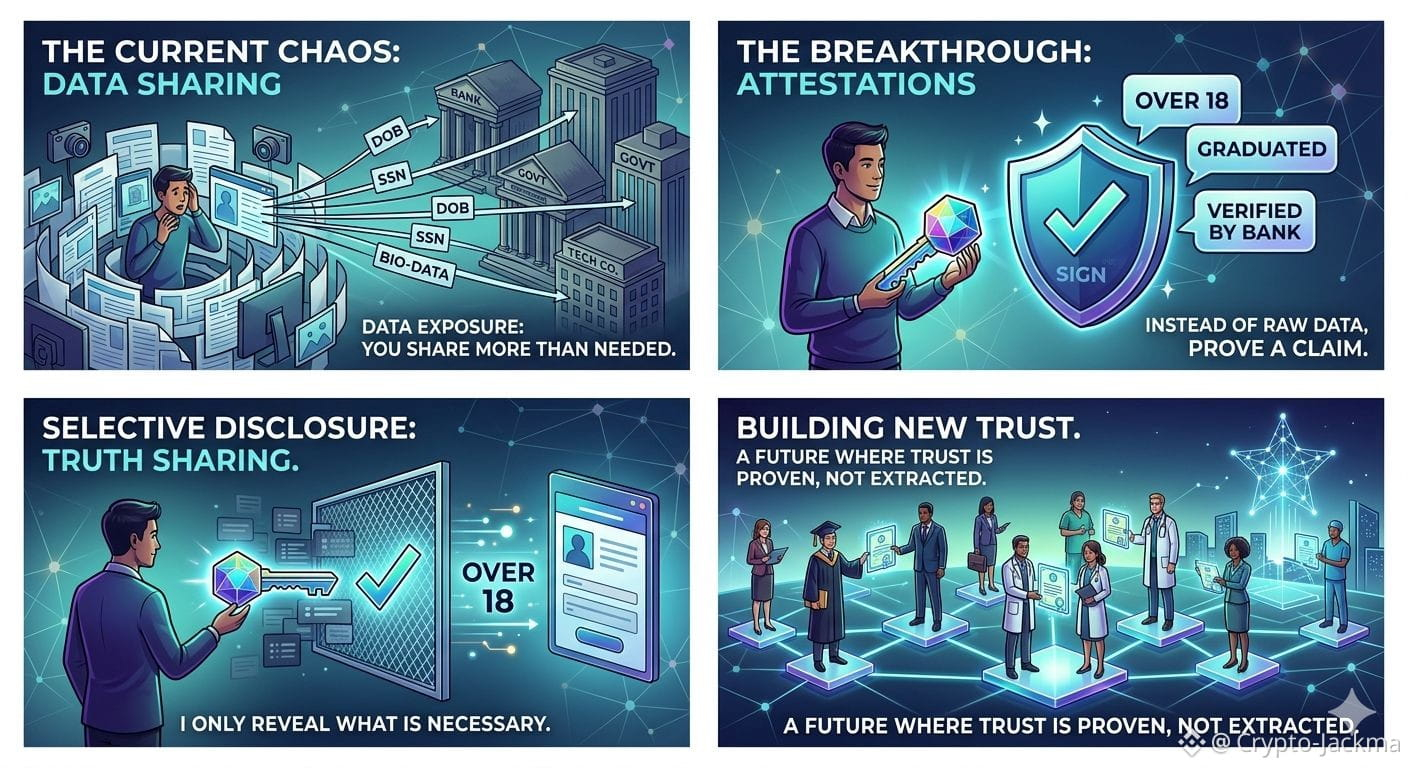
4
10
·
--
ブリッシュ
SIGNで信頼の未来を解き放とう!🌐✅ クレデンシャルを瞬時に検証し、成果を証明し、ブロックチェーンによるセキュリティで報酬を獲得しよう。偽の学位はもういらない、不確実性もなし—ただ透明で、グローバルで、安全な検証だけ。学生、フリーランサー、プロフェッショナルの皆さん、SIGNはあなたの成果をどこでも認識します。デジタルアイデンティティを構築し、分散型信頼革命に今すぐ参加しよう!
#SignDigitalSovereignInfra
$SIGN
@SignOfficial
{spot}(SIGNUSDT)
SIGNで信頼の未来を解き放とう!🌐✅ クレデンシャルを瞬時に検証し、成果を証明し、ブロックチェーンによるセキュリティで報酬を獲得しよう。偽の学位はもういらない、不確実性もなし—ただ透明で、グローバルで、安全な検証だけ。学生、フリーランサー、プロフェッショナルの皆さん、SIGNはあなたの成果をどこでも認識します。デジタルアイデンティティを構築し、分散型信頼革命に今すぐ参加しよう!
#SignDigitalSovereignInfra
$SIGN
@SignOfficial
#SignDigitalSovereignInfra
$SIGN
@SignOfficial
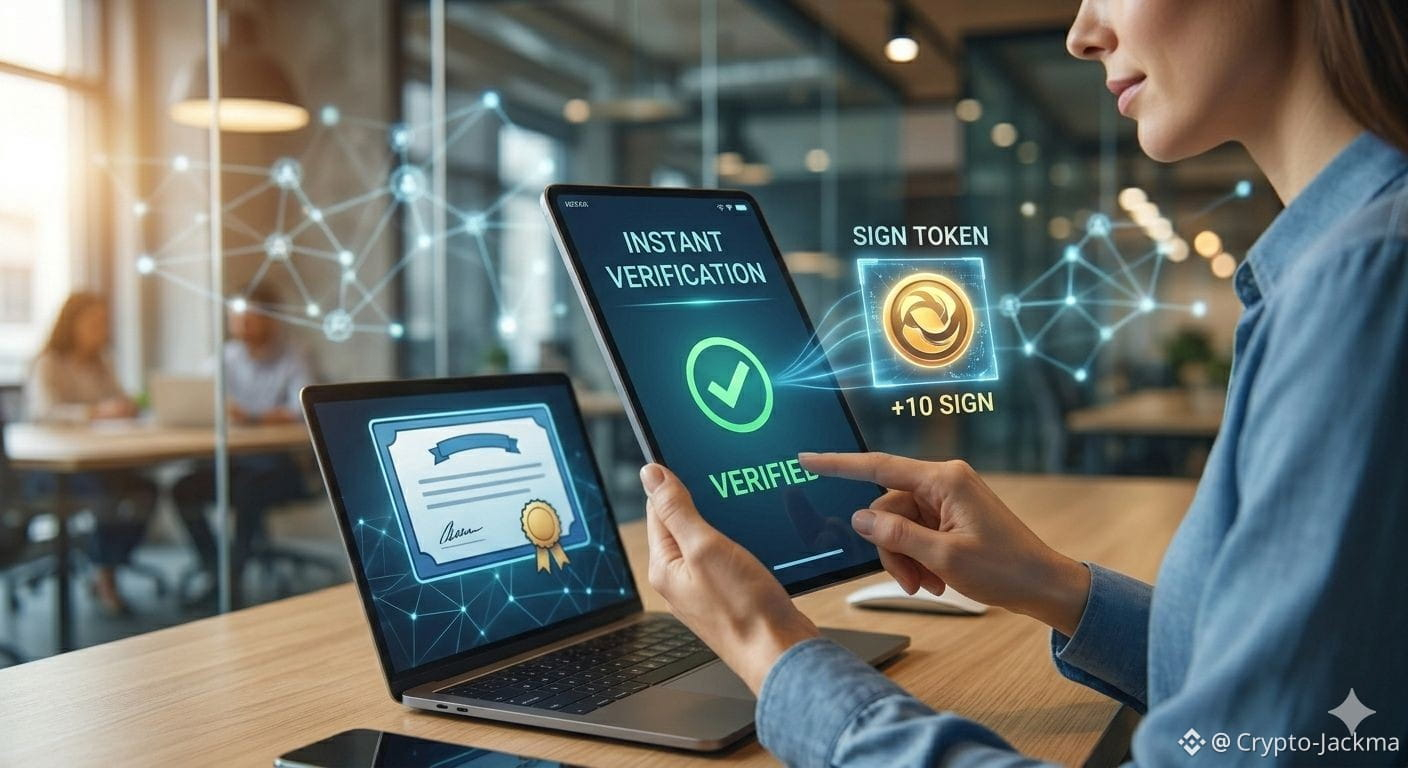

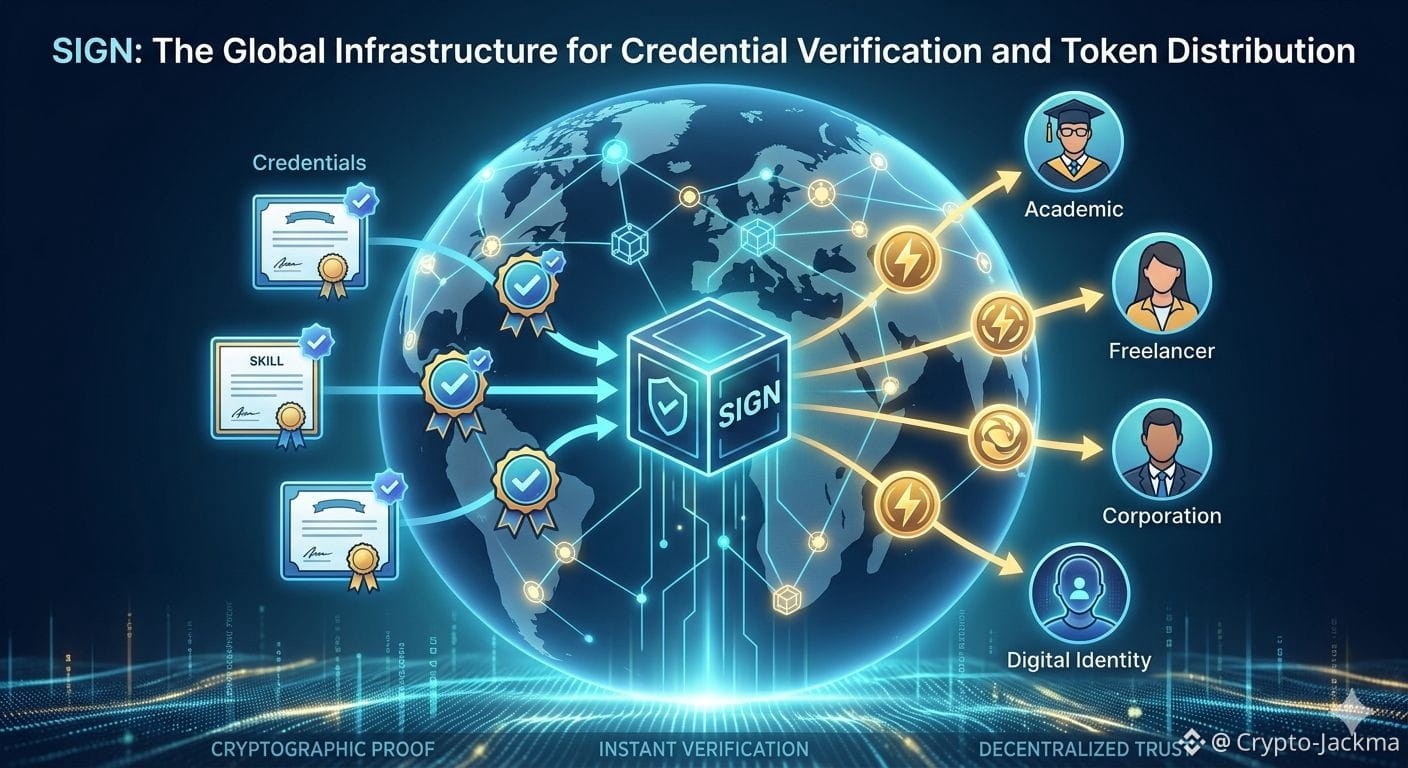
2
10
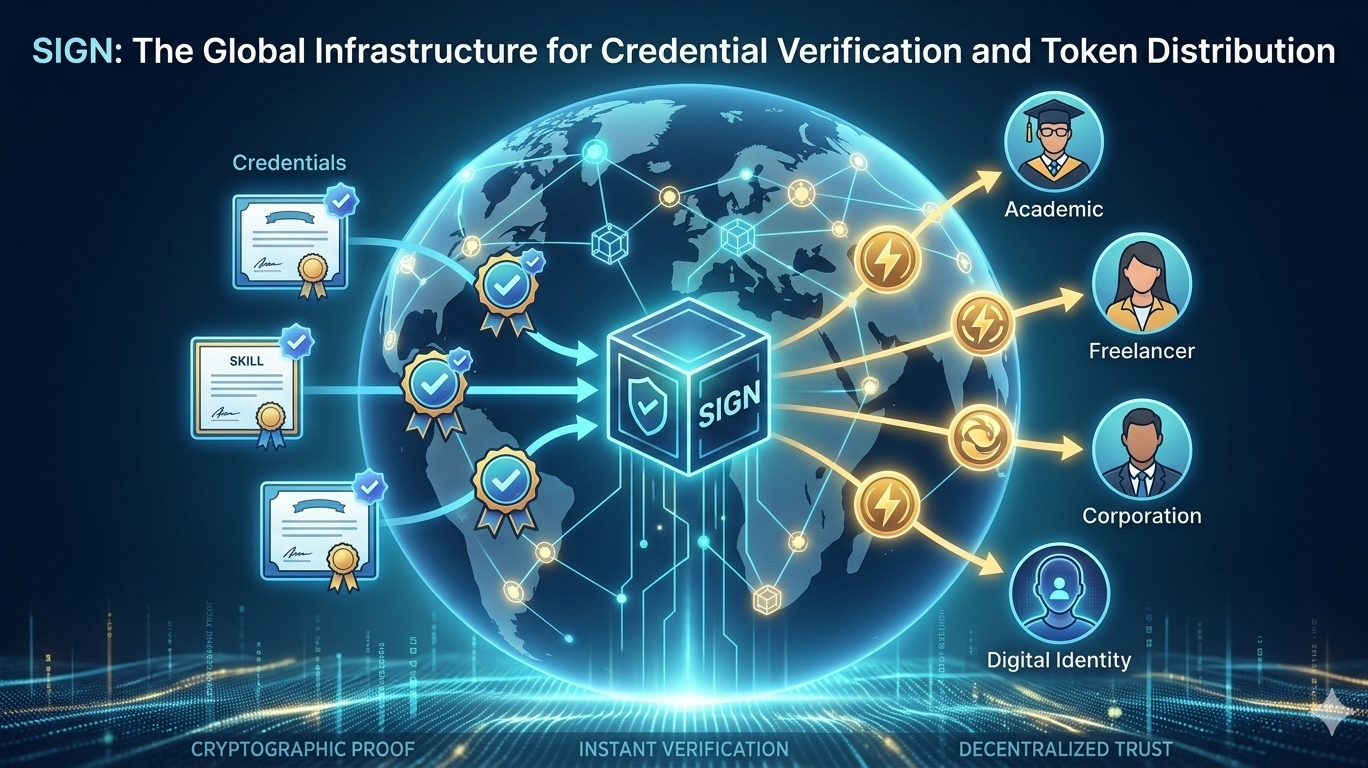
記事
SIGN: 信頼とトークン化された資格の未来を支えるはじめに
物理的存在よりもデジタルアイデンティティが重要性を増している世界で、1つの大きな疑問が浮かび上がります: 本当にオンラインの資格を信頼することができるのでしょうか? 偽の学位から操作された証明書、検証不可能な業績まで、デジタル空間は不確実性に満ちています。ここでSIGN – 資格検証とトークン配布のためのグローバルインフラが強力な解決策として登場します。
この記事では、SIGNが資格を検証し、トークン化された価値を配布する信頼できる、透明で分散型のシステムをどのように構築しているかを探ります。どのように機能するのか、なぜ重要なのか、最新のアップデート、トークンのユーティリティ、そしてそれがデジタル信頼の未来をどのように形作っているのかを解説します。
SIGN: 信頼とトークン化された資格の未来を支える
はじめに
物理的存在よりもデジタルアイデンティティが重要性を増している世界で、1つの大きな疑問が浮かび上がります: 本当にオンラインの資格を信頼することができるのでしょうか? 偽の学位から操作された証明書、検証不可能な業績まで、デジタル空間は不確実性に満ちています。ここでSIGN – 資格検証とトークン配布のためのグローバルインフラが強力な解決策として登場します。
この記事では、SIGNが資格を検証し、トークン化された価値を配布する信頼できる、透明で分散型のシステムをどのように構築しているかを探ります。どのように機能するのか、なぜ重要なのか、最新のアップデート、トークンのユーティリティ、そしてそれがデジタル信頼の未来をどのように形作っているのかを解説します。
物理的存在よりもデジタルアイデンティティが重要性を増している世界で、1つの大きな疑問が浮かび上がります: 本当にオンラインの資格を信頼することができるのでしょうか? 偽の学位から操作された証明書、検証不可能な業績まで、デジタル空間は不確実性に満ちています。ここでSIGN – 資格検証とトークン配布のためのグローバルインフラが強力な解決策として登場します。
この記事では、SIGNが資格を検証し、トークン化された価値を配布する信頼できる、透明で分散型のシステムをどのように構築しているかを探ります。どのように機能するのか、なぜ重要なのか、最新のアップデート、トークンのユーティリティ、そしてそれがデジタル信頼の未来をどのように形作っているのかを解説します。
1
22
·
--
弱気相場
ファブリックファンデーションは、人間と知能機械がグローバルで国境のない経済の中で共に働ける未来のためのインフラを構築しています。ロボットが大企業によってのみ制御されるのではなく、プロジェクトは機械がデジタルアイデンティティを持ち、安全な支払いを行い、オープンネットワーク上でタスクを調整できる分散型システムを導入しています。ROBOトークンを通じて、貢献者、開発者、オペレーターはガバナンスと経済活動に参加できます。このモデルは、ロボットサービスが透明で公正なエコシステムの中で成長することを可能にします。自動化が世界中に拡大する中、ファブリックは信頼、説明責任、人間の調和が技術進歩の中心であり続けることを確保することを目指しています。私たちは新しいロボット経済の初期の基盤を目の当たりにしています。
#FabricFoundativon @FabricFND $ROBO
{spot}(ROBOUSDT)
ファブリックファンデーションは、人間と知能機械がグローバルで国境のない経済の中で共に働ける未来のためのインフラを構築しています。ロボットが大企業によってのみ制御されるのではなく、プロジェクトは機械がデジタルアイデンティティを持ち、安全な支払いを行い、オープンネットワーク上でタスクを調整できる分散型システムを導入しています。ROBOトークンを通じて、貢献者、開発者、オペレーターはガバナンスと経済活動に参加できます。このモデルは、ロボットサービスが透明で公正なエコシステムの中で成長することを可能にします。自動化が世界中に拡大する中、ファブリックは信頼、説明責任、人間の調和が技術進歩の中心であり続けることを確保することを目指しています。私たちは新しいロボット経済の初期の基盤を目の当たりにしています。
#FabricFoundativon @Fabric Foundation $ROBO
#FabricFoundativon @Fabric Foundation $ROBO
17
ファブリックファウンデーション:国境のない世界における信頼のエンジニアリングイントロダクション
世界は静かに新しい技術の時代に入っています。人工知能はもはや画面上で動作するソフトウェアに限定されていません。機械は実際の物理的な世界で移動し、感知し、行動し始めています。ロボットは荷物を配達し、医師を支援し、倉庫で作業し、教育にも助けとなっています。しかし、これらの機械がより能力を持つようになっている一方で、それらを統治するグローバルシステムは未完成のままです。
これはファブリックファウンデーションが誕生する環境です。これは、人間と知的機械が安全かつ生産的に協力する未来のために必要な経済、ガバナンス、調整インフラを構築することに焦点を当てた非営利のイニシアティブです。その使命は、知的システムが人間の価値観に沿って保たれ、どこにでも人々がアクセスできるようにすることに中心を置いています。
ファブリックファウンデーション:国境のない世界における信頼のエンジニアリング
イントロダクション
世界は静かに新しい技術の時代に入っています。人工知能はもはや画面上で動作するソフトウェアに限定されていません。機械は実際の物理的な世界で移動し、感知し、行動し始めています。ロボットは荷物を配達し、医師を支援し、倉庫で作業し、教育にも助けとなっています。しかし、これらの機械がより能力を持つようになっている一方で、それらを統治するグローバルシステムは未完成のままです。
これはファブリックファウンデーションが誕生する環境です。これは、人間と知的機械が安全かつ生産的に協力する未来のために必要な経済、ガバナンス、調整インフラを構築することに焦点を当てた非営利のイニシアティブです。その使命は、知的システムが人間の価値観に沿って保たれ、どこにでも人々がアクセスできるようにすることに中心を置いています。
世界は静かに新しい技術の時代に入っています。人工知能はもはや画面上で動作するソフトウェアに限定されていません。機械は実際の物理的な世界で移動し、感知し、行動し始めています。ロボットは荷物を配達し、医師を支援し、倉庫で作業し、教育にも助けとなっています。しかし、これらの機械がより能力を持つようになっている一方で、それらを統治するグローバルシステムは未完成のままです。
これはファブリックファウンデーションが誕生する環境です。これは、人間と知的機械が安全かつ生産的に協力する未来のために必要な経済、ガバナンス、調整インフラを構築することに焦点を当てた非営利のイニシアティブです。その使命は、知的システムが人間の価値観に沿って保たれ、どこにでも人々がアクセスできるようにすることに中心を置いています。
3
22
·
--
弱気相場
ファブリックファウンデーションは、人間と知的機械がグローバルでボーダーレスな経済の中で共に働く未来のためのインフラを構築しています。ロボットが大企業によってのみ制御されるのではなく、このプロジェクトは機械がデジタルアイデンティティを持ち、安全な支払いを行い、オープンなネットワーク全体でタスクを調整できる分散型システムを導入します。ROBOトークンを通じて、貢献者、開発者、オペレーターはガバナンスや経済活動に参加できます。このモデルは、ロボティックサービスが透明で公正なエコシステムの中で成長することを可能にします。自動化が世界中に広がる中、ファブリックは信頼、責任、そして人間の調和が技術進歩の中心に留まることを確保することを目指しています。新しいロボット経済の初期の基盤を見ています。
#ROBO@FabricFND $ROBO
{spot}(ROBOUSDT)
ファブリックファウンデーションは、人間と知的機械がグローバルでボーダーレスな経済の中で共に働く未来のためのインフラを構築しています。ロボットが大企業によってのみ制御されるのではなく、このプロジェクトは機械がデジタルアイデンティティを持ち、安全な支払いを行い、オープンなネットワーク全体でタスクを調整できる分散型システムを導入します。ROBOトークンを通じて、貢献者、開発者、オペレーターはガバナンスや経済活動に参加できます。このモデルは、ロボティックサービスが透明で公正なエコシステムの中で成長することを可能にします。自動化が世界中に広がる中、ファブリックは信頼、責任、そして人間の調和が技術進歩の中心に留まることを確保することを目指しています。新しいロボット経済の初期の基盤を見ています。
#ROBO@Fabric Foundation $ROBO
#ROBO@Fabric Foundation $ROBO
4
·
--
弱気相場
ファブリックプロトコルとROBOは、AIエージェントとロボットが中央集権的な権威を信頼することなく、作業を行い、タスクを検証し、報酬を得ることができる分散型システムという強力なビジョンを構築しています。ブロックチェーンを使用して、各機械は安全なデジタルIDを取得し、すべてのアクションが透明に記録されます。ROBOトークンは、支払い、ガバナンス、ロボティックワークの証明を支え、実際の貢献に報いるものです。目標はシンプルでありながら大胆です — オープンな検証を通じて信頼できるAIを創造することです。これが成功すれば、私たちは透明性、説明責任、分散型の信頼に基づいた真の機械経済の誕生を目撃することになるでしょう。
#ROBO @FabricFND $ROBO
{spot}(ROBOUSDT)
ファブリックプロトコルとROBOは、AIエージェントとロボットが中央集権的な権威を信頼することなく、作業を行い、タスクを検証し、報酬を得ることができる分散型システムという強力なビジョンを構築しています。ブロックチェーンを使用して、各機械は安全なデジタルIDを取得し、すべてのアクションが透明に記録されます。ROBOトークンは、支払い、ガバナンス、ロボティックワークの証明を支え、実際の貢献に報いるものです。目標はシンプルでありながら大胆です — オープンな検証を通じて信頼できるAIを創造することです。これが成功すれば、私たちは透明性、説明責任、分散型の信頼に基づいた真の機械経済の誕生を目撃することになるでしょう。
#ROBO @Fabric Foundation $ROBO
#ROBO @Fabric Foundation $ROBO
2
23

記事
Fabric ProtocolとROBO: 分散型検証は本当に信頼できるAIを構築できるのか?Fabric Protocolは、ネイティブROBOトークンによって駆動され、ブロックチェーン、自律ロボティクス、人工知能の交差点における最も野心的な取り組みの1つを表しています。これは、機械、特にロボットや自律エージェントが、従来の中央集権的システムに依存することなく、相互に行動、調整、取引、検証できるようにすることで、典型的なAIプロジェクトを超えたオープンで分散型のエコシステムを提案しています。Fabricの核心は、物理的およびデジタルの自律システムが現実世界で相互作用しなければならないときに発生する信頼と調整の基本的な問題を解決することを目指しており、実質的に支持者がロボット経済または信頼性のない検証と透明なインセンティブに基づいて構築された機械ネイティブの経済層と呼ぶものを創出します。
Fabric ProtocolとROBO: 分散型検証は本当に信頼できるAIを構築できるのか?
Fabric Protocolは、ネイティブROBOトークンによって駆動され、ブロックチェーン、自律ロボティクス、人工知能の交差点における最も野心的な取り組みの1つを表しています。これは、機械、特にロボットや自律エージェントが、従来の中央集権的システムに依存することなく、相互に行動、調整、取引、検証できるようにすることで、典型的なAIプロジェクトを超えたオープンで分散型のエコシステムを提案しています。Fabricの核心は、物理的およびデジタルの自律システムが現実世界で相互作用しなければならないときに発生する信頼と調整の基本的な問題を解決することを目指しており、実質的に支持者がロボット経済または信頼性のない検証と透明なインセンティブに基づいて構築された機械ネイティブの経済層と呼ぶものを創出します。
15
·
--
ブリッシュ
ROBOはFabric Protocolのネイティブトークンであり、ロボットやAIエージェントがブロックチェーンを使用して働き、稼ぎ、調整できる分散型インフラを構築するプロジェクトです。Binance AlphaでROBOを請求するために残り9日間、対象となるユーザーはAlphaポイントを使用してプールが終了する前に早期アクセスを確保できます。このシステムはアクティブな参加者を報酬し、実際の需要を測定し、より広範な露出の前に市場の強さをテストします。主要な健康指標には流動性、取引量、および実際のユーティリティの採用が含まれます。ボラティリティや規制リスクが存在する一方で、長期的なビジョンは強力です。ROBOは、機械が透明なデジタル経済で協力する未来を実現することを目指しています。
#FABRICFUONDATION @FabricFND $ROBO
{future}(ROBOUSDT)
ROBOはFabric Protocolのネイティブトークンであり、ロボットやAIエージェントがブロックチェーンを使用して働き、稼ぎ、調整できる分散型インフラを構築するプロジェクトです。Binance AlphaでROBOを請求するために残り9日間、対象となるユーザーはAlphaポイントを使用してプールが終了する前に早期アクセスを確保できます。このシステムはアクティブな参加者を報酬し、実際の需要を測定し、より広範な露出の前に市場の強さをテストします。主要な健康指標には流動性、取引量、および実際のユーティリティの採用が含まれます。ボラティリティや規制リスクが存在する一方で、長期的なビジョンは強力です。ROBOは、機械が透明なデジタル経済で協力する未来を実現することを目指しています。
#FABRICFUONDATION @Fabric Foundation $ROBO
#FABRICFUONDATION @Fabric Foundation $ROBO
1
55
記事
残り9日で[ROBO]を請求: 対象外ですか? Binance AlphaでROBOを取得するための簡単な方法はこちら!まず、デザインが実際に何であるかをお伝えすることから始めます。私は噂や推測を繰り返すつもりはありません。信頼できる情報源とニュース報告を組み合わせて、あなたが信頼できる一つの物語を形成しています。
主張されている記念品はROBOと呼ばれ、Fabric Protocolと呼ばれるブロックチェーンデザインのネイティブ記念品です。このプロトコルは、ロボットとAIエージェントが分散型の方法で協力できる世界のためのオープンな構造を作成することを目的としています。これは単なる「楽しいミームコイン」ではなく、タスクを実行し、意見を調整し、経済的に相互作用する機械ネットワークのためのマイレージおよびガバナンスの記念品として設計されています。ROBOの総供給量は100億記念品に固定されており、影響を与えることはなく、時間の経過とともに希薄化を助けることを目指しています。機械がブロックチェーンに登録し、価格を獲得し、仕事を行う様子を想像してください — ROBOはそれを可能にする記念品です。
残り9日で[ROBO]を請求: 対象外ですか? Binance AlphaでROBOを取得するための簡単な方法はこちら!
まず、デザインが実際に何であるかをお伝えすることから始めます。私は噂や推測を繰り返すつもりはありません。信頼できる情報源とニュース報告を組み合わせて、あなたが信頼できる一つの物語を形成しています。
主張されている記念品はROBOと呼ばれ、Fabric Protocolと呼ばれるブロックチェーンデザインのネイティブ記念品です。このプロトコルは、ロボットとAIエージェントが分散型の方法で協力できる世界のためのオープンな構造を作成することを目的としています。これは単なる「楽しいミームコイン」ではなく、タスクを実行し、意見を調整し、経済的に相互作用する機械ネットワークのためのマイレージおよびガバナンスの記念品として設計されています。ROBOの総供給量は100億記念品に固定されており、影響を与えることはなく、時間の経過とともに希薄化を助けることを目指しています。機械がブロックチェーンに登録し、価格を獲得し、仕事を行う様子を想像してください — ROBOはそれを可能にする記念品です。
主張されている記念品はROBOと呼ばれ、Fabric Protocolと呼ばれるブロックチェーンデザインのネイティブ記念品です。このプロトコルは、ロボットとAIエージェントが分散型の方法で協力できる世界のためのオープンな構造を作成することを目的としています。これは単なる「楽しいミームコイン」ではなく、タスクを実行し、意見を調整し、経済的に相互作用する機械ネットワークのためのマイレージおよびガバナンスの記念品として設計されています。ROBOの総供給量は100億記念品に固定されており、影響を与えることはなく、時間の経過とともに希薄化を助けることを目指しています。機械がブロックチェーンに登録し、価格を獲得し、仕事を行う様子を想像してください — ROBOはそれを可能にする記念品です。
1
24
ログインして、さらにコンテンツを読む
厳選トピックで世界の暗号資産トレーダーの仲間入り
⚡️ 暗号資産に関する最新かつ有益な情報が見つかります。
💬 世界最大の暗号資産取引所から信頼されています。
👍 認証を受けたクリエイターから、有益なインサイトを得られます。
メール / 電話番号
トレンドトピック
StrategyStriveAdd2305BitcoinThisWeek
閲覧回数 2,780
188人が討論中
🔥 たった1週間で2,305 BTC — $BTCをチェック
企業のビットコイン・トレジャリー(準備資産)が引き続き拡大しています。
Strategy + Striveは2,305 $BTCを追加し、報告ベースの保有総量を約872K BTCに引き上げました。
これは今後の価格がどうなるかを保証するものではありませんが、なぜビットコインの固定供給が投資議論の大きな要素であり続けるのかを示しています。
Spot $BTC。実物の保有。レバレッジは不要。📊🟠
#strategystriveadd2305bitcointhisweek
CryptoMahibaloch
·いいね:1件
·閲覧回数 477
TrumpRejectsIranHormuzReopening
閲覧回数 7,171
288人が討論中
RLUSDSupplyHits2.49BMarketCapNears$2.5B
閲覧回数 3
20人が討論中