
Lavette Stamison
32 投稿

Lavette Stamison
報告
ユーザーをブロック
3 フォロー
27 フォロワー
54 いいね
投稿
翻訳参照
#termmax Here's the @termmax detail I think is most underrated, and it has nothing to do with rates.
In most fixed-term protocols, capital that's been offered but not yet borrowed sits there earning zero. Dead weight. TermMax attacks that from three angles:
⚙️ Idle fund deployment — unborrowed capital is routed into floating-rate protocols like Aave, Morpho and Venus, so it earns while waiting for a taker.
⚙️ Atomic orders — before funds are borrowed, virtual liquidity can sit across several orders simultaneously instead of being locked into one. No fragmentation.
⚙️ Named curators — markets are run by actual liquidity managers: Keyrock, Hardcoded Lab, Edge Capital, AlphaPing, Origami Crypto. They set target APR ranges rather than accepting whatever a generic curve produces.
I pay attention to this because it's the gap between a protocol that looks good in a screenshot and one where capital efficiency was designed in from the start. The vaults are ERC-4626, with a guardian role and an asymmetric timelock: risk-reducing changes apply instantly, risk-increasing ones wait out the full period. Boring plumbing, and it's exactly what decides whether something survives a bad week.
Before depositing, read the vault: curators set their own performance fee, typically 10-20% of profits, and their own capacity limits. $TMX
Do you check who curates a vault, or just look at the headline APY?
#termmax Here's the @TermMax detail I think is most underrated, and it has nothing to do with rates.
In most fixed-term protocols, capital that's been offered but not yet borrowed sits there earning zero. Dead weight. TermMax attacks that from three angles:
⚙️ Idle fund deployment — unborrowed capital is routed into floating-rate protocols like Aave, Morpho and Venus, so it earns while waiting for a taker.
⚙️ Atomic orders — before funds are borrowed, virtual liquidity can sit across several orders simultaneously instead of being locked into one. No fragmentation.
⚙️ Named curators — markets are run by actual liquidity managers: Keyrock, Hardcoded Lab, Edge Capital, AlphaPing, Origami Crypto. They set target APR ranges rather than accepting whatever a generic curve produces.
I pay attention to this because it's the gap between a protocol that looks good in a screenshot and one where capital efficiency was designed in from the start. The vaults are ERC-4626, with a guardian role and an asymmetric timelock: risk-reducing changes apply instantly, risk-increasing ones wait out the full period. Boring plumbing, and it's exactly what decides whether something survives a bad week.
Before depositing, read the vault: curators set their own performance fee, typically 10-20% of profits, and their own capacity limits. $TMX
Do you check who curates a vault, or just look at the headline APY?
In most fixed-term protocols, capital that's been offered but not yet borrowed sits there earning zero. Dead weight. TermMax attacks that from three angles:
⚙️ Idle fund deployment — unborrowed capital is routed into floating-rate protocols like Aave, Morpho and Venus, so it earns while waiting for a taker.
⚙️ Atomic orders — before funds are borrowed, virtual liquidity can sit across several orders simultaneously instead of being locked into one. No fragmentation.
⚙️ Named curators — markets are run by actual liquidity managers: Keyrock, Hardcoded Lab, Edge Capital, AlphaPing, Origami Crypto. They set target APR ranges rather than accepting whatever a generic curve produces.
I pay attention to this because it's the gap between a protocol that looks good in a screenshot and one where capital efficiency was designed in from the start. The vaults are ERC-4626, with a guardian role and an asymmetric timelock: risk-reducing changes apply instantly, risk-increasing ones wait out the full period. Boring plumbing, and it's exactly what decides whether something survives a bad week.
Before depositing, read the vault: curators set their own performance fee, typically 10-20% of profits, and their own capacity limits. $TMX
Do you check who curates a vault, or just look at the headline APY?
🔍 I read the curator first
0%
📈 APY, then maybe
0%
⏱️ Timelock design is key
0%
🤷 Vault curators?
0%
0 投票 • 投票は終了しました
1
208
·
--
ブリッシュ
翻訳参照
Eleven days I have placed the same five dollar buy in this campaign. Today I tried to place it at 4.50 and the exchange refused twice, for two different reasons. I had never checked the floor I was standing on.
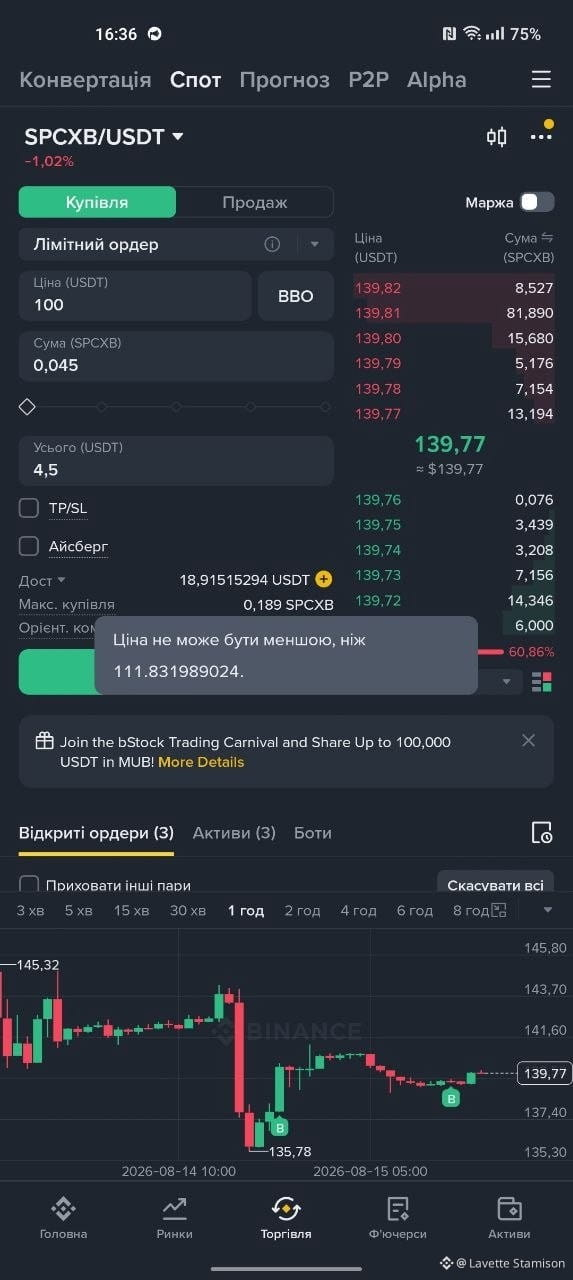
Setup. 15 August, 16:36 Kyiv time, phone app, $SPCXB order book, limit buy, my own account.
Attempt one. Price 100, size 0.045, total 4.50. Refused on price: "Price cannot be lower than 111.831989024." The reference at that second was 139.79. Divide that refusal number by 0.8 and you get 139.78998628. A twenty percent floor under the limit price I am allowed to name.
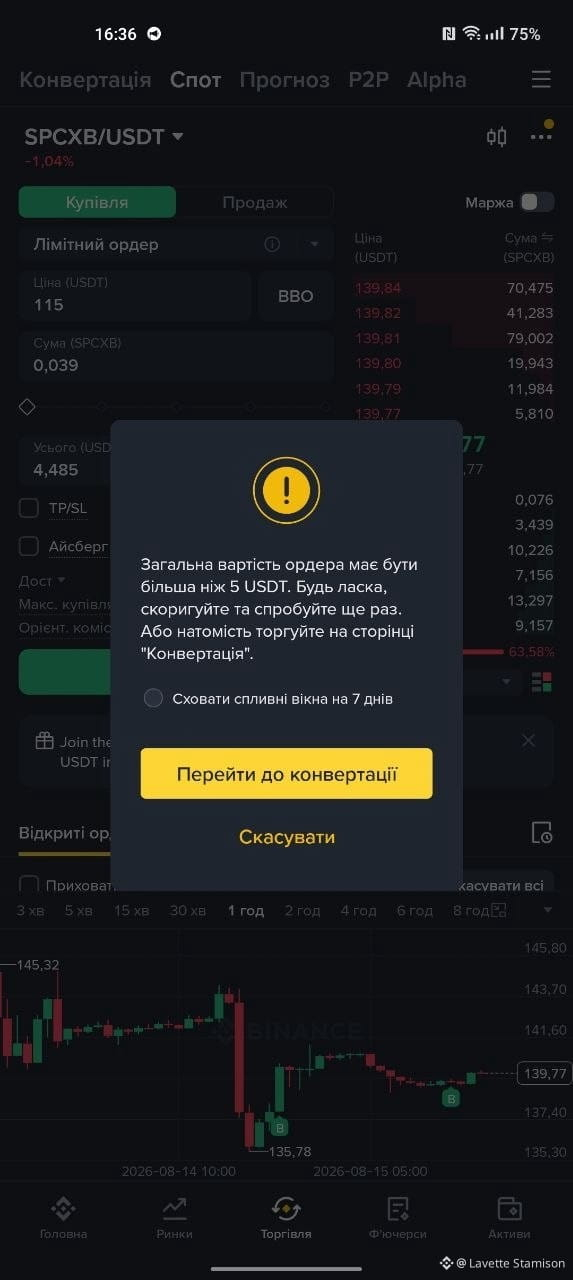
Attempt two. Price 115, size 0.039, total 4.485. Refused on size: total order value must be greater than 5 USDT. The only button on that window was Go to Convert.
Attempt three. Price 115, size 0.045, total 5.175. Accepted at 16:36:46.
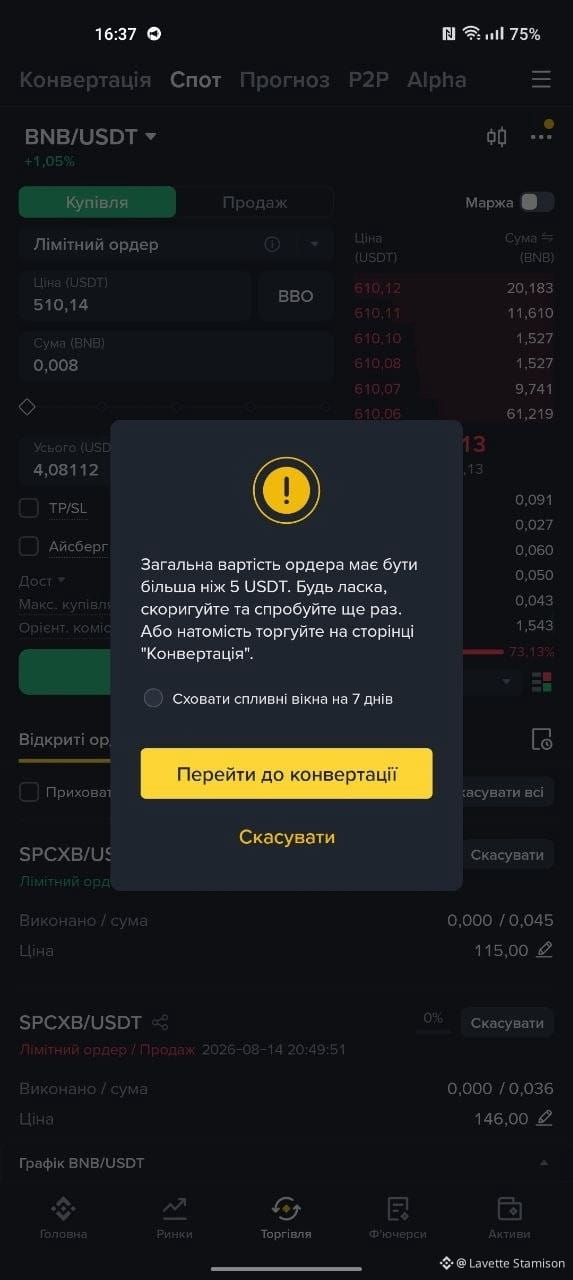
Control, 16:37, on the largest non stablecoin pair here, total 4.08. Identical window, identical wording.
So the floor is not five dollars. It sits above five dollars.
What you pay for. Three things.
The feed keeps saying fractions from 5 dollars. The wording on my screen says greater than 5, not at least 5. The campaign's own daily task is a 5 dollar trade. The threshold is set above the number everyone is told to trade.
Below the threshold you are not refused, you are redirected. Convert has no book and no limit price. You get a quote instead of a market.
The two limits stack on a small position. Your price is fenced into a band, your size is fenced from below. If the same floor applies on the way out, a five dollar position cannot be sold in halves at all.
Honest limits. One account, one minute, buy side only. I stopped at 4.485 and did not test exactly 5.00. I did not test the sell side, so the last point above is an inference, not a measurement. The band I measured on one pair at one price.
Do it yourself. Open the ticket, type 4.50, read what comes back. Do not take my word for any of this.
@BinanceCIS have you placed a bStock order at exactly the campaign amount?
$SPCXB
#bstockscis
Eleven days I have placed the same five dollar buy in this campaign. Today I tried to place it at 4.50 and the exchange refused twice, for two different reasons. I had never checked the floor I was standing on.
Setup. 15 August, 16:36 Kyiv time, phone app, $SPCXB order book, limit buy, my own account.
Attempt one. Price 100, size 0.045, total 4.50. Refused on price: "Price cannot be lower than 111.831989024." The reference at that second was 139.79. Divide that refusal number by 0.8 and you get 139.78998628. A twenty percent floor under the limit price I am allowed to name.
Attempt two. Price 115, size 0.039, total 4.485. Refused on size: total order value must be greater than 5 USDT. The only button on that window was Go to Convert.
Attempt three. Price 115, size 0.045, total 5.175. Accepted at 16:36:46.
Control, 16:37, on the largest non stablecoin pair here, total 4.08. Identical window, identical wording.
So the floor is not five dollars. It sits above five dollars.
What you pay for. Three things.
The feed keeps saying fractions from 5 dollars. The wording on my screen says greater than 5, not at least 5. The campaign's own daily task is a 5 dollar trade. The threshold is set above the number everyone is told to trade.
Below the threshold you are not refused, you are redirected. Convert has no book and no limit price. You get a quote instead of a market.
The two limits stack on a small position. Your price is fenced into a band, your size is fenced from below. If the same floor applies on the way out, a five dollar position cannot be sold in halves at all.
Honest limits. One account, one minute, buy side only. I stopped at 4.485 and did not test exactly 5.00. I did not test the sell side, so the last point above is an inference, not a measurement. The band I measured on one pair at one price.
Do it yourself. Open the ticket, type 4.50, read what comes back. Do not take my word for any of this.
@BinanceCIS have you placed a bStock order at exactly the campaign amount?
$SPCXB
#bstockscis
Setup. 15 August, 16:36 Kyiv time, phone app, $SPCXB order book, limit buy, my own account.
Attempt one. Price 100, size 0.045, total 4.50. Refused on price: "Price cannot be lower than 111.831989024." The reference at that second was 139.79. Divide that refusal number by 0.8 and you get 139.78998628. A twenty percent floor under the limit price I am allowed to name.
Attempt two. Price 115, size 0.039, total 4.485. Refused on size: total order value must be greater than 5 USDT. The only button on that window was Go to Convert.
Attempt three. Price 115, size 0.045, total 5.175. Accepted at 16:36:46.
Control, 16:37, on the largest non stablecoin pair here, total 4.08. Identical window, identical wording.
So the floor is not five dollars. It sits above five dollars.
What you pay for. Three things.
The feed keeps saying fractions from 5 dollars. The wording on my screen says greater than 5, not at least 5. The campaign's own daily task is a 5 dollar trade. The threshold is set above the number everyone is told to trade.
Below the threshold you are not refused, you are redirected. Convert has no book and no limit price. You get a quote instead of a market.
The two limits stack on a small position. Your price is fenced into a band, your size is fenced from below. If the same floor applies on the way out, a five dollar position cannot be sold in halves at all.
Honest limits. One account, one minute, buy side only. I stopped at 4.485 and did not test exactly 5.00. I did not test the sell side, so the last point above is an inference, not a measurement. The band I measured on one pair at one price.
Do it yourself. Open the ticket, type 4.50, read what comes back. Do not take my word for any of this.
@BinanceCIS have you placed a bStock order at exactly the campaign amount?
$SPCXB
#bstockscis
4
3
15
翻訳参照
I have twice told you that liquidity on these tokens is thin. Tonight I measured it and I was wrong.
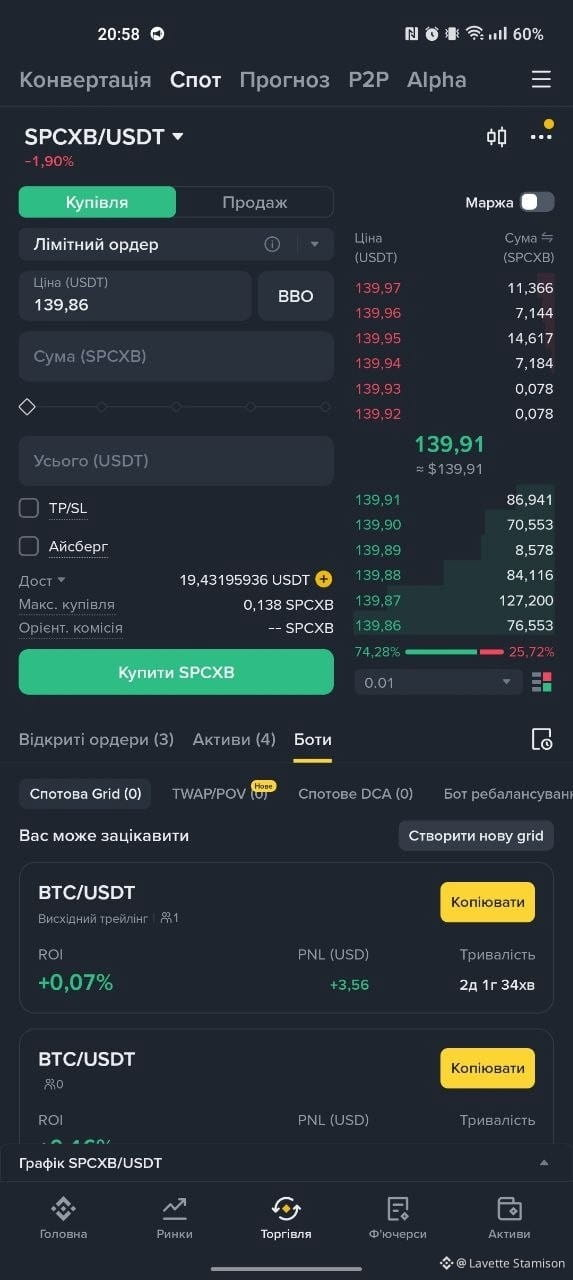
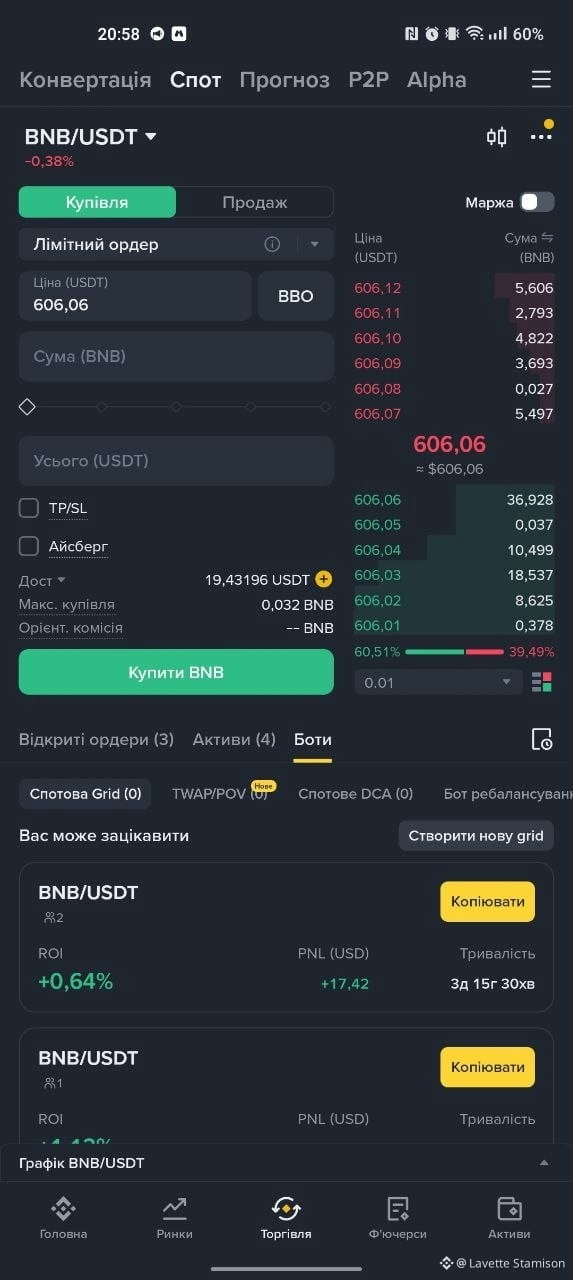
The setup. At 20:58 Kyiv, 13:58 New York, US session open, I opened SPCXB/USDT and BNB/USDT side by side and counted six price levels on each side of both books.
Bids, six levels deep. SPCXB: 453.9 tokens, about $63,500. BNB: 75.0 coins, about $45,500.
Asks, six levels deep. SPCXB: 40.5 tokens, about $5,660. BNB: 22.4 coins, about $13,600.
Spread: one tick on both, $0.01.
Order type menu: identical. Eight types each, TWAP and Scaled Order included.
The bid on a tokenized stock was deeper than the bid on BNB. I had been repeating a claim I never checked on this venue.
What you pay. Three things.
1️⃣ The book is lopsided. SPCXB sat near 11 to 1, bid over ask. BNB near 3 to 1. Buying slips more than selling, on the same screen, in the same second. That is the opposite of the story I had been telling.
2️⃣ A tick is not a tick. One cent on a $139.91 token is 0.007%. One cent on BNB at $606.06 is 0.0017%. Crossing the spread costs four times as much in relative terms, and no chart shows you that.
3️⃣ Scale. The whole visible ask side was $5,660. My campaign trade is $5. At that size none of this reaches me. Most of what gets written about depth here, mine included, is about a problem the writer does not have.
Honest limits: one snapshot, one minute, six levels, one ticker, mid session. Books move in seconds and I did not watch this one move. A deep bid at 21:00 says nothing about 03:00, when the underlying is shut.
Two posts of mine need this correction, so here it is. Before you believe anyone about liquidity on bStocks, open the two books in the same second and count. That includes not believing me.
@BinanceCIS is that bid depth market making, or is it flow?
$SPCXB
#bstockscis
I have twice told you that liquidity on these tokens is thin. Tonight I measured it and I was wrong.
The setup. At 20:58 Kyiv, 13:58 New York, US session open, I opened SPCXB/USDT and BNB/USDT side by side and counted six price levels on each side of both books.
Bids, six levels deep. SPCXB: 453.9 tokens, about $63,500. BNB: 75.0 coins, about $45,500.
Asks, six levels deep. SPCXB: 40.5 tokens, about $5,660. BNB: 22.4 coins, about $13,600.
Spread: one tick on both, $0.01.
Order type menu: identical. Eight types each, TWAP and Scaled Order included.
The bid on a tokenized stock was deeper than the bid on BNB. I had been repeating a claim I never checked on this venue.
What you pay. Three things.
1️⃣ The book is lopsided. SPCXB sat near 11 to 1, bid over ask. BNB near 3 to 1. Buying slips more than selling, on the same screen, in the same second. That is the opposite of the story I had been telling.
2️⃣ A tick is not a tick. One cent on a $139.91 token is 0.007%. One cent on BNB at $606.06 is 0.0017%. Crossing the spread costs four times as much in relative terms, and no chart shows you that.
3️⃣ Scale. The whole visible ask side was $5,660. My campaign trade is $5. At that size none of this reaches me. Most of what gets written about depth here, mine included, is about a problem the writer does not have.
Honest limits: one snapshot, one minute, six levels, one ticker, mid session. Books move in seconds and I did not watch this one move. A deep bid at 21:00 says nothing about 03:00, when the underlying is shut.
Two posts of mine need this correction, so here it is. Before you believe anyone about liquidity on bStocks, open the two books in the same second and count. That includes not believing me.
@BinanceCIS is that bid depth market making, or is it flow?
$SPCXB
#bstockscis
The setup. At 20:58 Kyiv, 13:58 New York, US session open, I opened SPCXB/USDT and BNB/USDT side by side and counted six price levels on each side of both books.
Bids, six levels deep. SPCXB: 453.9 tokens, about $63,500. BNB: 75.0 coins, about $45,500.
Asks, six levels deep. SPCXB: 40.5 tokens, about $5,660. BNB: 22.4 coins, about $13,600.
Spread: one tick on both, $0.01.
Order type menu: identical. Eight types each, TWAP and Scaled Order included.
The bid on a tokenized stock was deeper than the bid on BNB. I had been repeating a claim I never checked on this venue.
What you pay. Three things.
1️⃣ The book is lopsided. SPCXB sat near 11 to 1, bid over ask. BNB near 3 to 1. Buying slips more than selling, on the same screen, in the same second. That is the opposite of the story I had been telling.
2️⃣ A tick is not a tick. One cent on a $139.91 token is 0.007%. One cent on BNB at $606.06 is 0.0017%. Crossing the spread costs four times as much in relative terms, and no chart shows you that.
3️⃣ Scale. The whole visible ask side was $5,660. My campaign trade is $5. At that size none of this reaches me. Most of what gets written about depth here, mine included, is about a problem the writer does not have.
Honest limits: one snapshot, one minute, six levels, one ticker, mid session. Books move in seconds and I did not watch this one move. A deep bid at 21:00 says nothing about 03:00, when the underlying is shut.
Two posts of mine need this correction, so here it is. Before you believe anyone about liquidity on bStocks, open the two books in the same second and count. That includes not believing me.
@BinanceCIS is that bid depth market making, or is it flow?
$SPCXB
#bstockscis
2
1
107
·
--
ブリッシュ
今日のbStocksに関する記事は、1つの数字を必ず引用しています。私は、皆が参照しているページを開きましたが、そこには別の数字が表示されていました。
仕組み。Token Terminalのトークン化株式の時価総額は、オンチェーンでトークン化された価値であり、価格×供給量を発行体(issuer)ごとにまとめています。今日の話題:bStocksがOndoに次いで2位に入り、xStocksを追い抜きました。
手に入るもの。商品の外部スコアボード。公開で、ログイン不要。
支払うもの。3つあります。
1️⃣ ランクは薄いです。15:16(キエフ)時点で、そのページにはbStocksが$622.6M、xStocksが$605.5Mと表示されていました。$622.6Mに対する$17.1Mの差は2.8%。8月3日には$45M、火曜日には$9.4Mでした。
2️⃣ 比較が同一条件ではありません。あのページでは、すべてのbStockが1つのチェーンを挙げています。一方でxStocksの各アセットは6つです。bStocksはBNB Smart Chain上のBEP-20で、入出力の唯一のレールです。
3️⃣ 発行体はあなたのティッカーではありません。4つのトークンでその$622.6Mの約半分を占めており、そのうち2つは過去30日で下落しているのに、発行体全体の合計は上がっています。
率直な限界:1つのスナップショット、1つの午後。時価総額は価格と供給量を混ぜるので、下落は株(ストック)であって償還ではない可能性があります。
発行体の順位ではなく、自分のティッカーの行を読みましょう。
@BinanceCIS BSC以外で、bStocksはどのチェーンに決済されますか?
$SPCXB
#bstockscis
今日のbStocksに関する記事は、1つの数字を必ず引用しています。私は、皆が参照しているページを開きましたが、そこには別の数字が表示されていました。
仕組み。Token Terminalのトークン化株式の時価総額は、オンチェーンでトークン化された価値であり、価格×供給量を発行体(issuer)ごとにまとめています。今日の話題:bStocksがOndoに次いで2位に入り、xStocksを追い抜きました。
手に入るもの。商品の外部スコアボード。公開で、ログイン不要。
支払うもの。3つあります。
1️⃣ ランクは薄いです。15:16(キエフ)時点で、そのページにはbStocksが$622.6M、xStocksが$605.5Mと表示されていました。$622.6Mに対する$17.1Mの差は2.8%。8月3日には$45M、火曜日には$9.4Mでした。
2️⃣ 比較が同一条件ではありません。あのページでは、すべてのbStockが1つのチェーンを挙げています。一方でxStocksの各アセットは6つです。bStocksはBNB Smart Chain上のBEP-20で、入出力の唯一のレールです。
3️⃣ 発行体はあなたのティッカーではありません。4つのトークンでその$622.6Mの約半分を占めており、そのうち2つは過去30日で下落しているのに、発行体全体の合計は上がっています。
率直な限界:1つのスナップショット、1つの午後。時価総額は価格と供給量を混ぜるので、下落は株(ストック)であって償還ではない可能性があります。
発行体の順位ではなく、自分のティッカーの行を読みましょう。
@BinanceCIS BSC以外で、bStocksはどのチェーンに決済されますか?
$SPCXB
#bstockscis
仕組み。Token Terminalのトークン化株式の時価総額は、オンチェーンでトークン化された価値であり、価格×供給量を発行体(issuer)ごとにまとめています。今日の話題:bStocksがOndoに次いで2位に入り、xStocksを追い抜きました。
手に入るもの。商品の外部スコアボード。公開で、ログイン不要。
支払うもの。3つあります。
1️⃣ ランクは薄いです。15:16(キエフ)時点で、そのページにはbStocksが$622.6M、xStocksが$605.5Mと表示されていました。$622.6Mに対する$17.1Mの差は2.8%。8月3日には$45M、火曜日には$9.4Mでした。
2️⃣ 比較が同一条件ではありません。あのページでは、すべてのbStockが1つのチェーンを挙げています。一方でxStocksの各アセットは6つです。bStocksはBNB Smart Chain上のBEP-20で、入出力の唯一のレールです。
3️⃣ 発行体はあなたのティッカーではありません。4つのトークンでその$622.6Mの約半分を占めており、そのうち2つは過去30日で下落しているのに、発行体全体の合計は上がっています。
率直な限界:1つのスナップショット、1つの午後。時価総額は価格と供給量を混ぜるので、下落は株(ストック)であって償還ではない可能性があります。
発行体の順位ではなく、自分のティッカーの行を読みましょう。
@BinanceCIS BSC以外で、bStocksはどのチェーンに決済されますか?
$SPCXB
#bstockscis
I go by rankings
34%
I check my ticker's own row
33%
Didn't know it's one chain
0%
I track neither
33%
3 投票 • 投票は終了しました
2
3
552
·
--
ブリッシュ
翻訳参照
Today I went looking for what a bStock dividend actually pays and found two Binance pages that disagree.
The bStocks site promises the same economic entitlement as a shareholder. The Bahrain launch disclaimer says holders are not entitled to any dividends at all.
The mechanism. A dividend never reaches you as cash. The issuer collects it, withholding is applied, and the rest is rebased into your balance by the Multiplier.
What you get. Compounding with no action and no fee, on a fraction of a share.
What you pay. Three things.
1️⃣ Withholding. The standard US rate on dividends to a non-resident is 30% unless a treaty applies. Binance CIS published IBMB near 2.2% on 4 August. Net, closer to 1.5%.
2️⃣ The exit shuts. For Apple and IBM the snapshot was 10 August, 00:00 UTC, and conversion into the share was suspended from 8 August. The dividend lands while the door is shut.
3️⃣ No choice. You cannot take the cash instead. The issuer says the adjustment may not reflect the dividend's full value.
I read documents, not my own screen, and have never held a bStock through a dividend. Check the announcement for your ticker.
@BinanceCIS which rate applies to a CIS holder?
$IBMB
#bstockscis
Today I went looking for what a bStock dividend actually pays and found two Binance pages that disagree.
The bStocks site promises the same economic entitlement as a shareholder. The Bahrain launch disclaimer says holders are not entitled to any dividends at all.
The mechanism. A dividend never reaches you as cash. The issuer collects it, withholding is applied, and the rest is rebased into your balance by the Multiplier.
What you get. Compounding with no action and no fee, on a fraction of a share.
What you pay. Three things.
1️⃣ Withholding. The standard US rate on dividends to a non-resident is 30% unless a treaty applies. Binance CIS published IBMB near 2.2% on 4 August. Net, closer to 1.5%.
2️⃣ The exit shuts. For Apple and IBM the snapshot was 10 August, 00:00 UTC, and conversion into the share was suspended from 8 August. The dividend lands while the door is shut.
3️⃣ No choice. You cannot take the cash instead. The issuer says the adjustment may not reflect the dividend's full value.
I read documents, not my own screen, and have never held a bStock through a dividend. Check the announcement for your ticker.
@BinanceCIS which rate applies to a CIS holder?
$IBMB
#bstockscis
The bStocks site promises the same economic entitlement as a shareholder. The Bahrain launch disclaimer says holders are not entitled to any dividends at all.
The mechanism. A dividend never reaches you as cash. The issuer collects it, withholding is applied, and the rest is rebased into your balance by the Multiplier.
What you get. Compounding with no action and no fee, on a fraction of a share.
What you pay. Three things.
1️⃣ Withholding. The standard US rate on dividends to a non-resident is 30% unless a treaty applies. Binance CIS published IBMB near 2.2% on 4 August. Net, closer to 1.5%.
2️⃣ The exit shuts. For Apple and IBM the snapshot was 10 August, 00:00 UTC, and conversion into the share was suspended from 8 August. The dividend lands while the door is shut.
3️⃣ No choice. You cannot take the cash instead. The issuer says the adjustment may not reflect the dividend's full value.
I read documents, not my own screen, and have never held a bStock through a dividend. Check the announcement for your ticker.
@BinanceCIS which rate applies to a CIS holder?
$IBMB
#bstockscis
Didn't know about withholding
0%
Knew it, fine with it
0%
I avoid dividend tickers
0%
I exit before the snapshot
0%
0 投票 • 投票は終了しました
5
3
587
·
--
ブリッシュ
本人確認中
翻訳参照
Zero maker fees on bStocks run until August 31. That reads as cheaper trading. There is a less obvious reading.
Mechanism. On August 5, with ten new pairs, Binance switched on Spot Algo Trading Bot. A grid bot works through limit orders, so it sits on the maker side nearly always. While the promo lasts, those orders fill free.
What that gives you. The underlying stock trades about six and a half hours a day. A bStock never stops. Most of the day the price moves in a thin market with no reference print from Nasdaq. That is working conditions for a grid: it does not guess direction, it harvests range.
What you pay for it. Three things.
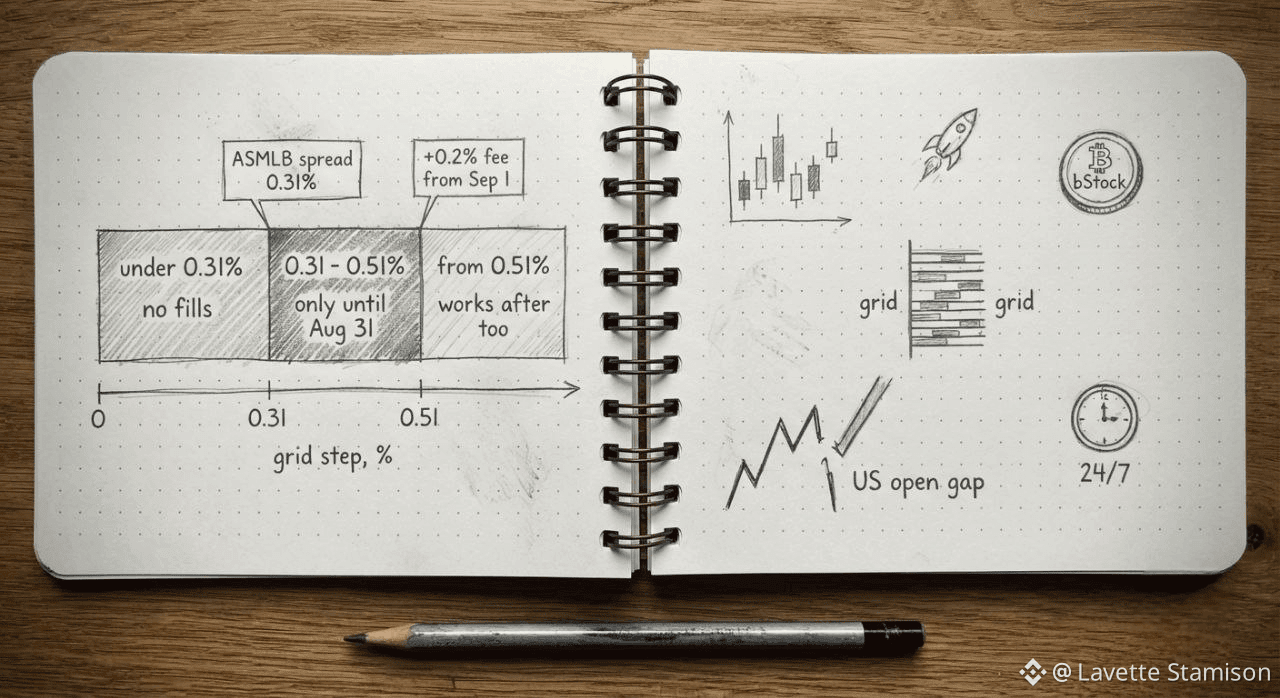
Thin liquidity outside the US session widens the spread. What you save on fees can go into slippage.
A gap at the US open pushes the grid outside its range. The bot has no view on earnings or macro.
From September 1 the standard fee returns. Arithmetic that worked in August may not work in September.
I have not run a grid on a bStocks pair, only watched the ASMLB book: in the European session the spread held around a third of a percent. Before starting I would check that the grid step covers that spread.
$ASMLB
#bstockscis @BinanceCIS
Zero maker fees on bStocks run until August 31. That reads as cheaper trading. There is a less obvious reading.
Mechanism. On August 5, with ten new pairs, Binance switched on Spot Algo Trading Bot. A grid bot works through limit orders, so it sits on the maker side nearly always. While the promo lasts, those orders fill free.
What that gives you. The underlying stock trades about six and a half hours a day. A bStock never stops. Most of the day the price moves in a thin market with no reference print from Nasdaq. That is working conditions for a grid: it does not guess direction, it harvests range.
What you pay for it. Three things.
Thin liquidity outside the US session widens the spread. What you save on fees can go into slippage.
A gap at the US open pushes the grid outside its range. The bot has no view on earnings or macro.
From September 1 the standard fee returns. Arithmetic that worked in August may not work in September.
I have not run a grid on a bStocks pair, only watched the ASMLB book: in the European session the spread held around a third of a percent. Before starting I would check that the grid step covers that spread.
$ASMLB
#bstockscis @BinanceCIS
Mechanism. On August 5, with ten new pairs, Binance switched on Spot Algo Trading Bot. A grid bot works through limit orders, so it sits on the maker side nearly always. While the promo lasts, those orders fill free.
What that gives you. The underlying stock trades about six and a half hours a day. A bStock never stops. Most of the day the price moves in a thin market with no reference print from Nasdaq. That is working conditions for a grid: it does not guess direction, it harvests range.
What you pay for it. Three things.
Thin liquidity outside the US session widens the spread. What you save on fees can go into slippage.
A gap at the US open pushes the grid outside its range. The bot has no view on earnings or macro.
From September 1 the standard fee returns. Arithmetic that worked in August may not work in September.
I have not run a grid on a bStocks pair, only watched the ASMLB book: in the European session the spread held around a third of a percent. Before starting I would check that the grid step covers that spread.
$ASMLB
#bstockscis @BinanceCIS
2
101
本人確認中
翻訳参照
Що станеться з обсягом bStocks 1 вересня, коли вимкнеться нульова комісія мейкера?
Звіт CoinDesk Data за липень, опублікований 1 серпня: обсяг торгів токенізованими акціями і ETF - $11,3 млрд, +288% за місяць. На bStocks припало $9,41 млрд, 83,3% ринку.
З них один токен, $QQQB (Invesco QQQ Trust, лістинг 30 червня о 13:30 UTC), зробив $9,27 млрд - близько 82% ринку. Я відняв: на всю решту лінійки bStocks лишається близько $140 млн за липень. Точність груба, це різниця округлених чисел, але порядок такий - приблизно $4,5 млн на добу на все інше.
Дві дати пояснюють це краще за попит. QQQB торгується з нульовою комісією мейкера до 31 серпня. З 23 липня Binance рахує обсяг по акціях і bStocks з множником 3x для просування по VIP-рівнях.
Базовий актив: QQQ у липні впав на 6,6% і в моменті був на 10,2% нижче закриття 30 червня, тоді як Nasdaq Composite -3,2%, S&P 500 -0,1%. Обсяг ріс не за ціною.
Для мене з цього випливає умова. Інший ETF лінійки, $EWYB (iShares MSCI South Korea), сидить уже в тій решті. Поки комісія нульова, я працюю лімітками, а після 31 серпня перевірятиму спред до заявки, не після.
{spot}(QQQBUSDT)
Що буде з обсягом bStocks після 31 серпня?
#bstockscis @BinanceCIS
Що станеться з обсягом bStocks 1 вересня, коли вимкнеться нульова комісія мейкера?
Звіт CoinDesk Data за липень, опублікований 1 серпня: обсяг торгів токенізованими акціями і ETF - $11,3 млрд, +288% за місяць. На bStocks припало $9,41 млрд, 83,3% ринку.
З них один токен, $QQQB (Invesco QQQ Trust, лістинг 30 червня о 13:30 UTC), зробив $9,27 млрд - близько 82% ринку. Я відняв: на всю решту лінійки bStocks лишається близько $140 млн за липень. Точність груба, це різниця округлених чисел, але порядок такий - приблизно $4,5 млн на добу на все інше.
Дві дати пояснюють це краще за попит. QQQB торгується з нульовою комісією мейкера до 31 серпня. З 23 липня Binance рахує обсяг по акціях і bStocks з множником 3x для просування по VIP-рівнях.
Базовий актив: QQQ у липні впав на 6,6% і в моменті був на 10,2% нижче закриття 30 червня, тоді як Nasdaq Composite -3,2%, S&P 500 -0,1%. Обсяг ріс не за ціною.
Для мене з цього випливає умова. Інший ETF лінійки, $EWYB (iShares MSCI South Korea), сидить уже в тій решті. Поки комісія нульова, я працюю лімітками, а після 31 серпня перевірятиму спред до заявки, не після.
Що буде з обсягом bStocks після 31 серпня?
#bstockscis @BinanceCIS
Звіт CoinDesk Data за липень, опублікований 1 серпня: обсяг торгів токенізованими акціями і ETF - $11,3 млрд, +288% за місяць. На bStocks припало $9,41 млрд, 83,3% ринку.
З них один токен, $QQQB (Invesco QQQ Trust, лістинг 30 червня о 13:30 UTC), зробив $9,27 млрд - близько 82% ринку. Я відняв: на всю решту лінійки bStocks лишається близько $140 млн за липень. Точність груба, це різниця округлених чисел, але порядок такий - приблизно $4,5 млн на добу на все інше.
Дві дати пояснюють це краще за попит. QQQB торгується з нульовою комісією мейкера до 31 серпня. З 23 липня Binance рахує обсяг по акціях і bStocks з множником 3x для просування по VIP-рівнях.
Базовий актив: QQQ у липні впав на 6,6% і в моменті був на 10,2% нижче закриття 30 червня, тоді як Nasdaq Composite -3,2%, S&P 500 -0,1%. Обсяг ріс не за ціною.
Для мене з цього випливає умова. Інший ETF лінійки, $EWYB (iShares MSCI South Korea), сидить уже в тій решті. Поки комісія нульова, я працюю лімітками, а після 31 серпня перевірятиму спред до заявки, не після.
Що буде з обсягом bStocks після 31 серпня?
#bstockscis @BinanceCIS
Впаде помітно 📉
0%
Утримається ⚖️
100%
Виросте, річ не в комісії 📈
0%
1 投票 • 投票は終了しました
2
88
·
--
ブリッシュ
本人確認中
保証1:1は、「逆の経路は動くの?」と聞くまで、説得力があるように聞こえます。
まさにそれが、実際のカバレッジと、表の中の記録を分けています。
bStockは、Binanceと提携するBTech Holdingsが発行する証明書で、その背後には1:1の比率で実在する株式が1つ付いています。ですが重要なのはもう一つ:換金(コンバージョン)は双方向で機能することです。現物の株式をbStockに変換でき、さらにbStockを現物株式に戻すことも、無料で、そして取引所のオープンを待たずに、いつでもできます。
私は毎日$SPCXB を$5で買っています。価格がだいたい$113のとき、これは約0.044トークンです。同じ「帰り道」が裏付けられている分割ポジションです。
一度も何も変換していません。しかし、出口(戻せる道)が存在するという事実そのものが、ポジションの見え方を変えます。USDTでしか売れないトークンを持つのと、基礎資産への“通行”があるものを持つのでは話が違うのです。
制限について率直に:これは株式の直接保有ではありません。議決権はありません。規制上はADGM/FSRAのルールに従った証明書です。コンバージョンの利用可能性は地域とアカウントのステータスによります。
あなたは、あなた自身に対してコンバージョンが利用可能かどうか確認しましたか?
@BinanceCIS #bstockscis $SPCXB
保証1:1は、「逆の経路は動くの?」と聞くまで、説得力があるように聞こえます。
まさにそれが、実際のカバレッジと、表の中の記録を分けています。
bStockは、Binanceと提携するBTech Holdingsが発行する証明書で、その背後には1:1の比率で実在する株式が1つ付いています。ですが重要なのはもう一つ:換金(コンバージョン)は双方向で機能することです。現物の株式をbStockに変換でき、さらにbStockを現物株式に戻すことも、無料で、そして取引所のオープンを待たずに、いつでもできます。
私は毎日$SPCXB を$5で買っています。価格がだいたい$113のとき、これは約0.044トークンです。同じ「帰り道」が裏付けられている分割ポジションです。
一度も何も変換していません。しかし、出口(戻せる道)が存在するという事実そのものが、ポジションの見え方を変えます。USDTでしか売れないトークンを持つのと、基礎資産への“通行”があるものを持つのでは話が違うのです。
制限について率直に:これは株式の直接保有ではありません。議決権はありません。規制上はADGM/FSRAのルールに従った証明書です。コンバージョンの利用可能性は地域とアカウントのステータスによります。
あなたは、あなた自身に対してコンバージョンが利用可能かどうか確認しましたか?
@BinanceCIS #bstockscis $SPCXB
まさにそれが、実際のカバレッジと、表の中の記録を分けています。
bStockは、Binanceと提携するBTech Holdingsが発行する証明書で、その背後には1:1の比率で実在する株式が1つ付いています。ですが重要なのはもう一つ:換金(コンバージョン)は双方向で機能することです。現物の株式をbStockに変換でき、さらにbStockを現物株式に戻すことも、無料で、そして取引所のオープンを待たずに、いつでもできます。
私は毎日$SPCXB を$5で買っています。価格がだいたい$113のとき、これは約0.044トークンです。同じ「帰り道」が裏付けられている分割ポジションです。
一度も何も変換していません。しかし、出口(戻せる道)が存在するという事実そのものが、ポジションの見え方を変えます。USDTでしか売れないトークンを持つのと、基礎資産への“通行”があるものを持つのでは話が違うのです。
制限について率直に:これは株式の直接保有ではありません。議決権はありません。規制上はADGM/FSRAのルールに従った証明書です。コンバージョンの利用可能性は地域とアカウントのステータスによります。
あなたは、あなた自身に対してコンバージョンが利用可能かどうか確認しましたか?
@BinanceCIS #bstockscis $SPCXB
Так, доступна
67%
Ні, не перевіряв
33%
Ні, не знав про неї
0%
Ще не купував bStocks
0%
3 投票 • 投票は終了しました
2
218
デジタル化が進んでいて、私みたいな年寄りでも気づくほどだ。
そして実際のところ、これは本当にとても良いことだ。すべてがより身近になり、最終的な利用者にとってより多くのコントロールができるようになる。最近、私が bStocks を見つけた。
もしできるだけ簡単に言うなら、これは一種のトークンで、基本的には世界のさまざまな企業の実在の株式によって裏付けられている(Tesla、NVIDIA など)。つまり、こうしたトークンを1つ買えば、手元に株1株があるのと同じだと考えていい。面白いのは、私たちはオープンマーケットや何か特別なものを必要としないことだ。すべてがブロックチェーン($BNB Chain)上で24時間365日動いている。
つまり:
- 私たちは市場の動きを待つ必要がないし、何か他のものを待つ必要もない。24/7で何でもできる。
- 株の一部を買うことができる。たとえば 5 USDT でも。想像してみてほしい。5ドルで Tesla($TSLAB )を保有しているのと同じ。細かいことかもしれないが、もうあなたは投資家だし、それが最高にいい。
どこで見つけて、Binanceでどうやって買うの?
1. Binance の Spot Market のセクション(または bStocks の専用セクション)に入る。
2. 検索で必要なティッカーを入力する。たとえば $TSLAB (Tesla の株の場合)やその他を入れる。リストはすでにかなり大きい。
3. USDT で、どんな暗号資産の取引ペアと同じくらい簡単にアセットを購入する。
実際にトークン化された株を試してみた?コメントで感想やおすすめを共有して。こちらも一緒に学ぼう。
@BinanceCIS #bstockscis
デジタル化が進んでいて、私みたいな年寄りでも気づくほどだ。
そして実際のところ、これは本当にとても良いことだ。すべてがより身近になり、最終的な利用者にとってより多くのコントロールができるようになる。最近、私が bStocks を見つけた。
もしできるだけ簡単に言うなら、これは一種のトークンで、基本的には世界のさまざまな企業の実在の株式によって裏付けられている(Tesla、NVIDIA など)。つまり、こうしたトークンを1つ買えば、手元に株1株があるのと同じだと考えていい。面白いのは、私たちはオープンマーケットや何か特別なものを必要としないことだ。すべてがブロックチェーン($BNB Chain)上で24時間365日動いている。
つまり:
- 私たちは市場の動きを待つ必要がないし、何か他のものを待つ必要もない。24/7で何でもできる。
- 株の一部を買うことができる。たとえば 5 USDT でも。想像してみてほしい。5ドルで Tesla($TSLAB )を保有しているのと同じ。細かいことかもしれないが、もうあなたは投資家だし、それが最高にいい。
どこで見つけて、Binanceでどうやって買うの?
1. Binance の Spot Market のセクション(または bStocks の専用セクション)に入る。
2. 検索で必要なティッカーを入力する。たとえば $TSLAB (Tesla の株の場合)やその他を入れる。リストはすでにかなり大きい。
3. USDT で、どんな暗号資産の取引ペアと同じくらい簡単にアセットを購入する。
実際にトークン化された株を試してみた?コメントで感想やおすすめを共有して。こちらも一緒に学ぼう。
@BinanceCIS #bstockscis
そして実際のところ、これは本当にとても良いことだ。すべてがより身近になり、最終的な利用者にとってより多くのコントロールができるようになる。最近、私が bStocks を見つけた。
もしできるだけ簡単に言うなら、これは一種のトークンで、基本的には世界のさまざまな企業の実在の株式によって裏付けられている(Tesla、NVIDIA など)。つまり、こうしたトークンを1つ買えば、手元に株1株があるのと同じだと考えていい。面白いのは、私たちはオープンマーケットや何か特別なものを必要としないことだ。すべてがブロックチェーン($BNB Chain)上で24時間365日動いている。
つまり:
- 私たちは市場の動きを待つ必要がないし、何か他のものを待つ必要もない。24/7で何でもできる。
- 株の一部を買うことができる。たとえば 5 USDT でも。想像してみてほしい。5ドルで Tesla($TSLAB )を保有しているのと同じ。細かいことかもしれないが、もうあなたは投資家だし、それが最高にいい。
どこで見つけて、Binanceでどうやって買うの?
1. Binance の Spot Market のセクション(または bStocks の専用セクション)に入る。
2. 検索で必要なティッカーを入力する。たとえば $TSLAB (Tesla の株の場合)やその他を入れる。リストはすでにかなり大きい。
3. USDT で、どんな暗号資産の取引ペアと同じくらい簡単にアセットを購入する。
実際にトークン化された株を試してみた?コメントで感想やおすすめを共有して。こちらも一緒に学ぼう。
@BinanceCIS #bstockscis
1
93
ログインして、さらにコンテンツを読む
厳選トピックで世界の暗号資産トレーダーの仲間入り
⚡️ 暗号資産に関する最新かつ有益な情報が見つかります。
💬 世界最大の暗号資産取引所から信頼されています。
👍 認証を受けたクリエイターから、有益なインサイトを得られます。
メール / 電話番号
トレンドトピック
FortitudeRaisesCreditLineTo$50M
閲覧回数 226
36人が討論中
#FortitudeRaisesCreditLineTo$50M
Fortitude Capitalのチームにとって記念すべき出来事です!📈 クレジットラインを驚異の5,000万ドルまで拡大することに成功したとお知らせでき、私たちは大変嬉しく思っています。取引所のフロアで行われた記念すべき調印セレモニーによって記されたこの重要なマイルストーンは、関係者全員のたゆまぬ努力と戦略的なビジョンの賜物です。
この増資によって、私たちは新たな投資機会を追求し、さらなる成長を後押しし、より一層お客様に価値あるサービスを提供できるようになります。この達成を可能にしてくださったパートナーやステークホルダーの皆さまへの感謝の気持ちでいっぱいです。
新たな自信をもって未来を見据えながら、私たちは革新を推進し、卓越した成果を提供し続けることにわくわくしています。確かな未来と、今後の成功に乾杯!
#FortitudeRaisesCreditLineTo$50M #FortitudeCapital #Growth #Expansion #CapitalRaise
取引可能なコインを3つ追加(参考):
この達成をさらに記念し、現代の金融環境に合わせるため、私たちは象徴的に3つの取引可能なコインを組み込みました:
$FTDR.US (Fortitude Token):Fortitude Capitalの将来の成功への持分を示す、架空のコインです。独自の特典や投資機会につながる可能性があります。
$USDC (USD Coin):広く認知されたステーブルコインであり、クレジットライン増額の確かなUSD価値を表し、流動性を確保します。
$ETH (Ethereum):主要な暗号資産プラットフォームで、イノベーションへの取り組みと金融の未来へのコミットメントを象徴しています。
なお、これらのコインは参考・象徴的な目的で含まれており、投資助言を意味するものではありません。投資判断は、必ず十分な調査と個々の状況に基づいて行ってください。
#market #US #ETH
Axiom AlphA
·いいね:0件
·閲覧回数 4
USWeighsPromotingDollarStablecoinsAbroad
閲覧回数 6,247
428人が討論中
US10YTreasuryYieldHits19YearHigh
閲覧回数 5,388
340人が討論中