

Wade King
20 投稿

Wade King
報告
ユーザーをブロック
📚 Crypto made simple || 📊 Market insights & trading basics ||💡 Learn. Analyze. Trade smarter.
8 フォロー
1 フォロワー
6 いいね
投稿
·
--
翻訳参照
Should You Put All Your Money Into One Crypto? 🧐
One concept every crypto investor should understand is **diversification**.
Diversification means spreading your investments across different assets instead of putting everything into one cryptocurrency.
For example, instead of putting your entire portfolio into $BTC , someone might hold a combination of BTC, ETH, and other assets based on their own risk tolerance and strategy.
Why do people diversify?
🔹 It can reduce dependence on a single asset
🔹 Different assets can behave differently in changing market conditions
🔹 It can help manage concentration risk
But diversification doesn't mean buying dozens of random coins.
Holding more assets doesn't automatically make a portfolio safer. Different cryptocurrencies can also move in the same direction during major market moves.
That's why it's important to understand what you're holding, why you're holding it, and how much risk you're taking.
A simple way to remember:
Diversification = spreading exposure
Not:
Diversification = buying everything
Before building a crypto portfolio, consider factors such as risk, liquidity, market conditions, and your investment goals.
How many different cryptocurrencies do you currently follow closely?
#Crypto #BTC #Investing #Diversification
Should You Put All Your Money Into One Crypto? 🧐
One concept every crypto investor should understand is **diversification**.
Diversification means spreading your investments across different assets instead of putting everything into one cryptocurrency.
For example, instead of putting your entire portfolio into $BTC , someone might hold a combination of BTC, ETH, and other assets based on their own risk tolerance and strategy.
Why do people diversify?
🔹 It can reduce dependence on a single asset
🔹 Different assets can behave differently in changing market conditions
🔹 It can help manage concentration risk
But diversification doesn't mean buying dozens of random coins.
Holding more assets doesn't automatically make a portfolio safer. Different cryptocurrencies can also move in the same direction during major market moves.
That's why it's important to understand what you're holding, why you're holding it, and how much risk you're taking.
A simple way to remember:
Diversification = spreading exposure
Not:
Diversification = buying everything
Before building a crypto portfolio, consider factors such as risk, liquidity, market conditions, and your investment goals.
How many different cryptocurrencies do you currently follow closely?
#Crypto #BTC #Investing #Diversification
One concept every crypto investor should understand is **diversification**.
Diversification means spreading your investments across different assets instead of putting everything into one cryptocurrency.
For example, instead of putting your entire portfolio into $BTC , someone might hold a combination of BTC, ETH, and other assets based on their own risk tolerance and strategy.
Why do people diversify?
🔹 It can reduce dependence on a single asset
🔹 Different assets can behave differently in changing market conditions
🔹 It can help manage concentration risk
But diversification doesn't mean buying dozens of random coins.
Holding more assets doesn't automatically make a portfolio safer. Different cryptocurrencies can also move in the same direction during major market moves.
That's why it's important to understand what you're holding, why you're holding it, and how much risk you're taking.
A simple way to remember:
Diversification = spreading exposure
Not:
Diversification = buying everything
Before building a crypto portfolio, consider factors such as risk, liquidity, market conditions, and your investment goals.
How many different cryptocurrencies do you currently follow closely?
#Crypto #BTC #Investing #Diversification
86
·
--
暗号資産におけるドル・コスト平均法(DCA)とは? 🧐
一度に大きな金額を投資する必要は、必ずしもありません。
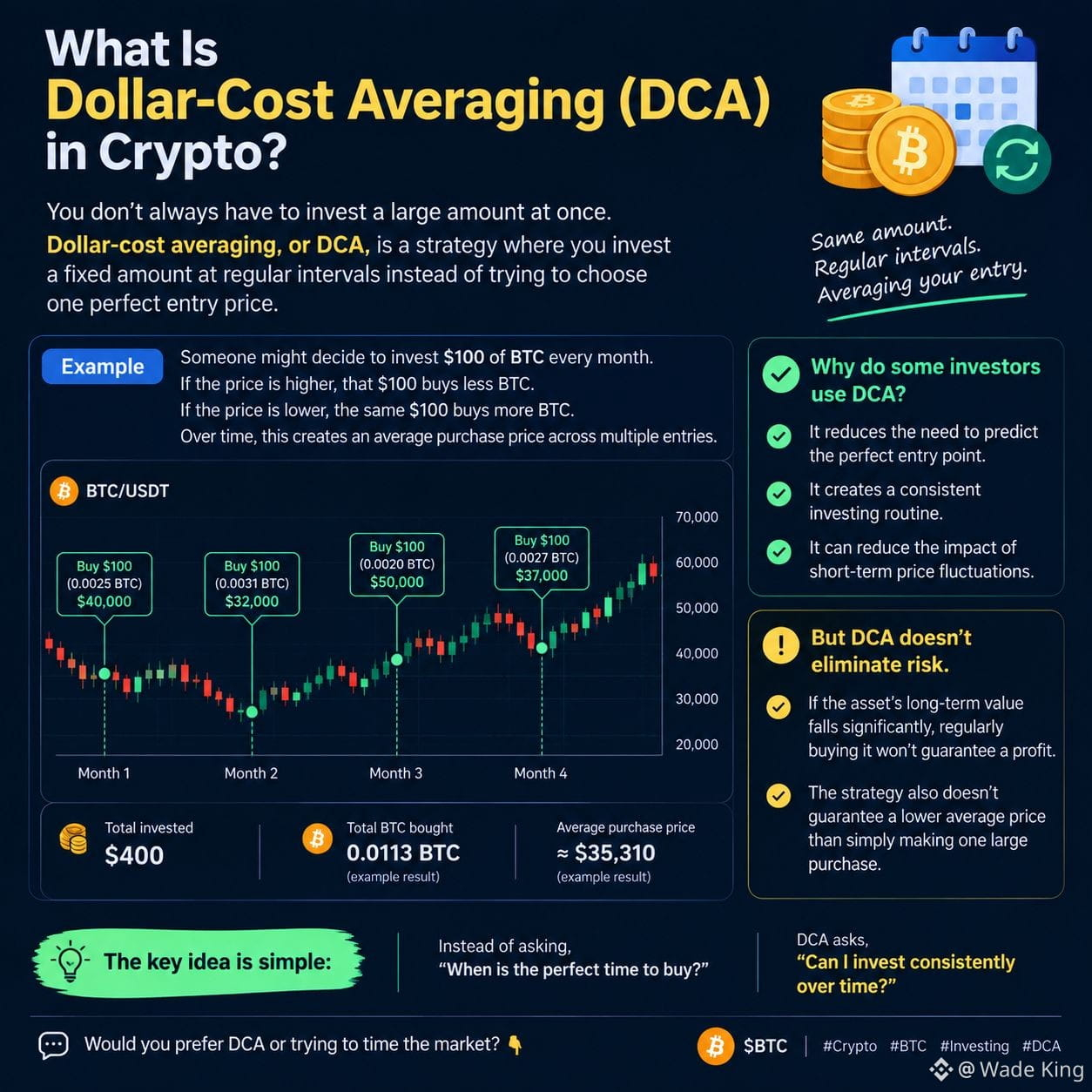
ドル・コスト平均法、つまり **DCA** は、最適なエントリー価格を一つ選ぼうとするのではなく、一定額を定期的に投資するという戦略です。
たとえば、ある人が毎月 $100 を $BTC に投資すると決めるかもしれません。
価格が高ければ、その $100 で買える BTC は少なくなります。
価格が低ければ、同じ $100 で買える BTC は多くなります。
時間が経つにつれて、複数回のエントリーにまたがって平均的な購入価格が作られていきます。
なぜ一部の投資家は DCA を使うのでしょうか?
🔹 perfect なエントリーポイントを当てる必要性を減らせる
🔹 一貫した投資ルーティンを作れる
🔹 短期的な価格変動の影響を抑えられる可能性がある
しかし、DCA はリスクをなくすわけではありません。
仮にその資産の長期的な価値が大きく下がった場合、定期的に買い続けても利益が保証されるわけではありません。さらに、この戦略は「一度に大きく買う」だけの場合よりも平均購入価格が必ず低くなることも保証しません。
ポイントはシンプルです:
「完璧な買い時はいつか?」と考えるのではなく、
DCA は「時間をかけて一貫して投資できるか?」を問います。
あなたは DCA を選びますか、それとも相場のタイミングを狙いますか?
{spot}(BTCUSDT)
#Crypto #BTC #Investing #DCA
暗号資産におけるドル・コスト平均法(DCA)とは? 🧐
一度に大きな金額を投資する必要は、必ずしもありません。
ドル・コスト平均法、つまり **DCA** は、最適なエントリー価格を一つ選ぼうとするのではなく、一定額を定期的に投資するという戦略です。
たとえば、ある人が毎月 $100 を $BTC に投資すると決めるかもしれません。
価格が高ければ、その $100 で買える BTC は少なくなります。
価格が低ければ、同じ $100 で買える BTC は多くなります。
時間が経つにつれて、複数回のエントリーにまたがって平均的な購入価格が作られていきます。
なぜ一部の投資家は DCA を使うのでしょうか?
🔹 perfect なエントリーポイントを当てる必要性を減らせる
🔹 一貫した投資ルーティンを作れる
🔹 短期的な価格変動の影響を抑えられる可能性がある
しかし、DCA はリスクをなくすわけではありません。
仮にその資産の長期的な価値が大きく下がった場合、定期的に買い続けても利益が保証されるわけではありません。さらに、この戦略は「一度に大きく買う」だけの場合よりも平均購入価格が必ず低くなることも保証しません。
ポイントはシンプルです:
「完璧な買い時はいつか?」と考えるのではなく、
DCA は「時間をかけて一貫して投資できるか?」を問います。
あなたは DCA を選びますか、それとも相場のタイミングを狙いますか?
#Crypto #BTC #Investing #DCA
一度に大きな金額を投資する必要は、必ずしもありません。
ドル・コスト平均法、つまり **DCA** は、最適なエントリー価格を一つ選ぼうとするのではなく、一定額を定期的に投資するという戦略です。
たとえば、ある人が毎月 $100 を $BTC に投資すると決めるかもしれません。
価格が高ければ、その $100 で買える BTC は少なくなります。
価格が低ければ、同じ $100 で買える BTC は多くなります。
時間が経つにつれて、複数回のエントリーにまたがって平均的な購入価格が作られていきます。
なぜ一部の投資家は DCA を使うのでしょうか?
🔹 perfect なエントリーポイントを当てる必要性を減らせる
🔹 一貫した投資ルーティンを作れる
🔹 短期的な価格変動の影響を抑えられる可能性がある
しかし、DCA はリスクをなくすわけではありません。
仮にその資産の長期的な価値が大きく下がった場合、定期的に買い続けても利益が保証されるわけではありません。さらに、この戦略は「一度に大きく買う」だけの場合よりも平均購入価格が必ず低くなることも保証しません。
ポイントはシンプルです:
「完璧な買い時はいつか?」と考えるのではなく、
DCA は「時間をかけて一貫して投資できるか?」を問います。
あなたは DCA を選びますか、それとも相場のタイミングを狙いますか?
#Crypto #BTC #Investing #DCA
74
·
--
翻訳参照
What Is Risk-Reward Ratio in Trading? 🧐
Before entering a trade, one useful question is:
"How much am I willing to risk compared with my potential target?"
That's where the **risk-reward ratio** comes in.
📉 Risk = the amount you could lose if the trade moves against you.
📈 Reward = the potential gain if the trade reaches your target.
For example, suppose $BTC is trading at $100,000.
A trader could set:
Entry: $100,000
Stop-loss: $98,000
Target: $104,000
That means the potential risk is $2,000 while the potential reward is $4,000.
The risk-reward ratio would be **1:2**.
In simple terms:
1 part potential risk
2 parts potential reward
But a higher risk-reward ratio doesn't automatically make a trade better. The probability of reaching the target, market conditions, position size, and overall strategy also matter.
Risk-reward is simply a tool that helps traders think about potential downside before entering a position.
Do you calculate risk-reward before taking a trade?
{spot}(BTCUSDT)
#crypto #BTC #Trading #RiskManagem
What Is Risk-Reward Ratio in Trading? 🧐
Before entering a trade, one useful question is:
"How much am I willing to risk compared with my potential target?"
That's where the **risk-reward ratio** comes in.
📉 Risk = the amount you could lose if the trade moves against you.
📈 Reward = the potential gain if the trade reaches your target.
For example, suppose $BTC is trading at $100,000.
A trader could set:
Entry: $100,000
Stop-loss: $98,000
Target: $104,000
That means the potential risk is $2,000 while the potential reward is $4,000.
The risk-reward ratio would be **1:2**.
In simple terms:
1 part potential risk
2 parts potential reward
But a higher risk-reward ratio doesn't automatically make a trade better. The probability of reaching the target, market conditions, position size, and overall strategy also matter.
Risk-reward is simply a tool that helps traders think about potential downside before entering a position.
Do you calculate risk-reward before taking a trade?
#crypto #BTC #Trading #RiskManagem
Before entering a trade, one useful question is:
"How much am I willing to risk compared with my potential target?"
That's where the **risk-reward ratio** comes in.
📉 Risk = the amount you could lose if the trade moves against you.
📈 Reward = the potential gain if the trade reaches your target.
For example, suppose $BTC is trading at $100,000.
A trader could set:
Entry: $100,000
Stop-loss: $98,000
Target: $104,000
That means the potential risk is $2,000 while the potential reward is $4,000.
The risk-reward ratio would be **1:2**.
In simple terms:
1 part potential risk
2 parts potential reward
But a higher risk-reward ratio doesn't automatically make a trade better. The probability of reaching the target, market conditions, position size, and overall strategy also matter.
Risk-reward is simply a tool that helps traders think about potential downside before entering a position.
Do you calculate risk-reward before taking a trade?
#crypto #BTC #Trading #RiskManagem
81
·
--
翻訳参照
What Is RSI in Crypto Trading? 📊
If you've ever looked at a crypto chart and seen "RSI," you may have wondered what it means.
RSI stands for **Relative Strength Index**. It is a technical indicator commonly used to measure the strength and speed of recent price movements.
RSI ranges from 0 to 100.
📈 A higher RSI can indicate that an asset has experienced strong recent buying momentum.
📉 A lower RSI can indicate stronger recent selling momentum.
Traders often pay attention to levels such as:
🔹 Above 70 — traditionally considered an overbought zone
🔹 Below 30 — traditionally considered an oversold zone
But there's an important point:
An RSI above 70 doesn't automatically mean the price must fall, and an RSI below 30 doesn't automatically mean the price must rise.
During strong trends, an asset can remain in these zones for a long time.
RSI is therefore better treated as one piece of information rather than a guaranteed buy or sell signal.
Do you use RSI when analyzing crypto? 👇
#Crypto #BTC #Trading #RSI
What Is RSI in Crypto Trading? 📊
If you've ever looked at a crypto chart and seen "RSI," you may have wondered what it means.
RSI stands for **Relative Strength Index**. It is a technical indicator commonly used to measure the strength and speed of recent price movements.
RSI ranges from 0 to 100.
📈 A higher RSI can indicate that an asset has experienced strong recent buying momentum.
📉 A lower RSI can indicate stronger recent selling momentum.
Traders often pay attention to levels such as:
🔹 Above 70 — traditionally considered an overbought zone
🔹 Below 30 — traditionally considered an oversold zone
But there's an important point:
An RSI above 70 doesn't automatically mean the price must fall, and an RSI below 30 doesn't automatically mean the price must rise.
During strong trends, an asset can remain in these zones for a long time.
RSI is therefore better treated as one piece of information rather than a guaranteed buy or sell signal.
Do you use RSI when analyzing crypto? 👇
#Crypto #BTC #Trading #RSI
If you've ever looked at a crypto chart and seen "RSI," you may have wondered what it means.
RSI stands for **Relative Strength Index**. It is a technical indicator commonly used to measure the strength and speed of recent price movements.
RSI ranges from 0 to 100.
📈 A higher RSI can indicate that an asset has experienced strong recent buying momentum.
📉 A lower RSI can indicate stronger recent selling momentum.
Traders often pay attention to levels such as:
🔹 Above 70 — traditionally considered an overbought zone
🔹 Below 30 — traditionally considered an oversold zone
But there's an important point:
An RSI above 70 doesn't automatically mean the price must fall, and an RSI below 30 doesn't automatically mean the price must rise.
During strong trends, an asset can remain in these zones for a long time.
RSI is therefore better treated as one piece of information rather than a guaranteed buy or sell signal.
Do you use RSI when analyzing crypto? 👇
#Crypto #BTC #Trading #RSI
73
·
--
翻訳参照
What Is a Candlestick in Crypto Trading? 🕯️
If you've ever opened a crypto chart, you've probably seen red and green candles everywhere.
But what do they actually tell you?
A candlestick shows how an asset's price moved during a specific period.
Each candle contains four important pieces of information:
🟢 Open — the price at the beginning of the period
🔴 Close — the price at the end of the period
⬆️ High — the highest price reached
⬇️ Low — the lowest price reached
The candle's body shows the difference between the opening and closing prices, while the thin lines (called wicks) show the high and low.
For example, a green candle generally means the closing price was higher than the opening price.
A red candle generally means the closing price was lower than the opening price.
The timeframe also matters. A 5-minute candle represents very different price activity from a daily candle.
Candlesticks don't predict the future by themselves, but they help traders understand price movement and market behavior.
Do you usually trade using 5-minute, 1-hour, or daily charts? 👇
#Crypto #BTC #Trading #Candlestick
What Is a Candlestick in Crypto Trading? 🕯️
If you've ever opened a crypto chart, you've probably seen red and green candles everywhere.
But what do they actually tell you?
A candlestick shows how an asset's price moved during a specific period.
Each candle contains four important pieces of information:
🟢 Open — the price at the beginning of the period
🔴 Close — the price at the end of the period
⬆️ High — the highest price reached
⬇️ Low — the lowest price reached
The candle's body shows the difference between the opening and closing prices, while the thin lines (called wicks) show the high and low.
For example, a green candle generally means the closing price was higher than the opening price.
A red candle generally means the closing price was lower than the opening price.
The timeframe also matters. A 5-minute candle represents very different price activity from a daily candle.
Candlesticks don't predict the future by themselves, but they help traders understand price movement and market behavior.
Do you usually trade using 5-minute, 1-hour, or daily charts? 👇
#Crypto #BTC #Trading #Candlestick
If you've ever opened a crypto chart, you've probably seen red and green candles everywhere.
But what do they actually tell you?
A candlestick shows how an asset's price moved during a specific period.
Each candle contains four important pieces of information:
🟢 Open — the price at the beginning of the period
🔴 Close — the price at the end of the period
⬆️ High — the highest price reached
⬇️ Low — the lowest price reached
The candle's body shows the difference between the opening and closing prices, while the thin lines (called wicks) show the high and low.
For example, a green candle generally means the closing price was higher than the opening price.
A red candle generally means the closing price was lower than the opening price.
The timeframe also matters. A 5-minute candle represents very different price activity from a daily candle.
Candlesticks don't predict the future by themselves, but they help traders understand price movement and market behavior.
Do you usually trade using 5-minute, 1-hour, or daily charts? 👇
#Crypto #BTC #Trading #Candlestick
72
·
--
暗号資産取引におけるオーダーブックとは? 🧐
取引画面を見て、「あの買い注文・売り注文は結局なにを意味するの?」と思ったことはありませんか?見ているのはオーダーブックです。
オーダーブックとは、ある資産についての買い注文と売り注文をリアルタイムで一覧表示したものです。
🟢 ビッド(Bid)=買い手が支払う用意のある価格
🔴 アスク(Ask)=売り手が受け入れる用意のある価格
たとえば、$BTC の場合、買い手は $99,900 で買う用意があり、売り手は $100,000 で売る用意があるとします。
最高のビッド(買い気配)と最安のアスク(売り気配)の差は、「スプレッド」と呼ばれます。
なぜオーダーブックが重要なのですか?
📊 利用可能な買い・売りの関心がわかる
💧 市場の流動性に関する手がかりになることがある
⚡ 大口注文が短期的な価格変動に影響することもある
🔎 現在の価格の周辺で市場がどうなっているかを理解するのに役立つ
ただし、オーダーブックは価格がどちらへ動くかを確実に予測できるものではありません。注文はいつでも追加されたり、キャンセルされたり、変更されたりします。
覚えるためのシンプルな方法:
Bids = 買い手
Asks = 売り手
Spread = 最良のビッドと最良のアスクの差
取引をする前にオーダーブックをチェックしますか? 👇
{spot}(BTCUSDT)
#Crypto #BTC #Trading #OrderBook
暗号資産取引におけるオーダーブックとは? 🧐
取引画面を見て、「あの買い注文・売り注文は結局なにを意味するの?」と思ったことはありませんか?見ているのはオーダーブックです。
オーダーブックとは、ある資産についての買い注文と売り注文をリアルタイムで一覧表示したものです。
🟢 ビッド(Bid)=買い手が支払う用意のある価格
🔴 アスク(Ask)=売り手が受け入れる用意のある価格
たとえば、$BTC の場合、買い手は $99,900 で買う用意があり、売り手は $100,000 で売る用意があるとします。
最高のビッド(買い気配)と最安のアスク(売り気配)の差は、「スプレッド」と呼ばれます。
なぜオーダーブックが重要なのですか?
📊 利用可能な買い・売りの関心がわかる
💧 市場の流動性に関する手がかりになることがある
⚡ 大口注文が短期的な価格変動に影響することもある
🔎 現在の価格の周辺で市場がどうなっているかを理解するのに役立つ
ただし、オーダーブックは価格がどちらへ動くかを確実に予測できるものではありません。注文はいつでも追加されたり、キャンセルされたり、変更されたりします。
覚えるためのシンプルな方法:
Bids = 買い手
Asks = 売り手
Spread = 最良のビッドと最良のアスクの差
取引をする前にオーダーブックをチェックしますか? 👇
#Crypto #BTC #Trading #OrderBook
取引画面を見て、「あの買い注文・売り注文は結局なにを意味するの?」と思ったことはありませんか?見ているのはオーダーブックです。
オーダーブックとは、ある資産についての買い注文と売り注文をリアルタイムで一覧表示したものです。
🟢 ビッド(Bid)=買い手が支払う用意のある価格
🔴 アスク(Ask)=売り手が受け入れる用意のある価格
たとえば、$BTC の場合、買い手は $99,900 で買う用意があり、売り手は $100,000 で売る用意があるとします。
最高のビッド(買い気配)と最安のアスク(売り気配)の差は、「スプレッド」と呼ばれます。
なぜオーダーブックが重要なのですか?
📊 利用可能な買い・売りの関心がわかる
💧 市場の流動性に関する手がかりになることがある
⚡ 大口注文が短期的な価格変動に影響することもある
🔎 現在の価格の周辺で市場がどうなっているかを理解するのに役立つ
ただし、オーダーブックは価格がどちらへ動くかを確実に予測できるものではありません。注文はいつでも追加されたり、キャンセルされたり、変更されたりします。
覚えるためのシンプルな方法:
Bids = 買い手
Asks = 売り手
Spread = 最良のビッドと最良のアスクの差
取引をする前にオーダーブックをチェックしますか? 👇
#Crypto #BTC #Trading #OrderBook
86
·
--
翻訳参照
What Are Stop-Loss and Take-Profit Orders? 🧐
Two important tools traders should understand are Stop-Loss and Take-Profit orders.
🛑 Stop-Loss
A stop-loss is designed to help limit potential losses by triggering an order when the market reaches a specified price.
🎯 Take-Profit
A take-profit order is designed to lock in potential gains when the market reaches a specified target.
For example, imagine $BTC is trading at $100,000.
A trader might set a stop-loss below their entry price and a take-profit above it.
The idea is simple:
Stop-Loss = predefined exit to manage downside
Take-Profit = predefined exit to manage a target
However, neither guarantees an exact execution price. Fast-moving markets, liquidity, and order type can affect how an order is executed.
Risk management is an important part of trading, so understanding your order settings before using them matters.
Do you use stop-loss and take-profit when trading? 👇
$BTC
#Crypto #BTC #Trading #RiskManagement
What Are Stop-Loss and Take-Profit Orders? 🧐
Two important tools traders should understand are Stop-Loss and Take-Profit orders.
🛑 Stop-Loss
A stop-loss is designed to help limit potential losses by triggering an order when the market reaches a specified price.
🎯 Take-Profit
A take-profit order is designed to lock in potential gains when the market reaches a specified target.
For example, imagine $BTC is trading at $100,000.
A trader might set a stop-loss below their entry price and a take-profit above it.
The idea is simple:
Stop-Loss = predefined exit to manage downside
Take-Profit = predefined exit to manage a target
However, neither guarantees an exact execution price. Fast-moving markets, liquidity, and order type can affect how an order is executed.
Risk management is an important part of trading, so understanding your order settings before using them matters.
Do you use stop-loss and take-profit when trading? 👇
$BTC
#Crypto #BTC #Trading #RiskManagement
Two important tools traders should understand are Stop-Loss and Take-Profit orders.
🛑 Stop-Loss
A stop-loss is designed to help limit potential losses by triggering an order when the market reaches a specified price.
🎯 Take-Profit
A take-profit order is designed to lock in potential gains when the market reaches a specified target.
For example, imagine $BTC is trading at $100,000.
A trader might set a stop-loss below their entry price and a take-profit above it.
The idea is simple:
Stop-Loss = predefined exit to manage downside
Take-Profit = predefined exit to manage a target
However, neither guarantees an exact execution price. Fast-moving markets, liquidity, and order type can affect how an order is executed.
Risk management is an important part of trading, so understanding your order settings before using them matters.
Do you use stop-loss and take-profit when trading? 👇
$BTC
#Crypto #BTC #Trading #RiskManagement
75
·
--
翻訳参照
Why is liquidity important in crypto? 🧐
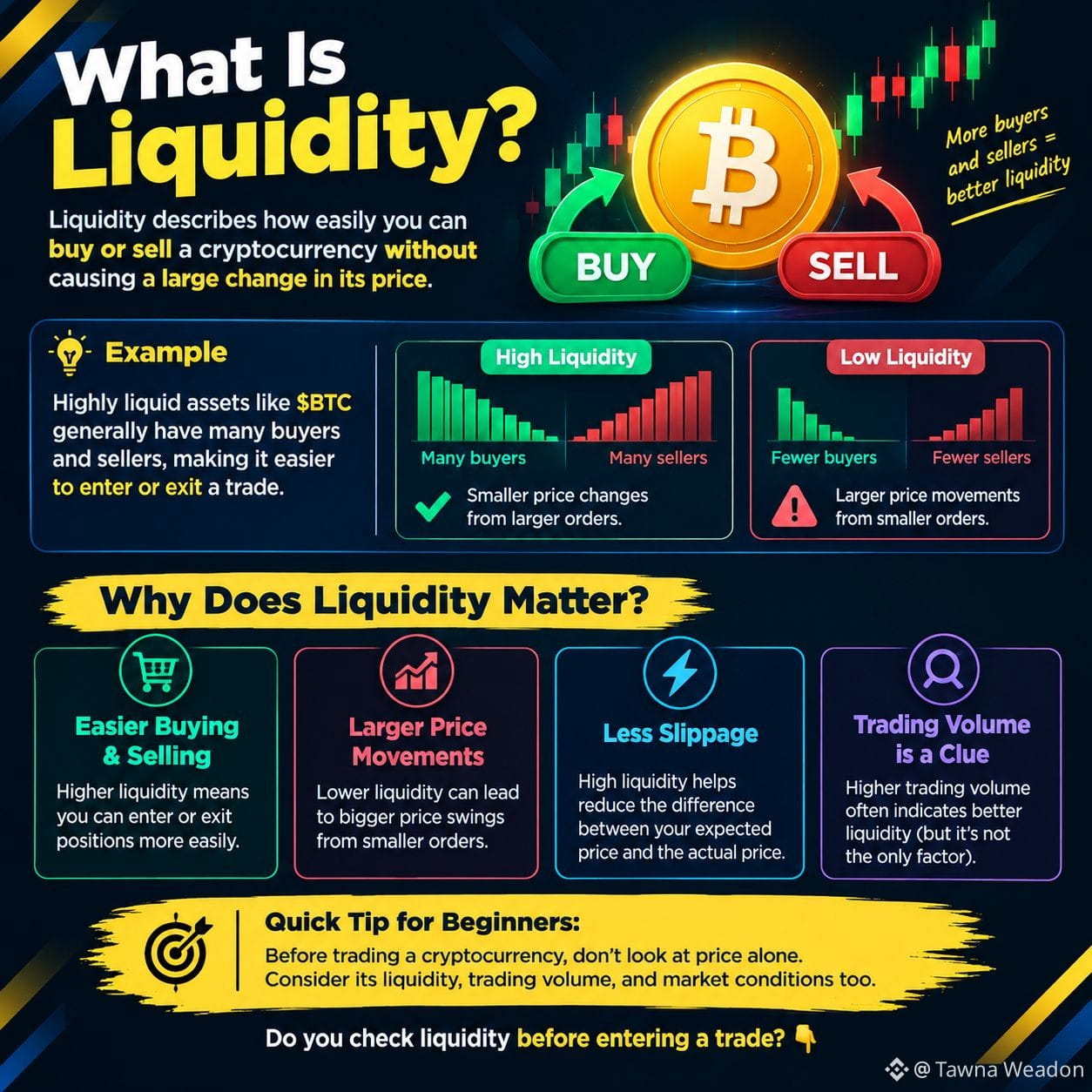
Liquidity describes how easily you can buy or sell a cryptocurrency without causing a large change in its price.
For example, highly liquid assets like $BTC generally have many buyers and sellers, making it easier to enter or exit a trade.
Why does liquidity matter?
💧 Higher liquidity can mean easier buying and selling
📉 Lower liquidity can lead to larger price movements from smaller orders
⚡ High liquidity can help reduce slippage
🔎 Trading volume is one useful indicator when evaluating market activity
A simple rule for beginners:
Before trading a cryptocurrency, don't look at price alone. Consider its liquidity, trading volume, and market conditions too.
Do you check liquidity before entering a trade? 👇
{spot}(BTCUSDT)
#Crypto #BTC #Trading #Liquidity
Why is liquidity important in crypto? 🧐
Liquidity describes how easily you can buy or sell a cryptocurrency without causing a large change in its price.
For example, highly liquid assets like $BTC generally have many buyers and sellers, making it easier to enter or exit a trade.
Why does liquidity matter?
💧 Higher liquidity can mean easier buying and selling
📉 Lower liquidity can lead to larger price movements from smaller orders
⚡ High liquidity can help reduce slippage
🔎 Trading volume is one useful indicator when evaluating market activity
A simple rule for beginners:
Before trading a cryptocurrency, don't look at price alone. Consider its liquidity, trading volume, and market conditions too.
Do you check liquidity before entering a trade? 👇
#Crypto #BTC #Trading #Liquidity
Liquidity describes how easily you can buy or sell a cryptocurrency without causing a large change in its price.
For example, highly liquid assets like $BTC generally have many buyers and sellers, making it easier to enter or exit a trade.
Why does liquidity matter?
💧 Higher liquidity can mean easier buying and selling
📉 Lower liquidity can lead to larger price movements from smaller orders
⚡ High liquidity can help reduce slippage
🔎 Trading volume is one useful indicator when evaluating market activity
A simple rule for beginners:
Before trading a cryptocurrency, don't look at price alone. Consider its liquidity, trading volume, and market conditions too.
Do you check liquidity before entering a trade? 👇
#Crypto #BTC #Trading #Liquidity
64
·
--
翻訳参照
How do you research a crypto project before investing? 🧐
Before putting money into a project, don't rely only on its price or social media hype.
Here are 6 things worth checking:
1️⃣ Project Purpose
What problem does it solve? Does it have a real use case?
2️⃣ Team & Community
Research the team, development activity, and whether the community is genuine.
3️⃣ Tokenomics
Check total supply, circulating supply, token distribution, and vesting schedules.
4️⃣ Market & Competition
Look at competitors, demand, market size, price history and trading volume.
5️⃣ Latest Updates
Check official announcements, development progress, partnerships and security issues.
6️⃣ Reliable Sources
Verify information using official documentation and multiple trusted sources.
Remember: No research = higher risk. Good research = better decisions.
What do you check first when researching a new crypto project? 👇
#Crypto #DYOR #Trading #Investing
How do you research a crypto project before investing? 🧐
Before putting money into a project, don't rely only on its price or social media hype.
Here are 6 things worth checking:
1️⃣ Project Purpose
What problem does it solve? Does it have a real use case?
2️⃣ Team & Community
Research the team, development activity, and whether the community is genuine.
3️⃣ Tokenomics
Check total supply, circulating supply, token distribution, and vesting schedules.
4️⃣ Market & Competition
Look at competitors, demand, market size, price history and trading volume.
5️⃣ Latest Updates
Check official announcements, development progress, partnerships and security issues.
6️⃣ Reliable Sources
Verify information using official documentation and multiple trusted sources.
Remember: No research = higher risk. Good research = better decisions.
What do you check first when researching a new crypto project? 👇
#Crypto #DYOR #Trading #Investing
Before putting money into a project, don't rely only on its price or social media hype.
Here are 6 things worth checking:
1️⃣ Project Purpose
What problem does it solve? Does it have a real use case?
2️⃣ Team & Community
Research the team, development activity, and whether the community is genuine.
3️⃣ Tokenomics
Check total supply, circulating supply, token distribution, and vesting schedules.
4️⃣ Market & Competition
Look at competitors, demand, market size, price history and trading volume.
5️⃣ Latest Updates
Check official announcements, development progress, partnerships and security issues.
6️⃣ Reliable Sources
Verify information using official documentation and multiple trusted sources.
Remember: No research = higher risk. Good research = better decisions.
What do you check first when researching a new crypto project? 👇
#Crypto #DYOR #Trading #Investing

61
·
--
翻訳参照
What are Support and Resistance in crypto? 🧐
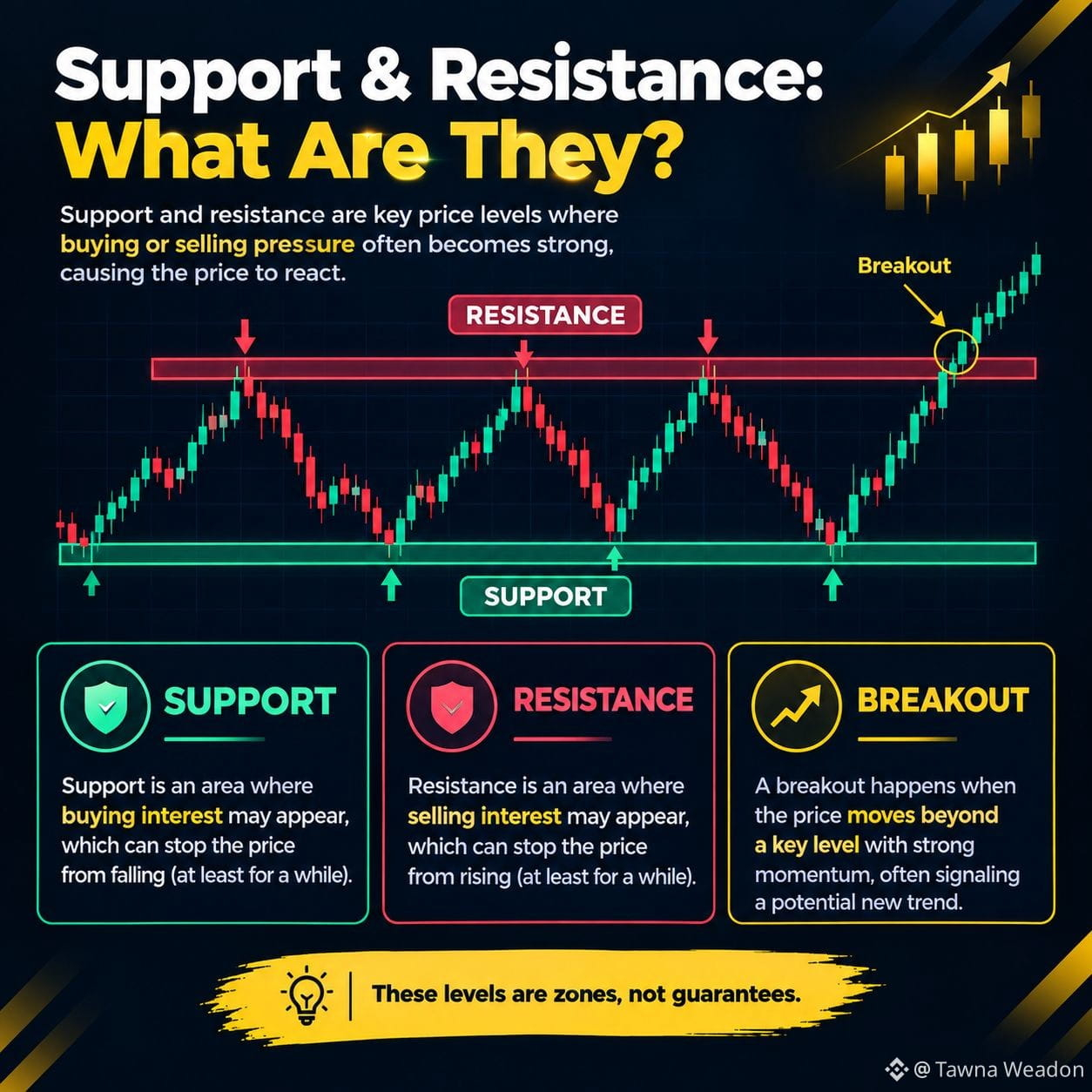
Support and resistance are two important concepts when reading a price chart.
🟢 Support = an area where buying interest may appear and help prevent the price from falling further.
🔴 Resistance = an area where selling interest may appear and make it harder for the price to rise.
For example, if $BTC repeatedly reacts around a similar price level, traders may watch that area as potential support or resistance.
But remember: these are zones, not guaranteed price levels. A strong move can break through either one.
Do you use support and resistance when analyzing a crypto chart? 👇
{spot}(BTCUSDT)
#Crypto #BTC #Trading #BinanceSquare
What are Support and Resistance in crypto? 🧐
Support and resistance are two important concepts when reading a price chart.
🟢 Support = an area where buying interest may appear and help prevent the price from falling further.
🔴 Resistance = an area where selling interest may appear and make it harder for the price to rise.
For example, if $BTC repeatedly reacts around a similar price level, traders may watch that area as potential support or resistance.
But remember: these are zones, not guaranteed price levels. A strong move can break through either one.
Do you use support and resistance when analyzing a crypto chart? 👇
#Crypto #BTC #Trading #BinanceSquare
Support and resistance are two important concepts when reading a price chart.
🟢 Support = an area where buying interest may appear and help prevent the price from falling further.
🔴 Resistance = an area where selling interest may appear and make it harder for the price to rise.
For example, if $BTC repeatedly reacts around a similar price level, traders may watch that area as potential support or resistance.
But remember: these are zones, not guaranteed price levels. A strong move can break through either one.
Do you use support and resistance when analyzing a crypto chart? 👇
#Crypto #BTC #Trading #BinanceSquare
90
·
--
翻訳参照
Why does trading volume matter in crypto? 🧐
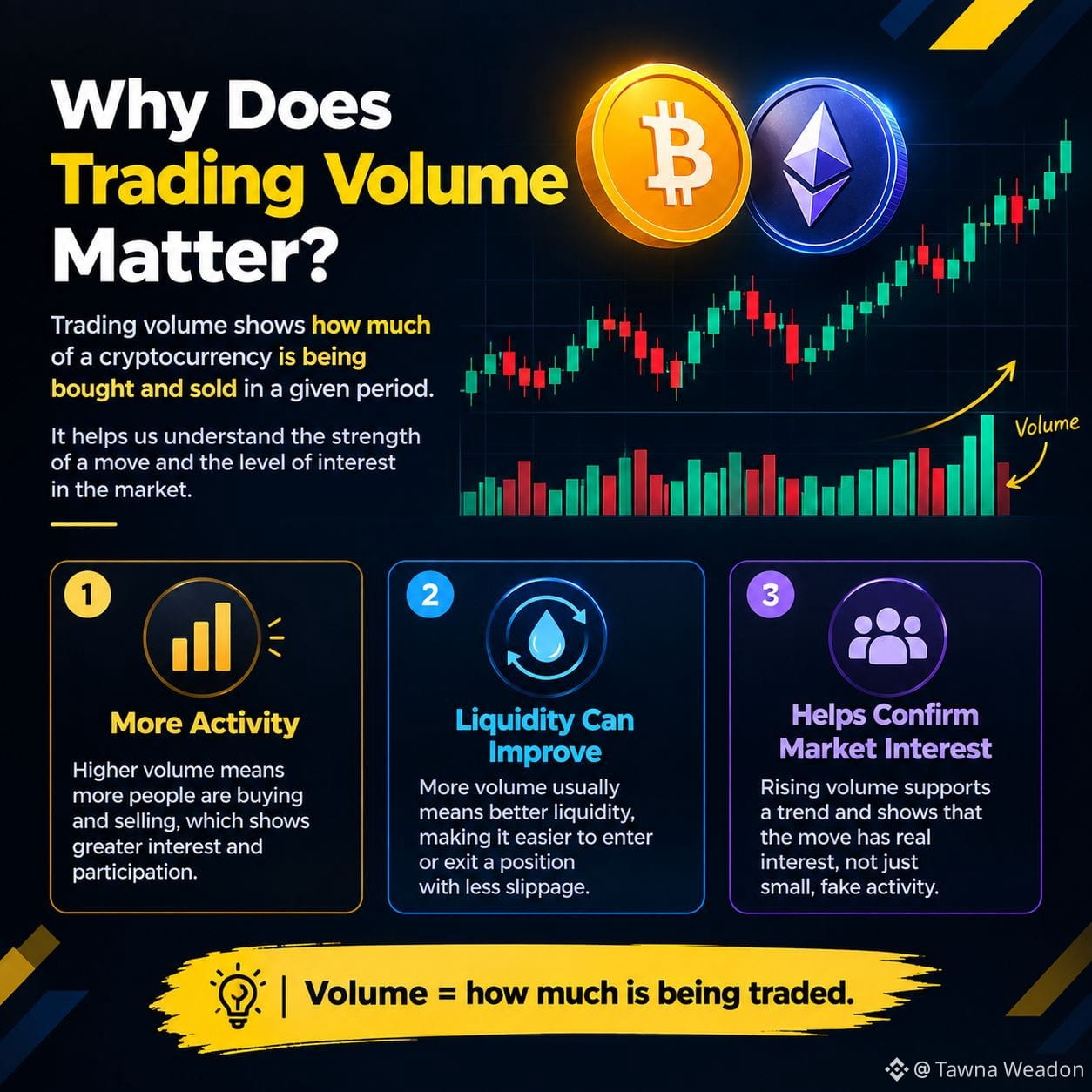
Trading volume shows how much of a cryptocurrency is being bought and sold during a given period.
For example, when you see high trading activity around $BTC , it means a large amount of Bitcoin is changing hands.
Why should beginners care about volume?
📊 Higher volume = more market activity
💧 More activity can mean better liquidity
🔎 Volume can help you understand whether a price move has strong market participation
But remember: high volume doesn't automatically mean the price will go up or down.
When you look at a crypto chart, do you check volume? 👇
#Crypto #Bitcoin #Trading #BinanceSquare
{spot}(BTCUSDT)
Why does trading volume matter in crypto? 🧐
Trading volume shows how much of a cryptocurrency is being bought and sold during a given period.
For example, when you see high trading activity around $BTC , it means a large amount of Bitcoin is changing hands.
Why should beginners care about volume?
📊 Higher volume = more market activity
💧 More activity can mean better liquidity
🔎 Volume can help you understand whether a price move has strong market participation
But remember: high volume doesn't automatically mean the price will go up or down.
When you look at a crypto chart, do you check volume? 👇
#Crypto #Bitcoin #Trading #BinanceSquare
Trading volume shows how much of a cryptocurrency is being bought and sold during a given period.
For example, when you see high trading activity around $BTC , it means a large amount of Bitcoin is changing hands.
Why should beginners care about volume?
📊 Higher volume = more market activity
💧 More activity can mean better liquidity
🔎 Volume can help you understand whether a price move has strong market participation
But remember: high volume doesn't automatically mean the price will go up or down.
When you look at a crypto chart, do you check volume? 👇
#Crypto #Bitcoin #Trading #BinanceSquare
75
·
--
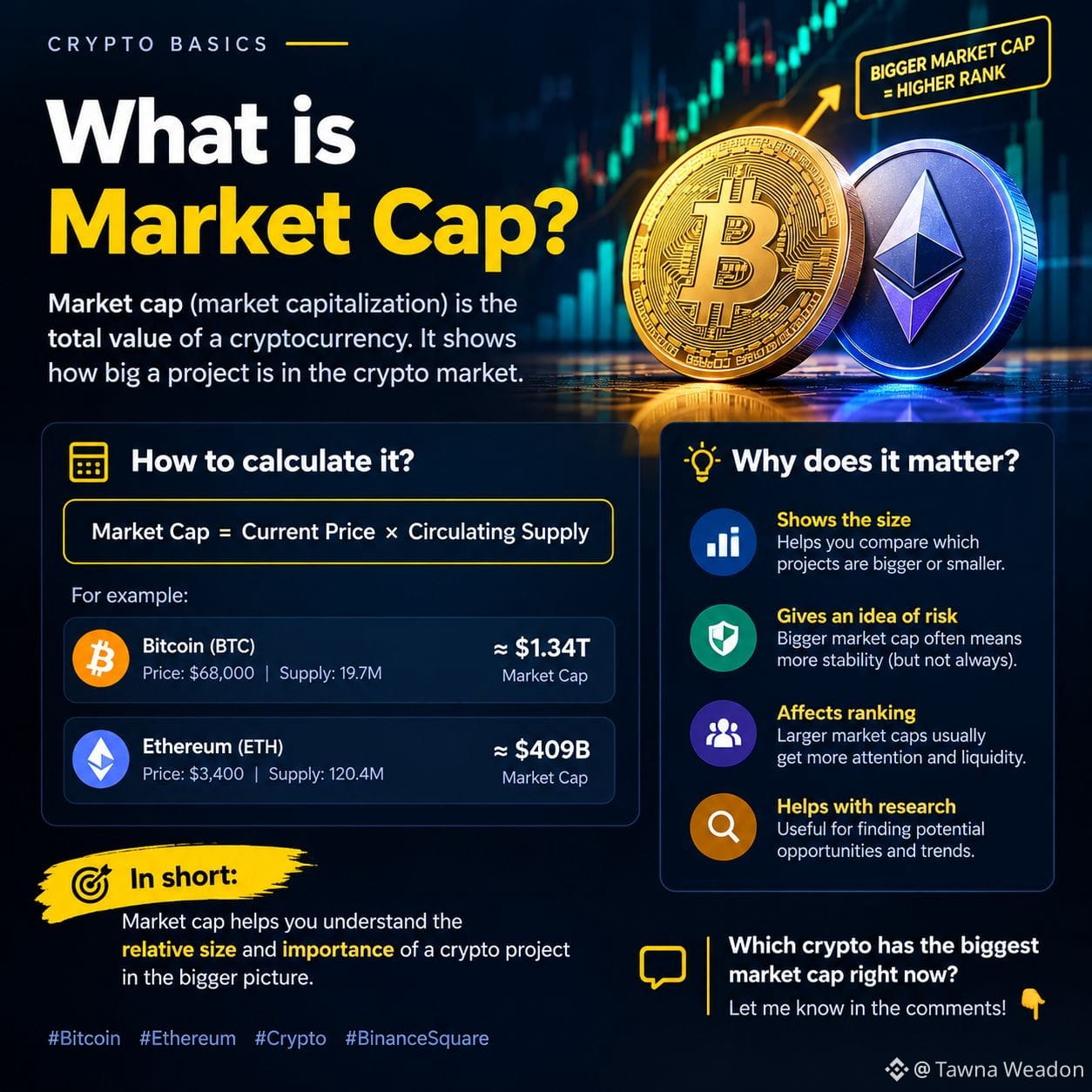
暗号資産の時価総額が実際に何を意味するのか、考えたことはありますか? 🧐
$BTC と $ETH は、まったく別の価格になり得ますが、価格だけでは、その暗号資産がどれほど大きいのかを本当に表してくれません。
時価総額(Market Cap)= 現在の価格 × 流通量(Circulating Supply)
だからこそ、$1で取引されているコインが、$1,000のコインよりも自動的に安い、あるいは割安だとは限りません。
初心者にとって、時価総額は暗号資産プロジェクトを調べる際に確認するのにとても役立つ数値の1つです。プロジェクトの相対的な規模を理解し、ほかのプロジェクトと比較するのに役立ちます。
暗号資産を調べるとき、最初に何を確認しますか――価格ですか、それとも時価総額ですか? 👇
{spot}(BTCUSDT)
{spot}(ETHUSDT)
#Crypto #Bitcoin #Ethereum #BinanceSquare
暗号資産の時価総額が実際に何を意味するのか、考えたことはありますか? 🧐
$BTC と $ETH は、まったく別の価格になり得ますが、価格だけでは、その暗号資産がどれほど大きいのかを本当に表してくれません。
時価総額(Market Cap)= 現在の価格 × 流通量(Circulating Supply)
だからこそ、$1で取引されているコインが、$1,000のコインよりも自動的に安い、あるいは割安だとは限りません。
初心者にとって、時価総額は暗号資産プロジェクトを調べる際に確認するのにとても役立つ数値の1つです。プロジェクトの相対的な規模を理解し、ほかのプロジェクトと比較するのに役立ちます。
暗号資産を調べるとき、最初に何を確認しますか――価格ですか、それとも時価総額ですか? 👇
#Crypto #Bitcoin #Ethereum #BinanceSquare
$BTC と $ETH は、まったく別の価格になり得ますが、価格だけでは、その暗号資産がどれほど大きいのかを本当に表してくれません。
時価総額(Market Cap)= 現在の価格 × 流通量(Circulating Supply)
だからこそ、$1で取引されているコインが、$1,000のコインよりも自動的に安い、あるいは割安だとは限りません。
初心者にとって、時価総額は暗号資産プロジェクトを調べる際に確認するのにとても役立つ数値の1つです。プロジェクトの相対的な規模を理解し、ほかのプロジェクトと比較するのに役立ちます。
暗号資産を調べるとき、最初に何を確認しますか――価格ですか、それとも時価総額ですか? 👇
#Crypto #Bitcoin #Ethereum #BinanceSquare
2
1
2
667
·
--
翻訳参照
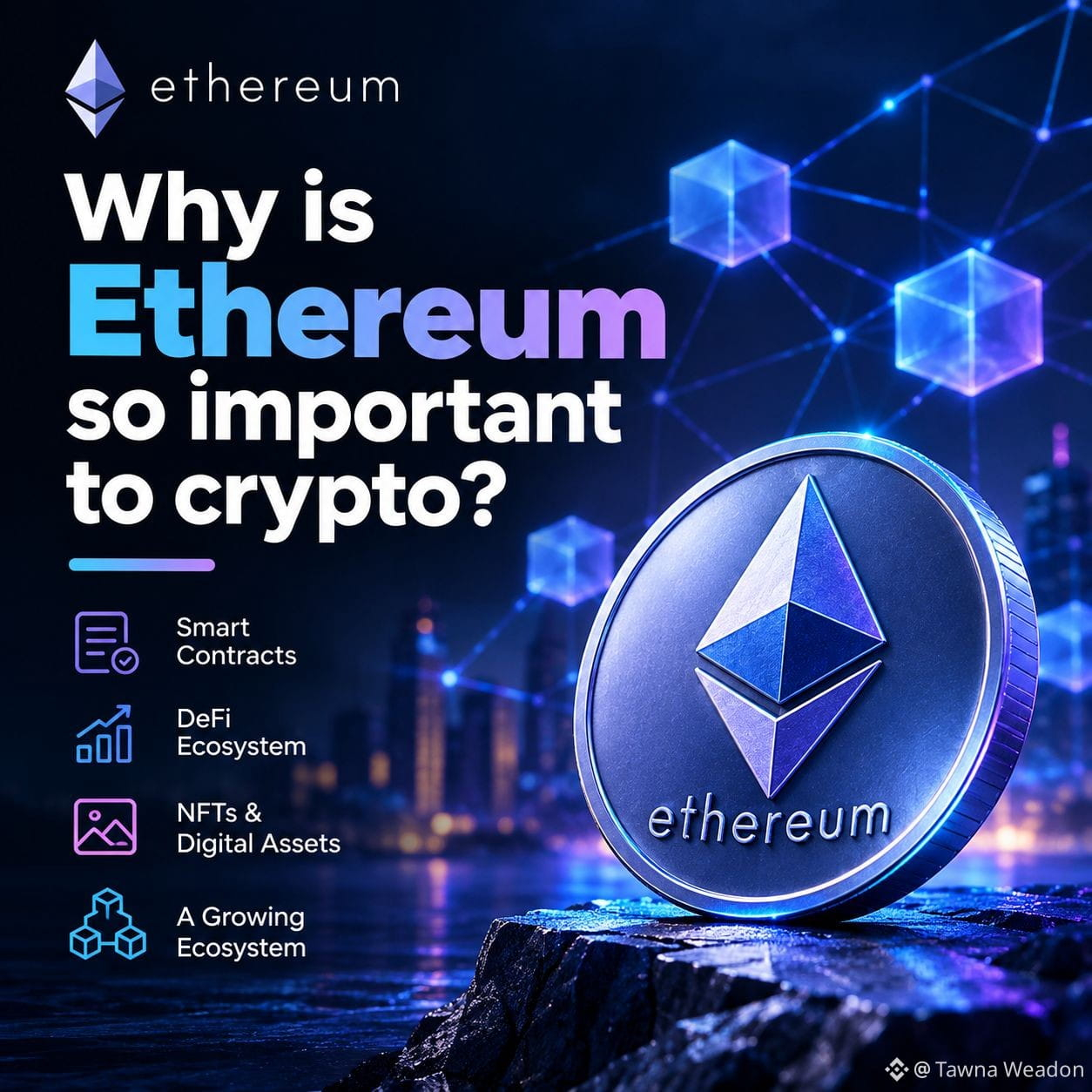
Why is Ethereum so important to crypto? 🧐
$ETH is more than just another cryptocurrency. Ethereum is one of the most widely used blockchain networks, supporting smart contracts, DeFi, NFTs, and many other applications.
One interesting thing about $ETH is that its value isn't only about price. The Ethereum network itself is used by thousands of projects and users.
For beginners, here's a simple way to think about it:
Bitcoin is often viewed as digital money, while Ethereum is more like a platform for building things on blockchain.
But which one has the stronger long-term potential — $BTC or $ETH? 👇
{spot}(ETHUSDT)
#Ethereum #ETH #Crypto #BinanceSquare
Why is Ethereum so important to crypto? 🧐
$ETH is more than just another cryptocurrency. Ethereum is one of the most widely used blockchain networks, supporting smart contracts, DeFi, NFTs, and many other applications.
One interesting thing about $ETH is that its value isn't only about price. The Ethereum network itself is used by thousands of projects and users.
For beginners, here's a simple way to think about it:
Bitcoin is often viewed as digital money, while Ethereum is more like a platform for building things on blockchain.
But which one has the stronger long-term potential — $BTC or $ETH ? 👇
#Ethereum #ETH #Crypto #BinanceSquare
$ETH is more than just another cryptocurrency. Ethereum is one of the most widely used blockchain networks, supporting smart contracts, DeFi, NFTs, and many other applications.
One interesting thing about $ETH is that its value isn't only about price. The Ethereum network itself is used by thousands of projects and users.
For beginners, here's a simple way to think about it:
Bitcoin is often viewed as digital money, while Ethereum is more like a platform for building things on blockchain.
But which one has the stronger long-term potential — $BTC or $ETH ? 👇
#Ethereum #ETH #Crypto #BinanceSquare
81
·
--
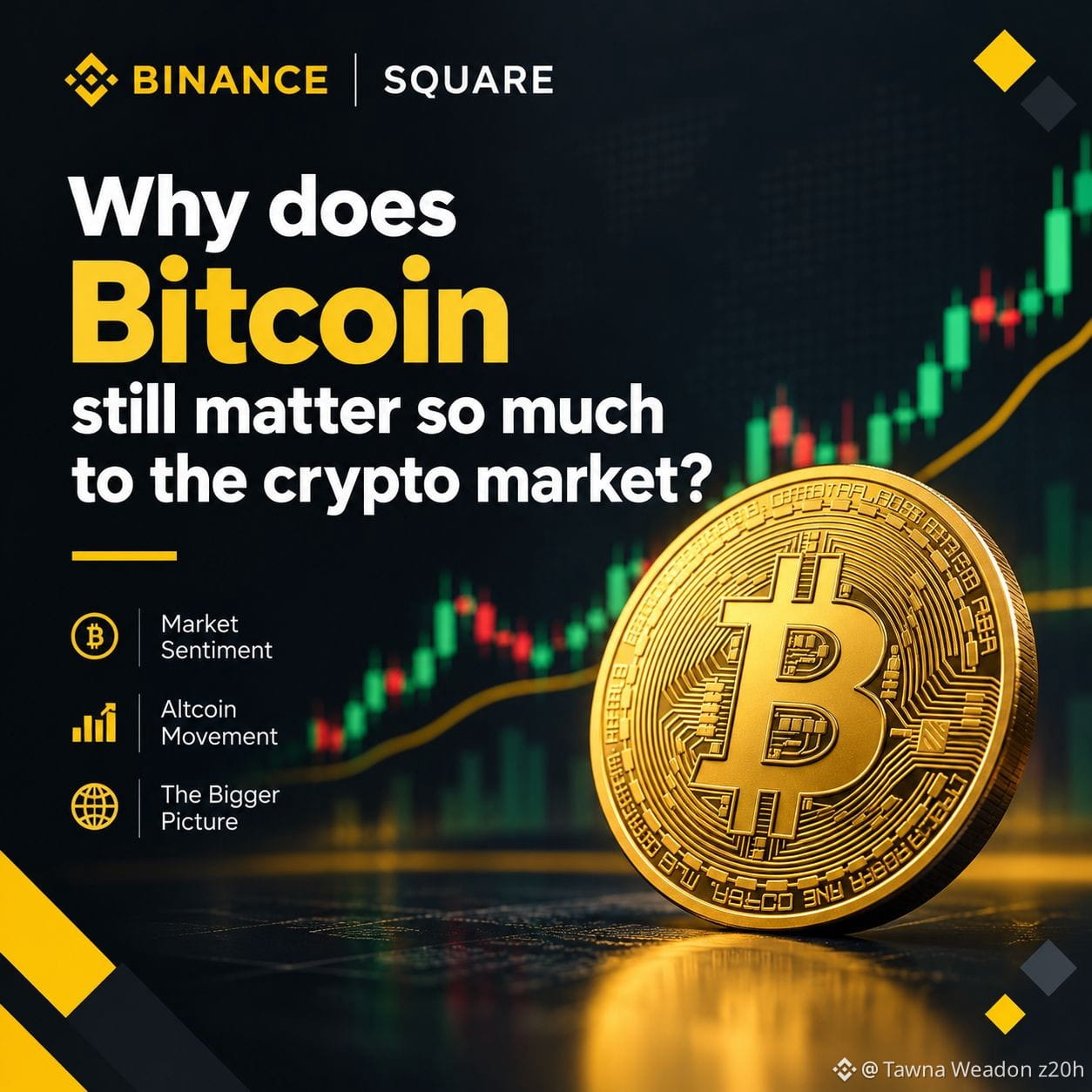
なぜビットコインは今も暗号資産市場でこれほど重要なのか? 🧐
$BTC は、時価総額で最大の暗号資産というだけではありません。ビットコインは、暗号資産全体の市場心理において重要な役割を果たすことがよくあります。
$BTC が強く動くと、トレーダーはアルトコインがどのように反応するかにも注目することが多いです。そのため、他の暗号資産を主に取引していても、ビットコインの値動きを理解しておくことは役に立ちます。
初心者にとって覚えておくとよい簡単なルールはこれです。アルトコインを単体で見ないでください。常に、特に $BTC を含むより広い市場全体に目を向けましょう。
あなたはどう思いますか――ビットコインは今後数年、主要な市場リーダーであり続けるのでしょうか? 👇
#Bitcoin #BTC #Crypto #BinanceSquare
{spot}(BTCUSDT)
なぜビットコインは今も暗号資産市場でこれほど重要なのか? 🧐
$BTC は、時価総額で最大の暗号資産というだけではありません。ビットコインは、暗号資産全体の市場心理において重要な役割を果たすことがよくあります。
$BTC が強く動くと、トレーダーはアルトコインがどのように反応するかにも注目することが多いです。そのため、他の暗号資産を主に取引していても、ビットコインの値動きを理解しておくことは役に立ちます。
初心者にとって覚えておくとよい簡単なルールはこれです。アルトコインを単体で見ないでください。常に、特に $BTC を含むより広い市場全体に目を向けましょう。
あなたはどう思いますか――ビットコインは今後数年、主要な市場リーダーであり続けるのでしょうか? 👇
#Bitcoin #BTC #Crypto #BinanceSquare
$BTC は、時価総額で最大の暗号資産というだけではありません。ビットコインは、暗号資産全体の市場心理において重要な役割を果たすことがよくあります。
$BTC が強く動くと、トレーダーはアルトコインがどのように反応するかにも注目することが多いです。そのため、他の暗号資産を主に取引していても、ビットコインの値動きを理解しておくことは役に立ちます。
初心者にとって覚えておくとよい簡単なルールはこれです。アルトコインを単体で見ないでください。常に、特に $BTC を含むより広い市場全体に目を向けましょう。
あなたはどう思いますか――ビットコインは今後数年、主要な市場リーダーであり続けるのでしょうか? 👇
#Bitcoin #BTC #Crypto #BinanceSquare
83
ログインして、さらにコンテンツを読む
厳選トピックで世界の暗号資産トレーダーの仲間入り
⚡️ 暗号資産に関する最新かつ有益な情報が見つかります。
💬 世界最大の暗号資産取引所から信頼されています。
👍 認証を受けたクリエイターから、有益なインサイトを得られます。
メール / 電話番号
トレンドトピック
ZcashETFPostsFirstWeeklyOutflow$93.6M
閲覧回数 39,025
129人が討論中
#ZcashETFPostsFirstWeeklyOutflow$93.6M
🚨🚨🚨🚨🚨🚨🚨🚨🚨🚨🚨🚨🚨🚨✅ 🚨 ZCASH ETFの資金フローが初めてマイナスに転じる!📉
$ZEC は、機関投資家の資金フローに大きな変化が起きているようで、Zcashの投資商品は8月のローンチ以来初めてとなる週次のネット・アウトフローを記録しました。
ファンドフローのデータによると、直近の週は約$93.6MがZcash商品から引き出され、同時にZECの値動きも大きく冷え込みました。
📊 何が起きた?
• 週次のZcash ETFのアウトフロー:$93.6M
• 9月30日のデイリー・アウトフロー:$30.25M
• ZCSHはこれまで1週間で約$98.2Mを集めていた
• ZECは約$1,300で取引中
• 最近の高値:約$1,690
• 週次の下落:およそ17%超
🔍 注目すべき水準
🟢 サポート:$1,280〜$1,300
🔴 レジスタンス:$1,450〜$1,500
重要なポイントは、$1,300のあたりが維持されて、新たな買い手を引きつけられるかどうかです。
機関投資家のフローも同様に重要です。安定したプラスの流入が戻れば、信頼の再燃を示唆する一方、アウトフローが続けば$ZEC への圧力が続く可能性があります。
👀 これはZECの大幅な上昇(急騰)の後の単なる利益確定なのか、それとも買い手が戻ってくる前に、さらに深い押しが見られるのでしょうか?
下にあなたの見解をシェアしてください。👇
#Zcash #ZEC #ZcashETF #Crypto
#analysis
owhggwiohsjowve
·いいね:0件
·閲覧回数 180
GreekPoliceBustCryptoScamRingArrest17
閲覧回数 93,837
768人が討論中
BitcoinRejectedAt$87K
閲覧回数 130,753
186人が討論中