

SawJan
20 投稿

SawJan
報告
ユーザーをブロック
取引を発注

SOLホルダー
低高頻度トレーダー
4.6年
8 フォロー
28 フォロワー
21 いいね
投稿
ポートフォリオ
·
--
📉 暗号資産市場アップデート:弱気派がやや優勢
暗号資産市場には小幅な下落圧力が見られ、主要資産は過去24時間で軒並み下落しています。
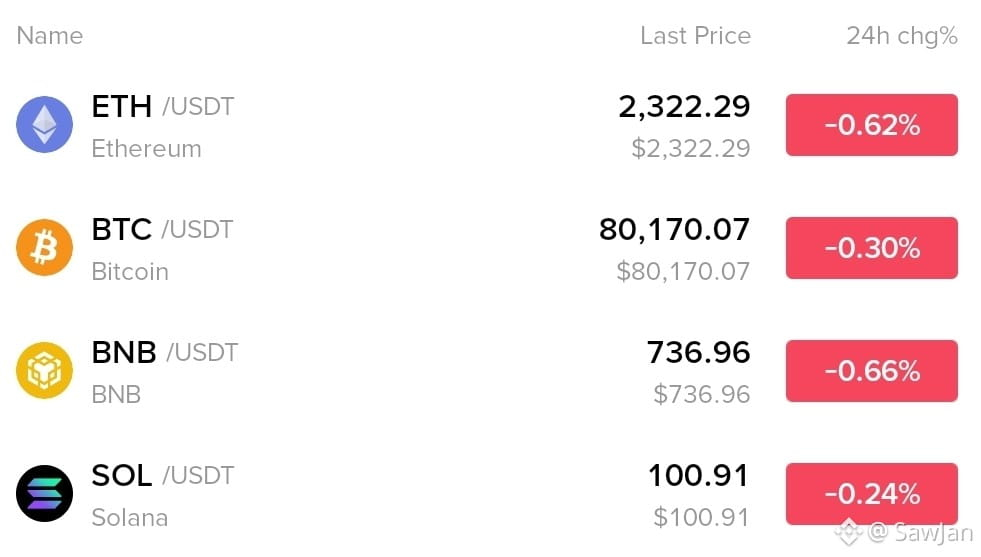
📊 市場スナップショット: 🔹 BTC:$80,170.07 | -0.30% 🔹 ETH:$2,322.29 | -0.62% 🔹 BNB:$736.96 | -0.66% 🔹 SOL:$100.91 | -0.24%
🔍 データから何が読み取れるでしょうか?
• ビットコインは相対的な強さを示しており、この4資産の中で下落幅が最小です。 • イーサリアムとBNBにはやや強い売り圧力がかかっており、BNBが最も大きく下落しています。 • ソラナは相対的な底堅さを示し、下落率は-0.24%と最小です。
🧠 私の見解:
これは明確な大きなトレンド転換の兆候というより、小幅な市場調整のように見えます。ただし、24時間のスナップショットだけでは次の動きを判断するには不十分です。
今後注目すべきポイントは、BTC価格の安定性、取引高、そしてETH、BNB、SOLが短期的な損失を取り戻せるかどうかです。
現在の赤いローソク足よりも、次の動きのほうが重要です。👀
健全な調整でしょうか、それともより深い下落の始まりでしょうか?
#Bitcoin #Ethereum #BNB #Solana #CryptoMarket
57
·
--
📉 暗号資産市場アップデート:弱気派がやや優勢
暗号資産市場には緩やかな下落圧力が見られ、主要資産は過去24時間で軒並み下落しています。
📊 市場スナップショット:
🔹 BTC:$80,170.07 | -0.30%
🔹 ETH:$2,322.29 | -0.62%
🔹 BNB:$736.96 | -0.66%
🔹 SOL:$100.91 | -0.24%
🔍 データから何が読み取れる?
• ビットコインは相対的な強さを見せ、この4資産の中で下落幅が最も小さくなっています。
• イーサリアムとBNBにはやや強い売り圧力がかかっており、BNBが最も大きく下落しています。
• ソラナは相対的な底堅さを見せ、下落率は-0.24%と最小です。
🧠 私の見解:
大きなトレンド転換を示す明確な証拠というより、緩やかな市場の調整に見えます。ただし、24時間のスナップショットだけでは次の動きを判断するには不十分です。
今後注目すべきポイントは、BTC価格の安定性、取引量、そしてETH、BNB、SOLが短期的な下落分を取り戻せるかどうかです。
現在の赤いローソク足よりも、次の動きのほうが重要です。👀
健全な調整でしょうか。それとも、より深い下落の始まりでしょうか?
#bitcoin #Ethereum #BNB #solana #CryptoMarket
82
·
--
弱気相場
今日は緑ではなく、何もかもが赤です 😬
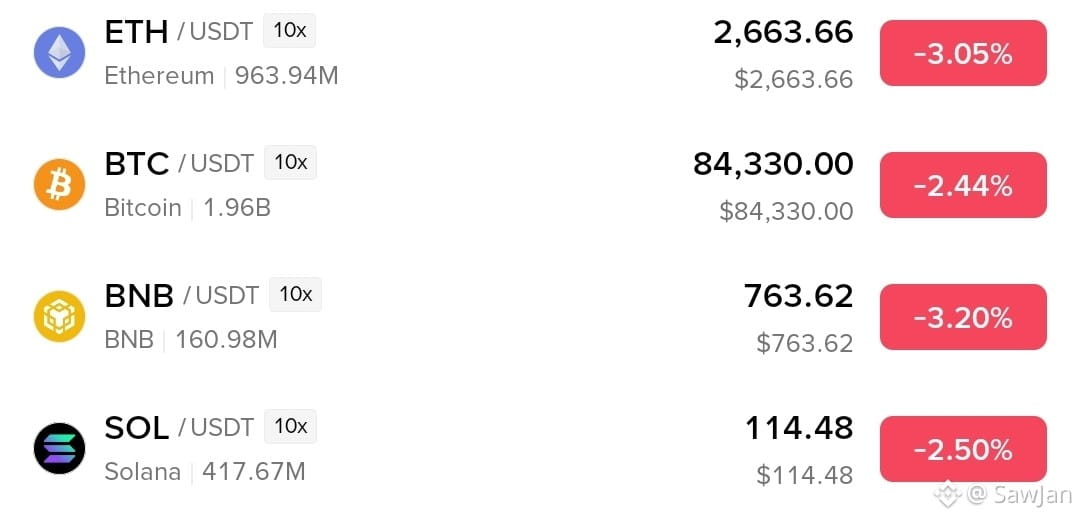
ETH -3.05% | BTC -2.44% | BNB -3.20% | SOL -2.50%
今日はどのチャートも赤く点滅しているようです 🔴
強気派は少し休憩しているようですね 🐂
焦らず、次の動きを見守りましょう 👀
ここから市場がどこへ向かうのか、見てみましょう 📉
今日は緑ではなく、何もかもが赤です 😬
ETH -3.05% | BTC -2.44% | BNB -3.20% | SOL -2.50%
今日はどのチャートも赤く点滅しているようです 🔴
強気派は少し休憩しているようですね 🐂
焦らず、次の動きを見守りましょう 👀
ここから市場がどこへ向かうのか、見てみましょう 📉
ETH -3.05% | BTC -2.44% | BNB -3.20% | SOL -2.50%
今日はどのチャートも赤く点滅しているようです 🔴
強気派は少し休憩しているようですね 🐂
焦らず、次の動きを見守りましょう 👀
ここから市場がどこへ向かうのか、見てみましょう 📉
116
·
--
DeFiは、最も高いAPYを追い求めるだけのものではなくなりつつあります。
@termmax は、固定金利での貸し借りという異なるアプローチを採用し、オンチェーンで資産を管理するユーザーに、より高い予測可能性をもたらします。
予測可能性が高まることで、大きな違いが生まれます。借り手は先を見据えた計画を立てられ、貸し手は期待できるリターンを把握でき、金利の変動に絶えず対応するのではなく、より明確な戦略に基づいて資本を配分できます。
マルチチェーン市場に対応するTermMaxは、より確かな自信を持って金融上の意思決定ができるDeFi体験の実現を目指しています。
不確実性を減らす。
より明確な仕組み。
より良い資本計画。
それこそが、DeFiに必要な方向性です。
#TermMax #DeFi #Web3
#termmax @termmax
DeFiは、最も高いAPYを追い求めるだけのものではなくなりつつあります。
@TermMax は、固定金利での貸し借りという異なるアプローチを採用し、オンチェーンで資産を管理するユーザーに、より高い予測可能性をもたらします。
予測可能性が高まることで、大きな違いが生まれます。借り手は先を見据えた計画を立てられ、貸し手は期待できるリターンを把握でき、金利の変動に絶えず対応するのではなく、より明確な戦略に基づいて資本を配分できます。
マルチチェーン市場に対応するTermMaxは、より確かな自信を持って金融上の意思決定ができるDeFi体験の実現を目指しています。
不確実性を減らす。
より明確な仕組み。
より良い資本計画。
それこそが、DeFiに必要な方向性です。
#TermMax #DeFi #Web3
#termmax @TermMax
68
·
--
DeFiに必要なのは、話題性だけではありません。資本を管理するための、より優れたツールが必要です。
@termmax は、オンチェーン金融の予測可能性を高める、固定金利の貸し借り市場を構築しています。マルチチェーンに対応し、資本配分をより明確にすることで、ユーザーはより大きな安心感を持って融資戦略に取り組めます。
金利を固定できる機能は、市場が不安定になり、変動する借入コストが急速に動く局面で、特に役立ちます。
DeFiが進化を続けるなか、予測可能な流動性と効率的な資本管理は、これまで以上に重要になるでしょう。
オンチェーン金融インフラの次世代が形作られていく今、#termmax は注目に値するプロジェクトです。
#termmax @termmax
DeFiに必要なのは、話題性だけではありません。資本を管理するための、より優れたツールが必要です。
@TermMax は、オンチェーン金融の予測可能性を高める、固定金利の貸し借り市場を構築しています。マルチチェーンに対応し、資本配分をより明確にすることで、ユーザーはより大きな安心感を持って融資戦略に取り組めます。
金利を固定できる機能は、市場が不安定になり、変動する借入コストが急速に動く局面で、特に役立ちます。
DeFiが進化を続けるなか、予測可能な流動性と効率的な資本管理は、これまで以上に重要になるでしょう。
オンチェーン金融インフラの次世代が形作られていく今、#termmax は注目に値するプロジェクトです。
#termmax @TermMax
@TermMax は、オンチェーン金融の予測可能性を高める、固定金利の貸し借り市場を構築しています。マルチチェーンに対応し、資本配分をより明確にすることで、ユーザーはより大きな安心感を持って融資戦略に取り組めます。
金利を固定できる機能は、市場が不安定になり、変動する借入コストが急速に動く局面で、特に役立ちます。
DeFiが進化を続けるなか、予測可能な流動性と効率的な資本管理は、これまで以上に重要になるでしょう。
オンチェーン金融インフラの次世代が形作られていく今、#termmax は注目に値するプロジェクトです。
#termmax @TermMax
66
·
--
#TermMax @termmax
DeFiには多くのレンディングプロトコルがありますが、予測可能な金利はまだ十分に注目されていません。
だからこそ、TermMaxが気になりました。
固定金利での貸し借りなら、資金計画がずっと立てやすくなります。市場の状況が変わるたびに対応するのではなく、あらかじめコストを把握できます。
マルチチェーンを目指す方向性も気に入っています。異なるエコシステムにまたがって市場や流動性が広がれば、固定金利商品は時間とともにさらに役立つものになるでしょう。
大きな視点で見れば、DeFiにはユーザーがより安心して資金を管理できるよう支えるインフラが必要です。
TermMaxはその方向に取り組んでおり、エコシステムがどこまで成長するのか注目しています。
注目を集めることを追い求めるDeFiプロダクトと、現実の課題を解決するインフラには違いがあります。
@termmax が興味深いのは、予測可能な借り入れと貸し出しという実用的な点に焦点を当てているからです。
特に市場が不安定になると、固定金利はユーザーが資金配分をより自在に管理する助けになります。
金利が次にどう動くかを常に気にする代わりに、ユーザーはより明確なコストと見通しに基づいてポジションを組み立てられます。
マルチチェーンのアプローチはさらなる可能性をもたらし、より多くの流動性や市場へのアクセスを開くかもしれません。
私にとって、これは注目する価値のあるDeFiインフラです。
ノイズは少なく。実用性は高く。
#TermMax
DeFiにまだ必要なのは、より高い予測可能性です。
その点で、@termmax は興味深い価値を示しています。
固定金利での貸し借りは、オンチェーンの資金計画を立てやすくします。戦略のために借り入れる場合も、流動性を配分する場合も、あらかじめ金利が分かれば多くの不確実性を取り除けます。
マルチチェーンのビジョンも重要だと思います。
流動性がいつまでも個別のエコシステム内に閉じ込められるべきではありません。
TermMaxが複数のチェーンにまたがって信頼できる固定金利市場を構築し続けられれば、より幅広いDeFiユーザーにとって役立つインフラになる可能性があります。
その構想はシンプルです。
予測可能な金利。
より良い資金計画。
より効率的なDeFi。
#termmax @termmax
#TermMax @termmax
DeFiには多くのレンディングプロトコルがありますが、予測可能な金利はまだ十分に注目されていません。
だからこそ、TermMaxが気になりました。
固定金利での貸し借りなら、資金計画がずっと立てやすくなります。市場の状況が変わるたびに対応するのではなく、あらかじめコストを把握できます。
マルチチェーンを目指す方向性も気に入っています。異なるエコシステムにまたがって市場や流動性が広がれば、固定金利商品は時間とともにさらに役立つものになるでしょう。
大きな視点で見れば、DeFiにはユーザーがより安心して資金を管理できるよう支えるインフラが必要です。
TermMaxはその方向に取り組んでおり、エコシステムがどこまで成長するのか注目しています。
注目を集めることを追い求めるDeFiプロダクトと、現実の課題を解決するインフラには違いがあります。
@TermMax が興味深いのは、予測可能な借り入れと貸し出しという実用的な点に焦点を当てているからです。
特に市場が不安定になると、固定金利はユーザーが資金配分をより自在に管理する助けになります。
金利が次にどう動くかを常に気にする代わりに、ユーザーはより明確なコストと見通しに基づいてポジションを組み立てられます。
マルチチェーンのアプローチはさらなる可能性をもたらし、より多くの流動性や市場へのアクセスを開くかもしれません。
私にとって、これは注目する価値のあるDeFiインフラです。
ノイズは少なく。実用性は高く。
#TermMax
DeFiにまだ必要なのは、より高い予測可能性です。
その点で、@TermMax は興味深い価値を示しています。
固定金利での貸し借りは、オンチェーンの資金計画を立てやすくします。戦略のために借り入れる場合も、流動性を配分する場合も、あらかじめ金利が分かれば多くの不確実性を取り除けます。
マルチチェーンのビジョンも重要だと思います。
流動性がいつまでも個別のエコシステム内に閉じ込められるべきではありません。
TermMaxが複数のチェーンにまたがって信頼できる固定金利市場を構築し続けられれば、より幅広いDeFiユーザーにとって役立つインフラになる可能性があります。
その構想はシンプルです。
予測可能な金利。
より良い資金計画。
より効率的なDeFi。
#termmax @TermMax
77
·
--
翻訳参照
TermMax is making DeFi feel more predictable by bringing fixed-rate lending, borrowing, and leverage on-chain. Instead of dealing with constantly changing rates, users can lock in borrowing costs or expected yields until maturity. The protocol also supports managed vaults, multi-chain markets, and one-click leverage, making complex strategies easier to access. What stands out to me is the focus on predictable capital allocation rather than simply chasing short-term incentives. As DeFi matures, fixed-rate markets could become an important building block for both users and institutions. TermMax is definitely one protocol worth watching as this category develops. #termmax @termmax #termmax @termmax
TermMax is making DeFi feel more predictable by bringing fixed-rate lending, borrowing, and leverage on-chain. Instead of dealing with constantly changing rates, users can lock in borrowing costs or expected yields until maturity. The protocol also supports managed vaults, multi-chain markets, and one-click leverage, making complex strategies easier to access. What stands out to me is the focus on predictable capital allocation rather than simply chasing short-term incentives. As DeFi matures, fixed-rate markets could become an important building block for both users and institutions. TermMax is definitely one protocol worth watching as this category develops. #termmax @TermMax #termmax @TermMax
68
·
--
翻訳参照
TermMax is building a more flexible way to access fixed-term DeFi markets, giving users better control over yield, maturity, and capital efficiency. What stands out to me about @TermMax is the focus on structured, term-based financial products rather than treating every DeFi position as purely variable. As DeFi evolves, predictable maturity and clearer risk-return profiles could become increasingly important for both users and protocols. TermMax is working toward making these markets more accessible while expanding the possibilities of onchain fixed-term finance. I’ll be watching how the ecosystem develops and how users leverage its growing product stack.
#termmax @termmax
TermMax is building a more flexible way to access fixed-term DeFi markets, giving users better control over yield, maturity, and capital efficiency. What stands out to me about @TermMax is the focus on structured, term-based financial products rather than treating every DeFi position as purely variable. As DeFi evolves, predictable maturity and clearer risk-return profiles could become increasingly important for both users and protocols. TermMax is working toward making these markets more accessible while expanding the possibilities of onchain fixed-term finance. I’ll be watching how the ecosystem develops and how users leverage its growing product stack.
#termmax @TermMax
#termmax @TermMax

68
·
--
翻訳参照
The future of trading isn't about choosing between earning yield and staying liquid—it's about having both in one seamless experience.
That's what makes GRVT stand out. By combining the speed and efficiency of a centralized exchange with the transparency and security of decentralized infrastructure, it creates a platform where users remain in control of their assets while accessing a smoother trading experience.
Whether you're trading crypto or real-world assets, your eligible balances don't have to sit idle. Instead, your capital can continue working in the background while remaining available for your next opportunity.
Self-custody, fast execution, and on-chain settlement aren't just technical features—they're building blocks for a more efficient financial system. As more users look for platforms that maximize both flexibility and capital efficiency, solutions like GRVT are becoming increasingly relevant.
The next generation of exchanges won't simply focus on lower fees or faster trades. They'll focus on making every asset more productive without compromising ownership or transparency.
GRVT is moving in that direction by bringing trading, earning, and self-custody together in a single unified experience. That's the kind of innovation that has the potential to reshape how we interact with digital and real-world assets.
@grvt_io #grvt
65
·
--
ブリッシュ
翻訳参照
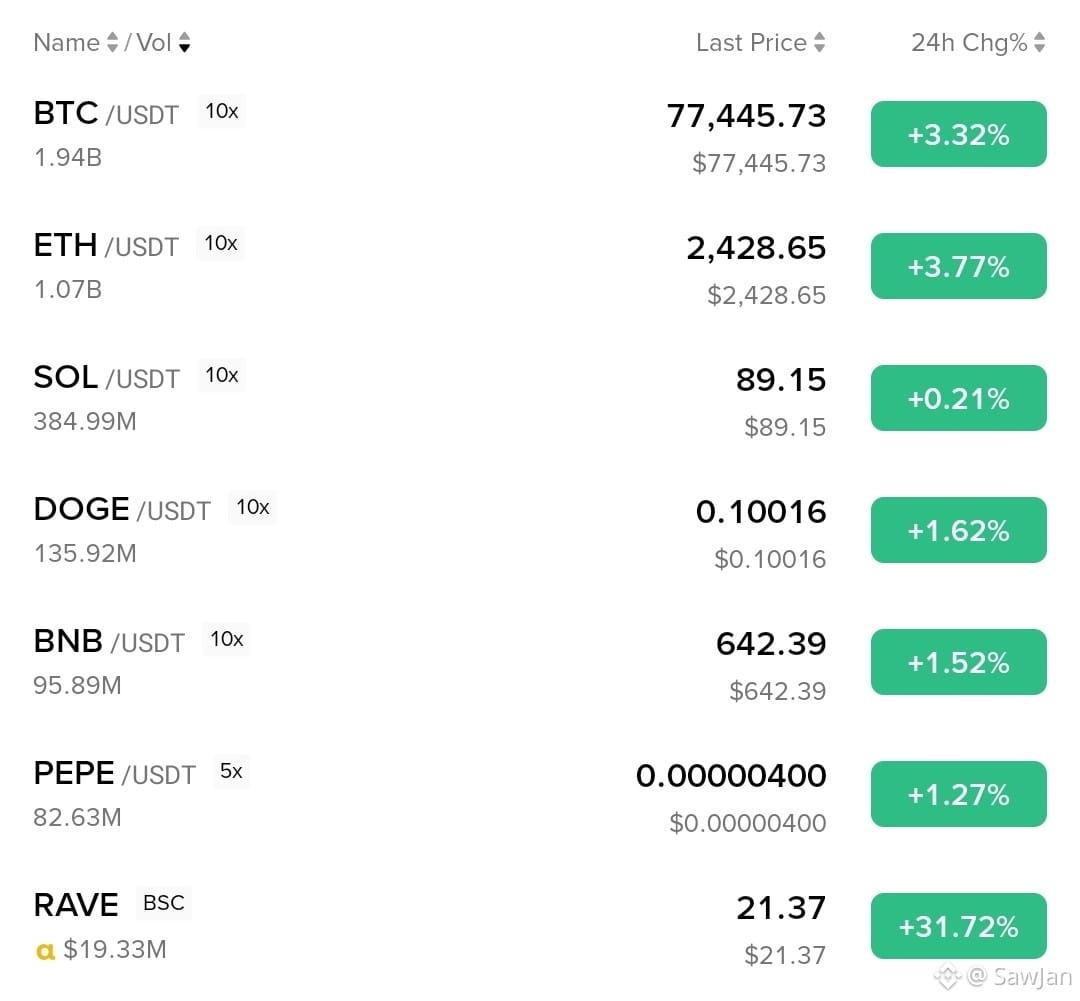
After long time the market is going to be green 💚 and $BTC , $ETH , $SOL and other coin going up start pump and i hope market going well a every coin gain they'res previous price.
After long time the market is going to be green 💚 and $BTC , $ETH , $SOL and other coin going up start pump and i hope market going well a every coin gain they'res previous price.
65
·
--

記事
翻訳参照
pixelThe evolution of @Pixels is becoming one of the most interesting case studies in web3 gaming right now. What started as a simple farming-style game has gradually transformed into a much deeper and more structured ecosystem through its Stacked approach. This shift is not just about adding features, but about creating a sustainable loop where players, creators, and the in-game economy all reinforce each other.
At the center of this system is $PIXEL. Instead of being just another in-game currency, it’s being positioned as the core layer that connects activity, rewards, and long-term participation. As more mechanics are introduced into the Stacked ecosystem, the role of $PIXEL becomes more meaningful, especially as utility expands across different parts of the platform.
One of the most important aspects of this evolution is how @Pixels is aligning incentives. Players are no longer just grinding for short-term rewards; they are contributing to a broader system that benefits from active participation. Creators, on the other hand, are becoming key drivers of growth by bringing attention, education, and narrative to the ecosystem. This combination creates a flywheel effect that is hard to replicate.
Another thing worth noting is the focus on scalability. Many web3 games struggle to maintain user interest over time, but the Stacked ecosystem appears designed to continuously introduce new layers of engagement. This keeps the experience fresh while also strengthening the value proposition of $PIXEL .
If this direction continues, @Pixels could set a strong example for how web3 gaming ecosystems should be built — not around short-term hype, but around long-term value creation. The integration of gameplay, economy, and community is what makes this model stand out.
Overall, the growth of @Pixels and its Stacked ecosystem shows that we are moving toward a more mature phase of web3 gaming. It’s no longer just about playing; it’s about participating in an evolving digital economy. And with $PIXEL at the center of it all, the foundation looks solid for future expansion.
pixel
The evolution of @Pixels is becoming one of the most interesting case studies in web3 gaming right now. What started as a simple farming-style game has gradually transformed into a much deeper and more structured ecosystem through its Stacked approach. This shift is not just about adding features, but about creating a sustainable loop where players, creators, and the in-game economy all reinforce each other.
At the center of this system is $PIXEL . Instead of being just another in-game currency, it’s being positioned as the core layer that connects activity, rewards, and long-term participation. As more mechanics are introduced into the Stacked ecosystem, the role of $PIXEL becomes more meaningful, especially as utility expands across different parts of the platform.
One of the most important aspects of this evolution is how @Pixels is aligning incentives. Players are no longer just grinding for short-term rewards; they are contributing to a broader system that benefits from active participation. Creators, on the other hand, are becoming key drivers of growth by bringing attention, education, and narrative to the ecosystem. This combination creates a flywheel effect that is hard to replicate.
Another thing worth noting is the focus on scalability. Many web3 games struggle to maintain user interest over time, but the Stacked ecosystem appears designed to continuously introduce new layers of engagement. This keeps the experience fresh while also strengthening the value proposition of $PIXEL .
If this direction continues, @Pixels could set a strong example for how web3 gaming ecosystems should be built — not around short-term hype, but around long-term value creation. The integration of gameplay, economy, and community is what makes this model stand out.
Overall, the growth of @Pixels and its Stacked ecosystem shows that we are moving toward a more mature phase of web3 gaming. It’s no longer just about playing; it’s about participating in an evolving digital economy. And with $PIXEL at the center of it all, the foundation looks solid for future expansion.
18
·
--
翻訳参照
pixelThe evolution of @Pixels is becoming one of the most interesting case studies in web3 gaming right now. What started as a simple farming-style game has gradually transformed into a much deeper and more structured ecosystem through its Stacked approach. This shift is not just about adding features, but about creating a sustainable loop where players, creators, and the in-game economy all reinforce each other.
At the center of this system is $PIXEL. Instead of being just another in-game currency, it’s being positioned as the core layer that connects activity, rewards, and long-term participation. As more mechanics are introduced into the Stacked ecosystem, the role of $PIXEL becomes more meaningful, especially as utility expands across different parts of the platform.
One of the most important aspects of this evolution is how @Pixels is aligning incentives. Players are no longer just grinding for short-term rewards; they are contributing to a broader system that benefits from active participation. Creators, on the other hand, are becoming key drivers of growth by bringing attention, education, and narrative to the ecosystem. This combination creates a flywheel effect that is hard to replicate.
Another thing worth noting is the focus on scalability. Many web3 games struggle to maintain user interest over time, but the Stacked ecosystem appears designed to continuously introduce new layers of engagement. This keeps the experience fresh while also strengthening the value proposition of $PIXEL.
If this direction continues, @Pixels could set a strong example for how web3 gaming ecosystems should be built — not around short-term hype, but around long-term value creation. The integration of gameplay, economy, and community is what makes this model stand out.
Overall, the growth of @Pixels and its Stacked ecosystem shows that we are moving toward a more mature phase of web3 gaming. It’s no longer just about playing; it’s about participating in an evolving digital economy. And with $PIXEL at the center of it all, the foundation looks solid for future expansion. #pixel
pixel
The evolution of @Pixels is becoming one of the most interesting case studies in web3 gaming right now. What started as a simple farming-style game has gradually transformed into a much deeper and more structured ecosystem through its Stacked approach. This shift is not just about adding features, but about creating a sustainable loop where players, creators, and the in-game economy all reinforce each other.
At the center of this system is $PIXEL. Instead of being just another in-game currency, it’s being positioned as the core layer that connects activity, rewards, and long-term participation. As more mechanics are introduced into the Stacked ecosystem, the role of $PIXEL becomes more meaningful, especially as utility expands across different parts of the platform.
One of the most important aspects of this evolution is how @Pixels is aligning incentives. Players are no longer just grinding for short-term rewards; they are contributing to a broader system that benefits from active participation. Creators, on the other hand, are becoming key drivers of growth by bringing attention, education, and narrative to the ecosystem. This combination creates a flywheel effect that is hard to replicate.
Another thing worth noting is the focus on scalability. Many web3 games struggle to maintain user interest over time, but the Stacked ecosystem appears designed to continuously introduce new layers of engagement. This keeps the experience fresh while also strengthening the value proposition of $PIXEL.
If this direction continues, @Pixels could set a strong example for how web3 gaming ecosystems should be built — not around short-term hype, but around long-term value creation. The integration of gameplay, economy, and community is what makes this model stand out.
Overall, the growth of @Pixels and its Stacked ecosystem shows that we are moving toward a more mature phase of web3 gaming. It’s no longer just about playing; it’s about participating in an evolving digital economy. And with $PIXEL at the center of it all, the foundation looks solid for future expansion. #pixel
18
·
--
翻訳参照
Seeing @Pixels grow into a full Stacked ecosystem is honestly impressive. What started as a simple web3 game is now evolving into something much bigger, where $PIXEL plays a key role in connecting gameplay, economy, and creators. The way they are building utility around the token shows long-term thinking rather than short-term hype. More players, more creators, and more use cases mean stronger network effects over time. If this momentum continues, Pixels could become a benchmark for how web3 gaming ecosystems should scale. Definitely worth paying attention to how this develops. #pixel
Seeing @Pixels grow into a full Stacked ecosystem is honestly impressive. What started as a simple web3 game is now evolving into something much bigger, where $PIXEL plays a key role in connecting gameplay, economy, and creators. The way they are building utility around the token shows long-term thinking rather than short-term hype. More players, more creators, and more use cases mean stronger network effects over time. If this momentum continues, Pixels could become a benchmark for how web3 gaming ecosystems should scale. Definitely worth paying attention to how this develops. #pixel
20
·
--
翻訳参照
Alpha Trading Competition you just see last day of events close no Trading Volume but you just start tarding then end event time . then see you are the last person never win event and Trading leaderboard is high 😂😂😂😂
Alpha Trading Competition you just see last day of events close no Trading Volume but you just start tarding then end event time . then see you are the last person never win event and Trading leaderboard is high 😂😂😂😂
2
·
--
記事
翻訳参照
Most DeFi is still stateless execution.Most DeFi is still stateless execution. @mira_network introduces persistent, context-aware agents that learn, adapt, and coordinate capital over time. By combining verifiable data, memory, and programmable liquidity, Mira enables continuous strategy evolution instead of isolated trades. $MIRA aligns data, execution, and incentives into one feedback loop, creating infrastructure for AI-native markets that compound intelligence and capital together. #Mira
Most DeFi is still stateless execution.
Most DeFi is still stateless execution. @mira_network introduces persistent, context-aware agents that learn, adapt, and coordinate capital over time. By combining verifiable data, memory, and programmable liquidity, Mira enables continuous strategy evolution instead of isolated trades. $MIRA aligns data, execution, and incentives into one feedback loop, creating infrastructure for AI-native markets that compound intelligence and capital together. #Mira
1
·
--
翻訳参照
Most DeFi is still stateless execution. @mira_network.Most DeFi is still stateless execution. @mira_network introduces persistent, context-aware agents that learn, adapt, and coordinate capital over time. By combining verifiable data, memory, and programmable liquidity, Mira enables continuous strategy evolution instead of isolated trades. $MIRA aligns data, execution, and incentives into one feedback loop, creating infrastructure for AI-native markets that compound intelligence and capital. #mira $MIRA
Most DeFi is still stateless execution. @mira_network.
Most DeFi is still stateless execution. @mira_network introduces persistent, context-aware agents that learn, adapt, and coordinate capital over time. By combining verifiable data, memory, and programmable liquidity, Mira enables continuous strategy evolution instead of isolated trades. $MIRA aligns data, execution, and incentives into one feedback loop, creating infrastructure for AI-native markets that compound intelligence and capital. #mira $MIRA
4
·
--
翻訳参照
Composable intelligence will define the next phase of onchain markets, and @mira_network is building the coordination layer for it. By enabling agents with persistent memory, verifiable data access, and programmable execution, Mira turns isolated smart contract calls into adaptive financial behavior. $MIRA aligns incentives across data providers, strategists, and liquidity venues, creating a feedback loop where strategies improve over time instead of resetting each transaction. This is infrastructure for AI-native DeFi—stateful, context-aware, and capital efficient by design. #mira $MIRA
Composable intelligence will define the next phase of onchain markets, and @mira_network is building the coordination layer for it. By enabling agents with persistent memory, verifiable data access, and programmable execution, Mira turns isolated smart contract calls into adaptive financial behavior. $MIRA aligns incentives across data providers, strategists, and liquidity venues, creating a feedback loop where strategies improve over time instead of resetting each transaction. This is infrastructure for AI-native DeFi—stateful, context-aware, and capital efficient by design. #mira $MIRA
3
·
--
翻訳参照
Autonomous agents need unified rails to manage data, memory, and capital without fragmentation.Autonomous agents need unified rails to manage data, memory, and capital without fragmentation. That’s the core of @mira_network—stateful AI actors executing on verifiable infrastructure with continuous context. $MIRA aligns incentives across data, liquidity, and execution, turning isolated transactions into adaptive financial behavior. This is coordination infrastructure for AI-native DeFi, where strategies learn, persist, and compound onchain. #Mira
Autonomous agents need unified rails to manage data, memory, and capital without fragmentation.
Autonomous agents need unified rails to manage data, memory, and capital without fragmentation. That’s the core of @mira_network—stateful AI actors executing on verifiable infrastructure with continuous context. $MIRA aligns incentives across data, liquidity, and execution, turning isolated transactions into adaptive financial behavior. This is coordination infrastructure for AI-native DeFi, where strategies learn, persist, and compound onchain. #Mira
6
12
·
--
翻訳参照
Liquidity, identity, and execution need to live in the same layer for AI-driven finance to scale. That’s the vision behind @mira_network—autonomous agents operating on unified rails with verifiable context and programmable capital. $MIRA isn’t just a token, it’s coordination infrastructure for the next machine economy.
#mira $MIRA
#mira $MIRA
10
22
·
--
翻訳参照
#BinanceTurns8 Join us in the #BinanceTurns8 celebration and win a share of up to $888,888 in BNB!
#BinanceTurns8 Join us in the #BinanceTurns8 celebration and win a share of up to $888,888 in BNB!
5
5
ログインして、さらにコンテンツを読む
厳選トピックで世界の暗号資産トレーダーの仲間入り
⚡️ 暗号資産に関する最新かつ有益な情報が見つかります。
💬 世界最大の暗号資産取引所から信頼されています。
👍 認証を受けたクリエイターから、有益なインサイトを得られます。
メール / 電話番号