
Binance Square
Nasir416
66 投稿

Nasir416

newbie
31 フォロー
26 フォロワー
35 いいね
投稿
·
--
翻訳参照
termmax is amazing
termmax is amazing
saving thanh
·
--
TermMax is a DeFi fixed-rate lending and borrowing protocol.
Termmax main focus is offering users fixed interest rates for lending and borrowing, ensuring the rate is locked at the time of the transaction. (this is the good for both parties )
It operates on Ethereum, Arbitrum, BNB Chain, Base, Berachain, and several other chains.
Important: On CoinGecko's current page, TMX is currently being shown as an 'upcoming cryptocurrency,' and its price is unavailable.
#termmax @TermMax
記事
翻訳参照
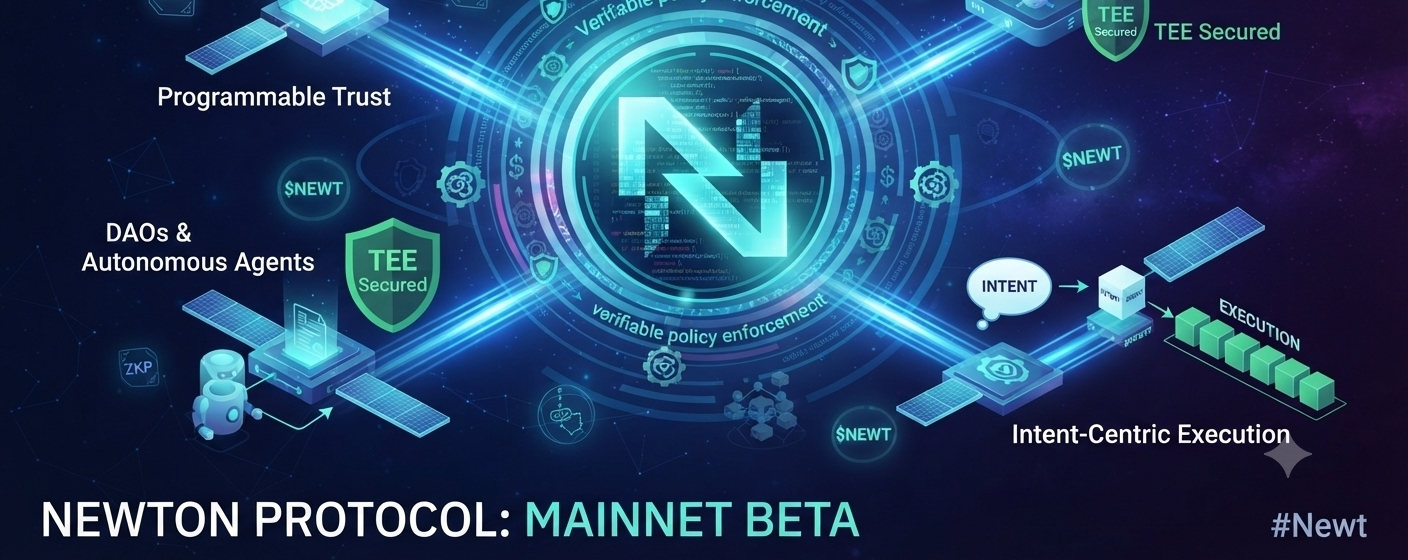
Unlocking the Future of On-Chain Automation: A Deep Dive into Newton ProtocolUnlocking the Future of On-Chain Automation: A Deep Dive into Newton Protocol The blockchain ecosystem has reached a critical juncture. While we have seen massive advancements in transaction speeds and lower costs, a fundamental challenge remains: how do we create reliable, programmable, and secure on-chain automation? This is where the Newton Protocol and its recently launched Mainnet Beta are setting a new standard for the industry. Bridging Intent and Execution At its core, Newton Protocol is designed to act as a decentralized authorization layer. It solves the "trust gap" in decentralized applications by enabling verifiable policy enforcement. In the current landscape, many autonomous agents and decentralized autonomous organizations (DAOs) struggle with managing risks while maintaining decentralization. Newton changes this dynamic by allowing users and protocols to define clear parameters for transactions. By bridging the gap between user "intent" and final "execution," the protocol ensures that every action is compliant with predefined security policies. This level of granular control is essential for bringing institutional-grade operations onto the blockchain. The Power of TEEs and Zero-Knowledge Proofs One of the most impressive technical aspects of the Newton Mainnet Beta is its robust security architecture. By integrating Trusted Execution Environments (TEEs) and zero-knowledge proofs (ZKPs), the protocol enables a new level of "programmable trust." This is not merely about security; it is about creating an environment where complex, cross-chain interactions can occur safely. Whether it is managing treasury assets for a DAO or powering autonomous trading agents, the architecture ensures that policies are enforced at the hardware and cryptographic level. This creates a tamper-proof framework that makes on-chain automation truly viable for the long term. Why the $NEWT Ecosystem Matters As we look at the broader market, the role of $NEWT within this ecosystem cannot be overstated. It serves as the fuel for this decentralized authorization infrastructure, incentivizing the nodes and participants necessary to maintain a secure and efficient network. The launch of the Mainnet Beta is not just a milestone for the team at @NewtonProtocol it is a major development for the entire Web3 space. By providing the tools to enforce policies autonomously, Newton is effectively building the "Internet of Policies." For developers and investors alike, this signifies a shift from simple decentralized finance to a more mature, complex, and reliable ecosystem. I am closely tracking how the $NEWT ecosystem grows over the coming months. With the infrastructure now live and functional, the potential for developers to build advanced, secure, and compliant decentralized tools is higher than ever. @NewtonProtocol #newt

Unlocking the Future of On-Chain Automation: A Deep Dive into Newton Protocol

Unlocking the Future of On-Chain Automation: A Deep Dive into Newton Protocol
The blockchain ecosystem has reached a critical juncture. While we have seen massive advancements in transaction speeds and lower costs, a fundamental challenge remains: how do we create reliable, programmable, and secure on-chain automation? This is where the Newton Protocol and its recently launched Mainnet Beta are setting a new standard for the industry.
Bridging Intent and Execution
At its core, Newton Protocol is designed to act as a decentralized authorization layer. It solves the "trust gap" in decentralized applications by enabling verifiable policy enforcement. In the current landscape, many autonomous agents and decentralized autonomous organizations (DAOs) struggle with managing risks while maintaining decentralization.
Newton changes this dynamic by allowing users and protocols to define clear parameters for transactions. By bridging the gap between user "intent" and final "execution," the protocol ensures that every action is compliant with predefined security policies. This level of granular control is essential for bringing institutional-grade operations onto the blockchain.
The Power of TEEs and Zero-Knowledge Proofs
One of the most impressive technical aspects of the Newton Mainnet Beta is its robust security architecture. By integrating Trusted Execution Environments (TEEs) and zero-knowledge proofs (ZKPs), the protocol enables a new level of "programmable trust."
This is not merely about security; it is about creating an environment where complex, cross-chain interactions can occur safely. Whether it is managing treasury assets for a DAO or powering autonomous trading agents, the architecture ensures that policies are enforced at the hardware and cryptographic level. This creates a tamper-proof framework that makes on-chain automation truly viable for the long term.
Why the $NEWT Ecosystem Matters
As we look at the broader market, the role of $NEWT within this ecosystem cannot be overstated. It serves as the fuel for this decentralized authorization infrastructure, incentivizing the nodes and participants necessary to maintain a secure and efficient network.
The launch of the Mainnet Beta is not just a milestone for the team at @NewtonProtocol it is a major development for the entire Web3 space. By providing the tools to enforce policies autonomously, Newton is effectively building the "Internet of Policies." For developers and investors alike, this signifies a shift from simple decentralized finance to a more mature, complex, and reliable ecosystem.
I am closely tracking how the $NEWT ecosystem grows over the coming months. With the infrastructure now live and functional, the potential for developers to build advanced, secure, and compliant decentralized tools is higher than ever.
@NewtonProtocol #newt
翻訳参照
#newt $NEWT The launch of the Newton Mainnet Beta is a significant milestone for the future of onchain finance and automation. By acting as a decentralized authorization layer, @NewtonProtocol is solving a critical gap by enabling programmable, verifiable policy enforcement before transactions even settle. What makes this truly impressive is the use of advanced cryptography—like Trusted Execution Environments (TEEs) and zero-knowledge proofs—to ensure compliance and security for DAOs and AI agents without sacrificing privacy. This isn't just about speed; it's about building an "Internet of Policies" that makes autonomous finance both scalable and institutional-grade. I’m definitely watching how the $NEWT ecosystem continues to expand as more developers integrate these robust controls. 🚀 #Newt
#newt $NEWT The launch of the Newton Mainnet Beta is a significant milestone for the future of onchain finance and automation. By acting as a decentralized authorization layer, @NewtonProtocol is solving a critical gap by enabling programmable, verifiable policy enforcement before transactions even settle.
What makes this truly impressive is the use of advanced cryptography—like Trusted Execution Environments (TEEs) and zero-knowledge proofs—to ensure compliance and security for DAOs and AI agents without sacrificing privacy. This isn't just about speed; it's about building an "Internet of Policies" that makes autonomous finance both scalable and institutional-grade. I’m definitely watching how the $NEWT ecosystem continues to expand as more developers integrate these robust controls. 🚀
#Newt
記事
翻訳参照
The Evolution of On-Chain Automation: A Deep Dive into Newton ProtocolThe Evolution of On-Chain Automation: A Deep Dive into Newton Protocol The decentralized finance (DeFi) landscape is witnessing a significant shift toward more secure, programmable, and automated systems. At the forefront of this evolution is the Newton Protocol, which has officially moved into its **Mainnet Beta** phase, marking a transformative moment for developers and institutions alike. By serving as a robust, decentralized policy engine, Newton Protocol is effectively bridging the gap between traditional financial compliance and the permissionless nature of blockchain technology. Programmable Compliance and Risk Management One of the most compelling aspects of @NewtonProtocol is its role as an authorization layer for transaction execution. Unlike traditional systems that rely on off-chain intermediaries, Newton enables developers to embed intricate compliance and risk controls directly into the transaction process itself. This ensures that only authorized, compliant actions are finalized on-chain, drastically reducing the risk of malicious activity or regulatory friction. VaultKit SDK and Real-Time Verification The introduction of the VaultKit SDK empowers builders to construct on-chain vaults where policy rules are enforced programmatically. By integrating verified, real-time price data—notably through partnerships with providers like RedStone—the protocol allows for the dynamic management of collateral and risk parameters. This capability is essential for creating institutional-grade financial products that maintain safety without sacrificing speed. Strengthening the $NEWT Ecosystem Underpinned by the $NEWT token and leveraging EigenLayer restaking, Newton Protocol is setting a new standard for trustless, self-operating financial infrastructure. As the ecosystem matures during the Mainnet Beta, we are seeing the foundational elements of a more transparent and secure future for decentralized assets. Whether you are a developer looking to build compliant dApps or an investor monitoring the space, the integration of these tools is a clear sign that the industry is moving toward more mature, robust architectures. Join the conversation and explore the future of secure, on-chain finance with #Newt $NEWT @NewtonProtocol

The Evolution of On-Chain Automation: A Deep Dive into Newton Protocol

The Evolution of On-Chain Automation: A Deep Dive into Newton Protocol
The decentralized finance (DeFi) landscape is witnessing a significant shift toward more secure, programmable, and automated systems. At the forefront of this evolution is the Newton Protocol, which has officially moved into its **Mainnet Beta** phase, marking a transformative moment for developers and institutions alike. By serving as a robust, decentralized policy engine, Newton Protocol is effectively bridging the gap between traditional financial compliance and the permissionless nature of blockchain technology.
Programmable Compliance and Risk Management
One of the most compelling aspects of @NewtonProtocol is its role as an authorization layer for transaction execution. Unlike traditional systems that rely on off-chain intermediaries, Newton enables developers to embed intricate compliance and risk controls directly into the transaction process itself. This ensures that only authorized, compliant actions are finalized on-chain, drastically reducing the risk of malicious activity or regulatory friction.
VaultKit SDK and Real-Time Verification
The introduction of the VaultKit SDK empowers builders to construct on-chain vaults where policy rules are enforced programmatically. By integrating verified, real-time price data—notably through partnerships with providers like RedStone—the protocol allows for the dynamic management of collateral and risk parameters. This capability is essential for creating institutional-grade financial products that maintain safety without sacrificing speed.
Strengthening the $NEWT Ecosystem
Underpinned by the $NEWT token and leveraging EigenLayer restaking, Newton Protocol is setting a new standard for trustless, self-operating financial infrastructure. As the ecosystem matures during the Mainnet Beta, we are seeing the foundational elements of a more transparent and secure future for decentralized assets. Whether you are a developer looking to build compliant dApps or an investor monitoring the space, the integration of these tools is a clear sign that the industry is moving toward more mature, robust architectures.
Join the conversation and explore the future of secure, on-chain finance with #Newt $NEWT @NewtonProtocol
翻訳参照
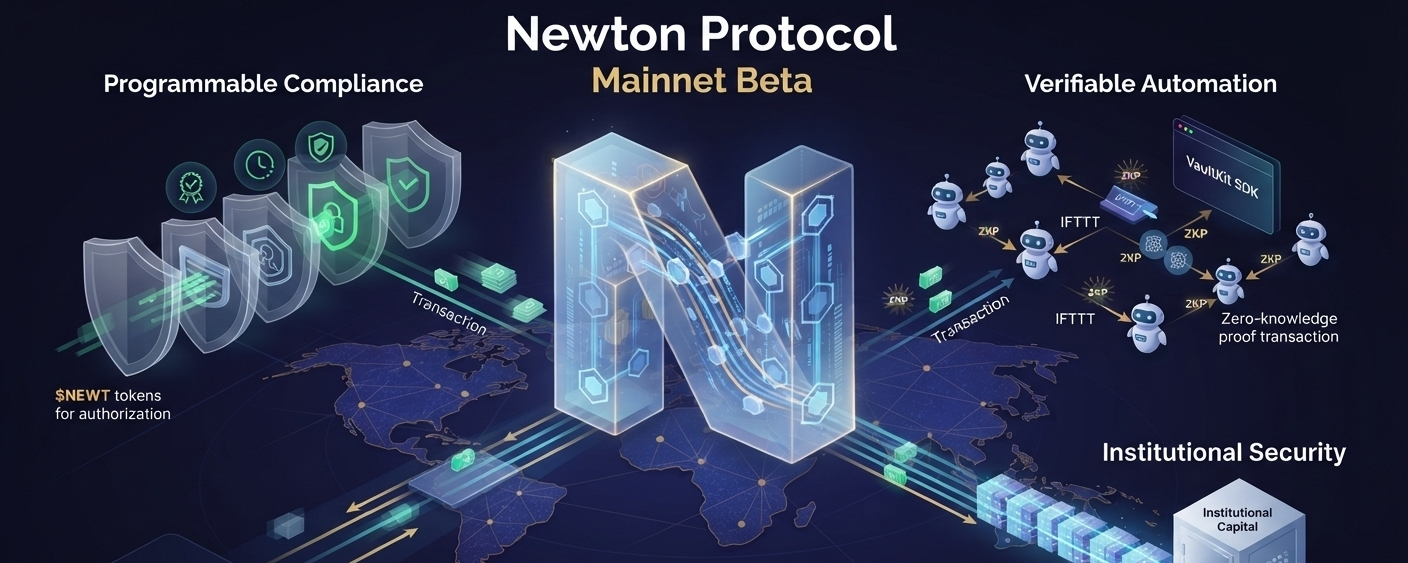
#newt $NEWT The Newton Protocol is making waves with its Mainnet Beta, functioning as a decentralized policy engine that brings secure, programmable on-chain automation to finance. By acting as an authorization layer, @NewtonProtocol allows developers to embed compliance and risk controls directly into transaction execution, ensuring only compliant transactions proceed. With the launch of the VaultKit SDK, builders can now create vaults where rules are enforced on-chain, utilizing verified price data from partners like RedStone to manage collateral and risk in real-time. This shift toward verifiable execution—secured by $NEWT and EigenLayer restaking—is a major step toward making decentralized finance more transparent, secure, and institutional-ready. The future of self-operating, trustless finance is here with #Newt.
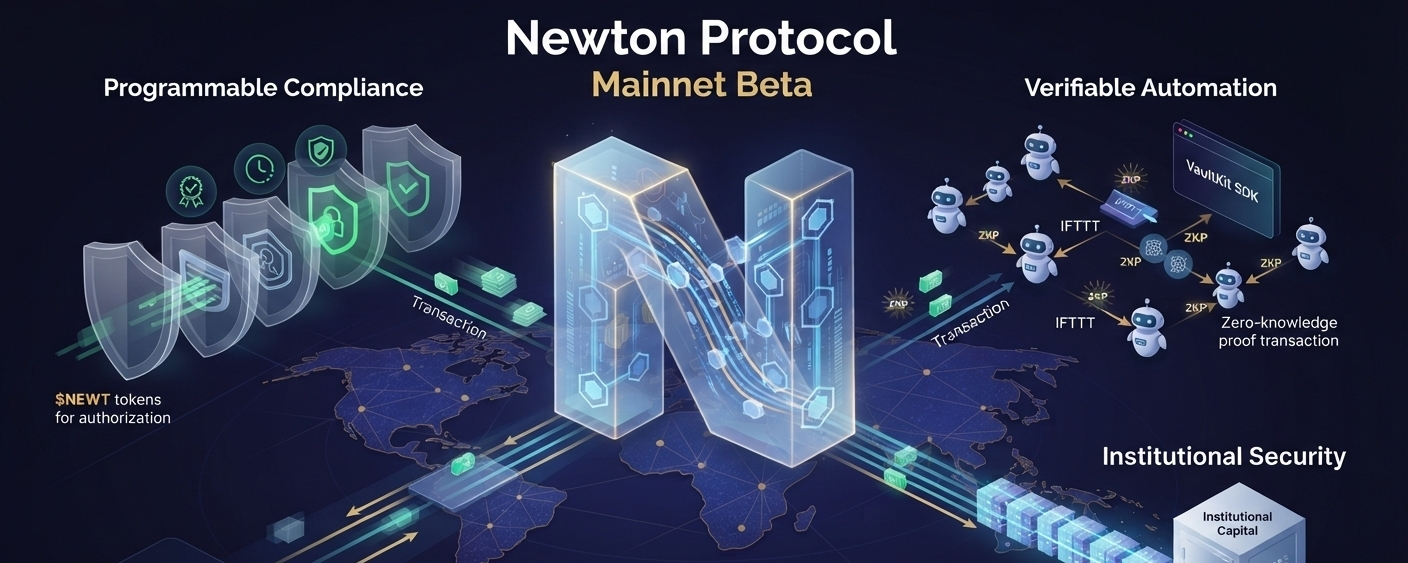
#newt $NEWT The Newton Protocol is making waves with its Mainnet Beta, functioning as a decentralized policy engine that brings secure, programmable on-chain automation to finance. By acting as an authorization layer, @NewtonProtocol allows developers to embed compliance and risk controls directly into transaction execution, ensuring only compliant transactions proceed.
With the launch of the VaultKit SDK, builders can now create vaults where rules are enforced on-chain, utilizing verified price data from partners like RedStone to manage collateral and risk in real-time. This shift toward verifiable execution—secured by $NEWT and EigenLayer restaking—is a major step toward making decentralized finance more transparent, secure, and institutional-ready. The future of self-operating, trustless finance is here with #Newt.
記事
翻訳参照
Newton Mainnet Beta: A Step Toward Smarter On-Chain AuthorizationThe blockchain industry has spent years improving speed, scalability, and liquidity, but one important challenge still remains: how can on-chain systems make smarter decisions before transactions happen? This is where @NewtonProtocol is becoming an interesting project to watch. Why Newton Protocol Matters Most smart contracts execute instructions exactly as they are written, but they usually cannot understand real-world context or advanced permission logic. As crypto grows and attracts institutions, AI agents, and automated systems, stronger control mechanisms become increasingly important. Newton Protocol aims to become an authorization and policy layer that helps define how transactions should behave before execution. Instead of simply processing activity, the network focuses on programmable rules, security checks, and verification systems that can help improve trust and reduce unnecessary risk. My Thoughts on Newton Mainnet Beta The launch of Newton Mainnet Beta feels like more than just another network milestone. To me, it represents movement toward practical infrastructure rather than hype-only narratives. A future with autonomous systems and AI-driven interactions will need stronger transaction policies and verifiable logic. If crypto wants mass adoption, users and institutions will need systems where permissions, risk controls, and transparency work together. Mainnet Beta creates a chance to test how these ideas perform in a real environment and whether they can support broader ecosystem growth. Looking Ahead I think projects solving infrastructure problems often gain value over time because they focus on building foundations rather than short-term attention. I will be closely watching ecosystem development, adoption, and future updates surrounding $NEWT Innovation in crypto is no longer only about faster chains; it is also about making blockchain actions smarter and safer. $NEWT #Newt @NewtonProtocol

Newton Mainnet Beta: A Step Toward Smarter On-Chain Authorization

The blockchain industry has spent years improving speed, scalability, and liquidity, but one important challenge still remains: how can on-chain systems make smarter decisions before transactions happen? This is where @NewtonProtocol is becoming an interesting project to watch.
Why Newton Protocol Matters
Most smart contracts execute instructions exactly as they are written, but they usually cannot understand real-world context or advanced permission logic. As crypto grows and attracts institutions, AI agents, and automated systems, stronger control mechanisms become increasingly important.
Newton Protocol aims to become an authorization and policy layer that helps define how transactions should behave before execution. Instead of simply processing activity, the network focuses on programmable rules, security checks, and verification systems that can help improve trust and reduce unnecessary risk.
My Thoughts on Newton Mainnet Beta
The launch of Newton Mainnet Beta feels like more than just another network milestone. To me, it represents movement toward practical infrastructure rather than hype-only narratives. A future with autonomous systems and AI-driven interactions will need stronger transaction policies and verifiable logic.
If crypto wants mass adoption, users and institutions will need systems where permissions, risk controls, and transparency work together. Mainnet Beta creates a chance to test how these ideas perform in a real environment and whether they can support broader ecosystem growth.
Looking Ahead
I think projects solving infrastructure problems often gain value over time because they focus on building foundations rather than short-term attention. I will be closely watching ecosystem development, adoption, and future updates surrounding $NEWT
Innovation in crypto is no longer only about faster chains; it is also about making blockchain actions smarter and safer.
$NEWT #Newt @NewtonProtocol
記事
翻訳参照
The Future of Autonomous Finance: Exploring the Newton Mainnet BetaThe arrival of the Newton Protocol Mainnet Beta marks a pivotal moment for the evolution of decentralized finance. As we witness the increasing complexity of on-chain operations—ranging from AI-driven agent trading to sophisticated vault management—the need for a robust, secure, and verifiable authorization layer has never been more critical. By integrating programmable compliance directly into the transaction execution layer, @NewtonProtocol is successfully bridging the gap between institutional-grade risk management and the permissionless nature of blockchain technology. Why Newton’s Mainnet Beta Matters At its core, Newton functions as an authorization engine that validates transactions against specific policies *before* they are finalized on-chain. In the current ecosystem, many automated tasks still rely on fragile off-chain bots or manual review processes, which introduce significant centralization risks and friction. Newton solves this by utilizing: Trusted Execution Environments (TEEs): These hardware-based environments allow for sensitive policy evaluation off-chain while maintaining a verifiable audit trail. Zero-Knowledge Proofs (ZKPs): Newton uses ZKPs to ensure that policy checks—such as KYC, accreditation, or spending limits—can be performed privately without exposing sensitive user data. Modular Architecture: By separating intent definition, execution, and validation, the protocol enables seamless integration across various chains, DAOs, and wallets. The Power of $NEWT and Data Integration The $NEWT token serves as the backbone of this ecosystem, powering network governance, staking for security, and computation fees. What makes the current Mainnet Beta particularly exciting is the integration of high-quality, real-time data sources like RedStone and Credora. By feeding verified market data and risk ratings directly into the policy engine, Newton enables curators to automate complex risk-mitigation strategies—such as triggering collateral liquidations or blocking transactions during extreme market volatility—with unprecedented precision. A Step Toward Self-Operating Finance For developers, the introduction of the VaultKit SDK represents a major leap forward, allowing for the rapid deployment of "if-this-then-that" logic that is transparent and censorship-resistant. As more institutions and protocols adopt this infrastructure, we are moving toward an era where finance becomes truly "self-operating." The transparency provided by the Newton Explorer allows any auditor or user to verify that these policies are being enforced as intended, building a new level of trust in autonomous systems. As we continue to see the adoption of AI agents in the crypto space, having a secure, policy-gated infrastructure like the one provided by #Newt will be essential to ensuring that these agents operate within safe and compliant boundaries. The launch of the Mainnet Beta is just the beginning. As the ecosystem matures and more builders integrate these tools, @NewtonProtocol is well-positioned to become the standard for verifiable on-chain automation. It is an exciting time to watch how this infrastructure will handle the next generation of institutional and retail asset flows. Disclaimer: This content is for informational purposes only and does not constitute financial advice. Always perform your own research before engaging with new protocols or dig ital assets.

The Future of Autonomous Finance: Exploring the Newton Mainnet Beta

The arrival of the Newton Protocol Mainnet Beta marks a pivotal moment for the evolution of decentralized finance. As we witness the increasing complexity of on-chain operations—ranging from AI-driven agent trading to sophisticated vault management—the need for a robust, secure, and verifiable authorization layer has never been more critical. By integrating programmable compliance directly into the transaction execution layer, @NewtonProtocol is successfully bridging the gap between institutional-grade risk management and the permissionless nature of blockchain technology.
Why Newton’s Mainnet Beta Matters
At its core, Newton functions as an authorization engine that validates transactions against specific policies *before* they are finalized on-chain. In the current ecosystem, many automated tasks still rely on fragile off-chain bots or manual review processes, which introduce significant centralization risks and friction. Newton solves this by utilizing:
Trusted Execution Environments (TEEs): These hardware-based environments allow for sensitive policy evaluation off-chain while maintaining a verifiable audit trail.
Zero-Knowledge Proofs (ZKPs): Newton uses ZKPs to ensure that policy checks—such as KYC, accreditation, or spending limits—can be performed privately without exposing sensitive user data.
Modular Architecture: By separating intent definition, execution, and validation, the protocol enables seamless integration across various chains, DAOs, and wallets.
The Power of $NEWT and Data Integration
The $NEWT token serves as the backbone of this ecosystem, powering network governance, staking for security, and computation fees. What makes the current Mainnet Beta particularly exciting is the integration of high-quality, real-time data sources like RedStone and Credora. By feeding verified market data and risk ratings directly into the policy engine, Newton enables curators to automate complex risk-mitigation strategies—such as triggering collateral liquidations or blocking transactions during extreme market volatility—with unprecedented precision.
A Step Toward Self-Operating Finance
For developers, the introduction of the VaultKit SDK represents a major leap forward, allowing for the rapid deployment of "if-this-then-that" logic that is transparent and censorship-resistant. As more institutions and protocols adopt this infrastructure, we are moving toward an era where finance becomes truly "self-operating."
The transparency provided by the Newton Explorer allows any auditor or user to verify that these policies are being enforced as intended, building a new level of trust in autonomous systems. As we continue to see the adoption of AI agents in the crypto space, having a secure, policy-gated infrastructure like the one provided by #Newt will be essential to ensuring that these agents operate within safe and compliant boundaries.
The launch of the Mainnet Beta is just the beginning. As the ecosystem matures and more builders integrate these tools, @NewtonProtocol is well-positioned to become the standard for verifiable on-chain automation. It is an exciting time to watch how this infrastructure will handle the next generation of institutional and retail asset flows.
Disclaimer: This content is for informational purposes only and does not constitute financial advice. Always perform your own research before engaging with new protocols or dig
ital assets.
翻訳参照
#newt $NEWT The launch of the Newton Mainnet Beta is a significant leap forward for on-chain automation. By integrating programmable compliance directly into the transaction layer, @NewtonProtocol is effectively bridging the gap between institutional-grade security and decentralized finance. The use of $NEWT to power these authorization policies—spanning identity requirements, spending limits, and jurisdiction restrictions—demonstrates a robust model for securing autonomous agents. It is fascinating to see how the protocol utilizes TEEs and zero-knowledge proofs to ensure that these automated tasks remain both private and verifiable. As the ecosystem continues to grow, this foundational infrastructure will likely become essential for safe, automated on-chain commerce. #Newt
翻訳参照
#opg $OPG Whether you’re using the SDK for verifiable LLM workflows or just testing out the privacy-focused chat interface, it’s clear that $OPG is building the infrastructure for the next era of decentralized intelligence. Excited to see how the ecosystem grows! #OPG
#opg $OPG Whether you’re using the SDK for verifiable LLM workflows or just testing out the privacy-focused chat interface, it’s clear that $OPG is building the infrastructure for the next era of decentralized intelligence. Excited to see how the ecosystem grows!
#OPG
翻訳参照
#opg $OPG Many projects talk about AI, but I like looking at whether the vision can actually scale. @OpenGradient is trying to build something that links AI and open infrastructure in a meaningful way. Keeping an eye on $OPG and future updates. #OPG
翻訳参照
#opg $OPG The rapid evolution of artificial intelligence is hitting a major bottleneck: trust and scalability. Most of the AI tools we use today are opaque, operating inside centralized silos where user privacy is often sacrificed for performance. This is exactly why I’m keeping a close eye on @OpenGradient. Their approach to decentralized infrastructure, specifically through their Hybrid AI Compute Architecture, is exactly the kind of innovation the industry needs to move toward verifiable, transparent AI. Beyond the technical architecture, OpenGradient Chat is a standout application. It’s rare to find a platform that actually delivers on the promise of on-device encryption while maintaining a high-performance experience. By decoupling user identity from AI queries, they are setting a new standard for how we should interact with large language models in a web3 environment. We are witnessing a fundamental shift in how compute is distributed, and I’m bullish on how $OPG is positioning itself to lead this transition. It’s an essential project to watch for anyone serious about the intersection of privacy and machine learning. #OPG
#opg $OPG The rapid evolution of artificial intelligence is hitting a major bottleneck: trust and scalability. Most of the AI tools we use today are opaque, operating inside centralized silos where user privacy is often sacrificed for performance. This is exactly why I’m keeping a close eye on @OpenGradient. Their approach to decentralized infrastructure, specifically through their Hybrid AI Compute Architecture, is exactly the kind of innovation the industry needs to move toward verifiable, transparent AI.
Beyond the technical architecture, OpenGradient Chat is a standout application. It’s rare to find a platform that actually delivers on the promise of on-device encryption while maintaining a high-performance experience. By decoupling user identity from AI queries, they are setting a new standard for how we should interact with large language models in a web3 environment. We are witnessing a fundamental shift in how compute is distributed, and I’m bullish on how $OPG is positioning itself to lead this transition. It’s an essential project to watch for anyone serious about the intersection of privacy and machine learning.
#OPG
翻訳参照
#opg $OPG I’ve been exploring what @OpenGradient is building, and it’s impressive to see how they’ve integrated such a massive Model Hub (over 4,000 models!) directly into a blockchain-native environment. Whether it's for AI agents or DeFi risk analysis, the ability to outsource complex compute while maintaining trustless verification is a game changer for Web3. Keep an eye on $OPG as they continue to scale verifiable AI across the industry! #OPG
翻訳参照
#opg $OPG The shift towards verifiable AI isn't just a technical upgrade; it's a fundamental change in how we interact with intelligence. By using @OpenGradient, we’re finally moving away from the "black box" models that dominate the space. Their platform effectively uses $OPG to align incentives with privacy, making it possible for developers to deploy models that are both powerful and inherently trustworthy. Using OpenGradient Chat feels like a glimpse into a more secure future where our data isn't the product. Truly impressive to see how they are handling decentralized computation in real-time. #OPG
翻訳参照
#opg $OPG The real challenge with AI today isn't making models slightly smarter; it's decentralized control. @OpenGradient is building a dedicated network to host, execute, and verify AI models without relying on a few tech giants. Looking forward to seeing how $OPG changes the infrastructure landscape. #OPG
翻訳参照
#opg $OPG A lot of web3 infrastructure projects struggle with real-world consumer adoption, but the OpenGradient Chat ecosystem bridges that gap perfectly. Linking consumer use directly to network demand via $OPG credits creates a sustainable economic model for decentralized private computing. Looking forward to seeing how the privacy layer holds up as more creators deploy agents! Check out the official updates from @OpenGradient to stay ahead of the curve. #OPG $OPG
#opg $OPG A lot of web3 infrastructure projects struggle with real-world consumer adoption, but the OpenGradient Chat ecosystem bridges that gap perfectly. Linking consumer use directly to network demand via $OPG credits creates a sustainable economic model for decentralized private computing. Looking forward to seeing how the privacy layer holds up as more creators deploy agents!
Check out the official updates from @OpenGradient to stay ahead of the curve. #OPG $OPG
翻訳参照
#opg $OPG As cryptographic verifiability becomes crucial for the AI era, the native utility of $OPG stands out as a foundational backbone for secure, decentralized intelligence. Definitely a project and ecosystem to watch closely! #OPG
翻訳参照
#opg $OPG Security and decentralization are non-negotiable for the future of AI. @OpenGradient is building the exact infrastructure we need to bridge open-source AI models with Web3 security. Keeping a close eye on $OPG and their latest ecosystem updates. Big things are coming! #OPG
翻訳参照
#opg $OPG Decentralized AI requires trustless execution, and @OpenGradient makes it seamless for developers to access over 2,000 open-source models natively through Solidity smart contracts. From DeFi risk analysis to autonomous agents, the utility of the network settles directly in $OPG. Excited to keep an eye on this ecosystem! #OPG
#opg $OPG Decentralized AI requires trustless execution, and @OpenGradient makes it seamless for developers to access over 2,000 open-source models natively through Solidity smart contracts. From DeFi risk analysis to autonomous agents, the utility of the network settles directly in $OPG . Excited to keep an eye on this ecosystem! #OPG
翻訳参照
OpenGradient
·
--
大手AI企業がプライバシーポリシーを更新しました。

今や、あなたの政府発行ID、あなたの写真、そしてあなたの顔を要求することができます。

「プライベート」なんてどこへやら。

私たちはプライベートなものを作りました: http://chat.opengradient.ai。

パート4: AIトーク (∇, ∇)
翻訳参照
#opg $OPG AI communities are moving beyond closed systems toward open ecosystems. @OpenGradient and OpenGradient Chat bring an interesting perspective by focusing on accessible intelligence and broader participation. Keeping an eye on innovation around $OPG and the community growth ahead. #OPG
ログインして、さらにコンテンツを読む
厳選トピックで世界の暗号資産トレーダーの仲間入り
⚡️ 暗号資産に関する最新かつ有益な情報が見つかります。
💬 世界最大の暗号資産取引所から信頼されています。
👍 認証を受けたクリエイターから、有益なインサイトを得られます。
メール / 電話番号
サイトマップ
Cookieの設定
プラットフォーム利用規約