
L I S A
3.1k 投稿

L I S A
取引を発注

LINEAホルダー
高頻度トレーダー
1.3年
114 フォロー
5.9K+ フォロワー
29.3K+ いいね
投稿
ポートフォリオ
すべて
引用
ライブ
翻訳参照
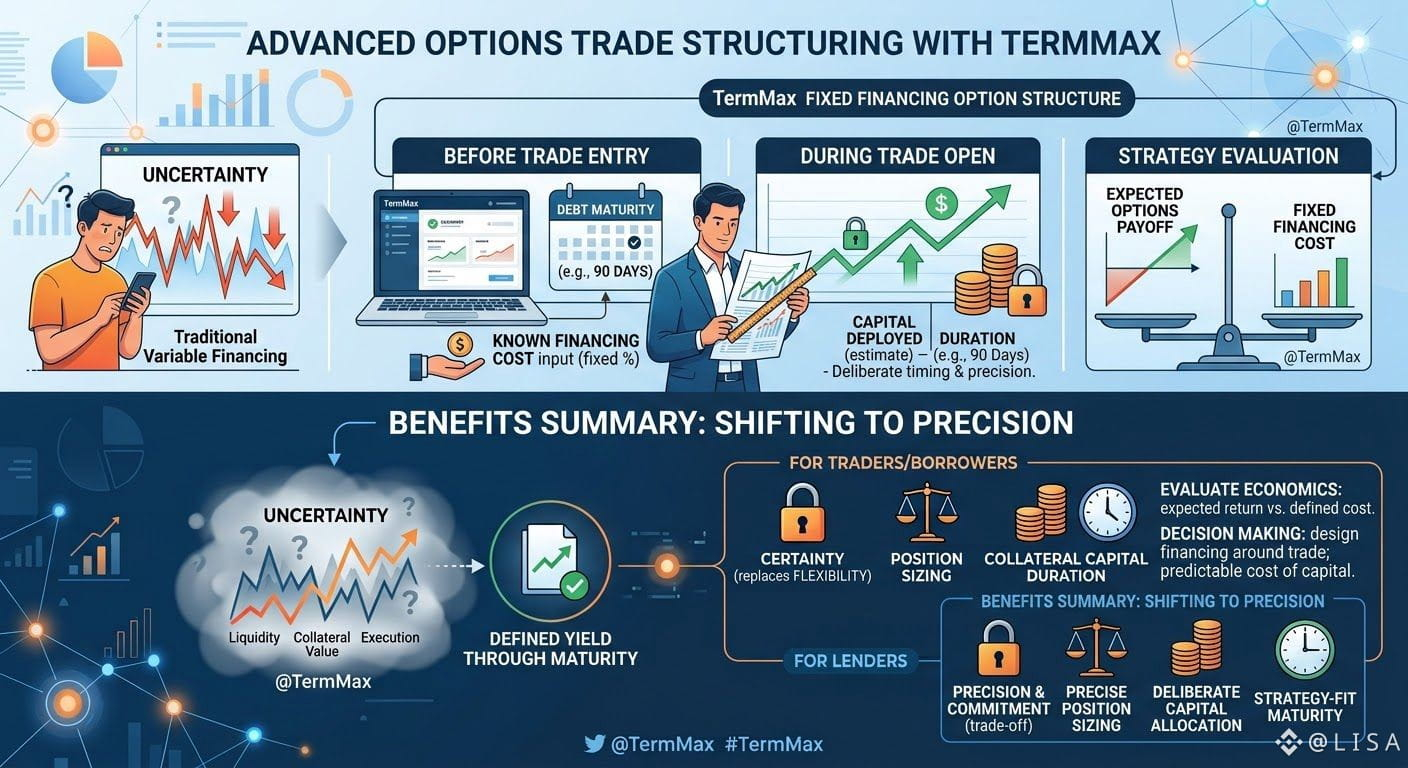
The part of TermMax I find most interesting is how fixed term financing changes the way I can structure an options trade. I usually think about an options position through entry, payoff, and risk, but financing can quietly alter the result while the trade is still open. With @TermMax , a fixed borrowing cost gives me a known financing input through maturity. That means I can estimate the cost of carry before entering instead of treating future interest expense as an unknown. #TermMax
The trade off is that precision comes with commitment. A fixed term means I need to choose a maturity that actually fits the strategy, rather than keeping capital completely flexible. But when the timing is deliberate, that constraint can be useful. I can compare the expected options payoff against a financing cost that stays defined, making the economics easier to evaluate before I commit capital. I see this as a subtle shift from simply borrowing to designing the financing around the trade itself. If options already require careful assumptions about timing and payoff, why should the cost of capital remain unpredictable?
The trade off is that precision comes with commitment. A fixed term means I need to choose a maturity that actually fits the strategy, rather than keeping capital completely flexible. But when the timing is deliberate, that constraint can be useful. I can compare the expected options payoff against a financing cost that stays defined, making the economics easier to evaluate before I commit capital. I see this as a subtle shift from simply borrowing to designing the financing around the trade itself. If options already require careful assumptions about timing and payoff, why should the cost of capital remain unpredictable?
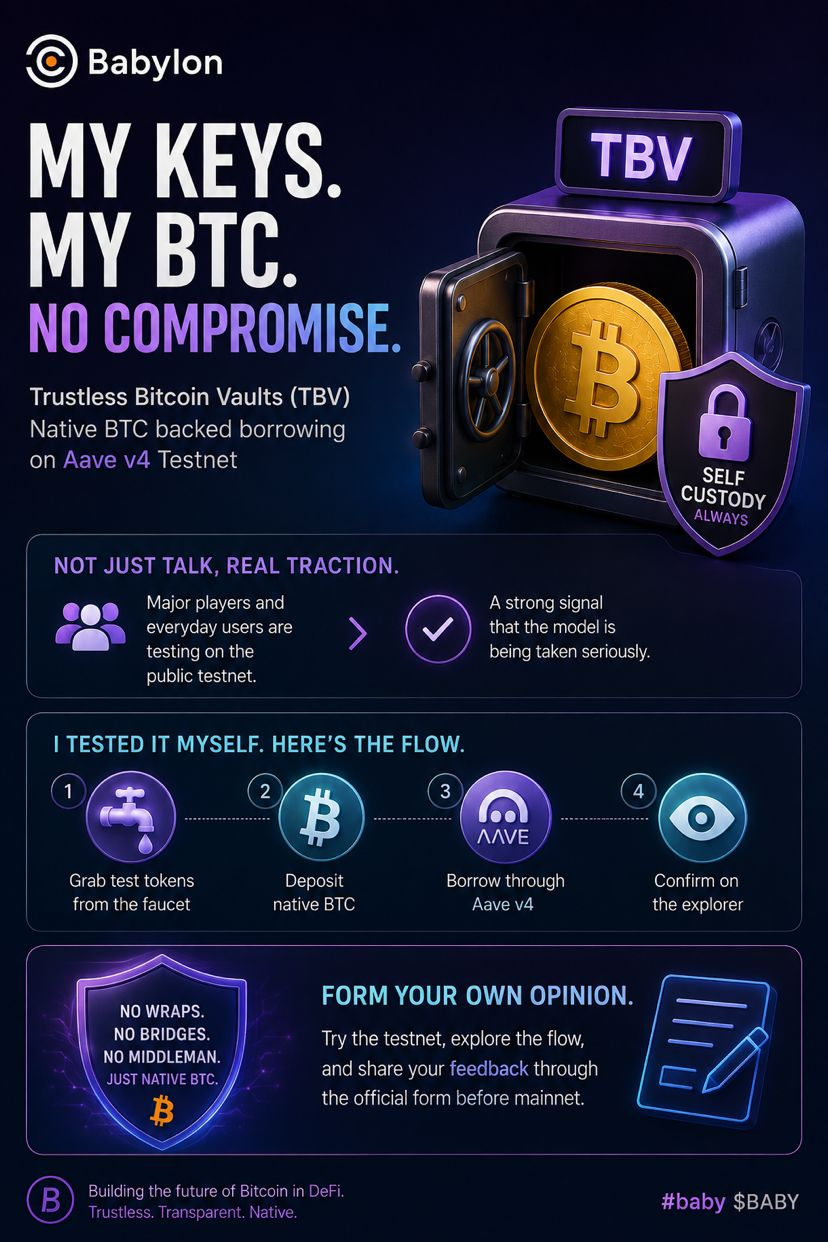
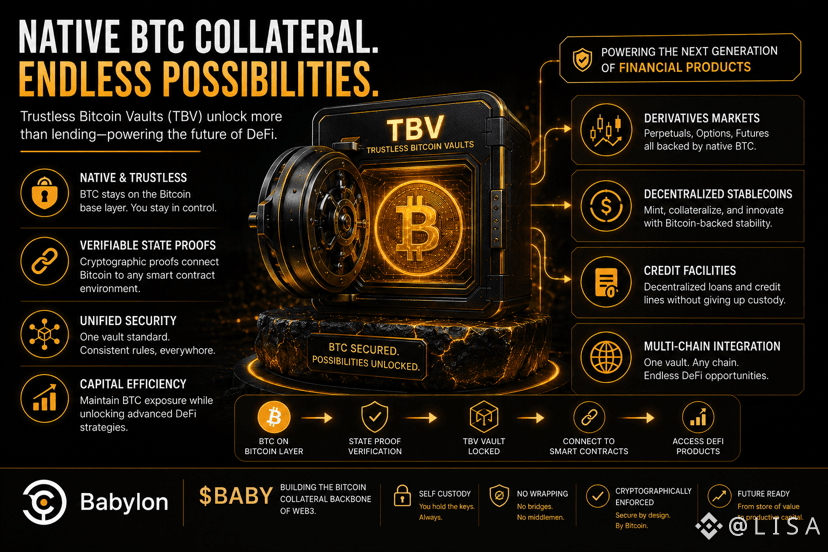
自己管理(セルフ・カストディ)は妥協しない唯一のものなので、BTCをラップしたりブリッジしたりするよう求めるほとんどのビットコイン融資プロダクトには、依頼された瞬間に関心がなくなります。@BabylonLabs_io のTrustless Bitcoin Vaults(TBV)は別物です。だからこそ、私はこれについて書くことにしました。
私の注目を集めたのは、Aave v4を通じたネイティブ・ビットコイン担保による借り入れの公開テストネットです。すでに主要な名前が、一般ユーザーと並んでテストに参加しています。これは、どの初期段階のテストネットでも見られるものではありません。小売(リテール)だけでなく、より本気で取り組まれていることを示唆しています。
私は誰でもできるのと同じ方法で検証しました。ファセットからテストトークンを入手し、ネイティブBTCを預け入れ、Aave v4経由で借り入れを行い、エクスプローラーで全てを確認しました。私の鍵は一度も私の管理の外に出ません。私の意見をそのまま受け取るのではなく、あなた自身の判断をしたいなら、メインネット前に公式フォームを通じてフィードバックを共有できます。
#baby $BABY
私の注目を集めたのは、Aave v4を通じたネイティブ・ビットコイン担保による借り入れの公開テストネットです。すでに主要な名前が、一般ユーザーと並んでテストに参加しています。これは、どの初期段階のテストネットでも見られるものではありません。小売(リテール)だけでなく、より本気で取り組まれていることを示唆しています。
私は誰でもできるのと同じ方法で検証しました。ファセットからテストトークンを入手し、ネイティブBTCを預け入れ、Aave v4経由で借り入れを行い、エクスプローラーで全てを確認しました。私の鍵は一度も私の管理の外に出ません。私の意見をそのまま受け取るのではなく、あなた自身の判断をしたいなら、メインネット前に公式フォームを通じてフィードバックを共有できます。
#baby $BABY
翻訳参照
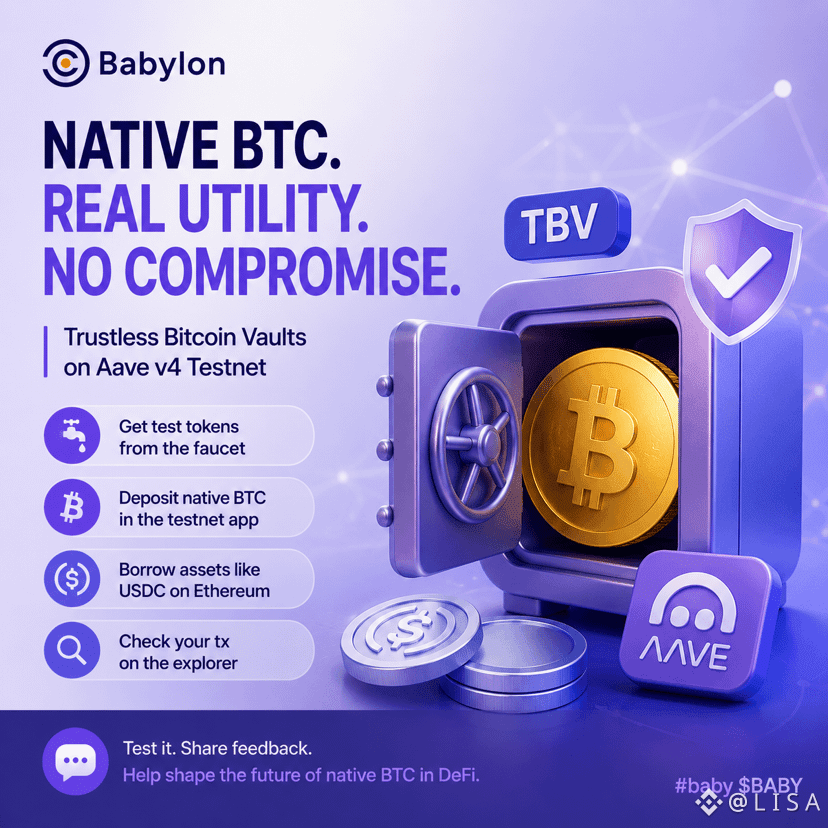
Babylon built the Bitcoin Staking Protocol, which grew into the largest Bitcoin based project in crypto by total value locked. Now @BabylonLabs_io is extending that native BTC into DeFi through Trustless Bitcoin Vaults (TBV), a way to use Bitcoin as collateral without wrapping, bridging, or trusting a middleman.
TBV currently powers native Bitcoin backed borrowing on Aave v4, live on public testnet. The flow is simple. Claim test tokens from the faucet, deposit native BTC in the testnet app, borrow assets like USDC on Ethereum, then check the transaction on the explorer.
What makes this worth trying is how little trust it asks for. Your Bitcoin stays native the whole time, and you never give up custody to complete the borrow. Test it yourself and send feedback through the official form before mainnet.
#baby $BABY
TBV currently powers native Bitcoin backed borrowing on Aave v4, live on public testnet. The flow is simple. Claim test tokens from the faucet, deposit native BTC in the testnet app, borrow assets like USDC on Ethereum, then check the transaction on the explorer.
What makes this worth trying is how little trust it asks for. Your Bitcoin stays native the whole time, and you never give up custody to complete the borrow. Test it yourself and send feedback through the official form before mainnet.
#baby $BABY
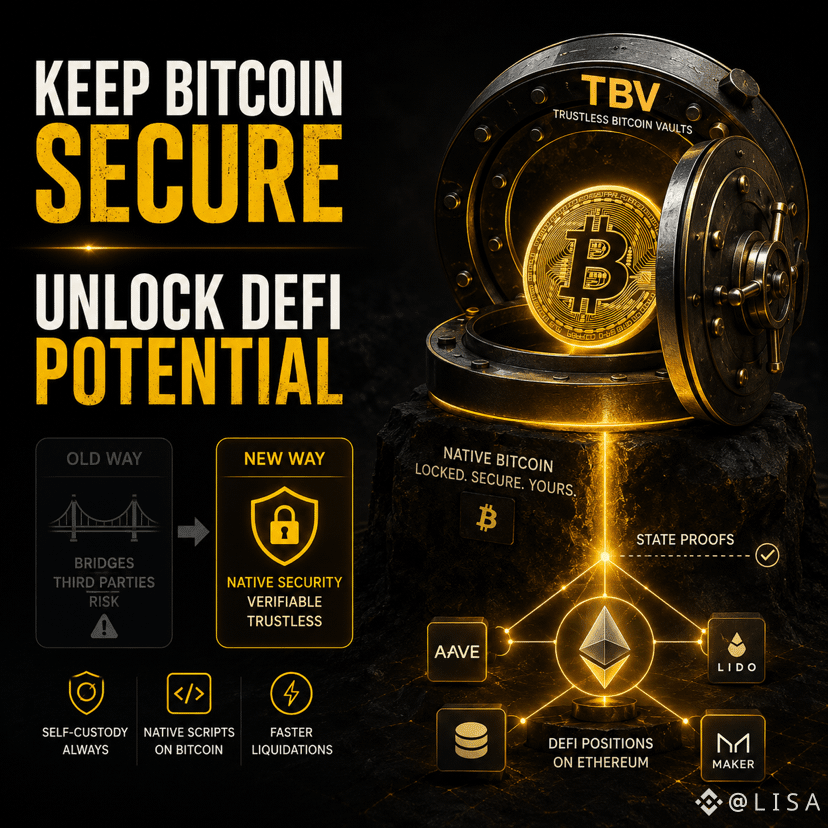
ほとんどのトレーダーには、資産に関するメンタル上の階層があり、その最上位にあるのは自己管理(セルフカストディ)で保有されるビットコインです。その他は通常、トレードオフとして扱われます。つまり、DeFiの利回りのためにそのセキュリティを犠牲にするか、現物保有に座って資本効率の可能性を無視するか、という二択です。
Trustless Bitcoin Vaults(TBV)は、ついにこの二元的なモデルを進化させています。資産を保有するか、それを運用に回すかの選択ではなく、TBVのアーキテクチャにより、ベースレイヤーのカストディを維持しつつ、同時にイーサリアム上のDeFiポジションを裏付けることができます。
ネイティブのビットコインに対して借り入れを行う際の実行フローを見ると、ラップドトークンのバリアントとはリスクプロファイルがまったく別物です。実際の担保はビットコインのタップルート・スクリプトにロックされたままで、状態プローフ(証明)だけが出力されるため、第三者のブリッジ運用者への依存が実質的に消えます。
借り入れを「信頼の問題」から「オンチェーンでスクリプトの実行を検証する問題」へと変えるのです。私はこれらのボールトがテストネットのシミュレーション中にどのように清算(リキディエーション)トリガーを扱うかについて調べる時間を費やしてきましたが、暗号学的な強制(enforcement)の速度は、従来のオラクルベースのブリッジ更新に比べて大幅な改善です。
ブリッジに関する不安から、レンディングプロトコルから距離を置いてきた人にとっては、市場における最初の本格的な変化がこれです。ネイティブの暗号学的な強制への移行は、レンディングに対するあなたの長期的な見通しを変えますか?
@BabylonLabs_io $BABY #baby
Trustless Bitcoin Vaults(TBV)は、ついにこの二元的なモデルを進化させています。資産を保有するか、それを運用に回すかの選択ではなく、TBVのアーキテクチャにより、ベースレイヤーのカストディを維持しつつ、同時にイーサリアム上のDeFiポジションを裏付けることができます。
ネイティブのビットコインに対して借り入れを行う際の実行フローを見ると、ラップドトークンのバリアントとはリスクプロファイルがまったく別物です。実際の担保はビットコインのタップルート・スクリプトにロックされたままで、状態プローフ(証明)だけが出力されるため、第三者のブリッジ運用者への依存が実質的に消えます。
借り入れを「信頼の問題」から「オンチェーンでスクリプトの実行を検証する問題」へと変えるのです。私はこれらのボールトがテストネットのシミュレーション中にどのように清算(リキディエーション)トリガーを扱うかについて調べる時間を費やしてきましたが、暗号学的な強制(enforcement)の速度は、従来のオラクルベースのブリッジ更新に比べて大幅な改善です。
ブリッジに関する不安から、レンディングプロトコルから距離を置いてきた人にとっては、市場における最初の本格的な変化がこれです。ネイティブの暗号学的な強制への移行は、レンディングに対するあなたの長期的な見通しを変えますか?
@BabylonLabs_io $BABY #baby
翻訳参照
When evaluating capital efficiency across decentralized finance, borrowing against spot assets is often just the initial step in a broader ecosystem shift.
The release of Trustless Bitcoin Vaults (TBV) opens the door for native Bitcoin collateral to power a vast range of financial instruments beyond simple lending pools. By enabling verifiable Bitcoin state proofs across external smart contract layers, TBV allows developers to build derivative markets, decentralized stablecoins, and credit facilities directly backed by unbridged BTC.
This means traders can maintain long term spot exposure while deploying their underlying wealth into structured yield strategies or hedging positions without counterparty friction.
What excites me most about expanding TBV into multi chain financial products is how it standardizes security across diverse DeFi applications. Rather than creating isolated wrapped tokens for every single protocol, a unified vault mechanism ensures that collateral rules and liquidation logic remain cryptographically consistent.
Whether you are backing synthetic assets on Ethereum or accessing automated credit lines, your primary Bitcoin stays securely anchored on its native chain.
As more decentralized protocols adopt TBV infrastructure, native Bitcoin will transform from a passive store of value into the primary collateral backbone for web3.
Have you considered using native $BTC to back non lending DeFi positions?
@BabylonLabs_io $BABY #baby
The release of Trustless Bitcoin Vaults (TBV) opens the door for native Bitcoin collateral to power a vast range of financial instruments beyond simple lending pools. By enabling verifiable Bitcoin state proofs across external smart contract layers, TBV allows developers to build derivative markets, decentralized stablecoins, and credit facilities directly backed by unbridged BTC.
This means traders can maintain long term spot exposure while deploying their underlying wealth into structured yield strategies or hedging positions without counterparty friction.
What excites me most about expanding TBV into multi chain financial products is how it standardizes security across diverse DeFi applications. Rather than creating isolated wrapped tokens for every single protocol, a unified vault mechanism ensures that collateral rules and liquidation logic remain cryptographically consistent.
Whether you are backing synthetic assets on Ethereum or accessing automated credit lines, your primary Bitcoin stays securely anchored on its native chain.
As more decentralized protocols adopt TBV infrastructure, native Bitcoin will transform from a passive store of value into the primary collateral backbone for web3.
Have you considered using native $BTC to back non lending DeFi positions?
@BabylonLabs_io $BABY #baby
翻訳参照
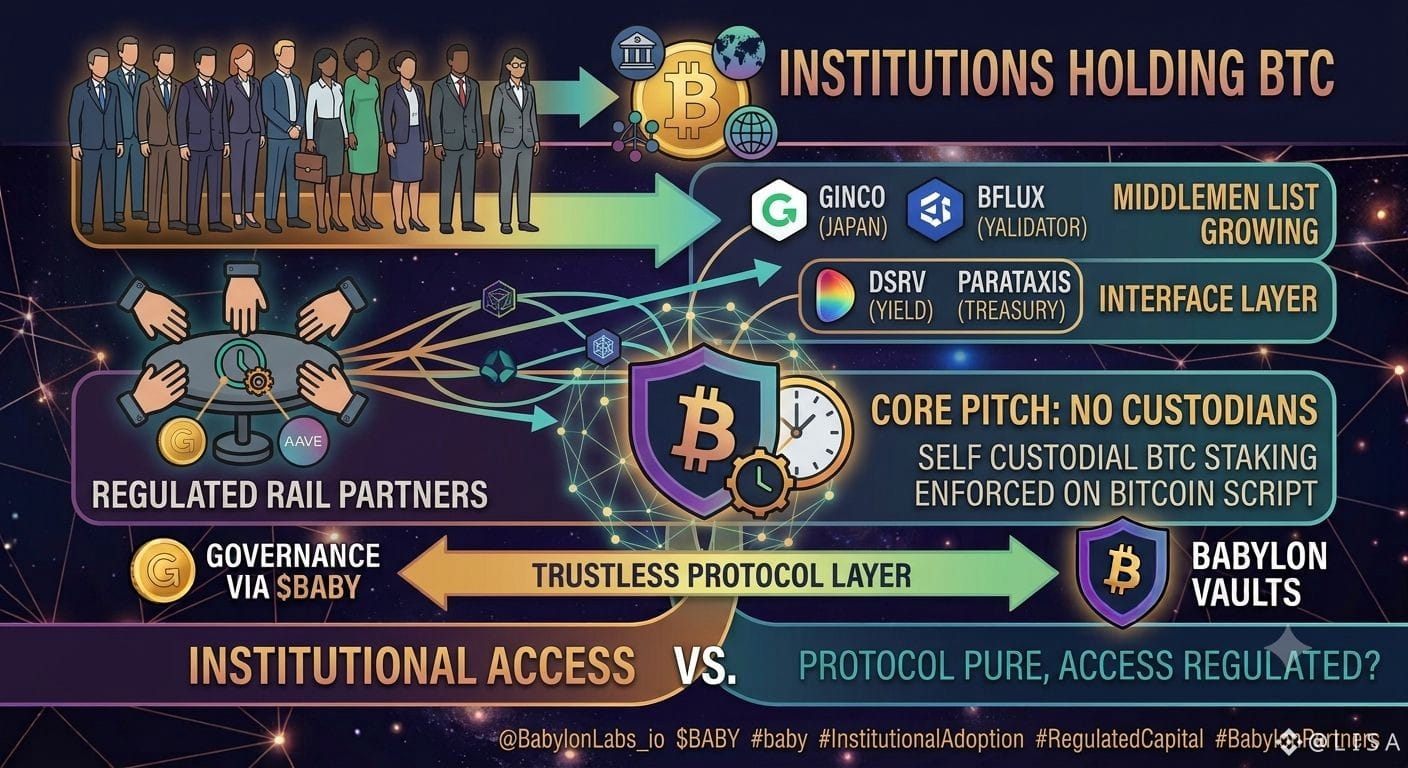
Babylon needed a growing list of institutional middlemen to sell a message about removing middlemen
I went through the recent partnership list and it kept growing. Ginco in Japan, Bflux for institutional yield, DSRV as validator infrastructure, Parataxis for treasury strategy. All of them sit between Babylon's protocol and the institutions actually holding the Bitcoin.
That struck me as worth sitting with. The core pitch is no custodians, no intermediaries, pure self custodial staking enforced on Bitcoin itself. Yet reaching institutions apparently requires enterprise wallet providers, custody specialists, and regional partners acting as the interface layer between cold $BTC reserves and the protocol underneath.
I do not think that contradicts the trustless design. The BTC itself stays locked under Bitcoin script conditions regardless of which enterprise wallet initiates the transaction. But it does mean the actual experience of trustless staking, for a bank or a corporate treasury anyway, still runs through a chain of vetted partners handling compliance, custody interfaces, and onboarding. Protocol level trustlessness and institutional access are turning out to be two very different layers of the same system.
Maybe that is just what adoption looks like. Regulated capital does not move without regulated rails, no matter how clean the underlying cryptography is.
Does institutional Bitcoin ever actually touch a truly trustless protocol directly, or does it always pass through a layer of trusted partners first regardless of what the base layer promises
@BabylonLabs_io $BABY #baby
I went through the recent partnership list and it kept growing. Ginco in Japan, Bflux for institutional yield, DSRV as validator infrastructure, Parataxis for treasury strategy. All of them sit between Babylon's protocol and the institutions actually holding the Bitcoin.
That struck me as worth sitting with. The core pitch is no custodians, no intermediaries, pure self custodial staking enforced on Bitcoin itself. Yet reaching institutions apparently requires enterprise wallet providers, custody specialists, and regional partners acting as the interface layer between cold $BTC reserves and the protocol underneath.
I do not think that contradicts the trustless design. The BTC itself stays locked under Bitcoin script conditions regardless of which enterprise wallet initiates the transaction. But it does mean the actual experience of trustless staking, for a bank or a corporate treasury anyway, still runs through a chain of vetted partners handling compliance, custody interfaces, and onboarding. Protocol level trustlessness and institutional access are turning out to be two very different layers of the same system.
Maybe that is just what adoption looks like. Regulated capital does not move without regulated rails, no matter how clean the underlying cryptography is.
Does institutional Bitcoin ever actually touch a truly trustless protocol directly, or does it always pass through a layer of trusted partners first regardless of what the base layer promises
@BabylonLabs_io $BABY #baby
翻訳参照
A one line bug report shows more about a protocol than any roadmap does
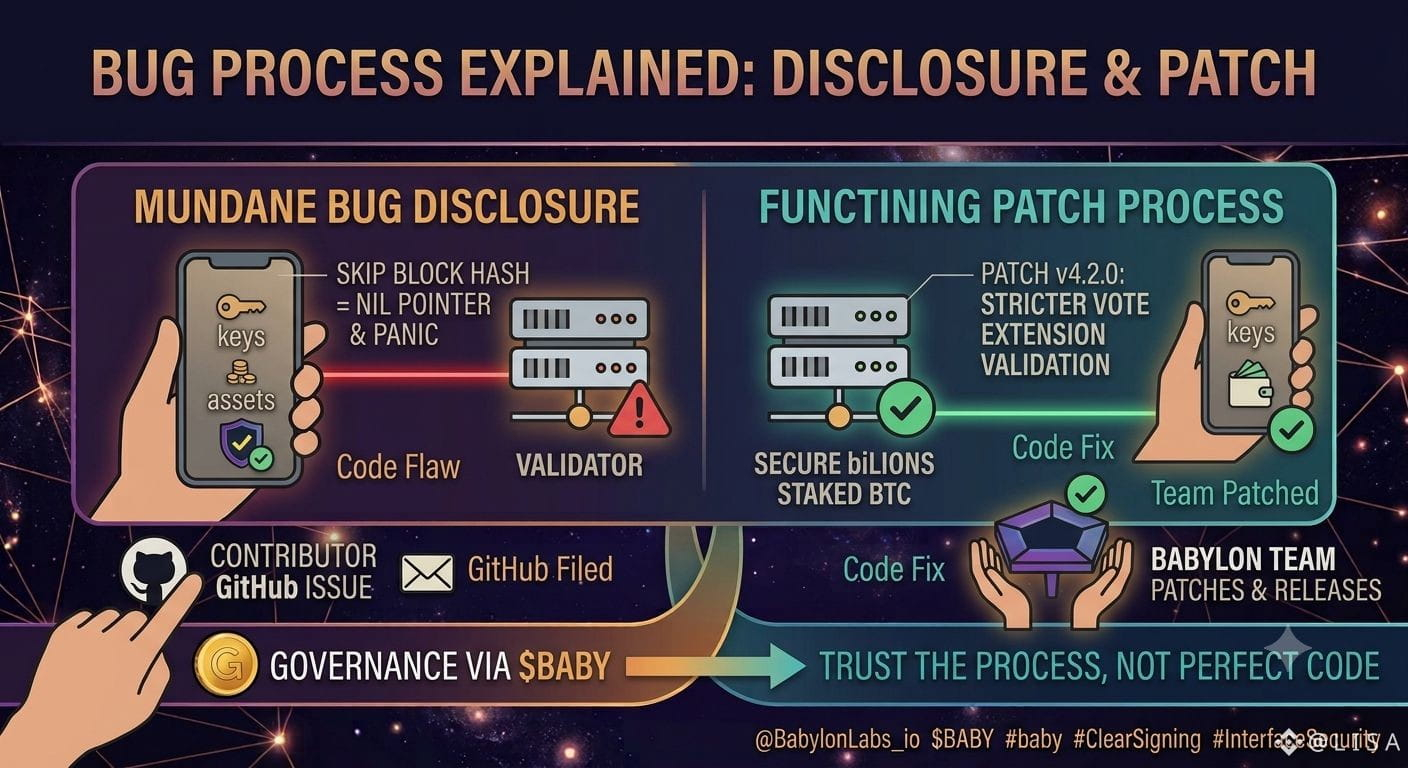
I read through the disclosure and the part that stuck with me was not the bug itself, it was how mundane it actually was. A malicious validator could skip a block hash field, protobuf allowed it because the field was optional, and Babylon's code tried to read data that was not there. Nil pointer, runtime panic, validators crashing right at epoch boundaries where consensus timing matters most.
Nothing exotic. No $BTC ever at risk, no funds touched, just a consensus layer bug that could have slowed block production if enough validators got hit at once.
What actually interests me is the disclosure path. Found by an independent pseudonymous contributor, filed publicly on GitHub, patched in version 4.2.0 with stricter validation around vote extensions. That is the boring, unglamorous reality of how security actually works in production systems securing billions in staked BTC. Not flawless code, just a functioning process for catching and fixing what slips through.
I think people conflate trustless with bug free, and those are not the same claim at all. Trustless describes who holds custody. It says nothing about whether the software underneath is perfect, because no software is.
Does a quiet, quickly patched bug make you trust the process more, or does any consensus level flaw on a Bitcoin security protocol just make you nervous regardless of how it gets resolved
@BabylonLabs_io $BABY #baby
I read through the disclosure and the part that stuck with me was not the bug itself, it was how mundane it actually was. A malicious validator could skip a block hash field, protobuf allowed it because the field was optional, and Babylon's code tried to read data that was not there. Nil pointer, runtime panic, validators crashing right at epoch boundaries where consensus timing matters most.
Nothing exotic. No $BTC ever at risk, no funds touched, just a consensus layer bug that could have slowed block production if enough validators got hit at once.
What actually interests me is the disclosure path. Found by an independent pseudonymous contributor, filed publicly on GitHub, patched in version 4.2.0 with stricter validation around vote extensions. That is the boring, unglamorous reality of how security actually works in production systems securing billions in staked BTC. Not flawless code, just a functioning process for catching and fixing what slips through.
I think people conflate trustless with bug free, and those are not the same claim at all. Trustless describes who holds custody. It says nothing about whether the software underneath is perfect, because no software is.
Does a quiet, quickly patched bug make you trust the process more, or does any consensus level flaw on a Bitcoin security protocol just make you nervous regardless of how it gets resolved
@BabylonLabs_io $BABY #baby
1つのステークで複数のネットワーク、どこでも同時に最悪の1日
このことについて、誰も十分に語っていません。
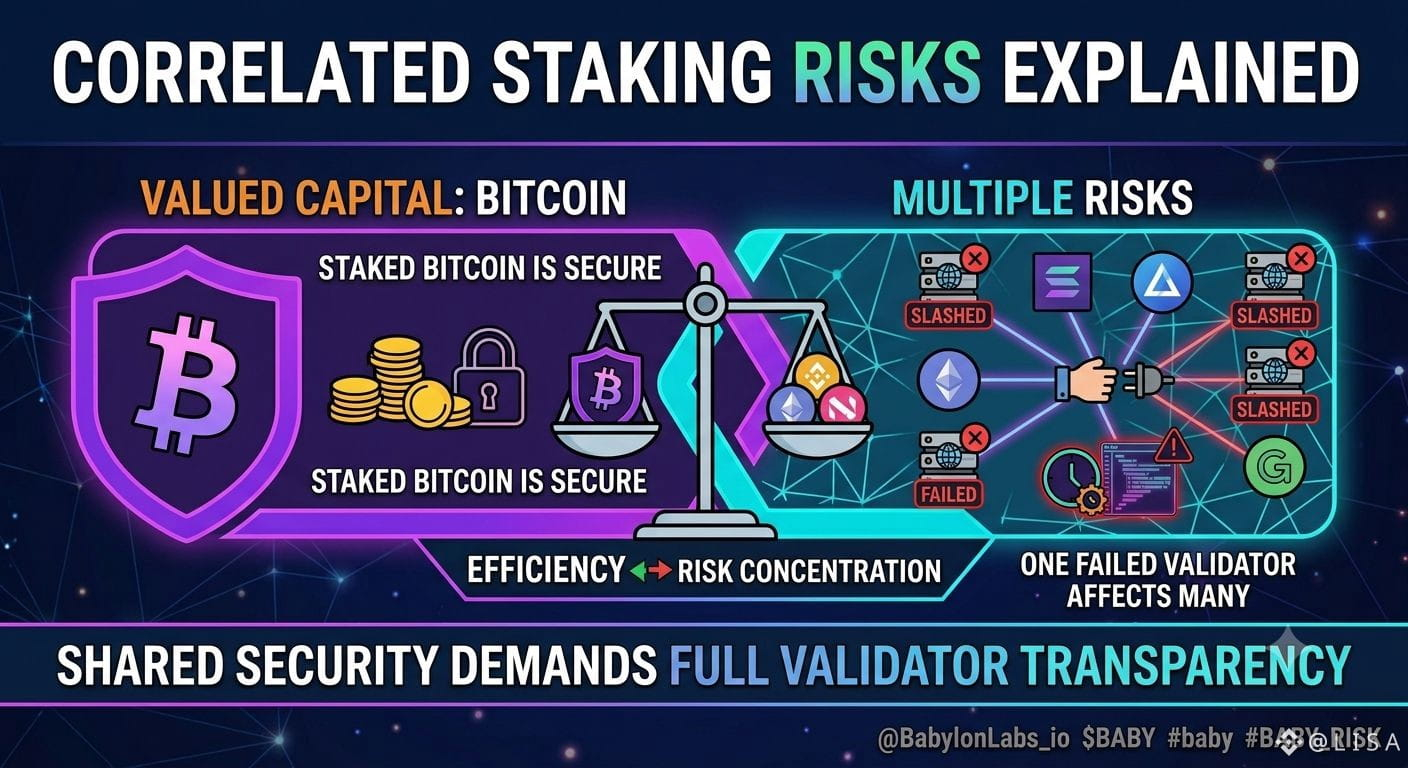
ステークしたBTCが同時に複数のBitcoin Secured Networkを支えることができるなら、それは効率的に見えます。資本は同じで、セキュリティの仕事は複数。紙の上では素晴らしい。
しかし、相関するリスクは双方向に働きます。
いくつかのネットワークでパフォーマンス不良のバリデータを1人抱えている場合、1回失敗して終わりにはなりません。参加しているすべての場所で失敗します。あなたの<0-9]{11}$BTC は、もはや1つのスラッシング条件にさらされるのではなく、そのバリデータが触れるネットワークの数だけ、さらされるのです。
効率と集中は、基本的に同じコインの裏表です。
私はこれがモデルを壊すと言っているのではありません。Babylon経由でステークする人にとって、デューデリジェンス(慎重な調査)が実際に何を意味するかが変わると言っています。もはや、1つのネットワークの健全性を評価するだけではありません。あなたのBTCが偶然に支えている、ネットワーク群全体にまたがるバリデータの振る舞いを評価することになります。
ほとんどの人はこれを確認しません。利回りを見て、自分で保有できると思って、そのままネットワークをステークします。ネットワーク間でのバリデータへのエクスポージャーを地図のように整理することはしません。
共有セキュリティには、バリデータ同士の重複に関する必須の透明性が必要なのでしょうか?それは、エンドユーザーにとってシンプルであることを目指したシステムに求めすぎなのでしょうか
@BabylonLabs_io $BABY #baby
このことについて、誰も十分に語っていません。
ステークしたBTCが同時に複数のBitcoin Secured Networkを支えることができるなら、それは効率的に見えます。資本は同じで、セキュリティの仕事は複数。紙の上では素晴らしい。
しかし、相関するリスクは双方向に働きます。
いくつかのネットワークでパフォーマンス不良のバリデータを1人抱えている場合、1回失敗して終わりにはなりません。参加しているすべての場所で失敗します。あなたの<0-9]{11}$BTC は、もはや1つのスラッシング条件にさらされるのではなく、そのバリデータが触れるネットワークの数だけ、さらされるのです。
効率と集中は、基本的に同じコインの裏表です。
私はこれがモデルを壊すと言っているのではありません。Babylon経由でステークする人にとって、デューデリジェンス(慎重な調査)が実際に何を意味するかが変わると言っています。もはや、1つのネットワークの健全性を評価するだけではありません。あなたのBTCが偶然に支えている、ネットワーク群全体にまたがるバリデータの振る舞いを評価することになります。
ほとんどの人はこれを確認しません。利回りを見て、自分で保有できると思って、そのままネットワークをステークします。ネットワーク間でのバリデータへのエクスポージャーを地図のように整理することはしません。
共有セキュリティには、バリデータ同士の重複に関する必須の透明性が必要なのでしょうか?それは、エンドユーザーにとってシンプルであることを目指したシステムに求めすぎなのでしょうか
@BabylonLabs_io $BABY #baby
翻訳参照
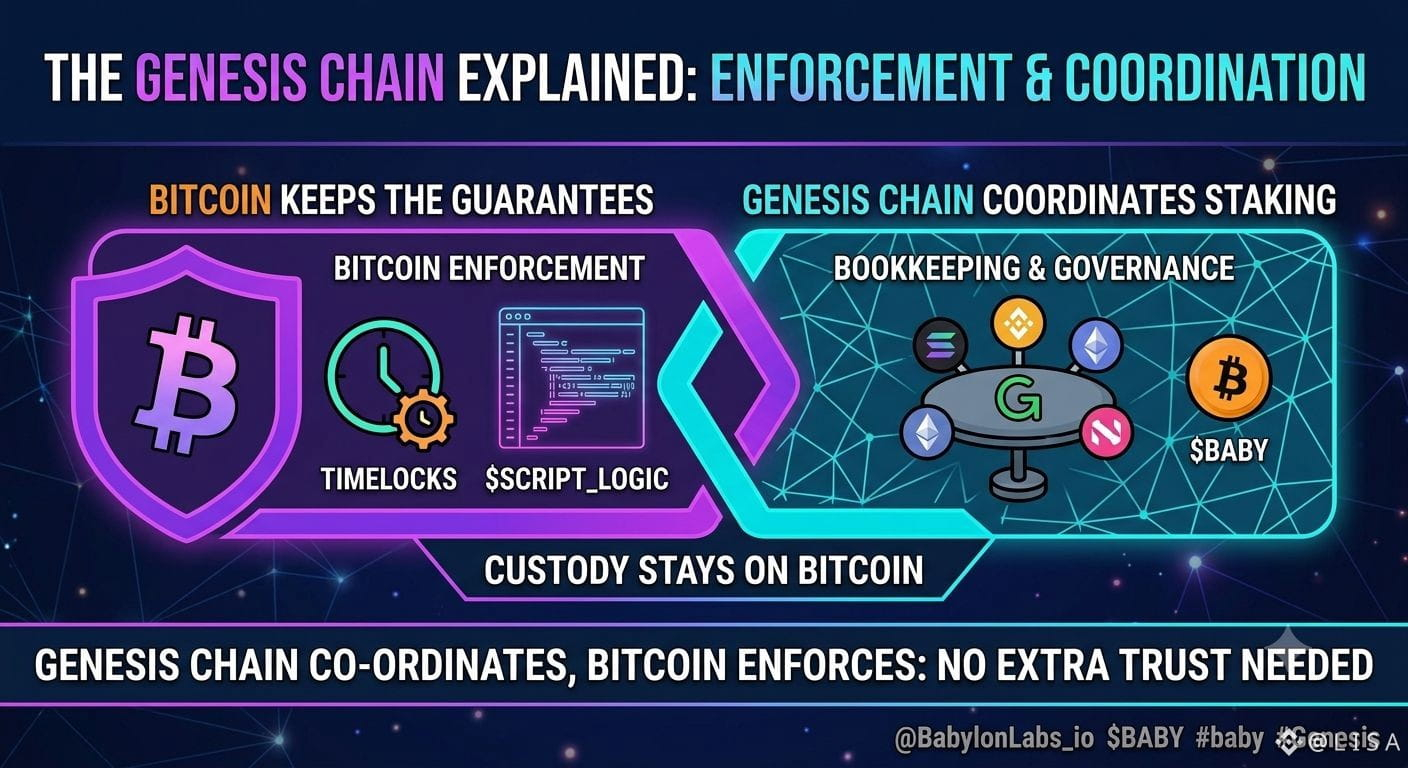
Why does a Bitcoin security protocol even need its own chain
This one bugged me for a bit. If the whole pitch is trustless Bitcoin staking with everything enforced through Bitcoin script and timelocks, why introduce Babylon Genesis chain into the picture at all. Doesn't adding another chain reintroduce the exact kind of extra trust surface this protocol is supposed to be avoiding.
The answer I landed on is that Bitcoin itself cannot coordinate anything beyond simple locking conditions. It has no concept of validator sets, no way to track which Proof of Stake networks are being secured or how slashing gets enforced across dozens of different Bitcoin Secured Networks. Genesis chain exists to do the coordination and governance work that Bitcoin was never designed to handle, while the actual custody and staking commitment stays enforced at the Bitcoin layer itself.
So it is less about adding trust and more about separating enforcement from orchestration. Bitcoin holds the guarantees, Genesis chain handles the bookkeeping and governance through BABY. Still, any additional chain is additional infrastructure that needs its own security assumptions, even if it never touches your actual staked $BTC .
Does that separation actually hold up as more networks plug in, or does complexity creep back in through the coordination layer instead of the custody layer
@BabylonLabs_io $BABY #baby
This one bugged me for a bit. If the whole pitch is trustless Bitcoin staking with everything enforced through Bitcoin script and timelocks, why introduce Babylon Genesis chain into the picture at all. Doesn't adding another chain reintroduce the exact kind of extra trust surface this protocol is supposed to be avoiding.
The answer I landed on is that Bitcoin itself cannot coordinate anything beyond simple locking conditions. It has no concept of validator sets, no way to track which Proof of Stake networks are being secured or how slashing gets enforced across dozens of different Bitcoin Secured Networks. Genesis chain exists to do the coordination and governance work that Bitcoin was never designed to handle, while the actual custody and staking commitment stays enforced at the Bitcoin layer itself.
So it is less about adding trust and more about separating enforcement from orchestration. Bitcoin holds the guarantees, Genesis chain handles the bookkeeping and governance through BABY. Still, any additional chain is additional infrastructure that needs its own security assumptions, even if it never touches your actual staked $BTC .
Does that separation actually hold up as more networks plug in, or does complexity creep back in through the coordination layer instead of the custody layer
@BabylonLabs_io $BABY #baby
翻訳参照
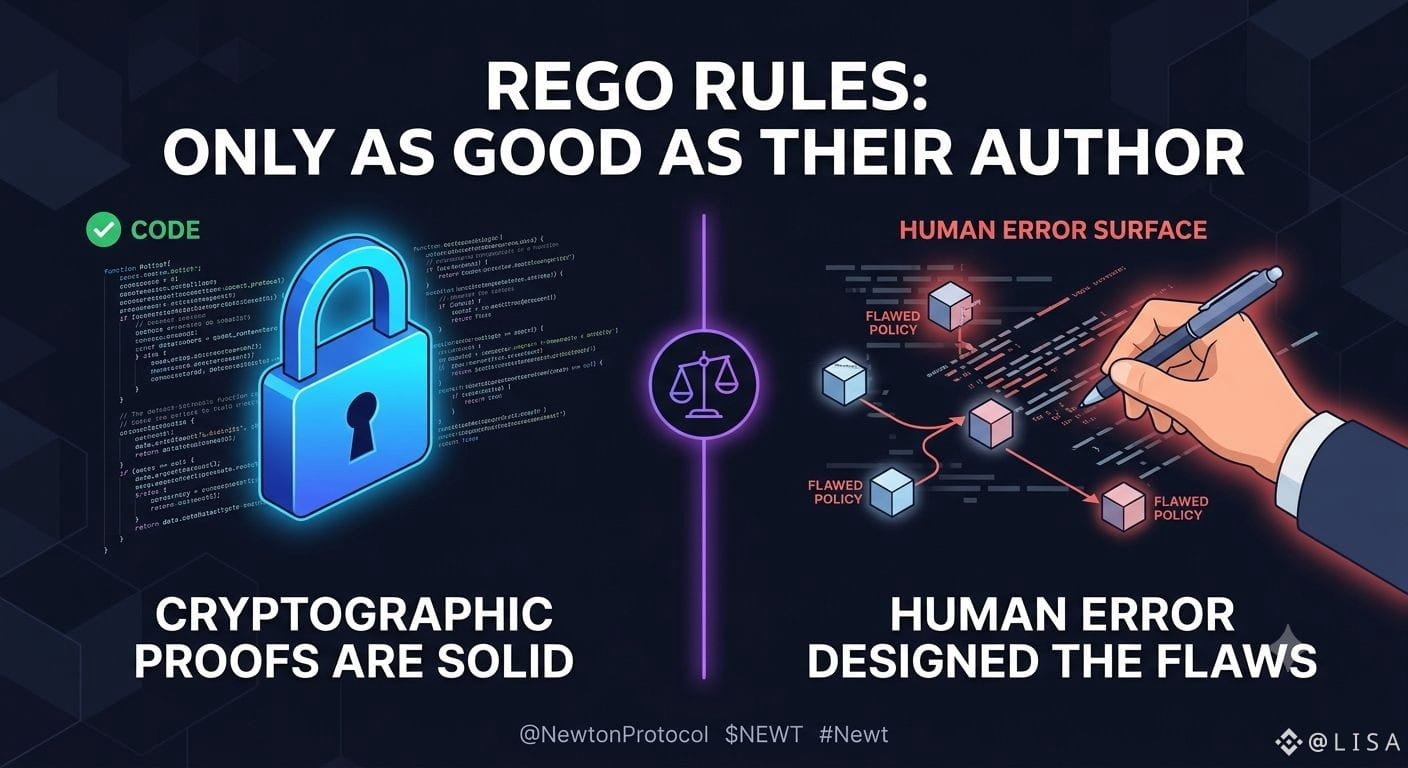
Rego Policy Rules Are Only As Good As Whoever Writes Them
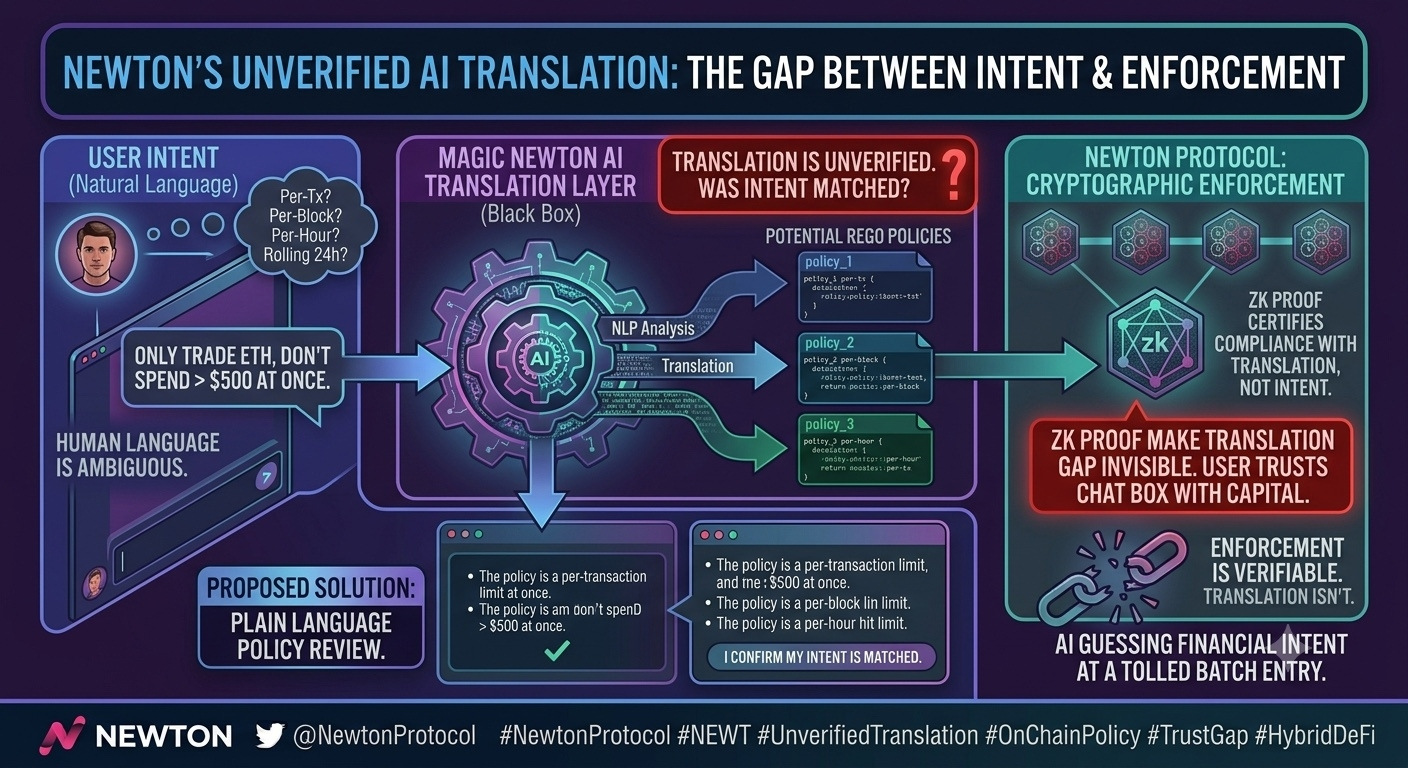
$NEWT Newton runs evaluations through Rego, a declarative policy language, and that's the part nobody's poking at yet. Someone still has to actually author these rules correctly, and Rego is notoriously easy to write technically valid logic that doesn't do what you think it does. If a vault curator or protocol writes a flawed policy, the zk proof will happily confirm that flawed policy was followed perfectly. Verification proves the rule executed as written, it says nothing about whether the rule itself was smart. That's a human error surface sitting right underneath all this cryptographic guarantee.
I want to see policy auditing tools before I trust curator written rules with real size. My exposure grows once there's a standard for reviewing Rego logic before it goes live on a vault. Proofs don't save you from bad policy design.
@NewtonProtocol $NEWT #Newt
$NEWT Newton runs evaluations through Rego, a declarative policy language, and that's the part nobody's poking at yet. Someone still has to actually author these rules correctly, and Rego is notoriously easy to write technically valid logic that doesn't do what you think it does. If a vault curator or protocol writes a flawed policy, the zk proof will happily confirm that flawed policy was followed perfectly. Verification proves the rule executed as written, it says nothing about whether the rule itself was smart. That's a human error surface sitting right underneath all this cryptographic guarantee.
I want to see policy auditing tools before I trust curator written rules with real size. My exposure grows once there's a standard for reviewing Rego logic before it goes live on a vault. Proofs don't save you from bad policy design.
@NewtonProtocol $NEWT #Newt
翻訳参照
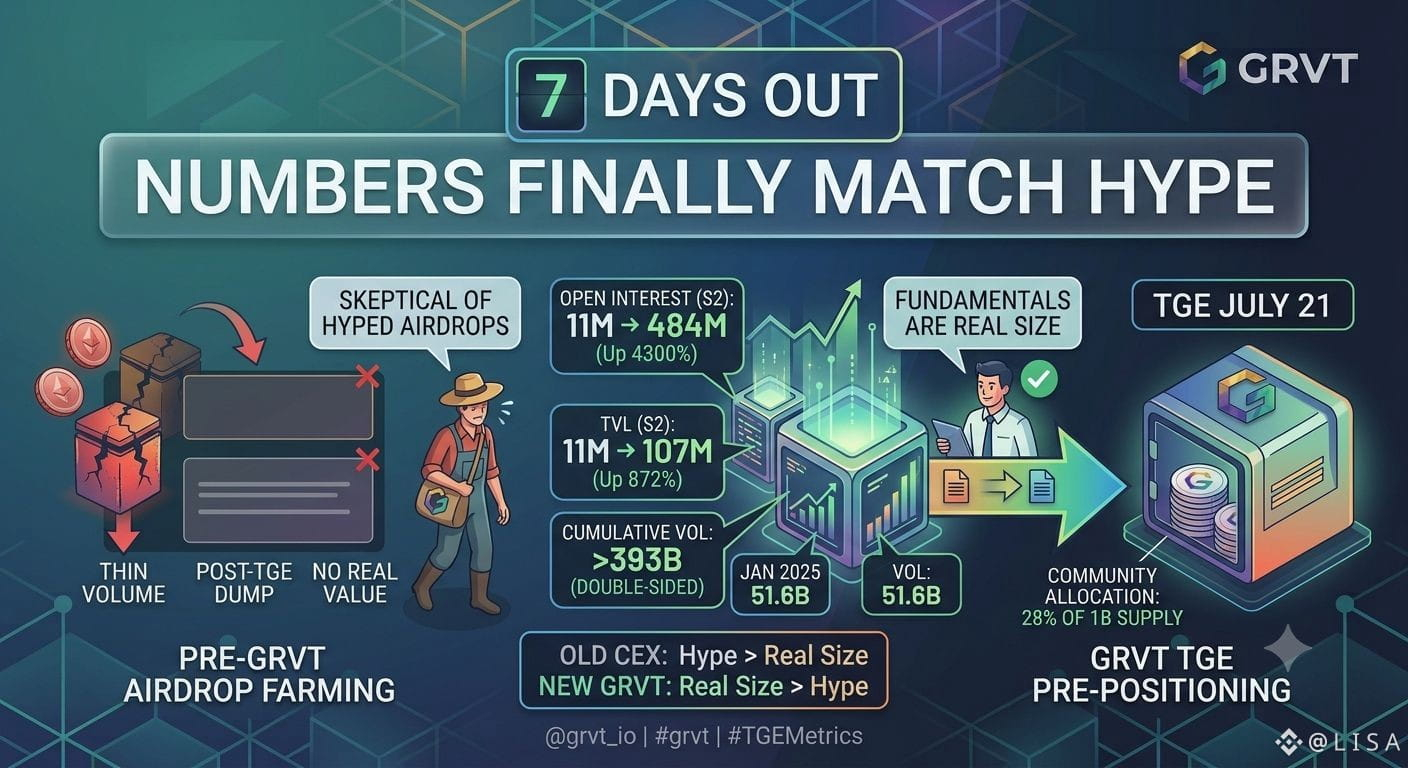
Seven Days Out And The Numbers Finally Match The Hype
I stopped taking airdrop farming seriously a while ago because most seasons end with a token that nobody actually wants once trading opens. GRVT is the first one in months where I actually pulled up the metrics before the token generation event instead of after, and the open interest data alone made me sit up.
Open interest went from roughly 11 million to 484 million during Season 2, that is not organic hype, that is real derivatives volume backing the points. TVL climbed from about 11 million to over 107 million in the same stretch. Cumulative trading volume crossed 393 billion double sided, and January alone printed 51.6 billion in monthly volume. Numbers like that usually show up after a token launches, not before it.
With the TGE landing July 21 and community allocation now sitting at 28 percent of the fixed 1 billion supply, this is one of the rare cases where the fundamentals were already stacking up while everyone else was just farming points blindly. I have seen too many projects launch a token into thin volume and watch it get dumped within days.
This one is launching into an exchange that already proved it can handle real size. That changes how I am thinking about post TGE positioning completely.
Watching order books closely once trading opens.
@grvt_io #grvt
I stopped taking airdrop farming seriously a while ago because most seasons end with a token that nobody actually wants once trading opens. GRVT is the first one in months where I actually pulled up the metrics before the token generation event instead of after, and the open interest data alone made me sit up.
Open interest went from roughly 11 million to 484 million during Season 2, that is not organic hype, that is real derivatives volume backing the points. TVL climbed from about 11 million to over 107 million in the same stretch. Cumulative trading volume crossed 393 billion double sided, and January alone printed 51.6 billion in monthly volume. Numbers like that usually show up after a token launches, not before it.
With the TGE landing July 21 and community allocation now sitting at 28 percent of the fixed 1 billion supply, this is one of the rare cases where the fundamentals were already stacking up while everyone else was just farming points blindly. I have seen too many projects launch a token into thin volume and watch it get dumped within days.
This one is launching into an exchange that already proved it can handle real size. That changes how I am thinking about post TGE positioning completely.
Watching order books closely once trading opens.
@grvt_io #grvt
翻訳参照
Policy Rules Blocking Legit Trades Is The Risk Nobody Mentions
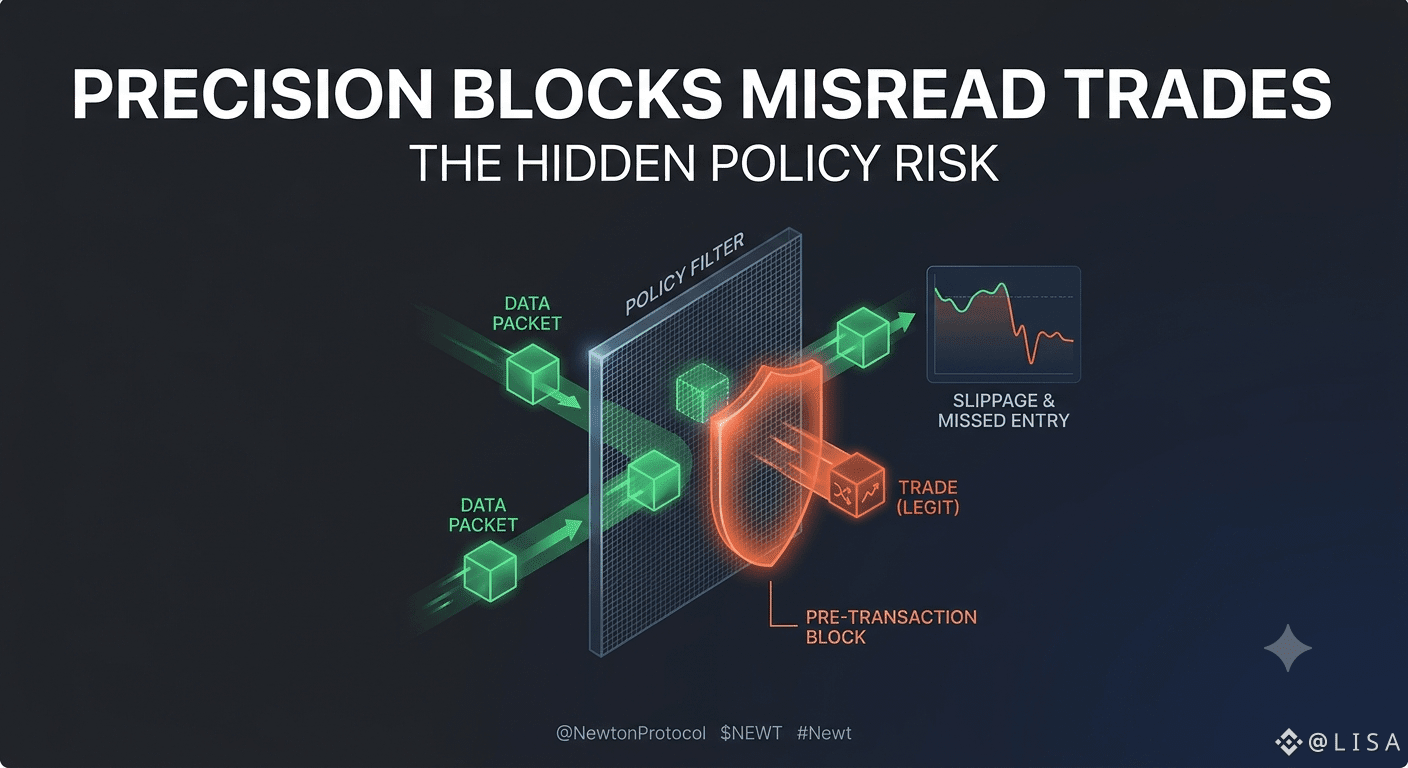
Everyone talks about Newton $NEWT stopping malicious settlement but flip that logic around for a second. A policy engine strict enough to catch bad actors is also strict enough to misfire on legitimate agent strategies that just look unusual on paper. If my automated strategy gets flagged and blocked because it doesn't match some predefined rule set, I'm eating slippage and missed entries while the system protects me from a threat that was never there. False positives in a pre transaction enforcement layer are a real cost, not just a theoretical one. Nobody's published data yet on how often legitimate trades get denied versus actual malicious ones.
I want false positive rates before I trust this with real size. My strategies can't afford getting blocked mid execution over an overly cautious rule set. Precision matters as much as protection here.
@NewtonProtocol
$NEWT
#Newt
Everyone talks about Newton $NEWT stopping malicious settlement but flip that logic around for a second. A policy engine strict enough to catch bad actors is also strict enough to misfire on legitimate agent strategies that just look unusual on paper. If my automated strategy gets flagged and blocked because it doesn't match some predefined rule set, I'm eating slippage and missed entries while the system protects me from a threat that was never there. False positives in a pre transaction enforcement layer are a real cost, not just a theoretical one. Nobody's published data yet on how often legitimate trades get denied versus actual malicious ones.
I want false positive rates before I trust this with real size. My strategies can't afford getting blocked mid execution over an overly cautious rule set. Precision matters as much as protection here.
@NewtonProtocol
$NEWT
#Newt
翻訳参照
Trusting A CEX With Proof Instead Of Promises
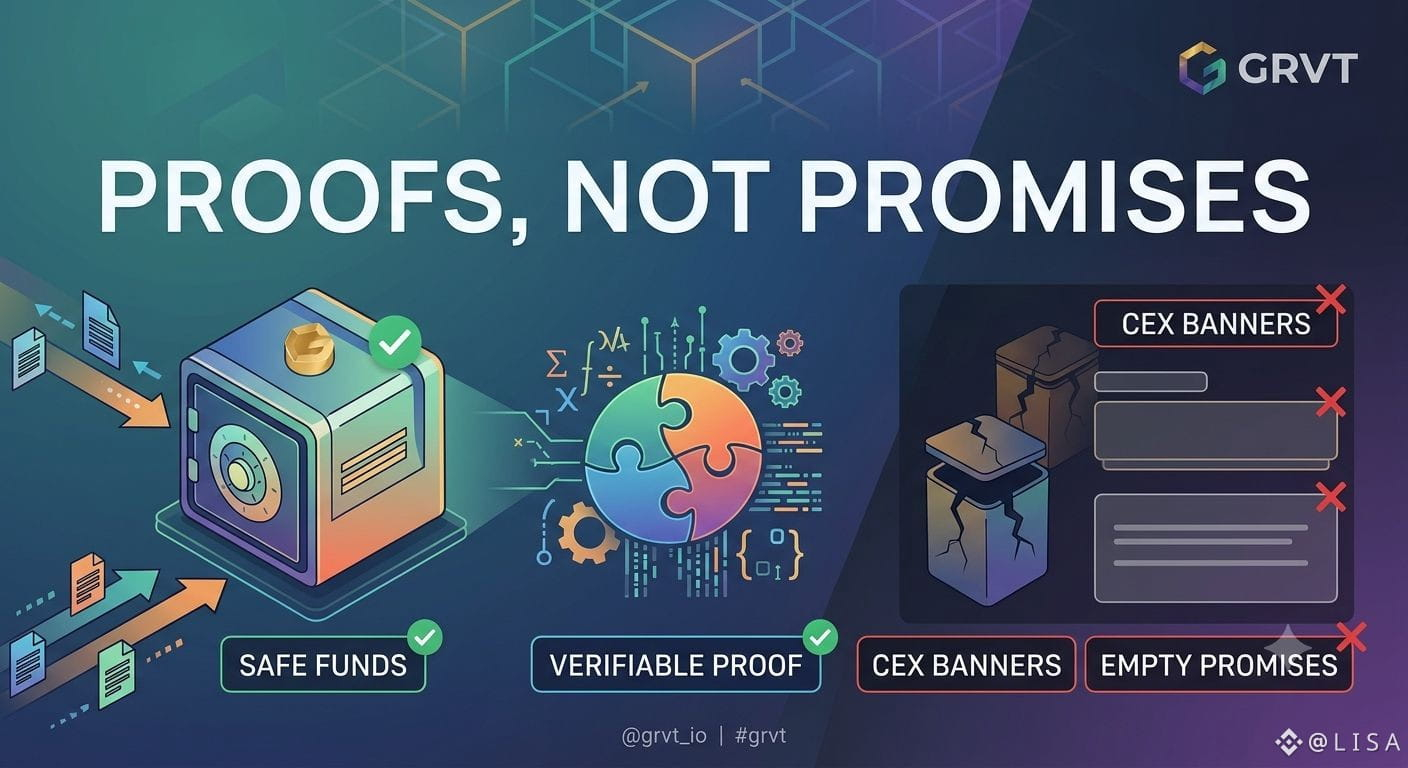
I have lost count of how many times an exchange told us our funds were safe right before everything collapsed. That is the entire reason on chain ZK settlement matters to me now, GRVT is not asking me to trust a balance sheet I cannot see, the proofs are verifiable instead of just promised in a blog post after something already broke.
Centralized exchanges historically operate on faith, you assume the reserves are there until a withdrawal freeze proves otherwise. GRVT flips that by settling trades through zero knowledge proofs on chain while still running execution off chain for speed, so the safety net is mathematical rather than reputational.
That distinction hits different after watching multiple platforms implode where users found out too late that their exposure was never actually backed the way it claimed. Here the settlement layer does not care about vibes or trust me bro announcements, it just verifies.
Licensed operation on top of that removes another layer of blind faith, this is not some anonymous team hoping regulators never notice them. $GRVT holding a fixed 1 billion supply cap gives the token side of this equation the same kind of predictability the settlement architecture already provides.
Watching how this holds up as bigger players start allocating size.
@grvt_io #grvt
I have lost count of how many times an exchange told us our funds were safe right before everything collapsed. That is the entire reason on chain ZK settlement matters to me now, GRVT is not asking me to trust a balance sheet I cannot see, the proofs are verifiable instead of just promised in a blog post after something already broke.
Centralized exchanges historically operate on faith, you assume the reserves are there until a withdrawal freeze proves otherwise. GRVT flips that by settling trades through zero knowledge proofs on chain while still running execution off chain for speed, so the safety net is mathematical rather than reputational.
That distinction hits different after watching multiple platforms implode where users found out too late that their exposure was never actually backed the way it claimed. Here the settlement layer does not care about vibes or trust me bro announcements, it just verifies.
Licensed operation on top of that removes another layer of blind faith, this is not some anonymous team hoping regulators never notice them. $GRVT holding a fixed 1 billion supply cap gives the token side of this equation the same kind of predictability the settlement architecture already provides.
Watching how this holds up as bigger players start allocating size.
@grvt_io #grvt
翻訳参照
Gas Deltas Are Going To Decide Where Volume Actually Goes
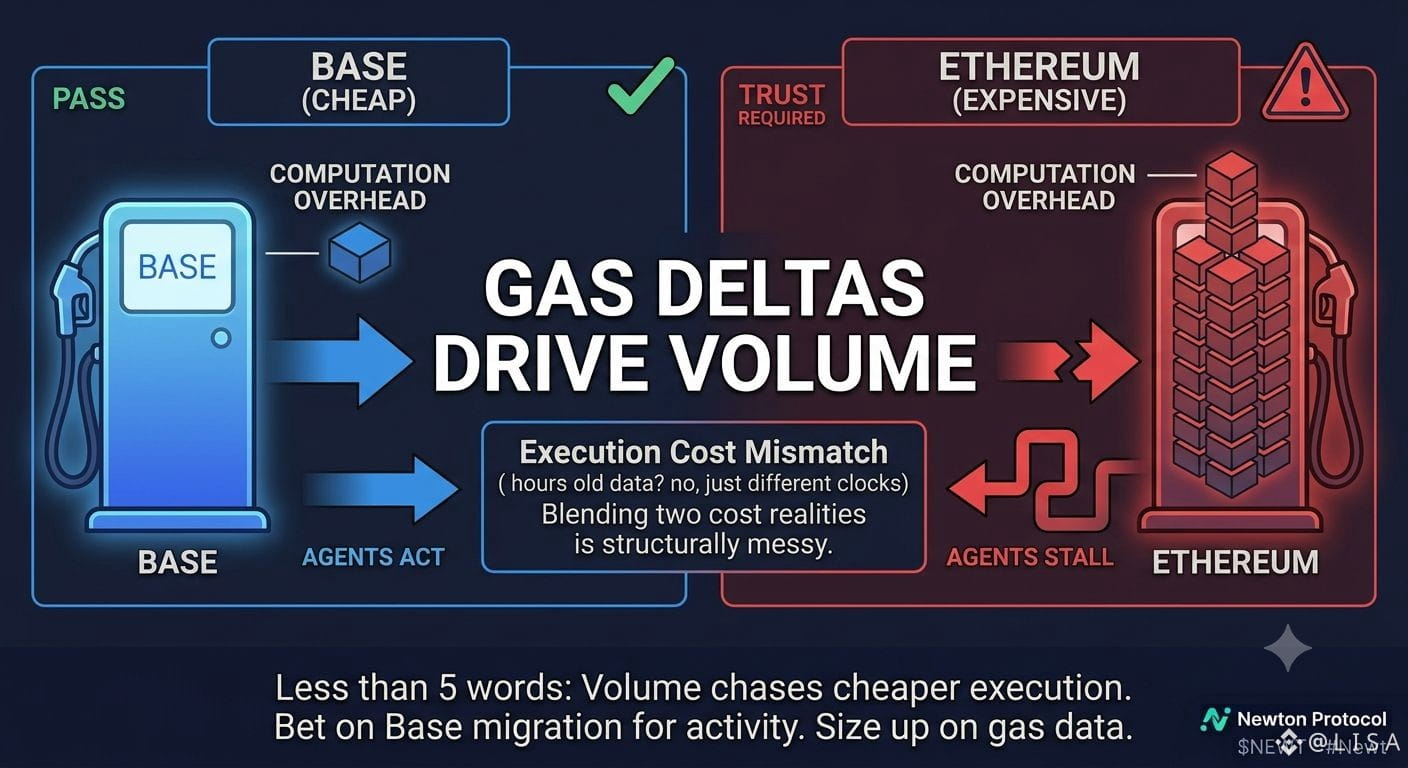
Newton runs on both Base and Ethereum mainnet but the execution cost between those two chains isn't even close, and that difference changes how agents actually behave in practice. If policy enforcement adds any extra computation on top of a normal transaction, that overhead gets multiplied by whatever gas environment you're in. On Base it's probably negligible, but on Ethereum mainnet during any real congestion that added verification step could make automated strategies unprofitable before they even settle. Nobody's published numbers comparing the actual cost delta between the two chains under this new enforcement layer.
I'd bet most serious agent activity migrates toward Base purely on cost, not because Ethereum $ETH is less secure. But if that happens fast, Ethereum side liquidity for this system could end up thin while everyone chases cheaper execution. Watching gas data before I size up.
@NewtonProtocol $NEWT #Newt
Newton runs on both Base and Ethereum mainnet but the execution cost between those two chains isn't even close, and that difference changes how agents actually behave in practice. If policy enforcement adds any extra computation on top of a normal transaction, that overhead gets multiplied by whatever gas environment you're in. On Base it's probably negligible, but on Ethereum mainnet during any real congestion that added verification step could make automated strategies unprofitable before they even settle. Nobody's published numbers comparing the actual cost delta between the two chains under this new enforcement layer.
I'd bet most serious agent activity migrates toward Base purely on cost, not because Ethereum $ETH is less secure. But if that happens fast, Ethereum side liquidity for this system could end up thin while everyone chases cheaper execution. Watching gas data before I size up.
@NewtonProtocol $NEWT #Newt
DEXのスリッページが待つことへの嫌悪感を教えてくれた
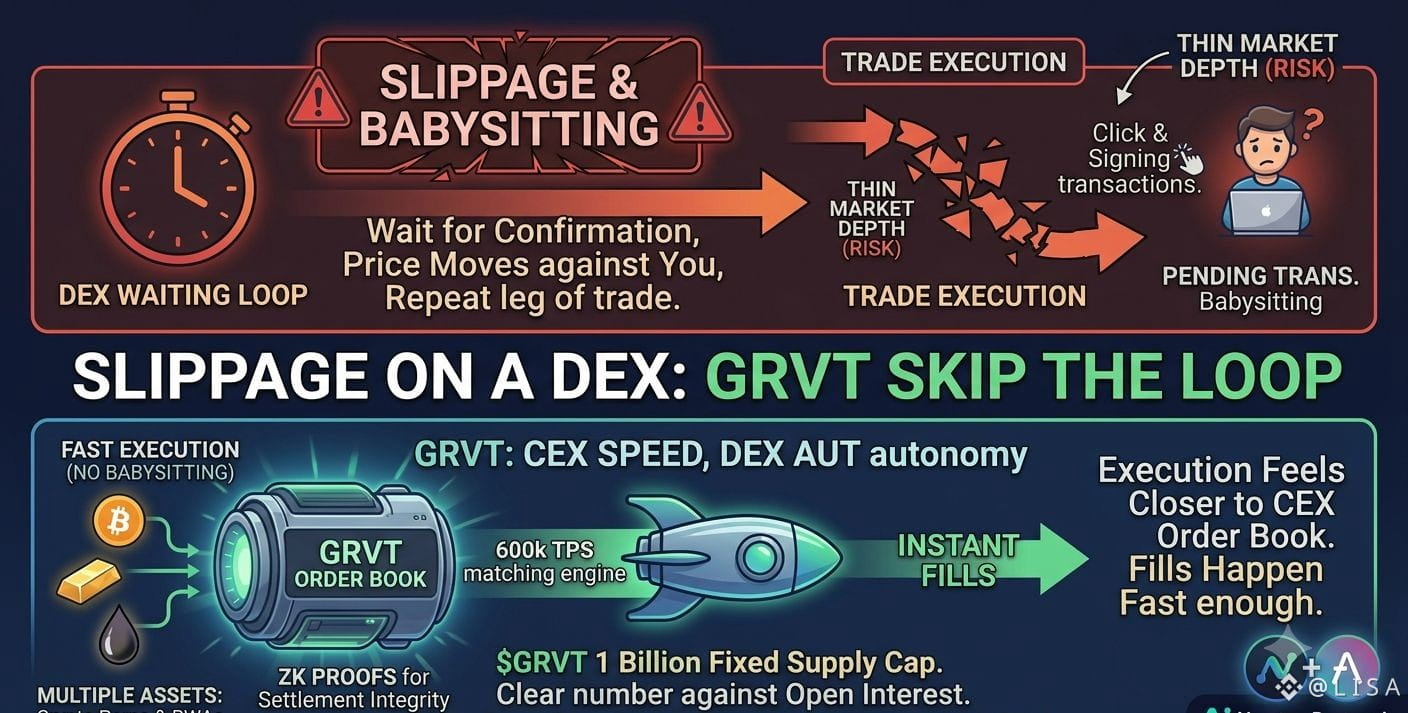
分散型アプリで実際の規模の取引をしたことがある人なら、手順はだいたい同じです。取引を行い、トランザクションの確認を待ち、価格が不利な方向に動いていくのを見て、次の取引に繰り返します。GRVTはこのループ全体を、実際に中央集権型取引所のような感覚を与える600k TPSのマッチングエンジンでスキップし、決済はZKプローフを通じてオンチェーンのまま行われます。
私を納得させたのは単なるスピードだけではありません。同じインターフェース内で、暗号パーペチュアルとRWAのエクスポージャーを金や石油のように切り替えられることです。取引所を変えたり、資産を手動でブリッジしたりする必要がありません。主要銘柄以外のものに関して、従来のDEX構成での板の厚みは通常薄く、スリッページがポジションに慣れる前にエントリーを削ってしまいます。
ここでの執行は、CEXの注文板により近い感覚です。約定が十分に速いので、私の論旨が陳腐化する間に、保留中のトランザクションを“見張る”必要がありません。DEXの自律性とCEXのスピードの間にあるこのギャップこそ、ほとんどのプラットフォームが失敗するポイントで、どちらかを選んで他方を犠牲にしてしまうのです。
GRVTは固定の供給上限10億を持っており、注目が集まっていくにつれて、それをオープンインタレストに照らして追跡できる、分かりやすい基準が私にはあります。
それでも、取引量が増えてきたときにどのようにスケールするか、引き続き見ています。
@grvt_io #grvt
分散型アプリで実際の規模の取引をしたことがある人なら、手順はだいたい同じです。取引を行い、トランザクションの確認を待ち、価格が不利な方向に動いていくのを見て、次の取引に繰り返します。GRVTはこのループ全体を、実際に中央集権型取引所のような感覚を与える600k TPSのマッチングエンジンでスキップし、決済はZKプローフを通じてオンチェーンのまま行われます。
私を納得させたのは単なるスピードだけではありません。同じインターフェース内で、暗号パーペチュアルとRWAのエクスポージャーを金や石油のように切り替えられることです。取引所を変えたり、資産を手動でブリッジしたりする必要がありません。主要銘柄以外のものに関して、従来のDEX構成での板の厚みは通常薄く、スリッページがポジションに慣れる前にエントリーを削ってしまいます。
ここでの執行は、CEXの注文板により近い感覚です。約定が十分に速いので、私の論旨が陳腐化する間に、保留中のトランザクションを“見張る”必要がありません。DEXの自律性とCEXのスピードの間にあるこのギャップこそ、ほとんどのプラットフォームが失敗するポイントで、どちらかを選んで他方を犠牲にしてしまうのです。
GRVTは固定の供給上限10億を持っており、注目が集まっていくにつれて、それをオープンインタレストに照らして追跡できる、分かりやすい基準が私にはあります。
それでも、取引量が増えてきたときにどのようにスケールするか、引き続き見ています。
@grvt_io #grvt
翻訳参照
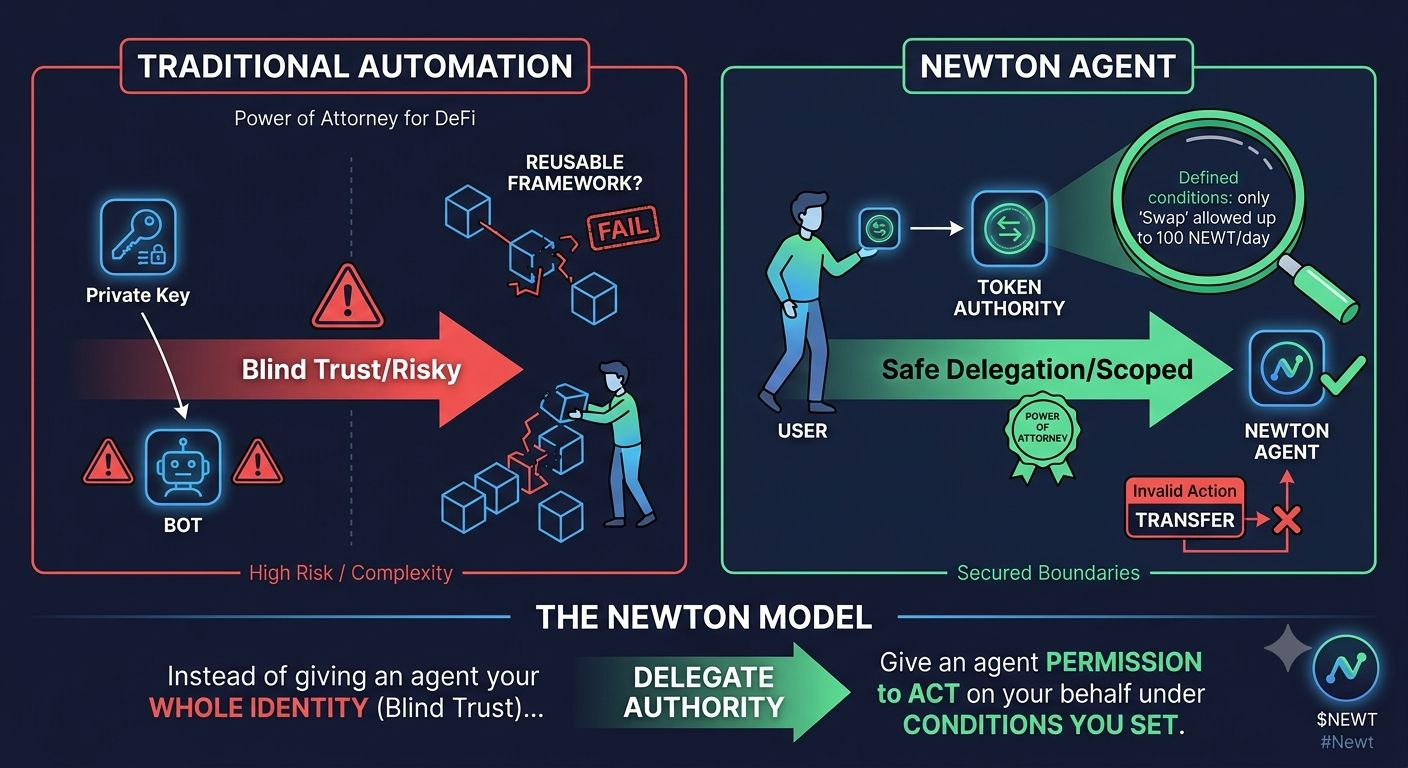
Sean Li describes what Newton lets you do as basically granting power of attorney to an AI agent, and honestly that's the clearest way I've heard this explained.
Think about power of attorney in real life. You don't hand someone your identity, you give them specific permission to act on your behalf under conditions you set, and if they step outside those conditions, it doesn't count. That's exactly the model here. You're not handing an agent your private key or full control over your funds, you're defining what it's allowed to do and Newton enforces those boundaries before anything executes.
That distinction matters more than it sounds. Most automation in crypto today either means trusting a centralized bot completely or writing custom permission logic yourself from scratch. Newton turns that into a standard, reusable framework, scoped authority instead of blind trust or none at all.
It's a simple analogy for a genuinely complicated technical problem, and simple analogies are usually the ones that actually stick.
@NewtonProtocol $NEWT #Newt
Think about power of attorney in real life. You don't hand someone your identity, you give them specific permission to act on your behalf under conditions you set, and if they step outside those conditions, it doesn't count. That's exactly the model here. You're not handing an agent your private key or full control over your funds, you're defining what it's allowed to do and Newton enforces those boundaries before anything executes.
That distinction matters more than it sounds. Most automation in crypto today either means trusting a centralized bot completely or writing custom permission logic yourself from scratch. Newton turns that into a standard, reusable framework, scoped authority instead of blind trust or none at all.
It's a simple analogy for a genuinely complicated technical problem, and simple analogies are usually the ones that actually stick.
@NewtonProtocol $NEWT #Newt
ログインして、さらにコンテンツを読む