

lillyvuchkova
14 投稿
lillyvuchkova
報告
ユーザーをブロック
10 フォロー
11 フォロワー
31 いいね
投稿
PINNED
今年の@Binance_Angels AwardsのAI Masterにノミネートされました 🏆
自分が本当にやっていて好きなことが何かに選ばれるなんて、うれしいサプライズ。そして、賞があるかどうかに関わらず、創作を続けるためのさらに強いモチベーションになります。
祈っています 💛
@Binancelatam
今年の@Binance Angels AwardsのAI Masterにノミネートされました 🏆
自分が本当にやっていて好きなことが何かに選ばれるなんて、うれしいサプライズ。そして、賞があるかどうかに関わらず、創作を続けるためのさらに強いモチベーションになります。
祈っています 💛
@Binance LATAM Official
自分が本当にやっていて好きなことが何かに選ばれるなんて、うれしいサプライズ。そして、賞があるかどうかに関わらず、創作を続けるためのさらに強いモチベーションになります。
祈っています 💛
@Binance LATAM Official

1
98
記事
翻訳参照
Binance vs Coinbase: Which Crypto Platform Is Best for Buying U.S. Stocks?Binance and Coinbase both sell U.S. stocks inside a crypto app, but they sell them to different people. Coinbase's stock brokerage serves only U.S. and U.K. residents, while Binance's serves eligible users outside the United States. Investors based in Mexico and Latin America have Binance as the only one of the two with direct U.S. stock trading. Elsewhere, where you live decides the answer before fees or features do.
This comparison combines official pages from both platforms with hands-on checks run on September 14, 2026.
How we testedBinance: an account verified in Mexico. We opened order forms for Apple stock (AAPL) and Apple's tokenized version (AAPLB) and read the estimated fees, without placing trades.Coinbase: averified account, plus Coinbase's public stock pages. Stock trading was unavailable in that region, so Coinbase details come from its official U.S. and U.K. pages.Fees: Binance's stock fees include a promotion that ends September 30, 2026. Standard rates appear alongside.
Which is better for buying U.S. stocks, Binance or Coinbase?
The better platform depends on your country of residence.
Mexico and Latin America: Binance, where eligible. Coinbase doesn't offer direct stock trading to residents there.U.S. residents: Coinbase. Binance does not offer these products to U.S. persons, and Coinbase charges no commission or trading fees on U.S. stock trades.U.K. residents: Coinbase offers U.S. stock trading through an FCA-regulated entity, but U.K. users cannot trade ETFs.Eligible users elsewhere: Binance offers the widest range in one account: direct stocks and ETFs, tokenized stocks (bStocks), stock options, equity-linked perpetual futures and recurring buys. Outside the U.S., Coinbase offers tokenized stocks on its Base network, only in eligible jurisdictions.
Can you buy U.S. stocks from Mexico and Latin America?
On Binance, yes: our Mexico-verified account showed every Binance stock product we checked. The account showed:
direct trading in more than 7,000 U.S. stocks and ETFsrecurring stock purchasesbStocks, with a "Buy with MXN" option on the trading pagean Options tab on the Apple stock page
On Coinbase, direct stock trading is limited to U.S. and U.K. residents, so Mexican and other Latin American residents can't use it. The Coinbase pages we reviewed don't say whether Coinbase Tokenized Stocks are available in Mexico; the eligibility check at base.org/stocks gives the current answer.
Across Latin America, availability on Binance varies by country. The reliable test is your own app: if the Stocks section loads and an order form opens after verification, the product is available on your account.
Two practical notes for Mexico:
Funding: direct stocks are paid in USDC or other supported crypto, not pesos. The "Buy with MXN" option appears on the bStocks trading page; we didn't test its payment methods or fees.Taxes: U.S. tax is withheld from dividends at a default rate of 30% before they reach your account. Mexican tax residents may have their own reporting obligations, so check with a tax adviser.
Who can buy U.S. stocks on each platform?
Binance offers stock trading to eligible users outside the United States, and availability varies by jurisdiction.
Coinbase offers direct stock trading to U.S. residents through Coinbase Capital Markets and to U.K. residents through CB Payments Ltd. From Bulgaria, Coinbase's Apple page showed "Trading stocks is not available in your area," and our Bulgaria-verified account had no stock trading. Coinbase Tokenized Stocks are offered only in eligible jurisdictions outside the U.S.
What are the ways to buy U.S. stocks on each platform?
Binance offers five routes:
Direct stocks and ETFs: more than 7,000 U.S.-listed stocks and ETFs, from 5 USD. You become the beneficial owner of the shares, which a U.S. clearing broker, Alpaca Securities, holds in custody. Trading runs up to 24 hours a day, five days a week, but only selected stocks trade overnight, and market orders execute only during regular hours.bStocks: tokenized securities backed 1:1 by U.S. stocks. They trade 24/7 against USDT, and you can withdraw them to BNB Chain-compatible wallets.Stock options: physically settled options on more than 1,000 U.S. stocks and ETFs, added in September 2026.Equity-linked perpetual futures: leveraged contracts that follow stock prices, without ownership.Recurring buys: automatic periodic purchases of selected stocks and ETFs. A single plan can split one amount across several stocks.
Coinbase offers two routes to U.K. and U.S. retail investors:
Direct stocks: U.S. residents trade thousands of stocks and ETFs 24/5, with fractional shares from 1 USD. U.K. residents trade roughly 3,800 U.S. stocks, from £1, funded in GBP or USDC.Coinbase Tokenized Stocks on Base: tokens backed 1:1 by shares, launched on August 24, 2026 with Apple, Alphabet, Meta and NVIDIA, and since expanded to ten tickers. They trade 24/7, sit in self-custody wallets and can be used in Base DeFi applications.
Coinbase also offers perpetuals and futures in the U.K., but its best execution policy states it does not offer them to retail clients there. Binance offers equity-linked perpetual futures to eligible users without that restriction.
How much does it cost to buy U.S. stocks on Binance and Coinbase?
Binance direct stocks charge no commission but do charge a platform fee or spread:
Small orders: a flat 0.35 USD on orders up to 350 USD. During a promotion running until 23:59 UTC on September 30, 2026, this drops to a flat 0.17 USD on orders up to 340 USD.Larger orders: a 0.10% spread, reduced to 0.05% during the same promotion.
The fee is calculated out of the amount you enter. On our account, a 10 USDC market order showed 9.83 USD of Apple stock during the promotion. The same fee applies again when you sell.
Funding matters too. Binance converts USDC to USD for free, while USDT, BNB, USD1, and U first convert to USDC at the market spread.
Binance bStocks use spot trading fees instead. The AAPLB trading page showed a 0.1% taker fee and a 0% maker fee before the optional BNB discount; your rate can vary with account tier.
A market order pays the taker fee. A limit order that waits in the order book pays the maker fee.Binance deducts the fee in AAPLB, not in USDT.Orders move in steps of 0.001 AAPLB, so a 10 USDT order came to about 9.77 USD at Apple's price that morning.
Coinbase charges no commission or fees on U.S. stock trades through Coinbase Capital Markets and currently charges no regulatory fees.
In the U.K., "no commission" is not the whole cost. U.S. shares are priced in USD, so paying in pounds triggers a currency conversion, and Coinbase's FCA cost disclosure puts that conversion fee at 0.50% of the transaction amount. Its own worked example shows a £10,000 purchase costing £50 on entry, cutting a 5% annual return to 4.5%. The disclosure lists no account, deposit, withdrawal, or ongoing custody fees beyond it.
What that means on a real purchase, excluding the market bid/ask spread:
A 10 USD buy costs 0.35 USD on a Binance direct stock at the standard rate, which is 3.5% of the purchase, or 0.17 USD during the promotion. As a bStock, it costs about 0.01 USD. On Coinbase in the U.S., it costs nothing; in the U.K., paying in pounds, about 0.05 USD.A 100 USD buy costs the same flat 0.35 USD on a Binance direct stock, now only 0.35% of the purchase, or 0.17 USD during the promotion. As a bStock, 0.10 USD. Coinbase U.S.: nothing; Coinbase U.K. in pounds: 0.50 USD.A 1,000 USD buy costs 1.00 USD on a Binance direct stock, or 0.50 USD during the promotion. As a bStock, 1.00 USD. Coinbase U.S.: nothing; Coinbase U.K. in pounds: 5.00 USD.
The Coinbase U.S. figures apply only to U.S. residents, who cannot use Binance's stock products. The U.K. figure is the currency conversion fee, which applies when funding in pounds rather than USDC.
Two patterns are worth noticing. Flat fees punish small orders: the same 0.35 USD is 3.5% of a 10 USD purchase and 0.35% of a 100 USD one. And none of these platforms charges a commission, yet all of them charge something. On a 1,000 USD purchase, the real cost runs from nothing to 5 USD, depending on the platform and the currency you fund with.
Other Binance costs to know before you buy:
Dividend tax: the clearing partner withholds U.S. tax at a default rate of 30%. This is a U.S. tax obligation, not a Binance fee.ADR fees: 0.01 to 0.03 USD per share on depositary receipts of non-U.S. companies.Voluntary corporate actions, such as tender offers: 200 USD per election.Moving shares out to another broker: 150 USD per stock, per request. Binance does not support ACATS transfers.Account fees: none. Binance also absorbs the SEC, FINRA, and CAT regulatory fees on sales.
Coinbase's U.K. disclosure lists comparable event-driven charges: a 150 USD standard legal transfer fee, matching Binance's, and a 50 USD voluntary corporate action election fee against Binance's 200 USD.
Does either platform get paid for sending your order somewhere?
Binance's stock trading disclaimer states that Binance may receive payment for order flow remuneration for directing your orders. Payment for order flow means a venue or market maker pays the platform for the right to fill your trade, which is why a service can be free at the point of use.
Coinbase's U.K. arm takes the opposite position. Its best execution policy says it does not structure or charge commissions in a way that would undermine compliance with FCA rules on conflicts and inducements, including restrictions on payment for order flow. It also commits to seeking the best total consideration for retail clients, meaning price plus execution costs.
Neither disclosure tells you what any individual order earned the platform. But the two describe different business models, and that is worth knowing before you judge a fee table.
What do you actually own on each platform?
What you own ranges from a share to a contract:
Binance direct stocks: you are the beneficial owner of real shares, eligible for dividends and corporate actions. The Apple page listed its August dividend under Events.Binance bStocks: a certificate representing the underlying stock, not a share. It gives no direct ownership in the company. Binance says bStocks convert 1:1 with the underlying share, with no conversion fee.Coinbase direct stocks (U.S. and U.K.): shares held through Coinbase's regulated brokerage entities.Coinbase Tokenized Stocks: Coinbase describes each token as a beneficial claim on a real share. The share is held by Alpaca in trust for token holders, and your claim runs against Coinbase's Abu Dhabi issuing vehicle rather than against Coinbase Global or the company itself.Perpetual futures and options: contracts, not ownership. On Binance, an exercised stock option delivers real shares.
Who holds the shares, and what happens if something goes wrong?
The company whose name is on the app is rarely the company holding your shares. Each product runs a different chain.
Binance direct stocks: Binance's broker-dealer, regulated in Abu Dhabi Global Market, sends orders to Alpaca Securities. Alpaca executes, clears, settles and holds the shares; Binance does not hold your securities.Coinbase U.K. stocks: three companies sit between you and the share. CB Payments Ltd is FCA-authorised to receive and transmit orders only, and states that it does not execute trades or hold client equities. It passes orders to Coinbase Capital Markets, a U.S. broker-dealer, which routes them to an external clearing broker such as Apex Clearing Corporation for execution, settlement and custody. CB Payments also warns that no order type carries a guaranteed execution price.On Coinbase Tokenized Stocks: the tokens are issued by a Coinbase special purpose vehicle licensed by the Abu Dhabi Global Market's Financial Services Regulatory Authority. Alpaca buys and custodies the underlying shares in segregated accounts, held in trust for token holders in a bankruptcy-remote structure. Coinbase says Alpaca is registered with the SEC and is a FINRA and SIPC member.Leaving: on Binance, moving a position to another broker costs 150 USD per stock. Coinbase's U.K. disclosure lists the same 150 USD standard legal transfer fee.
On protection, the two sides document very different amounts of detail.
Coinbase's U.K. filings are explicit. CB Payments states that it does not receive, hold or control client money or safeguard custody assets for these services, so the FCA's client asset rules, CASS, do not apply between you and CB Payments. Protection instead depends on the third party you end up contracted with. The FSCS may cover a valid claim if CB Payments itself fails in its arranging role, but it does not cover losses from falling share prices or poor investment performance, and any FSCS protection tied to a third party depends on that firm's own regulatory status. Complaints about CB Payments' conduct may be eligible for the Financial Ombudsman Service.
On the Binance side, the answer is partly knowable from the protection scheme itself. Binance describes Alpaca as a FINRA and SIPC member. SIPC covers customers of a failed member firm up to 500,000 USD, including 250,000 USD for cash claims, and SIPC states there is no requirement that a customer live in or be a citizen of the United States: a non-U.S. citizen is treated the same as a U.S. one. Alpaca also says it holds excess coverage above the SIPC limits.
Residency, then, is not the obstacle. The open question is narrower: SIPC protects customers of the member firm, and Binance's materials do not spell out whether someone who reaches Alpaca through Binance's introducing broker is a customer of Alpaca in that sense, or holds a share of a pooled account. That distinction determines what a claim would look like, and we could not resolve it from published sources.
Neither arrangement protects you from the stock going down. Both are about what happens if a firm in the chain fails.
Does 24/7 stock trading on a crypto platform actually work?
Early data suggests weekend bStock prices track Monday's opening prices closely, with caveats.
Binance Research studied the seven weekends after bStocks launched on June 11, 2026:
Weekend bStock prices captured a median 92% of the price gap at Monday's open, leaving an average residual deviation of 0.19%.Directional accuracy rose with the size of the move: 81% for gaps under 0.5%, 90% for 0.5–1%, 97% for 1–3%, and all 41 cases above 3%.
Binance Research notes the sample is small and does not present the data as a forecast. Its comparison also runs to the Monday open, by which time Binance's overnight stock session and U.S. pre-market trading have already begun.
Our own snapshot, taken during U.S. pre-market on September 11, 2026:
AAPLB bStock (05:58 ET): 325.80 USDT, with a 0.02 USDT gap between bid and ask (about 0.006%).Direct AAPL (06:04 ET): 325.78 USD, with a bid of 325.62 and an ask of 326.05 (about 0.13%). Binance labels this quote as indicative third-party data.Reference: Apple closed the previous day at 326.57 USD.
Coinbase Tokenized Stocks also trade 24/7 on Base; Coinbase direct stocks trade 24/5.
What "24/5" actually restricts
Both platforms limit what you can do outside regular U.S. hours, in similar ways.
Coinbase's U.K. risk disclosure states that market orders are not accepted during pre-market, overnight, and after-hours sessions; only collared limit orders are. Not every share is available for extended-hours trading, and Coinbase does not currently offer fractional share trading outside 9:30 a.m. to 4:00 p.m. ET. There is also a short daily window, 7:44:30 p.m. to 8:00 p.m. ET, when orders cannot be accepted at all because of third-party system limits.
Binance applies the same core restriction: market orders execute only during regular hours, and only selected stocks trade in its 24-hour session.
Coinbase also warns that outside regular hours there are fewer buyers and sellers, spreads widen, orders may fill partly or not at all, prices can move faster, and the same security may show different prices on different venues. Our pre-market readings above are consistent with that.
So "around the clock" describes when the market is open, not when every order type and every stock is available.
What are the risks of buying U.S. stocks on a crypto platform?
Market risk: stock prices fall as well as rise, and volatility rises outside regular U.S. market hours.Structure: bStocks are certificates, not shares, and carry issuer, custody, and technology risk. Self-custody does not mean the issuer has no control: reporting on Coinbase's prospectus describes powers to freeze and claw back tokens to meet legal requirements. Read the prospectus for whichever token you buy.Self-custody: tokens moved to your own wallet depend on your wallet security, so check the contract address before moving them.Leverage: perpetual futures use leverage, and positions can be liquidated. A Binance stock option expires worthless or is liquidated unless you submit an exercise instruction before the cut-off.Small-order costs: flat fees take a larger share of small purchases.Tax: U.S. dividend withholding reduces payouts.Borrowed money: Coinbase's risk disclosure tells U.K. clients not to fund investments with loans or credit facilities, and not to rely on expected profits to meet repayments. Sound advice on any platform.Eligibility: product availability depends on your country and can change. Binance places the responsibility on users to confirm that access to tokenized securities is lawful where they live.
Which should you choose?
You live in Mexico or elsewhere in Latin America: Binance, if the Stocks section is available on your verified account.Direct stocks, funded with USDC, if you want share ownership and dividends.bStocks, if you buy in small amounts or want to trade outside U.S. market hours, and accept the certificate structure.You live in the U.S.: Coinbase.You live in the U.K.: Coinbase for stocks, without ETFs.You live in another eligible country: the same logic as Mexico applies, and direct stocks cost less than bStocks for larger orders while the promotion runs.You want tokenized stocks in your own wallet: compare bStocks with Coinbase Tokenized Stocks, where each is available to you. Their legal structures differ.
Frequently asked questions
Do Binance and Coinbase sell real U.S. shares, or only tokens? Both sell real shares as well as tokens. Binance's direct stocks make eligible users beneficial owners of shares held by Alpaca Securities, and Coinbase sells shares to U.S. and U.K. residents. bStocks and Coinbase Tokenized Stocks are the tokenized versions.
Can I buy U.S. stocks on Binance from Mexico? Yes, if your account is eligible. Our account verified in Mexico showed direct stocks, bStocks, recurring buys, and an Options tab.
Can I use Coinbase to buy U.S. stocks from Mexico? Not Coinbase's direct stock trading, which serves only U.S. and U.K. residents. The Coinbase pages we reviewed don't confirm whether its tokenized stocks are available in Mexico; the eligibility check at base.org/stocks gives the current answer.
Can I buy U.S. stocks on Binance with pesos? Direct stocks are paid in USDC or other supported crypto. A "Buy with MXN" option appears on the bStocks trading page;
Do Binance stocks pay dividends? Yes. As a beneficial owner, you receive dividends after U.S. tax withholding, which defaults to 30%. Binance charges nothing to process them.
Can I transfer my stocks from Binance to another broker? Yes, through a DTC transfer costing 150 USD per stock, per request. Binance does not support ACATS transfers.
Can I trade U.S. stocks on Binance on weekends? Direct stocks close from Friday 8 p.m. to Sunday 8 p.m. ET. bStocks trade 24/7, including weekends.
What is the difference between bStocks and Binance direct stocks? Direct stocks make you the beneficial owner of real shares. A bStock is a certificate representing a share, with no direct ownership. Binance says the two convert 1:1 with no conversion fee.
Are my U.S. stocks on Binance protected? Alpaca Securities holds the shares and is a FINRA and SIPC member. The disclosures we reviewed don't state whether SIPC protection applies to non-U.S. customers accessing stocks through Binance.
Can I set up automatic stock purchases on Binance? Yes. Recurring buys run on a schedule you choose, and one plan can split an amount across several stocks and ETFs.
Are my stocks protected if the platform fails? Partly, and not in the way most people assume. Neither scheme covers your stock going down. Coinbase's U.K. disclosure says the FSCS may cover a valid claim if CB Payments fails in its arranging role, and that protection tied to a third party depends on that firm's own status. On Binance, the shares sit with Alpaca, a SIPC member; SIPC covers up to 500,000 USD per customer and applies regardless of where you live. What Binance's materials don't spell out is whether a Binance user counts as a customer of Alpaca for that purpose.
Can I place a market order outside U.S. trading hours? No, on either platform. Coinbase accepts only collared limit orders in extended sessions; Binance executes market orders during regular hours only.
Is "zero commission" really free? No. Binance charges a platform fee or spread instead of a commission. Coinbase charges nothing on U.S. stock trades, but its U.K. disclosure sets a 0.50% currency conversion fee when you pay in pounds. Read the cost disclosure, not the headline.
What is the cheapest way to buy a small amount of U.S. stock on Binance? For small orders, bStocks cost less: a 0.1% taker fee against a flat 0.17 USD (0.35 USD after September 30, 2026) on direct stocks. The trade-off is owning a certificate instead of the share.
This article is for information only and is not financial, investment, or tax advice. Data verified on September 11, 2026, from official Binance, Coinbase, and Base pages and hands-on account checks. Fees and availability change. Disclosure: The author is a Binance Angel.
Binance vs Coinbase: Which Crypto Platform Is Best for Buying U.S. Stocks?
Binance and Coinbase both sell U.S. stocks inside a crypto app, but they sell them to different people. Coinbase's stock brokerage serves only U.S. and U.K. residents, while Binance's serves eligible users outside the United States. Investors based in Mexico and Latin America have Binance as the only one of the two with direct U.S. stock trading. Elsewhere, where you live decides the answer before fees or features do.
This comparison combines official pages from both platforms with hands-on checks run on September 14, 2026.
How we testedBinance: an account verified in Mexico. We opened order forms for Apple stock (AAPL) and Apple's tokenized version (AAPLB) and read the estimated fees, without placing trades.Coinbase: averified account, plus Coinbase's public stock pages. Stock trading was unavailable in that region, so Coinbase details come from its official U.S. and U.K. pages.Fees: Binance's stock fees include a promotion that ends September 30, 2026. Standard rates appear alongside.
Which is better for buying U.S. stocks, Binance or Coinbase?
The better platform depends on your country of residence.
Mexico and Latin America: Binance, where eligible. Coinbase doesn't offer direct stock trading to residents there.U.S. residents: Coinbase. Binance does not offer these products to U.S. persons, and Coinbase charges no commission or trading fees on U.S. stock trades.U.K. residents: Coinbase offers U.S. stock trading through an FCA-regulated entity, but U.K. users cannot trade ETFs.Eligible users elsewhere: Binance offers the widest range in one account: direct stocks and ETFs, tokenized stocks (bStocks), stock options, equity-linked perpetual futures and recurring buys. Outside the U.S., Coinbase offers tokenized stocks on its Base network, only in eligible jurisdictions.
Can you buy U.S. stocks from Mexico and Latin America?
On Binance, yes: our Mexico-verified account showed every Binance stock product we checked. The account showed:
direct trading in more than 7,000 U.S. stocks and ETFsrecurring stock purchasesbStocks, with a "Buy with MXN" option on the trading pagean Options tab on the Apple stock page
On Coinbase, direct stock trading is limited to U.S. and U.K. residents, so Mexican and other Latin American residents can't use it. The Coinbase pages we reviewed don't say whether Coinbase Tokenized Stocks are available in Mexico; the eligibility check at base.org/stocks gives the current answer.
Across Latin America, availability on Binance varies by country. The reliable test is your own app: if the Stocks section loads and an order form opens after verification, the product is available on your account.
Two practical notes for Mexico:
Funding: direct stocks are paid in USDC or other supported crypto, not pesos. The "Buy with MXN" option appears on the bStocks trading page; we didn't test its payment methods or fees.Taxes: U.S. tax is withheld from dividends at a default rate of 30% before they reach your account. Mexican tax residents may have their own reporting obligations, so check with a tax adviser.
Who can buy U.S. stocks on each platform?
Binance offers stock trading to eligible users outside the United States, and availability varies by jurisdiction.
Coinbase offers direct stock trading to U.S. residents through Coinbase Capital Markets and to U.K. residents through CB Payments Ltd. From Bulgaria, Coinbase's Apple page showed "Trading stocks is not available in your area," and our Bulgaria-verified account had no stock trading. Coinbase Tokenized Stocks are offered only in eligible jurisdictions outside the U.S.
What are the ways to buy U.S. stocks on each platform?
Binance offers five routes:
Direct stocks and ETFs: more than 7,000 U.S.-listed stocks and ETFs, from 5 USD. You become the beneficial owner of the shares, which a U.S. clearing broker, Alpaca Securities, holds in custody. Trading runs up to 24 hours a day, five days a week, but only selected stocks trade overnight, and market orders execute only during regular hours.bStocks: tokenized securities backed 1:1 by U.S. stocks. They trade 24/7 against USDT, and you can withdraw them to BNB Chain-compatible wallets.Stock options: physically settled options on more than 1,000 U.S. stocks and ETFs, added in September 2026.Equity-linked perpetual futures: leveraged contracts that follow stock prices, without ownership.Recurring buys: automatic periodic purchases of selected stocks and ETFs. A single plan can split one amount across several stocks.
Coinbase offers two routes to U.K. and U.S. retail investors:
Direct stocks: U.S. residents trade thousands of stocks and ETFs 24/5, with fractional shares from 1 USD. U.K. residents trade roughly 3,800 U.S. stocks, from £1, funded in GBP or USDC.Coinbase Tokenized Stocks on Base: tokens backed 1:1 by shares, launched on August 24, 2026 with Apple, Alphabet, Meta and NVIDIA, and since expanded to ten tickers. They trade 24/7, sit in self-custody wallets and can be used in Base DeFi applications.
Coinbase also offers perpetuals and futures in the U.K., but its best execution policy states it does not offer them to retail clients there. Binance offers equity-linked perpetual futures to eligible users without that restriction.
How much does it cost to buy U.S. stocks on Binance and Coinbase?
Binance direct stocks charge no commission but do charge a platform fee or spread:
Small orders: a flat 0.35 USD on orders up to 350 USD. During a promotion running until 23:59 UTC on September 30, 2026, this drops to a flat 0.17 USD on orders up to 340 USD.Larger orders: a 0.10% spread, reduced to 0.05% during the same promotion.
The fee is calculated out of the amount you enter. On our account, a 10 USDC market order showed 9.83 USD of Apple stock during the promotion. The same fee applies again when you sell.
Funding matters too. Binance converts USDC to USD for free, while USDT, BNB, USD1, and U first convert to USDC at the market spread.
Binance bStocks use spot trading fees instead. The AAPLB trading page showed a 0.1% taker fee and a 0% maker fee before the optional BNB discount; your rate can vary with account tier.
A market order pays the taker fee. A limit order that waits in the order book pays the maker fee.Binance deducts the fee in AAPLB, not in USDT.Orders move in steps of 0.001 AAPLB, so a 10 USDT order came to about 9.77 USD at Apple's price that morning.
Coinbase charges no commission or fees on U.S. stock trades through Coinbase Capital Markets and currently charges no regulatory fees.
In the U.K., "no commission" is not the whole cost. U.S. shares are priced in USD, so paying in pounds triggers a currency conversion, and Coinbase's FCA cost disclosure puts that conversion fee at 0.50% of the transaction amount. Its own worked example shows a £10,000 purchase costing £50 on entry, cutting a 5% annual return to 4.5%. The disclosure lists no account, deposit, withdrawal, or ongoing custody fees beyond it.
What that means on a real purchase, excluding the market bid/ask spread:
A 10 USD buy costs 0.35 USD on a Binance direct stock at the standard rate, which is 3.5% of the purchase, or 0.17 USD during the promotion. As a bStock, it costs about 0.01 USD. On Coinbase in the U.S., it costs nothing; in the U.K., paying in pounds, about 0.05 USD.A 100 USD buy costs the same flat 0.35 USD on a Binance direct stock, now only 0.35% of the purchase, or 0.17 USD during the promotion. As a bStock, 0.10 USD. Coinbase U.S.: nothing; Coinbase U.K. in pounds: 0.50 USD.A 1,000 USD buy costs 1.00 USD on a Binance direct stock, or 0.50 USD during the promotion. As a bStock, 1.00 USD. Coinbase U.S.: nothing; Coinbase U.K. in pounds: 5.00 USD.
The Coinbase U.S. figures apply only to U.S. residents, who cannot use Binance's stock products. The U.K. figure is the currency conversion fee, which applies when funding in pounds rather than USDC.
Two patterns are worth noticing. Flat fees punish small orders: the same 0.35 USD is 3.5% of a 10 USD purchase and 0.35% of a 100 USD one. And none of these platforms charges a commission, yet all of them charge something. On a 1,000 USD purchase, the real cost runs from nothing to 5 USD, depending on the platform and the currency you fund with.
Other Binance costs to know before you buy:
Dividend tax: the clearing partner withholds U.S. tax at a default rate of 30%. This is a U.S. tax obligation, not a Binance fee.ADR fees: 0.01 to 0.03 USD per share on depositary receipts of non-U.S. companies.Voluntary corporate actions, such as tender offers: 200 USD per election.Moving shares out to another broker: 150 USD per stock, per request. Binance does not support ACATS transfers.Account fees: none. Binance also absorbs the SEC, FINRA, and CAT regulatory fees on sales.
Coinbase's U.K. disclosure lists comparable event-driven charges: a 150 USD standard legal transfer fee, matching Binance's, and a 50 USD voluntary corporate action election fee against Binance's 200 USD.
Does either platform get paid for sending your order somewhere?
Binance's stock trading disclaimer states that Binance may receive payment for order flow remuneration for directing your orders. Payment for order flow means a venue or market maker pays the platform for the right to fill your trade, which is why a service can be free at the point of use.
Coinbase's U.K. arm takes the opposite position. Its best execution policy says it does not structure or charge commissions in a way that would undermine compliance with FCA rules on conflicts and inducements, including restrictions on payment for order flow. It also commits to seeking the best total consideration for retail clients, meaning price plus execution costs.
Neither disclosure tells you what any individual order earned the platform. But the two describe different business models, and that is worth knowing before you judge a fee table.
What do you actually own on each platform?
What you own ranges from a share to a contract:
Binance direct stocks: you are the beneficial owner of real shares, eligible for dividends and corporate actions. The Apple page listed its August dividend under Events.Binance bStocks: a certificate representing the underlying stock, not a share. It gives no direct ownership in the company. Binance says bStocks convert 1:1 with the underlying share, with no conversion fee.Coinbase direct stocks (U.S. and U.K.): shares held through Coinbase's regulated brokerage entities.Coinbase Tokenized Stocks: Coinbase describes each token as a beneficial claim on a real share. The share is held by Alpaca in trust for token holders, and your claim runs against Coinbase's Abu Dhabi issuing vehicle rather than against Coinbase Global or the company itself.Perpetual futures and options: contracts, not ownership. On Binance, an exercised stock option delivers real shares.
Who holds the shares, and what happens if something goes wrong?
The company whose name is on the app is rarely the company holding your shares. Each product runs a different chain.
Binance direct stocks: Binance's broker-dealer, regulated in Abu Dhabi Global Market, sends orders to Alpaca Securities. Alpaca executes, clears, settles and holds the shares; Binance does not hold your securities.Coinbase U.K. stocks: three companies sit between you and the share. CB Payments Ltd is FCA-authorised to receive and transmit orders only, and states that it does not execute trades or hold client equities. It passes orders to Coinbase Capital Markets, a U.S. broker-dealer, which routes them to an external clearing broker such as Apex Clearing Corporation for execution, settlement and custody. CB Payments also warns that no order type carries a guaranteed execution price.On Coinbase Tokenized Stocks: the tokens are issued by a Coinbase special purpose vehicle licensed by the Abu Dhabi Global Market's Financial Services Regulatory Authority. Alpaca buys and custodies the underlying shares in segregated accounts, held in trust for token holders in a bankruptcy-remote structure. Coinbase says Alpaca is registered with the SEC and is a FINRA and SIPC member.Leaving: on Binance, moving a position to another broker costs 150 USD per stock. Coinbase's U.K. disclosure lists the same 150 USD standard legal transfer fee.
On protection, the two sides document very different amounts of detail.
Coinbase's U.K. filings are explicit. CB Payments states that it does not receive, hold or control client money or safeguard custody assets for these services, so the FCA's client asset rules, CASS, do not apply between you and CB Payments. Protection instead depends on the third party you end up contracted with. The FSCS may cover a valid claim if CB Payments itself fails in its arranging role, but it does not cover losses from falling share prices or poor investment performance, and any FSCS protection tied to a third party depends on that firm's own regulatory status. Complaints about CB Payments' conduct may be eligible for the Financial Ombudsman Service.
On the Binance side, the answer is partly knowable from the protection scheme itself. Binance describes Alpaca as a FINRA and SIPC member. SIPC covers customers of a failed member firm up to 500,000 USD, including 250,000 USD for cash claims, and SIPC states there is no requirement that a customer live in or be a citizen of the United States: a non-U.S. citizen is treated the same as a U.S. one. Alpaca also says it holds excess coverage above the SIPC limits.
Residency, then, is not the obstacle. The open question is narrower: SIPC protects customers of the member firm, and Binance's materials do not spell out whether someone who reaches Alpaca through Binance's introducing broker is a customer of Alpaca in that sense, or holds a share of a pooled account. That distinction determines what a claim would look like, and we could not resolve it from published sources.
Neither arrangement protects you from the stock going down. Both are about what happens if a firm in the chain fails.
Does 24/7 stock trading on a crypto platform actually work?
Early data suggests weekend bStock prices track Monday's opening prices closely, with caveats.
Binance Research studied the seven weekends after bStocks launched on June 11, 2026:
Weekend bStock prices captured a median 92% of the price gap at Monday's open, leaving an average residual deviation of 0.19%.Directional accuracy rose with the size of the move: 81% for gaps under 0.5%, 90% for 0.5–1%, 97% for 1–3%, and all 41 cases above 3%.
Binance Research notes the sample is small and does not present the data as a forecast. Its comparison also runs to the Monday open, by which time Binance's overnight stock session and U.S. pre-market trading have already begun.
Our own snapshot, taken during U.S. pre-market on September 11, 2026:
AAPLB bStock (05:58 ET): 325.80 USDT, with a 0.02 USDT gap between bid and ask (about 0.006%).Direct AAPL (06:04 ET): 325.78 USD, with a bid of 325.62 and an ask of 326.05 (about 0.13%). Binance labels this quote as indicative third-party data.Reference: Apple closed the previous day at 326.57 USD.
Coinbase Tokenized Stocks also trade 24/7 on Base; Coinbase direct stocks trade 24/5.
What "24/5" actually restricts
Both platforms limit what you can do outside regular U.S. hours, in similar ways.
Coinbase's U.K. risk disclosure states that market orders are not accepted during pre-market, overnight, and after-hours sessions; only collared limit orders are. Not every share is available for extended-hours trading, and Coinbase does not currently offer fractional share trading outside 9:30 a.m. to 4:00 p.m. ET. There is also a short daily window, 7:44:30 p.m. to 8:00 p.m. ET, when orders cannot be accepted at all because of third-party system limits.
Binance applies the same core restriction: market orders execute only during regular hours, and only selected stocks trade in its 24-hour session.
Coinbase also warns that outside regular hours there are fewer buyers and sellers, spreads widen, orders may fill partly or not at all, prices can move faster, and the same security may show different prices on different venues. Our pre-market readings above are consistent with that.
So "around the clock" describes when the market is open, not when every order type and every stock is available.
What are the risks of buying U.S. stocks on a crypto platform?
Market risk: stock prices fall as well as rise, and volatility rises outside regular U.S. market hours.Structure: bStocks are certificates, not shares, and carry issuer, custody, and technology risk. Self-custody does not mean the issuer has no control: reporting on Coinbase's prospectus describes powers to freeze and claw back tokens to meet legal requirements. Read the prospectus for whichever token you buy.Self-custody: tokens moved to your own wallet depend on your wallet security, so check the contract address before moving them.Leverage: perpetual futures use leverage, and positions can be liquidated. A Binance stock option expires worthless or is liquidated unless you submit an exercise instruction before the cut-off.Small-order costs: flat fees take a larger share of small purchases.Tax: U.S. dividend withholding reduces payouts.Borrowed money: Coinbase's risk disclosure tells U.K. clients not to fund investments with loans or credit facilities, and not to rely on expected profits to meet repayments. Sound advice on any platform.Eligibility: product availability depends on your country and can change. Binance places the responsibility on users to confirm that access to tokenized securities is lawful where they live.
Which should you choose?
You live in Mexico or elsewhere in Latin America: Binance, if the Stocks section is available on your verified account.Direct stocks, funded with USDC, if you want share ownership and dividends.bStocks, if you buy in small amounts or want to trade outside U.S. market hours, and accept the certificate structure.You live in the U.S.: Coinbase.You live in the U.K.: Coinbase for stocks, without ETFs.You live in another eligible country: the same logic as Mexico applies, and direct stocks cost less than bStocks for larger orders while the promotion runs.You want tokenized stocks in your own wallet: compare bStocks with Coinbase Tokenized Stocks, where each is available to you. Their legal structures differ.
Frequently asked questions
Do Binance and Coinbase sell real U.S. shares, or only tokens? Both sell real shares as well as tokens. Binance's direct stocks make eligible users beneficial owners of shares held by Alpaca Securities, and Coinbase sells shares to U.S. and U.K. residents. bStocks and Coinbase Tokenized Stocks are the tokenized versions.
Can I buy U.S. stocks on Binance from Mexico? Yes, if your account is eligible. Our account verified in Mexico showed direct stocks, bStocks, recurring buys, and an Options tab.
Can I use Coinbase to buy U.S. stocks from Mexico? Not Coinbase's direct stock trading, which serves only U.S. and U.K. residents. The Coinbase pages we reviewed don't confirm whether its tokenized stocks are available in Mexico; the eligibility check at base.org/stocks gives the current answer.
Can I buy U.S. stocks on Binance with pesos? Direct stocks are paid in USDC or other supported crypto. A "Buy with MXN" option appears on the bStocks trading page;
Do Binance stocks pay dividends? Yes. As a beneficial owner, you receive dividends after U.S. tax withholding, which defaults to 30%. Binance charges nothing to process them.
Can I transfer my stocks from Binance to another broker? Yes, through a DTC transfer costing 150 USD per stock, per request. Binance does not support ACATS transfers.
Can I trade U.S. stocks on Binance on weekends? Direct stocks close from Friday 8 p.m. to Sunday 8 p.m. ET. bStocks trade 24/7, including weekends.
What is the difference between bStocks and Binance direct stocks? Direct stocks make you the beneficial owner of real shares. A bStock is a certificate representing a share, with no direct ownership. Binance says the two convert 1:1 with no conversion fee.
Are my U.S. stocks on Binance protected? Alpaca Securities holds the shares and is a FINRA and SIPC member. The disclosures we reviewed don't state whether SIPC protection applies to non-U.S. customers accessing stocks through Binance.
Can I set up automatic stock purchases on Binance? Yes. Recurring buys run on a schedule you choose, and one plan can split an amount across several stocks and ETFs.
Are my stocks protected if the platform fails? Partly, and not in the way most people assume. Neither scheme covers your stock going down. Coinbase's U.K. disclosure says the FSCS may cover a valid claim if CB Payments fails in its arranging role, and that protection tied to a third party depends on that firm's own status. On Binance, the shares sit with Alpaca, a SIPC member; SIPC covers up to 500,000 USD per customer and applies regardless of where you live. What Binance's materials don't spell out is whether a Binance user counts as a customer of Alpaca for that purpose.
Can I place a market order outside U.S. trading hours? No, on either platform. Coinbase accepts only collared limit orders in extended sessions; Binance executes market orders during regular hours only.
Is "zero commission" really free? No. Binance charges a platform fee or spread instead of a commission. Coinbase charges nothing on U.S. stock trades, but its U.K. disclosure sets a 0.50% currency conversion fee when you pay in pounds. Read the cost disclosure, not the headline.
What is the cheapest way to buy a small amount of U.S. stock on Binance? For small orders, bStocks cost less: a 0.1% taker fee against a flat 0.17 USD (0.35 USD after September 30, 2026) on direct stocks. The trade-off is owning a certificate instead of the share.
This article is for information only and is not financial, investment, or tax advice. Data verified on September 11, 2026, from official Binance, Coinbase, and Base pages and hands-on account checks. Fees and availability change. Disclosure: The author is a Binance Angel.
This comparison combines official pages from both platforms with hands-on checks run on September 14, 2026.
How we testedBinance: an account verified in Mexico. We opened order forms for Apple stock (AAPL) and Apple's tokenized version (AAPLB) and read the estimated fees, without placing trades.Coinbase: averified account, plus Coinbase's public stock pages. Stock trading was unavailable in that region, so Coinbase details come from its official U.S. and U.K. pages.Fees: Binance's stock fees include a promotion that ends September 30, 2026. Standard rates appear alongside.
Which is better for buying U.S. stocks, Binance or Coinbase?
The better platform depends on your country of residence.
Mexico and Latin America: Binance, where eligible. Coinbase doesn't offer direct stock trading to residents there.U.S. residents: Coinbase. Binance does not offer these products to U.S. persons, and Coinbase charges no commission or trading fees on U.S. stock trades.U.K. residents: Coinbase offers U.S. stock trading through an FCA-regulated entity, but U.K. users cannot trade ETFs.Eligible users elsewhere: Binance offers the widest range in one account: direct stocks and ETFs, tokenized stocks (bStocks), stock options, equity-linked perpetual futures and recurring buys. Outside the U.S., Coinbase offers tokenized stocks on its Base network, only in eligible jurisdictions.
Can you buy U.S. stocks from Mexico and Latin America?
On Binance, yes: our Mexico-verified account showed every Binance stock product we checked. The account showed:
direct trading in more than 7,000 U.S. stocks and ETFsrecurring stock purchasesbStocks, with a "Buy with MXN" option on the trading pagean Options tab on the Apple stock page
On Coinbase, direct stock trading is limited to U.S. and U.K. residents, so Mexican and other Latin American residents can't use it. The Coinbase pages we reviewed don't say whether Coinbase Tokenized Stocks are available in Mexico; the eligibility check at base.org/stocks gives the current answer.
Across Latin America, availability on Binance varies by country. The reliable test is your own app: if the Stocks section loads and an order form opens after verification, the product is available on your account.
Two practical notes for Mexico:
Funding: direct stocks are paid in USDC or other supported crypto, not pesos. The "Buy with MXN" option appears on the bStocks trading page; we didn't test its payment methods or fees.Taxes: U.S. tax is withheld from dividends at a default rate of 30% before they reach your account. Mexican tax residents may have their own reporting obligations, so check with a tax adviser.
Who can buy U.S. stocks on each platform?
Binance offers stock trading to eligible users outside the United States, and availability varies by jurisdiction.
Coinbase offers direct stock trading to U.S. residents through Coinbase Capital Markets and to U.K. residents through CB Payments Ltd. From Bulgaria, Coinbase's Apple page showed "Trading stocks is not available in your area," and our Bulgaria-verified account had no stock trading. Coinbase Tokenized Stocks are offered only in eligible jurisdictions outside the U.S.
What are the ways to buy U.S. stocks on each platform?
Binance offers five routes:
Direct stocks and ETFs: more than 7,000 U.S.-listed stocks and ETFs, from 5 USD. You become the beneficial owner of the shares, which a U.S. clearing broker, Alpaca Securities, holds in custody. Trading runs up to 24 hours a day, five days a week, but only selected stocks trade overnight, and market orders execute only during regular hours.bStocks: tokenized securities backed 1:1 by U.S. stocks. They trade 24/7 against USDT, and you can withdraw them to BNB Chain-compatible wallets.Stock options: physically settled options on more than 1,000 U.S. stocks and ETFs, added in September 2026.Equity-linked perpetual futures: leveraged contracts that follow stock prices, without ownership.Recurring buys: automatic periodic purchases of selected stocks and ETFs. A single plan can split one amount across several stocks.
Coinbase offers two routes to U.K. and U.S. retail investors:
Direct stocks: U.S. residents trade thousands of stocks and ETFs 24/5, with fractional shares from 1 USD. U.K. residents trade roughly 3,800 U.S. stocks, from £1, funded in GBP or USDC.Coinbase Tokenized Stocks on Base: tokens backed 1:1 by shares, launched on August 24, 2026 with Apple, Alphabet, Meta and NVIDIA, and since expanded to ten tickers. They trade 24/7, sit in self-custody wallets and can be used in Base DeFi applications.
Coinbase also offers perpetuals and futures in the U.K., but its best execution policy states it does not offer them to retail clients there. Binance offers equity-linked perpetual futures to eligible users without that restriction.
How much does it cost to buy U.S. stocks on Binance and Coinbase?
Binance direct stocks charge no commission but do charge a platform fee or spread:
Small orders: a flat 0.35 USD on orders up to 350 USD. During a promotion running until 23:59 UTC on September 30, 2026, this drops to a flat 0.17 USD on orders up to 340 USD.Larger orders: a 0.10% spread, reduced to 0.05% during the same promotion.
The fee is calculated out of the amount you enter. On our account, a 10 USDC market order showed 9.83 USD of Apple stock during the promotion. The same fee applies again when you sell.
Funding matters too. Binance converts USDC to USD for free, while USDT, BNB, USD1, and U first convert to USDC at the market spread.
Binance bStocks use spot trading fees instead. The AAPLB trading page showed a 0.1% taker fee and a 0% maker fee before the optional BNB discount; your rate can vary with account tier.
A market order pays the taker fee. A limit order that waits in the order book pays the maker fee.Binance deducts the fee in AAPLB, not in USDT.Orders move in steps of 0.001 AAPLB, so a 10 USDT order came to about 9.77 USD at Apple's price that morning.
Coinbase charges no commission or fees on U.S. stock trades through Coinbase Capital Markets and currently charges no regulatory fees.
In the U.K., "no commission" is not the whole cost. U.S. shares are priced in USD, so paying in pounds triggers a currency conversion, and Coinbase's FCA cost disclosure puts that conversion fee at 0.50% of the transaction amount. Its own worked example shows a £10,000 purchase costing £50 on entry, cutting a 5% annual return to 4.5%. The disclosure lists no account, deposit, withdrawal, or ongoing custody fees beyond it.
What that means on a real purchase, excluding the market bid/ask spread:
A 10 USD buy costs 0.35 USD on a Binance direct stock at the standard rate, which is 3.5% of the purchase, or 0.17 USD during the promotion. As a bStock, it costs about 0.01 USD. On Coinbase in the U.S., it costs nothing; in the U.K., paying in pounds, about 0.05 USD.A 100 USD buy costs the same flat 0.35 USD on a Binance direct stock, now only 0.35% of the purchase, or 0.17 USD during the promotion. As a bStock, 0.10 USD. Coinbase U.S.: nothing; Coinbase U.K. in pounds: 0.50 USD.A 1,000 USD buy costs 1.00 USD on a Binance direct stock, or 0.50 USD during the promotion. As a bStock, 1.00 USD. Coinbase U.S.: nothing; Coinbase U.K. in pounds: 5.00 USD.
The Coinbase U.S. figures apply only to U.S. residents, who cannot use Binance's stock products. The U.K. figure is the currency conversion fee, which applies when funding in pounds rather than USDC.
Two patterns are worth noticing. Flat fees punish small orders: the same 0.35 USD is 3.5% of a 10 USD purchase and 0.35% of a 100 USD one. And none of these platforms charges a commission, yet all of them charge something. On a 1,000 USD purchase, the real cost runs from nothing to 5 USD, depending on the platform and the currency you fund with.
Other Binance costs to know before you buy:
Dividend tax: the clearing partner withholds U.S. tax at a default rate of 30%. This is a U.S. tax obligation, not a Binance fee.ADR fees: 0.01 to 0.03 USD per share on depositary receipts of non-U.S. companies.Voluntary corporate actions, such as tender offers: 200 USD per election.Moving shares out to another broker: 150 USD per stock, per request. Binance does not support ACATS transfers.Account fees: none. Binance also absorbs the SEC, FINRA, and CAT regulatory fees on sales.
Coinbase's U.K. disclosure lists comparable event-driven charges: a 150 USD standard legal transfer fee, matching Binance's, and a 50 USD voluntary corporate action election fee against Binance's 200 USD.
Does either platform get paid for sending your order somewhere?
Binance's stock trading disclaimer states that Binance may receive payment for order flow remuneration for directing your orders. Payment for order flow means a venue or market maker pays the platform for the right to fill your trade, which is why a service can be free at the point of use.
Coinbase's U.K. arm takes the opposite position. Its best execution policy says it does not structure or charge commissions in a way that would undermine compliance with FCA rules on conflicts and inducements, including restrictions on payment for order flow. It also commits to seeking the best total consideration for retail clients, meaning price plus execution costs.
Neither disclosure tells you what any individual order earned the platform. But the two describe different business models, and that is worth knowing before you judge a fee table.
What do you actually own on each platform?
What you own ranges from a share to a contract:
Binance direct stocks: you are the beneficial owner of real shares, eligible for dividends and corporate actions. The Apple page listed its August dividend under Events.Binance bStocks: a certificate representing the underlying stock, not a share. It gives no direct ownership in the company. Binance says bStocks convert 1:1 with the underlying share, with no conversion fee.Coinbase direct stocks (U.S. and U.K.): shares held through Coinbase's regulated brokerage entities.Coinbase Tokenized Stocks: Coinbase describes each token as a beneficial claim on a real share. The share is held by Alpaca in trust for token holders, and your claim runs against Coinbase's Abu Dhabi issuing vehicle rather than against Coinbase Global or the company itself.Perpetual futures and options: contracts, not ownership. On Binance, an exercised stock option delivers real shares.
Who holds the shares, and what happens if something goes wrong?
The company whose name is on the app is rarely the company holding your shares. Each product runs a different chain.
Binance direct stocks: Binance's broker-dealer, regulated in Abu Dhabi Global Market, sends orders to Alpaca Securities. Alpaca executes, clears, settles and holds the shares; Binance does not hold your securities.Coinbase U.K. stocks: three companies sit between you and the share. CB Payments Ltd is FCA-authorised to receive and transmit orders only, and states that it does not execute trades or hold client equities. It passes orders to Coinbase Capital Markets, a U.S. broker-dealer, which routes them to an external clearing broker such as Apex Clearing Corporation for execution, settlement and custody. CB Payments also warns that no order type carries a guaranteed execution price.On Coinbase Tokenized Stocks: the tokens are issued by a Coinbase special purpose vehicle licensed by the Abu Dhabi Global Market's Financial Services Regulatory Authority. Alpaca buys and custodies the underlying shares in segregated accounts, held in trust for token holders in a bankruptcy-remote structure. Coinbase says Alpaca is registered with the SEC and is a FINRA and SIPC member.Leaving: on Binance, moving a position to another broker costs 150 USD per stock. Coinbase's U.K. disclosure lists the same 150 USD standard legal transfer fee.
On protection, the two sides document very different amounts of detail.
Coinbase's U.K. filings are explicit. CB Payments states that it does not receive, hold or control client money or safeguard custody assets for these services, so the FCA's client asset rules, CASS, do not apply between you and CB Payments. Protection instead depends on the third party you end up contracted with. The FSCS may cover a valid claim if CB Payments itself fails in its arranging role, but it does not cover losses from falling share prices or poor investment performance, and any FSCS protection tied to a third party depends on that firm's own regulatory status. Complaints about CB Payments' conduct may be eligible for the Financial Ombudsman Service.
On the Binance side, the answer is partly knowable from the protection scheme itself. Binance describes Alpaca as a FINRA and SIPC member. SIPC covers customers of a failed member firm up to 500,000 USD, including 250,000 USD for cash claims, and SIPC states there is no requirement that a customer live in or be a citizen of the United States: a non-U.S. citizen is treated the same as a U.S. one. Alpaca also says it holds excess coverage above the SIPC limits.
Residency, then, is not the obstacle. The open question is narrower: SIPC protects customers of the member firm, and Binance's materials do not spell out whether someone who reaches Alpaca through Binance's introducing broker is a customer of Alpaca in that sense, or holds a share of a pooled account. That distinction determines what a claim would look like, and we could not resolve it from published sources.
Neither arrangement protects you from the stock going down. Both are about what happens if a firm in the chain fails.
Does 24/7 stock trading on a crypto platform actually work?
Early data suggests weekend bStock prices track Monday's opening prices closely, with caveats.
Binance Research studied the seven weekends after bStocks launched on June 11, 2026:
Weekend bStock prices captured a median 92% of the price gap at Monday's open, leaving an average residual deviation of 0.19%.Directional accuracy rose with the size of the move: 81% for gaps under 0.5%, 90% for 0.5–1%, 97% for 1–3%, and all 41 cases above 3%.
Binance Research notes the sample is small and does not present the data as a forecast. Its comparison also runs to the Monday open, by which time Binance's overnight stock session and U.S. pre-market trading have already begun.
Our own snapshot, taken during U.S. pre-market on September 11, 2026:
AAPLB bStock (05:58 ET): 325.80 USDT, with a 0.02 USDT gap between bid and ask (about 0.006%).Direct AAPL (06:04 ET): 325.78 USD, with a bid of 325.62 and an ask of 326.05 (about 0.13%). Binance labels this quote as indicative third-party data.Reference: Apple closed the previous day at 326.57 USD.
Coinbase Tokenized Stocks also trade 24/7 on Base; Coinbase direct stocks trade 24/5.
What "24/5" actually restricts
Both platforms limit what you can do outside regular U.S. hours, in similar ways.
Coinbase's U.K. risk disclosure states that market orders are not accepted during pre-market, overnight, and after-hours sessions; only collared limit orders are. Not every share is available for extended-hours trading, and Coinbase does not currently offer fractional share trading outside 9:30 a.m. to 4:00 p.m. ET. There is also a short daily window, 7:44:30 p.m. to 8:00 p.m. ET, when orders cannot be accepted at all because of third-party system limits.
Binance applies the same core restriction: market orders execute only during regular hours, and only selected stocks trade in its 24-hour session.
Coinbase also warns that outside regular hours there are fewer buyers and sellers, spreads widen, orders may fill partly or not at all, prices can move faster, and the same security may show different prices on different venues. Our pre-market readings above are consistent with that.
So "around the clock" describes when the market is open, not when every order type and every stock is available.
What are the risks of buying U.S. stocks on a crypto platform?
Market risk: stock prices fall as well as rise, and volatility rises outside regular U.S. market hours.Structure: bStocks are certificates, not shares, and carry issuer, custody, and technology risk. Self-custody does not mean the issuer has no control: reporting on Coinbase's prospectus describes powers to freeze and claw back tokens to meet legal requirements. Read the prospectus for whichever token you buy.Self-custody: tokens moved to your own wallet depend on your wallet security, so check the contract address before moving them.Leverage: perpetual futures use leverage, and positions can be liquidated. A Binance stock option expires worthless or is liquidated unless you submit an exercise instruction before the cut-off.Small-order costs: flat fees take a larger share of small purchases.Tax: U.S. dividend withholding reduces payouts.Borrowed money: Coinbase's risk disclosure tells U.K. clients not to fund investments with loans or credit facilities, and not to rely on expected profits to meet repayments. Sound advice on any platform.Eligibility: product availability depends on your country and can change. Binance places the responsibility on users to confirm that access to tokenized securities is lawful where they live.
Which should you choose?
You live in Mexico or elsewhere in Latin America: Binance, if the Stocks section is available on your verified account.Direct stocks, funded with USDC, if you want share ownership and dividends.bStocks, if you buy in small amounts or want to trade outside U.S. market hours, and accept the certificate structure.You live in the U.S.: Coinbase.You live in the U.K.: Coinbase for stocks, without ETFs.You live in another eligible country: the same logic as Mexico applies, and direct stocks cost less than bStocks for larger orders while the promotion runs.You want tokenized stocks in your own wallet: compare bStocks with Coinbase Tokenized Stocks, where each is available to you. Their legal structures differ.
Frequently asked questions
Do Binance and Coinbase sell real U.S. shares, or only tokens? Both sell real shares as well as tokens. Binance's direct stocks make eligible users beneficial owners of shares held by Alpaca Securities, and Coinbase sells shares to U.S. and U.K. residents. bStocks and Coinbase Tokenized Stocks are the tokenized versions.
Can I buy U.S. stocks on Binance from Mexico? Yes, if your account is eligible. Our account verified in Mexico showed direct stocks, bStocks, recurring buys, and an Options tab.
Can I use Coinbase to buy U.S. stocks from Mexico? Not Coinbase's direct stock trading, which serves only U.S. and U.K. residents. The Coinbase pages we reviewed don't confirm whether its tokenized stocks are available in Mexico; the eligibility check at base.org/stocks gives the current answer.
Can I buy U.S. stocks on Binance with pesos? Direct stocks are paid in USDC or other supported crypto. A "Buy with MXN" option appears on the bStocks trading page;
Do Binance stocks pay dividends? Yes. As a beneficial owner, you receive dividends after U.S. tax withholding, which defaults to 30%. Binance charges nothing to process them.
Can I transfer my stocks from Binance to another broker? Yes, through a DTC transfer costing 150 USD per stock, per request. Binance does not support ACATS transfers.
Can I trade U.S. stocks on Binance on weekends? Direct stocks close from Friday 8 p.m. to Sunday 8 p.m. ET. bStocks trade 24/7, including weekends.
What is the difference between bStocks and Binance direct stocks? Direct stocks make you the beneficial owner of real shares. A bStock is a certificate representing a share, with no direct ownership. Binance says the two convert 1:1 with no conversion fee.
Are my U.S. stocks on Binance protected? Alpaca Securities holds the shares and is a FINRA and SIPC member. The disclosures we reviewed don't state whether SIPC protection applies to non-U.S. customers accessing stocks through Binance.
Can I set up automatic stock purchases on Binance? Yes. Recurring buys run on a schedule you choose, and one plan can split an amount across several stocks and ETFs.
Are my stocks protected if the platform fails? Partly, and not in the way most people assume. Neither scheme covers your stock going down. Coinbase's U.K. disclosure says the FSCS may cover a valid claim if CB Payments fails in its arranging role, and that protection tied to a third party depends on that firm's own status. On Binance, the shares sit with Alpaca, a SIPC member; SIPC covers up to 500,000 USD per customer and applies regardless of where you live. What Binance's materials don't spell out is whether a Binance user counts as a customer of Alpaca for that purpose.
Can I place a market order outside U.S. trading hours? No, on either platform. Coinbase accepts only collared limit orders in extended sessions; Binance executes market orders during regular hours only.
Is "zero commission" really free? No. Binance charges a platform fee or spread instead of a commission. Coinbase charges nothing on U.S. stock trades, but its U.K. disclosure sets a 0.50% currency conversion fee when you pay in pounds. Read the cost disclosure, not the headline.
What is the cheapest way to buy a small amount of U.S. stock on Binance? For small orders, bStocks cost less: a 0.1% taker fee against a flat 0.17 USD (0.35 USD after September 30, 2026) on direct stocks. The trade-off is owning a certificate instead of the share.
This article is for information only and is not financial, investment, or tax advice. Data verified on September 11, 2026, from official Binance, Coinbase, and Base pages and hands-on account checks. Fees and availability change. Disclosure: The author is a Binance Angel.
4
2
5
62
記事
翻訳参照
¿Es seguro usar Binance en México en 2026?Sí, y lo importante es que no tienes que creerme: casi todo lo que respalda esa respuesta puedes verificar tú mismo en menos de diez minutos. Binance mantiene los saldos de los usuarios respaldados 1:1 con reservas verificables públicamente, opera un fondo de emergencia de aproximadamente mil millones de dólares con dirección de cartera pública y pone las herramientas de protección de cuenta en manos del usuario.
Pero "seguro" no es una sola cosa, y ahí es donde la mayoría de las respuestas se quedan cortas. En esta guía separo las cuatro preguntas distintas que suelen responderse como si fueran una, contesto cada una con datos que puedes comprobar y explico qué no está cubierto. Porque en México la mayoría de las pérdidas no ocurren donde uno se imagina.
Resumen rápido
¿Poco tiempo? Esto es lo esencial:
Ninguno de los 53 activos incluidos en la verificación más reciente queda por debajo del 100% de respaldo. Puedes comprobarlo tú mismo.El SAFU está hoy completamente en bitcoin - 15.000 BTC, cerca de mil millones de dólares. Pero no cubre todo. Responde a fallas de la plataforma, no a accesos hechos con tus propias credenciales. El plazo para reclamar es de 90 días.Tus pesos y tus criptos viven en sistemas distintos. El tramo en MXN pasa por Medá; el SAFU y la Prueba de Reservas cubren tus criptomonedas.La mayoría de las pérdidas reales no vienen de hackeos, sino de convencer al usuario de entregar algo voluntariamente.Las capas que más te protegen las activas tú, no Binance.
¿Qué significa "seguro" cuando hablas de un exchange?
Cuando alguien pregunta si Binance es seguro, normalmente está preguntando cuatro cosas distintas al mismo tiempo:
¿Mi dinero está ahí? ¿La plataforma realmente tiene los fondos que dice tener?¿Qué pasa si hackean la plataforma? ¿Existe un respaldo si algo falla del lado de Binance?¿Qué pasa si alguien entra a mi cuenta? ¿Qué tan difícil es que me la roben?¿Qué pasa si me estafan operando? Sobre todo en P2P, donde operas con otra persona.
Son riesgos completamente diferentes, con respuestas diferentes. Mezclarlos lleva a un error común: activar el 2FA y suponer que ya estás cubierto en todo. El 2FA no interviene si tú mismo liberas cripto en una operación P2P que no se pagó.
¿Los fondos que tienes en Binance están realmente respaldados?
Sí, y puedes auditarlo tú mismo. Binance publica una Prueba de Reservas que demuestra que mantiene los activos de los usuarios respaldados 1:1, publica las direcciones de las carteras que respaldan esas reservas, y en la verificación más reciente ninguno de los 53 activos incluidos queda por debajo del 100% de respaldo.
Lo que hace que esto sea distinto de una promesa corporativa es el mecanismo. El sistema usa un árbol de Merkle - una estructura criptográfica que resume todos los saldos de los usuarios en un solo hash - combinado con zk-SNARKs, una tecnología de prueba de conocimiento cero. Binance puede demostrar que tu saldo está incluido en el total reportado sin exponer los saldos de nadie más.
En la verificación del 1 de agosto de 2026 (BTC Block Height 962079), las proporciones de los principales activos eran:
BTC - 100,25%ETH -100,25%USDT -103,62%BNB -100,82%
Todas por encima del 100%. Eso es lo que significa "1:1 más reservas adicionales": no solo está cubierto, está sobrecubierto.
Y no son solo los principales. Esa verificación cubre 53 activos repartidos en siete páginas, y ninguno queda por debajo del 100%. Los más bajos tocan exactamente 100,00% - SOL, UNI, AAVE, PAXG, OP - y arriba hay márgenes amplios: FDUSD al 109,57%, USD1 al 112,80%, BUSD al 207,27%.
La página muestra además algo que casi nadie menciona: cada activo viene desglosado entre saldo de exchange y custodia externa. No todo está guardado en el mismo sitio. También publica el hash raíz de Merkle de cada auditoría y permite descargar el listado completo de direcciones.
Un detalle de honestidad que la propia página incluye: los activos sobrantes que aparecen ahí no representan la totalidad de los activos propios de Binance. La Prueba de Reservas cubre el respaldo de saldos de usuarios, que es justo lo que te importa a ti.
Y es una instantánea de una fecha, no un monitoreo continuo. Conviene revisarla de forma periódica.
Verifica tu propio saldo
Lo anterior es el panorama general. También puedes comprobar que tu cuenta específica fue incluida:
Inicia sesión en el sitio web de Binance (esto no está en la app)Ve a Cuenta → VerificaciónSelecciona la auditoría que quieres revisar
Verás tu ID del registro, el Código de la cuenta, el Hash de Merkle, la Hoja de Merkle y la lista de activos admitidos. Esos datos te permiten comprobar de forma independiente que tu balance fue incluido en el informe de pasivos.
Importante: estos campos son privados y contienen información de tu cuenta. No los compartas ni los publiques en capturas de pantalla.
¿Qué pasa si Binance sufre un incidente de seguridad?
Para eso existe el SAFU (Secure Asset Fund for Users), un fondo de emergencia creado en julio de 2018 y financiado apartando un porcentaje de las comisiones de trading.
Aquí hay un dato que la mayoría de las guías en español todavía tienen mal: el SAFU ya no está en USDC. La conversión total a bitcoin se completó a principios de 2026. Si lees un artículo que describe el SAFU como un fondo en stablecoins, está desactualizado.
Así está hoy:
Tamaño: alrededor de 15.000 BTC, cerca de mil millones de dólaresComposición: bitcoin en su totalidadSeparación: se mantiene aparte de las cuentas operativas de la empresaReposición: si el valor cae por debajo de los 800 millones de dólares, Binance repone el fondoCartera pública: 1BAuq7Vho2CEkVkUxbfU26LhwQjbCmWQkD
Esa dirección se puede consultar en cualquier explorador de blockchain, con el saldo actualizado en tiempo real. Es el mismo principio que la Prueba de Reservas: verificable sin permiso de nadie.
Binance no ha reportado ningún hackeo mayor de fondos de usuarios desde 2019.
Y ahora la parte que casi nadie escribe. El SAFU no es un seguro de depósito ni cubre cualquier pérdida:
Cubre pérdidas por compromiso de credenciales derivadas de una vulnerabilidad o deficiencia en los sistemas o protocolos de seguridad de Binance.Binance conserva discreción para determinar qué tipos de pérdida y qué reclamaciones son elegibles.Las solicitudes se hacen por Soporte de Binance dentro de un plazo de 90 días desde la fecha de la pérdida elegible.
Si el fallo fue de la plataforma, existe un respaldo. Si perdiste dinero porque compartiste tu código 2FA con alguien por teléfono, eso no es un incidente de plataforma. El plazo es de 90 días desde la fecha de la pérdida. Pasado ese punto, la solicitud ya no procede.
¿Cómo entran y salen tus pesos?
Por transferencia bancaria SPEI, directo desde tu banco. En la app eliges MXN como moneda y el método aparece como transferencia bancaria (SPEI), sin costo y con acreditación de hasta 1 día hábil.
Detrás de ese flujo está Medá, una entidad mexicana del grupo Binance que opera con un equipo independiente y se dedica exclusivamente a mover pesos vía SPEI. Se anunció en septiembre de 2025.
En la pantalla de depósito no lo ves: ahí solo dice SPEI. Aparece un paso después. Al dar clic en Continuar, si todavía no tienes tu cuenta lista, se abre una ventana para configurar Medá. La app la describe así: una entidad autorizada, regulada y supervisada por las autoridades financieras mexicanas para operar depósitos y retiros en pesos, como Institución de Fondos de Pago Electrónico.
Si es tu primera vez, el registro se hace desde la propia app: número de teléfono y correo, revisión de tus datos personales, identificación oficial por ambos lados y verificación facial.
Lo que esto cambia en la práctica es la ruta del dinero: al terminar la configuración tienes tu propia CLABE. Transfieres desde el banco que ya usas a una cuenta a tu nombre, y de regreso igual, sin depender de un intermediario distinto en cada operación.
Y aquí va el punto que casi nadie explica: tus pesos y tus criptomonedas viven en sistemas distintos. El tramo en pesos pasa por Medá. El tramo en cripto está en la custodia global de Binance, respaldado por la Prueba de Reservas y el fondo SAFU. Son dos cosas separadas, y las protecciones de este artículo cubren tus criptomonedas, no tu saldo en pesos.
¿Qué tan seguro es operar en P2P desde México?
El P2P es una de las vías más usadas en México, y trae su propia capa de riesgo porque ahí operas con otra persona.
Un principio general que conviene tener presente: a diferencia de una cuenta bancaria, por lo general no hay forma de recuperar criptomonedas perdidas o robadas. Por eso las protecciones del P2P actúan antes de que los fondos se muevan, no después.
Binance retiene la criptomoneda en depósito de garantía (escrow) desde que se abre la orden. El vendedor no recibe sus criptos hasta que confirma que recibió el pago. Si el pago no llega, los fondos no se liberan. Ninguna de las dos partes tiene que confiar en la otra: la confianza la sostiene el sistema.
Encima de eso hay dos reglas de la plataforma:
Verificación de identidad obligatoria. Todos los usuarios de Binance P2P deben completarla, lo que reduce el riesgo de operar con cuentas falsas.El nombre del pago debe coincidir. Si el nombre de la cuenta bancaria desde la que se envió el dinero no coincide con el nombre registrado en Binance P2P, el comprador incumplió las reglas. En ese caso no se debe liberar la criptomoneda.
El escrow te protege únicamente mientras estés dentro del sistema. Estas son las tres formas de salir de esa protección sin darte cuenta:
1. Te mueven la conversación fuera de Binance. "Te doy mejor precio por WhatsApp." Salir del chat de Binance P2P constituye una violación de la política de transacciones y es motivo suficiente para abrir una apelación.
2. Liberas cripto contra un comprobante en vez de contra tu cuenta. Los comprobantes se falsifican con facilidad. No marques la operación como completada hasta que veas el dinero acreditado en tu cuenta bancaria, no en una captura de pantalla.
3. Aceptas métodos de pago reversibles. El contracargo es una estafa vieja pero vigente: el comprador paga, tú liberas la cripto, y días después reclama al banco que él no hizo esa transferencia.
Si no estás seguro, apela antes de liberar. Mientras la orden está en apelación, la criptomoneda permanece bloqueada. Después de liberar, la operación es definitiva.
¿Dónde pierden dinero realmente los usuarios?
No en hackeos al exchange. En ingeniería social.
Los datos de Binance sobre su sistema de detección de fraude apuntan en esa dirección: en el primer trimestre de 2026 la plataforma reportó haber interceptado 22,9 millones de intentos de estafa y phishing, protegiendo aproximadamente 1.980 millones de dólares en fondos de usuarios. Desde principios de 2025 hasta ese trimestre, la cifra reportada es de 10.530 millones de dólares en pérdidas potenciales evitadas para más de 5,4 millones de usuarios.
Fíjate en lo que miden esos números. No son intentos de vulnerar la infraestructura de Binance. Son intentos de convencer a un usuario de que entregue algo voluntariamente: sus claves, su código, su confirmación.
Eso reordena las prioridades. La pregunta útil no es "¿es seguro Binance?" sino "¿qué tan difícil es convencerme a mí de cometer un error?"
¿Cuánto de tu cripto deberías dejar en Binance?
Depende de para qué la tienes. Hay tres usos distintos y solo uno pide que la muevas.
Lo que operas. Tiene que estar en la plataforma. Es donde tienes liquidez, ejecución y las rutas de entrada y salida en pesos.
Lo que tienes está generando rendimiento. Productos como Earn o staking funcionan porque los activos están en la plataforma. Sacarlos a autocustodia significa renunciar a ese rendimiento, así que es una decisión de qué prefieres, no de seguridad.
Lo que solo estás guardando. Aquí sí vale preguntarte si necesita estar ahí. Cripto que no piensas tocar en meses y que no está generando nada suma superficie de riesgo sin darte nada a cambio. Para eso existe la autocustodia, donde tú controlas las llaves.
Ahora, la autocustodia no es automáticamente más segura. Si pierdes tu frase de recuperación, no hay soporte que te la devuelva. Nadie puede restaurarla. Es un intercambio de riesgos, no una mejora gratuita. Si vas a dar ese paso, entiende primero cómo respaldar y proteger esa frase.
¿Qué protección tienes si algo sale mal?
Esta es la pregunta útil, más que "¿es seguro?" en abstracto. Depende de qué salió mal y de quién dependía evitarlo.
Lo cubre Binance:
Que los fondos estén respaldados 1:1 - Prueba de Reservas, verificable con tu ID del registroIncidentes de seguridad de la plataforma - fondo SAFU, con reclamación dentro de 90 díasDetección de patrones de fraude - sistemas automáticos y alertasDisputas P2P ocurridas dentro del sistema - escrow y proceso de apelación
Depende de ti:
Que nadie más entre a tu cuenta - 2FA y llave de accesoReconocer un correo falso - código anti-phishingQue un retiro no autorizado no salga - Protección de los retiros y lista blanca
No lo cubre nadie:
Una operación P2P cerrada fuera de la plataforma. Sin escrow no hay recursoLiberar cripto sin confirmar el pago en tu bancoQue el precio de un activo baje
Los dos últimos bloques son los que deciden tu experiencia. El primero ya está resuelto.
La configuración mínima que deberías tener activa
Cinco ajustes, unos minutos, y cubren la mayor parte del riesgo que sí está en tus manos:
1. Código anti-phishing. Un código que tú defines y que Binance incluye en todos sus correos legítimos. Si un mensaje dice ser de Binance pero no lo incluye, no es de Binance. Formato: entre 6 y 8 caracteres, con al menos tres tipos distintos entre mayúsculas, minúsculas, dígitos y guiones bajos.
2. 2FA con app autenticadora o llave de acceso, no SMS. Los códigos por mensaje de texto pueden interceptarse mediante ataques de intercambio de SIM.
3. Lista blanca de retiros. Restringe los retiros únicamente a direcciones que aprobaste antes. Ruta: Ajustes → Retiro → Lista blanca de retiros → Habilitar.
4. Protección de los retiros. La herramienta menos conocida y la más contundente. Bloquea todos los retiros on-chain durante el periodo que elijas, entre 1 y 7 días; si no lo personalizas, el valor por defecto es 2 días. Aunque alguien tenga tu contraseña y tu 2FA, no puede sacar tus criptomonedas. El desbloqueo anticipado viene desactivado de forma predeterminada: déjalo así.
5. Contacto de emergencia. Poco conocido y útil justo cuando más lo necesitas. Está en Cuenta → Seguridad → Seguridad avanzada.
Si solo haces una cosa hoy: entra a Cuenta → Seguridad y revisa el panel de Control de seguridad. Lo que esté en gris está pendiente.
Escribí una guía paso a paso de estas configuraciones y del proceso de verificación de saldo aquí: [https://www.binance.com/es-MX/square/post/358449066869084](https://www.binance.com/es-MX/square/post/358449066869084)
Un principio que vale más que cualquier ajuste: nadie de Binance te va a pedir tu contraseña, tu código 2FA ni acceso a tu pantalla. Nunca. Si alguien lo hace, no importa qué tan convincente suene, es una estafa.
En resumen
Binance es seguro de usar en México en 2026, y las razones son verificables sin salir de tu navegador: los fondos están respaldados 1:1 con Prueba de Reservas que puedes auditar con tu propio ID del registro, existe un fondo de emergencia de aproximadamente mil millones de dólares en bitcoin con dirección de cartera pública, y el P2P opera con depósito en garantía y verificación de identidad obligatoria.
Lo que ninguna plataforma puede hacer por ti es evitar que entregues tus llaves voluntariamente. Ese es el punto donde ocurren las pérdidas reales, y donde unos cuantos ajustes de configuración cambian tu perfil de riesgo más que cualquier otra cosa.
Preguntas frecuentes
¿El SAFU me cubre si me hackean la cuenta por mi culpa? No necesariamente. El SAFU cubre pérdidas derivadas de una vulnerabilidad o deficiencia en los sistemas de Binance, y la plataforma conserva discreción para determinar qué reclamaciones son elegibles. Si compartiste tu código 2FA o caíste en phishing, eso no es un fallo de plataforma. Si crees tener un caso, la solicitud se hace por Soporte de Binance dentro de los 90 días posteriores a la pérdida.
¿Cómo verifico que Binance realmente tiene mis fondos? Desde el sitio web, entra a Cuenta → Verificación, selecciona una auditoría y obtén tu ID del registro y tu Hoja de Merkle. Con esos datos puedes comprobar de forma independiente que tu saldo se incluyó en el informe de pasivos. El reporte público completo está en binance.com/es-MX/proof-of-reserves. No compartas esos campos con nadie: contienen datos de tu cuenta.
¿El SAFU cubre mi saldo en pesos? No. El SAFU y la Prueba de Reservas cubren tus criptomonedas. El tramo en pesos pasa por un sistema distinto. Son dos cosas separadas y conviene no confundirlas.
¿Te quedó alguna duda sobre alguna de estas verificaciones? Déjala en los comentarios para resolverla en el próximo post.
Las cifras corresponden a los reportes públicos más recientes disponibles al momento de la publicación. Verifica siempre los datos actualizados en las páginas oficiales de Binance.
#Binancesecurity #P2P #mexico #SeguridadCripto
¿Es seguro usar Binance en México en 2026?
Sí, y lo importante es que no tienes que creerme: casi todo lo que respalda esa respuesta puedes verificar tú mismo en menos de diez minutos. Binance mantiene los saldos de los usuarios respaldados 1:1 con reservas verificables públicamente, opera un fondo de emergencia de aproximadamente mil millones de dólares con dirección de cartera pública y pone las herramientas de protección de cuenta en manos del usuario.
Pero "seguro" no es una sola cosa, y ahí es donde la mayoría de las respuestas se quedan cortas. En esta guía separo las cuatro preguntas distintas que suelen responderse como si fueran una, contesto cada una con datos que puedes comprobar y explico qué no está cubierto. Porque en México la mayoría de las pérdidas no ocurren donde uno se imagina.
Resumen rápido
¿Poco tiempo? Esto es lo esencial:
Ninguno de los 53 activos incluidos en la verificación más reciente queda por debajo del 100% de respaldo. Puedes comprobarlo tú mismo.El SAFU está hoy completamente en bitcoin - 15.000 BTC, cerca de mil millones de dólares. Pero no cubre todo. Responde a fallas de la plataforma, no a accesos hechos con tus propias credenciales. El plazo para reclamar es de 90 días.Tus pesos y tus criptos viven en sistemas distintos. El tramo en MXN pasa por Medá; el SAFU y la Prueba de Reservas cubren tus criptomonedas.La mayoría de las pérdidas reales no vienen de hackeos, sino de convencer al usuario de entregar algo voluntariamente.Las capas que más te protegen las activas tú, no Binance.
¿Qué significa "seguro" cuando hablas de un exchange?
Cuando alguien pregunta si Binance es seguro, normalmente está preguntando cuatro cosas distintas al mismo tiempo:
¿Mi dinero está ahí? ¿La plataforma realmente tiene los fondos que dice tener?¿Qué pasa si hackean la plataforma? ¿Existe un respaldo si algo falla del lado de Binance?¿Qué pasa si alguien entra a mi cuenta? ¿Qué tan difícil es que me la roben?¿Qué pasa si me estafan operando? Sobre todo en P2P, donde operas con otra persona.
Son riesgos completamente diferentes, con respuestas diferentes. Mezclarlos lleva a un error común: activar el 2FA y suponer que ya estás cubierto en todo. El 2FA no interviene si tú mismo liberas cripto en una operación P2P que no se pagó.
¿Los fondos que tienes en Binance están realmente respaldados?
Sí, y puedes auditarlo tú mismo. Binance publica una Prueba de Reservas que demuestra que mantiene los activos de los usuarios respaldados 1:1, publica las direcciones de las carteras que respaldan esas reservas, y en la verificación más reciente ninguno de los 53 activos incluidos queda por debajo del 100% de respaldo.
Lo que hace que esto sea distinto de una promesa corporativa es el mecanismo. El sistema usa un árbol de Merkle - una estructura criptográfica que resume todos los saldos de los usuarios en un solo hash - combinado con zk-SNARKs, una tecnología de prueba de conocimiento cero. Binance puede demostrar que tu saldo está incluido en el total reportado sin exponer los saldos de nadie más.
En la verificación del 1 de agosto de 2026 (BTC Block Height 962079), las proporciones de los principales activos eran:
BTC - 100,25%ETH -100,25%USDT -103,62%BNB -100,82%
Todas por encima del 100%. Eso es lo que significa "1:1 más reservas adicionales": no solo está cubierto, está sobrecubierto.
Y no son solo los principales. Esa verificación cubre 53 activos repartidos en siete páginas, y ninguno queda por debajo del 100%. Los más bajos tocan exactamente 100,00% - SOL, UNI, AAVE, PAXG, OP - y arriba hay márgenes amplios: FDUSD al 109,57%, USD1 al 112,80%, BUSD al 207,27%.
La página muestra además algo que casi nadie menciona: cada activo viene desglosado entre saldo de exchange y custodia externa. No todo está guardado en el mismo sitio. También publica el hash raíz de Merkle de cada auditoría y permite descargar el listado completo de direcciones.
Un detalle de honestidad que la propia página incluye: los activos sobrantes que aparecen ahí no representan la totalidad de los activos propios de Binance. La Prueba de Reservas cubre el respaldo de saldos de usuarios, que es justo lo que te importa a ti.
Y es una instantánea de una fecha, no un monitoreo continuo. Conviene revisarla de forma periódica.
Verifica tu propio saldo
Lo anterior es el panorama general. También puedes comprobar que tu cuenta específica fue incluida:
Inicia sesión en el sitio web de Binance (esto no está en la app)Ve a Cuenta → VerificaciónSelecciona la auditoría que quieres revisar
Verás tu ID del registro, el Código de la cuenta, el Hash de Merkle, la Hoja de Merkle y la lista de activos admitidos. Esos datos te permiten comprobar de forma independiente que tu balance fue incluido en el informe de pasivos.
Importante: estos campos son privados y contienen información de tu cuenta. No los compartas ni los publiques en capturas de pantalla.
¿Qué pasa si Binance sufre un incidente de seguridad?
Para eso existe el SAFU (Secure Asset Fund for Users), un fondo de emergencia creado en julio de 2018 y financiado apartando un porcentaje de las comisiones de trading.
Aquí hay un dato que la mayoría de las guías en español todavía tienen mal: el SAFU ya no está en USDC. La conversión total a bitcoin se completó a principios de 2026. Si lees un artículo que describe el SAFU como un fondo en stablecoins, está desactualizado.
Así está hoy:
Tamaño: alrededor de 15.000 BTC, cerca de mil millones de dólaresComposición: bitcoin en su totalidadSeparación: se mantiene aparte de las cuentas operativas de la empresaReposición: si el valor cae por debajo de los 800 millones de dólares, Binance repone el fondoCartera pública: 1BAuq7Vho2CEkVkUxbfU26LhwQjbCmWQkD
Esa dirección se puede consultar en cualquier explorador de blockchain, con el saldo actualizado en tiempo real. Es el mismo principio que la Prueba de Reservas: verificable sin permiso de nadie.
Binance no ha reportado ningún hackeo mayor de fondos de usuarios desde 2019.
Y ahora la parte que casi nadie escribe. El SAFU no es un seguro de depósito ni cubre cualquier pérdida:
Cubre pérdidas por compromiso de credenciales derivadas de una vulnerabilidad o deficiencia en los sistemas o protocolos de seguridad de Binance.Binance conserva discreción para determinar qué tipos de pérdida y qué reclamaciones son elegibles.Las solicitudes se hacen por Soporte de Binance dentro de un plazo de 90 días desde la fecha de la pérdida elegible.
Si el fallo fue de la plataforma, existe un respaldo. Si perdiste dinero porque compartiste tu código 2FA con alguien por teléfono, eso no es un incidente de plataforma. El plazo es de 90 días desde la fecha de la pérdida. Pasado ese punto, la solicitud ya no procede.
¿Cómo entran y salen tus pesos?
Por transferencia bancaria SPEI, directo desde tu banco. En la app eliges MXN como moneda y el método aparece como transferencia bancaria (SPEI), sin costo y con acreditación de hasta 1 día hábil.
Detrás de ese flujo está Medá, una entidad mexicana del grupo Binance que opera con un equipo independiente y se dedica exclusivamente a mover pesos vía SPEI. Se anunció en septiembre de 2025.
En la pantalla de depósito no lo ves: ahí solo dice SPEI. Aparece un paso después. Al dar clic en Continuar, si todavía no tienes tu cuenta lista, se abre una ventana para configurar Medá. La app la describe así: una entidad autorizada, regulada y supervisada por las autoridades financieras mexicanas para operar depósitos y retiros en pesos, como Institución de Fondos de Pago Electrónico.
Si es tu primera vez, el registro se hace desde la propia app: número de teléfono y correo, revisión de tus datos personales, identificación oficial por ambos lados y verificación facial.
Lo que esto cambia en la práctica es la ruta del dinero: al terminar la configuración tienes tu propia CLABE. Transfieres desde el banco que ya usas a una cuenta a tu nombre, y de regreso igual, sin depender de un intermediario distinto en cada operación.
Y aquí va el punto que casi nadie explica: tus pesos y tus criptomonedas viven en sistemas distintos. El tramo en pesos pasa por Medá. El tramo en cripto está en la custodia global de Binance, respaldado por la Prueba de Reservas y el fondo SAFU. Son dos cosas separadas, y las protecciones de este artículo cubren tus criptomonedas, no tu saldo en pesos.
¿Qué tan seguro es operar en P2P desde México?
El P2P es una de las vías más usadas en México, y trae su propia capa de riesgo porque ahí operas con otra persona.
Un principio general que conviene tener presente: a diferencia de una cuenta bancaria, por lo general no hay forma de recuperar criptomonedas perdidas o robadas. Por eso las protecciones del P2P actúan antes de que los fondos se muevan, no después.
Binance retiene la criptomoneda en depósito de garantía (escrow) desde que se abre la orden. El vendedor no recibe sus criptos hasta que confirma que recibió el pago. Si el pago no llega, los fondos no se liberan. Ninguna de las dos partes tiene que confiar en la otra: la confianza la sostiene el sistema.
Encima de eso hay dos reglas de la plataforma:
Verificación de identidad obligatoria. Todos los usuarios de Binance P2P deben completarla, lo que reduce el riesgo de operar con cuentas falsas.El nombre del pago debe coincidir. Si el nombre de la cuenta bancaria desde la que se envió el dinero no coincide con el nombre registrado en Binance P2P, el comprador incumplió las reglas. En ese caso no se debe liberar la criptomoneda.
El escrow te protege únicamente mientras estés dentro del sistema. Estas son las tres formas de salir de esa protección sin darte cuenta:
1. Te mueven la conversación fuera de Binance. "Te doy mejor precio por WhatsApp." Salir del chat de Binance P2P constituye una violación de la política de transacciones y es motivo suficiente para abrir una apelación.
2. Liberas cripto contra un comprobante en vez de contra tu cuenta. Los comprobantes se falsifican con facilidad. No marques la operación como completada hasta que veas el dinero acreditado en tu cuenta bancaria, no en una captura de pantalla.
3. Aceptas métodos de pago reversibles. El contracargo es una estafa vieja pero vigente: el comprador paga, tú liberas la cripto, y días después reclama al banco que él no hizo esa transferencia.
Si no estás seguro, apela antes de liberar. Mientras la orden está en apelación, la criptomoneda permanece bloqueada. Después de liberar, la operación es definitiva.
¿Dónde pierden dinero realmente los usuarios?
No en hackeos al exchange. En ingeniería social.
Los datos de Binance sobre su sistema de detección de fraude apuntan en esa dirección: en el primer trimestre de 2026 la plataforma reportó haber interceptado 22,9 millones de intentos de estafa y phishing, protegiendo aproximadamente 1.980 millones de dólares en fondos de usuarios. Desde principios de 2025 hasta ese trimestre, la cifra reportada es de 10.530 millones de dólares en pérdidas potenciales evitadas para más de 5,4 millones de usuarios.
Fíjate en lo que miden esos números. No son intentos de vulnerar la infraestructura de Binance. Son intentos de convencer a un usuario de que entregue algo voluntariamente: sus claves, su código, su confirmación.
Eso reordena las prioridades. La pregunta útil no es "¿es seguro Binance?" sino "¿qué tan difícil es convencerme a mí de cometer un error?"
¿Cuánto de tu cripto deberías dejar en Binance?
Depende de para qué la tienes. Hay tres usos distintos y solo uno pide que la muevas.
Lo que operas. Tiene que estar en la plataforma. Es donde tienes liquidez, ejecución y las rutas de entrada y salida en pesos.
Lo que tienes está generando rendimiento. Productos como Earn o staking funcionan porque los activos están en la plataforma. Sacarlos a autocustodia significa renunciar a ese rendimiento, así que es una decisión de qué prefieres, no de seguridad.
Lo que solo estás guardando. Aquí sí vale preguntarte si necesita estar ahí. Cripto que no piensas tocar en meses y que no está generando nada suma superficie de riesgo sin darte nada a cambio. Para eso existe la autocustodia, donde tú controlas las llaves.
Ahora, la autocustodia no es automáticamente más segura. Si pierdes tu frase de recuperación, no hay soporte que te la devuelva. Nadie puede restaurarla. Es un intercambio de riesgos, no una mejora gratuita. Si vas a dar ese paso, entiende primero cómo respaldar y proteger esa frase.
¿Qué protección tienes si algo sale mal?
Esta es la pregunta útil, más que "¿es seguro?" en abstracto. Depende de qué salió mal y de quién dependía evitarlo.
Lo cubre Binance:
Que los fondos estén respaldados 1:1 - Prueba de Reservas, verificable con tu ID del registroIncidentes de seguridad de la plataforma - fondo SAFU, con reclamación dentro de 90 díasDetección de patrones de fraude - sistemas automáticos y alertasDisputas P2P ocurridas dentro del sistema - escrow y proceso de apelación
Depende de ti:
Que nadie más entre a tu cuenta - 2FA y llave de accesoReconocer un correo falso - código anti-phishingQue un retiro no autorizado no salga - Protección de los retiros y lista blanca
No lo cubre nadie:
Una operación P2P cerrada fuera de la plataforma. Sin escrow no hay recursoLiberar cripto sin confirmar el pago en tu bancoQue el precio de un activo baje
Los dos últimos bloques son los que deciden tu experiencia. El primero ya está resuelto.
La configuración mínima que deberías tener activa
Cinco ajustes, unos minutos, y cubren la mayor parte del riesgo que sí está en tus manos:
1. Código anti-phishing. Un código que tú defines y que Binance incluye en todos sus correos legítimos. Si un mensaje dice ser de Binance pero no lo incluye, no es de Binance. Formato: entre 6 y 8 caracteres, con al menos tres tipos distintos entre mayúsculas, minúsculas, dígitos y guiones bajos.
2. 2FA con app autenticadora o llave de acceso, no SMS. Los códigos por mensaje de texto pueden interceptarse mediante ataques de intercambio de SIM.
3. Lista blanca de retiros. Restringe los retiros únicamente a direcciones que aprobaste antes. Ruta: Ajustes → Retiro → Lista blanca de retiros → Habilitar.
4. Protección de los retiros. La herramienta menos conocida y la más contundente. Bloquea todos los retiros on-chain durante el periodo que elijas, entre 1 y 7 días; si no lo personalizas, el valor por defecto es 2 días. Aunque alguien tenga tu contraseña y tu 2FA, no puede sacar tus criptomonedas. El desbloqueo anticipado viene desactivado de forma predeterminada: déjalo así.
5. Contacto de emergencia. Poco conocido y útil justo cuando más lo necesitas. Está en Cuenta → Seguridad → Seguridad avanzada.
Si solo haces una cosa hoy: entra a Cuenta → Seguridad y revisa el panel de Control de seguridad. Lo que esté en gris está pendiente.
Escribí una guía paso a paso de estas configuraciones y del proceso de verificación de saldo aquí: https://www.binance.com/es-MX/square/post/358449066869084
Un principio que vale más que cualquier ajuste: nadie de Binance te va a pedir tu contraseña, tu código 2FA ni acceso a tu pantalla. Nunca. Si alguien lo hace, no importa qué tan convincente suene, es una estafa.
En resumen
Binance es seguro de usar en México en 2026, y las razones son verificables sin salir de tu navegador: los fondos están respaldados 1:1 con Prueba de Reservas que puedes auditar con tu propio ID del registro, existe un fondo de emergencia de aproximadamente mil millones de dólares en bitcoin con dirección de cartera pública, y el P2P opera con depósito en garantía y verificación de identidad obligatoria.
Lo que ninguna plataforma puede hacer por ti es evitar que entregues tus llaves voluntariamente. Ese es el punto donde ocurren las pérdidas reales, y donde unos cuantos ajustes de configuración cambian tu perfil de riesgo más que cualquier otra cosa.
Preguntas frecuentes
¿El SAFU me cubre si me hackean la cuenta por mi culpa? No necesariamente. El SAFU cubre pérdidas derivadas de una vulnerabilidad o deficiencia en los sistemas de Binance, y la plataforma conserva discreción para determinar qué reclamaciones son elegibles. Si compartiste tu código 2FA o caíste en phishing, eso no es un fallo de plataforma. Si crees tener un caso, la solicitud se hace por Soporte de Binance dentro de los 90 días posteriores a la pérdida.
¿Cómo verifico que Binance realmente tiene mis fondos? Desde el sitio web, entra a Cuenta → Verificación, selecciona una auditoría y obtén tu ID del registro y tu Hoja de Merkle. Con esos datos puedes comprobar de forma independiente que tu saldo se incluyó en el informe de pasivos. El reporte público completo está en binance.com/es-MX/proof-of-reserves. No compartas esos campos con nadie: contienen datos de tu cuenta.
¿El SAFU cubre mi saldo en pesos? No. El SAFU y la Prueba de Reservas cubren tus criptomonedas. El tramo en pesos pasa por un sistema distinto. Son dos cosas separadas y conviene no confundirlas.
¿Te quedó alguna duda sobre alguna de estas verificaciones? Déjala en los comentarios para resolverla en el próximo post.
Las cifras corresponden a los reportes públicos más recientes disponibles al momento de la publicación. Verifica siempre los datos actualizados en las páginas oficiales de Binance.
#Binancesecurity #P2P #mexico #SeguridadCripto
Pero "seguro" no es una sola cosa, y ahí es donde la mayoría de las respuestas se quedan cortas. En esta guía separo las cuatro preguntas distintas que suelen responderse como si fueran una, contesto cada una con datos que puedes comprobar y explico qué no está cubierto. Porque en México la mayoría de las pérdidas no ocurren donde uno se imagina.
Resumen rápido
¿Poco tiempo? Esto es lo esencial:
Ninguno de los 53 activos incluidos en la verificación más reciente queda por debajo del 100% de respaldo. Puedes comprobarlo tú mismo.El SAFU está hoy completamente en bitcoin - 15.000 BTC, cerca de mil millones de dólares. Pero no cubre todo. Responde a fallas de la plataforma, no a accesos hechos con tus propias credenciales. El plazo para reclamar es de 90 días.Tus pesos y tus criptos viven en sistemas distintos. El tramo en MXN pasa por Medá; el SAFU y la Prueba de Reservas cubren tus criptomonedas.La mayoría de las pérdidas reales no vienen de hackeos, sino de convencer al usuario de entregar algo voluntariamente.Las capas que más te protegen las activas tú, no Binance.
¿Qué significa "seguro" cuando hablas de un exchange?
Cuando alguien pregunta si Binance es seguro, normalmente está preguntando cuatro cosas distintas al mismo tiempo:
¿Mi dinero está ahí? ¿La plataforma realmente tiene los fondos que dice tener?¿Qué pasa si hackean la plataforma? ¿Existe un respaldo si algo falla del lado de Binance?¿Qué pasa si alguien entra a mi cuenta? ¿Qué tan difícil es que me la roben?¿Qué pasa si me estafan operando? Sobre todo en P2P, donde operas con otra persona.
Son riesgos completamente diferentes, con respuestas diferentes. Mezclarlos lleva a un error común: activar el 2FA y suponer que ya estás cubierto en todo. El 2FA no interviene si tú mismo liberas cripto en una operación P2P que no se pagó.
¿Los fondos que tienes en Binance están realmente respaldados?
Sí, y puedes auditarlo tú mismo. Binance publica una Prueba de Reservas que demuestra que mantiene los activos de los usuarios respaldados 1:1, publica las direcciones de las carteras que respaldan esas reservas, y en la verificación más reciente ninguno de los 53 activos incluidos queda por debajo del 100% de respaldo.
Lo que hace que esto sea distinto de una promesa corporativa es el mecanismo. El sistema usa un árbol de Merkle - una estructura criptográfica que resume todos los saldos de los usuarios en un solo hash - combinado con zk-SNARKs, una tecnología de prueba de conocimiento cero. Binance puede demostrar que tu saldo está incluido en el total reportado sin exponer los saldos de nadie más.
En la verificación del 1 de agosto de 2026 (BTC Block Height 962079), las proporciones de los principales activos eran:
BTC - 100,25%ETH -100,25%USDT -103,62%BNB -100,82%
Todas por encima del 100%. Eso es lo que significa "1:1 más reservas adicionales": no solo está cubierto, está sobrecubierto.
Y no son solo los principales. Esa verificación cubre 53 activos repartidos en siete páginas, y ninguno queda por debajo del 100%. Los más bajos tocan exactamente 100,00% - SOL, UNI, AAVE, PAXG, OP - y arriba hay márgenes amplios: FDUSD al 109,57%, USD1 al 112,80%, BUSD al 207,27%.
La página muestra además algo que casi nadie menciona: cada activo viene desglosado entre saldo de exchange y custodia externa. No todo está guardado en el mismo sitio. También publica el hash raíz de Merkle de cada auditoría y permite descargar el listado completo de direcciones.
Un detalle de honestidad que la propia página incluye: los activos sobrantes que aparecen ahí no representan la totalidad de los activos propios de Binance. La Prueba de Reservas cubre el respaldo de saldos de usuarios, que es justo lo que te importa a ti.
Y es una instantánea de una fecha, no un monitoreo continuo. Conviene revisarla de forma periódica.
Verifica tu propio saldo
Lo anterior es el panorama general. También puedes comprobar que tu cuenta específica fue incluida:
Inicia sesión en el sitio web de Binance (esto no está en la app)Ve a Cuenta → VerificaciónSelecciona la auditoría que quieres revisar
Verás tu ID del registro, el Código de la cuenta, el Hash de Merkle, la Hoja de Merkle y la lista de activos admitidos. Esos datos te permiten comprobar de forma independiente que tu balance fue incluido en el informe de pasivos.
Importante: estos campos son privados y contienen información de tu cuenta. No los compartas ni los publiques en capturas de pantalla.
¿Qué pasa si Binance sufre un incidente de seguridad?
Para eso existe el SAFU (Secure Asset Fund for Users), un fondo de emergencia creado en julio de 2018 y financiado apartando un porcentaje de las comisiones de trading.
Aquí hay un dato que la mayoría de las guías en español todavía tienen mal: el SAFU ya no está en USDC. La conversión total a bitcoin se completó a principios de 2026. Si lees un artículo que describe el SAFU como un fondo en stablecoins, está desactualizado.
Así está hoy:
Tamaño: alrededor de 15.000 BTC, cerca de mil millones de dólaresComposición: bitcoin en su totalidadSeparación: se mantiene aparte de las cuentas operativas de la empresaReposición: si el valor cae por debajo de los 800 millones de dólares, Binance repone el fondoCartera pública: 1BAuq7Vho2CEkVkUxbfU26LhwQjbCmWQkD
Esa dirección se puede consultar en cualquier explorador de blockchain, con el saldo actualizado en tiempo real. Es el mismo principio que la Prueba de Reservas: verificable sin permiso de nadie.
Binance no ha reportado ningún hackeo mayor de fondos de usuarios desde 2019.
Y ahora la parte que casi nadie escribe. El SAFU no es un seguro de depósito ni cubre cualquier pérdida:
Cubre pérdidas por compromiso de credenciales derivadas de una vulnerabilidad o deficiencia en los sistemas o protocolos de seguridad de Binance.Binance conserva discreción para determinar qué tipos de pérdida y qué reclamaciones son elegibles.Las solicitudes se hacen por Soporte de Binance dentro de un plazo de 90 días desde la fecha de la pérdida elegible.
Si el fallo fue de la plataforma, existe un respaldo. Si perdiste dinero porque compartiste tu código 2FA con alguien por teléfono, eso no es un incidente de plataforma. El plazo es de 90 días desde la fecha de la pérdida. Pasado ese punto, la solicitud ya no procede.
¿Cómo entran y salen tus pesos?
Por transferencia bancaria SPEI, directo desde tu banco. En la app eliges MXN como moneda y el método aparece como transferencia bancaria (SPEI), sin costo y con acreditación de hasta 1 día hábil.
Detrás de ese flujo está Medá, una entidad mexicana del grupo Binance que opera con un equipo independiente y se dedica exclusivamente a mover pesos vía SPEI. Se anunció en septiembre de 2025.
En la pantalla de depósito no lo ves: ahí solo dice SPEI. Aparece un paso después. Al dar clic en Continuar, si todavía no tienes tu cuenta lista, se abre una ventana para configurar Medá. La app la describe así: una entidad autorizada, regulada y supervisada por las autoridades financieras mexicanas para operar depósitos y retiros en pesos, como Institución de Fondos de Pago Electrónico.
Si es tu primera vez, el registro se hace desde la propia app: número de teléfono y correo, revisión de tus datos personales, identificación oficial por ambos lados y verificación facial.
Lo que esto cambia en la práctica es la ruta del dinero: al terminar la configuración tienes tu propia CLABE. Transfieres desde el banco que ya usas a una cuenta a tu nombre, y de regreso igual, sin depender de un intermediario distinto en cada operación.
Y aquí va el punto que casi nadie explica: tus pesos y tus criptomonedas viven en sistemas distintos. El tramo en pesos pasa por Medá. El tramo en cripto está en la custodia global de Binance, respaldado por la Prueba de Reservas y el fondo SAFU. Son dos cosas separadas, y las protecciones de este artículo cubren tus criptomonedas, no tu saldo en pesos.
¿Qué tan seguro es operar en P2P desde México?
El P2P es una de las vías más usadas en México, y trae su propia capa de riesgo porque ahí operas con otra persona.
Un principio general que conviene tener presente: a diferencia de una cuenta bancaria, por lo general no hay forma de recuperar criptomonedas perdidas o robadas. Por eso las protecciones del P2P actúan antes de que los fondos se muevan, no después.
Binance retiene la criptomoneda en depósito de garantía (escrow) desde que se abre la orden. El vendedor no recibe sus criptos hasta que confirma que recibió el pago. Si el pago no llega, los fondos no se liberan. Ninguna de las dos partes tiene que confiar en la otra: la confianza la sostiene el sistema.
Encima de eso hay dos reglas de la plataforma:
Verificación de identidad obligatoria. Todos los usuarios de Binance P2P deben completarla, lo que reduce el riesgo de operar con cuentas falsas.El nombre del pago debe coincidir. Si el nombre de la cuenta bancaria desde la que se envió el dinero no coincide con el nombre registrado en Binance P2P, el comprador incumplió las reglas. En ese caso no se debe liberar la criptomoneda.
El escrow te protege únicamente mientras estés dentro del sistema. Estas son las tres formas de salir de esa protección sin darte cuenta:
1. Te mueven la conversación fuera de Binance. "Te doy mejor precio por WhatsApp." Salir del chat de Binance P2P constituye una violación de la política de transacciones y es motivo suficiente para abrir una apelación.
2. Liberas cripto contra un comprobante en vez de contra tu cuenta. Los comprobantes se falsifican con facilidad. No marques la operación como completada hasta que veas el dinero acreditado en tu cuenta bancaria, no en una captura de pantalla.
3. Aceptas métodos de pago reversibles. El contracargo es una estafa vieja pero vigente: el comprador paga, tú liberas la cripto, y días después reclama al banco que él no hizo esa transferencia.
Si no estás seguro, apela antes de liberar. Mientras la orden está en apelación, la criptomoneda permanece bloqueada. Después de liberar, la operación es definitiva.
¿Dónde pierden dinero realmente los usuarios?
No en hackeos al exchange. En ingeniería social.
Los datos de Binance sobre su sistema de detección de fraude apuntan en esa dirección: en el primer trimestre de 2026 la plataforma reportó haber interceptado 22,9 millones de intentos de estafa y phishing, protegiendo aproximadamente 1.980 millones de dólares en fondos de usuarios. Desde principios de 2025 hasta ese trimestre, la cifra reportada es de 10.530 millones de dólares en pérdidas potenciales evitadas para más de 5,4 millones de usuarios.
Fíjate en lo que miden esos números. No son intentos de vulnerar la infraestructura de Binance. Son intentos de convencer a un usuario de que entregue algo voluntariamente: sus claves, su código, su confirmación.
Eso reordena las prioridades. La pregunta útil no es "¿es seguro Binance?" sino "¿qué tan difícil es convencerme a mí de cometer un error?"
¿Cuánto de tu cripto deberías dejar en Binance?
Depende de para qué la tienes. Hay tres usos distintos y solo uno pide que la muevas.
Lo que operas. Tiene que estar en la plataforma. Es donde tienes liquidez, ejecución y las rutas de entrada y salida en pesos.
Lo que tienes está generando rendimiento. Productos como Earn o staking funcionan porque los activos están en la plataforma. Sacarlos a autocustodia significa renunciar a ese rendimiento, así que es una decisión de qué prefieres, no de seguridad.
Lo que solo estás guardando. Aquí sí vale preguntarte si necesita estar ahí. Cripto que no piensas tocar en meses y que no está generando nada suma superficie de riesgo sin darte nada a cambio. Para eso existe la autocustodia, donde tú controlas las llaves.
Ahora, la autocustodia no es automáticamente más segura. Si pierdes tu frase de recuperación, no hay soporte que te la devuelva. Nadie puede restaurarla. Es un intercambio de riesgos, no una mejora gratuita. Si vas a dar ese paso, entiende primero cómo respaldar y proteger esa frase.
¿Qué protección tienes si algo sale mal?
Esta es la pregunta útil, más que "¿es seguro?" en abstracto. Depende de qué salió mal y de quién dependía evitarlo.
Lo cubre Binance:
Que los fondos estén respaldados 1:1 - Prueba de Reservas, verificable con tu ID del registroIncidentes de seguridad de la plataforma - fondo SAFU, con reclamación dentro de 90 díasDetección de patrones de fraude - sistemas automáticos y alertasDisputas P2P ocurridas dentro del sistema - escrow y proceso de apelación
Depende de ti:
Que nadie más entre a tu cuenta - 2FA y llave de accesoReconocer un correo falso - código anti-phishingQue un retiro no autorizado no salga - Protección de los retiros y lista blanca
No lo cubre nadie:
Una operación P2P cerrada fuera de la plataforma. Sin escrow no hay recursoLiberar cripto sin confirmar el pago en tu bancoQue el precio de un activo baje
Los dos últimos bloques son los que deciden tu experiencia. El primero ya está resuelto.
La configuración mínima que deberías tener activa
Cinco ajustes, unos minutos, y cubren la mayor parte del riesgo que sí está en tus manos:
1. Código anti-phishing. Un código que tú defines y que Binance incluye en todos sus correos legítimos. Si un mensaje dice ser de Binance pero no lo incluye, no es de Binance. Formato: entre 6 y 8 caracteres, con al menos tres tipos distintos entre mayúsculas, minúsculas, dígitos y guiones bajos.
2. 2FA con app autenticadora o llave de acceso, no SMS. Los códigos por mensaje de texto pueden interceptarse mediante ataques de intercambio de SIM.
3. Lista blanca de retiros. Restringe los retiros únicamente a direcciones que aprobaste antes. Ruta: Ajustes → Retiro → Lista blanca de retiros → Habilitar.
4. Protección de los retiros. La herramienta menos conocida y la más contundente. Bloquea todos los retiros on-chain durante el periodo que elijas, entre 1 y 7 días; si no lo personalizas, el valor por defecto es 2 días. Aunque alguien tenga tu contraseña y tu 2FA, no puede sacar tus criptomonedas. El desbloqueo anticipado viene desactivado de forma predeterminada: déjalo así.
5. Contacto de emergencia. Poco conocido y útil justo cuando más lo necesitas. Está en Cuenta → Seguridad → Seguridad avanzada.
Si solo haces una cosa hoy: entra a Cuenta → Seguridad y revisa el panel de Control de seguridad. Lo que esté en gris está pendiente.
Escribí una guía paso a paso de estas configuraciones y del proceso de verificación de saldo aquí: https://www.binance.com/es-MX/square/post/358449066869084
Un principio que vale más que cualquier ajuste: nadie de Binance te va a pedir tu contraseña, tu código 2FA ni acceso a tu pantalla. Nunca. Si alguien lo hace, no importa qué tan convincente suene, es una estafa.
En resumen
Binance es seguro de usar en México en 2026, y las razones son verificables sin salir de tu navegador: los fondos están respaldados 1:1 con Prueba de Reservas que puedes auditar con tu propio ID del registro, existe un fondo de emergencia de aproximadamente mil millones de dólares en bitcoin con dirección de cartera pública, y el P2P opera con depósito en garantía y verificación de identidad obligatoria.
Lo que ninguna plataforma puede hacer por ti es evitar que entregues tus llaves voluntariamente. Ese es el punto donde ocurren las pérdidas reales, y donde unos cuantos ajustes de configuración cambian tu perfil de riesgo más que cualquier otra cosa.
Preguntas frecuentes
¿El SAFU me cubre si me hackean la cuenta por mi culpa? No necesariamente. El SAFU cubre pérdidas derivadas de una vulnerabilidad o deficiencia en los sistemas de Binance, y la plataforma conserva discreción para determinar qué reclamaciones son elegibles. Si compartiste tu código 2FA o caíste en phishing, eso no es un fallo de plataforma. Si crees tener un caso, la solicitud se hace por Soporte de Binance dentro de los 90 días posteriores a la pérdida.
¿Cómo verifico que Binance realmente tiene mis fondos? Desde el sitio web, entra a Cuenta → Verificación, selecciona una auditoría y obtén tu ID del registro y tu Hoja de Merkle. Con esos datos puedes comprobar de forma independiente que tu saldo se incluyó en el informe de pasivos. El reporte público completo está en binance.com/es-MX/proof-of-reserves. No compartas esos campos con nadie: contienen datos de tu cuenta.
¿El SAFU cubre mi saldo en pesos? No. El SAFU y la Prueba de Reservas cubren tus criptomonedas. El tramo en pesos pasa por un sistema distinto. Son dos cosas separadas y conviene no confundirlas.
¿Te quedó alguna duda sobre alguna de estas verificaciones? Déjala en los comentarios para resolverla en el próximo post.
Las cifras corresponden a los reportes públicos más recientes disponibles al momento de la publicación. Verifica siempre los datos actualizados en las páginas oficiales de Binance.
#Binancesecurity #P2P #mexico #SeguridadCripto
2
341
本人確認中
記事
あなたのエージェント、あなたのルール、あなたの金融:なぜBinanceはAIエージェントのための金融レイヤーを構築しているのかAIは、質問に答えるところから一歩進んで行動を取る段階に入っています。
その一文は2年間にわたる予測でした。8月20日、それがインフラになりました。BinanceはAgent OSを立ち上げました。これは開発者向けのプラットフォームであり、AIアプリケーションを、暗号および従来の市場にわたる取引・マーケットデータ・ウォレット・決済・オンチェーン機能へと接続する標準化されたアクセスレイヤーです。
重要なのは、AIが今トレードを置けるようになったことではありません。スクリプトは何十年も前からトレードを置いてきました。問題は、市場について推論できるソフトウェアが、私たちが人間に対して与えるのと同種の、許可制で取り消し可能な認可を通じて、いまそれらに到達できるようになったこと――そして、その周縁(ペリメーター)が、最初の注文が約定される前に設計されていたことです。
あなたのエージェント、あなたのルール、あなたの金融:なぜBinanceはAIエージェントのための金融レイヤーを構築しているのか
AIは、質問に答えるところから一歩進んで行動を取る段階に入っています。
その一文は2年間にわたる予測でした。8月20日、それがインフラになりました。BinanceはAgent OSを立ち上げました。これは開発者向けのプラットフォームであり、AIアプリケーションを、暗号および従来の市場にわたる取引・マーケットデータ・ウォレット・決済・オンチェーン機能へと接続する標準化されたアクセスレイヤーです。
重要なのは、AIが今トレードを置けるようになったことではありません。スクリプトは何十年も前からトレードを置いてきました。問題は、市場について推論できるソフトウェアが、私たちが人間に対して与えるのと同種の、許可制で取り消し可能な認可を通じて、いまそれらに到達できるようになったこと――そして、その周縁(ペリメーター)が、最初の注文が約定される前に設計されていたことです。
その一文は2年間にわたる予測でした。8月20日、それがインフラになりました。BinanceはAgent OSを立ち上げました。これは開発者向けのプラットフォームであり、AIアプリケーションを、暗号および従来の市場にわたる取引・マーケットデータ・ウォレット・決済・オンチェーン機能へと接続する標準化されたアクセスレイヤーです。
重要なのは、AIが今トレードを置けるようになったことではありません。スクリプトは何十年も前からトレードを置いてきました。問題は、市場について推論できるソフトウェアが、私たちが人間に対して与えるのと同種の、許可制で取り消し可能な認可を通じて、いまそれらに到達できるようになったこと――そして、その周縁(ペリメーター)が、最初の注文が約定される前に設計されていたことです。
5
146
記事
2026年にメキシコのユーザー資金をBinanceはどのように守っているのか?Binanceは4つの層で資金を守ります。緊急時の資金であるSAFU、検証可能な準備金の証明(Proof of Reserves)、口座から有効化できるセキュリティツール、そして自動の不正検知システムです。
このガイドでは、それらの使い方を説明します。今日のSAFUが何を裏付けているのか、自分の残高を確認する方法、そしてあなた次第で有効にできる保護を5分で設定する方法です。
なぜなら、この仕組みの中で最も効果的な部分はBinanceが運用しているわけではないからです。あなたがオンにします。
クイック要約
時間があまりない?要点だけ言うと:
2026年にメキシコのユーザー資金をBinanceはどのように守っているのか?
Binanceは4つの層で資金を守ります。緊急時の資金であるSAFU、検証可能な準備金の証明(Proof of Reserves)、口座から有効化できるセキュリティツール、そして自動の不正検知システムです。
このガイドでは、それらの使い方を説明します。今日のSAFUが何を裏付けているのか、自分の残高を確認する方法、そしてあなた次第で有効にできる保護を5分で設定する方法です。
なぜなら、この仕組みの中で最も効果的な部分はBinanceが運用しているわけではないからです。あなたがオンにします。
クイック要約
時間があまりない?要点だけ言うと:
このガイドでは、それらの使い方を説明します。今日のSAFUが何を裏付けているのか、自分の残高を確認する方法、そしてあなた次第で有効にできる保護を5分で設定する方法です。
なぜなら、この仕組みの中で最も効果的な部分はBinanceが運用しているわけではないからです。あなたがオンにします。
クイック要約
時間があまりない?要点だけ言うと:
2
148
Binanceは、あなたのエージェントが出すすべての注文を確認できます。
しかし、理由は見えません。
AIが推論し、Binanceが執行します。
そこでサブアカウントの出番です。メイン口座を分けたまま、#AgentOSの金融機能を提供します。🔥
詳しくは ↠ https://binance.com/agent-os
@Binance_Angels
Binanceは、あなたのエージェントが出すすべての注文を確認できます。
しかし、理由は見えません。
AIが推論し、Binanceが執行します。
そこでサブアカウントの出番です。メイン口座を分けたまま、#AgentOSの金融機能を提供します。🔥
詳しくは ↠ https://binance.com/agent-os
@Binance Angels
しかし、理由は見えません。
AIが推論し、Binanceが執行します。
そこでサブアカウントの出番です。メイン口座を分けたまま、#AgentOSの金融機能を提供します。🔥
詳しくは ↠ https://binance.com/agent-os
@Binance Angels
2
93
今の夏、#freedomofmoney を読んでいて、正直なところ仕事や人生の見方が少し変わりました。まだ読み終えていないので、ちゃんとした振り返りはまた戻って書きますが、まずは@CZ 🙏 そして@Binance_Angels にも本当にありがとう。ここに関われていることに心から感謝しています。
今の夏、#freedomofmoney を読んでいて、正直なところ仕事や人生の見方が少し変わりました。まだ読み終えていないので、ちゃんとした振り返りはまた戻って書きますが、まずは@CZ 🙏 そして@Binance Angels にも本当にありがとう。ここに関われていることに心から感謝しています。

2
95

本人確認中
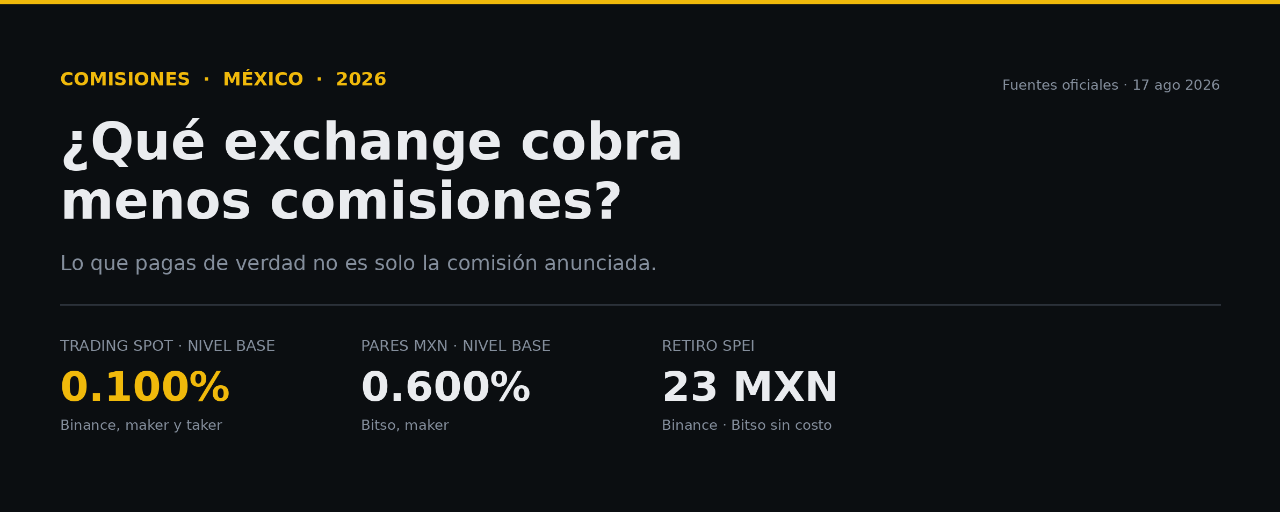
記事
2026年にメキシコで手数料が最も安い取引所は?唯一の答えはありません。そう言う人はおそらく1つの数字しか見ていないでしょう。メキシコペソで暗号資産を買う際の実際のコストは、「取引(売買)するのか、単に買うだけなのか」によって変わります。提示されている手数料は、支払う4つのうちの1つにすぎません。注文帳(リミット/指値など)で取引する場合、Binanceはベース水準で0.100%ですが、MXNのペアではBitsoが0.600%〜0.780%です。ペソの入金・出金ではBitsoのほうが安くつきます。そして「クイック購入」では、どちらも実際にかかる費用をそのまま公開していません。
2026年8月17日に、各プラットフォームの公式ページで確認した手数料。すべてベース水準(累積出来高なし、適用中の割引なし、プロモーションなし)に該当します。
2026年にメキシコで手数料が最も安い取引所は?
唯一の答えはありません。そう言う人はおそらく1つの数字しか見ていないでしょう。メキシコペソで暗号資産を買う際の実際のコストは、「取引(売買)するのか、単に買うだけなのか」によって変わります。提示されている手数料は、支払う4つのうちの1つにすぎません。注文帳(リミット/指値など)で取引する場合、Binanceはベース水準で0.100%ですが、MXNのペアではBitsoが0.600%〜0.780%です。ペソの入金・出金ではBitsoのほうが安くつきます。そして「クイック購入」では、どちらも実際にかかる費用をそのまま公開していません。
2026年8月17日に、各プラットフォームの公式ページで確認した手数料。すべてベース水準(累積出来高なし、適用中の割引なし、プロモーションなし)に該当します。
2026年8月17日に、各プラットフォームの公式ページで確認した手数料。すべてベース水準(累積出来高なし、適用中の割引なし、プロモーションなし)に該当します。
3
157
ログインして、さらにコンテンツを読む
厳選トピックで世界の暗号資産トレーダーの仲間入り
⚡️ 暗号資産に関する最新かつ有益な情報が見つかります。
💬 世界最大の暗号資産取引所から信頼されています。
👍 認証を受けたクリエイターから、有益なインサイトを得られます。
メール / 電話番号
トレンドトピック
SECHaltsCryptoETFReviewsAmidFundingLapse
閲覧回数 54,612
645人が討論中
#SECHaltsCryptoETFReviewsAmidFundingLapse
米国の予算空白を受け、SECが暗号資産ETFの見直しを凍結
米国証券取引委員会(SEC)は、暗号資産を基にした上場投資信託(ETF)に関する新たな申請の審査・承認プロセスを一時的に停止しました。この措置は、連邦予算が米議会によって期限までに承認されなかったことにより資金が途絶(funding lapse)し、非必須職員が休職(ライセンス取得)となった後、新しい米会計年度の開始とともに発効します。
対象となる措置:何が止まり、何が続くのか?
予算配分不足による危機対応計画の適用により、当局の運用ダイナミクスが変わりました:
新規ETF申請の一時停止:フォーム19b-4およびS-1/N-1Aに基づき進行中の案件は凍結されています。SECは、停止期間中は有効性に関する声明やコメントレターを発行しません。
90件超の申請が影響:承認待ちの90件以上の金融商品(複数のデジタル・アセットや複合戦略に関する提案を含む)が、審査スケジュールを止められています。
既存のETFは引き続き稼働:事前に承認され、取引所に上場しているビットコインおよびイーサリアムの現物ETF(ブラックロックのIBITやフィデリティのFBTCなど)は、二次市場で通常どおり売買が続いています。
今後注視すべきステップ
SECの分析再開は、米国議会における政治的な決着に左右されます。継続決議(Continuing Resolution)または最終予算が承認され次第、SECは通常業務を再開し、提出順に積み上がった申請を処理します。
$BTC
$ETH
$ZEC
Joseph RRG S7
·いいね:1件
·閲覧回数 1.2k
ZcashETFPostsFirstWeeklyOutflow$93.6M
閲覧回数 64,740
200人が討論中
GreekPoliceBustCryptoScamRingArrest17
閲覧回数 213,636
1,512人が討論中