Binance Square

Elayaa

89 フォロー
27.8K+ フォロワー
55.1K+ いいね
6.9K+ 共有
コンテンツ
PINNED
·
--
私は$2をたった2日で$316に変えました 😱🔥 今はステップ2: その$316を次の48時間で$10,000に変えます! 歴史を再び作りましょう。 小さな資本。大きなビジョン。止められないマインドセット。 あなたはこれを見ていますか、それとも自分であればいいのにと思っていますか? 続報をお待ちください — これからがワイルドです。 証拠 > 約束 集中 > 柔軟性 規律 > 疑念 #CryptoMarketCapBackTo$3T #BinanceAlphaAlert #USStockDrop #USChinaTensions
私は$2をたった2日で$316に変えました 😱🔥
今はステップ2: その$316を次の48時間で$10,000に変えます!
歴史を再び作りましょう。

小さな資本。大きなビジョン。止められないマインドセット。
あなたはこれを見ていますか、それとも自分であればいいのにと思っていますか?
続報をお待ちください — これからがワイルドです。

証拠 > 約束
集中 > 柔軟性
規律 > 疑念
#CryptoMarketCapBackTo$3T #BinanceAlphaAlert #USStockDrop #USChinaTensions
·
--
Plasma Makes Stablecoin Payments Feel SimpleSending stablecoins should feel like sending money, not managing a system. Plasma is a Layer 1 built with that idea in mind. Stablecoins are the default here, not an extra feature. Gasless USDT transfers mean you don’t need a separate token just to pay fees. Stablecoin-first gas removes another common blocker that slows people down. Transactions also reach finality in under a second through PlasmaBFT, so payments feel finished right away. Under the hood, Bitcoin-anchored security adds long-term neutrality and resistance. Plasma doesn’t try to make payments flashy. It focuses on removing the small frictions that usually cause hesitation, so value can move smoothly when it needs to. @Plasma @Plasma $XPL

Plasma Makes Stablecoin Payments Feel Simple

Sending stablecoins should feel like sending money, not managing a system. Plasma is a Layer 1 built with that idea in mind. Stablecoins are the default here, not an extra feature. Gasless USDT transfers mean you don’t need a separate token just to pay fees. Stablecoin-first gas removes another common blocker that slows people down. Transactions also reach finality in under a second through PlasmaBFT, so payments feel finished right away. Under the hood, Bitcoin-anchored security adds long-term neutrality and resistance. Plasma doesn’t try to make payments flashy. It focuses on removing the small frictions that usually cause hesitation, so value can move smoothly when it needs to.
@Plasma @Plasma $XPL
·
--
How to Earn Small Daily Rewards on Binance Without Investing Your Own MoneyMany people think you must deposit money to earn in crypto, but Binance does offer reward-based features where you can collect small amounts of crypto over time without trading your own funds. Let’s be clear: this is not guaranteed income, and it won’t be the same every day. But if you stay active, you can stack small rewards that may grow into a meaningful monthly total. Here’s a practical way to approach it. 1️⃣ Learn & Earn (Beginner Friendly) Binance sometimes gives free crypto for watching short lessons and passing quizzes. Why it helps: • No trading required • Simple educational tasks • Occasional token rewards New campaigns appear from time to time, so checking regularly can help you catch opportunities. 2️⃣ Daily Tasks & App Activities Binance runs rotating missions and promotions inside the app. These may include: • Event check-ins • Small engagement tasks • Limited-time challenges Each reward is small, but they can add up if you participate consistently. 3️⃣ Referral Program (Long-Term Growth) You can earn a percentage of trading fees from people who sign up using your referral link. This works best when you: • Share helpful educational content • Teach beginners how Binance works • Avoid spamming links Referral income depends entirely on how active your network is, so results vary. 4️⃣ Promotions, Events & Airdrops Binance occasionally runs: • Trading competitions • Token airdrops • Special campaigns These are not daily or guaranteed, but they can provide bonus rewards when available. 5️⃣ The Real Key: Consistency You won’t earn large amounts overnight. Some days you may earn nothing. Other days you might receive a small bonus from an event or campaign. Think of this as collecting small pieces over time, not a fixed daily paycheck. Final Thoughts Binance offers ways to earn small crypto rewards without investing your own money, mainly through education programs, promotions, and referrals. Earnings depend on availability, effort, and market activity — so treat this as a side opportunity, not a guaranteed income source. Stay active, stay cautious, and avoid anyone promising fixed daily profits. #USIranStandoff #TSLALinkedPerpsOnBinance #StrategyBTCPurchase

How to Earn Small Daily Rewards on Binance Without Investing Your Own Money

Many people think you must deposit money to earn in crypto, but Binance does offer reward-based features where you can collect small amounts of crypto over time without trading your own funds.

Let’s be clear: this is not guaranteed income, and it won’t be the same every day. But if you stay active, you can stack small rewards that may grow into a meaningful monthly total.

Here’s a practical way to approach it.

1️⃣ Learn & Earn (Beginner Friendly)

Binance sometimes gives free crypto for watching short lessons and passing quizzes.

Why it helps:

• No trading required

• Simple educational tasks

• Occasional token rewards

New campaigns appear from time to time, so checking regularly can help you catch opportunities.

2️⃣ Daily Tasks & App Activities

Binance runs rotating missions and promotions inside the app.

These may include:

• Event check-ins

• Small engagement tasks

• Limited-time challenges

Each reward is small, but they can add up if you participate consistently.

3️⃣ Referral Program (Long-Term Growth)

You can earn a percentage of trading fees from people who sign up using your referral link.

This works best when you:

• Share helpful educational content

• Teach beginners how Binance works

• Avoid spamming links

Referral income depends entirely on how active your network is, so results vary.

4️⃣ Promotions, Events & Airdrops

Binance occasionally runs:

• Trading competitions

• Token airdrops

• Special campaigns

These are not daily or guaranteed, but they can provide bonus rewards when available.

5️⃣ The Real Key: Consistency

You won’t earn large amounts overnight. Some days you may earn nothing. Other days you might receive a small bonus from an event or campaign.

Think of this as collecting small pieces over time, not a fixed daily paycheck.

Final Thoughts

Binance offers ways to earn small crypto rewards without investing your own money, mainly through education programs, promotions, and referrals. Earnings depend on availability, effort, and market activity — so treat this as a side opportunity, not a guaranteed income source.

Stay active, stay cautious, and avoid anyone promising fixed daily profits.

#USIranStandoff #TSLALinkedPerpsOnBinance #StrategyBTCPurchase
·
--
Plasma is a Layer 1 built for stablecoin payments. With gasless USDT transfers, stablecoin-first gas, and sub-second finality, it removes the small frictions that slow real-world value movement. Bitcoin-anchored security adds neutrality beneath the surface. @Plasma $XPL #Plasma
Plasma is a Layer 1 built for stablecoin payments. With gasless USDT transfers, stablecoin-first gas, and sub-second finality, it removes the small frictions that slow real-world value movement. Bitcoin-anchored security adds neutrality beneath the surface.
@Plasma $XPL #Plasma
·
--
Vanar Is Building Blockchain For The AI EraMost blockchains were designed for people clicking buttons. Vanar was designed with the idea that AI systems will also be active users. That changes what the foundation needs to look like. Instead of only focusing on speed, Vanar focuses on memory, reasoning, automation, and settlement at the base layer. Tools like myNeutron, Kayon, and Flows show how this works in practice. Memory can persist, decisions can be explained, and actions can run in a controlled way. This creates a full loop where intelligence does not stop at analysis but moves into real execution. $VANRY powers the economic layer behind these actions. As Vanar expands across chains starting with Base, this intelligent infrastructure connects to real users and real activity. Vanar is built for systems that run continuously, not just for trends. $VANRY #Vanar @Vanar

Vanar Is Building Blockchain For The AI Era

Most blockchains were designed for people clicking buttons. Vanar was designed with the idea that AI systems will also be active users. That changes what the foundation needs to look like. Instead of only focusing on speed, Vanar focuses on memory, reasoning, automation, and settlement at the base layer.

Tools like myNeutron, Kayon, and Flows show how this works in practice. Memory can persist, decisions can be explained, and actions can run in a controlled way. This creates a full loop where intelligence does not stop at analysis but moves into real execution.

$VANRY powers the economic layer behind these actions. As Vanar expands across chains starting with Base, this intelligent infrastructure connects to real users and real activity.

Vanar is built for systems that run continuously, not just for trends.

$VANRY

#Vanar

@Vanar
·
--
Vanar is building AI first blockchain infrastructure designed for real usage, not experiments. With native memory, onchain reasoning, and automated execution, the network supports intelligent systems at the base layer. $VANRY powers settlement across this stack as adoption expands cross chain. #Vanar @Vanar
Vanar is building AI first blockchain infrastructure designed for real usage, not experiments. With native memory, onchain reasoning, and automated execution, the network supports intelligent systems at the base layer. $VANRY powers settlement across this stack as adoption expands cross chain.
#Vanar @Vanarchain
·
--
Vanar was built with a simple assumption that most chains ignore: AI systems will not just be features, they will be active participants. That assumption changes everything about how infrastructure is designed. AI does not rely on wallets or interfaces. It requires persistent memory, reasoning that can be inspected, automation that can act safely, and settlement that works without human intervention. Vanar builds these capabilities into the base layer rather than retrofitting them later. Live systems already reflect this approach. myNeutron pushes semantic memory into the network. Kayon embeds on-chain reasoning and explainability. Flows translates intelligence into controlled automated action. Together they form a loop where memory informs decisions, decisions drive actions, and actions trigger settlement. VANRY powers the settlement layer, enabling real economic activity. Cross-chain availability starting with Base extends this intelligent stack into active ecosystems where users, liquidity, and activity already exist. Vanar is built for readiness, not narratives. $VANRY #Vanar @Vanar {spot}(VANRYUSDT)
Vanar was built with a simple assumption that most chains ignore: AI systems will not just be features, they will be active participants. That assumption changes everything about how infrastructure is designed.

AI does not rely on wallets or interfaces. It requires persistent memory, reasoning that can be inspected, automation that can act safely, and settlement that works without human intervention. Vanar builds these capabilities into the base layer rather than retrofitting them later.

Live systems already reflect this approach. myNeutron pushes semantic memory into the network. Kayon embeds on-chain reasoning and explainability. Flows translates intelligence into controlled automated action. Together they form a loop where memory informs decisions, decisions drive actions, and actions trigger settlement.

VANRY powers the settlement layer, enabling real economic activity. Cross-chain availability starting with Base extends this intelligent stack into active ecosystems where users, liquidity, and activity already exist.

Vanar is built for readiness, not narratives.

$VANRY
#Vanar
@Vanarchain
·
--
Vanar: Building AI-First Infrastructure From Day OneMost blockchain projects talk about AI after the fact. They retrofit tools or sprinkle in features, hoping to keep pace with the conversation. Vanar took a different approach. It assumed from the start that intelligent systems autonomous agents, reasoning engines, persistent memory modules would be part of its ecosystem. That single assumption shapes every layer of design. Human-centric chains rely on wallets dashboards and session-based actions. That works for humans because they tolerate friction, delays, and resets. AI does not. Agents do not click, they do not wait, they do not restart politely when context disappears. Infrastructure that treats AI as an add-on eventually fragments or fails at scale. Vanar prioritizes persistence and native intelligence over raw throughput. Memory, reasoning, automation, and settlement exist at the base layer. myNeutron pushes semantic memory into the core. Kayon embeds reasoning and explainability on-chain. Flows transforms intelligence into controlled automated action. These systems form an integrated loop: memory informs reasoning, reasoning drives action, action triggers settlement. VANRY powers the loop, enabling real economic activity rather than experimental demos. Cross-chain availability starting with Base extends this intelligent stack into live ecosystems, connecting agents to users and liquidity where it already exists. Vanar is quiet, deliberate, and designed to run when others are still retrofitting features. It’s built for agents, enterprises, and real-world adoption, not for hype. $VANRY #Vanar @Vanar

Vanar: Building AI-First Infrastructure From Day One

Most blockchain projects talk about AI after the fact. They retrofit tools or sprinkle in features, hoping to keep pace with the conversation. Vanar took a different approach. It assumed from the start that intelligent systems autonomous agents, reasoning engines, persistent memory modules would be part of its ecosystem. That single assumption shapes every layer of design.

Human-centric chains rely on wallets dashboards and session-based actions. That works for humans because they tolerate friction, delays, and resets. AI does not. Agents do not click, they do not wait, they do not restart politely when context disappears. Infrastructure that treats AI as an add-on eventually fragments or fails at scale.

Vanar prioritizes persistence and native intelligence over raw throughput. Memory, reasoning, automation, and settlement exist at the base layer. myNeutron pushes semantic memory into the core. Kayon embeds reasoning and explainability on-chain. Flows transforms intelligence into controlled automated action.

These systems form an integrated loop: memory informs reasoning, reasoning drives action, action triggers settlement. VANRY powers the loop, enabling real economic activity rather than experimental demos. Cross-chain availability starting with Base extends this intelligent stack into live ecosystems, connecting agents to users and liquidity where it already exists.

Vanar is quiet, deliberate, and designed to run when others are still retrofitting features. It’s built for agents, enterprises, and real-world adoption, not for hype.

$VANRY

#Vanar

@Vanar
·
--
自分の資金を投資せずにバイナンスで小さなデイリー報酬を得る方法多くの人は、クリプトで稼ぐためにはお金を入金しなければならないと思っていますが、バイナンスでは自分の資金を取引せずに少額のクリプトを徐々に集めることができる報酬ベースの機能を提供しています。 はっきりさせておきましょう:これは保証された収入ではなく、毎日同じではありません。しかし、アクティブでい続ければ、小さな報酬を積み重ねて、意味のある月間合計に成長させることができます。 これが実践的なアプローチの方法です。 1️⃣ 学び & 稼ぎ(初心者向け) バイナンスは時々、短いレッスンを視聴し、クイズに合格することで無料のクリプトを提供します。

自分の資金を投資せずにバイナンスで小さなデイリー報酬を得る方法

多くの人は、クリプトで稼ぐためにはお金を入金しなければならないと思っていますが、バイナンスでは自分の資金を取引せずに少額のクリプトを徐々に集めることができる報酬ベースの機能を提供しています。

はっきりさせておきましょう:これは保証された収入ではなく、毎日同じではありません。しかし、アクティブでい続ければ、小さな報酬を積み重ねて、意味のある月間合計に成長させることができます。

これが実践的なアプローチの方法です。

1️⃣ 学び & 稼ぎ(初心者向け)

バイナンスは時々、短いレッスンを視聴し、クイズに合格することで無料のクリプトを提供します。
·
--
🚨 JUST IN: 🇺🇸🇻🇪 トランプ: ベネズエラは政治囚の解放を加速していますドナルド・トランプ大統領はTruth Socialに投稿し、ベネズエラが政治囚を「急速に」解放していると述べ、ペースはすぐに加速すると呼びかけ、「強力な人道的ジェスチャー」と表現しました。 📊 実際に何が起こっているのか • ベネズエラ当局は、最近数週間で政治囚として特定された数十人から数百人を解放しました。 • 人権団体によると、これまでに約100〜150件の確認された解放が行われており、さらに確認中のものもあります。 • ベネズエラの暫定政府は600人以上が解放されたと主張していますが、独立した団体は重要なギャップがあり、多くの拘留者がまだ残っていると指摘しています。

🚨 JUST IN: 🇺🇸🇻🇪 トランプ: ベネズエラは政治囚の解放を加速しています

ドナルド・トランプ大統領はTruth Socialに投稿し、ベネズエラが政治囚を「急速に」解放していると述べ、ペースはすぐに加速すると呼びかけ、「強力な人道的ジェスチャー」と表現しました。

📊 実際に何が起こっているのか

• ベネズエラ当局は、最近数週間で政治囚として特定された数十人から数百人を解放しました。

• 人権団体によると、これまでに約100〜150件の確認された解放が行われており、さらに確認中のものもあります。

• ベネズエラの暫定政府は600人以上が解放されたと主張していますが、独立した団体は重要なギャップがあり、多くの拘留者がまだ残っていると指摘しています。
·
--
7 Smart Ways to Earn Free Rewards on BinanceA lot of people think crypto profits need big money to start — but Binance actually has several ways to earn small rewards with little or no investment. If you stay active and use the platform wisely, those small gains can grow over time. 1️⃣ Binance Earn Binance offers simple earning products like Flexible Savings and Locked Savings. Sometimes there are special promos with boosted rewards, giving you a chance to earn extra without taking on much risk. 2️⃣ Launchpool With Launchpool, you can stake coins like BNB and receive new tokens as rewards. You still keep your original coins, which is why many users see this as “free” earnings. 3️⃣ Learn & Earn Watch short lessons, complete quizzes, and receive small amounts of crypto. It’s beginner-friendly and doesn’t require any investment. 4️⃣ Referral Program Invite friends to Binance and earn a share of their trading fees. This can become a steady long-term income stream if you build an active network. 5️⃣ Airdrops Binance sometimes distributes free tokens to users holding certain assets or joining events. These rewards can show up unexpectedly and add value to your account. 6️⃣ Staking Rewards Locking coins you already own can generate extra tokens over time, especially when special high-reward campaigns appear. 7️⃣ Trading Competitions & Campaigns Binance runs events where users can win vouchers, tokens, or bonuses just for participating. Even smaller traders can benefit by following event rules. You might not get rich overnight, but combining these methods can help you steadily collect free crypto. Stay consistent, watch for new promotions, and make the most of the tools Binance offers. Small rewards today can turn into bigger opportunities later. 🚀 #USIranStandoff #StrategyBTCPurchase #TSLALinkedPerpsOnBinance #FedWatch

7 Smart Ways to Earn Free Rewards on Binance

A lot of people think crypto profits need big money to start — but Binance actually has several ways to earn small rewards with little or no investment. If you stay active and use the platform wisely, those small gains can grow over time.

1️⃣ Binance Earn

Binance offers simple earning products like Flexible Savings and Locked Savings. Sometimes there are special promos with boosted rewards, giving you a chance to earn extra without taking on much risk.

2️⃣ Launchpool

With Launchpool, you can stake coins like BNB and receive new tokens as rewards. You still keep your original coins, which is why many users see this as “free” earnings.

3️⃣ Learn & Earn

Watch short lessons, complete quizzes, and receive small amounts of crypto. It’s beginner-friendly and doesn’t require any investment.

4️⃣ Referral Program

Invite friends to Binance and earn a share of their trading fees. This can become a steady long-term income stream if you build an active network.

5️⃣ Airdrops

Binance sometimes distributes free tokens to users holding certain assets or joining events. These rewards can show up unexpectedly and add value to your account.

6️⃣ Staking Rewards

Locking coins you already own can generate extra tokens over time, especially when special high-reward campaigns appear.

7️⃣ Trading Competitions & Campaigns

Binance runs events where users can win vouchers, tokens, or bonuses just for participating. Even smaller traders can benefit by following event rules.

You might not get rich overnight, but combining these methods can help you steadily collect free crypto. Stay consistent, watch for new promotions, and make the most of the tools Binance offers.

Small rewards today can turn into bigger opportunities later. 🚀
#USIranStandoff #StrategyBTCPurchase #TSLALinkedPerpsOnBinance #FedWatch
·
--
💰 How to Earn Around $150/Month on Binance Without InvestingYes, it’s possible to earn a small monthly income on Binance without putting in your own money — if you use legit methods and stay consistent. This isn’t “get rich quick,” but it can be a solid starting point. Why $150/Month Is a Good Target ✔ No starting capital needed ✔ Beginner-friendly ✔ Low risk if done carefully ✔ Can grow into bigger online income later Even a steady $150/month can help you learn crypto and build online earning skills. 🔹 1. Binance Referral Program (Main Source) Binance pays you a commission when people you invite trade. How to do it: • Get your referral link from Binance • Share helpful content (not spam) in crypto groups or social media • Teach beginners how to sign up and trade safely Potential: With a few active users, this can become your biggest monthly earner over time. 🔹 2. Helping with Binance P2P Many beginners don’t understand P2P trading. If you know how it works, you can guide them and charge a small service fee. Example: Helping a few people daily for $1–$2 each can add up over a month. ⚠ Always follow Binance rules and never handle other people’s funds directly. 🔹 3. Binance Learn & Earn Binance sometimes rewards users with small amounts of crypto for watching lessons and completing quizzes. It won’t make you rich, but it’s free, educational, and adds extra monthly income. 🔹 4. Crypto Airdrops (Bonus) Some crypto projects give free tokens for simple tasks like social follows or joining communities. Not all are valuable, but occasional wins can add extra income. ⚡ The Key: Combine Everything No single method may reach $150 alone, but together they can. Focus on being helpful, consistent, and avoiding scams. Small online income streams grow over time — and this is one way to start without investment. #Mag7Earnings #USIranStandoff #StrategyBTCPurchase #ScrollCoFounderXAccountHacked

💰 How to Earn Around $150/Month on Binance Without Investing

Yes, it’s possible to earn a small monthly income on Binance without putting in your own money — if you use legit methods and stay consistent. This isn’t “get rich quick,” but it can be a solid starting point.

Why $150/Month Is a Good Target

✔ No starting capital needed

✔ Beginner-friendly

✔ Low risk if done carefully

✔ Can grow into bigger online income later

Even a steady $150/month can help you learn crypto and build online earning skills.

🔹 1. Binance Referral Program (Main Source)

Binance pays you a commission when people you invite trade.

How to do it:

• Get your referral link from Binance

• Share helpful content (not spam) in crypto groups or social media

• Teach beginners how to sign up and trade safely

Potential: With a few active users, this can become your biggest monthly earner over time.

🔹 2. Helping with Binance P2P

Many beginners don’t understand P2P trading. If you know how it works, you can guide them and charge a small service fee.

Example:

Helping a few people daily for $1–$2 each can add up over a month.

⚠ Always follow Binance rules and never handle other people’s funds directly.

🔹 3. Binance Learn & Earn

Binance sometimes rewards users with small amounts of crypto for watching lessons and completing quizzes.

It won’t make you rich, but it’s free, educational, and adds extra monthly income.

🔹 4. Crypto Airdrops (Bonus)

Some crypto projects give free tokens for simple tasks like social follows or joining communities. Not all are valuable, but occasional wins can add extra income.

⚡ The Key: Combine Everything

No single method may reach $150 alone, but together they can. Focus on being helpful, consistent, and avoiding scams.

Small online income streams grow over time — and this is one way to start without investment.

#Mag7Earnings #USIranStandoff #StrategyBTCPurchase #ScrollCoFounderXAccountHacked
·
--
Most payment problems don’t look like failures. They look like hesitation. A missing gas token. A confirmation that lasts just long enough to create doubt. Plasma is a Layer 1 built to remove that hesitation. Stablecoins are the default, not an add-on. Gasless USDT transfers and stablecoin-first gas shorten the path from intent to settlement. PlasmaBFT’s sub-second finality closes the transaction before uncertainty grows, while Bitcoin anchoring adds long-term neutrality beneath the surface. Plasma doesn’t try to make payments feel different. It removes the small frictions that make them feel unreliable. @Plasma $XPL {spot}(XPLUSDT) #Plasma
Most payment problems don’t look like failures. They look like hesitation. A missing gas token. A confirmation that lasts just long enough to create doubt.

Plasma is a Layer 1 built to remove that hesitation. Stablecoins are the default, not an add-on. Gasless USDT transfers and stablecoin-first gas shorten the path from intent to settlement. PlasmaBFT’s sub-second finality closes the transaction before uncertainty grows, while Bitcoin anchoring adds long-term neutrality beneath the surface.

Plasma doesn’t try to make payments feel different. It removes the small frictions that make them feel unreliable.
@Plasma $XPL
#Plasma
·
--
Payments don’t usually fall apart in dramatic ways.They drift off course in small, forgettable moments. A transfer that should feel instant stretches into a pause. Someone checks a balance they didn’t think would matter. A confirmation takes just long enough for doubt to sneak in. Nothing is technically wrong, but the interaction already feels unreliable. That feeling is enough to change behavior next time. This is the environment stablecoins now live in. For many users, stablecoins are not an experiment. They are working tools for holding and moving value. People use them for routine needs — sending money to family, paying contractors, settling trades, managing business flows. The expectations are simple: the value should move when asked, and it should feel finished when it arrives. But the infrastructure beneath stablecoins still often assumes users are willing to manage complexity mid-transaction. Plasma approaches the problem from a narrower angle. It’s a Layer 1 shaped around stablecoin settlement as the primary job, not one use case among many. That focus changes what gets optimized. Instead of adding more features, the system removes points where payments typically stall. Gas is the first of those points. On most networks, gas is treated as background infrastructure. In practice, it’s a recurring interruption. Someone holds USDT but can’t send it because they don’t have a separate token for fees. That moment doesn’t feel like a technical requirement. It feels like a contradiction. Gasless USDT transfers eliminate that contradiction. Stablecoin-first gas removes another layer of dependency. The system no longer asks users to prepare before acting. The path from intent to execution shortens, and with it, the number of ways a payment can fail before it even begins. This isn’t about convenience. It’s about reducing the surface area where hesitation can grow. Finality introduces another quiet source of friction. PlasmaBFT provides sub-second finality, but the real impact isn’t a number on a dashboard. It’s the timing of certainty. The transaction settles before attention has time to turn into doubt. No refreshing. No checking whether the state might still change. The interaction ends quickly, and that quick ending shapes trust more than raw speed ever could. There’s a pattern across payment systems that persist over time. They don’t encourage users to watch them work. They minimize the need for confirmation rituals. They aim to disappear as soon as the transaction is complete. Plasma’s settlement behavior fits that pattern. Security, too, plays a background role. Bitcoin-anchored security isn’t presented as spectacle. It’s a long-term positioning choice. Anchoring to Bitcoin suggests that settlement integrity should remain neutral and resistant to sudden shifts. For a system focused on stable value, that stability matters more than rapid change. Neutrality here isn’t abstract. Stablecoins move across jurisdictions, institutions, and economic cycles. A settlement layer that behaves consistently through those shifts reduces one more unknown in an already complex environment. Ethereum compatibility through Reth supports this without becoming the headline. Developers can work with familiar execution tools, but the chain itself operates under different priorities. Compatibility becomes a bridge for builders, not a signal that everything else is the same. What Plasma avoids is just as important as what it includes. There’s no strong push to be a universal playground for every application type. Payment-focused infrastructure tends to lose reliability when it accumulates too many parallel goals. Each additional pathway becomes another place for friction to appear under stress. Retail users often notice these dynamics first. In regions where stablecoins are already part of daily financial life, people don’t want to understand network mechanics. They want transfers to behave predictably. When payments work without explanation, usage grows quietly. The system fades into the background of routine. Institutions encounter a different set of pressures. Delayed settlement complicates accounting. Ambiguous finality creates reconciliation overhead. Edge cases turn into operational costs. For them, predictability reduces noise. A system that resolves cleanly is easier to integrate and harder to question. Plasma sits where these needs overlap, focusing on a shared failure mode: hesitation. When a payment hesitates, it stops feeling like money in motion and starts feeling like a process to manage. There’s a broader shift underway in how blockchain infrastructure is judged. Less attention goes to theoretical capability. More attention goes to how systems behave during ordinary, repeated use. Infrastructure earns trust by being uneventful in the right ways. Plasma doesn’t seem designed to hold attention during use. It’s designed to release it quickly. The transaction completes, and the user moves on to something else. Those moments don’t generate dramatic metrics. They don’t trend. But they accumulate. Systems that don’t interrupt get reused. Systems that don’t surprise become habits. Most networks optimize for activity and engagement. Plasma’s settlement layer appears optimized for completion — for the point where the transaction is no longer something to think about. That difference doesn’t show up as a headline feature. It shows up in the absence of friction. In transfers that don’t turn into questions. In payments that end before doubt begins. Over time, those quiet endings matter more than any visible innovation. #Plasma @Plasma $XPL {spot}(XPLUSDT)

Payments don’t usually fall apart in dramatic ways.

They drift off course in small, forgettable moments.

A transfer that should feel instant stretches into a pause. Someone checks a balance they didn’t think would matter. A confirmation takes just long enough for doubt to sneak in. Nothing is technically wrong, but the interaction already feels unreliable. That feeling is enough to change behavior next time.

This is the environment stablecoins now live in.

For many users, stablecoins are not an experiment. They are working tools for holding and moving value. People use them for routine needs — sending money to family, paying contractors, settling trades, managing business flows. The expectations are simple: the value should move when asked, and it should feel finished when it arrives.

But the infrastructure beneath stablecoins still often assumes users are willing to manage complexity mid-transaction.

Plasma approaches the problem from a narrower angle. It’s a Layer 1 shaped around stablecoin settlement as the primary job, not one use case among many. That focus changes what gets optimized. Instead of adding more features, the system removes points where payments typically stall.

Gas is the first of those points. On most networks, gas is treated as background infrastructure. In practice, it’s a recurring interruption. Someone holds USDT but can’t send it because they don’t have a separate token for fees. That moment doesn’t feel like a technical requirement. It feels like a contradiction.

Gasless USDT transfers eliminate that contradiction. Stablecoin-first gas removes another layer of dependency. The system no longer asks users to prepare before acting. The path from intent to execution shortens, and with it, the number of ways a payment can fail before it even begins.

This isn’t about convenience. It’s about reducing the surface area where hesitation can grow.

Finality introduces another quiet source of friction. PlasmaBFT provides sub-second finality, but the real impact isn’t a number on a dashboard. It’s the timing of certainty. The transaction settles before attention has time to turn into doubt. No refreshing. No checking whether the state might still change.

The interaction ends quickly, and that quick ending shapes trust more than raw speed ever could.

There’s a pattern across payment systems that persist over time. They don’t encourage users to watch them work. They minimize the need for confirmation rituals. They aim to disappear as soon as the transaction is complete. Plasma’s settlement behavior fits that pattern.

Security, too, plays a background role. Bitcoin-anchored security isn’t presented as spectacle. It’s a long-term positioning choice. Anchoring to Bitcoin suggests that settlement integrity should remain neutral and resistant to sudden shifts. For a system focused on stable value, that stability matters more than rapid change.

Neutrality here isn’t abstract. Stablecoins move across jurisdictions, institutions, and economic cycles. A settlement layer that behaves consistently through those shifts reduces one more unknown in an already complex environment.

Ethereum compatibility through Reth supports this without becoming the headline. Developers can work with familiar execution tools, but the chain itself operates under different priorities. Compatibility becomes a bridge for builders, not a signal that everything else is the same.

What Plasma avoids is just as important as what it includes. There’s no strong push to be a universal playground for every application type. Payment-focused infrastructure tends to lose reliability when it accumulates too many parallel goals. Each additional pathway becomes another place for friction to appear under stress.

Retail users often notice these dynamics first. In regions where stablecoins are already part of daily financial life, people don’t want to understand network mechanics. They want transfers to behave predictably. When payments work without explanation, usage grows quietly. The system fades into the background of routine.

Institutions encounter a different set of pressures. Delayed settlement complicates accounting. Ambiguous finality creates reconciliation overhead. Edge cases turn into operational costs. For them, predictability reduces noise. A system that resolves cleanly is easier to integrate and harder to question.

Plasma sits where these needs overlap, focusing on a shared failure mode: hesitation. When a payment hesitates, it stops feeling like money in motion and starts feeling like a process to manage.

There’s a broader shift underway in how blockchain infrastructure is judged. Less attention goes to theoretical capability. More attention goes to how systems behave during ordinary, repeated use. Infrastructure earns trust by being uneventful in the right ways.

Plasma doesn’t seem designed to hold attention during use. It’s designed to release it quickly. The transaction completes, and the user moves on to something else.

Those moments don’t generate dramatic metrics. They don’t trend. But they accumulate. Systems that don’t interrupt get reused. Systems that don’t surprise become habits.

Most networks optimize for activity and engagement. Plasma’s settlement layer appears optimized for completion — for the point where the transaction is no longer something to think about.

That difference doesn’t show up as a headline feature. It shows up in the absence of friction. In transfers that don’t turn into questions. In payments that end before doubt begins.

Over time, those quiet endings matter more than any visible innovation.

#Plasma @Plasma $XPL
·
--
なぜDuskのモジュラー設計が規制された金融アプリに重要なのか暗号通貨では、シンプルさがしばしば称賛されます。一つのチェーン、一つのモデル、一つのルールセット。これは汎用システムには機能しますが、金融はシンプルではありません。 異なる金融商品は異なるルールの下で運営されます。トークン化された証券には報告要件があります。規制された取引所にはライセンス義務があります。コンプライアンスに準拠した貸付プラットフォームは独自のフレームワークに従います。 これらすべてを一つの硬直したブロックチェーン構造に押し込もうとすると、通常は隠れたリスクが生じます。 Duskはこれに異なるアプローチを取ります。 そのモジュラーアーキテクチャにより、異なるタイプの金融アプリケーションがそれぞれの要件で動作できる一方で、同じ安全なレイヤー1に依存することができます。これは、一つのアプリケーションのルールやリスクが自動的にエコシステム全体に広がることはないことを意味します。

なぜDuskのモジュラー設計が規制された金融アプリに重要なのか

暗号通貨では、シンプルさがしばしば称賛されます。一つのチェーン、一つのモデル、一つのルールセット。これは汎用システムには機能しますが、金融はシンプルではありません。

異なる金融商品は異なるルールの下で運営されます。トークン化された証券には報告要件があります。規制された取引所にはライセンス義務があります。コンプライアンスに準拠した貸付プラットフォームは独自のフレームワークに従います。

これらすべてを一つの硬直したブロックチェーン構造に押し込もうとすると、通常は隠れたリスクが生じます。

Duskはこれに異なるアプローチを取ります。

そのモジュラーアーキテクチャにより、異なるタイプの金融アプリケーションがそれぞれの要件で動作できる一方で、同じ安全なレイヤー1に依存することができます。これは、一つのアプリケーションのルールやリスクが自動的にエコシステム全体に広がることはないことを意味します。
·
--
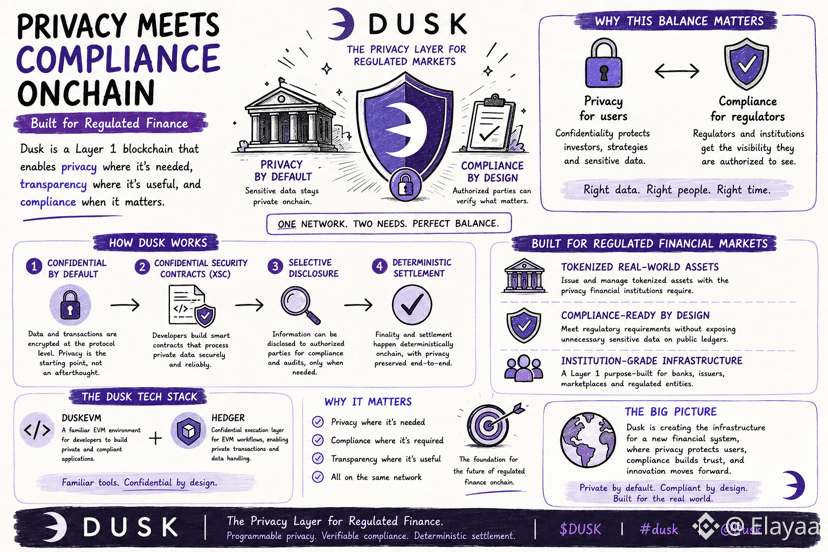
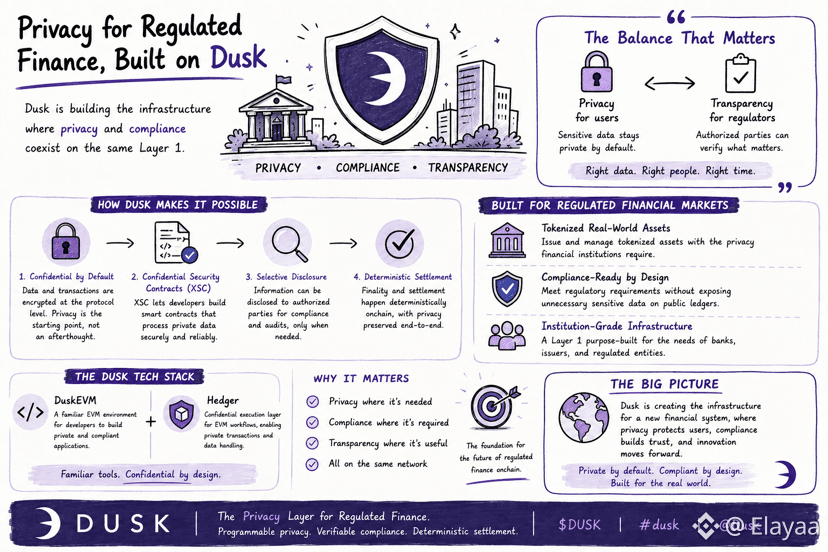
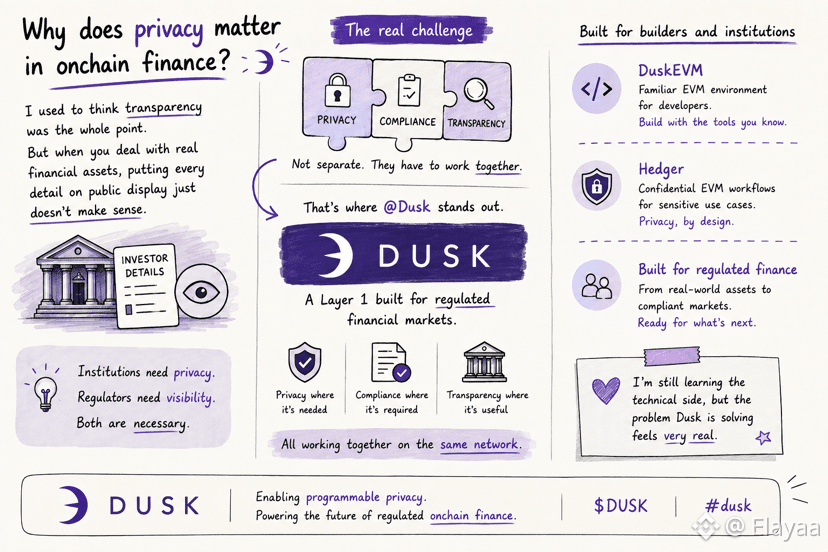
Dusk’s Privacy Model Feels Closer to Real Finance Than Most BlockchainsPrivacy in crypto is often misunderstood. Some projects treat it like total invisibility. Hide everything and assume trust will follow. Others go fully transparent and say openness solves everything. Neither approach works well for regulated finance. Real financial systems don’t operate at either extreme. They operate on controlled disclosure. Information is private by default but can be reviewed under the right conditions. Audits happen. Regulators check compliance. Sensitive data is not made public to everyone. Dusk builds around this reality. On Dusk, transactions remain confidential, but they are not beyond verification. Through privacy-preserving cryptography, the network allows proofs to be generated that confirm rules were followed without revealing underlying data. That balance is crucial. Imagine a regulated trading platform. It cannot expose every trade publicly, because that would leak sensitive information. But it also cannot refuse oversight. Regulators must be able to confirm that the platform operates within legal boundaries. Dusk makes that possible on-chain. Hedger is a key component in this design. It enables confidential transactions while still allowing selective disclosure. Information stays protected unless proof is required, and then only the necessary proof is shared. DuskEVM builds on this by allowing developers to deploy familiar Solidity smart contracts while settling on Dusk’s privacy-focused Layer 1. This lowers the barrier for institutions and developers who want compliance without abandoning existing tools. This is not about adding privacy as an extra feature. It is about building a system where privacy and accountability exist together from the start. $DUSK supports these processes at the network level. It helps power settlement, verification, and the continuity of the system as applications grow. Most users won’t see the cryptography or compliance layers. They will just experience platforms that feel stable and trustworthy. No unexpected data leaks. No sudden regulatory shutdowns. That kind of stability rarely comes from shortcuts. It usually comes from infrastructure that assumed responsibility early. Dusk is built with that assumption. #Dusk @Dusk_Foundation $DUSK {spot}(DUSKUSDT)

Dusk’s Privacy Model Feels Closer to Real Finance Than Most Blockchains

Privacy in crypto is often misunderstood. Some projects treat it like total invisibility. Hide everything and assume trust will follow. Others go fully transparent and say openness solves everything.

Neither approach works well for regulated finance.

Real financial systems don’t operate at either extreme. They operate on controlled disclosure. Information is private by default but can be reviewed under the right conditions. Audits happen. Regulators check compliance. Sensitive data is not made public to everyone.

Dusk builds around this reality.

On Dusk, transactions remain confidential, but they are not beyond verification. Through privacy-preserving cryptography, the network allows proofs to be generated that confirm rules were followed without revealing underlying data.

That balance is crucial.

Imagine a regulated trading platform. It cannot expose every trade publicly, because that would leak sensitive information. But it also cannot refuse oversight. Regulators must be able to confirm that the platform operates within legal boundaries.

Dusk makes that possible on-chain.

Hedger is a key component in this design. It enables confidential transactions while still allowing selective disclosure. Information stays protected unless proof is required, and then only the necessary proof is shared.

DuskEVM builds on this by allowing developers to deploy familiar Solidity smart contracts while settling on Dusk’s privacy-focused Layer 1. This lowers the barrier for institutions and developers who want compliance without abandoning existing tools.

This is not about adding privacy as an extra feature. It is about building a system where privacy and accountability exist together from the start.

$DUSK supports these processes at the network level. It helps power settlement, verification, and the continuity of the system as applications grow.

Most users won’t see the cryptography or compliance layers. They will just experience platforms that feel stable and trustworthy. No unexpected data leaks. No sudden regulatory shutdowns.

That kind of stability rarely comes from shortcuts. It usually comes from infrastructure that assumed responsibility early.

Dusk is built with that assumption.

#Dusk @Dusk $DUSK
·
--
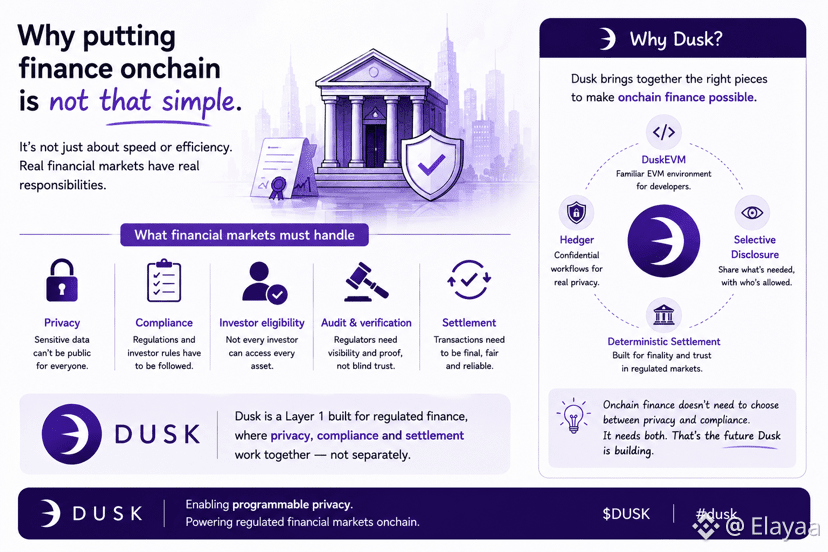
Dusk Is Built for the Moment Finance Starts Asking QuestionsCrypto is very comfortable when nobody is asking hard questions. Things move fast. Systems go live. Users interact. Everything feels open and innovative. Then real finance enters the picture. That’s when the tone changes. Suddenly it’s not just about speed or decentralization. It’s about responsibility. Someone asks where funds came from. Someone asks who approved a transaction. Someone asks whether activity can be reviewed without exposing private information. Most blockchains were not designed for that moment. They were designed for openness or censorship resistance, not financial accountability. Dusk feels like it was designed specifically for that moment. Dusk is a Layer 1 blockchain built for regulated financial infrastructure. That means it assumes oversight will happen. It assumes audits will happen. It assumes institutions will need systems that can be examined without breaking privacy. Privacy on Dusk is not about hiding activity forever. It’s about controlling who sees what, and when. Transactions are confidential by default, but proofs can be produced when verification is required. This is closer to how real-world finance already works. Banks don’t publish every transaction publicly. Regulators don’t monitor everything in real time. Information is disclosed under rules, not by default. Dusk mirrors this model using cryptography instead of paperwork. This is especially important for real-world assets. Tokenized securities, regulated trading platforms, and compliant investment products cannot run on systems that expose sensitive data to everyone. At the same time, they cannot operate on systems that cannot be audited. Dusk sits in the middle. Private by default. Verifiable when required. Another important piece is Dusk’s modular architecture. Financial products don’t all follow the same rules. A marketplace for tokenized bonds works differently than a regulated exchange or a compliant DeFi protocol. Forcing them into one rigid structure usually creates problems later. Dusk allows different applications to operate with different requirements while still settling on the same Layer 1. That flexibility is not flashy, but it is realistic. $DUSK plays a key role here. It supports settlement, network security, and the mechanisms that allow proofs to be verified. It is part of the infrastructure that keeps the system functioning smoothly under pressure. Most users will never think about these layers. They will just use platforms that don’t suddenly freeze, don’t run into legal walls, and don’t expose their financial data. That quiet reliability is often invisible. But in finance, invisible stability is usually the sign of good infrastructure. @Dusk_Foundation #Dusk $DUSK

Dusk Is Built for the Moment Finance Starts Asking Questions

Crypto is very comfortable when nobody is asking hard questions. Things move fast. Systems go live. Users interact. Everything feels open and innovative.

Then real finance enters the picture.

That’s when the tone changes.

Suddenly it’s not just about speed or decentralization. It’s about responsibility. Someone asks where funds came from. Someone asks who approved a transaction. Someone asks whether activity can be reviewed without exposing private information.

Most blockchains were not designed for that moment. They were designed for openness or censorship resistance, not financial accountability.

Dusk feels like it was designed specifically for that moment.

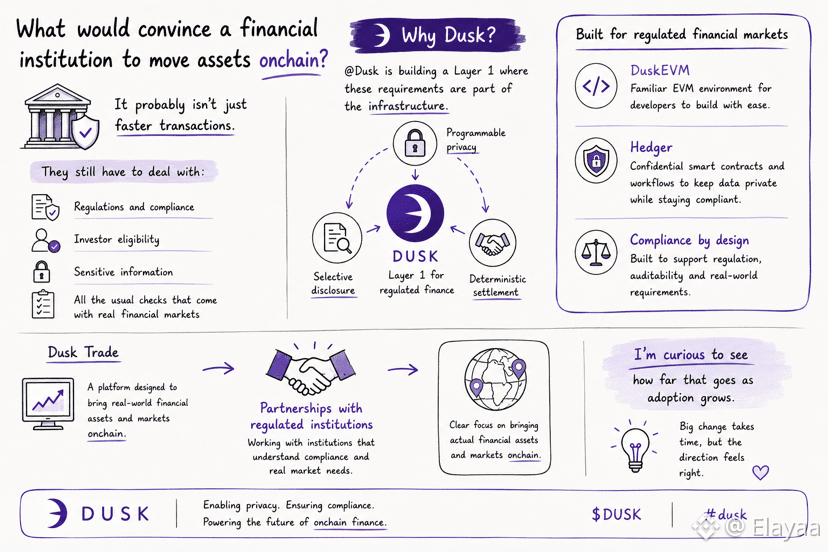
Dusk is a Layer 1 blockchain built for regulated financial infrastructure. That means it assumes oversight will happen. It assumes audits will happen. It assumes institutions will need systems that can be examined without breaking privacy.

Privacy on Dusk is not about hiding activity forever. It’s about controlling who sees what, and when. Transactions are confidential by default, but proofs can be produced when verification is required. This is closer to how real-world finance already works.

Banks don’t publish every transaction publicly. Regulators don’t monitor everything in real time. Information is disclosed under rules, not by default. Dusk mirrors this model using cryptography instead of paperwork.

This is especially important for real-world assets. Tokenized securities, regulated trading platforms, and compliant investment products cannot run on systems that expose sensitive data to everyone. At the same time, they cannot operate on systems that cannot be audited.

Dusk sits in the middle. Private by default. Verifiable when required.

Another important piece is Dusk’s modular architecture. Financial products don’t all follow the same rules. A marketplace for tokenized bonds works differently than a regulated exchange or a compliant DeFi protocol. Forcing them into one rigid structure usually creates problems later.

Dusk allows different applications to operate with different requirements while still settling on the same Layer 1. That flexibility is not flashy, but it is realistic.

$DUSK plays a key role here. It supports settlement, network security, and the mechanisms that allow proofs to be verified. It is part of the infrastructure that keeps the system functioning smoothly under pressure.

Most users will never think about these layers. They will just use platforms that don’t suddenly freeze, don’t run into legal walls, and don’t expose their financial data.

That quiet reliability is often invisible.

But in finance, invisible stability is usually the sign of good infrastructure.

@Dusk #Dusk $DUSK
·
--
Good financial infrastructure is often invisible. When systems work properly, users don’t notice them. There are no sudden rule changes, no emergency fixes, and no surprises under pressure. Dusk aims to be that kind of infrastructure. By building privacy, verification, and compliance into the foundation, Dusk allows real financial platforms to operate on-chain with fewer risks. Sensitive data stays protected, but necessary proof can still be shared with the right parties. Most users will only see stable platforms that function smoothly. Behind the scenes, Dusk provides the structure that makes that possible. $DUSK helps power this quiet reliability across the network. {spot}(DUSKUSDT) @Dusk_Foundation #Dusk
Good financial infrastructure is often invisible. When systems work properly, users don’t notice them. There are no sudden rule changes, no emergency fixes, and no surprises under pressure.

Dusk aims to be that kind of infrastructure.

By building privacy, verification, and compliance into the foundation, Dusk allows real financial platforms to operate on-chain with fewer risks. Sensitive data stays protected, but necessary proof can still be shared with the right parties.

Most users will only see stable platforms that function smoothly. Behind the scenes, Dusk provides the structure that makes that possible.

$DUSK helps power this quiet reliability across the network.
@Dusk #Dusk
·
--
Not all financial products follow the same rules. A trading platform, a bond, and a compliant DeFi application each have different requirements. Forcing them into one rigid blockchain model usually causes problems later. Dusk avoids that by using a modular architecture. Different applications can operate under different conditions while still settling on the same secure Layer 1. This allows flexibility without losing control or auditability. For institutions, this structure reduces risk and makes systems easier to understand and review. $DUSK plays a key role in keeping this ecosystem running, supporting transactions and proof mechanisms across the network. It’s not flashy design. It’s durable design built for real financial use. #Dusk @Dusk_Foundation
Not all financial products follow the same rules. A trading platform, a bond, and a compliant DeFi application each have different requirements. Forcing them into one rigid blockchain model usually causes problems later.

Dusk avoids that by using a modular architecture.

Different applications can operate under different conditions while still settling on the same secure Layer 1. This allows flexibility without losing control or auditability.

For institutions, this structure reduces risk and makes systems easier to understand and review.

$DUSK plays a key role in keeping this ecosystem running, supporting transactions and proof mechanisms across the network.

It’s not flashy design. It’s durable design built for real financial use. #Dusk
@Dusk
さらにコンテンツを探すには、ログインしてください
暗号資産関連最新ニュース総まとめ
⚡️ 暗号資産に関する最新のディスカッションに参加
💬 お気に入りのクリエイターと交流
👍 興味のあるコンテンツがきっと見つかります
メール / 電話番号
サイトマップ
Cookieの設定
プラットフォーム利用規約