Binance Square
赫拉迪耶什
14.9k 投稿

赫拉迪耶什

取引を発注
超高頻度トレーダー
4.4年
8.5K+ フォロー
4.4K+ フォロワー
3.8K+ いいね
投稿
ポートフォリオ
PINNED
·
--
記事
翻訳参照
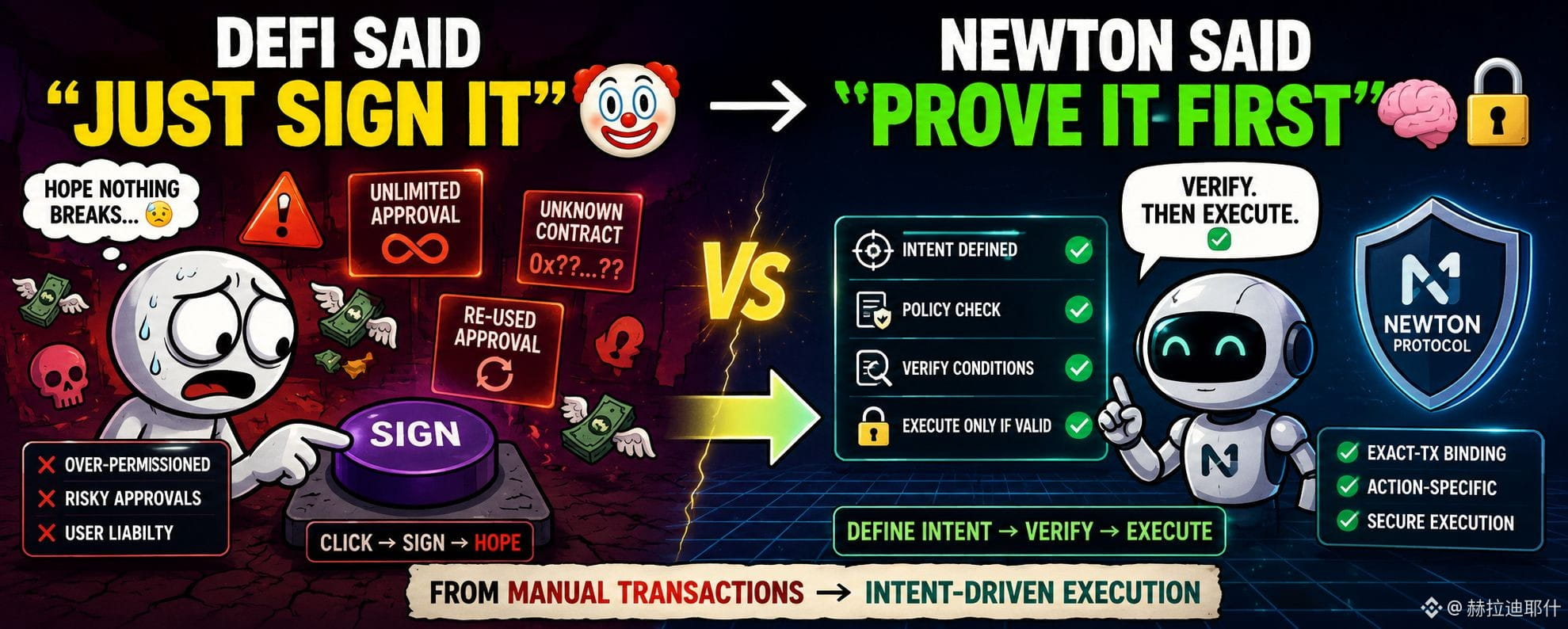
When “Just Click Approve” Stops Working And The Protocol Starts Thinking For YouI used to think beta meant unfinished. Something rough. Something not ready. Something you try once, then wait for the real version. That assumption does not hold as well anymore. Been noticing how normal it has become to just click approve in defi without thinking about what actually executes. It feels efficient. It feels routine. Until it is not. One wrong approval and the system still does exactly what you told it to do. That is not a bug. That is how the design works. Reading through the Newton Protocol whitepaper and spending time with the Newton Mainnet Beta, the shift feels quiet but structural. It is not trying to make transactions faster. It is trying to remove the need for users to manually construct them in the first place. From manual transactions to intent driven execution. That line sounds simple. But it changes the entire flow. Instead of defining every step, the user defines an outcome. The system then handles execution within a set of predefined policies. That means the logic is not just in the interface anymore. It is embedded into how execution is allowed to happen. This is where the design starts to feel intentional. Most of web3 security today is reactive. We analyze exploits after they happen. We build dashboards to explain failures. We improve monitoring. But the transaction still goes through first. The system assumes that if a user signs something, it should execute. Newton challenges that assumption. What if the system could filter risky actions before execution. Not after. Not during. Before. That shifts the role of infrastructure. Instead of being a passive executor, the protocol becomes an active decision layer. It does not just process instructions. It evaluates whether those instructions should be allowed to exist in the first place. Less reaction. More prevention. This is where the meme layer becomes real. We spent years optimizing clicks. Faster clicks. Cheaper clicks. Cleaner interfaces. But we rarely questioned whether users should be clicking through complex transaction flows at all. Newton is not optimizing the click. It is trying to remove it. That is a different direction than most infrastructure upgrades. The Mainnet Beta reflects that thinking. It does not feel like a feature showcase. It feels like a controlled environment to test whether intent based execution can hold under real conditions. Whether policies can meaningfully reduce user error. Whether automation can be trusted without turning into blind delegation. Because that is the real tension. Automation increases convenience. But it also introduces new forms of risk if not bounded correctly. Newton seems aware of that. The emphasis on policy defined execution suggests that automation is not meant to replace user control. It is meant to structure it. That distinction matters. If this model works, the interface stops being the primary trust layer. The protocol itself starts enforcing boundaries. Users are no longer responsible for catching every edge case manually. The system absorbs part of that responsibility. That changes where risk lives. It also changes who benefits. Developers can design around outcomes instead of step by step flows. Users interact with simpler abstractions. And the protocol becomes the place where rules are enforced consistently, not interpreted loosely. Early days, but the direction is clear. On chain finance may be moving toward systems that decide what should not happen, not just what can happen. That is a deeper shift than improving throughput or reducing fees. It is a shift in how decisions are made before execution even begins. Been seeing more about Newton lately, and the Mainnet Beta feels like a deliberate step in that direction. Not loud. Not over positioned. But structurally different. If they actually simplify automation while maintaining control, that could open a new layer of participation that does not rely on constant user attention. And maybe that is the real question. Are we still designing systems that expect users to think like machines. Or are we finally designing systems that can think within boundaries on behalf of users. At what point does execution stop being something you trigger and start becoming something the system responsibly manages. And if protocols begin to decide what should not execute, who defines those boundaries. @NewtonProtocol $NEWT #Newt {future}(NEWTUSDT) Not financial advice. DYOR.

When “Just Click Approve” Stops Working And The Protocol Starts Thinking For You

I used to think beta meant unfinished. Something rough. Something not ready. Something you try once, then wait for the real version.
That assumption does not hold as well anymore.
Been noticing how normal it has become to just click approve in defi without thinking about what actually executes. It feels efficient. It feels routine. Until it is not. One wrong approval and the system still does exactly what you told it to do.
That is not a bug. That is how the design works.
Reading through the Newton Protocol whitepaper and spending time with the Newton Mainnet Beta, the shift feels quiet but structural. It is not trying to make transactions faster. It is trying to remove the need for users to manually construct them in the first place.
From manual transactions to intent driven execution.
That line sounds simple. But it changes the entire flow.
Instead of defining every step, the user defines an outcome. The system then handles execution within a set of predefined policies. That means the logic is not just in the interface anymore. It is embedded into how execution is allowed to happen.
This is where the design starts to feel intentional.
Most of web3 security today is reactive. We analyze exploits after they happen. We build dashboards to explain failures. We improve monitoring. But the transaction still goes through first. The system assumes that if a user signs something, it should execute.
Newton challenges that assumption.
What if the system could filter risky actions before execution. Not after. Not during. Before.
That shifts the role of infrastructure.
Instead of being a passive executor, the protocol becomes an active decision layer. It does not just process instructions. It evaluates whether those instructions should be allowed to exist in the first place.
Less reaction. More prevention.
This is where the meme layer becomes real. We spent years optimizing clicks. Faster clicks. Cheaper clicks. Cleaner interfaces. But we rarely questioned whether users should be clicking through complex transaction flows at all.
Newton is not optimizing the click. It is trying to remove it.
That is a different direction than most infrastructure upgrades.
The Mainnet Beta reflects that thinking. It does not feel like a feature showcase. It feels like a controlled environment to test whether intent based execution can hold under real conditions. Whether policies can meaningfully reduce user error. Whether automation can be trusted without turning into blind delegation.
Because that is the real tension.
Automation increases convenience. But it also introduces new forms of risk if not bounded correctly. Newton seems aware of that. The emphasis on policy defined execution suggests that automation is not meant to replace user control. It is meant to structure it.
That distinction matters.
If this model works, the interface stops being the primary trust layer. The protocol itself starts enforcing boundaries. Users are no longer responsible for catching every edge case manually. The system absorbs part of that responsibility.
That changes where risk lives.
It also changes who benefits.
Developers can design around outcomes instead of step by step flows. Users interact with simpler abstractions. And the protocol becomes the place where rules are enforced consistently, not interpreted loosely.
Early days, but the direction is clear.
On chain finance may be moving toward systems that decide what should not happen, not just what can happen. That is a deeper shift than improving throughput or reducing fees. It is a shift in how decisions are made before execution even begins.
Been seeing more about Newton lately, and the Mainnet Beta feels like a deliberate step in that direction. Not loud. Not over positioned. But structurally different.
If they actually simplify automation while maintaining control, that could open a new layer of participation that does not rely on constant user attention.
And maybe that is the real question.
Are we still designing systems that expect users to think like machines. Or are we finally designing systems that can think within boundaries on behalf of users.
At what point does execution stop being something you trigger and start becoming something the system responsibly manages.
And if protocols begin to decide what should not execute, who defines those boundaries.
@NewtonProtocol
$NEWT
#Newt
Not financial advice. DYOR.
PINNED
翻訳参照
#newt $NEWT been noticing how normal it has become to just click approve in defi without thinking much about what actually executes that habit feels fine until it isn’t reading through the newton protocol whitepaper and trying the mainnet beta, the shift feels subtle but important it is not about making transactions faster it is about removing the need to manually construct them in the first place from manual transactions → intent-driven execution instead of telling the chain exactly what to do step by step, you define the outcome the system handles execution within predefined policies that changes where risk lives right now, web3 security mostly explains what went wrong after the fact newton is exploring something different filtering risky actions before they ever execute less reaction, more prevention if this works as intended, the interface stops being the main trust layer the protocol becomes the gatekeeper early days, but the direction is clear on-chain finance may be moving toward systems that decide what should not happen, not just what can been seeing more about newton lately, and the mainnet beta feels like a solid step forward if they actually simplify automation, it could open up a lot @NewtonProtocol $NEWT #Newt ⚠️this content is a paid partnership poll: what matters more in defi’s next phase?
#newt $NEWT been noticing how normal it has become to just click approve in defi without thinking much about what actually executes

that habit feels fine until it isn’t

reading through the newton protocol whitepaper and trying the mainnet beta, the shift feels subtle but important

it is not about making transactions faster
it is about removing the need to manually construct them in the first place

from manual transactions → intent-driven execution

instead of telling the chain exactly what to do step by step, you define the outcome
the system handles execution within predefined policies

that changes where risk lives

right now, web3 security mostly explains what went wrong after the fact
newton is exploring something different
filtering risky actions before they ever execute

less reaction, more prevention

if this works as intended, the interface stops being the main trust layer
the protocol becomes the gatekeeper

early days, but the direction is clear
on-chain finance may be moving toward systems that decide what should not happen, not just what can

been seeing more about newton lately, and the mainnet beta feels like a solid step forward
if they actually simplify automation, it could open up a lot

@NewtonProtocol
$NEWT
#Newt
⚠️this content is a paid partnership
poll:
what matters more in defi’s next phase?
faster execution
better ux
intent-based automation
pre-execution security
1 残り日数
記事
翻訳参照
DeFi Doesn’t Need Better UX. It Needs Fewer Mistakes.1/ Everyone says DeFi has a UX problem. That’s wrong. DeFi has a mistake problem. And it’s costing users more than fees ever did. Click. Sign. Approve. Repeat. One wrong action? It still executes. No safety net. That’s not UX. That’s liability by design. Faster chains won’t fix this. Because speed was never the issue. 👉 Execution quality is. 2/ Here’s the uncomfortable truth: DeFi isn’t built for you. It’s built for those who make fewer mistakes than you. Power users win. Bots win. MEV systems dominate. Why? Because they control: • Speed • Information • Execution Everyone else? They pay for the errors. 3/ Now a different model is emerging: Newton Mainnet Beta. Not “better UX.” Something deeper. 👉 Intent-driven execution. You don’t follow steps. You define outcomes. The system: → Verifies intent first → Applies constraints → Executes only valid actions Wrong inputs? They don’t execute. At all. 4/ If this model works, it doesn’t just improve DeFi. It reshapes power. • No fragile flows • No blind approvals • No dependence on perfect clicks But more importantly: It compresses advantage. It reduces MEV surface. It breaks systems built on user mistakes. And that creates tension. Because not everyone benefits from simpler systems. {future}(NEWTUSDT) 5/ Let’s add context: June 23, 2025 — NEWT hits Binance HODLer Airdrops (#24). 12.5M NEWT distributed (1.25% supply) Listed across: USDT, USDC, BNB, FDUSD, TRY This isn’t just distribution. It’s a signal. If intent-driven execution works: DeFi doesn’t evolve. It replaces itself. 6/ So the real question is: Who loses the most if users stop making mistakes? → MEV bots? → Power users? → Protocols built on complexity? @NewtonProtocol $NEWT #Newt Curious what you think 👇

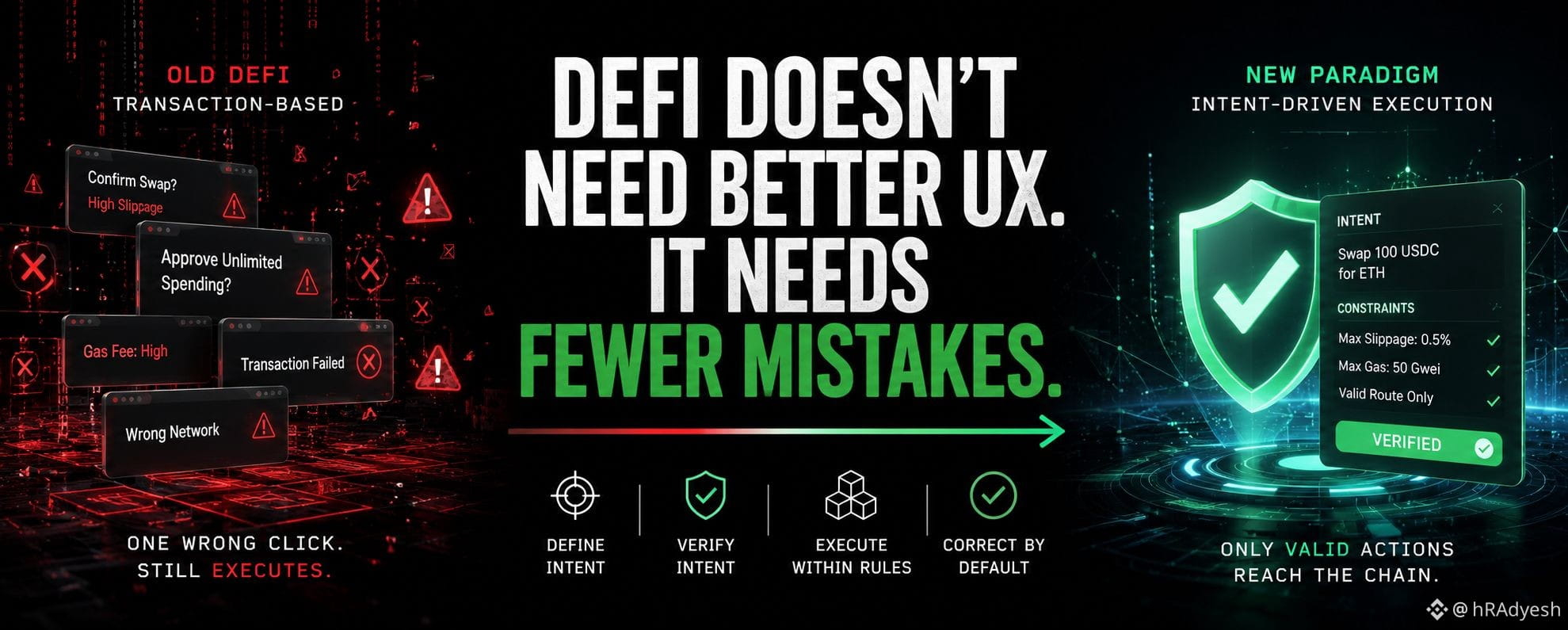
DeFi Doesn’t Need Better UX. It Needs Fewer Mistakes.

1/
Everyone says DeFi has a UX problem.
That’s wrong.
DeFi has a mistake problem.
And it’s costing users more than fees ever did.
Click.
Sign.
Approve.
Repeat.
One wrong action?
It still executes.
No safety net.
That’s not UX.
That’s liability by design.
Faster chains won’t fix this.
Because speed was never the issue.
👉 Execution quality is.
2/
Here’s the uncomfortable truth:
DeFi isn’t built for you.
It’s built for those who make fewer mistakes than you.
Power users win.
Bots win.
MEV systems dominate.
Why?
Because they control:
• Speed
• Information
• Execution
Everyone else?
They pay for the errors.
3/
Now a different model is emerging:
Newton Mainnet Beta.
Not “better UX.”
Something deeper.
👉 Intent-driven execution.
You don’t follow steps.
You define outcomes.
The system:
→ Verifies intent first
→ Applies constraints
→ Executes only valid actions
Wrong inputs?
They don’t execute.
At all.
4/
If this model works, it doesn’t just improve DeFi.
It reshapes power.
• No fragile flows
• No blind approvals
• No dependence on perfect clicks
But more importantly:
It compresses advantage.
It reduces MEV surface.
It breaks systems built on user mistakes.
And that creates tension.
Because not everyone benefits from simpler systems.
5/
Let’s add context:
June 23, 2025 — NEWT hits Binance HODLer Airdrops (#24).
12.5M NEWT distributed
(1.25% supply)
Listed across:
USDT, USDC, BNB, FDUSD, TRY
This isn’t just distribution.
It’s a signal.
If intent-driven execution works:
DeFi doesn’t evolve.
It replaces itself.
6/
So the real question is:
Who loses the most
if users stop making mistakes?
→ MEV bots?
→ Power users?
→ Protocols built on complexity?
@NewtonProtocol
$NEWT
#Newt
Curious what you think 👇
·
--
ブリッシュ
翻訳参照
#newt $NEWT Most people are still optimizing for faster transactions. That narrative is already outdated. Speed was never the real bottleneck. The real problem is execution quality. Crypto lets you do everything instantly, including the wrong things. Newton’s Mainnet Beta quietly challenges that foundation. This isn’t about better UX or lower fees. It’s a shift from transaction-based interaction → intent-driven execution. Instead of forcing users to click, sign, and manage every step, you define what you want. The protocol verifies that intent first, then executes within predefined rules. That moves trust from the interface to the protocol layer. Fewer invalid actions. Less wasted gas. Reduced dependency on perfect user behavior. {future}(NEWTUSDT) Context: On June 23, 2025, NEWT became the 24th Binance HODLer Airdrops project. 12.5M NEWT (1.25% supply) was distributed to BNB Simple Earn and On-Chain Yields users (June 14–17). It listed with Seed Tag across USDT, USDC, BNB, FDUSD, and TRY pairs. It’s still early. But if this model works, the industry doesn’t just get faster. It gets stricter about what is allowed to execute in the first place. @NewtonProtocol $NEWT #Newt Not financial advice. DYOR.
#newt $NEWT

Most people are still optimizing for faster transactions.

That narrative is already outdated.

Speed was never the real bottleneck. The real problem is execution quality. Crypto lets you do everything instantly, including the wrong things.

Newton’s Mainnet Beta quietly challenges that foundation.

This isn’t about better UX or lower fees. It’s a shift from transaction-based interaction → intent-driven execution.

Instead of forcing users to click, sign, and manage every step, you define what you want. The protocol verifies that intent first, then executes within predefined rules.

That moves trust from the interface to the protocol layer.

Fewer invalid actions. Less wasted gas. Reduced dependency on perfect user behavior.


Context:
On June 23, 2025, NEWT became the 24th Binance HODLer Airdrops project. 12.5M NEWT (1.25% supply) was distributed to BNB Simple Earn and On-Chain Yields users (June 14–17).
It listed with Seed Tag across USDT, USDC, BNB, FDUSD, and TRY pairs.

It’s still early. But if this model works, the industry doesn’t just get faster. It gets stricter about what is allowed to execute in the first place.

@NewtonProtocol
$NEWT
#Newt

Not financial advice. DYOR.
Pre-execut intent verification
Removing manual steps
Stronger risk constraints
Simpler onboarding
1 残り日数
記事
翻訳参照
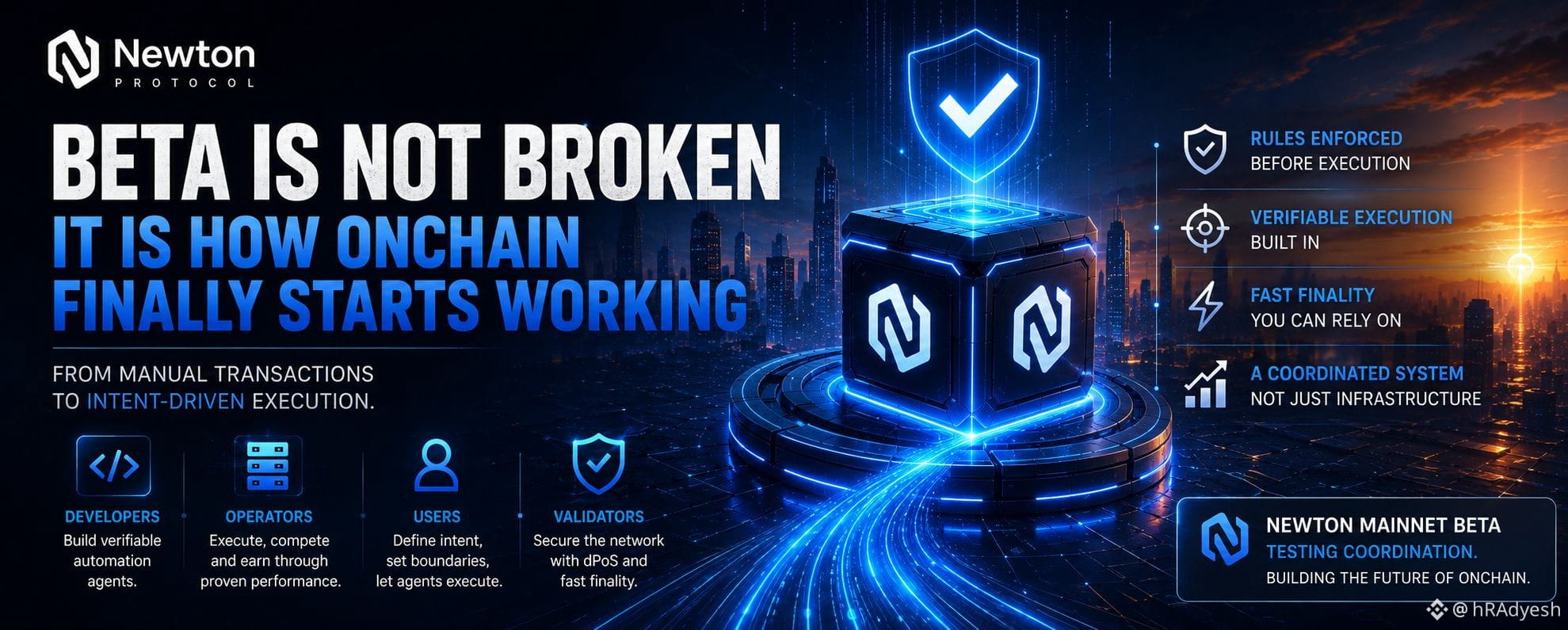
Beta Is Not Broken It Is How Onchain Finally Starts Working1/ Most people think “beta” means unfinished. That assumption breaks onchain. I opened Newton Mainnet Beta expecting friction. What I found instead was something most products never reach: Clarity from the first click. 2/ We’ve been trained to accept this: Beta = bugs + broken flows + patience. But what if beta wasn’t about fixing flaws… What if it was about proving a new model works? 3/ Newton flips the script. This is not about testing features. This is about testing intent as infrastructure. 4/ Here’s the shift: Onchain today → You manage steps Newton → You define outcomes That difference changes everything. 5/ Instead of asking: “Which chain? Which route? Which bridge?” You ask: “What do I want to achieve?” And the system handles the rest. 6/ Under the hood, it’s simple (but powerful): • Intent layer → captures your goal • Execution network → finds + executes paths • Verification → proves it actually happened No guesswork. No blind trust. 7/ Most systems force trade-offs: Speed vs security Yield vs risk Control vs convenience Newton removes the premise. 8/ Mainnet Beta is where this becomes real. Not a test environment. Not a concept. A live system executing intent with verifiable outcomes. 9/ And this is the bigger unlock: You don’t need to be an expert anymore. You don’t need to understand every step. You just need to know what you want. 10/ @NewtonProtocol isn’t building a better interface. It’s removing the need for one. $NEWT connects intent → execution → proof. {future}(NEWTUSDT) #Newt moves where capital actually flows. 11/ If this works at scale, everything changes: Apps → assistants Clicks → outcomes Users → intent issuers 12/ The real innovation isn’t adding features. It’s removing friction so completely that interaction itself starts to disappear. 13/ So the real questions are: What happens when execution is automatic? What happens when outcomes are provable? What happens when users stop thinking in steps? 14/ Beta is not broken. It’s where onchain finally starts working. Not financial advice. DYOR. @NewtonProtocol $NEWT #Newt

Beta Is Not Broken It Is How Onchain Finally Starts Working

1/
Most people think “beta” means unfinished.
That assumption breaks onchain.
I opened Newton Mainnet Beta expecting friction.
What I found instead was something most products never reach:
Clarity from the first click.
2/
We’ve been trained to accept this:
Beta = bugs + broken flows + patience.
But what if beta wasn’t about fixing flaws…
What if it was about proving a new model works?
3/
Newton flips the script.
This is not about testing features.
This is about testing intent as infrastructure.
4/
Here’s the shift:
Onchain today → You manage steps
Newton → You define outcomes
That difference changes everything.
5/
Instead of asking:
“Which chain? Which route? Which bridge?”
You ask:
“What do I want to achieve?”
And the system handles the rest.
6/
Under the hood, it’s simple (but powerful):
• Intent layer → captures your goal
• Execution network → finds + executes paths
• Verification → proves it actually happened
No guesswork. No blind trust.
7/
Most systems force trade-offs:
Speed vs security
Yield vs risk
Control vs convenience
Newton removes the premise.
8/
Mainnet Beta is where this becomes real.
Not a test environment.
Not a concept.
A live system executing intent with verifiable outcomes.
9/
And this is the bigger unlock:
You don’t need to be an expert anymore.
You don’t need to understand every step.
You just need to know what you want.
10/
@NewtonProtocol isn’t building a better interface.
It’s removing the need for one.
$NEWT connects intent → execution → proof.
#Newt moves where capital actually flows.
11/
If this works at scale, everything changes:
Apps → assistants
Clicks → outcomes
Users → intent issuers
12/
The real innovation isn’t adding features.
It’s removing friction so completely
that interaction itself starts to disappear.
13/
So the real questions are:
What happens when execution is automatic?
What happens when outcomes are provable?
What happens when users stop thinking in steps?
14/
Beta is not broken.
It’s where onchain finally starts working.
Not financial advice. DYOR.
@NewtonProtocol
$NEWT
#Newt
·
--
ブリッシュ
確認済み
翻訳参照
#newt $NEWT I've Been seeing more about Newton lately, and the Mainnet Beta feels like a solid step forward. What stands out isn’t just faster transactions. It’s the move away from doing everything manually. Instead of signing each step yourself, you state the outcome you want and the system figures out how to get there, then proves it happened on-chain. That’s the core of intent-driven execution. Less clicking, more defining. And with the Beta live, you can actually start to see what on-chain automation looks like when it’s built around coordination and verification, not just speed. It’s still early. But the direction is clear: finance that runs on stated intent, with receipts you can audit after. If they make this easier to use, it opens up a lot for how people and agents actually interact on-chain. {future}(NEWTUSDT) @NewtonProtocol $NEWT #Newt Where do you think intent-driven execution helps first?
#newt $NEWT
I've Been seeing more about Newton lately, and the Mainnet Beta feels like a solid step forward.

What stands out isn’t just faster transactions. It’s the move away from doing everything manually. Instead of signing each step yourself, you state the outcome you want and the system figures out how to get there, then proves it happened on-chain.

That’s the core of intent-driven execution. Less clicking, more defining. And with the Beta live, you can actually start to see what on-chain automation looks like when it’s built around coordination and verification, not just speed.

It’s still early. But the direction is clear: finance that runs on stated intent, with receipts you can audit after.

If they make this easier to use, it opens up a lot for how people and agents actually interact on-chain.

@NewtonProtocol
$NEWT
#Newt

Where do you think intent-driven execution helps first?
DeFi operations
Payments and subscriptions
Agent coordination
Auditing and compliance
10 残り時間
記事
Newton Mainnet Betaはテストというより、実行の未来のように感じる理由以前、ベータリリースとは単にそういうものだと思っていました。完成しきっていないもの。試してみるけれど、まだ完全には信頼できないもの。 午前4時30分に目を覚ましてNEWTを確認したとき、一瞬その前提がよみがえりました。でも、Newton Protocolを読み込んだり、Mainnet Betaを観察したりする時間を過ごすうちに、その見方は古く感じられてきました。 これは性能を証明しようとする初期プロダクトの感じがしません。制約の中で協調を試すために意図的に設計されたシステムのように感じます。 その視点の変化が、アーキテクチャ全体の見え方を変えます。

Newton Mainnet Betaはテストというより、実行の未来のように感じる理由

以前、ベータリリースとは単にそういうものだと思っていました。完成しきっていないもの。試してみるけれど、まだ完全には信頼できないもの。
午前4時30分に目を覚ましてNEWTを確認したとき、一瞬その前提がよみがえりました。でも、Newton Protocolを読み込んだり、Mainnet Betaを観察したりする時間を過ごすうちに、その見方は古く感じられてきました。
これは性能を証明しようとする初期プロダクトの感じがしません。制約の中で協調を試すために意図的に設計されたシステムのように感じます。
その視点の変化が、アーキテクチャ全体の見え方を変えます。
·
--
ブリッシュ
翻訳参照
#newt $NEWT I have been seeing more about Newton lately and the Mainnet Beta feels like a meaningful step forward. It doesn’t feel like a typical early version but more like a system testing how coordination actually works in practice. What stands out is how Newton rethinks execution. Instead of users manually triggering every transaction, it moves toward intent-driven automation, where outcomes are defined upfront and enforced before settlement. The protocol is built around four participants: Developers create verifiable agents using TEEs & ZKPs Operators execute tasks and compete based on proven performance Users define intent instead of actions Validators secure everything with dPoS and fast finality {spot}(NEWTUSDT) It feels like a shift from interface level trust → protocol level enforcement. Stablecoins may be the rails of the internet, but Newton is trying to rebuild the logic underneath those rails where rules are enforced before anything moves. It's still early, but the direction is clear: 👉 From manual transactions → intent-driven execution Curious to see how this evolves as the flywheel between participants starts to build. @NewtonProtocol $NEWT #Newt Poll: What matters most for the future of on-chain finance?
#newt $NEWT
I have been seeing more about Newton lately and the Mainnet Beta feels like a meaningful step forward. It doesn’t feel like a typical early version but more like a system testing how coordination actually works in practice.

What stands out is how Newton rethinks execution. Instead of users manually triggering every transaction, it moves toward intent-driven automation, where outcomes are defined upfront and enforced before settlement.

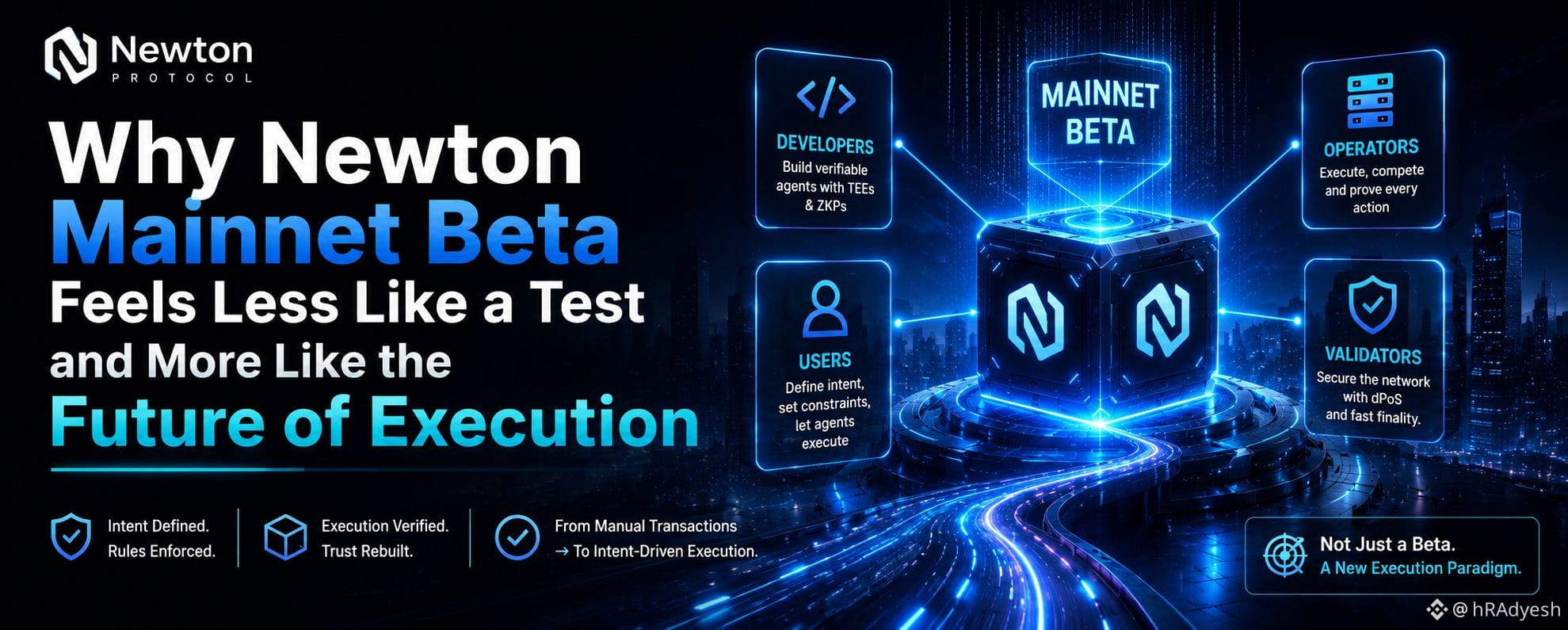
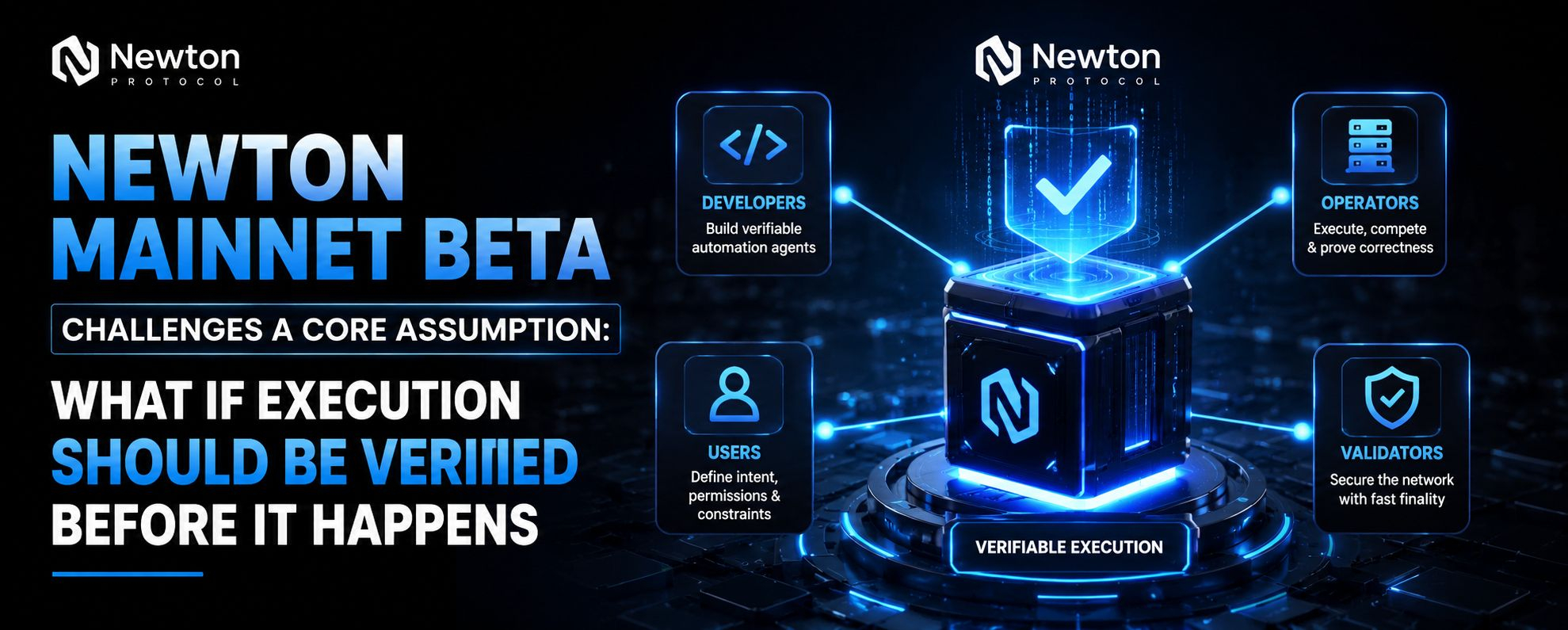
The protocol is built around four participants:

Developers create verifiable agents using TEEs & ZKPs

Operators execute tasks and compete based on proven performance

Users define intent instead of actions

Validators secure everything with dPoS and fast finality

It feels like a shift from interface level trust → protocol level enforcement.

Stablecoins may be the rails of the internet, but Newton is trying to rebuild the logic underneath those rails where rules are enforced before anything moves.

It's still early, but the direction is clear:
👉 From manual transactions → intent-driven execution

Curious to see how this evolves as the flywheel between participants starts to build.

@NewtonProtocol
$NEWT
#Newt

Poll: What matters most for the future of on-chain finance?
Verifiable execution
53%
Faster transactions
27%
Better UX
20%
Decentralization
0%
15 投票 • 投票は終了しました
記事
翻訳参照
🚀 Newton Mainnet Beta Challenges a Core Assumption: What If Execution Should Be Verified Before ItI have usually associated beta releases with something unfinished. A stage where systems are still being tested, edges are rough, and reliability is not fully there. But after spending time with the Newton Protocol white paper and observing the Newton Mainnet Beta, that assumption starts to feel limited. This does not come across as incomplete. It feels deliberately constrained — like an environment designed to test coordination, not just performance. The shift is subtle but important. Newton is not trying to make transactions faster. It is redefining how execution happens in the first place. At the center of this design is a coordinated system of four participants: Developers. Operators. Users. Validators. Each plays a distinct role — but the real innovation lies in how they interact. 🧠 Developers Build automation services and AI agents. These are not just scripts. They are containerized applications secured with: Trusted Execution Environments (TEEs) Zero Knowledge Proofs (ZKPs) Execution is not just protected — it is provable. ⚙️ Operators Bring these agents to life. They don’t just execute tasks — they compete in a marketplace to fulfill user intent: Efficiently Verifiably Their reputation is not branding. It is proof of performance. 👤 Users Interact in a completely different way. Instead of clicking through transactions, they define: Intent Permissions Constraints Execution happens within boundaries, not constant supervision. 🛡️ Validators Secure the system through delegated proof of stake. They ensure: Fast finality Block validity Reliable infrastructure What stands out is how deliberate this structure feels. This is not just a system. It is a framework designed to replace trust with verification at every layer. That is why the Newton Mainnet Beta feels different. It is not testing speed. It is testing coordination: Can developers build predictable agents? Can operators execute without shortcuts? Can users trust intent-based systems? The answers are still forming — but the direction is becoming clear. Most on-chain systems today assume: users must stay in control of every action. Every click. Every confirmation. Newton challenges that. It introduces a model where: 👉 Execution is defined before it happens 👉 Rules are enforced before action begins This shifts infrastructure from passive → active. From processing transactions to validating intent and enforcing correctness. The implication is bigger than automation. It redefines trust itself: From interfaces → cryptographic proof From reputation → verifiable outcomes From manual control → programmable intent If this model works, it could reshape: Portfolio management Risk execution Autonomous financial systems The Newton Mainnet Beta feels early — but not uncertain. It feels like a system being carefully engineered, not rushed And that raises bigger questions: If execution becomes intent-driven… 👉 What does user control really mean? If operators are judged only by proof… 👉 What happens to traditional reputation? If verification becomes default… 👉 Does speed still define progress? {spot}(NEWTUSDT) @NewtonProtocol $NEWT #Newt Not financial advice. DYOR.

🚀 Newton Mainnet Beta Challenges a Core Assumption: What If Execution Should Be Verified Before It

I have usually associated beta releases with something unfinished.
A stage where systems are still being tested, edges are rough, and reliability is not fully there.
But after spending time with the Newton Protocol white paper and observing the Newton Mainnet Beta, that assumption starts to feel limited.
This does not come across as incomplete.
It feels deliberately constrained — like an environment designed to test coordination, not just performance.
The shift is subtle but important.
Newton is not trying to make transactions faster.
It is redefining how execution happens in the first place.
At the center of this design is a coordinated system of four participants:
Developers. Operators. Users. Validators.
Each plays a distinct role — but the real innovation lies in how they interact.
🧠 Developers
Build automation services and AI agents.
These are not just scripts.
They are containerized applications secured with:
Trusted Execution Environments (TEEs)
Zero Knowledge Proofs (ZKPs)
Execution is not just protected —
it is provable.
⚙️ Operators
Bring these agents to life.
They don’t just execute tasks —
they compete in a marketplace to fulfill user intent:
Efficiently
Verifiably
Their reputation is not branding.
It is proof of performance.
👤 Users
Interact in a completely different way.
Instead of clicking through transactions, they define:
Intent
Permissions
Constraints
Execution happens within boundaries, not constant supervision.
🛡️ Validators
Secure the system through delegated proof of stake.
They ensure:
Fast finality
Block validity
Reliable infrastructure
What stands out is how deliberate this structure feels.
This is not just a system.
It is a framework designed to replace trust with verification at every layer.
That is why the Newton Mainnet Beta feels different.
It is not testing speed.
It is testing coordination:
Can developers build predictable agents?
Can operators execute without shortcuts?
Can users trust intent-based systems?
The answers are still forming —
but the direction is becoming clear.
Most on-chain systems today assume:
users must stay in control of every action.
Every click.
Every confirmation.
Newton challenges that.
It introduces a model where:
👉 Execution is defined before it happens
👉 Rules are enforced before action begins
This shifts infrastructure from passive → active.
From processing transactions
to validating intent and enforcing correctness.
The implication is bigger than automation.
It redefines trust itself:
From interfaces → cryptographic proof
From reputation → verifiable outcomes
From manual control → programmable intent
If this model works, it could reshape:
Portfolio management
Risk execution
Autonomous financial systems
The Newton Mainnet Beta feels early —
but not uncertain.
It feels like a system being carefully engineered, not rushed
And that raises bigger questions:
If execution becomes intent-driven…
👉 What does user control really mean?
If operators are judged only by proof…
👉 What happens to traditional reputation?
If verification becomes default…
👉 Does speed still define progress?
@NewtonProtocol
$NEWT
#Newt
Not financial advice. DYOR.
·
--
ブリッシュ
翻訳参照
#newt $NEWT I used to think most blockchain upgrades were about speed. Faster execution, lower fees, smoother UX. But reading deeper into Newton Protocol and observing the Newton Mainnet Beta, the shift feels different. It’s not just improving how transactions happen—it’s redefining who participates in execution itself. Newton introduces a coordinated system of developers, operators, users, and validators. Developers turn logic into verifiable agents. Operators compete to execute tasks but must prove correctness, not just deliver outcomes. Users don’t manually transact—they define intent, permissions, and constraints. Validators secure everything with fast finality. That structure changes the flow entirely. Instead of users triggering every action, execution becomes intent-driven. Tasks are submitted, fulfilled, verified, and recorded without relying on blind trust. Operators build reputation over time, not through marketing, but through provable performance. The Newton Mainnet Beta feels like an early version of this model in motion. Still developing, but directionally clear. On-chain finance may be moving from manual interaction toward verifiable automation layers. Not financial advice. DYOR. @NewtonProtocol $NEWT #Newt Poll: What matters most in automated on-chain systems?
#newt $NEWT
I used to think most blockchain upgrades were about speed. Faster execution, lower fees, smoother UX.

But reading deeper into Newton Protocol and observing the Newton Mainnet Beta, the shift feels different. It’s not just improving how transactions happen—it’s redefining who participates in execution itself.

Newton introduces a coordinated system of developers, operators, users, and validators. Developers turn logic into verifiable agents. Operators compete to execute tasks but must prove correctness, not just deliver outcomes. Users don’t manually transact—they define intent, permissions, and constraints. Validators secure everything with fast finality.

That structure changes the flow entirely.

Instead of users triggering every action, execution becomes intent-driven. Tasks are submitted, fulfilled, verified, and recorded without relying on blind trust. Operators build reputation over time, not through marketing, but through provable performance.

The Newton Mainnet Beta feels like an early version of this model in motion. Still developing, but directionally clear.

On-chain finance may be moving from manual interaction toward verifiable automation layers.

Not financial advice. DYOR.
@NewtonProtocol
$NEWT
#Newt

Poll:
What matters most in automated on-chain systems?
Execution speed
0%
Verifiable correctness
67%
Operator reputation
0%
User-defined constraints
33%
3 投票 • 投票は終了しました
記事
翻訳参照
I Used To Think Faster Was Better Until Newton Made Me Question What Should Execute At AllI Used To Think Most Progress In Crypto Came From Reducing Friction. Fewer steps. Faster execution. Less waiting. That was the direction everything seemed to be moving toward. If a system was faster, it was considered better. --- But lately, after spending time reading about @NewtonProtocol and looking closer at the Newton Mainnet Beta, that assumption started to feel incomplete. Not wrong. Just missing something important. --- Because speed only works when the system knows what should happen in the first place. --- There is also a common assumption that beta means unfinished. Something not ready. Something still being fixed. But the Newton Mainnet Beta does not feel like that. It feels more like a controlled environment. A space where execution is not just tested for speed,but for validity under defined conditions. --- That shift in framing matters. --- At its core, Newton moves away from manual transactionstoward intent-driven execution. 👉 Instead of users handling every step onchain,they define what they want done. That definition becomes an intent. --- But the intent does not execute immediately. It first passes through a policy layer. This layer evaluates whether the action fits within predefined rules: Risk limits Identity constraints Operational boundaries Only after this evaluation does execution become possible. --- The system separates three things that are usually blended together: Intent. Validation. Execution. --- That separation is subtle, but important. In most systems, if a transaction meets technical requirements, it executes. Validity is defined by code. --- But code does not understand context. It does not recognize risk. It does not understand intent. It simply executes. --- Newton challenges that assumption. It suggests that validity alone is not enough. Authorization needs to be defined before execution happens. --- That is where the design feels intentional rather than accidental. --- From the outside, the system still looks familiar. A vault exists. A manager signs. Execution happens. --- But the path has changed. Instructions no longer move directly from decision to settlement. They are evaluated first. Then allowed to proceed. --- This becomes more relevant as automation increases. Especially as AI systems begin to interact with onchain capital. --- Most conversations focus on capability. Can systems become faster? Can they optimize better? --- But a different question starts to matter more: What happens when these systems control real value at scale? --- At that point, speed without control becomes a risk. An automated system can execute a flawed decision faster than any human could react. Without boundaries, efficiency amplifies mistakes instead of preventing them. --- Newton appears to focus on that gap. Not by improving execution speed, but by defining the conditions under which execution is allowed. --- That shift changes where value sits in the system. Instead of competing on throughput,the focus moves toward decision integrity. --- Instead of asking how fast something can happen,the question becomes: Should it happen at all? --- It still feels early. But the direction is becoming clear. --- If intent becomes the starting point, then the layer that defines policies may become more important than the layer that processes transactions. --- And that raises questions that are not easy to ignore: If intent defines action, who defines the boundaries? If policies control execution, how are they verified? If speed becomes secondary, what does efficiency mean? --- Execution is no longer the bottleneck. Decision-making is. --- Not Financial Advice. DYOR. @NewtonProtocol $NEWT #Newt

I Used To Think Faster Was Better Until Newton Made Me Question What Should Execute At All

I Used To Think Most Progress In Crypto Came From Reducing Friction.
Fewer steps. Faster execution. Less waiting.
That was the direction everything seemed to be moving toward.
If a system was faster, it was considered better.
---
But lately, after spending time reading about @NewtonProtocol and looking closer at the Newton Mainnet Beta, that assumption started to feel incomplete.
Not wrong.
Just missing something important.
---
Because speed only works when the system knows what should happen in the first place.
---
There is also a common assumption that beta means unfinished.
Something not ready.
Something still being fixed.
But the Newton Mainnet Beta does not feel like that.
It feels more like a controlled environment.
A space where execution is not just tested for speed,but for validity under defined conditions.
---
That shift in framing matters.
---
At its core, Newton moves away from manual transactionstoward intent-driven execution.
👉 Instead of users handling every step onchain,they define what they want done.
That definition becomes an intent.
---
But the intent does not execute immediately.
It first passes through a policy layer.
This layer evaluates whether the action fits within predefined rules:
Risk limits
Identity constraints
Operational boundaries
Only after this evaluation does execution become possible.
---
The system separates three things that are usually blended together:
Intent. Validation. Execution.
---
That separation is subtle, but important.
In most systems, if a transaction meets technical requirements, it executes.
Validity is defined by code.
---
But code does not understand context.
It does not recognize risk.
It does not understand intent.
It simply executes.
---
Newton challenges that assumption.
It suggests that validity alone is not enough.
Authorization needs to be defined
before execution happens.
---
That is where the design feels intentional rather than accidental.
---
From the outside, the system still looks familiar.
A vault exists.
A manager signs.
Execution happens.
---
But the path has changed.
Instructions no longer move directly from decision to settlement.
They are evaluated first.
Then allowed to proceed.
---
This becomes more relevant as automation increases.
Especially as AI systems begin to interact with onchain capital.
---
Most conversations focus on capability.
Can systems become faster?
Can they optimize better?
---
But a different question starts to matter more:
What happens when these systems control real value at scale?
---
At that point, speed without control becomes a risk.
An automated system can execute a flawed decision
faster than any human could react.
Without boundaries, efficiency amplifies mistakes
instead of preventing them.
---
Newton appears to focus on that gap.
Not by improving execution speed, but by defining the conditions under which execution is allowed.
---
That shift changes where value sits in the system.
Instead of competing on throughput,the focus moves toward decision integrity.
---
Instead of asking how fast something can happen,the question becomes:
Should it happen at all?
---
It still feels early.
But the direction is becoming clear.
---
If intent becomes the starting point,
then the layer that defines policies
may become more important than the layer that processes transactions.
---
And that raises questions that are not easy to ignore:
If intent defines action, who defines the boundaries?
If policies control execution, how are they verified?
If speed becomes secondary, what does efficiency mean?
---
Execution is no longer the bottleneck.
Decision-making is.
---
Not Financial Advice. DYOR.
@NewtonProtocol
$NEWT
#Newt
#newt $NEWT 最近ニュートンについてよく耳にします。Mainnet Betaは、時間とともに大きな意味を持ちうる静かなマイルストーンのように感じます。 {spot}(NEWTUSDT) 最近、ニュートンに関する会話が増えているのを感じていて、Mainnet Betaは、時間が経つほど重要になっていくような“静かな転換”の一つに思えます。 白書から私が特に注目したのは、手動のトランザクション → 意図(インテント)駆動の実行への移行です。 ユーザーがすべての手順を扱うのではなく、システムが「何をしてほしいか」に焦点を当て、事前に定められたポリシーに基づいて評価し、その後に実行します。この小さな変化は、オンチェーン・システムとどのようにやり取りするかという考え方そのものを変えます。 Newton Mainnet Betaは、この方向性を反映しているように見えます。単に実行が速くなるだけではなく、実行の前に構造化された意思決定が行われる点が重要です。このモデルが機能し続けるなら、不必要なリスクを減らし、日常的なユーザーにとってオートメーションをより実用的にできるかもしれません。 もちろんまだ初期段階です。でも、オンチェーンの金融を「反応的」から「意図的」へと近づける一歩のように感じます。 ユーザーがこれらの“インテント”をどのように定義し、信頼できる形にするかを簡単にできれば、より幅広い採用のハードルを下げられる可能性があります。 実際のシナリオでより多くの人が使い始めたとき、どう進化していくのか気になります。 @NewtonProtocol $NEWT #Newt 🗳️ 投票 オンチェーン・ファイナンスの未来にとって、より重要なのは何でしょうか?
#newt $NEWT
最近ニュートンについてよく耳にします。Mainnet Betaは、時間とともに大きな意味を持ちうる静かなマイルストーンのように感じます。
最近、ニュートンに関する会話が増えているのを感じていて、Mainnet Betaは、時間が経つほど重要になっていくような“静かな転換”の一つに思えます。

白書から私が特に注目したのは、手動のトランザクション → 意図(インテント)駆動の実行への移行です。

ユーザーがすべての手順を扱うのではなく、システムが「何をしてほしいか」に焦点を当て、事前に定められたポリシーに基づいて評価し、その後に実行します。この小さな変化は、オンチェーン・システムとどのようにやり取りするかという考え方そのものを変えます。

Newton Mainnet Betaは、この方向性を反映しているように見えます。単に実行が速くなるだけではなく、実行の前に構造化された意思決定が行われる点が重要です。このモデルが機能し続けるなら、不必要なリスクを減らし、日常的なユーザーにとってオートメーションをより実用的にできるかもしれません。

もちろんまだ初期段階です。でも、オンチェーンの金融を「反応的」から「意図的」へと近づける一歩のように感じます。

ユーザーがこれらの“インテント”をどのように定義し、信頼できる形にするかを簡単にできれば、より幅広い採用のハードルを下げられる可能性があります。

実際のシナリオでより多くの人が使い始めたとき、どう進化していくのか気になります。

@NewtonProtocol
$NEWT
#Newt
🗳️ 投票
オンチェーン・ファイナンスの未来にとって、より重要なのは何でしょうか?
Faster execution
80%
Lower fees
20%
Intent-based automation
0%
5 投票 • 投票は終了しました
記事
翻訳参照
🚨 I Used To Think Speed Was The Edge… Until Newton Showed What Control Really MeansI Used To Think Progress In Crypto Meant One Thing: Less Friction. More Speed. Faster Execution. If A System Could Move Faster… It Was Automatically Better. But That Assumption Started To Break 👇 This is where the idea of control starts to change everything ↓ After Spending Time With @NewtonProtocol And Exploring The Newton Mainnet Beta… I Realized Something Important: 👉 Speed Alone Is Not Enough 👉 Execution Without Context Is Risk 🧠 The Misunderstood “Beta” Most People Think: Beta = Unfinished Product But Here, That Framing Feels Wrong. This Isn’t Just A Testnet… It’s A Controlled Environment ✔ Not Just Testing Speed ✔ But Testing Validity Under Rules And That Difference Matters. ⚙️ The Shift: From Transactions → Intent Instead Of Sending Transactions Directly Onchain… Users Define Intent But Here’s The Catch: 👉 Intent Doesn’t Execute Immediately It Goes Through A System 👇 Here’s how the system actually works in practice ↓ 🔍 What Happens Behind The Scenes Intent → What the user wants Policy Check → Rules evaluate it Verification → Results confirmed Execution → Only approved actions go onchain 🧩 Why This Architecture Matters This System Separates: ✔ Intent ✔ Validation ✔ Execution In Most Blockchains… These Are Blended Together. Here → They Are Explicit And That Changes Everything. ⚠️ The Hidden Problem With “Speed” Most Systems Assume: If A Transaction Is Valid → Execute It But Code Doesn’t Understand: ❌ Context ❌ Risk ❌ Intent It Just Executes. 🧠 Newton’s Core Idea 👉 Validity Is Not Enough 👉 Authorization Must Come First Execution Should Not Be Automatic. It Should Be Allowed. 🤖 Why This Matters More Now (AI Era) Everyone Talks About: ✔ Faster Systems ✔ Smarter Agents ✔ Better Automation But The Real Question Is: 👉 What Happens When AI Controls Capital? ⚠️ The Risk Nobody Talks About Without Control: 🚨 Faster Systems = Faster Mistakes An AI Agent Can Execute A Bad Decision Instantly And At Scale 🛡️ Newton’s Focus Not Just Better Execution… 👉 Better Conditions For Execution It Doesn’t Replace Action. It Shapes It. 🔄 The Shift In Value Old Model: ⚡ Speed = Value New Model: 🧠 Decision Integrity = Value 🧭 The Bigger Picture If This Direction Continues… The Most Important Layer Won’t Be: ❌ Execution It Will Be: ✅ Control & Policy ❓ The Questions That Matter If Intent Is The Starting Point: 👉 Who Defines The Rules? 👉 How Do We Verify Fairness? 👉 What Does “Efficiency” Mean Without Speed? 🧠 Final Thought We Spent Years Optimizing: How Fast Things Happen Now We’re Starting To Ask: 👉 Should They Happen At All? If You’re Still Only Thinking About Speed… You’re Missing The Bigger Shift. @NewtonProtocol Is Exploring Something Different. And It’s Worth Paying Attention. Not Financial Advice. DYOR. $NEWT #Newt 🎯

🚨 I Used To Think Speed Was The Edge… Until Newton Showed What Control Really Means

I Used To Think Progress In Crypto Meant One Thing:
Less Friction. More Speed. Faster Execution.
If A System Could Move Faster…
It Was Automatically Better.
But That Assumption Started To Break 👇
This is where the idea of control starts to change everything ↓
After Spending Time With @NewtonProtocol And Exploring The Newton Mainnet Beta…
I Realized Something Important:
👉 Speed Alone Is Not Enough
👉 Execution Without Context Is Risk
🧠 The Misunderstood “Beta”
Most People Think:
Beta = Unfinished Product
But Here, That Framing Feels Wrong.
This Isn’t Just A Testnet…
It’s A Controlled Environment
✔ Not Just Testing Speed
✔ But Testing Validity Under Rules
And That Difference Matters.
⚙️ The Shift: From Transactions → Intent
Instead Of Sending Transactions Directly Onchain…
Users Define Intent
But Here’s The Catch:
👉 Intent Doesn’t Execute Immediately
It Goes Through A System 👇
Here’s how the system actually works in practice ↓
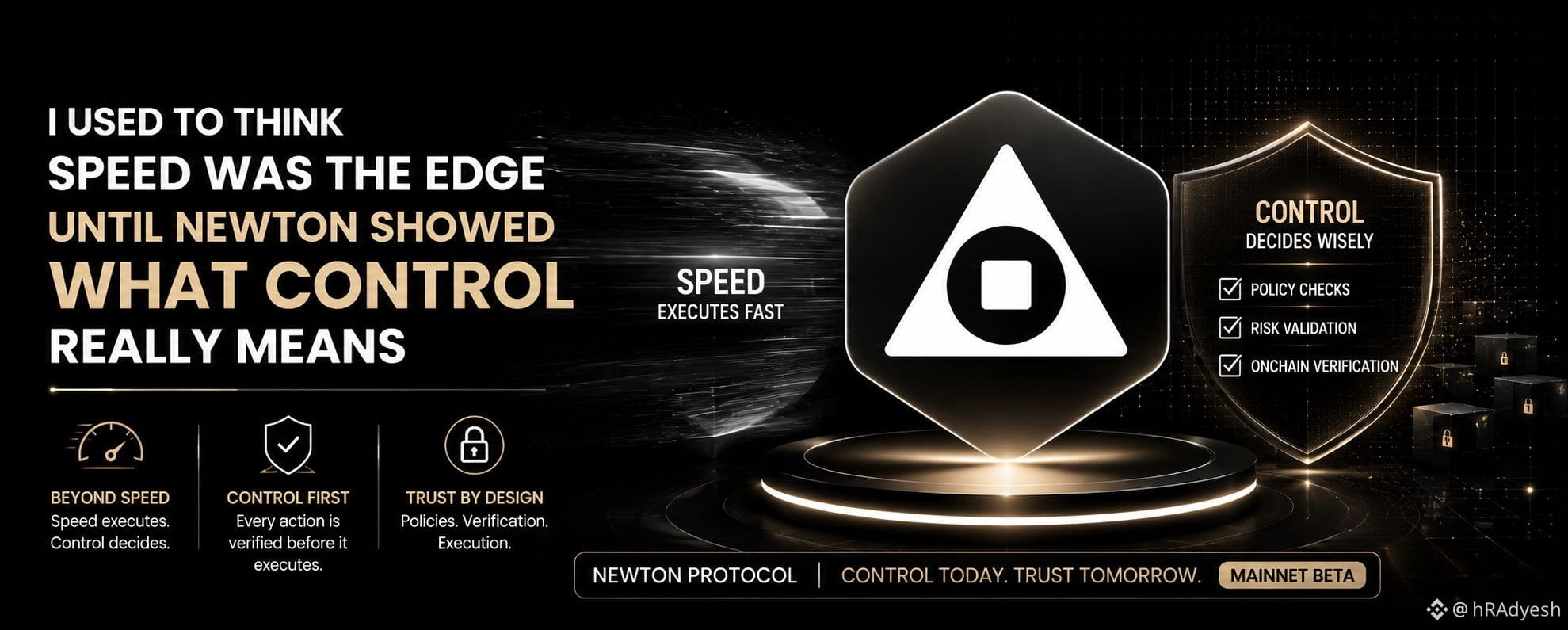
🔍 What Happens Behind The Scenes
Intent → What the user wants
Policy Check → Rules evaluate it
Verification → Results confirmed
Execution → Only approved actions go onchain
🧩 Why This Architecture Matters
This System Separates:
✔ Intent
✔ Validation
✔ Execution
In Most Blockchains…
These Are Blended Together.
Here → They Are Explicit
And That Changes Everything.
⚠️ The Hidden Problem With “Speed”
Most Systems Assume:
If A Transaction Is Valid → Execute It
But Code Doesn’t Understand:
❌ Context
❌ Risk
❌ Intent
It Just Executes.
🧠 Newton’s Core Idea
👉 Validity Is Not Enough
👉 Authorization Must Come First
Execution Should Not Be Automatic.
It Should Be Allowed.
🤖 Why This Matters More Now (AI Era)
Everyone Talks About:
✔ Faster Systems
✔ Smarter Agents
✔ Better Automation
But The Real Question Is:
👉 What Happens When AI Controls Capital?
⚠️ The Risk Nobody Talks About
Without Control:
🚨 Faster Systems = Faster Mistakes
An AI Agent Can Execute A Bad Decision
Instantly And At Scale
🛡️ Newton’s Focus
Not Just Better Execution…
👉 Better Conditions For Execution
It Doesn’t Replace Action.
It Shapes It.
🔄 The Shift In Value
Old Model:
⚡ Speed = Value
New Model:
🧠 Decision Integrity = Value
🧭 The Bigger Picture
If This Direction Continues…
The Most Important Layer Won’t Be:
❌ Execution
It Will Be:
✅ Control & Policy
❓ The Questions That Matter
If Intent Is The Starting Point:
👉 Who Defines The Rules?
👉 How Do We Verify Fairness?
👉 What Does “Efficiency” Mean Without Speed?
🧠 Final Thought
We Spent Years Optimizing:
How Fast Things Happen
Now We’re Starting To Ask:
👉 Should They Happen At All?
If You’re Still Only Thinking About Speed…
You’re Missing The Bigger Shift.
@NewtonProtocol Is Exploring Something Different.
And It’s Worth Paying Attention.
Not Financial Advice. DYOR.
$NEWT
#Newt
🎯
翻訳参照
#newt $NEWT I used to think most progress in crypto meant reducing friction. Fewer clicks, faster execution, less waiting. But reading through the Newton Protocol white paper made me question that assumption. Removing friction is useful, but only if the system knows what should happen in the first place. What stands out in Newton Mainnet Beta is the shift from manual transactions to intent-driven execution. Instead of users directly pushing transactions onchain, they define intent. That intent is then evaluated against policies before anything is executed. It changes the role of the user from operator to decision-maker. {spot}(NEWTUSDT) The design separates intent, validation, and execution into distinct steps. Offchain actors evaluate whether an action meets defined rules such as risk limits or compliance checks. These results are then verified onchain before settlement. This structure makes authorization explicit rather than assumed. It still feels early, but the direction is becoming clearer. As systems move toward automation, especially with AI agents, the question is not just how fast actions can be executed. It is whether those actions should be allowed at all. Newton seems to focus on that layer of control. Not replacing execution, but shaping it before it happens. @NewtonProtocol $NEWT #Newt What matters more as DeFi moves toward intent-based systems?
#newt $NEWT
I used to think most progress in crypto meant reducing friction. Fewer clicks, faster execution, less waiting. But reading through the Newton Protocol white paper made me question that assumption. Removing friction is useful, but only if the system knows what should happen in the first place.

What stands out in Newton Mainnet Beta is the shift from manual transactions to intent-driven execution. Instead of users directly pushing transactions onchain, they define intent. That intent is then evaluated against policies before anything is executed. It changes the role of the user from operator to decision-maker.
The design separates intent, validation, and execution into distinct steps. Offchain actors evaluate whether an action meets defined rules such as risk limits or compliance checks. These results are then verified onchain before settlement. This structure makes authorization explicit rather than assumed.

It still feels early, but the direction is becoming clearer. As systems move toward automation, especially with AI agents, the question is not just how fast actions can be executed. It is whether those actions should be allowed at all.

Newton seems to focus on that layer of control. Not replacing execution, but shaping it before it happens.

@NewtonProtocol
$NEWT
#Newt
What matters more as DeFi moves toward intent-based systems?
Smarter automation
57%
Faster settlement
29%
Stronger policy enforcement
0%
Clearer verification systems
14%
7 投票 • 投票は終了しました
記事
翻訳参照
Everyone Is Chasing Faster Execution. Newton Is Questioning Whether Execution Should Happen At AllI used to think most infrastructure upgrades were about performance. Faster blocks. Lower fees. Better throughput. That was the default lens. If something improved speed, it was progress. If it reduced cost, it was innovation. Everything else felt secondary. But reading deeper into Newton Protocol and observing the Newton Mainnet Beta shifted that perspective. Beta usually signals something incomplete. Something still being fixed. Something not ready. Here, it feels different. It feels deliberate. Less like a rough draft and more like a controlled environment where a specific idea is being tested under constraints. The shift is subtle but important. Newton is not optimizing how fast transactions execute. It is questioning whether every transaction should execute in the first place. At a system level, Newton introduces a checkpoint before execution. Actions are not simply signed and sent to the chain. They are evaluated against predefined policies. These policies define what is allowed, under what conditions, and within which boundaries. The evaluation happens offchain, but the outcome is verified onchain. That distinction matters. There is also a clear separation of roles. Policy creators define the rules. Operators evaluate intents against those rules. Validators verify the attestations onchain. Execution becomes the final step, not the default assumption. Authorization is no longer implicit in a signature. It becomes explicit through validation. This design starts to make more sense when you consider the direction of DeFi. We are moving toward automation. AI agents are beginning to manage capital, execute strategies, and interact with protocols. In that world, speed alone is not enough. An automated system can scale errors just as efficiently as it scales success. Newton Mainnet Beta seems to treat this as a core problem. Instead of building faster pipes, it is building filters. Instead of assuming all valid inputs are acceptable, it introduces a layer that decides what should be allowed before anything happens. That is not a minor adjustment. It is a different way of thinking about infrastructure. What stands out is that this architecture does not feel accidental. The separation between policy, validation, and execution suggests intentional design. Each component has a clear responsibility. This reduces ambiguity. It also creates a framework where trust is distributed across steps rather than concentrated in a single action. In traditional systems, approval and execution are often separate. Finance has always relied on layered checks. DeFi compressed those layers into a single transaction for efficiency. Newton appears to be reintroducing separation, but in a programmable and verifiable way. That balance between control and decentralization is not easy to achieve. The connection to the product is clear. Newton Mainnet Beta is not just testing performance. It is testing whether this model of pre execution validation can function at scale. It is testing whether policies can act as enforceable boundaries in a live environment. It is testing whether intent can be structured before it becomes action. That makes the Beta phase more meaningful. It is not about fixing bugs in isolation. It is about observing how a new execution paradigm behaves under real conditions. Looking ahead, the implications are broader than one protocol. If AI driven systems become standard in DeFi, the need for controlled execution environments will likely increase. Systems that can define and enforce what should happen may become more valuable than systems that simply execute faster. It raises a different set of questions. Not about speed, but about permission. Not about throughput, but about boundaries. Not about what is possible, but about what is acceptable. What happens when execution is no longer the primary bottleneck, but decision making is. What becomes more valuable in that world. The agent that acts, or the system that decides what actions are allowed. Is the next phase of infrastructure defined by how fast systems move, or by how carefully they choose to move. When automation becomes the default, does control become the real innovation. And if policies define execution, who defines the policies. Not financial advice. DYOR. @NewtonProtocol $NEWT #Newt

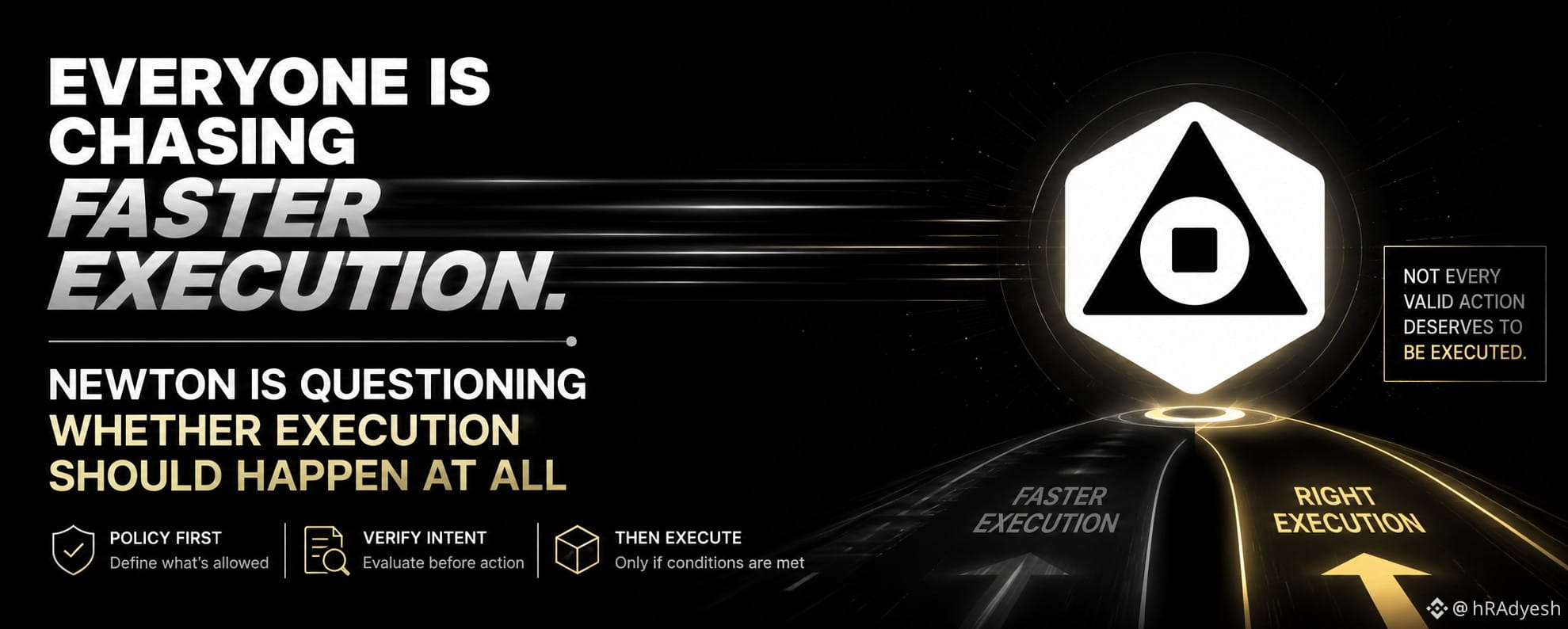
Everyone Is Chasing Faster Execution. Newton Is Questioning Whether Execution Should Happen At All

I used to think most infrastructure upgrades were about performance. Faster blocks. Lower fees. Better throughput. That was the default lens. If something improved speed, it was progress. If it reduced cost, it was innovation. Everything else felt secondary.
But reading deeper into Newton Protocol and observing the Newton Mainnet Beta shifted that perspective. Beta usually signals something incomplete. Something still being fixed. Something not ready. Here, it feels different. It feels deliberate. Less like a rough draft and more like a controlled environment where a specific idea is being tested under constraints.
The shift is subtle but important. Newton is not optimizing how fast transactions execute. It is questioning whether every transaction should execute in the first place.
At a system level, Newton introduces a checkpoint before execution. Actions are not simply signed and sent to the chain. They are evaluated against predefined policies. These policies define what is allowed, under what conditions, and within which boundaries. The evaluation happens offchain, but the outcome is verified onchain. That distinction matters.
There is also a clear separation of roles. Policy creators define the rules. Operators evaluate intents against those rules. Validators verify the attestations onchain. Execution becomes the final step, not the default assumption. Authorization is no longer implicit in a signature. It becomes explicit through validation.
This design starts to make more sense when you consider the direction of DeFi. We are moving toward automation. AI agents are beginning to manage capital, execute strategies, and interact with protocols. In that world, speed alone is not enough. An automated system can scale errors just as efficiently as it scales success.
Newton Mainnet Beta seems to treat this as a core problem. Instead of building faster pipes, it is building filters. Instead of assuming all valid inputs are acceptable, it introduces a layer that decides what should be allowed before anything happens. That is not a minor adjustment. It is a different way of thinking about infrastructure.
What stands out is that this architecture does not feel accidental. The separation between policy, validation, and execution suggests intentional design. Each component has a clear responsibility. This reduces ambiguity. It also creates a framework where trust is distributed across steps rather than concentrated in a single action.
In traditional systems, approval and execution are often separate. Finance has always relied on layered checks. DeFi compressed those layers into a single transaction for efficiency. Newton appears to be reintroducing separation, but in a programmable and verifiable way. That balance between control and decentralization is not easy to achieve.
The connection to the product is clear. Newton Mainnet Beta is not just testing performance. It is testing whether this model of pre execution validation can function at scale. It is testing whether policies can act as enforceable boundaries in a live environment. It is testing whether intent can be structured before it becomes action.
That makes the Beta phase more meaningful. It is not about fixing bugs in isolation. It is about observing how a new execution paradigm behaves under real conditions.
Looking ahead, the implications are broader than one protocol. If AI driven systems become standard in DeFi, the need for controlled execution environments will likely increase. Systems that can define and enforce what should happen may become more valuable than systems that simply execute faster.
It raises a different set of questions. Not about speed, but about permission. Not about throughput, but about boundaries. Not about what is possible, but about what is acceptable.
What happens when execution is no longer the primary bottleneck, but decision making is. What becomes more valuable in that world. The agent that acts, or the system that decides what actions are allowed.
Is the next phase of infrastructure defined by how fast systems move, or by how carefully they choose to move. When automation becomes the default, does control become the real innovation. And if policies define execution, who defines the policies.
Not financial advice. DYOR.
@NewtonProtocol
$NEWT
#Newt
翻訳参照
#newt $NEWT I used to think most infrastructure upgrades were about performance. Faster blocks, lower fees, better throughput. But after reading parts of the Newton Protocol white paper, I started paying more attention to something else. How decisions are controlled before execution even begins. Newton Mainnet Beta doesn’t feel like an unfinished product. It feels like a controlled environment where policy enforcement is tested as a first-class layer. Instead of assuming every valid transaction should execute, the system introduces a checkpoint. Each action is evaluated against predefined policies, using offchain computation and onchain verification before settlement. What stood out to me is the separation of roles. Policy definition, validation, and execution are not bundled together. Operators evaluate intent and produce attestations, which are then verified onchain. This creates a system where authorization is explicit, not implied. As AI agents become more involved in managing capital, this design starts to make more sense. Execution speed matters, but only after we trust the conditions under which execution happens. Without constraints, automation can scale mistakes just as efficiently as it scales success. Newton seems to focus less on what can be done and more on what should be allowed. That feels like a subtle but important shift in how DeFi infrastructure might evolve. {future}(NEWTUSDT) @NewtonProtocol $NEWT #Newt What matters more for the future of AI in DeFi?
#newt $NEWT I used to think most infrastructure upgrades were about performance. Faster blocks, lower fees, better throughput. But after reading parts of the Newton Protocol white paper, I started paying more attention to something else. How decisions are controlled before execution even begins.

Newton Mainnet Beta doesn’t feel like an unfinished product. It feels like a controlled environment where policy enforcement is tested as a first-class layer. Instead of assuming every valid transaction should execute, the system introduces a checkpoint. Each action is evaluated against predefined policies, using offchain computation and onchain verification before settlement.

What stood out to me is the separation of roles. Policy definition, validation, and execution are not bundled together. Operators evaluate intent and produce attestations, which are then verified onchain. This creates a system where authorization is explicit, not implied.

As AI agents become more involved in managing capital, this design starts to make more sense. Execution speed matters, but only after we trust the conditions under which execution happens. Without constraints, automation can scale mistakes just as efficiently as it scales success.

Newton seems to focus less on what can be done and more on what should be allowed. That feels like a subtle but important shift in how DeFi infrastructure might evolve.
@NewtonProtocol
$NEWT
#Newt
What matters more for the future of AI in DeFi?
Smarter AI agents
80%
Faster execution
0%
Stronger risk controls
20%
Transparent decision-making
0%
5 投票 • 投票は終了しました
記事
翻訳参照
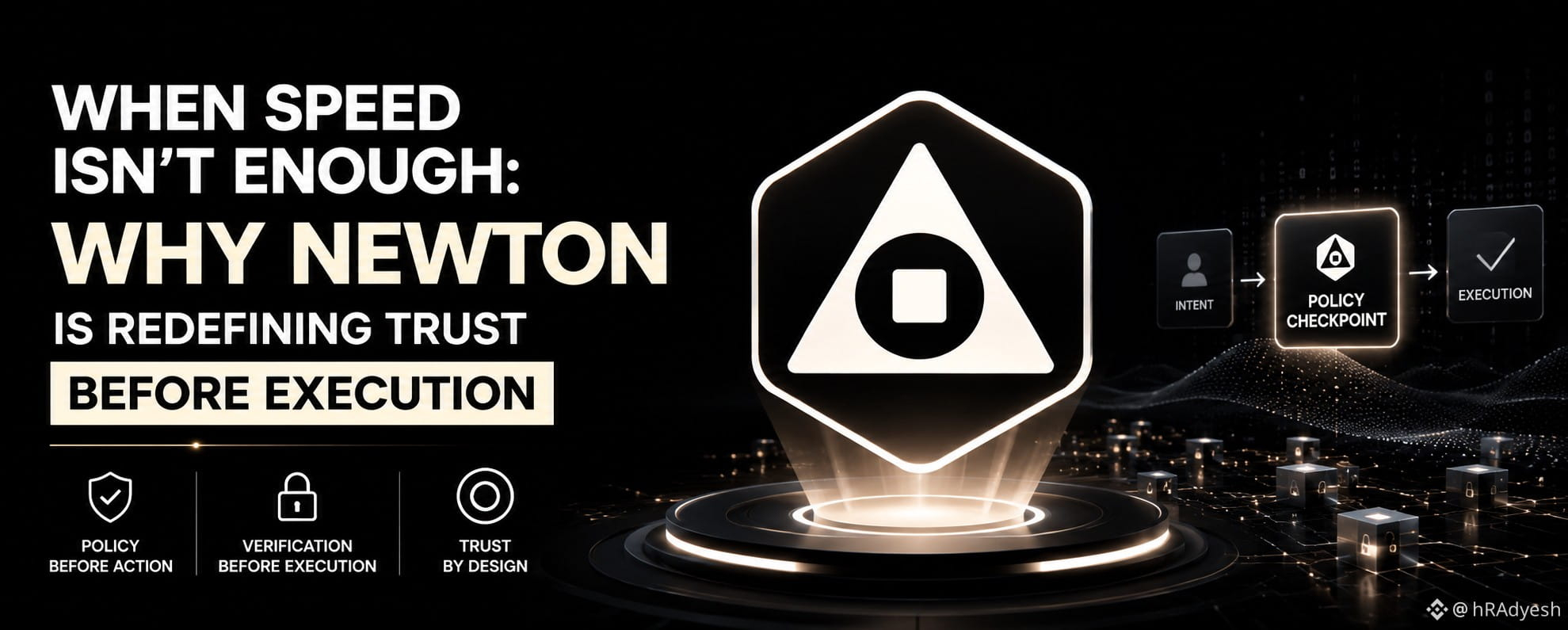
When Speed Isn’t Enough: Why Newton Is Redefining Trust Before ExecutionI used to think every serious blockchain upgrade was about one thing. Making transactions faster and cheaper. That was the metric everyone compared. Latency, throughput, fees. It all pointed in the same direction. Improve execution and everything else will follow. But after spending time reading about @NewtonProtocol and its Mainnet Beta, that assumption started to feel incomplete. Not wrong. Just insufficient. Because speed only matters after you are sure the action itself should happen. The idea that beta means unfinished also started to feel misleading. In most cases, beta suggests something is still being tested or is not fully reliable. Here, it feels different. The system is not unfinished. It is controlled. The environment is intentionally constrained so that execution can be observed, verified, and shaped before scaling. That is not a limitation. That is a design choice. That shift in perspective led me to look deeper into how the system actually works. At a simple level, Newton introduces a policy layer before execution. Instead of a transaction moving directly from user intent to smart contract settlement, it passes through a checkpoint. This checkpoint evaluates whether the action meets predefined conditions. These conditions can include identity requirements, risk parameters, compliance rules, or strategy constraints. The important detail is that this evaluation does not rely on blind trust. It uses a combination of offchain computation and onchain verification. Operators process the intent, evaluate it against the policy, and produce a signed result. These signatures are aggregated and verified before the transaction is allowed to proceed. This means the system separates three things that are usually mixed together. Policy definition, execution logic, and verification. Each part has its own role. Each part can be inspected. From the outside, the flow can look familiar. A vault still exists. A manager still signs. The intent still becomes execution. But the path is different. The instruction no longer goes directly to the contract. It is intercepted, checked, and only then allowed to continue. That is where the design becomes intentional rather than cosmetic. Most blockchain systems assume that once a transaction is valid, it should execute. Validity is defined by code. If the inputs match the rules, the system proceeds. But code does not understand context. It does not know if an action is risky, inappropriate, or simply poorly timed. Newton is built around the idea that validity is not enough. Authorization matters. Context matters. And these factors need to be enforced before execution, not analyzed after. This becomes more relevant as AI enters the picture. Most discussions about AI in crypto focus on capability. Can it trade better. Can it optimize yield. Can it react faster than humans. These are useful questions, but they ignore a more difficult one. What happens when these systems control meaningful amounts of capital. At that point, intelligence alone is not the bottleneck. Control is. An AI agent that executes a flawed strategy at high speed does not create efficiency. It creates faster losses. Without constraints, automation amplifies mistakes instead of preventing them. This is where Newton’s architecture starts to connect with a broader trend. It is not trying to build a better trader. It is trying to define the boundaries within which any trader, human or machine, can operate. That distinction may seem subtle, but it changes where value sits. Instead of competing on execution, the system competes on decision integrity. If this approach works, it could reshape how people think about infrastructure. The focus would shift from how fast transactions settle to how confidently they are approved. From raw throughput to controlled participation. It also raises questions that are not easy to answer. As more rules move onchain, who defines them. As policies become more complex, who verifies them. And as control increases, how do we ensure it does not turn into hidden centralization. These are not technical questions alone. They are design and governance questions. For now, what stands out is the direction. @NewtonProtocol is not trying to remove humans from the system. It is trying to reduce blind trust. It is not replacing execution. It is reframing it. And that might be the more important shift. If AI is going to manage capital, should we prioritize making it smarter or making it accountable. If every transaction can be checked before execution, does speed still remain the primary metric. And if policy becomes the gatekeeper, who ultimately controls the gate. Not financial advice. DYOR. @NewtonProtocol {spot}(NEWTUSDT) $NEWT #Newt

When Speed Isn’t Enough: Why Newton Is Redefining Trust Before Execution

I used to think every serious blockchain upgrade was about one thing. Making transactions faster and cheaper. That was the metric everyone compared. Latency, throughput, fees. It all pointed in the same direction. Improve execution and everything else will follow.
But after spending time reading about @NewtonProtocol and its Mainnet Beta, that assumption started to feel incomplete. Not wrong. Just insufficient. Because speed only matters after you are sure the action itself should happen.
The idea that beta means unfinished also started to feel misleading. In most cases, beta suggests something is still being tested or is not fully reliable. Here, it feels different. The system is not unfinished. It is controlled. The environment is intentionally constrained so that execution can be observed, verified, and shaped before scaling. That is not a limitation. That is a design choice.
That shift in perspective led me to look deeper into how the system actually works.
At a simple level, Newton introduces a policy layer before execution. Instead of a transaction moving directly from user intent to smart contract settlement, it passes through a checkpoint. This checkpoint evaluates whether the action meets predefined conditions. These conditions can include identity requirements, risk parameters, compliance rules, or strategy constraints.
The important detail is that this evaluation does not rely on blind trust. It uses a combination of offchain computation and onchain verification. Operators process the intent, evaluate it against the policy, and produce a signed result. These signatures are aggregated and verified before the transaction is allowed to proceed.
This means the system separates three things that are usually mixed together. Policy definition, execution logic, and verification. Each part has its own role. Each part can be inspected.
From the outside, the flow can look familiar. A vault still exists. A manager still signs. The intent still becomes execution. But the path is different. The instruction no longer goes directly to the contract. It is intercepted, checked, and only then allowed to continue.
That is where the design becomes intentional rather than cosmetic.
Most blockchain systems assume that once a transaction is valid, it should execute. Validity is defined by code. If the inputs match the rules, the system proceeds. But code does not understand context. It does not know if an action is risky, inappropriate, or simply poorly timed.
Newton is built around the idea that validity is not enough. Authorization matters. Context matters. And these factors need to be enforced before execution, not analyzed after.
This becomes more relevant as AI enters the picture.
Most discussions about AI in crypto focus on capability. Can it trade better. Can it optimize yield. Can it react faster than humans. These are useful questions, but they ignore a more difficult one. What happens when these systems control meaningful amounts of capital.
At that point, intelligence alone is not the bottleneck. Control is.
An AI agent that executes a flawed strategy at high speed does not create efficiency. It creates faster losses. Without constraints, automation amplifies mistakes instead of preventing them.
This is where Newton’s architecture starts to connect with a broader trend. It is not trying to build a better trader. It is trying to define the boundaries within which any trader, human or machine, can operate.
That distinction may seem subtle, but it changes where value sits. Instead of competing on execution, the system competes on decision integrity.
If this approach works, it could reshape how people think about infrastructure. The focus would shift from how fast transactions settle to how confidently they are approved. From raw throughput to controlled participation.
It also raises questions that are not easy to answer.
As more rules move onchain, who defines them. As policies become more complex, who verifies them. And as control increases, how do we ensure it does not turn into hidden centralization.
These are not technical questions alone. They are design and governance questions.
For now, what stands out is the direction. @NewtonProtocol is not trying to remove humans from the system. It is trying to reduce blind trust. It is not replacing execution. It is reframing it.
And that might be the more important shift.
If AI is going to manage capital, should we prioritize making it smarter or making it accountable.
If every transaction can be checked before execution, does speed still remain the primary metric.
And if policy becomes the gatekeeper, who ultimately controls the gate.
Not financial advice. DYOR.
@NewtonProtocol
$NEWT
#Newt
翻訳参照
#newt $NEWT Most people in crypto are still focused on price and speed. Faster transactions. Better yields. Smarter AI agents. But I keep thinking about a different question: What happens when AI starts managing real money at scale? At that point, intelligence alone isn’t enough. Control, rules, and verification start to matter more than execution speed. That’s why projects focusing on pre-execution checks and policy enforcement feel more relevant to me right now. @NewtonProtocol $NEWT #Newt {spot}(NEWTUSDT) Poll 👇 What matters more for the future of AI in DeFi?
#newt $NEWT
Most people in crypto are still focused on price and speed.

Faster transactions. Better yields. Smarter AI agents.

But I keep thinking about a different question:
What happens when AI starts managing real money at scale?

At that point, intelligence alone isn’t enough.
Control, rules, and verification start to matter more than execution speed.

That’s why projects focusing on pre-execution checks and policy enforcement feel more relevant to me right now.
@NewtonProtocol
$NEWT
#Newt

Poll 👇
What matters more for the future of AI in DeFi?
Smarter AI agents
67%
Faster execution
13%
Stronger risk controls
20%
Transparent decision-making
0%
15 投票 • 投票は終了しました
記事
翻訳参照
I Used To Think Beta Means Unfinished But Newton Turns It Into Controlled Execution{spot}(NEWTUSDT) I used to think a beta release in crypto meant something unfinished. A preview version. A signal that the real system was still ahead. But looking at Newton Mainnet Beta changed that assumption. What stood out was not what was missing, but what was already defined. The structure felt deliberate. Not experimental in the usual sense, but constrained in a way that suggested the boundaries were the product. Most systems treat a beta as a stage for feature expansion. Newton seems to treat it as a stage for behavioral validation. That shift becomes clearer when you look at how the system is designed. At its core, Newton is not optimizing for faster execution. It is restructuring how execution is allowed to happen in the first place. Instead of users manually triggering every transaction, the system moves toward intent based flows. The user defines what they want, and agents carry out those actions within predefined constraints. Those constraints are not static rules. They live inside policy enforced vaults, where logic stays consistent but parameters can be configured. That distinction matters more than it first appears. I used to think policies in crypto were just fixed rules set once and trusted forever. But looking deeper, the real shift is not the rule itself. It is how much of it becomes configurable. When logic stays constant but parameters change, control quietly moves away from code and into the hands of whoever sets those values. That creates flexibility. But it also changes the trust model in ways that are easy to overlook. Two users can rely on the same policy logic and still operate under very different assumptions, simply because their configurations differ. The system remains deterministic, yet outcomes depend on decisions many users may never fully inspect. This is where Newton’s design feels intentional rather than accidental. By placing policies before execution, the system is not just enforcing outcomes. It is shaping the conditions under which outcomes are even possible. Transactions are no longer just validated after submission. They are filtered before they can exist. That changes the role of infrastructure. Instead of acting as a neutral execution layer, it becomes a coordination layer. One that defines boundaries, validates intent, and ensures that actions remain within those boundaries even when performed by autonomous agents. It also explains why speed is not the primary narrative here. Fast execution without controlled behavior scales risk. Controlled execution, even if slightly constrained, scales trust. Newton seems to prioritize the second. The more I think about it, the more it feels like a shift from interaction to delegation. Users are no longer expected to manage every step. They define intent, and the system handles execution within a policy framework that is meant to be both verifiable and enforceable. That has implications beyond just user experience. It starts to make decentralized systems more compatible with real world operational requirements, where rules, limits, and accountability are not optional. They are expected. At the same time, it introduces a different kind of responsibility. If policies become configurable, then security is no longer only about code correctness. It is also about parameter correctness. The system can be perfectly designed and still behave in unexpected ways depending on how those parameters are set. So the question is not just whether policy enforced systems are safer. It is whether they make responsibility clearer or easier to overlook. Does intent based execution actually reduce complexity, or does it move it into layers most users do not actively examine. Does configurable enforcement create more adaptable control, or make identical systems operate under very different trust assumptions. And if execution is increasingly delegated, how do users stay confident in actions they no longer directly perform. Not financial advice. DYOR. @NewtonProtocol $NEWT #Newt

I Used To Think Beta Means Unfinished But Newton Turns It Into Controlled Execution

I used to think a beta release in crypto meant something unfinished. A preview version. A signal that the real system was still ahead.
But looking at Newton Mainnet Beta changed that assumption.
What stood out was not what was missing, but what was already defined. The structure felt deliberate. Not experimental in the usual sense, but constrained in a way that suggested the boundaries were the product.
Most systems treat a beta as a stage for feature expansion. Newton seems to treat it as a stage for behavioral validation.
That shift becomes clearer when you look at how the system is designed.
At its core, Newton is not optimizing for faster execution. It is restructuring how execution is allowed to happen in the first place. Instead of users manually triggering every transaction, the system moves toward intent based flows. The user defines what they want, and agents carry out those actions within predefined constraints.
Those constraints are not static rules. They live inside policy enforced vaults, where logic stays consistent but parameters can be configured. That distinction matters more than it first appears.
I used to think policies in crypto were just fixed rules set once and trusted forever. But looking deeper, the real shift is not the rule itself. It is how much of it becomes configurable.
When logic stays constant but parameters change, control quietly moves away from code and into the hands of whoever sets those values.
That creates flexibility. But it also changes the trust model in ways that are easy to overlook.
Two users can rely on the same policy logic and still operate under very different assumptions, simply because their configurations differ. The system remains deterministic, yet outcomes depend on decisions many users may never fully inspect.
This is where Newton’s design feels intentional rather than accidental.
By placing policies before execution, the system is not just enforcing outcomes. It is shaping the conditions under which outcomes are even possible. Transactions are no longer just validated after submission. They are filtered before they can exist.
That changes the role of infrastructure.
Instead of acting as a neutral execution layer, it becomes a coordination layer. One that defines boundaries, validates intent, and ensures that actions remain within those boundaries even when performed by autonomous agents.
It also explains why speed is not the primary narrative here.
Fast execution without controlled behavior scales risk. Controlled execution, even if slightly constrained, scales trust.
Newton seems to prioritize the second.
The more I think about it, the more it feels like a shift from interaction to delegation. Users are no longer expected to manage every step. They define intent, and the system handles execution within a policy framework that is meant to be both verifiable and enforceable.
That has implications beyond just user experience.
It starts to make decentralized systems more compatible with real world operational requirements, where rules, limits, and accountability are not optional. They are expected.
At the same time, it introduces a different kind of responsibility.
If policies become configurable, then security is no longer only about code correctness. It is also about parameter correctness. The system can be perfectly designed and still behave in unexpected ways depending on how those parameters are set.
So the question is not just whether policy enforced systems are safer.
It is whether they make responsibility clearer or easier to overlook.
Does intent based execution actually reduce complexity, or does it move it into layers most users do not actively examine.
Does configurable enforcement create more adaptable control, or make identical systems operate under very different trust assumptions.
And if execution is increasingly delegated, how do users stay confident in actions they no longer directly perform.
Not financial advice. DYOR.
@NewtonProtocol
$NEWT
#Newt
記事
翻訳参照
Newton Mainnet Beta Is Not Incomplete It Is Where Trust Gets EngineeredI initially looked at Newton Mainnet Beta the same way I look at most beta releases. A signal that something is still incomplete, still being tested, still not ready for serious usage. That assumption felt reasonable because in crypto, beta often translates to uncertainty rather than reliability. But that view started to shift after spending more time studying @NewtonProtocol and how the system is actually designed. The beta is not positioned as a half finished product. It functions more like a controlled proving ground where execution, policy enforcement, and service coordination are tested under real conditions before scale is introduced. At its core, Newton Protocol is not just another blockchain trying to improve throughput. It is building a public compute layer for the internet. The key component is an onchain service registry where computational services can be published, discovered, and composed. Anyone can contribute compute. Anyone can use it. The system standardizes how these services interact, which removes the need to rely on centralized providers for tasks like AI execution, data processing, or financial logic. This is where the design becomes more interesting. Newton introduces intent based execution, where users define outcomes instead of manually executing each step. Agents then carry out these actions, but they operate within constraints defined by vaults. These vaults act as policy layers that validate conditions before any transaction or computation is executed. The flow shifts from executing first and verifying later to enforcing rules at the point of action. That architecture is not accidental. It reflects a system level decision to prioritize verifiability over speed and coordination over fragmentation. The registry, agents, and vaults are not separate features. They form a loop where discovery, execution, and enforcement are tightly connected. This reduces ambiguity and makes outcomes more predictable, which is critical when systems begin to operate with less direct human input. The inclusion of infrastructure like Magic also adds an important layer to this system. Magic, built by engineers with backgrounds in Docker and Uber scale systems, has already onboarded tens of millions of wallets and supports hundreds of thousands of developers. Its embedded wallet model lowers the barrier to entry, which means interaction with Newton’s compute layer can become more seamless for both users and applications. This connection between access and execution is often overlooked, but it is necessary for real adoption. What stands out is how all of these pieces align toward a single goal. Making computation accessible as a public utility. Not just data availability, but actual usable compute that can be composed, verified, and executed without relying on centralized control. That is a meaningful shift from how most current systems operate. If this model holds, the implication is broader than just another protocol launch. It suggests a move toward environments where users define intent, systems handle execution, and trust is enforced through architecture rather than assumed through intermediaries. That is where agent driven systems begin to feel practical. I started with skepticism around the beta label. I end with a different view. The beta is not a weakness. It is part of a deliberate process to build a system that can be trusted under real conditions before it is scaled. Not financial advice. DYOR. @NewtonProtocol $NEWT #Newt

Newton Mainnet Beta Is Not Incomplete It Is Where Trust Gets Engineered

I initially looked at Newton Mainnet Beta the same way I look at most beta releases. A signal that something is still incomplete, still being tested, still not ready for serious usage. That assumption felt reasonable because in crypto, beta often translates to uncertainty rather than reliability.
But that view started to shift after spending more time studying @NewtonProtocol and how the system is actually designed. The beta is not positioned as a half finished product. It functions more like a controlled proving ground where execution, policy enforcement, and service coordination are tested under real conditions before scale is introduced.
At its core, Newton Protocol is not just another blockchain trying to improve throughput. It is building a public compute layer for the internet. The key component is an onchain service registry where computational services can be published, discovered, and composed. Anyone can contribute compute. Anyone can use it. The system standardizes how these services interact, which removes the need to rely on centralized providers for tasks like AI execution, data processing, or financial logic.
This is where the design becomes more interesting. Newton introduces intent based execution, where users define outcomes instead of manually executing each step. Agents then carry out these actions, but they operate within constraints defined by vaults. These vaults act as policy layers that validate conditions before any transaction or computation is executed. The flow shifts from executing first and verifying later to enforcing rules at the point of action.
That architecture is not accidental. It reflects a system level decision to prioritize verifiability over speed and coordination over fragmentation. The registry, agents, and vaults are not separate features. They form a loop where discovery, execution, and enforcement are tightly connected. This reduces ambiguity and makes outcomes more predictable, which is critical when systems begin to operate with less direct human input.
The inclusion of infrastructure like Magic also adds an important layer to this system. Magic, built by engineers with backgrounds in Docker and Uber scale systems, has already onboarded tens of millions of wallets and supports hundreds of thousands of developers. Its embedded wallet model lowers the barrier to entry, which means interaction with Newton’s compute layer can become more seamless for both users and applications. This connection between access and execution is often overlooked, but it is necessary for real adoption.
What stands out is how all of these pieces align toward a single goal. Making computation accessible as a public utility. Not just data availability, but actual usable compute that can be composed, verified, and executed without relying on centralized control. That is a meaningful shift from how most current systems operate.
If this model holds, the implication is broader than just another protocol launch. It suggests a move toward environments where users define intent, systems handle execution, and trust is enforced through architecture rather than assumed through intermediaries. That is where agent driven systems begin to feel practical.
I started with skepticism around the beta label. I end with a different view. The beta is not a weakness. It is part of a deliberate process to build a system that can be trusted under real conditions before it is scaled.
Not financial advice. DYOR.
@NewtonProtocol
$NEWT
#Newt
ログインして、さらにコンテンツを読む
厳選トピックで世界の暗号資産トレーダーの仲間入り
⚡️ 暗号資産に関する最新かつ有益な情報が見つかります。
💬 世界最大の暗号資産取引所から信頼されています。
👍 認証を受けたクリエイターから、有益なインサイトを得られます。
メール / 電話番号
サイトマップ
Cookieの設定
プラットフォーム利用規約