
CoinPulseHq
397 投稿

CoinPulseHq
報告
ユーザーをブロック
CoinPulseHQ is an independent digital newsroom covering cryptocurrency, blockchain and artificial intelligence.
3 フォロー
12 フォロワー
18 いいね
投稿
·
--
記事
翻訳参照
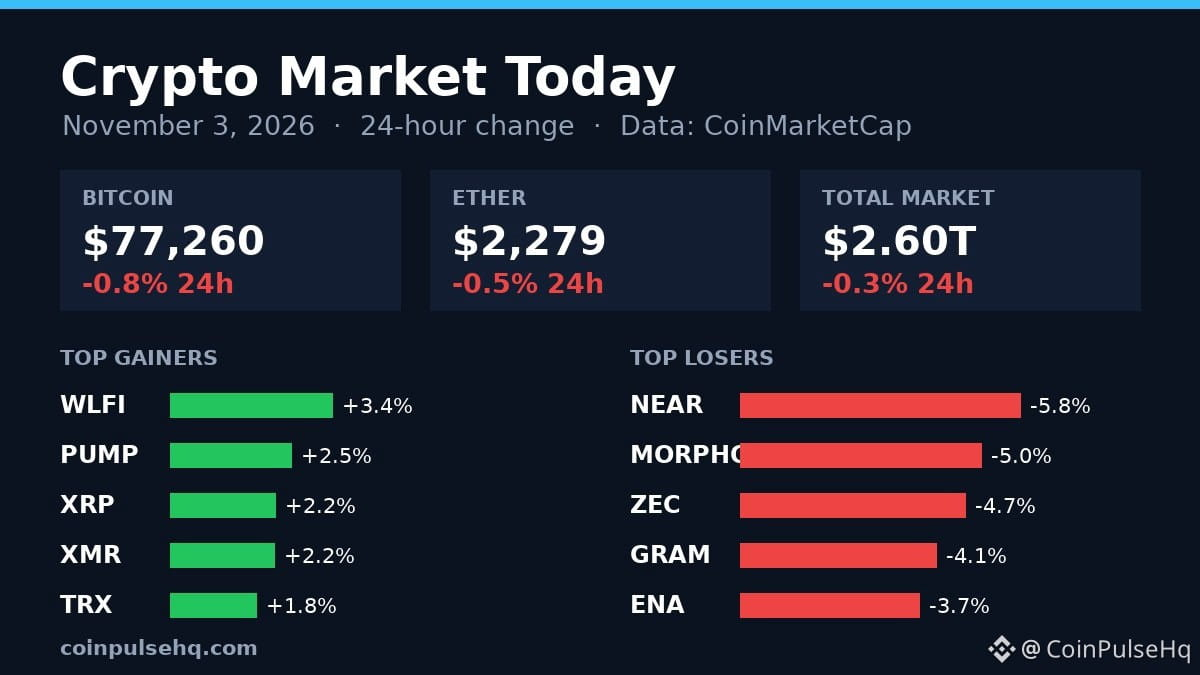
Crypto Market Today, Nov 3, 2026: Bitcoin Steady Near $77.3KThe crypto market was little changed over the past 24 hours. Total market value moved -0.3% to $2.60 trillion as of 13:00 UTC on Tuesday, November 3, 2026. Bitcoin traded at $77,260 (-0.8%) and Ether at $2,279 (-0.5%). 17 of the 50 largest coins were higher, and the median move was -0.6%.
Why is crypto flat today? What the numbers show
• Breadth. There was no clear direction: 17 of 50 large coins rose and 33 fell, so gains in some coins offset losses in others.
• Bitcoin versus altcoins. 28 of the other 49 large coins beat Bitcoin, so leadership was split. Bitcoin dominance stands at 59.9%, and Ether outperformed Bitcoin by 0.4 percentage points.
• Trading activity. 24-hour volume across the market was $64.6 billion, up 34.8% on the previous day. Volume did not change sharply, so the move was not driven by a surge of trading.
• Bitcoin's 24-hour range. From $76,343 (06:15 UTC) to $78,120 (13:45 UTC, Nov 2), a 2.3% swing. The low came after the high.
Stocks, the dollar and gold
Crypto often trades alongside other risk assets. Latest session for each (the date is the market's last close or update):
Market Level Change As of
S&P 500 7,541.40 -0.5% Nov 2
Nasdaq Composite 25,164.36 -1.1% Nov 2
US dollar index 101.85 +0.1% Nov 3
Gold 3,934.40 -0.9% Nov 3
US 10-year Treasury yield 4.937% +4.3 bp Nov 3
Biggest movers in the top 50
Gainers
Coin Price 24 hours 7 days
World Liberty Financial (WLFI) $0.05173 +3.4% -1.2%
Pump.fun (PUMP) $0.004222 +2.5% +0.9%
XRP (XRP) $1.28 +2.2% -2.0%
Monero (XMR) $624.04 +2.2% +4.9%
TRON (TRX) $0.3219 +1.8% -1.8%
Losers
Coin Price 24 hours 7 days
NEAR Protocol (NEAR) $3.90 -5.8% -14.0%
Morpho (MORPHO) $2.12 -5.0% -3.0%
Zcash (ZEC) $1,196 -4.7% -5.0%
Gram (prev. Toncoin) (GRAM) $1.15 -4.1% -5.8%
Ethena (ENA) $0.1726 -3.7% -16.0%
The stories behind today's moves
What CoinPulseHQ reported in the past 24 hours:
• Binance SAFU Bitcoin Wallet Falls to 7,500 BTC After Hack Payout — Binance's SAFU Bitcoin wallet fell to about 7,500 BTC after a 7,499 BTC transfer, as the exchange published proof of reserves for 10 tokens post-hack.
• Ethereum blobs stay guaranteed for 18 days, not deleted — Ethereum blobs are guaranteed for about 18 days, not deleted. Blobscan still traced the first blob from March 2024 across three archives in October 2026.
• Binance hackers swap $46.4M in stolen Solana for Bitcoin — Binance hackers moved 486,970 SOL worth about $46.4 million into Bitcoin via Relay, Chainalysis said, as Binance restored 95% of stolen assets after a $6.3B...
• Bitcoin’s $707B loss overhang points to a months-long recovery — About $707B of Bitcoin capital sits at a loss versus $380B in profit, and active addresses are down 43% from the December 2024 peak, AMBCrypto reports.
• OKX Adds 13,800 BTC Reserves in Month Binance Lost $6.3B — OKX's 49th proof-of-reserves report shows customer bitcoin up 13,800 BTC to 156,609 BTC, in the same month Binance lost $6.3 billion to hackers.
Live prices for the top 50 coins are on our Markets page, and today's biggest movers are on top crypto gainers and losers. Every daily report is collected on Crypto Market Today, and the previous one is Crypto Market Today, Nov 2, 2026: Bitcoin Steady Near $77.9K as JUST Jumps 3%. For the bigger picture, read our weekly market wraps, and if you are wondering about trading hours, see is the crypto market open on weekends.
How this report is made
CoinPulseHQ calculates every figure in this report from CoinMarketCap and CoinGecko market data recorded at 13:00 UTC on Tuesday, November 3, 2026, and stock, dollar, gold and bond levels from CNBC quotes. Stablecoins and wrapped or staked versions of other coins are left out of the rankings. Changes are over the previous 24 hours. The report describes what prices did and which measurable factors moved with them; it does not claim a single cause and does not predict prices. It is not financial advice.
Originally published on CoinPulseHQ: https://coinpulsehq.com/crypto-market-today-2026-11-03/
Crypto Market Today, Nov 3, 2026: Bitcoin Steady Near $77.3K
The crypto market was little changed over the past 24 hours. Total market value moved -0.3% to $2.60 trillion as of 13:00 UTC on Tuesday, November 3, 2026. Bitcoin traded at $77,260 (-0.8%) and Ether at $2,279 (-0.5%). 17 of the 50 largest coins were higher, and the median move was -0.6%.
Why is crypto flat today? What the numbers show
• Breadth. There was no clear direction: 17 of 50 large coins rose and 33 fell, so gains in some coins offset losses in others.
• Bitcoin versus altcoins. 28 of the other 49 large coins beat Bitcoin, so leadership was split. Bitcoin dominance stands at 59.9%, and Ether outperformed Bitcoin by 0.4 percentage points.
• Trading activity. 24-hour volume across the market was $64.6 billion, up 34.8% on the previous day. Volume did not change sharply, so the move was not driven by a surge of trading.
• Bitcoin's 24-hour range. From $76,343 (06:15 UTC) to $78,120 (13:45 UTC, Nov 2), a 2.3% swing. The low came after the high.
Stocks, the dollar and gold
Crypto often trades alongside other risk assets. Latest session for each (the date is the market's last close or update):
Market Level Change As of
S&P 500 7,541.40 -0.5% Nov 2
Nasdaq Composite 25,164.36 -1.1% Nov 2
US dollar index 101.85 +0.1% Nov 3
Gold 3,934.40 -0.9% Nov 3
US 10-year Treasury yield 4.937% +4.3 bp Nov 3
Biggest movers in the top 50
Gainers
Coin Price 24 hours 7 days
World Liberty Financial (WLFI) $0.05173 +3.4% -1.2%
Pump.fun (PUMP) $0.004222 +2.5% +0.9%
XRP (XRP) $1.28 +2.2% -2.0%
Monero (XMR) $624.04 +2.2% +4.9%
TRON (TRX) $0.3219 +1.8% -1.8%
Losers
Coin Price 24 hours 7 days
NEAR Protocol (NEAR) $3.90 -5.8% -14.0%
Morpho (MORPHO) $2.12 -5.0% -3.0%
Zcash (ZEC) $1,196 -4.7% -5.0%
Gram (prev. Toncoin) (GRAM) $1.15 -4.1% -5.8%
Ethena (ENA) $0.1726 -3.7% -16.0%
The stories behind today's moves
What CoinPulseHQ reported in the past 24 hours:
• Binance SAFU Bitcoin Wallet Falls to 7,500 BTC After Hack Payout — Binance's SAFU Bitcoin wallet fell to about 7,500 BTC after a 7,499 BTC transfer, as the exchange published proof of reserves for 10 tokens post-hack.
• Ethereum blobs stay guaranteed for 18 days, not deleted — Ethereum blobs are guaranteed for about 18 days, not deleted. Blobscan still traced the first blob from March 2024 across three archives in October 2026.
• Binance hackers swap $46.4M in stolen Solana for Bitcoin — Binance hackers moved 486,970 SOL worth about $46.4 million into Bitcoin via Relay, Chainalysis said, as Binance restored 95% of stolen assets after a $6.3B...
• Bitcoin’s $707B loss overhang points to a months-long recovery — About $707B of Bitcoin capital sits at a loss versus $380B in profit, and active addresses are down 43% from the December 2024 peak, AMBCrypto reports.
• OKX Adds 13,800 BTC Reserves in Month Binance Lost $6.3B — OKX's 49th proof-of-reserves report shows customer bitcoin up 13,800 BTC to 156,609 BTC, in the same month Binance lost $6.3 billion to hackers.
Live prices for the top 50 coins are on our Markets page, and today's biggest movers are on top crypto gainers and losers. Every daily report is collected on Crypto Market Today, and the previous one is Crypto Market Today, Nov 2, 2026: Bitcoin Steady Near $77.9K as JUST Jumps 3%. For the bigger picture, read our weekly market wraps, and if you are wondering about trading hours, see is the crypto market open on weekends.
How this report is made
CoinPulseHQ calculates every figure in this report from CoinMarketCap and CoinGecko market data recorded at 13:00 UTC on Tuesday, November 3, 2026, and stock, dollar, gold and bond levels from CNBC quotes. Stablecoins and wrapped or staked versions of other coins are left out of the rankings. Changes are over the previous 24 hours. The report describes what prices did and which measurable factors moved with them; it does not claim a single cause and does not predict prices. It is not financial advice.
Originally published on CoinPulseHQ: https://coinpulsehq.com/crypto-market-today-2026-11-03/
25
·
--
記事
翻訳参照
Bitcoin’s $707B loss overhang points to a months-long recoveryRoughly $707 billion of the capital invested in Bitcoin was held at a loss, against about $380 billion in profit, according to AMBCrypto. The outlet reported the figures on November 3, 2026, citing the analyst Darkfost, who tracks the daily average of capital sitting in profit or loss on Bitcoin spot positions.
Darkfost's view, as reported, is that clearing that overhang is a matter of time rather than a single catalyst. Bitcoin would need to trade through a large block of positions bought at higher prices before most of that capital returns to profit, and the analyst expects several months for that to happen. Only then, in that framing, does a market expansion have room to build.
Key facts
• About $707 billion of Bitcoin capital was at a loss, compared with roughly $380 billion in profit, per Darkfost's figures.
• Bitcoin's price fell to a low of $76,541 on Monday, November 2, 2026.
• The 30-day average of active addresses was 629,000, 43% below the December 2024 peak of 1.10 million, according to analyst Axel Adler Jr.
• The 30-day average of daily on-chain transfer volume slipped 5.4% from December 2024, from 865,000 BTC to 819,000 BTC.
• Brazilian exchange Mercado Bitcoin halted transfers after a security incident that drained $40 million, then resumed withdrawals.
Activity is down, but coins still move
The two on-chain readings cited in the report point in different directions. Address activity has contracted sharply: Adler compared the 43% decline from the December 2024 high with 2018, when active addresses fell 50%, from 1.10 million to 547,000, over about three months. The current contraction has stretched across almost two years.
Volume tells a milder story. Even with far fewer addresses in use, the average daily total of BTC moved on-chain was only slightly below the December 2024 level. AMBCrypto's summary of the data is that the coins changing hands remain comparable to that period, even as the number of participants has shrunk.
Sentiment hit by exchange failures
The loss figures landed alongside security trouble at major venues. Mercado Bitcoin stopped transfers after a $40 million drain and has since restored withdrawals, with deposits unaffected throughout. That incident followed the Binance heist by a matter of days, and AMBCrypto described market sentiment as still highly pessimistic.
The $75,000 demand zone, which lines up with the short-term holder cost basis, has become the level swing traders and longer-term holders are watching after the drop to $76,541.
Why it matters
The ratio of capital in loss to capital in profit shapes how rallies behave. Holders who bought near recent highs tend to sell as price returns to their entry point, so each leg upward meets supply from investors trying to get even. That is why recovery from a deep drawdown often takes months of sideways trading rather than a sharp reversal. For long-term holders the practical effect is a market where upside is absorbed gradually, and for newer buyers it means the cost basis of the past year's cohort now functions as resistance.
What to watch
The $75,000 demand zone is the immediate line to monitor; a sustained break below it would push more positions into loss and lengthen the recovery timeline Darkfost described. The daily balance between capital in profit and capital in loss is the metric that would show the overhang starting to clear. This article is not financial advice, and crypto markets are volatile and uncertain.
Originally published on CoinPulseHQ: https://coinpulsehq.com/bitcoin-707-billion-loss-overhang-recovery-months/
Bitcoin’s $707B loss overhang points to a months-long recovery
Roughly $707 billion of the capital invested in Bitcoin was held at a loss, against about $380 billion in profit, according to AMBCrypto. The outlet reported the figures on November 3, 2026, citing the analyst Darkfost, who tracks the daily average of capital sitting in profit or loss on Bitcoin spot positions.
Darkfost's view, as reported, is that clearing that overhang is a matter of time rather than a single catalyst. Bitcoin would need to trade through a large block of positions bought at higher prices before most of that capital returns to profit, and the analyst expects several months for that to happen. Only then, in that framing, does a market expansion have room to build.
Key facts
• About $707 billion of Bitcoin capital was at a loss, compared with roughly $380 billion in profit, per Darkfost's figures.
• Bitcoin's price fell to a low of $76,541 on Monday, November 2, 2026.
• The 30-day average of active addresses was 629,000, 43% below the December 2024 peak of 1.10 million, according to analyst Axel Adler Jr.
• The 30-day average of daily on-chain transfer volume slipped 5.4% from December 2024, from 865,000 BTC to 819,000 BTC.
• Brazilian exchange Mercado Bitcoin halted transfers after a security incident that drained $40 million, then resumed withdrawals.
Activity is down, but coins still move
The two on-chain readings cited in the report point in different directions. Address activity has contracted sharply: Adler compared the 43% decline from the December 2024 high with 2018, when active addresses fell 50%, from 1.10 million to 547,000, over about three months. The current contraction has stretched across almost two years.
Volume tells a milder story. Even with far fewer addresses in use, the average daily total of BTC moved on-chain was only slightly below the December 2024 level. AMBCrypto's summary of the data is that the coins changing hands remain comparable to that period, even as the number of participants has shrunk.
Sentiment hit by exchange failures
The loss figures landed alongside security trouble at major venues. Mercado Bitcoin stopped transfers after a $40 million drain and has since restored withdrawals, with deposits unaffected throughout. That incident followed the Binance heist by a matter of days, and AMBCrypto described market sentiment as still highly pessimistic.
The $75,000 demand zone, which lines up with the short-term holder cost basis, has become the level swing traders and longer-term holders are watching after the drop to $76,541.
Why it matters
The ratio of capital in loss to capital in profit shapes how rallies behave. Holders who bought near recent highs tend to sell as price returns to their entry point, so each leg upward meets supply from investors trying to get even. That is why recovery from a deep drawdown often takes months of sideways trading rather than a sharp reversal. For long-term holders the practical effect is a market where upside is absorbed gradually, and for newer buyers it means the cost basis of the past year's cohort now functions as resistance.
What to watch
The $75,000 demand zone is the immediate line to monitor; a sustained break below it would push more positions into loss and lengthen the recovery timeline Darkfost described. The daily balance between capital in profit and capital in loss is the metric that would show the overhang starting to clear. This article is not financial advice, and crypto markets are volatile and uncertain.
Originally published on CoinPulseHQ: https://coinpulsehq.com/bitcoin-707-billion-loss-overhang-recovery-months/
50
·
--
記事
翻訳参照
OKX Adds 13,800 BTC Reserves in Month Binance Lost $6.3BOKX's 49th consecutive proof-of-reserves report showed customer bitcoin balances rising 13,800 BTC to 156,609 BTC in the month to Nov. 1, a 9.66% increase from the Oct. 3 snapshot, according to Bitcoin.com News. At the time of the report those added coins were worth over $1 billion at a bitcoin price near $76,800, and the exchange's full customer stack was valued at roughly $12.04 billion.
The same month ended with Binance losing $6.3 billion to hackers, an event reported by crypto.news. OKX's snapshot window does not break out how much bitcoin arrived after that breach, so the report cannot by itself establish a link between the two.
Key facts
• OKX customer bitcoin rose 13,800 BTC to 156,609 BTC, a 9.66% gain from Oct. 3 to Nov. 1.
• Ether holdings climbed 2.95% to 1.92 million ETH, an increase of 54,879 ETH.
• USDT balances fell 9% to 7.96 billion tokens, roughly 787 million fewer than a month earlier.
• OKX's own token, OKB, slipped 0.08% to 19.68 million.
• Binance suspended and later restored withdrawals after the theft; crypto.news reported it processed $4.649 billion in withdrawals and $1.01 billion in deposits, a net outflow above $3.64 billion.
Where the money leaving Binance went
Bitcoin.com News reported that Binance has shed more than $16.5 billion in tracked assets since the hack, falling from about $144.9 billion on Oct. 29 to about $128.3 billion on Nov. 2. Some of that decline was the theft itself and some was price movement.
Whale Factor data cited in that report showed Binance losing about $4.5 billion over 24 hours while the next 10 exchanges combined took in only about $368 million. Most of the money leaving Binance therefore appears to have gone to self-custody wallets or stayed off exchanges rather than moving to competitors.
The two outlets describe the outflow differently. crypto.news frames its figure as net outflows from the exchange after withdrawal services resumed on Nov. 1, while Bitcoin.com News cites total tracked assets over a longer window. Both point in the same direction but are not directly comparable.
Binance answers with its own reserve proof
Binance co-founder Yi He said the exchange had generated the full zero-knowledge proof for its Oct. 31 snapshot, covering 10 tokens: BTC, ETH, USDT, BNB, SOL, USDC, XRP, USD1, RLUSD and ZEC. Such a proof lets an exchange demonstrate that reserves cover user balances without disclosing individual account data.
Days before that, Binance had said BTC, ETH, XRP and seven other cryptocurrencies were fully backed after the attack. Tether said it froze over $1.5 billion tied to the hack within 30 minutes.
OKX has published monthly reserves since the FTX collapse in late 2022, allowing users to check their own balances against holdings the exchange says cover them at least 1:1. The practice has become a standard trust signal for large venues.
Why it matters
Reserve reports are the main way customers can judge whether an exchange holds what it says it holds, and the contrast between OKX's gains and Binance's losses gives traders a side-by-side comparison in a period of acute stress. Where funds went after the breach also shapes the debate over whether exchange balances are a meaningful safety signal or simply a measure of user confidence that can move quickly.
What to watch
Binance plans new reserve snapshots on Nov. 4, 2026, and OKX's 50th report is due in early December. That report will be the first to cover a full month after the hack and should show whether OKX's bitcoin gains held once the initial panic faded. OKX also faces objections from Nvidia, Costco, Nike and other listed companies over its tokenized stock venture with Intercontinental Exchange.
This article is not financial advice, and crypto markets are volatile and can change quickly.
Originally published on CoinPulseHQ: https://coinpulsehq.com/okx-proof-of-reserves-13800-btc-binance-hack/
OKX Adds 13,800 BTC Reserves in Month Binance Lost $6.3B
OKX's 49th consecutive proof-of-reserves report showed customer bitcoin balances rising 13,800 BTC to 156,609 BTC in the month to Nov. 1, a 9.66% increase from the Oct. 3 snapshot, according to Bitcoin.com News. At the time of the report those added coins were worth over $1 billion at a bitcoin price near $76,800, and the exchange's full customer stack was valued at roughly $12.04 billion.
The same month ended with Binance losing $6.3 billion to hackers, an event reported by crypto.news. OKX's snapshot window does not break out how much bitcoin arrived after that breach, so the report cannot by itself establish a link between the two.
Key facts
• OKX customer bitcoin rose 13,800 BTC to 156,609 BTC, a 9.66% gain from Oct. 3 to Nov. 1.
• Ether holdings climbed 2.95% to 1.92 million ETH, an increase of 54,879 ETH.
• USDT balances fell 9% to 7.96 billion tokens, roughly 787 million fewer than a month earlier.
• OKX's own token, OKB, slipped 0.08% to 19.68 million.
• Binance suspended and later restored withdrawals after the theft; crypto.news reported it processed $4.649 billion in withdrawals and $1.01 billion in deposits, a net outflow above $3.64 billion.
Where the money leaving Binance went
Bitcoin.com News reported that Binance has shed more than $16.5 billion in tracked assets since the hack, falling from about $144.9 billion on Oct. 29 to about $128.3 billion on Nov. 2. Some of that decline was the theft itself and some was price movement.
Whale Factor data cited in that report showed Binance losing about $4.5 billion over 24 hours while the next 10 exchanges combined took in only about $368 million. Most of the money leaving Binance therefore appears to have gone to self-custody wallets or stayed off exchanges rather than moving to competitors.
The two outlets describe the outflow differently. crypto.news frames its figure as net outflows from the exchange after withdrawal services resumed on Nov. 1, while Bitcoin.com News cites total tracked assets over a longer window. Both point in the same direction but are not directly comparable.
Binance answers with its own reserve proof
Binance co-founder Yi He said the exchange had generated the full zero-knowledge proof for its Oct. 31 snapshot, covering 10 tokens: BTC, ETH, USDT, BNB, SOL, USDC, XRP, USD1, RLUSD and ZEC. Such a proof lets an exchange demonstrate that reserves cover user balances without disclosing individual account data.
Days before that, Binance had said BTC, ETH, XRP and seven other cryptocurrencies were fully backed after the attack. Tether said it froze over $1.5 billion tied to the hack within 30 minutes.
OKX has published monthly reserves since the FTX collapse in late 2022, allowing users to check their own balances against holdings the exchange says cover them at least 1:1. The practice has become a standard trust signal for large venues.
Why it matters
Reserve reports are the main way customers can judge whether an exchange holds what it says it holds, and the contrast between OKX's gains and Binance's losses gives traders a side-by-side comparison in a period of acute stress. Where funds went after the breach also shapes the debate over whether exchange balances are a meaningful safety signal or simply a measure of user confidence that can move quickly.
What to watch
Binance plans new reserve snapshots on Nov. 4, 2026, and OKX's 50th report is due in early December. That report will be the first to cover a full month after the hack and should show whether OKX's bitcoin gains held once the initial panic faded. OKX also faces objections from Nvidia, Costco, Nike and other listed companies over its tokenized stock venture with Intercontinental Exchange.
This article is not financial advice, and crypto markets are volatile and can change quickly.
Originally published on CoinPulseHQ: https://coinpulsehq.com/okx-proof-of-reserves-13800-btc-binance-hack/
·
--

記事
翻訳参照
Pando Rings Hacker Moves 4,000 ETH Through Tornado CashThe attacker behind the 2022 Pando Rings exploit deposited 4,000 ETH into Tornado Cash and left 3,548 ETH outside the mixer, according to on-chain data reported by AMBCrypto. The transfers, dated to the end of October and reported on November 2, mark the exploiter's renewed effort to hide stolen funds four years after the breach.
AMBCrypto, citing Arkham data, described a sequence in which the wallet first converted about $16.98 million in Dai to 7,548 ETH, then split the balance into smaller 100 ETH deposits worth roughly $229,000 each.
Key facts
• The attacker supplied 16.8 million USDT as collateral to borrow 5,000 ETH, repaid the loan, withdrew the collateral and swapped 16.7 million DAI for 7,548 ETH.
• After the conversions, 4,000 ETH went into Tornado Cash while 3,548 ETH stayed outside the mixer.
• Deposits were made in 100 ETH batches, each worth about $229,000, following an earlier 800 ETH deposit in August.
• AMBCrypto reported no confirmed exchange deposits and no established immediate selling pressure.
• Separately, Bitcoin.com News reported the Binance hacker split 233.46 million stolen XRP, worth about $293 million, across six new wallets between 03:52 and 04:00 UTC on Nov. 2.
How the funds were consolidated before the mixer
The attacker used Aave to turn stablecoin holdings into ETH before moving funds toward Tornado Cash. The lending step let the exploiter borrow ETH against USDT collateral, repay the loan, and then swap DAI for ETH, consolidating the balance into a single asset ahead of laundering.
That pattern matters for investigators because it breaks the link between the original stablecoin haul and the ETH that later entered the mixer. Rather than moving stolen tokens directly, the exploiter converted them through a lending market and a swap, adding layers that must be traced separately.
Why Tornado Cash complicates recovery
Tornado Cash pools deposits from many users and returns funds to fresh wallet addresses, cutting the direct connection between a depositor and later recipients. For theft recovery, that means wallet-level tracking of addresses tied to the hack yields less, and investigators must instead rely on transaction patterns and off-chain intelligence to establish where ETH eventually lands.
AMBCrypto reported that the latest deposits had not yet produced connections to wallets in known clusters. The exploiter's August deposit of 800 ETH shows the mixer strategy predates the current transfers, so the approach is established rather than new.
Bitcoin.com News offered a parallel case that shows both the limits and the value of tracing. The Binance attacker moved all 233.46 million stolen XRP into six new wallets, five holding about 40 million XRP each and the sixth 33.46 million, after test payments of 1,000 XRP. That outlet also reported about $242 million already routed through Tron-related paths, including Relay, Thorchain, Chainflip and Symbiosis, and a $250,000 deposit into the exchange Gate. Native XRP has no issuer able to freeze it, in contrast to stablecoins, where Tether froze about 378.7 million USDT.
Why it matters
For holders and exchanges, the Pando Rings case shows that an exploit four years old can still produce fresh laundering activity, which keeps recovery efforts open but unresolved. There is no evidence in the reported data that the ETH has reached a trading venue, so the transfers do not by themselves establish new selling pressure on Ethereum.
The two stories differ in what has been confirmed. AMBCrypto reported no exchange deposits from the Pando Rings funds; Bitcoin.com News reported exchanges watching six labelled wallets and a small test deposit at Gate. Both outlets describe tracing as the main remaining lever once funds enter a mixer or are split across new addresses.
What to watch
The next concrete signal will be whether any of the 3,548 ETH left outside Tornado Cash moves toward an identifiable exchange deposit address, and whether the 4,000 ETH already mixed surfaces in wallets tied to known clusters. Until then, the recovery status of the Pando Rings funds stays unconfirmed.
Originally published on CoinPulseHQ: https://coinpulsehq.com/pando-rings-hacker-4000-eth-tornado-cash/
Pando Rings Hacker Moves 4,000 ETH Through Tornado Cash
The attacker behind the 2022 Pando Rings exploit deposited 4,000 ETH into Tornado Cash and left 3,548 ETH outside the mixer, according to on-chain data reported by AMBCrypto. The transfers, dated to the end of October and reported on November 2, mark the exploiter's renewed effort to hide stolen funds four years after the breach.
AMBCrypto, citing Arkham data, described a sequence in which the wallet first converted about $16.98 million in Dai to 7,548 ETH, then split the balance into smaller 100 ETH deposits worth roughly $229,000 each.
Key facts
• The attacker supplied 16.8 million USDT as collateral to borrow 5,000 ETH, repaid the loan, withdrew the collateral and swapped 16.7 million DAI for 7,548 ETH.
• After the conversions, 4,000 ETH went into Tornado Cash while 3,548 ETH stayed outside the mixer.
• Deposits were made in 100 ETH batches, each worth about $229,000, following an earlier 800 ETH deposit in August.
• AMBCrypto reported no confirmed exchange deposits and no established immediate selling pressure.
• Separately, Bitcoin.com News reported the Binance hacker split 233.46 million stolen XRP, worth about $293 million, across six new wallets between 03:52 and 04:00 UTC on Nov. 2.
How the funds were consolidated before the mixer
The attacker used Aave to turn stablecoin holdings into ETH before moving funds toward Tornado Cash. The lending step let the exploiter borrow ETH against USDT collateral, repay the loan, and then swap DAI for ETH, consolidating the balance into a single asset ahead of laundering.
That pattern matters for investigators because it breaks the link between the original stablecoin haul and the ETH that later entered the mixer. Rather than moving stolen tokens directly, the exploiter converted them through a lending market and a swap, adding layers that must be traced separately.
Why Tornado Cash complicates recovery
Tornado Cash pools deposits from many users and returns funds to fresh wallet addresses, cutting the direct connection between a depositor and later recipients. For theft recovery, that means wallet-level tracking of addresses tied to the hack yields less, and investigators must instead rely on transaction patterns and off-chain intelligence to establish where ETH eventually lands.
AMBCrypto reported that the latest deposits had not yet produced connections to wallets in known clusters. The exploiter's August deposit of 800 ETH shows the mixer strategy predates the current transfers, so the approach is established rather than new.
Bitcoin.com News offered a parallel case that shows both the limits and the value of tracing. The Binance attacker moved all 233.46 million stolen XRP into six new wallets, five holding about 40 million XRP each and the sixth 33.46 million, after test payments of 1,000 XRP. That outlet also reported about $242 million already routed through Tron-related paths, including Relay, Thorchain, Chainflip and Symbiosis, and a $250,000 deposit into the exchange Gate. Native XRP has no issuer able to freeze it, in contrast to stablecoins, where Tether froze about 378.7 million USDT.
Why it matters
For holders and exchanges, the Pando Rings case shows that an exploit four years old can still produce fresh laundering activity, which keeps recovery efforts open but unresolved. There is no evidence in the reported data that the ETH has reached a trading venue, so the transfers do not by themselves establish new selling pressure on Ethereum.
The two stories differ in what has been confirmed. AMBCrypto reported no exchange deposits from the Pando Rings funds; Bitcoin.com News reported exchanges watching six labelled wallets and a small test deposit at Gate. Both outlets describe tracing as the main remaining lever once funds enter a mixer or are split across new addresses.
What to watch
The next concrete signal will be whether any of the 3,548 ETH left outside Tornado Cash moves toward an identifiable exchange deposit address, and whether the 4,000 ETH already mixed surfaces in wallets tied to known clusters. Until then, the recovery status of the Pando Rings funds stays unconfirmed.
Originally published on CoinPulseHQ: https://coinpulsehq.com/pando-rings-hacker-4000-eth-tornado-cash/
119
·
--

記事
翻訳参照
RBA raises rates to 4.85%, an 18-year high on AI costsAustralia's central bank lifted its benchmark cash rate by 25 basis points to 4.85% on Tuesday, the highest level in 18 years, as Cointelegraph reported. The Reserve Bank of Australia's board split 6–3 on the decision, with three members favouring a hold at 4.60%, per the RBA's media release.
In its statement, the board said inflation is now expected to stay elevated through much of 2027 and will not fall back into the 2%–3% target band until late 2027, roughly three quarters later than previously forecast. It pointed to higher fuel and commodity prices linked to the Middle East conflict, alongside AI-related investment that it said is driving rapid growth in prices for technology-related goods.
Key facts
• The RBA raised the cash rate by 25 basis points to 4.85% on Tuesday, its highest since November 2008 (CNBC).
• The vote was 6–3, with three board members preferring to keep rates at 4.60% (Cointelegraph).
• CNBC reported the hike was the RBA's fifth this year and matched expectations from economists polled by Reuters.
• Australia's consumer price index rose 4.3% in September, up from 4% in August, per CNBC.
• GDP rose 2.1% in the June quarter from a year earlier, down from 2.5% in the March quarter (CNBC).
AI and energy in the inflation forecast
The RBA framed AI investment as a cost channel rather than a productivity story this time. Its statement singled out technology-related goods prices as a source of upward pressure alongside fuel and commodities.
The US Federal Reserve has run into the same theme. Cointelegraph noted Fed officials have warned that the AI investment boom is adding to price pressures, including for computer equipment and utilities, as set out in a Federal Reserve speech on the topic. The Fed held rates last week, a contrast with Australia's move.
Australian Treasurer Jim Chalmers said the decision was widely anticipated but still hard on households and businesses. CNBC reported that in September, RBA governor Michelle Bullock called inflation "too high," attributing it to higher oil prices from the Iran War and stronger domestic spending, and said further increases would follow if needed.
Precious metals under pressure
The same forces have weighed on gold and silver. Mint reported gold's worst-ever October, with the metal down to ₹1,42,000 per 10 grams on November 1, 2026, including taxes, from ₹1,45,200 on Friday. Silver fell to ₹1,86,000 per kilogram from ₹1,90,200.
International gold dropped below $3,900 an ounce, its lowest since October 2025, according to Trading Economics data cited by Mint. Gaurav Garg of Lemonn told Mint that inflation data and expectations of a December Fed rate hike were reducing demand for non-yielding assets, while Rahul Khetawat of 360 ONE Asset pointed to higher energy prices and hawkish Fed commentary.
Why it matters
Higher Australian rates raise borrowing costs for households and businesses already facing cost-of-living pressure, and the RBA is trying to slow inflation without tipping activity into contraction. Bullock said a recession was not the bank's base case, per CNBC.
For markets, the combination of a hawkish Fed and a fresh RBA hike tightens financial conditions at a time when AI spending is itself being cited as an inflation source — a link that matters for crypto and tech valuations, which tend to react to rate expectations.
What to watch
The next signals are the Fed's December decision, which Mint reported markets expect to be a hike, and Australia's incoming inflation and GDP data as the RBA tests whether its fifth hike of the year is enough.
This article is not financial advice. Markets are volatile and uncertain, and readers should do their own research.
Originally published on CoinPulseHQ: https://coinpulsehq.com/rba-rate-hike-485-18-year-high-ai-inflation/
RBA raises rates to 4.85%, an 18-year high on AI costs
Australia's central bank lifted its benchmark cash rate by 25 basis points to 4.85% on Tuesday, the highest level in 18 years, as Cointelegraph reported. The Reserve Bank of Australia's board split 6–3 on the decision, with three members favouring a hold at 4.60%, per the RBA's media release.
In its statement, the board said inflation is now expected to stay elevated through much of 2027 and will not fall back into the 2%–3% target band until late 2027, roughly three quarters later than previously forecast. It pointed to higher fuel and commodity prices linked to the Middle East conflict, alongside AI-related investment that it said is driving rapid growth in prices for technology-related goods.
Key facts
• The RBA raised the cash rate by 25 basis points to 4.85% on Tuesday, its highest since November 2008 (CNBC).
• The vote was 6–3, with three board members preferring to keep rates at 4.60% (Cointelegraph).
• CNBC reported the hike was the RBA's fifth this year and matched expectations from economists polled by Reuters.
• Australia's consumer price index rose 4.3% in September, up from 4% in August, per CNBC.
• GDP rose 2.1% in the June quarter from a year earlier, down from 2.5% in the March quarter (CNBC).
AI and energy in the inflation forecast
The RBA framed AI investment as a cost channel rather than a productivity story this time. Its statement singled out technology-related goods prices as a source of upward pressure alongside fuel and commodities.
The US Federal Reserve has run into the same theme. Cointelegraph noted Fed officials have warned that the AI investment boom is adding to price pressures, including for computer equipment and utilities, as set out in a Federal Reserve speech on the topic. The Fed held rates last week, a contrast with Australia's move.
Australian Treasurer Jim Chalmers said the decision was widely anticipated but still hard on households and businesses. CNBC reported that in September, RBA governor Michelle Bullock called inflation "too high," attributing it to higher oil prices from the Iran War and stronger domestic spending, and said further increases would follow if needed.
Precious metals under pressure
The same forces have weighed on gold and silver. Mint reported gold's worst-ever October, with the metal down to ₹1,42,000 per 10 grams on November 1, 2026, including taxes, from ₹1,45,200 on Friday. Silver fell to ₹1,86,000 per kilogram from ₹1,90,200.
International gold dropped below $3,900 an ounce, its lowest since October 2025, according to Trading Economics data cited by Mint. Gaurav Garg of Lemonn told Mint that inflation data and expectations of a December Fed rate hike were reducing demand for non-yielding assets, while Rahul Khetawat of 360 ONE Asset pointed to higher energy prices and hawkish Fed commentary.
Why it matters
Higher Australian rates raise borrowing costs for households and businesses already facing cost-of-living pressure, and the RBA is trying to slow inflation without tipping activity into contraction. Bullock said a recession was not the bank's base case, per CNBC.
For markets, the combination of a hawkish Fed and a fresh RBA hike tightens financial conditions at a time when AI spending is itself being cited as an inflation source — a link that matters for crypto and tech valuations, which tend to react to rate expectations.
What to watch
The next signals are the Fed's December decision, which Mint reported markets expect to be a hike, and Australia's incoming inflation and GDP data as the RBA tests whether its fifth hike of the year is enough.
This article is not financial advice. Markets are volatile and uncertain, and readers should do their own research.
Originally published on CoinPulseHQ: https://coinpulsehq.com/rba-rate-hike-485-18-year-high-ai-inflation/
75
·
--

記事
翻訳参照
Bitget Opens Morpho Vault to 125 Million Users With 10% APRBitget has launched USDGO Onchain Earn, a product that lets customers put the USDGO stablecoin into a Gauntlet-curated Morpho vault without leaving their exchange accounts, Cointribune reported. The exchange opened the service to a user base of 125 million people and advertises a promotional annual percentage rate of up to 10% that runs through December 3, 2026.
The setup removes the usual steps of moving stablecoins to a self-custody wallet and paying gas fees. When a customer subscribes, Bitget generates a dedicated onchain address and covers the transaction costs, so the experience resembles buying any other exchange product.
Key facts
• Subscriptions go into a Morpho vault whose strategy and risk parameters are managed by Gauntlet; Morph supplies the ecosystem layer and Morpho the lending infrastructure.
• The promotional rate is capped at 5 million USDGO per user, and Bitget said it would confirm the promotion's terms and funding source before launch rather than at announcement.
• USDGO is issued by Anchorage Digital Bank, a federally chartered US digital asset bank supervised by the Office of the Comptroller of the Currency; OSL Group handles branding and distribution, and Bitget is not the issuer.
• In December 2025, Bitget introduced USDT and USDC Onchain Earn through Morpho and Arbitrum, a month after integrating Morph assets into spot trading.
• Morpho reports more than $16 billion in deposits, and Gauntlet curates $1.8 billion in assets.
How the yield and the exits work
The vault earns money by lending on Morpho, so its interest rate moves with utilisation rather than sitting at a fixed level. Bitget also states that returns are not guaranteed. According to the August 31, 2026 USDGO attestation report published by Anchorage, 1,244,426,424 tokens were outstanding against $1,248,950,562 in reserve assets, a surplus of roughly $4.5 million. Money market funds made up 62% of reserves and BlackRock's BUIDL fund another 37%.
Withdrawals carry their own conditions. There is no fixed lock-up period, but redemptions clear only when the vault holds enough liquidity and Morpho can process the request. Flexible access, in other words, does not promise instant access.
What Bitget is trading off
Bitget CEO Gracy Chen framed the launch around accessibility, arguing that users should not have to understand wallets, blockchain transactions or gas fees simply to earn on stablecoins. The technical friction is lower; the financial risk is not. A user who never opens a wallet is still exposed to lending-market conditions, vault liquidity and the terms behind the headline rate.
The move follows Bitget's recent test of an onchain strategy for tokenized stocks, part of a pattern of wrapping onchain finance in exchange-style packaging. The appeal rests on the partners: established DeFi infrastructure sits behind a subscription screen that looks routine to a retail customer.
Why it matters
Centralised exchanges have spent years losing stablecoin balances to onchain lending protocols that pay more. Products like this one let Bitget keep those balances in-house while outsourcing the yield mechanics to Morpho and Gauntlet, and it brings a bank-issued stablecoin into a DeFi lending market that retail users previously reached only through self-custody. For the 125 million customers on the platform, the barrier to entry drops; for regulators watching stablecoin issuance and DeFi lending converge, the arrangement layers a chartered bank, a distribution partner and a curated vault into one consumer product.
What to watch
The first concrete checkpoint is Bitget's confirmation of the promotional rate's terms and funding source before the product goes live, followed by the December 3, 2026 expiry of the 10% offer. What the vault actually pays once the promotion ends, and how quickly redemptions clear when liquidity tightens, will show whether the exchange wrapper lives up to the pitch.
This article is not financial advice. Yields on lending-based products are variable, and crypto markets are volatile and uncertain.
Originally published on CoinPulseHQ: https://coinpulsehq.com/bitget-usdgo-onchain-earn-morpho-vault/
Bitget Opens Morpho Vault to 125 Million Users With 10% APR
Bitget has launched USDGO Onchain Earn, a product that lets customers put the USDGO stablecoin into a Gauntlet-curated Morpho vault without leaving their exchange accounts, Cointribune reported. The exchange opened the service to a user base of 125 million people and advertises a promotional annual percentage rate of up to 10% that runs through December 3, 2026.
The setup removes the usual steps of moving stablecoins to a self-custody wallet and paying gas fees. When a customer subscribes, Bitget generates a dedicated onchain address and covers the transaction costs, so the experience resembles buying any other exchange product.
Key facts
• Subscriptions go into a Morpho vault whose strategy and risk parameters are managed by Gauntlet; Morph supplies the ecosystem layer and Morpho the lending infrastructure.
• The promotional rate is capped at 5 million USDGO per user, and Bitget said it would confirm the promotion's terms and funding source before launch rather than at announcement.
• USDGO is issued by Anchorage Digital Bank, a federally chartered US digital asset bank supervised by the Office of the Comptroller of the Currency; OSL Group handles branding and distribution, and Bitget is not the issuer.
• In December 2025, Bitget introduced USDT and USDC Onchain Earn through Morpho and Arbitrum, a month after integrating Morph assets into spot trading.
• Morpho reports more than $16 billion in deposits, and Gauntlet curates $1.8 billion in assets.
How the yield and the exits work
The vault earns money by lending on Morpho, so its interest rate moves with utilisation rather than sitting at a fixed level. Bitget also states that returns are not guaranteed. According to the August 31, 2026 USDGO attestation report published by Anchorage, 1,244,426,424 tokens were outstanding against $1,248,950,562 in reserve assets, a surplus of roughly $4.5 million. Money market funds made up 62% of reserves and BlackRock's BUIDL fund another 37%.
Withdrawals carry their own conditions. There is no fixed lock-up period, but redemptions clear only when the vault holds enough liquidity and Morpho can process the request. Flexible access, in other words, does not promise instant access.
What Bitget is trading off
Bitget CEO Gracy Chen framed the launch around accessibility, arguing that users should not have to understand wallets, blockchain transactions or gas fees simply to earn on stablecoins. The technical friction is lower; the financial risk is not. A user who never opens a wallet is still exposed to lending-market conditions, vault liquidity and the terms behind the headline rate.
The move follows Bitget's recent test of an onchain strategy for tokenized stocks, part of a pattern of wrapping onchain finance in exchange-style packaging. The appeal rests on the partners: established DeFi infrastructure sits behind a subscription screen that looks routine to a retail customer.
Why it matters
Centralised exchanges have spent years losing stablecoin balances to onchain lending protocols that pay more. Products like this one let Bitget keep those balances in-house while outsourcing the yield mechanics to Morpho and Gauntlet, and it brings a bank-issued stablecoin into a DeFi lending market that retail users previously reached only through self-custody. For the 125 million customers on the platform, the barrier to entry drops; for regulators watching stablecoin issuance and DeFi lending converge, the arrangement layers a chartered bank, a distribution partner and a curated vault into one consumer product.
What to watch
The first concrete checkpoint is Bitget's confirmation of the promotional rate's terms and funding source before the product goes live, followed by the December 3, 2026 expiry of the 10% offer. What the vault actually pays once the promotion ends, and how quickly redemptions clear when liquidity tightens, will show whether the exchange wrapper lives up to the pitch.
This article is not financial advice. Yields on lending-based products are variable, and crypto markets are volatile and uncertain.
Originally published on CoinPulseHQ: https://coinpulsehq.com/bitget-usdgo-onchain-earn-morpho-vault/
·
--

記事
翻訳参照
BTCPay Server urges shutdown after hot wallet drainsBTCPay Server, the free open-source software businesses use to accept Bitcoin, told operators on Sunday to shut down their instances after reports that attackers were emptying hot wallets on affected servers, Decrypt reported. The project posted the warning at 5:25 p.m. ET on November 1, 2026, saying it was receiving reports of hot wallets being swept and asking operators to run its shutdown script until an investigation was complete.
About two hours later, founder Nicolas Dorier said the reports appeared to involve releases older than version 2.4.2 and that the attacker had signed in to affected servers with administrator access. The project then said its investigation had identified an attack vector aimed at instances running version 2.4.1, released on July 23, or older, according to its follow-up update.
Key facts
• BTCPay Server issued its shutdown warning on Sunday, November 1, 2026, at 5:25 p.m. ET.
• The project said the attack vector targeted version 2.4.1, released July 23, or older.
• BTCPay released version 2.4.7 on Thursday as an emergency update fixing one critical and several medium-severity vulnerabilities.
• The flaws in 2.4.7 were surfaced through Anthropic's frontier open-source software scanner.
• Some hosts, including LunaNode, automatically shut down BTCPay instances to stop older versions from being exploited.
Self-hosted software with no central off switch
Because BTCPay is self-hosted, every merchant runs it on their own server and no central operator can disable instances for them. That is why the project resorted to a public call for operators to act themselves.
The risk centers on the optional hot wallet setup, in which a merchant's seed is stored on the internet-connected server so it can sign transactions automatically. BTCPay's own wallet documentation labels the feature "DANGER" and warns that it carries security implications. The project said it had no credible reports of hot wallet drains among users running the latest 2.4.7 release, and it asked anyone affected to send details and logs to its security team.
The emergency update shipped days before the reports surfaced. BTCPay has not said whether the attacks exploited any of the flaws that 2.4.7 fixed, and it has not disclosed how many servers were hit or how much Bitcoin was taken.
A repeat of August's warning
This is the second security scare for the project this year. In August, BTCPay warned that a critical vulnerability in all versions before 2.4.2 was being actively exploited and told users to update or shut down. Supporters later funded a recovery bounty equal to 10% of any stolen funds returned, capped at 3 BTC. The latest incident again points operators toward the same remedy the project has stressed all year: run current software.
Why it matters
Merchants who accept Bitcoin without a custodial processor depend on BTCPay and similar tools to hold and move funds themselves, so a flaw that exposes hot wallets puts business revenue directly at risk. The episode also shows how quickly a self-hosted project must rely on voluntary compliance, since the only lever it has is telling operators what to do. For merchants, the practical contrast is between automated hot wallets and setups that keep keys offline.
What to watch
The next signals are BTCPay's investigation findings, including whether the drains trace back to the vulnerabilities fixed in 2.4.7, and any disclosure of affected server counts or stolen Bitcoin. The project has asked affected operators to submit logs, which may shape that account.
Originally published on CoinPulseHQ: https://coinpulsehq.com/btcpay-server-hot-wallet-drains-shutdown/
BTCPay Server urges shutdown after hot wallet drains
BTCPay Server, the free open-source software businesses use to accept Bitcoin, told operators on Sunday to shut down their instances after reports that attackers were emptying hot wallets on affected servers, Decrypt reported. The project posted the warning at 5:25 p.m. ET on November 1, 2026, saying it was receiving reports of hot wallets being swept and asking operators to run its shutdown script until an investigation was complete.
About two hours later, founder Nicolas Dorier said the reports appeared to involve releases older than version 2.4.2 and that the attacker had signed in to affected servers with administrator access. The project then said its investigation had identified an attack vector aimed at instances running version 2.4.1, released on July 23, or older, according to its follow-up update.
Key facts
• BTCPay Server issued its shutdown warning on Sunday, November 1, 2026, at 5:25 p.m. ET.
• The project said the attack vector targeted version 2.4.1, released July 23, or older.
• BTCPay released version 2.4.7 on Thursday as an emergency update fixing one critical and several medium-severity vulnerabilities.
• The flaws in 2.4.7 were surfaced through Anthropic's frontier open-source software scanner.
• Some hosts, including LunaNode, automatically shut down BTCPay instances to stop older versions from being exploited.
Self-hosted software with no central off switch
Because BTCPay is self-hosted, every merchant runs it on their own server and no central operator can disable instances for them. That is why the project resorted to a public call for operators to act themselves.
The risk centers on the optional hot wallet setup, in which a merchant's seed is stored on the internet-connected server so it can sign transactions automatically. BTCPay's own wallet documentation labels the feature "DANGER" and warns that it carries security implications. The project said it had no credible reports of hot wallet drains among users running the latest 2.4.7 release, and it asked anyone affected to send details and logs to its security team.
The emergency update shipped days before the reports surfaced. BTCPay has not said whether the attacks exploited any of the flaws that 2.4.7 fixed, and it has not disclosed how many servers were hit or how much Bitcoin was taken.
A repeat of August's warning
This is the second security scare for the project this year. In August, BTCPay warned that a critical vulnerability in all versions before 2.4.2 was being actively exploited and told users to update or shut down. Supporters later funded a recovery bounty equal to 10% of any stolen funds returned, capped at 3 BTC. The latest incident again points operators toward the same remedy the project has stressed all year: run current software.
Why it matters
Merchants who accept Bitcoin without a custodial processor depend on BTCPay and similar tools to hold and move funds themselves, so a flaw that exposes hot wallets puts business revenue directly at risk. The episode also shows how quickly a self-hosted project must rely on voluntary compliance, since the only lever it has is telling operators what to do. For merchants, the practical contrast is between automated hot wallets and setups that keep keys offline.
What to watch
The next signals are BTCPay's investigation findings, including whether the drains trace back to the vulnerabilities fixed in 2.4.7, and any disclosure of affected server counts or stolen Bitcoin. The project has asked affected operators to submit logs, which may shape that account.
Originally published on CoinPulseHQ: https://coinpulsehq.com/btcpay-server-hot-wallet-drains-shutdown/
24
·
--

記事
翻訳参照
Ethereum blobs stay guaranteed for 18 days, not deletedEthereum's data blobs carry a protocol guarantee of roughly 18 days of availability, but that window was never a deletion date, and the network's first blob shows it. On October 27, 2026, the Blobscan archive still listed three storage locations for a blob first published on March 13, 2024, according to Cointribune.
That first blob was included in block 19,426,589. Although it measures 131,072 bytes, the report says only 8,745 bytes were actually used. The transaction itself remains visible on Etherscan as a type 3 entry, so its reference stays in the chain's permanent history while its contents depend on whoever keeps a copy.
Key facts
• The retention window is 4,096 epochs, which works out to about 18.2 days under the protocol's 32-slot, 12-second epochs.
• A blob holds 128 KiB of raw data, made of 4,096 elements of 32 bytes each.
• Since January 7, 2026, blocks have been able to carry up to 21 blobs, with a target of 14, up from 6 at launch.
• Blobscan's archive was consulted on October 27, 2026 and showed the March 13, 2024 blob stored at Google, on the WeaveVM network and on IPFS.
A guarantee window, not a countdown to erasure
The rules originate in EIP-4844, which Dencun activated on March 13, 2024. Layer 2 networks such as Base and Arbitrum use blobs to publish the verification data behind the transactions they batch, moving that job away from calldata, which is stored on-chain indefinitely. Blobs are carried in type 3 transactions and live in the consensus layer; smart contracts can only see a versioned hash, a cryptographic fingerprint. They also price separately from ordinary gas, with a floor tied to execution fees since EIP-7918.
Ethereum's own guidance frames the 18 days as an obligation: for 4,096 epochs (1,572,864 seconds), nodes must produce blobs, or their fragments since Fusaka, on request. The specification does not expect blobs to be stored as long as a block's execution data. The ethereum.org material on ZK rollups states that longer-term access falls to archiving services, and the storage strategies page places transactions and hashes, calldata, and contract state alongside blobs as categories with different durability.
PeerDAS raised capacity, not duration
Fusaka went live on December 3, 2025 and brought PeerDAS, under which an ordinary node samples fragments to confirm availability instead of downloading every blob. Ethereum's documentation says half the data is enough to rebuild all of it. That saving is what allowed the per-block ceiling to climb: the Ethereum Foundation's Fusaka announcement set out two stages, from 9 to 15 blobs on December 9, 2025 and to 21 with a target of 14 on January 7, 2026. The retention window held at 4,096 epochs throughout.
Why it matters
Anyone treating blob data as permanently retrievable from the network is relying on something the protocol stopped promising. Rollups use blobs to keep data available while transactions are verified, not as an archive, so a fingerprint alone cannot reconstruct the payload if no independent party kept it. Calldata and contract state remain on-chain; blobs are the odd ones out.
What to watch
Whether the first blob, or others like it, stays visible on Blobscan and its listed archives over time is the clearest test of how much blob history survives outside the guaranteed window.
Originally published on CoinPulseHQ: https://coinpulsehq.com/ethereum-blobs-18-day-guarantee/
Ethereum blobs stay guaranteed for 18 days, not deleted
Ethereum's data blobs carry a protocol guarantee of roughly 18 days of availability, but that window was never a deletion date, and the network's first blob shows it. On October 27, 2026, the Blobscan archive still listed three storage locations for a blob first published on March 13, 2024, according to Cointribune.
That first blob was included in block 19,426,589. Although it measures 131,072 bytes, the report says only 8,745 bytes were actually used. The transaction itself remains visible on Etherscan as a type 3 entry, so its reference stays in the chain's permanent history while its contents depend on whoever keeps a copy.
Key facts
• The retention window is 4,096 epochs, which works out to about 18.2 days under the protocol's 32-slot, 12-second epochs.
• A blob holds 128 KiB of raw data, made of 4,096 elements of 32 bytes each.
• Since January 7, 2026, blocks have been able to carry up to 21 blobs, with a target of 14, up from 6 at launch.
• Blobscan's archive was consulted on October 27, 2026 and showed the March 13, 2024 blob stored at Google, on the WeaveVM network and on IPFS.
A guarantee window, not a countdown to erasure
The rules originate in EIP-4844, which Dencun activated on March 13, 2024. Layer 2 networks such as Base and Arbitrum use blobs to publish the verification data behind the transactions they batch, moving that job away from calldata, which is stored on-chain indefinitely. Blobs are carried in type 3 transactions and live in the consensus layer; smart contracts can only see a versioned hash, a cryptographic fingerprint. They also price separately from ordinary gas, with a floor tied to execution fees since EIP-7918.
Ethereum's own guidance frames the 18 days as an obligation: for 4,096 epochs (1,572,864 seconds), nodes must produce blobs, or their fragments since Fusaka, on request. The specification does not expect blobs to be stored as long as a block's execution data. The ethereum.org material on ZK rollups states that longer-term access falls to archiving services, and the storage strategies page places transactions and hashes, calldata, and contract state alongside blobs as categories with different durability.
PeerDAS raised capacity, not duration
Fusaka went live on December 3, 2025 and brought PeerDAS, under which an ordinary node samples fragments to confirm availability instead of downloading every blob. Ethereum's documentation says half the data is enough to rebuild all of it. That saving is what allowed the per-block ceiling to climb: the Ethereum Foundation's Fusaka announcement set out two stages, from 9 to 15 blobs on December 9, 2025 and to 21 with a target of 14 on January 7, 2026. The retention window held at 4,096 epochs throughout.
Why it matters
Anyone treating blob data as permanently retrievable from the network is relying on something the protocol stopped promising. Rollups use blobs to keep data available while transactions are verified, not as an archive, so a fingerprint alone cannot reconstruct the payload if no independent party kept it. Calldata and contract state remain on-chain; blobs are the odd ones out.
What to watch
Whether the first blob, or others like it, stays visible on Blobscan and its listed archives over time is the clearest test of how much blob history survives outside the guaranteed window.
Originally published on CoinPulseHQ: https://coinpulsehq.com/ethereum-blobs-18-day-guarantee/
70
·
--
記事
翻訳参照
Binance SAFU Bitcoin Wallet Falls to 7,500 BTC After Hack PayoutBinance’s emergency Bitcoin wallet held roughly half its prior balance on Monday after the exchange drew on its user protection fund to cover losses from last week's theft, Cointelegraph reported. The Secure Asset Fund for Users (SAFU) address held about 7,500 BTC, worth $583 million, after a transfer of 7,499 BTC confirmed on Saturday. Before the transfer it held around 15,000 BTC. Cointelegraph noted the fund has no stated deadline for being restored.
Key facts
• The SAFU wallet dropped to about 7,500 BTC from roughly 15,000 BTC following the 7,499 BTC transfer.
• The October 29 breach involved about $6.3 billion in cryptocurrency, the largest theft in crypto history; the FBI attributed it to North Korea and named the hackers TraderTraitor.
• Binance said roughly 95% of affected assets had been replenished by November 1, up from 90% the day before.
• Binance's November 2 recovery update said the cryptographic proof for its October 31 snapshot was ready, a day ahead of the previously estimated November 3 completion.
• The snapshot covered ten tokens: Bitcoin, Ether, USDT, BNB, Solana, USDC, XRP, USD1, RLUSD and Zcash, each backed at least 1:1, crypto.news reported.
Proof of reserves goes live for users
Customers holding any of the ten covered assets can now check their balances against the October 31 snapshot through Binance's proof-of-reserves site. The system pairs a Merkle Tree with zk-SNARK proofs: the tree shows a user's balance was recorded, while the proof establishes reserves of at least 1:1 without revealing individual account figures, according to crypto.news. Users must log in and download the open-source verifier from the exchange's official page; the code sits on GitHub and has been independently audited.
SAFU's stated policy calls for the fund to be rebalanced back to $1 billion if market swings push its value below $800 million, but it sets no deadline for topping up money spent after a security incident. Cointelegraph said Binance did not immediately answer questions about the fund's remaining reserves, further deployments or refill plans.
Where the recovery stands
The remaining 5% of affected assets are tokens outside the ten covered in the reserve report. Binance has said these have thin liquidity, making large purchases slow, and is sourcing them through market trades, over-the-counter deals and industry partners. The exchange said it is using its corporate treasury, SAFU and part of its futures insurance fund to cover the shortfall, and that customers will not bear the losses.
Withdrawals resumed in stages on November 1, starting with 15 networks including Bitcoin, Ethereum, BNB Smart Chain, Tron, Solana, XRP Ledger, Arbitrum, Base, Optimism and Avalanche C-Chain. A further phase is due to begin November 3, though the exchange has not announced which tokens and networks it will cover or when each goes live. A second snapshot covering more tokens is set for November 4, with its proof expected to take another 40 to 50 hours to generate.
The two reports differ in timing detail. Cointelegraph described withdrawals as reopening in phases on Sunday, while crypto.news dated the first phase to November 1 and placed the next phase on November 3. Both accounts agree the October 31 snapshot proof arrived ahead of schedule. crypto.news also reported that a compromised DevOps engineer's laptop was identified as a possible entry point, that roughly $3 billion in assets were frozen with industry help, and that Binance plans a detailed post-incident report. Binance has said it will publish that report when its investigation concludes.
Why it matters
SAFU is one of the few publicly disclosed backstops an exchange holds for customer losses, so its halving is a visible measure of how much of this hack Binance is absorbing itself. The proof-of-reserves release shifts part of the verification burden onto users, who can now test the exchange's claims rather than take published totals on trust. For traders, the staged withdrawal reopening is the practical test of whether operations have returned to normal.
What to watch
The November 3 withdrawal phase and the November 4 snapshot will show whether the exchange can keep pace with its own schedule. Two open questions remain: when SAFU returns to its $1 billion target, and which less-liquid tokens still make up the final 5% of unreplaced assets.
Originally published on CoinPulseHQ: https://coinpulsehq.com/binance-safu-bitcoin-halved-reserve-proof/
Binance SAFU Bitcoin Wallet Falls to 7,500 BTC After Hack Payout
Binance’s emergency Bitcoin wallet held roughly half its prior balance on Monday after the exchange drew on its user protection fund to cover losses from last week's theft, Cointelegraph reported. The Secure Asset Fund for Users (SAFU) address held about 7,500 BTC, worth $583 million, after a transfer of 7,499 BTC confirmed on Saturday. Before the transfer it held around 15,000 BTC. Cointelegraph noted the fund has no stated deadline for being restored.
Key facts
• The SAFU wallet dropped to about 7,500 BTC from roughly 15,000 BTC following the 7,499 BTC transfer.
• The October 29 breach involved about $6.3 billion in cryptocurrency, the largest theft in crypto history; the FBI attributed it to North Korea and named the hackers TraderTraitor.
• Binance said roughly 95% of affected assets had been replenished by November 1, up from 90% the day before.
• Binance's November 2 recovery update said the cryptographic proof for its October 31 snapshot was ready, a day ahead of the previously estimated November 3 completion.
• The snapshot covered ten tokens: Bitcoin, Ether, USDT, BNB, Solana, USDC, XRP, USD1, RLUSD and Zcash, each backed at least 1:1, crypto.news reported.
Proof of reserves goes live for users
Customers holding any of the ten covered assets can now check their balances against the October 31 snapshot through Binance's proof-of-reserves site. The system pairs a Merkle Tree with zk-SNARK proofs: the tree shows a user's balance was recorded, while the proof establishes reserves of at least 1:1 without revealing individual account figures, according to crypto.news. Users must log in and download the open-source verifier from the exchange's official page; the code sits on GitHub and has been independently audited.
SAFU's stated policy calls for the fund to be rebalanced back to $1 billion if market swings push its value below $800 million, but it sets no deadline for topping up money spent after a security incident. Cointelegraph said Binance did not immediately answer questions about the fund's remaining reserves, further deployments or refill plans.
Where the recovery stands
The remaining 5% of affected assets are tokens outside the ten covered in the reserve report. Binance has said these have thin liquidity, making large purchases slow, and is sourcing them through market trades, over-the-counter deals and industry partners. The exchange said it is using its corporate treasury, SAFU and part of its futures insurance fund to cover the shortfall, and that customers will not bear the losses.
Withdrawals resumed in stages on November 1, starting with 15 networks including Bitcoin, Ethereum, BNB Smart Chain, Tron, Solana, XRP Ledger, Arbitrum, Base, Optimism and Avalanche C-Chain. A further phase is due to begin November 3, though the exchange has not announced which tokens and networks it will cover or when each goes live. A second snapshot covering more tokens is set for November 4, with its proof expected to take another 40 to 50 hours to generate.
The two reports differ in timing detail. Cointelegraph described withdrawals as reopening in phases on Sunday, while crypto.news dated the first phase to November 1 and placed the next phase on November 3. Both accounts agree the October 31 snapshot proof arrived ahead of schedule. crypto.news also reported that a compromised DevOps engineer's laptop was identified as a possible entry point, that roughly $3 billion in assets were frozen with industry help, and that Binance plans a detailed post-incident report. Binance has said it will publish that report when its investigation concludes.
Why it matters
SAFU is one of the few publicly disclosed backstops an exchange holds for customer losses, so its halving is a visible measure of how much of this hack Binance is absorbing itself. The proof-of-reserves release shifts part of the verification burden onto users, who can now test the exchange's claims rather than take published totals on trust. For traders, the staged withdrawal reopening is the practical test of whether operations have returned to normal.
What to watch
The November 3 withdrawal phase and the November 4 snapshot will show whether the exchange can keep pace with its own schedule. Two open questions remain: when SAFU returns to its $1 billion target, and which less-liquid tokens still make up the final 5% of unreplaced assets.
Originally published on CoinPulseHQ: https://coinpulsehq.com/binance-safu-bitcoin-halved-reserve-proof/
·
--
記事
翻訳参照
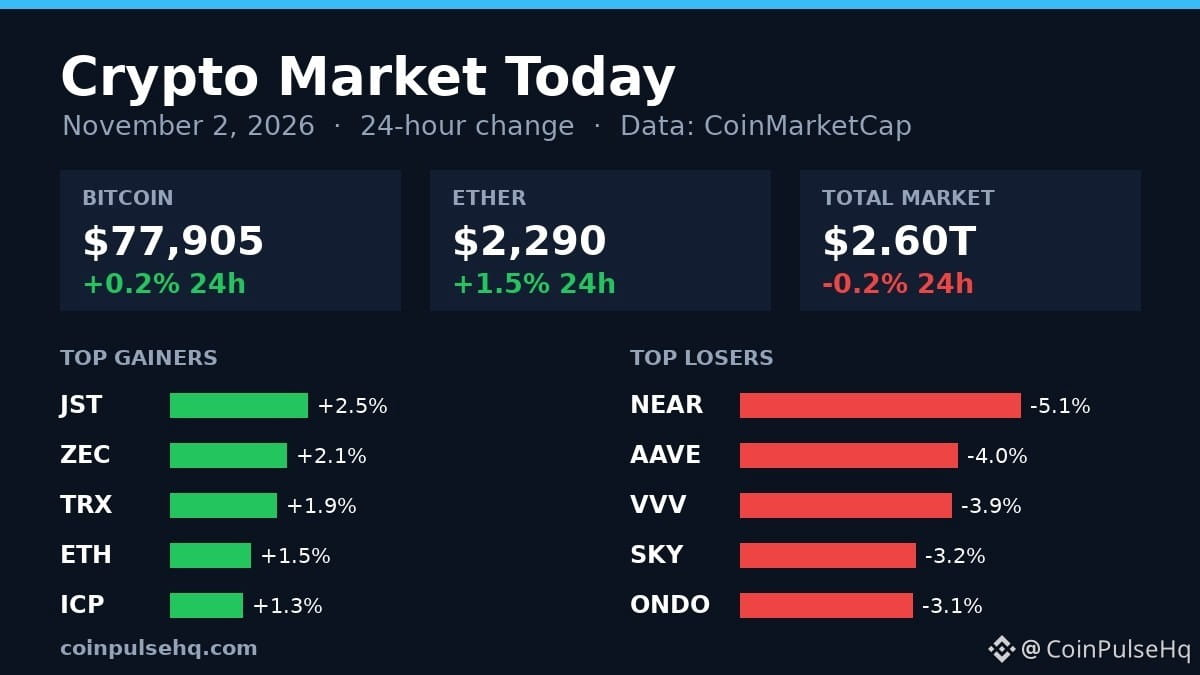
Crypto Market Today, Nov 2, 2026: Bitcoin Steady Near $77.9K as JUST Jumps 3%The crypto market was little changed over the past 24 hours. Total market value moved -0.2% to $2.60 trillion as of 13:00 UTC on Monday, November 2, 2026. Bitcoin traded at $77,905 (+0.2%) and Ether at $2,290 (+1.5%). 17 of the 50 largest coins were higher, and the median move was -0.6%.
Why is crypto flat today? What the numbers show
• Breadth. There was no clear direction: 17 of 50 large coins rose and 33 fell, so gains in some coins offset losses in others.
• Bitcoin versus altcoins. Only 14 of the other 49 large coins did better than Bitcoin, so money favoured the largest asset. Bitcoin dominance stands at 59.9%, and Ether outperformed Bitcoin by 1.2 percentage points.
• Trading activity. 24-hour volume across the market was $48.0 billion, up 22.9% on the previous day. Volume did not change sharply, so the move was not driven by a surge of trading.
• Bitcoin's 24-hour range. From $77,618 (22:25 UTC, Nov 1) to $78,650 (03:40 UTC), a 1.3% swing. The high came after the low.
Stocks, the dollar and gold
Crypto often trades alongside other risk assets. Latest session for each (the date is the market's last close or update):
Market Level Change As of
S&P 500 7,580.07 -1.8% Oct 30
Nasdaq Composite 25,437.00 -2.9% Oct 30
US dollar index 101.63 -0.2% Nov 2
Gold 3,910.80 +0.3% Nov 2
US 10-year Treasury yield 4.917% -1.2 bp Nov 2
Biggest movers in the top 50
Gainers
Coin Price 24 hours 7 days
JUST (JST) $0.1402 +2.5% -1.2%
Zcash (ZEC) $1,255 +2.1% +1.6%
TRON (TRX) $0.3163 +1.9% -4.2%
Ethereum (ETH) $2,290 +1.5% -1.7%
Internet Computer (ICP) $2.53 +1.3% -2.9%
Losers
Coin Price 24 hours 7 days
NEAR Protocol (NEAR) $4.13 -5.1% -9.3%
Aave (AAVE) $131.48 -4.0% -3.3%
Venice Token (VVV) $22.33 -3.9% -10.1%
Sky (SKY) $0.06636 -3.2% -3.9%
Ondo (ONDO) $0.3941 -3.1% -4.8%
The stories behind today's moves
What CoinPulseHQ reported in the past 24 hours:
• Ethereum staking queue holds 1.23M ETH against 1,682 ETH exits — About 1.23 million ETH worth roughly $2.8 billion was queued to stake on Ethereum, against just 1,682 ETH in the exit queue, AMBCrypto reported.
• Tether posts $1.5B Q3 profit as reserves rebuild to $7.95B — Tether reported $1.5B Q3 2026 net profit and rebuilt excess reserves to $7.95B, per a BDO attestation covering $191.45B in assets at September 30.
• Peter Schiff Casts Gold’s 3.5% Drop as Liquidity Problem — Peter Schiff called gold's $141.60 drop on Oct. 30 a short-term liquidity problem and a buying opportunity, as bitcoin fell to $76,368 after the Binance hack.
Live prices for the top 50 coins are on our Markets page, and today's biggest movers are on top crypto gainers and losers. Every daily report is collected on Crypto Market Today, and the previous one is Crypto Market Today, Oct 31, 2026: Bitcoin Steady Near $77.4K as Morpho Jumps 8%. For the bigger picture, read our weekly market wraps, and if you are wondering about trading hours, see is the crypto market open on weekends.
How this report is made
CoinPulseHQ calculates every figure in this report from CoinMarketCap and CoinGecko market data recorded at 13:00 UTC on Monday, November 2, 2026, and stock, dollar, gold and bond levels from CNBC quotes. Stablecoins and wrapped or staked versions of other coins are left out of the rankings. Changes are over the previous 24 hours. The report describes what prices did and which measurable factors moved with them; it does not claim a single cause and does not predict prices. It is not financial advice.
Originally published on CoinPulseHQ: https://coinpulsehq.com/crypto-market-today-2026-11-02/
Crypto Market Today, Nov 2, 2026: Bitcoin Steady Near $77.9K as JUST Jumps 3%
The crypto market was little changed over the past 24 hours. Total market value moved -0.2% to $2.60 trillion as of 13:00 UTC on Monday, November 2, 2026. Bitcoin traded at $77,905 (+0.2%) and Ether at $2,290 (+1.5%). 17 of the 50 largest coins were higher, and the median move was -0.6%.
Why is crypto flat today? What the numbers show
• Breadth. There was no clear direction: 17 of 50 large coins rose and 33 fell, so gains in some coins offset losses in others.
• Bitcoin versus altcoins. Only 14 of the other 49 large coins did better than Bitcoin, so money favoured the largest asset. Bitcoin dominance stands at 59.9%, and Ether outperformed Bitcoin by 1.2 percentage points.
• Trading activity. 24-hour volume across the market was $48.0 billion, up 22.9% on the previous day. Volume did not change sharply, so the move was not driven by a surge of trading.
• Bitcoin's 24-hour range. From $77,618 (22:25 UTC, Nov 1) to $78,650 (03:40 UTC), a 1.3% swing. The high came after the low.
Stocks, the dollar and gold
Crypto often trades alongside other risk assets. Latest session for each (the date is the market's last close or update):
Market Level Change As of
S&P 500 7,580.07 -1.8% Oct 30
Nasdaq Composite 25,437.00 -2.9% Oct 30
US dollar index 101.63 -0.2% Nov 2
Gold 3,910.80 +0.3% Nov 2
US 10-year Treasury yield 4.917% -1.2 bp Nov 2
Biggest movers in the top 50
Gainers
Coin Price 24 hours 7 days
JUST (JST) $0.1402 +2.5% -1.2%
Zcash (ZEC) $1,255 +2.1% +1.6%
TRON (TRX) $0.3163 +1.9% -4.2%
Ethereum (ETH) $2,290 +1.5% -1.7%
Internet Computer (ICP) $2.53 +1.3% -2.9%
Losers
Coin Price 24 hours 7 days
NEAR Protocol (NEAR) $4.13 -5.1% -9.3%
Aave (AAVE) $131.48 -4.0% -3.3%
Venice Token (VVV) $22.33 -3.9% -10.1%
Sky (SKY) $0.06636 -3.2% -3.9%
Ondo (ONDO) $0.3941 -3.1% -4.8%
The stories behind today's moves
What CoinPulseHQ reported in the past 24 hours:
• Ethereum staking queue holds 1.23M ETH against 1,682 ETH exits — About 1.23 million ETH worth roughly $2.8 billion was queued to stake on Ethereum, against just 1,682 ETH in the exit queue, AMBCrypto reported.
• Tether posts $1.5B Q3 profit as reserves rebuild to $7.95B — Tether reported $1.5B Q3 2026 net profit and rebuilt excess reserves to $7.95B, per a BDO attestation covering $191.45B in assets at September 30.
• Peter Schiff Casts Gold’s 3.5% Drop as Liquidity Problem — Peter Schiff called gold's $141.60 drop on Oct. 30 a short-term liquidity problem and a buying opportunity, as bitcoin fell to $76,368 after the Binance hack.
Live prices for the top 50 coins are on our Markets page, and today's biggest movers are on top crypto gainers and losers. Every daily report is collected on Crypto Market Today, and the previous one is Crypto Market Today, Oct 31, 2026: Bitcoin Steady Near $77.4K as Morpho Jumps 8%. For the bigger picture, read our weekly market wraps, and if you are wondering about trading hours, see is the crypto market open on weekends.
How this report is made
CoinPulseHQ calculates every figure in this report from CoinMarketCap and CoinGecko market data recorded at 13:00 UTC on Monday, November 2, 2026, and stock, dollar, gold and bond levels from CNBC quotes. Stablecoins and wrapped or staked versions of other coins are left out of the rankings. Changes are over the previous 24 hours. The report describes what prices did and which measurable factors moved with them; it does not claim a single cause and does not predict prices. It is not financial advice.
Originally published on CoinPulseHQ: https://coinpulsehq.com/crypto-market-today-2026-11-02/
65
·
--

記事
翻訳参照
Tether posts $1.5B Q3 profit as reserves rebuild to $7.95BTether reported $1.5 billion in net profit for the third quarter of 2026 and rebuilt its excess reserves to $7.95 billion as of September 30, according to AMBCrypto. The figure roughly doubles the $4.11 billion cushion the stablecoin issuer held three months earlier, based on figures published in its quarterly attestation.
The attestation, prepared by accounting firm BDO and announced on October 30, put total reserve assets at $191.45 billion against $183.5 billion in liabilities, crypto.news reported. In the announcement, CEO Paolo Ardoino framed the reserve strategy around reliability during stress.
Key facts
• Net operating profit was $1.5 billion in Q3 2026, matching the previous two quarters and bringing the nine-month total to $4.5 billion, per crypto.news and Crypto Briefing.
• Excess reserves stood at $7.95 billion at September 30, up from $4.11 billion at the end of June and below the $8.23 billion peak in Q1 2026, according to Crypto Briefing.
• Reserve assets included $132.4 billion in direct and indirect U.S. Treasury holdings, $19.08 billion in physical gold and $8.37 billion in Bitcoin valued at a September 30 price of $83,621.23 per coin, crypto.news reported.
• USDT supply held broadly steady near $184 billion through the first nine months of 2026, while AMBCrypto put users at a record 727 million, up 6% in Q3.
• AMBCrypto reported USDT market cap near $183 billion at quarter-end and described a 2% fall in Q3 that it partly linked to the Binance hack.
Where the buffer came from
AMBCrypto attributed the $3.85 billion increase mainly to unrealized paper gains on Bitcoin and gold holdings. It said Bitcoin's rise from $58,000 to more than $83,000 lifted the value of Tether's 100,000 BTC by $2.47 billion, and that gold's rally added about $700 million even though Tether shed 3.4 metric tonnes of physical metal. With those gains tied to market prices, the same holdings can lose value if markets fall.
crypto.news gave a different breakdown of the earnings themselves, noting Treasury bills and reverse repos supplied most operating income during the first nine months. Its report also drew a distinction Tether's other figures do not: a separate equity reconciliation recorded a $1.66 billion financial result for January through September and $519 million in net capital outflows, moving opening equity of $6.81 billion to $7.95 billion. That makes the $4.5 billion operating figure a different measure from the reconciliation.
The reserve mix in the attestation announced by Tether covers $122.84 billion in directly held Treasury bills with a weighted average maturity under 90 days, $9.52 billion in overnight reverse repos and $7.18 billion in term reverse repos. Cash and short-term instruments reached $139.58 billion, about 72.9% of reserves. Gold and Bitcoin together made up $27.45 billion, roughly 14.3% of assets.
Why it matters
The cushion is the first line of defense if holders redeem USDT quickly, so an $8 billion buffer against roughly $184 billion in issuance gives Tether more room than it had in June. Because much of that buffer sits in Treasuries and much of the recent gain is unrealized, the reserve position moves with interest rates and with Bitcoin and gold prices rather than with issuance alone. Crypto Briefing noted that supply staying near $184 billion through a volatile stretch indicates demand neither surged nor drained, and that Tether's earnings stay closely tied to short-term yields.
What to watch
Crypto Briefing flagged three items to track: whether excess reserves pass the Q1 high of $8.23 billion, whether issuance breaks out of its $184 billion holding pattern, and how quarterly profit shifts as the rate backdrop changes. AMBCrypto also noted that regulatory scrutiny over illicit Iranian capital flows and transparency questions carried into the fourth quarter under a Democrat-controlled Congress.
The figures describe results already reported for a closed quarter; any interpretation of them as a signal for future earnings or token value is not financial advice, and crypto markets are volatile.
Originally published on CoinPulseHQ: https://coinpulsehq.com/tether-q3-2026-profit-reserve-buffer-7-95b/
Tether posts $1.5B Q3 profit as reserves rebuild to $7.95B
Tether reported $1.5 billion in net profit for the third quarter of 2026 and rebuilt its excess reserves to $7.95 billion as of September 30, according to AMBCrypto. The figure roughly doubles the $4.11 billion cushion the stablecoin issuer held three months earlier, based on figures published in its quarterly attestation.
The attestation, prepared by accounting firm BDO and announced on October 30, put total reserve assets at $191.45 billion against $183.5 billion in liabilities, crypto.news reported. In the announcement, CEO Paolo Ardoino framed the reserve strategy around reliability during stress.
Key facts
• Net operating profit was $1.5 billion in Q3 2026, matching the previous two quarters and bringing the nine-month total to $4.5 billion, per crypto.news and Crypto Briefing.
• Excess reserves stood at $7.95 billion at September 30, up from $4.11 billion at the end of June and below the $8.23 billion peak in Q1 2026, according to Crypto Briefing.
• Reserve assets included $132.4 billion in direct and indirect U.S. Treasury holdings, $19.08 billion in physical gold and $8.37 billion in Bitcoin valued at a September 30 price of $83,621.23 per coin, crypto.news reported.
• USDT supply held broadly steady near $184 billion through the first nine months of 2026, while AMBCrypto put users at a record 727 million, up 6% in Q3.
• AMBCrypto reported USDT market cap near $183 billion at quarter-end and described a 2% fall in Q3 that it partly linked to the Binance hack.
Where the buffer came from
AMBCrypto attributed the $3.85 billion increase mainly to unrealized paper gains on Bitcoin and gold holdings. It said Bitcoin's rise from $58,000 to more than $83,000 lifted the value of Tether's 100,000 BTC by $2.47 billion, and that gold's rally added about $700 million even though Tether shed 3.4 metric tonnes of physical metal. With those gains tied to market prices, the same holdings can lose value if markets fall.
crypto.news gave a different breakdown of the earnings themselves, noting Treasury bills and reverse repos supplied most operating income during the first nine months. Its report also drew a distinction Tether's other figures do not: a separate equity reconciliation recorded a $1.66 billion financial result for January through September and $519 million in net capital outflows, moving opening equity of $6.81 billion to $7.95 billion. That makes the $4.5 billion operating figure a different measure from the reconciliation.
The reserve mix in the attestation announced by Tether covers $122.84 billion in directly held Treasury bills with a weighted average maturity under 90 days, $9.52 billion in overnight reverse repos and $7.18 billion in term reverse repos. Cash and short-term instruments reached $139.58 billion, about 72.9% of reserves. Gold and Bitcoin together made up $27.45 billion, roughly 14.3% of assets.
Why it matters
The cushion is the first line of defense if holders redeem USDT quickly, so an $8 billion buffer against roughly $184 billion in issuance gives Tether more room than it had in June. Because much of that buffer sits in Treasuries and much of the recent gain is unrealized, the reserve position moves with interest rates and with Bitcoin and gold prices rather than with issuance alone. Crypto Briefing noted that supply staying near $184 billion through a volatile stretch indicates demand neither surged nor drained, and that Tether's earnings stay closely tied to short-term yields.
What to watch
Crypto Briefing flagged three items to track: whether excess reserves pass the Q1 high of $8.23 billion, whether issuance breaks out of its $184 billion holding pattern, and how quarterly profit shifts as the rate backdrop changes. AMBCrypto also noted that regulatory scrutiny over illicit Iranian capital flows and transparency questions carried into the fourth quarter under a Democrat-controlled Congress.
The figures describe results already reported for a closed quarter; any interpretation of them as a signal for future earnings or token value is not financial advice, and crypto markets are volatile.
Originally published on CoinPulseHQ: https://coinpulsehq.com/tether-q3-2026-profit-reserve-buffer-7-95b/
80
·
--
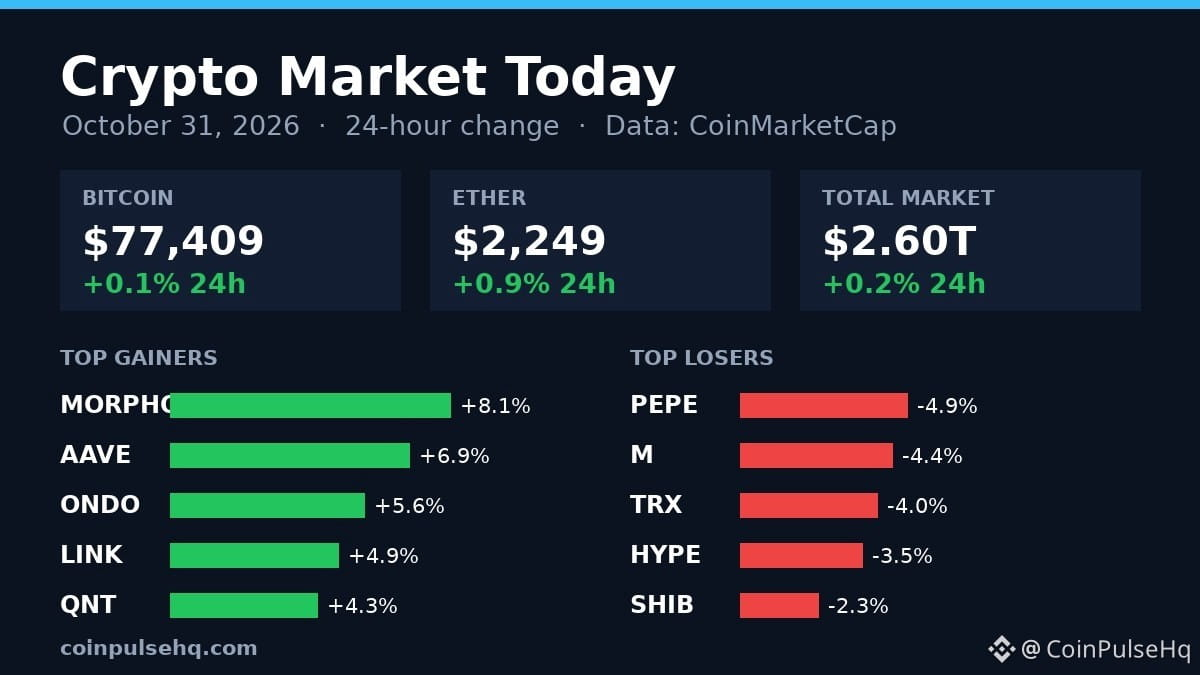
記事
今日の暗号資産市場、2026年10月31日:ビットコインは77,400ドル付近で安定、Morphoは8%急伸暗号資産市場は過去24時間でほぼ横ばいでした。10月31日(土)13:00 UTC時点で、時価総額は0.2%増の2.60兆ドルとなりました。ビットコインは77,409ドル(+0.1%)、イーサは2,249ドル(+0.9%)で取引されました。時価総額上位50銘柄のうち30銘柄が上昇し、値動きの中央値は+0.3%でした。
今日、暗号資産市場が横ばいなのはなぜ? 数字が示す状況
• 市場の広がり。明確な方向感はありませんでした。大型コイン50銘柄のうち30銘柄が上昇、20銘柄が下落し、一部のコインの上昇が他のコインの下落を相殺しました。
• ビットコインとアルトコインの比較。ほかの大型コイン49銘柄のうち28銘柄がビットコインを上回り、主導権は分かれました。ビットコインドミナンスは59.8%で、イーサはビットコインを0.7ポイント上回りました。
今日の暗号資産市場、2026年10月31日:ビットコインは77,400ドル付近で安定、Morphoは8%急伸
暗号資産市場は過去24時間でほぼ横ばいでした。10月31日(土)13:00 UTC時点で、時価総額は0.2%増の2.60兆ドルとなりました。ビットコインは77,409ドル(+0.1%)、イーサは2,249ドル(+0.9%)で取引されました。時価総額上位50銘柄のうち30銘柄が上昇し、値動きの中央値は+0.3%でした。
今日、暗号資産市場が横ばいなのはなぜ? 数字が示す状況
• 市場の広がり。明確な方向感はありませんでした。大型コイン50銘柄のうち30銘柄が上昇、20銘柄が下落し、一部のコインの上昇が他のコインの下落を相殺しました。
• ビットコインとアルトコインの比較。ほかの大型コイン49銘柄のうち28銘柄がビットコインを上回り、主導権は分かれました。ビットコインドミナンスは59.8%で、イーサはビットコインを0.7ポイント上回りました。
今日、暗号資産市場が横ばいなのはなぜ? 数字が示す状況
• 市場の広がり。明確な方向感はありませんでした。大型コイン50銘柄のうち30銘柄が上昇、20銘柄が下落し、一部のコインの上昇が他のコインの下落を相殺しました。
• ビットコインとアルトコインの比較。ほかの大型コイン49銘柄のうち28銘柄がビットコインを上回り、主導権は分かれました。ビットコインドミナンスは59.8%で、イーサはビットコインを0.7ポイント上回りました。
·
--

記事
Polymarketへのハッキング、700超のアカウントから260万ドルが流出Cointribuneの報道によると、第三者のスクリプトが侵害され、攻撃者がユーザーのポジションを売却し、無断で資金を移動できる状態になったため、Polymarketは2026年10月29日に約1時間、取引を停止しました。700を超えるアカウントで、損失額は少なくとも260万ドルと推定されています。
トレーダーからは、無断でポジションが売却され、残高が引き出されたとの報告がありました。80万ドルを失ったというユーザーや、アカウントの60万ドル全額が引き出されたユーザーもいました。Polymarketは被害を受けた全員に補償すると約束し、英国当局にこの件を報告したと述べています。
Polymarketへのハッキング、700超のアカウントから260万ドルが流出
Cointribuneの報道によると、第三者のスクリプトが侵害され、攻撃者がユーザーのポジションを売却し、無断で資金を移動できる状態になったため、Polymarketは2026年10月29日に約1時間、取引を停止しました。700を超えるアカウントで、損失額は少なくとも260万ドルと推定されています。
トレーダーからは、無断でポジションが売却され、残高が引き出されたとの報告がありました。80万ドルを失ったというユーザーや、アカウントの60万ドル全額が引き出されたユーザーもいました。Polymarketは被害を受けた全員に補償すると約束し、英国当局にこの件を報告したと述べています。
トレーダーからは、無断でポジションが売却され、残高が引き出されたとの報告がありました。80万ドルを失ったというユーザーや、アカウントの60万ドル全額が引き出されたユーザーもいました。Polymarketは被害を受けた全員に補償すると約束し、英国当局にこの件を報告したと述べています。
7
2.8k
·
--
記事
Binanceハッキングの資金が通過するなか、THORChainのRUNEが13%超上昇調査担当者がBinanceのセキュリティ侵害で流出した資金がクロスチェーンプロトコルを通じて移動する様子を追跡するなか、Bitcoinistによると、THORChainのネイティブトークンRUNEは金曜日、現地安値の0.59ドルから13%超上昇し、約0.67ドルとなった。AMBCryptoは、24時間の上昇率は15%を超えたとし、市場全体の時価総額が1,600億ドル減少した状況を背景として挙げた。
Binanceは、この侵害による被害額を約63億ドルと推定した。報告された暗号資産盗難事件のなかでも最大規模の一つとなる。Bitcoinistによると、同取引所の予備調査では、DevOpsエンジニアのノートパソコンが侵害された可能性が浮上した。この端末を通じて、攻撃者が内部インフラにアクセスし、不正な出金を実行できた可能性がある。
Binanceハッキングの資金が通過するなか、THORChainのRUNEが13%超上昇
調査担当者がBinanceのセキュリティ侵害で流出した資金がクロスチェーンプロトコルを通じて移動する様子を追跡するなか、Bitcoinistによると、THORChainのネイティブトークンRUNEは金曜日、現地安値の0.59ドルから13%超上昇し、約0.67ドルとなった。AMBCryptoは、24時間の上昇率は15%を超えたとし、市場全体の時価総額が1,600億ドル減少した状況を背景として挙げた。
Binanceは、この侵害による被害額を約63億ドルと推定した。報告された暗号資産盗難事件のなかでも最大規模の一つとなる。Bitcoinistによると、同取引所の予備調査では、DevOpsエンジニアのノートパソコンが侵害された可能性が浮上した。この端末を通じて、攻撃者が内部インフラにアクセスし、不正な出金を実行できた可能性がある。
Binanceは、この侵害による被害額を約63億ドルと推定した。報告された暗号資産盗難事件のなかでも最大規模の一つとなる。Bitcoinistによると、同取引所の予備調査では、DevOpsエンジニアのノートパソコンが侵害された可能性が浮上した。この端末を通じて、攻撃者が内部インフラにアクセスし、不正な出金を実行できた可能性がある。
90
·
--

記事
AIスキャンが発見したBitcoin Coreのノード関連バグ3件を修正Bitcoin Coreは、Bitcoinノードの動作を遅くしたりクラッシュさせたりする可能性のある3件の脆弱性を修正したと公表しました。修正は今週公開されたリリースを通じて運営者に提供されました。AMBCryptoの報道によると、バグは10月23日(金)、Project Loupeが実施したAIを活用したセキュリティスキャンで初めて発見され、同日中にBitcoin Coreのセキュリティチームに通知されました。
Bitcoin Coreの新バージョン(29、30、31、32)には、10月26日から10月28日にかけて該当する修正が盛り込まれました。脆弱性の公表は10月28日に行われました。
AIスキャンが発見したBitcoin Coreのノード関連バグ3件を修正
Bitcoin Coreは、Bitcoinノードの動作を遅くしたりクラッシュさせたりする可能性のある3件の脆弱性を修正したと公表しました。修正は今週公開されたリリースを通じて運営者に提供されました。AMBCryptoの報道によると、バグは10月23日(金)、Project Loupeが実施したAIを活用したセキュリティスキャンで初めて発見され、同日中にBitcoin Coreのセキュリティチームに通知されました。
Bitcoin Coreの新バージョン(29、30、31、32)には、10月26日から10月28日にかけて該当する修正が盛り込まれました。脆弱性の公表は10月28日に行われました。
Bitcoin Coreの新バージョン(29、30、31、32)には、10月26日から10月28日にかけて該当する修正が盛り込まれました。脆弱性の公表は10月28日に行われました。
·
--

記事
米GDPが予想を上回り、Bitcoinが81,547ドルまで反発Cointelegraphの報道によると、米経済指標がアナリストの予想を上回ったことを受け、木曜日のウォール街の取引開始後、BitcoinはBitstampで一時81,547ドルまで上昇した。水曜日の終値後に79,607ドルまで下落した後の動きで、反発により、時価総額最大の暗号資産は週足のレジスタンス水準まで戻した。
マクロ経済の状況はまちまちだったものの、暗号資産市場に有利な方向に傾いた。9月の個人消費支出(PCE)指数は前月比0.5%、前年同月比3.6%上昇し、予想と一致した。一方、第3四半期のGDP成長率は3.4%となり、予想の3.2%を上回った。
米GDPが予想を上回り、Bitcoinが81,547ドルまで反発
Cointelegraphの報道によると、米経済指標がアナリストの予想を上回ったことを受け、木曜日のウォール街の取引開始後、BitcoinはBitstampで一時81,547ドルまで上昇した。水曜日の終値後に79,607ドルまで下落した後の動きで、反発により、時価総額最大の暗号資産は週足のレジスタンス水準まで戻した。
マクロ経済の状況はまちまちだったものの、暗号資産市場に有利な方向に傾いた。9月の個人消費支出(PCE)指数は前月比0.5%、前年同月比3.6%上昇し、予想と一致した。一方、第3四半期のGDP成長率は3.4%となり、予想の3.2%を上回った。
マクロ経済の状況はまちまちだったものの、暗号資産市場に有利な方向に傾いた。9月の個人消費支出(PCE)指数は前月比0.5%、前年同月比3.6%上昇し、予想と一致した。一方、第3四半期のGDP成長率は3.4%となり、予想の3.2%を上回った。
1
·
--

記事
Uniswapのデイリーアクティブアドレス数が14,591に達し、2026年の最高を記録、UNIは約7ドルを維持AMBCryptoが引用したSantimentのデータによると、Uniswapのデイリーアクティブアドレス数は14,591に達し、1年間で最高水準となりました。同じ期間に13,137個の新しいUNIアドレスが作成され、ネットワークの成長は2020年9月以来最大の急増を記録しました。こうした採用状況を示すデータが発表された一方、トークン価格は約7ドルで横ばいとなっており、ネットワーク利用とデリバティブ取引の動向の乖離が、このニュースの核心です。
AMBCryptoの報道によると、UNIは記事執筆時点で7.04ドルで取引されており、24時間で2.0%下落した一方、年初来では24.8%の上昇を維持していました。
Uniswapのデイリーアクティブアドレス数が14,591に達し、2026年の最高を記録、UNIは約7ドルを維持
AMBCryptoが引用したSantimentのデータによると、Uniswapのデイリーアクティブアドレス数は14,591に達し、1年間で最高水準となりました。同じ期間に13,137個の新しいUNIアドレスが作成され、ネットワークの成長は2020年9月以来最大の急増を記録しました。こうした採用状況を示すデータが発表された一方、トークン価格は約7ドルで横ばいとなっており、ネットワーク利用とデリバティブ取引の動向の乖離が、このニュースの核心です。
AMBCryptoの報道によると、UNIは記事執筆時点で7.04ドルで取引されており、24時間で2.0%下落した一方、年初来では24.8%の上昇を維持していました。
AMBCryptoの報道によると、UNIは記事執筆時点で7.04ドルで取引されており、24時間で2.0%下落した一方、年初来では24.8%の上昇を維持していました。
18
·
--

記事
Binanceがウォレット侵害の可能性を調査、18億ドル相当のステーブルコインを凍結Cointelegraphの報道によると、Binanceは、同社のイーサリアムウォレットの一つに関連する数十億ドル規模のセキュリティ侵害の可能性について調査している。資金移動を受け、TetherとCircleは約18億ドル相当のステーブルコインを凍結した。取引所は2026年10月29日木曜日、潜在的なセキュリティ問題に関する報告を調査しているものの、ユーザー資金への影響は確認されていないと述べた。
主な事実
• Binanceは、不審なウォレットの動きをセキュリティチームが調査中であり、詳細が確認され次第、改めて公表すると述べた。
Binanceがウォレット侵害の可能性を調査、18億ドル相当のステーブルコインを凍結
Cointelegraphの報道によると、Binanceは、同社のイーサリアムウォレットの一つに関連する数十億ドル規模のセキュリティ侵害の可能性について調査している。資金移動を受け、TetherとCircleは約18億ドル相当のステーブルコインを凍結した。取引所は2026年10月29日木曜日、潜在的なセキュリティ問題に関する報告を調査しているものの、ユーザー資金への影響は確認されていないと述べた。
主な事実
• Binanceは、不審なウォレットの動きをセキュリティチームが調査中であり、詳細が確認され次第、改めて公表すると述べた。
主な事実
• Binanceは、不審なウォレットの動きをセキュリティチームが調査中であり、詳細が確認され次第、改めて公表すると述べた。
2
·
--

記事
SHIB、取引所への920億トークン流入を記録も価格は上値重くCointribuneが報じたCryptoQuantのデータによると、Shiba Inuは24時間で920億7000万トークンの純流入を暗号資産取引所に記録したものの、ミームコインの価格は約0.00000489ドルと、引き続き上値を抑えられた。見出しとなるトークン数は、その経済的規模を大きく上回っている。流入額は約45万ドルで、取引プラットフォームにあるSHIBの約0.11%に相当した。
U.Todayは、同じ純流入額として920億6780万SHIBを報じ、前の24時間と比べて0.77%増加したと説明した。入金は1%増の3242億8100万トークン、出金は1.13%増の2322億1310万トークンだった。純流入がプラスということは、流出した数より多くのトークンが流入したことを意味し、売却可能な供給量が増える。ただし、それだけで実際に売却が行われたと証明できるわけではない。
SHIB、取引所への920億トークン流入を記録も価格は上値重く
Cointribuneが報じたCryptoQuantのデータによると、Shiba Inuは24時間で920億7000万トークンの純流入を暗号資産取引所に記録したものの、ミームコインの価格は約0.00000489ドルと、引き続き上値を抑えられた。見出しとなるトークン数は、その経済的規模を大きく上回っている。流入額は約45万ドルで、取引プラットフォームにあるSHIBの約0.11%に相当した。
U.Todayは、同じ純流入額として920億6780万SHIBを報じ、前の24時間と比べて0.77%増加したと説明した。入金は1%増の3242億8100万トークン、出金は1.13%増の2322億1310万トークンだった。純流入がプラスということは、流出した数より多くのトークンが流入したことを意味し、売却可能な供給量が増える。ただし、それだけで実際に売却が行われたと証明できるわけではない。
U.Todayは、同じ純流入額として920億6780万SHIBを報じ、前の24時間と比べて0.77%増加したと説明した。入金は1%増の3242億8100万トークン、出金は1.13%増の2322億1310万トークンだった。純流入がプラスということは、流出した数より多くのトークンが流入したことを意味し、売却可能な供給量が増える。ただし、それだけで実際に売却が行われたと証明できるわけではない。
105
·
--
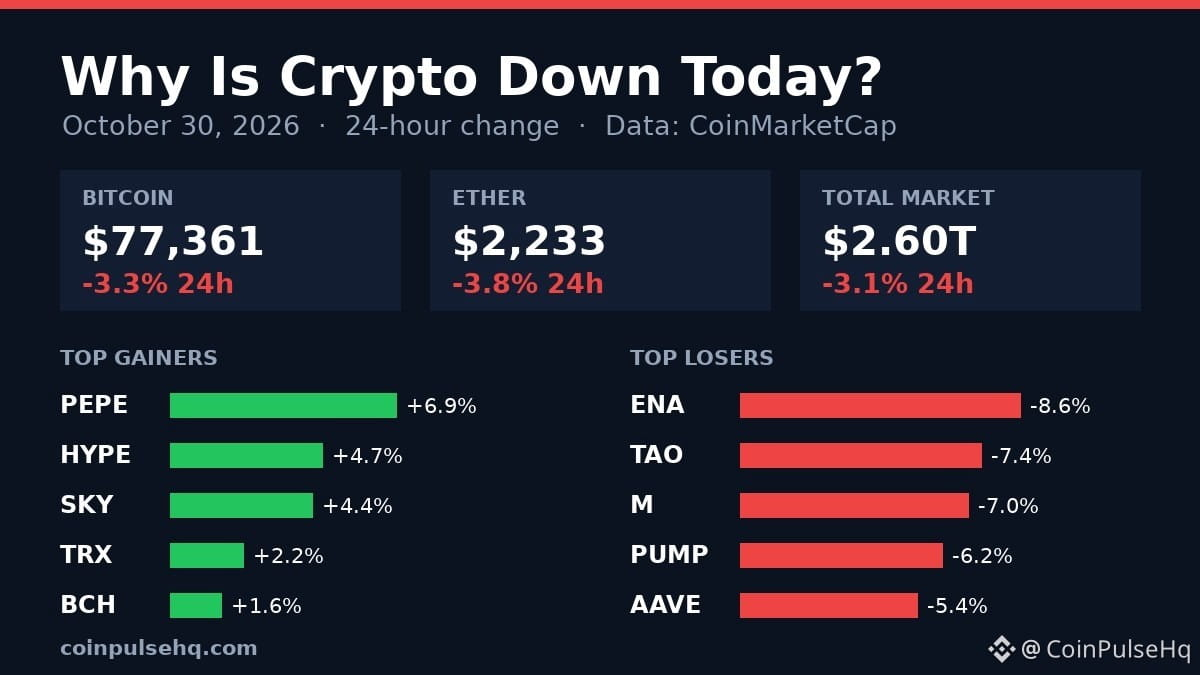
記事
暗号資産市場はなぜ下落しているのか? 2026年10月30日、ビットコインは3.3%下落し7万7,400ドルに暗号資産市場は本日下落しています。2026年10月30日(金)13:00 UTC時点で、時価総額は24時間で3.1%減少し、2.60兆ドルとなりました。ビットコインは77,361ドル(-3.3%)、イーサは2,233ドル(-3.8%)で取引されました。時価総額上位50銘柄のうち上昇したのは7銘柄で、値動きの中央値は-3.4%でした。
暗号資産市場はなぜ本日下落しているのか?データが示すこと
• 値下がりの広がり。下落は広範囲に及び、大型コイン50銘柄のうち43銘柄が値下がりしました。特定の1銘柄に限らず、市場全体で売りが広がりました。
• ビットコインとアルトコインの比較。ほかの大型コイン49銘柄のうち21銘柄がビットコインを上回り、相場の主導権は分かれました。ビットコインのドミナンスは59.8%で、イーサはビットコインを0.4ポイント下回りました。
暗号資産市場はなぜ下落しているのか? 2026年10月30日、ビットコインは3.3%下落し7万7,400ドルに
暗号資産市場は本日下落しています。2026年10月30日(金)13:00 UTC時点で、時価総額は24時間で3.1%減少し、2.60兆ドルとなりました。ビットコインは77,361ドル(-3.3%)、イーサは2,233ドル(-3.8%)で取引されました。時価総額上位50銘柄のうち上昇したのは7銘柄で、値動きの中央値は-3.4%でした。
暗号資産市場はなぜ本日下落しているのか?データが示すこと
• 値下がりの広がり。下落は広範囲に及び、大型コイン50銘柄のうち43銘柄が値下がりしました。特定の1銘柄に限らず、市場全体で売りが広がりました。
• ビットコインとアルトコインの比較。ほかの大型コイン49銘柄のうち21銘柄がビットコインを上回り、相場の主導権は分かれました。ビットコインのドミナンスは59.8%で、イーサはビットコインを0.4ポイント下回りました。
暗号資産市場はなぜ本日下落しているのか?データが示すこと
• 値下がりの広がり。下落は広範囲に及び、大型コイン50銘柄のうち43銘柄が値下がりしました。特定の1銘柄に限らず、市場全体で売りが広がりました。
• ビットコインとアルトコインの比較。ほかの大型コイン49銘柄のうち21銘柄がビットコインを上回り、相場の主導権は分かれました。ビットコインのドミナンスは59.8%で、イーサはビットコインを0.4ポイント下回りました。
ログインして、さらにコンテンツを読む
厳選トピックで世界の暗号資産トレーダーの仲間入り
⚡️ 暗号資産に関する最新かつ有益な情報が見つかります。
💬 世界最大の暗号資産取引所から信頼されています。
👍 認証を受けたクリエイターから、有益なインサイトを得られます。
メール / 電話番号