

Blockonomi
28.2k 投稿

Blockonomi
 厳選トピック確認済+
報告
ユーザーをブロック
A guide to Cryptocurrencies, Technology and the Blockchain Economy #cryptocurrency #blockchain #fintech
0 フォロー
15.8K+ フォロワー
12.8K+ いいね
投稿
·
--
翻訳参照
Kraken’s Parent Payward Taps SGB for Instant Crypto SettlementTLDR:
Payward will offer 24/7 instant settlement through SGB Net to selected institutional clients.
The service initially supports U.S. dollar transactions across selected Asian and Gulf markets.
SGB Net now processes more than $20 billion in fiat transactions each month.
SGB will use Kraken Prime for digital-asset liquidity and pricing for its customers.
Payward, the parent company of Kraken, has partnered with Singapore Gulf Bank (SGB) to provide 24/7 instant settlement for institutional digital asset clients in selected Asian and Gulf markets.
The partnership connects Payward to SGB Net, SGB’s real-time, multi-currency clearing network. The service will initially support U.S. dollar transactions for a select group of clients, with more clients and currencies planned.
How Payward’s 24/7 Settlement Network Works
SGB Net allows institutional clients to move funds between banking and digital asset infrastructure without waiting for traditional banking cut-off times.
Historically, bank settlement has followed business hours and fixed processing windows. Digital asset markets, however, operate continuously throughout the week.
Under the new arrangement, an SGB client can deposit funds with Payward and deploy them instantly. This could reduce delays between funding an account and accessing digital asset markets.
The initial rollout covers U.S. dollar transactions for selected clients in specific jurisdictions across Asia and the Gulf region. Payward and SGB plan to expand the service over time.
SGB Net launched in 2025 for digital asset businesses with increasing operational requirements. According to the companies, the network now processes more than $20 billion in fiat transactions each month.
The partnership also links SGB with Kraken Prime, Payward’s full-service prime brokerage platform. SGB will use Kraken Prime as an additional source of digital asset liquidity and pricing for its customers.
Kraken parent company Payward and Singapore Gulf Bank (SGB), a fully licensed digital bank regulated by the Central Bank of Bahrain, have announced a strategic partnership. Payward has integrated SGB’s real-time, multi-currency clearing network, SGB Net, to provide institutional…
— Wu Blockchain (@WuBlockchain) October 5, 2026
Payward Banking Expansion Connects Settlement and Liquidity
The partnership extends Payward’s broader effort to strengthen its banking infrastructure for institutional clients.
Payward Banking serves as the money layer supporting deposits, payments, cards, custody, and lending across the platform. Adding regulated banking partners can help connect traditional financial services with continuously operating digital asset markets.
For institutional traders, the key change is the timing of capital movement. Faster settlement can allow eligible clients to fund digital asset activity without waiting for the next banking window.
SGB is regulated by the Central Bank of Bahrain and is backed by Bahrain’s sovereign wealth fund Mumtalakat and Singapore’s Whampoa Group.
SGB Chief Executive Officer Shawn Chan said liquidity becomes more useful when clients can move funds when needed. The partnership therefore combines two important parts of institutional crypto infrastructure: access to liquidity and access to settlement.
For traders and institutions, the immediate offering remains limited to selected clients and U.S. dollar transactions. Its broader significance depends on whether Payward expands access across additional jurisdictions and currencies.
The SGB Net handles real-time fiat clearing while Kraken Prime provides digital asset market access. Together, the infrastructure will bring banking settlement closer to the continuous operating model of crypto markets.
The post Kraken’s Parent Payward Taps SGB for Instant Crypto Settlement appeared first on Blockonomi.
Kraken’s Parent Payward Taps SGB for Instant Crypto Settlement
TLDR:
Payward will offer 24/7 instant settlement through SGB Net to selected institutional clients.
The service initially supports U.S. dollar transactions across selected Asian and Gulf markets.
SGB Net now processes more than $20 billion in fiat transactions each month.
SGB will use Kraken Prime for digital-asset liquidity and pricing for its customers.
Payward, the parent company of Kraken, has partnered with Singapore Gulf Bank (SGB) to provide 24/7 instant settlement for institutional digital asset clients in selected Asian and Gulf markets.
The partnership connects Payward to SGB Net, SGB’s real-time, multi-currency clearing network. The service will initially support U.S. dollar transactions for a select group of clients, with more clients and currencies planned.
How Payward’s 24/7 Settlement Network Works
SGB Net allows institutional clients to move funds between banking and digital asset infrastructure without waiting for traditional banking cut-off times.
Historically, bank settlement has followed business hours and fixed processing windows. Digital asset markets, however, operate continuously throughout the week.
Under the new arrangement, an SGB client can deposit funds with Payward and deploy them instantly. This could reduce delays between funding an account and accessing digital asset markets.
The initial rollout covers U.S. dollar transactions for selected clients in specific jurisdictions across Asia and the Gulf region. Payward and SGB plan to expand the service over time.
SGB Net launched in 2025 for digital asset businesses with increasing operational requirements. According to the companies, the network now processes more than $20 billion in fiat transactions each month.
The partnership also links SGB with Kraken Prime, Payward’s full-service prime brokerage platform. SGB will use Kraken Prime as an additional source of digital asset liquidity and pricing for its customers.
Kraken parent company Payward and Singapore Gulf Bank (SGB), a fully licensed digital bank regulated by the Central Bank of Bahrain, have announced a strategic partnership. Payward has integrated SGB’s real-time, multi-currency clearing network, SGB Net, to provide institutional…
— Wu Blockchain (@WuBlockchain) October 5, 2026
Payward Banking Expansion Connects Settlement and Liquidity
The partnership extends Payward’s broader effort to strengthen its banking infrastructure for institutional clients.
Payward Banking serves as the money layer supporting deposits, payments, cards, custody, and lending across the platform. Adding regulated banking partners can help connect traditional financial services with continuously operating digital asset markets.
For institutional traders, the key change is the timing of capital movement. Faster settlement can allow eligible clients to fund digital asset activity without waiting for the next banking window.
SGB is regulated by the Central Bank of Bahrain and is backed by Bahrain’s sovereign wealth fund Mumtalakat and Singapore’s Whampoa Group.
SGB Chief Executive Officer Shawn Chan said liquidity becomes more useful when clients can move funds when needed. The partnership therefore combines two important parts of institutional crypto infrastructure: access to liquidity and access to settlement.
For traders and institutions, the immediate offering remains limited to selected clients and U.S. dollar transactions. Its broader significance depends on whether Payward expands access across additional jurisdictions and currencies.
The SGB Net handles real-time fiat clearing while Kraken Prime provides digital asset market access. Together, the infrastructure will bring banking settlement closer to the continuous operating model of crypto markets.
The post Kraken’s Parent Payward Taps SGB for Instant Crypto Settlement appeared first on Blockonomi.
Payward will offer 24/7 instant settlement through SGB Net to selected institutional clients.
The service initially supports U.S. dollar transactions across selected Asian and Gulf markets.
SGB Net now processes more than $20 billion in fiat transactions each month.
SGB will use Kraken Prime for digital-asset liquidity and pricing for its customers.
Payward, the parent company of Kraken, has partnered with Singapore Gulf Bank (SGB) to provide 24/7 instant settlement for institutional digital asset clients in selected Asian and Gulf markets.
The partnership connects Payward to SGB Net, SGB’s real-time, multi-currency clearing network. The service will initially support U.S. dollar transactions for a select group of clients, with more clients and currencies planned.
How Payward’s 24/7 Settlement Network Works
SGB Net allows institutional clients to move funds between banking and digital asset infrastructure without waiting for traditional banking cut-off times.
Historically, bank settlement has followed business hours and fixed processing windows. Digital asset markets, however, operate continuously throughout the week.
Under the new arrangement, an SGB client can deposit funds with Payward and deploy them instantly. This could reduce delays between funding an account and accessing digital asset markets.
The initial rollout covers U.S. dollar transactions for selected clients in specific jurisdictions across Asia and the Gulf region. Payward and SGB plan to expand the service over time.
SGB Net launched in 2025 for digital asset businesses with increasing operational requirements. According to the companies, the network now processes more than $20 billion in fiat transactions each month.
The partnership also links SGB with Kraken Prime, Payward’s full-service prime brokerage platform. SGB will use Kraken Prime as an additional source of digital asset liquidity and pricing for its customers.
Kraken parent company Payward and Singapore Gulf Bank (SGB), a fully licensed digital bank regulated by the Central Bank of Bahrain, have announced a strategic partnership. Payward has integrated SGB’s real-time, multi-currency clearing network, SGB Net, to provide institutional…
— Wu Blockchain (@WuBlockchain) October 5, 2026
Payward Banking Expansion Connects Settlement and Liquidity
The partnership extends Payward’s broader effort to strengthen its banking infrastructure for institutional clients.
Payward Banking serves as the money layer supporting deposits, payments, cards, custody, and lending across the platform. Adding regulated banking partners can help connect traditional financial services with continuously operating digital asset markets.
For institutional traders, the key change is the timing of capital movement. Faster settlement can allow eligible clients to fund digital asset activity without waiting for the next banking window.
SGB is regulated by the Central Bank of Bahrain and is backed by Bahrain’s sovereign wealth fund Mumtalakat and Singapore’s Whampoa Group.
SGB Chief Executive Officer Shawn Chan said liquidity becomes more useful when clients can move funds when needed. The partnership therefore combines two important parts of institutional crypto infrastructure: access to liquidity and access to settlement.
For traders and institutions, the immediate offering remains limited to selected clients and U.S. dollar transactions. Its broader significance depends on whether Payward expands access across additional jurisdictions and currencies.
The SGB Net handles real-time fiat clearing while Kraken Prime provides digital asset market access. Together, the infrastructure will bring banking settlement closer to the continuous operating model of crypto markets.
The post Kraken’s Parent Payward Taps SGB for Instant Crypto Settlement appeared first on Blockonomi.
6
·
--
翻訳参照
S&P Global (SPGI) Stock: New Vault Risk Tool Targets $10B Crypto MarketTLDR
S&P Global launches a new risk tool for the $10 billion crypto vault market.
The framework assesses six major risks across digital asset lending vaults.
Crypto vault deposits surged from $1.5 billion in 2024 to $10 billion in 2026.
SPGI stock closed 0.49% lower before edging 0.07% higher in pre-market trade.
The launch extends S&P Global’s broader push into blockchain finance and data.
S&P Global has launched a new risk assessment framework for digital asset lending vaults, targeting a rapidly expanding $10 billion market. The move strengthens the company’s growing role in blockchain-based finance and expands its analytical services beyond traditional credit markets. SPGI stock closed at $386.27, down 0.49%, before rising 0.07% to $386.54 in pre-market trading.
S&P Global Inc., SPGI
S&P Global Launches Vault Risk Assessment
S&P Global Ratings introduced the Vault Risk Assessment to evaluate impairment risks linked to digital asset lending vaults. The framework provides forward-looking analysis designed to improve transparency across blockchain-based pooled investment structures. It also addresses limited strategy and risk disclosures across many existing vault products.
The assessment covers six major areas that influence the overall risk profile of a digital asset vault. These include portfolio credit quality, liquidity mismatches, curator exposure, blockchain risks, protocol weaknesses, and governance security. S&P Global designed the approach to offer a standardized view across different vault structures.
However, the company does not classify the assessment as a traditional credit rating. The framework also avoids evaluating potential yields offered through specific vault strategies. Instead, it measures relative impairment risks affecting deposited capital and positions within individual vaults.
Digital Asset Vault Market Reaches $10 Billion
Digital asset lending vaults have expanded rapidly as blockchain finance attracts more institutional activity. Total deposits reached about $10 billion by September 2026, according to S&P Global. That figure stood near $1.5 billion during September 2024.
Vaults pool digital asset deposits and deploy those funds under defined lending or investment strategies. Smart contracts can manage these strategies automatically, while human managers can also control allocations. Depositors generally receive blockchain tokens representing their proportional ownership of underlying vault assets.
These structures increasingly mirror products found across traditional financial markets. Their functions can resemble money market funds, private credit vehicles, private equity structures, or hedge funds. However, blockchain technology allows these pooled strategies to operate directly through onchain infrastructure.
S&P Global Expands Digital Asset Strategy
The new product extends S&P Global’s broader expansion into digital asset risk, data, and blockchain infrastructure. The company previously introduced stablecoin assessments and issued a credit rating covering decentralized finance protocol Sky. It also rated a Bitcoin-backed structured finance transaction linked to digital asset lender Ledn.
S&P Dow Jones Indices has also worked with Kaiko to tokenize the iBoxx U.S. Treasuries Index. Meanwhile, S&P Global led a strategic investment in Kaiko during September 2026. That transaction deepened the company’s exposure to digital asset data, indices, and market infrastructure.
S&P Global also announced an agreement to acquire blockchain security company OpenZeppelin during September. The planned acquisition adds security expertise to its expanding portfolio of digital asset services. S&P Global Ratings plans to publish its first Vault Risk Assessments through future announcements.
The post S&P Global (SPGI) Stock: New Vault Risk Tool Targets $10B Crypto Market appeared first on Blockonomi.
S&P Global (SPGI) Stock: New Vault Risk Tool Targets $10B Crypto Market
TLDR
S&P Global launches a new risk tool for the $10 billion crypto vault market.
The framework assesses six major risks across digital asset lending vaults.
Crypto vault deposits surged from $1.5 billion in 2024 to $10 billion in 2026.
SPGI stock closed 0.49% lower before edging 0.07% higher in pre-market trade.
The launch extends S&P Global’s broader push into blockchain finance and data.
S&P Global has launched a new risk assessment framework for digital asset lending vaults, targeting a rapidly expanding $10 billion market. The move strengthens the company’s growing role in blockchain-based finance and expands its analytical services beyond traditional credit markets. SPGI stock closed at $386.27, down 0.49%, before rising 0.07% to $386.54 in pre-market trading.
S&P Global Inc., SPGI
S&P Global Launches Vault Risk Assessment
S&P Global Ratings introduced the Vault Risk Assessment to evaluate impairment risks linked to digital asset lending vaults. The framework provides forward-looking analysis designed to improve transparency across blockchain-based pooled investment structures. It also addresses limited strategy and risk disclosures across many existing vault products.
The assessment covers six major areas that influence the overall risk profile of a digital asset vault. These include portfolio credit quality, liquidity mismatches, curator exposure, blockchain risks, protocol weaknesses, and governance security. S&P Global designed the approach to offer a standardized view across different vault structures.
However, the company does not classify the assessment as a traditional credit rating. The framework also avoids evaluating potential yields offered through specific vault strategies. Instead, it measures relative impairment risks affecting deposited capital and positions within individual vaults.
Digital Asset Vault Market Reaches $10 Billion
Digital asset lending vaults have expanded rapidly as blockchain finance attracts more institutional activity. Total deposits reached about $10 billion by September 2026, according to S&P Global. That figure stood near $1.5 billion during September 2024.
Vaults pool digital asset deposits and deploy those funds under defined lending or investment strategies. Smart contracts can manage these strategies automatically, while human managers can also control allocations. Depositors generally receive blockchain tokens representing their proportional ownership of underlying vault assets.
These structures increasingly mirror products found across traditional financial markets. Their functions can resemble money market funds, private credit vehicles, private equity structures, or hedge funds. However, blockchain technology allows these pooled strategies to operate directly through onchain infrastructure.
S&P Global Expands Digital Asset Strategy
The new product extends S&P Global’s broader expansion into digital asset risk, data, and blockchain infrastructure. The company previously introduced stablecoin assessments and issued a credit rating covering decentralized finance protocol Sky. It also rated a Bitcoin-backed structured finance transaction linked to digital asset lender Ledn.
S&P Dow Jones Indices has also worked with Kaiko to tokenize the iBoxx U.S. Treasuries Index. Meanwhile, S&P Global led a strategic investment in Kaiko during September 2026. That transaction deepened the company’s exposure to digital asset data, indices, and market infrastructure.
S&P Global also announced an agreement to acquire blockchain security company OpenZeppelin during September. The planned acquisition adds security expertise to its expanding portfolio of digital asset services. S&P Global Ratings plans to publish its first Vault Risk Assessments through future announcements.
The post S&P Global (SPGI) Stock: New Vault Risk Tool Targets $10B Crypto Market appeared first on Blockonomi.
S&P Global launches a new risk tool for the $10 billion crypto vault market.
The framework assesses six major risks across digital asset lending vaults.
Crypto vault deposits surged from $1.5 billion in 2024 to $10 billion in 2026.
SPGI stock closed 0.49% lower before edging 0.07% higher in pre-market trade.
The launch extends S&P Global’s broader push into blockchain finance and data.
S&P Global has launched a new risk assessment framework for digital asset lending vaults, targeting a rapidly expanding $10 billion market. The move strengthens the company’s growing role in blockchain-based finance and expands its analytical services beyond traditional credit markets. SPGI stock closed at $386.27, down 0.49%, before rising 0.07% to $386.54 in pre-market trading.
S&P Global Inc., SPGI
S&P Global Launches Vault Risk Assessment
S&P Global Ratings introduced the Vault Risk Assessment to evaluate impairment risks linked to digital asset lending vaults. The framework provides forward-looking analysis designed to improve transparency across blockchain-based pooled investment structures. It also addresses limited strategy and risk disclosures across many existing vault products.
The assessment covers six major areas that influence the overall risk profile of a digital asset vault. These include portfolio credit quality, liquidity mismatches, curator exposure, blockchain risks, protocol weaknesses, and governance security. S&P Global designed the approach to offer a standardized view across different vault structures.
However, the company does not classify the assessment as a traditional credit rating. The framework also avoids evaluating potential yields offered through specific vault strategies. Instead, it measures relative impairment risks affecting deposited capital and positions within individual vaults.
Digital Asset Vault Market Reaches $10 Billion
Digital asset lending vaults have expanded rapidly as blockchain finance attracts more institutional activity. Total deposits reached about $10 billion by September 2026, according to S&P Global. That figure stood near $1.5 billion during September 2024.
Vaults pool digital asset deposits and deploy those funds under defined lending or investment strategies. Smart contracts can manage these strategies automatically, while human managers can also control allocations. Depositors generally receive blockchain tokens representing their proportional ownership of underlying vault assets.
These structures increasingly mirror products found across traditional financial markets. Their functions can resemble money market funds, private credit vehicles, private equity structures, or hedge funds. However, blockchain technology allows these pooled strategies to operate directly through onchain infrastructure.
S&P Global Expands Digital Asset Strategy
The new product extends S&P Global’s broader expansion into digital asset risk, data, and blockchain infrastructure. The company previously introduced stablecoin assessments and issued a credit rating covering decentralized finance protocol Sky. It also rated a Bitcoin-backed structured finance transaction linked to digital asset lender Ledn.
S&P Dow Jones Indices has also worked with Kaiko to tokenize the iBoxx U.S. Treasuries Index. Meanwhile, S&P Global led a strategic investment in Kaiko during September 2026. That transaction deepened the company’s exposure to digital asset data, indices, and market infrastructure.
S&P Global also announced an agreement to acquire blockchain security company OpenZeppelin during September. The planned acquisition adds security expertise to its expanding portfolio of digital asset services. S&P Global Ratings plans to publish its first Vault Risk Assessments through future announcements.
The post S&P Global (SPGI) Stock: New Vault Risk Tool Targets $10B Crypto Market appeared first on Blockonomi.
17
·
--
翻訳参照
Metaplanet Inc. (3350.T) Stock: Climbs on 85% Bitcoin Allocation Plan TLDR
Metaplanet stock gains 2.06% as Bitcoin stays central to its treasury strategy.
Metaplanet plans to keep 85% to 90% of its total assets allocated to Bitcoin.
Bitcoin-related credit facility borrowings will stay below about 10% of BTC NAV.
Strategic investments will account for about 10% to 15% of total company assets.
Project Nova targets recurring cash flow to support further Bitcoin purchases.
Metaplanet Inc. (3350.T) stock closed at ¥297.00, gaining 2.06% after recovering from early session weakness. The gain followed a revised capital allocation policy that keeps Bitcoin at the center of the company’s balance sheet. Metaplanet plans to hold roughly 85% to 90% of total assets in Bitcoin under the updated framework.
Metaplanet Inc., 3350.T
Metaplanet Stock Gains as Bitcoin Remains Core Asset
Metaplanet revised its capital allocation policy as its Bitcoin treasury strategy expands into a broader financial platform. The company originally established the policy in October 2025 and revised several provisions in March 2026. The latest changes now cover both capital raising and asset allocation across the group.
Bitcoin will remain Metaplanet’s primary treasury reserve asset under the updated structure. The company plans to allocate approximately 85% to 90% of total assets to Bitcoin. It will also continue using BTC Yield to measure growth in Bitcoin holdings per share.
Metaplanet held 44,000 BTC as of September 30, up from 30,823 BTC in October 2025. The increase reflects continued Bitcoin purchases funded through equity, bonds, and credit facilities. Management now plans to support further accumulation through permanent capital and recurring cash flows.
Capital Policy Limits Dilution and Bitcoin Leverage
Metaplanet plans to rely mainly on perpetual preferred stock and selected common stock issuance for Bitcoin purchases. The company generally will avoid issuing common shares when its mNAV falls below 1.0 times. However, it may use rights offerings when large Bitcoin purchases support longer-term shareholder interests.
The company also set a guideline limiting Bitcoin-related credit facility borrowings to about 10% of BTC net asset value. Metaplanet views its Bitcoin-backed credit facility as temporary financing rather than a permanent funding source. Therefore, it plans to shift longer-term financing toward preferred stock and other permanent equity capital.
Metaplanet may also conduct share buybacks when mNAV drops below 1.0 times. Management can authorize buybacks above that level when it considers the shares materially undervalued. Funding could come from cash, preferred stock proceeds, credit facilities, or Bitcoin income activities.
Project Nova Expands Cash Flow Strategy
Metaplanet will allocate roughly 10% to 15% of total assets toward strategic investments. These assets may include acquisitions, income-producing securities, and capital for its planned asset management business. The company expects these investments to support recurring cash flow and strengthen future financing capacity.
Project Nova already includes Metaplanet Securities and a planned investment in Nasdaq-listed Super League Enterprise. Metaplanet plans to contribute 2,100 BTC and $2.5 million for securities issued by SLE. The transaction could give Metaplanet control of SLE after regulatory and shareholder approvals.
Metaplanet will also introduce a Net Interest Income Strategy to generate recurring returns from income-producing assets. The strategy will target yields above the company’s financing costs while matching liabilities with related asset cash flows. Management plans to use resulting income to support obligations, financing capacity, and additional Bitcoin purchases.
The post Metaplanet Inc. (3350.T) Stock: Climbs on 85% Bitcoin Allocation Plan appeared first on Blockonomi.
Metaplanet Inc. (3350.T) Stock: Climbs on 85% Bitcoin Allocation Plan
TLDR
Metaplanet stock gains 2.06% as Bitcoin stays central to its treasury strategy.
Metaplanet plans to keep 85% to 90% of its total assets allocated to Bitcoin.
Bitcoin-related credit facility borrowings will stay below about 10% of BTC NAV.
Strategic investments will account for about 10% to 15% of total company assets.
Project Nova targets recurring cash flow to support further Bitcoin purchases.
Metaplanet Inc. (3350.T) stock closed at ¥297.00, gaining 2.06% after recovering from early session weakness. The gain followed a revised capital allocation policy that keeps Bitcoin at the center of the company’s balance sheet. Metaplanet plans to hold roughly 85% to 90% of total assets in Bitcoin under the updated framework.
Metaplanet Inc., 3350.T
Metaplanet Stock Gains as Bitcoin Remains Core Asset
Metaplanet revised its capital allocation policy as its Bitcoin treasury strategy expands into a broader financial platform. The company originally established the policy in October 2025 and revised several provisions in March 2026. The latest changes now cover both capital raising and asset allocation across the group.
Bitcoin will remain Metaplanet’s primary treasury reserve asset under the updated structure. The company plans to allocate approximately 85% to 90% of total assets to Bitcoin. It will also continue using BTC Yield to measure growth in Bitcoin holdings per share.
Metaplanet held 44,000 BTC as of September 30, up from 30,823 BTC in October 2025. The increase reflects continued Bitcoin purchases funded through equity, bonds, and credit facilities. Management now plans to support further accumulation through permanent capital and recurring cash flows.
Capital Policy Limits Dilution and Bitcoin Leverage
Metaplanet plans to rely mainly on perpetual preferred stock and selected common stock issuance for Bitcoin purchases. The company generally will avoid issuing common shares when its mNAV falls below 1.0 times. However, it may use rights offerings when large Bitcoin purchases support longer-term shareholder interests.
The company also set a guideline limiting Bitcoin-related credit facility borrowings to about 10% of BTC net asset value. Metaplanet views its Bitcoin-backed credit facility as temporary financing rather than a permanent funding source. Therefore, it plans to shift longer-term financing toward preferred stock and other permanent equity capital.
Metaplanet may also conduct share buybacks when mNAV drops below 1.0 times. Management can authorize buybacks above that level when it considers the shares materially undervalued. Funding could come from cash, preferred stock proceeds, credit facilities, or Bitcoin income activities.
Project Nova Expands Cash Flow Strategy
Metaplanet will allocate roughly 10% to 15% of total assets toward strategic investments. These assets may include acquisitions, income-producing securities, and capital for its planned asset management business. The company expects these investments to support recurring cash flow and strengthen future financing capacity.
Project Nova already includes Metaplanet Securities and a planned investment in Nasdaq-listed Super League Enterprise. Metaplanet plans to contribute 2,100 BTC and $2.5 million for securities issued by SLE. The transaction could give Metaplanet control of SLE after regulatory and shareholder approvals.
Metaplanet will also introduce a Net Interest Income Strategy to generate recurring returns from income-producing assets. The strategy will target yields above the company’s financing costs while matching liabilities with related asset cash flows. Management plans to use resulting income to support obligations, financing capacity, and additional Bitcoin purchases.
The post Metaplanet Inc. (3350.T) Stock: Climbs on 85% Bitcoin Allocation Plan appeared first on Blockonomi.
Metaplanet stock gains 2.06% as Bitcoin stays central to its treasury strategy.
Metaplanet plans to keep 85% to 90% of its total assets allocated to Bitcoin.
Bitcoin-related credit facility borrowings will stay below about 10% of BTC NAV.
Strategic investments will account for about 10% to 15% of total company assets.
Project Nova targets recurring cash flow to support further Bitcoin purchases.
Metaplanet Inc. (3350.T) stock closed at ¥297.00, gaining 2.06% after recovering from early session weakness. The gain followed a revised capital allocation policy that keeps Bitcoin at the center of the company’s balance sheet. Metaplanet plans to hold roughly 85% to 90% of total assets in Bitcoin under the updated framework.
Metaplanet Inc., 3350.T
Metaplanet Stock Gains as Bitcoin Remains Core Asset
Metaplanet revised its capital allocation policy as its Bitcoin treasury strategy expands into a broader financial platform. The company originally established the policy in October 2025 and revised several provisions in March 2026. The latest changes now cover both capital raising and asset allocation across the group.
Bitcoin will remain Metaplanet’s primary treasury reserve asset under the updated structure. The company plans to allocate approximately 85% to 90% of total assets to Bitcoin. It will also continue using BTC Yield to measure growth in Bitcoin holdings per share.
Metaplanet held 44,000 BTC as of September 30, up from 30,823 BTC in October 2025. The increase reflects continued Bitcoin purchases funded through equity, bonds, and credit facilities. Management now plans to support further accumulation through permanent capital and recurring cash flows.
Capital Policy Limits Dilution and Bitcoin Leverage
Metaplanet plans to rely mainly on perpetual preferred stock and selected common stock issuance for Bitcoin purchases. The company generally will avoid issuing common shares when its mNAV falls below 1.0 times. However, it may use rights offerings when large Bitcoin purchases support longer-term shareholder interests.
The company also set a guideline limiting Bitcoin-related credit facility borrowings to about 10% of BTC net asset value. Metaplanet views its Bitcoin-backed credit facility as temporary financing rather than a permanent funding source. Therefore, it plans to shift longer-term financing toward preferred stock and other permanent equity capital.
Metaplanet may also conduct share buybacks when mNAV drops below 1.0 times. Management can authorize buybacks above that level when it considers the shares materially undervalued. Funding could come from cash, preferred stock proceeds, credit facilities, or Bitcoin income activities.
Project Nova Expands Cash Flow Strategy
Metaplanet will allocate roughly 10% to 15% of total assets toward strategic investments. These assets may include acquisitions, income-producing securities, and capital for its planned asset management business. The company expects these investments to support recurring cash flow and strengthen future financing capacity.
Project Nova already includes Metaplanet Securities and a planned investment in Nasdaq-listed Super League Enterprise. Metaplanet plans to contribute 2,100 BTC and $2.5 million for securities issued by SLE. The transaction could give Metaplanet control of SLE after regulatory and shareholder approvals.
Metaplanet will also introduce a Net Interest Income Strategy to generate recurring returns from income-producing assets. The strategy will target yields above the company’s financing costs while matching liabilities with related asset cash flows. Management plans to use resulting income to support obligations, financing capacity, and additional Bitcoin purchases.
The post Metaplanet Inc. (3350.T) Stock: Climbs on 85% Bitcoin Allocation Plan appeared first on Blockonomi.
35
·
--
翻訳参照
CoinShares PLC (CSHR) Stock: Gains as Crypto Survey Signals Strong DemandTLDR
CSHR stock gains 0.41% as CoinShares publishes a major affluent crypto survey.
Crypto ownership reaches 70% in the US, UK, and Germany, with Sweden at 54%.
Current holders in the US, UK, and Germany show 91% intent to raise exposure.
Bitcoin remains dominant, while 89% of Bitcoin holders also own other crypto.
About 69% would consider wealth managers with specialist digital asset expertise.
CoinShares PLC stock ended Monday at $4.95, gaining 0.41% as the company released a major digital asset survey. The research covered 2,230 affluent participants across seven major markets in Europe and the United States. Results showed widespread crypto ownership, rising allocation plans, and strong demand for professional digital asset services.
CoinShares PLC Ordinary Shares, CSHR
CoinShares PLC Stock Gains Following Crypto Survey
CoinShares PLC shares added $0.02 during the session, placing CSHR stock at $4.95 by the close. The move followed the release of the CoinShares Affluent Investor Crypto Report. CoinShares conducted the research with strategic consultancy Vardaxoglou Advisory.
The study surveyed respondents across the US, UK, France, Germany, Italy, Sweden, and Switzerland. Digital asset ownership reached about 70% in the US, UK, Germany, and Switzerland. Sweden recorded the lowest ownership rate, although 54% of respondents still held digital assets.
The results also showed resilient demand following the sharp February 2026 market downturn. Germany recorded the strongest response, with 54% becoming more likely to allocate funds afterward. Only 23% of German respondents reported lower investment interest following the market decline.
Crypto Demand Remains Strong Across Major Markets
Current crypto holders showed strong plans to increase their digital asset exposure during 2026. The US, UK, and Germany each recorded a 91% rate among current holders. France followed at 87%, while Italy recorded an 85% rate.
Portfolio allocations also reflected a longer-term approach rather than short-term trading activity. Average digital asset exposure clustered around 10% of portfolios across the surveyed markets. Only 6% of respondents identified short-term trading as their main approach.
Bitcoin remained the dominant digital asset, with 80% of crypto holders owning the asset on average. However, 89% of Bitcoin holders also owned other digital assets, showing broader portfolio diversification. Bitcoin-only portfolios represented just 5% of US crypto holders and 15% in France.
Regulation and Wealth Services Support Market Growth
Government policy also influenced digital asset demand across the seven surveyed markets. About 79% supported stronger regulation, while US policy developments produced the strongest positive response. The US Administration’s crypto agenda increased investment intent among 68% to 79% of respondents.
Demand for wealth management services also emerged as a major theme in the CoinShares report. About 69% would consider working with wealth managers offering specialist digital asset knowledge. Meanwhile, 88% acknowledged they lacked enough knowledge to allocate funds with full confidence.
Younger respondents also reported higher portfolio allocations than older groups across every surveyed market. Those aged 18 to 44 allocated roughly twice as much in four markets. Their stronger participation could become significant as trillions of dollars move toward younger generations.
CoinShares has conducted digital asset research since 2013 across wealth management, mining, protocols, and hybrid finance. The latest study expands that research toward affluent market participants and their portfolio decisions. For CSHR stock, the report highlights demand trends linked directly to CoinShares’ core digital asset business.
The post CoinShares PLC (CSHR) Stock: Gains as Crypto Survey Signals Strong Demand appeared first on Blockonomi.
CoinShares PLC (CSHR) Stock: Gains as Crypto Survey Signals Strong Demand
TLDR
CSHR stock gains 0.41% as CoinShares publishes a major affluent crypto survey.
Crypto ownership reaches 70% in the US, UK, and Germany, with Sweden at 54%.
Current holders in the US, UK, and Germany show 91% intent to raise exposure.
Bitcoin remains dominant, while 89% of Bitcoin holders also own other crypto.
About 69% would consider wealth managers with specialist digital asset expertise.
CoinShares PLC stock ended Monday at $4.95, gaining 0.41% as the company released a major digital asset survey. The research covered 2,230 affluent participants across seven major markets in Europe and the United States. Results showed widespread crypto ownership, rising allocation plans, and strong demand for professional digital asset services.
CoinShares PLC Ordinary Shares, CSHR
CoinShares PLC Stock Gains Following Crypto Survey
CoinShares PLC shares added $0.02 during the session, placing CSHR stock at $4.95 by the close. The move followed the release of the CoinShares Affluent Investor Crypto Report. CoinShares conducted the research with strategic consultancy Vardaxoglou Advisory.
The study surveyed respondents across the US, UK, France, Germany, Italy, Sweden, and Switzerland. Digital asset ownership reached about 70% in the US, UK, Germany, and Switzerland. Sweden recorded the lowest ownership rate, although 54% of respondents still held digital assets.
The results also showed resilient demand following the sharp February 2026 market downturn. Germany recorded the strongest response, with 54% becoming more likely to allocate funds afterward. Only 23% of German respondents reported lower investment interest following the market decline.
Crypto Demand Remains Strong Across Major Markets
Current crypto holders showed strong plans to increase their digital asset exposure during 2026. The US, UK, and Germany each recorded a 91% rate among current holders. France followed at 87%, while Italy recorded an 85% rate.
Portfolio allocations also reflected a longer-term approach rather than short-term trading activity. Average digital asset exposure clustered around 10% of portfolios across the surveyed markets. Only 6% of respondents identified short-term trading as their main approach.
Bitcoin remained the dominant digital asset, with 80% of crypto holders owning the asset on average. However, 89% of Bitcoin holders also owned other digital assets, showing broader portfolio diversification. Bitcoin-only portfolios represented just 5% of US crypto holders and 15% in France.
Regulation and Wealth Services Support Market Growth
Government policy also influenced digital asset demand across the seven surveyed markets. About 79% supported stronger regulation, while US policy developments produced the strongest positive response. The US Administration’s crypto agenda increased investment intent among 68% to 79% of respondents.
Demand for wealth management services also emerged as a major theme in the CoinShares report. About 69% would consider working with wealth managers offering specialist digital asset knowledge. Meanwhile, 88% acknowledged they lacked enough knowledge to allocate funds with full confidence.
Younger respondents also reported higher portfolio allocations than older groups across every surveyed market. Those aged 18 to 44 allocated roughly twice as much in four markets. Their stronger participation could become significant as trillions of dollars move toward younger generations.
CoinShares has conducted digital asset research since 2013 across wealth management, mining, protocols, and hybrid finance. The latest study expands that research toward affluent market participants and their portfolio decisions. For CSHR stock, the report highlights demand trends linked directly to CoinShares’ core digital asset business.
The post CoinShares PLC (CSHR) Stock: Gains as Crypto Survey Signals Strong Demand appeared first on Blockonomi.
CSHR stock gains 0.41% as CoinShares publishes a major affluent crypto survey.
Crypto ownership reaches 70% in the US, UK, and Germany, with Sweden at 54%.
Current holders in the US, UK, and Germany show 91% intent to raise exposure.
Bitcoin remains dominant, while 89% of Bitcoin holders also own other crypto.
About 69% would consider wealth managers with specialist digital asset expertise.
CoinShares PLC stock ended Monday at $4.95, gaining 0.41% as the company released a major digital asset survey. The research covered 2,230 affluent participants across seven major markets in Europe and the United States. Results showed widespread crypto ownership, rising allocation plans, and strong demand for professional digital asset services.
CoinShares PLC Ordinary Shares, CSHR
CoinShares PLC Stock Gains Following Crypto Survey
CoinShares PLC shares added $0.02 during the session, placing CSHR stock at $4.95 by the close. The move followed the release of the CoinShares Affluent Investor Crypto Report. CoinShares conducted the research with strategic consultancy Vardaxoglou Advisory.
The study surveyed respondents across the US, UK, France, Germany, Italy, Sweden, and Switzerland. Digital asset ownership reached about 70% in the US, UK, Germany, and Switzerland. Sweden recorded the lowest ownership rate, although 54% of respondents still held digital assets.
The results also showed resilient demand following the sharp February 2026 market downturn. Germany recorded the strongest response, with 54% becoming more likely to allocate funds afterward. Only 23% of German respondents reported lower investment interest following the market decline.
Crypto Demand Remains Strong Across Major Markets
Current crypto holders showed strong plans to increase their digital asset exposure during 2026. The US, UK, and Germany each recorded a 91% rate among current holders. France followed at 87%, while Italy recorded an 85% rate.
Portfolio allocations also reflected a longer-term approach rather than short-term trading activity. Average digital asset exposure clustered around 10% of portfolios across the surveyed markets. Only 6% of respondents identified short-term trading as their main approach.
Bitcoin remained the dominant digital asset, with 80% of crypto holders owning the asset on average. However, 89% of Bitcoin holders also owned other digital assets, showing broader portfolio diversification. Bitcoin-only portfolios represented just 5% of US crypto holders and 15% in France.
Regulation and Wealth Services Support Market Growth
Government policy also influenced digital asset demand across the seven surveyed markets. About 79% supported stronger regulation, while US policy developments produced the strongest positive response. The US Administration’s crypto agenda increased investment intent among 68% to 79% of respondents.
Demand for wealth management services also emerged as a major theme in the CoinShares report. About 69% would consider working with wealth managers offering specialist digital asset knowledge. Meanwhile, 88% acknowledged they lacked enough knowledge to allocate funds with full confidence.
Younger respondents also reported higher portfolio allocations than older groups across every surveyed market. Those aged 18 to 44 allocated roughly twice as much in four markets. Their stronger participation could become significant as trillions of dollars move toward younger generations.
CoinShares has conducted digital asset research since 2013 across wealth management, mining, protocols, and hybrid finance. The latest study expands that research toward affluent market participants and their portfolio decisions. For CSHR stock, the report highlights demand trends linked directly to CoinShares’ core digital asset business.
The post CoinShares PLC (CSHR) Stock: Gains as Crypto Survey Signals Strong Demand appeared first on Blockonomi.
10
·
--
翻訳参照
Oracle (ORCL) Stock: Surges as $10M Backs Nashville SymphonyTLDR
Oracle stock rose 3.06% to $142.30, then added another 0.44% in pre-market trade.
Oracle pledged $10 million to support Nashville Symphony restructuring efforts.
The funding restores the 2026-27 season and reverses planned October furloughs.
Oracle links the partnership to its expanding headquarters presence in Nashville.
Nashville Symphony reaches 550,000 people yearly and 13 million global listeners.
Oracle stock gained 3.06% to $142.30 at Monday’s close before rising another 0.44% to $143.15 pre-market. Oracle announced a $10 million investment and strategic partnership with the Nashville Symphony. The funding will support the orchestra’s restructuring and help restore its suspended 2026-27 season.
Oracle $10M Investment Supports Symphony Restructuring
Oracle’s investment will address immediate financial pressures facing the Nashville Symphony during its ongoing restructuring process. The partnership will also help the organization resume operations at the Schermerhorn Symphony Center. Consequently, musicians and staff affected by planned furloughs can return to work.
The Symphony previously planned furloughs for its full-time employees and orchestra members beginning October 18. However, Oracle’s financial support allows management to reinstate the 2026-27 season and resume scheduled activities. The funding therefore provides immediate stability while the organization develops a longer-term financial plan.
The partnership also expands Oracle’s corporate involvement within Nashville as the technology company increases its local presence. Oracle is developing its new headquarters on Nashville’s East Bank as part of that expansion. Therefore, the Symphony investment connects the company’s business growth with broader community support.
Oracle Expands Its Role in Nashville Community
Oracle said the partnership reflects its commitment to supporting institutions that contribute to Nashville’s cultural environment. The company views the Symphony as an important part of the city’s arts community. Its funding will therefore help preserve performances while management works through the current financial challenges.
Nashville city officials also welcomed the investment because it prevents the cancellation of the upcoming season. The funding protects scheduled performances and helps maintain employment within the orchestra and its supporting operations. Moreover, it provides additional time for the organization to strengthen its financial structure.
Oracle’s Nashville expansion gives the company another reason to support local institutions and community programs. The East Bank headquarters project represents a major long-term commitment to the Tennessee city. As a result, Oracle continues building relationships with organizations outside its core technology operations.
Nashville Symphony Maintains Strong Regional Presence
The Nashville Symphony has operated since 1946 and performs at the Schermerhorn Symphony Center. It focuses on orchestral performances, contemporary American music, education programs, and community outreach. The organization has also built a large audience across Middle Tennessee through accessible programming.
Its education and community programs reach nearly 550,000 people across Middle Tennessee each year. Meanwhile, recordings, broadcasts, and streaming services connect the orchestra with almost 13 million listeners worldwide. The Symphony has also earned 14 Grammy Awards and received 27 nominations.
The new Oracle partnership gives the organization financial support while leadership works toward a more sustainable operating model. The investment also prevents immediate disruption to musicians, employees, scheduled performances, and community programs. Meanwhile, Oracle strengthens its Nashville presence beyond its expanding technology and headquarters operations.
The post Oracle (ORCL) Stock: Surges as $10M Backs Nashville Symphony appeared first on Blockonomi.
Oracle (ORCL) Stock: Surges as $10M Backs Nashville Symphony
TLDR
Oracle stock rose 3.06% to $142.30, then added another 0.44% in pre-market trade.
Oracle pledged $10 million to support Nashville Symphony restructuring efforts.
The funding restores the 2026-27 season and reverses planned October furloughs.
Oracle links the partnership to its expanding headquarters presence in Nashville.
Nashville Symphony reaches 550,000 people yearly and 13 million global listeners.
Oracle stock gained 3.06% to $142.30 at Monday’s close before rising another 0.44% to $143.15 pre-market. Oracle announced a $10 million investment and strategic partnership with the Nashville Symphony. The funding will support the orchestra’s restructuring and help restore its suspended 2026-27 season.
Oracle $10M Investment Supports Symphony Restructuring
Oracle’s investment will address immediate financial pressures facing the Nashville Symphony during its ongoing restructuring process. The partnership will also help the organization resume operations at the Schermerhorn Symphony Center. Consequently, musicians and staff affected by planned furloughs can return to work.
The Symphony previously planned furloughs for its full-time employees and orchestra members beginning October 18. However, Oracle’s financial support allows management to reinstate the 2026-27 season and resume scheduled activities. The funding therefore provides immediate stability while the organization develops a longer-term financial plan.
The partnership also expands Oracle’s corporate involvement within Nashville as the technology company increases its local presence. Oracle is developing its new headquarters on Nashville’s East Bank as part of that expansion. Therefore, the Symphony investment connects the company’s business growth with broader community support.
Oracle Expands Its Role in Nashville Community
Oracle said the partnership reflects its commitment to supporting institutions that contribute to Nashville’s cultural environment. The company views the Symphony as an important part of the city’s arts community. Its funding will therefore help preserve performances while management works through the current financial challenges.
Nashville city officials also welcomed the investment because it prevents the cancellation of the upcoming season. The funding protects scheduled performances and helps maintain employment within the orchestra and its supporting operations. Moreover, it provides additional time for the organization to strengthen its financial structure.
Oracle’s Nashville expansion gives the company another reason to support local institutions and community programs. The East Bank headquarters project represents a major long-term commitment to the Tennessee city. As a result, Oracle continues building relationships with organizations outside its core technology operations.
Nashville Symphony Maintains Strong Regional Presence
The Nashville Symphony has operated since 1946 and performs at the Schermerhorn Symphony Center. It focuses on orchestral performances, contemporary American music, education programs, and community outreach. The organization has also built a large audience across Middle Tennessee through accessible programming.
Its education and community programs reach nearly 550,000 people across Middle Tennessee each year. Meanwhile, recordings, broadcasts, and streaming services connect the orchestra with almost 13 million listeners worldwide. The Symphony has also earned 14 Grammy Awards and received 27 nominations.
The new Oracle partnership gives the organization financial support while leadership works toward a more sustainable operating model. The investment also prevents immediate disruption to musicians, employees, scheduled performances, and community programs. Meanwhile, Oracle strengthens its Nashville presence beyond its expanding technology and headquarters operations.
The post Oracle (ORCL) Stock: Surges as $10M Backs Nashville Symphony appeared first on Blockonomi.
Oracle stock rose 3.06% to $142.30, then added another 0.44% in pre-market trade.
Oracle pledged $10 million to support Nashville Symphony restructuring efforts.
The funding restores the 2026-27 season and reverses planned October furloughs.
Oracle links the partnership to its expanding headquarters presence in Nashville.
Nashville Symphony reaches 550,000 people yearly and 13 million global listeners.
Oracle stock gained 3.06% to $142.30 at Monday’s close before rising another 0.44% to $143.15 pre-market. Oracle announced a $10 million investment and strategic partnership with the Nashville Symphony. The funding will support the orchestra’s restructuring and help restore its suspended 2026-27 season.
Oracle $10M Investment Supports Symphony Restructuring
Oracle’s investment will address immediate financial pressures facing the Nashville Symphony during its ongoing restructuring process. The partnership will also help the organization resume operations at the Schermerhorn Symphony Center. Consequently, musicians and staff affected by planned furloughs can return to work.
The Symphony previously planned furloughs for its full-time employees and orchestra members beginning October 18. However, Oracle’s financial support allows management to reinstate the 2026-27 season and resume scheduled activities. The funding therefore provides immediate stability while the organization develops a longer-term financial plan.
The partnership also expands Oracle’s corporate involvement within Nashville as the technology company increases its local presence. Oracle is developing its new headquarters on Nashville’s East Bank as part of that expansion. Therefore, the Symphony investment connects the company’s business growth with broader community support.
Oracle Expands Its Role in Nashville Community
Oracle said the partnership reflects its commitment to supporting institutions that contribute to Nashville’s cultural environment. The company views the Symphony as an important part of the city’s arts community. Its funding will therefore help preserve performances while management works through the current financial challenges.
Nashville city officials also welcomed the investment because it prevents the cancellation of the upcoming season. The funding protects scheduled performances and helps maintain employment within the orchestra and its supporting operations. Moreover, it provides additional time for the organization to strengthen its financial structure.
Oracle’s Nashville expansion gives the company another reason to support local institutions and community programs. The East Bank headquarters project represents a major long-term commitment to the Tennessee city. As a result, Oracle continues building relationships with organizations outside its core technology operations.
Nashville Symphony Maintains Strong Regional Presence
The Nashville Symphony has operated since 1946 and performs at the Schermerhorn Symphony Center. It focuses on orchestral performances, contemporary American music, education programs, and community outreach. The organization has also built a large audience across Middle Tennessee through accessible programming.
Its education and community programs reach nearly 550,000 people across Middle Tennessee each year. Meanwhile, recordings, broadcasts, and streaming services connect the orchestra with almost 13 million listeners worldwide. The Symphony has also earned 14 Grammy Awards and received 27 nominations.
The new Oracle partnership gives the organization financial support while leadership works toward a more sustainable operating model. The investment also prevents immediate disruption to musicians, employees, scheduled performances, and community programs. Meanwhile, Oracle strengthens its Nashville presence beyond its expanding technology and headquarters operations.
The post Oracle (ORCL) Stock: Surges as $10M Backs Nashville Symphony appeared first on Blockonomi.
55
·
--
翻訳参照
US Sanctions French Charities Over Alleged Crypto Transfers to HamasTLDR
OFAC sanctioned two France-based charities and three individuals on October 2 over alleged Hamas financing.
Treasury says two French fundraisers sent hundreds of thousands of dollars in crypto to a Hamas commander in Gaza.
The network allegedly raised more than $2 million for Hamas between 2020 and 2026.
US crypto firms must block assets tied to the sanctioned parties and report them within 10 business days.
Foreign financial institutions could face secondary sanctions for knowingly helping the network.
The US Treasury Department has sanctioned two charities in France and three people it says helped send cryptocurrency and other funds to Hamas.
The Office of Foreign Assets Control, known as OFAC, added the names to its sanctions list on October 2. The move expands the list of parties that US crypto exchanges and payment firms must screen.
The charities named are Association Baraka and Ensemble C Mieux. The three individuals are Faouzi Barika, Amel Oualid and Saleem Abdallah Saleem al-Zaq.
How Treasury Says the Crypto Moved
Treasury alleges that Barika and Oualid, who are both based in France, sent hundreds of thousands of dollars in cryptocurrency to al-Zaq.
The agency described al-Zaq as a Gaza-based deputy battalion commander in Hamas’ military wing.
According to Treasury, the two fundraisers and their linked groups collected more than $2 million for Hamas between 2020 and 2026.
The agency did not say that the full $2 million moved through digital assets. It kept that wider fundraising total separate from the crypto transfers it tied to Barika and Oualid.
US authorities are tracing digital asset transfers alongside bank transfers and cash as part of efforts to disrupt Hamas funding. The new designations place the sanctioned parties under existing OFAC rules covering property held by US persons or moving through US jurisdiction.
What Crypto Firms Must Do Now
US exchanges, custodians and payment processors must block any property the designated parties have an interest in once it comes under their control. This applies unless an OFAC license or exemption covers it.
The rule also covers companies owned 50% or more, directly or indirectly, by one or more blocked persons. That means compliance teams may need to look beyond the five names Treasury published.
OFAC treats digital assets the same way it treats regular currency and other property under its sanctions rules.
A US-regulated crypto company that finds assets belonging to a blocked person must deny access to them. It must report the property to OFAC within 10 business days, and blocked assets must also be reported each year.
Firms do not have to convert frozen crypto into dollars. Custodians can hold the assets in their current form while keeping sanctioned parties from using or moving them.
The sanctions may also reach beyond the US. Treasury warned that foreign financial institutions could face secondary sanctions if they knowingly handle major transactions for the designated parties.
That warning does not freeze every blockchain transaction linked to the network worldwide. Enforcement depends on jurisdiction, ownership, whether blocked property is involved and, in some cases, what was known about a transaction.
Crypto firms are now watching whether US authorities will name more wallet addresses, intermediaries or entities tied to the network. Any new disclosures could widen screening work and lead exchanges to review past exposure to the alleged fundraising operation.
The post US Sanctions French Charities Over Alleged Crypto Transfers to Hamas appeared first on Blockonomi.
US Sanctions French Charities Over Alleged Crypto Transfers to Hamas
TLDR
OFAC sanctioned two France-based charities and three individuals on October 2 over alleged Hamas financing.
Treasury says two French fundraisers sent hundreds of thousands of dollars in crypto to a Hamas commander in Gaza.
The network allegedly raised more than $2 million for Hamas between 2020 and 2026.
US crypto firms must block assets tied to the sanctioned parties and report them within 10 business days.
Foreign financial institutions could face secondary sanctions for knowingly helping the network.
The US Treasury Department has sanctioned two charities in France and three people it says helped send cryptocurrency and other funds to Hamas.
The Office of Foreign Assets Control, known as OFAC, added the names to its sanctions list on October 2. The move expands the list of parties that US crypto exchanges and payment firms must screen.
The charities named are Association Baraka and Ensemble C Mieux. The three individuals are Faouzi Barika, Amel Oualid and Saleem Abdallah Saleem al-Zaq.
How Treasury Says the Crypto Moved
Treasury alleges that Barika and Oualid, who are both based in France, sent hundreds of thousands of dollars in cryptocurrency to al-Zaq.
The agency described al-Zaq as a Gaza-based deputy battalion commander in Hamas’ military wing.
According to Treasury, the two fundraisers and their linked groups collected more than $2 million for Hamas between 2020 and 2026.
The agency did not say that the full $2 million moved through digital assets. It kept that wider fundraising total separate from the crypto transfers it tied to Barika and Oualid.
US authorities are tracing digital asset transfers alongside bank transfers and cash as part of efforts to disrupt Hamas funding. The new designations place the sanctioned parties under existing OFAC rules covering property held by US persons or moving through US jurisdiction.
What Crypto Firms Must Do Now
US exchanges, custodians and payment processors must block any property the designated parties have an interest in once it comes under their control. This applies unless an OFAC license or exemption covers it.
The rule also covers companies owned 50% or more, directly or indirectly, by one or more blocked persons. That means compliance teams may need to look beyond the five names Treasury published.
OFAC treats digital assets the same way it treats regular currency and other property under its sanctions rules.
A US-regulated crypto company that finds assets belonging to a blocked person must deny access to them. It must report the property to OFAC within 10 business days, and blocked assets must also be reported each year.
Firms do not have to convert frozen crypto into dollars. Custodians can hold the assets in their current form while keeping sanctioned parties from using or moving them.
The sanctions may also reach beyond the US. Treasury warned that foreign financial institutions could face secondary sanctions if they knowingly handle major transactions for the designated parties.
That warning does not freeze every blockchain transaction linked to the network worldwide. Enforcement depends on jurisdiction, ownership, whether blocked property is involved and, in some cases, what was known about a transaction.
Crypto firms are now watching whether US authorities will name more wallet addresses, intermediaries or entities tied to the network. Any new disclosures could widen screening work and lead exchanges to review past exposure to the alleged fundraising operation.
The post US Sanctions French Charities Over Alleged Crypto Transfers to Hamas appeared first on Blockonomi.
OFAC sanctioned two France-based charities and three individuals on October 2 over alleged Hamas financing.
Treasury says two French fundraisers sent hundreds of thousands of dollars in crypto to a Hamas commander in Gaza.
The network allegedly raised more than $2 million for Hamas between 2020 and 2026.
US crypto firms must block assets tied to the sanctioned parties and report them within 10 business days.
Foreign financial institutions could face secondary sanctions for knowingly helping the network.
The US Treasury Department has sanctioned two charities in France and three people it says helped send cryptocurrency and other funds to Hamas.
The Office of Foreign Assets Control, known as OFAC, added the names to its sanctions list on October 2. The move expands the list of parties that US crypto exchanges and payment firms must screen.
The charities named are Association Baraka and Ensemble C Mieux. The three individuals are Faouzi Barika, Amel Oualid and Saleem Abdallah Saleem al-Zaq.
How Treasury Says the Crypto Moved
Treasury alleges that Barika and Oualid, who are both based in France, sent hundreds of thousands of dollars in cryptocurrency to al-Zaq.
The agency described al-Zaq as a Gaza-based deputy battalion commander in Hamas’ military wing.
According to Treasury, the two fundraisers and their linked groups collected more than $2 million for Hamas between 2020 and 2026.
The agency did not say that the full $2 million moved through digital assets. It kept that wider fundraising total separate from the crypto transfers it tied to Barika and Oualid.
US authorities are tracing digital asset transfers alongside bank transfers and cash as part of efforts to disrupt Hamas funding. The new designations place the sanctioned parties under existing OFAC rules covering property held by US persons or moving through US jurisdiction.
What Crypto Firms Must Do Now
US exchanges, custodians and payment processors must block any property the designated parties have an interest in once it comes under their control. This applies unless an OFAC license or exemption covers it.
The rule also covers companies owned 50% or more, directly or indirectly, by one or more blocked persons. That means compliance teams may need to look beyond the five names Treasury published.
OFAC treats digital assets the same way it treats regular currency and other property under its sanctions rules.
A US-regulated crypto company that finds assets belonging to a blocked person must deny access to them. It must report the property to OFAC within 10 business days, and blocked assets must also be reported each year.
Firms do not have to convert frozen crypto into dollars. Custodians can hold the assets in their current form while keeping sanctioned parties from using or moving them.
The sanctions may also reach beyond the US. Treasury warned that foreign financial institutions could face secondary sanctions if they knowingly handle major transactions for the designated parties.
That warning does not freeze every blockchain transaction linked to the network worldwide. Enforcement depends on jurisdiction, ownership, whether blocked property is involved and, in some cases, what was known about a transaction.
Crypto firms are now watching whether US authorities will name more wallet addresses, intermediaries or entities tied to the network. Any new disclosures could widen screening work and lead exchanges to review past exposure to the alleged fundraising operation.
The post US Sanctions French Charities Over Alleged Crypto Transfers to Hamas appeared first on Blockonomi.
5
·
--
翻訳参照
Hong Kong to Introduce Crypto Licensing Bill Before End of 2026TLDR
Hong Kong plans to introduce a bill before the end of 2026 creating four new crypto licensing regimes.
The licenses would cover virtual asset dealing, custody, advisory and management services.
Advisory and management rules will broadly mirror existing securities licensing standards.
Hong Kong already licenses crypto trading platforms and stablecoin issuers under separate frameworks.
The SFC plans new custody surveillance in 2026, with more monitoring tools arriving in 2027.
Hong Kong plans to introduce legislation before the end of 2026 that would create new licensing regimes for four types of crypto services. The plan covers virtual asset dealing, custody, advisory and management.
Christopher Hui, the Secretary for Financial Services and the Treasury, shared the timeline on Oct. 5. He spoke during a Legislative Council Finance Committee policy briefing.
The new regimes have not taken effect yet. The amendment bill must first be introduced to the Legislative Council and pass through the lawmaking process.
What the Four Crypto Licenses Would Cover
For virtual asset dealing, the proposed rules would follow parts of the framework used for Type 1 securities dealing. The Securities and Futures Commission (SFC) would license and supervise firms in this area.
Custody rules focus on firms that safeguard private keys for clients. The regime would include controls meant to protect customer property held in Hong Kong.
Advisory rules would broadly follow Type 4 securities regulation. Virtual asset management would be modeled on Type 9 asset management requirements.
Regulators have used the principle of “same business, same risks, same rules” when shaping the proposals.
Consultation on dealing and custody began in June 2025. It drew more than 190 responses before conclusions were published on Dec. 24.
A separate consultation on advisory and management services closed in January 2026 with 51 responses. Regulators confirmed the results in May.
Existing Rules and New Surveillance Tools
The new bill would sit alongside licensing systems already in place. Crypto exchanges serving the local market already need SFC authorization.
The SFC also introduced stricter custody standards for licensed platforms in August 2025. These cover cold wallets, withdrawals and cybersecurity controls.
Stablecoin issuance is overseen by the Hong Kong Monetary Authority (HKMA). The Stablecoins Ordinance took effect on Aug. 1, 2025, and the first two issuer licenses were granted in April 2026.
The SFC plans to launch a digital asset custody surveillance system in the second half of 2026. Its CrypTech program is expected to add big-data market surveillance and anti-money laundering monitoring in 2027.
The HKMA plans to introduce central bank digital currency settlement and 24/7 operations through EnsembleTX around the end of 2026.
Under the 2026 Policy Address, licensed platforms are expected to support trading in regulated stablecoins. Rules for tokenized investment products will also expand to include assets such as tokenized gold.
Authorities have not announced a start date for the four new licenses. Exact dates, exemptions and application steps will depend on the final law and later guidance.
The SFC continues to encourage firms that provide or plan to provide these services to contact regulators early. Officials said early talks could help companies prepare licensing applications before the new regimes take effect.
The post Hong Kong to Introduce Crypto Licensing Bill Before End of 2026 appeared first on Blockonomi.
Hong Kong to Introduce Crypto Licensing Bill Before End of 2026
TLDR
Hong Kong plans to introduce a bill before the end of 2026 creating four new crypto licensing regimes.
The licenses would cover virtual asset dealing, custody, advisory and management services.
Advisory and management rules will broadly mirror existing securities licensing standards.
Hong Kong already licenses crypto trading platforms and stablecoin issuers under separate frameworks.
The SFC plans new custody surveillance in 2026, with more monitoring tools arriving in 2027.
Hong Kong plans to introduce legislation before the end of 2026 that would create new licensing regimes for four types of crypto services. The plan covers virtual asset dealing, custody, advisory and management.
Christopher Hui, the Secretary for Financial Services and the Treasury, shared the timeline on Oct. 5. He spoke during a Legislative Council Finance Committee policy briefing.
The new regimes have not taken effect yet. The amendment bill must first be introduced to the Legislative Council and pass through the lawmaking process.
What the Four Crypto Licenses Would Cover
For virtual asset dealing, the proposed rules would follow parts of the framework used for Type 1 securities dealing. The Securities and Futures Commission (SFC) would license and supervise firms in this area.
Custody rules focus on firms that safeguard private keys for clients. The regime would include controls meant to protect customer property held in Hong Kong.
Advisory rules would broadly follow Type 4 securities regulation. Virtual asset management would be modeled on Type 9 asset management requirements.
Regulators have used the principle of “same business, same risks, same rules” when shaping the proposals.
Consultation on dealing and custody began in June 2025. It drew more than 190 responses before conclusions were published on Dec. 24.
A separate consultation on advisory and management services closed in January 2026 with 51 responses. Regulators confirmed the results in May.
Existing Rules and New Surveillance Tools
The new bill would sit alongside licensing systems already in place. Crypto exchanges serving the local market already need SFC authorization.
The SFC also introduced stricter custody standards for licensed platforms in August 2025. These cover cold wallets, withdrawals and cybersecurity controls.
Stablecoin issuance is overseen by the Hong Kong Monetary Authority (HKMA). The Stablecoins Ordinance took effect on Aug. 1, 2025, and the first two issuer licenses were granted in April 2026.
The SFC plans to launch a digital asset custody surveillance system in the second half of 2026. Its CrypTech program is expected to add big-data market surveillance and anti-money laundering monitoring in 2027.
The HKMA plans to introduce central bank digital currency settlement and 24/7 operations through EnsembleTX around the end of 2026.
Under the 2026 Policy Address, licensed platforms are expected to support trading in regulated stablecoins. Rules for tokenized investment products will also expand to include assets such as tokenized gold.
Authorities have not announced a start date for the four new licenses. Exact dates, exemptions and application steps will depend on the final law and later guidance.
The SFC continues to encourage firms that provide or plan to provide these services to contact regulators early. Officials said early talks could help companies prepare licensing applications before the new regimes take effect.
The post Hong Kong to Introduce Crypto Licensing Bill Before End of 2026 appeared first on Blockonomi.
Hong Kong plans to introduce a bill before the end of 2026 creating four new crypto licensing regimes.
The licenses would cover virtual asset dealing, custody, advisory and management services.
Advisory and management rules will broadly mirror existing securities licensing standards.
Hong Kong already licenses crypto trading platforms and stablecoin issuers under separate frameworks.
The SFC plans new custody surveillance in 2026, with more monitoring tools arriving in 2027.
Hong Kong plans to introduce legislation before the end of 2026 that would create new licensing regimes for four types of crypto services. The plan covers virtual asset dealing, custody, advisory and management.
Christopher Hui, the Secretary for Financial Services and the Treasury, shared the timeline on Oct. 5. He spoke during a Legislative Council Finance Committee policy briefing.
The new regimes have not taken effect yet. The amendment bill must first be introduced to the Legislative Council and pass through the lawmaking process.
What the Four Crypto Licenses Would Cover
For virtual asset dealing, the proposed rules would follow parts of the framework used for Type 1 securities dealing. The Securities and Futures Commission (SFC) would license and supervise firms in this area.
Custody rules focus on firms that safeguard private keys for clients. The regime would include controls meant to protect customer property held in Hong Kong.
Advisory rules would broadly follow Type 4 securities regulation. Virtual asset management would be modeled on Type 9 asset management requirements.
Regulators have used the principle of “same business, same risks, same rules” when shaping the proposals.
Consultation on dealing and custody began in June 2025. It drew more than 190 responses before conclusions were published on Dec. 24.
A separate consultation on advisory and management services closed in January 2026 with 51 responses. Regulators confirmed the results in May.
Existing Rules and New Surveillance Tools
The new bill would sit alongside licensing systems already in place. Crypto exchanges serving the local market already need SFC authorization.
The SFC also introduced stricter custody standards for licensed platforms in August 2025. These cover cold wallets, withdrawals and cybersecurity controls.
Stablecoin issuance is overseen by the Hong Kong Monetary Authority (HKMA). The Stablecoins Ordinance took effect on Aug. 1, 2025, and the first two issuer licenses were granted in April 2026.
The SFC plans to launch a digital asset custody surveillance system in the second half of 2026. Its CrypTech program is expected to add big-data market surveillance and anti-money laundering monitoring in 2027.
The HKMA plans to introduce central bank digital currency settlement and 24/7 operations through EnsembleTX around the end of 2026.
Under the 2026 Policy Address, licensed platforms are expected to support trading in regulated stablecoins. Rules for tokenized investment products will also expand to include assets such as tokenized gold.
Authorities have not announced a start date for the four new licenses. Exact dates, exemptions and application steps will depend on the final law and later guidance.
The SFC continues to encourage firms that provide or plan to provide these services to contact regulators early. Officials said early talks could help companies prepare licensing applications before the new regimes take effect.
The post Hong Kong to Introduce Crypto Licensing Bill Before End of 2026 appeared first on Blockonomi.
66
·
--
翻訳参照
Philippine Court Freezes 25 Crypto Wallets in Flood Control Corruption ProbeTLDR
The Philippine Court of Appeals froze 25 crypto wallets, 86 bank accounts, and other assets in a flood-control corruption probe.
The assets are linked to an unnamed prominent lawmaker, a corporation, and several individuals and entities.
Authorities have not disclosed the value, type of crypto, or wallet addresses involved.
Investigators say funds moved through banks, intermediaries, crypto platforms, and private wallets to make tracing harder.
The freeze can initially last 20 days and may be extended through court proceedings.
The Philippine Court of Appeals has frozen 25 crypto wallets as part of an investigation into alleged corruption tied to the country’s flood-control projects. The order also covers 86 bank accounts and other financial assets.
The Anti-Money Laundering Council (AMLC) said the assets are linked to an unnamed prominent lawmaker, a corporation, and several individuals and entities. The court found probable cause that the assets were connected to alleged plunder under Republic Act No. 7080.
In total, the order covers 116 accounts and assets. Besides the 25 wallets and 86 bank accounts, it includes four investment accounts and one insurance policy.
What the Freeze Order Covers
The order stops the assets from being withdrawn, transferred, or otherwise disposed of while the investigation continues. A freeze order is a temporary step meant to preserve assets that may be tied to unlawful activity.
PHILIPPINES: The Court of Appeals froze 25 crypto wallets and 91 other bank and investment accounts tied to an unnamed lawmaker in a flood-control plunder investigation.#Philippines #Regulation #Crypto pic.twitter.com/Ke8Ak1VaDx
— BullishMarketCap (@BullishMarktCap) October 4, 2026
It does not, on its own, prove that the account holders committed a crime. The AMLC has kept the names of the lawmaker and others private, citing legal limits on disclosure.
Authorities have not shared the value of the crypto in the 25 wallets. They also have not named the cryptocurrencies involved or released the wallet addresses.
The AMLC has not identified the virtual asset service provider linked to the case. Public information does not show that any specific crypto exchange was involved in wrongdoing.
How Funds Allegedly Moved
The AMLC said funds connected to the case moved through several channels. These included individual intermediaries, corporations, commercial bank accounts, money service businesses, virtual asset service providers, and multiple crypto wallets.
According to the council, using many recipients and channels made the money harder to trace. It also put more distance between the transactions and their alleged source.
Investigators said the people and entities under review did not appear to have enough operating revenue to support the size of the investments found. The AMLC did not disclose the total value of those investments.
Crypto had already come up in the wider probe. In December 2025, officials said people tied to the scandal allegedly converted large amounts of Philippine pesos into USDT and other digital assets through intermediaries.
Officials at the time described transactions of ₱50 million to ₱100 million as part of the patterns being examined. Those figures came from the earlier investigation and are not the value of the 25 frozen wallets.
The earlier probe also looked at the use of cold wallets, peer-to-peer trades, and crypto exchanges. Authorities said these methods could make it harder to follow funds across borders.
Under Philippine law, a Court of Appeals freeze order can initially last for 20 days. It can be extended through court proceedings, and authorities may seek further measures if the case moves to forfeiture.
Earlier AMLC actions have already led to court-approved freezes covering billions of pesos in assets tied to the broader flood-control investigation.
The AMLC said it will keep working with government agencies and financial service providers to trace and recover suspected assets. More details about the 25 wallets, including balances and transaction histories, could come out if courts or investigators release them.
The post Philippine Court Freezes 25 Crypto Wallets in Flood Control Corruption Probe appeared first on Blockonomi.
Philippine Court Freezes 25 Crypto Wallets in Flood Control Corruption Probe
TLDR
The Philippine Court of Appeals froze 25 crypto wallets, 86 bank accounts, and other assets in a flood-control corruption probe.
The assets are linked to an unnamed prominent lawmaker, a corporation, and several individuals and entities.
Authorities have not disclosed the value, type of crypto, or wallet addresses involved.
Investigators say funds moved through banks, intermediaries, crypto platforms, and private wallets to make tracing harder.
The freeze can initially last 20 days and may be extended through court proceedings.
The Philippine Court of Appeals has frozen 25 crypto wallets as part of an investigation into alleged corruption tied to the country’s flood-control projects. The order also covers 86 bank accounts and other financial assets.
The Anti-Money Laundering Council (AMLC) said the assets are linked to an unnamed prominent lawmaker, a corporation, and several individuals and entities. The court found probable cause that the assets were connected to alleged plunder under Republic Act No. 7080.
In total, the order covers 116 accounts and assets. Besides the 25 wallets and 86 bank accounts, it includes four investment accounts and one insurance policy.
What the Freeze Order Covers
The order stops the assets from being withdrawn, transferred, or otherwise disposed of while the investigation continues. A freeze order is a temporary step meant to preserve assets that may be tied to unlawful activity.
PHILIPPINES: The Court of Appeals froze 25 crypto wallets and 91 other bank and investment accounts tied to an unnamed lawmaker in a flood-control plunder investigation.#Philippines #Regulation #Crypto pic.twitter.com/Ke8Ak1VaDx
— BullishMarketCap (@BullishMarktCap) October 4, 2026
It does not, on its own, prove that the account holders committed a crime. The AMLC has kept the names of the lawmaker and others private, citing legal limits on disclosure.
Authorities have not shared the value of the crypto in the 25 wallets. They also have not named the cryptocurrencies involved or released the wallet addresses.
The AMLC has not identified the virtual asset service provider linked to the case. Public information does not show that any specific crypto exchange was involved in wrongdoing.
How Funds Allegedly Moved
The AMLC said funds connected to the case moved through several channels. These included individual intermediaries, corporations, commercial bank accounts, money service businesses, virtual asset service providers, and multiple crypto wallets.
According to the council, using many recipients and channels made the money harder to trace. It also put more distance between the transactions and their alleged source.
Investigators said the people and entities under review did not appear to have enough operating revenue to support the size of the investments found. The AMLC did not disclose the total value of those investments.
Crypto had already come up in the wider probe. In December 2025, officials said people tied to the scandal allegedly converted large amounts of Philippine pesos into USDT and other digital assets through intermediaries.
Officials at the time described transactions of ₱50 million to ₱100 million as part of the patterns being examined. Those figures came from the earlier investigation and are not the value of the 25 frozen wallets.
The earlier probe also looked at the use of cold wallets, peer-to-peer trades, and crypto exchanges. Authorities said these methods could make it harder to follow funds across borders.
Under Philippine law, a Court of Appeals freeze order can initially last for 20 days. It can be extended through court proceedings, and authorities may seek further measures if the case moves to forfeiture.
Earlier AMLC actions have already led to court-approved freezes covering billions of pesos in assets tied to the broader flood-control investigation.
The AMLC said it will keep working with government agencies and financial service providers to trace and recover suspected assets. More details about the 25 wallets, including balances and transaction histories, could come out if courts or investigators release them.
The post Philippine Court Freezes 25 Crypto Wallets in Flood Control Corruption Probe appeared first on Blockonomi.
The Philippine Court of Appeals froze 25 crypto wallets, 86 bank accounts, and other assets in a flood-control corruption probe.
The assets are linked to an unnamed prominent lawmaker, a corporation, and several individuals and entities.
Authorities have not disclosed the value, type of crypto, or wallet addresses involved.
Investigators say funds moved through banks, intermediaries, crypto platforms, and private wallets to make tracing harder.
The freeze can initially last 20 days and may be extended through court proceedings.
The Philippine Court of Appeals has frozen 25 crypto wallets as part of an investigation into alleged corruption tied to the country’s flood-control projects. The order also covers 86 bank accounts and other financial assets.
The Anti-Money Laundering Council (AMLC) said the assets are linked to an unnamed prominent lawmaker, a corporation, and several individuals and entities. The court found probable cause that the assets were connected to alleged plunder under Republic Act No. 7080.
In total, the order covers 116 accounts and assets. Besides the 25 wallets and 86 bank accounts, it includes four investment accounts and one insurance policy.
What the Freeze Order Covers
The order stops the assets from being withdrawn, transferred, or otherwise disposed of while the investigation continues. A freeze order is a temporary step meant to preserve assets that may be tied to unlawful activity.
PHILIPPINES: The Court of Appeals froze 25 crypto wallets and 91 other bank and investment accounts tied to an unnamed lawmaker in a flood-control plunder investigation.#Philippines #Regulation #Crypto pic.twitter.com/Ke8Ak1VaDx
— BullishMarketCap (@BullishMarktCap) October 4, 2026
It does not, on its own, prove that the account holders committed a crime. The AMLC has kept the names of the lawmaker and others private, citing legal limits on disclosure.
Authorities have not shared the value of the crypto in the 25 wallets. They also have not named the cryptocurrencies involved or released the wallet addresses.
The AMLC has not identified the virtual asset service provider linked to the case. Public information does not show that any specific crypto exchange was involved in wrongdoing.
How Funds Allegedly Moved
The AMLC said funds connected to the case moved through several channels. These included individual intermediaries, corporations, commercial bank accounts, money service businesses, virtual asset service providers, and multiple crypto wallets.
According to the council, using many recipients and channels made the money harder to trace. It also put more distance between the transactions and their alleged source.
Investigators said the people and entities under review did not appear to have enough operating revenue to support the size of the investments found. The AMLC did not disclose the total value of those investments.
Crypto had already come up in the wider probe. In December 2025, officials said people tied to the scandal allegedly converted large amounts of Philippine pesos into USDT and other digital assets through intermediaries.
Officials at the time described transactions of ₱50 million to ₱100 million as part of the patterns being examined. Those figures came from the earlier investigation and are not the value of the 25 frozen wallets.
The earlier probe also looked at the use of cold wallets, peer-to-peer trades, and crypto exchanges. Authorities said these methods could make it harder to follow funds across borders.
Under Philippine law, a Court of Appeals freeze order can initially last for 20 days. It can be extended through court proceedings, and authorities may seek further measures if the case moves to forfeiture.
Earlier AMLC actions have already led to court-approved freezes covering billions of pesos in assets tied to the broader flood-control investigation.
The AMLC said it will keep working with government agencies and financial service providers to trace and recover suspected assets. More details about the 25 wallets, including balances and transaction histories, could come out if courts or investigators release them.
The post Philippine Court Freezes 25 Crypto Wallets in Flood Control Corruption Probe appeared first on Blockonomi.
90
·
--
翻訳参照
Veysage Introduces $250 Entry Point for Selected Private AI Investment OpportunitiesFrankfurt, Germany — Veysage has introduced minimum investments starting at $250 for selected private-market opportunities, expanding the range of investment sizes available to eligible users interested in private companies.
The platform currently includes opportunities associated with artificial intelligence companies, with minimums and availability determined separately for each offering.
The entry point addresses one of the practical differences between private and public investing. Private-company transactions have traditionally involved larger minimum commitments, while individual opportunities can also carry different ownership structures, fees and eligibility requirements.
Veysage presents these conditions before a purchase is made rather than applying the $250 minimum across every investment on the platform.
Selected opportunities start at $250
Veysage currently shows a $250 minimum for selected private-market opportunities, including certain exposure to private artificial intelligence companies.
The minimum is specific to the individual offering. Other positions may require a different investment amount depending on available inventory and transaction structure.
This distinction is important because Veysage is not dividing publicly traded shares into smaller orders. The platform provides access to private-market positions, which can come with their own terms and ownership arrangements.
Before investing, users can review the stated minimum alongside the price, fees, eligibility requirements and structure of the position.
The lower entry point changes the amount of capital required for selected opportunities, but it does not change the risks associated with private-company investing.
Private AI companies remain a focus
Artificial intelligence is currently one of the main sectors represented in Veysage’s private marketplace.
The platform has displayed opportunities associated with companies including OpenAI and Anthropic. Access depends on available private-market inventory rather than those companies being listed on a public stock exchange.
An opportunity associated with a private company should also not be interpreted as an endorsement, partnership or direct fundraising relationship with that company unless explicitly stated.
Private-market positions can originate through existing shareholders and other secondary transactions. Depending on the offering, investors may acquire direct shares or a beneficial interest in a structure holding the underlying asset.
Veysage discloses the applicable ownership structure within the offering information.
Investment terms are available before purchase
The minimum investment is only one part of the information users can review.
Veysage also provides the terms attached to an available position so an investor can examine how the transaction is structured before committing capital.
Once a purchase is submitted, the platform continues to track the transaction through settlement. Purchase confirmations, ownership documentation and position information can then remain available through the user’s account.
This creates a continuous record around the investment rather than separating discovery, purchasing and ownership tracking into different systems.
The platform also includes company research, allowing users to examine an opportunity before reviewing its transaction terms.
Smaller minimums do not change private-market liquidity
Reducing the minimum required for an investment does not make a private position behave like a public stock.
Private-company investments can remain illiquid for long periods. An investor may not be able to sell a position when desired, and there is no guarantee that the underlying company will complete an IPO, acquisition or another liquidity event.
Valuations can also change between financing rounds or secondary transactions.
For investors, the $250 starting point therefore changes the size of the initial commitment for selected opportunities, not the nature of the asset itself.
Veysage identifies private-market investments as speculative and illiquid. Investors can lose some or all of the capital committed to an opportunity.
Eligibility also remains dependent on the individual offering and applicable requirements.
Veysage broadens investment sizes in private markets
The introduction of selected opportunities starting at $250 forms part of Veysage’s broader private-market platform.
Alongside access, the company is building the account infrastructure around private investing, including research, offering information, settlement tracking, ownership documentation and portfolio records.
Minimums will continue to vary according to the position being offered rather than following one platform-wide threshold.
About Veysage
Veysage is a private-market investing and portfolio management platform providing eligible investors with access to selected private-company opportunities. The platform combines company research, offering terms, purchasing, settlement tracking, ownership documentation and portfolio records within one account.
Private-market investments are speculative and illiquid and may result in loss of capital. Availability, minimum investment amounts, eligibility, fees and ownership structures vary by offering.
Learn more at Veysage official website
The post Veysage Introduces $250 Entry Point for Selected Private AI Investment Opportunities appeared first on Blockonomi.
Veysage Introduces $250 Entry Point for Selected Private AI Investment Opportunities
Frankfurt, Germany — Veysage has introduced minimum investments starting at $250 for selected private-market opportunities, expanding the range of investment sizes available to eligible users interested in private companies.
The platform currently includes opportunities associated with artificial intelligence companies, with minimums and availability determined separately for each offering.
The entry point addresses one of the practical differences between private and public investing. Private-company transactions have traditionally involved larger minimum commitments, while individual opportunities can also carry different ownership structures, fees and eligibility requirements.
Veysage presents these conditions before a purchase is made rather than applying the $250 minimum across every investment on the platform.
Selected opportunities start at $250
Veysage currently shows a $250 minimum for selected private-market opportunities, including certain exposure to private artificial intelligence companies.
The minimum is specific to the individual offering. Other positions may require a different investment amount depending on available inventory and transaction structure.
This distinction is important because Veysage is not dividing publicly traded shares into smaller orders. The platform provides access to private-market positions, which can come with their own terms and ownership arrangements.
Before investing, users can review the stated minimum alongside the price, fees, eligibility requirements and structure of the position.
The lower entry point changes the amount of capital required for selected opportunities, but it does not change the risks associated with private-company investing.
Private AI companies remain a focus
Artificial intelligence is currently one of the main sectors represented in Veysage’s private marketplace.
The platform has displayed opportunities associated with companies including OpenAI and Anthropic. Access depends on available private-market inventory rather than those companies being listed on a public stock exchange.
An opportunity associated with a private company should also not be interpreted as an endorsement, partnership or direct fundraising relationship with that company unless explicitly stated.
Private-market positions can originate through existing shareholders and other secondary transactions. Depending on the offering, investors may acquire direct shares or a beneficial interest in a structure holding the underlying asset.
Veysage discloses the applicable ownership structure within the offering information.
Investment terms are available before purchase
The minimum investment is only one part of the information users can review.
Veysage also provides the terms attached to an available position so an investor can examine how the transaction is structured before committing capital.
Once a purchase is submitted, the platform continues to track the transaction through settlement. Purchase confirmations, ownership documentation and position information can then remain available through the user’s account.
This creates a continuous record around the investment rather than separating discovery, purchasing and ownership tracking into different systems.
The platform also includes company research, allowing users to examine an opportunity before reviewing its transaction terms.
Smaller minimums do not change private-market liquidity
Reducing the minimum required for an investment does not make a private position behave like a public stock.
Private-company investments can remain illiquid for long periods. An investor may not be able to sell a position when desired, and there is no guarantee that the underlying company will complete an IPO, acquisition or another liquidity event.
Valuations can also change between financing rounds or secondary transactions.
For investors, the $250 starting point therefore changes the size of the initial commitment for selected opportunities, not the nature of the asset itself.
Veysage identifies private-market investments as speculative and illiquid. Investors can lose some or all of the capital committed to an opportunity.
Eligibility also remains dependent on the individual offering and applicable requirements.
Veysage broadens investment sizes in private markets
The introduction of selected opportunities starting at $250 forms part of Veysage’s broader private-market platform.
Alongside access, the company is building the account infrastructure around private investing, including research, offering information, settlement tracking, ownership documentation and portfolio records.
Minimums will continue to vary according to the position being offered rather than following one platform-wide threshold.
About Veysage
Veysage is a private-market investing and portfolio management platform providing eligible investors with access to selected private-company opportunities. The platform combines company research, offering terms, purchasing, settlement tracking, ownership documentation and portfolio records within one account.
Private-market investments are speculative and illiquid and may result in loss of capital. Availability, minimum investment amounts, eligibility, fees and ownership structures vary by offering.
Learn more at Veysage official website
The post Veysage Introduces $250 Entry Point for Selected Private AI Investment Opportunities appeared first on Blockonomi.
The platform currently includes opportunities associated with artificial intelligence companies, with minimums and availability determined separately for each offering.
The entry point addresses one of the practical differences between private and public investing. Private-company transactions have traditionally involved larger minimum commitments, while individual opportunities can also carry different ownership structures, fees and eligibility requirements.
Veysage presents these conditions before a purchase is made rather than applying the $250 minimum across every investment on the platform.
Selected opportunities start at $250
Veysage currently shows a $250 minimum for selected private-market opportunities, including certain exposure to private artificial intelligence companies.
The minimum is specific to the individual offering. Other positions may require a different investment amount depending on available inventory and transaction structure.
This distinction is important because Veysage is not dividing publicly traded shares into smaller orders. The platform provides access to private-market positions, which can come with their own terms and ownership arrangements.
Before investing, users can review the stated minimum alongside the price, fees, eligibility requirements and structure of the position.
The lower entry point changes the amount of capital required for selected opportunities, but it does not change the risks associated with private-company investing.
Private AI companies remain a focus
Artificial intelligence is currently one of the main sectors represented in Veysage’s private marketplace.
The platform has displayed opportunities associated with companies including OpenAI and Anthropic. Access depends on available private-market inventory rather than those companies being listed on a public stock exchange.
An opportunity associated with a private company should also not be interpreted as an endorsement, partnership or direct fundraising relationship with that company unless explicitly stated.
Private-market positions can originate through existing shareholders and other secondary transactions. Depending on the offering, investors may acquire direct shares or a beneficial interest in a structure holding the underlying asset.
Veysage discloses the applicable ownership structure within the offering information.
Investment terms are available before purchase
The minimum investment is only one part of the information users can review.
Veysage also provides the terms attached to an available position so an investor can examine how the transaction is structured before committing capital.
Once a purchase is submitted, the platform continues to track the transaction through settlement. Purchase confirmations, ownership documentation and position information can then remain available through the user’s account.
This creates a continuous record around the investment rather than separating discovery, purchasing and ownership tracking into different systems.
The platform also includes company research, allowing users to examine an opportunity before reviewing its transaction terms.
Smaller minimums do not change private-market liquidity
Reducing the minimum required for an investment does not make a private position behave like a public stock.
Private-company investments can remain illiquid for long periods. An investor may not be able to sell a position when desired, and there is no guarantee that the underlying company will complete an IPO, acquisition or another liquidity event.
Valuations can also change between financing rounds or secondary transactions.
For investors, the $250 starting point therefore changes the size of the initial commitment for selected opportunities, not the nature of the asset itself.
Veysage identifies private-market investments as speculative and illiquid. Investors can lose some or all of the capital committed to an opportunity.
Eligibility also remains dependent on the individual offering and applicable requirements.
Veysage broadens investment sizes in private markets
The introduction of selected opportunities starting at $250 forms part of Veysage’s broader private-market platform.
Alongside access, the company is building the account infrastructure around private investing, including research, offering information, settlement tracking, ownership documentation and portfolio records.
Minimums will continue to vary according to the position being offered rather than following one platform-wide threshold.
About Veysage
Veysage is a private-market investing and portfolio management platform providing eligible investors with access to selected private-company opportunities. The platform combines company research, offering terms, purchasing, settlement tracking, ownership documentation and portfolio records within one account.
Private-market investments are speculative and illiquid and may result in loss of capital. Availability, minimum investment amounts, eligibility, fees and ownership structures vary by offering.
Learn more at Veysage official website
The post Veysage Introduces $250 Entry Point for Selected Private AI Investment Opportunities appeared first on Blockonomi.
10
·
--
翻訳参照
Bitwise CEO Hunter Horsley Says Busy Investors Are Crypto’s ‘Final Boss’TLDR:
Horsley says busy investors are the final barrier to crypto adoption after exchanges and custody.
Horsley says Bitcoin needs steady gains, not a sharp dip or a run to $150,000 by October’s end.
Horsley sees no clients or partners waiting on Clarity as institutions keep moving into crypto.
Bitwise’s NEAR ETF has drawn over $50 million in net inflows since its late September launch.
Hunter Horsley, CEO of Bitwise, said investors being too busy is now the biggest barrier to crypto adoption. He made the remarks in an interview on Sunday with Wolf Of The All Street.
According to Horsley, regulation and access no longer rank among the industry’s main concerns. He also said institutions are not waiting on Clarity before entering the sector. Separately, Bitwise’s NEAR ETF has drawn over $50 million in net inflows.
Busy Investors and Advisor Demand
Hunter Horsley said crypto has met the “final boss of reasons” people avoid acting. He said the reason is simple: “They’re just busy.” Crypto spent ten years clearing other hurdles, he added.
The most common pushback Bitwise hears now comes from advisors. Many say their clients are not asking about crypto. Some advisors at large firms still do not know they can access Bitcoin. Their firms approved Bitwise products more than a year ago.
Horsley called that situation “almost hard to fathom.” The earlier obstacles, he said, included no exchanges, no qualified custodians, and fears of a government shutdown. Investor attention now ranks ahead of regulation and access.
Bitwise CEO Hunter Horsley says institutions aren't waiting on Clarity to go all in on crypto
"I think it's a relevant topic. I can't speak for all of Bitwise. Johanna, our general counsel, has, you know, put some comments out on Twitter. Matt has shared views on this."
"I… https://t.co/GJ2UAaKqAW pic.twitter.com/z707mQjxRF
— The Wolf Of All Streets (@scottmelker) October 4, 2026
Some advisors once set clients up with spot Bitcoin or Solana through crypto custodians. They now want to swap into ETF shares, Hunter Horsley said. He said those swaps are due in the third quarter. “Peace of mind, simplicity is the order of the day,” he said.
Price Range Matters for Adoption
Hunter Horsley said Bitcoin’s price needs to rise steadily rather than dip sharply or surge. Rising prices help Bitwise’s sales, but only up to a point. A balanced market, he added, is more conducive to adoption.
A falling market, he explained, leads many investors to wait and see whether prices drop further. A sudden run to $150,000 by the end of October would also cause a pause. Investors would worry that the market had overheated.
Horsley described the ideal as “positive price performance, not too slow, not too fast, and not too high too quickly.” He said the crypto sector is close to that point at present.
Bitcoin traded near $85,200 on Sunday, up 0.5% over 24 hours. On Stocktwits, retail sentiment around Bitcoin remained in the “bearish” zone. Chatter fell to “low” from “normal” levels over the past day.
Regulation, Clarity, and the NEAR ETF
Horsley shared remarks on the Clarity legislation. “I don’t see any clients or partners waiting for Clarity,” he said. He said the most regulated institutions are moving forward regardless of the outcome.
Clarity “could be an asset if written well,” Horsley said. Some use cases, he added, would be challenged without that clarity. Hunter Horsley also said the space is not lawless or ruleless, citing the GENIUS Act as “extremely powerful.”
Horsley said there is “no stopping this train.” He also said the SEC’s proposed custody framework does not greatly change how advisors add crypto.
It would open the door to stablecoin holdings, on-chain vaults, and tokenized assets, with use cases expected next year.
Bitwise launched the Bitwise NEAR ETF (NRR) on the New York Stock Exchange in late September. Hunter Horsley said the fund sits “squarely” at the intersection of AI and crypto.
He said index products have lagged single-asset funds so far. “The story is just getting started on the index front,” he said. NEAR’s price rose over 3% in the last 24 hours.
The post Bitwise CEO Hunter Horsley Says Busy Investors Are Crypto’s ‘Final Boss’ appeared first on Blockonomi.
Bitwise CEO Hunter Horsley Says Busy Investors Are Crypto’s ‘Final Boss’
TLDR:
Horsley says busy investors are the final barrier to crypto adoption after exchanges and custody.
Horsley says Bitcoin needs steady gains, not a sharp dip or a run to $150,000 by October’s end.
Horsley sees no clients or partners waiting on Clarity as institutions keep moving into crypto.
Bitwise’s NEAR ETF has drawn over $50 million in net inflows since its late September launch.
Hunter Horsley, CEO of Bitwise, said investors being too busy is now the biggest barrier to crypto adoption. He made the remarks in an interview on Sunday with Wolf Of The All Street.
According to Horsley, regulation and access no longer rank among the industry’s main concerns. He also said institutions are not waiting on Clarity before entering the sector. Separately, Bitwise’s NEAR ETF has drawn over $50 million in net inflows.
Busy Investors and Advisor Demand
Hunter Horsley said crypto has met the “final boss of reasons” people avoid acting. He said the reason is simple: “They’re just busy.” Crypto spent ten years clearing other hurdles, he added.
The most common pushback Bitwise hears now comes from advisors. Many say their clients are not asking about crypto. Some advisors at large firms still do not know they can access Bitcoin. Their firms approved Bitwise products more than a year ago.
Horsley called that situation “almost hard to fathom.” The earlier obstacles, he said, included no exchanges, no qualified custodians, and fears of a government shutdown. Investor attention now ranks ahead of regulation and access.
Bitwise CEO Hunter Horsley says institutions aren't waiting on Clarity to go all in on crypto
"I think it's a relevant topic. I can't speak for all of Bitwise. Johanna, our general counsel, has, you know, put some comments out on Twitter. Matt has shared views on this."
"I… https://t.co/GJ2UAaKqAW pic.twitter.com/z707mQjxRF
— The Wolf Of All Streets (@scottmelker) October 4, 2026
Some advisors once set clients up with spot Bitcoin or Solana through crypto custodians. They now want to swap into ETF shares, Hunter Horsley said. He said those swaps are due in the third quarter. “Peace of mind, simplicity is the order of the day,” he said.
Price Range Matters for Adoption
Hunter Horsley said Bitcoin’s price needs to rise steadily rather than dip sharply or surge. Rising prices help Bitwise’s sales, but only up to a point. A balanced market, he added, is more conducive to adoption.
A falling market, he explained, leads many investors to wait and see whether prices drop further. A sudden run to $150,000 by the end of October would also cause a pause. Investors would worry that the market had overheated.
Horsley described the ideal as “positive price performance, not too slow, not too fast, and not too high too quickly.” He said the crypto sector is close to that point at present.
Bitcoin traded near $85,200 on Sunday, up 0.5% over 24 hours. On Stocktwits, retail sentiment around Bitcoin remained in the “bearish” zone. Chatter fell to “low” from “normal” levels over the past day.
Regulation, Clarity, and the NEAR ETF
Horsley shared remarks on the Clarity legislation. “I don’t see any clients or partners waiting for Clarity,” he said. He said the most regulated institutions are moving forward regardless of the outcome.
Clarity “could be an asset if written well,” Horsley said. Some use cases, he added, would be challenged without that clarity. Hunter Horsley also said the space is not lawless or ruleless, citing the GENIUS Act as “extremely powerful.”
Horsley said there is “no stopping this train.” He also said the SEC’s proposed custody framework does not greatly change how advisors add crypto.
It would open the door to stablecoin holdings, on-chain vaults, and tokenized assets, with use cases expected next year.
Bitwise launched the Bitwise NEAR ETF (NRR) on the New York Stock Exchange in late September. Hunter Horsley said the fund sits “squarely” at the intersection of AI and crypto.
He said index products have lagged single-asset funds so far. “The story is just getting started on the index front,” he said. NEAR’s price rose over 3% in the last 24 hours.
The post Bitwise CEO Hunter Horsley Says Busy Investors Are Crypto’s ‘Final Boss’ appeared first on Blockonomi.
Horsley says busy investors are the final barrier to crypto adoption after exchanges and custody.
Horsley says Bitcoin needs steady gains, not a sharp dip or a run to $150,000 by October’s end.
Horsley sees no clients or partners waiting on Clarity as institutions keep moving into crypto.
Bitwise’s NEAR ETF has drawn over $50 million in net inflows since its late September launch.
Hunter Horsley, CEO of Bitwise, said investors being too busy is now the biggest barrier to crypto adoption. He made the remarks in an interview on Sunday with Wolf Of The All Street.
According to Horsley, regulation and access no longer rank among the industry’s main concerns. He also said institutions are not waiting on Clarity before entering the sector. Separately, Bitwise’s NEAR ETF has drawn over $50 million in net inflows.
Busy Investors and Advisor Demand
Hunter Horsley said crypto has met the “final boss of reasons” people avoid acting. He said the reason is simple: “They’re just busy.” Crypto spent ten years clearing other hurdles, he added.
The most common pushback Bitwise hears now comes from advisors. Many say their clients are not asking about crypto. Some advisors at large firms still do not know they can access Bitcoin. Their firms approved Bitwise products more than a year ago.
Horsley called that situation “almost hard to fathom.” The earlier obstacles, he said, included no exchanges, no qualified custodians, and fears of a government shutdown. Investor attention now ranks ahead of regulation and access.
Bitwise CEO Hunter Horsley says institutions aren't waiting on Clarity to go all in on crypto
"I think it's a relevant topic. I can't speak for all of Bitwise. Johanna, our general counsel, has, you know, put some comments out on Twitter. Matt has shared views on this."
"I… https://t.co/GJ2UAaKqAW pic.twitter.com/z707mQjxRF
— The Wolf Of All Streets (@scottmelker) October 4, 2026
Some advisors once set clients up with spot Bitcoin or Solana through crypto custodians. They now want to swap into ETF shares, Hunter Horsley said. He said those swaps are due in the third quarter. “Peace of mind, simplicity is the order of the day,” he said.
Price Range Matters for Adoption
Hunter Horsley said Bitcoin’s price needs to rise steadily rather than dip sharply or surge. Rising prices help Bitwise’s sales, but only up to a point. A balanced market, he added, is more conducive to adoption.
A falling market, he explained, leads many investors to wait and see whether prices drop further. A sudden run to $150,000 by the end of October would also cause a pause. Investors would worry that the market had overheated.
Horsley described the ideal as “positive price performance, not too slow, not too fast, and not too high too quickly.” He said the crypto sector is close to that point at present.
Bitcoin traded near $85,200 on Sunday, up 0.5% over 24 hours. On Stocktwits, retail sentiment around Bitcoin remained in the “bearish” zone. Chatter fell to “low” from “normal” levels over the past day.
Regulation, Clarity, and the NEAR ETF
Horsley shared remarks on the Clarity legislation. “I don’t see any clients or partners waiting for Clarity,” he said. He said the most regulated institutions are moving forward regardless of the outcome.
Clarity “could be an asset if written well,” Horsley said. Some use cases, he added, would be challenged without that clarity. Hunter Horsley also said the space is not lawless or ruleless, citing the GENIUS Act as “extremely powerful.”
Horsley said there is “no stopping this train.” He also said the SEC’s proposed custody framework does not greatly change how advisors add crypto.
It would open the door to stablecoin holdings, on-chain vaults, and tokenized assets, with use cases expected next year.
Bitwise launched the Bitwise NEAR ETF (NRR) on the New York Stock Exchange in late September. Hunter Horsley said the fund sits “squarely” at the intersection of AI and crypto.
He said index products have lagged single-asset funds so far. “The story is just getting started on the index front,” he said. NEAR’s price rose over 3% in the last 24 hours.
The post Bitwise CEO Hunter Horsley Says Busy Investors Are Crypto’s ‘Final Boss’ appeared first on Blockonomi.
160
·
--
翻訳参照
U.S. ETF Inflows Hit Record $1.93T as Q3 Delivers Historic $771B SurgeTLDR:
U.S. ETF inflows reached a record $1.93T through Sept. 29, up $580B, or 43%, from the same 2025 period.
Q3 delivered a record $771B in U.S.-listed ETF inflows, lifting the monthly pace to roughly $214B in 2026.
Equity ETFs drew more than $1T in 2026, while fixed-income ETFs attracted over $469B through September.
Spot Bitcoin ETFs added $2.65B in September, while spot Ether ETFs drew about $832M during the month.
U.S.-listed exchange-traded funds are drawing capital at a record pace, with net inflows reaching about $1.93 trillion through September 29. Bloomberg data compiled by Citadel Securities showed the total running $580 billion, or 43%, above the comparable 2025 period.
Source: Citadel Securities
The third quarter delivered the strongest contribution, attracting $771 billion and setting a new quarterly inflow record. The pace equates to roughly $214 billion monthly, putting annual flows on track to exceed $2.5 trillion if maintained.
BREAKING: US-listed ETFs have attracted +$1.93 trillion in inflows year-to-date, their largest intake in the first 3 quarters of the year on record.
This figure is +$580 billion, or +43%, above the amount recorded over the same period in 2025.
This also puts inflows for these… pic.twitter.com/Jbo749cdhF
— The Kobeissi Letter (@KobeissiLetter) October 4, 2026
The surge reflects broad demand rather than strength in a single investment category. Equity and fixed-income products have both absorbed substantial capital, reinforcing ETFs as a dominant vehicle for allocating money across markets. That breadth makes the record notable across both risk and income markets.
U.S. ETF Demand Spreads Across Equities and Bonds
State Street Investment Management separately estimated more than $1.54 trillion of U.S.-listed ETF inflows through September. That total already exceeded its $1.52 trillion full-year record from 2025.
State Street projected flows near $2.3 trillion by year-end. Its figures showed equity ETFs leading with more than $1 trillion, while fixed-income products attracted over $469 billion. Within equities, funds tracking U.S. stocks received about $655 billion.
Moreover, technology sector ETFs added more than $59 billion, highlighting the scale of allocations reaching market-leading companies. The State Street and Citadel totals differ as their datasets use different coverage or methodologies.
Neither report reconciled the gap, but both recorded historically strong ETF demand. Industry assets expanded alongside those inflows. Investment Company Institute data placed U.S. ETF assets at $16.27 trillion in August, while indexed funds held $22.4 trillion.
Those indexed mutual funds and ETFs represented 54.3% of combined long-term fund assets, showing how index-linked products now account for more than half of that market.
Record ETF Flows Boost Mega-Cap Exposure and Crypto Access
Citadel estimated the 10 largest S&P 500 companies receive about 41 cents from every dollar allocated to the index. Similarly, the Magnificent Seven receive roughly 35 cents. That structure means large index inflows direct substantial capital toward the biggest companies.
Meanwhile, only 25% of S&P 500 constituents traded above 50-day averages in late September. Crypto ETFs also participated in the broader shift toward regulated fund wrappers, although their flows remained much smaller than traditional ETF totals.
U.S. spot Bitcoin ETFs attracted about $2.65 billion in September, while spot Ether ETFs received roughly $832 million, according to SoSoValue data.These figures show investors using ETFs across stocks, bonds, Bitcoin and Ether. However, crypto remained a small share of the record industry-wide inflow total.
The post U.S. ETF Inflows Hit Record $1.93T as Q3 Delivers Historic $771B Surge appeared first on Blockonomi.
U.S. ETF Inflows Hit Record $1.93T as Q3 Delivers Historic $771B Surge
TLDR:
U.S. ETF inflows reached a record $1.93T through Sept. 29, up $580B, or 43%, from the same 2025 period.
Q3 delivered a record $771B in U.S.-listed ETF inflows, lifting the monthly pace to roughly $214B in 2026.
Equity ETFs drew more than $1T in 2026, while fixed-income ETFs attracted over $469B through September.
Spot Bitcoin ETFs added $2.65B in September, while spot Ether ETFs drew about $832M during the month.
U.S.-listed exchange-traded funds are drawing capital at a record pace, with net inflows reaching about $1.93 trillion through September 29. Bloomberg data compiled by Citadel Securities showed the total running $580 billion, or 43%, above the comparable 2025 period.
Source: Citadel Securities
The third quarter delivered the strongest contribution, attracting $771 billion and setting a new quarterly inflow record. The pace equates to roughly $214 billion monthly, putting annual flows on track to exceed $2.5 trillion if maintained.
BREAKING: US-listed ETFs have attracted +$1.93 trillion in inflows year-to-date, their largest intake in the first 3 quarters of the year on record.
This figure is +$580 billion, or +43%, above the amount recorded over the same period in 2025.
This also puts inflows for these… pic.twitter.com/Jbo749cdhF
— The Kobeissi Letter (@KobeissiLetter) October 4, 2026
The surge reflects broad demand rather than strength in a single investment category. Equity and fixed-income products have both absorbed substantial capital, reinforcing ETFs as a dominant vehicle for allocating money across markets. That breadth makes the record notable across both risk and income markets.
U.S. ETF Demand Spreads Across Equities and Bonds
State Street Investment Management separately estimated more than $1.54 trillion of U.S.-listed ETF inflows through September. That total already exceeded its $1.52 trillion full-year record from 2025.
State Street projected flows near $2.3 trillion by year-end. Its figures showed equity ETFs leading with more than $1 trillion, while fixed-income products attracted over $469 billion. Within equities, funds tracking U.S. stocks received about $655 billion.
Moreover, technology sector ETFs added more than $59 billion, highlighting the scale of allocations reaching market-leading companies. The State Street and Citadel totals differ as their datasets use different coverage or methodologies.
Neither report reconciled the gap, but both recorded historically strong ETF demand. Industry assets expanded alongside those inflows. Investment Company Institute data placed U.S. ETF assets at $16.27 trillion in August, while indexed funds held $22.4 trillion.
Those indexed mutual funds and ETFs represented 54.3% of combined long-term fund assets, showing how index-linked products now account for more than half of that market.
Record ETF Flows Boost Mega-Cap Exposure and Crypto Access
Citadel estimated the 10 largest S&P 500 companies receive about 41 cents from every dollar allocated to the index. Similarly, the Magnificent Seven receive roughly 35 cents. That structure means large index inflows direct substantial capital toward the biggest companies.
Meanwhile, only 25% of S&P 500 constituents traded above 50-day averages in late September. Crypto ETFs also participated in the broader shift toward regulated fund wrappers, although their flows remained much smaller than traditional ETF totals.
U.S. spot Bitcoin ETFs attracted about $2.65 billion in September, while spot Ether ETFs received roughly $832 million, according to SoSoValue data.These figures show investors using ETFs across stocks, bonds, Bitcoin and Ether. However, crypto remained a small share of the record industry-wide inflow total.
The post U.S. ETF Inflows Hit Record $1.93T as Q3 Delivers Historic $771B Surge appeared first on Blockonomi.
U.S. ETF inflows reached a record $1.93T through Sept. 29, up $580B, or 43%, from the same 2025 period.
Q3 delivered a record $771B in U.S.-listed ETF inflows, lifting the monthly pace to roughly $214B in 2026.
Equity ETFs drew more than $1T in 2026, while fixed-income ETFs attracted over $469B through September.
Spot Bitcoin ETFs added $2.65B in September, while spot Ether ETFs drew about $832M during the month.
U.S.-listed exchange-traded funds are drawing capital at a record pace, with net inflows reaching about $1.93 trillion through September 29. Bloomberg data compiled by Citadel Securities showed the total running $580 billion, or 43%, above the comparable 2025 period.
Source: Citadel Securities
The third quarter delivered the strongest contribution, attracting $771 billion and setting a new quarterly inflow record. The pace equates to roughly $214 billion monthly, putting annual flows on track to exceed $2.5 trillion if maintained.
BREAKING: US-listed ETFs have attracted +$1.93 trillion in inflows year-to-date, their largest intake in the first 3 quarters of the year on record.
This figure is +$580 billion, or +43%, above the amount recorded over the same period in 2025.
This also puts inflows for these… pic.twitter.com/Jbo749cdhF
— The Kobeissi Letter (@KobeissiLetter) October 4, 2026
The surge reflects broad demand rather than strength in a single investment category. Equity and fixed-income products have both absorbed substantial capital, reinforcing ETFs as a dominant vehicle for allocating money across markets. That breadth makes the record notable across both risk and income markets.
U.S. ETF Demand Spreads Across Equities and Bonds
State Street Investment Management separately estimated more than $1.54 trillion of U.S.-listed ETF inflows through September. That total already exceeded its $1.52 trillion full-year record from 2025.
State Street projected flows near $2.3 trillion by year-end. Its figures showed equity ETFs leading with more than $1 trillion, while fixed-income products attracted over $469 billion. Within equities, funds tracking U.S. stocks received about $655 billion.
Moreover, technology sector ETFs added more than $59 billion, highlighting the scale of allocations reaching market-leading companies. The State Street and Citadel totals differ as their datasets use different coverage or methodologies.
Neither report reconciled the gap, but both recorded historically strong ETF demand. Industry assets expanded alongside those inflows. Investment Company Institute data placed U.S. ETF assets at $16.27 trillion in August, while indexed funds held $22.4 trillion.
Those indexed mutual funds and ETFs represented 54.3% of combined long-term fund assets, showing how index-linked products now account for more than half of that market.
Record ETF Flows Boost Mega-Cap Exposure and Crypto Access
Citadel estimated the 10 largest S&P 500 companies receive about 41 cents from every dollar allocated to the index. Similarly, the Magnificent Seven receive roughly 35 cents. That structure means large index inflows direct substantial capital toward the biggest companies.
Meanwhile, only 25% of S&P 500 constituents traded above 50-day averages in late September. Crypto ETFs also participated in the broader shift toward regulated fund wrappers, although their flows remained much smaller than traditional ETF totals.
U.S. spot Bitcoin ETFs attracted about $2.65 billion in September, while spot Ether ETFs received roughly $832 million, according to SoSoValue data.These figures show investors using ETFs across stocks, bonds, Bitcoin and Ether. However, crypto remained a small share of the record industry-wide inflow total.
The post U.S. ETF Inflows Hit Record $1.93T as Q3 Delivers Historic $771B Surge appeared first on Blockonomi.
194
·
--

記事
翻訳参照
Binance TRX Inflow Surges to 136.9M as Price Holds Near $0.335TLDR:
Binance TRX netflow reached +79.8 million TRX on October 1, the largest daily net inflow in 99 days.
The seven-day net of +75.3 million TRX turns negative at −30.4 million over 14 days without October 1.
Netflow showed a +0.62 same-day return correlation, but next-day and two-day readings stayed weak at −0.05 and +0.19.
TRX trades near $0.3357 inside a rectangle, with resistance at $0.35 and support around $0.322.
Binance TRX netflow reached +79.8 million TRX on October 1, marking the largest daily net inflow in 99 days. Inflow totaled 136.9 million TRX, which was 3.1 times the 30-day daily mean of 44.4 million TRX.
TRX closed the day at $0.33, down 0.79%. The spike came one day before the October 2 NFP release. No scheduled macroeconomic event took place on October 1, according to the dataset covering June 27 to October 3.
One Deposit Day Drives Weekly Net Inflow
The seven-day Binance TRX netflow stood at +75.3 million TRX, compared with −25.9 million in the previous seven days. However, October 1 alone exceeded that weekly total.
Source: Cryptoquant
The other six days recorded combined net outflows of 4.5 million TRX. Likewise, the 14-day net was +49.4 million TRX, but it turned to −30.4 million without October 1. This pattern shows the spike carried the entire weekly reading.
Cumulative netflow reached 37.7 million on October 1. Afterward, it fell to 35.4 million by October 3. Therefore, one exceptional deposit day explains the weekly Binance TRX netflow, not a sustained inflow trend.
Netflow Shows No Clear Link to Later Returns
Across the 99-day sample, Binance TRX netflow had a rank correlation of +0.62 with same-day returns. Meanwhile, correlations with next-day and two-day-ahead returns were −0.05 and +0.19. Only the same-day reading showed a notable relationship.
These readings suggest no clear predictive relationship with subsequent returns. TRX moved just −0.04% on NFP day, despite the prior deposit spike. The latest inflation data in the dataset showed August CPI at 3.4% YoY. Core CPI stood at 2.4%, while PPI reached 5.4% YoY.
Pre-NFP positioning by a few large depositors is one possible explanation. However, this remains unverified. Further sessions are needed to confirm whether the Binance TRX netflow trend persists or the event was an isolated transfer.
The dataset flagged 17 days as network-unclean, which left network-side metrics blank. All of the last 14 days pass this check. Two of the last 30 days carry whale-outlier flags.
TRX Price Action and Technical Levels
TRX trades at $0.3357, according to market data. The price is up 0.10% over 24 hours and 0.46% over seven days. Meanwhile, 24-hour trading volume stands at $201,739,711. Price action therefore remained near the middle of the reported range.
Separately, analyst Crypto With Gopal posted on X on October 3 about the 4H chart. The analyst described TRX as consolidating inside a rectangle pattern near $0.335. Resistance sits near $0.35, while support is around $0.322.
$TRX is consolidating inside a clear Rectangle pattern on the 4H chart
Price is around $0.335, with strong resistance near $0.35 and support around $0.322. The range has held for weeks, showing a clear battle between buyers and sellers.
A breakout above $0.35 could open… pic.twitter.com/w5cYrexGwR
— Crypto With Gopal (@cryptowithgopal) October 3, 2026
According to the post, the range has held for weeks. A breakout above $0.35 could open an upside target near $0.38. Conversely, a breakdown below $0.322 could shift focus toward $0.29. The post labeled market sentiment as breakout watch.
The post Binance TRX Inflow Surges to 136.9M as Price Holds Near $0.335 appeared first on Blockonomi.
Binance TRX Inflow Surges to 136.9M as Price Holds Near $0.335
TLDR:
Binance TRX netflow reached +79.8 million TRX on October 1, the largest daily net inflow in 99 days.
The seven-day net of +75.3 million TRX turns negative at −30.4 million over 14 days without October 1.
Netflow showed a +0.62 same-day return correlation, but next-day and two-day readings stayed weak at −0.05 and +0.19.
TRX trades near $0.3357 inside a rectangle, with resistance at $0.35 and support around $0.322.
Binance TRX netflow reached +79.8 million TRX on October 1, marking the largest daily net inflow in 99 days. Inflow totaled 136.9 million TRX, which was 3.1 times the 30-day daily mean of 44.4 million TRX.
TRX closed the day at $0.33, down 0.79%. The spike came one day before the October 2 NFP release. No scheduled macroeconomic event took place on October 1, according to the dataset covering June 27 to October 3.
One Deposit Day Drives Weekly Net Inflow
The seven-day Binance TRX netflow stood at +75.3 million TRX, compared with −25.9 million in the previous seven days. However, October 1 alone exceeded that weekly total.
Source: Cryptoquant
The other six days recorded combined net outflows of 4.5 million TRX. Likewise, the 14-day net was +49.4 million TRX, but it turned to −30.4 million without October 1. This pattern shows the spike carried the entire weekly reading.
Cumulative netflow reached 37.7 million on October 1. Afterward, it fell to 35.4 million by October 3. Therefore, one exceptional deposit day explains the weekly Binance TRX netflow, not a sustained inflow trend.
Netflow Shows No Clear Link to Later Returns
Across the 99-day sample, Binance TRX netflow had a rank correlation of +0.62 with same-day returns. Meanwhile, correlations with next-day and two-day-ahead returns were −0.05 and +0.19. Only the same-day reading showed a notable relationship.
These readings suggest no clear predictive relationship with subsequent returns. TRX moved just −0.04% on NFP day, despite the prior deposit spike. The latest inflation data in the dataset showed August CPI at 3.4% YoY. Core CPI stood at 2.4%, while PPI reached 5.4% YoY.
Pre-NFP positioning by a few large depositors is one possible explanation. However, this remains unverified. Further sessions are needed to confirm whether the Binance TRX netflow trend persists or the event was an isolated transfer.
The dataset flagged 17 days as network-unclean, which left network-side metrics blank. All of the last 14 days pass this check. Two of the last 30 days carry whale-outlier flags.
TRX Price Action and Technical Levels
TRX trades at $0.3357, according to market data. The price is up 0.10% over 24 hours and 0.46% over seven days. Meanwhile, 24-hour trading volume stands at $201,739,711. Price action therefore remained near the middle of the reported range.
Separately, analyst Crypto With Gopal posted on X on October 3 about the 4H chart. The analyst described TRX as consolidating inside a rectangle pattern near $0.335. Resistance sits near $0.35, while support is around $0.322.
$TRX is consolidating inside a clear Rectangle pattern on the 4H chart
Price is around $0.335, with strong resistance near $0.35 and support around $0.322. The range has held for weeks, showing a clear battle between buyers and sellers.
A breakout above $0.35 could open… pic.twitter.com/w5cYrexGwR
— Crypto With Gopal (@cryptowithgopal) October 3, 2026
According to the post, the range has held for weeks. A breakout above $0.35 could open an upside target near $0.38. Conversely, a breakdown below $0.322 could shift focus toward $0.29. The post labeled market sentiment as breakout watch.
The post Binance TRX Inflow Surges to 136.9M as Price Holds Near $0.335 appeared first on Blockonomi.
Binance TRX netflow reached +79.8 million TRX on October 1, the largest daily net inflow in 99 days.
The seven-day net of +75.3 million TRX turns negative at −30.4 million over 14 days without October 1.
Netflow showed a +0.62 same-day return correlation, but next-day and two-day readings stayed weak at −0.05 and +0.19.
TRX trades near $0.3357 inside a rectangle, with resistance at $0.35 and support around $0.322.
Binance TRX netflow reached +79.8 million TRX on October 1, marking the largest daily net inflow in 99 days. Inflow totaled 136.9 million TRX, which was 3.1 times the 30-day daily mean of 44.4 million TRX.
TRX closed the day at $0.33, down 0.79%. The spike came one day before the October 2 NFP release. No scheduled macroeconomic event took place on October 1, according to the dataset covering June 27 to October 3.
One Deposit Day Drives Weekly Net Inflow
The seven-day Binance TRX netflow stood at +75.3 million TRX, compared with −25.9 million in the previous seven days. However, October 1 alone exceeded that weekly total.
Source: Cryptoquant
The other six days recorded combined net outflows of 4.5 million TRX. Likewise, the 14-day net was +49.4 million TRX, but it turned to −30.4 million without October 1. This pattern shows the spike carried the entire weekly reading.
Cumulative netflow reached 37.7 million on October 1. Afterward, it fell to 35.4 million by October 3. Therefore, one exceptional deposit day explains the weekly Binance TRX netflow, not a sustained inflow trend.
Netflow Shows No Clear Link to Later Returns
Across the 99-day sample, Binance TRX netflow had a rank correlation of +0.62 with same-day returns. Meanwhile, correlations with next-day and two-day-ahead returns were −0.05 and +0.19. Only the same-day reading showed a notable relationship.
These readings suggest no clear predictive relationship with subsequent returns. TRX moved just −0.04% on NFP day, despite the prior deposit spike. The latest inflation data in the dataset showed August CPI at 3.4% YoY. Core CPI stood at 2.4%, while PPI reached 5.4% YoY.
Pre-NFP positioning by a few large depositors is one possible explanation. However, this remains unverified. Further sessions are needed to confirm whether the Binance TRX netflow trend persists or the event was an isolated transfer.
The dataset flagged 17 days as network-unclean, which left network-side metrics blank. All of the last 14 days pass this check. Two of the last 30 days carry whale-outlier flags.
TRX Price Action and Technical Levels
TRX trades at $0.3357, according to market data. The price is up 0.10% over 24 hours and 0.46% over seven days. Meanwhile, 24-hour trading volume stands at $201,739,711. Price action therefore remained near the middle of the reported range.
Separately, analyst Crypto With Gopal posted on X on October 3 about the 4H chart. The analyst described TRX as consolidating inside a rectangle pattern near $0.335. Resistance sits near $0.35, while support is around $0.322.
$TRX is consolidating inside a clear Rectangle pattern on the 4H chart
Price is around $0.335, with strong resistance near $0.35 and support around $0.322. The range has held for weeks, showing a clear battle between buyers and sellers.
A breakout above $0.35 could open… pic.twitter.com/w5cYrexGwR
— Crypto With Gopal (@cryptowithgopal) October 3, 2026
According to the post, the range has held for weeks. A breakout above $0.35 could open an upside target near $0.38. Conversely, a breakdown below $0.322 could shift focus toward $0.29. The post labeled market sentiment as breakout watch.
The post Binance TRX Inflow Surges to 136.9M as Price Holds Near $0.335 appeared first on Blockonomi.
16
·
--
翻訳参照
Crypto Markets Brace for Bond-Heavy Week as Fed Minutes and ISM LoomTLDR:
Bitcoin starts near $85,000 as bond yields, Fed minutes and ISM data shape this week’s crypto outlook.
September payrolls rose 29,000 versus 90,000 expected, while unemployment increased to 4.2% overall.
The 10-year Treasury yield recently hit 5.34%, its highest level in roughly 24 years, pressuring risk assets.
A $39B 10-year Treasury reopening and Fed minutes make Wednesday the week’s key bond-market test for crypto.
Cryptocurrency markets enter a macro-heavy week with Treasury yields again shaping the outlook for Bitcoin and other risk-sensitive assets. The schedule includes services data, a major Treasury auction, Federal Reserve minutes, and consumer inflation expectations.
The Kobeissi Letter highlighted six events across Monday, Wednesday, and Friday, placing the bond market at the center of this week’s trading focus. Basically, higher Treasury yields raise returns on lower-risk assets and can tighten financial conditions, limiting demand for speculative assets.
Key Events This Week:
1. September ISM Non-Manufacturing PMI data – Monday
2. September ISM Non-Manufacturing Prices data – Monday
3. US 10Y Note Auction – Wednesday
4. Fed Meeting Minutes – Wednesday
5. October MI Consumer Sentiment data – Friday
6. October MI Inflation…
— The Kobeissi Letter (@KobeissiLetter) October 4, 2026
Bitcoin began the week near $85,000 after reaching about $87,000 following Friday’s weaker employment report. September payrolls rose by 29,000, below the 90,000 expected, while unemployment increased to 4.2%. The weaker labor figures shifted attention toward whether incoming inflation and activity data support another Fed increase. That makes this week’s bond moves especially important for crypto pricing.
Bond-Heavy Week Puts Bitcoin in Focus Before ISM and Fed Minutes
Monday’s first major catalyst arrives at 10:00 a.m. ET with the September ISM Services PMI. The August index stood at 55.4, while the Prices Index reached 72.6. As a result, economists expect the September headline reading near 55.
Attention will also center on prices after September manufacturing prices jumped to 77.9 from 71.1. A strong services reading alongside elevated prices would keep inflation pressures in focus. That combination could lift Treasury yields and the dollar, adding pressure across the crypto market.
Softer activity and weaker price pressures would instead reinforce expectations that the Fed can pause after September’s increase. The employment report already reduced expectations for another immediate rate rise.
$39B Treasury Auction and 5.34% Yield Raise Wednesday Stakes
Wednesday concentrates the week’s largest bond-related events, starting with Treasury’s scheduled 10-year note reopening. Officials had previously outlined a $39 billion October auction size, keeping demand for government debt firmly in focus. Meanwhile, the 10-year Treasury yield recently reached 5.34%, its highest level in about 24 years.
That rise in yields has already affected Bitcoin’s short-term performance. Earlier last week, Bitcoin moved above $85,500 before giving back gains as the 10-year yield remained near 5.3%. Later Wednesday, Fed minutes will offer more detail on how officials viewed the September policy decision. Policymakers unanimously raised rates by 25 basis points to 3.75%-4.00%.
Attention will then shift to Friday, when preliminary October University of Michigan sentiment and inflation expectations are released. September sentiment fell to 48.1, while one-year inflation expectations climbed to 4.6%. At the same time, five-year expectations increased to 3.4%. Together, those figures will provide another measure of whether inflation pressures remain embedded as markets assess the Fed’s next move.
Friday’s readings will therefore close a week dominated by interest rates and Treasury yields. For the crypto market, the key issue remains whether bond yields retreat from recent highs or stay elevated. As a result, macroeconomic data and rate expectations are likely to remain more influential than crypto-specific catalysts during the week.
The post Crypto Markets Brace for Bond-Heavy Week as Fed Minutes and ISM Loom appeared first on Blockonomi.
Crypto Markets Brace for Bond-Heavy Week as Fed Minutes and ISM Loom
TLDR:
Bitcoin starts near $85,000 as bond yields, Fed minutes and ISM data shape this week’s crypto outlook.
September payrolls rose 29,000 versus 90,000 expected, while unemployment increased to 4.2% overall.
The 10-year Treasury yield recently hit 5.34%, its highest level in roughly 24 years, pressuring risk assets.
A $39B 10-year Treasury reopening and Fed minutes make Wednesday the week’s key bond-market test for crypto.
Cryptocurrency markets enter a macro-heavy week with Treasury yields again shaping the outlook for Bitcoin and other risk-sensitive assets. The schedule includes services data, a major Treasury auction, Federal Reserve minutes, and consumer inflation expectations.
The Kobeissi Letter highlighted six events across Monday, Wednesday, and Friday, placing the bond market at the center of this week’s trading focus. Basically, higher Treasury yields raise returns on lower-risk assets and can tighten financial conditions, limiting demand for speculative assets.
Key Events This Week:
1. September ISM Non-Manufacturing PMI data – Monday
2. September ISM Non-Manufacturing Prices data – Monday
3. US 10Y Note Auction – Wednesday
4. Fed Meeting Minutes – Wednesday
5. October MI Consumer Sentiment data – Friday
6. October MI Inflation…
— The Kobeissi Letter (@KobeissiLetter) October 4, 2026
Bitcoin began the week near $85,000 after reaching about $87,000 following Friday’s weaker employment report. September payrolls rose by 29,000, below the 90,000 expected, while unemployment increased to 4.2%. The weaker labor figures shifted attention toward whether incoming inflation and activity data support another Fed increase. That makes this week’s bond moves especially important for crypto pricing.
Bond-Heavy Week Puts Bitcoin in Focus Before ISM and Fed Minutes
Monday’s first major catalyst arrives at 10:00 a.m. ET with the September ISM Services PMI. The August index stood at 55.4, while the Prices Index reached 72.6. As a result, economists expect the September headline reading near 55.
Attention will also center on prices after September manufacturing prices jumped to 77.9 from 71.1. A strong services reading alongside elevated prices would keep inflation pressures in focus. That combination could lift Treasury yields and the dollar, adding pressure across the crypto market.
Softer activity and weaker price pressures would instead reinforce expectations that the Fed can pause after September’s increase. The employment report already reduced expectations for another immediate rate rise.
$39B Treasury Auction and 5.34% Yield Raise Wednesday Stakes
Wednesday concentrates the week’s largest bond-related events, starting with Treasury’s scheduled 10-year note reopening. Officials had previously outlined a $39 billion October auction size, keeping demand for government debt firmly in focus. Meanwhile, the 10-year Treasury yield recently reached 5.34%, its highest level in about 24 years.
That rise in yields has already affected Bitcoin’s short-term performance. Earlier last week, Bitcoin moved above $85,500 before giving back gains as the 10-year yield remained near 5.3%. Later Wednesday, Fed minutes will offer more detail on how officials viewed the September policy decision. Policymakers unanimously raised rates by 25 basis points to 3.75%-4.00%.
Attention will then shift to Friday, when preliminary October University of Michigan sentiment and inflation expectations are released. September sentiment fell to 48.1, while one-year inflation expectations climbed to 4.6%. At the same time, five-year expectations increased to 3.4%. Together, those figures will provide another measure of whether inflation pressures remain embedded as markets assess the Fed’s next move.
Friday’s readings will therefore close a week dominated by interest rates and Treasury yields. For the crypto market, the key issue remains whether bond yields retreat from recent highs or stay elevated. As a result, macroeconomic data and rate expectations are likely to remain more influential than crypto-specific catalysts during the week.
The post Crypto Markets Brace for Bond-Heavy Week as Fed Minutes and ISM Loom appeared first on Blockonomi.
Bitcoin starts near $85,000 as bond yields, Fed minutes and ISM data shape this week’s crypto outlook.
September payrolls rose 29,000 versus 90,000 expected, while unemployment increased to 4.2% overall.
The 10-year Treasury yield recently hit 5.34%, its highest level in roughly 24 years, pressuring risk assets.
A $39B 10-year Treasury reopening and Fed minutes make Wednesday the week’s key bond-market test for crypto.
Cryptocurrency markets enter a macro-heavy week with Treasury yields again shaping the outlook for Bitcoin and other risk-sensitive assets. The schedule includes services data, a major Treasury auction, Federal Reserve minutes, and consumer inflation expectations.
The Kobeissi Letter highlighted six events across Monday, Wednesday, and Friday, placing the bond market at the center of this week’s trading focus. Basically, higher Treasury yields raise returns on lower-risk assets and can tighten financial conditions, limiting demand for speculative assets.
Key Events This Week:
1. September ISM Non-Manufacturing PMI data – Monday
2. September ISM Non-Manufacturing Prices data – Monday
3. US 10Y Note Auction – Wednesday
4. Fed Meeting Minutes – Wednesday
5. October MI Consumer Sentiment data – Friday
6. October MI Inflation…
— The Kobeissi Letter (@KobeissiLetter) October 4, 2026
Bitcoin began the week near $85,000 after reaching about $87,000 following Friday’s weaker employment report. September payrolls rose by 29,000, below the 90,000 expected, while unemployment increased to 4.2%. The weaker labor figures shifted attention toward whether incoming inflation and activity data support another Fed increase. That makes this week’s bond moves especially important for crypto pricing.
Bond-Heavy Week Puts Bitcoin in Focus Before ISM and Fed Minutes
Monday’s first major catalyst arrives at 10:00 a.m. ET with the September ISM Services PMI. The August index stood at 55.4, while the Prices Index reached 72.6. As a result, economists expect the September headline reading near 55.
Attention will also center on prices after September manufacturing prices jumped to 77.9 from 71.1. A strong services reading alongside elevated prices would keep inflation pressures in focus. That combination could lift Treasury yields and the dollar, adding pressure across the crypto market.
Softer activity and weaker price pressures would instead reinforce expectations that the Fed can pause after September’s increase. The employment report already reduced expectations for another immediate rate rise.
$39B Treasury Auction and 5.34% Yield Raise Wednesday Stakes
Wednesday concentrates the week’s largest bond-related events, starting with Treasury’s scheduled 10-year note reopening. Officials had previously outlined a $39 billion October auction size, keeping demand for government debt firmly in focus. Meanwhile, the 10-year Treasury yield recently reached 5.34%, its highest level in about 24 years.
That rise in yields has already affected Bitcoin’s short-term performance. Earlier last week, Bitcoin moved above $85,500 before giving back gains as the 10-year yield remained near 5.3%. Later Wednesday, Fed minutes will offer more detail on how officials viewed the September policy decision. Policymakers unanimously raised rates by 25 basis points to 3.75%-4.00%.
Attention will then shift to Friday, when preliminary October University of Michigan sentiment and inflation expectations are released. September sentiment fell to 48.1, while one-year inflation expectations climbed to 4.6%. At the same time, five-year expectations increased to 3.4%. Together, those figures will provide another measure of whether inflation pressures remain embedded as markets assess the Fed’s next move.
Friday’s readings will therefore close a week dominated by interest rates and Treasury yields. For the crypto market, the key issue remains whether bond yields retreat from recent highs or stay elevated. As a result, macroeconomic data and rate expectations are likely to remain more influential than crypto-specific catalysts during the week.
The post Crypto Markets Brace for Bond-Heavy Week as Fed Minutes and ISM Loom appeared first on Blockonomi.
19
·
--
BTC・ETH・SOLに売りシグナル、ビットコインは月曜日に反落するリスク要約:
ビットコインは日曜日の上昇後、約8万5,300ドルで取引されています。直近4回の日曜の値動きは、いずれも月曜日に反転しました。
BTCでは、直近4回のTDシーケンシャルの売りシグナルに続き、チャート上で1.74%から4.37%の下落が起きました。
ETHでは過去2回の売りシグナル後に5.40%と3.31%下落し、SOLでは直近3回の下落率が最大5.76%に達しました。
Kaikoの2024年の調査では、週末のビットコイン取引量はわずか16%でした。そのため、日曜日の取引は比較的流動性が低くなっています。
週末に再び上昇し、8万5,000ドルを上回ったビットコインは、短期的な警戒サインが2つ重なった状態で月曜の取引を迎えています。最近は日曜日の値動きが翌日に反転するケースが相次いでおり、主要な暗号資産の4時間足指標にも売りシグナルが現れています。
BTC・ETH・SOLに売りシグナル、ビットコインは月曜日に反落するリスク
要約:
ビットコインは日曜日の上昇後、約8万5,300ドルで取引されています。直近4回の日曜の値動きは、いずれも月曜日に反転しました。
BTCでは、直近4回のTDシーケンシャルの売りシグナルに続き、チャート上で1.74%から4.37%の下落が起きました。
ETHでは過去2回の売りシグナル後に5.40%と3.31%下落し、SOLでは直近3回の下落率が最大5.76%に達しました。
Kaikoの2024年の調査では、週末のビットコイン取引量はわずか16%でした。そのため、日曜日の取引は比較的流動性が低くなっています。
週末に再び上昇し、8万5,000ドルを上回ったビットコインは、短期的な警戒サインが2つ重なった状態で月曜の取引を迎えています。最近は日曜日の値動きが翌日に反転するケースが相次いでおり、主要な暗号資産の4時間足指標にも売りシグナルが現れています。
ビットコインは日曜日の上昇後、約8万5,300ドルで取引されています。直近4回の日曜の値動きは、いずれも月曜日に反転しました。
BTCでは、直近4回のTDシーケンシャルの売りシグナルに続き、チャート上で1.74%から4.37%の下落が起きました。
ETHでは過去2回の売りシグナル後に5.40%と3.31%下落し、SOLでは直近3回の下落率が最大5.76%に達しました。
Kaikoの2024年の調査では、週末のビットコイン取引量はわずか16%でした。そのため、日曜日の取引は比較的流動性が低くなっています。
週末に再び上昇し、8万5,000ドルを上回ったビットコインは、短期的な警戒サインが2つ重なった状態で月曜の取引を迎えています。最近は日曜日の値動きが翌日に反転するケースが相次いでおり、主要な暗号資産の4時間足指標にも売りシグナルが現れています。
263
·
--

記事
日曜に上がって月曜に下がる:BTC、ETH、SOLでTDシーケンシャルのシグナルが点灯し、ビットコインのパターンが再燃要約:
Ali Chartsによると、過去1カ月、ビットコインは日曜の値動きが月曜に反転することがよくありました。
ビットコインの4時間足チャートでTDシーケンシャルの売りシグナルが点灯した後は、過去4回すべてで調整が起きています。
イーサリアムでは、直近2回のTDシーケンシャル売りシグナルの後に、それぞれ5.40%と3.31%下落しました。
ソラナで直近に確認された同様のシグナル3回の後には、2.44%、5.76%、5.30%の調整がありました。
10月4日にビットコインが1%超上昇したことで、「日曜に上がって月曜に下がる」パターンが再び注目されています。過去1カ月、暗号資産の値動きは週の始まりに反転することがよくありました。
日曜に上がって月曜に下がる:BTC、ETH、SOLでTDシーケンシャルのシグナルが点灯し、ビットコインのパターンが再燃
要約:
Ali Chartsによると、過去1カ月、ビットコインは日曜の値動きが月曜に反転することがよくありました。
ビットコインの4時間足チャートでTDシーケンシャルの売りシグナルが点灯した後は、過去4回すべてで調整が起きています。
イーサリアムでは、直近2回のTDシーケンシャル売りシグナルの後に、それぞれ5.40%と3.31%下落しました。
ソラナで直近に確認された同様のシグナル3回の後には、2.44%、5.76%、5.30%の調整がありました。
10月4日にビットコインが1%超上昇したことで、「日曜に上がって月曜に下がる」パターンが再び注目されています。過去1カ月、暗号資産の値動きは週の始まりに反転することがよくありました。
Ali Chartsによると、過去1カ月、ビットコインは日曜の値動きが月曜に反転することがよくありました。
ビットコインの4時間足チャートでTDシーケンシャルの売りシグナルが点灯した後は、過去4回すべてで調整が起きています。
イーサリアムでは、直近2回のTDシーケンシャル売りシグナルの後に、それぞれ5.40%と3.31%下落しました。
ソラナで直近に確認された同様のシグナル3回の後には、2.44%、5.76%、5.30%の調整がありました。
10月4日にビットコインが1%超上昇したことで、「日曜に上がって月曜に下がる」パターンが再び注目されています。過去1カ月、暗号資産の値動きは週の始まりに反転することがよくありました。
230
·
--
本人確認中
翻訳参照
Persian Gulf Crude Exports Top 14M Bpd as Hormuz Oil Flows ReboundTLDR:
Persian Gulf crude exports topped 14M bpd, rebounding over 210% from the roughly 4.5M bpd March low.
Hormuz crude flows reached a 13.5M bpd seven-day average in late September, matching pre-war levels.
Middle East crude shipments averaged 19.5M bpd, beating the roughly 17M bpd pre-war benchmark by 2.5M bpd.
Refined fuel exports remain at just 50%-58% of 2025 levels despite a sharp rebound in regional crude flows.
Persian Gulf crude exports have moved above 14 million barrels per day, marking the strongest flow since the war began on February 28. The recovery shows tanker traffic around Hormuz is rebuilding after March disruptions pushed regional exports to roughly 4.5 million bpd.
Bloomberg data shared by The Kobeissi Letter show shipments from Saudi Arabia, Iraq, Kuwait, the UAE, Bahrain and Qatar rising more than 210% from that low. The four-week average has also approached 14 million bpd, its highest level in six months and about 80% of pre-war volumes.
Oil flows in the Strait of Hormuz have sharply rebounded:
Persian Gulf crude oil exports surpassed 14 million barrels per day last week for the first time since the Iran War began on February 28th.
This marks an over +210% increase from the ~4.5 million barrels per day low seen… pic.twitter.com/nzNU4ktWm1
— The Kobeissi Letter (@KobeissiLetter) October 4, 2026
Kpler data point to a recovery. Crude moving through Hormuz reached a seven-day average of 13.5 million bpd in late September, matching its pre-war baseline. Across the wider Middle East, including Red Sea routes, shipments averaged 19.5 million bpd, above the earlier benchmark near 17 million bpd.
Security Corridor Helps Restore Hormuz Traffic
The rebound followed months of work to reopen shipping lanes and reduce dependence on direct crossings through the strait. Axios reported in August that the U.S. military established a southern corridor along Oman’s coast.
That route allowed 15 to 20 tankers to enter and leave Hormuz each night. U.S. Central Command later said oil and LNG shipments had reached a six-month high. CENTCOM commander Admiral Brad Cooper also said the strait’s main transit lanes had been cleared of mines.
Meanwhile, producers expanded alternative routes to keep crude moving. Saudi Arabia resumed shipments through its East-West pipeline toward Yanbu. Some cargoes also moved through ship-to-ship transfers near Sohar in Oman and Fujairah in the UAE.
The scale remains important as Hormuz is the world’s largest oil chokepoint. U.S. Energy Information Administration data show 20.9 million bpd crossed it during 2025’s first half. That total included 14.7 million bpd of crude and condensate.
Refined Fuel Exports Stay at 50%-58% of 2025 Levels
Crude availability has recovered faster than refined fuels. Middle East diesel, gasoline and jet-fuel exports remain around 50% to 58% of 2025 levels. Refinery damage and transport disruptions continue limiting product supplies even as Persian Gulf crude cargoes move freely.
That gap has kept fuel markets under pressure. U.S. diesel prices have reached record levels, while Russian refinery disruptions and China’s suspension of October fuel exports have tightened global product supply further.
Brent settled at $102.25 a barrel on October 2, while WTI closed at $91.11. The latest figures show Hormuz is carrying oil volumes again. However, the recovery remains uneven. Crude flows have returned close to earlier levels, while refined-fuel exports still reflect refinery damage, logistical bottlenecks and shipping risks.
The post Persian Gulf Crude Exports Top 14M Bpd as Hormuz Oil Flows Rebound appeared first on Blockonomi.
Persian Gulf Crude Exports Top 14M Bpd as Hormuz Oil Flows Rebound
TLDR:
Persian Gulf crude exports topped 14M bpd, rebounding over 210% from the roughly 4.5M bpd March low.
Hormuz crude flows reached a 13.5M bpd seven-day average in late September, matching pre-war levels.
Middle East crude shipments averaged 19.5M bpd, beating the roughly 17M bpd pre-war benchmark by 2.5M bpd.
Refined fuel exports remain at just 50%-58% of 2025 levels despite a sharp rebound in regional crude flows.
Persian Gulf crude exports have moved above 14 million barrels per day, marking the strongest flow since the war began on February 28. The recovery shows tanker traffic around Hormuz is rebuilding after March disruptions pushed regional exports to roughly 4.5 million bpd.
Bloomberg data shared by The Kobeissi Letter show shipments from Saudi Arabia, Iraq, Kuwait, the UAE, Bahrain and Qatar rising more than 210% from that low. The four-week average has also approached 14 million bpd, its highest level in six months and about 80% of pre-war volumes.
Oil flows in the Strait of Hormuz have sharply rebounded:
Persian Gulf crude oil exports surpassed 14 million barrels per day last week for the first time since the Iran War began on February 28th.
This marks an over +210% increase from the ~4.5 million barrels per day low seen… pic.twitter.com/nzNU4ktWm1
— The Kobeissi Letter (@KobeissiLetter) October 4, 2026
Kpler data point to a recovery. Crude moving through Hormuz reached a seven-day average of 13.5 million bpd in late September, matching its pre-war baseline. Across the wider Middle East, including Red Sea routes, shipments averaged 19.5 million bpd, above the earlier benchmark near 17 million bpd.
Security Corridor Helps Restore Hormuz Traffic
The rebound followed months of work to reopen shipping lanes and reduce dependence on direct crossings through the strait. Axios reported in August that the U.S. military established a southern corridor along Oman’s coast.
That route allowed 15 to 20 tankers to enter and leave Hormuz each night. U.S. Central Command later said oil and LNG shipments had reached a six-month high. CENTCOM commander Admiral Brad Cooper also said the strait’s main transit lanes had been cleared of mines.
Meanwhile, producers expanded alternative routes to keep crude moving. Saudi Arabia resumed shipments through its East-West pipeline toward Yanbu. Some cargoes also moved through ship-to-ship transfers near Sohar in Oman and Fujairah in the UAE.
The scale remains important as Hormuz is the world’s largest oil chokepoint. U.S. Energy Information Administration data show 20.9 million bpd crossed it during 2025’s first half. That total included 14.7 million bpd of crude and condensate.
Refined Fuel Exports Stay at 50%-58% of 2025 Levels
Crude availability has recovered faster than refined fuels. Middle East diesel, gasoline and jet-fuel exports remain around 50% to 58% of 2025 levels. Refinery damage and transport disruptions continue limiting product supplies even as Persian Gulf crude cargoes move freely.
That gap has kept fuel markets under pressure. U.S. diesel prices have reached record levels, while Russian refinery disruptions and China’s suspension of October fuel exports have tightened global product supply further.
Brent settled at $102.25 a barrel on October 2, while WTI closed at $91.11. The latest figures show Hormuz is carrying oil volumes again. However, the recovery remains uneven. Crude flows have returned close to earlier levels, while refined-fuel exports still reflect refinery damage, logistical bottlenecks and shipping risks.
The post Persian Gulf Crude Exports Top 14M Bpd as Hormuz Oil Flows Rebound appeared first on Blockonomi.
Persian Gulf crude exports topped 14M bpd, rebounding over 210% from the roughly 4.5M bpd March low.
Hormuz crude flows reached a 13.5M bpd seven-day average in late September, matching pre-war levels.
Middle East crude shipments averaged 19.5M bpd, beating the roughly 17M bpd pre-war benchmark by 2.5M bpd.
Refined fuel exports remain at just 50%-58% of 2025 levels despite a sharp rebound in regional crude flows.
Persian Gulf crude exports have moved above 14 million barrels per day, marking the strongest flow since the war began on February 28. The recovery shows tanker traffic around Hormuz is rebuilding after March disruptions pushed regional exports to roughly 4.5 million bpd.
Bloomberg data shared by The Kobeissi Letter show shipments from Saudi Arabia, Iraq, Kuwait, the UAE, Bahrain and Qatar rising more than 210% from that low. The four-week average has also approached 14 million bpd, its highest level in six months and about 80% of pre-war volumes.
Oil flows in the Strait of Hormuz have sharply rebounded:
Persian Gulf crude oil exports surpassed 14 million barrels per day last week for the first time since the Iran War began on February 28th.
This marks an over +210% increase from the ~4.5 million barrels per day low seen… pic.twitter.com/nzNU4ktWm1
— The Kobeissi Letter (@KobeissiLetter) October 4, 2026
Kpler data point to a recovery. Crude moving through Hormuz reached a seven-day average of 13.5 million bpd in late September, matching its pre-war baseline. Across the wider Middle East, including Red Sea routes, shipments averaged 19.5 million bpd, above the earlier benchmark near 17 million bpd.
Security Corridor Helps Restore Hormuz Traffic
The rebound followed months of work to reopen shipping lanes and reduce dependence on direct crossings through the strait. Axios reported in August that the U.S. military established a southern corridor along Oman’s coast.
That route allowed 15 to 20 tankers to enter and leave Hormuz each night. U.S. Central Command later said oil and LNG shipments had reached a six-month high. CENTCOM commander Admiral Brad Cooper also said the strait’s main transit lanes had been cleared of mines.
Meanwhile, producers expanded alternative routes to keep crude moving. Saudi Arabia resumed shipments through its East-West pipeline toward Yanbu. Some cargoes also moved through ship-to-ship transfers near Sohar in Oman and Fujairah in the UAE.
The scale remains important as Hormuz is the world’s largest oil chokepoint. U.S. Energy Information Administration data show 20.9 million bpd crossed it during 2025’s first half. That total included 14.7 million bpd of crude and condensate.
Refined Fuel Exports Stay at 50%-58% of 2025 Levels
Crude availability has recovered faster than refined fuels. Middle East diesel, gasoline and jet-fuel exports remain around 50% to 58% of 2025 levels. Refinery damage and transport disruptions continue limiting product supplies even as Persian Gulf crude cargoes move freely.
That gap has kept fuel markets under pressure. U.S. diesel prices have reached record levels, while Russian refinery disruptions and China’s suspension of October fuel exports have tightened global product supply further.
Brent settled at $102.25 a barrel on October 2, while WTI closed at $91.11. The latest figures show Hormuz is carrying oil volumes again. However, the recovery remains uneven. Crude flows have returned close to earlier levels, while refined-fuel exports still reflect refinery damage, logistical bottlenecks and shipping risks.
The post Persian Gulf Crude Exports Top 14M Bpd as Hormuz Oil Flows Rebound appeared first on Blockonomi.
428
·
--
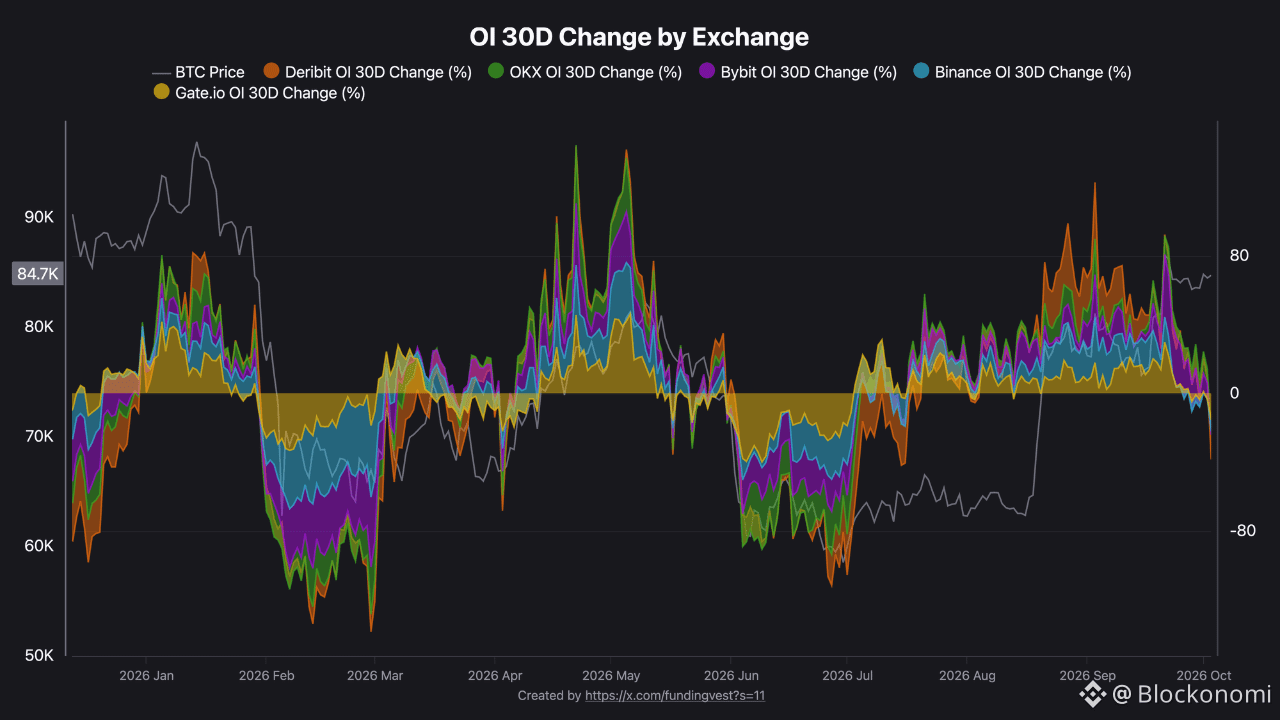
記事
翻訳参照
Bitcoin Open Interest Falls Across Major Exchanges as BTC Nears $87,000TLDR:
Bitcoin Open Interest dropped 6% on Binance over 30 days, signaling a loss in volatility balance.
Deribit and Gate.io each saw Open Interest fall 15%, pointing to position unwinding and weaker volume.
The 30-day structure matches prior local tops, where Open Interest contraction often marks distribution.
Similar setups in January and May 2026 accompanied Bitcoin pullbacks of approximately $10,000.
Bitcoin Open Interest has declined as the asset approaches the $87,000 level. The cryptocurrency continues to lose momentum while sell-offs deepen across the market.
On the 30-day chart, the current price structure resembles previous local tops. Contraction in open interest often appears during distribution phases, and the present setup shows it clearly.
Data from Binance, Deribit, and Gate.io points to a cooling market. Each of the three exchanges recorded notable drops in positions.
FundingVest Points to Open Interest Declines on Three Exchanges
Cryptoquant analyst FundingVest shared the data in a recent market post. The analyst stated that the “ongoing decline in market Open Interest” stands out as a key metric.
According to the post, Bitcoin Open Interest fell on all three venues over the 30-day window. The analyst also tied the move to the price weakness seen near $87,000.
FundingVest reported that Binance saw a 6% drop. The analyst said this reflects a loss in the volatility balance sustained over the past 30 days. Binance also serves as a benchmark for the market. Therefore, its figures offer a useful read on broader sentiment.
Source: Cryptoquant
Deribit recorded a steeper 15% reduction. FundingVest described the exchange as the dominant force in the options market. The analyst noted that a drop of this size points to position unwinding. In addition, expectations in derivative markets appear to be shifting.
Gate.io also posted a 15% decline. FundingVest linked the move to weaker trading volume and lower volatility expectations. Other exchanges saw only marginal losses. Still, the analyst said the sharp drops at the three venues confirm a “clear cooling-off phase.”
Past Pullbacks Offer a Reference Point
FundingVest compared the current setup with earlier periods. The 30-day open interest trend matches patterns from January 2026 and May 2026.
In both months, Bitcoin pulled back by approximately $10,000. The analyst presented these two episodes as the closest parallels.
The analyst also pointed to the same structure at previous local tops. Bitcoin now trades near $87,000 under similar conditions.
Moreover, contraction in open interest is frequently seen during distribution phases. The 30-day change on the chart follows that familiar pattern.
Open interest continues to drain at present. As a result, FundingVest said data from the three exchanges offers insight into the depth of the retracement.
The figures also reflect evolving market dynamics. Binance, Deribit, and Gate.io therefore remain the main reference points.
Bitcoin remains under pressure near the $87,000 mark. Selling continues to deepen as momentum weakens. Price action and derivatives data now point in the same direction. Consequently, the Bitcoin Open Interest trend stays a key metric to follow.
The post Bitcoin Open Interest Falls Across Major Exchanges as BTC Nears $87,000 appeared first on Blockonomi.
Bitcoin Open Interest Falls Across Major Exchanges as BTC Nears $87,000
TLDR:
Bitcoin Open Interest dropped 6% on Binance over 30 days, signaling a loss in volatility balance.
Deribit and Gate.io each saw Open Interest fall 15%, pointing to position unwinding and weaker volume.
The 30-day structure matches prior local tops, where Open Interest contraction often marks distribution.
Similar setups in January and May 2026 accompanied Bitcoin pullbacks of approximately $10,000.
Bitcoin Open Interest has declined as the asset approaches the $87,000 level. The cryptocurrency continues to lose momentum while sell-offs deepen across the market.
On the 30-day chart, the current price structure resembles previous local tops. Contraction in open interest often appears during distribution phases, and the present setup shows it clearly.
Data from Binance, Deribit, and Gate.io points to a cooling market. Each of the three exchanges recorded notable drops in positions.
FundingVest Points to Open Interest Declines on Three Exchanges
Cryptoquant analyst FundingVest shared the data in a recent market post. The analyst stated that the “ongoing decline in market Open Interest” stands out as a key metric.
According to the post, Bitcoin Open Interest fell on all three venues over the 30-day window. The analyst also tied the move to the price weakness seen near $87,000.
FundingVest reported that Binance saw a 6% drop. The analyst said this reflects a loss in the volatility balance sustained over the past 30 days. Binance also serves as a benchmark for the market. Therefore, its figures offer a useful read on broader sentiment.
Source: Cryptoquant
Deribit recorded a steeper 15% reduction. FundingVest described the exchange as the dominant force in the options market. The analyst noted that a drop of this size points to position unwinding. In addition, expectations in derivative markets appear to be shifting.
Gate.io also posted a 15% decline. FundingVest linked the move to weaker trading volume and lower volatility expectations. Other exchanges saw only marginal losses. Still, the analyst said the sharp drops at the three venues confirm a “clear cooling-off phase.”
Past Pullbacks Offer a Reference Point
FundingVest compared the current setup with earlier periods. The 30-day open interest trend matches patterns from January 2026 and May 2026.
In both months, Bitcoin pulled back by approximately $10,000. The analyst presented these two episodes as the closest parallels.
The analyst also pointed to the same structure at previous local tops. Bitcoin now trades near $87,000 under similar conditions.
Moreover, contraction in open interest is frequently seen during distribution phases. The 30-day change on the chart follows that familiar pattern.
Open interest continues to drain at present. As a result, FundingVest said data from the three exchanges offers insight into the depth of the retracement.
The figures also reflect evolving market dynamics. Binance, Deribit, and Gate.io therefore remain the main reference points.
Bitcoin remains under pressure near the $87,000 mark. Selling continues to deepen as momentum weakens. Price action and derivatives data now point in the same direction. Consequently, the Bitcoin Open Interest trend stays a key metric to follow.
The post Bitcoin Open Interest Falls Across Major Exchanges as BTC Nears $87,000 appeared first on Blockonomi.
Bitcoin Open Interest dropped 6% on Binance over 30 days, signaling a loss in volatility balance.
Deribit and Gate.io each saw Open Interest fall 15%, pointing to position unwinding and weaker volume.
The 30-day structure matches prior local tops, where Open Interest contraction often marks distribution.
Similar setups in January and May 2026 accompanied Bitcoin pullbacks of approximately $10,000.
Bitcoin Open Interest has declined as the asset approaches the $87,000 level. The cryptocurrency continues to lose momentum while sell-offs deepen across the market.
On the 30-day chart, the current price structure resembles previous local tops. Contraction in open interest often appears during distribution phases, and the present setup shows it clearly.
Data from Binance, Deribit, and Gate.io points to a cooling market. Each of the three exchanges recorded notable drops in positions.
FundingVest Points to Open Interest Declines on Three Exchanges
Cryptoquant analyst FundingVest shared the data in a recent market post. The analyst stated that the “ongoing decline in market Open Interest” stands out as a key metric.
According to the post, Bitcoin Open Interest fell on all three venues over the 30-day window. The analyst also tied the move to the price weakness seen near $87,000.
FundingVest reported that Binance saw a 6% drop. The analyst said this reflects a loss in the volatility balance sustained over the past 30 days. Binance also serves as a benchmark for the market. Therefore, its figures offer a useful read on broader sentiment.
Source: Cryptoquant
Deribit recorded a steeper 15% reduction. FundingVest described the exchange as the dominant force in the options market. The analyst noted that a drop of this size points to position unwinding. In addition, expectations in derivative markets appear to be shifting.
Gate.io also posted a 15% decline. FundingVest linked the move to weaker trading volume and lower volatility expectations. Other exchanges saw only marginal losses. Still, the analyst said the sharp drops at the three venues confirm a “clear cooling-off phase.”
Past Pullbacks Offer a Reference Point
FundingVest compared the current setup with earlier periods. The 30-day open interest trend matches patterns from January 2026 and May 2026.
In both months, Bitcoin pulled back by approximately $10,000. The analyst presented these two episodes as the closest parallels.
The analyst also pointed to the same structure at previous local tops. Bitcoin now trades near $87,000 under similar conditions.
Moreover, contraction in open interest is frequently seen during distribution phases. The 30-day change on the chart follows that familiar pattern.
Open interest continues to drain at present. As a result, FundingVest said data from the three exchanges offers insight into the depth of the retracement.
The figures also reflect evolving market dynamics. Binance, Deribit, and Gate.io therefore remain the main reference points.
Bitcoin remains under pressure near the $87,000 mark. Selling continues to deepen as momentum weakens. Price action and derivatives data now point in the same direction. Consequently, the Bitcoin Open Interest trend stays a key metric to follow.
The post Bitcoin Open Interest Falls Across Major Exchanges as BTC Nears $87,000 appeared first on Blockonomi.
103
·
--

記事
翻訳参照
Injective Stockdrop Goes Live as CypherOS Debuts and BuyBack Burns 7.2M INJTLDR:
The Community BuyBack closed with more than 7.2 million INJ burned, and Stockdrop claims are now open.
CypherOS made its first public appearance as a privacy platform for confidential trades and tokenization.
Canary Capital filed Amendment No. 3 for a Staked INJ ETF that plans to stake at least 90% of holdings.
Robinhood now supports INJ trading and transfers, giving users native INJ access without a bridge.
Injective Stockdrop went live this week, allowing participants to claim tokenized stock rewards. The Community BuyBack closed with more than 7.2 million INJ burned to date.
CypherOS also made its first public appearance as a privacy platform on the network. Meanwhile, Canary Capital filed an amendment for a Staked INJ ETF, and Robinhood added INJ trading and transfer support. These updates form the main developments on Injective over the past week.
Stockdrop and CypherOS Go Live
The first Injective Stockdrop is now live. The Community BuyBack that preceded it has ended. According to the project, more than 7.2 million INJ have been burned to date.
Stockdrop participants can now claim their tokenized stock rewards. The project refers to eligible community members as loyal ninjas.
CypherOS also made its first public appearance this week. Injective shared a preview of the platform. CypherOS is built for confidential transactions, trades, and tokenization. The project describes it as a privacy platform on Injective. Injective positioned the platform for use across its network.
Injective’s post on X also listed several ecosystem launches. Sprout (@sproutsomefun) lets users bridge, discover, and trade new launches in one place. RunUp (@runupdotfun) is now live as well.
The first Injective Stockdrop went live. The Community BuyBack closed with more than 7.2 million $INJ burned to date with loyal ninjas now being able to claim tokenized stocks. CypherOS also made its first public appearance as the privacy platform for confidential transactions,… pic.twitter.com/rvRzdtPYT0
— Injective (@injective) October 4, 2026
It allows users to launch tokens powered by long or short perp markets. Both projects operate within the Injective ecosystem.
INJ is now live across the Solana ecosystem. Support includes Phantom and several trading, launch, and data apps. The FOMO thesis competition also ended.
INJ was sent to every winner, and Injective said more releases are on the horizon. The network included these items in its weekly recap.
Institutional Access and Network Activity
Canary Capital filed Amendment No. 3 to its SEC registration statement for a Staked INJ ETF. According to the update, the fund plans to hold spot INJ.
It also intends to stake at least 90% of its US institutional holdings. Injective shared the filing detail in its weekly post on X.
Robinhood now supports INJ trading and transfers. Users therefore get a direct route into Injective with native INJ. The platform does not require a bridge.
Robinhood users can trade without moving assets across chains. Injective listed the update among its top developments this week.
Injective and LG CNS are also working together. The goal is to bring more activity onchain through a 24/7 programmable economy.
In addition, Injective hosted the largest institutional event during Korea Blockchain Week. Attendees included members from Coinbase, the Federal Reserve, LG, BitGo, and more.
Network data was also part of the update. Injective has processed more than 3 billion transactions. More than 42 million of those took place in the past 30 days. Injective listed these figures under key stats.
The post Injective Stockdrop Goes Live as CypherOS Debuts and BuyBack Burns 7.2M INJ appeared first on Blockonomi.
Injective Stockdrop Goes Live as CypherOS Debuts and BuyBack Burns 7.2M INJ
TLDR:
The Community BuyBack closed with more than 7.2 million INJ burned, and Stockdrop claims are now open.
CypherOS made its first public appearance as a privacy platform for confidential trades and tokenization.
Canary Capital filed Amendment No. 3 for a Staked INJ ETF that plans to stake at least 90% of holdings.
Robinhood now supports INJ trading and transfers, giving users native INJ access without a bridge.
Injective Stockdrop went live this week, allowing participants to claim tokenized stock rewards. The Community BuyBack closed with more than 7.2 million INJ burned to date.
CypherOS also made its first public appearance as a privacy platform on the network. Meanwhile, Canary Capital filed an amendment for a Staked INJ ETF, and Robinhood added INJ trading and transfer support. These updates form the main developments on Injective over the past week.
Stockdrop and CypherOS Go Live
The first Injective Stockdrop is now live. The Community BuyBack that preceded it has ended. According to the project, more than 7.2 million INJ have been burned to date.
Stockdrop participants can now claim their tokenized stock rewards. The project refers to eligible community members as loyal ninjas.
CypherOS also made its first public appearance this week. Injective shared a preview of the platform. CypherOS is built for confidential transactions, trades, and tokenization. The project describes it as a privacy platform on Injective. Injective positioned the platform for use across its network.
Injective’s post on X also listed several ecosystem launches. Sprout (@sproutsomefun) lets users bridge, discover, and trade new launches in one place. RunUp (@runupdotfun) is now live as well.
The first Injective Stockdrop went live. The Community BuyBack closed with more than 7.2 million $INJ burned to date with loyal ninjas now being able to claim tokenized stocks. CypherOS also made its first public appearance as the privacy platform for confidential transactions,… pic.twitter.com/rvRzdtPYT0
— Injective (@injective) October 4, 2026
It allows users to launch tokens powered by long or short perp markets. Both projects operate within the Injective ecosystem.
INJ is now live across the Solana ecosystem. Support includes Phantom and several trading, launch, and data apps. The FOMO thesis competition also ended.
INJ was sent to every winner, and Injective said more releases are on the horizon. The network included these items in its weekly recap.
Institutional Access and Network Activity
Canary Capital filed Amendment No. 3 to its SEC registration statement for a Staked INJ ETF. According to the update, the fund plans to hold spot INJ.
It also intends to stake at least 90% of its US institutional holdings. Injective shared the filing detail in its weekly post on X.
Robinhood now supports INJ trading and transfers. Users therefore get a direct route into Injective with native INJ. The platform does not require a bridge.
Robinhood users can trade without moving assets across chains. Injective listed the update among its top developments this week.
Injective and LG CNS are also working together. The goal is to bring more activity onchain through a 24/7 programmable economy.
In addition, Injective hosted the largest institutional event during Korea Blockchain Week. Attendees included members from Coinbase, the Federal Reserve, LG, BitGo, and more.
Network data was also part of the update. Injective has processed more than 3 billion transactions. More than 42 million of those took place in the past 30 days. Injective listed these figures under key stats.
The post Injective Stockdrop Goes Live as CypherOS Debuts and BuyBack Burns 7.2M INJ appeared first on Blockonomi.
The Community BuyBack closed with more than 7.2 million INJ burned, and Stockdrop claims are now open.
CypherOS made its first public appearance as a privacy platform for confidential trades and tokenization.
Canary Capital filed Amendment No. 3 for a Staked INJ ETF that plans to stake at least 90% of holdings.
Robinhood now supports INJ trading and transfers, giving users native INJ access without a bridge.
Injective Stockdrop went live this week, allowing participants to claim tokenized stock rewards. The Community BuyBack closed with more than 7.2 million INJ burned to date.
CypherOS also made its first public appearance as a privacy platform on the network. Meanwhile, Canary Capital filed an amendment for a Staked INJ ETF, and Robinhood added INJ trading and transfer support. These updates form the main developments on Injective over the past week.
Stockdrop and CypherOS Go Live
The first Injective Stockdrop is now live. The Community BuyBack that preceded it has ended. According to the project, more than 7.2 million INJ have been burned to date.
Stockdrop participants can now claim their tokenized stock rewards. The project refers to eligible community members as loyal ninjas.
CypherOS also made its first public appearance this week. Injective shared a preview of the platform. CypherOS is built for confidential transactions, trades, and tokenization. The project describes it as a privacy platform on Injective. Injective positioned the platform for use across its network.
Injective’s post on X also listed several ecosystem launches. Sprout (@sproutsomefun) lets users bridge, discover, and trade new launches in one place. RunUp (@runupdotfun) is now live as well.
The first Injective Stockdrop went live. The Community BuyBack closed with more than 7.2 million $INJ burned to date with loyal ninjas now being able to claim tokenized stocks. CypherOS also made its first public appearance as the privacy platform for confidential transactions,… pic.twitter.com/rvRzdtPYT0
— Injective (@injective) October 4, 2026
It allows users to launch tokens powered by long or short perp markets. Both projects operate within the Injective ecosystem.
INJ is now live across the Solana ecosystem. Support includes Phantom and several trading, launch, and data apps. The FOMO thesis competition also ended.
INJ was sent to every winner, and Injective said more releases are on the horizon. The network included these items in its weekly recap.
Institutional Access and Network Activity
Canary Capital filed Amendment No. 3 to its SEC registration statement for a Staked INJ ETF. According to the update, the fund plans to hold spot INJ.
It also intends to stake at least 90% of its US institutional holdings. Injective shared the filing detail in its weekly post on X.
Robinhood now supports INJ trading and transfers. Users therefore get a direct route into Injective with native INJ. The platform does not require a bridge.
Robinhood users can trade without moving assets across chains. Injective listed the update among its top developments this week.
Injective and LG CNS are also working together. The goal is to bring more activity onchain through a 24/7 programmable economy.
In addition, Injective hosted the largest institutional event during Korea Blockchain Week. Attendees included members from Coinbase, the Federal Reserve, LG, BitGo, and more.
Network data was also part of the update. Injective has processed more than 3 billion transactions. More than 42 million of those took place in the past 30 days. Injective listed these figures under key stats.
The post Injective Stockdrop Goes Live as CypherOS Debuts and BuyBack Burns 7.2M INJ appeared first on Blockonomi.
219
·
--

記事
翻訳参照
Solana Flips Ethereum as DEX Volume Tops L2s and Hyperliquid CombinedTLDR:
Solana logged $3.06B in daily spot DEX volume, topping Ethereum, L2s and Hyperliquid combined on October 3.
Solana captured over 36% of global spot DEX volume in H1 2026, nearly twice Ethereum’s share in the period.
DefiLlama showed about $78B in 30-day Solana DEX volume, versus roughly $42B recorded on Ethereum overall.
Memecoin volume fell to 16% from 40%, while stablecoin swaps rose to 19% from 6% over the same period.
Solana overtook Ethereum, its Layer 2 networks and Hyperliquid combined in spot decentralized exchange volume on October 3, according to Blockworks Research data. The comparison, shared by SolanaFloor on October 4, placed Solana at the top of the latest completed daily session.
JUST IN: @Solana recorded more spot DEX trading volume yesterday than Ethereum mainnet, all Ethereum L2s and Hyperliquid combined. pic.twitter.com/nJPYTt49Fq
— SolanaFloor (@SolanaFloor) October 4, 2026
Blockworks’ dedicated dashboard recorded $3.06 billion in previous-day spot DEX volume and $4.51 billion in DEX liquidity. The result stands out as the benchmark combines Ethereum mainnet with L2s and adds Hyperliquid, creating a wider measure of competing onchain trading activity.
Solana Extends Its Lead Across Spot DEX Markets
The October 3 result follows a broader shift in decentralized spot trading. Research from 21Shares found that Solana handled more than 36% of global spot DEX volume during the first half of 2026.
That share was roughly double Ethereum’s, even though Solana represented about 9.5% of the smart-contract blockchain market capitalization measured in the report.
DefiLlama data also placed the network among the largest decentralized trading ecosystems. Its recent rankings showed about $78 billion in 30-day Solana DEX volume, compared with roughly $42 billion for Ethereum.
However, provider totals differ as tracking methods are not identical. Blockworks only counts trades where both assets appear in its token database. That filtering is designed to remove artificial activity involving unidentified or thinly traded tokens. As a result, Blockworks totals can sit below raw blockchain volume.
Spot Trading Mix Shifts Toward Stablecoins and Tokenized Assets
The trading mix has also changed. According to 21Shares, memecoins accounted for 16% of Solana spot volume in H1 2026, down from 40% one year earlier. Stablecoin swaps moved in the opposite direction, rising from 6% to 19% over the same period.
That shift shows a larger share of activity moving beyond purely speculative tokens. Tokenized equities have also become part of the network’s trading base. Blockworks Research ranked Solana second behind Binance in median weekly spot volume among measured venues during 2026.
Even so, Solana DEX volume remained below 1% of either Nasdaq or the NYSE by dollar value, keeping the scale comparison in perspective. Trade count tells a different story. Solana recently processed about 208 million weekly spot DEX trades, above roughly 189 million NYSE transactions in a separate comparison.
Together, the October 3 lead, higher 30-day volume and changing asset mix show Solana strengthening its position in onchain spot execution. Ethereum, L2s and Hyperliquid still remain major competitors.
The comparison also highlights how dollar volume and transaction counts measure different dimensions of market activity across trading venues. On October 3, however, the daily dollar-volume ranking placed Solana ahead of the combined benchmark formed by Ethereum, L2s and Hyperliquid in this session.
The post Solana Flips Ethereum as DEX Volume Tops L2s and Hyperliquid Combined appeared first on Blockonomi.
Solana Flips Ethereum as DEX Volume Tops L2s and Hyperliquid Combined
TLDR:
Solana logged $3.06B in daily spot DEX volume, topping Ethereum, L2s and Hyperliquid combined on October 3.
Solana captured over 36% of global spot DEX volume in H1 2026, nearly twice Ethereum’s share in the period.
DefiLlama showed about $78B in 30-day Solana DEX volume, versus roughly $42B recorded on Ethereum overall.
Memecoin volume fell to 16% from 40%, while stablecoin swaps rose to 19% from 6% over the same period.
Solana overtook Ethereum, its Layer 2 networks and Hyperliquid combined in spot decentralized exchange volume on October 3, according to Blockworks Research data. The comparison, shared by SolanaFloor on October 4, placed Solana at the top of the latest completed daily session.
JUST IN: @Solana recorded more spot DEX trading volume yesterday than Ethereum mainnet, all Ethereum L2s and Hyperliquid combined. pic.twitter.com/nJPYTt49Fq
— SolanaFloor (@SolanaFloor) October 4, 2026
Blockworks’ dedicated dashboard recorded $3.06 billion in previous-day spot DEX volume and $4.51 billion in DEX liquidity. The result stands out as the benchmark combines Ethereum mainnet with L2s and adds Hyperliquid, creating a wider measure of competing onchain trading activity.
Solana Extends Its Lead Across Spot DEX Markets
The October 3 result follows a broader shift in decentralized spot trading. Research from 21Shares found that Solana handled more than 36% of global spot DEX volume during the first half of 2026.
That share was roughly double Ethereum’s, even though Solana represented about 9.5% of the smart-contract blockchain market capitalization measured in the report.
DefiLlama data also placed the network among the largest decentralized trading ecosystems. Its recent rankings showed about $78 billion in 30-day Solana DEX volume, compared with roughly $42 billion for Ethereum.
However, provider totals differ as tracking methods are not identical. Blockworks only counts trades where both assets appear in its token database. That filtering is designed to remove artificial activity involving unidentified or thinly traded tokens. As a result, Blockworks totals can sit below raw blockchain volume.
Spot Trading Mix Shifts Toward Stablecoins and Tokenized Assets
The trading mix has also changed. According to 21Shares, memecoins accounted for 16% of Solana spot volume in H1 2026, down from 40% one year earlier. Stablecoin swaps moved in the opposite direction, rising from 6% to 19% over the same period.
That shift shows a larger share of activity moving beyond purely speculative tokens. Tokenized equities have also become part of the network’s trading base. Blockworks Research ranked Solana second behind Binance in median weekly spot volume among measured venues during 2026.
Even so, Solana DEX volume remained below 1% of either Nasdaq or the NYSE by dollar value, keeping the scale comparison in perspective. Trade count tells a different story. Solana recently processed about 208 million weekly spot DEX trades, above roughly 189 million NYSE transactions in a separate comparison.
Together, the October 3 lead, higher 30-day volume and changing asset mix show Solana strengthening its position in onchain spot execution. Ethereum, L2s and Hyperliquid still remain major competitors.
The comparison also highlights how dollar volume and transaction counts measure different dimensions of market activity across trading venues. On October 3, however, the daily dollar-volume ranking placed Solana ahead of the combined benchmark formed by Ethereum, L2s and Hyperliquid in this session.
The post Solana Flips Ethereum as DEX Volume Tops L2s and Hyperliquid Combined appeared first on Blockonomi.
Solana logged $3.06B in daily spot DEX volume, topping Ethereum, L2s and Hyperliquid combined on October 3.
Solana captured over 36% of global spot DEX volume in H1 2026, nearly twice Ethereum’s share in the period.
DefiLlama showed about $78B in 30-day Solana DEX volume, versus roughly $42B recorded on Ethereum overall.
Memecoin volume fell to 16% from 40%, while stablecoin swaps rose to 19% from 6% over the same period.
Solana overtook Ethereum, its Layer 2 networks and Hyperliquid combined in spot decentralized exchange volume on October 3, according to Blockworks Research data. The comparison, shared by SolanaFloor on October 4, placed Solana at the top of the latest completed daily session.
JUST IN: @Solana recorded more spot DEX trading volume yesterday than Ethereum mainnet, all Ethereum L2s and Hyperliquid combined. pic.twitter.com/nJPYTt49Fq
— SolanaFloor (@SolanaFloor) October 4, 2026
Blockworks’ dedicated dashboard recorded $3.06 billion in previous-day spot DEX volume and $4.51 billion in DEX liquidity. The result stands out as the benchmark combines Ethereum mainnet with L2s and adds Hyperliquid, creating a wider measure of competing onchain trading activity.
Solana Extends Its Lead Across Spot DEX Markets
The October 3 result follows a broader shift in decentralized spot trading. Research from 21Shares found that Solana handled more than 36% of global spot DEX volume during the first half of 2026.
That share was roughly double Ethereum’s, even though Solana represented about 9.5% of the smart-contract blockchain market capitalization measured in the report.
DefiLlama data also placed the network among the largest decentralized trading ecosystems. Its recent rankings showed about $78 billion in 30-day Solana DEX volume, compared with roughly $42 billion for Ethereum.
However, provider totals differ as tracking methods are not identical. Blockworks only counts trades where both assets appear in its token database. That filtering is designed to remove artificial activity involving unidentified or thinly traded tokens. As a result, Blockworks totals can sit below raw blockchain volume.
Spot Trading Mix Shifts Toward Stablecoins and Tokenized Assets
The trading mix has also changed. According to 21Shares, memecoins accounted for 16% of Solana spot volume in H1 2026, down from 40% one year earlier. Stablecoin swaps moved in the opposite direction, rising from 6% to 19% over the same period.
That shift shows a larger share of activity moving beyond purely speculative tokens. Tokenized equities have also become part of the network’s trading base. Blockworks Research ranked Solana second behind Binance in median weekly spot volume among measured venues during 2026.
Even so, Solana DEX volume remained below 1% of either Nasdaq or the NYSE by dollar value, keeping the scale comparison in perspective. Trade count tells a different story. Solana recently processed about 208 million weekly spot DEX trades, above roughly 189 million NYSE transactions in a separate comparison.
Together, the October 3 lead, higher 30-day volume and changing asset mix show Solana strengthening its position in onchain spot execution. Ethereum, L2s and Hyperliquid still remain major competitors.
The comparison also highlights how dollar volume and transaction counts measure different dimensions of market activity across trading venues. On October 3, however, the daily dollar-volume ranking placed Solana ahead of the combined benchmark formed by Ethereum, L2s and Hyperliquid in this session.
The post Solana Flips Ethereum as DEX Volume Tops L2s and Hyperliquid Combined appeared first on Blockonomi.
87
·
--

記事
翻訳参照
Dogecoin Price Eyes $0.106 Rally as Triangle Nears Breakout PointTLDR:
DOGE trades at $0.09524, up 2.33% in 24 hours, with daily trading volume reaching $472,416,387.
Ali Charts says DOGE is consolidating inside a descending triangle that is nearing its apex.
A 4-hour close above $0.095 could confirm a bullish breakout and trigger a rally toward $0.106.
DogeOS launched a public testnet to bring Ethereum-style apps to DOGE, while a golden cross nears.
Dogecoin price stands at $0.09524 at the time of publication, marking a 2.33% increase over the past 24 hours. The token also recorded $472,416,387 in trading volume during that same period.
Meanwhile, analysts are tracking a descending triangle pattern that continues to tighten on the chart. A public testnet has also launched to bring Ethereum-style apps into the ecosystem. Together, these developments are drawing attention to DOGE as traders watch for the next price move.
Descending Triangle Approaches Its Apex
Crypto analyst Ali Charts shared a technical outlook for DOGE in a post on X. The post opens with the phrase “Dogecoin breakout ahead,” which sets its bullish tone.
According to the analyst, the token continues to consolidate inside a descending triangle. As a result, the pattern is becoming increasingly compressed. Ali Charts noted that a breakout could be getting closer as price approaches the apex.
DOGECOIN BREAKOUT AHEAD$DOGE continues to consolidate inside a descending triangle.
As price approaches the apex, the structure is becoming increasingly compressed and a breakout could be getting closer.
The key level I’m watching is $0.095.
A 4-hour close above it could… https://t.co/QUvX5wuILf pic.twitter.com/mcVKRSLvv2
— Ali Charts (@alicharts) October 4, 2026
The analyst identified $0.095 as the key level to watch in this setup. A 4-hour close above that mark could confirm a bullish breakout. In that case, the move could trigger a rally toward $0.106.
That target sits roughly 11% above the current Dogecoin price. The two levels, $0.095 and $0.106, therefore define the range in the analysis. Until then, the descending triangle remains intact on the chart.
Market data adds context to the setup. The Dogecoin price sits just above the $0.095 level at the time of writing. Over the past seven days, however, the token has declined 1.17%.
The compression described by Ali Charts has built up while weekly performance stayed slightly negative. Traders are watching how price reacts around that zone.
DogeOS Testnet and Golden Cross Setup
Separately, Giannis Andreou pointed to a new development within the Dogecoin ecosystem. In a post on X, he said DogeOS has launched a public testnet.
The testnet is designed to bring Ethereum-style apps into the DOGE ecosystem. According to Andreou, this gives DOGE an entirely new application layer. Because the testnet is public, wider participation is possible during this early phase.
$DOGE IS GETTING A WHOLE NEW APP LAYER
DogeOS has launched a public testnet designed to bring Ethereum-style apps into the $DOGE ecosystem.
That could expand $DOGE far beyond payments and meme trading.
At the same time, the chart is approaching its first golden cross of…
— Giannis Andreou (@gandreou007) October 4, 2026
He said the added functionality could expand DOGE far beyond payments and meme trading. The post describes payments and meme trading as the current focus of DOGE activity.
Support for Ethereum-style apps would therefore add a new category of use. In his view, utility is growing across the ecosystem. The testnet launch is the development he cited to support that view.
Andreou also pointed to the price chart, where DOGE is approaching its first golden cross of 2026. The golden cross has not yet formed, according to the post. He suggested that momentum may follow as utility continues to grow across the ecosystem.
At the same time, Ali Charts remains focused on the $0.095 level and a possible breakout. Together, the two posts describe both technical and ecosystem factors tied to the Dogecoin price.
The post Dogecoin Price Eyes $0.106 Rally as Triangle Nears Breakout Point appeared first on Blockonomi.
Dogecoin Price Eyes $0.106 Rally as Triangle Nears Breakout Point
TLDR:
DOGE trades at $0.09524, up 2.33% in 24 hours, with daily trading volume reaching $472,416,387.
Ali Charts says DOGE is consolidating inside a descending triangle that is nearing its apex.
A 4-hour close above $0.095 could confirm a bullish breakout and trigger a rally toward $0.106.
DogeOS launched a public testnet to bring Ethereum-style apps to DOGE, while a golden cross nears.
Dogecoin price stands at $0.09524 at the time of publication, marking a 2.33% increase over the past 24 hours. The token also recorded $472,416,387 in trading volume during that same period.
Meanwhile, analysts are tracking a descending triangle pattern that continues to tighten on the chart. A public testnet has also launched to bring Ethereum-style apps into the ecosystem. Together, these developments are drawing attention to DOGE as traders watch for the next price move.
Descending Triangle Approaches Its Apex
Crypto analyst Ali Charts shared a technical outlook for DOGE in a post on X. The post opens with the phrase “Dogecoin breakout ahead,” which sets its bullish tone.
According to the analyst, the token continues to consolidate inside a descending triangle. As a result, the pattern is becoming increasingly compressed. Ali Charts noted that a breakout could be getting closer as price approaches the apex.
DOGECOIN BREAKOUT AHEAD$DOGE continues to consolidate inside a descending triangle.
As price approaches the apex, the structure is becoming increasingly compressed and a breakout could be getting closer.
The key level I’m watching is $0.095.
A 4-hour close above it could… https://t.co/QUvX5wuILf pic.twitter.com/mcVKRSLvv2
— Ali Charts (@alicharts) October 4, 2026
The analyst identified $0.095 as the key level to watch in this setup. A 4-hour close above that mark could confirm a bullish breakout. In that case, the move could trigger a rally toward $0.106.
That target sits roughly 11% above the current Dogecoin price. The two levels, $0.095 and $0.106, therefore define the range in the analysis. Until then, the descending triangle remains intact on the chart.
Market data adds context to the setup. The Dogecoin price sits just above the $0.095 level at the time of writing. Over the past seven days, however, the token has declined 1.17%.
The compression described by Ali Charts has built up while weekly performance stayed slightly negative. Traders are watching how price reacts around that zone.
DogeOS Testnet and Golden Cross Setup
Separately, Giannis Andreou pointed to a new development within the Dogecoin ecosystem. In a post on X, he said DogeOS has launched a public testnet.
The testnet is designed to bring Ethereum-style apps into the DOGE ecosystem. According to Andreou, this gives DOGE an entirely new application layer. Because the testnet is public, wider participation is possible during this early phase.
$DOGE IS GETTING A WHOLE NEW APP LAYER
DogeOS has launched a public testnet designed to bring Ethereum-style apps into the $DOGE ecosystem.
That could expand $DOGE far beyond payments and meme trading.
At the same time, the chart is approaching its first golden cross of…
— Giannis Andreou (@gandreou007) October 4, 2026
He said the added functionality could expand DOGE far beyond payments and meme trading. The post describes payments and meme trading as the current focus of DOGE activity.
Support for Ethereum-style apps would therefore add a new category of use. In his view, utility is growing across the ecosystem. The testnet launch is the development he cited to support that view.
Andreou also pointed to the price chart, where DOGE is approaching its first golden cross of 2026. The golden cross has not yet formed, according to the post. He suggested that momentum may follow as utility continues to grow across the ecosystem.
At the same time, Ali Charts remains focused on the $0.095 level and a possible breakout. Together, the two posts describe both technical and ecosystem factors tied to the Dogecoin price.
The post Dogecoin Price Eyes $0.106 Rally as Triangle Nears Breakout Point appeared first on Blockonomi.
DOGE trades at $0.09524, up 2.33% in 24 hours, with daily trading volume reaching $472,416,387.
Ali Charts says DOGE is consolidating inside a descending triangle that is nearing its apex.
A 4-hour close above $0.095 could confirm a bullish breakout and trigger a rally toward $0.106.
DogeOS launched a public testnet to bring Ethereum-style apps to DOGE, while a golden cross nears.
Dogecoin price stands at $0.09524 at the time of publication, marking a 2.33% increase over the past 24 hours. The token also recorded $472,416,387 in trading volume during that same period.
Meanwhile, analysts are tracking a descending triangle pattern that continues to tighten on the chart. A public testnet has also launched to bring Ethereum-style apps into the ecosystem. Together, these developments are drawing attention to DOGE as traders watch for the next price move.
Descending Triangle Approaches Its Apex
Crypto analyst Ali Charts shared a technical outlook for DOGE in a post on X. The post opens with the phrase “Dogecoin breakout ahead,” which sets its bullish tone.
According to the analyst, the token continues to consolidate inside a descending triangle. As a result, the pattern is becoming increasingly compressed. Ali Charts noted that a breakout could be getting closer as price approaches the apex.
DOGECOIN BREAKOUT AHEAD$DOGE continues to consolidate inside a descending triangle.
As price approaches the apex, the structure is becoming increasingly compressed and a breakout could be getting closer.
The key level I’m watching is $0.095.
A 4-hour close above it could… https://t.co/QUvX5wuILf pic.twitter.com/mcVKRSLvv2
— Ali Charts (@alicharts) October 4, 2026
The analyst identified $0.095 as the key level to watch in this setup. A 4-hour close above that mark could confirm a bullish breakout. In that case, the move could trigger a rally toward $0.106.
That target sits roughly 11% above the current Dogecoin price. The two levels, $0.095 and $0.106, therefore define the range in the analysis. Until then, the descending triangle remains intact on the chart.
Market data adds context to the setup. The Dogecoin price sits just above the $0.095 level at the time of writing. Over the past seven days, however, the token has declined 1.17%.
The compression described by Ali Charts has built up while weekly performance stayed slightly negative. Traders are watching how price reacts around that zone.
DogeOS Testnet and Golden Cross Setup
Separately, Giannis Andreou pointed to a new development within the Dogecoin ecosystem. In a post on X, he said DogeOS has launched a public testnet.
The testnet is designed to bring Ethereum-style apps into the DOGE ecosystem. According to Andreou, this gives DOGE an entirely new application layer. Because the testnet is public, wider participation is possible during this early phase.
$DOGE IS GETTING A WHOLE NEW APP LAYER
DogeOS has launched a public testnet designed to bring Ethereum-style apps into the $DOGE ecosystem.
That could expand $DOGE far beyond payments and meme trading.
At the same time, the chart is approaching its first golden cross of…
— Giannis Andreou (@gandreou007) October 4, 2026
He said the added functionality could expand DOGE far beyond payments and meme trading. The post describes payments and meme trading as the current focus of DOGE activity.
Support for Ethereum-style apps would therefore add a new category of use. In his view, utility is growing across the ecosystem. The testnet launch is the development he cited to support that view.
Andreou also pointed to the price chart, where DOGE is approaching its first golden cross of 2026. The golden cross has not yet formed, according to the post. He suggested that momentum may follow as utility continues to grow across the ecosystem.
At the same time, Ali Charts remains focused on the $0.095 level and a possible breakout. Together, the two posts describe both technical and ecosystem factors tied to the Dogecoin price.
The post Dogecoin Price Eyes $0.106 Rally as Triangle Nears Breakout Point appeared first on Blockonomi.
116
ログインして、さらにコンテンツを読む
厳選トピックで世界の暗号資産トレーダーの仲間入り
⚡️ 暗号資産に関する最新かつ有益な情報が見つかります。
💬 世界最大の暗号資産取引所から信頼されています。
👍 認証を受けたクリエイターから、有益なインサイトを得られます。
メール / 電話番号
トレンドトピック
EthStakingExitQueueHits2026High
閲覧回数 5
26人が討論中
#EthStakingExitQueueHits2026High のトレンドを見るといつも不安になりますが、退出キューの急増は、ETHが大量に売られていることを意味するとは限りません。
ほとんどの場合、単にありふれた構造的な動きです。
利回りの追求:バリデーターが資金をリステーキングや、より利回りの高いDeFiに移すためにアンボンディングしています。
プールのリバランス:大手のリキッドステーキング事業者やカストディアンが、バリデーターノードを入れ替えたり、通常の償還に対応したりしています。
組み込みの安全策:大規模な資金移動の際もネットワークが完全に安定するよう、キューは出金を遅らせる設計になっています。
これは資金のローテーションであって、大量流出ではありません。
皆さんは今、ステーキングの設定を見直していますか?それともそのままにしていますか?
#EthStakingExitQueueHits2026High
aasho
·いいね:1件
·閲覧回数 16
FedOctoberHoldOdds82.3%
閲覧回数 3
19人が討論中
Nikkei225Jumps2.5%ToThreeMonthHigh
閲覧回数 24,113
453人が討論中