
B L A I S E
5.7k 投稿

B L A I S E
報告
ユーザーをブロック
Calm mind. Loud dreams.Finding beauty in stillness.
取引を発注
高頻度トレーダー
7.7か月
489 フォロー
12.3K+ フォロワー
3.1K+ いいね
投稿
ポートフォリオ
すべて
引用
ライブ
·
--
翻訳参照
$BTC is holding around $77,268 with a slight negative move. Price is sitting in a decision zone, so the next breakout could set the direction.
EP: $77,000–$77,300
TP1: $78,200
TP2: $79,000
TP3: $80,000
SL: $76,400
The setup is simple: hold the entry zone and momentum can accelerate toward the upside targets. A clean break below the SL invalidates the setup.
Let's go $BTC
{future}(BTCUSDT)
.
$BTC is holding around $77,268 with a slight negative move. Price is sitting in a decision zone, so the next breakout could set the direction.
EP: $77,000–$77,300
TP1: $78,200
TP2: $79,000
TP3: $80,000
SL: $76,400
The setup is simple: hold the entry zone and momentum can accelerate toward the upside targets. A clean break below the SL invalidates the setup.
Let's go $BTC
.
EP: $77,000–$77,300
TP1: $78,200
TP2: $79,000
TP3: $80,000
SL: $76,400
The setup is simple: hold the entry zone and momentum can accelerate toward the upside targets. A clean break below the SL invalidates the setup.
Let's go $BTC
.
51
·
--
$ETH 124.5 USDT(30日間の取引)
翻訳参照
$ETH is trading near $2,522 and showing modest positive momentum. If buyers keep control, another push higher could be coming.
EP: $2,500–$2,525
TP1: $2,570
TP2: $2,620
TP3: $2,680
SL: $2,450
Above the entry zone, ETH can build momentum toward the targets. Losing the SL means the setup needs to be reconsidered.
Let's go $ETH .
$ETH is trading near $2,522 and showing modest positive momentum. If buyers keep control, another push higher could be coming.
EP: $2,500–$2,525
TP1: $2,570
TP2: $2,620
TP3: $2,680
SL: $2,450
Above the entry zone, ETH can build momentum toward the targets. Losing the SL means the setup needs to be reconsidered.
Let's go $ETH .
EP: $2,500–$2,525
TP1: $2,570
TP2: $2,620
TP3: $2,680
SL: $2,450
Above the entry zone, ETH can build momentum toward the targets. Losing the SL means the setup needs to be reconsidered.
Let's go $ETH .
62
·
--
翻訳参照
$XRP is around $1.3669, showing positive momentum. This is a level worth watching closely because a continuation could bring a sharper move.
EP: $1.35–$1.37
TP1: $1.40
TP2: $1.44
TP3: $1.48
SL: $1.32
If XRP holds the entry zone, buyers could push toward the higher targets. Below the SL, the bullish setup is invalidated.
Let's go $XRP
{future}(XRPUSDT)
$XRP is around $1.3669, showing positive momentum. This is a level worth watching closely because a continuation could bring a sharper move.
EP: $1.35–$1.37
TP1: $1.40
TP2: $1.44
TP3: $1.48
SL: $1.32
If XRP holds the entry zone, buyers could push toward the higher targets. Below the SL, the bullish setup is invalidated.
Let's go $XRP
EP: $1.35–$1.37
TP1: $1.40
TP2: $1.44
TP3: $1.48
SL: $1.32
If XRP holds the entry zone, buyers could push toward the higher targets. Below the SL, the bullish setup is invalidated.
Let's go $XRP
50
·
--
翻訳参照
$KII is trading near $0.07746 after a notable -5.82% move. This is a high-volatility setup, so risk control matters more than chasing the candle.
EP: $0.0765–$0.0775
TP1: $0.0790
TP2: $0.0810
TP3: $0.0840
SL: $0.0735
A reclaim of the entry area could trigger a recovery move. If selling pressure continues below the SL, stay out.
Let's go $KII .
#SECReceivesGrayscaleLitecoinTrustETFFiling #ClarityActFacesProceduralVoteSept15
$KII is trading near $0.07746 after a notable -5.82% move. This is a high-volatility setup, so risk control matters more than chasing the candle.
EP: $0.0765–$0.0775
TP1: $0.0790
TP2: $0.0810
TP3: $0.0840
SL: $0.0735
A reclaim of the entry area could trigger a recovery move. If selling pressure continues below the SL, stay out.
Let's go $KII .
#SECReceivesGrayscaleLitecoinTrustETFFiling #ClarityActFacesProceduralVoteSept15
EP: $0.0765–$0.0775
TP1: $0.0790
TP2: $0.0810
TP3: $0.0840
SL: $0.0735
A reclaim of the entry area could trigger a recovery move. If selling pressure continues below the SL, stay out.
Let's go $KII .
#SECReceivesGrayscaleLitecoinTrustETFFiling #ClarityActFacesProceduralVoteSept15
181
·
--
翻訳参照
$VVV is showing the strongest move on the screen, trading around $24.285 with +3.59% momentum. Buyers currently have the advantage, but chasing a sharp move carries extra risk.
EP: $24.00–$24.30
TP1: $25.00
TP2: $25.80
TP3: $26.50
SL: $23.30
Holding above the entry zone keeps the bullish structure alive. A breakdown below the SL cancels the setup.
Let's go $VVV
{alpha}(84530xacfe6019ed1a7dc6f7b508c02d1b04ec88cc21bf)
$VVV is showing the strongest move on the screen, trading around $24.285 with +3.59% momentum. Buyers currently have the advantage, but chasing a sharp move carries extra risk.
EP: $24.00–$24.30
TP1: $25.00
TP2: $25.80
TP3: $26.50
SL: $23.30
Holding above the entry zone keeps the bullish structure alive. A breakdown below the SL cancels the setup.
Let's go $VVV
EP: $24.00–$24.30
TP1: $25.00
TP2: $25.80
TP3: $26.50
SL: $23.30
Holding above the entry zone keeps the bullish structure alive. A breakdown below the SL cancels the setup.
Let's go $VVV
256
·
--
ブリッシュ
翻訳参照
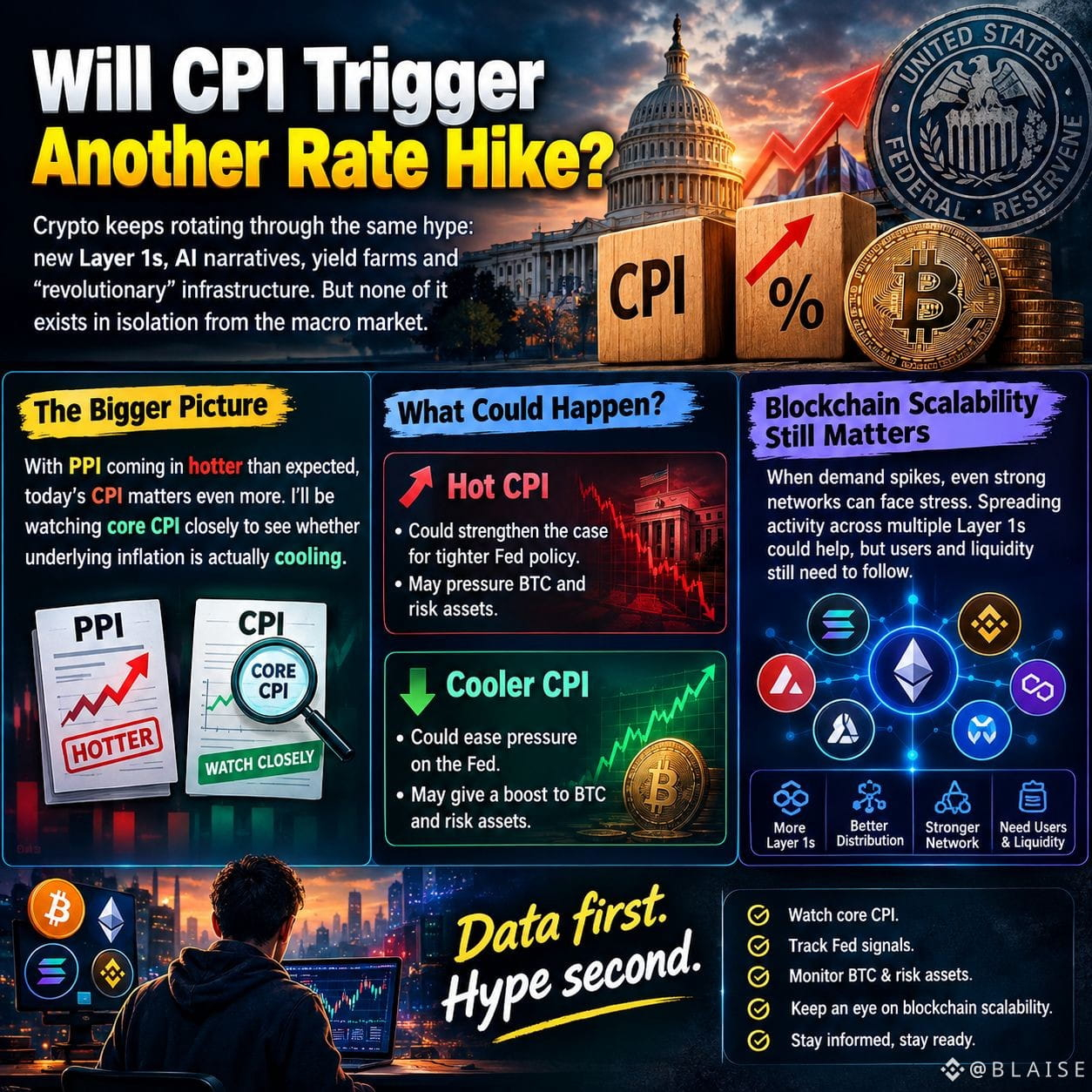
Will CPI Trigger Another Rate Hike#CPIWatch
Crypto keeps rotating through the same hype: new Layer 1s, AI narratives, yield farms and “revolutionary” infrastructure. But none of it exists in isolation from the macro market.#CPIWatch
With PPI coming in hotter than expected, today’s CPI matters even more. I’ll be watching core CPI closely to see whether underlying inflation is actually cooling.
Hot CPI could strengthen the case for tighter Fed policy and pressure BTC and risk assets. A cooler print could ease that pressure.#CPIWatch
At the same time, blockchain scalability remains important. When demand spikes, even strong networks can face stress. Spreading activity across multiple Layer 1s could help, but users and liquidity still need to follow.#CPIWatch
Data first. Hype second.
$牛来
{future}(牛来USDT)
$RAYSOL
{future}(RAYSOLUSDT)
$我踏马来了
{alpha}(560xc51a9250795c0186a6fb4a7d20a90330651e4444)
Will CPI Trigger Another Rate Hike#CPIWatch
Crypto keeps rotating through the same hype: new Layer 1s, AI narratives, yield farms and “revolutionary” infrastructure. But none of it exists in isolation from the macro market.#CPIWatch
With PPI coming in hotter than expected, today’s CPI matters even more. I’ll be watching core CPI closely to see whether underlying inflation is actually cooling.
Hot CPI could strengthen the case for tighter Fed policy and pressure BTC and risk assets. A cooler print could ease that pressure.#CPIWatch
At the same time, blockchain scalability remains important. When demand spikes, even strong networks can face stress. Spreading activity across multiple Layer 1s could help, but users and liquidity still need to follow.#CPIWatch
Data first. Hype second.
$牛来
$RAYSOL
$我踏马来了
Crypto keeps rotating through the same hype: new Layer 1s, AI narratives, yield farms and “revolutionary” infrastructure. But none of it exists in isolation from the macro market.#CPIWatch
With PPI coming in hotter than expected, today’s CPI matters even more. I’ll be watching core CPI closely to see whether underlying inflation is actually cooling.
Hot CPI could strengthen the case for tighter Fed policy and pressure BTC and risk assets. A cooler print could ease that pressure.#CPIWatch
At the same time, blockchain scalability remains important. When demand spikes, even strong networks can face stress. Spreading activity across multiple Layer 1s could help, but users and liquidity still need to follow.#CPIWatch
Data first. Hype second.
$牛来
$RAYSOL
$我踏马来了
1
1
597
·
--
翻訳参照
$KII — Breakout Watch
KII is around $0.07074, showing a strong 4.83% move. This is the kind of momentum that deserves attention if volume continues supporting it.
EP: $0.0705–$0.0710
TP1: $0.0745
TP2: $0.0780
TP3: $0.0820
SL: $0.0675
Holding the entry zone keeps the bullish structure intact. Losing the stop level invalidates the setup.
Let's go $KII
$KII — Breakout Watch
KII is around $0.07074, showing a strong 4.83% move. This is the kind of momentum that deserves attention if volume continues supporting it.
EP: $0.0705–$0.0710
TP1: $0.0745
TP2: $0.0780
TP3: $0.0820
SL: $0.0675
Holding the entry zone keeps the bullish structure intact. Losing the stop level invalidates the setup.
Let's go $KII
KII is around $0.07074, showing a strong 4.83% move. This is the kind of momentum that deserves attention if volume continues supporting it.
EP: $0.0705–$0.0710
TP1: $0.0745
TP2: $0.0780
TP3: $0.0820
SL: $0.0675
Holding the entry zone keeps the bullish structure intact. Losing the stop level invalidates the setup.
Let's go $KII
176
·
--
翻訳参照
$AIR.US — Short Momentum Setup
AIR is trading around $0.001, down 4.47%. Sellers currently have the advantage, so a continuation setup makes more sense while price remains weak.
EP: $0.00099–$0.00101
TP1: $0.00095
TP2: $0.00091
TP3: $0.00087
SL: $0.00104
If resistance continues rejecting price, downside targets become the focus. A reclaim above the stop zone would weaken the setup.
Let's go $AIR.US
$AIR.US — Short Momentum Setup
AIR is trading around $0.001, down 4.47%. Sellers currently have the advantage, so a continuation setup makes more sense while price remains weak.
EP: $0.00099–$0.00101
TP1: $0.00095
TP2: $0.00091
TP3: $0.00087
SL: $0.00104
If resistance continues rejecting price, downside targets become the focus. A reclaim above the stop zone would weaken the setup.
Let's go $AIR.US
AIR is trading around $0.001, down 4.47%. Sellers currently have the advantage, so a continuation setup makes more sense while price remains weak.
EP: $0.00099–$0.00101
TP1: $0.00095
TP2: $0.00091
TP3: $0.00087
SL: $0.00104
If resistance continues rejecting price, downside targets become the focus. A reclaim above the stop zone would weaken the setup.
Let's go $AIR.US
81
·
--
翻訳参照
$DOS — Bearish Continuation Setup
DOS is around $0.2141, down 6.41%, making it the weakest mover on the list. The setup remains bearish while sellers control the range.
EP: $0.2135–$0.2150
TP1: $0.2070
TP2: $0.2000
TP3: $0.1930
SL: $0.2220
Failure to reclaim the entry zone could open the path toward the lower targets. If price breaks above the stop, step aside.
Let's go $DOS
$DOS — Bearish Continuation Setup
DOS is around $0.2141, down 6.41%, making it the weakest mover on the list. The setup remains bearish while sellers control the range.
EP: $0.2135–$0.2150
TP1: $0.2070
TP2: $0.2000
TP3: $0.1930
SL: $0.2220
Failure to reclaim the entry zone could open the path toward the lower targets. If price breaks above the stop, step aside.
Let's go $DOS
DOS is around $0.2141, down 6.41%, making it the weakest mover on the list. The setup remains bearish while sellers control the range.
EP: $0.2135–$0.2150
TP1: $0.2070
TP2: $0.2000
TP3: $0.1930
SL: $0.2220
Failure to reclaim the entry zone could open the path toward the lower targets. If price breaks above the stop, step aside.
Let's go $DOS
420
·
--
翻訳参照
DEBIT is sitting around $1.6173, down 9.26%. After this sharp pullback, this is the zone I’d watch for a recovery attempt rather than chasing the move.
EP: $1.60–$1.63
TP1: $1.70
TP2: $1.82
TP3: $1.95
SL: $1.52
A clean reclaim above the entry zone could bring buyers back quickly.
Let's go $DEBIT
DEBIT is sitting around $1.6173, down 9.26%. After this sharp pullback, this is the zone I’d watch for a recovery attempt rather than chasing the move.
EP: $1.60–$1.63
TP1: $1.70
TP2: $1.82
TP3: $1.95
SL: $1.52
A clean reclaim above the entry zone could bring buyers back quickly.
Let's go $DEBIT
EP: $1.60–$1.63
TP1: $1.70
TP2: $1.82
TP3: $1.95
SL: $1.52
A clean reclaim above the entry zone could bring buyers back quickly.
Let's go $DEBIT
1
175
·
--
翻訳参照
TMX has taken a serious hit, trading near $0.05703 and down 21.94%. That makes this a high-risk setup, but a strong bounce from support could turn the momentum around.
EP: $0.0565–$0.0580
TP1: $0.0610
TP2: $0.0660
TP3: $0.0720
SL: $0.0520
Volatility is high here, so risk management matters.
Let's go $TMX
TMX has taken a serious hit, trading near $0.05703 and down 21.94%. That makes this a high-risk setup, but a strong bounce from support could turn the momentum around.
EP: $0.0565–$0.0580
TP1: $0.0610
TP2: $0.0660
TP3: $0.0720
SL: $0.0520
Volatility is high here, so risk management matters.
Let's go $TMX
EP: $0.0565–$0.0580
TP1: $0.0610
TP2: $0.0660
TP3: $0.0720
SL: $0.0520
Volatility is high here, so risk management matters.
Let's go $TMX
2
350
·
--
$MOVR は4.34%の値動きで注目を集め、0.8503付近で取引されています。これは、継続によって価格が次のレジスタンス・ゾーンへ向かう可能性があるモメンタムのセットアップです。
EP: 0.8503
TP1: 0.8850
TP2: 0.9200
TP3: 0.9600
SL: 0.8150
エントリー・ゾーンが維持される限り、買い手にはこの水準をさらに押し上げる余地があります。
さあMOVR.#YenBreaks155NearingYearHigh #CanadaToImpose15%To50%TariffsOnUSGoods #IMFSaysElSalvadorBTCNoPublicFunds
$MOVR は4.34%の値動きで注目を集め、0.8503付近で取引されています。これは、継続によって価格が次のレジスタンス・ゾーンへ向かう可能性があるモメンタムのセットアップです。
EP: 0.8503
TP1: 0.8850
TP2: 0.9200
TP3: 0.9600
SL: 0.8150
エントリー・ゾーンが維持される限り、買い手にはこの水準をさらに押し上げる余地があります。
さあMOVR.#YenBreaks155NearingYearHigh #CanadaToImpose15%To50%TariffsOnUSGoods #IMFSaysElSalvadorBTCNoPublicFunds
EP: 0.8503
TP1: 0.8850
TP2: 0.9200
TP3: 0.9600
SL: 0.8150
エントリー・ゾーンが維持される限り、買い手にはこの水準をさらに押し上げる余地があります。
さあMOVR.#YenBreaks155NearingYearHigh #CanadaToImpose15%To50%TariffsOnUSGoods #IMFSaysElSalvadorBTCNoPublicFunds
304
·
--
$ZRO は4.28%の上昇で押し上げられており、1.1276付近で推移しています。買い手ははっきりと活発で、現在のゾーンを上抜けてくれば次の目標に向けた道が開かれる可能性があります。
EP: 1.1276
TP1: 1.1700
TP2: 1.2150
TP3: 1.2600
SL: 1.0850
価格がエントリーエリアを尊重している限り、このセットアップは引き続き注目に値します。突発的な足を追いかけるのではなく、市場に動きを確認させましょう。
Let's go ZRO.#YenBreaks155NearingYearHigh #ZcashRises45%WeeklyToHighestSince2016 #RussiaUkraineTradeStrikesKushnerWitkoffToKyiv
$ZRO は4.28%の上昇で押し上げられており、1.1276付近で推移しています。買い手ははっきりと活発で、現在のゾーンを上抜けてくれば次の目標に向けた道が開かれる可能性があります。
EP: 1.1276
TP1: 1.1700
TP2: 1.2150
TP3: 1.2600
SL: 1.0850
価格がエントリーエリアを尊重している限り、このセットアップは引き続き注目に値します。突発的な足を追いかけるのではなく、市場に動きを確認させましょう。
Let's go ZRO.#YenBreaks155NearingYearHigh #ZcashRises45%WeeklyToHighestSince2016 #RussiaUkraineTradeStrikesKushnerWitkoffToKyiv
EP: 1.1276
TP1: 1.1700
TP2: 1.2150
TP3: 1.2600
SL: 1.0850
価格がエントリーエリアを尊重している限り、このセットアップは引き続き注目に値します。突発的な足を追いかけるのではなく、市場に動きを確認させましょう。
Let's go ZRO.#YenBreaks155NearingYearHigh #ZcashRises45%WeeklyToHighestSince2016 #RussiaUkraineTradeStrikesKushnerWitkoffToKyiv
107
·
--
翻訳参照
$USTC is also showing solid momentum, up around 4.25% and trading near 0.00563. If buyers maintain control, this could attempt another push toward the higher levels.
EP: 0.00563
TP1: 0.00585
TP2: 0.00610
TP3: 0.00640
SL: 0.00542
Momentum is the trigger here. Hold the structure, respect the stop, and let the trade develop.
Let's go USTC.#USIranTradeTankerStrikesEscalate
$USTC is also showing solid momentum, up around 4.25% and trading near 0.00563. If buyers maintain control, this could attempt another push toward the higher levels.
EP: 0.00563
TP1: 0.00585
TP2: 0.00610
TP3: 0.00640
SL: 0.00542
Momentum is the trigger here. Hold the structure, respect the stop, and let the trade develop.
Let's go USTC.#USIranTradeTankerStrikesEscalate
EP: 0.00563
TP1: 0.00585
TP2: 0.00610
TP3: 0.00640
SL: 0.00542
Momentum is the trigger here. Hold the structure, respect the stop, and let the trade develop.
Let's go USTC.#USIranTradeTankerStrikesEscalate
206
·
--
翻訳参照
RNBW is up +39.60% and showing serious momentum. The key is whether buyers can hold the breakout zone.
EP: 0.03550
TP: 0.03850 / 0.04150 / 0.04500
SL: 0.03280
A strong hold could trigger another leg higher. Watch volume.
Let's go $RNBW
{alpha}(84530xa53887f7e7c1bf5010b8627f1c1ba94fe7a5d6e0)
#USIranTradeTankerStrikesEscalate #SideSwapSuspendsLiquidServices #USStrikesIranTankersTehranRestrictsHormuz
RNBW is up +39.60% and showing serious momentum. The key is whether buyers can hold the breakout zone.
EP: 0.03550
TP: 0.03850 / 0.04150 / 0.04500
SL: 0.03280
A strong hold could trigger another leg higher. Watch volume.
Let's go $RNBW
#USIranTradeTankerStrikesEscalate #SideSwapSuspendsLiquidServices #USStrikesIranTankersTehranRestrictsHormuz
EP: 0.03550
TP: 0.03850 / 0.04150 / 0.04500
SL: 0.03280
A strong hold could trigger another leg higher. Watch volume.
Let's go $RNBW
#USIranTradeTankerStrikesEscalate #SideSwapSuspendsLiquidServices #USStrikesIranTankersTehranRestrictsHormuz
100
·
--
翻訳参照
$NYM is gaining +38.02% with aggressive buying pressure. The trend remains bullish while support holds.
EP: 0.02780
TP: 0.03000 / 0.03250 / 0.03500
SL: 0.02580
If buyers maintain control, another breakout attempt could come.
Let's go $NYM.ETF
{etf_us}(NYM.ETF)
#USIranTradeTankerStrikesEscalate #SideSwapSuspendsLiquidServices
$NYM is gaining +38.02% with aggressive buying pressure. The trend remains bullish while support holds.
EP: 0.02780
TP: 0.03000 / 0.03250 / 0.03500
SL: 0.02580
If buyers maintain control, another breakout attempt could come.
Let's go $NYM.ETF
#USIranTradeTankerStrikesEscalate #SideSwapSuspendsLiquidServices
EP: 0.02780
TP: 0.03000 / 0.03250 / 0.03500
SL: 0.02580
If buyers maintain control, another breakout attempt could come.
Let's go $NYM.ETF
#USIranTradeTankerStrikesEscalate #SideSwapSuspendsLiquidServices
57
·
--
翻訳参照
$PRAI is up +36.96% and catching momentum traders' attention. Buyers need to defend the current zone.
EP: 0.000704
TP: 0.000760 / 0.000820 / 0.000900
SL: 0.000660
Hold support and continuation remains possible. Risk management is key.
Let's go $PRAI #ZcashRises45%WeeklyToHighestSince2016 #SideSwapSuspendsLiquidServices
$PRAI is up +36.96% and catching momentum traders' attention. Buyers need to defend the current zone.
EP: 0.000704
TP: 0.000760 / 0.000820 / 0.000900
SL: 0.000660
Hold support and continuation remains possible. Risk management is key.
Let's go $PRAI #ZcashRises45%WeeklyToHighestSince2016 #SideSwapSuspendsLiquidServices
EP: 0.000704
TP: 0.000760 / 0.000820 / 0.000900
SL: 0.000660
Hold support and continuation remains possible. Risk management is key.
Let's go $PRAI #ZcashRises45%WeeklyToHighestSince2016 #SideSwapSuspendsLiquidServices
75
·
--
ブリッシュ
翻訳参照
I’ve been looking at Dusk differently lately.
#dusk @Dusk_Foundation
At first, I thought DuskEVM was mainly about bringing EVM compatibility to Dusk. But the more I looked, the more interesting the bigger picture became.
Crypto already has enough “next big L1” projects claiming to be faster, cheaper and more scalable. The real test starts when actual users and traffic arrive.
That’s why Dusk stands out to me.
It’s not just chasing TPS. The focus is on privacy and financial infrastructure, with use cases around tokenized assets, DeFi, lending and regulated financial applications.
DuskEVM also lets developers use familiar Solidity and EVM tools, while Hedger enables private yet verifiable transaction amounts. Chainlink CCIP can further help connect assets across different chains.
I’m still skeptical because good technology doesn’t guarantee adoption.
But the thesis is interesting.
Now I’m more curious about one thing:
What will people actually build on DuskEVM once mainnet arrives?
$ONG
{future}(ONGUSDT)
$NEIRO
{future}(NEIROUSDT)
$DUSK #dusk @Dusk_Foundation
I’ve been looking at Dusk differently lately.
#dusk @Dusk
At first, I thought DuskEVM was mainly about bringing EVM compatibility to Dusk. But the more I looked, the more interesting the bigger picture became.
Crypto already has enough “next big L1” projects claiming to be faster, cheaper and more scalable. The real test starts when actual users and traffic arrive.
That’s why Dusk stands out to me.
It’s not just chasing TPS. The focus is on privacy and financial infrastructure, with use cases around tokenized assets, DeFi, lending and regulated financial applications.
DuskEVM also lets developers use familiar Solidity and EVM tools, while Hedger enables private yet verifiable transaction amounts. Chainlink CCIP can further help connect assets across different chains.
I’m still skeptical because good technology doesn’t guarantee adoption.
But the thesis is interesting.
Now I’m more curious about one thing:
What will people actually build on DuskEVM once mainnet arrives?
$ONG
$NEIRO
$DUSK #dusk @Dusk
#dusk @Dusk
At first, I thought DuskEVM was mainly about bringing EVM compatibility to Dusk. But the more I looked, the more interesting the bigger picture became.
Crypto already has enough “next big L1” projects claiming to be faster, cheaper and more scalable. The real test starts when actual users and traffic arrive.
That’s why Dusk stands out to me.
It’s not just chasing TPS. The focus is on privacy and financial infrastructure, with use cases around tokenized assets, DeFi, lending and regulated financial applications.
DuskEVM also lets developers use familiar Solidity and EVM tools, while Hedger enables private yet verifiable transaction amounts. Chainlink CCIP can further help connect assets across different chains.
I’m still skeptical because good technology doesn’t guarantee adoption.
But the thesis is interesting.
Now I’m more curious about one thing:
What will people actually build on DuskEVM once mainnet arrives?
$ONG
$NEIRO
$DUSK #dusk @Dusk
🟢Yes_NPEX is real traction
0%
🔴No_thin proo, high risk
100%
🟡Too early to call
0%
1 投票 • 投票は終了しました
1
4
93
·
--
ブリッシュ
翻訳参照
#dusk @Dusk_Foundation
I’m honestly tired of the “next big Layer 1” narrative.
Every new chain promises faster, cheaper, scalable infrastructure, but the real test starts when actual users and liquidity show up.@Dusk_Foundation
That’s why Dusk catches my attention. It’s not trying to be another generic everything-chain. It’s focused on privacy and financial applications, with confidential smart contracts and its XSC standard.
But the January incident is also worth watching. Dusk’s Jan. 17 notice said monitoring flagged unusual activity involving a team-managed wallet, bridge services were paused, addresses were recycled, and no user funds were impacted. Other trackers described unauthorized activity draining DUSK through the Dusk-to-EVM bridge.
Same event, very different framing.
For me, the interesting part isn’t just the incident. It’s how a privacy-focused Layer 1 handles disclosure when the bridge—the least core part of the stack—gets touched.
I’m cautiously interested in Dusk, but adoption is the real test.
Good infrastructure only matters if people actually show up.
$AVAAI
{alpha}(CT_501DKu9kykSfbN5LBfFXtNNDPaX35o4Fv6vJ9FKk7pZpump)
$VELO
{alpha}(560xf486ad071f3bee968384d2e39e2d8af0fcf6fd46)
$DUSK
{future}(DUSKUSDT)
#dusk @Dusk_Foundation
#dusk @Dusk
I’m honestly tired of the “next big Layer 1” narrative.
Every new chain promises faster, cheaper, scalable infrastructure, but the real test starts when actual users and liquidity show up.@Dusk
That’s why Dusk catches my attention. It’s not trying to be another generic everything-chain. It’s focused on privacy and financial applications, with confidential smart contracts and its XSC standard.
But the January incident is also worth watching. Dusk’s Jan. 17 notice said monitoring flagged unusual activity involving a team-managed wallet, bridge services were paused, addresses were recycled, and no user funds were impacted. Other trackers described unauthorized activity draining DUSK through the Dusk-to-EVM bridge.
Same event, very different framing.
For me, the interesting part isn’t just the incident. It’s how a privacy-focused Layer 1 handles disclosure when the bridge—the least core part of the stack—gets touched.
I’m cautiously interested in Dusk, but adoption is the real test.
Good infrastructure only matters if people actually show up.
$AVAAI
$VELO
$DUSK
#dusk @Dusk
I’m honestly tired of the “next big Layer 1” narrative.
Every new chain promises faster, cheaper, scalable infrastructure, but the real test starts when actual users and liquidity show up.@Dusk
That’s why Dusk catches my attention. It’s not trying to be another generic everything-chain. It’s focused on privacy and financial applications, with confidential smart contracts and its XSC standard.
But the January incident is also worth watching. Dusk’s Jan. 17 notice said monitoring flagged unusual activity involving a team-managed wallet, bridge services were paused, addresses were recycled, and no user funds were impacted. Other trackers described unauthorized activity draining DUSK through the Dusk-to-EVM bridge.
Same event, very different framing.
For me, the interesting part isn’t just the incident. It’s how a privacy-focused Layer 1 handles disclosure when the bridge—the least core part of the stack—gets touched.
I’m cautiously interested in Dusk, but adoption is the real test.
Good infrastructure only matters if people actually show up.
$AVAAI
$VELO
$DUSK
#dusk @Dusk
MRNAon Takes Lead
0%
牛来 Shows Strength
80%
Biggest Winner Today
20%
Who Wins Next
0%
5 投票 • 投票は終了しました
3
1.1k
·
--
#TermMax @termmax
また別の日、また別の「次の大物チェーン」。Crypto$SKYAI は同じ話をリサイクルするのが本当に上手ですね。
TermMaxには目が引かれますが、宣伝を盲信するつもりはありません。分散型の固定金利による借り入れ・貸し出し・オプションのプロトコル@termmax として、そのアイデアは筋が通っています。実際の金融ツールこそが重要で、別のAIのバズワードやアニメ系の利回りファームは二の次です。
そして、スケーラビリティは技術がダメだからだけじゃありません。$MRNAon Trafficはブロックチェーンも壊します。Solanaはスムーズに感じることが多いですが、大きな需要が来るとそれでも限界が露呈する可能性があります。だから、複数のチェーンにまたがって活動を分散するのが理にかなっています。
とはいえ、難しいのは導入です。インフラが存在するだけで、ユーザーや流動性が動くわけではありません。TermMaxは、人々が本当に使いたいと思うものだと証明しなければならない。
慎重に期待していますが、仮想通貨は実行を待つべきだと教えてくれました。約束よりも、実際の成果を。
うまくいくかもしれない。あるいは、誰も来ない。
$CYS
{future}(CYSUSDT)
#TermMax @TermMax
また別の日、また別の「次の大物チェーン」。Crypto$SKYAI は同じ話をリサイクルするのが本当に上手ですね。
TermMaxには目が引かれますが、宣伝を盲信するつもりはありません。分散型の固定金利による借り入れ・貸し出し・オプションのプロトコル@TermMax として、そのアイデアは筋が通っています。実際の金融ツールこそが重要で、別のAIのバズワードやアニメ系の利回りファームは二の次です。
そして、スケーラビリティは技術がダメだからだけじゃありません。$MRNAon Trafficはブロックチェーンも壊します。Solanaはスムーズに感じることが多いですが、大きな需要が来るとそれでも限界が露呈する可能性があります。だから、複数のチェーンにまたがって活動を分散するのが理にかなっています。
とはいえ、難しいのは導入です。インフラが存在するだけで、ユーザーや流動性が動くわけではありません。TermMaxは、人々が本当に使いたいと思うものだと証明しなければならない。
慎重に期待していますが、仮想通貨は実行を待つべきだと教えてくれました。約束よりも、実際の成果を。
うまくいくかもしれない。あるいは、誰も来ない。
$CYS
また別の日、また別の「次の大物チェーン」。Crypto$SKYAI は同じ話をリサイクルするのが本当に上手ですね。
TermMaxには目が引かれますが、宣伝を盲信するつもりはありません。分散型の固定金利による借り入れ・貸し出し・オプションのプロトコル@TermMax として、そのアイデアは筋が通っています。実際の金融ツールこそが重要で、別のAIのバズワードやアニメ系の利回りファームは二の次です。
そして、スケーラビリティは技術がダメだからだけじゃありません。$MRNAon Trafficはブロックチェーンも壊します。Solanaはスムーズに感じることが多いですが、大きな需要が来るとそれでも限界が露呈する可能性があります。だから、複数のチェーンにまたがって活動を分散するのが理にかなっています。
とはいえ、難しいのは導入です。インフラが存在するだけで、ユーザーや流動性が動くわけではありません。TermMaxは、人々が本当に使いたいと思うものだと証明しなければならない。
慎重に期待していますが、仮想通貨は実行を待つべきだと教えてくれました。約束よりも、実際の成果を。
うまくいくかもしれない。あるいは、誰も来ない。
$CYS
Higher TVL🔘
33%
More active loans🔘
0%
Stronger protocol revenue🔘
50%
All three growing together🔘
17%
6 投票 • 投票は終了しました
4
10
915
ログインして、さらにコンテンツを読む
厳選トピックで世界の暗号資産トレーダーの仲間入り
⚡️ 暗号資産に関する最新かつ有益な情報が見つかります。
💬 世界最大の暗号資産取引所から信頼されています。
👍 認証を受けたクリエイターから、有益なインサイトを得られます。
メール / 電話番号
トレンドトピック
FedRateWatch
閲覧回数 329,462
1,966人が討論中
トレンドハッシュタグキャンペーンで「シェア&ウィン」交通(トラフィック)報酬を獲得しよう
✨トピック:FOMC 9月、「次のFRBの一手」は?
👉参加方法:
ハッシュタグ #FedRateWatch を付けて短い投稿または記事を投稿してください
以下の観点に基づいてコンテンツを作成してください:
- 8月のコアCPIは前月比0.3%上昇し、今週の25bp利上げの確率は現在約90%です。今週、利上げはあると思いますか?それは一時的なものですか、それともより長い利上げサイクルの始まりでしょうか?
- 利上げが実施された場合、BTC、テック株、ゴールドはどのように動きますか?強気(ブル)か弱気(ベア)か?
- 次の取引はどう計画していますか?取引共有ウィジェットを使って、BTC、株、またはゴールドの取引/保有を共有してください。
⏰キャンペーン期間:
- 2026-09-15 11:00 - 2026-09-17 3:00 UTC
🎁報酬:
- 上記のガイドラインを満たし、かつ100語を超える適格な投稿は審査され、抽選で500〜3,000ビューのランダムなトラフィック増加が付与される場合があります。投稿が選ばれた場合、フィードの事務局から通知が届きます。
- 記事がBinance Square Officialで特集されるチャンス
投稿のアイデアが必要ですか?トピックページ #FedRateWatch へアクセスするか、 Square Guide on How to Post for Better Reach をご覧ください。
Binance Square Official
·いいね:328件
·閲覧回数 604.9k
BitcoinSlidesTo$76000
閲覧回数 6,257
74人が討論中
BitcoinReboundsTo$79K
閲覧回数 53,916
371人が討論中