
Asif_Web 3 Player
7 投稿

Asif_Web 3 Player
報告
ユーザーをブロック
Little bit crypto expert, Learning, Earning and sharing 😁
2 フォロー
0 フォロワー
0 いいね
投稿
翻訳参照
Bitcoin at $58K. Still Scared?
BTC is down 54% from its $126K ATH.
Everyone is panicking again.
But remember:
BTC was $16K in 2022. People said it's dead.
BTC was $60K in 2021. People said it's dead.
BTC is $58K now. People are saying it again.
Bitcoin doesn't die. Weak hands do.
$55K is the key support.
Hold it = bounce to $64K
Lose it = $52K is next.
Are you buying fear or selling it?
#bitcoin #BTC #crypto
5
翻訳参照
#dusk $DUSK @Dusk_Foundation
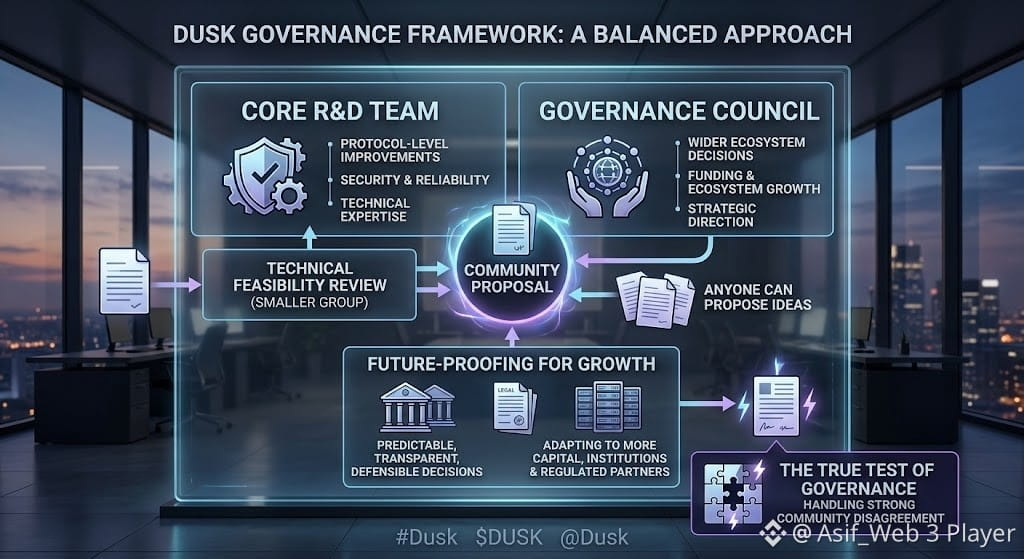
One thing I find genuinely interesting about @Dusk_Foundation is how its governance is split between two different roles.
The Core R&D Team focuses on protocol-level improvements, while the Governance Council handles the wider ecosystem — from funding decisions to broader network matters.
On paper, that separation makes a lot of sense.
But there’s a deeper question underneath it: how decentralized is a system when anyone can propose an idea, but a relatively small group ultimately decides whether the proposal is technically good enough to move forward?
That doesn’t necessarily mean the model is flawed. Technical expertise has to matter, especially when changes can affect the security and reliability of a network.
What I’m more curious about is how this balance evolves as Dusk grows.
As more capital, institutions and regulated partners become connected to the ecosystem, governance decisions may need to be not only technically sound, but also predictable, transparent and defensible.
I think the real test of Dusk’s governance won’t come from the easy decisions.
It’ll come when the community strongly disagrees on a difficult one.
That’s when the structure on paper becomes real governance.
Watching how Dusk handles that evolution could be one of the more interesting parts of the network’s journey.$AAPLB
#dusk $DUSK @Dusk
One thing I find genuinely interesting about @Dusk is how its governance is split between two different roles.
The Core R&D Team focuses on protocol-level improvements, while the Governance Council handles the wider ecosystem — from funding decisions to broader network matters.
On paper, that separation makes a lot of sense.
But there’s a deeper question underneath it: how decentralized is a system when anyone can propose an idea, but a relatively small group ultimately decides whether the proposal is technically good enough to move forward?
That doesn’t necessarily mean the model is flawed. Technical expertise has to matter, especially when changes can affect the security and reliability of a network.
What I’m more curious about is how this balance evolves as Dusk grows.
As more capital, institutions and regulated partners become connected to the ecosystem, governance decisions may need to be not only technically sound, but also predictable, transparent and defensible.
I think the real test of Dusk’s governance won’t come from the easy decisions.
It’ll come when the community strongly disagrees on a difficult one.
That’s when the structure on paper becomes real governance.
Watching how Dusk handles that evolution could be one of the more interesting parts of the network’s journey.$AAPLB
60
翻訳参照
#dusk $DUSK @Dusk_Foundation
One detail about @Dusk_Foundation transaction design really stands out to me: execution isn’t treated as something that happens for free.
When a transaction is processed, the system has to verify the rules, execute contract logic, handle deployments or calls, and account for the computation involved. That’s where $DUSK gas becomes more than just another network fee — it connects transaction costs with the resources actually being consumed.
I think that’s an important principle for a scalable execution layer. But it also raises an interesting question: as transactions become more sophisticated, can computational pricing stay transparent and predictable for users?
Efficient resource accounting is great, but if understanding the cost becomes too complicated, does that create a new UX challenge?
That balance could be one of the most interesting parts of Dusk’s execution model.
#dusk
#dusk $DUSK @Dusk
One detail about @Dusk transaction design really stands out to me: execution isn’t treated as something that happens for free.
When a transaction is processed, the system has to verify the rules, execute contract logic, handle deployments or calls, and account for the computation involved. That’s where $DUSK gas becomes more than just another network fee — it connects transaction costs with the resources actually being consumed.
I think that’s an important principle for a scalable execution layer. But it also raises an interesting question: as transactions become more sophisticated, can computational pricing stay transparent and predictable for users?
Efficient resource accounting is great, but if understanding the cost becomes too complicated, does that create a new UX challenge?
That balance could be one of the most interesting parts of Dusk’s execution model.
#dusk
64
翻訳参照
Celebrating 9 years of Binance innovation! All 9 landmarks unlocked. Ready to conquer the next chapters of this amazing crypto revolution. #BinanceTurns9
Celebrating 9 years of Binance innovation! All 9 landmarks unlocked. Ready to conquer the next chapters of this amazing crypto revolution. #BinanceTurns9
52
ログインして、さらにコンテンツを読む
厳選トピックで世界の暗号資産トレーダーの仲間入り
⚡️ 暗号資産に関する最新かつ有益な情報が見つかります。
💬 世界最大の暗号資産取引所から信頼されています。
👍 認証を受けたクリエイターから、有益なインサイトを得られます。
メール / 電話番号