

Anas btt
7.7k 投稿

Anas btt
報告
ユーザーをブロック
取引を発注
高頻度トレーダー
2.8年
330 フォロー
573 フォロワー
793 いいね
投稿
ポートフォリオ
すべて
引用
PINNED
·
--
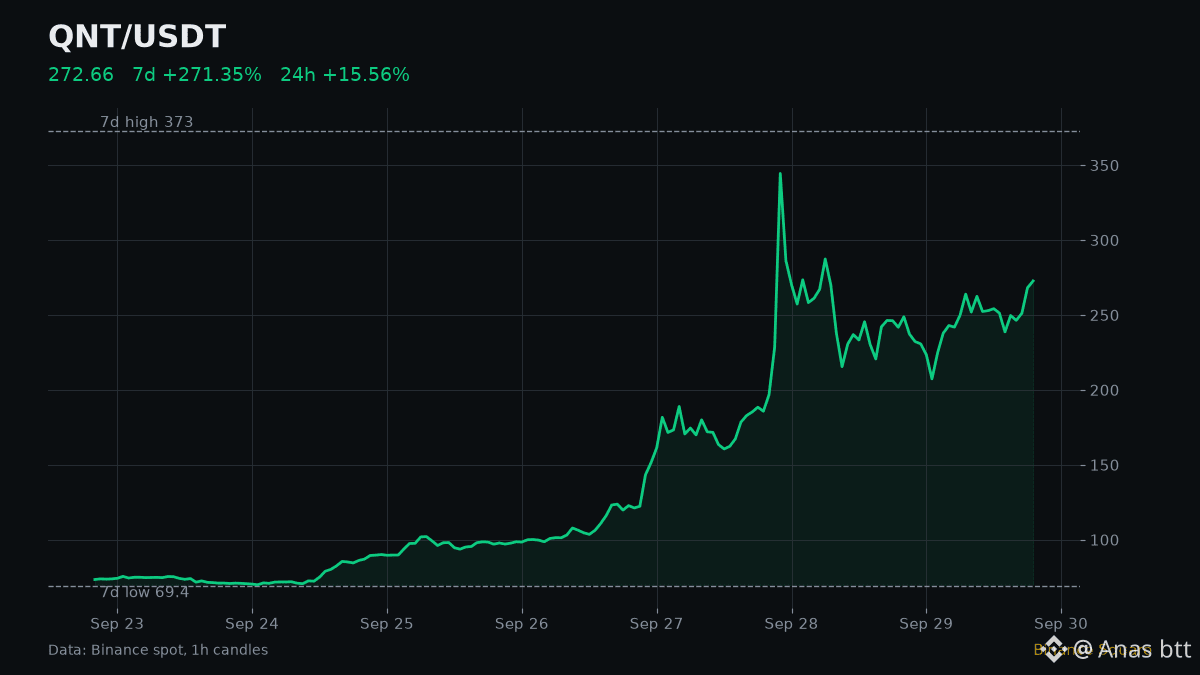
$QNT は7日で271%上昇しています。7日安値の69.4から高値の373まで到達し、現在は272.66で取引されています。
私が何度も立ち返るのは出来高です。直近24時間の売買代金(ターンオーバー)は約153.9M USDTで、7日平均の1.9倍です。この平均にはすでに上昇の全期間が含まれているため、買い手はまだ離れていません。
また、直近24時間で15.6%上昇した一方で、$BTC はわずか0.35%しか動いていません。これはそれ自体の物語であり、市場全体が押し上げたわけではありません。
それでも価格は高値373から26.9%下にあり、チャートではその急騰が短かったこと、そして大きく売られていることが示されています。時間足RSIは61で、極端に過熱というわけではありません。
私の見立て:強さは尊重しますが、1週間で271%も上がったコインは追いかけません。まだ取引はしません。
強気材料:出来高が平均の約2倍の水準を保ったまま、373を上回って維持すること。
慎重材料:およそ236を再び割り込むことです。そこは24時間前に価格があった水準です。そこまで下がれば今日の上昇分が打ち消され、需要の減退を示します。
Fear & Greedが73を示しており、群衆はすでに強く乗り込んでいます。次は、高値への次のテストで出来高が維持されるかどうかを見ます。
$QNT は7日で271%上昇しています。7日安値の69.4から高値の373まで到達し、現在は272.66で取引されています。
私が何度も立ち返るのは出来高です。直近24時間の売買代金(ターンオーバー)は約153.9M USDTで、7日平均の1.9倍です。この平均にはすでに上昇の全期間が含まれているため、買い手はまだ離れていません。
また、直近24時間で15.6%上昇した一方で、$BTC はわずか0.35%しか動いていません。これはそれ自体の物語であり、市場全体が押し上げたわけではありません。
それでも価格は高値373から26.9%下にあり、チャートではその急騰が短かったこと、そして大きく売られていることが示されています。時間足RSIは61で、極端に過熱というわけではありません。
私の見立て:強さは尊重しますが、1週間で271%も上がったコインは追いかけません。まだ取引はしません。
強気材料:出来高が平均の約2倍の水準を保ったまま、373を上回って維持すること。
慎重材料:およそ236を再び割り込むことです。そこは24時間前に価格があった水準です。そこまで下がれば今日の上昇分が打ち消され、需要の減退を示します。
Fear & Greedが73を示しており、群衆はすでに強く乗り込んでいます。次は、高値への次のテストで出来高が維持されるかどうかを見ます。
私が何度も立ち返るのは出来高です。直近24時間の売買代金(ターンオーバー)は約153.9M USDTで、7日平均の1.9倍です。この平均にはすでに上昇の全期間が含まれているため、買い手はまだ離れていません。
また、直近24時間で15.6%上昇した一方で、$BTC はわずか0.35%しか動いていません。これはそれ自体の物語であり、市場全体が押し上げたわけではありません。
それでも価格は高値373から26.9%下にあり、チャートではその急騰が短かったこと、そして大きく売られていることが示されています。時間足RSIは61で、極端に過熱というわけではありません。
私の見立て:強さは尊重しますが、1週間で271%も上がったコインは追いかけません。まだ取引はしません。
強気材料:出来高が平均の約2倍の水準を保ったまま、373を上回って維持すること。
慎重材料:およそ236を再び割り込むことです。そこは24時間前に価格があった水準です。そこまで下がれば今日の上昇分が打ち消され、需要の減退を示します。
Fear & Greedが73を示しており、群衆はすでに強く乗り込んでいます。次は、高値への次のテストで出来高が維持されるかどうかを見ます。
1
509
·
--
翻訳参照
🚀 Can You Predict the Market Before Everyone Else?🔥
The crypto market never sleeps! 📈📉 Every price movement brings new opportunities, but making smart predictions requires research, patience, and strategy.
🎯 Binance Pick brings a new way to explore prediction markets and test your market knowledge.
💡 Here's my approach:
✅ Analyze market trends before predicting.
✅ Follow the latest crypto news.
✅ Never rely on emotions alone.
✅ Learn from every prediction, whether right or wrong.
🏆 The goal isn't just to predict correctly — it's to become a smarter market observer!
💬 What do you think Bitcoin will do next: 🚀 Bullish or 🐻 Bearish?
Drop your prediction below! 👇
#BinancePick #Binance #bitcoin #crypto #MarketPredictions
🚀 Can You Predict the Market Before Everyone Else?🔥
The crypto market never sleeps! 📈📉 Every price movement brings new opportunities, but making smart predictions requires research, patience, and strategy.
🎯 Binance Pick brings a new way to explore prediction markets and test your market knowledge.
💡 Here's my approach:
✅ Analyze market trends before predicting.
✅ Follow the latest crypto news.
✅ Never rely on emotions alone.
✅ Learn from every prediction, whether right or wrong.
🏆 The goal isn't just to predict correctly — it's to become a smarter market observer!
💬 What do you think Bitcoin will do next: 🚀 Bullish or 🐻 Bearish?
Drop your prediction below! 👇
#BinancePick #Binance #bitcoin #crypto #MarketPredictions
The crypto market never sleeps! 📈📉 Every price movement brings new opportunities, but making smart predictions requires research, patience, and strategy.
🎯 Binance Pick brings a new way to explore prediction markets and test your market knowledge.
💡 Here's my approach:
✅ Analyze market trends before predicting.
✅ Follow the latest crypto news.
✅ Never rely on emotions alone.
✅ Learn from every prediction, whether right or wrong.
🏆 The goal isn't just to predict correctly — it's to become a smarter market observer!
💬 What do you think Bitcoin will do next: 🚀 Bullish or 🐻 Bearish?
Drop your prediction below! 👇
#BinancePick #Binance #bitcoin #crypto #MarketPredictions

3
·
--
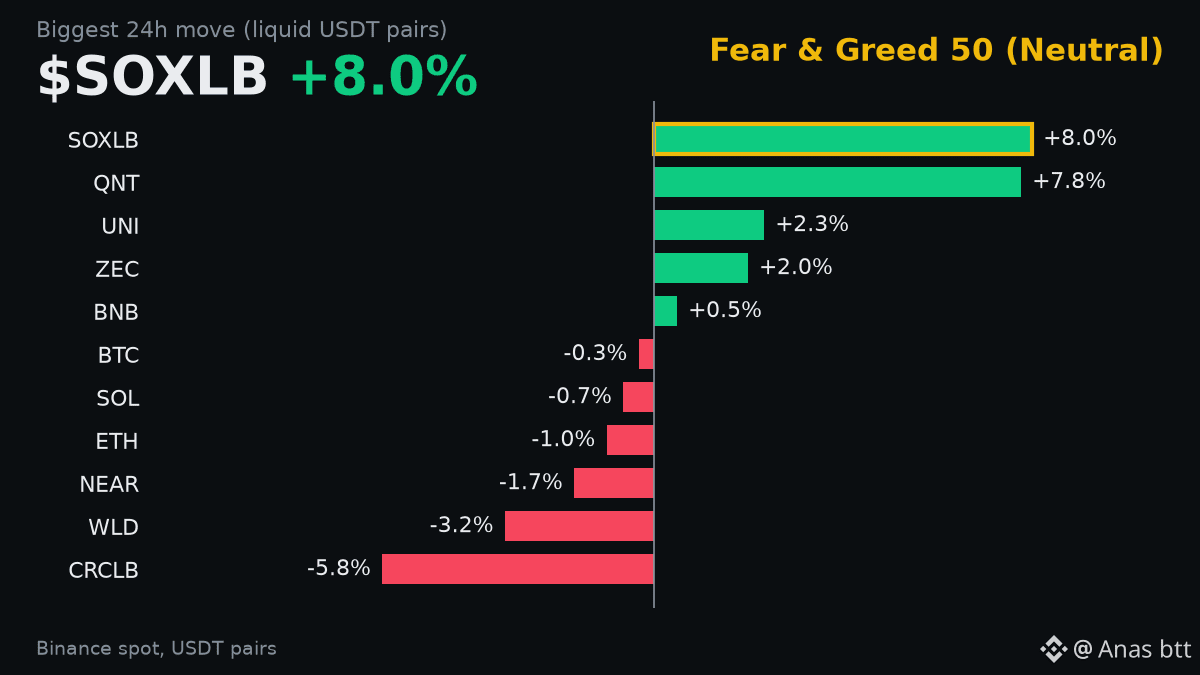
$SOXLB は過去24時間で8.024%上昇し、現在は$92.22で取引されています。これにより、本日の上昇率トップとなりました。しかし、この上昇は24時間の取引高が$29.413 millionの状況で起きています。ブレイクアウトが力強いと判断するには、特に$BTC や$ETH のような主要コインがほぼ横ばいのときは、取引高の大幅な増加による裏付けを確認したいところです。この値動きについては中立的に見ています。本格的な買い意欲を確認するため、今日の水準を上回る取引高の持続的な増加を注視しています。
#レバレッジトークン
$SOXLB は過去24時間で8.024%上昇し、現在は$92.22で取引されています。これにより、本日の上昇率トップとなりました。しかし、この上昇は24時間の取引高が$29.413 millionの状況で起きています。ブレイクアウトが力強いと判断するには、特に$BTC や$ETH のような主要コインがほぼ横ばいのときは、取引高の大幅な増加による裏付けを確認したいところです。この値動きについては中立的に見ています。本格的な買い意欲を確認するため、今日の水準を上回る取引高の持続的な増加を注視しています。
#レバレッジトークン
#レバレッジトークン
113
·
--
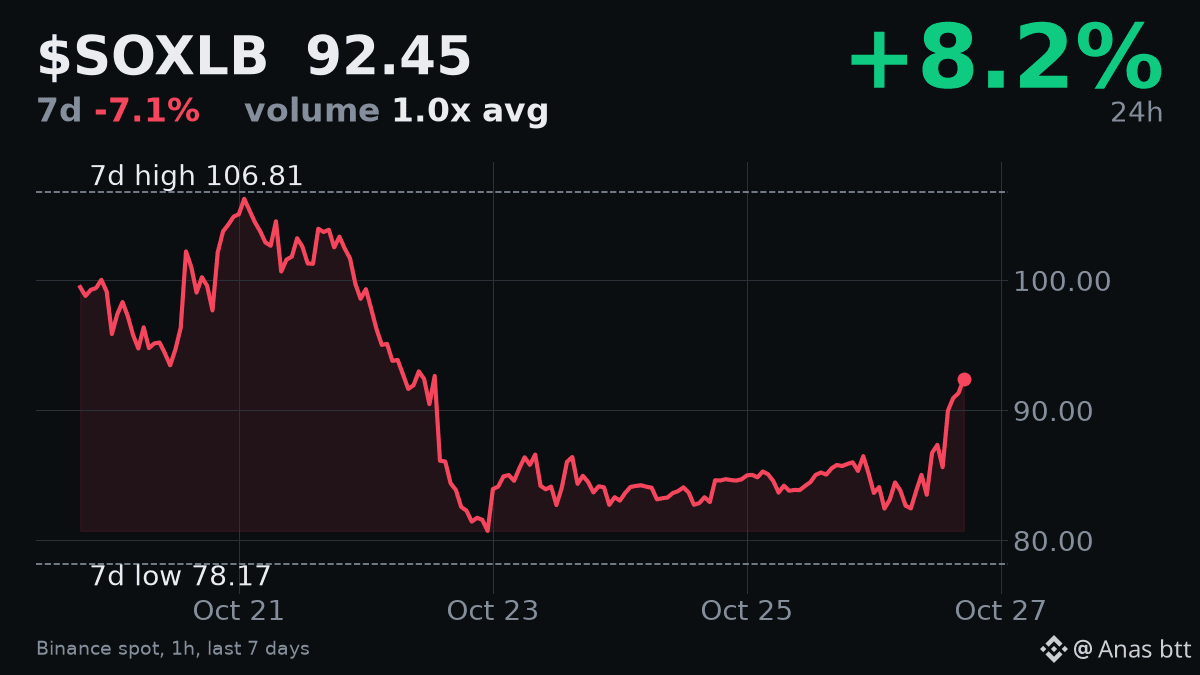
$SOXLB は過去24時間で8.205%上昇しましたが、7日間の最高値である$106.81を13.444%下回っています。7日間の最安値$78.17からの力強い反発により、相対力指数(RSI)は70.1に達しました。
直近の値動きは大きいものの、出来高は7日平均の0.979倍にとどまっており、この急速な上昇を強く裏付けるものではありません。7日間のチャートを見ると、RSIが高く、出来高が平均程度にすぎない状況でこれほど大きく上昇した場合、その後は値固めや反落に至ることがよくあります。ここでは慎重な見方をしています。現在の価格急騰は、短期的には行き過ぎているように見えます。
出来高の高い状態が続くなかで、$SOXLB が$106.81を明確に上抜け、その水準を維持すれば、より強気に転じるでしょう。それまでは、下方のサポート水準を再び試す可能性に注目しています。
#SOXLB #ETFs
$SOXLB は過去24時間で8.205%上昇しましたが、7日間の最高値である$106.81を13.444%下回っています。7日間の最安値$78.17からの力強い反発により、相対力指数(RSI)は70.1に達しました。
直近の値動きは大きいものの、出来高は7日平均の0.979倍にとどまっており、この急速な上昇を強く裏付けるものではありません。7日間のチャートを見ると、RSIが高く、出来高が平均程度にすぎない状況でこれほど大きく上昇した場合、その後は値固めや反落に至ることがよくあります。ここでは慎重な見方をしています。現在の価格急騰は、短期的には行き過ぎているように見えます。
出来高の高い状態が続くなかで、$SOXLB が$106.81を明確に上抜け、その水準を維持すれば、より強気に転じるでしょう。それまでは、下方のサポート水準を再び試す可能性に注目しています。
#SOXLB #ETFs
直近の値動きは大きいものの、出来高は7日平均の0.979倍にとどまっており、この急速な上昇を強く裏付けるものではありません。7日間のチャートを見ると、RSIが高く、出来高が平均程度にすぎない状況でこれほど大きく上昇した場合、その後は値固めや反落に至ることがよくあります。ここでは慎重な見方をしています。現在の価格急騰は、短期的には行き過ぎているように見えます。
出来高の高い状態が続くなかで、$SOXLB が$106.81を明確に上抜け、その水準を維持すれば、より強気に転じるでしょう。それまでは、下方のサポート水準を再び試す可能性に注目しています。
#SOXLB #ETFs
1
91
·
--
翻訳参照
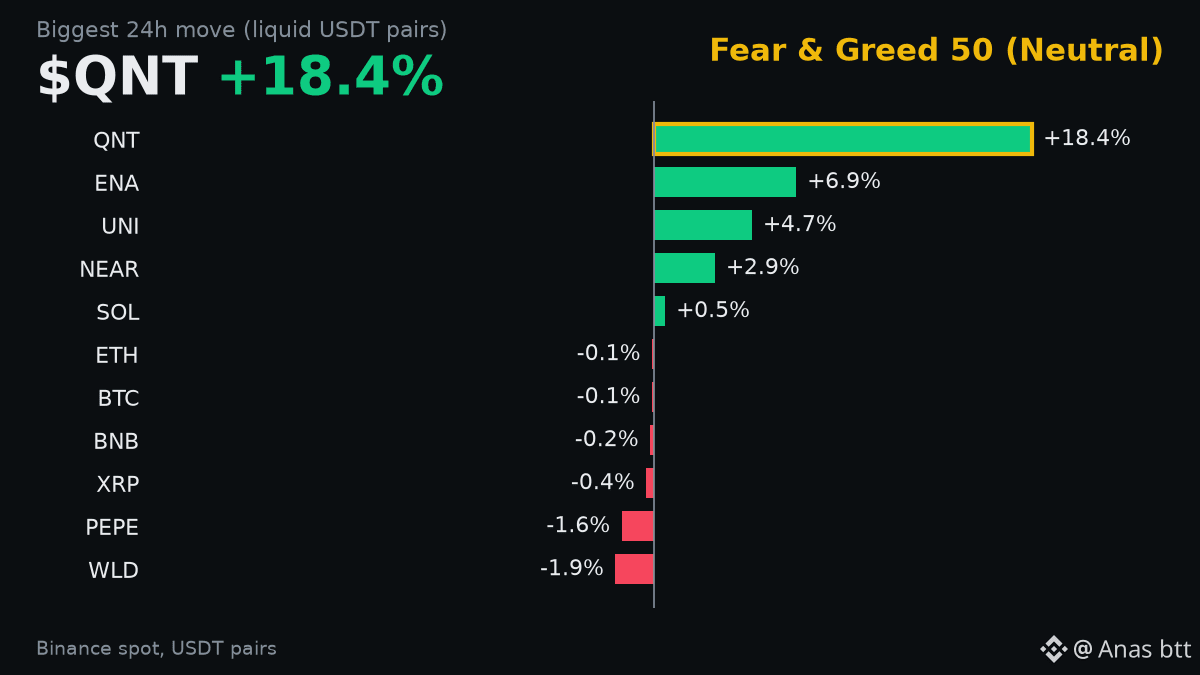
$QNT rose 18.376% in the last 24 hours to $214.71. This is the largest gain among top movers today.
However, this price move came with $22.091 million in 24-hour volume. This volume does not stand out as strong support for such a large percentage increase. I am cautious on this move.
For me to turn bullish, I would need to see a sustained follow-through with much higher trading volume. I am watching for clear volume confirmation in the next 24 hours.
#QNT #MarketPulse
$QNT rose 18.376% in the last 24 hours to $214.71. This is the largest gain among top movers today.
However, this price move came with $22.091 million in 24-hour volume. This volume does not stand out as strong support for such a large percentage increase. I am cautious on this move.
For me to turn bullish, I would need to see a sustained follow-through with much higher trading volume. I am watching for clear volume confirmation in the next 24 hours.
#QNT #MarketPulse
However, this price move came with $22.091 million in 24-hour volume. This volume does not stand out as strong support for such a large percentage increase. I am cautious on this move.
For me to turn bullish, I would need to see a sustained follow-through with much higher trading volume. I am watching for clear volume confirmation in the next 24 hours.
#QNT #MarketPulse
333
·
--
翻訳参照
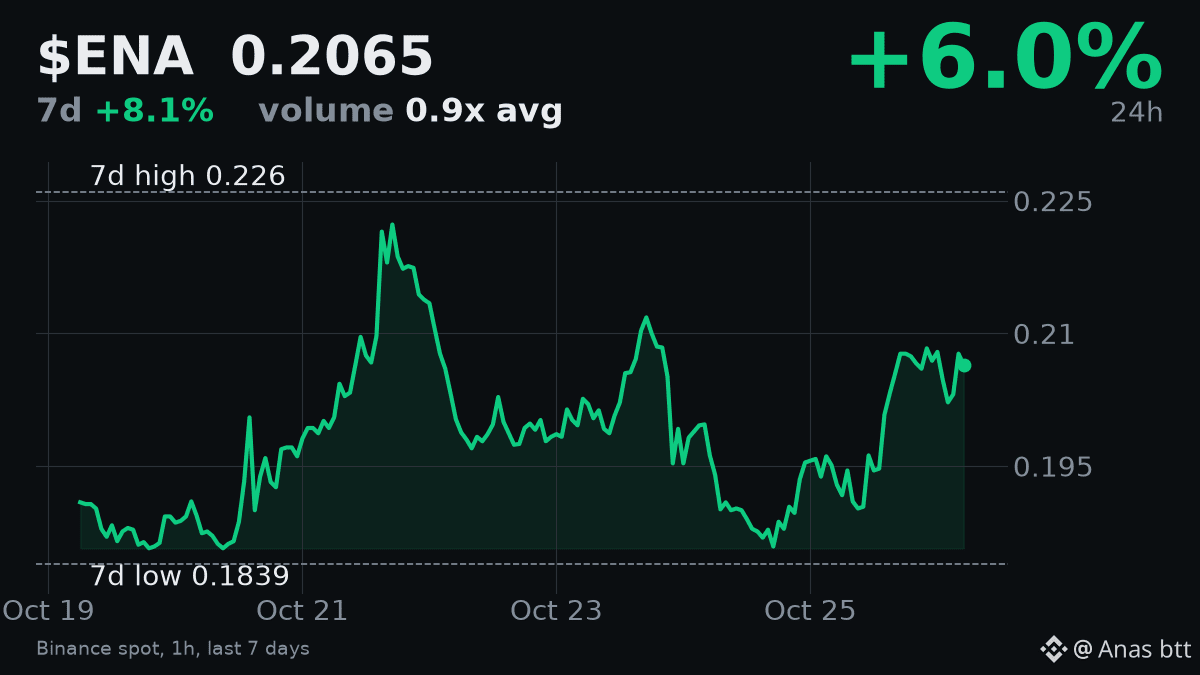
Currently, $ENA trades at $0.2065, up 5.952% in the past 24 hours. This move came with a 24-hour volume that is 0.8693 times its 7-day average. Low volume on an upward price move suggests caution. $ENA is still 8.628% below its 7-day high of $0.226. The 14-hour RSI is neutral at 58.8.
I am neutral on $ENA for now. A sustained break above $0.226 with strong, confirming volume would change my view. Until then, I am watching for increased volume to support any further upside.
#ENA #Volume
Currently, $ENA trades at $0.2065, up 5.952% in the past 24 hours. This move came with a 24-hour volume that is 0.8693 times its 7-day average. Low volume on an upward price move suggests caution. $ENA is still 8.628% below its 7-day high of $0.226. The 14-hour RSI is neutral at 58.8.
I am neutral on $ENA for now. A sustained break above $0.226 with strong, confirming volume would change my view. Until then, I am watching for increased volume to support any further upside.
#ENA #Volume
I am neutral on $ENA for now. A sustained break above $0.226 with strong, confirming volume would change my view. Until then, I am watching for increased volume to support any further upside.
#ENA #Volume
104
·
--
翻訳参照
#BinancePick
The Market Rewards Smart Decisions, Not Lucky Guesses!
Every day, the crypto market brings new surprises. Bitcoin rises, altcoins react, and market sentiment changes in seconds. 📊
But here's the real question: Can you spot the next move before it happens? 👀
🎯 With Binance Pick, you can put your market knowledge to the test and explore exciting prediction opportunities!
💡 My strategy is simple:
✅ Study the trends before making predictions.
✅ Pay attention to market sentiment and breaking news.
✅ Think logically instead of following the crowd.
✅ Manage risk and never assume a prediction is guaranteed.
🧠 Remember: Successful predictions aren't about being right every time. They're about making informed decisions and learning from the results.
🚀 Now it's your turn!
📈 Will Bitcoin continue climbing this week, or are we heading for a correction? 📉
👇 Share your prediction in the comments!
#bitcoin #cryptotrading #PredictionMarket
#BinancePick
The Market Rewards Smart Decisions, Not Lucky Guesses!
Every day, the crypto market brings new surprises. Bitcoin rises, altcoins react, and market sentiment changes in seconds. 📊
But here's the real question: Can you spot the next move before it happens? 👀
🎯 With Binance Pick, you can put your market knowledge to the test and explore exciting prediction opportunities!
💡 My strategy is simple:
✅ Study the trends before making predictions.
✅ Pay attention to market sentiment and breaking news.
✅ Think logically instead of following the crowd.
✅ Manage risk and never assume a prediction is guaranteed.
🧠 Remember: Successful predictions aren't about being right every time. They're about making informed decisions and learning from the results.
🚀 Now it's your turn!
📈 Will Bitcoin continue climbing this week, or are we heading for a correction? 📉
👇 Share your prediction in the comments!
#bitcoin #cryptotrading #PredictionMarket
The Market Rewards Smart Decisions, Not Lucky Guesses!
Every day, the crypto market brings new surprises. Bitcoin rises, altcoins react, and market sentiment changes in seconds. 📊
But here's the real question: Can you spot the next move before it happens? 👀
🎯 With Binance Pick, you can put your market knowledge to the test and explore exciting prediction opportunities!
💡 My strategy is simple:
✅ Study the trends before making predictions.
✅ Pay attention to market sentiment and breaking news.
✅ Think logically instead of following the crowd.
✅ Manage risk and never assume a prediction is guaranteed.
🧠 Remember: Successful predictions aren't about being right every time. They're about making informed decisions and learning from the results.
🚀 Now it's your turn!
📈 Will Bitcoin continue climbing this week, or are we heading for a correction? 📉
👇 Share your prediction in the comments!
#bitcoin #cryptotrading #PredictionMarket

77
·
--
本日、$ETHの相対力指数(RSI)は46.6です。この指標が極端な水準に達すると、反転が近いと考えてしまう初心者トレーダーを惑わせることがよくあります。
RSIはモメンタム・オシレーターです。価格変動の速さと変化を測定します。30を下回ると「売られすぎ」、70を上回ると「買われすぎ」と見なされることがよくあります。注意すべきなのは、強い下降トレンドでは、コインが長期間「売られすぎ」の状態にとどまることがある点です。強い上昇トレンドでは、「買われすぎ」の状態が続くこともあります。こうした水準だけを頼りにすると、主要なトレンドに逆らって早すぎるエントリーや決済をしてしまう可能性があります。
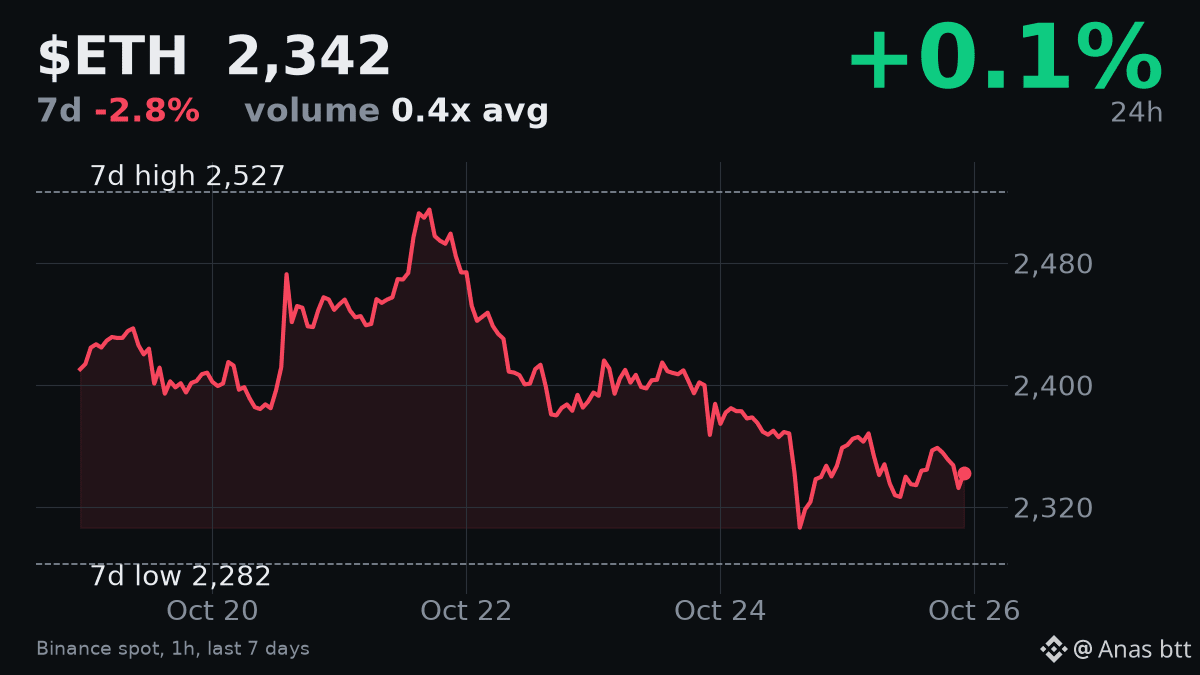
たとえば、$ETH は現在46.6です。売られすぎでも買われすぎでもない、中立的な水準です。過去24時間の価格変動は小さく、わずか0.08%の上昇にとどまっています。出来高も少なく、7日間平均の0.4198倍です。RSIが極端な水準まで動いたとしても、このように出来高が少なければ、その動きが続かない可能性を示唆しています。
RSIの極端な水準だけを根拠に取引するのではなく、ほかのシグナルと組み合わせましょう。価格とRSIのダイバージェンスを探す方法があります。あるいは、RSIが30または70のラインを再び上抜けるのを待ち、出来高の増加で確認してから取引を検討しましょう。RSIはあくまで、数あるツールのひとつとして活用してください。
シグナルを確認するため、出来高を伴って$ETHが直近のレンジを明確に上抜けるか、または下抜けるかを注視しています。
#RSI #テクニカル分析
本日、$ETH の相対力指数(RSI)は46.6です。この指標が極端な水準に達すると、反転が近いと考えてしまう初心者トレーダーを惑わせることがよくあります。
RSIはモメンタム・オシレーターです。価格変動の速さと変化を測定します。30を下回ると「売られすぎ」、70を上回ると「買われすぎ」と見なされることがよくあります。注意すべきなのは、強い下降トレンドでは、コインが長期間「売られすぎ」の状態にとどまることがある点です。強い上昇トレンドでは、「買われすぎ」の状態が続くこともあります。こうした水準だけを頼りにすると、主要なトレンドに逆らって早すぎるエントリーや決済をしてしまう可能性があります。
たとえば、$ETH は現在46.6です。売られすぎでも買われすぎでもない、中立的な水準です。過去24時間の価格変動は小さく、わずか0.08%の上昇にとどまっています。出来高も少なく、7日間平均の0.4198倍です。RSIが極端な水準まで動いたとしても、このように出来高が少なければ、その動きが続かない可能性を示唆しています。
RSIの極端な水準だけを根拠に取引するのではなく、ほかのシグナルと組み合わせましょう。価格とRSIのダイバージェンスを探す方法があります。あるいは、RSIが30または70のラインを再び上抜けるのを待ち、出来高の増加で確認してから取引を検討しましょう。RSIはあくまで、数あるツールのひとつとして活用してください。
シグナルを確認するため、出来高を伴って$ETH が直近のレンジを明確に上抜けるか、または下抜けるかを注視しています。
#RSI #テクニカル分析
RSIはモメンタム・オシレーターです。価格変動の速さと変化を測定します。30を下回ると「売られすぎ」、70を上回ると「買われすぎ」と見なされることがよくあります。注意すべきなのは、強い下降トレンドでは、コインが長期間「売られすぎ」の状態にとどまることがある点です。強い上昇トレンドでは、「買われすぎ」の状態が続くこともあります。こうした水準だけを頼りにすると、主要なトレンドに逆らって早すぎるエントリーや決済をしてしまう可能性があります。
たとえば、$ETH は現在46.6です。売られすぎでも買われすぎでもない、中立的な水準です。過去24時間の価格変動は小さく、わずか0.08%の上昇にとどまっています。出来高も少なく、7日間平均の0.4198倍です。RSIが極端な水準まで動いたとしても、このように出来高が少なければ、その動きが続かない可能性を示唆しています。
RSIの極端な水準だけを根拠に取引するのではなく、ほかのシグナルと組み合わせましょう。価格とRSIのダイバージェンスを探す方法があります。あるいは、RSIが30または70のラインを再び上抜けるのを待ち、出来高の増加で確認してから取引を検討しましょう。RSIはあくまで、数あるツールのひとつとして活用してください。
シグナルを確認するため、出来高を伴って$ETH が直近のレンジを明確に上抜けるか、または下抜けるかを注視しています。
#RSI #テクニカル分析
32
·
--
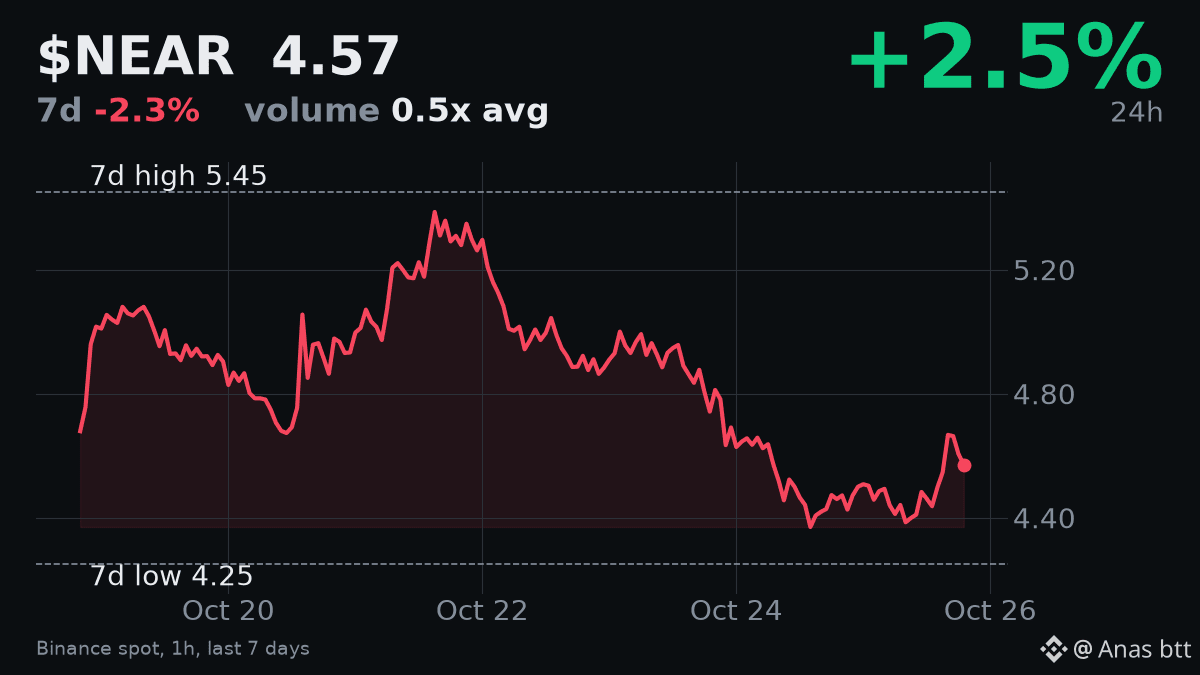
本日の$NEAR の取引量は7日平均の0.5329倍とかなり低調です。一方、過去24時間で2.534%上昇し、価格は$4.572となりました。取引量の低さから、最近の上昇には強い確信が伴っていない可能性があります。
$NEAR は依然として7日間の高値$5.451を16.125%下回っており、過去7日間では価格が2.308%下落しています。RSIは54.7で中立です。市場全体のセンチメントも54で中立となっており、昨日の51からわずかに上昇しています。
$NEARについては引き続き中立の見方です。強い取引量を伴って$4.80を明確に上抜ければ、強気に転じるでしょう。それまでは、短期的な上昇が勢いを失うリスクがあります。大きな値動きがあった際には、取引量による裏付けを待ちます。
#NEAR #出来高
本日の$NEAR の取引量は7日平均の0.5329倍とかなり低調です。一方、過去24時間で2.534%上昇し、価格は$4.572となりました。取引量の低さから、最近の上昇には強い確信が伴っていない可能性があります。
$NEAR は依然として7日間の高値$5.451を16.125%下回っており、過去7日間では価格が2.308%下落しています。RSIは54.7で中立です。市場全体のセンチメントも54で中立となっており、昨日の51からわずかに上昇しています。
$NEAR については引き続き中立の見方です。強い取引量を伴って$4.80を明確に上抜ければ、強気に転じるでしょう。それまでは、短期的な上昇が勢いを失うリスクがあります。大きな値動きがあった際には、取引量による裏付けを待ちます。
#NEAR #出来高
$NEAR は依然として7日間の高値$5.451を16.125%下回っており、過去7日間では価格が2.308%下落しています。RSIは54.7で中立です。市場全体のセンチメントも54で中立となっており、昨日の51からわずかに上昇しています。
$NEAR については引き続き中立の見方です。強い取引量を伴って$4.80を明確に上抜ければ、強気に転じるでしょう。それまでは、短期的な上昇が勢いを失うリスクがあります。大きな値動きがあった際には、取引量による裏付けを待ちます。
#NEAR #出来高
108
·
--
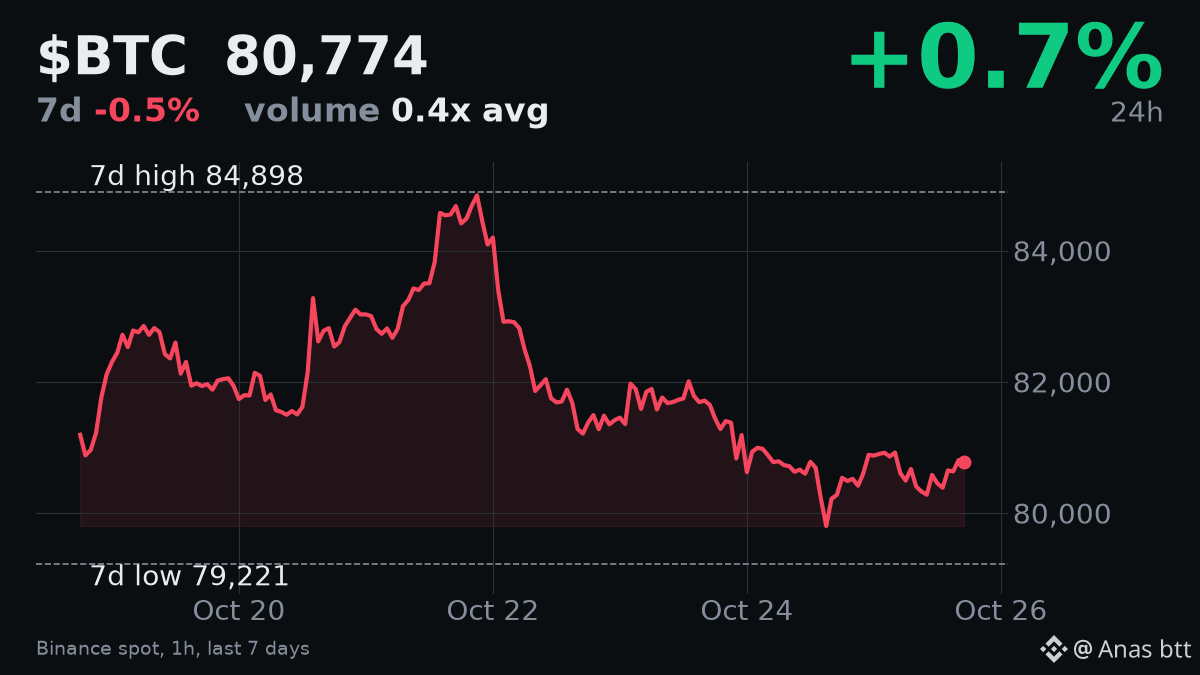
本日、$BTC は80,774ドルで取引されており、7日間の高値を約4.86%下回っています。多くのトレーダーは「完璧な」エントリーポイントを見つけることに重点を置きがちです。しかし、長期的に成功するには、1回の取引あたりのリスク管理のほうが重要な場合がよくあります。
ポジションサイズの設定とは、1回の取引にどれだけの資金を割り当てるかを決めることです。たとえば、現在の価格で$BTC を購入することを検討するなら、取引が思惑どおりに進まなかった場合にどこで決済するかも決めておく必要があります。決済水準を7日間の安値である79,220ドル付近に設定すれば、コイン1枚あたりの潜在的な損失額が定まります。
重要な教訓は、一見よさそうなエントリーでも、資金をリスクにさらしすぎれば大きな損失につながる可能性があるということです。リスクを小さく明確に抑えた不利なエントリーのほうが、口座資金を過度に危険にさらす完璧なエントリーよりも適切な場合がよくあります。市場では常に予想外の値動きが起こります。
私の考えでは、$BTC や$ETHのようなコインについて、市場環境にかかわらず、ポジションサイズの設定とリスク管理を重視することがトレーダーの最優先事項であるべきです。それが市場で生き残り続けるための鍵です。
次に注目すること:取引に入る前に、必ず1回あたりのリスクを計算しましょう。取引後ではありません。
#PositionSizing #リスク管理
本日、$BTC は80,774ドルで取引されており、7日間の高値を約4.86%下回っています。多くのトレーダーは「完璧な」エントリーポイントを見つけることに重点を置きがちです。しかし、長期的に成功するには、1回の取引あたりのリスク管理のほうが重要な場合がよくあります。
ポジションサイズの設定とは、1回の取引にどれだけの資金を割り当てるかを決めることです。たとえば、現在の価格で$BTC を購入することを検討するなら、取引が思惑どおりに進まなかった場合にどこで決済するかも決めておく必要があります。決済水準を7日間の安値である79,220ドル付近に設定すれば、コイン1枚あたりの潜在的な損失額が定まります。
重要な教訓は、一見よさそうなエントリーでも、資金をリスクにさらしすぎれば大きな損失につながる可能性があるということです。リスクを小さく明確に抑えた不利なエントリーのほうが、口座資金を過度に危険にさらす完璧なエントリーよりも適切な場合がよくあります。市場では常に予想外の値動きが起こります。
私の考えでは、$BTC や$ETH のようなコインについて、市場環境にかかわらず、ポジションサイズの設定とリスク管理を重視することがトレーダーの最優先事項であるべきです。それが市場で生き残り続けるための鍵です。
次に注目すること:取引に入る前に、必ず1回あたりのリスクを計算しましょう。取引後ではありません。
#PositionSizing #リスク管理
ポジションサイズの設定とは、1回の取引にどれだけの資金を割り当てるかを決めることです。たとえば、現在の価格で$BTC を購入することを検討するなら、取引が思惑どおりに進まなかった場合にどこで決済するかも決めておく必要があります。決済水準を7日間の安値である79,220ドル付近に設定すれば、コイン1枚あたりの潜在的な損失額が定まります。
重要な教訓は、一見よさそうなエントリーでも、資金をリスクにさらしすぎれば大きな損失につながる可能性があるということです。リスクを小さく明確に抑えた不利なエントリーのほうが、口座資金を過度に危険にさらす完璧なエントリーよりも適切な場合がよくあります。市場では常に予想外の値動きが起こります。
私の考えでは、$BTC や$ETH のようなコインについて、市場環境にかかわらず、ポジションサイズの設定とリスク管理を重視することがトレーダーの最優先事項であるべきです。それが市場で生き残り続けるための鍵です。
次に注目すること:取引に入る前に、必ず1回あたりのリスクを計算しましょう。取引後ではありません。
#PositionSizing #リスク管理
59
·
--
翻訳参照
#BinancePick
🔥 **The Market Rewards Smart Decisions, Not Lucky Guesses!** 🚀
Every day, the crypto market brings new surprises. Bitcoin rises, altcoins react, and market sentiment changes in seconds. 📊
But here's the real question: **Can you spot the next move before it happens?** 👀
🎯 With **Binance Pick**, you can put your market knowledge to the test and explore exciting prediction opportunities!
💡 My strategy is simple:
✅ Study the trends before making predictions.
✅ Pay attention to market sentiment and breaking news.
✅ Think logically instead of following the crowd.
✅ Manage risk and never assume a prediction is guaranteed.
🧠 Remember: Successful predictions aren't about being right every time. They're about making informed decisions and learning from the results.
🚀 **Now it's your turn!**
📈 Will Bitcoin continue climbing this week, or are we heading for a correction? 📉
👇 Share your prediction in the comments!
#Binance #bitcoin #cryptotrading #PredictionMarket
#BinancePick
🔥 **The Market Rewards Smart Decisions, Not Lucky Guesses!** 🚀
Every day, the crypto market brings new surprises. Bitcoin rises, altcoins react, and market sentiment changes in seconds. 📊
But here's the real question: **Can you spot the next move before it happens?** 👀
🎯 With **Binance Pick**, you can put your market knowledge to the test and explore exciting prediction opportunities!
💡 My strategy is simple:
✅ Study the trends before making predictions.
✅ Pay attention to market sentiment and breaking news.
✅ Think logically instead of following the crowd.
✅ Manage risk and never assume a prediction is guaranteed.
🧠 Remember: Successful predictions aren't about being right every time. They're about making informed decisions and learning from the results.
🚀 **Now it's your turn!**
📈 Will Bitcoin continue climbing this week, or are we heading for a correction? 📉
👇 Share your prediction in the comments!
#Binance #bitcoin #cryptotrading #PredictionMarket
🔥 **The Market Rewards Smart Decisions, Not Lucky Guesses!** 🚀
Every day, the crypto market brings new surprises. Bitcoin rises, altcoins react, and market sentiment changes in seconds. 📊
But here's the real question: **Can you spot the next move before it happens?** 👀
🎯 With **Binance Pick**, you can put your market knowledge to the test and explore exciting prediction opportunities!
💡 My strategy is simple:
✅ Study the trends before making predictions.
✅ Pay attention to market sentiment and breaking news.
✅ Think logically instead of following the crowd.
✅ Manage risk and never assume a prediction is guaranteed.
🧠 Remember: Successful predictions aren't about being right every time. They're about making informed decisions and learning from the results.
🚀 **Now it's your turn!**
📈 Will Bitcoin continue climbing this week, or are we heading for a correction? 📉
👇 Share your prediction in the comments!
#Binance #bitcoin #cryptotrading #PredictionMarket

3
·
--
翻訳参照
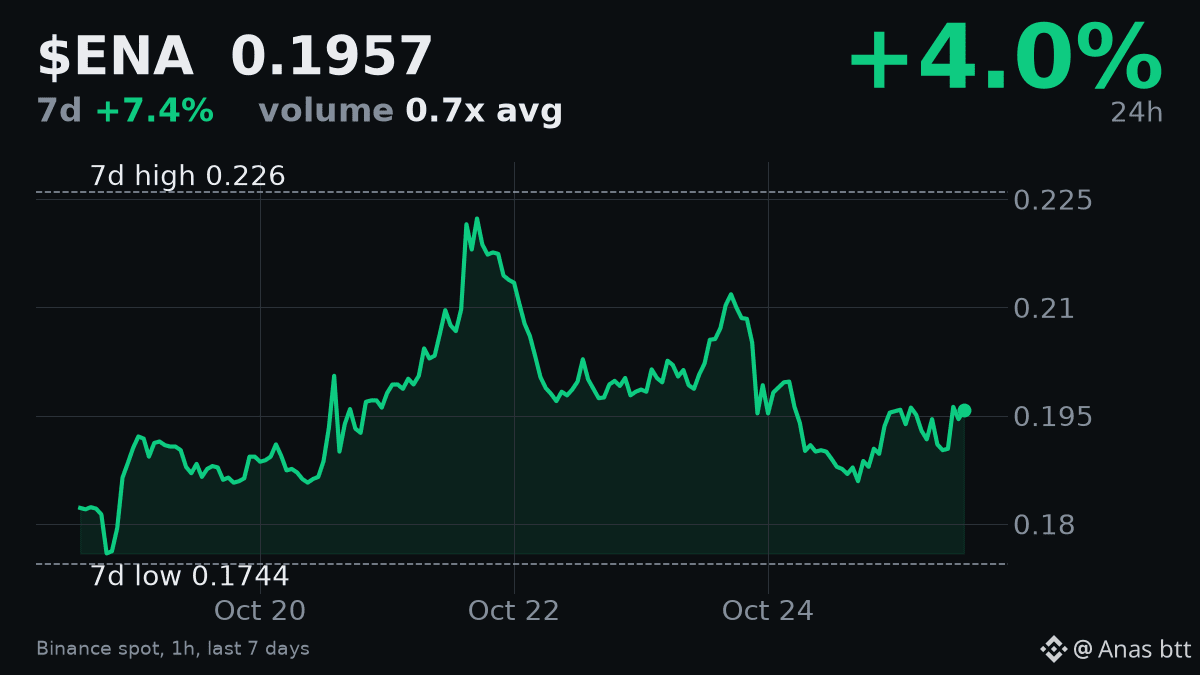
$ENA is up 7.409% in seven days, currently trading at $0.1957. It is still 13.407% below its 7-day high of $0.226. The 24-hour trading volume for $ENA is low today, at $25.46 million, which is only 0.65 times its 7-day average. This suggests weak interest despite the weekly gain.
RSI is neutral at 54.7, and $BTC is slightly down 0.41% in the last 24 hours. My view is neutral for now. The 7-day gain lacks strong volume confirmation, and the price is well off its weekly high. A decisive move above $0.226 with increased volume would change my outlook to more bullish. I will be watching for any significant price action to be confirmed by volume.
#ENA #VolumeAnalysis
$ENA is up 7.409% in seven days, currently trading at $0.1957. It is still 13.407% below its 7-day high of $0.226. The 24-hour trading volume for $ENA is low today, at $25.46 million, which is only 0.65 times its 7-day average. This suggests weak interest despite the weekly gain.
RSI is neutral at 54.7, and $BTC is slightly down 0.41% in the last 24 hours. My view is neutral for now. The 7-day gain lacks strong volume confirmation, and the price is well off its weekly high. A decisive move above $0.226 with increased volume would change my outlook to more bullish. I will be watching for any significant price action to be confirmed by volume.
#ENA #VolumeAnalysis
RSI is neutral at 54.7, and $BTC is slightly down 0.41% in the last 24 hours. My view is neutral for now. The 7-day gain lacks strong volume confirmation, and the price is well off its weekly high. A decisive move above $0.226 with increased volume would change my outlook to more bullish. I will be watching for any significant price action to be confirmed by volume.
#ENA #VolumeAnalysis
58
·
--
翻訳参照
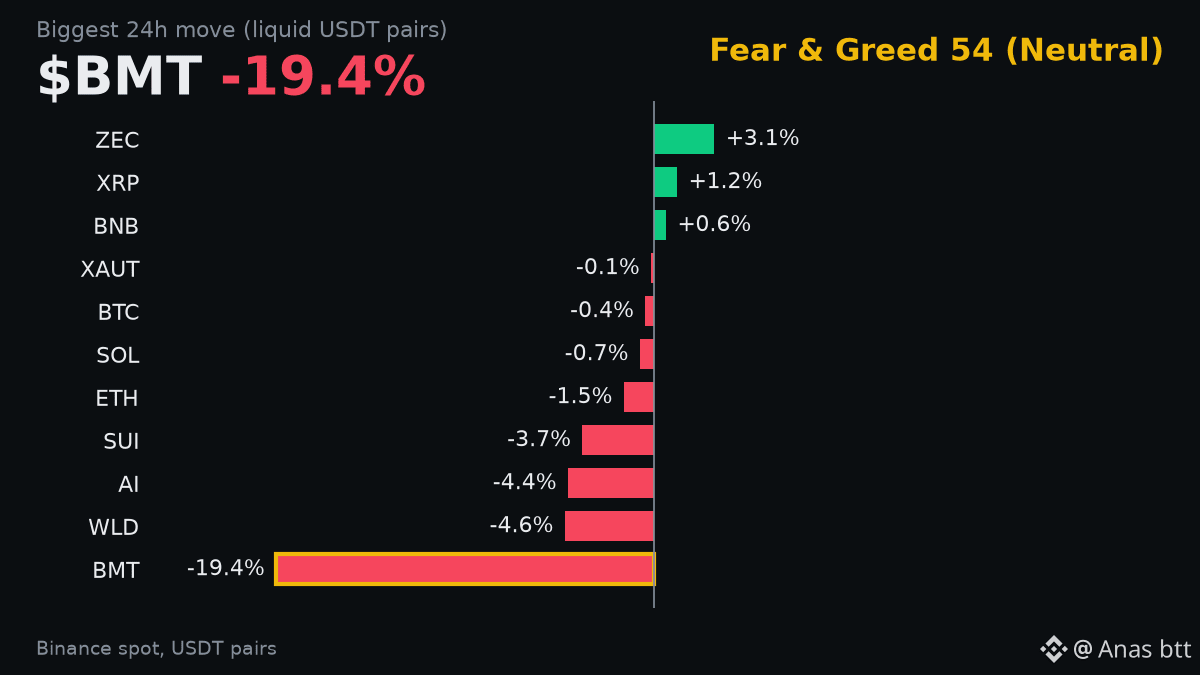
The biggest move today is $BMT, which fell 19.4% in the last 24 hours to a price of $0.03162. This comes with a volume of $31.671 million. Such a sharp drop suggests significant selling pressure for this specific asset.
Other major coins like $BTC and $ETH saw only minor price changes. $BTC is down 0.44% at $80,200.45 and $ETH is down 1.55% at $2,325.1. The Fear & Greed Index remains Neutral, rising slightly from 51 to 54. This indicates the broader market sentiment is stable, making the $BMT drop appear isolated for now.
I am watching for a clear rebound for $BMT, ideally with strong buying volume, to confirm any shift in sentiment. Otherwise, the current view is bearish for $BMT.
#BMT #MarketPulse
The biggest move today is $BMT , which fell 19.4% in the last 24 hours to a price of $0.03162. This comes with a volume of $31.671 million. Such a sharp drop suggests significant selling pressure for this specific asset.
Other major coins like $BTC and $ETH saw only minor price changes. $BTC is down 0.44% at $80,200.45 and $ETH is down 1.55% at $2,325.1. The Fear & Greed Index remains Neutral, rising slightly from 51 to 54. This indicates the broader market sentiment is stable, making the $BMT drop appear isolated for now.
I am watching for a clear rebound for $BMT , ideally with strong buying volume, to confirm any shift in sentiment. Otherwise, the current view is bearish for $BMT .
#BMT #MarketPulse
Other major coins like $BTC and $ETH saw only minor price changes. $BTC is down 0.44% at $80,200.45 and $ETH is down 1.55% at $2,325.1. The Fear & Greed Index remains Neutral, rising slightly from 51 to 54. This indicates the broader market sentiment is stable, making the $BMT drop appear isolated for now.
I am watching for a clear rebound for $BMT , ideally with strong buying volume, to confirm any shift in sentiment. Otherwise, the current view is bearish for $BMT .
#BMT #MarketPulse
226
·
--
翻訳参照
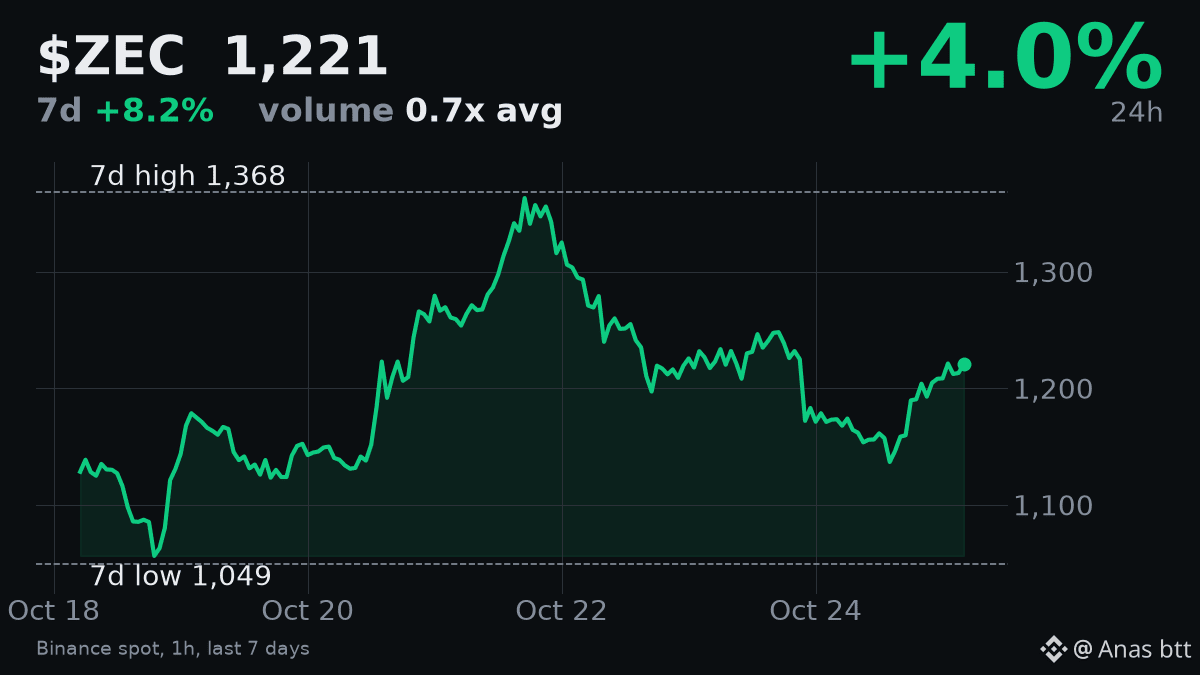
$ZEC is up 8.202% in seven days, currently trading at $1220.73. Its 24-hour volume today is 0.67 times its 7-day average, at $140.7 million. This suggests that recent price increases lack strong volume confirmation. The asset has pulled back 10.79% from its 7-day high of $1368.4. Its RSI is at 62.3.
My view is neutral for now. I would need to see a clear breakout above $1368.4 with significantly higher volume to consider a bullish position. A drop below the 7-day low of $1049.01 would signal weakness. I will be watching volume for conviction in the next price move.
#ZEC #MarketWatch
$ZEC is up 8.202% in seven days, currently trading at $1220.73. Its 24-hour volume today is 0.67 times its 7-day average, at $140.7 million. This suggests that recent price increases lack strong volume confirmation. The asset has pulled back 10.79% from its 7-day high of $1368.4. Its RSI is at 62.3.
My view is neutral for now. I would need to see a clear breakout above $1368.4 with significantly higher volume to consider a bullish position. A drop below the 7-day low of $1049.01 would signal weakness. I will be watching volume for conviction in the next price move.
#ZEC #MarketWatch
My view is neutral for now. I would need to see a clear breakout above $1368.4 with significantly higher volume to consider a bullish position. A drop below the 7-day low of $1049.01 would signal weakness. I will be watching volume for conviction in the next price move.
#ZEC #MarketWatch
199
·
--
翻訳参照
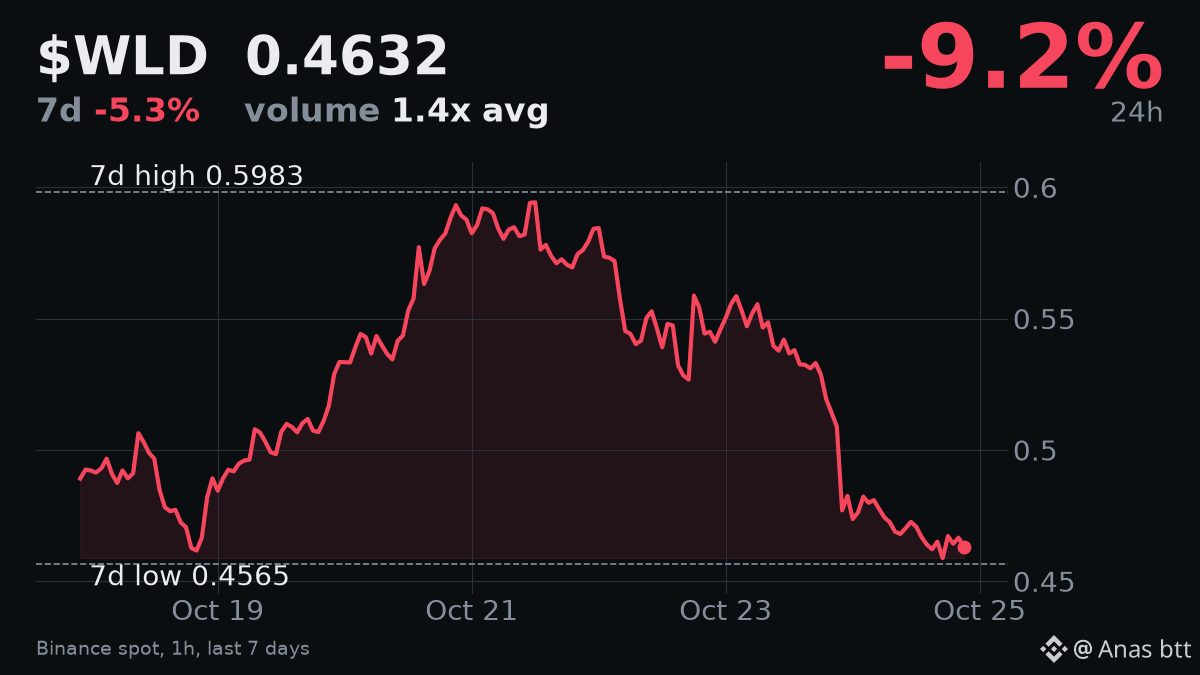
$WLD is trading at $0.4632, down 9.212% in the last 24 hours. The price has fallen 22.58% from its 7-day high of $0.5983. Volume is elevated today at 1.418 times its 7-day average, confirming the downward move.
The Relative Strength Index (RSI) for $WLD is at 34.2. This suggests strong selling pressure or that it is approaching oversold territory, but momentum remains negative. $BTC is also down 1.24% today, which adds to the general market sentiment.
My view is bearish for $WLD. The current price action shows weakness. I would consider this bearish trend broken if $WLD can recover above its 7-day high of $0.5983 with strong buying volume. I am watching for signs of accumulation or price stabilization. A rebound in the RSI above 50, confirmed by higher trading volumes, would be a positive sign.
#WLDAnalysis #MarketDowntrend
$WLD is trading at $0.4632, down 9.212% in the last 24 hours. The price has fallen 22.58% from its 7-day high of $0.5983. Volume is elevated today at 1.418 times its 7-day average, confirming the downward move.
The Relative Strength Index (RSI) for $WLD is at 34.2. This suggests strong selling pressure or that it is approaching oversold territory, but momentum remains negative. $BTC is also down 1.24% today, which adds to the general market sentiment.
My view is bearish for $WLD . The current price action shows weakness. I would consider this bearish trend broken if $WLD can recover above its 7-day high of $0.5983 with strong buying volume. I am watching for signs of accumulation or price stabilization. A rebound in the RSI above 50, confirmed by higher trading volumes, would be a positive sign.
#WLDAnalysis #MarketDowntrend
The Relative Strength Index (RSI) for $WLD is at 34.2. This suggests strong selling pressure or that it is approaching oversold territory, but momentum remains negative. $BTC is also down 1.24% today, which adds to the general market sentiment.
My view is bearish for $WLD . The current price action shows weakness. I would consider this bearish trend broken if $WLD can recover above its 7-day high of $0.5983 with strong buying volume. I am watching for signs of accumulation or price stabilization. A rebound in the RSI above 50, confirmed by higher trading volumes, would be a positive sign.
#WLDAnalysis #MarketDowntrend
204
·
--
翻訳参照
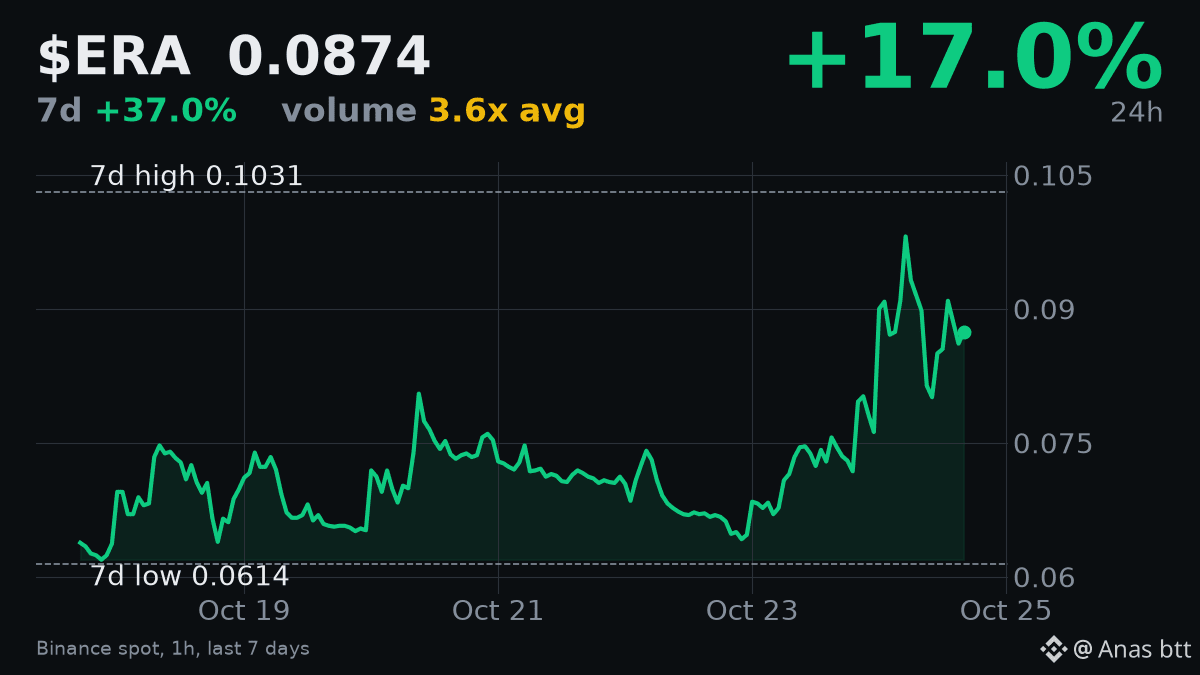
$ERA trading volume is significantly high today, at 3.646 times its 7-day average, with $27.64 million exchanged. The coin is currently priced at $0.0874, having surged 17.001% in the last 24 hours and 36.991% over the past seven days. Despite these strong gains, $ERA remains 15.228% below its 7-day high of $0.1031.
The 14-hour RSI is at 54.8, indicating neutral momentum. While the elevated volume suggests genuine interest, the inability to hold its recent high means I am not ready for a strong directional call. My view is neutral for now. I would turn bullish if $ERA can reclaim and hold above the $0.1031 level on good volume. A drop below $0.07 would suggest further consolidation or a deeper pullback.
I am watching for confirmation of either a breakout or a clear support level.
#ERACoin #Volume
$ERA trading volume is significantly high today, at 3.646 times its 7-day average, with $27.64 million exchanged. The coin is currently priced at $0.0874, having surged 17.001% in the last 24 hours and 36.991% over the past seven days. Despite these strong gains, $ERA remains 15.228% below its 7-day high of $0.1031.
The 14-hour RSI is at 54.8, indicating neutral momentum. While the elevated volume suggests genuine interest, the inability to hold its recent high means I am not ready for a strong directional call. My view is neutral for now. I would turn bullish if $ERA can reclaim and hold above the $0.1031 level on good volume. A drop below $0.07 would suggest further consolidation or a deeper pullback.
I am watching for confirmation of either a breakout or a clear support level.
#ERACoin #Volume
The 14-hour RSI is at 54.8, indicating neutral momentum. While the elevated volume suggests genuine interest, the inability to hold its recent high means I am not ready for a strong directional call. My view is neutral for now. I would turn bullish if $ERA can reclaim and hold above the $0.1031 level on good volume. A drop below $0.07 would suggest further consolidation or a deeper pullback.
I am watching for confirmation of either a breakout or a clear support level.
#ERACoin #Volume
170
·
--
翻訳参照
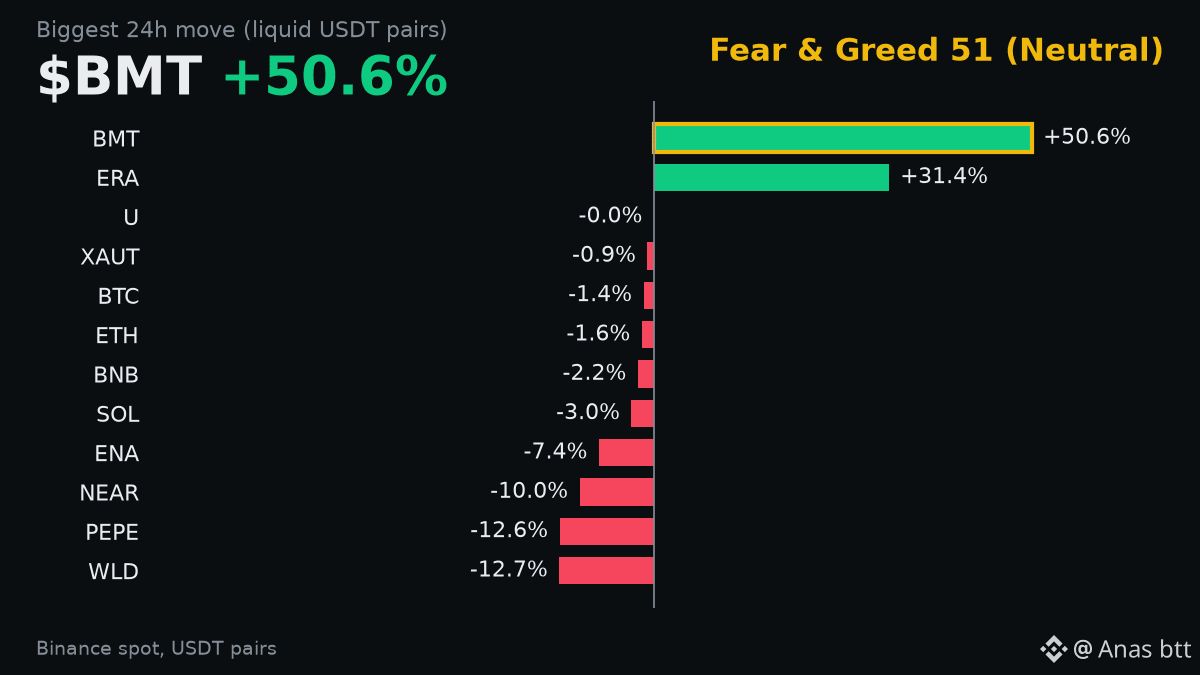
$BMT surged 50.576% in the last 24 hours, reaching $0.03659 with $49.557 million in volume. This is a significant move among top altcoins. The broader market, however, saw $BTC decline 1.4% and $ETH fall 1.64%, suggesting this rally in $BMT is an outlier.
The volume behind the $BMT rally is decent. A sustained upward trend would require continued buying interest. The outlook for $BMT is bullish in the very short term, but caution is warranted if the general market downtrend persists. A shift to a neutral outlook would occur if $BMT sees a swift reversal on heavy volume.
Next, attention will be on whether $BMT can consolidate these gains or if profit-taking emerges given the general market weakness.
#BMT #AltcoinRally
$BMT surged 50.576% in the last 24 hours, reaching $0.03659 with $49.557 million in volume. This is a significant move among top altcoins. The broader market, however, saw $BTC decline 1.4% and $ETH fall 1.64%, suggesting this rally in $BMT is an outlier.
The volume behind the $BMT rally is decent. A sustained upward trend would require continued buying interest. The outlook for $BMT is bullish in the very short term, but caution is warranted if the general market downtrend persists. A shift to a neutral outlook would occur if $BMT sees a swift reversal on heavy volume.
Next, attention will be on whether $BMT can consolidate these gains or if profit-taking emerges given the general market weakness.
#BMT #AltcoinRally
The volume behind the $BMT rally is decent. A sustained upward trend would require continued buying interest. The outlook for $BMT is bullish in the very short term, but caution is warranted if the general market downtrend persists. A shift to a neutral outlook would occur if $BMT sees a swift reversal on heavy volume.
Next, attention will be on whether $BMT can consolidate these gains or if profit-taking emerges given the general market weakness.
#BMT #AltcoinRally
100
·
--
翻訳参照
#BinancePick
🚀 Can You Predict the Market Before Everyone Else? 🔥
The crypto market never sleeps! 📈📉 Every price movement brings new opportunities, but making smart predictions requires research, patience, and strategy.
🎯 Binance Pick brings a new way to explore prediction markets and test your market knowledge.
💡 Here’s my approach:
✅ Analyze market trends before predicting.
✅ Follow the latest crypto news.
✅ Never rely on emotions alone.
✅ Learn from every prediction, whether right or wrong.
🏆 The goal isn’t just to predict correctly — it’s to become a smarter market observer!
💬 What do you think Bitcoin will do next: 🚀 Bullish or 🐻 Bearish?
Drop your prediction below! 👇
#BİNANCE #bitcoin #crypto #MarketPredictions
#BinancePick
🚀 Can You Predict the Market Before Everyone Else? 🔥
The crypto market never sleeps! 📈📉 Every price movement brings new opportunities, but making smart predictions requires research, patience, and strategy.
🎯 Binance Pick brings a new way to explore prediction markets and test your market knowledge.
💡 Here’s my approach:
✅ Analyze market trends before predicting.
✅ Follow the latest crypto news.
✅ Never rely on emotions alone.
✅ Learn from every prediction, whether right or wrong.
🏆 The goal isn’t just to predict correctly — it’s to become a smarter market observer!
💬 What do you think Bitcoin will do next: 🚀 Bullish or 🐻 Bearish?
Drop your prediction below! 👇
#BİNANCE #bitcoin #crypto #MarketPredictions
🚀 Can You Predict the Market Before Everyone Else? 🔥
The crypto market never sleeps! 📈📉 Every price movement brings new opportunities, but making smart predictions requires research, patience, and strategy.
🎯 Binance Pick brings a new way to explore prediction markets and test your market knowledge.
💡 Here’s my approach:
✅ Analyze market trends before predicting.
✅ Follow the latest crypto news.
✅ Never rely on emotions alone.
✅ Learn from every prediction, whether right or wrong.
🏆 The goal isn’t just to predict correctly — it’s to become a smarter market observer!
💬 What do you think Bitcoin will do next: 🚀 Bullish or 🐻 Bearish?
Drop your prediction below! 👇
#BİNANCE #bitcoin #crypto #MarketPredictions

45
·
--
翻訳参照
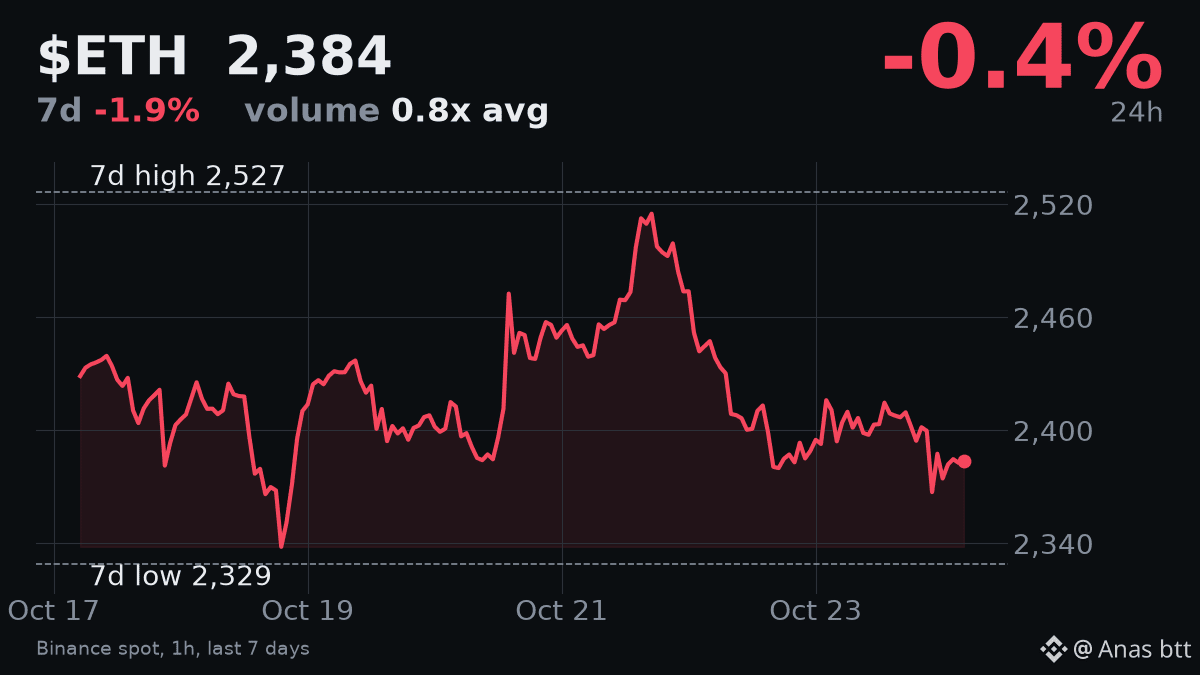
Bitcoin's movements often lead the crypto market. Today, $BTC is down 0.85% in 24 hours. Many altcoins, like $ETH, are also down, with $ETH dropping 0.41% in the same period. This shows how altcoins tend to follow Bitcoin's price.
Bitcoin has the largest market capitalization. Its price action often sets the general market sentiment. When traders move out of $BTC, they often move out of altcoins too.
However, sometimes altcoins decouple. For example, $BMT is up 31.96% today, even with $BTC trending down. This can happen when a project has its own strong news or a specific narrative driving demand. These projects often show independent strength against the broader market trend.
Decoupling means the altcoin moves independently from Bitcoin. It's a sign that specific factors are outweighing general market sentiment. Always watch $BTC for overall market direction. But also look for altcoins showing strong individual moves driven by their own news, as these can offer different opportunities.
#AltcoinSeason #MarketCorrelation
Bitcoin's movements often lead the crypto market. Today, $BTC is down 0.85% in 24 hours. Many altcoins, like $ETH , are also down, with $ETH dropping 0.41% in the same period. This shows how altcoins tend to follow Bitcoin's price.
Bitcoin has the largest market capitalization. Its price action often sets the general market sentiment. When traders move out of $BTC , they often move out of altcoins too.
However, sometimes altcoins decouple. For example, $BMT is up 31.96% today, even with $BTC trending down. This can happen when a project has its own strong news or a specific narrative driving demand. These projects often show independent strength against the broader market trend.
Decoupling means the altcoin moves independently from Bitcoin. It's a sign that specific factors are outweighing general market sentiment. Always watch $BTC for overall market direction. But also look for altcoins showing strong individual moves driven by their own news, as these can offer different opportunities.
#AltcoinSeason #MarketCorrelation
Bitcoin has the largest market capitalization. Its price action often sets the general market sentiment. When traders move out of $BTC , they often move out of altcoins too.
However, sometimes altcoins decouple. For example, $BMT is up 31.96% today, even with $BTC trending down. This can happen when a project has its own strong news or a specific narrative driving demand. These projects often show independent strength against the broader market trend.
Decoupling means the altcoin moves independently from Bitcoin. It's a sign that specific factors are outweighing general market sentiment. Always watch $BTC for overall market direction. But also look for altcoins showing strong individual moves driven by their own news, as these can offer different opportunities.
#AltcoinSeason #MarketCorrelation
261
·
--
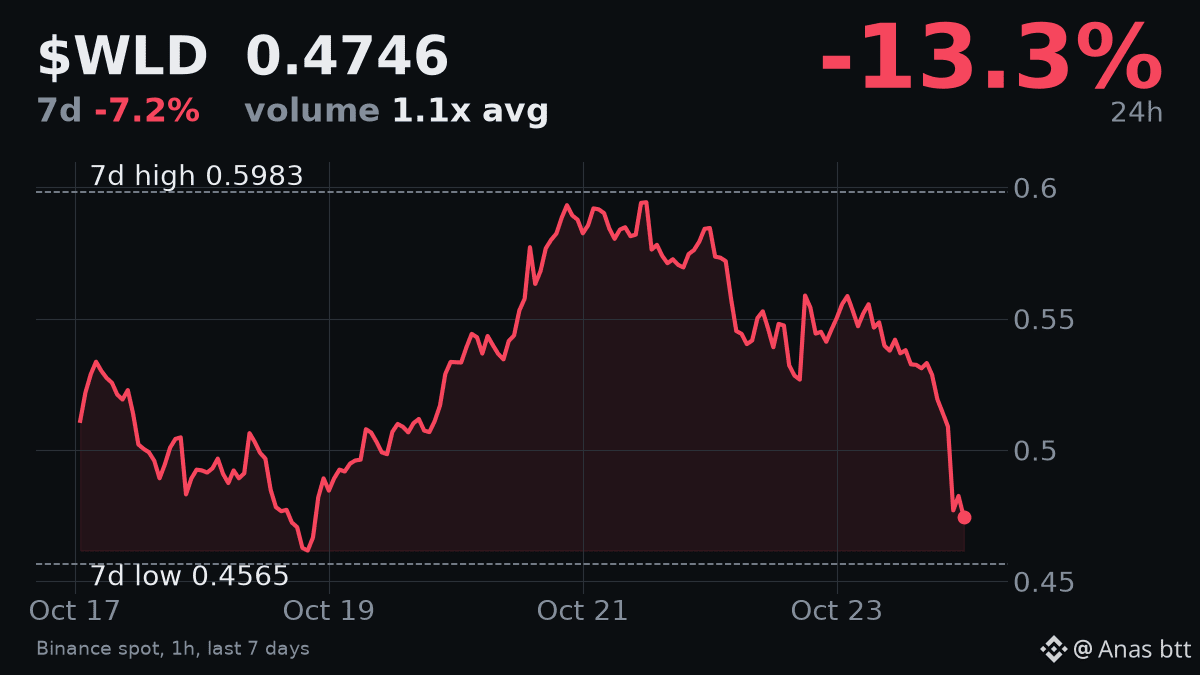
$WLD は過去24時間で13.25%下落し、現在は0.4746ドルで取引されています。現在、7日間の高値である0.5983ドルを20.67%下回っています。出来高は7日間平均の1.139倍とやや増加しており、売り圧力が確認できます。相対力指数(RSI)は21.1で、$WLD は時間足で売られすぎの状態にあることを示しています。
現在、$WLD について弱気に見ています。急激な価格下落と低いRSIに加え、出来高が高水準で推移していることから、さらなる下落、または値固めの期間に入る可能性があります。$WLD が0.50ドルを回復し、その水準を維持できれば、モメンタムが明確に転換したと判断し、見通しを改めるでしょう。この水準での買い集めの兆候や、力強い反発を注視しています。
#Worldcoin
$WLD は過去24時間で13.25%下落し、現在は0.4746ドルで取引されています。現在、7日間の高値である0.5983ドルを20.67%下回っています。出来高は7日間平均の1.139倍とやや増加しており、売り圧力が確認できます。相対力指数(RSI)は21.1で、$WLD は時間足で売られすぎの状態にあることを示しています。
現在、$WLD について弱気に見ています。急激な価格下落と低いRSIに加え、出来高が高水準で推移していることから、さらなる下落、または値固めの期間に入る可能性があります。$WLD が0.50ドルを回復し、その水準を維持できれば、モメンタムが明確に転換したと判断し、見通しを改めるでしょう。この水準での買い集めの兆候や、力強い反発を注視しています。
#Worldcoin
現在、$WLD について弱気に見ています。急激な価格下落と低いRSIに加え、出来高が高水準で推移していることから、さらなる下落、または値固めの期間に入る可能性があります。$WLD が0.50ドルを回復し、その水準を維持できれば、モメンタムが明確に転換したと判断し、見通しを改めるでしょう。この水準での買い集めの兆候や、力強い反発を注視しています。
#Worldcoin
1
730
ログインして、さらにコンテンツを読む
厳選トピックで世界の暗号資産トレーダーの仲間入り
⚡️ 暗号資産に関する最新かつ有益な情報が見つかります。
💬 世界最大の暗号資産取引所から信頼されています。
👍 認証を受けたクリエイターから、有益なインサイトを得られます。
メール / 電話番号
トレンドトピック
EthereumDropsBelow$2300
閲覧回数 1,814
76人が討論中
#EthereumDropsBelow$2300
ETH船長が2,300 USDTをわずかに下回るダイブを決め、過去24時間で1.39%下落。みんな気が気じゃない!
この急変の原因は?どうやら開発者たちが、バリデーターのステーキング資金がビルダーの懐にそのまま入ってしまうのを防ぐため、Glamsterdamアップグレードのバグを急いで修正する必要があったようです。さらに、「クジラ」のMachi Big Brotherが、レバレッジ25倍のロングポジションの一部を清算されました。清算価格は市場価格からわずか30ドル差というギリギリの水準。これじゃ市場が震えるのも無理はありません!
トレーダーは今どうすべき?スピリチュアル派はクジラが「出航」しないようお香を焚いて祈り、テクニカル派はパッチがテストネットで安定して動くか、じっと見守りましょう。
⚠️ これは金融アドバイスではありません。
登録コードVINHTOCDO、またはリンクからアカウントを登録して応援してください:https://www.binance.com/register?ref=VINHTOCDO
#Ethereum #Crypto #Staking #Glamsterdam #VINHTOCDO
下から取引して応援してください:
$ETH
$BNB
$SOL
Vinhtocdo
·いいね:3件
·閲覧回数 118
BitcoinSlipsBelow$80KAgain
閲覧回数 4,694
46人が討論中
ThailandLaunchesWORPTStablecoinToQRPaymentApp
閲覧回数 6,823
192人が討論中