
SAIIFY
2.5k 投稿

SAIIFY
Nothing To Show
高頻度トレーダー
1.4年
737 フォロー
23.2K+ フォロワー
5.0K+ いいね
投稿
すべて
引用
ライブ
翻訳参照
Most stablecoins are a companys promise. EURQ is legally the euro itself. Thats a bigger difference than it sounds.
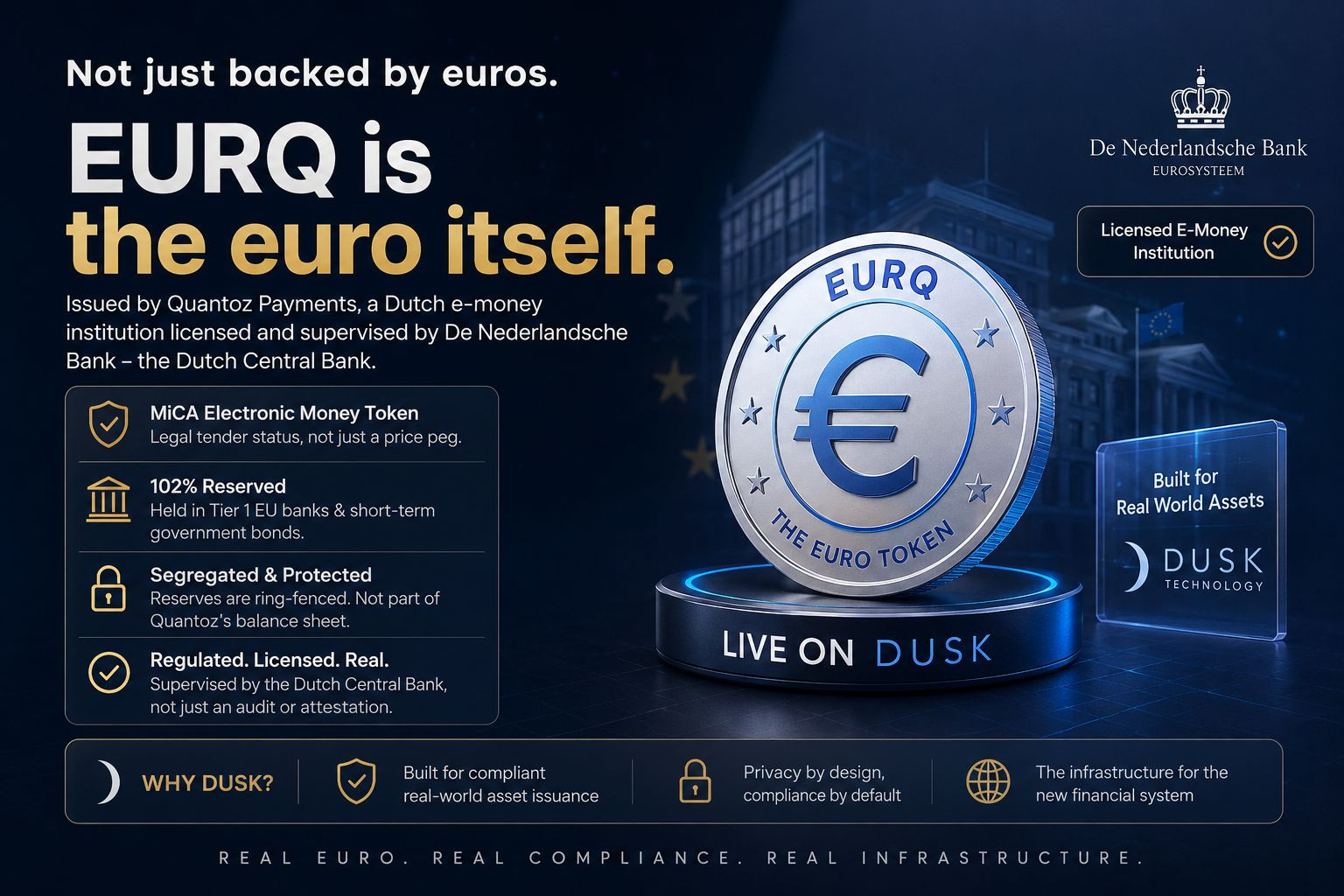
I have read a lot of stablecoin pitches. Almost all of them use the same language, backed 1:1, fully reserved, audited regularly. EURQ, the euro token now live on @Dusk , makes a different and much stronger claim, and I wanted to check whether it actually holds up.
EURQ is issued by Quantoz Payments, a Dutch electronic money institution licensed and supervised directly by De Nederlandsche Bank, the actual Dutch central bank. Thats not a self-attested audit or a third party attestation firm signing off after the fact. Thats a banking regulator granting an E-Money license the same category used for real digital cash, not a crypto side project wearing compliance language.
Heres the part that actually separates it from something like USDT or even USDC. Under MiCA, EURQ is classified as an Electronic Money Token, legal tender status, not just a price-pegged crypto asset. Reserves sit in Tier 1 European banks and short term government bonds, segregated from Quantozs own balance sheet, held at 102 percent to cover redemption even under stress. If Quantoz ran into trouble tomorrow, those reserves are not Quantozs money to touch.
Now the #dusk specific part. Dusk is not just one more chain EURQ happens to support. Out of the handful of blockchains carrying it, $DUSK is the one actually built for native real world asset issuance with compliance baked into the protocol itself, not bolted on after. Thats why NPEX picked it too, a real Euro token is the missing piece for an actual on-chain stock exchange to settle trades in something regulators recognize as genuine currency, not a synthetic stand-in for one.
I still think people should read the fine print on any stablecoin before trusting it. But EURQs fine print is a banking license, not a whitepaper. Thats a meaningfully different foundation than most of what circulates in this space.
I have read a lot of stablecoin pitches. Almost all of them use the same language, backed 1:1, fully reserved, audited regularly. EURQ, the euro token now live on @Dusk , makes a different and much stronger claim, and I wanted to check whether it actually holds up.
EURQ is issued by Quantoz Payments, a Dutch electronic money institution licensed and supervised directly by De Nederlandsche Bank, the actual Dutch central bank. Thats not a self-attested audit or a third party attestation firm signing off after the fact. Thats a banking regulator granting an E-Money license the same category used for real digital cash, not a crypto side project wearing compliance language.
Heres the part that actually separates it from something like USDT or even USDC. Under MiCA, EURQ is classified as an Electronic Money Token, legal tender status, not just a price-pegged crypto asset. Reserves sit in Tier 1 European banks and short term government bonds, segregated from Quantozs own balance sheet, held at 102 percent to cover redemption even under stress. If Quantoz ran into trouble tomorrow, those reserves are not Quantozs money to touch.
Now the #dusk specific part. Dusk is not just one more chain EURQ happens to support. Out of the handful of blockchains carrying it, $DUSK is the one actually built for native real world asset issuance with compliance baked into the protocol itself, not bolted on after. Thats why NPEX picked it too, a real Euro token is the missing piece for an actual on-chain stock exchange to settle trades in something regulators recognize as genuine currency, not a synthetic stand-in for one.
I still think people should read the fine print on any stablecoin before trusting it. But EURQs fine print is a banking license, not a whitepaper. Thats a meaningfully different foundation than most of what circulates in this space.
翻訳参照
It costs less to help secure @Dusk than it costs to fill up a gas tank for a month. That number stopped me.
I have been picking apart a lot of the rough edges in these threads, so let me flip it for a second and talk about something #dusk actually got right, because I think it gets buried under everything else.
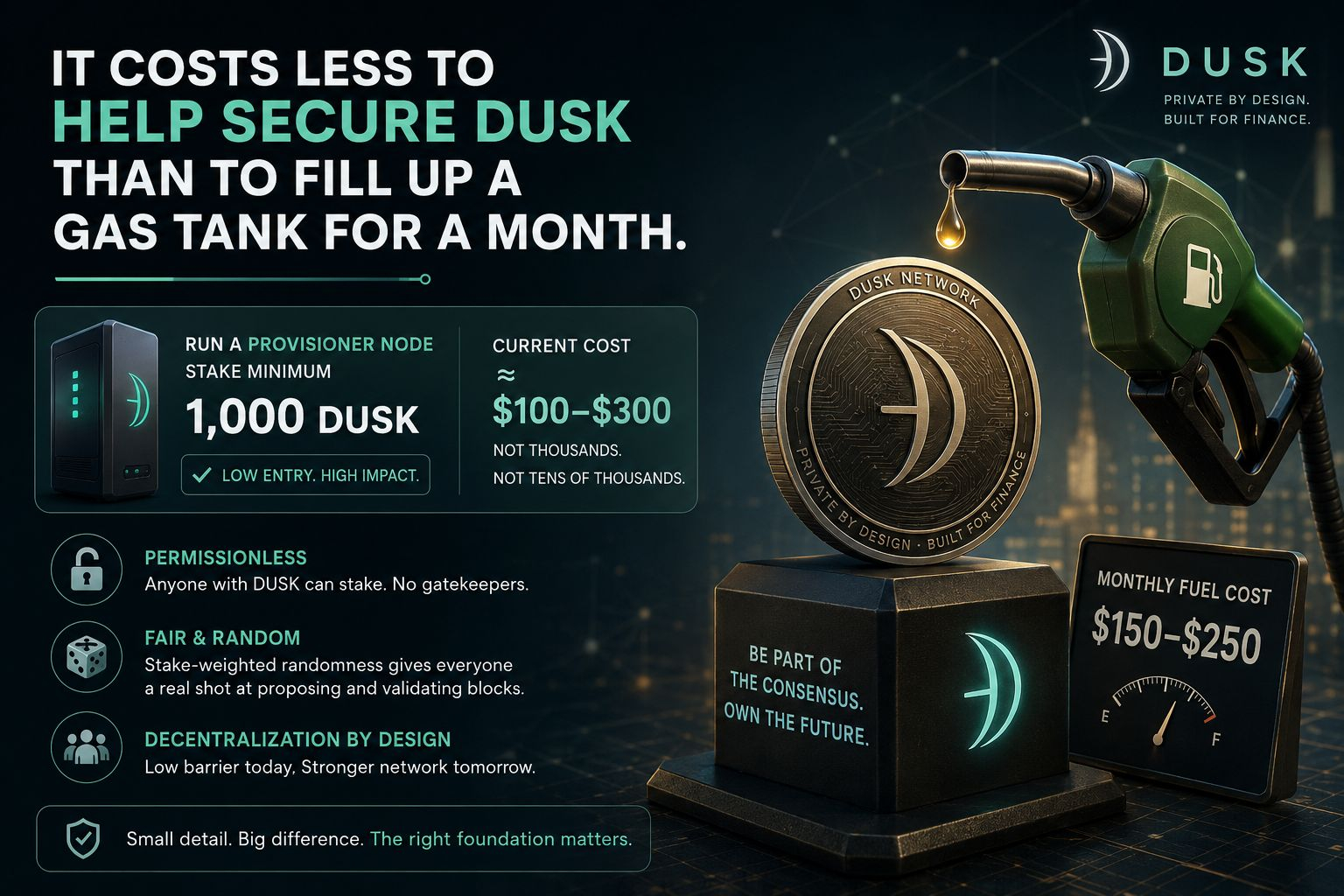
To run a validator node on Dusk, a Provisioner, the minimum stake is 1,000 $DUSK . At current prices thats somewhere in the low hundreds of dollars, not thousands, not tens of thousands. Compare that to what it takes to run an actual validator on a lot of major proof of stake chains, where the entry ticket runs well into 5 or 6 figures once you account for the minimum stake requirement. Dusk deliberately kept that door low.
And its not just cheap, its genuinely permissionless. Anyone holding DUSK can stake and become part of the consensus set, no application, no approval, no gatekeeper deciding whos allowed to help secure the network. Selection happens through stake weighted randomness, so smaller stakers still get real, recurring chances to propose and validate blocks, not just watch from the sidelines while a handful of whales run everything.
I want to be careful not to oversell this. Low cost of entry does not automatically mean the validator set stays spread out over time, concentration can still creep in as bigger holders accumulate more influence, that risk exists on every proof of stake chain regardless of the starting minimum. But a low floor is still the right foundation to build decentralization on top of. You cant get broad participation if the entry price locks most people out before they even try, and Dusk clearly chose not to do that.
Small detail, easy to scroll past. Probably should not be.
I have been picking apart a lot of the rough edges in these threads, so let me flip it for a second and talk about something #dusk actually got right, because I think it gets buried under everything else.
To run a validator node on Dusk, a Provisioner, the minimum stake is 1,000 $DUSK . At current prices thats somewhere in the low hundreds of dollars, not thousands, not tens of thousands. Compare that to what it takes to run an actual validator on a lot of major proof of stake chains, where the entry ticket runs well into 5 or 6 figures once you account for the minimum stake requirement. Dusk deliberately kept that door low.
And its not just cheap, its genuinely permissionless. Anyone holding DUSK can stake and become part of the consensus set, no application, no approval, no gatekeeper deciding whos allowed to help secure the network. Selection happens through stake weighted randomness, so smaller stakers still get real, recurring chances to propose and validate blocks, not just watch from the sidelines while a handful of whales run everything.
I want to be careful not to oversell this. Low cost of entry does not automatically mean the validator set stays spread out over time, concentration can still creep in as bigger holders accumulate more influence, that risk exists on every proof of stake chain regardless of the starting minimum. But a low floor is still the right foundation to build decentralization on top of. You cant get broad participation if the entry price locks most people out before they even try, and Dusk clearly chose not to do that.
Small detail, easy to scroll past. Probably should not be.
"MiCA 準拠"と言われ続けているのは @Dusk constantly です。Dusk 自体は実際には MiCA ライセンスを保有していません。読んで二度見しました。
#dusk itself が MiCA 認可されているかの確認を探しに行き、素直に「はい」と分かることを期待していました。見つかったのは、より微妙で、正直なところ単純な「はい」よりも面白い内容でした。
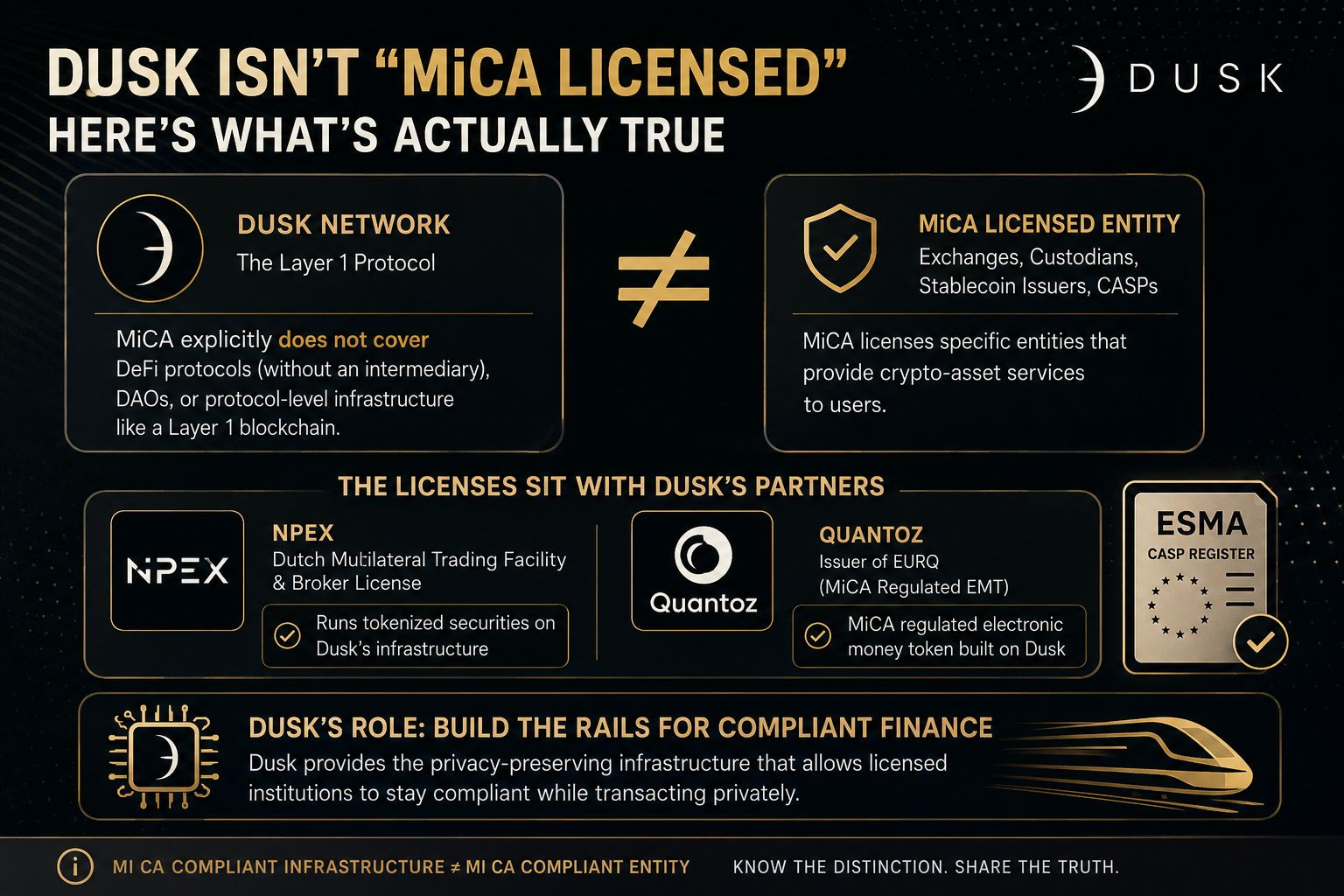
MiCA(EU の暗号資産規制の枠組み)は、特定のものをライセンスします。取引所、カストディアン、ステーブルコイン発行者、Crypto-Asset Service Providers(暗号資産サービス提供者)に当たる事業者です。Dusk が自分たちの記述の中で言っている通り、MiCA は(仲介なしの)DeFi プロトコルや、DAOs、あるいはレイヤー1ブロックチェーン自体のような単純なプロトコル基盤レベルのインフラを明確にカバーしていません。つまり、ライセンスされるのは「Dusk(ネットワーク)」そのものではありません。ライセンス対象となる事業者の下で動く“レール(基盤)”のことです。
実際のライセンスは Dusk のパートナー側にあります。NPEX はオランダの多角的取引施設(MTF)とブローカーライセンスを保有し、トークン化された証券を $DUSK infrastructure 上で運用しています。Quantoz は、MiCA 規制の電子マネートークンである EURQ を発行しており、それも Dusk 上で構築されています。これらはいずれも実在し、検証可能で、ESMA の CASP レジスターに掲載されています。Dusk は、ライセンスを受けた機関が、プライベートな取引をしつつコンプライアンスを維持できるようにする技術を作りました。それは本当に価値があります。ただしそれは、「Dusk は MiCA 準拠」と“包括的に”言い切るのとは別の主張です。
私は Dusk が不誠実だとは思いません。彼ら自身のブログ投稿は、見出しの先を読めば、その違いをかなりはっきり書いています。より正確には、「MiCA 準拠のインフラ」が会話やSNS投稿の中で「MiCA 準拠」と短縮されがちで、その短縮が、何を主張しているのかを静かに変えてしまうのだと思います。あるバージョンは私たちはコンプライアンスを可能にする、と言っています。もう一方は、私たちが準拠していると示唆します。これらは同じ文ではありません。
それをセールスポイントとして繰り返す前に、どちらが実際に当てはまるのかを知っておく価値があります。
#dusk itself が MiCA 認可されているかの確認を探しに行き、素直に「はい」と分かることを期待していました。見つかったのは、より微妙で、正直なところ単純な「はい」よりも面白い内容でした。
MiCA(EU の暗号資産規制の枠組み)は、特定のものをライセンスします。取引所、カストディアン、ステーブルコイン発行者、Crypto-Asset Service Providers(暗号資産サービス提供者)に当たる事業者です。Dusk が自分たちの記述の中で言っている通り、MiCA は(仲介なしの)DeFi プロトコルや、DAOs、あるいはレイヤー1ブロックチェーン自体のような単純なプロトコル基盤レベルのインフラを明確にカバーしていません。つまり、ライセンスされるのは「Dusk(ネットワーク)」そのものではありません。ライセンス対象となる事業者の下で動く“レール(基盤)”のことです。
実際のライセンスは Dusk のパートナー側にあります。NPEX はオランダの多角的取引施設(MTF)とブローカーライセンスを保有し、トークン化された証券を $DUSK infrastructure 上で運用しています。Quantoz は、MiCA 規制の電子マネートークンである EURQ を発行しており、それも Dusk 上で構築されています。これらはいずれも実在し、検証可能で、ESMA の CASP レジスターに掲載されています。Dusk は、ライセンスを受けた機関が、プライベートな取引をしつつコンプライアンスを維持できるようにする技術を作りました。それは本当に価値があります。ただしそれは、「Dusk は MiCA 準拠」と“包括的に”言い切るのとは別の主張です。
私は Dusk が不誠実だとは思いません。彼ら自身のブログ投稿は、見出しの先を読めば、その違いをかなりはっきり書いています。より正確には、「MiCA 準拠のインフラ」が会話やSNS投稿の中で「MiCA 準拠」と短縮されがちで、その短縮が、何を主張しているのかを静かに変えてしまうのだと思います。あるバージョンは私たちはコンプライアンスを可能にする、と言っています。もう一方は、私たちが準拠していると示唆します。これらは同じ文ではありません。
それをセールスポイントとして繰り返す前に、どちらが実際に当てはまるのかを知っておく価値があります。
翻訳参照
🚀 Crypto Market Blast: Bitcoin Just Shook the Market! 🚀
Bitcoin is on an incredible run this week. It closed with a 22% weekly gain, ending near $77,000, up from about $62,800 at the start of the week. That's its strongest weekly run since 2024, and Bitcoin even broke past the $78,000 level!
What's driving the rally?
📈 Treasury Secretary Bessent's bond market intervention pushed yields down
📈 Trump has been pushing Congress to pass the Clarity Act, which would bring clarity to crypto regulation
📈 This triggered a massive short squeeze, with roughly $2.7 billion in crypto short positions liquidated
It's not just Bitcoin. Ethereum jumped 8.12% to $2,515, and XRP surged 14.61% to $1.4538, showing the rally is broad rather than a single-token move. Bitcoin Cash gained 31% in 24 hours, and Ethena rose 27%. Altcoins are joining the party too! 🎉
⚠️ Reminder: crypto is highly volatile. Do your own research and only invest what you can afford to lose.
#Bitcoin #CryptoMarket #BTC #CryptoNews #Ethereum
Bitcoin is on an incredible run this week. It closed with a 22% weekly gain, ending near $77,000, up from about $62,800 at the start of the week. That's its strongest weekly run since 2024, and Bitcoin even broke past the $78,000 level!
What's driving the rally?
📈 Treasury Secretary Bessent's bond market intervention pushed yields down
📈 Trump has been pushing Congress to pass the Clarity Act, which would bring clarity to crypto regulation
📈 This triggered a massive short squeeze, with roughly $2.7 billion in crypto short positions liquidated
It's not just Bitcoin. Ethereum jumped 8.12% to $2,515, and XRP surged 14.61% to $1.4538, showing the rally is broad rather than a single-token move. Bitcoin Cash gained 31% in 24 hours, and Ethena rose 27%. Altcoins are joining the party too! 🎉
⚠️ Reminder: crypto is highly volatile. Do your own research and only invest what you can afford to lose.
#Bitcoin #CryptoMarket #BTC #CryptoNews #Ethereum
翻訳参照
Dusks founder is also the CTO of the exchange that runs on Dusks own technology. Nobody flagged this to me until I checked myself.
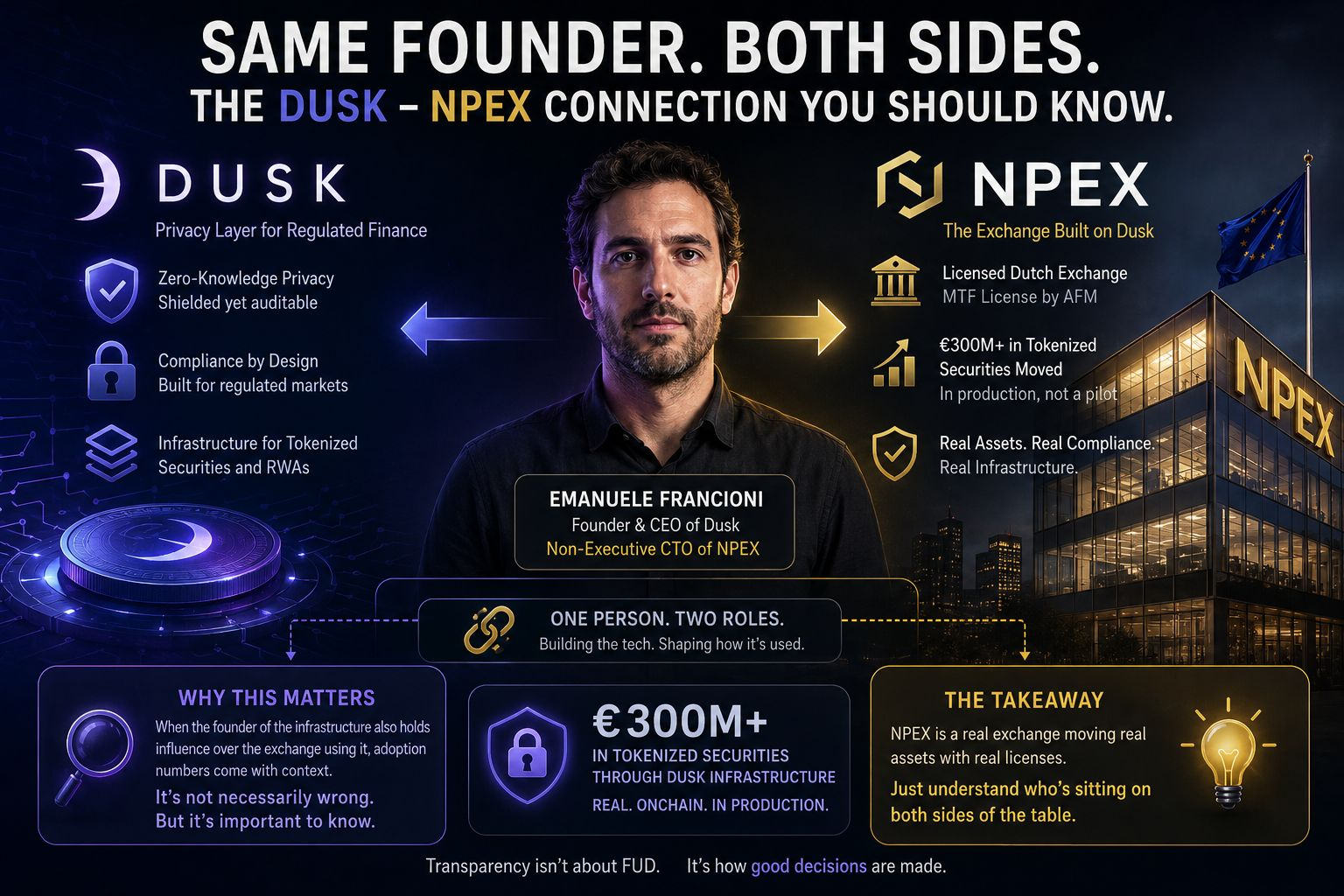
I was reading through #dusk partnership news and noticed a line that made me stop. Emanuele Francioni, founder and CEO of @Dusk , was appointed as Non-Executive CTO of NPEX, the licensed Dutch exchange that's tokenizing hundreds of millions in securities using Dusks infrastructure. Same person, sitting on both sides of whats supposed to be a partnership between two separate entities.
I want to be fair about this before jumping to conclusions. Non-Executive roles are common in this industry, Advisors sit on boards all the time, and having the actual architect of the underlying tech helping the exchange implement it correctly is not inherently sketchy. If anything, you could argue its the opposite, who better understands how to securely deploy $DUSK privacy and compliance layer than the person who built it.
But step back for a second. NPEX using Dusk is not just two companies doing business together anymore. Its a licensed exchange whose technical direction is partly steered by the same person whose company benefits directly from that Exchanges continued use of Dusk. Every reference to NPEX as proof of institutional adoption, the 300 million plus in tokenized assets, all of it carries this detail sitting quietly underneath, not hidden exactly, just rarely mentioned next to the headline number.
I dont think this makes the NPEX partnership fake or the numbers inflated. Real securities are genuinely moving through real infrastructure. I just think when a founder holds influence on both sides of a flagship adoption story, thats worth knowing before you treat it as fully independent validation, not after.
I was reading through #dusk partnership news and noticed a line that made me stop. Emanuele Francioni, founder and CEO of @Dusk , was appointed as Non-Executive CTO of NPEX, the licensed Dutch exchange that's tokenizing hundreds of millions in securities using Dusks infrastructure. Same person, sitting on both sides of whats supposed to be a partnership between two separate entities.
I want to be fair about this before jumping to conclusions. Non-Executive roles are common in this industry, Advisors sit on boards all the time, and having the actual architect of the underlying tech helping the exchange implement it correctly is not inherently sketchy. If anything, you could argue its the opposite, who better understands how to securely deploy $DUSK privacy and compliance layer than the person who built it.
But step back for a second. NPEX using Dusk is not just two companies doing business together anymore. Its a licensed exchange whose technical direction is partly steered by the same person whose company benefits directly from that Exchanges continued use of Dusk. Every reference to NPEX as proof of institutional adoption, the 300 million plus in tokenized assets, all of it carries this detail sitting quietly underneath, not hidden exactly, just rarely mentioned next to the headline number.
I dont think this makes the NPEX partnership fake or the numbers inflated. Real securities are genuinely moving through real infrastructure. I just think when a founder holds influence on both sides of a flagship adoption story, thats worth knowing before you treat it as fully independent validation, not after.
確認済み
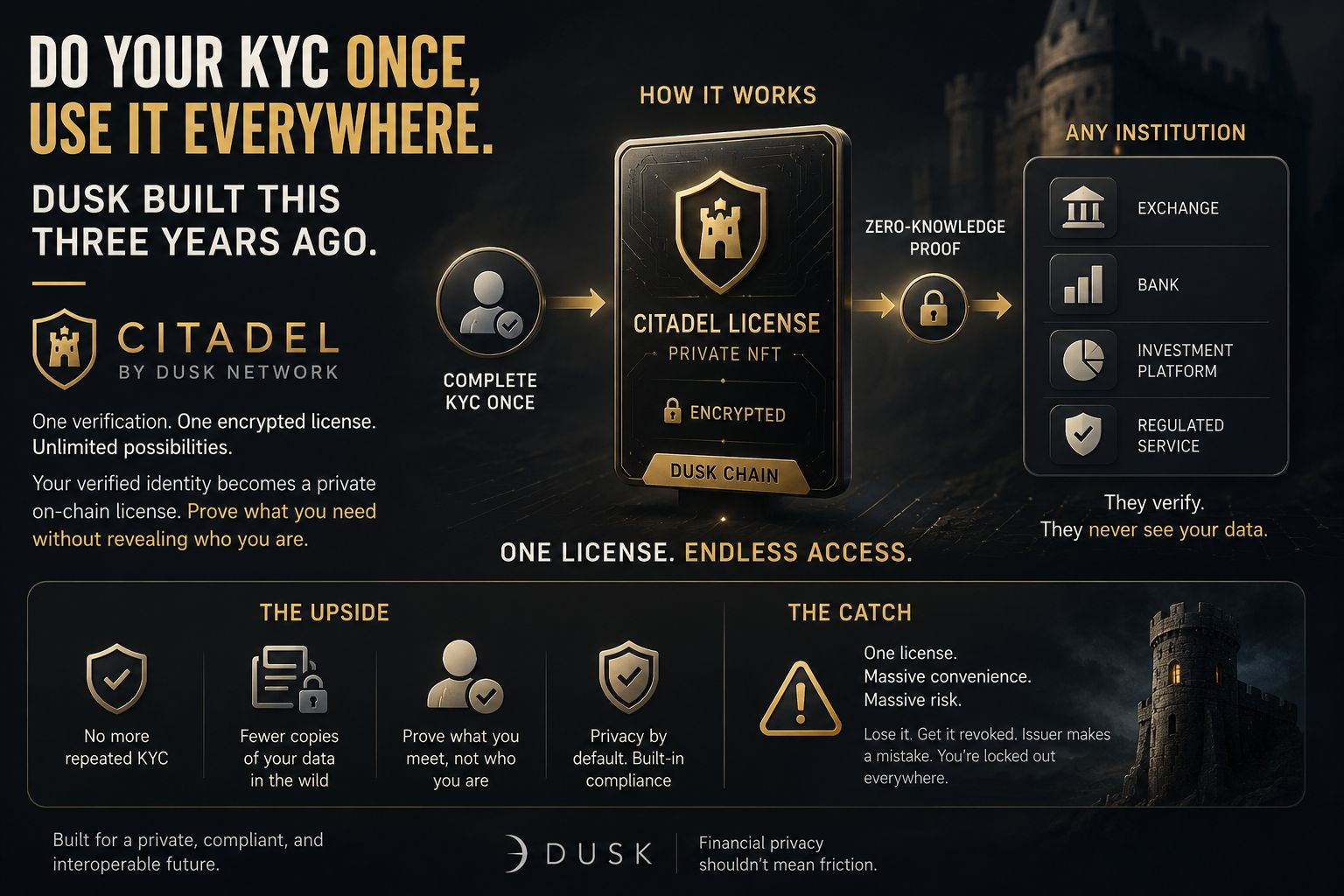
KYCは一度だけ済ませ、どこでも使い回せ。@Dusk は3年前にこれを作り上げたのに、もうほとんど誰も話題にしません。
最近のDuskEVMと価格の値動きにみんな盛り上がっているのは分かります。ですが、#dusk の過去ログをさかのぼってみると、今まさに出ているものよりも、もっと重要だと思う古い話を見つけました。Citadelです。KYCは一度完了すれば、その後あなたを確認する必要があるあらゆる機関が、毎回最初から同じ手続きをやらせる代わりに、ライセンスを照合するだけで済みます。
仕組みはこうです。あなたの検証済みの身元は、プライベートなNFTのようなもの、ライセンスとして、Duskチェーン上に暗号化されて保存されます。プラットフォームがあなたの要件(適格投資家としてのステータス、最低残高、その他何であれ)を満たしていることを確認したいとき、あなたは再び書類を渡す必要がありません。あなたは、そのプラットフォームの“正確な要件”を満たす有効なライセンスを保有していることを示すゼロ知識証明を生成します。彼らが見るのはそれだけ。名前でも、銀行の明細でもなく、「検証済みのYES」だけです。
この点が良いと思うのは明白です。今日のKYCは本当に最悪です。同じ書類、同じ“IDを持っている自撮り”。それを、触れるたびにすべての取引所やプラットフォームで何度も繰り返す。各サービスが、どこかにデータの新しいコピーを保存していく。Citadelはそれらを1つの検証に集約して再利用するので、個人書類の山がどこかのデータベースに溜まって漏洩を待つ…という状況を減らせます。
ただ、気になる点もあります。コンプライアンス上の“身元”が、オンチェーンの1つのライセンスに集約されるなら、そのライセンスは非常に価値の高い狙いになります。管理を失う、あるいは発行者がミスをする—そうなれば、1つのプラットフォームから締め出されるだけでなく、場合によっては全部です。利便性を中央集権化するのと、リスクを中央集権化するのは、たいてい同じ動きで、違う服を着ているだけです。
3年前の話なのに、いまだにあまり注目されていないようです。Duskが実際に作ったものの中で、最も過小評価されている可能性すらあります。$DUSK
最近のDuskEVMと価格の値動きにみんな盛り上がっているのは分かります。ですが、#dusk の過去ログをさかのぼってみると、今まさに出ているものよりも、もっと重要だと思う古い話を見つけました。Citadelです。KYCは一度完了すれば、その後あなたを確認する必要があるあらゆる機関が、毎回最初から同じ手続きをやらせる代わりに、ライセンスを照合するだけで済みます。
仕組みはこうです。あなたの検証済みの身元は、プライベートなNFTのようなもの、ライセンスとして、Duskチェーン上に暗号化されて保存されます。プラットフォームがあなたの要件(適格投資家としてのステータス、最低残高、その他何であれ)を満たしていることを確認したいとき、あなたは再び書類を渡す必要がありません。あなたは、そのプラットフォームの“正確な要件”を満たす有効なライセンスを保有していることを示すゼロ知識証明を生成します。彼らが見るのはそれだけ。名前でも、銀行の明細でもなく、「検証済みのYES」だけです。
この点が良いと思うのは明白です。今日のKYCは本当に最悪です。同じ書類、同じ“IDを持っている自撮り”。それを、触れるたびにすべての取引所やプラットフォームで何度も繰り返す。各サービスが、どこかにデータの新しいコピーを保存していく。Citadelはそれらを1つの検証に集約して再利用するので、個人書類の山がどこかのデータベースに溜まって漏洩を待つ…という状況を減らせます。
ただ、気になる点もあります。コンプライアンス上の“身元”が、オンチェーンの1つのライセンスに集約されるなら、そのライセンスは非常に価値の高い狙いになります。管理を失う、あるいは発行者がミスをする—そうなれば、1つのプラットフォームから締め出されるだけでなく、場合によっては全部です。利便性を中央集権化するのと、リスクを中央集権化するのは、たいてい同じ動きで、違う服を着ているだけです。
3年前の話なのに、いまだにあまり注目されていないようです。Duskが実際に作ったものの中で、最も過小評価されている可能性すらあります。$DUSK
翻訳参照
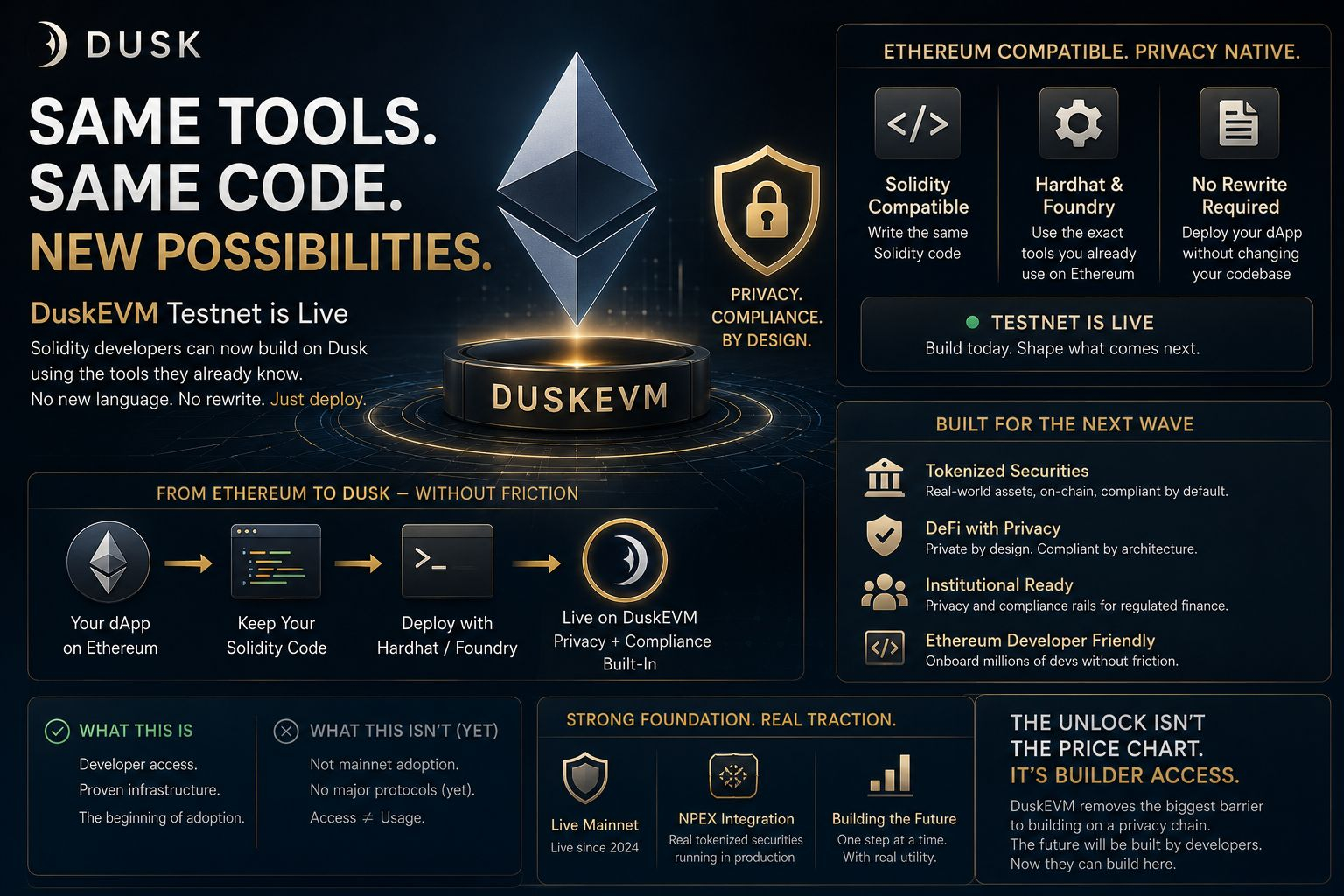
$DUSK just made it possible for any Ethereum Developer to build here without Learning anything new. I think this is the actual Unlock, not the price Chart.
Small headline, big implication. DuskEVM testnet went live earlier this month. What that actually means: Developers can now deploy Solidity contracts on @Dusk using Hardhat and Foundry, the exact tools they already use on Ethereum. No new language, no rewriting a codebase from scratch, no learning #dusk Native Rust Environment just to try it out.
Why that matters more than it sounds. Privacy chains have historically had a chicken and egg problem. The tech is genuinely impressive, but almost nobody builds on it because it demands developers abandon everything familiar and start over. Dusk just removed that excuse. An existing Ethereum DeFi app can now target DuskEVM directly, keep its Solidity code, and inherit Dusks privacy and compliance layer underneath without a rewrite.
I want to be honest about what this is and is not, because the hype cycle tends to skip this part. This is a testnet. It establishes developer access, it does not prove adoption yet. Nobodys shipped a major protocol on it, no TVL has moved because of it. Access is not the same as usage, and I have watched enough testnets get treated like finished products to know the difference matters.
Still, paired with everything else stacking up, real tokenized securities running through NPEX, a live Mainnet a year old now, this is the piece that turns "Interesting Privacy Chain" into "A Chain Ethereum Builders can actually enter without Friction". Thats a bigger deal long term than another green candle.
Watching this closely, not calling it proven yet. The testnet is real. The adoption is still an open question.
Small headline, big implication. DuskEVM testnet went live earlier this month. What that actually means: Developers can now deploy Solidity contracts on @Dusk using Hardhat and Foundry, the exact tools they already use on Ethereum. No new language, no rewriting a codebase from scratch, no learning #dusk Native Rust Environment just to try it out.
Why that matters more than it sounds. Privacy chains have historically had a chicken and egg problem. The tech is genuinely impressive, but almost nobody builds on it because it demands developers abandon everything familiar and start over. Dusk just removed that excuse. An existing Ethereum DeFi app can now target DuskEVM directly, keep its Solidity code, and inherit Dusks privacy and compliance layer underneath without a rewrite.
I want to be honest about what this is and is not, because the hype cycle tends to skip this part. This is a testnet. It establishes developer access, it does not prove adoption yet. Nobodys shipped a major protocol on it, no TVL has moved because of it. Access is not the same as usage, and I have watched enough testnets get treated like finished products to know the difference matters.
Still, paired with everything else stacking up, real tokenized securities running through NPEX, a live Mainnet a year old now, this is the piece that turns "Interesting Privacy Chain" into "A Chain Ethereum Builders can actually enter without Friction". Thats a bigger deal long term than another green candle.
Watching this closely, not calling it proven yet. The testnet is real. The adoption is still an open question.
翻訳参照
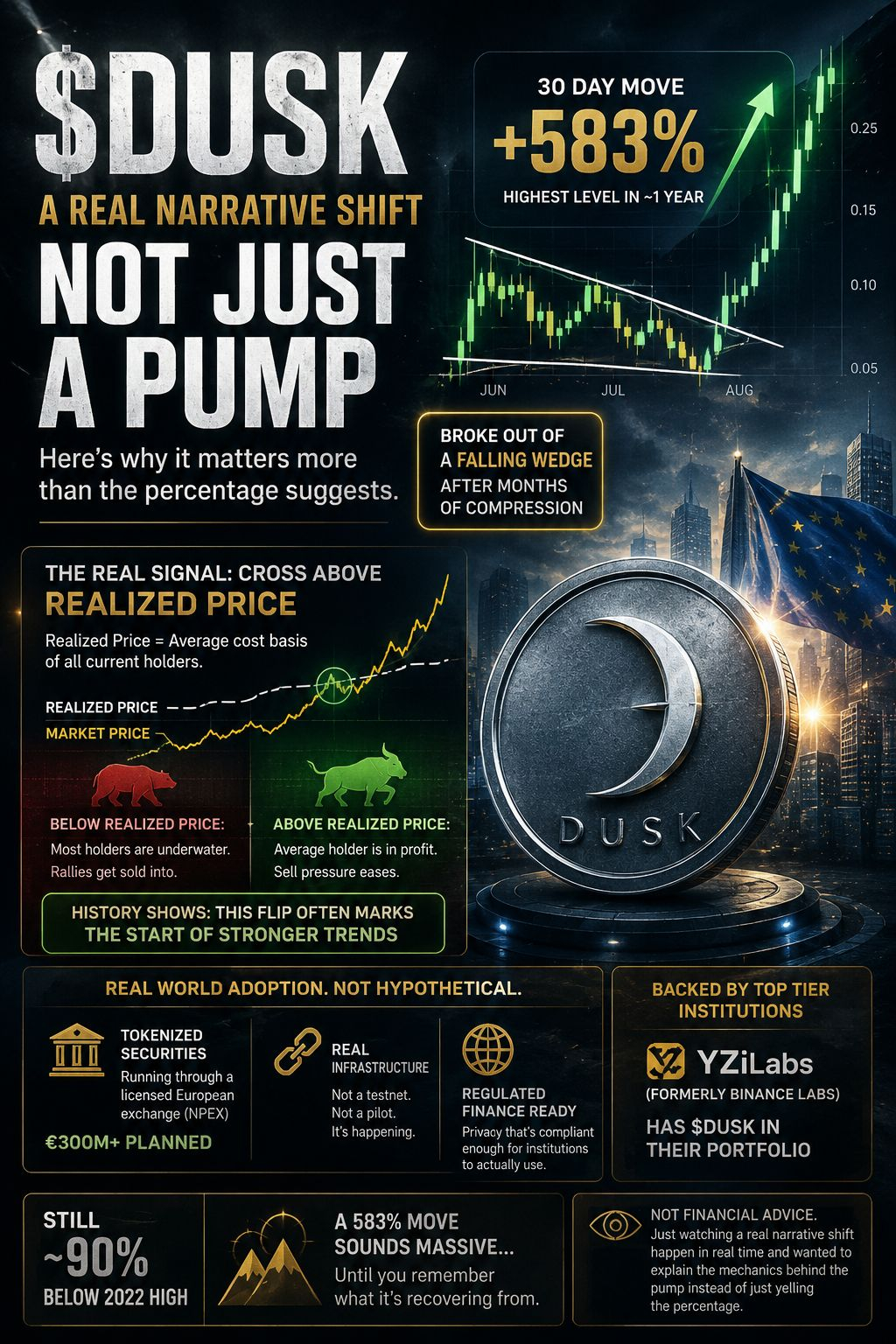
$DUSK just did something most Privacy Coins have not managed in Years. I want to explain why it matters more than the Percentage suggests.
Everyone chases the number first. Fine, lets start there. @Dusk ran nearly 583% in 30 days, Breaking out of a falling wedge it had been stuck in for months, hitting its Highest level in about a Year. Loud number. But loud numbers happen every week in this market and most of them mean nothing six weeks later.
Here is the part that actually made me Pay attention. On-chain data shows #dusk Crossed above its realized price, basically the average cost basis of everyone currently holding it. That flip matters more than people give it Credit for. Below that line, most holders are underwater and rallies get sold into as people rush to break even. Above it, the average holder is finally in profit, and historically that's when sell pressure eases instead of capping every bounce. It's the difference between a pump getting sold, and a trend that has room to actually continue.
And this is not happening in a vacuum. DUSK is one of the few privacy tokens actually shipping Real-World Asset (RWA) integration, Tokenized securities running through a licensed European exchange, north of 300 million Euros planned, not hypothetical.
Y Zi Labs, the fund formerly known as BINANCE Labs, has DUSK in its own portfolio. Thats not retail hype carrying this, thats a narrative Institutions are actually positioning around, privacy thats compliant enough for regulated finance to touch.
I will say the boring part too because it matters. This token is still sitting something like 90 percent below its 2022 high. A 583% move sounds massive until you remember what it's recovering from. Respect the move, dont romanticize it into something it is not yet.
Not financial Advice. Just watching a real narrative shift happen in real time and wanted to explain the mechanics behind the pump instead of just yelling the Percentage.
Everyone chases the number first. Fine, lets start there. @Dusk ran nearly 583% in 30 days, Breaking out of a falling wedge it had been stuck in for months, hitting its Highest level in about a Year. Loud number. But loud numbers happen every week in this market and most of them mean nothing six weeks later.
Here is the part that actually made me Pay attention. On-chain data shows #dusk Crossed above its realized price, basically the average cost basis of everyone currently holding it. That flip matters more than people give it Credit for. Below that line, most holders are underwater and rallies get sold into as people rush to break even. Above it, the average holder is finally in profit, and historically that's when sell pressure eases instead of capping every bounce. It's the difference between a pump getting sold, and a trend that has room to actually continue.
And this is not happening in a vacuum. DUSK is one of the few privacy tokens actually shipping Real-World Asset (RWA) integration, Tokenized securities running through a licensed European exchange, north of 300 million Euros planned, not hypothetical.
Y Zi Labs, the fund formerly known as BINANCE Labs, has DUSK in its own portfolio. Thats not retail hype carrying this, thats a narrative Institutions are actually positioning around, privacy thats compliant enough for regulated finance to touch.
I will say the boring part too because it matters. This token is still sitting something like 90 percent below its 2022 high. A 583% move sounds massive until you remember what it's recovering from. Respect the move, dont romanticize it into something it is not yet.
Not financial Advice. Just watching a real narrative shift happen in real time and wanted to explain the mechanics behind the pump instead of just yelling the Percentage.
翻訳参照
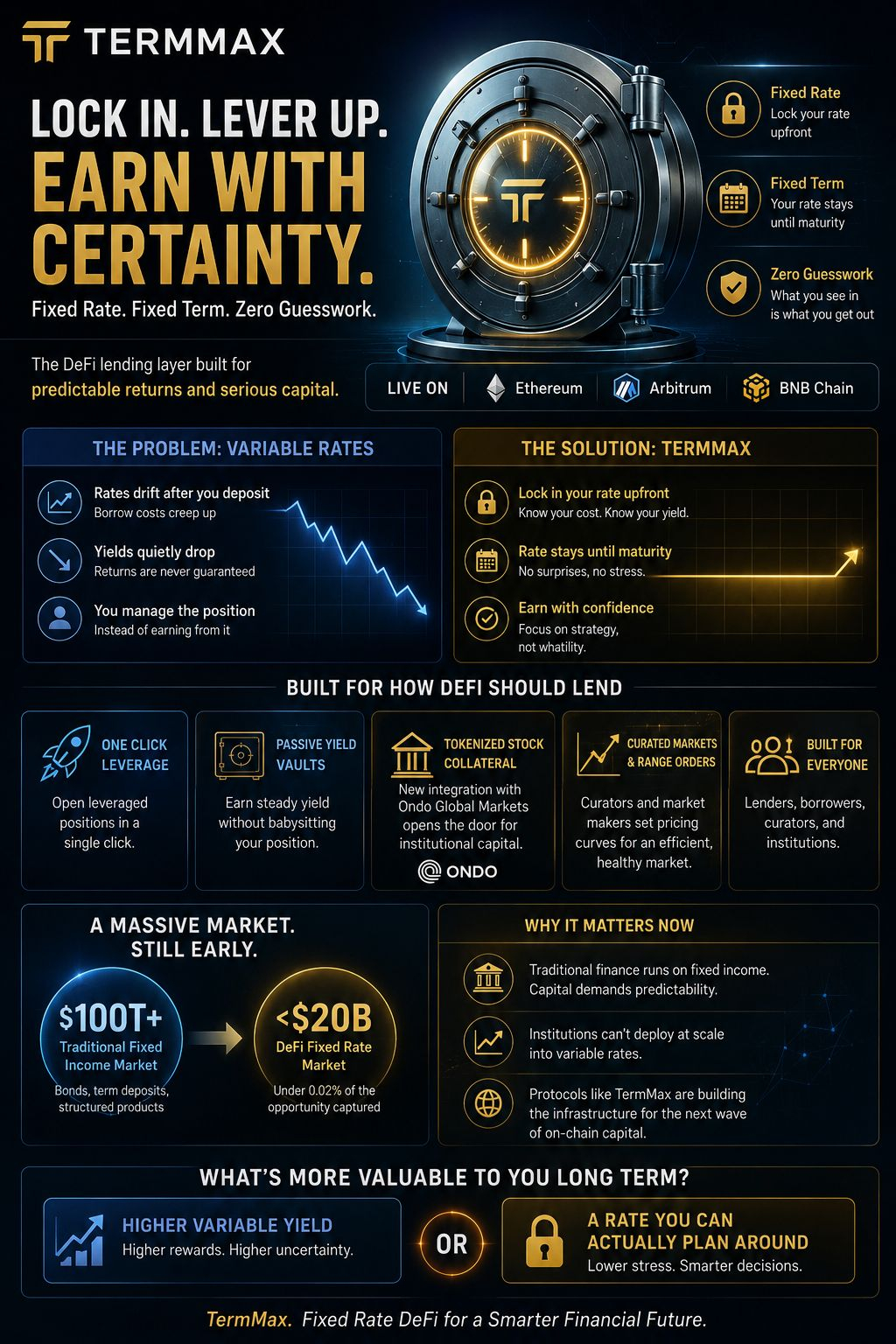
Most people dont realize how much they Are overpaying for uncertainty in DeFi.
You Deposit into a lending pool, the Rate looks great on day one, and then it Drifts. Borrow costs creep up. Yield quietly drops. You end up managing a position instead of actually earning from it.
@TermMax takes a different approach. Its a fixed rate, fixed term lending and borrowing protocol, live on Ethereum, Arbitrum, and BNB Chain. You lock in your rate upfront and it stays that way until maturity. What you see going in is what you get coming out.
A few reasons this stands out right now.
It supports one click leveraged positions without routing through multiple protocols.
Vaults let you earn passive yield without babysitting your position every day.
It recently added tokenized stock collateral through Ondo Global Markets, which is a real step toward bringing institutional capital on chain.
Curators and market makers can set their own pricing curves through range orders, so the market stays efficient instead of relying on a single formula.
Traditional finance runs on fixed income. Bonds, term deposits, structured products. Its a market worth well over $100T. DeFis fixed rate segment is still under $20B. Thats not a weakness in the space. Its early innings.
If DeFi wants to attract capital that cant tolerate unpredictable returns, protocols like this are the ones building the actual infrastructure for it.
Whats more valuable to you long term, higher variable yield or a rate you can actually plan around? #termmax
You Deposit into a lending pool, the Rate looks great on day one, and then it Drifts. Borrow costs creep up. Yield quietly drops. You end up managing a position instead of actually earning from it.
@TermMax takes a different approach. Its a fixed rate, fixed term lending and borrowing protocol, live on Ethereum, Arbitrum, and BNB Chain. You lock in your rate upfront and it stays that way until maturity. What you see going in is what you get coming out.
A few reasons this stands out right now.
It supports one click leveraged positions without routing through multiple protocols.
Vaults let you earn passive yield without babysitting your position every day.
It recently added tokenized stock collateral through Ondo Global Markets, which is a real step toward bringing institutional capital on chain.
Curators and market makers can set their own pricing curves through range orders, so the market stays efficient instead of relying on a single formula.
Traditional finance runs on fixed income. Bonds, term deposits, structured products. Its a market worth well over $100T. DeFis fixed rate segment is still under $20B. Thats not a weakness in the space. Its early innings.
If DeFi wants to attract capital that cant tolerate unpredictable returns, protocols like this are the ones building the actual infrastructure for it.
Whats more valuable to you long term, higher variable yield or a rate you can actually plan around? #termmax
確認済み
翻訳参照
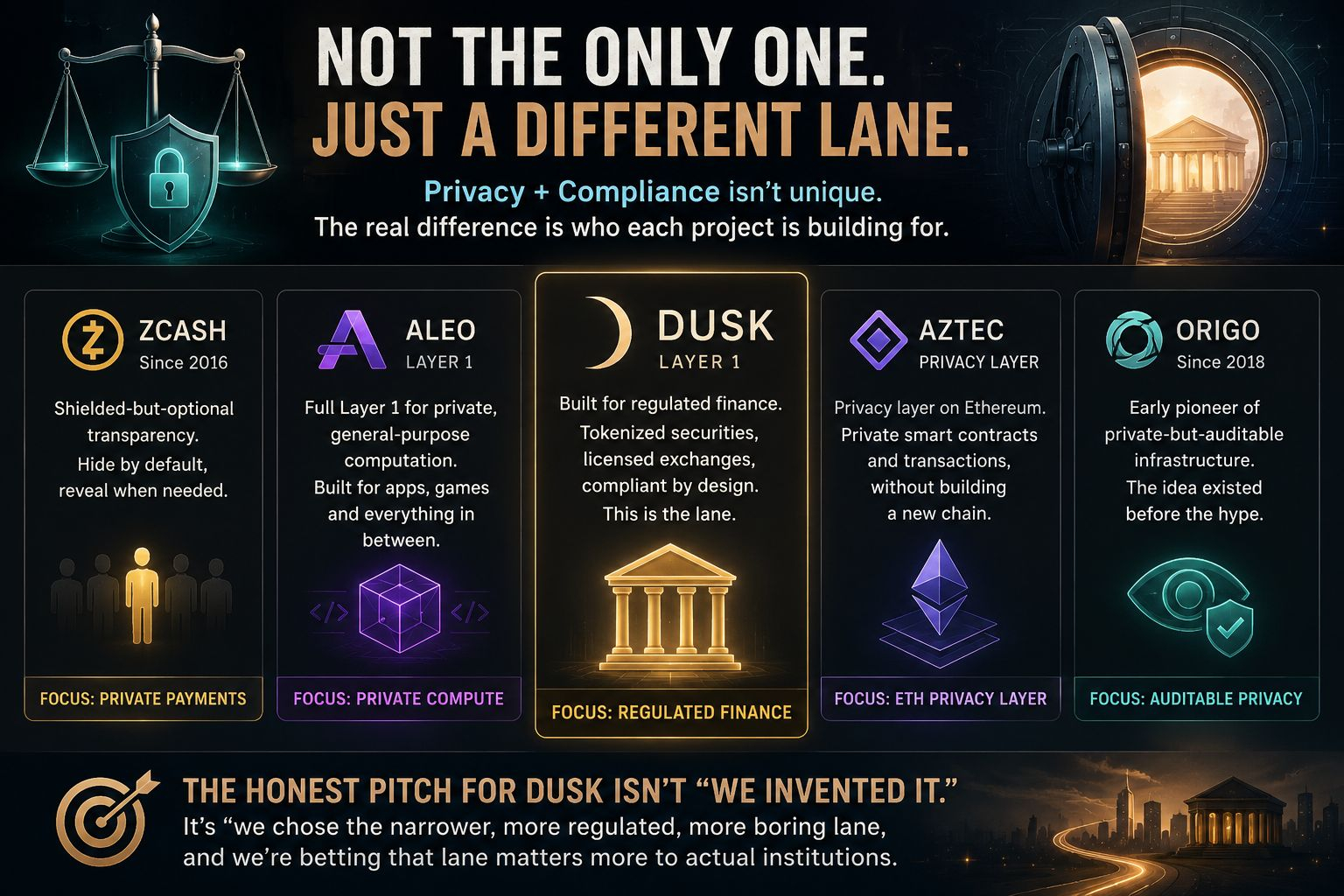
@Dusk keeps getting called "unique" for combining privacy and compliance. It is not, not really.
I kept seeing the same line repeated in #dusk write-ups. Privacy and regulatory compliance, together, first of its kind. So I went and checked who else is actually working on that exact problem, and its a more crowded room than the marketing lets on.
Zcash has been doing shielded-but-optional transparency since 2016, thats basically the same tension, hide by default, reveal when needed. Aleo is building a full Layer 1 around private, general-purpose computation, not just payments. Aztec is doing something similar but as a privacy layer sitting on top of Ethereum instead of its own chain. Even Origo, a much smaller, less talked about project, was pitching private-but-auditable infrastructure back in 2018, years before Dusk had a working mainnet.
What actually is different, and I want to be fair here, is who each of these is building for. Aleo and Aztec both lean toward general private computation, apps, games, arbitrary logic that happens to also be private. $DUSK narrows in specifically on regulated finance, tokenized securities, licensed exchanges, the NPEX kind of real-world deal. Thats a real distinction, not nothing. Its not a unique idea though, its a different target market for a shared idea a handful of teams have been chasing for years.
I think the honest version of Dusks pitch is not "We invented private compliant finance". Its "We picked a narrower, more boring, more regulated lane than Aleo or Aztec did, and we are betting that lane matters more to actual institutions." Thats a smaller claim. It also happens to be the one I find more believable.
I kept seeing the same line repeated in #dusk write-ups. Privacy and regulatory compliance, together, first of its kind. So I went and checked who else is actually working on that exact problem, and its a more crowded room than the marketing lets on.
Zcash has been doing shielded-but-optional transparency since 2016, thats basically the same tension, hide by default, reveal when needed. Aleo is building a full Layer 1 around private, general-purpose computation, not just payments. Aztec is doing something similar but as a privacy layer sitting on top of Ethereum instead of its own chain. Even Origo, a much smaller, less talked about project, was pitching private-but-auditable infrastructure back in 2018, years before Dusk had a working mainnet.
What actually is different, and I want to be fair here, is who each of these is building for. Aleo and Aztec both lean toward general private computation, apps, games, arbitrary logic that happens to also be private. $DUSK narrows in specifically on regulated finance, tokenized securities, licensed exchanges, the NPEX kind of real-world deal. Thats a real distinction, not nothing. Its not a unique idea though, its a different target market for a shared idea a handful of teams have been chasing for years.
I think the honest version of Dusks pitch is not "We invented private compliant finance". Its "We picked a narrower, more boring, more regulated lane than Aleo or Aztec did, and we are betting that lane matters more to actual institutions." Thats a smaller claim. It also happens to be the one I find more believable.
翻訳参照
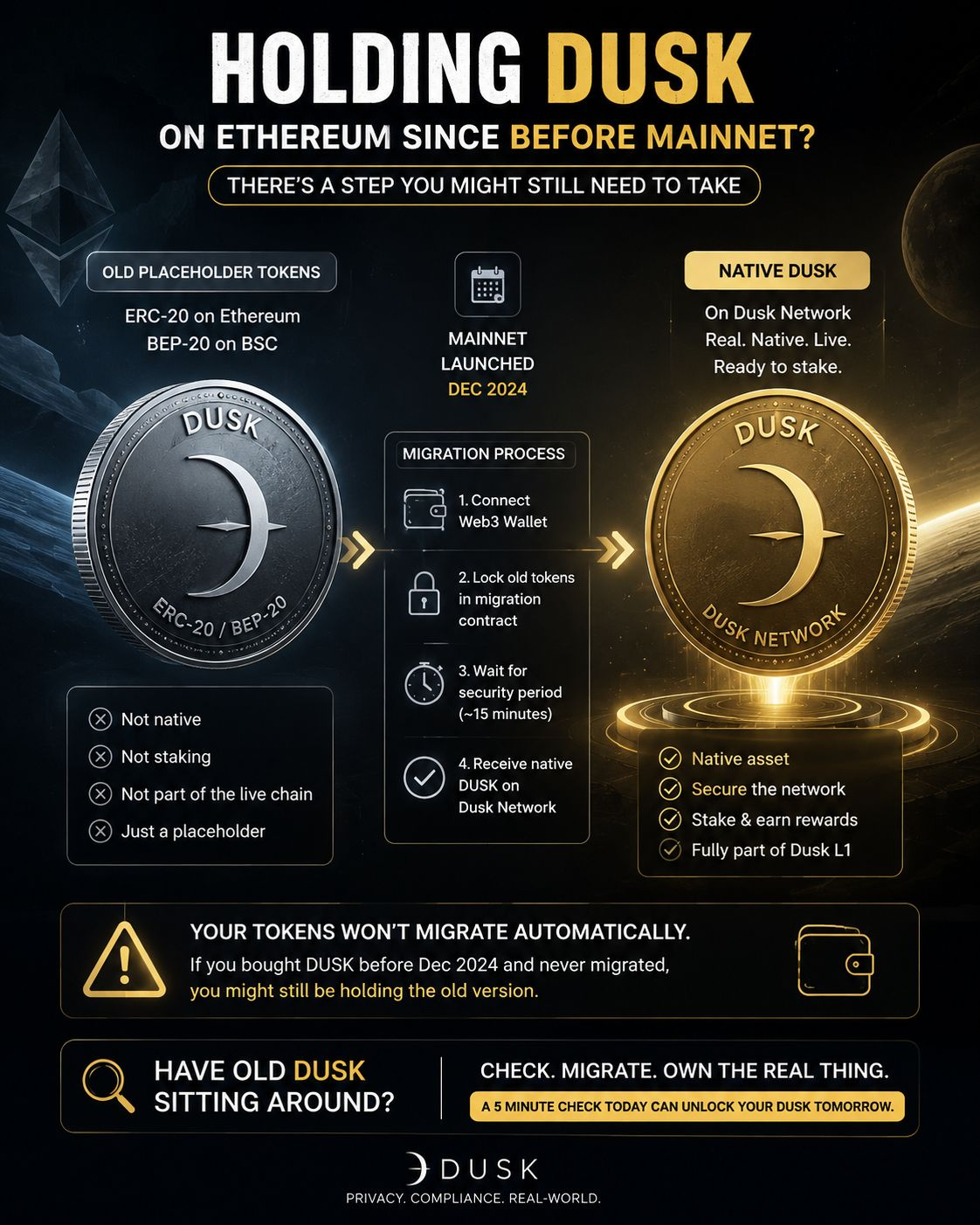
If you have been holding $DUSK on Ethereum since before mainnet, theres a step you might not know you still need to take...
I was reading through #dusk migration docs and realized something that seems easy to miss if you bought in early and just... never checked back.
@Dusk originally launched as a placeholder token, ERC-20 on Ethereum, BEP-20 on BSC, because the actual mainnet was not ready yet. Thats normal, plenty of projects do this. Whats less normal is what happens after mainnet actually launches. Those placeholder tokens dont automatically become the real thing. You have to manually migrate them, connect a Web3 wallet, lock the old tokens in a migration contract, and wait for native DUSK to get issued on the other end. Its not instant either, the contract itself imposes a wait, roughly fifteen minutes, built in for security.
Mainnet went live back in December 2024. That means anyone who bought ERC-20 or BEP-20 DUSK before then and just left it sitting in an exchange wallet or a Web3 wallet they forgot about is holding a placeholder token, not the actual native asset securing the network today. It still has value, its still swappable, but its not staking, not earning anything, not actually part of the live chain until someone manually moves it over.
I dont think this is some kind of trap, the process is documented, its not hidden. But migrations like this quietly strand tokens all the time, not through malice, just through people buying something years ago and forgetting to check back when the underlying project actually shipped.
If you have got old DUSK sitting somewhere and have not touched it since 2023 or 2024, thats worth a five minute check before you assume its already the current version.
I was reading through #dusk migration docs and realized something that seems easy to miss if you bought in early and just... never checked back.
@Dusk originally launched as a placeholder token, ERC-20 on Ethereum, BEP-20 on BSC, because the actual mainnet was not ready yet. Thats normal, plenty of projects do this. Whats less normal is what happens after mainnet actually launches. Those placeholder tokens dont automatically become the real thing. You have to manually migrate them, connect a Web3 wallet, lock the old tokens in a migration contract, and wait for native DUSK to get issued on the other end. Its not instant either, the contract itself imposes a wait, roughly fifteen minutes, built in for security.
Mainnet went live back in December 2024. That means anyone who bought ERC-20 or BEP-20 DUSK before then and just left it sitting in an exchange wallet or a Web3 wallet they forgot about is holding a placeholder token, not the actual native asset securing the network today. It still has value, its still swappable, but its not staking, not earning anything, not actually part of the live chain until someone manually moves it over.
I dont think this is some kind of trap, the process is documented, its not hidden. But migrations like this quietly strand tokens all the time, not through malice, just through people buying something years ago and forgetting to check back when the underlying project actually shipped.
If you have got old DUSK sitting somewhere and have not touched it since 2023 or 2024, thats worth a five minute check before you assume its already the current version.
確認済み
翻訳参照
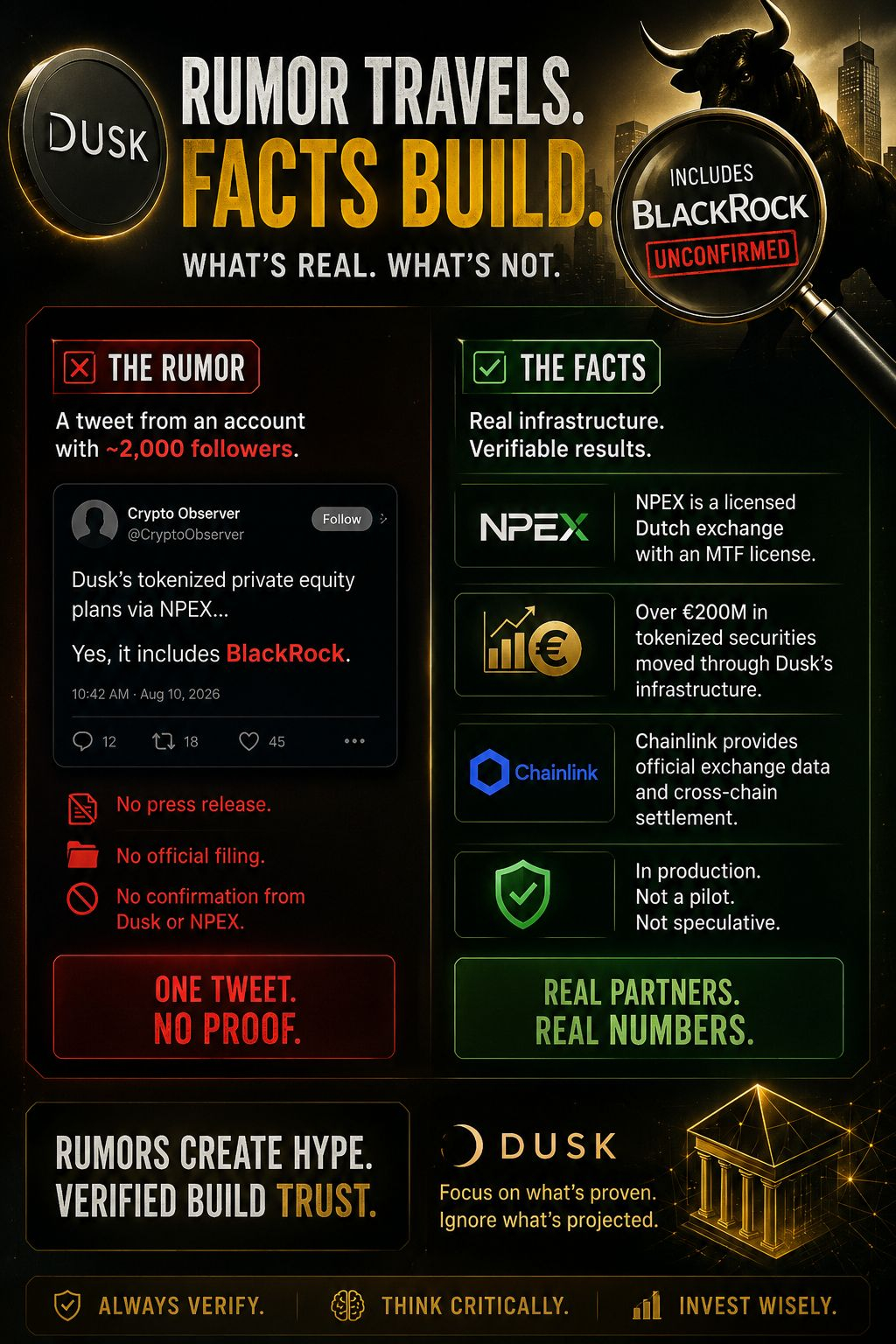
"Includes BlackRock" started as a tweet from an account with 2,000 followers. Now its part of the whole bull case.
I was reading through recent #dusk news roundups, and one line kept getting repeated across multiple sources: hints of BlackRock integration fueling institutional optimism. That phrase alone made me want to trace it back to the source instead of just repeating it.
Traced it back. Its a tweet. From an account with roughly 2,000 followers, commenting on @Dusk tokenized private equity plans through their NPEX partnership, adding "Yes, it includes BlackRock." Thats it. Thats the origin. Not a press release, not an official filing, not anything from Dusk or NPEX themselves confirming it. One persons aside, now circulating in market roundups as a genuine catalyst.
What actually is confirmed is a lot less flashy but honestly more solid. NPEX is a real, licensed Dutch exchange holding an MTF license, and they have moved over 200 million euros in tokenized securities through Dusks infrastructure, in production, not a pilot. Chainlinks involved now too, handling official exchange data and cross-chain settlement for the tokenized assets. Thats genuine institutional plumbing, verifiable, not speculative.
I get why the BlackRock line spreads faster than the NPEX numbers. One is a globally recognized name attached to a rumor. The other is a real but unfamiliar Dutch exchange attached to a confirmed number. Rumors travel lighter than facts, they always have.
Im not saying BlackRock definitely is not involved somehow, somewhere down the chain. Im saying nobodys actually shown that yet, and its already being treated like settled news in places that should know better. $DUSK
I was reading through recent #dusk news roundups, and one line kept getting repeated across multiple sources: hints of BlackRock integration fueling institutional optimism. That phrase alone made me want to trace it back to the source instead of just repeating it.
Traced it back. Its a tweet. From an account with roughly 2,000 followers, commenting on @Dusk tokenized private equity plans through their NPEX partnership, adding "Yes, it includes BlackRock." Thats it. Thats the origin. Not a press release, not an official filing, not anything from Dusk or NPEX themselves confirming it. One persons aside, now circulating in market roundups as a genuine catalyst.
What actually is confirmed is a lot less flashy but honestly more solid. NPEX is a real, licensed Dutch exchange holding an MTF license, and they have moved over 200 million euros in tokenized securities through Dusks infrastructure, in production, not a pilot. Chainlinks involved now too, handling official exchange data and cross-chain settlement for the tokenized assets. Thats genuine institutional plumbing, verifiable, not speculative.
I get why the BlackRock line spreads faster than the NPEX numbers. One is a globally recognized name attached to a rumor. The other is a real but unfamiliar Dutch exchange attached to a confirmed number. Rumors travel lighter than facts, they always have.
Im not saying BlackRock definitely is not involved somehow, somewhere down the chain. Im saying nobodys actually shown that yet, and its already being treated like settled news in places that should know better. $DUSK
翻訳参照
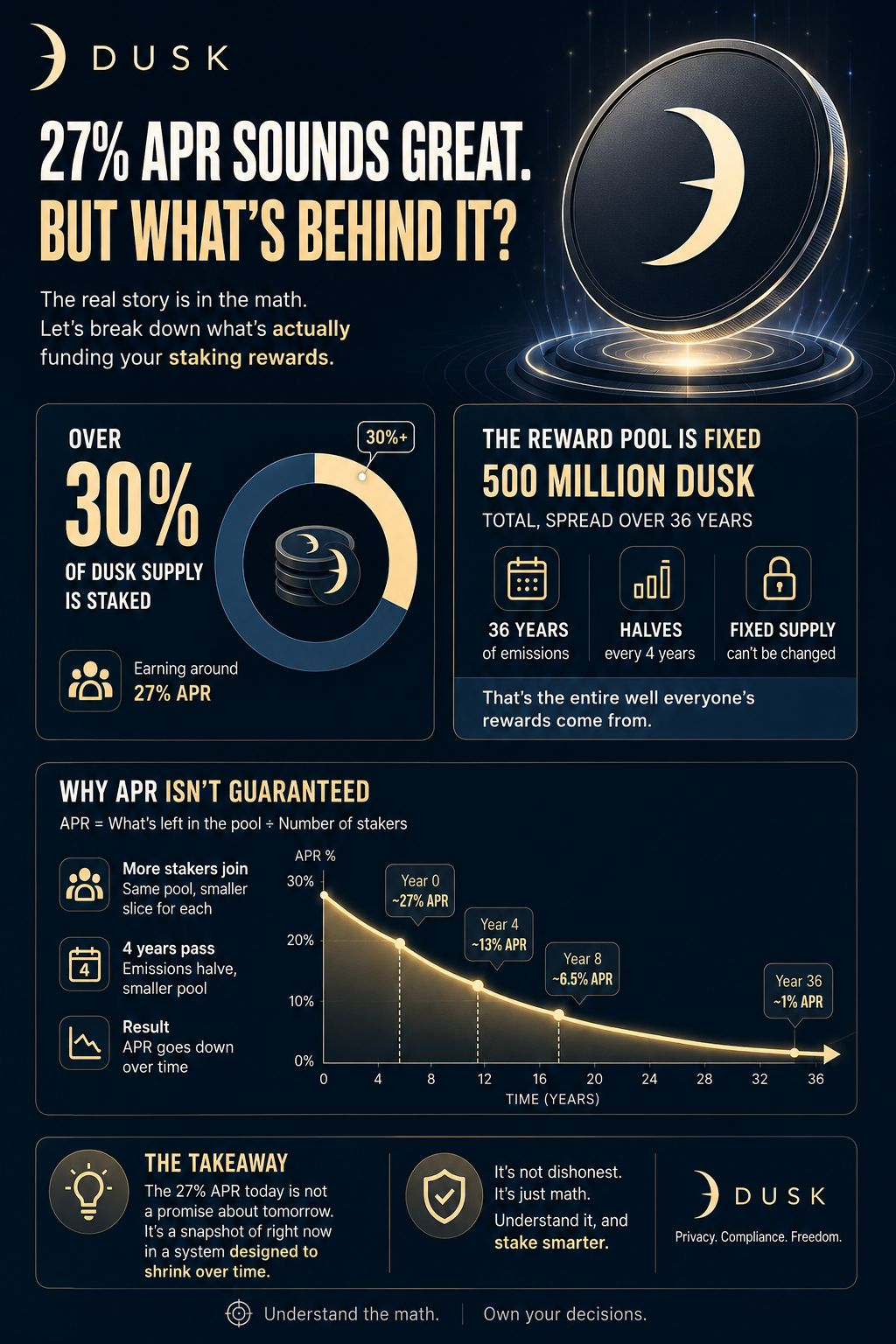
@Dusk is advertising 27% staking APR. The math behind it made me want to slow down.
Saw the number on their own account: over 30% of $DUSK supply staked, earning around 27% APR. Sounds great on its own. Then I checked what's actually funding that reward.
The whole staking reward pool is fixed. 500 million DUSK, total, spread out over 36 years, cut in half every four years by design. Thats it. Thats the entire well everyones rewards come from, forever shrinking on a schedule that was set in advance.
So here is the thing nobody says out loud next to that 27% figure. Its not a fixed rate. Its whatever is left in a shrinking pool, split across however many people happen to be staking at that moment. More stakers join, same pool, smaller slice each. Four years pass, the emission halves, smaller pool too. The 27% today is not a promise about tomorrow, its a snapshot of right now.
I dont think thats dishonest exactly, this is how most staking systems work once you look under the hood. I just think leading with a big APR number, without the decay curve sitting right next to it, sets people up to expect something thats mathematically built to shrink. #dusk
Saw the number on their own account: over 30% of $DUSK supply staked, earning around 27% APR. Sounds great on its own. Then I checked what's actually funding that reward.
The whole staking reward pool is fixed. 500 million DUSK, total, spread out over 36 years, cut in half every four years by design. Thats it. Thats the entire well everyones rewards come from, forever shrinking on a schedule that was set in advance.
So here is the thing nobody says out loud next to that 27% figure. Its not a fixed rate. Its whatever is left in a shrinking pool, split across however many people happen to be staking at that moment. More stakers join, same pool, smaller slice each. Four years pass, the emission halves, smaller pool too. The 27% today is not a promise about tomorrow, its a snapshot of right now.
I dont think thats dishonest exactly, this is how most staking systems work once you look under the hood. I just think leading with a big APR number, without the decay curve sitting right next to it, sets people up to expect something thats mathematically built to shrink. #dusk
翻訳参照
A blockchain trying to be private and fully auditable at once. Did not think that was possible until I looked closer.
Privacy and compliance usually dont mix in crypto. Either transactions are hidden and regulators hate it, or everythings public and you have rebuilt a transparent ledger nobody with real money wants. @Dusk is building the thing in between.
It's a Layer 1 for regulated finance, tokenized securities, compliant trading, not degen DeFi. It uses zero-knowledge proofs so transactions stay shielded from public view while still being fully auditable to whoevers legally allowed to check them. Confidential to everyone else, transparent to the one party who is supposed to see it. Thats a genuinely hard problem, not a slogan.
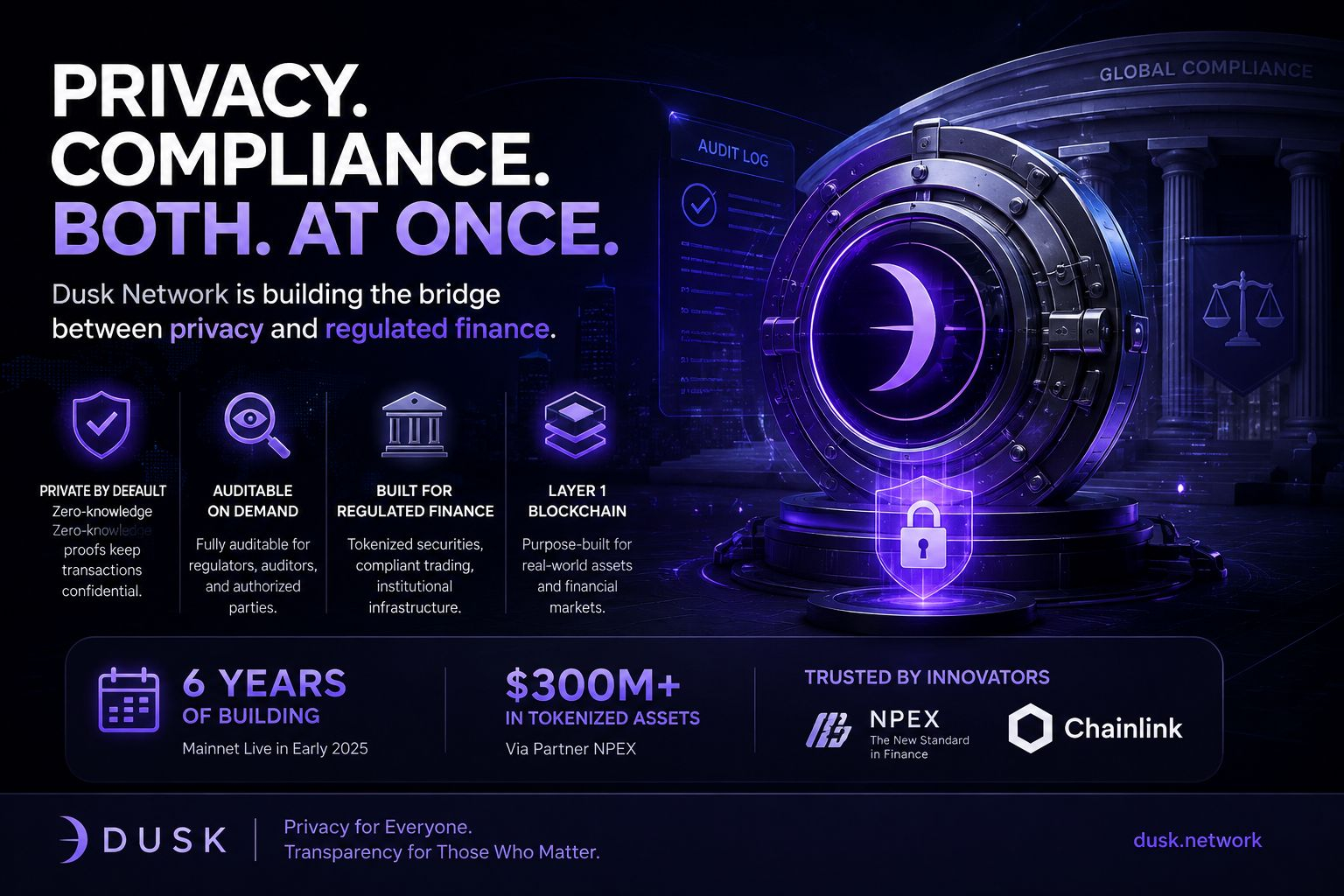
What caught my attention is the timeline. Mainnet went live in early 2025, six years after the project started. Six years is unusual patience in an industry that ships a whitepaper and a token in six months. Paired with real partners like NPEX tokenizing over 300 million dollars in assets, it reads less like stalling and more like someone waiting for the hard part to actually work.
The price chart tells a rougher story. DUSK still sits around 80 percent below its 2021 high, even after real rallies tied to actual news. That gap between "The Tech is Advancing" and "The Token has not Recovered" is common with infrastructure plays. The market does not wait for six year roadmaps to prove themselves.
I dont know yet if regulated finance actually wants this, or if institutions stay comfortable running real securities through a token this volatile. But privacy that does not have to fight compliance feels like one of the few genuinely new ideas I have run into lately. #dusk $DUSK
Privacy and compliance usually dont mix in crypto. Either transactions are hidden and regulators hate it, or everythings public and you have rebuilt a transparent ledger nobody with real money wants. @Dusk is building the thing in between.
It's a Layer 1 for regulated finance, tokenized securities, compliant trading, not degen DeFi. It uses zero-knowledge proofs so transactions stay shielded from public view while still being fully auditable to whoevers legally allowed to check them. Confidential to everyone else, transparent to the one party who is supposed to see it. Thats a genuinely hard problem, not a slogan.
What caught my attention is the timeline. Mainnet went live in early 2025, six years after the project started. Six years is unusual patience in an industry that ships a whitepaper and a token in six months. Paired with real partners like NPEX tokenizing over 300 million dollars in assets, it reads less like stalling and more like someone waiting for the hard part to actually work.
The price chart tells a rougher story. DUSK still sits around 80 percent below its 2021 high, even after real rallies tied to actual news. That gap between "The Tech is Advancing" and "The Token has not Recovered" is common with infrastructure plays. The market does not wait for six year roadmaps to prove themselves.
I dont know yet if regulated finance actually wants this, or if institutions stay comfortable running real securities through a token this volatile. But privacy that does not have to fight compliance feels like one of the few genuinely new ideas I have run into lately. #dusk $DUSK
暗号資産市場は、「熱に浮かれているよりも忍耐がより重要になる局面」に入っていくように感じます。
資金が回転し、物語(ナラティブ)が素早く切り替わり、そして強いプロジェクトがノイズから際立ってきています。BTCは市場のアンカーであり続けますが、流動性はDeFi、AI、RWA、インフラ領域の次の成長エリアを、徐々に探しているところです。
大きな疑問は「暗号資産はさらに上がるのか?」だけではありません。
「次の流動性の波が到来したとき、どのセクターやプロジェクトがまだ重要であり続けるのか?」です。
市場はめったに一直線に動きません。押し目、だまし上げ、そして突然の資金ローテーションが起こります。
私にとっては、すべての上昇のローソク足(グリーン)を追いかけるよりも、この局面はファンダメンタルズを見極め、流動性を追い、備えておくフェーズです。
次の大きな動きは、すでに静かに形成されつつあるかもしれません。👀
$NBISB $PROM
#crypto #BTC #Altcoins #DeFi #CryptoMarket
資金が回転し、物語(ナラティブ)が素早く切り替わり、そして強いプロジェクトがノイズから際立ってきています。BTCは市場のアンカーであり続けますが、流動性はDeFi、AI、RWA、インフラ領域の次の成長エリアを、徐々に探しているところです。
大きな疑問は「暗号資産はさらに上がるのか?」だけではありません。
「次の流動性の波が到来したとき、どのセクターやプロジェクトがまだ重要であり続けるのか?」です。
市場はめったに一直線に動きません。押し目、だまし上げ、そして突然の資金ローテーションが起こります。
私にとっては、すべての上昇のローソク足(グリーン)を追いかけるよりも、この局面はファンダメンタルズを見極め、流動性を追い、備えておくフェーズです。
次の大きな動きは、すでに静かに形成されつつあるかもしれません。👀
$NBISB $PROM
#crypto #BTC #Altcoins #DeFi #CryptoMarket
翻訳参照
@BabylonLabs_io own paperwork says #baby is not an investment. Their staking page disagrees with that.
I was reading through Babylon's tokenomics docs, mostly checking numbers, and ran into a disclaimer I was not expecting. Buried in the legal boilerplate, it says plainly that BABY's primary purpose is paying fees, securing consensus and enabling governance, and that it is not intended to serve as an investment. Fine, standard lawyer language, every project has some version of this.
Except I do just come from the staking page, where the whole pitch is APY numbers, reward projections and language about earning yield on your Bitcoin. Those two things are sitting on the same website contradicting each other, and I dont think thats an accident, I think its the exact tension every token project is currently navigating.
The SEC actually weighed in on this general question earlier this year and their framing stuck with me. What matters is not the label a project puts on its own token. What matters is economic reality, how the thing actually behaves in practice, regardless of what the disclaimer calls it. If something functions like an investment, generates yield, gets marketed around returns, the paperwork saying otherwise does not necessarily settle anything.
Im not a lawyer and Im not accusing Babylon of doing anything uniquely wrong here, honestly almost every token project has this same gap between its legal disclaimers and its actual marketing copy. But reading both pages back to back made the gap feel bigger than usual. One page says this is not an investment. The other page is entirely built around convincing you its worth investing in.
I dont know how that gets resolved, and I dont think Babylon does either yet, nobody in crypto fully does. I just think its worth noticing when a projects legal language and its marketing language are quietly telling you two different stories.
$BABY $ON
I was reading through Babylon's tokenomics docs, mostly checking numbers, and ran into a disclaimer I was not expecting. Buried in the legal boilerplate, it says plainly that BABY's primary purpose is paying fees, securing consensus and enabling governance, and that it is not intended to serve as an investment. Fine, standard lawyer language, every project has some version of this.
Except I do just come from the staking page, where the whole pitch is APY numbers, reward projections and language about earning yield on your Bitcoin. Those two things are sitting on the same website contradicting each other, and I dont think thats an accident, I think its the exact tension every token project is currently navigating.
The SEC actually weighed in on this general question earlier this year and their framing stuck with me. What matters is not the label a project puts on its own token. What matters is economic reality, how the thing actually behaves in practice, regardless of what the disclaimer calls it. If something functions like an investment, generates yield, gets marketed around returns, the paperwork saying otherwise does not necessarily settle anything.
Im not a lawyer and Im not accusing Babylon of doing anything uniquely wrong here, honestly almost every token project has this same gap between its legal disclaimers and its actual marketing copy. But reading both pages back to back made the gap feel bigger than usual. One page says this is not an investment. The other page is entirely built around convincing you its worth investing in.
I dont know how that gets resolved, and I dont think Babylon does either yet, nobody in crypto fully does. I just think its worth noticing when a projects legal language and its marketing language are quietly telling you two different stories.
$BABY $ON
翻訳参照
I just found out $BABY has no max supply, and I dont know how I feel about that
I was looking up the unlock schedule, expecting the usual story, cliff period, then gradual release, standard stuff. Then I hit one sentence that made me stop and reread it twice. The total supply is infinite. Not a big number. Infinite.
Circulating supply right now sits around 4 billion tokens. There was a cliff back in May, and since then the rest of team, advisor, and early investor allocations release linearly, a 36th of their share every month, all the way out to April 2029. That part is normal, most projects do some version of that to stop early holders from dumping everything at once. Whats not normal is that theres no ceiling waiting at the end of it. The supply just keeps expanding, indefinitely, through ongoing inflation that funds staking rewards.
I get the logic. Fixed supply tokens eventually run out of new rewards to hand out, and Babylon needs a permanent incentive to keep both BTC and BABY stakers showing up. Infinite issuance solves that problem cleanly. But it also means every single token you hold is being diluted, forever, on a schedule that never actually ends. Theres no future point where supply stops growing and scarcity kicks in. Thats just how the asset works, permanently.
This changes how I think about that 1 to 3 percent APY figure from earlier. If the reward is a token that inflates without limit, the real return is not the number on the staking page, its that number minus however fast new supply gets created every year. Nobody puts that second number next to the first one.
Im not saying this makes #baby bad. Plenty of useful tokens run on ongoing inflation, thats an old and known model. I just think infinite supply deserves to be said in plain words up front, not found by someone digging through a vesting page like I just did. @BabylonLabs_io
I was looking up the unlock schedule, expecting the usual story, cliff period, then gradual release, standard stuff. Then I hit one sentence that made me stop and reread it twice. The total supply is infinite. Not a big number. Infinite.
Circulating supply right now sits around 4 billion tokens. There was a cliff back in May, and since then the rest of team, advisor, and early investor allocations release linearly, a 36th of their share every month, all the way out to April 2029. That part is normal, most projects do some version of that to stop early holders from dumping everything at once. Whats not normal is that theres no ceiling waiting at the end of it. The supply just keeps expanding, indefinitely, through ongoing inflation that funds staking rewards.
I get the logic. Fixed supply tokens eventually run out of new rewards to hand out, and Babylon needs a permanent incentive to keep both BTC and BABY stakers showing up. Infinite issuance solves that problem cleanly. But it also means every single token you hold is being diluted, forever, on a schedule that never actually ends. Theres no future point where supply stops growing and scarcity kicks in. Thats just how the asset works, permanently.
This changes how I think about that 1 to 3 percent APY figure from earlier. If the reward is a token that inflates without limit, the real return is not the number on the staking page, its that number minus however fast new supply gets created every year. Nobody puts that second number next to the first one.
Im not saying this makes #baby bad. Plenty of useful tokens run on ongoing inflation, thats an old and known model. I just think infinite supply deserves to be said in plain words up front, not found by someone digging through a vesting page like I just did. @BabylonLabs_io
翻訳参照
There was a real bug in Babylon's code, and I think how they handled it matters more than the bug itself
I went looking for Bitcoin maximalist criticism of @BabylonLabs_io , expecting the usual "this isn't real Bitcoin" noise. Found something more useful instead: an actual disclosed vulnerability in the code.
A flaw was found in Babylon's BLS vote extension, the part of the system validators use to sign off on blocks. Malicious validators could have omitted certain block hash data at epoch boundaries, and if enough of them did it together, it could have triggered validator crashes and slowed block production during exactly the moments the chain needs to be most reliable. Developers flagged it publicly, security researchers warned it needed patching, and it got treated as the real production risk it was.
Here's why I dont think this should scare people off. Bugs in early infrastructure aren't a sign something is broken, they are a sign it's being looked at hard enough to find the cracks before they get exploited. What would actually worry me is a protocol holding billions in Bitcoin that never had a disclosed vulnerability at all, because that usually means nobody's looking hard enough, not that nothing's there.
Now, the maximalist critique underneath all this is a fair separate question, and I dont want to dodge it. Some purists argue that staking Bitcoin at all, wiring it into validator logic and slashing conditions, changes what Bitcoin fundamentally is, a step toward the same financialization Bitcoin was built to route around. I dont think that's a dumb objection. Every added mechanism is one more piece of surface area that didn't exist when BTC was just sitting in a wallet doing nothing.
Where I land: the bug tells me the engineering is being stress tested honestly. The maximalist objection tells me some people simply don't want Bitcoin to do more than it already does, and that's a values disagreement, not a security one. Worth holding both thoughts at once instead of picking whichever one supports what you already believed.
#baby $BABY
I went looking for Bitcoin maximalist criticism of @BabylonLabs_io , expecting the usual "this isn't real Bitcoin" noise. Found something more useful instead: an actual disclosed vulnerability in the code.
A flaw was found in Babylon's BLS vote extension, the part of the system validators use to sign off on blocks. Malicious validators could have omitted certain block hash data at epoch boundaries, and if enough of them did it together, it could have triggered validator crashes and slowed block production during exactly the moments the chain needs to be most reliable. Developers flagged it publicly, security researchers warned it needed patching, and it got treated as the real production risk it was.
Here's why I dont think this should scare people off. Bugs in early infrastructure aren't a sign something is broken, they are a sign it's being looked at hard enough to find the cracks before they get exploited. What would actually worry me is a protocol holding billions in Bitcoin that never had a disclosed vulnerability at all, because that usually means nobody's looking hard enough, not that nothing's there.
Now, the maximalist critique underneath all this is a fair separate question, and I dont want to dodge it. Some purists argue that staking Bitcoin at all, wiring it into validator logic and slashing conditions, changes what Bitcoin fundamentally is, a step toward the same financialization Bitcoin was built to route around. I dont think that's a dumb objection. Every added mechanism is one more piece of surface area that didn't exist when BTC was just sitting in a wallet doing nothing.
Where I land: the bug tells me the engineering is being stress tested honestly. The maximalist objection tells me some people simply don't want Bitcoin to do more than it already does, and that's a values disagreement, not a security one. Worth holding both thoughts at once instead of picking whichever one supports what you already believed.
#baby $BABY
翻訳参照
The guy who runs @BabylonLabs_io is not a crypto guy. That actually changes how I read the whole project.
I like knowing whos actually behind something before I trust it, so I looked up David Tse, the co-founder of Babylon. What I found wasn't the usual founder story.
He is a Stanford engineering professor. Before any of this, he invented the proportional fair scheduling algorithm, the thing that quietly helps run 3G, 4G, and 5G networks worldwide. He won the Claude E. Shannon Award, basically the highest honor in information theory. This is someone who spent decades solving how nodes communicate reliably without a central authority, then looked at Bitcoin and realized it was the same problem wearing a different coat. His words, not mine: different nodes need to trust each other without one party controlling everything.
That background actually explains something about Babylon that bugged me before I knew this. The protocol did not come out of a hackathon or a token launch plan. It came out of an academic paper that got accepted into a top security research venue on the first submission, no rebuttal needed, which apparently almost never happens. Theres still no CEO. Tse runs research, his co-founder Fisher Yu runs engineering. That's an unusual structure for something holding billions of dollars in Bitcoin.
I'll be honest, this doesn't automatically make it safer. Smart people build broken systems all the time, and academic rigor does not guarantee good token economics, we have already seen where that gap shows up. But it does change my read on intent. This does not feel like someone chasing a narrative. It feels like someone who already had tenure, already had the Shannon Award, and decided a research paper sitting in a journal wasn't enough of an outcome anymore.
Im still cautious about the token side. Im just less cautious about the engineering than I was before I knew who was actually behind it. #baby $BABY
$EPIC $EUL
I like knowing whos actually behind something before I trust it, so I looked up David Tse, the co-founder of Babylon. What I found wasn't the usual founder story.
He is a Stanford engineering professor. Before any of this, he invented the proportional fair scheduling algorithm, the thing that quietly helps run 3G, 4G, and 5G networks worldwide. He won the Claude E. Shannon Award, basically the highest honor in information theory. This is someone who spent decades solving how nodes communicate reliably without a central authority, then looked at Bitcoin and realized it was the same problem wearing a different coat. His words, not mine: different nodes need to trust each other without one party controlling everything.
That background actually explains something about Babylon that bugged me before I knew this. The protocol did not come out of a hackathon or a token launch plan. It came out of an academic paper that got accepted into a top security research venue on the first submission, no rebuttal needed, which apparently almost never happens. Theres still no CEO. Tse runs research, his co-founder Fisher Yu runs engineering. That's an unusual structure for something holding billions of dollars in Bitcoin.
I'll be honest, this doesn't automatically make it safer. Smart people build broken systems all the time, and academic rigor does not guarantee good token economics, we have already seen where that gap shows up. But it does change my read on intent. This does not feel like someone chasing a narrative. It feels like someone who already had tenure, already had the Shannon Award, and decided a research paper sitting in a journal wasn't enough of an outcome anymore.
Im still cautious about the token side. Im just less cautious about the engineering than I was before I knew who was actually behind it. #baby $BABY
$EPIC $EUL
翻訳参照
Kraken calls it "self-custodial" staking. I dont think that word means what they want it to mean here.
I went down a rabbit hole comparing how Babylon actually works versus how Kraken markets it, and there's a gap I can't unsee now.
Straight from Babylon, staking BTC is genuinely self-custodial. Your Bitcoin sits in a Taproot time-lock on the Bitcoin chain itself, verifiable by anyone, controlled by nobody but you. Then Kraken rolled out its own version, letting users stake BTC directly from their exchange account. Convenient, sure. But to do that, your Bitcoin first has to sit in Krakens custody before it ever touches Babylons protocol. One outlet flat out called this what it is, custodial staking wearing a self-custodial protocol's name. Kraken holds the coins. @BabylonLabs_io just handles what happens to them after that.
I don't think Kraken is being sneaky exactly, their staking page does say "self-custodial, time-locked output", its just describing the Babylon layer underneath, not what happens before your BTC ever gets there. Most people scrolling past that line are going to read "self-custodial" and assume it describes their relationship with Kraken too. It doesn't.
And then there's the flexible and auto earn options, which skip the unbonding period entirely, no waiting, stake and unstake instantly. That convenience has to come from somewhere. If there's no lockup on the Bitcoin side, Kraken is almost certainly managing that liquidity internally, pooling it, timing it, absorbing the mismatch themselves. Convenient for you, but thats Krakens balance sheet doing the work, not a Bitcoin script.
None of this means don't use it. Exchanges made this genuinely accessible to people who'd never touch a CLI, and that matters. I just think the word self-custodial is being stretched to cover a step it never actually reaches. #baby
$BABY $KOMA $XEC
I went down a rabbit hole comparing how Babylon actually works versus how Kraken markets it, and there's a gap I can't unsee now.
Straight from Babylon, staking BTC is genuinely self-custodial. Your Bitcoin sits in a Taproot time-lock on the Bitcoin chain itself, verifiable by anyone, controlled by nobody but you. Then Kraken rolled out its own version, letting users stake BTC directly from their exchange account. Convenient, sure. But to do that, your Bitcoin first has to sit in Krakens custody before it ever touches Babylons protocol. One outlet flat out called this what it is, custodial staking wearing a self-custodial protocol's name. Kraken holds the coins. @BabylonLabs_io just handles what happens to them after that.
I don't think Kraken is being sneaky exactly, their staking page does say "self-custodial, time-locked output", its just describing the Babylon layer underneath, not what happens before your BTC ever gets there. Most people scrolling past that line are going to read "self-custodial" and assume it describes their relationship with Kraken too. It doesn't.
And then there's the flexible and auto earn options, which skip the unbonding period entirely, no waiting, stake and unstake instantly. That convenience has to come from somewhere. If there's no lockup on the Bitcoin side, Kraken is almost certainly managing that liquidity internally, pooling it, timing it, absorbing the mismatch themselves. Convenient for you, but thats Krakens balance sheet doing the work, not a Bitcoin script.
None of this means don't use it. Exchanges made this genuinely accessible to people who'd never touch a CLI, and that matters. I just think the word self-custodial is being stretched to cover a step it never actually reaches. #baby
$BABY $KOMA $XEC
ログインして、さらにコンテンツを読む