
uring a period of hyperinflation in 2013, “my Venezuelan mother asked me to send money to Caracas, the country’s capital,” Hervé Larren recalls. However, bank transfers were not possible between the two countries. Busy with work in New York, he told a friend that he planned to fly to Caracas — carrying cash for his mother — and return the same day. “Why don’t you just send Bitcoin?” his friend asked, which quickly led to a change of plans as Larren made his first Bitcoin transfer. “My first crypto transaction, in 2013, was to wire Bitcoin from the U.S. to Venezuela. Due to the economic collapse, there was no functioning banking system between these two countries.” Switching from a career with luxury goods company LVMH Moët Hennessy Louis Vuitton, Larren co-founded a large-scale crypto mining operation and worked with Grayscale to bring crypto assets to old-school investors. He later became a key adviser to ApeCoin and the first person to bid a million dollars for a nonfungible token. From old to new “We were reporting to Nicolas Sarkozy, and he was coming to our meetings,” Larren recalls of his time as the head of a high school student council in Neuilly-sur-Seine, the wealthiest old-money suburb of Paris, where he grew up. Sarkozy served as the local mayor for 20 years before becoming the president of France. Larren’s mother — from Venezuela — was a TV host and the first Latina model signed by the L’Oreal cosmetics brand. His French father imported wine to Canada, where a third of the population is French-speaking. In the late 90s, Larren began undergraduate business studies at Montreal’s Concordia University. In 2019, Concordia labeled him “The Blockchain Maven” as part of a “50 Under 50” alumni distinction. Upon graduation, he got a job at Moët Hennessy’s New York office, where he worked on brand development of the firm’s Hennessy cognac brand in the United States. Larren worked on his MBA at Columbia University part time while at LVMH, graduating in 2010 and entering the venture capital world with Peak Ventures, which “was involved in tech companies including Twitter.” It was Larren’s first experience in the technology sector, which he describes as very different from the old-world, intergenerational luxury goods industry. Larren quickly moved to accept Bitcoin at an e-commerce business he was involved with, a company that helped charities raise money by partnering with celebrities. In 2015, he formed crypto mining firm Global Crypto Ventures, which grew into an operation of nearly 3,000 machines composed primarily of Bitmain Antminer S9 miners in Las Vegas and Texas, where “the cost of infrastructure and electricity was cheaper.” Larren at his mining facility. (Hervé Larren) Grayscale Digital Large Cap Fund While speaking at the 2017 World Technology Forum in New York, Larren met Digital Currency Group CEO Barry Silbert, who was talking right after him about the Grayscale Bitcoin Trust, through which retail investors could get exposure to Bitcoin through their brokerage. He was also working on a new investment vehicle called Grayscale Digital Large Cap Fund (GDLC), which represented a weighted portfolio of cryptocurrencies, including Ether, MATIC, ADA and SOL, in addition to Bitcoin. As a publicly traded investment instrument, it would require approval by the Securities and Exchange Commission. One relevant matter would be to ensure that the fund could buy its digital assets from a trusted source, preferably from within the United States. Larren’s mining firm was an ideal source, and having a ready buyer for mining proceeds made business smoother. This opportunity represented Larren’s first foray into crypto beyond Bitcoin, and it “attracted me to a new space.” Working with the SEC was no easy task, Larren recalls. “It was a nerve-racking process. Though the company was very confident about getting approval, there was a lot of uncertainty because no such investment trust had been approved previously.” However, the GDLC was approved, expanding the potential pool of crypto investors. Though many in the industry continue to preach the “not your keys, not your coins” mantra, Larren argues that just as with stocks, owning Bitcoin and other crypto assets through a financial instrument instead of on an exchange or cold-storage device is preferable for most of the public. There is less risk of being hacked or losing access to keys, and regulated funds must meet stringent security policies and often carry insurance. He also notes that they are easier to manage on a portfolio basis, particularly regarding taxation and being more straightforward for accountants to understand. Will BlackRock’s Bitcoin ETF be approved? These advantages make it easy to see why heavyweights of the financial industry see an opportunity in offering Bitcoin investment vehicles accessible to retail investors. One of these is BlackRock, which recently applied to launch a Bitcoin spot exchange-traded fund in the United States. “BlackRock offers the credibility to convince the SEC that the Bitcoin market can be operated safely and has much to offer investors,” Larren says optimistically. He expects that with BlackRock’s track record of 575 approved ETFs versus one denial, it will soon come online, with similar products expected in other markets. “I think it would lead to an automatic rise in Bitcoin’s price. I think many people are on the sidelines waiting for clarity, and that’s a step in Bitcoin’s institutional adoption.” “For a very long time, Grayscale had a premium on its shares” compared with the price of Bitcoin, Larren notes, explaining that the security, certainty and convenience meant that more conservative investors were historically willing to pay more per BTC. BlackRock’s ETF is unlikely to hold a large premium, which would serve to make the market more efficient. All roads in Decentraland lead to Beeple Larren first heard about the metaverse through Decentraland’s initial coin offering in August 2017. “They were selling 90,000 pieces of NFT land in the metaverse,” he recalls, adding that he felt a proximity to the project’s Argentine founders due to South America’s shared currency issues. “My first NFT purchase was actually buying my name in the metaverse,” he says, recalling how he spent 100 MANA to name his avatar. He was also given a piece of land on which to build the Airvey art gallery, where Larren placed various NFTs for sale. When Christie’s announced it would auction Beeple’s “Everydays” piece in its first-ever NFT auction in March 2021 — a story previously covered by Magazine — the auction house contacted the Airvey gallery to invite bids. “I wanted to be the first person in the world who bid seven figures on an NFT.” “Well that escalated quickly” was Beeple’s only comment when Larren’s bid for $1 million came through, representing the first volley in a bidding battle that would see an anonymous buyer later revealed as Vignesh Sundaresan, also known as Metakovan, beat Tron founder Justin Sun with a record-setting bid of $69 million. Beeple posted his reaction to the $1 million bid on Instagram. Bored Apes design ApeCoin With a newfound passion for NFTs, Larren joined Horizen Labs in 2021, months before the firm began discussions with Yuga Labs, a small company where four founders were working on an NFT project involving monkeys. Yuga contracted Horizen Labs to create ApeCoin, a large allocation of which was distributed to holders of Yuga’s NFT collections — including Bored Ape Yacht Club, Mutant Ape Yacht Club and Bored Ape Kennel Club — via massive airdrop. “We did everything from the white paper, tokenomics, to listing on exchanges. In less than 20 minutes, it became an $8 billion project,” Larren says, referring to the token’s undiluted market cap, now about $2 billion. In addition to the launch, Larren notes that Horizen Labs designed the token’s staking mechanism, which will see “100 million tokens distributed to the community over three years. As Gucci and TAG Heuer began accepting ApeCoin as a form of payment, Larren’s luxury contacts came calling back. “I spent a week with Chanel’s team at a castle in the English countryside, educating them on all aspects of Web3,” including MetaMask and NFT drops. Larren observes that as he moved from “the most successful physical goods company, LVMH, to the most successful digital goods company, Yuga Labs, the thought process was the same.” Read also Features Tiffany Fong flames Celsius.

記事
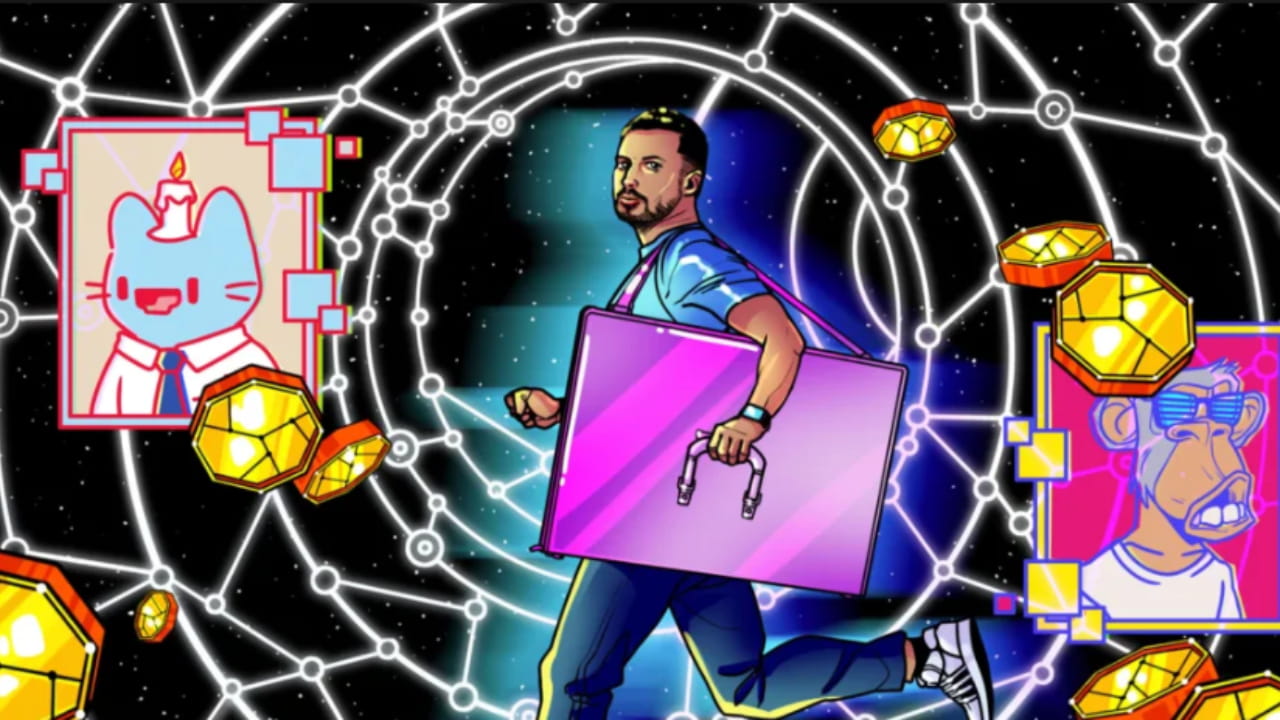
Hervé Larren on Bitcoin, Apes and the psychology of ‘blue-chip’ NFTs