


China is preparing for a major change in how people and businesses prove their identities online. Starting March 1, 2027, new regulations will establish how blockchain-based digital identities can be used across different institutions and services.
The announcement has caught the attention of the blockchain community, and for good reason. It brings together two important areas of technology: digital identity and blockchain infrastructure.
But what does this really mean for ordinary people, businesses, and the cryptocurrency industry?
The answer goes beyond blockchain technology itself.
China wants to make digital identity verification easier, faster, and more consistent. Instead of repeatedly proving who they are to different organizations, people and businesses could use verified digital credentials across participating services.
At the same time, the new framework introduces rules about how identities are verified, how personal information is handled, and which organizations can participate.
The March 2027 deadline is an important milestone, but the bigger story is what China is trying to build and how it could change the way people interact with digital services.
Understanding China’s new blockchain identity rules
China's new regulations focus on something that most people deal with every day without giving it much thought: proving who they are.
Whenever someone opens a bank account, applies for a service, or submits official documents, their identity usually needs to be checked.
Businesses face similar challenges. They often need to provide documents to prove their legal status, verify their representatives, or establish that they are authorized to carry out certain activities.
The problem is that different organizations often have different systems for handling these checks.
China's new framework aims to make that process easier by introducing distributed digital identities.
These identities use blockchain and other distributed technologies to help people and organizations establish their identity and prove specific information about themselves.
For example, imagine someone who graduates from a university and later applies for a job.
Instead of repeatedly submitting paper certificates, the graduate could present a digital credential issued by the university. An employer participating in the system could verify that credential and confirm that it is genuine.
The same idea could apply to professional qualifications, business registration, and other information that needs to be checked.
The goal is not to eliminate identity verification. It is to make verification more reliable and less repetitive.
That is what makes the initiative interesting. China is looking at blockchain as a way to improve the systems people already use, rather than limiting its applications to cryptocurrency.
Why March 1, 2027, matters
The March 1, 2027, date is the official implementation date of China's new distributed digital identity regulations.
The rules were published on November 27, 2026, by the Cyberspace Administration of China and ten other government departments.
This is an important development because the framework involves more than one government agency or a single technology company.
It covers areas such as identity verification, digital credentials, data security, and the organizations responsible for operating the system.
However, there is an important distinction to understand.
The regulations taking effect on March 1 does not mean that every Chinese citizen, business, or online platform will immediately start using a blockchain identity.
Building a system of this size takes time.
Organizations will need to connect their services, establish technical standards, and make sure their systems can recognize and verify digital credentials.
The government will also need to coordinate the institutions responsible for operating the infrastructure.
In other words, March 2027 marks the beginning of the formal regulatory framework. How quickly the system becomes part of everyday life will depend on what happens afterward.
How will blockchain-based digital identities work?
The idea behind a distributed digital identity is fairly simple.
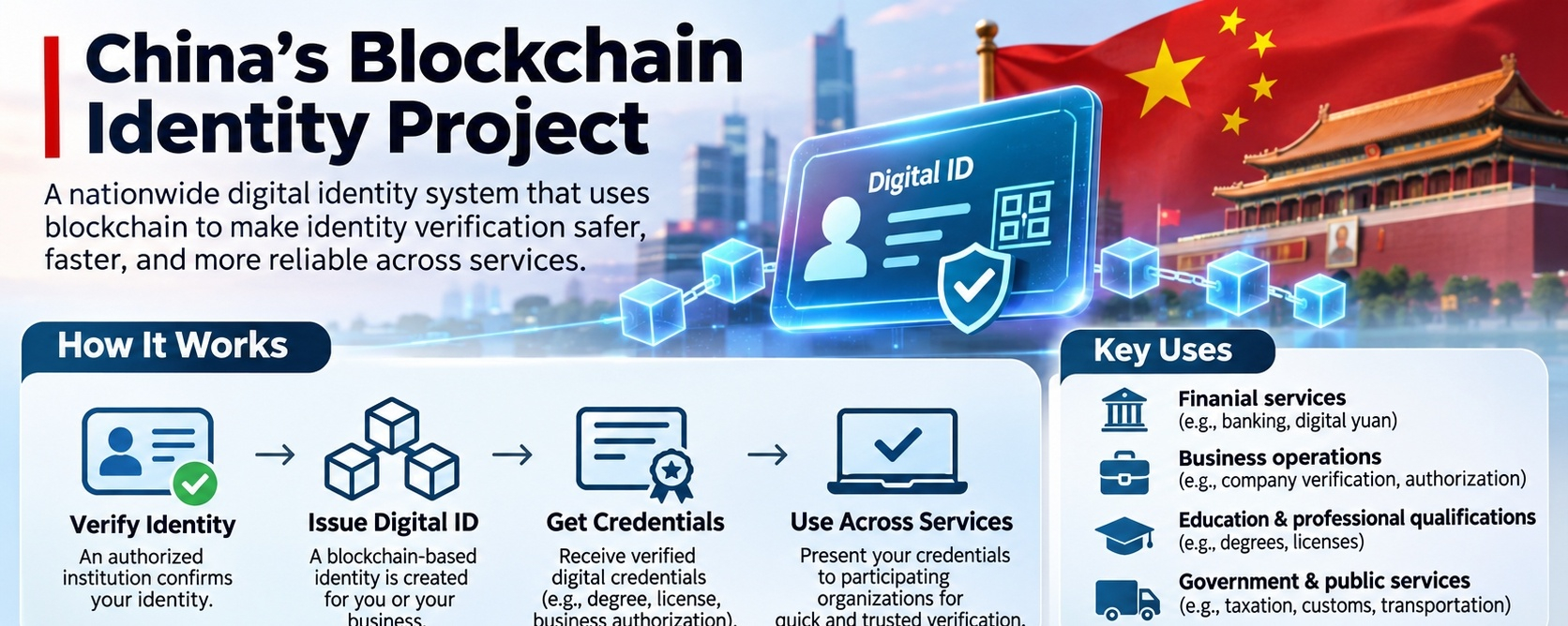
A person or organization first has their identity verified by an authorized institution.
Once that process is complete, a digital identity can be issued. The identity may then be used to obtain digital credentials that confirm specific information.
When the person or organization needs to prove something, they can present the relevant credential to a participating service.
The receiving organization can check whether the credential is genuine and valid through the identity infrastructure.
This could make many everyday processes easier.
For example, a company representative might need to prove that they are authorized to sign a document or complete a particular business transaction.
Instead of relying entirely on paper documents and manual checks, the receiving organization could verify a digital authorization credential.
The same principle could apply to educational qualifications, professional licenses, and other forms of official information.
The important part is that the credential can be checked by different participating organizations.
This is what the regulations mean by interoperability.
In simple terms, the aim is to make digital identities and credentials work across different systems instead of keeping them locked inside one platform.
What does this mean for personal information?
Whenever a country introduces a new digital identity system, privacy becomes an important part of the discussion.
Making identity verification easier is useful, but people also want to know what happens to their personal information.
Who can access it? How much information is being collected? Can it be used for purposes beyond the original reason for verification?
China's new regulations address some of these concerns.
The rules require identity service providers to collect only the information necessary for their activities.
They also restrict unnecessary connections between a user's digital identity and other accounts or personal information held by the same organization.
Where such a connection is necessary, the provider must obtain consent and explain why the information is being connected.
The regulations also place restrictions on using identity-verification data to build user profiles or conduct targeted marketing.
Another interesting feature is the use of verifiable claims.
Instead of automatically sharing an entire digital credential, a user may be able to present only the information needed for a particular purpose.
For example, someone who needs to prove that they hold a professional qualification may not need to share every detail contained in their identity records.
This could reduce unnecessary information sharing.
However, it is important not to confuse digital identity with complete anonymity.
The system still relies on identity verification by authorized institutions, and records must be maintained for oversight and auditing.
The real question is how effectively the privacy protections will work once the system is being used by a large number of organizations.
Why China is building its own blockchain infrastructure
China's digital identity initiative is part of a much wider effort to develop blockchain technology for practical use.
The country has been exploring blockchain applications in areas such as government services, business administration, data exchange, and industrial systems.
The new identity framework fits into that broader strategy.
The national blockchain network is intended to provide the technical foundation for identity registration, credential issuance, and verification.
An authorized operator will manage the identity chain and help participating organizations work together.
This is different from how many public blockchain networks operate.
On an open blockchain, users can often create addresses and participate without asking a central authority for permission.
China's framework follows a different approach.
It relies on recognized identity-verification institutions, authorized service providers, and established technical requirements.
The government wants to create a system where participating organizations can trust the identities and credentials being presented to them.
That approach may make the system easier to manage within China's regulatory environment, but it also means that it is not the same as a permissionless blockchain network.
The regulations establish requirements for cryptographic technology, key management, security, and institutional participation.
These requirements are intended to make the infrastructure reliable as more organizations begin using it.
Could the new rules change financial services?
Financial services are one of the areas where the new identity system could become particularly useful.
Banks and other financial institutions regularly need to verify customer identities, confirm business information, and establish whether someone is authorized to carry out a particular activity.
These checks are necessary, but they can also involve a lot of paperwork and repeated verification.
A standardized digital identity system could make some of these processes easier.
Instead of collecting the same documents repeatedly, participating institutions could use verified digital credentials to confirm relevant information.
For businesses, this could reduce administrative work and make certain services easier to access.
The regulations also encourage connections between distributed digital identities and existing financial identity systems, including the digital yuan.
However, this does not mean China is introducing a new cryptocurrency.
The regulations are focused on identity verification, not on creating a new investment token or allowing unrestricted cryptocurrency trading.
The involvement of financial authorities also does not mean that every blockchain-based financial product will receive regulatory approval.
The actual impact on financial services will depend on how institutions adopt the system and what applications become available.
What businesses could gain from the new system
For businesses, the biggest benefit could be simpler verification.
Companies often need to prove their legal status, confirm the identity of their representatives, or provide documents when dealing with different institutions.
A reusable digital identity could make these processes less complicated.
Imagine a company that needs to complete an administrative process with several different organizations.
Instead of repeatedly submitting documents, it could potentially use recognized digital credentials to establish its identity and verify the authority of its representatives.
This could save time and reduce the amount of manual document checking required.
The regulations encourage the use of distributed digital identities in areas such as taxation, customs, transportation, and public procurement.
These are sectors where reliable identity verification is an important part of everyday operations.
The framework also allows for the development of digital identities for certain industrial devices and physical objects.
That could eventually support more reliable communication between connected devices and industrial systems.
However, these benefits are not guaranteed.
Businesses will need to connect their systems, understand the requirements, and decide whether the infrastructure provides enough value to justify adoption.
The technology may be useful, but its success will depend on how well it works in real business situations.
What does this mean for blockchain and Web3?
The announcement is particularly interesting for the blockchain industry because digital identity is becoming an important part of many online applications.
Some blockchain-based services need to establish whether a user is a real person, whether a business is legally registered, or whether a particular credential is valid.
A reliable digital identity system could help address these needs.
For developers working on identity verification, digital credentials, and data interoperability, China's initiative is worth watching.
It shows that blockchain technology can be used to solve problems that have little to do with cryptocurrency trading.
However, China's framework should not be confused with the decentralized identity systems being developed across public blockchain networks.
The Chinese system relies on government-authorized infrastructure and recognized verification institutions.
It is designed to operate within the country's regulatory environment.
That makes it different from systems where anyone can create an identity and participate without approval from a central authority.
The new regulations also do not automatically establish compatibility with existing public blockchain networks.
For Web3 developers, the more important question is whether the framework creates useful applications and whether its technical standards can support practical use.
Will cryptocurrency investors benefit?
This is probably one of the first questions many people in the crypto community will ask.
Whenever a major country announces a blockchain initiative, investors naturally want to know whether it could affect the digital asset market.
But blockchain adoption and cryptocurrency adoption are not the same thing.
Blockchain is a technology that can be used for identity verification, data management, business applications, and financial services.
Cryptocurrency is only one possible application of that technology.
China's new regulations focus on digital identity infrastructure.
They do not introduce a new cryptocurrency, establish a new token, or announce unrestricted cryptocurrency trading.
The framework also does not create a direct investment opportunity simply because it involves blockchain.
For investors, the announcement is better understood as a development in China's digital infrastructure strategy.
It may become relevant to blockchain businesses and developers, but any impact on cryptocurrency markets would depend on broader developments.
The most important thing is to avoid treating a government blockchain announcement as an automatic bullish signal for Bitcoin, Ethereum, or any other digital asset.
The real value will depend on whether the system becomes useful and whether businesses begin using it at scale.
What about foreign businesses and international users?
China's new regulations also establish procedures for eligible individuals and organizations outside mainland China to apply for distributed digital identities.
This could be useful for foreign businesses that need to interact with Chinese institutions.
A recognized digital identity could help establish organizational status, verify representatives, or support certain administrative processes.
The regulations also encourage cooperation between domestic and overseas digital identity providers.
The aim is to make identity recognition easier across borders while maintaining security and regulatory control.
However, this does not mean that every foreign individual or company will automatically qualify for registration.
Eligibility depends on the applicable requirements and verification procedures.
It also does not mean that a digital identity issued in China will automatically be accepted by every foreign government or business.
Cross-border interoperability will depend on technical standards, legal requirements, and cooperation between participating organizations.
The framework establishes a direction for international cooperation, but the practical results will take time to develop.
The challenges China will need to overcome
Despite the potential benefits, building a nationwide digital identity system will not be simple.
One of the biggest challenges is making different systems work together.
For the framework to be useful, participating organizations need to recognize and verify credentials consistently.
If institutions continue using incompatible technical standards, the benefits of a shared identity infrastructure could be limited.
Security is another major concern.
Digital identity systems contain information that can be valuable to criminals and other unauthorized users.
Protecting identity credentials, cryptographic keys, and verification infrastructure will therefore be essential.
Privacy is equally important.
The regulations establish limits on data collection and certain uses of identity information, but their effectiveness will depend on implementation and oversight.
There is also the question of adoption.
A digital identity system becomes more useful when more organizations recognize and accept its credentials.
Businesses and public institutions will need to connect their systems and develop practical ways to use the infrastructure.
Finally, ordinary users need to understand how the system works, what information they are sharing, and how their credentials can be used.
These challenges do not mean the initiative will fail.
They simply show that building a nationwide digital identity system requires more than publishing regulations or developing blockchain technology.
It requires reliable infrastructure, effective governance, and applications that people and businesses actually want to use.
What to watch before March 2027
The period leading up to March 2027 will be important for understanding how the framework moves from regulation to practical use.
The first thing to watch is the development of technical standards and the identity-chain infrastructure.
The second is the participation of identity-verification institutions, businesses, and government departments.
The third is the introduction of real-world applications.
Financial services, taxation, transportation, customs, and business administration could provide some of the clearest examples of how the system works.
Privacy and security will also be important.
The way participating organizations handle identity information will help determine whether users can trust the system.
For the blockchain industry, the development of technical standards and potential interoperability with other identity systems will be worth following.
The most meaningful developments will not necessarily be the announcements that receive the most attention.
They will be the practical changes that show whether the infrastructure is becoming useful, secure, and widely accepted.
Conclusion: A new chapter in China's digital identity strategy
China's blockchain identity regulations represent an important development in the country's approach to digital infrastructure.
The framework is designed to make digital identities easier to verify and reuse across participating organizations.
It could help reduce repeated identity checks, simplify administrative processes, and create new opportunities for businesses and public institutions.
It also demonstrates how blockchain technology can support applications beyond cryptocurrency trading.
At the same time, the initiative raises important questions about privacy, security, interoperability, and the role of government-authorized identity infrastructure.
The March 1, 2027, deadline is an important milestone, but it is not the end of the story.
The real impact will depend on how the system is implemented, how many organizations adopt it, and whether it delivers meaningful benefits to users.
For the blockchain industry, the announcement is a reminder that the future of blockchain technology will not be shaped by cryptocurrency alone.
Digital identity, data verification, and trusted information exchange are becoming increasingly important areas of development.
China's new framework is a significant example of that shift.
The next phase will be about turning the regulations into a working system that people and businesses can actually use.
Sources and further reading
This article draws on official Chinese government documents, independent reporting, and digital-rights analysis.
China's official distributed digital identity regulations — the primary source for the legal framework, requirements, and implementation date.
Official questions and answers on the new regulations — background on the government's objectives, application areas, and implementation plans.
Crypto.news reporting on China's blockchain identity rules — additional reporting on the new identity framework and its potential applications.
China's National Network Identity Authentication Public Service Management Measures — background on the earlier national Internet identity framework.
ARTICLE 19 and the Network of Chinese Human Rights Defenders — analysis of privacy and online identity concerns surrounding China's broader digital identity policies.
Cointelegraph reporting on China's blockchain-based digital identity regulations — additional context on the new rules and their implications for digital identity interoperability.