$CRV: Checklists vs Speed in Fast Markets
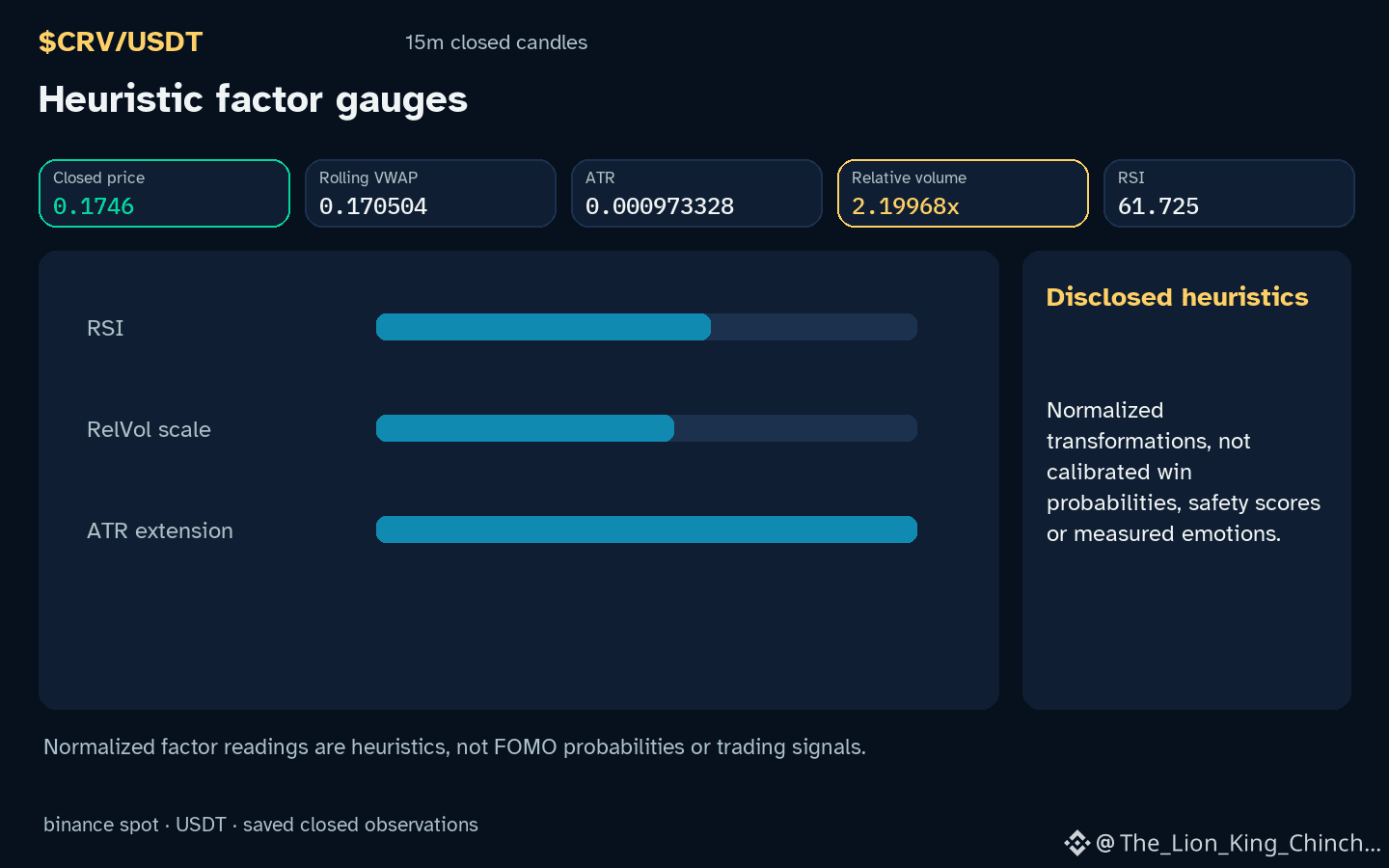
Why does $CRV show an hourly direction up while volume stays 2.20x the baseline? This observation invites a question about the hypothetical checklist used during sudden candle expansion.
Sometimes a researcher meticulously builds a thirty-point safety checklist, only to leave it neatly folded on the desk while excitement grabs the car keys and speeds away. This habit suggests that a fast candle can create a perceived urgency that overrides systematic verification. The useful lesson is that speed itself is not a signal, but a condition that tests the durability of a plan. If a checklist is only followed when the market is slow, it is not a tool; it is a hobby.
Consider the mechanism where a price moves toward resistance at 0.1757 while the RSI reaches 61.7. In a thought experiment, a fast candle might appear to signal a trend shift, yet a closed candle below resistance could equally suggest a local range expansion without a change in direction. The daily change of 0.460299% provides a broader context, but it does not dictate the outcome of the current hourly move.
Evidence for a reversal would be weakened if subsequent candles close above 0.1757 with maintained volume. Conversely, the idea of a breakout weakens if the RSI stays flat while the price returns to the local support at 0.1703. Reassessing the interpretative framework requires waiting for the candle to close before deciding if the movement honors the checklist or merely tests the patience of the observer.
Probabilistic market research, not a recommendation or guaranteed return.
#CRV #LearnCrypto