
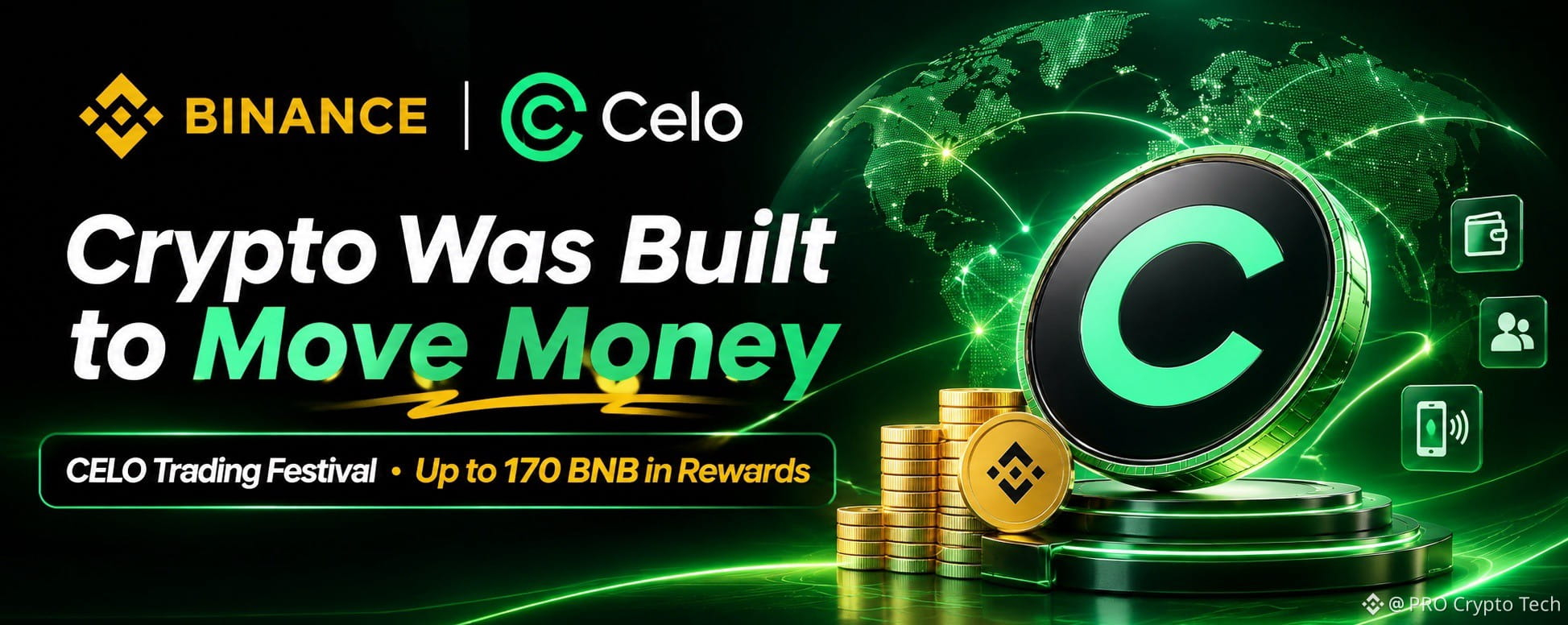


Imagine sending money across borders, paying someone in another country, or accessing digital dollars without dealing with complicated financial systems or expensive transaction fees.
Sounds simple, right?
But for millions of people around the world, moving money is still unnecessarily complicated.
This is one of the problems @celo is trying to solve.
And what’s interesting about Celo is that it isn’t just another blockchain competing for attention. Its focus is much more practical: making digital payments, stablecoins, and financial services easier to access through everyday technology.
Let’s take a closer look.
What Exactly Is Celo?
Celo is an Ethereum Layer 2 blockchain designed around real-world financial use cases, particularly payments and stablecoins.
Originally launched as an independent Layer 1 network, Celo completed its transition to an Ethereum Layer 2 in March 2025, using the OP Stack.
The idea is straightforward: combine Ethereum’s ecosystem and security architecture with an infrastructure designed for fast, affordable transactions.
Celo focuses on making blockchain technology useful beyond trading and speculation.
Think about payments, savings, remittances, decentralized finance, and access to digital currencies.
These are the kinds of applications Celo wants to support.
Why Is Celo Different?
One of the biggest challenges in crypto is turning blockchain technology into something ordinary people actually use.
Celo approaches this through three important areas.
1. Stablecoin Payments
Stablecoins are becoming an important part of digital finance because they offer access to currencies such as the US dollar without requiring users to deal with traditional banking infrastructure for every transaction.
Celo supports a growing ecosystem of stablecoins, including USDT and USDC, alongside local-currency stable assets.
This creates opportunities for payments, transfers, and other financial applications.
2. Affordable and Fast Transactions
Nobody wants to pay more in transaction fees than the amount they’re actually sending.
Celo is designed for low-cost transactions and approximately one-second block times.
Another interesting feature is fee abstraction, which allows supported tokens, including stablecoins, to be used for gas payments.
That means users don’t always need to hold a separate token just to pay network fees.
3. Real-World Mobile Adoption
This is where things get particularly interesting.
MiniPay, a self-custodial stablecoin wallet built by Opera on Celo, has surpassed 20 million activated wallets.
According to Celo’s November 2026 announcement, the ecosystem has also processed more than 600 million MiniPay transactions.
That’s an important development because it shows how blockchain infrastructure can support products designed for everyday users rather than only crypto traders.
What Is the CELO Token Actually Used For?
A blockchain’s technology is one thing, but its native token also needs a meaningful role in the ecosystem.
CELO serves several functions within the network.
Network fees: CELO is the native asset associated with transaction fees, although Celo also supports gas payments in other approved tokens.
Governance: CELO holders can participate in governance decisions and help shape the network’s future.
Staking and ecosystem participation: CELO can be locked to participate in the network’s applicable staking and reward mechanisms.
So CELO isn’t simply a token attached to a blockchain name. It has an actual role in the ecosystem’s infrastructure and governance.
Of course, utility doesn’t guarantee token price appreciation. That’s an important distinction every crypto investor should understand.
The CELO Trading Festival Is Now Live on Binance!
Now here’s something worth checking out.
Binance has teamed up with Celo for the CELO Trading Festival, featuring a total reward pool of up to 170 BNB across three promotional activities.
The campaign runs from November 20 to December 20, 2026.
Here’s how it works:
Promo A – Trading Tournament (Up to 75 BNB)
Eligible participants can join the competition, trade at least 500 USDT in CELO/USDT Spot trading volume, and compete on the leaderboard.
Eligible top-ranked participants can receive rewards according to the campaign rules.
Promo B – Welcome Rewards (70 BNB)
Eligible new users can register, complete KYC, purchase the required amount of CELO based on their country, and hold it in Simple Earn Flexible for three full days.
Rewards are limited and distributed on a first-come, first-served basis.
Final Thoughts
What I find interesting about Celo is its focus on something crypto has been promising for years: making digital money genuinely useful in everyday life.
Payments, stablecoins, mobile wallets, and financial accessibility are much bigger opportunities than simply creating another token and hoping people trade it.
Celo still faces competition and has plenty to prove, but its growing ecosystem and real-world usage make it a project worth understanding.
The bigger question isn’t just how high $CELO can go.
It’s how much of everyday finance blockchain technology can actually improve.
What do you think? Will payment-focused blockchains like Celo become one of crypto’s biggest use cases?
Share your thoughts below.
This article is for educational purposes only and is not financial advice. Cryptocurrency investments involve risk. Always do your own research.