


When I look at the crypto industry, one thing becomes increasingly clear: building a blockchain is one challenge, but giving people a genuine reason to use it is another.
We have seen hundreds of networks compete for attention through faster transactions, lower fees and new technical features. Yet, everyday payments remain one of the areas where blockchain technology still has plenty of room to grow.
This is where Celo catches my attention.
Instead of focusing entirely on trading activity or speculative applications, Celo has spent years developing an ecosystem around mobile accessibility, stablecoins and affordable financial services.
Its direction is particularly interesting because it connects two worlds that do not always work together smoothly: traditional financial needs and blockchain infrastructure.
I believe understanding this strategy is more important than simply looking at the latest CELO price movement.
MiniPay: Making Stablecoins Easier for Ordinary People
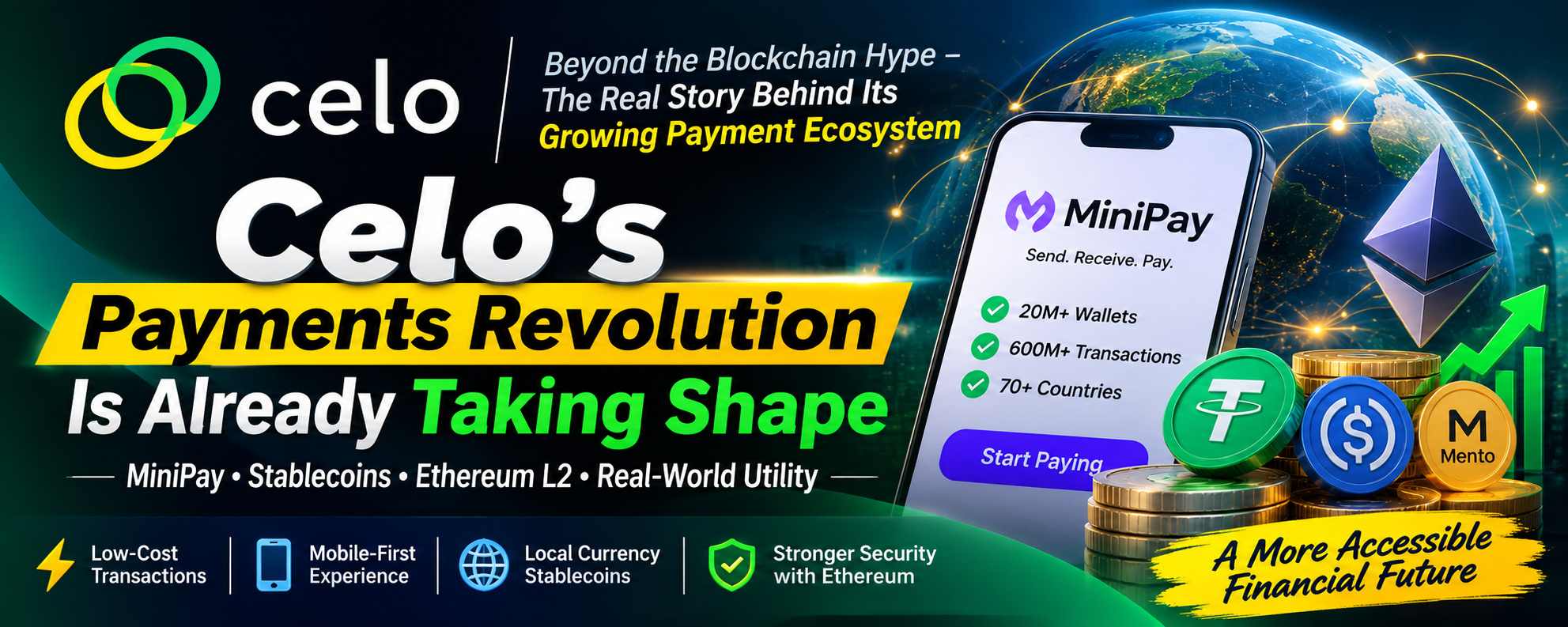
One of the strongest parts of Celo's ecosystem is MiniPay, a self-custodial stablecoin wallet developed by Opera.
What makes MiniPay interesting is its approach to user experience.
Most people do not want to learn how blockchain networks work before sending money. They want an application that is simple, familiar and reliable.
MiniPay is designed around that idea.
Its mobile-first experience makes it easier for users to access stablecoins, transfer funds and interact with applications without dealing with every technical detail behind a blockchain transaction.
Its reported October 2026 ecosystem figures were also worth noticing:
- More than 20 million wallet activations.
- Over 600 million transactions processed.
- More than $2.3 billion in processed volume.
- Availability across more than 70 countries.
- 77 Mini Apps.
Of course, these figures need context. Wallet activations are not necessarily unique active users, and cumulative transaction volume does not tell us how frequently people return to make payments.
For me, the real question is whether MiniPay can turn its distribution into regular financial activity.
That is what will matter over the long term.
The Privy Integration: A Practical Step Toward Better Wallet Experiences
On November 19, 2026, MiniPay announced its upgrade to Privy, Stripe's wallet infrastructure platform.
I find this development interesting for a simple reason: wallet complexity remains one of the biggest obstacles to crypto adoption.
The integration introduces email and social login options, alongside passkey-based access.
It also maintains self-custody and the ability for users to export their private keys.
This combination is important.
People want convenient access to their money, but they also need control over their assets.
Traditional wallets can make onboarding difficult for newcomers, particularly when seed phrases and private-key management become part of the first experience.
MiniPay is attempting to make that process more approachable without completely giving up the self-custody model.
Whether this translates into stronger retention will become clearer as more users adopt the updated experience.
Stripe and Stablecoin Payments: Connecting Two Financial Worlds
Another development worth watching is MiniPay's connection with Stripe's payment infrastructure.
On November 12, 2026, MiniPay announced stablecoin deposit support through Link by Stripe for users in the United States and European Union.
Supported payment methods include cards, Apple Pay and Google Pay.
Why does this matter?
Because accessing a blockchain wallet is only one part of the problem.
People also need a convenient way to move money into that wallet.
A low-cost blockchain does not solve everything if purchasing or depositing digital assets remains difficult.
This integration attempts to reduce that friction by connecting familiar payment methods with stablecoin access.
I would not treat this as proof of mass adoption or assume that every Stripe customer will become a Celo user.
But it is a practical infrastructure development, and those are often more meaningful than partnerships that exist mainly in announcements.
Mento: Why Local Currency Stablecoins Matter
Another part of Celo that deserves more attention is Mento.
While much of the stablecoin market revolves around US dollar assets, Mento's approach includes stable assets connected to different local currencies.
This is an important distinction.
Financial needs are not identical everywhere.
Someone in Brazil may prefer holding Brazilian reais. A European business may need euros, while users in West Africa may have different currency requirements.
Mento's ecosystem includes assets such as:
- USDm, connected to the US dollar.
- EURm, connected to the euro.
- BRLm, connected to the Brazilian real.
- XOFm, connected to the West African CFA franc.
The broader idea is to make local currencies available within blockchain-based financial applications.
This could support payments, savings, transfers and onchain foreign exchange.
However, I would not confuse the availability of a currency token with successful financial adoption.
Liquidity, reserve management, redemption arrangements and issuer transparency remain essential.
A stablecoin needs to be useful and dependable, not simply available on a blockchain.
Why Celo's Low Transaction Costs Matter
Sometimes the most valuable blockchain features are not the most complicated ones.
Celo's focus on inexpensive transactions is a good example.
The network is designed for relatively fast transactions and low fees, making it suitable for applications where people may need to move smaller amounts frequently.
Another useful feature is fee abstraction.
On many networks, users need a separate native token to pay gas fees.
This creates unnecessary friction for someone who simply wants to transfer stablecoins.
Celo supports paying transaction fees using selected ERC-20 assets, including supported stablecoins.
Imagine receiving USDC and wanting to send some of it to another person.
You should not always need to purchase another cryptocurrency just to complete that transfer.
This is a small design decision, but it makes a meaningful difference to the overall experience.
The easier it becomes to use blockchain infrastructure without thinking about it, the more practical these applications can become.
Celo's Ethereum Layer 2 Transition: A New Technical Foundation
Celo's move from an independent Layer 1 to an Ethereum Layer 2 on March 26, 2025, was an important turning point.
The network adopted the Optimism OP Stack while maintaining its focus on payments and financial accessibility.
Its architecture also uses EigenDA for data availability.
This gives Celo access to Ethereum's broader ecosystem while allowing it to maintain its own application environment.
I think the important point here is that Celo did not need to abandon its original identity to change its infrastructure.
Its payment-focused applications and stablecoin strategy remained central to its development.
The Jello upgrade in December 2025 also advanced its verification infrastructure through OP Succinct Lite and improvements involving EigenDA.
However, Ethereum settlement should not be confused with every security component being identical to a conventional Ethereum rollup.
Data availability, bridge assumptions, upgrade permissions and decentralization remain important considerations.
Technical progress matters, but security should always be evaluated carefully.
Local Financial Markets Could Be an Important Opportunity
What makes Celo's stablecoin strategy more interesting is its potential to serve different markets rather than concentrating exclusively on dollar-based payments.
Its ecosystem has expanded to include assets such as cNGN, IDRX and Ripio's wFIAT stablecoins.
These developments connect the network with currencies and financial markets across different regions.
I think this approach makes sense.
A financial application designed for international users should recognize that people have different currencies, different payment habits and different financial requirements.
For example, local-currency stablecoins could help businesses explore new settlement options without making every transaction dependent on a dollar conversion.
But the opportunity comes with challenges.
Local regulations, exchange liquidity, issuer reliability and redemption infrastructure will determine whether these assets become genuinely useful.
The long-term value will come from real financial activity, not simply increasing the number of supported tokens.
What Could AI Payments Mean for Celo?
Another area that deserves attention is agentic commerce.
AI applications are becoming increasingly capable of interacting with online services, accessing information and completing digital tasks.
Some of these services may eventually need to make payments automatically.
This is where x402 becomes relevant.
The protocol allows online services to request payments through HTTP-based payment flows.
Celo's x402 infrastructure supports stablecoin-based payments, creating opportunities for applications and AI agents to pay for digital services.
The October 2026 introduction of the buy marketplace, with access to more than 700 services, represents another development in this direction.
I find the idea interesting, but I would remain realistic about its current stage.
Agentic payments still need to demonstrate consistent demand, reliable settlement and secure transaction execution.
The infrastructure is developing, but its long-term importance will depend on whether businesses and developers actually use it.
Understanding the Role of the CELO Token
While Celo's ecosystem is expanding, the CELO token continues to play an important role.
Its main functions include:
Transaction Fees: CELO serves as the native gas asset, although supported alternative currencies can also be used for fees.
Governance: CELO holders can participate in decisions affecting the network.
Staking: The token participates in Celo's proof-of-stake framework.
Network Development: Governance and ecosystem mechanisms help support the network's continued development.
One point I would emphasize is that growing network adoption does not automatically guarantee an increase in CELO's price.
Stablecoin transactions can increase network usage without creating proportional demand for the native token.
That is why network activity, staking participation, token economics and sustainable demand should all be evaluated separately.
Five Things I Would Watch Going Forward
Rather than focusing only on announcements, I would pay attention to five developments.
1. MiniPay's Active Users
Are people returning regularly, or are wallet activations simply increasing?
2. Stablecoin Liquidity
Can users reliably move between different currencies without significant friction?
3. Stripe and Privy Integration
Will easier onboarding and payment access translate into meaningful adoption?
4. Network Security
Can Celo continue improving verification, decentralization and data availability?
5. CELO's Economic Value
Will increasing network activity create sustainable demand for the native token?
These questions will provide a much clearer picture of Celo's progress than short-term market excitement.
Final Thoughts: Celo's Real Opportunity Is in Everyday Finance
The more I look at Celo, the more I think its strongest opportunity lies outside the usual crypto competition.
Its ambition is not simply to become another blockchain with inexpensive transactions.
It is trying to build an environment where people can access stablecoins, send money, interact with local currencies and use financial applications without needing extensive blockchain knowledge.
MiniPay is helping bring that experience to mobile users.
Privy and Stripe integrations are working to reduce onboarding and payment friction.
Mento is developing local-currency infrastructure.
Ethereum provides the settlement foundation, while Celo continues building around its payment-focused identity.
There are still questions about liquidity, security, regulation, user retention and token economics. Those challenges deserve attention, and none of the developments guarantees future market performance.
But I believe Celo is pursuing a practical direction.
Crypto does not become useful simply because a network processes more transactions or announces another integration.
It becomes useful when people have a real reason to use it.
That is the opportunity Celo is working toward.
The future of blockchain payments will not be decided by technology alone. It will be decided by how naturally that technology fits into people's everyday lives.
