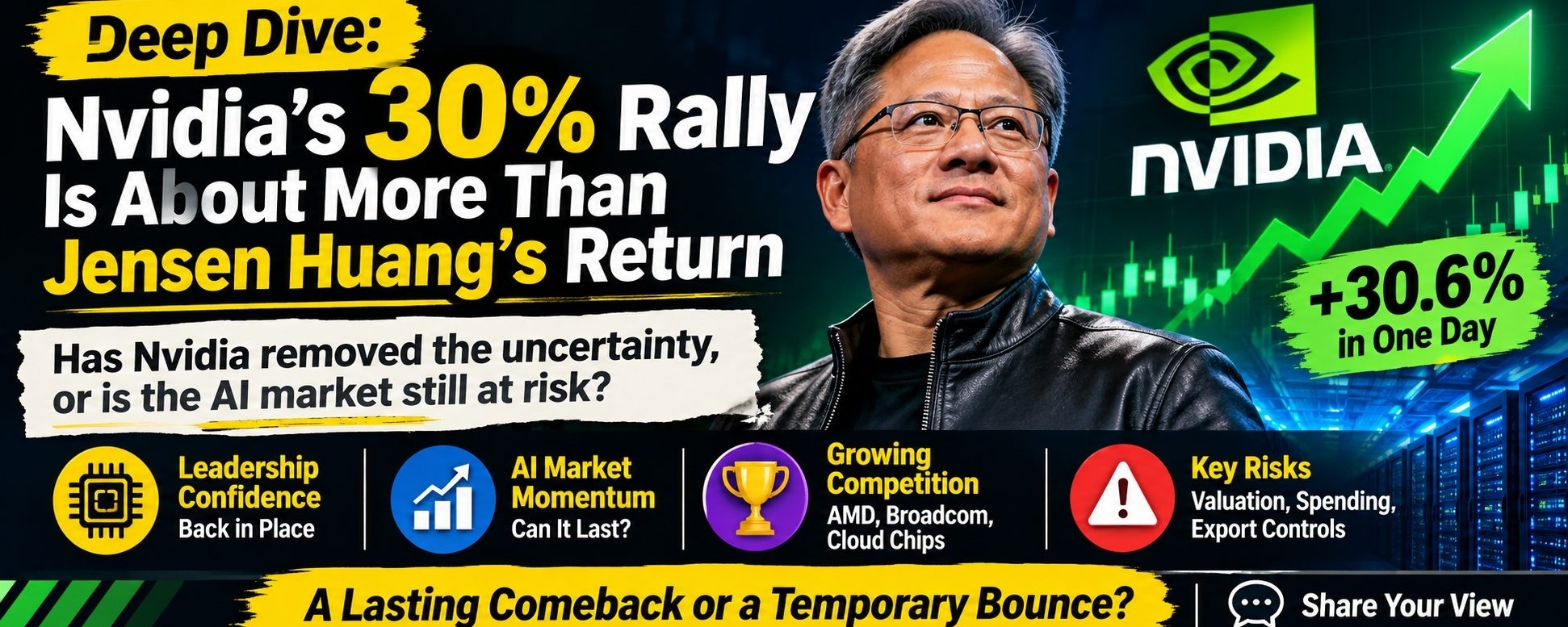


Deep Dive: Nvidia's 30% Rally Is About More Than Jensen Huang's Return
The real question: Has Nvidia removed the uncertainty surrounding its leadership, or has the market simply postponed its bigger concerns about AI?
Nvidia's dramatic rebound on November 23, 2026, highlights how much confidence in the AI industry remains connected to one company and its founder. Jensen Huang is back as CEO, but the market still has to assess Nvidia's long-term competitive position, corporate governance and the economics of the AI investment cycle.
1. Leadership confidence versus business fundamentals
Nvidia's rally reflects the removal of an immediate leadership uncertainty.
However, there is an important difference between restoring confidence in management and resolving the risks facing the business.
The return of Jensen Huang may reassure investors about strategic continuity, customer relationships and execution. But it does not automatically resolve concerns about AI infrastructure spending, chip-export restrictions, competition or the returns on massive data-center investments.
My central argument: Nvidia's leadership uncertainty has eased, but the broader AI investment debate remains open.
2. What happened?
According to NVIDIA's official November 23 announcement and its SEC filing, the board unanimously reinstated Jensen Huang as president, CEO and a board director, effective immediately.
The decision followed discussions with Huang and input from senior US government officials.
The company also confirmed that Colette Kress would continue as CFO.
There is an important detail investors should not overlook: Nvidia's independent investigation into reported foreign-intelligence targeting of Huang will continue. The company has also established a National Security and Export Control Committee and plans to appoint a Chief Compliance Officer.
This means the leadership reversal does not mean every governance or compliance question has been closed.
3. The numbers: What the market is telling us
According to Reuters, the Associated Press, CNBC and Yahoo Finance reporting on November 23:
- Nvidia: Shares surged approximately 31–33% during Monday's trading, depending on the reporting snapshot.
- Nasdaq Composite: Finished approximately 6.8% higher.
- S&P 500: Advanced approximately 4.9%.
- Dow Jones: Gained approximately 3.2%.
- Market capitalization: Nvidia added an estimated $900 billion to its market value, according to Reuters.
These figures show that the reaction extended beyond Nvidia.
The rally also suggests that investors had priced a meaningful amount of leadership uncertainty into technology stocks.
But a one-day rally is not proof of a sustainable market recovery.
4. Nvidia versus its competitors
Nvidia does not operate in an empty market. Its competitive position needs to be evaluated against several different business models.
AMD — Advanced Micro Devices
AMD competes in data-center accelerators and CPUs. Its importance is not simply whether it can match Nvidia's products, but whether customers can build viable alternative AI infrastructure around its hardware and software ecosystem.
Broadcom — Custom AI infrastructure
Broadcom participates in the AI infrastructure market through networking and custom accelerator solutions. Its business highlights another important competitive possibility: large technology companies may increasingly develop specialized chips rather than depend entirely on general-purpose GPU platforms.
Cloud providers — Internal AI chips
Major cloud companies are developing their own AI silicon. Their incentive is straightforward: greater control over hardware, supply, cost and infrastructure efficiency.
The competitive question is therefore bigger than which company produces the fastest chip.
It is about who can deliver the best overall economics for AI computing.
5. Risks investors should not ignore
1. Leadership and governance risk
The board has reinstated Huang, but its independent investigation remains ongoing. Investors still need clarity around governance and oversight.
2. AI spending sustainability
AI infrastructure requires substantial capital expenditure. If the commercial returns fail to justify that spending, demand expectations could change.
3. Competition
AMD, Broadcom and internally developed cloud chips could challenge Nvidia's position in different parts of the AI supply chain.
4. Export controls
Nvidia's international business remains exposed to restrictions on advanced semiconductor exports. Regulatory developments could affect its addressable market.
5. Valuation and market concentration
When a single company has an outsized influence on technology indices and AI sentiment, its volatility can affect the broader market.
6. What would change my mind?
investors welcomed the return of Nvidia's founder, and the announcement helped trigger a broad technology-market rebound.
It does not yet establish that the AI sector's previous concerns have disappeared.
I would become more constructive on the sustainability of this recovery if Nvidia maintains strong business execution, customers continue investing in AI infrastructure, and the market sees evidence that those investments are generating meaningful economic returns.
I would become more cautious if AI capital expenditure weakens, competition accelerates faster than expected, or governance and export-control concerns intensify.
The market may have regained confidence in Nvidia's leadership, but confidence in the AI investment cycle still needs to be earned through results.
What I'm watching:
- Nvidia's next financial results and forward guidance.
- AI infrastructure spending and evidence of customer returns.
- Developments in Nvidia's governance investigation and semiconductor export controls.
This is analysis, not financial advice.
Do you think Nvidia's rebound marks renewed confidence in the AI industry, or is the market still underestimating the risks?
#NVIDIAReinstatesJensenHuangasCEO